1
SEXUALLY TRANSMITTED
INFECTION(STI) IN WOMEN
Names REGISTRATION NUMBER
AKAYEZU Jean Claude 023/09/MDW/1586
NIYONSENGA EAMMANUEL 023/09/MDW/1598
UWAMAHORO CLEMENTINE 023/09/MDW/1617
MANIRAKIZA PASCAL 023/09/MDW/1570
MPOREBUKE JEAN 023/09/MDW/1572
DUSENGIMANA OSEE 023/09/MDW/1609
2
Sexually Transmition (STIs)
• Sexually transmitted Infections (STIs) are infections
that are spread by sexual contact with someone who
has an STI.
STIs are caused by bacteria, viruses, and parasites
spread through sexual contact. Infections can be found
in body fluids such as semen, on the skin of the genitals
and areas around them, and some also in the mouth,
throat, and rectum.
STIs are mostly spread through vaginal, anal, or oral
sex, and genital touching.
3
Sexually Transmition infections
(STIs)
• Some STIs cause no symptoms. Others can cause
discomfort or pain. If not treated, some can cause
pelvic inflammatory disease, infertility, chronic pelvic
pain, and cervical cancer. Some STIs can also greatly
increase the chance of becoming infected with HIV.
• STIs spread in a community because an infected
person has sex with an uninfected person. The more
sexual partners a person has, the greater his or her
risk of either becoming infected with STIs or
transmitting STIs.
4
STI:CLASSIFICATION
Three major groups:
1. Bacterial
2. Viral
3. Parasites
5
STI:CLASSIFICATION
Bacteria STIs with Causative agent
Syphilis : T. pallidum ( a spirochaete)
Chancroid: Haemophilus ducreyi( a gram negative
bacillus)
Lymphogranuloma Venereum (LGV):Clamydia
trachomatis
Bacterial vaginosis: Gardnerella vaginalis ( an
anaerobic bacterium) and Mycoplasma hominis.
6
STIS:CLASSIFICATION
Gonorrhoea: Neisseria gonorrhoeae( a gram
negative
diplococcus)
Non-gonococcal urethritis: Clamydia trachomatis,
Mycoplasma genitalium, Ureaplasma urealyticum
and
rarely other organisms.
7
STI:CLASSIFICATION
Viral STIs causative agent
Genital herpes: Herpes simplex virus-1( HSV1), Herpes
simplex virus-2( HSV-2)
Anogenital warts: Human papilloma virus (HPV) (various
subtypes)
Hepatitis: Hepatitis virus A, B, C and E
Infectious mononucleosis: Cytomegalovirus( CMV)
Human immunodeficiency virus (HIV/AIDS)
8
STI:CLASSIFICATION
Prasites
Trichomoniasis: Trichomonas vaginalis(a
protozoan)
Candidial vulvovaginitis : candida albicans and
other
species of candida
9
STI: SYPHILIS
• Caused by Treponema pallidum
• Incubation period: 9-90 days, usually 3-6 weeks
• Syphilis has a natural course having three stages:
primary, secondary and tertiary.
10
STI: SYPHILIS
Clinical features:
1. Primary syphilis:
Classical lesion is the chancre which is a painless genital
ulcer commonly on the cervix. Classically indurated,
firm, non-tender, round to oval with minimal or
no discharge, and does not bleed on palpation.
Incubation: 10 to 90 days. Resolve in 2 to 6 weeks.
11
STI: SYPHILIS
Clinical features:
- The other sites of the chancre are the labia, fourchette,
urethra, and perineum;
- Extragenital sites include the anus, mouth, oropharynx,
and breast.
-“Kissing lesions” may occur in areas of skin-to-skin
contact as on the vulva
-Regional lymph nodes often involved.
12
Secondary Syphilis
• Secondary lesions occur several weeks after the
primary chancre appears; and may persist for weeks
to months.
• Primary and secondary stages may overlap
• Mucocutaneous lesions most common
• Serologic tests are usually highest in titer during this
stage.
13
STI: SYPHILIS
Clinical features:
2. Secondary syphilis:
Secondary syphilis may be asymptomatic and may
be
detected in women with a history of recurrent
spontaneous abortions.
14
STI: SYPHILIS
Clinical features:
Latent syphilis: from untreated secondary syphilis
- Early latent syphilis: if the latent period is less than two
years after the primary infection.
- If more than two years have elapsed from the primary
infection it is called late latent syphilis.
- 1/3 of patients with latent syphilis develop tertiary syphilis
15
STI: SYPHILIS
Clinical features:
3. Tertiary syphilis:
oTertiary syphilis is rarely seen nowadays due to prompt treatment of
the primary lesion.
oThere is involvement of the neurological and cardiovascular system.
oEndarteritis leads to aortic aneurysm and aortic insufficiency, tabes
dorsalis, optic atrophy, and meningovascular syphilis, as well as
gummatous lesions
16
Neurosyphilis
• Occurs when T. pallidum invades the central nervous system
(CNS)
• May occur at any stage of syphilis
• Can be asymptomatic
• Early neurosyphilis occurs a few months to a few years after
infection
• Clinical manifestations can include acute syphilitic meningitis,
meningovascular syphilis, and ocular involvement
• Neurologic involvement can occur decades after infection
and is rarely seen
• Clinical manifestations can include general paresis, tabes dorsalis,
and ocular involvement
• Ocular involvement can occur in early or late neurosyphilis.
17
Congenital Syphilis
• Occurs when T. pallidum is transmitted from a
pregnant woman to her fetus
• May lead to stillbirth, neonatal death, and infant
disorders such as deafness, neurologic impairment,
and bone deformities
• Transmission can occur during any stage of syphilis;
risk is much higher during primary and secondary
syphilis
• Fetal infection can occur during any trimester of
pregnancy
• Wide spectrum of severity exists; only severe cases
are clinically apparent at birth
18
STI: SYPHILIS
Effect on pregnancy
Syphilis is a systemic infection from the onset and has
multi-systemic manifestations.
The effect on pregnancy depends upon the duration of
the disease stage i.e longer the duration of untreated
maternal syphilis , most is the effect on the fetus
( Kassowitz law)
19
STI: SYPHILIS
Effect on pregnancy
With primary and secondary syphilis: 50% chance of
preterm labour, stillbirth, neonatal death or
congenital syphilis in the neonate
With latent syphilis 9% go into preterm labour, 11% are
stillbirth, and only 10% are born with congenital syphilis.
20
STI: SYPHILIS
Effect on pregnancy
However a patient who has previously had several
miscarriages, stillbirths, and children with
congenital syphilis may later give birth to a healthy
non-infected child.
A positive serology at birth does not necessarily
indicate the presence of neonatal infection.
21
Clinical History
Assess
• History of syphilis
• Known contact to an early case of syphilis
• Typical signs or symptoms of syphilis in the past
12 months
• Most recent serologic test for syphilis
22
Physical Examination
• Oral cavity
• Lymph nodes
• Skin of torso
• Palms and soles
• Genitalia and perianal area
• Neurologic examination
• Abdomen
23
STI: SYPHILIS
Diagnosis:
 Screening tests: VDRL and RPR
 Specific Tests: TPHA, FTA-ABS test
 Dark ground illumination(DGI):microscopy
demonstrating the presence of T.pallidum from
ulcers, moist lesions, and mucous membranes.
24
STI: SYPHILIS
VDRL: Venereal Disease Research Laboratory
RPR: Rapid plasma reagin
TPHA: Treponemal pallidum haemagglutination assay
FTA-ABS: Fluorescent Treponemal Antibody Absorption Test.
25
STI: SYPHILIS
Treatment:
The recommended regimens for adults are as follows:
 Primary, secondary, or early latent stage:
1. Benzathine penicillin G: 2,4 million units IM as a single
dose( half in each buttock)
2. doxicycline 100: orally BD or Tetracycline 500 mg orally four
times daily for 2 weeks in nonpregnant patients with penicillin
allergy
26
STI: SYPHILIS
Treatment:
 Late latent syphilis, tertiary syphilis or syphilis of
unknown duration:
1. Benzathine penicillin G: 2,4 million units IM once
a week for 3 consecutive weeks.
2. doxicycline 100: orally BD or Tetracycline 500 mg
orally four times daily for 4 weeks in nonpregnant
patients with penicillin allergy
27
STI: SYPHILIS
Treatment :
 Neurosyphilis:
Crystalline penicillin G: 3 to 4 million units
intravenously every 4 hrs or 18 to 24 million units
daily
as continuous infusion for 10 to 14 days.
28
STI: SYPHILIS
Treatment :
 Pregnant women:
Same regimens are given depending upon the
stage of syphilis.
If allergy: Erythromycin 500 mg 4 times daily for
14 days.
STI: CHANCROID
29
STI:CHANCROID
- Also called as “soft sore”.
- Genital ulcerative disease.
- Caused by Haemophilus ducreyi, a gram-negative bacillus.
- Inoculated through micro-trauma or abrasion during sexual
intercourse.
30
STI:CHANCROID
Clinical features:
1. Symptoms:
- Pain on micturition or defecation, vaginal
discharge, dyspareunia as the usual symptoms as
the women are unaware of their lesions.
31
STI:CHANCROID
Clinical features:
2. Signs:
• Multiple ulcers( fourchette, vestibule, labia, clitoris, vagina and
the perianal area).
• Painful and tender inguinal lymphadenopathy (bubo) usually
starting on one side and then appearing bilaterally is common.
32
STI:CHANCROID
Diagnosis:
-clinical examination: accuracy of 30-50%
-A probable diagnosis of chancroid can be made if following
are present:
a. one or more painful genital ulcers
b. regional lymphadenopathy
c. dark ground examination(DGI) of ulcer exudates is
negative for T. pallidum( but keep in mind that more than
one STD often occur simultaneously) .
33
STI:CHANCROID
Diagnosis(cont’d):
d. the serological test for syphilis performed at
least 7 days after the onset of ulcers is non-reactive
e. the test of herpes simplex is negative.
f. isolation of H. ducreyi from the genital ulcer or
bubo-smears
g. culture: gives the definitive diagnosis
34
STI:CHANCROID
Treatment:
Any one of the following drugs can be given:
Azithromycin:1g orally , single dose, or
Ceftriaxone : 250 mg IM, single dose
Ciprofloxacin 500 mg orally twice a day for 3 days
Erythromycin 500 mg orally, 4 times a day, for 7days.
35
STI:CHANCROID
Treatment:
For pregnant and lactating women, Ceftriaxone and
Erythromycin are preferred.
36
Gonorrhea
 INTRODUCTION: Gonorrhoea is a major public
health challenge today, due to the high incidence of
infections accompanied by a dwindling of treatment
options.
 Gonoccocal infections can be prevented through
safer sexual intercourse.
 These infections represent 106 million of the
estimated 498 million new cases of curable STIs that
occur globally every year(WHO,2017).
STI:GONORRHEA
Caused by Neisseria gonorrheae, a gram
negative diplococcus. Intracellulary in
leucocytes.
Humans are the only natural host.
In women: cervicitis, urethritis, PID, and acute pharyngitis,
In men: urethritis, prostatitis, and epididymitis,
In newborns: exposure at birth may cause blindness,
infection of the joints, or even serious sepsis;
38
STI:GONORRHEA
Transmission:
From men to women by sexual contact.
Risk factor:
1. young age
2. multiple sexual partners
3. failure to use barrier contraception
4. early sexual activity
39
Gonorrhea Curriculum
40
Transmission
• Efficiently transmitted by
– Male to female via semen
– Vagina to male urethra
– Rectal intercourse
– Fellatio (pharyngeal infection)
– Perinatal transmission (mother to infant)
• Gonorrhea associated with increased
transmission of and susceptibility to HIV
infection
Epidemiology
Gonorrhea
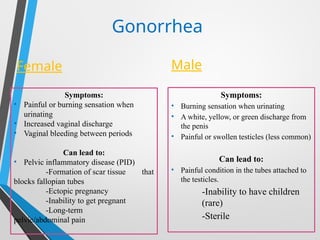
Female
Symptoms:
• Burning sensation when urinating
• A white, yellow, or green discharge from
the penis
• Painful or swollen testicles (less common)
Can lead to:
• Painful condition in the tubes attached to
the testicles.
-Inability to have children
(rare)
-Sterile
Male
Symptoms:
• Painful or burning sensation when
urinating
• Increased vaginal discharge
• Vaginal bleeding between periods
Can lead to:
• Pelvic inflammatory disease (PID)
-Formation of scar tissue that
blocks fallopian tubes
-Ectopic pregnancy
-Inability to get pregnant
-Long-term
pelvic/abdominal pain
STI:GONORRHEA
Clinical features:
In both sexes, when symptoms occur, they
usually appear 2 to 5 days after exposure but
may not be evident for 30 days.
Symptoms of gonococcal PID often occur after
a menstrual period.
42
STI:GONORRHEA
Clinical features:
symptoms include:
a. Mucopurulent discharge, as occurs in acute
cervicitis
b. Lower abdominal pain, anorexia, and fever, as is
characteristic, of acute PID; perihepatitis can
also occur because of peritoneal spread of
infection.
c. Dysuria ( men and women)
43
STI:GONORRHEA
Clinical features:
1. The commonest manifestation of gonorrhea in women is
cervicitis;
2. Endometritis, salpingitis, and rarely perihepatitis occur as
complications.
3. Urethritis is uncommon and when present, manifests as
moder ate burning micturition, frequency and urgency.
4. conjunctivitis, tonsillitis, and proctitis(anal intercourse) can
also occur.
44
STI:GONORRHEA
Complications:
1.Salpingitis:
- chronic infection leads to hydro or pyosalpinx.
45
STI:GONORRHEA
Complications:
2. Bartholin’s gland abscess:
- pus on pressure,
- small indurated swelling of the duct or gland due to
recurrent infection.
3. Disseminated infection
46
STI:GONORRHEA
Laboratory diagnosis:
1.Depends on the identification of (N.
gonorrhea( Microscopy and culture)
2. Specimen taken from endocervix, urethra,
rectum, or oropharynx.
3. The organisms are visualized on gram staining
with oil immersion as intracellular gram negative
diplococci.
47
STI:GONORRHEA
Treatment:
Uncomplicated infection:
Cefixime 400 mg orally in a single dose or
Ceftriaxone 125 mg IM in a single dose, or
Ciprofloxacin 500 mg orally, or ofloxacin 400 mg
orally or levofloxacin 250 mg orally, in a single
dose.
48
STI:GONORRHEA
Treatment:
Approximately 10% to 30% of women with
genital gonorrhea are also infected with
Clamydia.
Therefore, the treatment regimen should
always include:
Azithromycin 1g orally, or
doxicycline100 mg orally, twice a day for 7 days.
49
STI:GONORRHEA
Treatment:
For disseminated gonococcal infection
Ceftriaxone 1g IM or IV once daily for 7 days
(2 weeks for meningitis), or
Cefixime, 400 mg twice daily orally for 7 days
50
STI:GONORRHEA
PREVENTION
Modify sexual behaviour towards “safer sex”
Barrier methods: male and female condoms
Ocular prophylaxis at delivery:
Tetracyclin 1% oitntment
51
52
Chlamydia
53
DEFINITION
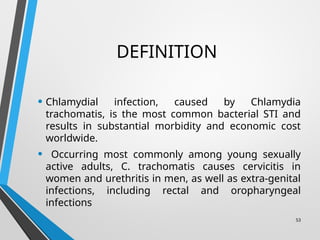
• Chlamydial infection, caused by Chlamydia
trachomatis, is the most common bacterial STI and
results in substantial morbidity and economic cost
worldwide.
• Occurring most commonly among young sexually
active adults, C. trachomatis causes cervicitis in
women and urethritis in men, as well as extra-genital
infections, including rectal and oropharyngeal
infections
54
Risk Factors
• Adolescence
• New or multiple sex partners
• History of STI
• Presence of another STI
• Oral contraceptive user
• Lack of barrier contraception
55
Transmission
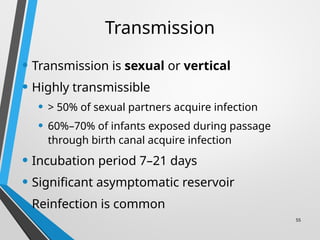
• Transmission is sexual or vertical
• Highly transmissible
• > 50% of sexual partners acquire infection
• 60%–70% of infants exposed during passage
through birth canal acquire infection
• Incubation period 7–21 days
• Significant asymptomatic reservoir
• Reinfection is common
STI: CHLAMYDIAL INFECTIONS
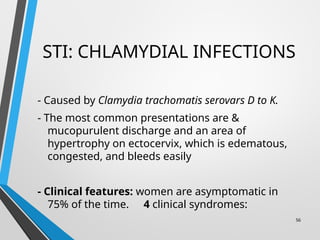
- Caused by Clamydia trachomatis serovars D to K.
- The most common presentations are &
mucopurulent discharge and an area of
hypertrophy on ectocervix, which is edematous,
congested, and bleeds easily
- Clinical features: women are asymptomatic in
75% of the time. 4 clinical syndromes:
56
57
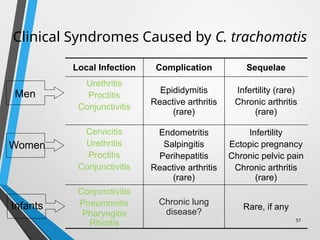
Clinical Syndromes Caused by C. trachomatis
Local Infection Complication Sequelae
Urethritis
Proctitis
Conjunctivitis
Epididymitis
Reactive arthritis
(rare)
Infertility (rare)
Chronic arthritis
(rare)
Cervicitis
Urethritis
Proctitis
Conjunctivitis
Endometritis
Salpingitis
Perihepatitis
Reactive arthritis
(rare)
Infertility
Ectopic pregnancy
Chronic pelvic pain
Chronic arthritis
(rare)
Conjunctivitis
Pneumonitis
Pharyngitis
Rhinitis
Chronic lung
disease?
Rare, if any
Men
Women
Infants
STI: CHLAMYDIAL INFECTIONS
Clinical features:
1. Mucopurulent cervicitis( MPC)
mucopurulent cervical discharge, cervical erosion and edema, spontaneous or easily induced
cervical bleeding.
2. Acute urethral syndrome
Dysuria-frequency syndrome in young sexually
active women, recent new sex partner.
. Pelvic inflammatory disease
lower abdominal pain, adnexal tenderness, on pelvic exam, evidence of cervicitis often present.
58
STI: CHLAMYDIAL INFECTIONS
Clinical features:
-Urethritis associated with cervicitis: dysuria, frequency and
pyuria
-Bartholinitis
-Endometritis: (50%), abnormal vaginal bleeding, menorrhagia
and metrorrhagia.
59
STI: CHLAMYDIAL INFECTIONS
Clinical features:
-Salpingitis: asymptomatic but causes progressive
tubal scarring(“silent salpingitis”) resulting in
ectopic pregnancy and infertility.
-Perihepatitis
60
STI: CHLAMYDIAL INFECTIONS
Clinical features:
Infection in pregnancy can cause spontaneous abortion,
low birth weight, prematurity, and preterm delivery.
Infection during delivery can cause neonatal
conjunctivitis, ophthalmia neonatorum, pneumonia,
chronic lung and eye disease.
61
STI: CHLAMYDIAL INFECTIONS
Diagnosis
-Culture
-Nucleic acid amplification test
-Anticlamydia antibodies
62
STI: CHLAMYDIAL INFECTIONS
Treatment:
Uncomplicated non-gonococcal associated infections( urethral,
endocervical and rectal) can be treated by:
1. Doxicycline 100 mg bid for 7 days, or
2. Tetracycline 500 mg qid for 7 days, or
3. Erythromycin stearate 500 mg qid fr 7 days. Or
4. ofloxacin 400 mg orally, twice daily for 7 days.
5. Azithromycin 1g orally.
63
VIRAL STIs
1. HIV infection
2. HPV infection: condylomata acuminata
3. Herpes simplex virus
4. Hepatitis B virus
64
STI: GENITAL HERPES
INTRODUCTION
Genital herpes is caused by herpes simplex
virus( HSV) serotypes 2 and 1, with HSV 2
being much more frequent.
65
STI: GENITAL HERPES
Clinical features:
1. Primary infection when the infection is acquired
2. Recurrent due to reactivation of HSV
Primary herpes genitalis:
-Multiple vesicles on the vulva, vagina, and periurethral
area, which rupture to form painful erosions causing
pain, dysuria, and dyspareunia,with associated
systemic symptoms
66
STI: GENITAL HERPES
A. First clinical episode:
Acyclovir 400 mg orally, 3 times a day or 200 mg 5
times a day for 7-10 days.
67
STI: GENITAL HERPES
B. For recurrences
treatment may be
a. Episodic at first sign of a reccurence: acyclovir
as above, for 5 days or
b. Suppressive to reduce recurrences( if >6
episodes/ year) : Acyclovir 400 mg orally twice a
day for 6 months
68
HEPATITIS B VIRUS( HBV)
Epidemiology:
HBV is most commonly transmitted sexually.
The disease can be also transmitted by
exposure to infected blood.
Incubation: 6 weeks to 6months
69
HEPATITIS B VIRUS( HBV)
Clinical presentation:
HBV is symptomatic in adult in about 50% of cases.
When symptoms are present they include:
-Jaundice and general malaise.
-2-6% of infected adults become chronically
infected, but 90% of infected infants develop
chronic infection.
70
HEPATITIS B VIRUS( HBV)
Diagnosis
Presence of hepatitis B surface antigen( HBsAg)
indicates either acute or chronic infection.
Presence of hepatitis B surface antibody ( Anti-
HBs) is indicative of immunity, either through prior
infection or immunization.
71
HEPATITIS B VIRUS( HBV)
Treatment and prevention:
 In acute infection: supportive treatment.
 Chronic hepatitis B: interferon alfa and Lamivudine have been
used in attempts.
 Vaccination is the mainstay of prevention.
 Hepatitis B immune globulin (HBIG) provides post exposure
prophylaxis, and the multidose hepatitis B vaccine gives
longstanding immunity.
72
HEPATITIS B VIRUS( HBV)
Pregnancy
For all pregnant test for HBsAg carrier status.
If chronic carrier, fetal infection can be prevented by
prompt infant immunization and HBIG
administration.
73
74
Cont,
Hepatitis A Hepatitis B Hepatitis C
Transmission mainly fecal-oral contact with blood
and other bodily
fluids that contain
HBV
contact with blood
that contains HCV
Incubation period 5–50 days
60–150 days 14–84 days
Acute vs. chronic Acute only can be acute or
chronic; most adults
clear the virus, but
children who contract
HBV are more likely
to have chronic
hepatitis B
can be acute or
chronic; over half of
people that contract
the virus will develop
a chronic hepatitis C
Acute vs. chronic Supportive care acute: supportive
care; chronic:
antiviral drugs may
be used
a course of antiviral
drugs, which can
clear the virus in
most people
Vaccine available? YES YES NO
CONDYLOMATA ACUMINATA
Introduction
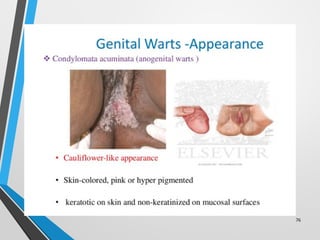
• Condyloma acuminata are raised, warty
lesions caused by infection by the human
papillomavirus(HPV).
Predominant Age: 16 to 25 years.
• Causes: Caused by infection by HPV (most frequently ) serotypes 6
and 11; 90%.
• The virus is most commonly spread by skin-to-skin (generally sexual)
contact and has an incubation period of 3 weeks to 8 months.
75
CONDYLOMATA ACUMINATA
76
CONDYLOMATA ACUMINATA
• Risk Factors:
 Multiple sexual partners;
 the presence of other vaginal infections such as
candidiasis, trichomoniasis, or bacterial
vaginosis;smoking;
 and oral contraceptive use.
77
CONDYLOMATA ACUMINATA
• CLINICAL CHARACTERISTICS
1. Signs and Symptoms
• Asymptomatic (<2% have condyloma)
• Painless, raised, soft, fleshy growths on the vulva,
vagina, cervix, urethral meatus, perineum, and anus
(mild irritation or discharge may accompany
secondary infections).
78
CONDYLOMATA ACUMINATA
• Special Tests:
-Colposcopic examination;
-Pap test; or the
-application of 3% to 5% acetic acid to make apparent the raised,
white, shiny plaques.
-Biopsy is indicated if the warts are pigmented, indurated, fixed,
bleeding, or ulcerated.
• Diagnostic Procedures: Physical examination, colposcopy,and
biopsy.
79
CONDYLOMATA ACUMINATA
Drug(s) of Choice
• Podophyllin (20% to 50% in tincture of benzoin, 25%
ointment), podophyllotoxin (0.5% solution, Condylox),
bichloracetic or trichloroacetic acid (80% to 100%
solution),
• carefully applied to the warts, protecting the adjacent
skin, and allowed to remain for between 30 minutes and 4
hours before being washed off the lesions.
80
CONDYLOMATA ACUMINATA
• Contraindications:
Podophyllin may not be used during
pregnancy because of absorption, potentially
resulting in neural or myelotoxicity.
81
CONDYLOMATA ACUMINATA
• Expected Outcome:
The success rate for resolution of overt warts is
approximately 75%, with a recurrence rate of
65% to 80%. If lesions persist or continually
recur, cryosurgery, electrodessication, surgical
excision, or laser vaporization may be
required.
82
83
HIV /AIDS
• HIV stands for Human Immunodeficiency Virus. It
is a virus that attacks the immune system,
specifically the CD4 cells (T cells), which help the
body fight off infections.HIV can lead to the
disease AIDS (Acquired Immunodeficiency
Syndrome).
84
Primarily Transmission
• 1. Unprotected Sexual Intercourse: The most common mode of HIV
transmission is through unprotected sexual intercourse, especially
among heterosexual couples.
• 2. Mother-to-Child Transmission: HIV can be transmitted from an HIV-
positive mother to her child during pregnancy, childbirth, or
breastfeeding.
• 3. Injection Drug Use: sharing contaminated needles and syringes
among injecting drug users can lead to the transmission of HIV.
• 4. Stigma and Discrimination: Stigma and discrimination against people
living with HIV can contribute to the spread of the virus by discouraging
individuals from seeking testing, treatment, and support services.
85
Preventive Measurement
• 1. Promoting Safe Sex Practices.
• 2. Voluntary Counseling and Testing (VCT).
• 3. Promoting Male Circumcision.
• 4. Prevention of Mother-to-Child Transmission
(PMTCT).
• 5. Promoting Education and Awareness.
• 6. Antiretroviral Therapy (ART).

GR II ASSIGNMENT PPT (1).pptxxxxxxxxxxxxx

  • 1.
    1 SEXUALLY TRANSMITTED INFECTION(STI) INWOMEN Names REGISTRATION NUMBER AKAYEZU Jean Claude 023/09/MDW/1586 NIYONSENGA EAMMANUEL 023/09/MDW/1598 UWAMAHORO CLEMENTINE 023/09/MDW/1617 MANIRAKIZA PASCAL 023/09/MDW/1570 MPOREBUKE JEAN 023/09/MDW/1572 DUSENGIMANA OSEE 023/09/MDW/1609
  • 2.
    2 Sexually Transmition (STIs) •Sexually transmitted Infections (STIs) are infections that are spread by sexual contact with someone who has an STI. STIs are caused by bacteria, viruses, and parasites spread through sexual contact. Infections can be found in body fluids such as semen, on the skin of the genitals and areas around them, and some also in the mouth, throat, and rectum. STIs are mostly spread through vaginal, anal, or oral sex, and genital touching.
  • 3.
    3 Sexually Transmition infections (STIs) •Some STIs cause no symptoms. Others can cause discomfort or pain. If not treated, some can cause pelvic inflammatory disease, infertility, chronic pelvic pain, and cervical cancer. Some STIs can also greatly increase the chance of becoming infected with HIV. • STIs spread in a community because an infected person has sex with an uninfected person. The more sexual partners a person has, the greater his or her risk of either becoming infected with STIs or transmitting STIs.
  • 4.
    4 STI:CLASSIFICATION Three major groups: 1.Bacterial 2. Viral 3. Parasites
  • 5.
    5 STI:CLASSIFICATION Bacteria STIs withCausative agent Syphilis : T. pallidum ( a spirochaete) Chancroid: Haemophilus ducreyi( a gram negative bacillus) Lymphogranuloma Venereum (LGV):Clamydia trachomatis Bacterial vaginosis: Gardnerella vaginalis ( an anaerobic bacterium) and Mycoplasma hominis.
  • 6.
    6 STIS:CLASSIFICATION Gonorrhoea: Neisseria gonorrhoeae(a gram negative diplococcus) Non-gonococcal urethritis: Clamydia trachomatis, Mycoplasma genitalium, Ureaplasma urealyticum and rarely other organisms.
  • 7.
    7 STI:CLASSIFICATION Viral STIs causativeagent Genital herpes: Herpes simplex virus-1( HSV1), Herpes simplex virus-2( HSV-2) Anogenital warts: Human papilloma virus (HPV) (various subtypes) Hepatitis: Hepatitis virus A, B, C and E Infectious mononucleosis: Cytomegalovirus( CMV) Human immunodeficiency virus (HIV/AIDS)
  • 8.
    8 STI:CLASSIFICATION Prasites Trichomoniasis: Trichomonas vaginalis(a protozoan) Candidialvulvovaginitis : candida albicans and other species of candida
  • 9.
    9 STI: SYPHILIS • Causedby Treponema pallidum • Incubation period: 9-90 days, usually 3-6 weeks • Syphilis has a natural course having three stages: primary, secondary and tertiary.
  • 10.
    10 STI: SYPHILIS Clinical features: 1.Primary syphilis: Classical lesion is the chancre which is a painless genital ulcer commonly on the cervix. Classically indurated, firm, non-tender, round to oval with minimal or no discharge, and does not bleed on palpation. Incubation: 10 to 90 days. Resolve in 2 to 6 weeks.
  • 11.
    11 STI: SYPHILIS Clinical features: -The other sites of the chancre are the labia, fourchette, urethra, and perineum; - Extragenital sites include the anus, mouth, oropharynx, and breast. -“Kissing lesions” may occur in areas of skin-to-skin contact as on the vulva -Regional lymph nodes often involved.
  • 12.
    12 Secondary Syphilis • Secondarylesions occur several weeks after the primary chancre appears; and may persist for weeks to months. • Primary and secondary stages may overlap • Mucocutaneous lesions most common • Serologic tests are usually highest in titer during this stage.
  • 13.
    13 STI: SYPHILIS Clinical features: 2.Secondary syphilis: Secondary syphilis may be asymptomatic and may be detected in women with a history of recurrent spontaneous abortions.
  • 14.
    14 STI: SYPHILIS Clinical features: Latentsyphilis: from untreated secondary syphilis - Early latent syphilis: if the latent period is less than two years after the primary infection. - If more than two years have elapsed from the primary infection it is called late latent syphilis. - 1/3 of patients with latent syphilis develop tertiary syphilis
  • 15.
    15 STI: SYPHILIS Clinical features: 3.Tertiary syphilis: oTertiary syphilis is rarely seen nowadays due to prompt treatment of the primary lesion. oThere is involvement of the neurological and cardiovascular system. oEndarteritis leads to aortic aneurysm and aortic insufficiency, tabes dorsalis, optic atrophy, and meningovascular syphilis, as well as gummatous lesions
  • 16.
    16 Neurosyphilis • Occurs whenT. pallidum invades the central nervous system (CNS) • May occur at any stage of syphilis • Can be asymptomatic • Early neurosyphilis occurs a few months to a few years after infection • Clinical manifestations can include acute syphilitic meningitis, meningovascular syphilis, and ocular involvement • Neurologic involvement can occur decades after infection and is rarely seen • Clinical manifestations can include general paresis, tabes dorsalis, and ocular involvement • Ocular involvement can occur in early or late neurosyphilis.
  • 17.
    17 Congenital Syphilis • Occurswhen T. pallidum is transmitted from a pregnant woman to her fetus • May lead to stillbirth, neonatal death, and infant disorders such as deafness, neurologic impairment, and bone deformities • Transmission can occur during any stage of syphilis; risk is much higher during primary and secondary syphilis • Fetal infection can occur during any trimester of pregnancy • Wide spectrum of severity exists; only severe cases are clinically apparent at birth
  • 18.
    18 STI: SYPHILIS Effect onpregnancy Syphilis is a systemic infection from the onset and has multi-systemic manifestations. The effect on pregnancy depends upon the duration of the disease stage i.e longer the duration of untreated maternal syphilis , most is the effect on the fetus ( Kassowitz law)
  • 19.
    19 STI: SYPHILIS Effect onpregnancy With primary and secondary syphilis: 50% chance of preterm labour, stillbirth, neonatal death or congenital syphilis in the neonate With latent syphilis 9% go into preterm labour, 11% are stillbirth, and only 10% are born with congenital syphilis.
  • 20.
    20 STI: SYPHILIS Effect onpregnancy However a patient who has previously had several miscarriages, stillbirths, and children with congenital syphilis may later give birth to a healthy non-infected child. A positive serology at birth does not necessarily indicate the presence of neonatal infection.
  • 21.
    21 Clinical History Assess • Historyof syphilis • Known contact to an early case of syphilis • Typical signs or symptoms of syphilis in the past 12 months • Most recent serologic test for syphilis
  • 22.
    22 Physical Examination • Oralcavity • Lymph nodes • Skin of torso • Palms and soles • Genitalia and perianal area • Neurologic examination • Abdomen
  • 23.
    23 STI: SYPHILIS Diagnosis:  Screeningtests: VDRL and RPR  Specific Tests: TPHA, FTA-ABS test  Dark ground illumination(DGI):microscopy demonstrating the presence of T.pallidum from ulcers, moist lesions, and mucous membranes.
  • 24.
    24 STI: SYPHILIS VDRL: VenerealDisease Research Laboratory RPR: Rapid plasma reagin TPHA: Treponemal pallidum haemagglutination assay FTA-ABS: Fluorescent Treponemal Antibody Absorption Test.
  • 25.
    25 STI: SYPHILIS Treatment: The recommendedregimens for adults are as follows:  Primary, secondary, or early latent stage: 1. Benzathine penicillin G: 2,4 million units IM as a single dose( half in each buttock) 2. doxicycline 100: orally BD or Tetracycline 500 mg orally four times daily for 2 weeks in nonpregnant patients with penicillin allergy
  • 26.
    26 STI: SYPHILIS Treatment:  Latelatent syphilis, tertiary syphilis or syphilis of unknown duration: 1. Benzathine penicillin G: 2,4 million units IM once a week for 3 consecutive weeks. 2. doxicycline 100: orally BD or Tetracycline 500 mg orally four times daily for 4 weeks in nonpregnant patients with penicillin allergy
  • 27.
    27 STI: SYPHILIS Treatment : Neurosyphilis: Crystalline penicillin G: 3 to 4 million units intravenously every 4 hrs or 18 to 24 million units daily as continuous infusion for 10 to 14 days.
  • 28.
    28 STI: SYPHILIS Treatment : Pregnant women: Same regimens are given depending upon the stage of syphilis. If allergy: Erythromycin 500 mg 4 times daily for 14 days.
  • 29.
  • 30.
    STI:CHANCROID - Also calledas “soft sore”. - Genital ulcerative disease. - Caused by Haemophilus ducreyi, a gram-negative bacillus. - Inoculated through micro-trauma or abrasion during sexual intercourse. 30
  • 31.
    STI:CHANCROID Clinical features: 1. Symptoms: -Pain on micturition or defecation, vaginal discharge, dyspareunia as the usual symptoms as the women are unaware of their lesions. 31
  • 32.
    STI:CHANCROID Clinical features: 2. Signs: •Multiple ulcers( fourchette, vestibule, labia, clitoris, vagina and the perianal area). • Painful and tender inguinal lymphadenopathy (bubo) usually starting on one side and then appearing bilaterally is common. 32
  • 33.
    STI:CHANCROID Diagnosis: -clinical examination: accuracyof 30-50% -A probable diagnosis of chancroid can be made if following are present: a. one or more painful genital ulcers b. regional lymphadenopathy c. dark ground examination(DGI) of ulcer exudates is negative for T. pallidum( but keep in mind that more than one STD often occur simultaneously) . 33
  • 34.
    STI:CHANCROID Diagnosis(cont’d): d. the serologicaltest for syphilis performed at least 7 days after the onset of ulcers is non-reactive e. the test of herpes simplex is negative. f. isolation of H. ducreyi from the genital ulcer or bubo-smears g. culture: gives the definitive diagnosis 34
  • 35.
    STI:CHANCROID Treatment: Any one ofthe following drugs can be given: Azithromycin:1g orally , single dose, or Ceftriaxone : 250 mg IM, single dose Ciprofloxacin 500 mg orally twice a day for 3 days Erythromycin 500 mg orally, 4 times a day, for 7days. 35
  • 36.
    STI:CHANCROID Treatment: For pregnant andlactating women, Ceftriaxone and Erythromycin are preferred. 36
  • 37.
    Gonorrhea  INTRODUCTION: Gonorrhoeais a major public health challenge today, due to the high incidence of infections accompanied by a dwindling of treatment options.  Gonoccocal infections can be prevented through safer sexual intercourse.  These infections represent 106 million of the estimated 498 million new cases of curable STIs that occur globally every year(WHO,2017).
  • 38.
    STI:GONORRHEA Caused by Neisseriagonorrheae, a gram negative diplococcus. Intracellulary in leucocytes. Humans are the only natural host. In women: cervicitis, urethritis, PID, and acute pharyngitis, In men: urethritis, prostatitis, and epididymitis, In newborns: exposure at birth may cause blindness, infection of the joints, or even serious sepsis; 38
  • 39.
    STI:GONORRHEA Transmission: From men towomen by sexual contact. Risk factor: 1. young age 2. multiple sexual partners 3. failure to use barrier contraception 4. early sexual activity 39
  • 40.
    Gonorrhea Curriculum 40 Transmission • Efficientlytransmitted by – Male to female via semen – Vagina to male urethra – Rectal intercourse – Fellatio (pharyngeal infection) – Perinatal transmission (mother to infant) • Gonorrhea associated with increased transmission of and susceptibility to HIV infection Epidemiology
  • 41.
    Gonorrhea Female Symptoms: • Burning sensationwhen urinating • A white, yellow, or green discharge from the penis • Painful or swollen testicles (less common) Can lead to: • Painful condition in the tubes attached to the testicles. -Inability to have children (rare) -Sterile Male Symptoms: • Painful or burning sensation when urinating • Increased vaginal discharge • Vaginal bleeding between periods Can lead to: • Pelvic inflammatory disease (PID) -Formation of scar tissue that blocks fallopian tubes -Ectopic pregnancy -Inability to get pregnant -Long-term pelvic/abdominal pain
  • 42.
    STI:GONORRHEA Clinical features: In bothsexes, when symptoms occur, they usually appear 2 to 5 days after exposure but may not be evident for 30 days. Symptoms of gonococcal PID often occur after a menstrual period. 42
  • 43.
    STI:GONORRHEA Clinical features: symptoms include: a.Mucopurulent discharge, as occurs in acute cervicitis b. Lower abdominal pain, anorexia, and fever, as is characteristic, of acute PID; perihepatitis can also occur because of peritoneal spread of infection. c. Dysuria ( men and women) 43
  • 44.
    STI:GONORRHEA Clinical features: 1. Thecommonest manifestation of gonorrhea in women is cervicitis; 2. Endometritis, salpingitis, and rarely perihepatitis occur as complications. 3. Urethritis is uncommon and when present, manifests as moder ate burning micturition, frequency and urgency. 4. conjunctivitis, tonsillitis, and proctitis(anal intercourse) can also occur. 44
  • 45.
  • 46.
    STI:GONORRHEA Complications: 2. Bartholin’s glandabscess: - pus on pressure, - small indurated swelling of the duct or gland due to recurrent infection. 3. Disseminated infection 46
  • 47.
    STI:GONORRHEA Laboratory diagnosis: 1.Depends onthe identification of (N. gonorrhea( Microscopy and culture) 2. Specimen taken from endocervix, urethra, rectum, or oropharynx. 3. The organisms are visualized on gram staining with oil immersion as intracellular gram negative diplococci. 47
  • 48.
    STI:GONORRHEA Treatment: Uncomplicated infection: Cefixime 400mg orally in a single dose or Ceftriaxone 125 mg IM in a single dose, or Ciprofloxacin 500 mg orally, or ofloxacin 400 mg orally or levofloxacin 250 mg orally, in a single dose. 48
  • 49.
    STI:GONORRHEA Treatment: Approximately 10% to30% of women with genital gonorrhea are also infected with Clamydia. Therefore, the treatment regimen should always include: Azithromycin 1g orally, or doxicycline100 mg orally, twice a day for 7 days. 49
  • 50.
    STI:GONORRHEA Treatment: For disseminated gonococcalinfection Ceftriaxone 1g IM or IV once daily for 7 days (2 weeks for meningitis), or Cefixime, 400 mg twice daily orally for 7 days 50
  • 51.
    STI:GONORRHEA PREVENTION Modify sexual behaviourtowards “safer sex” Barrier methods: male and female condoms Ocular prophylaxis at delivery: Tetracyclin 1% oitntment 51
  • 52.
  • 53.
    53 DEFINITION • Chlamydial infection,caused by Chlamydia trachomatis, is the most common bacterial STI and results in substantial morbidity and economic cost worldwide. • Occurring most commonly among young sexually active adults, C. trachomatis causes cervicitis in women and urethritis in men, as well as extra-genital infections, including rectal and oropharyngeal infections
  • 54.
    54 Risk Factors • Adolescence •New or multiple sex partners • History of STI • Presence of another STI • Oral contraceptive user • Lack of barrier contraception
  • 55.
    55 Transmission • Transmission issexual or vertical • Highly transmissible • > 50% of sexual partners acquire infection • 60%–70% of infants exposed during passage through birth canal acquire infection • Incubation period 7–21 days • Significant asymptomatic reservoir • Reinfection is common
  • 56.
    STI: CHLAMYDIAL INFECTIONS -Caused by Clamydia trachomatis serovars D to K. - The most common presentations are & mucopurulent discharge and an area of hypertrophy on ectocervix, which is edematous, congested, and bleeds easily - Clinical features: women are asymptomatic in 75% of the time. 4 clinical syndromes: 56
  • 57.
    57 Clinical Syndromes Causedby C. trachomatis Local Infection Complication Sequelae Urethritis Proctitis Conjunctivitis Epididymitis Reactive arthritis (rare) Infertility (rare) Chronic arthritis (rare) Cervicitis Urethritis Proctitis Conjunctivitis Endometritis Salpingitis Perihepatitis Reactive arthritis (rare) Infertility Ectopic pregnancy Chronic pelvic pain Chronic arthritis (rare) Conjunctivitis Pneumonitis Pharyngitis Rhinitis Chronic lung disease? Rare, if any Men Women Infants
  • 58.
    STI: CHLAMYDIAL INFECTIONS Clinicalfeatures: 1. Mucopurulent cervicitis( MPC) mucopurulent cervical discharge, cervical erosion and edema, spontaneous or easily induced cervical bleeding. 2. Acute urethral syndrome Dysuria-frequency syndrome in young sexually active women, recent new sex partner. . Pelvic inflammatory disease lower abdominal pain, adnexal tenderness, on pelvic exam, evidence of cervicitis often present. 58
  • 59.
    STI: CHLAMYDIAL INFECTIONS Clinicalfeatures: -Urethritis associated with cervicitis: dysuria, frequency and pyuria -Bartholinitis -Endometritis: (50%), abnormal vaginal bleeding, menorrhagia and metrorrhagia. 59
  • 60.
    STI: CHLAMYDIAL INFECTIONS Clinicalfeatures: -Salpingitis: asymptomatic but causes progressive tubal scarring(“silent salpingitis”) resulting in ectopic pregnancy and infertility. -Perihepatitis 60
  • 61.
    STI: CHLAMYDIAL INFECTIONS Clinicalfeatures: Infection in pregnancy can cause spontaneous abortion, low birth weight, prematurity, and preterm delivery. Infection during delivery can cause neonatal conjunctivitis, ophthalmia neonatorum, pneumonia, chronic lung and eye disease. 61
  • 62.
    STI: CHLAMYDIAL INFECTIONS Diagnosis -Culture -Nucleicacid amplification test -Anticlamydia antibodies 62
  • 63.
    STI: CHLAMYDIAL INFECTIONS Treatment: Uncomplicatednon-gonococcal associated infections( urethral, endocervical and rectal) can be treated by: 1. Doxicycline 100 mg bid for 7 days, or 2. Tetracycline 500 mg qid for 7 days, or 3. Erythromycin stearate 500 mg qid fr 7 days. Or 4. ofloxacin 400 mg orally, twice daily for 7 days. 5. Azithromycin 1g orally. 63
  • 64.
    VIRAL STIs 1. HIVinfection 2. HPV infection: condylomata acuminata 3. Herpes simplex virus 4. Hepatitis B virus 64
  • 65.
    STI: GENITAL HERPES INTRODUCTION Genitalherpes is caused by herpes simplex virus( HSV) serotypes 2 and 1, with HSV 2 being much more frequent. 65
  • 66.
    STI: GENITAL HERPES Clinicalfeatures: 1. Primary infection when the infection is acquired 2. Recurrent due to reactivation of HSV Primary herpes genitalis: -Multiple vesicles on the vulva, vagina, and periurethral area, which rupture to form painful erosions causing pain, dysuria, and dyspareunia,with associated systemic symptoms 66
  • 67.
    STI: GENITAL HERPES A.First clinical episode: Acyclovir 400 mg orally, 3 times a day or 200 mg 5 times a day for 7-10 days. 67
  • 68.
    STI: GENITAL HERPES B.For recurrences treatment may be a. Episodic at first sign of a reccurence: acyclovir as above, for 5 days or b. Suppressive to reduce recurrences( if >6 episodes/ year) : Acyclovir 400 mg orally twice a day for 6 months 68
  • 69.
    HEPATITIS B VIRUS(HBV) Epidemiology: HBV is most commonly transmitted sexually. The disease can be also transmitted by exposure to infected blood. Incubation: 6 weeks to 6months 69
  • 70.
    HEPATITIS B VIRUS(HBV) Clinical presentation: HBV is symptomatic in adult in about 50% of cases. When symptoms are present they include: -Jaundice and general malaise. -2-6% of infected adults become chronically infected, but 90% of infected infants develop chronic infection. 70
  • 71.
    HEPATITIS B VIRUS(HBV) Diagnosis Presence of hepatitis B surface antigen( HBsAg) indicates either acute or chronic infection. Presence of hepatitis B surface antibody ( Anti- HBs) is indicative of immunity, either through prior infection or immunization. 71
  • 72.
    HEPATITIS B VIRUS(HBV) Treatment and prevention:  In acute infection: supportive treatment.  Chronic hepatitis B: interferon alfa and Lamivudine have been used in attempts.  Vaccination is the mainstay of prevention.  Hepatitis B immune globulin (HBIG) provides post exposure prophylaxis, and the multidose hepatitis B vaccine gives longstanding immunity. 72
  • 73.
    HEPATITIS B VIRUS(HBV) Pregnancy For all pregnant test for HBsAg carrier status. If chronic carrier, fetal infection can be prevented by prompt infant immunization and HBIG administration. 73
  • 74.
    74 Cont, Hepatitis A HepatitisB Hepatitis C Transmission mainly fecal-oral contact with blood and other bodily fluids that contain HBV contact with blood that contains HCV Incubation period 5–50 days 60–150 days 14–84 days Acute vs. chronic Acute only can be acute or chronic; most adults clear the virus, but children who contract HBV are more likely to have chronic hepatitis B can be acute or chronic; over half of people that contract the virus will develop a chronic hepatitis C Acute vs. chronic Supportive care acute: supportive care; chronic: antiviral drugs may be used a course of antiviral drugs, which can clear the virus in most people Vaccine available? YES YES NO
  • 75.
    CONDYLOMATA ACUMINATA Introduction • Condylomaacuminata are raised, warty lesions caused by infection by the human papillomavirus(HPV). Predominant Age: 16 to 25 years. • Causes: Caused by infection by HPV (most frequently ) serotypes 6 and 11; 90%. • The virus is most commonly spread by skin-to-skin (generally sexual) contact and has an incubation period of 3 weeks to 8 months. 75
  • 76.
  • 77.
    CONDYLOMATA ACUMINATA • RiskFactors:  Multiple sexual partners;  the presence of other vaginal infections such as candidiasis, trichomoniasis, or bacterial vaginosis;smoking;  and oral contraceptive use. 77
  • 78.
    CONDYLOMATA ACUMINATA • CLINICALCHARACTERISTICS 1. Signs and Symptoms • Asymptomatic (<2% have condyloma) • Painless, raised, soft, fleshy growths on the vulva, vagina, cervix, urethral meatus, perineum, and anus (mild irritation or discharge may accompany secondary infections). 78
  • 79.
    CONDYLOMATA ACUMINATA • SpecialTests: -Colposcopic examination; -Pap test; or the -application of 3% to 5% acetic acid to make apparent the raised, white, shiny plaques. -Biopsy is indicated if the warts are pigmented, indurated, fixed, bleeding, or ulcerated. • Diagnostic Procedures: Physical examination, colposcopy,and biopsy. 79
  • 80.
    CONDYLOMATA ACUMINATA Drug(s) ofChoice • Podophyllin (20% to 50% in tincture of benzoin, 25% ointment), podophyllotoxin (0.5% solution, Condylox), bichloracetic or trichloroacetic acid (80% to 100% solution), • carefully applied to the warts, protecting the adjacent skin, and allowed to remain for between 30 minutes and 4 hours before being washed off the lesions. 80
  • 81.
    CONDYLOMATA ACUMINATA • Contraindications: Podophyllinmay not be used during pregnancy because of absorption, potentially resulting in neural or myelotoxicity. 81
  • 82.
    CONDYLOMATA ACUMINATA • ExpectedOutcome: The success rate for resolution of overt warts is approximately 75%, with a recurrence rate of 65% to 80%. If lesions persist or continually recur, cryosurgery, electrodessication, surgical excision, or laser vaporization may be required. 82
  • 83.
    83 HIV /AIDS • HIVstands for Human Immunodeficiency Virus. It is a virus that attacks the immune system, specifically the CD4 cells (T cells), which help the body fight off infections.HIV can lead to the disease AIDS (Acquired Immunodeficiency Syndrome).
  • 84.
    84 Primarily Transmission • 1.Unprotected Sexual Intercourse: The most common mode of HIV transmission is through unprotected sexual intercourse, especially among heterosexual couples. • 2. Mother-to-Child Transmission: HIV can be transmitted from an HIV- positive mother to her child during pregnancy, childbirth, or breastfeeding. • 3. Injection Drug Use: sharing contaminated needles and syringes among injecting drug users can lead to the transmission of HIV. • 4. Stigma and Discrimination: Stigma and discrimination against people living with HIV can contribute to the spread of the virus by discouraging individuals from seeking testing, treatment, and support services.
  • 85.
    85 Preventive Measurement • 1.Promoting Safe Sex Practices. • 2. Voluntary Counseling and Testing (VCT). • 3. Promoting Male Circumcision. • 4. Prevention of Mother-to-Child Transmission (PMTCT). • 5. Promoting Education and Awareness. • 6. Antiretroviral Therapy (ART).

Editor's Notes

  • #41 Note: Rectal infections of gonorrhea may either cause no symptoms or cause symptoms in both men and women that may include: •Discharge •Anal itching •Soreness •Bleeding •Painful bowel movements Untreated gonorrhea may also increase your chances of getting or giving HIV – the virus that causes AIDS. Rarely, untreated gonorrhea can also spread to your blood or joints. Some men with gonorrhea may have no symptoms at all. Most women with gonorrhea do not have any symptoms. Even when a woman has symptoms, they are often mild and can be mistaken for a bladder or vaginal infection.