HETN
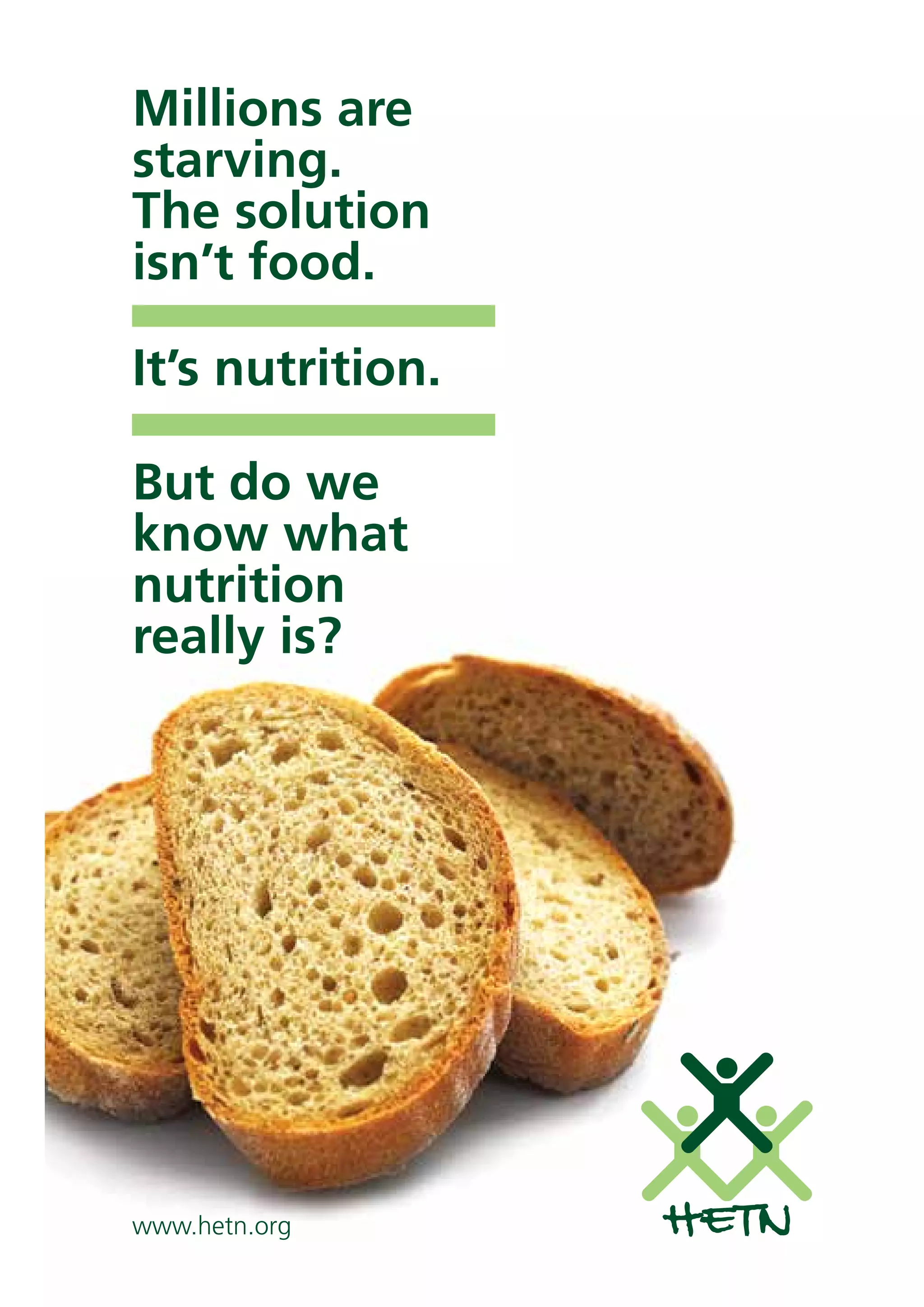
Millions are
starving.
The solution
isn’t food.
But do we
know what
nutrition
really is?
www.hetn.org
It’s nutrition.
Unlocking the
hidden hunger
crisis with effective
nutrition
Hidden Hunger affects more than two billion people. Even
when a person consumes adequate calories and protein,
if they lack one single micronutrient, or a combination
of vitamins and minerals, their immune system is
compromised and infections take hold.
World Food Program
HETN stands for
Health Empowerment
Through Nutrition – an
organisation dedicated to
exploring the relationship
between nutrition and
chronic disease
We know that the human body needs sufficient nutrients for optimum health
– but due to environmental degradation, soil depleting farming methods, food
processing and diet choices, the nutrition of most people is inadequate, even if
they have food on the table.
The result?
Immunity is compromised. Chronic diseases are on the increase. Even in the West
where people live longer, half have health problems that require prescription drugs
on a regular basis.
This worldwide problem is extreme in Africa, where a diet deficient in primary
micronutrients is widespread, and fortification of food with chemical isolates
has become commonplace.
This dietary fortification is inappropriate, because it cannot solve the problem
and may even make matters worse – as these chemical vitamins and minerals
are not only poorly absorbed, but often toxic, and rarely act in the body the
way nature intended.
Hunger is not merely about having a lack of food.
Hunger is about lacking food that produces a healthy
human being.
Throughout the world, nutrition is being neglected in favour of a full stomach.
HETN believes that there is more to food – because real food is about
effective nutrition.
The crisis
Malnutrition is rampant throughout the world – and has a devastating impact,
not only on lives, but also on the global economy.
The terms ‘nutrition’ and ‘a balanced diet’ are used with little understanding.
There are many communities experiencing health problems not seen by their
grandparents, who often lived in even greater poverty.
By providing highly refined foods with added highly refined vitamins and
minerals, science has done little to provide a solution to malnutrition – because
highly refined means that these foods are not the natural foods our bodies are
designed to use, and they don’t work.
The problem
Every day, the human body needs nutrients, including vitamins and minerals.
Obtaining these nutrients from the food we eat, or in the right form from
other sources, is beyond most people – either through poverty or ignorance.
Not only have people moved away from their traditional foods, but modern
agricultural practices and food processing remove essential nutrients from
the food chain.
This means we can no longer rely on ‘a balanced diet’ to obtain the nutrients
our bodies require.
The continued fortification of food and diets with chemical isolates cannot
address the problem.
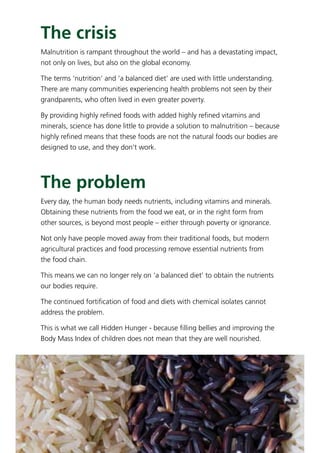
This is what we call Hidden Hunger - because filling bellies and improving the
Body Mass Index of children does not mean that they are well nourished.
Why healthy soil
means healthy food
and healthier people
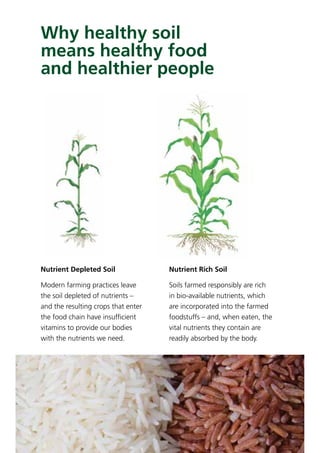
Nutrient Rich Soil
Soils farmed responsibly are rich
in bio-available nutrients, which
are incorporated into the farmed
foodstuffs – and, when eaten, the
vital nutrients they contain are
readily absorbed by the body.
Nutrient Depleted Soil
Modern farming practices leave
the soil depleted of nutrients –
and the resulting crops that enter
the food chain have insufficient
vitamins to provide our bodies
with the nutrients we need.
The more refined the food,
the less nutritious the food
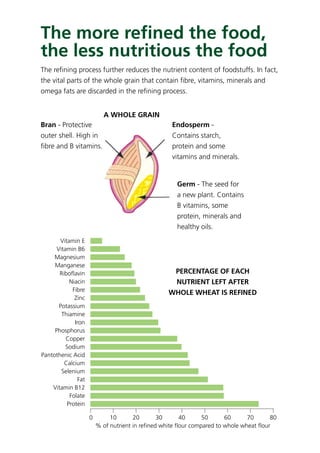
The refining process further reduces the nutrient content of foodstuffs. In fact,
the vital parts of the whole grain that contain fibre, vitamins, minerals and
omega fats are discarded in the refining process.
Protein
Folate
Vitamin B12
Fat
Selenium
Calcium
Pantothenic Acid
Sodium
Copper
Phosphorus
Iron
Thiamine
Potassium
Zinc
Fibre
Niacin
Riboflavin
Manganese
Magnesium
Vitamin B6
Vitamin E
0 10 20 30 40 50 60 70 80
% of nutrient in refined white flour compared to whole wheat flour
Bran - Protective
outer shell. High in
fibre and B vitamins.
Endosperm -
Contains starch,
protein and some
vitamins and minerals.
Germ - The seed for
a new plant. Contains
B vitamins, some
protein, minerals and
healthy oils.
A WHOLE GRAIN
PERCENTAGE OF EACH
NUTRIENT LEFT AFTER
WHOLE WHEAT IS REFINED
Food fortification isn’t
a solution
Where there is awareness of nutrient depletion, it is usually ‘corrected’ by the
addition of isolated chemical nutrients – but this does not solve the problem.
For example, according to the National Food Consumption Survey (2000), in
South Africa, the five foods eaten the most are refined white maize and sugar,
tea, milk and brown bread.
The result of this is that many children are seriously deficient in iron, zinc and
Vitamin A. In response, the Department of Health introduced mandatory food
fortification of all maize and wheat flour from 2003.
However, despite widespread use of these fortified foods, a repeat survey in
2005 showed no improvement. Why?
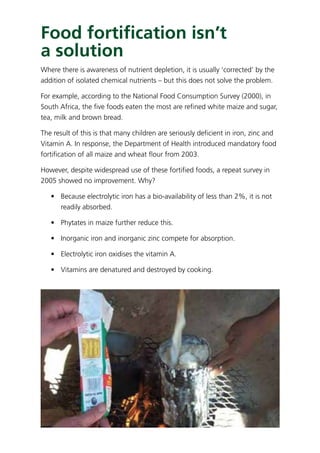
• Because electrolytic iron has a bio-availability of less than 2%, it is not
readily absorbed.
• Phytates in maize further reduce this.
• Inorganic iron and inorganic zinc compete for absorption.
• Electrolytic iron oxidises the vitamin A.
• Vitamins are denatured and destroyed by cooking.
Current solutions are not
working
A Balanced Diet is the medical approach – but ignores reality.
Most underdeveloped communities do not have access to foodstuffs that
will provide a balanced diet. Where they do, they often cannot afford these
foodstuffs. When they can afford them, due to ignorance, they usually do
not choose them. When they can afford and choose food that can provide a
balanced diet, it is often nutritionally depleted.
Food Security is the approach of the World Food Program, but often only fills
an empty stomach - because grain is grown on depleted soils and harvests are
deficient in vital trace minerals. The milling process results in the loss of fibre,
vitamins, minerals and omega fats, due to the removal of the husk, membrane
and germ. This removed goodness is usually sold as animal feed. This kind of
food intervention has a limited ability to strengthen the immune system.
Using supplements as isolates to address daily nutritional needs perpetuates
malnutrition as this approach results in expensive urine. The problem is that
isolates cannot be readily or easily absorbed and are often excreted from the
body without any effect. Because chemical Isolates and genuine food nutrients
have different structures, they use different metabolic pathways and function
differently in the body. The body needs these micronutrients as food or in a
food form. For example, the vitamin C you get from an orange is more readily
absorbed and is more effective than chemically produced ascorbic acid, which
is often just urinated out of the body. Isolating nutrients and expecting the
benefits of chemical isolates to equal those provided by whole foods, reveals an
ignorance of how nutrition works in the body.
Body Mass Index (BMI) is not a sensible measure of nutritional status –
because even though your body may not be emaciated, this does not mean
you are healthy. Why? Because an improvement in BMI can be achieved
through eating high levels of carbohydrate and fat – and that does not equate
to good nutrition. Gaining body mass can occur without even adding cheap
micronutrients – and is unaffected by whether or not the body absorbs these
micronutrients. We see confirmation of this, not only in Africa, but also in
the USA and UK, where there is a high prevalence of obesity in people eating
refined, nutritionally sterile food.
So for both poor and rich - malnutrition continues to exist.
We need a new
approach in order to
ensure real nutrition
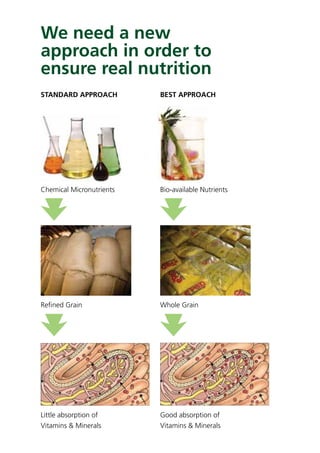
STANDARD APPROACH BEST APPROACH
Chemical Micronutrients Bio-available Nutrients
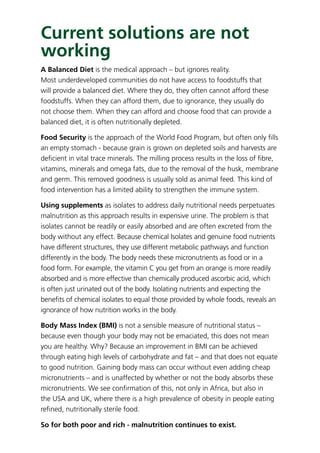
Refined Grain
Little absorption of
Vitamins & Minerals
Whole Grain
Good absorption of
Vitamins & Minerals
We need whole foods
with bio-available vitamins
and minerals
Where access to fruit and vegetables is limited, whole grain cereals need to be
fortified – but with nutrients that can be readily absorbed by the body.
This can be done. It is affordable. And it works!
Did you know that it costs less than £2 per month to
provide a vulnerable child or a TB patient with a daily
nutritious meal?
How? With products that are about real nutrition, such as e’Pap.
Products such as e’Pap are
about real nutrition
In Africa, HETN supports e’Pap. This is a pre-cooked, whole grain food,
based on maize and fortified with soya and a cocktail of 28 nutrients. e’Pap
is produced in Africa where it’s composition and brand name are suited to
Africa’s taste and tradition. The formulation is based on a local understanding
of nutritional need, and uses state of the art, first world fortification chemistry
to ensure bio-availability and bio-efficacy.
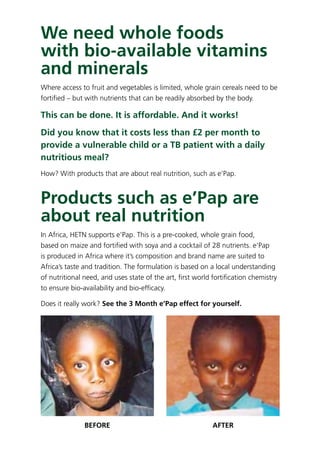
Does it really work? See the 3 Month e’Pap effect for yourself.
BEFORE AFTER
Proof that Health
Empowerment Through
Nutrition and e’Pap
changes lives
& Beyond is a world leader in luxury adventure travels and
safaris. They have a philosophy that says “Care of the Land.
Care of the Wildlife. Care of the People.” This was their
feedback on HETN’s approach and e’Pap.
“Our most valuable asset is our staff. With this in mind, in 2003 we
initiated Positive Health across the group. This programme is built
around natural vitamins and minerals, affordable foodstuffs and
the power of positive thinking. It is geared at preventive health
care and improving the health of people living with chronic disease.
e’Pap is an important part of this initiative.
Not just another cereal, e’Pap is a nutritious and affordable meal-in-
one, enjoyed by our staff at more than 45 safari camps and lodges.
Positive Health champions from each lodge educate the local
communities on the many benefits of this remarkable product.”
e’Pap makes the difference at & Beyond says Steve
Fitzgerald (Chairman)
We teach and encourage our staff, as well as the communities surrounding
our conservation areas, to grow their own vegetable gardens to ensure that
they get all the nutrients they need.
Operating in various countries across Africa and in very remote destinations,
this is obviously a challenge. In order to supplement their diets, five years ago
we sourced e’Pap, which is effective and affordable.
e’Pap contains all the nutrients that a person needs on a daily basis and we
have seen remarkable results.
The difference that it has made has been immediately visible, especially with
staff who were ill. Once they started using e’Pap, they begin to look healthier,
and their skin condition and colour, hair and weight improved visibily.
Another advantage is that absenteeism has been reduced and people have
more energy to perform their duties.
We would recommend this product to anybody, as it has really made a
difference to & Beyonders’ lives. It complements and enhances a well balanced
diet and helps the body to defend itself against opportunistic diseases.
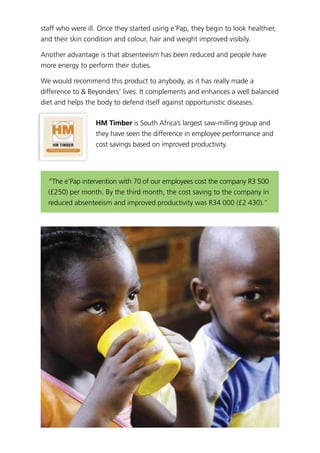
HM Timber is South Africa’s largest saw-milling group and
they have seen the difference in employee performance and
cost savings based on improved productivity.
“The e’Pap intervention with 70 of our employees cost the company R3 500
(£250) per month. By the third month, the cost saving to the company in
reduced absenteeism and improved productivity was R34 000 (£2 430).”
Proof that Health
Empowerment Through
Nutrition with e’Pap
saves lives
e’Pap Improves TB Cure Rates by 39%.
When e’Pap was introduced, no one believed that it
would save lives - but we have seen miracles.
Lenasia is surrounded by poverty. When everyone was
losing hope, this miracle pap came to save lives. We used
to cry and wonder why people should be so sick. Today, we walk with a smile and
songs in our hearts, because we have witnessed the dead brought back to life.
Atteridgeville is surrounded by squatter camps. Bread winners had taken to
their beds. When e’Pap was introduced, most families were back on their feet.
They gained weight, and grew in strength.
Patients at Hamanskraal now respond positively to medication. The children can
concentrate at school. They sing and praise e`Pap as it works miracles in their
villages. With this little sachet we can heal the nation; we can change the world.
John Heinrich, CEO, South African National Tuberculosis
Association, writes:
On behalf of SANTA, I would like to express our appreciation of the
partnership enjoyed with HETN in the distribution of e’Pap to TB patients, their
families and care workers.
The pilot project of 2 tons of e’Pap per month is proving highly successful.
The greatest impact is being seen on very ill / bedridden patients. Reports from
recipients indicate that e’Pap is far more beneficial than supposed enriched
foods received before.
These e’Pap projects have proved most valuable and are well received.
Their continuation and expansion is seen as one of the three major objectives
of SANTA in the continuing fight against TB and HIV/AIDS - namely Nutrition,
Awareness and Directly Observed Therapy (DOTS). SANTA is in no doubt that
improved nutrition can revolutionise the fight against both TB and HIV/AIDS. 
e’Pap is Changing Lives in Alexandra
On behalf of the Society of Saint Vincent
de Paul Maryvale Conference, I would
like to offer our sincere thanks for the
donations of e’Pap we have received from HETN, and our appreciation for the
partnership we have with you to distribute food to crèches and the terminally
ill in Alexandra Township.
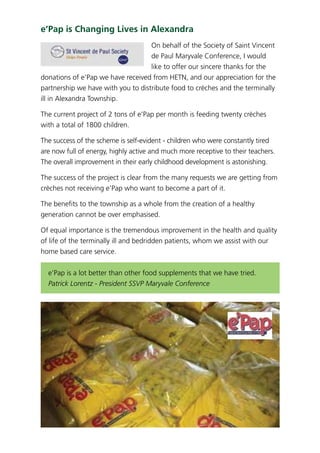
The current project of 2 tons of e’Pap per month is feeding twenty crèches
with a total of 1800 children.
The success of the scheme is self-evident - children who were constantly tired
are now full of energy, highly active and much more receptive to their teachers.
The overall improvement in their early childhood development is astonishing.
The success of the project is clear from the many requests we are getting from
crèches not receiving e’Pap who want to become a part of it.
The benefits to the township as a whole from the creation of a healthy
generation cannot be over emphasised.
Of equal importance is the tremendous improvement in the health and quality
of life of the terminally ill and bedridden patients, whom we assist with our
home based care service.
e’Pap is a lot better than other food supplements that we have tried.
Patrick Lorentz - President SSVP Maryvale Conference
How does HETN make
a difference?
HETN is a Charitable Foundation, registered in
the UK.
Our goal is to address nutrient depletion,
believing this to be crucial in health, education
and social upliftment programmes.
HETN’s approach is based on numerous
scientific trials that demonstrate the
importance of micronutrients in the prevention
and management of chronic disease.
Our projects have a single aim - to ensure
that the recipients of feeding programmes
receive a daily food portion that includes all the required micronutrients in a
bio-available form.
We make a difference by:
Partnering with NGOs in the field, to ensure that their nutritional interventions
are appropriate and cost effective. These include:
• Society of St Vincent de Paul (SSVP) - Crèche Feeding
• South African National Tuberculosis Association (SANTA) - Community Based
TB Support
Providing wholegrain food, with all the cereal fats, fibre, vitamins and minerals
intact, and with the addition of all the required micronutrients in a form that is
bio-available (chelates or food form).
Comparing different formulations and measuring outcomes – with the aim
of increasing the evidence base that supports nutritional interventions in the
management of chronic disease.
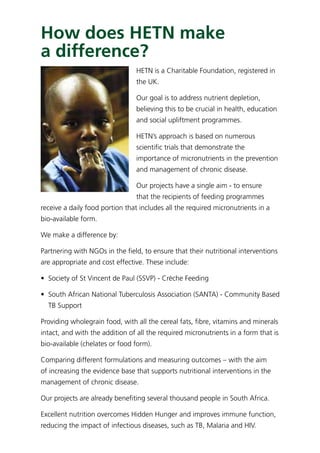
Our projects are already benefiting several thousand people in South Africa.
Excellent nutrition overcomes Hidden Hunger and improves immune function,
reducing the impact of infectious diseases, such as TB, Malaria and HIV.
While HETN advocates the effectiveness
of proper nutrition and provides credible
evidence to define what healthy food
actually is, it is not HETN’s task to
feed the hungry – because this is the
responsibility of governments and
international agencies.
Health Empowerment Through Nutrition
A UK Charitable Foundation (1116097)
email: info@hetn.org
www.hetn.org
HETN

HETN Hidden Hunger Brochure

  • 1.
    HETN Millions are starving. The solution isn’tfood. But do we know what nutrition really is? www.hetn.org It’s nutrition.
  • 2.
    Unlocking the hidden hunger crisiswith effective nutrition Hidden Hunger affects more than two billion people. Even when a person consumes adequate calories and protein, if they lack one single micronutrient, or a combination of vitamins and minerals, their immune system is compromised and infections take hold. World Food Program
  • 3.
    HETN stands for HealthEmpowerment Through Nutrition – an organisation dedicated to exploring the relationship between nutrition and chronic disease We know that the human body needs sufficient nutrients for optimum health – but due to environmental degradation, soil depleting farming methods, food processing and diet choices, the nutrition of most people is inadequate, even if they have food on the table. The result? Immunity is compromised. Chronic diseases are on the increase. Even in the West where people live longer, half have health problems that require prescription drugs on a regular basis. This worldwide problem is extreme in Africa, where a diet deficient in primary micronutrients is widespread, and fortification of food with chemical isolates has become commonplace. This dietary fortification is inappropriate, because it cannot solve the problem and may even make matters worse – as these chemical vitamins and minerals are not only poorly absorbed, but often toxic, and rarely act in the body the way nature intended. Hunger is not merely about having a lack of food. Hunger is about lacking food that produces a healthy human being. Throughout the world, nutrition is being neglected in favour of a full stomach. HETN believes that there is more to food – because real food is about effective nutrition.
  • 4.
    The crisis Malnutrition isrampant throughout the world – and has a devastating impact, not only on lives, but also on the global economy. The terms ‘nutrition’ and ‘a balanced diet’ are used with little understanding. There are many communities experiencing health problems not seen by their grandparents, who often lived in even greater poverty. By providing highly refined foods with added highly refined vitamins and minerals, science has done little to provide a solution to malnutrition – because highly refined means that these foods are not the natural foods our bodies are designed to use, and they don’t work. The problem Every day, the human body needs nutrients, including vitamins and minerals. Obtaining these nutrients from the food we eat, or in the right form from other sources, is beyond most people – either through poverty or ignorance. Not only have people moved away from their traditional foods, but modern agricultural practices and food processing remove essential nutrients from the food chain. This means we can no longer rely on ‘a balanced diet’ to obtain the nutrients our bodies require. The continued fortification of food and diets with chemical isolates cannot address the problem. This is what we call Hidden Hunger - because filling bellies and improving the Body Mass Index of children does not mean that they are well nourished.
  • 5.
    Why healthy soil meanshealthy food and healthier people Nutrient Rich Soil Soils farmed responsibly are rich in bio-available nutrients, which are incorporated into the farmed foodstuffs – and, when eaten, the vital nutrients they contain are readily absorbed by the body. Nutrient Depleted Soil Modern farming practices leave the soil depleted of nutrients – and the resulting crops that enter the food chain have insufficient vitamins to provide our bodies with the nutrients we need.
  • 6.
    The more refinedthe food, the less nutritious the food The refining process further reduces the nutrient content of foodstuffs. In fact, the vital parts of the whole grain that contain fibre, vitamins, minerals and omega fats are discarded in the refining process. Protein Folate Vitamin B12 Fat Selenium Calcium Pantothenic Acid Sodium Copper Phosphorus Iron Thiamine Potassium Zinc Fibre Niacin Riboflavin Manganese Magnesium Vitamin B6 Vitamin E 0 10 20 30 40 50 60 70 80 % of nutrient in refined white flour compared to whole wheat flour Bran - Protective outer shell. High in fibre and B vitamins. Endosperm - Contains starch, protein and some vitamins and minerals. Germ - The seed for a new plant. Contains B vitamins, some protein, minerals and healthy oils. A WHOLE GRAIN PERCENTAGE OF EACH NUTRIENT LEFT AFTER WHOLE WHEAT IS REFINED
  • 7.
    Food fortification isn’t asolution Where there is awareness of nutrient depletion, it is usually ‘corrected’ by the addition of isolated chemical nutrients – but this does not solve the problem. For example, according to the National Food Consumption Survey (2000), in South Africa, the five foods eaten the most are refined white maize and sugar, tea, milk and brown bread. The result of this is that many children are seriously deficient in iron, zinc and Vitamin A. In response, the Department of Health introduced mandatory food fortification of all maize and wheat flour from 2003. However, despite widespread use of these fortified foods, a repeat survey in 2005 showed no improvement. Why? • Because electrolytic iron has a bio-availability of less than 2%, it is not readily absorbed. • Phytates in maize further reduce this. • Inorganic iron and inorganic zinc compete for absorption. • Electrolytic iron oxidises the vitamin A. • Vitamins are denatured and destroyed by cooking.
  • 8.
    Current solutions arenot working A Balanced Diet is the medical approach – but ignores reality. Most underdeveloped communities do not have access to foodstuffs that will provide a balanced diet. Where they do, they often cannot afford these foodstuffs. When they can afford them, due to ignorance, they usually do not choose them. When they can afford and choose food that can provide a balanced diet, it is often nutritionally depleted. Food Security is the approach of the World Food Program, but often only fills an empty stomach - because grain is grown on depleted soils and harvests are deficient in vital trace minerals. The milling process results in the loss of fibre, vitamins, minerals and omega fats, due to the removal of the husk, membrane and germ. This removed goodness is usually sold as animal feed. This kind of food intervention has a limited ability to strengthen the immune system. Using supplements as isolates to address daily nutritional needs perpetuates malnutrition as this approach results in expensive urine. The problem is that isolates cannot be readily or easily absorbed and are often excreted from the body without any effect. Because chemical Isolates and genuine food nutrients have different structures, they use different metabolic pathways and function differently in the body. The body needs these micronutrients as food or in a food form. For example, the vitamin C you get from an orange is more readily absorbed and is more effective than chemically produced ascorbic acid, which is often just urinated out of the body. Isolating nutrients and expecting the benefits of chemical isolates to equal those provided by whole foods, reveals an ignorance of how nutrition works in the body. Body Mass Index (BMI) is not a sensible measure of nutritional status – because even though your body may not be emaciated, this does not mean you are healthy. Why? Because an improvement in BMI can be achieved through eating high levels of carbohydrate and fat – and that does not equate to good nutrition. Gaining body mass can occur without even adding cheap micronutrients – and is unaffected by whether or not the body absorbs these micronutrients. We see confirmation of this, not only in Africa, but also in the USA and UK, where there is a high prevalence of obesity in people eating refined, nutritionally sterile food. So for both poor and rich - malnutrition continues to exist.
  • 9.
    We need anew approach in order to ensure real nutrition STANDARD APPROACH BEST APPROACH Chemical Micronutrients Bio-available Nutrients Refined Grain Little absorption of Vitamins & Minerals Whole Grain Good absorption of Vitamins & Minerals
  • 10.
    We need wholefoods with bio-available vitamins and minerals Where access to fruit and vegetables is limited, whole grain cereals need to be fortified – but with nutrients that can be readily absorbed by the body. This can be done. It is affordable. And it works! Did you know that it costs less than £2 per month to provide a vulnerable child or a TB patient with a daily nutritious meal? How? With products that are about real nutrition, such as e’Pap. Products such as e’Pap are about real nutrition In Africa, HETN supports e’Pap. This is a pre-cooked, whole grain food, based on maize and fortified with soya and a cocktail of 28 nutrients. e’Pap is produced in Africa where it’s composition and brand name are suited to Africa’s taste and tradition. The formulation is based on a local understanding of nutritional need, and uses state of the art, first world fortification chemistry to ensure bio-availability and bio-efficacy. Does it really work? See the 3 Month e’Pap effect for yourself. BEFORE AFTER
  • 11.
    Proof that Health EmpowermentThrough Nutrition and e’Pap changes lives & Beyond is a world leader in luxury adventure travels and safaris. They have a philosophy that says “Care of the Land. Care of the Wildlife. Care of the People.” This was their feedback on HETN’s approach and e’Pap. “Our most valuable asset is our staff. With this in mind, in 2003 we initiated Positive Health across the group. This programme is built around natural vitamins and minerals, affordable foodstuffs and the power of positive thinking. It is geared at preventive health care and improving the health of people living with chronic disease. e’Pap is an important part of this initiative. Not just another cereal, e’Pap is a nutritious and affordable meal-in- one, enjoyed by our staff at more than 45 safari camps and lodges. Positive Health champions from each lodge educate the local communities on the many benefits of this remarkable product.” e’Pap makes the difference at & Beyond says Steve Fitzgerald (Chairman) We teach and encourage our staff, as well as the communities surrounding our conservation areas, to grow their own vegetable gardens to ensure that they get all the nutrients they need. Operating in various countries across Africa and in very remote destinations, this is obviously a challenge. In order to supplement their diets, five years ago we sourced e’Pap, which is effective and affordable. e’Pap contains all the nutrients that a person needs on a daily basis and we have seen remarkable results. The difference that it has made has been immediately visible, especially with
  • 12.
    staff who wereill. Once they started using e’Pap, they begin to look healthier, and their skin condition and colour, hair and weight improved visibily. Another advantage is that absenteeism has been reduced and people have more energy to perform their duties. We would recommend this product to anybody, as it has really made a difference to & Beyonders’ lives. It complements and enhances a well balanced diet and helps the body to defend itself against opportunistic diseases. HM Timber is South Africa’s largest saw-milling group and they have seen the difference in employee performance and cost savings based on improved productivity. “The e’Pap intervention with 70 of our employees cost the company R3 500 (£250) per month. By the third month, the cost saving to the company in reduced absenteeism and improved productivity was R34 000 (£2 430).”
  • 13.
    Proof that Health EmpowermentThrough Nutrition with e’Pap saves lives e’Pap Improves TB Cure Rates by 39%. When e’Pap was introduced, no one believed that it would save lives - but we have seen miracles. Lenasia is surrounded by poverty. When everyone was losing hope, this miracle pap came to save lives. We used to cry and wonder why people should be so sick. Today, we walk with a smile and songs in our hearts, because we have witnessed the dead brought back to life. Atteridgeville is surrounded by squatter camps. Bread winners had taken to their beds. When e’Pap was introduced, most families were back on their feet. They gained weight, and grew in strength. Patients at Hamanskraal now respond positively to medication. The children can concentrate at school. They sing and praise e`Pap as it works miracles in their villages. With this little sachet we can heal the nation; we can change the world. John Heinrich, CEO, South African National Tuberculosis Association, writes: On behalf of SANTA, I would like to express our appreciation of the partnership enjoyed with HETN in the distribution of e’Pap to TB patients, their families and care workers. The pilot project of 2 tons of e’Pap per month is proving highly successful. The greatest impact is being seen on very ill / bedridden patients. Reports from recipients indicate that e’Pap is far more beneficial than supposed enriched foods received before. These e’Pap projects have proved most valuable and are well received. Their continuation and expansion is seen as one of the three major objectives of SANTA in the continuing fight against TB and HIV/AIDS - namely Nutrition, Awareness and Directly Observed Therapy (DOTS). SANTA is in no doubt that improved nutrition can revolutionise the fight against both TB and HIV/AIDS. 
  • 14.
    e’Pap is ChangingLives in Alexandra On behalf of the Society of Saint Vincent de Paul Maryvale Conference, I would like to offer our sincere thanks for the donations of e’Pap we have received from HETN, and our appreciation for the partnership we have with you to distribute food to crèches and the terminally ill in Alexandra Township. The current project of 2 tons of e’Pap per month is feeding twenty crèches with a total of 1800 children. The success of the scheme is self-evident - children who were constantly tired are now full of energy, highly active and much more receptive to their teachers. The overall improvement in their early childhood development is astonishing. The success of the project is clear from the many requests we are getting from crèches not receiving e’Pap who want to become a part of it. The benefits to the township as a whole from the creation of a healthy generation cannot be over emphasised. Of equal importance is the tremendous improvement in the health and quality of life of the terminally ill and bedridden patients, whom we assist with our home based care service. e’Pap is a lot better than other food supplements that we have tried. Patrick Lorentz - President SSVP Maryvale Conference
  • 15.
    How does HETNmake a difference? HETN is a Charitable Foundation, registered in the UK. Our goal is to address nutrient depletion, believing this to be crucial in health, education and social upliftment programmes. HETN’s approach is based on numerous scientific trials that demonstrate the importance of micronutrients in the prevention and management of chronic disease. Our projects have a single aim - to ensure that the recipients of feeding programmes receive a daily food portion that includes all the required micronutrients in a bio-available form. We make a difference by: Partnering with NGOs in the field, to ensure that their nutritional interventions are appropriate and cost effective. These include: • Society of St Vincent de Paul (SSVP) - Crèche Feeding • South African National Tuberculosis Association (SANTA) - Community Based TB Support Providing wholegrain food, with all the cereal fats, fibre, vitamins and minerals intact, and with the addition of all the required micronutrients in a form that is bio-available (chelates or food form). Comparing different formulations and measuring outcomes – with the aim of increasing the evidence base that supports nutritional interventions in the management of chronic disease. Our projects are already benefiting several thousand people in South Africa. Excellent nutrition overcomes Hidden Hunger and improves immune function, reducing the impact of infectious diseases, such as TB, Malaria and HIV.
  • 16.
    While HETN advocatesthe effectiveness of proper nutrition and provides credible evidence to define what healthy food actually is, it is not HETN’s task to feed the hungry – because this is the responsibility of governments and international agencies. Health Empowerment Through Nutrition A UK Charitable Foundation (1116097) email: info@hetn.org www.hetn.org HETN