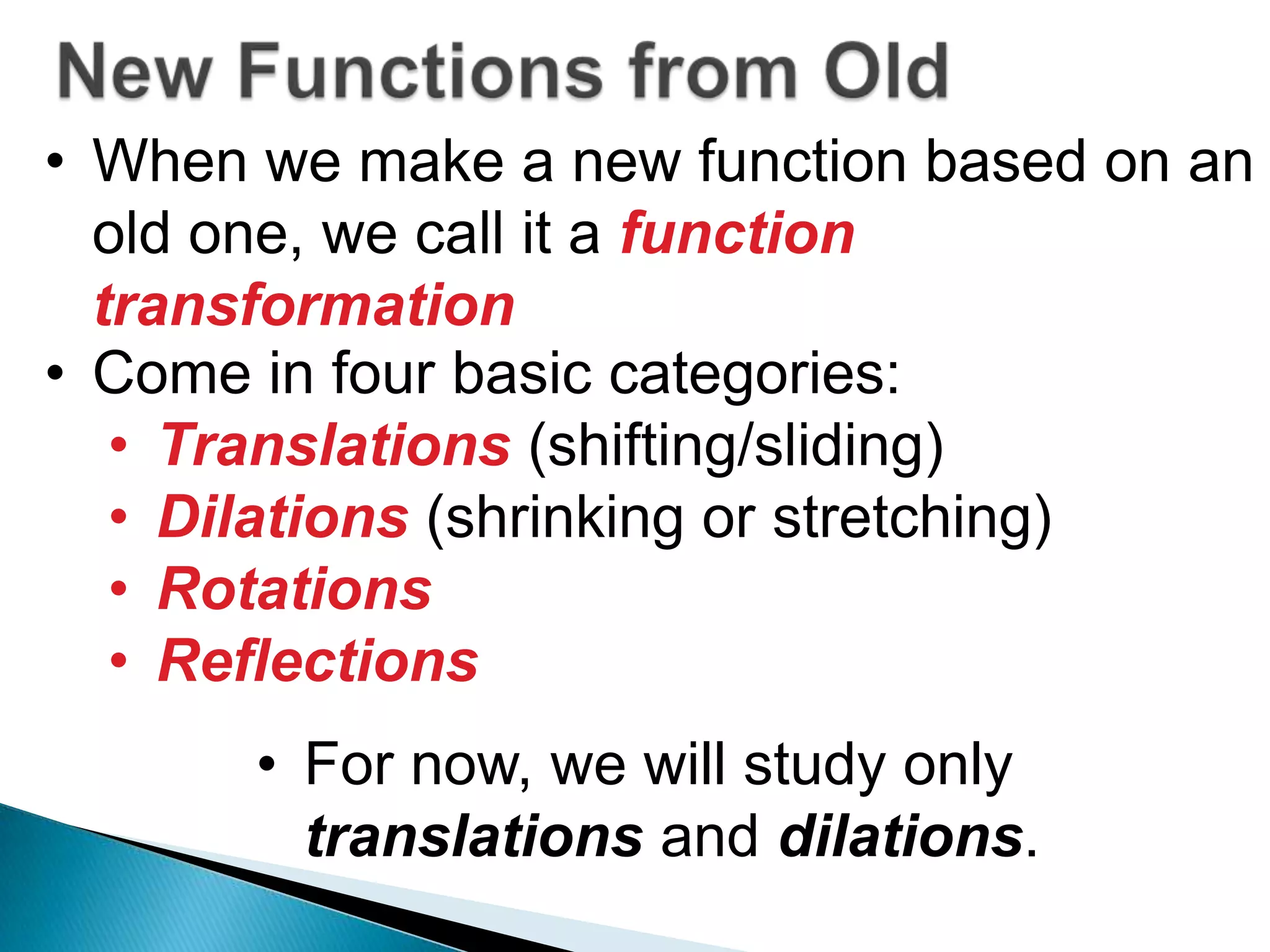
• When we make a new function based on an
old one, we call it a function
transformation
• Come in four basic categories:
• Translations (shifting/sliding)
• Dilations (shrinking or stretching)
• Rotations
• Reflections

• For now, we will study only
translations and dilations.
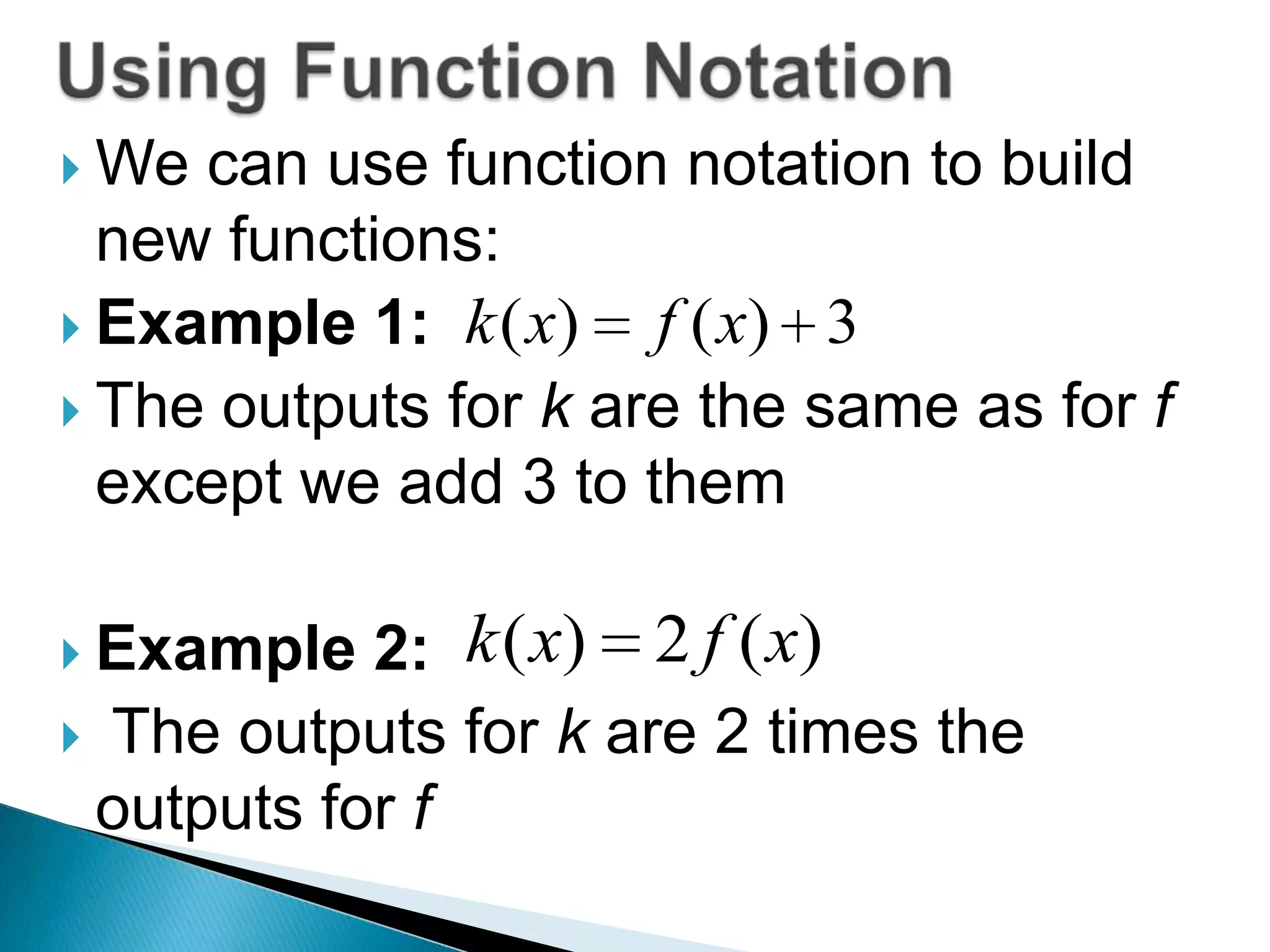
 We

can use function notation to build
new functions:
f ( x) 3
 Example 1: k ( x)
 The outputs for k are the same as for f
except we add 3 to them
2: k ( x) 2 f ( x)
 The outputs for k are 2 times the
outputs for f
 Example


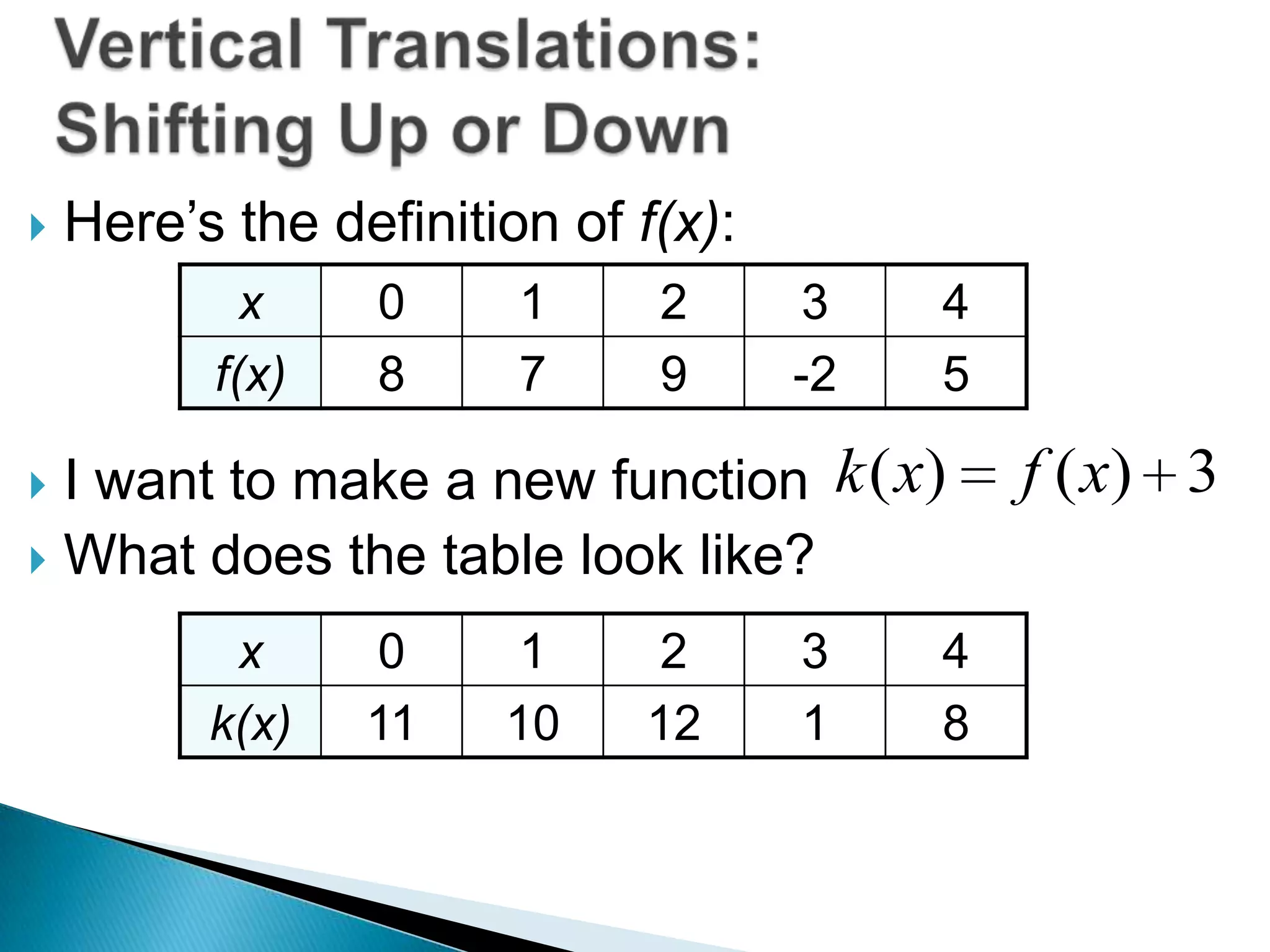
Here’s the definition of f(x):
x
f(x)

0
8

1
7

2
9

3
-2

4
5

I want to make a new function k ( x)
 What does the table look like?


x
k(x)

0
11

1
10

2
12

3
1

4
8

f ( x) 3
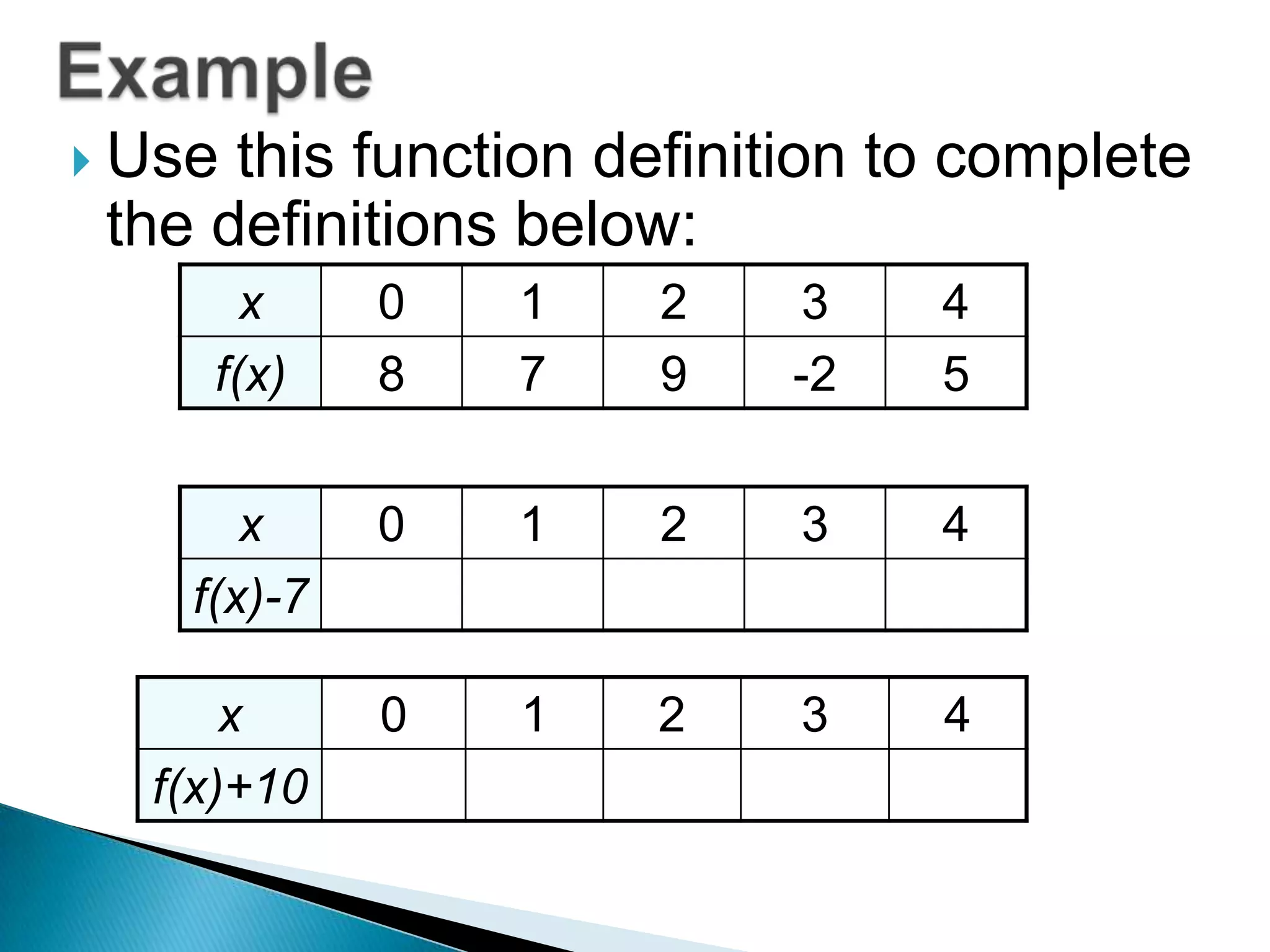
 Use

this function definition to complete
the definitions below:
x
f(x)

0
8

1
7

2
9

3
-2

4
5

x
f(x)-7

0

1

2

3

4

x
f(x)+10

0

1

2

3

4
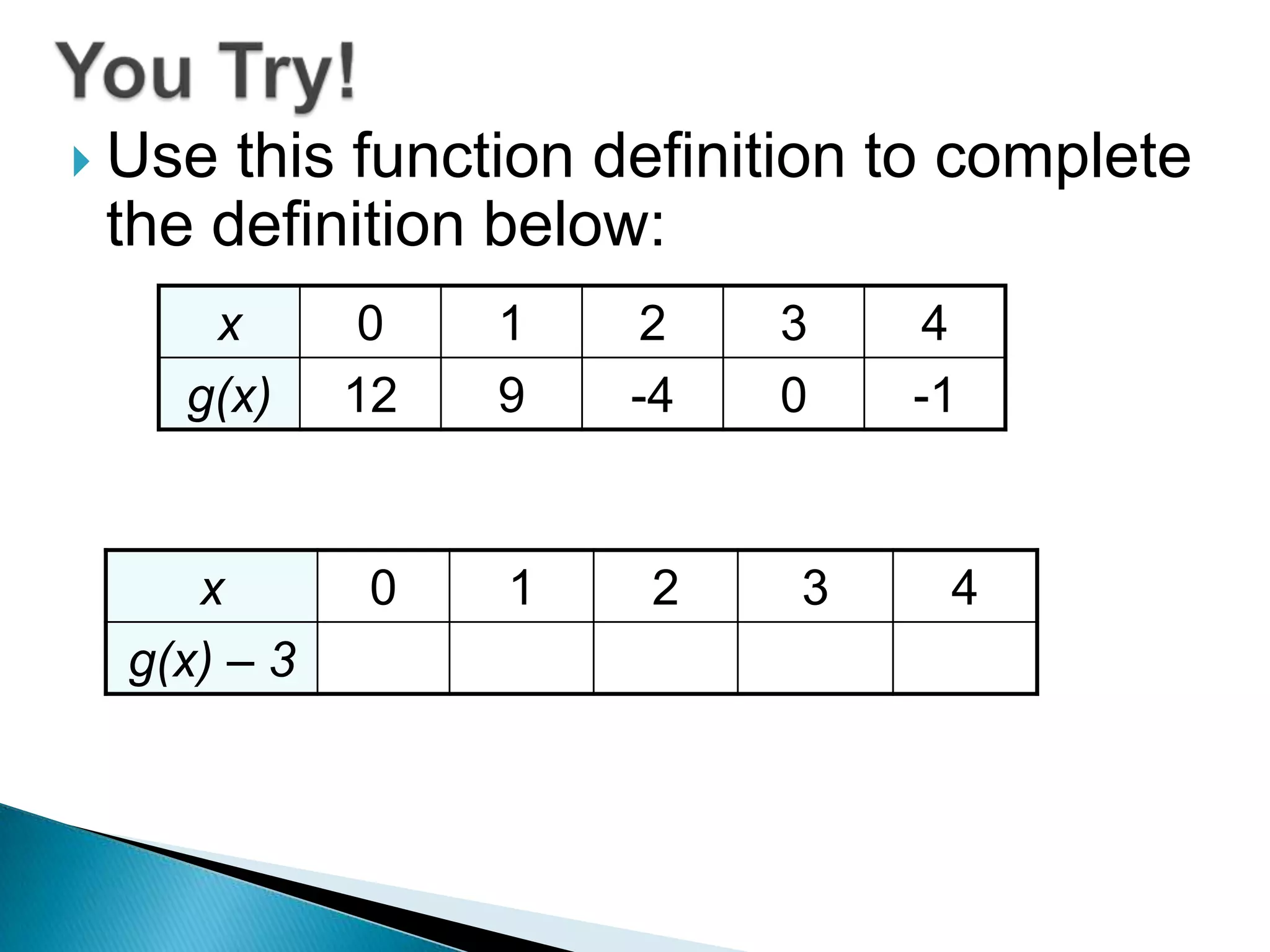
 Use

this function definition to complete
the definition below:
x
g(x)

x
g(x) – 3

0
12

1
9

2
-4

0

1

2

3
0

3

4
-1

4
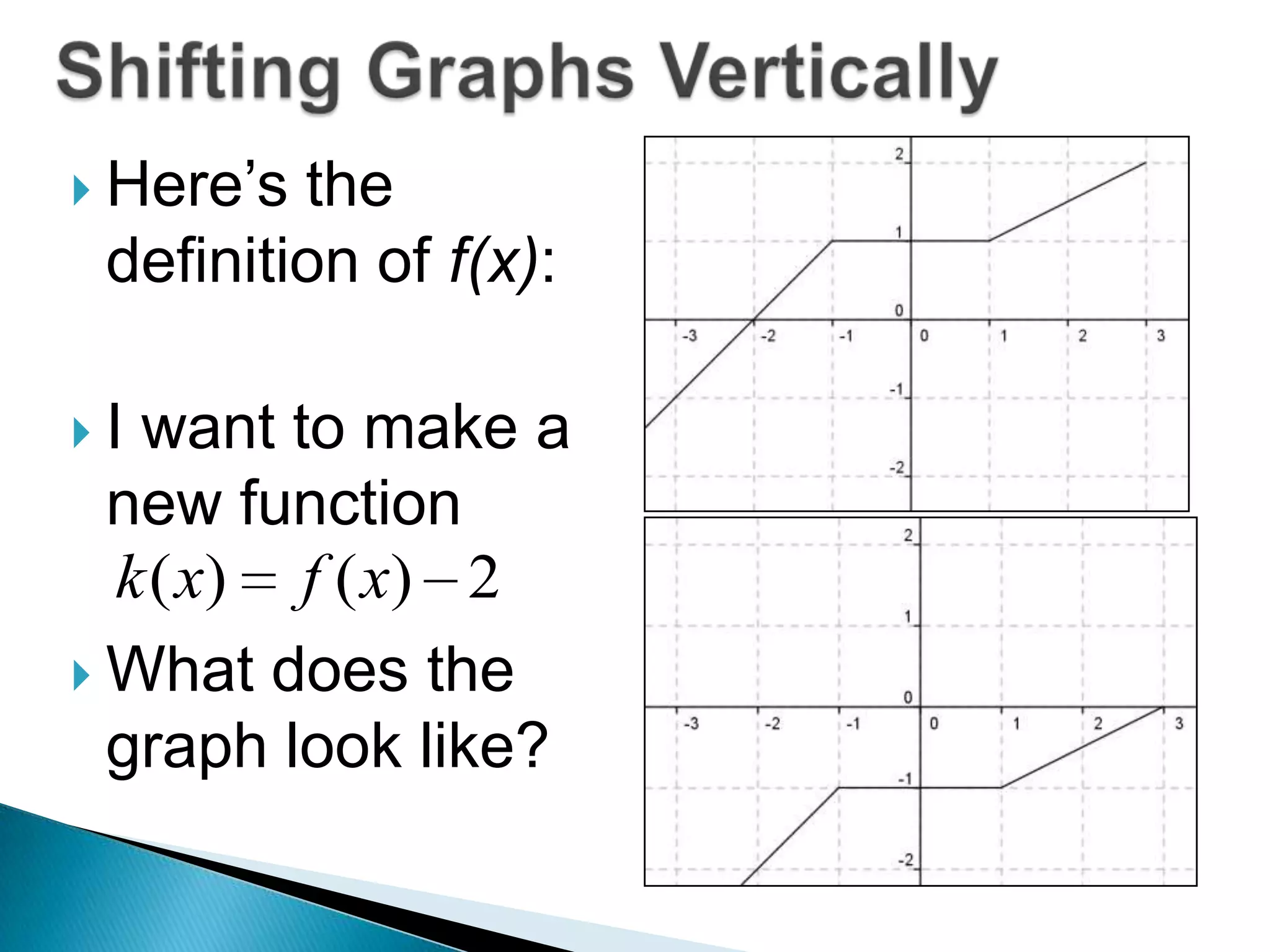
 Here’s

the
definition of f(x):

I

want to make a
new function
k ( x) f ( x) 2
 What does the
graph look like?
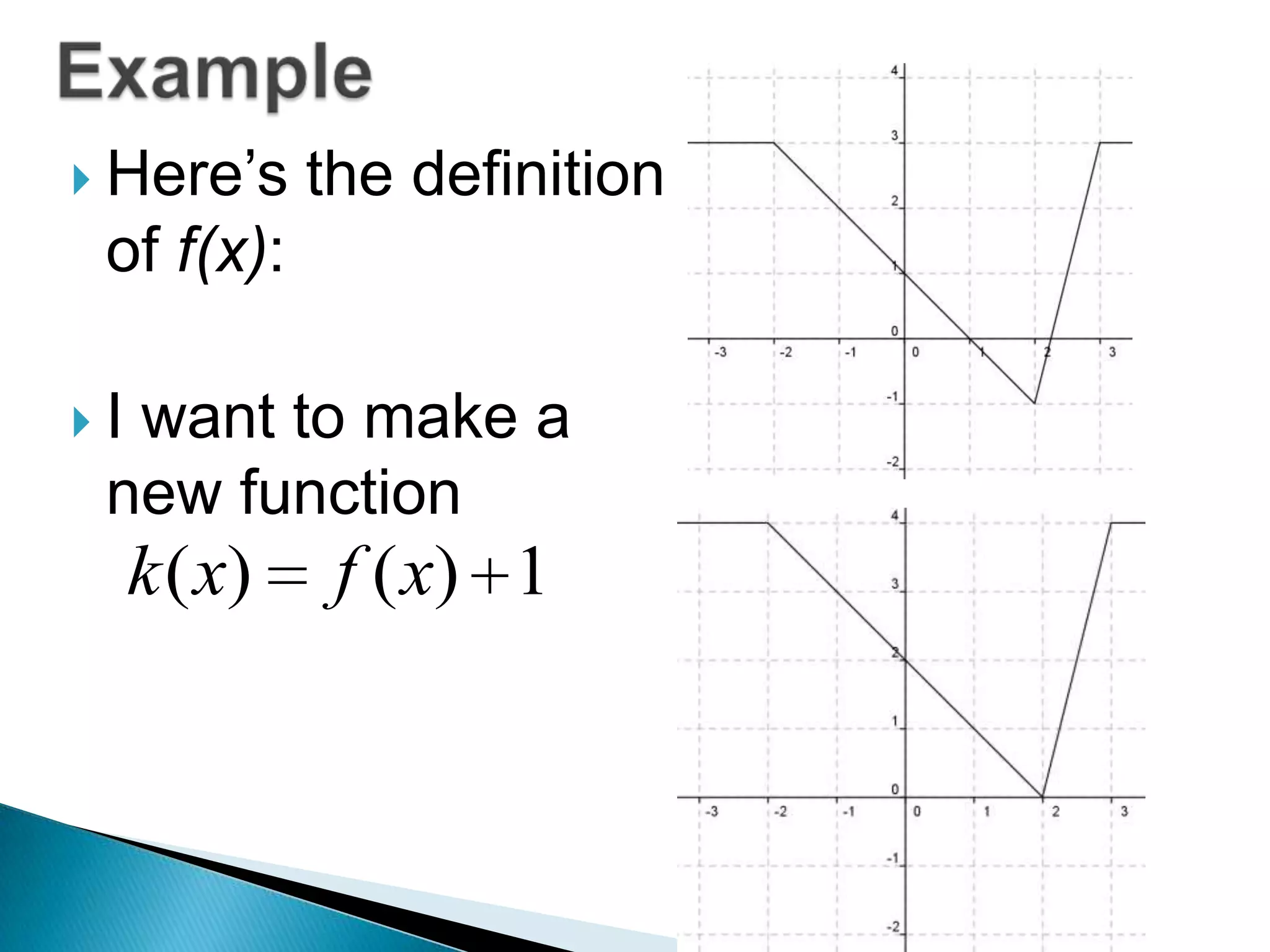
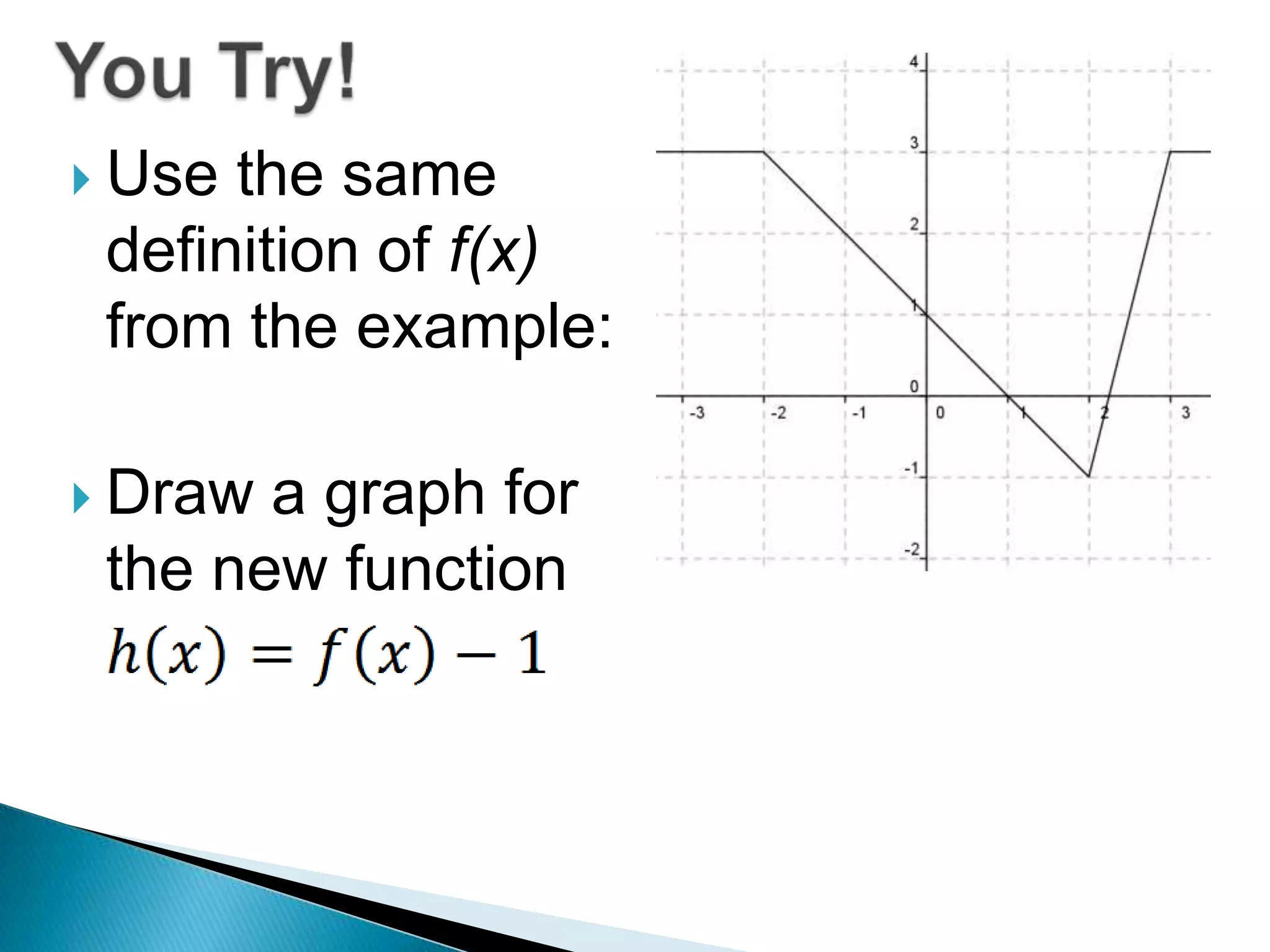
 Here’s

the definition

of f(x):
I

want to make a
new function

k ( x)

f ( x) 1
 Use

the same
definition of f(x)
from the example:

 Draw

a graph for
the new function
 Vertical

shifts added/subtracted
something to the output values.
 Horizontal shifts will add/subtract
something to the input values.
Example: h(x) = f(x + 1)
is a horizontal shift.
 When

the input is changed, we need
to “undo” that change to see what
happens to the graph/table.

 So,

f(x + 1) means we subtract 1
from the x values.
 And, f(x – 1) means we add 1 to the x
values.
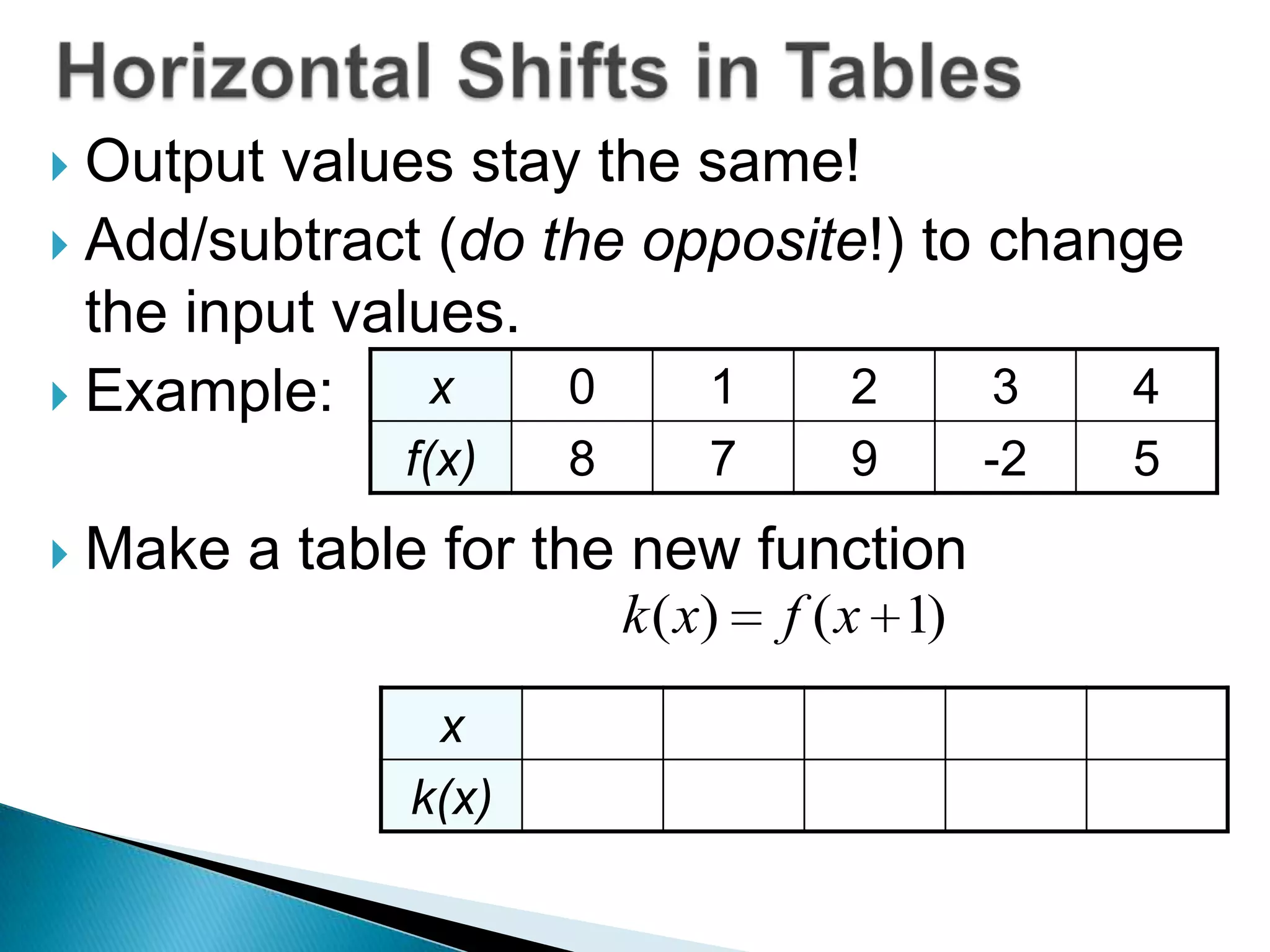
Output values stay the same!
 Add/subtract (do the opposite!) to change
the input values.
x
0
1
2
3
4
 Example:


f(x)


8

7

9

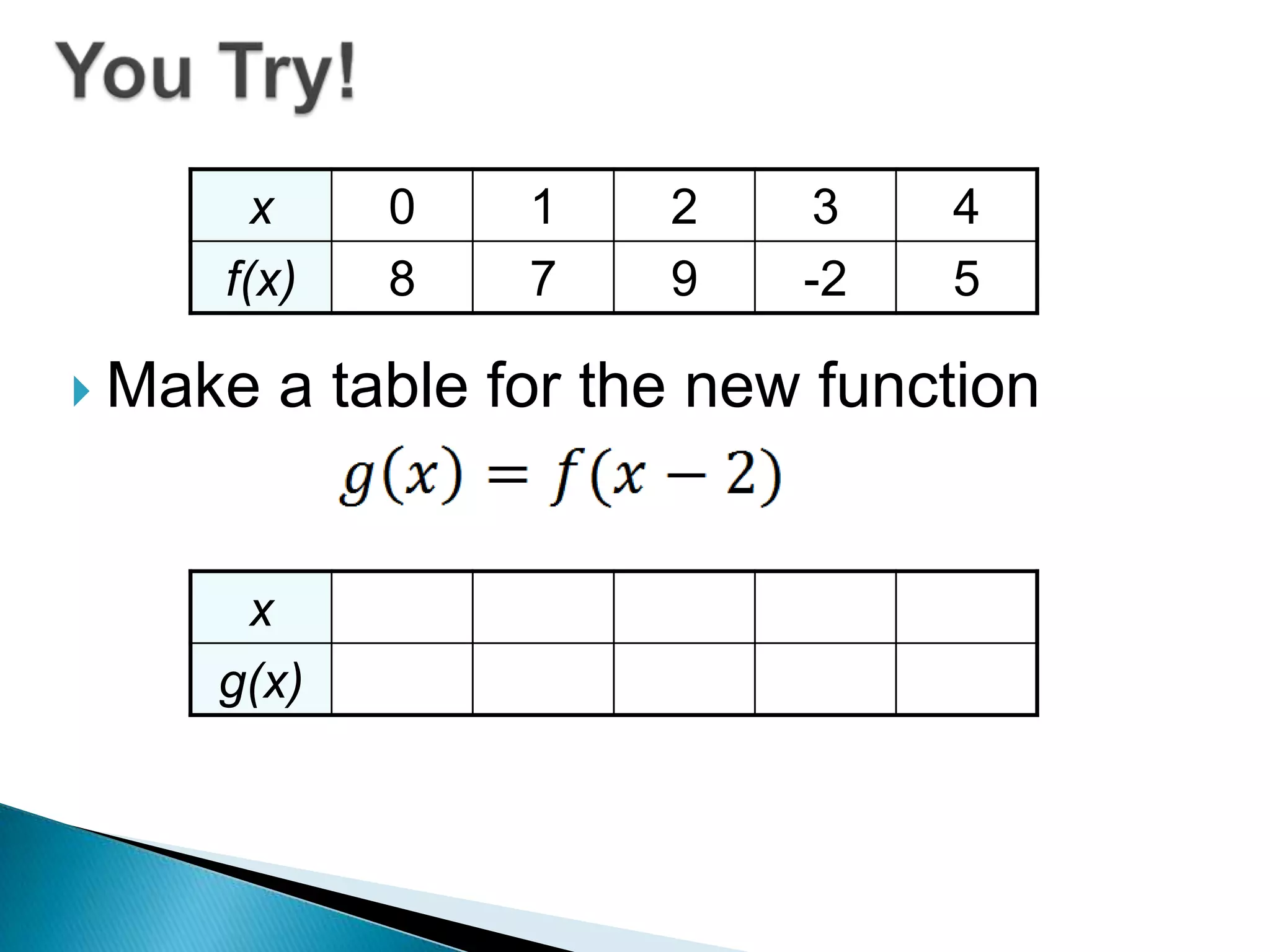
Make a table for the new function
k ( x)
x
k(x)

f ( x 1)

-2

5
x
f(x)
 Make

0
8

1
7

2
9

3
-2

4
5

a table for the new function

x
g(x)
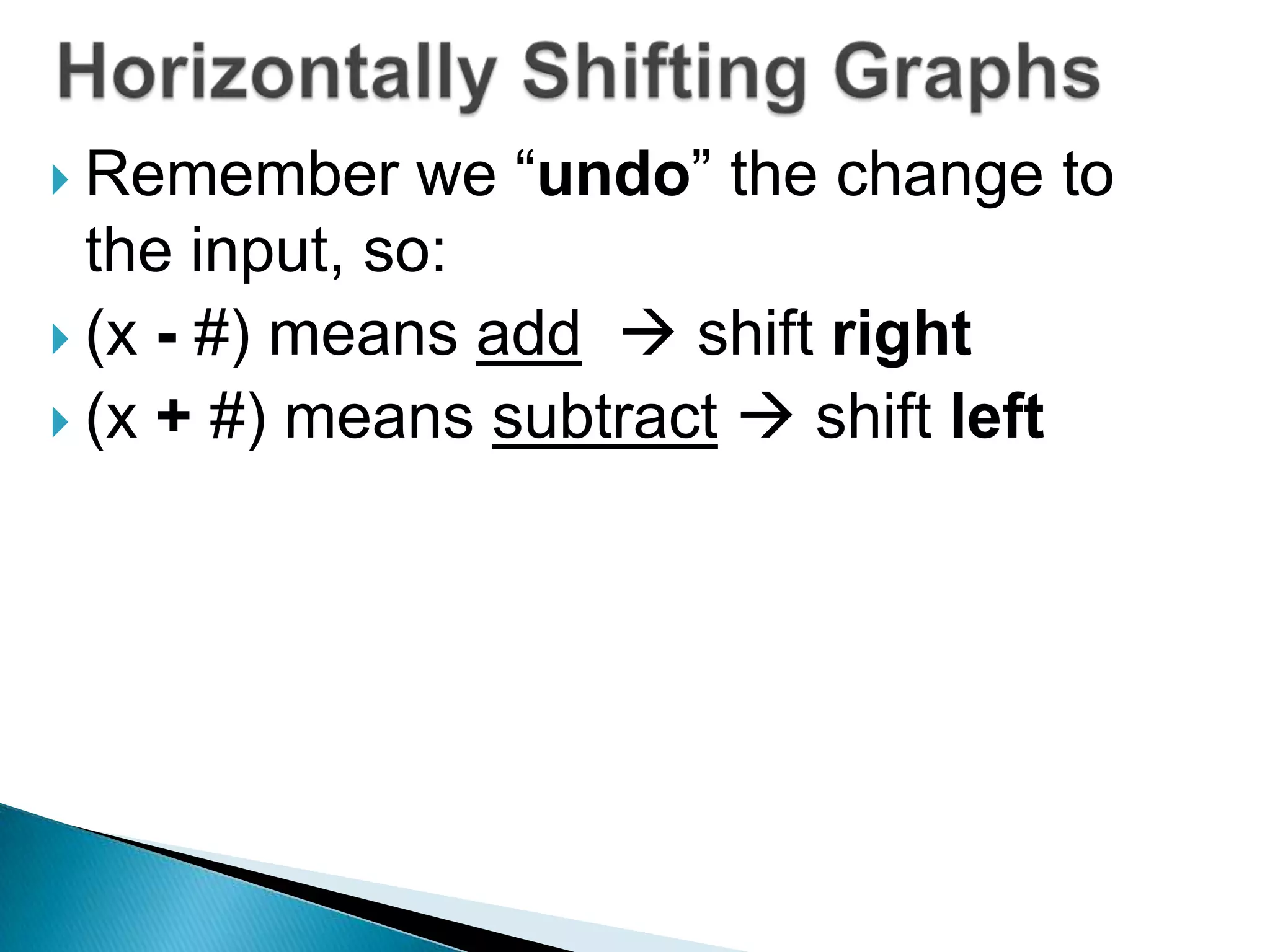
 Remember

we “undo” the change to
the input, so:
 (x - #) means add  shift right
 (x + #) means subtract  shift left
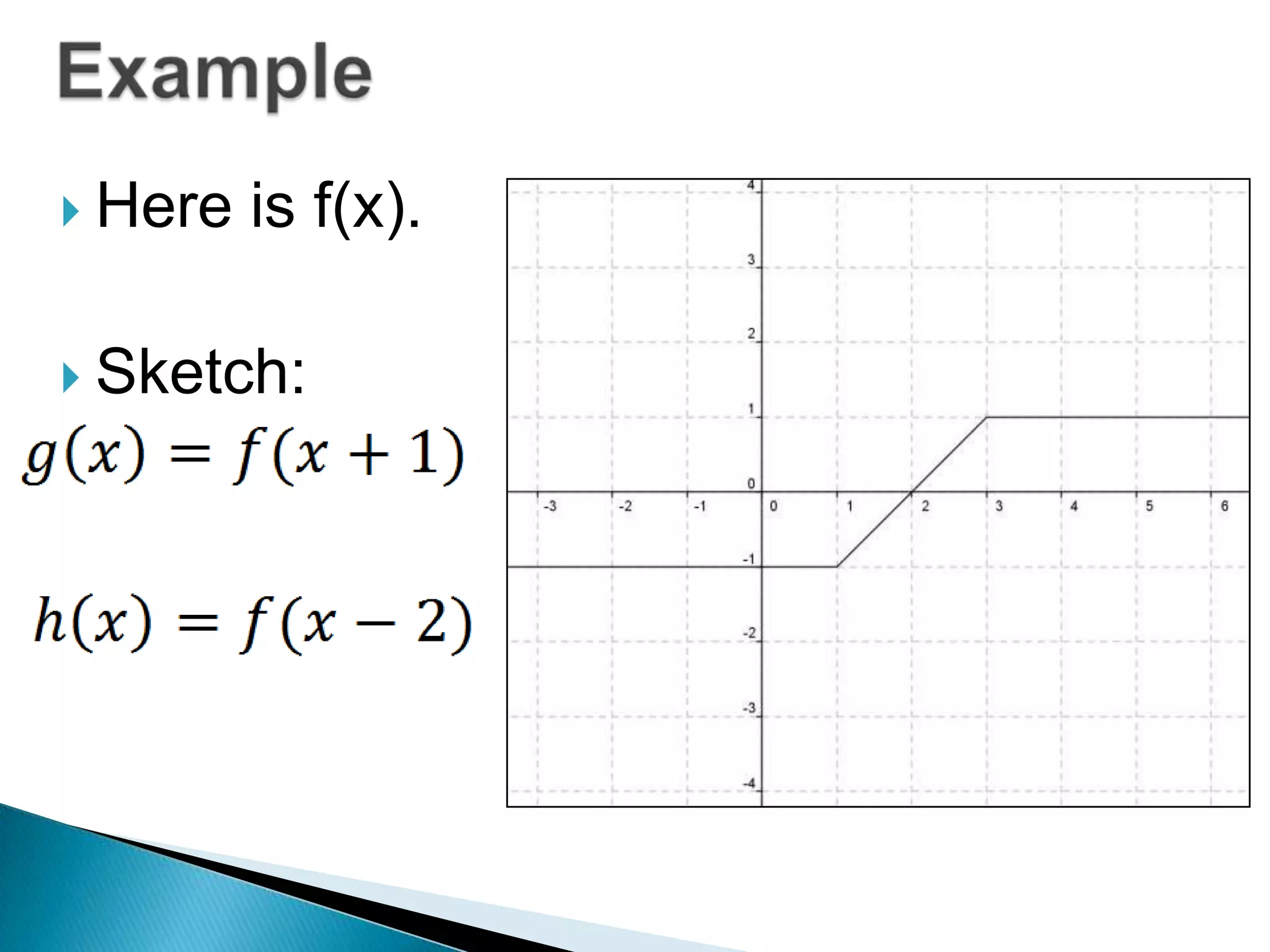
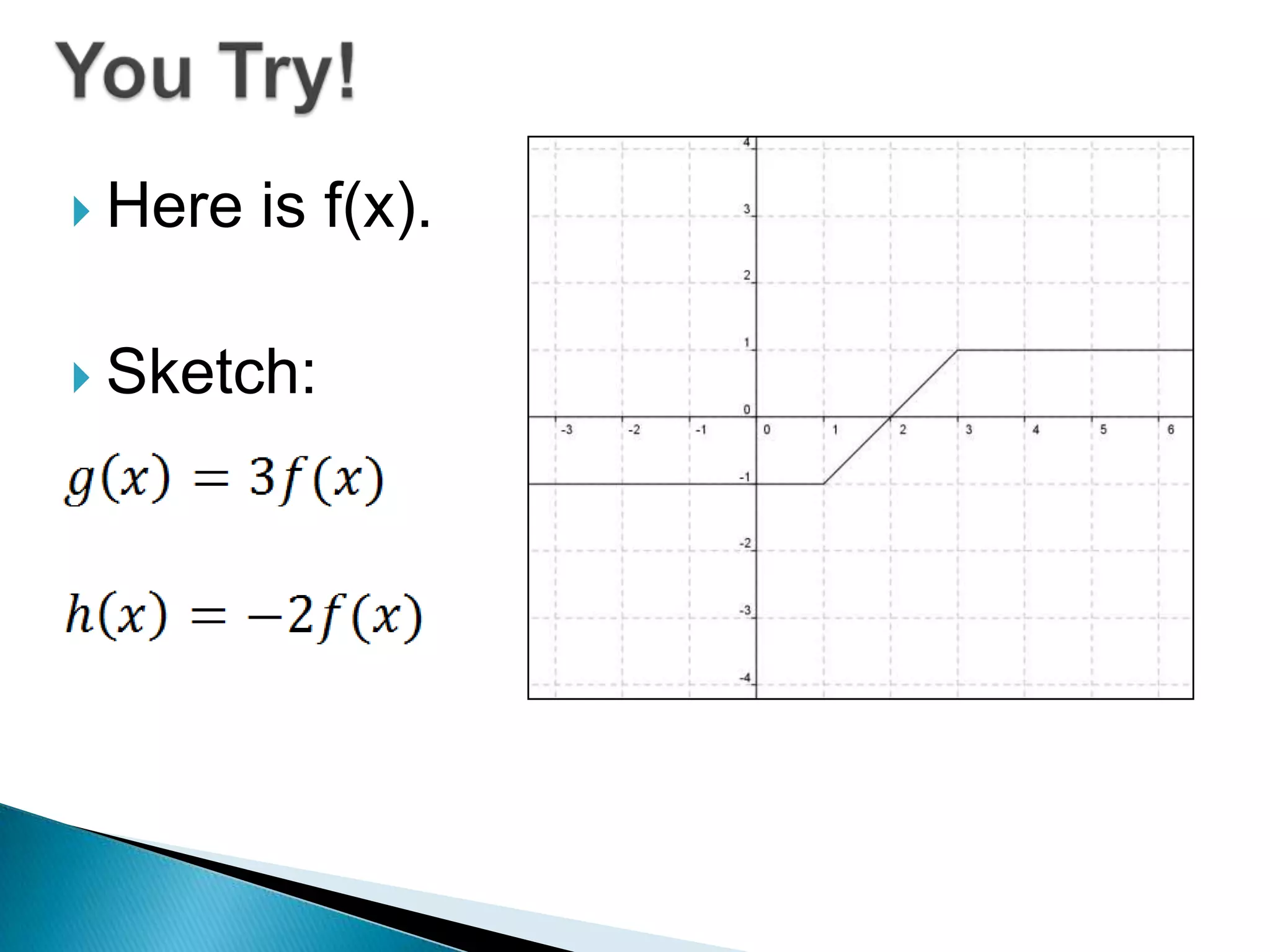
 Here

is f(x).

 Sketch:
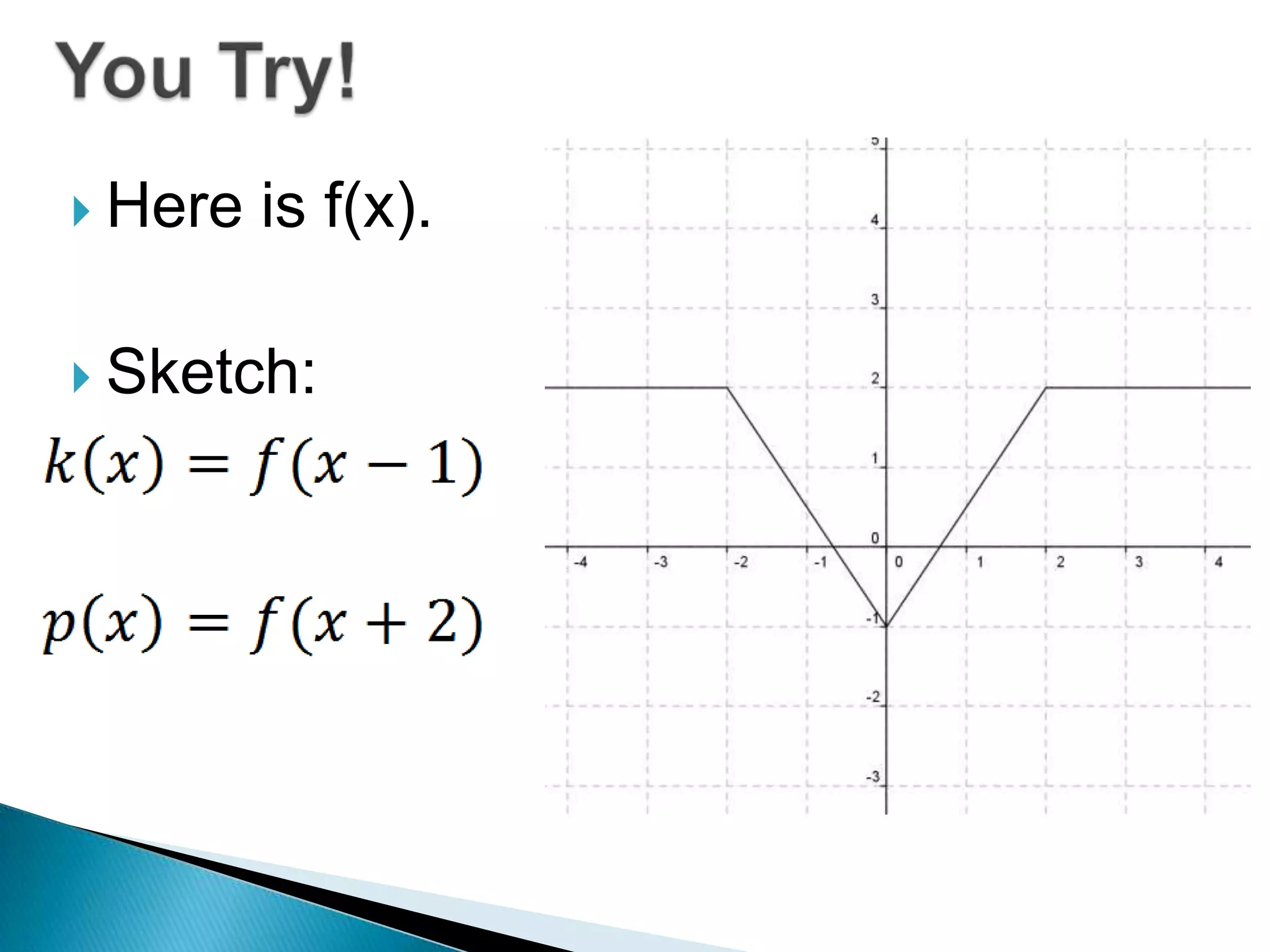
 Here

is f(x).

 Sketch:
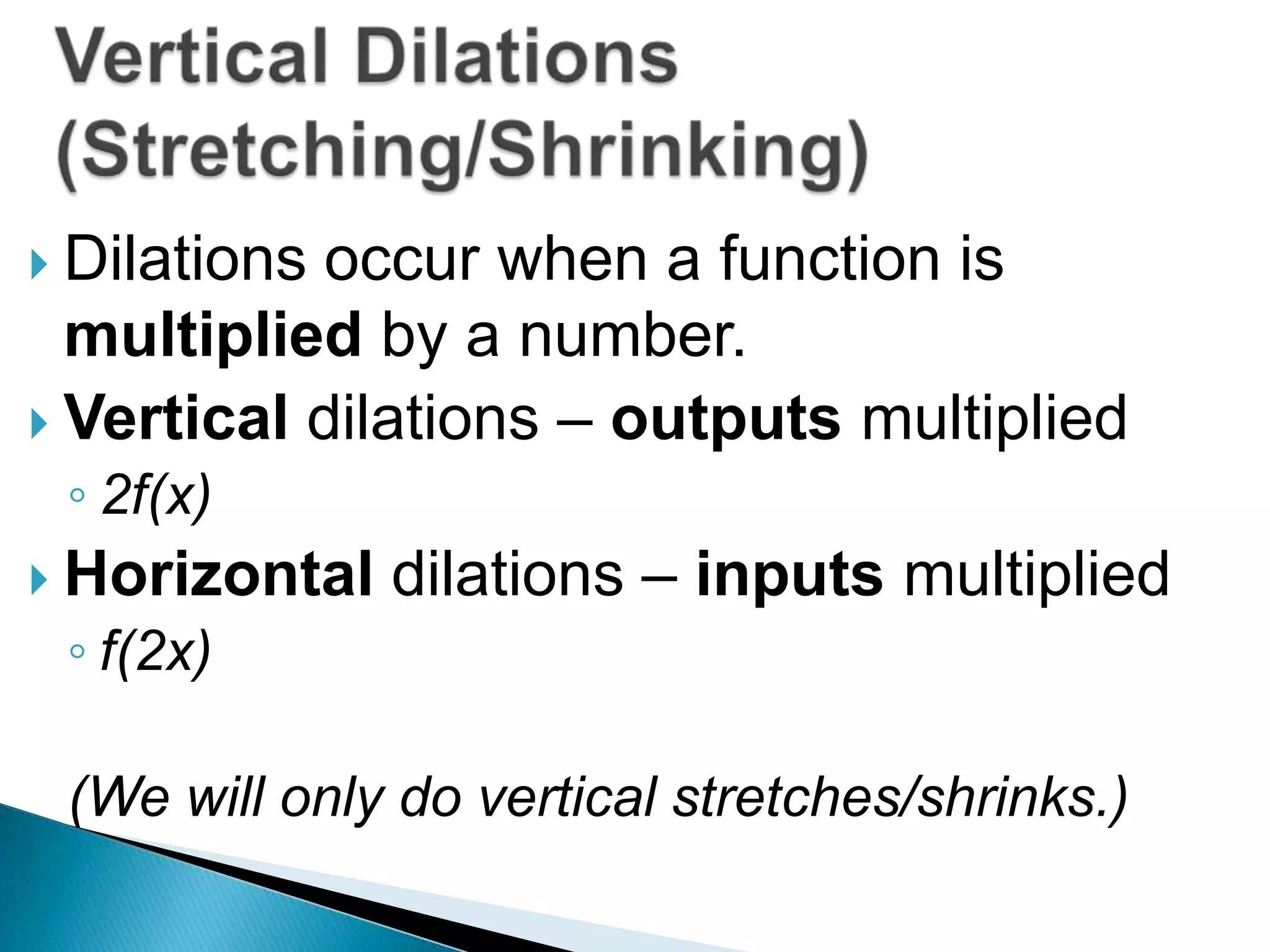
 Dilations

occur when a function is
multiplied by a number.
 Vertical dilations – outputs multiplied
◦ 2f(x)
 Horizontal

dilations – inputs multiplied

◦ f(2x)
(We will only do vertical stretches/shrinks.)
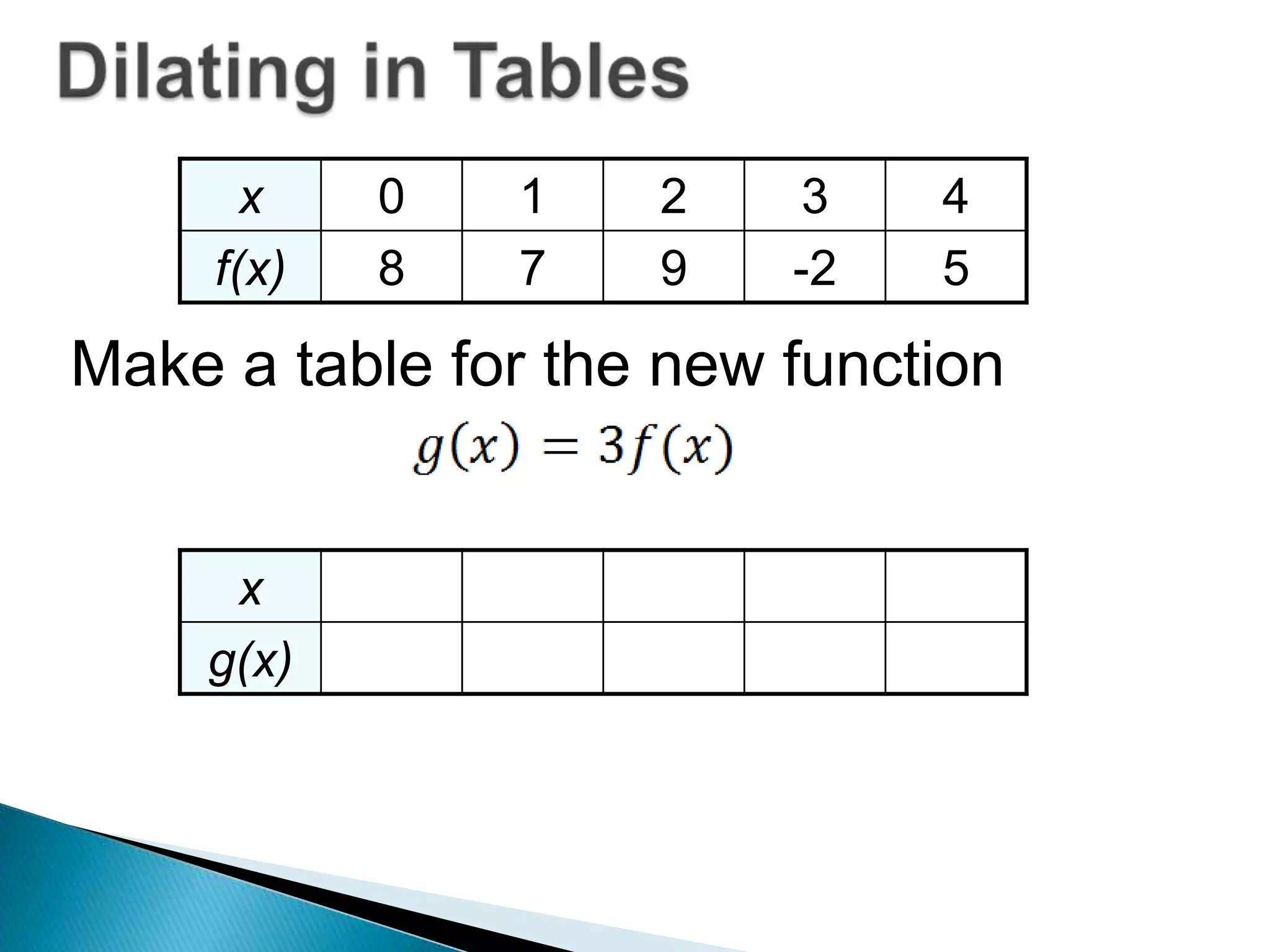
x
f(x)

0
8

1
7

2
9

3
-2

4
5

Make a table for the new function

x
g(x)
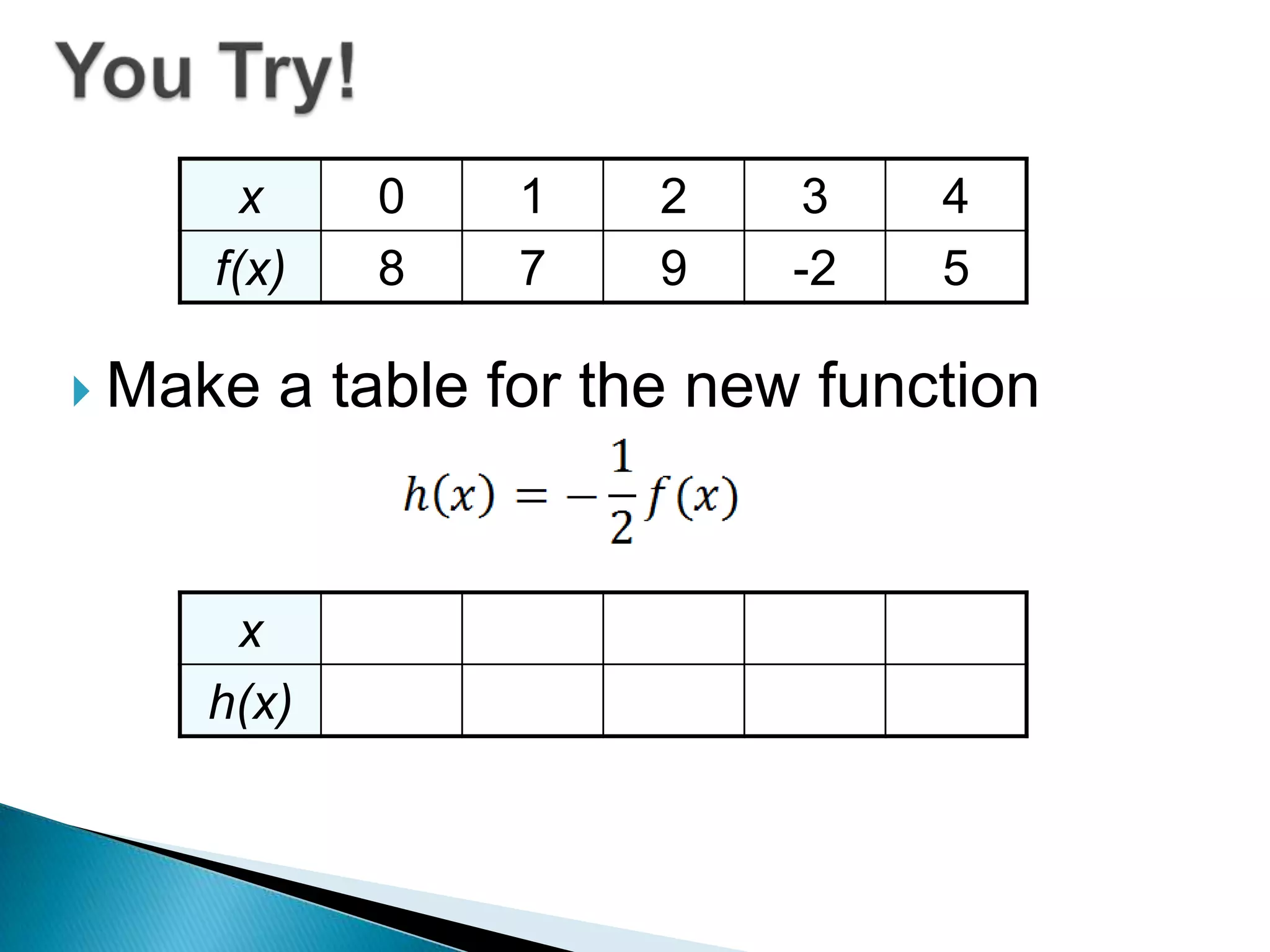
x
f(x)
 Make

0
8

1
7

2
9

3
-2

4
5

a table for the new function

x
h(x)
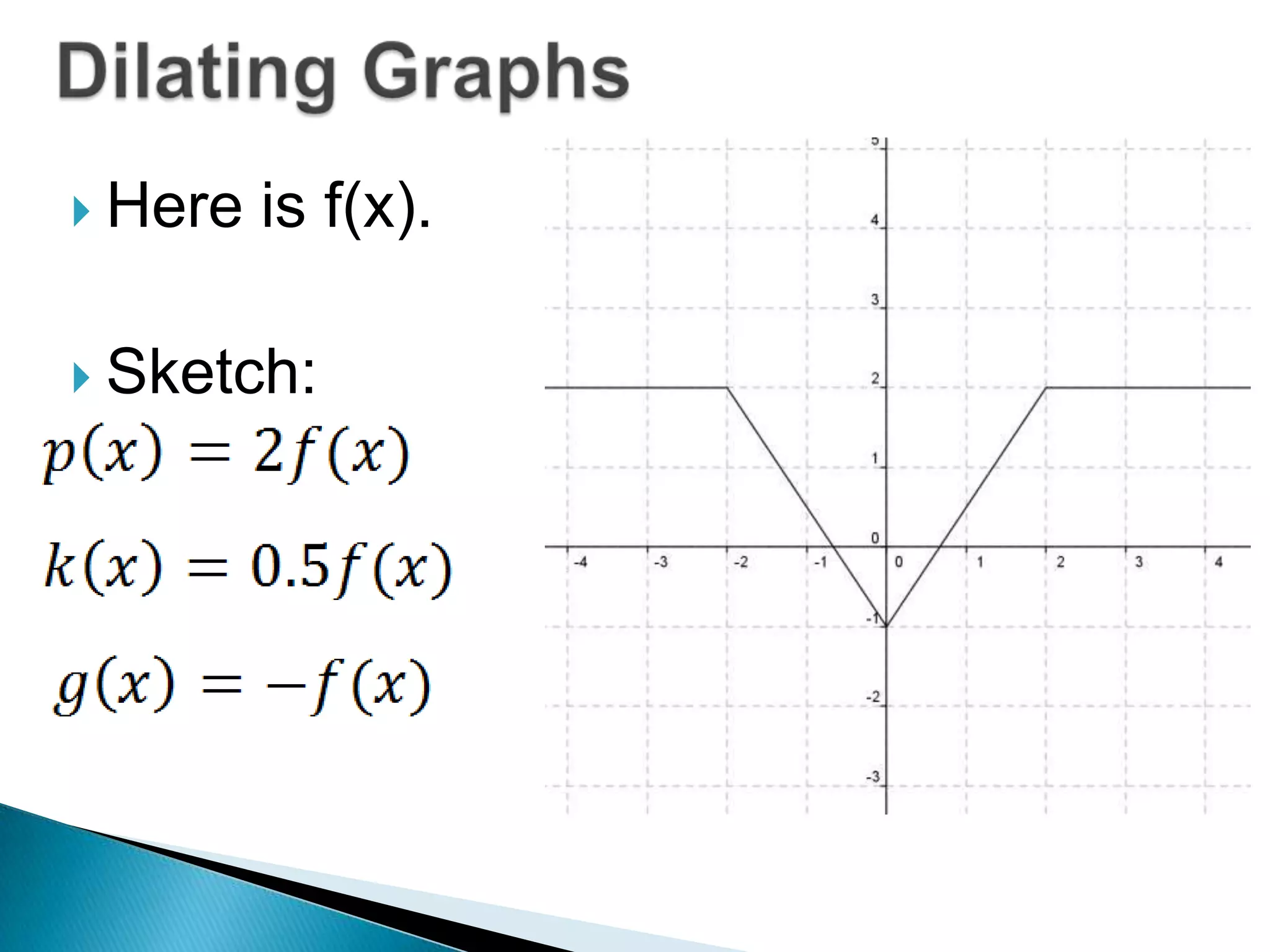
 Here

is f(x).

 Sketch:
 Here

is f(x).

 Sketch:

2.6 transformations