Nutritional Disorders
Caused by an insufficient intake of food
or of certain nutrients, by an inability of
the body to absorb and use nutrients, or
by overconsumption of certain foods
Management of
severe acute malnutrition
Objectives
-Classifications: clinical and by anthropometry.
- Criteria for admission to NutritionRehabilitation
ward.
-principle of treatment
-Treatment phases, initial phase, rehabilitation phase
and after care.
-Complications… hypoglycemia, hypothermia,
dehydrations, electrolyte disturbance, infection,
micronutrients deficiency, shock.
-Resomal (ORS).
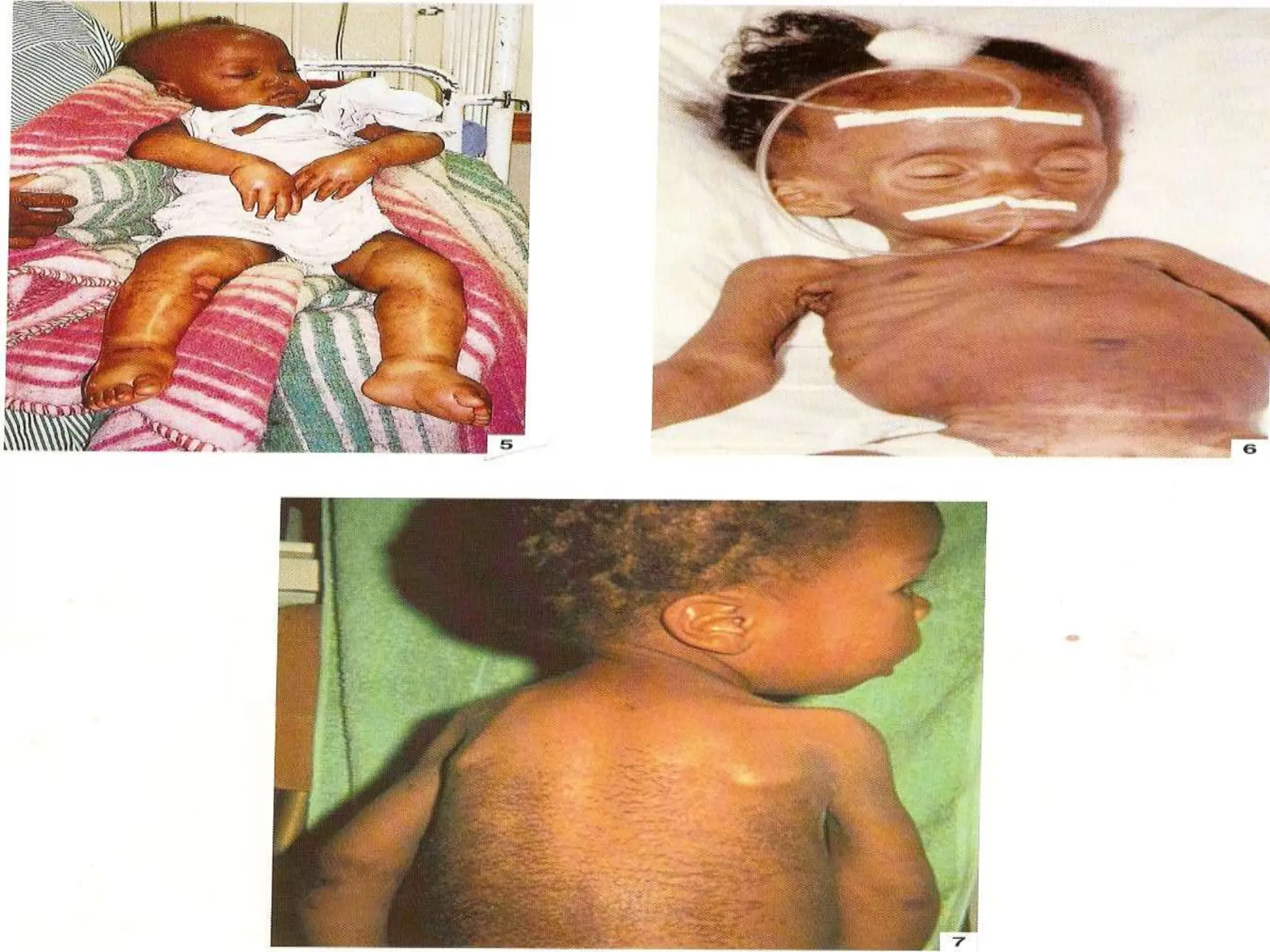
Severe wasting
Oedema
Dermataosis
Eye signs
1. Clinically evident forms:
Marasmus
*severe wasting
*no skin lesion
*loss of appetite
*child alert and irritable
Kwashiorkor (Edematous malnutrition)
*skin lesion
*hair discolored and brittle
*Loss of appetite
*apathy
Marasmus- Kwashiorkor muscle wasting and
edema
2. Classification (detected only by
anthropometry.
*Weight for height W/H – it reflect recent wt
loss (wasting)
*Height for age H/A - stunting
* Weight for age W/A -Underweight
* Medium Upper Arm Circumference (MUAC):
below 11.5 cm good predictor of short term
mortality
Infants and children who are 6–59 months of age
and have:
1- Mid-upper arm circumference <115 mm or
2-Weight-for-height/length < –3 Z-scores or
3- Bilateral edema (regardless of the degree), should be
immediately admitted to a program for the management
of severe acute malnutrition.
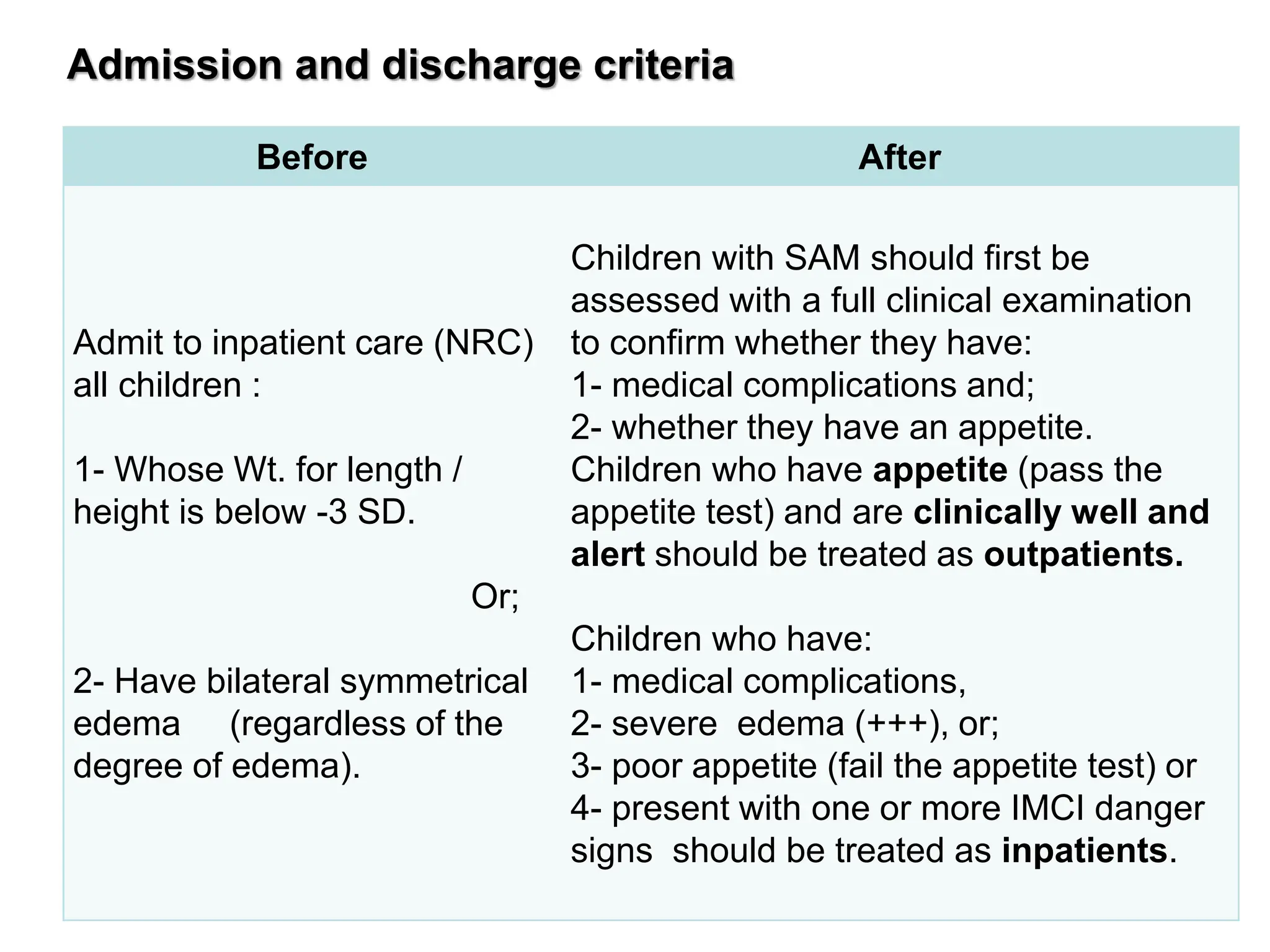
Admission and discharge criteria
Before After
Admit to inpatient care (NRC)
all children :
1- Whose Wt. for length /
height is below -3 SD.
Or;
2- Have bilateral symmetrical
edema (regardless of the
degree of edema).
Children with SAM should first be
assessed with a full clinical examination
to confirm whether they have:
1- medical complications and;
2- whether they have an appetite.
Children who have appetite (pass the
appetite test) and are clinically well and
alert should be treated as outpatients.
Children who have:
1- medical complications,
2- severe edema (+++), or;
3- poor appetite (fail the appetite test) or
4- present with one or more IMCI danger
signs should be treated as inpatients.
Complications
Hypoglycemia
Hypothermia
Shock
Dehydration
Anemia
Infections
Principles of treatment
Reductive adaptation
Consequences
• progressive feeding
•Iron is dangerous if given early
•electrolyte imbalances
hypoglycemia
infections
hypothermia
Case study
An 18-month-old girl who was referred from a health
centre. Her arms and shoulders appear very thin. She
has moderate oedema (both feet and lower legs). She
does not have diarrhoea or vomiting, and her eyes are
clear. Additional information is provided in the CCP
sections below.
-4 SD -3 SD -2 SD -1 SD
1.7 1.9 2.0 2.2
1.8 2.0 2.2 2.4
2.0 2.1 2.3 2.5
2.1 2.3 2.5 2.7
2.2 2.4 2.6 2.9
2.4 2.6 2.8 3.0
2.5 2.7 3.0 3.2
2.7 2.9 3.2 3.5
2.9 3.1 3.4 3.7
3.1 3.3 3.6 3.9
3.3 3.6 3.8 4.2
3.5 3.8 4.1 4.4
3.7 4.0 4.3 4.7
3.9 4.3 4.6 5.0
4.1 4.5 4.8 5.3
4.3 4.7 5.1 5.5
4.5 4.9 5.3 5.8
4.7 5.1 5.6 6.0
4.9 5.3 5.8 6.2
5.1 5.5 6.0 6.5
5.3 5.7 6.2 6.7
5.5 5.9 6.4 6.9
5.6 6.1 6.6 7.1
5.8 6.3 6.8 7.3
6.0 6.5 7.0 7.6
6.1 6.6 7.2 7.8
6.3 6.8 7.4 8.0
6.4 7.0 7.6 8.2
6.6 7.2 7.7 8.4
6.7 7.3 7.9 8.6
6.9 7.5 8.1 8.8
7.0 7.6 8.3 8.9
7.2 7.8 8.4 9.1
7.3 7.9 8.6 9.3
7.4 8.1 8.7 9.5
7.6 8.2 8.9 9.6
7.7 8.4 9.1 9.8
7.9 8.5 9.2 10.0
8.0 8.7 9.4 10.2
8.2 8.9 9.6 10.4
8.4 9.1 9.8 10.6
8.6 9.3 10.0 10.8
8.7 9.5 10.2 11.1
8.9 9.7 10.5 11.3
9.1 9.9 10.7 11.5
9.3 10.1 10.9 11.8
9.5 10.3 11.1 12.0
9.7 10.5 11.3 12.2
9.8 10.7 11.5 12.4
10.0 10.8 11.7 12.6
10.2 11.0 11.9 12.8
10.3 11.2 12.1 13.1
10.5 11.4 12.3 13.3
10.7 11.6 12.5 13.5
10.8 11.8 12.7 13.7
-1 SD -2 SD -3 SD -4 SD
2.3 2.1 1.9 1.7
2.4 2.2 2.0 1.9
2.6 2.4 2.2 2.0
2.7 2.5 2.3 2.1
2.9 2.6 2.4 2.2
3.1 2.8 2.6 2.4
3.3 3.0 2.8 2.5
3.5 3.2 2.9 2.7
3.7 3.4 3.1 2.8
3.9 3.6 3.3 3.0
4.2 3.8 3.5 3.2
4.4 4.0 3.7 3.4
4.6 4.3 3.9 3.6
4.9 4.5 4.1 3.8
5.1 4.7 4.3 3.9
5.4 4.9 4.5 4.1
5.6 5.1 4.7 4.3
5.8 5.3 4.9 4.5
6.0 5.5 5.1 4.7
6.3 5.7 5.3 4.8
6.5 5.9 5.5 5.0
6.7 6.1 5.6 5.1
6.9 6.3 5.8 5.3
7.1 6.5 6.0 5.5
7.3 6.7 6.1 5.6
7.5 6.9 6.3 5.8
7.7 7.0 6.5 5.9
7.8 7.2 6.6 6.0
8.0 7.4 6.8 6.2
8.2 7.5 6.9 6.3
8.4 7.7 7.1 6.5
8.5 7.8 7.2 6.6
8.7 8.0 7.4 6.7
8.9 8.2 7.5 6.9
9.1 8.3 7.7 7.0
9.2 8.5 7.8 7.1
9.4 8.7 8.0 7.3
9.6 8.8 8.1 7.5
9.8 9.0 8.3 7.6
10.1 9.2 8.5 7.8
10.3 9.4 8.7 8.0
10.5 9.7 8.9 8.1
10.7 9.9 9.1 8.3
11.0 10.1 9.3 8.5
11.2 10.3 9.5 8.7
11.4 10.5 9.7 8.8
11.7 10.7 9.9 9.0
11.9 10.9 10.1 9.2
12.1 11.1 10.2 9.4
12.3 11.3 10.4 9.5
12.6 11.5 10.6 9.7
12.8 11.7 10.8 9.9
13.0 12.0 11.0 10.1
13.3 12.2 11.2 10.2
13.5 12.4 11.4 10.4
: Weight-for-Length Reference Carda
Boys' weight (kg) Lengthb
Girls'
weight (kg)
Median (cm) Median
2.4 45 2.5
2.6 46 2.6
2.8 47 2.8
2.9 48 3.0
3.1 49 3.2
3.3 50 3.4
3.5 51 3.6
3.8 52 3.8
4.0 53 4.0
4.3 54 4.3
4.5 55 4.5
4.8 56 4.8
5.1 57 5.1
5.4 58 5.4
5.7 59 5.6
6.0 60 5.9
6.3 61 6.1
6.5 62 6.4
6.8 63 6.6
7.0 64 6.9
7.3 65 7.1
7.5 66 7.3
7.7 67 7.5
8.0 68 7.7
8.2 69 8.0
8.4 70 8.2
8.6 71 8.4
8.9 72 8.6
9.1 73 8.8
9.3 74 9.0
9.5 75 9.1
9.7 76 9.3
9.9 77 9.5
10.1 78 9.7
10.3 79 9.9
10.4 80 10.1
10.6 81 10.3
10.8 82 10.5
11.0 83 10.7
11.3 84 11.0
11.5 85 11.2
11.7 86 11.5
12.0 87 11.7
12.2 88 12.0
12.5 89 12.2
12.7 90 12.5
13.0 91 12.7
13.2 92 13.0
13.4 93 13.2
13.7 94 13.5
13.9 95 13.7
14.1 96 14.0
14.4 97 14.2
14.6 98 14.5
14.9 99 14.8
11.0 12.0 12.9 14.0 15.2 100 15.0 13.7 12.6 11.6 10
70 6.6
1.Shall you admitted her to the severe
malnutrition ward? Why or why not?
2.Is she hypothermic?
3.Is she hypoglycaemic?
Management of hypoglycemia
alert
can drink
50 ml bolus of
10% glucose
or 10% sucrose
orally
Not able to drink
50 ml by NG tube
lethargic,
unconscious,
or convulsing
give 5 ml/kg body
weight of sterile
10% glucose by
IV
followed by 50 ml
of 10% glucose or
sucrose by NG
tub
Start feeding F-75 half an hour after giving glucose and give it every
half-hour during the first 2 hours. For a hypoglycaemic child, the
amount to give every half-hour is ¼ of the 2-hourly amount of F-75.
ManageShock:
The severely malnourished child is considered to have shock if he/she:
• is lethargic or unconscious and
• has cold hands plus either:
• slow capillary refill (longer than 3 seconds),
or
• weak or fast pulse
Age Normal ranges (per
minute):
Pulse Respirations
2 months up to 12 months 80 up to 160 20 up to 60
12 months up to 60 months (5
years)
80 up to 140 20 up to 40
The severely malnourished child is considered to have shock if he/she:
• is lethargic or unconscious and
• has cold hands plus either:
• slow capillary refill (longer than 3 seconds),
or
• weak or fast pulse
The severely malnourished child is considered to have shock if he/she:
• is lethargic or unconscious and
• has cold hands plus either:
• slow capillary refill (longer than 3 seconds),
or
weak or fast pulse
• Shock from dehydration and sepsis are
likely to coexist in severely malnourished
children.
• They are difficult to differentiate on
clinical signs alone.
• Children with dehydration will respond to
IV fluids Those with septic shock and no
dehydration will not respond.
To start treatment:
*Give oxygen
*Give sterile 10% glucose (5 ml/kg) IV
*Give IV fluid at 15 ml/kg over 1 hour.
Use Ringer’s lactate with 5% dextrose;
or half-normal saline with 5% dextrose;
or half-strength Darrow’s solution with
5% dextrose; or if these are unavailable,
Ringer’s lactate .
*Measure and record PR &RR 10 every
minutes
*Give antibiotics
If there are signs of improvement (pulse
and respiration rates fall):
1.Repeat IV 15 ml/kg over 1 hour
2. Then switch to oral or nasogastric
rehydration with ReSoMal, 10 ml/kg/h
for up to 10 hours.
Give ReSoMal in alternate hours with
starter F-75,
3. Then continue feeding with starter F-
75
If the child fails to improve after the first
hour of treatment (15 ml/kg), assume
that the child has septic shock.
In this case: give maintenance IV fluids
(4 ml/kg/h) while waiting for blood,
when blood is available transfuse fresh
whole blood at 10 ml/kg slowly over 3
hours; then
begin feeding with starter F-75
Treat/prevent dehydration
• ReSoMal 5 ml/kg every 30 min. for two
hours, orally or by nasogastric tube, then
• 5-10 ml/kg/h for next 4-10 hours: the exact
amount to be given should be determined by
how much the child wants, and stool loss
and vomiting. Replace the ReSoMal doses at
4, 6, 8 and 10 hours with F-75 if
rehydration is continuing at these times,
then continue feeding starter F-75
Correct electrolyte imbalance
• Extra potassium 3-4 mmol/kg/d
• Extra magnesium 0.4-0.6 mmol/kg/d
• When rehydrating, give low sodium
rehydration fluid (e.g. ReSoMal)
• prepare food without salt
Treat/prevent infection
Routinely on admission give:
• Broad-spectrum antibiotic (s)
• Measles vaccine if child is > 6m and not
immunized (delay if the child is in shock)
Correct micronutrient deficiencies
* All severely malnourished children have vitamin and
mineral deficiencies.
*Although anemia is common, do NOT give iron
initially but wait until the child has a good appetite and
starts gaining weight.
• Vitamin A orally on Day 1
>12 months, give 200,000 IU
6-12 months, give 100,000 IU
0-5 months, give 50,000IU)
unless there is definite evidence that a dose has
been given in the last month.
• Multivitamin supplement
• Folic acid 1 mg/d (give 5 mg on Day 1)
• Zinc 2 mg/kg/d
• Copper 0.3 mg/kg/d
Give daily for at least 2 weeks
• Iron 3 mg/kg/d but only when gaining weight
Feeding
Stabilization
F75
Transition
F75
Rehabilitation
F100
100 kcal/kg/day 1-1.5 g protein/kg/day
130 ml/kg/d of fluid
(
(F75)
75 kcal/100 ml and 0.9g (protein/100ml
Oral or nasogastric (NG) feeds
Small, frequent feeds of low osmolarity and low lactose
(
stabilization phase (cautious feeding
Rehabilitation phase ( F-100)
Contains 100 kcal and 2.9 g protein/100 ml
Readiness to enter the rehabilitation phase
return of appetite
usually about one week after admission.
a gradual transition is recommended to avoid the
risk of heart failure which can occur if children
suddenly consume huge amounts.
Monitor during the transition for signs of heart
failure:
• Respiratory rate
• Pulse rate
If respirations increase by 5 or more breaths/min
and pulse by 25 or more beats/min for two
successive 4-hourly readings, reduce the volume
per feed
change from starter to catch-up formula:
• replace starter F-75 with the same amount of
catch-up formula F-100 for 48 hours then,
• increase each successive feed by 10 ml until
some feed remains uneaten. The point when
some remains unconsumed is likely to occur
when intakes reach about 30 ml/kg/feed (200
ml/kg/d).
Prepare for follow-up after recovery
A child who is 90% weight-for-length (equivalent to
-1SD) can be considered to have recovered.
Show parent how to:
• feed frequently with energy and nutrient dense foods
• give structured play therapy
*Advice parent to bring child back for regular follow-up
• ensure booster immunizations are given
• ensure vitamin A is given every six months
wt 4.600kg length 61cm -4SD
1312 2010
Wt 6.600kg
29122010
Yousif 8months WT 6KG (-4SD). 9.5 months WT 9kg(-1SD)
4/1 /2010 17 /2 /2010
wt 3kg •
Wt 5.3kg
25/10 30/11

Nutrition deficiency disorders in children

  • 1.
    Nutritional Disorders Caused byan insufficient intake of food or of certain nutrients, by an inability of the body to absorb and use nutrients, or by overconsumption of certain foods
  • 2.
  • 3.
    Objectives -Classifications: clinical andby anthropometry. - Criteria for admission to NutritionRehabilitation ward. -principle of treatment -Treatment phases, initial phase, rehabilitation phase and after care. -Complications… hypoglycemia, hypothermia, dehydrations, electrolyte disturbance, infection, micronutrients deficiency, shock. -Resomal (ORS).
  • 4.
  • 8.
    1. Clinically evidentforms: Marasmus *severe wasting *no skin lesion *loss of appetite *child alert and irritable Kwashiorkor (Edematous malnutrition) *skin lesion *hair discolored and brittle *Loss of appetite *apathy Marasmus- Kwashiorkor muscle wasting and edema
  • 9.
    2. Classification (detectedonly by anthropometry. *Weight for height W/H – it reflect recent wt loss (wasting) *Height for age H/A - stunting * Weight for age W/A -Underweight * Medium Upper Arm Circumference (MUAC): below 11.5 cm good predictor of short term mortality
  • 10.
    Infants and childrenwho are 6–59 months of age and have: 1- Mid-upper arm circumference <115 mm or 2-Weight-for-height/length < –3 Z-scores or 3- Bilateral edema (regardless of the degree), should be immediately admitted to a program for the management of severe acute malnutrition.
  • 11.
    Admission and dischargecriteria Before After Admit to inpatient care (NRC) all children : 1- Whose Wt. for length / height is below -3 SD. Or; 2- Have bilateral symmetrical edema (regardless of the degree of edema). Children with SAM should first be assessed with a full clinical examination to confirm whether they have: 1- medical complications and; 2- whether they have an appetite. Children who have appetite (pass the appetite test) and are clinically well and alert should be treated as outpatients. Children who have: 1- medical complications, 2- severe edema (+++), or; 3- poor appetite (fail the appetite test) or 4- present with one or more IMCI danger signs should be treated as inpatients.
  • 12.
  • 13.
    Principles of treatment Reductiveadaptation Consequences • progressive feeding •Iron is dangerous if given early •electrolyte imbalances hypoglycemia infections hypothermia
  • 15.
    Case study An 18-month-oldgirl who was referred from a health centre. Her arms and shoulders appear very thin. She has moderate oedema (both feet and lower legs). She does not have diarrhoea or vomiting, and her eyes are clear. Additional information is provided in the CCP sections below.
  • 16.
    -4 SD -3SD -2 SD -1 SD 1.7 1.9 2.0 2.2 1.8 2.0 2.2 2.4 2.0 2.1 2.3 2.5 2.1 2.3 2.5 2.7 2.2 2.4 2.6 2.9 2.4 2.6 2.8 3.0 2.5 2.7 3.0 3.2 2.7 2.9 3.2 3.5 2.9 3.1 3.4 3.7 3.1 3.3 3.6 3.9 3.3 3.6 3.8 4.2 3.5 3.8 4.1 4.4 3.7 4.0 4.3 4.7 3.9 4.3 4.6 5.0 4.1 4.5 4.8 5.3 4.3 4.7 5.1 5.5 4.5 4.9 5.3 5.8 4.7 5.1 5.6 6.0 4.9 5.3 5.8 6.2 5.1 5.5 6.0 6.5 5.3 5.7 6.2 6.7 5.5 5.9 6.4 6.9 5.6 6.1 6.6 7.1 5.8 6.3 6.8 7.3 6.0 6.5 7.0 7.6 6.1 6.6 7.2 7.8 6.3 6.8 7.4 8.0 6.4 7.0 7.6 8.2 6.6 7.2 7.7 8.4 6.7 7.3 7.9 8.6 6.9 7.5 8.1 8.8 7.0 7.6 8.3 8.9 7.2 7.8 8.4 9.1 7.3 7.9 8.6 9.3 7.4 8.1 8.7 9.5 7.6 8.2 8.9 9.6 7.7 8.4 9.1 9.8 7.9 8.5 9.2 10.0 8.0 8.7 9.4 10.2 8.2 8.9 9.6 10.4 8.4 9.1 9.8 10.6 8.6 9.3 10.0 10.8 8.7 9.5 10.2 11.1 8.9 9.7 10.5 11.3 9.1 9.9 10.7 11.5 9.3 10.1 10.9 11.8 9.5 10.3 11.1 12.0 9.7 10.5 11.3 12.2 9.8 10.7 11.5 12.4 10.0 10.8 11.7 12.6 10.2 11.0 11.9 12.8 10.3 11.2 12.1 13.1 10.5 11.4 12.3 13.3 10.7 11.6 12.5 13.5 10.8 11.8 12.7 13.7 -1 SD -2 SD -3 SD -4 SD 2.3 2.1 1.9 1.7 2.4 2.2 2.0 1.9 2.6 2.4 2.2 2.0 2.7 2.5 2.3 2.1 2.9 2.6 2.4 2.2 3.1 2.8 2.6 2.4 3.3 3.0 2.8 2.5 3.5 3.2 2.9 2.7 3.7 3.4 3.1 2.8 3.9 3.6 3.3 3.0 4.2 3.8 3.5 3.2 4.4 4.0 3.7 3.4 4.6 4.3 3.9 3.6 4.9 4.5 4.1 3.8 5.1 4.7 4.3 3.9 5.4 4.9 4.5 4.1 5.6 5.1 4.7 4.3 5.8 5.3 4.9 4.5 6.0 5.5 5.1 4.7 6.3 5.7 5.3 4.8 6.5 5.9 5.5 5.0 6.7 6.1 5.6 5.1 6.9 6.3 5.8 5.3 7.1 6.5 6.0 5.5 7.3 6.7 6.1 5.6 7.5 6.9 6.3 5.8 7.7 7.0 6.5 5.9 7.8 7.2 6.6 6.0 8.0 7.4 6.8 6.2 8.2 7.5 6.9 6.3 8.4 7.7 7.1 6.5 8.5 7.8 7.2 6.6 8.7 8.0 7.4 6.7 8.9 8.2 7.5 6.9 9.1 8.3 7.7 7.0 9.2 8.5 7.8 7.1 9.4 8.7 8.0 7.3 9.6 8.8 8.1 7.5 9.8 9.0 8.3 7.6 10.1 9.2 8.5 7.8 10.3 9.4 8.7 8.0 10.5 9.7 8.9 8.1 10.7 9.9 9.1 8.3 11.0 10.1 9.3 8.5 11.2 10.3 9.5 8.7 11.4 10.5 9.7 8.8 11.7 10.7 9.9 9.0 11.9 10.9 10.1 9.2 12.1 11.1 10.2 9.4 12.3 11.3 10.4 9.5 12.6 11.5 10.6 9.7 12.8 11.7 10.8 9.9 13.0 12.0 11.0 10.1 13.3 12.2 11.2 10.2 13.5 12.4 11.4 10.4 : Weight-for-Length Reference Carda Boys' weight (kg) Lengthb Girls' weight (kg) Median (cm) Median 2.4 45 2.5 2.6 46 2.6 2.8 47 2.8 2.9 48 3.0 3.1 49 3.2 3.3 50 3.4 3.5 51 3.6 3.8 52 3.8 4.0 53 4.0 4.3 54 4.3 4.5 55 4.5 4.8 56 4.8 5.1 57 5.1 5.4 58 5.4 5.7 59 5.6 6.0 60 5.9 6.3 61 6.1 6.5 62 6.4 6.8 63 6.6 7.0 64 6.9 7.3 65 7.1 7.5 66 7.3 7.7 67 7.5 8.0 68 7.7 8.2 69 8.0 8.4 70 8.2 8.6 71 8.4 8.9 72 8.6 9.1 73 8.8 9.3 74 9.0 9.5 75 9.1 9.7 76 9.3 9.9 77 9.5 10.1 78 9.7 10.3 79 9.9 10.4 80 10.1 10.6 81 10.3 10.8 82 10.5 11.0 83 10.7 11.3 84 11.0 11.5 85 11.2 11.7 86 11.5 12.0 87 11.7 12.2 88 12.0 12.5 89 12.2 12.7 90 12.5 13.0 91 12.7 13.2 92 13.0 13.4 93 13.2 13.7 94 13.5 13.9 95 13.7 14.1 96 14.0 14.4 97 14.2 14.6 98 14.5 14.9 99 14.8 11.0 12.0 12.9 14.0 15.2 100 15.0 13.7 12.6 11.6 10 70 6.6
  • 18.
    1.Shall you admittedher to the severe malnutrition ward? Why or why not? 2.Is she hypothermic? 3.Is she hypoglycaemic?
  • 19.
    Management of hypoglycemia alert candrink 50 ml bolus of 10% glucose or 10% sucrose orally Not able to drink 50 ml by NG tube lethargic, unconscious, or convulsing give 5 ml/kg body weight of sterile 10% glucose by IV followed by 50 ml of 10% glucose or sucrose by NG tub Start feeding F-75 half an hour after giving glucose and give it every half-hour during the first 2 hours. For a hypoglycaemic child, the amount to give every half-hour is ¼ of the 2-hourly amount of F-75.
  • 20.
    ManageShock: The severely malnourishedchild is considered to have shock if he/she: • is lethargic or unconscious and • has cold hands plus either: • slow capillary refill (longer than 3 seconds), or • weak or fast pulse Age Normal ranges (per minute): Pulse Respirations 2 months up to 12 months 80 up to 160 20 up to 60 12 months up to 60 months (5 years) 80 up to 140 20 up to 40 The severely malnourished child is considered to have shock if he/she: • is lethargic or unconscious and • has cold hands plus either: • slow capillary refill (longer than 3 seconds), or • weak or fast pulse The severely malnourished child is considered to have shock if he/she: • is lethargic or unconscious and • has cold hands plus either: • slow capillary refill (longer than 3 seconds), or weak or fast pulse
  • 21.
    • Shock fromdehydration and sepsis are likely to coexist in severely malnourished children. • They are difficult to differentiate on clinical signs alone. • Children with dehydration will respond to IV fluids Those with septic shock and no dehydration will not respond.
  • 22.
    To start treatment: *Giveoxygen *Give sterile 10% glucose (5 ml/kg) IV *Give IV fluid at 15 ml/kg over 1 hour. Use Ringer’s lactate with 5% dextrose; or half-normal saline with 5% dextrose; or half-strength Darrow’s solution with 5% dextrose; or if these are unavailable, Ringer’s lactate . *Measure and record PR &RR 10 every minutes *Give antibiotics
  • 23.
    If there aresigns of improvement (pulse and respiration rates fall): 1.Repeat IV 15 ml/kg over 1 hour 2. Then switch to oral or nasogastric rehydration with ReSoMal, 10 ml/kg/h for up to 10 hours. Give ReSoMal in alternate hours with starter F-75, 3. Then continue feeding with starter F- 75
  • 24.
    If the childfails to improve after the first hour of treatment (15 ml/kg), assume that the child has septic shock. In this case: give maintenance IV fluids (4 ml/kg/h) while waiting for blood, when blood is available transfuse fresh whole blood at 10 ml/kg slowly over 3 hours; then begin feeding with starter F-75
  • 25.
    Treat/prevent dehydration • ReSoMal5 ml/kg every 30 min. for two hours, orally or by nasogastric tube, then • 5-10 ml/kg/h for next 4-10 hours: the exact amount to be given should be determined by how much the child wants, and stool loss and vomiting. Replace the ReSoMal doses at 4, 6, 8 and 10 hours with F-75 if rehydration is continuing at these times, then continue feeding starter F-75
  • 28.
    Correct electrolyte imbalance •Extra potassium 3-4 mmol/kg/d • Extra magnesium 0.4-0.6 mmol/kg/d • When rehydrating, give low sodium rehydration fluid (e.g. ReSoMal) • prepare food without salt
  • 29.
    Treat/prevent infection Routinely onadmission give: • Broad-spectrum antibiotic (s) • Measles vaccine if child is > 6m and not immunized (delay if the child is in shock)
  • 30.
    Correct micronutrient deficiencies *All severely malnourished children have vitamin and mineral deficiencies. *Although anemia is common, do NOT give iron initially but wait until the child has a good appetite and starts gaining weight.
  • 31.
    • Vitamin Aorally on Day 1 >12 months, give 200,000 IU 6-12 months, give 100,000 IU 0-5 months, give 50,000IU) unless there is definite evidence that a dose has been given in the last month. • Multivitamin supplement • Folic acid 1 mg/d (give 5 mg on Day 1) • Zinc 2 mg/kg/d • Copper 0.3 mg/kg/d Give daily for at least 2 weeks • Iron 3 mg/kg/d but only when gaining weight
  • 32.
  • 33.
    100 kcal/kg/day 1-1.5g protein/kg/day 130 ml/kg/d of fluid ( (F75) 75 kcal/100 ml and 0.9g (protein/100ml Oral or nasogastric (NG) feeds Small, frequent feeds of low osmolarity and low lactose ( stabilization phase (cautious feeding
  • 34.
    Rehabilitation phase (F-100) Contains 100 kcal and 2.9 g protein/100 ml Readiness to enter the rehabilitation phase return of appetite usually about one week after admission. a gradual transition is recommended to avoid the risk of heart failure which can occur if children suddenly consume huge amounts.
  • 35.
    Monitor during thetransition for signs of heart failure: • Respiratory rate • Pulse rate If respirations increase by 5 or more breaths/min and pulse by 25 or more beats/min for two successive 4-hourly readings, reduce the volume per feed
  • 36.
    change from starterto catch-up formula: • replace starter F-75 with the same amount of catch-up formula F-100 for 48 hours then, • increase each successive feed by 10 ml until some feed remains uneaten. The point when some remains unconsumed is likely to occur when intakes reach about 30 ml/kg/feed (200 ml/kg/d).
  • 37.
    Prepare for follow-upafter recovery A child who is 90% weight-for-length (equivalent to -1SD) can be considered to have recovered. Show parent how to: • feed frequently with energy and nutrient dense foods • give structured play therapy *Advice parent to bring child back for regular follow-up • ensure booster immunizations are given • ensure vitamin A is given every six months
  • 38.
    wt 4.600kg length61cm -4SD 1312 2010 Wt 6.600kg 29122010
  • 39.
    Yousif 8months WT6KG (-4SD). 9.5 months WT 9kg(-1SD) 4/1 /2010 17 /2 /2010
  • 40.
    wt 3kg • Wt5.3kg 25/10 30/11