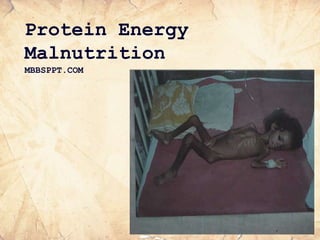
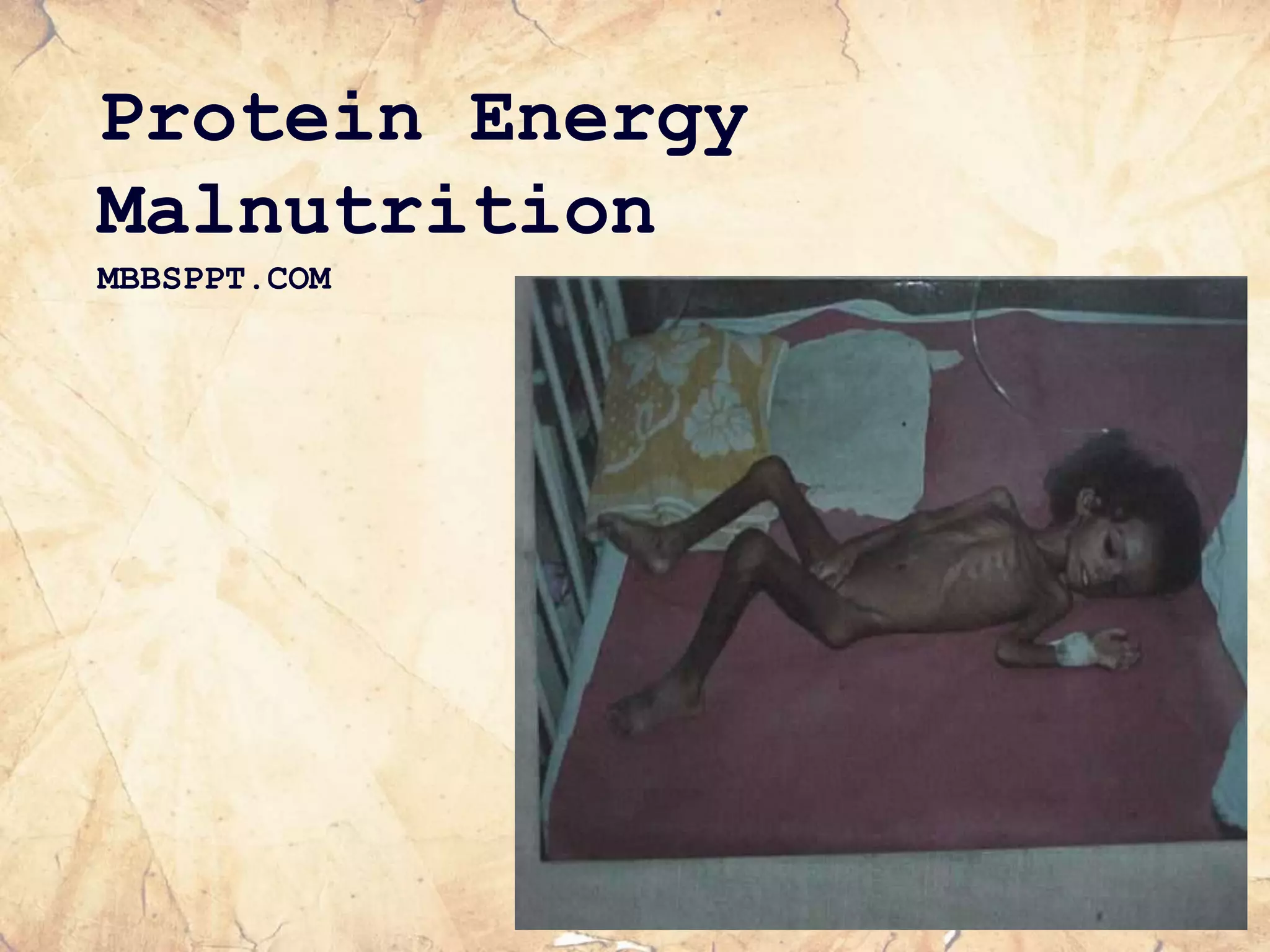
Protein Energy
Malnutrition
MBBSPPT.COM
Malnutrition
• Leading cause of morbidity &
mortality in children through out
the world
• 10% of under 5 year olds world
wide are wasted & 27% stunted &
25% underweight
• Direct cause of death in 7% &
underlying cause in 46% of <5 yr
old children
• In India: (NFHS - 3 data)
 Prevalence of under nutrition
(0-3 years): 46%
Etiology
• Low birth weight baby: Maternal
malnutrition LBW &
growth retarded babies with poor
nutritional reserve.In India 28%
babies born are LBW.
• Feeding habits: Lack of exclusive
breast feeding in first 6 mths,
introduction of artificial feeds ,
inappropriate hand and bottle
hygiene, delayed introduction of
complimentary food
• Infections: diarrhea, malaria,
measles, whooping cough &
tuberculosis precipitate &
aggravate the existing nutritional
deficit
 Impaired appetite
 Iatrogenic food restriction by
parents
 Metabolic demands high
 Catabolism of body tissue
 Loss of protein in infected
Etiology
Etiology
• High pressure advertising baby
food in market
• Social factors : Repeated
pregnancies, inadequate spacing,
food taboos, broken homes,
separation of child from parents,
natural disaster e.g. earthquake,
droughts, flood
• Poverty:
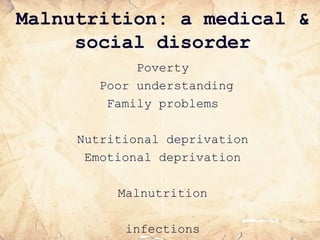
Malnutrition: a medical &
social disorder
Poverty
Poor understanding
Family problems
Nutritional deprivation
Emotional deprivation
Malnutrition
infections
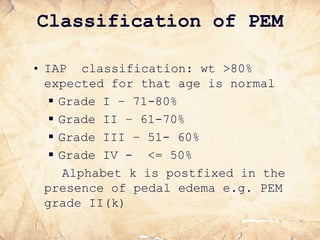
Classification of PEM
• IAP classification: wt >80%
expected for that age is normal
 Grade I – 71-80%
 Grade II – 61-70%
 Grade III – 51- 60%
 Grade IV - <= 50%
Alphabet k is postfixed in the
presence of pedal edema e.g. PEM
grade II(k)
Classification of PEM
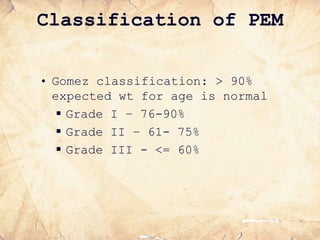
• Gomez classification: > 90%
expected wt for age is normal
 Grade I – 76-90%
 Grade II – 61- 75%
 Grade III - <= 60%
Classification of PEM
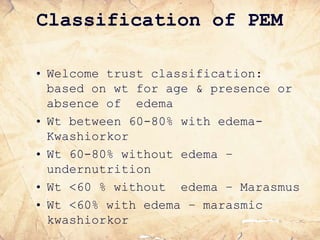
• Welcome trust classification:
based on wt for age & presence or
absence of edema
• Wt between 60-80% with edema-
Kwashiorkor
• Wt 60-80% without edema –
undernutrition
• Wt <60 % without edema – Marasmus
• Wt <60% with edema – marasmic
kwashiorkor
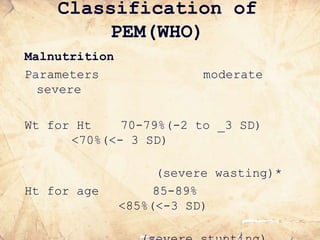
Classification of
PEM(WHO)
Malnutrition
Parameters moderate
severe
Wt for Ht 70-79%(-2 to _3 SD)
<70%(<- 3 SD)
(severe wasting)*
Ht for age 85-89%
<85%(<-3 SD)
Severe acute
malnutrition(sam)
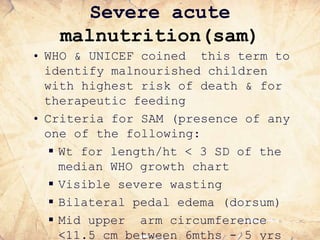
• WHO & UNICEF coined this term to
identify malnourished children
with highest risk of death & for
therapeutic feeding
• Criteria for SAM (presence of any
one of the following:
 Wt for length/ht < 3 SD of the
median WHO growth chart
 Visible severe wasting
 Bilateral pedal edema (dorsum)
 Mid upper arm circumference
<11.5 cm between 6mths - 5 yrs
Pathophysiology
• Classical theory:
 In kwashiorkor- mainly
deficiency of protein leading to
hypoalbuminemia leading to
edema
 In marasmus- Deficiency of
energy
• Gopalan’s theory of
adaptation:
 In marasmus – adaptation to
chronic nutritional deficiency
Pathophysiology
• Golden theory of free
radicals:
 Kwashiorkor develops due to
imbalance between the production
of free radicals & their safe
disposal
 Oxidative toxic stress releases
excess of free radicals
 Free radicals cause cell
membrane damage & increased
permeability & hence edema
Changes in body
composition & function
• Loss of muscle & subcutaneous
tisssue
• Body fat & total bone mass is
reduced
• Total body water in PEM –increased
to 70-80% body wt (60% in normal
children)
• Increased intracellular Na &
reduced total body K & Mg.
• Dehydration should be corrected
with caution, preferablly orally
• Metabolic alteration:
 BMR reduced by 30% & energy
expenditure due to poor activity
 Heat generation and heat losses
affected
• Biochemical changes:
 Liver – synthesis of all
proteins reduced,
gluconeogenesis & metabolism of
liver impaired leading to
incresed risk of hypoglycemia
Changes in body
composition & function
Biochemical changes
• Plasma transferin concn markedly
reduced
• Plasma triglyceride, Cholesterol &
beta lipoprotein reduced in
Kwashiorkor
• VLDL account for most of the
triglyceride in Kwashiorkor
• In marasmus above parameters may
be normal or reduced
Immunity
• Impaired cell mediated
immunity due to atrophy of
thymus & lymphoid tissue
 Tuberculosis tends to be
unusually severe
 Mx reaction poor
• Humoral immunity less
affected
 Circulating immunoglobulin
levels –normal or elevated
 Secretory IGA may be reduced
• Leukocyte count is usually normal
• Leukopenia may be present in vit
B12 & folic acid deficiency
• Chemotaxis is impaired but
phagocytosis is normal
• Impaired fungicidal & bactericidal
activity of leukocytes
• Physical barrier is impaired
Immunity
Gastro intestinal
system
• Atrophy of salivary gland
• Fatty infiltration of liver
• Atrophy of pancreatic acini
• Intestinal villi atrophied
reducing total absorptive surface
• Steatorrhea may occur
• Protuberant abdomen and rectal
prolapse due to laxity of muscles
Other systems
• CNS:
 Growth & development of brain
affected if malnutrion sets in
in first two years
 Associtaed micronutrient
deficiency e.g. iron, B1, B12,
Zinc & iodine further impairs
brain function and lowers
development score
Other systems
• Renal:
 GFR & renal plasma flow reduced
in severe PEM
 Urinay sodium & phosphorus
excretion reduced
• Endocrine: Insulin level reduced,
cortisol & growth hormone level
increased
• CVS: Cardiac output & stroke vol.
reduced,BP –low & renal perfusion
reduced
Clinical features
• Depends on
 Severity
 Duration
 Age
 Relative deficiency of diff
component of food
 Presence of associated infection
In India major limiting factor in
diet is energy
Nutritional marasmus &
Kwashiorkor are two extreme form
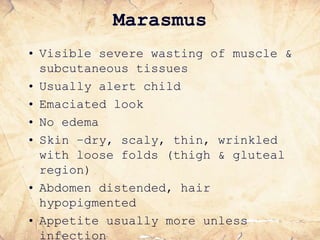
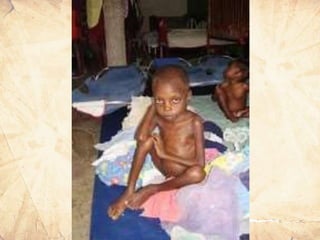
Marasmus
• Visible severe wasting of muscle &
subcutaneous tissues
• Usually alert child
• Emaciated look
• No edema
• Skin –dry, scaly, thin, wrinkled
with loose folds (thigh & gluteal
region)
• Abdomen distended, hair
hypopigmented
• Appetite usually more unless
infection
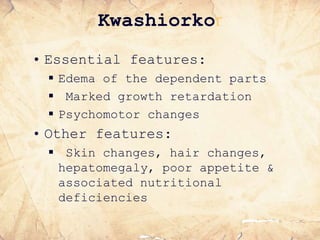
Kwashiorkor
• Essential features:
 Edema of the dependent parts
 Marked growth retardation
 Psychomotor changes
• Other features:
 Skin changes, hair changes,
hepatomegaly, poor appetite &
associated nutritional
deficiencies
Kwashiorkor
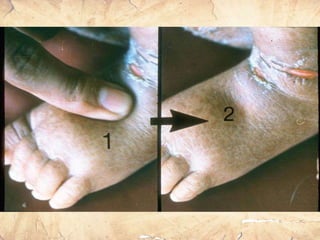
• Edema – due to
 i) Hypoalbuminemia,
 ii) Capillary leak due to
infection & hypokalemia
 iii) Free radical induced damage
to cell membrane
• Edema starts from lower
extremities and spreads
upwards with puffy face
Psychomotor changes
• Lethargic, listless & apathetic
• Play activity & interaction with
others reduced
• Resents examination
• Poor appetite
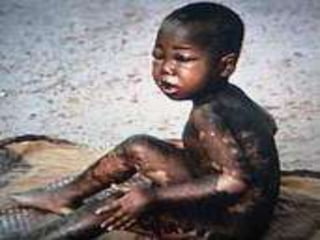
Skin & hair changes
Skin
• Dry and scaly
• Cracking giving
mosaic appearance
• Crazy pavement
dermatitis (black
patches over
flexors & pressure
sites)
• Raw hypopigmented
or hyperpigmented
patches
• Flaky paint
Hair
• Hypopigmented
• Lustureless
• Thin & easily
pluckable
• Flag sign
Management of SAM
• SAM out patient management
program
• In patient management:
 Initial Treatment: 2-7 days
 Rehabilitation: 2-6 weeks
 Follow up: After discharge
Management of moderate
malnutrition
• Managed at out-patient level
• Home based with Angadwadi
supervision
• Screen and treat for infections &
other associated nutritional
deficiencies
• De-worm
• Gradual increase in food intake to
provide 150-200 Cal/kg/day &
protiens 2-3gm/kg/day
oderate malnutrition contd..
Parental education:
• Stress on simple modifications in
the home cooked food without
resorting to expensive
supplemental foods
• Stress importance of breast
feeding
• addition of oil / butter
• Green leafy vegetables
• Small frequent feeds -at-least 5
/day
• Hygiene
Management <6 mths age
• Continuing or re initiating breast
feeding
• Supplemental suckling technique
for re initiation of breast
feeding
• If no prospect of continuing or re
initiation of breast feed – F- 75
formula feeding
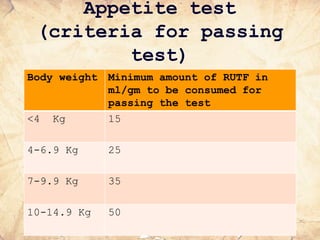
Appetite test
(criteria for passing
test)
Body weight Minimum amount of RUTF in
ml/gm to be consumed for
passing the test
<4 Kg 15
4-6.9 Kg 25
7-9.9 Kg 35
10-14.9 Kg 50
Ready to use treatment
formula (RUTF)
• Soft & crushable food used in
community treatment of SAM
• It is calorie dense milk based
sold diet
• It is best used when home based
food can not be made
• It contains approx 100 kcal & 2.9
gms protein/100 gms
• It is advised to be given 2-3 hrly
with lots of water to drink
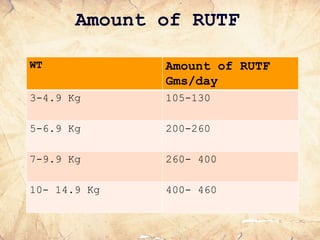
Amount of RUTF
WT Amount of RUTF
Gms/day
3-4.9 Kg 105-130
5-6.9 Kg 200-260
7-9.9 Kg 260- 400
10- 14.9 Kg 400- 460
Non responders
• Non responders:
 Failure to gain wt. for 21 days
 Wt. loss since admission to
program for 14 days
• Secondary Failure
 Failure of appetite test in any
visit or
 Wt loss of 5 % body wt. at any
visit
• Defaulters: not traceable for
two weeks
Indications for
admission
• Presence of medical complications
e.g Diarrhea, Pneumonia, Sepsis,
Hypoglycemia, Electrolyte
disturbances etc.
• Decreased appetite
• Presence of bilateral pitting
edema feet
• Age <6 months
Step wise management
of severe PEM
• Step 1-6 (1-2 days)
• SHIELDED
 S- Sugar deficiency
(hypoglycemia)
 H - Hypothermia
 I - Infection & septic shock
 EL- Electrolyte disturbances
 DE – Dehydration
 D – Deficiencies of iron,
vitamins & other micronutrients
Step wise management
of severe PEM
• Step 7 –(3-7 days) – Initiation of
feeding
• Step 8 – (2-6 weeks) – catch up
growth & rehabilitation
• Step 9 – (6-8 weeks) – Discharge
• Step 10 ( 8-36 weeks) – Follow up
• Malnourished children need BEST
diet
 B – Beginning of feeding,
 E- Energy dense feed,
 S- Sensory stimulation &
emotional support,
 T- Transfer to home based diet
& follow up
Initial treatment
• Treat or prevent hypoglycemia
(Blood sugar < 54 mg%)
Frequent monitoring of
blood sugar
Treat with 5ml/Kg of 10%
dextrose I/V
Early & frequent feeding
• Treat or prevent hypothermia (
rectal temp, <35.5 C)
Re- warm using warmer /
Kangaroo technique
Initial treatment contd..
Dehydration
• Diarrhoea common
• Assessment of dehydration difficult
Unreliable signs:
•Mental state
•Dryness of mouth tongue &
tears
•Skin elasticity
Dehydration Contd.
Reliable signs
• thirst
• recent sinking of eyes
• cold hands and feet
Treatment:
• Slow rehydration
• Preferably oral : WHO - ORS with
free access to water
• Give @ 70 -100 ml/kg over 12 hrs
Infections
Infections common
Host response masked
Start antibiotics in presence of
• Shock
• Hypoglycemia
• Hypothermia
• Skin infections
• Respiratory infections
• Lethargic/ sick looking
Infections Contd.
• Obtain appropriate cultures
• Start Broad spectrum
antibiotics:
• Give for at-least 5 days
• Review after culture reports
available/ child fails to
improve
• Treat for specific infections if
detected
Vitamin Deficiencies
• Vit. A : Day 1 in all children,
Additional doses on day 2 and 2
weeks later in children with signs
of deficiency
• Dose:
< 6 months : 50,000 U
6 - 12 months: 1 lakh U
>12 months : 2 lakh U
Vitamin Deficiency
Contd.
• Folic acid: 5 mg on Day 1 and
1mg thereafter
• Vit. K if marantic purpura
present
• Oral multi-vitamin supplements
Anemia
Mild to moderate anemia always
present due to:
• Iron & folic acid deficiency
• Worm infestation
• Malaria
• Recurrent infection
Severe anemia: Packed cell
transfusion @ 5-10 ml/kg over 3
hrs
Exchange transfusion in presence
of CHF
CHF
• More common in kwashiorkor
• Complication of over-hydration
• Blood/ plasma transfusion
Treatment
• Stop oral intake and I/V fluids
• Give I/V diuretic
Step 7( initiation of
feeding)
• Begin feeding as soon as possible
• Gradual re-introduction
• Small frequent feeds
• Milk is the usual introductory
food
• Start with 80 - 100 kcal/kg body
wt
• Gradually increase the amount
• May give naso-gastric feeds
initially
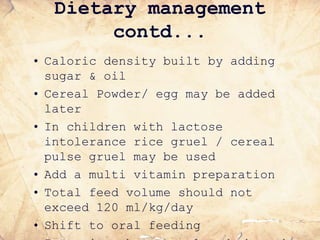
Dietary management
contd...
• Caloric density built by adding
sugar & oil
• Cereal Powder/ egg may be added
later
• In children with lactose
intolerance rice gruel / cereal
pulse gruel may be used
• Add a multi vitamin preparation
• Total feed volume should not
exceed 120 ml/kg/day
• Shift to oral feeding
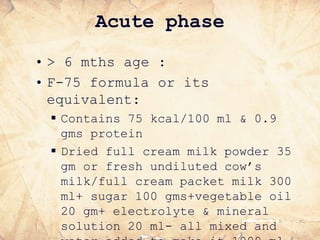
Acute phase
• > 6 mths age :
• F-75 formula or its
equivalent:
 Contains 75 kcal/100 ml & 0.9
gms protein
 Dried full cream milk powder 35
gm or fresh undiluted cow’s
milk/full cream packet milk 300
ml+ sugar 100 gms+vegetable oil
20 gm+ electrolyte & mineral
solution 20 ml- all mixed and
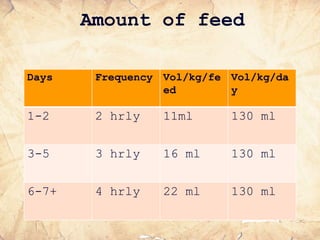
Amount of feed
Days Frequency Vol/kg/fe
ed
Vol/kg/da
y
1-2 2 hrly 11ml 130 ml
3-5 3 hrly 16 ml 130 ml
6-7+ 4 hrly 22 ml 130 ml
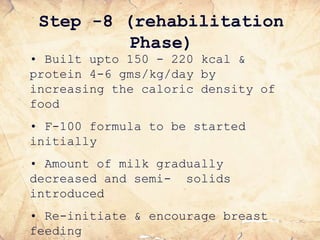
• Built upto 150 - 220 kcal &
protein 4-6 gms/kg/day by
increasing the caloric density of
food
• F-100 formula to be started
initially
• Amount of milk gradually
decreased and semi- solids
introduced
• Re-initiate & encourage breast
feeding
Step -8 (rehabilitation
Phase)
Rehabilitative phase
• F-100 catch up formula
diet or its equivalent is
started at rehabilitation
phase initially.
 F-110 contains 100 kcal & 2.9
gms protein /100 ml
 It contains dried full cream
milk powder 110 gms or 950 ml
cows milk+ sugar 50 gms +
vegetable oil 30 gms +
electrolyte solution 20 ml &
all added to make it 1000 ml
Step 9 (Discharge)
criteria
• Good appetite
• No edema
• Continuous weight gain of > 5
gm/kg/day x 3 consecutive days
• Completed appropriate
antimicrobials treatment & proper
immunization
• Care giver trained, motivated &
skilled to provide care
Step 10 (follow-up)
• Monitor progress
Usual wt. Gain 10 -15 gm/kg/d
• Re-inforce maternal education &
motivation
• Encourage child to eat as much as
possible
• 150 -200 Cal/kg/d
• Stimulate emotional & physical
dvpt.
• Rehabilitation phase complete when
child achieves 90% of expected wt.
Prevention of
malnutrition
• Tack the chief causes of
malnutrition:
• Delayed weaning
• Diluted top milk
• Late introduction of semisolids &
solids
• Maternal education
• Prevention of L.B.W.
• Access to health care
• Provision of comprehensive health
care services
protein-energy-malnutrition.pptx

protein-energy-malnutrition.pptx

  • 1.
  • 2.
    Malnutrition • Leading causeof morbidity & mortality in children through out the world • 10% of under 5 year olds world wide are wasted & 27% stunted & 25% underweight • Direct cause of death in 7% & underlying cause in 46% of <5 yr old children • In India: (NFHS - 3 data)  Prevalence of under nutrition (0-3 years): 46%
  • 3.
    Etiology • Low birthweight baby: Maternal malnutrition LBW & growth retarded babies with poor nutritional reserve.In India 28% babies born are LBW. • Feeding habits: Lack of exclusive breast feeding in first 6 mths, introduction of artificial feeds , inappropriate hand and bottle hygiene, delayed introduction of complimentary food
  • 4.
    • Infections: diarrhea,malaria, measles, whooping cough & tuberculosis precipitate & aggravate the existing nutritional deficit  Impaired appetite  Iatrogenic food restriction by parents  Metabolic demands high  Catabolism of body tissue  Loss of protein in infected Etiology
  • 5.
    Etiology • High pressureadvertising baby food in market • Social factors : Repeated pregnancies, inadequate spacing, food taboos, broken homes, separation of child from parents, natural disaster e.g. earthquake, droughts, flood • Poverty:
  • 6.
    Malnutrition: a medical& social disorder Poverty Poor understanding Family problems Nutritional deprivation Emotional deprivation Malnutrition infections
  • 7.
    Classification of PEM •IAP classification: wt >80% expected for that age is normal  Grade I – 71-80%  Grade II – 61-70%  Grade III – 51- 60%  Grade IV - <= 50% Alphabet k is postfixed in the presence of pedal edema e.g. PEM grade II(k)
  • 8.
    Classification of PEM •Gomez classification: > 90% expected wt for age is normal  Grade I – 76-90%  Grade II – 61- 75%  Grade III - <= 60%
  • 9.
    Classification of PEM •Welcome trust classification: based on wt for age & presence or absence of edema • Wt between 60-80% with edema- Kwashiorkor • Wt 60-80% without edema – undernutrition • Wt <60 % without edema – Marasmus • Wt <60% with edema – marasmic kwashiorkor
  • 10.
    Classification of PEM(WHO) Malnutrition Parameters moderate severe Wtfor Ht 70-79%(-2 to _3 SD) <70%(<- 3 SD) (severe wasting)* Ht for age 85-89% <85%(<-3 SD)
  • 11.
    Severe acute malnutrition(sam) • WHO& UNICEF coined this term to identify malnourished children with highest risk of death & for therapeutic feeding • Criteria for SAM (presence of any one of the following:  Wt for length/ht < 3 SD of the median WHO growth chart  Visible severe wasting  Bilateral pedal edema (dorsum)  Mid upper arm circumference <11.5 cm between 6mths - 5 yrs
  • 14.
    Pathophysiology • Classical theory: In kwashiorkor- mainly deficiency of protein leading to hypoalbuminemia leading to edema  In marasmus- Deficiency of energy • Gopalan’s theory of adaptation:  In marasmus – adaptation to chronic nutritional deficiency
  • 15.
    Pathophysiology • Golden theoryof free radicals:  Kwashiorkor develops due to imbalance between the production of free radicals & their safe disposal  Oxidative toxic stress releases excess of free radicals  Free radicals cause cell membrane damage & increased permeability & hence edema
  • 16.
    Changes in body composition& function • Loss of muscle & subcutaneous tisssue • Body fat & total bone mass is reduced • Total body water in PEM –increased to 70-80% body wt (60% in normal children) • Increased intracellular Na & reduced total body K & Mg. • Dehydration should be corrected with caution, preferablly orally
  • 17.
    • Metabolic alteration: BMR reduced by 30% & energy expenditure due to poor activity  Heat generation and heat losses affected • Biochemical changes:  Liver – synthesis of all proteins reduced, gluconeogenesis & metabolism of liver impaired leading to incresed risk of hypoglycemia Changes in body composition & function
  • 18.
    Biochemical changes • Plasmatransferin concn markedly reduced • Plasma triglyceride, Cholesterol & beta lipoprotein reduced in Kwashiorkor • VLDL account for most of the triglyceride in Kwashiorkor • In marasmus above parameters may be normal or reduced
  • 19.
    Immunity • Impaired cellmediated immunity due to atrophy of thymus & lymphoid tissue  Tuberculosis tends to be unusually severe  Mx reaction poor • Humoral immunity less affected  Circulating immunoglobulin levels –normal or elevated  Secretory IGA may be reduced
  • 20.
    • Leukocyte countis usually normal • Leukopenia may be present in vit B12 & folic acid deficiency • Chemotaxis is impaired but phagocytosis is normal • Impaired fungicidal & bactericidal activity of leukocytes • Physical barrier is impaired Immunity
  • 21.
    Gastro intestinal system • Atrophyof salivary gland • Fatty infiltration of liver • Atrophy of pancreatic acini • Intestinal villi atrophied reducing total absorptive surface • Steatorrhea may occur • Protuberant abdomen and rectal prolapse due to laxity of muscles
  • 22.
    Other systems • CNS: Growth & development of brain affected if malnutrion sets in in first two years  Associtaed micronutrient deficiency e.g. iron, B1, B12, Zinc & iodine further impairs brain function and lowers development score
  • 23.
    Other systems • Renal: GFR & renal plasma flow reduced in severe PEM  Urinay sodium & phosphorus excretion reduced • Endocrine: Insulin level reduced, cortisol & growth hormone level increased • CVS: Cardiac output & stroke vol. reduced,BP –low & renal perfusion reduced
  • 24.
    Clinical features • Dependson  Severity  Duration  Age  Relative deficiency of diff component of food  Presence of associated infection In India major limiting factor in diet is energy Nutritional marasmus & Kwashiorkor are two extreme form
  • 25.
    Marasmus • Visible severewasting of muscle & subcutaneous tissues • Usually alert child • Emaciated look • No edema • Skin –dry, scaly, thin, wrinkled with loose folds (thigh & gluteal region) • Abdomen distended, hair hypopigmented • Appetite usually more unless infection
  • 27.
    Kwashiorkor • Essential features: Edema of the dependent parts  Marked growth retardation  Psychomotor changes • Other features:  Skin changes, hair changes, hepatomegaly, poor appetite & associated nutritional deficiencies
  • 29.
    Kwashiorkor • Edema –due to  i) Hypoalbuminemia,  ii) Capillary leak due to infection & hypokalemia  iii) Free radical induced damage to cell membrane • Edema starts from lower extremities and spreads upwards with puffy face
  • 30.
    Psychomotor changes • Lethargic,listless & apathetic • Play activity & interaction with others reduced • Resents examination • Poor appetite
  • 31.
    Skin & hairchanges Skin • Dry and scaly • Cracking giving mosaic appearance • Crazy pavement dermatitis (black patches over flexors & pressure sites) • Raw hypopigmented or hyperpigmented patches • Flaky paint Hair • Hypopigmented • Lustureless • Thin & easily pluckable • Flag sign
  • 32.
    Management of SAM •SAM out patient management program • In patient management:  Initial Treatment: 2-7 days  Rehabilitation: 2-6 weeks  Follow up: After discharge
  • 33.
    Management of moderate malnutrition •Managed at out-patient level • Home based with Angadwadi supervision • Screen and treat for infections & other associated nutritional deficiencies • De-worm • Gradual increase in food intake to provide 150-200 Cal/kg/day & protiens 2-3gm/kg/day
  • 34.
    oderate malnutrition contd.. Parentaleducation: • Stress on simple modifications in the home cooked food without resorting to expensive supplemental foods • Stress importance of breast feeding • addition of oil / butter • Green leafy vegetables • Small frequent feeds -at-least 5 /day • Hygiene
  • 35.
    Management <6 mthsage • Continuing or re initiating breast feeding • Supplemental suckling technique for re initiation of breast feeding • If no prospect of continuing or re initiation of breast feed – F- 75 formula feeding
  • 36.
    Appetite test (criteria forpassing test) Body weight Minimum amount of RUTF in ml/gm to be consumed for passing the test <4 Kg 15 4-6.9 Kg 25 7-9.9 Kg 35 10-14.9 Kg 50
  • 37.
    Ready to usetreatment formula (RUTF) • Soft & crushable food used in community treatment of SAM • It is calorie dense milk based sold diet • It is best used when home based food can not be made • It contains approx 100 kcal & 2.9 gms protein/100 gms • It is advised to be given 2-3 hrly with lots of water to drink
  • 38.
    Amount of RUTF WTAmount of RUTF Gms/day 3-4.9 Kg 105-130 5-6.9 Kg 200-260 7-9.9 Kg 260- 400 10- 14.9 Kg 400- 460
  • 39.
    Non responders • Nonresponders:  Failure to gain wt. for 21 days  Wt. loss since admission to program for 14 days • Secondary Failure  Failure of appetite test in any visit or  Wt loss of 5 % body wt. at any visit • Defaulters: not traceable for two weeks
  • 40.
    Indications for admission • Presenceof medical complications e.g Diarrhea, Pneumonia, Sepsis, Hypoglycemia, Electrolyte disturbances etc. • Decreased appetite • Presence of bilateral pitting edema feet • Age <6 months
  • 41.
    Step wise management ofsevere PEM • Step 1-6 (1-2 days) • SHIELDED  S- Sugar deficiency (hypoglycemia)  H - Hypothermia  I - Infection & septic shock  EL- Electrolyte disturbances  DE – Dehydration  D – Deficiencies of iron, vitamins & other micronutrients
  • 42.
    Step wise management ofsevere PEM • Step 7 –(3-7 days) – Initiation of feeding • Step 8 – (2-6 weeks) – catch up growth & rehabilitation • Step 9 – (6-8 weeks) – Discharge • Step 10 ( 8-36 weeks) – Follow up
  • 43.
    • Malnourished childrenneed BEST diet  B – Beginning of feeding,  E- Energy dense feed,  S- Sensory stimulation & emotional support,  T- Transfer to home based diet & follow up
  • 44.
    Initial treatment • Treator prevent hypoglycemia (Blood sugar < 54 mg%) Frequent monitoring of blood sugar Treat with 5ml/Kg of 10% dextrose I/V Early & frequent feeding • Treat or prevent hypothermia ( rectal temp, <35.5 C) Re- warm using warmer / Kangaroo technique
  • 45.
    Initial treatment contd.. Dehydration •Diarrhoea common • Assessment of dehydration difficult Unreliable signs: •Mental state •Dryness of mouth tongue & tears •Skin elasticity
  • 46.
    Dehydration Contd. Reliable signs •thirst • recent sinking of eyes • cold hands and feet Treatment: • Slow rehydration • Preferably oral : WHO - ORS with free access to water • Give @ 70 -100 ml/kg over 12 hrs
  • 47.
    Infections Infections common Host responsemasked Start antibiotics in presence of • Shock • Hypoglycemia • Hypothermia • Skin infections • Respiratory infections • Lethargic/ sick looking
  • 48.
    Infections Contd. • Obtainappropriate cultures • Start Broad spectrum antibiotics: • Give for at-least 5 days • Review after culture reports available/ child fails to improve • Treat for specific infections if detected
  • 49.
    Vitamin Deficiencies • Vit.A : Day 1 in all children, Additional doses on day 2 and 2 weeks later in children with signs of deficiency • Dose: < 6 months : 50,000 U 6 - 12 months: 1 lakh U >12 months : 2 lakh U
  • 50.
    Vitamin Deficiency Contd. • Folicacid: 5 mg on Day 1 and 1mg thereafter • Vit. K if marantic purpura present • Oral multi-vitamin supplements
  • 51.
    Anemia Mild to moderateanemia always present due to: • Iron & folic acid deficiency • Worm infestation • Malaria • Recurrent infection Severe anemia: Packed cell transfusion @ 5-10 ml/kg over 3 hrs Exchange transfusion in presence of CHF
  • 52.
    CHF • More commonin kwashiorkor • Complication of over-hydration • Blood/ plasma transfusion Treatment • Stop oral intake and I/V fluids • Give I/V diuretic
  • 53.
    Step 7( initiationof feeding) • Begin feeding as soon as possible • Gradual re-introduction • Small frequent feeds • Milk is the usual introductory food • Start with 80 - 100 kcal/kg body wt • Gradually increase the amount • May give naso-gastric feeds initially
  • 54.
    Dietary management contd... • Caloricdensity built by adding sugar & oil • Cereal Powder/ egg may be added later • In children with lactose intolerance rice gruel / cereal pulse gruel may be used • Add a multi vitamin preparation • Total feed volume should not exceed 120 ml/kg/day • Shift to oral feeding
  • 55.
    Acute phase • >6 mths age : • F-75 formula or its equivalent:  Contains 75 kcal/100 ml & 0.9 gms protein  Dried full cream milk powder 35 gm or fresh undiluted cow’s milk/full cream packet milk 300 ml+ sugar 100 gms+vegetable oil 20 gm+ electrolyte & mineral solution 20 ml- all mixed and
  • 56.
    Amount of feed DaysFrequency Vol/kg/fe ed Vol/kg/da y 1-2 2 hrly 11ml 130 ml 3-5 3 hrly 16 ml 130 ml 6-7+ 4 hrly 22 ml 130 ml
  • 57.
    • Built upto150 - 220 kcal & protein 4-6 gms/kg/day by increasing the caloric density of food • F-100 formula to be started initially • Amount of milk gradually decreased and semi- solids introduced • Re-initiate & encourage breast feeding Step -8 (rehabilitation Phase)
  • 58.
    Rehabilitative phase • F-100catch up formula diet or its equivalent is started at rehabilitation phase initially.  F-110 contains 100 kcal & 2.9 gms protein /100 ml  It contains dried full cream milk powder 110 gms or 950 ml cows milk+ sugar 50 gms + vegetable oil 30 gms + electrolyte solution 20 ml & all added to make it 1000 ml
  • 59.
    Step 9 (Discharge) criteria •Good appetite • No edema • Continuous weight gain of > 5 gm/kg/day x 3 consecutive days • Completed appropriate antimicrobials treatment & proper immunization • Care giver trained, motivated & skilled to provide care
  • 60.
    Step 10 (follow-up) •Monitor progress Usual wt. Gain 10 -15 gm/kg/d • Re-inforce maternal education & motivation • Encourage child to eat as much as possible • 150 -200 Cal/kg/d • Stimulate emotional & physical dvpt. • Rehabilitation phase complete when child achieves 90% of expected wt.
  • 61.
    Prevention of malnutrition • Tackthe chief causes of malnutrition: • Delayed weaning • Diluted top milk • Late introduction of semisolids & solids • Maternal education • Prevention of L.B.W. • Access to health care • Provision of comprehensive health care services