Conversion Factors from BG to SI Units
To convert from To Multiply by
Acceleration ft/s2
m/s2
0.3048
Area ft2
m2
9.2903 E  2
mi2
m2
2.5900 E  6
acres m2
4.0469 E  3
Density slug/ft3
kg/m3
5.1538 E  2
lbm/ft3
kg/m3
1.6019 E  1
Energy ft-lbf J 1.3558
Btu J 1.0551 E  3
cal J 4.1868
Force lbf N 4.4482
kgf N 9.8067
Length ft m 0.3048
in m 2.5400 E  2
mi (statute) m 1.6093 E  3
nmi (nautical) m 1.8520 E  3
Mass slug kg 1.4594 E  1
lbm kg 4.5359 E  1
Mass flow slug/s kg/s 1.4594 E  1
lbm/s kg/s 4.5359 E  1
Power ftlbf/s W 1.3558
hp W 7.4570 E  2
Conversion Factors from BG to SI Units (Continued)
To convert from To Multiply by
Pressure lbf/ft2
Pa 4.7880 E  1
lbf/in2
Pa 6.8948 E  3
atm Pa 1.0133 E  5
mm Hg Pa 1.3332 E  2
Specific weight lbf/ft3
N/m3
1.5709 E  2
Specific heat ft2
/(s2
R) m2
/(s2
K) 1.6723 E  1
Surface tension lbf/ft N/m 1.4594 E  1
Temperature F C tC  (tF  32)
R K 0.5556
Velocity ft/s m/s 0.3048
mi/h m/s 4.4704 E  1
knot m/s 5.1444 E  1
Viscosity lbfs/ft2
Ns/m2
4.7880 E  1
g/(cms) Ns/m2
0.1
Volume ft3
m3
2.8317 E  2
L m3
0.001
gal (U.S.) m3
3.7854 E  3
fluid ounce (U.S.) m3
2.9574 E  5
Volume flow ft3
/s m3
/s 2.8317 E  2
gal/min m3
/s 6.3090 E  5
5
9
EQUATION SHEET
Ideal-gas law: p  RT, Rair  287 J/kg-K
Hydrostatics, constant density:
p2  p1  (z2 z1),   g
Buoyant force:
(displaced volume)
CV momentum:
Steady flow energy:
(p/V2
/2gz)out hfriction hpump hturbine
Incompressible continuity:
Incompressible stream function
Bernoulli unsteady irrotational flow:
Pipe head loss:
where f  Moody chart friction factor
Laminar flat plate flow: ,
,
Isentropic flow: ,
,
Prandtl-Meyer expansion: K  (k1)/(k1),
K1/2
tan1
[(Ma2
1)/K]1/2
tan1
(Ma2
1)1/2
Gradually varied channel flow:
, Fr  V/Vcrit
dy/dx  (S0  S)/(1  Fr2
)
p0/p  (T0/T)k(k1)
0/  (T0/T)1/(k1)
T0 /T15(k1)/26Ma2
CD  Drag/11
2V2
A2; CL  Lift/11
2V2
A2
CD  1.328/ReL
1/2
cf  0.664/Rex
1/2
/x  5.0/Rex
1/2
hf  f(L/d)V2
/(2g)
/t dp/  V2
/2 gz  Const
u  /y; v  /x
(x,y):
  V  0
(p/V2
/2gz)in 
 g 3(AV)V4out  g 3(AV )V4in  gF
d/dt1 CV
Vd	2
FB  fluid
Surface tension:
Hydrostatic panel force: ,
yCPIxxsin
/(hCGA), xCPIxysin
/(hCGA)
CV mass:
CV angular momentum:
Acceleration:
Navier-Stokes:
Velocity potential :
Turbulent friction factor:
Orifice, nozzle, venturi flow:
,
Turbulent flat plate flow: ,
2-D potential flow:
One-dimensional isentropic area change:
A/A*(1/Ma)[1{(k1)/2}Ma2
](1/2)(k1)/(k1)
Uniform flow, Manning’s n, SI units:
Euler turbine formula:
Power  Q(u2Vt2  u1Vt1), u  r
V0(m/s)  (1.0/n)3Rh(m)42/3
S0
1/2
2
  2
  0
cf  0.027/Rex
1/7
, CD  0.031/ReL
1/7
/x  0.16/Rex
1/7
  d/D
QCdAthroat 32	p/5(14
)641/2
2.0 log10 3
/(3.7d)  2.51/1Red 1f)4
1/1f 
u  /x; v  /y; w  /z
(x,y,z)
(dV/dt)gp
2
V
u(V/x) v(V/y)w(V/z)
dV/dt  V/t
gAV(r0V)outgAV(r0V)in gM0
d/dt(CV
(r0V)d	)
 g(AV)in  0
d/dt(CV
d	)  g(AV)out
F  hCGA
	p  Y(R1
1
 R2
1
)
This page intentionally left blank
Fluid Mechanics
whi29346_fm_i-xvi.qxd 12/14/09 7:09PM Page i ntt 208:MHDQ176:whi29346:0073529346:whi29346_pagefiles:
McGraw-Hill Series in Mechanical Engineering
Alciatore/Histand
Introduction to Mechatronics and Measurement Systems
Anderson
Computational Fluid Dynamics: The Basics with Applications
Anderson
Fundamentals of Aerodynamics
Anderson
Introduction to Flight
Anderson
Modern Compressible Flow
Beer/Johnston
Vector Mechanics for Engineers: Statics and Dynamics
Beer/Johnston
Mechanics of Materials
Budynas
Advanced Strength and Applied Stress Analysis
Budynas/Nisbett
Shigley’s Mechanical Engineering Design
Çengel
Heat and Mass Transfer: A Practical Approach
Çengel
Introduction to Thermodynamics  Heat Transfer
Çengel/Boles
Thermodynamics: An Engineering Approach
Çengel/Cimbala
Fluid Mechanics: Fundamentals and Applications
Çengel/Turner
Fundamentals of Thermal-Fluid Sciences
Dieter
Engineering Design: A Materials  Processing Approach
Dieter
Mechanical Metallurgy
Dorf/Byers
Technology Ventures: From Idea to Enterprise
Finnemore/Franzini
Fluid Mechanics with Engineering Applications
Hamrock/Schmid/Jacobson
Fundamentals of Machine Elements
Heywood
Internal Combustion Engine Fundamentals
Holman
Experimental Methods for Engineers
Holman
Heat Transfer
Kays/Crawford/Weigand
Convective Heat and Mass Transfer
Meirovitch
Fundamentals of Vibrations
Norton
Design of Machinery
Palm
System Dynamics
Reddy
An Introduction to Finite Element Method
Schey
Introduction to Manufacturing Processes
Smith/Hashemi
Foundations of Materials Science and Engineering
Turns
An Introduction to Combustion: Concepts and Applications
Ugural
Mechanical Design: An Integrated Approach
Ullman
The Mechanical Design Process
White
Fluid Mechanics
White
Viscous Fluid Flow
whi29346_fm_i-xvi.qxd 12/14/09 7:09PM Page ii ntt 208:MHDQ176:whi29346:0073529346:whi29346_pagefiles:
Seventh Edition
Frank M. White
University of Rhode Island
Fluid Mechanics
whi29346_fm_i-xvi.qxd 12/14/09 7:09PM Page iii ntt 208:MHDQ176:whi29346:0073529346:whi29346_pagefiles:
FLUID MECHANICS, SEVENTH EDITION
Published by McGraw-Hill, a business unit of The McGraw-Hill Companies, Inc., 1221 Avenue of the
Americas, New York, NY 10020. Copyright © 2011 by The McGraw-Hill Companies, Inc. All rights
reserved. Previous editions © 2008, 2003, and 1999. No part of this publication may be reproduced or
distributed in any form or by any means, or stored in a database or retrieval system, without the prior
written consent of The McGraw-Hill Companies, Inc., including, but not limited to, in any network or other
electronic storage or transmission, or broadcast for distance learning.
Some ancillaries, including electronic and print components, may not be available to customers outside the
United States.
This book is printed on acid-free paper.
1 2 3 4 5 6 7 8 9 0 DOC/DOC 1 0 9 8 7 6 5 4 3 2 1 0
www.mhhe.com
ISBN 978-0-07-352934-9
MHID 0-07-352934-6
Vice President  Editor-in-Chief: Marty Lange
Vice President, EDP/Central Publishing Services: Kimberly Meriwether-David
Global Publisher: Raghothaman Srinivasan
Senior Sponsoring Editor: Bill Stenquist
Director of Development: Kristine Tibbetts
Developmental Editor: Lora Neyens
Senior Marketing Manager: Curt Reynolds
Senior Project Manager: Lisa A. Bruflodt
Production Supervisor: Nicole Baumgartner
Design Coordinator: Brenda A. Rolwes
Cover Designer: Studio Montage, St. Louis, Missouri
(USE) Cover Image: Copyright SkySails
Senior Photo Research Coordinator: John C. Leland
Photo Research: Emily Tietz/Editorial Image, LLC
Compositor: Aptara, Inc.
Typeface: 10/12 Times Roman
Printer: R. R. Donnelley
All credits appearing on page or at the end of the book are considered to be an extension of the copyright page.
Library of Congress Cataloging-in-Publication Data
White, Frank M.
Fluid mechanics / Frank M. White. —7th ed.
p. cm. — (Mcgraw-Hill series in mechanical engineering)
Includes bibliographical references and index.
ISBN 978–0–07–352934–9 (alk. paper)
1. Fluid mechanics. I. Title.
TA357.W48 2009
620.1’06—dc22
2009047498
whi29346_fm_i-xvi.qxd 12/30/09 1:16PM Page iv ntt 208:MHDQ176:whi29346:0073529346:whi29346_pagefiles:
Frank M. White is Professor Emeritus of Mechanical and Ocean Engineering at the
University of Rhode Island. He studied at Georgia Tech and M.I.T. In 1966 he helped
found, at URI, the first department of ocean engineering in the country. Known
primarily as a teacher and writer, he has received eight teaching awards and has written
four textbooks on fluid mechanics and heat transfer.
From 1979 to 1990 he was editor-in-chief of the ASME Journal of Fluids
Engineering and then served from 1991 to 1997 as chairman of the ASME Board
of Editors and of the Publications Committee. He is a Fellow of ASME and in 1991
received the ASME Fluids Engineering Award. He lives with his wife, Jeanne, in
Narragansett, Rhode Island.
v
About the Author
whi29346_fm_i-xvi.qxd 12/14/09 7:09PM Page v ntt 208:MHDQ176:whi29346:0073529346:whi29346_pagefiles:
To Jeanne
whi29346_fm_i-xvi.qxd 12/14/09 7:09PM Page vi ntt 208:MHDQ176:whi29346:0073529346:whi29346_pagefiles:
Preface xi
Chapter 1
Introduction 3
1.1 Preliminary Remarks 3
1.2 History and Scope of Fluid Mechanics 4
1.3 Problem-Solving Techniques 6
1.4 The Concept of a Fluid 6
1.5 The Fluid as a Continuum 8
1.6 Dimensions and Units 9
1.7 Properties of the Velocity Field 17
1.8 Thermodynamic Properties of a Fluid 18
1.9 Viscosity and Other Secondary Properties 25
1.10 Basic Flow Analysis Techniques 40
1.11 Flow Patterns: Streamlines, Streaklines, and
Pathlines 41
1.12 The Engineering Equation Solver 46
1.13 Uncertainty in Experimental Data 46
1.14 The Fundamentals of Engineering (FE)
Examination 48
Problems 49
Fundamentals of Engineering Exam Problems 57
Comprehensive Problems 58
References 61
Chapter 2
Pressure Distribution in a Fluid 65
2.1 Pressure and Pressure Gradient 65
2.2 Equilibrium of a Fluid Element 67
2.3 Hydrostatic Pressure Distributions 68
2.4 Application to Manometry 75
2.5 Hydrostatic Forces on Plane Surfaces 78
2.6 Hydrostatic Forces on Curved Surfaces 86
2.7 Hydrostatic Forces in Layered Fluids 89
2.8 Buoyancy and Stability 91
2.9 Pressure Distribution in Rigid-Body Motion 97
2.10 Pressure Measurement 105
Summary 109
Problems 109
Word Problems 132
Fundamentals of Engineering Exam
Problems 133
Comprehensive Problems 134
Design Projects 135
References 136
Chapter 3
Integral Relations for a Control Volume 139
3.1 Basic Physical Laws of Fluid Mechanics 139
3.2 The Reynolds Transport Theorem 143
3.3 Conservation of Mass 150
3.4 The Linear Momentum Equation 155
3.5 Frictionless Flow: The Bernoulli Equation 169
3.6 The Angular Momentum Theorem 178
3.7 The Energy Equation 184
Summary 195
Problems 195
Word Problems 224
Fundamentals of Engineering Exam Problems 224
Comprehensive Problems 226
Design Project 227
References 227
Contents
vii
whi29346_fm_i-xvi.qxd 12/14/09 7:09PM Page vii ntt 208:MHDQ176:whi29346:0073529346:whi29346_pagefiles:
Chapter 4
Differential Relations for Fluid Flow 229
4.1 The Acceleration Field of a Fluid 230
4.2 The Differential Equation of Mass Conservation 232
4.3 The Differential Equation of Linear Momentum 238
4.4 The Differential Equation of Angular Momentum 244
4.5 The Differential Equation of Energy 246
4.6 Boundary Conditions for the Basic Equations 249
4.7 The Stream Function 253
4.8 Vorticity and Irrotationality 261
4.9 Frictionless Irrotational Flows 263
4.10 Some Illustrative Incompressible Viscous Flows 268
Summary 276
Problems 277
Word Problems 288
Fundamentals of Engineering Exam Problems 288
Comprehensive Problems 289
References 290
Chapter 5
Dimensional Analysis and Similarity 293
5.1 Introduction 298
5.2 The Principle of Dimensional Homogeneity 296
5.3 The Pi Theorem 302
5.4 Nondimensionalization of the Basic Equations 312
5.5 Modeling and Its Pitfalls 321
Summary 333
Problems 333
Word Problems 342
Fundamentals of Engineering Exam Problems 342
Comprehensive Problems 343
Design Projects 344
References 344
Chapter 6
Viscous Flow in Ducts 347
6.1 Reynolds Number Regimes 347
6.2 Internal versus External Viscous Flow 352
6.3 Head Loss—The Friction Factor 355
6.4 Laminar Fully Developed Pipe Flow 357
6.5 Turbulence Modeling 359
6.6 Turbulent Pipe Flow 365
6.7 Four Types of Pipe Flow Problems 373
6.8 Flow in Noncircular Ducts 379
6.9 Minor or Local Losses in Pipe Systems 388
6.10 Multiple-Pipe Systems 397
6.11 Experimental Duct Flows: Diffuser Performance 403
6.12 Fluid Meters 408
Summary 429
Problems 430
Word Problems 448
Fundamentals of Engineering Exam Problems 449
Comprehensive Problems 450
Design Projects 452
References 453
Chapter 7
Flow Past Immersed Bodies 457
7.1 Reynolds Number and Geometry Effects 457
7.2 Momentum Integral Estimates 461
7.3 The Boundary Layer Equations 464
7.4 The Flat-Plate Boundary Layer 467
7.5 Boundary Layers with Pressure Gradient 476
7.6 Experimental External Flows 482
Summary 509
Problems 510
Word Problems 523
Fundamentals of Engineering Exam Problems 524
Comprehensive Problems 524
Design Project 525
References 526
Chapter 8
Potential Flow and Computational Fluid Dynamics 529
8.1 Introduction and Review 529
8.2 Elementary Plane Flow Solutions 532
8.3 Superposition of Plane Flow Solutions 539
8.4 Plane Flow Past Closed-Body Shapes 545
8.5 Other Plane Potential Flows 555
8.6 Images 559
8.7 Airfoil Theory 562
8.8 Axisymmetric Potential Flow 574
8.9 Numerical Analysis 579
viii Contents
whi29346_fm_i-xvi.qxd 12/14/09 7:09PM Page viii ntt 208:MHDQ176:whi29346:0073529346:whi29346_pagefiles:
Summary 593
Problems 594
Word Problems 604
Comprehensive Problems 605
Design Projects 606
References 606
Chapter 9
Compressible Flow 609
9.1 Introduction: Review of Thermodynamics 609
9.2 The Speed of Sound 614
9.3 Adiabatic and Isentropic Steady Flow 616
9.4 Isentropic Flow with Area Changes 622
9.5 The Normal Shock Wave 629
9.6 Operation of Converging and Diverging Nozzles 637
9.7 Compressible Duct Flow with Friction 642
9.8 Frictionless Duct Flow with Heat Transfer 654
9.9 Two-Dimensional Supersonic Flow 659
9.10 Prandtl-Meyer Expansion Waves 669
Summary 681
Problems 682
Word Problems 695
Fundamentals of Engineering Exam Problems 696
Comprehensive Problems 696
Design Projects 698
References 698
Chapter 10
Open-Channel Flow 701
10.1 Introduction 701
10.2 Uniform Flow: The Chézy Formula 707
10.3 Efficient Uniform-Flow Channels 712
10.4 Specific Energy: Critical Depth 714
10.5 The Hydraulic Jump 722
10.6 Gradually Varied Flow 726
10.7 Flow Measurement and Control by Weirs 734
Summary 741
Problems 741
Word Problems 754
Fundamentals of Engineering Exam Problems 754
Comprehensive Problems 754
Design Projects 756
References 756
Chapter 11
Turbomachinery 759
11.1 Introduction and Classification 759
11.2 The Centrifugal Pump 762
11.3 Pump Performance Curves and Similarity Rules 768
11.4 Mixed- and Axial-Flow Pumps: The Specific Speed 778
11.5 Matching Pumps to System Characteristics 785
11.6 Turbines 793
Summary 807
Problems 807
Word Problems 820
Comprehensive Problems 820
Design Project 822
References 822
Appendix A Physical Properties of Fluids 824
Appendix B Compressible Flow Tables 829
Appendix C Conversion Factors 836
Appendix D Equations of Motion in Cylindrical Coordinates 838
Answers to Selected Problems 840
Index 847
Contents ix
whi29346_fm_i-xvi.qxd 12/14/09 7:09PM Page ix ntt 208:MHDQ176:whi29346:0073529346:whi29346_pagefiles:
This page intentionally left blank
The seventh edition of Fluid Mechanics sees some additions and deletions but no
philosophical change. The basic outline of eleven chapters, plus appendices, remains
the same. The triad of integral, differential, and experimental approaches is retained.
Many problem exercises, and some fully worked examples, have been changed. The
informal, student-oriented style is retained. A number of new photographs and figures
have been added. Many new references have been added, for a total of 435. The writer
is a firm believer in “further reading,” especially in the postgraduate years.
The total number of problem exercises continues to increase, from 1089 in the first
edition, to 1675 in this seventh edition. There are approximately 20 new problems
added to each chapter. Most of these are basic end-of-chapter problems, classified
according to topic. There are also Word Problems, multiple-choice Fundamentals of
Engineering Problems, Comprehensive Problems, and Design Projects. The appendix
lists approximately 700 Answers to Selected Problems.
The example problems are structured in the text to follow the sequence of recom-
mended steps outlined in Sect. 1.3, Problem-Solving Techniques.
The Engineering Equation Solver (EES) is available with the text and continues
its role as an attractive tool for fluid mechanics and, indeed, other engineering prob-
lems. Not only is it an excellent solver, but it also contains thermophysical proper-
ties, publication-quality plotting, units checking, and many mathematical functions,
including numerical integration. The author is indebted to Sanford Klein and William
Beckman, of the University of Wisconsin, for invaluable and continuous help in
preparing and updating EES for use in this text. For newcomers to EES, a brief guide
to its use is found on this book’s website.
There are some revisions in each chapter.
Chapter 1 has added material on the history of late 20th century fluid mechanics,
notably the development of Computational Fluid Dynamics. A very brief introduction
to the acceleration field has been added. Boundary conditions for slip flow have been
added. There is more discussion of the speed of sound in liquids. The treatment of
thermal conductivity has been moved to Chapter 4.
Content Changes
Learning Tools
General Approach
xi
Preface
whi29346_fm_i-xvi.qxd 12/14/09 7:09PM Page xi ntt 208:MHDQ176:whi29346:0073529346:whi29346_pagefiles:
Chapter 2 introduces a photo, discussion, and new problems for the deep ocean
submersible vehicle, ALVIN. The density distribution in the troposphere is now given
explicitly. There are brief remarks on the great Greek mathematician, Archimedes.
Chapter 3 has been substantially revised. Reviewers wanted Bernoulli’s equation
moved ahead of angular velocity and energy, to follow linear momentum. I did this
and followed their specific improvements, but truly extensive renumbering and rear-
ranging was necessary. Pressure and velocity conditions at a tank surface have an
improved discussion. A brief history of the control volume has been added. There is
a better treatment of the relation between Bernoulli’s equation and the energy equa-
tion. There is a new discussion of stagnation, static and dynamic pressures, and
boundary conditions at a jet exit.
Chapter 4 has a great new opener: CFD for flow past a spinning soccer ball. The
total time derivative of velocity is now written out in full. Fourier’s Law, and its appli-
cation to the differential energy equation, have been moved here from Chapter 1.
There are 21 new problems, including several slip-flow analyses.
The Chapter 5 introduction expands on the effects of Mach number and Froude
number, instead of concentrating only on the Reynolds number. Ipsen’s method, which
the writer admires, is retained as an alternative to the pi theorem. The new opener, a
giant disk-band-gap parachute, allows for several new dimensional analysis problems.
Chapter 6 has a new formula for entrance length in turbulent duct flow, sent to me
by two different researchers. There is a new problem describing the flow in a fuel
cell. The new opener, the Trans-Alaska Pipeline, allows for several innovative prob-
lems, including a related one on the proposed Alaska-Canada natural gas pipeline.
Chapter 7 has an improved description of turbulent flow past a flat plate, plus recent
reviews of progress in turbulence modeling with CFD. Two new aerodynamic
advances are reported: the Finaish-Witherspoon redesign of the Kline-Fogelman air-
foil and the increase in stall angle achieved by tubercles modeled after a humpback
whale. The new Transition®
flying car, which had a successful maiden flight in 2009,
leads to a number of good problem assignments. Two other photos, Rocket Man over
the Alps, and a cargo ship propelled by a kite, also lead to interesting new problems.
Chapter 8 is essentially unchanged, except for a bit more discussion of modern
CFD software. The Transition®
autocar, featured in Chapter 7, is attacked here by
aerodynamic theory, including induced drag.
Chapter 9 benefited from reviewer improvement. Figure 9.7, with its 30-year-old
curve-fits for the area ratio, has been replaced with fine-gridded curves for the area-
change properties. The curve-fits are gone, and Mach numbers follow nicely from
Fig. 9.7 and either Excel or EES. New Trends in Aeronautics presents the X-43 Scram-
jet airplane, which generates several new problem assignments. Data for the proposed
Alaska-to-Canada natural gas pipeline provides a different look at frictional choking.
Chapter 10 is basically the same, except for new photos of both plane and circu-
lar hydraulic jumps, plus a tidal bore, with their associated problem assignments.
Chapter 11 has added a section on the performance of gas turbines, with applica-
tion to turbofan aircraft engines. The section on wind turbines has been updated, with
new data and photos. A wind-turbine-driven vehicle, which can easily move directly
into the wind, has inspired new problem assignments.
xii Preface
whi29346_fm_i-xvi.qxd 12/14/09 7:09PM Page xii ntt 208:MHDQ176:whi29346:0073529346:whi29346_pagefiles:
Appendix A has new data on the bulk modulus of various liquids. Appendix B,
Compressible Flow Tables, has been shortened by using coarser increments (0.1) in
Mach number. Tables with much smaller increments are now on the bookswebsite.
Appendix E, Introduction to EES, has been deleted and moved to the website, on the
theory that most students are now quite familiar with EES.
A number of supplements are available to students and/or instructors at the text
website www.mhhe.com/white7e. Students have access to a Student Study Guide
developed by Jerry Dunn of Texas AM University. They are also able to utilize
Engineering Equation Solver (EES), fluid mechanics videos developed by Gary Set-
tles of Pennsylvania State University, and CFD images and animations prepared by
Fluent Inc. Also available to students are Fundamentals of Engineering (FE) Exam
quizzes, prepared by Edward Anderson of Texas Tech University.
Instructors may obtain a series of PowerPoint slides and images, plus the full Solu-
tions Manual, in PDF format. The Solutions Manual provides complete and detailed
solutions, including problem statements and artwork, to the end-of-chapter problems. It
may be photocopied for posting or preparing transparencies for the classroom. Instruc-
tors can also obtain access to C.O.S.M.O.S. for the seventh edition. C.O.S.M.O.S. is a
Complete Online Solutions Manual Organization System instructors can use to create
exams and assignments, create custom content, and edit supplied problems and
solutions.
Ebooks are an innovative way for students to save money and create a greener
environment at the same time. An ebook can save students about half the cost of a
traditional textbook and offers unique features like a powerful search engine, high-
lighting, and the ability to share notes with classmates using ebooks.
McGraw-Hill offers this text as an ebook. To talk about the ebook options, con-
tact your McGraw-Hill sales rep or visit the site www.coursesmart.com to learn more.
Online Supplements
Preface xiii
Electronic Textbook Options
whi29346_fm_i-xvi.qxd 12/14/09 7:09PM Page xiii ntt 208:MHDQ176:whi29346:0073529346:whi29346_pagefiles:
As usual, so many people have helped me that I may fail to list them all. Sheldon Green
of the University of British Columbia, Gordon Holloway of the University of New
Brunswick, Sukanta K. Dash of The Indian Institute of Technology at Kharagpur, and
Pezhman Shirvanian of Ford Motor Co. gave many helpful suggestions. Hubert Chanson
of the University of Queensland, Frank J. Cunha of PrattWhitney, Samuel Schweighart
of Terrafugia Inc., Mark Spear of the Woods Hole Oceanographic Institution, Keith
Hanna of ANSYS Inc., Elena Mejia of the Jet Propulsion Laboratory, Anne Staack of
SkySails, Inc., and Ellen Emerson White provided great new images. Samuel S. Sih
of Walla Walla College, Timothy Singler of SUNY Binghamton, Saeed Moaveni of
Minnesota State University, and John Borg of Marquette University were especially
helpful with the solutions manual.
The following prereviewers gave many excellent suggestions for improving the
manuscript: Rolando Bravo of Southern Illinois University; Joshua B. Kollat of Penn
State University; Daniel Maynes of Brigham Young University; Joseph Schaefer of
Iowa State University; and Xiangchun Xuan of Clemson University.
In preparation, the writer got stuck on Chapter 3 but was rescued by the following
reviewers: Serhiy Yarusevych of the University of Waterloo; H. Pirouz Kavehpour and
Jeff Eldredge of the University of California, Los Angeles; Rayhaneh Akhavan of the
University of Michigan; Soyoung Steve Cha of the University of Illinois, Chicago;
Georgia Richardson of the University of Alabama; Krishan Bhatia of Rowan Univer-
sity; Hugh Coleman of the University of Alabama-Huntsville; D.W. Ostendorf of
the University of Massachusetts; and Donna Meyer of the University of Rhode Island.
The writer continues to be indebted to many others who have reviewed this book
over the various years and editions.
Many other reviewers and correspondents gave good suggestions, encouragement,
corrections, and materials: Elizabeth J. Kenyon of MathWorks; Juan R. Cruz of NASA
Langley Research Center; LiKai Li of University of Science and Technology of China;
Tom Robbins of National Instruments; Tapan K. Sengupta of the Indian Institute of
Technology at Kanpur; Paulo Vatavuk of Unicamp University; Andris Skattebo of Scand-
power A/S; Jeffrey S. Allen of Michigan Technological University; Peter R. Spedding
of Queen’s University, Belfast, Northern Ireland; Iskender Sahin of Western Michigan
University; Michael K. Dailey of General Motors; Cristina L. Archer of Stanford
University; Paul F. Jacobs of Technology Development Associates; Rebecca Cullion-
Webb of the University of Colorado at Colorado Springs; Debendra K. Das of the Uni-
versity of Alaska Fairbanks; Kevin O’Sullivan and Matthew Lutts of the Associated
Acknowledgments
xiv
whi29346_fm_i-xvi.qxd 12/14/09 7:09PM Page xiv ntt 208:MHDQ176:whi29346:0073529346:whi29346_pagefiles:
Press; Lennart Lüttig and Nina Koliha of REpower Systems AG, Hamburg, Germany;
Chi-Yang Cheng of ANSYS Inc.; Debabrata Dasgupta of The Indian Institute of Tech-
nology at Kharagpur; Fabian Anselmet of the Institut de Recherche sur les Phenomenes
Hors Equilibre, Marseilles; David Chelidze, Richard Lessmann, Donna Meyer, Arun
Shukla, Peter Larsen, and Malcolm Spaulding of the University of Rhode Island; Craig
Swanson of Applied Science Associates, Inc.; Jim Smay of Oklahoma State University;
Deborah Pence of Oregon State University; Eric Braschoss of Philadelphia, PA.; and
Dale Hart of Louisiana Tech University.
The McGraw-Hill staff was, as usual, enormously helpful. Many thanks are due to
Bill Stenquist, Lora Kalb-Neyens, Curt Reynolds, John Leland, Jane Mohr, Brenda
Rolwes, as well as all those who worked on previous editions.
Finally, the continuing support and encouragement of my wife and family are, as
always, much appreciated. Special thanks are due to our dog, Sadie, and our cats, Cole
and Kerry.
Acknowledgments xv
whi29346_fm_i-xvi.qxd 12/14/09 7:09PM Page xv ntt 208:MHDQ176:whi29346:0073529346:whi29346_pagefiles:
This page intentionally left blank
Fluid Mechanics
whi29346_ch01_002-063.qxd 10/14/09 19:57 Page 1 Debd 208:MHDQ176:whi29346:0073529346:whi29346_pagefiles:
Hurricane Rita in the Gulf of Mexico, Sept. 22, 2005. Rita made landfall at the Texas-Louisiana
border and caused billions of dollars in wind and flooding damage. Though more dramatic than
typical applications in this text, Rita is a true fluid flow, strongly influenced by the earth’s rota-
tion and the ocean temperature. (Photo courtesy of NASA.)
2
whi29346_ch01_002-063.qxd 10/14/09 19:57 Page 2 Debd 208:MHDQ176:whi29346:0073529346:whi29346_pagefiles:
3
Fluid mechanics is the study of fluids either in motion (fluid dynamics) or at rest (fluid
statics). Both gases and liquids are classified as fluids, and the number of fluid engi-
neering applications is enormous: breathing, blood flow, swimming, pumps, fans, tur-
bines, airplanes, ships, rivers, windmills, pipes, missiles, icebergs, engines, filters, jets,
and sprinklers, to name a few. When you think about it, almost everything on this
planet either is a fluid or moves within or near a fluid.
The essence of the subject of fluid flow is a judicious compromise between theory
and experiment. Since fluid flow is a branch of mechanics, it satisfies a set of well-
documented basic laws, and thus a great deal of theoretical treatment is available. How-
ever, the theory is often frustrating because it applies mainly to idealized situations,
which may be invalid in practical problems. The two chief obstacles to a workable the-
ory are geometry and viscosity. The basic equations of fluid motion (Chap. 4) are too
difficult to enable the analyst to attack arbitrary geometric configurations. Thus most
textbooks concentrate on flat plates, circular pipes, and other easy geometries. It is pos-
sible to apply numerical computer techniques to complex geometries, and specialized
textbooks are now available to explain the new computational fluid dynamics (CFD)
approximations and methods [1–4].1
This book will present many theoretical results
while keeping their limitations in mind.
The second obstacle to a workable theory is the action of viscosity, which can be
neglected only in certain idealized flows (Chap. 8). First, viscosity increases the diffi-
culty of the basic equations, although the boundary-layer approximation found by
Ludwig Prandtl in 1904 (Chap. 7) has greatly simplified viscous-flow analyses. Sec-
ond, viscosity has a destabilizing effect on all fluids, giving rise, at frustratingly small
velocities, to a disorderly, random phenomenon called turbulence. The theory of tur-
bulent flow is crude and heavily backed up by experiment (Chap. 6), yet it can be quite
serviceable as an engineering estimate. This textbook only introduces the standard
experimental correlations for turbulent time-mean flow. Meanwhile, there are advanced
texts on both time-mean turbulence and turbulence modeling [5, 6] and on the newer,
computer-intensive direct numerical simulation (DNS) of fluctuating turbulence [7, 8].
1.1 Preliminary Remarks
Chapter 1
Introduction
1
Numbered references appear at the end of each chapter.
whi29346_ch01_002-063.qxd 10/14/09 19:57 Page 3 Debd 208:MHDQ176:whi29346:0073529346:whi29346_pagefiles:
Thus there is theory available for fluid flow problems, but in all cases it should
be backed up by experiment. Often the experimental data provide the main source
of information about specific flows, such as the drag and lift of immersed bodies
(Chap. 7). Fortunately, fluid mechanics is a highly visual subject, with good instru-
mentation [9–11], and the use of dimensional analysis and modeling concepts
(Chap. 5) is widespread. Thus experimentation provides a natural and easy comple-
ment to the theory. You should keep in mind that theory and experiment should go
hand in hand in all studies of fluid mechanics.
Like most scientific disciplines, fluid mechanics has a history of erratically occurring
early achievements, then an intermediate era of steady fundamental discoveries in the
eighteenth and nineteenth centuries, leading to the twenty-first-century era of “modern
practice,” as we self-centeredly term our limited but up-to-date knowledge. Ancient
civilizations had enough knowledge to solve certain flow problems. Sailing ships with
oars and irrigation systems were both known in prehistoric times. The Greeks pro-
duced quantitative information. Archimedes and Hero of Alexandria both postulated
the parallelogram law for addition of vectors in the third century B.C. Archimedes
(285–212 B.C.) formulated the laws of buoyancy and applied them to floating and sub-
merged bodies, actually deriving a form of the differential calculus as part of the
analysis. The Romans built extensive aqueduct systems in the fourth century B.C. but
left no records showing any quantitative knowledge of design principles.
From the birth of Christ to the Renaissance there was a steady improvement in the
design of such flow systems as ships and canals and water conduits but no recorded
evidence of fundamental improvements in flow analysis. Then Leonardo da Vinci
(1452–1519) stated the equation of conservation of mass in one-dimensional steady
flow. Leonardo was an excellent experimentalist, and his notes contain accurate
descriptions of waves, jets, hydraulic jumps, eddy formation, and both low-drag
(streamlined) and high-drag (parachute) designs. A Frenchman, Edme Mariotte
(1620–1684), built the first wind tunnel and tested models in it.
Problems involving the momentum of fluids could finally be analyzed after Isaac
Newton (1642–1727) postulated his laws of motion and the law of viscosity of the lin-
ear fluids now called newtonian. The theory first yielded to the assumption of a “per-
fect” or frictionless fluid, and eighteenth-century mathematicians (Daniel Bernoulli,
Leonhard Euler, Jean d’Alembert, Joseph-Louis Lagrange, and Pierre-Simon Laplace)
produced many beautiful solutions of frictionless-flow problems. Euler, Fig. 1.1, devel-
oped both the differential equations of motion and their integrated form, now called
the Bernoulli equation. D’Alembert used them to show his famous paradox: that a body
immersed in a frictionless fluid has zero drag. These beautiful results amounted to
overkill, since perfect-fluid assumptions have very limited application in practice and
most engineering flows are dominated by the effects of viscosity. Engineers began to
reject what they regarded as a totally unrealistic theory and developed the science of
hydraulics, relying almost entirely on experiment. Such experimentalists as Chézy,
Pitot, Borda, Weber, Francis, Hagen, Poiseuille, Darcy, Manning, Bazin, and Weisbach
produced data on a variety of flows such as open channels, ship resistance, pipe flows,
waves, and turbines. All too often the data were used in raw form without regard to
the fundamental physics of flow.
1.2 History and Scope of
Fluid Mechanics
4 Chapter 1 Introduction
Fig. 1.1 Leonhard Euler (1707–
1783) was the greatest mathemati-
cian of the eighteenth century and
used Newton’s calculus to develop
and solve the equations of motion
of inviscid flow. He published over
800 books and papers. [Courtesy
of the School of Mathematics and
Statistics, University of St Andrew,
Scotland.]
whi29346_ch01_002-063.qxd 10/14/09 19:57 Page 4 Debd 208:MHDQ176:whi29346:0073529346:whi29346_pagefiles:
At the end of the nineteenth century, unification between experimental hydraulics
and theoretical hydrodynamics finally began. William Froude (1810–1879) and his son
Robert (1846–1924) developed laws of model testing; Lord Rayleigh (1842–1919)
proposed the technique of dimensional analysis; and Osborne Reynolds (1842–1912)
published the classic pipe experiment in 1883, which showed the importance of the
dimensionless Reynolds number named after him. Meanwhile, viscous-flow theory
was available but unexploited, since Navier (1785–1836) and Stokes (1819–1903) had
successfully added newtonian viscous terms to the equations of motion. The result-
ing Navier-Stokes equations were too difficult to analyze for arbitrary flows. Then, in
1904, a German engineer, Ludwig Prandtl (1875–1953), Fig. 1.2, published perhaps the
most important paper ever written on fluid mechanics. Prandtl pointed out that fluid flows
with small viscosity, such as water flows and airflows, can be divided into a thin vis-
cous layer, or boundary layer, near solid surfaces and interfaces, patched onto a nearly
inviscid outer layer, where the Euler and Bernoulli equations apply. Boundary-layer
theory has proved to be a very important tool in modern flow analysis. The twentieth-
century foundations for the present state of the art in fluid mechanics were laid in a series
of broad-based experiments and theories by Prandtl and his two chief friendly competi-
tors, Theodore von Kármán (1881–1963) and Sir Geoffrey I. Taylor (1886–1975). Many
of the results sketched here from a historical point of view will, of course, be discussed
in this textbook. More historical details can be found in Refs. 12 to 14.
The second half of the twentieth century introduced a new tool: Computational
Fluid Dynamics (CFD). The earliest paper on the subject known to this writer was
by A. Thom in 1933 [47], a laborious, but accurate, hand calculation of flow past a
cylinder at low Reynolds numbers. Commercial digital computers became available
in the 1950s, and personal computers in the 1970s, bringing CFD into adulthood. A
legendary first textbook was by Patankar [3]. Presently, with increases in computer
speed and memory, almost any laminar flow can be modeled accurately. Turbulent
flow is still calculated with empirical models, but Direct Numerical Simulation [7, 8]
is possible for low Reynolds numbers. Another five orders of magnitude in computer
speed are needed before general turbulent flows can be calculated. That may not be
possible, due to size limits of nano- and pico-elements. But, if general DNS devel-
ops, Gad-el-Hak [14] raises the prospect of a shocking future: all of fluid mechanics
reduced to a black box, with no real need for teachers, researchers, writers, or fluids
engineers.
Since the earth is 75 percent covered with water and 100 percent covered with air,
the scope of fluid mechanics is vast and touches nearly every human endeavor. The
sciences of meteorology, physical oceanography, and hydrology are concerned with
naturally occurring fluid flows, as are medical studies of breathing and blood circu-
lation. All transportation problems involve fluid motion, with well-developed spe-
cialties in aerodynamics of aircraft and rockets and in naval hydrodynamics of ships
and submarines. Almost all our electric energy is developed either from water flow
or from steam flow through turbine generators. All combustion problems involve fluid
motion as do the more classic problems of irrigation, flood control, water supply,
sewage disposal, projectile motion, and oil and gas pipelines. The aim of this book
is to present enough fundamental concepts and practical applications in fluid mechan-
ics to prepare you to move smoothly into any of these specialized fields of the sci-
ence of flow—and then be prepared to move out again as new technologies develop.
1.2 History and Scope of Fluid Mechanics 5
Fig. 1.2 Ludwig Prandtl (1875–
1953), often called the “father of
modern fluid mechanics” [15],
developed boundary layer theory
and many other innovative analy-
ses. He and his students were
pioneers in flow visualization
techniques. [Aufnahme von Fr.
Struckmeyer, Gottingen, courtesy
AIP Emilio Segre Visual Archives,
Lande Collection.]
whi29346_ch01_002-063.qxd 10/14/09 19:57 Page 5 Debd 208:MHDQ176:whi29346:0073529346:whi29346_pagefiles:
Fluid flow analysis is packed with problems to be solved. The present text has more
than 1700 problem assignments. Solving a large number of these is a key to learning
the subject. One must deal with equations, data, tables, assumptions, unit systems,
and solution schemes. The degree of difficulty will vary, and we urge you to sample
the whole spectrum of assignments, with or without the Answers in the Appendix.
Here are the recommended steps for problem solution:
1. Read the problem and restate it with your summary of the results desired.
2. From tables or charts, gather the needed property data: density, viscosity, etc.
3. Make sure you understand what is asked. Students are apt to answer the wrong
question—for example, pressure instead of pressure gradient, lift force instead
of drag force, or mass flow instead of volume flow. Read the problem carefully.
4. Make a detailed, labeled sketch of the system or control volume needed.
5. Think carefully and list your assumptions. You must decide if the flow is steady
or unsteady, compressible or incompressible, viscous or inviscid, and whether
a control volume or partial differential equations are needed.
6. Find an algebraic solution if possible. Then, if a numerical value is needed, use
either the SI or BG unit systems, to be reviewed in Sec. 1.6.
7. Report your solution, labeled, with the proper units and the proper number of
significant figures (usually two or three) that the data uncertainty allows.
We shall follow these steps, where appropriate, in our example problems.
From the point of view of fluid mechanics, all matter consists of only two states, fluid
and solid. The difference between the two is perfectly obvious to the layperson, and it
is an interesting exercise to ask a layperson to put this difference into words. The tech-
nical distinction lies with the reaction of the two to an applied shear or tangential stress.
A solid can resist a shear stress by a static deflection; a fluid cannot . Any shear stress
applied to a fluid, no matter how small, will result in motion of that fluid. The fluid
moves and deforms continuously as long as the shear stress is applied. As a corollary,
we can say that a fluid at rest must be in a state of zero shear stress, a state often called
the hydrostatic stress condition in structural analysis. In this condition, Mohr’s circle
for stress reduces to a point, and there is no shear stress on any plane cut through the
element under stress.
Given this definition of a fluid, every layperson also knows that there are two
classes of fluids, liquids and gases. Again the distinction is a technical one concern-
ing the effect of cohesive forces. A liquid, being composed of relatively close-packed
molecules with strong cohesive forces, tends to retain its volume and will form a free
surface in a gravitational field if unconfined from above. Free-surface flows are dom-
inated by gravitational effects and are studied in Chaps. 5 and 10. Since gas mole-
cules are widely spaced with negligible cohesive forces, a gas is free to expand until
it encounters confining walls. A gas has no definite volume, and when left to itself
without confinement, a gas forms an atmosphere that is essentially hydrostatic. The
hydrostatic behavior of liquids and gases is taken up in Chap. 2. Gases cannot form
a free surface, and thus gas flows are rarely concerned with gravitational effects other
than buoyancy.
1.4 The Concept of a Fluid
1.3 Problem-Solving Techniques
6 Chapter 1 Introduction
whi29346_ch01_002-063.qxd 10/14/09 19:57 Page 6 Debd 208:MHDQ176:whi29346:0073529346:whi29346_pagefiles:
Figure 1.3 illustrates a solid block resting on a rigid plane and stressed by its own
weight. The solid sags into a static deflection, shown as a highly exaggerated dashed
line, resisting shear without flow. A free-body diagram of element A on the side of
the block shows that there is shear in the block along a plane cut at an angle  through
A. Since the block sides are unsupported, element A has zero stress on the left and
right sides and compression stress   p on the top and bottom. Mohr’s circle does
not reduce to a point, and there is nonzero shear stress in the block.
By contrast, the liquid and gas at rest in Fig. 1.3 require the supporting walls in
order to eliminate shear stress. The walls exert a compression stress of p and reduce
Mohr’s circle to a point with zero shear everywhere—that is, the hydrostatic condi-
tion. The liquid retains its volume and forms a free surface in the container. If the walls
are removed, shear develops in the liquid and a big splash results. If the container is
tilted, shear again develops, waves form, and the free surface seeks a horizontal con-
figuration, pouring out over the lip if necessary. Meanwhile, the gas is unrestrained
and expands out of the container, filling all available space. Element A in the gas is
also hydrostatic and exerts a compression stress p on the walls.
1.4 The Concept of a Fluid 7
Static
deflection
Free
surface
Hydrostatic
condition
Liquid
Solid
A A A
(a) (c)
(b) (d)
0
0
A A
Gas
(1)
– p – p
p
p
p
= 0
τ
θ
θ
θ
2
1
– = p – = p
σ
σ
1
τ
σ
τ
σ
τ
σ
Fig. 1.3 A solid at rest can resist
shear. (a) Static deflection of the
solid; (b) equilibrium and Mohr’s
circle for solid element A. A fluid
cannot resist shear. (c) Containing
walls are needed; (d) equilibrium
and Mohr’s circle for fluid
element A.
whi29346_ch01_002-063.qxd 10/14/09 19:57 Page 7 Debd 208:MHDQ176:whi29346:0073529346:whi29346_pagefiles:
In the previous discussion, clear decisions could be made about solids, liquids, and
gases. Most engineering fluid mechanics problems deal with these clear cases—that is,
the common liquids, such as water, oil, mercury, gasoline, and alcohol, and the com-
mon gases, such as air, helium, hydrogen, and steam, in their common temperature and
pressure ranges. There are many borderline cases, however, of which you should be
aware. Some apparently “solid” substances such as asphalt and lead resist shear stress
for short periods but actually deform slowly and exhibit definite fluid behavior over
long periods. Other substances, notably colloid and slurry mixtures, resist small shear
stresses but “yield” at large stress and begin to flow as fluids do. Specialized textbooks
are devoted to this study of more general deformation and flow, a field called
rheology [16]. Also, liquids and gases can coexist in two-phase mixtures, such as
steam–water mixtures or water with entrapped air bubbles. Specialized textbooks pres-
ent the analysis of such multiphase flows [17]. Finally, in some situations the distinc-
tion between a liquid and a gas blurs. This is the case at temperatures and pressures
above the so-called critical point of a substance, where only a single phase exists, pri-
marily resembling a gas. As pressure increases far above the critical point, the gaslike
substance becomes so dense that there is some resemblance to a liquid and the usual
thermodynamic approximations like the perfect-gas law become inaccurate. The criti-
cal temperature and pressure of water are Tc  647 K and pc  219 atm (atmosphere2
)
so that typical problems involving water and steam are below the critical point. Air,
being a mixture of gases, has no distinct critical point, but its principal component,
nitrogen, has Tc  126 K and pc  34 atm. Thus typical problems involving air are
in the range of high temperature and low pressure where air is distinctly and definitely
a gas. This text will be concerned solely with clearly identifiable liquids and gases,
and the borderline cases just discussed will be beyond our scope.
We have already used technical terms such as fluid pressure and density without a rig-
orous discussion of their definition. As far as we know, fluids are aggregations of mol-
ecules, widely spaced for a gas, closely spaced for a liquid. The distance between mol-
ecules is very large compared with the molecular diameter. The molecules are not fixed
in a lattice but move about freely relative to each other. Thus fluid density, or mass per
unit volume, has no precise meaning because the number of molecules occupying a given
volume continually changes. This effect becomes unimportant if the unit volume is large
compared with, say, the cube of the molecular spacing, when the number of molecules
within the volume will remain nearly constant in spite of the enormous interchange of
particles across the boundaries. If, however, the chosen unit volume is too large, there
could be a noticeable variation in the bulk aggregation of the particles. This situation is
illustrated in Fig. 1.4, where the “density” as calculated from molecular mass m within
a given volume  is plotted versus the size of the unit volume. There is a limiting vol-
ume * below which molecular variations may be important and above which aggre-
gate variations may be important. The density  of a fluid is best defined as
(1.1)
  lim
S*
m

1.5 The Fluid as a Continuum
8 Chapter 1 Introduction
2
One atmosphere equals 2116 lbf/ft2
 101,300 Pa.
whi29346_ch01_002-063.qxd 10/14/09 19:57 Page 8 Debd 208:MHDQ176:whi29346:0073529346:whi29346_pagefiles:
The limiting volume * is about 109
mm3
for all liquids and for gases at atmo-
spheric pressure. For example, 109
mm3
of air at standard conditions contains approx-
imately 3  107
molecules, which is sufficient to define a nearly constant density
according to Eq. (1.1). Most engineering problems are concerned with physical dimen-
sions much larger than this limiting volume, so that density is essentially a point func-
tion and fluid properties can be thought of as varying continually in space, as sketched
in Fig. 1.4a. Such a fluid is called a continuum, which simply means that its varia-
tion in properties is so smooth that differential calculus can be used to analyze the
substance. We shall assume that continuum calculus is valid for all the analyses in
this book. Again there are borderline cases for gases at such low pressures that molec-
ular spacing and mean free path3
are comparable to, or larger than, the physical size
of the system. This requires that the continuum approximation be dropped in favor of
a molecular theory of rarefied gas flow [18]. In principle, all fluid mechanics problems
can be attacked from the molecular viewpoint, but no such attempt will be made here.
Note that the use of continuum calculus does not preclude the possibility of discon-
tinuous jumps in fluid properties across a free surface or fluid interface or across a
shock wave in a compressible fluid (Chap. 9). Our calculus in analyzing fluid flow
must be flexible enough to handle discontinuous boundary conditions.
A dimension is the measure by which a physical variable is expressed quantitatively.
A unit is a particular way of attaching a number to the quantitative dimension. Thus
length is a dimension associated with such variables as distance, displacement, width,
deflection, and height, while centimeters and inches are both numerical units for
expressing length. Dimension is a powerful concept about which a splendid tool called
dimensional analysis has been developed (Chap. 5), while units are the numerical
quantity that the customer wants as the final answer.
In 1872 an international meeting in France proposed a treaty called the Metric Con-
vention, which was signed in 1875 by 17 countries including the United States. It was
an improvement over British systems because its use of base 10 is the foundation of
our number system, learned from childhood by all. Problems still remained because
1.6 Dimensions and Units
1.6 Dimensions and Units 9
Microscopic
uncertainty
Macroscopic
uncertainty
0
1200
δ
δ * ≈ 10-9
mm3
Elemental
volume
Region containing fluid
= 1000 kg/m3
= 1100
= 1200
= 1300
(a) (b)
ρ
ρ
ρ
ρ
ρ
δ
Fig. 1.4 The limit definition of
continuum fluid density: (a) an
elemental volume in a fluid region
of variable continuum density;
(b) calculated density versus size
of the elemental volume.
3
The mean distance traveled by molecules between collisions (see Prob. P1.5).
whi29346_ch01_002-063.qxd 10/14/09 19:57 Page 9 Debd 208:MHDQ176:whi29346:0073529346:whi29346_pagefiles:
even the metric countries differed in their use of kiloponds instead of dynes or
newtons, kilograms instead of grams, or calories instead of joules. To standardize the
metric system, a General Conference of Weights and Measures, attended in 1960 by
40 countries, proposed the International System of Units (SI). We are now undergo-
ing a painful period of transition to SI, an adjustment that may take many more years
to complete. The professional societies have led the way. Since July 1, 1974, SI units
have been required by all papers published by the American Society of Mechanical
Engineers, and there is a textbook explaining the SI [19]. The present text will use SI
units together with British gravitational (BG) units.
In fluid mechanics there are only four primary dimensions from which all other dimen-
sions can be derived: mass, length, time, and temperature.4
These dimensions and their
units in both systems are given in Table 1.1. Note that the kelvin unit uses no degree
symbol. The braces around a symbol like {M} mean “the dimension” of mass. All other
variables in fluid mechanics can be expressed in terms of {M}, {L}, {T}, and {}. For
example, acceleration has the dimensions {LT2
}. The most crucial of these secondary
dimensions is force, which is directly related to mass, length, and time by Newton’s
second law. Force equals the time rate of change of momentum or, for constant mass,
F  ma (1.2)
From this we see that, dimensionally, {F}  {MLT 2
}.
The use of a constant of proportionality in Newton’s law, Eq. (1.2), is avoided by
defining the force unit exactly in terms of the other basic units. In the SI system, the
basic units are newtons {F}, kilograms {M}, meters {L}, and seconds {T}. We define
1 newton of force  1 N  1 kg 1 m/s2
The newton is a relatively small force, about the weight of an apple (0.225 lbf). In addi-
tion, the basic unit of temperature { } in the SI system is the degree Kelvin, K. Use of
these SI units (N, kg, m, s, K) will require no conversion factors in our equations.
In the BG system also, a constant of proportionality in Eq. (1.2) is avoided by defin-
ing the force unit exactly in terms of the other basic units. In the BG system, the basic
units are pound-force {F}, slugs {M}, feet {L}, and seconds {T}. We define
1 pound of force  1 lbf  1 slug 1 ft/s2
#
The British Gravitational (BG)
System

#
The International System (SI)
Primary Dimensions
10 Chapter 1 Introduction
Table 1.1 Primary Dimensions in
SI and BG Systems
Primary dimension SI unit BG unit Conversion factor
Mass {M} Kilogram (kg) Slug 1 slug  14.5939 kg
Length {L} Meter (m) Foot (ft) 1 ft  0.3048 m
Time {T} Second (s) Second (s) 1 s  1 s
Temperature {} Kelvin (K) Rankine (R) 1 K  1.8R
4
If electromagnetic effects are important, a fifth primary dimension must be included, electric current
{I}, whose SI unit is the ampere (A).
whi29346_ch01_002-063.qxd 10/14/09 19:57 Page 10 Debd 208:MHDQ176:whi29346:0073529346:whi29346_pagefiles:
One lbf 4.4482 N and approximates the weight of four apples. We will use the
abbreviation lbf for pound-force and lbm for pound-mass. The slug is a rather hefty
mass, equal to 32.174 lbm. The basic unit of temperature {} in the BG system is the
degree Rankine, R. Recall that a temperature difference 1 K  1.8R. Use of these
BG units (lbf, slug, ft, s, R) will require no conversion factors in our equations.
There are other unit systems still in use. At least one needs no proportionality constant:
the CGS system (dyne, gram, cm, s, K). However, CGS units are too small for most
applications (1 dyne  105
N) and will not be used here.
In the USA, some still use the English Engineering system, (lbf, lbm, ft, s, R), where
the basic mass unit is the pound of mass. Newton’s law (1.2) must be rewritten:
(1.3)
The constant of proportionality, gc, has both dimensions and a numerical value not
equal to 1.0. The present text uses only the SI and BG systems and will not solve prob-
lems or examples in the English Engineering system. Because Americans still use them,
a few problems in the text will be stated in truly awkward units: acres, gallons, ounces,
or miles. Your assignment will be to convert these and solve in the SI or BG systems.
In engineering and science, all equations must be dimensionally homogeneous, that
is, each additive term in an equation must have the same dimensions. For example,
take Bernoulli’s incompressible equation, to be studied and used throughout this text:
Each and every term in this equation must have dimensions of pressure {ML1
T2
}.
We will examine the dimensional homogeneity of this equation in detail in Ex. 1.3.
A list of some important secondary variables in fluid mechanics, with dimensions
derived as combinations of the four primary dimensions, is given in Table 1.2. A more
complete list of conversion factors is given in App. C.
p 
1
2
V2
 gZ  constant
The Principle of
Dimensional Homogeneity
F 
ma
gc
, where gc  32.174
ft # lbm
lbf # s2
Other Unit Systems

1.6 Dimensions and Units 11
Table 1.2 Secondary Dimensions
in Fluid Mechanics
Secondary dimension SI unit BG unit Conversion factor
Area {L2
} m2
ft2
1 m2
 10.764 ft2
Volume {L3
} m3
ft3
1 m3
 35.315 ft3
Velocity {LT 1
} m/s ft/s 1 ft/s  0.3048 m/s
Acceleration {LT2
} m/s2
ft/s2
1 ft/s2
 0.3048 m/s2
Pressure or stress {ML1
T2
} Pa  N/m2
lbf/ft2
1 lbf/ft2
 47.88 Pa
Angular velocity {T1
} s1
s1
1 s1
 1 s1
Energy, heat, work {ML2
T2
} J  N  m ft  lbf 1 ft  lbf  1.3558 J
Power {ML2
T3
} W  J/s ft  lbf/s 1 ft  lbf/s  1.3558 W
Density {ML3
} kg/m3
slugs/ft3
1 slug/ft3
 515.4 kg/m3
Viscosity {ML1
T1
} kg/(m  s) slugs/(ft  s) 1 slug/(ft  s)  47.88 kg/(m  s)
Specific heat {L2
T2
1
} m2
/(s2
 K) ft2
/(s2
 R) 1 m2
/(s2
 K)  5.980 ft2
/(s2
 R)
whi29346_ch01_002-063.qxd 10/14/09 19:57 Page 11 Debd 208:MHDQ176:whi29346:0073529346:whi29346_pagefiles:
EXAMPLE 1.1
A body weighs 1000 lbf when exposed to a standard earth gravity g  32.174 ft/s2
. (a) What
is its mass in kg? (b) What will the weight of this body be in N if it is exposed to the
moon’s standard acceleration gmoon  1.62 m/s2
? (c) How fast will the body accelerate if
a net force of 400 lbf is applied to it on the moon or on the earth?
Solution
We need to find the (a) mass; (b) weight on the moon; and (c) acceleration of this body.
This is a fairly simple example of conversion factors for differing unit systems. No prop-
erty data is needed. The example is too low-level for a sketch.
Newton’s law (1.2) holds with known weight and gravitational acceleration. Solve for m:
Convert this to kilograms:
m  31.08 slugs  (31.08 slugs)(14.5939 kg/slug)  454 kg Ans. (a)
The mass of the body remains 454 kg regardless of its location. Equation (1.2) applies with
a new gravitational acceleration and hence a new weight:
F  Wmoon  mgmoon  (454 kg)(1.62 m/s2
)  735 N Ans. (b)
This part does not involve weight or gravity or location. It is simply an application of
Newton’s law with a known mass and known force:
F  400 lbf  ma  (31.08 slugs) a
Solve for
Ans. (c)
Comment (c): This acceleration would be the same on the earth or moon or anywhere.
Many data in the literature are reported in inconvenient or arcane units suitable
only to some industry or specialty or country. The engineer should convert these data
to the SI or BG system before using them. This requires the systematic application
of conversion factors, as in the following example.
EXAMPLE 1.2
Industries involved in viscosity measurement [27, 36] continue to use the CGS system of
units, since centimeters and grams yield convenient numbers for many fluids. The absolute
viscosity () unit is the poise, named after J. L. M. Poiseuille, a French physician who in
1840 performed pioneering experiments on water flow in pipes; 1 poise  1 g/(cm-s). The
kinematic viscosity () unit is the stokes, named after G. G. Stokes, a British physicist who
a 
400 lbf
31.08 slugs
 12.87
ft
s2 a0.3048
m
ft
b  3.92
m
s2
Part (c)
Part (b)
F  W  1000 lbf  mg  (m)(32.174 ft/s2
), or m 
1000 lbf
32.174 ft/s2  31.08 slugs
Part (a)
12 Chapter 1 Introduction
whi29346_ch01_002-063.qxd 10/14/09 19:57 Page 12 Debd 208:MHDQ176:whi29346:0073529346:whi29346_pagefiles:
in 1845 helped develop the basic partial differential equations of fluid momentum; 1 stokes
 1 cm2
/s. Water at 20C has   0.01 poise and also   0.01 stokes. Express these
results in (a) SI and (b) BG units.
Solution
• Approach: Systematically change grams to kg or slugs and change centimeters to meters
or feet.
• Property values: Given   0.01 g/(cm-s) and   0.01 cm2
/s.
• Solution steps: (a) For conversion to SI units,
Ans. (a)
• For conversion to BG units
Ans. (b)
• Comments: This was a laborious conversion that could have been shortened by using
the direct viscosity conversion factors in App. C. For example, BG  SI/47.88.
We repeat our advice: Faced with data in unusual units, convert them immediately
to either SI or BG units because (1) it is more professional and (2) theoretical equa-
tions in fluid mechanics are dimensionally consistent and require no further conver-
sion factors when these two fundamental unit systems are used, as the following
example shows.
EXAMPLE 1.3
A useful theoretical equation for computing the relation between pressure, velocity, and alti-
tude in a steady flow of a nearly inviscid, nearly incompressible fluid with negligible heat
transfer and shaft work5
is the Bernoulli relation, named after Daniel Bernoulli, who pub-
lished a hydrodynamics textbook in 1738:
(1)
where p0  stagnation pressure
p  pressure in moving fluid
V  velocity
  density
Z  altitude
g  gravitational acceleration
p0  p  1
2 V2
 gZ
  0.01
cm2
s
 0.01
cm2
(0.01 m/cm)2
(1 ft/0.3048 m)2
s
 0.0000108
ft2
s
  0.01
g
cm # s
 0.01
g(1 kg/1000 g)(1 slug/14.5939 kg)
(0.01 m/cm)(1 ft/0.3048 m)s
 0.0000209
slug
ft # s
Part (b)
  0.01
cm2
s
 0.01
cm2
(0.01 m/cm)2
s
 0.000001
m2
s
  0.01
g
cm # s
 0.01
g(1 kg/1000g)
cm(0.01 m/cm)s
 0.001
kg
m # s
Part (a)
1.6 Dimensions and Units 13
5
That’s an awful lot of assumptions, which need further study in Chap. 3.
whi29346_ch01_002-063.qxd 10/14/09 19:58 Page 13 Debd 208:MHDQ176:whi29346:0073529346:whi29346_pagefiles:
(a) Show that Eq. (1) satisfies the principle of dimensional homogeneity, which states that all
additive terms in a physical equation must have the same dimensions. (b) Show that consis-
tent units result without additional conversion factors in SI units. (c) Repeat (b) for BG units.
Solution
We can express Eq. (1) dimensionally, using braces, by entering the dimensions of each
term from Table 1.2:
{ML1
T2
}  {ML1
T2
}  {ML3
}{L2
T2
}  {ML3
}{LT2
}{L}
 {ML1
T2
} for all terms Ans. (a)
Enter the SI units for each quantity from Table 1.2:
{N/m2
}  {N/m2
}  {kg/m3
}{m2
/s2
}  {kg/m3
}{m/s2
}{m}
 {N/m2
}  {kg/(m  s2
)}
The right-hand side looks bad until we remember from Eq. (1.3) that 1 kg  1 N  s2
/m.
Ans. (b)
Thus all terms in Bernoulli’s equation will have units of pascals, or newtons per square
meter, when SI units are used. No conversion factors are needed, which is true of all theo-
retical equations in fluid mechanics.
Introducing BG units for each term, we have
{lbf/ft2
}  {lbf/ft2
}  {slugs/ft3
}{ft2
/s2
}  {slugs/ft3
}{ft/s2
}{ft}
 {lbf/ft2
}  {slugs/(ft  s2
)}
But, from Eq. (1.3), 1 slug  1 lbf  s2
/ft, so that
Ans. (c)
All terms have the unit of pounds-force per square foot. No conversion factors are needed
in the BG system either.
There is still a tendency in English-speaking countries to use pound-force per square
inch as a pressure unit because the numbers are more manageable. For example, stan-
dard atmospheric pressure is 14.7 lbf/in2
 2116 lbf/ft2
 101,300 Pa. The pascal is a
small unit because the newton is less than lbf and a square meter is a very large area.
Note that not only must all (fluid) mechanics equations be dimensionally homogeneous,
one must also use consistent units; that is, each additive term must have the same units.
There is no trouble doing this with the SI and BG systems, as in Example 1.3, but
woe unto those who try to mix colloquial English units. For example, in Chap. 9, we
often use the assumption of steady adiabatic compressible gas flow:
h  1
2V2
 constant
Consistent Units
1
4
5slugs/(ft # s2
)6 
5lbf # s2
/ft6
5ft # s2
6
 5lbf/ft2
6
Part (c)
5kg/(m # s2
)6 
5N # s2
/m6
5m # s2
6
 5N/m2
6
Part (b)
Part (a)
14 Chapter 1 Introduction
whi29346_ch01_002-063.qxd 10/14/09 19:58 Page 14 Debd 208:MHDQ176:whi29346:0073529346:whi29346_pagefiles:
where h is the fluid enthalpy and V2
/2 is its kinetic energy per unit mass. Colloquial
thermodynamic tables might list h in units of British thermal units per pound mass
(Btu/lb), whereas V is likely used in ft/s. It is completely erroneous to add Btu/lb to
ft2
/s2
. The proper unit for h in this case is ft  lbf/slug, which is identical to ft2
/s2
.
The conversion factor is 1 Btu/lb  25,040 ft2
/s2
 25,040 ft  lbf/slug.
All theoretical equations in mechanics (and in other physical sciences) are dimension-
ally homogeneous; that is, each additive term in the equation has the same dimensions.
However, the reader should be warned that many empirical formulas in the engi-
neering literature, arising primarily from correlations of data, are dimensionally incon-
sistent. Their units cannot be reconciled simply, and some terms may contain hidden
variables. An example is the formula that pipe valve manufacturers cite for liquid vol-
ume flow rate Q (m3
/s) through a partially open valve:
where 	p is the pressure drop across the valve and SG is the specific gravity of the
liquid (the ratio of its density to that of water). The quantity CV is the valve flow
coefficient, which manufacturers tabulate in their valve brochures. Since SG is dimen-
sionless {1}, we see that this formula is totally inconsistent, with one side being a
flow rate {L3
/T} and the other being the square root of a pressure drop {M1/2
/L1/2
T}.
It follows that CV must have dimensions, and rather odd ones at that: {L7/2
/M1/2
}.
Nor is the resolution of this discrepancy clear, although one hint is that the values of
CV in the literature increase nearly as the square of the size of the valve. The pres-
entation of experimental data in homogeneous form is the subject of dimensional
analysis (Chap. 5). There we shall learn that a homogeneous form for the valve flow
relation is
where  is the liquid density and A the area of the valve opening. The discharge coef-
ficient C d is dimensionless and changes only moderately with valve size. Please
believe—until we establish the fact in Chap. 5—that this latter is a much better for-
mulation of the data.
Meanwhile, we conclude that dimensionally inconsistent equations, though they
occur in engineering practice, are misleading and vague and even dangerous, in the
sense that they are often misused outside their range of applicability.
Engineering results often are too small or too large for the common units, with too
many zeros one way or the other. For example, to write p  114,000,000 Pa is long
and awkward. Using the prefix “M” to mean 106
, we convert this to a concise
p  114 MPa (megapascals). Similarly, t  0.000000003 s is a proofreader’s night-
mare compared to the equivalent t  3 ns (nanoseconds). Such prefixes are com-
mon and convenient, in both the SI and BG systems. A complete list is given in
Table 1.3.
Convenient Prefixes in
Powers of 10
Q  Cd Aopeninga
	p

b
1/2
Q  CV a
	p
SG
b
1/2
Homogeneous versus
Dimensionally Inconsistent
Equations
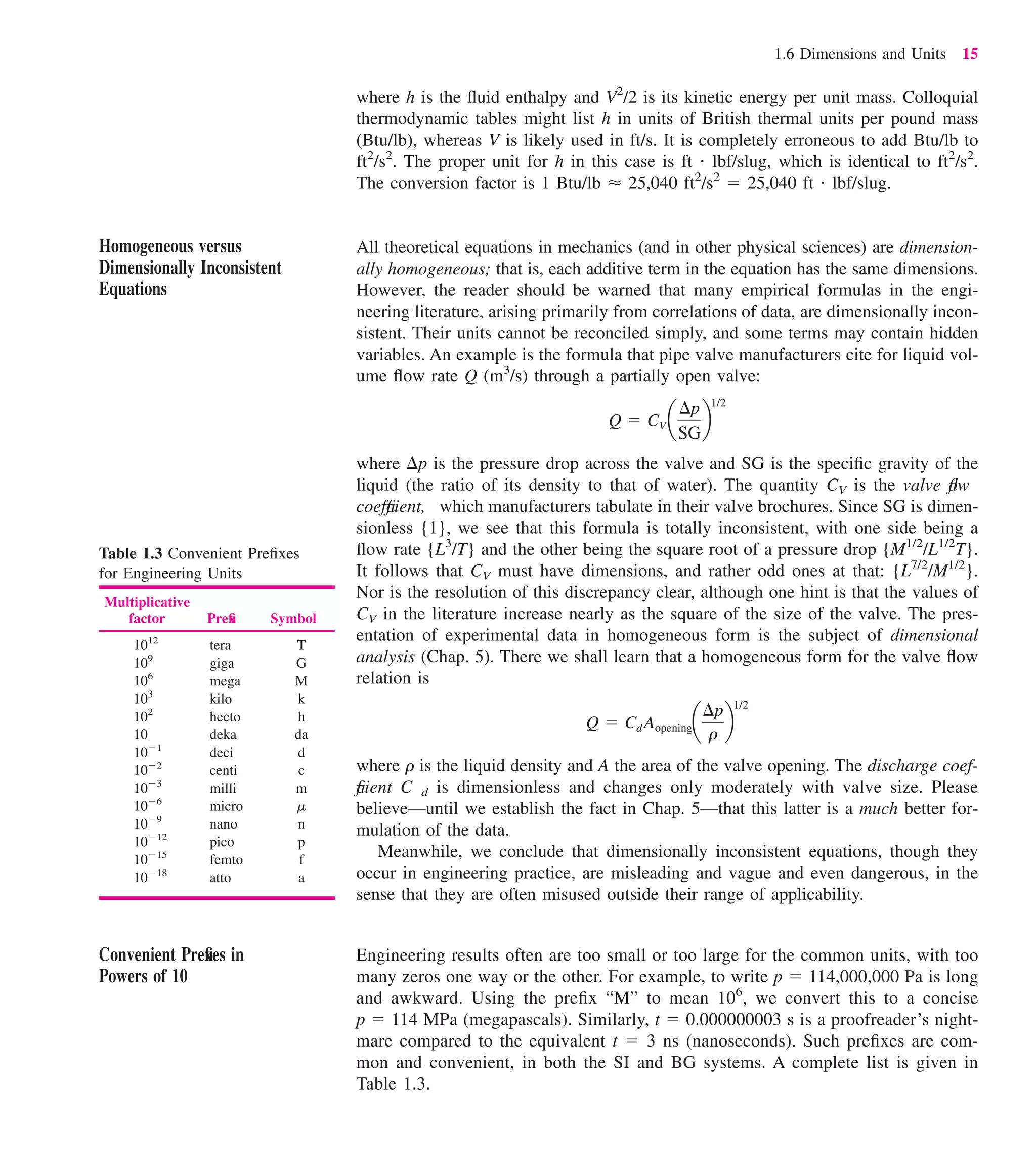
1.6 Dimensions and Units 15
Table 1.3 Convenient Prefixes
for Engineering Units
Multiplicative
factor Prefix Symbol
1012
tera T
109
giga G
106
mega M
103
kilo k
102
hecto h
10 deka da
101
deci d
102
centi c
103
milli m
106
micro 
109
nano n
1012
pico p
1015
femto f
1018
atto a
whi29346_ch01_002-063.qxd 10/14/09 19:58 Page 15 Debd 208:MHDQ176:whi29346:0073529346:whi29346_pagefiles:
EXAMPLE 1.4
In 1890 Robert Manning, an Irish engineer, proposed the following empirical formula
for the average velocity V in uniform flow due to gravity down an open channel (BG
units):
(1)
where R  hydraulic radius of channel (Chaps. 6 and 10)
S  channel slope (tangent of angle that bottom makes with horizontal)
n  Manning’s roughness factor (Chap. 10)
and n is a constant for a given surface condition for the walls and bottom of the channel.
(a) Is Manning’s formula dimensionally consistent? (b) Equation (1) is commonly taken to
be valid in BG units with n taken as dimensionless. Rewrite it in SI form.
Solution
• Assumption: The channel slope S is the tangent of an angle and is thus a dimensionless
ratio with the dimensional notation {1}—that is, not containing M, L, or T.
• Approach (a): Rewrite the dimensions of each term in Manning’s equation, using
brackets {}:
This formula is incompatible unless {1.49/n}  {L1/3
/T}. If n is dimensionless (and it is
never listed with units in textbooks), the number 1.49 must carry the dimensions of
{L1/3
/T}. Ans. (a)
• Comment (a): Formulas whose numerical coefficients have units can be disastrous for
engineers working in a different system or another fluid. Manning’s formula, though pop-
ular, is inconsistent both dimensionally and physically and is valid only for water flow
with certain wall roughnesses. The effects of water viscosity and density are hidden in
the numerical value 1.49.
• Approach (b): Part (a) showed that 1.49 has dimensions. If the formula is valid in BG
units, then it must equal 1.49 ft1/3
/s. By using the SI conversion for length, we obtain
(1.49 ft1/3
/s)(0.3048 m/ft)1/3
 1.00 m1/3
/s
Therefore Manning’s inconsistent formula changes form when converted to the SI system:
Ans. (b)
with R in meters and V in meters per second.
• Comment (b): Actually, we misled you: This is the way Manning, a metric user, first
proposed the formula. It was later converted to BG units. Such dimensionally inconsis-
tent formulas are dangerous and should either be reanalyzed or treated as having very
limited application.
SI units: V 
1.0
n
R2/3
S1/2
5V6  e
1.49
n
f 5R2/3
6 5S1/2
6 or e
L
T
f  e
1.49
n
f 5L2/3
6 516
V 
1.49
n
R2/3
S1/2
16 Chapter 1 Introduction
whi29346_ch01_002-063.qxd 10/14/09 19:58 Page 16 Debd 208:MHDQ176:whi29346:0073529346:whi29346_pagefiles:
In a given flow situation, the determination, by experiment or theory, of the proper-
ties of the fluid as a function of position and time is considered to be the solution to
the problem. In almost all cases, the emphasis is on the space–time distribution of the
fluid properties. One rarely keeps track of the actual fate of the specific fluid parti-
cles.6
This treatment of properties as continuum-field functions distinguishes fluid
mechanics from solid mechanics, where we are more likely to be interested in the tra-
jectories of individual particles or systems.
There are two different points of view in analyzing problems in mechanics. The first
view, appropriate to fluid mechanics, is concerned with the field of flow and is called
the eulerian method of description. In the eulerian method we compute the pressure
field p(x, y, z, t) of the flow pattern, not the pressure changes p(t) that a particle expe-
riences as it moves through the field.
The second method, which follows an individual particle moving through the flow,
is called the lagrangian description. The lagrangian approach, which is more appro-
priate to solid mechanics, will not be treated in this book. However, certain numeri-
cal analyses of sharply bounded fluid flows, such as the motion of isolated fluid
droplets, are very conveniently computed in lagrangian coordinates [1].
Fluid dynamic measurements are also suited to the eulerian system. For example,
when a pressure probe is introduced into a laboratory flow, it is fixed at a specific
position (x, y, z). Its output thus contributes to the description of the eulerian pres-
sure field p(x, y, z, t). To simulate a lagrangian measurement, the probe would have
to move downstream at the fluid particle speeds; this is sometimes done in oceano-
graphic measurements, where flowmeters drift along with the prevailing currents.
The two different descriptions can be contrasted in the analysis of traffic flow along
a freeway. A certain length of freeway may be selected for study and called the field of
flow. Obviously, as time passes, various cars will enter and leave the field, and the iden-
tity of the specific cars within the field will constantly be changing. The traffic engi-
neer ignores specific cars and concentrates on their average velocity as a function of
time and position within the field, plus the flow rate or number of cars per hour pass-
ing a given section of the freeway. This engineer is using an eulerian description of the
traffic flow. Other investigators, such as the police or social scientists, may be interested
in the path or speed or destination of specific cars in the field. By following a specific
car as a function of time, they are using a lagrangian description of the flow.
Foremost among the properties of a flow is the velocity field V(x, y, z, t). In fact,
determining the velocity is often tantamount to solving a flow problem, since other
properties follow directly from the velocity field. Chapter 2 is devoted to the calcu-
lation of the pressure field once the velocity field is known. Books on heat transfer
(for example, Ref. 20) are largely devoted to finding the temperature field from known
velocity fields.
The Velocity Field
Eulerian and Lagrangian
Descriptions
1.7 Properties of the
Velocity Field
1.7 Properties of the Velocity Field 17
6
One example where fluid particle paths are important is in water quality analysis of the fate of con-
taminant discharges.
whi29346_ch01_002-063.qxd 10/14/09 19:58 Page 17 Debd 208:MHDQ176:whi29346:0073529346:whi29346_pagefiles:
In general, velocity is a vector function of position and time and thus has three
components u, , and w, each a scalar field in itself:
(1.4)
The use of u, , and w instead of the more logical component notation Vx, Vy, and Vz
is the result of an almost unbreakable custom in fluid mechanics. Much of this text-
book, especially Chaps. 4, 7, 8, and 9, is concerned with finding the distribution of
the velocity vector V for a variety of practical flows.
The acceleration vector, a  dV/dt, occurs in Newton’s law for a fluid and thus is very
important. In order to follow a particle in the Eulerian frame of reference, the final result
for acceleration is nonlinear and quite complicated. Here we only give the formula:
(1.5)
where (u, v, w) are the velocity components from Eq. (1.4). We shall study this
formula in detail in Chap. 4. The last three terms in Eq. (1.5) are nonlinear products
and greatly complicate the analysis of general fluid motions, especially viscous
flows.
While the velocity field V is the most important fluid property, it interacts closely
with the thermodynamic properties of the fluid. We have already introduced into the
discussion the three most common such properties:
1. Pressure p
2. Density 
3. Temperature T
These three are constant companions of the velocity vector in flow analyses. Four
other intensive thermodynamic properties become important when work, heat, and
energy balances are treated (Chaps. 3 and 4):
4. Internal energy û
5. Enthalpy h  û  p/
6. Entropy s
7. Specific heats cp and cv
In addition, friction and heat conduction effects are governed by the two so-called
transport properties:
8. Coefficient of viscosity 
9. Thermal conductivity k
All nine of these quantities are true thermodynamic properties that are determined by
the thermodynamic condition or state of the fluid. For example, for a single-phase
1.8 Thermodynamic Properties
of a Fluid
a 
dV
dt


V

t
 u

V

x
 v

V

y
 w

V

z
The Acceleration Field
V(x, y, z, t)  iu(x, y, z, t)  jv(x, y, z, t)  kw(x, y, z, t)
18 Chapter 1 Introduction
whi29346_ch01_002-063.qxd 10/14/09 19:58 Page 18 Debd 208:MHDQ176:whi29346:0073529346:whi29346_pagefiles:
substance such as water or oxygen, two basic properties such as pressure and
temperature are sufficient to fix the value of all the others:
  (p, T) h  h(p, T)   (p, T)
and so on for every quantity in the list. Note that the specific volume, so important
in thermodynamic analyses, is omitted here in favor of its inverse, the density .
Recall that thermodynamic properties describe the state of a system—that is, a
collection of matter of fixed identity that interacts with its surroundings. In most cases
here the system will be a small fluid element, and all properties will be assumed to
be continuum properties of the flow field:   (x, y, z, t), and so on.
Recall also that thermodynamics is normally concerned with static systems,
whereas fluids are usually in variable motion with constantly changing properties.
Do the properties retain their meaning in a fluid flow that is technically not in
equilibrium? The answer is yes, from a statistical argument. In gases at normal pres-
sure (and even more so for liquids), an enormous number of molecular collisions
occur over a very short distance of the order of 1 m, so that a fluid subjected to
sudden changes rapidly adjusts itself toward equilibrium. We therefore assume that
all the thermodynamic properties just listed exist as point functions in a flowing fluid
and follow all the laws and state relations of ordinary equilibrium thermodynamics.
There are, of course, important nonequilibrium effects such as chemical and nuclear
reactions in flowing fluids, which are not treated in this text.
Pressure is the (compression) stress at a point in a static fluid (Fig. 1.3). Next to
velocity, the pressure p is the most dynamic variable in fluid mechanics. Differences
or gradients in pressure often drive a fluid flow, especially in ducts. In low-speed
flows, the actual magnitude of the pressure is often not important, unless it drops so
low as to cause vapor bubbles to form in a liquid. For convenience, we set many such
problem assignments at the level of 1 atm  2116 lbf/ft2
 101,300 Pa. High-speed
(compressible) gas flows (Chap. 9), however, are indeed sensitive to the magnitude
of pressure.
Temperature T is related to the internal energy level of a fluid. It may vary consider-
ably during high-speed flow of a gas (Chap. 9). Although engineers often use Celsius
or Fahrenheit scales for convenience, many applications in this text require absolute
(Kelvin or Rankine) temperature scales:
If temperature differences are strong, heat transfer may be important [20], but our
concern here is mainly with dynamic effects.
The density of a fluid, denoted by  (lowercase Greek rho), is its mass per unit volume.
Density is highly variable in gases and increases nearly proportionally to the pressure
level. Density in liquids is nearly constant; the density of water (about 1000 kg/m3
)
Density
K  C  273.16
R  F  459.69
Temperature
Pressure
1.8 Thermodynamic Properties of a Fluid 19
whi29346_ch01_002-063.qxd 10/14/09 19:58 Page 19 Debd 208:MHDQ176:whi29346:0073529346:whi29346_pagefiles:
increases only 1 percent if the pressure is increased by a factor of 220. Thus most liq-
uid flows are treated analytically as nearly “incompressible.”
In general, liquids are about three orders of magnitude more dense than gases at
atmospheric pressure. The heaviest common liquid is mercury, and the lightest gas is
hydrogen. Compare their densities at 20C and 1 atm:
They differ by a factor of 162,000! Thus the physical parameters in various liquid
and gas flows might vary considerably. The differences are often resolved by the use
of dimensional analysis (Chap. 5). Other fluid densities are listed in Tables A.3 and
A.4 (in App. A) and in Ref. 21.
The specific weight of a fluid, denoted by  (lowercase Greek gamma), is its weight
per unit volume. Just as a mass has a weight W  mg, density and specific weight
are simply related by gravity:
(1.6)
The units of  are weight per unit volume, in lbf/ft3
or N/m3
. In standard earth grav-
ity, g  32.174 ft/s2
 9.807 m/s2
. Thus, for example, the specific weights of air and
water at 20C and 1 atm are approximately
Specific weight is very useful in the hydrostatic pressure applications of Chap. 2.
Specific weights of other fluids are given in Tables A.3 and A.4.
Specific gravity, denoted by SG, is the ratio of a fluid density to a standard reference
fluid, usually water at 4C (for liquids) and air (for gases):
(1.7)
For example, the specific gravity of mercury (Hg) is SGHg  13,580/1000  13.6.
Engineers find these dimensionless ratios easier to remember than the actual numer-
ical values of density of a variety of fluids.
In thermostatics the only energy in a substance is that stored in a system by molec-
ular activity and molecular bonding forces. This is commonly denoted as internal
energy û. A commonly accepted adjustment to this static situation for fluid flow is to
add two more energy terms that arise from newtonian mechanics: potential energy
and kinetic energy.
Potential and Kinetic Energies
SGliquid 
liquid
water

liquid
1000 kg/m3
SGgas 
gas
air

gas
1.205 kg/m3
Specific Gravity
water  (998 kg/m3
)(9.807 m/s2
)  9790 N/m3
 62.4 lbf/ft3
air  (1.205 kg/m3
)(9.807 m/s2
)  11.8 N/m3
 0.0752 lbf/ft3
  g
Specific Weight
Mercury:   13,580 kg/m3
Hydrogen:   0.0838 kg/m3
20 Chapter 1 Introduction
whi29346_ch01_002-063.qxd 10/14/09 19:59 Page 20 Debd 208:MHDQ176:whi29346:0073529346:whi29346_pagefiles:
The potential energy equals the work required to move the system of mass m from
the origin to a position vector r  ix  jy  kz against a gravity field g. Its value
is mg  r, or g  r per unit mass. The kinetic energy equals the work required to
change the speed of the mass from zero to velocity V. Its value is mV2
or V2
per
unit mass. Then by common convention the total stored energy e per unit mass in
fluid mechanics is the sum of three terms:
e  û  V2
 (g  r) (1.8)
Also, throughout this book we shall define z as upward, so that g  gk and g  r 
gz. Then Eq. (1.8) becomes
e  û  V2
 gz (1.9)
The molecular internal energy û is a function of T and p for the single-phase pure
substance, whereas the potential and kinetic energies are kinematic quantities.
Thermodynamic properties are found both theoretically and experimentally to be
related to each other by state relations that differ for each substance. As mentioned,
we shall confine ourselves here to single-phase pure substances, such as water in its
liquid phase. The second most common fluid, air, is a mixture of gases, but since the
mixture ratios remain nearly constant between 160 and 2200 K, in this temperature
range air can be considered to be a pure substance.
All gases at high temperatures and low pressures (relative to their critical point)
are in good agreement with the perfect-gas law
(1.10)
where the specific heats cp and cv are defined in Eqs. (1.14) and (1.15).
Since Eq. (1.10) is dimensionally consistent, R has the same dimensions as spe-
cific heat, {L2
T2
1
}, or velocity squared per temperature unit (kelvin or degree
Rankine). Each gas has its own constant R, equal to a universal constant  divided
by the molecular weight
(1.11)
where   49,700 ft-lbf/(slugmol R)  8314 J/(kmol K). Most applications in
this book are for air, whose molecular weight is M  28.97/mol:
(1.12)
Standard atmospheric pressure is 2116 lbf/ft2
 2116 slug/(ft  s2
), and standard
temperature is 60F  520R. Thus standard air density is
(1.13)
This is a nominal value suitable for problems. For other gases, see Table A.4.
air 
2116 slug/(ft # s2
)
31716 ft2
/(s2 # R)4(520R)
 0.00237 slug/ft3
 1.22 kg/m3
Rair 
49,700 ft # lbf/(slugmol # R)
28.97/mol
 1716
ft # lbf
slug # R
 1716
ft2
s2
R
 287
m2
s2 # K
#
#
Rgas 

Mgas
p  RT R  cp  cv  gas constant
State Relations for Gases
1
2
1
2
1
2
1
2
1.8 Thermodynamic Properties of a Fluid 21
whi29346_ch01_002-063.qxd 10/14/09 19:59 Page 21 Debd 208:MHDQ176:whi29346:0073529346:whi29346_pagefiles:
One proves in thermodynamics that Eq. (1.10) requires that the internal molecular
energy û of a perfect gas vary only with temperature: û  û(T). Therefore the spe-
cific heat cv also varies only with temperature:
or (1.14)
In like manner h and cp of a perfect gas also vary only with temperature:
(1.15)
The ratio of specific heats of a perfect gas is an important dimensionless parameter
in compressible flow analysis (Chap. 9)
(1.16)
As a first approximation in airflow analysis we commonly take cp, cv, and k to be
constant:
(1.17)
Actually, for all gases, cp and cv increase gradually with temperature, and k decreases
gradually. Experimental values of the specific-heat ratio for eight common gases are
shown in Fig. 1.5.
Many flow problems involve steam. Typical steam operating conditions are relatively
close to the critical point, so that the perfect-gas approximation is inaccurate. Since no
simple formulas apply accurately, steam properties are available both in EES (see
Sec. 1.12) and on a CD-ROM [23] and even on the Internet, as a MathPad Corp.
applet [24]. Meanwhile, the error of using the perfect-gas law can be moderate, as the
following example shows.
EXAMPLE 1.5
Estimate  and cp of steam at 100 lbf/in2
and 400F, in English units, (a) by the perfect-gas
approximation and (b) by the ASME Steam Tables [23] or by EES.
Solution
• Approach (a)—the perfect-gas law: Although steam is not an ideal gas, we can estimate
these properties with moderate accuracy from Eqs. (1.10) and (1.17). First convert pressure
cp 
kR
k  1
 6010 ft2
/(s2 # R)  1005 m2
/(s2 # K)
cv 
R
k  1
 4293 ft2
/(s2 # R)  718 m2
/(s2 # K)
kair  1.4
k 
cp
cv
 k(T)
1
dh  cp(T)dT
cp  a

h

T
b
p

dh
dT
 cp(T)
h  û 
p

 û  RT  h(T)
dû  cv(T )dT
cv  a

û

T
b


dû
dT
 cv(T)
22 Chapter 1 Introduction
whi29346_ch01_002-063.qxd 10/14/09 19:59 Page 22 Debd 208:MHDQ176:whi29346:0073529346:whi29346_pagefiles:
from 100 lbf/in2
to 14,400 lbf/ft2
, and use absolute temperature, (400F  460)  860R.
Then we need the gas constant for steam, in English units. From Table A.4, the molecular
weight of H2O is 18.02, whence
Then the density estimate follows from the perfect-gas law, Eq. (1.10):
Ans. (a)
At 860R, from Fig. 1.5, ksteam  cp /cv  1.30. Then, from Eq. (1.17),
Ans. (a)
• Approach (b)—tables or software: One can either read the steam tables or program a
few lines in EES. In either case, the English units (psi, Btu, lbm) are awkward when
applied to fluid mechanics formulas. Even so, when using EES, make sure that the
cp 
kR
k  1

(1.3)(2758 ft # lbf/(slug R))
(1.3  1)
 12,000
ft # lbf
slug R
 
p
RT

14,400 lbf/ft2
32758 ft # lbf/(slug # R)4(860 R)
 0.00607
slug
ft3
Rsteam 
English
MH2O

49,700 ft # lbf/(slugmol R)
18.02/mol
 2758
ft # lbf
slug R
1.8 Thermodynamic Properties of a Fluid 23
Ar
Atmospheric pressure
H2
CO
Air and
N2
O2
Steam
CO2
1.7
1.6
1.5
1.4
1.3
1.2
1.1
1.0
1000
0 3000 4000 5000
=
k
cp
c
2000
Temperature, °R
υ
Fig. 1.5 Specific-heat ratio of eight
common gases as a function of
temperature. (Data from Ref. 22.)
whi29346_ch01_002-063.qxd 10/14/09 20:00 Page 23 Debd 208:MHDQ176:whi29346:0073529346:whi29346_pagefiles:
Variable Information menu specifies English units: psia and F. EES statements for
evaluating density and specific heat of steam are, for these conditions,
Rho  DENSITY(steam, P  100,T  400)
Cp  SPECHEAT(steam, P  100,T  400)
Note that the software is set up for psia and F, without converting. EES returns the curve-
fit values
Rho  0.2027 lbm/ft3
; Cp  0.5289 Btu/
(lbm-F)
As just stated, Btu and lbm are extremely unwieldy when applied to mass, momentum,
and energy problems in fluid mechanics. Therefore, either convert to ft-lbf and slugs using
your own resources, or use the “Convert” function in EES, placing the old and new units
in single quote marks:
Rho2  Rho*CONVERT(
‘lbm/ft^3’,‘slug/ft^3’
)
Cp2  Cp*CONVERT(
‘Btu/lbm-F’,‘ft^2/s^2-R’
)
Note that (1) you multiply the old Rho and Cp by the CONVERT function; and (2) units
to the right of the division sign “/” in CONVERT are assumed to be in the denominator.
EES returns these results:
Rho2  0.00630 slug/ft3
Cp2  13,200 ft2
/
(s2
-R) Ans. (b)
• Comments: The steam tables would yield results quite close to EES. The perfect-gas
estimate of  is 4 percent low, and the estimate of cp is 9 percent low. The chief reason
for the discrepancy is that this temperature and pressure are rather close to the critical
point and saturation line of steam. At higher temperatures and lower pressures, say, 800F
and 50 lbf/in2
, the perfect-gas law yields properties with an accuracy of about 
1 percent.
Once again let us warn that English units (psia, lbm Btu) are awkward and must be
converted in most fluid mechanics formulas. EES handles SI units nicely, with no con-
version factors needed.
The writer knows of no “perfect-liquid law” comparable to that for gases. Liquids are
nearly incompressible and have a single, reasonably constant specific heat. Thus an
idealized state relation for a liquid is
  const cp  cv  const dh  cp dT (1.18)
Most of the flow problems in this book can be attacked with these simple assump-
tions. Water is normally taken to have a density of 998 kg/m3
and a specific heat
cp  4210 m2
/(s2
 K). The steam tables may be used if more accuracy is required.
The density of a liquid usually decreases slightly with temperature and increases
moderately with pressure. If we neglect the temperature effect, an empirical pressure–
density relation for a liquid is
(1.19)
where B and n are dimensionless parameters that vary slightly with temperature and
pa and a are standard atmospheric values. Water can be fitted approximately to the
values B  3000 and n  7.
p
pa
 (B  1)a

a
b
n
 B
State Relations for Liquids
24 Chapter 1 Introduction
whi29346_ch01_002-063.qxd 10/14/09 20:00 Page 24 Debd 208:MHDQ176:whi29346:0073529346:whi29346_pagefiles:
Seawater is a variable mixture of water and salt and thus requires three thermo-
dynamic properties to define its state. These are normally taken as pressure, temper-
ature, and the salinity , defined as the weight of the dissolved salt divided by the
weight of the mixture. The average salinity of seawater is 0.035, usually written as 35
parts per 1000, or 35 ‰. The average density of seawater is 2.00 slugs/ft3
 1030 kg/m3
.
Strictly speaking, seawater has three specific heats, all approximately equal to the
value for pure water of 25,200 ft2
/(s2
 R)  4210 m2
/(s2
 K).
EXAMPLE 1.6
The pressure at the deepest part of the ocean is approximately 1100 atm. Estimate the den-
sity of seawater in slug/ft3
at this pressure.
Solution
Equation (1.19) holds for either water or seawater. The ratio p/pa is given as 1100:
or
Assuming an average surface seawater density a  2.00 slugs/ft3
, we compute
Ans.
Even at these immense pressures, the density increase is less than 5 percent, which justifies
the treatment of a liquid flow as essentially incompressible.
The quantities such as pressure, temperature, and density discussed in the previous
section are primary thermodynamic variables characteristic of any system. Certain
secondary variables also characterize specific fluid mechanical behavior. The most
important of these is viscosity, which relates the local stresses in a moving fluid to
the strain rate of the fluid element.
Viscosity is a quantitative measure of a fluid’s resistance to flow. More specifically,
it determines the fluid strain rate that is generated by a given applied shear stress. We
can easily move through air, which has very low viscosity. Movement is more diffi-
cult in water, which has 50 times higher viscosity. Still more resistance is found in
SAE 30 oil, which is 300 times more viscous than water. Try to slide your hand
through glycerin, which is five times more viscous than SAE 30 oil, or blackstrap
molasses, another factor of five higher than glycerin. Fluids may have a vast range
of viscosities.
Consider a fluid element sheared in one plane by a single shear stress 	, as in
Fig. 1.6a. The shear strain angle  will continuously grow with time as long as
the stress 	 is maintained, the upper surface moving at speed u larger than the
Viscosity
1.9 Viscosity and Other
Secondary Properties
  1.046(2.00)  2.09 slugs/ft3

a
 a
4100
3001
b
1/7
 1.046
1100  (3001)a

a
b
7
 3000
Ŝ
1.9 Viscosity and Other Secondary Properties 25
whi29346_ch01_002-063.qxd 10/14/09 20:00 Page 25 Debd 208:MHDQ176:whi29346:0073529346:whi29346_pagefiles:
lower. Such common fluids as water, oil, and air show a linear relation between
applied shear and resulting strain rate:
(1.20)
From the geometry of Fig. 1.4a, we see that
(1.21)
In the limit of infinitesimal changes, this becomes a relation between shear strain rate
and velocity gradient:
(1.22)
From Eq. (1.20), then, the applied shear is also proportional to the velocity gradient for
the common linear fluids. The constant of proportionality is the viscosity coefficient :
(1.23)
Equation (1.23) is dimensionally consistent; therefore  has dimensions of stress–time:
{FT/L2
} or {M/(LT)}. The BG unit is slugs per foot-second, and the SI unit is kilo-
grams per meter-second. The linear fluids that follow Eq. (1.23) are called newtonian
fluids, after Sir Isaac Newton, who first postulated this resistance law in 1687.
We do not really care about the strain angle (t) in fluid mechanics, concentrating
instead on the velocity distribution u(y), as in Fig. 1.6b. We shall use Eq. (1.23) in
Chap. 4 to derive a differential equation for finding the velocity distribution u(y)—
and, more generally, V(x, y, z, t)—in a viscous fluid. Figure 1.6b illustrates a shear
layer, or boundary layer, near a solid wall. The shear stress is proportional to the slope
of the velocity profile and is greatest at the wall. Further, at the wall, the velocity u
is zero relative to the wall: This is called the no-slip condition and is characteristic
of all viscous fluid flows.
	  
d
dt
 
du
dy
d
dt

du
dy
tan  
u t
y
	 

t
26 Chapter 1 Introduction
(b)
(a)
θ
δ
δu δt δθ
δt
τ ∝
δ
u = u
u = 0
δx
τ
u(y)
y
τ = du
dy
du
dy
No slip at wall
Velocity
profile
δ y
0
μ
θ
δ
Fig. 1.6 Shear stress causes contin-
uous shear deformation in a fluid:
(a) a fluid element straining at a
rate /t; (b) newtonian shear dis-
tribution in a shear layer near a
wall.
whi29346_ch01_002-063.qxd 10/14/09 20:00 Page 26 Debd 208:MHDQ176:whi29346:0073529346:whi29346_pagefiles:
The viscosity of newtonian fluids is a true thermodynamic property and varies with
temperature and pressure. At a given state (p, T) there is a vast range of values among
the common fluids. Table 1.4 lists the viscosity of eight fluids at standard pressure
and temperature. There is a variation of six orders of magnitude from hydrogen up
to glycerin. Thus there will be wide differences between fluids subjected to the same
applied stresses.
Generally speaking, the viscosity of a fluid increases only weakly with pressure.
For example, increasing p from 1 to 50 atm will increase  of air only 10 percent.
Temperature, however, has a strong effect, with  increasing with T for gases and
decreasing for liquids. Figure A.1 (in App. A) shows this temperature variation for
various common fluids. It is customary in most engineering work to neglect the pres-
sure variation.
The variation (p, T) for a typical fluid is nicely shown by Fig. 1.7, from Ref. 25,
which normalizes the data with the critical-point state (c, pc, Tc). This behavior, called
the principle of corresponding states, is characteristic of all fluids, but the actual
numerical values are uncertain to 
20 percent for any given fluid. For example, val-
ues of (T) for air at 1atm, from Table A.2, fall about 8 percent low compared to the
“low-density limit” in Fig. 1.7.
Note in Fig. 1.7 that changes with temperature occur very rapidly near the critical
point. In general, critical-point measurements are extremely difficult and uncertain.
The primary parameter correlating the viscous behavior of all newtonian fluids is the
dimensionless Reynolds number:
(1.24)
where V and L are characteristic velocity and length scales of the flow. The second
form of Re illustrates that the ratio of  to  has its own name, the kinematic viscosity:
(1.25)
It is called kinematic because the mass units cancel, leaving only the dimensions
{L2
/T}.


Re 
VL


VL

The Reynolds Number
1.9 Viscosity and Other Secondary Properties 27
Table 1.4 Viscosity and Kinematic
Viscosity of Eight Fluids at 1 atm
and 20C
, Ratio ,  Ratio
Fluid kg/(m  s)†
/(H2) kg/m3
m2
/s†
/(Hg)
Hydrogen 9.0 E–6 1.0 0.084 1.05 E–4 910
Air 1.8 E–5 2.1 1.20 1.50 E–5 130
Gasoline 2.9 E–4 33 680 4.22 E–7 3.7
Water 1.0 E–3 114 998 1.01 E–6 8.7
Ethyl alcohol 1.2 E–3 135 789 1.52 E–6 13
Mercury 1.5 E–3 170 13,550 1.16 E–7 1.0
SAE 30 oil 0.29 33,000 891 3.25 E–4 2,850
Glycerin 1.5 170,000 1,260 1.18 E–3 10,300
†
1 kg/(m  s)  0.0209 slug/(ft  s); 1 m2
/s  10.76 ft2
/s.
whi29346_ch01_002-063.qxd 10/14/09 20:00 Page 27 Debd 208:MHDQ176:whi29346:0073529346:whi29346_pagefiles:
Generally, the first thing a fluids engineer should do is estimate the Reynolds num-
ber range of the flow under study. Very low Re indicates viscous creeping motion,
where inertia effects are negligible. Moderate Re implies a smoothly varying laminar
flow. High Re probably spells turbulent flow, which is slowly varying in the time-
mean but has superimposed strong random high-frequency fluctuations. Explicit
numerical values for low, moderate, and high Reynolds numbers cannot be stated here.
They depend on flow geometry and will be discussed in Chaps. 5 through 7.
Table 1.4 also lists values of  for the same eight fluids. The pecking order changes
considerably, and mercury, the heaviest, has the smallest viscosity relative to its own
weight. All gases have high  relative to thin liquids such as gasoline, water, and alco-
hol. Oil and glycerin still have the highest , but the ratio is smaller. For given val-
ues of V and L in a flow, these fluids exhibit a spread of four orders of magnitude in
the Reynolds number.
A classic problem is the flow induced between a fixed lower plate and an upper plate
moving steadily at velocity V, as shown in Fig. 1.8. The clearance between plates is
Flow between Plates
28 Chapter 1 Introduction
0.4
=
c
r
μ
Tr
Tc
= T
μ
μ
0.8
0.7
0.6
0.5
0.4
0.3
0.2
1
0.9
2
3
4
5
6
7
8
9
10
0.6 0.8 1 2 3 4 5 7
6 8 9 10
Liquid
Two-phase
region
Critical
point
0.5
0
pr
= p/pc
= 0.2
Low-density limit
1
2
3
5
10
25
Dense gas
Fig. 1.7 Fluid viscosity nondimen-
sionalized by critical-point proper-
ties. This generalized chart is
characteristic of all fluids but is
accurate only to 
20 percent.
(From Ref. 25.)
whi29346_ch01_002-063.qxd 10/14/09 20:00 Page 28 Debd 208:MHDQ176:whi29346:0073529346:whi29346_pagefiles:
h, and the fluid is newtonian and does not slip at either plate. If the plates are large,
this steady shearing motion will set up a velocity distribution u(y), as shown, with
  w  0. The fluid acceleration is zero everywhere.
With zero acceleration and assuming no pressure variation in the flow direction,
you should show that a force balance on a small fluid element leads to the result that
the shear stress is constant throughout the fluid. Then Eq. (1.23) becomes
which we can integrate to obtain
u  a  by
The velocity distribution is linear, as shown in Fig. 1.8, and the constants a and b can
be evaluated from the no-slip condition at the upper and lower walls:
Hence a  0 and b  V/h. Then the velocity profile between the plates is given by
(1.26)
as indicated in Fig. 1.8. Turbulent flow (Chap. 6) does not have this shape.
Although viscosity has a profound effect on fluid motion, the actual viscous stresses
are quite small in magnitude even for oils, as shown in the following example.
EXAMPLE 1.7
Suppose that the fluid being sheared in Fig. 1.8 is SAE 30 oil at 20C. Compute the shear
stress in the oil if V  3 m/s and h  2 cm.
Solution
• System sketch: This is shown earlier in Fig. 1.8.
• Assumptions: Linear velocity profile, laminar newtonian fluid, no slip at either plate surface.
u  V
y
h
u  e
0  a  b(0) at y  0
V  a  b(h) at y  h
du
dy


 const
1.9 Viscosity and Other Secondary Properties 29
y
x
h u(y)
V
Moving
plate:
u = V
Viscous
fluid
u = V
u = 0
Fixed plate
Fig. 1.8 Viscous flow induced by
relative motion between two paral-
lel plates.
whi29346_ch01_002-063.qxd 10/14/09 20:00 Page 29 Debd 208:MHDQ176:whi29346:0073529346:whi29346_pagefiles:
30 Chapter 1 Introduction
• Approach: The analysis of Fig. 1.8 leads to Eq. (1.26) for laminar flow.
• Property values: From Table 1.4 for SAE 30 oil, the oil viscosity   0.29 kg/(m-s).
• Solution steps: In Eq. (1.26), the only unknown is the fluid shear stress:
Ans.
• Comments: Note the unit identities, 1 kg-m/s2
 1 N and 1 N/m2
 1 Pa. Although oil
is very viscous, this shear stress is modest, about 2400 times less than atmospheric pres-
sure. Viscous stresses in gases and thin (watery) liquids are even smaller.
Temperature has a strong effect and pressure a moderate effect on viscosity. The vis-
cosity of gases and most liquids increases slowly with pressure. Water is anomalous
in showing a very slight decrease below 30C. Since the change in viscosity is only
a few percent up to 100 atm, we shall neglect pressure effects in this book.
Gas viscosity increases with temperature. Two common approximations are the
power law and the Sutherland law:
(1.27)
where 0 is a known viscosity at a known absolute temperature T0 (usually 273 K).
The constants n and S are fit to the data, and both formulas are adequate over a wide
range of temperatures. For air, n  0.7 and S  110 K  199R. Other values are
given in Ref. 26.
Liquid viscosity decreases with temperature and is roughly exponential,   aebT
;
but a better fit is the empirical result that ln  is quadratic in 1/T, where T is absolute
temperature:
(1.28)
For water, with T0  273.16 K, 0  0.001792 kg/(m  s), suggested values are
a  1.94, b  4.80, and c  6.74, with accuracy about 
1 percent. The viscosity
of water is tabulated in Table A.1. Curve-fit viscosity formulas for 355 organic liquids
are given by Yaws et al. [27]. For further viscosity data, see Refs. 21, 28 and 29.
Fluids that do not follow the linear law of Eq. (1.23) are called nonnewtonian and are
treated in books on rheology [16]. Figure 1.9a compares some examples to a newtonian
fluid. For the nonlinear curves, the slope at any point is called the apparent viscosity.
Dilatant. This fluid is shear-thickening, increasing its resistance with increasing strain
rate. Examples are suspensions of corn starch or sand in water. The classic case is
quicksand, which stiffens up if one thrashes about.
Nonnewtonian Fluids
ln

0
 a  ba
T0
T
b  ca
T0
T
b
2

0
 μ
a
T
T0
b
n
power law
(T/T0)3/2
(T0  S)
T  S
Sutherland law
Variation of Viscosity
with Temperature
	  
V
h
 a0.29
kg
m # s
b
(3 m/s)
(0.02 m)
 43.5
kg # m/s2
m2  43.5
N
m2  44 Pa
whi29346_ch01_002-063.qxd 10/14/09 20:01 Page 30 Debd 208:MHDQ176:whi29346:0073529346:whi29346_pagefiles:
Pseudoplastic. A shear-thinning fluid is less resistant at higher strain rates. A very
strong thinning is called plastic. Some of the many examples are polymer solutions,
colloidal suspensions, paper pulp in water, latex paint, blood plasma, syrup, and
molasses. The classic case is paint, which is thick when poured but thin when brushed
at a high strain rate.
Bingham plastic. The limiting case of a plastic substance is one that requires a finite
yield stress before it begins to flow. Figure 1.9a shows yielding followed by linear
behavior, but nonlinear flow can also occur. Some examples are clay suspensions,
drilling mud, toothpaste, mayonnaise, chocolate, and mustard. The classic case is cat-
sup, which will not come out of the bottle until you stress it by shaking.
A further complication of nonnewtonian behavior is the transient effect shown in
Fig. 1.9b. Some fluids require a gradually increasing shear stress to maintain a
constant strain rate and are called rheopectic. The opposite case of a fluid that thins
out with time and requires decreasing stress is termed thixotropic. We neglect non-
newtonian effects in this book; see Ref. 16 for further study.
A liquid, being unable to expand freely, will form an interface with a second liquid
or gas. The physical chemistry of such interfacial surfaces is quite complex, and whole
textbooks are devoted to this specialty [30]. Molecules deep within the liquid repel
each other because of their close packing. Molecules at the surface are less dense and
attract each other. Since half of their neighbors are missing, the mechanical effect is
that the surface is in tension. We can account adequately for surface effects in fluid
mechanics with the concept of surface tension.
If a cut of length dL is made in an interfacial surface, equal and opposite forces
of magnitude  dL are exposed normal to the cut and parallel to the surface, where
 is called the coefficient of surface tension . The dimensions of  are {F/L}, with SI
Surface Tension
1.9 Viscosity and Other Secondary Properties 31
Shear
stress
Shear
stress
Yield
stress
Plastic
Ideal Bingham
plastic
Dilatant
Newtonian
Pseudoplastic
Shear strain rate d
dt
θ
0 0 Time
(a) (b)
Constant
strain rate
Rheopectic
Common
fluids
Thixotropic
τ
τ
Fig. 1.9 Rheological behavior
of various viscous materials:
(a) stress versus strain rate;
(b) effect of time on applied
stress.
whi29346_ch01_002-063.qxd 10/14/09 20:01 Page 31 Debd 208:MHDQ176:whi29346:0073529346:whi29346_pagefiles:
units of newtons per meter and BG units of pounds-force per foot. An alternate
concept is to open up the cut to an area dA; this requires work to be done of amount
 dA. Thus the coefficient  can also be regarded as the surface energy per unit area
of the interface, in N  m/m2
or ft  lbf/ft2
.
The two most common interfaces are water–air and mercury–air. For a clean sur-
face at 20C  68F, the measured surface tension is
(1.29)
These are design values and can change considerably if the surface contains contam-
inants like detergents or slicks. Generally  decreases with liquid temperature and is
zero at the critical point. Values of  for water are given in Fig. 1.10 and Table A.5.
If the interface is curved, a mechanical balance shows that there is a pressure
difference across the interface, the pressure being higher on the concave side, as illus-
trated in Fig. 1.11. In Fig. 1.11a, the pressure increase in the interior of a liquid cylin-
der is balanced by two surface-tension forces:
2RL 	p  2L
or (1.30)
We are not considering the weight of the liquid in this calculation. In Fig. 1.11b, the
pressure increase in the interior of a spherical droplet balances a ring of surface-
tension force:

R2
	p  2
R
or (1.31)
We can use this result to predict the pressure increase inside a soap bubble, which
has two interfaces with air, an inner and outer surface of nearly the same radius R:
(1.32)
	pbubble  2 	pdroplet 
4
R
	p 
2
R
	p 

R
air–water
air–mercury
  e
0.0050 lbf/ft  0.073 N/m
0.033 lbf/ft  0.48 N/m
32 Chapter 1 Introduction
0
0.050
0.060
0.070
0.080
10 20 30 40 50 60 70 80 90 100
T, C
,
N/m
Fig. 1.10 Surface tension of a
clean air–water interface. Data
from Table A.5.
whi29346_ch01_002-063.qxd 10/14/09 20:01 Page 32 Debd 208:MHDQ176:whi29346:0073529346:whi29346_pagefiles:
Figure 1.11c shows the general case of an arbitrarily curved interface whose princi-
pal radii of curvature are R1 and R2. A force balance normal to the surface will show
that the pressure increase on the concave side is
(1.33)
Equations (1.30) to (1.32) can all be derived from this general relation; for example,
in Eq. (1.30), R1  R and R2  .
A second important surface effect is the contact angle , which appears when a
liquid interface intersects with a solid surface, as in Fig. 1.12. The force balance
would then involve both  and . If the contact angle is less than 90, the liquid is
said to wet the solid; if   90, the liquid is termed nonwetting. For example, water
wets soap but does not wet wax. Water is extremely wetting to a clean glass sur-
face, with   0. Like , the contact angle  is sensitive to the actual physico-
chemical conditions of the solid–liquid interface. For a clean mercury–air–glass
interface,   130.
	p  (R1
1
 R2
1
)
1.9 Viscosity and Other Secondary Properties 33
Fig. 1.11 Pressure change across a curved interface due to surface tension: (a) interior of a liquid cylinder; (b) interior of a spherical
droplet; (c) general curved interface.
2RL Δp
2R
L
(a)
L
L
πR2
Δp
2πR
(b) (c)
Δp dA
dL2
dL1
dL2
dL1
R2
R1
Nonwetting
Solid
Liquid
Gas
θ θ
Fig. 1.12 Contact-angle effects
at liquid–gas–solid interface. If
  90, the liquid “wets” the
solid; if   90, the liquid is
nonwetting.
whi29346_ch01_002-063.qxd 10/14/09 20:01 Page 33 Debd 208:MHDQ176:whi29346:0073529346:whi29346_pagefiles:
Example 1.8 illustrates how surface tension causes a fluid interface to rise or fall
in a capillary tube.
EXAMPLE 1.8
Derive an expression for the change in height h in a circular tube of a liquid with surface
tension  and contact angle , as in Fig. E1.8.
Solution
The vertical component of the ring surface-tension force at the interface in the tube must
balance the weight of the column of fluid of height h:
2
R cos   
R2
h
Solving for h, we have the desired result:
Ans.
Thus the capillary height increases inversely with tube radius R and is positive if   90
(wetting liquid) and negative (capillary depression) if   90.
Suppose that R  1 mm. Then the capillary rise for a water–air–glass interface,   0,
  0.073 N/m, and   1000 kg/m3
is
For a mercury–air–glass interface, with   130,   0.48 N/m, and   13,600 kg/m3
,
the capillary rise is
When a small-diameter tube is used to make pressure measurements (Chap. 2), these cap-
illary effects must be corrected for.
Vapor pressure is the pressure at which a liquid boils and is in equilibrium with its
own vapor. For example, the vapor pressure of water at 68F is 49 lbf/ft2
, while that
of mercury is only 0.0035 lbf/ft2
. If the liquid pressure is greater than the vapor pres-
sure, the only exchange between liquid and vapor is evaporation at the interface. If,
however, the liquid pressure falls below the vapor pressure, vapor bubbles begin to
appear in the liquid. If water is heated to 212F, its vapor pressure rises to 2116 lbf/ft2
,
and thus water at normal atmospheric pressure will boil. When the liquid pressure is
dropped below the vapor pressure due to a flow phenomenon, we call the process
cavitation. If water is accelerated from rest to about 50 ft/s, its pressure drops by
about 15 lbf/in2
, or 1 atm. This can cause cavitation [31].
The dimensionless parameter describing flow-induced boiling is the cavitation number
(1.34)
Ca 
pa  pv
1
2V2
Vapor Pressure
h 
2(0.48)(cos 130)
13,600(9.81)(0.001)
 0.0046 m  0.46 cm
h 
2(0.073 N/m)(cos 0)
(1000 kg/m3
)(9.81 m/s2
)(0.001 m)
 0.015 (N # s2
)/kg  0.015 m  1.5 cm
h 
2 cos 
R
34 Chapter 1 Introduction
θ
2R
h
E1.8
whi29346_ch01_002-063.qxd 10/14/09 20:01 Page 34 Debd 208:MHDQ176:whi29346:0073529346:whi29346_pagefiles:
where pa  ambient pressure
pv  vapor pressure
V  characteristic flow velocity
  fluid density
Depending on the geometry, a given flow has a critical value of Ca below which the
flow will begin to cavitate. Values of surface tension and vapor pressure of water are
given in Table A.5. The vapor pressure of water is plotted in Fig. 1.13.
Figure 1.14a shows cavitation bubbles being formed on the low-pressure surfaces
of a marine propeller. When these bubbles move into a higher-pressure region, they
collapse implosively. Cavitation collapse can rapidly spall and erode metallic surfaces
and eventually destroy them, as shown in Fig. 1.14b.
EXAMPLE 1.9
A certain torpedo, moving in fresh water at 10C, has a minimum-pressure point given by
the formula
pmin  p0  0.35 V2
(1)
where p0  115 kPa,  is the water density, and V is the torpedo velocity. Estimate the veloc-
ity at which cavitation bubbles will form on the torpedo. The constant 0.35 is dimensionless.
Solution
• Assumption: Cavitation bubbles form when the minimum pressure equals the vapor
pressure pv.
• Approach: Solve Eq. (1) above, which is related to the Bernoulli equation from Example
1.3, for the velocity when pmin  pv. Use SI units (m, N, kg, s).
• Property values: At 10C, read Table A.1 for   1000 kg/m3
and Table A.5 for
pv  1.227 kPa.
1.9 Viscosity and Other Secondary Properties 35
100
80
60
40
20
0
p
v
,
kPa
0 20 40 60 80 100
T, °C
Fig. 1.13 Vapor pressure of water.
Data from Table A.5.
whi29346_ch01_002-063.qxd 10/14/09 20:01 Page 35 Debd 208:MHDQ176:whi29346:0073529346:whi29346_pagefiles:
36 Chapter 1 Introduction
Fig. 1.14 Two aspects of cavitation
bubble formation in liquid flows:
(a) Beauty: spiral bubble sheets
form from the surface of a marine
propeller (courtesy of the Garfield
Thomas Water Tunnel, Pennsylvania
State University); (b) ugliness:
collapsing bubbles erode a propeller
surface (courtesy of Thomas
T. Huang, David Taylor Research
Center).
whi29346_ch01_002-063.qxd 10/14/09 20:01 Page 36 Debd 208:MHDQ176:whi29346:0073529346:whi29346_pagefiles:
• Solution steps: Insert the known data into Eq. (1) and solve for the velocity, using SI units:
, with V in m/s
or Ans.
• Comments: Note that the use of SI units requires no conversion factors, as discussed in
Example 1.3b. Pressures must be entered in pascals, not kilopascals.
When a fluid flow is bounded by a solid surface, molecular interactions cause the fluid
in contact with the surface to seek momentum and energy equilibrium with that surface.
All liquids essentially are in equilibrium with the surfaces they contact. All gases are,
too, except under the most rarefied conditions [18]. Excluding rarefied gases, then, all flu-
ids at a point of contact with a solid take on the velocity and temperature of that surface:
(1.35)
These are called the no-slip and no-temperature-jump conditions, respectively. They
serve as boundary conditions for analysis of fluid flow past a solid surface. Figure
1.15 illustrates the no-slip condition for water flow past the top and bottom surfaces
of a fixed thin plate. The flow past the upper surface is disorderly, or turbulent, while
Vfluid  Vwall Tfluid  Twall
No-Slip and No-Temperature-
Jump Conditions
V  1325  18.0 m/s
Solve V2

(115,000  1227)
0.35(1000)
 325
m2
s2
pmin  pv  1227 Pa  115,000 Pa  0.35a
1000
kg
m3bV2
1.9 Viscosity and Other Secondary Properties 37
Fig. 1.15 The no-slip condition in
water flow past a thin fixed plate.
The upper flow is turbulent; the
lower flow is laminar. The velocity
profile is made visible by a line of
hydrogen bubbles discharged from
the wire across the flow. (National
Committee for Fluid Mechanics
Films, Education Development
Center, Inc, © 1972)
whi29346_ch01_002-063.qxd 10/14/09 20:02 Page 37 Debd 208:MHDQ176:whi29346:0073529346:whi29346_pagefiles:
the lower surface flow is smooth, or laminar.7
In both cases there is clearly no slip at
the wall, where the water takes on the zero velocity of the fixed plate. The velocity
profile is made visible by the discharge of a line of hydrogen bubbles from the wire
shown stretched across the flow.
To decrease the mathematical difficulty, the no-slip condition is partially relaxed
in the analysis of inviscid flow (Chap. 8). The flow is allowed to “slip” past the sur-
face but not to permeate through the surface
(1.36)
while the tangential velocity Vt is allowed to be independent of the wall. The analy-
sis is much simpler, but the flow patterns are highly idealized.
For high-viscosity newtonian fluids, the linear velocity assumption and the no-slip
conditions can yield some sophisticated approximate analyses for two- and three-
dimensional viscous flows. The following example, for a type of rotating-disk
viscometer, will illustrate.
EXAMPLE 1.10
A oil film of viscosity  and thickness lies between a solid wall and a circular disk,
as in Fig. E1.10. The disk is rotated steadily at angular velocity . Noting that both veloc-
ity and shear stress vary with radius r, derive a formula for the torque M required to rotate
the disk. Neglect air drag.
Solution
• System sketch: Figure E1.10 shows a side view (a) and a top view (b) of the system.
E1.10
• Assumptions: Linear velocity profile, laminar flow, no-slip, local shear stress given by
Eq. (1.23).
• Approach: Estimate the shear stress on a circular strip of width dr and area dA  2πr dr
in Fig. E1.10b, then find the moment dM about the origin caused by this shear stress. Inte-
grate over the entire disk to find the total moment M.
Ω
r
r = R
r = R
Oil film
thickness
h
Fixed wall
r
dM = (τ dA)r
dA = 2πr dr
(b)
(a)
dr
h V R
Vnormal(fluid)  Vnormal(solid)
38 Chapter 1 Introduction
7
Laminar and turbulent flows are studied in Chaps. 6 and 7.
whi29346_ch01_002-063.qxd 10/14/09 20:02 Page 38 Debd 208:MHDQ176:whi29346:0073529346:whi29346_pagefiles:
• Property values: Constant oil viscosity . In this steady flow, oil density is not relevant.
• Solution steps: At radius r, the velocity in the oil is tangential, varying from zero at the
fixed wall (no-slip) to u  r at the disk surface (also no-slip). The shear stress at this
position is thus
This shear stress is everywhere perpendicular to the radius from the origin (see Fig. E1.10b).
Then the total moment about the disk origin, caused by shearing this circular strip, can be
found and integrated:
Ans.
• Comments: This is a simplified engineering analysis, which neglects possible edge
effects, air drag on the top of the disk, and the turbulence that might ensue if the disk
rotates too fast.
The “free slip” boundary condition, Eq. (1.36), is an unrealistic mathematical artifice
to enable inviscid-flow solutions. However, actual, realistic wall slip occurs in rarefied
gases, where there are too few molecules to establish momentum equilibrium with
the wall. In 1879, the physicist James Clerk Maxwell used the kinetic theory of gases
to predict a slip velocity at the wall:
(1.37)
where is the mean free path of the gas, and u and x are along the wall. If is very
small compared to the lateral scale L of the flow, the Knudsen number, Kn  , is
small, and the slip velocity is near zero. We will assign a few slip problems, but the
details of rarefied gas flow are left for further reading in Refs. 18 and 52.
In gas flow, one must be aware of compressibility effects (significant density
changes caused by the flow). We shall see in Sec. 4.2 and in Chap. 9 that com-
pressibility becomes important when the flow velocity reaches a significant fraction
of the speed of sound of the fluid. The speed of sound a of a fluid is the rate of
propagation of small-disturbance pressure pulses (“sound waves”) through the fluid.
In Chap. 9 we shall show, from momentum and thermodynamic arguments, that the
speed of sound is defined by a pressure-density derivative proportional to the isen-
tropic bulk modulus:
wherěˇ B  isentropic bulk modulus   a

p


b
s
.
a2

B

 a

p


b
s
 ka

p


b
T
, k 
cp
cv
Speed of Sound
//L
/
/
uwall  /

u

y
|wall
Slip Flow in Gases
dM  (	)(dA)r  a
r
h
b(2
r dr)r, M  dM 
2

h 
R
0
r3
dr 

R4
2h
	  
du
dy
 
r
h
1.9 Viscosity and Other Secondary Properties 39
whi29346_ch01_002-063.qxd 10/14/09 20:02 Page 39 Debd 208:MHDQ176:whi29346:0073529346:whi29346_pagefiles:
This is true for either a liquid or a gas, but it is for gases that the problem of com-
pressibility occurs. For an ideal gas, Eq. (1.10), we obtain the simple formula
aideal gas  (kRT)1/2
(1.38)
where R is the gas constant, Eq. (1.11), and T the absolute temperature. For example,
for air at 20C, a  {(1.40)[287 m2
/(s2
 K)](293 K)}1/2
 343 m/s (1126 ft/s  768
mi/h). If, in this case, the air velocity reaches a significant fraction of a, say, 100 m/s,
then we must account for compressibility effects (Chap. 9). Another way to state this
is to account for compressibility when the Mach number Ma  V/a of the flow reaches
about 0.3.
The speed of sound of water is tabulated in Table A.5. For near perfect gases, like
air, the speed of sound is simply calculated by Eq. (1.38). Many liquids have their
bulk modulus listed in Table A.3. Note, however, as discussed in Ref. 51, even a very
small amount of dissolved gas in a liquid can reduce the mixture speed of sound by
up to 80 percent.
EXAMPLE 1.11
A commercial airplane flies at 540 mi/h at a standard altitude of 30,000 ft. What is its Mach
number?
Solution
• Approach: Find the “standard” speed of sound; divide it into the velocity, using proper
units.
• Property values: From Table A.6, at 30,000 ft (9144 m), a  303 m/s. Check this
against the standard temperature, estimated from the table to be 229 K. From Eq. (1.38)
for air,
a  [kRairT]1/2
 [1.4(287)(229)]1/2
 303 m/s.
• Solution steps: Convert the airplane velocity to m/s:
V  (540 mi/h)[0.44704 m/s/(mi/h)]  241 m/s.
Then the Mach number is given by
Ma  V/a  (241 m/s)/(303 m/s)  0.80 Ans.
• Comments: This value, Ma  0.80, is typical of present-day commercial airliners.
There are three basic ways to attack a fluid flow problem. They are equally impor-
tant for a student learning the subject, and this book tries to give adequate coverage
to each method:
1. Control-volume, or integral analysis (Chap. 3).
2. Infinitesimal system, or differential analysis (Chap. 4).
3. Experimental study, or dimensional analysis (Chap. 5).
1.10 Basic Flow Analysis
Techniques
40 Chapter 1 Introduction
whi29346_ch01_002-063.qxd 10/14/09 20:02 Page 40 Debd 208:MHDQ176:whi29346:0073529346:whi29346_pagefiles:
In all cases, the flow must satisfy the three basic laws of mechanics plus a thermo-
dynamic state relation and associated boundary conditions:
1. Conservation of mass (continuity).
2. Linear momentum (Newton’s second law).
3. First law of thermodynamics (conservation of energy).
4. A state relation like   (p, T).
5. Appropriate boundary conditions at solid surfaces, interfaces, inlets, and exits.
In integral and differential analyses, these five relations are modeled mathematically
and solved by computational methods. In an experimental study, the fluid itself per-
forms this task without the use of any mathematics. In other words, these laws are
believed to be fundamental to physics, and no fluid flow is known to violate them.
Fluid mechanics is a highly visual subject. The patterns of flow can be visualized in
a dozen different ways, and you can view these sketches or photographs and learn a
great deal qualitatively and often quantitatively about the flow.
Four basic types of line patterns are used to visualize flows:
1. A streamline is a line everywhere tangent to the velocity vector at a given instant.
2. A pathline is the actual path traversed by a given fluid particle.
3. A streakline is the locus of particles that have earlier passed through a
prescribed point.
4. A timeline is a set of fluid particles that form a line at a given instant.
The streamline is convenient to calculate mathematically, while the other three are
easier to generate experimentally. Note that a streamline and a timeline are instan-
taneous lines, while the pathline and the streakline are generated by the passage
of time. The velocity profile shown in Fig. 1.15 is really a timeline generated ear-
lier by a single discharge of bubbles from the wire. A pathline can be found by
a time exposure of a single marked particle moving through the flow. Streamlines
are difficult to generate experimentally in unsteady flow unless one marks a great
many particles and notes their direction of motion during a very short time inter-
val [32]. In steady flow, where velocity varies only with position, the situation
simplifies greatly:
Streamlines, pathlines, and streaklines are identical in steady flow.
In fluid mechanics the most common mathematical result for visualization purposes
is the streamline pattern. Figure 1.16a shows a typical set of streamlines, and
Fig. 1.16b shows a closed pattern called a streamtube. By definition the fluid within
a streamtube is confined there because it cannot cross the streamlines; thus the stream-
tube walls need not be solid but may be fluid surfaces.
Figure 1.17 shows an arbitrary velocity vector. If the elemental arc length dr of a
streamline is to be parallel to V, their respective components must be in proportion:
Streamline: (1.39)
dx
u

dy
v

dz
w

dr
V
1.11 Flow Patterns: Streamlines,
Streaklines, and Pathlines
1.11 Flow Patterns: Streamlines, Streaklines, and Pathlines 41
whi29346_ch01_002-063.qxd 10/14/09 20:02 Page 41 Debd 208:MHDQ176:whi29346:0073529346:whi29346_pagefiles:
If the velocities (u, , w) are known functions of position and time, Eq. (1.39) can be
integrated to find the streamline passing through the initial point (x0, y0, z0, t0). The
method is straightforward for steady flows (Example 1.12) but may be laborious for
unsteady flow.
The pathline, or displacement of a particle, is defined by integration of the veloc-
ity components:
Pathline: (1.40)
Given (u, , w) as known functions of position and time, the integration is begun at
a specified initial position (x0, y0, z0, t0). Again the integration may be laborious.
Streaklines, easily generated experimentally with smoke, dye, or bubble releases,
are very difficult to compute analytically. See Ref. 33 for mathematical details.
x  u dt y  v dt z  w dt
42 Chapter 1 Introduction
z
y
dy
dx
dr
x
v
dz
u
V
V
w
Fig. 1.17 Geometric relations for
defining a streamline.
(a)
V
(b)
No flow across
streamtube walls
Individual
streamline
Fig. 1.16 The most common
method of flow-pattern
presentation: (a) Streamlines are
everywhere tangent to the local
velocity vector; (b) a streamtube is
formed by a closed collection of
streamlines.
whi29346_ch01_002-063.qxd 10/14/09 20:02 Page 42 Debd 208:MHDQ176:whi29346:0073529346:whi29346_pagefiles:
EXAMPLE 1.12
Given the steady two-dimensional velocity distribution
u  Kx   Ky w  0 (1)
where K is a positive constant, compute and plot the streamlines of the flow, including direc-
tions, and give some possible interpretations of the pattern.
Solution
Since time does not appear explicitly in Eq. (1), the motion is steady, so that streamlines, path-
lines, and streaklines will coincide. Since w  0 everywhere, the motion is two-dimensional,
in the xy plane. The streamlines can be computed by substituting the expressions for u and
 into Eq. (1.39):
or
Integrating, we obtain ln x  ln y  ln C, or
xy  C Ans. (2)
This is the general expression for the streamlines, which are hyperbolas. The complete pattern
is plotted in Fig. E1.12 by assigning various values to the constant C. The arrowheads can be
determined only by returning to Eq. (1) to ascertain the velocity component directions, assum-
ing K is positive. For example, in the upper right quadrant (x  0, y  0), u is positive and 
is negative; hence the flow moves down and to the right, establishing the arrowheads as shown.
Note that the streamline pattern is entirely independent of constant K. It could represent
the impingement of two opposing streams, or the upper half could simulate the flow of a

dx
x
 
dy
y
dx
Kx
 
dy
Ky
1.11 Flow Patterns: Streamlines, Streaklines, and Pathlines 43
0
0
C = – 3
–2
– 1
C = 0
0
+1
+2
C = +3 –3
–2
–1
x
C = 0
+1
+2
+3
y
Fig. E1.12 Streamlines for the
velocity distribution given by
Eq. (1), for K  0.
whi29346_ch01_002-063.qxd 10/14/09 20:03 Page 43 Debd 208:MHDQ176:whi29346:0073529346:whi29346_pagefiles:
single downward stream against a flat wall. Taken in isolation, the upper right quadrant is
similar to the flow in a 90 corner. This is definitely a realistic flow pattern and is discussed
again in Chap. 8.
Finally note the peculiarity that the two streamlines (C  0) have opposite directions
and intersect. This is possible only at a point where u  v  w  0, which occurs at the
origin in this case. Such a point of zero velocity is called a stagnation point.
Clever experimentation can produce revealing images of a fluid flow pattern, as shown
earlier in Figs. 1.14a and 1.15. For example, streaklines are produced by the contin-
uous release of marked particles (dye, smoke, or bubbles) from a given point. If the
flow is steady, the streaklines will be identical to the streamlines and pathlines of the
flow.
Some methods of flow visualization include the following [34–36]:
1. Dye, smoke, or bubble discharges.
2. Surface powder or flakes on liquid flows.
3. Floating or neutral-density particles.
4. Optical techniques that detect density changes in gas flows: shadowgraph,
schlieren, and interferometer.
5. Tufts of yarn attached to boundary surfaces.
6. Evaporative coatings on boundary surfaces.
7. Luminescent fluids, additives, or bioluminescence.
8. Particle image velocimetry (PIV).
Figures 1.14a and 1.15 were both visualized by bubble releases. Another example is
the use of particles in Fig. 1.18 to visualize a flow negotiating a 180 turn in a ser-
pentine channel [42].
Figure 1.18a is at a low, laminar Reynolds number of 1000. The flow is steady,
and the particles form streaklines showing that the flow cannot make the sharp turn
without separating away from the bottom wall.
Figure 1.18b is at a higher, turbulent Reynolds number of 30,000. The flow is
unsteady, and the streaklines would be chaotic and smeared, unsuitable for visualiza-
tion. The image is thus produced by the new technique of particle image velocime-
try [37]. In PIV, hundreds of particles are tagged and photographed at two closely
spaced times. Particle movements thus indicate local velocity vectors. These hundreds
of vectors are then smoothed by repeated computer operations until the time-mean
flow pattern in Fig. 1.18b is achieved. Modern flow experiments and numerical mod-
els use computers extensively to create their visualizations, as described in the text
by Yang [38].
Mathematical details of streamline/streakline/pathline analysis are given in Ref. 33.
References 39–41 are beautiful albums of flow photographs. References 34–36 are
monographs on flow visualization techniques.
Fluid mechanics is a marvelous subject for visualization, not just for still (steady)
patterns, but also for moving (unsteady) motion studies. An outstanding list of avail-
able flow movies and videotapes is given by Carr and Young [43].
Flow Visualization
44 Chapter 1 Introduction
whi29346_ch01_002-063.qxd 10/14/09 20:03 Page 44 Debd 208:MHDQ176:whi29346:0073529346:whi29346_pagefiles:
1.12 The Engineering Equation Solver 45
Fig. 1.18. Two visualizations of
flow making a 180 turn in a
serpentine channel: (a) particle
streaklines at a Reynolds number
of 1000; (b) time-mean particle
image velocimetry (PIV) at a
turbulent Reynolds number of
30,000 (From Ref. 42, by permis-
sion of the American Society of
Mechanical Engineers.)
(a)
(b)
whi29346_ch01_002-063.qxd 10/14/09 20:03 Page 45 Debd 208:MHDQ176:whi29346:0073529346:whi29346_pagefiles:
Most of the examples and exercises in this text are amenable to direct calculation with-
out guessing or iteration or looping. Until recently, only such direct problem assignments,
whether “plug-and-chug” or more subtle, were appropriate for undergraduate engineer-
ing courses. However, the introduction of computer software solvers makes almost any
set of algebraic relations viable for analysis and solution. The solver recommended here
is the Engineering Equation Solver (EES) developed by Klein and Beckman [44].
Any software solver should handle a purely mathematical set of relations, such as
the one posed in Ref. 44: X ln (X)  Y3
, X1/2
 1/Y. Submit that pair to any commer-
cial solver and you will no doubt receive the answer: X  1.467, Y  0.826. However,
for engineers, in the author’s opinion, EES is superior to most solvers because (1) equa-
tions can be entered in any order; (2) scores of mathematical formulas are built-in, such
as the Bessel functions; and (3) thermophysical properties of many fluids are built-in,
such as the steam tables [23]. Both metric and English units are allowed. Equations
need not be written in the traditional BASIC or FORTRAN style. For example,
X  Y  1  0 is perfectly satisfactory; there is no need to retype this as X  Y  1.
For example, reconsider Example 1.7 as an EES exercise. One would first enter
the reference properties p0 and 0 plus the curve-fit constants B and n:
Pz  1.0
Rhoz  2.0
B  3000
n  7
Then specify the given pressure ratio and the curve-fit relation, Eq. (1.19), for the
equation of state of water:
P  1100∗Pz
P/Pz  (B  1)∗(Rho/Rhoz)^n  B
If you request an initial opinion from the CHECK/FORMAT menu, EES states that there
are six equations in six unknowns and there are no obvious difficulties. Then request
SOLVE from the menu and EES quickly prints out Rho  2.091, the correct answer
as seen already in Example 1.6. It also prints out values of the other five variables.
Occasionally EES reports “unable to converge” and states what went wrong (division
by zero, square root of a negative number, etc.). One needs only to improve the guesses
and ranges of the unknowns in Variable Information to assist EES to the solution.
In subsequent chapters we will illustrate some implicit (iterative) examples by
using EES and will also assign some advanced problem exercises for which EES is
an ideal approach. The use of an engineering solver, notably EES, is recommended
to all engineers in this era of the personal computer. If EES is not available, the writer
recommends using an Excel spreadsheet.
Uncertainty is a fact of life in engineering. We rarely know any engineering proper-
ties or variables to an extreme degree of accuracy. The uncertainty of data is normally
defined as the band within which one is 95 percent confident that the true value lies.
Recall from Fig. 1.7 that the uncertainty of the ratio /c was estimated as 
20 percent.
1.13 Uncertainty in
Experimental Data
1.12 The Engineering
Equation Solver
46 Chapter 1 Introduction
EES
whi29346_ch01_002-063.qxd 10/14/09 20:03 Page 46 Debd 208:MHDQ176:whi29346:0073529346:whi29346_pagefiles:
There are whole monographs devoted to the subject of experimental uncertainty
[45–46], so we give only a brief summary here.
All experimental data have uncertainty, separated into two causes: (1) a systematic error
due to the instrument or its environment and (2) a random error due to scatter in repeated
readings. We minimize the systematic error by careful calibration and then estimate the
random error statistically. The judgment of the experimenter is of crucial importance.
Here is the accepted mathematical estimate. Suppose a desired result P depends
upon a single experimental variable x. If x has an uncertainty x, then the uncertainty
P is estimated from the calculus:
If there are multiple variables, P  P(x1, x2, x3, xN), the overall uncertainty P is
calculated as a root-mean-square estimate [48]:
(1.41)
This calculation is statistically much more probable than simply adding linearly
the various uncertainties xi, thereby making the unlikely assumption that all
variables simultaneously attain maximum error. Note that it is the responsibility of
the experimenter to establish and report accurate estimates of all the relevant
uncertainties xi.
If the quantity P is a simple power-law expression of the other variables, for exam-
ple, P  Const then each derivative in Eq. (1.41) is proportional to P
and the relevant power-law exponent and is inversely proportional to that variable.
If P  Const then
Thus, from Eq. (1.41),
(1.42)
Evaluation of P is then a straightforward procedure, as in the following example.
EXAMPLE 1.13
The so-called dimensionless Moody pipe friction factor f, plotted in Fig. 6.13, is calculated
in experiments from the following formula involving pipe diameter D, pressure drop 	p,
density , volume flow rate Q, and pipe length L:
Measurement uncertainties are given for a certain experiment: D  0.5 percent, 	p  2.0
percent,   1.0 percent, Q  3.5 percent, and L  0.4 percent. Estimate the overall uncer-
tainty of the friction factor f.
f 

2
8
D5
	p
Q2
L
P
P
 can1
x1
x1
b
2
 an2
x2
x2
b
2
 an3
x3
x3
b
2
 p d
1/2

P

x1

n1P
x1
,

P

x2

n2P
x2
,

P

x3

n3P
x3
,p
x1
n1
x2
n2
x3
n3
. . .,
x1
n1
x2
n2
x3
n3
. . .,
P  ca

P

x1
x1b
2
 a

P

x2
x2b
2
 p  a

P

xN
xNb
2
d
1/2
p
P 

P

x
x
1.13 Uncertainty in Experimental Data 47
whi29346_ch01_002-063.qxd 10/14/09 20:03 Page 47 Debd 208:MHDQ176:whi29346:0073529346:whi29346_pagefiles:
48 Chapter 1 Introduction
Solution
The coefficient 
2
/8 is assumed to be a pure theoretical number, with no uncertainty. The
other variables may be collected using Eqs. (1.41) and (1.42):
 [{5(0.5%)}2
 (2.0%)2
 (1.0%)2
 {2(3.5%)}2
 (0.4%)2
]1/2
 7.8% Ans.
By far the dominant effect in this particular calculation is the 3.5 percent error in Q, which
is amplified by doubling, due to the power of 2 on flow rate. The diameter uncertainty,
which is quintupled, would have contributed more had D been larger than 0.5 percent.
The road toward a professional engineer’s license has a first stop, the Fundamentals
of Engineering Examination, known as the FE exam. It was formerly known as the
Engineer-in-Training (E-I-T) Examination. This eight-hour national test will probably
soon be required of all engineering graduates, not just for licensure, but as a student assess-
ment tool. The 120-problem four-hour morning session covers many general studies:
Mathematics—15% Ethics and business Material properties—7%
practices—7%
Engineering probability Engineering Fluid mechanics—7%
and statistics—7% economics—8%
Chemistry—9% Engineering Electricity and
mechanics—10% magnetism—9%
Computers—7% Strength of Thermodynamics—7%
materials—7%
For the 60-problem, four-hour afternoon session you may choose one of seven mod-
ules: chemical, civil, electrical, environmental, industrial, mechanical, and other/
general engineering. Note that fluid mechanics is an integral topic of the examination.
Therefore, for practice, this text includes a number of end-of-chapter FE problems
where appropriate.
The format for the FE exam questions is multiple-choice, usually with five selec-
tions, chosen carefully to tempt you with plausible answers if you used incorrect units,
forgot to double or halve something, are missing a factor of 
, or the like. In some
cases, the selections are unintentionally ambiguous, such as the following example
from a previous exam:
Transition from laminar to turbulent flow occurs at a Reynolds number of
(A) 900 (B) 1200 (C) 1500 (D) 2100 (E) 3000
The “correct” answer was graded as (D), Re  2100. Clearly the examiner was think-
ing, but forgot to specify, Red for flow in a smooth circular pipe, since (see Chaps. 6
and 7) transition is highly dependent on geometry, surface roughness, and the length
scale used in the definition of Re. The moral is not to get peevish about the exam but
simply to go with the flow (pun intended) and decide which answer best fits an under-
graduate training situation. Every effort has been made to keep the FE exam ques-
tions in this text unambiguous.
1.14 The Fundamentals of
Engineering (FE) Examination
U 
f
f
 ca5
D
D
b
2
 a1
	p
	p
b
2
 a1


b
2
 a2
Q
Q
b
2
 a1
L
L
b
2
d
1/2
whi29346_ch01_002-063.qxd 10/14/09 20:03 Page 48 Debd 208:MHDQ176:whi29346:0073529346:whi29346_pagefiles:
Problems 49
Problems
Most of the problems herein are fairly straightforward. More
difficult or open-ended assignments are labeled with an aster-
isk as in Prob. 1.18. Problems labeled with an EES icon
(for example, Prob. 1.61) will benefit from the use of the Engi-
neering Equation Solver (EES), while problems labeled with a
computer icon may require the use of a computer. The stan-
dard end-of-chapter problems 1.1 to 1.90 (categorized in the
problem list below) are followed by fundamentals of engineer-
ing (FE) exam problems FE1.1 to FE1.10 and comprehensive
problems C1.1 to C1.12.
Problem Distribution
Section Topic Problems
1.1, 1.4, 1.5 Fluid continuum concept 1.1–1.4
1.6 Dimensions and units 1.5–1.23
1.8 Thermodynamic properties 1.24–1.37
1.9 Viscosity, no-slip condition 1.38–1.61
1.9 Surface tension 1.62–1.71
1.9 Vapor pressure; cavitation 1.72–1.74
1.9 Speed of sound, Mach number 1.75–1.80
1.11 Streamlines 1.81–1.83
1.2 History of fluid mechanics 1.84–1.85a–n
1.13 Experimental uncertainty 1.86–1.90
The concept of a fluid
P1.1 A gas at 20C may be considered rarefied, deviating from
the continuum concept, when it contains less than 1012
molecules per cubic millimeter. If Avogadro’s number is
6.023 E23 molecules per mole, what absolute pressure (in
Pa) for air does this represent?
P1.2 Table A.6 lists the density of the standard atmosphere as
a function of altitude. Use these values to estimate,
crudely—say, within a factor of 2—the number of mole-
cules of air in the entire atmosphere of the earth.
P1.3 For the triangular element in Fig. P1.3, show that a tilted
free liquid surface, in contact with an atmosphere at pres-
sure pa, must undergo shear stress and hence begin to
flow. Hint: Account for the weight of the fluid and show
that a no-shear condition will cause horizontal forces to
be out of balance.
P1.3
pa
Fluid density 
␪
EES
P1.4 Sand, and other granular materials, appear to flow; that is,
you can pour them from a container or a hopper. There are
whole textbooks on the “transport” of granular materials
[54]. Therefore, is sand a fluid ? Explain.
Dimensions and units
P1.5 The mean free path of a gas, l, is defined as the aver-
age distance traveled by molecules between collisions.
A proposed formula for estimating l of an ideal gas is
What are the dimensions of the constant 1.26? Use the
formula to estimate the mean free path of air at 20C
and 7 kPa. Would you consider air rarefied at this
condition?
P1.6 The Saybolt Universal Viscometer, now outdated but
still sold in scientific catalogs, measures the kinematic
viscosity of lubricants [Ref. 49, p. 40]. A specialized
container, held at constant temperature, is filled with
the test fluid. Measure the time t for 60 ml of the fluid
to drain from a small hole or short tube in the bottom.
This time unit, called Saybolt universal seconds, or
SUS, is correlated with kinematic viscosity , in cen-
tistokes (1 stoke  1 cm2
/s), by the following curve-fit
formula:
(a) Comment on the dimensionality of this equation.
(b) Is the formula physically correct? (c) Since  varies
strongly with temperature, how does temperature enter
into the formula? (d) Can we easily convert  from cen-
tistokes to mm2
/s?
P1.7 Convert the following inappropriate quantities into SI
units: (a) a velocity of 5937 yards per hour; (b) a volume
flow rate of 4903 acre-feet of water per week; and (c) the
mass flow rate of 25,616 gallons per day of SAE 30W oil
at 20ºC.
P1.8 Suppose we know little about the strength of materials
but are told that the bending stress  in a beam is pro-
portional to the beam half-thickness y and also depends
on the bending moment M and the beam area moment
of inertia I. We also learn that, for the particular case
M  2900 in  lbf, y  1.5 in, and I  0.4 in4
, the pre-
dicted stress is 75 MPa. Using this information and
dimensional reasoning only, find, to three significant
figures, the only possible dimensionally homogeneous
formula   y f (M, I).
  0.215t 
145
t
for 40  t  100 SUS
l  1.26

1RT
whi29346_ch01_002-063.qxd 10/14/09 20:03 Page 49 Debd 208:MHDQ176:whi29346:0073529346:whi29346_pagefiles:
P1.9 An inverted conical container, 26 in in diameter and 44
in high, is filled with a liquid at 20C and weighed. The
liquid weight is found to be 5030 ounces. (a) What is
the density of the fluid, in kg/m3
? (b) What fluid might
this be? Assume standard gravity, g  9.807 m/s2
.
P1.10 The Stokes-Oseen formula [33] for drag force F on a
sphere of diameter D in a fluid stream of low velocity V,
density , and viscosity  is
Is this formula dimensionally homogeneous?
P1.11 In English Engineering units, the specific heat cp of air
at room temperature is approximately 0.24 Btu/(lbm-F).
When working with kinetic energy relations, it is more
appropriate to express cp as a velocity-squared per
absolute degree. Give the numerical value, in this form,
of cp for air in (a) SI units, and (b) BG units.
P1.12 For low-speed (laminar) steady flow through a circular
pipe, as shown in Fig. P1.12, the velocity u varies with
radius and takes the form
where  is the fluid viscosity and 	p is the pressure drop
from entrance to exit. What are the dimensions of the con-
stant B?
P1.12
P1.13 The efficiency
of a pump is defined as the (dimension-
less) ratio of the power developed by the flow to the
power required to drive the pump:
Q	p
input power
u  B
	p

(r0
2
 r2
)
F  3
DV 
9

16
V2
D2
where Q is the volume rate of flow and 	p is the pres-
sure rise produced by the pump. Suppose that a certain
pump develops a pressure rise of 35 lbf/in2
when its flow
rate is 40 L/s. If the input power is 16 hp, what is the effi-
ciency?
*P1.14 Figure P1.14 shows the flow of water over a dam. The
volume flow Q is known to depend only on crest
width B, acceleration of gravity g, and upstream water
height H above the dam crest. It is further known that
Q is proportional to B. What is the form of the only
possible dimensionally homogeneous relation for this
flow rate?
P1.14
P1.15 Mott [49] recommends the following formula for the fric-
tion head loss hf, in ft, for flow through a pipe of length
L and diameter D (both must be in ft):
where Q is the volume flow rate in ft3
/s, A is the pipe
cross-section area in ft2
, and Ch is a dimensionless coef-
ficient whose value is approximately 100. Determine the
dimensions of the constant 0.551.
P1.16 Algebraic equations such as Bernoulli’s relation, Eq. (1)
of Example 1.3, are dimensionally consistent, but what
about differential equations? Consider, for example, the
boundary-layer x-momentum equation, first derived by
Ludwig Prandtl in 1904:
where 	 is the boundary-layer shear stress and gx is the
component of gravity in the x direction. Is this equation
dimensionally consistent? Can you draw a general
conclusion?
u

u

x
 

u

y
 

p

x
 gx 


y
hf  La
Q
0.551AChD0.63b
1.852
H
B
Q
Water level
Dam
50 Chapter 1 Introduction
r = 0
r
u (r)
Pipe wall
r = r0
whi29346_ch01_002-063.qxd 10/14/09 20:04 Page 50 Debd 208:MHDQ176:whi29346:0073529346:whi29346_pagefiles:
P1.17 The Hazen-Williams hydraulics formula for volume rate
of flow Q through a pipe of diameter D and length L is
given by
where 	p is the pressure drop required to drive the flow.
What are the dimensions of the constant 61.9? Can this
formula be used with confidence for various liquids and
gases?
*P1.18 For small particles at low velocities, the first term in the
Stokes-Oseen drag law, Prob. 1.10, is dominant; hence,
F  KV, where K is a constant. Suppose a particle of
mass m is constrained to move horizontally from the
initial position x  0 with initial velocity V0. Show
(a) that its velocity will decrease exponentially with
time and (b) that it will stop after traveling a distance
x  mV0 /K.
P1.19 In his study of the circular hydraulic jump formed by a
faucet flowing into a sink, Watson [53] proposed a param-
eter combining volume flow rate Q, density , and vis-
cosity  of the fluid, and depth h of the water in the sink.
He claims that his grouping is dimensionless, with Q in
the numerator. Can you verify this?
P1.20 Books on porous media and atomization claim that the
viscosity  and surface tension of a fluid can be com-
bined with a characteristic velocity U to form an impor-
tant dimensionless parameter. (a) Verify that this is so.
(b) Evaluate this parameter for water at 20C and a
velocity of 3.5 cm/s. Note: You get extra credit if you
know the name of this parameter.
P1.21 In 1908, Prandtl’s student, Heinrich Blasius, proposed the
following formula for the wall shear stress at a position
x in viscous flow at velocity V past a flat surface:
Determine the dimensions of the constant 0.332.
P1.22 The Ekman number, Ek, arises in geophysical fluid dynam-
ics. It is a dimensionless parameter combining seawater
density , a characteristic length L, seawater viscosity ,
and the Coriolis frequency 
 sin, where 
 is the rotation
rate of the earth and  is the latitude angle. Determine the
correct form of Ek if the viscosity is in the numerator.
P1.23 During World War II, Sir Geoffrey Taylor, a British fluid
dynamicist, used dimensional analysis to estimate the
energy released by an atomic bomb explosion. He
assumed that the energy released E, was a function of
blast wave radius R, air density , and time t. Arrange
these variables into a single dimensionless group, which
we may term the blast wave number.

	w  0.332 1/2
1/2
V3/2
x1/2
	w

Q  61.9D2.63
a
	p
L
b
0.54
Thermodynamic properties
P1.24 Air, assumed to be an ideal gas with k  1.40, flows isen-
tropically through a nozzle. At section 1, conditions are
sea level standard (see Table A.6). At section 2, the tem-
perature is 50C. Estimate (a) the pressure, and (b) the
density of the air at section 2.
P1.25 A tank contains 0.9 m3
of helium at 200 kPa and 20C.
Estimate the total mass of this gas, in kg, (a) on earth and
(b) on the moon. Also, (c) how much heat transfer, in MJ,
is required to expand this gas at constant temperature to
a new volume of 1.5 m3
?
P1.26 When we in the United States say a car’s tire is filled “to
32 lb,” we mean that its internal pressure is 32 lbf/in2
above the ambient atmosphere. If the tire is at sea level,
has a volume of 3.0 ft3
, and is at 75F, estimate the total
weight of air, in lbf, inside the tire.
P1.27 For steam at 40 lbf/in2
, some values of temperature and
specific volume are as follows, from Ref. 23:
T, F 400 500 600 700 800
v, ft3
/lbm 12.624 14.165 15.685 17.195 18.699
Is steam, for these conditions, nearly a perfect gas, or is it
wildly nonideal? If reasonably perfect, find a least-squares†
value for the gas constant R, in m2
/(s2
 K); estimate the
percentage error in this approximation; and compare with
Table A.4.
P1.28 Wet atmospheric air at 100 percent relative humidity con-
tains saturated water vapor and, by Dalton’s law of par-
tial pressures,
patm  pdry air  pwater vapor
Suppose this wet atmosphere is at 40C and 1 atm.
Calculate the density of this 100 percent humid air, and
compare it with the density of dry air at the same
conditions.
P1.29 A compressed-air tank holds 5 ft3
of air at 120 lbf/in2
“gage,” that is, above atmospheric pressure. Estimate the
energy, in ft-lbf, required to compress this air from the
atmosphere, assuming an ideal isothermal process.
P1.30 Repeat Prob. 1.29 if the tank is filled with compressed
water instead of air. Why is the result thousands of times
less than the result of 215,000 ft  lbf in Prob. 1.29?
P1.31 One cubic foot of argon gas at 10C and 1 atm is com-
pressed isentropically to a pressure of 600 kPa. (a) What
will be its new pressure and temperature? (b) If it is
allowed to cool at this new volume back to 10C, what
will be the final pressure?
Problems 51
†
The concept of “least-squares” error is very important and should
be learned by everyone.
whi29346_ch01_002-063.qxd 10/14/09 20:04 Page 51 Debd 208:MHDQ176:whi29346:0073529346:whi29346_pagefiles:
P1.32 A blimp is approximated by a prolate spheroid 90 m long
and 30 m in diameter. Estimate the weight of 20C gas
within the blimp for (a) helium at 1.1 atm and (b) air at
1.0 atm. What might the difference between these two
values represent (see Chap. 2)?
P1.33 Experimental data [55] for the density of n-pentane liquid
for high pressures, at 50C, are listed as follows:
Pressure, MPa 0.01 10.23 20.70 34.31
Density, kg/m3
586.3 604.1 617.8 632.8
Interestingly, this data does not fit the author’s suggested
liquid state relation, Eq. (1.19), very well. Therefore
(a) fit the data, as best you can, to a second-order
polynomial. Use your curve-fit to estimate (b) the bulk
modulus of n-pentane at 1 atm, and (c) the speed of sound
of n-pentane at a pressure of 25 MPa.
P1.34 Consider steam at the following state near the saturation
line: (p1, T1)  (1.31 MPa, 290C). Calculate and com-
pare, for an ideal gas (Table A.4) and the steam tables (or
the EES software), (a) the density 1 and (b) the density
2 if the steam expands isentropically to a new pressure
of 414 kPa. Discuss your results.
P1.35 In Table A.4, most common gases (air, nitrogen, oxygen,
hydrogen) have a specific heat ratio k  1.40. Why do
argon and helium have such high values? Why does NH3
have such a low value? What is the lowest k for any gas
that you know of?
P1.36 The isentropic bulk modulus B of a fluid is defined in Eq.
(1.38). (a) What are its dimensions? Using theoretical p-
relations for a gas or liquid, estimate the bulk modulus,
in Pa, of (b) chlorine at 100C and 10 atm; and (c) water,
at 20C and 1000 atm.
P1.37 A near-ideal gas has a molecular weight of 44 and a spe-
cific heat cv  610 J/(kg  K). What are (a) its specific
heat ratio, k, and (b) its speed of sound at 100C?
Viscosity, no-slip condition
P1.38 In Fig. 1.8, if the fluid is glycerin at 20C and the width
between plates is 6 mm, what shear stress (in Pa) is
required to move the upper plate at 5.5 m/s? What is the
Reynolds number if L is taken to be the distance between
plates?
P1.39 Knowing  for air at 20C from Table 1.4, estimate its
viscosity at 500C by (a) the power law and (b) the Suther-
land law. Also make an estimate from (c) Fig. 1.7. Compare
with the accepted value of   3.58 E-5 kg/m  s.
*P1.40 For liquid viscosity as a function of temperature, a sim-
plification of the log-quadratic law of Eq. (1.30) is
Andrade’s equation [21],   A exp (B/T), where (A, B)
are curve-fit constants and T is absolute temperature. Fit
this relation to the data for water in Table A.1 and esti-
mate the percentage error of the approximation.
P1.41 An aluminum cylinder weighing 30 N, 6 cm in diameter
and 40 cm long, is falling concentrically through a long
vertical sleeve of diameter 6.04 cm. The clearance is filled
with SAE 50 oil at 20C. Estimate the terminal (zero
acceleration) fall velocity. Neglect air drag and assume a
linear velocity distribution in the oil. Hint: You are given
diameters, not radii.
P1.42 Experimental values for the viscosity of helium at 1 atm
are as follows:
T, K 200 400 600 800 1000 1200
, kg/(ms) 1.50 E-5 2.43 E-5 3.20 E-5 3.88 E-5 4.50 E-5 5.08 E-5
Fit these values to either (a) a power law or (b) the
Sutherland law, Eq. (1.29).
P1.43 For the flow of gas between two parallel plates of Fig.
1.8, reanalyze for the case of slip flow at both walls. Use
the simple slip condition, uwall  (du/dy)wall, where
is the mean free path of the fluid. Sketch the expected
velocity profile and find an expression for the shear stress
at each wall.
P1.44 SAE 50 oil at 20C fills the concentric annular space
between an inner cylinder, ri  5 cm, and an outer
cylinder, ro  6 cm. The length of the cylinders is 120 cm.
If the outer cylinder is fixed and the inner cylinder
rotates at 900 rev/min, use the linear profile approxi-
mation to estimate the power, in watts, required to
maintain the rotation. Neglect any temperature change
of the oil.
P1.45 A block of weight W slides down an inclined plane
while lubricated by a thin film of oil, as in Fig. P1.45.
The film contact area is A and its thickness is h. Assum-
ing a linear velocity distribution in the film, derive an
expression for the “terminal” (zero-acceleration) veloc-
ity V of the block. Find the terminal velocity of the
block if the block mass is 6 kg, A  35 cm2
,   15,
and the film is 1-mm-thick SAE 30 oil at 20C.
P1.45
Liquid film of
thickness h
W
V Block contact
area A
␪


52 Chapter 1 Introduction
whi29346_ch01_002-063.qxd 10/14/09 20:04 Page 52 Debd 208:MHDQ176:whi29346:0073529346:whi29346_pagefiles:
P1.46 A simple and popular model for two nonnewtonian fluids
in Fig. 1.9a is the power-law:
where C and n are constants fit to the fluid [16]. From Fig.
1.9a, deduce the values of the exponent n for which the fluid
is (a) newtonian, (b) dilatant, and (c) pseudoplastic. Con-
sider the specific model constant C  0.4 N  sn
/m2
, with
the fluid being sheared between two parallel plates as in
Fig. 1.8. If the shear stress in the fluid is 1200 Pa, find
the velocity V of the upper plate for the cases (d) n  1.0,
(e) n  1.2, and (f ) n  0.8.
P1.47 Data for the apparent viscosity of average human blood,
at normal body temperature of 37C, varies with shear
strain rate, as shown in the following table.
Strain rate, s1
1 10 100 1000
Apparent viscosity, 0.011 0.009 0.006 0.004
kg/(m s)
(a) Is blood a nonnewtonian fluid? (b) If so, what type of
fluid is it? (c) How do these viscosities compare with
plain water at 37C?
P1.48 A thin plate is separated from two fixed plates by very
viscous liquids 1 and 2, respectively, as in Fig. P1.48.
The plate spacings h1 and h2 are unequal, as shown. The
contact area is A between the center plate and each fluid.
(a) Assuming a linear velocity distribution in each fluid,
derive the force F required to pull the plate at velocity V.
(b) Is there a necessary relation between the two viscosi-
ties, 1 and 2?
P1.48
P1.49 An amazing number of commercial and laboratory
devices have been developed to measure fluid viscosity,
as described in Refs. 29 and 49. Consider a concentric
shaft, fixed axially and rotated inside the sleeve. Let the
inner and outer cylinders have radii ri and ro, respec-
tively, with total sleeve length L. Let the rotational rate
h1
h2
␮1
␮2
F, V

	  C a
du
dy
b
n
be  (rad/s) and the applied torque be M. Using these
parameters, derive a theoretical relation for the viscosity
 of the fluid between the cylinders.
P1.50 A simple viscometer measures the time t for a solid sphere
to fall a distance L through a test fluid of density . The
fluid viscosity  is then given by
where D is the sphere diameter and Wnet is the sphere net
weight in the fluid. (a) Prove that both of these formulas
are dimensionally homogeneous. (b) Suppose that a 2.5 mm
diameter aluminum sphere (density 2700 kg/m3
) falls in an
oil of density 875 kg/m3
. If the time to fall 50 cm is 32 s,
estimate the oil viscosity and verify that the inequality is
valid.
P1.51 An approximation for the boundary-layer shape in Figs.
1.6b and P1.51 is the formula
where U is the stream velocity far from the wall and  is
the boundary layer thickness, as in Fig. P.151. If the fluid
is helium at 20C and 1 atm, and if U  10.8 m/s and
  3 cm, use the formula to (a) estimate the wall shear
stress 	w in Pa, and (b) find the position in the boundary
layer where 	 is one-half of 	w.
P1.51
P1.52 The belt in Fig. P1.52 moves at a steady velocity V and
skims the top of a tank of oil of viscosity , as shown.
U
y
0
u(y)
y  ␦
u(y)  U sina

y
2
b, 0  y  
 
Wnett
3
DL
if t
2DL

Problems 53
L
V
Oil, depth h
Moving belt, width b
P1.52
whi29346_ch01_002-063.qxd 10/14/09 20:04 Page 53 Debd 208:MHDQ176:whi29346:0073529346:whi29346_pagefiles:
Assuming a linear velocity profile in the oil, develop a
simple formula for the required belt-drive power P as
a function of (h, L, V, b, ). What belt-drive power P,
in watts, is required if the belt moves at 2.5 m/s over
SAE 30W oil at 20C, with L  2 m, b  60 cm, and
h  3 cm?
*P1.53 A solid cone of angle 2, base r0, and density c is rotat-
ing with initial angular velocity 0 inside a conical seat,
as shown in Fig. P1.53. The clearance h is filled with oil
of viscosity . Neglecting air drag, derive an analytical
expression for the cone’s angular velocity (t) if there is
no applied torque.
P1.53
*P1.54 A disk of radius R rotates at an angular velocity  inside
a disk-shaped container filled with oil of viscosity , as
shown in Fig. P1.54. Assuming a linear velocity profile
and neglecting shear stress on the outer disk edges, derive
a formula for the viscous torque on the disk.
P1.54
P1.55 A block of weight W is being pulled over a table by another
weight Wo, as shown in Fig. P1.55. Find an algebraic
R R
Clearance
h
Oil
Ω
Oil
h
Base
radius r0
ω(t)
2θ
formula for the steady velocity U of the block if it slides
on an oil film of thickness h and viscosity . The block
bottom area A is in contact with the oil. Neglect the cord
weight and the pulley friction. Assume a linear velocity
profile in the oil film.
P1.55
*P1.56 The device in Fig. P1.56 is called a cone-plate viscome-
ter [29]. The angle of the cone is very small, so that sin
  , and the gap is filled with the test liquid. The
torque M to rotate the cone at a rate  is measured.
Assuming a linear velocity profile in the fluid film, derive
an expression for fluid viscosity  as a function of (M,
R, , ).
P1.56
P1.57 Extend the steady flow between a fixed lower plate
and a moving upper plate, from Fig. 1.8, to the case
of two immiscible liquids between the plates, as in
Fig. P1.57.
P1.57
h2
y
x h1 ␮1
␮2
V
Fixed
Ω
Fluid
R
␪ ␪
U
W
Wo
h
54 Chapter 1 Introduction
whi29346_ch01_002-063.qxd 10/14/09 20:04 Page 54 Debd 208:MHDQ176:whi29346:0073529346:whi29346_pagefiles:
(a) Sketch the expected no-slip velocity distribution u(y)
between the plates. (b) Find an analytic expression for the
velocity U at the interface between the two liquid layers.
(c) What is the result of (b) if the viscosities and layer
thicknesses are equal?
*P1.58 The laminar pipe flow example of Prob. 1.12 can be used
to design a capillary viscometer [29]. If Q is the volume
flow rate, L is the pipe length, and 	p is the pressure drop
from entrance to exit, the theory of Chap. 6 yields a for-
mula for viscosity:
Pipe end effects are neglected [29]. Suppose our capil-
lary has r0  2 mm and L  25 cm. The following flow
rate and pressure drop data are obtained for a certain
fluid:
Q, m3
/h 0.36 0.72 1.08 1.44 1.80
	p, kPa 159 318 477 1274 1851
What is the viscosity of the fluid? Note: Only the first
three points give the proper viscosity. What is peculiar
about the last two points, which were measured
accurately?
P1.59 A solid cylinder of diameter D, length L, and density s
falls due to gravity inside a tube of diameter D0. The
clearance, D0  D  D, is filled with fluid of density
 and viscosity . Neglect the air above and below the
cylinder. Derive a formula for the terminal fall velocity of
the cylinder. Apply your formula to the case of a steel
cylinder, D  2 cm, D0  2.04 cm, L  15 cm, with a
film of SAE 30 oil at 20C.
P1.60 Pipelines are cleaned by pushing through them a close-
fitting cylinder called a pig. The name comes from the
squealing noise it makes sliding along. Reference 50
describes a new nontoxic pig, driven by compressed air,
for cleaning cosmetic and beverage pipes. Suppose the
pig diameter is 5-15/16 in and its length 26 in. It cleans
a 6-in-diameter pipe at a speed of 1.2 m/s. If the
clearance is filled with glycerin at 20C, what pressure
difference, in pascals, is needed to drive the pig?
Assume a linear velocity profile in the oil and neglect
air drag.
*P1.61 An air-hockey puck has a mass of 50 g and is 9 cm in
diameter. When placed on the air table, a 20C air film,
of 0.12-mm thickness, forms under the puck. The puck
is struck with an initial velocity of 10 m/s. Assuming a
linear velocity distribution in the air film, how long will
it take the puck to (a) slow down to 1 m/s and (b) stop
 

r4
0	p
8LQ
completely? Also, (c) how far along this extremely long
table will the puck have traveled for condition (a)?
Surface tension
P1.62 The hydrogen bubbles that produced the velocity profiles
in Fig. 1.15 are quite small, D  0.01 mm. If the
hydrogen–water interface is comparable to air–water and
the water temperature is 30C, estimate the excess
pressure within the bubble.
P1.63 Derive Eq. (1.33) by making a force balance on the fluid
interface in Fig. 1.11c.
P1.64 Determine the maximum diameter, in milliliters, of a solid
aluminum ball, density o  2700 kg/m3
, which will float
on a clean water-air surface at 20C.
P1.65 The system in Fig. P1.65 is used to calculate the
pressure p1 in the tank by measuring the 15-cm height
of liquid in the 1-mm-diameter tube. The fluid is at
60C. Calculate the true fluid height in the tube and the
percentage error due to capillarity if the fluid is
(a) water or (b) mercury.
P1.65
P1.66 A thin wire ring, 3 cm in diameter, is lifted from a water
surface at 20C. Neglecting the wire weight, what is the
force required to lift the ring? Is this a good way to meas-
ure surface tension? Should the wire be made of any par-
ticular material?
P1.67 A vertical concentric annulus, with outer radius ro and inner
radius ri, is lowered into a fluid of surface tension  and
contact angle   90. Derive an expression for the capil-
lary rise h in the annular gap if the gap is very narrow.
*P1.68 Make an analysis of the shape (x) of the water–air inter-
face near a plane wall, as in Fig. P1.68, assuming that the
slope is small, R1
 d2
/dx2
. Also assume that the pres-
sure difference across the interface is balanced by the
specific weight and the interface height, 	p  g.
The boundary conditions are a wetting contact angle  at
15 cm
p1
Problems 55
EES
whi29346_ch01_002-063.qxd 10/14/09 20:05 Page 55 Debd 208:MHDQ176:whi29346:0073529346:whi29346_pagefiles:
x  0 and a horizontal surface
0 as . What is
the maximum height h at the wall?
P1.68
P1.69 A solid cylindrical needle of diameter d, length L, and
density n may float in liquid of surface tension Y. Neglect
buoyancy and assume a contact angle of 0. Derive a for-
mula for the maximum diameter dmax able to float in the
liquid. Calculate dmax for a steel needle (SG  7.84) in
water at 20C.
P1.70 Derive an expression for the capillary height change h for
a fluid of surface tension  and contact angle  between
two vertical parallel plates a distance W apart, as in Fig.
P1.70. What will h be for water at 20C if W  0.5 mm?
P1.70
*P1.71 A soap bubble of diameter D1 coalesces with another
bubble of diameter D2 to form a single bubble D3 with
the same amount of air. Assuming an isothermal process,
derive an expression for finding D3 as a function of D1,
D2, patm, and .
Vapor pressure
P1.72 Early mountaineers boiled water to estimate their altitude.
If they reach the top and find that water boils at 84C,
approximately how high is the mountain?
W
h
θ
(x)
θ
x = 0
y = h
y
x
η
x S  P1.73 A small submersible moves at velocity V, in fresh water
at 20C, at a 2-m depth, where ambient pressure is
131 kPa. Its critical cavitation number is known to be
Ca  0.25. At what velocity will cavitation bubbles begin
to form on the body? Will the body cavitate if
V  30 m/s and the water is cold (5C)?
P1.74 Oil, with a vapor pressure of 20 kPa, is delivered through
a pipeline by equally spaced pumps, each of which
increases the oil pressure by 1.3 MPa. Friction losses in
the pipe are 150 Pa per meter of pipe. What is the maxi-
mum possible pump spacing to avoid cavitation of the oil?
Speed of sound, Mach number
P1.75 An airplane flies at 555 mi/h. At what altitude in the stan-
dard atmosphere will the airplane’s Mach number be
exactly 0.8?
P1.76 Estimate the speed of sound of steam at 200C and
400 kPa (a) by an ideal-gas approximation (Table A.4)
and (b) using EES (or the steam tables) and making small
isentropic changes in pressure and density and approxi-
mating Eq. (1.37).
*P1.77 The density of 20C gasoline varies with pressure approx-
imately as follows:
p, atm 1 500 1000 1500
, lbm/ft3
42.45 44.85 46.60 47.98
Use these data to estimate (a) the speed of sound (m/s)
and (b) the bulk modulus (MPa) of gasoline at 1 atm.
P1.78 Sir Isaac Newton measured the speed of sound by timing
the difference between seeing a cannon’s puff of smoke
and hearing its boom. If the cannon is on a mountain 5.2
mi away, estimate the air temperature in degrees Celsius
if the time difference is (a) 24.2 s and (b) 25.1 s.
P1.79 From Table A.3, the density of glycerin at standard
conditions is about 1260 kg/m3
. At a very high pressure
of 8000 lb/in2
, its density increases to approximately
1275 kg/m3
. Use this data to estimate the speed of sound
of glycerin, in ft/s.
P1.80 In Problem P1.24, for the given data, the air velocity at
section 2 is 1180 ft/s. What is the Mach number at that
section?
Streamlines
P1.81 Repeat Example 1.12 by letting the velocity components
increase linearly with time:
V  Kxti  Kytj  0k
Find and sketch, for a few representative times, the instan-
taneous streamlines. How do they differ from the steady
flow lines in Example 1.12?
56 Chapter 1 Introduction
EES
whi29346_ch01_002-063.qxd 10/14/09 20:05 Page 56 Debd 208:MHDQ176:whi29346:0073529346:whi29346_pagefiles:
Problems 57
P1.82 A velocity field is given by u  V cos, v  V sin, and
w  0, where V and  are constants. Derive a formula for
the streamlines of this flow.
*P1.83 A two-dimensional unsteady velocity field is given by u 
x(1  2t), v  y. Find the equation of the time-varying
streamlines that all pass through the point (x0, y0) at some
time t. Sketch a few of these.
History of fluid mechanics
P1.84 In the early 1900s, the British chemist Sir Cyril Hinshel-
wood quipped that fluid dynamics study was divided into
“workers who observed things they could not explain and
workers who explained things they could not observe.” To
what historic situation was he referring?
P1.85 Do some reading and report to the class on the life and
achievements, especially vis-à-vis fluid mechanics, of
(a) Evangelista Torricelli (1608–1647)
(b) Henri de Pitot (1695–1771)
(c) Antoine Chézy (1718–1798)
(d) Gotthilf Heinrich Ludwig Hagen (1797–1884)
(e) Julius Weisbach (1806–1871)
(f) George Gabriel Stokes (1819–1903)
(g) Moritz Weber (1871–1951)
(h) Theodor von Kármán (1881–1963)
(i) Paul Richard Heinrich Blasius (1883–1970)
(j) Ludwig Prandtl (1875–1953)
(k) Osborne Reynolds (1842–1912)
(l) John William Strutt, Lord Rayleigh (1842–1919)
(m) Daniel Bernoulli (1700–1782)
(n) Leonhard Euler (1707–1783)
Experimental uncertainty
P1.86 A right circular cylinder volume is to be calculated from
the measured base radius R and height H. If the uncer-
tainty in R is 2 percent and the uncertainty in H is

3 percent, estimate the overall uncertainty in the calcu-
lated volume.
P1.87 A dimensionless parameter, important in natural convec-
tion heat transfer of fluids, is the Grashof number:
where g is the acceleration of gravity,  is the thermal
expansion coefficient,  the density, L a characteristic
length, 	T a temperature difference, and  the viscos-
ity. If the uncertainty of each of these variables is 
2
percent, determine the overall uncertainty of the
Grashof number.
P1.88 The device in Fig. P1.54 is called a rotating disk
viscometer [29]. Suppose that R  5 cm and h  1 mm.
(a) If the torque required to rotate the disk at 900 r/min
is 0.537 N  m, what is the viscosity of the fluid? (b) If
the uncertainty in each parameter (M, R, h, ) is 
1 per-
cent, what is the overall uncertainty in the viscosity?
P1.89 For the cone-plate viscometer of Fig. P1.56, suppose R 
6 cm and  3. (a) If the torque required to rotate the
cone is 0.157 N  m, what is the viscosity of the fluid?
(b) If the uncertainty in each parameter (M, R, , )
is 
2 percent, what is the overall uncertainty in the
viscosity?
P1.90 The dimensionless drag coefficient C D of a sphere, to be
studied in Chaps. 5 and 7, is
where F is the drag force,  the fluid density, V the fluid
velocity, and D the sphere diameter. If the uncertainties
of these variables are F (
3 percent),  (
1.5 percent),
V (
2 percent), and D (
1 percent), what is the overall
uncertainty in the measured drag coefficient?
CD 
F
(1/2)V2
(
/4)D2

Gr 
g  2
L3
	T
2
Fundamentals of Engineering Exam Problems
FE1.1 The absolute viscosity  of a fluid is primarily a
function of
(a) Density, (b) Temperature, (c) Pressure, (d) Velocity,
(e) Surface tension
FE1.2 Carbon dioxide, at 20C and 1 atm, is compressed
isentropically to 4 atm. Assume CO2 is an ideal gas.
The final temperature would be
(a) 130C, (b) 162C, (c) 171C, (d) 237C, (e) 313C
FE1.3 Helium has a molecular weight of 4.003. What is the
weight of 2 m3
of helium at 1 atm and 20C?
(a) 3.3 N, (b) 6.5 N, (c) 11.8 N, (d) 23.5 N, (e) 94.2 N
FE1.4 An oil has a kinematic viscosity of 1.25 E-4 m2
/s and
a specific gravity of 0.80. What is its dynamic (absolute)
viscosity in kg/(m  s)?
(a) 0.08, (b) 0.10, (c) 0.125, (d) 1.0, (e) 1.25
FE1.5 Consider a soap bubble of diameter 3 mm. If the sur-
face tension coefficient is 0.072 N/m and external
pressure is 0 Pa gage, what is the bubble’s internal
gage pressure?
(a) 24 Pa, (b) 48 Pa, (c) 96 Pa, (d) 192 Pa,
(e) 192 Pa
whi29346_ch01_002-063.qxd 10/14/09 20:05 Page 57 Debd 208:MHDQ176:whi29346:0073529346:whi29346_pagefiles:
58 Chapter 1 Introduction
Comprehensive Problems
C1.1 Sometimes we can develop equations and solve practi-
cal problems by knowing nothing more than the dimen-
sions of the key parameters in the problem. For exam-
ple, consider the heat loss through a window in a
building. Window efficiency is rated in terms of “R
value,” which has units of (ft2
 h  F)/Btu. A certain
manufacturer advertises a double-pane window with an
R value of 2.5. The same company produces a triple-
pane window with an R value of 3.4. In either case the
window dimensions are 3 ft by 5 ft. On a given winter
day, the temperature difference between the inside and
outside of the building is 45F.
(a) Develop an equation for the amount of heat lost in a
given time period 	t, through a window of area A, with
R value R, and temperature difference 	T. How much
heat (in Btu) is lost through the double-pane window
in one 24-h period?
(b) How much heat (in Btu) is lost through the triple-pane
window in one 24-h period?
(c) Suppose the building is heated with propane
gas, which costs $3.25 per gallon. The propane
burner is 80 percent efficient. Propane has approxi-
mately 90,000 Btu of available energy per gallon.
In that same 24-h period, how much money would
a homeowner save per window by installing triple-
pane rather than double-pane windows?
(d) Finally, suppose the homeowner buys 20 such
triple-pane windows for the house. A typical winter
has the equivalent of about 120 heating days at a
temperature difference of 45F. Each triple-pane
window costs $85 more than the double-pane
window. Ignoring interest and inflation, how many
years will it take the homeowner to make up the
additional cost of the triple-pane windows from
heating bill savings?
C1.2 When a person ice skates, the surface of the ice actually
melts beneath the blades, so that he or she skates on a
thin sheet of water between the blade and the ice.
(a) Find an expression for total friction force on the
bottom of the blade as a function of skater velocity
V, blade length L, water thickness (between the
blade and the ice) h, water viscosity , and blade
width W.
(b) Suppose an ice skater of total mass m is skating
along at a constant speed of V0 when she suddenly
stands stiff with her skates pointed directly forward,
allowing herself to coast to a stop. Neglecting fric-
tion due to air resistance, how far will she travel
before she comes to a stop? (Remember, she is
coasting on two skate blades.) Give your answer for
the total distance traveled, x, as a function of V0, m,
L, h, , and W.
(c) Find x for the case where V0  4.0 m/s, m  100 kg,
L  30 cm, W  5.0 mm, and h  0.10 mm. Do you
think our assumption of negligible air resistance is a
good one?
C1.3 Two thin flat plates, tilted at an angle , are placed in a
tank of liquid of known surface tension  and contact
angle , as shown in Fig. C1.3. At the free surface of the
liquid in the tank, the two plates are a distance L apart
FE1.6 The only possible dimensionless group that combines
velocity V, body size L, fluid density , and surface
tension coefficient  is
(a) L/V, (b) VL2
/, (c) V2
/L, (d) LV2
/,
(e) LV2
/
FE1.7 Two parallel plates, one moving at 4 m/s and the
other fixed, are separated by a 5-mm-thick layer of
oil of specific gravity 0.80 and kinematic viscosity
1.25 E-4 m2
/s. What is the average shear stress in
the oil?
(a) 80 Pa, (b) 100 Pa, (c) 125 Pa, (d) 160 Pa,
(e) 200 Pa
FE1.8 Carbon dioxide has a specific heat ratio of 1.30 and a
gas constant of 189 J/(kg  C). If its temperature rises
from 20 to 45C, what is its internal energy rise?
(a) 12.6 kJ/kg, (b) 15.8 kJ/kg, (c) 17.6 kJ/kg,
(d) 20.5 kJ/kg, (e) 25.1 kJ/kg
FE1.9 A certain water flow at 20C has a critical cavitation
number, where bubbles form, Ca  0.25, where Ca 
2(pa pvap)/V2
. If pa  1 atm and the vapor pressure
is 0.34 pounds per square inch absolute (psia), for what
water velocity will bubbles form?
(a) 12 mi/h, (b) 28 mi/h, (c) 36 mi/h, (d) 55 mi/h,
(e) 63 mi/h
FE1.10 Example 1.10 gave an analysis that predicted that the
viscous moment on a rotating disk M  
R4
/(2h).
If the uncertainty of each of the four variables (, ,
R, h) is 1.0 percent, what is the estimated overall
uncertainty of the moment M?
(a) 4.0 percent (b) 4.4 percent (c) 5.0 percent (d) 6.0
percent (e) 7.0 percent
whi29346_ch01_002-063.qxd 10/14/09 20:05 Page 58 Debd 208:MHDQ176:whi29346:0073529346:whi29346_pagefiles:
Comprehensive Problems 59
and have width b into the page. The liquid rises a distance
h between the plates, as shown.
(a) What is the total upward (z-directed) force, due to sur-
face tension, acting on the liquid column between the
plates?
(b) If the liquid density is , find an expression
for surface tension  in terms of the other variables.
C1.3
C1.4 Oil of viscosity  and density  drains steadily down the
side of a tall, wide vertical plate, as shown in Fig. C1.4.
In the region shown, fully developed conditions exist; that
is, the velocity profile shape and the film thickness  are
independent of distance z along the plate. The vertical
velocity w becomes a function only of x, and the shear
resistance from the atmosphere is negligible.
C1.4
(a) Sketch the approximate shape of the velocity profile
w(x), considering the boundary conditions at the wall
and at the film surface.
z
␦
x
g
Oil film
Air
Plate
h
z
g
L
␪
 
␪
(b) Suppose film thickness , and the slope of the veloc-
ity profile at the wall, (dw/dx)wall, are measured by a
laser Doppler anemometer (to be discussed in Chap.
6). Find an expression for the viscosity of the oil as
a function of , , (dw/dx)wall, and the gravitational
acceleration g. Note that, for the coordinate system
given, both w and (dw/dx)wall are negative.
C1.5 Viscosity can be measured by flow through a thin-bore
or capillary tube if the flow rate is low. For length
L, (small) diameter D V L, pressure drop 	p, and (low)
volume flow rate Q, the formula for viscosity is  
D4
	p/(CLQ), where C is a constant.
(a) Verify that C is dimensionless. The following data
are for water flowing through a 2-mm-diameter tube
which is 1 meter long. The pressure drop is held
constant at 	p  5 kPa.
T, C 10.0 40.0 70.0
Q, L/min 0.091 0.179 0.292
(b) Using proper SI units, determine an average value of
C by accounting for the variation with temperature of
the viscosity of water.
C1.6 The rotating-cylinder viscometer in Fig. C1.6 shears the
fluid in a narrow clearance 	r, as shown. Assuming a
linear velocity distribution in the gaps, if the driving
torque M is measured, find an expression for  by
(a) neglecting and (b) including the bottom friction.
C1.6
C1.7 SAE 10W oil at 20C flows past a flat surface, as in
Fig. 1.6b. The velocity profile u(y) is measured, with the
following results:
y, m 0.0 0.003 0.006 0.009 0.012 0.015
u, m/s 0.0 1.99 3.94 5.75 7.29 8.46
L
Ω
R
Viscous
fluid ␮
Solid
cylinder
Δr  R
whi29346_ch01_002-063.qxd 10/14/09 20:05 Page 59 Debd 208:MHDQ176:whi29346:0073529346:whi29346_pagefiles:
Using your best interpolating skills, estimate the shear
stress in the oil (a) at the wall and (b) at y  15 mm.
C1.8 A mechanical device that uses the rotating cylinder of
Fig. C1.6 is the Stormer viscometer [29]. Instead of being
driven at constant 
, a cord is wrapped around the shaft
and attached to a falling weight W. The time t to turn the
shaft a given number of revolutions (usually five) is
measured and correlated with viscosity. The formula is
where A and B are constants that are determined by cali-
brating the device with a known fluid. Here are calibra-
tion data for a Stormer viscometer tested in glycerol,
using a weight of 50 N:
, kg/m-s 0.23 0.34 0.57 0.84 1.15
t, sec 15 23 38 56 77
(a) Find reasonable values of A and B to fit this calibra-
tion data. Hint: The data are not very sensitive to the
value of B.
(b) A more viscous fluid is tested with a 100 N weight and
the measured time is 44 s. Estimate the viscosity of this
fluid.
C1.9 The lever in Fig. C1.9 has a weight W at one end and is
tied to a cylinder at the left end. The cylinder has negli-
gible weight and buoyancy and slides upward through a
film of heavy oil of viscosity . (a) If there is no acceler-
ation (uniform lever rotation), derive a formula for the rate
of fall V2 of the weight. Neglect the lever weight. Assume
a linear velocity profile in the oil film. (b) Estimate the fall
velocity of the weight if W  20 N, L1  75 cm, L2 
50 cm, D  10 cm, L  22 cm, R  1 mm, and the oil
is glycerin at 20C.
C1.9
C1.10 A popular gravity-driven instrument is the Cannon-
Ubbelohde viscometer, shown in Fig. C1.10. The test
L1 L2
V1
V2?
Cylinder, diameter D, length L,
in an oil film of thickness ⌬R.
pivot
W
t 
A
W  B
liquid is drawn up above the bulb on the right side and
allowed to drain by gravity through the capillary tube
below the bulb. The time t for the meniscus to pass
from upper to lower timing marks is recorded. The
kinematic viscosity is computed by the simple formula:
  Ct
where C is a calibration constant. For  in the range of
100–500 mm2
/s, the recommended constant is C 
0.50 mm2
/s2
, with an accuracy less than 0.5 percent.
(a) What liquids from Table A.3 are in this viscosity
range? (b) Is the calibration formula dimensionally con-
sistent? (c) What system properties might the constant C
depend upon? (d) What problem in this chapter hints at a
formula for estimating the viscosity?
C1.11 Mott [Ref. 49, p. 38] discusses a simple falling-ball vis-
cometer, which we can analyze later in Chapter 7. A small
ball of diameter D and density b falls though a tube of
test liquid (, ). The fall velocity V is calculated by the
time to fall a measured distance. The formula for calcu-
lating the viscosity of the fluid is
This result is limited by the requirement that the
Reynolds number (VD/) be less than 1.0. Suppose a steel
ball (SG  7.87) of diameter 2.2 mm falls in SAE 25W oil
(SG  0.88) at 20C. The measured fall velocity is 8.4 cm/s.
(a) What is the viscosity of the oil, in kg/m-s? (b) Is the
Reynolds number small enough for a valid estimate?
C1.12 A solid aluminum disk (SG  2.7) is 2 in in diameter and
3/16 in thick. It slides steadily down a 14 incline that is
coated with a castor oil (SG  0.96) film one hundredth
of an inch thick. The steady slide velocity is 2 cm/s. Using
Figure A.1 and a linear oil velocity profile assumption,
estimate the temperature of the castor oil.
 
(b  )gD2
18 V
Upper timing mark
Lower timing mark
Capillary tube
60 Chapter 1 Introduction
C1.10 The Cannon-Ubbe-
lohde viscometer. [Cour-
tesy of Cannon Instrument
Company.]
whi29346_ch01_002-063.qxd 10/14/09 20:05 Page 60 Debd 208:MHDQ176:whi29346:0073529346:whi29346_pagefiles:
References 61
References
1. J. C. Tannehill, D. A. Anderson, and R. H. Pletcher, Com-
putational Fluid Mechanics and Heat Transfer, 2d ed.,
Taylor and Francis, Bristol, PA, 1997.
2. J. Tu, G. H. Yeoh, and C. Liu, Computational Fluid
Dynamics: A Practical Approach, Butterworth-Heinemann,
New York, 2007.
3. S. V. Patankar, Numerical Heat Transfer and Fluid Flow,
Hemisphere, New York, 1980.
4. H. Versteeg and W. Malalasekra, An Introduction to Com-
putational Fluid Dynamics: The Finite Volume Method,
Prentice-Hall, Upper Saddle River, NJ, 2007.
5. C. J. Chen and S. Y. Jaw, Fundamentals of Turbulence Mod-
eling, Taylor and Francis, Bristol, PA, 1997.
6. S. B. Pope, Turbulent Flows, Cambridge University Press,
New York, 2000.
7. T. Baritaud, Direct Numerical Simulation for Turbulent
Reacting Flows, Editions Technip, Paris, 1996.
8. B. Geurts, Elements of Direct and Large Eddy Simulation,
R. T. Edwards Inc., Flourtown, PA, 2003.
9. S. Tavoularis, “Measurement in Fluid Mechanics,” Cam-
bridge University Press, New York, 2005.
10. R. C. Baker, Introductory Guide to Flow Measurement,
Wiley, New York, 2002.
11. R. W. Miller, Flow Measurement Engineering Handbook,
3d ed., McGraw-Hill, New York, 1996.
12. H. Rouse and S. Ince, History of Hydraulics, Iowa Institute
of Hydraulic Research, Univ. of Iowa, Iowa City, IA, 1957;
reprinted by Dover, New York, 1963.
13. H. Rouse, Hydraulics in the United States 1776–1976, Iowa
Institute of Hydraulic Research, Univ. of Iowa, Iowa City,
IA, 1976.
14. M. Gad-el-Hak, “Fluid Mechanics from the Beginning to the
Third Millennium,” Intl. J. of Engineering Education, vol. 14,
no. 3, 1998, pp. 177–185.
15. Cambridge University Press, “Ludwig Prandtl—Father of
Modern Fluid Mechanics,” URL www.fluidmech.net/msc/
prandtl.htm.
16. R. I. Tanner, Engineering Rheology, 2d ed., Oxford Univer-
sity Press, New York, 2000.
17. C. E. Brennen, Fundamentals of Multiphase Flow, Cam-
bridge University Press, New York, 2005. See also URL
http://caltechbook.library.caltech.edu/51/01/multiph.htm.
18. G. A. A. Bird, Molecular Gas Dynamics and the Direct Simu-
lation of Gas Flows, Oxford University Press, New York, 1994.
19. F. Carderelli and M. J. Shields, Scientific Unit Conversion:
A Practical Guide to Metrification, 2d ed., Springer-Verlag,
New York, 1999.
20. J. P. Holman, Heat Transfer, 9th ed., McGraw-Hill, New
York, 2001.
21. R. C. Reid, J. M. Prausnitz, and T. K. Sherwood, The Prop-
erties of Gases and Liquids, 4th ed., McGraw-Hill, New
York, 1987.
22. J. Hilsenrath et al., “Tables of Thermodynamic and Trans-
port Properties,” U.S. Nat. Bur. Standards Circular 564,
1955; reprinted by Pergamon, New York, 1960.
23. W. T. Parry et al., ASME International Steam Tables for
Industrial Use, ASME Press, New York, 2000 (software also
available).
24. MathPad Corp., Internet Steam Tables Calculator, URL
http://www.mathpad.com/public/htmls/main/left/StInfo.html.
25. O. A. Hougen and K. M. Watson, Chemical Process Prin-
ciples Charts, Wiley, New York, 1960.
26. F. M. White, Viscous Fluid Flow, 3d ed., McGraw-Hill,
New York, 2005.
27. C. L. Yaws, X. Lin, and L. Bu, “Calculate Viscosities for
355 Compounds: An Equation Can Be Used to Calculate
Liquid Viscosity as a Function of Temperature,”
Chemical Engineering, vol. 101, no. 4, April 1994,
pp. 119–128.
28. SAE Fuels and Lubricants Standards Manual, Society of
Automotive Engineers, Warrendale, PA, 2001.
29. C. L. Yaws, Handbook of Viscosity, 3 vols., Elsevier Science
and Technology, New York, 1994.
30. A. W. Adamson and A. P. Gast, Physical Chemistry of
Surfaces, Wiley, New York, 1999.
31. C. E. Brennen, Cavitation and Bubble Dynamics, Oxford
University Press, New York, 1994.
32. National Committee for Fluid Mechanics Films, Illustrated
Experiments in Fluid Mechanics, M.I.T. Press, Cambridge,
MA, 1972.
33. I. G. Currie, Fundamental Mechanics of Fluids, 3d ed.,
Marcel Dekker, New York, 2003.
34. W.-J. Yang (ed.), Handbook of Flow Visualization, 2d ed.,
Taylor and Francis, New York, 2001.
35. F.T. Nieuwstadt (ed.), Flow Visualization and Image Analy-
sis, Springer, New York, 2007.
36. T. T. Lim and A. J. Smits (eds.), Flow Visualization: Tech-
niques and Examples, Imperial College Press, London, 2000.
37. A. Schröder and C. E. Willert (eds.), Particle Image
Velocimetry: New Developments and Recent Applications,
Springer, New York, 2008.
38. Wen-Jai Yang, Computer-Assisted Flow Visualization,
Begell House, New York, 1994.
39. M. van Dyke, An Album of Fluid Motion, Parabolic Press,
Stanford, CA, 1982.
40. Y. Nakayama and Y. Tanida (eds.), Visualized Flow, vol. 1,
Elsevier, New York, 1993; vols. 2 and 3, CRC Press, Boca
Raton, FL, 1996.
whi29346_ch01_002-063.qxd 10/14/09 20:05 Page 61 Debd 208:MHDQ176:whi29346:0073529346:whi29346_pagefiles:
41. M. Samimy, K. S. Breuer, L. G. Leal, and P. H. Steen,
A Gallery of Fluid Motion, Cambridge University Press,
New York, 2003.
42. S. Y. Son et al., “Coolant Flow Field Measurements in a
Two-Pass Channel Using Particle Image Velocimetry,” 1999
Heat Transfer Gallery, Journal of Heat Transfer, vol. 121,
August, 1999.
43. B. Carr and V. E. Young, “Videotapes and Movies on
Fluid Dynamics and Fluid Machines,” in Handbook of
Fluid Dynamics and Fluid Machinery, vol. II, J. A. Schetz
and A. E. Fuhs (eds.), Wiley, New York, 1996,
pp. 1171–1189.
44. Sanford Klein and William Beckman, Engineering Equation
Solver (EES), F-Chart Software, Middleton, WI, 2008.
45. H. W. Coleman and W. G. Steele, Experimentation and
Uncertainty Analysis for Engineers, 3d ed., Wiley, New
York, 2009.
46. R. Cooke, Uncertainty Analysis, Wiley, New York, 2006.
47. A. Thom, “The Flow Past Circular Cylinders at Low Speeds,”
Proc. Royal Society, A141, London, 1933, pp. 651–666.
48. S. J. Kline and F. A. McClintock, “Describing Uncertainties
in Single-Sample Experiments,” Mechanical Engineering,
January, 1953, pp. 3–9.
49. R. L. Mott, Applied Fluid Mechanics, Pearson Prentice-Hall,
Upper Saddle River, NJ, 2006.
50. “Putting Porky to Work,” Technology Focus, Mechanical
Engineering, August 2002, p. 24.
51. R. M. Olson and S. J. Wright, Essentials of Engineering
Fluid Mechanics, 5th ed., HarperCollins, New York, 1990.
52. W. Liou and Y. Fang, Microfluid Mechanics: Principles and
Modeling, McGraw-Hill, New York, 2006.
53. E. J. Watson, “The Spread of a Liquid Jet over a
Horizontal Plane,” J. Fluid Mechanics, vol. 20, 1964,
pp. 481–499.
54. J. Dean and A. Reisinger, Sands, Powders, and Grains: An
Introduction to the Physics of Granular Materials, Springer-
Verlag, New York, 1999.
55. E. Kiran and Y. L. Sen, “High Pressure Density and Vis-
cosity of n-alkanes,” Int. J. Thermophysics, vol. 13, no. 3,
1992, pp. 411–442.
62 Chapter 1 Introduction
whi29346_ch01_002-063.qxd 10/14/09 20:05 Page 62 Debd 208:MHDQ176:whi29346:0073529346:whi29346_pagefiles:
This page intentionally left blank
64
We live comfortably in a hydrostatic condition, namely, our atmosphere, at pressures of 100 kPa
or less. The ocean, however, produces crushing hydrostatic pressures, increasing downward by
1 atm every 10 meters. The Deep Submergence Vehicle ALVIN is the descendant of
Dr. William Beebe’s cable-supported Bathysphere, which reached the depth of 1000 meters in
the 1930s. ALVIN is a self-propelled vehicle (no cable), with good visibility, video cameras,
instrument probes, and external manipulators. It can carry three passengers as deep as 4500 meters,
where the pressure is 450 atm, or about 3.3 tons per square inch. (Photo courtesy of Mark Spear
of the Woods Hole Oceanographic Institution.)
whi29346_ch02_064-137.qxd 10/14/09 22:06 Page 64 Debd 208:MHDQ176:whi29346:0073529346:whi29346_pagefiles:
65
Motivation. Many fluid problems do not involve motion. They concern the pressure
distribution in a static fluid and its effect on solid surfaces and on floating and sub-
merged bodies.
When the fluid velocity is zero, denoted as the hydrostatic condition, the pressure
variation is due only to the weight of the fluid. Assuming a known fluid in a given
gravity field, the pressure may easily be calculated by integration. Important applica-
tions in this chapter are (1) pressure distribution in the atmosphere and the oceans,
(2) the design of manometer, mechanical, and electronic pressure instruments, (3) forces
on submerged flat and curved surfaces, (4) buoyancy on a submerged body, and (5) the
behavior of floating bodies. The last two result in Archimedes’ principles.
If the fluid is moving in rigid-body motion, such as a tank of liquid that has been
spinning for a long time, the pressure also can be easily calculated because the fluid
is free of shear stress. We apply this idea here to simple rigid-body accelerations in
Sec. 2.9. Pressure measurement instruments are discussed in Sec. 2.10. As a matter of
fact, pressure also can be analyzed in arbitrary (nonrigid-body) motions V(x, y, z, t),
but we defer that subject to Chap. 4.
In Fig. 1.1 we saw that a fluid at rest cannot support shear stress and thus Mohr’s
circle reduces to a point. In other words, the normal stress on any plane through a
fluid element at rest is a point property called the fluid pressure p, taken positive for
compression by common convention. This is such an important concept that we shall
review it with another approach.
Figure 2.1 shows a small wedge of fluid at rest of size x by z by s and depth
b into the paper. There is no shear by definition, but we postulate that the pressures
px, pz, and pn may be different on each face. The weight of the element also may
be important. The element is assumed small, so the pressure is constant on each
2.1 Pressure and Pressure
Gradient
Chapter 2
Pressure Distribution
in a Fluid
whi29346_ch02_064-137.qxd 10/14/09 22:06 Page 65 Debd 208:MHDQ176:whi29346:0073529346:whi29346_pagefiles:
face. Summation of forces must equal zero (no acceleration) in both the x and z
directions.
(2.1)
But the geometry of the wedge is such that
(2.2)
Substitution into Eq. (2.1) and rearrangement give
(2.3)
These relations illustrate two important principles of the hydrostatic, or shear-free,
condition: (1) There is no pressure change in the horizontal direction, and (2) there
is a vertical change in pressure proportional to the density, gravity, and depth change.
We shall exploit these results to the fullest, starting in Sec. 2.3.
In the limit as the fluid wedge shrinks to a “point,’’ z n 0 and Eqs. (2.3)
become
(2.4)
Since  is arbitrary, we conclude that the pressure p in a static fluid is a point prop-
erty, independent of orientation.
Pressure (or any other stress, for that matter) causes a net force on a fluid element
when it varies spatially.1
To see this, consider the pressure acting on the two x faces
in Fig. 2.2. Let the pressure vary arbitrarily
The net force in the x direction on the element in Fig. 2.2 is given by
dFx  p dy dz  ap 
p
x
dxb dy dz  
p
x
dx dy dz
p  p(x, y, z, t)
Pressure Force on a Fluid
Element
px  pz  pn  p
px  pn pz  pn  1
2g z
s sin   z s cos   x
g Fz  0  pzb x  pnb s cos   1
2gb x z
g Fx  0  pxb z  pnb s sin 
66 Chapter 2 Pressure Distribution in a Fluid
Fig. 2.1 Equilibrium of a small
wedge of fluid at rest.
Δs
Δz
O
θ
Δx θ
px
pz
x
z (up)
Element weight:
dW = g( b Δx Δz)
1
2
Width b into paper
pn
ρ
1
An interesting application for a large element is seen in Fig. 3.7.
whi29346_ch02_064-137.qxd 10/14/09 22:06 Page 66 Debd 208:MHDQ176:whi29346:0073529346:whi29346_pagefiles:
In like manner the net force dFy involves p/y, and the net force dFz concerns
p/z. The total net-force vector on the element due to pressure is
(2.5)
We recognize the term in parentheses as the negative vector gradient of p. Denoting f
as the net force per unit element volume, we rewrite Eq. (2.5) as
(2.6)
where
Thus it is not the pressure but the pressure gradient causing a net force that must be
balanced by gravity or acceleration or some other effect in the fluid.
The pressure gradient is a surface force that acts on the sides of the element. There
may also be a body force, due to electromagnetic or gravitational potentials, acting
on the entire mass of the element. Here we consider only the gravity force, or weight
of the element:
or
(2.7)
In addition to gravity, a fluid in motion will have surface forces due to viscous
stresses. By Newton’s law, Eq. (1.2), the sum of these per-unit-volume forces equals
the mass per unit volume (density) times the acceleration a of the fluid element:
(2.8)
This general equation will be studied in detail in Chap. 4. Note that Eq. (2.8) is a vector
relation, and the acceleration may not be in the same vector direction as the velocity.
For our present topic, hydrostatics, the viscous stresses and the acceleration are zero.
a f  fpress  fgrav  fvisc  p  g  fvisc  a
fgrav  g
dFgrav  g dx dy dz
2.2 Equilibrium of a Fluid
Element
  gradientoperator  i

x
 j

y
 k

z
fpress  p
dFpress  ai
p
x
 j
p
y
 k
p
z
b dx dy dz
2.2 Equilibrium of a Fluid Element 67
Fig. 2.2 Net x force on an element
due to pressure variation.
( p + dx) dy dz
∂p
∂x
x
dy
dx
z
p dy dz
y
dz
whi29346_ch02_064-137.qxd 10/14/09 22:07 Page 67 Debd 208:MHDQ176:whi29346:0073529346:whi29346_pagefiles:
Before embarking on examples, we should note that engineers are apt to specify pres-
sures as (1) the absolute or total magnitude or (2) the value relative to the local ambi-
ent atmosphere. The second case occurs because many pressure instruments are of
differential type and record, not an absolute magnitude, but the difference between
the fluid pressure and the atmosphere. The measured pressure may be either higher
or lower than the local atmosphere, and each case is given a name:
1. p  pa Gage pressure: p(gage)  p  pa
2. p 	 pa Vacuum pressure: p(vacuum)  pa  p
This is a convenient shorthand, and one later adds (or subtracts) atmospheric pressure
to determine the absolute fluid pressure.
A typical situation is shown in Fig. 2.3. The local atmosphere is at, say, 90,000 Pa,
which might reflect a storm condition in a sea-level location or normal conditions at
an altitude of 1000 m. Thus, on this day, pa  90,000 Pa absolute  0 Pa gage  0 Pa
vacuum. Suppose gage 1 in a laboratory reads p1  120,000 Pa absolute. This value
may be reported as a gage pressure, p1  120,000  90,000  30,000 Pa gage. (One
must also record the atmospheric pressure in the laboratory, since pa changes grad-
ually.) Suppose gage 2 reads p2  50,000 Pa absolute. Locally, this is a vacuum
pressure and might be reported as p2  90,000  50,000  40,000 Pa vacuum.
Occasionally, in the problems section, we will specify gage or vacuum pressure to
keep you alert to this common engineering practice. If a pressure is listed without
the modifier gage or vacuum, we assume it is absolute pressure.
If the fluid is at rest or at constant velocity, a  0 and fvisc  0. Equation (2.8) for
the pressure distribution reduces to
(2.9)
This is a hydrostatic distribution and is correct for all fluids at rest, regardless of their
viscosity, because the viscous term vanishes identically.
p  g
2.3 Hydrostatic Pressure
Distributions
Gage Pressure and Vacuum
Pressure: Relative Terms
68 Chapter 2 Pressure Distribution in a Fluid
Fig. 2.3 Illustration of absolute,
gage, and vacuum pressure
readings.
Absolute zero reference:
p = 0 Pa abs = 90,000 Pa vacuum
120,000
90,000
50,000
0
p (Pascals)
High pressure:
p = 120,000 Pa abs = 30,000 Pa gage
Local atmosphere:
p = 90,000 Pa abs = 0 Pa gage = 0 Pa vacuum
Vacuum pressure:
p = 50,000 Pa abs = 40,000 Pa vacuum
40,000
30,000
50,000
(Tension)
whi29346_ch02_064-137.qxd 10/14/09 22:07 Page 68 Debd 208:MHDQ176:whi29346:0073529346:whi29346_pagefiles:
Recall from vector analysis that the vector p expresses the magnitude and direc-
tion of the maximum spatial rate of increase of the scalar property p. As a result, p
is perpendicular everywhere to surfaces of constant p. Thus Eq. (2.9) states that a
fluid in hydrostatic equilibrium will align its constant-pressure surfaces everywhere
normal to the local-gravity vector. The maximum pressure increase will be in the
direction of gravity—that is, “down.” If the fluid is a liquid, its free surface, being at
atmospheric pressure, will be normal to local gravity, or “horizontal.” You probably
knew all this before, but Eq. (2.9) is the proof of it.
In our customary coordinate system z is “up.” Thus the local-gravity vector for
small-scale problems is
(2.10)
where g is the magnitude of local gravity, for example, 9.807 m/s2
. For these coor-
dinates Eq. (2.9) has the components
(2.11)
the first two of which tell us that p is independent of x and y. Hence p/z can be
replaced by the total derivative dp/dz, and the hydrostatic condition reduces to
or (2.12)
Equation (2.12) is the solution to the hydrostatic problem. The integration requires an
assumption about the density and gravity distribution. Gases and liquids are usually
treated differently.
We state the following conclusions about a hydrostatic condition:
Pressure in a continuously distributed uniform static fluid varies only with vertical
distance and is independent of the shape of the container. The pressure is the same
at all points on a given horizontal plane in the fluid. The pressure increases with
depth in the fluid.
An illustration of this is shown in Fig. 2.4. The free surface of the container is atmo-
spheric and forms a horizontal plane. Points a, b, c, and d are at equal depth in a hori-
zontal plane and are interconnected by the same fluid, water; therefore all points have
the same pressure. The same is true of points A, B, and C on the bottom, which all
have the same higher pressure than at a, b, c, and d. However, point D, although at
the same depth as A, B, and C, has a different pressure because it lies beneath a dif-
ferent fluid, mercury.
For a spherical planet of uniform density, the acceleration of gravity varies inversely
as the square of the radius from its center
(2.13)
g  g0a
r0
r
b
2
Effect of Variable Gravity
p2  p1  
2
1
 dz
dp
dz
 
p
x
 0
p
y
 0
p
z
 g  
g  gk
2.3 Hydrostatic Pressure Distributions 69
whi29346_ch02_064-137.qxd 10/14/09 22:07 Page 69 Debd 208:MHDQ176:whi29346:0073529346:whi29346_pagefiles:
where r0 is the planet radius and g0 is the surface value of g. For earth, r0  3960
statute mi  6400 km. In typical engineering problems the deviation from r0 extends
from the deepest ocean, about 11 km, to the atmospheric height of supersonic trans-
port operation, about 20 km. This gives a maximum variation in g of (6400/6420)2
,
or 0.6 percent. We therefore neglect the variation of g in most problems.
Liquids are so nearly incompressible that we can neglect their density variation in
hydrostatics. In Example 1.6 we saw that water density increases only 4.6 percent at
the deepest part of the ocean. Its effect on hydrostatics would be about half of this,
or 2.3 percent. Thus we assume constant density in liquid hydrostatic calculations, for
which Eq. (2.12) integrates to
Liquids: (2.14)
or
We use the first form in most problems. The quantity  is called the specific weight
of the fluid, with dimensions of weight per unit volume; some values are tabulated in
Table 2.1. The quantity p/ is a length called the pressure head of the fluid.
z1  z2 
p2


p1

p2  p1  (z2  z1)
Hydrostatic Pressure in Liquids
70 Chapter 2 Pressure Distribution in a Fluid
Fig. 2.4 Hydrostatic-pressure distri-
bution. Points a, b, c, and d are at
equal depths in water and therefore
have identical pressures. Points A,
B, and C are also at equal depths
in water and have identical pres-
sures higher than a, b, c, and d.
Point D has a different pressure
from A, B, and C because it is not
connected to them by a water path.
Atmospheric pressure:
Depth 1
Depth 2
Water
Mercury
Free surface
a b c d
A B C D
Table 2.1 Specific Weight of Some
Common Fluids
Specific weight 
at 68°F  20°C
Fluid lbf/ft3
N/m3
Air (at 1 atm) 0.0752 11.8
Ethyl alcohol 49.2 7,733
SAE 30 oil 55.5 8,720
Water 62.4 9,790
Seawater 64.0 10,050
Glycerin 78.7 12,360
Carbon tetrachloride 99.1 15,570
Mercury 846 133,100
whi29346_ch02_064-137.qxd 10/14/09 22:07 Page 70 Debd 208:MHDQ176:whi29346:0073529346:whi29346_pagefiles:
2.3 Hydrostatic Pressure Distributions 71
For lakes and oceans, the coordinate system is usually chosen as in Fig. 2.5, with
z  0 at the free surface, where p equals the surface atmospheric pressure pa. When
we introduce the reference value (p1, z1)  (pa, 0), Eq. (2.14) becomes, for p at any
(negative) depth z,
Lakes and oceans: (2.15)
where  is the average specific weight of the lake or ocean. As we shall see, Eq. (2.15)
holds in the atmosphere also with an accuracy of 2 percent for heights z up to 1000 m.
EXAMPLE 2.1
Newfound Lake, a freshwater lake near Bristol, New Hampshire, has a maximum depth of
60 m, and the mean atmospheric pressure is 91 kPa. Estimate the absolute pressure in kPa
at this maximum depth.
Solution
• System sketch: Imagine that Fig. 2.5 is Newfound Lake, with h  60 m and z  0 at
the surface.
• Property values: From Table 2.1, water  9790 N/m3
. We are given that patmos  91 kPa.
• Solution steps: Apply Eq. (2.15) to the deepest point. Use SI units, pascals, not kilopascals:
Ans.
• Comments: Kilopascals are awkward. Use pascals in the formula, then convert the answer.
The simplest practical application of the hydrostatic formula (2.14) is the barometer
(Fig. 2.6), which measures atmospheric pressure. A tube is filled with mercury and
inverted while submerged in a reservoir. This causes a near vacuum in the closed upper
end because mercury has an extremely small vapor pressure at room temperatures
The Mercury Barometer
pmax  pa  z  91,000 Pa  (9790
N
m3 )(60m)  678,400 Pa  678 kPa
p  pa  z
Fig. 2.5 Hydrostatic-pressure distri-
bution in oceans and atmospheres.
g
0
+b
–h
Z
p ≈ pa
– b γair
Free surface: Z = 0, p = pa
Air
Water
p ≈ pa
+ hγwater
whi29346_ch02_064-137.qxd 10/14/09 22:07 Page 71 Debd 208:MHDQ176:whi29346:0073529346:whi29346_pagefiles:
(0.16 Pa at 20
C). Since atmospheric pressure forces a mercury column to rise a dis-
tance h into the tube, the upper mercury surface is at zero pressure.
From Fig. 2.6, Eq. (2.20) applies with p1  0 at z1  h and p2  pa at z2  0:
or (2.16)
At sea-level standard, with pa  101,350 Pa and M  133,100 N/m3
from Table 2.1,
the barometric height is h  101,350/133,100  0.761 m or 761 mm. In the United
States the weather service reports this as an atmospheric “pressure” of 29.96 inHg
(inches of mercury). Mercury is used because it is the heaviest common liquid. A
water barometer would be 34 ft high.
Gases are compressible, with density nearly proportional to pressure. Thus density must
be considered as a variable in Eq. (2.12) if the integration carries over large pressure
changes. It is sufficiently accurate to introduce the perfect-gas law p  RT in Eq. (2.12):
dp
dz
 g  
p
RT
g
Hydrostatic Pressure in Gases
h 
pa
M
pa  0  M (0  h)
72 Chapter 2 Pressure Distribution in a Fluid
p1
≈ 0
(Mercury has a very
low vapor pressure.)
z1
= h
h =
pa
z
Mercury
z2
= 0
p2
≈ pa
(The mercury is in
contact with the
atmosphere.) pa
M
γ
pM
(a) (b)
Fig. 2.6 A barometer measures local absolute atmospheric pressure: (a) the height of a mercury
column is proportional to patm; (b) a modern portable barometer, with digital readout, uses the
resonating silicon element of Fig. 2.28c. (Courtesy of Paul Lupke, Druck Inc.)
whi29346_ch02_064-137.qxd 10/14/09 22:07 Page 72 Debd 208:MHDQ176:whi29346:0073529346:whi29346_pagefiles:
2.3 Hydrostatic Pressure Distributions 73
Separate the variables and integrate between points 1 and 2:
(2.17)
The integral over z requires an assumption about the temperature variation T(z). One
common approximation is the isothermal atmosphere, where T  T0:
(2.18)
The quantity in brackets is dimensionless. (Think that over; it must be dimensionless,
right?) Equation (2.18) is a fair approximation for earth, but actually the earth’s mean
atmospheric temperature drops off nearly linearly with z up to an altitude of about
36,000 ft (11,000 m):
(2.19)
Here T0 is sea-level temperature (absolute) and B is the lapse rate, both of which vary
somewhat from day to day.
By international agreement [1] the following standard values are assumed to apply
from 0 to 36,000 ft:
This lower portion of the atmosphere is called the troposphere. Introducing Eq. (2.19)
into (2.17) and integrating, we obtain the more accurate relation
(2.20)
in the troposphere, with z  0 at sea level. The exponent g/(RB) is dimensionless
(again it must be) and has the standard value of 5.26 for air, with R  287 m2
/(s2
 K).
The U.S. standard atmosphere [1] is sketched in Fig. 2.7. The pressure is seen to
be nearly zero at z  30 km. For tabulated properties see Table A.6.
EXAMPLE 2.2
If sea-level pressure is 101,350 Pa, compute the standard pressure at an altitude of 5000 m,
using (a) the exact formula and (b) an isothermal assumption at a standard sea-level tem-
perature of 15
C. Is the isothermal approximation adequate?
  o a1 
Bz
To
b
g
RB
1
where o  1.2255
kg
m3 , po  101,350 Pa
p  pa a1 
Bz
T0
b
g/(RB)
where
g
RB
 5.26 (air)
B  0.003566
R/ft  0.00650 K/m
T0  518.69
R  288.16 K  15
C
The Standard Atmosphere
T  T0  Bz
p2  p1 exp c
g(z2  z1)
RT0
d

2
1
dp
p
 ln
p2
p1
 
g
R 
2
1
dz
T
whi29346_ch02_064-137.qxd 10/14/09 22:08 Page 73 Debd 208:MHDQ176:whi29346:0073529346:whi29346_pagefiles:
Solution
Use absolute temperature in the exact formula, Eq. (2.20):
Ans. (a)
This is the standard-pressure result given at z  5000 m in Table A.6.
If the atmosphere were isothermal at 288.16 K, Eq. (2.18) would apply:
Ans. (b)
This is 4 percent higher than the exact result. The isothermal formula is inaccurate in the
troposphere.
The linear approximation from Eq. (2.14), p  g z, is satisfactory for liquids,
which are nearly incompressible. For gases, it is inaccurate unless z is rather small.
Problem P2.26 asks you to show, by binomial expansion of Eq. (2.20), that the error
in using constant gas density to estimate p from Eq. (2.14) is small if
(2.21)
z
2T0
(n  1)B
Is the Linear Formula Adequate
for Gases?
 (101,350 Pa) exp(0.5929)  56,000 Pa
p  pa expa
gz
RT
b  (101,350 Pa) exp e
(9.807 m/s2
)(5000 m)
3287 m2
/(s2 # K)4(288.16 K)
f
Part (b)
 101,350(0.5328)  54,000 Pa
p  pa c1 
(0.00650 K/m)(5000 m)
288.16 K
d
5.26
 (101,350 Pa)(0.8872)5.26
Part (a)
74 Chapter 2 Pressure Distribution in a Fluid
Fig. 2.7 Temperature and pressure
distribution in the U.S. standard
atmosphere. (From Ref. 1.)
60
50
40
30
20
10
0
60
50
40
30
20
10
0
–60 –40 –20 0 +20
20.1 km
11.0 km
–56.5°C
Troposphere
Eq. (2.26)
15°C
Temperature, °C Pressure, kPa
40 80 120
Altitude
z,
km
Altitude
z,
km
1.20 kPa
Eq. (2.27)
101.33 kPa
Eq. (2.24)
whi29346_ch02_064-137.qxd 10/14/09 22:08 Page 74 Debd 208:MHDQ176:whi29346:0073529346:whi29346_pagefiles:
2.4 Application to Manometry 75
where To is the local absolute temperature, B is the lapse rate from Eq. (2.19), and
n  g/(RB) is the exponent in Eq. (2.20). The error is less than 1 percent if z 	 200 m.
From the hydrostatic formula (2.14), a change in elevation z2  z1 of a liquid is equiv-
alent to a change in pressure (p2  p1)/. Thus a static column of one or more liquids
or gases can be used to measure pressure differences between two points. Such a device
is called a manometer. If multiple fluids are used, we must change the density in the
formula as we move from one fluid to another. Figure 2.8 illustrates the use of the for-
mula with a column of multiple fluids. The pressure change through each fluid is cal-
culated separately. If we wish to know the total change p5  p1, we add the succes-
sive changes p2  p1, p3  p2, p4  p3, and p5  p4. The intermediate values of p
cancel, and we have, for the example of Fig. 2.8,
(2.22)
No additional simplification is possible on the right-hand side because of the different
densities. Notice that we have placed the fluids in order from the lightest
on top to the heaviest at bottom. This is the only stable configuration. If we attempt to
layer them in any other manner, the fluids will overturn and seek the stable arrangement.
The basic hydrostatic relation, Eq. (2.14), is mathematically correct but vexing to engi-
neers because it combines two negative signs to have the pressure increase downward.
When calculating hydrostatic pressure changes, engineers work instinctively by simply
having the pressure increase downward and decrease upward. If point 2 is a distance h
below point 1 in a uniform liquid, then p2  p1  gh. In the meantime, Eq. (2.14)
remains accurate and safe if used properly. For example, Eq. (2.22) is correct as shown,
or it could be rewritten in the following “multiple downward increase” mode:
That is, keep adding on pressure increments as you move down through the layered
fluid. A different application is a manometer, which involves both “up” and “down”
calculations.
p5  p1  0 0z1  z2 0  w 0z2  z3 0  G 0 z3  z4 0  M 0z4  z5 0
Pressure Increases Downward
p5  p1  0 (z2  z1)  w (z3  z2)  G (z4  z3)  M (z5  z4)
2.4 Application to Manometry
Fig. 2.8 Evaluating pressure
changes through a column of
multiple fluids.
Known pressure p1
Oil, o
ρ
Water, w
ρ
Glycerin, G
ρ
Mercury, M
ρ
z = z1
z2
z3
z4
z5
z
p2
– p1
= – o
g(z2
– z1
)
ρ
p3
– p2
= – w
g(z3
– z2
)
ρ
p4
– p3
= – G
g(z4
– z3
)
ρ
p5
– p4
= – M
g(z5
– z4
)
ρ
Sum = p5
– p1
whi29346_ch02_064-137.qxd 10/14/09 22:08 Page 75 Debd 208:MHDQ176:whi29346:0073529346:whi29346_pagefiles:
Figure 2.9 shows a simple U-tube open manometer that measures the gage pressure
pA relative to the atmosphere, pa. The chamber fluid 1 is separated from the atmo-
sphere by a second, heavier fluid 2, perhaps because fluid A is corrosive, or more
likely because a heavier fluid 2 will keep z2 small and the open tube can be shorter.
We first apply the hydrostatic formula (2.14) from A down to z1. Note that we can
then go down to the bottom of the U-tube and back up on the right side to z1, and the
pressure will be the same, p  p1. Thus we can “jump across” and then up to level z2:
(2.23)
Another physical reason that we can “jump across” at section 1 is that a continuous
length of the same fluid connects these two equal elevations. The hydrostatic relation
(2.14) requires this equality as a form of Pascal’s law:
Any two points at the same elevation in a continuous mass of the same static fluid
will be at the same pressure.
This idea of jumping across to equal pressures facilitates multiple-fluid problems. It
will be inaccurate however if there are bubbles in the fluid.
EXAMPLE 2.3
The classic use of a manometer is when two U-tube legs are of equal length, as in Fig. E2.3,
and the measurement involves a pressure difference across two horizontal points. The typical
application is to measure pressure change across a flow device, as shown. Derive a formula
for the pressure difference pa  pb in terms of the system parameters in Fig. E2.3.
E2.3
Flow device
␳1
␳2
(a) (b)
L
h
pA  1 0 zA  z1 0  2 0z1  z2 0  p2  patm
Application: A Simple Manometer
76 Chapter 2 Pressure Distribution in a Fluid
Fig. 2.9 Simple open manometer
for measuring pA relative to atmo-
spheric pressure.
zA
, pA A
ρ2
ρ1
z1
, p1
Jump across
Open, pa
z2
, p2
≈ pa
p = p1
at z = z1
in fluid 2
whi29346_ch02_064-137.qxd 10/14/09 22:08 Page 76 Debd 208:MHDQ176:whi29346:0073529346:whi29346_pagefiles:
2.4 Application to Manometry 77
Solution
Using Eq. (2.14), start at (a), evaluate pressure changes around the U-tube, and end up
at (b):
or Ans.
The measurement only includes h, the manometer reading. Terms involving L drop out.
Note the appearance of the difference in densities between manometer fluid and working
fluid. It is a common student error to fail to subtract out the working fluid density 1—a
serious error if both fluids are liquids and less disastrous numerically if fluid 1 is a gas.
Academically, of course, such an error is always considered serious by fluid mechanics
instructors.
Although Example 2.3, because of its popularity in engineering experiments, is
sometimes considered to be the “manometer formula,” it is best not to memorize it
but rather to adapt Eq. (2.14) to each new multiple-fluid hydrostatics problem. For
example, Fig. 2.10 illustrates a multiple-fluid manometer problem for finding the dif-
ference in pressure between two chambers A and B. We repeatedly apply Eq. (2.14),
jumping across at equal pressures when we come to a continuous mass of the same
fluid. Thus, in Fig. 2.10, we compute four pressure differences while making three
jumps:
(2.24)
The intermediate pressures p1,2,3 cancel. It looks complicated, but really it is merely
sequential. One starts at A, goes down to 1, jumps across, goes up to 2, jumps across,
goes down to 3, jumps across, and finally goes up to B.
 1(zA  z1)  2(z1  z2)  3(z2  z3)  4(z3  zB)
pA  pB  (pA  p1)  (p1  p2)  (p2  p3)  (p3  pB)
pa  pb  (2  1)gh
pa  1gL  1gh  2gh  1gL  pb
zA
, pA
z1
, p1
z1
, p1
Jump across
A
ρ1
ρ2
z2
, p2
z2
, p2
ρ3
Jump across
Jump across
z3
, p3
z3
, p3
ρ4
B zB
, pB
Fig. 2.10 A complicated multiple-
fluid manometer to relate pA to pB.
This system is not especially prac-
tical but makes a good homework
or examination problem.
whi29346_ch02_064-137.qxd 10/14/09 22:09 Page 77 Debd 208:MHDQ176:whi29346:0073529346:whi29346_pagefiles:
EXAMPLE 2.4
Pressure gage B is to measure the pressure at point A in a water flow. If the pressure at B
is 87 kPa, estimate the pressure at A in kPa. Assume all fluids are at 20
C. See Fig. E2.4.
E2.4
Solution
• System sketch: The system is shown in Fig. E2.4.
• Assumptions: Hydrostatic fluids, no mixing, vertical “up” in Fig. E2.4.
• Approach: Sequential use of Eq. (2.14) to go from A to B.
• Property values: From Table 2.1 or Table A.3:
• Solution steps: Proceed from A to B, “down” then “up,” jumping across at the left mer-
cury meniscus:
or
or Ans.
• Comments: Note that we abbreviated the units N/m2
to pascals, or Pa. The intermediate
five-figure result, pA  96,350 Pa, is unrealistic, since the data are known to only about
three significant figures.
In making these manometer calculations we have neglected the capillary height
changes due to surface tension, which were discussed in Example 1.8. These effects
cancel if there is a fluid interface, or meniscus, between similar fluids on both sides of
the U-tube. Otherwise, as in the right-hand U-tube of Fig. 2.10, a capillary correction
can be made or the effect can be made negligible by using large-bore (
 1 cm) tubes.
The design of containment structures requires computation of the hydrostatic forces
on various solid surfaces adjacent to the fluid. These forces relate to the weight of
fluid bearing on the surface. For example, a container with a flat, horizontal bottom
2.5 Hydrostatic Forces on
Plane Surfaces
pA  490  9317  523  87,000 Solve for pA  96,350 N/m2
 96.4 kPa
pA  (9790N/m3
)(0.05 m)  (133,100N/m3
)(0.07 m)  (8720N/m3
)(0.06m)  87,000
pA  w 0 z0w  m 0 zm 0  o 0 z 0o  pB
water  9790 N/m3
; mercury  133,100 N/m3
; oil  8720 N/m3
A
Water
flow
5 cm
4 cm
Mercury
SAE 30 oil Gage B
6 cm
11 cm
78 Chapter 2 Pressure Distribution in a Fluid
whi29346_ch02_064-137.qxd 10/14/09 22:09 Page 78 Debd 208:MHDQ176:whi29346:0073529346:whi29346_pagefiles:
2.5 Hydrostatic Forces on Plane Surfaces 79
of area Ab and water depth H will experience a downward bottom force Fb  HAb.
If the surface is not horizontal, additional computations are needed to find the hori-
zontal components of the hydrostatic force.
If we neglect density changes in the fluid, Eq. (2.14) applies and the pressure on
any submerged surface varies linearly with depth. For a plane surface, the linear
stress distribution is exactly analogous to combined bending and compression of a
beam in strength-of-materials theory. The hydrostatic problem thus reduces to sim-
ple formulas involving the centroid and moments of inertia of the plate cross-
sectional area.
Figure 2.11 shows a plane panel of arbitrary shape completely submerged in a liq-
uid. The panel plane makes an arbitrary angle  with the horizontal free surface, so
that the depth varies over the panel surface. If h is the depth to any element area dA
of the plate, from Eq. (2.14) the pressure there is p  pa  h.
To derive formulas involving the plate shape, establish an xy coordinate system in
the plane of the plate with the origin at its centroid, plus a dummy coordinate  down
from the surface in the plane of the plate. Then the total hydrostatic force on one side
of the plate is given by
(2.25)
The remaining integral is evaluated by noticing from Fig. 2.11 that h   sin 
and, by definition, the centroidal slant distance from the surface to the plate is
CG 
1
A  dA
F  p dA  (pa  h) dA  pa A  h dA
Fig. 2.11 Hydrostatic force and
center of pressure on an arbitrary
plane surface of area A inclined at
an angle  below the free surface.
Free surface p = pa
θ
h(x, y)
hCG
Resultant
force:
F = pCG
A
Side view
CP
x
y
CG
Plan view of arbitrary plane surface
dA = dx dy
ξ = h
sin θ
whi29346_ch02_064-137.qxd 10/14/09 22:09 Page 79 Debd 208:MHDQ176:whi29346:0073529346:whi29346_pagefiles:
Therefore, since  is constant along the plate, Eq. (2.25) becomes
Finally, unravel this by noticing that CG sin   hCG, the depth straight down from
the surface to the plate centroid. Thus
(2.26)
The force on one side of any plane submerged surface in a uniform fluid equals the
pressure at the plate centroid times the plate area, independent of the shape of the
plate or the angle  at which it is slanted.
Equation (2.26) can be visualized physically in Fig. 2.12 as the resultant of a lin-
ear stress distribution over the plate area. This simulates combined compression and
bending of a beam of the same cross section. It follows that the “bending” portion of
the stress causes no force if its “neutral axis” passes through the plate centroid of
area. Thus the remaining “compression” part must equal the centroid stress times the
plate area. This is the result of Eq. (2.26).
However, to balance the bending-moment portion of the stress, the resultant force
F acts not through the centroid but below it toward the high-pressure side. Its line
of action passes through the center of pressure CP of the plate, as sketched in
Fig. 2.11. To find the coordinates (xCP, yCP), we sum moments of the elemental force
p dA about the centroid and equate to the moment of the resultant F. To compute
yCP, we equate
FyCP  yp dA  y( pa   sin ) dA   sin y dA
F  paA  hCGA  (pa  hCG)A  pCGA
F  pa A   sin  dA  pa A   sin  CG A
80 Chapter 2 Pressure Distribution in a Fluid
Pressure distribution
p (x, y)
Centroid of the plane surface
Arbitrary
plane surface
of area A
pav
= p
CG
Fig. 2.12 The hydrostatic pressure
force on a plane surface is equal,
regardless of its shape, to the
resultant of the three-dimensional
linear pressure distribution on that
surface F  pCG A.
whi29346_ch02_064-137.qxd 10/14/09 22:09 Page 80 Debd 208:MHDQ176:whi29346:0073529346:whi29346_pagefiles:
2.5 Hydrostatic Forces on Plane Surfaces 81
The term  pay dA vanishes by definition of centroidal axes. Introducing   CG  y,
we obtain
where again  y dA  0 and Ixx is the area moment of inertia of the plate area about
its centroidal x axis, computed in the plane of the plate. Substituting for F gives the
result
(2.27)
The negative sign in Eq. (2.27) shows that yCP is below the centroid at a deeper level
and, unlike F, depends on angle . If we move the plate deeper, yCP approaches the
centroid because every term in Eq. (2.27) remains constant except pCG, which increases.
The determination of xCP is exactly similar:
where Ixy is the product of inertia of the plate, again computed in the plane of the
plate. Substituting for F gives
(2.28)
For positive Ixy, xCP is negative because the dominant pressure force acts in the third,
or lower left, quadrant of the panel. If Ixy  0, usually implying symmetry, xCP  0
and the center of pressure lies directly below the centroid on the y axis.
In most cases the ambient pressure pa is neglected because it acts on both sides of
the plate; for example, the other side of the plate is inside a ship or on the dry side
of a gate or dam. In this case pCG  hCG, and the center of pressure becomes inde-
pendent of specific weight:
(2.29)
Figure 2.13 gives the area and moments of inertia of several common cross sections for
use with these formulas. Note that  is the angle between the plate and the horizon.
F  hCGA yCP  
Ixx sin 
hCGA
xCP  
Ixy sin 
hCGA
Gage Pressure Formulas
xCP   sin 
Ixy
pCGA
  sin xy dA   sin  Ixy
FxCP  xp dA  x3pa  (CG  y) sin 4 dA
yCP   sin 
Ixx
pCGA
FyCP
  sin aCG y dA  y2
dAb   sin  Ixx
whi29346_ch02_064-137.qxd 10/14/09 22:10 Page 81 Debd 208:MHDQ176:whi29346:0073529346:whi29346_pagefiles:
EXAMPLE 2.5
The gate in Fig. E2.5a is 5 ft wide, is hinged at point B, and rests against a smooth wall at
point A. Compute (a) the force on the gate due to seawater pressure, (b) the horizontal force
P exerted by the wall at point A, and (c) the reactions at the hinge B.
E2.5a
15 ft
Wall
6 ft
8 ft
θ
Gate
Hinge
B
A
Seawater:
64 lbf/ft3
pa
pa
82 Chapter 2 Pressure Distribution in a Fluid
x
y
b
2
b
2
L
2
L
2
(a)
A = bL
Ixx =
bL3
12
Ixy = 0
x
y
R
R
A = R2
Ixx =
R4
4
Ixy = 0
π
π
(b)
x
y
Ixx =
bL3
36
A =
2
Ixy =
b(b – 2s)L2
72
b
2
b
2
L
3
2L
3
(c)
x
y
R R
A =
Ixx = 0.10976R4
Ixy = 0
π
2
4R
3π
(d)
s
bL R2
Fig. 2.13 Centroidal moments of
inertia for various cross sections:
(a) rectangle, (b) circle, (c) trian-
gle, and (d) semicircle.
whi29346_ch02_064-137.qxd 10/14/09 22:10 Page 82 Debd 208:MHDQ176:whi29346:0073529346:whi29346_pagefiles:
Solution
By geometry the gate is 10 ft long from A to B, and its centroid is halfway between, or
at elevation 3 ft above point B. The depth hCG is thus 15  3  12 ft. The gate area is
5(10)  50 ft2
. Neglect pa as acting on both sides of the gate. From Eq. (2.26) the hydro-
static force on the gate is
Ans. (a)
First we must find the center of pressure of F. A free-body diagram of the gate is shown in
Fig. E2.5b. The gate is a rectangle, hence
The distance l from the CG to the CP is given by Eq. (2.29) since pa is neglected.
E2.5b
The distance from point B to force F is thus 10  l  5  4.583 ft. Summing the moments
counterclockwise about B gives
or Ans. (b)
With F and P known, the reactions Bx and Bz are found by summing forces on the gate:
or
or Ans. (c)
This example should have reviewed your knowledge of statics.
Bz  30,700 lbf
g Fz  0  Bz  F cos   Bz  38,400 lbf (0.8)
Bx  6300 lbf
g Fx  0  Bx  F sin   P  Bx  38,400 lbf (0.6)  29,300 lbf
Part (c)
P  29,300 lbf
PL sin   F(5  l)  P(6 ft)  (38,400 lbf)(4.583 ft)  0
P
A
F
B
Bx
Bz
θ CP
CG
l
5 ft
L = 10 ft
l  yCP  
Ixx sin 
hCG A

(417 ft4
)( 6
10)
(12 ft)(50 ft2
)
 0.417 ft
Ixy  0 and Ixx 
bL3
12

(5 ft)(10 ft)3
12
 417 ft4
Part (b)
F  pCG A  hCG A  (64 lbf/ft3
)(12 ft)(50 ft2
)  38,400 lbf
Part (a)
2.5 Hydrostatic Forces on Plane Surfaces 83
whi29346_ch02_064-137.qxd 10/14/09 22:10 Page 83 Debd 208:MHDQ176:whi29346:0073529346:whi29346_pagefiles:
84 Chapter 2 Pressure Distribution in a Fluid
The solution of Example 2.5 was achieved with the moment of inertia formu-
las, Eqs. (2.29). They simplify the calculations, but one loses a physical feeling
for the forces. Let us repeat Parts (a) and (b) of Example 2.5 using a more visual
approach.
EXAMPLE 2.6
Repeat Example 2.5 to sketch the pressure distribution on plate AB, and break this distri-
bution into rectangular and triangular parts to solve for (a) the force on the plate and (b) the
center of pressure.
Solution
Point A is 9 ft deep, hence pA  hA  (64 lbf/ft3
)(9 ft)  576 lbf/ft2
. Similarly, Point B
is 15 ft deep, hence pB  hB  (64 lbf/ft3
)(15 ft)  960 lbf/ft2
. This defines the linear
pressure distribution in Fig. E2.6. The rectangle is 576 by 10 ft by 5 ft into the paper. The
triangle is (960  576)  384 lbf/ft2
 10 ft by 5 ft. The centroid of the rectangle is 5 ft
down the plate from A. The centroid of the triangle is 6.67 ft down from A. The total force
is the rectangle force plus the triangle force:
Ans. (a)
E2.6
The moments of these forces about point A are
Then Ans. (b)
Comment: We obtain the same force and center of pressure as in Example 2.5 but with
more understanding. However, this approach is awkward and laborious if the plate is
not a rectangle. It would be difficult to solve Example 2.7 with the pressure distribu-
tion alone because the plate is a triangle. Thus moments of inertia can be a useful
simplification.
5 ft  l 
MA
F

208,000 ft # lbf
38,400 lbf
 5.417 ft hence l  0.417 ft
MA  (28,800 lbf)(5 ft)  (9600 lbf)(6.67 ft)  144,000  64,000  208,000 ft # lbf
Part (b)
5 - l
5 ft
B
A
F
576 lbf/ft2
960 lbf/ft2
l
8 ft
B
A
6 ft
 28,800 lbf  9600 lbf  38,400 lbf
F  a576
lbf
ft2 b(10 ft)(5 ft)  a
384
2
lbf
ft2 b(10 ft)(5 ft)
Part (a)
whi29346_ch02_064-137.qxd 10/14/09 22:10 Page 84 Debd 208:MHDQ176:whi29346:0073529346:whi29346_pagefiles:
2.5 Hydrostatic Forces on Plane Surfaces 85
EXAMPLE 2.7
A tank of oil has a right-triangular panel near the bottom, as in Fig. E2.7. Omitting pa, find
the (a) hydrostatic force and (b) CP on the panel.
E2.7
Solution
The triangle has properties given in Fig. 2.13c. The centroid is one-third up (4 m) and one-
third over (2 m) from the lower left corner, as shown. The area is
The moments of inertia are
and
The depth to the centroid is hCG  5  4  9 m; thus the hydrostatic force from Eq. (2.26) is
Ans. (a)
The CP position is given by Eqs. (2.29):
Ans. (b)
The resultant force F  2.54 MN acts through this point, which is down and to the right
of the centroid, as shown in Fig. E2.7.
xCP  
Ixy sin 
hCG A
 
(72 m4
)(sin 30
)
(9 m)(36 m2
)
 0.111 m
yCP  
Ixx sin 
hCG A
 
(288 m4
)(sin 30
)
(9 m)(36 m2
)
 0.444 m
Part (b)
 2.54  106
(kg # m)/s2
 2.54  106
N  2.54 MN
F  ghCG A  (800 kg/m3
)(9.807 m/s2
)(9 m)(36 m2
)
Ixy 
b(b  2s)L2
72

(6 m)36 m  2(6 m)4(12 m)2
72
 72 m4
Ixx 
bL3
36

(6 m)(12 m)3
36
 288 m4
1
2(6 m)(12 m)  36 m2
Part (a)
pa
5 m
11 m
30°
6 m
4 m
Oil: = 800 kg/m3
ρ
pa
CG CP
4 m
2 m
8 m
4 m
whi29346_ch02_064-137.qxd 10/14/09 22:11 Page 85 Debd 208:MHDQ176:whi29346:0073529346:whi29346_pagefiles:
The resultant pressure force on a curved surface is most easily computed by separating
it into horizontal and vertical components. Consider the arbitrary curved surface
sketched in Fig. 2.14a. The incremental pressure forces, being normal to the local area
element, vary in direction along the surface and thus cannot be added numerically. We
could sum the separate three components of these elemental pressure forces, but it
turns out that we need not perform a laborious three-way integration.
Figure 2.14b shows a free-body diagram of the column of fluid contained in the
vertical projection above the curved surface. The desired forces FH and FV are
exerted by the surface on the fluid column. Other forces are shown due to fluid
weight and horizontal pressure on the vertical sides of this column. The column of
fluid must be in static equilibrium. On the upper part of the column bcde, the hor-
izontal components F1 exactly balance and are not relevant to the discussion. On
the lower, irregular portion of fluid abc adjoining the surface, summation of hori-
zontal forces shows that the desired force FH due to the curved surface is exactly
equal to the force FH on the vertical left side of the fluid column. This left-side
force can be computed by the plane surface formula, Eq. (2.26), based on a verti-
cal projection of the area of the curved surface. This is a general rule and simpli-
fies the analysis:
The horizontal component of force on a curved surface equals the force on the
plane area formed by the projection of the curved surface onto a vertical plane nor-
mal to the component.
If there are two horizontal components, both can be computed by this scheme. Sum-
mation of vertical forces on the fluid free body then shows that
(2.30)
We can state this in words as our second general rule:
The vertical component of pressure force on a curved surface equals in magnitude
and direction the weight of the entire column of fluid, both liquid and atmosphere,
above the curved surface.
FV  W1  W2  Wair
2.6 Hydrostatic Forces on
Curved Surfaces
86 Chapter 2 Pressure Distribution in a Fluid
Curved surface
projection onto
vertical plane
FV
FH
FH
(a)
F1
F1
FH
FH
FV
(b)
d
c
a
b
e
Wair
W2
W1
Fig. 2.14 Computation of
hydrostatic force on a curved
surface: (a) submerged curved
surface; (b) free-body diagram of
fluid above the curved surface.
whi29346_ch02_064-137.qxd 10/14/09 22:11 Page 86 Debd 208:MHDQ176:whi29346:0073529346:whi29346_pagefiles:
Thus the calculation of FV involves little more than finding centers of mass of a
column of fluid—perhaps a little integration if the lower portion abc in Fig. 2.14b has
a particularly vexing shape.
EXAMPLE 2.8
A dam has a parabolic shape z/z0  (x/x0)2
as shown in Fig. E2.8a, with x0  10 ft and
z0  24 ft. The fluid is water,   62.4 lbf/ft3
, and atmospheric pressure may be omitted.
Compute the forces FH and FV on the dam and their line of action. The width of the dam
is 50 ft.
E2.8a
Solution
• System sketch: Figure E2.8b shows the various dimensions. The dam width is b  50 ft.
• Approach: Calculate FH and its line of action from Eqs. (2.26) and (2.29). Calculate FV
and its line of action by finding the weight of fluid above the parabola and the centroid
of this weight.
• Solution steps for the horizontal component: The vertical projection of the parabola lies
along the z axis in Fig. E2.8b and is a rectangle 24 ft high and 50 ft wide. Its centroid is
halfway down, or hCG  24/2  12 ft. Its area is Aproj  (24 ft)(50 ft)  1200 ft2
. Then,
from Eq. (2.26),
The line of action of FH is below the centroid of Aproj, as given by Eq. (2.29):
Thus FH is 12  4  16 ft, or two-thirds of the way down from the surface (8 ft up from
the bottom).
• Comments: Note that you calculate FH and its line of action from the vertical projec-
tion of the parabola, not from the parabola itself. Since this projection is vertical, its angle
  90
.
• Solution steps for the vertical component: The vertical force FV equals the weight of
water above the parabola. Alas, a parabolic section is not in Fig. 2.13, so we had to look
yCP, proj  
Ixx sin 
hCG Aproj
 
(1/12)(50 ft)(24 ft)3
sin 90

(12 ft)(1200 ft2
)
 4 ft
FH  hCG Aproj  a62.4
lbf
ft3 b(12 ft)(1200 ft2
)  898,560 lbf  899  103
lbf
z = z0 ( x
x0
(2
pa = 0 lbf/ft2 gage
FV
FH
z
x0
x
z0
2.6 Hydrostatic Forces on Curved Surfaces 87
whi29346_ch02_064-137.qxd 10/14/09 22:11 Page 87 Debd 208:MHDQ176:whi29346:0073529346:whi29346_pagefiles:
it up in another book. The area and centroid are shown in Fig. E2.8b. The weight of this
parabolic amount of water is
E2.8b
This force acts downward, through the centroid of the parabolic section, or at a distance
3x0/8  3.75 ft over from the origin, as shown in Figs. E2.8b,c. The resultant hydrostatic
force on the dam is
Ans.
This resultant is shown in Fig. E2.8c and passes through a point 8 ft up and 3.75 ft over
from the origin. It strikes the dam at a point 5.43 ft over and 7.07 ft up, as shown.
• Comments: Note that entirely different formulas are used to calculate FH and FV. The
concept of center of pressure CP is, in the writer’s opinion, stretched too far when applied
to curved surfaces.
E2.8c
z
Resultant = 1028 × 103
lbf acts along z = 10.083–0.5555x
Parabola z = 0.24x2
29°
7.07 ft
5.43 ft
3.75 ft
x
8 ft
0
FV = 499 × 103
lbf
FH = 899 × 103
lbf
F  (F2
H  F2
V)1/2
 3(899E3 lbf)2
 (499E3 lbf)2
41/2
 1028  103
lbf at 29

3z0
5
Area =
2x0z0
3
z0 = 24 ft
0 3x0
8
x0 = 10 ft
Parabola
FV
FV   Asectionb  a62.4
lbf
ft3 bc
2
3
(24 ft)(10 ft)d(50 ft)  499,200 lbf  499  103
lbf
88 Chapter 2 Pressure Distribution in a Fluid
whi29346_ch02_064-137.qxd 10/14/09 22:11 Page 88 Debd 208:MHDQ176:whi29346:0073529346:whi29346_pagefiles:
EXAMPLE 2.9
Find an algebraic formula for the net vertical force F on the submerged semicircular pro-
jecting structure CDE in Fig. E2.9. The structure has uniform width b into the paper. The
liquid has specific weight .
Solution
The net force is the difference between the upward force FL on the lower surface DE and
the downward force FU on the upper surface CD, as shown in Fig. E2.9. The force FU
equals  times the volume ABDC above surface CD. The force FL equals  times the vol-
ume ABDEC above surface DE. The latter is clearly larger. The difference is  times the
volume of the structure itself. Thus the net upward fluid force on the semicylinder is
Ans.
This is the principle upon which the laws of buoyancy, Sec. 2.8, are founded. Note that the
result is independent of the depth of the structure and depends upon the specific weight of
the fluid, not the material within the structure.
The formulas for plane and curved surfaces in Secs. 2.5 and 2.6 are valid only for a
fluid of uniform density. If the fluid is layered with different densities, as in Fig. 2.15,
a single formula cannot solve the problem because the slope of the linear pressure
2.7 Hydrostatic Forces in
Layered Fluids
F  fluid (volume CDE)  fluid

2
R2
b
2.7 Hydrostatic Forces in Layered Fluids 89
A
B
FU
FL
D
E
C
R
E2.9
Fig. 2.15 Hydrostatic forces on a
surface immersed in a layered fluid
must be summed in separate pieces. p2 = p1 – 2g(z2 – z 1)
z
z = 0
z2
, p2
p = p1
– 2
g(z – z 1
)
pa
1
 2
Fluid 1
p = p
a
– 1
gz
p1
= pa
– 1
gz1
2
Fluid 2
Plane
surface
F1= p
CG1
A1
z1
, p1
F2= p
CG2
A2
ρ
ρ ρ
ρ
ρ
ρ
ρ
whi29346_ch02_064-137.qxd 10/14/09 22:11 Page 89 Debd 208:MHDQ176:whi29346:0073529346:whi29346_pagefiles:
distribution changes between layers. However, the formulas apply separately to each
layer, and thus the appropriate remedy is to compute and sum the separate layer forces
and moments.
Consider the slanted plane surface immersed in a two-layer fluid in Fig. 2.15. The
slope of the pressure distribution becomes steeper as we move down into the denser
second layer. The total force on the plate does not equal the pressure at the centroid
times the plate area, but the plate portion in each layer does satisfy the formula, so
that we can sum forces to find the total:
(2.31)
Similarly, the centroid of the plate portion in each layer can be used to locate the cen-
ter of pressure on that portion:
(2.32)
These formulas locate the center of pressure of that particular Fi with respect to the
centroid of that particular portion of plate in the layer, not with respect to the cen-
troid of the entire plate. The center of pressure of the total force F   Fi can then
be found by summing moments about some convenient point such as the surface. The
following example will illustrate this.
EXAMPLE 2.10
A tank 20 ft deep and 7 ft wide is layered with 8 ft of oil, 6 ft of water, and 4 ft of mer-
cury. Compute (a) the total hydrostatic force and (b) the resultant center of pressure of the
fluid on the right-hand side of the tank.
Solution
Divide the end panel into three parts as sketched in Fig. E2.10, and find the hydro-
static pressure at the centroid of each part, using the relation (2.26) in steps as in
Fig. E2.10:
These pressures are then multiplied by the respective panel areas to find the force on each
portion:
Ans. (a)
F  g Fi  108,800 lbf
F3  pCG3
A3  2506(4)(7)  70,200 lbf
F2  pCG2
A2  627(6)(7)  26,300 lbf
F1  pCG1
A1  (220 lbf/ft2
)(8 ft)(7 ft)  12,300 lbf
pCG3
 (55.0)(8)  62.4(6)  846(2)  2506 lbf/ft2
pCG2
 (55.0)(8)  62.4(3)  627 lbf/ft2
pCG1
 (55.0 lbf/ft3
)(4 ft)  220 lbf/ft2
Part (a)
yCPi
 
ig sin i Ixxi
pCGi
Ai
xCPi
 
ig sin i Ixyi
pCGi
Ai
F  g Fi  g pCGi
Ai
90 Chapter 2 Pressure Distribution in a Fluid
whi29346_ch02_064-137.qxd 10/14/09 22:12 Page 90 Debd 208:MHDQ176:whi29346:0073529346:whi29346_pagefiles:
E2.10
Equations (2.32) can be used to locate the CP of each force Fi, noting that   90
 and
sin   1 for all parts. The moments of inertia are  (7 ft)(8 ft)3
/12  298.7 ft4
, 
7(6)3
/12  126.0 ft4
, and  7(4)3
/12  37.3 ft4
. The centers of pressure are thus at
This locates  4  1.33  5.33 ft,  11  0.30  11.30 ft, and 
16  0.45  16.45 ft. Summing moments about the surface then gives
or 12,300(5.33)  26,300(11.30)  70,200(16.45)  108,800zCP
or Ans. (b)
The center of pressure of the total resultant force on the right side of the tank lies 13.95 ft
below the surface.
The same principles used to compute hydrostatic forces on surfaces can be applied to
the net pressure force on a completely submerged or floating body. The results are
the two laws of buoyancy discovered by Archimedes in the third century B.C.:
1. A body immersed in a fluid experiences a vertical buoyant force equal to the
weight of the fluid it displaces.
2. A floating body displaces its own weight in the fluid in which it floats.
2.8 Buoyancy and Stability
zCP  
1,518,000
108,800
 13.95 ft
gFizCPi
 FzCP
zCP3
zCP2
zCP1
yCP2
 
62.4(126.0)
26,300
 0.30 ft yCP3
 
846(37.3)
70,200
 0.45 ft
yCP1
 
1gIxx1
F1
 
(55.0 lbf/ft3
)(298.7 ft4
)
12,300 lbf
 1.33 ft
Ixx3
Ixx2
Ixx1
Part (b)
pa = 0
z = 0
4 ft
11 ft
16 ft
7 ft
8 ft
6 ft
Water (62.4)
Oil: 55.0 lbf/ft 3
(1)
(2)
4 ft
Mercury (846)
(3)
2.8 Buoyancy and Stability 91
whi29346_ch02_064-137.qxd 10/14/09 22:12 Page 91 Debd 208:MHDQ176:whi29346:0073529346:whi29346_pagefiles:
Archimedes (287–212 B.C.) was born and lived in the Greek city-state of Syracuse,
on what is now the island of Sicily. He was a brilliant mathematician and engineer,
two millennia ahead of his time. He calculated an accurate value for pi and approx-
imated areas and volumes of various bodies by summing elemental shapes. In other
words, he invented the integral calculus. He developed levers, pulleys, catapults, and
a screw pump. Archimedes was the first to write large numbers as powers of 10, avoid-
ing Roman numerals. And he deduced the principles of buoyancy, which we study
here, when he realized how light he was when sitting in a bathtub.
Archimedes’ two laws are easily derived by referring to Fig. 2.16. In Fig. 2.16a,
the body lies between an upper curved surface 1 and a lower curved surface 2. From
Eq. (2.30) for vertical force, the body experiences a net upward force
(2.33)
Alternatively, from Fig. 2.16b, we can sum the vertical forces on elemental vertical
slices through the immersed body:
(2.34)
These are identical results and equivalent to Archimedes’ law 1.
Equation (2.34) assumes that the fluid has uniform specific weight. The line of
action of the buoyant force passes through the center of volume of the displaced body;
that is, its center of mass computed as if it had uniform density. This point through
which FB acts is called the center of buoyancy, commonly labeled B or CB on a
drawing. Of course, the point B may or may not correspond to the actual center of
mass of the body’s own material, which may have variable density.
FB  body
(p2
 p1
) dAH
 (z2
 z1
) dAH
 ()(body volume)
 weight of fluid equivalent to body volume
 (fluid weight above 2)  (fluid weight above 1)
FB  FV (2)  FV (1)
92 Chapter 2 Pressure Distribution in a Fluid
Fig. 2.16 Two different approaches
to the buoyant force on an arbitrary
immersed body: (a) forces on
upper and lower curved surfaces;
(b) summation of elemental
vertical-pressure forces.
Surface
1
Surface
2
FV (1)
Horizontal
elemental
area dAH
z1 – z2
p1
p2
(a)
FV (2)
(b)
whi29346_ch02_064-137.qxd 10/14/09 22:12 Page 92 Debd 208:MHDQ176:whi29346:0073529346:whi29346_pagefiles:
Equation (2.34) can be generalized to a layered fluid (LF) by summing the weights
of each layer of density i displaced by the immersed body:
(2.35)
Each displaced layer would have its own center of volume, and one would have to
sum moments of the incremental buoyant forces to find the center of buoyancy of the
immersed body.
Since liquids are relatively heavy, we are conscious of their buoyant forces, but
gases also exert buoyancy on any body immersed in them. For example, human beings
have an average specific weight of about 60 lbf/ft3
. We may record the weight of a
person as 180 lbf and thus estimate the person’s total volume as 3.0 ft3
. However, in
so doing we are neglecting the buoyant force of the air surrounding the person. At
standard conditions, the specific weight of air is 0.0763 lbf/ft3
; hence the buoyant
force is approximately 0.23 lbf. If measured in a vacuum, the person would weigh
about 0.23 lbf more. For balloons and blimps the buoyant force of air, instead of being
negligible, is the controlling factor in the design. Also, many flow phenomena, such
as natural convection of heat and vertical mixing in the ocean, are strongly depend-
ent on seemingly small buoyant forces.
Floating bodies are a special case; only a portion of the body is submerged, with the
remainder poking up out of the free surface. This is illustrated in Fig. 2.17, where the
shaded portion is the displaced volume. Equation (2.34) is modified to apply to this
smaller volume:
(2.36)
Not only does the buoyant force equal the body weight, but also they are collinear
since there can be no net moments for static equilibrium. Equation (2.36) is the math-
ematical equivalent of Archimedes’ law 2, previously stated.
EXAMPLE 2.11
A block of concrete weighs 100 lbf in air and “weighs” only 60 lbf when immersed in fresh
water (62.4 lbf/ft3
). What is the average specific weight of the block?
FB  ()(displaced volume)  floating-body weight
(FB)LF  g ig(displaced volume)i
2.8 Buoyancy and Stability 93
Fig. 2.17 Static equilibrium of a
floating body.
CG
W
FB
B
(Displaced volume) × ( γ of fluid) = body weight
Neglect the displaced air up here.
whi29346_ch02_064-137.qxd 10/14/09 22:12 Page 93 Debd 208:MHDQ176:whi29346:0073529346:whi29346_pagefiles:
Solution
A free-body diagram of the submerged block (see Fig. E2.11) shows a balance between the
apparent weight, the buoyant force, and the actual weight:
or
Solving gives the volume of the block as 40/62.4  0.641 ft3
. Therefore the specific weight
of the block is
Ans.
Occasionally, a body will have exactly the right weight and volume for its ratio to
equal the specific weight of the fluid. If so, the body will be neutrally buoyant and will
remain at rest at any point where it is immersed in the fluid. Small neutrally buoyant
particles are sometimes used in flow visualization, and a neutrally buoyant body called
a Swallow float [2] is used to track oceanographic currents. A submarine can achieve
positive, neutral, or negative buoyancy by pumping water in or out of its ballast tanks.
A floating body as in Fig. 2.17 may not approve of the position in which it is floating.
If so, it will overturn at the first opportunity and is said to be statically unstable, like a
pencil balanced on its point. The least disturbance will cause it to seek another equilib-
rium position that is stable. Engineers must design to avoid floating instability. The only
way to tell for sure whether a floating position is stable is to “disturb” the body a slight
amount mathematically and see whether it develops a restoring moment that will return
it to its original position. If so, it is stable; if not, unstable. Such calculations for arbitrary
floating bodies have been honed to a fine art by naval architects [3], but we can at least
outline the basic principle of the static stability calculation. Figure 2.18 illustrates the
computation for the usual case of a symmetric floating body. The steps are as follows:
1. The basic floating position is calculated from Eq. (2.36). The body’s center of
mass G and center of buoyancy B are computed.
2. The body is tilted a small angle , and a new waterline is established for the
body to float at this angle. The new position B of the center of buoyancy is cal-
culated. A vertical line drawn upward from B intersects the line of symmetry at
a point M, called the metacenter, which is independent of  for small angles.
3. If point M is above G (that is, if the metacentric height is positive), a
restoring moment is present and the original position is stable. If M is below
G (negative ), the body is unstable and will overturn if disturbed. Stability
increases with increasing .
Thus the metacentric height is a property of the cross section for the given weight, and
its value gives an indication of the stability of the body. For a body of varying cross sec-
tion and draft, such as a ship, the computation of the metacenter can be very involved.
MG
MG
MG
Stability
block 
100 lbf
0.641 ft3  156 lbf/ft3
FB  40 lbf  (62.4 lbf/ft3
)(block volume, ft3
)
g Fz  0  60  FB  100
94 Chapter 2 Pressure Distribution in a Fluid
FB
W = 100 lbf
60 lbf
E2.11
whi29346_ch02_064-137.qxd 10/14/09 22:12 Page 94 Debd 208:MHDQ176:whi29346:0073529346:whi29346_pagefiles:
Naval architects [3] have developed the general stability concepts from Fig. 2.18 into
a simple computation involving the area moment of inertia of the waterline area about
the axis of tilt. The derivation assumes that the body has a smooth shape variation
(no discontinuities) near the waterline and is derived from Fig. 2.19.
The y axis of the body is assumed to be a line of symmetry. Tilting the body a
small angle  then submerges the small wedge Obd and uncovers an equal wedge
cOa, as shown. The new position B of the center of buoyancy is calculated as the
centroid of the submerged portion aObde of the body:
 0  
Obd
x L (x tan  dx) 
cOa
xL (x tan  dx)  tan  
waterline
x2
dAwaterline  IO tan 
x aObde  
cOdea
x d  
Obd
x d  
cOa
x d  0  
Obd
x (L dA)  
cOa
x (L dA)
Stability Related to Waterline
Area
2.8 Buoyancy and Stability 95
Line of
symmetry
G
W
FB
B
M
G
W
B'
FB
Δ
G
W M
FB
B'
Small
disturbance
angle
Small
disturbance
angle
(b)
Either Restoring moment or Overturning moment
(a) (c)
θ
Δθ
Fig. 2.18 Calculation of the meta-
center M of the floating body
shown in (a). Tilt the body a small
angle . Either (b) B moves far
out (point M above G denotes
stability); or (c) B moves slightly
(point M below G denotes
instability).
y
c
a
e
d x
x
b
M
O
B
●
●
●
dA = x tan ␪ dx
Tilted floating body
␪
␪
Variable-width
L(x) into paper
Original
waterline
area
␦␪
B
Fig. 2.19 A floating body tilted
through a small angle . The
movement of the center of buoy-
ancy B is related to the waterline
area moment of inertia.
x
whi29346_ch02_064-137.qxd 10/14/09 22:13 Page 95 Debd 208:MHDQ176:whi29346:0073529346:whi29346_pagefiles:
where IO is the area moment of inertia of the waterline footprint of the body about
its tilt axis O. The first integral vanishes because of the symmetry of the original
submerged portion cOdea. The remaining two “wedge” integrals combine into IO
when we notice that L dx equals an element of waterline area. Thus we determine
the desired distance from M to B:
(2.37)
The engineer would determine the distance from G to B from the basic shape and design
of the floating body and then make the calculation of IO and the submerged volume
sub. If the metacentric height MG is positive, the body is stable for small disturbances.
Note that if is negative, that is, B is above G, the body is always stable.
EXAMPLE 2.12
A barge has a uniform rectangular cross section of width 2L and vertical draft of height H, as
in Fig. E2.12. Determine (a) the metacentric height for a small tilt angle and (b) the range of
ratio L/H for which the barge is statically stable if G is exactly at the waterline as shown.
E2.12
Solution
If the barge has length b into the paper, the waterline area, relative to tilt axis O, has a base
b and a height 2L; therefore, IO  b(2L)3
/12. Meanwhile, sub  2LbH. Equation (2.37)
predicts
Ans. (a)
The barge can thus be stable only if
Ans. (b)
The wider the barge relative to its draft, the more stable it is. Lowering G would help also.
Even an expert will have difficulty determining the floating stability of a buoyant
body of irregular shape. Such bodies may have two or more stable positions. For
L2
 3H2
/2 or 2L  2.45H
MG 
Io
sub
 GB 
8bL3
/12
2LbH

H
2

L2
3H

H
2
G
B H
O
L L
●
GB
x
tan 
 MB 
IO
submerged
 MG  GB or MG 
IO
sub
 GB
96 Chapter 2 Pressure Distribution in a Fluid
whi29346_ch02_064-137.qxd 10/14/09 22:13 Page 96 Debd 208:MHDQ176:whi29346:0073529346:whi29346_pagefiles:
example, a ship may float the way we like it, so that we can sit on the deck, or it
may float upside down (capsized). An interesting mathematical approach to floating
stability is given in Ref. 11. The author of this reference points out that even simple
shapes, such as a cube of uniform density, may have a great many stable floating
orientations, not necessarily symmetric. Homogeneous circular cylinders can float
with the axis of symmetry tilted from the vertical.
Floating instability occurs in nature. Fish generally swim with their planes of sym-
metry vertical. After death, this position is unstable and they float with their flat sides
up. Giant icebergs may overturn after becoming unstable when their shapes change
due to underwater melting. Iceberg overturning is a dramatic, rarely seen event.
Figure 2.20 shows a typical North Atlantic iceberg formed by calving from a
Greenland glacier that protruded into the ocean. The exposed surface is rough, indi-
cating that it has undergone further calving. Icebergs are frozen fresh, bubbly, glacial
water of average density 900 kg/m3
. Thus, when an iceberg is floating in seawater,
whose average density is 1025 kg/m3
, approximately 900/1025, or seven-eighths, of
its volume lies below the water.
In rigid-body motion, all particles are in combined translation and rotation, and there
is no relative motion between particles. With no relative motion, there are no strains
or strain rates, so that the viscous term in Eq. (2.8) vanishes, leaving a balance
between pressure, gravity, and particle acceleration:
(2.38)
The pressure gradient acts in the direction g  a, and lines of constant pressure
(including the free surface, if any) are perpendicular to this direction. The general
case of combined translation and rotation of a rigid body is discussed in Chap. 3,
Fig. 3.11.
Fluids can rarely move in rigid-body motion unless restrained by confining walls
for a long time. For example, suppose a tank of water is in a car that starts a constant
acceleration. The water in the tank would begin to slosh about, and that sloshing
p  (g  a)
2.9 Pressure Distribution in
Rigid-Body Motion
2.9 Pressure Distribution in Rigid-Body Motion 97
Fig. 2.20 A North Atlantic iceberg
formed by calving from a Greenland
glacier. These, and their even larger
Antarctic sisters, are the largest
floating bodies in the world. Note
the evidence of further calving
fractures on the front surface.
(© Corbis.)
whi29346_ch02_064-137.qxd 10/14/09 22:13 Page 97 Debd 208:MHDQ176:whi29346:0073529346:whi29346_pagefiles:
would damp out very slowly until finally the particles of water would be in approx-
imately rigid-body acceleration. This would take so long that the car would have
reached hypersonic speeds. Nevertheless, we can at least discuss the pressure dis-
tribution in a tank of rigidly accelerating water.
In the case of uniform rigid-body acceleration, Eq. (2.38) applies, a having the same
magnitude and direction for all particles. With reference to Fig. 2.21, the parallelo-
gram sum of g and a gives the direction of the pressure gradient or greatest rate of
increase of p. The surfaces of constant pressure must be perpendicular to this and are
thus tilted at a downward angle  such that
(2.39)
One of these tilted lines is the free surface, which is found by the requirement that
the fluid retain its volume unless it spills out. The rate of increase of pressure in the
direction g  a is greater than in ordinary hydrostatics and is given by
(2.40)
These results are independent of the size or shape of the container as long as the fluid
is continuously connected throughout the container.
EXAMPLE 2.13
A drag racer rests her coffee mug on a horizontal tray while she accelerates at 7 m/s2
.
The mug is 10 cm deep and 6 cm in diameter and contains coffee 7 cm deep at rest.
(a) Assuming rigid-body acceleration of the coffee, determine whether it will spill out of
the mug. (b) Calculate the gage pressure in the corner at point A if the density of coffee
is 1010 kg/m3
.
dp
ds
 G where G  3a2
x  (g  az)2
41/2
  tan1 ax
g  az
Uniform Linear Acceleration
98 Chapter 2 Pressure Distribution in a Fluid
Fig. 2.21 Tilting of constant-
pressure surfaces in a tank of
liquid in rigid-body acceleration.
p = p1
p2
p3
x
z
ⵜp g – a
ax
a
az Fluid
at rest
S
– a θ = tan –1
ax
g + az
g
az
ax
θ
whi29346_ch02_064-137.qxd 10/14/09 22:13 Page 98 Debd 208:MHDQ176:whi29346:0073529346:whi29346_pagefiles:
Solution
• System sketch: Figure E2.13 shows the coffee tilted during the acceleration.
E2.13
• Assumptions: Rigid-body horizontal acceleration, ax  7 m/s2
. Symmetric coffee cup.
• Property values: Density of coffee given as 1010 kg/m3
.
• Approach (a): Determine the angle of tilt from the known acceleration, then find the
height rise.
• Solution steps: From Eq. (2.39), the angle of tilt is given by
If the mug is symmetric, the tilted surface will pass through the center point of the rest
position, as shown in Fig. E2.13. Then the rear side of the coffee free surface will rise an
amount z given by
Ans. (a)
• Comment (a): This solution neglects sloshing, which might occur if the start-up is
uneven.
• Approach (b): The pressure at A can be computed from Eq. (2.40), using the perpen-
dicular distance s from the surface to A. When at rest, pA  ghrest  (1010 kg/m3
)
(9.81 m/s2
)(0.07 m)  694 Pa. When accelerating,
Ans. (b)
• Comment (b): The acceleration has increased the pressure at A by 31 percent. Think
about this alternative: why does it work? Since az  0, we may proceed vertically down
the left side to compute
pA  g(zsurf  zA)  (1010 kg/m3
)(9.81 m/s2
)(0.0214  0.07 m)  906 Pa
pA  G s  a
1010
kg
m3bc2(9.81)2
 (7.0)2
d 3(0.07  0.0214) cos35.5
4  906 Pa
z  (3 cm)(tan 35.5
)  2.14 cm 	 3 cm therefore no spilling
  tan1 ax
g
 tan1 7.0 m/s2
9.81 m/s2  35.5

3 cm
ax
= 7 m/s2
A
Δz
3 cm
7 cm
θ
2.9 Pressure Distribution in Rigid-Body Motion 99
whi29346_ch02_064-137.qxd 10/14/09 22:13 Page 99 Debd 208:MHDQ176:whi29346:0073529346:whi29346_pagefiles:
As a second special case, consider rotation of the fluid about the z axis without any
translation, as sketched in Fig. 2.22. We assume that the container has been rotating
long enough at constant  for the fluid to have attained rigid-body rotation. The fluid
acceleration will then be a centripetal term. In the coordinates of Fig. 2.22, the angular-
velocity and position vectors are given by
(2.41)
Then the acceleration is given by
(2.42)
as marked in the figure, and Eq. (2.38) for the force balance becomes
Equating like components, we find the pressure field by solving two first-order partial
differential equations:
(2.43)
The right-hand sides of (2.43) are known functions of r and z. One can proceed as
follows: Integrate the first equation “partially,” holding z constant, with respect to r.
The result is
(2.44)
where the “constant” of integration is actually a function f(z).2
Now differentiate this
with respect to z and compare with the second relation of (2.43):
p
z
 0  f ¿(z)  
p  1
2r2
2
 f(z)
p
r
 r2 p
z
 
p  ir
p
r
 k
p
z
 (g  a)  (gk  r2
ir)
  (  r0)  r2
ir
  k r0  irr
Rigid-Body Rotation
100 Chapter 2 Pressure Distribution in a Fluid
2
This is because f(z) vanishes when differentiated with respect to r. If you don’t see this, you should
review your calculus.
z, k
r, ir
p = pa
Ω
a = –rΩ2
ir –a
g g–a
Still-water
level
Axis of
rotation
p = p1
p2
p3
Fig. 2.22 Development of parabo-
loid constant-pressure surfaces in a
fluid in rigid-body rotation. The
dashed line along the direction of
maximum pressure increase is an
exponential curve.
whi29346_ch02_064-137.qxd 10/14/09 22:14 Page 100 Debd 208:MHDQ176:whi29346:0073529346:whi29346_pagefiles:
or
where C is a constant. Thus Eq. (2.44) now becomes
(2.45)
This is the pressure distribution in the fluid. The value of C is found by specifying
the pressure at one point. If p  p0 at (r, z)  (0, 0), then C  p0. The final desired
distribution is
(2.46)
The pressure is linear in z and parabolic in r. If we wish to plot a constant-pressure
surface, say, p  p1, Eq. (2.45) becomes
(2.47)
Thus the surfaces are paraboloids of revolution, concave upward, with their minimum
points on the axis of rotation. Some examples are sketched in Fig. 2.22.
As in the previous example of linear acceleration, the position of the free surface
is found by conserving the volume of fluid. For a noncircular container with the axis
of rotation off-center, as in Fig. 2.22, a lot of laborious mensuration is required, and
a single problem will take you all weekend. However, the calculation is easy for a
cylinder rotating about its central axis, as in Fig. 2.23. Since the volume of a
paraboloid is one-half the base area times its height, the still-water level is exactly
halfway between the high and low points of the free surface. The center of the fluid
drops an amount h/2  2
R2
/(4g), and the edges rise an equal amount.
EXAMPLE 2.14
The coffee cup in Example 2.13 is removed from the drag racer, placed on a turntable, and
rotated about its central axis until a rigid-body mode occurs. Find (a) the angular velocity
that will cause the coffee to just reach the lip of the cup and (b) the gage pressure at point
A for this condition.
z 
p0  p1


r2
2
2g
 a  br2
p  p0  z  1
2r2
2
p  const  z  1
2r2
2
f(z)  z  C
2.9 Pressure Distribution in Rigid-Body Motion 101
Volume =
π
2
R2
h
Still -
water
level
R R
Ω
h =
Ω2
R2
2g
h
2
h
2
Fig. 2.23 Determining the free-
surface position for rotation of a
cylinder of fluid about its central
axis.
whi29346_ch02_064-137.qxd 10/14/09 22:14 Page 101 Debd 208:MHDQ176:whi29346:0073529346:whi29346_pagefiles:
Solution
The cup contains 7 cm of coffee. The remaining distance of 3 cm up to the lip must equal
the distance h/2 in Fig. 2.23. Thus
Solving, we obtain
Ans. (a)
To compute the pressure, it is convenient to put the origin of coordinates r and z at the bot-
tom of the free-surface depression, as shown in Fig. E2.14. The gage pressure here is p0  0,
and point A is at (r, z)  (3 cm, 4 cm). Equation (2.46) can then be evaluated:
Ans. (b)
This is about 43 percent greater than the still-water pressure pA  694 Pa.
Here, as in the linear acceleration case, it should be emphasized that the parab-
oloid pressure distribution (2.46) sets up in any fluid under rigid-body rotation,
regardless of the shape or size of the container. The container may even be closed
and filled with fluid. It is only necessary that the fluid be continuously intercon-
nected throughout the container. The following example will illustrate a peculiar
case in which one can visualize an imaginary free surface extending outside the
walls of the container.
EXAMPLE 2.15
A U-tube with a radius of 10 in and containing mercury to a height of 30 in is rotated about
its center at 180 r/min until a rigid-body mode is achieved. The diameter of the tubing is
negligible. Atmospheric pressure is 2116 lbf/ft2
. Find the pressure at point A in the rotating
condition. See Fig. E2.15.
Solution
Convert the angular velocity to radians per second:
From Table 2.1 we find for mercury that   846 lbf/ft3
and hence   846/32.2  26.3
slugs/ft3
. At this high rotation rate, the free surface will slant upward at a fierce angle [about
84
; check this from Eq. (2.47)], but the tubing is so thin that the free surface will remain
at approximately the same 30-in height, point B. Placing our origin of coordinates at this
  (180 r/min)
2 rad/r
60 s/min
 18.85 rad/s
 396 N/m2
 594 N/m2
 990 Pa
 1
2(1010 kg/m3
)(0.03 m)2
(1308 rad2
/s2
)
pA  0  (1010 kg/m3
)(9.81 m/s2
)(0.04 m)
Part (b)
2
 1308 or   36.2 rad/s  345 r/min
h
2
 0.03 m 
2
R2
4g

2
(0.03 m)2
4(9.81 m/s2
)
Part (a)
102 Chapter 2 Pressure Distribution in a Fluid
3 cm
A
3 cm
7 cm
3 cm
Ω
z
r
0
E2.14
z
Ω
r
Imaginary
free surface
10 in
30 in
0
A
B
E2.15
whi29346_ch02_064-137.qxd 10/14/09 22:14 Page 102 Debd 208:MHDQ176:whi29346:0073529346:whi29346_pagefiles:
2.9 Pressure Distribution in Rigid-Body Motion 103
height, we can calculate the constant C in Eq. (2.45) from the condition pB  2116 lbf/ft2
at (r, z)  (10 in, 0):
or
We then obtain pA by evaluating Eq. (2.46) at (r, z)  (0, 30 in):
Ans.
This is less than atmospheric pressure, and we can see why if we follow the free-surface
paraboloid down from point B along the dashed line in the figure. It will cross the hori-
zontal portion of the U-tube (where p will be atmospheric) and fall below point A. From
Fig. 2.23 the actual drop from point B will be
Thus pA is about 16 inHg below atmospheric pressure, or about (846)  1128 lbf/ft2
below
pa  2116 lbf/ft2
, which checks with the answer above. When the tube is at rest,
Hence rotation has reduced the pressure at point A by 77 percent. Further rotation can reduce
pA to near-zero pressure, and cavitation can occur.
An interesting by-product of this analysis for rigid-body rotation is that the lines
everywhere parallel to the pressure gradient form a family of curved surfaces, as
sketched in Fig. 2.22. They are everywhere orthogonal to the constant-pressure sur-
faces, and hence their slope is the negative inverse of the slope computed from
Eq. (2.47):
where GL stands for gradient line
or (2.48)
Separating the variables and integrating, we find the equation of the pressure-gradient
surfaces:
(2.49)
Notice that this result and Eq. (2.47) are independent of the density of the fluid. In
the absence of friction and Coriolis effects, Eq. (2.49) defines the lines along which
r  C1 expa
2
z
g
b
dz
dr
 
g
r2
dz
dr
`
GL
 
1
(dz/dr)pconst
 
1
r2
/g
pA  2116  846(30
12)  4231 lbf/ft2
16
12
h 
2
R2
2g

(18.85)2
(10
12)2
2(32.2)
 3.83 ft  46 in
pA  1129  (846 lbf/ft3
)(30
12 ft)  1129  2115  986 lbf/ft2
C  2116  3245  1129 lbf/ft2
pB  2116 lbf/ft2
 C  0  1
2(26.3 slugs/ft3
)(10
12 ft)2
(18.85 rad/s)2
whi29346_ch02_064-137.qxd 10/14/09 22:15 Page 103 Debd 208:MHDQ176:whi29346:0073529346:whi29346_pagefiles:
104 Chapter 2 Pressure Distribution in a Fluid
Fig. 2.24 Experimental demonstra-
tion with buoyant streamers of the
fluid force field in rigid-body rota-
tion: (top) fluid at rest (streamers
hang vertically upward); (bottom)
rigid-body rotation (streamers are
aligned with the direction of maxi-
mum pressure gradient). (© The
American Association of Physics
Teachers. Reprinted with
permission from “The Apparent
Field of Gravity in a Rotating
Fluid System” by R. Ian Fletcher.
American Journal of Physics
vol. 40, pp. 959–965, July 1972.)
whi29346_ch02_064-137.qxd 10/14/09 22:15 Page 104 Debd 208:MHDQ176:whi29346:0073529346:whi29346_pagefiles:
the apparent net gravitational field would act on a particle. Depending on its density,
a small particle or bubble would tend to rise or fall in the fluid along these expo-
nential lines, as demonstrated experimentally in Ref. 5. Also, buoyant streamers
would align themselves with these exponential lines, thus avoiding any stress other
than pure tension. Figure 2.24 shows the configuration of such streamers before and
during rotation.
Pressure is a derived property. It is the force per unit area as related to fluid
molecular bombardment of a surface. Thus most pressure instruments only infer
the pressure by calibration with a primary device such as a deadweight piston
tester. There are many such instruments, for both a static fluid and a moving stream.
The instrumentation texts in Refs. 7 to 10, 12, 13, and 16–17 list over 20 designs
for pressure measurement instruments. These instruments may be grouped into four
categories:
1. Gravity-based: barometer, manometer, deadweight piston.
2. Elastic deformation: bourdon tube (metal and quartz), diaphragm, bellows,
strain-gage, optical beam displacement.
3. Gas behavior: gas compression (McLeod gage), thermal conductance (Pirani
gage), molecular impact (Knudsen gage), ionization, thermal conductivity, air
piston.
4. Electric output: resistance (Bridgman wire gage), diffused strain gage,
capacitative, piezoelectric, potentiometric, magnetic inductance, magnetic
reluctance, linear variable differential transformer (LVDT), resonant
frequency.
5. Luminescent coatings for surface pressures [15].
The gas-behavior gages are mostly special-purpose instruments used for certain sci-
entific experiments. The deadweight tester is the instrument used most often for
calibrations; for example, it is used by the U.S. National Institute for Standards and
Technology (NIST). The barometer is described in Fig. 2.6.
The manometer, analyzed in Sec. 2.4, is a simple and inexpensive hydrostatic-
principle device with no moving parts except the liquid column itself. Manometer
measurements must not disturb the flow. The best way to do this is to take the meas-
urement through a static hole in the wall of the flow, as illustrated in Fig. 2.25a. The
hole should be normal to the wall, and burrs should be avoided. If the hole is small
enough (typically 1-mm diameter), there will be no flow into the measuring tube
once the pressure has adjusted to a steady value. Thus the flow is almost undisturbed.
An oscillating flow pressure, however, can cause a large error due to possible
dynamic response of the tubing. Other devices of smaller dimensions are used for
dynamic-pressure measurements. The manometer in Fig. 2.25a measures the gage
pressure p1. The instrument in Fig. 2.25b is a digital differential manometer, which
can measure the difference between two different points in the flow, with stated accu-
racy of 0.1 percent of full scale. The world of instrumentation is moving quickly
toward digital readings.
2.10 Pressure Measurement
2.10 Pressure Measurement 105
whi29346_ch02_064-137.qxd 10/14/09 22:15 Page 105 Debd 208:MHDQ176:whi29346:0073529346:whi29346_pagefiles:
In category 2, elastic-deformation instruments, a popular, inexpensive, and reliable
device is the bourdon tube, sketched in Fig. 2.26. When pressurized internally, a
curved tube with flattened cross section will deflect outward. The deflection can be
measured by a linkage attached to a calibrated dial pointer, as shown. Or the deflec-
tion can be used to drive electric-output sensors, such as a variable transformer. Sim-
ilarly, a membrane or diaphragm will deflect under pressure and can either be sensed
directly or used to drive another sensor.
An interesting variation of Fig. 2.26 is the fused-quartz, force-balanced bourdon
tube, shown in Fig. 2.27, whose spiral-tube deflection is sensed optically and returned
to a zero reference state by a magnetic element whose output is proportional to the
106 Chapter 2 Pressure Distribution in a Fluid
Bourdon
tube
Pointer for
dial gage
Section AA
A
A
Linkage
High pressure
Flattened tube deflects
outward under pressure
Fig. 2.26 Schematic of a bourdon-
tube device for mechanical meas-
urement of high pressures.
Flow
p1
(a) (b)
Fig. 2.25 Two types of accurate
manometers for precise measure-
ments: (a) tilted tube with
eyepiece; (b) a capacitive-type dig-
ital manometer of rated accuracy
0.1 percent. (Courtesy of Dwyer
Instruments, Inc.)
whi29346_ch02_064-137.qxd 10/14/09 22:15 Page 106 Debd 208:MHDQ176:whi29346:0073529346:whi29346_pagefiles:
Fig. 2.27 The fused-quartz, force-
balanced bourdon tube is the most
accurate pressure sensor used in
commercial applications today.
(Courtesy of Ruska Instrument
Corporation, Houston, TX.)
fluid pressure. The fused-quartz, force-balanced bourdon tube is reported to be one of
the most accurate pressure sensors ever devised, with uncertainty on the order of
0.003 percent.
The quartz gages, both the bourdon type and the resonant type, are expensive but
extremely accurate, stable, and reliable [14]. They are often used for deep-ocean
pressure measurements, which detect long waves and tsunami activity over extensive
time periods.
The last category, electric-output sensors, is extremely important in engineering
because the data can be stored on computers and freely manipulated, plotted, and ana-
lyzed. Three examples are shown in Fig. 2.28, the first being the capacitive sensor in
Fig. 2.28a. The differential pressure deflects the silicon diaphragm and changes the
capacitance of the liquid in the cavity. Note that the cavity has spherical end caps to
prevent overpressure damage. In the second type, Fig. 2.28b, strain gages and other
sensors are chemically diffused or etched onto a chip, which is stressed by the applied
pressure. Finally, in Fig. 2.28c, a micromachined silicon sensor is arranged to deform
under pressure such that its natural vibration frequency is proportional to the pressure.
An oscillator excites the element’s resonant frequency and converts it into appropri-
ate pressure units.
Another kind of dynamic electric-output sensor is the piezoelectric transducer,
shown in Fig. 2.29. The sensing elements are thin layers of quartz, which generate
an electric charge when subjected to stress. The design in Fig. 2.29 is flush-mounted
on a solid surface and can sense rapidly varying pressures, such as blast waves. Other
designs are of the cavity type. This type of sensor primarily detects transient pres-
sures, not steady stress, but if highly insulated can also be used for short-term static
events. Note also that it measures gage pressure—that is, it detects only a change
from ambient conditions.
2.10 Pressure Measurement 107
whi29346_ch02_064-137.qxd 10/14/09 22:15 Page 107 Debd 208:MHDQ176:whi29346:0073529346:whi29346_pagefiles:
108
Seal diaphragm
Filling liquid
Sensing diaphragm
Cover flange
Low-pressure side
High-pressure side
(a)
(b)
Strain gages
Diffused into integrated
silicon chip
Wire bonding
Stitch bonded
connections from
chip to body plug
Etched cavity
Micromachined
silicon sensor
Temperature sensor
On-chip diode for
optimum temperature
performance (c)
Fig. 2.28 Pressure sensors with
electric output: (a) a silicon
diaphragm whose deflection
changes the cavity capacitance
(Courtesy of Johnson-Yokogawa
Inc.); (b) a silicon strain gage that
is stressed by applied pressure;
(c) a micromachined silicon
element that resonates at a
frequency proportional to applied
pressure. [(b) and (c) are courtesy
of Druck, Inc., Fairfield, CT.]
whi29346_ch02_064-137.qxd 10/14/09 22:15 Page 108 Debd 208:MHDQ176:whi29346:0073529346:whi29346_pagefiles:
Problems
Most of the problems herein are fairly straightforward. More dif-
ficult or open-ended assignments are indicated with an asterisk,
as in Prob. 2.9. Problems labeled with an EES icon (for
example, Prob. 2.62) will benefit from the use of the Engi-
neering Equation Solver (EES), while problems labeled with a
computer icon may require the use of a computer. The
standard end-of-chapter problems 2.1 to 2.159 (categorized in
the problem distribution) are followed by word problems W2.1
to W2.9, fundamentals of engineering exam problems FE2.1 to
FE2.10, comprehensive problems C2.1 to C2.9, and design
projects D2.1 to D2.3.
Problem Distribution
Section Topic Problems
2.1, 2.2 Stresses; pressure gradient; gage pressure 2.1–2.6
2.3 Hydrostatic pressure; barometers 2.7–2.23
2.3 The atmosphere 2.24–2.29
EES
2.4 Manometers; multiple fluids 2.30–2.47
2.5 Forces on plane surfaces 2.48–2.80
2.6 Forces on curved surfaces 2.81–2.100
2.7 Forces in layered fluids 2.101–2.102
2.8 Buoyancy; Archimedes’ principles 2.103–2.126
2.8 Stability of floating bodies 2.127–2.136
2.9 Uniform acceleration 2.137–2.151
2.9 Rigid-body rotation 2.152–2.159
2.10 Pressure measurements None
Stresses; pressure gradient; gage pressure
P2.1 For the two-dimensional stress field shown in Fig. P2.1 it
is found that
Find the shear and normal stresses (in lbf/ft2
) acting on
plane AA cutting through the element at a 30
 angle as
shown.
	xx  3000 lbf/ft2
	yy  2000 lbf/ft2
	xy  500 lbf/ft2
Problems 109
Integrated
circuit
amplifier
Connector
Potting
Mounting
clamp nut
Acceleration
compensation
mass and plate
Quartz plates
Seal ring
Preload sleeve
Electrodes
Housing 0.218 in dia
Diaphragm
+
−
M
Fig. 2.29 A piezoelectric transducer
measures rapidly changing pressures.
(Courtesy of PCB Piezotronics, Inc.
Depew, New York.)
This chapter has been devoted entirely to the computation of pressure distributions
and the resulting forces and moments in a static fluid or a fluid with a known veloc-
ity field. All hydrostatic (Secs. 2.3 to 2.8) and rigid-body (Sec. 2.9) problems are
solved in this manner and are classic cases that every student should understand. In
arbitrary viscous flows, both pressure and velocity are unknowns and are solved
together as a system of equations in the chapters that follow.
Summary
whi29346_ch02_064-137.qxd 10/14/09 22:15 Page 109 Debd 208:MHDQ176:whi29346:0073529346:whi29346_pagefiles:
P2.1
P2.2 For the two-dimensional stress field shown in Fig. P2.1
suppose that
Compute (a) the shear stress 	xy and (b) the shear stress
on plane AA.
P2.3 A vertical, clean, glass piezometer tube has an inside
diameter of 1 mm. When pressure is applied, water at
20
C rises into the tube to a height of 25 cm. After cor-
recting for surface tension, estimate the applied pressure
in Pa.
P2.4 Pressure gages, such as the Bourdon gage in Fig. P2.4,
are calibrated with a deadweight piston. If the Bourdon
gage is designed to rotate the pointer 10 degrees for every
2 psig of internal pressure, how many degrees does the
pointer rotate if the piston and weight together total 44
newtons?
P2.4
P2.5 Denver, Colorado, has an average altitude of 5300 ft.
On a standard day (Table A.6), pressure gage A in a
laboratory experiment reads 83 kPa and gage B reads
105 kPa. Express these readings in gage pressure or
vacuum pressure (Pa), whichever is appropriate.
Oil
2 cm
diameter
W
Bourdon
gage
?
θ
	xx  2000 lbf/ft2
	yy  3000 lbf/ft2
	n(AA)  2500 lbf/ft2
30°
A
A
σxx
σxy
σyx
σyy
σxx
σyy
σyx
σxy
=
=
P2.6 Any pressure reading can be expressed as a length or
head, h  p/g. What is standard sea-level pressure
expressed in (a) ft of glycerin, (b) inHg, (c) m of water,
and (d) mm of ethanol? Assume all fluids are at 20
C.
Hydrostatic pressure; barometers
P2.7 La Paz, Bolivia is at an altitude of approximately
12,000 ft. Assume a standard atmosphere. How high
would the liquid rise in a methanol barometer, assumed
at 20°C?
Hint: Don’t forget the vapor pressure.
P2.8 A diamond mine is two miles below sea level. (a) Esti-
mate the air pressure at this depth. (b) If a barometer,
accurate to 1 mm of mercury, is carried into this mine,
how accurately can it estimate the depth of the mine? List
your assumptions carefully.
P2.9 A storage tank, 26 ft in diameter and 36 ft high, is
filled with SAE 30W oil at 20°C. ( a) What is the gage
pressure, in lbf/in2
, at the bottom of the tank? (b) How does
your result in (a) change if the tank diameter is reduced to
15 ft? (c) Repeat (a) if leakage has caused a layer of 5 ft
of water to rest at the bottom of the (full) tank.
P2.10 A closed tank contains 1.5 m of SAE 30 oil, 1 m of water,
20 cm of mercury, and an air space on top, all at 20
C.
The absolute pressure at the bottom of the tank is 60 kPa.
What is the pressure in the air space?
P2.11 In Fig. P2.11, pressure gage A reads 1.5 kPa (gage).
The fluids are at 20
C. Determine the elevations z, in
meters, of the liquid levels in the open piezometer tubes
B and C.
P2.11
P2.12 In Fig. P2.12 the tank contains water and immiscible
oil at 20
C. What is h in cm if the density of the oil is
898 kg/m3
?
1 m
1.5 m
2 m
z = 0
Gasoline
Glycerin
A
B C
Air
110 Chapter 2 Pressure Distribution in a Fluid
whi29346_ch02_064-137.qxd 10/14/09 22:15 Page 110 Debd 208:MHDQ176:whi29346:0073529346:whi29346_pagefiles:
P2.12
P2.13 In Fig. P2.13 the 20
C water and gasoline surfaces are
open to the atmosphere and at the same elevation. What
is the height h of the third liquid in the right leg?
P2.13
P2.14 For the three-liquid system shown, compute h1 and h2.
Neglect the air density.
P2.14
P2.15 The air–oil–water system in Fig. P2.15 is at 20
C. Know-
ing that gage A reads 15 lbf/in2
absolute and gage B reads
1.25 lbf/in2
less than gage C, compute (a) the specific
weight of the oil in lbf/ft3
and (b) the actual reading of
gage C in lbf/in2
absolute.
6 cm
12 cm
h
8 cm
Oil
Water
P2.15
P2.16 If the absolute pressure at the interface between water and
mercury in Fig. P2.16 is 93 kPa, what, in lbf/ft2
, is (a) the
pressure at the surface and (b) the pressure at the bottom
of the container?
P2.16
P2.17 The system in Fig. P2.17 is at 20
C. If the pressure at
point A is 1900 lbf/ft2
, determine the pressures at points
B, C, and D in lbf/ft2
.
P2.17
Air Air
Air
Water
A
B
C
2 ft
D
4 ft
3 ft
2 ft
5 ft
28 cm
8 cm
Water
Mercury
75° 75°
32 cm
Air
Oil
Water
1 ft
1 ft
2 ft
2 ft
A
B
C
15 lbf/in2
abs
Problems 111
1.5 m
1 m
h
Water
Gasoline
Liquid, SG = 1.60
h2
h1
Water
Mercury
8 cm
27 cm
5 cm
Oil,
SG =
0.78
whi29346_ch02_064-137.qxd 10/14/09 22:15 Page 111 Debd 208:MHDQ176:whi29346:0073529346:whi29346_pagefiles:
P2.18 The system in Fig. P2.18 is at 20
C. If atmospheric
pressure is 101.33 kPa and the pressure at the bottom
of the tank is 242 kPa, what is the specific gravity of
fluid X?
P2.18
P2.19 The U-tube in Fig. P2.19 has a 1-cm ID and contains mer-
cury as shown. If 20 cm3
of water is poured into the right-
hand leg, what will the free-surface height in each leg be
after the sloshing has died down?
P2.19
P2.20 The hydraulic jack in Fig. P2.20 is filled with oil at
56 lbf/ft3
. Neglecting the weight of the two pistons, what
force F on the handle is required to support the 2000-lbf
weight for this design?
P2.21 At 20
C gage A reads 350 kPa absolute. What is the
height h of the water in cm? What should gage B read in
kPa absolute? See Fig. P2.21.
Mercury
10 cm
10 cm
10 cm
0.5 m
SAE 30 oil
Water
Fluid X
1 m
2 m
3 m
Mercury
P2.20
P2.21
P2.22 The fuel gage for a gasoline tank in a car reads propor-
tional to the bottom gage pressure as in Fig. P2.22. If
the tank is 30 cm deep and accidentally contains 2 cm
of water plus gasoline, how many centimeters of air
remain at the top when the gage erroneously reads
“full”?
P2.22
P2.23 In Fig. P2.23 both fluids are at 20
C. If surface tension
effects are negligible, what is the density of the oil, in
kg/m3
?
Gasoline
SG = 0.68
30 cm
Water
h?
2 cm
Air
pgage
Vent
Mercury
80 cm
A B
h?
Air: 180 kPa abs
Water
Oil
3-in diameter
1 in 15 in
1-in diameter
F
2000
lbf
112 Chapter 2 Pressure Distribution in a Fluid
whi29346_ch02_064-137.qxd 10/14/09 22:15 Page 112 Debd 208:MHDQ176:whi29346:0073529346:whi29346_pagefiles:
P2.23
The atmosphere
P2.24 In Prob. 1.2 we made a crude integration of the density
distribution (z) in Table A.6 and estimated the mass of
the earth’s atmosphere to be m  6 E18 kg. Can this
result be used to estimate sea-level pressure on the earth?
Conversely, can the actual sea-level pressure of 101.35
kPa be used to make a more accurate estimate of the
atmospheric mass?
*P2.25 As measured by NASA’s Viking landers, the atmosphere of
Mars, where g ≈ 3.71 m/s2
, is almost entirely carbon diox-
ide, and the surface pressure averages 700 Pa. The tem-
perature is cold and drops off exponentially: T ≈ To eCz
,
where C  1.3E-5 m1
and To = 250 K. For example, at
20,000 m altitude, T ≈ 193 K. (a) Find an analytic formula
for the variation of pressure with altitude. (b) Find the alti-
tude where pressure on Mars has dropped to 1 pascal.
P2.26 For gases that undergo large changes in height, the linear
approximation, Eq. (2.14), is inaccurate. Expand the tro-
posphere power-law, Eq. (2.20), into a power series, and
show that the linear approximation p  pa  a gz is ade-
quate when
P2.27 Conduct an experiment to illustrate atmospheric pressure.
Note: Do this over a sink or you may get wet! Find a
drinking glass with a very smooth, uniform rim at the top.
Fill the glass nearly full with water. Place a smooth, light,
flat plate on top of the glass such that the entire rim of
the glass is covered. A glossy postcard works best. A small
index card or one flap of a greeting card will also work.
See Fig. P2.27a.
(a) Hold the card against the rim of the glass and turn
the glass upside down. Slowly release pressure on the
card. Does the water fall out of the glass? Record your
experimental observations. (b) Find an expression for
z
2T0
(n  1)B
where n 
g
RB
8 cm
6 cm
Water
Oil
10 cm
the pressure at points 1 and 2 in Fig. P2.27b. Note that
the glass is now inverted, so the original top rim of the
glass is at the bottom of the picture, and the original
bottom of the glass is at the top of the picture. The
weight of the card can be neglected. (c) Estimate the
theoretical maximum glass height at which this experi-
ment could still work, such that the water would not fall
out of the glass.
P2.27a
P2.27b
P2.28 A correlation of numerical calculations indicates that,
all other things being equal, the distance traveled by a
well-hit baseball varies inversely as the cube root of the
air density. If a home-run ball hit in New York City
travels 400 ft, estimate the distance it would travel in
(a) Denver, Colorado, and (b) La Paz, Bolivia.
P2.29 An airplane flies at a Mach number of 0.82 at a standard
altitude of 24,000 ft. (a) What is the plane’s velocity, in
mi/h? (b) What is the standard density at that altitude?
Manometers; multiple fluids
P2.30 For the traditional equal-level manometer measurement in
Fig. E2.3, water at 20°C flows through the plug device from
a to b. The manometer fluid is mercury. If L  12 cm and
h  24 cm, (a) what is the pressure drop through the
device? (b) If the water flows through the pipe at a
velocity V  18 ft/s, what is the dimensionless loss
coefficient of the device, defined by K  Δp/(V2
)? We
will study loss coefficients in Chap. 6.
Card Original top of glass
Original bottom of glass
1 ●
2 ●
Card Top of glass
Bottom of glass
Problems 113
whi29346_ch02_064-137.qxd 10/14/09 22:15 Page 113 Debd 208:MHDQ176:whi29346:0073529346:whi29346_pagefiles:
P2.31 In Fig. P2.31 all fluids are at 20
C. Determine the pres-
sure difference (Pa) between points A and B.
P2.31
P2.32 For the inverted manometer of Fig. P2.32, all fluids are
at 20
C. If pB  pA  97 kPa, what must the height H be
in cm?
P2.32
P2.33 In Fig. P2.33 the pressure at point A is 25 lbf/in2
. All flu-
ids are at 20
C. What is the air pressure in the closed
chamber B, in Pa?
P2.33
18 cm
H
35 cm
Mercury
Water
Meriam
red oil,
SG = 0.827
A
B
*P2.34 Sometimes manometer dimensions have a significant
effect. In Fig. P2.34 containers (a) and (b) are cylindri-
cal and conditions are such that pa  pb. Derive a for-
mula for the pressure difference pa  pb when the
oil–water interface on the right rises a distance h 	 h,
for (a) d
D and (b) d  0.15D. What is the percent-
age change in the value of p?
P2.34
P2.35 Water flows upward in a pipe slanted at 30
, as in Fig.
P2.35. The mercury manometer reads h  12 cm. Both
fluids are at 20
C. What is the pressure difference p1  p2
in the pipe?
P2.35
P2.36 In Fig. P2.36 both the tank and the tube are open to the
atmosphere. If L  2.13 m, what is the angle of tilt  of the
tube?
P2.37 The inclined manometer in Fig. P2.37 contains Meriam red
manometer oil, SG  0.827. Assume that the reservoir is
very large. If the inclined arm is fitted with graduations 1
in apart, what should the angle  be if each graduation
corresponds to 1 lbf/ft2
gage pressure for pA?
h
(1)
(2)
30

2 m
(a)
(b)
d
L
h
D D
Water
SAE 30 oil
H
114 Chapter 2 Pressure Distribution in a Fluid
A
4 cm
3 cm
6 cm
8 cm
5 cm
3 cm
Air
Liquid, SG = 1.45
B
Water
SAE 30 oil
20 cm
40 cm
8 cm
9 cm
14 cm
A
B
Kerosene
Air
Water
Mercury
Benzene
whi29346_ch02_064-137.qxd 10/14/09 22:15 Page 114 Debd 208:MHDQ176:whi29346:0073529346:whi29346_pagefiles:
P2.36
P2.37
P2.38 If the pressure in container A in Fig. P2.38 is 150 kPa,
compute the pressure in container B.
P2.38
P2.39 In Fig. P2.39 the right leg of the manometer is open to
the atmosphere. Find the gage pressure, in Pa, in the air
gap in the tank.
P2.40 In Fig. P2.40 the pressures at A and B are the same,
100 kPa. If water is introduced at A to increase pA
to 130 kPa, find and sketch the new positions of the
mercury menisci. The connecting tube is a uniform
1-cm diameter. Assume no change in the liquid
densities.
Water
Oil,
SG = 0.8
Mercury
A
B
18 cm
22 cm
16 cm
8 cm
1 in
Reservoir
θ D =
5
16
in
pA
50 cm
50 cm
Oil
SG = 0.8
Water
SG = 1.0
L
␪
P2.39
P2.40
P2.41 The system in Fig. P2.41 is at 20
C. Compute the pres-
sure at point A in lbf/ft2
absolute.
P2.41
P2.42 Very small pressure differences pA  pB can be meas-
ured accurately by the two-fluid differential manometer
in Fig. P2.42. Density 2 is only slightly larger than that
of the upper fluid 1. Derive an expression for the
proportionality between h and pA  pB if the reservoirs
are very large.
A
water
B
air
Mercury
15°
Mercury
Air
Oil,
SG = 0.8
11 cm
9 cm
12 cm
8 cm
8 cm
Problems 115
Water
Water
5 in
10 in
6 in
Mercury
A
Oil, SG = 0.85
pa = 14.7 lbf/in2
whi29346_ch02_064-137.qxd 10/14/09 22:15 Page 115 Debd 208:MHDQ176:whi29346:0073529346:whi29346_pagefiles:
P2.42
P2.43 The traditional method of measuring blood pressure uses
a sphygmomanometer, first recording the highest (sys-
tolic) and then the lowest (diastolic) pressure from which
flowing “Korotkoff” sounds can be heard. Patients with
dangerous hypertension can exhibit systolic pressures
as high as 5 lbf/in2
. Normal levels, however, are 2.7 and
1.7 lbf/in2
, respectively, for systolic and diastolic pres-
sures. The manometer uses mercury and air as fluids.
(a) How high in cm should the manometer tube be?
(b) Express normal systolic and diastolic blood pressure
in millimeters of mercury.
P2.44 Water flows downward in a pipe at 45
, as shown in
Fig. P2.44. The pressure drop p1  p2 is partly due to
gravity and partly due to friction. The mercury
manometer reads a 6-in height difference. What is the
total pressure drop p1  p2 in lbf/in2
? What is the pres-
sure drop due to friction only between 1 and 2 in
lbf/in2
? Does the manometer reading correspond only
to friction drop? Why?
P2.44
5 ft
Flow
1
2
45°
6 in
Mercury
Water
h1
pA
1
pB
1
h
2
h1
ρ ρ
ρ
P2.45 In Fig. P2.45, determine the gage pressure at point A in
Pa. Is it higher or lower than atmospheric?
P2.45
P2.46 In Fig. P2.46 both ends of the manometer are open to the
atmosphere. Estimate the specific gravity of fluid X.
P2.46
P2.47 The cylindrical tank in Fig. P2.47 is being filled with
water at 20
C by a pump developing an exit pressure of
175 kPa. At the instant shown, the air pressure is 110 kPa
and H  35 cm. The pump stops when it can no longer
raise the water pressure. For isothermal air compression,
estimate H at that time.
7 cm
4 cm
6 cm
9 cm
5 cm
12 cm
SAE 30 oil
Water
Fluid X
10 cm
45 cm
30 cm
15 cm
40 cm
patm
Air
Oil,
SG = 0.85
Water Mercury
A
116 Chapter 2 Pressure Distribution in a Fluid
EES
whi29346_ch02_064-137.qxd 10/14/09 22:15 Page 116 Debd 208:MHDQ176:whi29346:0073529346:whi29346_pagefiles:
P2.47
P2.48 The system in Fig. P2.48 is open to 1 atm on the right
side. (a) If L  120 cm, what is the air pressure in con-
tainer A? (b) Conversely, if pA  135 kPa, what is the
length L?
P2.48
Forces on plane surfaces
P2.49 Conduct the following experiment to illustrate air pres-
sure. Find a thin wooden ruler (approximately 1 ft in
length) or a thin wooden paint stirrer. Place it on the edge
of a desk or table with a little less than half of it hanging
over the edge lengthwise. Get two full-size sheets of
newspaper; open them up and place them on top of the
ruler, covering only the portion of the ruler resting on the
desk as illustrated in Fig. P2.49. (a) Estimate the total
force on top of the newspaper due to air pressure in the
room. (b) Careful! To avoid potential injury, make sure
nobody is standing directly in front of the desk. Perform
a karate chop on the portion of the ruler sticking out over
the edge of the desk. Record your results. (c) Explain your
results.
75 cm
H
50 cm
Air
20° C
Water
Pump
P2.49
P2.50 A small submarine, with a hatch door 30 in in diameter,
is submerged in seawater. (a) If the water hydrostatic
force on the hatch is 69,000 lbf, how deep is the sub?
(b) If the sub is 350 ft deep, what is the hydrostatic force
on the hatch?
P2.51 Gate AB in Fig. P2.51 is 1.2 m long and 0.8 m into
the paper. Neglecting atmospheric pressure, compute
the force F on the gate and its center-of-pressure
position X.
P2.51
P2.52 Example 2.5 calculated the force on plate AB and its line
of action, using the moment-of-inertia approach. Some
teachers say it is more instructive to calculate these by
direct integration of the pressure forces. Using Figs.
P2.52 and E2.5a, (a) find an expression for the pressure
variation p() along the plate; (b) integrate this expres-
sion to find the total force F; (c) integrate the moments
about point A to find the position of the center of
pressure.
8 m
6 m
1.2 m
F
40°
X
1 m
A
B
4 m
Oil,
SG = 0.82
Newspaper
Ruler
Desk
Problems 117
15 cm
32 cm
Air
18 cm 35°
Water
Mercury
L
A
whi29346_ch02_064-137.qxd 10/15/09 18:22 Page 117 Debd 208:MHDQ176:whi29346:0073529346:whi29346_pagefiles:
P2.52
P2.53 Panel ABC in the slanted side of a water tank is an isosce-
les triangle with the vertex at A and the base BC  2 m,
as in Fig. P2.53. Find the water force on the panel and its
line of action.
P2.53
P2.54 In Fig. P2.54, the hydrostatic force F is the same on the
bottom of all three containers, even though the weights of
liquid above are quite different. The three bottom shapes
and the fluids are the same. This is called the hydrostatic
paradox. Explain why it is true and sketch a free body of
each of the liquid columns.
P2.54
P2.55 Gate AB in Fig. P2.55 is 5 ft wide into the paper, hinged
at A, and restrained by a stop at B. The water is at 20
C.
Compute (a) the force on stop B and (b) the reactions at
A if the water depth h  9.5 ft.
P2.56 In Fig. P2.55, gate AB is 5 ft wide into the paper, and stop
B will break if the water force on it equals 9200 lbf. For
what water depth h is this condition reached?
P2.57 The tank in Fig. P2.57 is 2 m wide into the paper.
Neglecting atmospheric pressure, find the resultant hydro-
static force on panel BC (a) from a single formula and
(b) by computing horizontal and vertical forces separately,
in the spirit of Section 2.6.
(a)
F
(b) (c)
F F
Water
B, C 3 m
4 m
A
8 ft
B
A
6 ft
p()

P2.55
P2.57
P2.58 In Fig. P2.58, the cover gate AB closes a circular open-
ing 80 cm in diameter. The gate is held closed by a 200-kg
mass as shown. Assume standard gravity at 20
C. At what
water level h will the gate be dislodged? Neglect the
weight of the gate.
P2.58
*P2.59 Gate AB has length L and width b into the paper, is
hinged at B, and has negligible weight. The liquid level
h remains at the top of the gate for any angle . Find an
analytic expression for the force P, perpendicular
to AB, required to keep the gate in equilibrium in
Fig. P2.59.
Water
30 cm
3 m
m
200 kg
h
B A
Water
4 m
B
C
3 m
3 m
pa
Water
pa
4 ft
B
A
h
118 Chapter 2 Pressure Distribution in a Fluid
whi29346_ch02_064-137.qxd 10/14/09 22:16 Page 118 Debd 208:MHDQ176:whi29346:0073529346:whi29346_pagefiles:
P2.59
P2.60 Determine the water hydrostatic force on one side of the
vertical equilateral triangle panel BCD in Fig. P2.60.
Neglect atmospheric pressure.
P2.60
*P2.61 Gate AB in Fig. P2.61 is a homogeneous mass of 180 kg,
1.2 m wide into the paper, hinged at A, and resting on a
smooth bottom at B. All fluids are at 20
C. For what water
depth h will the force at point B be zero?
P2.61
P2.62 Gate AB in Fig. P2.62 is 15 ft long and 8 ft wide into the
paper and is hinged at B with a stop at A. The water is at
20
C. The gate is 1-in-thick steel, SG  7.85. Compute the
water level h for which the gate will start to fall.
Water
B
A
Glycerin
1 m
h
2 m
60°
B
D
C
20 cm
40 cm
30 cm
␪
B
h
Hinge
A
P
L
P2.62
P2.63 The tank in Fig. P2.63 has a 4-cm-diameter plug at the
bottom on the right. All fluids are at 20
C. The plug will
pop out if the hydrostatic force on it is 25 N. For this con-
dition, what will be the reading h on the mercury
manometer on the left side?
P2.63
*P2.64 Gate ABC in Fig. P2.64 has a fixed hinge line at B and is
2 m wide into the paper. The gate will open at A to release
water if the water depth is high enough. Compute the
depth h for which the gate will begin to open.
P2.64
Water at 20°C
A 20 cm B
C
1 m
h
h
50°
2 cm
H
Water
Plug,
D = 4 cm
Mercury
Water
h
B
15 ft
60°
10,000 lb
Pulley
A
Problems 119
EES
whi29346_ch02_064-137.qxd 10/14/09 22:16 Page 119 Debd 208:MHDQ176:whi29346:0073529346:whi29346_pagefiles:
*P2.65 Gate AB in Fig. P2.65 is semicircular, hinged at B, and
held by a horizontal force P at A. What force P is required
for equilibrium?
P2.65
P2.66 Dam ABC in Fig. P2.66 is 30 m wide into the paper and
made of concrete (SG  2.4). Find the hydrostatic force
on surface AB and its moment about C. Assuming no
seepage of water under the dam, could this force tip the
dam over? How does your argument change if there is
seepage under the dam?
P2.66
*P2.67 Generalize Prob. P2.66 as follows. Denote length AB as
H, length BC as L, and angle ABC as . Let the dam
material have specific gravity SG. The width of the dam
is b. Assume no seepage of water under the dam. Find
an analytic relation between SG and the critical angle c
for which the dam will just tip over to the right. Use
your relation to compute c for the special case SG 
2.4 (concrete).
P2.68 Isosceles triangle gate AB in Fig. P2.68 is hinged at A and
weighs 1500 N. What horizontal force P is required at
point B for equilibrium?
60 m
C
A
B
Water 20°C
80 m
Dam
P
A
B
5 m
Water
3 m Gate:
Side view P2.68
P2.69 Consider the slanted plate AB of length L in Fig. P2.69.
(a) Is the hydrostatic force F on the plate equal to the
weight of the missing water above the plate? If not, cor-
rect this hypothesis. Neglect the atmosphere. (b) Can a
“missing water” theory be generalized to curved surfaces
of this type?
P2.69
P2.70 The swing-check valve in Fig. P2.70 covers a 22.86-cm
diameter opening in the slanted wall. The hinge is 15 cm
from the centerline, as shown. The valve will open when
the hinge moment is 50 N  m. Find the value of h for
the water to cause this condition.
P2.70
*P2.71 In Fig. P2.71 gate AB is 3 m wide into the paper and is
connected by a rod and pulley to a concrete sphere
(SG  2.40). What diameter of the sphere is just suffi-
cient to keep the gate closed?
Water at 20
 C
15 cm
Hinge
Air
60

h
A
B
␪
F
Water specific weight γ
A
P
3 m
Gate
50° B
1 m
Oil, SG = 0.83
2 m
120 Chapter 2 Pressure Distribution in a Fluid
whi29346_ch02_064-137.qxd 10/14/09 22:16 Page 120 Debd 208:MHDQ176:whi29346:0073529346:whi29346_pagefiles:
P2.71
P2.72 Gate B in Fig. P2.72 is 30 cm high, 60 cm wide into the
paper, and hinged at the top. What water depth h will first
cause the gate to open?
P2.72
P2.73 Gate AB is 5 ft wide into the paper and opens to let fresh
water out when the ocean tide is dropping. The hinge at
A is 2 ft above the freshwater level. At what ocean level
h will the gate first open? Neglect the gate weight.
P2.73
P2.74 Find the height H in Fig. P2.74 for which the hydrostatic
force on the rectangular panel is the same as the force on
the semicircular panel below.
P2.75 The cap at point B on the 5-cm-diameter tube in Fig.
P2.75 will be dislodged when the hydrostatic force on its
base reaches 22 lbf. For what water depth h does this
occur?
A
B
h
Stop
10 ft
Tide
range
Seawater, SG = 1.025
B
Water
Air at
10 kPa
gage
h
A
4 m
B
Concrete
sphere, SG = 2.4
8 m
6 m
Water
P2.74
P2.75
P2.76 Panel BC in Fig. P2.76 is circular. Compute (a) the hydro-
static force of the water on the panel, (b) its center of pres-
sure, and (c) the moment of this force about point B.
P2.76
P2.77 The circular gate ABC in Fig. P2.77 has a 1-m radius and
is hinged at B. Compute the force P just sufficient to keep
the gate from opening when h  8 m. Neglect atmos-
pheric pressure.
P2.77
Water
A
B
C
1 m
h
1 m
P
pa
pa
Water
at 20°C
50°
C
B
3 m
3 m
3 m
1 m
Water
Oil,
SG = 0.8
B
2 m
h
2R
H
Problems 121
whi29346_ch02_064-137.qxd 10/16/09 16:44 Page 121 Debd 208:MHDQ176:whi29346:0073529346:whi29346_pagefiles:
P2.78 Panels AB and CD in Fig. P2.78 are each 120 cm wide
into the paper. (a) Can you deduce, by inspection, which
panel has the larger water force? (b) Even if your deduc-
tion is brilliant, calculate the panel forces anyway.
P2.78
P2.79 Gate ABC in Fig. P2.79 is 1 m square and is hinged at
B. It will open automatically when the water level h
becomes high enough. Determine the lowest height for
which the gate will open. Neglect atmospheric pressure.
Is this result independent of the liquid density?
P2.79
*P2.80 A concrete dam (SG  2.5) is made in the shape of an
isosceles triangle, as in Fig. P2.80. Analyze this geome-
try to find the range of angles  for which the hydrostatic
force will tend to tip the dam over at point B. The width
into the paper is b.
P2.80 B
␪
␪
h
Water
A
B
C
h
60 cm
40 cm
30 cm
50 cm
40 cm
Water
A
B C
D
40 cm
40° 50°
Forces on curved surfaces
P2.81 For the semicircular cylinder CDE in Example 2.9, find
the vertical hydrostatic force by integrating the vertical
component of pressure around the surface from   0 to
  .
*P2.82 The dam in Fig. P2.82 is a quarter circle 50 m wide
into the paper. Determine the horizontal and vertical com-
ponents of the hydrostatic force against the dam and the
point CP where the resultant strikes the dam.
P2.82
*P2.83 Gate AB in Fig. P2.83 is a quarter circle 10 ft wide into
the paper and hinged at B. Find the force F just sufficient
to keep the gate from opening. The gate is uniform and
weighs 3000 lbf.
P2.83
P2.84 Panel AB in Fig. P2.84 is a parabola with its maximum
at point A. It is 150 cm wide into the paper. Neglect atmos-
pheric pressure. Find (a) the vertical and (b) the horizon-
tal water forces on the panel.
P2.84
P2.85 Compute the horizontal and vertical components of the
hydrostatic force on the quarter-circle panel at the bottom
of the water tank in Fig. P2.85.
25 cm
Water
Parabola
75 cm
40 cm B
A
Water
A
B
F
r = 8 ft
Water
20 m
20 m
CP
pa
= 0
122 Chapter 2 Pressure Distribution in a Fluid
whi29346_ch02_064-137.qxd 10/14/09 22:16 Page 122 Debd 208:MHDQ176:whi29346:0073529346:whi29346_pagefiles:
P2.85
P2.86 The quarter circle gate BC in Fig. P2.86 in hinged at C.
Find the horizontal force P required to hold the gate
stationary. Neglect the weight of the gate.
P2.86
P2.87 The bottle of champagne (SG  0.96) in Fig. P2.87 is
under pressure, as shown by the mercury-manometer
reading. Compute the net force on the 2-in-radius hemi-
spherical end cap at the bottom of the bottle.
P2.87
*P2.88 Gate ABC is a circular arc, sometimes called a Tainter
gate, which can be raised and lowered by pivoting about
point O. See Fig. P2.88. For the position shown, deter-
mine (a) the hydrostatic force of the water on the gate
and (b) its line of action. Does the force pass through
point O?
4 in
2 in
6 in
Mercury
r = 2 in
P
B
C
2 m Water
Water
6 m
2 m
5 m
2 m
P2.88
P2.89 The tank in Fig. P2.89 contains benzene and is pressur-
ized to 200 kPa (gage) in the air gap. Determine the ver-
tical hydrostatic force on circular-arc section AB and its
line of action.
P2.89
P2.90 The tank in Fig. P2.90 is 120 cm long into the paper.
Determine the horizontal and vertical hydrostatic forces
on the quarter-circle panel AB. The fluid is water at 20
C.
Neglect atmospheric pressure.
P2.90
P2.91 The hemispherical dome in Fig. P2.91 weighs 30 kN and
is filled with water and attached to the floor by six equally
spaced bolts. What is the force in each bolt required to
hold down the dome?
A
B
150 cm
75 cm
40 cm
60 cm
60 cm
p = 200 kPa
Benzene
at 20
C
A
B
30 cm
Problems 123
Water
B
C
O
R = 6 m
6 m
6 m
A
whi29346_ch02_064-137.qxd 10/14/09 22:16 Page 123 Debd 208:MHDQ176:whi29346:0073529346:whi29346_pagefiles:
P2.91
P2.92 A 4-m-diameter water tank consists of two half cylinders,
each weighing 4.5 kN/m, bolted together as shown in
Fig. P2.92. If the support of the end caps is neglected,
determine the force induced in each bolt.
P2.92
*P2.93 In Fig. P2.93, a one-quadrant spherical shell of radius R is
submerged in liquid of specific weight  and depth h  R.
Find an analytic expression for the resultant hydrostatic
force, and its line of action, on the shell surface.
P2.93
z
, γ
R
R
x
z
R
h
ρ
2 m
Water
Bolt spacing 25 cm
2 m
Water
4 m
3cm
Six
bolts
2 m
P2.94 Find an analytic formula for the vertical and horizontal
forces on each of the semicircular panels AB in Fig. P2.94.
The width into the paper is b. Which force is larger?
Why?
P2.94
*P2.95 The uniform body A in Fig. P2.95 has width b into the
paper and is in static equilibrium when pivoted about
hinge O. What is the specific gravity of this body if
(a) h  0 and (b) h  R?
P2.95
P2.96 Curved panel BC in Fig. P2.96 is a 60
 arc, perpendicu-
lar to the bottom at C. If the panel is 4 m wide into the
paper, estimate the resultant hydrostatic force of the water
on the panel.
P2.96
B
O C
R = 3 m
Water
60°
2 m
A
R
R
h
O
Water
124 Chapter 2 Pressure Distribution in a Fluid
h
A
B
d
ρ
+
h
A
B
d
ρ
+
whi29346_ch02_064-137.qxd 10/14/09 22:16 Page 124 Debd 208:MHDQ176:whi29346:0073529346:whi29346_pagefiles:
P2.97 The contractor ran out of gunite mixture and finished the
deep corner, of a 5-m-wide swimming pool, with a
quarter-circle piece of PVC pipe, labeled AB in Fig.
P2.97. Compute the horizontal and vertical water forces
on the curved panel AB.
P2.97
P2.98 Gate ABC in Fig. P2.98 is a quarter circle 8 ft wide into
the paper. Compute the horizontal and vertical hydrostatic
forces on the gate and the line of action of the resultant
force.
P2.98
P2.99 The mega-magnum cylinder in Fig. P2.99 has a
hemispherical bottom and is pressurized with air to
75 kPa (gage) at the top. Determine (a) the horizontal
and (b) the vertical hydrostatic forces on the hemisphere,
in lbf.
P2.99
Water
Air
20 ft
12 ft
45°
45°
r = 4 ft
B
C
Water
A
2 m
1 m
Water
A
B
P2.100 Pressurized water fills the tank in Fig. P2.100. Compute
the net hydrostatic force on the conical surface ABC.
P2.100
Forces on layered surfaces
P2.101 The closed layered box in Fig. P2.101 has square hori-
zontal cross sections everywhere. All fluids are at 20
C.
Estimate the gage pressure of the air if (a) the hydrostatic
force on panel AB is 48 kN or (b) the hydrostatic force
on the bottom panel BC is 97 kN.
P2.101
P2.102 A cubical tank is 3  3  3 m and is layered with 1 meter
of fluid of specific gravity 1.0, 1 meter of fluid with
SG  0.9, and 1 meter of fluid with SG  0.8. Neglect
atmospheric pressure. Find (a) the hydrostatic force on
the bottom and (b) the force on a side panel.
Buoyancy; Archimedes’ principles
P2.103 A solid block, of specific gravity 0.9, floats such that
75 percent of its volume is in water and 25 percent of its
volume is in fluid X, which is layered above the water.
What is the specific gravity of fluid X?
A
B
C
30 cm
Air
SAE 30W oil
Water
160 cm
90 cm
80 cm
60 cm
2 m
A C
B
150 kPa
gage
4 m
7 m
Water
Problems 125
whi29346_ch02_064-137.qxd 10/14/09 22:16 Page 125 Debd 208:MHDQ176:whi29346:0073529346:whi29346_pagefiles:
P2.104 The can in Fig. P2.104 floats in the position shown. What
is its weight in N?
P2.104
P2.105 It is said that Archimedes discovered the buoyancy laws
when asked by King Hiero of Syracuse to determine
whether his new crown was pure gold (SG  19.3).
Archimedes measured the weight of the crown in air to
be 11.8 N and its weight in water to be 10.9 N. Was it
pure gold?
P2.106 A spherical helium balloon is 2.5 m in diameter and has
a total mass of 6.7 kg. When released into the U.S. stan-
dard atmosphere, at what altitude will it settle?
P2.107 Repeat Prob. 2.62, assuming that the 10,000-lbf weight is
aluminum (SG  2.71) and is hanging submerged in the
water.
P2.108 A 7-cm-diameter solid aluminum ball (SG  2.7) and a
solid brass ball (SG  8.5) balance nicely when sub-
merged in a liquid, as in Fig. P2.108. (a) If the fluid is
water at 20
C, what is the diameter of the brass ball?
(b) If the brass ball has a diameter of 3.8 cm, what is the
density of the fluid?
P2.108
P2.109 A hydrometer floats at a level that is a measure of the spe-
cific gravity of the liquid. The stem is of constant diam-
eter D, and a weight in the bottom stabilizes the body to
float vertically, as shown in Fig. P2.109. If the position
h  0 is pure water (SG  1.0), derive a formula for h
as a function of total weight W, D, SG, and the specific
weight 0 of water.

Brass

Aluminum
D = 7 cm
2 pulleys
Water
3 cm
8 cm
D = 9 cm
P2.109
P2.110 A solid sphere, of diameter 18 cm, floats in 20
C water
with 1,527 cubic centimeters exposed above the surface.
(a) What are the weight and specific gravity of this
sphere? (b) Will it float in 20
C gasoline? If so, how many
cubic centimeters will be exposed?
P2.111 A hot-air balloon must be designed to support basket,
cords, and one person for a total weight of 1300 N. The
balloon material has a mass of 60 g/m2
. Ambient air is
at 25
C and 1 atm. The hot air inside the balloon is at
70
C and 1 atm. What diameter spherical balloon will
just support the total weight? Neglect the size of the hot-
air inlet vent.
P2.112 The uniform 5-m-long round wooden rod in Fig. P2.112
is tied to the bottom by a string. Determine (a) the ten-
sion in the string and (b) the specific gravity of the wood.
Is it possible for the given information to determine the
inclination angle ? Explain.
P2.112
P2.113 A spar buoy is a buoyant rod weighted to float and pro-
trude vertically, as in Fig. P2.113. It can be used for meas-
urements or markers. Suppose that the buoy is maple wood
(SG  0.6), 2 in by 2 in by 12 ft, floating in seawater
Water at 20°C
String
1 m
4 m
␪
D = 8 cm
h
Fluid, SG  1
W
D
SG = 1.0
126 Chapter 2 Pressure Distribution in a Fluid
whi29346_ch02_064-137.qxd 10/14/09 22:16 Page 126 Debd 208:MHDQ176:whi29346:0073529346:whi29346_pagefiles:
(SG  1.025). How many pounds of steel (SG  7.85)
should be added to the bottom end so that h  18 in?
P2.113
P2.114 The uniform rod in Fig. P2.114 is hinged at point B on
the waterline and is in static equilibrium as shown when
2 kg of lead (SG  11.4) are attached to its end. What is
the specific gravity of the rod material? What is peculiar
about the rest angle   30
?
P2.114
P2.115 The 2-in by 2-in by 12-ft spar buoy from Fig. P2.113 has
5 lbm of steel attached and has gone aground on a rock,
as in Fig. P2.115. Compute the angle  at which the buoy
will lean, assuming that the rock exerts no moments on
the spar.
P2.115
Rock
Seawater
Wood
A
8 ft θ SG = 0.6
8 m
Hinge
␪ = 30

2 kg of lead
D = 4 cm
B
Wsteel
h
P2.116 The deep submersible vehicle ALVIN in the chapter-
opener photo has a hollow titanium (SG = 4.50) spheri-
cal passenger compartment with an inside diameter of
78.08 in and a wall thickness of 1.93 in. (a) Would the
empty sphere float in seawater? (b) Would it float if it
contained 1000 lbm of people and equipment inside?
(c) What wall thickness would cause the empty sphere to
be neutrally buoyant?
P2.117 The balloon in Fig. P2.117 is filled with helium and pres-
surized to 135 kPa and 20
C. The balloon material has a
mass of 85 g/m2
. Estimate (a) the tension in the mooring
line and (b) the height in the standard atmosphere to
which the balloon will rise if the mooring line is cut.
P2.117
P2.118 An intrepid treasure-salvage group has discovered a steel
box, containing gold doubloons and other valuables, rest-
ing in 80 ft of seawater. They estimate the weight of the
box and treasure (in air) at 7000 lbf. Their plan is to attach
the box to a sturdy balloon, inflated with air to 3 atm pres-
sure. The empty balloon weighs 250 lbf. The box is 2 ft
wide, 5 ft long, and 18 in high. What is the proper diam-
eter of the balloon to ensure an upward lift force on the
box that is 20 percent more than required?
P2.119 When a 5-lbf weight is placed on the end of the uniform
floating wooden beam in Fig. P2.119, the beam tilts at an
angle  with its upper right corner at the surface, as
shown. Determine (a) the angle  and (b) the specific
gravity of the wood. Hint: Both the vertical forces and the
moments about the beam centroid must be balanced.
P2.119
P2.120 A uniform wooden beam (SG  0.65) is 10 cm by 10 cm
by 3 m and is hinged at A, as in Fig. P2.120. At what angle
 will the beam float in the 20
C water?
Water 9 ft
5 lbf
4 in × 4 in
θ
Air:
100 kPa at
20°C
D = 10 m
Problems 127
whi29346_ch02_064-137.qxd 10/14/09 22:16 Page 127 Debd 208:MHDQ176:whi29346:0073529346:whi29346_pagefiles:
P2.120
P2.121 The uniform beam in Fig. P2.121, of size L by h by b and
with specific weight b, floats exactly on its diagonal when
a heavy uniform sphere is tied to the left corner, as
P2.121
shown. Show that this can happen only (a) when b  /3
and (b) when the sphere has size
P2.122 A uniform block of steel (SG  7.85) will “float” at a
mercury–water interface as in Fig. P2.122. What is the
ratio of the distances a and b for this condition?
P2.122
P2.123 A barge has the trapezoidal shape shown in Fig. P2.123
and is 22 m long into the paper. If the total weight of
barge and cargo is 350 tons, what is the draft H of the
barge when floating in seawater?
Steel
block
Mercury: SG = 13.56
a
b
Water
D  c
Lhb
(SG  1)
d
1/3
L
Diameter D
γ
Width b  L
γb
SG  1
h  L
θ
Water
1 m
A
P2.123
P2.124 A balloon weighing 3.5 lbf is 6 ft in diameter. It is filled
with hydrogen at 18 lbf/in2
absolute and 60
F and is
released. At what altitude in the U.S. standard atmosphere
will this balloon be neutrally buoyant?
P2.125 A solid sphere, of diameter 20 cm, has a specific gravity
of 0.7. (a) Will this sphere float in 20
C SAE 10W oil?
If so, (b) how many cubic centimeters are exposed, and
(c) how high will a spherical cap protrude above the sur-
face? Note: If your knowledge of offbeat sphere formulas
is lacking, you can “Ask Dr. Math” at Drexel University,
http://mathforum.org/dr.math/ EES is recommended
for the solution.
P2.126 A block of wood (SG  0.6) floats in fluid X in
Fig. P2.126 such that 75 percent of its volume is sub-
merged in fluid X. Estimate the vacuum pressure of the
air in the tank.
P2.126
Stability of floating bodies
*P2.127 Consider a cylinder of specific gravity S 	 1 floating ver-
tically in water (S  1), as in Fig. P2.127. Derive a for-
mula for the stable values of D/L as a function of S and
apply it to the case D/L  1.2.
P2.127
h
D
L
Air = 0 kPa gage
40 cm
70 cm
Air pressure?
Wood
Fluid X
H
2.5 m
8 m
60

60

128 Chapter 2 Pressure Distribution in a Fluid
whi29346_ch02_064-137.qxd 10/14/09 22:16 Page 128 Debd 208:MHDQ176:whi29346:0073529346:whi29346_pagefiles:
P2.128 An iceberg can be idealized as a cube of side length L, as
in Fig. P2.128. If seawater is denoted by S  1.0, then
glacier ice (which forms icebergs) has S  0.88. Deter-
mine if this “cubic” iceberg is stable for the position
shown in Fig. P2.128.
P2.128
P2.129 The iceberg idealization in Prob. P2.128 may become
unstable if its sides melt and its height exceeds its width.
In Fig. P2.128 suppose that the height is L and the depth
into the paper is L, but the width in the plane of the paper
is H 	 L. Assuming S  0.88 for the iceberg, find the
ratio H/L for which it becomes neutrally stable (about to
overturn).
P2.130 Consider a wooden cylinder (SG  0.6) 1 m in diameter
and 0.8 m long. Would this cylinder be stable if placed to
float with its axis vertical in oil (SG  0.8)?
P2.131 A barge is 15 ft wide and 40 ft long and floats with a draft
of 4 ft. It is piled so high with gravel that its center of
gravity is 3 ft above the waterline. Is it stable?
P2.132 A solid right circular cone has SG  0.99 and floats
vertically as in Fig. P2.132. Is this a stable position for
the cone?
P2.132
P2.133 Consider a uniform right circular cone of specific grav-
ity S 	 1, floating with its vertex down in water (S  1).
The base radius is R and the cone height is H. Calcu-
late and plot the stability MG of this cone, in dimen-
sionless form, versus H/R for a range of S 	 1.
P2.134 When floating in water (SG  1.0), an equilateral tri-
angular body (SG  0.9) might take one of the two
Water :
SG = 1.0
SG = 0.99
Water
S = 1.0
M?
G
B
Specific gravity
L
= S
h
positions shown in Fig. P2.134. Which is the more
stable position? Assume large width into the paper.
P2.134
P2.135 Consider a homogeneous right circular cylinder of
length L, radius R, and specific gravity SG, floating in
water (SG  1). Show that the body will be stable with
its axis vertical if
P2.136 Consider a homogeneous right circular cylinder of length
L, radius R, and specific gravity SG  0.5, floating in
water (SG  1). Show that the body will be stable with
its axis horizontal if L/R  2.0.
Uniform acceleration
P2.137 A tank of water 4 m deep receives a constant upward
acceleration az. Determine (a) the gage pressure at the tank
bottom if az  5 m2
/s and (b) the value of az that causes
the gage pressure at the tank bottom to be 1 atm.
P2.138 A 12-fl-oz glass, of 3-in diameter, partly full of water, is
attached to the edge of an 8-ft-diameter merry-
go-round, which is rotated at 12 r/min. How full can the
glass be before water spills? Hint: Assume that the glass is
much smaller than the radius of the merry-go-round.
P2.139 The tank of liquid in Fig. P2.139 accelerates to the right
with the fluid in rigid-body motion. (a) Compute ax in
m/s2
. (b) Why doesn’t the solution to part (a) depend on
the density of the fluid? (c) Determine the gage pressure
at point A if the fluid is glycerin at 20
C.
P2.139
P2.140 Suppose an elliptical-end fuel tank that is 10 m long and
has a 3-m horizontal major axis and 2-m vertical major
axis is filled completely with fuel oil (  890 kg/m3
). Let
the tank be pulled along a horizontal road. For rigid-body
A
28 cm
100 cm
ax
15 cm
R
L
 32SG(1  SG)41/2
(a) (b)
Problems 129
whi29346_ch02_064-137.qxd 10/14/09 22:16 Page 129 Debd 208:MHDQ176:whi29346:0073529346:whi29346_pagefiles:
motion, find the acceleration, and its direction, for
which (a) a constant-pressure surface extends from the
top of the front end wall to the bottom of the back end
and (b) the top of the back end is at a pressure 0.5 atm
lower than the top of the front end.
P2.141 The same tank from Prob. P2.139 is now moving with
constant acceleration up a 30
 inclined plane, as in Fig.
P2.141. Assuming rigid-body motion, compute (a) the
value of the acceleration a, (b) whether the acceleration
is up or down, and (c) the gage pressure at point A if the
fluid is mercury at 20
C.
P2.141
P2.142 The tank of water in Fig. P2.142 is 12 cm wide into the
paper. If the tank is accelerated to the right in rigid-body
motion at 6.0 m/s2
, compute (a) the water depth on side
AB and (b) the water-pressure force on panel AB. Assume
no spilling.
P2.142
P2.143 The tank of water in Fig. P2.143 is full and open to the
atmosphere at point A. For what acceleration ax in ft/s2
will the pressure at point B be (a) atmospheric and
(b) zero absolute?
Water at 20°C
24 cm
9 cm
A
B
28 cm
100 cm
15 cm
V
A
a?
30°
z
x
P2.143
P2.144 Consider a hollow cube of side length 22 cm, filled com-
pletely with water at 20
C. The top surface of the cube is
horizontal. One top corner, point A, is open through a small
hole to a pressure of 1 atm. Diagonally opposite to point A
is top corner B. Determine and discuss the various rigid-
body accelerations for which the water at point B begins to
cavitate, for (a) horizontal motion and (b) vertical motion.
P2.145 A fish tank 14 in deep by 16 by 27 in is to be carried
in a car that may experience accelerations as high as
6 m/s2
. What is the maximum water depth that will
avoid spilling in rigid-body motion? What is the proper
alignment of the tank with respect to the car motion?
P2.146 The tank in Fig. P2.146 is filled with water and has a vent
hole at point A. The tank is 1 m wide into the paper. Inside
the tank, a 10-cm balloon, filled with helium at 130 kPa,
is tethered centrally by a string. If the tank accelerates to
the right at 5 m/s2
in rigid-body motion, at what angle will
the balloon lean? Will it lean to the right or to the left?
P2.146
Water at 20°C
60 cm
40 cm
20 cm
D = 10 cm
String
1 atm
A
He
Water
2 ft
2 ft
1 ft
1 ft
A
B
ax
pa
= 15 lbf/in2
abs
130 Chapter 2 Pressure Distribution in a Fluid
whi29346_ch02_064-137.qxd 10/14/09 22:16 Page 130 Debd 208:MHDQ176:whi29346:0073529346:whi29346_pagefiles:
P2.147 The tank of water in Fig. P2.147 accelerates uniformly by
freely rolling down a 30
 incline. If the wheels are fric-
tionless, what is the angle ? Can you explain this inter-
esting result?
P2.147
P2.148 A child is holding a string onto which is attached a helium-
filled balloon. (a) The child is standing still and suddenly
accelerates forward. In a frame of reference moving with
the child, which way will the balloon tilt, forward or
backward? Explain. (b) The child is now sitting in a car
that is stopped at a red light. The helium-filled balloon is
not in contact with any part of the car (seats, ceiling, etc.)
but is held in place by the string, which is in turn held by
the child. All the windows in the car are closed. When the
traffic light turns green, the car accelerates forward. In a
frame of reference moving with the car and child, which
way will the balloon tilt, forward or backward? Explain.
(c) Purchase or borrow a helium-filled balloon. Conduct a
scientific experiment to see if your predictions in parts
(a) and (b) above are correct. If not, explain.
P2.149 The 6-ft-radius waterwheel in Fig. P2.149 is being used
to lift water with its 1-ft-diameter half-cylinder blades. If
the wheel rotates at 10 r/min and rigid-body motion is
assumed, what is the water surface angle  at position A?
P2.149
10 r/min
A
θ
1 ft
6 ft
θ
30°
P2.150 A cheap accelerometer, probably worth the price, can be
made from a U-tube as in Fig. P2.150. If L  18 cm and
D  5 mm, what will h be if ax  6 m/s2
? Can the scale
markings on the tube be linear multiples of ax?
P2.150
P2.151 The U-tube in Fig. P2.151 is open at A and closed at D. If
accelerated to the right at uniform ax, what acceleration will
cause the pressure at point C to be atmospheric? The fluid
is water (SG  1.0).
P2.151
Rigid-body motion
P2.152 A 16-cm-diameter open cylinder 27 cm high is full of
water. Compute the rigid-body rotation rate about its cen-
tral axis, in r/min, (a) for which one-third of the water
will spill out and (b) for which the bottom will be barely
exposed.
P2.153 A tall cylindrical container, 14 in in diameter, is used to
make a mold for forming 14-in salad bowls. The bowls
are to be 8 in deep. The cylinder is half-filled with molten
plastic, 
  1.6 kg/(m-s), rotated steadily about the cen-
tral axis, then cooled while rotating. What is the appro-
priate rotation rate, in r/min?
P2.154 A very tall 10-cm-diameter vase contains 1178 cm3
of
water. When spun steadily to achieve rigid-body
1 ft
1 ft
1 ft
D
C
B
A
D
ax
L
1
2
L
L
1
2
h Rest level
Problems 131
whi29346_ch02_064-137.qxd 10/14/09 22:16 Page 131 Debd 208:MHDQ176:whi29346:0073529346:whi29346_pagefiles:
rotation, a 4-cm-diameter dry spot appears at the bottom
of the vase. What is the rotation rate, in r/min, for this
condition?
P2.155 For what uniform rotation rate in r/min about axis C will
the U-tube in Fig. P2.155 take the configuration shown?
The fluid is mercury at 20C.
P2.155
P2.156 Suppose that the U-tube of Fig. P2.151 is rotated about
axis DC. If the fluid is water at 122F and atmospheric
pressure is 2116 lbf/ft2
absolute, at what rotation rate will
the fluid within the tube begin to vaporize? At what point
will this occur?
P2.157 The 45 V-tube in Fig. P2.157 contains water and is open
at A and closed at C. What uniform rotation rate in r/min
about axis AB will cause the pressure to be equal at points
B and C? For this condition, at what point in leg BC will
the pressure be a minimum?
A
B
C
20 cm
10 cm 5 cm
12 cm
Ω
P2.157
*P2.158 It is desired to make a 3-m-diameter parabolic telescope
mirror by rotating molten glass in rigid-body motion until
the desired shape is achieved and then cooling the glass
to a solid. The focus of the mirror is to be 4 m from the
mirror, measured along the centerline. What is the proper
mirror rotation rate, in r/min, for this task?
P2.159 The three-legged manometer in Fig. P2.159 is filled with
water to a depth of 20 cm. All tubes are long and have
equal small diameters. If the system spins at angular
velocity  about the central tube, (a) derive a formula to
find the change of height in the tubes; (b) find the height
in cm in each tube if   120 r/min. Hint: The central
tube must supply water to both the outer legs.
P2.159
20 cm
10 cm
10 cm
30 cm
45°
A C
B
132 Chapter 2 Pressure Distribution in a Fluid
Word Problems
W2.1 Consider a hollow cone with a vent hole in the vertex at
the top, along with a hollow cylinder, open at the top, with
the same base area as the cone. Fill both with water to the
top. The hydrostatic paradox is that both containers have
the same force on the bottom due to the water pressure,
although the cone contains 67 percent less water. Can you
explain the paradox?
W2.2 Can the temperature ever rise with altitude in the real
atmosphere? Wouldn’t this cause the air pressure to
increase upward? Explain the physics of this situation.
W2.3 Consider a submerged curved surface that consists of a
two-dimensional circular arc of arbitrary angle, arbitrary
depth, and arbitrary orientation. Show that the resultant
hydrostatic pressure force on this surface must pass
through the center of curvature of the arc.
W2.4 Fill a glass approximately 80 percent with water, and add a
large ice cube. Mark the water level. The ice cube, having
SG  0.9, sticks up out of the water. Let the ice cube melt
with negligible evaporation from the water surface. Will the
water level be higher than, lower than, or the same as before?
whi29346_ch02_064-137.qxd 12/17/09 3:50PM Page 132 ntt 208:MHDQ176:whi29346:0073529346:whi29346_pagefiles:
Fundamentals of Engineering Exam Problems 133
Fundamentals of Engineering Exam Problems
FE2.1 A gage attached to a pressurized nitrogen tank reads a
gage pressure of 28 in of mercury. If atmospheric pres-
sure is 14.4 psia, what is the absolute pressure in the
tank?
(a) 95 kPa, (b) 99 kPa, (c) 101 kPa, (d) 194 kPa,
(e) 203 kPa
FE2.2 On a sea-level standard day, a pressure gage, moored
below the surface of the ocean (SG  1.025), reads
an absolute pressure of 1.4 MPa. How deep is the
instrument?
(a) 4 m, (b) 129 m, (c) 133 m, (d) 140 m,
(e) 2080 m
FE2.3 In Fig. FE2.3, if the oil in region B has SG  0.8 and
the absolute pressure at point A is 1 atm, what is the
absolute pressure at point B?
(a) 5.6 kPa, (b) 10.9 kPa, (c) 107 kPa, (d) 112 kPa,
(e) 157 kPa
FE2.3
FE2.4 In Fig. FE2.3, if the oil in region B has SG  0.8 and
the absolute pressure at point B is 14 psia, what is the
absolute pressure at point A?
5 cm
3 cm
4 cm
8 cm
A
B
Oil
Mercury
SG = 13.56
Water
SG = 1
(a) 11 kPa, (b) 41 kPa, (c) 86 kPa, (d) 91 kPa,
(e) 101 kPa
FE2.5 A tank of water (SG  1.0) has a gate in its vertical
wall 5 m high and 3 m wide. The top edge of the gate
is 2 m below the surface. What is the hydrostatic force
on the gate?
(a) 147 kN, (b) 367 kN, (c) 490 kN, (d) 661 kN,
(e) 1028 kN
FE2.6 In Prob. FE2.5, how far below the surface is the center
of pressure of the hydrostatic force?
(a) 4.50 m, (b) 5.46 m, (c) 6.35 m, (d) 5.33 m,
(e) 4.96 m
FE2.7 A solid 1-m-diameter sphere floats at the interface
between water (SG  1.0) and mercury (SG  13.56)
such that 40 percent is in the water. What is the specific
gravity of the sphere?
(a) 6.02, (b) 7.28, (c) 7.78, (d) 8.54, (e) 12.56
FE2.8 A 5-m-diameter balloon contains helium at 125 kPa
absolute and 15
C, moored in sea-level standard air. If
the gas constant of helium is 2077 m2
/(s2
 K) and
balloon material weight is neglected, what is the net lift-
ing force of the balloon?
(a) 67 N, (b) 134 N, (c) 522 N, (d) 653 N, (e) 787 N
FE2.9 A square wooden (SG  0.6) rod, 5 cm by 5 cm by 10 m
long, floats vertically in water at 20
C when 6 kg of steel
(SG  7.84) are attached to one end. How high above the
water surface does the wooden end of the rod protrude?
(a) 0.6 m, (b) 1.6 m, (c) 1.9 m, (d) 2.4 m, (e) 4.0 m
FE2.10 A floating body will be stable when its
(a) center of gravity is above its center of buoyancy,
(b) center of buoyancy is below the waterline, (c) center
of buoyancy is above its metacenter, (d) metacenter is
above its center of buoyancy, (e) metacenter is above its
center of gravity
W2.5 A ship, carrying a load of steel, is trapped while floating
in a small closed lock. Members of the crew want to get
out, but they can’t quite reach the top wall of the lock.
A crew member suggests throwing the steel overboard in
the lock, claiming the ship will then rise and they can
climb out. Will this plan work?
W2.6 Consider a balloon of mass m floating neutrally in the
atmosphere, carrying a person/basket of mass M  m.
Discuss the stability of this system to disturbances.
W2.7 Consider a helium balloon on a string tied to the seat of
your stationary car. The windows are closed, so there is
no air motion within the car. The car begins to accelerate
forward. Which way will the balloon lean, forward or
backward? Hint: The acceleration sets up a horizontal
pressure gradient in the air within the car.
W2.8 Repeat your analysis of Prob. W2.7 to let the car move
at constant velocity and go around a curve. Will the bal-
loon lean in, toward the center of curvature, or out?
W2.9 The deep submersible vehicle ALVIN in the chapter-
opener photo weighs approximately 36,000 lbf in air. It
carries 800 lbm of steel weights on the sides. After a deep
mission and return, two 400-lbm piles of steel are left on
the ocean floor. Can you explain, in terms relevant to this
chapter, how these steel weights are used?
whi29346_ch02_064-137.qxd 10/14/09 22:16 Page 133 Debd 208:MHDQ176:whi29346:0073529346:whi29346_pagefiles:
134 Chapter 2 Pressure Distribution in a Fluid
R  5.80 m (to center of manometer)
h
Center of
rotation
  6.00 rpm
Water
7.00 cm
C2.3
Comprehensive Problems
C2.1 Some manometers are constructed as in Fig. C2.1, where one
side is a large reservoir (diameter D) and the other side is a
small tube of diameter d, open to the atmosphere. In such a
case, the height of manometer liquid on the reservoir side
does not change appreciably. This has the advantage that only
one height needs to be measured rather than two. The
manometer liquid has density m while the air has density a.
Ignore the effects of surface tension. When there is no pres-
sure difference across the manometer, the elevations on both
sides are the same, as indicated by the dashed line. Height h
is measured from the zero pressure level as shown. (a) When
a high pressure is applied to the left side, the manometer
liquid in the large reservoir goes down, while that in the tube
at the right goes up to conserve mass. Write an exact expres-
sion for p1gage, taking into account the movement of the sur-
face of the reservoir. Your equation should give p1gage as a
function of h, m, and the physical parameters in the prob-
lem, h, d, D, and gravity constant g. (b) Write an approxi-
mate expression for p1gage, neglecting the change in eleva-
tion of the surface of the reservoir liquid. (c) Suppose h 
0.26 m in a certain application. If pa  101,000 Pa and the
manometer liquid has a density of 820 kg/m3
, estimate the
ratio D/d required to keep the error of the approximation of
part (b) within 1 percent of the exact measurement of part
(a). Repeat for an error within 0.1 percent.
C2.1
D
h
d
Zero pressure level
To pressure measurement location
p1
␳a
(air)
pa
␳m
C2.2 A prankster has added oil, of specific gravity SG0, to the
left leg of the manometer in Fig. C2.2. Nevertheless, the
U-tube is still useful as a pressure-measuring device. It is
attached to a pressurized tank as shown in the figure.
(a) Find an expression for h as a function of H and other
parameters in the problem. (b) Find the special case of
your result in (a) when ptank  pa. (c) Suppose H  5.0 cm,
pa is 101.2kPa, ptank is 1.82 kPa higher than pa, and
SG0  0.85. Calculate h in cm, ignoring surface tension
effects and neglecting air density effects.
C2.2
C2.3 Professor F. Dynamics, riding the merry-go-round with his
son, has brought along his U-tube manometer. (You never
know when a manometer might come in handy.) As shown
in Fig. C2.3, the merry-go-round spins at constant angu-
lar velocity and the manometer legs are 7 cm apart. The
manometer center is 5.8 m from the axis of rotation.
Determine the height difference h in two ways:
(a) approximately, by assuming rigid-body translation
with a equal to the average manometer acceleration; and
(b) exactly, using rigid-body rotation theory. How good is
the approximation?
Oil
Water
H
h
Pressurized air tank,
with pressure  ptank
pa
whi29346_ch02_064-137.qxd 10/14/09 22:16 Page 134 Debd 208:MHDQ176:whi29346:0073529346:whi29346_pagefiles:
C2.4 A student sneaks a glass of cola onto a roller coaster ride.
The glass is cylindrical, twice as tall as it is wide, and filled
to the brim. He wants to know what percent of the cola he
should drink before the ride begins, so that none of it spills
during the big drop, in which the roller coaster achieves
0.55-g acceleration at a 45
 angle below the horizontal.
Make the calculation for him, neglecting sloshing and
assuming that the glass is vertical at all times.
C2.5 Dry adiabatic lapse rate (DALR) is defined as the nega-
tive value of atmospheric temperature gradient, dT/dz,
when temperature and pressure vary in an isentropic fash-
ion. Assuming air is an ideal gas, DALR  dT/dz when
T  T0(p/p0)a
, where exponent a  (k  1)/k, k  cp/cv
is the ratio of specific heats, and T0 and p0 are the tem-
perature and pressure at sea level, respectively. (a) Assum-
ing that hydrostatic conditions exist in the atmosphere,
show that the dry adiabatic lapse rate is constant and is
given by DALR  g(k  1)/(kR), where R is the ideal gas
constant for air. (b) Calculate the numerical value of
DALR for air in units of 
C/km.
C2.6 In “soft” liquids (low bulk modulus ), it may be neces-
sary to account for liquid compressibility in hydrostatic
calculations. An approximate density relation would be
where a is the speed of sound and (p0, 0) are the condi-
tions at the liquid surface z  0. Use this approximation
to show that the density variation with depth in a soft liq-
uid is where g is the acceleration of gravity
and z is positive upward. Then consider a vertical wall of
width b, extending from the surface (z  0) down to depth
z  h. Find an analytic expression for the hydrostatic
force F on this wall, and compare it with the incom-
pressible result F  0gh2
b/2. Would the center of
pressure be below the incompressible position z  2h/3?
C2.7 Venice, Italy, is slowly sinking, so now, especially in
winter, plazas and walkways are flooded during storms.
The proposed solution is the floating levee of Fig. C2.7.
  0egz/a2
dp 


d  a2
d or p  p0  a2
(  0)
When filled with air, it rises to block off the sea. The
levee is 30 m high, 5 m wide, and 20 m deep. Assume
a uniform density of 300 kg/m3
when floating. For the
1-m sea–lagoon difference shown, estimate the angle at
which the levee floats.
C2.7
C2.8 What is the uncertainty in using pressure measurement as
an altimeter? A gage on the side of an airplane measures
a local pressure of 54 kPa, with an uncertainty of 3 kPa.
The estimated lapse rate that day is 0.007 K/m, with an
uncertainty of 0.001 K/m. Effective sea-level temperature
is 10
C, with an uncertainty of 4
C. Effective sea-level
pressure is 100 kPa, with an uncertainty of 3 kPa. Estimate
the airplane’s altitude and its uncertainty.
C2.9 The ALVIN submersible vehicle in the chapter-opener photo
has a passenger compartment which is a titanium sphere of
inside diameter 78.08 in and thickness 1.93 in. If the vehi-
cle is submerged to a depth of 3850 m in the ocean, estimate
(a) the water pressure outside the sphere, (b) the maximum
elastic stress in the sphere, in lbf/in2
, and (c) the factor of
safety of the titanium alloy (6% aluminum, 4% vanadium).
Hinge
Storm levee filled
with air to float
Adriatic Sea—25 m
deep in a storm
Venice lagoon—24 m deep
Filled with water—no storm
Design Projects 135
Design Projects
D2.1 It is desired to have a bottom-moored, floating system
that creates a nonlinear force in the mooring line as the
water level rises. The design force F need only be accu-
rate in the range of seawater depths h between 6 and 8
m, as shown in the accompanying table. Design a buoy-
ant system that will provide this force distribution. The
system should be practical (of inexpensive materials and
simple construction).
h, m F, N h, m F, N
6.00 400 7.25 554
6.25 437 7.50 573
6.50 471 7.75 589
6.75 502 8.00 600
7.00 530
whi29346_ch02_064-137.qxd 10/14/09 22:16 Page 135 Debd 208:MHDQ176:whi29346:0073529346:whi29346_pagefiles:
136 Chapter 2 Pressure Distribution in a Fluid
References
1. U.S. Standard Atmosphere, 1976, Government Printing
Office, Washington, DC, 1976.
2. J. A. Knauss, Introduction to Physical Oceanography, 2nd ed.,
Waveland Press, Long Grove, IL, 2005.
3. E. C. Tupper, Introduction to Naval Architecture, 4th ed.,
Elsevier, New York, 2004.
4. D. T. Greenwood, Advanced Dynamics, Cambridge Univer-
sity Press, New York, 2006.
5. R. I. Fletcher, “The Apparent Field of Gravity in a Rotating
Fluid System,” Am. J. Phys., vol. 40, July 1972, pp. 959–965.
6. National Committee for Fluid Mechanics Films, Illustrated
Experiments in Fluid Mechanics, M.I.T. Press, Cambridge,
MA, 1972.
7. J. P. Holman, Experimental Methods for Engineers, 7th ed.,
McGraw-Hill, New York, 2000.
8. R. P. Benedict, Fundamentals of Temperature, Pressure, and
Flow Measurement, 3d ed., Wiley, New York, 1984.
9. T. G. Beckwith and R. G. Marangoni, Mechanical
Measurements, 5th ed., Addison-Wesley, Reading, MA,
1993.
45°
45°
Hinge
Deep water Shallow water
␪ ␪
Draft
D2.3
D2.2
b
h
Y
L
W
Circular arc block
Fluid: ␳
Pivot arm Pivot
Counterweight
Side view
of block face
R
D2.2 A laboratory apparatus used in some universities is shown
in Fig. D2.2. The purpose is to measure the hydrostatic
force on the flat face of the circular-arc block and compare
it with the theoretical value for given depth h. The coun-
terweight is arranged so that the pivot arm is horizontal
when the block is not submerged, whence the weight W
can be correlated with the hydrostatic force when the sub-
merged arm is again brought to horizontal. First show that
the apparatus concept is valid in principle; then derive a
formula for W as a function of h in terms of the system
parameters. Finally, suggest some appropriate values of Y,
L, and so on for a suitable apparatus and plot theoretical
W versus h for these values.
D2.3 The Leary Engineering Company (see Popular Science,
November 2000, p. 14) has proposed a ship hull with
hinges that allow it to open into a flatter shape when
entering shallow water. A simplified version is shown in
Fig. D2.3. In deep water, the hull cross section would be
triangular, with large draft. In shallow water, the hinges
would open to an angle as high as   45
. The dashed
line indicates that the bow and stern would be closed.
Make a parametric study of this configuration for various
, assuming a reasonable weight and center of gravity loca-
tion. Show how the draft, the metacentric height, and the
ship’s stability vary as the hinges are opened. Comment on
the effectiveness of this concept.
whi29346_ch02_064-137.qxd 10/14/09 22:16 Page 136 Debd 208:MHDQ176:whi29346:0073529346:whi29346_pagefiles:
10. J. W. Dally, W. F. Riley, and K. G. McConnell, Instrumentation
for Engineering Measurements, 2d ed., Wiley, New York, 1993.
11. E. N. Gilbert, “How Things Float,” Am. Math. Monthly, vol.
98, no. 3, 1991, pp. 201–216.
12. R. J. Figliola and D. E. Beasley, Theory and Design for
Mechanical Measurements, 4th ed., Wiley, New York,
2005.
13. R. W. Miller, Flow Measurement Engineering Handbook,
3d ed., McGraw-Hill, New York, 1996.
14. L. D. Clayton, E. P. EerNisse, R. W. Ward, and R. B.
Wiggins, “Miniature Crystalline Quartz Electromechanical
Structures,” Sensors and Actuators, vol. 20, Nov. 15, 1989,
pp. 171–177.
15. A. Kitai (ed.), Luminescent Materials and Applications,
John Wiley, New York, 2008.
16. B. G. Liptak (ed.), Instrument Engineer’s Handbook: Process
Measurement and Analysis, 4th ed., vol. 1, CRC Press, Boca
Raton, FL, 2003.
17. D. R. Gillum, Industrial Pressure, Level and Density Mea-
surement, Insrument Society of America, Research Triangle
Park, NC, 1995.
References 137
whi29346_ch02_064-137.qxd 10/14/09 22:16 Page 137 Debd 208:MHDQ176:whi29346:0073529346:whi29346_pagefiles:
138
Table tennis ball suspended by an air jet. The control volume momentum principle,
studied in this chapter, requires a force to change the direction of a flow. The jet flow
deflects around the ball, and the force is the ball’s weight. (Courtesy of Paul
Silverman/Fundamental Photographs.)
whi29346_ch03_138-227.qxd 10/28/09 16:46 Page 138 Debd 208:MHDQ176:whi29346:0073529346:whi29346_pagefiles:
139
Motivation. In analyzing fluid motion, we might take one of two paths: (1) seeking
to describe the detailed flow pattern at every point (x, y, z) in the field or (2) work-
ing with a finite region, making a balance of flow in versus flow out, and determining
gross flow effects such as the force or torque on a body or the total energy exchange.
The second is the “control volume” method and is the subject of this chapter. The
first is the “differential” approach and is developed in Chap. 4.
We first develop the concept of the control volume, in nearly the same manner as
one does in a thermodynamics course, and we find the rate of change of an arbitrary
gross fluid property, a result called the Reynolds transport theorem. We then apply
this theorem, in sequence, to mass, linear momentum, angular momentum, and
energy, thus deriving the four basic control volume relations of fluid mechanics.
There are many applications, of course. The chapter includes a special case of
frictionless, shaft-work-free momentum and energy: the Bernoulli equation. The
Bernoulli equation is a wonderful, historic relation, but it is extremely restrictive and
should always be viewed with skepticism and care in applying it to a real (viscous)
fluid motion.
It is time now to really get serious about flow problems. The fluid statics applications
of Chap. 2 were more like fun than work, at least in this writer’s opinion. Statics
problems basically require only the density of the fluid and knowledge of the posi-
tion of the free surface, but most flow problems require the analysis of an arbitrary
state of variable fluid motion defined by the geometry, the boundary conditions, and
the laws of mechanics. This chapter and the next two outline the three basic approaches
to the analysis of arbitrary flow problems:
1. Control volume, or large-scale, analysis (Chap. 3).
2. Differential, or small-scale, analysis (Chap. 4).
3. Experimental, or dimensional, analysis (Chap. 5).
3.1 Basic Physical Laws
of Fluid Mechanics
Chapter 3
Integral Relations
for a Control Volume
whi29346_ch03_138-227.qxd 10/28/09 16:46 Page 139 Debd 208:MHDQ176:whi29346:0073529346:whi29346_pagefiles:
The three approaches are roughly equal in importance. Control volume analysis, the
present topic, is accurate for any flow distribution but is often based on average or “one-
dimensional” property values at the boundaries. It always gives useful “engineering”
estimates. In principle, the differential equation approach of Chap. 4 can be applied to
any problem. Only a few problems, such as straight pipe flow, yield to exact analytical
solutions. But the differential equations can be modeled numerically, and the flourish-
ing field of computational fluid dynamics (CFD)[8] can now be used to give good esti-
mates for almost any geometry. Finally, the dimensional analysis of Chap. 5 applies to
any problem, whether analytical, numerical, or experimental. It is particularly useful to
reduce the cost of experimentation. Differential analysis of hydrodynamics began with
Euler and d’Alembert in the late eighteenth century. Lord Rayleigh and E. Buckingham
pioneered dimensional analysis at the end of the nineteenth century. The control vol-
ume was described in words, on an ad hoc one-case basis, by Daniel Bernoulli in 1753.
Ludwig Prandtl, the celebrated founder of modern fluid mechanics (Fig. 1.2), developed
the control volume as a systematic tool in the early 1900s. The writer’s teachers at M.I.T.
introduced control volume analysis into American textbooks, for thermodynamics by
Keenan in 1941 [10], and for fluids by Hunsaker and Rightmire in 1947 [11]. For a
complete history of the control volume, see Vincenti [9].
All the laws of mechanics are written for a system, which is defined as an arbitrary
quantity of mass of fixed identity. Everything external to this system is denoted by
the term surroundings, and the system is separated from its surroundings by its bound-
aries. The laws of mechanics then state what happens when there is an interaction
between the system and its surroundings.
First, the system is a fixed quantity of mass, denoted by m. Thus the mass of the
system is conserved and does not change.1
This is a law of mechanics and has a very
simple mathematical form, called conservation of mass:
or (3.1)
This is so obvious in solid mechanics problems that we often forget about it. In fluid
mechanics, we must pay a lot of attention to mass conservation, and it takes a little
analysis to make it hold.
Second, if the surroundings exert a net force F on the system, Newton’s second
law states that the mass in the system will begin to accelerate:2
(3.2)
In Eq. (2.8) we saw this relation applied to a differential element of viscous incom-
pressible fluid. In fluid mechanics Newton’s second law is called the linear momentum
relation. Note that it is a vector law that implies the three scalar equations Fx  max,
Fy  may, and Fz  maz.
F  ma  m
dV
dt

d
dt
(mV)
dm
dt
 0
msyst  const
Systems versus Control Volumes
140 Chapter 3 Integral Relations for a Control Volume
1
We are neglecting nuclear reactions, where mass can be changed to energy.
2
We are neglecting relativistic effects, where Newton’s law must be modified.
whi29346_ch03_138-227.qxd 10/28/09 16:46 Page 140 Debd 208:MHDQ176:whi29346:0073529346:whi29346_pagefiles:
Third, if the surroundings exert a net moment M about the center of mass of the
system, there will be a rotation effect
(3.3)
where H  (r  V)m is the angular momentum of the system about its center of
mass. Here we call Eq. (3.3) the angular momentum relation. Note that it is also a
vector equation implying three scalar equations such as Mx  dHx /dt.
For an arbitrary mass and arbitrary moment, H is quite complicated and contains
nine terms (see, for example, Ref. 1). In elementary dynamics we commonly treat
only a rigid body rotating about a fixed x axis, for which Eq. (3.3) reduces to
(3.4)
where x is the angular velocity of the body and Ix is its mass moment of inertia
about the x axis. Unfortunately, fluid systems are not rigid and rarely reduce to such
a simple relation, as we shall see in Sec. 3.6.
Fourth, if heat Q is added to the system or work W is done by the system,
the system energy dE must change according to the energy relation, or first law of
thermodynamics:
or (3.5)
Like mass conservation, Eq. (3.1), this is a scalar relation having only a single
component.
Finally, the second law of thermodynamics relates entropy change dS to heat added
dQ and absolute temperature T:
(3.6)
This is valid for a system and can be written in control volume form, but there are
almost no practical applications in fluid mechanics except to analyze flow loss details
(see Sec. 9.5).
All these laws involve thermodynamic properties, and thus we must supplement
them with state relations p  p(, T) and e  e(, T) for the particular fluid being
studied, as in Sec. 1.8. Although thermodynamics is not the main topic of this book,
it is very important to the general study of fluid mechanics. Thermodynamics is cru-
cial to compressible flow, Chap. 9. The student should review the first law and the
state relations, as discussed in Refs. 6 and 7.
The purpose of this chapter is to put our four basic laws into the control volume
form suitable for arbitrary regions in a flow:
1. Conservation of mass (Sec. 3.3).
2. The linear momentum relation (Sec. 3.4).
3. The angular momentum relation (Sec. 3.6).
4. The energy equation (Sec. 3.7).
dS 
Q
T
Q̇  Ẇ 
dE
dt
Q  W  dE
Mx  Ix
d
dt
(x)
M 
dH
dt
3.1 Basic Physical Laws of Fluid Mechanics 141
whi29346_ch03_138-227.qxd 10/28/09 16:46 Page 141 Debd 208:MHDQ176:whi29346:0073529346:whi29346_pagefiles:
Wherever necessary to complete the analysis we also introduce a state relation such
as the perfect-gas law.
Equations (3.1) to (3.6) apply to either fluid or solid systems. They are ideal for solid
mechanics, where we follow the same system forever because it represents the product
we are designing and building. For example, we follow a beam as it deflects under load.
We follow a piston as it oscillates. We follow a rocket system all the way to Mars.
But fluid systems do not demand this concentrated attention. It is rare that we wish
to follow the ultimate path of a specific particle of fluid. Instead it is likely that the
fluid forms the environment whose effect on our product we wish to know. For the
three examples just cited, we wish to know the wind loads on the beam, the fluid
pressures on the piston, and the drag and lift loads on the rocket. This requires that
the basic laws be rewritten to apply to a specific region in the neighborhood of our
product. In other words, where the fluid particles in the wind go after they leave the
beam is of little interest to a beam designer. The user’s point of view underlies the
need for the control volume analysis of this chapter.
In analyzing a control volume, we convert the system laws to apply to a specific
region, which the system may occupy for only an instant. The system passes on, and
other systems come along, but no matter. The basic laws are reformulated to apply to
this local region called a control volume. All we need to know is the flow field in this
region, and often simple assumptions will be accurate enough (such as uniform inlet
and/or outlet flows). The flow conditions away from the control volume are then irrel-
evant. The technique for making such localized analyses is the subject of this chapter.
All the analyses in this chapter involve evaluation of the volume flow Q or mass flow
passing through a surface (imaginary) defined in the flow.
Suppose that the surface S in Fig. 3.1a is a sort of (imaginary) wire mesh through
which the fluid passes without resistance. How much volume of fluid passes through S
in unit time? If, typically, V varies with position, we must integrate over the elemental
surface dA in Fig. 3.1a. Also, typically V may pass through dA at an angle  off the
normal. Let n be defined as the unit vector normal to dA. Then the amount of fluid
swept through dA in time dt is the volume of the slanted parallelepiped in Fig. 3.1b:
d  V dt dA cos   (V  n) dA dt
ṁ
Volume and Mass Rate of Flow
142 Chapter 3 Integral Relations for a Control Volume
Fig. 3.1 Volume rate of flow
through an arbitrary surface: (a) an
elemental area dA on the surface;
(b) the incremental volume swept
through dA equals V dt dA cos .
θ
S
dA
1
V
Unit normal n
dA
θ
n
V
V dt
(a) (b)
whi29346_ch03_138-227.qxd 10/28/09 16:46 Page 142 Debd 208:MHDQ176:whi29346:0073529346:whi29346_pagefiles:
The integral of d/dt is the total volume rate of flow Q through the surface S:
(3.7)
We could replace V  n by its equivalent, Vn, the component of V normal to dA, but
the use of the dot product allows Q to have a sign to distinguish between inflow and
outflow. By convention throughout this book we consider n to be the outward nor-
mal unit vector. Therefore V  n denotes outflow if it is positive and inflow if nega-
tive. This will be an extremely useful housekeeping device when we are computing
volume and mass flow in the basic control volume relations.
Volume flow can be multiplied by density to obtain the mass flow . If density
varies over the surface, it must be part of the surface integral:
If density and velocity are constant over the surface S, a simple expression results:
One-dimensional approximation:
To convert a system analysis to a control volume analysis, we must convert our math-
ematics to apply to a specific region rather than to individual masses. This conver-
sion, called the Reynolds transport theorem, can be applied to all the basic laws.
Examining the basic laws (3.1) to (3.3) and (3.5), we see that they are all concerned
with the time derivative of fluid properties m, V, H, and E. Therefore what we need
is to relate the time derivative of a system property to the rate of change of that prop-
erty within a certain region.
The desired conversion formula differs slightly according to whether the con-
trol volume is fixed, moving, or deformable. Figure 3.2 illustrates these three cases.
The fixed control volume in Fig. 3.2a encloses a stationary region of interest to a
nozzle designer. The control surface is an abstract concept and does not hinder the
flow in any way. It slices through the jet leaving the nozzle, encloses the sur-
rounding atmosphere, and slices through the flange bolts and the fluid within the
nozzle. This particular control volume exposes the stresses in the flange bolts,
3.2 The Reynolds Transport
Theorem
ṁ  Q  AV
ṁ  s
(V  n) dA  s
Vn dA
ṁ
Q  s
(V  n) dA  s
Vn dA
3.2 The Reynolds Transport Theorem 143
Fig. 3.2 Fixed, moving, and
deformable control volumes:
(a) fixed control volume for nozzle
stress analysis; (b) control volume
moving at ship speed for drag
force analysis; (c) control volume
deforming within cylinder for
transient pressure variation
analysis. (a)
Control
surface
(c)
Control
surface
V
V
(b)
Control
surface
V
whi29346_ch03_138-227.qxd 10/28/09 16:46 Page 143 Debd 208:MHDQ176:whi29346:0073529346:whi29346_pagefiles:
which contribute to applied forces in the momentum analysis. In this sense the con-
trol volume resembles the free-body concept, which is applied to systems in solid
mechanics analyses.
Figure 3.2b illustrates a moving control volume. Here the ship is of interest, not
the ocean, so that the control surface chases the ship at ship speed V. The control
volume is of fixed volume, but the relative motion between water and ship must be
considered. If V is constant, this relative motion is a steady flow pattern, which sim-
plifies the analysis.3
If V is variable, the relative motion is unsteady, so that the com-
puted results are time-variable and certain terms enter the momentum analysis to
reflect the noninertial (accelerating) frame of reference.
Figure 3.2c shows a deforming control volume. Varying relative motion at the
boundaries becomes a factor, and the rate of change of shape of the control volume
enters the analysis. We begin by deriving the fixed control volume case, and we con-
sider the other cases as advanced topics. An interesting history of control volume
analysis is given by Vincenti [9].
Figure 3.3 shows a fixed control volume with an arbitrary flow pattern passing through.
There are variable slivers of inflow and outflow of fluid all about the control surface.
In general, each differential area dA of surface will have a different velocity V mak-
ing a different angle  with the local normal to dA. Some elemental areas will have
inflow volume (VA cos )in dt, and others will have outflow volume (VA cos )out dt,
Arbitrary Fixed Control Volume
144 Chapter 3 Integral Relations for a Control Volume
3
A wind tunnel uses a fixed model to simulate flow over a body moving through a fluid. A tow tank
uses a moving model to simulate the same situation.
System at
time t + dt
System at
time t
d A
θ
n, Unit outward
normal to dA
Arbitrary
fixed
control
surface
CS
Vin
dA
Vout
n, Unit outward
normal to dA
Fixed
control
volume
CV
θ
d
in = Vin dAin cos in dt
= –V• n dA dt
θ d
out = V dAout cos out dt
= V • n dA dt
out θ
Fig. 3.3 An arbitrary control vol-
ume with an arbitrary flow pattern.
whi29346_ch03_138-227.qxd 10/28/09 16:46 Page 144 Debd 208:MHDQ176:whi29346:0073529346:whi29346_pagefiles:
as seen in Fig. 3.3. Some surfaces might correspond to streamlines (  90°) or solid
walls (V  0) with neither inflow nor outflow.
Let B be any property of the fluid (energy, momentum, enthalpy, etc.) and let  
d/dm be the intensive value, or the amount of B per unit mass in any small element
of the fluid. The total amount of B in the control volume (the solid curve in Fig. 3.3)
is thus
(3.8)
Examining Fig. 3.3, we see three sources of changes in B relating to the control volume:
A change within the control volume
Outflow of  from the control volume (3.9)
Inflow of  to the control volume
The notations CV and CS refer to the control volume and control surface, respec-
tively. Note, in Fig. 3.3, that the system has moved a bit, gaining the outflow sliver
and losing the inflow sliver. In the limit as dt 0, the instantaneous change of B in
the system is the sum of the change within, plus the outflow, minus the inflow:
(3.10)
This is the Reynolds transport theorem for an arbitrary fixed control volume. By
letting the property B be mass, momentum, angular momentum, or energy, we can
rewrite all the basic laws in control volume form. Note that all three of the inte-
grals are concerned with the intensive property . Since the control volume is fixed
in space, the elemental volumes d do not vary with time, so that the time deriv-
ative of the volume integral vanishes unless either  or  varies with time
(unsteady flow).
Equation (3.10) expresses the basic formula that a system derivative equals the rate
of change of B within the control volume plus the flux of B out of the control sur-
face minus the flux of B into the control surface. The quantity B (or ) may be any
vector or scalar property of the fluid. Two alternate forms are possible for the flux
terms. First we may notice that V cos  is the component of V normal to the area ele-
ment of the control surface. Thus we can write
(3.10a)
where  Vn dA is the differential mass flux through the surface. Form (3.10a)
helps us visualize what is being calculated.
dṁ
Flux terms  CS
Vn dAout  CS
Vn dAin  CS
 dṁout  CS
 dṁin
d
dt
(Bsyst) 
d
dt
a CV
 db  CS
V cos  dAout  CS
V cos  dAin
S
CS
V cos  dAin
CS
V cos  dAout
d
dt
a CV
db
BCV  CV
 dm  CV
d  
dB
dm
3.2 The Reynolds Transport Theorem 145
whi29346_ch03_138-227.qxd 10/28/09 16:47 Page 145 Debd 208:MHDQ176:whi29346:0073529346:whi29346_pagefiles:
A second, alternative form offers elegance and compactness as advantages. If n is
defined as the outward normal unit vector everywhere on the control surface, then
V  n  Vn for outflow and V  n  Vn for inflow. Therefore the flux terms can be
represented by a single integral involving V  n that accounts for both positive out-
flow and negative inflow:
(3.11)
The compact form of the Reynolds transport theorem is thus
(3.12)
This is beautiful but only occasionally useful, when the coordinate system is ide-
ally suited to the control volume selected. Otherwise the computations are easier
when the flux of B out is added and the flux of B in is subtracted, according to
(3.10) or (3.11).
The time derivative term can be written in the equivalent form
(3.13)
for the fixed control volume since the volume elements do not vary.
If the control volume is moving uniformly at velocity Vs, as in Fig. 3.2b, an observer
fixed to the control volume will see a relative velocity Vr of fluid crossing the con-
trol surface, defined by
(3.14)
where V is the fluid velocity relative to the same coordinate system in which the
control volume motion Vs is observed. Note that Eq. (3.14) is a vector subtraction.
The flux terms will be proportional to Vr, but the volume integral of Eq. (3.12) is
unchanged because the control volume moves as a fixed shape without deforming.
The Reynolds transport theorem for this case of a uniformly moving control volume is
(3.15)
which reduces to Eq. (3.12) if Vs  0.
If the control volume moves with a velocity Vs(t) that retains its shape, then the volume
elements do not change with time, but the boundary relative velocity Vr  V(r, t)  Vs(t)
becomes a somewhat more complicated function. Equation (3.15) is unchanged in
form, but the area integral may be more laborious to evaluate.
Control Volume of Constant
Shape but Variable Velocity4
d
dt
(Bsyst) 
d
dt
a CV
 db  CS
(Vr  n) dA
Vr  V  Vs
Control Volume Moving at
Constant Velocity
d
dt
a CV
 db  CV

t
() d
d
dt
(Bsyst) 
d
dt
a CV
 db  CS
(V  n) dA
Flux terms  CS
(V  n) dA
146 Chapter 3 Integral Relations for a Control Volume
4
This section may be omitted without loss of continuity.
whi29346_ch03_138-227.qxd 10/28/09 16:47 Page 146 Debd 208:MHDQ176:whi29346:0073529346:whi29346_pagefiles:
The most general situation is when the control volume is both moving and deforming
arbitrarily, as illustrated in Fig. 3.4. The flux of volume across the control surface is
again proportional to the relative normal velocity component Vr  n, as in Eq. (3.15).
However, since the control surface has a deformation, its velocity Vs  Vs(r, t), so that
the relative velocity Vr  V(r, t)  Vs(r, t) is or can be a complicated function, even
though the flux integral is the same as in Eq. (3.15). Meanwhile, the volume integral
in Eq. (3.15) must allow the volume elements to distort with time. Thus the time deriv-
ative must be applied after integration. For the deforming control volume, then, the
transport theorem takes the form
(3.16)
This is the most general case, which we can compare with the equivalent form for a
fixed control volume:
(3.17)
The moving and deforming control volume, Eq. (3.16), contains only two complica-
tions: (1) The time derivative of the first integral on the right must be taken outside,
and (2) the second integral involves the relative velocity Vr between the fluid system
and the control surface. These differences and mathematical subtleties are best shown
by examples.
d
dt
(Bsyst)  CV

t
() d  CS
(V  n) dA
d
dt
(Bsyst) 
d
dt
a CV
 db  CS
(Vr  n) dA
Arbitrarily Moving and
Deformable Control Volume5
3.2 The Reynolds Transport Theorem 147
Vr
Vs
V
n
d
in = –(Vr • n ) dA dt
d
out = (Vr • n ) dA dt
n
V
Vs
Vr = V – Vs
System at
time t + dt
CV at time t + dt
System and
CV at time t
Fig. 3.4 Relative velocity effects
between a system and a control
volume when both move and
deform. The system boundaries
move at velocity V, and the control
surface moves at velocity Vs.
5
This section may be omitted without loss of continuity.
whi29346_ch03_138-227.qxd 10/28/09 16:48 Page 147 Debd 208:MHDQ176:whi29346:0073529346:whi29346_pagefiles:
In many situations, the flow crosses the boundaries of the control surface only at sim-
plified inlets and exits that are approximately one-dimensional; that is, flow proper-
ties are nearly uniform over the cross section. For a fixed control volume, the surface
integral in Eq. (3.12) reduces to a sum of positive (outlet) and negative (inlet) prod-
uct terms for each cross section:
(3.18)
To the writer, this is an attractive way to set up a control volume analysis without
using the dot product notation. An example of multiple one-dimensional fluxes is
shown in Fig. 3.5. There are inlet flows at sections 1 and 4 and outflows at sections
2, 3, and 5. Equation (3.18) becomes
(3.19)
with no contribution from any other portion of the control surface because there is no
flow across the boundary.
EXAMPLE 3.1
A fixed control volume has three one-dimensional boundary sections, as shown in Fig. E3.1.
The flow within the control volume is steady. The flow properties at each section are tabu-
lated below. Find the rate of change of energy of the system that occupies the control volume
at this instant.
 1(AV)1  4 (AV)4
d
dt
(Bsyst) 
d
dt
a CV
 dmb  2(AV)2  3(AV)3  5(AV)5
d
dt
(Bsyst) 
d
dt
a CV
 dmb  a
outlets
i ṁi ƒout  a
inlets
iṁi ƒin where ṁi  iAiVi
One-Dimensional Flux Term
Approximations
148 Chapter 3 Integral Relations for a Control Volume
CV
1
2
3
4
5
All sections i:
Vi approximately
normal to area Ai
CS
Section 2:
uniform V2, A2, ␳2, ␤2, etc.
Fig. 3.5 A control volume with
simplified one-dimensional inlets
and exits.
3
2
1
CV
E3.1
whi29346_ch03_138-227.qxd 10/28/09 16:48 Page 148 Debd 208:MHDQ176:whi29346:0073529346:whi29346_pagefiles:
3.2 The Reynolds Transport Theorem 149
Section Type , kg/m3
V, m/s A, m2
e, J/kg
1 Inlet 800 5.0 2.0 300
2 Inlet 800 8.0 3.0 100
3 Outlet 800 17.0 2.0 150
Solution
• System sketch: Figure E3.1 shows two inlet flows, 1 and 2, and a single outlet flow, 3.
• Assumptions: Steady flow, fixed control volume, one-dimensional inlet and exit flows.
• Approach: Apply Eq. (3.17) with energy as the property, where B  E and  
dE/dm  e. Use the one-dimensional flux approximation and then insert the data from
the table.
• Solution steps: Outlet 3 contributes a positive term, and inlets 1 and 2 are negative. The
appropriate form of Eq. (3.12) is
Since the flow is steady, the time-derivative volume integral term is zero. Introducing
(AV)i as the mass flow grouping, we obtain
Introducing the numerical values from the table, we have
Ans.
Thus the system is losing energy at the rate of 0.24 MJ/s  0.24 MW. Since we have
accounted for all fluid energy crossing the boundary, we conclude from the first law that
there must be heat loss through the control surface, or the system must be doing work on
the environment through some device not shown. Notice that the use of SI units leads to
a consistent result in joules per second without any conversion factors. We promised in
Chap. 1 that this would be the case.
• Comments: This problem involves energy, but suppose we check the balance of mass
also. Then B  mass m, and   dm/dm  unity. Again the volume integral vanishes for
steady flow, and Eq. (3.17) reduces to
Thus the system mass does not change, which correctly expresses the law of conserva-
tion of system mass, Eq. (3.1).
 (8000  19,200  27,200) kg/s  0 kg/s
 (800 kg/m3
)(2 m2
)(5 m/s)  800(3)(8)  800(17)(2)
a
dm
dt
b
syst
 CS
(V  n) dA  1A1V1  2A2V2  3A3V3
 240,000 J/s  0.24 MJ/s
 (2,400,000  1,920,000  4,080,000) J/s
a
dE
dt
b
syst
 (300 J/kg)(800 kg/m3
)(2 m2
)(5 m/s)  100(800)(3)(8)  150(800)(2)(17)
a
dE
dt
b
syst
 e11A1V1  e22A2V2  e33A3V3
a
dE
dt
b
syst

d
dt
a 
CV
e  db  e3 ṁ3  e1 ṁ1  e2 ṁ2
whi29346_ch03_138-227.qxd 10/28/09 16:49 Page 149 Debd 208:MHDQ176:whi29346:0073529346:whi29346_pagefiles:
EXAMPLE 3.2
The balloon in Fig. E3.2 is being filled through section 1, where the area is A1, velocity is
V1, and fluid density is 1. The average density within the balloon is b(t). Find an expres-
sion for the rate of change of system mass within the balloon at this instant.
Solution
• System sketch: Figure E3.2 shows one inlet, no exits. The control volume and system
expand together, hence the relative velocity Vr  0 on the balloon surface.
• Assumptions: Unsteady flow (the control volume mass increases), deformable control
surface, one-dimensional inlet conditions.
• Approach: Apply Eq. (3.16) with Vr  0 on the balloon surface and Vr  V1 at the inlet.
• Solution steps: The property being studied is mass, B  m and   dm/dm  unity.
Apply Eq. (3.16). The volume integral is evaluated based on average density b, and the
surface integral term is negative (for an inlet):
Ans.
• Comments: The relation given is the answer to the question that was asked. Actually,
by the conservation law for mass, Eq. (3.1), (dm/dt)syst  0, and the answer could be
rewritten as
This is a first-order ordinary differential equation relating gas density and balloon radius.
It could form part of an engineering analysis of balloon inflation. It cannot be solved with-
out further use of mechanics and thermodynamics to relate the four unknowns b, 1, V1,
and R. The pressure and temperature and the elastic properties of the balloon would also
have to be brought into the analysis.
For advanced study, many more details of the analysis of deformable control vol-
umes can be found in Hansen [4] and Potter et al. [5].
The Reynolds transport theorem, Eq. (3.16) or (3.17), establishes a relation between
system rates of change and control volume surface and volume integrals. But system
derivatives are related to the basic laws of mechanics, Eqs. (3.1) to (3.5). Eliminat-
ing system derivatives between the two gives the control volume, or integral, forms
of the laws of mechanics of fluids. The dummy variable B becomes, respectively,
mass, linear momentum, angular momentum, and energy.
For conservation of mass, as discussed in Examples 3.1 and 3.2, B  m and
  dm/dm  1. Equation (3.1) becomes
(3.20)
a
dm
dt
b
syst
 0 
d
dt
a CV
 db  CS
(Vr  n) dA
3.3 Conservation of Mass
d
dt
(b R3
) 
3
4	
1A1V1
a
dm
dt
b
syst

d
dt
a 
CV
 db  
CS
(Vr
 n)dA 
d
dt
ab
4	
3
R
3
b  1A1
V1
150 Chapter 3 Integral Relations for a Control Volume
1
R(t)
Pipe
Average
density: b(t)
CS expands outward
with balloon radius R(t)
ρ
E3.2
whi29346_ch03_138-227.qxd 10/28/09 16:49 Page 150 Debd 208:MHDQ176:whi29346:0073529346:whi29346_pagefiles:
3.3 Conservation of Mass 151
This is the integral mass conservation law for a deformable control volume. For a
fixed control volume, we have
(3.21)
If the control volume has only a number of one-dimensional inlets and outlets, we can write
(3.22)
Other special cases occur. Suppose that the flow within the control volume is steady;
then /t  0, and Eq. (3.21) reduces to
(3.23)
This states that in steady flow the mass flows entering and leaving the control vol-
ume must balance exactly.6
If, further, the inlets and outlets are one-dimensional, we
have for steady flow
(3.24)
This simple approximation is widely used in engineering analyses. For example, refer-
ring to Fig. 3.5, we see that if the flow in that control volume is steady, the three out-
let mass fluxes balance the two inlets:
Outflow  inflow
(3.25)
The quantity AV is called the mass flow passing through the one-dimensional cross
section and has consistent units of kilograms per second (or slugs per second) for SI
(or BG) units. Equation (3.25) can be rewritten in the short form
(3.26)
and, in general, the steady-flow–mass-conservation relation (3.23) can be written as
(3.27)
If the inlets and outlets are not one-dimensional, one has to compute by integra-
tion over the section
(3.28)
where “cs” stands for cross section. An illustration of this is given in Example 3.4.
ṁcs  cs
(V  n) dA
ṁ
a
i
(ṁi)out  a
i
(ṁi)in
ṁ2  ṁ3  ṁ5  ṁ1  ṁ4
ṁ
2A2V2  3A3V3  5A5V5  1A1V1  4A4V4
a
i
(i AiVi)in  a
i
(i AiVi)out
CS
(V  n) dA  0
CV

t
d  a
i
(i Ai Vi)out  a
i
(i AiVi)in  0
CV

t
d  CS
(V  n) dA  0
6
Throughout this section we are neglecting sources or sinks of mass that might be embedded in the
control volume. Equations (3.20) and (3.21) can readily be modified to add source and sink terms, but
this is rarely necessary.
whi29346_ch03_138-227.qxd 10/28/09 16:50 Page 151 Debd 208:MHDQ176:whi29346:0073529346:whi29346_pagefiles:
Still further simplification is possible if the fluid is incompressible, which we may
define as having density variations that are negligible in the mass conservation
requirement.7
As we saw in Chap. 1, all liquids are nearly incompressible, and gas
flows can behave as if they were incompressible, particularly if the gas velocity is
less than about 30 percent of the speed of sound of the gas.
Again consider the fixed control volume. For nearly incompressible flow, the term
/t is small, so the time-derivative volume integral in Eq. (3.21) can be neglected. The
constant density can then be removed from the surface integral for a nice simplification:
or (3.29)
If the inlets and outlets are one-dimensional, we have
(3.30)
or
where Qi  Vi Ai is called the volume flow passing through the given cross section.
Again, if consistent units are used, Q  VA will have units of cubic meters per sec-
ond (SI) or cubic feet per second (BG). If the cross section is not one-dimensional,
we have to integrate
(3.31)
Equation (3.31) allows us to define an average velocity Vav that, when multiplied by
the section area, gives the correct volume flow:
(3.32)
This could be called the volume-average velocity. If the density varies across the sec-
tion, we can define an average density in the same manner:
(3.33)
But the mass flow would contain the product of density and velocity, and the average
product (V)av would in general have a different value from the product of the averages:
(3.34)
(V)av 
1
A (V  n) dA  avVav
av 
1
A  dA
Vav 
Q
A

1
A (V  n) dA
QCS  CS
(V  n) dA
aQout  aQin
a
i
(Vi Ai)out  a
i
(Vi Ai)in

CS
(V  n) dA  0
d
dt
a 
CV

t
db  
CS
(V  n) dA  0  
CS
(V  n) dA  
CS
(V  n) dA
Incompressible Flow
152 Chapter 3 Integral Relations for a Control Volume
7
Be warned that there is subjectivity in specifying incompressibility. Oceanographers consider a
0.1 percent density variation very significant, while aerodynamicists may neglect density variations in
highly compressible, even hypersonic, gas flows. Your task is to justify the incompressible approxi-
mation when you make it.
whi29346_ch03_138-227.qxd 10/28/09 16:50 Page 152 Debd 208:MHDQ176:whi29346:0073529346:whi29346_pagefiles:
3.3 Conservation of Mass 153
We illustrate average velocity in Example 3.4. We can often neglect the difference or,
if necessary, use a correction factor between mass average and volume average.
EXAMPLE 3.3
Write the conservation-of-mass relation for steady flow through a streamtube (flow
everywhere parallel to the walls) with a single one-dimensional inlet 1 and exit 2
(Fig. E3.3).
Solution
For steady flow Eq. (3.24) applies with the single inlet and exit:
Thus, in a streamtube in steady flow, the mass flow is constant across every section of the
tube. If the density is constant, then
The volume flow is constant in the tube in steady incompressible flow, and the velocity
increases as the section area decreases. This relation was derived by Leonardo da Vinci
in 1500.
EXAMPLE 3.4
For steady viscous flow through a circular tube (Fig. E3.4), the axial velocity profile is given
approximately by
so that u varies from zero at the wall (r  R), or no slip, up to a maximum u  U0 at the
centerline r  0. For highly viscous (laminar) flow m  , while for less viscous (turbulent)
flow m  . Compute the average velocity if the density is constant.
Solution
The average velocity is defined by Eq. (3.32). Here V  iu and n  i, and thus V  n  u.
Since the flow is symmetric, the differential area can be taken as a circular strip dA  2 	r dr.
Equation (3.32) becomes
or Ans.
Vav  U0
2
(1  m)(2  m)
Vav 
1
A u dA 
1
	R2 
R
0
U0 a1 
r
R
b
m
2	r dr
1
7
1
2
u  U0 a1 
r
R
b
m
Q  A1V1  A2V2  const or V2 
A1
A2
V1
ṁ  1A1V1  2A2V2  const
2
1
Streamtube
control volume
V • n = 0
V1
V2
E3.3
r
r = R
x
u(r)
U0
u = 0 (no slip)
E3.4
whi29346_ch03_138-227.qxd 10/28/09 16:51 Page 153 Debd 208:MHDQ176:whi29346:0073529346:whi29346_pagefiles:
For the laminar flow approximation, m  and Vav  0.53U0. (The exact laminar theory
in Chap. 6 gives Vav  0.50U0.) For turbulent flow, m  and Vav  0.82U0. (There is no
exact turbulent theory, and so we accept this approximation.) The turbulent velocity pro-
file is more uniform across the section, and thus the average velocity is only slightly less
than maximum.
EXAMPLE 3.5
The tank in Fig. E3.5 is being filled with water by two one-dimensional inlets. Air is trapped
at the top of the tank. The water height is h. (a) Find an expression for the change in water
height dh/dt. (b) Compute dh/dt if D1  1 in, D2  3 in, V1  3 ft/s, V2  2 ft/s, and
At  2 ft2
, assuming water at 20°C.
Solution
A suggested control volume encircles the tank and cuts through the two inlets. The flow
within is unsteady, and Eq. (3.22) applies with no outlets and two inlets:
(1)
Now if At is the tank cross-sectional area, the unsteady term can be evaluated as
follows:
(2)
The a term vanishes because it is the rate of change of air mass and is zero because the
air is trapped at the top. Substituting (2) into (1), we find the change of water height
Ans. (a)
For water, 1  2  w, and this result reduces to
(3)
The two inlet volume flows are
Then, from Eq. (3),
Ans. (b)
Suggestion: Repeat this problem with the top of the tank open.
dh
dt

(0.016  0.098) ft3
/s
2 ft2  0.057 ft/s
Q2  A2V2  1
4	( 3
12 ft)2
(2 ft/s)  0.098 ft3
/s
Q1  A1V1  1
4	( 1
12 ft)2
(3 ft/s)  0.016 ft3
/s
Part (b)
dh
dt

A1V1  A2V2
At

Q1  Q2
At
dh
dt

1A1V1  2A2V2
w At
d
dt
a CV
 d b 
d
dt
(w Ath) 
d
dt
3a At(H  h)4  w At
dh
dt
d
dt
a CV
 db  1A1V1  2A2V2  0
Part (a)
1
7
1
2
154 Chapter 3 Integral Relations for a Control Volume
1
2
Tank area At
a
w
H
h
Fixed CS
ρ
ρ
E3.5
whi29346_ch03_138-227.qxd 10/28/09 16:51 Page 154 Debd 208:MHDQ176:whi29346:0073529346:whi29346_pagefiles:
3.4 The Linear Momentum Equation 155
An illustration of a mass balance with a deforming control volume has already
been given in Example 3.2.
The control volume mass relations, Eq. (3.20) or (3.21), are fundamental to all fluid
flow analyses. They involve only velocity and density. Vector directions are of no con-
sequence except to determine the normal velocity at the surface and hence whether
the flow is in or out. Although your specific analysis may concern forces or moments
or energy, you must always make sure that mass is balanced as part of the analysis;
otherwise the results will be unrealistic and probably incorrect. We shall see in the
examples that follow how mass conservation is constantly checked in performing an
analysis of other fluid properties.
In Newton’s second law, Eq. (3.2), the property being differentiated is the linear
momentum mV. Therefore our dummy variable is B  mV and   dB/dm  V, and
application of the Reynolds transport theorem gives the linear momentum relation for
a deformable control volume:
(3.35)
The following points concerning this relation should be strongly emphasized:
1. The term V is the fluid velocity relative to an inertial (nonaccelerating)
coordinate system; otherwise Newton’s second law must be modified to
include noninertial relative acceleration terms (see the end of this section).
2. The term  F is the vector sum of all forces acting on the system material
considered as a free body; that is, it includes surface forces on all fluids and
solids cut by the control surface plus all body forces (gravity and
electromagnetic) acting on the masses within the control volume.
3. The entire equation is a vector relation; both the integrals are vectors due to
the term V in the integrands. The equation thus has three components. If we
want only, say, the x component, the equation reduces to
(3.36)
and similarly,  Fy and  Fz would involve v and w, respectively. Failure to
account for the vector nature of the linear momentum relation (3.35) is proba-
bly the greatest source of student error in control volume analyses.
For a fixed control volume, the relative velocity Vr  V, and Eq. (3.35) becomes
(3.37)
Again we stress that this is a vector relation and that V must be an inertial-frame
velocity. Most of the momentum analyses in this text are concerned with Eq. (3.37).
a F 
d
dt
a CV
V db  CS
V(V  n) dA
a Fx 
d
dt
a CV
u db  CS
u(Vr  n) dA
d
dt
(mV)syst  a F 
d
dt
a CV
V db  CS
V(Vr  n) dA
3.4 The Linear Momentum
Equation
whi29346_ch03_138-227.qxd 10/28/09 16:52 Page 155 Debd 208:MHDQ176:whi29346:0073529346:whi29346_pagefiles:
By analogy with the term mass flow used in Eq. (3.28), the surface integral in Eq. (3.37)
is called the momentum flux term. If we denote momentum by M, then
(3.38)
Because of the dot product, the result will be negative for inlet momentum flux and
positive for outlet flux. If the cross section is one-dimensional, V and  are uniform
over the area and the integrated result is
(3.39)
for outlet flux and for inlet flux. Thus if the control volume has only one-
dimensional inlets and outlets, Eq. (3.37) reduces to
(3.40)
This is a commonly used approximation in engineering analyses. It is crucial to realize that
we are dealing with vector sums. Equation (3.40) states that the net vector force on a fixed
control volume equals the rate of change of vector momentum within the control volume
plus the vector sum of outlet momentum fluxes minus the vector sum of inlet fluxes.
Generally speaking, the surface forces on a control volume are due to (1) forces
exposed by cutting through solid bodies that protrude through the surface and (2)
forces due to pressure and viscous stresses of the surrounding fluid. The computation
of pressure force is relatively simple, as shown in Fig. 3.6. Recall from Chap. 2 that
Net Pressure Force on a Closed
Control Surface
a F 
d
dt
a CV
V db  a (ṁiVi)out  a (ṁiVi)in
ṁiVi
Ṁseci  Vi(iVni Ai)  ṁiVi
ṀCS  sec
V(V  n) dA
One-Dimensional Momentum
Flux
156 Chapter 3 Integral Relations for a Control Volume
Closed
CS
pa
n
pa
pa
pa
pgage
= p – p a
Closed
CS pgage
= 0
pgage
pgage
pa
(a) (b)
n
pa
Fig. 3.6 Pressure force computation
by subtracting a uniform distribu-
tion: (a) uniform pressure,
;
(b) nonuniform pressure,
F   (p  pa)n dA.
F  pa n dA  0
whi29346_ch03_138-227.qxd 10/28/09 16:52 Page 156 Debd 208:MHDQ176:whi29346:0073529346:whi29346_pagefiles:
the external pressure force on a surface is normal to the surface and inward. Since
the unit vector n is defined as outward, one way to write the pressure force is
(3.41)
Now if the pressure has a uniform value pa all around the surface, as in Fig. 3.7a,
the net pressure force is zero:
(3.42)
where the subscript UP stands for uniform pressure. This result is independent of the
shape of the surface8
as long as the surface is closed and all our control volumes are
closed. Thus a seemingly complicated pressure force problem can be simplified by sub-
tracting any convenient uniform pressure pa and working only with the pieces of gage
pressure that remain, as illustrated in Fig. 3.6b. So Eq. (3.41) is entirely equivalent to
This trick can mean quite a savings in computation.
EXAMPLE 3.6
A control volume of a nozzle section has surface pressures of 40 lbf/in2
absolute at section 1
and atmospheric pressure of 15 lbf/in2
absolute at section 2 and on the external rounded part
of the nozzle, as in Fig. E3.6a. Compute the net pressure force if D1  3 in and D2  1 in.
Solution
• System sketch: The control volume is the outside of the nozzle, plus the cut sections
(1) and (2). There would also be stresses in the cut nozzle wall at section 1, which we
are neglecting here. The pressures acting on the control volume are shown in Fig. E3.6a.
Figure E3.6b shows the pressures after 15 lbf/in2
has been subtracted from all sides. Here
we compute the net pressure force only.
E3.6
2
1
2
1
40 lbf/in2
abs 15 lbf/in2
abs
Jet exit pressure is atmospheric
25 lbf/in2
gage
15 lbf/in2
abs
(a) (b)
15 lbf/in2
abs
Flow Flow
0 lbf/in2
gage
0 lbf/in2
gage
0 lbf/in2
gage
Fpress  CS
(p  pa
)(n) dA  CS
pgage
(n) dA
FUP  pa(n) dA  pa  n dA  0
Fpress  CS
p(n) dA
3.4 The Linear Momentum Equation 157
8
Can you prove this? It is a consequence of Gauss’s theorem from vector analysis.
whi29346_ch03_138-227.qxd 10/28/09 16:52 Page 157 Debd 208:MHDQ176:whi29346:0073529346:whi29346_pagefiles:
• Assumptions: Known pressures, as shown, on all surfaces of the control volume.
• Approach: Since three surfaces have p  15 lbf/in2
, subtract this amount everywhere so
that these three sides reduce to zero “gage pressure” for convenience. This is allowable
because of Eq. (3.42).
• Solution steps: For the modified pressure distribution, Fig. E3.6b, only section 1 is
needed:
Ans.
• Comments: This “uniform subtraction” artifice, which is entirely legal, has greatly sim-
plified the calculation of pressure force. Note: We were a bit too informal when multi-
plying pressure in lbf/in2
times area in square inches. We achieved lbf correctly, but it
would be better practice to convert all data to standard BG units. Further note: In addi-
tion to Fpress, there are other forces involved in this flow, due to tension stresses in the
cut nozzle wall and the fluid weight inside the control volume.
Figure E3.6 illustrates a pressure boundary condition commonly used for jet exit flow
problems. When a fluid flow leaves a confined internal duct and exits into an ambi-
ent “atmosphere,” its free surface is exposed to that atmosphere. Therefore the jet
itself will essentially be at atmospheric pressure also. This condition was used at
section 2 in Fig. E3.6.
Only two effects could maintain a pressure difference between the atmosphere and
a free exit jet. The first is surface tension, Eq. (1.31), which is usually negligible. The
second effect is a supersonic jet, which can separate itself from an atmosphere with
expansion or compression waves (Chap. 9). For the majority of applications, therefore,
we shall set the pressure in an exit jet as atmospheric.
EXAMPLE 3.7
A fixed control volume of a streamtube in steady flow has a uniform inlet flow (1, A1, V1)
and a uniform exit flow (2, A2, V2), as shown in Fig. 3.7. Find an expression for the net
force on the control volume.
Pressure Condition at a Jet Exit
Fpress  pgage,1 (n)1 A1  a25
lbf
in2bc(i)d c
	
4
(3 in)2
d  177i lbf
158 Chapter 3 Integral Relations for a Control Volume
θ
Fixed
control
volume
m V2
ΣF = m (V2 – V1)
(a) (b)
1
2
V • n = 0 V2
θ
V1
.
m = constant
m V1
Fig. 3.7 Net force on a one-
dimensional streamtube in steady
flow: (a) streamtube in steady
flow; (b) vector diagram for com-
puting net force.
whi29346_ch03_138-227.qxd 10/28/09 16:52 Page 158 Debd 208:MHDQ176:whi29346:0073529346:whi29346_pagefiles:
3.4 The Linear Momentum Equation 159
y
x
V
V
1
2
pa
θ
CV
F
F
θ
Fy
Fx
mV
mV
φ
(a) (b)
Fig. 3.8 Net applied force on a
fixed jet-turning vane: (a) geome-
try of the vane turning the water
jet; (b) vector diagram for the net
force.
Solution
Equation (3.40) applies with one inlet and exit:
The volume integral term vanishes for steady flow, but from conservation of mass in
Example 3.3 we saw that
Therefore a simple form for the desired result is
Ans.
This is a vector relation and is sketched in Fig. 3.7b. The term  F represents the net force
acting on the control volume due to all causes; it is needed to balance the change in momen-
tum of the fluid as it turns and decelerates while passing through the control volume.
EXAMPLE 3.8
As shown in Fig. 3.8a, a fixed vane turns a water jet of area A through an angle  without
changing its velocity magnitude. The flow is steady, pressure is pa everywhere, and friction
on the vane is negligible. (a) Find the components Fx and Fy of the applied vane force. (b) Find
expressions for the force magnitude F and the angle 
 between F and the horizontal; plot
them versus .
Solution
The control volume selected in Fig. 3.8a cuts through the inlet and exit of the jet and through
the vane support, exposing the vane force F. Since there is no cut along the vane–jet inter-
face, vane friction is internally self-canceling. The pressure force is zero in the uniform
atmosphere. We neglect the weight of fluid and the vane weight within the control volume.
Then Eq. (3.40) reduces to
Fvane  ṁ2V2  ṁ1V1
Part (a)
a F  ṁ(V2  V1)
ṁ1  ṁ2  ṁ  const
a F  ṁ2V2  ṁ1V1  (2A2V2)V2  (1A1V1)V1
whi29346_ch03_138-227.qxd 10/28/09 16:53 Page 159 Debd 208:MHDQ176:whi29346:0073529346:whi29346_pagefiles:
But the magnitude V1  V2  V as given, and conservation of mass for the streamtube
requires . The vector diagram for force and momentum change
becomes an isosceles triangle with legs V and base F, as in Fig. 3.8b. We can readily find
the force components from this diagram:
Ans. (a)
where V  AV2
for this case. This is the desired result.
The force magnitude is obtained from part (a):
Ans. (b)
E3.8
From the geometry of Fig. 3.8b we obtain
Ans. (b)
These can be plotted versus  as shown in Fig. E3.8. Two special cases are of interest. First,
the maximum force occurs at   180°—that is, when the jet is turned around and thrown
back in the opposite direction with its momentum completely reversed. This force is 2 V
and acts to the left; that is, 
  180°. Second, at very small turning angles ( 	 10°) we
obtain approximately
The force is linearly proportional to the turning angle and acts nearly normal to the jet. This
is the principle of a lifting vane, or airfoil, which causes a slight change in the oncoming
flow direction and thereby creates a lift force normal to the basic flow.
EXAMPLE 3.9
A water jet of velocity Vj impinges normal to a flat plate that moves to the right at velocity
Vc, as shown in Fig. 3.9a. Find the force required to keep the plate moving at constant veloc-
ity if the jet density is 1000 kg/m3
, the jet area is 3 cm2
, and Vj and Vc are 20 and 15 m/s,
respectively. Neglect the weight of the jet and plate, and assume steady flow with respect to
the moving plate with the jet splitting into an equal upward and downward half-jet.
F  ṁV 
  90

ṁ

  180
  tan1 Fy
Fx
 90
 

2
F
m V
F
m V
φ
φ
0 45° 90° 135° 180°
180°
1.0
2.0
θ
90°
F  (F2
x  F2
y)1/2
 ṁV3sin2
  (cos   1)2
41/2
 2ṁV sin

2
Part (b)
ṁ
Fx  ṁV(cos   1) Fy  ṁV sin 
ṁ
ṁ1  ṁ2  ṁ  AV
160 Chapter 3 Integral Relations for a Control Volume
whi29346_ch03_138-227.qxd 10/28/09 16:53 Page 160 Debd 208:MHDQ176:whi29346:0073529346:whi29346_pagefiles:
3.4 The Linear Momentum Equation 161
Nozzle
Vj
p = pa
Vc
CS
Vc
Vj – Vc
Aj j
CS
1
Ry
Rx
A1 = Aj
1
2
2 A2 = Aj
1
2
(a) (b)
Fig. 3.9 Force on a plate moving at
constant velocity: (a) jet striking a
moving plate normally; (b) control
volume fixed relative to the plate.
Solution
The suggested control volume in Fig. 3.9a cuts through the plate support to expose the
desired forces Rx and Ry. This control volume moves at speed Vc and thus is fixed relative
to the plate, as in Fig. 3.9b. We must satisfy both mass and momentum conservation for the
assumed steady flow pattern in Fig. 3.9b. There are two outlets and one inlet, and Eq. (3.30)
applies for mass conservation:
or (1)
We assume that the water is incompressible 1  2  j, and we are given that A1  A2  Aj.
Therefore Eq. (1) reduces to
(2)
Strictly speaking, this is all that mass conservation tells us. However, from the symmetry
of the jet deflection and the neglect of gravity on the fluid trajectory, we conclude that the
two velocities V1 and V2 must be equal, and hence Eq. (2) becomes
(3)
This equality can also be predicted by Bernoulli’s equation in Sect 3.5. For the given numer-
ical values, we have
Now we can compute Rx and Ry from the two components of momentum conservation.
Equation (3.40) applies with the unsteady term zero:
(4)
where from the mass analysis, . Now check the flow direc-
tions at each section: u1  u2  0, and uj  Vj  Vc  5 m/s. Thus Eq. (4) becomes
(5)
Rx  ṁjuj  3j Aj(Vj  Vc)4(Vj  Vc)
ṁ1  ṁ2  1
2ṁj  1
2j Aj(Vj  Vc)
a Fx  Rx  ṁ1u1  ṁ2u2  ṁjuj
V1  V2  20  15  5 m/s
V1  V2  Vj  Vc
V1  V2  2(Vj  Vc)
1
2
1A1V1  2A2V2  j Aj(Vj  Vc)
ṁout  ṁin
whi29346_ch03_138-227.qxd 10/28/09 16:54 Page 161 Debd 208:MHDQ176:whi29346:0073529346:whi29346_pagefiles:
For the given numerical values we have
Ans.
This acts to the left; that is, it requires a restraining force to keep the plate from accelerat-
ing to the right due to the continuous impact of the jet. The vertical force is
Check directions again: 1  V1, 2   V2, j  0. Thus
(6)
But since we found earlier that V1  V2, this means that Ry  0, as we could expect from
the symmetry of the jet deflection.9
Two other results are of interest. First, the relative
velocity at section 1 was found to be 5 m/s up, from Eq. (3). If we convert this to absolute
motion by adding on the control-volume speed Vc  15 m/s to the right, we find that the
absolute velocity V1  15i  5j m/s, or 15.8 m/s at an angle of 18.4° upward, as indicated in
Fig. 3.9a. Thus the absolute jet speed changes after hitting the plate. Second, the computed
force Rx does not change if we assume the jet deflects in all radial directions along the plate
surface rather than just up and down. Since the plate is normal to the x axis, there would still
be zero outlet x-momentum flux when Eq. (4) was rewritten for a radial deflection condition.
EXAMPLE 3.10
The sluice gate in Fig. E3.10a controls flow in open channels. At sections 1 and 2, the flow
is uniform and the pressure is hydrostatic. Neglecting bottom friction and atmospheric pres-
sure, derive a formula for the horizontal force F required to hold the gate. Express your
final formula in terms of the inlet velocity V1, eliminating V2.
E3.10a
Solution
Choose a control volume, Fig. E3.10b, that cuts through known regions (section 1 and sec-
tion 2, the bottom and the atmosphere) and that cuts along regions where unknown infor-
mation is desired (the gate, with its force F).
V1
h1
F
A
h2
Sluice
gate, width b
V2
Ry  ṁ1(V1)  ṁ2(V2)  1
2 ṁj(V1  V2)
Fy  Ry  ṁ11  ṁ22  ṁjj
Rx  (1000 kg/m3
)(0.0003 m2
)(5 m/s)2
 7.5 (kg # m)/s2
 7.5 N
162 Chapter 3 Integral Relations for a Control Volume
9
Symmetry can be a powerful tool if used properly. Try to learn more about the uses and misuses of
symmetry conditions.
whi29346_ch03_138-227.qxd 10/28/09 16:54 Page 162 Debd 208:MHDQ176:whi29346:0073529346:whi29346_pagefiles:
E3.10b
Assume steady incompressible flow with no variation across the width b. The inlet and out-
let mass flows balance:
We may use gage pressures for convenience because a uniform atmospheric pressure causes
no force, as shown earlier in Fig. 3.6. With x positive to the right, equate the net horizon-
tal force to the x-directed momentum change:
Solve for Fgate, and eliminate V2 using the mass flow relation. The desired result is:
Ans.
This is a powerful result from a relatively simple analysis. Later, in Sec. 10.4, we will be
able to calculate the actual flow rate from the water depths and the gate opening height.
EXAMPLE 3.11
Example 3.9 treated a plate at normal incidence to an oncoming flow. In Fig. 3.10 the plate is
parallel to the flow. The stream is not a jet but a broad river, or free stream, of uniform veloc-
ity V  U0i. The pressure is assumed uniform, and so it has no net force on the plate. The
plate does not block the flow as in Fig. 3.9, so the only effect is due to boundary shear, which
was neglected in the previous example. The no-slip condition at the wall brings the fluid there
to a halt, and these slowly moving particles retard their neighbors above, so that at the end of
the plate there is a significant retarded shear layer, or boundary layer, of thickness y  . The
viscous stresses along the wall can sum to a finite drag force on the plate. These effects are
illustrated in Fig. 3.10. The problem is to make an integral analysis and find the drag force D
in terms of the flow properties , U0, and  and the plate dimensions L and b.10
Solution
Like most practical cases, this problem requires a combined mass and momentum balance.
A proper selection of control volume is essential, and we select the four-sided region from
Fgate 

2
gbh2
1 c1  a
h2
h1
b
2
d  h1bV2
1a
h1
h2
 1b
ṁ  h1bV1
Fx  Fgate 

2
gh1(h1b) 

2
gh2(h2b)  ṁ(V2  V1)
ṁ  V1h1b  V2h2b or V2  V1(h1h2)
ρgh2
ρgh1
F
CV
τ = 0
gage
pressure
3.4 The Linear Momentum Equation 163
10
The general analysis of such wall shear problems, called boundary-layer theory, is treated in Sec. 7.3.
whi29346_ch03_138-227.qxd 10/28/09 16:54 Page 163 Debd 208:MHDQ176:whi29346:0073529346:whi29346_pagefiles:
0 to h to  to L and back to the origin 0, as shown in Fig. 3.10. Had we chosen to cut
across horizontally from left to right along the height y  h, we would have cut through the
shear layer and exposed unknown shear stresses. Instead we follow the streamline passing
through (x, y)  (0, h), which is outside the shear layer and also has no mass flow across
it. The four control volume sides are thus
1. From (0, 0) to (0, h): a one-dimensional inlet, V  n  U0.
2. From (0, h) to (L, ): a streamline, no shear, V  n  0.
3. From (L, ) to (L, 0): a two-dimensional outlet, V  n  u(y).
4. From (L, 0) to (0, 0): a streamline just above the plate surface, V  n  0, shear forces
summing to the drag force Di acting from the plate onto the retarded fluid.
The pressure is uniform, and so there is no net pressure force. Since the flow is assumed
incompressible and steady, Eq. (3.37) applies with no unsteady term and fluxes only across
sections 1 and 3:
Evaluating the first integral and rearranging give
(1)
This could be considered the answer to the problem, but it is not useful because the height
h is not known with respect to the shear layer thickness . This is found by applying mass
conservation, since the control volume forms a streamtube:
or (2)
U0h  

0
u dy ƒxL
CS
(V  n) dA  0  
h
0
(U0)b dy  

0
ub dy ƒxL
D  U2
0 bh  b

0
u2
dy ƒxL
 
h
0
U0(U0)b dy  

0
u(L, y)3u(L, y)4b dy
a Fx  D  1
u(0, y)(V  n) dA  3
u(L, y) (V  n) dA
164 Chapter 3 Integral Relations for a Control Volume
y
U0
Oncoming
stream
parallel
to plate
0
1
y = h
Streamline just
outside the
shear-layer region
2
Plate of width b
4
Boundary layer
where shear stress
is significant
p = pa
y = δ
3
U0
u(y)
x
L
Fig. 3.10 Control volume analysis
of drag force on a flat plate due
to boundary shear. The control
volume is bounded by sections 1,
2, 3, and 4.
whi29346_ch03_138-227.qxd 10/28/09 16:55 Page 164 Debd 208:MHDQ176:whi29346:0073529346:whi29346_pagefiles:
after canceling b and  and evaluating the first integral. Introduce this value of h into Eq. (1)
for a much cleaner result:
Ans. (3)
This result was first derived by Theodore von Kármán in 1921. 11
It relates the friction drag
on one side of a flat plate to the integral of the momentum deficit u(U0  u) across the
trailing cross section of the flow past the plate. Since U0  u vanishes as y increases, the
integral has a finite value. Equation (3) is an example of momentum integral theory for
boundary layers, which is treated in Chap. 7.
For flow in a duct, the axial velocity is usually nonuniform, as in Example 3.4. For
this case the simple momentum flux calculation is
somewhat in error and should be corrected to AV2
, where  is the dimensionless
momentum flux correction factor,   1.
The factor  accounts for the variation of u2
across the duct section. That is, we
compute the exact flux and set it equal to a flux based on average velocity in the duct:
or (3.43a)
Values of  can be computed based on typical duct velocity profiles similar to
those in Example 3.4. The results are as follows:
Laminar flow: (3.43b)
Turbulent flow:
(3.43c)
The turbulent correction factors have the following range of values:
Turbulent flow:
m
 1.037 1.027 1.020 1.016 1.013
These are so close to unity that they are normally neglected. The laminar correction
is often important.
1
9
1
8
1
7
1
6
1
5
 
(1  m)2
(2  m)2
2(1  2m)(2  2m)
u  U0a1 
r
R
b
m
1
9
m
1
5
u  U0a1 
r2
R2b  
4
3
 
1
A  a
u
Vav
b
2
dA
 u2
dA  ṁ Vav  AV2
av
u(V  n) dA  ṁV  AV2
Momentum Flux Correction
Factor
D  b

0
u(U0  u) dy ƒxL
3.4 The Linear Momentum Equation 165
11
The autobiography of this great twentieth-century engineer and teacher [2] is recommended for its
historical and scientific insight.
whi29346_ch03_138-227.qxd 10/28/09 16:55 Page 165 Debd 208:MHDQ176:whi29346:0073529346:whi29346_pagefiles:
To illustrate a typical use of these correction factors, the solution to Example 3.8
for nonuniform velocities at sections 1 and 2 would be modified as
(3.43d)
Note that the basic parameters and vector character of the result are not changed at
all by this correction.
The previous examples make it clear that the vector momentum equation is more dif-
ficult to handle than the scalar mass and energy equations. Here are some momentum
tips to remember:
The momentum relation is a vector equation. The forces and the momentum
terms are directional and can have three components. A sketch of these vectors
will be indispensable for the analysis.
The momentum flux terms, such as V(V  n)dA, link two different sign con-
ventions, so special care is needed. First, the vector coefficient V will have a
sign depending on its direction. Second, the mass flow term (V  n) will have
a sign ( , ) depending on whether it is (out, in). For example, in Fig. 3.8,
the x-components of V2 and V1, u2 and u1, are both positive; that is, they both
act to the right. Meanwhile, the mass flow at (2) is positive (out) and at (1) is
negative (in).
The one-dimensional approximation, Eq. (3.40), is glorious, because non-
uniform velocity distributions require laborious integration, as in Eq. 3.11. Thus
the momentum flux correction factors  are very useful in avoiding this
integration, especially for pipe flow.
The applied forces F act on all the material in the control volume—that is,
the surfaces (pressure and shear stresses), the solid supports that are cut
through, and the weight of the interior masses. Stresses on non-control-surface
parts of the interior are self-canceling and should be ignored.
If the fluid exits subsonically to an atmosphere, the fluid pressure there is
atmospheric.
Where possible, choose inlet and outlet surfaces normal to the flow, so that pres-
sure is the dominant force and the normal velocity equals the actual velocity.
Clearly, with that many helpful tips, substantial practice is needed to achieve momen-
tum skills.
All previous derivations and examples in this section have assumed that the coordi-
nate system is inertial—that is, at rest or moving at constant velocity. In this case the
rate of change of velocity equals the absolute acceleration of the system, and Newton’s
law applies directly in the form of Eqs. (3.2) and (3.35).
In many cases it is convenient to use a noninertial, or accelerating, coordinate sys-
tem. An example would be coordinates fixed to a rocket during takeoff. A second
example is any flow on the earth’s surface, which is accelerating relative to the fixed
Noninertial Reference Frame12

Linear Momentum Tips
a F  ṁ(2V2  1V1)
166 Chapter 3 Integral Relations for a Control Volume
12
This section may be omitted without loss of continuity.
whi29346_ch03_138-227.qxd 10/28/09 16:56 Page 166 Debd 208:MHDQ176:whi29346:0073529346:whi29346_pagefiles:
stars because of the rotation of the earth. Atmospheric and oceanographic flows expe-
rience the so-called Coriolis acceleration, outlined next. It is typically less than 105
g,
where g is the acceleration of gravity, but its accumulated effect over distances of
many kilometers can be dominant in geophysical flows. By contrast, the Coriolis
acceleration is negligible in small-scale problems like pipe or airfoil flows.
Suppose that the fluid flow has velocity V relative to a noninertial xyz coordinate
system, as shown in Fig. 3.11. Then dV/dt will represent a noninertial acceleration
that must be added vectorially to a relative acceleration arel to give the absolute
acceleration ai relative to some inertial coordinate system XYZ, as in Fig. 3.11. Thus
(3.44)
Since Newton’s law applies to the absolute acceleration,
or (3.45)
Thus Newton’s law in noninertial coordinates xyz is analogous to adding more “force”
terms marel to account for noninertial effects. In the most general case, sketched in
Fig. 3.11, the term arel contains four parts, three of which account for the angular
velocity (t) of the inertial coordinates. By inspection of Fig. 3.11, the absolute dis-
placement of a particle is
(3.46)
Differentiation gives the absolute velocity
(3.47)
Vi  V 
dR
dt
   r
Si  r  R
a F  marel  m
dV
dt
a F  mai  ma
dV
dt
 arelb
ai 
dV
dt
 arel
3.4 The Linear Momentum Equation 167
Particle
Vrel = dr
dt
y
x
z
X
Z
Y
R
Noninertial, moving,
rotating coordinates
Inertial
coordinates
r
Fig. 3.11 Geometry of fixed versus
accelerating coordinates.
whi29346_ch03_138-227.qxd 10/28/09 16:56 Page 167 Debd 208:MHDQ176:whi29346:0073529346:whi29346_pagefiles:
A second differentiation gives the absolute acceleration:
(3.48)
By comparison with Eq. (3.44), we see that the last four terms on the right represent
the additional relative acceleration:
1. d2
R/dt2
is the acceleration of the noninertial origin of coordinates xyz.
2. (d/dt)  r is the angular acceleration effect.
3. 2  V is the Coriolis acceleration.
4.   (  r) is the centripetal acceleration, directed from the particle normal
to the axis of rotation with magnitude 
2
L, where L is the normal distance to
the axis.13
Equation (3.45) differs from Eq. (3.2) only in the added inertial forces on the left-
hand side. Thus the control volume formulation of linear momentum in noninertial
coordinates merely adds inertial terms by integrating the added relative acceleration
over each differential mass in the control volume:
(3.49)
where
This is the noninertial analog of the inertial form given in Eq. (3.35). To analyze such
problems, one must know the displacement R and angular velocity  of the nonin-
ertial coordinates.
If the control volume is fixed in a moving frame, Eq. (3.49) reduces to
(3.50)
In other words, the right-hand side reduces to that of Eq. (3.37).
EXAMPLE 3.12
A classic example of an accelerating control volume is a rocket moving straight up, as in
Fig. E3.12. Let the initial mass be M0, and assume a steady exhaust mass flow and exhaust
velocity Ve relative to the rocket, as shown. If the flow pattern within the rocket motor is
steady and air drag is neglected, derive the differential equation of vertical rocket motion
V(t) and integrate using the initial condition V  0 at t  0.
ṁ
a F  CV
arel dm 
d
dt
a CV
V db  CS
V(V  n) dA
arel 
d2
R
dt2 
d
dt
 r  2  V    (  r)
a F  CV
arel dm 
d
dt
a CV
V db  CS
V(Vr  n) dA
ai 
dV
dt

d2
R
dt2 
d
dt
 r  2  V    (  r)
168 Chapter 3 Integral Relations for a Control Volume
13
A complete discussion of these noninertial coordinate terms is given, for example, in Ref. 4,
pp. 49–51.
whi29346_ch03_138-227.qxd 10/28/09 16:56 Page 168 Debd 208:MHDQ176:whi29346:0073529346:whi29346_pagefiles:
Solution
The appropriate control volume in Fig. E3.12 encloses the rocket, cuts through the exit jet,
and accelerates upward at rocket speed V(t). The z-momentum equation (3.49) becomes
or
The term arel  dV/dt of the rocket. The control volume integral vanishes because of the
steady rocket flow conditions. Separate the variables and integrate, assuming V  0 at t  0:
Ans.
This is a classic approximate formula in rocket dynamics. The first term is positive and, if the
fuel mass burned is a large fraction of initial mass, the final rocket velocity can exceed Ve.
A classic linear momentum analysis is a relation between pressure, velocity, and ele-
vation in a frictionless flow, now called the Bernoulli equation. It was stated (vaguely)
in words in 1738 in a textbook by Daniel Bernoulli. A complete derivation of the equa-
tion was given in 1755 by Leonhard Euler. The Bernoulli equation is very famous and
very widely used, but one should be wary of its restrictions—all fluids are viscous and
thus all flows have friction to some extent. To use the Bernoulli equation correctly,
one must confine it to regions of the flow that are nearly frictionless. This section
(and, in more detail, Chap. 8) will address the proper use of the Bernoulli relation.
Consider Fig. 3.12, which is an elemental fixed streamtube control volume of
variable area A(s) and length ds, where s is the streamline direction. The proper-
ties (, V, p) may vary with s and time but are assumed to be uniform over the
cross section A. The streamtube orientation  is arbitrary, with an elevation change
dz  ds sin . Friction on the streamtube walls is shown and then neglected—a
3.5 Frictionless Flow:
The Bernoulli Equation

V
0
dV  ṁ Ve 
t
0
dt
M0  ṁt
 g
t
0
dt or V(t)  Ve
ln a1 
ṁt
M0
b  gt
mg  m
dV
dt
 0  ṁ(Ve) with m  m(t)  M0  ṁt
a Fz  arel dm 
d
dt
a CV
w dṁb  (ṁw)e
3.5 Frictionless Flow: The Bernoulli Equation 169
Accelerating
control volume
Datum
V(t)
V(t)
Ve
z
g
m
E3.12
Fig. 3.12 The Bernoulli equation
for frictionless flow along a
streamline: (a) forces and fluxes;
(b) net pressure force after uniform
subtraction of p.
p+
A
A + dA
τ = 0
, V
θ
ds
CV
dz
+d
V+dV
p + dp
dp
0
0
dp
dp
dFs ≈ 1
2
dp dA
dW ≈ g dᐂ
(a) (b)
ρ ρ
ρ
ρ
p
S
whi29346_ch03_138-227.qxd 10/29/09 15:52 Page 169
very restrictive assumption. Note that the limit of a vanishingly small area means
that the streamtube is equivalent to a streamline of the flow. Bernoulli’s equation is
valid for both and is usually stated as holding “along a streamline” in frictionless flow.
Conservation of mass [Eq. (3.20)] for this elemental control volume yields
where  AV and d  A ds. Then our desired form of mass conservation is
(3.51)
This relation does not require an assumption of frictionless flow.
Now write the linear momentum relation [Eq. (3.37)] in the streamwise direction:
where Vs  V itself because s is the streamline direction. If we neglect the shear force on
the walls (frictionless flow), the forces are due to pressure and gravity. The streamwise
gravity force is due to the weight component of the fluid within the control volume:
The pressure force is more easily visualized, in Fig. 3.12b, by first subtracting a
uniform value p from all surfaces, remembering from Fig. 3.6 that the net force is
not changed. The pressure along the slanted side of the streamtube has a streamwise
component that acts not on A itself but on the outer ring of area increase dA. The net
pressure force is thus
to first order. Substitute these two force terms into the linear momentum relation:
The first and last terms on the right cancel by virtue of the continuity relation
[Eq. (3.51)]. Divide what remains by A and rearrange into the final desired relation:
(3.52)
This is Bernoulli’s equation for unsteady frictionless flow along a streamline . It is in dif-
ferential form and can be integrated between any two points 1 and 2 on the streamline:
(3.53)

2
1
V
t
ds  
2
1
dp


1
2
(V2
2  V2
1)  g(z2  z1)  0
V
t
ds 
dp

 V dV  g dz  0


t
VA ds 
V
t
A ds  ṁ dV  V dṁ
a dFs  A dz  A dp 

t
(V) A ds  d(ṁV)
dFs,press  1
2 dp dA  dp(A  dA)  A dp
dFs, grav  dW sin   A ds sin   A dz
adFs 
d
dt
a CV
V db  (ṁV)out  (ṁV)in 

t
(V) A ds  d(ṁV)
dṁ  d(AV)  

t
A ds
ṁ
d
dt
a CV
 db  ṁout  ṁin  0 

t
d  dṁ
170 Chapter 3 Integral Relations for a Control Volume
whi29346_ch03_138-227.qxd 10/28/09 16:57 Page 170 Debd 208:MHDQ176:whi29346:0073529346:whi29346_pagefiles:
3.5 Frictionless Flow: The Bernoulli Equation 171
To evaluate the two remaining integrals, one must estimate the unsteady effect V/ t
and the variation of density with pressure. At this time we consider only steady
( V/ t  0) incompressible (constant-density) flow, for which Eq. (3.53) becomes
or (3.54)
This is the Bernoulli equation for steady frictionless incompressible flow along a
streamline.
The Bernoulli relation, Eq. (3.54), is a classic momentum result, Newton’s law for a
frictionless, incompressible fluid. It may also be interpreted, however, as an idealized
energy relation. The changes from 1 to 2 in Eq. (3.54) represent reversible pressure
work, kinetic energy change, and potential energy change. The fact that the total
remains the same means that there is no energy exchange due to viscous dissipation,
heat transfer, or shaft work. Section 3.7 will add these effects by making a control
volume analysis of the First Law of Thermodynamics.
The Bernoulli equation is a momentum-based force relation and was derived using
the following restrictive assumptions:
1. Steady flow: a common situation, application to most flows in this text.
2. Incompressible flow: appropriate if the flow Mach number is less than 0.3.
This restriction is removed in Chap. 9 by allowing for compressibility.
3. Frictionless flow: restrictive—solid walls and mixing introduce friction effects.
4. Flow along a single streamline: different streamlines may have different “Bernoulli
constants” wo  p/  V2
/2  gz, but this is rare. In most cases, as we shall
prove in Chap. 4, a frictionless flow region is irrotational; that is, curl(V)  0.
For irrotational flow, the Bernoulli constant is the same everywhere.
The Bernoulli derivation does not account for possible energy exchange due to heat or
work. These thermodynamic effects are accounted for in the steady flow energy equa-
tion. We are thus warned that the Bernoulli equation may be modified by such an energy
exchange.
Figure 3.13 illustrates some practical limitations on the use of Bernoulli’s equation
(3.54). For the wind tunnel model test of Fig. 3.13a, the Bernoulli equation is valid in
the core flow of the tunnel but not in the tunnel wall boundary layers, the model surface
boundary layers, or the wake of the model, all of which are regions with high friction.
In the propeller flow of Fig. 3.13b, Bernoulli’s equation is valid both upstream and
downstream, but with a different constant w0  p/  V2
/2  gz, caused by the work
addition of the propeller. The Bernoulli relation (3.54) is not valid near the propeller
blades or in the helical vortices (not shown, see Fig. 1.14) shed downstream of the
blade edges. Also, the Bernoulli constants are higher in the flowing “slipstream” than
in the ambient atmosphere because of the slipstream kinetic energy.
For the chimney flow of Fig. 3.13c, Eq. (3.54) is valid before and after the fire,
but with a change in Bernoulli constant that is caused by heat addition. The Bernoulli
equation is not valid within the fire itself or in the chimney wall boundary layers.
Restrictions on the
Bernoulli Equation
Bernoulli Interpreted as an
Energy Relation
p1


1
2
V2
1  gz1 
p2


1
2
V2
2  gz2  const
p2  p1


1
2
(V2
2  V2
1)  g(z2  z1)  0


Steady Incompressible Flow
whi29346_ch03_138-227.qxd 10/28/09 16:58 Page 171 Debd 208:MHDQ176:whi29346:0073529346:whi29346_pagefiles:
When a subsonic jet of liquid or gas exits from a duct into the free atmosphere, it
immediately takes on the pressure of that atmosphere. This is a very important bound-
ary condition in solving Bernoulli problems, since the pressure at that point is known.
The interior of the free jet will also be atmospheric, except for small effects due to
surface tension and streamline curvature.
In many incompressible-flow Bernoulli analyses, elevation changes are negligible.
Thus Eq. (3.54) reduces to a balance between pressure and kinetic energy. We can
write this as
The quantity po is the pressure at any point in the frictionless flow where the veloc-
ity is zero. It is called the stagnation pressure and is the highest pressure possible in
the flow, if elevation changes are neglected. The place where zero-velocity occurs is
called a stagnation point. For example, on a moving aircraft, the front nose and the
wing leading edges are points of highest pressure. The pressures p1 and p2 are called
static pressures, in the moving fluid. The grouping (1/2)V2
has dimensions of pres-
sure and is called the dynamic pressure. A popular device called a Pitot-static tube
(Fig. 6.30) measures (po  p) and then calculates V from the dynamic pressure.
Note, however, that one particular zero-velocity condition, no-slip flow along a
fixed wall, does not result in stagnation pressure. The no-slip condition is a frictional
effect, and the Bernoulli equation does not apply.
p1 
1
2
V2
1  p2 
1
2
V2
2  po  constant
Stagnation, Static, and
Dynamic Pressures
Jet Exit Pressure Equals
Atmospheric Pressure
172 Chapter 3 Integral Relations for a Control Volume
Fig. 3.13 Illustration of regions of
validity and invalidity of the
Bernoulli equation: (a) tunnel
model, (b) propeller, (c) chimney.
Invalid
Model
Valid
Valid
(a) (b)
Valid
Valid,
new
constant
Ambient
air
Invalid
Valid, new
constant
Invalid
(c)
Valid
whi29346_ch03_138-227.qxd 10/28/09 16:58 Page 172 Debd 208:MHDQ176:whi29346:0073529346:whi29346_pagefiles:
3.5 Frictionless Flow: The Bernoulli Equation 173
Fig. 3.14 Hydraulic and energy
grade lines for frictionless flow in
a duct.
Flow
1
2
Energy grade line
Hydraulic grade line
Arbitrary datum (z = 0)
z1
2g
V2
2
V1
2
2g
p1
g
z2
p2
g
Constant
Bernoulli
head
ρ
ρ
A useful visual interpretation of Bernoulli’s equation is to sketch two grade lines of
a flow. The energy grade line (EGL) shows the height of the total Bernoulli constant
h0  z  p/  V2
/(2g). In frictionless flow with no work or heat transfer [Eq. (3.54)]
the EGL has constant height. The hydraulic grade line (HGL) shows the height
corresponding to elevation and pressure head z  p/—that is, the EGL minus the
velocity head V2
/(2g). The HGL is the height to which liquid would rise in a piezome-
ter tube (see Prob. 2.11) attached to the flow. In an open-channel flow the HGL is
identical to the free surface of the water.
Figure 3.14 illustrates the EGL and HGL for frictionless flow at sections 1 and 2
of a duct. The piezometer tubes measure the static pressure head z  p/ and thus
outline the HGL. The pitot stagnation-velocity tubes measure the total head z  p/ 
V2
/(2g), which corresponds to the EGL. In this particular case the EGL is constant,
and the HGL rises due to a drop in velocity.
In more general flow conditions, the EGL will drop slowly due to friction losses
and will drop sharply due to a substantial loss (a valve or obstruction) or due to
work extraction (to a turbine). The EGL can rise only if there is work addition (as
from a pump or propeller). The HGL generally follows the behavior of the EGL
with respect to losses or work transfer, and it rises and/or falls if the velocity
decreases and/or increases.
As mentioned before, no conversion factors are needed in computations with the
Bernoulli equation if consistent SI or BG units are used, as the following examples
will show.
In all Bernoulli-type problems in this text, we consistently take point 1 upstream
and point 2 downstream.
Hydraulic and Energy Grade
Lines
whi29346_ch03_138-227.qxd 10/28/09 16:58 Page 173 Debd 208:MHDQ176:whi29346:0073529346:whi29346_pagefiles:
EXAMPLE 3.13
Find a relation between nozzle discharge velocity V2 and tank free surface height h as in
Fig. E3.13. Assume steady frictionless flow.
E3.13
Solution
As mentioned, we always choose point 1 upstream and point 2 downstream. Try to choose
points 1 and 2 where maximum information is known or desired. Here we select point 1 as
the tank free surface, where elevation and pressure are known, and point 2 as the nozzle
exit, where again pressure and elevation are known. The two unknowns are V1 and V2.
Mass conservation is usually a vital part of Bernoulli analyses. If A1 is the tank cross
section and A2 the nozzle area, this is approximately a one-dimensional flow with constant
density, Eq. (3.30):
A1V1  A2V2 (1)
Bernoulli’s equation (3.54) gives
But since sections 1 and 2 are both exposed to atmospheric pressure p1  p2  pa, the pres-
sure terms cancel, leaving
(2)
Eliminating V1 between Eqs. (1) and (2), we obtain the desired result:
Ans. (3)
Generally the nozzle area A2 is very much smaller than the tank area A1, so that the ratio
is doubly negligible, and an accurate approximation for the outlet velocity is
Ans. (4)
V2  (2gh)1/2
A2
2
/A1
2
V2
2 
2gh
1  A2
2/A2
1
V2
2  V2
1  2g(z1  z2)  2gh
p1

 1
2 V2
1  gz1 
p2

 1
2 V2
2  gz2
1
2
V1
EGL
HGL
V2
Open jet:
p2 = pa
V1
2
2g
h = z1 – z2
174 Chapter 3 Integral Relations for a Control Volume
whi29346_ch03_138-227.qxd 10/28/09 16:58 Page 174 Debd 208:MHDQ176:whi29346:0073529346:whi29346_pagefiles:
3.5 Frictionless Flow: The Bernoulli Equation 175
This formula, discovered by Evangelista Torricelli in 1644, states that the discharge veloc-
ity equals the speed that a frictionless particle would attain if it fell freely from point 1 to
point 2. In other words, the potential energy of the surface fluid is entirely converted to
kinetic energy of efflux, which is consistent with the neglect of friction and the fact that no
net pressure work is done. Note that Eq. (4) is independent of the fluid density, a charac-
teristic of gravity-driven flows.
Except for the wall boundary layers, the streamlines from 1 to 2 all behave in the same
way, and we can assume that the Bernoulli constant h0 is the same for all the core flow.
However, the outlet flow is likely to be nonuniform, not one-dimensional, so that the aver-
age velocity is only approximately equal to Torricelli’s result. The engineer will then adjust
the formula to include a dimensionless discharge coefficient c d :
(5)
As discussed in Sec. 6.12, the discharge coefficient of a nozzle varies from about 0.6 to 1.0
as a function of (dimensionless) flow conditions and nozzle shape.
Many Bernoulli, and also steady flow energy, problems involve liquid flow from a
large tank or reservoir, as in Example 3.13. If the outflow is small compared to the
volume of the tank, the surface of the tank hardly moves. Therefore these problems
are analyzed assuming zero velocity at the tank surface. The pressure at the top of the
tank or reservoir is assumed to be atmospheric.
Before proceeding with more examples, we should note carefully that a solution
by Bernoulli’s equation (3.54) does not require a second control volume analysis, only
a selection of two points 1 and 2 along a given streamline. The control volume was
used to derive the differential relation (3.52), but the integrated form (3.54) is valid
all along the streamline for frictionless flow with no heat transfer or shaft work, and
a control volume is not necessary.
A classical Bernoulli application is the familiar process of siphoning a fluid from
one container to another. No pump is involved; a hydrostatic pressure difference pro-
vides the motive force. We analyze this in the following example.
EXAMPLE 3.14
Consider the water siphon shown in Fig. E3.14. Assuming that Bernoulli’s equation is valid,
(a) find an expression for the velocity V2 exiting the siphon tube. (b) If the tube is 1 cm in
diameter and z1  60 cm, z2  25 cm, z3  90 cm, and z4  35 cm, estimate the flow rate
in cm3
/s.
E3.14
z1
z2
z3
z4
V2
z =0
Surface Velocity Condition for a
Large Tank
(V2)av 
Q
A2
 cd(2gh)1/2
whi29346_ch03_138-227.qxd 10/28/09 16:58 Page 175 Debd 208:MHDQ176:whi29346:0073529346:whi29346_pagefiles:
Solution
• Assumptions: Frictionless, steady, incompressible flow. Write Bernoulli’s equation starting
from where information is known (the surface, z1) and proceeding to where information
is desired (the tube exit, z2).
Note that the velocity is approximately zero at z1, and a streamline goes from z1 to z2.
Note further that p1 and p2 are both atmospheric, p  patm, and therefore cancel. (a) Solve
for the exit velocity from the tube:
Ans. (a)
The velocity exiting the siphon increases as the tube exit is lowered below the tank sur-
face. There is no siphon effect if the exit is at or above the tank surface. Note that z3 and
z4 do not directly enter the analysis. However, z3 should not be too high because the pres-
sure there will be lower than atmospheric, and the liquid might vaporize. (b) For the given
numerical information, we need only z1 and z2 and calculate, in SI units,
Ans. (b)
• Comments: Note that this result is independent of the density of the fluid. As an exercise,
you may check that, for water (998 kg/m3
), p3 is 11,300 Pa below atmospheric pressure.
In Chap. 6 we will modify this example to include friction effects.
EXAMPLE 3.15
A constriction in a pipe will cause the velocity to rise and the pressure to fall at section 2
in the throat. The pressure difference is a measure of the flow rate through the pipe. The
smoothly necked-down system shown in Fig. E3.15 is called a venturi tube. Find an expres-
sion for the mass flux in the tube as a function of the pressure change.
E3.15
Solution
Bernoulli’s equation is assumed to hold along the center streamline:
p1

 1
2 V2
1  gz1 
p2

 1
2 V2
2  gz2
2
1
p1
HGL p2
Q  V2A2  (4.08 m/s)(	/4)(0.01 m)2
 321 E  6 m3
/s  321 cm3
/s
V2  22(9.81 m/s2
)30.6 m  (0.25) m4  4.08 m/s
V2  22g(z1  z2)
p1


V2
1
2
 gz1 
p2


V2
2
2
 gz2
176 Chapter 3 Integral Relations for a Control Volume
whi29346_ch03_138-227.qxd 10/28/09 16:58 Page 176 Debd 208:MHDQ176:whi29346:0073529346:whi29346_pagefiles:
3.5 Frictionless Flow: The Bernoulli Equation 177
If the tube is horizontal, z1  z2 and we can solve for V2:
(1)
We relate the velocities from the incompressible continuity relation:
or (2)
Combining (1) and (2), we obtain a formula for the velocity in the throat:
(3)
The mass flux is given by
(4)
This is the ideal frictionless mass flux. In practice, we measure and cor-
relate the dimensionless discharge coefficient cd.
EXAMPLE 3.16
A 10-cm fire hose with a 3-cm nozzle discharges 1.5 m3
/min to the atmosphere. Assum-
ing frictionless flow, find the force FB exerted by the flange bolts to hold the nozzle on
the hose.
Solution
We use Bernoulli’s equation and continuity to find the pressure p1 upstream of the nozzle,
and then we use a control volume momentum analysis to compute the bolt force, as in
Fig. E3.16.
E3.16
ṁactual  cd ṁideal
ṁ  A2V2  A2 a
2 p
1  4b
1/2
V2  c
2 p
(1  4
)
d
1/2
V1  2
V2  
D2
D1
A1V1  A2V2
V2
2  V2
1 
2 p

p  p1  p2
2
Water:
1000 kg/m3
1
D1 = 10 cm
(a)
CV
pa = 0 (gage)
1
2
FB
1
2
FB
p1
0
0
0
x
Control volume
(b)
D2 = 3 cm
whi29346_ch03_138-227.qxd 10/29/09 15:52 Page 177
The flow from 1 to 2 is a constriction exactly similar in effect to the venturi in Example 3.15,
for which Eq. (1) gave
(1)
The velocities are found from the known flow rate Q  1.5 m3
/min or 0.025 m3
/s:
We are given p2  pa  0 gage pressure. Then Eq. (1) becomes
The control volume force balance is shown in Fig. E3.16b:
and the zero gage pressure on all other surfaces contributes no force. The x-momentum flux is
at the outlet and at the inlet. The steady flow momentum relation (3.40) thus gives
or (2)
Substituting the given numerical values, we find
Ans.
Notice from these examples that the solution of a typical problem involving
Bernoulli’s equation almost always leads to a consideration of the continuity equation
as an equal partner in the analysis. The only exception is when the complete velocity
distribution is already known from a previous or given analysis, but that means the
continuity relation has already been used to obtain the given information. The point is
that the continuity relation is always an important element in a flow analysis.
A control volume analysis can be applied to the angular momentum relation, Eq. (3.3),
by letting our dummy variable B be the angular-momentum vector H. However, since the
system considered here is typically a group of nonrigid fluid particles of variable velocity,
the concept of mass moment of inertia is of no help, and we have to calculate the
3.6 The Angular Momentum
Theorem14
 4872 N  805 (kg # m)/s2
 4067 N (915 lbf)
FB  (620,000 N/m2
)(0.00785 m2
)  (25 kg/s)3(35.4  3.2)m/s4
A1 
	
4
D2
1 
	
4
(0.1 m)2
 0.00785 m2
ṁ  Q  (1000 kg/m3
)(0.025 m3
/s)  25 kg/s
FB  p1A1  ṁ(V2  V1)
FB  p1A1  ṁ(V2  V1)
ṁV1
ṁV2
a Fx  FB  p1A1
 620,000 kg/(m # s2
)  620,000 Pa gage
p1  1
2 (1000 kg/m3
)3(35.42
 3.22
)m2
/s2
4
V1 
Q
A1

0.025 m3
/s
(	/4)(0.1 m)2  3.2 m/s
V2 
Q
A2

0.025 m3
/s
(	/4)(0.03 m)2  35.4 m/s
p1  p2  1
2(V2
2  V2
1)
178 Chapter 3 Integral Relations for a Control Volume
14
This section may be omitted without loss of continuity.
whi29346_ch03_138-227.qxd 10/28/09 17:00 Page 178 Debd 208:MHDQ176:whi29346:0073529346:whi29346_pagefiles:
instantaneous angular momentum by integration over the elemental masses dm. If O is
the point about which moments are desired, the angular momentum about O is given by
(3.55)
where r is the position vector from 0 to the elemental mass dm and V is the velocity
of that element. The amount of angular momentum per unit mass is thus seen to be
The Reynolds transport theorem (3.16) then tells us that
(3.56)
for the most general case of a deformable control volume. But from the angular momen-
tum theorem (3.3), this must equal the sum of all the moments about point O applied
to the control volume
Note that the total moment equals the summation of moments of all applied forces about
point O. Recall, however, that this law, like Newton’s law (3.2), assumes that the particle
velocity V is relative to an inertial coordinate system. If not, the moments about point
O of the relative acceleration terms arel in Eq. (3.49) must also be included:
(3.57)
where the four terms constituting arel are given in Eq. (3.49). Thus the most general
case of the angular momentum theorem is for a deformable control volume associated
with a noninertial coordinate system. We combine Eqs. (3.56) and (3.57) to obtain
(3.58)
For a nondeformable inertial control volume, this reduces to
(3.59)
Further, if there are only one-dimensional inlets and exits, the angular momentum flux
terms evaluated on the control surface become
(3.60)
Although at this stage the angular momentum theorem can be considered a sup-
plementary topic, it has direct application to many important fluid flow problems
CS
(r  V)(V  n) dA  a (r  V)out ṁout  a (r  V)in ṁin
a M0 

t
c CV
(r  V) d d  CS
(r  V)(V  n) dA
a (r  F)o  CV
(r  arel) dm 
d
dt
c CV
(r  V) dd  CS
(r  V)(Vr  n) dA
a Mo  a (r  F)o  CV
(r  arel) dm
dHo
dt
 a Mo  a (r  F)o
dHo
dt
`
syst

d
dt
c CV
(r  V) d d  CS
(r  V)(Vr  n) dA
 
dHo
dm
 r  V
Ho  syst
(r  V) dm
3.6 The Angular Momentum Theorem 179
whi29346_ch03_138-227.qxd 10/28/09 17:00 Page 179 Debd 208:MHDQ176:whi29346:0073529346:whi29346_pagefiles:
involving torques or moments. A particularly important case is the analysis of rotat-
ing fluid flow devices, usually called turbomachines (Chap. 11).
EXAMPLE 3.17
As shown in Fig. E3.17a, a pipe bend is supported at point A and connected to a flow sys-
tem by flexible couplings at sections 1 and 2. The fluid is incompressible, and ambient pres-
sure pa is zero. (a) Find an expression for the torque T that must be resisted by the support
at A, in terms of the flow properties at sections 1 and 2 and the distances h1 and h2. (b) Com-
pute this torque if D1  D2  3 in, p1  100 lbf/in2
gage, p2  80 lbf/in2
gage, V1  40 ft/s,
h1  2 in, h2  10 in, and   1.94 slugs/ft3
.
E3.17a
Solution
The control volume chosen in Fig. E3.17b cuts through sections 1 and 2 and through the
support at A, where the torque TA is desired. The flexible couplings description specifies
that there is no torque at either section 1 or 2, and so the cuts there expose no moments.
For the angular momentum terms r  V, r should be taken from point A to sections 1 and
2. Note that the gage pressure forces p1A1 and p2A2 both have moments about A. Equation
(3.59) with one-dimensional flux terms becomes
(1)
Figure E3.17c shows that all the cross products are associated with either r1 sin 1  h1 or
r2 sin 2  h2, the perpendicular distances from point A to the pipe axes at 1 and 2. Remem-
ber that from the steady flow continuity relation. In terms of counterclockwise
moments, Eq. (1) then becomes
(2)
Rewriting this, we find the desired torque to be
Ans. (a) (3)
counterclockwise. The quantities p1 and p2 are gage pressures. Note that this result is inde-
pendent of the shape of the pipe bend and varies only with the properties at sections 1 and
2 and the distances h1 and h2.15
TA  h2(p2A2  ṁV2)  h1(p1A1  ṁV1)
TA  p1A1h1  p2A2h2  ṁ(h2V2  h1V1)
ṁin  ṁout
 (r2  V2)(ṁout)  (r1  V1)(ṁin)
a MA  TA  r1  (p1A1n1)  r2  (p2A2n2)
Part (a)
p1, V1, A1
1
pa = 0
= constant
V2 , A2, p2
h2
h1
A
2
ρ
180 Chapter 3 Integral Relations for a Control Volume
15
Indirectly, the pipe bend shape probably affects the pressure change from p1 to p2.
whi29346_ch03_138-227.qxd 10/28/09 17:01 Page 180 Debd 208:MHDQ176:whi29346:0073529346:whi29346_pagefiles:
3.6 The Angular Momentum Theorem 181
For the numerical example, convert all data to BG units:
The inlet and exit areas are the same, A1  A2  (/4)(0.25 ft)2
 0.0491 ft2
. Since the den-
sity is constant, we conclude from mass conservation, A1V1  A2V2, that V1  V2  40 ft/s.
The mass flow is
• Evaluation of the torque: The data can now be substituted into Eq. (3):
Ans. (b)
• Comments: The use of standard BG units is crucial when combining dissimilar terms,
such as pressure times area and mass flow times velocity, into proper additive units for a
numerical solution.
EXAMPLE 3.18
Figure 3.15 shows a schematic of a centrifugal pump. The fluid enters axially and passes
through the pump blades, which rotate at angular velocity ; the velocity of the fluid is
changed from V1 to V2 and its pressure from p1 to p2. (a) Find an expression for the torque
To that must be applied to these blades to maintain this flow. (b) The power supplied to the
pump would be P  To. To illustrate numerically, suppose r1  0.2 m, r2  0.5 m, and
 598 ft # lbf  143 ft # lbf  455 ft # lbf counterclockwise
 a
2
12
ftbca14,400
lbf
ft2 b(0.0491 ft2
)  a3.81
slug
s
ba40
ft
s
bd
TA  a
10
12
ftbca11,520
lbf
ft2 b(0.0491 ft2
)  a3.81
slug
s
ba40
ft
s
bd
ṁ   A1V1  a1.94
slug
ft3 b(0.0491 ft2
)a40
ft
s
b  3.81
slug
s
h1  2 in 
2
12
ft h2  10 in 
10
12
ft   1.94
slug
ft3
D1  D2  3 in  0.25 ft p1  100
lbf
in2  14,400
lbf
ft2 p2  80
lbf
in2  11,520
lbf
ft2
Part (b)
r1 V1 = h1 V1
r2
V2
= h2
V2
θ
θ
2
1
r2
r1
V2
V1
h2
= r2
sin
h1
= r1
sin
θ
θ
2
1
CV
V2
TA
V1
A
r1
r2
p1A1
p2 A2
E3.17b E3.17c
whi29346_ch03_138-227.qxd 10/29/09 15:52 Page 181
Solution
The control volume is chosen to be the annular region between sections 1 and 2 where the
flow passes through the pump blades (see Fig. 3.15). The flow is steady and assumed incom-
pressible. The contribution of pressure to the torque about axis O is zero since the pressure
forces at 1 and 2 act radially through O. Equation (3.59) becomes
(1)
where steady flow continuity tells us that
The cross product r  V is found to be clockwise about O at both sections:
Equation (1) thus becomes the desired formula for torque:
clockwise Ans. (a) (2a)
This relation is called Euler’s turbine formula . In an idealized pump, the inlet and outlet
tangential velocities would match the blade rotational speeds Vt1  r1 and Vt2  r2. Then
the formula for torque supplied becomes
(2b)
To  Q(r2
2  r2
1) clockwise
To  Q(r2Vt2  r1Vt1)k
r1  V1  r1Vt1k clockwise
r2  V2  r2Vt2 sin 90
 k  r2Vt2k clockwise
ṁin  Vn12	r1b  ṁout  Vn22	r2b  Q
a Mo  To  (r2  V2)ṁout  (r1  V1)ṁin
Part (a)
182 Chapter 3 Integral Relations for a Control Volume
Fig. 3.15 Schematic of a simplified
centrifugal pump.
1
2
ω
Blade
Pump
blade
shape
Width b
CV
Inflow
z,k
r1
r2
r
O
Blade
Vn2
Vt2
Vn1
Vt1
b  0.15 m. Let the pump rotate at 600 r/min and deliver water at 2.5 m3
/s with a density
of 1000 kg/m3
. Compute the torque and power supplied.
whi29346_ch03_138-227.qxd 10/28/09 17:02 Page 182 Debd 208:MHDQ176:whi29346:0073529346:whi29346_pagefiles:
Convert  to 600(2	/60)  62.8 rad/s. The normal velocities are not needed here but fol-
low from the flow rate
For the idealized inlet and outlet, tangential velocity equals tip speed:
Equation (2a) predicts the required torque to be
Ans.
The power required is
Ans.
In actual practice the tangential velocities are considerably less than the impeller-tip speeds,
and the design power requirements for this pump may be only 1 MW or less.
EXAMPLE 3.19
Figure 3.16 shows a lawn sprinkler arm viewed from above. The arm rotates about O at
constant angular velocity . The volume flux entering the arm at O is Q, and the fluid is
incompressible. There is a retarding torque at O, due to bearing friction, of amount Tok.
Find an expression for the rotation  in terms of the arm and flow properties.
Solution
The entering velocity is V0k, where V0  Q/Apipe. Equation (3.59) applies to the control vol-
ume sketched in Fig. 3.16 only if V is the absolute velocity relative to an inertial frame.
Thus the exit velocity at section 2 is
Equation (3.59) then predicts that, for steady flow,
(1)
where, from continuity, . The cross products with reference to point O are
r1  V1  0j  V0k  0
r2  V2  Rj  (V0  R)i  (R2
  RV0)k
ṁout  ṁin  Q
a Mo  Tok  (r2  V2)ṁout  (r1  V1)ṁin
V2  V0i  Ri
 2.07 MW (2780 hp)
P  To  (62.8 rad/s)(33,000 N # m)  2,070,000 (N # m)/s
 33,000 (kg # m2
)/s2
 33,000 N # m
To  (1000 kg/m3
)(2.5 m3
/s)3(0.5 m)(31.4 m/s)  (0.2 m)(12.6 m/s)4
Vt2  r2  62.8(0.5)  31.4 m/s
Vt1  r1  (62.8 rad/s)˛(0.2 m)  12.6 m/s
Vn2 
Q
2	r2b

2.5
2	(0.5)˛(0.15)
 5.3 m/s
Vn1 
Q
2	r1b

2.5 m3
/s
2	(0.2 m)(0.15 m)
 13.3 m/s
Part (b)
3.6 The Angular Momentum Theorem 183
y
x
R
ω
2 Absolute outlet
velocity
V2 = V0i – Rωi
CV
Retarding
torque T0
O
V0 =
Q
Apipe
k
Inlet velocity
Fig. 3.16 View from above of a
single arm of a rotating lawn
sprinkler.
whi29346_ch03_138-227.qxd 10/28/09 17:03 Page 183 Debd 208:MHDQ176:whi29346:0073529346:whi29346_pagefiles:
Equation (1) thus becomes
Ans.
The result may surprise you: Even if the retarding torque To is negligible, the arm rotational
speed is limited to the value V0/R imposed by the outlet speed and the arm length.
As our fourth and final basic law, we apply the Reynolds transport theorem (3.12) to
the first law of thermodynamics, Eq. (3.5). The dummy variable B becomes energy
E, and the energy per unit mass is   dE/dm  e. Equation (3.5) can then be writ-
ten for a fixed control volume as follows:17
(3.61)
Recall that positive Q denotes heat added to the system and positive W denotes work
done by the system.
The system energy per unit mass e may be of several types:
where eother could encompass chemical reactions, nuclear reactions, and electrostatic
or magnetic field effects. We neglect eother here and consider only the first three terms
as discussed in Eq. (1.9), with z defined as “up”:
(3.62)
The heat and work terms could be examined in detail. If this were a heat transfer
book, dQ/dt would be broken down into conduction, convection, and radiation effects
and whole chapters written on each (see, for example, Ref. 3). Here we leave the term
untouched and consider it only occasionally.
Using for convenience the overdot to denote the time derivative, we divide the
work term into three parts:
The work of gravitational forces has already been included as potential energy in Eq.
(3.62). Other types of work, such as those due to electromagnetic forces, are excluded
here.
The shaft work isolates the portion of the work that is deliberately done by a
machine (pump impeller, fan blade, piston, or the like) protruding through the control
surface into the control volume. No further specification other than is desired at
this point, but calculations of the work done by turbomachines will be performed in
Chap. 11.
Ẇs
Ẇ  Ẇshaft  Ẇpress  Ẇviscous stresses  Ẇs  Ẇp  Ẇ
e  û  1
2V2
 gz
e  einternal  ekinetic  epotential  eother
dQ
dt

dW
dt

dE
dt

d
dt
a CV
e db  CS
e(V  n) dA
3.7 The Energy Equation16
 
Vo
R

To
QR2
Tok  Q(R2
  RV0)k
184 Chapter 3 Integral Relations for a Control Volume
16
This section should be read for information and enrichment even if you lack formal background in
thermodynamics.
17
The energy equation for a deformable control volume is rather complicated and is not discussed
here. See Refs. 4 and 5 for further details.
whi29346_ch03_138-227.qxd 10/28/09 17:03 Page 184 Debd 208:MHDQ176:whi29346:0073529346:whi29346_pagefiles:
The rate of work done by pressure forces occurs at the surface only; all work
on internal portions of the material in the control volume is by equal and opposite
forces and is self-canceling. The pressure work equals the pressure force on a small
surface element dA times the normal velocity component into the control volume:
The total pressure work is the integral over the control surface:
(3.63)
A cautionary remark: If part of the control surface is the surface of a machine part,
we prefer to delegate that portion of the pressure to the shaft work term , not to
, which is primarily meant to isolate the fluid flow pressure work terms.
Finally, the shear work due to viscous stresses occurs at the control surface and
consists of the product of each viscous stress (one normal and two tangential) and the
respective velocity component:
or (3.64)
where
is the stress vector on the elemental surface dA. This term may vanish or be
negligible according to the particular type of surface at that part of the control volume:
Solid surface. For all parts of the control surface that are solid confining walls,
V  0 from the viscous no-slip condition; hence  zero identically.
Surface of a machine. Here the viscous work is contributed by the machine, and so
we absorb this work in the term .
An inlet or outlet. At an inlet or outlet, the flow is approximately normal to the
element dA; hence the only viscous work term comes from the normal stress
nnVn dA. Since viscous normal stresses are extremely small in all but rare
cases, such as the interior of a shock wave, it is customary to neglect viscous
work at inlets and outlets of the control volume.
Streamline surface. If the control surface is a streamline such as the upper curve
in the boundary layer analysis of Fig. 3.11, the viscous work term must be
evaluated and retained if shear stresses are significant along this line. In the
particular case of Fig. 3.11, the streamline is outside the boundary layer, and
viscous work is negligible.
The net result of this discussion is that the rate-of-work term in Eq. (3.61) con-
sists essentially of
(3.65)
where the subscript SS stands for stream surface. When we introduce (3.65) and (3.62)
into (3.61), we find that the pressure work term can be combined with the energy flux
Ẇ  Ẇs CS
p(V  n) dA  CS
(
V)ss dA
Ẇs
Ẇ
Ẇ  CS
V dA
dẆ
V dA
Ẇp
Ẇs
Ẇp  CS
p(V  n) dA
dẆp  (p dA)Vn, in  p(V  n) dA
Ẇp
3.7 The Energy Equation 185
whi29346_ch03_138-227.qxd 10/28/09 17:04 Page 185 Debd 208:MHDQ176:whi29346:0073529346:whi29346_pagefiles:
(1) (3)
(2)
Q = ?
150 hp
CV
E3.20
term since both involve surface integrals of V  n. The control volume energy equa-
tion thus becomes
(3.66)
Using e from (3.62), we see that the enthalpy h
ˆ  û  p/ occurs in the control surface
integral. The final general form for the energy equation for a fixed control volume
becomes
(3.67)
As mentioned, the shear work term is rarely important.
If the control volume has a series of one-dimensional inlets and outlets, as in Fig. 3.5,
the surface integral in (3.67) reduces to a summation of outlet fluxes minus inlet
fluxes:
(3.68)
where the values of h
ˆ , V2
, and gz are taken to be averages over each cross section.
EXAMPLE 3.20
A steady flow machine (Fig. E3.20) takes in air at section 1 and discharges it at sections 2
and 3. The properties at each section are as follows:
Section A, ft2
Q, ft3
/s T, °F p, lbf/in2
abs z, ft
1 0.4 100 70 20 1.0
2 1.0 40 100 30 4.0
3 0.25 50 200 ? 1.5
Work is provided to the machine at the rate of 150 hp. Find the pressure p3 in lbf/in2
absolute
and the heat transfer in Btu/s. Assume that air is a perfect gas with R  1716 and
cp  6003 ft-lbf/(slug  °R).
Solution
• System sketch: Figure E3.20 shows inlet 1 (negative flux) and outlets 2 and 3 (positive
fluxes).
• Assumptions: Steady flow, one-dimensional inlets and outlets, ideal gas, negligible shear work.
The flow is not incompressible. Note that Q1  Q2  Q3 because the densities are different.
Q̇
1
2
 a 1ĥ  1
2V2
 gz2outṁout  a 1ĥ  1
2V2
 gz2inṁin
CS
1ĥ  1
2V2
 gz2(V  n) dA
One-Dimensional Energy-Flux
Terms
Ẇ
Q̇  Ẇs  Ẇ 

t
c CV
aû  1
2V2
 gzb d dCS
aĥ  1
2V2
 gzb (V  n) dA
Q̇  Ẇs  Ẇ 

t
a CV
e db  CS
ae 
p

b(V  n) dA
186 Chapter 3 Integral Relations for a Control Volume
whi29346_ch03_138-227.qxd 10/28/09 17:04 Page 186 Debd 208:MHDQ176:whi29346:0073529346:whi29346_pagefiles:
• Approach: Evaluate the velocities and densities and enthalpies and substitute into Eq. (3.67).
Use BG units for all properties, including the pressures. With Qi given, we evaluateVi  Qi/Ai:
The densities at sections 1 and 2 follow from the ideal gas law:
However, p3 is unknown, so how do we find 3? Use the steady flow continuity relation:
(1)
Knowing 3 enables us to find p3 from the ideal-gas law:
Ans.
• Final solution steps: For an ideal gas, simply approximate enthalpies as hi  cpTi. The
shaft work is negative (into the control volume) and viscous work is neglected for this
solid-wall machine:
For steady flow, the volume integral in Eq. (3.67) vanishes, and the energy equation becomes
(2)
From our continuity calculations in Eq. (1) above, the mass flows are
It is instructive to separate the flux terms in the energy equation (2) for examination:
 10  23  7  20 ft-lbf/s
 (32.2)30.317(1.0)  0.180(4.0)  0.137(1.5)4
Potential energy flux  g(ṁ1z1  ṁ2z2  ṁ3z3)
 9900  140  2740  7000 ft-lbf/s
 1
2 30.317(250)2
 (0.180)(40)2
 (0.137)(200)2
4
Kinetic energy flux  1
2 (ṁ1V2
1  ṁ2V2
2  ṁ3V2
3 )
 1,009,000  605,000  543,000  139,000 ft-lbf/s
 (6003)3(0.317)(530)  (0.180)(560)  (0.137)(660)4
Enthalpy flux  cp(ṁ1T1  ṁ2T2  ṁ3T3)
ṁ3  3Q3  0.137
slug
s
ṁ1  1Q1  (0.00317)(100)  0.317
slug
s
ṁ2  2Q2  0.180
slug
s
Q̇  Ẇs  ṁ1 1cpT1  1
2 V2
1  gz12  ṁ2 1cpT2  1
2 V2
2  gz22  ṁ3 1cpT3  1
2 V2
3  gz32
Ẇ  0 Ẇs  (150 hp)a550
ft-lbf
s-hp
b  82,500
ft-lbf
s
(work on the system)
p3  3RT3  a0.00274
slug
ft3 ba1716
ft-lbf
slug 
R
b(200  460
R)  3100
lbf
ft2  21.5
lbf
in2
a0.00317
slug
ft3 ba100
ft3
s
b  0.00450(40)  3(50) solve for 3  0.00274
slug
ft3
ṁ1  ṁ2  ṁ3 or 1Q1  2Q2  3Q3
2 
(30  144)
(1716)(100  460)
 0.00450
slug
ft3
1 
p1
RT1

(20  144) lbf/ft2
31716 ft-lbf/(slug
R)4 3(70  460)
R4
 0.00317
slug
ft3
V1 
Q1
A1

100 ft3
/s
0.4 ft2  250
ft
s
V2 
40 ft3
/s
1.0 ft2  40
ft
s
V3 
50 ft3
/s
0.25 ft2  200
ft
s
3.7 The Energy Equation 187
whi29346_ch03_138-227.qxd 10/28/09 17:06 Page 187 Debd 208:MHDQ176:whi29346:0073529346:whi29346_pagefiles:
Equation (2) may now be evaluated for the heat transfer:
or Ans.
• Comments: The heat transfer is positive, which means into the control volume. It is typi-
cal of gas flows that potential energy flux is negligible, enthalpy flux is dominant, and kinetic
energy flux is small unless the velocities are very high (that is, high subsonic or supersonic).
For steady flow with one inlet and one outlet, both assumed one-dimensional,
Eq. (3.67) reduces to a celebrated relation used in many engineering analyses. Let
section 1 be the inlet and section 2 the outlet. Then
(3.69)
But, from continuity, we can rearrange (3.65) as follows:
(3.70)
where , the heat transferred to the fluid per unit mass. Similarly,
ws  Ws/  dWs /dm and w   dW /dm. Equation (3.70) is a general form
of the steady flow energy equation, which states that the upstream stagnation enthalpy
differs from the downstream value H2 only if there is heat
transfer, shaft work, or viscous work as the fluid passes between sections 1 and 2.
Recall that q is positive if heat is added to the control volume and that ws and w are
positive if work is done by the fluid on the surroundings.
Each term in Eq. (3.70) has the dimensions of energy per unit mass, or velocity
squared, which is a form commonly used by mechanical engineers. If we divide through
by g, each term becomes a length, or head, which is a form preferred by civil engineers.
The traditional symbol for head is h, which we do not wish to confuse with enthalpy.
Therefore we use internal energy in rewriting the head form of the energy relation:
(3.71)
where hq  q/g, hs  ws /g, and h  wu/g are the head forms of the heat added, shaft
work done, and viscous work done, respectively. The term p/ is called pressure head,
and the term V2
/2g is denoted as velocity head.
A common application of the steady flow energy equation is for low-speed (incom-
pressible) flow through a pipe or duct. A pump or turbine may be included in the
pipe system. The pipe and machine walls are solid, so the viscous work is zero.
Equation (3.71) may be written as
(3.72)
a
p1


V2
1
2g
 z1b  a
p2


V2
2
2g
 z2b 
û2  û1  q
g
Friction and Shaft Work in
Low-Speed Flow
p1


û1
g

V2
1
2g
 z1 
p2


û2
g

V2
2
2g
 z2  hq  hs  h
H1  1h  1
2V2
 gz21
Ẇ /ṁ
ṁ
q  Q̇/ṁ  dQ/dm
ĥ1  1
2 V2
1  gz1  1ĥ2  1
2 V2
2  gz22  q  ws  w
ṁ1  ṁ2  ṁ,
Q̇  Ẇs  Ẇ  ṁ11ĥ1  1
2 V2
1  gz12  ṁ21ĥ2  1
2 V2
2  gz22
The Steady Flow Energy Equation
Q̇  a49,520
ft-lbf
s
ba
1 Btu
778.2 ft-lbf
b   64
Btu
s
Q̇  (82,500)  139,000  7,000  20
188 Chapter 3 Integral Relations for a Control Volume
whi29346_ch03_138-227.qxd 10/28/09 17:06 Page 188 Debd 208:MHDQ176:whi29346:0073529346:whi29346_pagefiles:
Every term in this equation is a length, or head. The terms in parentheses are the upstream
(1) and downstream (2) values of the useful or available head or total head of the flow,
denoted by h0. The last term on the right is the difference (h01  h02), which can include
pump head input, turbine head extraction, and the friction head loss hf, always positive.
Thus, in incompressible flow with one inlet and one outlet, we may write
(3.73)
Most of our internal flow problems will be solved with the aid of Eq. (3.73). The h
terms are all positive; that is, friction loss is always positive in real (viscous) flows,
a pump adds energy (increases the left-hand side), and a turbine extracts energy from
the flow. If hp and/or ht are included, the pump and/or turbine must lie between points
1 and 2. In Chaps. 5 and 6 we shall develop methods of correlating hf losses with
flow parameters in pipes, valves, fittings, and other internal flow devices.
EXAMPLE 3.21
Gasoline at 20°C is pumped through a smooth 12-cm-diameter pipe 10 km long, at a flow
rate of 75 m3
/h (330 gal/min). The inlet is fed by a pump at an absolute pressure of 24 atm.
The exit is at standard atmospheric pressure and is 150 m higher. Estimate the frictional
head loss hf, and compare it to the velocity head of the flow V2
/(2g). (These numbers are
quite realistic for liquid flow through long pipelines.)
Solution
• Property values: From Table A.3 for gasoline at 20°C,   680 kg/m3
, or
  (680)(9.81)  6670 N/m3
.
• Assumptions: Steady flow. No shaft work, thus hp  ht  0. If z1  0, then z2  150 m.
• Approach: Find the velocity and the velocity head. These are needed for comparison.
Then evaluate the friction loss from Eq. (3.73).
• Solution steps: Since the pipe diameter is constant, the average velocity is the same
everywhere:
Substitute into Eq. (3.73) and solve for the friction head loss. Use pascals for the pres-
sures and note that the velocity heads cancel because of the constant-area pipe.
or Ans.
hf  364.7  15.2  150  199 m
(24)(101,350 N/m2
)
6670 N/m3  0.173 m  0 m 
101,350 N/m2
6670 N/m3  0.173 m  150 m  hf
pin


V2
in
2g
 zin 
pout


V2
out
2g
 zout  hf
Velocity head 
V2
2g

(1.84 m/s)2
2(9.81 m/s2
)
 0.173 m
Vin  Vout 
Q
A

Q
(	/4)D2 
(75 m3
/h)/(3600 s/h)
(	/4)(0.12 m)2  1.84
m
s
a
p


V2
2g
 zb
in
 a
p


V2
2g
 zb
out
 hfriction  hpump  hturbine
3.7 The Energy Equation 189
whi29346_ch03_138-227.qxd 10/28/09 17:07 Page 189 Debd 208:MHDQ176:whi29346:0073529346:whi29346_pagefiles:
The friction head is larger than the elevation change z, and the pump must drive the flow
against both changes, hence the high inlet pressure. The ratio of friction to velocity head is
Ans.
• Comments: This high ratio is typical of long pipelines. (Note that we did not make direct
use of the 10,000-m pipe length, whose effect is hidden within hf.) In Chap. 6 we can state
this problem in a more direct fashion: Given the flow rate, fluid, and pipe size, what inlet pres-
sure is needed? Our correlations for hf will lead to the estimate pinlet  24 atm, as stated here.
EXAMPLE 3.22
Air [R  1716, cp  6003 ft  lbf/(slug  °R)] flows steadily, as shown in Fig. E3.22, through
a turbine that produces 700 hp. For the inlet and exit conditions shown, estimate (a) the
exit velocity V2 and (b) the heat transferred Q in Btu/h.
E3.22
Solution
The inlet and exit densities can be computed from the perfect-gas law:
The mass flow is determined by the inlet conditions
Knowing mass flow, we compute the exit velocity
or Ans. (a)
V2  244 ft/s
ṁ  0.325  2A2V2  (0.00679)
	
4
a
6
12
b
2
V2
ṁ  1A1V1  (0.0166)
	
4
a
6
12
b
2
(100)  0.325 slug/s
2 
p2
RT2

40(144)
1716(460  35)
 0.00679 slug/ft3
1 
p1
RT1

150(144)
1716(460  300)
 0.0166 slug/ft3
Part (a)
1 2
Turbomachine
Ws = 700 hp
⋅
D1 = 6 in
p1 = 150 lb/in2
T1 = 300° F
V1 = 100 ft/s
D2 = 6 in
p2 = 40 lb/in2
T2 = 35° F
Q ?
⋅
hf
V2
/(2g)

199 m
0.173 m
 1150
190 Chapter 3 Integral Relations for a Control Volume
whi29346_ch03_138-227.qxd 10/28/09 17:07 Page 190 Debd 208:MHDQ176:whi29346:0073529346:whi29346_pagefiles:
The steady flow energy equation (3.69) applies with
Convert the turbine work to foot-pounds-force per second with the conversion factor 1 hp 
550 ft  lbf/s. The turbine work is positive
or
Convert this to British thermal units as follows:
Ans. (b)
The negative sign indicates that this heat transfer is a loss from the control volume.
Often the flow entering or leaving a port is not strictly one-dimensional. In particu-
lar, the velocity may vary over the cross section, as in Fig. E3.4. In this case the
kinetic energy term in Eq. (3.68) for a given port should be modified by a dimen-
sionless correction factor 
 so that the integral can be proportional to the square of
the average velocity through the port:
where for incompressible flow
If the density is also variable, the integration is very cumbersome; we shall not treat
this complication. By letting u be the velocity normal to the port, the first equation
above becomes, for incompressible flow,
or (3.74)
The term 
 is the kinetic energy correction factor, having a value of about 2.0 for
fully developed laminar pipe flow and from 1.04 to 1.11 for turbulent pipe flow. The
complete incompressible steady flow energy equation (3.73), including pumps, turbines,
and losses, would generalize to
(3.75)
a
p
g


2g
V2
 zb
in
 a
p
g


2g
V2
 zb
out
 hturbine  hpump  hfriction

 
1
A a
u
Vav
b
3
dA
1
2 u3
dA  1
2 
V3
avA
Vav 
1
A u dA
port
11
2 V
2
2(V  n) dA K 
11
2 V
2
av
2ṁ
Kinetic Energy Correction Factor
 578,000 Btu/h
Q̇  (125,000 ft # lbf/s)
3600 s/h
778.2 ft # lbf/Btu
Q̇  125,000 ft # lbf/s
 510,000 ft # lbf/s
Q̇  700(550)  0.32536003(495)  1
2(244)2
 6003(760)  1
2(100)2
4
Ẇs
Q̇  Ẇs  ṁ1cpT2  1
2V2
2  cpT1  1
2 V2
12
Ẇ  0, z1  z2, and ĥ  cpT:
Part (b)
3.7 The Energy Equation 191
whi29346_ch03_138-227.qxd 10/28/09 17:08 Page 191 Debd 208:MHDQ176:whi29346:0073529346:whi29346_pagefiles:
where the head terms on the right (ht, hp, hf) are all numerically positive. All addi-
tive terms in Eq. (3.75) have dimensions of length {L}. In problems involving tur-
bulent pipe flow, it is common to assume that 
  1.0. To compute numerical values,
we can use these approximations to be discussed in Chap. 6:
Laminar flow:
from which
and (3.76)
Turbulent flow:
from which, in Example 3.4,
Substituting into Eq. (3.74) gives
(3.77)
and numerical values are as follows:
Turbulent flow:
m

 1.106 1.077 1.058 1.046 1.037
These values are only slightly different from unity and are often neglected in ele-
mentary turbulent flow analyses. However, 
 should never be neglected in laminar
flow.
EXAMPLE 3.23
A hydroelectric power plant (Fig. E3.23) takes in 30 m3
/s of water through its turbine and
discharges it to the atmosphere at V2  2 m/s. The head loss in the turbine and penstock
system is hf  20 m. Assuming turbulent flow, 
  1.06, estimate the power in MW
extracted by the turbine.
Solution
We neglect viscous work and heat transfer and take section 1 at the reservoir surface
(Fig. E3.23), where V1  0, p1  patm, and z1  100 m. Section 2 is at the turbine
outlet.
1
9
1
8
1
7
1
6
1
5

 
(1  m)3
(2  m)3
4(1  3m)(2  3m)
Vav 
2U0
(1  m)(2  m)
u  U0a1 
r
R
b
m
m 
1
7

  2.0
Vav  0.5U0
u  U0 c1  a
r
R
b
2
d
192 Chapter 3 Integral Relations for a Control Volume
whi29346_ch03_138-227.qxd 10/28/09 17:08 Page 192 Debd 208:MHDQ176:whi29346:0073529346:whi29346_pagefiles:
3.7 The Energy Equation 193
E3.23
The steady flow energy equation (3.75) becomes, in head form,
The pressure terms cancel, and we may solve for the turbine head (which is positive):
The turbine extracts about 79.8 percent of the 100-m head available from the dam. The total
power extracted may be evaluated from the water mass flow:
Ans.
The turbine drives an electric generator that probably has losses of about 15 percent, so the
net power generated by this hydroelectric plant is about 20 MW.
EXAMPLE 3.24
The pump in Fig. E3.24 delivers water (62.4 lbf/ft3
) at 1.5 ft3
/s to a machine at section 2,
which is 20 ft higher than the reservoir surface. The losses between 1 and 2 are given by
E3.24
2
1
z1 = 0
Pump
hs (negative)
Water
Machine
D2 = 3 in
z2 = 20 ft
p2 = 10 lbf/in2
p1 = 14.7 lbf/in2
abs
 23.4 E6 kg # m2
/s3
 23.4 E6 N # m/s  23.4 MW
P  ṁws  (Q)(ght)  (998 kg/m3
)(30 m3
/s)(9.81 m/s2
)(79.8 m)
ht  100  20  0.2  79.8 m
pa


1.06(0)2
2(9.81)
 100 m 
pa


1.06(2.0 m/s)2
2(9.81 m/s2
)
 0 m  ht  20 m
p1


1V2
1
2g
 z1 
p2


2V2
2
2g
 z2  ht  hf
Water
30 m3
/s
z1 = 100 m
z2 = 0 m
2 m/s
Turbine
1
whi29346_ch03_138-227.qxd 10/28/09 17:09 Page 193 Debd 208:MHDQ176:whi29346:0073529346:whi29346_pagefiles:
194 Chapter 3 Integral Relations for a Control Volume
hf  KV2
2/(2g), where K  7.5 is a dimensionless loss coefficient (see Sec. 6.7). Take 
  1.07.
Find the horsepower required for the pump if it is 80 percent efficient.
Solution
• System sketch: Figure E3.24 shows the proper selection for sections 1 and 2.
• Assumptions: Steady flow, negligible viscous work, large reservoir (V1  0).
• Approach: First find the velocity V2 at the exit, then apply the steady flow energy equation.
• Solution steps: Use BG units, p1  14.7(144)  2117 lbf/ft2
and p2  10(144)  1440 lbf/ft2
.
Find V2 from the known flow rate and the pipe diameter:
The steady flow energy equation (3.75), with a pump (no turbine) plus z1  0 and V1  0,
becomes
or
• Comment: The pump must balance four different effects: the pressure change, the ele-
vation change, the exit jet kinetic energy, and the friction losses.
• Final solution: For the given data, we can evaluate the required pump head:
With the pump head known, the delivered pump power is computed similar to the turbine
in Example 3.23:
If the pump is 80 percent efficient, then we divide by the efficiency to find the input power
required:
Ans.
• Comment: The inclusion of the kinetic energy correction factor 
 in this case made a
difference of about 1 percent in the result. The friction loss, not the exit jet, was the dom-
inant parameter.
Pinput 
Ppump
efficiency

22.6 hp
0.80
 28.3 hp
 12450
ft  lbf
s

12,450 ft-lbf/s
550 ft-lbf/(shp)
 22.6 hp
Ppump  ṁws  Qhp  a62.4
lbf
ft3 ba1.5
ft3
s
b(133 ft)
hp 
(1440  2117)lbf/ft2
62.4 lbf/ft3  20  (1.07  7.5)
(30.6 ft/s)2
2(32.2 ft/s2
)
 11  20  124  133 ft
hp 
p2  p1

 z2  (
2  K)
V2
2
2g
p1


1V2
1
2g
 z1 
p2


2V2
2
2g
 z2  hp  hf , hf  K
V2
2
2g
V2 
Q
A2

1.5 ft3
/s
(	/4)(3/12 ft)2  30.6 ft/s
whi29346_ch03_138-227.qxd 10/28/09 17:09 Page 194 Debd 208:MHDQ176:whi29346:0073529346:whi29346_pagefiles:
end-of-chapter problems P3.1 to P3.185 (categorized in the
problem list here) are followed by word problems W3.1 to W3.7,
fundamentals of engineering (FE) exam problems FE3.1 to
FE3.10, comprehensive problems C3.1 to C3.5, and design project
D3.1.
Problems
Most of the problems herein are fairly straightforward. More dif-
ficult or open-ended assignments are labeled with an asterisk.
Problems labeled with an EES icon will benefit from the use
of the Engineering Equation Solver (EES), while figures with a
computer icon may require the use of a computer. The standard
EES
Problems 195
This chapter has analyzed the four basic equations of fluid mechanics: conservation
of (1) mass, (2) linear momentum, (3) angular momentum, and (4) energy. The equa-
tions were attacked “in the large”—that is, applied to whole regions of a flow. As
such, the typical analysis will involve an approximation of the flow field within the
region, giving somewhat crude but always instructive quantitative results. However,
the basic control volume relations are rigorous and correct and will give exact results
if applied to the exact flow field.
There are two main points to a control volume analysis. The first is the selection
of a proper, clever, workable control volume. There is no substitute for experience,
but the following guidelines apply. The control volume should cut through the place
where the information or solution is desired. It should cut through places where max-
imum information is already known. If the momentum equation is to be used, it should
not cut through solid walls unless absolutely necessary, since this will expose possi-
ble unknown stresses and forces and moments that make the solution for the desired
force difficult or impossible. Finally, every attempt should be made to place the con-
trol volume in a frame of reference where the flow is steady or quasi-steady, since
the steady formulation is much simpler to evaluate.
The second main point to a control volume analysis is the reduction of the analy-
sis to a case that applies to the problem at hand. The 24 examples in this chapter give
only an introduction to the search for appropriate simplifying assumptions. You will
need to solve 24 or 124 more examples to become truly experienced in simplifying
the problem just enough and no more. In the meantime, it would be wise for the
beginner to adopt a very general form of the control volume conservation laws and
then make a series of simplifications to achieve the final analysis. Starting with the
general form, one can ask a series of questions:
1. Is the control volume nondeforming or nonaccelerating?
2. Is the flow field steady? Can we change to a steady flow frame?
3. Can friction be neglected?
4. Is the fluid incompressible? If not, is the perfect-gas law applicable?
5. Are gravity or other body forces negligible?
6. Is there heat transfer, shaft work, or viscous work?
7. Are the inlet and outlet flows approximately one-dimensional?
8. Is atmospheric pressure important to the analysis? Is the pressure hydrostatic on
any portions of the control surface?
9. Are there reservoir conditions that change so slowly that the velocity and time
rates of change can be neglected?
In this way, by approving or rejecting a list of basic simplifications like these, one
can avoid pulling Bernoulli’s equation off the shelf when it does not apply.
Summary
whi29346_ch03_138-227.qxd 10/28/09 17:09 Page 195 Debd 208:MHDQ176:whi29346:0073529346:whi29346_pagefiles:
Problem Distribution
Section Topic Problems
3.1 Basic physical laws; volume flow P3.1–P3.5
3.2 The Reynolds transport theorem P3.6–P3.9
3.3 Conservation of mass P3.10–P3.38
3.4 The linear momentum equation P3.39–P3.109
3.5 The Bernoulli equation P3.110–P3.148
3.6 The angular momentum theorem P3.149–P3.164
3.7 The energy equation P3.165–P3.185
Basic physical laws; volume flow
P3.1 Discuss Newton’s second law (the linear momentum rela-
tion) in these three forms:
Are they all equally valid? Are they equivalent? Are some
forms better for fluid mechanics as opposed to solid
mechanics?
P3.2 Consider the angular momentum relation in the form
What does r mean in this relation? Is this relation valid
in both solid and fluid mechanics? Is it related to the lin-
ear momentum equation (Prob. 3.1)? In what manner?
P3.3 For steady low-Reynolds-number (laminar) flow through a
long tube (see Prob. 1.12), the axial velocity distribution
is given by u  C(R2
 r2
), where R is the tube radius and
r
R. Integrate u(r) to find the total volume flow Q
through the tube.
P3.4 A fire hose has a 5-in inside diameter and water is flowing
at 600 gal/min. The flow exits through a nozzle contrac-
tion with a diameter Dn. For steady flow, what should Dn
be, in inches, to create an average exit velocity of 25 m/s?
P3.5 Water at 20
C flows through a 5-in-diameter smooth pipe
at a high Reynolds number, for which the velocity profile
is approximated by u ≈ Uo(y/R)1/8
, where Uo is the cen-
terline velocity, R is the pipe radius, and y is the distance
measured from the wall toward the centerline. If the cen-
terline velocity is 25 ft/s, estimate the volume flow rate
in gallons per minute.
The Reynolds transport theorem
P3.6 When a gravity-driven liquid jet issues from a slot in a
tank, as in Fig. P3.6, an approximation for the exit veloc-
a MO 
d
dt
c system
(r  V) d d
a F 
d
dt
a system
V db
a F  ma a F 
d
dt
(mV)
ity distribution is , where h is the depth
of the jet centerline. Near the slot, the jet is horizontal,
two-dimensional, and of thickness 2L, as shown. Find a
general expression for the total volume flow Q issuing
from the slot; then take the limit of your result if L  h.
P3.6
P3.7 A spherical tank, of diameter 35 cm, is leaking air through
a 5-mm-diameter hole in its side. The air exits the hole at
360 m/s and a density of 2.5 kg/m3
. Assuming uniform
mixing, (a) find a formula for the rate of change of aver-
age density in the tank and (b) calculate a numerical value
for (d/dt) in the tank for the given data.
P3.8 Three pipes steadily deliver water at 20°C to a large exit
pipe in Fig. P3.8. The velocity V2  5 m/s, and the exit
flow rate Q4  120 m3
/h. Find (a) V1, (b) V3, and (c) V4
if it is known that increasing Q3 by 20 percent would
increase Q4 by 10 percent.
P3.8
P3.9 A laboratory test tank contains seawater of salinity S and
density . Water enters the tank at conditions (S1, 1, A1,
V1) and is assumed to mix immediately in the tank. Tank
water leaves through an outlet A2 at velocity V2. If salt is
a “conservative” property (neither created nor destroyed),
use the Reynolds transport theorem to find an expression
for the rate of change of salt mass Msalt within the tank.
Conservation of mass
P3.10 Water flowing through an 8-cm-diameter pipe enters a
porous section, as in Fig. P3.10, which allows a uniform
D2 = 5 cm
D3 = 6 cm
D1 = 4 cm
D4 = 9 cm
z = +L
x
z = –L
h
z
u  12g(h  z)
196 Chapter 3 Integral Relations for a Control Volume
whi29346_ch03_138-227.qxd 10/28/09 17:09 Page 196 Debd 208:MHDQ176:whi29346:0073529346:whi29346_pagefiles:
radial velocity vw through the wall surfaces for a distance
of 1.2 m. If the entrance average velocity V1 is 12 m/s,
find the exit velocity V2 if (a) vw  15 cm/s out of the
pipe walls or (b) vw  10 cm/s into the pipe. (c) What
value of vw will make V2  9 m/s?
P3.10
P3.11 The inlet section of a vacuum cleaner is a rectangle, 1 in
by 5 in. The blower is able to provide suction at 25 cubic
feet per minute. (a) What is the average velocity at the
inlet, in m/s? (b) If conditions are sea level standard, what
is the mass flow of air, in kg/s?
P3.12 The pipe flow in Fig. P3.12 fills a cylindrical surge tank
as shown. At time t  0, the water depth in the tank is
30 cm. Estimate the time required to fill the remainder of
the tank.
P3.12
P3.13 The cylindrical container in Fig. P3.13 is 20 cm in
diameter and has a conical contraction at the bottom
with an exit hole 3 cm in diameter. The tank contains
fresh water at standard sea-level conditions. If the water
surface is falling at the nearly steady rate dh/dt 
0.072 m/s, estimate the average velocity V out of the
bottom exit.
P3.14 The open tank in Fig. P3.14 contains water at 20°C and is
being filled through section 1. Assume incompressible flow.
First derive an analytic expression for the water-level
change dh/dt in terms of arbitrary volume flows (Q1, Q2,
Q3) and tank diameter d. Then, if the water level h is con-
stant, determine the exit velocity V2 for the given data
V1  3 m/s and Q3  0.01 m3
/s.
D = 75 cm
1 m
V1 = 2.5 m/s V2 = 1.9 m/s
d = 12 cm
1.2 m
vw
D = 8 cm
V1 V2
P3.13
P3.14
P3.15 Water, assumed incompressible, flows steadily through the
round pipe in Fig. P3.15. The entrance velocity is con-
stant, u  U0, and the exit velocity approximates turbu-
lent flow, u  umax(1  r/R)1/7
. Determine the ratio
U0/umax for this flow.
P3.15
P3.16 An incompressible fluid flows past an impermeable flat
plate, as in Fig. P3.16, with a uniform inlet profile u  U0
and a cubic polynomial exit profile
where  
y

u  U0 a
3  3
2
b
r
r = R
x = 0
U0
x = L
u(r)
Water
D2 = 7 cm
Q3 = 0.01 m3/s
D1 = 5 cm
d
2
3
1
h
h(t)
D
V?
Problems 197
whi29346_ch03_138-227.qxd 10/28/09 17:10 Page 197 Debd 208:MHDQ176:whi29346:0073529346:whi29346_pagefiles:
Compute the volume flow Q across the top surface of the
control volume.
P3.16
P3.17 Incompressible steady flow in the inlet between parallel
plates in Fig. P3.17 is uniform, u  U0  8 cm/s, while
downstream the flow develops into the parabolic laminar
profile u  az(z0  z), where a is a constant. If z0  4 cm
and the fluid is SAE 30 oil at 20°C, what is the value of
umax in cm/s?
P3.17
P3.18 An incompressible fluid flows steadily through the rec-
tangular duct in Fig. P3.18. The exit velocity profile is
given approximately by
(a) Does this profile satisfy the correct boundary condi-
tions for viscous fluid flow? (b) Find an analytical expres-
sion for the volume flow Q at the exit. (c) If the inlet flow
is 300 ft3
/min, estimate umax in m/s for b  h  10 cm.
P3.18
Inlet flow
L
2h
2b
z
x, u
y
u  umax a1 
y2
b2ba1 
z2
h2b
z = z0
umax
z = 0
U0
y = 0 CV
U0 U0
y = δ Q?
Solid plate, width b into paper
Cubic
P3.19 Water from a storm drain flows over an outfall onto a
porous bed that absorbs the water at a uniform vertical
velocity of 8 mm/s, as shown in Fig. P3.19. The system
is 5 m deep into the paper. Find the length L of the bed
that will completely absorb the storm water.
P3.19
P3.20 Oil (SG  0.89) enters at section 1 in Fig. P3.20 at a
weight flow of 250 N/h to lubricate a thrust bearing. The
steady oil flow exits radially through the narrow clear-
ance between thrust plates. Compute (a) the outlet
volume flux in mL/s and (b) the average outlet velocity
in cm/s.
P3.20
P3.21 For the two-port tank in Fig. E3.5, let the dimensions
remain the same, but assume V2  3 ft/s and that V1 is
unknown. If the water surface is rising at a rate of 1 in/s,
(a) determine the average velocity at section 1. (b) Is the
flow at section 1 in or out?
P3.22 The converging–diverging nozzle shown in Fig. P3.22
expands and accelerates dry air to supersonic speeds at
the exit, where p2  8 kPa and T2  240 K. At the throat,
p1  284 kPa, T1  665 K, and V1  517 m/s. For steady
compressible flow of an ideal gas, estimate (a) the mass
flow in kg/h, (b) the velocity V2, and (c) the Mach num-
ber Ma2.
P3.23 The hypodermic needle in Fig. P3.23 contains a liquid
serum (SG  1.05). If the serum is to be injected steadily
at 6 cm3
/s, how fast in in/s should the plunger be
h = 2 mm
D = 10 cm
2
1
2
D1 = 3 mm
2 m/s
Intial depth = 20 cm
L?
198 Chapter 3 Integral Relations for a Control Volume
whi29346_ch03_138-227.qxd 10/28/09 17:10 Page 198 Debd 208:MHDQ176:whi29346:0073529346:whi29346_pagefiles:
P3.22
P3.23
advanced (a) if leakage in the plunger clearance is neg-
lected and (b) if leakage is 10 percent of the needle flow?
*P3.24 Water enters the bottom of the cone in Fig. P3.24 at a uni-
formly increasing average velocity V  Kt. If d is very
small, derive an analytic formula for the water surface rise
h(t) for the condition h  0 at t  0. Assume incom-
pressible flow.
P3.24
P3.25 As will be discussed in Chaps. 7 and 8, the flow of a stream
U0 past a blunt flat plate creates a broad low-velocity wake
behind the plate. A simple model is given in Fig. P3.25,
with only half of the flow shown due to symmetry. The
velocity profile behind the plate is idealized as “dead air”
(near-zero velocity) behind the plate, plus a higher veloc-
ity, decaying vertically above the wake according to the
variation u  U0  U ez/L
, where L is the plate height
and z  0 is the top of the wake. Find U as a function
of stream speed U0.
P3.26 A thin layer of liquid, draining from an inclined plane, as
in Fig. P3.26, will have a laminar velocity profile u 
U0(2y/h  y2
/h2
), where U0 is the surface velocity. If the
h(t)
V = Kt
Diameter d
Cone
␪
␪
D1 = 0.75 in
D2 = 0.030 in
V2
1
2
Air
D1 = 1 cm
D2 = 2.5 cm
P3.25
P3.26
plane has width b into the paper, determine the volume
rate of flow in the film. Suppose that h  0.5 in and the
flow rate per foot of channel width is 1.25 gal/min. Esti-
mate U0 in ft/s.
P3.27 Consider a highly pressurized air tank at conditions (p0,
0, T0) and volume 0. In Chap. 9 we will learn that, if
the tank is allowed to exhaust to the atmosphere through
a well-designed converging nozzle of exit area A, the out-
going mass flow rate will be
This rate persists as long as p0 is at least twice as large
as the atmospheric pressure. Assuming constant T0 and an
ideal gas, (a) derive a formula for the change of density
0(t) within the tank. (b) Analyze the time t required for
the density to decrease by 25 percent.
P3.28 Air, assumed to be a perfect gas from Table A.4, flows
through a long, 2-cm-diameter insulated tube. At section
1, the pressure is 1.1 MPa and the temperature is 345 K.
At section 2, 67 meters further downstream, the density
is 1.34 kg/m3
, the temperature 298 K, and the Mach
ṁ 

 p0 A
1RT0
where 
  0.685 for air

y
x
θ
u (y)
g
h
Problems 199
U0
U0
u
Width b
into paper
Dead air (negligible velocity)
Exponential curve
U + ΔU
z
L
2
C
L
whi29346_ch03_138-227.qxd 10/28/09 17:10 Page 199 Debd 208:MHDQ176:whi29346:0073529346:whi29346_pagefiles:
number is 0.90. For one-dimensional flow, calculate
(a) the mass flow; (b) p2; (c) V2; and (d) the change in
entropy between 1 and 2. (e) How do you explain the
entropy change?
P3.29 In elementary compressible flow theory (Chap. 9), com-
pressed air will exhaust from a small hole in a tank at
the mass flow rate  C, where  is the air density in
the tank and C is a constant. If 0 is the initial density
in a tank of volume , derive a formula for the density
change (t) after the hole is opened. Apply your formula
to the following case: a spherical tank of diameter 50 cm,
with initial pressure 300 kPa and temperature 100°C,
and a hole whose initial exhaust rate is 0.01 kg/s.
Find the time required for the tank density to drop by
50 percent.
P3.30 A hollow conical container, standing point-down, is 1.2 m
high and has a total included cone angle of 80
. It is being
filled with water from a hose at 50 gallons per minute.
How long will it take to fill the cone?
P3.31 A bellows may be modeled as a deforming wedge-
shaped volume as in Fig. P3.31. The check valve on the
left (pleated) end is closed during the stroke. If b is the
bellows width into the paper, derive an expression for
outlet mass flow as a function of stroke (t).
P3.31
P3.32 Water at 20°C flows steadily through the piping junction
in Fig. P3.32, entering section 1 at 20 gal/min. The aver-
age velocity at section 2 is 2.5 m/s. A portion of the flow
is diverted through the showerhead, which contains 100
holes of 1-mm diameter. Assuming uniform shower flow,
estimate the exit velocity from the showerhead jets.
h
h
Stroke
L
d 
 h
m0
(t)
θ
(t)
θ
ṁ0
ṁ P3.32
P3.33 In some wind tunnels the test section is perforated to suck
out fluid and provide a thin viscous boundary layer. The
test section wall in Fig. P3.33 contains 1200 holes of
5-mm diameter each per square meter of wall area. The
suction velocity through each hole is Vs  8 m/s, and the
test-section entrance velocity is V1  35 m/s. Assuming
incompressible steady flow of air at 20°C, compute
(a) V0, (b) V2, and (c) Vf , in m/s.
P3.33
P3.34 A rocket motor is operating steadily, as shown in
Fig. P3.34. The products of combustion flowing out the
exhaust nozzle approximate a perfect gas with a molecular
weight of 28. For the given conditions calculate V2 in ft/s.
P3.34
P3.35 In contrast to the liquid rocket in Fig. P3.34, the solid-
propellant rocket in Fig. P3.35 is self-contained and has
no entrance ducts. Using a control volume analysis for the
conditions shown in Fig. P3.35, compute the rate of mass
1
3
2
Liquid oxygen:
0.5 slug/s
Liquid fuel:
0.1 slug/s
1100° F
15 lbf/in2
D2 = 5.5 in
4000° R
400 lbf/in2
Df = 2.2 m
D0 = 2.5 m
Vf V2 V1 V0
L = 4 m
Test section
Ds = 0.8 m
Uniform suction
(3)
(2) (1)
d = 4 cm
d = 1.5 cm
d = 2 cm
200 Chapter 3 Integral Relations for a Control Volume
whi29346_ch03_138-227.qxd 10/28/09 17:10 Page 200 Debd 208:MHDQ176:whi29346:0073529346:whi29346_pagefiles:
loss of the propellant, assuming that the exit gas has a
molecular weight of 28.
P3.35
P3.36 The jet pump in Fig. P3.36 injects water at U1  40 m/s
through a 3-in-pipe and entrains a secondary flow of water
U2  3 m/s in the annular region around the small pipe.
The two flows become fully mixed downstream, where U3
is approximately constant. For steady incompressible
flow, compute U3 in m/s.
P3.36
P3.37 If the rectangular tank full of water in Fig. P3.37 has its
right-hand wall lowered by an amount , as shown, water
will flow out as it would over a weir or dam. In Prob.
P1.14 we deduced that the outflow Q would be given by
where b is the tank width into the paper, g is the accel-
eration of gravity, and C is a dimensionless constant.
Assume that the water surface is horizontal, not slightly
curved as in the figure. Let the initial excess water level
be o. Derive a formula for the time required to reduce
the excess water level to (a) o/10 and (b) zero.
P3.37
δ
Q∝ δ 3/2
L
h
Q  Cbg1/2
3/2
Inlet
Mixing
region
Fully
mixed
U1
D1 = 3 in
U2
U3
D2 = 10 in
Propellant
Propellant
Combustion:
1500 K, 950 kPa
Exit section
De = 18 cm
pe = 90 kPa
Ve = 1150 m/s
Te = 750 K
P3.38 An incompressible fluid in Fig. P3.38 is being squeezed
outward between two large circular disks by the uniform
downward motion V0 of the upper disk. Assuming one-
dimensional radial outflow, use the control volume shown
to derive an expression for V(r).
P3.38
The linear momentum equation
P3.39 A wedge splits a sheet of 20°C water, as shown in Fig.
P3.39. Both wedge and sheet are very long into the
paper. If the force required to hold the wedge stationary
is F  124 N per meter of depth into the paper, what is
the angle  of the wedge?
P3.39
P3.40 The water jet in Fig. P3.40 strikes normal to a fixed plate.
Neglect gravity and friction, and compute the force F in
newtons required to hold the plate fixed.
P3.40
F
Plate
Dj
= 10 cm
Vj
= 8 m/s
␪ F
4 cm
6 m/s
6 m/s
6 m/s
r
h(t)
V
CV CV
V(r)?
V0
Fixed circular disk
Problems 201
whi29346_ch03_138-227.qxd 10/28/09 17:10 Page 201 Debd 208:MHDQ176:whi29346:0073529346:whi29346_pagefiles:
P3.41 In Fig. P3.41 the vane turns the water jet completely
around. Find an expression for the maximum jet velocity
V0 if the maximum possible support force is F0.
P3.41
P3.42 A liquid of density  flows through the sudden contrac-
tion in Fig. P3.42 and exits to the atmosphere. Assume
uniform conditions (p1, V1, D1) at section 1 and (p2, V2, D2)
at section 2. Find an expression for the force F exerted
by the fluid on the contraction.
P3.42
P3.43 Water at 20°C flows through a 5-cm-diameter pipe that
has a 180° vertical bend, as in Fig. P3.43. The total length
of pipe between flanges 1 and 2 is 75 cm. When the weight
flow rate is 230 N/s, p1  165 kPa and p2  134 kPa.
Neglecting pipe weight, determine the total force that the
flanges must withstand for this flow.
P3.43
*P3.44 When a uniform stream flows past an immersed thick
cylinder, a broad low-velocity wake is created down-
2
1
Atmosphere
pa
p1
2
1
F0
0
, V0
, D0
ρ
stream, idealized as a V shape in Fig. P3.44. Pressures
p1 and p2 are approximately equal. If the flow is two-
dimensional and incompressible, with width b into the
paper, derive a formula for the drag force F on the cylinder.
Rewrite your result in the form of a dimensionless drag
coefficient based on body length CD  F/(U2
bL).
P3.44
P3.45 A 12-cm-diameter pipe, containing water flowing at
200 N/s, is capped by an orifice plate, as in Fig. P3.45.
The exit jet is 25 mm in diameter. The pressure in the
pipe at section 1 is 800 kPa (gage). Calculate the force
F required to hold the orifice plate.
P3.45
P3.46 When a jet strikes an inclined fixed plate, as in
Fig. P3.46, it breaks into two jets at 2 and 3 of equal
velocity V  Vjet but unequal fluxes Q at 2 and
(1  )Q at section 3,  being a fraction. The reason is
that for frictionless flow the fluid can exert no tangen-
tial force Ft on the plate. The condition Ft  0 enables
us to solve for . Perform this analysis, and find  as a
function of the plate angle . Why doesn’t the answer
depend on the properties of the jet?
P3.47 A liquid jet of velocity Vj and diameter Dj strikes a fixed
hollow cone, as in Fig. P3.47, and deflects back as a con-
ical sheet at the same velocity. Find the cone angle  for
which the restraining force .
F  3
2 AjVj
2
V2
1
d = 25 mm
200 N/s
F?
202 Chapter 3 Integral Relations for a Control Volume
2
1
U
U
2 L
L
U
U
L
2
whi29346_ch03_138-227.qxd 10/29/09 15:52 Page 202
P3.46
P3.47
P3.48 The small boat in Fig. P3.48 is driven at a steady speed V0
by a jet of compressed air issuing from a 3-cm-diameter
hole at Ve  343 m/s. Jet exit conditions are pe  1 atm
and Te  30°C. Air drag is negligible, and the hull drag
is , where k  19 N  s2
/m2
. Estimate the boat speed
V0 in m/s.
P3.48
P3.49 The horizontal nozzle in Fig. P3.49 has D1  12 in and
D2  6 in, with inlet pressure p1  38 lbf/in2
absolute and
V2  56 ft/s. For water at 20°C, compute the horizontal
force provided by the flange bolts to hold the nozzle fixed.
Compressed
air
V0
Ve
De= 3 cm
Hull drag kV0
2
kV0
2
Conical sheet
θ
Jet
F
1
2
3
θ
Ft = 0
(1-α)Q, V
αQ, V
Fn
, Q, A, V
ρ
P3.49
P3.50 The jet engine on a test stand in Fig. P3.50 admits air at
20°C and 1 atm at section 1, where A1  0.5 m2
and V1 
250 m/s. The fuel-to-air ratio is 1:30. The air leaves sec-
tion 2 at atmospheric pressure and higher temperature,
where V2  900 m/s and A2  0.4 m2
. Compute the hor-
izontal test stand reaction Rx needed to hold this engine
fixed.
P3.50
P3.51 A liquid jet of velocity Vj and area Aj strikes a single 180°
bucket on a turbine wheel rotating at angular velocity 
,
as in Fig. P3.51. Derive an expression for the power P
delivered to this wheel at this instant as a function of the
system parameters. At what angular velocity is the maxi-
mum power delivered? How would your analysis differ if
there were many, many buckets on the wheel, so that the
jet was continually striking at least one bucket?
P3.51
P3.52 The vertical gate in a water channel is partially open, as
in Fig. P3.52. Assuming no change in water level and a
Jet
Bucket
Wheel, radius R
Ω
1 2
Rx
m fuel
Combustion
chamber
1
2
Open
jet
Water
pa = 15 lbf/in2 abs
Problems 203
EES
whi29346_ch03_138-227.qxd 10/28/09 17:10 Page 203 Debd 208:MHDQ176:whi29346:0073529346:whi29346_pagefiles:
hydrostatic pressure distribution, derive an expression
for the streamwise force Fx on one-half of the gate as a
function of (, h, w, , V1). Apply your result to the case
of water at 20°C, V1  0.8 m/s, h  2 m, w  1.5 m, and
  50°.
P3.52
P3.53 Consider incompressible flow in the entrance of a circular
tube, as in Fig. P3.53. The inlet flow is uniform, u1  U0.
The flow at section 2 is developed pipe flow. Find the wall
drag force F as a function of (p1, p2, , U0, R) if the flow
at section 2 is
(a) Laminar:
(b) Turbulent:
P3.53
P3.54 For the pipe-flow-reducing section of Fig. P3.54,
D1  8 cm, D2  5 cm, and p2  1 atm. All fluids are
r = R
1
U0
r
x
Friction drag on fluid
2
u2  umax a1 
r
R
b
1/7
u2  umax a1 
r2
R2b
h
Side view
θ
θ
V1
V2
Top view
2w
at 20°C. If V1  5 m/s and the manometer reading is
h  58 cm, estimate the total force resisted by the
flange bolts.
P3.54
P3.55 In Fig. P3.55 the jet strikes a vane that moves to the right
at constant velocity Vc on a frictionless cart. Compute
(a) the force Fx required to restrain the cart and (b) the
power P delivered to the cart. Also find the cart velocity
for which (c) the force Fx is a maximum and (d) the
power P is a maximum.
P3.55
P3.56 Water at 20°C flows steadily through the box in
Fig. P3.56, entering station (1) at 2 m/s. Calculate the
(a) horizontal and (b) vertical forces required to hold the
box stationary against the flow momentum.
P3.56
P3.57 Water flows through the duct in Fig. P3.57, which is 50 cm
wide and 1 m deep into the paper. Gate BC completely
y
x
65°
D2 = 3 cm
D1 = 5 cm
Fy
Fx
Vc = constant
θ
, Vj, Aj
ρ
1
2
p2 ≈ pa = 101 kPa
h
Mercury
Water
204 Chapter 3 Integral Relations for a Control Volume
whi29346_ch03_138-227.qxd 10/29/09 15:52 Page 204
closes the duct when   90°. Assuming one-dimensional
flow, for what angle  will the force of the exit jet on the
plate be 3 kN?
P3.57
P3.58 The water tank in Fig. P3.58 stands on a frictionless cart
and feeds a jet of diameter 4 cm and velocity 8 m/s, which
is deflected 60° by a vane. Compute the tension in the
supporting cable.
P3.58
P3.59 When a pipe flow suddenly expands from A1 to A2, as in
Fig. P3.59, low-speed, low-friction eddies appear in the cor-
ners and the flow gradually expands to A2 downstream.
Using the suggested control volume for incompressible
P3.59
p2 , V2 , A2
p1, V1, A1
Pressure ≈ p1
Control
volume
D = 4 m
D0 = 4 cm
60°
8 m/s
Cable
F = 3 kN
50 cm
1.2 m/s
Hinge B
␤
C
steady flow and assuming that p  p1 on the corner annu-
lar ring as shown, show that the downstream pressure is
given by
Neglect wall friction.
P3.60 Water at 20°C flows through the elbow in Fig. P3.60 and
exits to the atmosphere. The pipe diameter is D1  10 cm,
while D2  3 cm. At a weight flow rate of 150 N/s, the
pressure p1  2.3 atm (gage). Neglecting the weight of
water and elbow, estimate the force on the flange bolts at
section 1.
P3.60
P3.61 A 20°C water jet strikes a vane mounted on a tank with
frictionless wheels, as in Fig. P3.61. The jet turns
and falls into the tank without spilling out. If   30°,
evaluate the horizontal force F required to hold the tank
stationary.
P3.61
P3.62 Water at 20°C exits to the standard sea-level atmosphere
through the split nozzle in Fig. P3.62. Duct areas are
A1  0.02 m2
and A2  A3  0.008 m2
. If p1  135 kPa
(absolute) and the flow rate is Q2  Q3  275 m3
/h, com-
pute the force on the flange bolts at section 1.
F
Water
Vj = 50 ft/s
Dj = 2 in
θ
40°
1
2
p2  p1  V2
1
A1
A2
a1 
A1
A2
b
Problems 205
whi29346_ch03_138-227.qxd 10/28/09 17:10 Page 205 Debd 208:MHDQ176:whi29346:0073529346:whi29346_pagefiles:
P3.62
P3.63 A steady two-dimensional water jet, 4 cm thick with a
weight flow rate of 1960 N/s, strikes an angled barrier as
in Fig. P3.30. Pressure and water velocity are constant
everywhere. Thirty percent of the jet passes through the
slot. The rest splits symmetrically along the barrier. Cal-
culate the horizontal force F needed to hold the barrier
per unit thickness into the paper.
P3.63
P3.64 The 6-cm-diameter 20°C water jet in Fig. P3.64 strikes a
plate containing a hole of 4-cm diameter. Part of the jet
passes through the hole, and part is deflected. Determine
the horizontal force required to hold the plate.
P3.64
Plate
25 m/s 25 m/s
D1 = 6 cm
D2 = 4 cm
35°
35°
30%
1960 N/s
4 cm
F
30°
30°
3
2
1
P3.65 The box in Fig. P3.65 has three 0.5-in holes on the right
side. The volume flows of 20°C water shown are steady,
but the details of the interior are not known. Compute the
force, if any, that this water flow causes on the box.
P3.65
P3.66 The tank in Fig. P3.66 weighs 500 N empty and contains
600 L of water at 20°C. Pipes 1 and 2 have equal diam-
eters of 6 cm and equal steady volume flows of 300 m3
/h.
What should the scale reading W be in N?
P3.66
P3.67 Gravel is dumped from a hopper, at a rate of 650 N/s,
onto a moving belt, as in Fig. P3.67. The gravel then
passes off the end of the belt. The drive wheels are 80 cm
in diameter and rotate clockwise at 150 r/min. Neglecting
system friction and air drag, estimate the power required
to drive this belt.
P3.67
1
2
Water
Scale
W?
0.1 ft3
/s
0.2 ft3
/s
0.1 ft3
/s
206 Chapter 3 Integral Relations for a Control Volume
whi29346_ch03_138-227.qxd 10/29/09 15:52 Page 206
P3.68 The rocket in Fig. P3.68 has a supersonic exhaust, and the
exit pressure pe is not necessarily equal to pa. Show that
the force F required to hold this rocket on the test stand
is . Is this force F what we
term the thrust of the rocket?
P3.68
P3.69 A uniform rectangular plate, 40 cm long and 30 cm deep
into the paper, hangs in air from a hinge at its top (the
30-cm side). It is struck in its center by a horizontal 3-cm-
diameter jet of water moving at 8 m/s. If the gate has a
mass of 16 kg, estimate the angle at which the plate will
hang from the vertical.
P3.70 The dredger in Fig. P3.70 is loading sand (SG  2.6) onto
a barge. The sand leaves the dredger pipe at 4 ft/s with a
weight flux of 850 lbf/s. Estimate the tension on the moor-
ing line caused by this loading process.
P3.70
P3.71 Suppose that a deflector is deployed at the exit of the
jet engine of Prob. P3.50, as shown in Fig. P3.71. What
will the reaction Rx on the test stand be now? Is this
reaction sufficient to serve as a braking force during air-
plane landing?
P3.71
45°
45°
30°
Fuel
mf
m0
Oxidizer
pa
≠ pe
pe
, Ae
,Ve
e
F
.
.
F  e AeV2
e  Ae(pe  pa)
Problems 207
*P3.72 When immersed in a uniform stream, a thick elliptical
cylinder creates a broad downstream wake, as idealized
in Fig. P3.72. The pressure at the upstream and
downstream
P3.72
sections are approximately equal, and the fluid is water at
20°C. If U0  4 m/s and L  80 cm, estimate the drag
force on the cylinder per unit width into the paper. Also
compute the dimensionless drag coefficient CD 
2F/(U2
0 bL).
P3.73 A pump in a tank of water at 20°C directs a jet at 45 ft/s
and 200 gal/min against a vane, as shown in Fig. P3.73.
Compute the force F to hold the cart stationary if the jet
follows (a) path A or (b) path B. The tank holds 550 gal
of water at this instant.
P3.73
P3.74 Water at 20°C flows down through a vertical, 6-cm-
diameter tube at 300 gal/min, as in Fig. P3.74. The flow
then turns horizontally and exits through a 90° radial
duct segment 1 cm thick, as shown. If the radial outflow
is uniform and steady, estimate the forces (Fx, Fy, Fz)
required to support this system against fluid momentum
changes.
60°
120°
A
B
F
Water
L
Width b into paper
L
L
U0
U0
U0
2
whi29346_ch03_138-227.qxd 10/28/09 17:10 Page 207 Debd 208:MHDQ176:whi29346:0073529346:whi29346_pagefiles:
P3.74
*P3.75 A jet of liquid of density  and area A strikes a block and
splits into two jets, as in Fig. P3.75. Assume the same
velocity V for all three jets. The upper jet exits at an
angle  and area 
A. The lower jet is turned 90° down-
ward. Neglecting fluid weight, (a) derive a formula for
the forces (Fx, Fy) required to support the block against
fluid momentum changes. (b) Show that Fy  0 only if

  0.5. (c) Find the values of 
 and  for which both
Fx and Fy are zero.
P3.75
P3.76 A two-dimensional sheet of water, 10 cm thick and mov-
ing at 7 m/s, strikes a fixed wall inclined at 20° with
respect to the jet direction. Assuming frictionless flow,
find (a) the normal force on the wall per meter of depth,
and find the widths of the sheet deflected (b) upstream and
(c) downstream along the wall.
P3.77 Water at 20°C flows steadily through a reducing pipe bend,
as in Fig. P3.77. Known conditions are p1  350 kPa,
D1  25 cm, V1  2.2 m/s, p2  120 kPa, and D2  8 cm.
Neglecting bend and water weight, estimate the total force
that must be resisted by the flange bolts.
P3.78 A fluid jet of diameter D1 enters a cascade of moving
blades at absolute velocity V1 and angle 1, and it leaves
at absolute velocity V2 and angle 2, as in Fig. P3.78.
The blades move at velocity u. Derive a formula for the
power P delivered to the blades as a function of these
parameters.
Fx
Fy
 
A
V, A
(1 – )A
P3.77
P3.78
P3.79 Air at 20°C and 1 atm enters the bottom of an 85° con-
ical flowmeter duct at a mass flow of 0.3 kg/s, as shown
in Fig. P3.79. It is able to support a centered conical
body by steady annular flow around the cone, as shown.
The air velocity at the upper edge of the body equals the
entering velocity. Estimate the weight of the body, in
newtons.
P3.79
P3.80 A river of width b and depth h1 passes over a submerged
obstacle, or “drowned weir,” in Fig. P3.80, emerging at a
new flow condition (V2, h2). Neglect atmospheric pressure,
and assume that the water pressure is hydrostatic at both
sections 1 and 2. Derive an expression for the force exerted
V
V
V
d = 10 cm
85

α1
α2
u
1
β
V1
D1
Blades
V2
2
β
Air jet
1
2
pa
= 100 kPa
208 Chapter 3 Integral Relations for a Control Volume
90

R = 15 cm
Horizontal
plane
y
x
Vertical
plane
Radial outflow
6 cm
z
x
1 cm
whi29346_ch03_138-227.qxd 10/28/09 17:11 Page 208 Debd 208:MHDQ176:whi29346:0073529346:whi29346_pagefiles:
by the river on the obstacle in terms of V1, h1, h2, b,
, and g. Neglect water friction on the river bottom.
P3.80
P3.81 Torricelli’s idealization of efflux from a hole in the side
of a tank is as shown in Fig. P3.81. The
cylindrical tank weighs 150 N when empty and contains
water at 20°C. The tank bottom is on very smooth ice
(static friction coefficient   0.01). The hole diameter is
9 cm. For what water depth h will the tank just begin to
move to the right?
P3.81
*P3.82 The model car in Fig. P3.82 weighs 17 N and is to be
accelerated from rest by a 1-cm-diameter water jet mov-
ing at 75 m/s. Neglecting air drag and wheel friction,
estimate the velocity of the car after it has moved for-
ward 1 m.
P3.82
P3.83 Gasoline at 20°C is flowing at V1  12 m/s in a 5-cm-
diameter pipe when it encounters a 1m length of uniform
radial wall suction. At the end of this suction region, the
30 cm
h
Water
1 m
Static
friction
V
V  12 gh,
V2, h2
V1, h1
Width b into paper
average fluid velocity has dropped to V2  10 m/s. If p1 
120 kPa, estimate p2 if the wall friction losses are neglected.
P3.84 Air at 20°C and 1 atm flows in a 25-cm-diameter duct
at 15 m/s, as in Fig. P3.84. The exit is choked by a 90°
cone, as shown. Estimate the force of the airflow on the
cone.
P3.84
P3.85 The thin-plate orifice in Fig. P3.85 causes a large pres-
sure drop. For 20°C water flow at 500 gal/min, with pipe
D  10 cm and orifice d  6 cm, p1  p2  145 kPa. If
the wall friction is negligible, estimate the force of the
water on the orifice plate.
P3.85
P3.86 For the water jet pump of Prob. P3.36, add the following
data: p1  p2  25 lbf/in2
, and the distance between sec-
tions 1 and 3 is 80 in. If the average wall shear stress
between sections 1 and 3 is 7 lbf/ft2
, estimate the pres-
sure p3. Why is it higher than p1?
P3.87 A vane turns a water jet through an angle 
, as shown in
Fig. P3.87. Neglect friction on the vane walls. (a) What
is the angle 
 for the support force to be in pure
compression? (b) Calculate this compression force if
the water velocity is 22 ft/s and the jet cross section is
4 in2
.
1 2
40 cm
90°
25 cm
1 cm
Problems 209
x
V Vj
EES
whi29346_ch03_138-227.qxd 10/28/09 17:11 Page 209 Debd 208:MHDQ176:whi29346:0073529346:whi29346_pagefiles:
P3.87
P3.88 The boat in Fig. P3.88 is jet-propelled by a pump that
develops a volume flow rate Q and ejects water out the
stern at velocity Vj. If the boat drag force is F  kV2
,
where k is a constant, develop a formula for the steady
forward speed V of the boat.
P3.88
P3.89 Consider Fig. P3.36 as a general problem for analysis of
a mixing ejector pump. If all conditions (p, , V) are
known at sections 1 and 2 and if the wall friction is neg-
ligible, derive formulas for estimating (a) V3 and (b) p3.
P3.90 As shown in Fig. P3.90, a liquid column of height h is
confined in a vertical tube of cross-sectional area A by a
stopper. At t  0 the stopper is suddenly removed, expos-
ing the bottom of the liquid to atmospheric pressure.
P3.90
V(t)
h
Stopper
pa
V
V
F
25°
a
Using a control volume analysis of mass and vertical
momentum, derive the differential equation for the down-
ward motion V(t) of the liquid. Assume one-dimensional,
incompressible, frictionless flow.
P3.91 Extend Prob. P3.90 to include a linear (laminar) average
wall shear stress resistance of the form   cV, where c
is a constant. Find the differential equation for dV/dt and
then solve for V(t), assuming for simplicity that the wall
area remains constant.
*P3.92 A more involved version of Prob. P3.90 is the elbow-
shaped tube in Fig. P3.92, with constant cross-sectional
area A and diameter D  h, L. Assume incompressible
flow, neglect friction, and derive a differential equation
for dV/dt when the stopper is opened. Hint: Combine two
control volumes, one for each leg of the tube.
P3.92
P3.93 According to Torricelli’s theorem, the velocity of a fluid
draining from a hole in a tank is V  (2gh)1/2
, where h is
the depth of water above the hole, as in Fig. P3.93. Let
the hole have area Ao and the cylindrical tank have cross-
section area Ab 
 Ao. Derive a formula for the time to
drain the tank completely from an initial depth ho.
P3.93
P3.94 A water jet 3 in in diameter strikes a concrete (SG  2.3)
slab which rests freely on a level floor. If the slab is 1 ft
wide into the paper, calculate the jet velocity which will
just begin to tip the slab over.
Water h
V
V2
V1
pa
h
L
210 Chapter 3 Integral Relations for a Control Volume
V
Vj
Pump
Q
whi29346_ch03_138-227.qxd 12/16/09 9:01PM Page 210 ntt 208:MHDQ176:whi29346:0073529346:whi29346_pagefiles:
P3.94
P3.95 A tall water tank discharges through a well-rounded ori-
fice, as in Fig. P3.95. Use the Torricelli formula of Prob.
P3.81 to estimate the exit velocity. (a) If, at this instant,
the force F required to hold the plate is 40 N, what is the
depth h? (b) If the tank surface is dropping at the rate of
2.5 cm/s, what is the tank diameter D?
P3.95
P3.96 Extend Prob. P3.90 to the case of the liquid motion in a
frictionless U-tube whose liquid column is displaced a
distance Z upward and then released, as in Fig. P3.96.
P3.96
h1
h3
z
z
Equilibrium position
h2 ≈ 0
Liquid–column length
L = h1 + h2 + h3
V
h
D
d = 4 cm
F
36 in.
20 in.
3 in.
8 in.
V
Neglect the short horizontal leg, and combine control vol-
ume analyses for the left and right legs to derive a single
differential equation for V(t) of the liquid column.
*P3.97 Extend Prob. P3.96 to include a linear (laminar) average
wall shear stress resistance of the form
8V/D,
where  is the fluid viscosity. Find the differential equa-
tion for dV/dt and then solve for V(t), assuming an ini-
tial displacement z  z0, V  0 at t  0. The result
should be a damped oscillation tending toward z  0.
*P3.98 As an extension of Example 3.10, let the plate and its cart
(see Fig. 3.10a) be unrestrained horizontally, with fric-
tionless wheels. Derive (a) the equation of motion for cart
velocity Vc(t) and (b) a formula for the time required for
the cart to accelerate from rest to 90 percent of the jet
velocity (assuming the jet continues to strike the plate
horizontally). (c) Compute numerical values for part
(b) using the conditions of Example 3.10 and a cart mass
of 2 kg.
P3.99 Let the rocket of Fig. E3.12 start at z  0, with constant
exit velocity and exit mass flow, and rise vertically with
zero drag. (a) Show that, as long as fuel burning contin-
ues, the vertical height S(t) reached is given by
, where
(b) Apply this to the case Ve  1500 m/s and Mo 
1000 kg to find the height reached after a burn of 30 sec-
onds, when the final rocket mass is 400 kg.
P3.100 Suppose that the solid-propellant rocket of Prob. P3.35 is
built into a missile of diameter 70 cm and length 4 m. The
system weighs 1800 N, which includes 700 N of propel-
lant. Neglect air drag. If the missile is fired vertically from
rest at sea level, estimate (a) its velocity and height at fuel
burnout and (b) the maximum height it will attain.
P3.101 Water at 20
C flows steadily through the tank in Fig.
P3.101. Known conditions are D1  8 cm, V1  6 m/s,
and D2  4 cm. A rightward force F  70 N is required
to keep the tank fixed. (a) What is the velocity leaving
section 2? (b) If the tank cross section is 1.2 m2
, how fast
is the water surface h(t) rising or falling?
P3.101
P3.102 As can often be seen in a kitchen sink when the faucet
is running, a high-speed channel flow (V1, h1) may
1
2
h (t)
F
  1 
ṁt
Mo
S 
Ve Mo
ṁ
3ln    14
Problems 211
whi29346_ch03_138-227.qxd 10/28/09 17:11 Page 211 Debd 208:MHDQ176:whi29346:0073529346:whi29346_pagefiles:
“jump” to a low-speed, low-energy condition (V2, h2) as
in Fig. P3.102. The pressure at sections 1 and 2 is
approximately hydrostatic, and wall friction is negligible.
Use the continuity and momentum relations to find h2
and V2 in terms of (h1, V1).
P3.102
*P3.103 Suppose that the solid-propellant rocket of Prob. P3.35
is mounted on a 1000-kg car to propel it up a long slope
of 15°. The rocket motor weighs 900 N, which includes
500 N of propellant. If the car starts from rest when
the rocket is fired, and if air drag and wheel friction are
neglected, estimate the maximum distance that the car
will travel up the hill.
P3.104 A rocket is attached to a rigid horizontal rod hinged at the
origin as in Fig. P3.104. Its initial mass is M0, and its exit
properties are and Ve relative to the rocket. Set up the
differential equation for rocket motion, and solve for the
angular velocity (t) of the rod. Neglect gravity, air drag,
and the rod mass.
P3.104
P3.105 Extend Prob. P3.104 to the case where the rocket has a lin-
ear air drag force F  cV, where c is a constant. Assuming
no burnout, solve for (t) and find the terminal angular
velocity—that is, the final motion when the angular accel-
eration is zero. Apply to the case M0  6 kg, R  3 m,
 0.05 kg/s, Ve  1100 m/s, and c  0.075 N  s/m to
find the angular velocity after 12 s of burning.
ṁ
y
x
R
m, Ve, pe = pa
ω, ω
.
.
ṁ
Hydraulic
jump
V1
V2
 V1 h2
 h1
h1
P3.106 Actual air flow past a parachute creates a variable distri-
bution of velocities and directions. Let us model this as a
circular air jet, of diameter half the parachute diameter,
which is turned completely around by the parachute, as in
Fig. P3.106. (a) Find the force F required to support the
chute. (b) Express this force as a dimensionless drag
coefficient , CD = F/[(1
⁄2)V2
(4)D2
] and compare with
Table 7.3.
P3.106
P3.107 The cart in Fig. P3.107 moves at constant velocity
V0  12 m/s and takes on water with a scoop 80 cm
wide that dips h  2.5 cm into a pond. Neglect air drag
and wheel friction. Estimate the force required to keep
the cart moving.
P3.107
*P3.108 A rocket sled of mass M is to be decelerated by a scoop,
as in Fig. P3.108, which has width b into the paper
and dips into the water a depth h, creating an upward jet
at 60°. The rocket thrust is T to the left. Let the initial
velocity be V0, and neglect air drag and wheel friction.
Find an expression for V(t) of the sled for (a) T  0 and
(b) finite T  0.
P3.109 For the boundary layer flow in Fig. 3.10, let the exit
velocity profile, at x  L, simulate turbulent flow,
. (a) Find a relation between h and .
(b) Find an expression for the drag force F on the plate
between 0 and L.
u  U0(y/)1/7
Water
V0
h
D
D/2
ρ, V
212 Chapter 3 Integral Relations for a Control Volume
whi29346_ch03_138-227.qxd 10/28/09 17:11 Page 212 Debd 208:MHDQ176:whi29346:0073529346:whi29346_pagefiles:
P3.108
The Bernoulli Equation
P3.110 Repeat Prob. P3.49 by assuming that p1 is unknown and
using Bernoulli’s equation with no losses. Compute the
new bolt force for this assumption. What is the head loss
between 1 and 2 for the data of Prob. P3.49?
P3.111 Extend the siphon analysis of Example 3.22 as follows.
Let p1  1 atm, and let the fluid be hot water at 60C. Let
z1, z2, and z4 be the same, with z3 unknown. Find the value
of z3 for which the water might begin to vaporize.
P3.112 A jet of alcohol strikes the vertical plate in Fig. P3.112.
A force F  425 N is required to hold the plate station-
ary. Assuming there are no losses in the nozzle, estimate
(a) the mass flow rate of alcohol and (b) the absolute pres-
sure at section 1.
P3.112
P3.113 An airplane is flying at 300 mi/h at 4000 m standard
altitude. As is typical, the air velocity relative to the upper
surface of the wing, near its maximum thickness, is
26 percent higher than the plane’s velocity. Using
Bernoulli’s equation, calculate the absolute pressure at
this point on the wing. Neglect elevation changes and
compressibility.
Alcohol, SG = 0.79
F
V1
–V 2
D1
= 5 cm
D2
= 2 cm
pa = 101 kPa
M
V
60°
h
Water
P3.114 Water flows through a circular nozzle, exits into the air as
a jet, and strikes a plate, as shown in Fig. P3.114. The
force required to hold the plate steady is 70 N. Assuming
steady, frictionless, one-dimensional flow, estimate (a) the
velocities at sections (1) and (2) and (b) the mercury
manometer reading h.
P3.114
P3.115 A free liquid jet, as in Fig. P3.115, has constant ambient
pressure and small losses; hence from Bernoulli’s equation
z  V2
/(2g) is constant along the jet. For the fire nozzle in
the figure, what are (a) the minimum and (b) the maximum
values of  for which the water jet will clear the corner of
the building? For which case will the jet velocity be higher
when it strikes the roof of the building?
P3.115
P3.116 For the container of Fig. P3.116 use Bernoulli’s equa-
tion to derive a formula for the distance X where the
P3.116
h
Free
jet
H
X
40 ft
V1 = 100 ft/s
X
50 ft
θ
F
Water at 20°C
Hg
D1 = 10 cm
D2 = 3 cm
Air
h?
Problems 213
whi29346_ch03_138-227.qxd 12/16/2009 8:27 pm Page 213 pinnacle 208:MHDQ176:whi29346:0073529346:whi29346_pagefiles:
free jet leaving horizontally will strike the floor, as a
function of h and H. For what ratio h/H will X be max-
imum? Sketch the three trajectories for h/H  0.25, 0.5,
and 0.75.
P3.117 Water at 20C, in the pressurized tank of Fig. P3.117,
flows out and creates a vertical jet as shown. Assuming
steady frictionless flow, determine the height H to which
the jet rises.
P3.117
P3.118 Bernoulli’s 1738 treatise Hydrodynamica contains many
excellent sketches of flow patterns related to his friction-
less relation. One, however, redrawn here as Fig. P3.118,
seems physically misleading. Can you explain what might
be wrong with the figure?
P3.118
P3.119 A long fixed tube with a rounded nose, aligned with an
oncoming flow, can be used to measure velocity. Mea-
surements are made of the pressure at (1) the front nose
and (2) a hole in the side of the tube further along, where
the pressure nearly equals stream pressure.
(a) Make a sketch of this device and show how the veloc-
ity is calculated. (b) For a particular sea-level air flow, the
difference between nose pressure and side pressure is
1.5 lbf/in2
. What is the air velocity, in mi/h?
Air
75 kPa (gage)
Water
H?
85 cm
P3.120 The manometer fluid in Fig. P3.120 is mercury. Estimate
the volume flow in the tube if the flowing fluid is
(a) gasoline and (b) nitrogen, at 20°C and 1 atm.
P3.120
P3.121 In Fig. P3.121 the flowing fluid is CO2 at 20°C. Neglect
losses. If p1  170 kPa and the manometer fluid is
Meriam red oil (SG  0.827), estimate (a) p2 and (b) the
gas flow rate in m3
/h.
P3.121
P3.122 The cylindrical water tank in Fig. P3.122 is being filled
at a volume flow Q1  1.0 gal/min, while the water also
P3.122 V2
Diameter
D = 20 cm
h
Q1
D1 = 10 cm
D2 = 6 cm
8 cm
1 in
3 in
214 Chapter 3 Integral Relations for a Control Volume
Jet
Jet
whi29346_ch03_138-227.qxd 10/29/09 15:52 Page 214
drains from a bottom hole of diameter d  6 mm. At time
t  0, h  0. Find and plot the variation h(t) and the
eventual maximum water depth hmax. Assume that
Bernoulli’s steady-flow equation is valid.
P3.123 The air-cushion vehicle in Fig. P3.123 brings in sea-
level standard air through a fan and discharges it at high
velocity through an annular skirt of 3-cm clearance. If
the vehicle weighs 50 kN, estimate (a) the required
airflow rate and (b) the fan power in kW.
P3.123
P3.124 A necked-down section in a pipe flow, called a venturi,
develops a low throat pressure that can aspirate fluid
upward from a reservoir, as in Fig. P3.124. Using
Bernoulli’s equation with no losses, derive an expression
for the velocity V1 that is just sufficient to bring reservoir
fluid into the throat.
P3.124
P3.125 Suppose you are designing an air hockey table. The table
is 3.0  6.0 ft in area, with -in-diameter holes spaced
every inch in a rectangular grid pattern (2592 holes total).
The required jet speed from each hole is estimated to be
50 ft/s. Your job is to select an appropriate blower that
will meet the requirements. Estimate the volumetric flow
rate (in ft3
/min) and pressure rise (in lb/in2
) required of
the blower. Hint: Assume that the air is stagnant in the
1
16
Water
V1 V2
, p2
= pa
h
pa
Water
D2
D1
h = 3 cm
W = 50 kN
V
D = 6 m
1
large volume of the manifold under the table surface, and
neglect any frictional losses.
P3.126 The liquid in Fig. P3.126 is kerosene at 20°C. Estimate
the flow rate from the tank for (a) no losses and (b) pipe
losses hf  4.5V2
/(2g).
P3.126
P3.127 In Fig. P3.127 the open jet of water at 20°C exits a nozzle
into sea-level air and strikes a stagnation tube as shown.
P3.127
If the pressure at the centerline at section 1 is 110 kPa, and
losses are neglected, estimate (a) the mass flow in kg/s and
(b) the height H of the fluid in the stagnation tube.
P3.128 A venturi meter, shown in Fig. P3.128, is a carefully
designed constriction whose pressure difference is a meas-
ure of the flow rate in a pipe. Using Bernoulli’s equation for
P3.128
h
1
2
5 ft D = 1 in
V
pa
= 14.7 lbf/in2 abs
p = 20 lbf/in2 abs
Air:
Problems 215
Sea-level air
12 cm (1) Open jet
4 cm
H
Water
whi29346_ch03_138-227.qxd 10/29/09 22:28 Page 215 Debd 208:MHDQ176:whi29346:0073529346:whi29346_pagefiles:
steady incompressible flow with no losses, show that the
flow rate Q is related to the manometer reading h by
where M is the density of the manometer fluid.
P3.129 An open-circuit wind tunnel draws in sea-level standard air
and accelerates it through a contraction into a 1-m by 1-m
test section. A differential transducer mounted in the test
section wall measures a pressure difference of 45 mm of
water between the inside and outside. Estimate (a) the test
section velocity in mi/h and (b) the absolute pressure on the
front nose of a small model mounted in the test section.
P3.130 In Fig. P3.130 the fluid is gasoline at 20°C at a weight
flux of 120 N/s. Assuming no losses, estimate the gage
pressure at section 1.
P3.130
P3.131 In Fig. P3.131 both fluids are at 20°C. If V1  1.7 ft/s and
losses are neglected, what should the manometer reading
h ft be?
P3.131
3 in
1
1 in 2
10 ft
2 ft
Mercury
h
Water
p1
8 cm
Open
jet
2
5 cm
12 m
Q 
A2
11  (D2/D1)4
B
2gh(M  )

P3.132 Extend the siphon analysis of Example 3.14 to account
for friction in the tube, as follows. Let the friction head
loss in the tube be correlated as 5.4(Vtube)2
/(2g), which
approximates turbulent flow in a 2-m-long tube. Calculate
the exit velocity in m/s and the volume flow rate in cm3
/s,
and compare to Example 3.14.
P3.133 If losses are neglected in Fig. P3.133, for what water level
h will the flow begin to form vapor cavities at the throat
of the nozzle?
P3.133
*P3.134 For the 40°C water flow in Fig. P3.134, estimate the vol-
ume flow through the pipe, assuming no losses; then
explain what is wrong with this seemingly innocent
question. If the actual flow rate is Q  40 m3
/h, compute
(a) the head loss in ft and (b) the constriction diameter D
that causes cavitation, assuming that the throat divides the
head loss equally and that changing the constriction
causes no additional losses.
P3.134
P3.135 The 35°C water flow of Fig. P3.135 discharges to sea-
level standard atmosphere. Neglecting losses, for what
nozzle diameter D will cavitation begin to occur? To
avoid cavitation, should you increase or decrease D from
this critical value?
25 m
10 m
5 cm
D
2
1
D2 = 8 cm
D1 = 5 cm
pa
= 100 kPa
Water at 30°C
h
Open
jet
216 Chapter 3 Integral Relations for a Control Volume
whi29346_ch03_138-227.qxd 10/29/09 15:52 Page 216
P3.135
P3.136 Air, assumed frictionless, flows through a tube, exiting to
sea-level atmosphere. Diameters at 1 and 3 are 5 cm,
while D2  3 cm. What mass flow of air is required to
suck water up 10 cm into section 2 of Fig. P3.136?
P3.136
P3.137 In Fig. P3.137 the piston drives water at 20°C. Neglect-
ing losses, estimate the exit velocity V2 ft/s. If D2 is
further constricted, what is the maximum possible value
of V2?
2 3
1
Water
Air
10 cm
1 2 3
D
3 in
1 in
6 ft
P3.139 In the spillway flow of Fig. P3.139, the flow is assumed
uniform and hydrostatic at sections 1 and 2. If losses are
neglected, compute (a) V2 and (b) the force per unit width
of the water on the spillway.
P3.139
P3.140 For the water channel flow of Fig. P3.140, h1  1.5 m,
H  4 m, and V1  3 m/s. Neglecting losses and assum-
ing uniform flow at sections 1 and 2, find the downstream
depth h2, and show that two realistic solutions are possible.
P3.140
P3.141 For the water channel flow of Fig. P3.141, h1  0.45 ft,
H  2.2 ft, and V1  16 ft/s. Neglecting losses and assum-
ing uniform flow at sections 1 and 2, find the downstream
depth h2; show that two realistic solutions are possible.
P3.141
h2
h1
V1
V2
H
h1
h2
V2
V1
H
5 m
V1
V2
0.7 m
Problems 217
Water
D1 = 8 in
D2 = 4 in
V2
pa
F = 10 lbf
pa
P3.137
P3.138 For the sluice gate flow of Example 3.10, use Bernoulli’s
equation, along the surface, to estimate the flow rate Q
as a function of the two water depths. Assume constant
width b.
whi29346_ch03_138-227.qxd 12/16/2009 8:27 pm Page 217 pinnacle 208:MHDQ176:whi29346:0073529346:whi29346_pagefiles:
*P3.142 A cylindrical tank of diameter D contains liquid to an ini-
tial height h0. At time t  0 a small stopper of diameter
d is removed from the bottom. Using Bernoulli’s equation
with no losses, derive (a) a differential equation for the
free-surface height h(t) during draining and (b) an expres-
sion for the time t0 to drain the entire tank.
*P3.143 The large tank of incompressible liquid in Fig. P3.143 is
at rest when, at t  0, the valve is opened to the atmos-
phere. Assuming h  constant (negligible velocities and
accelerations in the tank), use the unsteady frictionless
Bernoulli equation to derive and solve a differential equa-
tion for V(t) in the pipe.
P3.143
P3.144 A 6-cm-diameter free water jet, in sea-level air at 101,350
Pa, strikes perpendicular to a flat wall. If the water stag-
nation pressure at the wall is 213,600 Pa, estimate the
force required to support the wall against jet momentum.
P3.145 The incompressible flow form of Bernoulli’s relation,
Eq. (3.54), is accurate only for Mach numbers less than
about 0.3. At higher speeds, variable density must
be accounted for. The most common assumption for com-
pressible fluids is isentropic flow of an ideal gas, or p 
Ck
, where k  cp c. Substitute this relation into Eq. (3.52),
integrate, and eliminate the constant C. Compare your com-
pressible result with Eq. (3.54) and comment.
P3.146 The pump in Fig. P3.146 draws gasoline at 20°C from a
reservoir. Pumps are in big trouble if the liquid vaporizes
(cavitates) before it enters the pump. (a) Neglecting losses
and assuming a flow rate of 65 gal/min, find the limita-
tions on (x, y, z) for avoiding cavitation. (b) If pipe fric-
tion losses are included, what additional limitations might
be important?
P3.147 For the system of Prob P3.146, let the pump exhaust
gasoline at 65 gal/min to the atmosphere through a 3-cm-
diameter opening, with no cavitation, when x  3 m,
y  2.5 m, and z  2 m. If the friction head loss is
hloss  3.7(V2
/2g), where V is the average velocity in the
pipe, estimate the horsepower required to be delivered by
the pump.
h ≈ constant
L
Valve
V (t)
D
P3.146
P3.148 By neglecting friction, (a) use the Bernoulli equation
between surfaces 1 and 2 to estimate the volume flow
through the orifice, whose diameter is 3 cm. (b) Why is
the result to part (a) absurd? (c) Suggest a way to resolve
this paradox and find the true flow rate.
P3.148
The angular momentum theorem
P3.149 The horizontal lawn sprinkler in Fig. P3.149 has a water
flow rate of 4.0 gal/min introduced vertically through the
center. Estimate (a) the retarding torque required to keep
the arms from rotating and (b) the rotation rate (r/min) if
there is no retarding torque.
P3.149
P3.150 In Prob. P3.60 find the torque caused around flange 1 if
the center point of exit 2 is 1.2 m directly below the flange
center.
R = 6 in
d = in
1
–
4
pa
2.5 m
4 m
1 m
1
2
Water
Pump
y
z
x
D = 3 cm
patm = 100 kPa
Gasoline,
SG = 0.68
218 Chapter 3 Integral Relations for a Control Volume
whi29346_ch03_138-227.qxd 10/28/09 17:11 Page 218 Debd 208:MHDQ176:whi29346:0073529346:whi29346_pagefiles:
P3.151 The wye joint in Fig. P3.151 splits the pipe flow into
equal amounts Q/2, which exit, as shown, a distance R0
from the axis. Neglect gravity and friction. Find an
expression for the torque T about the x axis required to
keep the system rotating at angular velocity 
.
P3.151
P3.152 Modify Example 3.19 so that the arm starts from rest and
spins up to its final rotation speed. The moment of iner-
tia of the arm about O is I0. Neglecting air drag, find d/dt
and integrate to determine the angular velocity (t),
assuming   0 at t  0.
P3.153 The three-arm lawn sprinkler of Fig. P3.153 receives
20°C water through the center at 2.7 m3
/h. If collar
friction is negligible, what is the steady rotation rate in
r/min for (a)   0° and (b)   40°?
P3.153
P3.154 Water at 20°C flows at 30 gal/min through the 0.75-in-
diameter double pipe bend of Fig. P3.154. The pressures are
p1  30 lbf/in2
and p2  24 lbf/in2
. Compute the torque T
at point B necessary to keep the pipe from rotating.
P3.155 The centrifugal pump of Fig. P3.155 has a flow rate Q
and exits the impeller at an angle 2 relative to the
blades, as shown. The fluid enters axially at section 1.
Assuming incompressible flow at shaft angular velocity
, derive a formula for the power P required to drive
the impeller.
θ
θ
θ
d = 7 mm
R = 15 cm
Q
θ
θ
Q
Q
x
T, Ω
2
2
R0  Dpipes
R0
P3.154
P3.155
P3.156 A simple turbomachine is constructed from a disk with two
internal ducts that exit tangentially through square holes,
as in Fig. P3.156. Water at 20°C enters normal to the disk
at the center, as shown. The disk must drive, at 250 r/min,
a small device whose retarding torque is 1.5 N  m. What
is the proper mass flow of water, in kg/s?
P3.156
Q
2 cm
2 cm
32 cm
Vrel, 2
θ2
Blade
R2
R1
Q T, P,ω
b2
50°
1
2
3 ft
B
Problems 219
whi29346_ch03_138-227.qxd 10/28/09 17:11 Page 219 Debd 208:MHDQ176:whi29346:0073529346:whi29346_pagefiles:
P3.157 Reverse the flow in Fig. P3.155, so that the system oper-
ates as a radial-inflow turbine. Assuming that the outflow
into section 1 has no tangential velocity, derive an expres-
sion for the power P extracted by the turbine.
P3.158 Revisit the turbine cascade system of Prob. P3.78, and
derive a formula for the power P delivered, using the
angular momentum theorem of Eq. (3.59).
P3.159 A centrifugal pump impeller delivers 4000 gal/min of
water at 20°C with a shaft rotation rate of 1750 r/min.
Neglect losses. If r1  6 in, r2  14 in, b1  b2  1.75 in,
Vt1  10 ft/s, and Vt2  110 ft/s, compute the absolute
velocities (a) V1 and (b) V2 and (c) the horsepower
required. (d) Compare with the ideal horsepower
required.
P3.160 The pipe bend of Fig. P3.160 has D1  27 cm and D2 
13 cm. When water at 20°C flows through the pipe at
4000 gal/min, p1  194 kPa (gage). Compute the torque
required at point B to hold the bend stationary.
P3.160
*P3.161 Extend Prob. P3.46 to the problem of computing the cen-
ter of pressure L of the normal face Fn, as in Fig. P3.161.
(At the center of pressure, no moments are required to hold
the plate at rest.) Neglect friction. Express your result in
terms of the sheet thickness h1 and the angle  between
the plate and the oncoming jet 1.
P3.161
, V
V
h1
h2
V
Fn
L
h3
ρ
1
2
V2, p2 = pa
B
50 cm
50 cm
V1, p1
C
P3.162 The waterwheel in Fig. P3.162 is being driven at
200 r/min by a 150-ft/s jet of water at 20°C. The jet
diameter is 2.5 in. Assuming no losses, what is the horse-
power developed by the wheel? For what speed 
 r/min
will the horsepower developed be a maximum? Assume
that there are many buckets on the waterwheel.
P3.162
P3.163 A rotating dishwasher arm delivers at 60°C to six nozzles,
as in Fig. P3.163. The total flow rate is 3.0 gal/min. Each
nozzle has a diameter of in. If the nozzle flows are
equal and friction is neglected, estimate the steady rota-
tion rate of the arm, in r/min.
P3.163
*P3.164 A liquid of density  flows through a 90° bend as shown
in Fig. P3.164 and issues vertically from a uniformly
porous section of length L. Neglecting pipe and liquid
weight, derive an expression for the torque M at point 0
required to hold the pipe stationary.
3
16
75°
4 ft
Ω
150 ft/s
220 Chapter 3 Integral Relations for a Control Volume
5 in
40°
5 in 6 in
whi29346_ch03_138-227.qxd 10/28/09 17:11 Page 220 Debd 208:MHDQ176:whi29346:0073529346:whi29346_pagefiles:
P3.164
The energy equation
P3.165 There is a steady isothermal flow of water at 20°C through
the device in Fig. P3.165. Heat-transfer, gravity, and tem-
perature effects are negligible. Known data are D1  9 cm,
Q1  220 m3
/h, p1  150 kPa, D2  7 cm, Q2  100 m3
/h,
p2  225 kPa, D3  4 cm, and p3  265 kPa. Compute the
rate of shaft work done for this device and its direction.
P3.165
P3.166 A power plant on a river, as in Fig. P3.166, must elimi-
nate 55 MW of waste heat to the river. The river
conditions upstream are Qi  2.5 m3
/s and Ti  18°C.
The river is 45 m wide and 2.7 m deep. If heat losses to
the atmosphere and ground are negligible, estimate the
downstream river conditions (Q0, T0).
P3.167 For the conditions of Prob. P3.166, if the power plant is
to heat the nearby river water by no more than 12°C, what
should be the minimum flow rate Q, in m3
/s, through the
plant heat exchanger? How will the value of Q affect the
downstream conditions (Q0, T0)?
P3.168 Multnomah Falls in the Columbia River Gorge has a sheer
drop of 543 ft. Using the steady flow energy equation,
estimate the water temperature change in °F caused by
this drop.
1
2
3
Isothermal
steady
flow
Q
x
y
0
d R, L
Vw
Closed
valve
R L

P3.166
P3.169 When the pump in Fig. P3.169 draws 220 m3
/h of water at
20°C from the reservoir, the total friction head loss is 5 m.
The flow discharges through a nozzle to the atmosphere.
Estimate the pump power in kW delivered to the water.
P3.169
P3.170 A steam turbine operates steadily under the following con-
ditions. At the inlet, p  2.5 MPa, T  450
C, and V 
40 m/s. At the outlet, p  22 kPa, T  70
C, and V 
225 m/s. (a) If we neglect elevation changes and heat
transfer, how much work is delivered to the turbine
blades, in kJ/kg? (b) If the mass flow is 10 kg/s, how
much total power is delivered? (c) Is the steam wet as it
leaves the exit?
P3.171 Consider a turbine extracting energy from a penstock in a
dam, as in Fig. P3.171. For turbulent pipe flow (Chap. 6),
Water
6 m
2 m Pump
Ve
De= 5 cm
D = 12 cm
Q0
, T0
Qi
, Ti
Power
plant
Q
Q
T + ΔT
T
Problems 221
whi29346_ch03_138-227.qxd 10/28/09 17:11 Page 221 Debd 208:MHDQ176:whi29346:0073529346:whi29346_pagefiles:
the friction head loss is approximately hf  CQ2
, where
the constant C depends on penstock dimensions and the
properties of water. Show that, for a given penstock geom-
etry and variable river flow Q, the maximum turbine power
possible in this case is Pmax  2gHQ/3 and occurs when
the flow rate is
P3.171
P3.172 The long pipe in Fig. P3.172 is filled with water at 20°C.
When valve A is closed, p1  p2  75 kPa. When the
valve is open and water flows at 500 m3
/h, p1  p2 
160 kPa. What is the friction head loss between 1 and 2,
in m, for the flowing condition?
P3.172
P3.173 A 36-in-diameter pipeline carries oil (SG  0.89) at
1 million barrels per day (bbl/day) (1 bbl  42 U.S. gal).
The friction head loss is 13 ft/1000 ft of pipe. It is planned
to place pumping stations every 10 mi along the pipe.
Estimate the horsepower that must be delivered to the oil
by each pump.
P3.174 The pump-turbine system in Fig. P3.174 draws water
from the upper reservoir in the daytime to produce power
for a city. At night, it pumps water from lower to upper
reservoirs to restore the situation. For a design flow rate
of 15,000 gal/min in either direction, the friction head loss
is 17 ft. Estimate the power in kW (a) extracted by the tur-
bine and (b) delivered by the pump.
1
2
Constant-
diameter
pipe
A
Penstock
Q
Turbine
H
Q  1H/(3C).
P3.174
P3.175 Water at 20°C is delivered from one reservoir to another
through a long 8-cm-diameter pipe. The lower reservoir
has a surface elevation z2  80 m. The friction loss in the
pipe is correlated by the formula hloss  17.5(V2
/2g),
where V is the average velocity in the pipe. If the steady
flow rate through the pipe is 500 gallons per minute, esti-
mate the surface elevation of the higher reservoir.
P3.176 A fireboat draws seawater (SG  1.025) from a
submerged pipe and discharges it through a nozzle, as in
Fig. P3.176. The total head loss is 6.5 ft. If the pump
efficiency is 75 percent, what horsepower motor is
required to drive it?
P3.176
P3.177 A device for measuring liquid viscosity is shown in
Fig. P3.177. With the parameters (, L, H, d) known,
the flow rate Q is measured and the viscosity calculated,
assuming a laminar-flow pipe loss from Chap. 6, hf 
(32LV)/(gd2
). Heat transfer and all other losses are neg-
ligible. (a) Derive a formula for the viscosity  of the fluid.
(b) Calculate  for the case d  2 mm,  = 800 kg/m3
, L
 95 cm, H  30 cm, and Q  760 cm3
/h. (c) What is
your guess of the fluid in part (b)? (d) Verify that the
Reynolds number Red is less than 2000 (laminar pipe flow).
P3.178 The horizontal pump in Fig. P3.178 discharges 20°C
water at 57 m3
/h. Neglecting losses, what power in kW is
delivered to the water by the pump?
D = 2 in
120 ft/s
D = 6 in
Pump
6 ft
10 ft
Water at 20°C
Pump-
turbine
1
2
Z1
= 150 ft
Z 2
= 25 ft
222 Chapter 3 Integral Relations for a Control Volume
whi29346_ch03_138-227.qxd 10/29/09 15:52 Page 222
P3.177
P3.178
P3.179 Steam enters a horizontal turbine at 350 lbf/in2
absolute,
580°C, and 12 ft/s and is discharged at 110 ft/s and 25°C
saturated conditions. The mass flow is 2.5 lbm/s, and the
heat losses are 7 Btu/lb of steam. If head losses are neg-
ligible, how much horsepower does the turbine develop?
P3.180 Water at 20°C is pumped at 1500 gal/min from the lower
to the upper reservoir, as in Fig. P3.180. Pipe friction
losses are approximated by hf  27V2
/(2g), where V is the
P3.180
z2 = 150 ft
z1 = 50 ft
D = 6 in
Pump
D2 = 3 cm
D1 = 9 cm
120 kPa
400 kPa
Pump
Water level
H
L
Q
d
average velocity in the pipe. If the pump is 75 percent effi-
cient, what horsepower is needed to drive it?
P3.181 A typical pump has a head that, for a given shaft rotation
rate, varies with the flow rate, resulting in a pump per-
formance curve as in Fig. P3.181. Suppose that this pump
is 75 percent efficient and is used for the system in Prob.
3.180. Estimate (a) the flow rate, in gal/min, and (b) the
horsepower needed to drive the pump.
P3.181
P3.182 The insulated tank in Fig. P3.182 is to be filled from a
high-pressure air supply. Initial conditions in the tank are
T  20°C and p  200 kPa. When the valve is opened,
the initial mass flow rate into the tank is 0.013 kg/s.
Assuming an ideal gas, estimate the initial rate of tem-
perature rise of the air in the tank.
P3.182
P3.183 The pump in Fig. P3.183 creates a 20°C water jet oriented
to travel a maximum horizontal distance. System friction
head losses are 6.5 m. The jet may be approximated by the
trajectory of frictionless particles. What power must be
delivered by the pump?
P3.183
2 m
25 m
Jet
Pump
15 m
D = 10 cm
De = 5 cm
Head,
ft
Flow rate, ft3/s
300
200
100
0
0 1 2 3 4
Pump performance
Problems 223
Valve
Air supply:
Tank : = 200 L
T1
= 20°C
P1
= 1500 kPa
EES
whi29346_ch03_138-227.qxd 10/28/09 17:11 Page 223 Debd 208:MHDQ176:whi29346:0073529346:whi29346_pagefiles:
Fundamentals of Engineering Exam Problems
FE3.1 In Fig. FE3.1 water exits from a nozzle into atmospheric
pressure of 101 kPa. If the flow rate is 160 gal/min,
what is the average velocity at section 1?
(a) 2.6 m/s, (b) 0.81 m/s, (c) 93 m/s, (d) 23 m/s,
(e) 1.62 m/s
FE3.2 In Fig. FE3.1 water exits from a nozzle into atmospheric
pressure of 101 kPa. If the flow rate is 160 gal/min
and friction is neglected, what is the gage pressure at
section 1?
P3.184 The large turbine in Fig. P3.184 diverts the river flow
under a dam as shown. System friction losses are
hf  3.5V2
/(2g), where V is the average velocity in
the supply pipe. For what river flow rate in m3
/s will the
power extracted be 25 MW? Which of the two possible
solutions has a better “conversion efficiency”?
P3.184 Turbine
D = 4 m
z2 = 10 m
z3 = 0 m
z1 = 50 m
P3.185 Kerosine at 20°C flows through the pump in Fig. P3.185
at 2.3 ft3
/s. Head losses between 1 and 2 are 8 ft, and the
pump delivers 8 hp to the flow. What should the mercury
manometer reading h ft be?
P3.185
Mercury
V1
h?
V2
5 ft
D2
= 6 in
D1
= 3 in
Pump
224 Chapter 3 Integral Relations for a Control Volume
Word Problems
W3.1 Derive a control volume form of the second law of
thermodynamics. Suggest some practical uses for your
relation in analyzing real fluid flows.
W3.2 Suppose that it is desired to estimate volume flow Q
in a pipe by measuring the axial velocity u(r) at spe-
cific points. For cost reasons only three measuring
points are to be used. What are the best radii selec-
tions for these three points?
W3.3 Consider water flowing by gravity through a short
pipe connecting two reservoirs whose surface levels
differ by an amount z. Why does the incompress-
ible frictionless Bernoulli equation lead to an
absurdity when the flow rate through the pipe is
computed? Does the paradox have something to do
with the length of the short pipe? Does the paradox
disappear if we round the entrance and exit edges of
the pipe?
W3.4 Use the steady flow energy equation to analyze flow
through a water faucet whose supply pressure is p0.
What physical mechanism causes the flow to vary
continuously from zero to maximum as we open the
faucet valve?
W3.5 Consider a long sewer pipe, half full of water, sloping
downward at angle . Antoine Chézy in 1768 deter-
mined that the average velocity of such an open chan-
nel flow should be V  C , where R is the
pipe radius and C is a constant. How does this famous
formula relate to the steady flow energy equation
applied to a length L of the channel?
W3.6 Put a table tennis ball in a funnel, and attach the small
end of the funnel to an air supply. You probably won’t
be able to blow the ball either up or down out of the
funnel. Explain why.
W3.7 How does a siphon work? Are there any limitations
(such as how high or how low can you siphon water
away from a tank)? Also, how far—could you use a
flexible tube to siphon water from a tank to a point
100 ft away?
1R tan 
EES
whi29346_ch03_138-227.qxd 10/29/09 16:04 Page 224
Fundamentals of Engineering Exam Problems 225
(a) 1.4 kPa, (b) 32 kPa, (c) 43 kPa, (d) 29 kPa,
(e) 123 kPa
FE3.3 In Fig. FE3.1 water exits from a nozzle into atmo-
spheric pressure of 101 kPa. If the exit velocity is
V2  8 m/s and friction is neglected, what is the axial
flange force required to keep the nozzle attached to
pipe 1?
(a) 11 N, (b) 56 N, (c) 83 N, (d) 123 N, (e) 110 N
FE3.1
FE3.4 In Fig. FE3.1 water exits from a nozzle into atmo-
spheric pressure of 101 kPa. If the manometer fluid
has a specific gravity of 1.6 and h  66 cm, with
friction neglected, what is the average velocity at
section 2?
(a) 4.55 m/s, (b) 2.4 m/s, (c) 2.95 m/s, (d) 5.55 m/s,
(e) 3.4 m/s
FE3.5 A jet of water 3 cm in diameter strikes normal to a
plate as in Fig. FE3.5. If the force required to hold the
plate is 23 N, what is the jet velocity?
(a) 2.85 m/s, (b) 5.7 m/s, (c) 8.1 m/s, (d) 4.0 m/s,
(e) 23 m/s
FE3.5
FE3.6 A fireboat pump delivers water to a vertical nozzle
with a 3:1 diameter ratio, as in Fig. FE3.6. If friction
V
3 cm
F = 23 N
h
(1) (2)
Jet
7 cm
4 cm
patm
= 101 kPa FE3.6
is neglected and the flow rate is 500 gal/min, how high
will the outlet water jet rise?
(a) 2.0 m, (b) 9.8 m, (c) 32 m, (d) 64 m, (e) 98 m
FE3.7 A fireboat pump delivers water to a vertical nozzle with
a 3:1 diameter ratio, as in Fig. FE3.6. If friction is neg-
lected and the pump increases the pressure at section 1
to 51 kPa (gage), what will be the resulting flow rate?
(a) 187 gal/min, (b) 199 gal/min, (c) 214 gal/min,
(d) 359 gal/min, (e) 141 gal/min
FE3.8 A fireboat pump delivers water to a vertical nozzle
with a 3:1 diameter ratio, as in Fig. FE3.6. If duct
and nozzle friction are neglected and the pump pro-
vides 12.3 ft of head to the flow, what will be the out-
let flow rate?
(a) 85 gal/min, (b) 120 gal/min, (c) 154 gal/min,
(d) 217 gal/min, (e) 285 gal/min
FE3.9 Water flowing in a smooth 6-cm-diameter pipe enters
a venturi contraction with a throat diameter of 3 cm.
Upstream pressure is 120 kPa. If cavitation occurs in
the throat at a flow rate of 155 gal/min, what is the
estimated fluid vapor pressure, assuming ideal fric-
tionless flow?
(a) 6 kPa, (b) 12 kPa, (c) 24 kPa, (d) 31 kPa,
(e) 52 kPa
FE3.10 Water flowing in a smooth 6-cm-diameter pipe enters
a venturi contraction with a throat diameter of 4 cm.
Upstream pressure is 120 kPa. If the pressure in the
throat is 50 kPa, what is the flow rate, assuming ideal
frictionless flow?
(a) 7.5 gal/min, (b) 236 gal/min, (c) 263 gal/min,
(d) 745 gal/min, (e) 1053 gal/min
Pump
120 cm
70 cm
patm
d = 4 cm
d = 12 cm
(1)
(2)
Water
whi29346_ch03_138-227.qxd 10/29/09 15:52 Page 225
226 Chapter 3 Integral Relations for a Control Volume
Comprehensive Problems
C3.1 In a certain industrial process, oil of density 
flows through the inclined pipe in Fig. C3.1. A U-tube
manometer, with fluid density m, measures the
pressure difference between points 1 and 2, as shown.
The pipe flow is steady, so that the fluids in the
manometer are stationary. (a) Find an analytic expres-
sion for p1  p2 in terms of the system parameters.
(b) Discuss the conditions on h necessary for there to
be no flow in the pipe. (c) What about flow up, from 1
to 2? (d) What about flow down, from 2 to 1?
C3.1
C3.2 A rigid tank of volume   1.0 m3
is initially filled
with air at 20°C and p0  100 kPa. At time t  0, a vac-
uum pump is turned on and evacuates air at a constant
volume flow rate Q  80 L/min (regardless of the pres-
sure). Assume an ideal gas and an isothermal process.
(a) Set up a differential equation for this flow. (b) Solve
this equation for t as a function of (, Q, p, p0).
(c) Compute the time in minutes to pump the tank down
to p  20 kPa. Hint: Your answer should lie between
15 and 25 min.
C3.3 Suppose the same steady water jet as in Prob. P3.40 (jet
velocity 8 m/s and jet diameter 10 cm) impinges instead
on a cup cavity as shown in Fig. C3.3. The water is
turned 180° and exits, due to friction, at lower veloc-
ity, Ve  4 m/s. (Looking from the left, the exit jet is a
circular annulus of outer radius R and thickness h, flow-
ing toward the viewer.) The cup has a radius of curva-
ture of 25 cm. Find (a) the thickness h of the exit
jet and (b) the force F required to hold the cupped
object in place. (c) Compare part (b) to Prob. 3.40,
where F  500 N, and give a physical explanation as
to why F has changed.
(1)
s
h
␪
(2)
␳m
␳
L
C3.3
C3.4 The air flow underneath an air hockey puck is very
complex, especially since the air jets from the air
hockey table impinge on the underside of the puck at
various points nonsymmetrically. A reasonable approx-
imation is that at any given time, the gage pressure on
the bottom of the puck is halfway between zero (atmos-
pheric pressure) and the stagnation pressure of the
impinging jets. (Stagnation pressure is defined as
.) (a) Find the jet velocity Vjet required to
support an air hockey puck of weight W and diameter
d. Give your answer in terms of W, d, and the density
 of the air. (b) For W  0.05 lbf and d  2.5 in, esti-
mate the required jet velocity in ft/s.
C3.5
Fan
V
z2
z1
Atmosphere
p0  1
2 V2
jet
R
F
h
Ve
Vj
Ve
whi29346_ch03_138-227.qxd 10/28/09 17:12 Page 226 Debd 208:MHDQ176:whi29346:0073529346:whi29346_pagefiles:
C3.5 Neglecting friction sometimes leads to odd results. You
are asked to analyze and discuss the following example
in Fig. C3.5. A fan blows air through a duct from
section 1 to section 2, as shown. Assume constant air
density . Neglecting frictional losses, find a relation
between the required fan head hp and the flow rate and
the elevation change. Then explain what may be an
unexpected result.
References 227
Design Project
D3.1 Let us generalize Probs. P3.180 and P3.181, in which a
pump performance curve was used to determine the
flow rate between reservoirs. The particular pump in
Fig. P3.181 is one of a family of pumps of similar shape,
whose dimensionless performance is as follows:
Head:
Efficiency:
  70  91,5003
 
power to water
power input
  6.04  161  
gh
n2
D2
p
and  
Q
nD3
p
where hp is the pump head (ft), n is the shaft rotation rate
(r/s), and Dp is the impeller diameter (ft). The range of
validity is 0    0.027. The pump of Fig. P3.181 had
Dp  2 ft in diameter and rotated at n  20 r/s
(1200 r/min). The solution to Prob. P3.181, namely, Q 
2.57 ft3
/s and hp  172 ft, corresponds to   3.46,  
0.016,   0.75 (or 75 percent), and power to the water 
gQhp  27,500 ft  lbf/s (50 hp). Please check these
numerical values before beginning this project.
Now revisit Prob. P3.181 an select a low-cost pump
that rotates at a rate no slower than 600 r/min and deliv-
ers no less than 1.0 ft3
/s of water. Assume that the cost
of the pump is linearly proportional to the power input
required. Comment on any limitations to your results.
References
1. D. T. Greenwood, Advanced Dynamics, Cambridge Univer-
sity Press, New York, 2006.
2. T. von Kármán, The Wind and Beyond, Little, Brown, Boston,
1967.
3. J. P. Holman, Heat Transfer, 9th ed., McGraw-Hill, New York,
2001.
4. A. G. Hansen, Fluid Mechanics, Wiley, New York, 1967.
5. M. C. Potter, D. C. Wiggert, and M. Hondzo, Mechanics of
Fluids, Brooks/Cole, Chicago, 2001.
6. R. E. Sonntag, C. Borgnakke, and G. J. Van Wylen, Fundamen-
tals of Thermodynamics, 7th ed., John Wiley, New York, 2008.
7. Y. A. Cengel and M. A. Boles, Thermodynamics: An Engi-
neering Approach, 6th ed., McGraw-Hill, New York, 2008.
8. J. D. Anderson, Computational Fluid Dynamics: The Basics
with Applications, McGraw-Hill, New York, 1995.
9. W. G. Vincenti, “Control Volume Analysis: A Difference in
Thinking between Engineering and Physics,” Technology and
Culture, vol. 23, no. 2, 1982, pp. 145–174.
10. J. Keenan, Thermodynamics, Wiley, New York, 1941.
11. J. Hunsaker and B. Rightmire, Engineering Applications of
Fluid Mechanics, McGraw-Hill, New York, 1947.
whi29346_ch03_138-227.qxd 12/16/09 9:01PM Page 227 ntt 208:MHDQ176:whi29346:0073529346:whi29346_pagefiles:
228
The differential equations of this chapter may be modeled by Computational Fluid Dynamics
(CFD) for almost any flow problem. The example above shows the computed velocity vectors
for flow past a curving, spinning soccer ball. This CFD project, headed by Dr. Keith Hanna
of FLUENT Inc., was inspired by a miraculous free kick by Brazil’s Roberto Carlos
at the World Cup. Carlos’ kick sailed high and wide to the right and then curved down
over the defenders’ heads into the net. The curved trajectory is called the Magnus effect
(Heinrich Magnus, 1853). The velocities in the figure are used to compute the surface pressures
and shear stresses, which are then summed to yield the transient force on the ball.
(Image Courtesy of ANSYS. Inc.)
whi29346_ch04_228-291.qxd 10/28/09 17:15 Page 228 Debd 208:MHDQ176:whi29346:0073529346:whi29346_pagefiles:
229
Motivation. In analyzing fluid motion, we might take one of two paths: (1) seeking
an estimate of gross effects (mass flow, induced force, energy change) over a finite
region or control volume or (2) seeking the point-by-point details of a flow pattern
by analyzing an infinitesimal region of the flow. The former or gross-average view-
point was the subject of Chap. 3.
This chapter treats the second in our trio of techniques for analyzing fluid motion:
small-scale, or differential, analysis. That is, we apply our four basic conservation
laws to an infinitesimally small control volume or, alternately, to an infinitesimal fluid
system. In either case the results yield the basic differential equations of fluid motion.
Appropriate boundary conditions are also developed.
In their most basic form, these differential equations of motion are quite difficult
to solve, and very little is known about their general mathematical properties. How-
ever, certain things can be done that have great educational value. First, as shown in
Chap. 5, the equations (even if unsolved) reveal the basic dimensionless parameters
that govern fluid motion. Second, as shown in Chap. 6, a great number of useful solu-
tions can be found if one makes two simplifying assumptions: (1) steady flow and (2)
incompressible flow. A third and rather drastic simplification, frictionless flow, makes
our old friend the Bernoulli equation valid and yields a wide variety of idealized, or
perfect-fluid, possible solutions. These idealized flows are treated in Chap. 8, and we
must be careful to ascertain whether such solutions are in fact realistic when com-
pared with actual fluid motion. Finally, even the difficult general differential equa-
tions now yield to the approximating technique known as computational fluid dynam-
ics (CFD) whereby the derivatives are simulated by algebraic relations between a
finite number of grid points in the flow field, which are then solved on a computer.
Reference 1 is an example of a textbook devoted entirely to numerical analysis of
fluid motion.
Chapter 4
Differential Relations
for Fluid Flow
whi29346_ch04_228-291.qxd 10/28/09 17:15 Page 229 Debd 208:MHDQ176:whi29346:0073529346:whi29346_pagefiles:
230 Chapter 4 Differential Relations for Fluid Flow
In Sec. 1.7 we established the cartesian vector form of a velocity field that varies in
space and time:
V(r, t)  iu(x, y, z, t)  j(x, y, z, t)  kw(x, y, z, t) (1.4)
This is the most important variable in fluid mechanics: Knowledge of the velocity vector
field is nearly equivalent to solving a fluid flow problem. Our coordinates are fixed in space,
and we observe the fluid as it passes by—as if we had scribed a set of coordinate lines
on a glass window in a wind tunnel. This is the eulerian frame of reference, as opposed
to the lagrangian frame, which follows the moving position of individual particles.
To write Newton’s second law for an infinitesimal fluid system, we need to cal-
culate the acceleration vector field a of the flow. Thus we compute the total time
derivative of the velocity vector:
Since each scalar component (u, , w) is a function of the four variables (x, y, z, t),
we use the chain rule to obtain each scalar time derivative. For example,
But, by definition, dx/dt is the local velocity component u, and dy/dt  , and dz/dt
 w. The total time derivative of u may thus be written as follows, with exactly sim-
ilar expressions for the time derivatives of  and w:
(4.1)
Summing these into a vector, we obtain the total acceleration:
(4.2)
Local Convective
The term V/t is called the local acceleration, which vanishes if the flow is steady—
that is, independent of time. The three terms in parentheses are called the convective
acceleration, which arises when the particle moves through regions of spatially vary-
ing velocity, as in a nozzle or diffuser. Flows that are nominally “steady” may have
large accelerations due to the convective terms.
Note our use of the compact dot product involving V and the gradient operator :
where
The total time derivative—sometimes called the substantial or material derivative—
concept may be applied to any variable, such as the pressure:
  i

x
 j

y
 k

z
u

x
 

y
 w

z
 V  
a 
dV
dt

V
t
 au
V
x
 
V
y
 w
V
z
b 
V
t
 (V  )V
az 
dw
dt

w
t
 u
w
x
 
w
y
 w
w
z

w
t
 (V  )w
ay 
d
dt


t
 u

x
 

y
 w

z


t
 (V  )
ax 
du
dt

u
t
 u
u
x
 
u
y
 w
u
z

u
t
 (V  )u
du(x, y, z, t)
dt

u
t

u
x
dx
dt

u
y
dy
dt

u
z
dz
dt
a 
dV
dt
 i
du
dt
 j
d
dt
 k
dw
dt
4.1 The Acceleration Field
of a Fluid
whi29346_ch04_228-291.qxd 10/28/09 17:16 Page 230 Debd 208:MHDQ176:whi29346:0073529346:whi29346_pagefiles:
(4.3)
Wherever convective effects occur in the basic laws involving mass, momentum, or
energy, the basic differential equations become nonlinear and are usually more com-
plicated than flows that do not involve convective changes.
We emphasize that this total time derivative follows a particle of fixed identity,
making it convenient for expressing laws of particle mechanics in the eulerian fluid
field description. The operator d/dt is sometimes assigned a special symbol such as
D/Dt as a further reminder that it contains four terms and follows a fixed particle.
As another reminder of the special nature of d/dt, some writers give it the name
substantial or material derivative.
EXAMPLE 4.1
Given the eulerian velocity vector field
V  3ti  xzj  ty2
k
find the total acceleration of a particle.
Solution
• Assumptions: Given three known unsteady velocity components, u  3t,   xz, and
w  ty2
.
• Approach: Carry out all the required derivatives with respect to (x, y, z, t), substitute
into the total acceleration vector, Eq. (4.2), and collect terms.
• Solution step 1: First work out the local acceleration V/t:
• Solution step 2: In a similar manner, the convective acceleration terms, from Eq. (4.2),
are
• Solution step 3: Combine all four terms above into the single “total” or “substantial”
derivative:
Ans.
• Comments: Assuming that V is valid everywhere as given, this total acceleration vector
dV/dt applies to all positions and times within the flow field.
 3i  (3tz  txy2
)j  (y2
 2txyz)k
dV
dt

V
t
 u
V
x
 
V
y
 w
V
z
 (3i  y2
k)  3tzj  2txyzk  txy2
j
w
V
z
 (ty2
)

z
(3ti  xzj  ty2
k)  (ty2
)(0i  xj  0k)  txy2
j

V
y
 (xz)

y
(3ti  xzj  ty2
k)  (xz)(0i  0j  2tyk)  2txyz k
u
V
x
 (3t)

x
(3ti  xzj  ty2
k)  (3t)(0i  zj  0k)  3tz j
V
t
 i
u
t
 j

t
 k
w
t
 i

t
(3t)  j

t
(xz)  k

t
(ty2
)  3i  0j  y2
k
dp
dt

p
t
 u
p
x
 
p
y
 w
p
z

p
t
 (V  )p
4.1 The Acceleration Field of a Fluid 231
whi29346_ch04_228-291.qxd 10/28/09 17:17 Page 231 Debd 208:MHDQ176:whi29346:0073529346:whi29346_pagefiles:
Conservation of mass, often called the continuity relation, states that the fluid mass
cannot change. We apply this concept to a very small region. All the basic differen-
tial equations can be derived by considering either an elemental control volume or an
elemental system. We choose an infinitesimal fixed control volume (dx, dy, dz), as in
Fig. 4.1, and use our basic control volume relations from Chap. 3. The flow through
each side of the element is approximately one-dimensional, and so the appropriate mass
conservation relation to use here is
(3.22)
The element is so small that the volume integral simply reduces to a differential term:
The mass flow terms occur on all six faces, three inlets and three outlets. We make use
of the field or continuum concept from Chap. 1, where all fluid properties are consid-
ered to be uniformly varying functions of time and position, such as   (x, y, z, t).
Thus, if T is the temperature on the left face of the element in Fig. 4.1, the right face will
have a slightly different temperature For mass conservation, if u is
known on the left face, the value of this product on the right face is
Figure 4.1 shows only the mass flows on the x or left and right faces. The flows
on the y (bottom and top) and the z (back and front) faces have been omitted to avoid
cluttering up the drawing. We can list all these six flows as follows:
Face Inlet mass flow Outlet mass flow
x u dy dz
y  dx dz
z w dx dy cw 

z
(w) dz d dx dy
c 

y
() dy d dx dz
cu 

x
(u) dx d dy dz
u  (u/x) dx.
T  (T/x) dx.
CV

t
d 

t
dx dy dz
CV

t
d  a
i
(i AiVi )out  a
i
(i AiVi )in  0
4.2 The Differential Equation
of Mass Conservation
232 Chapter 4 Differential Relations for Fluid Flow
y
z
dz
x
u + ∂
∂x
( u) dx dy dz
Control volume
ρ ρ
u dy dz
ρ
dy
dx
Fig. 4.1 Elemental cartesian fixed
control volume showing the inlet
and outlet mass flows on the x
faces.
whi29346_ch04_228-291.qxd 10/28/09 17:18 Page 232 Debd 208:MHDQ176:whi29346:0073529346:whi29346_pagefiles:
Introduce these terms into Eq. (3.22) and we have
The element volume cancels out of all terms, leaving a partial differential equation
involving the derivatives of density and velocity:
(4.4)
This is the desired result: conservation of mass for an infinitesimal control volume. It
is often called the equation of continuity because it requires no assumptions except that
the density and velocity are continuum functions. That is, the flow may be either steady
or unsteady, viscous or frictionless, compressible or incompressible.1
However, the
equation does not allow for any source or sink singularities within the element.
The vector gradient operator
enables us to rewrite the equation of continuity in a compact form, not that it helps
much in finding a solution. The last three terms of Eq. (4.4) are equivalent to the
divergence of the vector V
(4.5)
so that the compact form of the continuity relation is
(4.6)
In this vector form the equation is still quite general and can readily be converted to
other coordinate systems.
The most common alternative to the cartesian system is the cylindrical polar coordi-
nate system, sketched in Fig. 4.2. An arbitrary point P is defined by a distance z along
the axis, a radial distance r from the axis, and a rotation angle  about the axis. The
three independent orthogonal velocity components are an axial velocity z, a radial
velocity r, and a circumferential velocity , which is positive counterclockwise—that
is, in the direction of increasing . In general, all components, as well as pressure and
density and other fluid properties, are continuous functions of r, , z, and t.
The divergence of any vector function A(r, , z, t) is found by making the trans-
formation of coordinates
(4.7)
r  (x2
 y2
)1/2
  tan1 y
x
z  z
Cylindrical Polar Coordinates

t
   (V)  0

x
(u) 

y
() 

z
(w)    (V)
  i

x
 j

y
 k

z

t


x
(u) 

y
() 

z
(w)  0

t
dx dy dz 

x
(u) dx dy dz 

y
() dx dy dz 

z
(w) dx dy dz  0
4.2 The Differential Equation of Mass Conservation 233
1
One case where Eq. (4.4) might need special care is two-phase flow, where the density is discontin-
uous between the phases. For further details on this case, see Ref. 2, for example.
whi29346_ch04_228-291.qxd 10/28/09 17:18 Page 233 Debd 208:MHDQ176:whi29346:0073529346:whi29346_pagefiles:
and the result is given here without proof 2
(4.8)
The general continuity equation (4.6) in cylindrical polar coordinates is thus
(4.9)
There are other orthogonal curvilinear coordinate systems, notably spherical polar
coordinates, which occasionally merit use in a fluid mechanics problem. We shall not
treat these systems here except in Prob. P4.12.
There are also other ways to derive the basic continuity equation (4.6) that are
interesting and instructive. One example is the use of the divergence theorem. Ask
your instructor about these alternative approaches.
If the flow is steady, /t  0 and all properties are functions of position only. Equa-
tion (4.6) reduces to
Cartesian:
Cylindrical: (4.10)
Since density and velocity are both variables, these are still nonlinear and rather for-
midable, but a number of special-case solutions have been found.
1
r

r
(rr) 
1
r


() 

z
(z)  0

x
(u) 

y
() 

z
(w)  0
Steady Compressible Flow

t

1
r

r
(rr) 
1
r


() 

z
(z)  0
  A 
1
r

r
(rAr) 
1
r


(A) 

z
(Az)
234 Chapter 4 Differential Relations for Fluid Flow
θ r
Typical point (r, , z)
Base
line
r
z
r
r d
d
dr
Typical
infinitesimal
element
Cylindrical axis
θ
θ
θ
υ υ
z
υ
θ
dz
Fig. 4.2 Definition sketch for the
cylindrical coordinate system.
2
See, for example, Ref. 3, p. 783.
whi29346_ch04_228-291.qxd 10/28/09 17:19 Page 234 Debd 208:MHDQ176:whi29346:0073529346:whi29346_pagefiles:
A special case that affords great simplification is incompressible flow, where the
density changes are negligible. Then /t  0 regardless of whether the flow is
steady or unsteady, and the density can be slipped out of the divergence in Eq. (4.6)
and divided out. The result
  V  0 (4.11)
is valid for steady or unsteady incompressible flow. The two coordinate forms are
Cartesian: (4.12a)
Cylindrical: (4.12b)
These are linear differential equations, and a wide variety of solutions are known, as
discussed in Chaps. 6 to 8. Since no author or instructor can resist a wide variety of
solutions, it follows that a great deal of time is spent studying incompressible flows.
Fortunately, this is exactly what should be done, because most practical engineering
flows are approximately incompressible, the chief exception being the high-speed gas
flows treated in Chap. 9.
When is a given flow approximately incompressible? We can derive a nice crite-
rion by using some density approximations. In essence, we wish to slip the density
out of the divergence in Eq. (4.6) and approximate a typical term such as
(4.13)
This is equivalent to the strong inequality
or (4.14)
As shown in Eq. (1.38), the pressure change is approximately proportional to the den-
sity change and the square of the speed of sound a of the fluid:
p  a2
 (4.15)
Meanwhile, if elevation changes are negligible, the pressure is related to the velocity
change by Bernoulli’s equation (3.52):
p  V V (4.16)
Combining Eqs. (4.14) to (4.16), we obtain an explicit criterion for incompressible flow:
(4.17)
where Ma  V/a is the dimensionless Mach number of the flow. How small is small?
The commonly accepted limit is
Ma  0.3 (4.18)
V2
a2  Ma2
 1
`


`  `
V
V
`
` u

x
`  ` 
u
x
`

x
(u)  
u
x
1
r

r
(rr) 
1
r


() 

z
(z)  0
u
x


y

w
z
 0
Incompressible Flow
4.2 The Differential Equation of Mass Conservation 235
whi29346_ch04_228-291.qxd 10/28/09 17:19 Page 235 Debd 208:MHDQ176:whi29346:0073529346:whi29346_pagefiles:
For air at standard conditions, a flow can thus be considered incompressible if the
velocity is less than about 100 m/s (330 ft/s). This encompasses a wide variety of air-
flows: automobile and train motions, light aircraft, landing and takeoff of high-speed
aircraft, most pipe flows, and turbomachinery at moderate rotational speeds. Further,
it is clear that almost all liquid flows are incompressible, since flow velocities are
small and the speed of sound is very large.3
Before attempting to analyze the continuity equation, we shall proceed with the
derivation of the momentum and energy equations, so that we can analyze them as a
group. A very clever device called the stream function can often make short work of
the continuity equation, but we shall save it until Sec. 4.7.
One further remark is appropriate: The continuity equation is always important and
must always be satisfied for a rational analysis of a flow pattern. Any newly discov-
ered momentum or energy “solution” will ultimately fail when subjected to critical
analysis if it does not also satisfy the continuity equation.
EXAMPLE 4.2
Under what conditions does the velocity field
where a1, b1, etc.  const, represent an incompressible flow that conserves mass?
Solution
Recalling that V  ui  j  wk, we see that u  (a1x  b1y  c1z), etc. Substituting into
Eq. (4.12a) for incompressible continuity, we obtain
or Ans.
At least two of constants a1, b2, and c3 must have opposite signs. Continuity imposes no
restrictions whatever on constants b1, c1, a2, c2, a3, and b3, which do not contribute to a
volume increase or decrease of a differential element.
EXAMPLE 4.3
An incompressible velocity field is given by
where a and b are constants. What must the form of the velocity component  be?
u  a(x2
 y2
)  unknown w  b
a1  b2  c3  0

x
(a1x  b1y  c1z) 

y
(a2x  b2y  c2z) 

z
(a3x  b3y  c3z)  0
V  (a1x  b1y  c1z)i  (a2x  b2y  c2z)j  (a3x  b3y  c3z)k
236 Chapter 4 Differential Relations for Fluid Flow
3
An exception occurs in geophysical flows, where a density change is imposed thermally or mechan-
ically rather than by the flow conditions themselves. An example is fresh water layered upon saltwater
or warm air layered upon cold air in the atmosphere. We say that the fluid is stratified, and we must
account for vertical density changes in Eq. (4.6) even if the velocities are small.
whi29346_ch04_228-291.qxd 10/28/09 17:20 Page 236 Debd 208:MHDQ176:whi29346:0073529346:whi29346_pagefiles:
Solution
Again Eq. (4.12a) applies:
or (1)
This is easily integrated partially with respect to y:
Ans.
This is the only possible form for  that satisfies the incompressible continuity equation.
The function of integration f is entirely arbitrary since it vanishes when  is differentiated
with respect to y.4
EXAMPLE 4.4
A centrifugal impeller of 40-cm diameter is used to pump hydrogen at 15	C and 1-atm pres-
sure. Estimate the maximum allowable impeller rotational speed to avoid compressibility
effects at the blade tips.
Solution
• Assumptions: The maximum fluid velocity is approximately equal to the impeller tip
speed:
• Approach: Find the speed of sound of hydrogen and make sure that Vmax is much less.
• Property values: From Table A.4 for hydrogen, R  4124 m2
/(s2
 K) and k  1.41.
From Eq. (1.39) at 15	C  288K, compute the speed of sound:
• Final solution step: Use our rule of thumb, Eq. (4.18), to estimate the maximum impeller
speed:
Ans.
• Comments: This is a high rate because the speed of sound of hydrogen, a light gas, is
nearly four times greater than that of air. An impeller moving at this speed in air would
create tip shock waves.
Solve for 
  1940
rad
s
 18,500
rev
min
V  
rmax  0.3a or 
(0.2 m)  0.3(1294 m/s)
aH2
 2kRT  21.4134124 m2
/(s2
 K)4(288 K)  1294 m/s
Vmax  
rmax where rmax  D/2  0.20 m
(x, y, z, t)  2axy  f(x, z, t)

y
 2ax

x
(ax2
 ay2
) 

y

b
z
 0
4.2 The Differential Equation of Mass Conservation 237
4
This is a very realistic flow that simulates the turning of an inviscid fluid through a 60	 angle; see
Examples 4.7 and 4.9.
whi29346_ch04_228-291.qxd 10/28/09 17:20 Page 237 Debd 208:MHDQ176:whi29346:0073529346:whi29346_pagefiles:
This section uses an elemental volume to derive Newton’s Law for a moving fluid. An
alternate approach, which the reader might pursue, would be a force balance on an ele-
mental moving particle. Having done it once in Sec. 4.2 for mass conservation, we can
move along a little faster this time. We use the same elemental control volume as in
Fig. 4.1, for which the appropriate form of the linear momentum relation is
(3.40)
Again the element is so small that the volume integral simply reduces to a derivative term:
(4.19)
The momentum fluxes occur on all six faces, three inlets and three outlets. Refer-
ring again to Fig. 4.1, we can form a table of momentum fluxes by exact analogy
with the discussion that led up to the equation for net mass flux:
Faces Inlet momentum flux Outlet momentum flux
x uV dy dz
y V dx dz
z wV dx dy
Introduce these terms and Eq. (4.19) into Eq. (3.40), and get this intermediate result:
(4.20)
Note that this is a vector relation. A simplification occurs if we split up the term in
brackets as follows:
(4.21)
The term in brackets on the right-hand side is seen to be the equation of continuity,
Eq. (4.6), which vanishes identically. The long term in parentheses on the right-hand
side is seen from Eq. (4.2) to be the total acceleration of a particle that instantaneously
occupies the control volume:
(4.2)
Thus we have now reduced Eq. (4.20) to
(4.22)
a F  
dV
dt
dx dy dz
V
t
 u
V
x
 
V
y
 w
V
z

dV
dt
 Vc

t
   (V)d  a
V
t
 u
V
x
 
V
y
 w
V
z
b

t
(V) 

x
(uV) 

y
(V) 

z
(wV)
a F  dx dy dzc

t
(V) 

x
(uV) 

y
(V) 

z
(wV)d
c wV 

z
(wV) dzd dx dy
c V 

y
(V) dy d dx dz
cuV 

x
(uV) dxd dy dz

t
(V d) 

t
(V) dx dy dz
a F 

t
a CV
V db  a (ṁiVi)out  a (ṁiVi)in
4.3 The Differential Equation
of Linear Momentum
238 Chapter 4 Differential Relations for Fluid Flow
whi29346_ch04_228-291.qxd 10/28/09 17:21 Page 238 Debd 208:MHDQ176:whi29346:0073529346:whi29346_pagefiles:
It might be good for you to stop and rest now and think about what we have just
done. What is the relation between Eqs. (4.22) and (3.40) for an infinitesimal control
volume? Could we have begun the analysis at Eq. (4.22)?
Equation (4.22) points out that the net force on the control volume must be of dif-
ferential size and proportional to the element volume. These forces are of two types,
body forces and surface forces. Body forces are due to external fields (gravity, mag-
netism, electric potential) that act on the entire mass within the element. The only
body force we shall consider in this book is gravity. The gravity force on the differ-
ential mass  dx dy dz within the control volume is
(4.23)
where g may in general have an arbitrary orientation with respect to the coordinate sys-
tem. In many applications, such as Bernoulli’s equation, we take z “up,” and g  gk.
The surface forces are due to the stresses on the sides of the control surface. These
stresses are the sum of hydrostatic pressure plus viscous stresses ij that arise from
motion with velocity gradients:
(4.24)
The subscript notation for stresses is given in Fig. 4.3. Unlike velocity V, which is a
three-component vector, stresses ij and ij and strain rates ij are nine-component
tensors and require two subscripts to define each component. For further study of
tensor analysis, see Refs. 6, 11, or 13.
It is not these stresses but their gradients, or differences, that cause a net force on
the differential control surface. This is seen by referring to Fig. 4.4, which shows only
ij  †
p  xx yx zx
xy p  yy zy
xz yz p  zz
†
dFgrav  g dx dy dz
4.3 The Differential Equation of Linear Momentum 239
y
z
x
σyy
σyz
σyx
σxy
σxz
σxx
σzx
σzz
σzy
σi j = Stress in j
direction on a face
normal to i axis
Fig. 4.3 Notation for stresses.
whi29346_ch04_228-291.qxd 10/28/09 17:21 Page 239 Debd 208:MHDQ176:whi29346:0073529346:whi29346_pagefiles:
the x-directed stresses to avoid cluttering up the drawing. For example, the leftward
force xx dy dz on the left face is balanced by the rightward force xx dy dz on the
right face, leaving only the net rightward force ( ) dx dy dz on the right face.
The same thing happens on the other four faces, so that the net surface force in the
x direction is given by
(4.25)
We see that this force is proportional to the element volume. Notice that the stress
terms are taken from the top row of the array in Eq. (4.24). Splitting this row into
pressure plus viscous stresses, we can rewrite Eq. (4.25) as
(4.26)
where d  dx dy dz. In exactly similar manner, we can derive the y and z forces
per unit volume on the control surface:
(4.27)
Now we multiply Eqs. (4.26) and (4.27) by i, j, and k, respectively, and add to obtain
an expression for the net vector surface force:
(4.28)
a
dF
d
b
surf
 p  a
dF
d
b
viscous
dFz
d
 
p
z


x
(xz) 

y
(yz) 

z
(zz)
dFy
d
 
p
y


x
(xy) 

y
(yy) 

z
(zy)
dFx
d
 
p
x


x
(xx) 

y
(yx) 

z
(zx)
dFx,surf  c

x
(xx) 

y
(yx) 

z
(zx)d dx dy dz
xx /x
240 Chapter 4 Differential Relations for Fluid Flow
y
z
x
σxx dy dz
σzx dx dy
dy
σyx dx dz
dx
dz
(σyx +
∂σyx
∂y
dy) dx dz
(σxx +
∂σxx
∂x
dx) dy dz
(σzx +
∂σzx
∂z
dz) dx dy
Fig. 4.4 Elemental cartesian fixed
control volume showing the surface
forces in the x direction only.
whi29346_ch04_228-291.qxd 10/28/09 17:22 Page 240 Debd 208:MHDQ176:whi29346:0073529346:whi29346_pagefiles:
where the viscous force has a total of nine terms:
(4.29)
Since each term in parentheses in (4.29) represents the divergence of a stress com-
ponent vector acting on the x, y, and z faces, respectively, Eq. (4.29) is sometimes
expressed in divergence form:
(4.30)
where (4.31)
is the viscous stress tensor acting on the element. The surface force is thus the sum
of the pressure gradient vector and the divergence of the viscous stress tensor. Sub-
stituting into Eq. (4.22) and utilizing Eq. (4.23), we have the basic differential momen-
tum equation for an infinitesimal element:
(4.32)
where (4.33)
We can also express Eq. (4.32) in words:
Gravity force per unit volume  pressure force per unit volume
 viscous force per unit volume  density  acceleration (4.34)
Equation (4.32) is so brief and compact that its inherent complexity is almost invis-
ible. It is a vector equation, each of whose component equations contains nine terms.
Let us therefore write out the component equations in full to illustrate the mathe-
matical difficulties inherent in the momentum equation:
(4.35)
gz 
p
z

xz
x

yz
y

zz
z
 a
w
t
 u
w
x
 
w
y
 w
w
z
b
gy 
p
y

xy
x

yy
y

zy
z
 a

t
 u

x
 

y
 w

z
b
gx 
p
x

xx
x

yx
y

zx
z
 a
u
t
 u
u
x
 
u
y
 w
u
z
b
dV
dt

V
t
 u
V
x
 
V
y
 w
V
z
g  p    ij  
dV
dt
ij  £
xx yx zx
xy yy zy
xz yz zz
§
a
dF
d
b
viscous
   ij
 ka
xz
x

yz
y

zz
z
b
 ja
xy
x

yy
y

zy
z
b
a
dF
d
b
viscous
 ia
xx
x

yx
y

zx
z
b
4.3 The Differential Equation of Linear Momentum 241
whi29346_ch04_228-291.qxd 10/28/09 17:23 Page 241 Debd 208:MHDQ176:whi29346:0073529346:whi29346_pagefiles:
This is the differential momentum equation in its full glory, and it is valid for any
fluid in any general motion, particular fluids being characterized by particular viscous
stress terms. Note that the last three “convective” terms on the right-hand side of each
component equation in (4.35) are nonlinear, which complicates the general mathe-
matical analysis.
Equation (4.35) is not ready to use until we write the viscous stresses in terms of
velocity components. The simplest assumption is frictionless flow ij  0, for which
Eq. (4.32) reduces to
(4.36)
This is Euler’s equation for inviscid flow. We show in Sec. 4.9 that Euler’s equation
can be integrated along a streamline to yield the frictionless Bernoulli equation, (3.52)
or (3.54). The complete analysis of inviscid flow fields, using continuity and the
Bernoulli relation, is given in Chap. 8.
For a newtonian fluid, as discussed in Sec. 1.9, the viscous stresses are proportional
to the element strain rates and the coefficient of viscosity. For incompressible flow,
the generalization of Eq. (1.23) to three-dimensional viscous flow is5
(4.37)
where 	 is the viscosity coefficient. Substitution into Eq. (4.35) gives the differential
momentum equation for a newtonian fluid with constant density and viscosity:
(4.38)
These are the incompressible flow Navier-Stokes equations, named after C. L. M. H.
Navier (1785–1836) and Sir George G. Stokes (1819–1903), who are credited with
their derivation. They are second-order nonlinear partial differential equations and are
quite formidable, but solutions have been found to a variety of interesting viscous
gz 
p
z
 	a
2
w
x2 
2
w
y2 
2
w
z2 b  
dw
dt
gy 
p
y
 	a
2

x2 
2

y2 
2

z2 b  
d
dt
gx 
p
x
 	a
2
u
x2 
2
u
y2 
2
u
z2 b  
du
dt
yz  zy  	a

z

w
y
b
xy  yx  	a
u
y


x
b xz  zx  	a
w
x

u
z
b
txx  2	
u
x
tyy  2	

y
tzz  2	
w
z
Newtonian Fluid:
Navier-Stokes Equations
g  p  
dV
dt
Inviscid Flow: Euler’s Equation
242 Chapter 4 Differential Relations for Fluid Flow
5
When compressibility is significant, additional small terms arise containing the element volume
expansion rate and a second coefficient of viscosity; see Refs. 4 and 5 for details.
whi29346_ch04_228-291.qxd 10/28/09 17:24 Page 242 Debd 208:MHDQ176:whi29346:0073529346:whi29346_pagefiles:
flow problems, some of which are discussed in Sec. 4.11 and in Chap. 6 (see also
Refs. 4 and 5). For compressible flow, see Eq. (2.29) of Ref. 5.
Equations (4.38) have four unknowns: p, u, , and w. They should be combined
with the incompressible continuity relation [Eqs. (4.12)] to form four equations in
these four unknowns. We shall discuss this again in Sec. 4.6, which presents the appro-
priate boundary conditions for these equations.
Even though the Navier-Stokes equations have only a limited number of known
analytical solutions, they are amenable to fine-gridded computer modeling [1]. The
field of CFD is maturing fast, with many commercial software tools available. It is
possible now to achieve approximate, but realistic, CFD results for a wide variety of
complex two- and three-dimensional viscous flows.
EXAMPLE 4.5
Take the velocity field of Example 4.3, with b  0 for algebraic convenience
and determine under what conditions it is a solution to the Navier-Stokes momentum equa-
tions (4.38). Assuming that these conditions are met, determine the resulting pressure dis-
tribution when z is “up” (gx  0, gy  0, gz  g).
Solution
• Assumptions: Constant density and viscosity, steady flow (u and  independent of time).
• Approach: Substitute the known (u, , w) into Eqs. (4.38) and solve for the pressure gra-
dients. If a unique pressure function p(x, y, z) can then be found, the given solution is exact.
• Solution step 1: Substitute (u, , w) into Eqs. (4.38) in sequence:
Rearrange and solve for the three pressure gradients:
(1)
• Comment 1: The vertical pressure gradient is hydrostatic. (Could you have predicted this by
noting in Eqs. (4.38) that w  0?) However, the pressure is velocity-dependent in the xy plane.
• Solution step 2: To determine if the x and y gradients of pressure in Eq. (1) are compati-
ble, evaluate the mixed derivative,(2
p/x y); that is, cross-differentiate these two equations:

x
a
p
y
b 

x
32a2
(x2
y  y3
)4  4a2
xy

y
a
p
x
b 

y
32a2
(x3
 xy2
)4  4a2
xy
p
x
 2a2
(x3
 xy2
)
p
y
 2a2
(x2
y  y3
)
p
z
 g
(g) 
p
z
 	(0  0  0)  au
w
x
 
w
y
b  0
(0) 
p
y
 	(0  0  0)  au

x
 

y
b  2a2
(x2
y  y3
)
(0) 
p
x
 	(2a  2a  0)  au
u
x
 
u
y
b  2a2
(x3
 xy2
)
u  a(x2
 y2
)   2axy w  0
4.3 The Differential Equation of Linear Momentum 243
whi29346_ch04_228-291.qxd 10/28/09 17:25 Page 243 Debd 208:MHDQ176:whi29346:0073529346:whi29346_pagefiles:
• Comment 2: Since these are equal, the given velocity distribution is indeed an exact
solution of the Navier-Stokes equations.
• Solution step 3: To find the pressure, integrate Eqs. (1), collect, and compare. Start with
p/x. The procedure requires care! Integrate partially with respect to x, holding y and z
constant:
(2)
Note that the “constant” of integration f1 is a function of the variables that were not inte-
grated. Now differentiate Eq. (2) with respect to y and compare with p/y from Eq. (1):
(3)
This time the “constant” of integration f2 is a function of z only (the variable not inte-
grated). Now differentiate Eq. (3) with respect to z and compare with p/z from Eq. (1):
(4)
where C is a constant. This completes our three integrations. Combine Eqs. (3) and (4) to
obtain the full expression for the pressure distribution in this flow:
Ans. (5)
This is the desired solution. Do you recognize it? Not unless you go back to the begin-
ning and square the velocity components:
(6)
Comparing with Eq. (5), we can rewrite the pressure distribution as
(7)
• Comment: This is Bernoulli’s equation (3.54). That is no accident, because the velocity
distribution given in this problem is one of a family of flows that are solutions to the
Navier-Stokes equations and that satisfy Bernoulli’s incompressible equation everywhere
in the flow field. They are called irrotational flows, for which curl V    V  0. This
subject is discussed again in Sec. 4.9.
Having now been through the same approach for both mass and linear momentum,
we can go rapidly through a derivation of the differential angular momentum relation.
The appropriate form of the integral angular momentum equation for a fixed control
volume is
(3.59)
a Mo 

t
c CV
(r  V) dd  CS
(r  V)(V  n) dA
4.4 The Differential Equation
of Angular Momentum
p  1
2V2
 pgz  C
u2
 2
 w2
 V2
 a2
(x4
 y4
 2x2
y2
)
p(x, y, z)  gz  1
2 a2
(x4
 y4
 2x2
y2
)  C
p
z
ƒ(3) 
df2
dz

p
z
ƒ (1)  g or f2  gz  C
Collect terms: So far p  2a2
a
x4
4

x2
y2
2

y4
4
b  f2(z)
Compare:
f1
y
 2a2
 y3
or f1  
f1
y
dy ƒz  2a2

y4
4
 f2(z)
p
y
ƒ(2)  2a2
 x2
y 
f1
y

p
y
ƒ(1)  2a2
(x2
y  y3
)
p  
p
x
dx 0y,z  2a2
(x3
 xy2
) dx 0y,z  2a2
a
x4
4

x2
y2
2
b  f1(y, z)
244 Chapter 4 Differential Relations for Fluid Flow
whi29346_ch04_228-291.qxd 10/28/09 17:26 Page 244 Debd 208:MHDQ176:whi29346:0073529346:whi29346_pagefiles:
We shall confine ourselves to an axis through O that is parallel to the z axis and passes
through the centroid of the elemental control volume. This is shown in Fig. 4.5. Let
 be the angle of rotation about O of the fluid within the control volume. The only
stresses that have moments about O are the shear stresses xy and yx. We can evalu-
ate the moments about O and the angular momentum terms about O. A lot of alge-
bra is involved, and we give here only the result:
(4.39)
Assuming that the angular acceleration d2
/dt2
is not infinite, we can neglect all
higher-order differential terms, which leaves a finite and interesting result:
(4.40)
Had we summed moments about axes parallel to y or x, we would have obtained
exactly analogous results:
(4.41)
There is no differential angular momentum equation. Application of the integral
theorem to a differential element gives the result, well known to students of stress
analysis or strength of materials, that the shear stresses are symmetric: ij  ji.
This is the only result of this section.6
There is no differential equation to remem-
ber, which leaves room in your brain for the next topic, the differential energy
equation.
xz  zx yz  zy
xy  yx

1
12
(dx dy dz)(dx2
 dy2
)
d2

dt2
cxy  yx 
1
2

x
(xy) dx 
1
2

y
(yx) dy d dx dy dz
4.4 The Differential Equation of Angular Momentum 245
xy dy
dx
yx
Axis O
= Rotation
angle
yx + ∂
∂y
( yx) dy
xy + ∂
∂x
( xy) dx
θ
τ τ
τ τ
τ
τ
Fig. 4.5 Elemental cartesian fixed
control volume showing shear
stresses that may cause a net angu-
lar acceleration about axis O.
6
We are neglecting the possibility of a finite couple being applied to the element by some powerful
external force field. See, for example, Ref. 6.
whi29346_ch04_228-291.qxd 10/28/09 17:26 Page 245 Debd 208:MHDQ176:whi29346:0073529346:whi29346_pagefiles:
We are now so used to this type of derivation that we can race through the energy
equation at a bewildering pace. The appropriate integral relation for the fixed control
volume of Fig. 4.1 is
(3.66)
where because there can be no infinitesimal shaft protruding into the control
volume. By analogy with Eq. (4.20), the right-hand side becomes, for this tiny element,
where 
  e  p/. When we use the continuity equation by analogy with Eq. (4.21),
this becomes
(4.42)
To evaluate we neglect radiation and consider only heat conduction through the
sides of the element. Experiments for both fluids and solids show that the vector heat
transfer per unit area, q, is proportional to the vector gradient of temperature, ∇T.
This proportionality is called Fourier’s law of conduction, which is analogous to New-
ton’s viscosity law:
(4.43)
where k is called the thermal conductivity, a fluid property that varies with tempera-
ture and pressure in much the same way as viscosity. The minus sign satisfies the
convention that heat flux is positive in the direction of decreasing temperature.
Fourier’s law is dimensionally consistent, and k has SI units of joules per (sec-meter-
kelvin) and can be correlated with T in much the same way as Eqs. (1.27) and (1.28)
for gases and liquids, respectively.
Figure 4.6 shows the heat flow passing through the x faces, the y and z heat flows
being omitted for clarity. We can list these six heat flux terms:
Faces Inlet heat flux Outlet heat flux
x qx dy dz
y qy dx dz
z qz dx dy cqz 

z
(qz) dz d dx dy
cqy 

y
(qy) dy d dx dz
cqx 

x
(qx) dx d dy dz
or: qx  k
T
x
, qy  k
T
y
, qz  k
T
z
q  kT
Q
,
Thermal Conductivity; Fourier’s
Law
Q̇  Ẇ  a
de
dt
 V  p  p  Vb dx dy dz
Q̇  Ẇ  c

t
(e) 

x
(u
) 

y
(
) 

z
(w
)ddx dy dz
Ẇs  0
Q̇  Ẇs  Ẇ 

t
a CV
e db  CS
ae 
p

b(V  n) dA
4.5 The Differential Equation
of Energy7
246 Chapter 4 Differential Relations for Fluid Flow
7
This section may be omitted without loss of continuity.
whi29346_ch04_228-291.qxd 10/28/09 17:27 Page 246 Debd 208:MHDQ176:whi29346:0073529346:whi29346_pagefiles:
By adding the inlet terms and subtracting the outlet terms, we obtain the net heat
added to the element:
(4.44)
As expected, the heat flux is proportional to the element volume. Introducing Fourier’s
law from Eq. (4.43), we have
(4.45)
The rate of work done by viscous stresses equals the product of the stress component,
its corresponding velocity component, and the area of the element face. Figure 4.6 shows
the work rate on the left x face is
(4.46)
(where the subscript LF stands for left face) and a slightly different work on the right
face due to the gradient in wx. These work fluxes could be tabulated in exactly the
same manner as the heat fluxes in the previous table, with wx replacing qx, and so on.
After outlet terms are subtracted from inlet terms, the net viscous work rate becomes
(4.47)
We now substitute Eqs. (4.45) and (4.47) into Eq. (4.43) to obtain one form of the
differential energy equation:
(4.48)
where e  û  1
2V2
 gz

de
dt
 V  p  p  V    (k T)    (V  ij)
   (V  ij) dx dy dz


z
(uzx  zy  wzz)d dx dy dz
Ẇ   c

x
(uxx  xy  wxz) 

y
(uyx  yy  wyz)
Ẇ,LF  wx dy dz where wx  (uxx  xy  wxz)
Q̇    (kT) dx dy dz
Q̇   c

x
(qx) 

y
(qy) 

z
(qz)d dx dy dz    q dx dy dz
4.5 The Differential Equation of Energy 247
Heat flow per
unit area:
qx = –k
∂T
∂x
wx
Viscous
work rate
per unit
area: wx = –(u xx + xy + w xz)
dz
dy
dx
qx + ∂
∂x
(qx) dx
wx + ∂
∂x
(wx) dx
τ υτ τ
Fig. 4.6 Elemental cartesian con-
trol volume showing heat flow and
viscous work rate terms in the x
direction.
whi29346_ch04_228-291.qxd 10/28/09 17:27 Page 247 Debd 208:MHDQ176:whi29346:0073529346:whi29346_pagefiles:
A more useful form is obtained if we split up the viscous work term:
(4.49)
where
is short for the viscous-dissipation function.8
For a newtonian incompress-
ible viscous fluid, this function has the form
(4.50)
Since all terms are quadratic, viscous dissipation is always positive, so that a viscous
flow always tends to lose its available energy due to dissipation, in accordance with
the second law of thermodynamics.
Now substitute Eq. (4.49) into Eq. (4.48), using the linear momentum equation (4.32)
to eliminate   ij. This will cause the kinetic and potential energies to cancel, leav-
ing a more customary form of the general differential energy equation:
(4.51)
This equation is valid for a newtonian fluid under very general conditions of unsteady,
compressible, viscous, heat-conducting flow, except that it neglects radiation heat trans-
fer and internal sources of heat that might occur during a chemical or nuclear reaction.
Equation (4.51) is too difficult to analyze except on a digital computer [1]. It is
customary to make the following approximations:
(4.52)
Equation (4.51) then takes the simpler form, for   V  0,
(4.53)
which involves temperature T as the sole primary variable plus velocity as a second-
ary variable through the total time-derivative operator:
(4.54)
A great many interesting solutions to Eq. (4.53) are known for various flow condi-
tions, and extended treatments are given in advanced books on viscous flow [4, 5]
and books on heat transfer [7, 8].
One well-known special case of Eq. (4.53) occurs when the fluid is at rest or has
negligible velocity, where the dissipation
and convective terms become negligible:
(4.55)
The change from c to cp is correct and justified by the fact that, when pressure terms
are neglected from a gas flow energy equation [4, 5], what remains is approximately an
cp
T
t
 k2
T
dT
dt

T
t
 u
T
x
 
T
y
 w
T
z
c
dT
dt
 k2
T
dû  c dT c, 	, k,   const

dû
dt
 p(  V)    (kT )
a
w
y


z
b
2
 a
u
z

w
x
b
2
d
c2a
u
x
b
2
 2a

y
b
2
 2a
w
z
b
2
 a

x

u
y
b
2
  (V  ij)  V  (  ij)
248 Chapter 4 Differential Relations for Fluid Flow
8
For further details, see, e.g., Ref. 5, p. 72.
whi29346_ch04_228-291.qxd 10/28/09 17:28 Page 248 Debd 208:MHDQ176:whi29346:0073529346:whi29346_pagefiles:
enthalpy change, not an internal energy change. This is called the heat conduction equa-
tion in applied mathematics and is valid for solids and fluids at rest. The solution to
Eq. (4.55) for various conditions is a large part of courses and books on heat transfer.
This completes the derivation of the basic differential equations of fluid motion.
There are three basic differential equations of fluid motion, just derived. Let us sum-
marize them here:
Continuity: (4.56)
Momentum: (4.57)
Energy: (4.58)
where  is given by Eq. (4.50). In general, the density is variable, so that these three
equations contain five unknowns, , V, p, û, and T. Therefore we need two additional
relations to complete the system of equations. These are provided by data or alge-
braic expressions for the state relations of the thermodynamic properties:
(4.59)
For example, for a perfect gas with constant specific heats, we complete the system with
(4.60)
It is shown in advanced books [4, 5] that this system of equations (4.56) to (4.59) is
well posed and can be solved analytically or numerically, subject to the proper bound-
ary conditions.
What are the proper boundary conditions? First, if the flow is unsteady, there must
be an initial condition or initial spatial distribution known for each variable:
At t  0: (4.61)
Thereafter, for all times t to be analyzed, we must know something about the vari-
ables at each boundary enclosing the flow.
Figure 4.7 illustrates the three most common types of boundaries encountered in
fluid flow analysis: a solid wall, an inlet or outlet, and a liquid–gas interface.
First, for a solid, impermeable wall, there is no slip and no temperature jump in a
viscous heat-conducting fluid:
Solid wall: Vfluid  Vwall Tfluid  Twall (4.62)
The only exception to Eq. (4.62) occurs in an extremely rarefied gas flow, where
slippage can be present [5].
Second, at any inlet or outlet section of the flow, the complete distribution of veloc-
ity, pressure, and temperature must be known for all times:
Inlet or outlet: Known V, p, T (4.63)
These inlet and outlet sections can be and often are at  , simulating a body
immersed in an infinite expanse of fluid.
, V, p, û, T  known f(x, y, z)
 
p
RT
û  c dT  c T  const
  (p, T) û  û(p, T)

dû
dt
 p(  V)    (k T)  

dV
dt
 g  p    ij

t
   (V)  0
4.6 Boundary Conditions
for the Basic Equations
4.6 Boundary Conditions for the Basic Equations 249
whi29346_ch04_228-291.qxd 10/28/09 21:28 Page 249
Finally, the most complex conditions occur at a liquid–gas interface, or free sur-
face, as sketched in Fig. 4.7. Let us denote the interface by
Interface: (4.64)
Then there must be equality of vertical velocity across the interface, so that no holes
appear between liquid and gas:
(4.65)
This is called the kinematic boundary condition.
There must be mechanical equilibrium across the interface. The viscous shear
stresses must balance:
(4.66)
Neglecting the viscous normal stresses, the pressures must balance at the interface
except for surface tension effects:
(4.67)
which is equivalent to Eq. (1.33). The radii of curvature can be written in terms of
the free surface position :
(4.68)


y
c
/y
21  (/x)2
 (/y)2
d
R1
x  R1
y 

x
c
/x
21  (/x)2
 (/y)2
d
pliq  pgas  (R1
x  R1
y )
(zy)liq  (zy)gas (zx)liq  (zx)gas
wliq  wgas 
d
dt


t
 u

x
 

y
z  (x, y, t)
250 Chapter 4 Differential Relations for Fluid Flow
Z
Gas
Liquid
Inlet:
known V, p, T
Outlet:
known V, p, T
Solid contact:
(V, T )fluid = (V, T )wall
Solid impermeable wall
Liquid–gas interface z = η(x, y, t):
pliq = pgas – (R–1 + R–1)
x y
wliq = wgas =
d
dt
Equality of q and across interface
η

τ
Fig. 4.7 Typical boundary condi-
tions in a viscous heat-conducting
fluid flow analysis.
whi29346_ch04_228-291.qxd 10/28/09 17:29 Page 250 Debd 208:MHDQ176:whi29346:0073529346:whi29346_pagefiles:
Finally, the heat transfer must be the same on both sides of the interface, since no
heat can be stored in the infinitesimally thin interface:
(4.69)
Neglecting radiation, this is equivalent to
(4.70)
This is as much detail as we wish to give at this level of exposition. Further and even
more complicated details on fluid flow boundary conditions are given in Refs. 5 and 9.
In the introductory analyses given in this book, such as open-channel flows in Chap.
10, we shall back away from the exact conditions (4.65) to (4.69) and assume that
the upper fluid is an “atmosphere” that merely exerts pressure on the lower fluid,
with shear and heat conduction negligible. We also neglect nonlinear terms involv-
ing the slopes of the free surface. We then have a much simpler and linear set of
conditions at the surface:
(4.71)
In many cases, such as open-channel flow, we can also neglect surface tension, so that
(4.72)
These are the types of approximations that will be used in Chap. 10. The nondimen-
sional forms of these conditions will also be useful in Chap. 5.
Flow with constant , 	, and k is a basic simplification that will be used, for exam-
ple, throughout Chap. 6. The basic equations of motion (4.56) to (4.58) reduce to
Continuity: (4.73)
Momentum: (4.74)
Energy: (4.75)
Since  is constant, there are only three unknowns: p, V, and T. The system is closed.9
Not only that, the system splits apart: Continuity and momentum are independent of
T. Thus we can solve Eqs. (4.73) and (4.74) entirely separately for the pressure and
velocity, using such boundary conditions as
Solid surface: (4.76)
Inlet or outlet: (4.77)
Known V, p
V  Vwall
cp
dT
dt
 k2
T
dV
dt
 g  p  	2
V
  V  0
Incompressible Flow with
Constant Properties
pliq  patm
a
V
z
b
liq
 0 a
T
z
b
liq
 0
pliq  pgas  a
2

x2 
2

y2 b wliq 

t
Simplified Free Surface
Conditions
ak
T
z
b
liq
 ak
T
z
b
gas
(qz)liq  (qz)gas
4.6 Boundary Conditions for the Basic Equations 251
9
For this system, what are the thermodynamic equivalents to Eq. (4.59)?
whi29346_ch04_228-291.qxd 10/28/09 17:30 Page 251 Debd 208:MHDQ176:whi29346:0073529346:whi29346_pagefiles:
Free surface: (4.78)
Later, usually in another course,10
we can solve for the temperature distribution from
Eq. (4.75), which depends on velocity V through the dissipation
and the total time-
derivative operator d/dt.
Chapter 8 assumes inviscid flow throughout, for which the viscosity 	  0. The
momentum equation (4.74) reduces to
(4.79)
This is Euler’s equation; it can be integrated along a streamline to obtain Bernoulli’s
equation (see Sec. 4.9). By neglecting viscosity we have lost the second-order deriva-
tive of V in Eq. (4.74); therefore we must relax one boundary condition on velocity.
The only mathematically sensible condition to drop is the no-slip condition at the wall.
We let the flow slip parallel to the wall but do not allow it to flow into the wall. The
proper inviscid condition is that the normal velocities must match at any solid surface:
Inviscid flow: (4.80)
In most cases the wall is fixed; therefore the proper inviscid flow condition is
(4.81)
There is no condition whatever on the tangential velocity component at the wall in
inviscid flow. The tangential velocity will be part of the solution to an inviscid flow
analysis (see Chap. 8).
EXAMPLE 4.6
For steady incompressible laminar flow through a long tube, the velocity distribution is given
by
where U is the maximum, or centerline, velocity and R is the tube radius. If the wall tem-
perature is constant at Tw and the temperature T  T(r) only, find T(r) for this flow.
Solution
With T  T(r), Eq. (4.75) reduces for steady flow to
(1)
But since r  0 for this flow, the convective term on the left vanishes. Introduce z into
Eq. (1) to obtain
(2)
k
r
d
dr
ar
dT
dr
b  	a
dz
dr
b
2
 
4U2
	r2
R4
cpr
dT
dr

k
r
d
dr
ar
dT
dr
b  	a
dz
dr
b
2
z  Ua1 
r2
R2b r    0
Vn  0
(Vn)fluid  (Vn)wall

dV
dt
 g  p
Inviscid Flow Approximations
p  pa w 

t
252 Chapter 4 Differential Relations for Fluid Flow
10
Since temperature is entirely uncoupled by this assumption, we may never get around to solving
for it here and may ask you to wait until you take a course on heat transfer.
whi29346_ch04_228-291.qxd 10/28/09 17:30 Page 252 Debd 208:MHDQ176:whi29346:0073529346:whi29346_pagefiles:
Multiply through by r/k and integrate once:
(3)
Divide through by r and integrate once again:
(4)
Now we are in position to apply our boundary conditions to evaluate C1 and C2.
First, since the logarithm of zero is , the temperature at r  0 will be infinite unless
C1  0 (5)
Thus we eliminate the possibility of a logarithmic singularity. The same thing will happen
if we apply the symmetry condition dT/dr  0 at r  0 to Eq. (3). The constant C2 is then
found by the wall-temperature condition at r  R:
or (6)
The correct solution is thus
Ans. (7)
which is a fourth-order parabolic distribution with a maximum value T0  Tw  	U2
/(4k)
at the centerline.
We have seen in Sec. 4.6 that even if the temperature is uncoupled from our system
of equations of motion, we must solve the continuity and momentum equations simul-
taneously for pressure and velocity. The stream function
is a clever device that
allows us to satisfy the continuity equation and then solve the momentum equation
directly for the single variable
. Lines of constant
are streamlines of the flow.
The stream function idea works only if the continuity equation (4.56) can be
reduced to two terms. In general, we have four terms:
Cartesian: (4.82a)
Cylindrical: (4.82b)
First, let us eliminate unsteady flow, which is a peculiar and unrealistic application
of the stream function idea. Reduce either of Eqs. (4.82) to any two terms. The most
common application is incompressible flow in the xy plane:
(4.83)
u
x


y
 0

t

1
r

r
(rr) 
1
r


() 

z
(z)  0

t


x
(u) 

y
() 

z
(w)  0
4.7 The Stream Function
T(r)  Tw 
	U2
4k
a1 
r4
R4b
C2  Tw 
	U2
4k
T  Tw  
	U2
4k
 C2
T  
	U2
r4
4kR4  C1 ln r  C2
r
dT
dr
 
	U2
r4
kR4  C1
4.7 The Stream Function 253
whi29346_ch04_228-291.qxd 10/28/09 17:31 Page 253 Debd 208:MHDQ176:whi29346:0073529346:whi29346_pagefiles:
This equation is satisfied identically if a function
(x, y) is defined such that Eq. (4.83)
becomes
(4.84)
Comparison of (4.83) and (4.84) shows that this new function
must be defined such
that
(4.85)
or
Is this legitimate? Yes, it is just a mathematical trick of replacing two variables
(u and ) by a single higher-order function
. The vorticity11
or curl V, is an inter-
esting function:
(4.86)
Thus, if we take the curl of the momentum equation (4.74) and utilize Eq. (4.86), we
obtain a single equation for
for incompressible flow:
(4.87)
where 
  	/ is the kinematic viscosity. This is partly a victory and partly a defeat:
Eq. (4.87) is scalar and has only one variable,
, but it now contains fourth-order
derivatives and probably will require computer analysis. There will be four boundary
conditions required on
. For example, for the flow of a uniform stream in the x direc-
tion past a solid body, the four conditions would be
At infinity:
At the body:
(4.88)
Many examples of numerical solution of Eqs. (4.87) and (4.88) are given in Ref. 1.
One important application is inviscid, incompressible, irrotational flow12
in the xy
plane, where curl V  0. Equations (4.86) and (4.87) reduce to
(4.89)
2
2
x2 
2
y2  0
y
x
 0
y
 U
x
 0
y

x
(2
)
x

y
(2
)  
2
(2
)
curl V  k2
where 2
2
x2 
2
y2
V  i
y
 j
x
u
y
x

x
a
y
b 

y
a
x
b  0
254 Chapter 4 Differential Relations for Fluid Flow
11
See Section 4.8.
12
See Section 4.8.
whi29346_ch04_228-291.qxd 10/28/09 17:31 Page 254 Debd 208:MHDQ176:whi29346:0073529346:whi29346_pagefiles:
This is the second-order Laplace equation (Chap. 8), for which many solutions
and analytical techniques are known. Also, boundary conditions like Eq. (4.88)
reduce to
At infinity: (4.90)
At the body:
It is well within our capability to find some useful solutions to Eqs. (4.89) and (4.90),
which we shall do in Chap. 8.
The fancy mathematics above would serve alone to make the stream function immor-
tal and always useful to engineers. Even better, though,
has a beautiful geomet-
ric interpretation: Lines of constant
are streamlines of the flow. This can be
shown as follows. From Eq. (1.41) the definition of a streamline in two-dimensional
flow is
or (4.91)
Introducing the stream function from Eq. (4.85), we have
(4.92)
Thus the change in
is zero along a streamline, or
(4.93)
Having found a given solution
(x, y), we can plot lines of constant
to give the
streamlines of the flow.
const along a streamline
x
dx
y
dy  0  d
u dy   dx  0 streamline
dx
u

dy

Geometric Interpretation of
const
Uy  const
4.7 The Stream Function 255
dQ = (V • n) dA = d
Control surface
(unit depth
into paper)
dy
dx
V = iu + jv
n =
dy
ds
i –
dx
ds
j
ds
ψ
Fig. 4.8 Geometric interpretation
of stream function: volume flow
through a differential portion of a
control surface.
whi29346_ch04_228-291.qxd 10/28/09 17:31 Page 255 Debd 208:MHDQ176:whi29346:0073529346:whi29346_pagefiles:
There is also a physical interpretation that relates
to volume flow. From Fig. 4.8,
we can compute the volume flow dQ through an element ds of control surface of unit
depth:
(4.94)
Thus the change in
across the element is numerically equal to the volume flow
through the element. The volume flow between any two streamlines in the flow field
is equal to the change in stream function between those streamlines:
(4.95)
Further, the direction of the flow can be ascertained by noting whether
increases or
decreases. As sketched in Fig. 4.9, the flow is to the right if
U is greater than
L, where
the subscripts stand for upper and lower, as before; otherwise the flow is to the left.
Both the stream function and the velocity potential were invented by the French
mathematician Joseph Louis Lagrange and published in his treatise on fluid mechan-
ics in 1781.
EXAMPLE 4.7
If a stream function exists for the velocity field of Example 4.5
find it, plot it, and interpret it.
Solution
• Assumptions: Incompressible, two-dimensional flow.
• Approach: Use the definition of stream function derivatives, Eqs. (4.85), to find
(x, y).
u  a(x2
 y2
)   2axy w  0
Q1S2  
2
1
(V  n) dA  
2
1
d
2
1
x
dx
y
dy  d
dQ  (V  n) dA  ai
y
 j
x
b  ai
dy
ds
 j
dx
ds
b ds(1)
256 Chapter 4 Differential Relations for Fluid Flow
Flow
(a) (b)
Flow
U  L
ψ
ψ
L
ψ
U  L
ψ
ψ
L
ψ
Fig. 4.9 Sign convention for flow
in terms of change in stream func-
tion: (a) flow to the right if
U is
greater; (b) flow to the left if
L is
greater.
whi29346_ch04_228-291.qxd 10/28/09 17:32 Page 256 Debd 208:MHDQ176:whi29346:0073529346:whi29346_pagefiles:
• Solution step 1: Note that this velocity distribution was also examined in Example 4.3.
It satisfies continuity, Eq. (4.83), but let’s check that; otherwise
will not exist:
Thus we are certain that a stream function exists.
• Solution step 2: To find
, write out Eqs. (4.85) and integrate:
(1)
(2)
and work from either one toward the other. Integrate (1) partially
(3)
Differentiate (3) with respect to x and compare with (2)
(4)
Therefore f(x)  0, or f  constant. The complete stream function is thus found:
Ans. (5)
To plot this, set C  0 for convenience and plot the function
(6)
for constant values of
. The result is shown in Fig. E4.7a to be six 60° wedges of cir-
culating motion, each with identical flow patterns except for the arrows. Once the stream-
lines are labeled, the flow directions follow from the sign convention of Fig. 4.9. How
E4.7a
= 2a
a
0
–2a
= 2a
a
–a
–2a
x
y
60°
–a
0
a
2 a
The origin is a
stagnation point
60°
60°
60°
60°
–a
ψ
= –2a
ψ
ψ
3x2
y  y3

3
a
aax2
y 
y3
3
b  C
x
 2axy  f(x)  2axy
ax2
y 
ay3
3
 f(x)
x
 2axy
u
y
 ax2
 ay2
u
x


y


x
3a(x2
 y2
)4 

y
(2axy)  2ax  (2ax)  0 checks
4.7 The Stream Function 257
whi29346_ch04_228-291.qxd 10/28/09 17:32 Page 257 Debd 208:MHDQ176:whi29346:0073529346:whi29346_pagefiles:
E4.7b
can the flow be interpreted? Since there is slip along all streamlines, no streamline can
truly represent a solid surface in a viscous flow. However, the flow could represent the
impingement of three incoming streams at 60, 180, and 300°. This would be a rather unre-
alistic yet exact solution to the Navier-Stokes equations, as we showed in Example 4.5.
By allowing the flow to slip as a frictionless approximation, we could let any given
streamline be a body shape. Some examples are shown in Fig. E4.7b.
A stream function also exists in a variety of other physical situations where only
two coordinates are needed to define the flow. Three examples are illustrated here.
Suppose now that the density is variable but that w  0, so that the flow is in the xy
plane. Then the equation of continuity becomes
(4.96)
We see that this is in exactly the same form as Eq. (4.84). Therefore a compressible
flow stream function can be defined such that
(4.97)
Again lines of constant
are streamlines of the flow, but the change in
is now
equal to the mass flow, not the volume flow:
or (4.98)
The sign convention on flow direction is the same as in Fig. 4.9. This particular
stream function combines density with velocity and must be substituted into not only
momentum but also the energy and state relations (4.58) and (4.59) with pressure
and temperature as companion variables. Thus the compressible stream function is
ṁ1S2  
2
1
(V  n) dA
2
1
dṁ  (V  n) dA  d
u
y
x

x
(u) 

y
()  0
Steady Plane Compressible Flow
Flow around a 60° corner
Flow around a
rounded 60° corner
Incoming stream impinging
against a 120° corner
258 Chapter 4 Differential Relations for Fluid Flow
whi29346_ch04_228-291.qxd 10/28/09 17:33 Page 258 Debd 208:MHDQ176:whi29346:0073529346:whi29346_pagefiles:
not a great victory, and further assumptions must be made to effect an analytical
solution to a typical problem (see, for instance, Ref. 5, Chap. 7).
Suppose that the important coordinates are r and , with z  0, and that the density
is constant. Then Eq. (4.82b) reduces to
(4.99)
After multiplying through by r, we see that this is the analogous form of Eq. (4.84):
(4.100)
By comparison of (4.99) and (4.100) we deduce the form of the incompressible polar
coordinate stream function:
(4.101)
Once again lines of constant
are streamlines, and the change in
is the volume
flow . The sign convention is the same as in Fig. 4.9. This type of
stream function is very useful in analyzing flows with cylinders, vortices, sources, and
sinks (Chap. 8).
As a final example, suppose that the flow is three-dimensional (r, z) but with no cir-
cumferential variations,   /  0 (see Fig. 4.2 for definition of coordinates).
Such a flow is termed axisymmetric, and the flow pattern is the same when viewed
on any meridional plane through the axis of revolution z. For incompressible flow,
Eq. (4.82b) becomes
(4.102)
This doesn’t seem to work: Can’t we get rid of the one r outside? But when we real-
ize that r and z are independent coordinates, Eq. (4.102) can be rewritten as
(4.103)
By analogy with Eq. (4.84), this has the form
(4.104)
By comparing (4.103) and (4.104), we deduce the form of an incompressible axisym-
metric stream function
(r, z)
(4.105)
Here again lines of constant
are streamlines, but there is a factor (2) in the volume
flow: . The sign convention on flow is the same as in Fig. 4.9.
Q1S2  2(
2
1)
r  
1
r
z
z 
1
r
r

r
a
z
b 

z
a
r
b  0

r
(rr) 

z
(rz)  0
1
r

r
(rr) 

z
(z)  0
Incompressible Axisymmetric
Flow
Q1S2
2
1
r 
1
r
r

r
a
b 


a
r
b  0
1
r

r
(rr) 
1
r


()  0
Incompressible Plane Flow
in Polar Coordinates
4.7 The Stream Function 259
whi29346_ch04_228-291.qxd 10/28/09 17:33 Page 259 Debd 208:MHDQ176:whi29346:0073529346:whi29346_pagefiles:
EXAMPLE 4.8
Investigate the stream function in polar coordinates
(1)
where U and R are constants, a velocity and a length, respectively. Plot the streamlines.
What does the flow represent? Is it a realistic solution to the basic equations?
Solution
The streamlines are lines of constant
, which has units of square meters per second. Note
that
/(UR) is dimensionless. Rewrite Eq. (1) in dimensionless form
(2)
Of particular interest is the special line
0. From Eq. (1) or (2) this occurs when (a)
  0 or 180° and (b) r  R. Case (a) is the x axis, and case (b) is a circle of radius R, both
of which are plotted in Fig. E4.8.
For any other nonzero value of
it is easiest to pick a value of r and solve for :
(3)
In general, there will be two solutions for  because of the symmetry about the y axis. For
example, take
/(UR)  1.0:
E4.8
Guess r/R 3.0 2.5 2.0 1.8 1.7 1.618
Compute  22° 28° 42° 53° 64° 90°
158° 152° 138° 127° 116°
Streamlines converge,
high-velocity region
r = R
0
–1
+1
Singularity
at origin
– 1
2
+1
2
= +1
ψ
UR
0
0
0
0
–1
sin
/(UR)
r/R  R/r
UR
 sin a 
1

b  
r
R
U sin ar 
R2
r
b
260 Chapter 4 Differential Relations for Fluid Flow
whi29346_ch04_228-291.qxd 10/28/09 17:33 Page 260 Debd 208:MHDQ176:whi29346:0073529346:whi29346_pagefiles:
This line is plotted in Fig. E4.8 and passes over the circle r  R. Be careful, though, because
there is a second curve for
/(UR)  1.0 for small r  R below the x axis:
Guess r/R 0.618 0.6 0.5 0.4 0.3 0.2 0.1
Compute  90° 70° 42° 28° 19° 12° 6°
110° 138° 152° 161° 168° 174°
This second curve plots as a closed curve inside the circle r  R. There is a singularity of infi-
nite velocity and indeterminate flow direction at the origin. Figure E4.8 shows the full pattern.
The given stream function, Eq. (1), is an exact and classic solution to the momentum
equation (4.38) for frictionless flow. Outside the circle r  R it represents two-dimensional
inviscid flow of a uniform stream past a circular cylinder (Sec. 8.4). Inside the circle it rep-
resents a rather unrealistic trapped circulating motion of what is called a line doublet.
The assumption of zero fluid angular velocity, or irrotationality, is a very useful sim-
plification. Here we show that angular velocity is associated with the curl of the local
velocity vector.
The differential relations for deformation of a fluid element can be derived by
examining Fig. 4.10. Two fluid lines AB and BC, initially perpendicular at time t,
move and deform so that at t  dt they have slightly different lengths AB and BC
4.8 Vorticity and Irrotationality
4.8 Vorticity and Irrotationality 261
∂u
∂y
dy dt
d
A′
Time: t + dt
C′
B′
d
∂
∂x
dx dt
Line 2
Time t
V
Line 1
A
B C
dx
dy
y
x
0
∂
∂y
dy dt
dy +
∂u
∂x
dx dt
dx +
υ
β
α
υ
Fig. 4.10 Angular velocity and
strain rate of two fluid lines
deforming in the xy plane.
whi29346_ch04_228-291.qxd 10/28/09 17:33 Page 261 Debd 208:MHDQ176:whi29346:0073529346:whi29346_pagefiles:
and are slightly off the perpendicular by angles d and d. Such deformation occurs
kinematically because A, B, and C have slightly different velocities when the veloc-
ity field V has spatial gradients. All these differential changes in the motion of A, B,
and C are noted in Fig. 4.10.
We define the angular velocity z about the z axis as the average rate of counter-
clockwise turning of the two lines:
(4.106)
But from Fig. 4.10, d and d are each directly related to velocity derivatives in the
limit of small dt:
(4.107)
Combining Eqs. (4.106) and (4.107) gives the desired result:
(4.108)
In exactly similar manner we determine the other two rates:
(4.109)
The vector   ix  jy  kz is thus one-half the curl of the velocity vector
(4.110)
Since the factor of is annoying, many workers prefer to use a vector twice as large,
called the vorticity:
(4.111)
Many flows have negligible or zero vorticity and are called irrotational:
(4.112)
The next section expands on this idea. Such flows can be incompressible or com-
pressible, steady or unsteady.
We may also note that Fig. 4.10 demonstrates the shear strain rate of the element,
which is defined as the rate of closure of the initially perpendicular lines:
(4.113)

˙xy 
d
dt

d
dt


x

u
y
curl V  0
  2  curl V
1
2
 
1
2
(curl V) 
1
2
∞
i j k

x

y

z
u  w
∞
x 
1
2
a
w
y


z
b y 
1
2
a
u
z

w
x
b
z 
1
2
a

x

u
y
b
d  lim
dtS0
ctan1 (u/y) dy dt
dy  (/y) dy dt
d 
u
y
dt
d  lim
dtS0
ctan1 (/x) dx dt
dx  (u/x) dx dt
d 

x
dt
z 
1
2
a
d
dt

d
dt
b
262 Chapter 4 Differential Relations for Fluid Flow
whi29346_ch04_228-291.qxd 10/28/09 17:34 Page 262 Debd 208:MHDQ176:whi29346:0073529346:whi29346_pagefiles:
When multiplied by viscosity 	, this equals the shear stress xy in a newtonian fluid,
as discussed earlier in Eqs. (4.37). Appendix D lists strain rate and vorticity compo-
nents in cylindrical coordinates.
When a flow is both frictionless and irrotational, pleasant things happen. First, the
momentum equation (4.38) reduces to Euler’s equation:
(4.114)
Second, there is a great simplification in the acceleration term. Recall from Sec. 4.1
that acceleration has two terms:
(4.2)
A beautiful vector identity exists for the second term [11]:
(4.115)
where 
  curl V from Eq. (4.111) is the fluid vorticity.
Now combine (4.114) and (4.115), divide by , and rearrange on the left-hand side.
Dot the entire equation into an arbitrary vector displacement dr:
(4.116)
Nothing works right unless we can get rid of the third term. We want
(4.117)
This will be true under various conditions:
1. V is zero; trivial, no flow (hydrostatics).
2.  is zero; irrotational flow.
3. dr is perpendicular to   V; this is rather specialized and rare.
4. dr is parallel to V; we integrate along a streamline (see Sec. 3.5).
Condition 4 is the common assumption. If we integrate along a streamline in fric-
tionless compressible flow and take, for convenience, g   gk, Eq. (4.116) reduces
to
(4.118)
Except for the first term, these are exact differentials. Integrate between any two points
1 and 2 along the streamline:
(4.119)

2
1
V
t
ds  
2
1
dp


1
2
(V2
2
 V1
2
)  g(z2  z1)  0
V
t
 dr  da
1
2
V2
b 
dp

 g dz  0
(  V)  (dr)  0
c
V
t
 a
1
2
V2
b    V 
1

p  gd  dr  0
(V  )V  11
2V2
2    V
dV
dt

V
t
 (V  )V

dV
dt
 g  p
4.9 Frictionless Irrotational
Flows
4.9 Frictionless Irrotational Flows 263
whi29346_ch04_228-291.qxd 10/28/09 17:35 Page 263 Debd 208:MHDQ176:whi29346:0073529346:whi29346_pagefiles:
where ds is the arc length along the streamline. Equation (4.119) is Bernoulli’s equa-
tion for frictionless unsteady flow along a streamline and is identical to Eq. (3.53).
For incompressible steady flow, it reduces to
(4.120)
The constant may vary from streamline to streamline unless the flow is also irrota-
tional (assumption 2). For irrotational flow 
  0, the offending term Eq. (4.117) van-
ishes regardless of the direction of dr, and Eq. (4.120) then holds all over the flow
field with the same constant.
Irrotationality gives rise to a scalar function  similar and complementary to the
stream function
. From a theorem in vector analysis [11], a vector with zero curl
must be the gradient of a scalar function
(4.121)
where   (x, y, z, t) is called the velocity potential function. Knowledge of  thus
immediately gives the velocity components
(4.122)
Lines of constant  are called the potential lines of the flow.
Note that , unlike the stream function, is fully three-dimensional and not limited
to two coordinates. It reduces a velocity problem with three unknowns u, , and w to
a single unknown potential ; many examples are given in Chap. 8. The velocity
potential also simplifies the unsteady Bernoulli equation (4.118) because if  exists,
we obtain
(4.123)
along any arbitrary direction. Equation (4.118) then becomes a relation between  and p:
(4.124)
This is the unsteady irrotational Bernoulli equation. It is very important in the analy-
sis of accelerating flow fields (see Refs. 10 and 15), but the only application in this
text will be in Sec. 9.3 for steady flow.
If a flow is both irrotational and described by only two coordinates,
and  both exist
and the streamlines and potential lines are everywhere mutually perpendicular except at
a stagnation point. For example, for incompressible flow in the xy plane, we would have
(4.125)
(4.126)
x


y
u
y


x
Orthogonality of Streamlines
and Potential Lines

t
 
dp


1
2
002
 gz  const
V
t
 dr 

t
()  dr  da

t
b
u 

x
 

y
w 

z
If   V  0 then V  
Velocity Potential
p


1
2
V2
 gz  constant along streamline
264 Chapter 4 Differential Relations for Fluid Flow
whi29346_ch04_228-291.qxd 10/28/09 17:35 Page 264 Debd 208:MHDQ176:whi29346:0073529346:whi29346_pagefiles:
Can you tell by inspection not only that these relations imply orthogonality but also
that  and
satisfy Laplace’s equation?13
A line of constant  would be such that
the change in  is zero:
(4.127)
Solving, we have
(4.128)
Equation (4.128) is the mathematical condition that lines of constant  and
be mutu-
ally orthogonal. It may not be true at a stagnation point, where both u and  are zero,
so that their ratio in Eq. (4.128) is indeterminate.
This is the second time we have discussed Bernoulli’s equation under different cir-
cumstances (the first was in Sec. 3.5). Such reinforcement is useful, since this is prob-
ably the most widely used equation in fluid mechanics. It requires frictionless flow
with no shaft work or heat transfer between sections 1 and 2. The flow may or may
not be irrotational, the latter being an easier condition, allowing a universal Bernoulli
constant.
The only remaining question is this: When is a flow irrotational? In other words,
when does a flow have negligible angular velocity? The exact analysis of fluid rota-
tionality under arbitrary conditions is a topic for advanced study (for example, Ref.
10, Sec. 8.5; Ref. 9, Sec. 5.2; and Ref. 5, Sec. 2.10). We shall simply state those
results here without proof.
A fluid flow that is initially irrotational may become rotational if
1. There are significant viscous forces induced by jets, wakes, or solid boundaries.
In this case Bernoulli’s equation will not be valid in such viscous regions.
2. There are entropy gradients caused by curved shock waves (see Fig. 4.11b).
3. There are density gradients caused by stratification (uneven heating) rather than
by pressure gradients.
4. There are significant noninertial effects such as the earth’s rotation (the Coriolis
acceleration).
In cases 2 to 4, Bernoulli’s equation still holds along a streamline if friction is neg-
ligible. We shall not study cases 3 and 4 in this book. Case 2 will be treated briefly
in Chap. 9 on gas dynamics. Primarily we are concerned with case 1, where rotation
is induced by viscous stresses. This occurs near solid surfaces, where the no-slip con-
dition creates a boundary layer through which the stream velocity drops to zero, and
in jets and wakes, where streams of different velocities meet in a region of high shear.
Internal flows, such as pipes and ducts, are mostly viscous, and the wall layers
grow to meet in the core of the duct. Bernoulli’s equation does not hold in such flows
unless it is modified for viscous losses.
Generation of Rotationality14
a
dy
dx
b
const
 
u

 
1
(dy/dx)
const
d 

x
dx 

y
dy  0  u dx   dy
4.9 Frictionless Irrotational Flows 265
13
Equations (4.125) and (4.126) are called the Cauchy-Riemann equations and are studied in
complex variable theory.
14
This section may be omitted without loss of continuity.
whi29346_ch04_228-291.qxd 10/28/09 17:35 Page 265 Debd 208:MHDQ176:whi29346:0073529346:whi29346_pagefiles:
External flows, such as a body immersed in a stream, are partly viscous and partly
inviscid, the two regions being patched together at the edge of the shear layer or
boundary layer. Two examples are shown in Fig. 4.11. Figure 4.11a shows a low-
speed subsonic flow past a body. The approach stream is irrotational; that is, the curl
of a constant is zero, but viscous stresses create a rotational shear layer beside and
downstream of the body. Generally speaking (see Chap. 7), the shear layer is lami-
nar, or smooth, near the front of the body and turbulent, or disorderly, toward the rear.
A separated, or deadwater, region usually occurs near the trailing edge, followed by
an unsteady turbulent wake extending far downstream. Some sort of laminar or tur-
bulent viscous theory must be applied to these viscous regions; they are then patched
onto the outer flow, which is frictionless and irrotational. If the stream Mach number
is less than about 0.3, we can combine Eq. (4.122) with the incompressible continu-
ity equation (4.73):
or (4.129)
2
  0 
2

x2 
2

y2 
2

z2
  V    ()  0
266 Chapter 4 Differential Relations for Fluid Flow
(a)
(b)
Curved shock wave introduces rotationality
Viscous regions where Bernoulli is invalid:
Laminar
boundary
layer
Turbulent
boundary
layer
Slight
separated
flow
Wake
flow
Viscous regions where Bernoulli's equation fails:
Laminar
boundary
layer
Turbulent
boundary
layer Separated
flow
Wake
flow
U
Uniform
approach
flow
(irrotational)
Uniform
supersonic
approach
(irrotational)
U
Fig. 4.11 Typical flow patterns
illustrating viscous regions patched
onto nearly frictionless regions:
(a) low subsonic flow past a body
(U  a); frictionless, irrotational
potential flow outside the boundary
layer (Bernoulli and Laplace equa-
tions valid); (b) supersonic flow
past a body (U  a); frictionless,
rotational flow outside the bound-
ary layer (Bernoulli equation valid,
potential flow invalid).
whi29346_ch04_228-291.qxd 10/28/09 17:35 Page 266 Debd 208:MHDQ176:whi29346:0073529346:whi29346_pagefiles:
This is Laplace’s equation in three dimensions, there being no restraint on the num-
ber of coordinates in potential flow. A great deal of Chap. 8 will be concerned with
solving Eq. (4.129) for practical engineering problems; it holds in the entire region
of Fig. 4.11a outside the shear layer.
Figure 4.11b shows a supersonic flow past a round-nosed body. A curved shock
wave generally forms in front, and the flow downstream is rotational due to
entropy gradients (case 2). We can use Euler’s equation (4.114) in this frictionless
region but not potential theory. The shear layers have the same general character
as in Fig. 4.11a except that the separation zone is slight or often absent and the
wake is usually thinner. Theory of separated flow is presently qualitative, but we
can make quantitative estimates of laminar and turbulent boundary layers and
wakes.
EXAMPLE 4.9
If a velocity potential exists for the velocity field of Example 4.5
find it, plot it, and compare with Example 4.7.
Solution
Since w  0, the curl of V has only one z component, and we must show that it is zero:
Ans.
The flow is indeed irrotational. A velocity potential exists.
To find (x, y), set
(1)
(2)
Integrate (1)
(3)
Differentiate (3) and compare with (2)
(4)
Therefore f  0, or f  constant. The velocity potential is
Ans.
 
ax3
3
 axy2
 C

y
 2axy  f(y)  2axy
 
ax3
3
 axy2
 f(y)
 

y
 2axy
u 

x
 ax2
 ay2
 2ay  2ay  0 checks
(  V)z  2z 

x

u
y


x
(2axy) 

y
(ax2
 ay2
)
u  a(x2
 y2
)   2axy w  0
4.9 Frictionless Irrotational Flows 267
whi29346_ch04_228-291.qxd 10/28/09 17:36 Page 267 Debd 208:MHDQ176:whi29346:0073529346:whi29346_pagefiles:
E4.9
Letting C  0, we can plot the  lines in the same fashion as in Example 4.7. The result
is shown in Fig. E4.9 (no arrows on ). For this particular problem, the  lines form the
same pattern as the
lines of Example 4.7 (which are shown here as dashed lines) but are
displaced 30°. The  and
lines are everywhere perpendicular except at the origin, a stag-
nation point, where they are 30° apart. We expected trouble at the stagnation point, and
there is no general rule for determining the behavior of the lines at that point.
Inviscid flows do not satisfy the no-slip condition. They “slip” at the wall but do not
flow through the wall. To look at fully viscous no-slip conditions, we must attack the
complete Navier-Stokes equation (4.74), and the result is usually not at all irrotational,
nor does a velocity potential exist. We look here at three cases: (1) flow between par-
allel plates due to a moving upper wall, (2) flow between parallel plates due to pres-
sure gradient, and (3) flow between concentric cylinders when the inner one rotates.
Other cases will be given as problem assignments or considered in Chap. 6. Exten-
sive solutions for viscous flows are discussed in Refs. 4 and 5. All flows in this sec-
tion are viscous and rotational.
Consider two-dimensional incompressible plane (/z  0) viscous flow between par-
allel plates a distance 2h apart, as shown in Fig. 4.12. We assume that the plates are
very wide and very long, so that the flow is essentially axial, u  0 but   w  0.
The present case is Fig. 4.12a, where the upper plate moves at velocity V but there
is no pressure gradient. Neglect gravity effects. We learn from the continuity equa-
tion (4.73) that
Thus there is a single nonzero axial velocity component that varies only across the
channel. The flow is said to be fully developed (far downstream of the entrance).
u
x


y

w
z
 0 
u
x
 0  0 or u  u(y) only
Couette Flow between a Fixed
and a Moving Plate
4.10 Some Illustrative
Incompressible Viscous Flows
2a
a
0
–a
= –2a
y
= –2a
–a
0
a
2a
x
a 0 –a –2a
= 2a
φ
φ
φ
268 Chapter 4 Differential Relations for Fluid Flow
whi29346_ch04_228-291.qxd 10/28/09 17:36 Page 268 Debd 208:MHDQ176:whi29346:0073529346:whi29346_pagefiles:
Substitute u  u(y) into the x component of the Navier-Stokes momentum equation
(4.74) for two-dimensional (x, y) flow:
or (4.130)
Most of the terms drop out, and the momentum equation reduces to simply
The two constants are found by applying the no-slip condition at the upper and lower
plates:
or
Therefore the solution for this case (a), flow between plates with a moving upper
wall, is
(4.131)
This is Couette flow due to a moving wall: a linear velocity profile with no slip at
each wall, as anticipated and sketched in Fig. 4.12a. Note that the origin has been
placed in the center of the channel for convenience in case (b) which follows.
What we have just presented is a rigorous derivation of the more informally dis-
cussed flow of Fig. 1.8 (where y and h were defined differently).
Case (b) is sketched in Fig. 4.12b. Both plates are fixed (V  0), but the pressure
varies in the x direction. If   w  0, the continuity equation leads to the same
Flow Due to Pressure Gradient
between Two Fixed Plates
u 
V
2h
y 
V
2
h  y  h
C1 
V
2h
and C2 
V
2
u  0  C1(h)  C2
At y  h:
u  V  C1h  C2
At y  h:
d2
u
dy2  0 or u  C1y  C2
(0  0)  0  0  	a0 
d2
u
dy2 b
au
u
x
 
u
y
b  
p
x
 gx  	a
2
u
x2 
2
u
y2 b
4.10 Some Illustrative Incompressible Viscous Flows 269
y = +h
V
y
x
u(y)
y = –h
Fixed
(a)
Fixed
(b)
u(y)
Fixed
umax
Fig. 4.12 Incompressible viscous
flow between parallel plates: (a) no
pressure gradient, upper plate mov-
ing; (b) pressure gradient p/x
with both plates fixed.
whi29346_ch04_228-291.qxd 10/28/09 17:37 Page 269 Debd 208:MHDQ176:whi29346:0073529346:whi29346_pagefiles:
conclusion as case (a)—namely, that u  u(y) only. The x-momentum equation
(4.130) changes only because the pressure is variable:
(4.132)
Also, since   w  0 and gravity is neglected, the y- and z-momentum equations lead to
Thus the pressure gradient in Eq. (4.132) is the total and only gradient:
(4.133)
Why did we add the fact that dp/dx is constant? Recall a useful conclusion from the
theory of separation of variables: If two quantities are equal and one varies only with
y and the other varies only with x, then they must both equal the same constant. Oth-
erwise they would not be independent of each other.
Why did we state that the constant is negative? Physically, the pressure must
decrease in the flow direction in order to drive the flow against resisting wall shear
stress. Thus the velocity profile u(y) must have negative curvature everywhere, as
anticipated and sketched in Fig. 4.12b.
The solution to Eq. (4.133) is accomplished by double integration:
The constants are found from the no-slip condition at each wall:
:
Thus the solution to case (b), flow in a channel due to pressure gradient, is
(4.134)
The flow forms a Poiseuille parabola of constant negative curvature. The maximum
velocity occurs at the centerline y  0:
(4.135)
Other (laminar) flow parameters are computed in the following example.
EXAMPLE 4.10
For case (b) in Fig. 4.12b, flow between parallel plates due to the pressure gradient, com-
pute (a) the wall shear stress, (b) the stream function, (c) the vorticity, (d) the velocity poten-
tial, and (e) the average velocity.
umax  
dp
dx
h2
2	
u  
dp
dx
h2
2	
a1 
y2
h2b
u  0 or C1  0 and C2  
dp
dx
h2
2	
At y  
h
u 
1
	
dp
dx
y2
2
 C1y  C2
	
d2
u
dy2 
dp
dx
 const  0
p
y
 0 and
p
z
 0 or p  p(x) only
	
d2
u
dy2 
p
x
270 Chapter 4 Differential Relations for Fluid Flow
whi29346_ch04_228-291.qxd 10/28/09 17:37 Page 270 Debd 208:MHDQ176:whi29346:0073529346:whi29346_pagefiles:
4.10 Some Illustrative Incompressible Viscous Flows 271
Solution
All parameters can be computed from the basic solution, Eq. (4.134), by mathematical
manipulation.
The wall shear follows from the definition of a newtonian fluid, Eq. (4.37):
Ans. (a)
The wall shear has the same magnitude at each wall, but by our sign convention of Fig. 4.3,
the upper wall has negative shear stress.
Since the flow is plane, steady, and incompressible, a stream function exists:
Integrating and setting
0 at the centerline for convenience, we obtain
Ans. (b)
At the walls, y  
h and
2umaxh/3, respectively.
In plane flow, there is only a single nonzero vorticity component:
Ans. (c)
The vorticity is highest at the wall and is positive (counterclockwise) in the upper half and
negative (clockwise) in the lower half of the fluid. Viscous flows are typically full of vor-
ticity and are not at all irrotational.
From part (c), the vorticity is finite. Therefore the flow is not irrotational, and the velocity
potential does not exist. Ans. (d)
The average velocity is defined as Vav  Q/A, where over the cross section. For
our particular distribution u(y) from Eq. (4.134), we obtain
Ans. (e)
In plane Poiseuille flow between parallel plates, the average velocity is two-thirds of the
maximum (or centerline) value. This result could also have been obtained from the stream
function derived in part (b). From Eq. (4.95),
whence Vav  Q/Ab1  (4umaxh/3)/(2h)  2umax/3, the same result.
Qchannel
upper
lower 
2umaxh
3
 a
2umaxh
3
b 
4
3
umaxh per unit width
Vav 
1
A u dA 
1
b(2h) 
h
h
umaxa1 
y2
h2bb dy 
2
3
umax
Q  u dA
Part (e)
Part (d)

z  (curl V)z 

x

u
y

2umax
h2 y
Part (c)
umaxay 
y3
3h2b
u
y
 umaxa1 
y2
h2b
x
 0
Part (b)
 
dp
dx
h  
2	umax
h
w  xy wall  	a
u
y


x
b `
y
h
 	

y
ca
dp
dx
ba
h2
2	
ba1 
y2
h2bd `
y
h
Part (a)
whi29346_ch04_228-291.qxd 10/28/09 17:38 Page 271 Debd 208:MHDQ176:whi29346:0073529346:whi29346_pagefiles:
This example illustrates a statement made earlier: Knowledge of the velocity vector V
[as in Eq. (4.134)] is essentially the solution to a fluid mechanics problem, since all other
flow properties can then be calculated.
Perhaps the most useful exact solution of the Navier-Stokes equation is for incom-
pressible flow in a straight circular pipe of radius R, first studied experimentally by G.
Hagen in 1839 and J. L. Poiseuille in 1840. By fully developed we mean that the region
studied is far enough from the entrance that the flow is purely axial, z  0, while r
and  are zero. We neglect gravity and also assume axial symmetry—that is, /  0.
The equation of continuity in cylindrical coordinates, Eq. (4.12b), reduces to
The flow proceeds straight down the pipe without radial motion. The r-momentum
equation in cylindrical coordinates, Eq. (D.5), simplifies to p/r  0, or p  p(z)
only. The z-momentum equation in cylindrical coordinates, Eq. (D.7), reduces to
The convective acceleration term on the left vanishes because of the previously given
continuity equation. Thus the momentum equation may be rearranged as follows:
(4.136)
This is exactly the situation that occurred for flow between flat plates in Eq. (4.132).
Again the “separation” constant is negative, and pipe flow will look much like the
plate flow in Fig. 4.12b.
Equation (4.136) is linear and may be integrated twice, with the result
where C1 and C2 are constants. The boundary conditions are no slip at the wall and
finite velocity at the centerline:
To avoid a logarithmic singularity, the centerline condition requires that C1  0. Then,
from no slip, C2  (dp/dz)(R2
/4	). The final, and famous, solution for fully devel-
oped Hagen-Poiseuille flow is
(4.137)
z  a
dp
dz
b
1
4	
(R2
 r2
)
Finite velocity at r  0: z  finite  0  C1 ln(0)  C2
No slip at r  R: z  0 
dp
dz
R2
4	
 C1 ln(R)  C2
z 
dp
dz
r2
4	
 C1 ln(r)  C2
	
r
d
dr
ar
dz
dr
b 
dp
dz
 const  0
z
z
z
 
dp
dz
 	2
z  
dp
dz

	
r
d
dr
ar
dz
dr
b

z
(z)  0 or z  z(r) only
Fully Developed Laminar
Pipe Flow
272 Chapter 4 Differential Relations for Fluid Flow
whi29346_ch04_228-291.qxd 10/28/09 17:38 Page 272 Debd 208:MHDQ176:whi29346:0073529346:whi29346_pagefiles:
The velocity profile is a paraboloid with a maximum at the centerline. Just as in Exam-
ple 4.10, knowledge of the velocity distribution enables other parameters to be
calculated:
(4.138)
Note that we have substituted the equality (dp/dz)  p/L, where p is the pres-
sure drop along the entire length L of the pipe.
These formulas are valid as long as the flow is laminar—that is, when the dimen-
sionless Reynolds number of the flow, ReD  Vavg(2R)/	, is less than about 2100.
Note also that the formulas do not depend on density, the reason being that the con-
vective acceleration of this flow is zero.
EXAMPLE 4.11
SAE 10W oil at 20°C flows at 1.1 m 3
/h through a horizontal pipe with d  2 cm and L 
12 m. Find (a) the average velocity, (b) the Reynolds number, (c) the pressure drop, and
(d) the power required.
Solution
• Assumptions: Laminar, steady, Hagen-Poiseuille pipe flow.
• Approach: The formulas of Eqs. (4.138) are appropriate for this problem. Note that
R  0.01 m.
• Property values: From Table A.3 for SAE 10W oil,   870 kg/m3
and 	 
0.104 kg/(m-s).
• Solution steps: The average velocity follows easily from the flow rate and the pipe
area:
Ans. (a)
We had to convert Q to m3
/s. The (diameter) Reynolds number follows from the average
velocity:
Ans. (b)
Red 
Vavgd
	

(870 kg/m3
)(0.973 m/s)(0.02 m)
0.104 kg/(m-s)
 163
Vavg 
Q
R2 
(1.1/3600) m3
/s
(0.01m)2  0.973
m
s
wall  	 `
z
r
`
rR

4	Vavg
R

R
2
a
dp
dz
b 
R
2
p
L
Q  z dA  
R
0
Vmax a1
r2
R2b2r dr  R
2
Vavg

R4
8	
a
dp
dz
b 
R
4
p
8	 L
Vavg 
1
A z dA 
1
R2 
R
0
Vmaxa1
r2
R2b2r dr 
Vmax
2
 a
dp
dz
b
R
2
8	
Vmax  z(r  0)  a
dp
dz
b
R2
4	
4.10 Some Illustrative Incompressible Viscous Flows 273
whi29346_ch04_228-291.qxd 10/28/09 17:39 Page 273 Debd 208:MHDQ176:whi29346:0073529346:whi29346_pagefiles:
This is less than the “transition” value of 2100; so the flow is indeed laminar, and the
formulas are valid. The pressure drop is computed from the third of Eqs. (4.138):
Ans. (c)
When using SI units, the answer returns in pascals; no conversion factors are needed.
Finally, the power required is the product of flow rate and pressure drop:
Ans. (d)
• Comments: Pipe flow problems are straightforward algebraic exercises if the data are
compatible. Note again that SI units can be used in the formulas without conversion
factors.
Consider a fluid of constant (, 	) between two concentric cylinders, as in Fig. 4.13.
There is no axial motion or end effect z  /z  0. Let the inner cylinder rotate at
angular velocity 
i. Let the outer cylinder be fixed. There is circular symmetry, so
the velocity does not vary with  and varies only with r.
The continuity equation for this problem is Eq. (4.12b) with z  0:
Note that  does not vary with . Since r  0 at both the inner and outer cylinders,
it follows that r  0 everywhere and the motion can only be purely circumferential,
  (r). The -momentum equation (D.6) becomes
(V  ) 
r
r
 
1
r
p

 g  	a2
 

r2 b
1
r

r
(rr) 
1
r


 0 
1
r
d
dr
(rr) or rr  const
Flow between Long Concentric
Cylinders
Power  Qp  a
1.1
3600
m3
/sb(97,100 N/m2
)  29.7
N-m
s
 29.7 W
Q 
1.1
3600
m3
s

R4
p
8	 L

(0.01m)4
p
8(0.104 kg/(m-s))(12m)
solve for p  97,100 Pa
274 Chapter 4 Differential Relations for Fluid Flow
Fixed
Ωi
ro
v
r
ri
Fluid: ,
θ
ρ μ
Fig. 4.13 Coordinate system for
incompressible viscous flow
between a fixed outer cylinder and
a steadily rotating inner cylinder.
whi29346_ch04_228-291.qxd 10/28/09 17:39 Page 274 Debd 208:MHDQ176:whi29346:0073529346:whi29346_pagefiles:
For the conditions of the present problem, all terms are zero except the last. There-
fore the basic differential equation for flow between rotating cylinders is
(4.139)
This is a linear second-order ordinary differential equation with the solution
The constants are found by the no-slip condition at the inner and outer cylinders:
The final solution for the velocity distribution is
(4.140)
The velocity profile closely resembles the sketch in Fig. 4.13. Variations of this case,
such as a rotating outer cylinder, are given in the problem assignments.
The classic Couette flow solution16
of Eq. (4.140) describes a physically satisfying
concave, two-dimensional, laminar flow velocity profile as in Fig. 4.13. The solution
is mathematically exact for an incompressible fluid. However, it becomes unstable at
a relatively low rate of rotation of the inner cylinder, as shown in 1923 in a classic
paper by G. I. Taylor [17]. At a critical value of what is now called the dimension-
less Taylor number, denoted Ta,
(4.141)
the plane flow of Fig. 4.13 vanishes and is replaced by a laminar three-dimensional
flow pattern consisting of rows of nearly square alternating toroidal vortices. An
experimental demonstration of toroidal “Taylor vortices” is shown in Fig. 4.14a,
measured at Ta  1.16 Tacrit by Koschmieder [18]. At higher Taylor numbers, the vor-
tices also develop a circumferential periodicity but are still laminar, as illustrated in
Fig. 4.14b. At still higher Ta, turbulence ensues. This interesting instability reminds
us that the Navier-Stokes equations, being nonlinear, do admit to multiple (nonunique)
laminar solutions in addition to the usual instabilities associated with turbulence and
chaotic dynamic systems.
Tacrit 
ri(ro  ri)3

i
2

2  1700
Instability of Rotating Inner15
Cylinder Flow
  Æi ri
ro /r  r/ro
ro /ri  ri /ro
Rotating inner cylinder:
  
iri  C1ri 
C2
ri
Inner, at r  ri :
  0  C1ro 
C2
ro
Outer, at r  ro:
  C1r 
C2
r
2
 
1
r
d
dr
ar
d
dr
b 

r2
4.10 Some Illustrative Incompressible Viscous Flows 275
15
This section may be omitted without loss of continuity.
16
Named after M. Couette, whose pioneering paper in 1890 established rotating cylinders as a
method, still used today, for measuring the viscosity of fluids.
whi29346_ch04_228-291.qxd 10/28/09 17:40 Page 275 Debd 208:MHDQ176:whi29346:0073529346:whi29346_pagefiles:
(a)
(b)
Fig. 4.14 Experimental verification
of the instability of flow between
a fixed outer and a rotating inner
cylinder. (a) Toroidal Taylor
vortices exist at 1.16 times the
critical speed; (b) at 8.5 times the
critical speed, the vortices are
doubly periodic. (Courtesy of
Cambridge University Press—E.L.
Koschmieder, “Turbulent Taylor
Vortex Flow,” Journal of Fluid
Mechanics, vol. 93. pt. 3, 1979,
pp. 515–527. ) This instability does
not occur if only the outer cylinder
rotates.
276 Chapter 4 Differential Relations for Fluid Flow
This chapter complements Chap. 3 by using an infinitesimal control volume to derive
the basic partial differential equations of mass, momentum, and energy for a fluid.
These equations, together with thermodynamic state relations for the fluid and appro-
priate boundary conditions, in principle can be solved for the complete flow field in
any given fluid mechanics problem. Except for Chap. 9, in most of the problems to
be studied here an incompressible fluid with constant viscosity is assumed.
In addition to deriving the basic equations of mass, momentum, and energy, this
chapter introduced some supplementary ideas—the stream function, vorticity, irrota-
tionality, and the velocity potential—which will be useful in coming chapters, especially
Chap. 8. Temperature and density variations will be neglected except in Chap. 9, where
compressibility is studied.
Summary
whi29346_ch04_228-291.qxd 10/28/09 17:40 Page 276 Debd 208:MHDQ176:whi29346:0073529346:whi29346_pagefiles:
Problems
Most of the problems herein are fairly straightforward. More dif-
ficult or open-ended assignments are labeled with an asterisk.
Problems labeled with an EES icon will benefit from the use
of the Engineering Equation Solver (EES), while problems with a
computer icon may require the use of a computer. The stan-
dard end-of-chapter problems P4.1 to P4.98 (categorized in the
problem list here) are followed by word problems W4.1 to W4.10,
fundamentals of engineering exam problems FE4.1 to FE4.6, and
comprehensive problems C4.1 and C4.2.
Problem Distribution
Section Topic Problems
4.1 The acceleration of a fluid P4.1–P4.8
4.2 The continuity equation P4.9–P4.25
4.3 Linear momentum: Navier-Stokes P4.26–P4.38
4.4 Angular momentum: couple stresses P4.39
4.5 The differential energy equation P4.40–P4.41
4.6 Boundary conditions P4.42–P4.46
4.7 Stream function P4.47–P4.55
4.8 and 4.9 Velocity potential, vorticity P4.56–P4.67
4.7 and 4.9 Stream function and velocity potential P4.68–P4.78
4.10 Incompressible viscous flows P4.79–P4.96
4.10 Slip flows P4.97–P4.98
The acceleration of a fluid
P4.1 An idealized velocity field is given by the formula
Is this flow field steady or unsteady? Is it two- or three-
dimensional? At the point (x, y, z)  (1, 1, 0), compute
(a) the acceleration vector and (b) any unit vector normal
to the acceleration.
P4.2 Flow through the converging nozzle in Fig. P4.2 can
be approximated by the one-dimensional velocity distri-
bution
u  V0a1 
2x
L
b   0 w  0
V  4txi  2t2
yj  4xzk
EES
(a) Find a general expression for the fluid acceleration
in the nozzle. (b) For the specific case V0  10 ft/s and
L  6 in, compute the acceleration, in g’s, at the entrance
and at the exit.
P4.2
P4.3 A two-dimensional velocity field is given by
in arbitrary units. At (x, y)  (1, 2), compute (a) the
accelerations ax and ay, (b) the velocity component
in the direction   40°, (c) the direction of maxi-
mum velocity, and (d) the direction of maximum
acceleration.
P4.4 A simple flow model for a two-dimensional converging
nozzle is the distribution
(a) Sketch a few streamlines in the region 0  x/L 1 and
0  y/L  1, using the method of Section 1.11. (b) Find
expressions for the horizontal and vertical accelerations.
(c) Where is the largest resultant acceleration and its
numerical value?
P4.5 The velocity field near a stagnation point (see Example
1.12) may be written in the form
u 
U0 x
L
  
U0 y
L
U0 and L are constants
u  U0a1 
x
L
b v  U0
y
L
w  0
V  (x2
 y2
 x)i  (2xy  y)j
V0
u = 3V0
x = L
x
x = 0
Problems 277
This chapter ended by discussing a few classical solutions for laminar viscous flows
(Couette flow due to moving walls, Poiseuille duct flow due to pressure gradient, and
flow between rotating cylinders). Whole books [4, 5, 9–11, 15] discuss classical
approaches to fluid mechanics, and other texts [6, 12–14] extend these studies to the
realm of continuum mechanics. This does not mean that all problems can be solved
analytically. The new field of computational fluid dynamics [1] shows great promise
of achieving approximate solutions to a wide variety of flow problems. In addition,
when the geometry and boundary conditions are truly complex, experimentation
(Chap. 5) is a preferred alternative.
whi29346_ch04_228-291.qxd 10/28/09 17:40 Page 277 Debd 208:MHDQ176:whi29346:0073529346:whi29346_pagefiles:
(a) Show that the acceleration vector is purely radial.
(b) For the particular case L  1.5 m, if the acceleration
at (x, y)  (1 m, 1 m) is 25 m/s2
, what is the value of U0?
P4.6 An incompressible plane flow has the velocity compo-
nents u  2y,  8x, w  0. (a) Find the acceleration
components. (b) Determine if the vector acceleration is
radial. (c) Which two streamlines of this flow are
straight lines?
P4.7 Consider a sphere of radius R immersed in a uniform
stream U0, as shown in Fig. P4.7. According to the
theory of Chap. 8, the fluid velocity along streamline AB
is given by
Find (a) the position of maximum fluid acceleration
along AB and (b) the time required for a fluid particle
to travel from A to B.
P4.7
P4.8 When a valve is opened, fluid flows in the expansion
duct of Fig. P4.8 according to the approximation
Find (a) the fluid acceleration at (x, t)  (L, L/U) and
(b) the time for which the fluid acceleration at x  L is
zero. Why does the fluid acceleration become negative
after condition (b)?
P4.8
The continuity equation
P4.9 An idealized incompressible flow has the proposed
three-dimensional velocity distribution
x = 0 x = L
u(x, t)
V  iUa1 
x
2L
b tanh
Ut
L
U0
A
x = –4R
B
y
x
Sphere
R
V  ui  U0 a1 
R3
x3 bi

Find the appropriate form of the function f(y) that sat-
isfies the continuity relation.
P4.10 Consider the simple incompressible plane flow pattern u
 U,  V, and w  0, where U and V are constants.
(a) Convert these velocities into polar coordinate com-
ponents, r and . Hint: Make a sketch of the velocity
components. (b) Determine whether these new compo-
nents satisfy the continuity equation in polar coordinates.
P4.11 Derive Eq. (4.12b) for cylindrical coordinates by con-
sidering the flux of an incompressible fluid in and out
of the elemental control volume in Fig. 4.2.
P4.12 Spherical polar coordinates (r, , ) are defined in
Fig. P4.12. The cartesian transformations are
Do not show that the cartesian incompressible continu-
ity relation [Eq. (4.12a)] can be transformed to the
spherical polar form
What is the most general form of r when the flow is
purely radial—that is,  and  are zero?
P4.12
P4.13 For an incompressible plane flow in polar coordinates,
we are given
Find the appropriate form of circumferential velocity for
which continuity is satisfied.
r  r3
cos  r2
sin
y
x
z
P
θ
φ
υθ
r = constant
υφ
r
υr
1
r2

r
(r2
r) 
1
r sin 


( sin ) 
1
r sin 


()  0
z  r cos 
y  r sin  sin 
x  r sin  cos 


V  4xy2
i  f(y)j  zy2
k
278 Chapter 4 Differential Relations for Fluid Flow
whi29346_ch04_228-291.qxd 10/28/09 17:41 Page 278 Debd 208:MHDQ176:whi29346:0073529346:whi29346_pagefiles:
P4.14 For incompressible polar coordinate flow, what is the
most general form of a purely circulatory motion,  
(r, , t) and r  0, that satisfies continuity?
P4.15 What is the most general form of a purely radial polar
coordinate incompressible flow pattern, r  r(r, , t)
and   0, that satisfies continuity?
P4.16 Consider the plane polar coordinate velocity distribution
where C and K are constants. (a) Determine if the equa-
tion of continuity is satisfied. (b) By sketching some
velocity vector directions, plot a single streamline for
C  K. What might this flow field simulate?
P4.17 An excellent approximation for the two-dimensional
incompressible laminar boundary layer on the flat sur-
face in Fig. P4.17 is
(a) Assuming a no-slip condition at the wall, find an
expression for the velocity component (x, y) for y  .
(b) Then find the maximum value of  at the station
x  1 m, for the particular case of airflow, when
U  3 m/s and   1.1 cm.
P4.17
P4.18 A piston compresses gas in a cylinder by moving at con-
stant speed V, as in Fig. P4.18. Let the gas density and
P4.18 x = 0 x = L(t)
x
(t)
u(x, t)
ρ
V = constant
U
y
x
u(x, y)
U
Layer thickness (x)
0
U = constant
δ
u(x, y)
where   Cx1/2
, C  const
for y  
u  Ua2
y

 2
y3
3 
y4
4b
vr 
C
r
v 
K
r
vz  0
length at t  0 be 0 and L0, respectively. Let the gas
velocity vary linearly from u  V at the piston face to
u  0 at x  L. If the gas density varies only with time,
find an expression for (t).
P4.19 An incompressible flow field has the cylindrical com-
ponents   Cr, z  K(R2
 r2
), r  0, where C and
K are constants and r  R, z  L. Does this flow sat-
isfy continuity? What might it represent physically?
P4.20 A two-dimensional incompressible velocity field has
u  K(1  eay
), for x  L and 0  y  . What is
the most general form of (x, y) for which continuity is
satisfied and   0 at y  0? What are the proper
dimensions for constants K and a?
P4.21 Air flows under steady, approximately one-dimensional
conditions through the conical nozzle in Fig. P4.21. If
the speed of sound is approximately 340 m/s, what is
the minimum nozzle-diameter ratio De /D0 for which we
can safely neglect compressibility effects if V0  (a)
10 m/s and (b) 30 m/s?
P4.21
P4.22 In an axisymmetric flow, nothing varies with , the only
nonzero velocities are r and z (see Fig. 4.2). If the flow
is steady and incompressible and z  Bz, where B is
constant, find the most general form of r which satis-
fies continuity.
P4.23 A tank volume  contains gas at conditions (0, p0,
T0). At time t  0 it is punctured by a small hole of
area A. According to the theory of Chap. 9, the mass
flow out of such a hole is approximately proportional
to A and to the tank pressure. If the tank temperature
is assumed constant and the gas is ideal, find an
expression for the variation of density within the
tank.
P4.24 For laminar flow between parallel plates (see
Fig. 4.12b), the flow is two-dimensional if the
walls are porous. A special case solution is
, where A and B are constants.
(a) Find a general formula for velocity  if   0 at
y  0. (b) What is the value of the constant B if  
w at y  h?
u  (A  Bx)(h2
 y2
)
(  0)
D0
De
V0 Ve
Problems 279
whi29346_ch04_228-291.qxd 10/28/09 17:41 Page 279 Debd 208:MHDQ176:whi29346:0073529346:whi29346_pagefiles:
P4.25 An incompressible flow in polar coordinates is given by
Does this field satisfy continuity? For consistency, what
should the dimensions of constants K and b be? Sketch
the surface where r  0 and interpret.
Linear momentum: Navier-Stokes
*P4.26 Curvilinear, or streamline, coordinates are defined in Fig.
P4.26, where n is normal to the streamline in the plane of
the radius of curvature R. Euler’s frictionless momentum
equation (4.36) in streamline coordinates becomes
(1)
(2)
Show that the integral of Eq. (1) with respect to s is none
other than our old friend Bernoulli’s equation (3.54).
P4.26
P4.27 A frictionless, incompressible steady flow field is given by
in arbitrary units. Let the density be 0  constant and
neglect gravity. Find an expression for the pressure gra-
dient in the x direction.
P4.28 Consider the incompressible flow field of Prob. P4.6, with
velocity components u  2y,   8x, w  0. Neglect grav-
ity and assume constant viscosity. (a) Determine whether
this flow satisfies the Navier-Stokes equations. (b) If so,
find the pressure distribution p(x, y) if the pressure at the
origin is po.
P4.29 Consider a steady, two-dimensional, incompressible
flow of a newtonian fluid in which the velocity field is
known: u  2xy,   y2
 x2
, w  0. (a) Does this
flow satisfy conservation of mass? (b) Find the pressure
V  2xyi  y2
j
n s, V
z
x
y
R
Streamline
θ
V

t

V2
R
 
1

p
n
 gn
V
t
 V
V
s
 
1

p
s
 gs
  K sin a1 
b
r2b
r  K cos a1 
b
r2b
field, p(x, y) if the pressure at the point (x  0, y  0)
is equal to pa.
P4.30 For the velocity distribution of Prob. P4.4, determine if
(a) the equation of continuity and (b) the Navier-Stokes
equation are satisfied. (c) If the latter is true, find the
pressure distribution p(x, y) when the pressure at the ori-
gin equals po.
P4.31 According to potential theory (Chap. 8) for the flow
approaching a rounded two-dimensional body, as in
Fig. P4.31, the velocity approaching the stagnation point
is given by u  U(1  a2
/x2
), where a is the nose radius
and U is the velocity far upstream. Compute the value
and position of the maximum viscous normal stress
along this streamline.
P4.31
Is this also the position of maximum fluid deceleration?
Evaluate the maximum viscous normal stress if the fluid
is SAE 30 oil at 20°C, with U  2 m/s and a  6 cm.
P4.32 The answer to Prob. P4.14 is   f(r) only. Do not
reveal this to your friends if they are still working on
Prob. P4.14. Show that this flow field is an exact solu-
tion to the Navier-Stokes equations (4.38) for only two
special cases of the function f(r). Neglect gravity. Inter-
pret these two cases physically.
P4.33 Consider incompressible flow at a volume rate Q toward
a drain at the vertex of a 45° wedge of width b, as in Fig.
P4.33. Neglect gravity and friction and assume purely
radial inflow. (a) Find an expression for r(r). (b) Show
that the viscous term in the r-momentum equation is zero.
(c) Find the pressure distribution p(r) if p  po at r  R.
P4.33
Q
r
Drain
θ
q = p/4
Stagnation
point
(u = 0)
0
a
y
x
280 Chapter 4 Differential Relations for Fluid Flow
whi29346_ch04_228-291.qxd 10/28/09 17:42 Page 280 Debd 208:MHDQ176:whi29346:0073529346:whi29346_pagefiles:
P4.34 A proposed three-dimensional incompressible flow field
has the following vector form:
(a) Determine if this field is a valid solution to conti-
nuity and Navier-Stokes. (b) If g  gk, find the pres-
sure field p(x, y, z). (c) Is the flow irrotational?
P4.35 From the Navier-Stokes equations for incompressible
flow in polar coordinates (App. D for cylindrical coor-
dinates), find the most general case of purely circulat-
ing motion (r), r  z  0, for flow with no slip
between two fixed concentric cylinders, as in Fig. P4.35.
P4.35
P4.36 A constant-thickness film of viscous liquid flows in
laminar motion down a plate inclined at angle , as in
Fig. P4.36. The velocity profile is
Find the constant C in terms of the specific weight and
viscosity and the angle . Find the volume flux Q per
unit width in terms of these parameters.
P4.36
*P4.37 A viscous liquid of constant  and 	 falls due to grav-
ity between two plates a distance 2h apart, as in
Fig. P4.37. The flow is fully developed, with a single
velocity component w  w(x). There are no applied
g
y
u(y)
x
θ
h
u  Cy(2h  y)   w  0
r
r = a
r = b
(r)
No slip
θ
υ
V  Kxi  Kyj  2Kzk
pressure gradients, only gravity. Solve the Navier-Stokes
equation for the velocity profile between the plates.
P4.37
P4.38 Show that the incompressible flow distribution, in cylin-
drical coordinates,
where C is a constant, (a) satisfies the Navier-Stokes
equation for only two values of n. Neglect gravity. (b)
Knowing that p  p(r) only, find the pressure distribu-
tion for each case, assuming that the pressure at r  R
is p0. What might these two cases represent?
Angular momentum: couple stresses
P4.39 Reconsider the angular momentum balance of Fig. 4.5 by
adding a concentrated body couple Cz about the z axis [6].
Determine a relation between the body couple and shear
stress for equilibrium. What are the proper dimensions for
Cz? (Body couples are important in continuous media
with microstructure, such as granular materials.)
The differential energy equation
P4.40 For pressure-driven laminar flow between parallel plates
(see Fig. 4.12b), the velocity components are u  U(1–
y2
/h2
),   0, and w  0, where U is the centerline
velocity. In the spirit of Ex. 4.6, find the temperature
distribution T(y) for a constant wall temperature Tw.
P4.41 As mentioned in Sec. 4.10, the velocity profile for lam-
inar flow between two plates, as in Fig. P4.41, is
P4.41
y = h
y
y = 0
u(y) T(y)
x
Tw
Tw
vr  0 v  Crn
vz  0
h h
x
z, w
Problems 281
whi29346_ch04_228-291.qxd 10/28/09 17:42 Page 281 Debd 208:MHDQ176:whi29346:0073529346:whi29346_pagefiles:
If the wall temperature is Tw at both walls, use the
incompressible flow energy equation (4.75) to solve for
the temperature distribution T(y) between the walls for
steady flow.
Boundary conditions
P4.42 Suppose we wish to analyze the rotating, partly full
cylinder of Fig. 2.23 as a spin-up problem, starting from
rest and continuing until solid-body rotation is achieved.
What are the appropriate boundary and initial conditions
for this problem?
P4.43 For the draining liquid film of Fig. P4.36, what are the
appropriate boundary conditions (a) at the bottom y  0
and (b) at the surface y  h?
P4.44 Suppose that we wish to analyze the sudden pipe expan-
sion flow of Fig. P3.59, using the full continuity and
Navier-Stokes equations. What are the proper boundary
conditions to handle this problem?
P4.45 For the sluice gate problem of Example 3.10, list all the
boundary conditions needed to solve this flow exactly
by, say, Computational Fluid Dynamics.
P4.46 Fluid from a large reservoir at temperature T0 flows into
a circular pipe of radius R. The pipe walls are wound
with an electric resistance coil that delivers heat to the
fluid at a rate qw (energy per unit wall area). If we wish
to analyze this problem by using the full continuity,
Navier-Stokes, and energy equations, what are the
proper boundary conditions for the analysis?
Stream function
P4.47 A two-dimensional incompressible flow is given by the
velocity field V  3yi  2xj, in arbitrary units. Does
this flow satisfy continuity? If so, find the stream func-
tion
(x, y) and plot a few streamlines, with arrows.
P4.48 Consider the following two-dimensional incompressible
flow, which clearly satisfies continuity:
Find the stream function
(r, ) of this flow using polar
coordinates.
P4.49 Investigate the stream function
K(x2
 y2
), K 
constant. Plot the streamlines in the full xy plane, find
any stagnation points, and interpret what the flow could
represent.
P4.50 In 1851, George Stokes (of Navier-Stokes fame) solved
the problem of steady incompressible low-Reynolds-
number flow past a sphere, using spherical polar coor-
dinates (r, ) [Ref. 5, page 168]. In these coordinates,
the equation of continuity is
u  U0  constant,   V0  constant
u 
4umaxy(h  y)
h2   w  0
(a) Does a stream function exist for these coordinates?
(b) If so, find its form.
P4.51 The velocity profile for pressure-driven laminar flow
between parallel plates (see Fig. 4.12b) has the form u 
C(h2
– y2
), where C is a constant. (a) Determine if a
stream function exists. (b) If so, find a formula for the
stream function.
P4.52 A two-dimensional, incompressible, frictionless fluid is
guided by wedge-shaped walls into a small slot at the
origin, as in Fig. P4.52. The width into the paper is b,
P4.52
and the volume flow rate is Q. At any given distance r
from the slot, the flow is radial inward, with constant
velocity. Find an expression for the polar coordinate
stream function of this flow.
P4.53 For the fully developed laminar pipe flow solution of
Eq. (4.137), find the axisymmetric stream function
(r, z). Use this result to determine the average veloc-
ity V  Q/A in the pipe as a ratio of umax.
P4.54 An incompressible stream function is defined by
where U and L are (positive) constants. Where in this
chapter are the streamlines of this flow plotted? Use this
stream function to find the volume flow Q passing
through the rectangular surface whose corners are
defined by (x, y, z)  (2L, 0, 0), (2L, 0, b), (0, L, b), and
(0, L, 0). Show the direction of Q.
P4.55 For the incompressible plane flow of Prob. P4.6, with
velocity components u  2y,   8x, w  0, determine
(a) if a stream function exists. (b) If so, determine the
form of the stream function, and (c) plot a few repre-
sentative streamlines.
(x, y) 
U
L2 (3x2
y  y3
)
Slot
θ = π /4
vr
θ = 0
r

r
(r2
r sin) 


(r sin)  0
282 Chapter 4 Differential Relations for Fluid Flow
whi29346_ch04_228-291.qxd 10/28/09 17:42 Page 282 Debd 208:MHDQ176:whi29346:0073529346:whi29346_pagefiles:
Velocity potential, vorticity
P4.56 Investigate the velocity potential   Kxy, K  con-
stant. Sketch the potential lines in the full xy plane, find
any stagnation points, and sketch in by eye the orthog-
onal streamlines. What could the flow represent?
P4.57 A two-dimensional incompressible flow field is defined
by the velocity components
where V and L are constants. If they exist, find the
stream function and velocity potential.
P4.58 Show that the incompressible velocity potential in plane
polar coordinates (r, ) is such that
Finally show that  as defined here satisfies Laplace’s
equation in polar coordinates for incompressible flow.
P4.59 Consider the two-dimensional incompressible velocity
potential   xy  x2
 y2
. (a) Is it true that 2
 
0, and, if so, what does this mean? (b) If it exists, find
the stream function
(x, y) of this flow. (c) Find the
equation of the streamline that passes through (x, y)
 (2, 1).
P4.60 Liquid drains from a small hole in a tank, as shown in
Fig. P4.60, such that the velocity field set up is given
by r  0, z  0,   KR2
/r, where z  H is the depth
of the water far from the hole. Is this flow pattern rota-
tional or irrotational? Find the depth zC of the water at
the radius r  R.
P4.60
P4.61 For the incompressible plane flow of Prob. P4.6, with
velocity components u  2y,   8x, w  0, determine
(a) if a velocity potential exists. (b) If so, determine the
form of the velocity potential, and (c) plot a few repre-
sentative potential lines.
patm
z = 0
z
r
r = R
zC?
z = H
r 

r
 
1
r


u  2Va
x
L

y
L
b   2V
y
L
P4.62 Show that the linear Couette flow between plates in Fig.
1.6 has a stream function but no velocity potential. Why
is this so?
P4.63 Find the two-dimensional velocity potential (r, ) for
the polar coordinate flow pattern r  Q/r,   K/r,
where Q and K are constants.
P4.64 Show that the velocity potential (r, z) in axisymmetric
cylindrical coordinates (see Fig. 4.2) is defined such that
Further show that for incompressible flow this potential
satisfies Laplace’s equation in (r, z) coordinates.
P4.65 A two-dimensional incompressible flow is defined by
where K  constant. Is this flow irrotational? If so, find
its velocity potential, sketch a few potential lines, and
interpret the flow pattern.
P4.66 A plane polar coordinate velocity potential is defined by
Find the stream function for this flow, sketch some stream-
lines and potential lines, and interpret the flow pattern.
P4.67 A stream function for a plane, irrotational, polar coor-
dinate flow is
Find the velocity potential for this flow. Sketch some
streamlines and potential lines, and interpret the flow
pattern.
Stream function and velocity potential
P4.68 For the velocity distribution of Prob. P4.4, (a) determine
if a velocity potential exists, and (b), if it does, find an
expression for (x, y) and sketch the potential line which
passes through the point (x, y)  (L/2, L/2).
P4.69 A steady, two-dimensional flow has the following polar-
coordinate velocity potential:
where C and K are constants. Determine the stream
function
(r, ) for this flow. For extra credit, let C be
a velocity scale U and let K  UL, sketch what the flow
might represent.
P4.70 A CFD model of steady two-dimensional incompress-
ible flow has printed out the values of stream function
(x, y), in m2
/s, at each of the four corners of a small
  C r cos  K ln r
C  K ln r C and K  const
 
K cos 
r
K  const
u  
Ky
x2
 y2  
Kx
x2
 y2
r 

r
z 

z
Problems 283
whi29346_ch04_228-291.qxd 10/28/09 17:43 Page 283 Debd 208:MHDQ176:whi29346:0073529346:whi29346_pagefiles:
10-cm-by-10-cm cell, as shown in Fig. P4.70. Use these
numbers to estimate the resultant velocity in the center
of the cell and its angle  with respect to the x axis.
P4.70
P4.71 Consider the following two-dimensional function f(x, y):
(a) Under what conditions, if any, on (A, B, C, D) can
this function be a steady plane-flow velocity potential?
(b) If you find a (x, y) to satisfy part (a), also find the
associated stream function
(x, y), if any, for this flow.
P4.72 Water flows through a two-dimensional narrowing wedge
at 9.96 gal/min per meter of width into the paper (Fig.
P4.72). If this inward flow is purely radial, find an expres-
sion, in SI units, for (a) the stream function and (b) the
velocity potential of the flow. Assume one-dimensional
flow. The included angle of the wedge is 45	.
P4.72
P4.73 A CFD model of steady two-dimensional incompress-
ible flow has printed out the values of velocity potential
(x, y), in m2
/s, at each of the four corners of a small
Drain
Q r
f  Ax3
 Bxy2
 Cx2
 D where A  0
y = 1.0 m
y = 1.1 m
V ?
?
x = 1.5 m
1.7308 m2
/s 1.7978
2.0206
x = 1.6 m
= 1.9552 m2
/s
ψ
α
10-cm-by-10-cm cell, as shown in Fig. P4.73. Use these
numbers to estimate the resultant velocity in the center
of the cell and its angle  with respect to the x axis.
P4.73
P4.74 Consider the two-dimensional incompressible polar-
coordinate velocity potential
where B is a constant and L is a constant length scale.
(a) What are the dimensions of B? (b) Locate the only
stagnation point in this flow field. (c) Prove that a stream
function exists and then find the function
(r, ).
P4.75 Given the following steady axisymmetric stream function:
valid in the region 0  r  R and 0  z  L. (a) What
are the dimensions of the constant B? (b) Show whether
this flow possesses a velocity potential, and, if so, find
it. (c) What might this flow represent? Hint: Examine
the axial velocity vz.
*P4.76 A two-dimensional incompressible flow has the velocity
potential
where K and C are constants. In this discussion, avoid the
origin, which is a singularity (infinite velocity). (a) Find
the sole stagnation point of this flow, which is some-
where in the upper half plane. (b) Prove that a stream
function exists, and then find
(x, y), using the hint that
dx/(a2
 x2
)  (1/a)tan1
(x/a).
  K(x2
 y2
)  C ln(x2
 y2
)
B
2
ar2

r4
2R2b where B and R are constants
  Br cos  B L 
y = 1.0 m
y = 1.1 m
V ?
?
x = 1.5 m
4.9038 m2
/s 5.1236
5.0610
x = 1.6 m
= 4.8338 m2
/s
φ
α
284 Chapter 4 Differential Relations for Fluid Flow
whi29346_ch04_228-291.qxd 10/28/09 17:43 Page 284 Debd 208:MHDQ176:whi29346:0073529346:whi29346_pagefiles:
P4.77 Outside an inner, intense-activity circle of radius R, a
tropical storm can be simulated by a polar-coordinate
velocity potential (r, )  UoR , where Uo is the wind
velocity at radius R. (a) Determine the velocity compo-
nents outside r  R. (b) If, at R  25 mi, the velocity
is 100 mi/h and the pressure 99 kPa, calculate the veloc-
ity and pressure at r  100 mi.
P4.78 An incompressible, irrotational, two-dimensional flow
has the following stream function in polar coordinates:
Find an expression for the velocity potential of this flow.
Incompressible viscous flows
*P4.79 Study the combined effect of the two viscous flows in
Fig. 4.12. That is, find u(y) when the upper plate moves
at speed V and there is also a constant pressure gradi-
ent (dp/dx). Is superposition possible? If so, explain
why. Plot representative velocity profiles for (a) zero,
(b) positive, and (c) negative pressure gradients for the
same upper-wall speed V.
*P4.80 Oil, of density  and viscosity 	, drains steadily down
the side of a vertical plate, as in Fig. P4.80. After a
development region near the top of the plate, the oil
film will become independent of z and of constant
thickness . Assume that w  w(x) only and that the
atmosphere offers no shear resistance to the surface of
the film. (a) Solve the Navier-Stokes equation for w(x),
and sketch its approximate shape. (b) Suppose that film
thickness  and the slope of the velocity profile at the
wall [w/x]wall are measured with a laser-Doppler
anemometer (Chap. 6). Find an expression for oil vis-
cosity 	 as a function of (, , g, [w/x]wall).
P4.80
P4.81 Modify the analysis of Fig. 4.13 to find the velocity u
when the inner cylinder is fixed and the outer cylinder
rotates at angular velocity 
0. May this solution be
z
␦
x
g
Oil film
Air
Plate
Arn
sin(n) where A and n are constants.
added to Eq. (4.140) to represent the flow caused when
both inner and outer cylinders rotate? Explain your
conclusion.
*P4.82 A solid circular cylinder of radius R rotates at angular
velocity 
 in a viscous incompressible fluid that is at
rest far from the cylinder, as in Fig. P4.82. Make sim-
plifying assumptions and derive the governing differ-
ential equation and boundary conditions for the veloc-
ity field  in the fluid. Do not solve unless you are
obsessed with this problem. What is the steady-state
flow field for this problem?
P4.82
P4.83 The flow pattern in bearing lubrication can be illustrated
by Fig. P4.83, where a viscous oil (, 	) is forced into
the gap h(x) between a fixed slipper block and a wall
moving at velocity U. If the gap is thin, h  L, it can
be shown that the pressure and velocity distributions are
of the form p  p(x), u  u(y),   w  0. Neglecting
gravity, reduce the Navier-Stokes equations (4.38) to a
single differential equation for u(y). What are the proper
boundary conditions? Integrate and show that
where h  h(x) may be an arbitrary, slowly varying gap
width. (For further information on lubrication theory,
see Ref. 16.)
P4.83
Oil
inlet
y
h0
h(x) u(y)
h1
Moving wall
U
Oil
outlet
x
Fixed slipper
block
u 
1
2	
dp
dx
(y2
 yh)  Ua1 
y
h
b
r
θ
r = R
Ω
υ (r, , t)
θ θ
Problems 285
whi29346_ch04_228-291.qxd 10/28/09 17:43 Page 285 Debd 208:MHDQ176:whi29346:0073529346:whi29346_pagefiles:
*P4.84 Consider a viscous film of liquid draining uniformly
down the side of a vertical rod of radius a, as in
Fig. P4.84. At some distance down the rod the film will
approach a terminal or fully developed draining flow of
constant outer radius b, with z  z(r),   r  0.
Assume that the atmosphere offers no shear resistance
to the film motion. Derive a differential equation for z,
state the proper boundary conditions, and solve for the
film velocity distribution. How does the film radius b
relate to the total film volume flow rate Q?
P4.84
P4.85 A flat plate of essentially infinite width and breadth
oscillates sinusoidally in its own plane beneath a vis-
cous fluid, as in Fig. P4.85. The fluid is at rest far above
the plate. Making as many simplifying assumptions as
you can, set up the governing differential equation and
boundary conditions for finding the velocity field u in
the fluid. Do not solve (if you can solve it immediately,
you might be able to get exempted from the balance of
this course with credit).
P4.85
P4.86 SAE 10 oil at 20°C flows between parallel plates 8 mm
apart, as in Fig. P4.86. A mercury manometer, with wall
x
y
Incompressible
viscous
fluid u(x, y, z, t)?
Plate velocity:
U0 sin ωt
Fully
developed
region
Q
Film
υ
b
z
r
pa
a ≈ 0
μ
ρ
a
μ
z
pressure taps 1 m apart, registers a 6-cm height, as
shown. Estimate the flow rate of oil for this condition.
P4.86
P4.87 SAE 30W oil at 20°C flows through the 9-cm-diameter
pipe in Fig. P4.87 at an average velocity of 4.3 m/s.
P4.87
(a) Verify that the flow is laminar. (b) Determine the
volume flow rate in m3
/h. (c) Calculate the expected
reading h of the mercury manometer, in cm.
P4.88 The viscous oil in Fig. P4.88 is set into steady motion
by a concentric inner cylinder moving axially at veloc-
ity U inside a fixed outer cylinder. Assuming constant
pressure and density and a purely axial fluid motion,
solve Eqs. (4.38) for the fluid velocity distribution z(r).
What are the proper boundary conditions?
P4.88
Fixed outer cylinder
U
vz
b vz(r)
r
a
Oil: ,
ρ μ
h
SAE 30W oil
V
D = 9 cm
Hg
2.5 m
SAE 10
oil
Q 8 mm
6 cm
Mercury
1 m
286 Chapter 4 Differential Relations for Fluid Flow
EES
whi29346_ch04_228-291.qxd 10/29/09 15:53 Page 286
Problems 287
*P4.89 Modify Prob. P4.88 so that the outer cylinder also
moves to the left at constant speed V. Find the velocity
distribution z(r). For what ratio V/U will the wall shear
stress be the same at both cylinder surfaces?
P4.90 It is desired to pump ethanol at 20°C through 25 m of
straight smooth tubing under laminar-flow conditions,
Red  Vd/	  2300. The available pressure drop is 10
kPa. (a) What is the maximum possible mass flow, in
kg/h? (b) What is the appropriate diameter?
*P4.91 Consider two-dimensional, incompressible, steady
Couette flow (flow between two infinite parallel
plates with the upper plate moving at constant speed
and the lower plate stationary, as in Fig. 4.12a). Let
the fluid be nonnewtonian, with its viscous stresses
given by
where a and c are constants of the fluid. Make all the
same assumptions as in the derivation of Eq. (4.131).
(a) Find the velocity profile u(y). (b) How does the
velocity profile for this case compare to that of a new-
tonian fluid?
P4.92 A tank of area A0 is draining in laminar flow through a
pipe of diameter D and length L, as shown in Fig. P4.92.
Neglecting the exit jet kinetic energy and assuming the
pipe flow is driven by the hydrostatic pressure at its
entrance, derive a formula for the tank level h(t) if its
initial level is h0.
P4.92
Area Ao
h(t)
V(t)
, 
D, L
yz  zy  1
2aa

z

w
y
b
c
xz  zx  1
2aa
u
z

w
x
b
c
xy  yx  1
2aa
u
y


x
b
c
xx  aa
u
x
b
c
yy  aa

y
b
c
zz  aa
w
z
b
c
P4.93 A number of straight 25-cm-long microtubes of diam-
eter d are bundled together into a “honeycomb” whose
total cross-sectional area is 0.0006 m2
. The pressure
drop from entrance to exit is 1.5 kPa. It is desired that
the total volume flow rate be 5 m3
/h of water at 20°C.
(a) What is the appropriate microtube diameter?
(b) How many microtubes are in the bundle? (c) What
is the Reynolds number of each microtube?
P4.94 A long solid cylinder rotates steadily in a very viscous
fluid, as in Fig. P4.94. Assuming laminar flow, solve the
Navier-Stokes equation in polar coordinates to deter-
mine the resulting velocity distribution. The fluid is at
rest far from the cylinder. [Hint: the cylinder does not
induce any radial motion.]
P4.94
*P4.95 Two immiscible liquids of equal thickness h are being
sheared between a fixed and a moving plate, as in Fig.
P4.95. Gravity is neglected, and there is no variation
with x. Find an expression for (a) the velocity at the
interface and (b) the shear stress in each fluid. Assume
steady laminar flow.
P4.95
V
x
h
h y
Fixed
ρ μ
2, 2
ρ μ
1, 1
r
R
ρ μ
Ω
,
whi29346_ch04_228-291.qxd 10/28/09 17:43 Page 287 Debd 208:MHDQ176:whi29346:0073529346:whi29346_pagefiles:
288 Chapter 4 Differential Relations for Fluid Flow
P4.96 Reconsider Prob. P1.44 and calculate (a) the inner shear
stress and (b) the power required, if the exact laminar-
flow formula, Eq. (4.140) is used. (c) Determine
whether this flow pattern is stable. Hint: The shear stress
in (r, ) coordinates is not like plane flow.
Slip flows
P4.97 For the pressure-gradient flow between two parallel
plates of Fig. 4.12(b), reanalyze for the case of slip flow
at both walls. Use the simple slip condition uwall 
l (du/dy)wall, where l is the mean free path of the fluid.
(a) Sketch the expected velocity profile. (b) Find an
expression for the shear stress at each wall. (c) Find the
volume flow between the plates.
P4.98 For the pressure-gradient flow in a circular tube, in Sect.
4.10, reanalyze for the case of slip flow at the wall. Use
the simple slip condition z,wall  l (dvz/dr)wall, where l
is the mean free path of the fluid. (a) Sketch the
expected velocity profile. (b) Find an expression for the
shear stress at the wall. (c) Find the volume flow
through the tube.
Word Problems
W4.1 The total acceleration of a fluid particle is given by Eq.
(4.2) in the eulerian system, where V is a known function
of space and time. Explain how we might evaluate parti-
cle acceleration in the lagrangian frame, where particle
position r is a known function of time and initial position,
r  fcn(r0, t). Can you give an illustrative example?
W4.2 Is it true that the continuity relation, Eq. (4.6), is valid
for both viscous and inviscid, newtonian and nonnew-
tonian, compressible and incompressible flow? If so, are
there any limitations on this equation?
W4.3 Consider a CD (compact disc) rotating at angular veloc-
ity 
. Does it have vorticity in the sense of this chap-
ter? If so, how much vorticity?
W4.4 How much acceleration can fluids endure? Are fluids
like astronauts, who feel that 5g is severe? Perhaps use
the flow pattern of Example 4.8, at r  R, to make some
estimates of fluid acceleration magnitudes.
W4.5 State the conditions (there are more than one) under
which the analysis of temperature distribution in a flow
field can be completely uncoupled, so that a separate
analysis for velocity and pressure is possible. Can we
do this for both laminar and turbulent flow?
W4.6 Consider liquid flow over a dam or weir. How might the
boundary conditions and the flow pattern change when
we compare water flow over a large prototype to SAE
30 oil flow over a tiny scale model?
W4.7 What is the difference between the stream function
and our method of finding the streamlines from
Sec. 1.11? Or are they essentially the same?
W4.8 Under what conditions do both the stream function
and the velocity potential  exist for a flow field? When
does one exist but not the other?
W4.9 How might the remarkable three-dimensional Taylor insta-
bility of Fig. 4.14 be predicted? Discuss a general proce-
dure for examining the stability of a given flow pattern.
W4.10 Consider an irrotational, incompressible, axisymmetric
(/  0) flow in (r, z) coordinates. Does a stream
function exist? If so, does it satisfy Laplace’s equation?
Are lines of constant
equal to the flow streamlines?
Does a velocity potential exist? If so, does it satisfy
Laplace’s equation? Are lines of constant  everywhere
perpendicular to the
lines?
Fundamentals of Engineering Exam Problems
This chapter is not a favorite of the people who prepare the FE
Exam. Probably not a single problem from this chapter will
appear on the exam, but if some did, they might be like these.
FE4.1 Given the steady, incompressible velocity distribution
V  3xi  Cyj  0k, where C is a constant, if con-
servation of mass is satisfied, the value of C should be
(a) 3, (b) 3/2, (c) 0, (d) 3/2, (e) 3
FE4.2 Given the steady velocity distribution V  3xi  0j 
Cyk, where C is a constant, if the flow is irrotational,
the value of C should be
(a) 3, (b) 3/2, (c) 0, (d) 3/2, (e) 3
FE4.3 Given the steady, incompressible velocity distribution
V  3xi  Cyj  0k, where C is a constant, the shear
stress xy at the point (x, y, z) is given by
(a) 3	, (b) (3x  Cy)	, (c) 0, (d) C	,
(e) (3  C)	
FE4.4 Given the steady incompressible velocity distribution
u  Ax,   By, and w  Cxy, where (A, B, C) are
constants. This flow satisfies the equation of continu-
ity if A equals
(a) B, (b) B  C, (c) B  C, (d) B,
(e) (B  C)
whi29346_ch04_228-291.qxd 10/28/09 17:43 Page 288 Debd 208:MHDQ176:whi29346:0073529346:whi29346_pagefiles:
Comprehensive Problems 289
Comprehensive Problems
C4.1 In a certain medical application, water at room tempera-
ture and pressure flows through a rectangular channel of
length L  10 cm, width s  1.0 cm, and gap thickness
b  0.30 mm as in Fig. C4.1. The volume flow rate is
sinusoidal with amplitude  0.50 mL/s and frequency
f  20 Hz, i.e., Q  sin (2ft).
(a) Calculate the maximum Reynolds number (Re  Vb/)
based on maximum average velocity and gap thickness.
Channel flow like this remains laminar for Re less than
about 2000. If Re is greater than about 2000, the flow
will be turbulent. Is this flow laminar or turbulent? (b) In
this problem, the frequency is low enough that at any
given time, the flow can be solved as if it were steady at
the given flow rate. (This is called a quasi-steady assump-
tion.) At any arbitrary instant of time, find an expression
for streamwise velocity u as a function of y, 	, dp/dx, and
b, where dp/dx is the pressure gradient required to push
the flow through the channel at volume flow rate Q. In
addition, estimate the maximum magnitude of velocity
component u. (c) At any instant of time, find a relation-
ship between volume flow rate Q and pressure gradient
dp/dx. Your answer should be given as an expression for Q
as a function of dp/dx, s, b, and viscosity 	. (d) Estimate
the wall shear stress, w as a function of , f, 	, b, s, and
time (t). (e) Finally, for the numbers given in the prob-
lem statement, estimate the amplitude of the wall shear
stress, , in N/m2
.
C4.2 A belt moves upward at velocity V, dragging a film of
viscous liquid of thickness h, as in Fig. C4.2. Near the
belt, the film moves upward due to no slip. At its outer
edge, the film moves downward due to gravity. Assum-
ing that the only nonzero velocity is (x), with zero shear
stress at the outer film edge, derive a formula for (a) (x),
(b) the average velocity Vavg in the film, and (c) the
velocity Vc for which there is no net flow either up or
down. (d) Sketch (x) for case (c).

ˆw
Q̂
Q̂
Q̂
C4.1
C4.2
x, u
V
h  constant
y, v
, 
Belt
L
s
b
y
x
z
Q
FE4.5 For the velocity field in Prob. FE4.4, the convective
acceleration in the x direction is
(a) Ax2
, (b) A2
x, (c) B2
y, (d) By2
, (e) Cx2
y
FE4.6 If, for laminar flow in a smooth straight tube, the tube
diameter and length both double, while everything else
remains the same, the volume flow rate will increase
by a factor of
(a) 2, (b) 4, (c) 8, (d) 12, (e) 16
whi29346_ch04_228-291.qxd 10/28/09 17:44 Page 289 Debd 208:MHDQ176:whi29346:0073529346:whi29346_pagefiles:
References
1. J. D. Anderson, Computational Fluid Dynamics: The Basics
with Applications, McGraw-Hill, New York, 1995.
2. C. E. Brennen, Fundamentals of Multiphase Flow, Cam-
bridge University Press, New York, 2005. See also URL
http://caltechbook.library.caltech.edu/51/01/multiph.htm
3. S. M. Selby, CRC Handbook of Tables for Mathematics, 4th
ed., CRC Press Inc., Cleveland, OH, 1976.
4. H. Schlichting et al., Boundary Layer Theory, Springer, New
York, 2000.
5. F. M. White, Viscous Fluid Flow, 3d ed., McGraw-Hill, New
York, 2005.
6. J. N. Reddy, An Introduction to Continuum Mechanics,
Cambridge University Press, New York, 2007.
7. J. P. Holman, Heat Transfer, 10th ed., McGraw-Hill, New
York, 2005.
8. W. M. Kays and M. E. Crawford, Convective Heat and Mass
Transfer, 4th ed., McGraw-Hill, New York, 2004.
9. G. K. Batchelor, An Introduction to Fluid Dynamics, Cam-
bridge University Press, Cambridge, England, 1967.
10. L. Prandtl and O. G. Tietjens, Fundamentals of Hydro-and
Aeromechanics, Dover, New York, 1957.
11. R. Aris, Vectors, Tensors, and the Basic Equations of Fluid
Mechanics, Dover, New York, 1989.
12. O. Gonzalez and A. M. Stuart, A First Course in Continuum
Mechanics, Cambridge University Press, New York, 2008.
13. D. A. Danielson, Vectors and Tensors in Engineering and
Physics, 2d ed., Westview (Perseus) Press, Boulder, CO,
2003.
14. R. I. Tanner, Engineering Rheology, 2d ed., Oxford Univer-
sity Press, New York, 2000.
15. H. Lamb, Hydrodynamics, 6th ed., Dover, New York, 1945.
16. M. M. Khonsari and E. R. Booser, Applied Tribology: Bear-
ing Design and Lubrication, Wiley, New York, 2008.
17. G. I. Taylor, “Stability of a Viscous Liquid Contained
between Two Rotating Cylinders,” Philos. Trans. Roy. Soc.
London Ser. A, vol. 223, 1923, pp. 289–343.
18. E. L. Koschmieder, “Turbulent Taylor Vortex Flow,” J. Fluid
Mech., vol. 93, pt. 3, 1979, pp. 515–527.
19. M. T. Nair, T. K. Sengupta, and U. S. Chauhan, “Flow Past
Rotating Cylinders at High Reynolds Numbers Using Higher
Order Upwind Scheme,” Computers and Fluids, vol. 27,
no. 1, 1998, pp. 47–70.
20. M. Constanceau and C. Menard, “Influence of Rotation on
the Near-Wake Development behind an Impulsively Started
Circular Cylinder,” J. Fluid Mechanics, vol. 1258, 1985, pp.
399–446.
290 Chapter 4 Differential Relations for Fluid Flow
whi29346_ch04_228-291.qxd 10/28/09 17:44 Page 290 Debd 208:MHDQ176:whi29346:0073529346:whi29346_pagefiles:
This page intentionally left blank
292
Two engineers are dwarfed by a full-scale parachute being tested in 2007 at the NASA Ames
Research Center in Moffett Field, California. The wind tunnel, 80 ft high and 120 ft wide, is
the largest such facility in the world. The parachute, 55 ft in diameter, is intended to help land
an analytical roving laboratory on Mars in 2010. It has 80 suspension lines and is the largest
disk-gap-band type parachute [41] ever built. It was designed by Pioneer Aerospace of South
Windsor, Connecticut and can withstand loads in excess of 80,000 lbf. (Photo courtesy of NASA/
JPL-Caltech.)
whi29346_ch05_292-345.qxd 11/4/09 10:35 Page 292 Debd 208:MHDQ176:whi29346:0073529346:whi29346_pagefiles:
293
Motivation. In this chapter we discuss the planning, presentation, and interpretation
of experimental data. We shall try to convince you that such data are best presented
in dimensionless form. Experiments that might result in tables of output, or even mul-
tiple volumes of tables, might be reduced to a single set of curves—or even a single
curve—when suitably nondimensionalized. The technique for doing this is dimen-
sional analysis. It is also effective in theoretical studies.
Chapter 3 presented large-scale control volume balances of mass, momentum, and
energy, which led to global results: mass flow, force, torque, total work done, or heat
transfer. Chapter 4 presented infinitesimal balances that led to the basic partial dif-
ferential equations of fluid flow and some particular solutions for both inviscid and
viscous (laminar) flow. These straight analytical techniques are limited to simple
geometries and uniform boundary conditions. Only a fraction of engineering flow
problems can be solved by direct analytical formulas.
Most practical fluid flow problems are too complex, both geometrically and phys-
ically, to be solved analytically. They must be tested by experiment or approximated
by computational fluid dynamics (CFD) [2]. These results are typically reported as
experimental or numerical data points and smoothed curves. Such data have much
more generality if they are expressed in compact, economic form. This is the moti-
vation for dimensional analysis. The technique is a mainstay of fluid mechanics and
is also widely used in all engineering fields plus the physical, biological, medical, and
social sciences. The present chapter shows how dimensional analysis improves the
presentation of both data and theory.
Basically, dimensional analysis is a method for reducing the number and complexity
of experimental variables that affect a given physical phenomenon, by using a sort
of compacting technique. If a phenomenon depends on n dimensional variables,
dimensional analysis will reduce the problem to only k dimensionless variables, where
the reduction n  k  1, 2, 3, or 4, depending on the problem complexity. Generally
5.1 Introduction
Chapter 5
Dimensional Analysis
and Similarity
whi29346_ch05_292-345.qxd 11/4/09 10:35 Page 293 Debd 208:MHDQ176:whi29346:0073529346:whi29346_pagefiles:
n  k equals the number of different dimensions (sometimes called basic or primary
or fundamental dimensions) that govern the problem. In fluid mechanics, the four
basic dimensions are usually taken to be mass M, length L, time T, and temperature
, or an MLT system for short. Alternatively, one uses an FLT system, with force
F replacing mass.
Although its purpose is to reduce variables and group them in dimensionless form,
dimensional analysis has several side benefits. The first is enormous savings in time
and money. Suppose one knew that the force F on a particular body shape immersed
in a stream of fluid depended only on the body length L, stream velocity V, fluid den-
sity , and fluid viscosity ; that is,
F  f(L, V, , ) (5.1)
Suppose further that the geometry and flow conditions are so complicated that our inte-
gral theories (Chap. 3) and differential equations (Chap. 4) fail to yield the solution for
the force. Then we must find the function f(L, V, , ) experimentally or numerically.
Generally speaking, it takes about 10 points to define a curve. To find the effect of
body length in Eq. (5.1), we have to run the experiment for 10 lengths L. For each L
we need 10 values of V, 10 values of , and 10 values of , making a grand total of
104
, or 10,000, experiments. At $100 per experiment—well, you see what we are get-
ting into. However, with dimensional analysis, we can immediately reduce Eq. (5.1)
to the equivalent form
(5.2)
or
That is, the dimensionless force coefficient F /(V2
L2
) is a function only of the dimen-
sionless Reynolds number VL/. We shall learn exactly how to make this reduction
in Secs. 5.2 and 5.3.
Note that Eq. (5.2) is just an example, not the full story, of forces caused by fluid
flows. Some fluid forces have a very weak or negligible Reynolds number dependence
in wide regions (Fig. 5.3a). Other groups may also be important. The force coefficient
may depend, in high-speed gas flow, on the Mach number, Ma  V/a, where a is the
speed of sound. In free-surface flows, such as ship drag, CF may depend upon Froude
number, Fr  V2
/(gL), where g is the acceleration of gravity. In turbulent flow, force may
depend upon the roughness ratio, /L, where  is the roughness height of the surface.
The function g is different mathematically from the original function f, but it con-
tains all the same information. Nothing is lost in a dimensional analysis. And think
of the savings: We can establish g by running the experiment for only 10 values of
the single variable called the Reynolds number. We do not have to vary L, V, , or
 separately but only the grouping VL/. This we do merely by varying velocity V
in, say, a wind tunnel or drop test or water channel, and there is no need to build
10 different bodies or find 100 different fluids with 10 densities and 10 viscosities.
The cost is now about $1000, maybe less.
A second side benefit of dimensional analysis is that it helps our thinking and plan-
ning for an experiment or theory. It suggests dimensionless ways of writing equations
before we spend money on computer analysis to find solutions. It suggests variables
CF  g(Re)
F
V2
L2  ga
VL

b
294 Chapter 5 Dimensional Analysis and Similarity
whi29346_ch05_292-345.qxd 11/4/09 10:35 Page 294 Debd 208:MHDQ176:whi29346:0073529346:whi29346_pagefiles:
that can be discarded; sometimes dimensional analysis will immediately reject vari-
ables, and at other times it groups them off to the side, where a few simple tests will
show them to be unimportant. Finally, dimensional analysis will often give a great
deal of insight into the form of the physical relationship we are trying to study.
A third benefit is that dimensional analysis provides scaling laws that can convert
data from a cheap, small model to design information for an expensive, large proto-
type. We do not build a million-dollar airplane and see whether it has enough lift
force. We measure the lift on a small model and use a scaling law to predict the lift
on the full-scale prototype airplane. There are rules we shall explain for finding scal-
ing laws. When the scaling law is valid, we say that a condition of similarity exists
between the model and the prototype. In the simple case of Eq. (5.1), similarity is
achieved if the Reynolds number is the same for the model and prototype because the
function g then requires the force coefficient to be the same also:
If Rem  Rep then CFm  CFp (5.3)
where subscripts m and p mean model and prototype, respectively. From the defini-
tion of force coefficient, this means that
(5.4)
for data taken where pVpLp/p  mVmLm/m. Equation (5.4) is a scaling law: If you
measure the model force at the model Reynolds number, the prototype force at the
same Reynolds number equals the model force times the density ratio times the veloc-
ity ratio squared times the length ratio squared. We shall give more examples later.
Do you understand these introductory explanations? Be careful; learning dimensional
analysis is like learning to play tennis: There are levels of the game. We can establish
some ground rules and do some fairly good work in this brief chapter, but dimensional
analysis in the broad view has many subtleties and nuances that only time, practice, and
maturity enable you to master. Although dimensional analysis has a firm physical and
mathematical foundation, considerable art and skill are needed to use it effectively.
EXAMPLE 5.1
A copepod is a water crustacean approximately 1 mm in diameter. We want to know the
drag force on the copepod when it moves slowly in fresh water. A scale model 100 times
larger is made and tested in glycerin at V  30 cm/s. The measured drag on the model is
1.3 N. For similar conditions, what are the velocity and drag of the actual copepod in water?
Assume that Eq. (5.2) applies and the temperature is 20°C.
Solution
• Property values: From Table A.3, the densities and viscosities at 20°C are
Water (prototype): p  0.001 kg/(m-s) p  998 kg/m3
Glycerin (model): m  1.5 kg/(m-s) m  1263 kg/m3
• Assumptions: Equation (5.2) is appropriate and similarity is achieved; that is, the model
and prototype have the same Reynolds number and, therefore, the same force coefficient.
Fp
Fm

p
m
a
Vp
Vm
b
2
a
Lp
Lm
b
2
5.1 Introduction 295
whi29346_ch05_292-345.qxd 11/4/09 10:35 Page 295 Debd 208:MHDQ176:whi29346:0073529346:whi29346_pagefiles:
• Approach: The length scales are Lm  100 mm and Lp  1 mm. Calculate the Reynolds
number and force coefficient of the model and set them equal to prototype values:
Ans.
In like manner, using the prototype velocity just found, equate the force coefficients:
Ans.
• Comments: Assuming we modeled the Reynolds number correctly, the model test is a very
good idea, as it would obviously be difficult to measure such a tiny copepod drag force.
Historically, the first person to write extensively about units and dimensional
reasoning in physical relations was Euler in 1765. Euler’s ideas were far ahead of his
time, as were those of Joseph Fourier, whose 1822 book Analytical Theory of Heat
outlined what is now called the principle of dimensional homogeneity and even devel-
oped some similarity rules for heat flow. There were no further significant advances
until Lord Rayleigh’s book in 1877, Theory of Sound, which proposed a “method of
dimensions” and gave several examples of dimensional analysis. The final break-
through that established the method as we know it today is generally credited to
E. Buckingham in 1914 [1], whose paper outlined what is now called the Buckingham
Pi Theorem for describing dimensionless parameters (see Sec. 5.3). However, it is
now known that a Frenchman, A. Vaschy, in 1892 and a Russian, D. Riabouchinsky,
in 1911 had independently published papers reporting results equivalent to the pi the-
orem. Following Buckingham’s paper, P. W. Bridgman published a classic book in
1922 [3], outlining the general theory of dimensional analysis.
Dimensional analysis is so valuable and subtle, with both skill and art involved,
that it has spawned a wide variety of textbooks and treatises. The writer is aware of
more than 30 books on the subject, of which his engineering favorites are listed here
[3–10]. Dimensional analysis is not confined to fluid mechanics, or even to engi-
neering. Specialized books have been published on the application of dimensional
analysis to metrology [11], astrophysics [12], economics [13], chemistry [14], hydrol-
ogy [15], medications [16], clinical medicine [17], chemical processing pilot plants
[18], social sciences [19], biomedical sciences [20], pharmacy [21], fractal geometry
[22], and even the growth of plants [23]. Clearly this is a subject well worth learn-
ing for many career paths.
In making the remarkable jump from the five-variable Eq. (5.1) to the two-variable
Eq. (5.2), we were exploiting a rule that is almost a self-evident axiom in physics.
This rule, the principle of dimensional homogeneity (PDH), can be stated as follows:
5.2 The Principle of
Dimensional Homogeneity
Solve for Fp  7.3E-7N
 CFp 
Fp
(998 kg/m3
)(0.0253 m/s)2
(0.001 m)2
CFm 
Fm
mV2
mL2
m

1.3 N
(1263 kg/m3
)(0.3 m/s)2
(0.1 m)2  1.14
Solve for Vp  0.0253 m/s  2.53 cm/s
Rem 
mVm Lm
m

(1263 kg/m3
)(0.3 m/s)(0.1 m)
1.5 kg/(m-s)
 25.3  Rep 
(998 kg/m3
)Vp(0.001 m)
0.001 kg/(m-s)
296 Chapter 5 Dimensional Analysis and Similarity
whi29346_ch05_292-345.qxd 11/4/09 10:35 Page 296 Debd 208:MHDQ176:whi29346:0073529346:whi29346_pagefiles:
If an equation truly expresses a proper relationship between variables in a physical process,
it will be dimensionally homogeneous; that is, each of its additive terms will have the same
dimensions.
All the equations that are derived from the theory of mechanics are of this form. For
example, consider the relation that expresses the displacement of a falling body:
(5.5)
Each term in this equation is a displacement, or length, and has dimensions {L}. The
equation is dimensionally homogeneous. Note also that any consistent set of units can
be used to calculate a result.
Consider Bernoulli’s equation for incompressible flow:
(5.6)
Each term, including the constant, has dimensions of velocity squared, or {L2
T2
}.
The equation is dimensionally homogeneous and gives proper results for any consis-
tent set of units.
Students count on dimensional homogeneity and use it to check themselves when
they cannot quite remember an equation during an exam. For example, which is it:
(5.7)
By checking the dimensions, we reject the second form and back up our faulty mem-
ory. We are exploiting the principle of dimensional homogeneity, and this chapter sim-
ply exploits it further.
Equations (5.5) and (5.6) also illustrate some other factors that often enter into a
dimensional analysis:
Dimensional variables are the quantities that actually vary during a given case
and would be plotted against each other to show the data. In Eq. (5.5), they
are S and t; in Eq. (5.6) they are p, V, and z. All have dimensions, and all
can be nondimensionalized as a dimensional analysis technique.
Dimensional constants may vary from case to case but are held constant during a
given run. In Eq. (5.5) they are S0, V0, and g, and in Eq. (5.6) they are , g, and
C. They all have dimensions and conceivably could be nondimensionalized, but
they are normally used to help nondimensionalize the variables in the problem.
Pure constants have no dimensions and never did. They arise from mathematical
manipulations. In both Eqs. (5.5) and (5.6) they are and the exponent 2,
both of which came from an integration: Other
common dimensionless constants are  and e. Also, the argument of any
mathematical function, such as ln, exp, cos, or J0, is dimensionless.
Angles and revolutions are dimensionless. The preferred unit for an angle is the
radian, which makes it clear that an angle is a ratio. In like manner, a revolu-
tion is 2 radians.
t dt  1
2t2
,  V dV  1
2V2
.
1
2
Variables and Constants
S  1
2gt2
? or S  1
2g2
t?
p


1
2
V2
 gz  const
S  S0  V0t  1
2gt2
5.2 The Principle of Dimensional Homogeneity 297
whi29346_ch05_292-345.qxd 11/4/09 10:35 Page 297 Debd 208:MHDQ176:whi29346:0073529346:whi29346_pagefiles:
Counting numbers are dimensionless. For example, if we triple the energy E to
3E, the coefficient 3 is dimensionless.
Note that integration and differentiation of an equation may change the dimen-
sions but not the homogeneity of the equation. For example, integrate or differenti-
ate Eq. (5.5):
(5.8a)
(5.8b)
In the integrated form (5.8a) every term has dimensions of {LT}, while in the
derivative form (5.8b) every term is a velocity {LT1
}.
Finally, some physical variables are naturally dimensionless by virtue of their def-
inition as ratios of dimensional quantities. Some examples are strain (change in length
per unit length), Poisson’s ratio (ratio of transverse strain to longitudinal strain), and
specific gravity (ratio of density to standard water density).
The motive behind dimensional analysis is that any dimensionally homogeneous
equation can be written in an entirely equivalent nondimensional form that is more
compact. Usually there are multiple methods of presenting one’s dimensionless data
or theory. Let us illustrate these concepts more thoroughly by using the falling-body
relation (5.5) as an example.
Equation (5.5) is familiar and simple, yet illustrates most of the concepts of dimen-
sional analysis. It contains five terms (S, S0, V0, t, g), which we may divide, in our
thinking, into variables and parameters. The variables are the things we wish to plot,
the basic output of the experiment or theory: in this case, S versus t. The parameters
are those quantities whose effect on the variables we wish to know: in this case S0,
V0, and g. Almost any engineering study can be subdivided in this manner.
To nondimensionalize our results, we need to know how many dimensions are con-
tained among our variables and parameters: in this case, only two, length {L} and
time {T}. Check each term to verify this:
{S}  {S0}  {L} {t}  {T} {V0}  {LT1
} {g}  {LT2
}
Among our parameters, we therefore select two to be scaling parameters (also called
repeating variables), used to define dimensionless variables. What remains will be the
“basic” parameter(s) whose effect we wish to show in our plot. These choices will
not affect the content of our data, only the form of their presentation. Clearly there
is ambiguity in these choices, something that often vexes the beginning experimenter.
But the ambiguity is deliberate. Its purpose is to show a particular effect, and the
choice is yours to make.
For the falling-body problem, we select any two of the three parameters to be scal-
ing parameters. Thus we have three options. Let us discuss and display them in turn.
Ambiguity: The Choice of
Variables and Scaling Parameters1
dS
dt
 V0  gt
 S dt  S0t  1
2V0t2
 1
6gt3
298 Chapter 5 Dimensional Analysis and Similarity
1
I am indebted to Prof. Jacques Lewalle of Syracuse University for suggesting, outlining, and clarify-
ing this entire discussion.
whi29346_ch05_292-345.qxd 11/4/09 10:35 Page 298 Debd 208:MHDQ176:whi29346:0073529346:whi29346_pagefiles:
Option 1: Scaling parameters S0 and V0: the effect of gravity g.
First use the scaling parameters (S0, V0) to define dimensionless (*) displacement
and time. There is only one suitable definition for each:2
(5.9)
Substitute these variables into Eq. (5.5) and clean everything up until each term is
dimensionless. The result is our first option:
(5.10)
This result is shown plotted in Fig. 5.1a. There is a single dimensionless parameter
, which shows here the effect of gravity. It cannot show the direct effects of S0 and
V0, since these two are hidden in the ordinate and abscissa. We see that gravity
increases the parabolic rate of fall for t*  0, but not the initial slope at t*  0. We
would learn the same from falling-body data, and the plot, within experimental accu-
racy, would look like Fig. 5.1a.
Option 2: Scaling parameters V0 and g: the effect of initial displacement S0.
Now use the new scaling parameters (V0, g) to define dimensionless (**) dis-
placement and time. Again there is only one suitable definition:
(5.11)
Substitute these variables into Eq. (5.5) and clean everything up again. The result is
our second option:
(5.12)
This result is plotted in Fig. 5.1b. The same single parameter  again appears and
here shows the effect of initial displacement, which merely moves the curves upward
without changing their shape.
Option 3: Scaling parameters S0 and g: the effect of initial speed V0.
Finally use the scaling parameters (S0, g) to define dimensionless (***) displace-
ment and time. Again there is only one suitable definition:
(5.13)
Substitute these variables into Eq. (5.5) and clean everything up as usual. The result
is our third and final option:
(5.14)
S***  1  t*** 
1
2
t***2
 
1
1

V0
1gS0
S*** 
S
S0
t***  ta
g
S0
b
1/2
S**    t** 
1
2
t**2
 
gS0
V2
0
S** 
Sg
V0
2 t**  t
g
V0
S*  1  t* 
1
2
t*2
 
gS0
V2
0
S* 
S
S0
t* 
V0t
S0
5.2 The Principle of Dimensional Homogeneity 299
2
Make them proportional to S and t. Do not define dimensionless terms upside down: S0 S or
S0 (V0 t). The plots will look funny, users of your data will be confused, and your supervisor will be
angry. It is not a good idea.
whi29346_ch05_292-345.qxd 11/4/09 10:35 Page 299 Debd 208:MHDQ176:whi29346:0073529346:whi29346_pagefiles:
This final presentation is shown in Fig. 5.1c. Once again the parameter  appears, but
we have redefined it upside down, so that our display parameter V0 is in
the numerator and is linear. This is our free choice and simply improves the display.
Figure 5.1c shows that initial velocity increases the falling displacement.
Note that, in all three options, the same parameter  appears but has a different mean-
ing: dimensionless gravity, initial displacement, and initial velocity. The graphs, which
contain exactly the same information, change their appearance to reflect these differences.
Whereas the original problem, Eq. (5.5), involved five quantities, the dimension-
less presentations involve only three, having the form
(5.15)
S¿  fcn(t¿, )  
gS0
V2
0
  1/1,
300 Chapter 5 Dimensional Analysis and Similarity
Fig. 5.1 Three entirely equivalent
dimensionless presentations of the
falling-body problem, Eq. (5.5):
the effect of (a) gravity, (b) initial
displacement, and (c) initial velocity.
All plots contain the same
information.
t* =
V0t
S0
S
*=
S
S
0
10
8
6
4
2
0
0 1 2 3
(c)
S
***
=
S
S
0
t*** = g S0
t√
5
4
3
2
1
0 1 2 3
(a)
t** =
gt
V0
S
**
=
gS
V
0
2
8
6
4
2
0
0 1 2 3
(b)
1
0.5
0
1
0.5
V0
√gS0
= 2
gS0
V0
2
= 2
1
0.5
0.2
0
gS0
V0
2
= 2
0
/
whi29346_ch05_292-345.qxd 11/4/09 10:35 Page 300 Debd 208:MHDQ176:whi29346:0073529346:whi29346_pagefiles:
The reduction 5  3  2 should equal the number of fundamental dimensions
involved in the problem {L, T}. This idea led to the pi theorem (Sec. 5.3).
The selection of scaling variables is left to the user, but there are some guidelines. In Eq.
(5.2), it is now clear that the scaling variables were , V, and L, since they appear in both
force coefficient and Reynolds number. We could then interpret data from Eq. (5.2) as
the variation of dimensionless force versus dimensionless viscosity, since each appears in
only one dimensionless group. Similarly, in Eq. (5.5) the scaling variables were selected
from (S0, V0, g), not (S, t), because we wished to plot S versus t in the final result.
The following are some guidelines for selecting scaling variables:
1. They must not form a dimensionless group among themselves, but adding one
more variable will form a dimensionless quantity. For example, test powers of
, V, and L:
a
Vb
Lc
 (ML3
)a
(L/T)b
(L)c
 M0
L0
T0
only if a  0, b  0, c  0
In this case, we can see why this is so: Only  contains the dimension {M},
and only V contains the dimension {T}, so no cancellation is possible. If, now,
we add  to the scaling group, we will obtain the Reynolds number. If we add
F to the group, we form the force coefficient.
2. Do not select output variables for your scaling parameters. In Eq. (5.1), certainly
do not select F, which you wish to isolate for your plot. Nor was  selected,
for we wished to plot force versus viscosity.
3. If convenient, select popular, not obscure, scaling variables because they will ap-
pear in all of your dimensionless groups. Select density, not surface tension. Select
body length, not surface roughness. Select stream velocity, not speed of sound.
The examples that follow will make this clear. Problem assignments might give hints.
Suppose we wish to study drag force versus velocity. Then we would not use V as
a scaling parameter in Eq. (5.1). We would use (, , L) instead, and the final dimen-
sionless function would become
(5.16)
In plotting these data, we would not be able to discern the effect of  or , since they
appear in both dimensionless groups. The grouping CF
 again would mean dimen-
sionless force, and Re is now interpreted as either dimensionless velocity or size.3
The plot would be quite different compared to Eq. (5.2), although it contains exactly
the same information. The development of parameters such as CF
 and Re from the
initial variables is the subject of the pi theorem (Sec. 5.3).
The foundation of the dimensional analysis method rests on two assumptions: (1) The
proposed physical relation is dimensionally homogeneous, and (2) all the relevant
variables have been included in the proposed relation.
If a relevant variable is missing, dimensional analysis will fail, giving either
algebraic difficulties or, worse, yielding a dimensionless formulation that does not
Some Peculiar Engineering
Equations
CF
¿ 
F
2  f(Re) Re 
VL

Selection of Scaling (Repeating)
Variables
5.2 The Principle of Dimensional Homogeneity 301
3
We were lucky to achieve a size effect because in this case L, a scaling parameter, did not appear in
the drag coefficient.
whi29346_ch05_292-345.qxd 11/4/09 10:35 Page 301 Debd 208:MHDQ176:whi29346:0073529346:whi29346_pagefiles:
resolve the process. A typical case is Manning’s open-channel formula, discussed
in Example 1.4:
(1)
Since V is velocity, R is a radius, and n and S are dimensionless, the formula is not
dimensionally homogeneous. This should be a warning that (1) the formula changes
if the units of V and R change and (2) if valid, it represents a very special case. Equa-
tion (1) in Example 1.4 predates the dimensional analysis technique and is valid only
for water in rough channels at moderate velocities and large radii in BG units.
Such dimensionally inhomogeneous formulas abound in the hydraulics literature.
Another example is the Hazen-Williams formula [24] for volume flow of water through
a straight smooth pipe:
(5.17)
where D is diameter and dp/dx is the pressure gradient. Some of these formulas arise
because numbers have been inserted for fluid properties and other physical data into
perfectly legitimate homogeneous formulas. We shall not give the units of Eq. (5.17)
to avoid encouraging its use.
On the other hand, some formulas are “constructs” that cannot be made dimen-
sionally homogeneous. The “variables” they relate cannot be analyzed by the dimen-
sional analysis technique. Most of these formulas are raw empiricisms convenient to
a small group of specialists. Here are three examples:
(5.18)
(5.19)
(5.20)
Equation (5.18) relates the Brinell hardness B of a metal to its Rockwell hardness
R. Equation (5.19) relates the specific gravity S of an oil to its density in degrees
API. Equation (5.20) relates the viscosity of a liquid in DE, or degrees Engler, to
its viscosity tR in Saybolt seconds. Such formulas have a certain usefulness when
communicated between fellow specialists, but we cannot handle them here. Vari-
ables like Brinell hardness and Saybolt viscosity are not suited to an MLT dimen-
sional system.
There are several methods of reducing a number of dimensional variables into a smaller
number of dimensionless groups. The first scheme given here was proposed in 1914 by
Buckingham [1] and is now called the Buckingham Pi Theorem. The name pi comes from
the mathematical notation , meaning a product of variables. The dimensionless groups
found from the theorem are power products denoted by 1, 2, 3, etc. The method
allows the pi groups to be found in sequential order without resorting to free exponents.
5.3 The Pi Theorem
0.0147DE 
3.74
DE
 0.26tR 
172
tR
S 
140
130  API
B 
25,000
100  R
Q  61.9D2.63
a
dp
dx
b
0.54
V 
1.49
n
R2/3
S1/2
302 Chapter 5 Dimensional Analysis and Similarity
whi29346_ch05_292-345.qxd 11/4/09 10:35 Page 302 Debd 208:MHDQ176:whi29346:0073529346:whi29346_pagefiles:
The first part of the pi theorem explains what reduction in variables to expect:
If a physical process satisfies the PDH and involves n dimensional variables, it can be
reduced to a relation between only k dimensionless variables or s. The reduction j  n  k
equals the maximum number of variables that do not form a pi among themselves and is
always less than or equal to the number of dimensions describing the variables.
Take the specific case of force on an immersed body: Eq. (5.1) contains five vari-
ables F, L, U, , and  described by three dimensions {MLT}. Thus n  5 and j 	 3.
Therefore it is a good guess that we can reduce the problem to k pi groups, with k 
n  j 
 5  3  2. And this is exactly what we obtained: two dimensionless vari-
ables 1  CF and 2  Re. On rare occasions it may take more pi groups than this
minimum (see Example 5.5).
The second part of the theorem shows how to find the pi groups one at a time:
Find the reduction j, then select j scaling variables that do not form a pi among themselves.4
Each desired pi group will be a power product of these j variables plus one additional vari-
able, which is assigned any convenient nonzero exponent. Each pi group thus found is inde-
pendent.
To be specific, suppose the process involves five variables:
	1  f(	2, 	3, 	4, 	5)
Suppose there are three dimensions {MLT} and we search around and find that indeed
j  3. Then k  5  3  2 and we expect, from the theorem, two and only two pi
groups. Pick out three convenient variables that do not form a pi, and suppose these
turn out to be 	2, 	3, and 	4. Then the two pi groups are formed by power products
of these three plus one additional variable, either 	1 or 	5:
1  (	2)a
(	3)b
(	4)c
	1  M0
L0
T0
2  (	2)a
(	3)b
(	4)c
	5  M0
L0
T0
Here we have arbitrarily chosen 	1 and 	5, the added variables, to have unit expo-
nents. Equating exponents of the various dimensions is guaranteed by the theorem to
give unique values of a, b, and c for each pi. And they are independent because only
1 contains 	1 and only 2 contains 	5. It is a very neat system once you get used
to the procedure. We shall illustrate it with several examples.
Typically, six steps are involved:
1. List and count the n variables involved in the problem. If any important variables
are missing, dimensional analysis will fail.
2. List the dimensions of each variable according to {MLT} or {FLT}. A list
is given in Table 5.1.
3. Find j. Initially guess j equal to the number of different dimensions present,
and look for j variables that do not form a pi product. If no luck, reduce j by
1 and look again. With practice, you will find j rapidly.
4. Select j scaling parameters that do not form a pi product. Make sure they
please you and have some generality if possible, because they will then appear
5.3 The Pi Theorem 303
4
Make a clever choice here because all pi groups will contain these j variables in various groupings.
whi29346_ch05_292-345.qxd 11/4/09 10:35 Page 303 Debd 208:MHDQ176:whi29346:0073529346:whi29346_pagefiles:
in every one of your pi groups. Pick density or velocity or length. Do not pick
surface tension, for example, or you will form six different independent Weber-
number parameters and thoroughly annoy your colleagues.
5. Add one additional variable to your j repeating variables, and form a power
product. Algebraically find the exponents that make the product dimensionless.
Try to arrange for your output or dependent variables (force, pressure drop,
torque, power) to appear in the numerator, and your plots will look better. Do
this sequentially, adding one new variable each time, and you will find all
n  j  k desired pi products.
6. Write the final dimensionless function, and check the terms to make sure all pi
groups are dimensionless.
EXAMPLE 5.2
Repeat the development of Eq. (5.2) from Eq. (5.1), using the pi theorem.
Solution
Write the function and count variables:
F  f(L, U, , ) there are five variables (n  5)
Step 1
304 Chapter 5 Dimensional Analysis and Similarity
Table 5.1 Dimensions of Fluid-
Mechanics Properties
Dimensions
Quantity Symbol MLT FLT
Length L L L
Area A L2
L2
Volume  L3
L3
Velocity V LT1
LT1
Acceleration dV/dt LT2
LT2
Speed of sound a LT1
LT1
Volume flow Q L3
T1
L3
T1
Mass flow m
˙ M
T1
FTL1
Pressure, stress p, 
,  ML1
T2
FL2
Strain rate 
˙ T1
T1
Angle
None None
Angular velocity 
,  T1
T1
Viscosity  ML1
T1
FTL2
Kinematic viscosity  L2
T1
L2
T1
Surface tension
MT2
FL1
Force F MLT2
F
Moment, torque M ML2
T2
FL
Power P ML2
T–3
FLT1
Work, energy W, E ML2
T2
FL
Density  ML–3
FT2
L–4
Temperature T  
Specific heat cp, c	 L2
T2
1
L2
T2
1
Specific weight  ML– 2
T2
FL3
Thermal conductivity k MLT –3
1
FT1
1
Thermal expansion coefficient  1
1
whi29346_ch05_292-345.qxd 11/4/09 10:35 Page 304 Debd 208:MHDQ176:whi29346:0073529346:whi29346_pagefiles:
List dimensions of each variable. From Table 5.1
F L U  
{MLT2
} {L} {LT1
} {ML3
} {ML1
T1
}
Find j. No variable contains the dimension , and so j is less than or equal to 3 (MLT ).
We inspect the list and see that L, U, and  cannot form a pi group because only  con-
tains mass and only U contains time. Therefore j does equal 3, and n  j  5  3  2  k.
The pi theorem guarantees for this problem that there will be exactly two independent
dimensionless groups.
Select repeating j variables. The group L, U,  we found in step 3 will do fine.
Combine L, U,  with one additional variable, in sequence, to find the two pi products.
First add force to find 1. You may select any exponent on this additional term as you
please, to place it in the numerator or denominator to any power. Since F is the output, or
dependent, variable, we select it to appear to the first power in the numerator:
1  La
Ub
c
F  (L)a
(LT1
)b
(ML3
)c
( MLT2
)  M0
L0
T0
Equate exponents:
Length: a  b  3c  1  0
Mass: c  1  0
Time: b 2  0
We can solve explicitly for
a  2 b  2 c  1
Therefore Ans.
This is exactly the right pi group as in Eq. (5.2). By varying the exponent on F, we could
have found other equivalent groups such as UL1/2
/F1/2
.
Finally, add viscosity to L, U, and  to find 2. Select any power you like for viscos-
ity. By hindsight and custom, we select the power 1 to place it in the denominator:
2  La
Ub
c
1
 La
(LT1
)b
(ML3
)c
(ML1
T1
)1
 M0
L0
T0
Equate exponents:
Length: a  b  3c  1  0
Mass: c  1  0
Time: b  1  0
from which we find
a  b  c  1
Therefore Ans.
2  L1
U1
1
1

UL

 Re
1  L2
U2
1
F 
F
U2
L2  CF
Step 5
Step 4
Step 3
Step 2
5.3 The Pi Theorem 305
whi29346_ch05_292-345.qxd 11/4/09 10:35 Page 305 Debd 208:MHDQ176:whi29346:0073529346:whi29346_pagefiles:
We know we are finished; this is the second and last pi group. The theorem guarantees that
the functional relationship must be of the equivalent form
Ans.
which is exactly Eq. (5.2).
EXAMPLE 5.3
The power input P to a centrifugal pump is a function of the volume flow Q, impeller diam-
eter D, rotational rate , and the density  and viscosity  of the fluid:
P  f(Q, D, , , )
Rewrite this as a dimensionless relationship. Hint: Use , , and D as repeating
variables.
Solution
Count the variables. There are six (don’t forget the one on the left, P).
List the dimensions of each variable from Table 5.1. Use the {FLT} system:
P Q D   
{FLT1
} {L3
T1
} {L} {T1
} {FT2
L4
} {FTL2
}
Find j. Lucky us, we were told to use (, , D) as repeating variables, so surely j  3, the
number of dimensions (FLT)? Check that these three do not form a pi group:
a
b
Dc
 (T1
)a
(FT2
L4
)b
(L)c
 F0
L0
T0
only if a  0, b  0, c  0
Yes, j  3. This was not as obvious as the scaling group (L, U, ) in Example 5.2, but it
is true. We now know, from the theorem, that adding one more variable will indeed form a
pi group.
Combine (, , D) with power P to find the first pi group:
1  a
b
Dc
P  (T1
)a
(FT2
L4
)b
(L)c
(FLT1
)  F0
L0
T0
Equate exponents:
Force: b  1  0
Length: 4b  c  1  0
Time: a  2b  1  0
Solve algebraically to obtain a  3, b  1, and c  5. This first pi group, the out-
put dimensionless variable, is called the power coefficient of a pump, CP:
1  3
1
D5
P 
P
3
D5  CP
Step 4a
Step 3
Step 2
Step 1
F
U2
L2  ga
UL

b
Step 6
306 Chapter 5 Dimensional Analysis and Similarity
whi29346_ch05_292-345.qxd 11/4/09 10:35 Page 306 Debd 208:MHDQ176:whi29346:0073529346:whi29346_pagefiles:
Combine (, , D) with flow rate Q to find the second pi group:
2  a
b
Dc
Q  (T1
)a
(FT2
L4
)b
(L)c
(L3
T1
)  F0
L0
T0
After equating exponents, we now find a  1, b  0, and c  3. This second pi group
is called the flow coefficient of a pump, CQ:
Combine (, , D) with viscosity  to find the third and last pi group:
3  a
b
Dc
  (T1
)a
(FT2
L4
)b
(L)c
(FTL2
)  F0
L0
T0
This time, a  1, b  1, and c  2; or 3  /(D2
), a sort of Reynolds number.
The original relation between six variables is now reduced to three dimensionless
groups:
Ans.
Comment: These three are the classical coefficients used to correlate pump power in
Chap. 11.
EXAMPLE 5.4
At low velocities (laminar flow), the volume flow Q through a small-bore tube is a func-
tion only of the tube radius R, the fluid viscosity , and the pressure drop per unit tube
length dp/dx. Using the pi theorem, find an appropriate dimensionless relationship.
Solution
Write the given relation and count variables:
Make a list of the dimensions of these variables from Table 5.1 using the {MLT} system:
Q R  dp/dx
{L3
T1
} {L} {ML1
T1
} {ML2
T2
}
There are three primary dimensions (M, L, T), hence j 	 3. By trial and error we determine
that R, , and dp/dx cannot be combined into a pi group. Then j  3, and n  j  4  3  1.
There is only one pi group, which we find by combining Q in a power product with the
other three:
 M0
L0
T 0
1  Ra
b
a
dp
dx
b
c
Q1
 (L)a
(ML1
T1
)b
(ML2
T2
)c
(L3
T1
)
Q  f aR, ,
dp
dx
b four variables (n  4)
P
3
D5  f a
Q
D3 ,

D2b
Step 5
Step 4c
2  1
0
D3
Q 
Q
D3  CQ
Step 4b
5.3 The Pi Theorem 307
whi29346_ch05_292-345.qxd 11/4/09 10:35 Page 307 Debd 208:MHDQ176:whi29346:0073529346:whi29346_pagefiles:
Equate exponents:
Mass: b  c  0
Length: a  b  2c  3  0
Time: b  2c  1  0
Solving simultaneously, we obtain a  4, b  1, and c  1. Then
or Ans.
Since there is only one pi group, it must equal a dimensionless constant. This is as far as
dimensional analysis can take us. The laminar flow theory of Sec. 4.10 shows that the value
of the constant is
EXAMPLE 5.5
Assume that the tip deflection  of a cantilever beam is a function of the tip load P, beam
length L, area moment of inertia I, and material modulus of elasticity E; that is,   f(P,
L, I, E). Rewrite this function in dimensionless form, and comment on its complexity and
the peculiar value of j.
Solution
List the variables and their dimensions:
 P L I E
{L} {MLT2
} {L} {L4
} {ML1
T2
}
There are five variables (n  5) and three primary dimensions (M, L, T), hence j 	 3. But
try as we may, we cannot find any combination of three variables that does not form a pi
group. This is because {M} and {T} occur only in P and E and only in the same form,
{MT2
}. Thus we have encountered a special case of j  2, which is less than the number
of dimensions (M, L, T). To gain more insight into this peculiarity, you should rework the
problem, using the (F, L, T) system of dimensions. You will find that only {F} and {L}
occur in these variables, hence j  2.
With j  2, we select L and E as two variables that cannot form a pi group and then add
other variables to form the three desired pis:
1  La
Eb
I1
 (L)a
(ML1
T2
)b
(L4
)  M0
L0
T0
from which, after equating exponents, we find that a  4, b  0, or 1  I/L4
. Then
2  La
Eb
P1
 (L)a
(ML1
T2
)b
(MLT2
)  M0
L0
T0
from which we find a  2, b  1, or 2  P/(EL2
), and
3  La
Eb
1
 (L)a
(ML1
T2
)b
(L)  M0
L0
T0

8.
1 
Q
R4
(dp
dx)
 const
1  R4
1
a
dp
dx
b
1
Q
308 Chapter 5 Dimensional Analysis and Similarity
whi29346_ch05_292-345.qxd 11/4/09 10:36 Page 308 Debd 208:MHDQ176:whi29346:0073529346:whi29346_pagefiles:
from which a  1, b  0, or 3  /L. The proper dimensionless function is 3 
f(2, 1), or
Ans. (1)
This is a complex three-variable function, but dimensional analysis alone can take us no
further.
Comments: We can “improve” Eq. (1) by taking advantage of some physical reasoning,
as Langhaar points out [4, p. 91]. For small elastic deflections,  is proportional to load P
and inversely proportional to moment of inertia I. Since P and I occur separately in Eq. (1),
this means that 3 must be proportional to 2 and inversely proportional to 1. Thus, for
these conditions,
or (2)
This could not be predicted by a pure dimensional analysis. Strength-of-materials theory
predicts that the value of the constant is
The pi theorem method, just explained and illustrated, is often called the repeating
variable method of dimensional analysis. Select the repeating variables, add one more,
and you get a pi group. The writer likes it. This method is straightforward and sys-
tematically reveals all the desired pi groups. However, there are drawbacks: (1) All
pi groups contain the same repeating variables and might lack variety or effective-
ness, and (2) one must (sometimes laboriously) check that the selected repeating vari-
ables do not form a pi group among themselves (see Prob. P5.21).
Ipsen [5] suggests an entirely different procedure, a step-by-step method that
obtains all of the pi groups at once, without any counting or checking. One simply
successively eliminates each dimension in the desired function by division or multi-
plication. Let us illustrate with the same classical drag function proposed in Eq. (5.1).
Underneath the variables, write out the dimensions of each quantity.
F  fcn(L, V, , ) (5.1)
{MLT2
} {L} {LT1
} {ML3
} {ML1
T1
}
There are three dimensions, {MLT}. Eliminate them successively by division or mul-
tiplication by a variable. Start with mass {M}. Pick a variable that contains mass and
divide it into all the other variables with mass dimensions. We select , divide, and
rewrite the function (5.1):
 fcn L, V, , (5.1a)
{L4
T2
} {L} {LT1
} {ML3
} {L2
T1
}


b
a
F

An Alternate Step-by-Step Method
by Ipsen (1960)5
1
3.
  (const)
PL3
EI

L
 (const)
P
EL2
L4
I

L
 f a
P
EL2,
I
L4b
5.3 The Pi Theorem 309
5
These two methods (the pi theorem versus Ipsen) are quite different. Both are useful and interesting.
whi29346_ch05_292-345.qxd 11/4/09 10:36 Page 309 Debd 208:MHDQ176:whi29346:0073529346:whi29346_pagefiles:
We did not divide into L or V, which do not contain {M}. Equation (5.1a) at first looks
strange, but it contains five distinct variables and the same information as Eq. (5.1).
We see that  is no longer important because no other variable contains {M}. Thus
discard , and now there are only four variables. Next, eliminate time {T} by divid-
ing the time-containing variables by suitable powers of, say, V. The result is
 fcn L, V, (5.1b)
{L2
} {L} {LT1
} {L}
Now we see that V is no longer relevant since only V contains time {T}. Finally, elim-
inate {L} through division by, say, appropriate powers of L itself:
(5.1c)
{1} {L} {1}
Now L by itself is no longer relevant and so discard it also. The result is equivalent
to Eq. (5.2):
(5.2)
In Ipsen’s step-by-step method, we find the force coefficient is a function solely of
the Reynolds number. We did no counting and did not find j. We just successively
eliminated each primary dimension by division with the appropriate variables.
Recall Example 5.5, where we discovered, awkwardly, that the number of repeat-
ing variables was less than the number of primary dimensions. Ipsen’s method avoids
this preliminary check. Recall the beam-deflection problem proposed in Example 5.5
and the various dimensions:
  f(P, L, I, E)
{L} {MLT2
} {L} {L4
} {ML1
T2
}
For the first step, let us eliminate {M} by dividing by E. We only have to divide into P:
  L, I,
{L} {L2
} {L} {L4
} {ML1
T2
}
We see that we may discard E as no longer relevant, and the dimension {T} has van-
ished along with {M}. We need only eliminate {L} by dividing by, say, powers of L
itself:
{1} {1} {L} {1}
Discard L itself as now irrelevant, and we obtain Answer (1) to Example 5.5:

L
 fcna
P
EL2,
I
L4b

L
 fcna
P
EL2, L,
I
L4b
Eb
f a
P
E
,
F
V2
L2  fcna

VL
b
F
V2
L2  fcnaL,

VL
b

V
b
a
F
V2
310 Chapter 5 Dimensional Analysis and Similarity
whi29346_ch05_292-345.qxd 11/4/09 10:36 Page 310 Debd 208:MHDQ176:whi29346:0073529346:whi29346_pagefiles:
Ipsen’s approach is again successful. The fact that {M} and {T} vanished in the same
division is proof that there are only two repeating variables this time, not the three
that would be inferred by the presence of {M}, {L}, and {T}.
EXAMPLE 5.6
The leading-edge aerodynamic moment MLE on a supersonic airfoil is a function of its chord
length C, angle of attack α, and several air parameters: approach velocity V, density , speed
of sound a, and specific heat ratio k (Fig. E5.6). There is a very weak effect of air viscosity,
which is neglected here.
E5.6
Use Ipsen’s method to rewrite this function in dimensionless form.
Solution
Write out the given function and list the variables’ dimensions {MLT} underneath:
MLE  fcn(C, , V, , a, k)
{ML2
/T2
} {L} {1} {L/T} {M/L3
} {L/T} {1}
Two of them,  and k, are already dimensionless. Leave them alone; they will be pi
groups in the final function. You can eliminate any dimension. We choose mass {M} and
divide by :
{L5
/T2
} {L} {1} {L/T} {L/T} {1}
Recall Ipsen’s rules: Only divide into variables containing mass, in this case only MLE,
and then discard the divisor, . Now eliminate time {T} by dividing by appropriate pow-
ers of a:
{L3
} {L} {1} {1} {1}
,
V
a
, a, kb
fcnaC,

MLE
a2
MLE

 fcn(C, , V, , a, k)
V
C
MLE
α
5.3 The Pi Theorem 311
whi29346_ch05_292-345.qxd 11/4/09 10:36 Page 311 Debd 208:MHDQ176:whi29346:0073529346:whi29346_pagefiles:
Finally, eliminate {L} on the left side by dividing by C3
:
{1} {1} {1} {1}
We end up with four pi groups and recognize V/a as the Mach number, Ma. In aerody-
namics, the dimensionless moment is often called the moment coefficient , CM. Thus our final
result could be written in the compact form
CM  fcn(, Ma, k) Ans.
Comments: Our analysis is fine, but experiment and theory and physical reasoning all indi-
cate that MLE varies more strongly with V than with a. Thus aerodynamicists commonly
define the moment coefficient as CM = MLE/(V2
C3
) or something similar. We will study
the analysis of supersonic forces and moments in Chap. 9.
We could use the pi theorem method of the previous section to analyze problem after
problem after problem, finding the dimensionless parameters that govern in each case.
Textbooks on dimensional analysis [for example, 5] do this. An alternative and very pow-
erful technique is to attack the basic equations of flow from Chap. 4. Even though these
equations cannot be solved in general, they will reveal basic dimensionless parameters,
such as the Reynolds number, in their proper form and proper position, giving clues to
when they are negligible. The boundary conditions must also be non-dimensionalized.
Let us briefly apply this technique to the incompressible flow continuity and
momentum equations with constant viscosity:
Continuity:   V  0 (5.21a)
Navier-Stokes: (5.21b)
Typical boundary conditions for these two equations are (Sect. 4.6)
Fixed solid surface: V  0
Inlet or outlet: Known V, p (5.22)
Free surface, z  :
We omit the energy equation (4.75) and assign its dimensionless form in the prob-
lems (Prob. P5.43).
Equations (5.21) and (5.22) contain the three basic dimensions M, L, and T. All
variables p, V, x, y, z, and t can be nondimensionalized by using density and two
reference constants that might be characteristic of the particular fluid flow:
Reference velocity  U Reference length  L
For example, U may be the inlet or upstream velocity and L the diameter of a body
immersed in the stream.
w 
d
dt
p  pa
(Rx
1
 Ry
1
)

dV
dt
 g  p  2
V
5.4 Nondimensionalization
of the Basic Equations
MLE
a2
C3  fcnaC, ,
V
a
, kb
312 Chapter 5 Dimensional Analysis and Similarity
whi29346_ch05_292-345.qxd 11/4/09 10:36 Page 312 Debd 208:MHDQ176:whi29346:0073529346:whi29346_pagefiles:
Now define all relevant dimensionless variables, denoting them by an asterisk:
(5.23)
All these are fairly obvious except for p*, where we have introduced the piezomet-
ric pressure, assuming that z is up. This is a hindsight idea suggested by Bernoulli’s
equation (3.54).
Since , U, and L are all constants, the derivatives in Eqs. (5.21) can all be han-
dled in dimensionless form with dimensional coefficients. For example,
Substitute the variables from Eqs. (5.23) into Eqs. (5.21) and (5.22) and divide
through by the leading dimensional coefficient, in the same way as we handled
Eq. (5.12). Here are the resulting dimensionless equations of motion:
Continuity: (5.24a)
Momentum: (5.24b)
The dimensionless boundary conditions are:
Fixed solid surface:
Inlet or outlet:
Free surface, z*  *: (5.25)
These equations reveal a total of four dimensionless parameters, one in the Navier-
Stokes equation and three in the free-surface-pressure boundary condition.
In the continuity equation there are no parameters. The Navier-Stokes equation contains
one, generally accepted as the most important parameter in fluid mechanics:
Reynolds number Re 
UL

Dimensionless Parameters
p* 
pa
U2 
gL
U2 z*
U2
L
(Rx
*1
 Ry
*1
)
w* 
d*
dt*
Known V*, p*
V*  0
dV*
dt*
  *p* 

UL
*2
(V*)
*  V*  0
u
x

(Uu*)
(Lx*)

U
L
u*
x*
t* 
tU
L
p* 
p  gz
U2
x* 
x
L
y* 
y
L
z* 
z
L
R* 
R
L
V* 
V
U
*  L
5.4 Nondimensionalization of the Basic Equations 313
whi29346_ch05_292-345.qxd 11/4/09 10:36 Page 313 Debd 208:MHDQ176:whi29346:0073529346:whi29346_pagefiles:
It is named after Osborne Reynolds (1842–1912), a British engineer who first proposed
it in 1883 (Ref. 4 of Chap. 6). The Reynolds number is always important, with or with-
out a free surface, and can be neglected only in flow regions away from high-velocity
gradients—for example, away from solid surfaces, jets, or wakes.
The no-slip and inlet-exit boundary conditions contain no parameters. The free-
surface-pressure condition contains three:
This is named after Leonhard Euler (1707–1783) and is rarely important unless the
pressure drops low enough to cause vapor formation (cavitation) in a liquid. The Euler
number is often written in terms of pressure differences: Eu  p/(U2
). If p
involves vapor pressure p	, it is called the cavitation number Ca  (pa  p	)/(U2
).
The second free-surface parameter is much more important:
It is named after William Froude (1810–1879), a British naval architect who, with his
son Robert, developed the ship-model towing-tank concept and proposed similarity
rules for free-surface flows (ship resistance, surface waves, open channels). The
Froude number is the dominant effect in free-surface flows and is totally unimportant
if there is no free surface. Chapter 10 investigates Froude number effects in detail.
The final free-surface parameter is
It is named after Moritz Weber (1871–1951) of the Polytechnic Institute of Berlin,
who developed the laws of similitude in their modern form. It was Weber who named
Re and Fr after Reynolds and Froude. The Weber number is important only if it is of
order unity or less, which typically occurs when the surface curvature is comparable
in size to the liquid depth, such as in droplets, capillary flows, ripple waves, and very
small hydraulic models. If We is large, its effect may be neglected.
If there is no free surface, Fr, Eu, and We drop out entirely, except for the pos-
sibility of cavitation of a liquid at very small Eu. Thus, in low-speed viscous flows
with no free surface, the Reynolds number is the only important dimensionless
parameter.
In high-speed flow of a gas there are significant changes in pressure, density, and tem-
perature that must be related by an equation of state such as the perfect-gas law,
Eq. (1.10). These thermodynamic changes introduce two additional dimensionless
parameters mentioned briefly in earlier chapters:
Specific-heat ratio k 
cp
c	
Mach number Ma 
U
a
Compressibility Parameters
Weber number We 
U2
L
Froude number Fr 
U2
gL
Euler number (pressure coefficient) Eu 
pa
U2
314 Chapter 5 Dimensional Analysis and Similarity
whi29346_ch05_292-345.qxd 11/4/09 10:36 Page 314 Debd 208:MHDQ176:whi29346:0073529346:whi29346_pagefiles:
The Mach number is named after Ernst Mach (1838–1916), an Austrian physicist.
The effect of k is only slight to moderate, but Ma exerts a strong effect on com-
pressible flow properties if it is greater than about 0.3. These effects are studied in
Chap. 9.
If the flow pattern is oscillating, a seventh parameter enters through the inlet bound-
ary condition. For example, suppose that the inlet stream is of the form
u  U cos 
t
Nondimensionalization of this relation results in
The argument of the cosine contains the new parameter
The dimensionless forces and moments, friction, and heat transfer, and so on of such
an oscillating flow would be a function of both Reynolds and Strouhal numbers. This
parameter is named after V. Strouhal, a German physicist who experimented in 1878
with wires singing in the wind.
Some flows that you might guess to be perfectly steady actually have an oscil-
latory pattern that is dependent on the Reynolds number. An example is the peri-
odic vortex shedding behind a blunt body immersed in a steady stream of veloc-
ity U. Figure 5.2a shows an array of alternating vortices shed from a circular
cylinder immersed in a steady crossflow. This regular, periodic shedding is called
a Kármán vortex street,
after T. von Kármán, who explained it theoretically in
1912. The shedding occurs in the range 102
 Re  107
, with an average
Strouhal number 
d/(2U)  0.21. Figure 5.2b shows measured shedding
frequencies.
Resonance can occur if a vortex shedding frequency is near a body’s structural
vibration frequency. Electric transmission wires sing in the wind, undersea mooring
lines gallop at certain current speeds, and slender structures flutter at critical wind or
vehicle speeds. A striking example is the disastrous failure of the Tacoma Narrows
suspension bridge in 1940, when wind-excited vortex shedding caused resonance with
the natural torsional oscillations of the bridge. The problem was magnified by the
bridge deck nonlinear stiffness, which occurred when the hangers went slack during
the oscillation.
We have discussed seven important parameters in fluid mechanics, and there are oth-
ers. Four additional parameters arise from nondimensionalization of the energy equa-
tion (4.75) and its boundary conditions. These four (Prandtl number, Eckert number,
Grashof number, and wall temperature ratio) are listed in Table 5.2 just in case you
fail to solve Prob. P5.43. Another important and perhaps surprising parameter is the
Other Dimensionless Parameters
Strouhal number St 

L
U
u
U
 u*  cosa

L
U
t*b
Oscillating Flows
5.4 Nondimensionalization of the Basic Equations 315
whi29346_ch05_292-345.qxd 11/4/09 10:36 Page 315 Debd 208:MHDQ176:whi29346:0073529346:whi29346_pagefiles:
316 Chapter 5 Dimensional Analysis and Similarity
(a)
0.4
0.3
0.2
0.1
0
10 102
103
104
105
106
107
Re =
Ud
μ
(b)
St
=
d
2
U
Data spread
ω
π
ρ
Fig. 5.2 Vortex shedding from a
circular cylinder: (a) vortex street
behind a circular cylinder (Courtesy
of U.S. Navy); (b) experimental
shedding frequencies (data from
Refs. 25 and 26).
wall roughness ratio /L (in Table 5.2).6
Slight changes in surface roughness have a
striking effect in the turbulent flow or high-Reynolds-number range, as we shall see
in Chap. 6 and in Fig. 5.3.
This book is primarily concerned with Reynolds-, Mach-, and Froude-number
effects, which dominate most flows. Note that we discovered these parameters (except
/L) simply by nondimensionalizing the basic equations without actually solving them.
6
Roughness is easy to overlook because it is a slight geometric effect that does not appear in the
equations of motion. It is a boundary condition that one might forget.
whi29346_ch05_292-345.qxd 11/4/09 10:36 Page 316 Debd 208:MHDQ176:whi29346:0073529346:whi29346_pagefiles:
5.4 Nondimensionalization of the Basic Equations 317
Table 5.2 Dimensionless Groups in
Fluid Mechanics
Qualitative ratio
Parameter Definition of effects Importance
Reynolds number Almost always
Mach number Compressible flow
Froude number Free-surface flow
Weber number Free-surface flow
Rossby number Geophysical flows
Cavitation number Cavitation
(Euler number)
Prandtl number Heat convection
Eckert number Dissipation
Specific-heat ratio Compressible flow
Strouhal number Oscillating flow
Roughness ratio Turbulent, rough walls
Grashof number Natural convection
Rayleigh number Natural convection
Temperature ratio Heat transfer
Pressure coefficient Aerodynamics, hydrodynamics
Lift coefficient Aerodynamics, hydrodynamics
Drag coefficient Aerodynamics, hydrodynamics
Friction factor Pipe flow
Skin friction coefficient Boundary layer flow
Wall shear stress
Dynamic pressure
cf 
wall
V2
/2
Friction head loss
Velocity head
f 
hf
(V2
/2g)(L/d)
Drag force
Dynamic force
CD 
D
1
2U2
A
Lift force
Dynamic force
CL 
L
1
2U2
A
Static pressure
Dynamic pressure
Cp 
p  p
1
2U2
Wall temperature
Stream temperature
Tw
T0
Buoyancy
Viscosity
Ra 
TgL3
2
cp
 k
Buoyancy
Viscosity
Gr 
TgL3
2
2
Wall roughness
Body length

L
Oscillation
Mean speed
St 

L
U
Enthalpy
Internal energy
k 
cp
c	
Kinetic energy
Enthalpy
Ec 
U2
cpT0
Dissipation
Conduction
Pr 
cp
k
Pressure
Inertia
Ca 
p  p	
U2
Flow velocity
Coriolis effect
Ro 
U
earth L
Inertia
Surface tension
We 
U2
L
Inertia
Gravity
Fr 
U2
gL
Flow speed
Sound speed
Ma 
U
a
Inertia
Viscosity
Re 
UL

whi29346_ch05_292-345.qxd 11/4/09 10:36 Page 317 Debd 208:MHDQ176:whi29346:0073529346:whi29346_pagefiles:
If the reader is not satiated with the 19 parameters given in Table 5.2, Ref. 29 con-
tains a list of over 300 dimensionless parameters in use in engineering.
Dimensional analysis is fun, but does it work? Yes, if all important variables are
included in the proposed function, the dimensionless function found by dimensional
analysis will collapse all the data onto a single curve or set of curves.
An example of the success of dimensional analysis is given in Fig. 5.3 for the
measured drag on smooth cylinders and spheres. The flow is normal to the axis of
the cylinder, which is extremely long, L/d → . The data are from many sources, for
both liquids and gases, and include bodies from several meters in diameter down to
fine wires and balls less than 1 mm in size. Both curves in Fig. 5.3a are entirely
experimental; the analysis of immersed body drag is one of the weakest areas of
A Successful Application
318 Chapter 5 Dimensional Analysis and Similarity
5
4
3
2
1
0
10 102
103
104
105
106
107
Red =
(a)
CD
Cylinder (two-dimensional)
Sphere
Cylinder
length effect
(104
 Re  105
)
L/d
∞
40
20
10
5
3
2
1
1.20
0.98
0.91
0.82
0.74
0.72
0.68
0.64
1.5
104
Red
(b)
1.0
0.7
0.5
0.3
105
106
= 0.02
ε
−
d
0.009
0.007
0.004
0.002
0.0005 Smooth
Cylinder:
L
_
d
= ∞
Transition to turbulent
boundary layer
Ud
μ
ρ
CD
CD
Fig. 5.3 The proof of practical
dimensional analysis: drag coeffi-
cients of a cylinder and sphere:
(a) drag coefficient of a smooth
cylinder and sphere (data from
many sources); (b) increased
roughness causes earlier transition
to a turbulent boundary layer.
whi29346_ch05_292-345.qxd 11/4/09 10:36 Page 318 Debd 208:MHDQ176:whi29346:0073529346:whi29346_pagefiles:
modern fluid mechanics theory. Except for digital computer calculations, there is lit-
tle theory for cylinder and sphere drag except creeping flow, Re  1.
The Reynolds number of both bodies is based on diameter, hence the notation Red.
But the drag coefficients are defined differently:
(5.26)
They both have a factor because the term occurs in Bernoulli’s equation, and
both are based on the projected area—that is, the area one sees when looking toward
the body from upstream. The usual definition of CD is thus
(5.27)
However, one should carefully check the definitions of CD, Re, and the like before
using data in the literature. Airfoils, for example, use the planform area.
Figure 5.3a is for long, smooth cylinders. If wall roughness and cylinder length
are included as variables, we obtain from dimensional analysis a complex three-
parameter function:
(5.28)
To describe this function completely would require 1000 or more experiments or CFD
results. Therefore it is customary to explore the length and roughness effects sepa-
rately to establish trends.
The table with Fig. 5.3a shows the length effect with zero wall roughness. As
length decreases, the drag decreases by up to 50 percent. Physically, the pressure is
“relieved” at the ends as the flow is allowed to skirt around the tips instead of deflect-
ing over and under the body.
Figure 5.3b shows the effect of wall roughness for an infinitely long cylinder. The
sharp drop in drag occurs at lower Red as roughness causes an earlier transition to a
turbulent boundary layer on the surface of the body. Roughness has the same effect
on sphere drag, a fact that is exploited in sports by deliberate dimpling of golf balls
to give them less drag at their flight Red  105
. See Fig. D5.2.
Figure 5.3 is a typical experimental study of a fluid mechanics problem, aided by
dimensional analysis. As time and money and demand allow, the complete three-
parameter relation (5.28) could be filled out by further experiments.
EXAMPLE 5.7
A smooth cylinder, 1 cm in diameter and 20 cm long, is tested in a wind tunnel for a cross-
flow of 45 m/s of air at 20C and 1 atm. The measured drag is 2.2  0.1 N. (a) Does this
data point agree with the data in Fig. 5.3? (b) Can this data point be used to predict the
drag of a chimney 1 m in diameter and 20 m high in winds at 20C and 1 atm? If so, what
CD  f aRed,

d
,
L
d
b
CD 
drag
1
2 U2
(projected area)
1
2U2
1
2
CD  μ
drag
1
2U2
Ld
cylinder
drag
1
2U2 1
4d2 sphere
5.4 Nondimensionalization of the Basic Equations 319
whi29346_ch05_292-345.qxd 11/4/09 10:36 Page 319 Debd 208:MHDQ176:whi29346:0073529346:whi29346_pagefiles:
is the recommended range of wind velocities and drag forces for this data point? (c) Why
are the answers to part (b) always the same, regardless of the chimney height, as long as
L  20d?
Solution
(a) For air at 20C and 1 atm, take   1.2 kg/m3
and   1.8 E5 kg/(m-s). Since the
test cylinder is short, L/d  20, it should be compared with the tabulated value CD 0.91
in the table to the right of Fig. 5.3a. First calculate the Reynolds number of the test
cylinder:
Yes, this is in the range 104
 Re  105
listed in the table. Now calculate the test drag
coefficient:
Yes, this is close, and certainly within the range of 5 percent stated by the test results.
Ans. (a)
(b) Since the chimney has L/d  20, we can use the data if the Reynolds number range is
correct:
if
These are negligible winds, so the test data point is not very useful. Ans. (b)
The drag forces in this range are also negligibly small:
(c) Try this yourself. Choose any 20:1 size for the chimney, even something silly like
20 mm:1 mm. You will get the same results for U and F as in part (b) above. This is because
the product Ud occurs in Red and, if L  20d, the same product occurs in the drag force.
For example, for Re  104
,
The answer is always Fmin  0.25 N. This is an algebraic quirk that seldom occurs.
EXAMPLE 5.8
Telephone wires are said to “sing” in the wind. Consider a wire of diameter 8 mm. At what
sea-level wind velocity, if any, will the wire sing a middle C note?
Ud  104

then F  CD

2
U2
Ld  CD

2
U2
(20d)d  20CD

2
(Ud)2
 20CD

2
a
104


b
2
Fmax  CD

2
U2
maxLd  (0.91)a
1.2 kg/m3
2
b(1.5 m/s)2
(20 m)(1 m)  25 N
Fmin  CD

2
U2
minLd  (0.91)a
1.2 kg/m3
2
b(0.15 m/s)2
(20 m)(1 m)  0.25 N
0.15
m
s
 Uchimney  1.5
m
s
104

(1.2 kg/m3
)Uchimney(1 m)
1.8 E5 kg/(m  s)
 105
CD,test 
F
(1/2)U2
Ld

2.2 N
(1/2)(1.2 kg/m3
)(45 m/s)2
(0.2 m)(0.01 m)
 0.905
Red 
Ud


(1.2 kg/m3
)(45 m/s)(0.01 m)
1.8E5 kg/(m  s)
 30,000

320 Chapter 5 Dimensional Analysis and Similarity
whi29346_ch05_292-345.qxd 11/4/09 10:36 Page 320 Debd 208:MHDQ176:whi29346:0073529346:whi29346_pagefiles:
5.5 Modeling and Its Pitfalls 321
Solution
For sea-level air take  1.5 E5 m2
/s. For nonmusical readers, middle C is 262 Hz. Mea-
sured shedding rates are plotted in Fig. 5.2b. Over a wide range, the Strouhal number is
approximately 0.2, which we can take as a first guess. Note that ( /2)  f, the shedding
frequency. Thus
Now check the Reynolds number to see if we fall into the appropriate range:
In Fig. 5.2b, at Re  5600, maybe St is a little higher, at about 0.21. Thus a slightly
improved estimate is
Uwind  (262)(0.008)/(0.21) 10.0 m/s Ans.
So far we have learned about dimensional homogeneity and the pi theorem method,
using power products, for converting a homogeneous physical relation to dimension-
less form. This is straightforward mathematically, but certain engineering difficulties
need to be discussed.
First, we have more or less taken for granted that the variables that affect the process
can be listed and analyzed. Actually, selection of the important variables requires con-
siderable judgment and experience. The engineer must decide, for example, whether
viscosity can be neglected. Are there significant temperature effects? Is surface tension
important? What about wall roughness? Each pi group that is retained increases the
expense and effort required. Judgment in selecting variables will come through prac-
tice and maturity; this book should provide some of the necessary experience.
Once the variables are selected and the dimensional analysis is performed, the
experimenter seeks to achieve similarity between the model tested and the prototype
to be designed. With sufficient testing, the model data will reveal the desired dimen-
sionless function between variables:
1  f(2, 3, . . . k) (5.29)
With Eq. (5.29) available in chart, graphical, or analytical form, we are in a position
to ensure complete similarity between model and prototype. A formal statement would
be as follows:
Flow conditions for a model test are completely similar if all relevant dimension-
less parameters have the same corresponding values for the model and the
prototype.
This follows mathematically from Eq. (5.29). If 2m  2p, 3m  3p, and so
forth, Eq. (5.29) guarantees that the desired output 1m will equal 1p. But this is
5.5 Modeling and Its Pitfalls

Red 
Ud


(10.5 m/s)(0.008 m)
1.5 E5 m2
/s
 5600
U  10.5
m
s
St 
fd
U

(262 s1
)(0.008 m)
U
 0.2


whi29346_ch05_292-345.qxd 11/4/09 10:36 Page 321 Debd 208:MHDQ176:whi29346:0073529346:whi29346_pagefiles:
easier said than done, as we now discuss. There are specialized texts on model
testing [30–32].
Instead of complete similarity, the engineering literature speaks of particular types
of similarity, the most common being geometric, kinematic, dynamic, and thermal.
Let us consider each separately.
Geometric similarity concerns the length dimension {L} and must be ensured before
any sensible model testing can proceed. A formal definition is as follows:
A model and prototype are geometrically similar if and only if all body dimensions
in all three coordinates have the same linear scale ratio.
Note that all length scales must be the same. It is as if you took a photograph of the
prototype and reduced it or enlarged it until it fitted the size of the model. If the model
is to be made one-tenth the prototype size, its length, width, and height must each be
one-tenth as large. Not only that, but also its entire shape must be one-tenth as large,
and technically we speak of homologous points, which are points that have the same
relative location. For example, the nose of the prototype is homologous to the nose
of the model. The left wingtip of the prototype is homologous to the left wingtip of
the model. Then geometric similarity requires that all homologous points be related
by the same linear scale ratio. This applies to the fluid geometry as well as the model
geometry.
All angles are preserved in geometric similarity. All flow directions are preserved.
The orientations of model and prototype with respect to the surroundings must be
identical.
Figure 5.4 illustrates a prototype wing and a one-tenth-scale model. The model
lengths are all one-tenth as large, but its angle of attack with respect to the free stream
is the same for both model and prototype: 10° not 1°. All physical details on the model
must be scaled, and some are rather subtle and sometimes overlooked:
1. The model nose radius must be one-tenth as large.
2. The model surface roughness must be one-tenth as large.
Geometric Similarity
322 Chapter 5 Dimensional Analysis and Similarity
10°
Vp
(a)
a
Homologous
points
a
Vm
10°
40 m
8 m
0.8 m
4 m
(b)
*
1 m
*
0.1 m
Fig. 5.4 Geometric similarity in
model testing: (a) prototype;
(b) one-tenth-scale model.
whi29346_ch05_292-345.qxd 11/4/09 10:36 Page 322 Debd 208:MHDQ176:whi29346:0073529346:whi29346_pagefiles:
3. If the prototype has a 5-mm boundary layer trip wire 1.5 m from the leading
edge, the model should have a 0.5-mm trip wire 0.15 m from its leading edge.
4. If the prototype is constructed with protruding fasteners, the model should have
homologous protruding fasteners one-tenth as large.
And so on. Any departure from these details is a violation of geometric similarity and
must be justified by experimental comparison to show that the prototype behavior was
not significantly affected by the discrepancy.
Models that appear similar in shape but that clearly violate geometric similarity
should not be compared except at your own risk. Figure 5.5 illustrates this point. The
spheres in Fig. 5.5a are all geometrically similar and can be tested with a high expec-
tation of success if the Reynolds number, Froude number, or the like is matched. But
the ellipsoids in Fig. 5.5b merely look similar. They actually have different linear scale
ratios and therefore cannot be compared in a rational manner, even though they may
have identical Reynolds and Froude numbers and so on. The data will not be the same
for these ellipsoids, and any attempt to “compare” them is a matter of rough engi-
neering judgment.
Kinematic similarity requires that the model and prototype have the same length scale
ratio and the same time scale ratio. The result is that the velocity scale ratio will be
the same for both. As Langhaar [4] states it:
The motions of two systems are kinematically similar if homologous particles lie
at homologous points at homologous times.
Length scale equivalence simply implies geometric similarity, but time scale equiva-
lence may require additional dynamic considerations such as equivalence of the
Reynolds and Mach numbers.
One special case is incompressible frictionless flow with no free surface, as sketched
in Fig. 5.6a. These perfect-fluid flows are kinematically similar with independent length
and time scales, and no additional parameters are necessary (see Chap. 8 for further
details).
Kinematic Similarity
5.5 Modeling and Its Pitfalls 323
Huge
sphere
(a)
(b)
Medium
sphere
Tiny
sphere
V1 V2 V3 V4
V1 V2 V3
Large 4:1
ellipsoid
Medium 3.5:1
ellipsoid
Small 3:1
ellipsoid
Large
sphere
Fig. 5.5 Geometric similarity and
dissimilarity of flows: (a) similar;
(b) dissimilar.
whi29346_ch05_292-345.qxd 11/4/09 10:36 Page 323 Debd 208:MHDQ176:whi29346:0073529346:whi29346_pagefiles:
Frictionless flows with a free surface, as in Fig. 5.6b, are kinematically similar if
their Froude numbers are equal:
(5.30)
Note that the Froude number contains only length and time dimensions and hence is
a purely kinematic parameter that fixes the relation between length and time. From
Eq. (5.30), if the length scale is
Lm  Lp (5.31)
where  is a dimensionless ratio, the velocity scale is
(5.32)
Vm
Vp
 a
Lm
Lp
b
1
2
 1
Frm 
Vm
2
gLm

Vp
2
gLp
 Frp
324 Chapter 5 Dimensional Analysis and Similarity
V∞p
Prototype
V1p
(a)
V∞m = ␤V∞p
V1m = ␤V1p
V2m = ␤V2p
Model
Dm =
αDp
Prototype
waves:
Vp
Period Tp
Cp
Hm = Hp
λm = λp
Cm = Cp√
Period Tm = Tp√
(b)
λp
Vm = Vp√
Model
waves:
V2p
Dp
Hp
α
α
α
α
α
Fig. 5.6 Frictionless low-speed
flows are kinematically similar:
(a) Flows with no free surface are
kinematically similar with
independent length and time scale
ratios; (b) free-surface flows are
kinematically similar with length
and time scales related by the
Froude number.
whi29346_ch05_292-345.qxd 11/4/09 10:36 Page 324 Debd 208:MHDQ176:whi29346:0073529346:whi29346_pagefiles:
and the time scale is
(5.33)
These Froude-scaling kinematic relations are illustrated in Fig. 5.6b for wave motion
modeling. If the waves are related by the length scale , then the wave period, prop-
agation speed, and particle velocities are related by
If viscosity, surface tension, or compressibility is important, kinematic similarity
depends on the achievement of dynamic similarity.
Dynamic similarity exists when the model and the prototype have the same length
scale ratio, time scale ratio, and force scale (or mass scale) ratio. Again geometric
similarity is a first requirement; without it, proceed no further. Then dynamic simi-
larity exists, simultaneous with kinematic similarity, if the model and prototype force
and pressure coefficients are identical. This is ensured if
1. For compressible flow, the model and prototype Reynolds number and Mach
number and specific-heat ratio are correspondingly equal.
2. For incompressible flow
a. With no free surface: model and prototype Reynolds numbers are equal.
b. With a free surface: model and prototype Reynolds number, Froude
number, and (if necessary) Weber number and cavitation number are corre-
spondingly equal.
Mathematically, Newton’s law for any fluid particle requires that the sum of the pres-
sure force, gravity force, and friction force equal the acceleration term, or inertia force,
Fp  Fg  Ff  Fi
The dynamic similarity laws listed above ensure that each of these forces will be in
the same ratio and have equivalent directions between model and prototype. Figure 5.7
Dynamic Similarity
1.
Tm
Tp

Lm 
Vm
Lp 
Vp
 1
5.5 Modeling and Its Pitfalls 325
Ffm
Ffp
a
Fpp
Fgp
Fip
(a) (b)
Fpm
Fgm
Fim
a'
Fig. 5.7 Dynamic similarity in
sluice gate flow. Model and proto-
type yield identical homologous
force polygons if the Reynolds and
Froude numbers are the same cor-
responding values: (a) prototype;
(b) model.
whi29346_ch05_292-345.qxd 11/4/09 10:36 Page 325 Debd 208:MHDQ176:whi29346:0073529346:whi29346_pagefiles:
shows an example for flow through a sluice gate. The force polygons at homologous
points have exactly the same shape if the Reynolds and Froude numbers are equal
(neglecting surface tension and cavitation, of course). Kinematic similarity is also
ensured by these model laws.
The perfect dynamic similarity shown in Fig. 5.7 is more of a dream than a reality
because true equivalence of Reynolds and Froude numbers can be achieved only by
dramatic changes in fluid properties, whereas in fact most model testing is simply
done with water or air, the cheapest fluids available.
First consider hydraulic model testing with a free surface. Dynamic similarity
requires equivalent Froude numbers, Eq. (5.30), and equivalent Reynolds numbers:
(5.34)
But both velocity and length are constrained by the Froude number, Eqs. (5.31) and
(5.32). Therefore, for a given length scale ratio , Eq. (5.34) is true only if
(5.35)
For example, for a one-tenth-scale model,   0.1 and 3/2
 0.032. Since p is
undoubtedly water, we need a fluid with only 0.032 times the kinematic viscosity of
water to achieve dynamic similarity. Referring to Table 1.4, we see that this is impossi-
ble: Even mercury has only one-ninth the kinematic viscosity of water, and a mercury
hydraulic model would be expensive and bad for your health. In practice, water is used
for both the model and the prototype, and the Reynolds number similarity (5.34) is
unavoidably violated. The Froude number is held constant since it is the dominant param-
eter in free-surface flows. Typically the Reynolds number of the model flow is too small
by a factor of 10 to 1000. As shown in Fig. 5.8, the low-Reynolds-number model data
are used to estimate by extrapolation the desired high-Reynolds-number prototype data.
As the figure indicates, there is obviously considerable uncertainty in using such an
extrapolation, but there is no other practical alternative in hydraulic model testing.
m
p

Lm
Lp
Vm
Vp
 1  3/2
Vm Lm
m

VpLp
p
Discrepancies in Water
and Air Testing
326 Chapter 5 Dimensional Analysis and Similarity
log CD
Range
of Rem
Model
data:
Range
of Rep
Power-law
extrapolation
Uncertainty
in prototype
data estimate
log Re
105 106 107 108
Fig. 5.8 Reynolds-number extrapo-
lation, or scaling, of hydraulic data
with equal Froude numbers.
whi29346_ch05_292-345.qxd 11/4/09 10:36 Page 326 Debd 208:MHDQ176:whi29346:0073529346:whi29346_pagefiles:
Second, consider aerodynamic model testing in air with no free surface. The
important parameters are the Reynolds number and the Mach number. Equation (5.34)
should be satisfied, plus the compressibility criterion
(5.36)
Elimination of Vm/Vp between (5.34) and (5.36) gives
(5.37)
Since the prototype is no doubt an air operation, we need a wind-tunnel fluid of low
viscosity and high speed of sound. Hydrogen is the only practical example, but clearly
it is too expensive and dangerous. Therefore wind tunnels normally operate with air
as the working fluid. Cooling and pressurizing the air will bring Eq. (5.37) into better
agreement but not enough to satisfy a length scale reduction of, say, one-tenth.
Therefore Reynolds number scaling is also commonly violated in aerodynamic testing,
and an extrapolation like that in Fig. 5.8 is required here also.
There are specialized monographs devoted entirely to wind tunnel testing: low
speed [38], high speed [39], and a detailed general discussion [40]. The following
example illustrates modeling discrepancies in aeronautical testing.
EXAMPLE 5.9
A prototype airplane, with a chord length of 1.6 m, is to fly at Ma  2 at 10 km standard
altitude. A one-eighth scale model is to be tested in a helium wind tunnel at 100°C and
1 atm. Find the helium test section velocity that will match (a) the Mach number or (b) the
Reynolds number of the prototype. In each case criticize the lack of dynamic similarity.
(c) What high pressure in the helium tunnel will match both the Mach and Reynolds num-
bers? (d) Why does part (c) still not achieve dynamic similarity?
Solution
For helium, from Table A.4, R  2077 m2
/(s2
-K), k  1.66, and estimate He  2.32 E5 kg/
( ) from the power-law, n  0.67, in the table. (a) Calculate the helium speed of sound
and velocity:
Ans. (a)
For dynamic similarity, the Reynolds numbers should also be equal. From Table A.6 at an
altitude of 10,000 m, read air  0.4125 kg/m3
, aair  299.5 m/s, and estimate air  1.48
E5 kg/ from the power-law, n  0.7, in Table A.4. The air velocity is Vair  (Ma)(aair)
 2(299.5)  599 m/s. The model chord length is (1.6 m)/8  0.2 m. The helium density
m # s
VHe  2268
m
s
Maair  MaHe  2.0 
VHe
aHe

VHe
1134 m/s
aHe  1(kRT)He  2(1.66)(2077 m2
/s2
K)  (373 K)  1134 m/s
m # s
m
p

Lm
Lp
am
ap
Vm
am

Vp
ap
5.5 Modeling and Its Pitfalls 327
whi29346_ch05_292-345.qxd 11/4/09 10:36 Page 327 Debd 208:MHDQ176:whi29346:0073529346:whi29346_pagefiles:
is He  (p/RT)He  (101,350 Pa)/[(2077 m2
/s2
K)(373 K)]  0.131 kg/m3
. Now calculate
the two Reynolds numbers:
The model Reynolds number is 10 times less than the prototype. This is typical when using
small-scale models. The test results must be extrapolated for Reynolds number effects.
(b) Now ignore Mach number and let the model Reynolds number match the prototype:
Ans. (b)
This is ridiculous: a hypersonic Mach number of 21, suitable for escaping from the earth’s
gravity. One should match the Mach numbers and correct for a lower Reynolds number.
(c) Match both Reynolds and Mach numbers by increasing the helium density:
Ma matches if
Then
Solve for
Ans. (c)
A match is possible if we increase the tunnel pressure by a factor of ten, a daunting task.
(d) Even with Ma and Re matched, we are still not dynamically similar because the two gases
have different specific heat ratios: kHe  1.66 and kair  1.40. This discrepancy will cause
substantial differences in pressure, density, and temperature throughout supersonic flow.
Figure 5.9 shows a hydraulic model of the Bluestone Lake Dam in West Virginia.
The model itself is located at the U.S. Army Waterways Experiment Station in
Vicksburg, MS. The horizontal scale is 1:65, which is sufficient that the vertical scale
can also be 1:65 without incurring significant surface tension (Weber number) effects.
Velocities are scaled by the Froude number. However, the prototype Reynolds num-
ber, which is of order 1E7, cannot be matched here. The engineers set the Reynolds
number at about 2E4, high enough for a reasonable approximation of prototype tur-
bulent flow viscous effects. Note the intense turbulence below the dam. The down-
stream bed, or apron, of a dam must be strengthened structurally to avoid bed erosion.
He  1.36
kg
m3 pHe  RT 0He  (1.36)(2077)(373)  1.05 E6 Pa
ReHe  26.6 E6 
He(2268 m/s)(0.2 m)
2.32 E5 kg/(m # s)
VHe  2268
m
s
VHe  23,600
m
s
ReHe  Reair  26.6 E6 
(0.131 kg/m3
)VHe(0.2 m)
2.32 E5 kg/(m # s)
ReC,He 
VC

`
He

(0.131 kg/m3
)(2268 m/s)(0.2 m)
2.32 E5 kg/(m # s)
 2.56 E6
ReC,air 
VC

`
air

(0.4125 kg/m3
)(599 m/s)(1.6 m)
1.48 E5 kg/(m # s)
 26.6 E6
328 Chapter 5 Dimensional Analysis and Similarity
whi29346_ch05_292-345.qxd 11/4/09 10:36 Page 328 Debd 208:MHDQ176:whi29346:0073529346:whi29346_pagefiles:
5.5 Modeling and Its Pitfalls 329
For hydraulic models of larger scale, such as harbors, estuaries, and embayments,
geometric similarity may be violated of necessity. The vertical scale will be distorted
to avoid Weber number effects. For example, the horizontal scale may be 1:1000,
while the vertical scale is only 1:100. Thus the model channel may be deeper rela-
tive to its horizontal dimensions. Since deeper passages flow more efficiently, the
model channel bottom may be deliberately roughened to create the friction level
expected in the prototype.
EXAMPLE 5.10
The pressure drop due to friction for flow in a long smooth pipe is a function of average
flow velocity, density, viscosity, and pipe length and diameter: p  fcn(V, , , L, D). We
wish to know how p varies with V. (a) Use the pi theorem to rewrite this function in
Fig. 5.9 Hydraulic model of the Bluestone Lake Dam on the New River near Hinton, West Virginia. The model scale is 1:65
both vertically and horizontally, and the Reynolds number, though far below the prototype value, is set high enough for the
flow to be turbulent. (Courtesy of the U.S. Army Corps of Engineers Waterways Experiment Station.)
whi29346_ch05_292-345.qxd 11/4/09 10:36 Page 329 Debd 208:MHDQ176:whi29346:0073529346:whi29346_pagefiles:
dimensionless form. (b) Then plot this function, using the following data for three pipes and
three fluids:
D, cm L, m Q, m3
/h p, Pa , kg/m3
, kg/(m  s) V, m/s*
1.0 5.0 0.3 4,680 680† 2.92 E-4† 1.06
1.0 7.0 0.6 22,300 680† 2.92 E-4† 2.12
1.0 9.0 1.0 70,800 680† 2.92 E-4† 3.54
2.0 4.0 1.0 2,080 998‡ 0.0010‡ 0.88
2.0 6.0 2.0 10,500 998‡ 0.0010‡ 1.77
2.0 8.0 3.1 30,400 998‡ 0.0010‡ 2.74
3.0 3.0 0.5 540 13,550§ 1.56 E-3§ 0.20
3.0 4.0 1.0 2,480 13,550§ 1.56 E-3§ 0.39
3.0 5.0 1.7 9,600 13,550§ 1.56 E-3§ 0.67
*V  Q/A, A  D2
/4.
†Gasoline.
‡Water.
§Mercury.
(c) Suppose it is further known that p is proportional to L (which is quite true for long pipes
with well-rounded entrances). Use this information to simplify and improve the pi theorem
formulation. Plot the dimensionless data in this improved manner and comment on the results.
Solution
There are six variables with three primary dimensions involved {MLT}. Therefore we expect
that j  6  3  3 pi groups. We are correct, for we can find three variables that do not
form a pi product, for example, (, V, L). Carefully select three (j) repeating variables, but
not including p or V, which we plan to plot versus each other. We select (, , D), and
the pi theorem guarantees that three independent power-product groups will occur:
or
We have omitted the algebra of finding (a, b, c, d, e, f, g, h, i) by setting all exponents to
zero M0
, L0
, T0
. Therefore we wish to plot the dimensionless relation
Ans. (a)
We plot 1 versus 2 with 3 as a parameter. There will be nine data points. For exam-
ple, the first row in the data here yields
The nine data points are plotted as the open circles in Fig. 5.10. The values of L/D are
listed for each point, and we see a significant length effect. In fact, if we connect the only
two points that have the same L/D ( 200), we could see (and cross-plot to verify) that p
increases linearly with L, as stated in the last part of the problem. Since L occurs only in
VD


(680)(1.06)(0.01)
2.92 E-4
 24,700
L
D
 500
D2
p
2 
(680)(0.01)2
(4680)
(2.92 E-4)2  3.73 E9
D2
p
2  fcna
VD

,
L
D
b
1 
D2
p
2 2 
VD

3 
L
D
1  a
b
Dc
p 2  d
e
Df
V 3  g
h
Di
L
330 Chapter 5 Dimensional Analysis and Similarity
whi29346_ch05_292-345.qxd 11/4/09 10:36 Page 330 Debd 208:MHDQ176:whi29346:0073529346:whi29346_pagefiles:
3  L/D, the function 1  fcn(2, 3) must reduce to 1  (L/D) fcn(2), or simply a
function involving only two parameters:
Ans. (c)
We now modify each data point in Fig. 5.10 by dividing it by its L/D value. For example,
for the first row of data, D3
p/(L2
)  (3.73 E9)/500  7.46 E6. We replot these new
data points as solid circles in Fig. 5.10. They correlate almost perfectly into a straight-line
power-law function:
Ans. (c)
All newtonian smooth pipe flows should correlate in this manner. This example is a varia-
tion of the first completely successful dimensional analysis, pipe-flow friction, performed
by Prandtl’s student Paul Blasius, who published a related plot in 1911. For this range of
(turbulent flow) Reynolds numbers, the pressure drop increases approximately as V1.75
.
EXAMPLE 5.11
The smooth sphere data plotted in Fig. 5.3a represent dimensionless drag versus dimen-
sionless viscosity, since (, V, d) were selected as scaling or repeating variables. (a) Replot
these data to display the effect of dimensionless velocity on the drag. (b) Use your new fig-
ure to predict the terminal (zero-acceleration) velocity of a 1-cm-diameter steel ball (SG 
7.86) falling through water at 20°C.
Solution
• Assumptions: Fig 5.3a is valid for any smooth sphere in that Reynolds number range.
• Approach (a): Form pi groups from the function F  fcn(d, V, , ) in such a way that
F is plotted versus V. The answer was already given as Eq. (5.16), but let us review the
D3
p
L2  0.155a
VD

b
1.75
D3
p
L2  fcna
VD

b flow in a long pipe
5.5 Modeling and Its Pitfalls 331
105
ReD
104
Π1
Π3
108
107
106
0.155 ReD
1.75
109
1010
1011
Π1
L
D
= 200
500
100
300
700
400
133
900
200
Fig. 5.10 Two different correlations
of the data in Example 5.10: Open
circles when plotting D2
p/2
versus ReD, L/D is a parameter;
once it is known that p is propor-
tional to L, a replot (solid circles)
of D3
p/(L2
) versus ReD
collapses into a single power-law
curve.
whi29346_ch05_292-345.qxd 11/5/09 4:29AM Page 331 ntt 208:MHDQ176:whi29346:0073529346:whi29346_pagefiles:
steps. The proper scaling variables are (, , d), which do not form a pi. Therefore j  3,
and we expect n  j  5  3  2 pi groups. Skipping the algebra, they arise as
follows:
Ans. (a)
We may replot the data of Fig. 5.3a in this new form, noting that 1  (/8)(CD)(Re)2
.
This replot is shown as Fig. 5.11. The drag increases rapidly with velocity up to transi-
tion, where there is a slight drop, after which it increases more than ever. If force is known,
we may predict velocity from the figure, and vice versa.
• Property values for part (b): water  998 kg/m3
water  0.001 kg/(m-s)
steel  7.86water  7844 kg/m3
.
• Solution to part (b): For terminal velocity, the drag force equals the net weight of the
sphere in water:
F  Wnet  (s  w)g

6
d3
 (7840  998)(9.81)a

6
b(0.01)3
 0.0351 N
1  a
b
d c
F 
F
2 2  a
b
dc
V 
Vd

332 Chapter 5 Dimensional Analysis and Similarity
1011
1010
109
108
107
106
105
104
103
102
10
1
0.1 1 10 102
103
104
105
106
Re =
Vd
μ
F
μ
2
=
π
8
C
D
Re
2
Transition:
ρ
ρ
Fig. 5.11 Cross-plot of sphere
drag data from Fig. 5.3a to show
dimensionless force versus dimen-
sionless velocity.
whi29346_ch05_292-345.qxd 11/5/09 4:29AM Page 332 ntt 208:MHDQ176:whi29346:0073529346:whi29346_pagefiles:
Problems 333
Therefore the ordinate of Fig. 5.11 is known:
Falling steel sphere:
From Fig. 5.11, at F/2
 3.5 E7, a magnifying glass reveals that Red  2 E4. Then a
crude estimate of the terminal fall velocity is
Ans. (b)
• Comments: Better accuracy could be obtained by expanding the scale of Fig. 5.11 in the
region of the given force coefficient. However, there is considerable uncertainty in pub-
lished drag data for spheres, so the predicted fall velocity is probably uncertain by at least
10 percent.
Note that we found the answer directly from Fig. 5.11. We could use Fig. 5.3a also
but would have to iterate between the ordinate and abscissa to obtain the final result, since
V is contained in both plotted variables.
Chapters 3 and 4 presented integral and differential methods of mathematical analy-
sis of fluid flow. This chapter introduces the third and final method: experimentation,
as supplemented by the technique of dimensional analysis. Tests and experiments are
used both to strengthen existing theories and to provide useful engineering results
when theory is inadequate.
The chapter begins with a discussion of some familiar physical relations and
how they can be recast in dimensionless form because they satisfy the principle of
dimensional homogeneity. A general technique, the pi theorem, is then presented
for systematically finding a set of dimensionless parameters by grouping a list of
variables that govern any particular physical process. A second technique, Ipsen’s
method, is also described. Alternately, direct application of dimensional analysis
to the basic equations of fluid mechanics yields the fundamental parameters gov-
erning flow patterns: Reynolds number, Froude number, Prandtl number, Mach
number, and others.
It is shown that model testing in air and water often leads to scaling difficulties
for which compromises must be made. Many model tests do not achieve true dynamic
similarity. The chapter ends by pointing out that classic dimensionless charts and data
can be manipulated and recast to provide direct solutions to problems that would oth-
erwise be quite cumbersome and laboriously iterative.
Summary
Vd

 20,000 or V 
20,00030.001 kg/(m  s)4
(998 kg/m3
)(0.01 m)
 2.0
m
s
F
2 
(998 kg/m3
)(0.0351 N)
30.001 kg/(m  s)42  3.5 E7
Problems
Most of the problems herein are fairly straightforward. More dif-
ficult or open-ended assignments are labeled with an asterisk.
Problems labeled with an EES icon will benefit from the use
of the Engineering Equation Solver (EES), while problems
labeled with a computer icon may require the use of a com-
EES
puter. The standard end-of-chapter problems P5.1 to P5.91 (cate-
gorized in the problem list here) are followed by word problems
W5.1 to W5.10, fundamentals of engineering exam problems
FE5.1 to FE5.12, comprehensive applied problems C5.1 to C5.5,
and design projects D5.1 and D5.2.
whi29346_ch05_292-345.qxd 11/4/09 10:37 Page 333 Debd 208:MHDQ176:whi29346:0073529346:whi29346_pagefiles:
Problem Distribution
Section Topic Problems
5.1 Introduction P5.1–P5.9
5.2 The principle of dimensional homogeneity P5.10–P5.13
5.3 The pi theorem; Ipsen’s method P5.14–P5.42
5.4 Nondimensionalizing the basic equations P5.43–P5.47
5.4 Data for spheres, cylinders, other bodies P5.48–P5.59
5.5 Scaling of model data P5.60–P5.74
5.5 Froude and Mach number scaling P5.75–P5.84
5.5 Inventive rescaling of the data P5.85–P5.91
Introduction; dynamic similarity
P5.1 For axial flow through a circular tube, the Reynolds num-
ber for transition to turbulence is approximately 2300 [see
Eq. (6.2)], based on the diameter and average velocity. If
d  5 cm and the fluid is kerosene at 20°C, find the vol-
ume flow rate in m3
/h that causes transition.
P5.2 A prototype automobile is designed for cold weather in
Denver, CO (10°C, 83 kPa). Its drag force is to be tested
on a one-seventh-scale model in a wind tunnel at 150 mi/h,
20°C and 1 atm. If the model and prototype are to satisfy
dynamic similarity, what prototype velocity, in mi/h,
needs to be matched? Comment on your result.
P5.3 The transfer of energy by viscous dissipation is dependent
upon viscosity , thermal conductivity k, stream velocity
U, and stream temperature T0. Group these quantities, if
possible, into the dimensionless Brinkman number, which
is proportional to .
P5.4 When tested in water at 20°C flowing at 2 m/s, an 8-cm-
diameter sphere has a measured drag of 5 N. What will
be the velocity and drag force on a 1.5-m-diameter
weather balloon moored in sea-level standard air under
dynamically similar conditions?
P5.5 An automobile has a characteristic length and area of 8 ft
and 60 ft2
, respectively. When tested in sea-level standard
air, it has the following measured drag force versus speed:
V, mi/h 20 40 60
Drag, lbf 31 115 249
The same car travels in Colorado at 65 mi/h at an altitude
of 3500 m. Using dimensional analysis, estimate (a) its
drag force and (b) the horsepower required to overcome
air drag.
P5.6 The full-scale parachute in the chapter-opener photo had
a drag force of approximately 950 lbf when tested at a
velocity of 12 mi/h in air at 20°C and 1 atm. Earlier, a
model parachute of diameter 1.7 m was tested in the same
tunnel. (a) For dynamic similarity, what should be the air
velocity for the model? (b) What is the expected drag
force of the model? (c) Is there anything surprising about
your result to part (b)?
P5.7 A body is dropped on the moon (g  1.62 m/s2
) with an
initial velocity of 12 m/s. By using option 2 variables,
Eq. (5.11), the ground impact occurs at t**  0.34 and
S**  0.84. Estimate (a) the initial displacement, (b) the
final displacement, and (c) the time of impact.
P5.8 The Morton number Mo, used to correlate bubble dynam-
ics studies, is a dimensionless combination of accelera-
tion of gravity g, viscosity , density , and surface ten-
sion coefficient . If Mo is proportional to g, find its
form.
P5.9 The Richardson number, Ri, which correlates the
production of turbulence by buoyancy, is a dimension-
less combination of the acceleration of gravity g, the
fluid temperature T0, the local temperature gradient
, and the local velocity gradient . Determine
the form of the Richardson number if it is proportional
to g.
The principle of dimensional homogeneity
P5.10 Determine the dimension {MLT} of the following
quantities:
(a) (b) (c)
(d)
All quantities have their standard meanings; for example,
 is density.
P5.11 During World War II, Sir Geoffrey Taylor, a British
fluid dynamicist, used dimensional analysis to estimate
the wave speed of an atomic bomb explosion. He
assumed that the blast wave radius R was a function of
energy released E, air density , and time t. Use dimen-
sional reasoning to show how wave radius must vary
with time.
P5.12 The Stokes number, St, used in particle dynamics studies,
is a dimensionless combination of five variables: acceler-
ation of gravity g, viscosity , density , particle veloc-
ity U, and particle diameter D. (a) If St is proportional to
 and inversely proportional to g, find its form. (b) Show
that St is actually the quotient of two more traditional
dimensionless groups.
P5.13 The speed of propagation C of a capillary wave in deep
water is known to be a function only of density ,
wavelength , and surface tension . Find the proper
functional relationship, completing it with a dimension-
less constant. For a given density and wavelength, how
does the propagation speed change if the surface tension
is doubled?
 
u
t
dx dy dz
cp
2
T
x y

2
1
(p  p0) dA
u
u
x
u/z
T/z
334 Chapter 5 Dimensional Analysis and Similarity
whi29346_ch05_292-345.qxd 11/9/09 7:43PM Page 334 ntt 208:MHDQ176:whi29346:0073529346:whi29346_pagefiles:
The pi theorem; Ipsen’s method
P5.14 In forced convection, the heat transfer coefficient h is
a function of thermal conductivity k, density , viscos-
ity , specific heat cp, body length L, and velocity V.
Heat transfer coefficient has units of W/(m2
-K) and
dimensions . Rewrite this relation in
dimensionless form, using (k, , cp, L) as repeating
variables.
P5.15 The wall shear stress w in a boundary layer is assumed
to be a function of stream velocity U, boundary layer
thickness , local turbulence velocity u, density , and local
pressure gradient dp/dx. Using (, U, ) as repeating
variables, rewrite this relationship as a dimensionless
function.
P5.16 Convection heat transfer data are often reported as a heat
transfer coefficient h , defined by
Q
.
 hA T
where Q
.
 heat flow, J/s
A  surface area, m2
T  temperature difference, K
The dimensionless form of h, called the Stanton number,
is a combination of h, fluid density , specific heat cp, and
flow velocity V. Derive the Stanton number if it is pro-
portional to h. What are the units of h?
P5.17 If you disturb a tank of length L and water depth h, the
surface will oscillate back and forth at frequency ,
assumed here to depend also upon water density  and the
acceleration of gravity g. (a) Rewrite this as a dimen-
sionless function. (b) If a tank of water sloshes at 2.0 Hz
on earth, how fast would it oscillate on Mars
(g ≈ 3.7 m/s2
)?
P5.18 Under laminar conditions, the volume flow Q through a
small triangular-section pore of side length b and length
L is a function of viscosity , pressure drop per unit
length p/L, and b. Using the pi theorem, rewrite this
relation in dimensionless form. How does the volume
flow change if the pore size b is doubled?
P5.19 The period of oscillation T of a water surface wave is
assumed to be a function of density , wavelength ,
depth h, gravity g, and surface tension
. Rewrite this
relationship in dimensionless form. What results if
is
negligible? Hint: Take , , and g as repeating variables.
P5.20 A fixed cylinder of diameter D and length L, immersed in
a stream flowing normal to its axis at velocity U, will
experience zero average lift. However, if the cylinder is
rotating at angular velocity , a lift force F will arise. The
fluid density  is important, but viscosity is secondary and
can be neglected. Formulate this lift behavior as a dimen-
sionless function.
5MT3
1
6
P5.21 In Example 5.1 we used the pi theorem to develop
Eq. (5.2) from Eq. (5.1). Instead of merely listing the pri-
mary dimensions of each variable, some workers list the
powers of each primary dimension for each variable in an
array:
This array of exponents is called the dimensional
matrix for the given function. Show that the rank of
this matrix (the size of the largest nonzero determi-
nant) is equal to j  n  k, the desired reduction
between original variables and the pi groups. This is a
general property of dimensional matrices, as noted by
Buckingham [1].
P5.22 When freewheeling, the angular velocity  of a windmill
is found to be a function of the windmill diameter D, the
wind velocity V, the air density , the windmill height H
as compared to the atmospheric boundary layer height L,
and the number of blades N:
Viscosity effects are negligible. Find appropriate pi
groups for this problem and rewrite the function in dimen-
sionless form.
P5.23 The period T of vibration of a beam is a function of
its length L, area moment of inertia I, modulus of
elasticity E, density , and Poisson’s ratio 
. Rewrite
this relation in dimensionless form. What further
reduction can we make if E and I can occur only in
the product form EI? Hint: Take L, , and E as repeat-
ing variables.
P5.24 The lift force F on a missile is a function of its length
L, velocity V, diameter D, angle of attack , density
, viscosity , and speed of sound a of the air. Write
out the dimensional matrix of this function and deter-
mine its rank. (See Prob. P5.21 for an explanation of
this concept.) Rewrite the function in terms of pi
groups.
P5.25 The thrust F of a propeller is generally thought to be a
function of its diameter D and angular velocity , the
forward speed V, and the density  and viscosity  of
the fluid. Rewrite this relationship as a dimensionless
function.
P5.26 A pendulum has an oscillation period T which is
assumed to depend on its length L, bob mass m, angle
  fcnaD, V, ,
H
L
, Nb
F L U  
M 1 0 0 1 1
L £ 1 1 1 3 1§
T 2 0 1 0 1
Problems 335
whi29346_ch05_292-345.qxd 11/4/09 10:37 Page 335 Debd 208:MHDQ176:whi29346:0073529346:whi29346_pagefiles:
of swing
, and the acceleration of gravity. A pendulum
1 m long, with a bob mass of 200 g, is tested on earth
and found to have a period of 2.04 s when swinging at
20°. (a) What is its period when it swings at 45°? A
similarly constructed pendulum, with L  30 cm and
m  100 g, is to swing on the moon (g  1.62 m/s2
) at
20°. (b) What will be its period?
P5.27 In studying sand transport by ocean waves, A. Shields
in 1936 postulated that the threshold wave-induced
bottom shear stress  required to move particles
depends on gravity g, particle size d and density p,
and water density  and viscosity . Find suitable
dimensionless groups of this problem, which resulted
in 1936 in the celebrated Shields sand transport
diagram.
P5.28 A simply supported beam of diameter D, length L, and
modulus of elasticity E is subjected to a fluid crossflow
of velocity V, density , and viscosity . Its center
deflection  is assumed to be a function of all these vari-
ables. (a) Rewrite this proposed function in dimension-
less form. (b) Suppose it is known that  is independ-
ent of , inversely proportional to E, and dependent
only on V2
, not  and V separately. Simplify the
dimensionless function accordingly. Hint: Take L, ,
and V as repeating variables.
P5.29 When fluid in a pipe is accelerated linearly from rest, it
begins as laminar flow and then undergoes transition to
turbulence at a time ttr that depends on the pipe diame-
ter D, fluid acceleration a, density , and viscosity .
Arrange this into a dimensionless relation between ttr
and D.
P5.30 When a large tank of high-pressure gas discharges
through a nozzle, the exit mass flow m
.
is a function of
tank pressure p0 and temperature T0, gas constant R, spe-
cific heat cp, and nozzle diameter D. Rewrite this as a
dimensionless function. Check to see if you can use (p0,
T0, R, D) as repeating variables.
P5.31 The heat transfer rate per unit area q to a body from a
fluid in natural or gravitational convection is a function
of the temperature difference T, gravity g, body length
L, and three fluid properties: kinematic viscosity , con-
ductivity k, and thermal expansion coefficient . Rewrite
in dimensionless form if it is known that g and  appear
only as the product g.
P5.32 A weir is an obstruction in a channel flow that can be
calibrated to measure the flow rate, as in Fig. P5.32. The
volume flow Q varies with gravity g, weir width b into
the paper, and upstream water height H above the weir
crest. If it is known that Q is proportional to b, use the
pi theorem to find a unique functional relationship
Q(g, b, H).
P5.32
P5.33 A spar buoy (see Prob. P2.113) has a period T of vertical
(heave) oscillation that depends on the waterline cross-
sectional area A, buoy mass m, and fluid specific weight
. How does the period change due to doubling of (a) the
mass and (b) the area? Instrument buoys should have long
periods to avoid wave resonance. Sketch a possible long-
period buoy design.
P5.34 To good approximation, the thermal conductivity k of a gas
(see Ref. 30 of Chap. 1) depends only on the density ,
mean free path l, gas constant R, and absolute temperature
T. For air at 20°C and 1 atm, k  0.026 W/(m  K) and l 
6.5 E-8 m. Use this information to determine k for hydro-
gen at 20°C and 1 atm if l  1.2 E-7 m.
P5.35 The torque M required to turn the cone-plate vis-
cometer in Fig. P5.35 depends on the radius R, rota-
tion rate , fluid viscosity , and cone angle
.
Rewrite this relation in dimensionless form. How does
the relation simplify it if it is known that M is pro-
portional to
?
P5.35
P5.36 The rate of heat loss Q
.
loss through a window or wall is a
function of the temperature difference between inside and
outside T, the window surface area A, and the R value
of the window, which has units of (ft2
 h  °F)/
Btu. (a) Using the Buckingham Pi Theorem, find an
expression for rate of heat loss as a function of the other
three parameters in the problem. (b) If the temperature
difference T doubles, by what factor does the rate of heat
loss increase?
␪
Ω
␪
R
Fluid
H
Q
Weir
336 Chapter 5 Dimensional Analysis and Similarity
whi29346_ch05_292-345.qxd 11/4/09 10:37 Page 336 Debd 208:MHDQ176:whi29346:0073529346:whi29346_pagefiles:
P5.37 The volume flow Q through an orifice plate is a function
of pipe diameter D, pressure drop p across the orifice,
fluid density  and viscosity , and orifice diameter d.
Using D, , and p as repeating variables, express this rela-
tionship in dimensionless form.
P5.38 The size d of droplets produced by a liquid spray nozzle
is thought to depend on the nozzle diameter D, jet veloc-
ity U, and the properties of the liquid , , and
. Rewrite
this relation in dimensionless form. Hint: Take D, , and
U as repeating variables.
P5.39 Consider natural convection in a rotating, fluid-filled
enclosure. The average wall shear stress  in the enclo-
sure is assumed to be a function of rotation rate , enclo-
sure height H, density , temperature difference T,
viscosity , and thermal expansion coefficient .
(a) Rewrite this relationship as a dimensionless function.
(b) Do you see a severe flaw in the analysis?
P5.40 The time td to drain a liquid from a hole in the bottom of
a tank is a function of the hole diameter d, the initial fluid
volume 0, the initial liquid depth h0, and the density 
and viscosity  of the fluid. Rewrite this relation as a
dimensionless function, using Ipsen’s method.
P5.41 A certain axial flow turbine has an output torque M that
is proportional to the volume flow rate Q and also depends
on the density , rotor diameter D, and rotation rate .
How does the torque change due to a doubling of (a) D
and (b) ?
P5.42 When disturbed, a floating buoy will bob up and down at
frequency f. Assume that this frequency varies with buoy
mass m, waterline diameter d, and the specific weight 
of the liquid. (a) Express this as a dimensionless function.
(b) If d and  are constant and the buoy mass is halved,
how will the frequency change?
Nondimensionalizing the basic equations
P5.43 Nondimensionalize the energy equation (4.75) and its
boundary conditions (4.62), (4.63), and (4.70) by defin-
ing T*  T/T0, where T0 is the inlet temperature,
assumed constant. Use other dimensionless variables as
needed from Eqs. (5.23). Isolate all dimensionless
parameters you find, and relate them to the list given in
Table 5.2.
P5.44 The differential energy equation for incompressible two-
dimensional flow through a “Darcy-type” porous medium
is approximately
where 
 is the permeability of the porous medium. All
other symbols have their usual meanings. (a) What are the
appropriate dimensions for 
? (b) Nondimensionalize this
cp


p
x
T
x
 cp


p
y
T
y
 k
2
T
y2  0
equation, using (L, U, , T0) as scaling constants, and dis-
cuss any dimensionless parameters that arise.
P5.45 A model differential equation, for chemical reaction
dynamics in a plug reactor, is as follows:
where u is the velocity, D is a diffusion coefficient, k is
a reaction rate, x is distance along the reactor, and C is
the (dimensionless) concentration of a given chemical in
the reactor. (a) Determine the appropriate dimensions of
D and k. (b) Using a characteristic length scale L and
average velocity V as parameters, rewrite this equation in
dimensionless form and comment on any pi groups
appearing.
P5.46 If a vertical wall at temperature Tw is surrounded by a
fluid at temperature T0, a natural convection boundary
layer flow will form. For laminar flow, the momentum
equation is
to be solved, along with continuity and energy, for (u, v, T)
with appropriate boundary conditions. The quantity  is the
thermal expansion coefficient of the fluid. Use , g, L, and
(TwT0) to nondimensionalize this equation. Note that there
is no “stream” velocity in this type of flow.
P5.47 The differential equation for small-amplitude vibrations
y(x, t) of a simple beam is given by
where   beam material density
A  cross-sectional area
I  area moment of inertia
E  Young’s modulus
Use only the quantities , E, and A to nondimensionalize
y, x, and t, and rewrite the differential equation in dimen-
sionless form. Do any parameters remain? Could they be
removed by further manipulation of the variables?
Data for spheres, cylinders, other bodies
P5.48 A smooth steel (SG  7.86) sphere is immersed in a
stream of ethanol at 20°C moving at 1.5 m/s. Estimate its
drag in N from Fig. 5.3a. What stream velocity would
quadruple its drag? Take D  2.5 cm.
P5.49 The sphere in Prob. P5.48 is dropped in gasoline at 20°C.
Ignoring its acceleration phase, what will its terminal
(constant) fall velocity be, from Fig. 5.3a?
A
2
y
t2  EI
4
y
x4  0
(u
u
x
 	
u
y
)  (T  T0)g  
2
u
y2
u
C
x
 D
2
C
x2  kC 
C
t
Problems 337
whi29346_ch05_292-345.qxd 11/5/09 4:29AM Page 337 ntt 208:MHDQ176:whi29346:0073529346:whi29346_pagefiles:
338 Chapter 5 Dimensional Analysis and Similarity
P5.50 The parachute in the chapter-opener photo is, of course,
meant to decelerate the payload on Mars. The wind tun-
nel test gave a drag coefficient of about 1.1, based upon
the projected area of the parachute. Suppose it was falling
on earth and, at an altitude of 1000 m, showed a steady
descent rate of about 18 mi/h. Estimate the weight of the
payload.
P5.51 A ship is towing a sonar array that approximates a sub-
merged cylinder 1 ft in diameter and 30 ft long with its
axis normal to the direction of tow. If the tow speed is
12 kn (1 kn  1.69 ft/s), estimate the horsepower required
to tow this cylinder. What will be the frequency of vor-
tices shed from the cylinder? Use Figs. 5.2 and 5.3.
P5.52 When fluid in a long pipe starts up from rest at a uniform
acceleration a, the initial flow is laminar. The flow under-
goes transition to turbulence at a time t* which depends,
to first approximation, only upon a, , and . Experiments
by P. J. Lefebvre, on water at 20°C starting from rest with
1-g acceleration in a 3-cm-diameter pipe, showed transi-
tion at t*  1.02 s. Use this data to estimate (a) the tran-
sition time and (b) the transition Reynolds number ReD
for water flow accelerating at 35 m/s2
in a 5-cm-diame-
ter pipe.
P5.53 Vortex shedding can be used to design a vortex flowmeter
(Fig. 6.33). A blunt rod stretched across the pipe sheds vor-
tices whose frequency is read by the sensor downstream.
Suppose the pipe diameter is 5 cm and the rod is a cylin-
der of diameter 8 mm. If the sensor reads 5400 counts per
minute, estimate the volume flow rate of water in m3
/h.
How might the meter react to other liquids?
P5.54 A fishnet is made of 1-mm-diameter strings knotted into
2  2 cm squares. Estimate the horsepower required to
tow 300 ft2
of this netting at 3 kn in seawater at 20°C.
The net plane is normal to the flow direction.
P5.55 The radio antenna on a car begins to vibrate wildly at 8 Hz
when the car is driven at 45 mi/h over a rutted road that
approximates a sine wave of amplitude 2 cm and wave-
length   2.5 m. The antenna diameter is 4 mm. Is the
vibration due to the road or to vortex shedding?
P5.56 Flow past a long cylinder of square cross-section results
in more drag than the comparable round cylinder. Here
are data taken in a water tunnel for a square cylinder of
side length b  2 cm:
V, m/s 1.0 2.0 3.0 4.0
Drag, N/(m of depth) 21 85 191 335
(a) Use these data to predict the drag force per unit depth
of wind blowing at 6 m/s, in air at 20°C, over a tall square
chimney of side length b  55 cm. (b) Is there any uncer-
tainty in your estimate?
P5.57 The simply supported 1040 carbon-steel rod of Fig. P5.57
is subjected to a crossflow stream of air at 20°C and
1 atm. For what stream velocity U will the rod center
deflection be approximately 1 cm?
P5.57
P5.58 For the steel rod of Prob. P5.57, at what airstream
velocity U will the rod begin to vibrate laterally in
resonance in its first mode (a half sine wave)? Hint:
Consult a vibration text [34,35] under “lateral beam
vibration.”
P5.59 A long, slender, smooth 3-cm-diameter flagpole bends
alarmingly in 20 mi/h sea-level winds, causing patriotic
citizens to gasp. An engineer claims that the pole will
bend less if its surface is deliberately roughened. Is she
correct, at least qualitatively?
Scaling of model data
*P5.60 The thrust F of a free propeller, either aircraft or
marine, depends upon density , the rotation rate n in
r/s, the diameter D, and the forward velocity V. Viscous
effects are slight and neglected here. Tests of a 25-cm-
diameter model aircraft propeller, in a sea-level wind
tunnel, yield the following thrust data at a velocity of
20 m/s:
Rotation rate, r/min 4800 6000 8000
Measured thrust, N 6.1 19 47
(a) Use this data to make a crude but effective dimen-
sionless plot. (b) Use the dimensionless data to predict
the thrust, in newtons, of a similar 1.6-m-diameter pro-
totype propeller when rotating at 3800 r/min and flying
at 225 mi/h at 4000-m standard altitude.
P5.61 If viscosity is neglected, typical pump flow results from
Example 5.3 are shown in Fig. P5.61 for a model pump
tested in water. The pressure rise decreases and the power
required increases with the dimensionless flow coefficient.
Curve-fit expressions are given for the data. Suppose a
similar pump of 12-cm diameter is built to move gasoline
at 20°C and a flow rate of 25 m 3
/h. If the pump rotation
speed is 30 r/s, find (a) the pressure rise and (b) the power
required.
U
D = 1 cm, L = 60 cm
δ = 1 cm?
EES
EES
whi29346_ch05_292-345.qxd 11/4/09 10:37 Page 338 Debd 208:MHDQ176:whi29346:0073529346:whi29346_pagefiles:
Problems 339
P5.61
P5.62 Extend Prob. P5.30 as follows. Let the maximum mass
flow m
.
again be a function of tank pressure p0 and tem-
perature T0, gas constant R, and nozzle diameter D, but
replace cp by the specific heat ratio, k. For an air tank at
190 kPa and 330 K, with a 2-cm nozzle diameter, exper-
iments show a mass flow of 0.133 kg/s. (a) Can this data
be used to correlate an oxygen tank? (b) If so, estimate
the oxygen mass flow if the tank conditions are 300 kPa
and 450 K, with a nozzle diameter of 3 cm.
*P5.63 The pressure drop per unit length p/L in smooth pipe
flow is known to be a function only of the average veloc-
ity V, diameter D, and fluid properties  and . The fol-
lowing data were obtained for flow of water at 20°C in
an 8-cm-diameter pipe 50 m long:
Q, m3
/s 0.005 0.01 0.015 0.020
p, Pa 5800 20,300 42,100 70,800
Verify that these data are slightly outside the range of Fig.
5.10. What is a suitable power-law curve fit for the pres-
ent data? Use these data to estimate the pressure drop for
flow of kerosene at 20°C in a smooth pipe of diameter
5 cm and length 200 m if the flow rate is 50 m3
/h.
P5.64 The natural frequency 
 of vibration of a mass M attached
to a rod, as in Fig. P5.64, depends only on M
P5.64
ω
L Stiffness EI
M
Pressure rise
Power
Pump data
(Ω in r/s)
= flow coefficient
0
P
Ω3
D5
≈ 0.5 +
Ω2
D2
≈ 6.0 – 120
( (
ΩD3
Q
ρ
ρ
2
3Q
ΩD3
Δp
ΩD3
Q
and the stiffness EI and length L of the rod. Tests with a
2-kg mass attached to a 1040 carbon steel rod of diame-
ter 12 mm and length 40 cm reveal a natural frequency
of 0.9 Hz. Use these data to predict the natural frequency
of a 1-kg mass attached to a 2024 aluminum alloy rod of
the same size.
P5.65 In turbulent flow near a flat wall, the local velocity u
varies only with distance y from the wall, wall shear stress
w, and fluid properties  and . The following data were
taken in the University of Rhode Island wind tunnel for
airflow,   0.0023 slug/ft3
,   3.81 E-7 slug/(ft  s),
and w  0.029 lbf/ft2
:
y, in 0.021 0.035 0.055 0.080 0.12 0.16
u, ft/s 50.6 54.2 57.6 59.7 63.5 65.9
(a) Plot these data in the form of dimensionless u versus
dimensionless y, and suggest a suitable power-law curve
fit. (b) Suppose that the tunnel speed is increased until
u  90 ft/s at y  0.11 in. Estimate the new wall shear
stress, in lbf/ft2
.
P5.66 A torpedo 8 m below the surface in 20°C seawater cavi-
tates at a speed of 21 m/s when atmospheric pressure is
101 kPa. If Reynolds number and Froude number effects
are negligible, at what speed will it cavitate when running
at a depth of 20 m? At what depth should it be to avoid
cavitation at 30 m/s?
P5.67 A student needs to measure the drag on a prototype of char-
acteristic dimension dp moving at velocity Up in air at stan-
dard atmospheric conditions. He constructs a model of
characteristic dimension dm, such that the ratio dp/dm is
some factor f. He then measures the drag on the model at
dynamically similar conditions (also with air at standard
atmospheric conditions). The student claims that the drag
force on the prototype will be identical to that measured on
the model. Is this claim correct? Explain.
P5.68 For the rotating-cylinder function of Prob. P5.20, if
L  D, the problem can be reduced to only two
groups, F/(U2
LD) versus (D/U). Here are experi-
mental data for a cylinder 30 cm in diameter and 2 m
long, rotating in sea-level air, with U  25 m/s.
, rev/min 0 3000 6000 9000 12000 15000
F, N 0 850 2260 2900 3120 3300
(a) Reduce this data to the two dimensionless groups and
make a plot. (b) Use this plot to predict the lift of a cylin-
der with D  5 cm, L  80 cm, rotating at 3800 rev/min
in water at U  4 m/s.
P5.69 A simple flow measurement device for streams and chan-
nels is a notch, of angle , cut into the side of a dam, as
shown in Fig. P5.69. The volume flow Q depends only on
whi29346_ch05_292-345.qxd 11/4/09 10:37 Page 339 Debd 208:MHDQ176:whi29346:0073529346:whi29346_pagefiles:
340 Chapter 5 Dimensional Analysis and Similarity
, the acceleration of gravity g, and the height  of the
upstream water surface above the notch vertex. Tests of a
model notch, of angle   55°, yield the following flow
rate data:
, cm 10 20 30 40
Q, m3
/h 8 47 126 263
(a) Find a dimensionless correlation for the data (b) Use
the model data to predict the flow rate of a prototype
notch, also of angle   55°, when the upstream height
 is 3.2 m.
P5.69
P5.70 A diamond-shaped body, of characteristic length 9 in, has
the following measured drag forces when placed in a wind
tunnel at sea-level standard conditions:
V, ft/s 30 38 48 56 61
F, 1bf 1.25 1.95 3.02 4.05 4.81
Use these data to predict the drag force of a similar
15-in diamond placed at similar orientation in 20°C
water flowing at 2.2 m/s.
P5.71 The pressure drop in a venturi meter (Fig. P3.128) varies
only with the fluid density, pipe approach velocity, and
diameter ratio of the meter. A model venturi meter tested
in water at 20°C shows a 5-kPa drop when the approach
velocity is 4 m/s. A geometrically similar prototype
meter is used to measure gasoline at 20°C and a flow
rate of 9 m3
/min. If the prototype pressure gage is most
accurate at 15 kPa, what should the upstream pipe diam-
eter be?
P5.72 A one-twelfth-scale model of a large commercial aircraft
is tested in a wind tunnel at 20°C and 1 atm. The model
chord length is 27 cm, and its wing area is 0.63 m2
. Test
results for the drag of the model are as follows:
V, mi/h 50 75 100 125
Drag, N 15 32 53 80
In the spirit of Fig. 5.8, use this data to estimate the drag
of the full-scale aircraft when flying at 550 mi/h, for the
same angle of attack, at 32,800 ft standard altitude.
␦
␣
P5.73 The power P generated by a certain windmill design
depends on its diameter D, the air density , the wind
velocity V, the rotation rate , and the number of blades
n. (a) Write this relationship in dimensionless form. A
model windmill, of diameter 50 cm, develops 2.7 kW
at sea level when V  40 m/s and when rotating at
4800 r/min. (b) What power will be developed by a geo-
metrically and dynamically similar prototype, of diam-
eter 5 m, in winds of 12 m/s at 2000 m standard alti-
tude? (c) What is the appropriate rotation rate of the
prototype?
P5.74 A one-tenth-scale model of a supersonic wing tested at
700 m/s in air at 20°C and 1 atm shows a pitching
moment of 0.25 kN  m. If Reynolds number effects are
negligible, what will the pitching moment of the proto-
type wing be if it is flying at the same Mach number at
8-km standard altitude?
Froude and Mach number scaling
P5.75 According to the web site USGS Daily Water Data for the
Nation, the mean flow rate in the New River near Hinton,
WV, is 10,100 ft3
/s. If the hydraulic model in Fig. 5.9 is
to match this condition with Froude number scaling, what
is the proper model flow rate?
*P5.76 A 2-ft-long model of a ship is tested in a freshwater tow
tank. The measured drag may be split into “friction”
drag (Reynolds scaling) and “wave” drag (Froude scal-
ing). The model data are as follows:
Tow speed, ft/s 0.8 1.6 2.4 3.2 4.0 4.8
Friction drag, lbf 0.016 0.057 0.122 0.208 0.315 0.441
Wave drag, lbf 0.002 0.021 0.083 0.253 0.509 0.697
The prototype ship is 150 ft long. Estimate its total drag
when cruising at 15 kn in seawater at 20°C.
P5.77 A dam spillway is to be tested by using Froude scaling
with a one-thirtieth-scale model. The model flow has an
average velocity of 0.6 m/s and a volume flow of
0.05 m3
/s. What will the velocity and flow of the proto-
type be? If the measured force on a certain part of the
model is 1.5 N, what will the corresponding force on the
prototype be?
P5.78 A prototype spillway has a characteristic velocity of
3 m/s and a characteristic length of 10 m. A small
model is constructed by using Froude scaling. What is
the minimum scale ratio of the model that will ensure
that its minimum Weber number is 100? Both flows use
water at 20°C.
P5.79 An East Coast estuary has a tidal period of 12.42 h (the
semidiurnal lunar tide) and tidal currents of approximately
EES
whi29346_ch05_292-345.qxd 11/9/09 7:43PM Page 340 ntt 208:MHDQ176:whi29346:0073529346:whi29346_pagefiles:
Problems 341
80 cm/s. If a one-five-hundredth-scale model is constructed
with tides driven by a pump and storage apparatus, what
should the period of the model tides be and what model cur-
rent speeds are expected?
P5.80 A prototype ship is 35 m long and designed to cruise at
11 m/s (about 21 kn). Its drag is to be simulated by a 1-m-
long model pulled in a tow tank. For Froude scaling find
(a) the tow speed, (b) the ratio of prototype to model drag,
and (c) the ratio of prototype to model power.
P5.81 An airplane, of overall length 55 ft, is designed to fly at
680 m/s at 8000-m standard altitude. A one-thirtieth-scale
model is to be tested in a pressurized helium wind tunnel
at 20°C. What is the appropriate tunnel pressure in atm?
Even at this (high) pressure, exact dynamic similarity is
not achieved. Why?
P5.82 A one-fiftieth scale model of a military airplane is
tested at 1020 m/s in a wind tunnel at sea-level condi-
tions. The model wing area is 180 cm2
. The angle of
attack is 3 degrees. If the measured model lift is 860 N,
what is the prototype lift, using Mach number scaling,
when it flies at 10,000 m standard altitude under
dynamically similar conditions? Note: Be careful with
the area scaling.
P5.83 A one-fortieth-scale model of a ship’s propeller is tested
in a tow tank at 1200 r/min and exhibits a power output
of 1.4 ft  lbf/s. According to Froude scaling laws, what
should the revolutions per minute and horsepower output
of the prototype propeller be under dynamically similar
conditions?
P5.84 A prototype ocean platform piling is expected to
encounter currents of 150 cm/s and waves of 12-s period
and 3-m height. If a one-fifteenth-scale model is tested in
a wave channel, what current speed, wave period, and
wave height should be encountered by the model?
Inventive rescaling of the data
*P5.85 As shown in Example 5.3, pump performance data can be
nondimensionalized. Problem P5.61 gave typical dimen-
sionless data for centrifugal pump “head,” H  p/g, as
follows:
where Q is the volume flow rate, n the rotation rate in
r/s, and D the impeller diameter. This type of correla-
tion allows one to compute H when (, Q, D) are
known. (a) Show how to rearrange these pi groups so
that one can size the pump, that is, compute D directly
when (Q, H, n) are known. (b) Make a crude but effec-
tive plot of your new function. (c) Apply part (b) to the
gH
n2
D2  6.0  120a
Q
nD3b
2
following example: Find D when H  37 m, Q  0.14
m3
/s, and n  35 r/s. Find the pump diameter for this
condition.
P5.86 Solve Prob. P5.49 for glycerin at 20°C, using the modi-
fied sphere-drag plot of Fig. 5.11.
P5.87 In Prob. P5.61 it would be difficult to solve for 
because it appears in all three of the dimensionless pump
coefficients. Suppose that, in Prob. 5.61,  is unknown
but D  12 cm and Q  25 m3
/h. The fluid is gasoline
at 20°C. Rescale the coefficients, using the data of Prob.
P5.61, to make a plot of dimensionless power versus
dimensionless rotation speed. Enter this plot to find the
maximum rotation speed  for which the power will not
exceed 300 W.
P5.88 Modify Prob. P5.61 as follows: Let   32 r/s and Q 
24 m3
/h for a geometrically similar pump. What is the
maximum diameter if the power is not to exceed 340 W?
Solve this problem by rescaling the data of Fig. P5.61 to
make a plot of dimensionless power versus dimension-
less diameter. Enter this plot directly to find the desired
diameter.
P5.89 Wall friction w, for turbulent flow at velocity U in a pipe
of diameter D, was correlated, in 1911, with a dimen-
sionless correlation by Ludwig Prandtl’s student H. Bla-
sius:
Suppose that (, U, , w) were all known and it was
desired to find the unknown velocity U. Rearrange and
rewrite the formula so that U can be immediately
calculated.
P5.90 Knowing that p is proportional to L, rescale the data of
Example 5.10 to plot dimensionless p versus dimen-
sionless viscosity. Use this plot to find the viscosity
required in the first row of data in Example 5.10 if the
pressure drop is increased to 10 kPa for the same flow
rate, length, and density.
*P5.91 The traditional “Moody-type” pipe friction correlation in
Chap. 6 is of the form
where D is the pipe diameter, L the pipe length, and the
wall roughness. Note that pipe average velocity V is used
on both sides. This form is meant to find p when V is
known. (a) Suppose that p is known, and we wish to
find V. Rearrange the above function so that V is isolated
on the left-hand side. Use the following data, for /D 
0.005, to make a plot of your new function, with your
velocity parameter as the ordinate of the plot.


f 
2pD
V2
L
 fcna
VD

,

D
b
w
U2 
0.632
(UD/)1/4
whi29346_ch05_292-345.qxd 11/4/09 10:37 Page 341 Debd 208:MHDQ176:whi29346:0073529346:whi29346_pagefiles:
342 Chapter 5 Dimensional Analysis and Similarity
f 0.0356 0.0316 0.0308 0.0305 0.0304
VD/ 15,000 75,000 250,000 900,000 3,330,000
(b) Use your plot to determine V, in m/s, for the following pipe
flow: D  5 cm,  0.025 cm, L  10 m, for water flow at 20°C
and 1 atm. The pressure drop p is 110 kPa.

Word Problems
W5.1 In 98 percent of data analysis cases, the “reducing fac-
tor” j, which lowers the number n of dimensional vari-
ables to n  j dimensionless groups, exactly equals the
number of relevant dimensions (M, L, T, ). In one case
(Example 5.5) this was not so. Explain in words why
this situation happens.
W5.2 Consider the following equation: 1 dollar bill  6 in. Is
this relation dimensionally inconsistent? Does it satisfy
the PDH? Why?
W5.3 In making a dimensional analysis, what rules do you fol-
low for choosing your scaling variables?
W5.4 In an earlier edition, the writer asked the following
question about Fig. 5.1: “Which of the three graphs is a
more effective presentation?” Why was this a dumb
question?
W5.5 This chapter discusses the difficulty of scaling Mach and
Reynolds numbers together (an airplane) and Froude
and Reynolds numbers together (a ship). Give an exam-
ple of a flow that would combine Mach and Froude
numbers. Would there be scaling problems for common
fluids?
W5.6 What is different about a very small model of a weir or
dam (Fig. P5.32) that would make the test results diffi-
cult to relate to the prototype?
W5.7 What else are you studying this term? Give an example
of a popular equation or formula from another course
(thermodynamics, strength of materials, or the like) that
does not satisfy the principle of dimensional homo-
geneity. Explain what is wrong and whether it can be
modified to be homogeneous.
W5.8 Some colleges (such as Colorado State University) have
environmental wind tunnels that can be used to study
phenomena like wind flow over city buildings. What
details of scaling might be important in such studies?
W5.9 If the model scale ratio is   Lm /Lp, as in Eq. (5.31),
and the Weber number is important, how must the model
and prototype surface tension be related to  for
dynamic similarity?
W5.10 For a typical incompressible velocity potential analysis
in Chap. 8 we solve 2
  0, subject to known values
of /n on the boundaries. What dimensionless param-
eters govern this type of motion?
Fundamentals of Engineering Exam Problems
FE5.1 Given the parameters (U, L, g, , ) that affect a cer-
tain liquid flow problem, the ratio V2
/(Lg) is usually
known as the
(a) velocity head, (b) Bernoulli head, (c) Froude num-
ber, (d) kinetic energy, (e) impact energy
FE5.2 A ship 150 m long, designed to cruise at 18 kn, is to
be tested in a tow tank with a model 3 m long. The
appropriate tow velocity is
(a) 0.19 m/s, (b) 0.35 m/s, (c) 1.31 m/s,
(d) 2.55 m/s, (e) 8.35 m/s
FE5.3 A ship 150 m long, designed to cruise at 18 kn, is to
be tested in a tow tank with a model 3 m long. If the
model wave drag is 2.2 N, the estimated full-size ship
wave drag is
(a) 5500 N, (b) 8700 N, (c) 38,900 N,
(d) 61,800 N, (e) 275,000 N
FE5.4 A tidal estuary is dominated by the semidiurnal lunar
tide, with a period of 12.42 h. If a 1500 model of the
estuary is tested, what should be the model tidal
period?
(a) 4.0 s, (b) 1.5 min, (c) 17 min, (d) 33 min,
(e) 64 min
FE5.5 A football, meant to be thrown at 60 mi/h in sea-level
air (  1.22 kg/m3
,   1.78 E-5 N  s/m2
), is to be
tested using a one-quarter scale model in a water tunnel
(  998 kg/m3
,   0.0010 N  s/m2
). For dynamic
similarity, what is the proper model water velocity?
(a) 7.5 mi/h, (b) 15.0 mi/h, (c) 15.6 mi/h,
(d) 16.5 mi/h, (e) 30 mi/h
FE5.6 A football, meant to be thrown at 60 mi/h in sea-level
air (  1.22 kg/m3
,   1.78 E-5 N  m2
), is to be
tested using a one-quarter scale model in a water tun-
nel (  998 kg/m3
,   0.0010 N  s/m2
). For
dynamic similarity, what is the ratio of prototype force
to model force?
(a) 3.861, (b) 161, (c) 321, (d) 561, (e) 641
whi29346_ch05_292-345.qxd 11/4/09 10:37 Page 342 Debd 208:MHDQ176:whi29346:0073529346:whi29346_pagefiles:
FE5.7 Consider liquid flow of density , viscosity , and
velocity U over a very small model spillway of length
scale L, such that the liquid surface tension coefficient
is important. The quantity U2
L/
in this case is
important and is called the
(a) capillary rise, (b) Froude number, (c) Prandtl num-
ber, (d ) Weber number, (e) Bond number
FE5.8 If a stream flowing at velocity U past a body of length
L causes a force F on the body that depends only on U,
L, and fluid viscosity , then F must be proportional to
(a) UL/, (b) U2
L2
, (c) U/L, (d) UL, (e) UL/
FE5.9 In supersonic wind tunnel testing, if different gases are
used, dynamic similarity requires that the model and
prototype have the same Mach number and the same
(a) Euler number, (b) speed of sound, (c) stagnation
enthalpy, (d) Froude number, (e) specific-heat ratio
FE5.10 The Reynolds number for a 1-ft-diameter sphere mov-
ing at 2.3 mi/h through seawater (specific gravity
1.027, viscosity 1.07 E-3 N  s/m2
) is approximately
(a) 300, (b) 3000, (c) 30,000, (d) 300,000,
(e) 3,000,000
FE5.11 The Ekman number, important in physical oceanogra-
phy, is a dimensionless combination of , L, , and the
earth’s rotation rate . If the Ekman number is pro-
portional to , it should take the form
(a) (b) (c) (d)
(e)
FE5.12 A valid, but probably useless, dimensionless group is
given by , where everything has its usual
meaning, except . What are the dimensions of ?
(a) , (b) , (c) ,
(d) , (e) LT1
1
LT1
ML1
L1
T2
L1
T1
(T0g)/(
L)
/L
L2
/,
L/,
L/,
2
L2
/,
Comprehensive Problems 343
Comprehensive Problems
C5.1 Estimating pipe wall friction is one of the most common
tasks in fluids engineering. For long circular rough pipes in
turbulent flow, wall shear w is a function of density , vis-
cosity , average velocity V, pipe diameter d, and wall
roughness height . Thus, functionally, we can write w 
fcn(, , V, d, ). (a) Using dimensional analysis, rewrite this
function in dimensionless form. (b) A certain pipe has d 
5 cm and   0.25 mm. For flow of water at 20°C, meas-
urements show the following values of wall shear stress:
Q, gal/min 1.5 3.0 6.0 9.0 12.0 14.0
w, Pa 0.05 0.18 0.37 0.64 0.86 1.25
Plot these data using the dimensionless form obtained in
part (a) and suggest a curve-fit formula. Does your plot
reveal the entire functional relation obtained in part (a)?
C5.2 When the fluid exiting a nozzle, as in Fig. P3.49, is a gas,
instead of water, compressibility may be important, espe-
cially if upstream pressure p1 is large and exit diameter d2
is small. In this case, the difference p1  p2 is no longer con-
trolling, and the gas mass flow ṁ reaches a maximum value
that depends on p1 and d2 and also on the absolute upstream
temperature T1 and the gas constant R. Thus, functionally,
ṁ  fcn(p1, d2, T1, R). (a) Using dimensional analysis,
rewrite this function in dimensionless form. (b) A certain
pipe has d2  1 cm. For flow of air, measurements show the
following values of mass flow through the nozzle:
T1, K 300 300 300 500 800
p1, kPa 200 250 300 300 300
ṁ, kg/s 0.037 0.046 0.055 0.043 0.034
Plot these data in the dimensionless form obtained in part
(a). Does your plot reveal the entire functional relation
obtained in part (a)?
C5.3 Reconsider the fully developed draining vertical oil film
problem (see Fig. P4.80) as an exercise in dimensional
analysis. Let the vertical velocity be a function only of dis-
tance from the plate, fluid properties, gravity, and film
thickness. That is, w  fcn(x, , , g, ). (a) Use the pi
theorem to rewrite this function in terms of dimensionless
parameters. (b) Verify that the exact solution from Prob.
P4.80 is consistent with your result in part (a).
C5.4 The Taco Inc. model 4013 centrifugal pump has an
impeller of diameter D  12.95 in. When pumping 20°C
water at   1160 r/min, the measured flow rate Q and
pressure rise p are given by the manufacturer as follows:
Q, gal/min 200 300 400 500 600 700
p, lb/in2
36 35 34 32 29 23
(a) Assuming that p  fcn(, Q, D, ), use the pi theo-
rem to rewrite this function in terms of dimensionless
parameters and then plot the given data in dimensionless
form. (b) It is desired to use the same pump, running at
900 r/min, to pump 20°C gasoline at 400 gal/min. Accord-
ing to your dimensionless correlation, what pressure rise
p is expected, in lbf/in2
?
C5.5 Does an automobile radio antenna vibrate in resonance due
to vortex shedding? Consider an antenna of length L and
diameter D. According to beam vibration theory [see
[34, 35], p. 401], the first mode natural frequency of a solid
circular cantilever beam is 
n  3.516[EI/(AL4
)]1/2
,
whi29346_ch05_292-345.qxd 11/4/09 10:37 Page 343 Debd 208:MHDQ176:whi29346:0073529346:whi29346_pagefiles:
References
1. E. Buckingham, “On Physically Similar Systems: Illustra-
tions of the Use of Dimensional Equations,” Phys. Rev.,
vol. 4, no. 4, 1914, pp. 345–376.
2. J. D. Anderson, Computational Fluid Dynamics: The Basics
with Applications, McGraw-Hill, New York, 1995.
344 Chapter 5 Dimensional Analysis and Similarity
Design Projects
D5.1 We are given laboratory data, taken by Prof. Robert Kirchhoff
and his students at the University of Massachusetts, for the
spin rate of a 2-cup anemometer. The anemometer was
made of ping-pong balls (d  1.5 in) split in half, facing
in opposite directions, and glued to thin ( -in) rods pegged
to a center axle. (See Fig. P7.91 for a sketch.) There were
four rods, of lengths l  0.212, 0.322, 0.458, and 0.574 ft.
The experimental data, for wind tunnel velocity U and
rotation rate , are as follows:
l  0.212 l  0.322 l  0.458 l  0.574
U, ft/s , r/min U, ft/s , r/min U, ft/s , r/min U, ft/s , r/min
18.95 435 18.95 225 20.10 140 23.21 115
22.20 545 23.19 290 26.77 215 27.60 145
25.90 650 29.15 370 31.37 260 32.07 175
29.94 760 32.79 425 36.05 295 36.05 195
38.45 970 38.45 495 39.03 327 39.60 215
Assume that the angular velocity  of the device is a func-
tion of wind speed U, air density  and viscosity , rod
length l, and cup diameter d. For all data, assume air is at
1 atm and 20°C. Define appropriate pi groups for this prob-
lem, and plot the data in this dimensionless manner. Com-
ment on the possible uncertainty of the results.
As a design application, suppose we are to use this
anemometer geometry for a large-scale (d  30 cm) airport
wind anemometer. If wind speeds vary up to 25 m/s and we
desire an average rotation rate   120 r/min, what should
be the proper rod length? What are possible limitations of
your design? Predict the expected  (in r/min) of your design
as affected by wind speeds from 0 to 25 m/s.
D5.2 By analogy with the cylinder drag data in Fig. 5.3b,
spheres also show a strong roughness effect on drag, at
least in the Reynolds number range 4 E4  ReD  3 E5,
which accounts for the dimpling of golf balls to increase
their distance traveled. Some experimental data for
roughened spheres [33] are given in Fig. D5.2. The figure
1
4
also shows typical golf ball data. We see that some rough-
ened spheres are better than golf balls in some regions. For
the present study, let us neglect the ball’s spin, which causes
the very important side-force or Magnus effect (see
Fig. 8.15) and assume that the ball is hit without spin and
follows the equations of motion for plane motion (x, z):
mẋ˙
 F cos
mż˙
 F sin
W
where
The ball has a particular CD(ReD) curve from Fig. D5.2
and is struck with an initial velocity V0 and angle
0. Take
the ball’s average mass to be 46 g and its diameter to be
4.3 cm. Assuming sea-level air and a modest but finite
range of initial conditions, integrate the equations of
motion to compare the trajectory of “roughened spheres”
to actual golf ball calculations. Can the rough sphere
outdrive a normal golf ball for any conditions? What
roughness-effect differences occur between a low-impact
duffer and, say, Tiger Woods?
F  CD

2

4
D2
(ẋ2
 ż2
)
tan1 ż
ẋ
Smooth sphere
Rough spheres
Golf ball
900  105
1250  105
500  105
 150  105

D
0.6
0.5
0.4
0.3
0.2
0.1
0
2  104 105 106 4  106
Reynolds number, UD/
Drag
coefficient,
C
D
D5.2
where E is the modulus of elasticity, I is the area
moment of inertia,  is the beam material density, and
A is the beam cross-section area. (a) Show that 
n is
proportional to the antenna radius R. (b) If the antenna
is steel, with L  60 cm and D  4 mm, estimate the
natural vibration frequency, in Hz. (c) Compare with the
shedding frequency if the car moves at 65 mi/h.
whi29346_ch05_292-345.qxd 11/4/09 10:37 Page 344 Debd 208:MHDQ176:whi29346:0073529346:whi29346_pagefiles:
3. P. W. Bridgman, Dimensional Analysis, Yale University
Press, New Haven, CT, 1922, rev. ed., 1963.
4. H. L. Langhaar, Dimensional Analysis and the Theory of
Models, Wiley, New York, 1951.
5. E. C. Ipsen, Units, Dimensions, and Dimensionless Num-
bers, McGraw-Hill, New York, 1960.
6. H. G. Hornung, Dimensional Analysis: Examples of the Use
of Symmetry, Dover, New York, 2006.
7. E. S. Taylor, Dimensional Analysis for Engineers, Clarendon
Press, Oxford, England, 1974.
8. G. I. Barenblatt, Dimensional Analysis, Gordon and Breach,
New York, 1987.
9. A. C. Palmer, Dimensional Analysis and Intelligent Experi-
mentation, World Scientific Publishing, Hackensack, NJ,
2008.
10. T. Szirtes and P. Rozsa, Applied Dimensional Analysis and
Modeling, McGraw-Hill, New York, 1997.
11. R. Esnault-Pelterie, Dimensional Analysis and Metrology,
F. Rouge, Lausanne, Switzerland, 1950.
12. R. Kurth, Dimensional Analysis and Group Theory in Astro-
physics, Pergamon, New York, 1972.
13. F. J. de-Jong, Dimensional Analysis for Economists, North
Holland, Amsterdam, 1967.
14. R. Nakon, Chemical Problem Solving Using Dimensional
Analysis, Prentice-Hall, Upper Saddle River, NJ, 1990.
15. D. R. Maidment (ed.), Hydrologic and Hydraulic Modeling
Support: With Geographic Information Systems, Environ-
mental Systems Research Institute, Redlands, CA, 2000.
16. A. M. Curren and L. D. Munday, Dimensional Analysis for
Meds, 3d ed., Delmar Thomson Learning, Albany, NY, 2005.
17. G. P. Craig, Clinical Calculations Made Easy: Solving Prob-
lems Using Dimensional Analysis, 4th ed. Lippincott
Williams and Wilkins, Baltimore, MD, 2008.
18. M. Zlokarnik, Dimensional Analysis and Scale-Up in Chem-
ical Engineering, Springer-Verlag, New York, 1991.
19. W. G. Jacoby, Data Theory and Dimensional Analysis, Sage,
Newbury Park, CA, 1991.
20. B. Schepartz, Dimensional Analysis in the Biomedical Sci-
ences, Thomas, Springfield, IL, 1980.
21. A. J. Smith, Dosage and Solution Calculations: The Dimen-
sional Analysis Way, Mosby, St. Louis, MO, 1989.
22. J. B. Bassingthwaighte et al., Fractal Physiology, Oxford
Univ. Press, New York, 1994.
23. K. J. Niklas, Plant Allometry: The Scaling of Form and
Process, Univ. of Chicago Press, Chicago, 1994.
24. “Flow of Fluids through Valves, Fittings, and Pipes,” Crane
Valve Group, Long Beach, CA, 1957 (now updated as a
CD-ROM; see http://www.cranevalves.com).
25. A. Roshko, “On the Development of Turbulent Wakes from
Vortex Streets,” NACA Rep. 1191, 1954.
26. G. W. Jones, Jr., “Unsteady Lift Forces Generated by Vortex
Shedding about a Large, Stationary, Oscillating Cylinder at
High Reynolds Numbers,” ASME Symp. Unsteady Flow, 1968.
27. O. M. Griffin and S. E. Ramberg, “The Vortex Street Wakes
of Vibrating Cylinders,” J. Fluid Mech., vol. 66, pt. 3, 1974,
pp. 553–576.
28. Encyclopedia of Science and Technology, 10th ed., McGraw-
Hill, New York, 2007.
29. H. A. Becker, Dimensionless Parameters, Wiley, New York,
1976.
30. V. P. Singh et al. (eds.), Hydraulic Modeling, Water
Resources Publications LLC, Highlands Ranch, CO, 1999.
31. J. J. Sharp, Hydraulic Modeling, Butterworth, London, 1981.
32. R. Ettema, Hydraulic Modeling: Concepts and Practice,
American Society of Civil Engineers, Reston, VA, 2000.
33. R. D. Blevins, Applied Fluid Dynamics Handbook, van
Nostrand Reinhold, New York, 1984.
34. W. J. Palm III, Mechanical Vibration, Wiley, New York,
2006.
35. S. S. Rao, Mechanical Vibrations, 4th ed., Prentice-Hall,
Upper Saddle River, NJ, 2003.
36. G. I. Barenblatt, Scaling, Cambridge University Press,
Cambridge, UK, 2003.
37. L. J. Fingersh, “Unsteady Aerodynamics Experiment,” Jour-
nal of Solar Energy Engineering, vol. 123, Nov. 2001, p. 267.
38. J. B. Barlow, W. H. Rae, and A. Pope, Low-Speed Wind Tun-
nel Testing, Wiley, New York, 1999.
39. B. H. Goethert, Transonic Wind Tunnel Testing, Dover, New
York, 2007.
40. American Institute of Aeronautics and Astronautics, Recom-
mended Practice: Wind Tunnel Testing, 2 vols., Reston, VA,
2003.
41. P. N. Desai, J. T. Schofield, and M. E. Lisano, “Flight
Reconstruction of the Mars Pathfinder Disk-Gap-Band
Parachute Drag Coefficients,” J. Spacecraft and Rockets,
vol. 42, no. 4, July–August 2005, pp. 672–676.
References 345
whi29346_ch05_292-345.qxd 11/4/09 10:37 Page 345 Debd 208:MHDQ176:whi29346:0073529346:whi29346_pagefiles:
346
This chapter is mostly about pipe flow. The photo shows a dramatic pipe-
engineering achievement: the Trans-Alaska Pipeline System (TAPS). The
pipeline runs almost 800 miles (1300 km), from Prudhoe Bay in the north
to the port of Valdez in the south. It was built between 1975 and 1977 at
a cost of eight billion dollars. There are 11 pumping stations, each with
four pumps. The single pipe is 48 in (1.22 m) in diameter and is capable
of carrying up to two million barrels (333,000 m3
) of oil per day, on a
trip that takes almost six days. Since the oil temperature is typically about
60°C, many portions are cooled by an ammonia system to avoid damage
to the permafrost. Why does the pipeline zigzag? Shoddy construction?
No, the zigzag allows for flexible pipeline movement if disturbed by earth-
quakes, avalanches, or sudden temperature changes. (Photo © Corbis RF )
whi29346_ch06_346-455.qxd 11/4/09 10:38 Page 346 Debd 208:MHDQ176:whi29346:0073529346:whi29346_pagefiles:
347
Motivation. This chapter is completely devoted to an important practical fluids engi-
neering problem: flow in ducts with various velocities, various fluids, and various duct
shapes. Piping systems are encountered in almost every engineering design and thus
have been studied extensively. There is a small amount of theory plus a large amount
of experimentation.
The basic piping problem is this: Given the pipe geometry and its added compo-
nents (such as fittings, valves, bends, and diffusers) plus the desired flow rate and
fluid properties, what pressure drop is needed to drive the flow? Of course, it may be
stated in alternative form: Given the pressure drop available from a pump, what flow
rate will ensue? The correlations discussed in this chapter are adequate to solve most
such piping problems.
Now that we have derived and studied the basic flow equations in Chap. 4, you would
think that we could just whip off myriad beautiful solutions illustrating the full range
of fluid behavior, of course expressing all these educational results in dimensionless
form, using our new tool from Chap. 5, dimensional analysis.
The fact of the matter is that no general analysis of fluid motion yet exists. There
are several dozen known particular solutions, there are many approximate digital com-
puter solutions, and there are a great many experimental data. There is a lot of the-
ory available if we neglect such important effects as viscosity and compressibility
(Chap. 8), but there is no general theory and there may never be. The reason is that
a profound and vexing change in fluid behavior occurs at moderate Reynolds num-
bers. The flow ceases being smooth and steady (laminar) and becomes fluctuating and
agitated (turbulent). The changeover is called transition to turbulence. In Fig. 5.3a
we saw that transition on the cylinder and sphere occurred at about Re  3  105
,
where the sharp drop in the drag coefficient appeared. Transition depends on many
effects, such as wall roughness (Fig. 5.3b) or fluctuations in the inlet stream, but the
primary parameter is the Reynolds number. There are a great many data on transition
but only a small amount of theory [1 to 3].
Turbulence can be detected from a measurement by a small, sensitive instrument
such as a hot-wire anemometer (Fig. 6.29e) or a piezoelectric pressure transducer. The
6.1 Reynolds Number Regimes
Chapter 6
Viscous Flow in Ducts
whi29346_ch06_346-455.qxd 11/4/09 10:38 Page 347 Debd 208:MHDQ176:whi29346:0073529346:whi29346_pagefiles:
flow will appear steady on average but will reveal rapid, random fluctuations if
turbulence is present, as sketched in Fig. 6.1. If the flow is laminar, there may be
occasional natural disturbances that damp out quickly (Fig. 6.1a). If transition is
occurring, there will be sharp bursts of intermittent turbulent fluctuation (Fig. 6.1b)
as the increasing Reynolds number causes a breakdown or instability of laminar
motion. At sufficiently large Re, the flow will fluctuate continually (Fig. 6.1c) and is
termed fully turbulent. The fluctuations, typically ranging from 1 to 20 percent of the
average velocity, are not strictly periodic but are random and encompass a continu-
ous range, or spectrum, of frequencies. In a typical wind tunnel flow at high Re, the
turbulent frequency ranges from 1 to 10,000 Hz, and the wavelength ranges from
about 0.01 to 400 cm.
EXAMPLE 6.1
The accepted transition Reynolds number for flow in a circular pipe is Red,crit  2300. For
flow through a 5-cm-diameter pipe, at what velocity will this occur at 20°C for ( a) airflow
and (b) water flow?
Solution
Almost all pipe flow formulas are based on the average velocity V  Q/A, not centerline or
any other point velocity. Thus transition is specified at Vd/  2300. With d known, we
introduce the appropriate fluid properties at 20°C from Tables A.3 and A.4:
(a) Air:
(b) Water:
These are very low velocities, so most engineering air and water pipe flows are turbulent,
not laminar. We might expect laminar duct flow with more viscous fluids such as lubricat-
ing oils or glycerin.
In free-surface flows, turbulence can be observed directly. Figure 6.2 shows liquid
flow issuing from the open end of a tube. The low-Reynolds-number jet (Fig. 6.2a) is
smooth and laminar, with the fast center motion and slower wall flow forming different
Vd


(998 kg/m3
)V(0.05 m)
0.001 kg/(m  s)
 2300 or V  0.046
m
s
Vd


(1.205 kg/m3
)V(0.05 m)
1.80 E-5 kg/(m  s)
 2300 or V  0.7
m
s
348 Chapter 6 Viscous Flow in Ducts
t
u
(a)
t
u
(b)
t
u
(c)
Small natural
disturbances
damp quickly
Intermittent
bursts of
turbulence
Continuous
turbulence
Fig. 6.1 The three regimes of vis-
cous flow: (a) laminar flow at low
Re; (b) transition at intermediate
Re; (c) turbulent flow at high Re.
whi29346_ch06_346-455.qxd 11/4/09 10:38 Page 348 Debd 208:MHDQ176:whi29346:0073529346:whi29346_pagefiles:
6.1 Reynolds Number Regimes 349
Fig. 6.2 Flow issuing at constant
speed from a pipe: (a) high-
viscosity, low-Reynolds-number,
laminar flow; (b) low-viscosity,
high-Reynolds-number, turbulent
flow. (National Committee for
Fluid Mechanics Films, Education
Development Center, Inc., © 1972.)
whi29346_ch06_346-455.qxd 11/4/09 10:38 Page 349 Debd 208:MHDQ176:whi29346:0073529346:whi29346_pagefiles:
trajectories joined by a liquid sheet. The higher-Reynolds-number turbulent flow (Fig.
6.2b) is unsteady and irregular but, when averaged over time, is steady and predictable.
How did turbulence form inside the pipe? The laminar parabolic flow profile, which
is similar to Eq. (4.146), became unstable and, at Red  2300, began to form “slugs”
or “puffs” of intense turbulence. A puff has a fast-moving front and a slow-moving
rear and may be visualized by experimenting with glass tube flow. Figure 6.3 shows
a puff as photographed by Bandyopadhyay [45]. Near the entrance (Fig. 6.3a and b)
there is an irregular laminar–turbulent interface, and vortex roll-up is visible. Further
downstream (Fig. 6.3c) the puff becomes fully turbulent and very active, with helical
motions visible. Far downstream (Fig. 6.3d) the puff is cone-shaped and less active,
with a fuzzy ill-defined interface, sometimes called the “relaminarization” region.
A complete description of the statistical aspects of turbulence is given in Ref. 1, while
theory and data on transition effects are given in Refs. 2 and 3. At this introductory
level we merely point out that the primary parameter affecting transition is the Reynolds
number. If Re  UL/, where U is the average stream velocity and L is the “width,”
or transverse thickness, of the shear layer, the following approximate ranges occur:
0  Re  1: highly viscous laminar “creeping” motion
1  Re  100: laminar, strong Reynolds number dependence
100  Re  103
: laminar, boundary layer theory useful
103
 Re  104
: transition to turbulence
104
 Re  106
: turbulent, moderate Reynolds number dependence
106
 Re   : turbulent, slight Reynolds number dependence
These representative ranges vary somewhat with flow geometry, surface roughness,
and the level of fluctuations in the inlet stream. The great majority of our analyses
are concerned with laminar flow or with turbulent flow, and one should not normally
design a flow operation in the transition region.
350 Chapter 6 Viscous Flow in Ducts
(a)
Flow
(b)
(c)
(d)
Fig. 6.3 Formation of a turbulent
puff in pipe flow: (a) and (b) near
the entrance; (c) somewhat down-
stream; (d) far downstream. (Cour-
tesy of Cambridge University
Press–P. R. Bandyopadhyay,
“ Aspects of the Equilibrium Puff
in Transitional Pipe Flow,” Journal
of Fluid Mechanics, vol. 163,
1986, pp. 439–458.)
whi29346_ch06_346-455.qxd 11/4/09 10:38 Page 350 Debd 208:MHDQ176:whi29346:0073529346:whi29346_pagefiles:
Since turbulent flow is more prevalent than laminar flow, experimenters have observed
turbulence for centuries without being aware of the details. Before 1930 flow instru-
ments were too insensitive to record rapid fluctuations, and workers simply reported
mean values of velocity, pressure, force, and so on. But turbulence can change the mean
values dramatically, as with the sharp drop in drag coefficient in Fig. 5.3. A German
engineer named G. H. L. Hagen first reported in 1839 that there might be two regimes
of viscous flow. He measured water flow in long brass pipes and deduced a pressure-
drop law:
(6.1)
This is exactly our laminar flow scaling law from Example 5.4, but Hagen did not
realize that the constant was proportional to the fluid viscosity.
The formula broke down as Hagen increased Q beyond a certain limit—that is,
past the critical Reynolds number—and he stated in his paper that there must be a
second mode of flow characterized by “strong movements of water for which p
varies as the second power of the discharge. . . .” He admitted that he could not clar-
ify the reasons for the change.
A typical example of Hagen’s data is shown in Fig. 6.4. The pressure drop varies
linearly with V  Q/A up to about 1.1 ft/s, where there is a sharp change. Above
about V  2.2 ft/s the pressure drop is nearly quadratic with V. The actual power
p  (const)
LQ
R4  entrance effect
Historical Outline
6.1 Reynolds Number Regimes 351
Fig. 6.4 Experimental evidence of
transition for water flow in a -in
smooth pipe 10 ft long.
1
4
Turbulent flow
Δp α V 1.75
Laminar flow
Δp α V
Transition
0 0.5 1.0 1.5 2.0 2.5
0
20
40
80
100
120
Average velocity V, ft/s
Pressure
drop
Δp,
lbf/ft
2
60
whi29346_ch06_346-455.qxd 11/4/09 10:38 Page 351 Debd 208:MHDQ176:whi29346:0073529346:whi29346_pagefiles:
p  V1.75
seems impossible on dimensional grounds but is easily explained when
the dimensionless pipe flow data (Fig. 5.10) are displayed.
In 1883 Osborne Reynolds, a British engineering professor, showed that the change
depended on the parameter Vd/, now named in his honor. By introducing a dye
streak into a pipe flow, Reynolds could observe transition and turbulence. His sketches
[4] of the flow behavior are shown in Fig. 6.5.
If we examine Hagen’s data and compute the Reynolds number at V  1.1 ft/s,
we obtain Red  2100. The flow became fully turbulent, V  2.2 ft/s, at Red  4200.
The accepted design value for pipe flow transition is now taken to be
(6.2)
This is accurate for commercial pipes (Fig. 6.13), although with special care in pro-
viding a rounded entrance, smooth walls, and a steady inlet stream, Red,crit can be
delayed until much higher values. The study of transition in pipe flow, both experi-
mentally and theoretically, continues to be a fascinating topic for researchers, as dis-
cussed in a recent review article [55]. Note: The value of 2300 is for transition in
pipes. Other geometries, such as plates, airfoils, cylinders, and spheres, have com-
pletely different transition Reynolds numbers.
Transition also occurs in external flows around bodies such as the sphere and cylin-
der in Fig. 5.3. Ludwig Prandtl, a German engineering professor, showed in 1914 that
the thin boundary layer surrounding the body was undergoing transition from lami-
nar to turbulent flow. Thereafter the force coefficient of a body was acknowledged to
be a function of the Reynolds number [Eq. (5.2)].
There are now extensive theories and experiments of laminar flow instability that
explain why a flow changes to turbulence. Reference 5 is an advanced textbook on
this subject.
Laminar flow theory is now well developed, and many solutions are known [2, 3],
but no analyses can simulate the fine-scale random fluctuations of turbulent flow.1
Therefore most turbulent flow theory is semiempirical, based on dimensional analy-
sis and physical reasoning; it is concerned with the mean flow properties only and the
mean of the fluctuations, not their rapid variations. The turbulent flow “theory” pre-
sented here in Chaps. 6 and 7 is unbelievably crude yet surprisingly effective. We
shall attempt a rational approach that places turbulent flow analysis on a firm physi-
cal basis.
Both laminar and turbulent flow may be either internal (that is, “bounded” by walls)
or external and unbounded. This chapter treats internal flows, and Chap. 7 studies
external flows.
An internal flow is constrained by the bounding walls, and the viscous effects
will grow and meet and permeate the entire flow. Figure 6.6 shows an internal flow
in a long duct. There is an entrance region where a nearly inviscid upstream flow
converges and enters the tube. Viscous boundary layers grow downstream, retard-
ing the axial flow u(r, x) at the wall and thereby accelerating the center core flow
6.2 Internal versus External
Viscous Flows
Red,crit  2300
352 Chapter 6 Viscous Flow in Ducts
Needle
Tank
Dye filament
(a)
(b)
(c)
Fig. 6.5 Reynolds’ sketches of pipe
flow transition: (a) low-speed, lam-
inar flow; (b) high-speed, turbulent
flow; (c) spark photograph of con-
dition (b). (From Ref. 4.)
1
However, direct numerical simulation (DNS) of low-Reynolds-number turbulence is now quite
common [32].
whi29346_ch06_346-455.qxd 11/4/09 10:38 Page 352 Debd 208:MHDQ176:whi29346:0073529346:whi29346_pagefiles:
to maintain the incompressible continuity requirement
(6.3)
At a finite distance from the entrance, the boundary layers merge and the inviscid
core disappears. The tube flow is then entirely viscous, and the axial velocity adjusts
slightly further until at x  Le it no longer changes with x and is said to be fully
developed, u  u(r) only. Downstream of x  Le the velocity profile is constant, the
wall shear is constant, and the pressure drops linearly with x, for either laminar or
turbulent flow. All these details are shown in Fig. 6.6.
Dimensional analysis shows that the Reynolds number is the only parameter affect-
ing entrance length. If
then (6.4)
For laminar flow [2, 3], the accepted correlation is
(6.5)
Le
d
 0.06 Red laminar
Le
d
 ga
Vd

b  g(Red)
Le  f(d, V, , ) V 
Q
A
Q  u dA  const
6.2 Internal versus External Viscous Flows 353
Inviscid
core flow
0 Le
x
Entrance
pressure
drop
Linear
pressure
drop in
fully developed
flow region
Pressure
Entrance length Le
(developing profile region)
Growing
boundary
layers
Boundary
layers
merge
Developed
velocity
profile u(r)
u(r, x)
x
r
Fully developed
flow region
Fig. 6.6 Developing velocity
profiles and pressure changes in
the entrance of a duct flow.
whi29346_ch06_346-455.qxd 11/4/09 10:38 Page 353 Debd 208:MHDQ176:whi29346:0073529346:whi29346_pagefiles:
The maximum laminar entrance length, at Red,crit  2300, is Le  138d, which is the
longest development length possible.
In turbulent flow, the boundary layers grow faster, and Le is relatively shorter. For
decades, the writer has favored a sixth-power-law estimate, , but
recent CFD results, communicated by Fabien Anselmet, and separately by Sukanta
Dash, indicate that a better turbulent entrance-length correlation is
(6.6)
Some computed turbulent entrance-length estimates are thus
Red 4000 104
105
106
107
Le/d 13 16 28 51 90
Now 90 diameters may seem “long,” but typical pipe flow applications involve an
L/d value of 1000 or more, in which case the entrance effect may be neglected and
a simple analysis made for fully developed flow. This is possible for both laminar and
turbulent flows, including rough walls and noncircular cross sections.
EXAMPLE 6.2
A -in-diameter water pipe is 60 ft long and delivers water at 5 gal/min at 20°C. What frac-
tion of this pipe is taken up by the entrance region?
Solution
Convert
The average velocity is
From Table 1.4 read for water   1.01  10	6
m2
/s  1.09  10	5
ft2
/s. Then the pipe
Reynolds number is
This is greater than 4000; hence the flow is fully turbulent, and Eq. (6.6) applies for entrance
length:
The actual pipe has L/d  (60 ft)/[( /12)ft]  1440. Hence the entrance region takes up the
fraction
Ans.
This is a very small percentage, so that we can reasonably treat this pipe flow as essentially
fully developed.
Le
L

21
1440
 0.015  1.5%
1
2
Le
d
 1.6 Red
1/4
 (1.6)(31,300)1/4
 21
Red 
Vd


(8.17 ft/s)3(1
2/12) ft4
1.09  10	5
ft2
/s
 31,300
V 
Q
A

0.0111 ft3
/s
(/4)3(1
2/12) ft42  8.17 ft/s
Q  (5 gal/min)
0.00223 ft3
/s
1 gal/min
 0.0111 ft3
/s
1
2
Le
d
 1.6 Red
1/4
for Red 
 107
Le/d  4.4 Red
1/6
354 Chapter 6 Viscous Flow in Ducts
whi29346_ch06_346-455.qxd 11/4/09 10:38 Page 354 Debd 208:MHDQ176:whi29346:0073529346:whi29346_pagefiles:
Shortness can be a virtue in duct flow if one wishes to maintain the inviscid core.
For example, a “long” wind tunnel would be ridiculous, since the viscous core would
invalidate the purpose of simulating free-flight conditions. A typical laboratory low-
speed wind tunnel test section is 1 m in diameter and 5 m long, with V  30 m/s. If
we take air  1.51  10	5
m2
/s from Table 1.4, then Red  1.99  106
and, from
Eq. (6.6), Le/d  49. The test section has L/d  5, which is much shorter than the
development length. At the end of the section the wall boundary layers are only 10
cm thick, leaving 80 cm of inviscid core suitable for model testing.
An external flow has no restraining walls and is free to expand no matter how thick
the viscous layers on the immersed body may become. Thus, far from the body the
flow is nearly inviscid, and our analytical technique, treated in Chap. 7, is to patch
an inviscid-flow solution onto a viscous boundary-layer solution computed for the
wall region. There is no external equivalent of fully developed internal flow.
When applying pipe flow formulas to practical problems, it is customary to use a con-
trol volume analysis. Consider incompressible steady flow between sections 1 and 2
of the inclined constant-area pipe in Fig. 6.7. The one-dimensional continuity rela-
tion, Eq. (3.30), reduces to
since the pipe is of constant area. The steady flow energy equation (3.75) becomes
(6.7)
a
p
g
 
V2
2g
 zb
1
 a
p
g
 
V2
2g
 zb
2
 hf
Q1  Q2  const or V1  V2  V
6.3 Head Loss—The Friction
Factor
6.3 Head Loss—The Friction Factor 355
2
u(r)
r
r = R
1
x2 – x1 = L
p2
x
Z2
p1 = p2 + Δp
gx = g sin φ
g
φ
φ
Z1
w
τ
τ(r)
Fig. 6.7 Control volume of steady,
fully developed flow between two
sections in an inclined pipe.
whi29346_ch06_346-455.qxd 11/4/09 10:38 Page 355 Debd 208:MHDQ176:whi29346:0073529346:whi29346_pagefiles:
since there is no pump or turbine between 1 and 2. For fully developed flow, the veloc-
ity profile shape is the same at sections 1 and 2. Thus 1  2 and, since V1  V2,
Eq. (6.7) reduces to head loss versus pressure drop and elevation change:
(6.8)
The pipe head loss equals the change in the sum of pressure and gravity head—that
is, the change in height of the hydraulic grade line (HGL).
Finally, apply the momentum relation (3.40) to the control volume in Fig. 6.7,
accounting for applied x-directed forces due to pressure, gravity, and shear:
(6.9a)
Rearrange this and we find that the head loss is also related to wall shear stress:
(6.9b)
where we have substituted z  L sin  from the geometry of Fig. 6.7. Note that,
regardless of whether the pipe is horizontal or tilted, the head loss is proportional to
the wall shear stress.
How should we correlate the head loss for pipe flow problems? The answer was
given a century and a half ago by Julius Weisbach, a German professor who in 1850
published the first modern textbook on hydrodynamics. Equation (6.9b) shows that hf
is proportional to (L/d), and data such as Hagen’s in Fig. 6.6 show that, for turbulent
flow, hf is approximately proportional to V2
. The proposed correlation, still as effec-
tive today as in 1850, is
(6.10)
The dimensionless parameter f is called the Darcy friction factor, after Henry Darcy
(1803–1858), a French engineer whose pipe flow experiments in 1857 first estab-
lished the effect of roughness on pipe resistance. The quantity  is the wall rough-
ness height, which is important in turbulent (but not laminar) pipe flow. We added
the “duct shape” effect in Eq. (6.10) to remind us that square and triangular and
other noncircular ducts have a somewhat different friction factor than a circular
pipe. Actual data and theory for friction factors will be discussed in the sections
that follow.
By equating Eqs. (6.9) and (6.10) we find an alternative form for friction factor:
(6.11)
For noncircular ducts, we must interpret 	w to be an average value around the duct
perimeter. For this reason Eq. (6.10) is preferred as a unified definition of the Darcy
friction factor.
f 
8	w
V2
hf  f
L
d
V2
2g
where f  fcn(Red,

d
, duct shape)
z 
p
g
 hf 
2	w
g
L
R

4	w
g
L
d
a Fx  p(R2
)  g(R2
)L sin  	 	w(2R)L  ṁ(V2 	 V1)  0
hf  (z1 	 z2)  a
p1
g
	
p2
g
b  z 
p
g
356 Chapter 6 Viscous Flow in Ducts
whi29346_ch06_346-455.qxd 11/4/09 10:38 Page 356 Debd 208:MHDQ176:whi29346:0073529346:whi29346_pagefiles:
Analytical solutions can be readily derived for laminar flows, either circular or non-
circular. Consider fully developed Poiseuille flow in a round pipe of diameter d, radius
R. Complete analytical results were given in Sect. 4.10. Let us review those formu-
las here:
(6.12)
The paraboloid velocity profile has an average velocity V which is one-half of the
maximum velocity. The quantity p is the pressure drop in a pipe of length L; that
is, (dp/dx) is negative. These formulas are valid whenever the pipe Reynolds number,
Red  Vd/, is less than about 2300. Note that 	w is proportional to V (see Fig. 6.6)
and is independent of density because the fluid acceleration is zero. Neither of these
is true in turbulent flow.
With wall shear stress known, the Poiseuille flow friction factor is easily determined:
(6.13)
In laminar flow, the pipe friction factor decreases inversely with Reynolds number.
This famous formula is effective, but often the algebraic relations of Eqs. (6.12) are
more direct for problems.
EXAMPLE 6.3
An oil with   900 kg/m3
and   0.0002 m2
/s flows upward through an inclined pipe
as shown in Fig. E6.3. The pressure and elevation are known at sections 1 and 2, 10 m
apart. Assuming steady laminar flow, (a) verify that the flow is up, (b) compute hf between
1 and 2, and compute (c) Q, (d) V, and (e) Red. Is the flow really laminar?
Solution
For later use, calculate
z2  L sin 40  (10 m)(0.643)  6.43 m
    (900 kg/m3
)(0.0002 m2
/s)  0.18 kg/(m # s)
Part (a)
flam 
8	w,lam
V2 
8(8V/d)
V2 
64
Vd/

64
Red
hf 
32LV
gd2 
128LQ
gd4
	w  0 
du
dr
0 rR 
4V
R

8V
d

R
2
a
p  gz
L
b
Q  udA  R2
V 
R4
8
a
p  gz
L
b
V 
Q
A

umax
2
 a
p  gz
L
b
R2
8
u  umax a1 	
r2
R2b where umax  a	
dp
dx
b
R2
4
and a	
dp
dx
b  a
p  gz
L
b
6.4 Laminar Fully Developed
Pipe Flow
6.4 Laminar Fully Developed Pipe Flow 357
whi29346_ch06_346-455.qxd 11/4/09 10:38 Page 357 Debd 208:MHDQ176:whi29346:0073529346:whi29346_pagefiles:
E6.3
The flow goes in the direction of falling HGL; therefore compute the hydraulic grade-line
height at each section:
The HGL is lower at section 2; hence the flow is up from 1 to 2 as assumed. Ans. (a)
The head loss is the change in HGL:
Ans. (b)
Half the length of the pipe is quite a large head loss.
We can compute Q from the various laminar flow formulas, notably Eq. (6.12):
Ans. (c)
Divide Q by the pipe area to get the average velocity:
Ans. (d)
With V known, the Reynolds number is
Ans. (e)
This is well below the transition value Red  2300, so we are fairly certain the flow is
laminar.
Notice that by sticking entirely to consistent SI units (meters, seconds, kilograms,
newtons) for all variables we avoid the need for any conversion factors in the calcula-
tions.
Red 
Vd


2.7(0.06)
0.0002
 810
Part (e)
V 
Q
R2 
0.0076
(0.03)2  2.7 m/s
Part (d)
Q 
gd4
hf
128L

(900)(9.807)(0.06)4
(4.9)
128(0.18)(10)
 0.0076 m3
/s
Part (c)
hf  HGL1 	 HGL2  39.65 m 	 34.75 m  4.9 m
Part (b)
HGL2  z2 
p2
g
 6.43 
250,000
900(9.807)
 34.75 m
HGL1  z1 
p1
g
 0 
350,000
900(9.807)
 39.65 m
10 m
Q,V
d = 6 cm
p2
= 250,000 Pa
p1
= 350,000 Pa, z1 = 0
1
2
40°
358 Chapter 6 Viscous Flow in Ducts
whi29346_ch06_346-455.qxd 11/4/09 10:38 Page 358 Debd 208:MHDQ176:whi29346:0073529346:whi29346_pagefiles:
EXAMPLE 6.4
A liquid of specific weight g  58 lbf/ft3
flows by gravity through a 1-ft tank and a 1-ft
capillary tube at a rate of 0.15 ft3
/h, as shown in Fig. E6.4. Sections 1 and 2 are at atmo-
spheric pressure. Neglecting entrance effects, compute the viscosity of the liquid.
Solution
• System sketch: Figure E6.4 shows L  1 ft, d  0.004 ft, and Q  0.15 ft3
/h.
• Assumptions: Laminar, fully developed, incompressible (Poiseuille) pipe flow. Atmos-
pheric pressure at sections 1 and 2. Negligible velocity at surface, V1  0.
• Approach: Use continuity and energy to find the head loss and thence the viscosity.
• Property values: Given g  58 lbf/ft3
, figure out   58/32.2  1.80 slug/ft3
if needed.
• Solution step 1: From continuity and the known flow rate, determine V2:
Write the energy equation between 1 and 2, canceling terms, and find the head loss:
or
• Comment: We introduced 2  2.0 for laminar pipe flow from Eq. (3.76). If we forgot
2, we would have calculated hf  1.83 ft, a 10 percent error.
• Solution step 2: With head loss known, the viscosity follows from the laminar formula
in Eqs. (6.12):
Ans.
• Comments: We didn’t need the value of —the formula contains g, but who knew?
Note also that L in this formula is the pipe length of 1 ft, not the total elevation change.
• Final check: Calculate the Reynolds number to see if it is less than 2300 for laminar flow:
• Comments: So we did need  after all to calculate Red. Unexpected comment: For this
head loss, there is a second (turbulent) solution, as we shall see in Example 6.8.
Throughout this chapter we assume constant density and viscosity and no thermal
interaction, so that only the continuity and momentum equations are to be solved for
velocity and pressure
Continuity:
Momentum:
(6.14)

dV
dt
p  g
2
V

u

x


y


w

z
 0
6.5 Turbulence Modeling
Red 
Vd


(1.80 slug/ft3
)(3.32 ft/s)(0.004 ft)
(1.45E-5 slug/ft-s)
 1650 Yes, laminar.
hf  1.66 ft 
32 LV
(g)d2 
32(1.0 ft)(3.32 ft/s)
(58 lbf/ft3
)(0.004 ft)2 solve for   1.45E-5
slug
ft-s
hf  z1 	 z2 	
2V2
2
2g
 2.0 ft 	 0 ft 	
(2.0)(3.32 ft/s)2
2(32.2 ft/s2
)
 1.66 ft
p1
g

1V1
2
2g
 z1 
p2
g

2V2
2
2g
 z2  hf
V2 
Q
A2

Q
(/4)d2 
(0.15/3600)ft3
/s
(/4)(0.004 ft)2  3.32 ft/s
6.5 Turbulence Modeling 359
1
2
d = 0.004 ft
Q = 0.15 ft3/h
1 ft
1 ft
E6.4
whi29346_ch06_346-455.qxd 11/4/09 10:38 Page 359 Debd 208:MHDQ176:whi29346:0073529346:whi29346_pagefiles:
subject to no slip at the walls and known inlet and exit conditions. (We shall save our
free-surface solutions for Chap. 10.)
We will not work with the differential energy relation, Eq. (4.53), in this chapter, but
it is very important, both for heat transfer calculations and for general understanding of
duct flow processes. There is work being done by pressure forces to drive the fluid
through the duct. Where does this energy go? There is no work done by the wall shear
stresses, because the velocity at the wall is zero. The answer is that pressure work is
balanced by viscous dissipation in the interior of the flow. The integral of the dissipa-
tion function , from Eq. (4.50), over the flow field will equal the pressure work. An
example of this fundamental viscous flow energy balance is given in Problem C6.7.
Both laminar and turbulent flows satisfy Eqs. (6.14). For laminar flow, where there
are no random fluctuations, we go right to the attack and solve them for a variety of
geometries [2, 3], leaving many more, of course, for the problems.
For turbulent flow, because of the fluctuations, every velocity and pressure term in
Eqs. (6.14) is a rapidly varying random function of time and space. At present our
mathematics cannot handle such instantaneous fluctuating variables. No single pair of
random functions V(x, y, z, t) and p(x, y, z, t) is known to be a solution to Eqs. (6.14).
Moreover, our attention as engineers is toward the average or mean values of veloc-
ity, pressure, shear stress, and the like in a high-Reynolds-number (turbulent) flow.
This approach led Osborne Reynolds in 1895 to rewrite Eqs. (6.14) in terms of mean
or time-averaged turbulent variables.
The time mean of a turbulent function u(x, y, z, t) is defined by
(6.15)
where T is an averaging period taken to be longer than any significant period of the
fluctuations themselves. The mean values of turbulent velocity and pressure are illus-
trated in Fig. 6.8. For turbulent gas and water flows, an averaging period T  5 s is
usually quite adequate.
u 
1
T 
T
0
u dt
u
Reynolds’ Time-Averaging
Concept
360 Chapter 6 Viscous Flow in Ducts
t
u
(a)
t
p
(b)
u′
u
u = u + u′
p′
p = p + p′
p
Fig. 6.8 Definition of mean and
fluctuating turbulent variables: (a)
velocity; (b) pressure.
whi29346_ch06_346-455.qxd 11/4/09 10:38 Page 360 Debd 208:MHDQ176:whi29346:0073529346:whi29346_pagefiles:
The fluctuation u  is defined as the deviation of u from its average value
(6.16)
also shown in Fig. 6.8. It follows by definition that a fluctuation has zero mean value:
(6.17)
However, the mean square of a fluctuation is not zero and is a measure of the inten-
sity of the turbulence:
(6.18)
Nor in general are the mean fluctuation products such as and zero in a typ-
ical turbulent flow.
Reynolds’ idea was to split each property into mean plus fluctuating variables:
(6.19)
Substitute these into Eqs. (6.14), and take the time mean of each equation. The con-
tinuity relation reduces to
(6.20)
which is no different from a laminar continuity relation.
However, each component of the momentum equation (6.14b), after time averag-
ing, will contain mean values plus three mean products, or correlations, of fluctuat-
ing velocities. The most important of these is the momentum relation in the main-
stream, or x, direction, which takes the form
(6.21)
The three correlation terms and are called turbulent stresses
because they have the same dimensions and occur right alongside the newtonian (lam-
inar) stress terms and so on. Actually, they are convective acceleration terms
(which is why the density appears), not stresses, but they have the mathematical effect
of stress and are so termed almost universally in the literature.
The turbulent stresses are unknown a priori and must be related by experiment to geom-
etry and flow conditions, as detailed in Refs. 1 to 3. Fortunately, in duct and boundary layer
flow, the stress associated with direction y normal to the wall is dominant, and we
can approximate with excellent accuracy a simpler streamwise momentum equation
(6.22)
where (6.23)
	  

u

y
	 u¿
¿  	lam  	turb

du
dt
 	

p

x
 gx 


y
	u¿
¿,
(
u/
x)
	u¿w¿,
	u¿
¿,
	u¿2
,


y
a

u

y
	 u¿
¿b 


z
a

u

z
	 u¿w¿b

du
dt
 	

p

x
 gx 


x
a

u

x
	 u¿2
b

u

x


y


w

z
 0
u  u  u¿ 
  
  
¿ w  w  w¿ p  p  p¿
u¿p¿
u¿
¿
u¿2 
1
T 
T
0
u¿2
dt  0
u¿ 
1
T 
T
0
(u 	 u) dt  u 	 u  0
u¿  u 	 u
6.5 Turbulence Modeling 361
whi29346_ch06_346-455.qxd 11/4/09 10:38 Page 361 Debd 208:MHDQ176:whi29346:0073529346:whi29346_pagefiles:
Figure 6.9 shows the distribution of 	lam and 	turb from typical measurements across
a turbulent shear layer near a wall. Laminar shear is dominant near the wall (the wall
layer), and turbulent shear dominates in the outer layer. There is an intermediate
region, called the overlap layer, where both laminar and turbulent shear are impor-
tant. These three regions are labeled in Fig. 6.9.
In the outer layer 	turb is two or three orders of magnitude greater than 	lam, and
vice versa in the wall layer. These experimental facts enable us to use a crude but
very effective model for the velocity distribution (y) across a turbulent wall layer.
We have seen in Fig. 6.9 that there are three regions in turbulent flow near a wall:
1. Wall layer: Viscous shear dominates.
2. Outer layer: Turbulent shear dominates.
3. Overlap layer: Both types of shear are important.
From now on let us agree to drop the overbar from velocity . Let 	w be the wall
shear stress, and let  and U represent the thickness and velocity at the edge of the
outer layer, y  .
For the wall layer, Prandtl deduced in 1930 that u must be independent of the shear
layer thickness:
(6.24)
By dimensional analysis, this is equivalent to
(6.25)
Equation (6.25) is called the law of the wall, and the quantity u* is termed the friction
velocity because it has dimensions {LT 	1
}, although it is not actually a flow velocity.
Subsequently, Kármán in 1933 deduced that u in the outer layer is independent of
molecular viscosity, but its deviation from the stream velocity U must depend on the
layer thickness  and the other properties:
(6.26)
(U 	 u)outer  g(, 	w, , y)
u

u
u*  Fa
yu*

b u*  a
	w

b
1/2
u  f(, 	w, , y)
u
The Logarithmic Overlap Law
u
362 Chapter 6 Viscous Flow in Ducts
y
y = (x)
(x, y)
turb
lam
(a) (b)
Viscous wall layer
Overlap layer
Outer
turbulent
layer
w(x) 0
y
U(x)
u(x, y)
δ
τ
τ
τ
τ
Fig. 6.9 Typical velocity and shear
distributions in turbulent flow near
a wall: (a) shear; (b) velocity.
whi29346_ch06_346-455.qxd 11/4/09 10:38 Page 362 Debd 208:MHDQ176:whi29346:0073529346:whi29346_pagefiles:
Again, by dimensional analysis we rewrite this as
(6.27)
where u* has the same meaning as in Eq. (6.25). Equation (6.27) is called the velocity-
defect law for the outer layer.
Both the wall law (6.25) and the defect law (6.27) are found to be accurate for a
wide variety of experimental turbulent duct and boundary layer flows [1 to 3]. They
are different in form, yet they must overlap smoothly in the intermediate layer. In
1937 C. B. Millikan showed that this can be true only if the overlap layer velocity
varies logarithmically with y:
(6.28)
Over the full range of turbulent smooth wall flows, the dimensionless constants
and
B are found to have the approximate values
0.41 and B  5.0. Equation (6.28)
is called the logarithmic overlap layer.
Thus by dimensional reasoning and physical insight we infer that a plot of u
versus ln y in a turbulent shear layer will show a curved wall region, a curved
outer region, and a straight-line logarithmic overlap. Figure 6.10 shows that this
u
u*

1
ln
yu*
v
 B overlap layer
U 	 u
u*
 Ga
y

b
6.5 Turbulence Modeling 363
30
25
20
15
10
5
0
1
y+
= yu*
10 102
103
104
Linear
viscous
sublayer,
Eq. (6.29)
Logarithmic
overlap
Eq. (6.28)
Experimental data
u+ = y+
I
n
n
e
r
l
a
y
e
r
Outer law profiles:
Strong increasing pressure
Flat plate flow
Pipe flow
Strong decreasing pressure
u
+
=
u
u*
Overlap layer
ν
Fig. 6.10 Experimental verification
of the inner, outer, and overlap
layer laws relating velocity profiles
in turbulent wall flow.
whi29346_ch06_346-455.qxd 11/4/09 10:39 Page 363 Debd 208:MHDQ176:whi29346:0073529346:whi29346_pagefiles:
is exactly the case. The four outer-law profiles shown all merge smoothly with
the logarithmic overlap law but have different magnitudes because they vary in
external pressure gradient. The wall law is unique and follows the linear viscous
relation
(6.29)
from the wall to about y
 5, thereafter curving over to merge with the logarithmic
law at about y
 30.
Believe it or not, Fig. 6.10, which is nothing more than a shrewd correlation of
velocity profiles, is the basis for most existing “theory” of turbulent shear flows.
Notice that we have not solved any equations at all but have merely expressed the
streamwise velocity in a neat form.
There is serendipity in Fig. 6.10: The logarithmic law (6.28), instead of just
being a short overlapping link, actually approximates nearly the entire velocity
profile, except for the outer law when the pressure is increasing strongly down-
stream (as in a diffuser). The inner wall law typically extends over less than 2
percent of the profile and can be neglected. Thus we can use Eq. (6.28) as an
excellent approximation to solve nearly every turbulent flow problem presented
in this and the next chapter. Many additional applications are given in Refs. 2
and 3.
Turbulence modeling is a very active field. Scores of papers have been published to
more accurately simulate the turbulent stresses in Eq. (6.21) and their y and z com-
ponents. This research, now available in advanced texts [1, 13, 19], goes well beyond
the present book, which is confined to the use of the logarithmic law (6.28) for pipe
and boundary layer problems. For example, L. Prandtl, who invented boundary layer
theory in 1904, later proposed an eddy viscosity model of the Reynolds stress term in
Eq. (6.23):
(6.30)
The term t, which is a property of the flow, not the fluid, is called the eddy viscos-
ity and can be modeled in various ways. The most popular form is Eq. (6.30), where
l is called the mixing length of the turbulent eddies (analogous to mean free path in
molecular theory). Near a solid wall, l is approximately proportional to distance from
the wall, and Kármán suggested
(6.31)
As a homework assignment, Prob. P6.40, you may show that Eqs. (6.30) and (6.31)
lead to the logarithmic law (6.28) near a wall.
Modern turbulence models approximate three-dimensional turbulent flows and
employ additional partial differential equations for such quantities as the turbulence
kinetic energy, the turbulent dissipation, and the six Reynolds stresses. For details,
see Refs. 1, 13, and 19.
l
y where
Kármán's constant  0.41
	 u¿v¿  	turb  t
du
dy
where t   l2
0
du
dy
0
Advanced Modeling Concepts
u

u
u*

yu*

 y
364 Chapter 6 Viscous Flow in Ducts
whi29346_ch06_346-455.qxd 11/4/09 10:39 Page 364 Debd 208:MHDQ176:whi29346:0073529346:whi29346_pagefiles:
EXAMPLE 6.5
Air at 20°C flows through a 14-cm-diameter tube under fully developed conditions. The
centerline velocity is u0  5 m/s. Estimate from Fig. 6.10 (a) the friction velocity u* and
(b) the wall shear stress w.
Solution
• System sketch: Figure E6.5 shows turbulent pipe flow with u0  5 m/s and R  7 cm.
• Assumptions: Figure 6.10 shows that the logarithmic law, Eq. (6.28), is accurate all the
way to the center of the tube.
• Approach: Use Eq. (6.28) to estimate the unknown friction velocity u*.
• Property values: For air at 20°C,   1.205 kg/m3
and   1.51E-5 m2
/s.
• Solution step: Insert all the given data into Eq. (6.28) at y  R (the centerline). The
only unknown is u*:
Although the logarithm makes it awkward, one can iterate this by hand to find u*. Or one
can open EES and type out a single statement of Eq. (6.28):
5.0/ustar  (1/0.41)*ln(0.07*ustar/1.51E-5)5
Any nominal guess, e.g., u*  1, will do. EES immediately returns the correct solution:
Ans. (a)
Ans. (b)
• Comments: The logarithmic law solved everything! This is a powerful technique, using
an experimental velocity correlation to approximate general turbulent flows. You may
check that the Reynolds number Red is about 40,000, definitely turbulent flow.
For turbulent pipe flow we need not solve a differential equation but instead proceed
with the logarithmic law, as in Example 6.5. Assume that Eq. (6.28) correlates the
local mean velocity u(r) all the way across the pipe
(6.32)
where we have replaced y by R  r. Compute the average velocity from this profile:
(6.33)
Introducing   0.41 and B  5.0, we obtain, numerically,
(6.34)
V
u*
 2.44 ln
Ru*

 1.34

1
2
u*a
2

ln
Ru*

 2B 
3

b
V 
Q
A

1
R2 
R
0
u*c
1

ln
(R  r)u*

 Bd 2r dr
u(r)
u*

1

ln
(R  r)u*

 B
6.6 Turbulent Pipe Flow
w  u*2
 (1.205)(0.228)2
 0.062 Pa
u*  0.228 m/s
u0
u*

1

ln a
Ru*
v
b  B or
5.0 m/s
u*

1
0.41
ln c
(0.07 m)u*
1.51E-5 m2
/s
d  5
6.6 Turbulent Pipe Flow 365
u(y)
y = R
y
r
r = R = 7 cm
u0 = 5 m/s
E6.5
whi29346_ch06_346-455.qxd 11/6/09 9:32PM Page 365 ntt G4 Mac OS 9.2:Desktop Folder:sanjay_6/11/9:
This looks only marginally interesting until we realize that V/u* is directly related to
the Darcy friction factor:
(6.35)
Moreover, the argument of the logarithm in (6.34) is equivalent to
(6.36)
Introducing (6.35) and (6.36) into Eq. (6.34), changing to a base-10 logarithm, and
rearranging, we obtain
(6.37)
In other words, by simply computing the mean velocity from the logarithmic law cor-
relation, we obtain a relation between the friction factor and Reynolds number for tur-
bulent pipe flow. Prandtl derived Eq. (6.37) in 1935 and then adjusted the constants
slightly to fit friction data better:
(6.38)
This is the accepted formula for a smooth-walled pipe. Some numerical values may
be listed as follows:
Red 4000 104
105
106
107
108
f 0.0399 0.0309 0.0180 0.0116 0.0081 0.0059
Thus f drops by only a factor of 5 over a 10,000-fold increase in Reynolds number.
Equation (6.38) is cumbersome to solve if Red is known and f is wanted. There are
many alternative approximations in the literature from which f can be computed
explicitly from Red:
(6.39)
Blasius, a student of Prandtl, presented his formula in the first correlation ever made
of pipe friction versus Reynolds number. Although his formula has a limited range,
it illustrates what was happening in Fig. 6.4 to Hagen’s 1839 pressure-drop data. For
a horizontal pipe, from Eq. (6.39),
or (6.40)
at low turbulent Reynolds numbers. This explains why Hagen’s data for pressure drop
begin to increase as the 1.75 power of the velocity, in Fig. 6.4. Note that p varies
only slightly with viscosity, which is characteristic of turbulent flow. Introducing
p  0.158 L3/4
1/4
d	5/4
V7/4
hf 
p
g
 f
L
d
V2
2g
 0.316a

Vd
b
1/4
L
d
V2
2g
f  •
0.316 Re	1/4
d 4000  Red  105
H. Blasius (1911)
a1.8 log
Red
6.9
b
	2
Ref. 9
1
f1/2  2.0 log (Red f1/2
) 	 0.8
1
f1/2  1.99 log (Red f1/2
) 	 1.02
Ru*


1
2Vd

u*
V

1
2
Red a
f
8
b
1/2
V
u*
 a
V2
	w
b
1/2
 a
8
f
b
1/2
366 Chapter 6 Viscous Flow in Ducts
whi29346_ch06_346-455.qxd 11/4/09 10:39 Page 366 Debd 208:MHDQ176:whi29346:0073529346:whi29346_pagefiles:
into Eq. (6.40), we obtain the alternative form
(6.41)
For a given flow rate Q, the turbulent pressure drop decreases with diameter even
more sharply than the laminar formula (6.12). Thus the quickest way to reduce
required pumping pressure is to increase the pipe size, although, of course, the larger
pipe is more expensive. Doubling the pipe size decreases p by a factor of about 27
for a given Q. Compare Eq. (6.40) with Example 5.7 and Fig. 5.10.
The maximum velocity in turbulent pipe flow is given by Eq. (6.32), evaluated at
r  0:
(6.42)
Combining this with Eq. (6.33), we obtain the formula relating mean velocity to max-
imum velocity:
(6.43)
Some numerical values are
Red 4000 104
105
106
107
108
V/umax 0.794 0.814 0.852 0.877 0.895 0.909
The ratio varies with the Reynolds number and is much larger than the value of 0.5
predicted for all laminar pipe flow in Eq. (6.12). Thus a turbulent velocity profile, as
shown in Fig. 6.11b, is very flat in the center and drops off sharply to zero at the wall.
It was not known until experiments in 1800 by Coulomb [6] that surface roughness
has an effect on friction resistance. It turns out that the effect is negligible for lami-
nar pipe flow, and all the laminar formulas derived in this section are valid for rough
Effect of Rough Walls
V
umax
 (1  1.31f)	1
umax
u*

1
ln
Ru*

 B
p  0.241L3/4
1/4
d	4.75
Q1.75
Q  1
4d2
V
6.6 Turbulent Pipe Flow 367
umax
V
(a)
(b)
V
umax
Parabolic
curve
Fig. 6.11 Comparison of laminar
and turbulent pipe flow velocity
profiles for the same volume flow:
(a) laminar flow; (b) turbulent
flow.
whi29346_ch06_346-455.qxd 11/4/09 10:39 Page 367 Debd 208:MHDQ176:whi29346:0073529346:whi29346_pagefiles:
walls also. But turbulent flow is strongly affected by roughness. In Fig. 6.10 the lin-
ear viscous sublayer extends out only to y
 yu*/  5. Thus, compared with the
diameter, the sublayer thickness ys is only
(6.44)
For example, at Red  105
, f  0.0180, and ys /d  0.001, a wall roughness of
about 0.001d will break up the sublayer and profoundly change the wall law in
Fig. 6.10.
Measurements of u(y) in turbulent rough-wall flow by Prandtl’s student Nikuradse
[7] show, as in Fig. 6.12a, that a roughness height 
 will force the logarithm law pro-
file outward on the abscissa by an amount approximately equal to ln 

, where 


u*/. The slope of the logarithm law remains the same, 1/
, but the shift outward
causes the constant B to be less by an amount B  (1/) ln 

.
Nikuradse [7] simulated roughness by gluing uniform sand grains onto the inner
walls of the pipes. He then measured the pressure drops and flow rates and correlated
friction factor versus Reynolds number in Fig. 6.12b. We see that laminar friction is
unaffected, but turbulent friction, after an onset point, increases monotonically with
the roughness ratio 
/d. For any given 
/d, the friction factor becomes constant (fully
ys
d

5/u*
d

14.1
Redf1/2
368 Chapter 6 Viscous Flow in Ducts
0.08
0.06
0.04
0.02
0.01
0.10
103
Red
f
Eq. (6.39a)
Eq. (6.38)
= 0.0333
0.0163
0.00833
0.00397
0.00198
0.00099
(b)
Rough
Smooth
≈1n ∋
∋
+
ΔB
log
yu*
v
(a)
u
u*
104
105
106
Red
64
d
Fig. 6.12 Effect of wall roughness on turbulent pipe flow. (a) The logarithmic overlap
velocity profile shifts down and to the right; (b) experiments with sand-grain roughness by
Nikuradse [7] show a systematic increase of the turbulent friction factor with the roughness
ratio.
whi29346_ch06_346-455.qxd 11/4/09 10:39 Page 368 Debd 208:MHDQ176:whi29346:0073529346:whi29346_pagefiles:
rough) at high Reynolds numbers. These points of change are certain values of 


u*/:
hydraulically smooth walls, no effect of roughness on friction
transitional roughness, moderate Reynolds number effect
For fully rough flow, 

 70, the log law downshift B in Fig. 6.12a is
(6.45)
and the logarithm law modified for roughness becomes
(6.46)
The viscosity vanishes, and hence fully rough flow is independent of the Reynolds
number. If we integrate Eq. (6.46) to obtain the average velocity in the pipe, we obtain
or fully rough flow (6.47)
There is no Reynolds number effect; hence the head loss varies exactly as the square
of the velocity in this case. Some numerical values of friction factor may be listed:

/d 0.00001 0.0001 0.001 0.01 0.05
f 0.00806 0.0120 0.0196 0.0379 0.0716
The friction factor increases by 9 times as the roughness increases by a factor of
5000. In the transitional roughness region, sand grains behave somewhat differ-
ently from commercially rough pipes, so Fig. 6.12b has now been replaced by the
Moody chart.
In 1939 to cover the transitionally rough range, Colebrook [9] combined the smooth
wall [Eq. (6.38)] and fully rough [Eq. (6.47)] relations into a clever interpolation
formula:
(6.48)
This is the accepted design formula for turbulent friction. It was plotted in 1944 by
Moody [8] into what is now called the Moody chart for pipe friction (Fig. 6.13). The
1
f1/2  	2.0 loga

/d
3.7

2.51
Red f1/2b
The Moody Chart
1
f1/2  	2.0 log

/d
3.7
V
u*
 2.44 ln
d

 3.2
u

1
ln y
 B 	 B 
1
ln
y

 8.5
B 
1
ln 

	 3.5
fully rough flow, sublayer totally broken up and friction
independent of Reynolds number

u*

 70:
5 


u*


 70:

u*

 5:
6.6 Turbulent Pipe Flow 369
whi29346_ch06_346-455.qxd 11/4/09 10:39 Page 369 Debd 208:MHDQ176:whi29346:0073529346:whi29346_pagefiles:
Moody chart is probably the most famous and useful figure in fluid mechanics. It
is accurate to  15 percent for design calculations over the full range shown in
Fig. 6.13. It can be used for circular and noncircular (Sec. 6.6) pipe flows and for
open-channel flows (Chap. 10). The data can even be adapted as an approximation to
boundary layer flows (Chap. 7).
Equation (6.48) is cumbersome to evaluate for f if Red is known, although it easily
yields to the EES Equation Solver. An alternative explicit formula given by Haaland
[33] as
(6.49)
varies less than 2 percent from Eq. (6.48).
1
f1/2  	1.8 log c
6.9
Red
 a

/d
3.7
b
1.11
d
370 Chapter 6 Viscous Flow in Ducts
Values of (Vd) for water at 60°F (velocity, ft/s × diameter, in)
0.10
0.09
0.08
0.07
0.06
0.05
0.04
0.03
0.025
0.02
0.01
0.009
0.008
Friction
factor
f
=
h
L
d
V
2
2g
0.015
0.05
0.04
0.03
0.02
0.008
0.006
0.004
0.002
0.001
0.0008
0.0006
0.0004
0.0002
0.0001
0.000,05
0.000,01
Relative
roughness
ε
d
0.015
0.01
103
2(103
) 3 4 5 6 8
104
8000
2 4 6 8 10 20 40 60 100 200 400 600 800 1000 2000 4000 6000 10,000 20,000 40,000 60,000 100,000
Values of (Vd) for atmospheric air at 60°F
80,000
0.1 0.2 0.4 0.6 0.8 1 2 4 6 8 10 20 40 80 100 200 400 600 800 1000
60 2000 4000 6000
8000
10,000
2(104
) 3 4 5 6 8
105
2(105
) 3 4 5 6 8
106
2(106
) 3 4 5 6 8
107
2(107
) 3 4 5 6 8
108
ε
d
= 0.000,001
ε
d
= 0.000,005
Reynolds number Re =
Vd
ν
Complete turbulence, rough pipes
Transition
zone
Critical
zone
L
a
m
i
n
a
r
f
l
o
w
f
=
6
4
R
e
Smooth pipes
Recr
Laminar
flow
(
(
Fig. 6.13 The Moody chart for pipe friction with smooth and rough walls. This chart is identical to Eq. (6.48) for turbulent flow.
(From Ref. 8, by permission of the ASME.)
whi29346_ch06_346-455.qxd 11/4/09 10:39 Page 370 Debd 208:MHDQ176:whi29346:0073529346:whi29346_pagefiles:
The shaded area in the Moody chart indicates the range where transition from lam-
inar to turbulent flow occurs. There are no reliable friction factors in this range, 2000
 Red,  4000. Notice that the roughness curves are nearly horizontal in the fully
rough regime to the right of the dashed line.
From tests with commercial pipes, recommended values for average pipe rough-
ness are listed in Table 6.1.
EXAMPLE 6.62
Compute the loss of head and pressure drop in 200 ft of horizontal 6-in-diameter asphalted
cast iron pipe carrying water with a mean velocity of 6 ft/s.
Solution
• System sketch: See Fig. 6.7 for a horizontal pipe, with z  0 and hf proportional to p.
• Assumptions: Turbulent flow, asphalted horizontal cast iron pipe, d  0.5 ft, L  200 ft.
• Approach: Find Red and 
/d; enter the Moody chart, Fig. 6.13; find f, then hf and p.
• Property values: From Table A.3 for water, converting to BG units,   998/515.38 
1.94 slug/ft3
,   0.001/47.88  2.09E-5 slug/(ft-s).
• Solution step 1: Calculate Red and the roughness ratio. As a crutch, Moody provided
water and air values of “Vd” at the top of Fig. 6.13 to find Red. No, let’s calculate it
ourselves:
Red 
Vd


(1.94 slug/ft3
)(6 ft/s)(0.5 ft)
2.09E-5 slug/(ft  s)
 279,000 (turbulent)
6.6 Turbulent Pipe Flow 371
Table 6.1 Recommended
Roughness Values for Commercial
Ducts

Material Condition ft mm Uncertainty, %
Steel Sheet metal, new 0.00016 0.05 60
Stainless, new 0.000007 0.002 50
Commercial, new 0.00015 0.046 30
Riveted 0.01 3.0 70
Rusted 0.007 2.0 50
Iron Cast, new 0.00085 0.26 50
Wrought, new 0.00015 0.046 20
Galvanized, new 0.0005 0.15 40
Asphalted cast 0.0004 0.12 50
Brass Drawn, new 0.000007 0.002 50
Plastic Drawn tubing 0.000005 0.0015 60
Glass — Smooth Smooth
Concrete Smoothed 0.00013 0.04 60
Rough 0.007 2.0 50
Rubber Smoothed 0.000033 0.01 60
Wood Stave 0.0016 0.5 40
2
This example was given by Moody in his 1944 paper [8].
whi29346_ch06_346-455.qxd 11/4/09 10:39 Page 371 Debd 208:MHDQ176:whi29346:0073529346:whi29346_pagefiles:
From Table 6.1, for asphalted cast iron, 
  0.0004 ft. Then calculate
• Solution step 2: Find the friction factor from the Moody chart or from Eq. (6.48). If
you use the Moody chart, Fig. 6.13, you need practice. Find the line on the right side for

/d  0.0008 and follow it back to the left until it hits the vertical line for Red  2.79E5.
Read, approximately, f  0.02 [or compute f  0.0198 from Eq. (6.48), perhaps using
EES].
• Solution step 3: Calculate hf from Eq. (6.10) and p from Eq. (6.8) for a horizontal
pipe:
Ans.
Ans.
• Comments: In giving this example, Moody [8] stated that this estimate, even for clean
new pipe, can be considered accurate only to about 10 percent.
EXAMPLE 6.7
Oil, with   900 kg/m3
and   0.00001 m2
/s, flows at 0.2 m3
/s through 500 m of 200-mm-
diameter cast iron pipe. Determine (a) the head loss and (b) the pressure drop if the pipe
slopes down at 10° in the flow direction.
Solution
First compute the velocity from the known flow rate:
Then the Reynolds number is
From Table 6.1, 
  0.26 mm for cast iron pipe. Then
Enter the Moody chart on the right at 
/d  0.0013 (you will have to interpolate), and move
to the left to intersect with Re  128,000. Read f  0.0225 [from Eq. (6.48) for these val-
ues we could compute f  0.0227]. Then the head loss is
Ans. (a)
hf  f
L
d
V2
2g
 (0.0225)
500 m
0.2 m
(6.4 m/s)2
2(9.81 m/s2
)
 117 m

d

0.26 mm
200 mm
 0.0013
Red 
Vd
v

(6.4 m/s)(0.2 m)
0.00001 m2
/s
 128,000
V 
Q
R2 
0.2 m3
/s
(0.1 m)2  6.4 m/s
p  ghf  (1.94 slug/ft3
)(32.2 ft/s2
)(4.5 ft)  280 lbf/ft2
hf  f
L
d
V2
2g
 (0.02)a
200 ft
0.5 ft
b
(6 ft/s)2
2(32.2 ft/s2
)
 4.5 ft

/d  (0.0004 ft)/(0.5 ft)  0.0008
372 Chapter 6 Viscous Flow in Ducts
whi29346_ch06_346-455.qxd 11/4/09 10:39 Page 372 Debd 208:MHDQ176:whi29346:0073529346:whi29346_pagefiles:
From Eq. (6.9) for the inclined pipe,
or
Ans. (b)
EXAMPLE 6.8
Repeat Example 6.4 to see whether there is any possible turbulent flow solution for a
smooth-walled pipe.
Solution
In Example 6.4 we estimated a head loss hf  1.66 ft, assuming laminar exit flow (  2.0).
For this condition the friction factor is
For laminar flow, Red  64/f  64/0.0388  1650, as we showed in Example 6.4. However,
from the Moody chart (Fig. 6.13), we see that f  0.0388 also corresponds to a turbulent
smooth-wall condition, at Red  4500. If the flow actually were turbulent, we should change
our kinetic energy factor to   1.06 [Eq. (3.77)], whence the corrected hf  1.82 ft and
f  0.0425. With f known, we can estimate the Reynolds number from our formulas:
So the flow might have been turbulent, in which case the viscosity of the fluid would have been
Ans.
This is about 55 percent less than our laminar estimate in Example 6.4. The moral is to keep
the capillary-flow Reynolds number below about 1000 to avoid such duplicate solutions.
The Moody chart (Fig. 6.13) can be used to solve almost any problem involving fric-
tion losses in long pipe flows. However, many such problems involve considerable
iteration and repeated calculations using the chart because the standard Moody chart
is essentially a head loss chart. One is supposed to know all other variables, com-
pute Red, enter the chart, find f, and hence compute hf. This is one of four funda-
mental problems which are commonly encountered in pipe flow calculations:
1. Given d, L, and V or Q, , , and g, compute the head loss hf (head loss problem).
2. Given d, L, hf, , , and g, compute the velocity V or flow rate Q (flow rate
problem).
3. Given Q, L, hf, , , and g, compute the diameter d of the pipe (sizing problem).
4. Given Q, d, hf, , , and g, compute the pipe length L.
6.7 Four Types of Pipe Flow
Problems
 
Vd
Red

1.80(3.32)(0.004)
3300
 7.2  10	6
slug/(ft # s)
Red  3250 3Eq. (6.38)4 or Red  3400 3Eq. (6.39b)4
f  hf
d
L
2g
V2  (1.66 ft)
(0.004 ft)(2)(32.2 ft/s2
)
(1.0 ft)(3.32 ft/s)2  0.0388
 (900 kg/m3
)(9.81 m/s2
)(30 m)  265,000 kg/(m # s2
)  265,000 Pa
p  g3hf 	 (500 m) sin 104  g(117 m 	 87 m)
hf 
p
g
 z1 	 z2 
p
g
 L sin 10
6.7 Four Types of Pipe Flow Problems 373
whi29346_ch06_346-455.qxd 11/4/09 10:39 Page 373 Debd 208:MHDQ176:whi29346:0073529346:whi29346_pagefiles:
Problems 1 and 4 are well suited to the Moody chart. We have to iterate to compute
velocity or diameter because both d and V are contained in the ordinate and the
abscissa of the chart.
There are two alternatives to iteration for problems of type 2 and 3: (a) prepara-
tion of a suitable new Moody-type chart (see Probs. P6.68 and P6.73); or (b) the use
of solver software, especially the Engineering Equation Solver, known as EES [47],
which gives the answer directly if the proper data are entered. Examples 6.9 and 6.11
include the EES approach to these problems.
Even though velocity (or flow rate) appears in both the ordinate and the abscissa on
the Moody chart, iteration for turbulent flow is nevertheless quite fast because f varies
so slowly with Red. Alternately, in the spirit of Example 5.7, we could change the
scaling variables to (, , d) and thus arrive at dimensionless head loss versus dimen-
sionless velocity. The result is3
(6.50)
Example 5.7 did this and offered the simple correlation   0.155 , which is
valid for turbulent flow with smooth walls and Red 
 1 E5.
A formula valid for all turbulent pipe flows is found by simply rewriting the Cole-
brook interpolation, Eq. (6.48), in the form of Eq. (6.50):
(6.51)
Given , we compute Red (and hence velocity) directly. Let us illustrate these two
approaches with the following example.
EXAMPLE 6.9
Oil, with   950 kg/m3
and   2 E-5 m2
/s, flows through a 30-cm-diameter pipe 100 m
long with a head loss of 8 m. The roughness ratio is 
/d  0.0002. Find the average veloc-
ity and flow rate.
Direct Solution
First calculate the dimensionless head loss parameter:
Now enter Eq. (6.51) to find the Reynolds number:
Red  	38(5.3 E7)41/2
log a
0.0002
3.7

1.775
15.3 E7
b  72,600
 
gd3
hf
Lv2 
(9.81 m/s2
)(0.3 m)3
(8.0 m)
(100 m)(2 E-5 m2
/s)2  5.30 E7
Red  	(8)1/2
log a

/d
3.7

1.775
1
b  
gd3
hf
Lv2
Red
1.75
  fcn(Red) where  
gd3
hf
Lv2 
f Re2
d
2
Type 2 Problem:
Find the Flow Rate
374 Chapter 6 Viscous Flow in Ducts
3
The parameter  was suggested by H. Rouse in 1942.
whi29346_ch06_346-455.qxd 11/4/09 10:39 Page 374 Debd 208:MHDQ176:whi29346:0073529346:whi29346_pagefiles:
The velocity and flow rate follow from the Reynolds number:
Ans.
No iteration is required, but this idea falters if additional losses are present. Note that we
never bothered to compute the friction factor.
Iterative Solution
By definition, the friction factor is known except for V:
(SI units)
To get started, we only need to guess f, compute , then get Red, compute a
better f from the Moody chart, and repeat. The process converges fairly rapidly. A good first
guess is the “fully rough” value for 
/d  0.0002, or f  0.014 from Fig. 6.13. The itera-
tion would be as follows:
Guess f  0.014, then m/s and Red  Vd/  87,000. At
Red  87,000 and 
/d  0.0002, compute fnew  0.0195 [Eq. (6.48)].
New f  0.0195, m/s and Red  Vd/  73,700. At Red
 73,700 and 
/d  0.0002, compute fnew  0.0201 [Eq. (6.48)].
Better f  0.0201, m/s and Red  72,600. At Red 
72,600 and 
/d  0.0002, compute fnew  0.0201 [Eq. (6.48)].
We have converged to three significant figures. Thus our iterative solution is
Ans.
The iterative approach is straightforward and not too onerous, so it is routinely used by
engineers. Obviously this repetitive procedure is ideal for a personal computer.
Engineering Equation Solver (EES) Solution
In EES, one simply enters the data and the appropriate equations, letting the software do the
rest. Correct units must of course be used. For the present example, the data could be entered
as SI:
rho950 nu2E-5 d0.3 L100 epsod0.0002 hf8.0 g9.81
The appropriate equations are the Moody formula (6.48) plus the definitions of Reynolds num-
ber, volume flow rate as determined from velocity, and the Darcy head loss formula (6.10):
ReV*d/nu
QV*pi*d^2/4
f(	2.0*log10(epsod/3.72.51/Re/f^0.5))^(	2)
hff*L/d*V^2/2/g
Q  Va

4
bd2
 (4.84)a

4
b(0.3)2
 0.342 m3
/s
V  4.84 m/s
V  10.471/0.0201  4.84
V  10.471/0.0195  4.91
V  10.471/0.014  5.80
V  10.471/f
f  hf
d
L
2g
V2  (8 m)a
0.3 m
100 m
bc
2(9.81 m/s2
V2 d or f V2
 0.471
Q  V

4
d2
 a4.84
m
s
b

4
(0.3 m)2
 0.342 m3
/s
V 
Red
d

(2 E-5 m2
/s)(72,600)
0.3 m
 4.84 m/s
6.7 Four Types of Pipe Flow Problems 375
EES
whi29346_ch06_346-455.qxd 11/4/09 10:39 Page 375 Debd 208:MHDQ176:whi29346:0073529346:whi29346_pagefiles:
EES understands that “pi” represents 3.141593. Then hit “SOLVE” from the menu. If errors
have been entered, EES will complain that the system cannot be solved and attempt to
explain why. Otherwise, the software will iterate, and in this case EES prints the correct
solution:
Q0.342 V4.84 f0.0201 Re72585
The units are spelled out in a separate list as [m, kg, s, N]. This elegant approach to engi-
neering problem solving has one drawback—namely, that the user fails to check the solu-
tion for engineering viability. For example, are the data typed correctly? Is the Reynolds
number turbulent?
The Moody chart is especially awkward for finding the pipe size, since d occurs in
all three parameters f, Red, and 
/d. Further, it depends on whether we know the veloc-
ity or the flow rate. We cannot know both, or else we could immediately compute
.
Let us assume that we know the flow rate Q. Note that this requires us to redefine
the Reynolds number in terms of Q:
(6.52)
Then, if we choose (Q, , ) as scaling parameters (to eliminate d), we obtain the
functional relationship
and can thus solve d when the right-hand side is known. Unfortunately, the writer
knows of no formula for this relation. Here it seems reasonable to forgo a plot or
curve fitted formula and to simply set up the problem as an iteration in terms of the
Moody chart variables. In this case we also have to set up the friction factor in terms
of the flow rate:
(6.53)
The following two examples illustrate the iteration.
EXAMPLE 6.10
Work Example 6.9 backward, assuming that Q  0.342 m3
/s and 
  0.06 mm are known
but that d (30 cm) is unknown. Recall L  100 m,   950 kg/m3
,   2 E-5 m2
/s, and
hf  8 m.
Iterative Solution
First write the diameter in terms of the friction factor:
(1)
f 
2
8
(9.81 m/s2
)(8 m)d5
(100 m)(0.342 m3
/s)2  8.28d5
or d  0.655f1/5
f  hf
d
L
2g
V2 
2
8
ghf d5
LQ2
Red 
4Q
d
 fcna
ghf Q3
L5 ,


Q
b
Red 
Vd


4Q
d
d  14Q/(V)
Type 3 Problem: Find the Pipe
Diameter
376 Chapter 6 Viscous Flow in Ducts
whi29346_ch06_346-455.qxd 11/4/09 10:39 Page 376 Debd 208:MHDQ176:whi29346:0073529346:whi29346_pagefiles:
in SI units. Also write the Reynolds number and roughness ratio in terms of the diameter:
(2)
(3)
Guess f, compute d from (1), then compute Red from (2) and /d from (3), and compute a
better f from the Moody chart or Eq. (6.48). Repeat until (fairly rapid) convergence. Having
no initial estimate for f, the writer guesses f  0.03 (about in the middle of the turbulent
portion of the Moody chart). The following calculations result:
Eq. (6.48):
Eq. (6.48): Ans.
The procedure has converged to the correct diameter of 30 cm given in Example 6.9.
EES Solution
For an EES solution, enter the data and the appropriate equations. The diameter is
unknown. Correct units must of course be used. For the present example, the data should
use SI units:
rho950 nu2E-5 L100 eps6E-5 hf8.0 g9.81 Q0.342
The appropriate equations are the Moody formula, the definition of Reynolds number, vol-
ume flow rate as determined from velocity, the Darcy head loss formula, and the roughness
ratio:
ReV*d/nu
QV*pi*d^2/4
f( 2.0*log10(epsod/3.72.51/Re/f^0.5))^(2)
hff*L/d*V^2/2/g
epsodeps/d
Hit Solve from the menu. Unlike Example 6.9, this time EES complains that the system
cannot be solved and reports “logarithm of a negative number.” The reason is that we
allowed EES to assume that f could be a negative number. Bring down Variable Informa-
tion from the menu and change the limits of f so that it cannot be negative. EES agrees and
iterates to this solution:
d0.300 V4.84 f0.0201 Re72,585
The unit system is spelled out as (m, kg, s, N). As always when using software, the user
should check the solution for engineering viability. For example, is the Reynolds number
turbulent? (Yes.)
fbetter  0.0201 and d  0.300 m
Red,new  72,500

d
 2.0 E-4
fnew  0.0203 then dnew  0.301 m
Red 
21,800
0.325
 67,000

d
 1.85 E-4
f  0.03 d  0.655(0.03)1/5
 0.325 m

d

6 E-5 m
d
Red 
4(0.342 m3
/s)
(2 E-5 m2
/s)d

21,800
d
6.7 Four Types of Pipe Flow Problems 377
EES
whi29346_ch06_346-455.qxd 11/6/09 9:32PM Page 377 ntt G4 Mac OS 9.2:Desktop Folder:sanjay_6/11/9:
EXAMPLE 6.11
Work Moody’s problem, Example 6.6, backward to find the wall roughness 
 if everything
else is known: V  6 ft/s, d  0.5 ft, L  200 ft,   1.94 slug/ft3
,   2.09E-5 slug/ft-s,
hf  4.5 ft.
Solution
• Analytic solution: This is not as bad as having the diameter unknown, because 
 appears
in only one parameter, 
/d. We can immediately calculate Q, Red, and the friction factor:
With f and Red known, we look on the Moody chart or solve Eq. (6.48) for the rough-
ness ratio:
After a bit of ugly manipulation, we calculate 
/d  0.000871, or   0.000435 ft. Ans.
• EES solution: Simply type in the data, in BG units (ft, s, lbf, slugs):
rho1.
94 mu2.
09E-5 d0.
5 V6.
0 L200 hf8.
0 g32.2
Then type in the same five defining formulas for pipe flow that we used in Example 6.11:
Rerho*V*d/mu
QV*pi*d^2/4
f(	2.0*log10 (epsod/3.7  2.51/Re/f^.5))^(	2)
hff*L/d*V^2/2/g
epsodeps/d
With any reasonable guess for 
  0, EES promptly returns   0.000435 ft. Ans.
• Comments: Finding the roughness is not as hard as finding the diameter. The discrep-
ancy from Moody’s value of 
  0.00040 ft was caused by rounding off hf to 4.5 ft.
In discussing pipe sizing problems, we should remark that commercial pipes are
made only in certain sizes. Table 6.2 lists standard water pipe sizes in the United
States. If the sizing calculation gives an intermediate diameter, the next largest pipe
size should be selected.
In designing piping systems, it is desirable to estimate the appropriate pipe length for
a given pipe diameter, pump power, and flow rate. The pump head will match the
Type 4 Problem:
Find the Pipe Length
1
1f
 	2.0 log10 a

/d
3.7

2.51
Red 1f
b or
1
10.0201
 	2.0 log10 a

/d
3.7

2.51
27850010.0201
b
f 
hf
(L/d)(V2
/2g)

4.5 ft
(200 ft/0.5 ft)3(6 ft/s)2
/2/(32.2 ft/s2
)4
 0.0201
Red 
Vd


(1.94 slug/ft3
)(6 ft/s)(0.5 ft)
2.09e 	 5 slug/ft 	 s
 278,500
Q  V R2
 (6.0 ft/s)(0.25 ft)2
 1.18 ft3
/s
378 Chapter 6 Viscous Flow in Ducts
Table 6.2 Nominal and Actual
Sizes of Schedule 40 Wrought
Steel Pipe*
Nominal size, in Actual ID, in
0.269
0.364
0.493
0.622
0.824
1 1.049
1.610
2 2.067
2.469
3 3.068
*Nominal size within 1 percent for 4 in or
larger.
21
2
11
2
3
4
1
2
3
8
1
4
1
8
whi29346_ch06_346-455.qxd 11/4/09 10:39 Page 378 Debd 208:MHDQ176:whi29346:0073529346:whi29346_pagefiles:
piping head loss. If minor losses are neglected, the (horizontal) pipe length follows
from Darcy’s formula (6.10):
(6.54)
With Q, and d, and  known, we may compute Red and f, after which L is obtained
from the formula. Note that pump efficiency varies strongly with flow rate (Chap. 11).
Thus, it is important to match pipe length to the pump’s region of maximum efficiency.
EXAMPLE 6.12
A pump delivers 0.6 hp to water at 68F, flowing in a 6-in-diameter asphalted cast iron hor-
izontal pipe at V  6 ft/s. What is the proper pipe length to match these conditions?
Solution
• Approach: Find hf from the known power and find f from Red and /d. Then find L.
• Water properties: For water at 68F, Table A.3, converting to BG units,   1.94 slug/ft3
and   2.09E	5 slug/(ft 	 s).
• Pipe roughness: From Table 6.1 for asphalted cast iron,   0.0004 ft.
• Solution step 1: Find the pump head from the flow rate and the pump power:
• Solution step 2: Compute the friction factor from the Colebrook formula, Eq. (6.48):
• Solution step 3: Find the pipe length from the Darcy formula (6.10):
Ans.
• Comment: This is Moody’s problem (Example 6.6) turned around so that the length is
unknown.
If the duct is noncircular, the analysis of fully developed flow follows that of the circular
pipe but is more complicated algebraically. For laminar flow, one can solve the exact equa-
tions of continuity and momentum. For turbulent flow, the logarithm law velocity profile
can be used, or (better and simpler) the hydraulic diameter is an excellent approximation.
6.8 Flow in Noncircular Ducts4
Solve for L  203 ft
hp  hf  4.48 ft  f
L
d
V2
2g
 (0.0198)a
L
0.5 ft
b
(6 ft/s)2
2(32.2 ft/s2
)
1
1f
 	2.0 log10 a
/d
3.7

2.51
Red 1f
b yields f  0.0198
Red 
Vd


(1.94)(6)(0.5)
2.09 E	5
 278,500

d

0.0004 ft
0.5 ft
 0.0008
hpump 
Power
gQ

(0.6 hp)3550(ft  lbf)/(s  hp)4
(1.94 slug/ft3
)(32.2 ft/s2
)(1.18 ft3
/s)
 4.48 ft
Q  AV 

4
(0.5 ft)2
a6
ft
s
b  1.18
ft3
s
hpump 
Power
gQ
 hf  f
L
d
V2
2g
6.8 Flow in Noncircular Ducts 379
4
This section may be omitted without loss of continuity.
whi29346_ch06_346-455.qxd 11/4/09 10:39 Page 379 Debd 208:MHDQ176:whi29346:0073529346:whi29346_pagefiles:
For a noncircular duct, the control volume concept of Fig. 6.7 is still valid, but the
cross-sectional area A does not equal R2
and the cross-sectional perimeter wetted
by the shear stress  does not equal 2R. The momentum equation (6.9a) thus
becomes
or (6.55)
This is identical to Eq. (6.9b) except that (1) the shear stress is an average value inte-
grated around the perimeter and (2) the length scale A/ takes the place of the pipe
radius R. For this reason a noncircular duct is said to have a hydraulic radius Rh,
defined by
(6.56)
This concept receives constant use in open-channel flow (Chap. 10), where the chan-
nel cross section is almost never circular. If, by comparison to Eq. (6.11) for pipe
flow, we define the friction factor in terms of average shear
(6.57)
where NCD stands for noncircular duct and V  Q/A as usual, Eq. (6.55) becomes
(6.58)
This is equivalent to Eq. (6.10) for pipe flow except that d is replaced by 4Rh. There-
fore we customarily define the hydraulic diameter as
(6.59)
We should stress that the wetted perimeter includes all surfaces acted upon by the
shear stress. For example, in a circular annulus, both the outer and the inner perime-
ter should be added. The fact that Dh equals 4Rh is just one of those things: Chalk it
up to an engineer’s sense of humor. Note that for the degenerate case of a circular
pipe, Dh  4R2
/(2R)  2R, as expected.
We would therefore expect by dimensional analysis that this friction factor f, based
on hydraulic diameter as in Eq. (6.58), would correlate with the Reynolds number and
roughness ratio based on the hydraulic diameter
(6.60)
and this is the way the data are correlated. But we should not necessarily expect the
Moody chart (Fig. 6.13) to hold exactly in terms of this new length scale. And it does
f  Fa
VDh

,

Dh
b
Dh 
4A


4  area
wetted perimeter
 4Rh
hf  f
L
4Rh
V2
2g
 f
L
Dh
V2
2g
fNCD 
8	w
V2
Rh 
A


cross-sectional area
wetted perimeter
hf 
p
g
 z 
	w
g
L
A/
p A  gA L sin  	 	w L  0
The Hydraulic Diameter
380 Chapter 6 Viscous Flow in Ducts
whi29346_ch06_346-455.qxd 11/4/09 10:39 Page 380 Debd 208:MHDQ176:whi29346:0073529346:whi29346_pagefiles:
not, but it is surprisingly accurate:
(6.61)
Now let us look at some particular cases.
Probably the simplest noncircular duct flow is fully developed flow between parallel
plates a distance 2h apart, as in Fig. 6.14. As noted in the figure, the width b W h, so
the flow is essentially two-dimensional; that is, u  u(y) only. The hydraulic diameter is
(6.62)
that is, twice the distance between the plates. The pressure gradient is constant,
(	dp/dx)  p/L, where L is the length of the channel along the x axis.
The laminar solution was given in Sect. 4.10, in connection with Fig. 4.16b. Let us
review those results here:
(6.63)
hf 
p
g

3LV
gh2
	w   `
du
dy
`
yh
 h
p
L

3V
h
V 
Q
A

h2
3
p
L

2
3
umax
Q 
2bh3
3
p
L
u  umax a1 	
y2
h2b where umax 
h2
2
p
L
Laminar Flow Solution
Dh 
4A

 lim
bS
4(2bh)
2b  4h
 4h
Flow between Parallel Plates
f  μ
64
ReDh
40% laminar flow
fMoodyaReDh,

Dh
b 15% turbulent flow
6.8 Flow in Noncircular Ducts 381
u max
2h
Y
y
y = +h
u(y)
x
y = – h
b → ∞
Fig. 6.14 Fully developed flow
between parallel plates.
whi29346_ch06_346-455.qxd 11/4/09 10:39 Page 381 Debd 208:MHDQ176:whi29346:0073529346:whi29346_pagefiles:
Now use the head loss to establish the laminar friction factor:
(6.64)
Thus, if we could not work out the laminar theory and chose to use the approxima-
tion f  64/ , we would be 33 percent low. The hydraulic-diameter approximation
is relatively crude in laminar flow, as Eq. (6.61) states.
Just as in circular-pipe flow, the laminar solution above becomes unstable at about
 2000; transition occurs and turbulent flow results.
For turbulent flow between parallel plates, we can again use the logarithm law, Eq.
(6.28), as an approximation across the entire channel, using not y but a wall coordi-
nate Y, as shown in Fig. 6.14:
(6.65)
This distribution looks very much like the flat turbulent profile for pipe flow in Fig.
6.11b, and the mean velocity is
(6.66)
Recalling that V/u*  (8/f )1/2
, we see that Eq. (6.66) is equivalent to a parallel-plate
friction law. Rearranging and cleaning up the constant terms, we obtain
(6.67)
where we have introduced the hydraulic diameter Dh  4h. This is remarkably close
to the smooth-wall pipe friction law, Eq. (6.38). Therefore we conclude that the use
of the hydraulic diameter in this turbulent case is quite successful. That turns out to
be true for other noncircular turbulent flows also.
Equation (6.67) can be brought into exact agreement with the pipe law by rewrit-
ing it in the form
(6.68)
Thus the turbulent friction is predicted most accurately when we use an effective diame-
ter Deff equal to 0.64 times the hydraulic diameter. The effect on f itself is much less, about
10 percent at most. We can compare with Eq. (6.64) for laminar flow, which predicted
Parallel plates: (6.69)
This close resemblance (0.64Dh versus 0.667Dh) occurs so often in noncircular duct
flow that we take it to be a general rule for computing turbulent friction in ducts:
(6.70)
Deff  Dh
64
( f ReDh
)laminar theory
better accuracy
Deff  Dh 
4A

reasonable accuracy
Deff 
64
96
Dh 
2
3
Dh
1
f1/2  2.0 log (0.64 ReDh
f1/2
) 	 0.8
1
f1/2  2.0 log (ReDh
f1/2
) 	 1.19
V 
1
h 
h
0
u dY  u*a
1
ln
hu*

 B 	
1
b
u(Y)
u*

1
ln
Yu*

 B 0  Y  h
Turbulent Flow Solution
ReDh
ReDh
flam 
hf
(L/Dh)(V2
/2g)

96
V(4h)

96
ReDh
382 Chapter 6 Viscous Flow in Ducts
whi29346_ch06_346-455.qxd 11/4/09 10:40 Page 382 Debd 208:MHDQ176:whi29346:0073529346:whi29346_pagefiles:
Jones [10] shows that the effective-laminar-diameter idea collapses all data for rec-
tangular ducts of arbitrary height-to-width ratio onto the Moody chart for pipe flow.
We recommend this idea for all noncircular ducts.
EXAMPLE 6.13
Fluid flows at an average velocity of 6 ft/s between horizontal parallel plates a distance of
2.4 in apart. Find the head loss and pressure drop for each 100 ft of length for   1.9
slugs/ft3
and (a)   0.00002 ft2
/s and (b)   0.002 ft2
/s. Assume smooth walls.
Solution
The viscosity     3.8  10	5
slug/(ft  s). The spacing is 2h  2.4 in  0.2 ft, and
Dh  4h  0.4 ft. The Reynolds number is
The flow is therefore turbulent. For reasonable accuracy, simply look on the Moody chart
(Fig. 6.13) for smooth walls:
Ans. (a)
Since there is no change in elevation,
Ans. (a)
This is the head loss and pressure drop per 100 ft of channel. For more accuracy, take
Deff  Dh from laminar theory; then
and from the Moody chart read f  0.0189 for smooth walls. Thus a better estimate is
and Better ans. (a)
The more accurate formula predicts friction about 9 percent higher.
Compute     0.0038 slug/(ft  s). The Reynolds number is 6.0(0.4)/0.002  1200;
therefore the flow is laminar, since Re is less than 2300.
You could use the laminar flow friction factor, Eq. (6.64)
from which
and Ans. (b)
p  1.9(32.2)(11.2)  684 lbf/ft2
hf  0.08
100
0.4
(6.0)2
2(32.2)
 11.2 ft
flam 
96
ReDh

96
1200
 0.08
Part (b)
p  1.9(32.2)(2.64)  161 lbf/ft2
hf  0.0189
100
0.4
(6.0)2
2(32.2)
 2.64 ft
Reeff  64
96(120,000)  80,000
64
96
p  ghf  1.9(32.2)(2.42)  148 lbf/ft2
f  0.0173 hf  f
L
Dh
V2
2g
 0.0173
100
0.4
(6.0)2
2(32.2)
 2.42 ft
ReDh

VDh


(6.0 ft/s)(0.4 ft)
0.00002 ft2
/s
 120,000
Part (a)
6.8 Flow in Noncircular Ducts 383
whi29346_ch06_346-455.qxd 11/4/09 10:40 Page 383 Debd 208:MHDQ176:whi29346:0073529346:whi29346_pagefiles:
Alternately you can finesse the Reynolds number and go directly to the appropriate lami-
nar flow formula, Eq. (6.63):
or
and
This is one of those (perhaps unexpected) problems where the laminar friction is greater
than the turbulent friction.
Consider steady axial laminar flow in the annular space between two concentric cylin-
ders, as in Fig. 6.15. There is no slip at the inner (r  b) and outer radius (r  a).
For u  u(r) only, the governing relation is Eq. (D.7):
(6.71)
Integrate this twice:
The constants are found from the two no-slip conditions:
u(r  b)  0 
1
4
b2 K

 C1 ln b  C2
u(r  a)  0 
1
4
a2 K

 C1 ln a  C2
u 
1
4
r2 K

 C1 ln r  C2
d
dr
ar
du
dr
b  Kr K 
d
dx
(p  gz)
Flow through a Concentric
Annulus
hf 
p
g

684
1.9(32.2)
 11.2 ft
p 
3(6.0 ft/s)30.0038 slug/(ft  s)4(100 ft)
(0.1 ft)2  684 slugs/(ft  s2
)  684 lbf/ft2
V 
h2
3
p
L
384 Chapter 6 Viscous Flow in Ducts
u(r)
u(r)
r
r = b
r = a
x
Fig. 6.15 Fully developed flow
through a concentric annulus.
whi29346_ch06_346-455.qxd 11/4/09 10:40 Page 384 Debd 208:MHDQ176:whi29346:0073529346:whi29346_pagefiles:
The final solution for the velocity profile is
(6.72)
The volume flow is given by
(6.73)
The velocity profile u(r) resembles a parabola wrapped around in a circle to form a
split doughnut, as in Fig. 6.15.
It is confusing to base the friction factor on the wall shear because there are two
shear stresses, the inner stress being greater than the outer. It is better to define f with
respect to the head loss, as in Eq. (6.58),
(6.74)
The hydraulic diameter for an annulus is
(6.75)
It is twice the clearance, rather like the parallel-plate result of twice the distance
between plates [Eq. (6.62)].
Substituting hf, Dh, and V into Eq. (6.74), we find that the friction factor for lam-
inar flow in a concentric annulus is of the form
(6.76)
The dimensionless term  is a sort of correction factor for the hydraulic diameter. We
could rewrite Eq. (6.76) as
Concentric annulus: (6.77)
Some numerical values of f and Deff/Dh  1/ are given in Table 6.3. Again,
laminar annular flow becomes unstable at  2000.
For turbulent flow through a concentric annulus, the analysis might proceed by
patching together two logarithmic law profiles, one going out from the inner wall to
meet the other coming in from the outer wall. We omit such a scheme here and pro-
ceed directly to the friction factor. According to the general rule proposed in Eq. (6.61),
turbulent friction is predicted with excellent accuracy by replacing d in the Moody
chart by Deff  2(a 	 b)/, with values listed in Table 6.3.5
This idea includes rough-
ness also (replace 
/d in the chart by 
/Deff). For a quick design number with about
10 percent accuracy, one can simply use the hydraulic diameter Dh  2(a 	 b).
ReDh
ReDh
f 
64
Reeff
Reeff 
1

ReDh
f 
64
ReDh
 
(a 	 b)2
(a2
	 b2
)
a4
	 b4
	 (a2
	 b2
)2
/ln (a/b)
Dh 
4(a2
	 b2
)
2(a  b)
 2(a 	 b)
f  hf
Dh
L
2g
V2 where V 
Q
(a2
	 b2
)
Q  
a
b
u 2r dr 

8
c	
d
dx
(p  gz)d c a4
	 b4
	
(a2
	 b2
)2
ln (a/b)
d
u 
1
4
c	
d
dx
(p  gz) d c a2
	 r2

a2
	 b2
ln (b/a)
ln
a
r
d
6.8 Flow in Noncircular Ducts 385
5
Jones and Leung [44] show that data for annular flow also satisfy the effective-laminar-diameter idea.
Table 6.3 Laminar Friction Factors
for a Concentric Annulus
b/a f Deff /Dh  1/
0.0 64.0 1.000
0.00001 70.09 0.913
0.0001 71.78 0.892
0.001 74.68 0.857
0.01 80.11 0.799
0.05 86.27 0.742
0.1 89.37 0.716
0.2 92.35 0.693
0.4 94.71 0.676
0.6 95.59 0.670
0.8 95.92 0.667
1.0 96.0 0.667
ReDh
whi29346_ch06_346-455.qxd 11/4/09 10:40 Page 385 Debd 208:MHDQ176:whi29346:0073529346:whi29346_pagefiles:
EXAMPLE 6.14
What should the reservoir level h be to maintain a flow of 0.01 m3
/s through the commer-
cial steel annulus 30 m long shown in Fig. E6.14? Neglect entrance effects and take  
1000 kg/m3
and   1.02  10	6
m2
/s for water.
E6.14
Solution
• Assumptions: Fully developed annulus flow, minor losses neglected.
• Approach: Determine the Reynolds number, then find f and hf and thence h.
• Property values: Given   1000 kg/m3
and   1.02E-6 m2/s.
• Solution step 1: Calculate the velocity, hydraulic diameter, and Reynolds number:
• Solution step 2: Apply the steady flow energy equation between sections 1 and 2:
or (1)
Note that z1  h. For turbulent flow, from Eq. (3.43c), we estimate 2  1.03
• Solution step 3: Determine the roughness ratio and the friction factor. From Table 6.1,
for (new) commercial steel pipe,   0.046 mm. Then
For a reasonable estimate, use to estimate the friction factor from Eq. (6.48):
For slightly better accuracy, we could use Deff  Dh /. From Table 6.3, for b/a  3/5, 1/ 
0.67. Then Deff  0.67(40 mm)  26.8 mm, whence  52,300, 
/Deff  0.00172, and
ReDeff
1
1f
 	2.0 log10 a
0.00115
3.7

2.51
78,0001f
b solve for f  0.0232
ReDh

Dh

0.046 mm
40 mm
 0.00115
h 
2V2
2
2g
 hf 
V2
2
2g
a2  f
L
Dh
b
p1
g

1V1
2
2g
 z1 
p2
g

2V2
2
2g
 z2  hf
ReDh

VDh


(1.99 m/s)(0.04 m)
1.02E-6 m2
/s
 78,000 (turbulent flow)
Dh  2(a 	 b)  2(0.05 m 	 0.03 m)  0.04 m
V 
Q
A

0.01 m3
/s
3(0.05 m)2
	 (0.03 m)2
4
 1.99
m
s
1
2
Water
L = 30 m
Q, V
a = 5 cm
b = 3 cm
h = ?
386 Chapter 6 Viscous Flow in Ducts
whi29346_ch06_346-455.qxd 11/4/09 10:40 Page 386 Debd 208:MHDQ176:whi29346:0073529346:whi29346_pagefiles:
feff  0.0257. Using the latter estimate, we find the required reservoir level from Eq. (1):
Ans.
• Comments: Note that we do not replace Dh by Deff in the head loss term fL/Dh, which
comes from a momentum balance and requires hydraulic diameter. If we used the sim-
pler friction estimate, f  0.0232, we would obtain h  3.72 m, or about 9 percent lower.
In principle, any duct cross section can be solved analytically for the laminar flow
velocity distribution, volume flow, and friction factor. This is because any cross sec-
tion can be mapped onto a circle by the methods of complex variables, and other pow-
erful analytical techniques are also available. Many examples are given by White
[3, pp. 112–115], Berker [11], and Olson and Wright [12, pp. 315–317]. Reference
34 is devoted entirely to laminar duct flow.
In general, however, most unusual duct sections have strictly academic and not
commercial value. We list here only the rectangular and isosceles-triangular sections,
in Table 6.4, leaving other cross sections for you to find in the references.
For turbulent flow in a duct of unusual cross section, one should replace d by Dh on
the Moody chart if no laminar theory is available. If laminar results are known, such
as Table 6.4, replace d by Deff  [64/(f Re)]Dh for the particular geometry of the duct.
For laminar flow in rectangles and triangles, the wall friction varies greatly, being
largest near the midpoints of the sides and zero in the corners. In turbulent flow
through the same sections, the shear is nearly constant along the sides, dropping off
sharply to zero in the corners. This is because of the phenomenon of turbulent
secondary flow, in which there are nonzero mean velocities v and w in the plane of
the cross section. Some measurements of axial velocity and secondary flow patterns
are shown in Fig. 6.16, as sketched by Nikuradse in his 1926 dissertation. The
Other Noncircular Cross Sections
h 
V2
2
2g
a2  feff
L
Dh
b 
(1.99 m/s)2
2(9.81 m/s)2 c1.03  0.0257
30 m
0.04 m
d  4.1 m
6.8 Flow in Noncircular Ducts 387
Table 6.4 Laminar Friction
Constants f Re for Rectangular and
Triangular Ducts
Rectangular Isosceles triangle
b/a f , deg f
0.0 96.00 0 48.0
0.05 89.91 10 51.6
0.1 84.68 20 52.9
0.125 82.34 30 53.3
0.167 78.81 40 52.9
0.25 72.93 50 52.0
0.4 65.47 60 51.1
0.5 62.19 70 49.5
0.75 57.89 80 48.3
1.0 56.91 90 48.0
ReDh
ReDh
b
a
2␪
Midplane
(a) (b)
Fig. 6.16 Illustration of secondary
turbulent flow in noncircular ducts:
(a) axial mean velocity contours;
(b) secondary flow in-plane cellu-
lar motions. (After J. Nikuradse,
dissertation, Göttingen, 1926.)
whi29346_ch06_346-455.qxd 11/4/09 10:40 Page 387 Debd 208:MHDQ176:whi29346:0073529346:whi29346_pagefiles:
secondary flow “cells” drive the mean flow toward the corners, so that the axial veloc-
ity contours are similar to the cross section and the wall shear is nearly constant. This
is why the hydraulic-diameter concept is so successful for turbulent flow. Laminar
flow in a straight noncircular duct has no secondary flow. An accurate theoretical
prediction of turbulent secondary flow has yet to be achieved, although numerical
models are often successful [36].
EXAMPLE 6.15
Air, with   0.00237 slug/ft3
and   0.000157 ft2
/s, is forced through a horizontal square
9-by 9-in duct 100 ft long at 25 ft3
/s. Find the pressure drop if   0.0003 ft.
Solution
Compute the mean velocity and hydraulic diameter:
From Table 6.4, for b/a  1.0, the effective diameter is
whence
From the Moody chart, read f  0.0177. Then the pressure drop is
or p  5.5 lbf/ft2
Ans.
Pressure drop in air ducts is usually small because of the low density.
For any pipe system, in addition to the Moody-type friction loss computed for the
length of pipe, there are additional so-called minor losses or local losses due to
1. Pipe entrance or exit.
2. Sudden expansion or contraction.
3. Bends, elbows, tees, and other fittings.
6.9 Minor or Local Losses
in Pipe Systems6
p  ghf  g af
L
Dh
V2
2g
b  0.00237(32.2)c0.0177
100
0.75
44.42
2(32.2)
d

Deff

0.0003
0.843
 0.000356
Reeff 
VDeff


44.4(0.843)
0.000157
 239,000
Deff 
64
56.91
Dh  0.843 ft
Dh 
4A


4(81 in2
)
36 in
 9 in  0.75 ft
V 
25 ft3
/s
(0.75 ft)2  44.4 ft/s
388 Chapter 6 Viscous Flow in Ducts
6
This section may be omitted without loss of continuity.
whi29346_ch06_346-455.qxd 11/6/09 9:32PM Page 388 ntt G4 Mac OS 9.2:Desktop Folder:sanjay_6/11/9:
4. Valves, open or partially closed.
5. Gradual expansions or contractions.
The losses may not be so minor; for example, a partially closed valve can cause a
greater pressure drop than a long pipe.
Since the flow pattern in fittings and valves is quite complex, the theory is very
weak. The losses are commonly measured experimentally and correlated with the pipe
flow parameters. The data, especially for valves, are somewhat dependent on the par-
ticular manufacturer’s design, so that the values listed here must be taken as average
design estimates [15, 16, 35, 43, 46].
The measured minor loss is usually given as a ratio of the head loss hm  p/(g)
through the device to the velocity head V2
/(2g) of the associated piping system:
(6.78)
Although K is dimensionless, it often is not correlated in the literature with the
Reynolds number and roughness ratio but rather simply with the raw size of the pipe
in, say, inches. Almost all data are reported for turbulent flow conditions.
A single pipe system may have many minor losses. Since all are correlated with
V2
/(2g), they can be summed into a single total system loss if the pipe has constant
diameter:
(6.79)
Note, however, that we must sum the losses separately if the pipe size changes so that
V2
changes. The length L in Eq. (6.79) is the total length of the pipe axis.
There are many different valve designs in commercial use. Figure 6.17 shows five
typical designs: (a) the gate, which slides down across the section; (b) the globe,
which closes a hole in a special insert; (c) the angle, similar to a globe but with a
90° turn; (d) the swing-check valve, which allows only one-way flow; and (e) the
disk, which closes the section with a circular gate. The globe, with its tortuous flow
path, has the highest losses when fully open. Many excellent details about these and
other valves are given in the handbooks by Skousen [35] and Smith and Zappe [52].
Table 6.5 lists loss coefficients K for four types of valve, three angles of elbow fit-
ting, and two tee connections. Fittings may be connected by either internal screws or
flanges, hence the two listings. We see that K generally decreases with pipe size,
which is consistent with the higher Reynolds number and decreased roughness ratio
of large pipes. We stress that Table 6.5 represents losses averaged among various
manufacturers, so there is an uncertainty as high as 50 percent.
In addition, most of the data in Table 6.5 are relatively old [15, 16] and therefore
based on fittings manufactured in the 1950s. Modern forged and molded fittings may
yield somewhat different loss factors, often less than listed in Table 6.5. An exam-
ple, shown in Fig. 6.18a, gives recent data [48] for fairly short (bend-radius/elbow-
diameter  1.2) flanged 90° elbows. The elbow diameter was 1.69 in. Notice first
that K is plotted versus Reynolds number, rather than versus the raw (dimensional)
pipe diameters in Table 6.5, and therefore Fig. 6.18a has more generality. Then notice
htot  hf  ghm 
V2
2g
a
fL
d
 gKb
Loss coefficient K 
hm
V2
/(2g)

p
1
2V2
6.9 Minor or Local Losses in Pipe Systems 389
whi29346_ch06_346-455.qxd 11/4/09 10:40 Page 389 Debd 208:MHDQ176:whi29346:0073529346:whi29346_pagefiles:
that the K values of 0.23  0.05 are significantly less than the values for 90° elbows
in Table 6.5, indicating smoother walls and/or better design. One may conclude that
(1) Table 6.5 data are probably conservative and (2) loss factors are highly depend-
ent on actual design and manufacturing factors, with Table 6.5 serving only as a
rough guide.
The valve losses in Table 6.5 are for the fully open condition. Losses can be much
higher for a partially open valve. Figure 6.18b gives average losses for three valves
as a function of “percentage open,” as defined by the opening-distance ratio h/D (see
Fig. 6.17 for the geometries). Again we should warn of a possible uncertainty of 50
percent. Of all minor losses, valves, because of their complex geometry, are most sen-
sitive to manufacturers’ design details. For more accuracy, the particular design and
manufacturer should be consulted [35].
The butterfly valve of Fig. 6.19a is a stem-mounted disk that, when closed, seats
against an O-ring or compliant seal near the pipe surface. A single 90° turn opens the
valve completely, hence the design is ideal for controllable quick-opening and quick-
closing situations such as occur in fire protection and the electric power industry.
However, considerable dynamic torque is needed to close these valves, and losses are
high when the valves are nearly closed.
Figure 6.19b shows butterfly-valve loss coefficients as a function of the opening
angle  for turbulent flow conditions (  0 is closed). The losses are huge when the
opening is small, and K drops off nearly exponentially with the opening angle. There
390 Chapter 6 Viscous Flow in Ducts
h
D
(a)
(a)
D
D
h
(b)
D
D
(c)
D
(d)
(e)
h D
Fig. 6.17 Typical commercial valve
geometries: (a) gate valve;
(b) globe valve; (c) angle valve;
(d) swing-check valve; (e) disk-
type gate valve.
whi29346_ch06_346-455.qxd 11/4/09 10:40 Page 390 Debd 208:MHDQ176:whi29346:0073529346:whi29346_pagefiles:
is a factor of 2 spread among the various manufacturers. Note that K in Fig. 6.19b
is, as usual, based on the average pipe velocity V  Q/A, not on the increased veloc-
ity of the flow as it passes through the narrow valve passage.
A bend or curve in a pipe, as in Fig. 6.20, always induces a loss larger than the sim-
ple straight-pipe Moody friction loss, due to flow separation on the curved walls and a
swirling secondary flow arising from the centripetal acceleration. The smooth-wall loss
6.9 Minor or Local Losses in Pipe Systems 391
Table 6.5 Resistance Coefficients
K  hm/[V2
/(2g)] for Open Valves,
Elbows, and Tees
Nominal diameter, in
Screwed Flanged
1 2 4 1 2 4 8 20
Valves (fully open):
Globe 14 8.2 6.9 5.7 13 8.5 6.0 5.8 5.5
Gate 0.30 0.24 0.16 0.11 0.80 0.35 0.16 0.07 0.03
Swing check 5.1 2.9 2.1 2.0 2.0 2.0 2.0 2.0 2.0
Angle 9.0 4.7 2.0 1.0 4.5 2.4 2.0 2.0 2.0
Elbows:
45° regular 0.39 0.32 0.30 0.29
45° long radius 0.21 0.20 0.19 0.16 0.14
90° regular 2.0 1.5 0.95 0.64 0.50 0.39 0.30 0.26 0.21
90° long radius 1.0 0.72 0.41 0.23 0.40 0.30 0.19 0.15 0.10
180° regular 2.0 1.5 0.95 0.64 0.41 0.35 0.30 0.25 0.20
180° long radius 0.40 0.30 0.21 0.15 0.10
Tees:
Line flow 0.90 0.90 0.90 0.90 0.24 0.19 0.14 0.10 0.07
Branch flow 2.4 1.8 1.4 1.1 1.0 0.80 0.64 0.58 0.41
1
2
0.05 0.1 0.2 0.3 0.5 1.0 2.0 3.0 4.0
Reynolds number (millions)
0.16
0.18
0.20
0.22
0.24
0.26
0.28
0.30
0.32
0.34
K
factor
10%
	10%
Curve-fit correlation
K  1.49 Re	0.145
Legend
Plastic elbow
Metal elbow no. 1
Metal elbow no. 2
Fig. 6.18a Recent measured loss
coefficients for 90° elbows. These
values are less than those reported
in Table 6.5. (From Ref. 48, cour-
tesy of R. D. Coffield.)
whi29346_ch06_346-455.qxd 11/4/09 10:40 Page 391 Debd 208:MHDQ176:whi29346:0073529346:whi29346_pagefiles:
coefficients K in Fig. 6.20, from the data of Ito [49], are for total loss, including Moody
friction effects. The separation and secondary flow losses decrease with R/d, while the
Moody losses increase because the bend length increases. The curves in Fig. 6.20 thus
show a minimum where the two effects cross. Ito [49] gives a curve-fit formula for the
90° bend in turbulent flow:
(6.80a)
The formula accounts for Reynolds number, which equals 200,000 in Fig. 6.20. Com-
prehensive reviews of curved-pipe flow, for both laminar and turbulent flow, are given
by Berger et al. [53] and for 90 bends by Spedding et al. [54].
As shown in Fig. 6.21, entrance losses are highly dependent on entrance geome-
try, but exit losses are not. Sharp edges or protrusions in the entrance cause large
zones of flow separation and large losses. A little rounding goes a long way, and a
90 bend: K  0.388 a
R
d
b
0.84
ReD
	0.17
where   0.95  4.42a
R
d
b
	1.96
 1
392 Chapter 6 Viscous Flow in Ducts
20.00
18.00
16.00
14.00
12.00
10.00
8.00
6.00
4.00
2.00
0.00
0.25 0.30 0.40 0.50 0.60 0.70 0.75 0.80 0.90 1.00
Fractional opening h
D
K
Gate
Disk
Globe
(a)
1000.00
100.00
10.00
1.00
0.10
20 30 40 50 60 70 90
Valve opening angle, degrees
(b)
K
80
Fig. 6.18b Average loss
coefficients for partially open
valves (see sketches in Fig. 6.17).
Fig. 6.19 Performance of butterfly
valves: (a) typical geometry (Cour-
tesy of Tyco Engineered Products
and Services); (b) loss coefficients
for three different manufacturers.
whi29346_ch06_346-455.qxd 11/4/09 10:40 Page 392 Debd 208:MHDQ176:whi29346:0073529346:whi29346_pagefiles:
6.9 Minor or Local Losses in Pipe Systems 393
Secondary
flow pattern:
d = constant
0.8
0.6
0.2
K
0
1.0
0 10
5 15
R
d
R 0.4
␪
=
1
8
0
°
␪ = 90°
␪ = 45°
Fig. 6.20 Resistance coefficients
for smooth-walled 45°, 90°, and
180° bends, at Red  200,000,
after Ito [49].
(b)
0.6
0.4
0.2
0
0 0.10 0.15 0.20
r
d
L
θ
K
Sharp-edged
V
10°
50°
30°
r
d
L
d
r
d
,
L
d
θ =
0 0.1 0.2 0.3 0.4
(a)
K 0.02
1.0
0.5
V
t
l
t
d
= 0
l
d
Fig. 6.21 Entrance and exit loss
coefficients: (a) reentrant inlets;
(b) rounded and beveled inlets. Exit
losses are K  1.0 for all shapes
of exit (reentrant, sharp, beveled,
or rounded). (From Ref. 37.)
whi29346_ch06_346-455.qxd 11/10/09 5:17PM Page 393 ntt 208:MHDQ176:whi29346:0073529346:whi29346_pagefiles:
well-rounded entrance (r  0.2d) has a nearly negligible loss K  0.05. At a sub-
merged exit, on the other hand, the flow simply passes out of the pipe into the large
downstream reservoir and loses all its velocity head due to viscous dissipation. There-
fore K  1.0 for all submerged exits, no matter how well rounded.
If the entrance is from a finite reservoir, it is termed a sudden contraction (SC)
between two sizes of pipe. If the exit is to finite-sized pipe, it is termed a sudden
expansion (SE). The losses for both are graphed in Fig. 6.22. For the sudden expan-
sion, the shear stress in the corner separated flow, or deadwater region, is negligible,
so that a control volume analysis between the expansion section and the end of the
separation zone gives a theoretical loss:
(6.80)
Note that K is based on the velocity head in the small pipe. Equation (6.80) is in
excellent agreement with experiment.
For the sudden contraction, however, flow separation in the downstream pipe
causes the main stream to contract through a minimum diameter dmin, called the vena
contracta, as sketched in Fig. 6.22. Because the theory of the vena contracta is not
well developed, the loss coefficient in the figure for sudden contraction is experi-
mental. It fits the empirical formula
(6.81)
up to the value d/D  0.76, above which it merges into the sudden-expansion prediction,
Eq. (6.80).
KSC  0.42a1 	
d2
D2b
KSE  a1 	
d2
D2b
2

hm
V2
/(2g)
1.0
0.8
0.6
0.4
0.2
0 0.2 0.4 0.6 0.8 1.0
Sudden expansion
d
V D
Eq. (6.81)
Eq. (6.80)
Sudden contraction:
d
D
D
Vena contracta
K
=
h
m
V
2
/(2g)
d
V
Fig. 6.22 Sudden expansion and
contraction losses. Note that the
loss is based on velocity head in
the small pipe.
394 Chapter 6 Viscous Flow in Ducts
whi29346_ch06_346-455.qxd 11/4/09 10:40 Page 394 Debd 208:MHDQ176:whi29346:0073529346:whi29346_pagefiles:
6.9 Minor or Local Losses in Pipe Systems 395
Fig. 6.23 Flow losses in a gradual
conical expansion region, as calcu-
lated from Gibson’s suggestion
[15, 50], Eq. (6.82), for a smooth
wall.
50
40
30
20
10
0.9
1.0
0.8
0.7
0.6 0.6
0.5
0.5
0.4
0.4
0.3
0.3
0.2
0.2
0.1
d1/d2  0.1
0.0
0
Data:
K
d1/d2  0.33
 0.50 [16]
Total cone angle 2␪, degrees
2θ
V1 d1 d2 V2
As flow enters a gradual expansion or diffuser, such as the conical geometry of
Fig. 6.23, the velocity drops and the pressure rises. Head loss can be large, due to
flow separation on the walls, if the cone angle is too great. A thinner entrance
boundary layer, as in Fig. 6.6, causes a slightly smaller loss than a fully developed
inlet flow. The flow loss is a combination of nonideal pressure recovery plus wall
friction. Some correlating curves are shown in Fig. 6.23. The loss coefficient K is
based on the velocity head in the inlet (small) pipe and depends upon cone angle
2 and the diffuser diameter ratio d1/d2. There is scatter in the reported data [15,
16]. The curves in Fig. 6.23 are based on a correlation by A. H. Gibson [50], cited
in Ref. 15:
(6.82)
For large angles, 2  45, drop the coefficient (2.61 sin), which leaves us with
a loss equivalent to the sudden expansion of Eq. (6.80). As seen, the formula is
in reasonable agreement with the data from Ref.16. The minimum loss lies in the
region 5  2  15, which is the best geometry for an efficient diffuser. For
angles less than 5, the diffuser is too long and has too much friction. Angles
greater than 15 cause flow separation, resulting in poor pressure recovery. Pro-
fessor Gordon Holloway provided the writer a recent example, where an improved
diffuser design reduced the power requirement of a wind tunnel by 40 percent
(100 hp decrease!). We shall look again at diffusers in Sec. 6.11, using the data
of Ref. 14.
Kdiffuser 
hm
V2
1(2 g)
 2.61 sin  a1 	
d2
D2b
2
 favg
L
davg
for 2 
 45
Gradual Expansion—The Diffuser
whi29346_ch06_346-455.qxd 11/4/09 10:40 Page 395 Debd 208:MHDQ176:whi29346:0073529346:whi29346_pagefiles:
For a gradual contraction, the loss is very small, as seen from the following exper-
imental values [15]:
Contraction cone angle 2, deg 30 45 60
K for gradual contraction 0.02 0.04 0.07
References 15, 16, 43, and 46 contain additional data on minor losses.
EXAMPLE 6.16
Water,   1.94 slugs/ft3
and   0.000011 ft2
/s, is pumped between two reservoirs at
0.2 ft3
/s through 400 ft of 2-in-diameter pipe and several minor losses, as shown in
Fig. E6.16. The roughness ratio is 
/d  0.001. Compute the pump horsepower required.
E6.16
Solution
Write the steady flow energy equation between sections 1 and 2, the two reservoir surfaces:
where hp is the head increase across the pump. But since p1  p2 and V1  V2  0, solve
for the pump head:
(1)
Now with the flow rate known, calculate
Now list and sum the minor loss coefficients:
V 
Q
A

0.2 ft3
/s
1
4( 2
12 ft)2  9.17 ft/s
hp  z2 	 z1  hf  a hm  120 ft 	 20 ft 
V2
2g
a
fL
d
 a Kb
p1
g

V2
1
2g
 z1  a
p2
g

V2
2
2g
 z2b  hf  a hm 	 hp
Sharp
entrance
Open globe
valve
Pump
400 ft of pipe, d = ft
12-in
bend radius
Half-open
gate valve
Sharp
exit
Screwed
regular
90° elbow
z2 = 120 ft
z1 = 20 ft
2
1
2
12
396 Chapter 6 Viscous Flow in Ducts
whi29346_ch06_346-455.qxd 11/4/09 10:40 Page 396 Debd 208:MHDQ176:whi29346:0073529346:whi29346_pagefiles:
Loss K
Sharp entrance (Fig. 6.21) 0.5
Open globe valve (2 in, Table 6.5) 6.9
12-in bend (Fig. 6.20) 0.25
Regular 90° elbow (Table 6.5) 0.95
Half-closed gate valve (from Fig. 6.18b) 2.7
Sharp exit (Fig. 6.21) 1.0
 K  12.3
Calculate the Reynolds number and pipe friction factor:
For 
/d  0.001, from the Moody chart read f  0.0216. Substitute into Eq. (1):
The pump must provide a power to the water of
The conversion factor is 1 hp  550 ft  lbf/s. Therefore
Ans.
Allowing for an efficiency of 70 to 80 percent, a pump is needed with an input of about 6 hp.
If you can solve the equations for one-pipe systems, you can solve them all; but when
systems contain two or more pipes, certain basic rules make the calculations very
smooth. Any resemblance between these rules and the rules for handling electric cir-
cuits is not coincidental.
Figure 6.24 shows three examples of multiple-pipe systems.
The first is a set of three (or more) pipes in series. Rule 1 is that the flow rate is the
same in all pipes:
Q1  Q2  Q3  const (6.83)
or (6.84)
Rule 2 is that the total head loss through the system equals the sum of the head loss
in each pipe:
(6.85)
hASB  h1  h2  h3
V1d2
1  V2d2
2  V3d2
3
Pipes in Series
6.10 Multiple-Pipe Systems7
P 
2300
550
 4.2 hp
P  gQhp  31.94(32.2) lbf/ft3
4(0.2 ft3
/s)(184 ft)  2300 ft # lbf/s
 100 ft  84 ft  184 ft pump head
hp  100 ft 
(9.17 ft/s)2
2(32.2 ft/s2
)
c
0.0216(400)
2
12
 12.3d
Red 
Vd


9.17( 2
12)
0.000011
 139,000
6.10 Multiple-Pipe Systems 397
7
This section may be omitted without loss of continuity.
whi29346_ch06_346-455.qxd 11/4/09 10:40 Page 397 Debd 208:MHDQ176:whi29346:0073529346:whi29346_pagefiles:
In terms of the friction and minor losses in each pipe, we could rewrite this as
(6.86)
and so on for any number of pipes in the series. Since V2 and V3 are proportional to
V1 from Eq. (6.84), Eq. (6.86) is of the form
(6.87)
where the i are dimensionless constants. If the flow rate is given, we can evaluate
the right-hand side and hence the total head loss. If the head loss is given, a little iter-
ation is needed, since f1, f2, and f3 all depend on V1 through the Reynolds number.
Begin by calculating f1, f2, and f3, assuming fully rough flow, and the solution for V1
will converge with one or two iterations. EES is ideal for this purpose.
hASB 
V2
1
2g
(0  1 f1  2 f2  3 f3)

V2
3
2g
a
f3L3
d3
 a K3b
hASB 
V2
1
2g
a
f1L1
d1
 a K1b 
V2
2
2g
a
f2L2
d2
 a K2b
398 Chapter 6 Viscous Flow in Ducts
1 2
3
(a)
B
1
2
3
A
B
(b)
1
3
(c)
z1
z3
HGL
HGL
HGL
z2
zJ +
pJ
g
ρ
2
A
Fig. 6.24 Examples of multiple-
pipe systems: (a) pipes in series;
(b) pipes in parallel; (c) the three-
reservoir junction problem.
whi29346_ch06_346-455.qxd 11/4/09 10:40 Page 398 Debd 208:MHDQ176:whi29346:0073529346:whi29346_pagefiles:
EXAMPLE 6.17
Given is a three-pipe series system, as in Fig. 6.24a. The total pressure drop is pA 	 pB 
150,000 Pa, and the elevation drop is zA 	 zB  5 m. The pipe data are
Pipe L, m d, cm 
, mm 
/d
1 100 8 0.24 0.003
2 150 6 0.12 0.002
3 80 4 0.20 0.005
The fluid is water,   1000 kg/m3
and   1.02  10	6
m2
/s. Calculate the flow rate Q in
m3
/h through the system.
Solution
The total head loss across the system is
From the continuity relation (6.84) the velocities are
and
Neglecting minor losses and substituting into Eq. (6.86), we obtain
or (1)
This is the form that was hinted at in Eq. (6.87). It seems to be dominated by the third
pipe loss 32,000f3. Begin by estimating f1, f2, and f3 from the Moody-chart fully rough
regime:
Substitute in Eq. (1) to find  2g(20.3)/(33  185  973). The first estimate thus is V1 
0.58 m/s, from which
Hence, from the Moody chart,
f1  0.0288 f2  0.0260 f3  0.0314
Re1  45,400 Re2  60,500 Re3  90,800
V2
1
f1  0.0262 f2  0.0234 f3  0.0304
20.3 m 
V2
1
2g
(1250f1  7900f2  32,000f3)
hASB 
V2
1
2g
c1250f1  2500a
16
9
b
2
f2  2000(4)2
f3 d
Re2 
V2d2
V1d1
Re1 
4
3
Re1 Re3  2Re1
V2 
d2
1
d2
2
V1 
16
9
V1 V3 
d2
1
d2
3
V1  4V1
hASB 
pA 	 pB
g
 zA 	 zB 
150,000
1000(9.81)
 5 m  20.3 m
6.10 Multiple-Pipe Systems 399
whi29346_ch06_346-455.qxd 11/4/09 10:40 Page 399 Debd 208:MHDQ176:whi29346:0073529346:whi29346_pagefiles:
Substitution into Eq. (1) gives the better estimate
or Ans.
A second iteration gives Q  10.22 m3
/h, a negligible change.
The second multiple-pipe system is the parallel flow case shown in Fig. 6.24b. Here
the pressure drop is the same in each pipe, and the total flow is the sum of the indi-
vidual flows:
(6.88a)
Q  Q1  Q2  Q3 (6.88b)
If the total head loss is known, it is straightforward to solve for Qi in each pipe and
sum them, as will be seen in Example 6.18. The reverse problem, of determining Qi
when hf is known, requires iteration. Each pipe is related to hf by the Moody relation
hf  f(L/d)(V2
/2g)  fQ2
/C, where C  2
gd5
/8L. Thus each pipe has nearly quad-
ratic nonlinear parallel resistance, and head loss is related to total flow rate by
(6.89)
Since the fi vary with Reynolds number and roughness ratio, one begins Eq. (6.89)
by guessing values of fi (fully rough values are recommended) and calculating a first
estimate of hf. Then each pipe yields a flow-rate estimate Qi  (Cihf/fi)1/2
and hence
a new Reynolds number and a better estimate of fi. Then repeat Eq. (6.89) to
convergence.
It should be noted that both of these parallel-pipe cases—finding either Q or hf —
are easily solved by EES if reasonable initial guesses are given.
EXAMPLE 6.18
Assume that the same three pipes in Example 6.17 are now in parallel with the same total
head loss of 20.3 m. Compute the total flow rate Q, neglecting minor losses.
Solution
From Eq. (6.88a) we can solve for each V separately:
(1)
Guess fully rough flow in pipe 1: f1  0.0262, V1  3.49 m/s; hence Re1  V1d1/ 
273,000. From the Moody chart read f1  0.0267; recompute V1  3.46 m/s, Q1  62.5
m3
/h. [This problem can also be solved from Eq. (6.51).]
20.3 m 
V2
1
2g
1250f1 
V2
2
2g
2500f2 
V2
3
2g
2000f3
hf 
Q2
1 g 1Ci/fi22 where Ci 
2
gdi
5
8Li
hASB  h1  h2  h3
Pipes in Parallel
Q  10.2 m3
/h
V1  0.565 m/s Q  1
4d2
1V1  2.84  10	3
m3
/s
400 Chapter 6 Viscous Flow in Ducts
whi29346_ch06_346-455.qxd 11/4/09 10:40 Page 400 Debd 208:MHDQ176:whi29346:0073529346:whi29346_pagefiles:
Next guess for pipe 2: f2  0.0234, V2  2.61 m/s; then Re2  153,000, and hence f2
 0.0246, V2  2.55 m/s, Q2  25.9 m3
/h.
Finally guess for pipe 3: f3  0.0304, V3  2.56 m/s; then Re3  100,000, and hence
f3  0.0313, V3  2.52 m/s, Q3  11.4 m3
/h.
This is satisfactory convergence. The total flow rate is
Ans.
These three pipes carry 10 times more flow in parallel than they do in series.
This example is ideal for EES. One enters the pipe data (Li, di, 
i); the fluid properties
(, ); the definitions Qi  (/4) Vi, Rei  Vidi/, and hf  fi (Li/di) ( /2g); plus the
Colebrook formula (6.48) for each friction factor fi. There is no need to use resistance ideas
such as Eq. (6.89). Specify that fi  0 and Rei  4000. Then, if one enters Q   Qi 
(99.8/3600) m3
/s, EES quickly solves for hf  20.3 m. Conversely, if one enters hf  20.3
m, EES solves for Q  99.8 m3
/h.
Consider the third example of a three-reservoir pipe junction, as in Fig. 6.24c. If all
flows are considered positive toward the junction, then
Q1  Q2  Q3  0 (6.90)
which obviously implies that one or two of the flows must be away from the junc-
tion. The pressure must change through each pipe so as to give the same static pres-
sure pJ at the junction. In other words, let the HGL at the junction have the elevation
where pJ is in gage pressure for simplicity. Then the head loss through each, assum-
ing p1  p2  p3  0 (gage) at each reservoir surface, must be such that
(6.91)
We guess the position hJ and solve Eqs. (6.91) for V1, V2, and V3 and hence Q1, Q2,
and Q3, iterating until the flow rates balance at the junction according to Eq. (6.90).
If we guess hJ too high, the sum Q1  Q2  Q3 will be negative and the remedy is
to reduce hJ, and vice versa.
EXAMPLE 6.19
Take the same three pipes as in Example 6.17, and assume that they connect three reser-
voirs at these surface elevations
z1  20 m z2  100 m z3  40 m
h3 
V2
3
2g
f3L3
d3
 z3 	 hJ
h2 
V2
2
2g
f2L2
d2
 z2 	 hJ
h1 
V2
1
2g
f1L1
d1
 z1 	 hJ
hJ  zJ 
pJ
g
Three-Reservoir Junction
V2
i
d2
i
Q  Q1  Q2  Q3  62.5  25.9  11.4  99.8 m3
/h
6.10 Multiple-Pipe Systems 401
EES
whi29346_ch06_346-455.qxd 11/4/09 10:40 Page 401 Debd 208:MHDQ176:whi29346:0073529346:whi29346_pagefiles:
Find the resulting flow rates in each pipe, neglecting minor losses.
Solution
As a first guess, take hJ equal to the middle reservoir height, z3  hJ  40 m. This saves
one calculation (Q3  0) and enables us to get the lay of the land:
Reservoir hJ, m zi  hJ, m fi Vi, m/s Qi, m3
/h Li/di
1 40 	20 0.0267 	3.43 	62.1 1250
2 40 60 0.0241 4.42 45.0 2500
3 40 0 0 0 2000
Q  	17.1
Since the sum of the flow rates toward the junction is negative, we guessed hJ too high.
Reduce hJ to 30 m and repeat:
Reservoir hJ, m zi  hJ, m fi Vi, m/s Qi, m3
/h
1 30 	10 0.0269 	2.42 	43.7
2 30 70 0.0241 4.78 48.6
3 30 10 0.0317 1.76 8.0
Q  12.9
This is positive Q, and so we can linearly interpolate to get an accurate guess: hJ  34.3 m.
Make one final list:
Reservoir hJ, m zi  hJ, m fi Vi, m/s Qi, m3
/h
1 34.3 	14.3 0.0268 	2.90 	52.4
2 34.3 65.7 0.0241 4.63 47.1
3 34.3 5.7 0.0321 1.32 6.0
Q  0.7
This is close enough; hence we calculate that the flow rate is 52.4 m3
/h toward reservoir 3,
balanced by 47.1 m3
/h away from reservoir 1 and 6.0 m3
/h away from reservoir 3.
One further iteration with this problem would give hJ  34.53 m, resulting in Q1 
	52.8, Q2  47.0, and Q3  5.8 m3
/h, so that Q  0 to three-place accuracy. Pedagogi-
cally speaking, we would then be exhausted.
The ultimate case of a multipipe system is the piping network illustrated in Fig. 6.25.
This might represent a water supply system for an apartment or subdivision or even
a city. This network is quite complex algebraically but follows the same basic rules:
1. The net flow into any junction must be zero.
2. The net pressure change around any closed loop must be zero. In other words,
the HGL at each junction must have one and only one elevation.
3. All pressure changes must satisfy the Moody and minor-loss friction
correlations.
Pipe Networks
402 Chapter 6 Viscous Flow in Ducts
whi29346_ch06_346-455.qxd 11/4/09 10:40 Page 402 Debd 208:MHDQ176:whi29346:0073529346:whi29346_pagefiles:
By supplying these rules to each junction and independent loop in the network, one
obtains a set of simultaneous equations for the flow rates in each pipe leg and the
HGL (or pressure) at each junction. Solution may then be obtained by numerical iter-
ation, as first developed in a hand calculation technique by Prof. Hardy Cross in 1936
[17]. Computer solution of pipe network problems is now quite common and covered
in at least one specialized text [18]. Network analysis is quite useful for real water
distribution systems if well calibrated with the actual system head loss data.
The Moody chart is such a great correlation for tubes of any cross section with any
roughness or flow rate that we may be deluded into thinking that the world of
internal flow prediction is at our feet. Not so. The theory is reliable only for ducts of
constant cross section. As soon as the section varies, we must rely principally on
experiment to determine the flow properties. As mentioned many times before, experi-
mentation is a vital part of fluid mechanics.
Literally thousands of papers in the literature report experimental data for specific
internal and external viscous flows. We have already seen several examples:
1. Vortex shedding from a cylinder (Fig. 5.2).
2. Drag of a sphere and a cylinder (Fig. 5.3).
3. Hydraulic model of a dam spillway (Fig. 5.9).
4. Rough-wall pipe flows (Fig. 6.12).
5. Secondary flow in ducts (Fig. 6.16).
6. Minor duct loss coefficients (Sec. 6.9).
Chapter 7 will treat a great many more external flow experiments, especially in Sec.
7.6. Here we shall show data for one type of internal flow, the diffuser.
6.11 Experimental Duct Flows:
Diffuser Performance
6.11 Experimental Duct Flows: Diffuser Performance 403
7
2
1
3
6
4
5
10
12
9
11
8
A B C
D
E
Loop I Loop II
Loop III
Loop IV
F
G H
I
Fig. 6.25 Schematic of a piping
network.
whi29346_ch06_346-455.qxd 11/4/09 10:40 Page 403 Debd 208:MHDQ176:whi29346:0073529346:whi29346_pagefiles:
A diffuser, shown in Fig. 6.26a and b, is an expansion or area increase intended to
reduce velocity in order to recover the pressure head of the flow. Rouse and Ince [6]
relate that it may have been invented by customers of the early Roman (about 100
A.D.) water supply system, where water flowed continuously and was billed accord-
ing to pipe size. The ingenious customers discovered that they could increase the flow
rate at no extra cost by flaring the outlet section of the pipe.
Engineers have always designed diffusers to increase pressure and reduce kinetic
energy of ducted flows, but until about 1950, diffuser design was a combination of art,
luck, and vast amounts of empiricism. Small changes in design parameters caused large
changes in performance. The Bernoulli equation seemed highly suspect as a useful tool.
Neglecting losses and gravity effects, the incompressible Bernoulli equation pre-
dicts that
(6.92)
where p0 is the stagnation pressure the fluid would achieve if the fluid were slowed
to rest (V  0) without losses.
The basic output of a diffuser is the pressure-recovery coefficient C p, defined as
(6.93)
where subscripts e and t mean the exit and the throat (or inlet), respectively. Higher
Cp means better performance.
Cp 
pe  pt
p0t  pt
p  1
2V2
 p0  const
Diffuser Performance
404 Chapter 6 Viscous Flow in Ducts
W1 2θ W2
2
L
(a)
(b)
L
D De
Throat
Exit
L
W1
100
70
40
20
10
7
4
2
1
1 2 4 7 10 20 40 100
Transitory
stall Maximum
unsteadiness
2
,
degrees
Cp max
c
b
Jet flow
θ
(c)
c
No
stall a
a
b
Bistable
steady stall
1
b
2θ
Fig. 6.26 Diffuser geometry and typical flow regimes: (a) geometry of a flat-walled diffuser;
(b) geometry of a conical diffuser; (c) flat diffuser stability map. (From Ref. 14, by permis-
sion of Creare, Inc.)
whi29346_ch06_346-455.qxd 11/10/09 5:17PM Page 404 ntt 208:MHDQ176:whi29346:0073529346:whi29346_pagefiles:
Consider the flat-walled diffuser in Fig. 6.26a, where section 1 is the inlet and sec-
tion 2 the exit. Application of Bernoulli’s equation (6.92) to this diffuser predicts that
or (6.94)
Meanwhile, steady one-dimensional continuity would require that
(6.95)
Combining (6.94) and (6.95), we can write the performance in terms of the area ratio
AR  A2/A1, which is a basic parameter in diffuser design:
(6.96)
A typical design would have AR  5:1, for which Eq. (6.96) predicts Cp  0.96, or
nearly full recovery. But, in fact, measured values of Cp for this area ratio [14] are
only as high as 0.86 and can be as low as 0.24.
The basic reason for the discrepancy is flow separation, as sketched in Fig. 6.27.
The increasing pressure in the diffuser is an unfavorable gradient (Sec. 7.5), which
Cp,frictionless  1 	 (AR)	2
Q  V1A1  V2A2
Cp,frictionless  1 	 a
V2
V1
b
2
p01  p1  1
2V1
2
 p2  1
2V2
2
 p02
6.11 Experimental Duct Flows: Diffuser Performance 405
Thin
boundary
layers
Low
velocity,
high
pressure
(a)
Thick
boundary
layers
(b)
Backflow
High
velocity,
low
pressure
“Stalled”
flow
Separation
point
Fig. 6.27 Diffuser performance:
(a) ideal pattern with good
performance; (b) actual measured
pattern with boundary layer separa-
tion and resultant poor
performance.
whi29346_ch06_346-455.qxd 11/4/09 10:41 Page 405 Debd 208:MHDQ176:whi29346:0073529346:whi29346_pagefiles:
causes the viscous boundary layers to break away from the walls and greatly
reduces the performance. Computational fluid dynamics (CFD) can now predict
this behavior.
As an added complication to boundary layer separation, the flow patterns in a dif-
fuser are highly variable and were considered mysterious and erratic until 1955, when
Kline revealed the structure of these patterns with flow visualization techniques in a
simple water channel.
A complete stability map of diffuser flow patterns was published in 1962 by Fox
and Kline [21], as shown in Fig. 6.26c. There are four basic regions. Below line
aa there is steady viscous flow, no separation, and moderately good performance.
Note that even a very short diffuser will separate, or stall, if its half-angle is greater
than 10°.
Between lines aa and bb is a transitory stall pattern with strongly unsteady flow.
Best performance (highest Cp) occurs in this region. The third pattern, between bb
and cc, is steady bistable stall from one wall only. The stall pattern may flip-flop from
one wall to the other, and performance is poor.
The fourth pattern, above line cc, is jet flow, where the wall separation is so gross
and pervasive that the mainstream ignores the walls and simply passes on through at
nearly constant area. Performance is extremely poor in this region.
Dimensional analysis of a flat-walled or conical diffuser shows that Cp should
depend on the following parameters:
1. Any two of the following geometric parameters:
a. Area ratio AR  A2/A1 or (De /D)2
b. Divergence angle 2
c. Slenderness L/W1 or L/D
2. Inlet Reynolds number Ret  V1W1/ or Ret  V1D/
3. Inlet Mach number Mat  V1/a1
4. Inlet boundary layer blockage factor Bt  ABL/A1, where ABL is the wall area
blocked, or displaced, by the retarded boundary layer flow in the inlet (typically
Bt varies from 0.03 to 0.12)
A flat-walled diffuser would require an additional shape parameter to describe its
cross section:
5. Aspect ratio AS  b/W1
Even with this formidable list, we have omitted five possible important effects: inlet
turbulence, inlet swirl, inlet profile vorticity, superimposed pulsations, and down-
stream obstruction, all of which occur in practical machinery applications.
The three most important parameters are AR, , and B. Typical performance maps
for diffusers are shown in Fig. 6.28. For this case of 8 to 9 percent blockage, both
the flat-walled and conical types give about the same maximum performance, Cp 
0.70, but at different divergence angles (9° flat versus 4.5° conical). Both types fall
far short of the Bernoulli estimates of Cp  0.93 (flat) and 0.99 (conical), primarily
because of the blockage effect.
From the data of Ref. 14 we can determine that, in general, performance decreases
with blockage and is approximately the same for both flat-walled and conical diffusers,
406 Chapter 6 Viscous Flow in Ducts
whi29346_ch06_346-455.qxd 11/4/09 10:41 Page 406 Debd 208:MHDQ176:whi29346:0073529346:whi29346_pagefiles:
as shown in Table 6.6. In all cases, the best conical diffuser is 10 to 80 percent longer
than the best flat-walled design. Therefore, if length is limited in the design, the flat-
walled design will give the better performance depending on duct cross section.
The experimental design of a diffuser is an excellent example of a successful attempt
to minimize the undesirable effects of adverse pressure gradient and flow separation.
6.11 Experimental Duct Flows: Diffuser Performance 407
AS = 1.0
Mat = 0.2
Bt = 0.08
ReDh
= 279,000
Flat
5
4.5
4
3.5
3
2
1.75
20°
18°
16°
14°
12°
10° 8°
4 5
6°
6 7 8 9 10 12 14 16 18 20
2␪ = 4°
L
W1
0.60
0.62
0.64
0.66
0.68
0.69
0
.
7
0
Cp
Transitory
stall
boundary
AR
(a)
Table 6.6 Maximum Diffuser
Performance Data [14]
Flat-walled Conical
Inlet blockage
Bt Cp,max L/W1 Cp,max L/d
0.02 0.86 18 0.83 20
0.04 0.80 18 0.78 22
0.06 0.75 19 0.74 24
0.08 0.70 20 0.71 26
0.10 0.66 18 0.68 28
0.12 0.63 16 0.65 30
Fig. 6.28a Typical performance
maps for flat-wall and conical dif-
fusers at similar operating
conditions: flat wall. (From Ref.
14, by permission of Creare, Inc.)
whi29346_ch06_346-455.qxd 11/4/09 10:41 Page 407 Debd 208:MHDQ176:whi29346:0073529346:whi29346_pagefiles:
Almost all practical fluid engineering problems are associated with the need for an
accurate flow measurement. There is a need to measure local properties (velocity,
pressure, temperature, density, viscosity, turbulent intensity), integrated properties
(mass flow and volume flow), and global properties (visualization of the entire
flow field). We shall concentrate in this section on velocity and volume flow mea-
surements.
We have discussed pressure measurement in Sec. 2.10. Measurement of other ther-
modynamic properties, such as density, temperature, and viscosity, is beyond the scope
of this text and is treated in specialized books such as Refs. 22 and 23. Global visu-
alization techniques were discussed in Sec. 1.11 for low-speed flows, and the special
optical techniques used in high-speed flows are treated in Ref. 34 of Chap. 1. Flow
measurement schemes suitable for open-channel and other free-surface flows are
treated in Chap. 10.
Velocity averaged over a small region, or point, can be measured by several different
physical principles, listed in order of increasing complexity and sophistication:
Local Velocity Measurements
6.12 Fluid Meters
408 Chapter 6 Viscous Flow in Ducts
Mt = 0.2
Bt = 0.09
Red = 120,000
Conical
AR
25
16
12
10
8
6
5
4
3
2.5
2
1.75
1.5
2 4 6 8 10 12 16 20 25
2 = 18°
θ 16° 14° 12° 10° 8°
6°
5°
4°
0.70
3°
0.68
2°
30
Diffuser length–throat diameter ratio L
d
0.66
0.64
0.62
0.60
0.58
0.56
0.54
0.52
0.50
0.48
0.46
0.44
Cp
(b)
Fig. 6.28b Typical performance
maps for flat-wall and conical
diffusers at similar operating con-
ditions: conical wall. (From Ref.
14, by permission of Creare, Inc.)
whi29346_ch06_346-455.qxd 11/4/09 10:41 Page 408 Debd 208:MHDQ176:whi29346:0073529346:whi29346_pagefiles:
1. Trajectory of floats or neutrally buoyant particles.
2. Rotating mechanical devices:
a. Cup anemometer.
b. Savonius rotor.
c. Propeller meter.
d. Turbine meter.
3. Pitot-static tube (Fig. 6.30).
4. Electromagnetic current meter.
5. Hot wires and hot films.
6. Laser-doppler anemometer (LDA).
Some of these meters are sketched in Fig. 6.29.
6.12 Fluid Meters 409
Laser
(g)
(a)
(d)
(b)
(e)
(c)
(f )
(h)
Fine
wire:
Plated film:
θ
Focusing
optics
Flow Receiving
optics
Photo
detector
Display
Fig. 6.29 Eight common velocity
meters: (a) three-cup anemometer;
(b) Savonius rotor; (c) turbine
mounted in a duct; (d) free-
propeller meter; (e) hot-wire
anemometer; (f) hot-film anemome-
ter; (g) pitot-static tube; (h) laser-
doppler anemometer.
whi29346_ch06_346-455.qxd 11/4/09 10:41 Page 409 Debd 208:MHDQ176:whi29346:0073529346:whi29346_pagefiles:
Floats or Buoyant Particles. A simple but effective estimate of flow velocity can be
found from visible particles entrained in the flow. Examples include flakes on the sur-
face of a channel flow, small neutrally buoyant spheres mixed with a liquid, or hydro-
gen bubbles. Sometimes gas flows can be estimated from the motion of entrained dust
particles. One must establish whether the particle motion truly simulates the fluid motion.
Floats are commonly used to track the movement of ocean waters and can be designed
to move at the surface, along the bottom, or at any given depth [24]. Many official tidal
current charts [25] were obtained by releasing and timing a floating spar attached to a
length of string. One can release whole groups of spars to determine a flow pattern.
Rotating Sensors. The rotating devices of Fig. 6.29a to d can be used in either gases
or liquids, and their rotation rate is approximately proportional to the flow velocity.
The cup anemometer (Fig. 6.29a) and Savonius rotor (Fig. 6.29b) always rotate the
same way, regardless of flow direction. They are popular in atmospheric and oceano-
graphic applications and can be fitted with a direction vane to align themselves with
the flow. The ducted-propeller (Fig. 6.29c) and free-propeller (Fig. 6.29d) meters must
be aligned with the flow parallel to their axis of rotation. They can sense reverse flow
because they will then rotate in the opposite direction. All these rotating sensors can
be attached to counters or sensed by electromagnetic or slip-ring devices for either a
continuous or a digital reading of flow velocity. All have the disadvantage of being
relatively large and thus not representing a “point.”
Pitot-Static Tube. A slender tube aligned with the flow (Figs. 6.29g and 6.30) can
measure local velocity by means of a pressure difference. It has sidewall holes to
measure the static pressure ps in the moving stream and a hole in the front to meas-
ure the stagnation pressure p0, where the stream is decelerated to zero velocity. Instead
of measuring p0 or ps separately, it is customary to measure their difference with, say,
a transducer, as in Fig. 6.30.
If ReD  1000, where D is the probe diameter, the flow around the probe is nearly
frictionless and Bernoulli’s relation, Eq. (3.54), applies with good accuracy. For
incompressible flow
ps  1
2V2
 gzs  p0  1
2(0)2
 gz0
410 Chapter 6 Viscous Flow in Ducts
V
θ
ps
Stagnation
pressure 4 to 8
holes
Static
pressure
≈
Free-stream
pressure
+10%
–10%
Error
0° 10° 20°
Static pressure
Stagnation pressure
Yaw angle
p0
p
S
Differential
pressure
transducer
8D
θ
0
Fig. 6.30 Pitot-static tube for com-
bined measurement of static and
stagnation pressure in a moving
stream.
whi29346_ch06_346-455.qxd 11/4/09 10:41 Page 410 Debd 208:MHDQ176:whi29346:0073529346:whi29346_pagefiles:
Assuming that the elevation pressure difference g(zs 	 z0) is negligible, this reduces to
(6.97)
This is the Pitot formula, named after the French engineer, Henri de Pitot, who
designed the device in 1732.
The primary disadvantage of the pitot tube is that it must be aligned with the flow
direction, which may be unknown. For yaw angles greater than 5°, there are substantial
errors in both the p0 and ps measurements, as shown in Fig. 6.30. The pitot-static tube
is useful in liquids and gases; for gases a compressibility correction is necessary if the
stream Mach number is high (Chap. 9). Because of the slow response of the fluid-filled
tubes leading to the pressure sensors, it is not useful for unsteady flow measurements.
It does resemble a point and can be made small enough to measure, for example, blood
flow in arteries and veins. It is not suitable for low-velocity measurement in gases
because of the small pressure differences developed. For example, if V  1 ft/s in stan-
dard air, from Eq. (6.97) we compute p0 	 p equal to only 0.001 lbf/ft2
(0.048 Pa).
This is beyond the resolution of most pressure gages.
Electromagnetic Meter. If a magnetic field is applied across a conducting fluid, the
fluid motion will induce a voltage across two electrodes placed in or near the flow.
The electrodes can be streamlined or built into the wall, and they cause little or no
flow resistance. The output is very strong for highly conducting fluids such as liquid
metals. Seawater also gives good output, and electromagnetic current meters are in
common use in oceanography. Even low-conductivity freshwater can be measured by
amplifying the output and insulating the electrodes. Commercial instruments are avail-
able for most liquid flows but are relatively costly. Electromagnetic flowmeters are
treated in Ref. 26.
Hot-Wire Anemometer. A very fine wire (d  0.01 mm or less) heated between two
small probes, as in Fig. 6.29e, is ideally suited to measure rapidly fluctuating flows
such as the turbulent boundary layer. The idea dates back to work by L. V. King in
1914 on heat loss from long thin cylinders. If electric power is supplied to heat the
cylinder, the loss varies with flow velocity across the cylinder according to King’s law
(6.98)
where n  at very low Reynolds numbers and equals at high Reynolds numbers.
The hot wire normally operates in the high-Reynolds-number range but should be
calibrated in each situation to find the best-fit a, b, and n. The wire can be oper-
ated either at constant current I, so that resistance R is a measure of V, or at constant
resistance R (constant temperature), with I a measure of velocity. In either case, the
output is a nonlinear function of V, and the equipment should contain a linearizer to
produce convenient velocity data. Many varieties of commercial hot-wire equipment
are available, as are do-it-yourself designs [27]. Excellent detailed discussions of the
hot wire are given in Ref. 28.
Because of its frailty, the hot wire is not suited to liquid flows, whose high den-
sity and entrained sediment will knock the wire right off. A more stable yet quite sen-
sitive alternative for liquid flow measurement is the hot-film anemometer (Fig. 6.29f).
A thin metallic film, usually platinum, is plated onto a relatively thick support, which
1
2
1
3
q  I2
R  a  b(V)n
V  c2
(p0 	 ps)

d
1/2
6.12 Fluid Meters 411
whi29346_ch06_346-455.qxd 11/4/09 10:41 Page 411 Debd 208:MHDQ176:whi29346:0073529346:whi29346_pagefiles:
can be a wedge, a cone, or a cylinder. The operation is similar to the hot wire. The
cone gives best response but is liable to error when the flow is yawed to its axis.
Hot wires can easily be arranged in groups to measure two- and three-dimensional
velocity components.
Laser-Doppler Anemometer. In the LDA a laser beam provides highly focused, coher-
ent monochromatic light that is passed through the flow. When this light is scattered
from a moving particle in the flow, a stationary observer can detect a change, or doppler
shift, in the frequency of the scattered light. The shift f is proportional to the veloc-
ity of the particle. There is essentially zero disturbance of the flow by the laser.
Figure 6.29h shows the popular dual-beam mode of the LDA. A focusing device
splits the laser into two beams, which cross the flow at an angle . Their intersection,
which is the measuring volume or resolution of the measurement, resembles an ellip-
soid about 0.5 mm wide and 0.1 mm in diameter. Particles passing through this meas-
uring volume scatter the beams; they then pass through receiving optics to a pho-
todetector, which converts the light to an electric signal. A signal processor then
converts electric frequency to a voltage that can be either displayed or stored. If  is
the wavelength of the laser light, the measured velocity is given by
(6.99)
Multiple components of velocity can be detected by using more than one photode-
tector and other operating modes. Either liquids or gases can be measured as long as
scattering particles are present. In liquids, normal impurities serve as scatterers, but
gases may have to be seeded. The particles may be as small as the wavelength of the
light. Although the measuring volume is not as small as with a hot wire, the LDA is
capable of measuring turbulent fluctuations.
The advantages of the LDA are as follows:
1. No disturbance of the flow.
2. High spatial resolution of the flow field.
3. Velocity data that are independent of the fluid thermodynamic properties.
4. An output voltage that is linear with velocity.
5. No need for calibration.
The disadvantages are that both the apparatus and the fluid must be transparent to light
and that the cost is high (a basic system shown in Fig. 6.29h begins at about $50,000).
Once installed, an LDA can map the entire flow field in minutest detail. To truly appre-
ciate the power of the LDA, one should examine, for instance, the amazingly detailed
three-dimensional flow profiles measured by Eckardt [29] in a high-speed centrifugal com-
pressor impeller. Extensive discussions of laser velocimetry are given in Refs. 38 and 39.
Particle Image Velocimetry. This popular new idea, called PIV for short, measures not
just a single point but instead maps the entire field of flow. An illustration was shown
in Fig. 1.17b. The flow is seeded with neutrally buoyant particles. A planar laser light
sheet across the flow is pulsed twice and photographed twice. If r is the particle
displacement vector over a short time t, an estimate of its velocity is V  r/t.
V 
 f
2 sin (/2)
412 Chapter 6 Viscous Flow in Ducts
whi29346_ch06_346-455.qxd 11/4/09 10:41 Page 412 Debd 208:MHDQ176:whi29346:0073529346:whi29346_pagefiles:
A dedicated computer applies this formula to a whole cloud of particles and thus maps
the flow field. One can also use the data to calculate velocity gradient and vorticity
fields. Since the particles all look alike, other cameras may be needed to identify them.
Three-dimensional velocities can be measured by two cameras in a stereoscopic
arrangement. The PIV method is not limited to stop-action. New high-speed cameras
(up to 10,000 frames per second) can record movies of unsteady flow fields. For fur-
ther details, see the monograph by M. Raffel [51].
EXAMPLE 6.20
The pitot-static tube of Fig. 6.30 uses mercury as a manometer fluid. When it is placed in
a water flow, the manometer height reading is h  8.4 in. Neglecting yaw and other errors,
what is the flow velocity V in ft/s?
Solution
From the two-fluid manometer relation (2.33), with zA  z2, the pressure difference is related
to h by
Taking the specific weights of mercury and water from Table 2.1, we have
The density of water is 62.4/32.2  1.94 slugs/ft3
. Introducing these values into the pitot-
static formula (6.97), we obtain
Ans.
Since this is a low-speed flow, no compressibility correction is needed.
It is often desirable to measure the integrated mass, or volume flow, passing through a
duct. Accurate measurement of flow is vital in billing customers for a given amount of
liquid or gas passing through a duct. The different devices available to make these meas-
urements are discussed in great detail in the ASME text on fluid meters [30]. These
devices split into two classes: mechanical instruments and head loss instruments.
The mechanical instruments measure actual mass or volume of fluid by trapping
it and counting it. The various types of measurement are
1. Mass measurement
a. Weighing tanks
b. Tilting traps
2. Volume measurement
a. Volume tanks
b. Reciprocating pistons
Volume Flow Measurements
V  c
2(549 lbf/ft2
)
1.94 slugs/ft3 d
1/2
 23.8 ft/s
p0 	 ps  (846 	 62.4 lbf/ft3
)
8.4
12
ft  549 lbf/ft2
p0 	 ps  (M 	 w)h
6.12 Fluid Meters 413
whi29346_ch06_346-455.qxd 11/4/09 10:41 Page 413 Debd 208:MHDQ176:whi29346:0073529346:whi29346_pagefiles:
c. Rotating slotted rings
d. Nutating disc
e. Sliding vanes
f. Gear or lobed impellers
g. Reciprocating bellows
h. Sealed-drum compartments
The last three of these are suitable for gas flow measurement.
The head loss devices obstruct the flow and cause a pressure drop, which is a meas-
ure of flux:
1. Bernoulli-type devices
a. Thin-plate orifice
b. Flow nozzle
c. Venturi tube
2. Friction loss devices
a. Capillary tube
b. Porous plug
The friction loss meters cause a large nonrecoverable head loss and obstruct the flow
too much to be generally useful.
Six other widely used meters operate on different physical principles:
1. Turbine meter
2. Vortex meter
3. Ultrasonic flowmeter
4. Rotameter
5. Coriolis mass flowmeter
6. Laminar flow element
Nutating Disc Meter. For measuring liquid volumes, as opposed to volume rates, the
most common devices are the nutating disc and the turbine meter. Figure 6.31 shows
414 Chapter 6 Viscous Flow in Ducts
C
B
A
D
E
Fig. 6.31 Cutaway sketch of a
nutating disc fluid meter. A:
metered-volume chamber; B: nutat-
ing disc; C: rotating spindle; D:
drive magnet; E: magnetic counter
sensor. (Courtesy of Badger Meter,
Inc., Milwaukee, Wisconsin.)
whi29346_ch06_346-455.qxd 11/4/09 10:41 Page 414 Debd 208:MHDQ176:whi29346:0073529346:whi29346_pagefiles:
a cutaway sketch of a nutating disc meter, widely used in both water and gasoline
delivery systems. The mechanism is clever and perhaps beyond the writer’s capabil-
ity to explain. The metering chamber is a slice of a sphere and contains a rotating
disc set at an angle to the incoming flow. The fluid causes the disc to nutate (spin
eccentrically), and one revolution corresponds to a certain fluid volume passing
through. Total volume is obtained by counting the number of revolutions.
Turbine Meter. The turbine meter, sometimes called a propeller meter, is a freely
rotating propeller that can be installed in a pipeline. A typical design is shown
in Fig. 6.32a. There are flow straighteners upstream of the rotor, and the rotation
6.12 Fluid Meters 415
Rotor supports
Turbine
rotor
Magnetic
pulse
pickup
(a)
0 500 1000 1500 2000
1720
1715
1710
1705
1700
1695
1690
Pulses
per
cubic
meter
m3/h
(b)
10-in turbine
0.44
0.38
0.20
v = 0.06 cm2/s
Fig. 6.32 The turbine meter widely
used in the oil, gas, and water
supply industries: (a) basic design;
(b) typical calibration curve for a
range of crude oils. (Daniel Indus-
tries, Houston, TX.)
whi29346_ch06_346-455.qxd 11/4/09 10:41 Page 415 Debd 208:MHDQ176:whi29346:0073529346:whi29346_pagefiles:
is measured by electric or magnetic pickup of pulses caused by passage of a point
on the rotor. The rotor rotation is approximately proportional to the volume flow in
the pipe.
Like the nutating disc, a major advantage of the turbine meter is that each pulse cor-
responds to a finite incremental volume of fluid, and the pulses are digital and can be
summed easily. Liquid flow turbine meters have as few as two blades and produce a
constant number of pulses per unit fluid volume over a 51 flow rate range with  0.25
percent accuracy. Gas meters need many blades to produce sufficient torque and are
accurate to  1 percent.
Since turbine meters are very individualistic, flow calibration is an absolute neces-
sity. A typical liquid meter calibration curve is shown in Fig. 6.32b. Researchers
attempting to establish universal calibration curves have met with little practical suc-
cess as a result of manufacturing variabilities.
Turbine meters can also be used in unconfined flow situations, such as winds or
ocean currents. They can be compact, even microsize with two or three component
directions. Figure 6.33 illustrates a handheld wind velocity meter that uses a seven-
bladed turbine with a calibrated digital output. The accuracy of this device is quoted
at  2 percent.
Vortex Flowmeters. Recall from Fig. 5.2 that a bluff body placed in a uniform
crossflow sheds alternating vortices at a nearly uniform Strouhal number St 
fL/U, where U is the approach velocity and L is a characteristic body width. Since
L and St are constant, this means that the shedding frequency is proportional to
velocity:
(6.100)
The vortex meter introduces a shedding element across a pipe flow and picks up the
shedding frequency downstream with a pressure, ultrasonic, or heat transfer type of
sensor. A typical design is shown in Fig. 6.34.
f  (const)(U)
416 Chapter 6 Viscous Flow in Ducts
Fig. 6.33 A Commercial handheld
wind velocity turbine meter. (Cour-
tesy of Nielsen-Kellerman
Company.)
whi29346_ch06_346-455.qxd 11/4/09 10:41 Page 416 Debd 208:MHDQ176:whi29346:0073529346:whi29346_pagefiles:
The advantages of a vortex meter are as follows:
1. Absence of moving parts.
2. Accuracy to  1 percent over a wide flow rate range (up to 1001).
3. Ability to handle very hot or very cold fluids.
4. Requirement of only a short pipe length.
5. Calibration insensitive to fluid density or viscosity.
For further details see Ref. 40.
Ultrasonic Flowmeters. The sound-wave analog of the laser velocimeter of Fig. 6.29h
is the ultrasonic flowmeter. Two examples are shown in Fig. 6.35. The pulse-type
flowmeter is shown in Fig. 6.35a. Upstream piezoelectric transducer A is excited with
a short sonic pulse that propagates across the flow to downstream transducer B. The
arrival at B triggers another pulse to be created at A, resulting in a regular pulse fre-
quency fA. The same process is duplicated in the reverse direction from B to A, cre-
ating frequency fB. The difference fA 	 fB is proportional to the flow rate. Figure 6.35b
shows a doppler-type arrangement, where sound waves from transmitter T are scat-
tered by particles or contaminants in the flow to receiver R. Comparison of the two
signals reveals a doppler frequency shift that is proportional to the flow rate. Ultra-
sonic meters are nonintrusive and can be directly attached to pipe flows in the field
6.12 Fluid Meters 417
Fig. 6.34 A vortex flowmeter.
(Courtesy of Invensys p/c.)
whi29346_ch06_346-455.qxd 11/4/09 10:41 Page 417 Debd 208:MHDQ176:whi29346:0073529346:whi29346_pagefiles:
(Fig. 6.35c). Their quoted uncertainty of  1 to 2 percent can rise to  5 percent or
more due to irregularities in velocity profile, fluid temperature, or Reynolds number.
For further details see Ref. 41.
Rotameter. The variable-area transparent rotameter of Fig. 6.36 has a float that, under
the action of flow, rises in the vertical tapered tube and takes a certain equilibrium
position for any given flow rate. A student exercise for the forces on the float would
yield the approximate relation
(6.101)
where Wnet is the float’s net weight in the fluid, Aa  Atube 	 Afloat is the annular
area between the float and the tube, and Cd is a dimensionless discharge coefficient
of order unity, for the annular constricted flow. For slightly tapered tubes, Aa varies
nearly linearly with the float position, and the tube may be calibrated and marked
with a flow rate scale, as in Fig. 6.36. The rotameter thus provides a readily visible
measure of the flow rate. Capacity may be changed by using different-sized floats.
Obviously the tube must be vertical, and the device does not give accurate readings
for fluids containing high concentrations of bubbles or particles.
Coriolis Mass Flowmeter. Most commercial meters measure volume flow, with mass
flow then computed by multiplying by the nominal fluid density. An attractive mod-
ern alternative is a mass flowmeter, which operates on the principle of the Coriolis
Q  CdAa a
2Wnet
Afloatfluid
b
1/2
418 Chapter 6 Viscous Flow in Ducts
A
B
R
T
(a)
(b)
(c)
Fig. 6.35 Ultrasonic flowmeters: (a) pulse type; (b) doppler-shift type (from Ref. 41); (c) a
portable noninvasive installation (Courtesy of Thermo Polysonics, Houston, TX.)
whi29346_ch06_346-455.qxd 11/4/09 10:41 Page 418 Debd 208:MHDQ176:whi29346:0073529346:whi29346_pagefiles:
acceleration associated with noninertial coordinates [recall Fig. 3.11 and the Coriolis
term 2  V in Eq. (3.48)]. The output of the meter is directly proportional to mass
flow.
Figure 6.37 is a schematic of a Coriolis device, to be inserted into a piping sys-
tem. The flow enters a double-loop, double-tube arrangement, which is electromag-
netically vibrated at a high natural frequency (amplitude  1 mm and frequency 
100 Hz). The up flow induces inward loop motion, while the down flow creates out-
ward loop motion, both due to the Coriolis effect. Sensors at both ends register a
phase difference that is proportional to mass flow. Quoted accuracy is approximately
 0.2 percent of full scale.
Laminar Flow Element. In many, perhaps most, commercial flowmeters, the flow
through the meter is turbulent and the variation of flow rate with pressure drop is
nonlinear. In laminar duct flow, however, Q is linearly proportional to p, as in
Eq. (6.12): Q  [R4
/(8L)] p. Thus a laminar flow sensing element is attrac-
tive, since its calibration will be linear. To ensure laminar flow for what otherwise
would be a turbulent condition, all or part of the fluid is directed into small pas-
sages, each of which has a low (laminar) Reynolds number. A honeycomb is a pop-
ular design.
Figure 6.38 uses axial flow through a narrow annulus to effect laminar flow. The
theory again predicts Qp, as in Eq. (6.73). However, the flow is very sensitive to
passage size; for example, halving the annulus clearance increases p more than eight
times. Careful calibration is thus necessary. In Fig. 6.38 the laminar flow concept has
been synthesized into a complete mass flow system, with temperature control, differ-
ential pressure measurement, and a microprocessor all self-contained. The accuracy
of this device is rated at  0.2 percent.
Bernoulli Obstruction Theory. Consider the generalized flow obstruction shown in
Fig. 6.39. The flow in the basic duct of diameter D is forced through an obstruction
6.12 Fluid Meters 419
Fig. 6.36 A commercial rotameter.
The float rises in the tapered tube
to an equilibrium position, which
is a measure of the fluid flow rate.
(Courtesy of Blue White Industries,
Huntington Beach, CA.)
Fig. 6.37 A Coriolis mass flowme-
ter. (Courtesy of ABB Instrumenta-
tion, Inc.)
whi29346_ch06_346-455.qxd 11/4/09 10:41 Page 419 Debd 208:MHDQ176:whi29346:0073529346:whi29346_pagefiles:
of diameter d; the  ratio of the device is a key parameter:
(6.102)
After leaving the obstruction, the flow may neck down even more through a vena
contracta of diameter D2  d, as shown. Apply the Bernoulli and continuity equa-
tions for incompressible steady frictionless flow to estimate the pressure change:
Continuity:
Bernoulli:
Eliminating V1, we solve these for V2 or Q in terms of the pressure change p1 	 p2:
(6.103)
But this is surely inaccurate because we have neglected friction in a duct flow, where
we know friction will be very important. Nor do we want to get into the business of
measuring vena contracta ratios D2/d for use in (6.103). Therefore we assume that
Q
A2
 V2  c
2(p1 	 p2)
(1 	 D2
4
/D4
)
d
1/2
p0  p1  1
2V1
2
 p2  1
2V2
2
Q 

4
D2
V1 

4
D2
2
V2
 
d
D
420 Chapter 6 Viscous Flow in Ducts
Electrical connector
Microprocessor
Self-sealing pressure
measurement connection
Sintered
metallic filter
Flange connection
O-ring
Pressure-equalization chamber
O-ring-sealed pressure connection
Annular laminar-
flow path defined
by piston
and cylinder
Platinum resistance
thermometer Piston-centering seat
Fig. 6.38 A complete flowmeter
system using a laminar flow
element (in this case a narrow
annulus). The flow rate is linearly
proportional to the pressure drop.
(Courtesy of Martin Girard, DH
Instruments, Inc.)
whi29346_ch06_346-455.qxd 11/4/09 10:41 Page 420 Debd 208:MHDQ176:whi29346:0073529346:whi29346_pagefiles:
D2/D   and then calibrate the device to fit the relation
(6.104)
where subscript t denotes the throat of the obstruction. The dimensionless discharge
coeffi cient Cd accounts for the discrepancies in the approximate analysis. By dimen-
sional analysis for a given design we expect
(6.105)
The geometric factor involving  in (6.104) is called the velocity-of-approach factor:
(6.106)
One can also group Cd and E in Eq. (6.104) to form the dimensionless flow coeffi-
cient :
(6.107)
  CdE 
Cd
(1 	 4
)1/2
E  (1 	 4
)	1/2
Cd  f(, ReD) where ReD 
V1D

Q  AtVt  Cd At c
2(p1 	 p2)/
1 	 4 d
1/2
6.12 Fluid Meters 421
Horizontal
Moody
loss
Nonrecoverable
head loss
HGL
EGL
p1
– p2
D V1
Deadwater
region
Dividing
streamline
V2 ≈ V1
D
D2
( )
2
Vena contracta D2
d = D
β
Fig. 6.39 Velocity and pressure
change through a generalized
Bernoulli obstruction meter.
whi29346_ch06_346-455.qxd 11/4/09 10:41 Page 421 Debd 208:MHDQ176:whi29346:0073529346:whi29346_pagefiles:
Thus Eq. (6.104) can be written in the equivalent form
(6.108)
Obviously the flow coefficient is correlated in the same manner:
(6.109)
Occasionally one uses the throat Reynolds number instead of the approach Reynolds
number:
(6.110)
Since the design parameters are assumed known, the correlation of  from Eq. (6.109)
or of Cd from Eq. (6.105) is the desired solution to the fluid metering problem.
The mass flow is related to Q by
(6.111)
and is thus correlated by exactly the same formulas.
Figure 6.40 shows the three basic devices recommended for use by the International
Organization for Standardization (ISO) [31]: the orifice, nozzle, and venturi tube.
ṁ  Q
Red 
Vtd


ReD

  f(, ReD)
Q  At c
2(p1  p2)

d
1/2
422 Chapter 6 Viscous Flow in Ducts
3
2d
Flow
d 0.6d
d
t2  13 mm
t1  0.15D
(a)
Flow
d
D
Bevel angle:
45° to 60°
Edge thickness:
0.005D to 0.02D
Plate thickness:
up to 0.05D
(b)
Ellipse
2
D
Flow
0.7d
Throat tap
ISA 1932
nozzle shape
2
d
Conical
diffuser
 15°
(c)
␪
Fig. 6.40 Standard shapes for the
three primary Bernoulli obstruction-
type meters: (a) long-radius nozzle;
(b) thin-plate orifice; (c) venturi
nozzle. (Based on data from the
International Organization for
Standardization.)
whi29346_ch06_346-455.qxd 08/23/2010 3:25 pm Page 422 207:MH01007_r1:whi29346_disk1of1:0073529346:whi29346_pagefiles:
Thin-Plate Orifi ce. The thin-plate orifice, Fig. 6.40b, can be made with  in the range
of 0.2 to 0.8, except that the hole diameter d should not be less than 12.5 mm. To
measure p1 and p2, three types of tappings are commonly used:
1. Corner taps where the plate meets the pipe wall.
2. D: D taps: pipe-wall taps at D upstream and D downstream.
3. Flange taps: 1 in (25 mm) upstream and 1 in (25 mm) downstream of the plate,
regardless of the size D.
Types 1 and 2 approximate geometric similarity, but since the flange taps 3 do not,
they must be correlated separately for every single size of pipe in which a flange-tap
plate is used [30, 31].
Figure 6.41 shows the discharge coefficient of an orifice with D: D or type 2 taps
in the Reynolds number range ReD  104
to 107
of normal use. Although detailed charts
such as Fig. 6.41 are available for designers [30], the ASME recommends use of the
curve-fit formulas developed by the ISO [31]. The basic form of the curve fit is [42]
(6.112)
where f()  0.5959  0.03122.1
 0.1848
Cd  f()  91.712.5
ReD
0.75

0.094
1  4 F1  0.03373
F2
1
2
1
2
1
2
6.12 Fluid Meters 423
0.66
0.65
0.64
0.63
0.62
0.61
0.60
0.59
0.58
104 106 107
ReD
0.7
0.6
0.5
0.4
0.3
0.2
β = 0.8 =
d
D
p1
p2
d
Flow
1
2
D
Cd
105
D
D
Fig. 6.41 Discharge coefficient for
a thin-plate orifice with D: D
taps, plotted from Eqs. (6.112) and
(6.113b).
1
2
whi29346_ch06_346-455.qxd 11/10/09 5:17PM Page 423 ntt 208:MHDQ176:whi29346:0073529346:whi29346_pagefiles:
424 Chapter 6 Viscous Flow in Ducts
The correlation factors F1 and F2 vary with tap position:
Corner taps: (6.113a)
(6.113b)
Flange taps: (6.113c)
Note that the flange taps (6.113c), not being geometrically similar, use raw diameter
in inches in the formula. The constants will change if other diameter units are used.
We cautioned against such dimensional formulas in Example 1.4 and Eq. (5.17) and
give Eq. (6.113c) only because flange taps are widely used in the United States.
Flow Nozzle. The flow nozzle comes in two types, a long-radius type shown in Fig.
6.40a and a short-radius type (not shown) called the ISA 1932 nozzle [30, 31]. The
flow nozzle, with its smooth rounded entrance convergence, practically eliminates the
vena contracta and gives discharge coefficients near unity. The nonrecoverable loss is
still large because there is no diffuser provided for gradual expansion.
The ISO recommended correlation for long-radius-nozzle discharge coefficient is
(6.114)
The second form is independent of the  ratio and is plotted in Fig. 6.42. A similar
ISO correlation is recommended for the short-radius ISA 1932 flow nozzle:
(6.115)
Flow nozzles may have  values between 0.2 and 0.8.
 (0.000215 	 0.001125  0.002494.7
)a
106
ReD
b
1.15
Cd  0.9900 	 0.22624.1
Cd  0.9965 	 0.006531/2
a
106
ReD
b
1/2
 0.9965 	 0.00653a
106
Red
b
1/2
F2 
1
D (in)
F1  •
1
D (in)
D  2.3 in
0.4333 2.0 
 D 
 2.3 in
F1  0.4333 F2  0.47
D: 1
2D taps:
F1  0 F2  0
1.00
0.99
0.98
0.97
0.96
0.95
0.94
0.93
104
105
106
107
108
Cd
Red, ReD
All values
of ␤
Long-radius
nozzle (Red)
Classical
Herschel venturi (ReD)
Fig. 6.42 Discharge coefficient for
long-radius nozzle and classical
Herschel-type venturi.
whi29346_ch06_346-455.qxd 11/4/09 10:41 Page 424 Debd 208:MHDQ176:whi29346:0073529346:whi29346_pagefiles:
6.12 Fluid Meters 425
Venturi Meter. The third and final type of obstruction meter is the venturi, named in
honor of Giovanni Venturi (1746–1822), an Italian physicist who first tested conical
expansions and contractions. The original, or classical, venturi was invented by a U.S.
engineer, Clemens Herschel, in 1898. It consisted of a 21° conical contraction, a
straight throat of diameter d and length d, then a 7 to 15° conical expansion. The dis-
charge coefficient is near unity, and the nonrecoverable loss is very small. Herschel
venturis are seldom used now.
The modern venturi nozzle, Fig. 6.40c, consists of an ISA 1932 nozzle entrance
and a conical expansion of half-angle no greater than 15°. It is intended to be oper-
ated in a narrow Reynolds number range of 1.5  105
to 2  106
. Its discharge coef-
ficient, shown in Fig. 6.43, is given by the ISO correlation formula
(6.116)
It is independent of ReD within the given range. The Herschel venturi discharge
varies with ReD but not with , as shown in Fig. 6.42. Both have very low net
losses.
The choice of meter depends on the loss and the cost and can be illustrated by the
following table:
Type of meter Net head loss Cost
Orifice Large Small
Nozzle Medium Medium
Venturi Small Large
As so often happens, the product of inefficiency and initial cost is approximately
constant.
The average nonrecoverable head losses for the three types of meters, expressed
as a fraction of the throat velocity head /(2g), are shown in Fig. 6.44. The orifice
V2
t
Cd  0.9858 	 0.1964.5
0.3 0.4 0.5 0.6 0.7 0.8
0.92
0.94
0.96
0.98
1.00
β
Cd
International
standards:
0.316   0.775
1.5 × 10⁵
 ReD  2.0 × 10⁶
β
Fig. 6.43 Discharge coefficient for
a venturi nozzle.
whi29346_ch06_346-455.qxd 11/4/09 10:41 Page 425 Debd 208:MHDQ176:whi29346:0073529346:whi29346_pagefiles:
426 Chapter 6 Viscous Flow in Ducts
has the greatest loss and the venturi the least, as discussed. The orifice and nozzle
simulate partially closed valves as in Fig. 6.18b, while the venturi is a very minor
loss. When the loss is given as a fraction of the measured pressure drop, the orifice
and nozzle have nearly equal losses, as Example 6.21 will illustrate.
The other types of instruments discussed earlier in this section can also serve as
flowmeters if properly constructed. For example, a hot wire mounted in a tube can
be calibrated to read volume flow rather than point velocity. Such hot-wire meters are
commercially available, as are other meters modified to use velocity instruments. For
further details see Ref. 30.
Compressible Gas Flow Correction Factor. The orifice/nozzle/venturi formulas in this
section assume incompressible flow. If the fluid is a gas, and the pressure ratio (p2/p1)
is not near unity, a compressibility correction is needed. Equation (6.104) is rewrit-
ten in terms of mass flow and the upstream density 1:
(6.117)
The dimensionless expansion factor Y is a function of pressure ratio, , and the type
of meter. Some values are plotted in Fig. 6.45. The orifice, with its strong jet con-
traction, has a different factor from the venturi or the flow nozzle, which are designed
to eliminate contraction.
ṁ  Cd Y At
B
21(p1 	 p2)
1 	 4 where  
d
D
3.0
2.5
2.0
1.5
1.0
0.5
0
0.2 0.3 0.4 0.5 0.6 0.7 0.8
β
Thin-plate
orifice
Flow
nozzle
Venturi:
15° cone angle
7° cone angle
K
m
=
h
m
V
t
2
/(2g)
Fig. 6.44 Nonrecoverable head loss
in Bernoulli obstruction meters.
(Adapted from Ref. 30.)
whi29346_ch06_346-455.qxd 11/4/09 10:41 Page 426 Debd 208:MHDQ176:whi29346:0073529346:whi29346_pagefiles:
EXAMPLE 6.21
We want to meter the volume flow of water (  1000 kg/m3
,   1.02  10	6
m2
/s)
moving through a 200-mm-diameter pipe at an average velocity of 2.0 m/s. If the dif-
ferential pressure gage selected reads accurately at p1 	 p2  50,000 Pa, what size meter
should be selected for installing (a) an orifice with D: D taps, (b) a long-radius flow
nozzle, or (c) a venturi nozzle? What would be the nonrecoverable head loss for each
design?
Solution
Here the unknown is the  ratio of the meter. Since the discharge coefficient is a compli-
cated function of , iteration or EES will be necessary. We are given D  0.2 m and V1 
2.0 m/s. The pipe-approach Reynolds number is thus
For all three cases [(a) to (c)] the generalized formula (6.108) holds:
(1)
where the given data are V1  2.0 m/s,   1000 kg/m3
, and p  50,000 Pa. Inserting
these known values into Eq. (1) gives a relation between  and :
(2)
The unknowns are  (or ) and Cd. Parts (a) to (c) depend on the particular chart or for-
mula needed for Cd  fcn(ReD, ). We can make an initial guess   0.5 and iterate to
convergence.
2.0
2   c
2(50,000)
1000
d
1/2
or 2

0.2

Vt 
V1
2  c
2(p1 	 p2)

d
1/2
 
Cd
(1 	 4
)1/2
ReD 
V1D
v

(2.0)(0.2)
1.02  10	6  392,000
1
2
6.12 Fluid Meters 427
Sharp-edged orifices:
␤ = 0.2 0.5 0.7 0.8
␤ = 0.2 0.5 0.6 0.7 0.8
Nozzles and venturis:
Expansion
factor,
Y
0.6
0.7
0.8
0.9
1
0.6 0.7 0.8 0.9 1
p2/p1
Fig. 6.45 Compressible flow
expansion factor Y for flowmeters.
whi29346_ch06_346-455.qxd 11/4/09 10:41 Page 427 Debd 208:MHDQ176:whi29346:0073529346:whi29346_pagefiles:
For the orifice with D: D taps, use Eq. (6.112) or Fig. 6.41. The iterative sequence is
We have converged to three figures. The proper orifice diameter is
Ans. (a)
For the long-radius flow nozzle, use Eq. (6.114) or Fig. 6.42. The iterative sequence is
We have converged to three figures. The proper nozzle diameter is
Ans. (b)
For the venturi nozzle, use Eq. (6.116) or Fig. 6.43. The iterative sequence is
We have converged to three figures. The proper venturi diameter is
Ans. (c)
Comments: These meters are of similar size, but their head losses are not the same.
From Fig. 6.44 for the three different shapes we may read the three K factors and
compute
The venturi loss is only about 22 percent of the orifice and nozzle losses.
Solution
The iteration encountered in this example is ideal for the EES. Input the data in SI units:
Rho=1000 Nu=1.02E-6 D=0.2 V=2.0 DeltaP=50000
Then write out the basic formulas for Reynolds number, throat velocity and flow coefficient:
Re=V*D/Nu
Vt=V/Beta^2
Alpha=Cd/(1-Beta^4)^0.5
Vt=Alpha*SQRT(2*DeltaP/Rho)
Finally, input the proper formula for the discharge coefficient. For example, for the flow
nozzle,
Cd=0.9965-0.00653*Beta^0.5*(1E6/Re)^0.5
When asked to Solve the equation, EES at first complains of dividing by zero. One must
then tighten up the Variable Information by not allowing , , or Cd to be negative and, in
particular, by confining  to its practical range 0.2    0.9. EES then readily announces
correct answers for the flow nozzle:
Alpha=1.0096 Cd=0.9895 Beta=0.4451
hm,orifice  3.5 m hm,nozzle  3.6 m hm,venturi  0.8 m
d  D  89 mm
1  0.5, Cd1  0.977, 1  1.009, 2  0.445, Cd2  0.9807, 2  1.0004, 3  0.447
Part (c)
d  D  89 mm
1  0.5, Cd1  0.9891, 1  1.022, 2  0.442, Cd2  0.9896, 2  1.009, 3  0.445
Part (b)
d  D  112 mm
1  0.5, Cd1  0.604, 1  0.624, 2  0.566, Cd2  0.606, 2  0.640, 3  0.559
1
2
Part (a)
428 Chapter 6 Viscous Flow in Ducts
EES
whi29346_ch06_346-455.qxd 11/4/09 10:41 Page 428 Debd 208:MHDQ176:whi29346:0073529346:whi29346_pagefiles:
EXAMPLE 6.22
A long-radius nozzle of diameter 6 cm is used to meter air flow in a 10-cm-diameter pipe.
Upstream conditions are p1  200 kPa and T1  100°C. If the pressure drop through the
nozzle is 60 kPa, estimate the flow rate in m3
/s.
Solution
• Assumptions: The pressure drops 30 percent, so we need the compressibility factor Y,
and Eq. (6.117) is applicable to this problem.
• Approach: Find 1 and Cd and apply Eq. (6.117) with   6/10  0.6.
• Property values: Given p1 and T1, 1  p1/RT1  (200,000)/[287(100  273)]  1.87
kg/m3
. The downstream pressure is p2  200	60  140 kPa, hence p2/p1  0.7. At
100°C, from Table A.2, the viscosity of air is 2.17E-5 kg/m-s
• Solution steps: Initially apply Eq. (6.117) by guessing, from Fig. 6.42, that Cd  0.98.
From Fig. 6.45, for a nozzle with p2/p1  0.7 and   0.6, read Y  0.80. Then
Now estimate Red, putting it in the convenient mass flow form:
Returning to Fig. 6.42, we could read a slightly better Cd  0.99. Thus our final estimate is
Ans.
• Comments: Figure 6.45 is not just a “chart” for engineers to use casually. It is based on
the compressible flow theory of Chap. 9. There, we may reassign this example as a theory.
ṁ  1.14 kg/s
Red 
Vd


4 ṁ
d

4(1.13 kg/s)
(2.17 E-5 kg/m 	 s)(0.06 m)
 1.11E6
 1.13
kg
s
ṁ  Cd YAt
B
21(p1 	 p2)
1 	 4  (0.98)(0.80)

4
(0.06 m)2
B
2(1.87 kg/m3
)(60,000 Pa)
1 	 (0.6)
Summary 429
This chapter has been concerned with internal pipe and duct flows, which are proba-
bly the most common problems encountered in engineering fluid mechanics. Such
flows are very sensitive to the Reynolds number and change from laminar to transi-
tional to turbulent flow as the Reynolds number increases.
The various Reynolds number regimes were outlined, and a semiempirical
approach to turbulent flow modeling was presented. The chapter then made a detailed
analysis of flow through a straight circular pipe, leading to the famous Moody chart
(Fig. 6.13) for the friction factor. Possible uses of the Moody chart were discussed
for flow rate and sizing problems, as well as the application of the Moody chart to
noncircular ducts using an equivalent duct “diameter.” The addition of minor losses
due to valves, elbows, fittings, and other devices was presented in the form of loss
coefficients to be incorporated along with Moody-type friction losses. Multiple-pipe
systems were discussed briefly and were seen to be quite complex algebraically and
appropriate for computer solution.
Summary
whi29346_ch06_346-455.qxd 11/4/09 10:41 Page 429 Debd 208:MHDQ176:whi29346:0073529346:whi29346_pagefiles:
430 Chapter 6 Viscous Flow in Ducts
Problems
Most of the problems herein are fairly straightforward. More diffi-
cult or open-ended assignments are labeled with an asterisk. Prob-
lems labeled with an EES icon will benefit from the use of the
Engineering Equation Solver (EES), while problems labeled with a
computer icon may require the use of a computer. The standard
end-of-chapter problems P6.1 to P6.163 (categorized in the problem
list here) are followed by word problems W6.1 to W6.4, funda-
mentals of engineering exam problems FE6.1 to FE6.15, compre-
hensive problems C6.1 to C6.9, and design projects D6.1 and D6.2.
Problem Distribution
Section Topic Problems
6.1 Reynolds number regimes P6.1–P6.5
6.2 Internal and external flow P6.6–P6.8
6.3 Head loss—friction factor P6.9–P6.11
6.4 Laminar pipe flow P6.12–P6.33
6.5 Turbulence modeling P6.34–P6.40
6.6 Turbulent pipe flow P6.41–P6.62
6.7 Flow rate and sizing problems P6.63–P6.85
6.8 Noncircular ducts P6.86–P6.98
6.9 Minor or local losses P6.99–P6.110
6.10 Series and parallel pipe systems P6.111–P6.120
6.10 Three-reservoir and pipe network systems P6.121–P6.130
6.11 Diffuser performance P6.131–P6.134
6.12 The pitot-static tube P6.135–P6.139
6.12 Flowmeters: the orifice plate P6.140–P6.148
6.12 Flowmeters: the flow nozzle P6.149–P6.153
6.12 Flowmeters: the venturi meter P6.154–P6.159
6.12 Flowmeters: other designs P6.160–P6.161
6.12 Flowmeters: compressibility correction P6.162–P6.163
Reynolds number regimes
P6.1 An engineer claims that the flow of SAE 30W oil, at
20C, through a 5-cm-diameter smooth pipe at 1 million
N/h, is laminar. Do you agree? A million newtons is a lot,
so this sounds like an awfully high flow rate.
P6.2 The present pumping rate of North Slope crude oil
through the Alaska Pipeline (see the chapter-opener
photo) is about 600,000 barrels per day (1 barrel  42
U.S. gallons). What would be the maximum rate if the
flow were constrained to be laminar? Assume that Alaskan
oil fits Fig. A.1 of the Appendix at 60°C.
EES
P6.3 Following up Prob. P6.2, suppose the Alaska Pipeline
were carrying 30 million U.S. gallons per day of SAE 30W
oil at 20°C? Estimate the Reynolds number. Is the flow
laminar?
P6.4 For flow of SAE 30 oil through a 5-cm-diameter pipe, from
Fig. A.1, for what flow rate in m3
/h would we expect tran-
sition to turbulence at (a) 20°C and (b) 100°C?
P6.5 In flow past a body or wall, early transition to turbulence
can be induced by placing a trip wire on the wall across the
flow, as in Fig. P6.5. If the trip wire in Fig. P6.5 is placed
where the local velocity is U, it will trigger turbulence if
Ud/  850, where d is the wire diameter [3, p. 388]. If the
sphere diameter is 20 cm and transition is observed at ReD
 90,000, what is the diameter of the trip wire in mm?
P6.5
Internal and external flow
P6.6 For flow of a uniform stream parallel to a sharp flat plate,
transition to a turbulent boundary layer on the plate may
occur at Rex  Ux/  1E6, where U is the approach
velocity and x is distance along the plate. If U  2.5 m/s,
determine the distance x for the following fluids at 20C
and 1 atm: (a) hydrogen, (b) air, (c) gasoline, (d) water,
(e) mercury, and ( f ) glycerin.
P6.7 Cola, approximated as pure water at 20°C, is to fill an
8-oz container (1 U.S. gal  128 fl oz) through a 5-mm-
diameter tube. Estimate the minimum filling time if the
tube flow is to remain laminar. For what cola (water) tem-
perature would this minimum time be 1 min?
P6.8 When water at 20°C is in steady turbulent flow through
an 8-cm-diameter pipe, the wall shear stress is 72 Pa.
What is the axial pressure gradient (p/x) if the pipe is
(a) horizontal and (b) vertical with the flow up?
D
Trip wire d
U
Diffusers are added to ducts to increase pressure recovery at the exit of a system.
Their behavior was presented as experimental data, since the theory of real diffusers
is still not well developed. The chapter ended with a discussion of flowmeters, espe-
cially the pitot-static tube and the Bernoulli obstruction type of meter. Flowmeters
also require careful experimental calibration.
whi29346_ch06_346-455.qxd 11/4/09 10:41 Page 430 Debd 208:MHDQ176:whi29346:0073529346:whi29346_pagefiles:
Head loss––friction factor
P6.9 A light liquid (  950 kg/m3
) flows at an average veloc-
ity of 10 m/s through a horizontal smooth tube of diam-
eter 5 cm. The fluid pressure is measured at 1-m intervals
along the pipe, as follows:
x, m 0 1 2 3 4 5 6
p, kPa 304 273 255 240 226 213 200
Estimate (a) the total head loss, in meters; (b) the wall
shear stress in the fully developed section of the pipe; and
(c) the overall friction factor.
P6.10 Water at 20°C flows through an inclined 8-cm-diameter
pipe. At sections A and B the following data are taken: pA
 186 kPa, VA  3.2 m/s, zA  24.5 m, and pB  260
kPa, VB  3.2 m/s, zB  9.1 m. Which way is the flow
going? What is the head loss in meters?
P6.11 Water at 20°C flows upward at 4 m/s in a 6-cm-diameter
pipe. The pipe length between points 1 and 2 is 5 m, and
point 2 is 3 m higher. A mercury manometer, connected
between 1 and 2, has a reading h  135 mm, with p1
higher. (a) What is the pressure change ( p1 	 p2)?
(b) What is the head loss, in meters? (c) Is the manome-
ter reading proportional to head loss? Explain. (d) What
is the friction factor of the flow?
In Probs. 6.12 to 6.99, neglect minor losses.
Laminar pipe flow––no minor losses
P6.12 A 5-mm-diameter capillary tube is used as a viscometer
for oils. When the flow rate is 0.071 m3
/h, the measured
pressure drop per unit length is 375 kPa/m. Estimate the
viscosity of the fluid. Is the flow laminar? Can you also
estimate the density of the fluid?
P6.13 A soda straw is 20 cm long and 2 mm in diameter. It deliv-
ers cold cola, approximated as water at 10°C, at a rate of
3 cm3
/s. (a) What is the head loss through the straw? What
is the axial pressure gradient p/x if the flow is (b) ver-
tically up or (c) horizontal? Can the human lung deliver
this much flow?
P6.14 Water at 20°C is to be siphoned through a tube 1 m long
and 2 mm in diameter, as in Fig. P6.14. Is there any height
H for which the flow might not be laminar? What is the
flow rate if H  50 cm? Neglect the tube curvature.
P6.14
Water at 20˚ C
L = 1m, d = 2mm
H
P6.15 Professor Gordon Holloway and his students at the Uni-
versity of New Brunswick went to a fast-food emporium
and tried to drink chocolate shakes (  1200 kg/m3
, 
 6 kg/m-s) through fat straws 8 mm in diameter and
30 cm long. (a) Verify that their human lungs, which can
develop approximately 3000 Pa of vacuum pressure,
would be unable to drink the milkshake through the ver-
tical straw. (b) A student cut 15 cm from his straw and
proceeded to drink happily. What rate of milkshake flow
was produced by this strategy?
P6.16 Fluid flows steadily, at volume rate Q, through a large
pipe and then divides into two small pipes, the larger of
which has an inside diameter of 25 mm and carries three
times the flow of the smaller pipe. Both small pipes have
the same length and pressure drop. If all flows are lami-
nar, estimate the diameter of the smaller pipe.
P6.17 A capillary viscometer measures the time required for a
specified volume 
 of liquid to flow through a small-bore
glass tube, as in Fig. P6.17. This transit time is then cor-
related with fluid viscosity. For the system shown,
(a) derive an approximate formula for the time required,
assuming laminar flow with no entrance and exit losses.
(b) If L  12 cm, l  2 cm, 
  8 cm3
, and the fluid is
water at 20°C, what capillary diameter D will result in a
transit time t of 6 seconds?
P6.17
P6.18 To determine the viscosity of a liquid of specific gravity
0.95, you fill, to a depth of 12 cm, a large container that
drains through a 30-cm-long vertical tube attached to the
bottom. The tube diameter is 2 mm, and the rate of drain-
ing is found to be 1.9 cm3
/s. What is your estimate of the
fluid viscosity? Is the tube flow laminar?
␷
Large reservoir

L
D
Problems 431
whi29346_ch06_346-455.qxd 11/4/09 10:41 Page 431 Debd 208:MHDQ176:whi29346:0073529346:whi29346_pagefiles:
P6.19 An oil (SG  0.9) issues from the pipe in Fig. P6.19 at
Q  35 ft3
/h. What is the kinematic viscosity of the oil in
ft3
/s? Is the flow laminar?
P6.19
P6.20 The oil tanks in Tinyland are only 160 cm high, and
they discharge to the Tinyland oil truck through a
smooth tube 4 mm in diameter and 55 cm long. The
tube exit is open to the atmosphere and 145 cm below
the tank surface. The fluid is medium fuel oil,   850
kg/m3
and   0.11 kg/(m-s). Estimate the oil flow rate
in cm3
/h.
P6.21 In Tinyland, houses are less than a foot high! The rainfall
is laminar! The drainpipe in Fig. P6.21 is only 2 mm in
diameter. (a) When the gutter is full, what is the rate of
draining? (b) The gutter is designed for a sudden rain-
storm of up to 5 mm per hour. For this condition, what is
the maximum roof area that can be drained successfully?
(c) What is Red?
P6.21
P6.22 A steady push on the piston in Fig. P6.22 causes a flow
rate Q  0.15 cm3
/s through the needle. The fluid has  
900 kg/m3
and   0.002 kg/(m  s). What force F is
required to maintain the flow?
Water
Tinyland
governor’s
mansion
20 cm
10 ft
L = 6 ft
D =
1
2
in
Q
P6.22
P6.23 SAE 10 oil at 20°C flows in a vertical pipe of diameter
2.5 cm. It is found that the pressure is constant through-
out the fluid. What is the oil flow rate in m3
/h? Is the flow
up or down?
P6.24 Two tanks of water at 20°C are connected by a capillary
tube 4 mm in diameter and 3.5 m long. The surface of
tank 1 is 30 cm higher than the surface of tank 2. (a) Esti-
mate the flow rate in m3
/h. Is the flow laminar? (b) For
what tube diameter will Red be 500?
P6.25 For the configuration shown in Fig. P6.25, the fluid is
ethyl alcohol at 20°C, and the tanks are very wide. Find
the flow rate which occurs in m3
/h. Is the flow laminar?
P6.25
P6.26 Two oil tanks are connected by two 9-m-long pipes, as
in Fig. P6.26. Pipe 1 is 5 cm in diameter and is 6 m
higher than pipe 2. It is found that the flow rate in pipe
2 is twice as large as the flow in pipe 1. (a) What is the
diameter of pipe 2? (b) Are both pipe flows laminar?
(c) What is the flow rate in pipe 2 (m3
/s)? Neglect minor
losses.
*P6.27 Let us attack Prob. P6.25 in symbolic fashion, using Fig.
P6.27. All parameters are constant except the upper tank
depth Z(t). Find an expression for the flow rate Q(t) as a
function of Z(t). Set up a differential equation, and solve
for the time t0 to drain the upper tank completely. Assume
quasi-steady laminar flow.
2 mm
1 m
50 cm
40 cm
80 cm
1.5 cm 3 cm
Q F
D1 = 0.25 mm
D2 = 1 cm
432 Chapter 6 Viscous Flow in Ducts
whi29346_ch06_346-455.qxd 11/4/09 10:41 Page 432 Debd 208:MHDQ176:whi29346:0073529346:whi29346_pagefiles:
P6.26
P6.27
P6.28 For straightening and smoothing an airflow in a 50-cm-
diameter duct, the duct is packed with a “honeycomb” of
thin straws of length 30 cm and diameter 4 mm, as in Fig.
P6.28. The inlet flow is air at 110 kPa and 20°C, moving
at an average velocity of 6 m/s. Estimate the pressure drop
across the honeycomb.
P6.29 SAE 30W oil at 20°C fl ows through a straight pipe 25 m
long, with diameter 4 cm. The average velocity is 2 m/s.
(a) Is the flow laminar? Calculate (b) the pressure drop
and (c) the power required. (d) If the pipe diameter is
doubled, for the same average velocity, by what percent
does the required power increase?
P6.30 SAE 10 oil at 20°C fl ows through the 4-cm-diameter ver-
tical pipe of Fig. P6.30. For the mercury manometer read-
ing h  42 cm shown, (a) calculate the volume flow rate
in m3
/h and (b) state the direction of flow.
ρ, μ
D
Z(t)
H
d h
L
SAE
30 W
oil at
20 C
za  22 m
D1  5 cm
D2
L  9 m
zb  15 m
6 m
P6.28
P6.30
P6.31 A laminar flow element (LFE) (Meriam Instrument Co.)
measures low gas-flow rates with a bundle of capillary tubes
or ducts packed inside a large outer tube. Consider oxygen
at 20C and 1 atm flowing at 84 ft3
/min in a 4-in-diameter
pipe. (a) Is the flow turbulent when approaching the ele-
ment? (b) If there are 1000 capillary tubes, L  4 in, select
a tube diameter to keep Red below 1500 and also to keep
the tube pressure drop no greater than 0.5 lbf/in2
. (c) Do the
tubes selected in part (b) fit nicely within the approach pipe?
P6.32 SAE 30 oil at 20°C fl ows in the 3-cm-diameter pipe in
Fig. P6.32, which slopes at 37°. For the pressure mea-
surements shown, determine (a) whether the flow is up or
down and (b) the flow rate in m3
/h.
P6.32
pB
= 180 kPa
37°
pA
= 500 kPa
15 m
20 m
SAE 10 oil
Mercury
D = 4 cm
3 m
42 cm
6 m/s
Thousands
of straws
50
cm
30 cm
Problems 433
whi29346_ch06_346-455.qxd 11/4/09 10:41 Page 433 Debd 208:MHDQ176:whi29346:0073529346:whi29346_pagefiles:
P6.33 Water at 20°C is pumped from a reservoir through a verti-
cal tube 10 ft long and 1/16th in in diameter. The pump
provides a pressure rise of 11 lbf/in2
to the flow. Neglect
entrance losses. (a) Calculate the exit velocity. (b) Approx-
imately how high will the exit water jet rise? (c) Verify that
the flow is laminar.
Turbulence modeling
P6.34 Derive the time-averaged x-momentum equation (6.21) by
direct substitution of Eqs. (6.19) into the momentum
equation (6.14). It is convenient to write the convective
acceleration as
which is valid because of the continuity relation, Eq.
(6.14).
P6.35 In the overlap layer of Fig. 6.9a, turbulent shear is large.
If we neglect viscosity, we can replace Eq. (6.24) by the
approximate velocity-gradient function
Show by dimensional analysis, that this leads to the log-
arithmic overlap relation (6.28).
P6.36 The following turbulent flow velocity data u(y), for air at
75°F and 1 atm near a smooth flat wall, were taken in the
University of Rhode Island wind tunnel:
y, in 0.025 0.035 0.047 0.055 0.065
u, ft/s 51.2 54.2 56.8 57.6 59.1
Estimate (a) the wall shear stress and (b) the velocity u
at y  0.22 in.
P6.37 Two infinite plates a distance h apart are parallel to the
xz plane with the upper plate moving at speed V, as in
Fig. P6.37. There is a fluid of viscosity  and constant
pressure between the plates. Neglecting gravity and
assuming incompressible turbulent flow u(y) between
the plates, use the logarithmic law and appropriate
boundary conditions to derive a formula for dimen-
sionless wall shear stress versus dimensionless plate
velocity. Sketch a typical shape of the profile u(y).
P6.37
x
y
V
h
Fixed
u
υ
du
dy
 fcn(y,	w,)
du
dt


x
(u2
) 


y
(u
) 


z
(uw)
P6.38 Suppose in Fig. P6.37 that h  3 cm, the fluid in water at
20°C, and the flow is turbulent, so that the logarithmic
law is valid. If the shear stress in the fluid is 15 Pa, what
is V in m/s?
P6.39 By analogy with laminar shear, 	   du/dy, T. V. Boussi-
nesq in 1877 postulated that turbulent shear could also be
related to the mean velocity gradient 	turb  
 du/dy,
where 
 is called the eddy viscosity and is much larger
than . If the logarithmic overlap law, Eq. (6.28), is valid
with 	turb  	w, show that
u*y.
P6.40 Theodore von Ká rmá n in 1930 theorized that turbulent
shear could be represented by 	turb  
 du/dy, where 
 
2
y2
du/dy is called the mixing-length eddy viscosity and
0.41 is Ká rmá n’s dimensionless mixing-length con-
stant [2, 3]. Assuming that 	turb  	w near the wall, show
that this expression can be integrated to yield the loga-
rithmic overlap law, Eq. (6.28).
Turbulent pipe flow––no minor losses
P6.41 Two reservoirs, which differ in surface elevation by 40 m,
are connected by 350 m of new pipe of diameter 8 cm. If
the desired flow rate is at least 130 N/s of water at 20C,
can the pipe material be made of (a) galvanized iron,
(b) commercial steel, or (c) cast iron? Neglect minor losses.
P6.42 Fluid flows steadily, at volume rate Q, through a large hor-
izontal pipe and then divides into two small pipes, the larger
of which has an inside diameter of 25 mm and carries three
times the flow of the smaller pipe. Both small pipes have the
same length and pressure drop. If all flows are turbulent, at
ReD near 104
, estimate the diameter of the smaller pipe.
P6.43 A reservoir supplies water through 100 m of 30-cm-
diameter cast iron pipe to a turbine that extracts 80 hp from
the flow. The water then exhausts to the atmosphere.
P6.43
Neglect minor losses. (a) Assuming that f  0.019, find the
flow rate (which results in a cubic polynomial). Explain why
there are two legitimate solutions. (b) For extra credit, solve
for the flow rates using the actual friction factors.
P6.44 Mercury at 20°C fl ows through 4 m of 7-mm-diameter
glass tubing at an average velocity of 5 m/s. Estimate the
head loss in m and the pressure drop in kPa.
Water
at 20° C
Turbine
Cast iron pipe
z1 = 35 m
z2 = 5 m
434 Chapter 6 Viscous Flow in Ducts
whi29346_ch06_346-455.qxd 11/4/09 10:41 Page 434 Debd 208:MHDQ176:whi29346:0073529346:whi29346_pagefiles:
P6.45 Oil, SG  0.88 and   4 E-5 m2
/s, flows at 400 gal/min
through a 6-in asphalted cast iron pipe. The pipe is 0.5 mi
long and slopes upward at 8° in the flow direction. Com-
pute the head loss in ft and the pressure change.
P6.46 Repeat Prob. P3.5, for the same data, by using the more
exact turbulent flow formulas to compute the volume flow
rate in gallons per minute.
P6.47 The gutter and smooth drainpipe in Fig. P6.47 remove rain-
water from the roof of a building. The smooth drainpipe is
7 cm in diameter. (a) When the gutter is full, estimate the
rate of draining. (b) The gutter is designed for a sudden rain-
storm of up to 5 inches per hour. For this condition, what
is the maximum roof area that can be drained successfully?
P6.47
P6.48 Show that if Eq. (6.33) is accurate, the position in a tur-
bulent pipe flow where local velocity u equals average
velocity V occurs exactly at r  0.777R, independent of
the Reynolds number.
P6.49 The tank–pipe system of Fig. P6.49 is to deliver at least
11 m3
/h of water at 20°C to the reservoir. What is the
maximum roughness height 
 allowable for the pipe?
P6.49
L = 5 m, d = 3 cm
4 m
2 m
Water at 20°C
Water
4.2 m
P6.50 Ethanol at 20°C fl ows at 125 U.S. gal/min through a hor-
izontal cast iron pipe with L  12 m and d  5 cm.
Neglecting entrance effects, estimate (a) the pressure gra-
dient dp/dx, (b) the wall shear stress 	w, and (c) the per-
centage reduction in friction factor if the pipe walls are
polished to a smooth surface.
P6.51 The viscous sublayer (Fig. 6.9) is normally less than 1
percent of the pipe diameter and therefore very difficult
to probe with a finite-sized instrument. In an effort to gen-
erate a thick sublayer for probing, Pennsylvania State
University in 1964 built a pipe with a flow of glycerin.
Assume a smooth 12-in-diameter pipe with V  60 ft/s
and glycerin at 20°C. Compute the sublayer thickness in
inches and the pumping horsepower required at 75 per-
cent efficiency if L  40 ft.
P6.52 The pipe flow in Fig. P6.52 is driven by pressurized air
in the tank. What gage pressure p1 is needed to provide a
20°C water flow rate Q  60 m3
/h?
P6.52
P6.53 Water at 20°C flows by gravity through a smooth pipe
from one reservoir to a lower one. The elevation differ-
ence is 60 m. The pipe is 360 m long, with a diameter of
12 cm. Calculate the expected flow rate in m3
/h. Neglect
minor losses.
*P6.54 A swimming pool W by Y by h deep is to be emptied by
gravity through the long pipe shown in Fig. P6.54.
Assuming an average pipe friction factor fav and neglect-
ing minor losses, derive a formula for the time to empty
the tank from an initial level ho.
P6.54
h
Water
Bottom =
W by Y
Pipe:
L, D, ␧
V
30 m
60 m
80 m
10 m
Smooth pipe:
d = 5 cm
Q
Open jet
p1
Problems 435
EES
whi29346_ch06_346-455.qxd 11/4/09 10:41 Page 435 Debd 208:MHDQ176:whi29346:0073529346:whi29346_pagefiles:
P6.55 The reservoirs in Fig. P6.55 contain water at 20°C. If the
pipe is smooth with L  4500 m and d  4 cm, what will
the flow rate in m3
/h be for z  100 m?
P6.55
P6.56 The Alaska Pipeline in the chapter-opener photo has a
design flow rate of 4.4E7 gallons per day of crude oil
at 60°C (see Fig. A.1). (a) Assuming a galvanized-iron
wall, estimate the total pressure drop required for the
800-mile trip. (b) If there are nine equally spaced
pumps, estimate the horsepower each pump must
deliver.
P6.57 Apply the analysis of Prob. P6.54 to the following data.
Let W  5 m, Y  8 m, ho  2 m, L  15 m, D  5 cm,
and 
  0. (a) By letting h  1.5 m and 0.5 m as repre-
sentative depths, estimate the average friction factor. Then
(b) estimate the time to drain the pool.
P6.58 For the system in Prob. 6.53, a pump is used at night to
drive water back to the upper reservoir. If the pump deliv-
ers 15,000 W to the water, estimate the flow rate.
P6.59 The following data were obtained for flow of 20°C water
at 20 m3
/h through a badly corroded 5-cm-diameter pipe
that slopes downward at an angle of 8°: p1  420 kPa, z1
 12 m, p2  250 kPa, z2  3 m. Estimate (a) the rough-
ness ratio of the pipe and (b) the percentage change in
head loss if the pipe were smooth and the flow rate the
same.
P6.60 In the spirit of Haaland’s explicit pipe friction factor
approximation, Eq. (6.49), Jeppson [20] proposed the fol-
lowing explicit formula:
(a) Is this identical to Haaland’s formula with just a sim-
ple rearrangement? Explain. (b) Compare Jeppson’s for-
mula to Haaland’s for a few representative values of (tur-
bulent) Red and /d and their errors compared to the
Colebrook formula (6.48). Discuss briefly.
P6.61 What level h must be maintained in Fig. P6.61 to deliver
a flow rate of 0.015 ft3
/s through the -in commercial steel
pipe?
1
2
1
1f
 	2.0 log10 a
/d
3.7

5.74
Re0.9
d
b
1
2
B
L, D,
Δz
ε
P6.61
P6.62 Water at 20°C is to be pumped through 2000 ft of pipe from
reservoir 1 to 2 at a rate of 3 ft3
/s, as shown in Fig. P6.62.
If the pipe is cast iron of diameter 6 in and the pump is 75
percent efficient, what horsepower pump is needed?
P6.62
Flow rate and sizing problems
P6.63 A tank contains 1 m3
of water at 20°C and has a drawn-
capillary outlet tube at the bottom, as in Fig. P6.63. Find
the outlet volume flux Q in m3
/h at this instant.
P6.63
P6.64 For the system in Fig. P6.63, solve for the flow rate in
m3
/h if the fluid is SAE 10 oil at 20°C. Is the flow lam-
inar or turbulent?
Q
1 m 1 m3
L = 80 cm
D = 4 cm
Pump
L = 2000 ft
2
1
120 ft
Water
at 20°C
h
L = 80 ft
D =
1
2
in
436 Chapter 6 Viscous Flow in Ducts
EES
whi29346_ch06_346-455.qxd 11/4/09 10:41 Page 436 Debd 208:MHDQ176:whi29346:0073529346:whi29346_pagefiles:
P6.65 In Prob. P6.63 the initial flow is turbulent. As the water
drains out of the tank, will the flow revert to laminar motion
as the tank becomes nearly empty? If so, at what tank depth?
Estimate the time, in h, to drain the tank completely.
P6.66 Ethyl alcohol at 20°C flows through a 10-cm horizontal
drawn tube 100 m long. The fully developed wall shear
stress is 14 Pa. Estimate (a) the pressure drop, (b) the
volume flow rate, and (c) the velocity u at r  1 cm.
P6.67 A straight 10-cm commercial-steel pipe is 1 km long
and is laid on a constant slope of 5°. Water at 20°C
flows downward, due to gravity only. Estimate the flow
rate in m3
/h. What happens if the pipe length is 2 km?
P6.68 The Moody chart, Fig. 6.13, is best for finding head loss
(or p) when Q, V, d, and L are known. It is awkward
for the second type of problem, finding Q when hf or p
is known (see Example 6.9). Prepare a modified Moody
chart whose abscissa is independent of Q and V, using /d
as a parameter, from which one can immediately read the
ordinate to find (dimensionless) Q or V. Use your chart to
solve Example 6.9.
P6.69 For Prob. P6.62 suppose the only pump available can
deliver 80 hp to the fluid. What is the proper pipe size in
inches to maintain the 3 ft3
/s flow rate?
P6.70 Ethylene glycol at 20°C flows through 80 m of cast iron
pipe of diameter 6 cm. The measured pressure drop is 250
kPa. Neglect minor losses. Using a noniterative formula-
tion, estimate the flow rate in m3
/h.
*P6.71 It is desired to solve Prob. 6.62 for the most economical
pump and cast iron pipe system. If the pump costs $125
per horsepower delivered to the fluid and the pipe costs
$7000 per inch of diameter, what are the minimum cost
and the pipe and pump size to maintain the 3 ft3
/s flow
rate? Make some simplifying assumptions.
P6.72 Modify Prob. P6.57 by letting the diameter be unknown.
Find the proper pipe diameter for which the pool will
drain in about two hours flat.
P6.73 The Moody chart, Fig. 6.13, is best for finding head loss (or
p) when Q, V, d, and L are known. It is awkward for the
third type of problem, finding d when hf (or p) and Q are
known (see Example 6.10). Prepare a modified Moody chart
whose abscissa is independent of d, using as a parameter 
nondimensionalized without d, from which one can imme-
diately read the (dimensionless) ordinate to find d. Use your
chart to solve Example 6.10.
P6.74 Two reservoirs, which differ in surface elevation by 40 m,
are connected by a new commercial steel pipe of diame-
ter 8 cm. If the desired flow rate is 200 N/s of water at
20C, what is the proper length of the pipe?
P6.75 You wish to water your garden with 100 ft of -in-diameter
hose whose roughness is 0.011 in. What will be the deliv-
ery, in ft3
/s, if the gage pressure at the faucet is 60 lbf/in2
?
5
8
If there is no nozzle (just an open hose exit), what is the
maximum horizontal distance the exit jet will carry?
P6.76 The small turbine in Fig. P6.76 extracts 400 W of power
from the water flow. Both pipes are wrought iron. Com-
pute the flow rate Q in m3
/h. Why are there two solutions?
Which is better?
P6.76
*P6.77 Modify Prob. P6.76 into an economic analysis, as follows.
Let the 40 m of wrought iron pipe have a uniform diam-
eter d. Let the steady water flow available be Q  30
m3
/h. The cost of the turbine is $4 per watt developed,
and the cost of the piping is $75 per centimeter of diam-
eter. The power generated may be sold for $0.08 per
kilowatt-hour. Find the proper pipe diameter for minimum
payback time—that is, the minimum time for which the
power sales will equal the initial cost of the system.
P6.78 In Fig. P6.78 the connecting pipe is commercial steel
6 cm in diameter. Estimate the flow rate, in m3
/h, if the
fluid is water at 20°C. Which way is the flow?
P6.78
P6.79 A garden hose is to be used as the return line in a water-
fall display at a mall. In order to select the proper pump,
you need to know the roughness height inside the garden
hose. Unfortunately, roughness information is not supplied
by the hose manufacturer. So you devise a simple experi-
ment to measure the roughness. The hose is attached to the
drain of an above-ground swimming pool, the surface of
200 kPa
gage
L = 50 m
15 m
Q
Water
20° C
Turbine
30 m
D = 4 cm
10 m
D = 6 cm
20 m
Problems 437
whi29346_ch06_346-455.qxd 11/6/09 9:32PM Page 437 ntt G4 Mac OS 9.2:Desktop Folder:sanjay_6/11/9:
which is 3.0 m above the hose outlet. You estimate the
minor loss coefficient of the entrance region as 0.5, and
the drain valve has a minor loss equivalent length of 200
diameters when fully open. Using a bucket and stopwatch,
you open the valve and measure the flow rate to be 2.0 
10	4
m3
/s for a hose that is 10.0 m long and has an inside
diameter of 1.50 cm. Estimate the roughness height in mm
inside the hose.
P6.80 The head-versus-flow-rate characteristics of a centrifugal
pump are shown in Fig. P6.80. If this pump drives water
at 20°C through 120 m of 30-cm-diameter cast iron pipe,
what will be the resulting flow rate, in m3
/s?
P6.80
P6.81 The pump in Fig. P6.80 is used to deliver gasoline at 20°C
through 350 m of 30-cm-diameter galvanized iron pipe.
Estimate the resulting flow rate, in m3
/s. (Note that the
pump head is now in meters of gasoline.)
P6.82 Fluid at 20°C flows through a horizontal galvanized-iron
pipe 20 m long and 8 cm in diameter. The wall shear
stress is 90 Pa. Calculate the flow rate in m3
/h if the fluid
is (a) glycerin and (b) water.
P6.83 For the system of Fig. P6.55, let z  80 m and L  185
m of cast iron pipe. What is the pipe diameter for which
the flow rate will be 7 m3
/h?
P6.84 It is desired to deliver 60 m3
/h of water at 20°C through
a horizontal asphalted cast iron pipe. Estimate the pipe
diameter that will cause the pressure drop to be exactly
40 kPa per 100 m of pipe length.
P6.85 For the system in Prob. P6.53, a pump, which delivers
15,000 W to the water, is used at night to refill the upper
reservoir. The pipe diameter is increased from 12 cm to
provide more flow. If the resultant flow rate is 90 m3
/h,
estimate the new pipe size.
Noncircular ducts
P6.86 SAE 10 oil at 20°C fl ows at an average velocity of 2 m/s
between two smooth parallel horizontal plates 3 cm apart.
Estimate (a) the centerline velocity, (b) the head loss per
meter, and (c) the pressure drop per meter.
P6.87 A commercial steel annulus 40 ft long, with a  1 in and
b  in, connects two reservoirs that differ in surface
1
2
80 m
hp
0
Pump
performance
Parabola
Q 2m3/s
height by 20 ft. Compute the flow rate in ft3
/s through the
annulus if the fl uid is water at 20°C.
P6.88 An oil cooler consists of multiple parallel-plate pas-
sages, as shown in Fig. P6.88. The available pressure
drop is 6 kPa, and the fluid is SAE 10W oil at 20°C. If
the desired total flow rate is 900 m3
/h, estimate the
appropriate number of passages. The plate walls are
hydraulically smooth.
P6.88
P6.89 An annulus of narrow clearance causes a very large pres-
sure drop and is useful as an accurate measurement of vis-
cosity. If a smooth annulus 1 m long with a  50 mm and
b  49 mm carries an oil flow at 0.001 m3
/s, what is the
oil viscosity if the pressure drop is 250 kPa?
P6.90 A rectangular sheet-metal duct is 200 ft long and has a
fixed height H  6 in. The width B, however, may vary
from 6 to 36 in. A blower provides a pressure drop of
80 Pa of air at 20°C and 1 atm. What is the optimum
width B that will provide the most airflow in ft3
/s?
P6.91 Heat exchangers often consist of many triangular pas-
sages. Typical is Fig. P6.91, with L  60 cm and an
isosceles-triangle cross section of side length a  2 cm
and included angle   80°. If the average velocity is
V  2 m/s and the fluid is SAE 10 oil at 20°C, estimate
the pressure drop.
P6.91
P6.92 A large room uses a fan to draw in atmospheric air at
20°C through a 30-cm by 30-cm commercial-steel duct
V
β
L
a
2 m
50 cm
50 cm
Flow
438 Chapter 6 Viscous Flow in Ducts
whi29346_ch06_346-455.qxd 11/4/09 10:41 Page 438 Debd 208:MHDQ176:whi29346:0073529346:whi29346_pagefiles:
12 m long, as in Fig. P6.92. Estimate (a) the air flow rate
in m3
/h if the room pressure is 10 Pa vacuum and (b) the
room pressure if the flow rate is 1200 m3
/h. Neglect minor
losses.
P6.92
P6.93 In Moody’s Example 6.6, the 6-inch diameter, 200-ft-long
asphalted cast iron pipe has a pressure drop of about 280
lbf/ft2
when the average water velocity is 6 ft/s. Compare
this to an annular cast iron pipe with an inner diameter
of 6 in and the same annular average velocity of 6 ft/s.
(a) What outer diameter would cause the flow to have the
same pressure drop of 280 lbf/ft2
? (b) How do the cross-
section areas compare, and why? Use the hydraulic diam-
eter approximation.
P6.94 Air at 20°C flows through a smooth duct of diameter
20 cm at an average velocity of 5 m/s. It then flows into
a smooth square duct of side length a. Find the square
duct size a for which the pressure drop per meter will be
exactly the same as the circular duct?
P6.95 Although analytical solutions are available for laminar
flow in many duct shapes [34], what do we do about
ducts of arbitrary shape? Bahrami et al. [57] propose that
a better approach to the pipe result, fRe  64, is achieved
by replacing the hydraulic diameter Dh by , where A
is the area of the cross section. Test this idea for the
isosceles triangles of Table 6.4. If time is short, at least
try 10°, 50°, and 80°. What do you conclude about this
idea?
P6.96 A fuel cell [59] consists of air (or oxygen) and hydrogen
micro ducts, separated by a membrane that promotes pro-
ton exchange for an electric current, as in Fig. P6.96. Sup-
pose that the air side, at 20°C and approximately 1 atm,
has five 1 mm by 1 mm ducts, each 1 m long. The total
flow rate is 1.5E-4 kg/s. (a) Determine if the flow is lam-
inar or turbulent. (b) Estimate the pressure drop. (Prob-
lem courtesy of Dr. Pezhman Shirvanian.)
P6.97 A heat exchanger consists of multiple parallel-plate pas-
sages, as shown in Fig. P6.97. The available pressure
drop is 2 kPa, and the fluid is water at 20°C. If the
desired total flow rate is 900 m3
/h, estimate the appro-
priate number of passages. The plate walls are hydrauli-
cally smooth.
1A
12 m
Room
30 cm by 30 cm
patm
Fan
P6.96
P6.97
P6.98 A rectangular heat exchanger is to be divided into smaller
sections using sheets of commercial steel 0.4 mm thick, as
sketched in Fig. P6.98. The flow rate is 20 kg/s of water at
20°C. Basic dimensions are L  1 m, W  20 cm, and
H  10 cm. What is the proper number of square sections
if the overall pressure drop is to be no more than 1600 Pa?
P6.98
H
W
L
2 m
50 cm
50 cm
Flow
Anode Cathode
1 mm by 1 mm by 1m
PEM membrane
Hydrogen
flow
Air
flow
Problems 439
whi29346_ch06_346-455.qxd 11/9/09 7:44PM Page 439 ntt 208:MHDQ176:whi29346:0073529346:whi29346_pagefiles:
Minor or local losses
P6.99 In Sec. 6.11 it was mentioned that Roman aqueduct cus-
tomers obtained extra water by attaching a diffuser to their
pipe exits. Fig. P6.99 shows a simulation: a smooth inlet
pipe, with or without a 15 conical diffuser expanding to a
5-cm-diameter exit. The pipe entrance is sharp-edged. Cal-
culate the flow rate (a) without and (b) with the diffuser.
P6.99
P6.100 Water at 68°F flows at 100 gal/min through a 2-in-diameter
commercial steel pipe that is 150 ft long. According to
Table 6.5, how many 90° regular screwed elbows can be
added to the system before the overall pressure drop
exceeds 25 lbf/in2
?
P6.101 In Fig. P6.101 a thick filter is being tested for losses. The
flow rate in the pipe is 7 m3
/min, and the upstream pres-
sure is 120 kPa. The fluid is air at 20°C. Using the water
manometer reading, estimate the loss coefficient K of the
filter.
P6.101
*P6.102 A 70 percent effi cient pump delivers water at 20°C from
one reservoir to another 20 ft higher, as in Fig. P6.102.
The piping system consists of 60 ft of galvanized iron 2-
in pipe, a reentrant entrance, two screwed 90° long-radius
elbows, a screwed-open gate valve, and a sharp exit. What
is the input power required in horsepower with and with-
out a 6° well-designed conical expansion added to the
exit? The flow rate is 0.4 ft3
/s.
4 cm Water
Air d = 10 cm
D2 = 5 cm
15 diffuser
D1 = 3 cm, L = 2 m
2 m
P6.102
P6.103 The reservoirs in Fig. P6.103 are connected by cast iron
pipes joined abruptly, with sharp-edged entrance and exit.
Including minor losses, estimate the flow of water at 20°C
if the surface of reservoir 1 is 45 ft higher than that of
reservoir 2.
P6.103
P6.104 Water at 20°C flows through a smooth horizontal pipe at
12 m3
/h. The pipe diameter is 5 cm, and its length is 10 m.
(a) Compute the pressure drop. (b) If a gate valve is
added, what gate opening h/D will reduce the flow rate
by 50 percent for the same pressure drop?
P6.105 The system in Fig. P6.105 consists of 1200 m of 5 cm
cast iron pipe, two 45° and four 90° fl anged long-radius
elbows, a fully open flanged globe valve, and a sharp exit
into a reservoir. If the elevation at point 1 is 400 m, what
gage pressure is required at point 1 to deliver 0.005 m3
/s
of water at 20°C into the reservoir?
P6.106 The water pipe in Fig. P6.106 slopes upward at 30°. The
pipe has a 1-in diameter and is smooth. The flanged globe
valve is fully open. If the mercury manometer shows a
7-in deflection, what is the flow rate in ft3
/s?
P6.107 In Fig. P6.107 the pipe is galvanized iron. Estimate the per-
centage increase in the flow rate (a) if the pipe entrance
1 2
D = 2 in
L = 20 ft
D = 1 in
L = 20 ft
1 in 2 in
20 ft
6° cone
Pump
440 Chapter 6 Viscous Flow in Ducts
whi29346_ch06_346-455.qxd 11/4/09 10:41 Page 440 Debd 208:MHDQ176:whi29346:0073529346:whi29346_pagefiles:
P6.105
P6.106
P6.107
is cut off flush with the wall and (b) if the butterfly valve
is opened wide.
P6.108 The water pump in Fig. P6.108 maintains a pressure of
6.5 psig at point 1. There is a filter, a half-open disk valve,
and two regular screwed elbows. There are 80 ft of 4-in
diameter commercial steel pipe. (a) If the flow rate is 0.4
ft3
/s, what is the loss coefficient of the filter? (b) If the
disk valve is wide open and Kfiilte  7, what is the result-
ing flow rate?
Open jet
Water at
20°C
5 m
6 cm
Butterfly valve
at 30°
D = 5 cm, L = 2 m
7 in
10 ft
Mercury
Globe
1
Elevation
500 m
Sharp
exit
Open
globe
45°
45°
P6.108
P6.109 In Fig. P6.109 there are 125 ft of 2-in pipe, 75 ft of 6-in
pipe, and 150 ft of 3-in pipe, all cast iron. There are three
90° elbows and an open globe valve, all fl anged. If the
exit elevation is zero, what horsepower is extracted by the
turbine when the flow rate is 0.16 ft3
/s of water at 20°C?
P6.109
P6.110 In Fig. P6.110 the pipe entrance is sharp-edged. If the
flow rate is 0.004 m3
/s, what power, in W, is extracted by
the turbine?
P6.110
Series and parallel pipe systems
P6.111 For the parallel-pipe system of Fig. P6.111, each pipe is
cast iron, and the pressure drop p1  p2  3 lbf/in2
. Com-
pute the total flow rate between 1 and 2 if the fluid is SAE
10 oil at 20°C.
Water
40 m
Turbine
Open globe
valve
Cast iron:
L = 125 m, D = 5 cm
Open
globe
Turbine
3 in
6 in
2 in
Elevation 100 ft
1
Pump
Valve Filter
Elbows
9 ft
Problems 441
whi29346_ch06_346-455.qxd 11/4/09 10:42 Page 441 Debd 208:MHDQ176:whi29346:0073529346:whi29346_pagefiles:
P6.111
P6.112 If the two pipes in Fig. P6.111 are instead laid in series
with the same total pressure drop of 3 lbf/in2
, what will
the flow rate be? The fluid is SAE 10 oil at 20°C.
P6.113 The parallel galvanized iron pipe system of Fig. P6.113
delivers water at 20°C with a total flow rate of 0.036 m 3
/s.
If the pump is wide open and not running, with a loss
coefficient K  1.5, determine (a) the flow rate in each
pipe and (b) the overall pressure drop.
P6.113
*P6.114 A blower supplies standard air to a plenum that feeds two
horizontal square sheet-metal ducts with sharp-edged
entrances. One duct is 100 ft long, with a cross-section 6 in
by 6 in. The second duct is 200 ft long. Each duct exhausts
to the atmosphere. When the plenum pressure is 5.0
lbf/ft2
(gage) the volume flow in the longer duct is three
times the flow in the shorter duct. Estimate both volume
flows and the cross-section size of the longer duct.
P6.115 In Fig. P6.115 all pipes are 8-cm-diameter cast iron.
Determine the flow rate from reservoir 1 if valve C is
(a) closed and (b) open, K  0.5.
P6.116 For the series-parallel system of Fig. P6.116, all pipes are
8-cm-diameter asphalted cast iron. If the total pressure
drop p1 	 p2  750 kPa, find the resulting flow rate
Q m3
/h for water at 20°C. Neglect minor losses.
P6.117 A blower delivers air at 3000 m3
/h to the duct circuit in
Fig. P6.117. Each duct is commercial steel and of square
cross section, with side lengths a1  a3  20 cm and
a2  a4  12 cm. Assuming sea-level air conditions, esti-
mate the power required if the blower has an efficiency
of 75 percent. Neglect minor losses.
L1 = 60 m, D1 = 5 cm
Q = 0.036 m3
/s
L2 = 55 m, D2 = 4 cm
Pump
L = 200 ft
1 2
D = 3 in
D = 2 in
L = 250 ft
P6.115
P6.116
P6.117
P6.118 For the piping system of Fig. P6.118, all pipes are con-
crete with a roughness of 0.04 in. Neglecting minor
losses, compute the overall pressure drop p1 	 p2 in
lbf/in2
if Q  20 ft3
/s. The fl uid is water at 20°C.
P6.119 For the system of Prob. P6.111, again let the fluid be SAE
10W oil at 20°C, with both pipes cast iron. If the fl ow
rate in the 2-in pipe (b) is 3.0 ft3
/min, estimate the flow
rate in the 3-in pipe (a), in ft3
/min.
1
4
3
2 30 m
40 m
Blower
1 2
L = 250 m
150 m
100 m
1
2
Z = 25 m
Water
at 20°C
L = 100 m
A C
B
Valve
L = 70 m
Z = 0 m
10 m
30 m
L = 50 m
442 Chapter 6 Viscous Flow in Ducts
whi29346_ch06_346-455.qxd 11/4/09 10:42 Page 442 Debd 208:MHDQ176:whi29346:0073529346:whi29346_pagefiles:
P6.118
P6.120 Three cast iron pipes are laid in parallel with these dimen-
sions:
Pipe Length, m Diameter, cm
1 800 12
2 600 8
3 900 10
The total flow rate is 200 m3
/h of water at 20°C. Deter-
mine (a) the flow rate in each pipe and (b) the pressure
drop across the system.
Three-reservoir and pipe network systems
P6.121 Consider the three-reservoir system of Fig. P6.121 with
the following data:
All pipes are 28-cm-diameter unfinished concrete ( 
1 mm). Compute the steady flow rate in all pipes for
water at 20°C.
P6.121
P6.122 Modify Prob. P6.121 as follows. Reduce the diameter to
15 cm (with   1 mm), and compute the flow rates for
water at 20°C. These flow rates distribute in nearly the
same manner as in Prob. P6.121 but are about 5.2 times
lower. Can you explain this difference?
Z1
Z2
Z3
L1
L2
L3
z1  25 m z2  115 m z3  85 m
L1  95 m L2  125 m L3  160 m
D = 8 in
L = 1500 ft
2
1
L = 1000 ft
D = 12 in
D = 15 in
L = 1200 ft
D = 12 in
L = 800 ft
P6.123 Modify Prob. P6.121 as follows. All data are the same
except that z3 is unknown. Find the value of z3 for which
the flow rate in pipe 3 is 0.2 m3
/s toward the junction. (This
problem requires iteration and is best suited to a computer.)
P6.124 The three-reservoir system in Fig. P6.124 delivers water
at 20°C. The system data are as follows:
All pipes are galvanized iron. Compute the flow rate in
all pipes.
P6.124
P6.125 Suppose that the three cast iron pipes in Prob. P6.120 are
instead connected to meet smoothly at a point B, as shown
in Fig. P6.125. The inlet pressures in each pipe are
The fluid is water at 20°C. Neglect minor losses. Estimate
the flow rate in each pipe and whether it is toward or away
from point B.
P6.125
P6.126 Modify Prob. P6.124 as follows. Let all data be the same
except that pipe 1 is fitted with a butterfly valve (Fig.
6.19b). Estimate the proper valve opening angle (in
degrees) for the flow rate through pipe 1 to be reduced to
B
1 2
3
p1  200 kPa p2  160 kPa p3  100 kPa.
1
2
3
z1= 20 ft
z2= 100 ft
z3= 50 ft
J
L1  1800 ft L2  1200 ft L3  1600 ft
D1  8 in D2  6 in D3  9 in
Problems 443
EES
whi29346_ch06_346-455.qxd 11/9/09 7:44PM Page 443 ntt 208:MHDQ176:whi29346:0073529346:whi29346_pagefiles:
1.5 ft3
/s toward reservoir 1. (This problem requires itera-
tion and is best suited to a computer.)
P6.127 In the five-pipe horizontal network of Fig. P6.127, assume
that all pipes have a friction factor f  0.025. For the
given inlet and exit flow rate of 2 ft3
/s of water at 20°C,
determine the flow rate and direction in all pipes. If pA 
120 lbf/in2
gage, determine the pressures at points B, C,
and D.
P6.127
P6.128 Modify Prob. P6.127 as follows. Let the inlet flow rate at
A and the exit flow at D be unknown. Let pA 	 pB  100
lbf/in2
. Compute the flow rate in all five pipes.
P6.129 In Fig. P6.129 all four horizontal cast iron pipes are 45 m
long and 8 cm in diameter and meet at junction a, deliv-
ering water at 20°C. The pressures are known at four
points as shown:
Neglecting minor losses, determine the flow rate in each
pipe.
P6.129
P6.130 In Fig. P6.130 lengths AB and BD are 2000 and 1500 ft,
respectively. The friction factor is 0.022 everywhere, and
pA  90 lbf/in2
gage. All pipes have a diameter of 6 in.
p1
L1
p2
L2
L3
a
L4
p4
p3
p3  675 kPa p4  100 kPa
p1  950 kPa p2  350 kPa
d = 8 in
D
A
B
4000 ft
3000 ft
2 ft3
/s
2 ft3
/s
9 in
3 in
C
6 in
8 in
For water at 20°C, determine the flow rate in all pipes and
the pressures at points B, C, and D.
P6.130
Diffuser performance
P6.131 A water tunnel test section has a 1-m diameter and flow
properties V  20 m/s, p  100 kPa, and T  20°C. The
boundary layer blockage at the end of the section is 9
percent. If a conical diffuser is to be added at the end
of the section to achieve maximum pressure recovery,
what should its angle, length, exit diameter, and exit
pressure be?
P6.132 For Prob. P6.131 suppose we are limited by space to a
total diffuser length of 10 m. What should the diffuser
angle, exit diameter, and exit pressure be for maximum
recovery?
P6.133 A wind tunnel test section is 3 ft square with flow prop-
erties V  150 ft/s, p  15 lbf/in2
absolute, and T 
68°F. Boundary layer blockage at the end of the test
section is 8 percent. Find the angle, length, exit height,
and exit pressure of a flat-walled diffuser added onto the
section to achieve maximum pressure recovery.
P6.134 For Prob. P6.133 suppose we are limited by space to a
total diffuser length of 30 ft. What should the diffuser
angle, exit height, and exit pressure be for maximum
recovery?
The pitot-static tube
P6.135 An airplane uses a pitot-static tube as a velocimeter. The
measurements, with their uncertainties, are a static temper-
ature of (	11  3)°C, a static pressure of 60  2 kPa, and
a pressure difference (po 	 ps)  3200  60 Pa. (a) Esti-
mate the airplane’s velocity and its uncertainty. (b) Is a
compressibility correction needed?
P6.136 For the pitot-static pressure arrangement of Fig. P6.136,
the manometer fluid is (colored) water at 20°C. Estimate
(a) the centerline velocity, (b) the pipe volume flow, and
(c) the (smooth) wall shear stress.
C
D
A B
0.5 ft3
/s
2.0 ft3
/s
0.5 ft3
/s
1.0 ft3
/s
444 Chapter 6 Viscous Flow in Ducts
whi29346_ch06_346-455.qxd 11/4/09 10:42 Page 444 Debd 208:MHDQ176:whi29346:0073529346:whi29346_pagefiles:
P6.137 For the 20°C water flow of Fig. P6.137, use the pitot-
static arrangement to estimate (a) the centerline velocity
and (b) the volume flow in the 5-in-diameter smooth pipe.
(c) What error in flow rate is caused by neglecting the
1-ft elevation difference?
P6.136
P6.137
P6.138 An engineer who took college fluid mechanics on a pass–fail
basis has placed the static pressure hole far upstream of the
stagnation probe, as in Fig. P6.138, thus contaminating the
pitot measurement ridiculously with pipe friction losses. If
the pipe fl ow is air at 20°C and 1 atm and the manometer
fluid is Meriam red oil (SG  0.827), estimate the air cen-
terline velocity for the given manometer reading of 16 cm.
Assume a smooth-walled tube.
P6.138
D = 6 cm
16 cm
10 m
Air
2 in
Mercury
1 ft
Air
8 cm
20°C
1 atm
40 mm
P6.139 Professor Walter Tunnel needs to measure the flow
velocity in a water tunnel. Due to budgetary restric-
tions, he cannot afford a pitot-static probe, but instead
inserts a total head probe and a static pressure probe,
as shown in Fig. P6.139, a distance h1 apart from each
other. Both probes are in the main free stream of the
water tunnel, unaffected by the thin boundary layers on
the sidewalls. The two probes are connected as shown
to a U-tube manometer. The densities and vertical dis-
tances are shown in Fig. P6.139. (a) Write an expres-
sion for velocity V in terms of the parameters in the
problem. (b) Is it critical that distance h1 be measured
accurately? (c) How does the expression for velocity V
differ from that which would be obtained if a pitot-
static probe had been available and used with the same
U-tube manometer?
P6.139
Flowmeters: the orifice plate
P6.140 Kerosene at 20°C fl ows at 18 m3
/h in a 5-cm-diameter pipe.
If a 2-cm-diameter thin-plate orifice with corner taps is
installed, what will the measured pressure drop be, in Pa?
P6.141 Gasoline at 20°C fl ows at 105 m3
/h in a 10-cm-diameter
pipe. We wish to meter the flow with a thin-plate
orifice and a differential pressure transducer that reads
best at about 55 kPa. What is the proper  ratio for the
orifice?
P6.142 The shower head in Fig. P6.142 delivers water at 50°C.
An orifice-type flow reducer is to be installed. The
upstream pressure is constant at 400 kPa. What flow
rate, in gal/min, results without the reducer? What
reducer orifice diameter would decrease the flow by 40
percent?
h1
h2
h3
U-tube manometer
ptotal
pstatic
w
m
V
Problems 445
EES
whi29346_ch06_346-455.qxd 11/10/09 5:17PM Page 445 ntt 208:MHDQ176:whi29346:0073529346:whi29346_pagefiles:
P6.142
P6.143 A 10-cm-diameter smooth pipe contains an orifice plate with
D: D taps and   0.5. The measured orifice pressure drop
is 75 kPa for water flow at 20°C. Estimate the fl ow rate, in
m3
/h. What is the nonrecoverable head loss?
*P6.144 Water at 20°C flows through the orifi ce in Fig. P6.154,
which is monitored by a mercury manometer. If d  3 cm,
(a) what is h when the flow rate is 20 m3
/h and (b) what
is Q in m3
/h when h  58 cm?
P6.144
P6.145 The 1-m-diameter tank in Fig. P6.145 is initially filled with
gasoline at 20°C. There is a 2-cm-diameter orifi ce in the
bottom. If the orifice is suddenly opened, estimate the time
for the fluid level h(t) to drop from 2.0 to 1.6 m.
P6.145
1 m
h(0) = 2 m
Q(t)
h(t)
Water
d
h
5 cm
Mercury
1
2
p = 400 kPa
45 holes, 1.5-mm diameter
Flow reducer
D = 1.5 cm
446 Chapter 6 Viscous Flow in Ducts
P6.146 A pipe connecting two reservoirs, as in Fig. P6.146, con-
tains a thin-plate orifi ce. For water fl ow at 20°C, estimate
(a) the volume flow through the pipe and (b) the pressure
drop across the orifice plate.
P6.146
P6.147 Air flows through a 6-cm-diameter smooth pipe that has
a 2-m-long perforated section containing 500 holes (diam-
eter 1 mm), as in Fig. P6.147. Pressure outside the pipe
is sea-level standard air. If p1  105 kPa and Q1  110
m3
/h, estimate p2 and Q2, assuming that the holes are
approximated by thin-plate orifices. Hint: A momentum
control volume may be very useful.
P6.147
P6.148 A smooth pipe containing ethanol at 20°C flows at
7 m3
/h through a Bernoulli obstruction, as in Fig.
P6.148. Three piezometer tubes are installed, as shown.
If the obstruction is a thin-plate orifice, estimate the
piezometer levels (a) h2 and (b) h3.
P6.148
Flowmeters: the flow nozzle
P6.149 In a laboratory experiment, air at 20°C flows from a large
tank through a 2-cm-diameter smooth pipe into a sea-level
D = 5 cm
5 m
d = 3 cm
h3
h2
h1= 1 m
D = 6 cm
2 m
500 holes (diameter 1 mm)
1 2
20 m
3-cm
orifice
L = 100 m
D = 5 cm
whi29346_ch06_346-455.qxd 11/4/09 10:42 Page 446 Debd 208:MHDQ176:whi29346:0073529346:whi29346_pagefiles:
atmosphere, as in Fig. P6.149. The flow is metered by a
long-radius nozzle of 1-cm diameter, using a manometer
with Meriam red oil (SG  0.827). The pipe is 8 m long.
The measurements of tank pressure and manometer height
are as follows:
ptank, Pa(gage): 60 320 1200 2050 2470 3500 4900
hmano, mm: 6 38 160 295 380 575 820
Use these data to calculate the flow rates Q and
Reynolds numbers ReD and make a plot of measured
flow rate versus tank pressure. Is the flow laminar or
turbulent? Compare the data with theoretical results
obtained from the Moody chart, including minor losses.
Discuss.
P6.149
P6.150 Gasoline at 20°C flows at 0.06 m 3
/s through a 15-cm
pipe and is metered by a 9-cm long-radius flow nozzle
(Fig. 6.40a). What is the expected pressure drop across
the nozzle?
P6.151 An engineer needs to monitor a flow of 20C gasoline at
about 250  25 gal/min through a 4-in-diameter smooth
pipe. She can use an orifice plate, a long-radius flow noz-
zle, or a venturi nozzle, all with 2-in-diameter throats. The
only differential pressure gage available is accurate in the
range 6 to 10 lbf/in2
. Disregarding flow losses, which
device is best?
P6.152 Kerosene at 20°C fl ows at 20 m 3
/h in an 8-cm-diameter
pipe. The flow is to be metered by an ISA 1932 flow noz-
zle so that the pressure drop is 7000 Pa. What is the
proper nozzle diameter?
P6.153 Two water tanks, each with base area of 1 ft2
, are con-
nected by a 0.5-in-diameter long-radius nozzle as in Fig.
P6.153. If h  1 ft as shown for t  0, estimate the time
for h(t) to drop to 0.25 ft.
Flowmeters: the venturi meter
P6.154 Gasoline at 20°C flows through a 6-cm-diameter pipe. It
is metered by a modern venturi nozzle with d  4 cm.
Air
tank
pgage
pa = 1 atm
8 m
h
V
P6.153
The measured pressure drop is 8.5 kPa. Estimate the flow
rate in gallons per minute.
P6.155 It is desired to meter methanol at 20°C flowing through a
5-in-diameter pipe. The expected flow rate is about 300
gal/min. Two flowmeters are available: a venturi nozzle
and a thinplate orifice, each with d  2 in. The differen-
tial pressure gage on hand is most accurate at about 12–15
lbs/in2
. Which meter is better for this job?
P6.156 Ethanol at 20°C fl ows down through a modern venturi
nozzle as in Fig. P6.156. If the mercury manometer
reading is 4 in, as shown, estimate the flow rate, in
gal/min.
P6.156
P6.157 Modify Prob. P6.156 if the fl uid is air at 20°C, entering
the venturi at a pressure of 18 lbf/in2
. Should a com-
pressibility correction be used?
P6.158 Water at 20°C flows in a long horizontal commercial
steel 6-cm-diameter pipe that contains a classical Her-
schel venturi with a 4-cm throat. The venturi is con-
nected to a mercury manometer whose reading is h  40
cm. Estimate (a) the flow rate, in m3
/h, and (b) the total
pressure difference between points 50 cm upstream and
50 cm downstream of the venturi.
d = 3 in
4 in
D = 6 in
9 in
d = in
1
2
1 ft2
1 ft2
h = 1ft
2 ft
Problems 447
whi29346_ch06_346-455.qxd 11/4/09 10:42 Page 447 Debd 208:MHDQ176:whi29346:0073529346:whi29346_pagefiles:
448 Chapter 6 Viscous Flow in Ducts
P6.159 A modern venturi nozzle is tested in a laboratory flow with
water at 20°C. The pipe diameter is 5.5 cm, and the ven-
turi throat diameter is 3.5 cm. The flow rate is measured
by a weigh tank and the pressure drop by a water–mercury
manometer. The mass flow rate and manometer readings
are as follows:
, kg/s 0.95 1.98 2.99 5.06 8.15
h, mm 3.7 15.9 36.2 102.4 264.4
Use these data to plot a calibration curve of venturi dis-
charge coefficient versus Reynolds number. Compare with
the accepted correlation, Eq. (6.114).
Flowmeters: other designs
P6.160 An instrument popular in the beverage industry is the
target flowmeter in Fig. P6.160. A small flat disk is
mounted in the center of the pipe, supported by a strong
but thin rod. (a) Explain how the flowmeter works.
(b) If the bending moment M of the rod is measured at
the wall, derive a formula for the estimated velocity of
the flow. (c) List a few advantages and disadvantages of
such an instrument.
P6.160
P6.161 An instrument popular in the water supply industry,
sketched in Fig. P6.161, is the single jet water meter.
(a) How does it work? (b) What do you think a typical
calibration curve would look like? (c) Can you cite fur-
ther details, for example, reliability, head loss, cost
[58]?
Flow
ṁ
P6.161
Flowmeters: compressibility correction
P6.162 Air flows at high speed through a Herschel venturi moni-
tored by a mercury manometer, as shown in Fig. P6.162.
The upstream conditions are 150 kPa and 80°C. If h  37
cm, estimate the mass flow in kg/s. (Hint: The flow is
compressible.)
P6.162
P6.163 Modify Prob. P6.162 as follows. Find the manometer
reading h for which the mass flow through the venturi is
approximately 0.4 kg/s. (Hint: The flow is compressible.)
h
Air
D = 6 cm
d = 4 cm
Mercury
Word Problems
W6.1 In fully developed straight-duct flow, the velocity pro-
files do not change (why?), but the pressure drops
along the pipe axis. Thus there is pressure work done
on the fluid. If, say, the pipe is insulated from heat loss,
where does this energy go? Make a thermodynamic
analysis of the pipe flow.
W6.2 From the Moody chart (Fig. 6.13), rough surfaces,
such as sand grains or ragged machining, do not affect
laminar flow. Can you
Seven edition in fluid mechanics White

Seven edition in fluid mechanics White

  • 2.
    Conversion Factors fromBG to SI Units To convert from To Multiply by Acceleration ft/s2 m/s2 0.3048 Area ft2 m2 9.2903 E 2 mi2 m2 2.5900 E 6 acres m2 4.0469 E 3 Density slug/ft3 kg/m3 5.1538 E 2 lbm/ft3 kg/m3 1.6019 E 1 Energy ft-lbf J 1.3558 Btu J 1.0551 E 3 cal J 4.1868 Force lbf N 4.4482 kgf N 9.8067 Length ft m 0.3048 in m 2.5400 E 2 mi (statute) m 1.6093 E 3 nmi (nautical) m 1.8520 E 3 Mass slug kg 1.4594 E 1 lbm kg 4.5359 E 1 Mass flow slug/s kg/s 1.4594 E 1 lbm/s kg/s 4.5359 E 1 Power ftlbf/s W 1.3558 hp W 7.4570 E 2
  • 3.
    Conversion Factors fromBG to SI Units (Continued) To convert from To Multiply by Pressure lbf/ft2 Pa 4.7880 E 1 lbf/in2 Pa 6.8948 E 3 atm Pa 1.0133 E 5 mm Hg Pa 1.3332 E 2 Specific weight lbf/ft3 N/m3 1.5709 E 2 Specific heat ft2 /(s2 R) m2 /(s2 K) 1.6723 E 1 Surface tension lbf/ft N/m 1.4594 E 1 Temperature F C tC (tF 32) R K 0.5556 Velocity ft/s m/s 0.3048 mi/h m/s 4.4704 E 1 knot m/s 5.1444 E 1 Viscosity lbfs/ft2 Ns/m2 4.7880 E 1 g/(cms) Ns/m2 0.1 Volume ft3 m3 2.8317 E 2 L m3 0.001 gal (U.S.) m3 3.7854 E 3 fluid ounce (U.S.) m3 2.9574 E 5 Volume flow ft3 /s m3 /s 2.8317 E 2 gal/min m3 /s 6.3090 E 5 5 9
  • 4.
    EQUATION SHEET Ideal-gas law:p RT, Rair 287 J/kg-K Hydrostatics, constant density: p2 p1 (z2 z1), g Buoyant force: (displaced volume) CV momentum: Steady flow energy: (p/V2 /2gz)out hfriction hpump hturbine Incompressible continuity: Incompressible stream function Bernoulli unsteady irrotational flow: Pipe head loss: where f Moody chart friction factor Laminar flat plate flow: , , Isentropic flow: , , Prandtl-Meyer expansion: K (k1)/(k1), K1/2 tan1 [(Ma2 1)/K]1/2 tan1 (Ma2 1)1/2 Gradually varied channel flow: , Fr V/Vcrit dy/dx (S0 S)/(1 Fr2 ) p0/p (T0/T)k(k1) 0/ (T0/T)1/(k1) T0 /T15(k1)/26Ma2 CD Drag/11 2V2 A2; CL Lift/11 2V2 A2 CD 1.328/ReL 1/2 cf 0.664/Rex 1/2 /x 5.0/Rex 1/2 hf f(L/d)V2 /(2g) /t dp/ V2 /2 gz Const u /y; v /x (x,y): V 0 (p/V2 /2gz)in g 3(AV)V4out g 3(AV )V4in gF d/dt1 CV Vd 2 FB fluid Surface tension: Hydrostatic panel force: , yCPIxxsin /(hCGA), xCPIxysin /(hCGA) CV mass: CV angular momentum: Acceleration: Navier-Stokes: Velocity potential : Turbulent friction factor: Orifice, nozzle, venturi flow: , Turbulent flat plate flow: , 2-D potential flow: One-dimensional isentropic area change: A/A*(1/Ma)[1{(k1)/2}Ma2 ](1/2)(k1)/(k1) Uniform flow, Manning’s n, SI units: Euler turbine formula: Power Q(u2Vt2 u1Vt1), u r V0(m/s) (1.0/n)3Rh(m)42/3 S0 1/2 2 2 0 cf 0.027/Rex 1/7 , CD 0.031/ReL 1/7 /x 0.16/Rex 1/7 d/D QCdAthroat 32 p/5(14 )641/2 2.0 log10 3
  • 5.
    /(3.7d) 2.51/1Red1f)4 1/1f u /x; v /y; w /z (x,y,z) (dV/dt)gp 2 V u(V/x) v(V/y)w(V/z) dV/dt V/t gAV(r0V)outgAV(r0V)in gM0 d/dt(CV (r0V)d ) g(AV)in 0 d/dt(CV d ) g(AV)out F hCGA p Y(R1 1 R2 1 )
  • 6.
  • 7.
    Fluid Mechanics whi29346_fm_i-xvi.qxd 12/14/097:09PM Page i ntt 208:MHDQ176:whi29346:0073529346:whi29346_pagefiles:
  • 8.
    McGraw-Hill Series inMechanical Engineering Alciatore/Histand Introduction to Mechatronics and Measurement Systems Anderson Computational Fluid Dynamics: The Basics with Applications Anderson Fundamentals of Aerodynamics Anderson Introduction to Flight Anderson Modern Compressible Flow Beer/Johnston Vector Mechanics for Engineers: Statics and Dynamics Beer/Johnston Mechanics of Materials Budynas Advanced Strength and Applied Stress Analysis Budynas/Nisbett Shigley’s Mechanical Engineering Design Çengel Heat and Mass Transfer: A Practical Approach Çengel Introduction to Thermodynamics Heat Transfer Çengel/Boles Thermodynamics: An Engineering Approach Çengel/Cimbala Fluid Mechanics: Fundamentals and Applications Çengel/Turner Fundamentals of Thermal-Fluid Sciences Dieter Engineering Design: A Materials Processing Approach Dieter Mechanical Metallurgy Dorf/Byers Technology Ventures: From Idea to Enterprise Finnemore/Franzini Fluid Mechanics with Engineering Applications Hamrock/Schmid/Jacobson Fundamentals of Machine Elements Heywood Internal Combustion Engine Fundamentals Holman Experimental Methods for Engineers Holman Heat Transfer Kays/Crawford/Weigand Convective Heat and Mass Transfer Meirovitch Fundamentals of Vibrations Norton Design of Machinery Palm System Dynamics Reddy An Introduction to Finite Element Method Schey Introduction to Manufacturing Processes Smith/Hashemi Foundations of Materials Science and Engineering Turns An Introduction to Combustion: Concepts and Applications Ugural Mechanical Design: An Integrated Approach Ullman The Mechanical Design Process White Fluid Mechanics White Viscous Fluid Flow whi29346_fm_i-xvi.qxd 12/14/09 7:09PM Page ii ntt 208:MHDQ176:whi29346:0073529346:whi29346_pagefiles:
  • 9.
    Seventh Edition Frank M.White University of Rhode Island Fluid Mechanics whi29346_fm_i-xvi.qxd 12/14/09 7:09PM Page iii ntt 208:MHDQ176:whi29346:0073529346:whi29346_pagefiles:
  • 10.
    FLUID MECHANICS, SEVENTHEDITION Published by McGraw-Hill, a business unit of The McGraw-Hill Companies, Inc., 1221 Avenue of the Americas, New York, NY 10020. Copyright © 2011 by The McGraw-Hill Companies, Inc. All rights reserved. Previous editions © 2008, 2003, and 1999. No part of this publication may be reproduced or distributed in any form or by any means, or stored in a database or retrieval system, without the prior written consent of The McGraw-Hill Companies, Inc., including, but not limited to, in any network or other electronic storage or transmission, or broadcast for distance learning. Some ancillaries, including electronic and print components, may not be available to customers outside the United States. This book is printed on acid-free paper. 1 2 3 4 5 6 7 8 9 0 DOC/DOC 1 0 9 8 7 6 5 4 3 2 1 0 www.mhhe.com ISBN 978-0-07-352934-9 MHID 0-07-352934-6 Vice President Editor-in-Chief: Marty Lange Vice President, EDP/Central Publishing Services: Kimberly Meriwether-David Global Publisher: Raghothaman Srinivasan Senior Sponsoring Editor: Bill Stenquist Director of Development: Kristine Tibbetts Developmental Editor: Lora Neyens Senior Marketing Manager: Curt Reynolds Senior Project Manager: Lisa A. Bruflodt Production Supervisor: Nicole Baumgartner Design Coordinator: Brenda A. Rolwes Cover Designer: Studio Montage, St. Louis, Missouri (USE) Cover Image: Copyright SkySails Senior Photo Research Coordinator: John C. Leland Photo Research: Emily Tietz/Editorial Image, LLC Compositor: Aptara, Inc. Typeface: 10/12 Times Roman Printer: R. R. Donnelley All credits appearing on page or at the end of the book are considered to be an extension of the copyright page. Library of Congress Cataloging-in-Publication Data White, Frank M. Fluid mechanics / Frank M. White. —7th ed. p. cm. — (Mcgraw-Hill series in mechanical engineering) Includes bibliographical references and index. ISBN 978–0–07–352934–9 (alk. paper) 1. Fluid mechanics. I. Title. TA357.W48 2009 620.1’06—dc22 2009047498 whi29346_fm_i-xvi.qxd 12/30/09 1:16PM Page iv ntt 208:MHDQ176:whi29346:0073529346:whi29346_pagefiles:
  • 11.
    Frank M. Whiteis Professor Emeritus of Mechanical and Ocean Engineering at the University of Rhode Island. He studied at Georgia Tech and M.I.T. In 1966 he helped found, at URI, the first department of ocean engineering in the country. Known primarily as a teacher and writer, he has received eight teaching awards and has written four textbooks on fluid mechanics and heat transfer. From 1979 to 1990 he was editor-in-chief of the ASME Journal of Fluids Engineering and then served from 1991 to 1997 as chairman of the ASME Board of Editors and of the Publications Committee. He is a Fellow of ASME and in 1991 received the ASME Fluids Engineering Award. He lives with his wife, Jeanne, in Narragansett, Rhode Island. v About the Author whi29346_fm_i-xvi.qxd 12/14/09 7:09PM Page v ntt 208:MHDQ176:whi29346:0073529346:whi29346_pagefiles:
  • 12.
    To Jeanne whi29346_fm_i-xvi.qxd 12/14/097:09PM Page vi ntt 208:MHDQ176:whi29346:0073529346:whi29346_pagefiles:
  • 13.
    Preface xi Chapter 1 Introduction3 1.1 Preliminary Remarks 3 1.2 History and Scope of Fluid Mechanics 4 1.3 Problem-Solving Techniques 6 1.4 The Concept of a Fluid 6 1.5 The Fluid as a Continuum 8 1.6 Dimensions and Units 9 1.7 Properties of the Velocity Field 17 1.8 Thermodynamic Properties of a Fluid 18 1.9 Viscosity and Other Secondary Properties 25 1.10 Basic Flow Analysis Techniques 40 1.11 Flow Patterns: Streamlines, Streaklines, and Pathlines 41 1.12 The Engineering Equation Solver 46 1.13 Uncertainty in Experimental Data 46 1.14 The Fundamentals of Engineering (FE) Examination 48 Problems 49 Fundamentals of Engineering Exam Problems 57 Comprehensive Problems 58 References 61 Chapter 2 Pressure Distribution in a Fluid 65 2.1 Pressure and Pressure Gradient 65 2.2 Equilibrium of a Fluid Element 67 2.3 Hydrostatic Pressure Distributions 68 2.4 Application to Manometry 75 2.5 Hydrostatic Forces on Plane Surfaces 78 2.6 Hydrostatic Forces on Curved Surfaces 86 2.7 Hydrostatic Forces in Layered Fluids 89 2.8 Buoyancy and Stability 91 2.9 Pressure Distribution in Rigid-Body Motion 97 2.10 Pressure Measurement 105 Summary 109 Problems 109 Word Problems 132 Fundamentals of Engineering Exam Problems 133 Comprehensive Problems 134 Design Projects 135 References 136 Chapter 3 Integral Relations for a Control Volume 139 3.1 Basic Physical Laws of Fluid Mechanics 139 3.2 The Reynolds Transport Theorem 143 3.3 Conservation of Mass 150 3.4 The Linear Momentum Equation 155 3.5 Frictionless Flow: The Bernoulli Equation 169 3.6 The Angular Momentum Theorem 178 3.7 The Energy Equation 184 Summary 195 Problems 195 Word Problems 224 Fundamentals of Engineering Exam Problems 224 Comprehensive Problems 226 Design Project 227 References 227 Contents vii whi29346_fm_i-xvi.qxd 12/14/09 7:09PM Page vii ntt 208:MHDQ176:whi29346:0073529346:whi29346_pagefiles:
  • 14.
    Chapter 4 Differential Relationsfor Fluid Flow 229 4.1 The Acceleration Field of a Fluid 230 4.2 The Differential Equation of Mass Conservation 232 4.3 The Differential Equation of Linear Momentum 238 4.4 The Differential Equation of Angular Momentum 244 4.5 The Differential Equation of Energy 246 4.6 Boundary Conditions for the Basic Equations 249 4.7 The Stream Function 253 4.8 Vorticity and Irrotationality 261 4.9 Frictionless Irrotational Flows 263 4.10 Some Illustrative Incompressible Viscous Flows 268 Summary 276 Problems 277 Word Problems 288 Fundamentals of Engineering Exam Problems 288 Comprehensive Problems 289 References 290 Chapter 5 Dimensional Analysis and Similarity 293 5.1 Introduction 298 5.2 The Principle of Dimensional Homogeneity 296 5.3 The Pi Theorem 302 5.4 Nondimensionalization of the Basic Equations 312 5.5 Modeling and Its Pitfalls 321 Summary 333 Problems 333 Word Problems 342 Fundamentals of Engineering Exam Problems 342 Comprehensive Problems 343 Design Projects 344 References 344 Chapter 6 Viscous Flow in Ducts 347 6.1 Reynolds Number Regimes 347 6.2 Internal versus External Viscous Flow 352 6.3 Head Loss—The Friction Factor 355 6.4 Laminar Fully Developed Pipe Flow 357 6.5 Turbulence Modeling 359 6.6 Turbulent Pipe Flow 365 6.7 Four Types of Pipe Flow Problems 373 6.8 Flow in Noncircular Ducts 379 6.9 Minor or Local Losses in Pipe Systems 388 6.10 Multiple-Pipe Systems 397 6.11 Experimental Duct Flows: Diffuser Performance 403 6.12 Fluid Meters 408 Summary 429 Problems 430 Word Problems 448 Fundamentals of Engineering Exam Problems 449 Comprehensive Problems 450 Design Projects 452 References 453 Chapter 7 Flow Past Immersed Bodies 457 7.1 Reynolds Number and Geometry Effects 457 7.2 Momentum Integral Estimates 461 7.3 The Boundary Layer Equations 464 7.4 The Flat-Plate Boundary Layer 467 7.5 Boundary Layers with Pressure Gradient 476 7.6 Experimental External Flows 482 Summary 509 Problems 510 Word Problems 523 Fundamentals of Engineering Exam Problems 524 Comprehensive Problems 524 Design Project 525 References 526 Chapter 8 Potential Flow and Computational Fluid Dynamics 529 8.1 Introduction and Review 529 8.2 Elementary Plane Flow Solutions 532 8.3 Superposition of Plane Flow Solutions 539 8.4 Plane Flow Past Closed-Body Shapes 545 8.5 Other Plane Potential Flows 555 8.6 Images 559 8.7 Airfoil Theory 562 8.8 Axisymmetric Potential Flow 574 8.9 Numerical Analysis 579 viii Contents whi29346_fm_i-xvi.qxd 12/14/09 7:09PM Page viii ntt 208:MHDQ176:whi29346:0073529346:whi29346_pagefiles:
  • 15.
    Summary 593 Problems 594 WordProblems 604 Comprehensive Problems 605 Design Projects 606 References 606 Chapter 9 Compressible Flow 609 9.1 Introduction: Review of Thermodynamics 609 9.2 The Speed of Sound 614 9.3 Adiabatic and Isentropic Steady Flow 616 9.4 Isentropic Flow with Area Changes 622 9.5 The Normal Shock Wave 629 9.6 Operation of Converging and Diverging Nozzles 637 9.7 Compressible Duct Flow with Friction 642 9.8 Frictionless Duct Flow with Heat Transfer 654 9.9 Two-Dimensional Supersonic Flow 659 9.10 Prandtl-Meyer Expansion Waves 669 Summary 681 Problems 682 Word Problems 695 Fundamentals of Engineering Exam Problems 696 Comprehensive Problems 696 Design Projects 698 References 698 Chapter 10 Open-Channel Flow 701 10.1 Introduction 701 10.2 Uniform Flow: The Chézy Formula 707 10.3 Efficient Uniform-Flow Channels 712 10.4 Specific Energy: Critical Depth 714 10.5 The Hydraulic Jump 722 10.6 Gradually Varied Flow 726 10.7 Flow Measurement and Control by Weirs 734 Summary 741 Problems 741 Word Problems 754 Fundamentals of Engineering Exam Problems 754 Comprehensive Problems 754 Design Projects 756 References 756 Chapter 11 Turbomachinery 759 11.1 Introduction and Classification 759 11.2 The Centrifugal Pump 762 11.3 Pump Performance Curves and Similarity Rules 768 11.4 Mixed- and Axial-Flow Pumps: The Specific Speed 778 11.5 Matching Pumps to System Characteristics 785 11.6 Turbines 793 Summary 807 Problems 807 Word Problems 820 Comprehensive Problems 820 Design Project 822 References 822 Appendix A Physical Properties of Fluids 824 Appendix B Compressible Flow Tables 829 Appendix C Conversion Factors 836 Appendix D Equations of Motion in Cylindrical Coordinates 838 Answers to Selected Problems 840 Index 847 Contents ix whi29346_fm_i-xvi.qxd 12/14/09 7:09PM Page ix ntt 208:MHDQ176:whi29346:0073529346:whi29346_pagefiles:
  • 16.
  • 17.
    The seventh editionof Fluid Mechanics sees some additions and deletions but no philosophical change. The basic outline of eleven chapters, plus appendices, remains the same. The triad of integral, differential, and experimental approaches is retained. Many problem exercises, and some fully worked examples, have been changed. The informal, student-oriented style is retained. A number of new photographs and figures have been added. Many new references have been added, for a total of 435. The writer is a firm believer in “further reading,” especially in the postgraduate years. The total number of problem exercises continues to increase, from 1089 in the first edition, to 1675 in this seventh edition. There are approximately 20 new problems added to each chapter. Most of these are basic end-of-chapter problems, classified according to topic. There are also Word Problems, multiple-choice Fundamentals of Engineering Problems, Comprehensive Problems, and Design Projects. The appendix lists approximately 700 Answers to Selected Problems. The example problems are structured in the text to follow the sequence of recom- mended steps outlined in Sect. 1.3, Problem-Solving Techniques. The Engineering Equation Solver (EES) is available with the text and continues its role as an attractive tool for fluid mechanics and, indeed, other engineering prob- lems. Not only is it an excellent solver, but it also contains thermophysical proper- ties, publication-quality plotting, units checking, and many mathematical functions, including numerical integration. The author is indebted to Sanford Klein and William Beckman, of the University of Wisconsin, for invaluable and continuous help in preparing and updating EES for use in this text. For newcomers to EES, a brief guide to its use is found on this book’s website. There are some revisions in each chapter. Chapter 1 has added material on the history of late 20th century fluid mechanics, notably the development of Computational Fluid Dynamics. A very brief introduction to the acceleration field has been added. Boundary conditions for slip flow have been added. There is more discussion of the speed of sound in liquids. The treatment of thermal conductivity has been moved to Chapter 4. Content Changes Learning Tools General Approach xi Preface whi29346_fm_i-xvi.qxd 12/14/09 7:09PM Page xi ntt 208:MHDQ176:whi29346:0073529346:whi29346_pagefiles:
  • 18.
    Chapter 2 introducesa photo, discussion, and new problems for the deep ocean submersible vehicle, ALVIN. The density distribution in the troposphere is now given explicitly. There are brief remarks on the great Greek mathematician, Archimedes. Chapter 3 has been substantially revised. Reviewers wanted Bernoulli’s equation moved ahead of angular velocity and energy, to follow linear momentum. I did this and followed their specific improvements, but truly extensive renumbering and rear- ranging was necessary. Pressure and velocity conditions at a tank surface have an improved discussion. A brief history of the control volume has been added. There is a better treatment of the relation between Bernoulli’s equation and the energy equa- tion. There is a new discussion of stagnation, static and dynamic pressures, and boundary conditions at a jet exit. Chapter 4 has a great new opener: CFD for flow past a spinning soccer ball. The total time derivative of velocity is now written out in full. Fourier’s Law, and its appli- cation to the differential energy equation, have been moved here from Chapter 1. There are 21 new problems, including several slip-flow analyses. The Chapter 5 introduction expands on the effects of Mach number and Froude number, instead of concentrating only on the Reynolds number. Ipsen’s method, which the writer admires, is retained as an alternative to the pi theorem. The new opener, a giant disk-band-gap parachute, allows for several new dimensional analysis problems. Chapter 6 has a new formula for entrance length in turbulent duct flow, sent to me by two different researchers. There is a new problem describing the flow in a fuel cell. The new opener, the Trans-Alaska Pipeline, allows for several innovative prob- lems, including a related one on the proposed Alaska-Canada natural gas pipeline. Chapter 7 has an improved description of turbulent flow past a flat plate, plus recent reviews of progress in turbulence modeling with CFD. Two new aerodynamic advances are reported: the Finaish-Witherspoon redesign of the Kline-Fogelman air- foil and the increase in stall angle achieved by tubercles modeled after a humpback whale. The new Transition® flying car, which had a successful maiden flight in 2009, leads to a number of good problem assignments. Two other photos, Rocket Man over the Alps, and a cargo ship propelled by a kite, also lead to interesting new problems. Chapter 8 is essentially unchanged, except for a bit more discussion of modern CFD software. The Transition® autocar, featured in Chapter 7, is attacked here by aerodynamic theory, including induced drag. Chapter 9 benefited from reviewer improvement. Figure 9.7, with its 30-year-old curve-fits for the area ratio, has been replaced with fine-gridded curves for the area- change properties. The curve-fits are gone, and Mach numbers follow nicely from Fig. 9.7 and either Excel or EES. New Trends in Aeronautics presents the X-43 Scram- jet airplane, which generates several new problem assignments. Data for the proposed Alaska-to-Canada natural gas pipeline provides a different look at frictional choking. Chapter 10 is basically the same, except for new photos of both plane and circu- lar hydraulic jumps, plus a tidal bore, with their associated problem assignments. Chapter 11 has added a section on the performance of gas turbines, with applica- tion to turbofan aircraft engines. The section on wind turbines has been updated, with new data and photos. A wind-turbine-driven vehicle, which can easily move directly into the wind, has inspired new problem assignments. xii Preface whi29346_fm_i-xvi.qxd 12/14/09 7:09PM Page xii ntt 208:MHDQ176:whi29346:0073529346:whi29346_pagefiles:
  • 19.
    Appendix A hasnew data on the bulk modulus of various liquids. Appendix B, Compressible Flow Tables, has been shortened by using coarser increments (0.1) in Mach number. Tables with much smaller increments are now on the bookswebsite. Appendix E, Introduction to EES, has been deleted and moved to the website, on the theory that most students are now quite familiar with EES. A number of supplements are available to students and/or instructors at the text website www.mhhe.com/white7e. Students have access to a Student Study Guide developed by Jerry Dunn of Texas AM University. They are also able to utilize Engineering Equation Solver (EES), fluid mechanics videos developed by Gary Set- tles of Pennsylvania State University, and CFD images and animations prepared by Fluent Inc. Also available to students are Fundamentals of Engineering (FE) Exam quizzes, prepared by Edward Anderson of Texas Tech University. Instructors may obtain a series of PowerPoint slides and images, plus the full Solu- tions Manual, in PDF format. The Solutions Manual provides complete and detailed solutions, including problem statements and artwork, to the end-of-chapter problems. It may be photocopied for posting or preparing transparencies for the classroom. Instruc- tors can also obtain access to C.O.S.M.O.S. for the seventh edition. C.O.S.M.O.S. is a Complete Online Solutions Manual Organization System instructors can use to create exams and assignments, create custom content, and edit supplied problems and solutions. Ebooks are an innovative way for students to save money and create a greener environment at the same time. An ebook can save students about half the cost of a traditional textbook and offers unique features like a powerful search engine, high- lighting, and the ability to share notes with classmates using ebooks. McGraw-Hill offers this text as an ebook. To talk about the ebook options, con- tact your McGraw-Hill sales rep or visit the site www.coursesmart.com to learn more. Online Supplements Preface xiii Electronic Textbook Options whi29346_fm_i-xvi.qxd 12/14/09 7:09PM Page xiii ntt 208:MHDQ176:whi29346:0073529346:whi29346_pagefiles:
  • 20.
    As usual, somany people have helped me that I may fail to list them all. Sheldon Green of the University of British Columbia, Gordon Holloway of the University of New Brunswick, Sukanta K. Dash of The Indian Institute of Technology at Kharagpur, and Pezhman Shirvanian of Ford Motor Co. gave many helpful suggestions. Hubert Chanson of the University of Queensland, Frank J. Cunha of PrattWhitney, Samuel Schweighart of Terrafugia Inc., Mark Spear of the Woods Hole Oceanographic Institution, Keith Hanna of ANSYS Inc., Elena Mejia of the Jet Propulsion Laboratory, Anne Staack of SkySails, Inc., and Ellen Emerson White provided great new images. Samuel S. Sih of Walla Walla College, Timothy Singler of SUNY Binghamton, Saeed Moaveni of Minnesota State University, and John Borg of Marquette University were especially helpful with the solutions manual. The following prereviewers gave many excellent suggestions for improving the manuscript: Rolando Bravo of Southern Illinois University; Joshua B. Kollat of Penn State University; Daniel Maynes of Brigham Young University; Joseph Schaefer of Iowa State University; and Xiangchun Xuan of Clemson University. In preparation, the writer got stuck on Chapter 3 but was rescued by the following reviewers: Serhiy Yarusevych of the University of Waterloo; H. Pirouz Kavehpour and Jeff Eldredge of the University of California, Los Angeles; Rayhaneh Akhavan of the University of Michigan; Soyoung Steve Cha of the University of Illinois, Chicago; Georgia Richardson of the University of Alabama; Krishan Bhatia of Rowan Univer- sity; Hugh Coleman of the University of Alabama-Huntsville; D.W. Ostendorf of the University of Massachusetts; and Donna Meyer of the University of Rhode Island. The writer continues to be indebted to many others who have reviewed this book over the various years and editions. Many other reviewers and correspondents gave good suggestions, encouragement, corrections, and materials: Elizabeth J. Kenyon of MathWorks; Juan R. Cruz of NASA Langley Research Center; LiKai Li of University of Science and Technology of China; Tom Robbins of National Instruments; Tapan K. Sengupta of the Indian Institute of Technology at Kanpur; Paulo Vatavuk of Unicamp University; Andris Skattebo of Scand- power A/S; Jeffrey S. Allen of Michigan Technological University; Peter R. Spedding of Queen’s University, Belfast, Northern Ireland; Iskender Sahin of Western Michigan University; Michael K. Dailey of General Motors; Cristina L. Archer of Stanford University; Paul F. Jacobs of Technology Development Associates; Rebecca Cullion- Webb of the University of Colorado at Colorado Springs; Debendra K. Das of the Uni- versity of Alaska Fairbanks; Kevin O’Sullivan and Matthew Lutts of the Associated Acknowledgments xiv whi29346_fm_i-xvi.qxd 12/14/09 7:09PM Page xiv ntt 208:MHDQ176:whi29346:0073529346:whi29346_pagefiles:
  • 21.
    Press; Lennart Lüttigand Nina Koliha of REpower Systems AG, Hamburg, Germany; Chi-Yang Cheng of ANSYS Inc.; Debabrata Dasgupta of The Indian Institute of Tech- nology at Kharagpur; Fabian Anselmet of the Institut de Recherche sur les Phenomenes Hors Equilibre, Marseilles; David Chelidze, Richard Lessmann, Donna Meyer, Arun Shukla, Peter Larsen, and Malcolm Spaulding of the University of Rhode Island; Craig Swanson of Applied Science Associates, Inc.; Jim Smay of Oklahoma State University; Deborah Pence of Oregon State University; Eric Braschoss of Philadelphia, PA.; and Dale Hart of Louisiana Tech University. The McGraw-Hill staff was, as usual, enormously helpful. Many thanks are due to Bill Stenquist, Lora Kalb-Neyens, Curt Reynolds, John Leland, Jane Mohr, Brenda Rolwes, as well as all those who worked on previous editions. Finally, the continuing support and encouragement of my wife and family are, as always, much appreciated. Special thanks are due to our dog, Sadie, and our cats, Cole and Kerry. Acknowledgments xv whi29346_fm_i-xvi.qxd 12/14/09 7:09PM Page xv ntt 208:MHDQ176:whi29346:0073529346:whi29346_pagefiles:
  • 22.
  • 23.
    Fluid Mechanics whi29346_ch01_002-063.qxd 10/14/0919:57 Page 1 Debd 208:MHDQ176:whi29346:0073529346:whi29346_pagefiles:
  • 24.
    Hurricane Rita inthe Gulf of Mexico, Sept. 22, 2005. Rita made landfall at the Texas-Louisiana border and caused billions of dollars in wind and flooding damage. Though more dramatic than typical applications in this text, Rita is a true fluid flow, strongly influenced by the earth’s rota- tion and the ocean temperature. (Photo courtesy of NASA.) 2 whi29346_ch01_002-063.qxd 10/14/09 19:57 Page 2 Debd 208:MHDQ176:whi29346:0073529346:whi29346_pagefiles:
  • 25.
    3 Fluid mechanics isthe study of fluids either in motion (fluid dynamics) or at rest (fluid statics). Both gases and liquids are classified as fluids, and the number of fluid engi- neering applications is enormous: breathing, blood flow, swimming, pumps, fans, tur- bines, airplanes, ships, rivers, windmills, pipes, missiles, icebergs, engines, filters, jets, and sprinklers, to name a few. When you think about it, almost everything on this planet either is a fluid or moves within or near a fluid. The essence of the subject of fluid flow is a judicious compromise between theory and experiment. Since fluid flow is a branch of mechanics, it satisfies a set of well- documented basic laws, and thus a great deal of theoretical treatment is available. How- ever, the theory is often frustrating because it applies mainly to idealized situations, which may be invalid in practical problems. The two chief obstacles to a workable the- ory are geometry and viscosity. The basic equations of fluid motion (Chap. 4) are too difficult to enable the analyst to attack arbitrary geometric configurations. Thus most textbooks concentrate on flat plates, circular pipes, and other easy geometries. It is pos- sible to apply numerical computer techniques to complex geometries, and specialized textbooks are now available to explain the new computational fluid dynamics (CFD) approximations and methods [1–4].1 This book will present many theoretical results while keeping their limitations in mind. The second obstacle to a workable theory is the action of viscosity, which can be neglected only in certain idealized flows (Chap. 8). First, viscosity increases the diffi- culty of the basic equations, although the boundary-layer approximation found by Ludwig Prandtl in 1904 (Chap. 7) has greatly simplified viscous-flow analyses. Sec- ond, viscosity has a destabilizing effect on all fluids, giving rise, at frustratingly small velocities, to a disorderly, random phenomenon called turbulence. The theory of tur- bulent flow is crude and heavily backed up by experiment (Chap. 6), yet it can be quite serviceable as an engineering estimate. This textbook only introduces the standard experimental correlations for turbulent time-mean flow. Meanwhile, there are advanced texts on both time-mean turbulence and turbulence modeling [5, 6] and on the newer, computer-intensive direct numerical simulation (DNS) of fluctuating turbulence [7, 8]. 1.1 Preliminary Remarks Chapter 1 Introduction 1 Numbered references appear at the end of each chapter. whi29346_ch01_002-063.qxd 10/14/09 19:57 Page 3 Debd 208:MHDQ176:whi29346:0073529346:whi29346_pagefiles:
  • 26.
    Thus there istheory available for fluid flow problems, but in all cases it should be backed up by experiment. Often the experimental data provide the main source of information about specific flows, such as the drag and lift of immersed bodies (Chap. 7). Fortunately, fluid mechanics is a highly visual subject, with good instru- mentation [9–11], and the use of dimensional analysis and modeling concepts (Chap. 5) is widespread. Thus experimentation provides a natural and easy comple- ment to the theory. You should keep in mind that theory and experiment should go hand in hand in all studies of fluid mechanics. Like most scientific disciplines, fluid mechanics has a history of erratically occurring early achievements, then an intermediate era of steady fundamental discoveries in the eighteenth and nineteenth centuries, leading to the twenty-first-century era of “modern practice,” as we self-centeredly term our limited but up-to-date knowledge. Ancient civilizations had enough knowledge to solve certain flow problems. Sailing ships with oars and irrigation systems were both known in prehistoric times. The Greeks pro- duced quantitative information. Archimedes and Hero of Alexandria both postulated the parallelogram law for addition of vectors in the third century B.C. Archimedes (285–212 B.C.) formulated the laws of buoyancy and applied them to floating and sub- merged bodies, actually deriving a form of the differential calculus as part of the analysis. The Romans built extensive aqueduct systems in the fourth century B.C. but left no records showing any quantitative knowledge of design principles. From the birth of Christ to the Renaissance there was a steady improvement in the design of such flow systems as ships and canals and water conduits but no recorded evidence of fundamental improvements in flow analysis. Then Leonardo da Vinci (1452–1519) stated the equation of conservation of mass in one-dimensional steady flow. Leonardo was an excellent experimentalist, and his notes contain accurate descriptions of waves, jets, hydraulic jumps, eddy formation, and both low-drag (streamlined) and high-drag (parachute) designs. A Frenchman, Edme Mariotte (1620–1684), built the first wind tunnel and tested models in it. Problems involving the momentum of fluids could finally be analyzed after Isaac Newton (1642–1727) postulated his laws of motion and the law of viscosity of the lin- ear fluids now called newtonian. The theory first yielded to the assumption of a “per- fect” or frictionless fluid, and eighteenth-century mathematicians (Daniel Bernoulli, Leonhard Euler, Jean d’Alembert, Joseph-Louis Lagrange, and Pierre-Simon Laplace) produced many beautiful solutions of frictionless-flow problems. Euler, Fig. 1.1, devel- oped both the differential equations of motion and their integrated form, now called the Bernoulli equation. D’Alembert used them to show his famous paradox: that a body immersed in a frictionless fluid has zero drag. These beautiful results amounted to overkill, since perfect-fluid assumptions have very limited application in practice and most engineering flows are dominated by the effects of viscosity. Engineers began to reject what they regarded as a totally unrealistic theory and developed the science of hydraulics, relying almost entirely on experiment. Such experimentalists as Chézy, Pitot, Borda, Weber, Francis, Hagen, Poiseuille, Darcy, Manning, Bazin, and Weisbach produced data on a variety of flows such as open channels, ship resistance, pipe flows, waves, and turbines. All too often the data were used in raw form without regard to the fundamental physics of flow. 1.2 History and Scope of Fluid Mechanics 4 Chapter 1 Introduction Fig. 1.1 Leonhard Euler (1707– 1783) was the greatest mathemati- cian of the eighteenth century and used Newton’s calculus to develop and solve the equations of motion of inviscid flow. He published over 800 books and papers. [Courtesy of the School of Mathematics and Statistics, University of St Andrew, Scotland.] whi29346_ch01_002-063.qxd 10/14/09 19:57 Page 4 Debd 208:MHDQ176:whi29346:0073529346:whi29346_pagefiles:
  • 27.
    At the endof the nineteenth century, unification between experimental hydraulics and theoretical hydrodynamics finally began. William Froude (1810–1879) and his son Robert (1846–1924) developed laws of model testing; Lord Rayleigh (1842–1919) proposed the technique of dimensional analysis; and Osborne Reynolds (1842–1912) published the classic pipe experiment in 1883, which showed the importance of the dimensionless Reynolds number named after him. Meanwhile, viscous-flow theory was available but unexploited, since Navier (1785–1836) and Stokes (1819–1903) had successfully added newtonian viscous terms to the equations of motion. The result- ing Navier-Stokes equations were too difficult to analyze for arbitrary flows. Then, in 1904, a German engineer, Ludwig Prandtl (1875–1953), Fig. 1.2, published perhaps the most important paper ever written on fluid mechanics. Prandtl pointed out that fluid flows with small viscosity, such as water flows and airflows, can be divided into a thin vis- cous layer, or boundary layer, near solid surfaces and interfaces, patched onto a nearly inviscid outer layer, where the Euler and Bernoulli equations apply. Boundary-layer theory has proved to be a very important tool in modern flow analysis. The twentieth- century foundations for the present state of the art in fluid mechanics were laid in a series of broad-based experiments and theories by Prandtl and his two chief friendly competi- tors, Theodore von Kármán (1881–1963) and Sir Geoffrey I. Taylor (1886–1975). Many of the results sketched here from a historical point of view will, of course, be discussed in this textbook. More historical details can be found in Refs. 12 to 14. The second half of the twentieth century introduced a new tool: Computational Fluid Dynamics (CFD). The earliest paper on the subject known to this writer was by A. Thom in 1933 [47], a laborious, but accurate, hand calculation of flow past a cylinder at low Reynolds numbers. Commercial digital computers became available in the 1950s, and personal computers in the 1970s, bringing CFD into adulthood. A legendary first textbook was by Patankar [3]. Presently, with increases in computer speed and memory, almost any laminar flow can be modeled accurately. Turbulent flow is still calculated with empirical models, but Direct Numerical Simulation [7, 8] is possible for low Reynolds numbers. Another five orders of magnitude in computer speed are needed before general turbulent flows can be calculated. That may not be possible, due to size limits of nano- and pico-elements. But, if general DNS devel- ops, Gad-el-Hak [14] raises the prospect of a shocking future: all of fluid mechanics reduced to a black box, with no real need for teachers, researchers, writers, or fluids engineers. Since the earth is 75 percent covered with water and 100 percent covered with air, the scope of fluid mechanics is vast and touches nearly every human endeavor. The sciences of meteorology, physical oceanography, and hydrology are concerned with naturally occurring fluid flows, as are medical studies of breathing and blood circu- lation. All transportation problems involve fluid motion, with well-developed spe- cialties in aerodynamics of aircraft and rockets and in naval hydrodynamics of ships and submarines. Almost all our electric energy is developed either from water flow or from steam flow through turbine generators. All combustion problems involve fluid motion as do the more classic problems of irrigation, flood control, water supply, sewage disposal, projectile motion, and oil and gas pipelines. The aim of this book is to present enough fundamental concepts and practical applications in fluid mechan- ics to prepare you to move smoothly into any of these specialized fields of the sci- ence of flow—and then be prepared to move out again as new technologies develop. 1.2 History and Scope of Fluid Mechanics 5 Fig. 1.2 Ludwig Prandtl (1875– 1953), often called the “father of modern fluid mechanics” [15], developed boundary layer theory and many other innovative analy- ses. He and his students were pioneers in flow visualization techniques. [Aufnahme von Fr. Struckmeyer, Gottingen, courtesy AIP Emilio Segre Visual Archives, Lande Collection.] whi29346_ch01_002-063.qxd 10/14/09 19:57 Page 5 Debd 208:MHDQ176:whi29346:0073529346:whi29346_pagefiles:
  • 28.
    Fluid flow analysisis packed with problems to be solved. The present text has more than 1700 problem assignments. Solving a large number of these is a key to learning the subject. One must deal with equations, data, tables, assumptions, unit systems, and solution schemes. The degree of difficulty will vary, and we urge you to sample the whole spectrum of assignments, with or without the Answers in the Appendix. Here are the recommended steps for problem solution: 1. Read the problem and restate it with your summary of the results desired. 2. From tables or charts, gather the needed property data: density, viscosity, etc. 3. Make sure you understand what is asked. Students are apt to answer the wrong question—for example, pressure instead of pressure gradient, lift force instead of drag force, or mass flow instead of volume flow. Read the problem carefully. 4. Make a detailed, labeled sketch of the system or control volume needed. 5. Think carefully and list your assumptions. You must decide if the flow is steady or unsteady, compressible or incompressible, viscous or inviscid, and whether a control volume or partial differential equations are needed. 6. Find an algebraic solution if possible. Then, if a numerical value is needed, use either the SI or BG unit systems, to be reviewed in Sec. 1.6. 7. Report your solution, labeled, with the proper units and the proper number of significant figures (usually two or three) that the data uncertainty allows. We shall follow these steps, where appropriate, in our example problems. From the point of view of fluid mechanics, all matter consists of only two states, fluid and solid. The difference between the two is perfectly obvious to the layperson, and it is an interesting exercise to ask a layperson to put this difference into words. The tech- nical distinction lies with the reaction of the two to an applied shear or tangential stress. A solid can resist a shear stress by a static deflection; a fluid cannot . Any shear stress applied to a fluid, no matter how small, will result in motion of that fluid. The fluid moves and deforms continuously as long as the shear stress is applied. As a corollary, we can say that a fluid at rest must be in a state of zero shear stress, a state often called the hydrostatic stress condition in structural analysis. In this condition, Mohr’s circle for stress reduces to a point, and there is no shear stress on any plane cut through the element under stress. Given this definition of a fluid, every layperson also knows that there are two classes of fluids, liquids and gases. Again the distinction is a technical one concern- ing the effect of cohesive forces. A liquid, being composed of relatively close-packed molecules with strong cohesive forces, tends to retain its volume and will form a free surface in a gravitational field if unconfined from above. Free-surface flows are dom- inated by gravitational effects and are studied in Chaps. 5 and 10. Since gas mole- cules are widely spaced with negligible cohesive forces, a gas is free to expand until it encounters confining walls. A gas has no definite volume, and when left to itself without confinement, a gas forms an atmosphere that is essentially hydrostatic. The hydrostatic behavior of liquids and gases is taken up in Chap. 2. Gases cannot form a free surface, and thus gas flows are rarely concerned with gravitational effects other than buoyancy. 1.4 The Concept of a Fluid 1.3 Problem-Solving Techniques 6 Chapter 1 Introduction whi29346_ch01_002-063.qxd 10/14/09 19:57 Page 6 Debd 208:MHDQ176:whi29346:0073529346:whi29346_pagefiles:
  • 29.
    Figure 1.3 illustratesa solid block resting on a rigid plane and stressed by its own weight. The solid sags into a static deflection, shown as a highly exaggerated dashed line, resisting shear without flow. A free-body diagram of element A on the side of the block shows that there is shear in the block along a plane cut at an angle through A. Since the block sides are unsupported, element A has zero stress on the left and right sides and compression stress p on the top and bottom. Mohr’s circle does not reduce to a point, and there is nonzero shear stress in the block. By contrast, the liquid and gas at rest in Fig. 1.3 require the supporting walls in order to eliminate shear stress. The walls exert a compression stress of p and reduce Mohr’s circle to a point with zero shear everywhere—that is, the hydrostatic condi- tion. The liquid retains its volume and forms a free surface in the container. If the walls are removed, shear develops in the liquid and a big splash results. If the container is tilted, shear again develops, waves form, and the free surface seeks a horizontal con- figuration, pouring out over the lip if necessary. Meanwhile, the gas is unrestrained and expands out of the container, filling all available space. Element A in the gas is also hydrostatic and exerts a compression stress p on the walls. 1.4 The Concept of a Fluid 7 Static deflection Free surface Hydrostatic condition Liquid Solid A A A (a) (c) (b) (d) 0 0 A A Gas (1) – p – p p p p = 0 τ θ θ θ 2 1 – = p – = p σ σ 1 τ σ τ σ τ σ Fig. 1.3 A solid at rest can resist shear. (a) Static deflection of the solid; (b) equilibrium and Mohr’s circle for solid element A. A fluid cannot resist shear. (c) Containing walls are needed; (d) equilibrium and Mohr’s circle for fluid element A. whi29346_ch01_002-063.qxd 10/14/09 19:57 Page 7 Debd 208:MHDQ176:whi29346:0073529346:whi29346_pagefiles:
  • 30.
    In the previousdiscussion, clear decisions could be made about solids, liquids, and gases. Most engineering fluid mechanics problems deal with these clear cases—that is, the common liquids, such as water, oil, mercury, gasoline, and alcohol, and the com- mon gases, such as air, helium, hydrogen, and steam, in their common temperature and pressure ranges. There are many borderline cases, however, of which you should be aware. Some apparently “solid” substances such as asphalt and lead resist shear stress for short periods but actually deform slowly and exhibit definite fluid behavior over long periods. Other substances, notably colloid and slurry mixtures, resist small shear stresses but “yield” at large stress and begin to flow as fluids do. Specialized textbooks are devoted to this study of more general deformation and flow, a field called rheology [16]. Also, liquids and gases can coexist in two-phase mixtures, such as steam–water mixtures or water with entrapped air bubbles. Specialized textbooks pres- ent the analysis of such multiphase flows [17]. Finally, in some situations the distinc- tion between a liquid and a gas blurs. This is the case at temperatures and pressures above the so-called critical point of a substance, where only a single phase exists, pri- marily resembling a gas. As pressure increases far above the critical point, the gaslike substance becomes so dense that there is some resemblance to a liquid and the usual thermodynamic approximations like the perfect-gas law become inaccurate. The criti- cal temperature and pressure of water are Tc 647 K and pc 219 atm (atmosphere2 ) so that typical problems involving water and steam are below the critical point. Air, being a mixture of gases, has no distinct critical point, but its principal component, nitrogen, has Tc 126 K and pc 34 atm. Thus typical problems involving air are in the range of high temperature and low pressure where air is distinctly and definitely a gas. This text will be concerned solely with clearly identifiable liquids and gases, and the borderline cases just discussed will be beyond our scope. We have already used technical terms such as fluid pressure and density without a rig- orous discussion of their definition. As far as we know, fluids are aggregations of mol- ecules, widely spaced for a gas, closely spaced for a liquid. The distance between mol- ecules is very large compared with the molecular diameter. The molecules are not fixed in a lattice but move about freely relative to each other. Thus fluid density, or mass per unit volume, has no precise meaning because the number of molecules occupying a given volume continually changes. This effect becomes unimportant if the unit volume is large compared with, say, the cube of the molecular spacing, when the number of molecules within the volume will remain nearly constant in spite of the enormous interchange of particles across the boundaries. If, however, the chosen unit volume is too large, there could be a noticeable variation in the bulk aggregation of the particles. This situation is illustrated in Fig. 1.4, where the “density” as calculated from molecular mass m within a given volume is plotted versus the size of the unit volume. There is a limiting vol- ume * below which molecular variations may be important and above which aggre- gate variations may be important. The density of a fluid is best defined as (1.1) lim S* m 1.5 The Fluid as a Continuum 8 Chapter 1 Introduction 2 One atmosphere equals 2116 lbf/ft2 101,300 Pa. whi29346_ch01_002-063.qxd 10/14/09 19:57 Page 8 Debd 208:MHDQ176:whi29346:0073529346:whi29346_pagefiles:
  • 31.
    The limiting volume* is about 109 mm3 for all liquids and for gases at atmo- spheric pressure. For example, 109 mm3 of air at standard conditions contains approx- imately 3 107 molecules, which is sufficient to define a nearly constant density according to Eq. (1.1). Most engineering problems are concerned with physical dimen- sions much larger than this limiting volume, so that density is essentially a point func- tion and fluid properties can be thought of as varying continually in space, as sketched in Fig. 1.4a. Such a fluid is called a continuum, which simply means that its varia- tion in properties is so smooth that differential calculus can be used to analyze the substance. We shall assume that continuum calculus is valid for all the analyses in this book. Again there are borderline cases for gases at such low pressures that molec- ular spacing and mean free path3 are comparable to, or larger than, the physical size of the system. This requires that the continuum approximation be dropped in favor of a molecular theory of rarefied gas flow [18]. In principle, all fluid mechanics problems can be attacked from the molecular viewpoint, but no such attempt will be made here. Note that the use of continuum calculus does not preclude the possibility of discon- tinuous jumps in fluid properties across a free surface or fluid interface or across a shock wave in a compressible fluid (Chap. 9). Our calculus in analyzing fluid flow must be flexible enough to handle discontinuous boundary conditions. A dimension is the measure by which a physical variable is expressed quantitatively. A unit is a particular way of attaching a number to the quantitative dimension. Thus length is a dimension associated with such variables as distance, displacement, width, deflection, and height, while centimeters and inches are both numerical units for expressing length. Dimension is a powerful concept about which a splendid tool called dimensional analysis has been developed (Chap. 5), while units are the numerical quantity that the customer wants as the final answer. In 1872 an international meeting in France proposed a treaty called the Metric Con- vention, which was signed in 1875 by 17 countries including the United States. It was an improvement over British systems because its use of base 10 is the foundation of our number system, learned from childhood by all. Problems still remained because 1.6 Dimensions and Units 1.6 Dimensions and Units 9 Microscopic uncertainty Macroscopic uncertainty 0 1200 δ δ * ≈ 10-9 mm3 Elemental volume Region containing fluid = 1000 kg/m3 = 1100 = 1200 = 1300 (a) (b) ρ ρ ρ ρ ρ δ Fig. 1.4 The limit definition of continuum fluid density: (a) an elemental volume in a fluid region of variable continuum density; (b) calculated density versus size of the elemental volume. 3 The mean distance traveled by molecules between collisions (see Prob. P1.5). whi29346_ch01_002-063.qxd 10/14/09 19:57 Page 9 Debd 208:MHDQ176:whi29346:0073529346:whi29346_pagefiles:
  • 32.
    even the metriccountries differed in their use of kiloponds instead of dynes or newtons, kilograms instead of grams, or calories instead of joules. To standardize the metric system, a General Conference of Weights and Measures, attended in 1960 by 40 countries, proposed the International System of Units (SI). We are now undergo- ing a painful period of transition to SI, an adjustment that may take many more years to complete. The professional societies have led the way. Since July 1, 1974, SI units have been required by all papers published by the American Society of Mechanical Engineers, and there is a textbook explaining the SI [19]. The present text will use SI units together with British gravitational (BG) units. In fluid mechanics there are only four primary dimensions from which all other dimen- sions can be derived: mass, length, time, and temperature.4 These dimensions and their units in both systems are given in Table 1.1. Note that the kelvin unit uses no degree symbol. The braces around a symbol like {M} mean “the dimension” of mass. All other variables in fluid mechanics can be expressed in terms of {M}, {L}, {T}, and {}. For example, acceleration has the dimensions {LT2 }. The most crucial of these secondary dimensions is force, which is directly related to mass, length, and time by Newton’s second law. Force equals the time rate of change of momentum or, for constant mass, F ma (1.2) From this we see that, dimensionally, {F} {MLT 2 }. The use of a constant of proportionality in Newton’s law, Eq. (1.2), is avoided by defining the force unit exactly in terms of the other basic units. In the SI system, the basic units are newtons {F}, kilograms {M}, meters {L}, and seconds {T}. We define 1 newton of force 1 N 1 kg 1 m/s2 The newton is a relatively small force, about the weight of an apple (0.225 lbf). In addi- tion, the basic unit of temperature { } in the SI system is the degree Kelvin, K. Use of these SI units (N, kg, m, s, K) will require no conversion factors in our equations. In the BG system also, a constant of proportionality in Eq. (1.2) is avoided by defin- ing the force unit exactly in terms of the other basic units. In the BG system, the basic units are pound-force {F}, slugs {M}, feet {L}, and seconds {T}. We define 1 pound of force 1 lbf 1 slug 1 ft/s2 # The British Gravitational (BG) System # The International System (SI) Primary Dimensions 10 Chapter 1 Introduction Table 1.1 Primary Dimensions in SI and BG Systems Primary dimension SI unit BG unit Conversion factor Mass {M} Kilogram (kg) Slug 1 slug 14.5939 kg Length {L} Meter (m) Foot (ft) 1 ft 0.3048 m Time {T} Second (s) Second (s) 1 s 1 s Temperature {} Kelvin (K) Rankine (R) 1 K 1.8R 4 If electromagnetic effects are important, a fifth primary dimension must be included, electric current {I}, whose SI unit is the ampere (A). whi29346_ch01_002-063.qxd 10/14/09 19:57 Page 10 Debd 208:MHDQ176:whi29346:0073529346:whi29346_pagefiles:
  • 33.
    One lbf 4.4482N and approximates the weight of four apples. We will use the abbreviation lbf for pound-force and lbm for pound-mass. The slug is a rather hefty mass, equal to 32.174 lbm. The basic unit of temperature {} in the BG system is the degree Rankine, R. Recall that a temperature difference 1 K 1.8R. Use of these BG units (lbf, slug, ft, s, R) will require no conversion factors in our equations. There are other unit systems still in use. At least one needs no proportionality constant: the CGS system (dyne, gram, cm, s, K). However, CGS units are too small for most applications (1 dyne 105 N) and will not be used here. In the USA, some still use the English Engineering system, (lbf, lbm, ft, s, R), where the basic mass unit is the pound of mass. Newton’s law (1.2) must be rewritten: (1.3) The constant of proportionality, gc, has both dimensions and a numerical value not equal to 1.0. The present text uses only the SI and BG systems and will not solve prob- lems or examples in the English Engineering system. Because Americans still use them, a few problems in the text will be stated in truly awkward units: acres, gallons, ounces, or miles. Your assignment will be to convert these and solve in the SI or BG systems. In engineering and science, all equations must be dimensionally homogeneous, that is, each additive term in an equation must have the same dimensions. For example, take Bernoulli’s incompressible equation, to be studied and used throughout this text: Each and every term in this equation must have dimensions of pressure {ML1 T2 }. We will examine the dimensional homogeneity of this equation in detail in Ex. 1.3. A list of some important secondary variables in fluid mechanics, with dimensions derived as combinations of the four primary dimensions, is given in Table 1.2. A more complete list of conversion factors is given in App. C. p 1 2 V2 gZ constant The Principle of Dimensional Homogeneity F ma gc , where gc 32.174 ft # lbm lbf # s2 Other Unit Systems 1.6 Dimensions and Units 11 Table 1.2 Secondary Dimensions in Fluid Mechanics Secondary dimension SI unit BG unit Conversion factor Area {L2 } m2 ft2 1 m2 10.764 ft2 Volume {L3 } m3 ft3 1 m3 35.315 ft3 Velocity {LT 1 } m/s ft/s 1 ft/s 0.3048 m/s Acceleration {LT2 } m/s2 ft/s2 1 ft/s2 0.3048 m/s2 Pressure or stress {ML1 T2 } Pa N/m2 lbf/ft2 1 lbf/ft2 47.88 Pa Angular velocity {T1 } s1 s1 1 s1 1 s1 Energy, heat, work {ML2 T2 } J N m ft lbf 1 ft lbf 1.3558 J Power {ML2 T3 } W J/s ft lbf/s 1 ft lbf/s 1.3558 W Density {ML3 } kg/m3 slugs/ft3 1 slug/ft3 515.4 kg/m3 Viscosity {ML1 T1 } kg/(m s) slugs/(ft s) 1 slug/(ft s) 47.88 kg/(m s) Specific heat {L2 T2 1 } m2 /(s2 K) ft2 /(s2 R) 1 m2 /(s2 K) 5.980 ft2 /(s2 R) whi29346_ch01_002-063.qxd 10/14/09 19:57 Page 11 Debd 208:MHDQ176:whi29346:0073529346:whi29346_pagefiles:
  • 34.
    EXAMPLE 1.1 A bodyweighs 1000 lbf when exposed to a standard earth gravity g 32.174 ft/s2 . (a) What is its mass in kg? (b) What will the weight of this body be in N if it is exposed to the moon’s standard acceleration gmoon 1.62 m/s2 ? (c) How fast will the body accelerate if a net force of 400 lbf is applied to it on the moon or on the earth? Solution We need to find the (a) mass; (b) weight on the moon; and (c) acceleration of this body. This is a fairly simple example of conversion factors for differing unit systems. No prop- erty data is needed. The example is too low-level for a sketch. Newton’s law (1.2) holds with known weight and gravitational acceleration. Solve for m: Convert this to kilograms: m 31.08 slugs (31.08 slugs)(14.5939 kg/slug) 454 kg Ans. (a) The mass of the body remains 454 kg regardless of its location. Equation (1.2) applies with a new gravitational acceleration and hence a new weight: F Wmoon mgmoon (454 kg)(1.62 m/s2 ) 735 N Ans. (b) This part does not involve weight or gravity or location. It is simply an application of Newton’s law with a known mass and known force: F 400 lbf ma (31.08 slugs) a Solve for Ans. (c) Comment (c): This acceleration would be the same on the earth or moon or anywhere. Many data in the literature are reported in inconvenient or arcane units suitable only to some industry or specialty or country. The engineer should convert these data to the SI or BG system before using them. This requires the systematic application of conversion factors, as in the following example. EXAMPLE 1.2 Industries involved in viscosity measurement [27, 36] continue to use the CGS system of units, since centimeters and grams yield convenient numbers for many fluids. The absolute viscosity () unit is the poise, named after J. L. M. Poiseuille, a French physician who in 1840 performed pioneering experiments on water flow in pipes; 1 poise 1 g/(cm-s). The kinematic viscosity () unit is the stokes, named after G. G. Stokes, a British physicist who a 400 lbf 31.08 slugs 12.87 ft s2 a0.3048 m ft b 3.92 m s2 Part (c) Part (b) F W 1000 lbf mg (m)(32.174 ft/s2 ), or m 1000 lbf 32.174 ft/s2 31.08 slugs Part (a) 12 Chapter 1 Introduction whi29346_ch01_002-063.qxd 10/14/09 19:57 Page 12 Debd 208:MHDQ176:whi29346:0073529346:whi29346_pagefiles:
  • 35.
    in 1845 helpeddevelop the basic partial differential equations of fluid momentum; 1 stokes 1 cm2 /s. Water at 20C has 0.01 poise and also 0.01 stokes. Express these results in (a) SI and (b) BG units. Solution • Approach: Systematically change grams to kg or slugs and change centimeters to meters or feet. • Property values: Given 0.01 g/(cm-s) and 0.01 cm2 /s. • Solution steps: (a) For conversion to SI units, Ans. (a) • For conversion to BG units Ans. (b) • Comments: This was a laborious conversion that could have been shortened by using the direct viscosity conversion factors in App. C. For example, BG SI/47.88. We repeat our advice: Faced with data in unusual units, convert them immediately to either SI or BG units because (1) it is more professional and (2) theoretical equa- tions in fluid mechanics are dimensionally consistent and require no further conver- sion factors when these two fundamental unit systems are used, as the following example shows. EXAMPLE 1.3 A useful theoretical equation for computing the relation between pressure, velocity, and alti- tude in a steady flow of a nearly inviscid, nearly incompressible fluid with negligible heat transfer and shaft work5 is the Bernoulli relation, named after Daniel Bernoulli, who pub- lished a hydrodynamics textbook in 1738: (1) where p0 stagnation pressure p pressure in moving fluid V velocity density Z altitude g gravitational acceleration p0 p 1 2 V2 gZ 0.01 cm2 s 0.01 cm2 (0.01 m/cm)2 (1 ft/0.3048 m)2 s 0.0000108 ft2 s 0.01 g cm # s 0.01 g(1 kg/1000 g)(1 slug/14.5939 kg) (0.01 m/cm)(1 ft/0.3048 m)s 0.0000209 slug ft # s Part (b) 0.01 cm2 s 0.01 cm2 (0.01 m/cm)2 s 0.000001 m2 s 0.01 g cm # s 0.01 g(1 kg/1000g) cm(0.01 m/cm)s 0.001 kg m # s Part (a) 1.6 Dimensions and Units 13 5 That’s an awful lot of assumptions, which need further study in Chap. 3. whi29346_ch01_002-063.qxd 10/14/09 19:58 Page 13 Debd 208:MHDQ176:whi29346:0073529346:whi29346_pagefiles:
  • 36.
    (a) Show thatEq. (1) satisfies the principle of dimensional homogeneity, which states that all additive terms in a physical equation must have the same dimensions. (b) Show that consis- tent units result without additional conversion factors in SI units. (c) Repeat (b) for BG units. Solution We can express Eq. (1) dimensionally, using braces, by entering the dimensions of each term from Table 1.2: {ML1 T2 } {ML1 T2 } {ML3 }{L2 T2 } {ML3 }{LT2 }{L} {ML1 T2 } for all terms Ans. (a) Enter the SI units for each quantity from Table 1.2: {N/m2 } {N/m2 } {kg/m3 }{m2 /s2 } {kg/m3 }{m/s2 }{m} {N/m2 } {kg/(m s2 )} The right-hand side looks bad until we remember from Eq. (1.3) that 1 kg 1 N s2 /m. Ans. (b) Thus all terms in Bernoulli’s equation will have units of pascals, or newtons per square meter, when SI units are used. No conversion factors are needed, which is true of all theo- retical equations in fluid mechanics. Introducing BG units for each term, we have {lbf/ft2 } {lbf/ft2 } {slugs/ft3 }{ft2 /s2 } {slugs/ft3 }{ft/s2 }{ft} {lbf/ft2 } {slugs/(ft s2 )} But, from Eq. (1.3), 1 slug 1 lbf s2 /ft, so that Ans. (c) All terms have the unit of pounds-force per square foot. No conversion factors are needed in the BG system either. There is still a tendency in English-speaking countries to use pound-force per square inch as a pressure unit because the numbers are more manageable. For example, stan- dard atmospheric pressure is 14.7 lbf/in2 2116 lbf/ft2 101,300 Pa. The pascal is a small unit because the newton is less than lbf and a square meter is a very large area. Note that not only must all (fluid) mechanics equations be dimensionally homogeneous, one must also use consistent units; that is, each additive term must have the same units. There is no trouble doing this with the SI and BG systems, as in Example 1.3, but woe unto those who try to mix colloquial English units. For example, in Chap. 9, we often use the assumption of steady adiabatic compressible gas flow: h 1 2V2 constant Consistent Units 1 4 5slugs/(ft # s2 )6 5lbf # s2 /ft6 5ft # s2 6 5lbf/ft2 6 Part (c) 5kg/(m # s2 )6 5N # s2 /m6 5m # s2 6 5N/m2 6 Part (b) Part (a) 14 Chapter 1 Introduction whi29346_ch01_002-063.qxd 10/14/09 19:58 Page 14 Debd 208:MHDQ176:whi29346:0073529346:whi29346_pagefiles:
  • 37.
    where h isthe fluid enthalpy and V2 /2 is its kinetic energy per unit mass. Colloquial thermodynamic tables might list h in units of British thermal units per pound mass (Btu/lb), whereas V is likely used in ft/s. It is completely erroneous to add Btu/lb to ft2 /s2 . The proper unit for h in this case is ft lbf/slug, which is identical to ft2 /s2 . The conversion factor is 1 Btu/lb 25,040 ft2 /s2 25,040 ft lbf/slug. All theoretical equations in mechanics (and in other physical sciences) are dimension- ally homogeneous; that is, each additive term in the equation has the same dimensions. However, the reader should be warned that many empirical formulas in the engi- neering literature, arising primarily from correlations of data, are dimensionally incon- sistent. Their units cannot be reconciled simply, and some terms may contain hidden variables. An example is the formula that pipe valve manufacturers cite for liquid vol- ume flow rate Q (m3 /s) through a partially open valve: where p is the pressure drop across the valve and SG is the specific gravity of the liquid (the ratio of its density to that of water). The quantity CV is the valve flow coefficient, which manufacturers tabulate in their valve brochures. Since SG is dimen- sionless {1}, we see that this formula is totally inconsistent, with one side being a flow rate {L3 /T} and the other being the square root of a pressure drop {M1/2 /L1/2 T}. It follows that CV must have dimensions, and rather odd ones at that: {L7/2 /M1/2 }. Nor is the resolution of this discrepancy clear, although one hint is that the values of CV in the literature increase nearly as the square of the size of the valve. The pres- entation of experimental data in homogeneous form is the subject of dimensional analysis (Chap. 5). There we shall learn that a homogeneous form for the valve flow relation is where is the liquid density and A the area of the valve opening. The discharge coef- ficient C d is dimensionless and changes only moderately with valve size. Please believe—until we establish the fact in Chap. 5—that this latter is a much better for- mulation of the data. Meanwhile, we conclude that dimensionally inconsistent equations, though they occur in engineering practice, are misleading and vague and even dangerous, in the sense that they are often misused outside their range of applicability. Engineering results often are too small or too large for the common units, with too many zeros one way or the other. For example, to write p 114,000,000 Pa is long and awkward. Using the prefix “M” to mean 106 , we convert this to a concise p 114 MPa (megapascals). Similarly, t 0.000000003 s is a proofreader’s night- mare compared to the equivalent t 3 ns (nanoseconds). Such prefixes are com- mon and convenient, in both the SI and BG systems. A complete list is given in Table 1.3. Convenient Prefixes in Powers of 10 Q Cd Aopeninga p b 1/2 Q CV a p SG b 1/2 Homogeneous versus Dimensionally Inconsistent Equations 1.6 Dimensions and Units 15 Table 1.3 Convenient Prefixes for Engineering Units Multiplicative factor Prefix Symbol 1012 tera T 109 giga G 106 mega M 103 kilo k 102 hecto h 10 deka da 101 deci d 102 centi c 103 milli m 106 micro 109 nano n 1012 pico p 1015 femto f 1018 atto a whi29346_ch01_002-063.qxd 10/14/09 19:58 Page 15 Debd 208:MHDQ176:whi29346:0073529346:whi29346_pagefiles:
  • 38.
    EXAMPLE 1.4 In 1890Robert Manning, an Irish engineer, proposed the following empirical formula for the average velocity V in uniform flow due to gravity down an open channel (BG units): (1) where R hydraulic radius of channel (Chaps. 6 and 10) S channel slope (tangent of angle that bottom makes with horizontal) n Manning’s roughness factor (Chap. 10) and n is a constant for a given surface condition for the walls and bottom of the channel. (a) Is Manning’s formula dimensionally consistent? (b) Equation (1) is commonly taken to be valid in BG units with n taken as dimensionless. Rewrite it in SI form. Solution • Assumption: The channel slope S is the tangent of an angle and is thus a dimensionless ratio with the dimensional notation {1}—that is, not containing M, L, or T. • Approach (a): Rewrite the dimensions of each term in Manning’s equation, using brackets {}: This formula is incompatible unless {1.49/n} {L1/3 /T}. If n is dimensionless (and it is never listed with units in textbooks), the number 1.49 must carry the dimensions of {L1/3 /T}. Ans. (a) • Comment (a): Formulas whose numerical coefficients have units can be disastrous for engineers working in a different system or another fluid. Manning’s formula, though pop- ular, is inconsistent both dimensionally and physically and is valid only for water flow with certain wall roughnesses. The effects of water viscosity and density are hidden in the numerical value 1.49. • Approach (b): Part (a) showed that 1.49 has dimensions. If the formula is valid in BG units, then it must equal 1.49 ft1/3 /s. By using the SI conversion for length, we obtain (1.49 ft1/3 /s)(0.3048 m/ft)1/3 1.00 m1/3 /s Therefore Manning’s inconsistent formula changes form when converted to the SI system: Ans. (b) with R in meters and V in meters per second. • Comment (b): Actually, we misled you: This is the way Manning, a metric user, first proposed the formula. It was later converted to BG units. Such dimensionally inconsis- tent formulas are dangerous and should either be reanalyzed or treated as having very limited application. SI units: V 1.0 n R2/3 S1/2 5V6 e 1.49 n f 5R2/3 6 5S1/2 6 or e L T f e 1.49 n f 5L2/3 6 516 V 1.49 n R2/3 S1/2 16 Chapter 1 Introduction whi29346_ch01_002-063.qxd 10/14/09 19:58 Page 16 Debd 208:MHDQ176:whi29346:0073529346:whi29346_pagefiles:
  • 39.
    In a givenflow situation, the determination, by experiment or theory, of the proper- ties of the fluid as a function of position and time is considered to be the solution to the problem. In almost all cases, the emphasis is on the space–time distribution of the fluid properties. One rarely keeps track of the actual fate of the specific fluid parti- cles.6 This treatment of properties as continuum-field functions distinguishes fluid mechanics from solid mechanics, where we are more likely to be interested in the tra- jectories of individual particles or systems. There are two different points of view in analyzing problems in mechanics. The first view, appropriate to fluid mechanics, is concerned with the field of flow and is called the eulerian method of description. In the eulerian method we compute the pressure field p(x, y, z, t) of the flow pattern, not the pressure changes p(t) that a particle expe- riences as it moves through the field. The second method, which follows an individual particle moving through the flow, is called the lagrangian description. The lagrangian approach, which is more appro- priate to solid mechanics, will not be treated in this book. However, certain numeri- cal analyses of sharply bounded fluid flows, such as the motion of isolated fluid droplets, are very conveniently computed in lagrangian coordinates [1]. Fluid dynamic measurements are also suited to the eulerian system. For example, when a pressure probe is introduced into a laboratory flow, it is fixed at a specific position (x, y, z). Its output thus contributes to the description of the eulerian pres- sure field p(x, y, z, t). To simulate a lagrangian measurement, the probe would have to move downstream at the fluid particle speeds; this is sometimes done in oceano- graphic measurements, where flowmeters drift along with the prevailing currents. The two different descriptions can be contrasted in the analysis of traffic flow along a freeway. A certain length of freeway may be selected for study and called the field of flow. Obviously, as time passes, various cars will enter and leave the field, and the iden- tity of the specific cars within the field will constantly be changing. The traffic engi- neer ignores specific cars and concentrates on their average velocity as a function of time and position within the field, plus the flow rate or number of cars per hour pass- ing a given section of the freeway. This engineer is using an eulerian description of the traffic flow. Other investigators, such as the police or social scientists, may be interested in the path or speed or destination of specific cars in the field. By following a specific car as a function of time, they are using a lagrangian description of the flow. Foremost among the properties of a flow is the velocity field V(x, y, z, t). In fact, determining the velocity is often tantamount to solving a flow problem, since other properties follow directly from the velocity field. Chapter 2 is devoted to the calcu- lation of the pressure field once the velocity field is known. Books on heat transfer (for example, Ref. 20) are largely devoted to finding the temperature field from known velocity fields. The Velocity Field Eulerian and Lagrangian Descriptions 1.7 Properties of the Velocity Field 1.7 Properties of the Velocity Field 17 6 One example where fluid particle paths are important is in water quality analysis of the fate of con- taminant discharges. whi29346_ch01_002-063.qxd 10/14/09 19:58 Page 17 Debd 208:MHDQ176:whi29346:0073529346:whi29346_pagefiles:
  • 40.
    In general, velocityis a vector function of position and time and thus has three components u, , and w, each a scalar field in itself: (1.4) The use of u, , and w instead of the more logical component notation Vx, Vy, and Vz is the result of an almost unbreakable custom in fluid mechanics. Much of this text- book, especially Chaps. 4, 7, 8, and 9, is concerned with finding the distribution of the velocity vector V for a variety of practical flows. The acceleration vector, a dV/dt, occurs in Newton’s law for a fluid and thus is very important. In order to follow a particle in the Eulerian frame of reference, the final result for acceleration is nonlinear and quite complicated. Here we only give the formula: (1.5) where (u, v, w) are the velocity components from Eq. (1.4). We shall study this formula in detail in Chap. 4. The last three terms in Eq. (1.5) are nonlinear products and greatly complicate the analysis of general fluid motions, especially viscous flows. While the velocity field V is the most important fluid property, it interacts closely with the thermodynamic properties of the fluid. We have already introduced into the discussion the three most common such properties: 1. Pressure p 2. Density 3. Temperature T These three are constant companions of the velocity vector in flow analyses. Four other intensive thermodynamic properties become important when work, heat, and energy balances are treated (Chaps. 3 and 4): 4. Internal energy û 5. Enthalpy h û p/ 6. Entropy s 7. Specific heats cp and cv In addition, friction and heat conduction effects are governed by the two so-called transport properties: 8. Coefficient of viscosity 9. Thermal conductivity k All nine of these quantities are true thermodynamic properties that are determined by the thermodynamic condition or state of the fluid. For example, for a single-phase 1.8 Thermodynamic Properties of a Fluid a dV dt V t u V x v V y w V z The Acceleration Field V(x, y, z, t) iu(x, y, z, t) jv(x, y, z, t) kw(x, y, z, t) 18 Chapter 1 Introduction whi29346_ch01_002-063.qxd 10/14/09 19:58 Page 18 Debd 208:MHDQ176:whi29346:0073529346:whi29346_pagefiles:
  • 41.
    substance such aswater or oxygen, two basic properties such as pressure and temperature are sufficient to fix the value of all the others: (p, T) h h(p, T) (p, T) and so on for every quantity in the list. Note that the specific volume, so important in thermodynamic analyses, is omitted here in favor of its inverse, the density . Recall that thermodynamic properties describe the state of a system—that is, a collection of matter of fixed identity that interacts with its surroundings. In most cases here the system will be a small fluid element, and all properties will be assumed to be continuum properties of the flow field: (x, y, z, t), and so on. Recall also that thermodynamics is normally concerned with static systems, whereas fluids are usually in variable motion with constantly changing properties. Do the properties retain their meaning in a fluid flow that is technically not in equilibrium? The answer is yes, from a statistical argument. In gases at normal pres- sure (and even more so for liquids), an enormous number of molecular collisions occur over a very short distance of the order of 1 m, so that a fluid subjected to sudden changes rapidly adjusts itself toward equilibrium. We therefore assume that all the thermodynamic properties just listed exist as point functions in a flowing fluid and follow all the laws and state relations of ordinary equilibrium thermodynamics. There are, of course, important nonequilibrium effects such as chemical and nuclear reactions in flowing fluids, which are not treated in this text. Pressure is the (compression) stress at a point in a static fluid (Fig. 1.3). Next to velocity, the pressure p is the most dynamic variable in fluid mechanics. Differences or gradients in pressure often drive a fluid flow, especially in ducts. In low-speed flows, the actual magnitude of the pressure is often not important, unless it drops so low as to cause vapor bubbles to form in a liquid. For convenience, we set many such problem assignments at the level of 1 atm 2116 lbf/ft2 101,300 Pa. High-speed (compressible) gas flows (Chap. 9), however, are indeed sensitive to the magnitude of pressure. Temperature T is related to the internal energy level of a fluid. It may vary consider- ably during high-speed flow of a gas (Chap. 9). Although engineers often use Celsius or Fahrenheit scales for convenience, many applications in this text require absolute (Kelvin or Rankine) temperature scales: If temperature differences are strong, heat transfer may be important [20], but our concern here is mainly with dynamic effects. The density of a fluid, denoted by (lowercase Greek rho), is its mass per unit volume. Density is highly variable in gases and increases nearly proportionally to the pressure level. Density in liquids is nearly constant; the density of water (about 1000 kg/m3 ) Density K C 273.16 R F 459.69 Temperature Pressure 1.8 Thermodynamic Properties of a Fluid 19 whi29346_ch01_002-063.qxd 10/14/09 19:58 Page 19 Debd 208:MHDQ176:whi29346:0073529346:whi29346_pagefiles:
  • 42.
    increases only 1percent if the pressure is increased by a factor of 220. Thus most liq- uid flows are treated analytically as nearly “incompressible.” In general, liquids are about three orders of magnitude more dense than gases at atmospheric pressure. The heaviest common liquid is mercury, and the lightest gas is hydrogen. Compare their densities at 20C and 1 atm: They differ by a factor of 162,000! Thus the physical parameters in various liquid and gas flows might vary considerably. The differences are often resolved by the use of dimensional analysis (Chap. 5). Other fluid densities are listed in Tables A.3 and A.4 (in App. A) and in Ref. 21. The specific weight of a fluid, denoted by (lowercase Greek gamma), is its weight per unit volume. Just as a mass has a weight W mg, density and specific weight are simply related by gravity: (1.6) The units of are weight per unit volume, in lbf/ft3 or N/m3 . In standard earth grav- ity, g 32.174 ft/s2 9.807 m/s2 . Thus, for example, the specific weights of air and water at 20C and 1 atm are approximately Specific weight is very useful in the hydrostatic pressure applications of Chap. 2. Specific weights of other fluids are given in Tables A.3 and A.4. Specific gravity, denoted by SG, is the ratio of a fluid density to a standard reference fluid, usually water at 4C (for liquids) and air (for gases): (1.7) For example, the specific gravity of mercury (Hg) is SGHg 13,580/1000 13.6. Engineers find these dimensionless ratios easier to remember than the actual numer- ical values of density of a variety of fluids. In thermostatics the only energy in a substance is that stored in a system by molec- ular activity and molecular bonding forces. This is commonly denoted as internal energy û. A commonly accepted adjustment to this static situation for fluid flow is to add two more energy terms that arise from newtonian mechanics: potential energy and kinetic energy. Potential and Kinetic Energies SGliquid liquid water liquid 1000 kg/m3 SGgas gas air gas 1.205 kg/m3 Specific Gravity water (998 kg/m3 )(9.807 m/s2 ) 9790 N/m3 62.4 lbf/ft3 air (1.205 kg/m3 )(9.807 m/s2 ) 11.8 N/m3 0.0752 lbf/ft3 g Specific Weight Mercury: 13,580 kg/m3 Hydrogen: 0.0838 kg/m3 20 Chapter 1 Introduction whi29346_ch01_002-063.qxd 10/14/09 19:59 Page 20 Debd 208:MHDQ176:whi29346:0073529346:whi29346_pagefiles:
  • 43.
    The potential energyequals the work required to move the system of mass m from the origin to a position vector r ix jy kz against a gravity field g. Its value is mg r, or g r per unit mass. The kinetic energy equals the work required to change the speed of the mass from zero to velocity V. Its value is mV2 or V2 per unit mass. Then by common convention the total stored energy e per unit mass in fluid mechanics is the sum of three terms: e û V2 (g r) (1.8) Also, throughout this book we shall define z as upward, so that g gk and g r gz. Then Eq. (1.8) becomes e û V2 gz (1.9) The molecular internal energy û is a function of T and p for the single-phase pure substance, whereas the potential and kinetic energies are kinematic quantities. Thermodynamic properties are found both theoretically and experimentally to be related to each other by state relations that differ for each substance. As mentioned, we shall confine ourselves here to single-phase pure substances, such as water in its liquid phase. The second most common fluid, air, is a mixture of gases, but since the mixture ratios remain nearly constant between 160 and 2200 K, in this temperature range air can be considered to be a pure substance. All gases at high temperatures and low pressures (relative to their critical point) are in good agreement with the perfect-gas law (1.10) where the specific heats cp and cv are defined in Eqs. (1.14) and (1.15). Since Eq. (1.10) is dimensionally consistent, R has the same dimensions as spe- cific heat, {L2 T2 1 }, or velocity squared per temperature unit (kelvin or degree Rankine). Each gas has its own constant R, equal to a universal constant divided by the molecular weight (1.11) where 49,700 ft-lbf/(slugmol R) 8314 J/(kmol K). Most applications in this book are for air, whose molecular weight is M 28.97/mol: (1.12) Standard atmospheric pressure is 2116 lbf/ft2 2116 slug/(ft s2 ), and standard temperature is 60F 520R. Thus standard air density is (1.13) This is a nominal value suitable for problems. For other gases, see Table A.4. air 2116 slug/(ft # s2 ) 31716 ft2 /(s2 # R)4(520R) 0.00237 slug/ft3 1.22 kg/m3 Rair 49,700 ft # lbf/(slugmol # R) 28.97/mol 1716 ft # lbf slug # R 1716 ft2 s2 R 287 m2 s2 # K # # Rgas Mgas p RT R cp cv gas constant State Relations for Gases 1 2 1 2 1 2 1 2 1.8 Thermodynamic Properties of a Fluid 21 whi29346_ch01_002-063.qxd 10/14/09 19:59 Page 21 Debd 208:MHDQ176:whi29346:0073529346:whi29346_pagefiles:
  • 44.
    One proves inthermodynamics that Eq. (1.10) requires that the internal molecular energy û of a perfect gas vary only with temperature: û û(T). Therefore the spe- cific heat cv also varies only with temperature: or (1.14) In like manner h and cp of a perfect gas also vary only with temperature: (1.15) The ratio of specific heats of a perfect gas is an important dimensionless parameter in compressible flow analysis (Chap. 9) (1.16) As a first approximation in airflow analysis we commonly take cp, cv, and k to be constant: (1.17) Actually, for all gases, cp and cv increase gradually with temperature, and k decreases gradually. Experimental values of the specific-heat ratio for eight common gases are shown in Fig. 1.5. Many flow problems involve steam. Typical steam operating conditions are relatively close to the critical point, so that the perfect-gas approximation is inaccurate. Since no simple formulas apply accurately, steam properties are available both in EES (see Sec. 1.12) and on a CD-ROM [23] and even on the Internet, as a MathPad Corp. applet [24]. Meanwhile, the error of using the perfect-gas law can be moderate, as the following example shows. EXAMPLE 1.5 Estimate and cp of steam at 100 lbf/in2 and 400F, in English units, (a) by the perfect-gas approximation and (b) by the ASME Steam Tables [23] or by EES. Solution • Approach (a)—the perfect-gas law: Although steam is not an ideal gas, we can estimate these properties with moderate accuracy from Eqs. (1.10) and (1.17). First convert pressure cp kR k 1 6010 ft2 /(s2 # R) 1005 m2 /(s2 # K) cv R k 1 4293 ft2 /(s2 # R) 718 m2 /(s2 # K) kair 1.4 k cp cv k(T)
  • 45.
    1 dh cp(T)dT cp a h T b p dh dT cp(T) h û p û RT h(T) dû cv(T )dT cv a û T b dû dT cv(T) 22 Chapter 1 Introduction whi29346_ch01_002-063.qxd 10/14/09 19:59 Page 22 Debd 208:MHDQ176:whi29346:0073529346:whi29346_pagefiles:
  • 46.
    from 100 lbf/in2 to14,400 lbf/ft2 , and use absolute temperature, (400F 460) 860R. Then we need the gas constant for steam, in English units. From Table A.4, the molecular weight of H2O is 18.02, whence Then the density estimate follows from the perfect-gas law, Eq. (1.10): Ans. (a) At 860R, from Fig. 1.5, ksteam cp /cv 1.30. Then, from Eq. (1.17), Ans. (a) • Approach (b)—tables or software: One can either read the steam tables or program a few lines in EES. In either case, the English units (psi, Btu, lbm) are awkward when applied to fluid mechanics formulas. Even so, when using EES, make sure that the cp kR k 1 (1.3)(2758 ft # lbf/(slug R)) (1.3 1) 12,000 ft # lbf slug R p RT 14,400 lbf/ft2 32758 ft # lbf/(slug # R)4(860 R) 0.00607 slug ft3 Rsteam English MH2O 49,700 ft # lbf/(slugmol R) 18.02/mol 2758 ft # lbf slug R 1.8 Thermodynamic Properties of a Fluid 23 Ar Atmospheric pressure H2 CO Air and N2 O2 Steam CO2 1.7 1.6 1.5 1.4 1.3 1.2 1.1 1.0 1000 0 3000 4000 5000 = k cp c 2000 Temperature, °R υ Fig. 1.5 Specific-heat ratio of eight common gases as a function of temperature. (Data from Ref. 22.) whi29346_ch01_002-063.qxd 10/14/09 20:00 Page 23 Debd 208:MHDQ176:whi29346:0073529346:whi29346_pagefiles:
  • 47.
    Variable Information menuspecifies English units: psia and F. EES statements for evaluating density and specific heat of steam are, for these conditions, Rho DENSITY(steam, P 100,T 400) Cp SPECHEAT(steam, P 100,T 400) Note that the software is set up for psia and F, without converting. EES returns the curve- fit values Rho 0.2027 lbm/ft3 ; Cp 0.5289 Btu/ (lbm-F) As just stated, Btu and lbm are extremely unwieldy when applied to mass, momentum, and energy problems in fluid mechanics. Therefore, either convert to ft-lbf and slugs using your own resources, or use the “Convert” function in EES, placing the old and new units in single quote marks: Rho2 Rho*CONVERT( ‘lbm/ft^3’,‘slug/ft^3’ ) Cp2 Cp*CONVERT( ‘Btu/lbm-F’,‘ft^2/s^2-R’ ) Note that (1) you multiply the old Rho and Cp by the CONVERT function; and (2) units to the right of the division sign “/” in CONVERT are assumed to be in the denominator. EES returns these results: Rho2 0.00630 slug/ft3 Cp2 13,200 ft2 / (s2 -R) Ans. (b) • Comments: The steam tables would yield results quite close to EES. The perfect-gas estimate of is 4 percent low, and the estimate of cp is 9 percent low. The chief reason for the discrepancy is that this temperature and pressure are rather close to the critical point and saturation line of steam. At higher temperatures and lower pressures, say, 800F and 50 lbf/in2 , the perfect-gas law yields properties with an accuracy of about 1 percent. Once again let us warn that English units (psia, lbm Btu) are awkward and must be converted in most fluid mechanics formulas. EES handles SI units nicely, with no con- version factors needed. The writer knows of no “perfect-liquid law” comparable to that for gases. Liquids are nearly incompressible and have a single, reasonably constant specific heat. Thus an idealized state relation for a liquid is const cp cv const dh cp dT (1.18) Most of the flow problems in this book can be attacked with these simple assump- tions. Water is normally taken to have a density of 998 kg/m3 and a specific heat cp 4210 m2 /(s2 K). The steam tables may be used if more accuracy is required. The density of a liquid usually decreases slightly with temperature and increases moderately with pressure. If we neglect the temperature effect, an empirical pressure– density relation for a liquid is (1.19) where B and n are dimensionless parameters that vary slightly with temperature and pa and a are standard atmospheric values. Water can be fitted approximately to the values B 3000 and n 7. p pa (B 1)a a b n B State Relations for Liquids 24 Chapter 1 Introduction whi29346_ch01_002-063.qxd 10/14/09 20:00 Page 24 Debd 208:MHDQ176:whi29346:0073529346:whi29346_pagefiles:
  • 48.
    Seawater is avariable mixture of water and salt and thus requires three thermo- dynamic properties to define its state. These are normally taken as pressure, temper- ature, and the salinity , defined as the weight of the dissolved salt divided by the weight of the mixture. The average salinity of seawater is 0.035, usually written as 35 parts per 1000, or 35 ‰. The average density of seawater is 2.00 slugs/ft3 1030 kg/m3 . Strictly speaking, seawater has three specific heats, all approximately equal to the value for pure water of 25,200 ft2 /(s2 R) 4210 m2 /(s2 K). EXAMPLE 1.6 The pressure at the deepest part of the ocean is approximately 1100 atm. Estimate the den- sity of seawater in slug/ft3 at this pressure. Solution Equation (1.19) holds for either water or seawater. The ratio p/pa is given as 1100: or Assuming an average surface seawater density a 2.00 slugs/ft3 , we compute Ans. Even at these immense pressures, the density increase is less than 5 percent, which justifies the treatment of a liquid flow as essentially incompressible. The quantities such as pressure, temperature, and density discussed in the previous section are primary thermodynamic variables characteristic of any system. Certain secondary variables also characterize specific fluid mechanical behavior. The most important of these is viscosity, which relates the local stresses in a moving fluid to the strain rate of the fluid element. Viscosity is a quantitative measure of a fluid’s resistance to flow. More specifically, it determines the fluid strain rate that is generated by a given applied shear stress. We can easily move through air, which has very low viscosity. Movement is more diffi- cult in water, which has 50 times higher viscosity. Still more resistance is found in SAE 30 oil, which is 300 times more viscous than water. Try to slide your hand through glycerin, which is five times more viscous than SAE 30 oil, or blackstrap molasses, another factor of five higher than glycerin. Fluids may have a vast range of viscosities. Consider a fluid element sheared in one plane by a single shear stress , as in Fig. 1.6a. The shear strain angle will continuously grow with time as long as the stress is maintained, the upper surface moving at speed u larger than the Viscosity 1.9 Viscosity and Other Secondary Properties 1.046(2.00) 2.09 slugs/ft3 a a 4100 3001 b 1/7 1.046 1100 (3001)a a b 7 3000 Ŝ 1.9 Viscosity and Other Secondary Properties 25 whi29346_ch01_002-063.qxd 10/14/09 20:00 Page 25 Debd 208:MHDQ176:whi29346:0073529346:whi29346_pagefiles:
  • 49.
    lower. Such commonfluids as water, oil, and air show a linear relation between applied shear and resulting strain rate: (1.20) From the geometry of Fig. 1.4a, we see that (1.21) In the limit of infinitesimal changes, this becomes a relation between shear strain rate and velocity gradient: (1.22) From Eq. (1.20), then, the applied shear is also proportional to the velocity gradient for the common linear fluids. The constant of proportionality is the viscosity coefficient : (1.23) Equation (1.23) is dimensionally consistent; therefore has dimensions of stress–time: {FT/L2 } or {M/(LT)}. The BG unit is slugs per foot-second, and the SI unit is kilo- grams per meter-second. The linear fluids that follow Eq. (1.23) are called newtonian fluids, after Sir Isaac Newton, who first postulated this resistance law in 1687. We do not really care about the strain angle (t) in fluid mechanics, concentrating instead on the velocity distribution u(y), as in Fig. 1.6b. We shall use Eq. (1.23) in Chap. 4 to derive a differential equation for finding the velocity distribution u(y)— and, more generally, V(x, y, z, t)—in a viscous fluid. Figure 1.6b illustrates a shear layer, or boundary layer, near a solid wall. The shear stress is proportional to the slope of the velocity profile and is greatest at the wall. Further, at the wall, the velocity u is zero relative to the wall: This is called the no-slip condition and is characteristic of all viscous fluid flows. d dt du dy d dt du dy tan u t y t 26 Chapter 1 Introduction (b) (a) θ δ δu δt δθ δt τ ∝ δ u = u u = 0 δx τ u(y) y τ = du dy du dy No slip at wall Velocity profile δ y 0 μ θ δ Fig. 1.6 Shear stress causes contin- uous shear deformation in a fluid: (a) a fluid element straining at a rate /t; (b) newtonian shear dis- tribution in a shear layer near a wall. whi29346_ch01_002-063.qxd 10/14/09 20:00 Page 26 Debd 208:MHDQ176:whi29346:0073529346:whi29346_pagefiles:
  • 50.
    The viscosity ofnewtonian fluids is a true thermodynamic property and varies with temperature and pressure. At a given state (p, T) there is a vast range of values among the common fluids. Table 1.4 lists the viscosity of eight fluids at standard pressure and temperature. There is a variation of six orders of magnitude from hydrogen up to glycerin. Thus there will be wide differences between fluids subjected to the same applied stresses. Generally speaking, the viscosity of a fluid increases only weakly with pressure. For example, increasing p from 1 to 50 atm will increase of air only 10 percent. Temperature, however, has a strong effect, with increasing with T for gases and decreasing for liquids. Figure A.1 (in App. A) shows this temperature variation for various common fluids. It is customary in most engineering work to neglect the pres- sure variation. The variation (p, T) for a typical fluid is nicely shown by Fig. 1.7, from Ref. 25, which normalizes the data with the critical-point state (c, pc, Tc). This behavior, called the principle of corresponding states, is characteristic of all fluids, but the actual numerical values are uncertain to 20 percent for any given fluid. For example, val- ues of (T) for air at 1atm, from Table A.2, fall about 8 percent low compared to the “low-density limit” in Fig. 1.7. Note in Fig. 1.7 that changes with temperature occur very rapidly near the critical point. In general, critical-point measurements are extremely difficult and uncertain. The primary parameter correlating the viscous behavior of all newtonian fluids is the dimensionless Reynolds number: (1.24) where V and L are characteristic velocity and length scales of the flow. The second form of Re illustrates that the ratio of to has its own name, the kinematic viscosity: (1.25) It is called kinematic because the mass units cancel, leaving only the dimensions {L2 /T}. Re VL VL The Reynolds Number 1.9 Viscosity and Other Secondary Properties 27 Table 1.4 Viscosity and Kinematic Viscosity of Eight Fluids at 1 atm and 20C , Ratio , Ratio Fluid kg/(m s)† /(H2) kg/m3 m2 /s† /(Hg) Hydrogen 9.0 E–6 1.0 0.084 1.05 E–4 910 Air 1.8 E–5 2.1 1.20 1.50 E–5 130 Gasoline 2.9 E–4 33 680 4.22 E–7 3.7 Water 1.0 E–3 114 998 1.01 E–6 8.7 Ethyl alcohol 1.2 E–3 135 789 1.52 E–6 13 Mercury 1.5 E–3 170 13,550 1.16 E–7 1.0 SAE 30 oil 0.29 33,000 891 3.25 E–4 2,850 Glycerin 1.5 170,000 1,260 1.18 E–3 10,300 † 1 kg/(m s) 0.0209 slug/(ft s); 1 m2 /s 10.76 ft2 /s. whi29346_ch01_002-063.qxd 10/14/09 20:00 Page 27 Debd 208:MHDQ176:whi29346:0073529346:whi29346_pagefiles:
  • 51.
    Generally, the firstthing a fluids engineer should do is estimate the Reynolds num- ber range of the flow under study. Very low Re indicates viscous creeping motion, where inertia effects are negligible. Moderate Re implies a smoothly varying laminar flow. High Re probably spells turbulent flow, which is slowly varying in the time- mean but has superimposed strong random high-frequency fluctuations. Explicit numerical values for low, moderate, and high Reynolds numbers cannot be stated here. They depend on flow geometry and will be discussed in Chaps. 5 through 7. Table 1.4 also lists values of for the same eight fluids. The pecking order changes considerably, and mercury, the heaviest, has the smallest viscosity relative to its own weight. All gases have high relative to thin liquids such as gasoline, water, and alco- hol. Oil and glycerin still have the highest , but the ratio is smaller. For given val- ues of V and L in a flow, these fluids exhibit a spread of four orders of magnitude in the Reynolds number. A classic problem is the flow induced between a fixed lower plate and an upper plate moving steadily at velocity V, as shown in Fig. 1.8. The clearance between plates is Flow between Plates 28 Chapter 1 Introduction 0.4 = c r μ Tr Tc = T μ μ 0.8 0.7 0.6 0.5 0.4 0.3 0.2 1 0.9 2 3 4 5 6 7 8 9 10 0.6 0.8 1 2 3 4 5 7 6 8 9 10 Liquid Two-phase region Critical point 0.5 0 pr = p/pc = 0.2 Low-density limit 1 2 3 5 10 25 Dense gas Fig. 1.7 Fluid viscosity nondimen- sionalized by critical-point proper- ties. This generalized chart is characteristic of all fluids but is accurate only to 20 percent. (From Ref. 25.) whi29346_ch01_002-063.qxd 10/14/09 20:00 Page 28 Debd 208:MHDQ176:whi29346:0073529346:whi29346_pagefiles:
  • 52.
    h, and thefluid is newtonian and does not slip at either plate. If the plates are large, this steady shearing motion will set up a velocity distribution u(y), as shown, with w 0. The fluid acceleration is zero everywhere. With zero acceleration and assuming no pressure variation in the flow direction, you should show that a force balance on a small fluid element leads to the result that the shear stress is constant throughout the fluid. Then Eq. (1.23) becomes which we can integrate to obtain u a by The velocity distribution is linear, as shown in Fig. 1.8, and the constants a and b can be evaluated from the no-slip condition at the upper and lower walls: Hence a 0 and b V/h. Then the velocity profile between the plates is given by (1.26) as indicated in Fig. 1.8. Turbulent flow (Chap. 6) does not have this shape. Although viscosity has a profound effect on fluid motion, the actual viscous stresses are quite small in magnitude even for oils, as shown in the following example. EXAMPLE 1.7 Suppose that the fluid being sheared in Fig. 1.8 is SAE 30 oil at 20C. Compute the shear stress in the oil if V 3 m/s and h 2 cm. Solution • System sketch: This is shown earlier in Fig. 1.8. • Assumptions: Linear velocity profile, laminar newtonian fluid, no slip at either plate surface. u V y h u e 0 a b(0) at y 0 V a b(h) at y h du dy const 1.9 Viscosity and Other Secondary Properties 29 y x h u(y) V Moving plate: u = V Viscous fluid u = V u = 0 Fixed plate Fig. 1.8 Viscous flow induced by relative motion between two paral- lel plates. whi29346_ch01_002-063.qxd 10/14/09 20:00 Page 29 Debd 208:MHDQ176:whi29346:0073529346:whi29346_pagefiles:
  • 53.
    30 Chapter 1Introduction • Approach: The analysis of Fig. 1.8 leads to Eq. (1.26) for laminar flow. • Property values: From Table 1.4 for SAE 30 oil, the oil viscosity 0.29 kg/(m-s). • Solution steps: In Eq. (1.26), the only unknown is the fluid shear stress: Ans. • Comments: Note the unit identities, 1 kg-m/s2 1 N and 1 N/m2 1 Pa. Although oil is very viscous, this shear stress is modest, about 2400 times less than atmospheric pres- sure. Viscous stresses in gases and thin (watery) liquids are even smaller. Temperature has a strong effect and pressure a moderate effect on viscosity. The vis- cosity of gases and most liquids increases slowly with pressure. Water is anomalous in showing a very slight decrease below 30C. Since the change in viscosity is only a few percent up to 100 atm, we shall neglect pressure effects in this book. Gas viscosity increases with temperature. Two common approximations are the power law and the Sutherland law: (1.27) where 0 is a known viscosity at a known absolute temperature T0 (usually 273 K). The constants n and S are fit to the data, and both formulas are adequate over a wide range of temperatures. For air, n 0.7 and S 110 K 199R. Other values are given in Ref. 26. Liquid viscosity decreases with temperature and is roughly exponential, aebT ; but a better fit is the empirical result that ln is quadratic in 1/T, where T is absolute temperature: (1.28) For water, with T0 273.16 K, 0 0.001792 kg/(m s), suggested values are a 1.94, b 4.80, and c 6.74, with accuracy about 1 percent. The viscosity of water is tabulated in Table A.1. Curve-fit viscosity formulas for 355 organic liquids are given by Yaws et al. [27]. For further viscosity data, see Refs. 21, 28 and 29. Fluids that do not follow the linear law of Eq. (1.23) are called nonnewtonian and are treated in books on rheology [16]. Figure 1.9a compares some examples to a newtonian fluid. For the nonlinear curves, the slope at any point is called the apparent viscosity. Dilatant. This fluid is shear-thickening, increasing its resistance with increasing strain rate. Examples are suspensions of corn starch or sand in water. The classic case is quicksand, which stiffens up if one thrashes about. Nonnewtonian Fluids ln 0 a ba T0 T b ca T0 T b 2 0 μ a T T0 b n power law (T/T0)3/2 (T0 S) T S Sutherland law Variation of Viscosity with Temperature V h a0.29 kg m # s b (3 m/s) (0.02 m) 43.5 kg # m/s2 m2 43.5 N m2 44 Pa whi29346_ch01_002-063.qxd 10/14/09 20:01 Page 30 Debd 208:MHDQ176:whi29346:0073529346:whi29346_pagefiles:
  • 54.
    Pseudoplastic. A shear-thinningfluid is less resistant at higher strain rates. A very strong thinning is called plastic. Some of the many examples are polymer solutions, colloidal suspensions, paper pulp in water, latex paint, blood plasma, syrup, and molasses. The classic case is paint, which is thick when poured but thin when brushed at a high strain rate. Bingham plastic. The limiting case of a plastic substance is one that requires a finite yield stress before it begins to flow. Figure 1.9a shows yielding followed by linear behavior, but nonlinear flow can also occur. Some examples are clay suspensions, drilling mud, toothpaste, mayonnaise, chocolate, and mustard. The classic case is cat- sup, which will not come out of the bottle until you stress it by shaking. A further complication of nonnewtonian behavior is the transient effect shown in Fig. 1.9b. Some fluids require a gradually increasing shear stress to maintain a constant strain rate and are called rheopectic. The opposite case of a fluid that thins out with time and requires decreasing stress is termed thixotropic. We neglect non- newtonian effects in this book; see Ref. 16 for further study. A liquid, being unable to expand freely, will form an interface with a second liquid or gas. The physical chemistry of such interfacial surfaces is quite complex, and whole textbooks are devoted to this specialty [30]. Molecules deep within the liquid repel each other because of their close packing. Molecules at the surface are less dense and attract each other. Since half of their neighbors are missing, the mechanical effect is that the surface is in tension. We can account adequately for surface effects in fluid mechanics with the concept of surface tension. If a cut of length dL is made in an interfacial surface, equal and opposite forces of magnitude dL are exposed normal to the cut and parallel to the surface, where is called the coefficient of surface tension . The dimensions of are {F/L}, with SI Surface Tension 1.9 Viscosity and Other Secondary Properties 31 Shear stress Shear stress Yield stress Plastic Ideal Bingham plastic Dilatant Newtonian Pseudoplastic Shear strain rate d dt θ 0 0 Time (a) (b) Constant strain rate Rheopectic Common fluids Thixotropic τ τ Fig. 1.9 Rheological behavior of various viscous materials: (a) stress versus strain rate; (b) effect of time on applied stress. whi29346_ch01_002-063.qxd 10/14/09 20:01 Page 31 Debd 208:MHDQ176:whi29346:0073529346:whi29346_pagefiles:
  • 55.
    units of newtonsper meter and BG units of pounds-force per foot. An alternate concept is to open up the cut to an area dA; this requires work to be done of amount dA. Thus the coefficient can also be regarded as the surface energy per unit area of the interface, in N m/m2 or ft lbf/ft2 . The two most common interfaces are water–air and mercury–air. For a clean sur- face at 20C 68F, the measured surface tension is (1.29) These are design values and can change considerably if the surface contains contam- inants like detergents or slicks. Generally decreases with liquid temperature and is zero at the critical point. Values of for water are given in Fig. 1.10 and Table A.5. If the interface is curved, a mechanical balance shows that there is a pressure difference across the interface, the pressure being higher on the concave side, as illus- trated in Fig. 1.11. In Fig. 1.11a, the pressure increase in the interior of a liquid cylin- der is balanced by two surface-tension forces: 2RL p 2L or (1.30) We are not considering the weight of the liquid in this calculation. In Fig. 1.11b, the pressure increase in the interior of a spherical droplet balances a ring of surface- tension force: R2 p 2 R or (1.31) We can use this result to predict the pressure increase inside a soap bubble, which has two interfaces with air, an inner and outer surface of nearly the same radius R: (1.32) pbubble 2 pdroplet 4 R p 2 R p R air–water air–mercury e 0.0050 lbf/ft 0.073 N/m 0.033 lbf/ft 0.48 N/m 32 Chapter 1 Introduction 0 0.050 0.060 0.070 0.080 10 20 30 40 50 60 70 80 90 100 T, C , N/m Fig. 1.10 Surface tension of a clean air–water interface. Data from Table A.5. whi29346_ch01_002-063.qxd 10/14/09 20:01 Page 32 Debd 208:MHDQ176:whi29346:0073529346:whi29346_pagefiles:
  • 56.
    Figure 1.11c showsthe general case of an arbitrarily curved interface whose princi- pal radii of curvature are R1 and R2. A force balance normal to the surface will show that the pressure increase on the concave side is (1.33) Equations (1.30) to (1.32) can all be derived from this general relation; for example, in Eq. (1.30), R1 R and R2 . A second important surface effect is the contact angle , which appears when a liquid interface intersects with a solid surface, as in Fig. 1.12. The force balance would then involve both and . If the contact angle is less than 90, the liquid is said to wet the solid; if 90, the liquid is termed nonwetting. For example, water wets soap but does not wet wax. Water is extremely wetting to a clean glass sur- face, with 0. Like , the contact angle is sensitive to the actual physico- chemical conditions of the solid–liquid interface. For a clean mercury–air–glass interface, 130. p (R1 1 R2 1 ) 1.9 Viscosity and Other Secondary Properties 33 Fig. 1.11 Pressure change across a curved interface due to surface tension: (a) interior of a liquid cylinder; (b) interior of a spherical droplet; (c) general curved interface. 2RL Δp 2R L (a) L L πR2 Δp 2πR (b) (c) Δp dA dL2 dL1 dL2 dL1 R2 R1 Nonwetting Solid Liquid Gas θ θ Fig. 1.12 Contact-angle effects at liquid–gas–solid interface. If 90, the liquid “wets” the solid; if 90, the liquid is nonwetting. whi29346_ch01_002-063.qxd 10/14/09 20:01 Page 33 Debd 208:MHDQ176:whi29346:0073529346:whi29346_pagefiles:
  • 57.
    Example 1.8 illustrateshow surface tension causes a fluid interface to rise or fall in a capillary tube. EXAMPLE 1.8 Derive an expression for the change in height h in a circular tube of a liquid with surface tension and contact angle , as in Fig. E1.8. Solution The vertical component of the ring surface-tension force at the interface in the tube must balance the weight of the column of fluid of height h: 2 R cos R2 h Solving for h, we have the desired result: Ans. Thus the capillary height increases inversely with tube radius R and is positive if 90 (wetting liquid) and negative (capillary depression) if 90. Suppose that R 1 mm. Then the capillary rise for a water–air–glass interface, 0, 0.073 N/m, and 1000 kg/m3 is For a mercury–air–glass interface, with 130, 0.48 N/m, and 13,600 kg/m3 , the capillary rise is When a small-diameter tube is used to make pressure measurements (Chap. 2), these cap- illary effects must be corrected for. Vapor pressure is the pressure at which a liquid boils and is in equilibrium with its own vapor. For example, the vapor pressure of water at 68F is 49 lbf/ft2 , while that of mercury is only 0.0035 lbf/ft2 . If the liquid pressure is greater than the vapor pres- sure, the only exchange between liquid and vapor is evaporation at the interface. If, however, the liquid pressure falls below the vapor pressure, vapor bubbles begin to appear in the liquid. If water is heated to 212F, its vapor pressure rises to 2116 lbf/ft2 , and thus water at normal atmospheric pressure will boil. When the liquid pressure is dropped below the vapor pressure due to a flow phenomenon, we call the process cavitation. If water is accelerated from rest to about 50 ft/s, its pressure drops by about 15 lbf/in2 , or 1 atm. This can cause cavitation [31]. The dimensionless parameter describing flow-induced boiling is the cavitation number (1.34) Ca pa pv 1 2V2 Vapor Pressure h 2(0.48)(cos 130) 13,600(9.81)(0.001) 0.0046 m 0.46 cm h 2(0.073 N/m)(cos 0) (1000 kg/m3 )(9.81 m/s2 )(0.001 m) 0.015 (N # s2 )/kg 0.015 m 1.5 cm h 2 cos R 34 Chapter 1 Introduction θ 2R h E1.8 whi29346_ch01_002-063.qxd 10/14/09 20:01 Page 34 Debd 208:MHDQ176:whi29346:0073529346:whi29346_pagefiles:
  • 58.
    where pa ambient pressure pv vapor pressure V characteristic flow velocity fluid density Depending on the geometry, a given flow has a critical value of Ca below which the flow will begin to cavitate. Values of surface tension and vapor pressure of water are given in Table A.5. The vapor pressure of water is plotted in Fig. 1.13. Figure 1.14a shows cavitation bubbles being formed on the low-pressure surfaces of a marine propeller. When these bubbles move into a higher-pressure region, they collapse implosively. Cavitation collapse can rapidly spall and erode metallic surfaces and eventually destroy them, as shown in Fig. 1.14b. EXAMPLE 1.9 A certain torpedo, moving in fresh water at 10C, has a minimum-pressure point given by the formula pmin p0 0.35 V2 (1) where p0 115 kPa, is the water density, and V is the torpedo velocity. Estimate the veloc- ity at which cavitation bubbles will form on the torpedo. The constant 0.35 is dimensionless. Solution • Assumption: Cavitation bubbles form when the minimum pressure equals the vapor pressure pv. • Approach: Solve Eq. (1) above, which is related to the Bernoulli equation from Example 1.3, for the velocity when pmin pv. Use SI units (m, N, kg, s). • Property values: At 10C, read Table A.1 for 1000 kg/m3 and Table A.5 for pv 1.227 kPa. 1.9 Viscosity and Other Secondary Properties 35 100 80 60 40 20 0 p v , kPa 0 20 40 60 80 100 T, °C Fig. 1.13 Vapor pressure of water. Data from Table A.5. whi29346_ch01_002-063.qxd 10/14/09 20:01 Page 35 Debd 208:MHDQ176:whi29346:0073529346:whi29346_pagefiles:
  • 59.
    36 Chapter 1Introduction Fig. 1.14 Two aspects of cavitation bubble formation in liquid flows: (a) Beauty: spiral bubble sheets form from the surface of a marine propeller (courtesy of the Garfield Thomas Water Tunnel, Pennsylvania State University); (b) ugliness: collapsing bubbles erode a propeller surface (courtesy of Thomas T. Huang, David Taylor Research Center). whi29346_ch01_002-063.qxd 10/14/09 20:01 Page 36 Debd 208:MHDQ176:whi29346:0073529346:whi29346_pagefiles:
  • 60.
    • Solution steps:Insert the known data into Eq. (1) and solve for the velocity, using SI units: , with V in m/s or Ans. • Comments: Note that the use of SI units requires no conversion factors, as discussed in Example 1.3b. Pressures must be entered in pascals, not kilopascals. When a fluid flow is bounded by a solid surface, molecular interactions cause the fluid in contact with the surface to seek momentum and energy equilibrium with that surface. All liquids essentially are in equilibrium with the surfaces they contact. All gases are, too, except under the most rarefied conditions [18]. Excluding rarefied gases, then, all flu- ids at a point of contact with a solid take on the velocity and temperature of that surface: (1.35) These are called the no-slip and no-temperature-jump conditions, respectively. They serve as boundary conditions for analysis of fluid flow past a solid surface. Figure 1.15 illustrates the no-slip condition for water flow past the top and bottom surfaces of a fixed thin plate. The flow past the upper surface is disorderly, or turbulent, while Vfluid Vwall Tfluid Twall No-Slip and No-Temperature- Jump Conditions V 1325 18.0 m/s Solve V2 (115,000 1227) 0.35(1000) 325 m2 s2 pmin pv 1227 Pa 115,000 Pa 0.35a 1000 kg m3bV2 1.9 Viscosity and Other Secondary Properties 37 Fig. 1.15 The no-slip condition in water flow past a thin fixed plate. The upper flow is turbulent; the lower flow is laminar. The velocity profile is made visible by a line of hydrogen bubbles discharged from the wire across the flow. (National Committee for Fluid Mechanics Films, Education Development Center, Inc, © 1972) whi29346_ch01_002-063.qxd 10/14/09 20:02 Page 37 Debd 208:MHDQ176:whi29346:0073529346:whi29346_pagefiles:
  • 61.
    the lower surfaceflow is smooth, or laminar.7 In both cases there is clearly no slip at the wall, where the water takes on the zero velocity of the fixed plate. The velocity profile is made visible by the discharge of a line of hydrogen bubbles from the wire shown stretched across the flow. To decrease the mathematical difficulty, the no-slip condition is partially relaxed in the analysis of inviscid flow (Chap. 8). The flow is allowed to “slip” past the sur- face but not to permeate through the surface (1.36) while the tangential velocity Vt is allowed to be independent of the wall. The analy- sis is much simpler, but the flow patterns are highly idealized. For high-viscosity newtonian fluids, the linear velocity assumption and the no-slip conditions can yield some sophisticated approximate analyses for two- and three- dimensional viscous flows. The following example, for a type of rotating-disk viscometer, will illustrate. EXAMPLE 1.10 A oil film of viscosity and thickness lies between a solid wall and a circular disk, as in Fig. E1.10. The disk is rotated steadily at angular velocity . Noting that both veloc- ity and shear stress vary with radius r, derive a formula for the torque M required to rotate the disk. Neglect air drag. Solution • System sketch: Figure E1.10 shows a side view (a) and a top view (b) of the system. E1.10 • Assumptions: Linear velocity profile, laminar flow, no-slip, local shear stress given by Eq. (1.23). • Approach: Estimate the shear stress on a circular strip of width dr and area dA 2πr dr in Fig. E1.10b, then find the moment dM about the origin caused by this shear stress. Inte- grate over the entire disk to find the total moment M. Ω r r = R r = R Oil film thickness h Fixed wall r dM = (τ dA)r dA = 2πr dr (b) (a) dr h V R Vnormal(fluid) Vnormal(solid) 38 Chapter 1 Introduction 7 Laminar and turbulent flows are studied in Chaps. 6 and 7. whi29346_ch01_002-063.qxd 10/14/09 20:02 Page 38 Debd 208:MHDQ176:whi29346:0073529346:whi29346_pagefiles:
  • 62.
    • Property values:Constant oil viscosity . In this steady flow, oil density is not relevant. • Solution steps: At radius r, the velocity in the oil is tangential, varying from zero at the fixed wall (no-slip) to u r at the disk surface (also no-slip). The shear stress at this position is thus This shear stress is everywhere perpendicular to the radius from the origin (see Fig. E1.10b). Then the total moment about the disk origin, caused by shearing this circular strip, can be found and integrated: Ans. • Comments: This is a simplified engineering analysis, which neglects possible edge effects, air drag on the top of the disk, and the turbulence that might ensue if the disk rotates too fast. The “free slip” boundary condition, Eq. (1.36), is an unrealistic mathematical artifice to enable inviscid-flow solutions. However, actual, realistic wall slip occurs in rarefied gases, where there are too few molecules to establish momentum equilibrium with the wall. In 1879, the physicist James Clerk Maxwell used the kinetic theory of gases to predict a slip velocity at the wall: (1.37) where is the mean free path of the gas, and u and x are along the wall. If is very small compared to the lateral scale L of the flow, the Knudsen number, Kn , is small, and the slip velocity is near zero. We will assign a few slip problems, but the details of rarefied gas flow are left for further reading in Refs. 18 and 52. In gas flow, one must be aware of compressibility effects (significant density changes caused by the flow). We shall see in Sec. 4.2 and in Chap. 9 that com- pressibility becomes important when the flow velocity reaches a significant fraction of the speed of sound of the fluid. The speed of sound a of a fluid is the rate of propagation of small-disturbance pressure pulses (“sound waves”) through the fluid. In Chap. 9 we shall show, from momentum and thermodynamic arguments, that the speed of sound is defined by a pressure-density derivative proportional to the isen- tropic bulk modulus: wherěˇ B isentropic bulk modulus a p b s . a2 B a p b s ka p b T , k cp cv Speed of Sound //L / / uwall / u y |wall Slip Flow in Gases dM ( )(dA)r a r h b(2 r dr)r, M dM 2 h R 0 r3 dr R4 2h du dy r h 1.9 Viscosity and Other Secondary Properties 39 whi29346_ch01_002-063.qxd 10/14/09 20:02 Page 39 Debd 208:MHDQ176:whi29346:0073529346:whi29346_pagefiles:
  • 63.
    This is truefor either a liquid or a gas, but it is for gases that the problem of com- pressibility occurs. For an ideal gas, Eq. (1.10), we obtain the simple formula aideal gas (kRT)1/2 (1.38) where R is the gas constant, Eq. (1.11), and T the absolute temperature. For example, for air at 20C, a {(1.40)[287 m2 /(s2 K)](293 K)}1/2 343 m/s (1126 ft/s 768 mi/h). If, in this case, the air velocity reaches a significant fraction of a, say, 100 m/s, then we must account for compressibility effects (Chap. 9). Another way to state this is to account for compressibility when the Mach number Ma V/a of the flow reaches about 0.3. The speed of sound of water is tabulated in Table A.5. For near perfect gases, like air, the speed of sound is simply calculated by Eq. (1.38). Many liquids have their bulk modulus listed in Table A.3. Note, however, as discussed in Ref. 51, even a very small amount of dissolved gas in a liquid can reduce the mixture speed of sound by up to 80 percent. EXAMPLE 1.11 A commercial airplane flies at 540 mi/h at a standard altitude of 30,000 ft. What is its Mach number? Solution • Approach: Find the “standard” speed of sound; divide it into the velocity, using proper units. • Property values: From Table A.6, at 30,000 ft (9144 m), a 303 m/s. Check this against the standard temperature, estimated from the table to be 229 K. From Eq. (1.38) for air, a [kRairT]1/2 [1.4(287)(229)]1/2 303 m/s. • Solution steps: Convert the airplane velocity to m/s: V (540 mi/h)[0.44704 m/s/(mi/h)] 241 m/s. Then the Mach number is given by Ma V/a (241 m/s)/(303 m/s) 0.80 Ans. • Comments: This value, Ma 0.80, is typical of present-day commercial airliners. There are three basic ways to attack a fluid flow problem. They are equally impor- tant for a student learning the subject, and this book tries to give adequate coverage to each method: 1. Control-volume, or integral analysis (Chap. 3). 2. Infinitesimal system, or differential analysis (Chap. 4). 3. Experimental study, or dimensional analysis (Chap. 5). 1.10 Basic Flow Analysis Techniques 40 Chapter 1 Introduction whi29346_ch01_002-063.qxd 10/14/09 20:02 Page 40 Debd 208:MHDQ176:whi29346:0073529346:whi29346_pagefiles:
  • 64.
    In all cases,the flow must satisfy the three basic laws of mechanics plus a thermo- dynamic state relation and associated boundary conditions: 1. Conservation of mass (continuity). 2. Linear momentum (Newton’s second law). 3. First law of thermodynamics (conservation of energy). 4. A state relation like (p, T). 5. Appropriate boundary conditions at solid surfaces, interfaces, inlets, and exits. In integral and differential analyses, these five relations are modeled mathematically and solved by computational methods. In an experimental study, the fluid itself per- forms this task without the use of any mathematics. In other words, these laws are believed to be fundamental to physics, and no fluid flow is known to violate them. Fluid mechanics is a highly visual subject. The patterns of flow can be visualized in a dozen different ways, and you can view these sketches or photographs and learn a great deal qualitatively and often quantitatively about the flow. Four basic types of line patterns are used to visualize flows: 1. A streamline is a line everywhere tangent to the velocity vector at a given instant. 2. A pathline is the actual path traversed by a given fluid particle. 3. A streakline is the locus of particles that have earlier passed through a prescribed point. 4. A timeline is a set of fluid particles that form a line at a given instant. The streamline is convenient to calculate mathematically, while the other three are easier to generate experimentally. Note that a streamline and a timeline are instan- taneous lines, while the pathline and the streakline are generated by the passage of time. The velocity profile shown in Fig. 1.15 is really a timeline generated ear- lier by a single discharge of bubbles from the wire. A pathline can be found by a time exposure of a single marked particle moving through the flow. Streamlines are difficult to generate experimentally in unsteady flow unless one marks a great many particles and notes their direction of motion during a very short time inter- val [32]. In steady flow, where velocity varies only with position, the situation simplifies greatly: Streamlines, pathlines, and streaklines are identical in steady flow. In fluid mechanics the most common mathematical result for visualization purposes is the streamline pattern. Figure 1.16a shows a typical set of streamlines, and Fig. 1.16b shows a closed pattern called a streamtube. By definition the fluid within a streamtube is confined there because it cannot cross the streamlines; thus the stream- tube walls need not be solid but may be fluid surfaces. Figure 1.17 shows an arbitrary velocity vector. If the elemental arc length dr of a streamline is to be parallel to V, their respective components must be in proportion: Streamline: (1.39) dx u dy v dz w dr V 1.11 Flow Patterns: Streamlines, Streaklines, and Pathlines 1.11 Flow Patterns: Streamlines, Streaklines, and Pathlines 41 whi29346_ch01_002-063.qxd 10/14/09 20:02 Page 41 Debd 208:MHDQ176:whi29346:0073529346:whi29346_pagefiles:
  • 65.
    If the velocities(u, , w) are known functions of position and time, Eq. (1.39) can be integrated to find the streamline passing through the initial point (x0, y0, z0, t0). The method is straightforward for steady flows (Example 1.12) but may be laborious for unsteady flow. The pathline, or displacement of a particle, is defined by integration of the veloc- ity components: Pathline: (1.40) Given (u, , w) as known functions of position and time, the integration is begun at a specified initial position (x0, y0, z0, t0). Again the integration may be laborious. Streaklines, easily generated experimentally with smoke, dye, or bubble releases, are very difficult to compute analytically. See Ref. 33 for mathematical details. x u dt y v dt z w dt 42 Chapter 1 Introduction z y dy dx dr x v dz u V V w Fig. 1.17 Geometric relations for defining a streamline. (a) V (b) No flow across streamtube walls Individual streamline Fig. 1.16 The most common method of flow-pattern presentation: (a) Streamlines are everywhere tangent to the local velocity vector; (b) a streamtube is formed by a closed collection of streamlines. whi29346_ch01_002-063.qxd 10/14/09 20:02 Page 42 Debd 208:MHDQ176:whi29346:0073529346:whi29346_pagefiles:
  • 66.
    EXAMPLE 1.12 Given thesteady two-dimensional velocity distribution u Kx Ky w 0 (1) where K is a positive constant, compute and plot the streamlines of the flow, including direc- tions, and give some possible interpretations of the pattern. Solution Since time does not appear explicitly in Eq. (1), the motion is steady, so that streamlines, path- lines, and streaklines will coincide. Since w 0 everywhere, the motion is two-dimensional, in the xy plane. The streamlines can be computed by substituting the expressions for u and into Eq. (1.39): or Integrating, we obtain ln x ln y ln C, or xy C Ans. (2) This is the general expression for the streamlines, which are hyperbolas. The complete pattern is plotted in Fig. E1.12 by assigning various values to the constant C. The arrowheads can be determined only by returning to Eq. (1) to ascertain the velocity component directions, assum- ing K is positive. For example, in the upper right quadrant (x 0, y 0), u is positive and is negative; hence the flow moves down and to the right, establishing the arrowheads as shown. Note that the streamline pattern is entirely independent of constant K. It could represent the impingement of two opposing streams, or the upper half could simulate the flow of a dx x dy y dx Kx dy Ky 1.11 Flow Patterns: Streamlines, Streaklines, and Pathlines 43 0 0 C = – 3 –2 – 1 C = 0 0 +1 +2 C = +3 –3 –2 –1 x C = 0 +1 +2 +3 y Fig. E1.12 Streamlines for the velocity distribution given by Eq. (1), for K 0. whi29346_ch01_002-063.qxd 10/14/09 20:03 Page 43 Debd 208:MHDQ176:whi29346:0073529346:whi29346_pagefiles:
  • 67.
    single downward streamagainst a flat wall. Taken in isolation, the upper right quadrant is similar to the flow in a 90 corner. This is definitely a realistic flow pattern and is discussed again in Chap. 8. Finally note the peculiarity that the two streamlines (C 0) have opposite directions and intersect. This is possible only at a point where u v w 0, which occurs at the origin in this case. Such a point of zero velocity is called a stagnation point. Clever experimentation can produce revealing images of a fluid flow pattern, as shown earlier in Figs. 1.14a and 1.15. For example, streaklines are produced by the contin- uous release of marked particles (dye, smoke, or bubbles) from a given point. If the flow is steady, the streaklines will be identical to the streamlines and pathlines of the flow. Some methods of flow visualization include the following [34–36]: 1. Dye, smoke, or bubble discharges. 2. Surface powder or flakes on liquid flows. 3. Floating or neutral-density particles. 4. Optical techniques that detect density changes in gas flows: shadowgraph, schlieren, and interferometer. 5. Tufts of yarn attached to boundary surfaces. 6. Evaporative coatings on boundary surfaces. 7. Luminescent fluids, additives, or bioluminescence. 8. Particle image velocimetry (PIV). Figures 1.14a and 1.15 were both visualized by bubble releases. Another example is the use of particles in Fig. 1.18 to visualize a flow negotiating a 180 turn in a ser- pentine channel [42]. Figure 1.18a is at a low, laminar Reynolds number of 1000. The flow is steady, and the particles form streaklines showing that the flow cannot make the sharp turn without separating away from the bottom wall. Figure 1.18b is at a higher, turbulent Reynolds number of 30,000. The flow is unsteady, and the streaklines would be chaotic and smeared, unsuitable for visualiza- tion. The image is thus produced by the new technique of particle image velocime- try [37]. In PIV, hundreds of particles are tagged and photographed at two closely spaced times. Particle movements thus indicate local velocity vectors. These hundreds of vectors are then smoothed by repeated computer operations until the time-mean flow pattern in Fig. 1.18b is achieved. Modern flow experiments and numerical mod- els use computers extensively to create their visualizations, as described in the text by Yang [38]. Mathematical details of streamline/streakline/pathline analysis are given in Ref. 33. References 39–41 are beautiful albums of flow photographs. References 34–36 are monographs on flow visualization techniques. Fluid mechanics is a marvelous subject for visualization, not just for still (steady) patterns, but also for moving (unsteady) motion studies. An outstanding list of avail- able flow movies and videotapes is given by Carr and Young [43]. Flow Visualization 44 Chapter 1 Introduction whi29346_ch01_002-063.qxd 10/14/09 20:03 Page 44 Debd 208:MHDQ176:whi29346:0073529346:whi29346_pagefiles:
  • 68.
    1.12 The EngineeringEquation Solver 45 Fig. 1.18. Two visualizations of flow making a 180 turn in a serpentine channel: (a) particle streaklines at a Reynolds number of 1000; (b) time-mean particle image velocimetry (PIV) at a turbulent Reynolds number of 30,000 (From Ref. 42, by permis- sion of the American Society of Mechanical Engineers.) (a) (b) whi29346_ch01_002-063.qxd 10/14/09 20:03 Page 45 Debd 208:MHDQ176:whi29346:0073529346:whi29346_pagefiles:
  • 69.
    Most of theexamples and exercises in this text are amenable to direct calculation with- out guessing or iteration or looping. Until recently, only such direct problem assignments, whether “plug-and-chug” or more subtle, were appropriate for undergraduate engineer- ing courses. However, the introduction of computer software solvers makes almost any set of algebraic relations viable for analysis and solution. The solver recommended here is the Engineering Equation Solver (EES) developed by Klein and Beckman [44]. Any software solver should handle a purely mathematical set of relations, such as the one posed in Ref. 44: X ln (X) Y3 , X1/2 1/Y. Submit that pair to any commer- cial solver and you will no doubt receive the answer: X 1.467, Y 0.826. However, for engineers, in the author’s opinion, EES is superior to most solvers because (1) equa- tions can be entered in any order; (2) scores of mathematical formulas are built-in, such as the Bessel functions; and (3) thermophysical properties of many fluids are built-in, such as the steam tables [23]. Both metric and English units are allowed. Equations need not be written in the traditional BASIC or FORTRAN style. For example, X Y 1 0 is perfectly satisfactory; there is no need to retype this as X Y 1. For example, reconsider Example 1.7 as an EES exercise. One would first enter the reference properties p0 and 0 plus the curve-fit constants B and n: Pz 1.0 Rhoz 2.0 B 3000 n 7 Then specify the given pressure ratio and the curve-fit relation, Eq. (1.19), for the equation of state of water: P 1100∗Pz P/Pz (B 1)∗(Rho/Rhoz)^n B If you request an initial opinion from the CHECK/FORMAT menu, EES states that there are six equations in six unknowns and there are no obvious difficulties. Then request SOLVE from the menu and EES quickly prints out Rho 2.091, the correct answer as seen already in Example 1.6. It also prints out values of the other five variables. Occasionally EES reports “unable to converge” and states what went wrong (division by zero, square root of a negative number, etc.). One needs only to improve the guesses and ranges of the unknowns in Variable Information to assist EES to the solution. In subsequent chapters we will illustrate some implicit (iterative) examples by using EES and will also assign some advanced problem exercises for which EES is an ideal approach. The use of an engineering solver, notably EES, is recommended to all engineers in this era of the personal computer. If EES is not available, the writer recommends using an Excel spreadsheet. Uncertainty is a fact of life in engineering. We rarely know any engineering proper- ties or variables to an extreme degree of accuracy. The uncertainty of data is normally defined as the band within which one is 95 percent confident that the true value lies. Recall from Fig. 1.7 that the uncertainty of the ratio /c was estimated as 20 percent. 1.13 Uncertainty in Experimental Data 1.12 The Engineering Equation Solver 46 Chapter 1 Introduction EES whi29346_ch01_002-063.qxd 10/14/09 20:03 Page 46 Debd 208:MHDQ176:whi29346:0073529346:whi29346_pagefiles:
  • 70.
    There are wholemonographs devoted to the subject of experimental uncertainty [45–46], so we give only a brief summary here. All experimental data have uncertainty, separated into two causes: (1) a systematic error due to the instrument or its environment and (2) a random error due to scatter in repeated readings. We minimize the systematic error by careful calibration and then estimate the random error statistically. The judgment of the experimenter is of crucial importance. Here is the accepted mathematical estimate. Suppose a desired result P depends upon a single experimental variable x. If x has an uncertainty x, then the uncertainty P is estimated from the calculus: If there are multiple variables, P P(x1, x2, x3, xN), the overall uncertainty P is calculated as a root-mean-square estimate [48]: (1.41) This calculation is statistically much more probable than simply adding linearly the various uncertainties xi, thereby making the unlikely assumption that all variables simultaneously attain maximum error. Note that it is the responsibility of the experimenter to establish and report accurate estimates of all the relevant uncertainties xi. If the quantity P is a simple power-law expression of the other variables, for exam- ple, P Const then each derivative in Eq. (1.41) is proportional to P and the relevant power-law exponent and is inversely proportional to that variable. If P Const then Thus, from Eq. (1.41), (1.42) Evaluation of P is then a straightforward procedure, as in the following example. EXAMPLE 1.13 The so-called dimensionless Moody pipe friction factor f, plotted in Fig. 6.13, is calculated in experiments from the following formula involving pipe diameter D, pressure drop p, density , volume flow rate Q, and pipe length L: Measurement uncertainties are given for a certain experiment: D 0.5 percent, p 2.0 percent, 1.0 percent, Q 3.5 percent, and L 0.4 percent. Estimate the overall uncer- tainty of the friction factor f. f 2 8 D5 p Q2 L P P can1 x1 x1 b 2 an2 x2 x2 b 2 an3 x3 x3 b 2 p d 1/2 P x1 n1P x1 , P x2 n2P x2 , P x3 n3P x3 ,p x1 n1 x2 n2 x3 n3 . . ., x1 n1 x2 n2 x3 n3 . . ., P ca P x1 x1b 2 a P x2 x2b 2 p a P xN xNb 2 d 1/2 p P P x x 1.13 Uncertainty in Experimental Data 47 whi29346_ch01_002-063.qxd 10/14/09 20:03 Page 47 Debd 208:MHDQ176:whi29346:0073529346:whi29346_pagefiles:
  • 71.
    48 Chapter 1Introduction Solution The coefficient 2 /8 is assumed to be a pure theoretical number, with no uncertainty. The other variables may be collected using Eqs. (1.41) and (1.42): [{5(0.5%)}2 (2.0%)2 (1.0%)2 {2(3.5%)}2 (0.4%)2 ]1/2 7.8% Ans. By far the dominant effect in this particular calculation is the 3.5 percent error in Q, which is amplified by doubling, due to the power of 2 on flow rate. The diameter uncertainty, which is quintupled, would have contributed more had D been larger than 0.5 percent. The road toward a professional engineer’s license has a first stop, the Fundamentals of Engineering Examination, known as the FE exam. It was formerly known as the Engineer-in-Training (E-I-T) Examination. This eight-hour national test will probably soon be required of all engineering graduates, not just for licensure, but as a student assess- ment tool. The 120-problem four-hour morning session covers many general studies: Mathematics—15% Ethics and business Material properties—7% practices—7% Engineering probability Engineering Fluid mechanics—7% and statistics—7% economics—8% Chemistry—9% Engineering Electricity and mechanics—10% magnetism—9% Computers—7% Strength of Thermodynamics—7% materials—7% For the 60-problem, four-hour afternoon session you may choose one of seven mod- ules: chemical, civil, electrical, environmental, industrial, mechanical, and other/ general engineering. Note that fluid mechanics is an integral topic of the examination. Therefore, for practice, this text includes a number of end-of-chapter FE problems where appropriate. The format for the FE exam questions is multiple-choice, usually with five selec- tions, chosen carefully to tempt you with plausible answers if you used incorrect units, forgot to double or halve something, are missing a factor of , or the like. In some cases, the selections are unintentionally ambiguous, such as the following example from a previous exam: Transition from laminar to turbulent flow occurs at a Reynolds number of (A) 900 (B) 1200 (C) 1500 (D) 2100 (E) 3000 The “correct” answer was graded as (D), Re 2100. Clearly the examiner was think- ing, but forgot to specify, Red for flow in a smooth circular pipe, since (see Chaps. 6 and 7) transition is highly dependent on geometry, surface roughness, and the length scale used in the definition of Re. The moral is not to get peevish about the exam but simply to go with the flow (pun intended) and decide which answer best fits an under- graduate training situation. Every effort has been made to keep the FE exam ques- tions in this text unambiguous. 1.14 The Fundamentals of Engineering (FE) Examination U f f ca5 D D b 2 a1 p p b 2 a1 b 2 a2 Q Q b 2 a1 L L b 2 d 1/2 whi29346_ch01_002-063.qxd 10/14/09 20:03 Page 48 Debd 208:MHDQ176:whi29346:0073529346:whi29346_pagefiles:
  • 72.
    Problems 49 Problems Most ofthe problems herein are fairly straightforward. More difficult or open-ended assignments are labeled with an aster- isk as in Prob. 1.18. Problems labeled with an EES icon (for example, Prob. 1.61) will benefit from the use of the Engi- neering Equation Solver (EES), while problems labeled with a computer icon may require the use of a computer. The stan- dard end-of-chapter problems 1.1 to 1.90 (categorized in the problem list below) are followed by fundamentals of engineer- ing (FE) exam problems FE1.1 to FE1.10 and comprehensive problems C1.1 to C1.12. Problem Distribution Section Topic Problems 1.1, 1.4, 1.5 Fluid continuum concept 1.1–1.4 1.6 Dimensions and units 1.5–1.23 1.8 Thermodynamic properties 1.24–1.37 1.9 Viscosity, no-slip condition 1.38–1.61 1.9 Surface tension 1.62–1.71 1.9 Vapor pressure; cavitation 1.72–1.74 1.9 Speed of sound, Mach number 1.75–1.80 1.11 Streamlines 1.81–1.83 1.2 History of fluid mechanics 1.84–1.85a–n 1.13 Experimental uncertainty 1.86–1.90 The concept of a fluid P1.1 A gas at 20C may be considered rarefied, deviating from the continuum concept, when it contains less than 1012 molecules per cubic millimeter. If Avogadro’s number is 6.023 E23 molecules per mole, what absolute pressure (in Pa) for air does this represent? P1.2 Table A.6 lists the density of the standard atmosphere as a function of altitude. Use these values to estimate, crudely—say, within a factor of 2—the number of mole- cules of air in the entire atmosphere of the earth. P1.3 For the triangular element in Fig. P1.3, show that a tilted free liquid surface, in contact with an atmosphere at pres- sure pa, must undergo shear stress and hence begin to flow. Hint: Account for the weight of the fluid and show that a no-shear condition will cause horizontal forces to be out of balance. P1.3 pa Fluid density ␪ EES P1.4 Sand, and other granular materials, appear to flow; that is, you can pour them from a container or a hopper. There are whole textbooks on the “transport” of granular materials [54]. Therefore, is sand a fluid ? Explain. Dimensions and units P1.5 The mean free path of a gas, l, is defined as the aver- age distance traveled by molecules between collisions. A proposed formula for estimating l of an ideal gas is What are the dimensions of the constant 1.26? Use the formula to estimate the mean free path of air at 20C and 7 kPa. Would you consider air rarefied at this condition? P1.6 The Saybolt Universal Viscometer, now outdated but still sold in scientific catalogs, measures the kinematic viscosity of lubricants [Ref. 49, p. 40]. A specialized container, held at constant temperature, is filled with the test fluid. Measure the time t for 60 ml of the fluid to drain from a small hole or short tube in the bottom. This time unit, called Saybolt universal seconds, or SUS, is correlated with kinematic viscosity , in cen- tistokes (1 stoke 1 cm2 /s), by the following curve-fit formula: (a) Comment on the dimensionality of this equation. (b) Is the formula physically correct? (c) Since varies strongly with temperature, how does temperature enter into the formula? (d) Can we easily convert from cen- tistokes to mm2 /s? P1.7 Convert the following inappropriate quantities into SI units: (a) a velocity of 5937 yards per hour; (b) a volume flow rate of 4903 acre-feet of water per week; and (c) the mass flow rate of 25,616 gallons per day of SAE 30W oil at 20ºC. P1.8 Suppose we know little about the strength of materials but are told that the bending stress in a beam is pro- portional to the beam half-thickness y and also depends on the bending moment M and the beam area moment of inertia I. We also learn that, for the particular case M 2900 in lbf, y 1.5 in, and I 0.4 in4 , the pre- dicted stress is 75 MPa. Using this information and dimensional reasoning only, find, to three significant figures, the only possible dimensionally homogeneous formula y f (M, I). 0.215t 145 t for 40 t 100 SUS l 1.26 1RT whi29346_ch01_002-063.qxd 10/14/09 20:03 Page 49 Debd 208:MHDQ176:whi29346:0073529346:whi29346_pagefiles:
  • 73.
    P1.9 An invertedconical container, 26 in in diameter and 44 in high, is filled with a liquid at 20C and weighed. The liquid weight is found to be 5030 ounces. (a) What is the density of the fluid, in kg/m3 ? (b) What fluid might this be? Assume standard gravity, g 9.807 m/s2 . P1.10 The Stokes-Oseen formula [33] for drag force F on a sphere of diameter D in a fluid stream of low velocity V, density , and viscosity is Is this formula dimensionally homogeneous? P1.11 In English Engineering units, the specific heat cp of air at room temperature is approximately 0.24 Btu/(lbm-F). When working with kinetic energy relations, it is more appropriate to express cp as a velocity-squared per absolute degree. Give the numerical value, in this form, of cp for air in (a) SI units, and (b) BG units. P1.12 For low-speed (laminar) steady flow through a circular pipe, as shown in Fig. P1.12, the velocity u varies with radius and takes the form where is the fluid viscosity and p is the pressure drop from entrance to exit. What are the dimensions of the con- stant B? P1.12 P1.13 The efficiency
  • 74.
    of a pumpis defined as the (dimension- less) ratio of the power developed by the flow to the power required to drive the pump:
  • 75.
    Q p input power u B p (r0 2 r2 ) F 3 DV 9 16 V2 D2 where Q is the volume rate of flow and p is the pres- sure rise produced by the pump. Suppose that a certain pump develops a pressure rise of 35 lbf/in2 when its flow rate is 40 L/s. If the input power is 16 hp, what is the effi- ciency? *P1.14 Figure P1.14 shows the flow of water over a dam. The volume flow Q is known to depend only on crest width B, acceleration of gravity g, and upstream water height H above the dam crest. It is further known that Q is proportional to B. What is the form of the only possible dimensionally homogeneous relation for this flow rate? P1.14 P1.15 Mott [49] recommends the following formula for the fric- tion head loss hf, in ft, for flow through a pipe of length L and diameter D (both must be in ft): where Q is the volume flow rate in ft3 /s, A is the pipe cross-section area in ft2 , and Ch is a dimensionless coef- ficient whose value is approximately 100. Determine the dimensions of the constant 0.551. P1.16 Algebraic equations such as Bernoulli’s relation, Eq. (1) of Example 1.3, are dimensionally consistent, but what about differential equations? Consider, for example, the boundary-layer x-momentum equation, first derived by Ludwig Prandtl in 1904: where is the boundary-layer shear stress and gx is the component of gravity in the x direction. Is this equation dimensionally consistent? Can you draw a general conclusion? u u x u y p x gx y hf La Q 0.551AChD0.63b 1.852 H B Q Water level Dam 50 Chapter 1 Introduction r = 0 r u (r) Pipe wall r = r0 whi29346_ch01_002-063.qxd 10/14/09 20:04 Page 50 Debd 208:MHDQ176:whi29346:0073529346:whi29346_pagefiles:
  • 76.
    P1.17 The Hazen-Williamshydraulics formula for volume rate of flow Q through a pipe of diameter D and length L is given by where p is the pressure drop required to drive the flow. What are the dimensions of the constant 61.9? Can this formula be used with confidence for various liquids and gases? *P1.18 For small particles at low velocities, the first term in the Stokes-Oseen drag law, Prob. 1.10, is dominant; hence, F KV, where K is a constant. Suppose a particle of mass m is constrained to move horizontally from the initial position x 0 with initial velocity V0. Show (a) that its velocity will decrease exponentially with time and (b) that it will stop after traveling a distance x mV0 /K. P1.19 In his study of the circular hydraulic jump formed by a faucet flowing into a sink, Watson [53] proposed a param- eter combining volume flow rate Q, density , and vis- cosity of the fluid, and depth h of the water in the sink. He claims that his grouping is dimensionless, with Q in the numerator. Can you verify this? P1.20 Books on porous media and atomization claim that the viscosity and surface tension of a fluid can be com- bined with a characteristic velocity U to form an impor- tant dimensionless parameter. (a) Verify that this is so. (b) Evaluate this parameter for water at 20C and a velocity of 3.5 cm/s. Note: You get extra credit if you know the name of this parameter. P1.21 In 1908, Prandtl’s student, Heinrich Blasius, proposed the following formula for the wall shear stress at a position x in viscous flow at velocity V past a flat surface: Determine the dimensions of the constant 0.332. P1.22 The Ekman number, Ek, arises in geophysical fluid dynam- ics. It is a dimensionless parameter combining seawater density , a characteristic length L, seawater viscosity , and the Coriolis frequency sin, where is the rotation rate of the earth and is the latitude angle. Determine the correct form of Ek if the viscosity is in the numerator. P1.23 During World War II, Sir Geoffrey Taylor, a British fluid dynamicist, used dimensional analysis to estimate the energy released by an atomic bomb explosion. He assumed that the energy released E, was a function of blast wave radius R, air density , and time t. Arrange these variables into a single dimensionless group, which we may term the blast wave number. w 0.332 1/2 1/2 V3/2 x1/2 w Q 61.9D2.63 a p L b 0.54 Thermodynamic properties P1.24 Air, assumed to be an ideal gas with k 1.40, flows isen- tropically through a nozzle. At section 1, conditions are sea level standard (see Table A.6). At section 2, the tem- perature is 50C. Estimate (a) the pressure, and (b) the density of the air at section 2. P1.25 A tank contains 0.9 m3 of helium at 200 kPa and 20C. Estimate the total mass of this gas, in kg, (a) on earth and (b) on the moon. Also, (c) how much heat transfer, in MJ, is required to expand this gas at constant temperature to a new volume of 1.5 m3 ? P1.26 When we in the United States say a car’s tire is filled “to 32 lb,” we mean that its internal pressure is 32 lbf/in2 above the ambient atmosphere. If the tire is at sea level, has a volume of 3.0 ft3 , and is at 75F, estimate the total weight of air, in lbf, inside the tire. P1.27 For steam at 40 lbf/in2 , some values of temperature and specific volume are as follows, from Ref. 23: T, F 400 500 600 700 800 v, ft3 /lbm 12.624 14.165 15.685 17.195 18.699 Is steam, for these conditions, nearly a perfect gas, or is it wildly nonideal? If reasonably perfect, find a least-squares† value for the gas constant R, in m2 /(s2 K); estimate the percentage error in this approximation; and compare with Table A.4. P1.28 Wet atmospheric air at 100 percent relative humidity con- tains saturated water vapor and, by Dalton’s law of par- tial pressures, patm pdry air pwater vapor Suppose this wet atmosphere is at 40C and 1 atm. Calculate the density of this 100 percent humid air, and compare it with the density of dry air at the same conditions. P1.29 A compressed-air tank holds 5 ft3 of air at 120 lbf/in2 “gage,” that is, above atmospheric pressure. Estimate the energy, in ft-lbf, required to compress this air from the atmosphere, assuming an ideal isothermal process. P1.30 Repeat Prob. 1.29 if the tank is filled with compressed water instead of air. Why is the result thousands of times less than the result of 215,000 ft lbf in Prob. 1.29? P1.31 One cubic foot of argon gas at 10C and 1 atm is com- pressed isentropically to a pressure of 600 kPa. (a) What will be its new pressure and temperature? (b) If it is allowed to cool at this new volume back to 10C, what will be the final pressure? Problems 51 † The concept of “least-squares” error is very important and should be learned by everyone. whi29346_ch01_002-063.qxd 10/14/09 20:04 Page 51 Debd 208:MHDQ176:whi29346:0073529346:whi29346_pagefiles:
  • 77.
    P1.32 A blimpis approximated by a prolate spheroid 90 m long and 30 m in diameter. Estimate the weight of 20C gas within the blimp for (a) helium at 1.1 atm and (b) air at 1.0 atm. What might the difference between these two values represent (see Chap. 2)? P1.33 Experimental data [55] for the density of n-pentane liquid for high pressures, at 50C, are listed as follows: Pressure, MPa 0.01 10.23 20.70 34.31 Density, kg/m3 586.3 604.1 617.8 632.8 Interestingly, this data does not fit the author’s suggested liquid state relation, Eq. (1.19), very well. Therefore (a) fit the data, as best you can, to a second-order polynomial. Use your curve-fit to estimate (b) the bulk modulus of n-pentane at 1 atm, and (c) the speed of sound of n-pentane at a pressure of 25 MPa. P1.34 Consider steam at the following state near the saturation line: (p1, T1) (1.31 MPa, 290C). Calculate and com- pare, for an ideal gas (Table A.4) and the steam tables (or the EES software), (a) the density 1 and (b) the density 2 if the steam expands isentropically to a new pressure of 414 kPa. Discuss your results. P1.35 In Table A.4, most common gases (air, nitrogen, oxygen, hydrogen) have a specific heat ratio k 1.40. Why do argon and helium have such high values? Why does NH3 have such a low value? What is the lowest k for any gas that you know of? P1.36 The isentropic bulk modulus B of a fluid is defined in Eq. (1.38). (a) What are its dimensions? Using theoretical p- relations for a gas or liquid, estimate the bulk modulus, in Pa, of (b) chlorine at 100C and 10 atm; and (c) water, at 20C and 1000 atm. P1.37 A near-ideal gas has a molecular weight of 44 and a spe- cific heat cv 610 J/(kg K). What are (a) its specific heat ratio, k, and (b) its speed of sound at 100C? Viscosity, no-slip condition P1.38 In Fig. 1.8, if the fluid is glycerin at 20C and the width between plates is 6 mm, what shear stress (in Pa) is required to move the upper plate at 5.5 m/s? What is the Reynolds number if L is taken to be the distance between plates? P1.39 Knowing for air at 20C from Table 1.4, estimate its viscosity at 500C by (a) the power law and (b) the Suther- land law. Also make an estimate from (c) Fig. 1.7. Compare with the accepted value of 3.58 E-5 kg/m s. *P1.40 For liquid viscosity as a function of temperature, a sim- plification of the log-quadratic law of Eq. (1.30) is Andrade’s equation [21], A exp (B/T), where (A, B) are curve-fit constants and T is absolute temperature. Fit this relation to the data for water in Table A.1 and esti- mate the percentage error of the approximation. P1.41 An aluminum cylinder weighing 30 N, 6 cm in diameter and 40 cm long, is falling concentrically through a long vertical sleeve of diameter 6.04 cm. The clearance is filled with SAE 50 oil at 20C. Estimate the terminal (zero acceleration) fall velocity. Neglect air drag and assume a linear velocity distribution in the oil. Hint: You are given diameters, not radii. P1.42 Experimental values for the viscosity of helium at 1 atm are as follows: T, K 200 400 600 800 1000 1200 , kg/(ms) 1.50 E-5 2.43 E-5 3.20 E-5 3.88 E-5 4.50 E-5 5.08 E-5 Fit these values to either (a) a power law or (b) the Sutherland law, Eq. (1.29). P1.43 For the flow of gas between two parallel plates of Fig. 1.8, reanalyze for the case of slip flow at both walls. Use the simple slip condition, uwall (du/dy)wall, where is the mean free path of the fluid. Sketch the expected velocity profile and find an expression for the shear stress at each wall. P1.44 SAE 50 oil at 20C fills the concentric annular space between an inner cylinder, ri 5 cm, and an outer cylinder, ro 6 cm. The length of the cylinders is 120 cm. If the outer cylinder is fixed and the inner cylinder rotates at 900 rev/min, use the linear profile approxi- mation to estimate the power, in watts, required to maintain the rotation. Neglect any temperature change of the oil. P1.45 A block of weight W slides down an inclined plane while lubricated by a thin film of oil, as in Fig. P1.45. The film contact area is A and its thickness is h. Assum- ing a linear velocity distribution in the film, derive an expression for the “terminal” (zero-acceleration) veloc- ity V of the block. Find the terminal velocity of the block if the block mass is 6 kg, A 35 cm2 , 15, and the film is 1-mm-thick SAE 30 oil at 20C. P1.45 Liquid film of thickness h W V Block contact area A ␪ 52 Chapter 1 Introduction whi29346_ch01_002-063.qxd 10/14/09 20:04 Page 52 Debd 208:MHDQ176:whi29346:0073529346:whi29346_pagefiles:
  • 78.
    P1.46 A simpleand popular model for two nonnewtonian fluids in Fig. 1.9a is the power-law: where C and n are constants fit to the fluid [16]. From Fig. 1.9a, deduce the values of the exponent n for which the fluid is (a) newtonian, (b) dilatant, and (c) pseudoplastic. Con- sider the specific model constant C 0.4 N sn /m2 , with the fluid being sheared between two parallel plates as in Fig. 1.8. If the shear stress in the fluid is 1200 Pa, find the velocity V of the upper plate for the cases (d) n 1.0, (e) n 1.2, and (f ) n 0.8. P1.47 Data for the apparent viscosity of average human blood, at normal body temperature of 37C, varies with shear strain rate, as shown in the following table. Strain rate, s1 1 10 100 1000 Apparent viscosity, 0.011 0.009 0.006 0.004 kg/(m s) (a) Is blood a nonnewtonian fluid? (b) If so, what type of fluid is it? (c) How do these viscosities compare with plain water at 37C? P1.48 A thin plate is separated from two fixed plates by very viscous liquids 1 and 2, respectively, as in Fig. P1.48. The plate spacings h1 and h2 are unequal, as shown. The contact area is A between the center plate and each fluid. (a) Assuming a linear velocity distribution in each fluid, derive the force F required to pull the plate at velocity V. (b) Is there a necessary relation between the two viscosi- ties, 1 and 2? P1.48 P1.49 An amazing number of commercial and laboratory devices have been developed to measure fluid viscosity, as described in Refs. 29 and 49. Consider a concentric shaft, fixed axially and rotated inside the sleeve. Let the inner and outer cylinders have radii ri and ro, respec- tively, with total sleeve length L. Let the rotational rate h1 h2 ␮1 ␮2 F, V C a du dy b n be (rad/s) and the applied torque be M. Using these parameters, derive a theoretical relation for the viscosity of the fluid between the cylinders. P1.50 A simple viscometer measures the time t for a solid sphere to fall a distance L through a test fluid of density . The fluid viscosity is then given by where D is the sphere diameter and Wnet is the sphere net weight in the fluid. (a) Prove that both of these formulas are dimensionally homogeneous. (b) Suppose that a 2.5 mm diameter aluminum sphere (density 2700 kg/m3 ) falls in an oil of density 875 kg/m3 . If the time to fall 50 cm is 32 s, estimate the oil viscosity and verify that the inequality is valid. P1.51 An approximation for the boundary-layer shape in Figs. 1.6b and P1.51 is the formula where U is the stream velocity far from the wall and is the boundary layer thickness, as in Fig. P.151. If the fluid is helium at 20C and 1 atm, and if U 10.8 m/s and 3 cm, use the formula to (a) estimate the wall shear stress w in Pa, and (b) find the position in the boundary layer where is one-half of w. P1.51 P1.52 The belt in Fig. P1.52 moves at a steady velocity V and skims the top of a tank of oil of viscosity , as shown. U y 0 u(y) y ␦ u(y) U sina y 2 b, 0 y Wnett 3 DL if t
  • 79.
    2DL Problems 53 L V Oil, depthh Moving belt, width b P1.52 whi29346_ch01_002-063.qxd 10/14/09 20:04 Page 53 Debd 208:MHDQ176:whi29346:0073529346:whi29346_pagefiles:
  • 80.
    Assuming a linearvelocity profile in the oil, develop a simple formula for the required belt-drive power P as a function of (h, L, V, b, ). What belt-drive power P, in watts, is required if the belt moves at 2.5 m/s over SAE 30W oil at 20C, with L 2 m, b 60 cm, and h 3 cm? *P1.53 A solid cone of angle 2, base r0, and density c is rotat- ing with initial angular velocity 0 inside a conical seat, as shown in Fig. P1.53. The clearance h is filled with oil of viscosity . Neglecting air drag, derive an analytical expression for the cone’s angular velocity (t) if there is no applied torque. P1.53 *P1.54 A disk of radius R rotates at an angular velocity inside a disk-shaped container filled with oil of viscosity , as shown in Fig. P1.54. Assuming a linear velocity profile and neglecting shear stress on the outer disk edges, derive a formula for the viscous torque on the disk. P1.54 P1.55 A block of weight W is being pulled over a table by another weight Wo, as shown in Fig. P1.55. Find an algebraic R R Clearance h Oil Ω Oil h Base radius r0 ω(t) 2θ formula for the steady velocity U of the block if it slides on an oil film of thickness h and viscosity . The block bottom area A is in contact with the oil. Neglect the cord weight and the pulley friction. Assume a linear velocity profile in the oil film. P1.55 *P1.56 The device in Fig. P1.56 is called a cone-plate viscome- ter [29]. The angle of the cone is very small, so that sin , and the gap is filled with the test liquid. The torque M to rotate the cone at a rate is measured. Assuming a linear velocity profile in the fluid film, derive an expression for fluid viscosity as a function of (M, R, , ). P1.56 P1.57 Extend the steady flow between a fixed lower plate and a moving upper plate, from Fig. 1.8, to the case of two immiscible liquids between the plates, as in Fig. P1.57. P1.57 h2 y x h1 ␮1 ␮2 V Fixed Ω Fluid R ␪ ␪ U W Wo h 54 Chapter 1 Introduction whi29346_ch01_002-063.qxd 10/14/09 20:04 Page 54 Debd 208:MHDQ176:whi29346:0073529346:whi29346_pagefiles:
  • 81.
    (a) Sketch theexpected no-slip velocity distribution u(y) between the plates. (b) Find an analytic expression for the velocity U at the interface between the two liquid layers. (c) What is the result of (b) if the viscosities and layer thicknesses are equal? *P1.58 The laminar pipe flow example of Prob. 1.12 can be used to design a capillary viscometer [29]. If Q is the volume flow rate, L is the pipe length, and p is the pressure drop from entrance to exit, the theory of Chap. 6 yields a for- mula for viscosity: Pipe end effects are neglected [29]. Suppose our capil- lary has r0 2 mm and L 25 cm. The following flow rate and pressure drop data are obtained for a certain fluid: Q, m3 /h 0.36 0.72 1.08 1.44 1.80 p, kPa 159 318 477 1274 1851 What is the viscosity of the fluid? Note: Only the first three points give the proper viscosity. What is peculiar about the last two points, which were measured accurately? P1.59 A solid cylinder of diameter D, length L, and density s falls due to gravity inside a tube of diameter D0. The clearance, D0 D D, is filled with fluid of density and viscosity . Neglect the air above and below the cylinder. Derive a formula for the terminal fall velocity of the cylinder. Apply your formula to the case of a steel cylinder, D 2 cm, D0 2.04 cm, L 15 cm, with a film of SAE 30 oil at 20C. P1.60 Pipelines are cleaned by pushing through them a close- fitting cylinder called a pig. The name comes from the squealing noise it makes sliding along. Reference 50 describes a new nontoxic pig, driven by compressed air, for cleaning cosmetic and beverage pipes. Suppose the pig diameter is 5-15/16 in and its length 26 in. It cleans a 6-in-diameter pipe at a speed of 1.2 m/s. If the clearance is filled with glycerin at 20C, what pressure difference, in pascals, is needed to drive the pig? Assume a linear velocity profile in the oil and neglect air drag. *P1.61 An air-hockey puck has a mass of 50 g and is 9 cm in diameter. When placed on the air table, a 20C air film, of 0.12-mm thickness, forms under the puck. The puck is struck with an initial velocity of 10 m/s. Assuming a linear velocity distribution in the air film, how long will it take the puck to (a) slow down to 1 m/s and (b) stop r4 0 p 8LQ completely? Also, (c) how far along this extremely long table will the puck have traveled for condition (a)? Surface tension P1.62 The hydrogen bubbles that produced the velocity profiles in Fig. 1.15 are quite small, D 0.01 mm. If the hydrogen–water interface is comparable to air–water and the water temperature is 30C, estimate the excess pressure within the bubble. P1.63 Derive Eq. (1.33) by making a force balance on the fluid interface in Fig. 1.11c. P1.64 Determine the maximum diameter, in milliliters, of a solid aluminum ball, density o 2700 kg/m3 , which will float on a clean water-air surface at 20C. P1.65 The system in Fig. P1.65 is used to calculate the pressure p1 in the tank by measuring the 15-cm height of liquid in the 1-mm-diameter tube. The fluid is at 60C. Calculate the true fluid height in the tube and the percentage error due to capillarity if the fluid is (a) water or (b) mercury. P1.65 P1.66 A thin wire ring, 3 cm in diameter, is lifted from a water surface at 20C. Neglecting the wire weight, what is the force required to lift the ring? Is this a good way to meas- ure surface tension? Should the wire be made of any par- ticular material? P1.67 A vertical concentric annulus, with outer radius ro and inner radius ri, is lowered into a fluid of surface tension and contact angle 90. Derive an expression for the capil- lary rise h in the annular gap if the gap is very narrow. *P1.68 Make an analysis of the shape (x) of the water–air inter- face near a plane wall, as in Fig. P1.68, assuming that the slope is small, R1 d2
  • 82.
    /dx2 . Also assumethat the pres- sure difference across the interface is balanced by the specific weight and the interface height, p g. The boundary conditions are a wetting contact angle at 15 cm p1 Problems 55 EES whi29346_ch01_002-063.qxd 10/14/09 20:05 Page 55 Debd 208:MHDQ176:whi29346:0073529346:whi29346_pagefiles:
  • 83.
    x 0and a horizontal surface
  • 84.
    0 as .What is the maximum height h at the wall? P1.68 P1.69 A solid cylindrical needle of diameter d, length L, and density n may float in liquid of surface tension Y. Neglect buoyancy and assume a contact angle of 0. Derive a for- mula for the maximum diameter dmax able to float in the liquid. Calculate dmax for a steel needle (SG 7.84) in water at 20C. P1.70 Derive an expression for the capillary height change h for a fluid of surface tension and contact angle between two vertical parallel plates a distance W apart, as in Fig. P1.70. What will h be for water at 20C if W 0.5 mm? P1.70 *P1.71 A soap bubble of diameter D1 coalesces with another bubble of diameter D2 to form a single bubble D3 with the same amount of air. Assuming an isothermal process, derive an expression for finding D3 as a function of D1, D2, patm, and . Vapor pressure P1.72 Early mountaineers boiled water to estimate their altitude. If they reach the top and find that water boils at 84C, approximately how high is the mountain? W h θ (x) θ x = 0 y = h y x η x S P1.73 A small submersible moves at velocity V, in fresh water at 20C, at a 2-m depth, where ambient pressure is 131 kPa. Its critical cavitation number is known to be Ca 0.25. At what velocity will cavitation bubbles begin to form on the body? Will the body cavitate if V 30 m/s and the water is cold (5C)? P1.74 Oil, with a vapor pressure of 20 kPa, is delivered through a pipeline by equally spaced pumps, each of which increases the oil pressure by 1.3 MPa. Friction losses in the pipe are 150 Pa per meter of pipe. What is the maxi- mum possible pump spacing to avoid cavitation of the oil? Speed of sound, Mach number P1.75 An airplane flies at 555 mi/h. At what altitude in the stan- dard atmosphere will the airplane’s Mach number be exactly 0.8? P1.76 Estimate the speed of sound of steam at 200C and 400 kPa (a) by an ideal-gas approximation (Table A.4) and (b) using EES (or the steam tables) and making small isentropic changes in pressure and density and approxi- mating Eq. (1.37). *P1.77 The density of 20C gasoline varies with pressure approx- imately as follows: p, atm 1 500 1000 1500 , lbm/ft3 42.45 44.85 46.60 47.98 Use these data to estimate (a) the speed of sound (m/s) and (b) the bulk modulus (MPa) of gasoline at 1 atm. P1.78 Sir Isaac Newton measured the speed of sound by timing the difference between seeing a cannon’s puff of smoke and hearing its boom. If the cannon is on a mountain 5.2 mi away, estimate the air temperature in degrees Celsius if the time difference is (a) 24.2 s and (b) 25.1 s. P1.79 From Table A.3, the density of glycerin at standard conditions is about 1260 kg/m3 . At a very high pressure of 8000 lb/in2 , its density increases to approximately 1275 kg/m3 . Use this data to estimate the speed of sound of glycerin, in ft/s. P1.80 In Problem P1.24, for the given data, the air velocity at section 2 is 1180 ft/s. What is the Mach number at that section? Streamlines P1.81 Repeat Example 1.12 by letting the velocity components increase linearly with time: V Kxti Kytj 0k Find and sketch, for a few representative times, the instan- taneous streamlines. How do they differ from the steady flow lines in Example 1.12? 56 Chapter 1 Introduction EES whi29346_ch01_002-063.qxd 10/14/09 20:05 Page 56 Debd 208:MHDQ176:whi29346:0073529346:whi29346_pagefiles:
  • 85.
    Problems 57 P1.82 Avelocity field is given by u V cos, v V sin, and w 0, where V and are constants. Derive a formula for the streamlines of this flow. *P1.83 A two-dimensional unsteady velocity field is given by u x(1 2t), v y. Find the equation of the time-varying streamlines that all pass through the point (x0, y0) at some time t. Sketch a few of these. History of fluid mechanics P1.84 In the early 1900s, the British chemist Sir Cyril Hinshel- wood quipped that fluid dynamics study was divided into “workers who observed things they could not explain and workers who explained things they could not observe.” To what historic situation was he referring? P1.85 Do some reading and report to the class on the life and achievements, especially vis-à-vis fluid mechanics, of (a) Evangelista Torricelli (1608–1647) (b) Henri de Pitot (1695–1771) (c) Antoine Chézy (1718–1798) (d) Gotthilf Heinrich Ludwig Hagen (1797–1884) (e) Julius Weisbach (1806–1871) (f) George Gabriel Stokes (1819–1903) (g) Moritz Weber (1871–1951) (h) Theodor von Kármán (1881–1963) (i) Paul Richard Heinrich Blasius (1883–1970) (j) Ludwig Prandtl (1875–1953) (k) Osborne Reynolds (1842–1912) (l) John William Strutt, Lord Rayleigh (1842–1919) (m) Daniel Bernoulli (1700–1782) (n) Leonhard Euler (1707–1783) Experimental uncertainty P1.86 A right circular cylinder volume is to be calculated from the measured base radius R and height H. If the uncer- tainty in R is 2 percent and the uncertainty in H is 3 percent, estimate the overall uncertainty in the calcu- lated volume. P1.87 A dimensionless parameter, important in natural convec- tion heat transfer of fluids, is the Grashof number: where g is the acceleration of gravity, is the thermal expansion coefficient, the density, L a characteristic length, T a temperature difference, and the viscos- ity. If the uncertainty of each of these variables is 2 percent, determine the overall uncertainty of the Grashof number. P1.88 The device in Fig. P1.54 is called a rotating disk viscometer [29]. Suppose that R 5 cm and h 1 mm. (a) If the torque required to rotate the disk at 900 r/min is 0.537 N m, what is the viscosity of the fluid? (b) If the uncertainty in each parameter (M, R, h, ) is 1 per- cent, what is the overall uncertainty in the viscosity? P1.89 For the cone-plate viscometer of Fig. P1.56, suppose R 6 cm and 3. (a) If the torque required to rotate the cone is 0.157 N m, what is the viscosity of the fluid? (b) If the uncertainty in each parameter (M, R, , ) is 2 percent, what is the overall uncertainty in the viscosity? P1.90 The dimensionless drag coefficient C D of a sphere, to be studied in Chaps. 5 and 7, is where F is the drag force, the fluid density, V the fluid velocity, and D the sphere diameter. If the uncertainties of these variables are F ( 3 percent), ( 1.5 percent), V ( 2 percent), and D ( 1 percent), what is the overall uncertainty in the measured drag coefficient? CD F (1/2)V2 ( /4)D2 Gr g 2 L3 T 2 Fundamentals of Engineering Exam Problems FE1.1 The absolute viscosity of a fluid is primarily a function of (a) Density, (b) Temperature, (c) Pressure, (d) Velocity, (e) Surface tension FE1.2 Carbon dioxide, at 20C and 1 atm, is compressed isentropically to 4 atm. Assume CO2 is an ideal gas. The final temperature would be (a) 130C, (b) 162C, (c) 171C, (d) 237C, (e) 313C FE1.3 Helium has a molecular weight of 4.003. What is the weight of 2 m3 of helium at 1 atm and 20C? (a) 3.3 N, (b) 6.5 N, (c) 11.8 N, (d) 23.5 N, (e) 94.2 N FE1.4 An oil has a kinematic viscosity of 1.25 E-4 m2 /s and a specific gravity of 0.80. What is its dynamic (absolute) viscosity in kg/(m s)? (a) 0.08, (b) 0.10, (c) 0.125, (d) 1.0, (e) 1.25 FE1.5 Consider a soap bubble of diameter 3 mm. If the sur- face tension coefficient is 0.072 N/m and external pressure is 0 Pa gage, what is the bubble’s internal gage pressure? (a) 24 Pa, (b) 48 Pa, (c) 96 Pa, (d) 192 Pa, (e) 192 Pa whi29346_ch01_002-063.qxd 10/14/09 20:05 Page 57 Debd 208:MHDQ176:whi29346:0073529346:whi29346_pagefiles:
  • 86.
    58 Chapter 1Introduction Comprehensive Problems C1.1 Sometimes we can develop equations and solve practi- cal problems by knowing nothing more than the dimen- sions of the key parameters in the problem. For exam- ple, consider the heat loss through a window in a building. Window efficiency is rated in terms of “R value,” which has units of (ft2 h F)/Btu. A certain manufacturer advertises a double-pane window with an R value of 2.5. The same company produces a triple- pane window with an R value of 3.4. In either case the window dimensions are 3 ft by 5 ft. On a given winter day, the temperature difference between the inside and outside of the building is 45F. (a) Develop an equation for the amount of heat lost in a given time period t, through a window of area A, with R value R, and temperature difference T. How much heat (in Btu) is lost through the double-pane window in one 24-h period? (b) How much heat (in Btu) is lost through the triple-pane window in one 24-h period? (c) Suppose the building is heated with propane gas, which costs $3.25 per gallon. The propane burner is 80 percent efficient. Propane has approxi- mately 90,000 Btu of available energy per gallon. In that same 24-h period, how much money would a homeowner save per window by installing triple- pane rather than double-pane windows? (d) Finally, suppose the homeowner buys 20 such triple-pane windows for the house. A typical winter has the equivalent of about 120 heating days at a temperature difference of 45F. Each triple-pane window costs $85 more than the double-pane window. Ignoring interest and inflation, how many years will it take the homeowner to make up the additional cost of the triple-pane windows from heating bill savings? C1.2 When a person ice skates, the surface of the ice actually melts beneath the blades, so that he or she skates on a thin sheet of water between the blade and the ice. (a) Find an expression for total friction force on the bottom of the blade as a function of skater velocity V, blade length L, water thickness (between the blade and the ice) h, water viscosity , and blade width W. (b) Suppose an ice skater of total mass m is skating along at a constant speed of V0 when she suddenly stands stiff with her skates pointed directly forward, allowing herself to coast to a stop. Neglecting fric- tion due to air resistance, how far will she travel before she comes to a stop? (Remember, she is coasting on two skate blades.) Give your answer for the total distance traveled, x, as a function of V0, m, L, h, , and W. (c) Find x for the case where V0 4.0 m/s, m 100 kg, L 30 cm, W 5.0 mm, and h 0.10 mm. Do you think our assumption of negligible air resistance is a good one? C1.3 Two thin flat plates, tilted at an angle , are placed in a tank of liquid of known surface tension and contact angle , as shown in Fig. C1.3. At the free surface of the liquid in the tank, the two plates are a distance L apart FE1.6 The only possible dimensionless group that combines velocity V, body size L, fluid density , and surface tension coefficient is (a) L/V, (b) VL2 /, (c) V2 /L, (d) LV2 /, (e) LV2 / FE1.7 Two parallel plates, one moving at 4 m/s and the other fixed, are separated by a 5-mm-thick layer of oil of specific gravity 0.80 and kinematic viscosity 1.25 E-4 m2 /s. What is the average shear stress in the oil? (a) 80 Pa, (b) 100 Pa, (c) 125 Pa, (d) 160 Pa, (e) 200 Pa FE1.8 Carbon dioxide has a specific heat ratio of 1.30 and a gas constant of 189 J/(kg C). If its temperature rises from 20 to 45C, what is its internal energy rise? (a) 12.6 kJ/kg, (b) 15.8 kJ/kg, (c) 17.6 kJ/kg, (d) 20.5 kJ/kg, (e) 25.1 kJ/kg FE1.9 A certain water flow at 20C has a critical cavitation number, where bubbles form, Ca 0.25, where Ca 2(pa pvap)/V2 . If pa 1 atm and the vapor pressure is 0.34 pounds per square inch absolute (psia), for what water velocity will bubbles form? (a) 12 mi/h, (b) 28 mi/h, (c) 36 mi/h, (d) 55 mi/h, (e) 63 mi/h FE1.10 Example 1.10 gave an analysis that predicted that the viscous moment on a rotating disk M R4 /(2h). If the uncertainty of each of the four variables (, , R, h) is 1.0 percent, what is the estimated overall uncertainty of the moment M? (a) 4.0 percent (b) 4.4 percent (c) 5.0 percent (d) 6.0 percent (e) 7.0 percent whi29346_ch01_002-063.qxd 10/14/09 20:05 Page 58 Debd 208:MHDQ176:whi29346:0073529346:whi29346_pagefiles:
  • 87.
    Comprehensive Problems 59 andhave width b into the page. The liquid rises a distance h between the plates, as shown. (a) What is the total upward (z-directed) force, due to sur- face tension, acting on the liquid column between the plates? (b) If the liquid density is , find an expression for surface tension in terms of the other variables. C1.3 C1.4 Oil of viscosity and density drains steadily down the side of a tall, wide vertical plate, as shown in Fig. C1.4. In the region shown, fully developed conditions exist; that is, the velocity profile shape and the film thickness are independent of distance z along the plate. The vertical velocity w becomes a function only of x, and the shear resistance from the atmosphere is negligible. C1.4 (a) Sketch the approximate shape of the velocity profile w(x), considering the boundary conditions at the wall and at the film surface. z ␦ x g Oil film Air Plate h z g L ␪ ␪ (b) Suppose film thickness , and the slope of the veloc- ity profile at the wall, (dw/dx)wall, are measured by a laser Doppler anemometer (to be discussed in Chap. 6). Find an expression for the viscosity of the oil as a function of , , (dw/dx)wall, and the gravitational acceleration g. Note that, for the coordinate system given, both w and (dw/dx)wall are negative. C1.5 Viscosity can be measured by flow through a thin-bore or capillary tube if the flow rate is low. For length L, (small) diameter D V L, pressure drop p, and (low) volume flow rate Q, the formula for viscosity is D4 p/(CLQ), where C is a constant. (a) Verify that C is dimensionless. The following data are for water flowing through a 2-mm-diameter tube which is 1 meter long. The pressure drop is held constant at p 5 kPa. T, C 10.0 40.0 70.0 Q, L/min 0.091 0.179 0.292 (b) Using proper SI units, determine an average value of C by accounting for the variation with temperature of the viscosity of water. C1.6 The rotating-cylinder viscometer in Fig. C1.6 shears the fluid in a narrow clearance r, as shown. Assuming a linear velocity distribution in the gaps, if the driving torque M is measured, find an expression for by (a) neglecting and (b) including the bottom friction. C1.6 C1.7 SAE 10W oil at 20C flows past a flat surface, as in Fig. 1.6b. The velocity profile u(y) is measured, with the following results: y, m 0.0 0.003 0.006 0.009 0.012 0.015 u, m/s 0.0 1.99 3.94 5.75 7.29 8.46 L Ω R Viscous fluid ␮ Solid cylinder Δr R whi29346_ch01_002-063.qxd 10/14/09 20:05 Page 59 Debd 208:MHDQ176:whi29346:0073529346:whi29346_pagefiles:
  • 88.
    Using your bestinterpolating skills, estimate the shear stress in the oil (a) at the wall and (b) at y 15 mm. C1.8 A mechanical device that uses the rotating cylinder of Fig. C1.6 is the Stormer viscometer [29]. Instead of being driven at constant , a cord is wrapped around the shaft and attached to a falling weight W. The time t to turn the shaft a given number of revolutions (usually five) is measured and correlated with viscosity. The formula is where A and B are constants that are determined by cali- brating the device with a known fluid. Here are calibra- tion data for a Stormer viscometer tested in glycerol, using a weight of 50 N: , kg/m-s 0.23 0.34 0.57 0.84 1.15 t, sec 15 23 38 56 77 (a) Find reasonable values of A and B to fit this calibra- tion data. Hint: The data are not very sensitive to the value of B. (b) A more viscous fluid is tested with a 100 N weight and the measured time is 44 s. Estimate the viscosity of this fluid. C1.9 The lever in Fig. C1.9 has a weight W at one end and is tied to a cylinder at the left end. The cylinder has negli- gible weight and buoyancy and slides upward through a film of heavy oil of viscosity . (a) If there is no acceler- ation (uniform lever rotation), derive a formula for the rate of fall V2 of the weight. Neglect the lever weight. Assume a linear velocity profile in the oil film. (b) Estimate the fall velocity of the weight if W 20 N, L1 75 cm, L2 50 cm, D 10 cm, L 22 cm, R 1 mm, and the oil is glycerin at 20C. C1.9 C1.10 A popular gravity-driven instrument is the Cannon- Ubbelohde viscometer, shown in Fig. C1.10. The test L1 L2 V1 V2? Cylinder, diameter D, length L, in an oil film of thickness ⌬R. pivot W t A W B liquid is drawn up above the bulb on the right side and allowed to drain by gravity through the capillary tube below the bulb. The time t for the meniscus to pass from upper to lower timing marks is recorded. The kinematic viscosity is computed by the simple formula: Ct where C is a calibration constant. For in the range of 100–500 mm2 /s, the recommended constant is C 0.50 mm2 /s2 , with an accuracy less than 0.5 percent. (a) What liquids from Table A.3 are in this viscosity range? (b) Is the calibration formula dimensionally con- sistent? (c) What system properties might the constant C depend upon? (d) What problem in this chapter hints at a formula for estimating the viscosity? C1.11 Mott [Ref. 49, p. 38] discusses a simple falling-ball vis- cometer, which we can analyze later in Chapter 7. A small ball of diameter D and density b falls though a tube of test liquid (, ). The fall velocity V is calculated by the time to fall a measured distance. The formula for calcu- lating the viscosity of the fluid is This result is limited by the requirement that the Reynolds number (VD/) be less than 1.0. Suppose a steel ball (SG 7.87) of diameter 2.2 mm falls in SAE 25W oil (SG 0.88) at 20C. The measured fall velocity is 8.4 cm/s. (a) What is the viscosity of the oil, in kg/m-s? (b) Is the Reynolds number small enough for a valid estimate? C1.12 A solid aluminum disk (SG 2.7) is 2 in in diameter and 3/16 in thick. It slides steadily down a 14 incline that is coated with a castor oil (SG 0.96) film one hundredth of an inch thick. The steady slide velocity is 2 cm/s. Using Figure A.1 and a linear oil velocity profile assumption, estimate the temperature of the castor oil. (b )gD2 18 V Upper timing mark Lower timing mark Capillary tube 60 Chapter 1 Introduction C1.10 The Cannon-Ubbe- lohde viscometer. [Cour- tesy of Cannon Instrument Company.] whi29346_ch01_002-063.qxd 10/14/09 20:05 Page 60 Debd 208:MHDQ176:whi29346:0073529346:whi29346_pagefiles:
  • 89.
    References 61 References 1. J.C. Tannehill, D. A. Anderson, and R. H. Pletcher, Com- putational Fluid Mechanics and Heat Transfer, 2d ed., Taylor and Francis, Bristol, PA, 1997. 2. J. Tu, G. H. Yeoh, and C. Liu, Computational Fluid Dynamics: A Practical Approach, Butterworth-Heinemann, New York, 2007. 3. S. V. Patankar, Numerical Heat Transfer and Fluid Flow, Hemisphere, New York, 1980. 4. H. Versteeg and W. Malalasekra, An Introduction to Com- putational Fluid Dynamics: The Finite Volume Method, Prentice-Hall, Upper Saddle River, NJ, 2007. 5. C. J. Chen and S. Y. Jaw, Fundamentals of Turbulence Mod- eling, Taylor and Francis, Bristol, PA, 1997. 6. S. B. Pope, Turbulent Flows, Cambridge University Press, New York, 2000. 7. T. Baritaud, Direct Numerical Simulation for Turbulent Reacting Flows, Editions Technip, Paris, 1996. 8. B. Geurts, Elements of Direct and Large Eddy Simulation, R. T. Edwards Inc., Flourtown, PA, 2003. 9. S. Tavoularis, “Measurement in Fluid Mechanics,” Cam- bridge University Press, New York, 2005. 10. R. C. Baker, Introductory Guide to Flow Measurement, Wiley, New York, 2002. 11. R. W. Miller, Flow Measurement Engineering Handbook, 3d ed., McGraw-Hill, New York, 1996. 12. H. Rouse and S. Ince, History of Hydraulics, Iowa Institute of Hydraulic Research, Univ. of Iowa, Iowa City, IA, 1957; reprinted by Dover, New York, 1963. 13. H. Rouse, Hydraulics in the United States 1776–1976, Iowa Institute of Hydraulic Research, Univ. of Iowa, Iowa City, IA, 1976. 14. M. Gad-el-Hak, “Fluid Mechanics from the Beginning to the Third Millennium,” Intl. J. of Engineering Education, vol. 14, no. 3, 1998, pp. 177–185. 15. Cambridge University Press, “Ludwig Prandtl—Father of Modern Fluid Mechanics,” URL www.fluidmech.net/msc/ prandtl.htm. 16. R. I. Tanner, Engineering Rheology, 2d ed., Oxford Univer- sity Press, New York, 2000. 17. C. E. Brennen, Fundamentals of Multiphase Flow, Cam- bridge University Press, New York, 2005. See also URL http://caltechbook.library.caltech.edu/51/01/multiph.htm. 18. G. A. A. Bird, Molecular Gas Dynamics and the Direct Simu- lation of Gas Flows, Oxford University Press, New York, 1994. 19. F. Carderelli and M. J. Shields, Scientific Unit Conversion: A Practical Guide to Metrification, 2d ed., Springer-Verlag, New York, 1999. 20. J. P. Holman, Heat Transfer, 9th ed., McGraw-Hill, New York, 2001. 21. R. C. Reid, J. M. Prausnitz, and T. K. Sherwood, The Prop- erties of Gases and Liquids, 4th ed., McGraw-Hill, New York, 1987. 22. J. Hilsenrath et al., “Tables of Thermodynamic and Trans- port Properties,” U.S. Nat. Bur. Standards Circular 564, 1955; reprinted by Pergamon, New York, 1960. 23. W. T. Parry et al., ASME International Steam Tables for Industrial Use, ASME Press, New York, 2000 (software also available). 24. MathPad Corp., Internet Steam Tables Calculator, URL http://www.mathpad.com/public/htmls/main/left/StInfo.html. 25. O. A. Hougen and K. M. Watson, Chemical Process Prin- ciples Charts, Wiley, New York, 1960. 26. F. M. White, Viscous Fluid Flow, 3d ed., McGraw-Hill, New York, 2005. 27. C. L. Yaws, X. Lin, and L. Bu, “Calculate Viscosities for 355 Compounds: An Equation Can Be Used to Calculate Liquid Viscosity as a Function of Temperature,” Chemical Engineering, vol. 101, no. 4, April 1994, pp. 119–128. 28. SAE Fuels and Lubricants Standards Manual, Society of Automotive Engineers, Warrendale, PA, 2001. 29. C. L. Yaws, Handbook of Viscosity, 3 vols., Elsevier Science and Technology, New York, 1994. 30. A. W. Adamson and A. P. Gast, Physical Chemistry of Surfaces, Wiley, New York, 1999. 31. C. E. Brennen, Cavitation and Bubble Dynamics, Oxford University Press, New York, 1994. 32. National Committee for Fluid Mechanics Films, Illustrated Experiments in Fluid Mechanics, M.I.T. Press, Cambridge, MA, 1972. 33. I. G. Currie, Fundamental Mechanics of Fluids, 3d ed., Marcel Dekker, New York, 2003. 34. W.-J. Yang (ed.), Handbook of Flow Visualization, 2d ed., Taylor and Francis, New York, 2001. 35. F.T. Nieuwstadt (ed.), Flow Visualization and Image Analy- sis, Springer, New York, 2007. 36. T. T. Lim and A. J. Smits (eds.), Flow Visualization: Tech- niques and Examples, Imperial College Press, London, 2000. 37. A. Schröder and C. E. Willert (eds.), Particle Image Velocimetry: New Developments and Recent Applications, Springer, New York, 2008. 38. Wen-Jai Yang, Computer-Assisted Flow Visualization, Begell House, New York, 1994. 39. M. van Dyke, An Album of Fluid Motion, Parabolic Press, Stanford, CA, 1982. 40. Y. Nakayama and Y. Tanida (eds.), Visualized Flow, vol. 1, Elsevier, New York, 1993; vols. 2 and 3, CRC Press, Boca Raton, FL, 1996. whi29346_ch01_002-063.qxd 10/14/09 20:05 Page 61 Debd 208:MHDQ176:whi29346:0073529346:whi29346_pagefiles:
  • 90.
    41. M. Samimy,K. S. Breuer, L. G. Leal, and P. H. Steen, A Gallery of Fluid Motion, Cambridge University Press, New York, 2003. 42. S. Y. Son et al., “Coolant Flow Field Measurements in a Two-Pass Channel Using Particle Image Velocimetry,” 1999 Heat Transfer Gallery, Journal of Heat Transfer, vol. 121, August, 1999. 43. B. Carr and V. E. Young, “Videotapes and Movies on Fluid Dynamics and Fluid Machines,” in Handbook of Fluid Dynamics and Fluid Machinery, vol. II, J. A. Schetz and A. E. Fuhs (eds.), Wiley, New York, 1996, pp. 1171–1189. 44. Sanford Klein and William Beckman, Engineering Equation Solver (EES), F-Chart Software, Middleton, WI, 2008. 45. H. W. Coleman and W. G. Steele, Experimentation and Uncertainty Analysis for Engineers, 3d ed., Wiley, New York, 2009. 46. R. Cooke, Uncertainty Analysis, Wiley, New York, 2006. 47. A. Thom, “The Flow Past Circular Cylinders at Low Speeds,” Proc. Royal Society, A141, London, 1933, pp. 651–666. 48. S. J. Kline and F. A. McClintock, “Describing Uncertainties in Single-Sample Experiments,” Mechanical Engineering, January, 1953, pp. 3–9. 49. R. L. Mott, Applied Fluid Mechanics, Pearson Prentice-Hall, Upper Saddle River, NJ, 2006. 50. “Putting Porky to Work,” Technology Focus, Mechanical Engineering, August 2002, p. 24. 51. R. M. Olson and S. J. Wright, Essentials of Engineering Fluid Mechanics, 5th ed., HarperCollins, New York, 1990. 52. W. Liou and Y. Fang, Microfluid Mechanics: Principles and Modeling, McGraw-Hill, New York, 2006. 53. E. J. Watson, “The Spread of a Liquid Jet over a Horizontal Plane,” J. Fluid Mechanics, vol. 20, 1964, pp. 481–499. 54. J. Dean and A. Reisinger, Sands, Powders, and Grains: An Introduction to the Physics of Granular Materials, Springer- Verlag, New York, 1999. 55. E. Kiran and Y. L. Sen, “High Pressure Density and Vis- cosity of n-alkanes,” Int. J. Thermophysics, vol. 13, no. 3, 1992, pp. 411–442. 62 Chapter 1 Introduction whi29346_ch01_002-063.qxd 10/14/09 20:05 Page 62 Debd 208:MHDQ176:whi29346:0073529346:whi29346_pagefiles:
  • 91.
  • 92.
    64 We live comfortablyin a hydrostatic condition, namely, our atmosphere, at pressures of 100 kPa or less. The ocean, however, produces crushing hydrostatic pressures, increasing downward by 1 atm every 10 meters. The Deep Submergence Vehicle ALVIN is the descendant of Dr. William Beebe’s cable-supported Bathysphere, which reached the depth of 1000 meters in the 1930s. ALVIN is a self-propelled vehicle (no cable), with good visibility, video cameras, instrument probes, and external manipulators. It can carry three passengers as deep as 4500 meters, where the pressure is 450 atm, or about 3.3 tons per square inch. (Photo courtesy of Mark Spear of the Woods Hole Oceanographic Institution.) whi29346_ch02_064-137.qxd 10/14/09 22:06 Page 64 Debd 208:MHDQ176:whi29346:0073529346:whi29346_pagefiles:
  • 93.
    65 Motivation. Many fluidproblems do not involve motion. They concern the pressure distribution in a static fluid and its effect on solid surfaces and on floating and sub- merged bodies. When the fluid velocity is zero, denoted as the hydrostatic condition, the pressure variation is due only to the weight of the fluid. Assuming a known fluid in a given gravity field, the pressure may easily be calculated by integration. Important applica- tions in this chapter are (1) pressure distribution in the atmosphere and the oceans, (2) the design of manometer, mechanical, and electronic pressure instruments, (3) forces on submerged flat and curved surfaces, (4) buoyancy on a submerged body, and (5) the behavior of floating bodies. The last two result in Archimedes’ principles. If the fluid is moving in rigid-body motion, such as a tank of liquid that has been spinning for a long time, the pressure also can be easily calculated because the fluid is free of shear stress. We apply this idea here to simple rigid-body accelerations in Sec. 2.9. Pressure measurement instruments are discussed in Sec. 2.10. As a matter of fact, pressure also can be analyzed in arbitrary (nonrigid-body) motions V(x, y, z, t), but we defer that subject to Chap. 4. In Fig. 1.1 we saw that a fluid at rest cannot support shear stress and thus Mohr’s circle reduces to a point. In other words, the normal stress on any plane through a fluid element at rest is a point property called the fluid pressure p, taken positive for compression by common convention. This is such an important concept that we shall review it with another approach. Figure 2.1 shows a small wedge of fluid at rest of size x by z by s and depth b into the paper. There is no shear by definition, but we postulate that the pressures px, pz, and pn may be different on each face. The weight of the element also may be important. The element is assumed small, so the pressure is constant on each 2.1 Pressure and Pressure Gradient Chapter 2 Pressure Distribution in a Fluid whi29346_ch02_064-137.qxd 10/14/09 22:06 Page 65 Debd 208:MHDQ176:whi29346:0073529346:whi29346_pagefiles:
  • 94.
    face. Summation offorces must equal zero (no acceleration) in both the x and z directions. (2.1) But the geometry of the wedge is such that (2.2) Substitution into Eq. (2.1) and rearrangement give (2.3) These relations illustrate two important principles of the hydrostatic, or shear-free, condition: (1) There is no pressure change in the horizontal direction, and (2) there is a vertical change in pressure proportional to the density, gravity, and depth change. We shall exploit these results to the fullest, starting in Sec. 2.3. In the limit as the fluid wedge shrinks to a “point,’’ z n 0 and Eqs. (2.3) become (2.4) Since is arbitrary, we conclude that the pressure p in a static fluid is a point prop- erty, independent of orientation. Pressure (or any other stress, for that matter) causes a net force on a fluid element when it varies spatially.1 To see this, consider the pressure acting on the two x faces in Fig. 2.2. Let the pressure vary arbitrarily The net force in the x direction on the element in Fig. 2.2 is given by dFx p dy dz ap p x dxb dy dz p x dx dy dz p p(x, y, z, t) Pressure Force on a Fluid Element px pz pn p px pn pz pn 1 2g z s sin z s cos x g Fz 0 pzb x pnb s cos 1 2gb x z g Fx 0 pxb z pnb s sin 66 Chapter 2 Pressure Distribution in a Fluid Fig. 2.1 Equilibrium of a small wedge of fluid at rest. Δs Δz O θ Δx θ px pz x z (up) Element weight: dW = g( b Δx Δz) 1 2 Width b into paper pn ρ 1 An interesting application for a large element is seen in Fig. 3.7. whi29346_ch02_064-137.qxd 10/14/09 22:06 Page 66 Debd 208:MHDQ176:whi29346:0073529346:whi29346_pagefiles:
  • 95.
    In like mannerthe net force dFy involves p/y, and the net force dFz concerns p/z. The total net-force vector on the element due to pressure is (2.5) We recognize the term in parentheses as the negative vector gradient of p. Denoting f as the net force per unit element volume, we rewrite Eq. (2.5) as (2.6) where Thus it is not the pressure but the pressure gradient causing a net force that must be balanced by gravity or acceleration or some other effect in the fluid. The pressure gradient is a surface force that acts on the sides of the element. There may also be a body force, due to electromagnetic or gravitational potentials, acting on the entire mass of the element. Here we consider only the gravity force, or weight of the element: or (2.7) In addition to gravity, a fluid in motion will have surface forces due to viscous stresses. By Newton’s law, Eq. (1.2), the sum of these per-unit-volume forces equals the mass per unit volume (density) times the acceleration a of the fluid element: (2.8) This general equation will be studied in detail in Chap. 4. Note that Eq. (2.8) is a vector relation, and the acceleration may not be in the same vector direction as the velocity. For our present topic, hydrostatics, the viscous stresses and the acceleration are zero. a f fpress fgrav fvisc p g fvisc a fgrav g dFgrav g dx dy dz 2.2 Equilibrium of a Fluid Element gradientoperator i x j y k z fpress p dFpress ai p x j p y k p z b dx dy dz 2.2 Equilibrium of a Fluid Element 67 Fig. 2.2 Net x force on an element due to pressure variation. ( p + dx) dy dz ∂p ∂x x dy dx z p dy dz y dz whi29346_ch02_064-137.qxd 10/14/09 22:07 Page 67 Debd 208:MHDQ176:whi29346:0073529346:whi29346_pagefiles:
  • 96.
    Before embarking onexamples, we should note that engineers are apt to specify pres- sures as (1) the absolute or total magnitude or (2) the value relative to the local ambi- ent atmosphere. The second case occurs because many pressure instruments are of differential type and record, not an absolute magnitude, but the difference between the fluid pressure and the atmosphere. The measured pressure may be either higher or lower than the local atmosphere, and each case is given a name: 1. p pa Gage pressure: p(gage) p pa 2. p pa Vacuum pressure: p(vacuum) pa p This is a convenient shorthand, and one later adds (or subtracts) atmospheric pressure to determine the absolute fluid pressure. A typical situation is shown in Fig. 2.3. The local atmosphere is at, say, 90,000 Pa, which might reflect a storm condition in a sea-level location or normal conditions at an altitude of 1000 m. Thus, on this day, pa 90,000 Pa absolute 0 Pa gage 0 Pa vacuum. Suppose gage 1 in a laboratory reads p1 120,000 Pa absolute. This value may be reported as a gage pressure, p1 120,000 90,000 30,000 Pa gage. (One must also record the atmospheric pressure in the laboratory, since pa changes grad- ually.) Suppose gage 2 reads p2 50,000 Pa absolute. Locally, this is a vacuum pressure and might be reported as p2 90,000 50,000 40,000 Pa vacuum. Occasionally, in the problems section, we will specify gage or vacuum pressure to keep you alert to this common engineering practice. If a pressure is listed without the modifier gage or vacuum, we assume it is absolute pressure. If the fluid is at rest or at constant velocity, a 0 and fvisc 0. Equation (2.8) for the pressure distribution reduces to (2.9) This is a hydrostatic distribution and is correct for all fluids at rest, regardless of their viscosity, because the viscous term vanishes identically. p g 2.3 Hydrostatic Pressure Distributions Gage Pressure and Vacuum Pressure: Relative Terms 68 Chapter 2 Pressure Distribution in a Fluid Fig. 2.3 Illustration of absolute, gage, and vacuum pressure readings. Absolute zero reference: p = 0 Pa abs = 90,000 Pa vacuum 120,000 90,000 50,000 0 p (Pascals) High pressure: p = 120,000 Pa abs = 30,000 Pa gage Local atmosphere: p = 90,000 Pa abs = 0 Pa gage = 0 Pa vacuum Vacuum pressure: p = 50,000 Pa abs = 40,000 Pa vacuum 40,000 30,000 50,000 (Tension) whi29346_ch02_064-137.qxd 10/14/09 22:07 Page 68 Debd 208:MHDQ176:whi29346:0073529346:whi29346_pagefiles:
  • 97.
    Recall from vectoranalysis that the vector p expresses the magnitude and direc- tion of the maximum spatial rate of increase of the scalar property p. As a result, p is perpendicular everywhere to surfaces of constant p. Thus Eq. (2.9) states that a fluid in hydrostatic equilibrium will align its constant-pressure surfaces everywhere normal to the local-gravity vector. The maximum pressure increase will be in the direction of gravity—that is, “down.” If the fluid is a liquid, its free surface, being at atmospheric pressure, will be normal to local gravity, or “horizontal.” You probably knew all this before, but Eq. (2.9) is the proof of it. In our customary coordinate system z is “up.” Thus the local-gravity vector for small-scale problems is (2.10) where g is the magnitude of local gravity, for example, 9.807 m/s2 . For these coor- dinates Eq. (2.9) has the components (2.11) the first two of which tell us that p is independent of x and y. Hence p/z can be replaced by the total derivative dp/dz, and the hydrostatic condition reduces to or (2.12) Equation (2.12) is the solution to the hydrostatic problem. The integration requires an assumption about the density and gravity distribution. Gases and liquids are usually treated differently. We state the following conclusions about a hydrostatic condition: Pressure in a continuously distributed uniform static fluid varies only with vertical distance and is independent of the shape of the container. The pressure is the same at all points on a given horizontal plane in the fluid. The pressure increases with depth in the fluid. An illustration of this is shown in Fig. 2.4. The free surface of the container is atmo- spheric and forms a horizontal plane. Points a, b, c, and d are at equal depth in a hori- zontal plane and are interconnected by the same fluid, water; therefore all points have the same pressure. The same is true of points A, B, and C on the bottom, which all have the same higher pressure than at a, b, c, and d. However, point D, although at the same depth as A, B, and C, has a different pressure because it lies beneath a dif- ferent fluid, mercury. For a spherical planet of uniform density, the acceleration of gravity varies inversely as the square of the radius from its center (2.13) g g0a r0 r b 2 Effect of Variable Gravity p2 p1 2 1 dz dp dz p x 0 p y 0 p z g g gk 2.3 Hydrostatic Pressure Distributions 69 whi29346_ch02_064-137.qxd 10/14/09 22:07 Page 69 Debd 208:MHDQ176:whi29346:0073529346:whi29346_pagefiles:
  • 98.
    where r0 isthe planet radius and g0 is the surface value of g. For earth, r0 3960 statute mi 6400 km. In typical engineering problems the deviation from r0 extends from the deepest ocean, about 11 km, to the atmospheric height of supersonic trans- port operation, about 20 km. This gives a maximum variation in g of (6400/6420)2 , or 0.6 percent. We therefore neglect the variation of g in most problems. Liquids are so nearly incompressible that we can neglect their density variation in hydrostatics. In Example 1.6 we saw that water density increases only 4.6 percent at the deepest part of the ocean. Its effect on hydrostatics would be about half of this, or 2.3 percent. Thus we assume constant density in liquid hydrostatic calculations, for which Eq. (2.12) integrates to Liquids: (2.14) or We use the first form in most problems. The quantity is called the specific weight of the fluid, with dimensions of weight per unit volume; some values are tabulated in Table 2.1. The quantity p/ is a length called the pressure head of the fluid. z1 z2 p2 p1 p2 p1 (z2 z1) Hydrostatic Pressure in Liquids 70 Chapter 2 Pressure Distribution in a Fluid Fig. 2.4 Hydrostatic-pressure distri- bution. Points a, b, c, and d are at equal depths in water and therefore have identical pressures. Points A, B, and C are also at equal depths in water and have identical pres- sures higher than a, b, c, and d. Point D has a different pressure from A, B, and C because it is not connected to them by a water path. Atmospheric pressure: Depth 1 Depth 2 Water Mercury Free surface a b c d A B C D Table 2.1 Specific Weight of Some Common Fluids Specific weight at 68°F 20°C Fluid lbf/ft3 N/m3 Air (at 1 atm) 0.0752 11.8 Ethyl alcohol 49.2 7,733 SAE 30 oil 55.5 8,720 Water 62.4 9,790 Seawater 64.0 10,050 Glycerin 78.7 12,360 Carbon tetrachloride 99.1 15,570 Mercury 846 133,100 whi29346_ch02_064-137.qxd 10/14/09 22:07 Page 70 Debd 208:MHDQ176:whi29346:0073529346:whi29346_pagefiles:
  • 99.
    2.3 Hydrostatic PressureDistributions 71 For lakes and oceans, the coordinate system is usually chosen as in Fig. 2.5, with z 0 at the free surface, where p equals the surface atmospheric pressure pa. When we introduce the reference value (p1, z1) (pa, 0), Eq. (2.14) becomes, for p at any (negative) depth z, Lakes and oceans: (2.15) where is the average specific weight of the lake or ocean. As we shall see, Eq. (2.15) holds in the atmosphere also with an accuracy of 2 percent for heights z up to 1000 m. EXAMPLE 2.1 Newfound Lake, a freshwater lake near Bristol, New Hampshire, has a maximum depth of 60 m, and the mean atmospheric pressure is 91 kPa. Estimate the absolute pressure in kPa at this maximum depth. Solution • System sketch: Imagine that Fig. 2.5 is Newfound Lake, with h 60 m and z 0 at the surface. • Property values: From Table 2.1, water 9790 N/m3 . We are given that patmos 91 kPa. • Solution steps: Apply Eq. (2.15) to the deepest point. Use SI units, pascals, not kilopascals: Ans. • Comments: Kilopascals are awkward. Use pascals in the formula, then convert the answer. The simplest practical application of the hydrostatic formula (2.14) is the barometer (Fig. 2.6), which measures atmospheric pressure. A tube is filled with mercury and inverted while submerged in a reservoir. This causes a near vacuum in the closed upper end because mercury has an extremely small vapor pressure at room temperatures The Mercury Barometer pmax pa z 91,000 Pa (9790 N m3 )(60m) 678,400 Pa 678 kPa p pa z Fig. 2.5 Hydrostatic-pressure distri- bution in oceans and atmospheres. g 0 +b –h Z p ≈ pa – b γair Free surface: Z = 0, p = pa Air Water p ≈ pa + hγwater whi29346_ch02_064-137.qxd 10/14/09 22:07 Page 71 Debd 208:MHDQ176:whi29346:0073529346:whi29346_pagefiles:
  • 100.
    (0.16 Pa at20 C). Since atmospheric pressure forces a mercury column to rise a dis- tance h into the tube, the upper mercury surface is at zero pressure. From Fig. 2.6, Eq. (2.20) applies with p1 0 at z1 h and p2 pa at z2 0: or (2.16) At sea-level standard, with pa 101,350 Pa and M 133,100 N/m3 from Table 2.1, the barometric height is h 101,350/133,100 0.761 m or 761 mm. In the United States the weather service reports this as an atmospheric “pressure” of 29.96 inHg (inches of mercury). Mercury is used because it is the heaviest common liquid. A water barometer would be 34 ft high. Gases are compressible, with density nearly proportional to pressure. Thus density must be considered as a variable in Eq. (2.12) if the integration carries over large pressure changes. It is sufficiently accurate to introduce the perfect-gas law p RT in Eq. (2.12): dp dz g p RT g Hydrostatic Pressure in Gases h pa M pa 0 M (0 h) 72 Chapter 2 Pressure Distribution in a Fluid p1 ≈ 0 (Mercury has a very low vapor pressure.) z1 = h h = pa z Mercury z2 = 0 p2 ≈ pa (The mercury is in contact with the atmosphere.) pa M γ pM (a) (b) Fig. 2.6 A barometer measures local absolute atmospheric pressure: (a) the height of a mercury column is proportional to patm; (b) a modern portable barometer, with digital readout, uses the resonating silicon element of Fig. 2.28c. (Courtesy of Paul Lupke, Druck Inc.) whi29346_ch02_064-137.qxd 10/14/09 22:07 Page 72 Debd 208:MHDQ176:whi29346:0073529346:whi29346_pagefiles:
  • 101.
    2.3 Hydrostatic PressureDistributions 73 Separate the variables and integrate between points 1 and 2: (2.17) The integral over z requires an assumption about the temperature variation T(z). One common approximation is the isothermal atmosphere, where T T0: (2.18) The quantity in brackets is dimensionless. (Think that over; it must be dimensionless, right?) Equation (2.18) is a fair approximation for earth, but actually the earth’s mean atmospheric temperature drops off nearly linearly with z up to an altitude of about 36,000 ft (11,000 m): (2.19) Here T0 is sea-level temperature (absolute) and B is the lapse rate, both of which vary somewhat from day to day. By international agreement [1] the following standard values are assumed to apply from 0 to 36,000 ft: This lower portion of the atmosphere is called the troposphere. Introducing Eq. (2.19) into (2.17) and integrating, we obtain the more accurate relation (2.20) in the troposphere, with z 0 at sea level. The exponent g/(RB) is dimensionless (again it must be) and has the standard value of 5.26 for air, with R 287 m2 /(s2 K). The U.S. standard atmosphere [1] is sketched in Fig. 2.7. The pressure is seen to be nearly zero at z 30 km. For tabulated properties see Table A.6. EXAMPLE 2.2 If sea-level pressure is 101,350 Pa, compute the standard pressure at an altitude of 5000 m, using (a) the exact formula and (b) an isothermal assumption at a standard sea-level tem- perature of 15 C. Is the isothermal approximation adequate? o a1 Bz To b g RB 1 where o 1.2255 kg m3 , po 101,350 Pa p pa a1 Bz T0 b g/(RB) where g RB 5.26 (air) B 0.003566 R/ft 0.00650 K/m T0 518.69 R 288.16 K 15 C The Standard Atmosphere T T0 Bz p2 p1 exp c g(z2 z1) RT0 d 2 1 dp p ln p2 p1 g R 2 1 dz T whi29346_ch02_064-137.qxd 10/14/09 22:08 Page 73 Debd 208:MHDQ176:whi29346:0073529346:whi29346_pagefiles:
  • 102.
    Solution Use absolute temperaturein the exact formula, Eq. (2.20): Ans. (a) This is the standard-pressure result given at z 5000 m in Table A.6. If the atmosphere were isothermal at 288.16 K, Eq. (2.18) would apply: Ans. (b) This is 4 percent higher than the exact result. The isothermal formula is inaccurate in the troposphere. The linear approximation from Eq. (2.14), p g z, is satisfactory for liquids, which are nearly incompressible. For gases, it is inaccurate unless z is rather small. Problem P2.26 asks you to show, by binomial expansion of Eq. (2.20), that the error in using constant gas density to estimate p from Eq. (2.14) is small if (2.21) z
  • 103.
    2T0 (n 1)B Isthe Linear Formula Adequate for Gases? (101,350 Pa) exp(0.5929) 56,000 Pa p pa expa gz RT b (101,350 Pa) exp e (9.807 m/s2 )(5000 m) 3287 m2 /(s2 # K)4(288.16 K) f Part (b) 101,350(0.5328) 54,000 Pa p pa c1 (0.00650 K/m)(5000 m) 288.16 K d 5.26 (101,350 Pa)(0.8872)5.26 Part (a) 74 Chapter 2 Pressure Distribution in a Fluid Fig. 2.7 Temperature and pressure distribution in the U.S. standard atmosphere. (From Ref. 1.) 60 50 40 30 20 10 0 60 50 40 30 20 10 0 –60 –40 –20 0 +20 20.1 km 11.0 km –56.5°C Troposphere Eq. (2.26) 15°C Temperature, °C Pressure, kPa 40 80 120 Altitude z, km Altitude z, km 1.20 kPa Eq. (2.27) 101.33 kPa Eq. (2.24) whi29346_ch02_064-137.qxd 10/14/09 22:08 Page 74 Debd 208:MHDQ176:whi29346:0073529346:whi29346_pagefiles:
  • 104.
    2.4 Application toManometry 75 where To is the local absolute temperature, B is the lapse rate from Eq. (2.19), and n g/(RB) is the exponent in Eq. (2.20). The error is less than 1 percent if z 200 m. From the hydrostatic formula (2.14), a change in elevation z2 z1 of a liquid is equiv- alent to a change in pressure (p2 p1)/. Thus a static column of one or more liquids or gases can be used to measure pressure differences between two points. Such a device is called a manometer. If multiple fluids are used, we must change the density in the formula as we move from one fluid to another. Figure 2.8 illustrates the use of the for- mula with a column of multiple fluids. The pressure change through each fluid is cal- culated separately. If we wish to know the total change p5 p1, we add the succes- sive changes p2 p1, p3 p2, p4 p3, and p5 p4. The intermediate values of p cancel, and we have, for the example of Fig. 2.8, (2.22) No additional simplification is possible on the right-hand side because of the different densities. Notice that we have placed the fluids in order from the lightest on top to the heaviest at bottom. This is the only stable configuration. If we attempt to layer them in any other manner, the fluids will overturn and seek the stable arrangement. The basic hydrostatic relation, Eq. (2.14), is mathematically correct but vexing to engi- neers because it combines two negative signs to have the pressure increase downward. When calculating hydrostatic pressure changes, engineers work instinctively by simply having the pressure increase downward and decrease upward. If point 2 is a distance h below point 1 in a uniform liquid, then p2 p1 gh. In the meantime, Eq. (2.14) remains accurate and safe if used properly. For example, Eq. (2.22) is correct as shown, or it could be rewritten in the following “multiple downward increase” mode: That is, keep adding on pressure increments as you move down through the layered fluid. A different application is a manometer, which involves both “up” and “down” calculations. p5 p1 0 0z1 z2 0 w 0z2 z3 0 G 0 z3 z4 0 M 0z4 z5 0 Pressure Increases Downward p5 p1 0 (z2 z1) w (z3 z2) G (z4 z3) M (z5 z4) 2.4 Application to Manometry Fig. 2.8 Evaluating pressure changes through a column of multiple fluids. Known pressure p1 Oil, o ρ Water, w ρ Glycerin, G ρ Mercury, M ρ z = z1 z2 z3 z4 z5 z p2 – p1 = – o g(z2 – z1 ) ρ p3 – p2 = – w g(z3 – z2 ) ρ p4 – p3 = – G g(z4 – z3 ) ρ p5 – p4 = – M g(z5 – z4 ) ρ Sum = p5 – p1 whi29346_ch02_064-137.qxd 10/14/09 22:08 Page 75 Debd 208:MHDQ176:whi29346:0073529346:whi29346_pagefiles:
  • 105.
    Figure 2.9 showsa simple U-tube open manometer that measures the gage pressure pA relative to the atmosphere, pa. The chamber fluid 1 is separated from the atmo- sphere by a second, heavier fluid 2, perhaps because fluid A is corrosive, or more likely because a heavier fluid 2 will keep z2 small and the open tube can be shorter. We first apply the hydrostatic formula (2.14) from A down to z1. Note that we can then go down to the bottom of the U-tube and back up on the right side to z1, and the pressure will be the same, p p1. Thus we can “jump across” and then up to level z2: (2.23) Another physical reason that we can “jump across” at section 1 is that a continuous length of the same fluid connects these two equal elevations. The hydrostatic relation (2.14) requires this equality as a form of Pascal’s law: Any two points at the same elevation in a continuous mass of the same static fluid will be at the same pressure. This idea of jumping across to equal pressures facilitates multiple-fluid problems. It will be inaccurate however if there are bubbles in the fluid. EXAMPLE 2.3 The classic use of a manometer is when two U-tube legs are of equal length, as in Fig. E2.3, and the measurement involves a pressure difference across two horizontal points. The typical application is to measure pressure change across a flow device, as shown. Derive a formula for the pressure difference pa pb in terms of the system parameters in Fig. E2.3. E2.3 Flow device ␳1 ␳2 (a) (b) L h pA 1 0 zA z1 0 2 0z1 z2 0 p2 patm Application: A Simple Manometer 76 Chapter 2 Pressure Distribution in a Fluid Fig. 2.9 Simple open manometer for measuring pA relative to atmo- spheric pressure. zA , pA A ρ2 ρ1 z1 , p1 Jump across Open, pa z2 , p2 ≈ pa p = p1 at z = z1 in fluid 2 whi29346_ch02_064-137.qxd 10/14/09 22:08 Page 76 Debd 208:MHDQ176:whi29346:0073529346:whi29346_pagefiles:
  • 106.
    2.4 Application toManometry 77 Solution Using Eq. (2.14), start at (a), evaluate pressure changes around the U-tube, and end up at (b): or Ans. The measurement only includes h, the manometer reading. Terms involving L drop out. Note the appearance of the difference in densities between manometer fluid and working fluid. It is a common student error to fail to subtract out the working fluid density 1—a serious error if both fluids are liquids and less disastrous numerically if fluid 1 is a gas. Academically, of course, such an error is always considered serious by fluid mechanics instructors. Although Example 2.3, because of its popularity in engineering experiments, is sometimes considered to be the “manometer formula,” it is best not to memorize it but rather to adapt Eq. (2.14) to each new multiple-fluid hydrostatics problem. For example, Fig. 2.10 illustrates a multiple-fluid manometer problem for finding the dif- ference in pressure between two chambers A and B. We repeatedly apply Eq. (2.14), jumping across at equal pressures when we come to a continuous mass of the same fluid. Thus, in Fig. 2.10, we compute four pressure differences while making three jumps: (2.24) The intermediate pressures p1,2,3 cancel. It looks complicated, but really it is merely sequential. One starts at A, goes down to 1, jumps across, goes up to 2, jumps across, goes down to 3, jumps across, and finally goes up to B. 1(zA z1) 2(z1 z2) 3(z2 z3) 4(z3 zB) pA pB (pA p1) (p1 p2) (p2 p3) (p3 pB) pa pb (2 1)gh pa 1gL 1gh 2gh 1gL pb zA , pA z1 , p1 z1 , p1 Jump across A ρ1 ρ2 z2 , p2 z2 , p2 ρ3 Jump across Jump across z3 , p3 z3 , p3 ρ4 B zB , pB Fig. 2.10 A complicated multiple- fluid manometer to relate pA to pB. This system is not especially prac- tical but makes a good homework or examination problem. whi29346_ch02_064-137.qxd 10/14/09 22:09 Page 77 Debd 208:MHDQ176:whi29346:0073529346:whi29346_pagefiles:
  • 107.
    EXAMPLE 2.4 Pressure gageB is to measure the pressure at point A in a water flow. If the pressure at B is 87 kPa, estimate the pressure at A in kPa. Assume all fluids are at 20 C. See Fig. E2.4. E2.4 Solution • System sketch: The system is shown in Fig. E2.4. • Assumptions: Hydrostatic fluids, no mixing, vertical “up” in Fig. E2.4. • Approach: Sequential use of Eq. (2.14) to go from A to B. • Property values: From Table 2.1 or Table A.3: • Solution steps: Proceed from A to B, “down” then “up,” jumping across at the left mer- cury meniscus: or or Ans. • Comments: Note that we abbreviated the units N/m2 to pascals, or Pa. The intermediate five-figure result, pA 96,350 Pa, is unrealistic, since the data are known to only about three significant figures. In making these manometer calculations we have neglected the capillary height changes due to surface tension, which were discussed in Example 1.8. These effects cancel if there is a fluid interface, or meniscus, between similar fluids on both sides of the U-tube. Otherwise, as in the right-hand U-tube of Fig. 2.10, a capillary correction can be made or the effect can be made negligible by using large-bore ( 1 cm) tubes. The design of containment structures requires computation of the hydrostatic forces on various solid surfaces adjacent to the fluid. These forces relate to the weight of fluid bearing on the surface. For example, a container with a flat, horizontal bottom 2.5 Hydrostatic Forces on Plane Surfaces pA 490 9317 523 87,000 Solve for pA 96,350 N/m2 96.4 kPa pA (9790N/m3 )(0.05 m) (133,100N/m3 )(0.07 m) (8720N/m3 )(0.06m) 87,000 pA w 0 z0w m 0 zm 0 o 0 z 0o pB water 9790 N/m3 ; mercury 133,100 N/m3 ; oil 8720 N/m3 A Water flow 5 cm 4 cm Mercury SAE 30 oil Gage B 6 cm 11 cm 78 Chapter 2 Pressure Distribution in a Fluid whi29346_ch02_064-137.qxd 10/14/09 22:09 Page 78 Debd 208:MHDQ176:whi29346:0073529346:whi29346_pagefiles:
  • 108.
    2.5 Hydrostatic Forceson Plane Surfaces 79 of area Ab and water depth H will experience a downward bottom force Fb HAb. If the surface is not horizontal, additional computations are needed to find the hori- zontal components of the hydrostatic force. If we neglect density changes in the fluid, Eq. (2.14) applies and the pressure on any submerged surface varies linearly with depth. For a plane surface, the linear stress distribution is exactly analogous to combined bending and compression of a beam in strength-of-materials theory. The hydrostatic problem thus reduces to sim- ple formulas involving the centroid and moments of inertia of the plate cross- sectional area. Figure 2.11 shows a plane panel of arbitrary shape completely submerged in a liq- uid. The panel plane makes an arbitrary angle with the horizontal free surface, so that the depth varies over the panel surface. If h is the depth to any element area dA of the plate, from Eq. (2.14) the pressure there is p pa h. To derive formulas involving the plate shape, establish an xy coordinate system in the plane of the plate with the origin at its centroid, plus a dummy coordinate down from the surface in the plane of the plate. Then the total hydrostatic force on one side of the plate is given by (2.25) The remaining integral is evaluated by noticing from Fig. 2.11 that h sin and, by definition, the centroidal slant distance from the surface to the plate is CG 1 A dA F p dA (pa h) dA pa A h dA Fig. 2.11 Hydrostatic force and center of pressure on an arbitrary plane surface of area A inclined at an angle below the free surface. Free surface p = pa θ h(x, y) hCG Resultant force: F = pCG A Side view CP x y CG Plan view of arbitrary plane surface dA = dx dy ξ = h sin θ whi29346_ch02_064-137.qxd 10/14/09 22:09 Page 79 Debd 208:MHDQ176:whi29346:0073529346:whi29346_pagefiles:
  • 109.
    Therefore, since is constant along the plate, Eq. (2.25) becomes Finally, unravel this by noticing that CG sin hCG, the depth straight down from the surface to the plate centroid. Thus (2.26) The force on one side of any plane submerged surface in a uniform fluid equals the pressure at the plate centroid times the plate area, independent of the shape of the plate or the angle at which it is slanted. Equation (2.26) can be visualized physically in Fig. 2.12 as the resultant of a lin- ear stress distribution over the plate area. This simulates combined compression and bending of a beam of the same cross section. It follows that the “bending” portion of the stress causes no force if its “neutral axis” passes through the plate centroid of area. Thus the remaining “compression” part must equal the centroid stress times the plate area. This is the result of Eq. (2.26). However, to balance the bending-moment portion of the stress, the resultant force F acts not through the centroid but below it toward the high-pressure side. Its line of action passes through the center of pressure CP of the plate, as sketched in Fig. 2.11. To find the coordinates (xCP, yCP), we sum moments of the elemental force p dA about the centroid and equate to the moment of the resultant F. To compute yCP, we equate FyCP yp dA y( pa sin ) dA sin y dA F paA hCGA (pa hCG)A pCGA F pa A sin dA pa A sin CG A 80 Chapter 2 Pressure Distribution in a Fluid Pressure distribution p (x, y) Centroid of the plane surface Arbitrary plane surface of area A pav = p CG Fig. 2.12 The hydrostatic pressure force on a plane surface is equal, regardless of its shape, to the resultant of the three-dimensional linear pressure distribution on that surface F pCG A. whi29346_ch02_064-137.qxd 10/14/09 22:09 Page 80 Debd 208:MHDQ176:whi29346:0073529346:whi29346_pagefiles:
  • 110.
    2.5 Hydrostatic Forceson Plane Surfaces 81 The term pay dA vanishes by definition of centroidal axes. Introducing CG y, we obtain where again y dA 0 and Ixx is the area moment of inertia of the plate area about its centroidal x axis, computed in the plane of the plate. Substituting for F gives the result (2.27) The negative sign in Eq. (2.27) shows that yCP is below the centroid at a deeper level and, unlike F, depends on angle . If we move the plate deeper, yCP approaches the centroid because every term in Eq. (2.27) remains constant except pCG, which increases. The determination of xCP is exactly similar: where Ixy is the product of inertia of the plate, again computed in the plane of the plate. Substituting for F gives (2.28) For positive Ixy, xCP is negative because the dominant pressure force acts in the third, or lower left, quadrant of the panel. If Ixy 0, usually implying symmetry, xCP 0 and the center of pressure lies directly below the centroid on the y axis. In most cases the ambient pressure pa is neglected because it acts on both sides of the plate; for example, the other side of the plate is inside a ship or on the dry side of a gate or dam. In this case pCG hCG, and the center of pressure becomes inde- pendent of specific weight: (2.29) Figure 2.13 gives the area and moments of inertia of several common cross sections for use with these formulas. Note that is the angle between the plate and the horizon. F hCGA yCP Ixx sin hCGA xCP Ixy sin hCGA Gage Pressure Formulas xCP sin Ixy pCGA sin xy dA sin Ixy FxCP xp dA x3pa (CG y) sin 4 dA yCP sin Ixx pCGA FyCP sin aCG y dA y2 dAb sin Ixx whi29346_ch02_064-137.qxd 10/14/09 22:10 Page 81 Debd 208:MHDQ176:whi29346:0073529346:whi29346_pagefiles:
  • 111.
    EXAMPLE 2.5 The gatein Fig. E2.5a is 5 ft wide, is hinged at point B, and rests against a smooth wall at point A. Compute (a) the force on the gate due to seawater pressure, (b) the horizontal force P exerted by the wall at point A, and (c) the reactions at the hinge B. E2.5a 15 ft Wall 6 ft 8 ft θ Gate Hinge B A Seawater: 64 lbf/ft3 pa pa 82 Chapter 2 Pressure Distribution in a Fluid x y b 2 b 2 L 2 L 2 (a) A = bL Ixx = bL3 12 Ixy = 0 x y R R A = R2 Ixx = R4 4 Ixy = 0 π π (b) x y Ixx = bL3 36 A = 2 Ixy = b(b – 2s)L2 72 b 2 b 2 L 3 2L 3 (c) x y R R A = Ixx = 0.10976R4 Ixy = 0 π 2 4R 3π (d) s bL R2 Fig. 2.13 Centroidal moments of inertia for various cross sections: (a) rectangle, (b) circle, (c) trian- gle, and (d) semicircle. whi29346_ch02_064-137.qxd 10/14/09 22:10 Page 82 Debd 208:MHDQ176:whi29346:0073529346:whi29346_pagefiles:
  • 112.
    Solution By geometry thegate is 10 ft long from A to B, and its centroid is halfway between, or at elevation 3 ft above point B. The depth hCG is thus 15 3 12 ft. The gate area is 5(10) 50 ft2 . Neglect pa as acting on both sides of the gate. From Eq. (2.26) the hydro- static force on the gate is Ans. (a) First we must find the center of pressure of F. A free-body diagram of the gate is shown in Fig. E2.5b. The gate is a rectangle, hence The distance l from the CG to the CP is given by Eq. (2.29) since pa is neglected. E2.5b The distance from point B to force F is thus 10 l 5 4.583 ft. Summing the moments counterclockwise about B gives or Ans. (b) With F and P known, the reactions Bx and Bz are found by summing forces on the gate: or or Ans. (c) This example should have reviewed your knowledge of statics. Bz 30,700 lbf g Fz 0 Bz F cos Bz 38,400 lbf (0.8) Bx 6300 lbf g Fx 0 Bx F sin P Bx 38,400 lbf (0.6) 29,300 lbf Part (c) P 29,300 lbf PL sin F(5 l) P(6 ft) (38,400 lbf)(4.583 ft) 0 P A F B Bx Bz θ CP CG l 5 ft L = 10 ft l yCP Ixx sin hCG A (417 ft4 )( 6 10) (12 ft)(50 ft2 ) 0.417 ft Ixy 0 and Ixx bL3 12 (5 ft)(10 ft)3 12 417 ft4 Part (b) F pCG A hCG A (64 lbf/ft3 )(12 ft)(50 ft2 ) 38,400 lbf Part (a) 2.5 Hydrostatic Forces on Plane Surfaces 83 whi29346_ch02_064-137.qxd 10/14/09 22:10 Page 83 Debd 208:MHDQ176:whi29346:0073529346:whi29346_pagefiles:
  • 113.
    84 Chapter 2Pressure Distribution in a Fluid The solution of Example 2.5 was achieved with the moment of inertia formu- las, Eqs. (2.29). They simplify the calculations, but one loses a physical feeling for the forces. Let us repeat Parts (a) and (b) of Example 2.5 using a more visual approach. EXAMPLE 2.6 Repeat Example 2.5 to sketch the pressure distribution on plate AB, and break this distri- bution into rectangular and triangular parts to solve for (a) the force on the plate and (b) the center of pressure. Solution Point A is 9 ft deep, hence pA hA (64 lbf/ft3 )(9 ft) 576 lbf/ft2 . Similarly, Point B is 15 ft deep, hence pB hB (64 lbf/ft3 )(15 ft) 960 lbf/ft2 . This defines the linear pressure distribution in Fig. E2.6. The rectangle is 576 by 10 ft by 5 ft into the paper. The triangle is (960 576) 384 lbf/ft2 10 ft by 5 ft. The centroid of the rectangle is 5 ft down the plate from A. The centroid of the triangle is 6.67 ft down from A. The total force is the rectangle force plus the triangle force: Ans. (a) E2.6 The moments of these forces about point A are Then Ans. (b) Comment: We obtain the same force and center of pressure as in Example 2.5 but with more understanding. However, this approach is awkward and laborious if the plate is not a rectangle. It would be difficult to solve Example 2.7 with the pressure distribu- tion alone because the plate is a triangle. Thus moments of inertia can be a useful simplification. 5 ft l MA F 208,000 ft # lbf 38,400 lbf 5.417 ft hence l 0.417 ft MA (28,800 lbf)(5 ft) (9600 lbf)(6.67 ft) 144,000 64,000 208,000 ft # lbf Part (b) 5 - l 5 ft B A F 576 lbf/ft2 960 lbf/ft2 l 8 ft B A 6 ft 28,800 lbf 9600 lbf 38,400 lbf F a576 lbf ft2 b(10 ft)(5 ft) a 384 2 lbf ft2 b(10 ft)(5 ft) Part (a) whi29346_ch02_064-137.qxd 10/14/09 22:10 Page 84 Debd 208:MHDQ176:whi29346:0073529346:whi29346_pagefiles:
  • 114.
    2.5 Hydrostatic Forceson Plane Surfaces 85 EXAMPLE 2.7 A tank of oil has a right-triangular panel near the bottom, as in Fig. E2.7. Omitting pa, find the (a) hydrostatic force and (b) CP on the panel. E2.7 Solution The triangle has properties given in Fig. 2.13c. The centroid is one-third up (4 m) and one- third over (2 m) from the lower left corner, as shown. The area is The moments of inertia are and The depth to the centroid is hCG 5 4 9 m; thus the hydrostatic force from Eq. (2.26) is Ans. (a) The CP position is given by Eqs. (2.29): Ans. (b) The resultant force F 2.54 MN acts through this point, which is down and to the right of the centroid, as shown in Fig. E2.7. xCP Ixy sin hCG A (72 m4 )(sin 30 ) (9 m)(36 m2 ) 0.111 m yCP Ixx sin hCG A (288 m4 )(sin 30 ) (9 m)(36 m2 ) 0.444 m Part (b) 2.54 106 (kg # m)/s2 2.54 106 N 2.54 MN F ghCG A (800 kg/m3 )(9.807 m/s2 )(9 m)(36 m2 ) Ixy b(b 2s)L2 72 (6 m)36 m 2(6 m)4(12 m)2 72 72 m4 Ixx bL3 36 (6 m)(12 m)3 36 288 m4 1 2(6 m)(12 m) 36 m2 Part (a) pa 5 m 11 m 30° 6 m 4 m Oil: = 800 kg/m3 ρ pa CG CP 4 m 2 m 8 m 4 m whi29346_ch02_064-137.qxd 10/14/09 22:11 Page 85 Debd 208:MHDQ176:whi29346:0073529346:whi29346_pagefiles:
  • 115.
    The resultant pressureforce on a curved surface is most easily computed by separating it into horizontal and vertical components. Consider the arbitrary curved surface sketched in Fig. 2.14a. The incremental pressure forces, being normal to the local area element, vary in direction along the surface and thus cannot be added numerically. We could sum the separate three components of these elemental pressure forces, but it turns out that we need not perform a laborious three-way integration. Figure 2.14b shows a free-body diagram of the column of fluid contained in the vertical projection above the curved surface. The desired forces FH and FV are exerted by the surface on the fluid column. Other forces are shown due to fluid weight and horizontal pressure on the vertical sides of this column. The column of fluid must be in static equilibrium. On the upper part of the column bcde, the hor- izontal components F1 exactly balance and are not relevant to the discussion. On the lower, irregular portion of fluid abc adjoining the surface, summation of hori- zontal forces shows that the desired force FH due to the curved surface is exactly equal to the force FH on the vertical left side of the fluid column. This left-side force can be computed by the plane surface formula, Eq. (2.26), based on a verti- cal projection of the area of the curved surface. This is a general rule and simpli- fies the analysis: The horizontal component of force on a curved surface equals the force on the plane area formed by the projection of the curved surface onto a vertical plane nor- mal to the component. If there are two horizontal components, both can be computed by this scheme. Sum- mation of vertical forces on the fluid free body then shows that (2.30) We can state this in words as our second general rule: The vertical component of pressure force on a curved surface equals in magnitude and direction the weight of the entire column of fluid, both liquid and atmosphere, above the curved surface. FV W1 W2 Wair 2.6 Hydrostatic Forces on Curved Surfaces 86 Chapter 2 Pressure Distribution in a Fluid Curved surface projection onto vertical plane FV FH FH (a) F1 F1 FH FH FV (b) d c a b e Wair W2 W1 Fig. 2.14 Computation of hydrostatic force on a curved surface: (a) submerged curved surface; (b) free-body diagram of fluid above the curved surface. whi29346_ch02_064-137.qxd 10/14/09 22:11 Page 86 Debd 208:MHDQ176:whi29346:0073529346:whi29346_pagefiles:
  • 116.
    Thus the calculationof FV involves little more than finding centers of mass of a column of fluid—perhaps a little integration if the lower portion abc in Fig. 2.14b has a particularly vexing shape. EXAMPLE 2.8 A dam has a parabolic shape z/z0 (x/x0)2 as shown in Fig. E2.8a, with x0 10 ft and z0 24 ft. The fluid is water, 62.4 lbf/ft3 , and atmospheric pressure may be omitted. Compute the forces FH and FV on the dam and their line of action. The width of the dam is 50 ft. E2.8a Solution • System sketch: Figure E2.8b shows the various dimensions. The dam width is b 50 ft. • Approach: Calculate FH and its line of action from Eqs. (2.26) and (2.29). Calculate FV and its line of action by finding the weight of fluid above the parabola and the centroid of this weight. • Solution steps for the horizontal component: The vertical projection of the parabola lies along the z axis in Fig. E2.8b and is a rectangle 24 ft high and 50 ft wide. Its centroid is halfway down, or hCG 24/2 12 ft. Its area is Aproj (24 ft)(50 ft) 1200 ft2 . Then, from Eq. (2.26), The line of action of FH is below the centroid of Aproj, as given by Eq. (2.29): Thus FH is 12 4 16 ft, or two-thirds of the way down from the surface (8 ft up from the bottom). • Comments: Note that you calculate FH and its line of action from the vertical projec- tion of the parabola, not from the parabola itself. Since this projection is vertical, its angle 90 . • Solution steps for the vertical component: The vertical force FV equals the weight of water above the parabola. Alas, a parabolic section is not in Fig. 2.13, so we had to look yCP, proj Ixx sin hCG Aproj (1/12)(50 ft)(24 ft)3 sin 90 (12 ft)(1200 ft2 ) 4 ft FH hCG Aproj a62.4 lbf ft3 b(12 ft)(1200 ft2 ) 898,560 lbf 899 103 lbf z = z0 ( x x0 (2 pa = 0 lbf/ft2 gage FV FH z x0 x z0 2.6 Hydrostatic Forces on Curved Surfaces 87 whi29346_ch02_064-137.qxd 10/14/09 22:11 Page 87 Debd 208:MHDQ176:whi29346:0073529346:whi29346_pagefiles:
  • 117.
    it up inanother book. The area and centroid are shown in Fig. E2.8b. The weight of this parabolic amount of water is E2.8b This force acts downward, through the centroid of the parabolic section, or at a distance 3x0/8 3.75 ft over from the origin, as shown in Figs. E2.8b,c. The resultant hydrostatic force on the dam is Ans. This resultant is shown in Fig. E2.8c and passes through a point 8 ft up and 3.75 ft over from the origin. It strikes the dam at a point 5.43 ft over and 7.07 ft up, as shown. • Comments: Note that entirely different formulas are used to calculate FH and FV. The concept of center of pressure CP is, in the writer’s opinion, stretched too far when applied to curved surfaces. E2.8c z Resultant = 1028 × 103 lbf acts along z = 10.083–0.5555x Parabola z = 0.24x2 29° 7.07 ft 5.43 ft 3.75 ft x 8 ft 0 FV = 499 × 103 lbf FH = 899 × 103 lbf F (F2 H F2 V)1/2 3(899E3 lbf)2 (499E3 lbf)2 41/2 1028 103 lbf at 29 3z0 5 Area = 2x0z0 3 z0 = 24 ft 0 3x0 8 x0 = 10 ft Parabola FV FV Asectionb a62.4 lbf ft3 bc 2 3 (24 ft)(10 ft)d(50 ft) 499,200 lbf 499 103 lbf 88 Chapter 2 Pressure Distribution in a Fluid whi29346_ch02_064-137.qxd 10/14/09 22:11 Page 88 Debd 208:MHDQ176:whi29346:0073529346:whi29346_pagefiles:
  • 118.
    EXAMPLE 2.9 Find analgebraic formula for the net vertical force F on the submerged semicircular pro- jecting structure CDE in Fig. E2.9. The structure has uniform width b into the paper. The liquid has specific weight . Solution The net force is the difference between the upward force FL on the lower surface DE and the downward force FU on the upper surface CD, as shown in Fig. E2.9. The force FU equals times the volume ABDC above surface CD. The force FL equals times the vol- ume ABDEC above surface DE. The latter is clearly larger. The difference is times the volume of the structure itself. Thus the net upward fluid force on the semicylinder is Ans. This is the principle upon which the laws of buoyancy, Sec. 2.8, are founded. Note that the result is independent of the depth of the structure and depends upon the specific weight of the fluid, not the material within the structure. The formulas for plane and curved surfaces in Secs. 2.5 and 2.6 are valid only for a fluid of uniform density. If the fluid is layered with different densities, as in Fig. 2.15, a single formula cannot solve the problem because the slope of the linear pressure 2.7 Hydrostatic Forces in Layered Fluids F fluid (volume CDE) fluid 2 R2 b 2.7 Hydrostatic Forces in Layered Fluids 89 A B FU FL D E C R E2.9 Fig. 2.15 Hydrostatic forces on a surface immersed in a layered fluid must be summed in separate pieces. p2 = p1 – 2g(z2 – z 1) z z = 0 z2 , p2 p = p1 – 2 g(z – z 1 ) pa 1 2 Fluid 1 p = p a – 1 gz p1 = pa – 1 gz1 2 Fluid 2 Plane surface F1= p CG1 A1 z1 , p1 F2= p CG2 A2 ρ ρ ρ ρ ρ ρ ρ whi29346_ch02_064-137.qxd 10/14/09 22:11 Page 89 Debd 208:MHDQ176:whi29346:0073529346:whi29346_pagefiles:
  • 119.
    distribution changes betweenlayers. However, the formulas apply separately to each layer, and thus the appropriate remedy is to compute and sum the separate layer forces and moments. Consider the slanted plane surface immersed in a two-layer fluid in Fig. 2.15. The slope of the pressure distribution becomes steeper as we move down into the denser second layer. The total force on the plate does not equal the pressure at the centroid times the plate area, but the plate portion in each layer does satisfy the formula, so that we can sum forces to find the total: (2.31) Similarly, the centroid of the plate portion in each layer can be used to locate the cen- ter of pressure on that portion: (2.32) These formulas locate the center of pressure of that particular Fi with respect to the centroid of that particular portion of plate in the layer, not with respect to the cen- troid of the entire plate. The center of pressure of the total force F Fi can then be found by summing moments about some convenient point such as the surface. The following example will illustrate this. EXAMPLE 2.10 A tank 20 ft deep and 7 ft wide is layered with 8 ft of oil, 6 ft of water, and 4 ft of mer- cury. Compute (a) the total hydrostatic force and (b) the resultant center of pressure of the fluid on the right-hand side of the tank. Solution Divide the end panel into three parts as sketched in Fig. E2.10, and find the hydro- static pressure at the centroid of each part, using the relation (2.26) in steps as in Fig. E2.10: These pressures are then multiplied by the respective panel areas to find the force on each portion: Ans. (a) F g Fi 108,800 lbf F3 pCG3 A3 2506(4)(7) 70,200 lbf F2 pCG2 A2 627(6)(7) 26,300 lbf F1 pCG1 A1 (220 lbf/ft2 )(8 ft)(7 ft) 12,300 lbf pCG3 (55.0)(8) 62.4(6) 846(2) 2506 lbf/ft2 pCG2 (55.0)(8) 62.4(3) 627 lbf/ft2 pCG1 (55.0 lbf/ft3 )(4 ft) 220 lbf/ft2 Part (a) yCPi ig sin i Ixxi pCGi Ai xCPi ig sin i Ixyi pCGi Ai F g Fi g pCGi Ai 90 Chapter 2 Pressure Distribution in a Fluid whi29346_ch02_064-137.qxd 10/14/09 22:12 Page 90 Debd 208:MHDQ176:whi29346:0073529346:whi29346_pagefiles:
  • 120.
    E2.10 Equations (2.32) canbe used to locate the CP of each force Fi, noting that 90 and sin 1 for all parts. The moments of inertia are (7 ft)(8 ft)3 /12 298.7 ft4 , 7(6)3 /12 126.0 ft4 , and 7(4)3 /12 37.3 ft4 . The centers of pressure are thus at This locates 4 1.33 5.33 ft, 11 0.30 11.30 ft, and 16 0.45 16.45 ft. Summing moments about the surface then gives or 12,300(5.33) 26,300(11.30) 70,200(16.45) 108,800zCP or Ans. (b) The center of pressure of the total resultant force on the right side of the tank lies 13.95 ft below the surface. The same principles used to compute hydrostatic forces on surfaces can be applied to the net pressure force on a completely submerged or floating body. The results are the two laws of buoyancy discovered by Archimedes in the third century B.C.: 1. A body immersed in a fluid experiences a vertical buoyant force equal to the weight of the fluid it displaces. 2. A floating body displaces its own weight in the fluid in which it floats. 2.8 Buoyancy and Stability zCP 1,518,000 108,800 13.95 ft gFizCPi FzCP zCP3 zCP2 zCP1 yCP2 62.4(126.0) 26,300 0.30 ft yCP3 846(37.3) 70,200 0.45 ft yCP1 1gIxx1 F1 (55.0 lbf/ft3 )(298.7 ft4 ) 12,300 lbf 1.33 ft Ixx3 Ixx2 Ixx1 Part (b) pa = 0 z = 0 4 ft 11 ft 16 ft 7 ft 8 ft 6 ft Water (62.4) Oil: 55.0 lbf/ft 3 (1) (2) 4 ft Mercury (846) (3) 2.8 Buoyancy and Stability 91 whi29346_ch02_064-137.qxd 10/14/09 22:12 Page 91 Debd 208:MHDQ176:whi29346:0073529346:whi29346_pagefiles:
  • 121.
    Archimedes (287–212 B.C.)was born and lived in the Greek city-state of Syracuse, on what is now the island of Sicily. He was a brilliant mathematician and engineer, two millennia ahead of his time. He calculated an accurate value for pi and approx- imated areas and volumes of various bodies by summing elemental shapes. In other words, he invented the integral calculus. He developed levers, pulleys, catapults, and a screw pump. Archimedes was the first to write large numbers as powers of 10, avoid- ing Roman numerals. And he deduced the principles of buoyancy, which we study here, when he realized how light he was when sitting in a bathtub. Archimedes’ two laws are easily derived by referring to Fig. 2.16. In Fig. 2.16a, the body lies between an upper curved surface 1 and a lower curved surface 2. From Eq. (2.30) for vertical force, the body experiences a net upward force (2.33) Alternatively, from Fig. 2.16b, we can sum the vertical forces on elemental vertical slices through the immersed body: (2.34) These are identical results and equivalent to Archimedes’ law 1. Equation (2.34) assumes that the fluid has uniform specific weight. The line of action of the buoyant force passes through the center of volume of the displaced body; that is, its center of mass computed as if it had uniform density. This point through which FB acts is called the center of buoyancy, commonly labeled B or CB on a drawing. Of course, the point B may or may not correspond to the actual center of mass of the body’s own material, which may have variable density. FB body (p2 p1 ) dAH (z2 z1 ) dAH ()(body volume) weight of fluid equivalent to body volume (fluid weight above 2) (fluid weight above 1) FB FV (2) FV (1) 92 Chapter 2 Pressure Distribution in a Fluid Fig. 2.16 Two different approaches to the buoyant force on an arbitrary immersed body: (a) forces on upper and lower curved surfaces; (b) summation of elemental vertical-pressure forces. Surface 1 Surface 2 FV (1) Horizontal elemental area dAH z1 – z2 p1 p2 (a) FV (2) (b) whi29346_ch02_064-137.qxd 10/14/09 22:12 Page 92 Debd 208:MHDQ176:whi29346:0073529346:whi29346_pagefiles:
  • 122.
    Equation (2.34) canbe generalized to a layered fluid (LF) by summing the weights of each layer of density i displaced by the immersed body: (2.35) Each displaced layer would have its own center of volume, and one would have to sum moments of the incremental buoyant forces to find the center of buoyancy of the immersed body. Since liquids are relatively heavy, we are conscious of their buoyant forces, but gases also exert buoyancy on any body immersed in them. For example, human beings have an average specific weight of about 60 lbf/ft3 . We may record the weight of a person as 180 lbf and thus estimate the person’s total volume as 3.0 ft3 . However, in so doing we are neglecting the buoyant force of the air surrounding the person. At standard conditions, the specific weight of air is 0.0763 lbf/ft3 ; hence the buoyant force is approximately 0.23 lbf. If measured in a vacuum, the person would weigh about 0.23 lbf more. For balloons and blimps the buoyant force of air, instead of being negligible, is the controlling factor in the design. Also, many flow phenomena, such as natural convection of heat and vertical mixing in the ocean, are strongly depend- ent on seemingly small buoyant forces. Floating bodies are a special case; only a portion of the body is submerged, with the remainder poking up out of the free surface. This is illustrated in Fig. 2.17, where the shaded portion is the displaced volume. Equation (2.34) is modified to apply to this smaller volume: (2.36) Not only does the buoyant force equal the body weight, but also they are collinear since there can be no net moments for static equilibrium. Equation (2.36) is the math- ematical equivalent of Archimedes’ law 2, previously stated. EXAMPLE 2.11 A block of concrete weighs 100 lbf in air and “weighs” only 60 lbf when immersed in fresh water (62.4 lbf/ft3 ). What is the average specific weight of the block? FB ()(displaced volume) floating-body weight (FB)LF g ig(displaced volume)i 2.8 Buoyancy and Stability 93 Fig. 2.17 Static equilibrium of a floating body. CG W FB B (Displaced volume) × ( γ of fluid) = body weight Neglect the displaced air up here. whi29346_ch02_064-137.qxd 10/14/09 22:12 Page 93 Debd 208:MHDQ176:whi29346:0073529346:whi29346_pagefiles:
  • 123.
    Solution A free-body diagramof the submerged block (see Fig. E2.11) shows a balance between the apparent weight, the buoyant force, and the actual weight: or Solving gives the volume of the block as 40/62.4 0.641 ft3 . Therefore the specific weight of the block is Ans. Occasionally, a body will have exactly the right weight and volume for its ratio to equal the specific weight of the fluid. If so, the body will be neutrally buoyant and will remain at rest at any point where it is immersed in the fluid. Small neutrally buoyant particles are sometimes used in flow visualization, and a neutrally buoyant body called a Swallow float [2] is used to track oceanographic currents. A submarine can achieve positive, neutral, or negative buoyancy by pumping water in or out of its ballast tanks. A floating body as in Fig. 2.17 may not approve of the position in which it is floating. If so, it will overturn at the first opportunity and is said to be statically unstable, like a pencil balanced on its point. The least disturbance will cause it to seek another equilib- rium position that is stable. Engineers must design to avoid floating instability. The only way to tell for sure whether a floating position is stable is to “disturb” the body a slight amount mathematically and see whether it develops a restoring moment that will return it to its original position. If so, it is stable; if not, unstable. Such calculations for arbitrary floating bodies have been honed to a fine art by naval architects [3], but we can at least outline the basic principle of the static stability calculation. Figure 2.18 illustrates the computation for the usual case of a symmetric floating body. The steps are as follows: 1. The basic floating position is calculated from Eq. (2.36). The body’s center of mass G and center of buoyancy B are computed. 2. The body is tilted a small angle , and a new waterline is established for the body to float at this angle. The new position B of the center of buoyancy is cal- culated. A vertical line drawn upward from B intersects the line of symmetry at a point M, called the metacenter, which is independent of for small angles. 3. If point M is above G (that is, if the metacentric height is positive), a restoring moment is present and the original position is stable. If M is below G (negative ), the body is unstable and will overturn if disturbed. Stability increases with increasing . Thus the metacentric height is a property of the cross section for the given weight, and its value gives an indication of the stability of the body. For a body of varying cross sec- tion and draft, such as a ship, the computation of the metacenter can be very involved. MG MG MG Stability block 100 lbf 0.641 ft3 156 lbf/ft3 FB 40 lbf (62.4 lbf/ft3 )(block volume, ft3 ) g Fz 0 60 FB 100 94 Chapter 2 Pressure Distribution in a Fluid FB W = 100 lbf 60 lbf E2.11 whi29346_ch02_064-137.qxd 10/14/09 22:12 Page 94 Debd 208:MHDQ176:whi29346:0073529346:whi29346_pagefiles:
  • 124.
    Naval architects [3]have developed the general stability concepts from Fig. 2.18 into a simple computation involving the area moment of inertia of the waterline area about the axis of tilt. The derivation assumes that the body has a smooth shape variation (no discontinuities) near the waterline and is derived from Fig. 2.19. The y axis of the body is assumed to be a line of symmetry. Tilting the body a small angle then submerges the small wedge Obd and uncovers an equal wedge cOa, as shown. The new position B of the center of buoyancy is calculated as the centroid of the submerged portion aObde of the body: 0 Obd x L (x tan dx) cOa xL (x tan dx) tan waterline x2 dAwaterline IO tan x aObde cOdea x d Obd x d cOa x d 0 Obd x (L dA) cOa x (L dA) Stability Related to Waterline Area 2.8 Buoyancy and Stability 95 Line of symmetry G W FB B M G W B' FB Δ G W M FB B' Small disturbance angle Small disturbance angle (b) Either Restoring moment or Overturning moment (a) (c) θ Δθ Fig. 2.18 Calculation of the meta- center M of the floating body shown in (a). Tilt the body a small angle . Either (b) B moves far out (point M above G denotes stability); or (c) B moves slightly (point M below G denotes instability). y c a e d x x b M O B ● ● ● dA = x tan ␪ dx Tilted floating body ␪ ␪ Variable-width L(x) into paper Original waterline area ␦␪ B Fig. 2.19 A floating body tilted through a small angle . The movement of the center of buoy- ancy B is related to the waterline area moment of inertia. x whi29346_ch02_064-137.qxd 10/14/09 22:13 Page 95 Debd 208:MHDQ176:whi29346:0073529346:whi29346_pagefiles:
  • 125.
    where IO isthe area moment of inertia of the waterline footprint of the body about its tilt axis O. The first integral vanishes because of the symmetry of the original submerged portion cOdea. The remaining two “wedge” integrals combine into IO when we notice that L dx equals an element of waterline area. Thus we determine the desired distance from M to B: (2.37) The engineer would determine the distance from G to B from the basic shape and design of the floating body and then make the calculation of IO and the submerged volume sub. If the metacentric height MG is positive, the body is stable for small disturbances. Note that if is negative, that is, B is above G, the body is always stable. EXAMPLE 2.12 A barge has a uniform rectangular cross section of width 2L and vertical draft of height H, as in Fig. E2.12. Determine (a) the metacentric height for a small tilt angle and (b) the range of ratio L/H for which the barge is statically stable if G is exactly at the waterline as shown. E2.12 Solution If the barge has length b into the paper, the waterline area, relative to tilt axis O, has a base b and a height 2L; therefore, IO b(2L)3 /12. Meanwhile, sub 2LbH. Equation (2.37) predicts Ans. (a) The barge can thus be stable only if Ans. (b) The wider the barge relative to its draft, the more stable it is. Lowering G would help also. Even an expert will have difficulty determining the floating stability of a buoyant body of irregular shape. Such bodies may have two or more stable positions. For L2 3H2 /2 or 2L 2.45H MG Io sub GB 8bL3 /12 2LbH H 2 L2 3H H 2 G B H O L L ● GB x tan MB IO submerged MG GB or MG IO sub GB 96 Chapter 2 Pressure Distribution in a Fluid whi29346_ch02_064-137.qxd 10/14/09 22:13 Page 96 Debd 208:MHDQ176:whi29346:0073529346:whi29346_pagefiles:
  • 126.
    example, a shipmay float the way we like it, so that we can sit on the deck, or it may float upside down (capsized). An interesting mathematical approach to floating stability is given in Ref. 11. The author of this reference points out that even simple shapes, such as a cube of uniform density, may have a great many stable floating orientations, not necessarily symmetric. Homogeneous circular cylinders can float with the axis of symmetry tilted from the vertical. Floating instability occurs in nature. Fish generally swim with their planes of sym- metry vertical. After death, this position is unstable and they float with their flat sides up. Giant icebergs may overturn after becoming unstable when their shapes change due to underwater melting. Iceberg overturning is a dramatic, rarely seen event. Figure 2.20 shows a typical North Atlantic iceberg formed by calving from a Greenland glacier that protruded into the ocean. The exposed surface is rough, indi- cating that it has undergone further calving. Icebergs are frozen fresh, bubbly, glacial water of average density 900 kg/m3 . Thus, when an iceberg is floating in seawater, whose average density is 1025 kg/m3 , approximately 900/1025, or seven-eighths, of its volume lies below the water. In rigid-body motion, all particles are in combined translation and rotation, and there is no relative motion between particles. With no relative motion, there are no strains or strain rates, so that the viscous term in Eq. (2.8) vanishes, leaving a balance between pressure, gravity, and particle acceleration: (2.38) The pressure gradient acts in the direction g a, and lines of constant pressure (including the free surface, if any) are perpendicular to this direction. The general case of combined translation and rotation of a rigid body is discussed in Chap. 3, Fig. 3.11. Fluids can rarely move in rigid-body motion unless restrained by confining walls for a long time. For example, suppose a tank of water is in a car that starts a constant acceleration. The water in the tank would begin to slosh about, and that sloshing p (g a) 2.9 Pressure Distribution in Rigid-Body Motion 2.9 Pressure Distribution in Rigid-Body Motion 97 Fig. 2.20 A North Atlantic iceberg formed by calving from a Greenland glacier. These, and their even larger Antarctic sisters, are the largest floating bodies in the world. Note the evidence of further calving fractures on the front surface. (© Corbis.) whi29346_ch02_064-137.qxd 10/14/09 22:13 Page 97 Debd 208:MHDQ176:whi29346:0073529346:whi29346_pagefiles:
  • 127.
    would damp outvery slowly until finally the particles of water would be in approx- imately rigid-body acceleration. This would take so long that the car would have reached hypersonic speeds. Nevertheless, we can at least discuss the pressure dis- tribution in a tank of rigidly accelerating water. In the case of uniform rigid-body acceleration, Eq. (2.38) applies, a having the same magnitude and direction for all particles. With reference to Fig. 2.21, the parallelo- gram sum of g and a gives the direction of the pressure gradient or greatest rate of increase of p. The surfaces of constant pressure must be perpendicular to this and are thus tilted at a downward angle such that (2.39) One of these tilted lines is the free surface, which is found by the requirement that the fluid retain its volume unless it spills out. The rate of increase of pressure in the direction g a is greater than in ordinary hydrostatics and is given by (2.40) These results are independent of the size or shape of the container as long as the fluid is continuously connected throughout the container. EXAMPLE 2.13 A drag racer rests her coffee mug on a horizontal tray while she accelerates at 7 m/s2 . The mug is 10 cm deep and 6 cm in diameter and contains coffee 7 cm deep at rest. (a) Assuming rigid-body acceleration of the coffee, determine whether it will spill out of the mug. (b) Calculate the gage pressure in the corner at point A if the density of coffee is 1010 kg/m3 . dp ds G where G 3a2 x (g az)2 41/2 tan1 ax g az Uniform Linear Acceleration 98 Chapter 2 Pressure Distribution in a Fluid Fig. 2.21 Tilting of constant- pressure surfaces in a tank of liquid in rigid-body acceleration. p = p1 p2 p3 x z ⵜp g – a ax a az Fluid at rest S – a θ = tan –1 ax g + az g az ax θ whi29346_ch02_064-137.qxd 10/14/09 22:13 Page 98 Debd 208:MHDQ176:whi29346:0073529346:whi29346_pagefiles:
  • 128.
    Solution • System sketch:Figure E2.13 shows the coffee tilted during the acceleration. E2.13 • Assumptions: Rigid-body horizontal acceleration, ax 7 m/s2 . Symmetric coffee cup. • Property values: Density of coffee given as 1010 kg/m3 . • Approach (a): Determine the angle of tilt from the known acceleration, then find the height rise. • Solution steps: From Eq. (2.39), the angle of tilt is given by If the mug is symmetric, the tilted surface will pass through the center point of the rest position, as shown in Fig. E2.13. Then the rear side of the coffee free surface will rise an amount z given by Ans. (a) • Comment (a): This solution neglects sloshing, which might occur if the start-up is uneven. • Approach (b): The pressure at A can be computed from Eq. (2.40), using the perpen- dicular distance s from the surface to A. When at rest, pA ghrest (1010 kg/m3 ) (9.81 m/s2 )(0.07 m) 694 Pa. When accelerating, Ans. (b) • Comment (b): The acceleration has increased the pressure at A by 31 percent. Think about this alternative: why does it work? Since az 0, we may proceed vertically down the left side to compute pA g(zsurf zA) (1010 kg/m3 )(9.81 m/s2 )(0.0214 0.07 m) 906 Pa pA G s a 1010 kg m3bc2(9.81)2 (7.0)2 d 3(0.07 0.0214) cos35.5 4 906 Pa z (3 cm)(tan 35.5 ) 2.14 cm 3 cm therefore no spilling tan1 ax g tan1 7.0 m/s2 9.81 m/s2 35.5 3 cm ax = 7 m/s2 A Δz 3 cm 7 cm θ 2.9 Pressure Distribution in Rigid-Body Motion 99 whi29346_ch02_064-137.qxd 10/14/09 22:13 Page 99 Debd 208:MHDQ176:whi29346:0073529346:whi29346_pagefiles:
  • 129.
    As a secondspecial case, consider rotation of the fluid about the z axis without any translation, as sketched in Fig. 2.22. We assume that the container has been rotating long enough at constant for the fluid to have attained rigid-body rotation. The fluid acceleration will then be a centripetal term. In the coordinates of Fig. 2.22, the angular- velocity and position vectors are given by (2.41) Then the acceleration is given by (2.42) as marked in the figure, and Eq. (2.38) for the force balance becomes Equating like components, we find the pressure field by solving two first-order partial differential equations: (2.43) The right-hand sides of (2.43) are known functions of r and z. One can proceed as follows: Integrate the first equation “partially,” holding z constant, with respect to r. The result is (2.44) where the “constant” of integration is actually a function f(z).2 Now differentiate this with respect to z and compare with the second relation of (2.43): p z 0 f ¿(z) p 1 2r2 2 f(z) p r r2 p z p ir p r k p z (g a) (gk r2 ir) ( r0) r2 ir k r0 irr Rigid-Body Rotation 100 Chapter 2 Pressure Distribution in a Fluid 2 This is because f(z) vanishes when differentiated with respect to r. If you don’t see this, you should review your calculus. z, k r, ir p = pa Ω a = –rΩ2 ir –a g g–a Still-water level Axis of rotation p = p1 p2 p3 Fig. 2.22 Development of parabo- loid constant-pressure surfaces in a fluid in rigid-body rotation. The dashed line along the direction of maximum pressure increase is an exponential curve. whi29346_ch02_064-137.qxd 10/14/09 22:14 Page 100 Debd 208:MHDQ176:whi29346:0073529346:whi29346_pagefiles:
  • 130.
    or where C isa constant. Thus Eq. (2.44) now becomes (2.45) This is the pressure distribution in the fluid. The value of C is found by specifying the pressure at one point. If p p0 at (r, z) (0, 0), then C p0. The final desired distribution is (2.46) The pressure is linear in z and parabolic in r. If we wish to plot a constant-pressure surface, say, p p1, Eq. (2.45) becomes (2.47) Thus the surfaces are paraboloids of revolution, concave upward, with their minimum points on the axis of rotation. Some examples are sketched in Fig. 2.22. As in the previous example of linear acceleration, the position of the free surface is found by conserving the volume of fluid. For a noncircular container with the axis of rotation off-center, as in Fig. 2.22, a lot of laborious mensuration is required, and a single problem will take you all weekend. However, the calculation is easy for a cylinder rotating about its central axis, as in Fig. 2.23. Since the volume of a paraboloid is one-half the base area times its height, the still-water level is exactly halfway between the high and low points of the free surface. The center of the fluid drops an amount h/2 2 R2 /(4g), and the edges rise an equal amount. EXAMPLE 2.14 The coffee cup in Example 2.13 is removed from the drag racer, placed on a turntable, and rotated about its central axis until a rigid-body mode occurs. Find (a) the angular velocity that will cause the coffee to just reach the lip of the cup and (b) the gage pressure at point A for this condition. z p0 p1 r2 2 2g a br2 p p0 z 1 2r2 2 p const z 1 2r2 2 f(z) z C 2.9 Pressure Distribution in Rigid-Body Motion 101 Volume = π 2 R2 h Still - water level R R Ω h = Ω2 R2 2g h 2 h 2 Fig. 2.23 Determining the free- surface position for rotation of a cylinder of fluid about its central axis. whi29346_ch02_064-137.qxd 10/14/09 22:14 Page 101 Debd 208:MHDQ176:whi29346:0073529346:whi29346_pagefiles:
  • 131.
    Solution The cup contains7 cm of coffee. The remaining distance of 3 cm up to the lip must equal the distance h/2 in Fig. 2.23. Thus Solving, we obtain Ans. (a) To compute the pressure, it is convenient to put the origin of coordinates r and z at the bot- tom of the free-surface depression, as shown in Fig. E2.14. The gage pressure here is p0 0, and point A is at (r, z) (3 cm, 4 cm). Equation (2.46) can then be evaluated: Ans. (b) This is about 43 percent greater than the still-water pressure pA 694 Pa. Here, as in the linear acceleration case, it should be emphasized that the parab- oloid pressure distribution (2.46) sets up in any fluid under rigid-body rotation, regardless of the shape or size of the container. The container may even be closed and filled with fluid. It is only necessary that the fluid be continuously intercon- nected throughout the container. The following example will illustrate a peculiar case in which one can visualize an imaginary free surface extending outside the walls of the container. EXAMPLE 2.15 A U-tube with a radius of 10 in and containing mercury to a height of 30 in is rotated about its center at 180 r/min until a rigid-body mode is achieved. The diameter of the tubing is negligible. Atmospheric pressure is 2116 lbf/ft2 . Find the pressure at point A in the rotating condition. See Fig. E2.15. Solution Convert the angular velocity to radians per second: From Table 2.1 we find for mercury that 846 lbf/ft3 and hence 846/32.2 26.3 slugs/ft3 . At this high rotation rate, the free surface will slant upward at a fierce angle [about 84 ; check this from Eq. (2.47)], but the tubing is so thin that the free surface will remain at approximately the same 30-in height, point B. Placing our origin of coordinates at this (180 r/min) 2 rad/r 60 s/min 18.85 rad/s 396 N/m2 594 N/m2 990 Pa 1 2(1010 kg/m3 )(0.03 m)2 (1308 rad2 /s2 ) pA 0 (1010 kg/m3 )(9.81 m/s2 )(0.04 m) Part (b) 2 1308 or 36.2 rad/s 345 r/min h 2 0.03 m 2 R2 4g 2 (0.03 m)2 4(9.81 m/s2 ) Part (a) 102 Chapter 2 Pressure Distribution in a Fluid 3 cm A 3 cm 7 cm 3 cm Ω z r 0 E2.14 z Ω r Imaginary free surface 10 in 30 in 0 A B E2.15 whi29346_ch02_064-137.qxd 10/14/09 22:14 Page 102 Debd 208:MHDQ176:whi29346:0073529346:whi29346_pagefiles:
  • 132.
    2.9 Pressure Distributionin Rigid-Body Motion 103 height, we can calculate the constant C in Eq. (2.45) from the condition pB 2116 lbf/ft2 at (r, z) (10 in, 0): or We then obtain pA by evaluating Eq. (2.46) at (r, z) (0, 30 in): Ans. This is less than atmospheric pressure, and we can see why if we follow the free-surface paraboloid down from point B along the dashed line in the figure. It will cross the hori- zontal portion of the U-tube (where p will be atmospheric) and fall below point A. From Fig. 2.23 the actual drop from point B will be Thus pA is about 16 inHg below atmospheric pressure, or about (846) 1128 lbf/ft2 below pa 2116 lbf/ft2 , which checks with the answer above. When the tube is at rest, Hence rotation has reduced the pressure at point A by 77 percent. Further rotation can reduce pA to near-zero pressure, and cavitation can occur. An interesting by-product of this analysis for rigid-body rotation is that the lines everywhere parallel to the pressure gradient form a family of curved surfaces, as sketched in Fig. 2.22. They are everywhere orthogonal to the constant-pressure sur- faces, and hence their slope is the negative inverse of the slope computed from Eq. (2.47): where GL stands for gradient line or (2.48) Separating the variables and integrating, we find the equation of the pressure-gradient surfaces: (2.49) Notice that this result and Eq. (2.47) are independent of the density of the fluid. In the absence of friction and Coriolis effects, Eq. (2.49) defines the lines along which r C1 expa 2 z g b dz dr g r2 dz dr ` GL 1 (dz/dr)pconst 1 r2 /g pA 2116 846(30 12) 4231 lbf/ft2 16 12 h 2 R2 2g (18.85)2 (10 12)2 2(32.2) 3.83 ft 46 in pA 1129 (846 lbf/ft3 )(30 12 ft) 1129 2115 986 lbf/ft2 C 2116 3245 1129 lbf/ft2 pB 2116 lbf/ft2 C 0 1 2(26.3 slugs/ft3 )(10 12 ft)2 (18.85 rad/s)2 whi29346_ch02_064-137.qxd 10/14/09 22:15 Page 103 Debd 208:MHDQ176:whi29346:0073529346:whi29346_pagefiles:
  • 133.
    104 Chapter 2Pressure Distribution in a Fluid Fig. 2.24 Experimental demonstra- tion with buoyant streamers of the fluid force field in rigid-body rota- tion: (top) fluid at rest (streamers hang vertically upward); (bottom) rigid-body rotation (streamers are aligned with the direction of maxi- mum pressure gradient). (© The American Association of Physics Teachers. Reprinted with permission from “The Apparent Field of Gravity in a Rotating Fluid System” by R. Ian Fletcher. American Journal of Physics vol. 40, pp. 959–965, July 1972.) whi29346_ch02_064-137.qxd 10/14/09 22:15 Page 104 Debd 208:MHDQ176:whi29346:0073529346:whi29346_pagefiles:
  • 134.
    the apparent netgravitational field would act on a particle. Depending on its density, a small particle or bubble would tend to rise or fall in the fluid along these expo- nential lines, as demonstrated experimentally in Ref. 5. Also, buoyant streamers would align themselves with these exponential lines, thus avoiding any stress other than pure tension. Figure 2.24 shows the configuration of such streamers before and during rotation. Pressure is a derived property. It is the force per unit area as related to fluid molecular bombardment of a surface. Thus most pressure instruments only infer the pressure by calibration with a primary device such as a deadweight piston tester. There are many such instruments, for both a static fluid and a moving stream. The instrumentation texts in Refs. 7 to 10, 12, 13, and 16–17 list over 20 designs for pressure measurement instruments. These instruments may be grouped into four categories: 1. Gravity-based: barometer, manometer, deadweight piston. 2. Elastic deformation: bourdon tube (metal and quartz), diaphragm, bellows, strain-gage, optical beam displacement. 3. Gas behavior: gas compression (McLeod gage), thermal conductance (Pirani gage), molecular impact (Knudsen gage), ionization, thermal conductivity, air piston. 4. Electric output: resistance (Bridgman wire gage), diffused strain gage, capacitative, piezoelectric, potentiometric, magnetic inductance, magnetic reluctance, linear variable differential transformer (LVDT), resonant frequency. 5. Luminescent coatings for surface pressures [15]. The gas-behavior gages are mostly special-purpose instruments used for certain sci- entific experiments. The deadweight tester is the instrument used most often for calibrations; for example, it is used by the U.S. National Institute for Standards and Technology (NIST). The barometer is described in Fig. 2.6. The manometer, analyzed in Sec. 2.4, is a simple and inexpensive hydrostatic- principle device with no moving parts except the liquid column itself. Manometer measurements must not disturb the flow. The best way to do this is to take the meas- urement through a static hole in the wall of the flow, as illustrated in Fig. 2.25a. The hole should be normal to the wall, and burrs should be avoided. If the hole is small enough (typically 1-mm diameter), there will be no flow into the measuring tube once the pressure has adjusted to a steady value. Thus the flow is almost undisturbed. An oscillating flow pressure, however, can cause a large error due to possible dynamic response of the tubing. Other devices of smaller dimensions are used for dynamic-pressure measurements. The manometer in Fig. 2.25a measures the gage pressure p1. The instrument in Fig. 2.25b is a digital differential manometer, which can measure the difference between two different points in the flow, with stated accu- racy of 0.1 percent of full scale. The world of instrumentation is moving quickly toward digital readings. 2.10 Pressure Measurement 2.10 Pressure Measurement 105 whi29346_ch02_064-137.qxd 10/14/09 22:15 Page 105 Debd 208:MHDQ176:whi29346:0073529346:whi29346_pagefiles:
  • 135.
    In category 2,elastic-deformation instruments, a popular, inexpensive, and reliable device is the bourdon tube, sketched in Fig. 2.26. When pressurized internally, a curved tube with flattened cross section will deflect outward. The deflection can be measured by a linkage attached to a calibrated dial pointer, as shown. Or the deflec- tion can be used to drive electric-output sensors, such as a variable transformer. Sim- ilarly, a membrane or diaphragm will deflect under pressure and can either be sensed directly or used to drive another sensor. An interesting variation of Fig. 2.26 is the fused-quartz, force-balanced bourdon tube, shown in Fig. 2.27, whose spiral-tube deflection is sensed optically and returned to a zero reference state by a magnetic element whose output is proportional to the 106 Chapter 2 Pressure Distribution in a Fluid Bourdon tube Pointer for dial gage Section AA A A Linkage High pressure Flattened tube deflects outward under pressure Fig. 2.26 Schematic of a bourdon- tube device for mechanical meas- urement of high pressures. Flow p1 (a) (b) Fig. 2.25 Two types of accurate manometers for precise measure- ments: (a) tilted tube with eyepiece; (b) a capacitive-type dig- ital manometer of rated accuracy 0.1 percent. (Courtesy of Dwyer Instruments, Inc.) whi29346_ch02_064-137.qxd 10/14/09 22:15 Page 106 Debd 208:MHDQ176:whi29346:0073529346:whi29346_pagefiles:
  • 136.
    Fig. 2.27 Thefused-quartz, force- balanced bourdon tube is the most accurate pressure sensor used in commercial applications today. (Courtesy of Ruska Instrument Corporation, Houston, TX.) fluid pressure. The fused-quartz, force-balanced bourdon tube is reported to be one of the most accurate pressure sensors ever devised, with uncertainty on the order of 0.003 percent. The quartz gages, both the bourdon type and the resonant type, are expensive but extremely accurate, stable, and reliable [14]. They are often used for deep-ocean pressure measurements, which detect long waves and tsunami activity over extensive time periods. The last category, electric-output sensors, is extremely important in engineering because the data can be stored on computers and freely manipulated, plotted, and ana- lyzed. Three examples are shown in Fig. 2.28, the first being the capacitive sensor in Fig. 2.28a. The differential pressure deflects the silicon diaphragm and changes the capacitance of the liquid in the cavity. Note that the cavity has spherical end caps to prevent overpressure damage. In the second type, Fig. 2.28b, strain gages and other sensors are chemically diffused or etched onto a chip, which is stressed by the applied pressure. Finally, in Fig. 2.28c, a micromachined silicon sensor is arranged to deform under pressure such that its natural vibration frequency is proportional to the pressure. An oscillator excites the element’s resonant frequency and converts it into appropri- ate pressure units. Another kind of dynamic electric-output sensor is the piezoelectric transducer, shown in Fig. 2.29. The sensing elements are thin layers of quartz, which generate an electric charge when subjected to stress. The design in Fig. 2.29 is flush-mounted on a solid surface and can sense rapidly varying pressures, such as blast waves. Other designs are of the cavity type. This type of sensor primarily detects transient pres- sures, not steady stress, but if highly insulated can also be used for short-term static events. Note also that it measures gage pressure—that is, it detects only a change from ambient conditions. 2.10 Pressure Measurement 107 whi29346_ch02_064-137.qxd 10/14/09 22:15 Page 107 Debd 208:MHDQ176:whi29346:0073529346:whi29346_pagefiles:
  • 137.
    108 Seal diaphragm Filling liquid Sensingdiaphragm Cover flange Low-pressure side High-pressure side (a) (b) Strain gages Diffused into integrated silicon chip Wire bonding Stitch bonded connections from chip to body plug Etched cavity Micromachined silicon sensor Temperature sensor On-chip diode for optimum temperature performance (c) Fig. 2.28 Pressure sensors with electric output: (a) a silicon diaphragm whose deflection changes the cavity capacitance (Courtesy of Johnson-Yokogawa Inc.); (b) a silicon strain gage that is stressed by applied pressure; (c) a micromachined silicon element that resonates at a frequency proportional to applied pressure. [(b) and (c) are courtesy of Druck, Inc., Fairfield, CT.] whi29346_ch02_064-137.qxd 10/14/09 22:15 Page 108 Debd 208:MHDQ176:whi29346:0073529346:whi29346_pagefiles:
  • 138.
    Problems Most of theproblems herein are fairly straightforward. More dif- ficult or open-ended assignments are indicated with an asterisk, as in Prob. 2.9. Problems labeled with an EES icon (for example, Prob. 2.62) will benefit from the use of the Engi- neering Equation Solver (EES), while problems labeled with a computer icon may require the use of a computer. The standard end-of-chapter problems 2.1 to 2.159 (categorized in the problem distribution) are followed by word problems W2.1 to W2.9, fundamentals of engineering exam problems FE2.1 to FE2.10, comprehensive problems C2.1 to C2.9, and design projects D2.1 to D2.3. Problem Distribution Section Topic Problems 2.1, 2.2 Stresses; pressure gradient; gage pressure 2.1–2.6 2.3 Hydrostatic pressure; barometers 2.7–2.23 2.3 The atmosphere 2.24–2.29 EES 2.4 Manometers; multiple fluids 2.30–2.47 2.5 Forces on plane surfaces 2.48–2.80 2.6 Forces on curved surfaces 2.81–2.100 2.7 Forces in layered fluids 2.101–2.102 2.8 Buoyancy; Archimedes’ principles 2.103–2.126 2.8 Stability of floating bodies 2.127–2.136 2.9 Uniform acceleration 2.137–2.151 2.9 Rigid-body rotation 2.152–2.159 2.10 Pressure measurements None Stresses; pressure gradient; gage pressure P2.1 For the two-dimensional stress field shown in Fig. P2.1 it is found that Find the shear and normal stresses (in lbf/ft2 ) acting on plane AA cutting through the element at a 30 angle as shown. xx 3000 lbf/ft2 yy 2000 lbf/ft2 xy 500 lbf/ft2 Problems 109 Integrated circuit amplifier Connector Potting Mounting clamp nut Acceleration compensation mass and plate Quartz plates Seal ring Preload sleeve Electrodes Housing 0.218 in dia Diaphragm + − M Fig. 2.29 A piezoelectric transducer measures rapidly changing pressures. (Courtesy of PCB Piezotronics, Inc. Depew, New York.) This chapter has been devoted entirely to the computation of pressure distributions and the resulting forces and moments in a static fluid or a fluid with a known veloc- ity field. All hydrostatic (Secs. 2.3 to 2.8) and rigid-body (Sec. 2.9) problems are solved in this manner and are classic cases that every student should understand. In arbitrary viscous flows, both pressure and velocity are unknowns and are solved together as a system of equations in the chapters that follow. Summary whi29346_ch02_064-137.qxd 10/14/09 22:15 Page 109 Debd 208:MHDQ176:whi29346:0073529346:whi29346_pagefiles:
  • 139.
    P2.1 P2.2 For thetwo-dimensional stress field shown in Fig. P2.1 suppose that Compute (a) the shear stress xy and (b) the shear stress on plane AA. P2.3 A vertical, clean, glass piezometer tube has an inside diameter of 1 mm. When pressure is applied, water at 20 C rises into the tube to a height of 25 cm. After cor- recting for surface tension, estimate the applied pressure in Pa. P2.4 Pressure gages, such as the Bourdon gage in Fig. P2.4, are calibrated with a deadweight piston. If the Bourdon gage is designed to rotate the pointer 10 degrees for every 2 psig of internal pressure, how many degrees does the pointer rotate if the piston and weight together total 44 newtons? P2.4 P2.5 Denver, Colorado, has an average altitude of 5300 ft. On a standard day (Table A.6), pressure gage A in a laboratory experiment reads 83 kPa and gage B reads 105 kPa. Express these readings in gage pressure or vacuum pressure (Pa), whichever is appropriate. Oil 2 cm diameter W Bourdon gage ? θ xx 2000 lbf/ft2 yy 3000 lbf/ft2 n(AA) 2500 lbf/ft2 30° A A σxx σxy σyx σyy σxx σyy σyx σxy = = P2.6 Any pressure reading can be expressed as a length or head, h p/g. What is standard sea-level pressure expressed in (a) ft of glycerin, (b) inHg, (c) m of water, and (d) mm of ethanol? Assume all fluids are at 20 C. Hydrostatic pressure; barometers P2.7 La Paz, Bolivia is at an altitude of approximately 12,000 ft. Assume a standard atmosphere. How high would the liquid rise in a methanol barometer, assumed at 20°C? Hint: Don’t forget the vapor pressure. P2.8 A diamond mine is two miles below sea level. (a) Esti- mate the air pressure at this depth. (b) If a barometer, accurate to 1 mm of mercury, is carried into this mine, how accurately can it estimate the depth of the mine? List your assumptions carefully. P2.9 A storage tank, 26 ft in diameter and 36 ft high, is filled with SAE 30W oil at 20°C. ( a) What is the gage pressure, in lbf/in2 , at the bottom of the tank? (b) How does your result in (a) change if the tank diameter is reduced to 15 ft? (c) Repeat (a) if leakage has caused a layer of 5 ft of water to rest at the bottom of the (full) tank. P2.10 A closed tank contains 1.5 m of SAE 30 oil, 1 m of water, 20 cm of mercury, and an air space on top, all at 20 C. The absolute pressure at the bottom of the tank is 60 kPa. What is the pressure in the air space? P2.11 In Fig. P2.11, pressure gage A reads 1.5 kPa (gage). The fluids are at 20 C. Determine the elevations z, in meters, of the liquid levels in the open piezometer tubes B and C. P2.11 P2.12 In Fig. P2.12 the tank contains water and immiscible oil at 20 C. What is h in cm if the density of the oil is 898 kg/m3 ? 1 m 1.5 m 2 m z = 0 Gasoline Glycerin A B C Air 110 Chapter 2 Pressure Distribution in a Fluid whi29346_ch02_064-137.qxd 10/14/09 22:15 Page 110 Debd 208:MHDQ176:whi29346:0073529346:whi29346_pagefiles:
  • 140.
    P2.12 P2.13 In Fig.P2.13 the 20 C water and gasoline surfaces are open to the atmosphere and at the same elevation. What is the height h of the third liquid in the right leg? P2.13 P2.14 For the three-liquid system shown, compute h1 and h2. Neglect the air density. P2.14 P2.15 The air–oil–water system in Fig. P2.15 is at 20 C. Know- ing that gage A reads 15 lbf/in2 absolute and gage B reads 1.25 lbf/in2 less than gage C, compute (a) the specific weight of the oil in lbf/ft3 and (b) the actual reading of gage C in lbf/in2 absolute. 6 cm 12 cm h 8 cm Oil Water P2.15 P2.16 If the absolute pressure at the interface between water and mercury in Fig. P2.16 is 93 kPa, what, in lbf/ft2 , is (a) the pressure at the surface and (b) the pressure at the bottom of the container? P2.16 P2.17 The system in Fig. P2.17 is at 20 C. If the pressure at point A is 1900 lbf/ft2 , determine the pressures at points B, C, and D in lbf/ft2 . P2.17 Air Air Air Water A B C 2 ft D 4 ft 3 ft 2 ft 5 ft 28 cm 8 cm Water Mercury 75° 75° 32 cm Air Oil Water 1 ft 1 ft 2 ft 2 ft A B C 15 lbf/in2 abs Problems 111 1.5 m 1 m h Water Gasoline Liquid, SG = 1.60 h2 h1 Water Mercury 8 cm 27 cm 5 cm Oil, SG = 0.78 whi29346_ch02_064-137.qxd 10/14/09 22:15 Page 111 Debd 208:MHDQ176:whi29346:0073529346:whi29346_pagefiles:
  • 141.
    P2.18 The systemin Fig. P2.18 is at 20 C. If atmospheric pressure is 101.33 kPa and the pressure at the bottom of the tank is 242 kPa, what is the specific gravity of fluid X? P2.18 P2.19 The U-tube in Fig. P2.19 has a 1-cm ID and contains mer- cury as shown. If 20 cm3 of water is poured into the right- hand leg, what will the free-surface height in each leg be after the sloshing has died down? P2.19 P2.20 The hydraulic jack in Fig. P2.20 is filled with oil at 56 lbf/ft3 . Neglecting the weight of the two pistons, what force F on the handle is required to support the 2000-lbf weight for this design? P2.21 At 20 C gage A reads 350 kPa absolute. What is the height h of the water in cm? What should gage B read in kPa absolute? See Fig. P2.21. Mercury 10 cm 10 cm 10 cm 0.5 m SAE 30 oil Water Fluid X 1 m 2 m 3 m Mercury P2.20 P2.21 P2.22 The fuel gage for a gasoline tank in a car reads propor- tional to the bottom gage pressure as in Fig. P2.22. If the tank is 30 cm deep and accidentally contains 2 cm of water plus gasoline, how many centimeters of air remain at the top when the gage erroneously reads “full”? P2.22 P2.23 In Fig. P2.23 both fluids are at 20 C. If surface tension effects are negligible, what is the density of the oil, in kg/m3 ? Gasoline SG = 0.68 30 cm Water h? 2 cm Air pgage Vent Mercury 80 cm A B h? Air: 180 kPa abs Water Oil 3-in diameter 1 in 15 in 1-in diameter F 2000 lbf 112 Chapter 2 Pressure Distribution in a Fluid whi29346_ch02_064-137.qxd 10/14/09 22:15 Page 112 Debd 208:MHDQ176:whi29346:0073529346:whi29346_pagefiles:
  • 142.
    P2.23 The atmosphere P2.24 InProb. 1.2 we made a crude integration of the density distribution (z) in Table A.6 and estimated the mass of the earth’s atmosphere to be m 6 E18 kg. Can this result be used to estimate sea-level pressure on the earth? Conversely, can the actual sea-level pressure of 101.35 kPa be used to make a more accurate estimate of the atmospheric mass? *P2.25 As measured by NASA’s Viking landers, the atmosphere of Mars, where g ≈ 3.71 m/s2 , is almost entirely carbon diox- ide, and the surface pressure averages 700 Pa. The tem- perature is cold and drops off exponentially: T ≈ To eCz , where C 1.3E-5 m1 and To = 250 K. For example, at 20,000 m altitude, T ≈ 193 K. (a) Find an analytic formula for the variation of pressure with altitude. (b) Find the alti- tude where pressure on Mars has dropped to 1 pascal. P2.26 For gases that undergo large changes in height, the linear approximation, Eq. (2.14), is inaccurate. Expand the tro- posphere power-law, Eq. (2.20), into a power series, and show that the linear approximation p pa a gz is ade- quate when P2.27 Conduct an experiment to illustrate atmospheric pressure. Note: Do this over a sink or you may get wet! Find a drinking glass with a very smooth, uniform rim at the top. Fill the glass nearly full with water. Place a smooth, light, flat plate on top of the glass such that the entire rim of the glass is covered. A glossy postcard works best. A small index card or one flap of a greeting card will also work. See Fig. P2.27a. (a) Hold the card against the rim of the glass and turn the glass upside down. Slowly release pressure on the card. Does the water fall out of the glass? Record your experimental observations. (b) Find an expression for z
  • 143.
    2T0 (n 1)B wheren g RB 8 cm 6 cm Water Oil 10 cm the pressure at points 1 and 2 in Fig. P2.27b. Note that the glass is now inverted, so the original top rim of the glass is at the bottom of the picture, and the original bottom of the glass is at the top of the picture. The weight of the card can be neglected. (c) Estimate the theoretical maximum glass height at which this experi- ment could still work, such that the water would not fall out of the glass. P2.27a P2.27b P2.28 A correlation of numerical calculations indicates that, all other things being equal, the distance traveled by a well-hit baseball varies inversely as the cube root of the air density. If a home-run ball hit in New York City travels 400 ft, estimate the distance it would travel in (a) Denver, Colorado, and (b) La Paz, Bolivia. P2.29 An airplane flies at a Mach number of 0.82 at a standard altitude of 24,000 ft. (a) What is the plane’s velocity, in mi/h? (b) What is the standard density at that altitude? Manometers; multiple fluids P2.30 For the traditional equal-level manometer measurement in Fig. E2.3, water at 20°C flows through the plug device from a to b. The manometer fluid is mercury. If L 12 cm and h 24 cm, (a) what is the pressure drop through the device? (b) If the water flows through the pipe at a velocity V 18 ft/s, what is the dimensionless loss coefficient of the device, defined by K Δp/(V2 )? We will study loss coefficients in Chap. 6. Card Original top of glass Original bottom of glass 1 ● 2 ● Card Top of glass Bottom of glass Problems 113 whi29346_ch02_064-137.qxd 10/14/09 22:15 Page 113 Debd 208:MHDQ176:whi29346:0073529346:whi29346_pagefiles:
  • 144.
    P2.31 In Fig.P2.31 all fluids are at 20 C. Determine the pres- sure difference (Pa) between points A and B. P2.31 P2.32 For the inverted manometer of Fig. P2.32, all fluids are at 20 C. If pB pA 97 kPa, what must the height H be in cm? P2.32 P2.33 In Fig. P2.33 the pressure at point A is 25 lbf/in2 . All flu- ids are at 20 C. What is the air pressure in the closed chamber B, in Pa? P2.33 18 cm H 35 cm Mercury Water Meriam red oil, SG = 0.827 A B *P2.34 Sometimes manometer dimensions have a significant effect. In Fig. P2.34 containers (a) and (b) are cylindri- cal and conditions are such that pa pb. Derive a for- mula for the pressure difference pa pb when the oil–water interface on the right rises a distance h h, for (a) d
  • 145.
    D and (b)d 0.15D. What is the percent- age change in the value of p? P2.34 P2.35 Water flows upward in a pipe slanted at 30 , as in Fig. P2.35. The mercury manometer reads h 12 cm. Both fluids are at 20 C. What is the pressure difference p1 p2 in the pipe? P2.35 P2.36 In Fig. P2.36 both the tank and the tube are open to the atmosphere. If L 2.13 m, what is the angle of tilt of the tube? P2.37 The inclined manometer in Fig. P2.37 contains Meriam red manometer oil, SG 0.827. Assume that the reservoir is very large. If the inclined arm is fitted with graduations 1 in apart, what should the angle be if each graduation corresponds to 1 lbf/ft2 gage pressure for pA? h (1) (2) 30 2 m (a) (b) d L h D D Water SAE 30 oil H 114 Chapter 2 Pressure Distribution in a Fluid A 4 cm 3 cm 6 cm 8 cm 5 cm 3 cm Air Liquid, SG = 1.45 B Water SAE 30 oil 20 cm 40 cm 8 cm 9 cm 14 cm A B Kerosene Air Water Mercury Benzene whi29346_ch02_064-137.qxd 10/14/09 22:15 Page 114 Debd 208:MHDQ176:whi29346:0073529346:whi29346_pagefiles:
  • 146.
    P2.36 P2.37 P2.38 If thepressure in container A in Fig. P2.38 is 150 kPa, compute the pressure in container B. P2.38 P2.39 In Fig. P2.39 the right leg of the manometer is open to the atmosphere. Find the gage pressure, in Pa, in the air gap in the tank. P2.40 In Fig. P2.40 the pressures at A and B are the same, 100 kPa. If water is introduced at A to increase pA to 130 kPa, find and sketch the new positions of the mercury menisci. The connecting tube is a uniform 1-cm diameter. Assume no change in the liquid densities. Water Oil, SG = 0.8 Mercury A B 18 cm 22 cm 16 cm 8 cm 1 in Reservoir θ D = 5 16 in pA 50 cm 50 cm Oil SG = 0.8 Water SG = 1.0 L ␪ P2.39 P2.40 P2.41 The system in Fig. P2.41 is at 20 C. Compute the pres- sure at point A in lbf/ft2 absolute. P2.41 P2.42 Very small pressure differences pA pB can be meas- ured accurately by the two-fluid differential manometer in Fig. P2.42. Density 2 is only slightly larger than that of the upper fluid 1. Derive an expression for the proportionality between h and pA pB if the reservoirs are very large. A water B air Mercury 15° Mercury Air Oil, SG = 0.8 11 cm 9 cm 12 cm 8 cm 8 cm Problems 115 Water Water 5 in 10 in 6 in Mercury A Oil, SG = 0.85 pa = 14.7 lbf/in2 whi29346_ch02_064-137.qxd 10/14/09 22:15 Page 115 Debd 208:MHDQ176:whi29346:0073529346:whi29346_pagefiles:
  • 147.
    P2.42 P2.43 The traditionalmethod of measuring blood pressure uses a sphygmomanometer, first recording the highest (sys- tolic) and then the lowest (diastolic) pressure from which flowing “Korotkoff” sounds can be heard. Patients with dangerous hypertension can exhibit systolic pressures as high as 5 lbf/in2 . Normal levels, however, are 2.7 and 1.7 lbf/in2 , respectively, for systolic and diastolic pres- sures. The manometer uses mercury and air as fluids. (a) How high in cm should the manometer tube be? (b) Express normal systolic and diastolic blood pressure in millimeters of mercury. P2.44 Water flows downward in a pipe at 45 , as shown in Fig. P2.44. The pressure drop p1 p2 is partly due to gravity and partly due to friction. The mercury manometer reads a 6-in height difference. What is the total pressure drop p1 p2 in lbf/in2 ? What is the pres- sure drop due to friction only between 1 and 2 in lbf/in2 ? Does the manometer reading correspond only to friction drop? Why? P2.44 5 ft Flow 1 2 45° 6 in Mercury Water h1 pA 1 pB 1 h 2 h1 ρ ρ ρ P2.45 In Fig. P2.45, determine the gage pressure at point A in Pa. Is it higher or lower than atmospheric? P2.45 P2.46 In Fig. P2.46 both ends of the manometer are open to the atmosphere. Estimate the specific gravity of fluid X. P2.46 P2.47 The cylindrical tank in Fig. P2.47 is being filled with water at 20 C by a pump developing an exit pressure of 175 kPa. At the instant shown, the air pressure is 110 kPa and H 35 cm. The pump stops when it can no longer raise the water pressure. For isothermal air compression, estimate H at that time. 7 cm 4 cm 6 cm 9 cm 5 cm 12 cm SAE 30 oil Water Fluid X 10 cm 45 cm 30 cm 15 cm 40 cm patm Air Oil, SG = 0.85 Water Mercury A 116 Chapter 2 Pressure Distribution in a Fluid EES whi29346_ch02_064-137.qxd 10/14/09 22:15 Page 116 Debd 208:MHDQ176:whi29346:0073529346:whi29346_pagefiles:
  • 148.
    P2.47 P2.48 The systemin Fig. P2.48 is open to 1 atm on the right side. (a) If L 120 cm, what is the air pressure in con- tainer A? (b) Conversely, if pA 135 kPa, what is the length L? P2.48 Forces on plane surfaces P2.49 Conduct the following experiment to illustrate air pres- sure. Find a thin wooden ruler (approximately 1 ft in length) or a thin wooden paint stirrer. Place it on the edge of a desk or table with a little less than half of it hanging over the edge lengthwise. Get two full-size sheets of newspaper; open them up and place them on top of the ruler, covering only the portion of the ruler resting on the desk as illustrated in Fig. P2.49. (a) Estimate the total force on top of the newspaper due to air pressure in the room. (b) Careful! To avoid potential injury, make sure nobody is standing directly in front of the desk. Perform a karate chop on the portion of the ruler sticking out over the edge of the desk. Record your results. (c) Explain your results. 75 cm H 50 cm Air 20° C Water Pump P2.49 P2.50 A small submarine, with a hatch door 30 in in diameter, is submerged in seawater. (a) If the water hydrostatic force on the hatch is 69,000 lbf, how deep is the sub? (b) If the sub is 350 ft deep, what is the hydrostatic force on the hatch? P2.51 Gate AB in Fig. P2.51 is 1.2 m long and 0.8 m into the paper. Neglecting atmospheric pressure, compute the force F on the gate and its center-of-pressure position X. P2.51 P2.52 Example 2.5 calculated the force on plate AB and its line of action, using the moment-of-inertia approach. Some teachers say it is more instructive to calculate these by direct integration of the pressure forces. Using Figs. P2.52 and E2.5a, (a) find an expression for the pressure variation p() along the plate; (b) integrate this expres- sion to find the total force F; (c) integrate the moments about point A to find the position of the center of pressure. 8 m 6 m 1.2 m F 40° X 1 m A B 4 m Oil, SG = 0.82 Newspaper Ruler Desk Problems 117 15 cm 32 cm Air 18 cm 35° Water Mercury L A whi29346_ch02_064-137.qxd 10/15/09 18:22 Page 117 Debd 208:MHDQ176:whi29346:0073529346:whi29346_pagefiles:
  • 149.
    P2.52 P2.53 Panel ABCin the slanted side of a water tank is an isosce- les triangle with the vertex at A and the base BC 2 m, as in Fig. P2.53. Find the water force on the panel and its line of action. P2.53 P2.54 In Fig. P2.54, the hydrostatic force F is the same on the bottom of all three containers, even though the weights of liquid above are quite different. The three bottom shapes and the fluids are the same. This is called the hydrostatic paradox. Explain why it is true and sketch a free body of each of the liquid columns. P2.54 P2.55 Gate AB in Fig. P2.55 is 5 ft wide into the paper, hinged at A, and restrained by a stop at B. The water is at 20 C. Compute (a) the force on stop B and (b) the reactions at A if the water depth h 9.5 ft. P2.56 In Fig. P2.55, gate AB is 5 ft wide into the paper, and stop B will break if the water force on it equals 9200 lbf. For what water depth h is this condition reached? P2.57 The tank in Fig. P2.57 is 2 m wide into the paper. Neglecting atmospheric pressure, find the resultant hydro- static force on panel BC (a) from a single formula and (b) by computing horizontal and vertical forces separately, in the spirit of Section 2.6. (a) F (b) (c) F F Water B, C 3 m 4 m A 8 ft B A 6 ft p() P2.55 P2.57 P2.58 In Fig. P2.58, the cover gate AB closes a circular open- ing 80 cm in diameter. The gate is held closed by a 200-kg mass as shown. Assume standard gravity at 20 C. At what water level h will the gate be dislodged? Neglect the weight of the gate. P2.58 *P2.59 Gate AB has length L and width b into the paper, is hinged at B, and has negligible weight. The liquid level h remains at the top of the gate for any angle . Find an analytic expression for the force P, perpendicular to AB, required to keep the gate in equilibrium in Fig. P2.59. Water 30 cm 3 m m 200 kg h B A Water 4 m B C 3 m 3 m pa Water pa 4 ft B A h 118 Chapter 2 Pressure Distribution in a Fluid whi29346_ch02_064-137.qxd 10/14/09 22:16 Page 118 Debd 208:MHDQ176:whi29346:0073529346:whi29346_pagefiles:
  • 150.
    P2.59 P2.60 Determine thewater hydrostatic force on one side of the vertical equilateral triangle panel BCD in Fig. P2.60. Neglect atmospheric pressure. P2.60 *P2.61 Gate AB in Fig. P2.61 is a homogeneous mass of 180 kg, 1.2 m wide into the paper, hinged at A, and resting on a smooth bottom at B. All fluids are at 20 C. For what water depth h will the force at point B be zero? P2.61 P2.62 Gate AB in Fig. P2.62 is 15 ft long and 8 ft wide into the paper and is hinged at B with a stop at A. The water is at 20 C. The gate is 1-in-thick steel, SG 7.85. Compute the water level h for which the gate will start to fall. Water B A Glycerin 1 m h 2 m 60° B D C 20 cm 40 cm 30 cm ␪ B h Hinge A P L P2.62 P2.63 The tank in Fig. P2.63 has a 4-cm-diameter plug at the bottom on the right. All fluids are at 20 C. The plug will pop out if the hydrostatic force on it is 25 N. For this con- dition, what will be the reading h on the mercury manometer on the left side? P2.63 *P2.64 Gate ABC in Fig. P2.64 has a fixed hinge line at B and is 2 m wide into the paper. The gate will open at A to release water if the water depth is high enough. Compute the depth h for which the gate will begin to open. P2.64 Water at 20°C A 20 cm B C 1 m h h 50° 2 cm H Water Plug, D = 4 cm Mercury Water h B 15 ft 60° 10,000 lb Pulley A Problems 119 EES whi29346_ch02_064-137.qxd 10/14/09 22:16 Page 119 Debd 208:MHDQ176:whi29346:0073529346:whi29346_pagefiles:
  • 151.
    *P2.65 Gate ABin Fig. P2.65 is semicircular, hinged at B, and held by a horizontal force P at A. What force P is required for equilibrium? P2.65 P2.66 Dam ABC in Fig. P2.66 is 30 m wide into the paper and made of concrete (SG 2.4). Find the hydrostatic force on surface AB and its moment about C. Assuming no seepage of water under the dam, could this force tip the dam over? How does your argument change if there is seepage under the dam? P2.66 *P2.67 Generalize Prob. P2.66 as follows. Denote length AB as H, length BC as L, and angle ABC as . Let the dam material have specific gravity SG. The width of the dam is b. Assume no seepage of water under the dam. Find an analytic relation between SG and the critical angle c for which the dam will just tip over to the right. Use your relation to compute c for the special case SG 2.4 (concrete). P2.68 Isosceles triangle gate AB in Fig. P2.68 is hinged at A and weighs 1500 N. What horizontal force P is required at point B for equilibrium? 60 m C A B Water 20°C 80 m Dam P A B 5 m Water 3 m Gate: Side view P2.68 P2.69 Consider the slanted plate AB of length L in Fig. P2.69. (a) Is the hydrostatic force F on the plate equal to the weight of the missing water above the plate? If not, cor- rect this hypothesis. Neglect the atmosphere. (b) Can a “missing water” theory be generalized to curved surfaces of this type? P2.69 P2.70 The swing-check valve in Fig. P2.70 covers a 22.86-cm diameter opening in the slanted wall. The hinge is 15 cm from the centerline, as shown. The valve will open when the hinge moment is 50 N m. Find the value of h for the water to cause this condition. P2.70 *P2.71 In Fig. P2.71 gate AB is 3 m wide into the paper and is connected by a rod and pulley to a concrete sphere (SG 2.40). What diameter of the sphere is just suffi- cient to keep the gate closed? Water at 20 C 15 cm Hinge Air 60 h A B ␪ F Water specific weight γ A P 3 m Gate 50° B 1 m Oil, SG = 0.83 2 m 120 Chapter 2 Pressure Distribution in a Fluid whi29346_ch02_064-137.qxd 10/14/09 22:16 Page 120 Debd 208:MHDQ176:whi29346:0073529346:whi29346_pagefiles:
  • 152.
    P2.71 P2.72 Gate Bin Fig. P2.72 is 30 cm high, 60 cm wide into the paper, and hinged at the top. What water depth h will first cause the gate to open? P2.72 P2.73 Gate AB is 5 ft wide into the paper and opens to let fresh water out when the ocean tide is dropping. The hinge at A is 2 ft above the freshwater level. At what ocean level h will the gate first open? Neglect the gate weight. P2.73 P2.74 Find the height H in Fig. P2.74 for which the hydrostatic force on the rectangular panel is the same as the force on the semicircular panel below. P2.75 The cap at point B on the 5-cm-diameter tube in Fig. P2.75 will be dislodged when the hydrostatic force on its base reaches 22 lbf. For what water depth h does this occur? A B h Stop 10 ft Tide range Seawater, SG = 1.025 B Water Air at 10 kPa gage h A 4 m B Concrete sphere, SG = 2.4 8 m 6 m Water P2.74 P2.75 P2.76 Panel BC in Fig. P2.76 is circular. Compute (a) the hydro- static force of the water on the panel, (b) its center of pres- sure, and (c) the moment of this force about point B. P2.76 P2.77 The circular gate ABC in Fig. P2.77 has a 1-m radius and is hinged at B. Compute the force P just sufficient to keep the gate from opening when h 8 m. Neglect atmos- pheric pressure. P2.77 Water A B C 1 m h 1 m P pa pa Water at 20°C 50° C B 3 m 3 m 3 m 1 m Water Oil, SG = 0.8 B 2 m h 2R H Problems 121 whi29346_ch02_064-137.qxd 10/16/09 16:44 Page 121 Debd 208:MHDQ176:whi29346:0073529346:whi29346_pagefiles:
  • 153.
    P2.78 Panels ABand CD in Fig. P2.78 are each 120 cm wide into the paper. (a) Can you deduce, by inspection, which panel has the larger water force? (b) Even if your deduc- tion is brilliant, calculate the panel forces anyway. P2.78 P2.79 Gate ABC in Fig. P2.79 is 1 m square and is hinged at B. It will open automatically when the water level h becomes high enough. Determine the lowest height for which the gate will open. Neglect atmospheric pressure. Is this result independent of the liquid density? P2.79 *P2.80 A concrete dam (SG 2.5) is made in the shape of an isosceles triangle, as in Fig. P2.80. Analyze this geome- try to find the range of angles for which the hydrostatic force will tend to tip the dam over at point B. The width into the paper is b. P2.80 B ␪ ␪ h Water A B C h 60 cm 40 cm 30 cm 50 cm 40 cm Water A B C D 40 cm 40° 50° Forces on curved surfaces P2.81 For the semicircular cylinder CDE in Example 2.9, find the vertical hydrostatic force by integrating the vertical component of pressure around the surface from 0 to . *P2.82 The dam in Fig. P2.82 is a quarter circle 50 m wide into the paper. Determine the horizontal and vertical com- ponents of the hydrostatic force against the dam and the point CP where the resultant strikes the dam. P2.82 *P2.83 Gate AB in Fig. P2.83 is a quarter circle 10 ft wide into the paper and hinged at B. Find the force F just sufficient to keep the gate from opening. The gate is uniform and weighs 3000 lbf. P2.83 P2.84 Panel AB in Fig. P2.84 is a parabola with its maximum at point A. It is 150 cm wide into the paper. Neglect atmos- pheric pressure. Find (a) the vertical and (b) the horizon- tal water forces on the panel. P2.84 P2.85 Compute the horizontal and vertical components of the hydrostatic force on the quarter-circle panel at the bottom of the water tank in Fig. P2.85. 25 cm Water Parabola 75 cm 40 cm B A Water A B F r = 8 ft Water 20 m 20 m CP pa = 0 122 Chapter 2 Pressure Distribution in a Fluid whi29346_ch02_064-137.qxd 10/14/09 22:16 Page 122 Debd 208:MHDQ176:whi29346:0073529346:whi29346_pagefiles:
  • 154.
    P2.85 P2.86 The quartercircle gate BC in Fig. P2.86 in hinged at C. Find the horizontal force P required to hold the gate stationary. Neglect the weight of the gate. P2.86 P2.87 The bottle of champagne (SG 0.96) in Fig. P2.87 is under pressure, as shown by the mercury-manometer reading. Compute the net force on the 2-in-radius hemi- spherical end cap at the bottom of the bottle. P2.87 *P2.88 Gate ABC is a circular arc, sometimes called a Tainter gate, which can be raised and lowered by pivoting about point O. See Fig. P2.88. For the position shown, deter- mine (a) the hydrostatic force of the water on the gate and (b) its line of action. Does the force pass through point O? 4 in 2 in 6 in Mercury r = 2 in P B C 2 m Water Water 6 m 2 m 5 m 2 m P2.88 P2.89 The tank in Fig. P2.89 contains benzene and is pressur- ized to 200 kPa (gage) in the air gap. Determine the ver- tical hydrostatic force on circular-arc section AB and its line of action. P2.89 P2.90 The tank in Fig. P2.90 is 120 cm long into the paper. Determine the horizontal and vertical hydrostatic forces on the quarter-circle panel AB. The fluid is water at 20 C. Neglect atmospheric pressure. P2.90 P2.91 The hemispherical dome in Fig. P2.91 weighs 30 kN and is filled with water and attached to the floor by six equally spaced bolts. What is the force in each bolt required to hold down the dome? A B 150 cm 75 cm 40 cm 60 cm 60 cm p = 200 kPa Benzene at 20 C A B 30 cm Problems 123 Water B C O R = 6 m 6 m 6 m A whi29346_ch02_064-137.qxd 10/14/09 22:16 Page 123 Debd 208:MHDQ176:whi29346:0073529346:whi29346_pagefiles:
  • 155.
    P2.91 P2.92 A 4-m-diameterwater tank consists of two half cylinders, each weighing 4.5 kN/m, bolted together as shown in Fig. P2.92. If the support of the end caps is neglected, determine the force induced in each bolt. P2.92 *P2.93 In Fig. P2.93, a one-quadrant spherical shell of radius R is submerged in liquid of specific weight and depth h R. Find an analytic expression for the resultant hydrostatic force, and its line of action, on the shell surface. P2.93 z , γ R R x z R h ρ 2 m Water Bolt spacing 25 cm 2 m Water 4 m 3cm Six bolts 2 m P2.94 Find an analytic formula for the vertical and horizontal forces on each of the semicircular panels AB in Fig. P2.94. The width into the paper is b. Which force is larger? Why? P2.94 *P2.95 The uniform body A in Fig. P2.95 has width b into the paper and is in static equilibrium when pivoted about hinge O. What is the specific gravity of this body if (a) h 0 and (b) h R? P2.95 P2.96 Curved panel BC in Fig. P2.96 is a 60 arc, perpendicu- lar to the bottom at C. If the panel is 4 m wide into the paper, estimate the resultant hydrostatic force of the water on the panel. P2.96 B O C R = 3 m Water 60° 2 m A R R h O Water 124 Chapter 2 Pressure Distribution in a Fluid h A B d ρ + h A B d ρ + whi29346_ch02_064-137.qxd 10/14/09 22:16 Page 124 Debd 208:MHDQ176:whi29346:0073529346:whi29346_pagefiles:
  • 156.
    P2.97 The contractorran out of gunite mixture and finished the deep corner, of a 5-m-wide swimming pool, with a quarter-circle piece of PVC pipe, labeled AB in Fig. P2.97. Compute the horizontal and vertical water forces on the curved panel AB. P2.97 P2.98 Gate ABC in Fig. P2.98 is a quarter circle 8 ft wide into the paper. Compute the horizontal and vertical hydrostatic forces on the gate and the line of action of the resultant force. P2.98 P2.99 The mega-magnum cylinder in Fig. P2.99 has a hemispherical bottom and is pressurized with air to 75 kPa (gage) at the top. Determine (a) the horizontal and (b) the vertical hydrostatic forces on the hemisphere, in lbf. P2.99 Water Air 20 ft 12 ft 45° 45° r = 4 ft B C Water A 2 m 1 m Water A B P2.100 Pressurized water fills the tank in Fig. P2.100. Compute the net hydrostatic force on the conical surface ABC. P2.100 Forces on layered surfaces P2.101 The closed layered box in Fig. P2.101 has square hori- zontal cross sections everywhere. All fluids are at 20 C. Estimate the gage pressure of the air if (a) the hydrostatic force on panel AB is 48 kN or (b) the hydrostatic force on the bottom panel BC is 97 kN. P2.101 P2.102 A cubical tank is 3 3 3 m and is layered with 1 meter of fluid of specific gravity 1.0, 1 meter of fluid with SG 0.9, and 1 meter of fluid with SG 0.8. Neglect atmospheric pressure. Find (a) the hydrostatic force on the bottom and (b) the force on a side panel. Buoyancy; Archimedes’ principles P2.103 A solid block, of specific gravity 0.9, floats such that 75 percent of its volume is in water and 25 percent of its volume is in fluid X, which is layered above the water. What is the specific gravity of fluid X? A B C 30 cm Air SAE 30W oil Water 160 cm 90 cm 80 cm 60 cm 2 m A C B 150 kPa gage 4 m 7 m Water Problems 125 whi29346_ch02_064-137.qxd 10/14/09 22:16 Page 125 Debd 208:MHDQ176:whi29346:0073529346:whi29346_pagefiles:
  • 157.
    P2.104 The canin Fig. P2.104 floats in the position shown. What is its weight in N? P2.104 P2.105 It is said that Archimedes discovered the buoyancy laws when asked by King Hiero of Syracuse to determine whether his new crown was pure gold (SG 19.3). Archimedes measured the weight of the crown in air to be 11.8 N and its weight in water to be 10.9 N. Was it pure gold? P2.106 A spherical helium balloon is 2.5 m in diameter and has a total mass of 6.7 kg. When released into the U.S. stan- dard atmosphere, at what altitude will it settle? P2.107 Repeat Prob. 2.62, assuming that the 10,000-lbf weight is aluminum (SG 2.71) and is hanging submerged in the water. P2.108 A 7-cm-diameter solid aluminum ball (SG 2.7) and a solid brass ball (SG 8.5) balance nicely when sub- merged in a liquid, as in Fig. P2.108. (a) If the fluid is water at 20 C, what is the diameter of the brass ball? (b) If the brass ball has a diameter of 3.8 cm, what is the density of the fluid? P2.108 P2.109 A hydrometer floats at a level that is a measure of the spe- cific gravity of the liquid. The stem is of constant diam- eter D, and a weight in the bottom stabilizes the body to float vertically, as shown in Fig. P2.109. If the position h 0 is pure water (SG 1.0), derive a formula for h as a function of total weight W, D, SG, and the specific weight 0 of water. Brass Aluminum D = 7 cm 2 pulleys Water 3 cm 8 cm D = 9 cm P2.109 P2.110 A solid sphere, of diameter 18 cm, floats in 20 C water with 1,527 cubic centimeters exposed above the surface. (a) What are the weight and specific gravity of this sphere? (b) Will it float in 20 C gasoline? If so, how many cubic centimeters will be exposed? P2.111 A hot-air balloon must be designed to support basket, cords, and one person for a total weight of 1300 N. The balloon material has a mass of 60 g/m2 . Ambient air is at 25 C and 1 atm. The hot air inside the balloon is at 70 C and 1 atm. What diameter spherical balloon will just support the total weight? Neglect the size of the hot- air inlet vent. P2.112 The uniform 5-m-long round wooden rod in Fig. P2.112 is tied to the bottom by a string. Determine (a) the ten- sion in the string and (b) the specific gravity of the wood. Is it possible for the given information to determine the inclination angle ? Explain. P2.112 P2.113 A spar buoy is a buoyant rod weighted to float and pro- trude vertically, as in Fig. P2.113. It can be used for meas- urements or markers. Suppose that the buoy is maple wood (SG 0.6), 2 in by 2 in by 12 ft, floating in seawater Water at 20°C String 1 m 4 m ␪ D = 8 cm h Fluid, SG 1 W D SG = 1.0 126 Chapter 2 Pressure Distribution in a Fluid whi29346_ch02_064-137.qxd 10/14/09 22:16 Page 126 Debd 208:MHDQ176:whi29346:0073529346:whi29346_pagefiles:
  • 158.
    (SG 1.025).How many pounds of steel (SG 7.85) should be added to the bottom end so that h 18 in? P2.113 P2.114 The uniform rod in Fig. P2.114 is hinged at point B on the waterline and is in static equilibrium as shown when 2 kg of lead (SG 11.4) are attached to its end. What is the specific gravity of the rod material? What is peculiar about the rest angle 30 ? P2.114 P2.115 The 2-in by 2-in by 12-ft spar buoy from Fig. P2.113 has 5 lbm of steel attached and has gone aground on a rock, as in Fig. P2.115. Compute the angle at which the buoy will lean, assuming that the rock exerts no moments on the spar. P2.115 Rock Seawater Wood A 8 ft θ SG = 0.6 8 m Hinge ␪ = 30 2 kg of lead D = 4 cm B Wsteel h P2.116 The deep submersible vehicle ALVIN in the chapter- opener photo has a hollow titanium (SG = 4.50) spheri- cal passenger compartment with an inside diameter of 78.08 in and a wall thickness of 1.93 in. (a) Would the empty sphere float in seawater? (b) Would it float if it contained 1000 lbm of people and equipment inside? (c) What wall thickness would cause the empty sphere to be neutrally buoyant? P2.117 The balloon in Fig. P2.117 is filled with helium and pres- surized to 135 kPa and 20 C. The balloon material has a mass of 85 g/m2 . Estimate (a) the tension in the mooring line and (b) the height in the standard atmosphere to which the balloon will rise if the mooring line is cut. P2.117 P2.118 An intrepid treasure-salvage group has discovered a steel box, containing gold doubloons and other valuables, rest- ing in 80 ft of seawater. They estimate the weight of the box and treasure (in air) at 7000 lbf. Their plan is to attach the box to a sturdy balloon, inflated with air to 3 atm pres- sure. The empty balloon weighs 250 lbf. The box is 2 ft wide, 5 ft long, and 18 in high. What is the proper diam- eter of the balloon to ensure an upward lift force on the box that is 20 percent more than required? P2.119 When a 5-lbf weight is placed on the end of the uniform floating wooden beam in Fig. P2.119, the beam tilts at an angle with its upper right corner at the surface, as shown. Determine (a) the angle and (b) the specific gravity of the wood. Hint: Both the vertical forces and the moments about the beam centroid must be balanced. P2.119 P2.120 A uniform wooden beam (SG 0.65) is 10 cm by 10 cm by 3 m and is hinged at A, as in Fig. P2.120. At what angle will the beam float in the 20 C water? Water 9 ft 5 lbf 4 in × 4 in θ Air: 100 kPa at 20°C D = 10 m Problems 127 whi29346_ch02_064-137.qxd 10/14/09 22:16 Page 127 Debd 208:MHDQ176:whi29346:0073529346:whi29346_pagefiles:
  • 159.
    P2.120 P2.121 The uniformbeam in Fig. P2.121, of size L by h by b and with specific weight b, floats exactly on its diagonal when a heavy uniform sphere is tied to the left corner, as P2.121 shown. Show that this can happen only (a) when b /3 and (b) when the sphere has size P2.122 A uniform block of steel (SG 7.85) will “float” at a mercury–water interface as in Fig. P2.122. What is the ratio of the distances a and b for this condition? P2.122 P2.123 A barge has the trapezoidal shape shown in Fig. P2.123 and is 22 m long into the paper. If the total weight of barge and cargo is 350 tons, what is the draft H of the barge when floating in seawater? Steel block Mercury: SG = 13.56 a b Water D c Lhb (SG 1) d 1/3 L Diameter D γ Width b L γb SG 1 h L θ Water 1 m A P2.123 P2.124 A balloon weighing 3.5 lbf is 6 ft in diameter. It is filled with hydrogen at 18 lbf/in2 absolute and 60 F and is released. At what altitude in the U.S. standard atmosphere will this balloon be neutrally buoyant? P2.125 A solid sphere, of diameter 20 cm, has a specific gravity of 0.7. (a) Will this sphere float in 20 C SAE 10W oil? If so, (b) how many cubic centimeters are exposed, and (c) how high will a spherical cap protrude above the sur- face? Note: If your knowledge of offbeat sphere formulas is lacking, you can “Ask Dr. Math” at Drexel University, http://mathforum.org/dr.math/ EES is recommended for the solution. P2.126 A block of wood (SG 0.6) floats in fluid X in Fig. P2.126 such that 75 percent of its volume is sub- merged in fluid X. Estimate the vacuum pressure of the air in the tank. P2.126 Stability of floating bodies *P2.127 Consider a cylinder of specific gravity S 1 floating ver- tically in water (S 1), as in Fig. P2.127. Derive a for- mula for the stable values of D/L as a function of S and apply it to the case D/L 1.2. P2.127 h D L Air = 0 kPa gage 40 cm 70 cm Air pressure? Wood Fluid X H 2.5 m 8 m 60 60 128 Chapter 2 Pressure Distribution in a Fluid whi29346_ch02_064-137.qxd 10/14/09 22:16 Page 128 Debd 208:MHDQ176:whi29346:0073529346:whi29346_pagefiles:
  • 160.
    P2.128 An icebergcan be idealized as a cube of side length L, as in Fig. P2.128. If seawater is denoted by S 1.0, then glacier ice (which forms icebergs) has S 0.88. Deter- mine if this “cubic” iceberg is stable for the position shown in Fig. P2.128. P2.128 P2.129 The iceberg idealization in Prob. P2.128 may become unstable if its sides melt and its height exceeds its width. In Fig. P2.128 suppose that the height is L and the depth into the paper is L, but the width in the plane of the paper is H L. Assuming S 0.88 for the iceberg, find the ratio H/L for which it becomes neutrally stable (about to overturn). P2.130 Consider a wooden cylinder (SG 0.6) 1 m in diameter and 0.8 m long. Would this cylinder be stable if placed to float with its axis vertical in oil (SG 0.8)? P2.131 A barge is 15 ft wide and 40 ft long and floats with a draft of 4 ft. It is piled so high with gravel that its center of gravity is 3 ft above the waterline. Is it stable? P2.132 A solid right circular cone has SG 0.99 and floats vertically as in Fig. P2.132. Is this a stable position for the cone? P2.132 P2.133 Consider a uniform right circular cone of specific grav- ity S 1, floating with its vertex down in water (S 1). The base radius is R and the cone height is H. Calcu- late and plot the stability MG of this cone, in dimen- sionless form, versus H/R for a range of S 1. P2.134 When floating in water (SG 1.0), an equilateral tri- angular body (SG 0.9) might take one of the two Water : SG = 1.0 SG = 0.99 Water S = 1.0 M? G B Specific gravity L = S h positions shown in Fig. P2.134. Which is the more stable position? Assume large width into the paper. P2.134 P2.135 Consider a homogeneous right circular cylinder of length L, radius R, and specific gravity SG, floating in water (SG 1). Show that the body will be stable with its axis vertical if P2.136 Consider a homogeneous right circular cylinder of length L, radius R, and specific gravity SG 0.5, floating in water (SG 1). Show that the body will be stable with its axis horizontal if L/R 2.0. Uniform acceleration P2.137 A tank of water 4 m deep receives a constant upward acceleration az. Determine (a) the gage pressure at the tank bottom if az 5 m2 /s and (b) the value of az that causes the gage pressure at the tank bottom to be 1 atm. P2.138 A 12-fl-oz glass, of 3-in diameter, partly full of water, is attached to the edge of an 8-ft-diameter merry- go-round, which is rotated at 12 r/min. How full can the glass be before water spills? Hint: Assume that the glass is much smaller than the radius of the merry-go-round. P2.139 The tank of liquid in Fig. P2.139 accelerates to the right with the fluid in rigid-body motion. (a) Compute ax in m/s2 . (b) Why doesn’t the solution to part (a) depend on the density of the fluid? (c) Determine the gage pressure at point A if the fluid is glycerin at 20 C. P2.139 P2.140 Suppose an elliptical-end fuel tank that is 10 m long and has a 3-m horizontal major axis and 2-m vertical major axis is filled completely with fuel oil ( 890 kg/m3 ). Let the tank be pulled along a horizontal road. For rigid-body A 28 cm 100 cm ax 15 cm R L 32SG(1 SG)41/2 (a) (b) Problems 129 whi29346_ch02_064-137.qxd 10/14/09 22:16 Page 129 Debd 208:MHDQ176:whi29346:0073529346:whi29346_pagefiles:
  • 161.
    motion, find theacceleration, and its direction, for which (a) a constant-pressure surface extends from the top of the front end wall to the bottom of the back end and (b) the top of the back end is at a pressure 0.5 atm lower than the top of the front end. P2.141 The same tank from Prob. P2.139 is now moving with constant acceleration up a 30 inclined plane, as in Fig. P2.141. Assuming rigid-body motion, compute (a) the value of the acceleration a, (b) whether the acceleration is up or down, and (c) the gage pressure at point A if the fluid is mercury at 20 C. P2.141 P2.142 The tank of water in Fig. P2.142 is 12 cm wide into the paper. If the tank is accelerated to the right in rigid-body motion at 6.0 m/s2 , compute (a) the water depth on side AB and (b) the water-pressure force on panel AB. Assume no spilling. P2.142 P2.143 The tank of water in Fig. P2.143 is full and open to the atmosphere at point A. For what acceleration ax in ft/s2 will the pressure at point B be (a) atmospheric and (b) zero absolute? Water at 20°C 24 cm 9 cm A B 28 cm 100 cm 15 cm V A a? 30° z x P2.143 P2.144 Consider a hollow cube of side length 22 cm, filled com- pletely with water at 20 C. The top surface of the cube is horizontal. One top corner, point A, is open through a small hole to a pressure of 1 atm. Diagonally opposite to point A is top corner B. Determine and discuss the various rigid- body accelerations for which the water at point B begins to cavitate, for (a) horizontal motion and (b) vertical motion. P2.145 A fish tank 14 in deep by 16 by 27 in is to be carried in a car that may experience accelerations as high as 6 m/s2 . What is the maximum water depth that will avoid spilling in rigid-body motion? What is the proper alignment of the tank with respect to the car motion? P2.146 The tank in Fig. P2.146 is filled with water and has a vent hole at point A. The tank is 1 m wide into the paper. Inside the tank, a 10-cm balloon, filled with helium at 130 kPa, is tethered centrally by a string. If the tank accelerates to the right at 5 m/s2 in rigid-body motion, at what angle will the balloon lean? Will it lean to the right or to the left? P2.146 Water at 20°C 60 cm 40 cm 20 cm D = 10 cm String 1 atm A He Water 2 ft 2 ft 1 ft 1 ft A B ax pa = 15 lbf/in2 abs 130 Chapter 2 Pressure Distribution in a Fluid whi29346_ch02_064-137.qxd 10/14/09 22:16 Page 130 Debd 208:MHDQ176:whi29346:0073529346:whi29346_pagefiles:
  • 162.
    P2.147 The tankof water in Fig. P2.147 accelerates uniformly by freely rolling down a 30 incline. If the wheels are fric- tionless, what is the angle ? Can you explain this inter- esting result? P2.147 P2.148 A child is holding a string onto which is attached a helium- filled balloon. (a) The child is standing still and suddenly accelerates forward. In a frame of reference moving with the child, which way will the balloon tilt, forward or backward? Explain. (b) The child is now sitting in a car that is stopped at a red light. The helium-filled balloon is not in contact with any part of the car (seats, ceiling, etc.) but is held in place by the string, which is in turn held by the child. All the windows in the car are closed. When the traffic light turns green, the car accelerates forward. In a frame of reference moving with the car and child, which way will the balloon tilt, forward or backward? Explain. (c) Purchase or borrow a helium-filled balloon. Conduct a scientific experiment to see if your predictions in parts (a) and (b) above are correct. If not, explain. P2.149 The 6-ft-radius waterwheel in Fig. P2.149 is being used to lift water with its 1-ft-diameter half-cylinder blades. If the wheel rotates at 10 r/min and rigid-body motion is assumed, what is the water surface angle at position A? P2.149 10 r/min A θ 1 ft 6 ft θ 30° P2.150 A cheap accelerometer, probably worth the price, can be made from a U-tube as in Fig. P2.150. If L 18 cm and D 5 mm, what will h be if ax 6 m/s2 ? Can the scale markings on the tube be linear multiples of ax? P2.150 P2.151 The U-tube in Fig. P2.151 is open at A and closed at D. If accelerated to the right at uniform ax, what acceleration will cause the pressure at point C to be atmospheric? The fluid is water (SG 1.0). P2.151 Rigid-body motion P2.152 A 16-cm-diameter open cylinder 27 cm high is full of water. Compute the rigid-body rotation rate about its cen- tral axis, in r/min, (a) for which one-third of the water will spill out and (b) for which the bottom will be barely exposed. P2.153 A tall cylindrical container, 14 in in diameter, is used to make a mold for forming 14-in salad bowls. The bowls are to be 8 in deep. The cylinder is half-filled with molten plastic, 1.6 kg/(m-s), rotated steadily about the cen- tral axis, then cooled while rotating. What is the appro- priate rotation rate, in r/min? P2.154 A very tall 10-cm-diameter vase contains 1178 cm3 of water. When spun steadily to achieve rigid-body 1 ft 1 ft 1 ft D C B A D ax L 1 2 L L 1 2 h Rest level Problems 131 whi29346_ch02_064-137.qxd 10/14/09 22:16 Page 131 Debd 208:MHDQ176:whi29346:0073529346:whi29346_pagefiles:
  • 163.
    rotation, a 4-cm-diameterdry spot appears at the bottom of the vase. What is the rotation rate, in r/min, for this condition? P2.155 For what uniform rotation rate in r/min about axis C will the U-tube in Fig. P2.155 take the configuration shown? The fluid is mercury at 20C. P2.155 P2.156 Suppose that the U-tube of Fig. P2.151 is rotated about axis DC. If the fluid is water at 122F and atmospheric pressure is 2116 lbf/ft2 absolute, at what rotation rate will the fluid within the tube begin to vaporize? At what point will this occur? P2.157 The 45 V-tube in Fig. P2.157 contains water and is open at A and closed at C. What uniform rotation rate in r/min about axis AB will cause the pressure to be equal at points B and C? For this condition, at what point in leg BC will the pressure be a minimum? A B C 20 cm 10 cm 5 cm 12 cm Ω P2.157 *P2.158 It is desired to make a 3-m-diameter parabolic telescope mirror by rotating molten glass in rigid-body motion until the desired shape is achieved and then cooling the glass to a solid. The focus of the mirror is to be 4 m from the mirror, measured along the centerline. What is the proper mirror rotation rate, in r/min, for this task? P2.159 The three-legged manometer in Fig. P2.159 is filled with water to a depth of 20 cm. All tubes are long and have equal small diameters. If the system spins at angular velocity about the central tube, (a) derive a formula to find the change of height in the tubes; (b) find the height in cm in each tube if 120 r/min. Hint: The central tube must supply water to both the outer legs. P2.159 20 cm 10 cm 10 cm 30 cm 45° A C B 132 Chapter 2 Pressure Distribution in a Fluid Word Problems W2.1 Consider a hollow cone with a vent hole in the vertex at the top, along with a hollow cylinder, open at the top, with the same base area as the cone. Fill both with water to the top. The hydrostatic paradox is that both containers have the same force on the bottom due to the water pressure, although the cone contains 67 percent less water. Can you explain the paradox? W2.2 Can the temperature ever rise with altitude in the real atmosphere? Wouldn’t this cause the air pressure to increase upward? Explain the physics of this situation. W2.3 Consider a submerged curved surface that consists of a two-dimensional circular arc of arbitrary angle, arbitrary depth, and arbitrary orientation. Show that the resultant hydrostatic pressure force on this surface must pass through the center of curvature of the arc. W2.4 Fill a glass approximately 80 percent with water, and add a large ice cube. Mark the water level. The ice cube, having SG 0.9, sticks up out of the water. Let the ice cube melt with negligible evaporation from the water surface. Will the water level be higher than, lower than, or the same as before? whi29346_ch02_064-137.qxd 12/17/09 3:50PM Page 132 ntt 208:MHDQ176:whi29346:0073529346:whi29346_pagefiles:
  • 164.
    Fundamentals of EngineeringExam Problems 133 Fundamentals of Engineering Exam Problems FE2.1 A gage attached to a pressurized nitrogen tank reads a gage pressure of 28 in of mercury. If atmospheric pres- sure is 14.4 psia, what is the absolute pressure in the tank? (a) 95 kPa, (b) 99 kPa, (c) 101 kPa, (d) 194 kPa, (e) 203 kPa FE2.2 On a sea-level standard day, a pressure gage, moored below the surface of the ocean (SG 1.025), reads an absolute pressure of 1.4 MPa. How deep is the instrument? (a) 4 m, (b) 129 m, (c) 133 m, (d) 140 m, (e) 2080 m FE2.3 In Fig. FE2.3, if the oil in region B has SG 0.8 and the absolute pressure at point A is 1 atm, what is the absolute pressure at point B? (a) 5.6 kPa, (b) 10.9 kPa, (c) 107 kPa, (d) 112 kPa, (e) 157 kPa FE2.3 FE2.4 In Fig. FE2.3, if the oil in region B has SG 0.8 and the absolute pressure at point B is 14 psia, what is the absolute pressure at point A? 5 cm 3 cm 4 cm 8 cm A B Oil Mercury SG = 13.56 Water SG = 1 (a) 11 kPa, (b) 41 kPa, (c) 86 kPa, (d) 91 kPa, (e) 101 kPa FE2.5 A tank of water (SG 1.0) has a gate in its vertical wall 5 m high and 3 m wide. The top edge of the gate is 2 m below the surface. What is the hydrostatic force on the gate? (a) 147 kN, (b) 367 kN, (c) 490 kN, (d) 661 kN, (e) 1028 kN FE2.6 In Prob. FE2.5, how far below the surface is the center of pressure of the hydrostatic force? (a) 4.50 m, (b) 5.46 m, (c) 6.35 m, (d) 5.33 m, (e) 4.96 m FE2.7 A solid 1-m-diameter sphere floats at the interface between water (SG 1.0) and mercury (SG 13.56) such that 40 percent is in the water. What is the specific gravity of the sphere? (a) 6.02, (b) 7.28, (c) 7.78, (d) 8.54, (e) 12.56 FE2.8 A 5-m-diameter balloon contains helium at 125 kPa absolute and 15 C, moored in sea-level standard air. If the gas constant of helium is 2077 m2 /(s2 K) and balloon material weight is neglected, what is the net lift- ing force of the balloon? (a) 67 N, (b) 134 N, (c) 522 N, (d) 653 N, (e) 787 N FE2.9 A square wooden (SG 0.6) rod, 5 cm by 5 cm by 10 m long, floats vertically in water at 20 C when 6 kg of steel (SG 7.84) are attached to one end. How high above the water surface does the wooden end of the rod protrude? (a) 0.6 m, (b) 1.6 m, (c) 1.9 m, (d) 2.4 m, (e) 4.0 m FE2.10 A floating body will be stable when its (a) center of gravity is above its center of buoyancy, (b) center of buoyancy is below the waterline, (c) center of buoyancy is above its metacenter, (d) metacenter is above its center of buoyancy, (e) metacenter is above its center of gravity W2.5 A ship, carrying a load of steel, is trapped while floating in a small closed lock. Members of the crew want to get out, but they can’t quite reach the top wall of the lock. A crew member suggests throwing the steel overboard in the lock, claiming the ship will then rise and they can climb out. Will this plan work? W2.6 Consider a balloon of mass m floating neutrally in the atmosphere, carrying a person/basket of mass M m. Discuss the stability of this system to disturbances. W2.7 Consider a helium balloon on a string tied to the seat of your stationary car. The windows are closed, so there is no air motion within the car. The car begins to accelerate forward. Which way will the balloon lean, forward or backward? Hint: The acceleration sets up a horizontal pressure gradient in the air within the car. W2.8 Repeat your analysis of Prob. W2.7 to let the car move at constant velocity and go around a curve. Will the bal- loon lean in, toward the center of curvature, or out? W2.9 The deep submersible vehicle ALVIN in the chapter- opener photo weighs approximately 36,000 lbf in air. It carries 800 lbm of steel weights on the sides. After a deep mission and return, two 400-lbm piles of steel are left on the ocean floor. Can you explain, in terms relevant to this chapter, how these steel weights are used? whi29346_ch02_064-137.qxd 10/14/09 22:16 Page 133 Debd 208:MHDQ176:whi29346:0073529346:whi29346_pagefiles:
  • 165.
    134 Chapter 2Pressure Distribution in a Fluid R 5.80 m (to center of manometer) h Center of rotation 6.00 rpm Water 7.00 cm C2.3 Comprehensive Problems C2.1 Some manometers are constructed as in Fig. C2.1, where one side is a large reservoir (diameter D) and the other side is a small tube of diameter d, open to the atmosphere. In such a case, the height of manometer liquid on the reservoir side does not change appreciably. This has the advantage that only one height needs to be measured rather than two. The manometer liquid has density m while the air has density a. Ignore the effects of surface tension. When there is no pres- sure difference across the manometer, the elevations on both sides are the same, as indicated by the dashed line. Height h is measured from the zero pressure level as shown. (a) When a high pressure is applied to the left side, the manometer liquid in the large reservoir goes down, while that in the tube at the right goes up to conserve mass. Write an exact expres- sion for p1gage, taking into account the movement of the sur- face of the reservoir. Your equation should give p1gage as a function of h, m, and the physical parameters in the prob- lem, h, d, D, and gravity constant g. (b) Write an approxi- mate expression for p1gage, neglecting the change in eleva- tion of the surface of the reservoir liquid. (c) Suppose h 0.26 m in a certain application. If pa 101,000 Pa and the manometer liquid has a density of 820 kg/m3 , estimate the ratio D/d required to keep the error of the approximation of part (b) within 1 percent of the exact measurement of part (a). Repeat for an error within 0.1 percent. C2.1 D h d Zero pressure level To pressure measurement location p1 ␳a (air) pa ␳m C2.2 A prankster has added oil, of specific gravity SG0, to the left leg of the manometer in Fig. C2.2. Nevertheless, the U-tube is still useful as a pressure-measuring device. It is attached to a pressurized tank as shown in the figure. (a) Find an expression for h as a function of H and other parameters in the problem. (b) Find the special case of your result in (a) when ptank pa. (c) Suppose H 5.0 cm, pa is 101.2kPa, ptank is 1.82 kPa higher than pa, and SG0 0.85. Calculate h in cm, ignoring surface tension effects and neglecting air density effects. C2.2 C2.3 Professor F. Dynamics, riding the merry-go-round with his son, has brought along his U-tube manometer. (You never know when a manometer might come in handy.) As shown in Fig. C2.3, the merry-go-round spins at constant angu- lar velocity and the manometer legs are 7 cm apart. The manometer center is 5.8 m from the axis of rotation. Determine the height difference h in two ways: (a) approximately, by assuming rigid-body translation with a equal to the average manometer acceleration; and (b) exactly, using rigid-body rotation theory. How good is the approximation? Oil Water H h Pressurized air tank, with pressure ptank pa whi29346_ch02_064-137.qxd 10/14/09 22:16 Page 134 Debd 208:MHDQ176:whi29346:0073529346:whi29346_pagefiles:
  • 166.
    C2.4 A studentsneaks a glass of cola onto a roller coaster ride. The glass is cylindrical, twice as tall as it is wide, and filled to the brim. He wants to know what percent of the cola he should drink before the ride begins, so that none of it spills during the big drop, in which the roller coaster achieves 0.55-g acceleration at a 45 angle below the horizontal. Make the calculation for him, neglecting sloshing and assuming that the glass is vertical at all times. C2.5 Dry adiabatic lapse rate (DALR) is defined as the nega- tive value of atmospheric temperature gradient, dT/dz, when temperature and pressure vary in an isentropic fash- ion. Assuming air is an ideal gas, DALR dT/dz when T T0(p/p0)a , where exponent a (k 1)/k, k cp/cv is the ratio of specific heats, and T0 and p0 are the tem- perature and pressure at sea level, respectively. (a) Assum- ing that hydrostatic conditions exist in the atmosphere, show that the dry adiabatic lapse rate is constant and is given by DALR g(k 1)/(kR), where R is the ideal gas constant for air. (b) Calculate the numerical value of DALR for air in units of C/km. C2.6 In “soft” liquids (low bulk modulus ), it may be neces- sary to account for liquid compressibility in hydrostatic calculations. An approximate density relation would be where a is the speed of sound and (p0, 0) are the condi- tions at the liquid surface z 0. Use this approximation to show that the density variation with depth in a soft liq- uid is where g is the acceleration of gravity and z is positive upward. Then consider a vertical wall of width b, extending from the surface (z 0) down to depth z h. Find an analytic expression for the hydrostatic force F on this wall, and compare it with the incom- pressible result F 0gh2 b/2. Would the center of pressure be below the incompressible position z 2h/3? C2.7 Venice, Italy, is slowly sinking, so now, especially in winter, plazas and walkways are flooded during storms. The proposed solution is the floating levee of Fig. C2.7. 0egz/a2 dp d a2 d or p p0 a2 ( 0) When filled with air, it rises to block off the sea. The levee is 30 m high, 5 m wide, and 20 m deep. Assume a uniform density of 300 kg/m3 when floating. For the 1-m sea–lagoon difference shown, estimate the angle at which the levee floats. C2.7 C2.8 What is the uncertainty in using pressure measurement as an altimeter? A gage on the side of an airplane measures a local pressure of 54 kPa, with an uncertainty of 3 kPa. The estimated lapse rate that day is 0.007 K/m, with an uncertainty of 0.001 K/m. Effective sea-level temperature is 10 C, with an uncertainty of 4 C. Effective sea-level pressure is 100 kPa, with an uncertainty of 3 kPa. Estimate the airplane’s altitude and its uncertainty. C2.9 The ALVIN submersible vehicle in the chapter-opener photo has a passenger compartment which is a titanium sphere of inside diameter 78.08 in and thickness 1.93 in. If the vehi- cle is submerged to a depth of 3850 m in the ocean, estimate (a) the water pressure outside the sphere, (b) the maximum elastic stress in the sphere, in lbf/in2 , and (c) the factor of safety of the titanium alloy (6% aluminum, 4% vanadium). Hinge Storm levee filled with air to float Adriatic Sea—25 m deep in a storm Venice lagoon—24 m deep Filled with water—no storm Design Projects 135 Design Projects D2.1 It is desired to have a bottom-moored, floating system that creates a nonlinear force in the mooring line as the water level rises. The design force F need only be accu- rate in the range of seawater depths h between 6 and 8 m, as shown in the accompanying table. Design a buoy- ant system that will provide this force distribution. The system should be practical (of inexpensive materials and simple construction). h, m F, N h, m F, N 6.00 400 7.25 554 6.25 437 7.50 573 6.50 471 7.75 589 6.75 502 8.00 600 7.00 530 whi29346_ch02_064-137.qxd 10/14/09 22:16 Page 135 Debd 208:MHDQ176:whi29346:0073529346:whi29346_pagefiles:
  • 167.
    136 Chapter 2Pressure Distribution in a Fluid References 1. U.S. Standard Atmosphere, 1976, Government Printing Office, Washington, DC, 1976. 2. J. A. Knauss, Introduction to Physical Oceanography, 2nd ed., Waveland Press, Long Grove, IL, 2005. 3. E. C. Tupper, Introduction to Naval Architecture, 4th ed., Elsevier, New York, 2004. 4. D. T. Greenwood, Advanced Dynamics, Cambridge Univer- sity Press, New York, 2006. 5. R. I. Fletcher, “The Apparent Field of Gravity in a Rotating Fluid System,” Am. J. Phys., vol. 40, July 1972, pp. 959–965. 6. National Committee for Fluid Mechanics Films, Illustrated Experiments in Fluid Mechanics, M.I.T. Press, Cambridge, MA, 1972. 7. J. P. Holman, Experimental Methods for Engineers, 7th ed., McGraw-Hill, New York, 2000. 8. R. P. Benedict, Fundamentals of Temperature, Pressure, and Flow Measurement, 3d ed., Wiley, New York, 1984. 9. T. G. Beckwith and R. G. Marangoni, Mechanical Measurements, 5th ed., Addison-Wesley, Reading, MA, 1993. 45° 45° Hinge Deep water Shallow water ␪ ␪ Draft D2.3 D2.2 b h Y L W Circular arc block Fluid: ␳ Pivot arm Pivot Counterweight Side view of block face R D2.2 A laboratory apparatus used in some universities is shown in Fig. D2.2. The purpose is to measure the hydrostatic force on the flat face of the circular-arc block and compare it with the theoretical value for given depth h. The coun- terweight is arranged so that the pivot arm is horizontal when the block is not submerged, whence the weight W can be correlated with the hydrostatic force when the sub- merged arm is again brought to horizontal. First show that the apparatus concept is valid in principle; then derive a formula for W as a function of h in terms of the system parameters. Finally, suggest some appropriate values of Y, L, and so on for a suitable apparatus and plot theoretical W versus h for these values. D2.3 The Leary Engineering Company (see Popular Science, November 2000, p. 14) has proposed a ship hull with hinges that allow it to open into a flatter shape when entering shallow water. A simplified version is shown in Fig. D2.3. In deep water, the hull cross section would be triangular, with large draft. In shallow water, the hinges would open to an angle as high as 45 . The dashed line indicates that the bow and stern would be closed. Make a parametric study of this configuration for various , assuming a reasonable weight and center of gravity loca- tion. Show how the draft, the metacentric height, and the ship’s stability vary as the hinges are opened. Comment on the effectiveness of this concept. whi29346_ch02_064-137.qxd 10/14/09 22:16 Page 136 Debd 208:MHDQ176:whi29346:0073529346:whi29346_pagefiles:
  • 168.
    10. J. W.Dally, W. F. Riley, and K. G. McConnell, Instrumentation for Engineering Measurements, 2d ed., Wiley, New York, 1993. 11. E. N. Gilbert, “How Things Float,” Am. Math. Monthly, vol. 98, no. 3, 1991, pp. 201–216. 12. R. J. Figliola and D. E. Beasley, Theory and Design for Mechanical Measurements, 4th ed., Wiley, New York, 2005. 13. R. W. Miller, Flow Measurement Engineering Handbook, 3d ed., McGraw-Hill, New York, 1996. 14. L. D. Clayton, E. P. EerNisse, R. W. Ward, and R. B. Wiggins, “Miniature Crystalline Quartz Electromechanical Structures,” Sensors and Actuators, vol. 20, Nov. 15, 1989, pp. 171–177. 15. A. Kitai (ed.), Luminescent Materials and Applications, John Wiley, New York, 2008. 16. B. G. Liptak (ed.), Instrument Engineer’s Handbook: Process Measurement and Analysis, 4th ed., vol. 1, CRC Press, Boca Raton, FL, 2003. 17. D. R. Gillum, Industrial Pressure, Level and Density Mea- surement, Insrument Society of America, Research Triangle Park, NC, 1995. References 137 whi29346_ch02_064-137.qxd 10/14/09 22:16 Page 137 Debd 208:MHDQ176:whi29346:0073529346:whi29346_pagefiles:
  • 169.
    138 Table tennis ballsuspended by an air jet. The control volume momentum principle, studied in this chapter, requires a force to change the direction of a flow. The jet flow deflects around the ball, and the force is the ball’s weight. (Courtesy of Paul Silverman/Fundamental Photographs.) whi29346_ch03_138-227.qxd 10/28/09 16:46 Page 138 Debd 208:MHDQ176:whi29346:0073529346:whi29346_pagefiles:
  • 170.
    139 Motivation. In analyzingfluid motion, we might take one of two paths: (1) seeking to describe the detailed flow pattern at every point (x, y, z) in the field or (2) work- ing with a finite region, making a balance of flow in versus flow out, and determining gross flow effects such as the force or torque on a body or the total energy exchange. The second is the “control volume” method and is the subject of this chapter. The first is the “differential” approach and is developed in Chap. 4. We first develop the concept of the control volume, in nearly the same manner as one does in a thermodynamics course, and we find the rate of change of an arbitrary gross fluid property, a result called the Reynolds transport theorem. We then apply this theorem, in sequence, to mass, linear momentum, angular momentum, and energy, thus deriving the four basic control volume relations of fluid mechanics. There are many applications, of course. The chapter includes a special case of frictionless, shaft-work-free momentum and energy: the Bernoulli equation. The Bernoulli equation is a wonderful, historic relation, but it is extremely restrictive and should always be viewed with skepticism and care in applying it to a real (viscous) fluid motion. It is time now to really get serious about flow problems. The fluid statics applications of Chap. 2 were more like fun than work, at least in this writer’s opinion. Statics problems basically require only the density of the fluid and knowledge of the posi- tion of the free surface, but most flow problems require the analysis of an arbitrary state of variable fluid motion defined by the geometry, the boundary conditions, and the laws of mechanics. This chapter and the next two outline the three basic approaches to the analysis of arbitrary flow problems: 1. Control volume, or large-scale, analysis (Chap. 3). 2. Differential, or small-scale, analysis (Chap. 4). 3. Experimental, or dimensional, analysis (Chap. 5). 3.1 Basic Physical Laws of Fluid Mechanics Chapter 3 Integral Relations for a Control Volume whi29346_ch03_138-227.qxd 10/28/09 16:46 Page 139 Debd 208:MHDQ176:whi29346:0073529346:whi29346_pagefiles:
  • 171.
    The three approachesare roughly equal in importance. Control volume analysis, the present topic, is accurate for any flow distribution but is often based on average or “one- dimensional” property values at the boundaries. It always gives useful “engineering” estimates. In principle, the differential equation approach of Chap. 4 can be applied to any problem. Only a few problems, such as straight pipe flow, yield to exact analytical solutions. But the differential equations can be modeled numerically, and the flourish- ing field of computational fluid dynamics (CFD)[8] can now be used to give good esti- mates for almost any geometry. Finally, the dimensional analysis of Chap. 5 applies to any problem, whether analytical, numerical, or experimental. It is particularly useful to reduce the cost of experimentation. Differential analysis of hydrodynamics began with Euler and d’Alembert in the late eighteenth century. Lord Rayleigh and E. Buckingham pioneered dimensional analysis at the end of the nineteenth century. The control vol- ume was described in words, on an ad hoc one-case basis, by Daniel Bernoulli in 1753. Ludwig Prandtl, the celebrated founder of modern fluid mechanics (Fig. 1.2), developed the control volume as a systematic tool in the early 1900s. The writer’s teachers at M.I.T. introduced control volume analysis into American textbooks, for thermodynamics by Keenan in 1941 [10], and for fluids by Hunsaker and Rightmire in 1947 [11]. For a complete history of the control volume, see Vincenti [9]. All the laws of mechanics are written for a system, which is defined as an arbitrary quantity of mass of fixed identity. Everything external to this system is denoted by the term surroundings, and the system is separated from its surroundings by its bound- aries. The laws of mechanics then state what happens when there is an interaction between the system and its surroundings. First, the system is a fixed quantity of mass, denoted by m. Thus the mass of the system is conserved and does not change.1 This is a law of mechanics and has a very simple mathematical form, called conservation of mass: or (3.1) This is so obvious in solid mechanics problems that we often forget about it. In fluid mechanics, we must pay a lot of attention to mass conservation, and it takes a little analysis to make it hold. Second, if the surroundings exert a net force F on the system, Newton’s second law states that the mass in the system will begin to accelerate:2 (3.2) In Eq. (2.8) we saw this relation applied to a differential element of viscous incom- pressible fluid. In fluid mechanics Newton’s second law is called the linear momentum relation. Note that it is a vector law that implies the three scalar equations Fx max, Fy may, and Fz maz. F ma m dV dt d dt (mV) dm dt 0 msyst const Systems versus Control Volumes 140 Chapter 3 Integral Relations for a Control Volume 1 We are neglecting nuclear reactions, where mass can be changed to energy. 2 We are neglecting relativistic effects, where Newton’s law must be modified. whi29346_ch03_138-227.qxd 10/28/09 16:46 Page 140 Debd 208:MHDQ176:whi29346:0073529346:whi29346_pagefiles:
  • 172.
    Third, if thesurroundings exert a net moment M about the center of mass of the system, there will be a rotation effect (3.3) where H (r V)m is the angular momentum of the system about its center of mass. Here we call Eq. (3.3) the angular momentum relation. Note that it is also a vector equation implying three scalar equations such as Mx dHx /dt. For an arbitrary mass and arbitrary moment, H is quite complicated and contains nine terms (see, for example, Ref. 1). In elementary dynamics we commonly treat only a rigid body rotating about a fixed x axis, for which Eq. (3.3) reduces to (3.4) where x is the angular velocity of the body and Ix is its mass moment of inertia about the x axis. Unfortunately, fluid systems are not rigid and rarely reduce to such a simple relation, as we shall see in Sec. 3.6. Fourth, if heat Q is added to the system or work W is done by the system, the system energy dE must change according to the energy relation, or first law of thermodynamics: or (3.5) Like mass conservation, Eq. (3.1), this is a scalar relation having only a single component. Finally, the second law of thermodynamics relates entropy change dS to heat added dQ and absolute temperature T: (3.6) This is valid for a system and can be written in control volume form, but there are almost no practical applications in fluid mechanics except to analyze flow loss details (see Sec. 9.5). All these laws involve thermodynamic properties, and thus we must supplement them with state relations p p(, T) and e e(, T) for the particular fluid being studied, as in Sec. 1.8. Although thermodynamics is not the main topic of this book, it is very important to the general study of fluid mechanics. Thermodynamics is cru- cial to compressible flow, Chap. 9. The student should review the first law and the state relations, as discussed in Refs. 6 and 7. The purpose of this chapter is to put our four basic laws into the control volume form suitable for arbitrary regions in a flow: 1. Conservation of mass (Sec. 3.3). 2. The linear momentum relation (Sec. 3.4). 3. The angular momentum relation (Sec. 3.6). 4. The energy equation (Sec. 3.7). dS Q T Q̇ Ẇ dE dt Q W dE Mx Ix d dt (x) M dH dt 3.1 Basic Physical Laws of Fluid Mechanics 141 whi29346_ch03_138-227.qxd 10/28/09 16:46 Page 141 Debd 208:MHDQ176:whi29346:0073529346:whi29346_pagefiles:
  • 173.
    Wherever necessary tocomplete the analysis we also introduce a state relation such as the perfect-gas law. Equations (3.1) to (3.6) apply to either fluid or solid systems. They are ideal for solid mechanics, where we follow the same system forever because it represents the product we are designing and building. For example, we follow a beam as it deflects under load. We follow a piston as it oscillates. We follow a rocket system all the way to Mars. But fluid systems do not demand this concentrated attention. It is rare that we wish to follow the ultimate path of a specific particle of fluid. Instead it is likely that the fluid forms the environment whose effect on our product we wish to know. For the three examples just cited, we wish to know the wind loads on the beam, the fluid pressures on the piston, and the drag and lift loads on the rocket. This requires that the basic laws be rewritten to apply to a specific region in the neighborhood of our product. In other words, where the fluid particles in the wind go after they leave the beam is of little interest to a beam designer. The user’s point of view underlies the need for the control volume analysis of this chapter. In analyzing a control volume, we convert the system laws to apply to a specific region, which the system may occupy for only an instant. The system passes on, and other systems come along, but no matter. The basic laws are reformulated to apply to this local region called a control volume. All we need to know is the flow field in this region, and often simple assumptions will be accurate enough (such as uniform inlet and/or outlet flows). The flow conditions away from the control volume are then irrel- evant. The technique for making such localized analyses is the subject of this chapter. All the analyses in this chapter involve evaluation of the volume flow Q or mass flow passing through a surface (imaginary) defined in the flow. Suppose that the surface S in Fig. 3.1a is a sort of (imaginary) wire mesh through which the fluid passes without resistance. How much volume of fluid passes through S in unit time? If, typically, V varies with position, we must integrate over the elemental surface dA in Fig. 3.1a. Also, typically V may pass through dA at an angle off the normal. Let n be defined as the unit vector normal to dA. Then the amount of fluid swept through dA in time dt is the volume of the slanted parallelepiped in Fig. 3.1b: d V dt dA cos (V n) dA dt ṁ Volume and Mass Rate of Flow 142 Chapter 3 Integral Relations for a Control Volume Fig. 3.1 Volume rate of flow through an arbitrary surface: (a) an elemental area dA on the surface; (b) the incremental volume swept through dA equals V dt dA cos . θ S dA 1 V Unit normal n dA θ n V V dt (a) (b) whi29346_ch03_138-227.qxd 10/28/09 16:46 Page 142 Debd 208:MHDQ176:whi29346:0073529346:whi29346_pagefiles:
  • 174.
    The integral ofd/dt is the total volume rate of flow Q through the surface S: (3.7) We could replace V n by its equivalent, Vn, the component of V normal to dA, but the use of the dot product allows Q to have a sign to distinguish between inflow and outflow. By convention throughout this book we consider n to be the outward nor- mal unit vector. Therefore V n denotes outflow if it is positive and inflow if nega- tive. This will be an extremely useful housekeeping device when we are computing volume and mass flow in the basic control volume relations. Volume flow can be multiplied by density to obtain the mass flow . If density varies over the surface, it must be part of the surface integral: If density and velocity are constant over the surface S, a simple expression results: One-dimensional approximation: To convert a system analysis to a control volume analysis, we must convert our math- ematics to apply to a specific region rather than to individual masses. This conver- sion, called the Reynolds transport theorem, can be applied to all the basic laws. Examining the basic laws (3.1) to (3.3) and (3.5), we see that they are all concerned with the time derivative of fluid properties m, V, H, and E. Therefore what we need is to relate the time derivative of a system property to the rate of change of that prop- erty within a certain region. The desired conversion formula differs slightly according to whether the con- trol volume is fixed, moving, or deformable. Figure 3.2 illustrates these three cases. The fixed control volume in Fig. 3.2a encloses a stationary region of interest to a nozzle designer. The control surface is an abstract concept and does not hinder the flow in any way. It slices through the jet leaving the nozzle, encloses the sur- rounding atmosphere, and slices through the flange bolts and the fluid within the nozzle. This particular control volume exposes the stresses in the flange bolts, 3.2 The Reynolds Transport Theorem ṁ Q AV ṁ s (V n) dA s Vn dA ṁ Q s (V n) dA s Vn dA 3.2 The Reynolds Transport Theorem 143 Fig. 3.2 Fixed, moving, and deformable control volumes: (a) fixed control volume for nozzle stress analysis; (b) control volume moving at ship speed for drag force analysis; (c) control volume deforming within cylinder for transient pressure variation analysis. (a) Control surface (c) Control surface V V (b) Control surface V whi29346_ch03_138-227.qxd 10/28/09 16:46 Page 143 Debd 208:MHDQ176:whi29346:0073529346:whi29346_pagefiles:
  • 175.
    which contribute toapplied forces in the momentum analysis. In this sense the con- trol volume resembles the free-body concept, which is applied to systems in solid mechanics analyses. Figure 3.2b illustrates a moving control volume. Here the ship is of interest, not the ocean, so that the control surface chases the ship at ship speed V. The control volume is of fixed volume, but the relative motion between water and ship must be considered. If V is constant, this relative motion is a steady flow pattern, which sim- plifies the analysis.3 If V is variable, the relative motion is unsteady, so that the com- puted results are time-variable and certain terms enter the momentum analysis to reflect the noninertial (accelerating) frame of reference. Figure 3.2c shows a deforming control volume. Varying relative motion at the boundaries becomes a factor, and the rate of change of shape of the control volume enters the analysis. We begin by deriving the fixed control volume case, and we con- sider the other cases as advanced topics. An interesting history of control volume analysis is given by Vincenti [9]. Figure 3.3 shows a fixed control volume with an arbitrary flow pattern passing through. There are variable slivers of inflow and outflow of fluid all about the control surface. In general, each differential area dA of surface will have a different velocity V mak- ing a different angle with the local normal to dA. Some elemental areas will have inflow volume (VA cos )in dt, and others will have outflow volume (VA cos )out dt, Arbitrary Fixed Control Volume 144 Chapter 3 Integral Relations for a Control Volume 3 A wind tunnel uses a fixed model to simulate flow over a body moving through a fluid. A tow tank uses a moving model to simulate the same situation. System at time t + dt System at time t d A θ n, Unit outward normal to dA Arbitrary fixed control surface CS Vin dA Vout n, Unit outward normal to dA Fixed control volume CV θ d in = Vin dAin cos in dt = –V• n dA dt θ d out = V dAout cos out dt = V • n dA dt out θ Fig. 3.3 An arbitrary control vol- ume with an arbitrary flow pattern. whi29346_ch03_138-227.qxd 10/28/09 16:46 Page 144 Debd 208:MHDQ176:whi29346:0073529346:whi29346_pagefiles:
  • 176.
    as seen inFig. 3.3. Some surfaces might correspond to streamlines ( 90°) or solid walls (V 0) with neither inflow nor outflow. Let B be any property of the fluid (energy, momentum, enthalpy, etc.) and let d/dm be the intensive value, or the amount of B per unit mass in any small element of the fluid. The total amount of B in the control volume (the solid curve in Fig. 3.3) is thus (3.8) Examining Fig. 3.3, we see three sources of changes in B relating to the control volume: A change within the control volume Outflow of from the control volume (3.9) Inflow of to the control volume The notations CV and CS refer to the control volume and control surface, respec- tively. Note, in Fig. 3.3, that the system has moved a bit, gaining the outflow sliver and losing the inflow sliver. In the limit as dt 0, the instantaneous change of B in the system is the sum of the change within, plus the outflow, minus the inflow: (3.10) This is the Reynolds transport theorem for an arbitrary fixed control volume. By letting the property B be mass, momentum, angular momentum, or energy, we can rewrite all the basic laws in control volume form. Note that all three of the inte- grals are concerned with the intensive property . Since the control volume is fixed in space, the elemental volumes d do not vary with time, so that the time deriv- ative of the volume integral vanishes unless either or varies with time (unsteady flow). Equation (3.10) expresses the basic formula that a system derivative equals the rate of change of B within the control volume plus the flux of B out of the control sur- face minus the flux of B into the control surface. The quantity B (or ) may be any vector or scalar property of the fluid. Two alternate forms are possible for the flux terms. First we may notice that V cos is the component of V normal to the area ele- ment of the control surface. Thus we can write (3.10a) where Vn dA is the differential mass flux through the surface. Form (3.10a) helps us visualize what is being calculated. dṁ Flux terms CS Vn dAout CS Vn dAin CS dṁout CS dṁin d dt (Bsyst) d dt a CV db CS V cos dAout CS V cos dAin S CS V cos dAin CS V cos dAout d dt a CV db BCV CV dm CV d dB dm 3.2 The Reynolds Transport Theorem 145 whi29346_ch03_138-227.qxd 10/28/09 16:47 Page 145 Debd 208:MHDQ176:whi29346:0073529346:whi29346_pagefiles:
  • 177.
    A second, alternativeform offers elegance and compactness as advantages. If n is defined as the outward normal unit vector everywhere on the control surface, then V n Vn for outflow and V n Vn for inflow. Therefore the flux terms can be represented by a single integral involving V n that accounts for both positive out- flow and negative inflow: (3.11) The compact form of the Reynolds transport theorem is thus (3.12) This is beautiful but only occasionally useful, when the coordinate system is ide- ally suited to the control volume selected. Otherwise the computations are easier when the flux of B out is added and the flux of B in is subtracted, according to (3.10) or (3.11). The time derivative term can be written in the equivalent form (3.13) for the fixed control volume since the volume elements do not vary. If the control volume is moving uniformly at velocity Vs, as in Fig. 3.2b, an observer fixed to the control volume will see a relative velocity Vr of fluid crossing the con- trol surface, defined by (3.14) where V is the fluid velocity relative to the same coordinate system in which the control volume motion Vs is observed. Note that Eq. (3.14) is a vector subtraction. The flux terms will be proportional to Vr, but the volume integral of Eq. (3.12) is unchanged because the control volume moves as a fixed shape without deforming. The Reynolds transport theorem for this case of a uniformly moving control volume is (3.15) which reduces to Eq. (3.12) if Vs 0. If the control volume moves with a velocity Vs(t) that retains its shape, then the volume elements do not change with time, but the boundary relative velocity Vr V(r, t) Vs(t) becomes a somewhat more complicated function. Equation (3.15) is unchanged in form, but the area integral may be more laborious to evaluate. Control Volume of Constant Shape but Variable Velocity4 d dt (Bsyst) d dt a CV db CS (Vr n) dA Vr V Vs Control Volume Moving at Constant Velocity d dt a CV db CV t () d d dt (Bsyst) d dt a CV db CS (V n) dA Flux terms CS (V n) dA 146 Chapter 3 Integral Relations for a Control Volume 4 This section may be omitted without loss of continuity. whi29346_ch03_138-227.qxd 10/28/09 16:47 Page 146 Debd 208:MHDQ176:whi29346:0073529346:whi29346_pagefiles:
  • 178.
    The most generalsituation is when the control volume is both moving and deforming arbitrarily, as illustrated in Fig. 3.4. The flux of volume across the control surface is again proportional to the relative normal velocity component Vr n, as in Eq. (3.15). However, since the control surface has a deformation, its velocity Vs Vs(r, t), so that the relative velocity Vr V(r, t) Vs(r, t) is or can be a complicated function, even though the flux integral is the same as in Eq. (3.15). Meanwhile, the volume integral in Eq. (3.15) must allow the volume elements to distort with time. Thus the time deriv- ative must be applied after integration. For the deforming control volume, then, the transport theorem takes the form (3.16) This is the most general case, which we can compare with the equivalent form for a fixed control volume: (3.17) The moving and deforming control volume, Eq. (3.16), contains only two complica- tions: (1) The time derivative of the first integral on the right must be taken outside, and (2) the second integral involves the relative velocity Vr between the fluid system and the control surface. These differences and mathematical subtleties are best shown by examples. d dt (Bsyst) CV t () d CS (V n) dA d dt (Bsyst) d dt a CV db CS (Vr n) dA Arbitrarily Moving and Deformable Control Volume5 3.2 The Reynolds Transport Theorem 147 Vr Vs V n d in = –(Vr • n ) dA dt d out = (Vr • n ) dA dt n V Vs Vr = V – Vs System at time t + dt CV at time t + dt System and CV at time t Fig. 3.4 Relative velocity effects between a system and a control volume when both move and deform. The system boundaries move at velocity V, and the control surface moves at velocity Vs. 5 This section may be omitted without loss of continuity. whi29346_ch03_138-227.qxd 10/28/09 16:48 Page 147 Debd 208:MHDQ176:whi29346:0073529346:whi29346_pagefiles:
  • 179.
    In many situations,the flow crosses the boundaries of the control surface only at sim- plified inlets and exits that are approximately one-dimensional; that is, flow proper- ties are nearly uniform over the cross section. For a fixed control volume, the surface integral in Eq. (3.12) reduces to a sum of positive (outlet) and negative (inlet) prod- uct terms for each cross section: (3.18) To the writer, this is an attractive way to set up a control volume analysis without using the dot product notation. An example of multiple one-dimensional fluxes is shown in Fig. 3.5. There are inlet flows at sections 1 and 4 and outflows at sections 2, 3, and 5. Equation (3.18) becomes (3.19) with no contribution from any other portion of the control surface because there is no flow across the boundary. EXAMPLE 3.1 A fixed control volume has three one-dimensional boundary sections, as shown in Fig. E3.1. The flow within the control volume is steady. The flow properties at each section are tabu- lated below. Find the rate of change of energy of the system that occupies the control volume at this instant. 1(AV)1 4 (AV)4 d dt (Bsyst) d dt a CV dmb 2(AV)2 3(AV)3 5(AV)5 d dt (Bsyst) d dt a CV dmb a outlets i ṁi ƒout a inlets iṁi ƒin where ṁi iAiVi One-Dimensional Flux Term Approximations 148 Chapter 3 Integral Relations for a Control Volume CV 1 2 3 4 5 All sections i: Vi approximately normal to area Ai CS Section 2: uniform V2, A2, ␳2, ␤2, etc. Fig. 3.5 A control volume with simplified one-dimensional inlets and exits. 3 2 1 CV E3.1 whi29346_ch03_138-227.qxd 10/28/09 16:48 Page 148 Debd 208:MHDQ176:whi29346:0073529346:whi29346_pagefiles:
  • 180.
    3.2 The ReynoldsTransport Theorem 149 Section Type , kg/m3 V, m/s A, m2 e, J/kg 1 Inlet 800 5.0 2.0 300 2 Inlet 800 8.0 3.0 100 3 Outlet 800 17.0 2.0 150 Solution • System sketch: Figure E3.1 shows two inlet flows, 1 and 2, and a single outlet flow, 3. • Assumptions: Steady flow, fixed control volume, one-dimensional inlet and exit flows. • Approach: Apply Eq. (3.17) with energy as the property, where B E and dE/dm e. Use the one-dimensional flux approximation and then insert the data from the table. • Solution steps: Outlet 3 contributes a positive term, and inlets 1 and 2 are negative. The appropriate form of Eq. (3.12) is Since the flow is steady, the time-derivative volume integral term is zero. Introducing (AV)i as the mass flow grouping, we obtain Introducing the numerical values from the table, we have Ans. Thus the system is losing energy at the rate of 0.24 MJ/s 0.24 MW. Since we have accounted for all fluid energy crossing the boundary, we conclude from the first law that there must be heat loss through the control surface, or the system must be doing work on the environment through some device not shown. Notice that the use of SI units leads to a consistent result in joules per second without any conversion factors. We promised in Chap. 1 that this would be the case. • Comments: This problem involves energy, but suppose we check the balance of mass also. Then B mass m, and dm/dm unity. Again the volume integral vanishes for steady flow, and Eq. (3.17) reduces to Thus the system mass does not change, which correctly expresses the law of conserva- tion of system mass, Eq. (3.1). (8000 19,200 27,200) kg/s 0 kg/s (800 kg/m3 )(2 m2 )(5 m/s) 800(3)(8) 800(17)(2) a dm dt b syst CS (V n) dA 1A1V1 2A2V2 3A3V3 240,000 J/s 0.24 MJ/s (2,400,000 1,920,000 4,080,000) J/s a dE dt b syst (300 J/kg)(800 kg/m3 )(2 m2 )(5 m/s) 100(800)(3)(8) 150(800)(2)(17) a dE dt b syst e11A1V1 e22A2V2 e33A3V3 a dE dt b syst d dt a CV e db e3 ṁ3 e1 ṁ1 e2 ṁ2 whi29346_ch03_138-227.qxd 10/28/09 16:49 Page 149 Debd 208:MHDQ176:whi29346:0073529346:whi29346_pagefiles:
  • 181.
    EXAMPLE 3.2 The balloonin Fig. E3.2 is being filled through section 1, where the area is A1, velocity is V1, and fluid density is 1. The average density within the balloon is b(t). Find an expres- sion for the rate of change of system mass within the balloon at this instant. Solution • System sketch: Figure E3.2 shows one inlet, no exits. The control volume and system expand together, hence the relative velocity Vr 0 on the balloon surface. • Assumptions: Unsteady flow (the control volume mass increases), deformable control surface, one-dimensional inlet conditions. • Approach: Apply Eq. (3.16) with Vr 0 on the balloon surface and Vr V1 at the inlet. • Solution steps: The property being studied is mass, B m and dm/dm unity. Apply Eq. (3.16). The volume integral is evaluated based on average density b, and the surface integral term is negative (for an inlet): Ans. • Comments: The relation given is the answer to the question that was asked. Actually, by the conservation law for mass, Eq. (3.1), (dm/dt)syst 0, and the answer could be rewritten as This is a first-order ordinary differential equation relating gas density and balloon radius. It could form part of an engineering analysis of balloon inflation. It cannot be solved with- out further use of mechanics and thermodynamics to relate the four unknowns b, 1, V1, and R. The pressure and temperature and the elastic properties of the balloon would also have to be brought into the analysis. For advanced study, many more details of the analysis of deformable control vol- umes can be found in Hansen [4] and Potter et al. [5]. The Reynolds transport theorem, Eq. (3.16) or (3.17), establishes a relation between system rates of change and control volume surface and volume integrals. But system derivatives are related to the basic laws of mechanics, Eqs. (3.1) to (3.5). Eliminat- ing system derivatives between the two gives the control volume, or integral, forms of the laws of mechanics of fluids. The dummy variable B becomes, respectively, mass, linear momentum, angular momentum, and energy. For conservation of mass, as discussed in Examples 3.1 and 3.2, B m and dm/dm 1. Equation (3.1) becomes (3.20) a dm dt b syst 0 d dt a CV db CS (Vr n) dA 3.3 Conservation of Mass d dt (b R3 ) 3 4 1A1V1 a dm dt b syst d dt a CV db CS (Vr n)dA d dt ab 4 3 R 3 b 1A1 V1 150 Chapter 3 Integral Relations for a Control Volume 1 R(t) Pipe Average density: b(t) CS expands outward with balloon radius R(t) ρ E3.2 whi29346_ch03_138-227.qxd 10/28/09 16:49 Page 150 Debd 208:MHDQ176:whi29346:0073529346:whi29346_pagefiles:
  • 182.
    3.3 Conservation ofMass 151 This is the integral mass conservation law for a deformable control volume. For a fixed control volume, we have (3.21) If the control volume has only a number of one-dimensional inlets and outlets, we can write (3.22) Other special cases occur. Suppose that the flow within the control volume is steady; then /t 0, and Eq. (3.21) reduces to (3.23) This states that in steady flow the mass flows entering and leaving the control vol- ume must balance exactly.6 If, further, the inlets and outlets are one-dimensional, we have for steady flow (3.24) This simple approximation is widely used in engineering analyses. For example, refer- ring to Fig. 3.5, we see that if the flow in that control volume is steady, the three out- let mass fluxes balance the two inlets: Outflow inflow (3.25) The quantity AV is called the mass flow passing through the one-dimensional cross section and has consistent units of kilograms per second (or slugs per second) for SI (or BG) units. Equation (3.25) can be rewritten in the short form (3.26) and, in general, the steady-flow–mass-conservation relation (3.23) can be written as (3.27) If the inlets and outlets are not one-dimensional, one has to compute by integra- tion over the section (3.28) where “cs” stands for cross section. An illustration of this is given in Example 3.4. ṁcs cs (V n) dA ṁ a i (ṁi)out a i (ṁi)in ṁ2 ṁ3 ṁ5 ṁ1 ṁ4 ṁ 2A2V2 3A3V3 5A5V5 1A1V1 4A4V4 a i (i AiVi)in a i (i AiVi)out CS (V n) dA 0 CV t d a i (i Ai Vi)out a i (i AiVi)in 0 CV t d CS (V n) dA 0 6 Throughout this section we are neglecting sources or sinks of mass that might be embedded in the control volume. Equations (3.20) and (3.21) can readily be modified to add source and sink terms, but this is rarely necessary. whi29346_ch03_138-227.qxd 10/28/09 16:50 Page 151 Debd 208:MHDQ176:whi29346:0073529346:whi29346_pagefiles:
  • 183.
    Still further simplificationis possible if the fluid is incompressible, which we may define as having density variations that are negligible in the mass conservation requirement.7 As we saw in Chap. 1, all liquids are nearly incompressible, and gas flows can behave as if they were incompressible, particularly if the gas velocity is less than about 30 percent of the speed of sound of the gas. Again consider the fixed control volume. For nearly incompressible flow, the term /t is small, so the time-derivative volume integral in Eq. (3.21) can be neglected. The constant density can then be removed from the surface integral for a nice simplification: or (3.29) If the inlets and outlets are one-dimensional, we have (3.30) or where Qi Vi Ai is called the volume flow passing through the given cross section. Again, if consistent units are used, Q VA will have units of cubic meters per sec- ond (SI) or cubic feet per second (BG). If the cross section is not one-dimensional, we have to integrate (3.31) Equation (3.31) allows us to define an average velocity Vav that, when multiplied by the section area, gives the correct volume flow: (3.32) This could be called the volume-average velocity. If the density varies across the sec- tion, we can define an average density in the same manner: (3.33) But the mass flow would contain the product of density and velocity, and the average product (V)av would in general have a different value from the product of the averages: (3.34) (V)av 1 A (V n) dA avVav av 1 A dA Vav Q A 1 A (V n) dA QCS CS (V n) dA aQout aQin a i (Vi Ai)out a i (Vi Ai)in CS (V n) dA 0 d dt a CV t db CS (V n) dA 0 CS (V n) dA CS (V n) dA Incompressible Flow 152 Chapter 3 Integral Relations for a Control Volume 7 Be warned that there is subjectivity in specifying incompressibility. Oceanographers consider a 0.1 percent density variation very significant, while aerodynamicists may neglect density variations in highly compressible, even hypersonic, gas flows. Your task is to justify the incompressible approxi- mation when you make it. whi29346_ch03_138-227.qxd 10/28/09 16:50 Page 152 Debd 208:MHDQ176:whi29346:0073529346:whi29346_pagefiles:
  • 184.
    3.3 Conservation ofMass 153 We illustrate average velocity in Example 3.4. We can often neglect the difference or, if necessary, use a correction factor between mass average and volume average. EXAMPLE 3.3 Write the conservation-of-mass relation for steady flow through a streamtube (flow everywhere parallel to the walls) with a single one-dimensional inlet 1 and exit 2 (Fig. E3.3). Solution For steady flow Eq. (3.24) applies with the single inlet and exit: Thus, in a streamtube in steady flow, the mass flow is constant across every section of the tube. If the density is constant, then The volume flow is constant in the tube in steady incompressible flow, and the velocity increases as the section area decreases. This relation was derived by Leonardo da Vinci in 1500. EXAMPLE 3.4 For steady viscous flow through a circular tube (Fig. E3.4), the axial velocity profile is given approximately by so that u varies from zero at the wall (r R), or no slip, up to a maximum u U0 at the centerline r 0. For highly viscous (laminar) flow m , while for less viscous (turbulent) flow m . Compute the average velocity if the density is constant. Solution The average velocity is defined by Eq. (3.32). Here V iu and n i, and thus V n u. Since the flow is symmetric, the differential area can be taken as a circular strip dA 2 r dr. Equation (3.32) becomes or Ans. Vav U0 2 (1 m)(2 m) Vav 1 A u dA 1 R2 R 0 U0 a1 r R b m 2 r dr 1 7 1 2 u U0 a1 r R b m Q A1V1 A2V2 const or V2 A1 A2 V1 ṁ 1A1V1 2A2V2 const 2 1 Streamtube control volume V • n = 0 V1 V2 E3.3 r r = R x u(r) U0 u = 0 (no slip) E3.4 whi29346_ch03_138-227.qxd 10/28/09 16:51 Page 153 Debd 208:MHDQ176:whi29346:0073529346:whi29346_pagefiles:
  • 185.
    For the laminarflow approximation, m and Vav 0.53U0. (The exact laminar theory in Chap. 6 gives Vav 0.50U0.) For turbulent flow, m and Vav 0.82U0. (There is no exact turbulent theory, and so we accept this approximation.) The turbulent velocity pro- file is more uniform across the section, and thus the average velocity is only slightly less than maximum. EXAMPLE 3.5 The tank in Fig. E3.5 is being filled with water by two one-dimensional inlets. Air is trapped at the top of the tank. The water height is h. (a) Find an expression for the change in water height dh/dt. (b) Compute dh/dt if D1 1 in, D2 3 in, V1 3 ft/s, V2 2 ft/s, and At 2 ft2 , assuming water at 20°C. Solution A suggested control volume encircles the tank and cuts through the two inlets. The flow within is unsteady, and Eq. (3.22) applies with no outlets and two inlets: (1) Now if At is the tank cross-sectional area, the unsteady term can be evaluated as follows: (2) The a term vanishes because it is the rate of change of air mass and is zero because the air is trapped at the top. Substituting (2) into (1), we find the change of water height Ans. (a) For water, 1 2 w, and this result reduces to (3) The two inlet volume flows are Then, from Eq. (3), Ans. (b) Suggestion: Repeat this problem with the top of the tank open. dh dt (0.016 0.098) ft3 /s 2 ft2 0.057 ft/s Q2 A2V2 1 4 ( 3 12 ft)2 (2 ft/s) 0.098 ft3 /s Q1 A1V1 1 4 ( 1 12 ft)2 (3 ft/s) 0.016 ft3 /s Part (b) dh dt A1V1 A2V2 At Q1 Q2 At dh dt 1A1V1 2A2V2 w At d dt a CV d b d dt (w Ath) d dt 3a At(H h)4 w At dh dt d dt a CV db 1A1V1 2A2V2 0 Part (a) 1 7 1 2 154 Chapter 3 Integral Relations for a Control Volume 1 2 Tank area At a w H h Fixed CS ρ ρ E3.5 whi29346_ch03_138-227.qxd 10/28/09 16:51 Page 154 Debd 208:MHDQ176:whi29346:0073529346:whi29346_pagefiles:
  • 186.
    3.4 The LinearMomentum Equation 155 An illustration of a mass balance with a deforming control volume has already been given in Example 3.2. The control volume mass relations, Eq. (3.20) or (3.21), are fundamental to all fluid flow analyses. They involve only velocity and density. Vector directions are of no con- sequence except to determine the normal velocity at the surface and hence whether the flow is in or out. Although your specific analysis may concern forces or moments or energy, you must always make sure that mass is balanced as part of the analysis; otherwise the results will be unrealistic and probably incorrect. We shall see in the examples that follow how mass conservation is constantly checked in performing an analysis of other fluid properties. In Newton’s second law, Eq. (3.2), the property being differentiated is the linear momentum mV. Therefore our dummy variable is B mV and dB/dm V, and application of the Reynolds transport theorem gives the linear momentum relation for a deformable control volume: (3.35) The following points concerning this relation should be strongly emphasized: 1. The term V is the fluid velocity relative to an inertial (nonaccelerating) coordinate system; otherwise Newton’s second law must be modified to include noninertial relative acceleration terms (see the end of this section). 2. The term F is the vector sum of all forces acting on the system material considered as a free body; that is, it includes surface forces on all fluids and solids cut by the control surface plus all body forces (gravity and electromagnetic) acting on the masses within the control volume. 3. The entire equation is a vector relation; both the integrals are vectors due to the term V in the integrands. The equation thus has three components. If we want only, say, the x component, the equation reduces to (3.36) and similarly, Fy and Fz would involve v and w, respectively. Failure to account for the vector nature of the linear momentum relation (3.35) is proba- bly the greatest source of student error in control volume analyses. For a fixed control volume, the relative velocity Vr V, and Eq. (3.35) becomes (3.37) Again we stress that this is a vector relation and that V must be an inertial-frame velocity. Most of the momentum analyses in this text are concerned with Eq. (3.37). a F d dt a CV V db CS V(V n) dA a Fx d dt a CV u db CS u(Vr n) dA d dt (mV)syst a F d dt a CV V db CS V(Vr n) dA 3.4 The Linear Momentum Equation whi29346_ch03_138-227.qxd 10/28/09 16:52 Page 155 Debd 208:MHDQ176:whi29346:0073529346:whi29346_pagefiles:
  • 187.
    By analogy withthe term mass flow used in Eq. (3.28), the surface integral in Eq. (3.37) is called the momentum flux term. If we denote momentum by M, then (3.38) Because of the dot product, the result will be negative for inlet momentum flux and positive for outlet flux. If the cross section is one-dimensional, V and are uniform over the area and the integrated result is (3.39) for outlet flux and for inlet flux. Thus if the control volume has only one- dimensional inlets and outlets, Eq. (3.37) reduces to (3.40) This is a commonly used approximation in engineering analyses. It is crucial to realize that we are dealing with vector sums. Equation (3.40) states that the net vector force on a fixed control volume equals the rate of change of vector momentum within the control volume plus the vector sum of outlet momentum fluxes minus the vector sum of inlet fluxes. Generally speaking, the surface forces on a control volume are due to (1) forces exposed by cutting through solid bodies that protrude through the surface and (2) forces due to pressure and viscous stresses of the surrounding fluid. The computation of pressure force is relatively simple, as shown in Fig. 3.6. Recall from Chap. 2 that Net Pressure Force on a Closed Control Surface a F d dt a CV V db a (ṁiVi)out a (ṁiVi)in ṁiVi Ṁseci Vi(iVni Ai) ṁiVi ṀCS sec V(V n) dA One-Dimensional Momentum Flux 156 Chapter 3 Integral Relations for a Control Volume Closed CS pa n pa pa pa pgage = p – p a Closed CS pgage = 0 pgage pgage pa (a) (b) n pa Fig. 3.6 Pressure force computation by subtracting a uniform distribu- tion: (a) uniform pressure, ; (b) nonuniform pressure, F (p pa)n dA. F pa n dA 0 whi29346_ch03_138-227.qxd 10/28/09 16:52 Page 156 Debd 208:MHDQ176:whi29346:0073529346:whi29346_pagefiles:
  • 188.
    the external pressureforce on a surface is normal to the surface and inward. Since the unit vector n is defined as outward, one way to write the pressure force is (3.41) Now if the pressure has a uniform value pa all around the surface, as in Fig. 3.7a, the net pressure force is zero: (3.42) where the subscript UP stands for uniform pressure. This result is independent of the shape of the surface8 as long as the surface is closed and all our control volumes are closed. Thus a seemingly complicated pressure force problem can be simplified by sub- tracting any convenient uniform pressure pa and working only with the pieces of gage pressure that remain, as illustrated in Fig. 3.6b. So Eq. (3.41) is entirely equivalent to This trick can mean quite a savings in computation. EXAMPLE 3.6 A control volume of a nozzle section has surface pressures of 40 lbf/in2 absolute at section 1 and atmospheric pressure of 15 lbf/in2 absolute at section 2 and on the external rounded part of the nozzle, as in Fig. E3.6a. Compute the net pressure force if D1 3 in and D2 1 in. Solution • System sketch: The control volume is the outside of the nozzle, plus the cut sections (1) and (2). There would also be stresses in the cut nozzle wall at section 1, which we are neglecting here. The pressures acting on the control volume are shown in Fig. E3.6a. Figure E3.6b shows the pressures after 15 lbf/in2 has been subtracted from all sides. Here we compute the net pressure force only. E3.6 2 1 2 1 40 lbf/in2 abs 15 lbf/in2 abs Jet exit pressure is atmospheric 25 lbf/in2 gage 15 lbf/in2 abs (a) (b) 15 lbf/in2 abs Flow Flow 0 lbf/in2 gage 0 lbf/in2 gage 0 lbf/in2 gage Fpress CS (p pa )(n) dA CS pgage (n) dA FUP pa(n) dA pa n dA 0 Fpress CS p(n) dA 3.4 The Linear Momentum Equation 157 8 Can you prove this? It is a consequence of Gauss’s theorem from vector analysis. whi29346_ch03_138-227.qxd 10/28/09 16:52 Page 157 Debd 208:MHDQ176:whi29346:0073529346:whi29346_pagefiles:
  • 189.
    • Assumptions: Knownpressures, as shown, on all surfaces of the control volume. • Approach: Since three surfaces have p 15 lbf/in2 , subtract this amount everywhere so that these three sides reduce to zero “gage pressure” for convenience. This is allowable because of Eq. (3.42). • Solution steps: For the modified pressure distribution, Fig. E3.6b, only section 1 is needed: Ans. • Comments: This “uniform subtraction” artifice, which is entirely legal, has greatly sim- plified the calculation of pressure force. Note: We were a bit too informal when multi- plying pressure in lbf/in2 times area in square inches. We achieved lbf correctly, but it would be better practice to convert all data to standard BG units. Further note: In addi- tion to Fpress, there are other forces involved in this flow, due to tension stresses in the cut nozzle wall and the fluid weight inside the control volume. Figure E3.6 illustrates a pressure boundary condition commonly used for jet exit flow problems. When a fluid flow leaves a confined internal duct and exits into an ambi- ent “atmosphere,” its free surface is exposed to that atmosphere. Therefore the jet itself will essentially be at atmospheric pressure also. This condition was used at section 2 in Fig. E3.6. Only two effects could maintain a pressure difference between the atmosphere and a free exit jet. The first is surface tension, Eq. (1.31), which is usually negligible. The second effect is a supersonic jet, which can separate itself from an atmosphere with expansion or compression waves (Chap. 9). For the majority of applications, therefore, we shall set the pressure in an exit jet as atmospheric. EXAMPLE 3.7 A fixed control volume of a streamtube in steady flow has a uniform inlet flow (1, A1, V1) and a uniform exit flow (2, A2, V2), as shown in Fig. 3.7. Find an expression for the net force on the control volume. Pressure Condition at a Jet Exit Fpress pgage,1 (n)1 A1 a25 lbf in2bc(i)d c 4 (3 in)2 d 177i lbf 158 Chapter 3 Integral Relations for a Control Volume θ Fixed control volume m V2 ΣF = m (V2 – V1) (a) (b) 1 2 V • n = 0 V2 θ V1 . m = constant m V1 Fig. 3.7 Net force on a one- dimensional streamtube in steady flow: (a) streamtube in steady flow; (b) vector diagram for com- puting net force. whi29346_ch03_138-227.qxd 10/28/09 16:52 Page 158 Debd 208:MHDQ176:whi29346:0073529346:whi29346_pagefiles:
  • 190.
    3.4 The LinearMomentum Equation 159 y x V V 1 2 pa θ CV F F θ Fy Fx mV mV φ (a) (b) Fig. 3.8 Net applied force on a fixed jet-turning vane: (a) geome- try of the vane turning the water jet; (b) vector diagram for the net force. Solution Equation (3.40) applies with one inlet and exit: The volume integral term vanishes for steady flow, but from conservation of mass in Example 3.3 we saw that Therefore a simple form for the desired result is Ans. This is a vector relation and is sketched in Fig. 3.7b. The term F represents the net force acting on the control volume due to all causes; it is needed to balance the change in momen- tum of the fluid as it turns and decelerates while passing through the control volume. EXAMPLE 3.8 As shown in Fig. 3.8a, a fixed vane turns a water jet of area A through an angle without changing its velocity magnitude. The flow is steady, pressure is pa everywhere, and friction on the vane is negligible. (a) Find the components Fx and Fy of the applied vane force. (b) Find expressions for the force magnitude F and the angle between F and the horizontal; plot them versus . Solution The control volume selected in Fig. 3.8a cuts through the inlet and exit of the jet and through the vane support, exposing the vane force F. Since there is no cut along the vane–jet inter- face, vane friction is internally self-canceling. The pressure force is zero in the uniform atmosphere. We neglect the weight of fluid and the vane weight within the control volume. Then Eq. (3.40) reduces to Fvane ṁ2V2 ṁ1V1 Part (a) a F ṁ(V2 V1) ṁ1 ṁ2 ṁ const a F ṁ2V2 ṁ1V1 (2A2V2)V2 (1A1V1)V1 whi29346_ch03_138-227.qxd 10/28/09 16:53 Page 159 Debd 208:MHDQ176:whi29346:0073529346:whi29346_pagefiles:
  • 191.
    But the magnitudeV1 V2 V as given, and conservation of mass for the streamtube requires . The vector diagram for force and momentum change becomes an isosceles triangle with legs V and base F, as in Fig. 3.8b. We can readily find the force components from this diagram: Ans. (a) where V AV2 for this case. This is the desired result. The force magnitude is obtained from part (a): Ans. (b) E3.8 From the geometry of Fig. 3.8b we obtain Ans. (b) These can be plotted versus as shown in Fig. E3.8. Two special cases are of interest. First, the maximum force occurs at 180°—that is, when the jet is turned around and thrown back in the opposite direction with its momentum completely reversed. This force is 2 V and acts to the left; that is, 180°. Second, at very small turning angles ( 10°) we obtain approximately The force is linearly proportional to the turning angle and acts nearly normal to the jet. This is the principle of a lifting vane, or airfoil, which causes a slight change in the oncoming flow direction and thereby creates a lift force normal to the basic flow. EXAMPLE 3.9 A water jet of velocity Vj impinges normal to a flat plate that moves to the right at velocity Vc, as shown in Fig. 3.9a. Find the force required to keep the plate moving at constant veloc- ity if the jet density is 1000 kg/m3 , the jet area is 3 cm2 , and Vj and Vc are 20 and 15 m/s, respectively. Neglect the weight of the jet and plate, and assume steady flow with respect to the moving plate with the jet splitting into an equal upward and downward half-jet. F ṁV 90 ṁ 180 tan1 Fy Fx 90 2 F m V F m V φ φ 0 45° 90° 135° 180° 180° 1.0 2.0 θ 90° F (F2 x F2 y)1/2 ṁV3sin2 (cos 1)2 41/2 2ṁV sin 2 Part (b) ṁ Fx ṁV(cos 1) Fy ṁV sin ṁ ṁ1 ṁ2 ṁ AV 160 Chapter 3 Integral Relations for a Control Volume whi29346_ch03_138-227.qxd 10/28/09 16:53 Page 160 Debd 208:MHDQ176:whi29346:0073529346:whi29346_pagefiles:
  • 192.
    3.4 The LinearMomentum Equation 161 Nozzle Vj p = pa Vc CS Vc Vj – Vc Aj j CS 1 Ry Rx A1 = Aj 1 2 2 A2 = Aj 1 2 (a) (b) Fig. 3.9 Force on a plate moving at constant velocity: (a) jet striking a moving plate normally; (b) control volume fixed relative to the plate. Solution The suggested control volume in Fig. 3.9a cuts through the plate support to expose the desired forces Rx and Ry. This control volume moves at speed Vc and thus is fixed relative to the plate, as in Fig. 3.9b. We must satisfy both mass and momentum conservation for the assumed steady flow pattern in Fig. 3.9b. There are two outlets and one inlet, and Eq. (3.30) applies for mass conservation: or (1) We assume that the water is incompressible 1 2 j, and we are given that A1 A2 Aj. Therefore Eq. (1) reduces to (2) Strictly speaking, this is all that mass conservation tells us. However, from the symmetry of the jet deflection and the neglect of gravity on the fluid trajectory, we conclude that the two velocities V1 and V2 must be equal, and hence Eq. (2) becomes (3) This equality can also be predicted by Bernoulli’s equation in Sect 3.5. For the given numer- ical values, we have Now we can compute Rx and Ry from the two components of momentum conservation. Equation (3.40) applies with the unsteady term zero: (4) where from the mass analysis, . Now check the flow direc- tions at each section: u1 u2 0, and uj Vj Vc 5 m/s. Thus Eq. (4) becomes (5) Rx ṁjuj 3j Aj(Vj Vc)4(Vj Vc) ṁ1 ṁ2 1 2ṁj 1 2j Aj(Vj Vc) a Fx Rx ṁ1u1 ṁ2u2 ṁjuj V1 V2 20 15 5 m/s V1 V2 Vj Vc V1 V2 2(Vj Vc) 1 2 1A1V1 2A2V2 j Aj(Vj Vc) ṁout ṁin whi29346_ch03_138-227.qxd 10/28/09 16:54 Page 161 Debd 208:MHDQ176:whi29346:0073529346:whi29346_pagefiles:
  • 193.
    For the givennumerical values we have Ans. This acts to the left; that is, it requires a restraining force to keep the plate from accelerat- ing to the right due to the continuous impact of the jet. The vertical force is Check directions again: 1 V1, 2 V2, j 0. Thus (6) But since we found earlier that V1 V2, this means that Ry 0, as we could expect from the symmetry of the jet deflection.9 Two other results are of interest. First, the relative velocity at section 1 was found to be 5 m/s up, from Eq. (3). If we convert this to absolute motion by adding on the control-volume speed Vc 15 m/s to the right, we find that the absolute velocity V1 15i 5j m/s, or 15.8 m/s at an angle of 18.4° upward, as indicated in Fig. 3.9a. Thus the absolute jet speed changes after hitting the plate. Second, the computed force Rx does not change if we assume the jet deflects in all radial directions along the plate surface rather than just up and down. Since the plate is normal to the x axis, there would still be zero outlet x-momentum flux when Eq. (4) was rewritten for a radial deflection condition. EXAMPLE 3.10 The sluice gate in Fig. E3.10a controls flow in open channels. At sections 1 and 2, the flow is uniform and the pressure is hydrostatic. Neglecting bottom friction and atmospheric pres- sure, derive a formula for the horizontal force F required to hold the gate. Express your final formula in terms of the inlet velocity V1, eliminating V2. E3.10a Solution Choose a control volume, Fig. E3.10b, that cuts through known regions (section 1 and sec- tion 2, the bottom and the atmosphere) and that cuts along regions where unknown infor- mation is desired (the gate, with its force F). V1 h1 F A h2 Sluice gate, width b V2 Ry ṁ1(V1) ṁ2(V2) 1 2 ṁj(V1 V2) Fy Ry ṁ11 ṁ22 ṁjj Rx (1000 kg/m3 )(0.0003 m2 )(5 m/s)2 7.5 (kg # m)/s2 7.5 N 162 Chapter 3 Integral Relations for a Control Volume 9 Symmetry can be a powerful tool if used properly. Try to learn more about the uses and misuses of symmetry conditions. whi29346_ch03_138-227.qxd 10/28/09 16:54 Page 162 Debd 208:MHDQ176:whi29346:0073529346:whi29346_pagefiles:
  • 194.
    E3.10b Assume steady incompressibleflow with no variation across the width b. The inlet and out- let mass flows balance: We may use gage pressures for convenience because a uniform atmospheric pressure causes no force, as shown earlier in Fig. 3.6. With x positive to the right, equate the net horizon- tal force to the x-directed momentum change: Solve for Fgate, and eliminate V2 using the mass flow relation. The desired result is: Ans. This is a powerful result from a relatively simple analysis. Later, in Sec. 10.4, we will be able to calculate the actual flow rate from the water depths and the gate opening height. EXAMPLE 3.11 Example 3.9 treated a plate at normal incidence to an oncoming flow. In Fig. 3.10 the plate is parallel to the flow. The stream is not a jet but a broad river, or free stream, of uniform veloc- ity V U0i. The pressure is assumed uniform, and so it has no net force on the plate. The plate does not block the flow as in Fig. 3.9, so the only effect is due to boundary shear, which was neglected in the previous example. The no-slip condition at the wall brings the fluid there to a halt, and these slowly moving particles retard their neighbors above, so that at the end of the plate there is a significant retarded shear layer, or boundary layer, of thickness y . The viscous stresses along the wall can sum to a finite drag force on the plate. These effects are illustrated in Fig. 3.10. The problem is to make an integral analysis and find the drag force D in terms of the flow properties , U0, and and the plate dimensions L and b.10 Solution Like most practical cases, this problem requires a combined mass and momentum balance. A proper selection of control volume is essential, and we select the four-sided region from Fgate 2 gbh2 1 c1 a h2 h1 b 2 d h1bV2 1a h1 h2 1b ṁ h1bV1 Fx Fgate 2 gh1(h1b) 2 gh2(h2b) ṁ(V2 V1) ṁ V1h1b V2h2b or V2 V1(h1h2) ρgh2 ρgh1 F CV τ = 0 gage pressure 3.4 The Linear Momentum Equation 163 10 The general analysis of such wall shear problems, called boundary-layer theory, is treated in Sec. 7.3. whi29346_ch03_138-227.qxd 10/28/09 16:54 Page 163 Debd 208:MHDQ176:whi29346:0073529346:whi29346_pagefiles:
  • 195.
    0 to hto to L and back to the origin 0, as shown in Fig. 3.10. Had we chosen to cut across horizontally from left to right along the height y h, we would have cut through the shear layer and exposed unknown shear stresses. Instead we follow the streamline passing through (x, y) (0, h), which is outside the shear layer and also has no mass flow across it. The four control volume sides are thus 1. From (0, 0) to (0, h): a one-dimensional inlet, V n U0. 2. From (0, h) to (L, ): a streamline, no shear, V n 0. 3. From (L, ) to (L, 0): a two-dimensional outlet, V n u(y). 4. From (L, 0) to (0, 0): a streamline just above the plate surface, V n 0, shear forces summing to the drag force Di acting from the plate onto the retarded fluid. The pressure is uniform, and so there is no net pressure force. Since the flow is assumed incompressible and steady, Eq. (3.37) applies with no unsteady term and fluxes only across sections 1 and 3: Evaluating the first integral and rearranging give (1) This could be considered the answer to the problem, but it is not useful because the height h is not known with respect to the shear layer thickness . This is found by applying mass conservation, since the control volume forms a streamtube: or (2) U0h 0 u dy ƒxL CS (V n) dA 0 h 0 (U0)b dy 0 ub dy ƒxL D U2 0 bh b 0 u2 dy ƒxL h 0 U0(U0)b dy 0 u(L, y)3u(L, y)4b dy a Fx D 1 u(0, y)(V n) dA 3 u(L, y) (V n) dA 164 Chapter 3 Integral Relations for a Control Volume y U0 Oncoming stream parallel to plate 0 1 y = h Streamline just outside the shear-layer region 2 Plate of width b 4 Boundary layer where shear stress is significant p = pa y = δ 3 U0 u(y) x L Fig. 3.10 Control volume analysis of drag force on a flat plate due to boundary shear. The control volume is bounded by sections 1, 2, 3, and 4. whi29346_ch03_138-227.qxd 10/28/09 16:55 Page 164 Debd 208:MHDQ176:whi29346:0073529346:whi29346_pagefiles:
  • 196.
    after canceling band and evaluating the first integral. Introduce this value of h into Eq. (1) for a much cleaner result: Ans. (3) This result was first derived by Theodore von Kármán in 1921. 11 It relates the friction drag on one side of a flat plate to the integral of the momentum deficit u(U0 u) across the trailing cross section of the flow past the plate. Since U0 u vanishes as y increases, the integral has a finite value. Equation (3) is an example of momentum integral theory for boundary layers, which is treated in Chap. 7. For flow in a duct, the axial velocity is usually nonuniform, as in Example 3.4. For this case the simple momentum flux calculation is somewhat in error and should be corrected to AV2 , where is the dimensionless momentum flux correction factor, 1. The factor accounts for the variation of u2 across the duct section. That is, we compute the exact flux and set it equal to a flux based on average velocity in the duct: or (3.43a) Values of can be computed based on typical duct velocity profiles similar to those in Example 3.4. The results are as follows: Laminar flow: (3.43b) Turbulent flow: (3.43c) The turbulent correction factors have the following range of values: Turbulent flow: m 1.037 1.027 1.020 1.016 1.013 These are so close to unity that they are normally neglected. The laminar correction is often important. 1 9 1 8 1 7 1 6 1 5 (1 m)2 (2 m)2 2(1 2m)(2 2m) u U0a1 r R b m 1 9
  • 197.
  • 198.
    1 5 u U0a1 r2 R2b 4 3 1 A a u Vav b 2 dA u2 dA ṁ Vav AV2 av u(V n) dA ṁV AV2 Momentum Flux Correction Factor D b 0 u(U0 u) dy ƒxL 3.4 The Linear Momentum Equation 165 11 The autobiography of this great twentieth-century engineer and teacher [2] is recommended for its historical and scientific insight. whi29346_ch03_138-227.qxd 10/28/09 16:55 Page 165 Debd 208:MHDQ176:whi29346:0073529346:whi29346_pagefiles:
  • 199.
    To illustrate atypical use of these correction factors, the solution to Example 3.8 for nonuniform velocities at sections 1 and 2 would be modified as (3.43d) Note that the basic parameters and vector character of the result are not changed at all by this correction. The previous examples make it clear that the vector momentum equation is more dif- ficult to handle than the scalar mass and energy equations. Here are some momentum tips to remember: The momentum relation is a vector equation. The forces and the momentum terms are directional and can have three components. A sketch of these vectors will be indispensable for the analysis. The momentum flux terms, such as V(V n)dA, link two different sign con- ventions, so special care is needed. First, the vector coefficient V will have a sign depending on its direction. Second, the mass flow term (V n) will have a sign ( , ) depending on whether it is (out, in). For example, in Fig. 3.8, the x-components of V2 and V1, u2 and u1, are both positive; that is, they both act to the right. Meanwhile, the mass flow at (2) is positive (out) and at (1) is negative (in). The one-dimensional approximation, Eq. (3.40), is glorious, because non- uniform velocity distributions require laborious integration, as in Eq. 3.11. Thus the momentum flux correction factors are very useful in avoiding this integration, especially for pipe flow. The applied forces F act on all the material in the control volume—that is, the surfaces (pressure and shear stresses), the solid supports that are cut through, and the weight of the interior masses. Stresses on non-control-surface parts of the interior are self-canceling and should be ignored. If the fluid exits subsonically to an atmosphere, the fluid pressure there is atmospheric. Where possible, choose inlet and outlet surfaces normal to the flow, so that pres- sure is the dominant force and the normal velocity equals the actual velocity. Clearly, with that many helpful tips, substantial practice is needed to achieve momen- tum skills. All previous derivations and examples in this section have assumed that the coordi- nate system is inertial—that is, at rest or moving at constant velocity. In this case the rate of change of velocity equals the absolute acceleration of the system, and Newton’s law applies directly in the form of Eqs. (3.2) and (3.35). In many cases it is convenient to use a noninertial, or accelerating, coordinate sys- tem. An example would be coordinates fixed to a rocket during takeoff. A second example is any flow on the earth’s surface, which is accelerating relative to the fixed Noninertial Reference Frame12 Linear Momentum Tips a F ṁ(2V2 1V1) 166 Chapter 3 Integral Relations for a Control Volume 12 This section may be omitted without loss of continuity. whi29346_ch03_138-227.qxd 10/28/09 16:56 Page 166 Debd 208:MHDQ176:whi29346:0073529346:whi29346_pagefiles:
  • 200.
    stars because ofthe rotation of the earth. Atmospheric and oceanographic flows expe- rience the so-called Coriolis acceleration, outlined next. It is typically less than 105 g, where g is the acceleration of gravity, but its accumulated effect over distances of many kilometers can be dominant in geophysical flows. By contrast, the Coriolis acceleration is negligible in small-scale problems like pipe or airfoil flows. Suppose that the fluid flow has velocity V relative to a noninertial xyz coordinate system, as shown in Fig. 3.11. Then dV/dt will represent a noninertial acceleration that must be added vectorially to a relative acceleration arel to give the absolute acceleration ai relative to some inertial coordinate system XYZ, as in Fig. 3.11. Thus (3.44) Since Newton’s law applies to the absolute acceleration, or (3.45) Thus Newton’s law in noninertial coordinates xyz is analogous to adding more “force” terms marel to account for noninertial effects. In the most general case, sketched in Fig. 3.11, the term arel contains four parts, three of which account for the angular velocity (t) of the inertial coordinates. By inspection of Fig. 3.11, the absolute dis- placement of a particle is (3.46) Differentiation gives the absolute velocity (3.47) Vi V dR dt r Si r R a F marel m dV dt a F mai ma dV dt arelb ai dV dt arel 3.4 The Linear Momentum Equation 167 Particle Vrel = dr dt y x z X Z Y R Noninertial, moving, rotating coordinates Inertial coordinates r Fig. 3.11 Geometry of fixed versus accelerating coordinates. whi29346_ch03_138-227.qxd 10/28/09 16:56 Page 167 Debd 208:MHDQ176:whi29346:0073529346:whi29346_pagefiles:
  • 201.
    A second differentiationgives the absolute acceleration: (3.48) By comparison with Eq. (3.44), we see that the last four terms on the right represent the additional relative acceleration: 1. d2 R/dt2 is the acceleration of the noninertial origin of coordinates xyz. 2. (d/dt) r is the angular acceleration effect. 3. 2 V is the Coriolis acceleration. 4. ( r) is the centripetal acceleration, directed from the particle normal to the axis of rotation with magnitude 2 L, where L is the normal distance to the axis.13 Equation (3.45) differs from Eq. (3.2) only in the added inertial forces on the left- hand side. Thus the control volume formulation of linear momentum in noninertial coordinates merely adds inertial terms by integrating the added relative acceleration over each differential mass in the control volume: (3.49) where This is the noninertial analog of the inertial form given in Eq. (3.35). To analyze such problems, one must know the displacement R and angular velocity of the nonin- ertial coordinates. If the control volume is fixed in a moving frame, Eq. (3.49) reduces to (3.50) In other words, the right-hand side reduces to that of Eq. (3.37). EXAMPLE 3.12 A classic example of an accelerating control volume is a rocket moving straight up, as in Fig. E3.12. Let the initial mass be M0, and assume a steady exhaust mass flow and exhaust velocity Ve relative to the rocket, as shown. If the flow pattern within the rocket motor is steady and air drag is neglected, derive the differential equation of vertical rocket motion V(t) and integrate using the initial condition V 0 at t 0. ṁ a F CV arel dm d dt a CV V db CS V(V n) dA arel d2 R dt2 d dt r 2 V ( r) a F CV arel dm d dt a CV V db CS V(Vr n) dA ai dV dt d2 R dt2 d dt r 2 V ( r) 168 Chapter 3 Integral Relations for a Control Volume 13 A complete discussion of these noninertial coordinate terms is given, for example, in Ref. 4, pp. 49–51. whi29346_ch03_138-227.qxd 10/28/09 16:56 Page 168 Debd 208:MHDQ176:whi29346:0073529346:whi29346_pagefiles:
  • 202.
    Solution The appropriate controlvolume in Fig. E3.12 encloses the rocket, cuts through the exit jet, and accelerates upward at rocket speed V(t). The z-momentum equation (3.49) becomes or The term arel dV/dt of the rocket. The control volume integral vanishes because of the steady rocket flow conditions. Separate the variables and integrate, assuming V 0 at t 0: Ans. This is a classic approximate formula in rocket dynamics. The first term is positive and, if the fuel mass burned is a large fraction of initial mass, the final rocket velocity can exceed Ve. A classic linear momentum analysis is a relation between pressure, velocity, and ele- vation in a frictionless flow, now called the Bernoulli equation. It was stated (vaguely) in words in 1738 in a textbook by Daniel Bernoulli. A complete derivation of the equa- tion was given in 1755 by Leonhard Euler. The Bernoulli equation is very famous and very widely used, but one should be wary of its restrictions—all fluids are viscous and thus all flows have friction to some extent. To use the Bernoulli equation correctly, one must confine it to regions of the flow that are nearly frictionless. This section (and, in more detail, Chap. 8) will address the proper use of the Bernoulli relation. Consider Fig. 3.12, which is an elemental fixed streamtube control volume of variable area A(s) and length ds, where s is the streamline direction. The proper- ties (, V, p) may vary with s and time but are assumed to be uniform over the cross section A. The streamtube orientation is arbitrary, with an elevation change dz ds sin . Friction on the streamtube walls is shown and then neglected—a 3.5 Frictionless Flow: The Bernoulli Equation V 0 dV ṁ Ve t 0 dt M0 ṁt g t 0 dt or V(t) Ve ln a1 ṁt M0 b gt mg m dV dt 0 ṁ(Ve) with m m(t) M0 ṁt a Fz arel dm d dt a CV w dṁb (ṁw)e 3.5 Frictionless Flow: The Bernoulli Equation 169 Accelerating control volume Datum V(t) V(t) Ve z g m E3.12 Fig. 3.12 The Bernoulli equation for frictionless flow along a streamline: (a) forces and fluxes; (b) net pressure force after uniform subtraction of p. p+ A A + dA τ = 0 , V θ ds CV dz +d V+dV p + dp dp 0 0 dp dp dFs ≈ 1 2 dp dA dW ≈ g dᐂ (a) (b) ρ ρ ρ ρ p S whi29346_ch03_138-227.qxd 10/29/09 15:52 Page 169
  • 203.
    very restrictive assumption.Note that the limit of a vanishingly small area means that the streamtube is equivalent to a streamline of the flow. Bernoulli’s equation is valid for both and is usually stated as holding “along a streamline” in frictionless flow. Conservation of mass [Eq. (3.20)] for this elemental control volume yields where AV and d A ds. Then our desired form of mass conservation is (3.51) This relation does not require an assumption of frictionless flow. Now write the linear momentum relation [Eq. (3.37)] in the streamwise direction: where Vs V itself because s is the streamline direction. If we neglect the shear force on the walls (frictionless flow), the forces are due to pressure and gravity. The streamwise gravity force is due to the weight component of the fluid within the control volume: The pressure force is more easily visualized, in Fig. 3.12b, by first subtracting a uniform value p from all surfaces, remembering from Fig. 3.6 that the net force is not changed. The pressure along the slanted side of the streamtube has a streamwise component that acts not on A itself but on the outer ring of area increase dA. The net pressure force is thus to first order. Substitute these two force terms into the linear momentum relation: The first and last terms on the right cancel by virtue of the continuity relation [Eq. (3.51)]. Divide what remains by A and rearrange into the final desired relation: (3.52) This is Bernoulli’s equation for unsteady frictionless flow along a streamline . It is in dif- ferential form and can be integrated between any two points 1 and 2 on the streamline: (3.53) 2 1 V t ds 2 1 dp 1 2 (V2 2 V2 1) g(z2 z1) 0 V t ds dp V dV g dz 0 t VA ds V t A ds ṁ dV V dṁ a dFs A dz A dp t (V) A ds d(ṁV) dFs,press 1 2 dp dA dp(A dA) A dp dFs, grav dW sin A ds sin A dz adFs d dt a CV V db (ṁV)out (ṁV)in t (V) A ds d(ṁV) dṁ d(AV) t A ds ṁ d dt a CV db ṁout ṁin 0 t d dṁ 170 Chapter 3 Integral Relations for a Control Volume whi29346_ch03_138-227.qxd 10/28/09 16:57 Page 170 Debd 208:MHDQ176:whi29346:0073529346:whi29346_pagefiles:
  • 204.
    3.5 Frictionless Flow:The Bernoulli Equation 171 To evaluate the two remaining integrals, one must estimate the unsteady effect V/ t and the variation of density with pressure. At this time we consider only steady ( V/ t 0) incompressible (constant-density) flow, for which Eq. (3.53) becomes or (3.54) This is the Bernoulli equation for steady frictionless incompressible flow along a streamline. The Bernoulli relation, Eq. (3.54), is a classic momentum result, Newton’s law for a frictionless, incompressible fluid. It may also be interpreted, however, as an idealized energy relation. The changes from 1 to 2 in Eq. (3.54) represent reversible pressure work, kinetic energy change, and potential energy change. The fact that the total remains the same means that there is no energy exchange due to viscous dissipation, heat transfer, or shaft work. Section 3.7 will add these effects by making a control volume analysis of the First Law of Thermodynamics. The Bernoulli equation is a momentum-based force relation and was derived using the following restrictive assumptions: 1. Steady flow: a common situation, application to most flows in this text. 2. Incompressible flow: appropriate if the flow Mach number is less than 0.3. This restriction is removed in Chap. 9 by allowing for compressibility. 3. Frictionless flow: restrictive—solid walls and mixing introduce friction effects. 4. Flow along a single streamline: different streamlines may have different “Bernoulli constants” wo p/ V2 /2 gz, but this is rare. In most cases, as we shall prove in Chap. 4, a frictionless flow region is irrotational; that is, curl(V) 0. For irrotational flow, the Bernoulli constant is the same everywhere. The Bernoulli derivation does not account for possible energy exchange due to heat or work. These thermodynamic effects are accounted for in the steady flow energy equa- tion. We are thus warned that the Bernoulli equation may be modified by such an energy exchange. Figure 3.13 illustrates some practical limitations on the use of Bernoulli’s equation (3.54). For the wind tunnel model test of Fig. 3.13a, the Bernoulli equation is valid in the core flow of the tunnel but not in the tunnel wall boundary layers, the model surface boundary layers, or the wake of the model, all of which are regions with high friction. In the propeller flow of Fig. 3.13b, Bernoulli’s equation is valid both upstream and downstream, but with a different constant w0 p/ V2 /2 gz, caused by the work addition of the propeller. The Bernoulli relation (3.54) is not valid near the propeller blades or in the helical vortices (not shown, see Fig. 1.14) shed downstream of the blade edges. Also, the Bernoulli constants are higher in the flowing “slipstream” than in the ambient atmosphere because of the slipstream kinetic energy. For the chimney flow of Fig. 3.13c, Eq. (3.54) is valid before and after the fire, but with a change in Bernoulli constant that is caused by heat addition. The Bernoulli equation is not valid within the fire itself or in the chimney wall boundary layers. Restrictions on the Bernoulli Equation Bernoulli Interpreted as an Energy Relation p1 1 2 V2 1 gz1 p2 1 2 V2 2 gz2 const p2 p1 1 2 (V2 2 V2 1) g(z2 z1) 0 Steady Incompressible Flow whi29346_ch03_138-227.qxd 10/28/09 16:58 Page 171 Debd 208:MHDQ176:whi29346:0073529346:whi29346_pagefiles:
  • 205.
    When a subsonicjet of liquid or gas exits from a duct into the free atmosphere, it immediately takes on the pressure of that atmosphere. This is a very important bound- ary condition in solving Bernoulli problems, since the pressure at that point is known. The interior of the free jet will also be atmospheric, except for small effects due to surface tension and streamline curvature. In many incompressible-flow Bernoulli analyses, elevation changes are negligible. Thus Eq. (3.54) reduces to a balance between pressure and kinetic energy. We can write this as The quantity po is the pressure at any point in the frictionless flow where the veloc- ity is zero. It is called the stagnation pressure and is the highest pressure possible in the flow, if elevation changes are neglected. The place where zero-velocity occurs is called a stagnation point. For example, on a moving aircraft, the front nose and the wing leading edges are points of highest pressure. The pressures p1 and p2 are called static pressures, in the moving fluid. The grouping (1/2)V2 has dimensions of pres- sure and is called the dynamic pressure. A popular device called a Pitot-static tube (Fig. 6.30) measures (po p) and then calculates V from the dynamic pressure. Note, however, that one particular zero-velocity condition, no-slip flow along a fixed wall, does not result in stagnation pressure. The no-slip condition is a frictional effect, and the Bernoulli equation does not apply. p1 1 2 V2 1 p2 1 2 V2 2 po constant Stagnation, Static, and Dynamic Pressures Jet Exit Pressure Equals Atmospheric Pressure 172 Chapter 3 Integral Relations for a Control Volume Fig. 3.13 Illustration of regions of validity and invalidity of the Bernoulli equation: (a) tunnel model, (b) propeller, (c) chimney. Invalid Model Valid Valid (a) (b) Valid Valid, new constant Ambient air Invalid Valid, new constant Invalid (c) Valid whi29346_ch03_138-227.qxd 10/28/09 16:58 Page 172 Debd 208:MHDQ176:whi29346:0073529346:whi29346_pagefiles:
  • 206.
    3.5 Frictionless Flow:The Bernoulli Equation 173 Fig. 3.14 Hydraulic and energy grade lines for frictionless flow in a duct. Flow 1 2 Energy grade line Hydraulic grade line Arbitrary datum (z = 0) z1 2g V2 2 V1 2 2g p1 g z2 p2 g Constant Bernoulli head ρ ρ A useful visual interpretation of Bernoulli’s equation is to sketch two grade lines of a flow. The energy grade line (EGL) shows the height of the total Bernoulli constant h0 z p/ V2 /(2g). In frictionless flow with no work or heat transfer [Eq. (3.54)] the EGL has constant height. The hydraulic grade line (HGL) shows the height corresponding to elevation and pressure head z p/—that is, the EGL minus the velocity head V2 /(2g). The HGL is the height to which liquid would rise in a piezome- ter tube (see Prob. 2.11) attached to the flow. In an open-channel flow the HGL is identical to the free surface of the water. Figure 3.14 illustrates the EGL and HGL for frictionless flow at sections 1 and 2 of a duct. The piezometer tubes measure the static pressure head z p/ and thus outline the HGL. The pitot stagnation-velocity tubes measure the total head z p/ V2 /(2g), which corresponds to the EGL. In this particular case the EGL is constant, and the HGL rises due to a drop in velocity. In more general flow conditions, the EGL will drop slowly due to friction losses and will drop sharply due to a substantial loss (a valve or obstruction) or due to work extraction (to a turbine). The EGL can rise only if there is work addition (as from a pump or propeller). The HGL generally follows the behavior of the EGL with respect to losses or work transfer, and it rises and/or falls if the velocity decreases and/or increases. As mentioned before, no conversion factors are needed in computations with the Bernoulli equation if consistent SI or BG units are used, as the following examples will show. In all Bernoulli-type problems in this text, we consistently take point 1 upstream and point 2 downstream. Hydraulic and Energy Grade Lines whi29346_ch03_138-227.qxd 10/28/09 16:58 Page 173 Debd 208:MHDQ176:whi29346:0073529346:whi29346_pagefiles:
  • 207.
    EXAMPLE 3.13 Find arelation between nozzle discharge velocity V2 and tank free surface height h as in Fig. E3.13. Assume steady frictionless flow. E3.13 Solution As mentioned, we always choose point 1 upstream and point 2 downstream. Try to choose points 1 and 2 where maximum information is known or desired. Here we select point 1 as the tank free surface, where elevation and pressure are known, and point 2 as the nozzle exit, where again pressure and elevation are known. The two unknowns are V1 and V2. Mass conservation is usually a vital part of Bernoulli analyses. If A1 is the tank cross section and A2 the nozzle area, this is approximately a one-dimensional flow with constant density, Eq. (3.30): A1V1 A2V2 (1) Bernoulli’s equation (3.54) gives But since sections 1 and 2 are both exposed to atmospheric pressure p1 p2 pa, the pres- sure terms cancel, leaving (2) Eliminating V1 between Eqs. (1) and (2), we obtain the desired result: Ans. (3) Generally the nozzle area A2 is very much smaller than the tank area A1, so that the ratio is doubly negligible, and an accurate approximation for the outlet velocity is Ans. (4) V2 (2gh)1/2 A2 2 /A1 2 V2 2 2gh 1 A2 2/A2 1 V2 2 V2 1 2g(z1 z2) 2gh p1 1 2 V2 1 gz1 p2 1 2 V2 2 gz2 1 2 V1 EGL HGL V2 Open jet: p2 = pa V1 2 2g h = z1 – z2 174 Chapter 3 Integral Relations for a Control Volume whi29346_ch03_138-227.qxd 10/28/09 16:58 Page 174 Debd 208:MHDQ176:whi29346:0073529346:whi29346_pagefiles:
  • 208.
    3.5 Frictionless Flow:The Bernoulli Equation 175 This formula, discovered by Evangelista Torricelli in 1644, states that the discharge veloc- ity equals the speed that a frictionless particle would attain if it fell freely from point 1 to point 2. In other words, the potential energy of the surface fluid is entirely converted to kinetic energy of efflux, which is consistent with the neglect of friction and the fact that no net pressure work is done. Note that Eq. (4) is independent of the fluid density, a charac- teristic of gravity-driven flows. Except for the wall boundary layers, the streamlines from 1 to 2 all behave in the same way, and we can assume that the Bernoulli constant h0 is the same for all the core flow. However, the outlet flow is likely to be nonuniform, not one-dimensional, so that the aver- age velocity is only approximately equal to Torricelli’s result. The engineer will then adjust the formula to include a dimensionless discharge coefficient c d : (5) As discussed in Sec. 6.12, the discharge coefficient of a nozzle varies from about 0.6 to 1.0 as a function of (dimensionless) flow conditions and nozzle shape. Many Bernoulli, and also steady flow energy, problems involve liquid flow from a large tank or reservoir, as in Example 3.13. If the outflow is small compared to the volume of the tank, the surface of the tank hardly moves. Therefore these problems are analyzed assuming zero velocity at the tank surface. The pressure at the top of the tank or reservoir is assumed to be atmospheric. Before proceeding with more examples, we should note carefully that a solution by Bernoulli’s equation (3.54) does not require a second control volume analysis, only a selection of two points 1 and 2 along a given streamline. The control volume was used to derive the differential relation (3.52), but the integrated form (3.54) is valid all along the streamline for frictionless flow with no heat transfer or shaft work, and a control volume is not necessary. A classical Bernoulli application is the familiar process of siphoning a fluid from one container to another. No pump is involved; a hydrostatic pressure difference pro- vides the motive force. We analyze this in the following example. EXAMPLE 3.14 Consider the water siphon shown in Fig. E3.14. Assuming that Bernoulli’s equation is valid, (a) find an expression for the velocity V2 exiting the siphon tube. (b) If the tube is 1 cm in diameter and z1 60 cm, z2 25 cm, z3 90 cm, and z4 35 cm, estimate the flow rate in cm3 /s. E3.14 z1 z2 z3 z4 V2 z =0 Surface Velocity Condition for a Large Tank (V2)av Q A2 cd(2gh)1/2 whi29346_ch03_138-227.qxd 10/28/09 16:58 Page 175 Debd 208:MHDQ176:whi29346:0073529346:whi29346_pagefiles:
  • 209.
    Solution • Assumptions: Frictionless,steady, incompressible flow. Write Bernoulli’s equation starting from where information is known (the surface, z1) and proceeding to where information is desired (the tube exit, z2). Note that the velocity is approximately zero at z1, and a streamline goes from z1 to z2. Note further that p1 and p2 are both atmospheric, p patm, and therefore cancel. (a) Solve for the exit velocity from the tube: Ans. (a) The velocity exiting the siphon increases as the tube exit is lowered below the tank sur- face. There is no siphon effect if the exit is at or above the tank surface. Note that z3 and z4 do not directly enter the analysis. However, z3 should not be too high because the pres- sure there will be lower than atmospheric, and the liquid might vaporize. (b) For the given numerical information, we need only z1 and z2 and calculate, in SI units, Ans. (b) • Comments: Note that this result is independent of the density of the fluid. As an exercise, you may check that, for water (998 kg/m3 ), p3 is 11,300 Pa below atmospheric pressure. In Chap. 6 we will modify this example to include friction effects. EXAMPLE 3.15 A constriction in a pipe will cause the velocity to rise and the pressure to fall at section 2 in the throat. The pressure difference is a measure of the flow rate through the pipe. The smoothly necked-down system shown in Fig. E3.15 is called a venturi tube. Find an expres- sion for the mass flux in the tube as a function of the pressure change. E3.15 Solution Bernoulli’s equation is assumed to hold along the center streamline: p1 1 2 V2 1 gz1 p2 1 2 V2 2 gz2 2 1 p1 HGL p2 Q V2A2 (4.08 m/s)( /4)(0.01 m)2 321 E 6 m3 /s 321 cm3 /s V2 22(9.81 m/s2 )30.6 m (0.25) m4 4.08 m/s V2 22g(z1 z2) p1 V2 1 2 gz1 p2 V2 2 2 gz2 176 Chapter 3 Integral Relations for a Control Volume whi29346_ch03_138-227.qxd 10/28/09 16:58 Page 176 Debd 208:MHDQ176:whi29346:0073529346:whi29346_pagefiles:
  • 210.
    3.5 Frictionless Flow:The Bernoulli Equation 177 If the tube is horizontal, z1 z2 and we can solve for V2: (1) We relate the velocities from the incompressible continuity relation: or (2) Combining (1) and (2), we obtain a formula for the velocity in the throat: (3) The mass flux is given by (4) This is the ideal frictionless mass flux. In practice, we measure and cor- relate the dimensionless discharge coefficient cd. EXAMPLE 3.16 A 10-cm fire hose with a 3-cm nozzle discharges 1.5 m3 /min to the atmosphere. Assum- ing frictionless flow, find the force FB exerted by the flange bolts to hold the nozzle on the hose. Solution We use Bernoulli’s equation and continuity to find the pressure p1 upstream of the nozzle, and then we use a control volume momentum analysis to compute the bolt force, as in Fig. E3.16. E3.16 ṁactual cd ṁideal ṁ A2V2 A2 a 2 p 1 4b 1/2 V2 c 2 p (1 4 ) d 1/2 V1 2 V2 D2 D1 A1V1 A2V2 V2 2 V2 1 2 p p p1 p2 2 Water: 1000 kg/m3 1 D1 = 10 cm (a) CV pa = 0 (gage) 1 2 FB 1 2 FB p1 0 0 0 x Control volume (b) D2 = 3 cm whi29346_ch03_138-227.qxd 10/29/09 15:52 Page 177
  • 211.
    The flow from1 to 2 is a constriction exactly similar in effect to the venturi in Example 3.15, for which Eq. (1) gave (1) The velocities are found from the known flow rate Q 1.5 m3 /min or 0.025 m3 /s: We are given p2 pa 0 gage pressure. Then Eq. (1) becomes The control volume force balance is shown in Fig. E3.16b: and the zero gage pressure on all other surfaces contributes no force. The x-momentum flux is at the outlet and at the inlet. The steady flow momentum relation (3.40) thus gives or (2) Substituting the given numerical values, we find Ans. Notice from these examples that the solution of a typical problem involving Bernoulli’s equation almost always leads to a consideration of the continuity equation as an equal partner in the analysis. The only exception is when the complete velocity distribution is already known from a previous or given analysis, but that means the continuity relation has already been used to obtain the given information. The point is that the continuity relation is always an important element in a flow analysis. A control volume analysis can be applied to the angular momentum relation, Eq. (3.3), by letting our dummy variable B be the angular-momentum vector H. However, since the system considered here is typically a group of nonrigid fluid particles of variable velocity, the concept of mass moment of inertia is of no help, and we have to calculate the 3.6 The Angular Momentum Theorem14 4872 N 805 (kg # m)/s2 4067 N (915 lbf) FB (620,000 N/m2 )(0.00785 m2 ) (25 kg/s)3(35.4 3.2)m/s4 A1 4 D2 1 4 (0.1 m)2 0.00785 m2 ṁ Q (1000 kg/m3 )(0.025 m3 /s) 25 kg/s FB p1A1 ṁ(V2 V1) FB p1A1 ṁ(V2 V1) ṁV1 ṁV2 a Fx FB p1A1 620,000 kg/(m # s2 ) 620,000 Pa gage p1 1 2 (1000 kg/m3 )3(35.42 3.22 )m2 /s2 4 V1 Q A1 0.025 m3 /s ( /4)(0.1 m)2 3.2 m/s V2 Q A2 0.025 m3 /s ( /4)(0.03 m)2 35.4 m/s p1 p2 1 2(V2 2 V2 1) 178 Chapter 3 Integral Relations for a Control Volume 14 This section may be omitted without loss of continuity. whi29346_ch03_138-227.qxd 10/28/09 17:00 Page 178 Debd 208:MHDQ176:whi29346:0073529346:whi29346_pagefiles:
  • 212.
    instantaneous angular momentumby integration over the elemental masses dm. If O is the point about which moments are desired, the angular momentum about O is given by (3.55) where r is the position vector from 0 to the elemental mass dm and V is the velocity of that element. The amount of angular momentum per unit mass is thus seen to be The Reynolds transport theorem (3.16) then tells us that (3.56) for the most general case of a deformable control volume. But from the angular momen- tum theorem (3.3), this must equal the sum of all the moments about point O applied to the control volume Note that the total moment equals the summation of moments of all applied forces about point O. Recall, however, that this law, like Newton’s law (3.2), assumes that the particle velocity V is relative to an inertial coordinate system. If not, the moments about point O of the relative acceleration terms arel in Eq. (3.49) must also be included: (3.57) where the four terms constituting arel are given in Eq. (3.49). Thus the most general case of the angular momentum theorem is for a deformable control volume associated with a noninertial coordinate system. We combine Eqs. (3.56) and (3.57) to obtain (3.58) For a nondeformable inertial control volume, this reduces to (3.59) Further, if there are only one-dimensional inlets and exits, the angular momentum flux terms evaluated on the control surface become (3.60) Although at this stage the angular momentum theorem can be considered a sup- plementary topic, it has direct application to many important fluid flow problems CS (r V)(V n) dA a (r V)out ṁout a (r V)in ṁin a M0 t c CV (r V) d d CS (r V)(V n) dA a (r F)o CV (r arel) dm d dt c CV (r V) dd CS (r V)(Vr n) dA a Mo a (r F)o CV (r arel) dm dHo dt a Mo a (r F)o dHo dt ` syst d dt c CV (r V) d d CS (r V)(Vr n) dA dHo dm r V Ho syst (r V) dm 3.6 The Angular Momentum Theorem 179 whi29346_ch03_138-227.qxd 10/28/09 17:00 Page 179 Debd 208:MHDQ176:whi29346:0073529346:whi29346_pagefiles:
  • 213.
    involving torques ormoments. A particularly important case is the analysis of rotat- ing fluid flow devices, usually called turbomachines (Chap. 11). EXAMPLE 3.17 As shown in Fig. E3.17a, a pipe bend is supported at point A and connected to a flow sys- tem by flexible couplings at sections 1 and 2. The fluid is incompressible, and ambient pres- sure pa is zero. (a) Find an expression for the torque T that must be resisted by the support at A, in terms of the flow properties at sections 1 and 2 and the distances h1 and h2. (b) Com- pute this torque if D1 D2 3 in, p1 100 lbf/in2 gage, p2 80 lbf/in2 gage, V1 40 ft/s, h1 2 in, h2 10 in, and 1.94 slugs/ft3 . E3.17a Solution The control volume chosen in Fig. E3.17b cuts through sections 1 and 2 and through the support at A, where the torque TA is desired. The flexible couplings description specifies that there is no torque at either section 1 or 2, and so the cuts there expose no moments. For the angular momentum terms r V, r should be taken from point A to sections 1 and 2. Note that the gage pressure forces p1A1 and p2A2 both have moments about A. Equation (3.59) with one-dimensional flux terms becomes (1) Figure E3.17c shows that all the cross products are associated with either r1 sin 1 h1 or r2 sin 2 h2, the perpendicular distances from point A to the pipe axes at 1 and 2. Remem- ber that from the steady flow continuity relation. In terms of counterclockwise moments, Eq. (1) then becomes (2) Rewriting this, we find the desired torque to be Ans. (a) (3) counterclockwise. The quantities p1 and p2 are gage pressures. Note that this result is inde- pendent of the shape of the pipe bend and varies only with the properties at sections 1 and 2 and the distances h1 and h2.15 TA h2(p2A2 ṁV2) h1(p1A1 ṁV1) TA p1A1h1 p2A2h2 ṁ(h2V2 h1V1) ṁin ṁout (r2 V2)(ṁout) (r1 V1)(ṁin) a MA TA r1 (p1A1n1) r2 (p2A2n2) Part (a) p1, V1, A1 1 pa = 0 = constant V2 , A2, p2 h2 h1 A 2 ρ 180 Chapter 3 Integral Relations for a Control Volume 15 Indirectly, the pipe bend shape probably affects the pressure change from p1 to p2. whi29346_ch03_138-227.qxd 10/28/09 17:01 Page 180 Debd 208:MHDQ176:whi29346:0073529346:whi29346_pagefiles:
  • 214.
    3.6 The AngularMomentum Theorem 181 For the numerical example, convert all data to BG units: The inlet and exit areas are the same, A1 A2 (/4)(0.25 ft)2 0.0491 ft2 . Since the den- sity is constant, we conclude from mass conservation, A1V1 A2V2, that V1 V2 40 ft/s. The mass flow is • Evaluation of the torque: The data can now be substituted into Eq. (3): Ans. (b) • Comments: The use of standard BG units is crucial when combining dissimilar terms, such as pressure times area and mass flow times velocity, into proper additive units for a numerical solution. EXAMPLE 3.18 Figure 3.15 shows a schematic of a centrifugal pump. The fluid enters axially and passes through the pump blades, which rotate at angular velocity ; the velocity of the fluid is changed from V1 to V2 and its pressure from p1 to p2. (a) Find an expression for the torque To that must be applied to these blades to maintain this flow. (b) The power supplied to the pump would be P To. To illustrate numerically, suppose r1 0.2 m, r2 0.5 m, and 598 ft # lbf 143 ft # lbf 455 ft # lbf counterclockwise a 2 12 ftbca14,400 lbf ft2 b(0.0491 ft2 ) a3.81 slug s ba40 ft s bd TA a 10 12 ftbca11,520 lbf ft2 b(0.0491 ft2 ) a3.81 slug s ba40 ft s bd ṁ A1V1 a1.94 slug ft3 b(0.0491 ft2 )a40 ft s b 3.81 slug s h1 2 in 2 12 ft h2 10 in 10 12 ft 1.94 slug ft3 D1 D2 3 in 0.25 ft p1 100 lbf in2 14,400 lbf ft2 p2 80 lbf in2 11,520 lbf ft2 Part (b) r1 V1 = h1 V1 r2 V2 = h2 V2 θ θ 2 1 r2 r1 V2 V1 h2 = r2 sin h1 = r1 sin θ θ 2 1 CV V2 TA V1 A r1 r2 p1A1 p2 A2 E3.17b E3.17c whi29346_ch03_138-227.qxd 10/29/09 15:52 Page 181
  • 215.
    Solution The control volumeis chosen to be the annular region between sections 1 and 2 where the flow passes through the pump blades (see Fig. 3.15). The flow is steady and assumed incom- pressible. The contribution of pressure to the torque about axis O is zero since the pressure forces at 1 and 2 act radially through O. Equation (3.59) becomes (1) where steady flow continuity tells us that The cross product r V is found to be clockwise about O at both sections: Equation (1) thus becomes the desired formula for torque: clockwise Ans. (a) (2a) This relation is called Euler’s turbine formula . In an idealized pump, the inlet and outlet tangential velocities would match the blade rotational speeds Vt1 r1 and Vt2 r2. Then the formula for torque supplied becomes (2b) To Q(r2 2 r2 1) clockwise To Q(r2Vt2 r1Vt1)k r1 V1 r1Vt1k clockwise r2 V2 r2Vt2 sin 90 k r2Vt2k clockwise ṁin Vn12 r1b ṁout Vn22 r2b Q a Mo To (r2 V2)ṁout (r1 V1)ṁin Part (a) 182 Chapter 3 Integral Relations for a Control Volume Fig. 3.15 Schematic of a simplified centrifugal pump. 1 2 ω Blade Pump blade shape Width b CV Inflow z,k r1 r2 r O Blade Vn2 Vt2 Vn1 Vt1 b 0.15 m. Let the pump rotate at 600 r/min and deliver water at 2.5 m3 /s with a density of 1000 kg/m3 . Compute the torque and power supplied. whi29346_ch03_138-227.qxd 10/28/09 17:02 Page 182 Debd 208:MHDQ176:whi29346:0073529346:whi29346_pagefiles:
  • 216.
    Convert to600(2 /60) 62.8 rad/s. The normal velocities are not needed here but fol- low from the flow rate For the idealized inlet and outlet, tangential velocity equals tip speed: Equation (2a) predicts the required torque to be Ans. The power required is Ans. In actual practice the tangential velocities are considerably less than the impeller-tip speeds, and the design power requirements for this pump may be only 1 MW or less. EXAMPLE 3.19 Figure 3.16 shows a lawn sprinkler arm viewed from above. The arm rotates about O at constant angular velocity . The volume flux entering the arm at O is Q, and the fluid is incompressible. There is a retarding torque at O, due to bearing friction, of amount Tok. Find an expression for the rotation in terms of the arm and flow properties. Solution The entering velocity is V0k, where V0 Q/Apipe. Equation (3.59) applies to the control vol- ume sketched in Fig. 3.16 only if V is the absolute velocity relative to an inertial frame. Thus the exit velocity at section 2 is Equation (3.59) then predicts that, for steady flow, (1) where, from continuity, . The cross products with reference to point O are r1 V1 0j V0k 0 r2 V2 Rj (V0 R)i (R2 RV0)k ṁout ṁin Q a Mo Tok (r2 V2)ṁout (r1 V1)ṁin V2 V0i Ri 2.07 MW (2780 hp) P To (62.8 rad/s)(33,000 N # m) 2,070,000 (N # m)/s 33,000 (kg # m2 )/s2 33,000 N # m To (1000 kg/m3 )(2.5 m3 /s)3(0.5 m)(31.4 m/s) (0.2 m)(12.6 m/s)4 Vt2 r2 62.8(0.5) 31.4 m/s Vt1 r1 (62.8 rad/s)˛(0.2 m) 12.6 m/s Vn2 Q 2 r2b 2.5 2 (0.5)˛(0.15) 5.3 m/s Vn1 Q 2 r1b 2.5 m3 /s 2 (0.2 m)(0.15 m) 13.3 m/s Part (b) 3.6 The Angular Momentum Theorem 183 y x R ω 2 Absolute outlet velocity V2 = V0i – Rωi CV Retarding torque T0 O V0 = Q Apipe k Inlet velocity Fig. 3.16 View from above of a single arm of a rotating lawn sprinkler. whi29346_ch03_138-227.qxd 10/28/09 17:03 Page 183 Debd 208:MHDQ176:whi29346:0073529346:whi29346_pagefiles:
  • 217.
    Equation (1) thusbecomes Ans. The result may surprise you: Even if the retarding torque To is negligible, the arm rotational speed is limited to the value V0/R imposed by the outlet speed and the arm length. As our fourth and final basic law, we apply the Reynolds transport theorem (3.12) to the first law of thermodynamics, Eq. (3.5). The dummy variable B becomes energy E, and the energy per unit mass is dE/dm e. Equation (3.5) can then be writ- ten for a fixed control volume as follows:17 (3.61) Recall that positive Q denotes heat added to the system and positive W denotes work done by the system. The system energy per unit mass e may be of several types: where eother could encompass chemical reactions, nuclear reactions, and electrostatic or magnetic field effects. We neglect eother here and consider only the first three terms as discussed in Eq. (1.9), with z defined as “up”: (3.62) The heat and work terms could be examined in detail. If this were a heat transfer book, dQ/dt would be broken down into conduction, convection, and radiation effects and whole chapters written on each (see, for example, Ref. 3). Here we leave the term untouched and consider it only occasionally. Using for convenience the overdot to denote the time derivative, we divide the work term into three parts: The work of gravitational forces has already been included as potential energy in Eq. (3.62). Other types of work, such as those due to electromagnetic forces, are excluded here. The shaft work isolates the portion of the work that is deliberately done by a machine (pump impeller, fan blade, piston, or the like) protruding through the control surface into the control volume. No further specification other than is desired at this point, but calculations of the work done by turbomachines will be performed in Chap. 11. Ẇs Ẇ Ẇshaft Ẇpress Ẇviscous stresses Ẇs Ẇp Ẇ e û 1 2V2 gz e einternal ekinetic epotential eother dQ dt dW dt dE dt d dt a CV e db CS e(V n) dA 3.7 The Energy Equation16 Vo R To QR2 Tok Q(R2 RV0)k 184 Chapter 3 Integral Relations for a Control Volume 16 This section should be read for information and enrichment even if you lack formal background in thermodynamics. 17 The energy equation for a deformable control volume is rather complicated and is not discussed here. See Refs. 4 and 5 for further details. whi29346_ch03_138-227.qxd 10/28/09 17:03 Page 184 Debd 208:MHDQ176:whi29346:0073529346:whi29346_pagefiles:
  • 218.
    The rate ofwork done by pressure forces occurs at the surface only; all work on internal portions of the material in the control volume is by equal and opposite forces and is self-canceling. The pressure work equals the pressure force on a small surface element dA times the normal velocity component into the control volume: The total pressure work is the integral over the control surface: (3.63) A cautionary remark: If part of the control surface is the surface of a machine part, we prefer to delegate that portion of the pressure to the shaft work term , not to , which is primarily meant to isolate the fluid flow pressure work terms. Finally, the shear work due to viscous stresses occurs at the control surface and consists of the product of each viscous stress (one normal and two tangential) and the respective velocity component: or (3.64) where
  • 219.
    is the stressvector on the elemental surface dA. This term may vanish or be negligible according to the particular type of surface at that part of the control volume: Solid surface. For all parts of the control surface that are solid confining walls, V 0 from the viscous no-slip condition; hence zero identically. Surface of a machine. Here the viscous work is contributed by the machine, and so we absorb this work in the term . An inlet or outlet. At an inlet or outlet, the flow is approximately normal to the element dA; hence the only viscous work term comes from the normal stress
  • 220.
    nnVn dA. Sinceviscous normal stresses are extremely small in all but rare cases, such as the interior of a shock wave, it is customary to neglect viscous work at inlets and outlets of the control volume. Streamline surface. If the control surface is a streamline such as the upper curve in the boundary layer analysis of Fig. 3.11, the viscous work term must be evaluated and retained if shear stresses are significant along this line. In the particular case of Fig. 3.11, the streamline is outside the boundary layer, and viscous work is negligible. The net result of this discussion is that the rate-of-work term in Eq. (3.61) con- sists essentially of (3.65) where the subscript SS stands for stream surface. When we introduce (3.65) and (3.62) into (3.61), we find that the pressure work term can be combined with the energy flux Ẇ Ẇs CS p(V n) dA CS (
  • 221.
  • 222.
  • 223.
    V dA Ẇp Ẇs Ẇp CS p(V n) dA dẆp (p dA)Vn, in p(V n) dA Ẇp 3.7 The Energy Equation 185 whi29346_ch03_138-227.qxd 10/28/09 17:04 Page 185 Debd 208:MHDQ176:whi29346:0073529346:whi29346_pagefiles:
  • 224.
    (1) (3) (2) Q =? 150 hp CV E3.20 term since both involve surface integrals of V n. The control volume energy equa- tion thus becomes (3.66) Using e from (3.62), we see that the enthalpy h ˆ û p/ occurs in the control surface integral. The final general form for the energy equation for a fixed control volume becomes (3.67) As mentioned, the shear work term is rarely important. If the control volume has a series of one-dimensional inlets and outlets, as in Fig. 3.5, the surface integral in (3.67) reduces to a summation of outlet fluxes minus inlet fluxes: (3.68) where the values of h ˆ , V2 , and gz are taken to be averages over each cross section. EXAMPLE 3.20 A steady flow machine (Fig. E3.20) takes in air at section 1 and discharges it at sections 2 and 3. The properties at each section are as follows: Section A, ft2 Q, ft3 /s T, °F p, lbf/in2 abs z, ft 1 0.4 100 70 20 1.0 2 1.0 40 100 30 4.0 3 0.25 50 200 ? 1.5 Work is provided to the machine at the rate of 150 hp. Find the pressure p3 in lbf/in2 absolute and the heat transfer in Btu/s. Assume that air is a perfect gas with R 1716 and cp 6003 ft-lbf/(slug °R). Solution • System sketch: Figure E3.20 shows inlet 1 (negative flux) and outlets 2 and 3 (positive fluxes). • Assumptions: Steady flow, one-dimensional inlets and outlets, ideal gas, negligible shear work. The flow is not incompressible. Note that Q1 Q2 Q3 because the densities are different. Q̇ 1 2 a 1ĥ 1 2V2 gz2outṁout a 1ĥ 1 2V2 gz2inṁin CS 1ĥ 1 2V2 gz2(V n) dA One-Dimensional Energy-Flux Terms Ẇ Q̇ Ẇs Ẇ t c CV aû 1 2V2 gzb d dCS aĥ 1 2V2 gzb (V n) dA Q̇ Ẇs Ẇ t a CV e db CS ae p b(V n) dA 186 Chapter 3 Integral Relations for a Control Volume whi29346_ch03_138-227.qxd 10/28/09 17:04 Page 186 Debd 208:MHDQ176:whi29346:0073529346:whi29346_pagefiles:
  • 225.
    • Approach: Evaluatethe velocities and densities and enthalpies and substitute into Eq. (3.67). Use BG units for all properties, including the pressures. With Qi given, we evaluateVi Qi/Ai: The densities at sections 1 and 2 follow from the ideal gas law: However, p3 is unknown, so how do we find 3? Use the steady flow continuity relation: (1) Knowing 3 enables us to find p3 from the ideal-gas law: Ans. • Final solution steps: For an ideal gas, simply approximate enthalpies as hi cpTi. The shaft work is negative (into the control volume) and viscous work is neglected for this solid-wall machine: For steady flow, the volume integral in Eq. (3.67) vanishes, and the energy equation becomes (2) From our continuity calculations in Eq. (1) above, the mass flows are It is instructive to separate the flux terms in the energy equation (2) for examination: 10 23 7 20 ft-lbf/s (32.2)30.317(1.0) 0.180(4.0) 0.137(1.5)4 Potential energy flux g(ṁ1z1 ṁ2z2 ṁ3z3) 9900 140 2740 7000 ft-lbf/s 1 2 30.317(250)2 (0.180)(40)2 (0.137)(200)2 4 Kinetic energy flux 1 2 (ṁ1V2 1 ṁ2V2 2 ṁ3V2 3 ) 1,009,000 605,000 543,000 139,000 ft-lbf/s (6003)3(0.317)(530) (0.180)(560) (0.137)(660)4 Enthalpy flux cp(ṁ1T1 ṁ2T2 ṁ3T3) ṁ3 3Q3 0.137 slug s ṁ1 1Q1 (0.00317)(100) 0.317 slug s ṁ2 2Q2 0.180 slug s Q̇ Ẇs ṁ1 1cpT1 1 2 V2 1 gz12 ṁ2 1cpT2 1 2 V2 2 gz22 ṁ3 1cpT3 1 2 V2 3 gz32 Ẇ 0 Ẇs (150 hp)a550 ft-lbf s-hp b 82,500 ft-lbf s (work on the system) p3 3RT3 a0.00274 slug ft3 ba1716 ft-lbf slug R b(200 460 R) 3100 lbf ft2 21.5 lbf in2 a0.00317 slug ft3 ba100 ft3 s b 0.00450(40) 3(50) solve for 3 0.00274 slug ft3 ṁ1 ṁ2 ṁ3 or 1Q1 2Q2 3Q3 2 (30 144) (1716)(100 460) 0.00450 slug ft3 1 p1 RT1 (20 144) lbf/ft2 31716 ft-lbf/(slug R)4 3(70 460) R4 0.00317 slug ft3 V1 Q1 A1 100 ft3 /s 0.4 ft2 250 ft s V2 40 ft3 /s 1.0 ft2 40 ft s V3 50 ft3 /s 0.25 ft2 200 ft s 3.7 The Energy Equation 187 whi29346_ch03_138-227.qxd 10/28/09 17:06 Page 187 Debd 208:MHDQ176:whi29346:0073529346:whi29346_pagefiles:
  • 226.
    Equation (2) maynow be evaluated for the heat transfer: or Ans. • Comments: The heat transfer is positive, which means into the control volume. It is typi- cal of gas flows that potential energy flux is negligible, enthalpy flux is dominant, and kinetic energy flux is small unless the velocities are very high (that is, high subsonic or supersonic). For steady flow with one inlet and one outlet, both assumed one-dimensional, Eq. (3.67) reduces to a celebrated relation used in many engineering analyses. Let section 1 be the inlet and section 2 the outlet. Then (3.69) But, from continuity, we can rearrange (3.65) as follows: (3.70) where , the heat transferred to the fluid per unit mass. Similarly, ws Ws/ dWs /dm and w dW /dm. Equation (3.70) is a general form of the steady flow energy equation, which states that the upstream stagnation enthalpy differs from the downstream value H2 only if there is heat transfer, shaft work, or viscous work as the fluid passes between sections 1 and 2. Recall that q is positive if heat is added to the control volume and that ws and w are positive if work is done by the fluid on the surroundings. Each term in Eq. (3.70) has the dimensions of energy per unit mass, or velocity squared, which is a form commonly used by mechanical engineers. If we divide through by g, each term becomes a length, or head, which is a form preferred by civil engineers. The traditional symbol for head is h, which we do not wish to confuse with enthalpy. Therefore we use internal energy in rewriting the head form of the energy relation: (3.71) where hq q/g, hs ws /g, and h wu/g are the head forms of the heat added, shaft work done, and viscous work done, respectively. The term p/ is called pressure head, and the term V2 /2g is denoted as velocity head. A common application of the steady flow energy equation is for low-speed (incom- pressible) flow through a pipe or duct. A pump or turbine may be included in the pipe system. The pipe and machine walls are solid, so the viscous work is zero. Equation (3.71) may be written as (3.72) a p1 V2 1 2g z1b a p2 V2 2 2g z2b û2 û1 q g Friction and Shaft Work in Low-Speed Flow p1 û1 g V2 1 2g z1 p2 û2 g V2 2 2g z2 hq hs h H1 1h 1 2V2 gz21 Ẇ /ṁ ṁ q Q̇/ṁ dQ/dm ĥ1 1 2 V2 1 gz1 1ĥ2 1 2 V2 2 gz22 q ws w ṁ1 ṁ2 ṁ, Q̇ Ẇs Ẇ ṁ11ĥ1 1 2 V2 1 gz12 ṁ21ĥ2 1 2 V2 2 gz22 The Steady Flow Energy Equation Q̇ a49,520 ft-lbf s ba 1 Btu 778.2 ft-lbf b 64 Btu s Q̇ (82,500) 139,000 7,000 20 188 Chapter 3 Integral Relations for a Control Volume whi29346_ch03_138-227.qxd 10/28/09 17:06 Page 188 Debd 208:MHDQ176:whi29346:0073529346:whi29346_pagefiles:
  • 227.
    Every term inthis equation is a length, or head. The terms in parentheses are the upstream (1) and downstream (2) values of the useful or available head or total head of the flow, denoted by h0. The last term on the right is the difference (h01 h02), which can include pump head input, turbine head extraction, and the friction head loss hf, always positive. Thus, in incompressible flow with one inlet and one outlet, we may write (3.73) Most of our internal flow problems will be solved with the aid of Eq. (3.73). The h terms are all positive; that is, friction loss is always positive in real (viscous) flows, a pump adds energy (increases the left-hand side), and a turbine extracts energy from the flow. If hp and/or ht are included, the pump and/or turbine must lie between points 1 and 2. In Chaps. 5 and 6 we shall develop methods of correlating hf losses with flow parameters in pipes, valves, fittings, and other internal flow devices. EXAMPLE 3.21 Gasoline at 20°C is pumped through a smooth 12-cm-diameter pipe 10 km long, at a flow rate of 75 m3 /h (330 gal/min). The inlet is fed by a pump at an absolute pressure of 24 atm. The exit is at standard atmospheric pressure and is 150 m higher. Estimate the frictional head loss hf, and compare it to the velocity head of the flow V2 /(2g). (These numbers are quite realistic for liquid flow through long pipelines.) Solution • Property values: From Table A.3 for gasoline at 20°C, 680 kg/m3 , or (680)(9.81) 6670 N/m3 . • Assumptions: Steady flow. No shaft work, thus hp ht 0. If z1 0, then z2 150 m. • Approach: Find the velocity and the velocity head. These are needed for comparison. Then evaluate the friction loss from Eq. (3.73). • Solution steps: Since the pipe diameter is constant, the average velocity is the same everywhere: Substitute into Eq. (3.73) and solve for the friction head loss. Use pascals for the pres- sures and note that the velocity heads cancel because of the constant-area pipe. or Ans. hf 364.7 15.2 150 199 m (24)(101,350 N/m2 ) 6670 N/m3 0.173 m 0 m 101,350 N/m2 6670 N/m3 0.173 m 150 m hf pin V2 in 2g zin pout V2 out 2g zout hf Velocity head V2 2g (1.84 m/s)2 2(9.81 m/s2 ) 0.173 m Vin Vout Q A Q ( /4)D2 (75 m3 /h)/(3600 s/h) ( /4)(0.12 m)2 1.84 m s a p V2 2g zb in a p V2 2g zb out hfriction hpump hturbine 3.7 The Energy Equation 189 whi29346_ch03_138-227.qxd 10/28/09 17:07 Page 189 Debd 208:MHDQ176:whi29346:0073529346:whi29346_pagefiles:
  • 228.
    The friction headis larger than the elevation change z, and the pump must drive the flow against both changes, hence the high inlet pressure. The ratio of friction to velocity head is Ans. • Comments: This high ratio is typical of long pipelines. (Note that we did not make direct use of the 10,000-m pipe length, whose effect is hidden within hf.) In Chap. 6 we can state this problem in a more direct fashion: Given the flow rate, fluid, and pipe size, what inlet pres- sure is needed? Our correlations for hf will lead to the estimate pinlet 24 atm, as stated here. EXAMPLE 3.22 Air [R 1716, cp 6003 ft lbf/(slug °R)] flows steadily, as shown in Fig. E3.22, through a turbine that produces 700 hp. For the inlet and exit conditions shown, estimate (a) the exit velocity V2 and (b) the heat transferred Q in Btu/h. E3.22 Solution The inlet and exit densities can be computed from the perfect-gas law: The mass flow is determined by the inlet conditions Knowing mass flow, we compute the exit velocity or Ans. (a) V2 244 ft/s ṁ 0.325 2A2V2 (0.00679) 4 a 6 12 b 2 V2 ṁ 1A1V1 (0.0166) 4 a 6 12 b 2 (100) 0.325 slug/s 2 p2 RT2 40(144) 1716(460 35) 0.00679 slug/ft3 1 p1 RT1 150(144) 1716(460 300) 0.0166 slug/ft3 Part (a) 1 2 Turbomachine Ws = 700 hp ⋅ D1 = 6 in p1 = 150 lb/in2 T1 = 300° F V1 = 100 ft/s D2 = 6 in p2 = 40 lb/in2 T2 = 35° F Q ? ⋅ hf V2 /(2g) 199 m 0.173 m 1150 190 Chapter 3 Integral Relations for a Control Volume whi29346_ch03_138-227.qxd 10/28/09 17:07 Page 190 Debd 208:MHDQ176:whi29346:0073529346:whi29346_pagefiles:
  • 229.
    The steady flowenergy equation (3.69) applies with Convert the turbine work to foot-pounds-force per second with the conversion factor 1 hp 550 ft lbf/s. The turbine work is positive or Convert this to British thermal units as follows: Ans. (b) The negative sign indicates that this heat transfer is a loss from the control volume. Often the flow entering or leaving a port is not strictly one-dimensional. In particu- lar, the velocity may vary over the cross section, as in Fig. E3.4. In this case the kinetic energy term in Eq. (3.68) for a given port should be modified by a dimen- sionless correction factor so that the integral can be proportional to the square of the average velocity through the port: where for incompressible flow If the density is also variable, the integration is very cumbersome; we shall not treat this complication. By letting u be the velocity normal to the port, the first equation above becomes, for incompressible flow, or (3.74) The term is the kinetic energy correction factor, having a value of about 2.0 for fully developed laminar pipe flow and from 1.04 to 1.11 for turbulent pipe flow. The complete incompressible steady flow energy equation (3.73), including pumps, turbines, and losses, would generalize to (3.75) a p g 2g V2 zb in a p g 2g V2 zb out hturbine hpump hfriction 1 A a u Vav b 3 dA 1 2 u3 dA 1 2 V3 avA Vav 1 A u dA port 11 2 V 2 2(V n) dA K 11 2 V 2 av 2ṁ Kinetic Energy Correction Factor 578,000 Btu/h Q̇ (125,000 ft # lbf/s) 3600 s/h 778.2 ft # lbf/Btu Q̇ 125,000 ft # lbf/s 510,000 ft # lbf/s Q̇ 700(550) 0.32536003(495) 1 2(244)2 6003(760) 1 2(100)2 4 Ẇs Q̇ Ẇs ṁ1cpT2 1 2V2 2 cpT1 1 2 V2 12 Ẇ 0, z1 z2, and ĥ cpT: Part (b) 3.7 The Energy Equation 191 whi29346_ch03_138-227.qxd 10/28/09 17:08 Page 191 Debd 208:MHDQ176:whi29346:0073529346:whi29346_pagefiles:
  • 230.
    where the headterms on the right (ht, hp, hf) are all numerically positive. All addi- tive terms in Eq. (3.75) have dimensions of length {L}. In problems involving tur- bulent pipe flow, it is common to assume that 1.0. To compute numerical values, we can use these approximations to be discussed in Chap. 6: Laminar flow: from which and (3.76) Turbulent flow: from which, in Example 3.4, Substituting into Eq. (3.74) gives (3.77) and numerical values are as follows: Turbulent flow: m 1.106 1.077 1.058 1.046 1.037 These values are only slightly different from unity and are often neglected in ele- mentary turbulent flow analyses. However, should never be neglected in laminar flow. EXAMPLE 3.23 A hydroelectric power plant (Fig. E3.23) takes in 30 m3 /s of water through its turbine and discharges it to the atmosphere at V2 2 m/s. The head loss in the turbine and penstock system is hf 20 m. Assuming turbulent flow, 1.06, estimate the power in MW extracted by the turbine. Solution We neglect viscous work and heat transfer and take section 1 at the reservoir surface (Fig. E3.23), where V1 0, p1 patm, and z1 100 m. Section 2 is at the turbine outlet. 1 9 1 8 1 7 1 6 1 5 (1 m)3 (2 m)3 4(1 3m)(2 3m) Vav 2U0 (1 m)(2 m) u U0a1 r R b m m 1 7 2.0 Vav 0.5U0 u U0 c1 a r R b 2 d 192 Chapter 3 Integral Relations for a Control Volume whi29346_ch03_138-227.qxd 10/28/09 17:08 Page 192 Debd 208:MHDQ176:whi29346:0073529346:whi29346_pagefiles:
  • 231.
    3.7 The EnergyEquation 193 E3.23 The steady flow energy equation (3.75) becomes, in head form, The pressure terms cancel, and we may solve for the turbine head (which is positive): The turbine extracts about 79.8 percent of the 100-m head available from the dam. The total power extracted may be evaluated from the water mass flow: Ans. The turbine drives an electric generator that probably has losses of about 15 percent, so the net power generated by this hydroelectric plant is about 20 MW. EXAMPLE 3.24 The pump in Fig. E3.24 delivers water (62.4 lbf/ft3 ) at 1.5 ft3 /s to a machine at section 2, which is 20 ft higher than the reservoir surface. The losses between 1 and 2 are given by E3.24 2 1 z1 = 0 Pump hs (negative) Water Machine D2 = 3 in z2 = 20 ft p2 = 10 lbf/in2 p1 = 14.7 lbf/in2 abs 23.4 E6 kg # m2 /s3 23.4 E6 N # m/s 23.4 MW P ṁws (Q)(ght) (998 kg/m3 )(30 m3 /s)(9.81 m/s2 )(79.8 m) ht 100 20 0.2 79.8 m pa 1.06(0)2 2(9.81) 100 m pa 1.06(2.0 m/s)2 2(9.81 m/s2 ) 0 m ht 20 m p1 1V2 1 2g z1 p2 2V2 2 2g z2 ht hf Water 30 m3 /s z1 = 100 m z2 = 0 m 2 m/s Turbine 1 whi29346_ch03_138-227.qxd 10/28/09 17:09 Page 193 Debd 208:MHDQ176:whi29346:0073529346:whi29346_pagefiles:
  • 232.
    194 Chapter 3Integral Relations for a Control Volume hf KV2 2/(2g), where K 7.5 is a dimensionless loss coefficient (see Sec. 6.7). Take 1.07. Find the horsepower required for the pump if it is 80 percent efficient. Solution • System sketch: Figure E3.24 shows the proper selection for sections 1 and 2. • Assumptions: Steady flow, negligible viscous work, large reservoir (V1 0). • Approach: First find the velocity V2 at the exit, then apply the steady flow energy equation. • Solution steps: Use BG units, p1 14.7(144) 2117 lbf/ft2 and p2 10(144) 1440 lbf/ft2 . Find V2 from the known flow rate and the pipe diameter: The steady flow energy equation (3.75), with a pump (no turbine) plus z1 0 and V1 0, becomes or • Comment: The pump must balance four different effects: the pressure change, the ele- vation change, the exit jet kinetic energy, and the friction losses. • Final solution: For the given data, we can evaluate the required pump head: With the pump head known, the delivered pump power is computed similar to the turbine in Example 3.23: If the pump is 80 percent efficient, then we divide by the efficiency to find the input power required: Ans. • Comment: The inclusion of the kinetic energy correction factor in this case made a difference of about 1 percent in the result. The friction loss, not the exit jet, was the dom- inant parameter. Pinput Ppump efficiency 22.6 hp 0.80 28.3 hp 12450 ft lbf s 12,450 ft-lbf/s 550 ft-lbf/(shp) 22.6 hp Ppump ṁws Qhp a62.4 lbf ft3 ba1.5 ft3 s b(133 ft) hp (1440 2117)lbf/ft2 62.4 lbf/ft3 20 (1.07 7.5) (30.6 ft/s)2 2(32.2 ft/s2 ) 11 20 124 133 ft hp p2 p1 z2 ( 2 K) V2 2 2g p1 1V2 1 2g z1 p2 2V2 2 2g z2 hp hf , hf K V2 2 2g V2 Q A2 1.5 ft3 /s ( /4)(3/12 ft)2 30.6 ft/s whi29346_ch03_138-227.qxd 10/28/09 17:09 Page 194 Debd 208:MHDQ176:whi29346:0073529346:whi29346_pagefiles:
  • 233.
    end-of-chapter problems P3.1to P3.185 (categorized in the problem list here) are followed by word problems W3.1 to W3.7, fundamentals of engineering (FE) exam problems FE3.1 to FE3.10, comprehensive problems C3.1 to C3.5, and design project D3.1. Problems Most of the problems herein are fairly straightforward. More dif- ficult or open-ended assignments are labeled with an asterisk. Problems labeled with an EES icon will benefit from the use of the Engineering Equation Solver (EES), while figures with a computer icon may require the use of a computer. The standard EES Problems 195 This chapter has analyzed the four basic equations of fluid mechanics: conservation of (1) mass, (2) linear momentum, (3) angular momentum, and (4) energy. The equa- tions were attacked “in the large”—that is, applied to whole regions of a flow. As such, the typical analysis will involve an approximation of the flow field within the region, giving somewhat crude but always instructive quantitative results. However, the basic control volume relations are rigorous and correct and will give exact results if applied to the exact flow field. There are two main points to a control volume analysis. The first is the selection of a proper, clever, workable control volume. There is no substitute for experience, but the following guidelines apply. The control volume should cut through the place where the information or solution is desired. It should cut through places where max- imum information is already known. If the momentum equation is to be used, it should not cut through solid walls unless absolutely necessary, since this will expose possi- ble unknown stresses and forces and moments that make the solution for the desired force difficult or impossible. Finally, every attempt should be made to place the con- trol volume in a frame of reference where the flow is steady or quasi-steady, since the steady formulation is much simpler to evaluate. The second main point to a control volume analysis is the reduction of the analy- sis to a case that applies to the problem at hand. The 24 examples in this chapter give only an introduction to the search for appropriate simplifying assumptions. You will need to solve 24 or 124 more examples to become truly experienced in simplifying the problem just enough and no more. In the meantime, it would be wise for the beginner to adopt a very general form of the control volume conservation laws and then make a series of simplifications to achieve the final analysis. Starting with the general form, one can ask a series of questions: 1. Is the control volume nondeforming or nonaccelerating? 2. Is the flow field steady? Can we change to a steady flow frame? 3. Can friction be neglected? 4. Is the fluid incompressible? If not, is the perfect-gas law applicable? 5. Are gravity or other body forces negligible? 6. Is there heat transfer, shaft work, or viscous work? 7. Are the inlet and outlet flows approximately one-dimensional? 8. Is atmospheric pressure important to the analysis? Is the pressure hydrostatic on any portions of the control surface? 9. Are there reservoir conditions that change so slowly that the velocity and time rates of change can be neglected? In this way, by approving or rejecting a list of basic simplifications like these, one can avoid pulling Bernoulli’s equation off the shelf when it does not apply. Summary whi29346_ch03_138-227.qxd 10/28/09 17:09 Page 195 Debd 208:MHDQ176:whi29346:0073529346:whi29346_pagefiles:
  • 234.
    Problem Distribution Section TopicProblems 3.1 Basic physical laws; volume flow P3.1–P3.5 3.2 The Reynolds transport theorem P3.6–P3.9 3.3 Conservation of mass P3.10–P3.38 3.4 The linear momentum equation P3.39–P3.109 3.5 The Bernoulli equation P3.110–P3.148 3.6 The angular momentum theorem P3.149–P3.164 3.7 The energy equation P3.165–P3.185 Basic physical laws; volume flow P3.1 Discuss Newton’s second law (the linear momentum rela- tion) in these three forms: Are they all equally valid? Are they equivalent? Are some forms better for fluid mechanics as opposed to solid mechanics? P3.2 Consider the angular momentum relation in the form What does r mean in this relation? Is this relation valid in both solid and fluid mechanics? Is it related to the lin- ear momentum equation (Prob. 3.1)? In what manner? P3.3 For steady low-Reynolds-number (laminar) flow through a long tube (see Prob. 1.12), the axial velocity distribution is given by u C(R2 r2 ), where R is the tube radius and r
  • 235.
    R. Integrate u(r)to find the total volume flow Q through the tube. P3.4 A fire hose has a 5-in inside diameter and water is flowing at 600 gal/min. The flow exits through a nozzle contrac- tion with a diameter Dn. For steady flow, what should Dn be, in inches, to create an average exit velocity of 25 m/s? P3.5 Water at 20 C flows through a 5-in-diameter smooth pipe at a high Reynolds number, for which the velocity profile is approximated by u ≈ Uo(y/R)1/8 , where Uo is the cen- terline velocity, R is the pipe radius, and y is the distance measured from the wall toward the centerline. If the cen- terline velocity is 25 ft/s, estimate the volume flow rate in gallons per minute. The Reynolds transport theorem P3.6 When a gravity-driven liquid jet issues from a slot in a tank, as in Fig. P3.6, an approximation for the exit veloc- a MO d dt c system (r V) d d a F d dt a system V db a F ma a F d dt (mV) ity distribution is , where h is the depth of the jet centerline. Near the slot, the jet is horizontal, two-dimensional, and of thickness 2L, as shown. Find a general expression for the total volume flow Q issuing from the slot; then take the limit of your result if L h. P3.6 P3.7 A spherical tank, of diameter 35 cm, is leaking air through a 5-mm-diameter hole in its side. The air exits the hole at 360 m/s and a density of 2.5 kg/m3 . Assuming uniform mixing, (a) find a formula for the rate of change of aver- age density in the tank and (b) calculate a numerical value for (d/dt) in the tank for the given data. P3.8 Three pipes steadily deliver water at 20°C to a large exit pipe in Fig. P3.8. The velocity V2 5 m/s, and the exit flow rate Q4 120 m3 /h. Find (a) V1, (b) V3, and (c) V4 if it is known that increasing Q3 by 20 percent would increase Q4 by 10 percent. P3.8 P3.9 A laboratory test tank contains seawater of salinity S and density . Water enters the tank at conditions (S1, 1, A1, V1) and is assumed to mix immediately in the tank. Tank water leaves through an outlet A2 at velocity V2. If salt is a “conservative” property (neither created nor destroyed), use the Reynolds transport theorem to find an expression for the rate of change of salt mass Msalt within the tank. Conservation of mass P3.10 Water flowing through an 8-cm-diameter pipe enters a porous section, as in Fig. P3.10, which allows a uniform D2 = 5 cm D3 = 6 cm D1 = 4 cm D4 = 9 cm z = +L x z = –L h z u 12g(h z) 196 Chapter 3 Integral Relations for a Control Volume whi29346_ch03_138-227.qxd 10/28/09 17:09 Page 196 Debd 208:MHDQ176:whi29346:0073529346:whi29346_pagefiles:
  • 236.
    radial velocity vwthrough the wall surfaces for a distance of 1.2 m. If the entrance average velocity V1 is 12 m/s, find the exit velocity V2 if (a) vw 15 cm/s out of the pipe walls or (b) vw 10 cm/s into the pipe. (c) What value of vw will make V2 9 m/s? P3.10 P3.11 The inlet section of a vacuum cleaner is a rectangle, 1 in by 5 in. The blower is able to provide suction at 25 cubic feet per minute. (a) What is the average velocity at the inlet, in m/s? (b) If conditions are sea level standard, what is the mass flow of air, in kg/s? P3.12 The pipe flow in Fig. P3.12 fills a cylindrical surge tank as shown. At time t 0, the water depth in the tank is 30 cm. Estimate the time required to fill the remainder of the tank. P3.12 P3.13 The cylindrical container in Fig. P3.13 is 20 cm in diameter and has a conical contraction at the bottom with an exit hole 3 cm in diameter. The tank contains fresh water at standard sea-level conditions. If the water surface is falling at the nearly steady rate dh/dt 0.072 m/s, estimate the average velocity V out of the bottom exit. P3.14 The open tank in Fig. P3.14 contains water at 20°C and is being filled through section 1. Assume incompressible flow. First derive an analytic expression for the water-level change dh/dt in terms of arbitrary volume flows (Q1, Q2, Q3) and tank diameter d. Then, if the water level h is con- stant, determine the exit velocity V2 for the given data V1 3 m/s and Q3 0.01 m3 /s. D = 75 cm 1 m V1 = 2.5 m/s V2 = 1.9 m/s d = 12 cm 1.2 m vw D = 8 cm V1 V2 P3.13 P3.14 P3.15 Water, assumed incompressible, flows steadily through the round pipe in Fig. P3.15. The entrance velocity is con- stant, u U0, and the exit velocity approximates turbu- lent flow, u umax(1 r/R)1/7 . Determine the ratio U0/umax for this flow. P3.15 P3.16 An incompressible fluid flows past an impermeable flat plate, as in Fig. P3.16, with a uniform inlet profile u U0 and a cubic polynomial exit profile where y u U0 a 3 3 2 b r r = R x = 0 U0 x = L u(r) Water D2 = 7 cm Q3 = 0.01 m3/s D1 = 5 cm d 2 3 1 h h(t) D V? Problems 197 whi29346_ch03_138-227.qxd 10/28/09 17:10 Page 197 Debd 208:MHDQ176:whi29346:0073529346:whi29346_pagefiles:
  • 237.
    Compute the volumeflow Q across the top surface of the control volume. P3.16 P3.17 Incompressible steady flow in the inlet between parallel plates in Fig. P3.17 is uniform, u U0 8 cm/s, while downstream the flow develops into the parabolic laminar profile u az(z0 z), where a is a constant. If z0 4 cm and the fluid is SAE 30 oil at 20°C, what is the value of umax in cm/s? P3.17 P3.18 An incompressible fluid flows steadily through the rec- tangular duct in Fig. P3.18. The exit velocity profile is given approximately by (a) Does this profile satisfy the correct boundary condi- tions for viscous fluid flow? (b) Find an analytical expres- sion for the volume flow Q at the exit. (c) If the inlet flow is 300 ft3 /min, estimate umax in m/s for b h 10 cm. P3.18 Inlet flow L 2h 2b z x, u y u umax a1 y2 b2ba1 z2 h2b z = z0 umax z = 0 U0 y = 0 CV U0 U0 y = δ Q? Solid plate, width b into paper Cubic P3.19 Water from a storm drain flows over an outfall onto a porous bed that absorbs the water at a uniform vertical velocity of 8 mm/s, as shown in Fig. P3.19. The system is 5 m deep into the paper. Find the length L of the bed that will completely absorb the storm water. P3.19 P3.20 Oil (SG 0.89) enters at section 1 in Fig. P3.20 at a weight flow of 250 N/h to lubricate a thrust bearing. The steady oil flow exits radially through the narrow clear- ance between thrust plates. Compute (a) the outlet volume flux in mL/s and (b) the average outlet velocity in cm/s. P3.20 P3.21 For the two-port tank in Fig. E3.5, let the dimensions remain the same, but assume V2 3 ft/s and that V1 is unknown. If the water surface is rising at a rate of 1 in/s, (a) determine the average velocity at section 1. (b) Is the flow at section 1 in or out? P3.22 The converging–diverging nozzle shown in Fig. P3.22 expands and accelerates dry air to supersonic speeds at the exit, where p2 8 kPa and T2 240 K. At the throat, p1 284 kPa, T1 665 K, and V1 517 m/s. For steady compressible flow of an ideal gas, estimate (a) the mass flow in kg/h, (b) the velocity V2, and (c) the Mach num- ber Ma2. P3.23 The hypodermic needle in Fig. P3.23 contains a liquid serum (SG 1.05). If the serum is to be injected steadily at 6 cm3 /s, how fast in in/s should the plunger be h = 2 mm D = 10 cm 2 1 2 D1 = 3 mm 2 m/s Intial depth = 20 cm L? 198 Chapter 3 Integral Relations for a Control Volume whi29346_ch03_138-227.qxd 10/28/09 17:10 Page 198 Debd 208:MHDQ176:whi29346:0073529346:whi29346_pagefiles:
  • 238.
    P3.22 P3.23 advanced (a) ifleakage in the plunger clearance is neg- lected and (b) if leakage is 10 percent of the needle flow? *P3.24 Water enters the bottom of the cone in Fig. P3.24 at a uni- formly increasing average velocity V Kt. If d is very small, derive an analytic formula for the water surface rise h(t) for the condition h 0 at t 0. Assume incom- pressible flow. P3.24 P3.25 As will be discussed in Chaps. 7 and 8, the flow of a stream U0 past a blunt flat plate creates a broad low-velocity wake behind the plate. A simple model is given in Fig. P3.25, with only half of the flow shown due to symmetry. The velocity profile behind the plate is idealized as “dead air” (near-zero velocity) behind the plate, plus a higher veloc- ity, decaying vertically above the wake according to the variation u U0 U ez/L , where L is the plate height and z 0 is the top of the wake. Find U as a function of stream speed U0. P3.26 A thin layer of liquid, draining from an inclined plane, as in Fig. P3.26, will have a laminar velocity profile u U0(2y/h y2 /h2 ), where U0 is the surface velocity. If the h(t) V = Kt Diameter d Cone ␪ ␪ D1 = 0.75 in D2 = 0.030 in V2 1 2 Air D1 = 1 cm D2 = 2.5 cm P3.25 P3.26 plane has width b into the paper, determine the volume rate of flow in the film. Suppose that h 0.5 in and the flow rate per foot of channel width is 1.25 gal/min. Esti- mate U0 in ft/s. P3.27 Consider a highly pressurized air tank at conditions (p0, 0, T0) and volume 0. In Chap. 9 we will learn that, if the tank is allowed to exhaust to the atmosphere through a well-designed converging nozzle of exit area A, the out- going mass flow rate will be This rate persists as long as p0 is at least twice as large as the atmospheric pressure. Assuming constant T0 and an ideal gas, (a) derive a formula for the change of density 0(t) within the tank. (b) Analyze the time t required for the density to decrease by 25 percent. P3.28 Air, assumed to be a perfect gas from Table A.4, flows through a long, 2-cm-diameter insulated tube. At section 1, the pressure is 1.1 MPa and the temperature is 345 K. At section 2, 67 meters further downstream, the density is 1.34 kg/m3 , the temperature 298 K, and the Mach ṁ p0 A 1RT0 where 0.685 for air y x θ u (y) g h Problems 199 U0 U0 u Width b into paper Dead air (negligible velocity) Exponential curve U + ΔU z L 2 C L whi29346_ch03_138-227.qxd 10/28/09 17:10 Page 199 Debd 208:MHDQ176:whi29346:0073529346:whi29346_pagefiles:
  • 239.
    number is 0.90.For one-dimensional flow, calculate (a) the mass flow; (b) p2; (c) V2; and (d) the change in entropy between 1 and 2. (e) How do you explain the entropy change? P3.29 In elementary compressible flow theory (Chap. 9), com- pressed air will exhaust from a small hole in a tank at the mass flow rate C, where is the air density in the tank and C is a constant. If 0 is the initial density in a tank of volume , derive a formula for the density change (t) after the hole is opened. Apply your formula to the following case: a spherical tank of diameter 50 cm, with initial pressure 300 kPa and temperature 100°C, and a hole whose initial exhaust rate is 0.01 kg/s. Find the time required for the tank density to drop by 50 percent. P3.30 A hollow conical container, standing point-down, is 1.2 m high and has a total included cone angle of 80 . It is being filled with water from a hose at 50 gallons per minute. How long will it take to fill the cone? P3.31 A bellows may be modeled as a deforming wedge- shaped volume as in Fig. P3.31. The check valve on the left (pleated) end is closed during the stroke. If b is the bellows width into the paper, derive an expression for outlet mass flow as a function of stroke (t). P3.31 P3.32 Water at 20°C flows steadily through the piping junction in Fig. P3.32, entering section 1 at 20 gal/min. The aver- age velocity at section 2 is 2.5 m/s. A portion of the flow is diverted through the showerhead, which contains 100 holes of 1-mm diameter. Assuming uniform shower flow, estimate the exit velocity from the showerhead jets. h h Stroke L d h m0 (t) θ (t) θ ṁ0 ṁ P3.32 P3.33 In some wind tunnels the test section is perforated to suck out fluid and provide a thin viscous boundary layer. The test section wall in Fig. P3.33 contains 1200 holes of 5-mm diameter each per square meter of wall area. The suction velocity through each hole is Vs 8 m/s, and the test-section entrance velocity is V1 35 m/s. Assuming incompressible steady flow of air at 20°C, compute (a) V0, (b) V2, and (c) Vf , in m/s. P3.33 P3.34 A rocket motor is operating steadily, as shown in Fig. P3.34. The products of combustion flowing out the exhaust nozzle approximate a perfect gas with a molecular weight of 28. For the given conditions calculate V2 in ft/s. P3.34 P3.35 In contrast to the liquid rocket in Fig. P3.34, the solid- propellant rocket in Fig. P3.35 is self-contained and has no entrance ducts. Using a control volume analysis for the conditions shown in Fig. P3.35, compute the rate of mass 1 3 2 Liquid oxygen: 0.5 slug/s Liquid fuel: 0.1 slug/s 1100° F 15 lbf/in2 D2 = 5.5 in 4000° R 400 lbf/in2 Df = 2.2 m D0 = 2.5 m Vf V2 V1 V0 L = 4 m Test section Ds = 0.8 m Uniform suction (3) (2) (1) d = 4 cm d = 1.5 cm d = 2 cm 200 Chapter 3 Integral Relations for a Control Volume whi29346_ch03_138-227.qxd 10/28/09 17:10 Page 200 Debd 208:MHDQ176:whi29346:0073529346:whi29346_pagefiles:
  • 240.
    loss of thepropellant, assuming that the exit gas has a molecular weight of 28. P3.35 P3.36 The jet pump in Fig. P3.36 injects water at U1 40 m/s through a 3-in-pipe and entrains a secondary flow of water U2 3 m/s in the annular region around the small pipe. The two flows become fully mixed downstream, where U3 is approximately constant. For steady incompressible flow, compute U3 in m/s. P3.36 P3.37 If the rectangular tank full of water in Fig. P3.37 has its right-hand wall lowered by an amount , as shown, water will flow out as it would over a weir or dam. In Prob. P1.14 we deduced that the outflow Q would be given by where b is the tank width into the paper, g is the accel- eration of gravity, and C is a dimensionless constant. Assume that the water surface is horizontal, not slightly curved as in the figure. Let the initial excess water level be o. Derive a formula for the time required to reduce the excess water level to (a) o/10 and (b) zero. P3.37 δ Q∝ δ 3/2 L h Q Cbg1/2 3/2 Inlet Mixing region Fully mixed U1 D1 = 3 in U2 U3 D2 = 10 in Propellant Propellant Combustion: 1500 K, 950 kPa Exit section De = 18 cm pe = 90 kPa Ve = 1150 m/s Te = 750 K P3.38 An incompressible fluid in Fig. P3.38 is being squeezed outward between two large circular disks by the uniform downward motion V0 of the upper disk. Assuming one- dimensional radial outflow, use the control volume shown to derive an expression for V(r). P3.38 The linear momentum equation P3.39 A wedge splits a sheet of 20°C water, as shown in Fig. P3.39. Both wedge and sheet are very long into the paper. If the force required to hold the wedge stationary is F 124 N per meter of depth into the paper, what is the angle of the wedge? P3.39 P3.40 The water jet in Fig. P3.40 strikes normal to a fixed plate. Neglect gravity and friction, and compute the force F in newtons required to hold the plate fixed. P3.40 F Plate Dj = 10 cm Vj = 8 m/s ␪ F 4 cm 6 m/s 6 m/s 6 m/s r h(t) V CV CV V(r)? V0 Fixed circular disk Problems 201 whi29346_ch03_138-227.qxd 10/28/09 17:10 Page 201 Debd 208:MHDQ176:whi29346:0073529346:whi29346_pagefiles:
  • 241.
    P3.41 In Fig.P3.41 the vane turns the water jet completely around. Find an expression for the maximum jet velocity V0 if the maximum possible support force is F0. P3.41 P3.42 A liquid of density flows through the sudden contrac- tion in Fig. P3.42 and exits to the atmosphere. Assume uniform conditions (p1, V1, D1) at section 1 and (p2, V2, D2) at section 2. Find an expression for the force F exerted by the fluid on the contraction. P3.42 P3.43 Water at 20°C flows through a 5-cm-diameter pipe that has a 180° vertical bend, as in Fig. P3.43. The total length of pipe between flanges 1 and 2 is 75 cm. When the weight flow rate is 230 N/s, p1 165 kPa and p2 134 kPa. Neglecting pipe weight, determine the total force that the flanges must withstand for this flow. P3.43 *P3.44 When a uniform stream flows past an immersed thick cylinder, a broad low-velocity wake is created down- 2 1 Atmosphere pa p1 2 1 F0 0 , V0 , D0 ρ stream, idealized as a V shape in Fig. P3.44. Pressures p1 and p2 are approximately equal. If the flow is two- dimensional and incompressible, with width b into the paper, derive a formula for the drag force F on the cylinder. Rewrite your result in the form of a dimensionless drag coefficient based on body length CD F/(U2 bL). P3.44 P3.45 A 12-cm-diameter pipe, containing water flowing at 200 N/s, is capped by an orifice plate, as in Fig. P3.45. The exit jet is 25 mm in diameter. The pressure in the pipe at section 1 is 800 kPa (gage). Calculate the force F required to hold the orifice plate. P3.45 P3.46 When a jet strikes an inclined fixed plate, as in Fig. P3.46, it breaks into two jets at 2 and 3 of equal velocity V Vjet but unequal fluxes Q at 2 and (1 )Q at section 3, being a fraction. The reason is that for frictionless flow the fluid can exert no tangen- tial force Ft on the plate. The condition Ft 0 enables us to solve for . Perform this analysis, and find as a function of the plate angle . Why doesn’t the answer depend on the properties of the jet? P3.47 A liquid jet of velocity Vj and diameter Dj strikes a fixed hollow cone, as in Fig. P3.47, and deflects back as a con- ical sheet at the same velocity. Find the cone angle for which the restraining force . F 3 2 AjVj 2 V2 1 d = 25 mm 200 N/s F? 202 Chapter 3 Integral Relations for a Control Volume 2 1 U U 2 L L U U L 2 whi29346_ch03_138-227.qxd 10/29/09 15:52 Page 202
  • 242.
    P3.46 P3.47 P3.48 The smallboat in Fig. P3.48 is driven at a steady speed V0 by a jet of compressed air issuing from a 3-cm-diameter hole at Ve 343 m/s. Jet exit conditions are pe 1 atm and Te 30°C. Air drag is negligible, and the hull drag is , where k 19 N s2 /m2 . Estimate the boat speed V0 in m/s. P3.48 P3.49 The horizontal nozzle in Fig. P3.49 has D1 12 in and D2 6 in, with inlet pressure p1 38 lbf/in2 absolute and V2 56 ft/s. For water at 20°C, compute the horizontal force provided by the flange bolts to hold the nozzle fixed. Compressed air V0 Ve De= 3 cm Hull drag kV0 2 kV0 2 Conical sheet θ Jet F 1 2 3 θ Ft = 0 (1-α)Q, V αQ, V Fn , Q, A, V ρ P3.49 P3.50 The jet engine on a test stand in Fig. P3.50 admits air at 20°C and 1 atm at section 1, where A1 0.5 m2 and V1 250 m/s. The fuel-to-air ratio is 1:30. The air leaves sec- tion 2 at atmospheric pressure and higher temperature, where V2 900 m/s and A2 0.4 m2 . Compute the hor- izontal test stand reaction Rx needed to hold this engine fixed. P3.50 P3.51 A liquid jet of velocity Vj and area Aj strikes a single 180° bucket on a turbine wheel rotating at angular velocity , as in Fig. P3.51. Derive an expression for the power P delivered to this wheel at this instant as a function of the system parameters. At what angular velocity is the maxi- mum power delivered? How would your analysis differ if there were many, many buckets on the wheel, so that the jet was continually striking at least one bucket? P3.51 P3.52 The vertical gate in a water channel is partially open, as in Fig. P3.52. Assuming no change in water level and a Jet Bucket Wheel, radius R Ω 1 2 Rx m fuel Combustion chamber 1 2 Open jet Water pa = 15 lbf/in2 abs Problems 203 EES whi29346_ch03_138-227.qxd 10/28/09 17:10 Page 203 Debd 208:MHDQ176:whi29346:0073529346:whi29346_pagefiles:
  • 243.
    hydrostatic pressure distribution,derive an expression for the streamwise force Fx on one-half of the gate as a function of (, h, w, , V1). Apply your result to the case of water at 20°C, V1 0.8 m/s, h 2 m, w 1.5 m, and 50°. P3.52 P3.53 Consider incompressible flow in the entrance of a circular tube, as in Fig. P3.53. The inlet flow is uniform, u1 U0. The flow at section 2 is developed pipe flow. Find the wall drag force F as a function of (p1, p2, , U0, R) if the flow at section 2 is (a) Laminar: (b) Turbulent: P3.53 P3.54 For the pipe-flow-reducing section of Fig. P3.54, D1 8 cm, D2 5 cm, and p2 1 atm. All fluids are r = R 1 U0 r x Friction drag on fluid 2 u2 umax a1 r R b 1/7 u2 umax a1 r2 R2b h Side view θ θ V1 V2 Top view 2w at 20°C. If V1 5 m/s and the manometer reading is h 58 cm, estimate the total force resisted by the flange bolts. P3.54 P3.55 In Fig. P3.55 the jet strikes a vane that moves to the right at constant velocity Vc on a frictionless cart. Compute (a) the force Fx required to restrain the cart and (b) the power P delivered to the cart. Also find the cart velocity for which (c) the force Fx is a maximum and (d) the power P is a maximum. P3.55 P3.56 Water at 20°C flows steadily through the box in Fig. P3.56, entering station (1) at 2 m/s. Calculate the (a) horizontal and (b) vertical forces required to hold the box stationary against the flow momentum. P3.56 P3.57 Water flows through the duct in Fig. P3.57, which is 50 cm wide and 1 m deep into the paper. Gate BC completely y x 65° D2 = 3 cm D1 = 5 cm Fy Fx Vc = constant θ , Vj, Aj ρ 1 2 p2 ≈ pa = 101 kPa h Mercury Water 204 Chapter 3 Integral Relations for a Control Volume whi29346_ch03_138-227.qxd 10/29/09 15:52 Page 204
  • 244.
    closes the ductwhen 90°. Assuming one-dimensional flow, for what angle will the force of the exit jet on the plate be 3 kN? P3.57 P3.58 The water tank in Fig. P3.58 stands on a frictionless cart and feeds a jet of diameter 4 cm and velocity 8 m/s, which is deflected 60° by a vane. Compute the tension in the supporting cable. P3.58 P3.59 When a pipe flow suddenly expands from A1 to A2, as in Fig. P3.59, low-speed, low-friction eddies appear in the cor- ners and the flow gradually expands to A2 downstream. Using the suggested control volume for incompressible P3.59 p2 , V2 , A2 p1, V1, A1 Pressure ≈ p1 Control volume D = 4 m D0 = 4 cm 60° 8 m/s Cable F = 3 kN 50 cm 1.2 m/s Hinge B ␤ C steady flow and assuming that p p1 on the corner annu- lar ring as shown, show that the downstream pressure is given by Neglect wall friction. P3.60 Water at 20°C flows through the elbow in Fig. P3.60 and exits to the atmosphere. The pipe diameter is D1 10 cm, while D2 3 cm. At a weight flow rate of 150 N/s, the pressure p1 2.3 atm (gage). Neglecting the weight of water and elbow, estimate the force on the flange bolts at section 1. P3.60 P3.61 A 20°C water jet strikes a vane mounted on a tank with frictionless wheels, as in Fig. P3.61. The jet turns and falls into the tank without spilling out. If 30°, evaluate the horizontal force F required to hold the tank stationary. P3.61 P3.62 Water at 20°C exits to the standard sea-level atmosphere through the split nozzle in Fig. P3.62. Duct areas are A1 0.02 m2 and A2 A3 0.008 m2 . If p1 135 kPa (absolute) and the flow rate is Q2 Q3 275 m3 /h, com- pute the force on the flange bolts at section 1. F Water Vj = 50 ft/s Dj = 2 in θ 40° 1 2 p2 p1 V2 1 A1 A2 a1 A1 A2 b Problems 205 whi29346_ch03_138-227.qxd 10/28/09 17:10 Page 205 Debd 208:MHDQ176:whi29346:0073529346:whi29346_pagefiles:
  • 245.
    P3.62 P3.63 A steadytwo-dimensional water jet, 4 cm thick with a weight flow rate of 1960 N/s, strikes an angled barrier as in Fig. P3.30. Pressure and water velocity are constant everywhere. Thirty percent of the jet passes through the slot. The rest splits symmetrically along the barrier. Cal- culate the horizontal force F needed to hold the barrier per unit thickness into the paper. P3.63 P3.64 The 6-cm-diameter 20°C water jet in Fig. P3.64 strikes a plate containing a hole of 4-cm diameter. Part of the jet passes through the hole, and part is deflected. Determine the horizontal force required to hold the plate. P3.64 Plate 25 m/s 25 m/s D1 = 6 cm D2 = 4 cm 35° 35° 30% 1960 N/s 4 cm F 30° 30° 3 2 1 P3.65 The box in Fig. P3.65 has three 0.5-in holes on the right side. The volume flows of 20°C water shown are steady, but the details of the interior are not known. Compute the force, if any, that this water flow causes on the box. P3.65 P3.66 The tank in Fig. P3.66 weighs 500 N empty and contains 600 L of water at 20°C. Pipes 1 and 2 have equal diam- eters of 6 cm and equal steady volume flows of 300 m3 /h. What should the scale reading W be in N? P3.66 P3.67 Gravel is dumped from a hopper, at a rate of 650 N/s, onto a moving belt, as in Fig. P3.67. The gravel then passes off the end of the belt. The drive wheels are 80 cm in diameter and rotate clockwise at 150 r/min. Neglecting system friction and air drag, estimate the power required to drive this belt. P3.67 1 2 Water Scale W? 0.1 ft3 /s 0.2 ft3 /s 0.1 ft3 /s 206 Chapter 3 Integral Relations for a Control Volume whi29346_ch03_138-227.qxd 10/29/09 15:52 Page 206
  • 246.
    P3.68 The rocketin Fig. P3.68 has a supersonic exhaust, and the exit pressure pe is not necessarily equal to pa. Show that the force F required to hold this rocket on the test stand is . Is this force F what we term the thrust of the rocket? P3.68 P3.69 A uniform rectangular plate, 40 cm long and 30 cm deep into the paper, hangs in air from a hinge at its top (the 30-cm side). It is struck in its center by a horizontal 3-cm- diameter jet of water moving at 8 m/s. If the gate has a mass of 16 kg, estimate the angle at which the plate will hang from the vertical. P3.70 The dredger in Fig. P3.70 is loading sand (SG 2.6) onto a barge. The sand leaves the dredger pipe at 4 ft/s with a weight flux of 850 lbf/s. Estimate the tension on the moor- ing line caused by this loading process. P3.70 P3.71 Suppose that a deflector is deployed at the exit of the jet engine of Prob. P3.50, as shown in Fig. P3.71. What will the reaction Rx on the test stand be now? Is this reaction sufficient to serve as a braking force during air- plane landing? P3.71 45° 45° 30° Fuel mf m0 Oxidizer pa ≠ pe pe , Ae ,Ve e F . . F e AeV2 e Ae(pe pa) Problems 207 *P3.72 When immersed in a uniform stream, a thick elliptical cylinder creates a broad downstream wake, as idealized in Fig. P3.72. The pressure at the upstream and downstream P3.72 sections are approximately equal, and the fluid is water at 20°C. If U0 4 m/s and L 80 cm, estimate the drag force on the cylinder per unit width into the paper. Also compute the dimensionless drag coefficient CD 2F/(U2 0 bL). P3.73 A pump in a tank of water at 20°C directs a jet at 45 ft/s and 200 gal/min against a vane, as shown in Fig. P3.73. Compute the force F to hold the cart stationary if the jet follows (a) path A or (b) path B. The tank holds 550 gal of water at this instant. P3.73 P3.74 Water at 20°C flows down through a vertical, 6-cm- diameter tube at 300 gal/min, as in Fig. P3.74. The flow then turns horizontally and exits through a 90° radial duct segment 1 cm thick, as shown. If the radial outflow is uniform and steady, estimate the forces (Fx, Fy, Fz) required to support this system against fluid momentum changes. 60° 120° A B F Water L Width b into paper L L U0 U0 U0 2 whi29346_ch03_138-227.qxd 10/28/09 17:10 Page 207 Debd 208:MHDQ176:whi29346:0073529346:whi29346_pagefiles:
  • 247.
    P3.74 *P3.75 A jetof liquid of density and area A strikes a block and splits into two jets, as in Fig. P3.75. Assume the same velocity V for all three jets. The upper jet exits at an angle and area A. The lower jet is turned 90° down- ward. Neglecting fluid weight, (a) derive a formula for the forces (Fx, Fy) required to support the block against fluid momentum changes. (b) Show that Fy 0 only if 0.5. (c) Find the values of and for which both Fx and Fy are zero. P3.75 P3.76 A two-dimensional sheet of water, 10 cm thick and mov- ing at 7 m/s, strikes a fixed wall inclined at 20° with respect to the jet direction. Assuming frictionless flow, find (a) the normal force on the wall per meter of depth, and find the widths of the sheet deflected (b) upstream and (c) downstream along the wall. P3.77 Water at 20°C flows steadily through a reducing pipe bend, as in Fig. P3.77. Known conditions are p1 350 kPa, D1 25 cm, V1 2.2 m/s, p2 120 kPa, and D2 8 cm. Neglecting bend and water weight, estimate the total force that must be resisted by the flange bolts. P3.78 A fluid jet of diameter D1 enters a cascade of moving blades at absolute velocity V1 and angle 1, and it leaves at absolute velocity V2 and angle 2, as in Fig. P3.78. The blades move at velocity u. Derive a formula for the power P delivered to the blades as a function of these parameters. Fx Fy A V, A (1 – )A P3.77 P3.78 P3.79 Air at 20°C and 1 atm enters the bottom of an 85° con- ical flowmeter duct at a mass flow of 0.3 kg/s, as shown in Fig. P3.79. It is able to support a centered conical body by steady annular flow around the cone, as shown. The air velocity at the upper edge of the body equals the entering velocity. Estimate the weight of the body, in newtons. P3.79 P3.80 A river of width b and depth h1 passes over a submerged obstacle, or “drowned weir,” in Fig. P3.80, emerging at a new flow condition (V2, h2). Neglect atmospheric pressure, and assume that the water pressure is hydrostatic at both sections 1 and 2. Derive an expression for the force exerted V V V d = 10 cm 85 α1 α2 u 1 β V1 D1 Blades V2 2 β Air jet 1 2 pa = 100 kPa 208 Chapter 3 Integral Relations for a Control Volume 90 R = 15 cm Horizontal plane y x Vertical plane Radial outflow 6 cm z x 1 cm whi29346_ch03_138-227.qxd 10/28/09 17:11 Page 208 Debd 208:MHDQ176:whi29346:0073529346:whi29346_pagefiles:
  • 248.
    by the riveron the obstacle in terms of V1, h1, h2, b, , and g. Neglect water friction on the river bottom. P3.80 P3.81 Torricelli’s idealization of efflux from a hole in the side of a tank is as shown in Fig. P3.81. The cylindrical tank weighs 150 N when empty and contains water at 20°C. The tank bottom is on very smooth ice (static friction coefficient 0.01). The hole diameter is 9 cm. For what water depth h will the tank just begin to move to the right? P3.81 *P3.82 The model car in Fig. P3.82 weighs 17 N and is to be accelerated from rest by a 1-cm-diameter water jet mov- ing at 75 m/s. Neglecting air drag and wheel friction, estimate the velocity of the car after it has moved for- ward 1 m. P3.82 P3.83 Gasoline at 20°C is flowing at V1 12 m/s in a 5-cm- diameter pipe when it encounters a 1m length of uniform radial wall suction. At the end of this suction region, the 30 cm h Water 1 m Static friction V V 12 gh, V2, h2 V1, h1 Width b into paper average fluid velocity has dropped to V2 10 m/s. If p1 120 kPa, estimate p2 if the wall friction losses are neglected. P3.84 Air at 20°C and 1 atm flows in a 25-cm-diameter duct at 15 m/s, as in Fig. P3.84. The exit is choked by a 90° cone, as shown. Estimate the force of the airflow on the cone. P3.84 P3.85 The thin-plate orifice in Fig. P3.85 causes a large pres- sure drop. For 20°C water flow at 500 gal/min, with pipe D 10 cm and orifice d 6 cm, p1 p2 145 kPa. If the wall friction is negligible, estimate the force of the water on the orifice plate. P3.85 P3.86 For the water jet pump of Prob. P3.36, add the following data: p1 p2 25 lbf/in2 , and the distance between sec- tions 1 and 3 is 80 in. If the average wall shear stress between sections 1 and 3 is 7 lbf/ft2 , estimate the pres- sure p3. Why is it higher than p1? P3.87 A vane turns a water jet through an angle , as shown in Fig. P3.87. Neglect friction on the vane walls. (a) What is the angle for the support force to be in pure compression? (b) Calculate this compression force if the water velocity is 22 ft/s and the jet cross section is 4 in2 . 1 2 40 cm 90° 25 cm 1 cm Problems 209 x V Vj EES whi29346_ch03_138-227.qxd 10/28/09 17:11 Page 209 Debd 208:MHDQ176:whi29346:0073529346:whi29346_pagefiles:
  • 249.
    P3.87 P3.88 The boatin Fig. P3.88 is jet-propelled by a pump that develops a volume flow rate Q and ejects water out the stern at velocity Vj. If the boat drag force is F kV2 , where k is a constant, develop a formula for the steady forward speed V of the boat. P3.88 P3.89 Consider Fig. P3.36 as a general problem for analysis of a mixing ejector pump. If all conditions (p, , V) are known at sections 1 and 2 and if the wall friction is neg- ligible, derive formulas for estimating (a) V3 and (b) p3. P3.90 As shown in Fig. P3.90, a liquid column of height h is confined in a vertical tube of cross-sectional area A by a stopper. At t 0 the stopper is suddenly removed, expos- ing the bottom of the liquid to atmospheric pressure. P3.90 V(t) h Stopper pa V V F 25° a Using a control volume analysis of mass and vertical momentum, derive the differential equation for the down- ward motion V(t) of the liquid. Assume one-dimensional, incompressible, frictionless flow. P3.91 Extend Prob. P3.90 to include a linear (laminar) average wall shear stress resistance of the form cV, where c is a constant. Find the differential equation for dV/dt and then solve for V(t), assuming for simplicity that the wall area remains constant. *P3.92 A more involved version of Prob. P3.90 is the elbow- shaped tube in Fig. P3.92, with constant cross-sectional area A and diameter D h, L. Assume incompressible flow, neglect friction, and derive a differential equation for dV/dt when the stopper is opened. Hint: Combine two control volumes, one for each leg of the tube. P3.92 P3.93 According to Torricelli’s theorem, the velocity of a fluid draining from a hole in a tank is V (2gh)1/2 , where h is the depth of water above the hole, as in Fig. P3.93. Let the hole have area Ao and the cylindrical tank have cross- section area Ab Ao. Derive a formula for the time to drain the tank completely from an initial depth ho. P3.93 P3.94 A water jet 3 in in diameter strikes a concrete (SG 2.3) slab which rests freely on a level floor. If the slab is 1 ft wide into the paper, calculate the jet velocity which will just begin to tip the slab over. Water h V V2 V1 pa h L 210 Chapter 3 Integral Relations for a Control Volume V Vj Pump Q whi29346_ch03_138-227.qxd 12/16/09 9:01PM Page 210 ntt 208:MHDQ176:whi29346:0073529346:whi29346_pagefiles:
  • 250.
    P3.94 P3.95 A tallwater tank discharges through a well-rounded ori- fice, as in Fig. P3.95. Use the Torricelli formula of Prob. P3.81 to estimate the exit velocity. (a) If, at this instant, the force F required to hold the plate is 40 N, what is the depth h? (b) If the tank surface is dropping at the rate of 2.5 cm/s, what is the tank diameter D? P3.95 P3.96 Extend Prob. P3.90 to the case of the liquid motion in a frictionless U-tube whose liquid column is displaced a distance Z upward and then released, as in Fig. P3.96. P3.96 h1 h3 z z Equilibrium position h2 ≈ 0 Liquid–column length L = h1 + h2 + h3 V h D d = 4 cm F 36 in. 20 in. 3 in. 8 in. V Neglect the short horizontal leg, and combine control vol- ume analyses for the left and right legs to derive a single differential equation for V(t) of the liquid column. *P3.97 Extend Prob. P3.96 to include a linear (laminar) average wall shear stress resistance of the form
  • 251.
    8V/D, where isthe fluid viscosity. Find the differential equa- tion for dV/dt and then solve for V(t), assuming an ini- tial displacement z z0, V 0 at t 0. The result should be a damped oscillation tending toward z 0. *P3.98 As an extension of Example 3.10, let the plate and its cart (see Fig. 3.10a) be unrestrained horizontally, with fric- tionless wheels. Derive (a) the equation of motion for cart velocity Vc(t) and (b) a formula for the time required for the cart to accelerate from rest to 90 percent of the jet velocity (assuming the jet continues to strike the plate horizontally). (c) Compute numerical values for part (b) using the conditions of Example 3.10 and a cart mass of 2 kg. P3.99 Let the rocket of Fig. E3.12 start at z 0, with constant exit velocity and exit mass flow, and rise vertically with zero drag. (a) Show that, as long as fuel burning contin- ues, the vertical height S(t) reached is given by , where (b) Apply this to the case Ve 1500 m/s and Mo 1000 kg to find the height reached after a burn of 30 sec- onds, when the final rocket mass is 400 kg. P3.100 Suppose that the solid-propellant rocket of Prob. P3.35 is built into a missile of diameter 70 cm and length 4 m. The system weighs 1800 N, which includes 700 N of propel- lant. Neglect air drag. If the missile is fired vertically from rest at sea level, estimate (a) its velocity and height at fuel burnout and (b) the maximum height it will attain. P3.101 Water at 20 C flows steadily through the tank in Fig. P3.101. Known conditions are D1 8 cm, V1 6 m/s, and D2 4 cm. A rightward force F 70 N is required to keep the tank fixed. (a) What is the velocity leaving section 2? (b) If the tank cross section is 1.2 m2 , how fast is the water surface h(t) rising or falling? P3.101 P3.102 As can often be seen in a kitchen sink when the faucet is running, a high-speed channel flow (V1, h1) may 1 2 h (t) F 1 ṁt Mo S Ve Mo ṁ 3ln 14 Problems 211 whi29346_ch03_138-227.qxd 10/28/09 17:11 Page 211 Debd 208:MHDQ176:whi29346:0073529346:whi29346_pagefiles:
  • 252.
    “jump” to alow-speed, low-energy condition (V2, h2) as in Fig. P3.102. The pressure at sections 1 and 2 is approximately hydrostatic, and wall friction is negligible. Use the continuity and momentum relations to find h2 and V2 in terms of (h1, V1). P3.102 *P3.103 Suppose that the solid-propellant rocket of Prob. P3.35 is mounted on a 1000-kg car to propel it up a long slope of 15°. The rocket motor weighs 900 N, which includes 500 N of propellant. If the car starts from rest when the rocket is fired, and if air drag and wheel friction are neglected, estimate the maximum distance that the car will travel up the hill. P3.104 A rocket is attached to a rigid horizontal rod hinged at the origin as in Fig. P3.104. Its initial mass is M0, and its exit properties are and Ve relative to the rocket. Set up the differential equation for rocket motion, and solve for the angular velocity (t) of the rod. Neglect gravity, air drag, and the rod mass. P3.104 P3.105 Extend Prob. P3.104 to the case where the rocket has a lin- ear air drag force F cV, where c is a constant. Assuming no burnout, solve for (t) and find the terminal angular velocity—that is, the final motion when the angular accel- eration is zero. Apply to the case M0 6 kg, R 3 m, 0.05 kg/s, Ve 1100 m/s, and c 0.075 N s/m to find the angular velocity after 12 s of burning. ṁ y x R m, Ve, pe = pa ω, ω . . ṁ Hydraulic jump V1 V2 V1 h2 h1 h1 P3.106 Actual air flow past a parachute creates a variable distri- bution of velocities and directions. Let us model this as a circular air jet, of diameter half the parachute diameter, which is turned completely around by the parachute, as in Fig. P3.106. (a) Find the force F required to support the chute. (b) Express this force as a dimensionless drag coefficient , CD = F/[(1 ⁄2)V2 (4)D2 ] and compare with Table 7.3. P3.106 P3.107 The cart in Fig. P3.107 moves at constant velocity V0 12 m/s and takes on water with a scoop 80 cm wide that dips h 2.5 cm into a pond. Neglect air drag and wheel friction. Estimate the force required to keep the cart moving. P3.107 *P3.108 A rocket sled of mass M is to be decelerated by a scoop, as in Fig. P3.108, which has width b into the paper and dips into the water a depth h, creating an upward jet at 60°. The rocket thrust is T to the left. Let the initial velocity be V0, and neglect air drag and wheel friction. Find an expression for V(t) of the sled for (a) T 0 and (b) finite T 0. P3.109 For the boundary layer flow in Fig. 3.10, let the exit velocity profile, at x L, simulate turbulent flow, . (a) Find a relation between h and . (b) Find an expression for the drag force F on the plate between 0 and L. u U0(y/)1/7 Water V0 h D D/2 ρ, V 212 Chapter 3 Integral Relations for a Control Volume whi29346_ch03_138-227.qxd 10/28/09 17:11 Page 212 Debd 208:MHDQ176:whi29346:0073529346:whi29346_pagefiles:
  • 253.
    P3.108 The Bernoulli Equation P3.110Repeat Prob. P3.49 by assuming that p1 is unknown and using Bernoulli’s equation with no losses. Compute the new bolt force for this assumption. What is the head loss between 1 and 2 for the data of Prob. P3.49? P3.111 Extend the siphon analysis of Example 3.22 as follows. Let p1 1 atm, and let the fluid be hot water at 60C. Let z1, z2, and z4 be the same, with z3 unknown. Find the value of z3 for which the water might begin to vaporize. P3.112 A jet of alcohol strikes the vertical plate in Fig. P3.112. A force F 425 N is required to hold the plate station- ary. Assuming there are no losses in the nozzle, estimate (a) the mass flow rate of alcohol and (b) the absolute pres- sure at section 1. P3.112 P3.113 An airplane is flying at 300 mi/h at 4000 m standard altitude. As is typical, the air velocity relative to the upper surface of the wing, near its maximum thickness, is 26 percent higher than the plane’s velocity. Using Bernoulli’s equation, calculate the absolute pressure at this point on the wing. Neglect elevation changes and compressibility. Alcohol, SG = 0.79 F V1 –V 2 D1 = 5 cm D2 = 2 cm pa = 101 kPa M V 60° h Water P3.114 Water flows through a circular nozzle, exits into the air as a jet, and strikes a plate, as shown in Fig. P3.114. The force required to hold the plate steady is 70 N. Assuming steady, frictionless, one-dimensional flow, estimate (a) the velocities at sections (1) and (2) and (b) the mercury manometer reading h. P3.114 P3.115 A free liquid jet, as in Fig. P3.115, has constant ambient pressure and small losses; hence from Bernoulli’s equation z V2 /(2g) is constant along the jet. For the fire nozzle in the figure, what are (a) the minimum and (b) the maximum values of for which the water jet will clear the corner of the building? For which case will the jet velocity be higher when it strikes the roof of the building? P3.115 P3.116 For the container of Fig. P3.116 use Bernoulli’s equa- tion to derive a formula for the distance X where the P3.116 h Free jet H X 40 ft V1 = 100 ft/s X 50 ft θ F Water at 20°C Hg D1 = 10 cm D2 = 3 cm Air h? Problems 213 whi29346_ch03_138-227.qxd 12/16/2009 8:27 pm Page 213 pinnacle 208:MHDQ176:whi29346:0073529346:whi29346_pagefiles:
  • 254.
    free jet leavinghorizontally will strike the floor, as a function of h and H. For what ratio h/H will X be max- imum? Sketch the three trajectories for h/H 0.25, 0.5, and 0.75. P3.117 Water at 20C, in the pressurized tank of Fig. P3.117, flows out and creates a vertical jet as shown. Assuming steady frictionless flow, determine the height H to which the jet rises. P3.117 P3.118 Bernoulli’s 1738 treatise Hydrodynamica contains many excellent sketches of flow patterns related to his friction- less relation. One, however, redrawn here as Fig. P3.118, seems physically misleading. Can you explain what might be wrong with the figure? P3.118 P3.119 A long fixed tube with a rounded nose, aligned with an oncoming flow, can be used to measure velocity. Mea- surements are made of the pressure at (1) the front nose and (2) a hole in the side of the tube further along, where the pressure nearly equals stream pressure. (a) Make a sketch of this device and show how the veloc- ity is calculated. (b) For a particular sea-level air flow, the difference between nose pressure and side pressure is 1.5 lbf/in2 . What is the air velocity, in mi/h? Air 75 kPa (gage) Water H? 85 cm P3.120 The manometer fluid in Fig. P3.120 is mercury. Estimate the volume flow in the tube if the flowing fluid is (a) gasoline and (b) nitrogen, at 20°C and 1 atm. P3.120 P3.121 In Fig. P3.121 the flowing fluid is CO2 at 20°C. Neglect losses. If p1 170 kPa and the manometer fluid is Meriam red oil (SG 0.827), estimate (a) p2 and (b) the gas flow rate in m3 /h. P3.121 P3.122 The cylindrical water tank in Fig. P3.122 is being filled at a volume flow Q1 1.0 gal/min, while the water also P3.122 V2 Diameter D = 20 cm h Q1 D1 = 10 cm D2 = 6 cm 8 cm 1 in 3 in 214 Chapter 3 Integral Relations for a Control Volume Jet Jet whi29346_ch03_138-227.qxd 10/29/09 15:52 Page 214
  • 255.
    drains from abottom hole of diameter d 6 mm. At time t 0, h 0. Find and plot the variation h(t) and the eventual maximum water depth hmax. Assume that Bernoulli’s steady-flow equation is valid. P3.123 The air-cushion vehicle in Fig. P3.123 brings in sea- level standard air through a fan and discharges it at high velocity through an annular skirt of 3-cm clearance. If the vehicle weighs 50 kN, estimate (a) the required airflow rate and (b) the fan power in kW. P3.123 P3.124 A necked-down section in a pipe flow, called a venturi, develops a low throat pressure that can aspirate fluid upward from a reservoir, as in Fig. P3.124. Using Bernoulli’s equation with no losses, derive an expression for the velocity V1 that is just sufficient to bring reservoir fluid into the throat. P3.124 P3.125 Suppose you are designing an air hockey table. The table is 3.0 6.0 ft in area, with -in-diameter holes spaced every inch in a rectangular grid pattern (2592 holes total). The required jet speed from each hole is estimated to be 50 ft/s. Your job is to select an appropriate blower that will meet the requirements. Estimate the volumetric flow rate (in ft3 /min) and pressure rise (in lb/in2 ) required of the blower. Hint: Assume that the air is stagnant in the 1 16 Water V1 V2 , p2 = pa h pa Water D2 D1 h = 3 cm W = 50 kN V D = 6 m 1 large volume of the manifold under the table surface, and neglect any frictional losses. P3.126 The liquid in Fig. P3.126 is kerosene at 20°C. Estimate the flow rate from the tank for (a) no losses and (b) pipe losses hf 4.5V2 /(2g). P3.126 P3.127 In Fig. P3.127 the open jet of water at 20°C exits a nozzle into sea-level air and strikes a stagnation tube as shown. P3.127 If the pressure at the centerline at section 1 is 110 kPa, and losses are neglected, estimate (a) the mass flow in kg/s and (b) the height H of the fluid in the stagnation tube. P3.128 A venturi meter, shown in Fig. P3.128, is a carefully designed constriction whose pressure difference is a meas- ure of the flow rate in a pipe. Using Bernoulli’s equation for P3.128 h 1 2 5 ft D = 1 in V pa = 14.7 lbf/in2 abs p = 20 lbf/in2 abs Air: Problems 215 Sea-level air 12 cm (1) Open jet 4 cm H Water whi29346_ch03_138-227.qxd 10/29/09 22:28 Page 215 Debd 208:MHDQ176:whi29346:0073529346:whi29346_pagefiles:
  • 256.
    steady incompressible flowwith no losses, show that the flow rate Q is related to the manometer reading h by where M is the density of the manometer fluid. P3.129 An open-circuit wind tunnel draws in sea-level standard air and accelerates it through a contraction into a 1-m by 1-m test section. A differential transducer mounted in the test section wall measures a pressure difference of 45 mm of water between the inside and outside. Estimate (a) the test section velocity in mi/h and (b) the absolute pressure on the front nose of a small model mounted in the test section. P3.130 In Fig. P3.130 the fluid is gasoline at 20°C at a weight flux of 120 N/s. Assuming no losses, estimate the gage pressure at section 1. P3.130 P3.131 In Fig. P3.131 both fluids are at 20°C. If V1 1.7 ft/s and losses are neglected, what should the manometer reading h ft be? P3.131 3 in 1 1 in 2 10 ft 2 ft Mercury h Water p1 8 cm Open jet 2 5 cm 12 m Q A2 11 (D2/D1)4 B 2gh(M ) P3.132 Extend the siphon analysis of Example 3.14 to account for friction in the tube, as follows. Let the friction head loss in the tube be correlated as 5.4(Vtube)2 /(2g), which approximates turbulent flow in a 2-m-long tube. Calculate the exit velocity in m/s and the volume flow rate in cm3 /s, and compare to Example 3.14. P3.133 If losses are neglected in Fig. P3.133, for what water level h will the flow begin to form vapor cavities at the throat of the nozzle? P3.133 *P3.134 For the 40°C water flow in Fig. P3.134, estimate the vol- ume flow through the pipe, assuming no losses; then explain what is wrong with this seemingly innocent question. If the actual flow rate is Q 40 m3 /h, compute (a) the head loss in ft and (b) the constriction diameter D that causes cavitation, assuming that the throat divides the head loss equally and that changing the constriction causes no additional losses. P3.134 P3.135 The 35°C water flow of Fig. P3.135 discharges to sea- level standard atmosphere. Neglecting losses, for what nozzle diameter D will cavitation begin to occur? To avoid cavitation, should you increase or decrease D from this critical value? 25 m 10 m 5 cm D 2 1 D2 = 8 cm D1 = 5 cm pa = 100 kPa Water at 30°C h Open jet 216 Chapter 3 Integral Relations for a Control Volume whi29346_ch03_138-227.qxd 10/29/09 15:52 Page 216
  • 257.
    P3.135 P3.136 Air, assumedfrictionless, flows through a tube, exiting to sea-level atmosphere. Diameters at 1 and 3 are 5 cm, while D2 3 cm. What mass flow of air is required to suck water up 10 cm into section 2 of Fig. P3.136? P3.136 P3.137 In Fig. P3.137 the piston drives water at 20°C. Neglect- ing losses, estimate the exit velocity V2 ft/s. If D2 is further constricted, what is the maximum possible value of V2? 2 3 1 Water Air 10 cm 1 2 3 D 3 in 1 in 6 ft P3.139 In the spillway flow of Fig. P3.139, the flow is assumed uniform and hydrostatic at sections 1 and 2. If losses are neglected, compute (a) V2 and (b) the force per unit width of the water on the spillway. P3.139 P3.140 For the water channel flow of Fig. P3.140, h1 1.5 m, H 4 m, and V1 3 m/s. Neglecting losses and assum- ing uniform flow at sections 1 and 2, find the downstream depth h2, and show that two realistic solutions are possible. P3.140 P3.141 For the water channel flow of Fig. P3.141, h1 0.45 ft, H 2.2 ft, and V1 16 ft/s. Neglecting losses and assum- ing uniform flow at sections 1 and 2, find the downstream depth h2; show that two realistic solutions are possible. P3.141 h2 h1 V1 V2 H h1 h2 V2 V1 H 5 m V1 V2 0.7 m Problems 217 Water D1 = 8 in D2 = 4 in V2 pa F = 10 lbf pa P3.137 P3.138 For the sluice gate flow of Example 3.10, use Bernoulli’s equation, along the surface, to estimate the flow rate Q as a function of the two water depths. Assume constant width b. whi29346_ch03_138-227.qxd 12/16/2009 8:27 pm Page 217 pinnacle 208:MHDQ176:whi29346:0073529346:whi29346_pagefiles:
  • 258.
    *P3.142 A cylindricaltank of diameter D contains liquid to an ini- tial height h0. At time t 0 a small stopper of diameter d is removed from the bottom. Using Bernoulli’s equation with no losses, derive (a) a differential equation for the free-surface height h(t) during draining and (b) an expres- sion for the time t0 to drain the entire tank. *P3.143 The large tank of incompressible liquid in Fig. P3.143 is at rest when, at t 0, the valve is opened to the atmos- phere. Assuming h constant (negligible velocities and accelerations in the tank), use the unsteady frictionless Bernoulli equation to derive and solve a differential equa- tion for V(t) in the pipe. P3.143 P3.144 A 6-cm-diameter free water jet, in sea-level air at 101,350 Pa, strikes perpendicular to a flat wall. If the water stag- nation pressure at the wall is 213,600 Pa, estimate the force required to support the wall against jet momentum. P3.145 The incompressible flow form of Bernoulli’s relation, Eq. (3.54), is accurate only for Mach numbers less than about 0.3. At higher speeds, variable density must be accounted for. The most common assumption for com- pressible fluids is isentropic flow of an ideal gas, or p Ck , where k cp c. Substitute this relation into Eq. (3.52), integrate, and eliminate the constant C. Compare your com- pressible result with Eq. (3.54) and comment. P3.146 The pump in Fig. P3.146 draws gasoline at 20°C from a reservoir. Pumps are in big trouble if the liquid vaporizes (cavitates) before it enters the pump. (a) Neglecting losses and assuming a flow rate of 65 gal/min, find the limita- tions on (x, y, z) for avoiding cavitation. (b) If pipe fric- tion losses are included, what additional limitations might be important? P3.147 For the system of Prob P3.146, let the pump exhaust gasoline at 65 gal/min to the atmosphere through a 3-cm- diameter opening, with no cavitation, when x 3 m, y 2.5 m, and z 2 m. If the friction head loss is hloss 3.7(V2 /2g), where V is the average velocity in the pipe, estimate the horsepower required to be delivered by the pump. h ≈ constant L Valve V (t) D P3.146 P3.148 By neglecting friction, (a) use the Bernoulli equation between surfaces 1 and 2 to estimate the volume flow through the orifice, whose diameter is 3 cm. (b) Why is the result to part (a) absurd? (c) Suggest a way to resolve this paradox and find the true flow rate. P3.148 The angular momentum theorem P3.149 The horizontal lawn sprinkler in Fig. P3.149 has a water flow rate of 4.0 gal/min introduced vertically through the center. Estimate (a) the retarding torque required to keep the arms from rotating and (b) the rotation rate (r/min) if there is no retarding torque. P3.149 P3.150 In Prob. P3.60 find the torque caused around flange 1 if the center point of exit 2 is 1.2 m directly below the flange center. R = 6 in d = in 1 – 4 pa 2.5 m 4 m 1 m 1 2 Water Pump y z x D = 3 cm patm = 100 kPa Gasoline, SG = 0.68 218 Chapter 3 Integral Relations for a Control Volume whi29346_ch03_138-227.qxd 10/28/09 17:11 Page 218 Debd 208:MHDQ176:whi29346:0073529346:whi29346_pagefiles:
  • 259.
    P3.151 The wyejoint in Fig. P3.151 splits the pipe flow into equal amounts Q/2, which exit, as shown, a distance R0 from the axis. Neglect gravity and friction. Find an expression for the torque T about the x axis required to keep the system rotating at angular velocity . P3.151 P3.152 Modify Example 3.19 so that the arm starts from rest and spins up to its final rotation speed. The moment of iner- tia of the arm about O is I0. Neglecting air drag, find d/dt and integrate to determine the angular velocity (t), assuming 0 at t 0. P3.153 The three-arm lawn sprinkler of Fig. P3.153 receives 20°C water through the center at 2.7 m3 /h. If collar friction is negligible, what is the steady rotation rate in r/min for (a) 0° and (b) 40°? P3.153 P3.154 Water at 20°C flows at 30 gal/min through the 0.75-in- diameter double pipe bend of Fig. P3.154. The pressures are p1 30 lbf/in2 and p2 24 lbf/in2 . Compute the torque T at point B necessary to keep the pipe from rotating. P3.155 The centrifugal pump of Fig. P3.155 has a flow rate Q and exits the impeller at an angle 2 relative to the blades, as shown. The fluid enters axially at section 1. Assuming incompressible flow at shaft angular velocity , derive a formula for the power P required to drive the impeller. θ θ θ d = 7 mm R = 15 cm Q θ θ Q Q x T, Ω 2 2 R0 Dpipes R0 P3.154 P3.155 P3.156 A simple turbomachine is constructed from a disk with two internal ducts that exit tangentially through square holes, as in Fig. P3.156. Water at 20°C enters normal to the disk at the center, as shown. The disk must drive, at 250 r/min, a small device whose retarding torque is 1.5 N m. What is the proper mass flow of water, in kg/s? P3.156 Q 2 cm 2 cm 32 cm Vrel, 2 θ2 Blade R2 R1 Q T, P,ω b2 50° 1 2 3 ft B Problems 219 whi29346_ch03_138-227.qxd 10/28/09 17:11 Page 219 Debd 208:MHDQ176:whi29346:0073529346:whi29346_pagefiles:
  • 260.
    P3.157 Reverse theflow in Fig. P3.155, so that the system oper- ates as a radial-inflow turbine. Assuming that the outflow into section 1 has no tangential velocity, derive an expres- sion for the power P extracted by the turbine. P3.158 Revisit the turbine cascade system of Prob. P3.78, and derive a formula for the power P delivered, using the angular momentum theorem of Eq. (3.59). P3.159 A centrifugal pump impeller delivers 4000 gal/min of water at 20°C with a shaft rotation rate of 1750 r/min. Neglect losses. If r1 6 in, r2 14 in, b1 b2 1.75 in, Vt1 10 ft/s, and Vt2 110 ft/s, compute the absolute velocities (a) V1 and (b) V2 and (c) the horsepower required. (d) Compare with the ideal horsepower required. P3.160 The pipe bend of Fig. P3.160 has D1 27 cm and D2 13 cm. When water at 20°C flows through the pipe at 4000 gal/min, p1 194 kPa (gage). Compute the torque required at point B to hold the bend stationary. P3.160 *P3.161 Extend Prob. P3.46 to the problem of computing the cen- ter of pressure L of the normal face Fn, as in Fig. P3.161. (At the center of pressure, no moments are required to hold the plate at rest.) Neglect friction. Express your result in terms of the sheet thickness h1 and the angle between the plate and the oncoming jet 1. P3.161 , V V h1 h2 V Fn L h3 ρ 1 2 V2, p2 = pa B 50 cm 50 cm V1, p1 C P3.162 The waterwheel in Fig. P3.162 is being driven at 200 r/min by a 150-ft/s jet of water at 20°C. The jet diameter is 2.5 in. Assuming no losses, what is the horse- power developed by the wheel? For what speed r/min will the horsepower developed be a maximum? Assume that there are many buckets on the waterwheel. P3.162 P3.163 A rotating dishwasher arm delivers at 60°C to six nozzles, as in Fig. P3.163. The total flow rate is 3.0 gal/min. Each nozzle has a diameter of in. If the nozzle flows are equal and friction is neglected, estimate the steady rota- tion rate of the arm, in r/min. P3.163 *P3.164 A liquid of density flows through a 90° bend as shown in Fig. P3.164 and issues vertically from a uniformly porous section of length L. Neglecting pipe and liquid weight, derive an expression for the torque M at point 0 required to hold the pipe stationary. 3 16 75° 4 ft Ω 150 ft/s 220 Chapter 3 Integral Relations for a Control Volume 5 in 40° 5 in 6 in whi29346_ch03_138-227.qxd 10/28/09 17:11 Page 220 Debd 208:MHDQ176:whi29346:0073529346:whi29346_pagefiles:
  • 261.
    P3.164 The energy equation P3.165There is a steady isothermal flow of water at 20°C through the device in Fig. P3.165. Heat-transfer, gravity, and tem- perature effects are negligible. Known data are D1 9 cm, Q1 220 m3 /h, p1 150 kPa, D2 7 cm, Q2 100 m3 /h, p2 225 kPa, D3 4 cm, and p3 265 kPa. Compute the rate of shaft work done for this device and its direction. P3.165 P3.166 A power plant on a river, as in Fig. P3.166, must elimi- nate 55 MW of waste heat to the river. The river conditions upstream are Qi 2.5 m3 /s and Ti 18°C. The river is 45 m wide and 2.7 m deep. If heat losses to the atmosphere and ground are negligible, estimate the downstream river conditions (Q0, T0). P3.167 For the conditions of Prob. P3.166, if the power plant is to heat the nearby river water by no more than 12°C, what should be the minimum flow rate Q, in m3 /s, through the plant heat exchanger? How will the value of Q affect the downstream conditions (Q0, T0)? P3.168 Multnomah Falls in the Columbia River Gorge has a sheer drop of 543 ft. Using the steady flow energy equation, estimate the water temperature change in °F caused by this drop. 1 2 3 Isothermal steady flow Q x y 0 d R, L Vw Closed valve R L P3.166 P3.169 When the pump in Fig. P3.169 draws 220 m3 /h of water at 20°C from the reservoir, the total friction head loss is 5 m. The flow discharges through a nozzle to the atmosphere. Estimate the pump power in kW delivered to the water. P3.169 P3.170 A steam turbine operates steadily under the following con- ditions. At the inlet, p 2.5 MPa, T 450 C, and V 40 m/s. At the outlet, p 22 kPa, T 70 C, and V 225 m/s. (a) If we neglect elevation changes and heat transfer, how much work is delivered to the turbine blades, in kJ/kg? (b) If the mass flow is 10 kg/s, how much total power is delivered? (c) Is the steam wet as it leaves the exit? P3.171 Consider a turbine extracting energy from a penstock in a dam, as in Fig. P3.171. For turbulent pipe flow (Chap. 6), Water 6 m 2 m Pump Ve De= 5 cm D = 12 cm Q0 , T0 Qi , Ti Power plant Q Q T + ΔT T Problems 221 whi29346_ch03_138-227.qxd 10/28/09 17:11 Page 221 Debd 208:MHDQ176:whi29346:0073529346:whi29346_pagefiles:
  • 262.
    the friction headloss is approximately hf CQ2 , where the constant C depends on penstock dimensions and the properties of water. Show that, for a given penstock geom- etry and variable river flow Q, the maximum turbine power possible in this case is Pmax 2gHQ/3 and occurs when the flow rate is P3.171 P3.172 The long pipe in Fig. P3.172 is filled with water at 20°C. When valve A is closed, p1 p2 75 kPa. When the valve is open and water flows at 500 m3 /h, p1 p2 160 kPa. What is the friction head loss between 1 and 2, in m, for the flowing condition? P3.172 P3.173 A 36-in-diameter pipeline carries oil (SG 0.89) at 1 million barrels per day (bbl/day) (1 bbl 42 U.S. gal). The friction head loss is 13 ft/1000 ft of pipe. It is planned to place pumping stations every 10 mi along the pipe. Estimate the horsepower that must be delivered to the oil by each pump. P3.174 The pump-turbine system in Fig. P3.174 draws water from the upper reservoir in the daytime to produce power for a city. At night, it pumps water from lower to upper reservoirs to restore the situation. For a design flow rate of 15,000 gal/min in either direction, the friction head loss is 17 ft. Estimate the power in kW (a) extracted by the tur- bine and (b) delivered by the pump. 1 2 Constant- diameter pipe A Penstock Q Turbine H Q 1H/(3C). P3.174 P3.175 Water at 20°C is delivered from one reservoir to another through a long 8-cm-diameter pipe. The lower reservoir has a surface elevation z2 80 m. The friction loss in the pipe is correlated by the formula hloss 17.5(V2 /2g), where V is the average velocity in the pipe. If the steady flow rate through the pipe is 500 gallons per minute, esti- mate the surface elevation of the higher reservoir. P3.176 A fireboat draws seawater (SG 1.025) from a submerged pipe and discharges it through a nozzle, as in Fig. P3.176. The total head loss is 6.5 ft. If the pump efficiency is 75 percent, what horsepower motor is required to drive it? P3.176 P3.177 A device for measuring liquid viscosity is shown in Fig. P3.177. With the parameters (, L, H, d) known, the flow rate Q is measured and the viscosity calculated, assuming a laminar-flow pipe loss from Chap. 6, hf (32LV)/(gd2 ). Heat transfer and all other losses are neg- ligible. (a) Derive a formula for the viscosity of the fluid. (b) Calculate for the case d 2 mm, = 800 kg/m3 , L 95 cm, H 30 cm, and Q 760 cm3 /h. (c) What is your guess of the fluid in part (b)? (d) Verify that the Reynolds number Red is less than 2000 (laminar pipe flow). P3.178 The horizontal pump in Fig. P3.178 discharges 20°C water at 57 m3 /h. Neglecting losses, what power in kW is delivered to the water by the pump? D = 2 in 120 ft/s D = 6 in Pump 6 ft 10 ft Water at 20°C Pump- turbine 1 2 Z1 = 150 ft Z 2 = 25 ft 222 Chapter 3 Integral Relations for a Control Volume whi29346_ch03_138-227.qxd 10/29/09 15:52 Page 222
  • 263.
    P3.177 P3.178 P3.179 Steam entersa horizontal turbine at 350 lbf/in2 absolute, 580°C, and 12 ft/s and is discharged at 110 ft/s and 25°C saturated conditions. The mass flow is 2.5 lbm/s, and the heat losses are 7 Btu/lb of steam. If head losses are neg- ligible, how much horsepower does the turbine develop? P3.180 Water at 20°C is pumped at 1500 gal/min from the lower to the upper reservoir, as in Fig. P3.180. Pipe friction losses are approximated by hf 27V2 /(2g), where V is the P3.180 z2 = 150 ft z1 = 50 ft D = 6 in Pump D2 = 3 cm D1 = 9 cm 120 kPa 400 kPa Pump Water level H L Q d average velocity in the pipe. If the pump is 75 percent effi- cient, what horsepower is needed to drive it? P3.181 A typical pump has a head that, for a given shaft rotation rate, varies with the flow rate, resulting in a pump per- formance curve as in Fig. P3.181. Suppose that this pump is 75 percent efficient and is used for the system in Prob. 3.180. Estimate (a) the flow rate, in gal/min, and (b) the horsepower needed to drive the pump. P3.181 P3.182 The insulated tank in Fig. P3.182 is to be filled from a high-pressure air supply. Initial conditions in the tank are T 20°C and p 200 kPa. When the valve is opened, the initial mass flow rate into the tank is 0.013 kg/s. Assuming an ideal gas, estimate the initial rate of tem- perature rise of the air in the tank. P3.182 P3.183 The pump in Fig. P3.183 creates a 20°C water jet oriented to travel a maximum horizontal distance. System friction head losses are 6.5 m. The jet may be approximated by the trajectory of frictionless particles. What power must be delivered by the pump? P3.183 2 m 25 m Jet Pump 15 m D = 10 cm De = 5 cm Head, ft Flow rate, ft3/s 300 200 100 0 0 1 2 3 4 Pump performance Problems 223 Valve Air supply: Tank : = 200 L T1 = 20°C P1 = 1500 kPa EES whi29346_ch03_138-227.qxd 10/28/09 17:11 Page 223 Debd 208:MHDQ176:whi29346:0073529346:whi29346_pagefiles:
  • 264.
    Fundamentals of EngineeringExam Problems FE3.1 In Fig. FE3.1 water exits from a nozzle into atmospheric pressure of 101 kPa. If the flow rate is 160 gal/min, what is the average velocity at section 1? (a) 2.6 m/s, (b) 0.81 m/s, (c) 93 m/s, (d) 23 m/s, (e) 1.62 m/s FE3.2 In Fig. FE3.1 water exits from a nozzle into atmospheric pressure of 101 kPa. If the flow rate is 160 gal/min and friction is neglected, what is the gage pressure at section 1? P3.184 The large turbine in Fig. P3.184 diverts the river flow under a dam as shown. System friction losses are hf 3.5V2 /(2g), where V is the average velocity in the supply pipe. For what river flow rate in m3 /s will the power extracted be 25 MW? Which of the two possible solutions has a better “conversion efficiency”? P3.184 Turbine D = 4 m z2 = 10 m z3 = 0 m z1 = 50 m P3.185 Kerosine at 20°C flows through the pump in Fig. P3.185 at 2.3 ft3 /s. Head losses between 1 and 2 are 8 ft, and the pump delivers 8 hp to the flow. What should the mercury manometer reading h ft be? P3.185 Mercury V1 h? V2 5 ft D2 = 6 in D1 = 3 in Pump 224 Chapter 3 Integral Relations for a Control Volume Word Problems W3.1 Derive a control volume form of the second law of thermodynamics. Suggest some practical uses for your relation in analyzing real fluid flows. W3.2 Suppose that it is desired to estimate volume flow Q in a pipe by measuring the axial velocity u(r) at spe- cific points. For cost reasons only three measuring points are to be used. What are the best radii selec- tions for these three points? W3.3 Consider water flowing by gravity through a short pipe connecting two reservoirs whose surface levels differ by an amount z. Why does the incompress- ible frictionless Bernoulli equation lead to an absurdity when the flow rate through the pipe is computed? Does the paradox have something to do with the length of the short pipe? Does the paradox disappear if we round the entrance and exit edges of the pipe? W3.4 Use the steady flow energy equation to analyze flow through a water faucet whose supply pressure is p0. What physical mechanism causes the flow to vary continuously from zero to maximum as we open the faucet valve? W3.5 Consider a long sewer pipe, half full of water, sloping downward at angle . Antoine Chézy in 1768 deter- mined that the average velocity of such an open chan- nel flow should be V C , where R is the pipe radius and C is a constant. How does this famous formula relate to the steady flow energy equation applied to a length L of the channel? W3.6 Put a table tennis ball in a funnel, and attach the small end of the funnel to an air supply. You probably won’t be able to blow the ball either up or down out of the funnel. Explain why. W3.7 How does a siphon work? Are there any limitations (such as how high or how low can you siphon water away from a tank)? Also, how far—could you use a flexible tube to siphon water from a tank to a point 100 ft away? 1R tan EES whi29346_ch03_138-227.qxd 10/29/09 16:04 Page 224
  • 265.
    Fundamentals of EngineeringExam Problems 225 (a) 1.4 kPa, (b) 32 kPa, (c) 43 kPa, (d) 29 kPa, (e) 123 kPa FE3.3 In Fig. FE3.1 water exits from a nozzle into atmo- spheric pressure of 101 kPa. If the exit velocity is V2 8 m/s and friction is neglected, what is the axial flange force required to keep the nozzle attached to pipe 1? (a) 11 N, (b) 56 N, (c) 83 N, (d) 123 N, (e) 110 N FE3.1 FE3.4 In Fig. FE3.1 water exits from a nozzle into atmo- spheric pressure of 101 kPa. If the manometer fluid has a specific gravity of 1.6 and h 66 cm, with friction neglected, what is the average velocity at section 2? (a) 4.55 m/s, (b) 2.4 m/s, (c) 2.95 m/s, (d) 5.55 m/s, (e) 3.4 m/s FE3.5 A jet of water 3 cm in diameter strikes normal to a plate as in Fig. FE3.5. If the force required to hold the plate is 23 N, what is the jet velocity? (a) 2.85 m/s, (b) 5.7 m/s, (c) 8.1 m/s, (d) 4.0 m/s, (e) 23 m/s FE3.5 FE3.6 A fireboat pump delivers water to a vertical nozzle with a 3:1 diameter ratio, as in Fig. FE3.6. If friction V 3 cm F = 23 N h (1) (2) Jet 7 cm 4 cm patm = 101 kPa FE3.6 is neglected and the flow rate is 500 gal/min, how high will the outlet water jet rise? (a) 2.0 m, (b) 9.8 m, (c) 32 m, (d) 64 m, (e) 98 m FE3.7 A fireboat pump delivers water to a vertical nozzle with a 3:1 diameter ratio, as in Fig. FE3.6. If friction is neg- lected and the pump increases the pressure at section 1 to 51 kPa (gage), what will be the resulting flow rate? (a) 187 gal/min, (b) 199 gal/min, (c) 214 gal/min, (d) 359 gal/min, (e) 141 gal/min FE3.8 A fireboat pump delivers water to a vertical nozzle with a 3:1 diameter ratio, as in Fig. FE3.6. If duct and nozzle friction are neglected and the pump pro- vides 12.3 ft of head to the flow, what will be the out- let flow rate? (a) 85 gal/min, (b) 120 gal/min, (c) 154 gal/min, (d) 217 gal/min, (e) 285 gal/min FE3.9 Water flowing in a smooth 6-cm-diameter pipe enters a venturi contraction with a throat diameter of 3 cm. Upstream pressure is 120 kPa. If cavitation occurs in the throat at a flow rate of 155 gal/min, what is the estimated fluid vapor pressure, assuming ideal fric- tionless flow? (a) 6 kPa, (b) 12 kPa, (c) 24 kPa, (d) 31 kPa, (e) 52 kPa FE3.10 Water flowing in a smooth 6-cm-diameter pipe enters a venturi contraction with a throat diameter of 4 cm. Upstream pressure is 120 kPa. If the pressure in the throat is 50 kPa, what is the flow rate, assuming ideal frictionless flow? (a) 7.5 gal/min, (b) 236 gal/min, (c) 263 gal/min, (d) 745 gal/min, (e) 1053 gal/min Pump 120 cm 70 cm patm d = 4 cm d = 12 cm (1) (2) Water whi29346_ch03_138-227.qxd 10/29/09 15:52 Page 225
  • 266.
    226 Chapter 3Integral Relations for a Control Volume Comprehensive Problems C3.1 In a certain industrial process, oil of density flows through the inclined pipe in Fig. C3.1. A U-tube manometer, with fluid density m, measures the pressure difference between points 1 and 2, as shown. The pipe flow is steady, so that the fluids in the manometer are stationary. (a) Find an analytic expres- sion for p1 p2 in terms of the system parameters. (b) Discuss the conditions on h necessary for there to be no flow in the pipe. (c) What about flow up, from 1 to 2? (d) What about flow down, from 2 to 1? C3.1 C3.2 A rigid tank of volume 1.0 m3 is initially filled with air at 20°C and p0 100 kPa. At time t 0, a vac- uum pump is turned on and evacuates air at a constant volume flow rate Q 80 L/min (regardless of the pres- sure). Assume an ideal gas and an isothermal process. (a) Set up a differential equation for this flow. (b) Solve this equation for t as a function of (, Q, p, p0). (c) Compute the time in minutes to pump the tank down to p 20 kPa. Hint: Your answer should lie between 15 and 25 min. C3.3 Suppose the same steady water jet as in Prob. P3.40 (jet velocity 8 m/s and jet diameter 10 cm) impinges instead on a cup cavity as shown in Fig. C3.3. The water is turned 180° and exits, due to friction, at lower veloc- ity, Ve 4 m/s. (Looking from the left, the exit jet is a circular annulus of outer radius R and thickness h, flow- ing toward the viewer.) The cup has a radius of curva- ture of 25 cm. Find (a) the thickness h of the exit jet and (b) the force F required to hold the cupped object in place. (c) Compare part (b) to Prob. 3.40, where F 500 N, and give a physical explanation as to why F has changed. (1) s h ␪ (2) ␳m ␳ L C3.3 C3.4 The air flow underneath an air hockey puck is very complex, especially since the air jets from the air hockey table impinge on the underside of the puck at various points nonsymmetrically. A reasonable approx- imation is that at any given time, the gage pressure on the bottom of the puck is halfway between zero (atmos- pheric pressure) and the stagnation pressure of the impinging jets. (Stagnation pressure is defined as .) (a) Find the jet velocity Vjet required to support an air hockey puck of weight W and diameter d. Give your answer in terms of W, d, and the density of the air. (b) For W 0.05 lbf and d 2.5 in, esti- mate the required jet velocity in ft/s. C3.5 Fan V z2 z1 Atmosphere p0 1 2 V2 jet R F h Ve Vj Ve whi29346_ch03_138-227.qxd 10/28/09 17:12 Page 226 Debd 208:MHDQ176:whi29346:0073529346:whi29346_pagefiles:
  • 267.
    C3.5 Neglecting frictionsometimes leads to odd results. You are asked to analyze and discuss the following example in Fig. C3.5. A fan blows air through a duct from section 1 to section 2, as shown. Assume constant air density . Neglecting frictional losses, find a relation between the required fan head hp and the flow rate and the elevation change. Then explain what may be an unexpected result. References 227 Design Project D3.1 Let us generalize Probs. P3.180 and P3.181, in which a pump performance curve was used to determine the flow rate between reservoirs. The particular pump in Fig. P3.181 is one of a family of pumps of similar shape, whose dimensionless performance is as follows: Head: Efficiency: 70 91,5003 power to water power input 6.04 161 gh n2 D2 p and Q nD3 p where hp is the pump head (ft), n is the shaft rotation rate (r/s), and Dp is the impeller diameter (ft). The range of validity is 0 0.027. The pump of Fig. P3.181 had Dp 2 ft in diameter and rotated at n 20 r/s (1200 r/min). The solution to Prob. P3.181, namely, Q 2.57 ft3 /s and hp 172 ft, corresponds to 3.46, 0.016, 0.75 (or 75 percent), and power to the water gQhp 27,500 ft lbf/s (50 hp). Please check these numerical values before beginning this project. Now revisit Prob. P3.181 an select a low-cost pump that rotates at a rate no slower than 600 r/min and deliv- ers no less than 1.0 ft3 /s of water. Assume that the cost of the pump is linearly proportional to the power input required. Comment on any limitations to your results. References 1. D. T. Greenwood, Advanced Dynamics, Cambridge Univer- sity Press, New York, 2006. 2. T. von Kármán, The Wind and Beyond, Little, Brown, Boston, 1967. 3. J. P. Holman, Heat Transfer, 9th ed., McGraw-Hill, New York, 2001. 4. A. G. Hansen, Fluid Mechanics, Wiley, New York, 1967. 5. M. C. Potter, D. C. Wiggert, and M. Hondzo, Mechanics of Fluids, Brooks/Cole, Chicago, 2001. 6. R. E. Sonntag, C. Borgnakke, and G. J. Van Wylen, Fundamen- tals of Thermodynamics, 7th ed., John Wiley, New York, 2008. 7. Y. A. Cengel and M. A. Boles, Thermodynamics: An Engi- neering Approach, 6th ed., McGraw-Hill, New York, 2008. 8. J. D. Anderson, Computational Fluid Dynamics: The Basics with Applications, McGraw-Hill, New York, 1995. 9. W. G. Vincenti, “Control Volume Analysis: A Difference in Thinking between Engineering and Physics,” Technology and Culture, vol. 23, no. 2, 1982, pp. 145–174. 10. J. Keenan, Thermodynamics, Wiley, New York, 1941. 11. J. Hunsaker and B. Rightmire, Engineering Applications of Fluid Mechanics, McGraw-Hill, New York, 1947. whi29346_ch03_138-227.qxd 12/16/09 9:01PM Page 227 ntt 208:MHDQ176:whi29346:0073529346:whi29346_pagefiles:
  • 268.
    228 The differential equationsof this chapter may be modeled by Computational Fluid Dynamics (CFD) for almost any flow problem. The example above shows the computed velocity vectors for flow past a curving, spinning soccer ball. This CFD project, headed by Dr. Keith Hanna of FLUENT Inc., was inspired by a miraculous free kick by Brazil’s Roberto Carlos at the World Cup. Carlos’ kick sailed high and wide to the right and then curved down over the defenders’ heads into the net. The curved trajectory is called the Magnus effect (Heinrich Magnus, 1853). The velocities in the figure are used to compute the surface pressures and shear stresses, which are then summed to yield the transient force on the ball. (Image Courtesy of ANSYS. Inc.) whi29346_ch04_228-291.qxd 10/28/09 17:15 Page 228 Debd 208:MHDQ176:whi29346:0073529346:whi29346_pagefiles:
  • 269.
    229 Motivation. In analyzingfluid motion, we might take one of two paths: (1) seeking an estimate of gross effects (mass flow, induced force, energy change) over a finite region or control volume or (2) seeking the point-by-point details of a flow pattern by analyzing an infinitesimal region of the flow. The former or gross-average view- point was the subject of Chap. 3. This chapter treats the second in our trio of techniques for analyzing fluid motion: small-scale, or differential, analysis. That is, we apply our four basic conservation laws to an infinitesimally small control volume or, alternately, to an infinitesimal fluid system. In either case the results yield the basic differential equations of fluid motion. Appropriate boundary conditions are also developed. In their most basic form, these differential equations of motion are quite difficult to solve, and very little is known about their general mathematical properties. How- ever, certain things can be done that have great educational value. First, as shown in Chap. 5, the equations (even if unsolved) reveal the basic dimensionless parameters that govern fluid motion. Second, as shown in Chap. 6, a great number of useful solu- tions can be found if one makes two simplifying assumptions: (1) steady flow and (2) incompressible flow. A third and rather drastic simplification, frictionless flow, makes our old friend the Bernoulli equation valid and yields a wide variety of idealized, or perfect-fluid, possible solutions. These idealized flows are treated in Chap. 8, and we must be careful to ascertain whether such solutions are in fact realistic when com- pared with actual fluid motion. Finally, even the difficult general differential equa- tions now yield to the approximating technique known as computational fluid dynam- ics (CFD) whereby the derivatives are simulated by algebraic relations between a finite number of grid points in the flow field, which are then solved on a computer. Reference 1 is an example of a textbook devoted entirely to numerical analysis of fluid motion. Chapter 4 Differential Relations for Fluid Flow whi29346_ch04_228-291.qxd 10/28/09 17:15 Page 229 Debd 208:MHDQ176:whi29346:0073529346:whi29346_pagefiles:
  • 270.
    230 Chapter 4Differential Relations for Fluid Flow In Sec. 1.7 we established the cartesian vector form of a velocity field that varies in space and time: V(r, t) iu(x, y, z, t) j(x, y, z, t) kw(x, y, z, t) (1.4) This is the most important variable in fluid mechanics: Knowledge of the velocity vector field is nearly equivalent to solving a fluid flow problem. Our coordinates are fixed in space, and we observe the fluid as it passes by—as if we had scribed a set of coordinate lines on a glass window in a wind tunnel. This is the eulerian frame of reference, as opposed to the lagrangian frame, which follows the moving position of individual particles. To write Newton’s second law for an infinitesimal fluid system, we need to cal- culate the acceleration vector field a of the flow. Thus we compute the total time derivative of the velocity vector: Since each scalar component (u, , w) is a function of the four variables (x, y, z, t), we use the chain rule to obtain each scalar time derivative. For example, But, by definition, dx/dt is the local velocity component u, and dy/dt , and dz/dt w. The total time derivative of u may thus be written as follows, with exactly sim- ilar expressions for the time derivatives of and w: (4.1) Summing these into a vector, we obtain the total acceleration: (4.2) Local Convective The term V/t is called the local acceleration, which vanishes if the flow is steady— that is, independent of time. The three terms in parentheses are called the convective acceleration, which arises when the particle moves through regions of spatially vary- ing velocity, as in a nozzle or diffuser. Flows that are nominally “steady” may have large accelerations due to the convective terms. Note our use of the compact dot product involving V and the gradient operator : where The total time derivative—sometimes called the substantial or material derivative— concept may be applied to any variable, such as the pressure: i x j y k z u x y w z V a dV dt V t au V x V y w V z b V t (V )V az dw dt w t u w x w y w w z w t (V )w ay d dt t u x y w z t (V ) ax du dt u t u u x u y w u z u t (V )u du(x, y, z, t) dt u t u x dx dt u y dy dt u z dz dt a dV dt i du dt j d dt k dw dt 4.1 The Acceleration Field of a Fluid whi29346_ch04_228-291.qxd 10/28/09 17:16 Page 230 Debd 208:MHDQ176:whi29346:0073529346:whi29346_pagefiles:
  • 271.
    (4.3) Wherever convective effectsoccur in the basic laws involving mass, momentum, or energy, the basic differential equations become nonlinear and are usually more com- plicated than flows that do not involve convective changes. We emphasize that this total time derivative follows a particle of fixed identity, making it convenient for expressing laws of particle mechanics in the eulerian fluid field description. The operator d/dt is sometimes assigned a special symbol such as D/Dt as a further reminder that it contains four terms and follows a fixed particle. As another reminder of the special nature of d/dt, some writers give it the name substantial or material derivative. EXAMPLE 4.1 Given the eulerian velocity vector field V 3ti xzj ty2 k find the total acceleration of a particle. Solution • Assumptions: Given three known unsteady velocity components, u 3t, xz, and w ty2 . • Approach: Carry out all the required derivatives with respect to (x, y, z, t), substitute into the total acceleration vector, Eq. (4.2), and collect terms. • Solution step 1: First work out the local acceleration V/t: • Solution step 2: In a similar manner, the convective acceleration terms, from Eq. (4.2), are • Solution step 3: Combine all four terms above into the single “total” or “substantial” derivative: Ans. • Comments: Assuming that V is valid everywhere as given, this total acceleration vector dV/dt applies to all positions and times within the flow field. 3i (3tz txy2 )j (y2 2txyz)k dV dt V t u V x V y w V z (3i y2 k) 3tzj 2txyzk txy2 j w V z (ty2 ) z (3ti xzj ty2 k) (ty2 )(0i xj 0k) txy2 j V y (xz) y (3ti xzj ty2 k) (xz)(0i 0j 2tyk) 2txyz k u V x (3t) x (3ti xzj ty2 k) (3t)(0i zj 0k) 3tz j V t i u t j t k w t i t (3t) j t (xz) k t (ty2 ) 3i 0j y2 k dp dt p t u p x p y w p z p t (V )p 4.1 The Acceleration Field of a Fluid 231 whi29346_ch04_228-291.qxd 10/28/09 17:17 Page 231 Debd 208:MHDQ176:whi29346:0073529346:whi29346_pagefiles:
  • 272.
    Conservation of mass,often called the continuity relation, states that the fluid mass cannot change. We apply this concept to a very small region. All the basic differen- tial equations can be derived by considering either an elemental control volume or an elemental system. We choose an infinitesimal fixed control volume (dx, dy, dz), as in Fig. 4.1, and use our basic control volume relations from Chap. 3. The flow through each side of the element is approximately one-dimensional, and so the appropriate mass conservation relation to use here is (3.22) The element is so small that the volume integral simply reduces to a differential term: The mass flow terms occur on all six faces, three inlets and three outlets. We make use of the field or continuum concept from Chap. 1, where all fluid properties are consid- ered to be uniformly varying functions of time and position, such as (x, y, z, t). Thus, if T is the temperature on the left face of the element in Fig. 4.1, the right face will have a slightly different temperature For mass conservation, if u is known on the left face, the value of this product on the right face is Figure 4.1 shows only the mass flows on the x or left and right faces. The flows on the y (bottom and top) and the z (back and front) faces have been omitted to avoid cluttering up the drawing. We can list all these six flows as follows: Face Inlet mass flow Outlet mass flow x u dy dz y dx dz z w dx dy cw z (w) dz d dx dy c y () dy d dx dz cu x (u) dx d dy dz u (u/x) dx. T (T/x) dx. CV t d t dx dy dz CV t d a i (i AiVi )out a i (i AiVi )in 0 4.2 The Differential Equation of Mass Conservation 232 Chapter 4 Differential Relations for Fluid Flow y z dz x u + ∂ ∂x ( u) dx dy dz Control volume ρ ρ u dy dz ρ dy dx Fig. 4.1 Elemental cartesian fixed control volume showing the inlet and outlet mass flows on the x faces. whi29346_ch04_228-291.qxd 10/28/09 17:18 Page 232 Debd 208:MHDQ176:whi29346:0073529346:whi29346_pagefiles:
  • 273.
    Introduce these termsinto Eq. (3.22) and we have The element volume cancels out of all terms, leaving a partial differential equation involving the derivatives of density and velocity: (4.4) This is the desired result: conservation of mass for an infinitesimal control volume. It is often called the equation of continuity because it requires no assumptions except that the density and velocity are continuum functions. That is, the flow may be either steady or unsteady, viscous or frictionless, compressible or incompressible.1 However, the equation does not allow for any source or sink singularities within the element. The vector gradient operator enables us to rewrite the equation of continuity in a compact form, not that it helps much in finding a solution. The last three terms of Eq. (4.4) are equivalent to the divergence of the vector V (4.5) so that the compact form of the continuity relation is (4.6) In this vector form the equation is still quite general and can readily be converted to other coordinate systems. The most common alternative to the cartesian system is the cylindrical polar coordi- nate system, sketched in Fig. 4.2. An arbitrary point P is defined by a distance z along the axis, a radial distance r from the axis, and a rotation angle about the axis. The three independent orthogonal velocity components are an axial velocity z, a radial velocity r, and a circumferential velocity , which is positive counterclockwise—that is, in the direction of increasing . In general, all components, as well as pressure and density and other fluid properties, are continuous functions of r, , z, and t. The divergence of any vector function A(r, , z, t) is found by making the trans- formation of coordinates (4.7) r (x2 y2 )1/2 tan1 y x z z Cylindrical Polar Coordinates t (V) 0 x (u) y () z (w) (V) i x j y k z t x (u) y () z (w) 0 t dx dy dz x (u) dx dy dz y () dx dy dz z (w) dx dy dz 0 4.2 The Differential Equation of Mass Conservation 233 1 One case where Eq. (4.4) might need special care is two-phase flow, where the density is discontin- uous between the phases. For further details on this case, see Ref. 2, for example. whi29346_ch04_228-291.qxd 10/28/09 17:18 Page 233 Debd 208:MHDQ176:whi29346:0073529346:whi29346_pagefiles:
  • 274.
    and the resultis given here without proof 2 (4.8) The general continuity equation (4.6) in cylindrical polar coordinates is thus (4.9) There are other orthogonal curvilinear coordinate systems, notably spherical polar coordinates, which occasionally merit use in a fluid mechanics problem. We shall not treat these systems here except in Prob. P4.12. There are also other ways to derive the basic continuity equation (4.6) that are interesting and instructive. One example is the use of the divergence theorem. Ask your instructor about these alternative approaches. If the flow is steady, /t 0 and all properties are functions of position only. Equa- tion (4.6) reduces to Cartesian: Cylindrical: (4.10) Since density and velocity are both variables, these are still nonlinear and rather for- midable, but a number of special-case solutions have been found. 1 r r (rr) 1 r () z (z) 0 x (u) y () z (w) 0 Steady Compressible Flow t 1 r r (rr) 1 r () z (z) 0 A 1 r r (rAr) 1 r (A) z (Az) 234 Chapter 4 Differential Relations for Fluid Flow θ r Typical point (r, , z) Base line r z r r d d dr Typical infinitesimal element Cylindrical axis θ θ θ υ υ z υ θ dz Fig. 4.2 Definition sketch for the cylindrical coordinate system. 2 See, for example, Ref. 3, p. 783. whi29346_ch04_228-291.qxd 10/28/09 17:19 Page 234 Debd 208:MHDQ176:whi29346:0073529346:whi29346_pagefiles:
  • 275.
    A special casethat affords great simplification is incompressible flow, where the density changes are negligible. Then /t 0 regardless of whether the flow is steady or unsteady, and the density can be slipped out of the divergence in Eq. (4.6) and divided out. The result V 0 (4.11) is valid for steady or unsteady incompressible flow. The two coordinate forms are Cartesian: (4.12a) Cylindrical: (4.12b) These are linear differential equations, and a wide variety of solutions are known, as discussed in Chaps. 6 to 8. Since no author or instructor can resist a wide variety of solutions, it follows that a great deal of time is spent studying incompressible flows. Fortunately, this is exactly what should be done, because most practical engineering flows are approximately incompressible, the chief exception being the high-speed gas flows treated in Chap. 9. When is a given flow approximately incompressible? We can derive a nice crite- rion by using some density approximations. In essence, we wish to slip the density out of the divergence in Eq. (4.6) and approximate a typical term such as (4.13) This is equivalent to the strong inequality or (4.14) As shown in Eq. (1.38), the pressure change is approximately proportional to the den- sity change and the square of the speed of sound a of the fluid: p a2 (4.15) Meanwhile, if elevation changes are negligible, the pressure is related to the velocity change by Bernoulli’s equation (3.52): p V V (4.16) Combining Eqs. (4.14) to (4.16), we obtain an explicit criterion for incompressible flow: (4.17) where Ma V/a is the dimensionless Mach number of the flow. How small is small? The commonly accepted limit is Ma 0.3 (4.18) V2 a2 Ma2 1 ` ` ` V V ` ` u x ` ` u x ` x (u) u x 1 r r (rr) 1 r () z (z) 0 u x y w z 0 Incompressible Flow 4.2 The Differential Equation of Mass Conservation 235 whi29346_ch04_228-291.qxd 10/28/09 17:19 Page 235 Debd 208:MHDQ176:whi29346:0073529346:whi29346_pagefiles:
  • 276.
    For air atstandard conditions, a flow can thus be considered incompressible if the velocity is less than about 100 m/s (330 ft/s). This encompasses a wide variety of air- flows: automobile and train motions, light aircraft, landing and takeoff of high-speed aircraft, most pipe flows, and turbomachinery at moderate rotational speeds. Further, it is clear that almost all liquid flows are incompressible, since flow velocities are small and the speed of sound is very large.3 Before attempting to analyze the continuity equation, we shall proceed with the derivation of the momentum and energy equations, so that we can analyze them as a group. A very clever device called the stream function can often make short work of the continuity equation, but we shall save it until Sec. 4.7. One further remark is appropriate: The continuity equation is always important and must always be satisfied for a rational analysis of a flow pattern. Any newly discov- ered momentum or energy “solution” will ultimately fail when subjected to critical analysis if it does not also satisfy the continuity equation. EXAMPLE 4.2 Under what conditions does the velocity field where a1, b1, etc. const, represent an incompressible flow that conserves mass? Solution Recalling that V ui j wk, we see that u (a1x b1y c1z), etc. Substituting into Eq. (4.12a) for incompressible continuity, we obtain or Ans. At least two of constants a1, b2, and c3 must have opposite signs. Continuity imposes no restrictions whatever on constants b1, c1, a2, c2, a3, and b3, which do not contribute to a volume increase or decrease of a differential element. EXAMPLE 4.3 An incompressible velocity field is given by where a and b are constants. What must the form of the velocity component be? u a(x2 y2 ) unknown w b a1 b2 c3 0 x (a1x b1y c1z) y (a2x b2y c2z) z (a3x b3y c3z) 0 V (a1x b1y c1z)i (a2x b2y c2z)j (a3x b3y c3z)k 236 Chapter 4 Differential Relations for Fluid Flow 3 An exception occurs in geophysical flows, where a density change is imposed thermally or mechan- ically rather than by the flow conditions themselves. An example is fresh water layered upon saltwater or warm air layered upon cold air in the atmosphere. We say that the fluid is stratified, and we must account for vertical density changes in Eq. (4.6) even if the velocities are small. whi29346_ch04_228-291.qxd 10/28/09 17:20 Page 236 Debd 208:MHDQ176:whi29346:0073529346:whi29346_pagefiles:
  • 277.
    Solution Again Eq. (4.12a)applies: or (1) This is easily integrated partially with respect to y: Ans. This is the only possible form for that satisfies the incompressible continuity equation. The function of integration f is entirely arbitrary since it vanishes when is differentiated with respect to y.4 EXAMPLE 4.4 A centrifugal impeller of 40-cm diameter is used to pump hydrogen at 15 C and 1-atm pres- sure. Estimate the maximum allowable impeller rotational speed to avoid compressibility effects at the blade tips. Solution • Assumptions: The maximum fluid velocity is approximately equal to the impeller tip speed: • Approach: Find the speed of sound of hydrogen and make sure that Vmax is much less. • Property values: From Table A.4 for hydrogen, R 4124 m2 /(s2 K) and k 1.41. From Eq. (1.39) at 15 C 288K, compute the speed of sound: • Final solution step: Use our rule of thumb, Eq. (4.18), to estimate the maximum impeller speed: Ans. • Comments: This is a high rate because the speed of sound of hydrogen, a light gas, is nearly four times greater than that of air. An impeller moving at this speed in air would create tip shock waves. Solve for 1940 rad s 18,500 rev min V rmax 0.3a or (0.2 m) 0.3(1294 m/s) aH2 2kRT 21.4134124 m2 /(s2 K)4(288 K) 1294 m/s Vmax rmax where rmax D/2 0.20 m (x, y, z, t) 2axy f(x, z, t) y 2ax x (ax2 ay2 ) y b z 0 4.2 The Differential Equation of Mass Conservation 237 4 This is a very realistic flow that simulates the turning of an inviscid fluid through a 60 angle; see Examples 4.7 and 4.9. whi29346_ch04_228-291.qxd 10/28/09 17:20 Page 237 Debd 208:MHDQ176:whi29346:0073529346:whi29346_pagefiles:
  • 278.
    This section usesan elemental volume to derive Newton’s Law for a moving fluid. An alternate approach, which the reader might pursue, would be a force balance on an ele- mental moving particle. Having done it once in Sec. 4.2 for mass conservation, we can move along a little faster this time. We use the same elemental control volume as in Fig. 4.1, for which the appropriate form of the linear momentum relation is (3.40) Again the element is so small that the volume integral simply reduces to a derivative term: (4.19) The momentum fluxes occur on all six faces, three inlets and three outlets. Refer- ring again to Fig. 4.1, we can form a table of momentum fluxes by exact analogy with the discussion that led up to the equation for net mass flux: Faces Inlet momentum flux Outlet momentum flux x uV dy dz y V dx dz z wV dx dy Introduce these terms and Eq. (4.19) into Eq. (3.40), and get this intermediate result: (4.20) Note that this is a vector relation. A simplification occurs if we split up the term in brackets as follows: (4.21) The term in brackets on the right-hand side is seen to be the equation of continuity, Eq. (4.6), which vanishes identically. The long term in parentheses on the right-hand side is seen from Eq. (4.2) to be the total acceleration of a particle that instantaneously occupies the control volume: (4.2) Thus we have now reduced Eq. (4.20) to (4.22) a F dV dt dx dy dz V t u V x V y w V z dV dt Vc t (V)d a V t u V x V y w V z b t (V) x (uV) y (V) z (wV) a F dx dy dzc t (V) x (uV) y (V) z (wV)d c wV z (wV) dzd dx dy c V y (V) dy d dx dz cuV x (uV) dxd dy dz t (V d) t (V) dx dy dz a F t a CV V db a (ṁiVi)out a (ṁiVi)in 4.3 The Differential Equation of Linear Momentum 238 Chapter 4 Differential Relations for Fluid Flow whi29346_ch04_228-291.qxd 10/28/09 17:21 Page 238 Debd 208:MHDQ176:whi29346:0073529346:whi29346_pagefiles:
  • 279.
    It might begood for you to stop and rest now and think about what we have just done. What is the relation between Eqs. (4.22) and (3.40) for an infinitesimal control volume? Could we have begun the analysis at Eq. (4.22)? Equation (4.22) points out that the net force on the control volume must be of dif- ferential size and proportional to the element volume. These forces are of two types, body forces and surface forces. Body forces are due to external fields (gravity, mag- netism, electric potential) that act on the entire mass within the element. The only body force we shall consider in this book is gravity. The gravity force on the differ- ential mass dx dy dz within the control volume is (4.23) where g may in general have an arbitrary orientation with respect to the coordinate sys- tem. In many applications, such as Bernoulli’s equation, we take z “up,” and g gk. The surface forces are due to the stresses on the sides of the control surface. These stresses are the sum of hydrostatic pressure plus viscous stresses ij that arise from motion with velocity gradients: (4.24) The subscript notation for stresses is given in Fig. 4.3. Unlike velocity V, which is a three-component vector, stresses ij and ij and strain rates ij are nine-component tensors and require two subscripts to define each component. For further study of tensor analysis, see Refs. 6, 11, or 13. It is not these stresses but their gradients, or differences, that cause a net force on the differential control surface. This is seen by referring to Fig. 4.4, which shows only ij † p xx yx zx xy p yy zy xz yz p zz † dFgrav g dx dy dz 4.3 The Differential Equation of Linear Momentum 239 y z x σyy σyz σyx σxy σxz σxx σzx σzz σzy σi j = Stress in j direction on a face normal to i axis Fig. 4.3 Notation for stresses. whi29346_ch04_228-291.qxd 10/28/09 17:21 Page 239 Debd 208:MHDQ176:whi29346:0073529346:whi29346_pagefiles:
  • 280.
    the x-directed stressesto avoid cluttering up the drawing. For example, the leftward force xx dy dz on the left face is balanced by the rightward force xx dy dz on the right face, leaving only the net rightward force ( ) dx dy dz on the right face. The same thing happens on the other four faces, so that the net surface force in the x direction is given by (4.25) We see that this force is proportional to the element volume. Notice that the stress terms are taken from the top row of the array in Eq. (4.24). Splitting this row into pressure plus viscous stresses, we can rewrite Eq. (4.25) as (4.26) where d dx dy dz. In exactly similar manner, we can derive the y and z forces per unit volume on the control surface: (4.27) Now we multiply Eqs. (4.26) and (4.27) by i, j, and k, respectively, and add to obtain an expression for the net vector surface force: (4.28) a dF d b surf p a dF d b viscous dFz d p z x (xz) y (yz) z (zz) dFy d p y x (xy) y (yy) z (zy) dFx d p x x (xx) y (yx) z (zx) dFx,surf c x (xx) y (yx) z (zx)d dx dy dz xx /x 240 Chapter 4 Differential Relations for Fluid Flow y z x σxx dy dz σzx dx dy dy σyx dx dz dx dz (σyx + ∂σyx ∂y dy) dx dz (σxx + ∂σxx ∂x dx) dy dz (σzx + ∂σzx ∂z dz) dx dy Fig. 4.4 Elemental cartesian fixed control volume showing the surface forces in the x direction only. whi29346_ch04_228-291.qxd 10/28/09 17:22 Page 240 Debd 208:MHDQ176:whi29346:0073529346:whi29346_pagefiles:
  • 281.
    where the viscousforce has a total of nine terms: (4.29) Since each term in parentheses in (4.29) represents the divergence of a stress com- ponent vector acting on the x, y, and z faces, respectively, Eq. (4.29) is sometimes expressed in divergence form: (4.30) where (4.31) is the viscous stress tensor acting on the element. The surface force is thus the sum of the pressure gradient vector and the divergence of the viscous stress tensor. Sub- stituting into Eq. (4.22) and utilizing Eq. (4.23), we have the basic differential momen- tum equation for an infinitesimal element: (4.32) where (4.33) We can also express Eq. (4.32) in words: Gravity force per unit volume pressure force per unit volume viscous force per unit volume density acceleration (4.34) Equation (4.32) is so brief and compact that its inherent complexity is almost invis- ible. It is a vector equation, each of whose component equations contains nine terms. Let us therefore write out the component equations in full to illustrate the mathe- matical difficulties inherent in the momentum equation: (4.35) gz p z xz x yz y zz z a w t u w x w y w w z b gy p y xy x yy y zy z a t u x y w z b gx p x xx x yx y zx z a u t u u x u y w u z b dV dt V t u V x V y w V z g p ij dV dt ij £ xx yx zx xy yy zy xz yz zz § a dF d b viscous ij ka xz x yz y zz z b ja xy x yy y zy z b a dF d b viscous ia xx x yx y zx z b 4.3 The Differential Equation of Linear Momentum 241 whi29346_ch04_228-291.qxd 10/28/09 17:23 Page 241 Debd 208:MHDQ176:whi29346:0073529346:whi29346_pagefiles:
  • 282.
    This is thedifferential momentum equation in its full glory, and it is valid for any fluid in any general motion, particular fluids being characterized by particular viscous stress terms. Note that the last three “convective” terms on the right-hand side of each component equation in (4.35) are nonlinear, which complicates the general mathe- matical analysis. Equation (4.35) is not ready to use until we write the viscous stresses in terms of velocity components. The simplest assumption is frictionless flow ij 0, for which Eq. (4.32) reduces to (4.36) This is Euler’s equation for inviscid flow. We show in Sec. 4.9 that Euler’s equation can be integrated along a streamline to yield the frictionless Bernoulli equation, (3.52) or (3.54). The complete analysis of inviscid flow fields, using continuity and the Bernoulli relation, is given in Chap. 8. For a newtonian fluid, as discussed in Sec. 1.9, the viscous stresses are proportional to the element strain rates and the coefficient of viscosity. For incompressible flow, the generalization of Eq. (1.23) to three-dimensional viscous flow is5 (4.37) where is the viscosity coefficient. Substitution into Eq. (4.35) gives the differential momentum equation for a newtonian fluid with constant density and viscosity: (4.38) These are the incompressible flow Navier-Stokes equations, named after C. L. M. H. Navier (1785–1836) and Sir George G. Stokes (1819–1903), who are credited with their derivation. They are second-order nonlinear partial differential equations and are quite formidable, but solutions have been found to a variety of interesting viscous gz p z a 2 w x2 2 w y2 2 w z2 b dw dt gy p y a 2 x2 2 y2 2 z2 b d dt gx p x a 2 u x2 2 u y2 2 u z2 b du dt yz zy a z w y b xy yx a u y x b xz zx a w x u z b txx 2 u x tyy 2 y tzz 2 w z Newtonian Fluid: Navier-Stokes Equations g p dV dt Inviscid Flow: Euler’s Equation 242 Chapter 4 Differential Relations for Fluid Flow 5 When compressibility is significant, additional small terms arise containing the element volume expansion rate and a second coefficient of viscosity; see Refs. 4 and 5 for details. whi29346_ch04_228-291.qxd 10/28/09 17:24 Page 242 Debd 208:MHDQ176:whi29346:0073529346:whi29346_pagefiles:
  • 283.
    flow problems, someof which are discussed in Sec. 4.11 and in Chap. 6 (see also Refs. 4 and 5). For compressible flow, see Eq. (2.29) of Ref. 5. Equations (4.38) have four unknowns: p, u, , and w. They should be combined with the incompressible continuity relation [Eqs. (4.12)] to form four equations in these four unknowns. We shall discuss this again in Sec. 4.6, which presents the appro- priate boundary conditions for these equations. Even though the Navier-Stokes equations have only a limited number of known analytical solutions, they are amenable to fine-gridded computer modeling [1]. The field of CFD is maturing fast, with many commercial software tools available. It is possible now to achieve approximate, but realistic, CFD results for a wide variety of complex two- and three-dimensional viscous flows. EXAMPLE 4.5 Take the velocity field of Example 4.3, with b 0 for algebraic convenience and determine under what conditions it is a solution to the Navier-Stokes momentum equa- tions (4.38). Assuming that these conditions are met, determine the resulting pressure dis- tribution when z is “up” (gx 0, gy 0, gz g). Solution • Assumptions: Constant density and viscosity, steady flow (u and independent of time). • Approach: Substitute the known (u, , w) into Eqs. (4.38) and solve for the pressure gra- dients. If a unique pressure function p(x, y, z) can then be found, the given solution is exact. • Solution step 1: Substitute (u, , w) into Eqs. (4.38) in sequence: Rearrange and solve for the three pressure gradients: (1) • Comment 1: The vertical pressure gradient is hydrostatic. (Could you have predicted this by noting in Eqs. (4.38) that w 0?) However, the pressure is velocity-dependent in the xy plane. • Solution step 2: To determine if the x and y gradients of pressure in Eq. (1) are compati- ble, evaluate the mixed derivative,(2 p/x y); that is, cross-differentiate these two equations: x a p y b x 32a2 (x2 y y3 )4 4a2 xy y a p x b y 32a2 (x3 xy2 )4 4a2 xy p x 2a2 (x3 xy2 ) p y 2a2 (x2 y y3 ) p z g (g) p z (0 0 0) au w x w y b 0 (0) p y (0 0 0) au x y b 2a2 (x2 y y3 ) (0) p x (2a 2a 0) au u x u y b 2a2 (x3 xy2 ) u a(x2 y2 ) 2axy w 0 4.3 The Differential Equation of Linear Momentum 243 whi29346_ch04_228-291.qxd 10/28/09 17:25 Page 243 Debd 208:MHDQ176:whi29346:0073529346:whi29346_pagefiles:
  • 284.
    • Comment 2:Since these are equal, the given velocity distribution is indeed an exact solution of the Navier-Stokes equations. • Solution step 3: To find the pressure, integrate Eqs. (1), collect, and compare. Start with p/x. The procedure requires care! Integrate partially with respect to x, holding y and z constant: (2) Note that the “constant” of integration f1 is a function of the variables that were not inte- grated. Now differentiate Eq. (2) with respect to y and compare with p/y from Eq. (1): (3) This time the “constant” of integration f2 is a function of z only (the variable not inte- grated). Now differentiate Eq. (3) with respect to z and compare with p/z from Eq. (1): (4) where C is a constant. This completes our three integrations. Combine Eqs. (3) and (4) to obtain the full expression for the pressure distribution in this flow: Ans. (5) This is the desired solution. Do you recognize it? Not unless you go back to the begin- ning and square the velocity components: (6) Comparing with Eq. (5), we can rewrite the pressure distribution as (7) • Comment: This is Bernoulli’s equation (3.54). That is no accident, because the velocity distribution given in this problem is one of a family of flows that are solutions to the Navier-Stokes equations and that satisfy Bernoulli’s incompressible equation everywhere in the flow field. They are called irrotational flows, for which curl V V 0. This subject is discussed again in Sec. 4.9. Having now been through the same approach for both mass and linear momentum, we can go rapidly through a derivation of the differential angular momentum relation. The appropriate form of the integral angular momentum equation for a fixed control volume is (3.59) a Mo t c CV (r V) dd CS (r V)(V n) dA 4.4 The Differential Equation of Angular Momentum p 1 2V2 pgz C u2 2 w2 V2 a2 (x4 y4 2x2 y2 ) p(x, y, z) gz 1 2 a2 (x4 y4 2x2 y2 ) C p z ƒ(3) df2 dz p z ƒ (1) g or f2 gz C Collect terms: So far p 2a2 a x4 4 x2 y2 2 y4 4 b f2(z) Compare: f1 y 2a2 y3 or f1 f1 y dy ƒz 2a2 y4 4 f2(z) p y ƒ(2) 2a2 x2 y f1 y p y ƒ(1) 2a2 (x2 y y3 ) p p x dx 0y,z 2a2 (x3 xy2 ) dx 0y,z 2a2 a x4 4 x2 y2 2 b f1(y, z) 244 Chapter 4 Differential Relations for Fluid Flow whi29346_ch04_228-291.qxd 10/28/09 17:26 Page 244 Debd 208:MHDQ176:whi29346:0073529346:whi29346_pagefiles:
  • 285.
    We shall confineourselves to an axis through O that is parallel to the z axis and passes through the centroid of the elemental control volume. This is shown in Fig. 4.5. Let be the angle of rotation about O of the fluid within the control volume. The only stresses that have moments about O are the shear stresses xy and yx. We can evalu- ate the moments about O and the angular momentum terms about O. A lot of alge- bra is involved, and we give here only the result: (4.39) Assuming that the angular acceleration d2 /dt2 is not infinite, we can neglect all higher-order differential terms, which leaves a finite and interesting result: (4.40) Had we summed moments about axes parallel to y or x, we would have obtained exactly analogous results: (4.41) There is no differential angular momentum equation. Application of the integral theorem to a differential element gives the result, well known to students of stress analysis or strength of materials, that the shear stresses are symmetric: ij ji. This is the only result of this section.6 There is no differential equation to remem- ber, which leaves room in your brain for the next topic, the differential energy equation. xz zx yz zy xy yx 1 12 (dx dy dz)(dx2 dy2 ) d2 dt2 cxy yx 1 2 x (xy) dx 1 2 y (yx) dy d dx dy dz 4.4 The Differential Equation of Angular Momentum 245 xy dy dx yx Axis O = Rotation angle yx + ∂ ∂y ( yx) dy xy + ∂ ∂x ( xy) dx θ τ τ τ τ τ τ Fig. 4.5 Elemental cartesian fixed control volume showing shear stresses that may cause a net angu- lar acceleration about axis O. 6 We are neglecting the possibility of a finite couple being applied to the element by some powerful external force field. See, for example, Ref. 6. whi29346_ch04_228-291.qxd 10/28/09 17:26 Page 245 Debd 208:MHDQ176:whi29346:0073529346:whi29346_pagefiles:
  • 286.
    We are nowso used to this type of derivation that we can race through the energy equation at a bewildering pace. The appropriate integral relation for the fixed control volume of Fig. 4.1 is (3.66) where because there can be no infinitesimal shaft protruding into the control volume. By analogy with Eq. (4.20), the right-hand side becomes, for this tiny element, where e p/. When we use the continuity equation by analogy with Eq. (4.21), this becomes (4.42) To evaluate we neglect radiation and consider only heat conduction through the sides of the element. Experiments for both fluids and solids show that the vector heat transfer per unit area, q, is proportional to the vector gradient of temperature, ∇T. This proportionality is called Fourier’s law of conduction, which is analogous to New- ton’s viscosity law: (4.43) where k is called the thermal conductivity, a fluid property that varies with tempera- ture and pressure in much the same way as viscosity. The minus sign satisfies the convention that heat flux is positive in the direction of decreasing temperature. Fourier’s law is dimensionally consistent, and k has SI units of joules per (sec-meter- kelvin) and can be correlated with T in much the same way as Eqs. (1.27) and (1.28) for gases and liquids, respectively. Figure 4.6 shows the heat flow passing through the x faces, the y and z heat flows being omitted for clarity. We can list these six heat flux terms: Faces Inlet heat flux Outlet heat flux x qx dy dz y qy dx dz z qz dx dy cqz z (qz) dz d dx dy cqy y (qy) dy d dx dz cqx x (qx) dx d dy dz or: qx k T x , qy k T y , qz k T z q kT Q , Thermal Conductivity; Fourier’s Law Q̇ Ẇ a de dt V p p Vb dx dy dz Q̇ Ẇ c t (e) x (u ) y ( ) z (w )ddx dy dz Ẇs 0 Q̇ Ẇs Ẇ t a CV e db CS ae p b(V n) dA 4.5 The Differential Equation of Energy7 246 Chapter 4 Differential Relations for Fluid Flow 7 This section may be omitted without loss of continuity. whi29346_ch04_228-291.qxd 10/28/09 17:27 Page 246 Debd 208:MHDQ176:whi29346:0073529346:whi29346_pagefiles:
  • 287.
    By adding theinlet terms and subtracting the outlet terms, we obtain the net heat added to the element: (4.44) As expected, the heat flux is proportional to the element volume. Introducing Fourier’s law from Eq. (4.43), we have (4.45) The rate of work done by viscous stresses equals the product of the stress component, its corresponding velocity component, and the area of the element face. Figure 4.6 shows the work rate on the left x face is (4.46) (where the subscript LF stands for left face) and a slightly different work on the right face due to the gradient in wx. These work fluxes could be tabulated in exactly the same manner as the heat fluxes in the previous table, with wx replacing qx, and so on. After outlet terms are subtracted from inlet terms, the net viscous work rate becomes (4.47) We now substitute Eqs. (4.45) and (4.47) into Eq. (4.43) to obtain one form of the differential energy equation: (4.48) where e û 1 2V2 gz de dt V p p V (k T) (V ij) (V ij) dx dy dz z (uzx zy wzz)d dx dy dz Ẇ c x (uxx xy wxz) y (uyx yy wyz) Ẇ,LF wx dy dz where wx (uxx xy wxz) Q̇ (kT) dx dy dz Q̇ c x (qx) y (qy) z (qz)d dx dy dz q dx dy dz 4.5 The Differential Equation of Energy 247 Heat flow per unit area: qx = –k ∂T ∂x wx Viscous work rate per unit area: wx = –(u xx + xy + w xz) dz dy dx qx + ∂ ∂x (qx) dx wx + ∂ ∂x (wx) dx τ υτ τ Fig. 4.6 Elemental cartesian con- trol volume showing heat flow and viscous work rate terms in the x direction. whi29346_ch04_228-291.qxd 10/28/09 17:27 Page 247 Debd 208:MHDQ176:whi29346:0073529346:whi29346_pagefiles:
  • 288.
    A more usefulform is obtained if we split up the viscous work term: (4.49) where
  • 289.
    is short forthe viscous-dissipation function.8 For a newtonian incompress- ible viscous fluid, this function has the form (4.50) Since all terms are quadratic, viscous dissipation is always positive, so that a viscous flow always tends to lose its available energy due to dissipation, in accordance with the second law of thermodynamics. Now substitute Eq. (4.49) into Eq. (4.48), using the linear momentum equation (4.32) to eliminate ij. This will cause the kinetic and potential energies to cancel, leav- ing a more customary form of the general differential energy equation: (4.51) This equation is valid for a newtonian fluid under very general conditions of unsteady, compressible, viscous, heat-conducting flow, except that it neglects radiation heat trans- fer and internal sources of heat that might occur during a chemical or nuclear reaction. Equation (4.51) is too difficult to analyze except on a digital computer [1]. It is customary to make the following approximations: (4.52) Equation (4.51) then takes the simpler form, for V 0, (4.53) which involves temperature T as the sole primary variable plus velocity as a second- ary variable through the total time-derivative operator: (4.54) A great many interesting solutions to Eq. (4.53) are known for various flow condi- tions, and extended treatments are given in advanced books on viscous flow [4, 5] and books on heat transfer [7, 8]. One well-known special case of Eq. (4.53) occurs when the fluid is at rest or has negligible velocity, where the dissipation
  • 290.
    and convective termsbecome negligible: (4.55) The change from c to cp is correct and justified by the fact that, when pressure terms are neglected from a gas flow energy equation [4, 5], what remains is approximately an cp T t k2 T dT dt T t u T x T y w T z c dT dt k2 T
  • 291.
    dû cdT c, , k, const dû dt p( V) (kT )
  • 292.
  • 293.
    c2a u x b 2 2a y b 2 2a w z b 2 a x u y b 2 (V ij) V ( ij)
  • 294.
    248 Chapter 4Differential Relations for Fluid Flow 8 For further details, see, e.g., Ref. 5, p. 72. whi29346_ch04_228-291.qxd 10/28/09 17:28 Page 248 Debd 208:MHDQ176:whi29346:0073529346:whi29346_pagefiles:
  • 295.
    enthalpy change, notan internal energy change. This is called the heat conduction equa- tion in applied mathematics and is valid for solids and fluids at rest. The solution to Eq. (4.55) for various conditions is a large part of courses and books on heat transfer. This completes the derivation of the basic differential equations of fluid motion. There are three basic differential equations of fluid motion, just derived. Let us sum- marize them here: Continuity: (4.56) Momentum: (4.57) Energy: (4.58) where is given by Eq. (4.50). In general, the density is variable, so that these three equations contain five unknowns, , V, p, û, and T. Therefore we need two additional relations to complete the system of equations. These are provided by data or alge- braic expressions for the state relations of the thermodynamic properties: (4.59) For example, for a perfect gas with constant specific heats, we complete the system with (4.60) It is shown in advanced books [4, 5] that this system of equations (4.56) to (4.59) is well posed and can be solved analytically or numerically, subject to the proper bound- ary conditions. What are the proper boundary conditions? First, if the flow is unsteady, there must be an initial condition or initial spatial distribution known for each variable: At t 0: (4.61) Thereafter, for all times t to be analyzed, we must know something about the vari- ables at each boundary enclosing the flow. Figure 4.7 illustrates the three most common types of boundaries encountered in fluid flow analysis: a solid wall, an inlet or outlet, and a liquid–gas interface. First, for a solid, impermeable wall, there is no slip and no temperature jump in a viscous heat-conducting fluid: Solid wall: Vfluid Vwall Tfluid Twall (4.62) The only exception to Eq. (4.62) occurs in an extremely rarefied gas flow, where slippage can be present [5]. Second, at any inlet or outlet section of the flow, the complete distribution of veloc- ity, pressure, and temperature must be known for all times: Inlet or outlet: Known V, p, T (4.63) These inlet and outlet sections can be and often are at , simulating a body immersed in an infinite expanse of fluid. , V, p, û, T known f(x, y, z) p RT û c dT c T const (p, T) û û(p, T) dû dt p( V) (k T) dV dt g p ij t (V) 0 4.6 Boundary Conditions for the Basic Equations 4.6 Boundary Conditions for the Basic Equations 249 whi29346_ch04_228-291.qxd 10/28/09 21:28 Page 249
  • 296.
    Finally, the mostcomplex conditions occur at a liquid–gas interface, or free sur- face, as sketched in Fig. 4.7. Let us denote the interface by Interface: (4.64) Then there must be equality of vertical velocity across the interface, so that no holes appear between liquid and gas: (4.65) This is called the kinematic boundary condition. There must be mechanical equilibrium across the interface. The viscous shear stresses must balance: (4.66) Neglecting the viscous normal stresses, the pressures must balance at the interface except for surface tension effects: (4.67) which is equivalent to Eq. (1.33). The radii of curvature can be written in terms of the free surface position : (4.68) y c /y 21 (/x)2 (/y)2 d R1 x R1 y x c /x 21 (/x)2 (/y)2 d pliq pgas (R1 x R1 y ) (zy)liq (zy)gas (zx)liq (zx)gas wliq wgas d dt t u x y z (x, y, t) 250 Chapter 4 Differential Relations for Fluid Flow Z Gas Liquid Inlet: known V, p, T Outlet: known V, p, T Solid contact: (V, T )fluid = (V, T )wall Solid impermeable wall Liquid–gas interface z = η(x, y, t): pliq = pgas – (R–1 + R–1) x y wliq = wgas = d dt Equality of q and across interface η τ Fig. 4.7 Typical boundary condi- tions in a viscous heat-conducting fluid flow analysis. whi29346_ch04_228-291.qxd 10/28/09 17:29 Page 250 Debd 208:MHDQ176:whi29346:0073529346:whi29346_pagefiles:
  • 297.
    Finally, the heattransfer must be the same on both sides of the interface, since no heat can be stored in the infinitesimally thin interface: (4.69) Neglecting radiation, this is equivalent to (4.70) This is as much detail as we wish to give at this level of exposition. Further and even more complicated details on fluid flow boundary conditions are given in Refs. 5 and 9. In the introductory analyses given in this book, such as open-channel flows in Chap. 10, we shall back away from the exact conditions (4.65) to (4.69) and assume that the upper fluid is an “atmosphere” that merely exerts pressure on the lower fluid, with shear and heat conduction negligible. We also neglect nonlinear terms involv- ing the slopes of the free surface. We then have a much simpler and linear set of conditions at the surface: (4.71) In many cases, such as open-channel flow, we can also neglect surface tension, so that (4.72) These are the types of approximations that will be used in Chap. 10. The nondimen- sional forms of these conditions will also be useful in Chap. 5. Flow with constant , , and k is a basic simplification that will be used, for exam- ple, throughout Chap. 6. The basic equations of motion (4.56) to (4.58) reduce to Continuity: (4.73) Momentum: (4.74) Energy: (4.75) Since is constant, there are only three unknowns: p, V, and T. The system is closed.9 Not only that, the system splits apart: Continuity and momentum are independent of T. Thus we can solve Eqs. (4.73) and (4.74) entirely separately for the pressure and velocity, using such boundary conditions as Solid surface: (4.76) Inlet or outlet: (4.77) Known V, p V Vwall cp dT dt k2 T
  • 298.
    dV dt g p 2 V V 0 Incompressible Flow with Constant Properties pliq patm a V z b liq 0 a T z b liq 0 pliq pgas a 2 x2 2 y2 b wliq t Simplified Free Surface Conditions ak T z b liq ak T z b gas (qz)liq (qz)gas 4.6 Boundary Conditions for the Basic Equations 251 9 For this system, what are the thermodynamic equivalents to Eq. (4.59)? whi29346_ch04_228-291.qxd 10/28/09 17:30 Page 251 Debd 208:MHDQ176:whi29346:0073529346:whi29346_pagefiles:
  • 299.
    Free surface: (4.78) Later,usually in another course,10 we can solve for the temperature distribution from Eq. (4.75), which depends on velocity V through the dissipation
  • 300.
    and the totaltime- derivative operator d/dt. Chapter 8 assumes inviscid flow throughout, for which the viscosity 0. The momentum equation (4.74) reduces to (4.79) This is Euler’s equation; it can be integrated along a streamline to obtain Bernoulli’s equation (see Sec. 4.9). By neglecting viscosity we have lost the second-order deriva- tive of V in Eq. (4.74); therefore we must relax one boundary condition on velocity. The only mathematically sensible condition to drop is the no-slip condition at the wall. We let the flow slip parallel to the wall but do not allow it to flow into the wall. The proper inviscid condition is that the normal velocities must match at any solid surface: Inviscid flow: (4.80) In most cases the wall is fixed; therefore the proper inviscid flow condition is (4.81) There is no condition whatever on the tangential velocity component at the wall in inviscid flow. The tangential velocity will be part of the solution to an inviscid flow analysis (see Chap. 8). EXAMPLE 4.6 For steady incompressible laminar flow through a long tube, the velocity distribution is given by where U is the maximum, or centerline, velocity and R is the tube radius. If the wall tem- perature is constant at Tw and the temperature T T(r) only, find T(r) for this flow. Solution With T T(r), Eq. (4.75) reduces for steady flow to (1) But since r 0 for this flow, the convective term on the left vanishes. Introduce z into Eq. (1) to obtain (2) k r d dr ar dT dr b a dz dr b 2 4U2 r2 R4 cpr dT dr k r d dr ar dT dr b a dz dr b 2 z Ua1 r2 R2b r 0 Vn 0 (Vn)fluid (Vn)wall dV dt g p Inviscid Flow Approximations p pa w t 252 Chapter 4 Differential Relations for Fluid Flow 10 Since temperature is entirely uncoupled by this assumption, we may never get around to solving for it here and may ask you to wait until you take a course on heat transfer. whi29346_ch04_228-291.qxd 10/28/09 17:30 Page 252 Debd 208:MHDQ176:whi29346:0073529346:whi29346_pagefiles:
  • 301.
    Multiply through byr/k and integrate once: (3) Divide through by r and integrate once again: (4) Now we are in position to apply our boundary conditions to evaluate C1 and C2. First, since the logarithm of zero is , the temperature at r 0 will be infinite unless C1 0 (5) Thus we eliminate the possibility of a logarithmic singularity. The same thing will happen if we apply the symmetry condition dT/dr 0 at r 0 to Eq. (3). The constant C2 is then found by the wall-temperature condition at r R: or (6) The correct solution is thus Ans. (7) which is a fourth-order parabolic distribution with a maximum value T0 Tw U2 /(4k) at the centerline. We have seen in Sec. 4.6 that even if the temperature is uncoupled from our system of equations of motion, we must solve the continuity and momentum equations simul- taneously for pressure and velocity. The stream function
  • 302.
    is a cleverdevice that allows us to satisfy the continuity equation and then solve the momentum equation directly for the single variable
  • 303.
    . Lines ofconstant
  • 304.
    are streamlines ofthe flow. The stream function idea works only if the continuity equation (4.56) can be reduced to two terms. In general, we have four terms: Cartesian: (4.82a) Cylindrical: (4.82b) First, let us eliminate unsteady flow, which is a peculiar and unrealistic application of the stream function idea. Reduce either of Eqs. (4.82) to any two terms. The most common application is incompressible flow in the xy plane: (4.83) u x y 0 t 1 r r (rr) 1 r () z (z) 0 t x (u) y () z (w) 0 4.7 The Stream Function T(r) Tw U2 4k a1 r4 R4b C2 Tw U2 4k T Tw U2 4k C2 T U2 r4 4kR4 C1 ln r C2 r dT dr U2 r4 kR4 C1 4.7 The Stream Function 253 whi29346_ch04_228-291.qxd 10/28/09 17:31 Page 253 Debd 208:MHDQ176:whi29346:0073529346:whi29346_pagefiles:
  • 305.
    This equation issatisfied identically if a function
  • 306.
    (x, y) isdefined such that Eq. (4.83) becomes (4.84) Comparison of (4.83) and (4.84) shows that this new function
  • 307.
    must be definedsuch that (4.85) or Is this legitimate? Yes, it is just a mathematical trick of replacing two variables (u and ) by a single higher-order function
  • 308.
    . The vorticity11 orcurl V, is an inter- esting function: (4.86) Thus, if we take the curl of the momentum equation (4.74) and utilize Eq. (4.86), we obtain a single equation for
  • 309.
    for incompressible flow: (4.87) where / is the kinematic viscosity. This is partly a victory and partly a defeat: Eq. (4.87) is scalar and has only one variable,
  • 310.
    , but itnow contains fourth-order derivatives and probably will require computer analysis. There will be four boundary conditions required on
  • 311.
    . For example,for the flow of a uniform stream in the x direc- tion past a solid body, the four conditions would be At infinity: At the body: (4.88) Many examples of numerical solution of Eqs. (4.87) and (4.88) are given in Ref. 1. One important application is inviscid, incompressible, irrotational flow12 in the xy plane, where curl V 0. Equations (4.86) and (4.87) reduce to (4.89) 2
  • 312.
  • 313.
  • 314.
  • 315.
  • 316.
  • 317.
  • 318.
  • 319.
  • 320.
  • 321.
  • 322.
  • 323.
  • 324.
  • 325.
  • 326.
  • 327.
  • 328.
  • 329.
  • 330.
  • 331.
  • 332.
  • 333.
    x b 0 254Chapter 4 Differential Relations for Fluid Flow 11 See Section 4.8. 12 See Section 4.8. whi29346_ch04_228-291.qxd 10/28/09 17:31 Page 254 Debd 208:MHDQ176:whi29346:0073529346:whi29346_pagefiles:
  • 334.
    This is thesecond-order Laplace equation (Chap. 8), for which many solutions and analytical techniques are known. Also, boundary conditions like Eq. (4.88) reduce to At infinity: (4.90) At the body: It is well within our capability to find some useful solutions to Eqs. (4.89) and (4.90), which we shall do in Chap. 8. The fancy mathematics above would serve alone to make the stream function immor- tal and always useful to engineers. Even better, though,
  • 335.
    has a beautifulgeomet- ric interpretation: Lines of constant
  • 336.
    are streamlines ofthe flow. This can be shown as follows. From Eq. (1.41) the definition of a streamline in two-dimensional flow is or (4.91) Introducing the stream function from Eq. (4.85), we have (4.92) Thus the change in
  • 337.
    is zero alonga streamline, or (4.93) Having found a given solution
  • 338.
    (x, y), wecan plot lines of constant
  • 339.
  • 340.
    const along astreamline
  • 341.
  • 342.
  • 343.
    u dy dx 0 streamline dx u dy Geometric Interpretation of
  • 344.
  • 345.
    Uy const 4.7The Stream Function 255 dQ = (V • n) dA = d Control surface (unit depth into paper) dy dx V = iu + jv n = dy ds i – dx ds j ds ψ Fig. 4.8 Geometric interpretation of stream function: volume flow through a differential portion of a control surface. whi29346_ch04_228-291.qxd 10/28/09 17:31 Page 255 Debd 208:MHDQ176:whi29346:0073529346:whi29346_pagefiles:
  • 346.
    There is alsoa physical interpretation that relates
  • 347.
    to volume flow.From Fig. 4.8, we can compute the volume flow dQ through an element ds of control surface of unit depth: (4.94) Thus the change in
  • 348.
    across the elementis numerically equal to the volume flow through the element. The volume flow between any two streamlines in the flow field is equal to the change in stream function between those streamlines: (4.95) Further, the direction of the flow can be ascertained by noting whether
  • 349.
    increases or decreases. Assketched in Fig. 4.9, the flow is to the right if
  • 350.
  • 351.
    L, where the subscriptsstand for upper and lower, as before; otherwise the flow is to the left. Both the stream function and the velocity potential were invented by the French mathematician Joseph Louis Lagrange and published in his treatise on fluid mechan- ics in 1781. EXAMPLE 4.7 If a stream function exists for the velocity field of Example 4.5 find it, plot it, and interpret it. Solution • Assumptions: Incompressible, two-dimensional flow. • Approach: Use the definition of stream function derivatives, Eqs. (4.85), to find
  • 352.
    (x, y). u a(x2 y2 ) 2axy w 0 Q1S2 2 1 (V n) dA 2 1 d
  • 353.
  • 354.
  • 355.
  • 356.
  • 357.
    dQ (V n) dA ai
  • 358.
  • 359.
    x b ai dy ds j dx ds b ds(1) 256 Chapter 4 Differential Relations for Fluid Flow Flow (a) (b) Flow U L ψ ψ L ψ U L ψ ψ L ψ Fig. 4.9 Sign convention for flow in terms of change in stream func- tion: (a) flow to the right if
  • 360.
    U is greater; (b)flow to the left if
  • 361.
    L is greater. whi29346_ch04_228-291.qxd 10/28/0917:32 Page 256 Debd 208:MHDQ176:whi29346:0073529346:whi29346_pagefiles:
  • 362.
    • Solution step1: Note that this velocity distribution was also examined in Example 4.3. It satisfies continuity, Eq. (4.83), but let’s check that; otherwise
  • 363.
    will not exist: Thuswe are certain that a stream function exists. • Solution step 2: To find
  • 364.
    , write outEqs. (4.85) and integrate: (1) (2) and work from either one toward the other. Integrate (1) partially (3) Differentiate (3) with respect to x and compare with (2) (4) Therefore f(x) 0, or f constant. The complete stream function is thus found: Ans. (5) To plot this, set C 0 for convenience and plot the function (6) for constant values of
  • 365.
    . The resultis shown in Fig. E4.7a to be six 60° wedges of cir- culating motion, each with identical flow patterns except for the arrows. Once the stream- lines are labeled, the flow directions follow from the sign convention of Fig. 4.9. How E4.7a = 2a a 0 –2a = 2a a –a –2a x y 60° –a 0 a 2 a The origin is a stagnation point 60° 60° 60° 60° –a ψ = –2a ψ ψ 3x2 y y3 3
  • 366.
  • 367.
  • 368.
    x 2axy f(x) 2axy
  • 369.
  • 370.
  • 371.
    y ax2 ay2 u x y x 3a(x2 y2 )4 y (2axy) 2ax (2ax) 0 checks 4.7 The Stream Function 257 whi29346_ch04_228-291.qxd 10/28/09 17:32 Page 257 Debd 208:MHDQ176:whi29346:0073529346:whi29346_pagefiles:
  • 372.
    E4.7b can the flowbe interpreted? Since there is slip along all streamlines, no streamline can truly represent a solid surface in a viscous flow. However, the flow could represent the impingement of three incoming streams at 60, 180, and 300°. This would be a rather unre- alistic yet exact solution to the Navier-Stokes equations, as we showed in Example 4.5. By allowing the flow to slip as a frictionless approximation, we could let any given streamline be a body shape. Some examples are shown in Fig. E4.7b. A stream function also exists in a variety of other physical situations where only two coordinates are needed to define the flow. Three examples are illustrated here. Suppose now that the density is variable but that w 0, so that the flow is in the xy plane. Then the equation of continuity becomes (4.96) We see that this is in exactly the same form as Eq. (4.84). Therefore a compressible flow stream function can be defined such that (4.97) Again lines of constant
  • 373.
    are streamlines ofthe flow, but the change in
  • 374.
    is now equal tothe mass flow, not the volume flow: or (4.98) The sign convention on flow direction is the same as in Fig. 4.9. This particular stream function combines density with velocity and must be substituted into not only momentum but also the energy and state relations (4.58) and (4.59) with pressure and temperature as companion variables. Thus the compressible stream function is ṁ1S2 2 1 (V n) dA
  • 375.
  • 376.
    1 dṁ (V n) dA d
  • 377.
  • 378.
  • 379.
    x x (u) y () 0 Steady Plane Compressible Flow Flow around a 60° corner Flow around a rounded 60° corner Incoming stream impinging against a 120° corner 258 Chapter 4 Differential Relations for Fluid Flow whi29346_ch04_228-291.qxd 10/28/09 17:33 Page 258 Debd 208:MHDQ176:whi29346:0073529346:whi29346_pagefiles:
  • 380.
    not a greatvictory, and further assumptions must be made to effect an analytical solution to a typical problem (see, for instance, Ref. 5, Chap. 7). Suppose that the important coordinates are r and , with z 0, and that the density is constant. Then Eq. (4.82b) reduces to (4.99) After multiplying through by r, we see that this is the analogous form of Eq. (4.84): (4.100) By comparison of (4.99) and (4.100) we deduce the form of the incompressible polar coordinate stream function: (4.101) Once again lines of constant
  • 381.
    are streamlines, andthe change in
  • 382.
    is the volume flow. The sign convention is the same as in Fig. 4.9. This type of stream function is very useful in analyzing flows with cylinders, vortices, sources, and sinks (Chap. 8). As a final example, suppose that the flow is three-dimensional (r, z) but with no cir- cumferential variations, / 0 (see Fig. 4.2 for definition of coordinates). Such a flow is termed axisymmetric, and the flow pattern is the same when viewed on any meridional plane through the axis of revolution z. For incompressible flow, Eq. (4.82b) becomes (4.102) This doesn’t seem to work: Can’t we get rid of the one r outside? But when we real- ize that r and z are independent coordinates, Eq. (4.102) can be rewritten as (4.103) By analogy with Eq. (4.84), this has the form (4.104) By comparing (4.103) and (4.104), we deduce the form of an incompressible axisym- metric stream function
  • 383.
    (r, z) (4.105) Here againlines of constant
  • 384.
    are streamlines, butthere is a factor (2) in the volume flow: . The sign convention on flow is the same as in Fig. 4.9. Q1S2 2(
  • 385.
  • 386.
  • 387.
  • 388.
  • 389.
  • 390.
    r b 0 r (rr) z (rz) 0 1 r r (rr) z (z) 0 Incompressible Axisymmetric Flow Q1S2
  • 391.
  • 392.
  • 393.
  • 394.
  • 395.
    r b 0 1 r r (rr) 1 r () 0 Incompressible Plane Flow in Polar Coordinates 4.7 The Stream Function 259 whi29346_ch04_228-291.qxd 10/28/09 17:33 Page 259 Debd 208:MHDQ176:whi29346:0073529346:whi29346_pagefiles:
  • 396.
    EXAMPLE 4.8 Investigate thestream function in polar coordinates (1) where U and R are constants, a velocity and a length, respectively. Plot the streamlines. What does the flow represent? Is it a realistic solution to the basic equations? Solution The streamlines are lines of constant
  • 397.
    , which hasunits of square meters per second. Note that
  • 398.
    /(UR) is dimensionless.Rewrite Eq. (1) in dimensionless form (2) Of particular interest is the special line
  • 399.
    0. From Eq.(1) or (2) this occurs when (a) 0 or 180° and (b) r R. Case (a) is the x axis, and case (b) is a circle of radius R, both of which are plotted in Fig. E4.8. For any other nonzero value of
  • 400.
    it is easiestto pick a value of r and solve for : (3) In general, there will be two solutions for because of the symmetry about the y axis. For example, take
  • 401.
    /(UR) 1.0: E4.8 Guessr/R 3.0 2.5 2.0 1.8 1.7 1.618 Compute 22° 28° 42° 53° 64° 90° 158° 152° 138° 127° 116° Streamlines converge, high-velocity region r = R 0 –1 +1 Singularity at origin – 1 2 +1 2 = +1 ψ UR 0 0 0 0 –1 sin
  • 402.
  • 403.
    UR sin a 1 b r R
  • 404.
    U sin ar R2 r b 260 Chapter 4 Differential Relations for Fluid Flow whi29346_ch04_228-291.qxd 10/28/09 17:33 Page 260 Debd 208:MHDQ176:whi29346:0073529346:whi29346_pagefiles:
  • 405.
    This line isplotted in Fig. E4.8 and passes over the circle r R. Be careful, though, because there is a second curve for
  • 406.
    /(UR) 1.0for small r R below the x axis: Guess r/R 0.618 0.6 0.5 0.4 0.3 0.2 0.1 Compute 90° 70° 42° 28° 19° 12° 6° 110° 138° 152° 161° 168° 174° This second curve plots as a closed curve inside the circle r R. There is a singularity of infi- nite velocity and indeterminate flow direction at the origin. Figure E4.8 shows the full pattern. The given stream function, Eq. (1), is an exact and classic solution to the momentum equation (4.38) for frictionless flow. Outside the circle r R it represents two-dimensional inviscid flow of a uniform stream past a circular cylinder (Sec. 8.4). Inside the circle it rep- resents a rather unrealistic trapped circulating motion of what is called a line doublet. The assumption of zero fluid angular velocity, or irrotationality, is a very useful sim- plification. Here we show that angular velocity is associated with the curl of the local velocity vector. The differential relations for deformation of a fluid element can be derived by examining Fig. 4.10. Two fluid lines AB and BC, initially perpendicular at time t, move and deform so that at t dt they have slightly different lengths AB and BC 4.8 Vorticity and Irrotationality 4.8 Vorticity and Irrotationality 261 ∂u ∂y dy dt d A′ Time: t + dt C′ B′ d ∂ ∂x dx dt Line 2 Time t V Line 1 A B C dx dy y x 0 ∂ ∂y dy dt dy + ∂u ∂x dx dt dx + υ β α υ Fig. 4.10 Angular velocity and strain rate of two fluid lines deforming in the xy plane. whi29346_ch04_228-291.qxd 10/28/09 17:33 Page 261 Debd 208:MHDQ176:whi29346:0073529346:whi29346_pagefiles:
  • 407.
    and are slightlyoff the perpendicular by angles d and d. Such deformation occurs kinematically because A, B, and C have slightly different velocities when the veloc- ity field V has spatial gradients. All these differential changes in the motion of A, B, and C are noted in Fig. 4.10. We define the angular velocity z about the z axis as the average rate of counter- clockwise turning of the two lines: (4.106) But from Fig. 4.10, d and d are each directly related to velocity derivatives in the limit of small dt: (4.107) Combining Eqs. (4.106) and (4.107) gives the desired result: (4.108) In exactly similar manner we determine the other two rates: (4.109) The vector ix jy kz is thus one-half the curl of the velocity vector (4.110) Since the factor of is annoying, many workers prefer to use a vector twice as large, called the vorticity: (4.111) Many flows have negligible or zero vorticity and are called irrotational: (4.112) The next section expands on this idea. Such flows can be incompressible or com- pressible, steady or unsteady. We may also note that Fig. 4.10 demonstrates the shear strain rate of the element, which is defined as the rate of closure of the initially perpendicular lines: (4.113) ˙xy d dt d dt x u y curl V 0 2 curl V 1 2 1 2 (curl V) 1 2 ∞ i j k x y z u w ∞ x 1 2 a w y z b y 1 2 a u z w x b z 1 2 a x u y b d lim dtS0 ctan1 (u/y) dy dt dy (/y) dy dt d u y dt d lim dtS0 ctan1 (/x) dx dt dx (u/x) dx dt d x dt z 1 2 a d dt d dt b 262 Chapter 4 Differential Relations for Fluid Flow whi29346_ch04_228-291.qxd 10/28/09 17:34 Page 262 Debd 208:MHDQ176:whi29346:0073529346:whi29346_pagefiles:
  • 408.
    When multiplied byviscosity , this equals the shear stress xy in a newtonian fluid, as discussed earlier in Eqs. (4.37). Appendix D lists strain rate and vorticity compo- nents in cylindrical coordinates. When a flow is both frictionless and irrotational, pleasant things happen. First, the momentum equation (4.38) reduces to Euler’s equation: (4.114) Second, there is a great simplification in the acceleration term. Recall from Sec. 4.1 that acceleration has two terms: (4.2) A beautiful vector identity exists for the second term [11]: (4.115) where curl V from Eq. (4.111) is the fluid vorticity. Now combine (4.114) and (4.115), divide by , and rearrange on the left-hand side. Dot the entire equation into an arbitrary vector displacement dr: (4.116) Nothing works right unless we can get rid of the third term. We want (4.117) This will be true under various conditions: 1. V is zero; trivial, no flow (hydrostatics). 2. is zero; irrotational flow. 3. dr is perpendicular to V; this is rather specialized and rare. 4. dr is parallel to V; we integrate along a streamline (see Sec. 3.5). Condition 4 is the common assumption. If we integrate along a streamline in fric- tionless compressible flow and take, for convenience, g gk, Eq. (4.116) reduces to (4.118) Except for the first term, these are exact differentials. Integrate between any two points 1 and 2 along the streamline: (4.119) 2 1 V t ds 2 1 dp 1 2 (V2 2 V1 2 ) g(z2 z1) 0 V t dr da 1 2 V2 b dp g dz 0 ( V) (dr) 0 c V t a 1 2 V2 b V 1 p gd dr 0 (V )V 11 2V2 2 V dV dt V t (V )V dV dt g p 4.9 Frictionless Irrotational Flows 4.9 Frictionless Irrotational Flows 263 whi29346_ch04_228-291.qxd 10/28/09 17:35 Page 263 Debd 208:MHDQ176:whi29346:0073529346:whi29346_pagefiles:
  • 409.
    where ds isthe arc length along the streamline. Equation (4.119) is Bernoulli’s equa- tion for frictionless unsteady flow along a streamline and is identical to Eq. (3.53). For incompressible steady flow, it reduces to (4.120) The constant may vary from streamline to streamline unless the flow is also irrota- tional (assumption 2). For irrotational flow 0, the offending term Eq. (4.117) van- ishes regardless of the direction of dr, and Eq. (4.120) then holds all over the flow field with the same constant. Irrotationality gives rise to a scalar function similar and complementary to the stream function
  • 410.
    . From atheorem in vector analysis [11], a vector with zero curl must be the gradient of a scalar function (4.121) where (x, y, z, t) is called the velocity potential function. Knowledge of thus immediately gives the velocity components (4.122) Lines of constant are called the potential lines of the flow. Note that , unlike the stream function, is fully three-dimensional and not limited to two coordinates. It reduces a velocity problem with three unknowns u, , and w to a single unknown potential ; many examples are given in Chap. 8. The velocity potential also simplifies the unsteady Bernoulli equation (4.118) because if exists, we obtain (4.123) along any arbitrary direction. Equation (4.118) then becomes a relation between and p: (4.124) This is the unsteady irrotational Bernoulli equation. It is very important in the analy- sis of accelerating flow fields (see Refs. 10 and 15), but the only application in this text will be in Sec. 9.3 for steady flow. If a flow is both irrotational and described by only two coordinates,
  • 411.
    and bothexist and the streamlines and potential lines are everywhere mutually perpendicular except at a stagnation point. For example, for incompressible flow in the xy plane, we would have (4.125) (4.126)
  • 412.
  • 413.
    y x Orthogonality of Streamlines andPotential Lines t dp 1 2 002 gz const V t dr t () dr da t b u x y w z If V 0 then V Velocity Potential p 1 2 V2 gz constant along streamline 264 Chapter 4 Differential Relations for Fluid Flow whi29346_ch04_228-291.qxd 10/28/09 17:35 Page 264 Debd 208:MHDQ176:whi29346:0073529346:whi29346_pagefiles:
  • 414.
    Can you tellby inspection not only that these relations imply orthogonality but also that and
  • 415.
    satisfy Laplace’s equation?13 Aline of constant would be such that the change in is zero: (4.127) Solving, we have (4.128) Equation (4.128) is the mathematical condition that lines of constant and
  • 416.
    be mutu- ally orthogonal.It may not be true at a stagnation point, where both u and are zero, so that their ratio in Eq. (4.128) is indeterminate. This is the second time we have discussed Bernoulli’s equation under different cir- cumstances (the first was in Sec. 3.5). Such reinforcement is useful, since this is prob- ably the most widely used equation in fluid mechanics. It requires frictionless flow with no shaft work or heat transfer between sections 1 and 2. The flow may or may not be irrotational, the latter being an easier condition, allowing a universal Bernoulli constant. The only remaining question is this: When is a flow irrotational? In other words, when does a flow have negligible angular velocity? The exact analysis of fluid rota- tionality under arbitrary conditions is a topic for advanced study (for example, Ref. 10, Sec. 8.5; Ref. 9, Sec. 5.2; and Ref. 5, Sec. 2.10). We shall simply state those results here without proof. A fluid flow that is initially irrotational may become rotational if 1. There are significant viscous forces induced by jets, wakes, or solid boundaries. In this case Bernoulli’s equation will not be valid in such viscous regions. 2. There are entropy gradients caused by curved shock waves (see Fig. 4.11b). 3. There are density gradients caused by stratification (uneven heating) rather than by pressure gradients. 4. There are significant noninertial effects such as the earth’s rotation (the Coriolis acceleration). In cases 2 to 4, Bernoulli’s equation still holds along a streamline if friction is neg- ligible. We shall not study cases 3 and 4 in this book. Case 2 will be treated briefly in Chap. 9 on gas dynamics. Primarily we are concerned with case 1, where rotation is induced by viscous stresses. This occurs near solid surfaces, where the no-slip con- dition creates a boundary layer through which the stream velocity drops to zero, and in jets and wakes, where streams of different velocities meet in a region of high shear. Internal flows, such as pipes and ducts, are mostly viscous, and the wall layers grow to meet in the core of the duct. Bernoulli’s equation does not hold in such flows unless it is modified for viscous losses. Generation of Rotationality14 a dy dx b const u 1 (dy/dx)
  • 417.
    const d x dx y dy 0 u dx dy 4.9 Frictionless Irrotational Flows 265 13 Equations (4.125) and (4.126) are called the Cauchy-Riemann equations and are studied in complex variable theory. 14 This section may be omitted without loss of continuity. whi29346_ch04_228-291.qxd 10/28/09 17:35 Page 265 Debd 208:MHDQ176:whi29346:0073529346:whi29346_pagefiles:
  • 418.
    External flows, suchas a body immersed in a stream, are partly viscous and partly inviscid, the two regions being patched together at the edge of the shear layer or boundary layer. Two examples are shown in Fig. 4.11. Figure 4.11a shows a low- speed subsonic flow past a body. The approach stream is irrotational; that is, the curl of a constant is zero, but viscous stresses create a rotational shear layer beside and downstream of the body. Generally speaking (see Chap. 7), the shear layer is lami- nar, or smooth, near the front of the body and turbulent, or disorderly, toward the rear. A separated, or deadwater, region usually occurs near the trailing edge, followed by an unsteady turbulent wake extending far downstream. Some sort of laminar or tur- bulent viscous theory must be applied to these viscous regions; they are then patched onto the outer flow, which is frictionless and irrotational. If the stream Mach number is less than about 0.3, we can combine Eq. (4.122) with the incompressible continu- ity equation (4.73): or (4.129) 2 0 2 x2 2 y2 2 z2 V () 0 266 Chapter 4 Differential Relations for Fluid Flow (a) (b) Curved shock wave introduces rotationality Viscous regions where Bernoulli is invalid: Laminar boundary layer Turbulent boundary layer Slight separated flow Wake flow Viscous regions where Bernoulli's equation fails: Laminar boundary layer Turbulent boundary layer Separated flow Wake flow U Uniform approach flow (irrotational) Uniform supersonic approach (irrotational) U Fig. 4.11 Typical flow patterns illustrating viscous regions patched onto nearly frictionless regions: (a) low subsonic flow past a body (U a); frictionless, irrotational potential flow outside the boundary layer (Bernoulli and Laplace equa- tions valid); (b) supersonic flow past a body (U a); frictionless, rotational flow outside the bound- ary layer (Bernoulli equation valid, potential flow invalid). whi29346_ch04_228-291.qxd 10/28/09 17:35 Page 266 Debd 208:MHDQ176:whi29346:0073529346:whi29346_pagefiles:
  • 419.
    This is Laplace’sequation in three dimensions, there being no restraint on the num- ber of coordinates in potential flow. A great deal of Chap. 8 will be concerned with solving Eq. (4.129) for practical engineering problems; it holds in the entire region of Fig. 4.11a outside the shear layer. Figure 4.11b shows a supersonic flow past a round-nosed body. A curved shock wave generally forms in front, and the flow downstream is rotational due to entropy gradients (case 2). We can use Euler’s equation (4.114) in this frictionless region but not potential theory. The shear layers have the same general character as in Fig. 4.11a except that the separation zone is slight or often absent and the wake is usually thinner. Theory of separated flow is presently qualitative, but we can make quantitative estimates of laminar and turbulent boundary layers and wakes. EXAMPLE 4.9 If a velocity potential exists for the velocity field of Example 4.5 find it, plot it, and compare with Example 4.7. Solution Since w 0, the curl of V has only one z component, and we must show that it is zero: Ans. The flow is indeed irrotational. A velocity potential exists. To find (x, y), set (1) (2) Integrate (1) (3) Differentiate (3) and compare with (2) (4) Therefore f 0, or f constant. The velocity potential is Ans. ax3 3 axy2 C y 2axy f(y) 2axy ax3 3 axy2 f(y) y 2axy u x ax2 ay2 2ay 2ay 0 checks ( V)z 2z x u y x (2axy) y (ax2 ay2 ) u a(x2 y2 ) 2axy w 0 4.9 Frictionless Irrotational Flows 267 whi29346_ch04_228-291.qxd 10/28/09 17:36 Page 267 Debd 208:MHDQ176:whi29346:0073529346:whi29346_pagefiles:
  • 420.
    E4.9 Letting C 0, we can plot the lines in the same fashion as in Example 4.7. The result is shown in Fig. E4.9 (no arrows on ). For this particular problem, the lines form the same pattern as the
  • 421.
    lines of Example4.7 (which are shown here as dashed lines) but are displaced 30°. The and
  • 422.
    lines are everywhereperpendicular except at the origin, a stag- nation point, where they are 30° apart. We expected trouble at the stagnation point, and there is no general rule for determining the behavior of the lines at that point. Inviscid flows do not satisfy the no-slip condition. They “slip” at the wall but do not flow through the wall. To look at fully viscous no-slip conditions, we must attack the complete Navier-Stokes equation (4.74), and the result is usually not at all irrotational, nor does a velocity potential exist. We look here at three cases: (1) flow between par- allel plates due to a moving upper wall, (2) flow between parallel plates due to pres- sure gradient, and (3) flow between concentric cylinders when the inner one rotates. Other cases will be given as problem assignments or considered in Chap. 6. Exten- sive solutions for viscous flows are discussed in Refs. 4 and 5. All flows in this sec- tion are viscous and rotational. Consider two-dimensional incompressible plane (/z 0) viscous flow between par- allel plates a distance 2h apart, as shown in Fig. 4.12. We assume that the plates are very wide and very long, so that the flow is essentially axial, u 0 but w 0. The present case is Fig. 4.12a, where the upper plate moves at velocity V but there is no pressure gradient. Neglect gravity effects. We learn from the continuity equa- tion (4.73) that Thus there is a single nonzero axial velocity component that varies only across the channel. The flow is said to be fully developed (far downstream of the entrance). u x y w z 0 u x 0 0 or u u(y) only Couette Flow between a Fixed and a Moving Plate 4.10 Some Illustrative Incompressible Viscous Flows 2a a 0 –a = –2a y = –2a –a 0 a 2a x a 0 –a –2a = 2a φ φ φ 268 Chapter 4 Differential Relations for Fluid Flow whi29346_ch04_228-291.qxd 10/28/09 17:36 Page 268 Debd 208:MHDQ176:whi29346:0073529346:whi29346_pagefiles:
  • 423.
    Substitute u u(y) into the x component of the Navier-Stokes momentum equation (4.74) for two-dimensional (x, y) flow: or (4.130) Most of the terms drop out, and the momentum equation reduces to simply The two constants are found by applying the no-slip condition at the upper and lower plates: or Therefore the solution for this case (a), flow between plates with a moving upper wall, is (4.131) This is Couette flow due to a moving wall: a linear velocity profile with no slip at each wall, as anticipated and sketched in Fig. 4.12a. Note that the origin has been placed in the center of the channel for convenience in case (b) which follows. What we have just presented is a rigorous derivation of the more informally dis- cussed flow of Fig. 1.8 (where y and h were defined differently). Case (b) is sketched in Fig. 4.12b. Both plates are fixed (V 0), but the pressure varies in the x direction. If w 0, the continuity equation leads to the same Flow Due to Pressure Gradient between Two Fixed Plates u V 2h y V 2 h y h C1 V 2h and C2 V 2 u 0 C1(h) C2 At y h: u V C1h C2 At y h: d2 u dy2 0 or u C1y C2 (0 0) 0 0 a0 d2 u dy2 b au u x u y b p x gx a 2 u x2 2 u y2 b 4.10 Some Illustrative Incompressible Viscous Flows 269 y = +h V y x u(y) y = –h Fixed (a) Fixed (b) u(y) Fixed umax Fig. 4.12 Incompressible viscous flow between parallel plates: (a) no pressure gradient, upper plate mov- ing; (b) pressure gradient p/x with both plates fixed. whi29346_ch04_228-291.qxd 10/28/09 17:37 Page 269 Debd 208:MHDQ176:whi29346:0073529346:whi29346_pagefiles:
  • 424.
    conclusion as case(a)—namely, that u u(y) only. The x-momentum equation (4.130) changes only because the pressure is variable: (4.132) Also, since w 0 and gravity is neglected, the y- and z-momentum equations lead to Thus the pressure gradient in Eq. (4.132) is the total and only gradient: (4.133) Why did we add the fact that dp/dx is constant? Recall a useful conclusion from the theory of separation of variables: If two quantities are equal and one varies only with y and the other varies only with x, then they must both equal the same constant. Oth- erwise they would not be independent of each other. Why did we state that the constant is negative? Physically, the pressure must decrease in the flow direction in order to drive the flow against resisting wall shear stress. Thus the velocity profile u(y) must have negative curvature everywhere, as anticipated and sketched in Fig. 4.12b. The solution to Eq. (4.133) is accomplished by double integration: The constants are found from the no-slip condition at each wall: : Thus the solution to case (b), flow in a channel due to pressure gradient, is (4.134) The flow forms a Poiseuille parabola of constant negative curvature. The maximum velocity occurs at the centerline y 0: (4.135) Other (laminar) flow parameters are computed in the following example. EXAMPLE 4.10 For case (b) in Fig. 4.12b, flow between parallel plates due to the pressure gradient, com- pute (a) the wall shear stress, (b) the stream function, (c) the vorticity, (d) the velocity poten- tial, and (e) the average velocity. umax dp dx h2 2 u dp dx h2 2 a1 y2 h2b u 0 or C1 0 and C2 dp dx h2 2 At y h u 1 dp dx y2 2 C1y C2 d2 u dy2 dp dx const 0 p y 0 and p z 0 or p p(x) only d2 u dy2 p x 270 Chapter 4 Differential Relations for Fluid Flow whi29346_ch04_228-291.qxd 10/28/09 17:37 Page 270 Debd 208:MHDQ176:whi29346:0073529346:whi29346_pagefiles:
  • 425.
    4.10 Some IllustrativeIncompressible Viscous Flows 271 Solution All parameters can be computed from the basic solution, Eq. (4.134), by mathematical manipulation. The wall shear follows from the definition of a newtonian fluid, Eq. (4.37): Ans. (a) The wall shear has the same magnitude at each wall, but by our sign convention of Fig. 4.3, the upper wall has negative shear stress. Since the flow is plane, steady, and incompressible, a stream function exists: Integrating and setting
  • 426.
    0 at thecenterline for convenience, we obtain Ans. (b) At the walls, y h and
  • 427.
    2umaxh/3, respectively. In planeflow, there is only a single nonzero vorticity component: Ans. (c) The vorticity is highest at the wall and is positive (counterclockwise) in the upper half and negative (clockwise) in the lower half of the fluid. Viscous flows are typically full of vor- ticity and are not at all irrotational. From part (c), the vorticity is finite. Therefore the flow is not irrotational, and the velocity potential does not exist. Ans. (d) The average velocity is defined as Vav Q/A, where over the cross section. For our particular distribution u(y) from Eq. (4.134), we obtain Ans. (e) In plane Poiseuille flow between parallel plates, the average velocity is two-thirds of the maximum (or centerline) value. This result could also have been obtained from the stream function derived in part (b). From Eq. (4.95), whence Vav Q/Ab1 (4umaxh/3)/(2h) 2umax/3, the same result. Qchannel
  • 428.
  • 429.
    lower 2umaxh 3 a 2umaxh 3 b 4 3 umaxh per unit width Vav 1 A u dA 1 b(2h) h h umaxa1 y2 h2bb dy 2 3 umax Q u dA Part (e) Part (d) z (curl V)z x u y 2umax h2 y Part (c)
  • 430.
  • 431.
  • 432.
    x 0 Part (b) dp dx h 2 umax h w xy wall a u y x b ` y h y ca dp dx ba h2 2 ba1 y2 h2bd ` y h Part (a) whi29346_ch04_228-291.qxd 10/28/09 17:38 Page 271 Debd 208:MHDQ176:whi29346:0073529346:whi29346_pagefiles:
  • 433.
    This example illustratesa statement made earlier: Knowledge of the velocity vector V [as in Eq. (4.134)] is essentially the solution to a fluid mechanics problem, since all other flow properties can then be calculated. Perhaps the most useful exact solution of the Navier-Stokes equation is for incom- pressible flow in a straight circular pipe of radius R, first studied experimentally by G. Hagen in 1839 and J. L. Poiseuille in 1840. By fully developed we mean that the region studied is far enough from the entrance that the flow is purely axial, z 0, while r and are zero. We neglect gravity and also assume axial symmetry—that is, / 0. The equation of continuity in cylindrical coordinates, Eq. (4.12b), reduces to The flow proceeds straight down the pipe without radial motion. The r-momentum equation in cylindrical coordinates, Eq. (D.5), simplifies to p/r 0, or p p(z) only. The z-momentum equation in cylindrical coordinates, Eq. (D.7), reduces to The convective acceleration term on the left vanishes because of the previously given continuity equation. Thus the momentum equation may be rearranged as follows: (4.136) This is exactly the situation that occurred for flow between flat plates in Eq. (4.132). Again the “separation” constant is negative, and pipe flow will look much like the plate flow in Fig. 4.12b. Equation (4.136) is linear and may be integrated twice, with the result where C1 and C2 are constants. The boundary conditions are no slip at the wall and finite velocity at the centerline: To avoid a logarithmic singularity, the centerline condition requires that C1 0. Then, from no slip, C2 (dp/dz)(R2 /4 ). The final, and famous, solution for fully devel- oped Hagen-Poiseuille flow is (4.137) z a dp dz b 1 4 (R2 r2 ) Finite velocity at r 0: z finite 0 C1 ln(0) C2 No slip at r R: z 0 dp dz R2 4 C1 ln(R) C2 z dp dz r2 4 C1 ln(r) C2 r d dr ar dz dr b dp dz const 0 z z z dp dz 2 z dp dz r d dr ar dz dr b z (z) 0 or z z(r) only Fully Developed Laminar Pipe Flow 272 Chapter 4 Differential Relations for Fluid Flow whi29346_ch04_228-291.qxd 10/28/09 17:38 Page 272 Debd 208:MHDQ176:whi29346:0073529346:whi29346_pagefiles:
  • 434.
    The velocity profileis a paraboloid with a maximum at the centerline. Just as in Exam- ple 4.10, knowledge of the velocity distribution enables other parameters to be calculated: (4.138) Note that we have substituted the equality (dp/dz) p/L, where p is the pres- sure drop along the entire length L of the pipe. These formulas are valid as long as the flow is laminar—that is, when the dimen- sionless Reynolds number of the flow, ReD Vavg(2R)/ , is less than about 2100. Note also that the formulas do not depend on density, the reason being that the con- vective acceleration of this flow is zero. EXAMPLE 4.11 SAE 10W oil at 20°C flows at 1.1 m 3 /h through a horizontal pipe with d 2 cm and L 12 m. Find (a) the average velocity, (b) the Reynolds number, (c) the pressure drop, and (d) the power required. Solution • Assumptions: Laminar, steady, Hagen-Poiseuille pipe flow. • Approach: The formulas of Eqs. (4.138) are appropriate for this problem. Note that R 0.01 m. • Property values: From Table A.3 for SAE 10W oil, 870 kg/m3 and 0.104 kg/(m-s). • Solution steps: The average velocity follows easily from the flow rate and the pipe area: Ans. (a) We had to convert Q to m3 /s. The (diameter) Reynolds number follows from the average velocity: Ans. (b) Red Vavgd (870 kg/m3 )(0.973 m/s)(0.02 m) 0.104 kg/(m-s) 163 Vavg Q R2 (1.1/3600) m3 /s (0.01m)2 0.973 m s wall ` z r ` rR 4 Vavg R R 2 a dp dz b R 2 p L Q z dA R 0 Vmax a1 r2 R2b2r dr R 2 Vavg R4 8 a dp dz b R 4 p 8 L Vavg 1 A z dA 1 R2 R 0 Vmaxa1 r2 R2b2r dr Vmax 2 a dp dz b R 2 8 Vmax z(r 0) a dp dz b R2 4 4.10 Some Illustrative Incompressible Viscous Flows 273 whi29346_ch04_228-291.qxd 10/28/09 17:39 Page 273 Debd 208:MHDQ176:whi29346:0073529346:whi29346_pagefiles:
  • 435.
    This is lessthan the “transition” value of 2100; so the flow is indeed laminar, and the formulas are valid. The pressure drop is computed from the third of Eqs. (4.138): Ans. (c) When using SI units, the answer returns in pascals; no conversion factors are needed. Finally, the power required is the product of flow rate and pressure drop: Ans. (d) • Comments: Pipe flow problems are straightforward algebraic exercises if the data are compatible. Note again that SI units can be used in the formulas without conversion factors. Consider a fluid of constant (, ) between two concentric cylinders, as in Fig. 4.13. There is no axial motion or end effect z /z 0. Let the inner cylinder rotate at angular velocity i. Let the outer cylinder be fixed. There is circular symmetry, so the velocity does not vary with and varies only with r. The continuity equation for this problem is Eq. (4.12b) with z 0: Note that does not vary with . Since r 0 at both the inner and outer cylinders, it follows that r 0 everywhere and the motion can only be purely circumferential, (r). The -momentum equation (D.6) becomes (V ) r r 1 r p g a2 r2 b 1 r r (rr) 1 r 0 1 r d dr (rr) or rr const Flow between Long Concentric Cylinders Power Qp a 1.1 3600 m3 /sb(97,100 N/m2 ) 29.7 N-m s 29.7 W Q 1.1 3600 m3 s R4 p 8 L (0.01m)4 p 8(0.104 kg/(m-s))(12m) solve for p 97,100 Pa 274 Chapter 4 Differential Relations for Fluid Flow Fixed Ωi ro v r ri Fluid: , θ ρ μ Fig. 4.13 Coordinate system for incompressible viscous flow between a fixed outer cylinder and a steadily rotating inner cylinder. whi29346_ch04_228-291.qxd 10/28/09 17:39 Page 274 Debd 208:MHDQ176:whi29346:0073529346:whi29346_pagefiles:
  • 436.
    For the conditionsof the present problem, all terms are zero except the last. There- fore the basic differential equation for flow between rotating cylinders is (4.139) This is a linear second-order ordinary differential equation with the solution The constants are found by the no-slip condition at the inner and outer cylinders: The final solution for the velocity distribution is (4.140) The velocity profile closely resembles the sketch in Fig. 4.13. Variations of this case, such as a rotating outer cylinder, are given in the problem assignments. The classic Couette flow solution16 of Eq. (4.140) describes a physically satisfying concave, two-dimensional, laminar flow velocity profile as in Fig. 4.13. The solution is mathematically exact for an incompressible fluid. However, it becomes unstable at a relatively low rate of rotation of the inner cylinder, as shown in 1923 in a classic paper by G. I. Taylor [17]. At a critical value of what is now called the dimension- less Taylor number, denoted Ta, (4.141) the plane flow of Fig. 4.13 vanishes and is replaced by a laminar three-dimensional flow pattern consisting of rows of nearly square alternating toroidal vortices. An experimental demonstration of toroidal “Taylor vortices” is shown in Fig. 4.14a, measured at Ta 1.16 Tacrit by Koschmieder [18]. At higher Taylor numbers, the vor- tices also develop a circumferential periodicity but are still laminar, as illustrated in Fig. 4.14b. At still higher Ta, turbulence ensues. This interesting instability reminds us that the Navier-Stokes equations, being nonlinear, do admit to multiple (nonunique) laminar solutions in addition to the usual instabilities associated with turbulence and chaotic dynamic systems. Tacrit ri(ro ri)3 i 2 2 1700 Instability of Rotating Inner15 Cylinder Flow Æi ri ro /r r/ro ro /ri ri /ro Rotating inner cylinder: iri C1ri C2 ri Inner, at r ri : 0 C1ro C2 ro Outer, at r ro: C1r C2 r 2 1 r d dr ar d dr b r2 4.10 Some Illustrative Incompressible Viscous Flows 275 15 This section may be omitted without loss of continuity. 16 Named after M. Couette, whose pioneering paper in 1890 established rotating cylinders as a method, still used today, for measuring the viscosity of fluids. whi29346_ch04_228-291.qxd 10/28/09 17:40 Page 275 Debd 208:MHDQ176:whi29346:0073529346:whi29346_pagefiles:
  • 437.
    (a) (b) Fig. 4.14 Experimentalverification of the instability of flow between a fixed outer and a rotating inner cylinder. (a) Toroidal Taylor vortices exist at 1.16 times the critical speed; (b) at 8.5 times the critical speed, the vortices are doubly periodic. (Courtesy of Cambridge University Press—E.L. Koschmieder, “Turbulent Taylor Vortex Flow,” Journal of Fluid Mechanics, vol. 93. pt. 3, 1979, pp. 515–527. ) This instability does not occur if only the outer cylinder rotates. 276 Chapter 4 Differential Relations for Fluid Flow This chapter complements Chap. 3 by using an infinitesimal control volume to derive the basic partial differential equations of mass, momentum, and energy for a fluid. These equations, together with thermodynamic state relations for the fluid and appro- priate boundary conditions, in principle can be solved for the complete flow field in any given fluid mechanics problem. Except for Chap. 9, in most of the problems to be studied here an incompressible fluid with constant viscosity is assumed. In addition to deriving the basic equations of mass, momentum, and energy, this chapter introduced some supplementary ideas—the stream function, vorticity, irrota- tionality, and the velocity potential—which will be useful in coming chapters, especially Chap. 8. Temperature and density variations will be neglected except in Chap. 9, where compressibility is studied. Summary whi29346_ch04_228-291.qxd 10/28/09 17:40 Page 276 Debd 208:MHDQ176:whi29346:0073529346:whi29346_pagefiles:
  • 438.
    Problems Most of theproblems herein are fairly straightforward. More dif- ficult or open-ended assignments are labeled with an asterisk. Problems labeled with an EES icon will benefit from the use of the Engineering Equation Solver (EES), while problems with a computer icon may require the use of a computer. The stan- dard end-of-chapter problems P4.1 to P4.98 (categorized in the problem list here) are followed by word problems W4.1 to W4.10, fundamentals of engineering exam problems FE4.1 to FE4.6, and comprehensive problems C4.1 and C4.2. Problem Distribution Section Topic Problems 4.1 The acceleration of a fluid P4.1–P4.8 4.2 The continuity equation P4.9–P4.25 4.3 Linear momentum: Navier-Stokes P4.26–P4.38 4.4 Angular momentum: couple stresses P4.39 4.5 The differential energy equation P4.40–P4.41 4.6 Boundary conditions P4.42–P4.46 4.7 Stream function P4.47–P4.55 4.8 and 4.9 Velocity potential, vorticity P4.56–P4.67 4.7 and 4.9 Stream function and velocity potential P4.68–P4.78 4.10 Incompressible viscous flows P4.79–P4.96 4.10 Slip flows P4.97–P4.98 The acceleration of a fluid P4.1 An idealized velocity field is given by the formula Is this flow field steady or unsteady? Is it two- or three- dimensional? At the point (x, y, z) (1, 1, 0), compute (a) the acceleration vector and (b) any unit vector normal to the acceleration. P4.2 Flow through the converging nozzle in Fig. P4.2 can be approximated by the one-dimensional velocity distri- bution u V0a1 2x L b 0 w 0 V 4txi 2t2 yj 4xzk EES (a) Find a general expression for the fluid acceleration in the nozzle. (b) For the specific case V0 10 ft/s and L 6 in, compute the acceleration, in g’s, at the entrance and at the exit. P4.2 P4.3 A two-dimensional velocity field is given by in arbitrary units. At (x, y) (1, 2), compute (a) the accelerations ax and ay, (b) the velocity component in the direction 40°, (c) the direction of maxi- mum velocity, and (d) the direction of maximum acceleration. P4.4 A simple flow model for a two-dimensional converging nozzle is the distribution (a) Sketch a few streamlines in the region 0 x/L 1 and 0 y/L 1, using the method of Section 1.11. (b) Find expressions for the horizontal and vertical accelerations. (c) Where is the largest resultant acceleration and its numerical value? P4.5 The velocity field near a stagnation point (see Example 1.12) may be written in the form u U0 x L U0 y L U0 and L are constants u U0a1 x L b v U0 y L w 0 V (x2 y2 x)i (2xy y)j V0 u = 3V0 x = L x x = 0 Problems 277 This chapter ended by discussing a few classical solutions for laminar viscous flows (Couette flow due to moving walls, Poiseuille duct flow due to pressure gradient, and flow between rotating cylinders). Whole books [4, 5, 9–11, 15] discuss classical approaches to fluid mechanics, and other texts [6, 12–14] extend these studies to the realm of continuum mechanics. This does not mean that all problems can be solved analytically. The new field of computational fluid dynamics [1] shows great promise of achieving approximate solutions to a wide variety of flow problems. In addition, when the geometry and boundary conditions are truly complex, experimentation (Chap. 5) is a preferred alternative. whi29346_ch04_228-291.qxd 10/28/09 17:40 Page 277 Debd 208:MHDQ176:whi29346:0073529346:whi29346_pagefiles:
  • 439.
    (a) Show thatthe acceleration vector is purely radial. (b) For the particular case L 1.5 m, if the acceleration at (x, y) (1 m, 1 m) is 25 m/s2 , what is the value of U0? P4.6 An incompressible plane flow has the velocity compo- nents u 2y, 8x, w 0. (a) Find the acceleration components. (b) Determine if the vector acceleration is radial. (c) Which two streamlines of this flow are straight lines? P4.7 Consider a sphere of radius R immersed in a uniform stream U0, as shown in Fig. P4.7. According to the theory of Chap. 8, the fluid velocity along streamline AB is given by Find (a) the position of maximum fluid acceleration along AB and (b) the time required for a fluid particle to travel from A to B. P4.7 P4.8 When a valve is opened, fluid flows in the expansion duct of Fig. P4.8 according to the approximation Find (a) the fluid acceleration at (x, t) (L, L/U) and (b) the time for which the fluid acceleration at x L is zero. Why does the fluid acceleration become negative after condition (b)? P4.8 The continuity equation P4.9 An idealized incompressible flow has the proposed three-dimensional velocity distribution x = 0 x = L u(x, t) V iUa1 x 2L b tanh Ut L U0 A x = –4R B y x Sphere R V ui U0 a1 R3 x3 bi Find the appropriate form of the function f(y) that sat- isfies the continuity relation. P4.10 Consider the simple incompressible plane flow pattern u U, V, and w 0, where U and V are constants. (a) Convert these velocities into polar coordinate com- ponents, r and . Hint: Make a sketch of the velocity components. (b) Determine whether these new compo- nents satisfy the continuity equation in polar coordinates. P4.11 Derive Eq. (4.12b) for cylindrical coordinates by con- sidering the flux of an incompressible fluid in and out of the elemental control volume in Fig. 4.2. P4.12 Spherical polar coordinates (r, , ) are defined in Fig. P4.12. The cartesian transformations are Do not show that the cartesian incompressible continu- ity relation [Eq. (4.12a)] can be transformed to the spherical polar form What is the most general form of r when the flow is purely radial—that is, and are zero? P4.12 P4.13 For an incompressible plane flow in polar coordinates, we are given Find the appropriate form of circumferential velocity for which continuity is satisfied. r r3 cos r2 sin y x z P θ φ υθ r = constant υφ r υr 1 r2 r (r2 r) 1 r sin ( sin ) 1 r sin () 0 z r cos y r sin sin x r sin cos V 4xy2 i f(y)j zy2 k 278 Chapter 4 Differential Relations for Fluid Flow whi29346_ch04_228-291.qxd 10/28/09 17:41 Page 278 Debd 208:MHDQ176:whi29346:0073529346:whi29346_pagefiles:
  • 440.
    P4.14 For incompressiblepolar coordinate flow, what is the most general form of a purely circulatory motion, (r, , t) and r 0, that satisfies continuity? P4.15 What is the most general form of a purely radial polar coordinate incompressible flow pattern, r r(r, , t) and 0, that satisfies continuity? P4.16 Consider the plane polar coordinate velocity distribution where C and K are constants. (a) Determine if the equa- tion of continuity is satisfied. (b) By sketching some velocity vector directions, plot a single streamline for C K. What might this flow field simulate? P4.17 An excellent approximation for the two-dimensional incompressible laminar boundary layer on the flat sur- face in Fig. P4.17 is (a) Assuming a no-slip condition at the wall, find an expression for the velocity component (x, y) for y . (b) Then find the maximum value of at the station x 1 m, for the particular case of airflow, when U 3 m/s and 1.1 cm. P4.17 P4.18 A piston compresses gas in a cylinder by moving at con- stant speed V, as in Fig. P4.18. Let the gas density and P4.18 x = 0 x = L(t) x (t) u(x, t) ρ V = constant U y x u(x, y) U Layer thickness (x) 0 U = constant δ u(x, y) where Cx1/2 , C const for y u Ua2 y 2 y3 3 y4 4b vr C r v K r vz 0 length at t 0 be 0 and L0, respectively. Let the gas velocity vary linearly from u V at the piston face to u 0 at x L. If the gas density varies only with time, find an expression for (t). P4.19 An incompressible flow field has the cylindrical com- ponents Cr, z K(R2 r2 ), r 0, where C and K are constants and r R, z L. Does this flow sat- isfy continuity? What might it represent physically? P4.20 A two-dimensional incompressible velocity field has u K(1 eay ), for x L and 0 y . What is the most general form of (x, y) for which continuity is satisfied and 0 at y 0? What are the proper dimensions for constants K and a? P4.21 Air flows under steady, approximately one-dimensional conditions through the conical nozzle in Fig. P4.21. If the speed of sound is approximately 340 m/s, what is the minimum nozzle-diameter ratio De /D0 for which we can safely neglect compressibility effects if V0 (a) 10 m/s and (b) 30 m/s? P4.21 P4.22 In an axisymmetric flow, nothing varies with , the only nonzero velocities are r and z (see Fig. 4.2). If the flow is steady and incompressible and z Bz, where B is constant, find the most general form of r which satis- fies continuity. P4.23 A tank volume contains gas at conditions (0, p0, T0). At time t 0 it is punctured by a small hole of area A. According to the theory of Chap. 9, the mass flow out of such a hole is approximately proportional to A and to the tank pressure. If the tank temperature is assumed constant and the gas is ideal, find an expression for the variation of density within the tank. P4.24 For laminar flow between parallel plates (see Fig. 4.12b), the flow is two-dimensional if the walls are porous. A special case solution is , where A and B are constants. (a) Find a general formula for velocity if 0 at y 0. (b) What is the value of the constant B if w at y h? u (A Bx)(h2 y2 ) ( 0) D0 De V0 Ve Problems 279 whi29346_ch04_228-291.qxd 10/28/09 17:41 Page 279 Debd 208:MHDQ176:whi29346:0073529346:whi29346_pagefiles:
  • 441.
    P4.25 An incompressibleflow in polar coordinates is given by Does this field satisfy continuity? For consistency, what should the dimensions of constants K and b be? Sketch the surface where r 0 and interpret. Linear momentum: Navier-Stokes *P4.26 Curvilinear, or streamline, coordinates are defined in Fig. P4.26, where n is normal to the streamline in the plane of the radius of curvature R. Euler’s frictionless momentum equation (4.36) in streamline coordinates becomes (1) (2) Show that the integral of Eq. (1) with respect to s is none other than our old friend Bernoulli’s equation (3.54). P4.26 P4.27 A frictionless, incompressible steady flow field is given by in arbitrary units. Let the density be 0 constant and neglect gravity. Find an expression for the pressure gra- dient in the x direction. P4.28 Consider the incompressible flow field of Prob. P4.6, with velocity components u 2y, 8x, w 0. Neglect grav- ity and assume constant viscosity. (a) Determine whether this flow satisfies the Navier-Stokes equations. (b) If so, find the pressure distribution p(x, y) if the pressure at the origin is po. P4.29 Consider a steady, two-dimensional, incompressible flow of a newtonian fluid in which the velocity field is known: u 2xy, y2 x2 , w 0. (a) Does this flow satisfy conservation of mass? (b) Find the pressure V 2xyi y2 j n s, V z x y R Streamline θ V t V2 R 1 p n gn V t V V s 1 p s gs K sin a1 b r2b r K cos a1 b r2b field, p(x, y) if the pressure at the point (x 0, y 0) is equal to pa. P4.30 For the velocity distribution of Prob. P4.4, determine if (a) the equation of continuity and (b) the Navier-Stokes equation are satisfied. (c) If the latter is true, find the pressure distribution p(x, y) when the pressure at the ori- gin equals po. P4.31 According to potential theory (Chap. 8) for the flow approaching a rounded two-dimensional body, as in Fig. P4.31, the velocity approaching the stagnation point is given by u U(1 a2 /x2 ), where a is the nose radius and U is the velocity far upstream. Compute the value and position of the maximum viscous normal stress along this streamline. P4.31 Is this also the position of maximum fluid deceleration? Evaluate the maximum viscous normal stress if the fluid is SAE 30 oil at 20°C, with U 2 m/s and a 6 cm. P4.32 The answer to Prob. P4.14 is f(r) only. Do not reveal this to your friends if they are still working on Prob. P4.14. Show that this flow field is an exact solu- tion to the Navier-Stokes equations (4.38) for only two special cases of the function f(r). Neglect gravity. Inter- pret these two cases physically. P4.33 Consider incompressible flow at a volume rate Q toward a drain at the vertex of a 45° wedge of width b, as in Fig. P4.33. Neglect gravity and friction and assume purely radial inflow. (a) Find an expression for r(r). (b) Show that the viscous term in the r-momentum equation is zero. (c) Find the pressure distribution p(r) if p po at r R. P4.33 Q r Drain θ q = p/4 Stagnation point (u = 0) 0 a y x 280 Chapter 4 Differential Relations for Fluid Flow whi29346_ch04_228-291.qxd 10/28/09 17:42 Page 280 Debd 208:MHDQ176:whi29346:0073529346:whi29346_pagefiles:
  • 442.
    P4.34 A proposedthree-dimensional incompressible flow field has the following vector form: (a) Determine if this field is a valid solution to conti- nuity and Navier-Stokes. (b) If g gk, find the pres- sure field p(x, y, z). (c) Is the flow irrotational? P4.35 From the Navier-Stokes equations for incompressible flow in polar coordinates (App. D for cylindrical coor- dinates), find the most general case of purely circulat- ing motion (r), r z 0, for flow with no slip between two fixed concentric cylinders, as in Fig. P4.35. P4.35 P4.36 A constant-thickness film of viscous liquid flows in laminar motion down a plate inclined at angle , as in Fig. P4.36. The velocity profile is Find the constant C in terms of the specific weight and viscosity and the angle . Find the volume flux Q per unit width in terms of these parameters. P4.36 *P4.37 A viscous liquid of constant and falls due to grav- ity between two plates a distance 2h apart, as in Fig. P4.37. The flow is fully developed, with a single velocity component w w(x). There are no applied g y u(y) x θ h u Cy(2h y) w 0 r r = a r = b (r) No slip θ υ V Kxi Kyj 2Kzk pressure gradients, only gravity. Solve the Navier-Stokes equation for the velocity profile between the plates. P4.37 P4.38 Show that the incompressible flow distribution, in cylin- drical coordinates, where C is a constant, (a) satisfies the Navier-Stokes equation for only two values of n. Neglect gravity. (b) Knowing that p p(r) only, find the pressure distribu- tion for each case, assuming that the pressure at r R is p0. What might these two cases represent? Angular momentum: couple stresses P4.39 Reconsider the angular momentum balance of Fig. 4.5 by adding a concentrated body couple Cz about the z axis [6]. Determine a relation between the body couple and shear stress for equilibrium. What are the proper dimensions for Cz? (Body couples are important in continuous media with microstructure, such as granular materials.) The differential energy equation P4.40 For pressure-driven laminar flow between parallel plates (see Fig. 4.12b), the velocity components are u U(1– y2 /h2 ), 0, and w 0, where U is the centerline velocity. In the spirit of Ex. 4.6, find the temperature distribution T(y) for a constant wall temperature Tw. P4.41 As mentioned in Sec. 4.10, the velocity profile for lam- inar flow between two plates, as in Fig. P4.41, is P4.41 y = h y y = 0 u(y) T(y) x Tw Tw vr 0 v Crn vz 0 h h x z, w Problems 281 whi29346_ch04_228-291.qxd 10/28/09 17:42 Page 281 Debd 208:MHDQ176:whi29346:0073529346:whi29346_pagefiles:
  • 443.
    If the walltemperature is Tw at both walls, use the incompressible flow energy equation (4.75) to solve for the temperature distribution T(y) between the walls for steady flow. Boundary conditions P4.42 Suppose we wish to analyze the rotating, partly full cylinder of Fig. 2.23 as a spin-up problem, starting from rest and continuing until solid-body rotation is achieved. What are the appropriate boundary and initial conditions for this problem? P4.43 For the draining liquid film of Fig. P4.36, what are the appropriate boundary conditions (a) at the bottom y 0 and (b) at the surface y h? P4.44 Suppose that we wish to analyze the sudden pipe expan- sion flow of Fig. P3.59, using the full continuity and Navier-Stokes equations. What are the proper boundary conditions to handle this problem? P4.45 For the sluice gate problem of Example 3.10, list all the boundary conditions needed to solve this flow exactly by, say, Computational Fluid Dynamics. P4.46 Fluid from a large reservoir at temperature T0 flows into a circular pipe of radius R. The pipe walls are wound with an electric resistance coil that delivers heat to the fluid at a rate qw (energy per unit wall area). If we wish to analyze this problem by using the full continuity, Navier-Stokes, and energy equations, what are the proper boundary conditions for the analysis? Stream function P4.47 A two-dimensional incompressible flow is given by the velocity field V 3yi 2xj, in arbitrary units. Does this flow satisfy continuity? If so, find the stream func- tion
  • 444.
    (x, y) andplot a few streamlines, with arrows. P4.48 Consider the following two-dimensional incompressible flow, which clearly satisfies continuity: Find the stream function
  • 445.
    (r, ) ofthis flow using polar coordinates. P4.49 Investigate the stream function
  • 446.
    K(x2 y2 ), K constant. Plot the streamlines in the full xy plane, find any stagnation points, and interpret what the flow could represent. P4.50 In 1851, George Stokes (of Navier-Stokes fame) solved the problem of steady incompressible low-Reynolds- number flow past a sphere, using spherical polar coor- dinates (r, ) [Ref. 5, page 168]. In these coordinates, the equation of continuity is u U0 constant, V0 constant u 4umaxy(h y) h2 w 0 (a) Does a stream function exist for these coordinates? (b) If so, find its form. P4.51 The velocity profile for pressure-driven laminar flow between parallel plates (see Fig. 4.12b) has the form u C(h2 – y2 ), where C is a constant. (a) Determine if a stream function exists. (b) If so, find a formula for the stream function. P4.52 A two-dimensional, incompressible, frictionless fluid is guided by wedge-shaped walls into a small slot at the origin, as in Fig. P4.52. The width into the paper is b, P4.52 and the volume flow rate is Q. At any given distance r from the slot, the flow is radial inward, with constant velocity. Find an expression for the polar coordinate stream function of this flow. P4.53 For the fully developed laminar pipe flow solution of Eq. (4.137), find the axisymmetric stream function
  • 447.
    (r, z). Usethis result to determine the average veloc- ity V Q/A in the pipe as a ratio of umax. P4.54 An incompressible stream function is defined by where U and L are (positive) constants. Where in this chapter are the streamlines of this flow plotted? Use this stream function to find the volume flow Q passing through the rectangular surface whose corners are defined by (x, y, z) (2L, 0, 0), (2L, 0, b), (0, L, b), and (0, L, 0). Show the direction of Q. P4.55 For the incompressible plane flow of Prob. P4.6, with velocity components u 2y, 8x, w 0, determine (a) if a stream function exists. (b) If so, determine the form of the stream function, and (c) plot a few repre- sentative streamlines.
  • 448.
    (x, y) U L2(3x2 y y3 ) Slot θ = π /4 vr θ = 0 r r (r2 r sin) (r sin) 0 282 Chapter 4 Differential Relations for Fluid Flow whi29346_ch04_228-291.qxd 10/28/09 17:42 Page 282 Debd 208:MHDQ176:whi29346:0073529346:whi29346_pagefiles:
  • 449.
    Velocity potential, vorticity P4.56Investigate the velocity potential Kxy, K con- stant. Sketch the potential lines in the full xy plane, find any stagnation points, and sketch in by eye the orthog- onal streamlines. What could the flow represent? P4.57 A two-dimensional incompressible flow field is defined by the velocity components where V and L are constants. If they exist, find the stream function and velocity potential. P4.58 Show that the incompressible velocity potential in plane polar coordinates (r, ) is such that Finally show that as defined here satisfies Laplace’s equation in polar coordinates for incompressible flow. P4.59 Consider the two-dimensional incompressible velocity potential xy x2 y2 . (a) Is it true that 2 0, and, if so, what does this mean? (b) If it exists, find the stream function
  • 450.
    (x, y) ofthis flow. (c) Find the equation of the streamline that passes through (x, y) (2, 1). P4.60 Liquid drains from a small hole in a tank, as shown in Fig. P4.60, such that the velocity field set up is given by r 0, z 0, KR2 /r, where z H is the depth of the water far from the hole. Is this flow pattern rota- tional or irrotational? Find the depth zC of the water at the radius r R. P4.60 P4.61 For the incompressible plane flow of Prob. P4.6, with velocity components u 2y, 8x, w 0, determine (a) if a velocity potential exists. (b) If so, determine the form of the velocity potential, and (c) plot a few repre- sentative potential lines. patm z = 0 z r r = R zC? z = H r r 1 r u 2Va x L y L b 2V y L P4.62 Show that the linear Couette flow between plates in Fig. 1.6 has a stream function but no velocity potential. Why is this so? P4.63 Find the two-dimensional velocity potential (r, ) for the polar coordinate flow pattern r Q/r, K/r, where Q and K are constants. P4.64 Show that the velocity potential (r, z) in axisymmetric cylindrical coordinates (see Fig. 4.2) is defined such that Further show that for incompressible flow this potential satisfies Laplace’s equation in (r, z) coordinates. P4.65 A two-dimensional incompressible flow is defined by where K constant. Is this flow irrotational? If so, find its velocity potential, sketch a few potential lines, and interpret the flow pattern. P4.66 A plane polar coordinate velocity potential is defined by Find the stream function for this flow, sketch some stream- lines and potential lines, and interpret the flow pattern. P4.67 A stream function for a plane, irrotational, polar coor- dinate flow is Find the velocity potential for this flow. Sketch some streamlines and potential lines, and interpret the flow pattern. Stream function and velocity potential P4.68 For the velocity distribution of Prob. P4.4, (a) determine if a velocity potential exists, and (b), if it does, find an expression for (x, y) and sketch the potential line which passes through the point (x, y) (L/2, L/2). P4.69 A steady, two-dimensional flow has the following polar- coordinate velocity potential: where C and K are constants. Determine the stream function
  • 451.
    (r, ) forthis flow. For extra credit, let C be a velocity scale U and let K UL, sketch what the flow might represent. P4.70 A CFD model of steady two-dimensional incompress- ible flow has printed out the values of stream function
  • 452.
    (x, y), inm2 /s, at each of the four corners of a small C r cos K ln r
  • 453.
    C Kln r C and K const K cos r K const u Ky x2 y2 Kx x2 y2 r r z z Problems 283 whi29346_ch04_228-291.qxd 10/28/09 17:43 Page 283 Debd 208:MHDQ176:whi29346:0073529346:whi29346_pagefiles:
  • 454.
    10-cm-by-10-cm cell, asshown in Fig. P4.70. Use these numbers to estimate the resultant velocity in the center of the cell and its angle with respect to the x axis. P4.70 P4.71 Consider the following two-dimensional function f(x, y): (a) Under what conditions, if any, on (A, B, C, D) can this function be a steady plane-flow velocity potential? (b) If you find a (x, y) to satisfy part (a), also find the associated stream function
  • 455.
    (x, y), ifany, for this flow. P4.72 Water flows through a two-dimensional narrowing wedge at 9.96 gal/min per meter of width into the paper (Fig. P4.72). If this inward flow is purely radial, find an expres- sion, in SI units, for (a) the stream function and (b) the velocity potential of the flow. Assume one-dimensional flow. The included angle of the wedge is 45 . P4.72 P4.73 A CFD model of steady two-dimensional incompress- ible flow has printed out the values of velocity potential (x, y), in m2 /s, at each of the four corners of a small Drain Q r f Ax3 Bxy2 Cx2 D where A 0 y = 1.0 m y = 1.1 m V ? ? x = 1.5 m 1.7308 m2 /s 1.7978 2.0206 x = 1.6 m = 1.9552 m2 /s ψ α 10-cm-by-10-cm cell, as shown in Fig. P4.73. Use these numbers to estimate the resultant velocity in the center of the cell and its angle with respect to the x axis. P4.73 P4.74 Consider the two-dimensional incompressible polar- coordinate velocity potential where B is a constant and L is a constant length scale. (a) What are the dimensions of B? (b) Locate the only stagnation point in this flow field. (c) Prove that a stream function exists and then find the function
  • 456.
    (r, ). P4.75 Giventhe following steady axisymmetric stream function: valid in the region 0 r R and 0 z L. (a) What are the dimensions of the constant B? (b) Show whether this flow possesses a velocity potential, and, if so, find it. (c) What might this flow represent? Hint: Examine the axial velocity vz. *P4.76 A two-dimensional incompressible flow has the velocity potential where K and C are constants. In this discussion, avoid the origin, which is a singularity (infinite velocity). (a) Find the sole stagnation point of this flow, which is some- where in the upper half plane. (b) Prove that a stream function exists, and then find
  • 457.
    (x, y), usingthe hint that dx/(a2 x2 ) (1/a)tan1 (x/a). K(x2 y2 ) C ln(x2 y2 )
  • 458.
    B 2 ar2 r4 2R2b where Band R are constants Br cos B L y = 1.0 m y = 1.1 m V ? ? x = 1.5 m 4.9038 m2 /s 5.1236 5.0610 x = 1.6 m = 4.8338 m2 /s φ α 284 Chapter 4 Differential Relations for Fluid Flow whi29346_ch04_228-291.qxd 10/28/09 17:43 Page 284 Debd 208:MHDQ176:whi29346:0073529346:whi29346_pagefiles:
  • 459.
    P4.77 Outside aninner, intense-activity circle of radius R, a tropical storm can be simulated by a polar-coordinate velocity potential (r, ) UoR , where Uo is the wind velocity at radius R. (a) Determine the velocity compo- nents outside r R. (b) If, at R 25 mi, the velocity is 100 mi/h and the pressure 99 kPa, calculate the veloc- ity and pressure at r 100 mi. P4.78 An incompressible, irrotational, two-dimensional flow has the following stream function in polar coordinates: Find an expression for the velocity potential of this flow. Incompressible viscous flows *P4.79 Study the combined effect of the two viscous flows in Fig. 4.12. That is, find u(y) when the upper plate moves at speed V and there is also a constant pressure gradi- ent (dp/dx). Is superposition possible? If so, explain why. Plot representative velocity profiles for (a) zero, (b) positive, and (c) negative pressure gradients for the same upper-wall speed V. *P4.80 Oil, of density and viscosity , drains steadily down the side of a vertical plate, as in Fig. P4.80. After a development region near the top of the plate, the oil film will become independent of z and of constant thickness . Assume that w w(x) only and that the atmosphere offers no shear resistance to the surface of the film. (a) Solve the Navier-Stokes equation for w(x), and sketch its approximate shape. (b) Suppose that film thickness and the slope of the velocity profile at the wall [w/x]wall are measured with a laser-Doppler anemometer (Chap. 6). Find an expression for oil vis- cosity as a function of (, , g, [w/x]wall). P4.80 P4.81 Modify the analysis of Fig. 4.13 to find the velocity u when the inner cylinder is fixed and the outer cylinder rotates at angular velocity 0. May this solution be z ␦ x g Oil film Air Plate
  • 460.
    Arn sin(n) where Aand n are constants. added to Eq. (4.140) to represent the flow caused when both inner and outer cylinders rotate? Explain your conclusion. *P4.82 A solid circular cylinder of radius R rotates at angular velocity in a viscous incompressible fluid that is at rest far from the cylinder, as in Fig. P4.82. Make sim- plifying assumptions and derive the governing differ- ential equation and boundary conditions for the veloc- ity field in the fluid. Do not solve unless you are obsessed with this problem. What is the steady-state flow field for this problem? P4.82 P4.83 The flow pattern in bearing lubrication can be illustrated by Fig. P4.83, where a viscous oil (, ) is forced into the gap h(x) between a fixed slipper block and a wall moving at velocity U. If the gap is thin, h L, it can be shown that the pressure and velocity distributions are of the form p p(x), u u(y), w 0. Neglecting gravity, reduce the Navier-Stokes equations (4.38) to a single differential equation for u(y). What are the proper boundary conditions? Integrate and show that where h h(x) may be an arbitrary, slowly varying gap width. (For further information on lubrication theory, see Ref. 16.) P4.83 Oil inlet y h0 h(x) u(y) h1 Moving wall U Oil outlet x Fixed slipper block u 1 2 dp dx (y2 yh) Ua1 y h b r θ r = R Ω υ (r, , t) θ θ Problems 285 whi29346_ch04_228-291.qxd 10/28/09 17:43 Page 285 Debd 208:MHDQ176:whi29346:0073529346:whi29346_pagefiles:
  • 461.
    *P4.84 Consider aviscous film of liquid draining uniformly down the side of a vertical rod of radius a, as in Fig. P4.84. At some distance down the rod the film will approach a terminal or fully developed draining flow of constant outer radius b, with z z(r), r 0. Assume that the atmosphere offers no shear resistance to the film motion. Derive a differential equation for z, state the proper boundary conditions, and solve for the film velocity distribution. How does the film radius b relate to the total film volume flow rate Q? P4.84 P4.85 A flat plate of essentially infinite width and breadth oscillates sinusoidally in its own plane beneath a vis- cous fluid, as in Fig. P4.85. The fluid is at rest far above the plate. Making as many simplifying assumptions as you can, set up the governing differential equation and boundary conditions for finding the velocity field u in the fluid. Do not solve (if you can solve it immediately, you might be able to get exempted from the balance of this course with credit). P4.85 P4.86 SAE 10 oil at 20°C flows between parallel plates 8 mm apart, as in Fig. P4.86. A mercury manometer, with wall x y Incompressible viscous fluid u(x, y, z, t)? Plate velocity: U0 sin ωt Fully developed region Q Film υ b z r pa a ≈ 0 μ ρ a μ z pressure taps 1 m apart, registers a 6-cm height, as shown. Estimate the flow rate of oil for this condition. P4.86 P4.87 SAE 30W oil at 20°C flows through the 9-cm-diameter pipe in Fig. P4.87 at an average velocity of 4.3 m/s. P4.87 (a) Verify that the flow is laminar. (b) Determine the volume flow rate in m3 /h. (c) Calculate the expected reading h of the mercury manometer, in cm. P4.88 The viscous oil in Fig. P4.88 is set into steady motion by a concentric inner cylinder moving axially at veloc- ity U inside a fixed outer cylinder. Assuming constant pressure and density and a purely axial fluid motion, solve Eqs. (4.38) for the fluid velocity distribution z(r). What are the proper boundary conditions? P4.88 Fixed outer cylinder U vz b vz(r) r a Oil: , ρ μ h SAE 30W oil V D = 9 cm Hg 2.5 m SAE 10 oil Q 8 mm 6 cm Mercury 1 m 286 Chapter 4 Differential Relations for Fluid Flow EES whi29346_ch04_228-291.qxd 10/29/09 15:53 Page 286
  • 462.
    Problems 287 *P4.89 ModifyProb. P4.88 so that the outer cylinder also moves to the left at constant speed V. Find the velocity distribution z(r). For what ratio V/U will the wall shear stress be the same at both cylinder surfaces? P4.90 It is desired to pump ethanol at 20°C through 25 m of straight smooth tubing under laminar-flow conditions, Red Vd/ 2300. The available pressure drop is 10 kPa. (a) What is the maximum possible mass flow, in kg/h? (b) What is the appropriate diameter? *P4.91 Consider two-dimensional, incompressible, steady Couette flow (flow between two infinite parallel plates with the upper plate moving at constant speed and the lower plate stationary, as in Fig. 4.12a). Let the fluid be nonnewtonian, with its viscous stresses given by where a and c are constants of the fluid. Make all the same assumptions as in the derivation of Eq. (4.131). (a) Find the velocity profile u(y). (b) How does the velocity profile for this case compare to that of a new- tonian fluid? P4.92 A tank of area A0 is draining in laminar flow through a pipe of diameter D and length L, as shown in Fig. P4.92. Neglecting the exit jet kinetic energy and assuming the pipe flow is driven by the hydrostatic pressure at its entrance, derive a formula for the tank level h(t) if its initial level is h0. P4.92 Area Ao h(t) V(t) , D, L yz zy 1 2aa z w y b c xz zx 1 2aa u z w x b c xy yx 1 2aa u y x b c xx aa u x b c yy aa y b c zz aa w z b c P4.93 A number of straight 25-cm-long microtubes of diam- eter d are bundled together into a “honeycomb” whose total cross-sectional area is 0.0006 m2 . The pressure drop from entrance to exit is 1.5 kPa. It is desired that the total volume flow rate be 5 m3 /h of water at 20°C. (a) What is the appropriate microtube diameter? (b) How many microtubes are in the bundle? (c) What is the Reynolds number of each microtube? P4.94 A long solid cylinder rotates steadily in a very viscous fluid, as in Fig. P4.94. Assuming laminar flow, solve the Navier-Stokes equation in polar coordinates to deter- mine the resulting velocity distribution. The fluid is at rest far from the cylinder. [Hint: the cylinder does not induce any radial motion.] P4.94 *P4.95 Two immiscible liquids of equal thickness h are being sheared between a fixed and a moving plate, as in Fig. P4.95. Gravity is neglected, and there is no variation with x. Find an expression for (a) the velocity at the interface and (b) the shear stress in each fluid. Assume steady laminar flow. P4.95 V x h h y Fixed ρ μ 2, 2 ρ μ 1, 1 r R ρ μ Ω , whi29346_ch04_228-291.qxd 10/28/09 17:43 Page 287 Debd 208:MHDQ176:whi29346:0073529346:whi29346_pagefiles:
  • 463.
    288 Chapter 4Differential Relations for Fluid Flow P4.96 Reconsider Prob. P1.44 and calculate (a) the inner shear stress and (b) the power required, if the exact laminar- flow formula, Eq. (4.140) is used. (c) Determine whether this flow pattern is stable. Hint: The shear stress in (r, ) coordinates is not like plane flow. Slip flows P4.97 For the pressure-gradient flow between two parallel plates of Fig. 4.12(b), reanalyze for the case of slip flow at both walls. Use the simple slip condition uwall l (du/dy)wall, where l is the mean free path of the fluid. (a) Sketch the expected velocity profile. (b) Find an expression for the shear stress at each wall. (c) Find the volume flow between the plates. P4.98 For the pressure-gradient flow in a circular tube, in Sect. 4.10, reanalyze for the case of slip flow at the wall. Use the simple slip condition z,wall l (dvz/dr)wall, where l is the mean free path of the fluid. (a) Sketch the expected velocity profile. (b) Find an expression for the shear stress at the wall. (c) Find the volume flow through the tube. Word Problems W4.1 The total acceleration of a fluid particle is given by Eq. (4.2) in the eulerian system, where V is a known function of space and time. Explain how we might evaluate parti- cle acceleration in the lagrangian frame, where particle position r is a known function of time and initial position, r fcn(r0, t). Can you give an illustrative example? W4.2 Is it true that the continuity relation, Eq. (4.6), is valid for both viscous and inviscid, newtonian and nonnew- tonian, compressible and incompressible flow? If so, are there any limitations on this equation? W4.3 Consider a CD (compact disc) rotating at angular veloc- ity . Does it have vorticity in the sense of this chap- ter? If so, how much vorticity? W4.4 How much acceleration can fluids endure? Are fluids like astronauts, who feel that 5g is severe? Perhaps use the flow pattern of Example 4.8, at r R, to make some estimates of fluid acceleration magnitudes. W4.5 State the conditions (there are more than one) under which the analysis of temperature distribution in a flow field can be completely uncoupled, so that a separate analysis for velocity and pressure is possible. Can we do this for both laminar and turbulent flow? W4.6 Consider liquid flow over a dam or weir. How might the boundary conditions and the flow pattern change when we compare water flow over a large prototype to SAE 30 oil flow over a tiny scale model? W4.7 What is the difference between the stream function
  • 464.
    and our methodof finding the streamlines from Sec. 1.11? Or are they essentially the same? W4.8 Under what conditions do both the stream function
  • 465.
    and the velocitypotential exist for a flow field? When does one exist but not the other? W4.9 How might the remarkable three-dimensional Taylor insta- bility of Fig. 4.14 be predicted? Discuss a general proce- dure for examining the stability of a given flow pattern. W4.10 Consider an irrotational, incompressible, axisymmetric (/ 0) flow in (r, z) coordinates. Does a stream function exist? If so, does it satisfy Laplace’s equation? Are lines of constant
  • 466.
    equal to theflow streamlines? Does a velocity potential exist? If so, does it satisfy Laplace’s equation? Are lines of constant everywhere perpendicular to the
  • 467.
    lines? Fundamentals of EngineeringExam Problems This chapter is not a favorite of the people who prepare the FE Exam. Probably not a single problem from this chapter will appear on the exam, but if some did, they might be like these. FE4.1 Given the steady, incompressible velocity distribution V 3xi Cyj 0k, where C is a constant, if con- servation of mass is satisfied, the value of C should be (a) 3, (b) 3/2, (c) 0, (d) 3/2, (e) 3 FE4.2 Given the steady velocity distribution V 3xi 0j Cyk, where C is a constant, if the flow is irrotational, the value of C should be (a) 3, (b) 3/2, (c) 0, (d) 3/2, (e) 3 FE4.3 Given the steady, incompressible velocity distribution V 3xi Cyj 0k, where C is a constant, the shear stress xy at the point (x, y, z) is given by (a) 3 , (b) (3x Cy) , (c) 0, (d) C , (e) (3 C) FE4.4 Given the steady incompressible velocity distribution u Ax, By, and w Cxy, where (A, B, C) are constants. This flow satisfies the equation of continu- ity if A equals (a) B, (b) B C, (c) B C, (d) B, (e) (B C) whi29346_ch04_228-291.qxd 10/28/09 17:43 Page 288 Debd 208:MHDQ176:whi29346:0073529346:whi29346_pagefiles:
  • 468.
    Comprehensive Problems 289 ComprehensiveProblems C4.1 In a certain medical application, water at room tempera- ture and pressure flows through a rectangular channel of length L 10 cm, width s 1.0 cm, and gap thickness b 0.30 mm as in Fig. C4.1. The volume flow rate is sinusoidal with amplitude 0.50 mL/s and frequency f 20 Hz, i.e., Q sin (2ft). (a) Calculate the maximum Reynolds number (Re Vb/) based on maximum average velocity and gap thickness. Channel flow like this remains laminar for Re less than about 2000. If Re is greater than about 2000, the flow will be turbulent. Is this flow laminar or turbulent? (b) In this problem, the frequency is low enough that at any given time, the flow can be solved as if it were steady at the given flow rate. (This is called a quasi-steady assump- tion.) At any arbitrary instant of time, find an expression for streamwise velocity u as a function of y, , dp/dx, and b, where dp/dx is the pressure gradient required to push the flow through the channel at volume flow rate Q. In addition, estimate the maximum magnitude of velocity component u. (c) At any instant of time, find a relation- ship between volume flow rate Q and pressure gradient dp/dx. Your answer should be given as an expression for Q as a function of dp/dx, s, b, and viscosity . (d) Estimate the wall shear stress, w as a function of , f, , b, s, and time (t). (e) Finally, for the numbers given in the prob- lem statement, estimate the amplitude of the wall shear stress, , in N/m2 . C4.2 A belt moves upward at velocity V, dragging a film of viscous liquid of thickness h, as in Fig. C4.2. Near the belt, the film moves upward due to no slip. At its outer edge, the film moves downward due to gravity. Assum- ing that the only nonzero velocity is (x), with zero shear stress at the outer film edge, derive a formula for (a) (x), (b) the average velocity Vavg in the film, and (c) the velocity Vc for which there is no net flow either up or down. (d) Sketch (x) for case (c). ˆw Q̂ Q̂ Q̂ C4.1 C4.2 x, u V h constant y, v , Belt L s b y x z Q FE4.5 For the velocity field in Prob. FE4.4, the convective acceleration in the x direction is (a) Ax2 , (b) A2 x, (c) B2 y, (d) By2 , (e) Cx2 y FE4.6 If, for laminar flow in a smooth straight tube, the tube diameter and length both double, while everything else remains the same, the volume flow rate will increase by a factor of (a) 2, (b) 4, (c) 8, (d) 12, (e) 16 whi29346_ch04_228-291.qxd 10/28/09 17:44 Page 289 Debd 208:MHDQ176:whi29346:0073529346:whi29346_pagefiles:
  • 469.
    References 1. J. D.Anderson, Computational Fluid Dynamics: The Basics with Applications, McGraw-Hill, New York, 1995. 2. C. E. Brennen, Fundamentals of Multiphase Flow, Cam- bridge University Press, New York, 2005. See also URL http://caltechbook.library.caltech.edu/51/01/multiph.htm 3. S. M. Selby, CRC Handbook of Tables for Mathematics, 4th ed., CRC Press Inc., Cleveland, OH, 1976. 4. H. Schlichting et al., Boundary Layer Theory, Springer, New York, 2000. 5. F. M. White, Viscous Fluid Flow, 3d ed., McGraw-Hill, New York, 2005. 6. J. N. Reddy, An Introduction to Continuum Mechanics, Cambridge University Press, New York, 2007. 7. J. P. Holman, Heat Transfer, 10th ed., McGraw-Hill, New York, 2005. 8. W. M. Kays and M. E. Crawford, Convective Heat and Mass Transfer, 4th ed., McGraw-Hill, New York, 2004. 9. G. K. Batchelor, An Introduction to Fluid Dynamics, Cam- bridge University Press, Cambridge, England, 1967. 10. L. Prandtl and O. G. Tietjens, Fundamentals of Hydro-and Aeromechanics, Dover, New York, 1957. 11. R. Aris, Vectors, Tensors, and the Basic Equations of Fluid Mechanics, Dover, New York, 1989. 12. O. Gonzalez and A. M. Stuart, A First Course in Continuum Mechanics, Cambridge University Press, New York, 2008. 13. D. A. Danielson, Vectors and Tensors in Engineering and Physics, 2d ed., Westview (Perseus) Press, Boulder, CO, 2003. 14. R. I. Tanner, Engineering Rheology, 2d ed., Oxford Univer- sity Press, New York, 2000. 15. H. Lamb, Hydrodynamics, 6th ed., Dover, New York, 1945. 16. M. M. Khonsari and E. R. Booser, Applied Tribology: Bear- ing Design and Lubrication, Wiley, New York, 2008. 17. G. I. Taylor, “Stability of a Viscous Liquid Contained between Two Rotating Cylinders,” Philos. Trans. Roy. Soc. London Ser. A, vol. 223, 1923, pp. 289–343. 18. E. L. Koschmieder, “Turbulent Taylor Vortex Flow,” J. Fluid Mech., vol. 93, pt. 3, 1979, pp. 515–527. 19. M. T. Nair, T. K. Sengupta, and U. S. Chauhan, “Flow Past Rotating Cylinders at High Reynolds Numbers Using Higher Order Upwind Scheme,” Computers and Fluids, vol. 27, no. 1, 1998, pp. 47–70. 20. M. Constanceau and C. Menard, “Influence of Rotation on the Near-Wake Development behind an Impulsively Started Circular Cylinder,” J. Fluid Mechanics, vol. 1258, 1985, pp. 399–446. 290 Chapter 4 Differential Relations for Fluid Flow whi29346_ch04_228-291.qxd 10/28/09 17:44 Page 290 Debd 208:MHDQ176:whi29346:0073529346:whi29346_pagefiles:
  • 470.
  • 471.
    292 Two engineers aredwarfed by a full-scale parachute being tested in 2007 at the NASA Ames Research Center in Moffett Field, California. The wind tunnel, 80 ft high and 120 ft wide, is the largest such facility in the world. The parachute, 55 ft in diameter, is intended to help land an analytical roving laboratory on Mars in 2010. It has 80 suspension lines and is the largest disk-gap-band type parachute [41] ever built. It was designed by Pioneer Aerospace of South Windsor, Connecticut and can withstand loads in excess of 80,000 lbf. (Photo courtesy of NASA/ JPL-Caltech.) whi29346_ch05_292-345.qxd 11/4/09 10:35 Page 292 Debd 208:MHDQ176:whi29346:0073529346:whi29346_pagefiles:
  • 472.
    293 Motivation. In thischapter we discuss the planning, presentation, and interpretation of experimental data. We shall try to convince you that such data are best presented in dimensionless form. Experiments that might result in tables of output, or even mul- tiple volumes of tables, might be reduced to a single set of curves—or even a single curve—when suitably nondimensionalized. The technique for doing this is dimen- sional analysis. It is also effective in theoretical studies. Chapter 3 presented large-scale control volume balances of mass, momentum, and energy, which led to global results: mass flow, force, torque, total work done, or heat transfer. Chapter 4 presented infinitesimal balances that led to the basic partial dif- ferential equations of fluid flow and some particular solutions for both inviscid and viscous (laminar) flow. These straight analytical techniques are limited to simple geometries and uniform boundary conditions. Only a fraction of engineering flow problems can be solved by direct analytical formulas. Most practical fluid flow problems are too complex, both geometrically and phys- ically, to be solved analytically. They must be tested by experiment or approximated by computational fluid dynamics (CFD) [2]. These results are typically reported as experimental or numerical data points and smoothed curves. Such data have much more generality if they are expressed in compact, economic form. This is the moti- vation for dimensional analysis. The technique is a mainstay of fluid mechanics and is also widely used in all engineering fields plus the physical, biological, medical, and social sciences. The present chapter shows how dimensional analysis improves the presentation of both data and theory. Basically, dimensional analysis is a method for reducing the number and complexity of experimental variables that affect a given physical phenomenon, by using a sort of compacting technique. If a phenomenon depends on n dimensional variables, dimensional analysis will reduce the problem to only k dimensionless variables, where the reduction n k 1, 2, 3, or 4, depending on the problem complexity. Generally 5.1 Introduction Chapter 5 Dimensional Analysis and Similarity whi29346_ch05_292-345.qxd 11/4/09 10:35 Page 293 Debd 208:MHDQ176:whi29346:0073529346:whi29346_pagefiles:
  • 473.
    n kequals the number of different dimensions (sometimes called basic or primary or fundamental dimensions) that govern the problem. In fluid mechanics, the four basic dimensions are usually taken to be mass M, length L, time T, and temperature , or an MLT system for short. Alternatively, one uses an FLT system, with force F replacing mass. Although its purpose is to reduce variables and group them in dimensionless form, dimensional analysis has several side benefits. The first is enormous savings in time and money. Suppose one knew that the force F on a particular body shape immersed in a stream of fluid depended only on the body length L, stream velocity V, fluid den- sity , and fluid viscosity ; that is, F f(L, V, , ) (5.1) Suppose further that the geometry and flow conditions are so complicated that our inte- gral theories (Chap. 3) and differential equations (Chap. 4) fail to yield the solution for the force. Then we must find the function f(L, V, , ) experimentally or numerically. Generally speaking, it takes about 10 points to define a curve. To find the effect of body length in Eq. (5.1), we have to run the experiment for 10 lengths L. For each L we need 10 values of V, 10 values of , and 10 values of , making a grand total of 104 , or 10,000, experiments. At $100 per experiment—well, you see what we are get- ting into. However, with dimensional analysis, we can immediately reduce Eq. (5.1) to the equivalent form (5.2) or That is, the dimensionless force coefficient F /(V2 L2 ) is a function only of the dimen- sionless Reynolds number VL/. We shall learn exactly how to make this reduction in Secs. 5.2 and 5.3. Note that Eq. (5.2) is just an example, not the full story, of forces caused by fluid flows. Some fluid forces have a very weak or negligible Reynolds number dependence in wide regions (Fig. 5.3a). Other groups may also be important. The force coefficient may depend, in high-speed gas flow, on the Mach number, Ma V/a, where a is the speed of sound. In free-surface flows, such as ship drag, CF may depend upon Froude number, Fr V2 /(gL), where g is the acceleration of gravity. In turbulent flow, force may depend upon the roughness ratio, /L, where is the roughness height of the surface. The function g is different mathematically from the original function f, but it con- tains all the same information. Nothing is lost in a dimensional analysis. And think of the savings: We can establish g by running the experiment for only 10 values of the single variable called the Reynolds number. We do not have to vary L, V, , or separately but only the grouping VL/. This we do merely by varying velocity V in, say, a wind tunnel or drop test or water channel, and there is no need to build 10 different bodies or find 100 different fluids with 10 densities and 10 viscosities. The cost is now about $1000, maybe less. A second side benefit of dimensional analysis is that it helps our thinking and plan- ning for an experiment or theory. It suggests dimensionless ways of writing equations before we spend money on computer analysis to find solutions. It suggests variables CF g(Re) F V2 L2 ga VL b 294 Chapter 5 Dimensional Analysis and Similarity whi29346_ch05_292-345.qxd 11/4/09 10:35 Page 294 Debd 208:MHDQ176:whi29346:0073529346:whi29346_pagefiles:
  • 474.
    that can bediscarded; sometimes dimensional analysis will immediately reject vari- ables, and at other times it groups them off to the side, where a few simple tests will show them to be unimportant. Finally, dimensional analysis will often give a great deal of insight into the form of the physical relationship we are trying to study. A third benefit is that dimensional analysis provides scaling laws that can convert data from a cheap, small model to design information for an expensive, large proto- type. We do not build a million-dollar airplane and see whether it has enough lift force. We measure the lift on a small model and use a scaling law to predict the lift on the full-scale prototype airplane. There are rules we shall explain for finding scal- ing laws. When the scaling law is valid, we say that a condition of similarity exists between the model and the prototype. In the simple case of Eq. (5.1), similarity is achieved if the Reynolds number is the same for the model and prototype because the function g then requires the force coefficient to be the same also: If Rem Rep then CFm CFp (5.3) where subscripts m and p mean model and prototype, respectively. From the defini- tion of force coefficient, this means that (5.4) for data taken where pVpLp/p mVmLm/m. Equation (5.4) is a scaling law: If you measure the model force at the model Reynolds number, the prototype force at the same Reynolds number equals the model force times the density ratio times the veloc- ity ratio squared times the length ratio squared. We shall give more examples later. Do you understand these introductory explanations? Be careful; learning dimensional analysis is like learning to play tennis: There are levels of the game. We can establish some ground rules and do some fairly good work in this brief chapter, but dimensional analysis in the broad view has many subtleties and nuances that only time, practice, and maturity enable you to master. Although dimensional analysis has a firm physical and mathematical foundation, considerable art and skill are needed to use it effectively. EXAMPLE 5.1 A copepod is a water crustacean approximately 1 mm in diameter. We want to know the drag force on the copepod when it moves slowly in fresh water. A scale model 100 times larger is made and tested in glycerin at V 30 cm/s. The measured drag on the model is 1.3 N. For similar conditions, what are the velocity and drag of the actual copepod in water? Assume that Eq. (5.2) applies and the temperature is 20°C. Solution • Property values: From Table A.3, the densities and viscosities at 20°C are Water (prototype): p 0.001 kg/(m-s) p 998 kg/m3 Glycerin (model): m 1.5 kg/(m-s) m 1263 kg/m3 • Assumptions: Equation (5.2) is appropriate and similarity is achieved; that is, the model and prototype have the same Reynolds number and, therefore, the same force coefficient. Fp Fm p m a Vp Vm b 2 a Lp Lm b 2 5.1 Introduction 295 whi29346_ch05_292-345.qxd 11/4/09 10:35 Page 295 Debd 208:MHDQ176:whi29346:0073529346:whi29346_pagefiles:
  • 475.
    • Approach: Thelength scales are Lm 100 mm and Lp 1 mm. Calculate the Reynolds number and force coefficient of the model and set them equal to prototype values: Ans. In like manner, using the prototype velocity just found, equate the force coefficients: Ans. • Comments: Assuming we modeled the Reynolds number correctly, the model test is a very good idea, as it would obviously be difficult to measure such a tiny copepod drag force. Historically, the first person to write extensively about units and dimensional reasoning in physical relations was Euler in 1765. Euler’s ideas were far ahead of his time, as were those of Joseph Fourier, whose 1822 book Analytical Theory of Heat outlined what is now called the principle of dimensional homogeneity and even devel- oped some similarity rules for heat flow. There were no further significant advances until Lord Rayleigh’s book in 1877, Theory of Sound, which proposed a “method of dimensions” and gave several examples of dimensional analysis. The final break- through that established the method as we know it today is generally credited to E. Buckingham in 1914 [1], whose paper outlined what is now called the Buckingham Pi Theorem for describing dimensionless parameters (see Sec. 5.3). However, it is now known that a Frenchman, A. Vaschy, in 1892 and a Russian, D. Riabouchinsky, in 1911 had independently published papers reporting results equivalent to the pi the- orem. Following Buckingham’s paper, P. W. Bridgman published a classic book in 1922 [3], outlining the general theory of dimensional analysis. Dimensional analysis is so valuable and subtle, with both skill and art involved, that it has spawned a wide variety of textbooks and treatises. The writer is aware of more than 30 books on the subject, of which his engineering favorites are listed here [3–10]. Dimensional analysis is not confined to fluid mechanics, or even to engi- neering. Specialized books have been published on the application of dimensional analysis to metrology [11], astrophysics [12], economics [13], chemistry [14], hydrol- ogy [15], medications [16], clinical medicine [17], chemical processing pilot plants [18], social sciences [19], biomedical sciences [20], pharmacy [21], fractal geometry [22], and even the growth of plants [23]. Clearly this is a subject well worth learn- ing for many career paths. In making the remarkable jump from the five-variable Eq. (5.1) to the two-variable Eq. (5.2), we were exploiting a rule that is almost a self-evident axiom in physics. This rule, the principle of dimensional homogeneity (PDH), can be stated as follows: 5.2 The Principle of Dimensional Homogeneity Solve for Fp 7.3E-7N CFp Fp (998 kg/m3 )(0.0253 m/s)2 (0.001 m)2 CFm Fm mV2 mL2 m 1.3 N (1263 kg/m3 )(0.3 m/s)2 (0.1 m)2 1.14 Solve for Vp 0.0253 m/s 2.53 cm/s Rem mVm Lm m (1263 kg/m3 )(0.3 m/s)(0.1 m) 1.5 kg/(m-s) 25.3 Rep (998 kg/m3 )Vp(0.001 m) 0.001 kg/(m-s) 296 Chapter 5 Dimensional Analysis and Similarity whi29346_ch05_292-345.qxd 11/4/09 10:35 Page 296 Debd 208:MHDQ176:whi29346:0073529346:whi29346_pagefiles:
  • 476.
    If an equationtruly expresses a proper relationship between variables in a physical process, it will be dimensionally homogeneous; that is, each of its additive terms will have the same dimensions. All the equations that are derived from the theory of mechanics are of this form. For example, consider the relation that expresses the displacement of a falling body: (5.5) Each term in this equation is a displacement, or length, and has dimensions {L}. The equation is dimensionally homogeneous. Note also that any consistent set of units can be used to calculate a result. Consider Bernoulli’s equation for incompressible flow: (5.6) Each term, including the constant, has dimensions of velocity squared, or {L2 T2 }. The equation is dimensionally homogeneous and gives proper results for any consis- tent set of units. Students count on dimensional homogeneity and use it to check themselves when they cannot quite remember an equation during an exam. For example, which is it: (5.7) By checking the dimensions, we reject the second form and back up our faulty mem- ory. We are exploiting the principle of dimensional homogeneity, and this chapter sim- ply exploits it further. Equations (5.5) and (5.6) also illustrate some other factors that often enter into a dimensional analysis: Dimensional variables are the quantities that actually vary during a given case and would be plotted against each other to show the data. In Eq. (5.5), they are S and t; in Eq. (5.6) they are p, V, and z. All have dimensions, and all can be nondimensionalized as a dimensional analysis technique. Dimensional constants may vary from case to case but are held constant during a given run. In Eq. (5.5) they are S0, V0, and g, and in Eq. (5.6) they are , g, and C. They all have dimensions and conceivably could be nondimensionalized, but they are normally used to help nondimensionalize the variables in the problem. Pure constants have no dimensions and never did. They arise from mathematical manipulations. In both Eqs. (5.5) and (5.6) they are and the exponent 2, both of which came from an integration: Other common dimensionless constants are and e. Also, the argument of any mathematical function, such as ln, exp, cos, or J0, is dimensionless. Angles and revolutions are dimensionless. The preferred unit for an angle is the radian, which makes it clear that an angle is a ratio. In like manner, a revolu- tion is 2 radians. t dt 1 2t2 , V dV 1 2V2 . 1 2 Variables and Constants S 1 2gt2 ? or S 1 2g2 t? p 1 2 V2 gz const S S0 V0t 1 2gt2 5.2 The Principle of Dimensional Homogeneity 297 whi29346_ch05_292-345.qxd 11/4/09 10:35 Page 297 Debd 208:MHDQ176:whi29346:0073529346:whi29346_pagefiles:
  • 477.
    Counting numbers aredimensionless. For example, if we triple the energy E to 3E, the coefficient 3 is dimensionless. Note that integration and differentiation of an equation may change the dimen- sions but not the homogeneity of the equation. For example, integrate or differenti- ate Eq. (5.5): (5.8a) (5.8b) In the integrated form (5.8a) every term has dimensions of {LT}, while in the derivative form (5.8b) every term is a velocity {LT1 }. Finally, some physical variables are naturally dimensionless by virtue of their def- inition as ratios of dimensional quantities. Some examples are strain (change in length per unit length), Poisson’s ratio (ratio of transverse strain to longitudinal strain), and specific gravity (ratio of density to standard water density). The motive behind dimensional analysis is that any dimensionally homogeneous equation can be written in an entirely equivalent nondimensional form that is more compact. Usually there are multiple methods of presenting one’s dimensionless data or theory. Let us illustrate these concepts more thoroughly by using the falling-body relation (5.5) as an example. Equation (5.5) is familiar and simple, yet illustrates most of the concepts of dimen- sional analysis. It contains five terms (S, S0, V0, t, g), which we may divide, in our thinking, into variables and parameters. The variables are the things we wish to plot, the basic output of the experiment or theory: in this case, S versus t. The parameters are those quantities whose effect on the variables we wish to know: in this case S0, V0, and g. Almost any engineering study can be subdivided in this manner. To nondimensionalize our results, we need to know how many dimensions are con- tained among our variables and parameters: in this case, only two, length {L} and time {T}. Check each term to verify this: {S} {S0} {L} {t} {T} {V0} {LT1 } {g} {LT2 } Among our parameters, we therefore select two to be scaling parameters (also called repeating variables), used to define dimensionless variables. What remains will be the “basic” parameter(s) whose effect we wish to show in our plot. These choices will not affect the content of our data, only the form of their presentation. Clearly there is ambiguity in these choices, something that often vexes the beginning experimenter. But the ambiguity is deliberate. Its purpose is to show a particular effect, and the choice is yours to make. For the falling-body problem, we select any two of the three parameters to be scal- ing parameters. Thus we have three options. Let us discuss and display them in turn. Ambiguity: The Choice of Variables and Scaling Parameters1 dS dt V0 gt S dt S0t 1 2V0t2 1 6gt3 298 Chapter 5 Dimensional Analysis and Similarity 1 I am indebted to Prof. Jacques Lewalle of Syracuse University for suggesting, outlining, and clarify- ing this entire discussion. whi29346_ch05_292-345.qxd 11/4/09 10:35 Page 298 Debd 208:MHDQ176:whi29346:0073529346:whi29346_pagefiles:
  • 478.
    Option 1: Scalingparameters S0 and V0: the effect of gravity g. First use the scaling parameters (S0, V0) to define dimensionless (*) displacement and time. There is only one suitable definition for each:2 (5.9) Substitute these variables into Eq. (5.5) and clean everything up until each term is dimensionless. The result is our first option: (5.10) This result is shown plotted in Fig. 5.1a. There is a single dimensionless parameter , which shows here the effect of gravity. It cannot show the direct effects of S0 and V0, since these two are hidden in the ordinate and abscissa. We see that gravity increases the parabolic rate of fall for t* 0, but not the initial slope at t* 0. We would learn the same from falling-body data, and the plot, within experimental accu- racy, would look like Fig. 5.1a. Option 2: Scaling parameters V0 and g: the effect of initial displacement S0. Now use the new scaling parameters (V0, g) to define dimensionless (**) dis- placement and time. Again there is only one suitable definition: (5.11) Substitute these variables into Eq. (5.5) and clean everything up again. The result is our second option: (5.12) This result is plotted in Fig. 5.1b. The same single parameter again appears and here shows the effect of initial displacement, which merely moves the curves upward without changing their shape. Option 3: Scaling parameters S0 and g: the effect of initial speed V0. Finally use the scaling parameters (S0, g) to define dimensionless (***) displace- ment and time. Again there is only one suitable definition: (5.13) Substitute these variables into Eq. (5.5) and clean everything up as usual. The result is our third and final option: (5.14) S*** 1 t*** 1 2 t***2 1 1 V0 1gS0 S*** S S0 t*** ta g S0 b 1/2 S** t** 1 2 t**2 gS0 V2 0 S** Sg V0 2 t** t g V0 S* 1 t* 1 2 t*2 gS0 V2 0 S* S S0 t* V0t S0 5.2 The Principle of Dimensional Homogeneity 299 2 Make them proportional to S and t. Do not define dimensionless terms upside down: S0 S or S0 (V0 t). The plots will look funny, users of your data will be confused, and your supervisor will be angry. It is not a good idea. whi29346_ch05_292-345.qxd 11/4/09 10:35 Page 299 Debd 208:MHDQ176:whi29346:0073529346:whi29346_pagefiles:
  • 479.
    This final presentationis shown in Fig. 5.1c. Once again the parameter appears, but we have redefined it upside down, so that our display parameter V0 is in the numerator and is linear. This is our free choice and simply improves the display. Figure 5.1c shows that initial velocity increases the falling displacement. Note that, in all three options, the same parameter appears but has a different mean- ing: dimensionless gravity, initial displacement, and initial velocity. The graphs, which contain exactly the same information, change their appearance to reflect these differences. Whereas the original problem, Eq. (5.5), involved five quantities, the dimension- less presentations involve only three, having the form (5.15) S¿ fcn(t¿, ) gS0 V2 0 1/1, 300 Chapter 5 Dimensional Analysis and Similarity Fig. 5.1 Three entirely equivalent dimensionless presentations of the falling-body problem, Eq. (5.5): the effect of (a) gravity, (b) initial displacement, and (c) initial velocity. All plots contain the same information. t* = V0t S0 S *= S S 0 10 8 6 4 2 0 0 1 2 3 (c) S *** = S S 0 t*** = g S0 t√ 5 4 3 2 1 0 1 2 3 (a) t** = gt V0 S ** = gS V 0 2 8 6 4 2 0 0 1 2 3 (b) 1 0.5 0 1 0.5 V0 √gS0 = 2 gS0 V0 2 = 2 1 0.5 0.2 0 gS0 V0 2 = 2 0 / whi29346_ch05_292-345.qxd 11/4/09 10:35 Page 300 Debd 208:MHDQ176:whi29346:0073529346:whi29346_pagefiles:
  • 480.
    The reduction 5 3 2 should equal the number of fundamental dimensions involved in the problem {L, T}. This idea led to the pi theorem (Sec. 5.3). The selection of scaling variables is left to the user, but there are some guidelines. In Eq. (5.2), it is now clear that the scaling variables were , V, and L, since they appear in both force coefficient and Reynolds number. We could then interpret data from Eq. (5.2) as the variation of dimensionless force versus dimensionless viscosity, since each appears in only one dimensionless group. Similarly, in Eq. (5.5) the scaling variables were selected from (S0, V0, g), not (S, t), because we wished to plot S versus t in the final result. The following are some guidelines for selecting scaling variables: 1. They must not form a dimensionless group among themselves, but adding one more variable will form a dimensionless quantity. For example, test powers of , V, and L: a Vb Lc (ML3 )a (L/T)b (L)c M0 L0 T0 only if a 0, b 0, c 0 In this case, we can see why this is so: Only contains the dimension {M}, and only V contains the dimension {T}, so no cancellation is possible. If, now, we add to the scaling group, we will obtain the Reynolds number. If we add F to the group, we form the force coefficient. 2. Do not select output variables for your scaling parameters. In Eq. (5.1), certainly do not select F, which you wish to isolate for your plot. Nor was selected, for we wished to plot force versus viscosity. 3. If convenient, select popular, not obscure, scaling variables because they will ap- pear in all of your dimensionless groups. Select density, not surface tension. Select body length, not surface roughness. Select stream velocity, not speed of sound. The examples that follow will make this clear. Problem assignments might give hints. Suppose we wish to study drag force versus velocity. Then we would not use V as a scaling parameter in Eq. (5.1). We would use (, , L) instead, and the final dimen- sionless function would become (5.16) In plotting these data, we would not be able to discern the effect of or , since they appear in both dimensionless groups. The grouping CF again would mean dimen- sionless force, and Re is now interpreted as either dimensionless velocity or size.3 The plot would be quite different compared to Eq. (5.2), although it contains exactly the same information. The development of parameters such as CF and Re from the initial variables is the subject of the pi theorem (Sec. 5.3). The foundation of the dimensional analysis method rests on two assumptions: (1) The proposed physical relation is dimensionally homogeneous, and (2) all the relevant variables have been included in the proposed relation. If a relevant variable is missing, dimensional analysis will fail, giving either algebraic difficulties or, worse, yielding a dimensionless formulation that does not Some Peculiar Engineering Equations CF ¿ F 2 f(Re) Re VL Selection of Scaling (Repeating) Variables 5.2 The Principle of Dimensional Homogeneity 301 3 We were lucky to achieve a size effect because in this case L, a scaling parameter, did not appear in the drag coefficient. whi29346_ch05_292-345.qxd 11/4/09 10:35 Page 301 Debd 208:MHDQ176:whi29346:0073529346:whi29346_pagefiles:
  • 481.
    resolve the process.A typical case is Manning’s open-channel formula, discussed in Example 1.4: (1) Since V is velocity, R is a radius, and n and S are dimensionless, the formula is not dimensionally homogeneous. This should be a warning that (1) the formula changes if the units of V and R change and (2) if valid, it represents a very special case. Equa- tion (1) in Example 1.4 predates the dimensional analysis technique and is valid only for water in rough channels at moderate velocities and large radii in BG units. Such dimensionally inhomogeneous formulas abound in the hydraulics literature. Another example is the Hazen-Williams formula [24] for volume flow of water through a straight smooth pipe: (5.17) where D is diameter and dp/dx is the pressure gradient. Some of these formulas arise because numbers have been inserted for fluid properties and other physical data into perfectly legitimate homogeneous formulas. We shall not give the units of Eq. (5.17) to avoid encouraging its use. On the other hand, some formulas are “constructs” that cannot be made dimen- sionally homogeneous. The “variables” they relate cannot be analyzed by the dimen- sional analysis technique. Most of these formulas are raw empiricisms convenient to a small group of specialists. Here are three examples: (5.18) (5.19) (5.20) Equation (5.18) relates the Brinell hardness B of a metal to its Rockwell hardness R. Equation (5.19) relates the specific gravity S of an oil to its density in degrees API. Equation (5.20) relates the viscosity of a liquid in DE, or degrees Engler, to its viscosity tR in Saybolt seconds. Such formulas have a certain usefulness when communicated between fellow specialists, but we cannot handle them here. Vari- ables like Brinell hardness and Saybolt viscosity are not suited to an MLT dimen- sional system. There are several methods of reducing a number of dimensional variables into a smaller number of dimensionless groups. The first scheme given here was proposed in 1914 by Buckingham [1] and is now called the Buckingham Pi Theorem. The name pi comes from the mathematical notation , meaning a product of variables. The dimensionless groups found from the theorem are power products denoted by 1, 2, 3, etc. The method allows the pi groups to be found in sequential order without resorting to free exponents. 5.3 The Pi Theorem 0.0147DE 3.74 DE 0.26tR 172 tR S 140 130 API B 25,000 100 R Q 61.9D2.63 a dp dx b 0.54 V 1.49 n R2/3 S1/2 302 Chapter 5 Dimensional Analysis and Similarity whi29346_ch05_292-345.qxd 11/4/09 10:35 Page 302 Debd 208:MHDQ176:whi29346:0073529346:whi29346_pagefiles:
  • 482.
    The first partof the pi theorem explains what reduction in variables to expect: If a physical process satisfies the PDH and involves n dimensional variables, it can be reduced to a relation between only k dimensionless variables or s. The reduction j n k equals the maximum number of variables that do not form a pi among themselves and is always less than or equal to the number of dimensions describing the variables. Take the specific case of force on an immersed body: Eq. (5.1) contains five vari- ables F, L, U, , and described by three dimensions {MLT}. Thus n 5 and j 3. Therefore it is a good guess that we can reduce the problem to k pi groups, with k n j 5 3 2. And this is exactly what we obtained: two dimensionless vari- ables 1 CF and 2 Re. On rare occasions it may take more pi groups than this minimum (see Example 5.5). The second part of the theorem shows how to find the pi groups one at a time: Find the reduction j, then select j scaling variables that do not form a pi among themselves.4 Each desired pi group will be a power product of these j variables plus one additional vari- able, which is assigned any convenient nonzero exponent. Each pi group thus found is inde- pendent. To be specific, suppose the process involves five variables: 1 f( 2, 3, 4, 5) Suppose there are three dimensions {MLT} and we search around and find that indeed j 3. Then k 5 3 2 and we expect, from the theorem, two and only two pi groups. Pick out three convenient variables that do not form a pi, and suppose these turn out to be 2, 3, and 4. Then the two pi groups are formed by power products of these three plus one additional variable, either 1 or 5: 1 ( 2)a ( 3)b ( 4)c 1 M0 L0 T0 2 ( 2)a ( 3)b ( 4)c 5 M0 L0 T0 Here we have arbitrarily chosen 1 and 5, the added variables, to have unit expo- nents. Equating exponents of the various dimensions is guaranteed by the theorem to give unique values of a, b, and c for each pi. And they are independent because only 1 contains 1 and only 2 contains 5. It is a very neat system once you get used to the procedure. We shall illustrate it with several examples. Typically, six steps are involved: 1. List and count the n variables involved in the problem. If any important variables are missing, dimensional analysis will fail. 2. List the dimensions of each variable according to {MLT} or {FLT}. A list is given in Table 5.1. 3. Find j. Initially guess j equal to the number of different dimensions present, and look for j variables that do not form a pi product. If no luck, reduce j by 1 and look again. With practice, you will find j rapidly. 4. Select j scaling parameters that do not form a pi product. Make sure they please you and have some generality if possible, because they will then appear 5.3 The Pi Theorem 303 4 Make a clever choice here because all pi groups will contain these j variables in various groupings. whi29346_ch05_292-345.qxd 11/4/09 10:35 Page 303 Debd 208:MHDQ176:whi29346:0073529346:whi29346_pagefiles:
  • 483.
    in every oneof your pi groups. Pick density or velocity or length. Do not pick surface tension, for example, or you will form six different independent Weber- number parameters and thoroughly annoy your colleagues. 5. Add one additional variable to your j repeating variables, and form a power product. Algebraically find the exponents that make the product dimensionless. Try to arrange for your output or dependent variables (force, pressure drop, torque, power) to appear in the numerator, and your plots will look better. Do this sequentially, adding one new variable each time, and you will find all n j k desired pi products. 6. Write the final dimensionless function, and check the terms to make sure all pi groups are dimensionless. EXAMPLE 5.2 Repeat the development of Eq. (5.2) from Eq. (5.1), using the pi theorem. Solution Write the function and count variables: F f(L, U, , ) there are five variables (n 5) Step 1 304 Chapter 5 Dimensional Analysis and Similarity Table 5.1 Dimensions of Fluid- Mechanics Properties Dimensions Quantity Symbol MLT FLT Length L L L Area A L2 L2 Volume L3 L3 Velocity V LT1 LT1 Acceleration dV/dt LT2 LT2 Speed of sound a LT1 LT1 Volume flow Q L3 T1 L3 T1 Mass flow m ˙ M T1 FTL1 Pressure, stress p, , ML1 T2 FL2 Strain rate ˙ T1 T1 Angle
  • 484.
    None None Angular velocity , T1 T1 Viscosity ML1 T1 FTL2 Kinematic viscosity L2 T1 L2 T1 Surface tension
  • 485.
    MT2 FL1 Force F MLT2 F Moment,torque M ML2 T2 FL Power P ML2 T–3 FLT1 Work, energy W, E ML2 T2 FL Density ML–3 FT2 L–4 Temperature T Specific heat cp, c L2 T2 1 L2 T2 1 Specific weight ML– 2 T2 FL3 Thermal conductivity k MLT –3 1 FT1 1 Thermal expansion coefficient 1 1 whi29346_ch05_292-345.qxd 11/4/09 10:35 Page 304 Debd 208:MHDQ176:whi29346:0073529346:whi29346_pagefiles:
  • 486.
    List dimensions ofeach variable. From Table 5.1 F L U {MLT2 } {L} {LT1 } {ML3 } {ML1 T1 } Find j. No variable contains the dimension , and so j is less than or equal to 3 (MLT ). We inspect the list and see that L, U, and cannot form a pi group because only con- tains mass and only U contains time. Therefore j does equal 3, and n j 5 3 2 k. The pi theorem guarantees for this problem that there will be exactly two independent dimensionless groups. Select repeating j variables. The group L, U, we found in step 3 will do fine. Combine L, U, with one additional variable, in sequence, to find the two pi products. First add force to find 1. You may select any exponent on this additional term as you please, to place it in the numerator or denominator to any power. Since F is the output, or dependent, variable, we select it to appear to the first power in the numerator: 1 La Ub c F (L)a (LT1 )b (ML3 )c ( MLT2 ) M0 L0 T0 Equate exponents: Length: a b 3c 1 0 Mass: c 1 0 Time: b 2 0 We can solve explicitly for a 2 b 2 c 1 Therefore Ans. This is exactly the right pi group as in Eq. (5.2). By varying the exponent on F, we could have found other equivalent groups such as UL1/2 /F1/2 . Finally, add viscosity to L, U, and to find 2. Select any power you like for viscos- ity. By hindsight and custom, we select the power 1 to place it in the denominator: 2 La Ub c 1 La (LT1 )b (ML3 )c (ML1 T1 )1 M0 L0 T0 Equate exponents: Length: a b 3c 1 0 Mass: c 1 0 Time: b 1 0 from which we find a b c 1 Therefore Ans. 2 L1 U1 1 1 UL Re 1 L2 U2 1 F F U2 L2 CF Step 5 Step 4 Step 3 Step 2 5.3 The Pi Theorem 305 whi29346_ch05_292-345.qxd 11/4/09 10:35 Page 305 Debd 208:MHDQ176:whi29346:0073529346:whi29346_pagefiles:
  • 487.
    We know weare finished; this is the second and last pi group. The theorem guarantees that the functional relationship must be of the equivalent form Ans. which is exactly Eq. (5.2). EXAMPLE 5.3 The power input P to a centrifugal pump is a function of the volume flow Q, impeller diam- eter D, rotational rate , and the density and viscosity of the fluid: P f(Q, D, , , ) Rewrite this as a dimensionless relationship. Hint: Use , , and D as repeating variables. Solution Count the variables. There are six (don’t forget the one on the left, P). List the dimensions of each variable from Table 5.1. Use the {FLT} system: P Q D {FLT1 } {L3 T1 } {L} {T1 } {FT2 L4 } {FTL2 } Find j. Lucky us, we were told to use (, , D) as repeating variables, so surely j 3, the number of dimensions (FLT)? Check that these three do not form a pi group: a b Dc (T1 )a (FT2 L4 )b (L)c F0 L0 T0 only if a 0, b 0, c 0 Yes, j 3. This was not as obvious as the scaling group (L, U, ) in Example 5.2, but it is true. We now know, from the theorem, that adding one more variable will indeed form a pi group. Combine (, , D) with power P to find the first pi group: 1 a b Dc P (T1 )a (FT2 L4 )b (L)c (FLT1 ) F0 L0 T0 Equate exponents: Force: b 1 0 Length: 4b c 1 0 Time: a 2b 1 0 Solve algebraically to obtain a 3, b 1, and c 5. This first pi group, the out- put dimensionless variable, is called the power coefficient of a pump, CP: 1 3 1 D5 P P 3 D5 CP Step 4a Step 3 Step 2 Step 1 F U2 L2 ga UL b Step 6 306 Chapter 5 Dimensional Analysis and Similarity whi29346_ch05_292-345.qxd 11/4/09 10:35 Page 306 Debd 208:MHDQ176:whi29346:0073529346:whi29346_pagefiles:
  • 488.
    Combine (, ,D) with flow rate Q to find the second pi group: 2 a b Dc Q (T1 )a (FT2 L4 )b (L)c (L3 T1 ) F0 L0 T0 After equating exponents, we now find a 1, b 0, and c 3. This second pi group is called the flow coefficient of a pump, CQ: Combine (, , D) with viscosity to find the third and last pi group: 3 a b Dc (T1 )a (FT2 L4 )b (L)c (FTL2 ) F0 L0 T0 This time, a 1, b 1, and c 2; or 3 /(D2 ), a sort of Reynolds number. The original relation between six variables is now reduced to three dimensionless groups: Ans. Comment: These three are the classical coefficients used to correlate pump power in Chap. 11. EXAMPLE 5.4 At low velocities (laminar flow), the volume flow Q through a small-bore tube is a func- tion only of the tube radius R, the fluid viscosity , and the pressure drop per unit tube length dp/dx. Using the pi theorem, find an appropriate dimensionless relationship. Solution Write the given relation and count variables: Make a list of the dimensions of these variables from Table 5.1 using the {MLT} system: Q R dp/dx {L3 T1 } {L} {ML1 T1 } {ML2 T2 } There are three primary dimensions (M, L, T), hence j 3. By trial and error we determine that R, , and dp/dx cannot be combined into a pi group. Then j 3, and n j 4 3 1. There is only one pi group, which we find by combining Q in a power product with the other three: M0 L0 T 0 1 Ra b a dp dx b c Q1 (L)a (ML1 T1 )b (ML2 T2 )c (L3 T1 ) Q f aR, , dp dx b four variables (n 4) P 3 D5 f a Q D3 , D2b Step 5 Step 4c 2 1 0 D3 Q Q D3 CQ Step 4b 5.3 The Pi Theorem 307 whi29346_ch05_292-345.qxd 11/4/09 10:35 Page 307 Debd 208:MHDQ176:whi29346:0073529346:whi29346_pagefiles:
  • 489.
    Equate exponents: Mass: b c 0 Length: a b 2c 3 0 Time: b 2c 1 0 Solving simultaneously, we obtain a 4, b 1, and c 1. Then or Ans. Since there is only one pi group, it must equal a dimensionless constant. This is as far as dimensional analysis can take us. The laminar flow theory of Sec. 4.10 shows that the value of the constant is EXAMPLE 5.5 Assume that the tip deflection of a cantilever beam is a function of the tip load P, beam length L, area moment of inertia I, and material modulus of elasticity E; that is, f(P, L, I, E). Rewrite this function in dimensionless form, and comment on its complexity and the peculiar value of j. Solution List the variables and their dimensions: P L I E {L} {MLT2 } {L} {L4 } {ML1 T2 } There are five variables (n 5) and three primary dimensions (M, L, T), hence j 3. But try as we may, we cannot find any combination of three variables that does not form a pi group. This is because {M} and {T} occur only in P and E and only in the same form, {MT2 }. Thus we have encountered a special case of j 2, which is less than the number of dimensions (M, L, T). To gain more insight into this peculiarity, you should rework the problem, using the (F, L, T) system of dimensions. You will find that only {F} and {L} occur in these variables, hence j 2. With j 2, we select L and E as two variables that cannot form a pi group and then add other variables to form the three desired pis: 1 La Eb I1 (L)a (ML1 T2 )b (L4 ) M0 L0 T0 from which, after equating exponents, we find that a 4, b 0, or 1 I/L4 . Then 2 La Eb P1 (L)a (ML1 T2 )b (MLT2 ) M0 L0 T0 from which we find a 2, b 1, or 2 P/(EL2 ), and 3 La Eb 1 (L)a (ML1 T2 )b (L) M0 L0 T0 8. 1 Q R4 (dp dx) const 1 R4 1 a dp dx b 1 Q 308 Chapter 5 Dimensional Analysis and Similarity whi29346_ch05_292-345.qxd 11/4/09 10:36 Page 308 Debd 208:MHDQ176:whi29346:0073529346:whi29346_pagefiles:
  • 490.
    from which a 1, b 0, or 3 /L. The proper dimensionless function is 3 f(2, 1), or Ans. (1) This is a complex three-variable function, but dimensional analysis alone can take us no further. Comments: We can “improve” Eq. (1) by taking advantage of some physical reasoning, as Langhaar points out [4, p. 91]. For small elastic deflections, is proportional to load P and inversely proportional to moment of inertia I. Since P and I occur separately in Eq. (1), this means that 3 must be proportional to 2 and inversely proportional to 1. Thus, for these conditions, or (2) This could not be predicted by a pure dimensional analysis. Strength-of-materials theory predicts that the value of the constant is The pi theorem method, just explained and illustrated, is often called the repeating variable method of dimensional analysis. Select the repeating variables, add one more, and you get a pi group. The writer likes it. This method is straightforward and sys- tematically reveals all the desired pi groups. However, there are drawbacks: (1) All pi groups contain the same repeating variables and might lack variety or effective- ness, and (2) one must (sometimes laboriously) check that the selected repeating vari- ables do not form a pi group among themselves (see Prob. P5.21). Ipsen [5] suggests an entirely different procedure, a step-by-step method that obtains all of the pi groups at once, without any counting or checking. One simply successively eliminates each dimension in the desired function by division or multi- plication. Let us illustrate with the same classical drag function proposed in Eq. (5.1). Underneath the variables, write out the dimensions of each quantity. F fcn(L, V, , ) (5.1) {MLT2 } {L} {LT1 } {ML3 } {ML1 T1 } There are three dimensions, {MLT}. Eliminate them successively by division or mul- tiplication by a variable. Start with mass {M}. Pick a variable that contains mass and divide it into all the other variables with mass dimensions. We select , divide, and rewrite the function (5.1): fcn L, V, , (5.1a) {L4 T2 } {L} {LT1 } {ML3 } {L2 T1 } b a F An Alternate Step-by-Step Method by Ipsen (1960)5 1 3. (const) PL3 EI L (const) P EL2 L4 I L f a P EL2, I L4b 5.3 The Pi Theorem 309 5 These two methods (the pi theorem versus Ipsen) are quite different. Both are useful and interesting. whi29346_ch05_292-345.qxd 11/4/09 10:36 Page 309 Debd 208:MHDQ176:whi29346:0073529346:whi29346_pagefiles:
  • 491.
    We did notdivide into L or V, which do not contain {M}. Equation (5.1a) at first looks strange, but it contains five distinct variables and the same information as Eq. (5.1). We see that is no longer important because no other variable contains {M}. Thus discard , and now there are only four variables. Next, eliminate time {T} by divid- ing the time-containing variables by suitable powers of, say, V. The result is fcn L, V, (5.1b) {L2 } {L} {LT1 } {L} Now we see that V is no longer relevant since only V contains time {T}. Finally, elim- inate {L} through division by, say, appropriate powers of L itself: (5.1c) {1} {L} {1} Now L by itself is no longer relevant and so discard it also. The result is equivalent to Eq. (5.2): (5.2) In Ipsen’s step-by-step method, we find the force coefficient is a function solely of the Reynolds number. We did no counting and did not find j. We just successively eliminated each primary dimension by division with the appropriate variables. Recall Example 5.5, where we discovered, awkwardly, that the number of repeat- ing variables was less than the number of primary dimensions. Ipsen’s method avoids this preliminary check. Recall the beam-deflection problem proposed in Example 5.5 and the various dimensions: f(P, L, I, E) {L} {MLT2 } {L} {L4 } {ML1 T2 } For the first step, let us eliminate {M} by dividing by E. We only have to divide into P: L, I, {L} {L2 } {L} {L4 } {ML1 T2 } We see that we may discard E as no longer relevant, and the dimension {T} has van- ished along with {M}. We need only eliminate {L} by dividing by, say, powers of L itself: {1} {1} {L} {1} Discard L itself as now irrelevant, and we obtain Answer (1) to Example 5.5: L fcna P EL2, I L4b L fcna P EL2, L, I L4b Eb f a P E , F V2 L2 fcna VL b F V2 L2 fcnaL, VL b V b a F V2 310 Chapter 5 Dimensional Analysis and Similarity whi29346_ch05_292-345.qxd 11/4/09 10:36 Page 310 Debd 208:MHDQ176:whi29346:0073529346:whi29346_pagefiles:
  • 492.
    Ipsen’s approach isagain successful. The fact that {M} and {T} vanished in the same division is proof that there are only two repeating variables this time, not the three that would be inferred by the presence of {M}, {L}, and {T}. EXAMPLE 5.6 The leading-edge aerodynamic moment MLE on a supersonic airfoil is a function of its chord length C, angle of attack α, and several air parameters: approach velocity V, density , speed of sound a, and specific heat ratio k (Fig. E5.6). There is a very weak effect of air viscosity, which is neglected here. E5.6 Use Ipsen’s method to rewrite this function in dimensionless form. Solution Write out the given function and list the variables’ dimensions {MLT} underneath: MLE fcn(C, , V, , a, k) {ML2 /T2 } {L} {1} {L/T} {M/L3 } {L/T} {1} Two of them, and k, are already dimensionless. Leave them alone; they will be pi groups in the final function. You can eliminate any dimension. We choose mass {M} and divide by : {L5 /T2 } {L} {1} {L/T} {L/T} {1} Recall Ipsen’s rules: Only divide into variables containing mass, in this case only MLE, and then discard the divisor, . Now eliminate time {T} by dividing by appropriate pow- ers of a: {L3 } {L} {1} {1} {1} , V a , a, kb fcnaC, MLE a2 MLE fcn(C, , V, , a, k) V C MLE α 5.3 The Pi Theorem 311 whi29346_ch05_292-345.qxd 11/4/09 10:36 Page 311 Debd 208:MHDQ176:whi29346:0073529346:whi29346_pagefiles:
  • 493.
    Finally, eliminate {L}on the left side by dividing by C3 : {1} {1} {1} {1} We end up with four pi groups and recognize V/a as the Mach number, Ma. In aerody- namics, the dimensionless moment is often called the moment coefficient , CM. Thus our final result could be written in the compact form CM fcn(, Ma, k) Ans. Comments: Our analysis is fine, but experiment and theory and physical reasoning all indi- cate that MLE varies more strongly with V than with a. Thus aerodynamicists commonly define the moment coefficient as CM = MLE/(V2 C3 ) or something similar. We will study the analysis of supersonic forces and moments in Chap. 9. We could use the pi theorem method of the previous section to analyze problem after problem after problem, finding the dimensionless parameters that govern in each case. Textbooks on dimensional analysis [for example, 5] do this. An alternative and very pow- erful technique is to attack the basic equations of flow from Chap. 4. Even though these equations cannot be solved in general, they will reveal basic dimensionless parameters, such as the Reynolds number, in their proper form and proper position, giving clues to when they are negligible. The boundary conditions must also be non-dimensionalized. Let us briefly apply this technique to the incompressible flow continuity and momentum equations with constant viscosity: Continuity: V 0 (5.21a) Navier-Stokes: (5.21b) Typical boundary conditions for these two equations are (Sect. 4.6) Fixed solid surface: V 0 Inlet or outlet: Known V, p (5.22) Free surface, z : We omit the energy equation (4.75) and assign its dimensionless form in the prob- lems (Prob. P5.43). Equations (5.21) and (5.22) contain the three basic dimensions M, L, and T. All variables p, V, x, y, z, and t can be nondimensionalized by using density and two reference constants that might be characteristic of the particular fluid flow: Reference velocity U Reference length L For example, U may be the inlet or upstream velocity and L the diameter of a body immersed in the stream. w d dt p pa
  • 494.
    (Rx 1 Ry 1 ) dV dt g p 2 V 5.4 Nondimensionalization of the Basic Equations MLE a2 C3 fcnaC, , V a , kb 312 Chapter 5 Dimensional Analysis and Similarity whi29346_ch05_292-345.qxd 11/4/09 10:36 Page 312 Debd 208:MHDQ176:whi29346:0073529346:whi29346_pagefiles:
  • 495.
    Now define allrelevant dimensionless variables, denoting them by an asterisk: (5.23) All these are fairly obvious except for p*, where we have introduced the piezomet- ric pressure, assuming that z is up. This is a hindsight idea suggested by Bernoulli’s equation (3.54). Since , U, and L are all constants, the derivatives in Eqs. (5.21) can all be han- dled in dimensionless form with dimensional coefficients. For example, Substitute the variables from Eqs. (5.23) into Eqs. (5.21) and (5.22) and divide through by the leading dimensional coefficient, in the same way as we handled Eq. (5.12). Here are the resulting dimensionless equations of motion: Continuity: (5.24a) Momentum: (5.24b) The dimensionless boundary conditions are: Fixed solid surface: Inlet or outlet: Free surface, z* *: (5.25) These equations reveal a total of four dimensionless parameters, one in the Navier- Stokes equation and three in the free-surface-pressure boundary condition. In the continuity equation there are no parameters. The Navier-Stokes equation contains one, generally accepted as the most important parameter in fluid mechanics: Reynolds number Re UL Dimensionless Parameters p* pa U2 gL U2 z*
  • 496.
    U2 L (Rx *1 Ry *1 ) w* d* dt* KnownV*, p* V* 0 dV* dt* *p* UL *2 (V*) * V* 0 u x (Uu*) (Lx*) U L u* x* t* tU L p* p gz U2 x* x L y* y L z* z L R* R L V* V U * L 5.4 Nondimensionalization of the Basic Equations 313 whi29346_ch05_292-345.qxd 11/4/09 10:36 Page 313 Debd 208:MHDQ176:whi29346:0073529346:whi29346_pagefiles:
  • 497.
    It is namedafter Osborne Reynolds (1842–1912), a British engineer who first proposed it in 1883 (Ref. 4 of Chap. 6). The Reynolds number is always important, with or with- out a free surface, and can be neglected only in flow regions away from high-velocity gradients—for example, away from solid surfaces, jets, or wakes. The no-slip and inlet-exit boundary conditions contain no parameters. The free- surface-pressure condition contains three: This is named after Leonhard Euler (1707–1783) and is rarely important unless the pressure drops low enough to cause vapor formation (cavitation) in a liquid. The Euler number is often written in terms of pressure differences: Eu p/(U2 ). If p involves vapor pressure p , it is called the cavitation number Ca (pa p )/(U2 ). The second free-surface parameter is much more important: It is named after William Froude (1810–1879), a British naval architect who, with his son Robert, developed the ship-model towing-tank concept and proposed similarity rules for free-surface flows (ship resistance, surface waves, open channels). The Froude number is the dominant effect in free-surface flows and is totally unimportant if there is no free surface. Chapter 10 investigates Froude number effects in detail. The final free-surface parameter is It is named after Moritz Weber (1871–1951) of the Polytechnic Institute of Berlin, who developed the laws of similitude in their modern form. It was Weber who named Re and Fr after Reynolds and Froude. The Weber number is important only if it is of order unity or less, which typically occurs when the surface curvature is comparable in size to the liquid depth, such as in droplets, capillary flows, ripple waves, and very small hydraulic models. If We is large, its effect may be neglected. If there is no free surface, Fr, Eu, and We drop out entirely, except for the pos- sibility of cavitation of a liquid at very small Eu. Thus, in low-speed viscous flows with no free surface, the Reynolds number is the only important dimensionless parameter. In high-speed flow of a gas there are significant changes in pressure, density, and tem- perature that must be related by an equation of state such as the perfect-gas law, Eq. (1.10). These thermodynamic changes introduce two additional dimensionless parameters mentioned briefly in earlier chapters: Specific-heat ratio k cp c Mach number Ma U a Compressibility Parameters Weber number We U2 L
  • 498.
    Froude number Fr U2 gL Euler number (pressure coefficient) Eu pa U2 314 Chapter 5 Dimensional Analysis and Similarity whi29346_ch05_292-345.qxd 11/4/09 10:36 Page 314 Debd 208:MHDQ176:whi29346:0073529346:whi29346_pagefiles:
  • 499.
    The Mach numberis named after Ernst Mach (1838–1916), an Austrian physicist. The effect of k is only slight to moderate, but Ma exerts a strong effect on com- pressible flow properties if it is greater than about 0.3. These effects are studied in Chap. 9. If the flow pattern is oscillating, a seventh parameter enters through the inlet bound- ary condition. For example, suppose that the inlet stream is of the form u U cos t Nondimensionalization of this relation results in The argument of the cosine contains the new parameter The dimensionless forces and moments, friction, and heat transfer, and so on of such an oscillating flow would be a function of both Reynolds and Strouhal numbers. This parameter is named after V. Strouhal, a German physicist who experimented in 1878 with wires singing in the wind. Some flows that you might guess to be perfectly steady actually have an oscil- latory pattern that is dependent on the Reynolds number. An example is the peri- odic vortex shedding behind a blunt body immersed in a steady stream of veloc- ity U. Figure 5.2a shows an array of alternating vortices shed from a circular cylinder immersed in a steady crossflow. This regular, periodic shedding is called a Kármán vortex street, after T. von Kármán, who explained it theoretically in 1912. The shedding occurs in the range 102 Re 107 , with an average Strouhal number d/(2U) 0.21. Figure 5.2b shows measured shedding frequencies. Resonance can occur if a vortex shedding frequency is near a body’s structural vibration frequency. Electric transmission wires sing in the wind, undersea mooring lines gallop at certain current speeds, and slender structures flutter at critical wind or vehicle speeds. A striking example is the disastrous failure of the Tacoma Narrows suspension bridge in 1940, when wind-excited vortex shedding caused resonance with the natural torsional oscillations of the bridge. The problem was magnified by the bridge deck nonlinear stiffness, which occurred when the hangers went slack during the oscillation. We have discussed seven important parameters in fluid mechanics, and there are oth- ers. Four additional parameters arise from nondimensionalization of the energy equa- tion (4.75) and its boundary conditions. These four (Prandtl number, Eckert number, Grashof number, and wall temperature ratio) are listed in Table 5.2 just in case you fail to solve Prob. P5.43. Another important and perhaps surprising parameter is the Other Dimensionless Parameters Strouhal number St L U u U u* cosa L U t*b Oscillating Flows 5.4 Nondimensionalization of the Basic Equations 315 whi29346_ch05_292-345.qxd 11/4/09 10:36 Page 315 Debd 208:MHDQ176:whi29346:0073529346:whi29346_pagefiles:
  • 500.
    316 Chapter 5Dimensional Analysis and Similarity (a) 0.4 0.3 0.2 0.1 0 10 102 103 104 105 106 107 Re = Ud μ (b) St = d 2 U Data spread ω π ρ Fig. 5.2 Vortex shedding from a circular cylinder: (a) vortex street behind a circular cylinder (Courtesy of U.S. Navy); (b) experimental shedding frequencies (data from Refs. 25 and 26). wall roughness ratio /L (in Table 5.2).6 Slight changes in surface roughness have a striking effect in the turbulent flow or high-Reynolds-number range, as we shall see in Chap. 6 and in Fig. 5.3. This book is primarily concerned with Reynolds-, Mach-, and Froude-number effects, which dominate most flows. Note that we discovered these parameters (except /L) simply by nondimensionalizing the basic equations without actually solving them. 6 Roughness is easy to overlook because it is a slight geometric effect that does not appear in the equations of motion. It is a boundary condition that one might forget. whi29346_ch05_292-345.qxd 11/4/09 10:36 Page 316 Debd 208:MHDQ176:whi29346:0073529346:whi29346_pagefiles:
  • 501.
    5.4 Nondimensionalization ofthe Basic Equations 317 Table 5.2 Dimensionless Groups in Fluid Mechanics Qualitative ratio Parameter Definition of effects Importance Reynolds number Almost always Mach number Compressible flow Froude number Free-surface flow Weber number Free-surface flow Rossby number Geophysical flows Cavitation number Cavitation (Euler number) Prandtl number Heat convection Eckert number Dissipation Specific-heat ratio Compressible flow Strouhal number Oscillating flow Roughness ratio Turbulent, rough walls Grashof number Natural convection Rayleigh number Natural convection Temperature ratio Heat transfer Pressure coefficient Aerodynamics, hydrodynamics Lift coefficient Aerodynamics, hydrodynamics Drag coefficient Aerodynamics, hydrodynamics Friction factor Pipe flow Skin friction coefficient Boundary layer flow Wall shear stress Dynamic pressure cf wall V2 /2 Friction head loss Velocity head f hf (V2 /2g)(L/d) Drag force Dynamic force CD D 1 2U2 A Lift force Dynamic force CL L 1 2U2 A Static pressure Dynamic pressure Cp p p 1 2U2 Wall temperature Stream temperature Tw T0 Buoyancy Viscosity Ra TgL3 2 cp k Buoyancy Viscosity Gr TgL3 2 2 Wall roughness Body length L Oscillation Mean speed St L U Enthalpy Internal energy k cp c Kinetic energy Enthalpy Ec U2 cpT0 Dissipation Conduction Pr cp k Pressure Inertia Ca p p U2 Flow velocity Coriolis effect Ro U earth L Inertia Surface tension We U2 L
  • 502.
    Inertia Gravity Fr U2 gL Flow speed Soundspeed Ma U a Inertia Viscosity Re UL whi29346_ch05_292-345.qxd 11/4/09 10:36 Page 317 Debd 208:MHDQ176:whi29346:0073529346:whi29346_pagefiles:
  • 503.
    If the readeris not satiated with the 19 parameters given in Table 5.2, Ref. 29 con- tains a list of over 300 dimensionless parameters in use in engineering. Dimensional analysis is fun, but does it work? Yes, if all important variables are included in the proposed function, the dimensionless function found by dimensional analysis will collapse all the data onto a single curve or set of curves. An example of the success of dimensional analysis is given in Fig. 5.3 for the measured drag on smooth cylinders and spheres. The flow is normal to the axis of the cylinder, which is extremely long, L/d → . The data are from many sources, for both liquids and gases, and include bodies from several meters in diameter down to fine wires and balls less than 1 mm in size. Both curves in Fig. 5.3a are entirely experimental; the analysis of immersed body drag is one of the weakest areas of A Successful Application 318 Chapter 5 Dimensional Analysis and Similarity 5 4 3 2 1 0 10 102 103 104 105 106 107 Red = (a) CD Cylinder (two-dimensional) Sphere Cylinder length effect (104 Re 105 ) L/d ∞ 40 20 10 5 3 2 1 1.20 0.98 0.91 0.82 0.74 0.72 0.68 0.64 1.5 104 Red (b) 1.0 0.7 0.5 0.3 105 106 = 0.02 ε − d 0.009 0.007 0.004 0.002 0.0005 Smooth Cylinder: L _ d = ∞ Transition to turbulent boundary layer Ud μ ρ CD CD Fig. 5.3 The proof of practical dimensional analysis: drag coeffi- cients of a cylinder and sphere: (a) drag coefficient of a smooth cylinder and sphere (data from many sources); (b) increased roughness causes earlier transition to a turbulent boundary layer. whi29346_ch05_292-345.qxd 11/4/09 10:36 Page 318 Debd 208:MHDQ176:whi29346:0073529346:whi29346_pagefiles:
  • 504.
    modern fluid mechanicstheory. Except for digital computer calculations, there is lit- tle theory for cylinder and sphere drag except creeping flow, Re 1. The Reynolds number of both bodies is based on diameter, hence the notation Red. But the drag coefficients are defined differently: (5.26) They both have a factor because the term occurs in Bernoulli’s equation, and both are based on the projected area—that is, the area one sees when looking toward the body from upstream. The usual definition of CD is thus (5.27) However, one should carefully check the definitions of CD, Re, and the like before using data in the literature. Airfoils, for example, use the planform area. Figure 5.3a is for long, smooth cylinders. If wall roughness and cylinder length are included as variables, we obtain from dimensional analysis a complex three- parameter function: (5.28) To describe this function completely would require 1000 or more experiments or CFD results. Therefore it is customary to explore the length and roughness effects sepa- rately to establish trends. The table with Fig. 5.3a shows the length effect with zero wall roughness. As length decreases, the drag decreases by up to 50 percent. Physically, the pressure is “relieved” at the ends as the flow is allowed to skirt around the tips instead of deflect- ing over and under the body. Figure 5.3b shows the effect of wall roughness for an infinitely long cylinder. The sharp drop in drag occurs at lower Red as roughness causes an earlier transition to a turbulent boundary layer on the surface of the body. Roughness has the same effect on sphere drag, a fact that is exploited in sports by deliberate dimpling of golf balls to give them less drag at their flight Red 105 . See Fig. D5.2. Figure 5.3 is a typical experimental study of a fluid mechanics problem, aided by dimensional analysis. As time and money and demand allow, the complete three- parameter relation (5.28) could be filled out by further experiments. EXAMPLE 5.7 A smooth cylinder, 1 cm in diameter and 20 cm long, is tested in a wind tunnel for a cross- flow of 45 m/s of air at 20C and 1 atm. The measured drag is 2.2 0.1 N. (a) Does this data point agree with the data in Fig. 5.3? (b) Can this data point be used to predict the drag of a chimney 1 m in diameter and 20 m high in winds at 20C and 1 atm? If so, what CD f aRed, d , L d b CD drag 1 2 U2 (projected area) 1 2U2 1 2 CD μ drag 1 2U2 Ld cylinder drag 1 2U2 1 4d2 sphere 5.4 Nondimensionalization of the Basic Equations 319 whi29346_ch05_292-345.qxd 11/4/09 10:36 Page 319 Debd 208:MHDQ176:whi29346:0073529346:whi29346_pagefiles:
  • 505.
    is the recommendedrange of wind velocities and drag forces for this data point? (c) Why are the answers to part (b) always the same, regardless of the chimney height, as long as L 20d? Solution (a) For air at 20C and 1 atm, take 1.2 kg/m3 and 1.8 E5 kg/(m-s). Since the test cylinder is short, L/d 20, it should be compared with the tabulated value CD 0.91 in the table to the right of Fig. 5.3a. First calculate the Reynolds number of the test cylinder: Yes, this is in the range 104 Re 105 listed in the table. Now calculate the test drag coefficient: Yes, this is close, and certainly within the range of 5 percent stated by the test results. Ans. (a) (b) Since the chimney has L/d 20, we can use the data if the Reynolds number range is correct: if These are negligible winds, so the test data point is not very useful. Ans. (b) The drag forces in this range are also negligibly small: (c) Try this yourself. Choose any 20:1 size for the chimney, even something silly like 20 mm:1 mm. You will get the same results for U and F as in part (b) above. This is because the product Ud occurs in Red and, if L 20d, the same product occurs in the drag force. For example, for Re 104 , The answer is always Fmin 0.25 N. This is an algebraic quirk that seldom occurs. EXAMPLE 5.8 Telephone wires are said to “sing” in the wind. Consider a wire of diameter 8 mm. At what sea-level wind velocity, if any, will the wire sing a middle C note? Ud 104 then F CD 2 U2 Ld CD 2 U2 (20d)d 20CD 2 (Ud)2 20CD 2 a 104 b 2 Fmax CD 2 U2 maxLd (0.91)a 1.2 kg/m3 2 b(1.5 m/s)2 (20 m)(1 m) 25 N Fmin CD 2 U2 minLd (0.91)a 1.2 kg/m3 2 b(0.15 m/s)2 (20 m)(1 m) 0.25 N 0.15 m s Uchimney 1.5 m s 104 (1.2 kg/m3 )Uchimney(1 m) 1.8 E5 kg/(m s) 105 CD,test F (1/2)U2 Ld 2.2 N (1/2)(1.2 kg/m3 )(45 m/s)2 (0.2 m)(0.01 m) 0.905 Red Ud (1.2 kg/m3 )(45 m/s)(0.01 m) 1.8E5 kg/(m s) 30,000 320 Chapter 5 Dimensional Analysis and Similarity whi29346_ch05_292-345.qxd 11/4/09 10:36 Page 320 Debd 208:MHDQ176:whi29346:0073529346:whi29346_pagefiles:
  • 506.
    5.5 Modeling andIts Pitfalls 321 Solution For sea-level air take 1.5 E5 m2 /s. For nonmusical readers, middle C is 262 Hz. Mea- sured shedding rates are plotted in Fig. 5.2b. Over a wide range, the Strouhal number is approximately 0.2, which we can take as a first guess. Note that ( /2) f, the shedding frequency. Thus Now check the Reynolds number to see if we fall into the appropriate range: In Fig. 5.2b, at Re 5600, maybe St is a little higher, at about 0.21. Thus a slightly improved estimate is Uwind (262)(0.008)/(0.21) 10.0 m/s Ans. So far we have learned about dimensional homogeneity and the pi theorem method, using power products, for converting a homogeneous physical relation to dimension- less form. This is straightforward mathematically, but certain engineering difficulties need to be discussed. First, we have more or less taken for granted that the variables that affect the process can be listed and analyzed. Actually, selection of the important variables requires con- siderable judgment and experience. The engineer must decide, for example, whether viscosity can be neglected. Are there significant temperature effects? Is surface tension important? What about wall roughness? Each pi group that is retained increases the expense and effort required. Judgment in selecting variables will come through prac- tice and maturity; this book should provide some of the necessary experience. Once the variables are selected and the dimensional analysis is performed, the experimenter seeks to achieve similarity between the model tested and the prototype to be designed. With sufficient testing, the model data will reveal the desired dimen- sionless function between variables: 1 f(2, 3, . . . k) (5.29) With Eq. (5.29) available in chart, graphical, or analytical form, we are in a position to ensure complete similarity between model and prototype. A formal statement would be as follows: Flow conditions for a model test are completely similar if all relevant dimension- less parameters have the same corresponding values for the model and the prototype. This follows mathematically from Eq. (5.29). If 2m 2p, 3m 3p, and so forth, Eq. (5.29) guarantees that the desired output 1m will equal 1p. But this is 5.5 Modeling and Its Pitfalls Red Ud (10.5 m/s)(0.008 m) 1.5 E5 m2 /s 5600 U 10.5 m s St fd U (262 s1 )(0.008 m) U 0.2 whi29346_ch05_292-345.qxd 11/4/09 10:36 Page 321 Debd 208:MHDQ176:whi29346:0073529346:whi29346_pagefiles:
  • 507.
    easier said thandone, as we now discuss. There are specialized texts on model testing [30–32]. Instead of complete similarity, the engineering literature speaks of particular types of similarity, the most common being geometric, kinematic, dynamic, and thermal. Let us consider each separately. Geometric similarity concerns the length dimension {L} and must be ensured before any sensible model testing can proceed. A formal definition is as follows: A model and prototype are geometrically similar if and only if all body dimensions in all three coordinates have the same linear scale ratio. Note that all length scales must be the same. It is as if you took a photograph of the prototype and reduced it or enlarged it until it fitted the size of the model. If the model is to be made one-tenth the prototype size, its length, width, and height must each be one-tenth as large. Not only that, but also its entire shape must be one-tenth as large, and technically we speak of homologous points, which are points that have the same relative location. For example, the nose of the prototype is homologous to the nose of the model. The left wingtip of the prototype is homologous to the left wingtip of the model. Then geometric similarity requires that all homologous points be related by the same linear scale ratio. This applies to the fluid geometry as well as the model geometry. All angles are preserved in geometric similarity. All flow directions are preserved. The orientations of model and prototype with respect to the surroundings must be identical. Figure 5.4 illustrates a prototype wing and a one-tenth-scale model. The model lengths are all one-tenth as large, but its angle of attack with respect to the free stream is the same for both model and prototype: 10° not 1°. All physical details on the model must be scaled, and some are rather subtle and sometimes overlooked: 1. The model nose radius must be one-tenth as large. 2. The model surface roughness must be one-tenth as large. Geometric Similarity 322 Chapter 5 Dimensional Analysis and Similarity 10° Vp (a) a Homologous points a Vm 10° 40 m 8 m 0.8 m 4 m (b) * 1 m * 0.1 m Fig. 5.4 Geometric similarity in model testing: (a) prototype; (b) one-tenth-scale model. whi29346_ch05_292-345.qxd 11/4/09 10:36 Page 322 Debd 208:MHDQ176:whi29346:0073529346:whi29346_pagefiles:
  • 508.
    3. If theprototype has a 5-mm boundary layer trip wire 1.5 m from the leading edge, the model should have a 0.5-mm trip wire 0.15 m from its leading edge. 4. If the prototype is constructed with protruding fasteners, the model should have homologous protruding fasteners one-tenth as large. And so on. Any departure from these details is a violation of geometric similarity and must be justified by experimental comparison to show that the prototype behavior was not significantly affected by the discrepancy. Models that appear similar in shape but that clearly violate geometric similarity should not be compared except at your own risk. Figure 5.5 illustrates this point. The spheres in Fig. 5.5a are all geometrically similar and can be tested with a high expec- tation of success if the Reynolds number, Froude number, or the like is matched. But the ellipsoids in Fig. 5.5b merely look similar. They actually have different linear scale ratios and therefore cannot be compared in a rational manner, even though they may have identical Reynolds and Froude numbers and so on. The data will not be the same for these ellipsoids, and any attempt to “compare” them is a matter of rough engi- neering judgment. Kinematic similarity requires that the model and prototype have the same length scale ratio and the same time scale ratio. The result is that the velocity scale ratio will be the same for both. As Langhaar [4] states it: The motions of two systems are kinematically similar if homologous particles lie at homologous points at homologous times. Length scale equivalence simply implies geometric similarity, but time scale equiva- lence may require additional dynamic considerations such as equivalence of the Reynolds and Mach numbers. One special case is incompressible frictionless flow with no free surface, as sketched in Fig. 5.6a. These perfect-fluid flows are kinematically similar with independent length and time scales, and no additional parameters are necessary (see Chap. 8 for further details). Kinematic Similarity 5.5 Modeling and Its Pitfalls 323 Huge sphere (a) (b) Medium sphere Tiny sphere V1 V2 V3 V4 V1 V2 V3 Large 4:1 ellipsoid Medium 3.5:1 ellipsoid Small 3:1 ellipsoid Large sphere Fig. 5.5 Geometric similarity and dissimilarity of flows: (a) similar; (b) dissimilar. whi29346_ch05_292-345.qxd 11/4/09 10:36 Page 323 Debd 208:MHDQ176:whi29346:0073529346:whi29346_pagefiles:
  • 509.
    Frictionless flows witha free surface, as in Fig. 5.6b, are kinematically similar if their Froude numbers are equal: (5.30) Note that the Froude number contains only length and time dimensions and hence is a purely kinematic parameter that fixes the relation between length and time. From Eq. (5.30), if the length scale is Lm Lp (5.31) where is a dimensionless ratio, the velocity scale is (5.32) Vm Vp a Lm Lp b 1 2 1 Frm Vm 2 gLm Vp 2 gLp Frp 324 Chapter 5 Dimensional Analysis and Similarity V∞p Prototype V1p (a) V∞m = ␤V∞p V1m = ␤V1p V2m = ␤V2p Model Dm = αDp Prototype waves: Vp Period Tp Cp Hm = Hp λm = λp Cm = Cp√ Period Tm = Tp√ (b) λp Vm = Vp√ Model waves: V2p Dp Hp α α α α α Fig. 5.6 Frictionless low-speed flows are kinematically similar: (a) Flows with no free surface are kinematically similar with independent length and time scale ratios; (b) free-surface flows are kinematically similar with length and time scales related by the Froude number. whi29346_ch05_292-345.qxd 11/4/09 10:36 Page 324 Debd 208:MHDQ176:whi29346:0073529346:whi29346_pagefiles:
  • 510.
    and the timescale is (5.33) These Froude-scaling kinematic relations are illustrated in Fig. 5.6b for wave motion modeling. If the waves are related by the length scale , then the wave period, prop- agation speed, and particle velocities are related by If viscosity, surface tension, or compressibility is important, kinematic similarity depends on the achievement of dynamic similarity. Dynamic similarity exists when the model and the prototype have the same length scale ratio, time scale ratio, and force scale (or mass scale) ratio. Again geometric similarity is a first requirement; without it, proceed no further. Then dynamic simi- larity exists, simultaneous with kinematic similarity, if the model and prototype force and pressure coefficients are identical. This is ensured if 1. For compressible flow, the model and prototype Reynolds number and Mach number and specific-heat ratio are correspondingly equal. 2. For incompressible flow a. With no free surface: model and prototype Reynolds numbers are equal. b. With a free surface: model and prototype Reynolds number, Froude number, and (if necessary) Weber number and cavitation number are corre- spondingly equal. Mathematically, Newton’s law for any fluid particle requires that the sum of the pres- sure force, gravity force, and friction force equal the acceleration term, or inertia force, Fp Fg Ff Fi The dynamic similarity laws listed above ensure that each of these forces will be in the same ratio and have equivalent directions between model and prototype. Figure 5.7 Dynamic Similarity 1. Tm Tp Lm Vm Lp Vp 1 5.5 Modeling and Its Pitfalls 325 Ffm Ffp a Fpp Fgp Fip (a) (b) Fpm Fgm Fim a' Fig. 5.7 Dynamic similarity in sluice gate flow. Model and proto- type yield identical homologous force polygons if the Reynolds and Froude numbers are the same cor- responding values: (a) prototype; (b) model. whi29346_ch05_292-345.qxd 11/4/09 10:36 Page 325 Debd 208:MHDQ176:whi29346:0073529346:whi29346_pagefiles:
  • 511.
    shows an examplefor flow through a sluice gate. The force polygons at homologous points have exactly the same shape if the Reynolds and Froude numbers are equal (neglecting surface tension and cavitation, of course). Kinematic similarity is also ensured by these model laws. The perfect dynamic similarity shown in Fig. 5.7 is more of a dream than a reality because true equivalence of Reynolds and Froude numbers can be achieved only by dramatic changes in fluid properties, whereas in fact most model testing is simply done with water or air, the cheapest fluids available. First consider hydraulic model testing with a free surface. Dynamic similarity requires equivalent Froude numbers, Eq. (5.30), and equivalent Reynolds numbers: (5.34) But both velocity and length are constrained by the Froude number, Eqs. (5.31) and (5.32). Therefore, for a given length scale ratio , Eq. (5.34) is true only if (5.35) For example, for a one-tenth-scale model, 0.1 and 3/2 0.032. Since p is undoubtedly water, we need a fluid with only 0.032 times the kinematic viscosity of water to achieve dynamic similarity. Referring to Table 1.4, we see that this is impossi- ble: Even mercury has only one-ninth the kinematic viscosity of water, and a mercury hydraulic model would be expensive and bad for your health. In practice, water is used for both the model and the prototype, and the Reynolds number similarity (5.34) is unavoidably violated. The Froude number is held constant since it is the dominant param- eter in free-surface flows. Typically the Reynolds number of the model flow is too small by a factor of 10 to 1000. As shown in Fig. 5.8, the low-Reynolds-number model data are used to estimate by extrapolation the desired high-Reynolds-number prototype data. As the figure indicates, there is obviously considerable uncertainty in using such an extrapolation, but there is no other practical alternative in hydraulic model testing. m p Lm Lp Vm Vp 1 3/2 Vm Lm m VpLp p Discrepancies in Water and Air Testing 326 Chapter 5 Dimensional Analysis and Similarity log CD Range of Rem Model data: Range of Rep Power-law extrapolation Uncertainty in prototype data estimate log Re 105 106 107 108 Fig. 5.8 Reynolds-number extrapo- lation, or scaling, of hydraulic data with equal Froude numbers. whi29346_ch05_292-345.qxd 11/4/09 10:36 Page 326 Debd 208:MHDQ176:whi29346:0073529346:whi29346_pagefiles:
  • 512.
    Second, consider aerodynamicmodel testing in air with no free surface. The important parameters are the Reynolds number and the Mach number. Equation (5.34) should be satisfied, plus the compressibility criterion (5.36) Elimination of Vm/Vp between (5.34) and (5.36) gives (5.37) Since the prototype is no doubt an air operation, we need a wind-tunnel fluid of low viscosity and high speed of sound. Hydrogen is the only practical example, but clearly it is too expensive and dangerous. Therefore wind tunnels normally operate with air as the working fluid. Cooling and pressurizing the air will bring Eq. (5.37) into better agreement but not enough to satisfy a length scale reduction of, say, one-tenth. Therefore Reynolds number scaling is also commonly violated in aerodynamic testing, and an extrapolation like that in Fig. 5.8 is required here also. There are specialized monographs devoted entirely to wind tunnel testing: low speed [38], high speed [39], and a detailed general discussion [40]. The following example illustrates modeling discrepancies in aeronautical testing. EXAMPLE 5.9 A prototype airplane, with a chord length of 1.6 m, is to fly at Ma 2 at 10 km standard altitude. A one-eighth scale model is to be tested in a helium wind tunnel at 100°C and 1 atm. Find the helium test section velocity that will match (a) the Mach number or (b) the Reynolds number of the prototype. In each case criticize the lack of dynamic similarity. (c) What high pressure in the helium tunnel will match both the Mach and Reynolds num- bers? (d) Why does part (c) still not achieve dynamic similarity? Solution For helium, from Table A.4, R 2077 m2 /(s2 -K), k 1.66, and estimate He 2.32 E5 kg/ ( ) from the power-law, n 0.67, in the table. (a) Calculate the helium speed of sound and velocity: Ans. (a) For dynamic similarity, the Reynolds numbers should also be equal. From Table A.6 at an altitude of 10,000 m, read air 0.4125 kg/m3 , aair 299.5 m/s, and estimate air 1.48 E5 kg/ from the power-law, n 0.7, in Table A.4. The air velocity is Vair (Ma)(aair) 2(299.5) 599 m/s. The model chord length is (1.6 m)/8 0.2 m. The helium density m # s VHe 2268 m s Maair MaHe 2.0 VHe aHe VHe 1134 m/s aHe 1(kRT)He 2(1.66)(2077 m2 /s2 K) (373 K) 1134 m/s m # s m p Lm Lp am ap Vm am Vp ap 5.5 Modeling and Its Pitfalls 327 whi29346_ch05_292-345.qxd 11/4/09 10:36 Page 327 Debd 208:MHDQ176:whi29346:0073529346:whi29346_pagefiles:
  • 513.
    is He (p/RT)He (101,350 Pa)/[(2077 m2 /s2 K)(373 K)] 0.131 kg/m3 . Now calculate the two Reynolds numbers: The model Reynolds number is 10 times less than the prototype. This is typical when using small-scale models. The test results must be extrapolated for Reynolds number effects. (b) Now ignore Mach number and let the model Reynolds number match the prototype: Ans. (b) This is ridiculous: a hypersonic Mach number of 21, suitable for escaping from the earth’s gravity. One should match the Mach numbers and correct for a lower Reynolds number. (c) Match both Reynolds and Mach numbers by increasing the helium density: Ma matches if Then Solve for Ans. (c) A match is possible if we increase the tunnel pressure by a factor of ten, a daunting task. (d) Even with Ma and Re matched, we are still not dynamically similar because the two gases have different specific heat ratios: kHe 1.66 and kair 1.40. This discrepancy will cause substantial differences in pressure, density, and temperature throughout supersonic flow. Figure 5.9 shows a hydraulic model of the Bluestone Lake Dam in West Virginia. The model itself is located at the U.S. Army Waterways Experiment Station in Vicksburg, MS. The horizontal scale is 1:65, which is sufficient that the vertical scale can also be 1:65 without incurring significant surface tension (Weber number) effects. Velocities are scaled by the Froude number. However, the prototype Reynolds num- ber, which is of order 1E7, cannot be matched here. The engineers set the Reynolds number at about 2E4, high enough for a reasonable approximation of prototype tur- bulent flow viscous effects. Note the intense turbulence below the dam. The down- stream bed, or apron, of a dam must be strengthened structurally to avoid bed erosion. He 1.36 kg m3 pHe RT 0He (1.36)(2077)(373) 1.05 E6 Pa ReHe 26.6 E6 He(2268 m/s)(0.2 m) 2.32 E5 kg/(m # s) VHe 2268 m s VHe 23,600 m s ReHe Reair 26.6 E6 (0.131 kg/m3 )VHe(0.2 m) 2.32 E5 kg/(m # s) ReC,He VC ` He (0.131 kg/m3 )(2268 m/s)(0.2 m) 2.32 E5 kg/(m # s) 2.56 E6 ReC,air VC ` air (0.4125 kg/m3 )(599 m/s)(1.6 m) 1.48 E5 kg/(m # s) 26.6 E6 328 Chapter 5 Dimensional Analysis and Similarity whi29346_ch05_292-345.qxd 11/4/09 10:36 Page 328 Debd 208:MHDQ176:whi29346:0073529346:whi29346_pagefiles:
  • 514.
    5.5 Modeling andIts Pitfalls 329 For hydraulic models of larger scale, such as harbors, estuaries, and embayments, geometric similarity may be violated of necessity. The vertical scale will be distorted to avoid Weber number effects. For example, the horizontal scale may be 1:1000, while the vertical scale is only 1:100. Thus the model channel may be deeper rela- tive to its horizontal dimensions. Since deeper passages flow more efficiently, the model channel bottom may be deliberately roughened to create the friction level expected in the prototype. EXAMPLE 5.10 The pressure drop due to friction for flow in a long smooth pipe is a function of average flow velocity, density, viscosity, and pipe length and diameter: p fcn(V, , , L, D). We wish to know how p varies with V. (a) Use the pi theorem to rewrite this function in Fig. 5.9 Hydraulic model of the Bluestone Lake Dam on the New River near Hinton, West Virginia. The model scale is 1:65 both vertically and horizontally, and the Reynolds number, though far below the prototype value, is set high enough for the flow to be turbulent. (Courtesy of the U.S. Army Corps of Engineers Waterways Experiment Station.) whi29346_ch05_292-345.qxd 11/4/09 10:36 Page 329 Debd 208:MHDQ176:whi29346:0073529346:whi29346_pagefiles:
  • 515.
    dimensionless form. (b)Then plot this function, using the following data for three pipes and three fluids: D, cm L, m Q, m3 /h p, Pa , kg/m3 , kg/(m s) V, m/s* 1.0 5.0 0.3 4,680 680† 2.92 E-4† 1.06 1.0 7.0 0.6 22,300 680† 2.92 E-4† 2.12 1.0 9.0 1.0 70,800 680† 2.92 E-4† 3.54 2.0 4.0 1.0 2,080 998‡ 0.0010‡ 0.88 2.0 6.0 2.0 10,500 998‡ 0.0010‡ 1.77 2.0 8.0 3.1 30,400 998‡ 0.0010‡ 2.74 3.0 3.0 0.5 540 13,550§ 1.56 E-3§ 0.20 3.0 4.0 1.0 2,480 13,550§ 1.56 E-3§ 0.39 3.0 5.0 1.7 9,600 13,550§ 1.56 E-3§ 0.67 *V Q/A, A D2 /4. †Gasoline. ‡Water. §Mercury. (c) Suppose it is further known that p is proportional to L (which is quite true for long pipes with well-rounded entrances). Use this information to simplify and improve the pi theorem formulation. Plot the dimensionless data in this improved manner and comment on the results. Solution There are six variables with three primary dimensions involved {MLT}. Therefore we expect that j 6 3 3 pi groups. We are correct, for we can find three variables that do not form a pi product, for example, (, V, L). Carefully select three (j) repeating variables, but not including p or V, which we plan to plot versus each other. We select (, , D), and the pi theorem guarantees that three independent power-product groups will occur: or We have omitted the algebra of finding (a, b, c, d, e, f, g, h, i) by setting all exponents to zero M0 , L0 , T0 . Therefore we wish to plot the dimensionless relation Ans. (a) We plot 1 versus 2 with 3 as a parameter. There will be nine data points. For exam- ple, the first row in the data here yields The nine data points are plotted as the open circles in Fig. 5.10. The values of L/D are listed for each point, and we see a significant length effect. In fact, if we connect the only two points that have the same L/D ( 200), we could see (and cross-plot to verify) that p increases linearly with L, as stated in the last part of the problem. Since L occurs only in VD (680)(1.06)(0.01) 2.92 E-4 24,700 L D 500 D2 p 2 (680)(0.01)2 (4680) (2.92 E-4)2 3.73 E9 D2 p 2 fcna VD , L D b 1 D2 p 2 2 VD 3 L D 1 a b Dc p 2 d e Df V 3 g h Di L 330 Chapter 5 Dimensional Analysis and Similarity whi29346_ch05_292-345.qxd 11/4/09 10:36 Page 330 Debd 208:MHDQ176:whi29346:0073529346:whi29346_pagefiles:
  • 516.
    3 L/D,the function 1 fcn(2, 3) must reduce to 1 (L/D) fcn(2), or simply a function involving only two parameters: Ans. (c) We now modify each data point in Fig. 5.10 by dividing it by its L/D value. For example, for the first row of data, D3 p/(L2 ) (3.73 E9)/500 7.46 E6. We replot these new data points as solid circles in Fig. 5.10. They correlate almost perfectly into a straight-line power-law function: Ans. (c) All newtonian smooth pipe flows should correlate in this manner. This example is a varia- tion of the first completely successful dimensional analysis, pipe-flow friction, performed by Prandtl’s student Paul Blasius, who published a related plot in 1911. For this range of (turbulent flow) Reynolds numbers, the pressure drop increases approximately as V1.75 . EXAMPLE 5.11 The smooth sphere data plotted in Fig. 5.3a represent dimensionless drag versus dimen- sionless viscosity, since (, V, d) were selected as scaling or repeating variables. (a) Replot these data to display the effect of dimensionless velocity on the drag. (b) Use your new fig- ure to predict the terminal (zero-acceleration) velocity of a 1-cm-diameter steel ball (SG 7.86) falling through water at 20°C. Solution • Assumptions: Fig 5.3a is valid for any smooth sphere in that Reynolds number range. • Approach (a): Form pi groups from the function F fcn(d, V, , ) in such a way that F is plotted versus V. The answer was already given as Eq. (5.16), but let us review the D3 p L2 0.155a VD b 1.75 D3 p L2 fcna VD b flow in a long pipe 5.5 Modeling and Its Pitfalls 331 105 ReD 104 Π1 Π3 108 107 106 0.155 ReD 1.75 109 1010 1011 Π1 L D = 200 500 100 300 700 400 133 900 200 Fig. 5.10 Two different correlations of the data in Example 5.10: Open circles when plotting D2 p/2 versus ReD, L/D is a parameter; once it is known that p is propor- tional to L, a replot (solid circles) of D3 p/(L2 ) versus ReD collapses into a single power-law curve. whi29346_ch05_292-345.qxd 11/5/09 4:29AM Page 331 ntt 208:MHDQ176:whi29346:0073529346:whi29346_pagefiles:
  • 517.
    steps. The properscaling variables are (, , d), which do not form a pi. Therefore j 3, and we expect n j 5 3 2 pi groups. Skipping the algebra, they arise as follows: Ans. (a) We may replot the data of Fig. 5.3a in this new form, noting that 1 (/8)(CD)(Re)2 . This replot is shown as Fig. 5.11. The drag increases rapidly with velocity up to transi- tion, where there is a slight drop, after which it increases more than ever. If force is known, we may predict velocity from the figure, and vice versa. • Property values for part (b): water 998 kg/m3 water 0.001 kg/(m-s) steel 7.86water 7844 kg/m3 . • Solution to part (b): For terminal velocity, the drag force equals the net weight of the sphere in water: F Wnet (s w)g 6 d3 (7840 998)(9.81)a 6 b(0.01)3 0.0351 N 1 a b d c F F 2 2 a b dc V Vd 332 Chapter 5 Dimensional Analysis and Similarity 1011 1010 109 108 107 106 105 104 103 102 10 1 0.1 1 10 102 103 104 105 106 Re = Vd μ F μ 2 = π 8 C D Re 2 Transition: ρ ρ Fig. 5.11 Cross-plot of sphere drag data from Fig. 5.3a to show dimensionless force versus dimen- sionless velocity. whi29346_ch05_292-345.qxd 11/5/09 4:29AM Page 332 ntt 208:MHDQ176:whi29346:0073529346:whi29346_pagefiles:
  • 518.
    Problems 333 Therefore theordinate of Fig. 5.11 is known: Falling steel sphere: From Fig. 5.11, at F/2 3.5 E7, a magnifying glass reveals that Red 2 E4. Then a crude estimate of the terminal fall velocity is Ans. (b) • Comments: Better accuracy could be obtained by expanding the scale of Fig. 5.11 in the region of the given force coefficient. However, there is considerable uncertainty in pub- lished drag data for spheres, so the predicted fall velocity is probably uncertain by at least 10 percent. Note that we found the answer directly from Fig. 5.11. We could use Fig. 5.3a also but would have to iterate between the ordinate and abscissa to obtain the final result, since V is contained in both plotted variables. Chapters 3 and 4 presented integral and differential methods of mathematical analy- sis of fluid flow. This chapter introduces the third and final method: experimentation, as supplemented by the technique of dimensional analysis. Tests and experiments are used both to strengthen existing theories and to provide useful engineering results when theory is inadequate. The chapter begins with a discussion of some familiar physical relations and how they can be recast in dimensionless form because they satisfy the principle of dimensional homogeneity. A general technique, the pi theorem, is then presented for systematically finding a set of dimensionless parameters by grouping a list of variables that govern any particular physical process. A second technique, Ipsen’s method, is also described. Alternately, direct application of dimensional analysis to the basic equations of fluid mechanics yields the fundamental parameters gov- erning flow patterns: Reynolds number, Froude number, Prandtl number, Mach number, and others. It is shown that model testing in air and water often leads to scaling difficulties for which compromises must be made. Many model tests do not achieve true dynamic similarity. The chapter ends by pointing out that classic dimensionless charts and data can be manipulated and recast to provide direct solutions to problems that would oth- erwise be quite cumbersome and laboriously iterative. Summary Vd 20,000 or V 20,00030.001 kg/(m s)4 (998 kg/m3 )(0.01 m) 2.0 m s F 2 (998 kg/m3 )(0.0351 N) 30.001 kg/(m s)42 3.5 E7 Problems Most of the problems herein are fairly straightforward. More dif- ficult or open-ended assignments are labeled with an asterisk. Problems labeled with an EES icon will benefit from the use of the Engineering Equation Solver (EES), while problems labeled with a computer icon may require the use of a com- EES puter. The standard end-of-chapter problems P5.1 to P5.91 (cate- gorized in the problem list here) are followed by word problems W5.1 to W5.10, fundamentals of engineering exam problems FE5.1 to FE5.12, comprehensive applied problems C5.1 to C5.5, and design projects D5.1 and D5.2. whi29346_ch05_292-345.qxd 11/4/09 10:37 Page 333 Debd 208:MHDQ176:whi29346:0073529346:whi29346_pagefiles:
  • 519.
    Problem Distribution Section TopicProblems 5.1 Introduction P5.1–P5.9 5.2 The principle of dimensional homogeneity P5.10–P5.13 5.3 The pi theorem; Ipsen’s method P5.14–P5.42 5.4 Nondimensionalizing the basic equations P5.43–P5.47 5.4 Data for spheres, cylinders, other bodies P5.48–P5.59 5.5 Scaling of model data P5.60–P5.74 5.5 Froude and Mach number scaling P5.75–P5.84 5.5 Inventive rescaling of the data P5.85–P5.91 Introduction; dynamic similarity P5.1 For axial flow through a circular tube, the Reynolds num- ber for transition to turbulence is approximately 2300 [see Eq. (6.2)], based on the diameter and average velocity. If d 5 cm and the fluid is kerosene at 20°C, find the vol- ume flow rate in m3 /h that causes transition. P5.2 A prototype automobile is designed for cold weather in Denver, CO (10°C, 83 kPa). Its drag force is to be tested on a one-seventh-scale model in a wind tunnel at 150 mi/h, 20°C and 1 atm. If the model and prototype are to satisfy dynamic similarity, what prototype velocity, in mi/h, needs to be matched? Comment on your result. P5.3 The transfer of energy by viscous dissipation is dependent upon viscosity , thermal conductivity k, stream velocity U, and stream temperature T0. Group these quantities, if possible, into the dimensionless Brinkman number, which is proportional to . P5.4 When tested in water at 20°C flowing at 2 m/s, an 8-cm- diameter sphere has a measured drag of 5 N. What will be the velocity and drag force on a 1.5-m-diameter weather balloon moored in sea-level standard air under dynamically similar conditions? P5.5 An automobile has a characteristic length and area of 8 ft and 60 ft2 , respectively. When tested in sea-level standard air, it has the following measured drag force versus speed: V, mi/h 20 40 60 Drag, lbf 31 115 249 The same car travels in Colorado at 65 mi/h at an altitude of 3500 m. Using dimensional analysis, estimate (a) its drag force and (b) the horsepower required to overcome air drag. P5.6 The full-scale parachute in the chapter-opener photo had a drag force of approximately 950 lbf when tested at a velocity of 12 mi/h in air at 20°C and 1 atm. Earlier, a model parachute of diameter 1.7 m was tested in the same tunnel. (a) For dynamic similarity, what should be the air velocity for the model? (b) What is the expected drag force of the model? (c) Is there anything surprising about your result to part (b)? P5.7 A body is dropped on the moon (g 1.62 m/s2 ) with an initial velocity of 12 m/s. By using option 2 variables, Eq. (5.11), the ground impact occurs at t** 0.34 and S** 0.84. Estimate (a) the initial displacement, (b) the final displacement, and (c) the time of impact. P5.8 The Morton number Mo, used to correlate bubble dynam- ics studies, is a dimensionless combination of accelera- tion of gravity g, viscosity , density , and surface ten- sion coefficient . If Mo is proportional to g, find its form. P5.9 The Richardson number, Ri, which correlates the production of turbulence by buoyancy, is a dimension- less combination of the acceleration of gravity g, the fluid temperature T0, the local temperature gradient , and the local velocity gradient . Determine the form of the Richardson number if it is proportional to g. The principle of dimensional homogeneity P5.10 Determine the dimension {MLT} of the following quantities: (a) (b) (c) (d) All quantities have their standard meanings; for example, is density. P5.11 During World War II, Sir Geoffrey Taylor, a British fluid dynamicist, used dimensional analysis to estimate the wave speed of an atomic bomb explosion. He assumed that the blast wave radius R was a function of energy released E, air density , and time t. Use dimen- sional reasoning to show how wave radius must vary with time. P5.12 The Stokes number, St, used in particle dynamics studies, is a dimensionless combination of five variables: acceler- ation of gravity g, viscosity , density , particle veloc- ity U, and particle diameter D. (a) If St is proportional to and inversely proportional to g, find its form. (b) Show that St is actually the quotient of two more traditional dimensionless groups. P5.13 The speed of propagation C of a capillary wave in deep water is known to be a function only of density , wavelength , and surface tension . Find the proper functional relationship, completing it with a dimension- less constant. For a given density and wavelength, how does the propagation speed change if the surface tension is doubled? u t dx dy dz cp 2 T x y 2 1 (p p0) dA u u x u/z T/z 334 Chapter 5 Dimensional Analysis and Similarity whi29346_ch05_292-345.qxd 11/9/09 7:43PM Page 334 ntt 208:MHDQ176:whi29346:0073529346:whi29346_pagefiles:
  • 520.
    The pi theorem;Ipsen’s method P5.14 In forced convection, the heat transfer coefficient h is a function of thermal conductivity k, density , viscos- ity , specific heat cp, body length L, and velocity V. Heat transfer coefficient has units of W/(m2 -K) and dimensions . Rewrite this relation in dimensionless form, using (k, , cp, L) as repeating variables. P5.15 The wall shear stress w in a boundary layer is assumed to be a function of stream velocity U, boundary layer thickness , local turbulence velocity u, density , and local pressure gradient dp/dx. Using (, U, ) as repeating variables, rewrite this relationship as a dimensionless function. P5.16 Convection heat transfer data are often reported as a heat transfer coefficient h , defined by Q . hA T where Q . heat flow, J/s A surface area, m2 T temperature difference, K The dimensionless form of h, called the Stanton number, is a combination of h, fluid density , specific heat cp, and flow velocity V. Derive the Stanton number if it is pro- portional to h. What are the units of h? P5.17 If you disturb a tank of length L and water depth h, the surface will oscillate back and forth at frequency , assumed here to depend also upon water density and the acceleration of gravity g. (a) Rewrite this as a dimen- sionless function. (b) If a tank of water sloshes at 2.0 Hz on earth, how fast would it oscillate on Mars (g ≈ 3.7 m/s2 )? P5.18 Under laminar conditions, the volume flow Q through a small triangular-section pore of side length b and length L is a function of viscosity , pressure drop per unit length p/L, and b. Using the pi theorem, rewrite this relation in dimensionless form. How does the volume flow change if the pore size b is doubled? P5.19 The period of oscillation T of a water surface wave is assumed to be a function of density , wavelength , depth h, gravity g, and surface tension
  • 521.
    . Rewrite this relationshipin dimensionless form. What results if
  • 522.
    is negligible? Hint: Take, , and g as repeating variables. P5.20 A fixed cylinder of diameter D and length L, immersed in a stream flowing normal to its axis at velocity U, will experience zero average lift. However, if the cylinder is rotating at angular velocity , a lift force F will arise. The fluid density is important, but viscosity is secondary and can be neglected. Formulate this lift behavior as a dimen- sionless function. 5MT3 1 6 P5.21 In Example 5.1 we used the pi theorem to develop Eq. (5.2) from Eq. (5.1). Instead of merely listing the pri- mary dimensions of each variable, some workers list the powers of each primary dimension for each variable in an array: This array of exponents is called the dimensional matrix for the given function. Show that the rank of this matrix (the size of the largest nonzero determi- nant) is equal to j n k, the desired reduction between original variables and the pi groups. This is a general property of dimensional matrices, as noted by Buckingham [1]. P5.22 When freewheeling, the angular velocity of a windmill is found to be a function of the windmill diameter D, the wind velocity V, the air density , the windmill height H as compared to the atmospheric boundary layer height L, and the number of blades N: Viscosity effects are negligible. Find appropriate pi groups for this problem and rewrite the function in dimen- sionless form. P5.23 The period T of vibration of a beam is a function of its length L, area moment of inertia I, modulus of elasticity E, density , and Poisson’s ratio . Rewrite this relation in dimensionless form. What further reduction can we make if E and I can occur only in the product form EI? Hint: Take L, , and E as repeat- ing variables. P5.24 The lift force F on a missile is a function of its length L, velocity V, diameter D, angle of attack , density , viscosity , and speed of sound a of the air. Write out the dimensional matrix of this function and deter- mine its rank. (See Prob. P5.21 for an explanation of this concept.) Rewrite the function in terms of pi groups. P5.25 The thrust F of a propeller is generally thought to be a function of its diameter D and angular velocity , the forward speed V, and the density and viscosity of the fluid. Rewrite this relationship as a dimensionless function. P5.26 A pendulum has an oscillation period T which is assumed to depend on its length L, bob mass m, angle fcnaD, V, , H L , Nb F L U M 1 0 0 1 1 L £ 1 1 1 3 1§ T 2 0 1 0 1 Problems 335 whi29346_ch05_292-345.qxd 11/4/09 10:37 Page 335 Debd 208:MHDQ176:whi29346:0073529346:whi29346_pagefiles:
  • 523.
  • 524.
    , and theacceleration of gravity. A pendulum 1 m long, with a bob mass of 200 g, is tested on earth and found to have a period of 2.04 s when swinging at 20°. (a) What is its period when it swings at 45°? A similarly constructed pendulum, with L 30 cm and m 100 g, is to swing on the moon (g 1.62 m/s2 ) at
  • 525.
    20°. (b) Whatwill be its period? P5.27 In studying sand transport by ocean waves, A. Shields in 1936 postulated that the threshold wave-induced bottom shear stress required to move particles depends on gravity g, particle size d and density p, and water density and viscosity . Find suitable dimensionless groups of this problem, which resulted in 1936 in the celebrated Shields sand transport diagram. P5.28 A simply supported beam of diameter D, length L, and modulus of elasticity E is subjected to a fluid crossflow of velocity V, density , and viscosity . Its center deflection is assumed to be a function of all these vari- ables. (a) Rewrite this proposed function in dimension- less form. (b) Suppose it is known that is independ- ent of , inversely proportional to E, and dependent only on V2 , not and V separately. Simplify the dimensionless function accordingly. Hint: Take L, , and V as repeating variables. P5.29 When fluid in a pipe is accelerated linearly from rest, it begins as laminar flow and then undergoes transition to turbulence at a time ttr that depends on the pipe diame- ter D, fluid acceleration a, density , and viscosity . Arrange this into a dimensionless relation between ttr and D. P5.30 When a large tank of high-pressure gas discharges through a nozzle, the exit mass flow m . is a function of tank pressure p0 and temperature T0, gas constant R, spe- cific heat cp, and nozzle diameter D. Rewrite this as a dimensionless function. Check to see if you can use (p0, T0, R, D) as repeating variables. P5.31 The heat transfer rate per unit area q to a body from a fluid in natural or gravitational convection is a function of the temperature difference T, gravity g, body length L, and three fluid properties: kinematic viscosity , con- ductivity k, and thermal expansion coefficient . Rewrite in dimensionless form if it is known that g and appear only as the product g. P5.32 A weir is an obstruction in a channel flow that can be calibrated to measure the flow rate, as in Fig. P5.32. The volume flow Q varies with gravity g, weir width b into the paper, and upstream water height H above the weir crest. If it is known that Q is proportional to b, use the pi theorem to find a unique functional relationship Q(g, b, H). P5.32 P5.33 A spar buoy (see Prob. P2.113) has a period T of vertical (heave) oscillation that depends on the waterline cross- sectional area A, buoy mass m, and fluid specific weight . How does the period change due to doubling of (a) the mass and (b) the area? Instrument buoys should have long periods to avoid wave resonance. Sketch a possible long- period buoy design. P5.34 To good approximation, the thermal conductivity k of a gas (see Ref. 30 of Chap. 1) depends only on the density , mean free path l, gas constant R, and absolute temperature T. For air at 20°C and 1 atm, k 0.026 W/(m K) and l 6.5 E-8 m. Use this information to determine k for hydro- gen at 20°C and 1 atm if l 1.2 E-7 m. P5.35 The torque M required to turn the cone-plate vis- cometer in Fig. P5.35 depends on the radius R, rota- tion rate , fluid viscosity , and cone angle
  • 526.
    . Rewrite this relationin dimensionless form. How does the relation simplify it if it is known that M is pro- portional to
  • 527.
    ? P5.35 P5.36 The rateof heat loss Q . loss through a window or wall is a function of the temperature difference between inside and outside T, the window surface area A, and the R value of the window, which has units of (ft2 h °F)/ Btu. (a) Using the Buckingham Pi Theorem, find an expression for rate of heat loss as a function of the other three parameters in the problem. (b) If the temperature difference T doubles, by what factor does the rate of heat loss increase? ␪ Ω ␪ R Fluid H Q Weir 336 Chapter 5 Dimensional Analysis and Similarity whi29346_ch05_292-345.qxd 11/4/09 10:37 Page 336 Debd 208:MHDQ176:whi29346:0073529346:whi29346_pagefiles:
  • 528.
    P5.37 The volumeflow Q through an orifice plate is a function of pipe diameter D, pressure drop p across the orifice, fluid density and viscosity , and orifice diameter d. Using D, , and p as repeating variables, express this rela- tionship in dimensionless form. P5.38 The size d of droplets produced by a liquid spray nozzle is thought to depend on the nozzle diameter D, jet veloc- ity U, and the properties of the liquid , , and
  • 529.
    . Rewrite this relationin dimensionless form. Hint: Take D, , and U as repeating variables. P5.39 Consider natural convection in a rotating, fluid-filled enclosure. The average wall shear stress in the enclo- sure is assumed to be a function of rotation rate , enclo- sure height H, density , temperature difference T, viscosity , and thermal expansion coefficient . (a) Rewrite this relationship as a dimensionless function. (b) Do you see a severe flaw in the analysis? P5.40 The time td to drain a liquid from a hole in the bottom of a tank is a function of the hole diameter d, the initial fluid volume 0, the initial liquid depth h0, and the density and viscosity of the fluid. Rewrite this relation as a dimensionless function, using Ipsen’s method. P5.41 A certain axial flow turbine has an output torque M that is proportional to the volume flow rate Q and also depends on the density , rotor diameter D, and rotation rate . How does the torque change due to a doubling of (a) D and (b) ? P5.42 When disturbed, a floating buoy will bob up and down at frequency f. Assume that this frequency varies with buoy mass m, waterline diameter d, and the specific weight of the liquid. (a) Express this as a dimensionless function. (b) If d and are constant and the buoy mass is halved, how will the frequency change? Nondimensionalizing the basic equations P5.43 Nondimensionalize the energy equation (4.75) and its boundary conditions (4.62), (4.63), and (4.70) by defin- ing T* T/T0, where T0 is the inlet temperature, assumed constant. Use other dimensionless variables as needed from Eqs. (5.23). Isolate all dimensionless parameters you find, and relate them to the list given in Table 5.2. P5.44 The differential energy equation for incompressible two- dimensional flow through a “Darcy-type” porous medium is approximately where is the permeability of the porous medium. All other symbols have their usual meanings. (a) What are the appropriate dimensions for ? (b) Nondimensionalize this cp p x T x cp p y T y k 2 T y2 0 equation, using (L, U, , T0) as scaling constants, and dis- cuss any dimensionless parameters that arise. P5.45 A model differential equation, for chemical reaction dynamics in a plug reactor, is as follows: where u is the velocity, D is a diffusion coefficient, k is a reaction rate, x is distance along the reactor, and C is the (dimensionless) concentration of a given chemical in the reactor. (a) Determine the appropriate dimensions of D and k. (b) Using a characteristic length scale L and average velocity V as parameters, rewrite this equation in dimensionless form and comment on any pi groups appearing. P5.46 If a vertical wall at temperature Tw is surrounded by a fluid at temperature T0, a natural convection boundary layer flow will form. For laminar flow, the momentum equation is to be solved, along with continuity and energy, for (u, v, T) with appropriate boundary conditions. The quantity is the thermal expansion coefficient of the fluid. Use , g, L, and (TwT0) to nondimensionalize this equation. Note that there is no “stream” velocity in this type of flow. P5.47 The differential equation for small-amplitude vibrations y(x, t) of a simple beam is given by where beam material density A cross-sectional area I area moment of inertia E Young’s modulus Use only the quantities , E, and A to nondimensionalize y, x, and t, and rewrite the differential equation in dimen- sionless form. Do any parameters remain? Could they be removed by further manipulation of the variables? Data for spheres, cylinders, other bodies P5.48 A smooth steel (SG 7.86) sphere is immersed in a stream of ethanol at 20°C moving at 1.5 m/s. Estimate its drag in N from Fig. 5.3a. What stream velocity would quadruple its drag? Take D 2.5 cm. P5.49 The sphere in Prob. P5.48 is dropped in gasoline at 20°C. Ignoring its acceleration phase, what will its terminal (constant) fall velocity be, from Fig. 5.3a? A 2 y t2 EI 4 y x4 0 (u u x u y ) (T T0)g 2 u y2 u C x D 2 C x2 kC C t Problems 337 whi29346_ch05_292-345.qxd 11/5/09 4:29AM Page 337 ntt 208:MHDQ176:whi29346:0073529346:whi29346_pagefiles:
  • 530.
    338 Chapter 5Dimensional Analysis and Similarity P5.50 The parachute in the chapter-opener photo is, of course, meant to decelerate the payload on Mars. The wind tun- nel test gave a drag coefficient of about 1.1, based upon the projected area of the parachute. Suppose it was falling on earth and, at an altitude of 1000 m, showed a steady descent rate of about 18 mi/h. Estimate the weight of the payload. P5.51 A ship is towing a sonar array that approximates a sub- merged cylinder 1 ft in diameter and 30 ft long with its axis normal to the direction of tow. If the tow speed is 12 kn (1 kn 1.69 ft/s), estimate the horsepower required to tow this cylinder. What will be the frequency of vor- tices shed from the cylinder? Use Figs. 5.2 and 5.3. P5.52 When fluid in a long pipe starts up from rest at a uniform acceleration a, the initial flow is laminar. The flow under- goes transition to turbulence at a time t* which depends, to first approximation, only upon a, , and . Experiments by P. J. Lefebvre, on water at 20°C starting from rest with 1-g acceleration in a 3-cm-diameter pipe, showed transi- tion at t* 1.02 s. Use this data to estimate (a) the tran- sition time and (b) the transition Reynolds number ReD for water flow accelerating at 35 m/s2 in a 5-cm-diame- ter pipe. P5.53 Vortex shedding can be used to design a vortex flowmeter (Fig. 6.33). A blunt rod stretched across the pipe sheds vor- tices whose frequency is read by the sensor downstream. Suppose the pipe diameter is 5 cm and the rod is a cylin- der of diameter 8 mm. If the sensor reads 5400 counts per minute, estimate the volume flow rate of water in m3 /h. How might the meter react to other liquids? P5.54 A fishnet is made of 1-mm-diameter strings knotted into 2 2 cm squares. Estimate the horsepower required to tow 300 ft2 of this netting at 3 kn in seawater at 20°C. The net plane is normal to the flow direction. P5.55 The radio antenna on a car begins to vibrate wildly at 8 Hz when the car is driven at 45 mi/h over a rutted road that approximates a sine wave of amplitude 2 cm and wave- length 2.5 m. The antenna diameter is 4 mm. Is the vibration due to the road or to vortex shedding? P5.56 Flow past a long cylinder of square cross-section results in more drag than the comparable round cylinder. Here are data taken in a water tunnel for a square cylinder of side length b 2 cm: V, m/s 1.0 2.0 3.0 4.0 Drag, N/(m of depth) 21 85 191 335 (a) Use these data to predict the drag force per unit depth of wind blowing at 6 m/s, in air at 20°C, over a tall square chimney of side length b 55 cm. (b) Is there any uncer- tainty in your estimate? P5.57 The simply supported 1040 carbon-steel rod of Fig. P5.57 is subjected to a crossflow stream of air at 20°C and 1 atm. For what stream velocity U will the rod center deflection be approximately 1 cm? P5.57 P5.58 For the steel rod of Prob. P5.57, at what airstream velocity U will the rod begin to vibrate laterally in resonance in its first mode (a half sine wave)? Hint: Consult a vibration text [34,35] under “lateral beam vibration.” P5.59 A long, slender, smooth 3-cm-diameter flagpole bends alarmingly in 20 mi/h sea-level winds, causing patriotic citizens to gasp. An engineer claims that the pole will bend less if its surface is deliberately roughened. Is she correct, at least qualitatively? Scaling of model data *P5.60 The thrust F of a free propeller, either aircraft or marine, depends upon density , the rotation rate n in r/s, the diameter D, and the forward velocity V. Viscous effects are slight and neglected here. Tests of a 25-cm- diameter model aircraft propeller, in a sea-level wind tunnel, yield the following thrust data at a velocity of 20 m/s: Rotation rate, r/min 4800 6000 8000 Measured thrust, N 6.1 19 47 (a) Use this data to make a crude but effective dimen- sionless plot. (b) Use the dimensionless data to predict the thrust, in newtons, of a similar 1.6-m-diameter pro- totype propeller when rotating at 3800 r/min and flying at 225 mi/h at 4000-m standard altitude. P5.61 If viscosity is neglected, typical pump flow results from Example 5.3 are shown in Fig. P5.61 for a model pump tested in water. The pressure rise decreases and the power required increases with the dimensionless flow coefficient. Curve-fit expressions are given for the data. Suppose a similar pump of 12-cm diameter is built to move gasoline at 20°C and a flow rate of 25 m 3 /h. If the pump rotation speed is 30 r/s, find (a) the pressure rise and (b) the power required. U D = 1 cm, L = 60 cm δ = 1 cm? EES EES whi29346_ch05_292-345.qxd 11/4/09 10:37 Page 338 Debd 208:MHDQ176:whi29346:0073529346:whi29346_pagefiles:
  • 531.
    Problems 339 P5.61 P5.62 ExtendProb. P5.30 as follows. Let the maximum mass flow m . again be a function of tank pressure p0 and tem- perature T0, gas constant R, and nozzle diameter D, but replace cp by the specific heat ratio, k. For an air tank at 190 kPa and 330 K, with a 2-cm nozzle diameter, exper- iments show a mass flow of 0.133 kg/s. (a) Can this data be used to correlate an oxygen tank? (b) If so, estimate the oxygen mass flow if the tank conditions are 300 kPa and 450 K, with a nozzle diameter of 3 cm. *P5.63 The pressure drop per unit length p/L in smooth pipe flow is known to be a function only of the average veloc- ity V, diameter D, and fluid properties and . The fol- lowing data were obtained for flow of water at 20°C in an 8-cm-diameter pipe 50 m long: Q, m3 /s 0.005 0.01 0.015 0.020 p, Pa 5800 20,300 42,100 70,800 Verify that these data are slightly outside the range of Fig. 5.10. What is a suitable power-law curve fit for the pres- ent data? Use these data to estimate the pressure drop for flow of kerosene at 20°C in a smooth pipe of diameter 5 cm and length 200 m if the flow rate is 50 m3 /h. P5.64 The natural frequency of vibration of a mass M attached to a rod, as in Fig. P5.64, depends only on M P5.64 ω L Stiffness EI M Pressure rise Power Pump data (Ω in r/s) = flow coefficient 0 P Ω3 D5 ≈ 0.5 + Ω2 D2 ≈ 6.0 – 120 ( ( ΩD3 Q ρ ρ 2 3Q ΩD3 Δp ΩD3 Q and the stiffness EI and length L of the rod. Tests with a 2-kg mass attached to a 1040 carbon steel rod of diame- ter 12 mm and length 40 cm reveal a natural frequency of 0.9 Hz. Use these data to predict the natural frequency of a 1-kg mass attached to a 2024 aluminum alloy rod of the same size. P5.65 In turbulent flow near a flat wall, the local velocity u varies only with distance y from the wall, wall shear stress w, and fluid properties and . The following data were taken in the University of Rhode Island wind tunnel for airflow, 0.0023 slug/ft3 , 3.81 E-7 slug/(ft s), and w 0.029 lbf/ft2 : y, in 0.021 0.035 0.055 0.080 0.12 0.16 u, ft/s 50.6 54.2 57.6 59.7 63.5 65.9 (a) Plot these data in the form of dimensionless u versus dimensionless y, and suggest a suitable power-law curve fit. (b) Suppose that the tunnel speed is increased until u 90 ft/s at y 0.11 in. Estimate the new wall shear stress, in lbf/ft2 . P5.66 A torpedo 8 m below the surface in 20°C seawater cavi- tates at a speed of 21 m/s when atmospheric pressure is 101 kPa. If Reynolds number and Froude number effects are negligible, at what speed will it cavitate when running at a depth of 20 m? At what depth should it be to avoid cavitation at 30 m/s? P5.67 A student needs to measure the drag on a prototype of char- acteristic dimension dp moving at velocity Up in air at stan- dard atmospheric conditions. He constructs a model of characteristic dimension dm, such that the ratio dp/dm is some factor f. He then measures the drag on the model at dynamically similar conditions (also with air at standard atmospheric conditions). The student claims that the drag force on the prototype will be identical to that measured on the model. Is this claim correct? Explain. P5.68 For the rotating-cylinder function of Prob. P5.20, if L D, the problem can be reduced to only two groups, F/(U2 LD) versus (D/U). Here are experi- mental data for a cylinder 30 cm in diameter and 2 m long, rotating in sea-level air, with U 25 m/s. , rev/min 0 3000 6000 9000 12000 15000 F, N 0 850 2260 2900 3120 3300 (a) Reduce this data to the two dimensionless groups and make a plot. (b) Use this plot to predict the lift of a cylin- der with D 5 cm, L 80 cm, rotating at 3800 rev/min in water at U 4 m/s. P5.69 A simple flow measurement device for streams and chan- nels is a notch, of angle , cut into the side of a dam, as shown in Fig. P5.69. The volume flow Q depends only on whi29346_ch05_292-345.qxd 11/4/09 10:37 Page 339 Debd 208:MHDQ176:whi29346:0073529346:whi29346_pagefiles:
  • 532.
    340 Chapter 5Dimensional Analysis and Similarity , the acceleration of gravity g, and the height of the upstream water surface above the notch vertex. Tests of a model notch, of angle 55°, yield the following flow rate data: , cm 10 20 30 40 Q, m3 /h 8 47 126 263 (a) Find a dimensionless correlation for the data (b) Use the model data to predict the flow rate of a prototype notch, also of angle 55°, when the upstream height is 3.2 m. P5.69 P5.70 A diamond-shaped body, of characteristic length 9 in, has the following measured drag forces when placed in a wind tunnel at sea-level standard conditions: V, ft/s 30 38 48 56 61 F, 1bf 1.25 1.95 3.02 4.05 4.81 Use these data to predict the drag force of a similar 15-in diamond placed at similar orientation in 20°C water flowing at 2.2 m/s. P5.71 The pressure drop in a venturi meter (Fig. P3.128) varies only with the fluid density, pipe approach velocity, and diameter ratio of the meter. A model venturi meter tested in water at 20°C shows a 5-kPa drop when the approach velocity is 4 m/s. A geometrically similar prototype meter is used to measure gasoline at 20°C and a flow rate of 9 m3 /min. If the prototype pressure gage is most accurate at 15 kPa, what should the upstream pipe diam- eter be? P5.72 A one-twelfth-scale model of a large commercial aircraft is tested in a wind tunnel at 20°C and 1 atm. The model chord length is 27 cm, and its wing area is 0.63 m2 . Test results for the drag of the model are as follows: V, mi/h 50 75 100 125 Drag, N 15 32 53 80 In the spirit of Fig. 5.8, use this data to estimate the drag of the full-scale aircraft when flying at 550 mi/h, for the same angle of attack, at 32,800 ft standard altitude. ␦ ␣ P5.73 The power P generated by a certain windmill design depends on its diameter D, the air density , the wind velocity V, the rotation rate , and the number of blades n. (a) Write this relationship in dimensionless form. A model windmill, of diameter 50 cm, develops 2.7 kW at sea level when V 40 m/s and when rotating at 4800 r/min. (b) What power will be developed by a geo- metrically and dynamically similar prototype, of diam- eter 5 m, in winds of 12 m/s at 2000 m standard alti- tude? (c) What is the appropriate rotation rate of the prototype? P5.74 A one-tenth-scale model of a supersonic wing tested at 700 m/s in air at 20°C and 1 atm shows a pitching moment of 0.25 kN m. If Reynolds number effects are negligible, what will the pitching moment of the proto- type wing be if it is flying at the same Mach number at 8-km standard altitude? Froude and Mach number scaling P5.75 According to the web site USGS Daily Water Data for the Nation, the mean flow rate in the New River near Hinton, WV, is 10,100 ft3 /s. If the hydraulic model in Fig. 5.9 is to match this condition with Froude number scaling, what is the proper model flow rate? *P5.76 A 2-ft-long model of a ship is tested in a freshwater tow tank. The measured drag may be split into “friction” drag (Reynolds scaling) and “wave” drag (Froude scal- ing). The model data are as follows: Tow speed, ft/s 0.8 1.6 2.4 3.2 4.0 4.8 Friction drag, lbf 0.016 0.057 0.122 0.208 0.315 0.441 Wave drag, lbf 0.002 0.021 0.083 0.253 0.509 0.697 The prototype ship is 150 ft long. Estimate its total drag when cruising at 15 kn in seawater at 20°C. P5.77 A dam spillway is to be tested by using Froude scaling with a one-thirtieth-scale model. The model flow has an average velocity of 0.6 m/s and a volume flow of 0.05 m3 /s. What will the velocity and flow of the proto- type be? If the measured force on a certain part of the model is 1.5 N, what will the corresponding force on the prototype be? P5.78 A prototype spillway has a characteristic velocity of 3 m/s and a characteristic length of 10 m. A small model is constructed by using Froude scaling. What is the minimum scale ratio of the model that will ensure that its minimum Weber number is 100? Both flows use water at 20°C. P5.79 An East Coast estuary has a tidal period of 12.42 h (the semidiurnal lunar tide) and tidal currents of approximately EES whi29346_ch05_292-345.qxd 11/9/09 7:43PM Page 340 ntt 208:MHDQ176:whi29346:0073529346:whi29346_pagefiles:
  • 533.
    Problems 341 80 cm/s.If a one-five-hundredth-scale model is constructed with tides driven by a pump and storage apparatus, what should the period of the model tides be and what model cur- rent speeds are expected? P5.80 A prototype ship is 35 m long and designed to cruise at 11 m/s (about 21 kn). Its drag is to be simulated by a 1-m- long model pulled in a tow tank. For Froude scaling find (a) the tow speed, (b) the ratio of prototype to model drag, and (c) the ratio of prototype to model power. P5.81 An airplane, of overall length 55 ft, is designed to fly at 680 m/s at 8000-m standard altitude. A one-thirtieth-scale model is to be tested in a pressurized helium wind tunnel at 20°C. What is the appropriate tunnel pressure in atm? Even at this (high) pressure, exact dynamic similarity is not achieved. Why? P5.82 A one-fiftieth scale model of a military airplane is tested at 1020 m/s in a wind tunnel at sea-level condi- tions. The model wing area is 180 cm2 . The angle of attack is 3 degrees. If the measured model lift is 860 N, what is the prototype lift, using Mach number scaling, when it flies at 10,000 m standard altitude under dynamically similar conditions? Note: Be careful with the area scaling. P5.83 A one-fortieth-scale model of a ship’s propeller is tested in a tow tank at 1200 r/min and exhibits a power output of 1.4 ft lbf/s. According to Froude scaling laws, what should the revolutions per minute and horsepower output of the prototype propeller be under dynamically similar conditions? P5.84 A prototype ocean platform piling is expected to encounter currents of 150 cm/s and waves of 12-s period and 3-m height. If a one-fifteenth-scale model is tested in a wave channel, what current speed, wave period, and wave height should be encountered by the model? Inventive rescaling of the data *P5.85 As shown in Example 5.3, pump performance data can be nondimensionalized. Problem P5.61 gave typical dimen- sionless data for centrifugal pump “head,” H p/g, as follows: where Q is the volume flow rate, n the rotation rate in r/s, and D the impeller diameter. This type of correla- tion allows one to compute H when (, Q, D) are known. (a) Show how to rearrange these pi groups so that one can size the pump, that is, compute D directly when (Q, H, n) are known. (b) Make a crude but effec- tive plot of your new function. (c) Apply part (b) to the gH n2 D2 6.0 120a Q nD3b 2 following example: Find D when H 37 m, Q 0.14 m3 /s, and n 35 r/s. Find the pump diameter for this condition. P5.86 Solve Prob. P5.49 for glycerin at 20°C, using the modi- fied sphere-drag plot of Fig. 5.11. P5.87 In Prob. P5.61 it would be difficult to solve for because it appears in all three of the dimensionless pump coefficients. Suppose that, in Prob. 5.61, is unknown but D 12 cm and Q 25 m3 /h. The fluid is gasoline at 20°C. Rescale the coefficients, using the data of Prob. P5.61, to make a plot of dimensionless power versus dimensionless rotation speed. Enter this plot to find the maximum rotation speed for which the power will not exceed 300 W. P5.88 Modify Prob. P5.61 as follows: Let 32 r/s and Q 24 m3 /h for a geometrically similar pump. What is the maximum diameter if the power is not to exceed 340 W? Solve this problem by rescaling the data of Fig. P5.61 to make a plot of dimensionless power versus dimension- less diameter. Enter this plot directly to find the desired diameter. P5.89 Wall friction w, for turbulent flow at velocity U in a pipe of diameter D, was correlated, in 1911, with a dimen- sionless correlation by Ludwig Prandtl’s student H. Bla- sius: Suppose that (, U, , w) were all known and it was desired to find the unknown velocity U. Rearrange and rewrite the formula so that U can be immediately calculated. P5.90 Knowing that p is proportional to L, rescale the data of Example 5.10 to plot dimensionless p versus dimen- sionless viscosity. Use this plot to find the viscosity required in the first row of data in Example 5.10 if the pressure drop is increased to 10 kPa for the same flow rate, length, and density. *P5.91 The traditional “Moody-type” pipe friction correlation in Chap. 6 is of the form where D is the pipe diameter, L the pipe length, and the wall roughness. Note that pipe average velocity V is used on both sides. This form is meant to find p when V is known. (a) Suppose that p is known, and we wish to find V. Rearrange the above function so that V is isolated on the left-hand side. Use the following data, for /D 0.005, to make a plot of your new function, with your velocity parameter as the ordinate of the plot. f 2pD V2 L fcna VD , D b w U2 0.632 (UD/)1/4 whi29346_ch05_292-345.qxd 11/4/09 10:37 Page 341 Debd 208:MHDQ176:whi29346:0073529346:whi29346_pagefiles:
  • 534.
    342 Chapter 5Dimensional Analysis and Similarity f 0.0356 0.0316 0.0308 0.0305 0.0304 VD/ 15,000 75,000 250,000 900,000 3,330,000 (b) Use your plot to determine V, in m/s, for the following pipe flow: D 5 cm, 0.025 cm, L 10 m, for water flow at 20°C and 1 atm. The pressure drop p is 110 kPa. Word Problems W5.1 In 98 percent of data analysis cases, the “reducing fac- tor” j, which lowers the number n of dimensional vari- ables to n j dimensionless groups, exactly equals the number of relevant dimensions (M, L, T, ). In one case (Example 5.5) this was not so. Explain in words why this situation happens. W5.2 Consider the following equation: 1 dollar bill 6 in. Is this relation dimensionally inconsistent? Does it satisfy the PDH? Why? W5.3 In making a dimensional analysis, what rules do you fol- low for choosing your scaling variables? W5.4 In an earlier edition, the writer asked the following question about Fig. 5.1: “Which of the three graphs is a more effective presentation?” Why was this a dumb question? W5.5 This chapter discusses the difficulty of scaling Mach and Reynolds numbers together (an airplane) and Froude and Reynolds numbers together (a ship). Give an exam- ple of a flow that would combine Mach and Froude numbers. Would there be scaling problems for common fluids? W5.6 What is different about a very small model of a weir or dam (Fig. P5.32) that would make the test results diffi- cult to relate to the prototype? W5.7 What else are you studying this term? Give an example of a popular equation or formula from another course (thermodynamics, strength of materials, or the like) that does not satisfy the principle of dimensional homo- geneity. Explain what is wrong and whether it can be modified to be homogeneous. W5.8 Some colleges (such as Colorado State University) have environmental wind tunnels that can be used to study phenomena like wind flow over city buildings. What details of scaling might be important in such studies? W5.9 If the model scale ratio is Lm /Lp, as in Eq. (5.31), and the Weber number is important, how must the model and prototype surface tension be related to for dynamic similarity? W5.10 For a typical incompressible velocity potential analysis in Chap. 8 we solve 2 0, subject to known values of /n on the boundaries. What dimensionless param- eters govern this type of motion? Fundamentals of Engineering Exam Problems FE5.1 Given the parameters (U, L, g, , ) that affect a cer- tain liquid flow problem, the ratio V2 /(Lg) is usually known as the (a) velocity head, (b) Bernoulli head, (c) Froude num- ber, (d) kinetic energy, (e) impact energy FE5.2 A ship 150 m long, designed to cruise at 18 kn, is to be tested in a tow tank with a model 3 m long. The appropriate tow velocity is (a) 0.19 m/s, (b) 0.35 m/s, (c) 1.31 m/s, (d) 2.55 m/s, (e) 8.35 m/s FE5.3 A ship 150 m long, designed to cruise at 18 kn, is to be tested in a tow tank with a model 3 m long. If the model wave drag is 2.2 N, the estimated full-size ship wave drag is (a) 5500 N, (b) 8700 N, (c) 38,900 N, (d) 61,800 N, (e) 275,000 N FE5.4 A tidal estuary is dominated by the semidiurnal lunar tide, with a period of 12.42 h. If a 1500 model of the estuary is tested, what should be the model tidal period? (a) 4.0 s, (b) 1.5 min, (c) 17 min, (d) 33 min, (e) 64 min FE5.5 A football, meant to be thrown at 60 mi/h in sea-level air ( 1.22 kg/m3 , 1.78 E-5 N s/m2 ), is to be tested using a one-quarter scale model in a water tunnel ( 998 kg/m3 , 0.0010 N s/m2 ). For dynamic similarity, what is the proper model water velocity? (a) 7.5 mi/h, (b) 15.0 mi/h, (c) 15.6 mi/h, (d) 16.5 mi/h, (e) 30 mi/h FE5.6 A football, meant to be thrown at 60 mi/h in sea-level air ( 1.22 kg/m3 , 1.78 E-5 N m2 ), is to be tested using a one-quarter scale model in a water tun- nel ( 998 kg/m3 , 0.0010 N s/m2 ). For dynamic similarity, what is the ratio of prototype force to model force? (a) 3.861, (b) 161, (c) 321, (d) 561, (e) 641 whi29346_ch05_292-345.qxd 11/4/09 10:37 Page 342 Debd 208:MHDQ176:whi29346:0073529346:whi29346_pagefiles:
  • 535.
    FE5.7 Consider liquidflow of density , viscosity , and velocity U over a very small model spillway of length scale L, such that the liquid surface tension coefficient
  • 536.
    is important. Thequantity U2 L/
  • 537.
    in this caseis important and is called the (a) capillary rise, (b) Froude number, (c) Prandtl num- ber, (d ) Weber number, (e) Bond number FE5.8 If a stream flowing at velocity U past a body of length L causes a force F on the body that depends only on U, L, and fluid viscosity , then F must be proportional to (a) UL/, (b) U2 L2 , (c) U/L, (d) UL, (e) UL/ FE5.9 In supersonic wind tunnel testing, if different gases are used, dynamic similarity requires that the model and prototype have the same Mach number and the same (a) Euler number, (b) speed of sound, (c) stagnation enthalpy, (d) Froude number, (e) specific-heat ratio FE5.10 The Reynolds number for a 1-ft-diameter sphere mov- ing at 2.3 mi/h through seawater (specific gravity 1.027, viscosity 1.07 E-3 N s/m2 ) is approximately (a) 300, (b) 3000, (c) 30,000, (d) 300,000, (e) 3,000,000 FE5.11 The Ekman number, important in physical oceanogra- phy, is a dimensionless combination of , L, , and the earth’s rotation rate . If the Ekman number is pro- portional to , it should take the form (a) (b) (c) (d) (e) FE5.12 A valid, but probably useless, dimensionless group is given by , where everything has its usual meaning, except . What are the dimensions of ? (a) , (b) , (c) , (d) , (e) LT1 1 LT1 ML1 L1 T2 L1 T1 (T0g)/(
  • 538.
    L) /L L2 /, L/, L/, 2 L2 /, Comprehensive Problems 343 ComprehensiveProblems C5.1 Estimating pipe wall friction is one of the most common tasks in fluids engineering. For long circular rough pipes in turbulent flow, wall shear w is a function of density , vis- cosity , average velocity V, pipe diameter d, and wall roughness height . Thus, functionally, we can write w fcn(, , V, d, ). (a) Using dimensional analysis, rewrite this function in dimensionless form. (b) A certain pipe has d 5 cm and 0.25 mm. For flow of water at 20°C, meas- urements show the following values of wall shear stress: Q, gal/min 1.5 3.0 6.0 9.0 12.0 14.0 w, Pa 0.05 0.18 0.37 0.64 0.86 1.25 Plot these data using the dimensionless form obtained in part (a) and suggest a curve-fit formula. Does your plot reveal the entire functional relation obtained in part (a)? C5.2 When the fluid exiting a nozzle, as in Fig. P3.49, is a gas, instead of water, compressibility may be important, espe- cially if upstream pressure p1 is large and exit diameter d2 is small. In this case, the difference p1 p2 is no longer con- trolling, and the gas mass flow ṁ reaches a maximum value that depends on p1 and d2 and also on the absolute upstream temperature T1 and the gas constant R. Thus, functionally, ṁ fcn(p1, d2, T1, R). (a) Using dimensional analysis, rewrite this function in dimensionless form. (b) A certain pipe has d2 1 cm. For flow of air, measurements show the following values of mass flow through the nozzle: T1, K 300 300 300 500 800 p1, kPa 200 250 300 300 300 ṁ, kg/s 0.037 0.046 0.055 0.043 0.034 Plot these data in the dimensionless form obtained in part (a). Does your plot reveal the entire functional relation obtained in part (a)? C5.3 Reconsider the fully developed draining vertical oil film problem (see Fig. P4.80) as an exercise in dimensional analysis. Let the vertical velocity be a function only of dis- tance from the plate, fluid properties, gravity, and film thickness. That is, w fcn(x, , , g, ). (a) Use the pi theorem to rewrite this function in terms of dimensionless parameters. (b) Verify that the exact solution from Prob. P4.80 is consistent with your result in part (a). C5.4 The Taco Inc. model 4013 centrifugal pump has an impeller of diameter D 12.95 in. When pumping 20°C water at 1160 r/min, the measured flow rate Q and pressure rise p are given by the manufacturer as follows: Q, gal/min 200 300 400 500 600 700 p, lb/in2 36 35 34 32 29 23 (a) Assuming that p fcn(, Q, D, ), use the pi theo- rem to rewrite this function in terms of dimensionless parameters and then plot the given data in dimensionless form. (b) It is desired to use the same pump, running at 900 r/min, to pump 20°C gasoline at 400 gal/min. Accord- ing to your dimensionless correlation, what pressure rise p is expected, in lbf/in2 ? C5.5 Does an automobile radio antenna vibrate in resonance due to vortex shedding? Consider an antenna of length L and diameter D. According to beam vibration theory [see [34, 35], p. 401], the first mode natural frequency of a solid circular cantilever beam is n 3.516[EI/(AL4 )]1/2 , whi29346_ch05_292-345.qxd 11/4/09 10:37 Page 343 Debd 208:MHDQ176:whi29346:0073529346:whi29346_pagefiles:
  • 539.
    References 1. E. Buckingham,“On Physically Similar Systems: Illustra- tions of the Use of Dimensional Equations,” Phys. Rev., vol. 4, no. 4, 1914, pp. 345–376. 2. J. D. Anderson, Computational Fluid Dynamics: The Basics with Applications, McGraw-Hill, New York, 1995. 344 Chapter 5 Dimensional Analysis and Similarity Design Projects D5.1 We are given laboratory data, taken by Prof. Robert Kirchhoff and his students at the University of Massachusetts, for the spin rate of a 2-cup anemometer. The anemometer was made of ping-pong balls (d 1.5 in) split in half, facing in opposite directions, and glued to thin ( -in) rods pegged to a center axle. (See Fig. P7.91 for a sketch.) There were four rods, of lengths l 0.212, 0.322, 0.458, and 0.574 ft. The experimental data, for wind tunnel velocity U and rotation rate , are as follows: l 0.212 l 0.322 l 0.458 l 0.574 U, ft/s , r/min U, ft/s , r/min U, ft/s , r/min U, ft/s , r/min 18.95 435 18.95 225 20.10 140 23.21 115 22.20 545 23.19 290 26.77 215 27.60 145 25.90 650 29.15 370 31.37 260 32.07 175 29.94 760 32.79 425 36.05 295 36.05 195 38.45 970 38.45 495 39.03 327 39.60 215 Assume that the angular velocity of the device is a func- tion of wind speed U, air density and viscosity , rod length l, and cup diameter d. For all data, assume air is at 1 atm and 20°C. Define appropriate pi groups for this prob- lem, and plot the data in this dimensionless manner. Com- ment on the possible uncertainty of the results. As a design application, suppose we are to use this anemometer geometry for a large-scale (d 30 cm) airport wind anemometer. If wind speeds vary up to 25 m/s and we desire an average rotation rate 120 r/min, what should be the proper rod length? What are possible limitations of your design? Predict the expected (in r/min) of your design as affected by wind speeds from 0 to 25 m/s. D5.2 By analogy with the cylinder drag data in Fig. 5.3b, spheres also show a strong roughness effect on drag, at least in the Reynolds number range 4 E4 ReD 3 E5, which accounts for the dimpling of golf balls to increase their distance traveled. Some experimental data for roughened spheres [33] are given in Fig. D5.2. The figure 1 4 also shows typical golf ball data. We see that some rough- ened spheres are better than golf balls in some regions. For the present study, let us neglect the ball’s spin, which causes the very important side-force or Magnus effect (see Fig. 8.15) and assume that the ball is hit without spin and follows the equations of motion for plane motion (x, z): mẋ˙ F cos
  • 540.
  • 541.
    W where The ball hasa particular CD(ReD) curve from Fig. D5.2 and is struck with an initial velocity V0 and angle
  • 542.
    0. Take the ball’saverage mass to be 46 g and its diameter to be 4.3 cm. Assuming sea-level air and a modest but finite range of initial conditions, integrate the equations of motion to compare the trajectory of “roughened spheres” to actual golf ball calculations. Can the rough sphere outdrive a normal golf ball for any conditions? What roughness-effect differences occur between a low-impact duffer and, say, Tiger Woods? F CD 2 4 D2 (ẋ2 ż2 )
  • 543.
    tan1 ż ẋ Smooth sphere Roughspheres Golf ball 900 105 1250 105 500 105 150 105 D 0.6 0.5 0.4 0.3 0.2 0.1 0 2 104 105 106 4 106 Reynolds number, UD/ Drag coefficient, C D D5.2 where E is the modulus of elasticity, I is the area moment of inertia, is the beam material density, and A is the beam cross-section area. (a) Show that n is proportional to the antenna radius R. (b) If the antenna is steel, with L 60 cm and D 4 mm, estimate the natural vibration frequency, in Hz. (c) Compare with the shedding frequency if the car moves at 65 mi/h. whi29346_ch05_292-345.qxd 11/4/09 10:37 Page 344 Debd 208:MHDQ176:whi29346:0073529346:whi29346_pagefiles:
  • 544.
    3. P. W.Bridgman, Dimensional Analysis, Yale University Press, New Haven, CT, 1922, rev. ed., 1963. 4. H. L. Langhaar, Dimensional Analysis and the Theory of Models, Wiley, New York, 1951. 5. E. C. Ipsen, Units, Dimensions, and Dimensionless Num- bers, McGraw-Hill, New York, 1960. 6. H. G. Hornung, Dimensional Analysis: Examples of the Use of Symmetry, Dover, New York, 2006. 7. E. S. Taylor, Dimensional Analysis for Engineers, Clarendon Press, Oxford, England, 1974. 8. G. I. Barenblatt, Dimensional Analysis, Gordon and Breach, New York, 1987. 9. A. C. Palmer, Dimensional Analysis and Intelligent Experi- mentation, World Scientific Publishing, Hackensack, NJ, 2008. 10. T. Szirtes and P. Rozsa, Applied Dimensional Analysis and Modeling, McGraw-Hill, New York, 1997. 11. R. Esnault-Pelterie, Dimensional Analysis and Metrology, F. Rouge, Lausanne, Switzerland, 1950. 12. R. Kurth, Dimensional Analysis and Group Theory in Astro- physics, Pergamon, New York, 1972. 13. F. J. de-Jong, Dimensional Analysis for Economists, North Holland, Amsterdam, 1967. 14. R. Nakon, Chemical Problem Solving Using Dimensional Analysis, Prentice-Hall, Upper Saddle River, NJ, 1990. 15. D. R. Maidment (ed.), Hydrologic and Hydraulic Modeling Support: With Geographic Information Systems, Environ- mental Systems Research Institute, Redlands, CA, 2000. 16. A. M. Curren and L. D. Munday, Dimensional Analysis for Meds, 3d ed., Delmar Thomson Learning, Albany, NY, 2005. 17. G. P. Craig, Clinical Calculations Made Easy: Solving Prob- lems Using Dimensional Analysis, 4th ed. Lippincott Williams and Wilkins, Baltimore, MD, 2008. 18. M. Zlokarnik, Dimensional Analysis and Scale-Up in Chem- ical Engineering, Springer-Verlag, New York, 1991. 19. W. G. Jacoby, Data Theory and Dimensional Analysis, Sage, Newbury Park, CA, 1991. 20. B. Schepartz, Dimensional Analysis in the Biomedical Sci- ences, Thomas, Springfield, IL, 1980. 21. A. J. Smith, Dosage and Solution Calculations: The Dimen- sional Analysis Way, Mosby, St. Louis, MO, 1989. 22. J. B. Bassingthwaighte et al., Fractal Physiology, Oxford Univ. Press, New York, 1994. 23. K. J. Niklas, Plant Allometry: The Scaling of Form and Process, Univ. of Chicago Press, Chicago, 1994. 24. “Flow of Fluids through Valves, Fittings, and Pipes,” Crane Valve Group, Long Beach, CA, 1957 (now updated as a CD-ROM; see http://www.cranevalves.com). 25. A. Roshko, “On the Development of Turbulent Wakes from Vortex Streets,” NACA Rep. 1191, 1954. 26. G. W. Jones, Jr., “Unsteady Lift Forces Generated by Vortex Shedding about a Large, Stationary, Oscillating Cylinder at High Reynolds Numbers,” ASME Symp. Unsteady Flow, 1968. 27. O. M. Griffin and S. E. Ramberg, “The Vortex Street Wakes of Vibrating Cylinders,” J. Fluid Mech., vol. 66, pt. 3, 1974, pp. 553–576. 28. Encyclopedia of Science and Technology, 10th ed., McGraw- Hill, New York, 2007. 29. H. A. Becker, Dimensionless Parameters, Wiley, New York, 1976. 30. V. P. Singh et al. (eds.), Hydraulic Modeling, Water Resources Publications LLC, Highlands Ranch, CO, 1999. 31. J. J. Sharp, Hydraulic Modeling, Butterworth, London, 1981. 32. R. Ettema, Hydraulic Modeling: Concepts and Practice, American Society of Civil Engineers, Reston, VA, 2000. 33. R. D. Blevins, Applied Fluid Dynamics Handbook, van Nostrand Reinhold, New York, 1984. 34. W. J. Palm III, Mechanical Vibration, Wiley, New York, 2006. 35. S. S. Rao, Mechanical Vibrations, 4th ed., Prentice-Hall, Upper Saddle River, NJ, 2003. 36. G. I. Barenblatt, Scaling, Cambridge University Press, Cambridge, UK, 2003. 37. L. J. Fingersh, “Unsteady Aerodynamics Experiment,” Jour- nal of Solar Energy Engineering, vol. 123, Nov. 2001, p. 267. 38. J. B. Barlow, W. H. Rae, and A. Pope, Low-Speed Wind Tun- nel Testing, Wiley, New York, 1999. 39. B. H. Goethert, Transonic Wind Tunnel Testing, Dover, New York, 2007. 40. American Institute of Aeronautics and Astronautics, Recom- mended Practice: Wind Tunnel Testing, 2 vols., Reston, VA, 2003. 41. P. N. Desai, J. T. Schofield, and M. E. Lisano, “Flight Reconstruction of the Mars Pathfinder Disk-Gap-Band Parachute Drag Coefficients,” J. Spacecraft and Rockets, vol. 42, no. 4, July–August 2005, pp. 672–676. References 345 whi29346_ch05_292-345.qxd 11/4/09 10:37 Page 345 Debd 208:MHDQ176:whi29346:0073529346:whi29346_pagefiles:
  • 545.
    346 This chapter ismostly about pipe flow. The photo shows a dramatic pipe- engineering achievement: the Trans-Alaska Pipeline System (TAPS). The pipeline runs almost 800 miles (1300 km), from Prudhoe Bay in the north to the port of Valdez in the south. It was built between 1975 and 1977 at a cost of eight billion dollars. There are 11 pumping stations, each with four pumps. The single pipe is 48 in (1.22 m) in diameter and is capable of carrying up to two million barrels (333,000 m3 ) of oil per day, on a trip that takes almost six days. Since the oil temperature is typically about 60°C, many portions are cooled by an ammonia system to avoid damage to the permafrost. Why does the pipeline zigzag? Shoddy construction? No, the zigzag allows for flexible pipeline movement if disturbed by earth- quakes, avalanches, or sudden temperature changes. (Photo © Corbis RF ) whi29346_ch06_346-455.qxd 11/4/09 10:38 Page 346 Debd 208:MHDQ176:whi29346:0073529346:whi29346_pagefiles:
  • 546.
    347 Motivation. This chapteris completely devoted to an important practical fluids engi- neering problem: flow in ducts with various velocities, various fluids, and various duct shapes. Piping systems are encountered in almost every engineering design and thus have been studied extensively. There is a small amount of theory plus a large amount of experimentation. The basic piping problem is this: Given the pipe geometry and its added compo- nents (such as fittings, valves, bends, and diffusers) plus the desired flow rate and fluid properties, what pressure drop is needed to drive the flow? Of course, it may be stated in alternative form: Given the pressure drop available from a pump, what flow rate will ensue? The correlations discussed in this chapter are adequate to solve most such piping problems. Now that we have derived and studied the basic flow equations in Chap. 4, you would think that we could just whip off myriad beautiful solutions illustrating the full range of fluid behavior, of course expressing all these educational results in dimensionless form, using our new tool from Chap. 5, dimensional analysis. The fact of the matter is that no general analysis of fluid motion yet exists. There are several dozen known particular solutions, there are many approximate digital com- puter solutions, and there are a great many experimental data. There is a lot of the- ory available if we neglect such important effects as viscosity and compressibility (Chap. 8), but there is no general theory and there may never be. The reason is that a profound and vexing change in fluid behavior occurs at moderate Reynolds num- bers. The flow ceases being smooth and steady (laminar) and becomes fluctuating and agitated (turbulent). The changeover is called transition to turbulence. In Fig. 5.3a we saw that transition on the cylinder and sphere occurred at about Re 3 105 , where the sharp drop in the drag coefficient appeared. Transition depends on many effects, such as wall roughness (Fig. 5.3b) or fluctuations in the inlet stream, but the primary parameter is the Reynolds number. There are a great many data on transition but only a small amount of theory [1 to 3]. Turbulence can be detected from a measurement by a small, sensitive instrument such as a hot-wire anemometer (Fig. 6.29e) or a piezoelectric pressure transducer. The 6.1 Reynolds Number Regimes Chapter 6 Viscous Flow in Ducts whi29346_ch06_346-455.qxd 11/4/09 10:38 Page 347 Debd 208:MHDQ176:whi29346:0073529346:whi29346_pagefiles:
  • 547.
    flow will appearsteady on average but will reveal rapid, random fluctuations if turbulence is present, as sketched in Fig. 6.1. If the flow is laminar, there may be occasional natural disturbances that damp out quickly (Fig. 6.1a). If transition is occurring, there will be sharp bursts of intermittent turbulent fluctuation (Fig. 6.1b) as the increasing Reynolds number causes a breakdown or instability of laminar motion. At sufficiently large Re, the flow will fluctuate continually (Fig. 6.1c) and is termed fully turbulent. The fluctuations, typically ranging from 1 to 20 percent of the average velocity, are not strictly periodic but are random and encompass a continu- ous range, or spectrum, of frequencies. In a typical wind tunnel flow at high Re, the turbulent frequency ranges from 1 to 10,000 Hz, and the wavelength ranges from about 0.01 to 400 cm. EXAMPLE 6.1 The accepted transition Reynolds number for flow in a circular pipe is Red,crit 2300. For flow through a 5-cm-diameter pipe, at what velocity will this occur at 20°C for ( a) airflow and (b) water flow? Solution Almost all pipe flow formulas are based on the average velocity V Q/A, not centerline or any other point velocity. Thus transition is specified at Vd/ 2300. With d known, we introduce the appropriate fluid properties at 20°C from Tables A.3 and A.4: (a) Air: (b) Water: These are very low velocities, so most engineering air and water pipe flows are turbulent, not laminar. We might expect laminar duct flow with more viscous fluids such as lubricat- ing oils or glycerin. In free-surface flows, turbulence can be observed directly. Figure 6.2 shows liquid flow issuing from the open end of a tube. The low-Reynolds-number jet (Fig. 6.2a) is smooth and laminar, with the fast center motion and slower wall flow forming different Vd (998 kg/m3 )V(0.05 m) 0.001 kg/(m s) 2300 or V 0.046 m s Vd (1.205 kg/m3 )V(0.05 m) 1.80 E-5 kg/(m s) 2300 or V 0.7 m s 348 Chapter 6 Viscous Flow in Ducts t u (a) t u (b) t u (c) Small natural disturbances damp quickly Intermittent bursts of turbulence Continuous turbulence Fig. 6.1 The three regimes of vis- cous flow: (a) laminar flow at low Re; (b) transition at intermediate Re; (c) turbulent flow at high Re. whi29346_ch06_346-455.qxd 11/4/09 10:38 Page 348 Debd 208:MHDQ176:whi29346:0073529346:whi29346_pagefiles:
  • 548.
    6.1 Reynolds NumberRegimes 349 Fig. 6.2 Flow issuing at constant speed from a pipe: (a) high- viscosity, low-Reynolds-number, laminar flow; (b) low-viscosity, high-Reynolds-number, turbulent flow. (National Committee for Fluid Mechanics Films, Education Development Center, Inc., © 1972.) whi29346_ch06_346-455.qxd 11/4/09 10:38 Page 349 Debd 208:MHDQ176:whi29346:0073529346:whi29346_pagefiles:
  • 549.
    trajectories joined bya liquid sheet. The higher-Reynolds-number turbulent flow (Fig. 6.2b) is unsteady and irregular but, when averaged over time, is steady and predictable. How did turbulence form inside the pipe? The laminar parabolic flow profile, which is similar to Eq. (4.146), became unstable and, at Red 2300, began to form “slugs” or “puffs” of intense turbulence. A puff has a fast-moving front and a slow-moving rear and may be visualized by experimenting with glass tube flow. Figure 6.3 shows a puff as photographed by Bandyopadhyay [45]. Near the entrance (Fig. 6.3a and b) there is an irregular laminar–turbulent interface, and vortex roll-up is visible. Further downstream (Fig. 6.3c) the puff becomes fully turbulent and very active, with helical motions visible. Far downstream (Fig. 6.3d) the puff is cone-shaped and less active, with a fuzzy ill-defined interface, sometimes called the “relaminarization” region. A complete description of the statistical aspects of turbulence is given in Ref. 1, while theory and data on transition effects are given in Refs. 2 and 3. At this introductory level we merely point out that the primary parameter affecting transition is the Reynolds number. If Re UL/, where U is the average stream velocity and L is the “width,” or transverse thickness, of the shear layer, the following approximate ranges occur: 0 Re 1: highly viscous laminar “creeping” motion 1 Re 100: laminar, strong Reynolds number dependence 100 Re 103 : laminar, boundary layer theory useful 103 Re 104 : transition to turbulence 104 Re 106 : turbulent, moderate Reynolds number dependence 106 Re : turbulent, slight Reynolds number dependence These representative ranges vary somewhat with flow geometry, surface roughness, and the level of fluctuations in the inlet stream. The great majority of our analyses are concerned with laminar flow or with turbulent flow, and one should not normally design a flow operation in the transition region. 350 Chapter 6 Viscous Flow in Ducts (a) Flow (b) (c) (d) Fig. 6.3 Formation of a turbulent puff in pipe flow: (a) and (b) near the entrance; (c) somewhat down- stream; (d) far downstream. (Cour- tesy of Cambridge University Press–P. R. Bandyopadhyay, “ Aspects of the Equilibrium Puff in Transitional Pipe Flow,” Journal of Fluid Mechanics, vol. 163, 1986, pp. 439–458.) whi29346_ch06_346-455.qxd 11/4/09 10:38 Page 350 Debd 208:MHDQ176:whi29346:0073529346:whi29346_pagefiles:
  • 550.
    Since turbulent flowis more prevalent than laminar flow, experimenters have observed turbulence for centuries without being aware of the details. Before 1930 flow instru- ments were too insensitive to record rapid fluctuations, and workers simply reported mean values of velocity, pressure, force, and so on. But turbulence can change the mean values dramatically, as with the sharp drop in drag coefficient in Fig. 5.3. A German engineer named G. H. L. Hagen first reported in 1839 that there might be two regimes of viscous flow. He measured water flow in long brass pipes and deduced a pressure- drop law: (6.1) This is exactly our laminar flow scaling law from Example 5.4, but Hagen did not realize that the constant was proportional to the fluid viscosity. The formula broke down as Hagen increased Q beyond a certain limit—that is, past the critical Reynolds number—and he stated in his paper that there must be a second mode of flow characterized by “strong movements of water for which p varies as the second power of the discharge. . . .” He admitted that he could not clar- ify the reasons for the change. A typical example of Hagen’s data is shown in Fig. 6.4. The pressure drop varies linearly with V Q/A up to about 1.1 ft/s, where there is a sharp change. Above about V 2.2 ft/s the pressure drop is nearly quadratic with V. The actual power p (const) LQ R4 entrance effect Historical Outline 6.1 Reynolds Number Regimes 351 Fig. 6.4 Experimental evidence of transition for water flow in a -in smooth pipe 10 ft long. 1 4 Turbulent flow Δp α V 1.75 Laminar flow Δp α V Transition 0 0.5 1.0 1.5 2.0 2.5 0 20 40 80 100 120 Average velocity V, ft/s Pressure drop Δp, lbf/ft 2 60 whi29346_ch06_346-455.qxd 11/4/09 10:38 Page 351 Debd 208:MHDQ176:whi29346:0073529346:whi29346_pagefiles:
  • 551.
    p V1.75 seemsimpossible on dimensional grounds but is easily explained when the dimensionless pipe flow data (Fig. 5.10) are displayed. In 1883 Osborne Reynolds, a British engineering professor, showed that the change depended on the parameter Vd/, now named in his honor. By introducing a dye streak into a pipe flow, Reynolds could observe transition and turbulence. His sketches [4] of the flow behavior are shown in Fig. 6.5. If we examine Hagen’s data and compute the Reynolds number at V 1.1 ft/s, we obtain Red 2100. The flow became fully turbulent, V 2.2 ft/s, at Red 4200. The accepted design value for pipe flow transition is now taken to be (6.2) This is accurate for commercial pipes (Fig. 6.13), although with special care in pro- viding a rounded entrance, smooth walls, and a steady inlet stream, Red,crit can be delayed until much higher values. The study of transition in pipe flow, both experi- mentally and theoretically, continues to be a fascinating topic for researchers, as dis- cussed in a recent review article [55]. Note: The value of 2300 is for transition in pipes. Other geometries, such as plates, airfoils, cylinders, and spheres, have com- pletely different transition Reynolds numbers. Transition also occurs in external flows around bodies such as the sphere and cylin- der in Fig. 5.3. Ludwig Prandtl, a German engineering professor, showed in 1914 that the thin boundary layer surrounding the body was undergoing transition from lami- nar to turbulent flow. Thereafter the force coefficient of a body was acknowledged to be a function of the Reynolds number [Eq. (5.2)]. There are now extensive theories and experiments of laminar flow instability that explain why a flow changes to turbulence. Reference 5 is an advanced textbook on this subject. Laminar flow theory is now well developed, and many solutions are known [2, 3], but no analyses can simulate the fine-scale random fluctuations of turbulent flow.1 Therefore most turbulent flow theory is semiempirical, based on dimensional analy- sis and physical reasoning; it is concerned with the mean flow properties only and the mean of the fluctuations, not their rapid variations. The turbulent flow “theory” pre- sented here in Chaps. 6 and 7 is unbelievably crude yet surprisingly effective. We shall attempt a rational approach that places turbulent flow analysis on a firm physi- cal basis. Both laminar and turbulent flow may be either internal (that is, “bounded” by walls) or external and unbounded. This chapter treats internal flows, and Chap. 7 studies external flows. An internal flow is constrained by the bounding walls, and the viscous effects will grow and meet and permeate the entire flow. Figure 6.6 shows an internal flow in a long duct. There is an entrance region where a nearly inviscid upstream flow converges and enters the tube. Viscous boundary layers grow downstream, retard- ing the axial flow u(r, x) at the wall and thereby accelerating the center core flow 6.2 Internal versus External Viscous Flows Red,crit 2300 352 Chapter 6 Viscous Flow in Ducts Needle Tank Dye filament (a) (b) (c) Fig. 6.5 Reynolds’ sketches of pipe flow transition: (a) low-speed, lam- inar flow; (b) high-speed, turbulent flow; (c) spark photograph of con- dition (b). (From Ref. 4.) 1 However, direct numerical simulation (DNS) of low-Reynolds-number turbulence is now quite common [32]. whi29346_ch06_346-455.qxd 11/4/09 10:38 Page 352 Debd 208:MHDQ176:whi29346:0073529346:whi29346_pagefiles:
  • 552.
    to maintain theincompressible continuity requirement (6.3) At a finite distance from the entrance, the boundary layers merge and the inviscid core disappears. The tube flow is then entirely viscous, and the axial velocity adjusts slightly further until at x Le it no longer changes with x and is said to be fully developed, u u(r) only. Downstream of x Le the velocity profile is constant, the wall shear is constant, and the pressure drops linearly with x, for either laminar or turbulent flow. All these details are shown in Fig. 6.6. Dimensional analysis shows that the Reynolds number is the only parameter affect- ing entrance length. If then (6.4) For laminar flow [2, 3], the accepted correlation is (6.5) Le d 0.06 Red laminar Le d ga Vd b g(Red) Le f(d, V, , ) V Q A Q u dA const 6.2 Internal versus External Viscous Flows 353 Inviscid core flow 0 Le x Entrance pressure drop Linear pressure drop in fully developed flow region Pressure Entrance length Le (developing profile region) Growing boundary layers Boundary layers merge Developed velocity profile u(r) u(r, x) x r Fully developed flow region Fig. 6.6 Developing velocity profiles and pressure changes in the entrance of a duct flow. whi29346_ch06_346-455.qxd 11/4/09 10:38 Page 353 Debd 208:MHDQ176:whi29346:0073529346:whi29346_pagefiles:
  • 553.
    The maximum laminarentrance length, at Red,crit 2300, is Le 138d, which is the longest development length possible. In turbulent flow, the boundary layers grow faster, and Le is relatively shorter. For decades, the writer has favored a sixth-power-law estimate, , but recent CFD results, communicated by Fabien Anselmet, and separately by Sukanta Dash, indicate that a better turbulent entrance-length correlation is (6.6) Some computed turbulent entrance-length estimates are thus Red 4000 104 105 106 107 Le/d 13 16 28 51 90 Now 90 diameters may seem “long,” but typical pipe flow applications involve an L/d value of 1000 or more, in which case the entrance effect may be neglected and a simple analysis made for fully developed flow. This is possible for both laminar and turbulent flows, including rough walls and noncircular cross sections. EXAMPLE 6.2 A -in-diameter water pipe is 60 ft long and delivers water at 5 gal/min at 20°C. What frac- tion of this pipe is taken up by the entrance region? Solution Convert The average velocity is From Table 1.4 read for water 1.01 10 6 m2 /s 1.09 10 5 ft2 /s. Then the pipe Reynolds number is This is greater than 4000; hence the flow is fully turbulent, and Eq. (6.6) applies for entrance length: The actual pipe has L/d (60 ft)/[( /12)ft] 1440. Hence the entrance region takes up the fraction Ans. This is a very small percentage, so that we can reasonably treat this pipe flow as essentially fully developed. Le L 21 1440 0.015 1.5% 1 2 Le d 1.6 Red 1/4 (1.6)(31,300)1/4 21 Red Vd (8.17 ft/s)3(1 2/12) ft4 1.09 10 5 ft2 /s 31,300 V Q A 0.0111 ft3 /s (/4)3(1 2/12) ft42 8.17 ft/s Q (5 gal/min) 0.00223 ft3 /s 1 gal/min 0.0111 ft3 /s 1 2 Le d 1.6 Red 1/4 for Red 107 Le/d 4.4 Red 1/6 354 Chapter 6 Viscous Flow in Ducts whi29346_ch06_346-455.qxd 11/4/09 10:38 Page 354 Debd 208:MHDQ176:whi29346:0073529346:whi29346_pagefiles:
  • 554.
    Shortness can bea virtue in duct flow if one wishes to maintain the inviscid core. For example, a “long” wind tunnel would be ridiculous, since the viscous core would invalidate the purpose of simulating free-flight conditions. A typical laboratory low- speed wind tunnel test section is 1 m in diameter and 5 m long, with V 30 m/s. If we take air 1.51 10 5 m2 /s from Table 1.4, then Red 1.99 106 and, from Eq. (6.6), Le/d 49. The test section has L/d 5, which is much shorter than the development length. At the end of the section the wall boundary layers are only 10 cm thick, leaving 80 cm of inviscid core suitable for model testing. An external flow has no restraining walls and is free to expand no matter how thick the viscous layers on the immersed body may become. Thus, far from the body the flow is nearly inviscid, and our analytical technique, treated in Chap. 7, is to patch an inviscid-flow solution onto a viscous boundary-layer solution computed for the wall region. There is no external equivalent of fully developed internal flow. When applying pipe flow formulas to practical problems, it is customary to use a con- trol volume analysis. Consider incompressible steady flow between sections 1 and 2 of the inclined constant-area pipe in Fig. 6.7. The one-dimensional continuity rela- tion, Eq. (3.30), reduces to since the pipe is of constant area. The steady flow energy equation (3.75) becomes (6.7) a p g V2 2g zb 1 a p g V2 2g zb 2 hf Q1 Q2 const or V1 V2 V 6.3 Head Loss—The Friction Factor 6.3 Head Loss—The Friction Factor 355 2 u(r) r r = R 1 x2 – x1 = L p2 x Z2 p1 = p2 + Δp gx = g sin φ g φ φ Z1 w τ τ(r) Fig. 6.7 Control volume of steady, fully developed flow between two sections in an inclined pipe. whi29346_ch06_346-455.qxd 11/4/09 10:38 Page 355 Debd 208:MHDQ176:whi29346:0073529346:whi29346_pagefiles:
  • 555.
    since there isno pump or turbine between 1 and 2. For fully developed flow, the veloc- ity profile shape is the same at sections 1 and 2. Thus 1 2 and, since V1 V2, Eq. (6.7) reduces to head loss versus pressure drop and elevation change: (6.8) The pipe head loss equals the change in the sum of pressure and gravity head—that is, the change in height of the hydraulic grade line (HGL). Finally, apply the momentum relation (3.40) to the control volume in Fig. 6.7, accounting for applied x-directed forces due to pressure, gravity, and shear: (6.9a) Rearrange this and we find that the head loss is also related to wall shear stress: (6.9b) where we have substituted z L sin from the geometry of Fig. 6.7. Note that, regardless of whether the pipe is horizontal or tilted, the head loss is proportional to the wall shear stress. How should we correlate the head loss for pipe flow problems? The answer was given a century and a half ago by Julius Weisbach, a German professor who in 1850 published the first modern textbook on hydrodynamics. Equation (6.9b) shows that hf is proportional to (L/d), and data such as Hagen’s in Fig. 6.6 show that, for turbulent flow, hf is approximately proportional to V2 . The proposed correlation, still as effec- tive today as in 1850, is (6.10) The dimensionless parameter f is called the Darcy friction factor, after Henry Darcy (1803–1858), a French engineer whose pipe flow experiments in 1857 first estab- lished the effect of roughness on pipe resistance. The quantity is the wall rough- ness height, which is important in turbulent (but not laminar) pipe flow. We added the “duct shape” effect in Eq. (6.10) to remind us that square and triangular and other noncircular ducts have a somewhat different friction factor than a circular pipe. Actual data and theory for friction factors will be discussed in the sections that follow. By equating Eqs. (6.9) and (6.10) we find an alternative form for friction factor: (6.11) For noncircular ducts, we must interpret w to be an average value around the duct perimeter. For this reason Eq. (6.10) is preferred as a unified definition of the Darcy friction factor. f 8 w V2 hf f L d V2 2g where f fcn(Red, d , duct shape) z p g hf 2 w g L R 4 w g L d a Fx p(R2 ) g(R2 )L sin w(2R)L ṁ(V2 V1) 0 hf (z1 z2) a p1 g p2 g b z p g 356 Chapter 6 Viscous Flow in Ducts whi29346_ch06_346-455.qxd 11/4/09 10:38 Page 356 Debd 208:MHDQ176:whi29346:0073529346:whi29346_pagefiles:
  • 556.
    Analytical solutions canbe readily derived for laminar flows, either circular or non- circular. Consider fully developed Poiseuille flow in a round pipe of diameter d, radius R. Complete analytical results were given in Sect. 4.10. Let us review those formu- las here: (6.12) The paraboloid velocity profile has an average velocity V which is one-half of the maximum velocity. The quantity p is the pressure drop in a pipe of length L; that is, (dp/dx) is negative. These formulas are valid whenever the pipe Reynolds number, Red Vd/, is less than about 2300. Note that w is proportional to V (see Fig. 6.6) and is independent of density because the fluid acceleration is zero. Neither of these is true in turbulent flow. With wall shear stress known, the Poiseuille flow friction factor is easily determined: (6.13) In laminar flow, the pipe friction factor decreases inversely with Reynolds number. This famous formula is effective, but often the algebraic relations of Eqs. (6.12) are more direct for problems. EXAMPLE 6.3 An oil with 900 kg/m3 and 0.0002 m2 /s flows upward through an inclined pipe as shown in Fig. E6.3. The pressure and elevation are known at sections 1 and 2, 10 m apart. Assuming steady laminar flow, (a) verify that the flow is up, (b) compute hf between 1 and 2, and compute (c) Q, (d) V, and (e) Red. Is the flow really laminar? Solution For later use, calculate z2 L sin 40 (10 m)(0.643) 6.43 m (900 kg/m3 )(0.0002 m2 /s) 0.18 kg/(m # s) Part (a) flam 8 w,lam V2 8(8V/d) V2 64 Vd/ 64 Red hf 32LV gd2 128LQ gd4 w 0 du dr 0 rR 4V R 8V d R 2 a p gz L b Q udA R2 V R4 8 a p gz L b V Q A umax 2 a p gz L b R2 8 u umax a1 r2 R2b where umax a dp dx b R2 4 and a dp dx b a p gz L b 6.4 Laminar Fully Developed Pipe Flow 6.4 Laminar Fully Developed Pipe Flow 357 whi29346_ch06_346-455.qxd 11/4/09 10:38 Page 357 Debd 208:MHDQ176:whi29346:0073529346:whi29346_pagefiles:
  • 557.
    E6.3 The flow goesin the direction of falling HGL; therefore compute the hydraulic grade-line height at each section: The HGL is lower at section 2; hence the flow is up from 1 to 2 as assumed. Ans. (a) The head loss is the change in HGL: Ans. (b) Half the length of the pipe is quite a large head loss. We can compute Q from the various laminar flow formulas, notably Eq. (6.12): Ans. (c) Divide Q by the pipe area to get the average velocity: Ans. (d) With V known, the Reynolds number is Ans. (e) This is well below the transition value Red 2300, so we are fairly certain the flow is laminar. Notice that by sticking entirely to consistent SI units (meters, seconds, kilograms, newtons) for all variables we avoid the need for any conversion factors in the calcula- tions. Red Vd 2.7(0.06) 0.0002 810 Part (e) V Q R2 0.0076 (0.03)2 2.7 m/s Part (d) Q gd4 hf 128L (900)(9.807)(0.06)4 (4.9) 128(0.18)(10) 0.0076 m3 /s Part (c) hf HGL1 HGL2 39.65 m 34.75 m 4.9 m Part (b) HGL2 z2 p2 g 6.43 250,000 900(9.807) 34.75 m HGL1 z1 p1 g 0 350,000 900(9.807) 39.65 m 10 m Q,V d = 6 cm p2 = 250,000 Pa p1 = 350,000 Pa, z1 = 0 1 2 40° 358 Chapter 6 Viscous Flow in Ducts whi29346_ch06_346-455.qxd 11/4/09 10:38 Page 358 Debd 208:MHDQ176:whi29346:0073529346:whi29346_pagefiles:
  • 558.
    EXAMPLE 6.4 A liquidof specific weight g 58 lbf/ft3 flows by gravity through a 1-ft tank and a 1-ft capillary tube at a rate of 0.15 ft3 /h, as shown in Fig. E6.4. Sections 1 and 2 are at atmo- spheric pressure. Neglecting entrance effects, compute the viscosity of the liquid. Solution • System sketch: Figure E6.4 shows L 1 ft, d 0.004 ft, and Q 0.15 ft3 /h. • Assumptions: Laminar, fully developed, incompressible (Poiseuille) pipe flow. Atmos- pheric pressure at sections 1 and 2. Negligible velocity at surface, V1 0. • Approach: Use continuity and energy to find the head loss and thence the viscosity. • Property values: Given g 58 lbf/ft3 , figure out 58/32.2 1.80 slug/ft3 if needed. • Solution step 1: From continuity and the known flow rate, determine V2: Write the energy equation between 1 and 2, canceling terms, and find the head loss: or • Comment: We introduced 2 2.0 for laminar pipe flow from Eq. (3.76). If we forgot 2, we would have calculated hf 1.83 ft, a 10 percent error. • Solution step 2: With head loss known, the viscosity follows from the laminar formula in Eqs. (6.12): Ans. • Comments: We didn’t need the value of —the formula contains g, but who knew? Note also that L in this formula is the pipe length of 1 ft, not the total elevation change. • Final check: Calculate the Reynolds number to see if it is less than 2300 for laminar flow: • Comments: So we did need after all to calculate Red. Unexpected comment: For this head loss, there is a second (turbulent) solution, as we shall see in Example 6.8. Throughout this chapter we assume constant density and viscosity and no thermal interaction, so that only the continuity and momentum equations are to be solved for velocity and pressure Continuity: Momentum: (6.14) dV dt
  • 559.
  • 560.
    2 V u x y w z 0 6.5 TurbulenceModeling Red Vd (1.80 slug/ft3 )(3.32 ft/s)(0.004 ft) (1.45E-5 slug/ft-s) 1650 Yes, laminar. hf 1.66 ft 32 LV (g)d2 32(1.0 ft)(3.32 ft/s) (58 lbf/ft3 )(0.004 ft)2 solve for 1.45E-5 slug ft-s hf z1 z2 2V2 2 2g 2.0 ft 0 ft (2.0)(3.32 ft/s)2 2(32.2 ft/s2 ) 1.66 ft p1 g 1V1 2 2g z1 p2 g 2V2 2 2g z2 hf V2 Q A2 Q (/4)d2 (0.15/3600)ft3 /s (/4)(0.004 ft)2 3.32 ft/s 6.5 Turbulence Modeling 359 1 2 d = 0.004 ft Q = 0.15 ft3/h 1 ft 1 ft E6.4 whi29346_ch06_346-455.qxd 11/4/09 10:38 Page 359 Debd 208:MHDQ176:whi29346:0073529346:whi29346_pagefiles:
  • 561.
    subject to noslip at the walls and known inlet and exit conditions. (We shall save our free-surface solutions for Chap. 10.) We will not work with the differential energy relation, Eq. (4.53), in this chapter, but it is very important, both for heat transfer calculations and for general understanding of duct flow processes. There is work being done by pressure forces to drive the fluid through the duct. Where does this energy go? There is no work done by the wall shear stresses, because the velocity at the wall is zero. The answer is that pressure work is balanced by viscous dissipation in the interior of the flow. The integral of the dissipa- tion function , from Eq. (4.50), over the flow field will equal the pressure work. An example of this fundamental viscous flow energy balance is given in Problem C6.7. Both laminar and turbulent flows satisfy Eqs. (6.14). For laminar flow, where there are no random fluctuations, we go right to the attack and solve them for a variety of geometries [2, 3], leaving many more, of course, for the problems. For turbulent flow, because of the fluctuations, every velocity and pressure term in Eqs. (6.14) is a rapidly varying random function of time and space. At present our mathematics cannot handle such instantaneous fluctuating variables. No single pair of random functions V(x, y, z, t) and p(x, y, z, t) is known to be a solution to Eqs. (6.14). Moreover, our attention as engineers is toward the average or mean values of veloc- ity, pressure, shear stress, and the like in a high-Reynolds-number (turbulent) flow. This approach led Osborne Reynolds in 1895 to rewrite Eqs. (6.14) in terms of mean or time-averaged turbulent variables. The time mean of a turbulent function u(x, y, z, t) is defined by (6.15) where T is an averaging period taken to be longer than any significant period of the fluctuations themselves. The mean values of turbulent velocity and pressure are illus- trated in Fig. 6.8. For turbulent gas and water flows, an averaging period T 5 s is usually quite adequate. u 1 T T 0 u dt u Reynolds’ Time-Averaging Concept 360 Chapter 6 Viscous Flow in Ducts t u (a) t p (b) u′ u u = u + u′ p′ p = p + p′ p Fig. 6.8 Definition of mean and fluctuating turbulent variables: (a) velocity; (b) pressure. whi29346_ch06_346-455.qxd 11/4/09 10:38 Page 360 Debd 208:MHDQ176:whi29346:0073529346:whi29346_pagefiles:
  • 562.
    The fluctuation u is defined as the deviation of u from its average value (6.16) also shown in Fig. 6.8. It follows by definition that a fluctuation has zero mean value: (6.17) However, the mean square of a fluctuation is not zero and is a measure of the inten- sity of the turbulence: (6.18) Nor in general are the mean fluctuation products such as and zero in a typ- ical turbulent flow. Reynolds’ idea was to split each property into mean plus fluctuating variables: (6.19) Substitute these into Eqs. (6.14), and take the time mean of each equation. The con- tinuity relation reduces to (6.20) which is no different from a laminar continuity relation. However, each component of the momentum equation (6.14b), after time averag- ing, will contain mean values plus three mean products, or correlations, of fluctuat- ing velocities. The most important of these is the momentum relation in the main- stream, or x, direction, which takes the form (6.21) The three correlation terms and are called turbulent stresses because they have the same dimensions and occur right alongside the newtonian (lam- inar) stress terms and so on. Actually, they are convective acceleration terms (which is why the density appears), not stresses, but they have the mathematical effect of stress and are so termed almost universally in the literature. The turbulent stresses are unknown a priori and must be related by experiment to geom- etry and flow conditions, as detailed in Refs. 1 to 3. Fortunately, in duct and boundary layer flow, the stress associated with direction y normal to the wall is dominant, and we can approximate with excellent accuracy a simpler streamwise momentum equation (6.22) where (6.23) u y u¿ ¿ lam turb du dt p x gx y u¿ ¿, ( u/ x) u¿w¿, u¿ ¿, u¿2 , y a u y u¿ ¿b z a u z u¿w¿b du dt p x gx x a u x u¿2 b u x y w z 0 u u u¿ ¿ w w w¿ p p p¿ u¿p¿ u¿ ¿ u¿2 1 T T 0 u¿2 dt 0 u¿ 1 T T 0 (u u) dt u u 0 u¿ u u 6.5 Turbulence Modeling 361 whi29346_ch06_346-455.qxd 11/4/09 10:38 Page 361 Debd 208:MHDQ176:whi29346:0073529346:whi29346_pagefiles:
  • 563.
    Figure 6.9 showsthe distribution of lam and turb from typical measurements across a turbulent shear layer near a wall. Laminar shear is dominant near the wall (the wall layer), and turbulent shear dominates in the outer layer. There is an intermediate region, called the overlap layer, where both laminar and turbulent shear are impor- tant. These three regions are labeled in Fig. 6.9. In the outer layer turb is two or three orders of magnitude greater than lam, and vice versa in the wall layer. These experimental facts enable us to use a crude but very effective model for the velocity distribution (y) across a turbulent wall layer. We have seen in Fig. 6.9 that there are three regions in turbulent flow near a wall: 1. Wall layer: Viscous shear dominates. 2. Outer layer: Turbulent shear dominates. 3. Overlap layer: Both types of shear are important. From now on let us agree to drop the overbar from velocity . Let w be the wall shear stress, and let and U represent the thickness and velocity at the edge of the outer layer, y . For the wall layer, Prandtl deduced in 1930 that u must be independent of the shear layer thickness: (6.24) By dimensional analysis, this is equivalent to (6.25) Equation (6.25) is called the law of the wall, and the quantity u* is termed the friction velocity because it has dimensions {LT 1 }, although it is not actually a flow velocity. Subsequently, Kármán in 1933 deduced that u in the outer layer is independent of molecular viscosity, but its deviation from the stream velocity U must depend on the layer thickness and the other properties: (6.26) (U u)outer g(, w, , y) u u u* Fa yu* b u* a w b 1/2 u f(, w, , y) u The Logarithmic Overlap Law u 362 Chapter 6 Viscous Flow in Ducts y y = (x) (x, y) turb lam (a) (b) Viscous wall layer Overlap layer Outer turbulent layer w(x) 0 y U(x) u(x, y) δ τ τ τ τ Fig. 6.9 Typical velocity and shear distributions in turbulent flow near a wall: (a) shear; (b) velocity. whi29346_ch06_346-455.qxd 11/4/09 10:38 Page 362 Debd 208:MHDQ176:whi29346:0073529346:whi29346_pagefiles:
  • 564.
    Again, by dimensionalanalysis we rewrite this as (6.27) where u* has the same meaning as in Eq. (6.25). Equation (6.27) is called the velocity- defect law for the outer layer. Both the wall law (6.25) and the defect law (6.27) are found to be accurate for a wide variety of experimental turbulent duct and boundary layer flows [1 to 3]. They are different in form, yet they must overlap smoothly in the intermediate layer. In 1937 C. B. Millikan showed that this can be true only if the overlap layer velocity varies logarithmically with y: (6.28) Over the full range of turbulent smooth wall flows, the dimensionless constants
  • 565.
    and B are foundto have the approximate values
  • 566.
    0.41 and B 5.0. Equation (6.28) is called the logarithmic overlap layer. Thus by dimensional reasoning and physical insight we infer that a plot of u versus ln y in a turbulent shear layer will show a curved wall region, a curved outer region, and a straight-line logarithmic overlap. Figure 6.10 shows that this u u* 1
  • 567.
    ln yu* v B overlaplayer U u u* Ga y b 6.5 Turbulence Modeling 363 30 25 20 15 10 5 0 1 y+ = yu* 10 102 103 104 Linear viscous sublayer, Eq. (6.29) Logarithmic overlap Eq. (6.28) Experimental data u+ = y+ I n n e r l a y e r Outer law profiles: Strong increasing pressure Flat plate flow Pipe flow Strong decreasing pressure u + = u u* Overlap layer ν Fig. 6.10 Experimental verification of the inner, outer, and overlap layer laws relating velocity profiles in turbulent wall flow. whi29346_ch06_346-455.qxd 11/4/09 10:39 Page 363 Debd 208:MHDQ176:whi29346:0073529346:whi29346_pagefiles:
  • 568.
    is exactly thecase. The four outer-law profiles shown all merge smoothly with the logarithmic overlap law but have different magnitudes because they vary in external pressure gradient. The wall law is unique and follows the linear viscous relation (6.29) from the wall to about y 5, thereafter curving over to merge with the logarithmic law at about y 30. Believe it or not, Fig. 6.10, which is nothing more than a shrewd correlation of velocity profiles, is the basis for most existing “theory” of turbulent shear flows. Notice that we have not solved any equations at all but have merely expressed the streamwise velocity in a neat form. There is serendipity in Fig. 6.10: The logarithmic law (6.28), instead of just being a short overlapping link, actually approximates nearly the entire velocity profile, except for the outer law when the pressure is increasing strongly down- stream (as in a diffuser). The inner wall law typically extends over less than 2 percent of the profile and can be neglected. Thus we can use Eq. (6.28) as an excellent approximation to solve nearly every turbulent flow problem presented in this and the next chapter. Many additional applications are given in Refs. 2 and 3. Turbulence modeling is a very active field. Scores of papers have been published to more accurately simulate the turbulent stresses in Eq. (6.21) and their y and z com- ponents. This research, now available in advanced texts [1, 13, 19], goes well beyond the present book, which is confined to the use of the logarithmic law (6.28) for pipe and boundary layer problems. For example, L. Prandtl, who invented boundary layer theory in 1904, later proposed an eddy viscosity model of the Reynolds stress term in Eq. (6.23): (6.30) The term t, which is a property of the flow, not the fluid, is called the eddy viscos- ity and can be modeled in various ways. The most popular form is Eq. (6.30), where l is called the mixing length of the turbulent eddies (analogous to mean free path in molecular theory). Near a solid wall, l is approximately proportional to distance from the wall, and Kármán suggested (6.31) As a homework assignment, Prob. P6.40, you may show that Eqs. (6.30) and (6.31) lead to the logarithmic law (6.28) near a wall. Modern turbulence models approximate three-dimensional turbulent flows and employ additional partial differential equations for such quantities as the turbulence kinetic energy, the turbulent dissipation, and the six Reynolds stresses. For details, see Refs. 1, 13, and 19. l
  • 569.
  • 570.
    Kármán's constant 0.41 u¿v¿ turb t du dy where t l2 0 du dy 0 Advanced Modeling Concepts u u u* yu* y 364 Chapter 6 Viscous Flow in Ducts whi29346_ch06_346-455.qxd 11/4/09 10:39 Page 364 Debd 208:MHDQ176:whi29346:0073529346:whi29346_pagefiles:
  • 571.
    EXAMPLE 6.5 Air at20°C flows through a 14-cm-diameter tube under fully developed conditions. The centerline velocity is u0 5 m/s. Estimate from Fig. 6.10 (a) the friction velocity u* and (b) the wall shear stress w. Solution • System sketch: Figure E6.5 shows turbulent pipe flow with u0 5 m/s and R 7 cm. • Assumptions: Figure 6.10 shows that the logarithmic law, Eq. (6.28), is accurate all the way to the center of the tube. • Approach: Use Eq. (6.28) to estimate the unknown friction velocity u*. • Property values: For air at 20°C, 1.205 kg/m3 and 1.51E-5 m2 /s. • Solution step: Insert all the given data into Eq. (6.28) at y R (the centerline). The only unknown is u*: Although the logarithm makes it awkward, one can iterate this by hand to find u*. Or one can open EES and type out a single statement of Eq. (6.28): 5.0/ustar (1/0.41)*ln(0.07*ustar/1.51E-5)5 Any nominal guess, e.g., u* 1, will do. EES immediately returns the correct solution: Ans. (a) Ans. (b) • Comments: The logarithmic law solved everything! This is a powerful technique, using an experimental velocity correlation to approximate general turbulent flows. You may check that the Reynolds number Red is about 40,000, definitely turbulent flow. For turbulent pipe flow we need not solve a differential equation but instead proceed with the logarithmic law, as in Example 6.5. Assume that Eq. (6.28) correlates the local mean velocity u(r) all the way across the pipe (6.32) where we have replaced y by R r. Compute the average velocity from this profile: (6.33) Introducing 0.41 and B 5.0, we obtain, numerically, (6.34) V u* 2.44 ln Ru* 1.34 1 2 u*a 2 ln Ru* 2B 3 b V Q A 1 R2 R 0 u*c 1 ln (R r)u* Bd 2r dr u(r) u* 1 ln (R r)u* B 6.6 Turbulent Pipe Flow w u*2 (1.205)(0.228)2 0.062 Pa u* 0.228 m/s u0 u* 1 ln a Ru* v b B or 5.0 m/s u* 1 0.41 ln c (0.07 m)u* 1.51E-5 m2 /s d 5 6.6 Turbulent Pipe Flow 365 u(y) y = R y r r = R = 7 cm u0 = 5 m/s E6.5 whi29346_ch06_346-455.qxd 11/6/09 9:32PM Page 365 ntt G4 Mac OS 9.2:Desktop Folder:sanjay_6/11/9:
  • 572.
    This looks onlymarginally interesting until we realize that V/u* is directly related to the Darcy friction factor: (6.35) Moreover, the argument of the logarithm in (6.34) is equivalent to (6.36) Introducing (6.35) and (6.36) into Eq. (6.34), changing to a base-10 logarithm, and rearranging, we obtain (6.37) In other words, by simply computing the mean velocity from the logarithmic law cor- relation, we obtain a relation between the friction factor and Reynolds number for tur- bulent pipe flow. Prandtl derived Eq. (6.37) in 1935 and then adjusted the constants slightly to fit friction data better: (6.38) This is the accepted formula for a smooth-walled pipe. Some numerical values may be listed as follows: Red 4000 104 105 106 107 108 f 0.0399 0.0309 0.0180 0.0116 0.0081 0.0059 Thus f drops by only a factor of 5 over a 10,000-fold increase in Reynolds number. Equation (6.38) is cumbersome to solve if Red is known and f is wanted. There are many alternative approximations in the literature from which f can be computed explicitly from Red: (6.39) Blasius, a student of Prandtl, presented his formula in the first correlation ever made of pipe friction versus Reynolds number. Although his formula has a limited range, it illustrates what was happening in Fig. 6.4 to Hagen’s 1839 pressure-drop data. For a horizontal pipe, from Eq. (6.39), or (6.40) at low turbulent Reynolds numbers. This explains why Hagen’s data for pressure drop begin to increase as the 1.75 power of the velocity, in Fig. 6.4. Note that p varies only slightly with viscosity, which is characteristic of turbulent flow. Introducing p 0.158 L3/4 1/4 d 5/4 V7/4 hf p g f L d V2 2g 0.316a Vd b 1/4 L d V2 2g f • 0.316 Re 1/4 d 4000 Red 105 H. Blasius (1911) a1.8 log Red 6.9 b 2 Ref. 9 1 f1/2 2.0 log (Red f1/2 ) 0.8 1 f1/2 1.99 log (Red f1/2 ) 1.02 Ru* 1 2Vd u* V 1 2 Red a f 8 b 1/2 V u* a V2 w b 1/2 a 8 f b 1/2 366 Chapter 6 Viscous Flow in Ducts whi29346_ch06_346-455.qxd 11/4/09 10:39 Page 366 Debd 208:MHDQ176:whi29346:0073529346:whi29346_pagefiles:
  • 573.
    into Eq. (6.40),we obtain the alternative form (6.41) For a given flow rate Q, the turbulent pressure drop decreases with diameter even more sharply than the laminar formula (6.12). Thus the quickest way to reduce required pumping pressure is to increase the pipe size, although, of course, the larger pipe is more expensive. Doubling the pipe size decreases p by a factor of about 27 for a given Q. Compare Eq. (6.40) with Example 5.7 and Fig. 5.10. The maximum velocity in turbulent pipe flow is given by Eq. (6.32), evaluated at r 0: (6.42) Combining this with Eq. (6.33), we obtain the formula relating mean velocity to max- imum velocity: (6.43) Some numerical values are Red 4000 104 105 106 107 108 V/umax 0.794 0.814 0.852 0.877 0.895 0.909 The ratio varies with the Reynolds number and is much larger than the value of 0.5 predicted for all laminar pipe flow in Eq. (6.12). Thus a turbulent velocity profile, as shown in Fig. 6.11b, is very flat in the center and drops off sharply to zero at the wall. It was not known until experiments in 1800 by Coulomb [6] that surface roughness has an effect on friction resistance. It turns out that the effect is negligible for lami- nar pipe flow, and all the laminar formulas derived in this section are valid for rough Effect of Rough Walls V umax (1 1.31f) 1 umax u* 1
  • 574.
    ln Ru* B p 0.241L3/4 1/4 d 4.75 Q1.75 Q 1 4d2 V 6.6 Turbulent Pipe Flow 367 umax V (a) (b) V umax Parabolic curve Fig. 6.11 Comparison of laminar and turbulent pipe flow velocity profiles for the same volume flow: (a) laminar flow; (b) turbulent flow. whi29346_ch06_346-455.qxd 11/4/09 10:39 Page 367 Debd 208:MHDQ176:whi29346:0073529346:whi29346_pagefiles:
  • 575.
    walls also. Butturbulent flow is strongly affected by roughness. In Fig. 6.10 the lin- ear viscous sublayer extends out only to y yu*/ 5. Thus, compared with the diameter, the sublayer thickness ys is only (6.44) For example, at Red 105 , f 0.0180, and ys /d 0.001, a wall roughness of about 0.001d will break up the sublayer and profoundly change the wall law in Fig. 6.10. Measurements of u(y) in turbulent rough-wall flow by Prandtl’s student Nikuradse [7] show, as in Fig. 6.12a, that a roughness height will force the logarithm law pro- file outward on the abscissa by an amount approximately equal to ln , where u*/. The slope of the logarithm law remains the same, 1/
  • 576.
    , but theshift outward causes the constant B to be less by an amount B (1/) ln . Nikuradse [7] simulated roughness by gluing uniform sand grains onto the inner walls of the pipes. He then measured the pressure drops and flow rates and correlated friction factor versus Reynolds number in Fig. 6.12b. We see that laminar friction is unaffected, but turbulent friction, after an onset point, increases monotonically with the roughness ratio /d. For any given /d, the friction factor becomes constant (fully ys d 5/u* d 14.1 Redf1/2 368 Chapter 6 Viscous Flow in Ducts 0.08 0.06 0.04 0.02 0.01 0.10 103 Red f Eq. (6.39a) Eq. (6.38) = 0.0333 0.0163 0.00833 0.00397 0.00198 0.00099 (b) Rough Smooth ≈1n ∋ ∋ + ΔB log yu* v (a) u u* 104 105 106 Red 64 d Fig. 6.12 Effect of wall roughness on turbulent pipe flow. (a) The logarithmic overlap velocity profile shifts down and to the right; (b) experiments with sand-grain roughness by Nikuradse [7] show a systematic increase of the turbulent friction factor with the roughness ratio. whi29346_ch06_346-455.qxd 11/4/09 10:39 Page 368 Debd 208:MHDQ176:whi29346:0073529346:whi29346_pagefiles:
  • 577.
    rough) at highReynolds numbers. These points of change are certain values of u*/: hydraulically smooth walls, no effect of roughness on friction transitional roughness, moderate Reynolds number effect For fully rough flow, 70, the log law downshift B in Fig. 6.12a is (6.45) and the logarithm law modified for roughness becomes (6.46) The viscosity vanishes, and hence fully rough flow is independent of the Reynolds number. If we integrate Eq. (6.46) to obtain the average velocity in the pipe, we obtain or fully rough flow (6.47) There is no Reynolds number effect; hence the head loss varies exactly as the square of the velocity in this case. Some numerical values of friction factor may be listed: /d 0.00001 0.0001 0.001 0.01 0.05 f 0.00806 0.0120 0.0196 0.0379 0.0716 The friction factor increases by 9 times as the roughness increases by a factor of 5000. In the transitional roughness region, sand grains behave somewhat differ- ently from commercially rough pipes, so Fig. 6.12b has now been replaced by the Moody chart. In 1939 to cover the transitionally rough range, Colebrook [9] combined the smooth wall [Eq. (6.38)] and fully rough [Eq. (6.47)] relations into a clever interpolation formula: (6.48) This is the accepted design formula for turbulent friction. It was plotted in 1944 by Moody [8] into what is now called the Moody chart for pipe friction (Fig. 6.13). The 1 f1/2 2.0 loga /d 3.7 2.51 Red f1/2b The Moody Chart 1 f1/2 2.0 log /d 3.7 V u* 2.44 ln d 3.2 u 1
  • 578.
    ln y B B 1
  • 579.
  • 580.
    ln 3.5 fullyrough flow, sublayer totally broken up and friction independent of Reynolds number u* 70: 5 u* 70: u* 5: 6.6 Turbulent Pipe Flow 369 whi29346_ch06_346-455.qxd 11/4/09 10:39 Page 369 Debd 208:MHDQ176:whi29346:0073529346:whi29346_pagefiles:
  • 581.
    Moody chart isprobably the most famous and useful figure in fluid mechanics. It is accurate to 15 percent for design calculations over the full range shown in Fig. 6.13. It can be used for circular and noncircular (Sec. 6.6) pipe flows and for open-channel flows (Chap. 10). The data can even be adapted as an approximation to boundary layer flows (Chap. 7). Equation (6.48) is cumbersome to evaluate for f if Red is known, although it easily yields to the EES Equation Solver. An alternative explicit formula given by Haaland [33] as (6.49) varies less than 2 percent from Eq. (6.48). 1 f1/2 1.8 log c 6.9 Red a /d 3.7 b 1.11 d 370 Chapter 6 Viscous Flow in Ducts Values of (Vd) for water at 60°F (velocity, ft/s × diameter, in) 0.10 0.09 0.08 0.07 0.06 0.05 0.04 0.03 0.025 0.02 0.01 0.009 0.008 Friction factor f = h L d V 2 2g 0.015 0.05 0.04 0.03 0.02 0.008 0.006 0.004 0.002 0.001 0.0008 0.0006 0.0004 0.0002 0.0001 0.000,05 0.000,01 Relative roughness ε d 0.015 0.01 103 2(103 ) 3 4 5 6 8 104 8000 2 4 6 8 10 20 40 60 100 200 400 600 800 1000 2000 4000 6000 10,000 20,000 40,000 60,000 100,000 Values of (Vd) for atmospheric air at 60°F 80,000 0.1 0.2 0.4 0.6 0.8 1 2 4 6 8 10 20 40 80 100 200 400 600 800 1000 60 2000 4000 6000 8000 10,000 2(104 ) 3 4 5 6 8 105 2(105 ) 3 4 5 6 8 106 2(106 ) 3 4 5 6 8 107 2(107 ) 3 4 5 6 8 108 ε d = 0.000,001 ε d = 0.000,005 Reynolds number Re = Vd ν Complete turbulence, rough pipes Transition zone Critical zone L a m i n a r f l o w f = 6 4 R e Smooth pipes Recr Laminar flow ( ( Fig. 6.13 The Moody chart for pipe friction with smooth and rough walls. This chart is identical to Eq. (6.48) for turbulent flow. (From Ref. 8, by permission of the ASME.) whi29346_ch06_346-455.qxd 11/4/09 10:39 Page 370 Debd 208:MHDQ176:whi29346:0073529346:whi29346_pagefiles:
  • 582.
    The shaded areain the Moody chart indicates the range where transition from lam- inar to turbulent flow occurs. There are no reliable friction factors in this range, 2000 Red, 4000. Notice that the roughness curves are nearly horizontal in the fully rough regime to the right of the dashed line. From tests with commercial pipes, recommended values for average pipe rough- ness are listed in Table 6.1. EXAMPLE 6.62 Compute the loss of head and pressure drop in 200 ft of horizontal 6-in-diameter asphalted cast iron pipe carrying water with a mean velocity of 6 ft/s. Solution • System sketch: See Fig. 6.7 for a horizontal pipe, with z 0 and hf proportional to p. • Assumptions: Turbulent flow, asphalted horizontal cast iron pipe, d 0.5 ft, L 200 ft. • Approach: Find Red and /d; enter the Moody chart, Fig. 6.13; find f, then hf and p. • Property values: From Table A.3 for water, converting to BG units, 998/515.38 1.94 slug/ft3 , 0.001/47.88 2.09E-5 slug/(ft-s). • Solution step 1: Calculate Red and the roughness ratio. As a crutch, Moody provided water and air values of “Vd” at the top of Fig. 6.13 to find Red. No, let’s calculate it ourselves: Red Vd (1.94 slug/ft3 )(6 ft/s)(0.5 ft) 2.09E-5 slug/(ft s) 279,000 (turbulent) 6.6 Turbulent Pipe Flow 371 Table 6.1 Recommended Roughness Values for Commercial Ducts Material Condition ft mm Uncertainty, % Steel Sheet metal, new 0.00016 0.05 60 Stainless, new 0.000007 0.002 50 Commercial, new 0.00015 0.046 30 Riveted 0.01 3.0 70 Rusted 0.007 2.0 50 Iron Cast, new 0.00085 0.26 50 Wrought, new 0.00015 0.046 20 Galvanized, new 0.0005 0.15 40 Asphalted cast 0.0004 0.12 50 Brass Drawn, new 0.000007 0.002 50 Plastic Drawn tubing 0.000005 0.0015 60 Glass — Smooth Smooth Concrete Smoothed 0.00013 0.04 60 Rough 0.007 2.0 50 Rubber Smoothed 0.000033 0.01 60 Wood Stave 0.0016 0.5 40 2 This example was given by Moody in his 1944 paper [8]. whi29346_ch06_346-455.qxd 11/4/09 10:39 Page 371 Debd 208:MHDQ176:whi29346:0073529346:whi29346_pagefiles:
  • 583.
    From Table 6.1,for asphalted cast iron, 0.0004 ft. Then calculate • Solution step 2: Find the friction factor from the Moody chart or from Eq. (6.48). If you use the Moody chart, Fig. 6.13, you need practice. Find the line on the right side for /d 0.0008 and follow it back to the left until it hits the vertical line for Red 2.79E5. Read, approximately, f 0.02 [or compute f 0.0198 from Eq. (6.48), perhaps using EES]. • Solution step 3: Calculate hf from Eq. (6.10) and p from Eq. (6.8) for a horizontal pipe: Ans. Ans. • Comments: In giving this example, Moody [8] stated that this estimate, even for clean new pipe, can be considered accurate only to about 10 percent. EXAMPLE 6.7 Oil, with 900 kg/m3 and 0.00001 m2 /s, flows at 0.2 m3 /s through 500 m of 200-mm- diameter cast iron pipe. Determine (a) the head loss and (b) the pressure drop if the pipe slopes down at 10° in the flow direction. Solution First compute the velocity from the known flow rate: Then the Reynolds number is From Table 6.1, 0.26 mm for cast iron pipe. Then Enter the Moody chart on the right at /d 0.0013 (you will have to interpolate), and move to the left to intersect with Re 128,000. Read f 0.0225 [from Eq. (6.48) for these val- ues we could compute f 0.0227]. Then the head loss is Ans. (a) hf f L d V2 2g (0.0225) 500 m 0.2 m (6.4 m/s)2 2(9.81 m/s2 ) 117 m d 0.26 mm 200 mm 0.0013 Red Vd v (6.4 m/s)(0.2 m) 0.00001 m2 /s 128,000 V Q R2 0.2 m3 /s (0.1 m)2 6.4 m/s p ghf (1.94 slug/ft3 )(32.2 ft/s2 )(4.5 ft) 280 lbf/ft2 hf f L d V2 2g (0.02)a 200 ft 0.5 ft b (6 ft/s)2 2(32.2 ft/s2 ) 4.5 ft /d (0.0004 ft)/(0.5 ft) 0.0008 372 Chapter 6 Viscous Flow in Ducts whi29346_ch06_346-455.qxd 11/4/09 10:39 Page 372 Debd 208:MHDQ176:whi29346:0073529346:whi29346_pagefiles:
  • 584.
    From Eq. (6.9)for the inclined pipe, or Ans. (b) EXAMPLE 6.8 Repeat Example 6.4 to see whether there is any possible turbulent flow solution for a smooth-walled pipe. Solution In Example 6.4 we estimated a head loss hf 1.66 ft, assuming laminar exit flow ( 2.0). For this condition the friction factor is For laminar flow, Red 64/f 64/0.0388 1650, as we showed in Example 6.4. However, from the Moody chart (Fig. 6.13), we see that f 0.0388 also corresponds to a turbulent smooth-wall condition, at Red 4500. If the flow actually were turbulent, we should change our kinetic energy factor to 1.06 [Eq. (3.77)], whence the corrected hf 1.82 ft and f 0.0425. With f known, we can estimate the Reynolds number from our formulas: So the flow might have been turbulent, in which case the viscosity of the fluid would have been Ans. This is about 55 percent less than our laminar estimate in Example 6.4. The moral is to keep the capillary-flow Reynolds number below about 1000 to avoid such duplicate solutions. The Moody chart (Fig. 6.13) can be used to solve almost any problem involving fric- tion losses in long pipe flows. However, many such problems involve considerable iteration and repeated calculations using the chart because the standard Moody chart is essentially a head loss chart. One is supposed to know all other variables, com- pute Red, enter the chart, find f, and hence compute hf. This is one of four funda- mental problems which are commonly encountered in pipe flow calculations: 1. Given d, L, and V or Q, , , and g, compute the head loss hf (head loss problem). 2. Given d, L, hf, , , and g, compute the velocity V or flow rate Q (flow rate problem). 3. Given Q, L, hf, , , and g, compute the diameter d of the pipe (sizing problem). 4. Given Q, d, hf, , , and g, compute the pipe length L. 6.7 Four Types of Pipe Flow Problems Vd Red 1.80(3.32)(0.004) 3300 7.2 10 6 slug/(ft # s) Red 3250 3Eq. (6.38)4 or Red 3400 3Eq. (6.39b)4 f hf d L 2g V2 (1.66 ft) (0.004 ft)(2)(32.2 ft/s2 ) (1.0 ft)(3.32 ft/s)2 0.0388 (900 kg/m3 )(9.81 m/s2 )(30 m) 265,000 kg/(m # s2 ) 265,000 Pa p g3hf (500 m) sin 104 g(117 m 87 m) hf p g z1 z2 p g L sin 10 6.7 Four Types of Pipe Flow Problems 373 whi29346_ch06_346-455.qxd 11/4/09 10:39 Page 373 Debd 208:MHDQ176:whi29346:0073529346:whi29346_pagefiles:
  • 585.
    Problems 1 and4 are well suited to the Moody chart. We have to iterate to compute velocity or diameter because both d and V are contained in the ordinate and the abscissa of the chart. There are two alternatives to iteration for problems of type 2 and 3: (a) prepara- tion of a suitable new Moody-type chart (see Probs. P6.68 and P6.73); or (b) the use of solver software, especially the Engineering Equation Solver, known as EES [47], which gives the answer directly if the proper data are entered. Examples 6.9 and 6.11 include the EES approach to these problems. Even though velocity (or flow rate) appears in both the ordinate and the abscissa on the Moody chart, iteration for turbulent flow is nevertheless quite fast because f varies so slowly with Red. Alternately, in the spirit of Example 5.7, we could change the scaling variables to (, , d) and thus arrive at dimensionless head loss versus dimen- sionless velocity. The result is3 (6.50) Example 5.7 did this and offered the simple correlation 0.155 , which is valid for turbulent flow with smooth walls and Red 1 E5. A formula valid for all turbulent pipe flows is found by simply rewriting the Cole- brook interpolation, Eq. (6.48), in the form of Eq. (6.50): (6.51) Given , we compute Red (and hence velocity) directly. Let us illustrate these two approaches with the following example. EXAMPLE 6.9 Oil, with 950 kg/m3 and 2 E-5 m2 /s, flows through a 30-cm-diameter pipe 100 m long with a head loss of 8 m. The roughness ratio is /d 0.0002. Find the average veloc- ity and flow rate. Direct Solution First calculate the dimensionless head loss parameter: Now enter Eq. (6.51) to find the Reynolds number: Red 38(5.3 E7)41/2 log a 0.0002 3.7 1.775 15.3 E7 b 72,600 gd3 hf Lv2 (9.81 m/s2 )(0.3 m)3 (8.0 m) (100 m)(2 E-5 m2 /s)2 5.30 E7 Red (8)1/2 log a /d 3.7 1.775 1 b gd3 hf Lv2 Red 1.75 fcn(Red) where gd3 hf Lv2 f Re2 d 2 Type 2 Problem: Find the Flow Rate 374 Chapter 6 Viscous Flow in Ducts 3 The parameter was suggested by H. Rouse in 1942. whi29346_ch06_346-455.qxd 11/4/09 10:39 Page 374 Debd 208:MHDQ176:whi29346:0073529346:whi29346_pagefiles:
  • 586.
    The velocity andflow rate follow from the Reynolds number: Ans. No iteration is required, but this idea falters if additional losses are present. Note that we never bothered to compute the friction factor. Iterative Solution By definition, the friction factor is known except for V: (SI units) To get started, we only need to guess f, compute , then get Red, compute a better f from the Moody chart, and repeat. The process converges fairly rapidly. A good first guess is the “fully rough” value for /d 0.0002, or f 0.014 from Fig. 6.13. The itera- tion would be as follows: Guess f 0.014, then m/s and Red Vd/ 87,000. At Red 87,000 and /d 0.0002, compute fnew 0.0195 [Eq. (6.48)]. New f 0.0195, m/s and Red Vd/ 73,700. At Red 73,700 and /d 0.0002, compute fnew 0.0201 [Eq. (6.48)]. Better f 0.0201, m/s and Red 72,600. At Red 72,600 and /d 0.0002, compute fnew 0.0201 [Eq. (6.48)]. We have converged to three significant figures. Thus our iterative solution is Ans. The iterative approach is straightforward and not too onerous, so it is routinely used by engineers. Obviously this repetitive procedure is ideal for a personal computer. Engineering Equation Solver (EES) Solution In EES, one simply enters the data and the appropriate equations, letting the software do the rest. Correct units must of course be used. For the present example, the data could be entered as SI: rho950 nu2E-5 d0.3 L100 epsod0.0002 hf8.0 g9.81 The appropriate equations are the Moody formula (6.48) plus the definitions of Reynolds num- ber, volume flow rate as determined from velocity, and the Darcy head loss formula (6.10): ReV*d/nu QV*pi*d^2/4 f( 2.0*log10(epsod/3.72.51/Re/f^0.5))^( 2) hff*L/d*V^2/2/g Q Va 4 bd2 (4.84)a 4 b(0.3)2 0.342 m3 /s V 4.84 m/s V 10.471/0.0201 4.84 V 10.471/0.0195 4.91 V 10.471/0.014 5.80 V 10.471/f f hf d L 2g V2 (8 m)a 0.3 m 100 m bc 2(9.81 m/s2 V2 d or f V2 0.471 Q V 4 d2 a4.84 m s b 4 (0.3 m)2 0.342 m3 /s V Red d (2 E-5 m2 /s)(72,600) 0.3 m 4.84 m/s 6.7 Four Types of Pipe Flow Problems 375 EES whi29346_ch06_346-455.qxd 11/4/09 10:39 Page 375 Debd 208:MHDQ176:whi29346:0073529346:whi29346_pagefiles:
  • 587.
    EES understands that“pi” represents 3.141593. Then hit “SOLVE” from the menu. If errors have been entered, EES will complain that the system cannot be solved and attempt to explain why. Otherwise, the software will iterate, and in this case EES prints the correct solution: Q0.342 V4.84 f0.0201 Re72585 The units are spelled out in a separate list as [m, kg, s, N]. This elegant approach to engi- neering problem solving has one drawback—namely, that the user fails to check the solu- tion for engineering viability. For example, are the data typed correctly? Is the Reynolds number turbulent? The Moody chart is especially awkward for finding the pipe size, since d occurs in all three parameters f, Red, and /d. Further, it depends on whether we know the veloc- ity or the flow rate. We cannot know both, or else we could immediately compute . Let us assume that we know the flow rate Q. Note that this requires us to redefine the Reynolds number in terms of Q: (6.52) Then, if we choose (Q, , ) as scaling parameters (to eliminate d), we obtain the functional relationship and can thus solve d when the right-hand side is known. Unfortunately, the writer knows of no formula for this relation. Here it seems reasonable to forgo a plot or curve fitted formula and to simply set up the problem as an iteration in terms of the Moody chart variables. In this case we also have to set up the friction factor in terms of the flow rate: (6.53) The following two examples illustrate the iteration. EXAMPLE 6.10 Work Example 6.9 backward, assuming that Q 0.342 m3 /s and 0.06 mm are known but that d (30 cm) is unknown. Recall L 100 m, 950 kg/m3 , 2 E-5 m2 /s, and hf 8 m. Iterative Solution First write the diameter in terms of the friction factor: (1) f 2 8 (9.81 m/s2 )(8 m)d5 (100 m)(0.342 m3 /s)2 8.28d5 or d 0.655f1/5 f hf d L 2g V2 2 8 ghf d5 LQ2 Red 4Q d fcna ghf Q3 L5 , Q b Red Vd 4Q d d 14Q/(V) Type 3 Problem: Find the Pipe Diameter 376 Chapter 6 Viscous Flow in Ducts whi29346_ch06_346-455.qxd 11/4/09 10:39 Page 376 Debd 208:MHDQ176:whi29346:0073529346:whi29346_pagefiles:
  • 588.
    in SI units.Also write the Reynolds number and roughness ratio in terms of the diameter: (2) (3) Guess f, compute d from (1), then compute Red from (2) and /d from (3), and compute a better f from the Moody chart or Eq. (6.48). Repeat until (fairly rapid) convergence. Having no initial estimate for f, the writer guesses f 0.03 (about in the middle of the turbulent portion of the Moody chart). The following calculations result: Eq. (6.48): Eq. (6.48): Ans. The procedure has converged to the correct diameter of 30 cm given in Example 6.9. EES Solution For an EES solution, enter the data and the appropriate equations. The diameter is unknown. Correct units must of course be used. For the present example, the data should use SI units: rho950 nu2E-5 L100 eps6E-5 hf8.0 g9.81 Q0.342 The appropriate equations are the Moody formula, the definition of Reynolds number, vol- ume flow rate as determined from velocity, the Darcy head loss formula, and the roughness ratio: ReV*d/nu QV*pi*d^2/4 f( 2.0*log10(epsod/3.72.51/Re/f^0.5))^(2) hff*L/d*V^2/2/g epsodeps/d Hit Solve from the menu. Unlike Example 6.9, this time EES complains that the system cannot be solved and reports “logarithm of a negative number.” The reason is that we allowed EES to assume that f could be a negative number. Bring down Variable Informa- tion from the menu and change the limits of f so that it cannot be negative. EES agrees and iterates to this solution: d0.300 V4.84 f0.0201 Re72,585 The unit system is spelled out as (m, kg, s, N). As always when using software, the user should check the solution for engineering viability. For example, is the Reynolds number turbulent? (Yes.) fbetter 0.0201 and d 0.300 m Red,new 72,500 d 2.0 E-4 fnew 0.0203 then dnew 0.301 m Red 21,800 0.325 67,000 d 1.85 E-4 f 0.03 d 0.655(0.03)1/5 0.325 m d 6 E-5 m d Red 4(0.342 m3 /s) (2 E-5 m2 /s)d 21,800 d 6.7 Four Types of Pipe Flow Problems 377 EES whi29346_ch06_346-455.qxd 11/6/09 9:32PM Page 377 ntt G4 Mac OS 9.2:Desktop Folder:sanjay_6/11/9:
  • 589.
    EXAMPLE 6.11 Work Moody’sproblem, Example 6.6, backward to find the wall roughness if everything else is known: V 6 ft/s, d 0.5 ft, L 200 ft, 1.94 slug/ft3 , 2.09E-5 slug/ft-s, hf 4.5 ft. Solution • Analytic solution: This is not as bad as having the diameter unknown, because appears in only one parameter, /d. We can immediately calculate Q, Red, and the friction factor: With f and Red known, we look on the Moody chart or solve Eq. (6.48) for the rough- ness ratio: After a bit of ugly manipulation, we calculate /d 0.000871, or 0.000435 ft. Ans. • EES solution: Simply type in the data, in BG units (ft, s, lbf, slugs): rho1. 94 mu2. 09E-5 d0. 5 V6. 0 L200 hf8. 0 g32.2 Then type in the same five defining formulas for pipe flow that we used in Example 6.11: Rerho*V*d/mu QV*pi*d^2/4 f( 2.0*log10 (epsod/3.7 2.51/Re/f^.5))^( 2) hff*L/d*V^2/2/g epsodeps/d With any reasonable guess for 0, EES promptly returns 0.000435 ft. Ans. • Comments: Finding the roughness is not as hard as finding the diameter. The discrep- ancy from Moody’s value of 0.00040 ft was caused by rounding off hf to 4.5 ft. In discussing pipe sizing problems, we should remark that commercial pipes are made only in certain sizes. Table 6.2 lists standard water pipe sizes in the United States. If the sizing calculation gives an intermediate diameter, the next largest pipe size should be selected. In designing piping systems, it is desirable to estimate the appropriate pipe length for a given pipe diameter, pump power, and flow rate. The pump head will match the Type 4 Problem: Find the Pipe Length 1 1f 2.0 log10 a /d 3.7 2.51 Red 1f b or 1 10.0201 2.0 log10 a /d 3.7 2.51 27850010.0201 b f hf (L/d)(V2 /2g) 4.5 ft (200 ft/0.5 ft)3(6 ft/s)2 /2/(32.2 ft/s2 )4 0.0201 Red Vd (1.94 slug/ft3 )(6 ft/s)(0.5 ft) 2.09e 5 slug/ft s 278,500 Q V R2 (6.0 ft/s)(0.25 ft)2 1.18 ft3 /s 378 Chapter 6 Viscous Flow in Ducts Table 6.2 Nominal and Actual Sizes of Schedule 40 Wrought Steel Pipe* Nominal size, in Actual ID, in 0.269 0.364 0.493 0.622 0.824 1 1.049 1.610 2 2.067 2.469 3 3.068 *Nominal size within 1 percent for 4 in or larger. 21 2 11 2 3 4 1 2 3 8 1 4 1 8 whi29346_ch06_346-455.qxd 11/4/09 10:39 Page 378 Debd 208:MHDQ176:whi29346:0073529346:whi29346_pagefiles:
  • 590.
    piping head loss.If minor losses are neglected, the (horizontal) pipe length follows from Darcy’s formula (6.10): (6.54) With Q, and d, and known, we may compute Red and f, after which L is obtained from the formula. Note that pump efficiency varies strongly with flow rate (Chap. 11). Thus, it is important to match pipe length to the pump’s region of maximum efficiency. EXAMPLE 6.12 A pump delivers 0.6 hp to water at 68F, flowing in a 6-in-diameter asphalted cast iron hor- izontal pipe at V 6 ft/s. What is the proper pipe length to match these conditions? Solution • Approach: Find hf from the known power and find f from Red and /d. Then find L. • Water properties: For water at 68F, Table A.3, converting to BG units, 1.94 slug/ft3 and 2.09E 5 slug/(ft s). • Pipe roughness: From Table 6.1 for asphalted cast iron, 0.0004 ft. • Solution step 1: Find the pump head from the flow rate and the pump power: • Solution step 2: Compute the friction factor from the Colebrook formula, Eq. (6.48): • Solution step 3: Find the pipe length from the Darcy formula (6.10): Ans. • Comment: This is Moody’s problem (Example 6.6) turned around so that the length is unknown. If the duct is noncircular, the analysis of fully developed flow follows that of the circular pipe but is more complicated algebraically. For laminar flow, one can solve the exact equa- tions of continuity and momentum. For turbulent flow, the logarithm law velocity profile can be used, or (better and simpler) the hydraulic diameter is an excellent approximation. 6.8 Flow in Noncircular Ducts4 Solve for L 203 ft hp hf 4.48 ft f L d V2 2g (0.0198)a L 0.5 ft b (6 ft/s)2 2(32.2 ft/s2 ) 1 1f 2.0 log10 a /d 3.7 2.51 Red 1f b yields f 0.0198 Red Vd (1.94)(6)(0.5) 2.09 E 5 278,500 d 0.0004 ft 0.5 ft 0.0008 hpump Power gQ (0.6 hp)3550(ft lbf)/(s hp)4 (1.94 slug/ft3 )(32.2 ft/s2 )(1.18 ft3 /s) 4.48 ft Q AV 4 (0.5 ft)2 a6 ft s b 1.18 ft3 s hpump Power gQ hf f L d V2 2g 6.8 Flow in Noncircular Ducts 379 4 This section may be omitted without loss of continuity. whi29346_ch06_346-455.qxd 11/4/09 10:39 Page 379 Debd 208:MHDQ176:whi29346:0073529346:whi29346_pagefiles:
  • 591.
    For a noncircularduct, the control volume concept of Fig. 6.7 is still valid, but the cross-sectional area A does not equal R2 and the cross-sectional perimeter wetted by the shear stress does not equal 2R. The momentum equation (6.9a) thus becomes or (6.55) This is identical to Eq. (6.9b) except that (1) the shear stress is an average value inte- grated around the perimeter and (2) the length scale A/ takes the place of the pipe radius R. For this reason a noncircular duct is said to have a hydraulic radius Rh, defined by (6.56) This concept receives constant use in open-channel flow (Chap. 10), where the chan- nel cross section is almost never circular. If, by comparison to Eq. (6.11) for pipe flow, we define the friction factor in terms of average shear (6.57) where NCD stands for noncircular duct and V Q/A as usual, Eq. (6.55) becomes (6.58) This is equivalent to Eq. (6.10) for pipe flow except that d is replaced by 4Rh. There- fore we customarily define the hydraulic diameter as (6.59) We should stress that the wetted perimeter includes all surfaces acted upon by the shear stress. For example, in a circular annulus, both the outer and the inner perime- ter should be added. The fact that Dh equals 4Rh is just one of those things: Chalk it up to an engineer’s sense of humor. Note that for the degenerate case of a circular pipe, Dh 4R2 /(2R) 2R, as expected. We would therefore expect by dimensional analysis that this friction factor f, based on hydraulic diameter as in Eq. (6.58), would correlate with the Reynolds number and roughness ratio based on the hydraulic diameter (6.60) and this is the way the data are correlated. But we should not necessarily expect the Moody chart (Fig. 6.13) to hold exactly in terms of this new length scale. And it does f Fa VDh , Dh b Dh 4A 4 area wetted perimeter 4Rh hf f L 4Rh V2 2g f L Dh V2 2g fNCD 8 w V2 Rh A cross-sectional area wetted perimeter hf p g z w g L A/ p A gA L sin w L 0 The Hydraulic Diameter 380 Chapter 6 Viscous Flow in Ducts whi29346_ch06_346-455.qxd 11/4/09 10:39 Page 380 Debd 208:MHDQ176:whi29346:0073529346:whi29346_pagefiles:
  • 592.
    not, but itis surprisingly accurate: (6.61) Now let us look at some particular cases. Probably the simplest noncircular duct flow is fully developed flow between parallel plates a distance 2h apart, as in Fig. 6.14. As noted in the figure, the width b W h, so the flow is essentially two-dimensional; that is, u u(y) only. The hydraulic diameter is (6.62) that is, twice the distance between the plates. The pressure gradient is constant, ( dp/dx) p/L, where L is the length of the channel along the x axis. The laminar solution was given in Sect. 4.10, in connection with Fig. 4.16b. Let us review those results here: (6.63) hf p g 3LV gh2 w ` du dy ` yh h p L 3V h V Q A h2 3 p L 2 3 umax Q 2bh3 3 p L u umax a1 y2 h2b where umax h2 2 p L Laminar Flow Solution Dh 4A lim bS 4(2bh) 2b 4h 4h Flow between Parallel Plates f μ 64 ReDh 40% laminar flow fMoodyaReDh, Dh b 15% turbulent flow 6.8 Flow in Noncircular Ducts 381 u max 2h Y y y = +h u(y) x y = – h b → ∞ Fig. 6.14 Fully developed flow between parallel plates. whi29346_ch06_346-455.qxd 11/4/09 10:39 Page 381 Debd 208:MHDQ176:whi29346:0073529346:whi29346_pagefiles:
  • 593.
    Now use thehead loss to establish the laminar friction factor: (6.64) Thus, if we could not work out the laminar theory and chose to use the approxima- tion f 64/ , we would be 33 percent low. The hydraulic-diameter approximation is relatively crude in laminar flow, as Eq. (6.61) states. Just as in circular-pipe flow, the laminar solution above becomes unstable at about 2000; transition occurs and turbulent flow results. For turbulent flow between parallel plates, we can again use the logarithm law, Eq. (6.28), as an approximation across the entire channel, using not y but a wall coordi- nate Y, as shown in Fig. 6.14: (6.65) This distribution looks very much like the flat turbulent profile for pipe flow in Fig. 6.11b, and the mean velocity is (6.66) Recalling that V/u* (8/f )1/2 , we see that Eq. (6.66) is equivalent to a parallel-plate friction law. Rearranging and cleaning up the constant terms, we obtain (6.67) where we have introduced the hydraulic diameter Dh 4h. This is remarkably close to the smooth-wall pipe friction law, Eq. (6.38). Therefore we conclude that the use of the hydraulic diameter in this turbulent case is quite successful. That turns out to be true for other noncircular turbulent flows also. Equation (6.67) can be brought into exact agreement with the pipe law by rewrit- ing it in the form (6.68) Thus the turbulent friction is predicted most accurately when we use an effective diame- ter Deff equal to 0.64 times the hydraulic diameter. The effect on f itself is much less, about 10 percent at most. We can compare with Eq. (6.64) for laminar flow, which predicted Parallel plates: (6.69) This close resemblance (0.64Dh versus 0.667Dh) occurs so often in noncircular duct flow that we take it to be a general rule for computing turbulent friction in ducts: (6.70) Deff Dh 64 ( f ReDh )laminar theory better accuracy Deff Dh 4A reasonable accuracy Deff 64 96 Dh 2 3 Dh 1 f1/2 2.0 log (0.64 ReDh f1/2 ) 0.8 1 f1/2 2.0 log (ReDh f1/2 ) 1.19 V 1 h h 0 u dY u*a 1
  • 594.
  • 595.
  • 596.
    ln Yu* B 0 Y h Turbulent Flow Solution ReDh ReDh flam hf (L/Dh)(V2 /2g) 96 V(4h) 96 ReDh 382 Chapter 6 Viscous Flow in Ducts whi29346_ch06_346-455.qxd 11/4/09 10:40 Page 382 Debd 208:MHDQ176:whi29346:0073529346:whi29346_pagefiles:
  • 597.
    Jones [10] showsthat the effective-laminar-diameter idea collapses all data for rec- tangular ducts of arbitrary height-to-width ratio onto the Moody chart for pipe flow. We recommend this idea for all noncircular ducts. EXAMPLE 6.13 Fluid flows at an average velocity of 6 ft/s between horizontal parallel plates a distance of 2.4 in apart. Find the head loss and pressure drop for each 100 ft of length for 1.9 slugs/ft3 and (a) 0.00002 ft2 /s and (b) 0.002 ft2 /s. Assume smooth walls. Solution The viscosity 3.8 10 5 slug/(ft s). The spacing is 2h 2.4 in 0.2 ft, and Dh 4h 0.4 ft. The Reynolds number is The flow is therefore turbulent. For reasonable accuracy, simply look on the Moody chart (Fig. 6.13) for smooth walls: Ans. (a) Since there is no change in elevation, Ans. (a) This is the head loss and pressure drop per 100 ft of channel. For more accuracy, take Deff Dh from laminar theory; then and from the Moody chart read f 0.0189 for smooth walls. Thus a better estimate is and Better ans. (a) The more accurate formula predicts friction about 9 percent higher. Compute 0.0038 slug/(ft s). The Reynolds number is 6.0(0.4)/0.002 1200; therefore the flow is laminar, since Re is less than 2300. You could use the laminar flow friction factor, Eq. (6.64) from which and Ans. (b) p 1.9(32.2)(11.2) 684 lbf/ft2 hf 0.08 100 0.4 (6.0)2 2(32.2) 11.2 ft flam 96 ReDh 96 1200 0.08 Part (b) p 1.9(32.2)(2.64) 161 lbf/ft2 hf 0.0189 100 0.4 (6.0)2 2(32.2) 2.64 ft Reeff 64 96(120,000) 80,000 64 96 p ghf 1.9(32.2)(2.42) 148 lbf/ft2 f 0.0173 hf f L Dh V2 2g 0.0173 100 0.4 (6.0)2 2(32.2) 2.42 ft ReDh VDh (6.0 ft/s)(0.4 ft) 0.00002 ft2 /s 120,000 Part (a) 6.8 Flow in Noncircular Ducts 383 whi29346_ch06_346-455.qxd 11/4/09 10:40 Page 383 Debd 208:MHDQ176:whi29346:0073529346:whi29346_pagefiles:
  • 598.
    Alternately you canfinesse the Reynolds number and go directly to the appropriate lami- nar flow formula, Eq. (6.63): or and This is one of those (perhaps unexpected) problems where the laminar friction is greater than the turbulent friction. Consider steady axial laminar flow in the annular space between two concentric cylin- ders, as in Fig. 6.15. There is no slip at the inner (r b) and outer radius (r a). For u u(r) only, the governing relation is Eq. (D.7): (6.71) Integrate this twice: The constants are found from the two no-slip conditions: u(r b) 0 1 4 b2 K C1 ln b C2 u(r a) 0 1 4 a2 K C1 ln a C2 u 1 4 r2 K C1 ln r C2 d dr ar du dr b Kr K d dx (p gz) Flow through a Concentric Annulus hf p g 684 1.9(32.2) 11.2 ft p 3(6.0 ft/s)30.0038 slug/(ft s)4(100 ft) (0.1 ft)2 684 slugs/(ft s2 ) 684 lbf/ft2 V h2 3 p L 384 Chapter 6 Viscous Flow in Ducts u(r) u(r) r r = b r = a x Fig. 6.15 Fully developed flow through a concentric annulus. whi29346_ch06_346-455.qxd 11/4/09 10:40 Page 384 Debd 208:MHDQ176:whi29346:0073529346:whi29346_pagefiles:
  • 599.
    The final solutionfor the velocity profile is (6.72) The volume flow is given by (6.73) The velocity profile u(r) resembles a parabola wrapped around in a circle to form a split doughnut, as in Fig. 6.15. It is confusing to base the friction factor on the wall shear because there are two shear stresses, the inner stress being greater than the outer. It is better to define f with respect to the head loss, as in Eq. (6.58), (6.74) The hydraulic diameter for an annulus is (6.75) It is twice the clearance, rather like the parallel-plate result of twice the distance between plates [Eq. (6.62)]. Substituting hf, Dh, and V into Eq. (6.74), we find that the friction factor for lam- inar flow in a concentric annulus is of the form (6.76) The dimensionless term is a sort of correction factor for the hydraulic diameter. We could rewrite Eq. (6.76) as Concentric annulus: (6.77) Some numerical values of f and Deff/Dh 1/ are given in Table 6.3. Again, laminar annular flow becomes unstable at 2000. For turbulent flow through a concentric annulus, the analysis might proceed by patching together two logarithmic law profiles, one going out from the inner wall to meet the other coming in from the outer wall. We omit such a scheme here and pro- ceed directly to the friction factor. According to the general rule proposed in Eq. (6.61), turbulent friction is predicted with excellent accuracy by replacing d in the Moody chart by Deff 2(a b)/, with values listed in Table 6.3.5 This idea includes rough- ness also (replace /d in the chart by /Deff). For a quick design number with about 10 percent accuracy, one can simply use the hydraulic diameter Dh 2(a b). ReDh ReDh f 64 Reeff Reeff 1 ReDh f 64 ReDh (a b)2 (a2 b2 ) a4 b4 (a2 b2 )2 /ln (a/b) Dh 4(a2 b2 ) 2(a b) 2(a b) f hf Dh L 2g V2 where V Q (a2 b2 ) Q a b u 2r dr 8 c d dx (p gz)d c a4 b4 (a2 b2 )2 ln (a/b) d u 1 4 c d dx (p gz) d c a2 r2 a2 b2 ln (b/a) ln a r d 6.8 Flow in Noncircular Ducts 385 5 Jones and Leung [44] show that data for annular flow also satisfy the effective-laminar-diameter idea. Table 6.3 Laminar Friction Factors for a Concentric Annulus b/a f Deff /Dh 1/ 0.0 64.0 1.000 0.00001 70.09 0.913 0.0001 71.78 0.892 0.001 74.68 0.857 0.01 80.11 0.799 0.05 86.27 0.742 0.1 89.37 0.716 0.2 92.35 0.693 0.4 94.71 0.676 0.6 95.59 0.670 0.8 95.92 0.667 1.0 96.0 0.667 ReDh whi29346_ch06_346-455.qxd 11/4/09 10:40 Page 385 Debd 208:MHDQ176:whi29346:0073529346:whi29346_pagefiles:
  • 600.
    EXAMPLE 6.14 What shouldthe reservoir level h be to maintain a flow of 0.01 m3 /s through the commer- cial steel annulus 30 m long shown in Fig. E6.14? Neglect entrance effects and take 1000 kg/m3 and 1.02 10 6 m2 /s for water. E6.14 Solution • Assumptions: Fully developed annulus flow, minor losses neglected. • Approach: Determine the Reynolds number, then find f and hf and thence h. • Property values: Given 1000 kg/m3 and 1.02E-6 m2/s. • Solution step 1: Calculate the velocity, hydraulic diameter, and Reynolds number: • Solution step 2: Apply the steady flow energy equation between sections 1 and 2: or (1) Note that z1 h. For turbulent flow, from Eq. (3.43c), we estimate 2 1.03 • Solution step 3: Determine the roughness ratio and the friction factor. From Table 6.1, for (new) commercial steel pipe, 0.046 mm. Then For a reasonable estimate, use to estimate the friction factor from Eq. (6.48): For slightly better accuracy, we could use Deff Dh /. From Table 6.3, for b/a 3/5, 1/ 0.67. Then Deff 0.67(40 mm) 26.8 mm, whence 52,300, /Deff 0.00172, and ReDeff 1 1f 2.0 log10 a 0.00115 3.7 2.51 78,0001f b solve for f 0.0232 ReDh Dh 0.046 mm 40 mm 0.00115 h 2V2 2 2g hf V2 2 2g a2 f L Dh b p1 g 1V1 2 2g z1 p2 g 2V2 2 2g z2 hf ReDh VDh (1.99 m/s)(0.04 m) 1.02E-6 m2 /s 78,000 (turbulent flow) Dh 2(a b) 2(0.05 m 0.03 m) 0.04 m V Q A 0.01 m3 /s 3(0.05 m)2 (0.03 m)2 4 1.99 m s 1 2 Water L = 30 m Q, V a = 5 cm b = 3 cm h = ? 386 Chapter 6 Viscous Flow in Ducts whi29346_ch06_346-455.qxd 11/4/09 10:40 Page 386 Debd 208:MHDQ176:whi29346:0073529346:whi29346_pagefiles:
  • 601.
    feff 0.0257.Using the latter estimate, we find the required reservoir level from Eq. (1): Ans. • Comments: Note that we do not replace Dh by Deff in the head loss term fL/Dh, which comes from a momentum balance and requires hydraulic diameter. If we used the sim- pler friction estimate, f 0.0232, we would obtain h 3.72 m, or about 9 percent lower. In principle, any duct cross section can be solved analytically for the laminar flow velocity distribution, volume flow, and friction factor. This is because any cross sec- tion can be mapped onto a circle by the methods of complex variables, and other pow- erful analytical techniques are also available. Many examples are given by White [3, pp. 112–115], Berker [11], and Olson and Wright [12, pp. 315–317]. Reference 34 is devoted entirely to laminar duct flow. In general, however, most unusual duct sections have strictly academic and not commercial value. We list here only the rectangular and isosceles-triangular sections, in Table 6.4, leaving other cross sections for you to find in the references. For turbulent flow in a duct of unusual cross section, one should replace d by Dh on the Moody chart if no laminar theory is available. If laminar results are known, such as Table 6.4, replace d by Deff [64/(f Re)]Dh for the particular geometry of the duct. For laminar flow in rectangles and triangles, the wall friction varies greatly, being largest near the midpoints of the sides and zero in the corners. In turbulent flow through the same sections, the shear is nearly constant along the sides, dropping off sharply to zero in the corners. This is because of the phenomenon of turbulent secondary flow, in which there are nonzero mean velocities v and w in the plane of the cross section. Some measurements of axial velocity and secondary flow patterns are shown in Fig. 6.16, as sketched by Nikuradse in his 1926 dissertation. The Other Noncircular Cross Sections h V2 2 2g a2 feff L Dh b (1.99 m/s)2 2(9.81 m/s)2 c1.03 0.0257 30 m 0.04 m d 4.1 m 6.8 Flow in Noncircular Ducts 387 Table 6.4 Laminar Friction Constants f Re for Rectangular and Triangular Ducts Rectangular Isosceles triangle b/a f , deg f 0.0 96.00 0 48.0 0.05 89.91 10 51.6 0.1 84.68 20 52.9 0.125 82.34 30 53.3 0.167 78.81 40 52.9 0.25 72.93 50 52.0 0.4 65.47 60 51.1 0.5 62.19 70 49.5 0.75 57.89 80 48.3 1.0 56.91 90 48.0 ReDh ReDh b a 2␪ Midplane (a) (b) Fig. 6.16 Illustration of secondary turbulent flow in noncircular ducts: (a) axial mean velocity contours; (b) secondary flow in-plane cellu- lar motions. (After J. Nikuradse, dissertation, Göttingen, 1926.) whi29346_ch06_346-455.qxd 11/4/09 10:40 Page 387 Debd 208:MHDQ176:whi29346:0073529346:whi29346_pagefiles:
  • 602.
    secondary flow “cells”drive the mean flow toward the corners, so that the axial veloc- ity contours are similar to the cross section and the wall shear is nearly constant. This is why the hydraulic-diameter concept is so successful for turbulent flow. Laminar flow in a straight noncircular duct has no secondary flow. An accurate theoretical prediction of turbulent secondary flow has yet to be achieved, although numerical models are often successful [36]. EXAMPLE 6.15 Air, with 0.00237 slug/ft3 and 0.000157 ft2 /s, is forced through a horizontal square 9-by 9-in duct 100 ft long at 25 ft3 /s. Find the pressure drop if 0.0003 ft. Solution Compute the mean velocity and hydraulic diameter: From Table 6.4, for b/a 1.0, the effective diameter is whence From the Moody chart, read f 0.0177. Then the pressure drop is or p 5.5 lbf/ft2 Ans. Pressure drop in air ducts is usually small because of the low density. For any pipe system, in addition to the Moody-type friction loss computed for the length of pipe, there are additional so-called minor losses or local losses due to 1. Pipe entrance or exit. 2. Sudden expansion or contraction. 3. Bends, elbows, tees, and other fittings. 6.9 Minor or Local Losses in Pipe Systems6 p ghf g af L Dh V2 2g b 0.00237(32.2)c0.0177 100 0.75 44.42 2(32.2) d Deff 0.0003 0.843 0.000356 Reeff VDeff 44.4(0.843) 0.000157 239,000 Deff 64 56.91 Dh 0.843 ft Dh 4A 4(81 in2 ) 36 in 9 in 0.75 ft V 25 ft3 /s (0.75 ft)2 44.4 ft/s 388 Chapter 6 Viscous Flow in Ducts 6 This section may be omitted without loss of continuity. whi29346_ch06_346-455.qxd 11/6/09 9:32PM Page 388 ntt G4 Mac OS 9.2:Desktop Folder:sanjay_6/11/9:
  • 603.
    4. Valves, openor partially closed. 5. Gradual expansions or contractions. The losses may not be so minor; for example, a partially closed valve can cause a greater pressure drop than a long pipe. Since the flow pattern in fittings and valves is quite complex, the theory is very weak. The losses are commonly measured experimentally and correlated with the pipe flow parameters. The data, especially for valves, are somewhat dependent on the par- ticular manufacturer’s design, so that the values listed here must be taken as average design estimates [15, 16, 35, 43, 46]. The measured minor loss is usually given as a ratio of the head loss hm p/(g) through the device to the velocity head V2 /(2g) of the associated piping system: (6.78) Although K is dimensionless, it often is not correlated in the literature with the Reynolds number and roughness ratio but rather simply with the raw size of the pipe in, say, inches. Almost all data are reported for turbulent flow conditions. A single pipe system may have many minor losses. Since all are correlated with V2 /(2g), they can be summed into a single total system loss if the pipe has constant diameter: (6.79) Note, however, that we must sum the losses separately if the pipe size changes so that V2 changes. The length L in Eq. (6.79) is the total length of the pipe axis. There are many different valve designs in commercial use. Figure 6.17 shows five typical designs: (a) the gate, which slides down across the section; (b) the globe, which closes a hole in a special insert; (c) the angle, similar to a globe but with a 90° turn; (d) the swing-check valve, which allows only one-way flow; and (e) the disk, which closes the section with a circular gate. The globe, with its tortuous flow path, has the highest losses when fully open. Many excellent details about these and other valves are given in the handbooks by Skousen [35] and Smith and Zappe [52]. Table 6.5 lists loss coefficients K for four types of valve, three angles of elbow fit- ting, and two tee connections. Fittings may be connected by either internal screws or flanges, hence the two listings. We see that K generally decreases with pipe size, which is consistent with the higher Reynolds number and decreased roughness ratio of large pipes. We stress that Table 6.5 represents losses averaged among various manufacturers, so there is an uncertainty as high as 50 percent. In addition, most of the data in Table 6.5 are relatively old [15, 16] and therefore based on fittings manufactured in the 1950s. Modern forged and molded fittings may yield somewhat different loss factors, often less than listed in Table 6.5. An exam- ple, shown in Fig. 6.18a, gives recent data [48] for fairly short (bend-radius/elbow- diameter 1.2) flanged 90° elbows. The elbow diameter was 1.69 in. Notice first that K is plotted versus Reynolds number, rather than versus the raw (dimensional) pipe diameters in Table 6.5, and therefore Fig. 6.18a has more generality. Then notice htot hf ghm V2 2g a fL d gKb Loss coefficient K hm V2 /(2g) p 1 2V2 6.9 Minor or Local Losses in Pipe Systems 389 whi29346_ch06_346-455.qxd 11/4/09 10:40 Page 389 Debd 208:MHDQ176:whi29346:0073529346:whi29346_pagefiles:
  • 604.
    that the Kvalues of 0.23 0.05 are significantly less than the values for 90° elbows in Table 6.5, indicating smoother walls and/or better design. One may conclude that (1) Table 6.5 data are probably conservative and (2) loss factors are highly depend- ent on actual design and manufacturing factors, with Table 6.5 serving only as a rough guide. The valve losses in Table 6.5 are for the fully open condition. Losses can be much higher for a partially open valve. Figure 6.18b gives average losses for three valves as a function of “percentage open,” as defined by the opening-distance ratio h/D (see Fig. 6.17 for the geometries). Again we should warn of a possible uncertainty of 50 percent. Of all minor losses, valves, because of their complex geometry, are most sen- sitive to manufacturers’ design details. For more accuracy, the particular design and manufacturer should be consulted [35]. The butterfly valve of Fig. 6.19a is a stem-mounted disk that, when closed, seats against an O-ring or compliant seal near the pipe surface. A single 90° turn opens the valve completely, hence the design is ideal for controllable quick-opening and quick- closing situations such as occur in fire protection and the electric power industry. However, considerable dynamic torque is needed to close these valves, and losses are high when the valves are nearly closed. Figure 6.19b shows butterfly-valve loss coefficients as a function of the opening angle for turbulent flow conditions ( 0 is closed). The losses are huge when the opening is small, and K drops off nearly exponentially with the opening angle. There 390 Chapter 6 Viscous Flow in Ducts h D (a) (a) D D h (b) D D (c) D (d) (e) h D Fig. 6.17 Typical commercial valve geometries: (a) gate valve; (b) globe valve; (c) angle valve; (d) swing-check valve; (e) disk- type gate valve. whi29346_ch06_346-455.qxd 11/4/09 10:40 Page 390 Debd 208:MHDQ176:whi29346:0073529346:whi29346_pagefiles:
  • 605.
    is a factorof 2 spread among the various manufacturers. Note that K in Fig. 6.19b is, as usual, based on the average pipe velocity V Q/A, not on the increased veloc- ity of the flow as it passes through the narrow valve passage. A bend or curve in a pipe, as in Fig. 6.20, always induces a loss larger than the sim- ple straight-pipe Moody friction loss, due to flow separation on the curved walls and a swirling secondary flow arising from the centripetal acceleration. The smooth-wall loss 6.9 Minor or Local Losses in Pipe Systems 391 Table 6.5 Resistance Coefficients K hm/[V2 /(2g)] for Open Valves, Elbows, and Tees Nominal diameter, in Screwed Flanged 1 2 4 1 2 4 8 20 Valves (fully open): Globe 14 8.2 6.9 5.7 13 8.5 6.0 5.8 5.5 Gate 0.30 0.24 0.16 0.11 0.80 0.35 0.16 0.07 0.03 Swing check 5.1 2.9 2.1 2.0 2.0 2.0 2.0 2.0 2.0 Angle 9.0 4.7 2.0 1.0 4.5 2.4 2.0 2.0 2.0 Elbows: 45° regular 0.39 0.32 0.30 0.29 45° long radius 0.21 0.20 0.19 0.16 0.14 90° regular 2.0 1.5 0.95 0.64 0.50 0.39 0.30 0.26 0.21 90° long radius 1.0 0.72 0.41 0.23 0.40 0.30 0.19 0.15 0.10 180° regular 2.0 1.5 0.95 0.64 0.41 0.35 0.30 0.25 0.20 180° long radius 0.40 0.30 0.21 0.15 0.10 Tees: Line flow 0.90 0.90 0.90 0.90 0.24 0.19 0.14 0.10 0.07 Branch flow 2.4 1.8 1.4 1.1 1.0 0.80 0.64 0.58 0.41 1 2 0.05 0.1 0.2 0.3 0.5 1.0 2.0 3.0 4.0 Reynolds number (millions) 0.16 0.18 0.20 0.22 0.24 0.26 0.28 0.30 0.32 0.34 K factor 10% 10% Curve-fit correlation K 1.49 Re 0.145 Legend Plastic elbow Metal elbow no. 1 Metal elbow no. 2 Fig. 6.18a Recent measured loss coefficients for 90° elbows. These values are less than those reported in Table 6.5. (From Ref. 48, cour- tesy of R. D. Coffield.) whi29346_ch06_346-455.qxd 11/4/09 10:40 Page 391 Debd 208:MHDQ176:whi29346:0073529346:whi29346_pagefiles:
  • 606.
    coefficients K inFig. 6.20, from the data of Ito [49], are for total loss, including Moody friction effects. The separation and secondary flow losses decrease with R/d, while the Moody losses increase because the bend length increases. The curves in Fig. 6.20 thus show a minimum where the two effects cross. Ito [49] gives a curve-fit formula for the 90° bend in turbulent flow: (6.80a) The formula accounts for Reynolds number, which equals 200,000 in Fig. 6.20. Com- prehensive reviews of curved-pipe flow, for both laminar and turbulent flow, are given by Berger et al. [53] and for 90 bends by Spedding et al. [54]. As shown in Fig. 6.21, entrance losses are highly dependent on entrance geome- try, but exit losses are not. Sharp edges or protrusions in the entrance cause large zones of flow separation and large losses. A little rounding goes a long way, and a 90 bend: K 0.388 a R d b 0.84 ReD 0.17 where 0.95 4.42a R d b 1.96 1 392 Chapter 6 Viscous Flow in Ducts 20.00 18.00 16.00 14.00 12.00 10.00 8.00 6.00 4.00 2.00 0.00 0.25 0.30 0.40 0.50 0.60 0.70 0.75 0.80 0.90 1.00 Fractional opening h D K Gate Disk Globe (a) 1000.00 100.00 10.00 1.00 0.10 20 30 40 50 60 70 90 Valve opening angle, degrees (b) K 80 Fig. 6.18b Average loss coefficients for partially open valves (see sketches in Fig. 6.17). Fig. 6.19 Performance of butterfly valves: (a) typical geometry (Cour- tesy of Tyco Engineered Products and Services); (b) loss coefficients for three different manufacturers. whi29346_ch06_346-455.qxd 11/4/09 10:40 Page 392 Debd 208:MHDQ176:whi29346:0073529346:whi29346_pagefiles:
  • 607.
    6.9 Minor orLocal Losses in Pipe Systems 393 Secondary flow pattern: d = constant 0.8 0.6 0.2 K 0 1.0 0 10 5 15 R d R 0.4 ␪ = 1 8 0 ° ␪ = 90° ␪ = 45° Fig. 6.20 Resistance coefficients for smooth-walled 45°, 90°, and 180° bends, at Red 200,000, after Ito [49]. (b) 0.6 0.4 0.2 0 0 0.10 0.15 0.20 r d L θ K Sharp-edged V 10° 50° 30° r d L d r d , L d θ = 0 0.1 0.2 0.3 0.4 (a) K 0.02 1.0 0.5 V t l t d = 0 l d Fig. 6.21 Entrance and exit loss coefficients: (a) reentrant inlets; (b) rounded and beveled inlets. Exit losses are K 1.0 for all shapes of exit (reentrant, sharp, beveled, or rounded). (From Ref. 37.) whi29346_ch06_346-455.qxd 11/10/09 5:17PM Page 393 ntt 208:MHDQ176:whi29346:0073529346:whi29346_pagefiles:
  • 608.
    well-rounded entrance (r 0.2d) has a nearly negligible loss K 0.05. At a sub- merged exit, on the other hand, the flow simply passes out of the pipe into the large downstream reservoir and loses all its velocity head due to viscous dissipation. There- fore K 1.0 for all submerged exits, no matter how well rounded. If the entrance is from a finite reservoir, it is termed a sudden contraction (SC) between two sizes of pipe. If the exit is to finite-sized pipe, it is termed a sudden expansion (SE). The losses for both are graphed in Fig. 6.22. For the sudden expan- sion, the shear stress in the corner separated flow, or deadwater region, is negligible, so that a control volume analysis between the expansion section and the end of the separation zone gives a theoretical loss: (6.80) Note that K is based on the velocity head in the small pipe. Equation (6.80) is in excellent agreement with experiment. For the sudden contraction, however, flow separation in the downstream pipe causes the main stream to contract through a minimum diameter dmin, called the vena contracta, as sketched in Fig. 6.22. Because the theory of the vena contracta is not well developed, the loss coefficient in the figure for sudden contraction is experi- mental. It fits the empirical formula (6.81) up to the value d/D 0.76, above which it merges into the sudden-expansion prediction, Eq. (6.80). KSC 0.42a1 d2 D2b KSE a1 d2 D2b 2 hm V2 /(2g) 1.0 0.8 0.6 0.4 0.2 0 0.2 0.4 0.6 0.8 1.0 Sudden expansion d V D Eq. (6.81) Eq. (6.80) Sudden contraction: d D D Vena contracta K = h m V 2 /(2g) d V Fig. 6.22 Sudden expansion and contraction losses. Note that the loss is based on velocity head in the small pipe. 394 Chapter 6 Viscous Flow in Ducts whi29346_ch06_346-455.qxd 11/4/09 10:40 Page 394 Debd 208:MHDQ176:whi29346:0073529346:whi29346_pagefiles:
  • 609.
    6.9 Minor orLocal Losses in Pipe Systems 395 Fig. 6.23 Flow losses in a gradual conical expansion region, as calcu- lated from Gibson’s suggestion [15, 50], Eq. (6.82), for a smooth wall. 50 40 30 20 10 0.9 1.0 0.8 0.7 0.6 0.6 0.5 0.5 0.4 0.4 0.3 0.3 0.2 0.2 0.1 d1/d2 0.1 0.0 0 Data: K d1/d2 0.33 0.50 [16] Total cone angle 2␪, degrees 2θ V1 d1 d2 V2 As flow enters a gradual expansion or diffuser, such as the conical geometry of Fig. 6.23, the velocity drops and the pressure rises. Head loss can be large, due to flow separation on the walls, if the cone angle is too great. A thinner entrance boundary layer, as in Fig. 6.6, causes a slightly smaller loss than a fully developed inlet flow. The flow loss is a combination of nonideal pressure recovery plus wall friction. Some correlating curves are shown in Fig. 6.23. The loss coefficient K is based on the velocity head in the inlet (small) pipe and depends upon cone angle 2 and the diffuser diameter ratio d1/d2. There is scatter in the reported data [15, 16]. The curves in Fig. 6.23 are based on a correlation by A. H. Gibson [50], cited in Ref. 15: (6.82) For large angles, 2 45, drop the coefficient (2.61 sin), which leaves us with a loss equivalent to the sudden expansion of Eq. (6.80). As seen, the formula is in reasonable agreement with the data from Ref.16. The minimum loss lies in the region 5 2 15, which is the best geometry for an efficient diffuser. For angles less than 5, the diffuser is too long and has too much friction. Angles greater than 15 cause flow separation, resulting in poor pressure recovery. Pro- fessor Gordon Holloway provided the writer a recent example, where an improved diffuser design reduced the power requirement of a wind tunnel by 40 percent (100 hp decrease!). We shall look again at diffusers in Sec. 6.11, using the data of Ref. 14. Kdiffuser hm V2 1(2 g) 2.61 sin a1 d2 D2b 2 favg L davg for 2 45 Gradual Expansion—The Diffuser whi29346_ch06_346-455.qxd 11/4/09 10:40 Page 395 Debd 208:MHDQ176:whi29346:0073529346:whi29346_pagefiles:
  • 610.
    For a gradualcontraction, the loss is very small, as seen from the following exper- imental values [15]: Contraction cone angle 2, deg 30 45 60 K for gradual contraction 0.02 0.04 0.07 References 15, 16, 43, and 46 contain additional data on minor losses. EXAMPLE 6.16 Water, 1.94 slugs/ft3 and 0.000011 ft2 /s, is pumped between two reservoirs at 0.2 ft3 /s through 400 ft of 2-in-diameter pipe and several minor losses, as shown in Fig. E6.16. The roughness ratio is /d 0.001. Compute the pump horsepower required. E6.16 Solution Write the steady flow energy equation between sections 1 and 2, the two reservoir surfaces: where hp is the head increase across the pump. But since p1 p2 and V1 V2 0, solve for the pump head: (1) Now with the flow rate known, calculate Now list and sum the minor loss coefficients: V Q A 0.2 ft3 /s 1 4( 2 12 ft)2 9.17 ft/s hp z2 z1 hf a hm 120 ft 20 ft V2 2g a fL d a Kb p1 g V2 1 2g z1 a p2 g V2 2 2g z2b hf a hm hp Sharp entrance Open globe valve Pump 400 ft of pipe, d = ft 12-in bend radius Half-open gate valve Sharp exit Screwed regular 90° elbow z2 = 120 ft z1 = 20 ft 2 1 2 12 396 Chapter 6 Viscous Flow in Ducts whi29346_ch06_346-455.qxd 11/4/09 10:40 Page 396 Debd 208:MHDQ176:whi29346:0073529346:whi29346_pagefiles:
  • 611.
    Loss K Sharp entrance(Fig. 6.21) 0.5 Open globe valve (2 in, Table 6.5) 6.9 12-in bend (Fig. 6.20) 0.25 Regular 90° elbow (Table 6.5) 0.95 Half-closed gate valve (from Fig. 6.18b) 2.7 Sharp exit (Fig. 6.21) 1.0 K 12.3 Calculate the Reynolds number and pipe friction factor: For /d 0.001, from the Moody chart read f 0.0216. Substitute into Eq. (1): The pump must provide a power to the water of The conversion factor is 1 hp 550 ft lbf/s. Therefore Ans. Allowing for an efficiency of 70 to 80 percent, a pump is needed with an input of about 6 hp. If you can solve the equations for one-pipe systems, you can solve them all; but when systems contain two or more pipes, certain basic rules make the calculations very smooth. Any resemblance between these rules and the rules for handling electric cir- cuits is not coincidental. Figure 6.24 shows three examples of multiple-pipe systems. The first is a set of three (or more) pipes in series. Rule 1 is that the flow rate is the same in all pipes: Q1 Q2 Q3 const (6.83) or (6.84) Rule 2 is that the total head loss through the system equals the sum of the head loss in each pipe: (6.85) hASB h1 h2 h3 V1d2 1 V2d2 2 V3d2 3 Pipes in Series 6.10 Multiple-Pipe Systems7 P 2300 550 4.2 hp P gQhp 31.94(32.2) lbf/ft3 4(0.2 ft3 /s)(184 ft) 2300 ft # lbf/s 100 ft 84 ft 184 ft pump head hp 100 ft (9.17 ft/s)2 2(32.2 ft/s2 ) c 0.0216(400) 2 12 12.3d Red Vd 9.17( 2 12) 0.000011 139,000 6.10 Multiple-Pipe Systems 397 7 This section may be omitted without loss of continuity. whi29346_ch06_346-455.qxd 11/4/09 10:40 Page 397 Debd 208:MHDQ176:whi29346:0073529346:whi29346_pagefiles:
  • 612.
    In terms ofthe friction and minor losses in each pipe, we could rewrite this as (6.86) and so on for any number of pipes in the series. Since V2 and V3 are proportional to V1 from Eq. (6.84), Eq. (6.86) is of the form (6.87) where the i are dimensionless constants. If the flow rate is given, we can evaluate the right-hand side and hence the total head loss. If the head loss is given, a little iter- ation is needed, since f1, f2, and f3 all depend on V1 through the Reynolds number. Begin by calculating f1, f2, and f3, assuming fully rough flow, and the solution for V1 will converge with one or two iterations. EES is ideal for this purpose. hASB V2 1 2g (0 1 f1 2 f2 3 f3) V2 3 2g a f3L3 d3 a K3b hASB V2 1 2g a f1L1 d1 a K1b V2 2 2g a f2L2 d2 a K2b 398 Chapter 6 Viscous Flow in Ducts 1 2 3 (a) B 1 2 3 A B (b) 1 3 (c) z1 z3 HGL HGL HGL z2 zJ + pJ g ρ 2 A Fig. 6.24 Examples of multiple- pipe systems: (a) pipes in series; (b) pipes in parallel; (c) the three- reservoir junction problem. whi29346_ch06_346-455.qxd 11/4/09 10:40 Page 398 Debd 208:MHDQ176:whi29346:0073529346:whi29346_pagefiles:
  • 613.
    EXAMPLE 6.17 Given isa three-pipe series system, as in Fig. 6.24a. The total pressure drop is pA pB 150,000 Pa, and the elevation drop is zA zB 5 m. The pipe data are Pipe L, m d, cm , mm /d 1 100 8 0.24 0.003 2 150 6 0.12 0.002 3 80 4 0.20 0.005 The fluid is water, 1000 kg/m3 and 1.02 10 6 m2 /s. Calculate the flow rate Q in m3 /h through the system. Solution The total head loss across the system is From the continuity relation (6.84) the velocities are and Neglecting minor losses and substituting into Eq. (6.86), we obtain or (1) This is the form that was hinted at in Eq. (6.87). It seems to be dominated by the third pipe loss 32,000f3. Begin by estimating f1, f2, and f3 from the Moody-chart fully rough regime: Substitute in Eq. (1) to find 2g(20.3)/(33 185 973). The first estimate thus is V1 0.58 m/s, from which Hence, from the Moody chart, f1 0.0288 f2 0.0260 f3 0.0314 Re1 45,400 Re2 60,500 Re3 90,800 V2 1 f1 0.0262 f2 0.0234 f3 0.0304 20.3 m V2 1 2g (1250f1 7900f2 32,000f3) hASB V2 1 2g c1250f1 2500a 16 9 b 2 f2 2000(4)2 f3 d Re2 V2d2 V1d1 Re1 4 3 Re1 Re3 2Re1 V2 d2 1 d2 2 V1 16 9 V1 V3 d2 1 d2 3 V1 4V1 hASB pA pB g zA zB 150,000 1000(9.81) 5 m 20.3 m 6.10 Multiple-Pipe Systems 399 whi29346_ch06_346-455.qxd 11/4/09 10:40 Page 399 Debd 208:MHDQ176:whi29346:0073529346:whi29346_pagefiles:
  • 614.
    Substitution into Eq.(1) gives the better estimate or Ans. A second iteration gives Q 10.22 m3 /h, a negligible change. The second multiple-pipe system is the parallel flow case shown in Fig. 6.24b. Here the pressure drop is the same in each pipe, and the total flow is the sum of the indi- vidual flows: (6.88a) Q Q1 Q2 Q3 (6.88b) If the total head loss is known, it is straightforward to solve for Qi in each pipe and sum them, as will be seen in Example 6.18. The reverse problem, of determining Qi when hf is known, requires iteration. Each pipe is related to hf by the Moody relation hf f(L/d)(V2 /2g) fQ2 /C, where C 2 gd5 /8L. Thus each pipe has nearly quad- ratic nonlinear parallel resistance, and head loss is related to total flow rate by (6.89) Since the fi vary with Reynolds number and roughness ratio, one begins Eq. (6.89) by guessing values of fi (fully rough values are recommended) and calculating a first estimate of hf. Then each pipe yields a flow-rate estimate Qi (Cihf/fi)1/2 and hence a new Reynolds number and a better estimate of fi. Then repeat Eq. (6.89) to convergence. It should be noted that both of these parallel-pipe cases—finding either Q or hf — are easily solved by EES if reasonable initial guesses are given. EXAMPLE 6.18 Assume that the same three pipes in Example 6.17 are now in parallel with the same total head loss of 20.3 m. Compute the total flow rate Q, neglecting minor losses. Solution From Eq. (6.88a) we can solve for each V separately: (1) Guess fully rough flow in pipe 1: f1 0.0262, V1 3.49 m/s; hence Re1 V1d1/ 273,000. From the Moody chart read f1 0.0267; recompute V1 3.46 m/s, Q1 62.5 m3 /h. [This problem can also be solved from Eq. (6.51).] 20.3 m V2 1 2g 1250f1 V2 2 2g 2500f2 V2 3 2g 2000f3 hf Q2 1 g 1Ci/fi22 where Ci 2 gdi 5 8Li hASB h1 h2 h3 Pipes in Parallel Q 10.2 m3 /h V1 0.565 m/s Q 1 4d2 1V1 2.84 10 3 m3 /s 400 Chapter 6 Viscous Flow in Ducts whi29346_ch06_346-455.qxd 11/4/09 10:40 Page 400 Debd 208:MHDQ176:whi29346:0073529346:whi29346_pagefiles:
  • 615.
    Next guess forpipe 2: f2 0.0234, V2 2.61 m/s; then Re2 153,000, and hence f2 0.0246, V2 2.55 m/s, Q2 25.9 m3 /h. Finally guess for pipe 3: f3 0.0304, V3 2.56 m/s; then Re3 100,000, and hence f3 0.0313, V3 2.52 m/s, Q3 11.4 m3 /h. This is satisfactory convergence. The total flow rate is Ans. These three pipes carry 10 times more flow in parallel than they do in series. This example is ideal for EES. One enters the pipe data (Li, di, i); the fluid properties (, ); the definitions Qi (/4) Vi, Rei Vidi/, and hf fi (Li/di) ( /2g); plus the Colebrook formula (6.48) for each friction factor fi. There is no need to use resistance ideas such as Eq. (6.89). Specify that fi 0 and Rei 4000. Then, if one enters Q Qi (99.8/3600) m3 /s, EES quickly solves for hf 20.3 m. Conversely, if one enters hf 20.3 m, EES solves for Q 99.8 m3 /h. Consider the third example of a three-reservoir pipe junction, as in Fig. 6.24c. If all flows are considered positive toward the junction, then Q1 Q2 Q3 0 (6.90) which obviously implies that one or two of the flows must be away from the junc- tion. The pressure must change through each pipe so as to give the same static pres- sure pJ at the junction. In other words, let the HGL at the junction have the elevation where pJ is in gage pressure for simplicity. Then the head loss through each, assum- ing p1 p2 p3 0 (gage) at each reservoir surface, must be such that (6.91) We guess the position hJ and solve Eqs. (6.91) for V1, V2, and V3 and hence Q1, Q2, and Q3, iterating until the flow rates balance at the junction according to Eq. (6.90). If we guess hJ too high, the sum Q1 Q2 Q3 will be negative and the remedy is to reduce hJ, and vice versa. EXAMPLE 6.19 Take the same three pipes as in Example 6.17, and assume that they connect three reser- voirs at these surface elevations z1 20 m z2 100 m z3 40 m h3 V2 3 2g f3L3 d3 z3 hJ h2 V2 2 2g f2L2 d2 z2 hJ h1 V2 1 2g f1L1 d1 z1 hJ hJ zJ pJ g Three-Reservoir Junction V2 i d2 i Q Q1 Q2 Q3 62.5 25.9 11.4 99.8 m3 /h 6.10 Multiple-Pipe Systems 401 EES whi29346_ch06_346-455.qxd 11/4/09 10:40 Page 401 Debd 208:MHDQ176:whi29346:0073529346:whi29346_pagefiles:
  • 616.
    Find the resultingflow rates in each pipe, neglecting minor losses. Solution As a first guess, take hJ equal to the middle reservoir height, z3 hJ 40 m. This saves one calculation (Q3 0) and enables us to get the lay of the land: Reservoir hJ, m zi hJ, m fi Vi, m/s Qi, m3 /h Li/di 1 40 20 0.0267 3.43 62.1 1250 2 40 60 0.0241 4.42 45.0 2500 3 40 0 0 0 2000 Q 17.1 Since the sum of the flow rates toward the junction is negative, we guessed hJ too high. Reduce hJ to 30 m and repeat: Reservoir hJ, m zi hJ, m fi Vi, m/s Qi, m3 /h 1 30 10 0.0269 2.42 43.7 2 30 70 0.0241 4.78 48.6 3 30 10 0.0317 1.76 8.0 Q 12.9 This is positive Q, and so we can linearly interpolate to get an accurate guess: hJ 34.3 m. Make one final list: Reservoir hJ, m zi hJ, m fi Vi, m/s Qi, m3 /h 1 34.3 14.3 0.0268 2.90 52.4 2 34.3 65.7 0.0241 4.63 47.1 3 34.3 5.7 0.0321 1.32 6.0 Q 0.7 This is close enough; hence we calculate that the flow rate is 52.4 m3 /h toward reservoir 3, balanced by 47.1 m3 /h away from reservoir 1 and 6.0 m3 /h away from reservoir 3. One further iteration with this problem would give hJ 34.53 m, resulting in Q1 52.8, Q2 47.0, and Q3 5.8 m3 /h, so that Q 0 to three-place accuracy. Pedagogi- cally speaking, we would then be exhausted. The ultimate case of a multipipe system is the piping network illustrated in Fig. 6.25. This might represent a water supply system for an apartment or subdivision or even a city. This network is quite complex algebraically but follows the same basic rules: 1. The net flow into any junction must be zero. 2. The net pressure change around any closed loop must be zero. In other words, the HGL at each junction must have one and only one elevation. 3. All pressure changes must satisfy the Moody and minor-loss friction correlations. Pipe Networks 402 Chapter 6 Viscous Flow in Ducts whi29346_ch06_346-455.qxd 11/4/09 10:40 Page 402 Debd 208:MHDQ176:whi29346:0073529346:whi29346_pagefiles:
  • 617.
    By supplying theserules to each junction and independent loop in the network, one obtains a set of simultaneous equations for the flow rates in each pipe leg and the HGL (or pressure) at each junction. Solution may then be obtained by numerical iter- ation, as first developed in a hand calculation technique by Prof. Hardy Cross in 1936 [17]. Computer solution of pipe network problems is now quite common and covered in at least one specialized text [18]. Network analysis is quite useful for real water distribution systems if well calibrated with the actual system head loss data. The Moody chart is such a great correlation for tubes of any cross section with any roughness or flow rate that we may be deluded into thinking that the world of internal flow prediction is at our feet. Not so. The theory is reliable only for ducts of constant cross section. As soon as the section varies, we must rely principally on experiment to determine the flow properties. As mentioned many times before, experi- mentation is a vital part of fluid mechanics. Literally thousands of papers in the literature report experimental data for specific internal and external viscous flows. We have already seen several examples: 1. Vortex shedding from a cylinder (Fig. 5.2). 2. Drag of a sphere and a cylinder (Fig. 5.3). 3. Hydraulic model of a dam spillway (Fig. 5.9). 4. Rough-wall pipe flows (Fig. 6.12). 5. Secondary flow in ducts (Fig. 6.16). 6. Minor duct loss coefficients (Sec. 6.9). Chapter 7 will treat a great many more external flow experiments, especially in Sec. 7.6. Here we shall show data for one type of internal flow, the diffuser. 6.11 Experimental Duct Flows: Diffuser Performance 6.11 Experimental Duct Flows: Diffuser Performance 403 7 2 1 3 6 4 5 10 12 9 11 8 A B C D E Loop I Loop II Loop III Loop IV F G H I Fig. 6.25 Schematic of a piping network. whi29346_ch06_346-455.qxd 11/4/09 10:40 Page 403 Debd 208:MHDQ176:whi29346:0073529346:whi29346_pagefiles:
  • 618.
    A diffuser, shownin Fig. 6.26a and b, is an expansion or area increase intended to reduce velocity in order to recover the pressure head of the flow. Rouse and Ince [6] relate that it may have been invented by customers of the early Roman (about 100 A.D.) water supply system, where water flowed continuously and was billed accord- ing to pipe size. The ingenious customers discovered that they could increase the flow rate at no extra cost by flaring the outlet section of the pipe. Engineers have always designed diffusers to increase pressure and reduce kinetic energy of ducted flows, but until about 1950, diffuser design was a combination of art, luck, and vast amounts of empiricism. Small changes in design parameters caused large changes in performance. The Bernoulli equation seemed highly suspect as a useful tool. Neglecting losses and gravity effects, the incompressible Bernoulli equation pre- dicts that (6.92) where p0 is the stagnation pressure the fluid would achieve if the fluid were slowed to rest (V 0) without losses. The basic output of a diffuser is the pressure-recovery coefficient C p, defined as (6.93) where subscripts e and t mean the exit and the throat (or inlet), respectively. Higher Cp means better performance. Cp pe pt p0t pt p 1 2V2 p0 const Diffuser Performance 404 Chapter 6 Viscous Flow in Ducts W1 2θ W2 2 L (a) (b) L D De Throat Exit L W1 100 70 40 20 10 7 4 2 1 1 2 4 7 10 20 40 100 Transitory stall Maximum unsteadiness 2 , degrees Cp max c b Jet flow θ (c) c No stall a a b Bistable steady stall 1 b 2θ Fig. 6.26 Diffuser geometry and typical flow regimes: (a) geometry of a flat-walled diffuser; (b) geometry of a conical diffuser; (c) flat diffuser stability map. (From Ref. 14, by permis- sion of Creare, Inc.) whi29346_ch06_346-455.qxd 11/10/09 5:17PM Page 404 ntt 208:MHDQ176:whi29346:0073529346:whi29346_pagefiles:
  • 619.
    Consider the flat-walleddiffuser in Fig. 6.26a, where section 1 is the inlet and sec- tion 2 the exit. Application of Bernoulli’s equation (6.92) to this diffuser predicts that or (6.94) Meanwhile, steady one-dimensional continuity would require that (6.95) Combining (6.94) and (6.95), we can write the performance in terms of the area ratio AR A2/A1, which is a basic parameter in diffuser design: (6.96) A typical design would have AR 5:1, for which Eq. (6.96) predicts Cp 0.96, or nearly full recovery. But, in fact, measured values of Cp for this area ratio [14] are only as high as 0.86 and can be as low as 0.24. The basic reason for the discrepancy is flow separation, as sketched in Fig. 6.27. The increasing pressure in the diffuser is an unfavorable gradient (Sec. 7.5), which Cp,frictionless 1 (AR) 2 Q V1A1 V2A2 Cp,frictionless 1 a V2 V1 b 2 p01 p1 1 2V1 2 p2 1 2V2 2 p02 6.11 Experimental Duct Flows: Diffuser Performance 405 Thin boundary layers Low velocity, high pressure (a) Thick boundary layers (b) Backflow High velocity, low pressure “Stalled” flow Separation point Fig. 6.27 Diffuser performance: (a) ideal pattern with good performance; (b) actual measured pattern with boundary layer separa- tion and resultant poor performance. whi29346_ch06_346-455.qxd 11/4/09 10:41 Page 405 Debd 208:MHDQ176:whi29346:0073529346:whi29346_pagefiles:
  • 620.
    causes the viscousboundary layers to break away from the walls and greatly reduces the performance. Computational fluid dynamics (CFD) can now predict this behavior. As an added complication to boundary layer separation, the flow patterns in a dif- fuser are highly variable and were considered mysterious and erratic until 1955, when Kline revealed the structure of these patterns with flow visualization techniques in a simple water channel. A complete stability map of diffuser flow patterns was published in 1962 by Fox and Kline [21], as shown in Fig. 6.26c. There are four basic regions. Below line aa there is steady viscous flow, no separation, and moderately good performance. Note that even a very short diffuser will separate, or stall, if its half-angle is greater than 10°. Between lines aa and bb is a transitory stall pattern with strongly unsteady flow. Best performance (highest Cp) occurs in this region. The third pattern, between bb and cc, is steady bistable stall from one wall only. The stall pattern may flip-flop from one wall to the other, and performance is poor. The fourth pattern, above line cc, is jet flow, where the wall separation is so gross and pervasive that the mainstream ignores the walls and simply passes on through at nearly constant area. Performance is extremely poor in this region. Dimensional analysis of a flat-walled or conical diffuser shows that Cp should depend on the following parameters: 1. Any two of the following geometric parameters: a. Area ratio AR A2/A1 or (De /D)2 b. Divergence angle 2 c. Slenderness L/W1 or L/D 2. Inlet Reynolds number Ret V1W1/ or Ret V1D/ 3. Inlet Mach number Mat V1/a1 4. Inlet boundary layer blockage factor Bt ABL/A1, where ABL is the wall area blocked, or displaced, by the retarded boundary layer flow in the inlet (typically Bt varies from 0.03 to 0.12) A flat-walled diffuser would require an additional shape parameter to describe its cross section: 5. Aspect ratio AS b/W1 Even with this formidable list, we have omitted five possible important effects: inlet turbulence, inlet swirl, inlet profile vorticity, superimposed pulsations, and down- stream obstruction, all of which occur in practical machinery applications. The three most important parameters are AR, , and B. Typical performance maps for diffusers are shown in Fig. 6.28. For this case of 8 to 9 percent blockage, both the flat-walled and conical types give about the same maximum performance, Cp 0.70, but at different divergence angles (9° flat versus 4.5° conical). Both types fall far short of the Bernoulli estimates of Cp 0.93 (flat) and 0.99 (conical), primarily because of the blockage effect. From the data of Ref. 14 we can determine that, in general, performance decreases with blockage and is approximately the same for both flat-walled and conical diffusers, 406 Chapter 6 Viscous Flow in Ducts whi29346_ch06_346-455.qxd 11/4/09 10:41 Page 406 Debd 208:MHDQ176:whi29346:0073529346:whi29346_pagefiles:
  • 621.
    as shown inTable 6.6. In all cases, the best conical diffuser is 10 to 80 percent longer than the best flat-walled design. Therefore, if length is limited in the design, the flat- walled design will give the better performance depending on duct cross section. The experimental design of a diffuser is an excellent example of a successful attempt to minimize the undesirable effects of adverse pressure gradient and flow separation. 6.11 Experimental Duct Flows: Diffuser Performance 407 AS = 1.0 Mat = 0.2 Bt = 0.08 ReDh = 279,000 Flat 5 4.5 4 3.5 3 2 1.75 20° 18° 16° 14° 12° 10° 8° 4 5 6° 6 7 8 9 10 12 14 16 18 20 2␪ = 4° L W1 0.60 0.62 0.64 0.66 0.68 0.69 0 . 7 0 Cp Transitory stall boundary AR (a) Table 6.6 Maximum Diffuser Performance Data [14] Flat-walled Conical Inlet blockage Bt Cp,max L/W1 Cp,max L/d 0.02 0.86 18 0.83 20 0.04 0.80 18 0.78 22 0.06 0.75 19 0.74 24 0.08 0.70 20 0.71 26 0.10 0.66 18 0.68 28 0.12 0.63 16 0.65 30 Fig. 6.28a Typical performance maps for flat-wall and conical dif- fusers at similar operating conditions: flat wall. (From Ref. 14, by permission of Creare, Inc.) whi29346_ch06_346-455.qxd 11/4/09 10:41 Page 407 Debd 208:MHDQ176:whi29346:0073529346:whi29346_pagefiles:
  • 622.
    Almost all practicalfluid engineering problems are associated with the need for an accurate flow measurement. There is a need to measure local properties (velocity, pressure, temperature, density, viscosity, turbulent intensity), integrated properties (mass flow and volume flow), and global properties (visualization of the entire flow field). We shall concentrate in this section on velocity and volume flow mea- surements. We have discussed pressure measurement in Sec. 2.10. Measurement of other ther- modynamic properties, such as density, temperature, and viscosity, is beyond the scope of this text and is treated in specialized books such as Refs. 22 and 23. Global visu- alization techniques were discussed in Sec. 1.11 for low-speed flows, and the special optical techniques used in high-speed flows are treated in Ref. 34 of Chap. 1. Flow measurement schemes suitable for open-channel and other free-surface flows are treated in Chap. 10. Velocity averaged over a small region, or point, can be measured by several different physical principles, listed in order of increasing complexity and sophistication: Local Velocity Measurements 6.12 Fluid Meters 408 Chapter 6 Viscous Flow in Ducts Mt = 0.2 Bt = 0.09 Red = 120,000 Conical AR 25 16 12 10 8 6 5 4 3 2.5 2 1.75 1.5 2 4 6 8 10 12 16 20 25 2 = 18° θ 16° 14° 12° 10° 8° 6° 5° 4° 0.70 3° 0.68 2° 30 Diffuser length–throat diameter ratio L d 0.66 0.64 0.62 0.60 0.58 0.56 0.54 0.52 0.50 0.48 0.46 0.44 Cp (b) Fig. 6.28b Typical performance maps for flat-wall and conical diffusers at similar operating con- ditions: conical wall. (From Ref. 14, by permission of Creare, Inc.) whi29346_ch06_346-455.qxd 11/4/09 10:41 Page 408 Debd 208:MHDQ176:whi29346:0073529346:whi29346_pagefiles:
  • 623.
    1. Trajectory offloats or neutrally buoyant particles. 2. Rotating mechanical devices: a. Cup anemometer. b. Savonius rotor. c. Propeller meter. d. Turbine meter. 3. Pitot-static tube (Fig. 6.30). 4. Electromagnetic current meter. 5. Hot wires and hot films. 6. Laser-doppler anemometer (LDA). Some of these meters are sketched in Fig. 6.29. 6.12 Fluid Meters 409 Laser (g) (a) (d) (b) (e) (c) (f ) (h) Fine wire: Plated film: θ Focusing optics Flow Receiving optics Photo detector Display Fig. 6.29 Eight common velocity meters: (a) three-cup anemometer; (b) Savonius rotor; (c) turbine mounted in a duct; (d) free- propeller meter; (e) hot-wire anemometer; (f) hot-film anemome- ter; (g) pitot-static tube; (h) laser- doppler anemometer. whi29346_ch06_346-455.qxd 11/4/09 10:41 Page 409 Debd 208:MHDQ176:whi29346:0073529346:whi29346_pagefiles:
  • 624.
    Floats or BuoyantParticles. A simple but effective estimate of flow velocity can be found from visible particles entrained in the flow. Examples include flakes on the sur- face of a channel flow, small neutrally buoyant spheres mixed with a liquid, or hydro- gen bubbles. Sometimes gas flows can be estimated from the motion of entrained dust particles. One must establish whether the particle motion truly simulates the fluid motion. Floats are commonly used to track the movement of ocean waters and can be designed to move at the surface, along the bottom, or at any given depth [24]. Many official tidal current charts [25] were obtained by releasing and timing a floating spar attached to a length of string. One can release whole groups of spars to determine a flow pattern. Rotating Sensors. The rotating devices of Fig. 6.29a to d can be used in either gases or liquids, and their rotation rate is approximately proportional to the flow velocity. The cup anemometer (Fig. 6.29a) and Savonius rotor (Fig. 6.29b) always rotate the same way, regardless of flow direction. They are popular in atmospheric and oceano- graphic applications and can be fitted with a direction vane to align themselves with the flow. The ducted-propeller (Fig. 6.29c) and free-propeller (Fig. 6.29d) meters must be aligned with the flow parallel to their axis of rotation. They can sense reverse flow because they will then rotate in the opposite direction. All these rotating sensors can be attached to counters or sensed by electromagnetic or slip-ring devices for either a continuous or a digital reading of flow velocity. All have the disadvantage of being relatively large and thus not representing a “point.” Pitot-Static Tube. A slender tube aligned with the flow (Figs. 6.29g and 6.30) can measure local velocity by means of a pressure difference. It has sidewall holes to measure the static pressure ps in the moving stream and a hole in the front to meas- ure the stagnation pressure p0, where the stream is decelerated to zero velocity. Instead of measuring p0 or ps separately, it is customary to measure their difference with, say, a transducer, as in Fig. 6.30. If ReD 1000, where D is the probe diameter, the flow around the probe is nearly frictionless and Bernoulli’s relation, Eq. (3.54), applies with good accuracy. For incompressible flow ps 1 2V2 gzs p0 1 2(0)2 gz0 410 Chapter 6 Viscous Flow in Ducts V θ ps Stagnation pressure 4 to 8 holes Static pressure ≈ Free-stream pressure +10% –10% Error 0° 10° 20° Static pressure Stagnation pressure Yaw angle p0 p S Differential pressure transducer 8D θ 0 Fig. 6.30 Pitot-static tube for com- bined measurement of static and stagnation pressure in a moving stream. whi29346_ch06_346-455.qxd 11/4/09 10:41 Page 410 Debd 208:MHDQ176:whi29346:0073529346:whi29346_pagefiles:
  • 625.
    Assuming that theelevation pressure difference g(zs z0) is negligible, this reduces to (6.97) This is the Pitot formula, named after the French engineer, Henri de Pitot, who designed the device in 1732. The primary disadvantage of the pitot tube is that it must be aligned with the flow direction, which may be unknown. For yaw angles greater than 5°, there are substantial errors in both the p0 and ps measurements, as shown in Fig. 6.30. The pitot-static tube is useful in liquids and gases; for gases a compressibility correction is necessary if the stream Mach number is high (Chap. 9). Because of the slow response of the fluid-filled tubes leading to the pressure sensors, it is not useful for unsteady flow measurements. It does resemble a point and can be made small enough to measure, for example, blood flow in arteries and veins. It is not suitable for low-velocity measurement in gases because of the small pressure differences developed. For example, if V 1 ft/s in stan- dard air, from Eq. (6.97) we compute p0 p equal to only 0.001 lbf/ft2 (0.048 Pa). This is beyond the resolution of most pressure gages. Electromagnetic Meter. If a magnetic field is applied across a conducting fluid, the fluid motion will induce a voltage across two electrodes placed in or near the flow. The electrodes can be streamlined or built into the wall, and they cause little or no flow resistance. The output is very strong for highly conducting fluids such as liquid metals. Seawater also gives good output, and electromagnetic current meters are in common use in oceanography. Even low-conductivity freshwater can be measured by amplifying the output and insulating the electrodes. Commercial instruments are avail- able for most liquid flows but are relatively costly. Electromagnetic flowmeters are treated in Ref. 26. Hot-Wire Anemometer. A very fine wire (d 0.01 mm or less) heated between two small probes, as in Fig. 6.29e, is ideally suited to measure rapidly fluctuating flows such as the turbulent boundary layer. The idea dates back to work by L. V. King in 1914 on heat loss from long thin cylinders. If electric power is supplied to heat the cylinder, the loss varies with flow velocity across the cylinder according to King’s law (6.98) where n at very low Reynolds numbers and equals at high Reynolds numbers. The hot wire normally operates in the high-Reynolds-number range but should be calibrated in each situation to find the best-fit a, b, and n. The wire can be oper- ated either at constant current I, so that resistance R is a measure of V, or at constant resistance R (constant temperature), with I a measure of velocity. In either case, the output is a nonlinear function of V, and the equipment should contain a linearizer to produce convenient velocity data. Many varieties of commercial hot-wire equipment are available, as are do-it-yourself designs [27]. Excellent detailed discussions of the hot wire are given in Ref. 28. Because of its frailty, the hot wire is not suited to liquid flows, whose high den- sity and entrained sediment will knock the wire right off. A more stable yet quite sen- sitive alternative for liquid flow measurement is the hot-film anemometer (Fig. 6.29f). A thin metallic film, usually platinum, is plated onto a relatively thick support, which 1 2 1 3 q I2 R a b(V)n V c2 (p0 ps) d 1/2 6.12 Fluid Meters 411 whi29346_ch06_346-455.qxd 11/4/09 10:41 Page 411 Debd 208:MHDQ176:whi29346:0073529346:whi29346_pagefiles:
  • 626.
    can be awedge, a cone, or a cylinder. The operation is similar to the hot wire. The cone gives best response but is liable to error when the flow is yawed to its axis. Hot wires can easily be arranged in groups to measure two- and three-dimensional velocity components. Laser-Doppler Anemometer. In the LDA a laser beam provides highly focused, coher- ent monochromatic light that is passed through the flow. When this light is scattered from a moving particle in the flow, a stationary observer can detect a change, or doppler shift, in the frequency of the scattered light. The shift f is proportional to the veloc- ity of the particle. There is essentially zero disturbance of the flow by the laser. Figure 6.29h shows the popular dual-beam mode of the LDA. A focusing device splits the laser into two beams, which cross the flow at an angle . Their intersection, which is the measuring volume or resolution of the measurement, resembles an ellip- soid about 0.5 mm wide and 0.1 mm in diameter. Particles passing through this meas- uring volume scatter the beams; they then pass through receiving optics to a pho- todetector, which converts the light to an electric signal. A signal processor then converts electric frequency to a voltage that can be either displayed or stored. If is the wavelength of the laser light, the measured velocity is given by (6.99) Multiple components of velocity can be detected by using more than one photode- tector and other operating modes. Either liquids or gases can be measured as long as scattering particles are present. In liquids, normal impurities serve as scatterers, but gases may have to be seeded. The particles may be as small as the wavelength of the light. Although the measuring volume is not as small as with a hot wire, the LDA is capable of measuring turbulent fluctuations. The advantages of the LDA are as follows: 1. No disturbance of the flow. 2. High spatial resolution of the flow field. 3. Velocity data that are independent of the fluid thermodynamic properties. 4. An output voltage that is linear with velocity. 5. No need for calibration. The disadvantages are that both the apparatus and the fluid must be transparent to light and that the cost is high (a basic system shown in Fig. 6.29h begins at about $50,000). Once installed, an LDA can map the entire flow field in minutest detail. To truly appre- ciate the power of the LDA, one should examine, for instance, the amazingly detailed three-dimensional flow profiles measured by Eckardt [29] in a high-speed centrifugal com- pressor impeller. Extensive discussions of laser velocimetry are given in Refs. 38 and 39. Particle Image Velocimetry. This popular new idea, called PIV for short, measures not just a single point but instead maps the entire field of flow. An illustration was shown in Fig. 1.17b. The flow is seeded with neutrally buoyant particles. A planar laser light sheet across the flow is pulsed twice and photographed twice. If r is the particle displacement vector over a short time t, an estimate of its velocity is V r/t. V f 2 sin (/2) 412 Chapter 6 Viscous Flow in Ducts whi29346_ch06_346-455.qxd 11/4/09 10:41 Page 412 Debd 208:MHDQ176:whi29346:0073529346:whi29346_pagefiles:
  • 627.
    A dedicated computerapplies this formula to a whole cloud of particles and thus maps the flow field. One can also use the data to calculate velocity gradient and vorticity fields. Since the particles all look alike, other cameras may be needed to identify them. Three-dimensional velocities can be measured by two cameras in a stereoscopic arrangement. The PIV method is not limited to stop-action. New high-speed cameras (up to 10,000 frames per second) can record movies of unsteady flow fields. For fur- ther details, see the monograph by M. Raffel [51]. EXAMPLE 6.20 The pitot-static tube of Fig. 6.30 uses mercury as a manometer fluid. When it is placed in a water flow, the manometer height reading is h 8.4 in. Neglecting yaw and other errors, what is the flow velocity V in ft/s? Solution From the two-fluid manometer relation (2.33), with zA z2, the pressure difference is related to h by Taking the specific weights of mercury and water from Table 2.1, we have The density of water is 62.4/32.2 1.94 slugs/ft3 . Introducing these values into the pitot- static formula (6.97), we obtain Ans. Since this is a low-speed flow, no compressibility correction is needed. It is often desirable to measure the integrated mass, or volume flow, passing through a duct. Accurate measurement of flow is vital in billing customers for a given amount of liquid or gas passing through a duct. The different devices available to make these meas- urements are discussed in great detail in the ASME text on fluid meters [30]. These devices split into two classes: mechanical instruments and head loss instruments. The mechanical instruments measure actual mass or volume of fluid by trapping it and counting it. The various types of measurement are 1. Mass measurement a. Weighing tanks b. Tilting traps 2. Volume measurement a. Volume tanks b. Reciprocating pistons Volume Flow Measurements V c 2(549 lbf/ft2 ) 1.94 slugs/ft3 d 1/2 23.8 ft/s p0 ps (846 62.4 lbf/ft3 ) 8.4 12 ft 549 lbf/ft2 p0 ps (M w)h 6.12 Fluid Meters 413 whi29346_ch06_346-455.qxd 11/4/09 10:41 Page 413 Debd 208:MHDQ176:whi29346:0073529346:whi29346_pagefiles:
  • 628.
    c. Rotating slottedrings d. Nutating disc e. Sliding vanes f. Gear or lobed impellers g. Reciprocating bellows h. Sealed-drum compartments The last three of these are suitable for gas flow measurement. The head loss devices obstruct the flow and cause a pressure drop, which is a meas- ure of flux: 1. Bernoulli-type devices a. Thin-plate orifice b. Flow nozzle c. Venturi tube 2. Friction loss devices a. Capillary tube b. Porous plug The friction loss meters cause a large nonrecoverable head loss and obstruct the flow too much to be generally useful. Six other widely used meters operate on different physical principles: 1. Turbine meter 2. Vortex meter 3. Ultrasonic flowmeter 4. Rotameter 5. Coriolis mass flowmeter 6. Laminar flow element Nutating Disc Meter. For measuring liquid volumes, as opposed to volume rates, the most common devices are the nutating disc and the turbine meter. Figure 6.31 shows 414 Chapter 6 Viscous Flow in Ducts C B A D E Fig. 6.31 Cutaway sketch of a nutating disc fluid meter. A: metered-volume chamber; B: nutat- ing disc; C: rotating spindle; D: drive magnet; E: magnetic counter sensor. (Courtesy of Badger Meter, Inc., Milwaukee, Wisconsin.) whi29346_ch06_346-455.qxd 11/4/09 10:41 Page 414 Debd 208:MHDQ176:whi29346:0073529346:whi29346_pagefiles:
  • 629.
    a cutaway sketchof a nutating disc meter, widely used in both water and gasoline delivery systems. The mechanism is clever and perhaps beyond the writer’s capabil- ity to explain. The metering chamber is a slice of a sphere and contains a rotating disc set at an angle to the incoming flow. The fluid causes the disc to nutate (spin eccentrically), and one revolution corresponds to a certain fluid volume passing through. Total volume is obtained by counting the number of revolutions. Turbine Meter. The turbine meter, sometimes called a propeller meter, is a freely rotating propeller that can be installed in a pipeline. A typical design is shown in Fig. 6.32a. There are flow straighteners upstream of the rotor, and the rotation 6.12 Fluid Meters 415 Rotor supports Turbine rotor Magnetic pulse pickup (a) 0 500 1000 1500 2000 1720 1715 1710 1705 1700 1695 1690 Pulses per cubic meter m3/h (b) 10-in turbine 0.44 0.38 0.20 v = 0.06 cm2/s Fig. 6.32 The turbine meter widely used in the oil, gas, and water supply industries: (a) basic design; (b) typical calibration curve for a range of crude oils. (Daniel Indus- tries, Houston, TX.) whi29346_ch06_346-455.qxd 11/4/09 10:41 Page 415 Debd 208:MHDQ176:whi29346:0073529346:whi29346_pagefiles:
  • 630.
    is measured byelectric or magnetic pickup of pulses caused by passage of a point on the rotor. The rotor rotation is approximately proportional to the volume flow in the pipe. Like the nutating disc, a major advantage of the turbine meter is that each pulse cor- responds to a finite incremental volume of fluid, and the pulses are digital and can be summed easily. Liquid flow turbine meters have as few as two blades and produce a constant number of pulses per unit fluid volume over a 51 flow rate range with 0.25 percent accuracy. Gas meters need many blades to produce sufficient torque and are accurate to 1 percent. Since turbine meters are very individualistic, flow calibration is an absolute neces- sity. A typical liquid meter calibration curve is shown in Fig. 6.32b. Researchers attempting to establish universal calibration curves have met with little practical suc- cess as a result of manufacturing variabilities. Turbine meters can also be used in unconfined flow situations, such as winds or ocean currents. They can be compact, even microsize with two or three component directions. Figure 6.33 illustrates a handheld wind velocity meter that uses a seven- bladed turbine with a calibrated digital output. The accuracy of this device is quoted at 2 percent. Vortex Flowmeters. Recall from Fig. 5.2 that a bluff body placed in a uniform crossflow sheds alternating vortices at a nearly uniform Strouhal number St fL/U, where U is the approach velocity and L is a characteristic body width. Since L and St are constant, this means that the shedding frequency is proportional to velocity: (6.100) The vortex meter introduces a shedding element across a pipe flow and picks up the shedding frequency downstream with a pressure, ultrasonic, or heat transfer type of sensor. A typical design is shown in Fig. 6.34. f (const)(U) 416 Chapter 6 Viscous Flow in Ducts Fig. 6.33 A Commercial handheld wind velocity turbine meter. (Cour- tesy of Nielsen-Kellerman Company.) whi29346_ch06_346-455.qxd 11/4/09 10:41 Page 416 Debd 208:MHDQ176:whi29346:0073529346:whi29346_pagefiles:
  • 631.
    The advantages ofa vortex meter are as follows: 1. Absence of moving parts. 2. Accuracy to 1 percent over a wide flow rate range (up to 1001). 3. Ability to handle very hot or very cold fluids. 4. Requirement of only a short pipe length. 5. Calibration insensitive to fluid density or viscosity. For further details see Ref. 40. Ultrasonic Flowmeters. The sound-wave analog of the laser velocimeter of Fig. 6.29h is the ultrasonic flowmeter. Two examples are shown in Fig. 6.35. The pulse-type flowmeter is shown in Fig. 6.35a. Upstream piezoelectric transducer A is excited with a short sonic pulse that propagates across the flow to downstream transducer B. The arrival at B triggers another pulse to be created at A, resulting in a regular pulse fre- quency fA. The same process is duplicated in the reverse direction from B to A, cre- ating frequency fB. The difference fA fB is proportional to the flow rate. Figure 6.35b shows a doppler-type arrangement, where sound waves from transmitter T are scat- tered by particles or contaminants in the flow to receiver R. Comparison of the two signals reveals a doppler frequency shift that is proportional to the flow rate. Ultra- sonic meters are nonintrusive and can be directly attached to pipe flows in the field 6.12 Fluid Meters 417 Fig. 6.34 A vortex flowmeter. (Courtesy of Invensys p/c.) whi29346_ch06_346-455.qxd 11/4/09 10:41 Page 417 Debd 208:MHDQ176:whi29346:0073529346:whi29346_pagefiles:
  • 632.
    (Fig. 6.35c). Theirquoted uncertainty of 1 to 2 percent can rise to 5 percent or more due to irregularities in velocity profile, fluid temperature, or Reynolds number. For further details see Ref. 41. Rotameter. The variable-area transparent rotameter of Fig. 6.36 has a float that, under the action of flow, rises in the vertical tapered tube and takes a certain equilibrium position for any given flow rate. A student exercise for the forces on the float would yield the approximate relation (6.101) where Wnet is the float’s net weight in the fluid, Aa Atube Afloat is the annular area between the float and the tube, and Cd is a dimensionless discharge coefficient of order unity, for the annular constricted flow. For slightly tapered tubes, Aa varies nearly linearly with the float position, and the tube may be calibrated and marked with a flow rate scale, as in Fig. 6.36. The rotameter thus provides a readily visible measure of the flow rate. Capacity may be changed by using different-sized floats. Obviously the tube must be vertical, and the device does not give accurate readings for fluids containing high concentrations of bubbles or particles. Coriolis Mass Flowmeter. Most commercial meters measure volume flow, with mass flow then computed by multiplying by the nominal fluid density. An attractive mod- ern alternative is a mass flowmeter, which operates on the principle of the Coriolis Q CdAa a 2Wnet Afloatfluid b 1/2 418 Chapter 6 Viscous Flow in Ducts A B R T (a) (b) (c) Fig. 6.35 Ultrasonic flowmeters: (a) pulse type; (b) doppler-shift type (from Ref. 41); (c) a portable noninvasive installation (Courtesy of Thermo Polysonics, Houston, TX.) whi29346_ch06_346-455.qxd 11/4/09 10:41 Page 418 Debd 208:MHDQ176:whi29346:0073529346:whi29346_pagefiles:
  • 633.
    acceleration associated withnoninertial coordinates [recall Fig. 3.11 and the Coriolis term 2 V in Eq. (3.48)]. The output of the meter is directly proportional to mass flow. Figure 6.37 is a schematic of a Coriolis device, to be inserted into a piping sys- tem. The flow enters a double-loop, double-tube arrangement, which is electromag- netically vibrated at a high natural frequency (amplitude 1 mm and frequency 100 Hz). The up flow induces inward loop motion, while the down flow creates out- ward loop motion, both due to the Coriolis effect. Sensors at both ends register a phase difference that is proportional to mass flow. Quoted accuracy is approximately 0.2 percent of full scale. Laminar Flow Element. In many, perhaps most, commercial flowmeters, the flow through the meter is turbulent and the variation of flow rate with pressure drop is nonlinear. In laminar duct flow, however, Q is linearly proportional to p, as in Eq. (6.12): Q [R4 /(8L)] p. Thus a laminar flow sensing element is attrac- tive, since its calibration will be linear. To ensure laminar flow for what otherwise would be a turbulent condition, all or part of the fluid is directed into small pas- sages, each of which has a low (laminar) Reynolds number. A honeycomb is a pop- ular design. Figure 6.38 uses axial flow through a narrow annulus to effect laminar flow. The theory again predicts Qp, as in Eq. (6.73). However, the flow is very sensitive to passage size; for example, halving the annulus clearance increases p more than eight times. Careful calibration is thus necessary. In Fig. 6.38 the laminar flow concept has been synthesized into a complete mass flow system, with temperature control, differ- ential pressure measurement, and a microprocessor all self-contained. The accuracy of this device is rated at 0.2 percent. Bernoulli Obstruction Theory. Consider the generalized flow obstruction shown in Fig. 6.39. The flow in the basic duct of diameter D is forced through an obstruction 6.12 Fluid Meters 419 Fig. 6.36 A commercial rotameter. The float rises in the tapered tube to an equilibrium position, which is a measure of the fluid flow rate. (Courtesy of Blue White Industries, Huntington Beach, CA.) Fig. 6.37 A Coriolis mass flowme- ter. (Courtesy of ABB Instrumenta- tion, Inc.) whi29346_ch06_346-455.qxd 11/4/09 10:41 Page 419 Debd 208:MHDQ176:whi29346:0073529346:whi29346_pagefiles:
  • 634.
    of diameter d;the ratio of the device is a key parameter: (6.102) After leaving the obstruction, the flow may neck down even more through a vena contracta of diameter D2 d, as shown. Apply the Bernoulli and continuity equa- tions for incompressible steady frictionless flow to estimate the pressure change: Continuity: Bernoulli: Eliminating V1, we solve these for V2 or Q in terms of the pressure change p1 p2: (6.103) But this is surely inaccurate because we have neglected friction in a duct flow, where we know friction will be very important. Nor do we want to get into the business of measuring vena contracta ratios D2/d for use in (6.103). Therefore we assume that Q A2 V2 c 2(p1 p2) (1 D2 4 /D4 ) d 1/2 p0 p1 1 2V1 2 p2 1 2V2 2 Q 4 D2 V1 4 D2 2 V2 d D 420 Chapter 6 Viscous Flow in Ducts Electrical connector Microprocessor Self-sealing pressure measurement connection Sintered metallic filter Flange connection O-ring Pressure-equalization chamber O-ring-sealed pressure connection Annular laminar- flow path defined by piston and cylinder Platinum resistance thermometer Piston-centering seat Fig. 6.38 A complete flowmeter system using a laminar flow element (in this case a narrow annulus). The flow rate is linearly proportional to the pressure drop. (Courtesy of Martin Girard, DH Instruments, Inc.) whi29346_ch06_346-455.qxd 11/4/09 10:41 Page 420 Debd 208:MHDQ176:whi29346:0073529346:whi29346_pagefiles:
  • 635.
    D2/D and then calibrate the device to fit the relation (6.104) where subscript t denotes the throat of the obstruction. The dimensionless discharge coeffi cient Cd accounts for the discrepancies in the approximate analysis. By dimen- sional analysis for a given design we expect (6.105) The geometric factor involving in (6.104) is called the velocity-of-approach factor: (6.106) One can also group Cd and E in Eq. (6.104) to form the dimensionless flow coeffi- cient : (6.107) CdE Cd (1 4 )1/2 E (1 4 ) 1/2 Cd f(, ReD) where ReD V1D Q AtVt Cd At c 2(p1 p2)/ 1 4 d 1/2 6.12 Fluid Meters 421 Horizontal Moody loss Nonrecoverable head loss HGL EGL p1 – p2 D V1 Deadwater region Dividing streamline V2 ≈ V1 D D2 ( ) 2 Vena contracta D2 d = D β Fig. 6.39 Velocity and pressure change through a generalized Bernoulli obstruction meter. whi29346_ch06_346-455.qxd 11/4/09 10:41 Page 421 Debd 208:MHDQ176:whi29346:0073529346:whi29346_pagefiles:
  • 636.
    Thus Eq. (6.104)can be written in the equivalent form (6.108) Obviously the flow coefficient is correlated in the same manner: (6.109) Occasionally one uses the throat Reynolds number instead of the approach Reynolds number: (6.110) Since the design parameters are assumed known, the correlation of from Eq. (6.109) or of Cd from Eq. (6.105) is the desired solution to the fluid metering problem. The mass flow is related to Q by (6.111) and is thus correlated by exactly the same formulas. Figure 6.40 shows the three basic devices recommended for use by the International Organization for Standardization (ISO) [31]: the orifice, nozzle, and venturi tube. ṁ Q Red Vtd ReD f(, ReD) Q At c 2(p1 p2) d 1/2 422 Chapter 6 Viscous Flow in Ducts 3 2d Flow d 0.6d d t2 13 mm t1 0.15D (a) Flow d D Bevel angle: 45° to 60° Edge thickness: 0.005D to 0.02D Plate thickness: up to 0.05D (b) Ellipse 2 D Flow 0.7d Throat tap ISA 1932 nozzle shape 2 d Conical diffuser 15° (c) ␪ Fig. 6.40 Standard shapes for the three primary Bernoulli obstruction- type meters: (a) long-radius nozzle; (b) thin-plate orifice; (c) venturi nozzle. (Based on data from the International Organization for Standardization.) whi29346_ch06_346-455.qxd 08/23/2010 3:25 pm Page 422 207:MH01007_r1:whi29346_disk1of1:0073529346:whi29346_pagefiles:
  • 637.
    Thin-Plate Orifi ce.The thin-plate orifice, Fig. 6.40b, can be made with in the range of 0.2 to 0.8, except that the hole diameter d should not be less than 12.5 mm. To measure p1 and p2, three types of tappings are commonly used: 1. Corner taps where the plate meets the pipe wall. 2. D: D taps: pipe-wall taps at D upstream and D downstream. 3. Flange taps: 1 in (25 mm) upstream and 1 in (25 mm) downstream of the plate, regardless of the size D. Types 1 and 2 approximate geometric similarity, but since the flange taps 3 do not, they must be correlated separately for every single size of pipe in which a flange-tap plate is used [30, 31]. Figure 6.41 shows the discharge coefficient of an orifice with D: D or type 2 taps in the Reynolds number range ReD 104 to 107 of normal use. Although detailed charts such as Fig. 6.41 are available for designers [30], the ASME recommends use of the curve-fit formulas developed by the ISO [31]. The basic form of the curve fit is [42] (6.112) where f() 0.5959 0.03122.1 0.1848 Cd f() 91.712.5 ReD 0.75 0.094 1 4 F1 0.03373 F2 1 2 1 2 1 2 6.12 Fluid Meters 423 0.66 0.65 0.64 0.63 0.62 0.61 0.60 0.59 0.58 104 106 107 ReD 0.7 0.6 0.5 0.4 0.3 0.2 β = 0.8 = d D p1 p2 d Flow 1 2 D Cd 105 D D Fig. 6.41 Discharge coefficient for a thin-plate orifice with D: D taps, plotted from Eqs. (6.112) and (6.113b). 1 2 whi29346_ch06_346-455.qxd 11/10/09 5:17PM Page 423 ntt 208:MHDQ176:whi29346:0073529346:whi29346_pagefiles:
  • 638.
    424 Chapter 6Viscous Flow in Ducts The correlation factors F1 and F2 vary with tap position: Corner taps: (6.113a) (6.113b) Flange taps: (6.113c) Note that the flange taps (6.113c), not being geometrically similar, use raw diameter in inches in the formula. The constants will change if other diameter units are used. We cautioned against such dimensional formulas in Example 1.4 and Eq. (5.17) and give Eq. (6.113c) only because flange taps are widely used in the United States. Flow Nozzle. The flow nozzle comes in two types, a long-radius type shown in Fig. 6.40a and a short-radius type (not shown) called the ISA 1932 nozzle [30, 31]. The flow nozzle, with its smooth rounded entrance convergence, practically eliminates the vena contracta and gives discharge coefficients near unity. The nonrecoverable loss is still large because there is no diffuser provided for gradual expansion. The ISO recommended correlation for long-radius-nozzle discharge coefficient is (6.114) The second form is independent of the ratio and is plotted in Fig. 6.42. A similar ISO correlation is recommended for the short-radius ISA 1932 flow nozzle: (6.115) Flow nozzles may have values between 0.2 and 0.8. (0.000215 0.001125 0.002494.7 )a 106 ReD b 1.15 Cd 0.9900 0.22624.1 Cd 0.9965 0.006531/2 a 106 ReD b 1/2 0.9965 0.00653a 106 Red b 1/2 F2 1 D (in) F1 • 1 D (in) D 2.3 in 0.4333 2.0 D 2.3 in F1 0.4333 F2 0.47 D: 1 2D taps: F1 0 F2 0 1.00 0.99 0.98 0.97 0.96 0.95 0.94 0.93 104 105 106 107 108 Cd Red, ReD All values of ␤ Long-radius nozzle (Red) Classical Herschel venturi (ReD) Fig. 6.42 Discharge coefficient for long-radius nozzle and classical Herschel-type venturi. whi29346_ch06_346-455.qxd 11/4/09 10:41 Page 424 Debd 208:MHDQ176:whi29346:0073529346:whi29346_pagefiles:
  • 639.
    6.12 Fluid Meters425 Venturi Meter. The third and final type of obstruction meter is the venturi, named in honor of Giovanni Venturi (1746–1822), an Italian physicist who first tested conical expansions and contractions. The original, or classical, venturi was invented by a U.S. engineer, Clemens Herschel, in 1898. It consisted of a 21° conical contraction, a straight throat of diameter d and length d, then a 7 to 15° conical expansion. The dis- charge coefficient is near unity, and the nonrecoverable loss is very small. Herschel venturis are seldom used now. The modern venturi nozzle, Fig. 6.40c, consists of an ISA 1932 nozzle entrance and a conical expansion of half-angle no greater than 15°. It is intended to be oper- ated in a narrow Reynolds number range of 1.5 105 to 2 106 . Its discharge coef- ficient, shown in Fig. 6.43, is given by the ISO correlation formula (6.116) It is independent of ReD within the given range. The Herschel venturi discharge varies with ReD but not with , as shown in Fig. 6.42. Both have very low net losses. The choice of meter depends on the loss and the cost and can be illustrated by the following table: Type of meter Net head loss Cost Orifice Large Small Nozzle Medium Medium Venturi Small Large As so often happens, the product of inefficiency and initial cost is approximately constant. The average nonrecoverable head losses for the three types of meters, expressed as a fraction of the throat velocity head /(2g), are shown in Fig. 6.44. The orifice V2 t Cd 0.9858 0.1964.5 0.3 0.4 0.5 0.6 0.7 0.8 0.92 0.94 0.96 0.98 1.00 β Cd International standards: 0.316 0.775 1.5 × 10⁵ ReD 2.0 × 10⁶ β Fig. 6.43 Discharge coefficient for a venturi nozzle. whi29346_ch06_346-455.qxd 11/4/09 10:41 Page 425 Debd 208:MHDQ176:whi29346:0073529346:whi29346_pagefiles:
  • 640.
    426 Chapter 6Viscous Flow in Ducts has the greatest loss and the venturi the least, as discussed. The orifice and nozzle simulate partially closed valves as in Fig. 6.18b, while the venturi is a very minor loss. When the loss is given as a fraction of the measured pressure drop, the orifice and nozzle have nearly equal losses, as Example 6.21 will illustrate. The other types of instruments discussed earlier in this section can also serve as flowmeters if properly constructed. For example, a hot wire mounted in a tube can be calibrated to read volume flow rather than point velocity. Such hot-wire meters are commercially available, as are other meters modified to use velocity instruments. For further details see Ref. 30. Compressible Gas Flow Correction Factor. The orifice/nozzle/venturi formulas in this section assume incompressible flow. If the fluid is a gas, and the pressure ratio (p2/p1) is not near unity, a compressibility correction is needed. Equation (6.104) is rewrit- ten in terms of mass flow and the upstream density 1: (6.117) The dimensionless expansion factor Y is a function of pressure ratio, , and the type of meter. Some values are plotted in Fig. 6.45. The orifice, with its strong jet con- traction, has a different factor from the venturi or the flow nozzle, which are designed to eliminate contraction. ṁ Cd Y At B 21(p1 p2) 1 4 where d D 3.0 2.5 2.0 1.5 1.0 0.5 0 0.2 0.3 0.4 0.5 0.6 0.7 0.8 β Thin-plate orifice Flow nozzle Venturi: 15° cone angle 7° cone angle K m = h m V t 2 /(2g) Fig. 6.44 Nonrecoverable head loss in Bernoulli obstruction meters. (Adapted from Ref. 30.) whi29346_ch06_346-455.qxd 11/4/09 10:41 Page 426 Debd 208:MHDQ176:whi29346:0073529346:whi29346_pagefiles:
  • 641.
    EXAMPLE 6.21 We wantto meter the volume flow of water ( 1000 kg/m3 , 1.02 10 6 m2 /s) moving through a 200-mm-diameter pipe at an average velocity of 2.0 m/s. If the dif- ferential pressure gage selected reads accurately at p1 p2 50,000 Pa, what size meter should be selected for installing (a) an orifice with D: D taps, (b) a long-radius flow nozzle, or (c) a venturi nozzle? What would be the nonrecoverable head loss for each design? Solution Here the unknown is the ratio of the meter. Since the discharge coefficient is a compli- cated function of , iteration or EES will be necessary. We are given D 0.2 m and V1 2.0 m/s. The pipe-approach Reynolds number is thus For all three cases [(a) to (c)] the generalized formula (6.108) holds: (1) where the given data are V1 2.0 m/s, 1000 kg/m3 , and p 50,000 Pa. Inserting these known values into Eq. (1) gives a relation between and : (2) The unknowns are (or ) and Cd. Parts (a) to (c) depend on the particular chart or for- mula needed for Cd fcn(ReD, ). We can make an initial guess 0.5 and iterate to convergence. 2.0 2 c 2(50,000) 1000 d 1/2 or 2 0.2 Vt V1 2 c 2(p1 p2) d 1/2 Cd (1 4 )1/2 ReD V1D v (2.0)(0.2) 1.02 10 6 392,000 1 2 6.12 Fluid Meters 427 Sharp-edged orifices: ␤ = 0.2 0.5 0.7 0.8 ␤ = 0.2 0.5 0.6 0.7 0.8 Nozzles and venturis: Expansion factor, Y 0.6 0.7 0.8 0.9 1 0.6 0.7 0.8 0.9 1 p2/p1 Fig. 6.45 Compressible flow expansion factor Y for flowmeters. whi29346_ch06_346-455.qxd 11/4/09 10:41 Page 427 Debd 208:MHDQ176:whi29346:0073529346:whi29346_pagefiles:
  • 642.
    For the orificewith D: D taps, use Eq. (6.112) or Fig. 6.41. The iterative sequence is We have converged to three figures. The proper orifice diameter is Ans. (a) For the long-radius flow nozzle, use Eq. (6.114) or Fig. 6.42. The iterative sequence is We have converged to three figures. The proper nozzle diameter is Ans. (b) For the venturi nozzle, use Eq. (6.116) or Fig. 6.43. The iterative sequence is We have converged to three figures. The proper venturi diameter is Ans. (c) Comments: These meters are of similar size, but their head losses are not the same. From Fig. 6.44 for the three different shapes we may read the three K factors and compute The venturi loss is only about 22 percent of the orifice and nozzle losses. Solution The iteration encountered in this example is ideal for the EES. Input the data in SI units: Rho=1000 Nu=1.02E-6 D=0.2 V=2.0 DeltaP=50000 Then write out the basic formulas for Reynolds number, throat velocity and flow coefficient: Re=V*D/Nu Vt=V/Beta^2 Alpha=Cd/(1-Beta^4)^0.5 Vt=Alpha*SQRT(2*DeltaP/Rho) Finally, input the proper formula for the discharge coefficient. For example, for the flow nozzle, Cd=0.9965-0.00653*Beta^0.5*(1E6/Re)^0.5 When asked to Solve the equation, EES at first complains of dividing by zero. One must then tighten up the Variable Information by not allowing , , or Cd to be negative and, in particular, by confining to its practical range 0.2 0.9. EES then readily announces correct answers for the flow nozzle: Alpha=1.0096 Cd=0.9895 Beta=0.4451 hm,orifice 3.5 m hm,nozzle 3.6 m hm,venturi 0.8 m d D 89 mm 1 0.5, Cd1 0.977, 1 1.009, 2 0.445, Cd2 0.9807, 2 1.0004, 3 0.447 Part (c) d D 89 mm 1 0.5, Cd1 0.9891, 1 1.022, 2 0.442, Cd2 0.9896, 2 1.009, 3 0.445 Part (b) d D 112 mm 1 0.5, Cd1 0.604, 1 0.624, 2 0.566, Cd2 0.606, 2 0.640, 3 0.559 1 2 Part (a) 428 Chapter 6 Viscous Flow in Ducts EES whi29346_ch06_346-455.qxd 11/4/09 10:41 Page 428 Debd 208:MHDQ176:whi29346:0073529346:whi29346_pagefiles:
  • 643.
    EXAMPLE 6.22 A long-radiusnozzle of diameter 6 cm is used to meter air flow in a 10-cm-diameter pipe. Upstream conditions are p1 200 kPa and T1 100°C. If the pressure drop through the nozzle is 60 kPa, estimate the flow rate in m3 /s. Solution • Assumptions: The pressure drops 30 percent, so we need the compressibility factor Y, and Eq. (6.117) is applicable to this problem. • Approach: Find 1 and Cd and apply Eq. (6.117) with 6/10 0.6. • Property values: Given p1 and T1, 1 p1/RT1 (200,000)/[287(100 273)] 1.87 kg/m3 . The downstream pressure is p2 200 60 140 kPa, hence p2/p1 0.7. At 100°C, from Table A.2, the viscosity of air is 2.17E-5 kg/m-s • Solution steps: Initially apply Eq. (6.117) by guessing, from Fig. 6.42, that Cd 0.98. From Fig. 6.45, for a nozzle with p2/p1 0.7 and 0.6, read Y 0.80. Then Now estimate Red, putting it in the convenient mass flow form: Returning to Fig. 6.42, we could read a slightly better Cd 0.99. Thus our final estimate is Ans. • Comments: Figure 6.45 is not just a “chart” for engineers to use casually. It is based on the compressible flow theory of Chap. 9. There, we may reassign this example as a theory. ṁ 1.14 kg/s Red Vd 4 ṁ d 4(1.13 kg/s) (2.17 E-5 kg/m s)(0.06 m) 1.11E6 1.13 kg s ṁ Cd YAt B 21(p1 p2) 1 4 (0.98)(0.80) 4 (0.06 m)2 B 2(1.87 kg/m3 )(60,000 Pa) 1 (0.6) Summary 429 This chapter has been concerned with internal pipe and duct flows, which are proba- bly the most common problems encountered in engineering fluid mechanics. Such flows are very sensitive to the Reynolds number and change from laminar to transi- tional to turbulent flow as the Reynolds number increases. The various Reynolds number regimes were outlined, and a semiempirical approach to turbulent flow modeling was presented. The chapter then made a detailed analysis of flow through a straight circular pipe, leading to the famous Moody chart (Fig. 6.13) for the friction factor. Possible uses of the Moody chart were discussed for flow rate and sizing problems, as well as the application of the Moody chart to noncircular ducts using an equivalent duct “diameter.” The addition of minor losses due to valves, elbows, fittings, and other devices was presented in the form of loss coefficients to be incorporated along with Moody-type friction losses. Multiple-pipe systems were discussed briefly and were seen to be quite complex algebraically and appropriate for computer solution. Summary whi29346_ch06_346-455.qxd 11/4/09 10:41 Page 429 Debd 208:MHDQ176:whi29346:0073529346:whi29346_pagefiles:
  • 644.
    430 Chapter 6Viscous Flow in Ducts Problems Most of the problems herein are fairly straightforward. More diffi- cult or open-ended assignments are labeled with an asterisk. Prob- lems labeled with an EES icon will benefit from the use of the Engineering Equation Solver (EES), while problems labeled with a computer icon may require the use of a computer. The standard end-of-chapter problems P6.1 to P6.163 (categorized in the problem list here) are followed by word problems W6.1 to W6.4, funda- mentals of engineering exam problems FE6.1 to FE6.15, compre- hensive problems C6.1 to C6.9, and design projects D6.1 and D6.2. Problem Distribution Section Topic Problems 6.1 Reynolds number regimes P6.1–P6.5 6.2 Internal and external flow P6.6–P6.8 6.3 Head loss—friction factor P6.9–P6.11 6.4 Laminar pipe flow P6.12–P6.33 6.5 Turbulence modeling P6.34–P6.40 6.6 Turbulent pipe flow P6.41–P6.62 6.7 Flow rate and sizing problems P6.63–P6.85 6.8 Noncircular ducts P6.86–P6.98 6.9 Minor or local losses P6.99–P6.110 6.10 Series and parallel pipe systems P6.111–P6.120 6.10 Three-reservoir and pipe network systems P6.121–P6.130 6.11 Diffuser performance P6.131–P6.134 6.12 The pitot-static tube P6.135–P6.139 6.12 Flowmeters: the orifice plate P6.140–P6.148 6.12 Flowmeters: the flow nozzle P6.149–P6.153 6.12 Flowmeters: the venturi meter P6.154–P6.159 6.12 Flowmeters: other designs P6.160–P6.161 6.12 Flowmeters: compressibility correction P6.162–P6.163 Reynolds number regimes P6.1 An engineer claims that the flow of SAE 30W oil, at 20C, through a 5-cm-diameter smooth pipe at 1 million N/h, is laminar. Do you agree? A million newtons is a lot, so this sounds like an awfully high flow rate. P6.2 The present pumping rate of North Slope crude oil through the Alaska Pipeline (see the chapter-opener photo) is about 600,000 barrels per day (1 barrel 42 U.S. gallons). What would be the maximum rate if the flow were constrained to be laminar? Assume that Alaskan oil fits Fig. A.1 of the Appendix at 60°C. EES P6.3 Following up Prob. P6.2, suppose the Alaska Pipeline were carrying 30 million U.S. gallons per day of SAE 30W oil at 20°C? Estimate the Reynolds number. Is the flow laminar? P6.4 For flow of SAE 30 oil through a 5-cm-diameter pipe, from Fig. A.1, for what flow rate in m3 /h would we expect tran- sition to turbulence at (a) 20°C and (b) 100°C? P6.5 In flow past a body or wall, early transition to turbulence can be induced by placing a trip wire on the wall across the flow, as in Fig. P6.5. If the trip wire in Fig. P6.5 is placed where the local velocity is U, it will trigger turbulence if Ud/ 850, where d is the wire diameter [3, p. 388]. If the sphere diameter is 20 cm and transition is observed at ReD 90,000, what is the diameter of the trip wire in mm? P6.5 Internal and external flow P6.6 For flow of a uniform stream parallel to a sharp flat plate, transition to a turbulent boundary layer on the plate may occur at Rex Ux/ 1E6, where U is the approach velocity and x is distance along the plate. If U 2.5 m/s, determine the distance x for the following fluids at 20C and 1 atm: (a) hydrogen, (b) air, (c) gasoline, (d) water, (e) mercury, and ( f ) glycerin. P6.7 Cola, approximated as pure water at 20°C, is to fill an 8-oz container (1 U.S. gal 128 fl oz) through a 5-mm- diameter tube. Estimate the minimum filling time if the tube flow is to remain laminar. For what cola (water) tem- perature would this minimum time be 1 min? P6.8 When water at 20°C is in steady turbulent flow through an 8-cm-diameter pipe, the wall shear stress is 72 Pa. What is the axial pressure gradient (p/x) if the pipe is (a) horizontal and (b) vertical with the flow up? D Trip wire d U Diffusers are added to ducts to increase pressure recovery at the exit of a system. Their behavior was presented as experimental data, since the theory of real diffusers is still not well developed. The chapter ended with a discussion of flowmeters, espe- cially the pitot-static tube and the Bernoulli obstruction type of meter. Flowmeters also require careful experimental calibration. whi29346_ch06_346-455.qxd 11/4/09 10:41 Page 430 Debd 208:MHDQ176:whi29346:0073529346:whi29346_pagefiles:
  • 645.
    Head loss––friction factor P6.9A light liquid ( 950 kg/m3 ) flows at an average veloc- ity of 10 m/s through a horizontal smooth tube of diam- eter 5 cm. The fluid pressure is measured at 1-m intervals along the pipe, as follows: x, m 0 1 2 3 4 5 6 p, kPa 304 273 255 240 226 213 200 Estimate (a) the total head loss, in meters; (b) the wall shear stress in the fully developed section of the pipe; and (c) the overall friction factor. P6.10 Water at 20°C flows through an inclined 8-cm-diameter pipe. At sections A and B the following data are taken: pA 186 kPa, VA 3.2 m/s, zA 24.5 m, and pB 260 kPa, VB 3.2 m/s, zB 9.1 m. Which way is the flow going? What is the head loss in meters? P6.11 Water at 20°C flows upward at 4 m/s in a 6-cm-diameter pipe. The pipe length between points 1 and 2 is 5 m, and point 2 is 3 m higher. A mercury manometer, connected between 1 and 2, has a reading h 135 mm, with p1 higher. (a) What is the pressure change ( p1 p2)? (b) What is the head loss, in meters? (c) Is the manome- ter reading proportional to head loss? Explain. (d) What is the friction factor of the flow? In Probs. 6.12 to 6.99, neglect minor losses. Laminar pipe flow––no minor losses P6.12 A 5-mm-diameter capillary tube is used as a viscometer for oils. When the flow rate is 0.071 m3 /h, the measured pressure drop per unit length is 375 kPa/m. Estimate the viscosity of the fluid. Is the flow laminar? Can you also estimate the density of the fluid? P6.13 A soda straw is 20 cm long and 2 mm in diameter. It deliv- ers cold cola, approximated as water at 10°C, at a rate of 3 cm3 /s. (a) What is the head loss through the straw? What is the axial pressure gradient p/x if the flow is (b) ver- tically up or (c) horizontal? Can the human lung deliver this much flow? P6.14 Water at 20°C is to be siphoned through a tube 1 m long and 2 mm in diameter, as in Fig. P6.14. Is there any height H for which the flow might not be laminar? What is the flow rate if H 50 cm? Neglect the tube curvature. P6.14 Water at 20˚ C L = 1m, d = 2mm H P6.15 Professor Gordon Holloway and his students at the Uni- versity of New Brunswick went to a fast-food emporium and tried to drink chocolate shakes ( 1200 kg/m3 , 6 kg/m-s) through fat straws 8 mm in diameter and 30 cm long. (a) Verify that their human lungs, which can develop approximately 3000 Pa of vacuum pressure, would be unable to drink the milkshake through the ver- tical straw. (b) A student cut 15 cm from his straw and proceeded to drink happily. What rate of milkshake flow was produced by this strategy? P6.16 Fluid flows steadily, at volume rate Q, through a large pipe and then divides into two small pipes, the larger of which has an inside diameter of 25 mm and carries three times the flow of the smaller pipe. Both small pipes have the same length and pressure drop. If all flows are lami- nar, estimate the diameter of the smaller pipe. P6.17 A capillary viscometer measures the time required for a specified volume of liquid to flow through a small-bore glass tube, as in Fig. P6.17. This transit time is then cor- related with fluid viscosity. For the system shown, (a) derive an approximate formula for the time required, assuming laminar flow with no entrance and exit losses. (b) If L 12 cm, l 2 cm, 8 cm3 , and the fluid is water at 20°C, what capillary diameter D will result in a transit time t of 6 seconds? P6.17 P6.18 To determine the viscosity of a liquid of specific gravity 0.95, you fill, to a depth of 12 cm, a large container that drains through a 30-cm-long vertical tube attached to the bottom. The tube diameter is 2 mm, and the rate of drain- ing is found to be 1.9 cm3 /s. What is your estimate of the fluid viscosity? Is the tube flow laminar? ␷ Large reservoir L D Problems 431 whi29346_ch06_346-455.qxd 11/4/09 10:41 Page 431 Debd 208:MHDQ176:whi29346:0073529346:whi29346_pagefiles:
  • 646.
    P6.19 An oil(SG 0.9) issues from the pipe in Fig. P6.19 at Q 35 ft3 /h. What is the kinematic viscosity of the oil in ft3 /s? Is the flow laminar? P6.19 P6.20 The oil tanks in Tinyland are only 160 cm high, and they discharge to the Tinyland oil truck through a smooth tube 4 mm in diameter and 55 cm long. The tube exit is open to the atmosphere and 145 cm below the tank surface. The fluid is medium fuel oil, 850 kg/m3 and 0.11 kg/(m-s). Estimate the oil flow rate in cm3 /h. P6.21 In Tinyland, houses are less than a foot high! The rainfall is laminar! The drainpipe in Fig. P6.21 is only 2 mm in diameter. (a) When the gutter is full, what is the rate of draining? (b) The gutter is designed for a sudden rain- storm of up to 5 mm per hour. For this condition, what is the maximum roof area that can be drained successfully? (c) What is Red? P6.21 P6.22 A steady push on the piston in Fig. P6.22 causes a flow rate Q 0.15 cm3 /s through the needle. The fluid has 900 kg/m3 and 0.002 kg/(m s). What force F is required to maintain the flow? Water Tinyland governor’s mansion 20 cm 10 ft L = 6 ft D = 1 2 in Q P6.22 P6.23 SAE 10 oil at 20°C flows in a vertical pipe of diameter 2.5 cm. It is found that the pressure is constant through- out the fluid. What is the oil flow rate in m3 /h? Is the flow up or down? P6.24 Two tanks of water at 20°C are connected by a capillary tube 4 mm in diameter and 3.5 m long. The surface of tank 1 is 30 cm higher than the surface of tank 2. (a) Esti- mate the flow rate in m3 /h. Is the flow laminar? (b) For what tube diameter will Red be 500? P6.25 For the configuration shown in Fig. P6.25, the fluid is ethyl alcohol at 20°C, and the tanks are very wide. Find the flow rate which occurs in m3 /h. Is the flow laminar? P6.25 P6.26 Two oil tanks are connected by two 9-m-long pipes, as in Fig. P6.26. Pipe 1 is 5 cm in diameter and is 6 m higher than pipe 2. It is found that the flow rate in pipe 2 is twice as large as the flow in pipe 1. (a) What is the diameter of pipe 2? (b) Are both pipe flows laminar? (c) What is the flow rate in pipe 2 (m3 /s)? Neglect minor losses. *P6.27 Let us attack Prob. P6.25 in symbolic fashion, using Fig. P6.27. All parameters are constant except the upper tank depth Z(t). Find an expression for the flow rate Q(t) as a function of Z(t). Set up a differential equation, and solve for the time t0 to drain the upper tank completely. Assume quasi-steady laminar flow. 2 mm 1 m 50 cm 40 cm 80 cm 1.5 cm 3 cm Q F D1 = 0.25 mm D2 = 1 cm 432 Chapter 6 Viscous Flow in Ducts whi29346_ch06_346-455.qxd 11/4/09 10:41 Page 432 Debd 208:MHDQ176:whi29346:0073529346:whi29346_pagefiles:
  • 647.
    P6.26 P6.27 P6.28 For straighteningand smoothing an airflow in a 50-cm- diameter duct, the duct is packed with a “honeycomb” of thin straws of length 30 cm and diameter 4 mm, as in Fig. P6.28. The inlet flow is air at 110 kPa and 20°C, moving at an average velocity of 6 m/s. Estimate the pressure drop across the honeycomb. P6.29 SAE 30W oil at 20°C fl ows through a straight pipe 25 m long, with diameter 4 cm. The average velocity is 2 m/s. (a) Is the flow laminar? Calculate (b) the pressure drop and (c) the power required. (d) If the pipe diameter is doubled, for the same average velocity, by what percent does the required power increase? P6.30 SAE 10 oil at 20°C fl ows through the 4-cm-diameter ver- tical pipe of Fig. P6.30. For the mercury manometer read- ing h 42 cm shown, (a) calculate the volume flow rate in m3 /h and (b) state the direction of flow. ρ, μ D Z(t) H d h L SAE 30 W oil at 20 C za 22 m D1 5 cm D2 L 9 m zb 15 m 6 m P6.28 P6.30 P6.31 A laminar flow element (LFE) (Meriam Instrument Co.) measures low gas-flow rates with a bundle of capillary tubes or ducts packed inside a large outer tube. Consider oxygen at 20C and 1 atm flowing at 84 ft3 /min in a 4-in-diameter pipe. (a) Is the flow turbulent when approaching the ele- ment? (b) If there are 1000 capillary tubes, L 4 in, select a tube diameter to keep Red below 1500 and also to keep the tube pressure drop no greater than 0.5 lbf/in2 . (c) Do the tubes selected in part (b) fit nicely within the approach pipe? P6.32 SAE 30 oil at 20°C fl ows in the 3-cm-diameter pipe in Fig. P6.32, which slopes at 37°. For the pressure mea- surements shown, determine (a) whether the flow is up or down and (b) the flow rate in m3 /h. P6.32 pB = 180 kPa 37° pA = 500 kPa 15 m 20 m SAE 10 oil Mercury D = 4 cm 3 m 42 cm 6 m/s Thousands of straws 50 cm 30 cm Problems 433 whi29346_ch06_346-455.qxd 11/4/09 10:41 Page 433 Debd 208:MHDQ176:whi29346:0073529346:whi29346_pagefiles:
  • 648.
    P6.33 Water at20°C is pumped from a reservoir through a verti- cal tube 10 ft long and 1/16th in in diameter. The pump provides a pressure rise of 11 lbf/in2 to the flow. Neglect entrance losses. (a) Calculate the exit velocity. (b) Approx- imately how high will the exit water jet rise? (c) Verify that the flow is laminar. Turbulence modeling P6.34 Derive the time-averaged x-momentum equation (6.21) by direct substitution of Eqs. (6.19) into the momentum equation (6.14). It is convenient to write the convective acceleration as which is valid because of the continuity relation, Eq. (6.14). P6.35 In the overlap layer of Fig. 6.9a, turbulent shear is large. If we neglect viscosity, we can replace Eq. (6.24) by the approximate velocity-gradient function Show by dimensional analysis, that this leads to the log- arithmic overlap relation (6.28). P6.36 The following turbulent flow velocity data u(y), for air at 75°F and 1 atm near a smooth flat wall, were taken in the University of Rhode Island wind tunnel: y, in 0.025 0.035 0.047 0.055 0.065 u, ft/s 51.2 54.2 56.8 57.6 59.1 Estimate (a) the wall shear stress and (b) the velocity u at y 0.22 in. P6.37 Two infinite plates a distance h apart are parallel to the xz plane with the upper plate moving at speed V, as in Fig. P6.37. There is a fluid of viscosity and constant pressure between the plates. Neglecting gravity and assuming incompressible turbulent flow u(y) between the plates, use the logarithmic law and appropriate boundary conditions to derive a formula for dimen- sionless wall shear stress versus dimensionless plate velocity. Sketch a typical shape of the profile u(y). P6.37 x y V h Fixed u υ du dy fcn(y, w,) du dt x (u2 ) y (u ) z (uw) P6.38 Suppose in Fig. P6.37 that h 3 cm, the fluid in water at 20°C, and the flow is turbulent, so that the logarithmic law is valid. If the shear stress in the fluid is 15 Pa, what is V in m/s? P6.39 By analogy with laminar shear, du/dy, T. V. Boussi- nesq in 1877 postulated that turbulent shear could also be related to the mean velocity gradient turb du/dy, where is called the eddy viscosity and is much larger than . If the logarithmic overlap law, Eq. (6.28), is valid with turb w, show that
  • 649.
    u*y. P6.40 Theodore vonKá rmá n in 1930 theorized that turbulent shear could be represented by turb du/dy, where 2 y2 du/dy is called the mixing-length eddy viscosity and
  • 650.
    0.41 is Kármá n’s dimensionless mixing-length con- stant [2, 3]. Assuming that turb w near the wall, show that this expression can be integrated to yield the loga- rithmic overlap law, Eq. (6.28). Turbulent pipe flow––no minor losses P6.41 Two reservoirs, which differ in surface elevation by 40 m, are connected by 350 m of new pipe of diameter 8 cm. If the desired flow rate is at least 130 N/s of water at 20C, can the pipe material be made of (a) galvanized iron, (b) commercial steel, or (c) cast iron? Neglect minor losses. P6.42 Fluid flows steadily, at volume rate Q, through a large hor- izontal pipe and then divides into two small pipes, the larger of which has an inside diameter of 25 mm and carries three times the flow of the smaller pipe. Both small pipes have the same length and pressure drop. If all flows are turbulent, at ReD near 104 , estimate the diameter of the smaller pipe. P6.43 A reservoir supplies water through 100 m of 30-cm- diameter cast iron pipe to a turbine that extracts 80 hp from the flow. The water then exhausts to the atmosphere. P6.43 Neglect minor losses. (a) Assuming that f 0.019, find the flow rate (which results in a cubic polynomial). Explain why there are two legitimate solutions. (b) For extra credit, solve for the flow rates using the actual friction factors. P6.44 Mercury at 20°C fl ows through 4 m of 7-mm-diameter glass tubing at an average velocity of 5 m/s. Estimate the head loss in m and the pressure drop in kPa. Water at 20° C Turbine Cast iron pipe z1 = 35 m z2 = 5 m 434 Chapter 6 Viscous Flow in Ducts whi29346_ch06_346-455.qxd 11/4/09 10:41 Page 434 Debd 208:MHDQ176:whi29346:0073529346:whi29346_pagefiles:
  • 651.
    P6.45 Oil, SG 0.88 and 4 E-5 m2 /s, flows at 400 gal/min through a 6-in asphalted cast iron pipe. The pipe is 0.5 mi long and slopes upward at 8° in the flow direction. Com- pute the head loss in ft and the pressure change. P6.46 Repeat Prob. P3.5, for the same data, by using the more exact turbulent flow formulas to compute the volume flow rate in gallons per minute. P6.47 The gutter and smooth drainpipe in Fig. P6.47 remove rain- water from the roof of a building. The smooth drainpipe is 7 cm in diameter. (a) When the gutter is full, estimate the rate of draining. (b) The gutter is designed for a sudden rain- storm of up to 5 inches per hour. For this condition, what is the maximum roof area that can be drained successfully? P6.47 P6.48 Show that if Eq. (6.33) is accurate, the position in a tur- bulent pipe flow where local velocity u equals average velocity V occurs exactly at r 0.777R, independent of the Reynolds number. P6.49 The tank–pipe system of Fig. P6.49 is to deliver at least 11 m3 /h of water at 20°C to the reservoir. What is the maximum roughness height allowable for the pipe? P6.49 L = 5 m, d = 3 cm 4 m 2 m Water at 20°C Water 4.2 m P6.50 Ethanol at 20°C fl ows at 125 U.S. gal/min through a hor- izontal cast iron pipe with L 12 m and d 5 cm. Neglecting entrance effects, estimate (a) the pressure gra- dient dp/dx, (b) the wall shear stress w, and (c) the per- centage reduction in friction factor if the pipe walls are polished to a smooth surface. P6.51 The viscous sublayer (Fig. 6.9) is normally less than 1 percent of the pipe diameter and therefore very difficult to probe with a finite-sized instrument. In an effort to gen- erate a thick sublayer for probing, Pennsylvania State University in 1964 built a pipe with a flow of glycerin. Assume a smooth 12-in-diameter pipe with V 60 ft/s and glycerin at 20°C. Compute the sublayer thickness in inches and the pumping horsepower required at 75 per- cent efficiency if L 40 ft. P6.52 The pipe flow in Fig. P6.52 is driven by pressurized air in the tank. What gage pressure p1 is needed to provide a 20°C water flow rate Q 60 m3 /h? P6.52 P6.53 Water at 20°C flows by gravity through a smooth pipe from one reservoir to a lower one. The elevation differ- ence is 60 m. The pipe is 360 m long, with a diameter of 12 cm. Calculate the expected flow rate in m3 /h. Neglect minor losses. *P6.54 A swimming pool W by Y by h deep is to be emptied by gravity through the long pipe shown in Fig. P6.54. Assuming an average pipe friction factor fav and neglect- ing minor losses, derive a formula for the time to empty the tank from an initial level ho. P6.54 h Water Bottom = W by Y Pipe: L, D, ␧ V 30 m 60 m 80 m 10 m Smooth pipe: d = 5 cm Q Open jet p1 Problems 435 EES whi29346_ch06_346-455.qxd 11/4/09 10:41 Page 435 Debd 208:MHDQ176:whi29346:0073529346:whi29346_pagefiles:
  • 652.
    P6.55 The reservoirsin Fig. P6.55 contain water at 20°C. If the pipe is smooth with L 4500 m and d 4 cm, what will the flow rate in m3 /h be for z 100 m? P6.55 P6.56 The Alaska Pipeline in the chapter-opener photo has a design flow rate of 4.4E7 gallons per day of crude oil at 60°C (see Fig. A.1). (a) Assuming a galvanized-iron wall, estimate the total pressure drop required for the 800-mile trip. (b) If there are nine equally spaced pumps, estimate the horsepower each pump must deliver. P6.57 Apply the analysis of Prob. P6.54 to the following data. Let W 5 m, Y 8 m, ho 2 m, L 15 m, D 5 cm, and 0. (a) By letting h 1.5 m and 0.5 m as repre- sentative depths, estimate the average friction factor. Then (b) estimate the time to drain the pool. P6.58 For the system in Prob. 6.53, a pump is used at night to drive water back to the upper reservoir. If the pump deliv- ers 15,000 W to the water, estimate the flow rate. P6.59 The following data were obtained for flow of 20°C water at 20 m3 /h through a badly corroded 5-cm-diameter pipe that slopes downward at an angle of 8°: p1 420 kPa, z1 12 m, p2 250 kPa, z2 3 m. Estimate (a) the rough- ness ratio of the pipe and (b) the percentage change in head loss if the pipe were smooth and the flow rate the same. P6.60 In the spirit of Haaland’s explicit pipe friction factor approximation, Eq. (6.49), Jeppson [20] proposed the fol- lowing explicit formula: (a) Is this identical to Haaland’s formula with just a sim- ple rearrangement? Explain. (b) Compare Jeppson’s for- mula to Haaland’s for a few representative values of (tur- bulent) Red and /d and their errors compared to the Colebrook formula (6.48). Discuss briefly. P6.61 What level h must be maintained in Fig. P6.61 to deliver a flow rate of 0.015 ft3 /s through the -in commercial steel pipe? 1 2 1 1f 2.0 log10 a /d 3.7 5.74 Re0.9 d b 1 2 B L, D, Δz ε P6.61 P6.62 Water at 20°C is to be pumped through 2000 ft of pipe from reservoir 1 to 2 at a rate of 3 ft3 /s, as shown in Fig. P6.62. If the pipe is cast iron of diameter 6 in and the pump is 75 percent efficient, what horsepower pump is needed? P6.62 Flow rate and sizing problems P6.63 A tank contains 1 m3 of water at 20°C and has a drawn- capillary outlet tube at the bottom, as in Fig. P6.63. Find the outlet volume flux Q in m3 /h at this instant. P6.63 P6.64 For the system in Fig. P6.63, solve for the flow rate in m3 /h if the fluid is SAE 10 oil at 20°C. Is the flow lam- inar or turbulent? Q 1 m 1 m3 L = 80 cm D = 4 cm Pump L = 2000 ft 2 1 120 ft Water at 20°C h L = 80 ft D = 1 2 in 436 Chapter 6 Viscous Flow in Ducts EES whi29346_ch06_346-455.qxd 11/4/09 10:41 Page 436 Debd 208:MHDQ176:whi29346:0073529346:whi29346_pagefiles:
  • 653.
    P6.65 In Prob.P6.63 the initial flow is turbulent. As the water drains out of the tank, will the flow revert to laminar motion as the tank becomes nearly empty? If so, at what tank depth? Estimate the time, in h, to drain the tank completely. P6.66 Ethyl alcohol at 20°C flows through a 10-cm horizontal drawn tube 100 m long. The fully developed wall shear stress is 14 Pa. Estimate (a) the pressure drop, (b) the volume flow rate, and (c) the velocity u at r 1 cm. P6.67 A straight 10-cm commercial-steel pipe is 1 km long and is laid on a constant slope of 5°. Water at 20°C flows downward, due to gravity only. Estimate the flow rate in m3 /h. What happens if the pipe length is 2 km? P6.68 The Moody chart, Fig. 6.13, is best for finding head loss (or p) when Q, V, d, and L are known. It is awkward for the second type of problem, finding Q when hf or p is known (see Example 6.9). Prepare a modified Moody chart whose abscissa is independent of Q and V, using /d as a parameter, from which one can immediately read the ordinate to find (dimensionless) Q or V. Use your chart to solve Example 6.9. P6.69 For Prob. P6.62 suppose the only pump available can deliver 80 hp to the fluid. What is the proper pipe size in inches to maintain the 3 ft3 /s flow rate? P6.70 Ethylene glycol at 20°C flows through 80 m of cast iron pipe of diameter 6 cm. The measured pressure drop is 250 kPa. Neglect minor losses. Using a noniterative formula- tion, estimate the flow rate in m3 /h. *P6.71 It is desired to solve Prob. 6.62 for the most economical pump and cast iron pipe system. If the pump costs $125 per horsepower delivered to the fluid and the pipe costs $7000 per inch of diameter, what are the minimum cost and the pipe and pump size to maintain the 3 ft3 /s flow rate? Make some simplifying assumptions. P6.72 Modify Prob. P6.57 by letting the diameter be unknown. Find the proper pipe diameter for which the pool will drain in about two hours flat. P6.73 The Moody chart, Fig. 6.13, is best for finding head loss (or p) when Q, V, d, and L are known. It is awkward for the third type of problem, finding d when hf (or p) and Q are known (see Example 6.10). Prepare a modified Moody chart whose abscissa is independent of d, using as a parameter nondimensionalized without d, from which one can imme- diately read the (dimensionless) ordinate to find d. Use your chart to solve Example 6.10. P6.74 Two reservoirs, which differ in surface elevation by 40 m, are connected by a new commercial steel pipe of diame- ter 8 cm. If the desired flow rate is 200 N/s of water at 20C, what is the proper length of the pipe? P6.75 You wish to water your garden with 100 ft of -in-diameter hose whose roughness is 0.011 in. What will be the deliv- ery, in ft3 /s, if the gage pressure at the faucet is 60 lbf/in2 ? 5 8 If there is no nozzle (just an open hose exit), what is the maximum horizontal distance the exit jet will carry? P6.76 The small turbine in Fig. P6.76 extracts 400 W of power from the water flow. Both pipes are wrought iron. Com- pute the flow rate Q in m3 /h. Why are there two solutions? Which is better? P6.76 *P6.77 Modify Prob. P6.76 into an economic analysis, as follows. Let the 40 m of wrought iron pipe have a uniform diam- eter d. Let the steady water flow available be Q 30 m3 /h. The cost of the turbine is $4 per watt developed, and the cost of the piping is $75 per centimeter of diam- eter. The power generated may be sold for $0.08 per kilowatt-hour. Find the proper pipe diameter for minimum payback time—that is, the minimum time for which the power sales will equal the initial cost of the system. P6.78 In Fig. P6.78 the connecting pipe is commercial steel 6 cm in diameter. Estimate the flow rate, in m3 /h, if the fluid is water at 20°C. Which way is the flow? P6.78 P6.79 A garden hose is to be used as the return line in a water- fall display at a mall. In order to select the proper pump, you need to know the roughness height inside the garden hose. Unfortunately, roughness information is not supplied by the hose manufacturer. So you devise a simple experi- ment to measure the roughness. The hose is attached to the drain of an above-ground swimming pool, the surface of 200 kPa gage L = 50 m 15 m Q Water 20° C Turbine 30 m D = 4 cm 10 m D = 6 cm 20 m Problems 437 whi29346_ch06_346-455.qxd 11/6/09 9:32PM Page 437 ntt G4 Mac OS 9.2:Desktop Folder:sanjay_6/11/9:
  • 654.
    which is 3.0m above the hose outlet. You estimate the minor loss coefficient of the entrance region as 0.5, and the drain valve has a minor loss equivalent length of 200 diameters when fully open. Using a bucket and stopwatch, you open the valve and measure the flow rate to be 2.0 10 4 m3 /s for a hose that is 10.0 m long and has an inside diameter of 1.50 cm. Estimate the roughness height in mm inside the hose. P6.80 The head-versus-flow-rate characteristics of a centrifugal pump are shown in Fig. P6.80. If this pump drives water at 20°C through 120 m of 30-cm-diameter cast iron pipe, what will be the resulting flow rate, in m3 /s? P6.80 P6.81 The pump in Fig. P6.80 is used to deliver gasoline at 20°C through 350 m of 30-cm-diameter galvanized iron pipe. Estimate the resulting flow rate, in m3 /s. (Note that the pump head is now in meters of gasoline.) P6.82 Fluid at 20°C flows through a horizontal galvanized-iron pipe 20 m long and 8 cm in diameter. The wall shear stress is 90 Pa. Calculate the flow rate in m3 /h if the fluid is (a) glycerin and (b) water. P6.83 For the system of Fig. P6.55, let z 80 m and L 185 m of cast iron pipe. What is the pipe diameter for which the flow rate will be 7 m3 /h? P6.84 It is desired to deliver 60 m3 /h of water at 20°C through a horizontal asphalted cast iron pipe. Estimate the pipe diameter that will cause the pressure drop to be exactly 40 kPa per 100 m of pipe length. P6.85 For the system in Prob. P6.53, a pump, which delivers 15,000 W to the water, is used at night to refill the upper reservoir. The pipe diameter is increased from 12 cm to provide more flow. If the resultant flow rate is 90 m3 /h, estimate the new pipe size. Noncircular ducts P6.86 SAE 10 oil at 20°C fl ows at an average velocity of 2 m/s between two smooth parallel horizontal plates 3 cm apart. Estimate (a) the centerline velocity, (b) the head loss per meter, and (c) the pressure drop per meter. P6.87 A commercial steel annulus 40 ft long, with a 1 in and b in, connects two reservoirs that differ in surface 1 2 80 m hp 0 Pump performance Parabola Q 2m3/s height by 20 ft. Compute the flow rate in ft3 /s through the annulus if the fl uid is water at 20°C. P6.88 An oil cooler consists of multiple parallel-plate pas- sages, as shown in Fig. P6.88. The available pressure drop is 6 kPa, and the fluid is SAE 10W oil at 20°C. If the desired total flow rate is 900 m3 /h, estimate the appropriate number of passages. The plate walls are hydraulically smooth. P6.88 P6.89 An annulus of narrow clearance causes a very large pres- sure drop and is useful as an accurate measurement of vis- cosity. If a smooth annulus 1 m long with a 50 mm and b 49 mm carries an oil flow at 0.001 m3 /s, what is the oil viscosity if the pressure drop is 250 kPa? P6.90 A rectangular sheet-metal duct is 200 ft long and has a fixed height H 6 in. The width B, however, may vary from 6 to 36 in. A blower provides a pressure drop of 80 Pa of air at 20°C and 1 atm. What is the optimum width B that will provide the most airflow in ft3 /s? P6.91 Heat exchangers often consist of many triangular pas- sages. Typical is Fig. P6.91, with L 60 cm and an isosceles-triangle cross section of side length a 2 cm and included angle 80°. If the average velocity is V 2 m/s and the fluid is SAE 10 oil at 20°C, estimate the pressure drop. P6.91 P6.92 A large room uses a fan to draw in atmospheric air at 20°C through a 30-cm by 30-cm commercial-steel duct V β L a 2 m 50 cm 50 cm Flow 438 Chapter 6 Viscous Flow in Ducts whi29346_ch06_346-455.qxd 11/4/09 10:41 Page 438 Debd 208:MHDQ176:whi29346:0073529346:whi29346_pagefiles:
  • 655.
    12 m long,as in Fig. P6.92. Estimate (a) the air flow rate in m3 /h if the room pressure is 10 Pa vacuum and (b) the room pressure if the flow rate is 1200 m3 /h. Neglect minor losses. P6.92 P6.93 In Moody’s Example 6.6, the 6-inch diameter, 200-ft-long asphalted cast iron pipe has a pressure drop of about 280 lbf/ft2 when the average water velocity is 6 ft/s. Compare this to an annular cast iron pipe with an inner diameter of 6 in and the same annular average velocity of 6 ft/s. (a) What outer diameter would cause the flow to have the same pressure drop of 280 lbf/ft2 ? (b) How do the cross- section areas compare, and why? Use the hydraulic diam- eter approximation. P6.94 Air at 20°C flows through a smooth duct of diameter 20 cm at an average velocity of 5 m/s. It then flows into a smooth square duct of side length a. Find the square duct size a for which the pressure drop per meter will be exactly the same as the circular duct? P6.95 Although analytical solutions are available for laminar flow in many duct shapes [34], what do we do about ducts of arbitrary shape? Bahrami et al. [57] propose that a better approach to the pipe result, fRe 64, is achieved by replacing the hydraulic diameter Dh by , where A is the area of the cross section. Test this idea for the isosceles triangles of Table 6.4. If time is short, at least try 10°, 50°, and 80°. What do you conclude about this idea? P6.96 A fuel cell [59] consists of air (or oxygen) and hydrogen micro ducts, separated by a membrane that promotes pro- ton exchange for an electric current, as in Fig. P6.96. Sup- pose that the air side, at 20°C and approximately 1 atm, has five 1 mm by 1 mm ducts, each 1 m long. The total flow rate is 1.5E-4 kg/s. (a) Determine if the flow is lam- inar or turbulent. (b) Estimate the pressure drop. (Prob- lem courtesy of Dr. Pezhman Shirvanian.) P6.97 A heat exchanger consists of multiple parallel-plate pas- sages, as shown in Fig. P6.97. The available pressure drop is 2 kPa, and the fluid is water at 20°C. If the desired total flow rate is 900 m3 /h, estimate the appro- priate number of passages. The plate walls are hydrauli- cally smooth. 1A 12 m Room 30 cm by 30 cm patm Fan P6.96 P6.97 P6.98 A rectangular heat exchanger is to be divided into smaller sections using sheets of commercial steel 0.4 mm thick, as sketched in Fig. P6.98. The flow rate is 20 kg/s of water at 20°C. Basic dimensions are L 1 m, W 20 cm, and H 10 cm. What is the proper number of square sections if the overall pressure drop is to be no more than 1600 Pa? P6.98 H W L 2 m 50 cm 50 cm Flow Anode Cathode 1 mm by 1 mm by 1m PEM membrane Hydrogen flow Air flow Problems 439 whi29346_ch06_346-455.qxd 11/9/09 7:44PM Page 439 ntt 208:MHDQ176:whi29346:0073529346:whi29346_pagefiles:
  • 656.
    Minor or locallosses P6.99 In Sec. 6.11 it was mentioned that Roman aqueduct cus- tomers obtained extra water by attaching a diffuser to their pipe exits. Fig. P6.99 shows a simulation: a smooth inlet pipe, with or without a 15 conical diffuser expanding to a 5-cm-diameter exit. The pipe entrance is sharp-edged. Cal- culate the flow rate (a) without and (b) with the diffuser. P6.99 P6.100 Water at 68°F flows at 100 gal/min through a 2-in-diameter commercial steel pipe that is 150 ft long. According to Table 6.5, how many 90° regular screwed elbows can be added to the system before the overall pressure drop exceeds 25 lbf/in2 ? P6.101 In Fig. P6.101 a thick filter is being tested for losses. The flow rate in the pipe is 7 m3 /min, and the upstream pres- sure is 120 kPa. The fluid is air at 20°C. Using the water manometer reading, estimate the loss coefficient K of the filter. P6.101 *P6.102 A 70 percent effi cient pump delivers water at 20°C from one reservoir to another 20 ft higher, as in Fig. P6.102. The piping system consists of 60 ft of galvanized iron 2- in pipe, a reentrant entrance, two screwed 90° long-radius elbows, a screwed-open gate valve, and a sharp exit. What is the input power required in horsepower with and with- out a 6° well-designed conical expansion added to the exit? The flow rate is 0.4 ft3 /s. 4 cm Water Air d = 10 cm D2 = 5 cm 15 diffuser D1 = 3 cm, L = 2 m 2 m P6.102 P6.103 The reservoirs in Fig. P6.103 are connected by cast iron pipes joined abruptly, with sharp-edged entrance and exit. Including minor losses, estimate the flow of water at 20°C if the surface of reservoir 1 is 45 ft higher than that of reservoir 2. P6.103 P6.104 Water at 20°C flows through a smooth horizontal pipe at 12 m3 /h. The pipe diameter is 5 cm, and its length is 10 m. (a) Compute the pressure drop. (b) If a gate valve is added, what gate opening h/D will reduce the flow rate by 50 percent for the same pressure drop? P6.105 The system in Fig. P6.105 consists of 1200 m of 5 cm cast iron pipe, two 45° and four 90° fl anged long-radius elbows, a fully open flanged globe valve, and a sharp exit into a reservoir. If the elevation at point 1 is 400 m, what gage pressure is required at point 1 to deliver 0.005 m3 /s of water at 20°C into the reservoir? P6.106 The water pipe in Fig. P6.106 slopes upward at 30°. The pipe has a 1-in diameter and is smooth. The flanged globe valve is fully open. If the mercury manometer shows a 7-in deflection, what is the flow rate in ft3 /s? P6.107 In Fig. P6.107 the pipe is galvanized iron. Estimate the per- centage increase in the flow rate (a) if the pipe entrance 1 2 D = 2 in L = 20 ft D = 1 in L = 20 ft 1 in 2 in 20 ft 6° cone Pump 440 Chapter 6 Viscous Flow in Ducts whi29346_ch06_346-455.qxd 11/4/09 10:41 Page 440 Debd 208:MHDQ176:whi29346:0073529346:whi29346_pagefiles:
  • 657.
    P6.105 P6.106 P6.107 is cut offflush with the wall and (b) if the butterfly valve is opened wide. P6.108 The water pump in Fig. P6.108 maintains a pressure of 6.5 psig at point 1. There is a filter, a half-open disk valve, and two regular screwed elbows. There are 80 ft of 4-in diameter commercial steel pipe. (a) If the flow rate is 0.4 ft3 /s, what is the loss coefficient of the filter? (b) If the disk valve is wide open and Kfiilte 7, what is the result- ing flow rate? Open jet Water at 20°C 5 m 6 cm Butterfly valve at 30° D = 5 cm, L = 2 m 7 in 10 ft Mercury Globe 1 Elevation 500 m Sharp exit Open globe 45° 45° P6.108 P6.109 In Fig. P6.109 there are 125 ft of 2-in pipe, 75 ft of 6-in pipe, and 150 ft of 3-in pipe, all cast iron. There are three 90° elbows and an open globe valve, all fl anged. If the exit elevation is zero, what horsepower is extracted by the turbine when the flow rate is 0.16 ft3 /s of water at 20°C? P6.109 P6.110 In Fig. P6.110 the pipe entrance is sharp-edged. If the flow rate is 0.004 m3 /s, what power, in W, is extracted by the turbine? P6.110 Series and parallel pipe systems P6.111 For the parallel-pipe system of Fig. P6.111, each pipe is cast iron, and the pressure drop p1 p2 3 lbf/in2 . Com- pute the total flow rate between 1 and 2 if the fluid is SAE 10 oil at 20°C. Water 40 m Turbine Open globe valve Cast iron: L = 125 m, D = 5 cm Open globe Turbine 3 in 6 in 2 in Elevation 100 ft 1 Pump Valve Filter Elbows 9 ft Problems 441 whi29346_ch06_346-455.qxd 11/4/09 10:42 Page 441 Debd 208:MHDQ176:whi29346:0073529346:whi29346_pagefiles:
  • 658.
    P6.111 P6.112 If thetwo pipes in Fig. P6.111 are instead laid in series with the same total pressure drop of 3 lbf/in2 , what will the flow rate be? The fluid is SAE 10 oil at 20°C. P6.113 The parallel galvanized iron pipe system of Fig. P6.113 delivers water at 20°C with a total flow rate of 0.036 m 3 /s. If the pump is wide open and not running, with a loss coefficient K 1.5, determine (a) the flow rate in each pipe and (b) the overall pressure drop. P6.113 *P6.114 A blower supplies standard air to a plenum that feeds two horizontal square sheet-metal ducts with sharp-edged entrances. One duct is 100 ft long, with a cross-section 6 in by 6 in. The second duct is 200 ft long. Each duct exhausts to the atmosphere. When the plenum pressure is 5.0 lbf/ft2 (gage) the volume flow in the longer duct is three times the flow in the shorter duct. Estimate both volume flows and the cross-section size of the longer duct. P6.115 In Fig. P6.115 all pipes are 8-cm-diameter cast iron. Determine the flow rate from reservoir 1 if valve C is (a) closed and (b) open, K 0.5. P6.116 For the series-parallel system of Fig. P6.116, all pipes are 8-cm-diameter asphalted cast iron. If the total pressure drop p1 p2 750 kPa, find the resulting flow rate Q m3 /h for water at 20°C. Neglect minor losses. P6.117 A blower delivers air at 3000 m3 /h to the duct circuit in Fig. P6.117. Each duct is commercial steel and of square cross section, with side lengths a1 a3 20 cm and a2 a4 12 cm. Assuming sea-level air conditions, esti- mate the power required if the blower has an efficiency of 75 percent. Neglect minor losses. L1 = 60 m, D1 = 5 cm Q = 0.036 m3 /s L2 = 55 m, D2 = 4 cm Pump L = 200 ft 1 2 D = 3 in D = 2 in L = 250 ft P6.115 P6.116 P6.117 P6.118 For the piping system of Fig. P6.118, all pipes are con- crete with a roughness of 0.04 in. Neglecting minor losses, compute the overall pressure drop p1 p2 in lbf/in2 if Q 20 ft3 /s. The fl uid is water at 20°C. P6.119 For the system of Prob. P6.111, again let the fluid be SAE 10W oil at 20°C, with both pipes cast iron. If the fl ow rate in the 2-in pipe (b) is 3.0 ft3 /min, estimate the flow rate in the 3-in pipe (a), in ft3 /min. 1 4 3 2 30 m 40 m Blower 1 2 L = 250 m 150 m 100 m 1 2 Z = 25 m Water at 20°C L = 100 m A C B Valve L = 70 m Z = 0 m 10 m 30 m L = 50 m 442 Chapter 6 Viscous Flow in Ducts whi29346_ch06_346-455.qxd 11/4/09 10:42 Page 442 Debd 208:MHDQ176:whi29346:0073529346:whi29346_pagefiles:
  • 659.
    P6.118 P6.120 Three castiron pipes are laid in parallel with these dimen- sions: Pipe Length, m Diameter, cm 1 800 12 2 600 8 3 900 10 The total flow rate is 200 m3 /h of water at 20°C. Deter- mine (a) the flow rate in each pipe and (b) the pressure drop across the system. Three-reservoir and pipe network systems P6.121 Consider the three-reservoir system of Fig. P6.121 with the following data: All pipes are 28-cm-diameter unfinished concrete ( 1 mm). Compute the steady flow rate in all pipes for water at 20°C. P6.121 P6.122 Modify Prob. P6.121 as follows. Reduce the diameter to 15 cm (with 1 mm), and compute the flow rates for water at 20°C. These flow rates distribute in nearly the same manner as in Prob. P6.121 but are about 5.2 times lower. Can you explain this difference? Z1 Z2 Z3 L1 L2 L3 z1 25 m z2 115 m z3 85 m L1 95 m L2 125 m L3 160 m D = 8 in L = 1500 ft 2 1 L = 1000 ft D = 12 in D = 15 in L = 1200 ft D = 12 in L = 800 ft P6.123 Modify Prob. P6.121 as follows. All data are the same except that z3 is unknown. Find the value of z3 for which the flow rate in pipe 3 is 0.2 m3 /s toward the junction. (This problem requires iteration and is best suited to a computer.) P6.124 The three-reservoir system in Fig. P6.124 delivers water at 20°C. The system data are as follows: All pipes are galvanized iron. Compute the flow rate in all pipes. P6.124 P6.125 Suppose that the three cast iron pipes in Prob. P6.120 are instead connected to meet smoothly at a point B, as shown in Fig. P6.125. The inlet pressures in each pipe are The fluid is water at 20°C. Neglect minor losses. Estimate the flow rate in each pipe and whether it is toward or away from point B. P6.125 P6.126 Modify Prob. P6.124 as follows. Let all data be the same except that pipe 1 is fitted with a butterfly valve (Fig. 6.19b). Estimate the proper valve opening angle (in degrees) for the flow rate through pipe 1 to be reduced to B 1 2 3 p1 200 kPa p2 160 kPa p3 100 kPa. 1 2 3 z1= 20 ft z2= 100 ft z3= 50 ft J L1 1800 ft L2 1200 ft L3 1600 ft D1 8 in D2 6 in D3 9 in Problems 443 EES whi29346_ch06_346-455.qxd 11/9/09 7:44PM Page 443 ntt 208:MHDQ176:whi29346:0073529346:whi29346_pagefiles:
  • 660.
    1.5 ft3 /s towardreservoir 1. (This problem requires itera- tion and is best suited to a computer.) P6.127 In the five-pipe horizontal network of Fig. P6.127, assume that all pipes have a friction factor f 0.025. For the given inlet and exit flow rate of 2 ft3 /s of water at 20°C, determine the flow rate and direction in all pipes. If pA 120 lbf/in2 gage, determine the pressures at points B, C, and D. P6.127 P6.128 Modify Prob. P6.127 as follows. Let the inlet flow rate at A and the exit flow at D be unknown. Let pA pB 100 lbf/in2 . Compute the flow rate in all five pipes. P6.129 In Fig. P6.129 all four horizontal cast iron pipes are 45 m long and 8 cm in diameter and meet at junction a, deliv- ering water at 20°C. The pressures are known at four points as shown: Neglecting minor losses, determine the flow rate in each pipe. P6.129 P6.130 In Fig. P6.130 lengths AB and BD are 2000 and 1500 ft, respectively. The friction factor is 0.022 everywhere, and pA 90 lbf/in2 gage. All pipes have a diameter of 6 in. p1 L1 p2 L2 L3 a L4 p4 p3 p3 675 kPa p4 100 kPa p1 950 kPa p2 350 kPa d = 8 in D A B 4000 ft 3000 ft 2 ft3 /s 2 ft3 /s 9 in 3 in C 6 in 8 in For water at 20°C, determine the flow rate in all pipes and the pressures at points B, C, and D. P6.130 Diffuser performance P6.131 A water tunnel test section has a 1-m diameter and flow properties V 20 m/s, p 100 kPa, and T 20°C. The boundary layer blockage at the end of the section is 9 percent. If a conical diffuser is to be added at the end of the section to achieve maximum pressure recovery, what should its angle, length, exit diameter, and exit pressure be? P6.132 For Prob. P6.131 suppose we are limited by space to a total diffuser length of 10 m. What should the diffuser angle, exit diameter, and exit pressure be for maximum recovery? P6.133 A wind tunnel test section is 3 ft square with flow prop- erties V 150 ft/s, p 15 lbf/in2 absolute, and T 68°F. Boundary layer blockage at the end of the test section is 8 percent. Find the angle, length, exit height, and exit pressure of a flat-walled diffuser added onto the section to achieve maximum pressure recovery. P6.134 For Prob. P6.133 suppose we are limited by space to a total diffuser length of 30 ft. What should the diffuser angle, exit height, and exit pressure be for maximum recovery? The pitot-static tube P6.135 An airplane uses a pitot-static tube as a velocimeter. The measurements, with their uncertainties, are a static temper- ature of ( 11 3)°C, a static pressure of 60 2 kPa, and a pressure difference (po ps) 3200 60 Pa. (a) Esti- mate the airplane’s velocity and its uncertainty. (b) Is a compressibility correction needed? P6.136 For the pitot-static pressure arrangement of Fig. P6.136, the manometer fluid is (colored) water at 20°C. Estimate (a) the centerline velocity, (b) the pipe volume flow, and (c) the (smooth) wall shear stress. C D A B 0.5 ft3 /s 2.0 ft3 /s 0.5 ft3 /s 1.0 ft3 /s 444 Chapter 6 Viscous Flow in Ducts whi29346_ch06_346-455.qxd 11/4/09 10:42 Page 444 Debd 208:MHDQ176:whi29346:0073529346:whi29346_pagefiles:
  • 661.
    P6.137 For the20°C water flow of Fig. P6.137, use the pitot- static arrangement to estimate (a) the centerline velocity and (b) the volume flow in the 5-in-diameter smooth pipe. (c) What error in flow rate is caused by neglecting the 1-ft elevation difference? P6.136 P6.137 P6.138 An engineer who took college fluid mechanics on a pass–fail basis has placed the static pressure hole far upstream of the stagnation probe, as in Fig. P6.138, thus contaminating the pitot measurement ridiculously with pipe friction losses. If the pipe fl ow is air at 20°C and 1 atm and the manometer fluid is Meriam red oil (SG 0.827), estimate the air cen- terline velocity for the given manometer reading of 16 cm. Assume a smooth-walled tube. P6.138 D = 6 cm 16 cm 10 m Air 2 in Mercury 1 ft Air 8 cm 20°C 1 atm 40 mm P6.139 Professor Walter Tunnel needs to measure the flow velocity in a water tunnel. Due to budgetary restric- tions, he cannot afford a pitot-static probe, but instead inserts a total head probe and a static pressure probe, as shown in Fig. P6.139, a distance h1 apart from each other. Both probes are in the main free stream of the water tunnel, unaffected by the thin boundary layers on the sidewalls. The two probes are connected as shown to a U-tube manometer. The densities and vertical dis- tances are shown in Fig. P6.139. (a) Write an expres- sion for velocity V in terms of the parameters in the problem. (b) Is it critical that distance h1 be measured accurately? (c) How does the expression for velocity V differ from that which would be obtained if a pitot- static probe had been available and used with the same U-tube manometer? P6.139 Flowmeters: the orifice plate P6.140 Kerosene at 20°C fl ows at 18 m3 /h in a 5-cm-diameter pipe. If a 2-cm-diameter thin-plate orifice with corner taps is installed, what will the measured pressure drop be, in Pa? P6.141 Gasoline at 20°C fl ows at 105 m3 /h in a 10-cm-diameter pipe. We wish to meter the flow with a thin-plate orifice and a differential pressure transducer that reads best at about 55 kPa. What is the proper ratio for the orifice? P6.142 The shower head in Fig. P6.142 delivers water at 50°C. An orifice-type flow reducer is to be installed. The upstream pressure is constant at 400 kPa. What flow rate, in gal/min, results without the reducer? What reducer orifice diameter would decrease the flow by 40 percent? h1 h2 h3 U-tube manometer ptotal pstatic w m V Problems 445 EES whi29346_ch06_346-455.qxd 11/10/09 5:17PM Page 445 ntt 208:MHDQ176:whi29346:0073529346:whi29346_pagefiles:
  • 662.
    P6.142 P6.143 A 10-cm-diametersmooth pipe contains an orifice plate with D: D taps and 0.5. The measured orifice pressure drop is 75 kPa for water flow at 20°C. Estimate the fl ow rate, in m3 /h. What is the nonrecoverable head loss? *P6.144 Water at 20°C flows through the orifi ce in Fig. P6.154, which is monitored by a mercury manometer. If d 3 cm, (a) what is h when the flow rate is 20 m3 /h and (b) what is Q in m3 /h when h 58 cm? P6.144 P6.145 The 1-m-diameter tank in Fig. P6.145 is initially filled with gasoline at 20°C. There is a 2-cm-diameter orifi ce in the bottom. If the orifice is suddenly opened, estimate the time for the fluid level h(t) to drop from 2.0 to 1.6 m. P6.145 1 m h(0) = 2 m Q(t) h(t) Water d h 5 cm Mercury 1 2 p = 400 kPa 45 holes, 1.5-mm diameter Flow reducer D = 1.5 cm 446 Chapter 6 Viscous Flow in Ducts P6.146 A pipe connecting two reservoirs, as in Fig. P6.146, con- tains a thin-plate orifi ce. For water fl ow at 20°C, estimate (a) the volume flow through the pipe and (b) the pressure drop across the orifice plate. P6.146 P6.147 Air flows through a 6-cm-diameter smooth pipe that has a 2-m-long perforated section containing 500 holes (diam- eter 1 mm), as in Fig. P6.147. Pressure outside the pipe is sea-level standard air. If p1 105 kPa and Q1 110 m3 /h, estimate p2 and Q2, assuming that the holes are approximated by thin-plate orifices. Hint: A momentum control volume may be very useful. P6.147 P6.148 A smooth pipe containing ethanol at 20°C flows at 7 m3 /h through a Bernoulli obstruction, as in Fig. P6.148. Three piezometer tubes are installed, as shown. If the obstruction is a thin-plate orifice, estimate the piezometer levels (a) h2 and (b) h3. P6.148 Flowmeters: the flow nozzle P6.149 In a laboratory experiment, air at 20°C flows from a large tank through a 2-cm-diameter smooth pipe into a sea-level D = 5 cm 5 m d = 3 cm h3 h2 h1= 1 m D = 6 cm 2 m 500 holes (diameter 1 mm) 1 2 20 m 3-cm orifice L = 100 m D = 5 cm whi29346_ch06_346-455.qxd 11/4/09 10:42 Page 446 Debd 208:MHDQ176:whi29346:0073529346:whi29346_pagefiles:
  • 663.
    atmosphere, as inFig. P6.149. The flow is metered by a long-radius nozzle of 1-cm diameter, using a manometer with Meriam red oil (SG 0.827). The pipe is 8 m long. The measurements of tank pressure and manometer height are as follows: ptank, Pa(gage): 60 320 1200 2050 2470 3500 4900 hmano, mm: 6 38 160 295 380 575 820 Use these data to calculate the flow rates Q and Reynolds numbers ReD and make a plot of measured flow rate versus tank pressure. Is the flow laminar or turbulent? Compare the data with theoretical results obtained from the Moody chart, including minor losses. Discuss. P6.149 P6.150 Gasoline at 20°C flows at 0.06 m 3 /s through a 15-cm pipe and is metered by a 9-cm long-radius flow nozzle (Fig. 6.40a). What is the expected pressure drop across the nozzle? P6.151 An engineer needs to monitor a flow of 20C gasoline at about 250 25 gal/min through a 4-in-diameter smooth pipe. She can use an orifice plate, a long-radius flow noz- zle, or a venturi nozzle, all with 2-in-diameter throats. The only differential pressure gage available is accurate in the range 6 to 10 lbf/in2 . Disregarding flow losses, which device is best? P6.152 Kerosene at 20°C fl ows at 20 m 3 /h in an 8-cm-diameter pipe. The flow is to be metered by an ISA 1932 flow noz- zle so that the pressure drop is 7000 Pa. What is the proper nozzle diameter? P6.153 Two water tanks, each with base area of 1 ft2 , are con- nected by a 0.5-in-diameter long-radius nozzle as in Fig. P6.153. If h 1 ft as shown for t 0, estimate the time for h(t) to drop to 0.25 ft. Flowmeters: the venturi meter P6.154 Gasoline at 20°C flows through a 6-cm-diameter pipe. It is metered by a modern venturi nozzle with d 4 cm. Air tank pgage pa = 1 atm 8 m h V P6.153 The measured pressure drop is 8.5 kPa. Estimate the flow rate in gallons per minute. P6.155 It is desired to meter methanol at 20°C flowing through a 5-in-diameter pipe. The expected flow rate is about 300 gal/min. Two flowmeters are available: a venturi nozzle and a thinplate orifice, each with d 2 in. The differen- tial pressure gage on hand is most accurate at about 12–15 lbs/in2 . Which meter is better for this job? P6.156 Ethanol at 20°C fl ows down through a modern venturi nozzle as in Fig. P6.156. If the mercury manometer reading is 4 in, as shown, estimate the flow rate, in gal/min. P6.156 P6.157 Modify Prob. P6.156 if the fl uid is air at 20°C, entering the venturi at a pressure of 18 lbf/in2 . Should a com- pressibility correction be used? P6.158 Water at 20°C flows in a long horizontal commercial steel 6-cm-diameter pipe that contains a classical Her- schel venturi with a 4-cm throat. The venturi is con- nected to a mercury manometer whose reading is h 40 cm. Estimate (a) the flow rate, in m3 /h, and (b) the total pressure difference between points 50 cm upstream and 50 cm downstream of the venturi. d = 3 in 4 in D = 6 in 9 in d = in 1 2 1 ft2 1 ft2 h = 1ft 2 ft Problems 447 whi29346_ch06_346-455.qxd 11/4/09 10:42 Page 447 Debd 208:MHDQ176:whi29346:0073529346:whi29346_pagefiles:
  • 664.
    448 Chapter 6Viscous Flow in Ducts P6.159 A modern venturi nozzle is tested in a laboratory flow with water at 20°C. The pipe diameter is 5.5 cm, and the ven- turi throat diameter is 3.5 cm. The flow rate is measured by a weigh tank and the pressure drop by a water–mercury manometer. The mass flow rate and manometer readings are as follows: , kg/s 0.95 1.98 2.99 5.06 8.15 h, mm 3.7 15.9 36.2 102.4 264.4 Use these data to plot a calibration curve of venturi dis- charge coefficient versus Reynolds number. Compare with the accepted correlation, Eq. (6.114). Flowmeters: other designs P6.160 An instrument popular in the beverage industry is the target flowmeter in Fig. P6.160. A small flat disk is mounted in the center of the pipe, supported by a strong but thin rod. (a) Explain how the flowmeter works. (b) If the bending moment M of the rod is measured at the wall, derive a formula for the estimated velocity of the flow. (c) List a few advantages and disadvantages of such an instrument. P6.160 P6.161 An instrument popular in the water supply industry, sketched in Fig. P6.161, is the single jet water meter. (a) How does it work? (b) What do you think a typical calibration curve would look like? (c) Can you cite fur- ther details, for example, reliability, head loss, cost [58]? Flow ṁ P6.161 Flowmeters: compressibility correction P6.162 Air flows at high speed through a Herschel venturi moni- tored by a mercury manometer, as shown in Fig. P6.162. The upstream conditions are 150 kPa and 80°C. If h 37 cm, estimate the mass flow in kg/s. (Hint: The flow is compressible.) P6.162 P6.163 Modify Prob. P6.162 as follows. Find the manometer reading h for which the mass flow through the venturi is approximately 0.4 kg/s. (Hint: The flow is compressible.) h Air D = 6 cm d = 4 cm Mercury Word Problems W6.1 In fully developed straight-duct flow, the velocity pro- files do not change (why?), but the pressure drops along the pipe axis. Thus there is pressure work done on the fluid. If, say, the pipe is insulated from heat loss, where does this energy go? Make a thermodynamic analysis of the pipe flow. W6.2 From the Moody chart (Fig. 6.13), rough surfaces, such as sand grains or ragged machining, do not affect laminar flow. Can you