Department Of Mechanical Engineering,MRCET.
DIGITAL NOTES
FLUID MECHANICS AND HYDRAULIC
MACHINERY
R17A0309
B.Tech II –Year –II Semester
DEPARTMENT OF MECHANICAL ENGINEERING
MALLA REDDY COLLEGE OF
ENGINEERING & TECHNOLOGY
(An Autonomous Institution – UGC, Govt.of India)
Recognizes under 2(f) and 12(B) of UGC ACT 1956
(Affiliated to JNTUH, Hyderabad, Approved by AICTE –Accredited by NBA & NAAC-“A” Grade-ISO 9001:2015
Certified)
Department Of Mechanical Engineering,MRCET.
MALLA REDDY COLLEGE OF ENGINEERING & TECHNOLOGY
Objectives:
 To understand fluid statics and fluid dynamics.
 To understand application of mass, momentum and energy equation in fluid flow.
 To learn various flow measurement techniques.
UNIT-I
Fluid Statics: Dimensions and units: physical properties of fluids- specific gravity,
viscosity surface tension- vapor pressure and their influence on fluid motion- atmospheric
gauge and vacuum pressure – measurement of pressure- Piezometer, U-tube and
differential manometers.
UNIT-II
Fluid Kinematics: Stream line, path line and streak lines and stream tube, classification
of flows-steady & unsteady, uniform, non uniform, laminar, turbulent, rotational, and
irrotational flows-equation of continuity for one dimensional flow.
Fluid Dynamics: Surface and body forces –Euler’s and Bernoulli’s equations for flow
along a stream line, momentum equation and its application on force on pipe bend.
UNIT-III
Boundary Layer Concept: Definition, thickness, characteristics along thin plate, laminar
and turbulent boundary layers (No derivation).
Closed conduit flow: Reynold’s experiment- Darcy Weisbach equation- Major and
Minor losses - pipes in series and pipes in parallel- total energy line-hydraulic gradient
line. Measurement of flow: pitot tube, venturimeter, and orifice meter.
UNIT-IV
Basics of Turbo Machinery: Hydrodynamic force of jets on stationary and moving flat,
inclined, and curved vanes.
Hydraulic Turbines: Classification of turbines, impulse and reaction turbines, Pelton
wheel turbine, Francis turbine and Kaplan turbine-working proportions, work done,
efficiencies. Hydraulic design- draft tube theory- functions and efficiency.
Performance of hydraulic turbines: Geometric similarity, Unit and specific quantities,
characteristic curves, cavitation, surge tank, water hammer.
UNIT-V
Centrifugal Pumps: Classification, working, work done – manomertic head and
efficiencies specific speed- performance characteristic curves, NPSH.
Reciprocating Pumps: Working, Discharge, slip, indicator diagrams.
TEXT BOOKS:
1. Hydraulics, fluid mechanics and Hydraulic machinery MODI and SETH.
2. Fluid Mechanics and Hydraulic Machines by Rajput.
3. Fluid Mechanics and Machinery by D. Rama Durgaiah, New Age International
REFERENCE BOOKS:
1. Fluid Mechanics and Fluid Power Engineering by D.S. Kumar, Kotaria & Sons.
2. Hydraulic Machines by Banga & Sharma, Khanna Publishers.
3. Instrumentation for Engineering Measurements by James W. Dally, William E.
Riley , Wiley & Sons Inc. 2004 (Chapter 12 – Fluid Flow Measurements).
OUTCOMES:
 Student will be able to understand properties of fluids and classification of flows.
 Formulate and solve equations of the control volume for fluid flow systems,
calculate resistance to flow of incompressible fluids through closed conduits and
oversurfaces.
 Apply fundamentals of compressible fluid flows to relevant systems.
Department Of Mechanical Engineering,MRCET.
CONTENTS
UNIT NO NAME OF THE UNIT PAGE NO
I
FLUID STATICS 1-20
II
FLUID KINEMATICS
FLUID DYNAMICS
21-38
III
BOUNDARY LAYER CONCEPT
CLOSED CONDUIT FLOW
39-71
IV
BASICS OF TURBO MACHINERY
HYDRAULIC TURBINES
PERFORMANCE OF HYDRAULIC TURBINES
72-103
V
CENTRIFUGAL PUMP
RECIPROCATING PUMP
104-119
1 Department of Mechanical Engineering, MRCET
UNIT-1
FLUID STATICS
Fluid Mechanics is basically a study of:
1) Physical behavior of fluids and fluid systems and laws governing their behavior.
2) Action of forces on fluids and the resulting flow pattern.
Fluid is further sub-divided in to liquid and gas. The liquids and gases exhibit
different characteristics on account of their different molecular structure. Spacing and latitude
of the motion of molecules is large in a gas and weak in liquids and very strong in a solid. It
is due to these aspects that solid is very compact and rigid in form, liquid accommodates
itself to the shape of the container, and gas fill up the whole of the vessel containing it.
Fluid mechanics cover many areas like:
1. Design of wide range of hydraulic structures (dams, canals, weirs etc) and machinery
(Pumps, Turbines etc).
2. Design of complex network of pumping and pipe lines for transporting liquids. Flow
of water through pipes and its distribution to service lines.
3. Fluid control devices both pneumatic and hydraulic.
4. Design and analysis of gas turbines and rocket engines and air–craft.
5. Power generation from hydraulic, stream and Gas turbines.
6. Methods and devices for measurement of pressure and velocity of a fluid in motion.
UNITS AND DIMENSIONS:
A dimension is a name which describes the measurable characteristics of an object such as
mass, length and temperature etc. a unit is accepted standard for measuring the dimension.
The dimensions used are expressed in four fundamental dimensions namely Mass, Length,
Time and Temperature.
Mass (M) – Kg
Length (L) – m
Time (T) – S
Temperature (t) – 0
C or K (Kelvin)
1. Density: Mass per unit volume=kg/m3
2. Newton: Unit of force expressed in terms of mass and acceleration, according to
Newton’s 2nd
law motion. Newton is that force which when applied to a mass of 1 kg
gives an acceleration 1m/Sec2
. F=Mass x Acceleration = kg – m/sec2
= N.
3. Pascal: A Pascal is the pressure produced by a force of Newton uniformly applied
over an area of 1 m2
. Pressure = Force per unit area = N/ m2
= Pascal or Pa.
4. Joule: A joule is the work done when the point of application of force of 1 Newton is
displaced Work = Force per unit area = N m = J or Joule.
2 Department of Mechanical Engineering, MRCET
5. Watt: A Watt represents a work equivalent of a Joule done per second.
Power = Work done per unit time = J/ Sec = W or Watt.
Density or Mass Density: The density or mass density of a fluid is defined as the ratio of the mass of
the fluid to its volume. Thus the mass per unit volume of the fluid is called density. It is denoted by ℓ
The unit of mass density is Kg/m3
𝜌 =
The value of density of water is 1000Kg/m3
.
Mass of fluid
Volume of fluid
Specific weight or Specific density: It is the ratio between the weights of the fluid to its volume. The
weight per unit volume of the fluid is called weight density and it is denoted by w.
w =
Weight of fluid
Volume of fluid
=
Mass of fluid × Acceleration due togravity
Volume of fluid
=
Mass of fluid ×g
Volume of fluid
= ρ × g
Specific volume: It is defined as the volume of the fluid occupied by a unit mass or volume per unit
mass of fluid is called Specific volume.
Specific volume =
Volume of the fluid
=
Mass of fluid
1 1
Mass of fluid
=
ρ
Volume of the fluid
Thus the Specific volume is the reciprocal of Mass density. It is expressed as m3
//
kg/
and is commonly
applied to gases.
Specific Gravity: It is defined as the ratio of the Weight density (or density) of a fluid to the Weight
density (or density) of a standard fluid. For liquids the standard fluid taken is water and for gases the
standard liquid taken is air. The Specific gravity is also called relative density. It is a dimension less
quantity and it is denoted by ѕ.
S (for liquids) =
weight density of liquid
weight density of water
S (for gases) =
weight density of gas
weight density of air
Weight density of liquid=S × weight density of water = S×1000 ×9.81 N/ m 3
Density of liquid= S × density of water = S × 1000 Kg/ m 3
If the specific gravity of fluid is known, then the density of fluid will be equal to specific gravity of
the fluid multiplied by the density of water
Example: The specific gravity of mercury is 13.6
Hence density of mercury = 13.6 ×1000 = 13600 Kg/ m 3
3 Department of Mechanical Engineering, MRCET
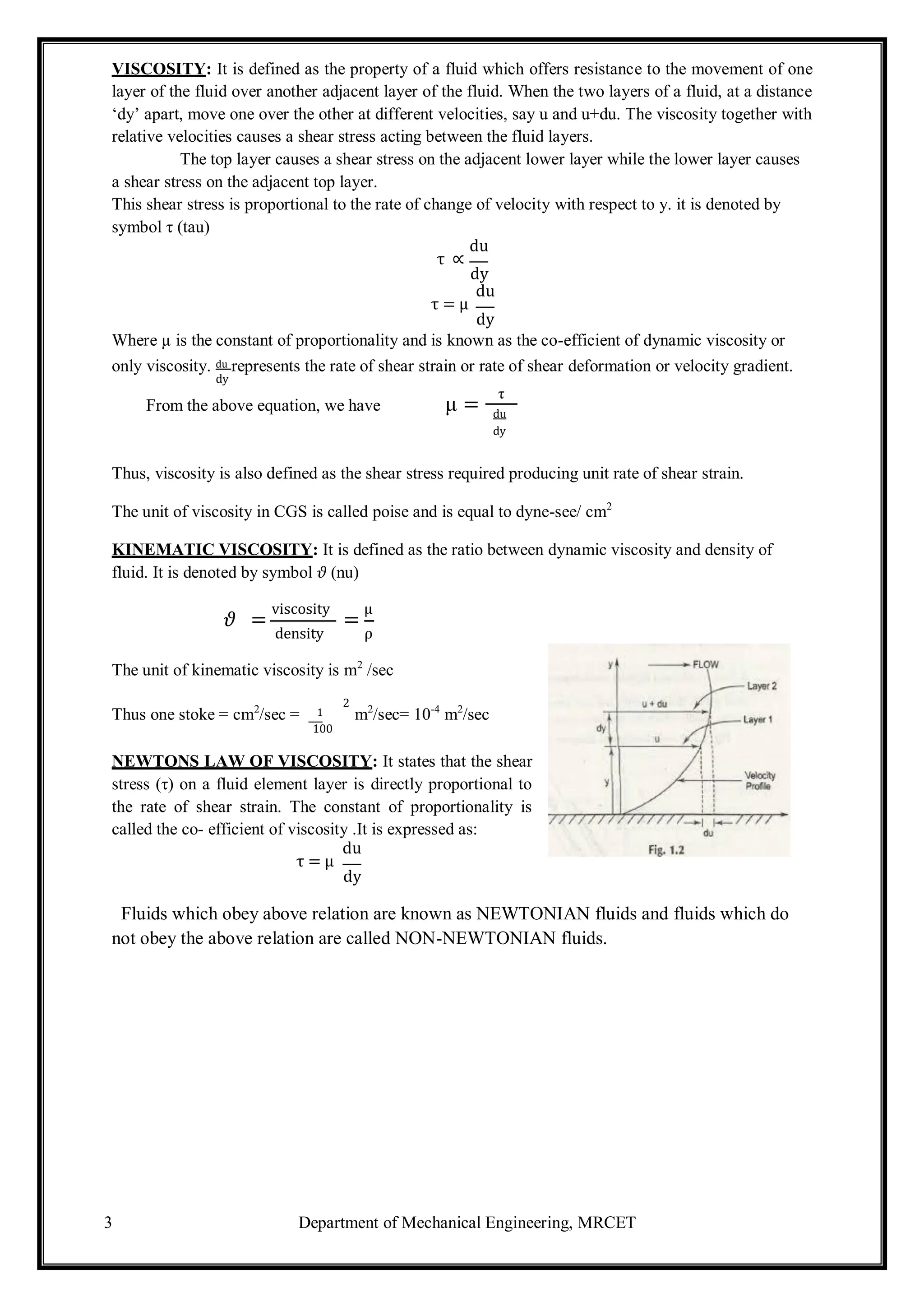
VISCOSITY: It is defined as the property of a fluid which offers resistance to the movement of one
layer of the fluid over another adjacent layer of the fluid. When the two layers of a fluid, at a distance
‘dy’ apart, move one over the other at different velocities, say u and u+du. The viscosity together with
relative velocities causes a shear stress acting between the fluid layers.
The top layer causes a shear stress on the adjacent lower layer while the lower layer causes
a shear stress on the adjacent top layer.
This shear stress is proportional to the rate of change of velocity with respect to y. it is denoted by
symbol τ (tau)
du
τ ∝
dy
du
τ = μ
dy
Where µ is the constant of proportionality and is known as the co-efficient of dynamic viscosity or
only viscosity. du represents the rate of shear strain or rate of shear deformation or velocity gradient.
dy
From the above equation, we have μ =
τ
du
dy
Thus, viscosity is also defined as the shear stress required producing unit rate of shear strain.
The unit of viscosity in CGS is called poise and is equal to dyne-see/ cm2
KINEMATIC VISCOSITY: It is defined as the ratio between dynamic viscosity and density of
fluid. It is denoted by symbol 𝜗 (nu)
𝜗 =
viscosity
=
μ
density ρ
The unit of kinematic viscosity is m2
/sec
2
Thus one stoke = cm2
/sec = 1 m2
/sec= 10-4
m2
/sec
100
NEWTONS LAW OF VISCOSITY: It states that the shear
stress (τ) on a fluid element layer is directly proportional to
the rate of shear strain. The constant of proportionality is
called the co- efficient of viscosity .It is expressed as:
du
τ = μ
dy
Fluids which obey above relation are known as NEWTONIAN fluids and fluids which do
not obey the above relation are called NON-NEWTONIAN fluids.
4 Department of Mechanical Engineering, MRCET
2
2 .
2
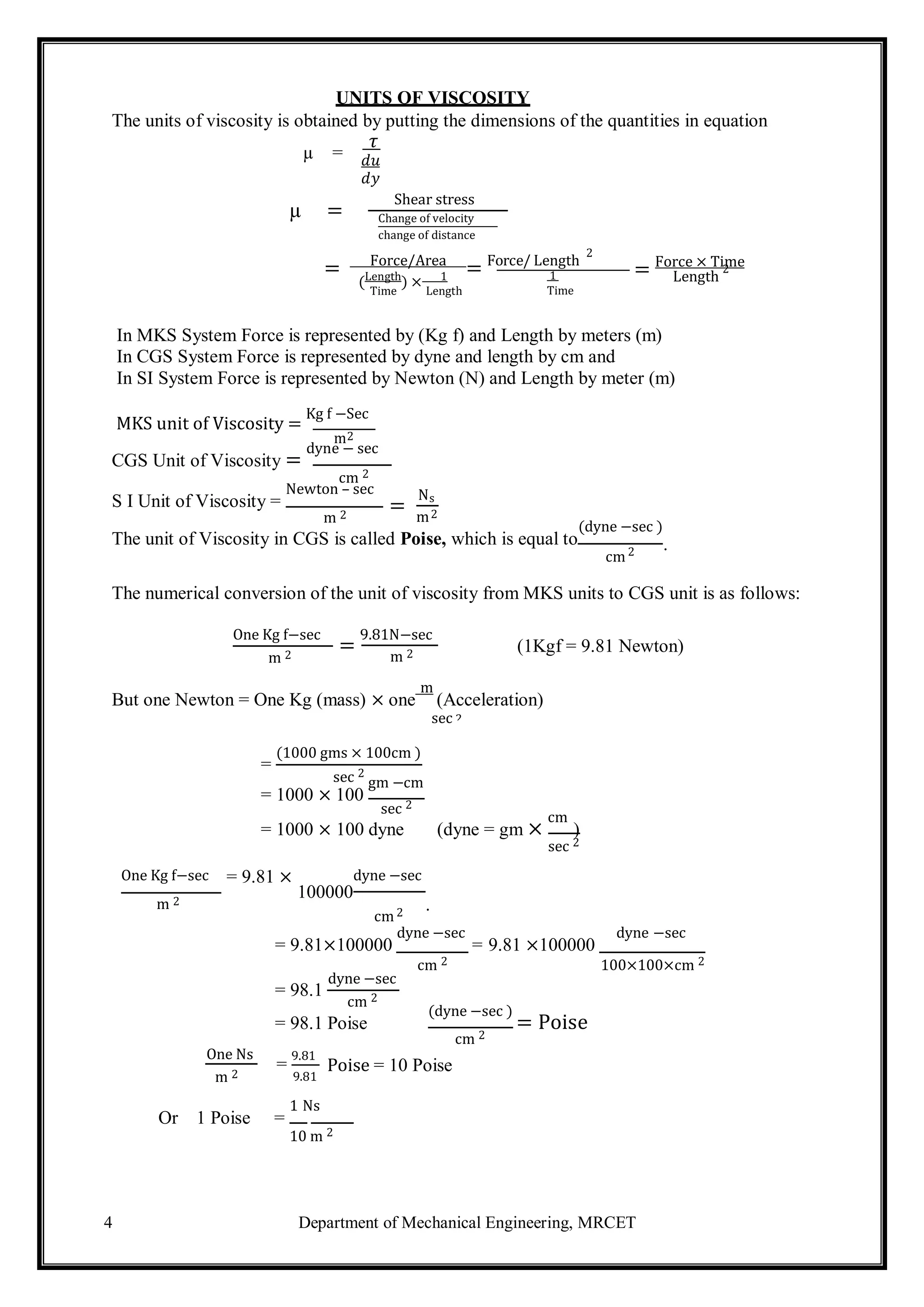
UNITS OF VISCOSITY
The units of viscosity is obtained by putting the dimensions of the quantities in equation
𝜏
𝑑𝑢
𝑑𝑦
Shear stress
Change of velocity
change of distance
= Force/Area
= Force/ Length
2
= Force × Time
(Length
) × 1 1 Length
2
Time Length Time
In MKS System Force is represented by (Kg f) and Length by meters (m)
In CGS System Force is represented by dyne and length by cm and
In SI System Force is represented by Newton (N) and Length by meter (m)
MKS unit of Viscosity =
Kg f −Sec
m
CGS Unit of Viscosity =
dyne − sec
cm 2
S I Unit of Viscosity =
Newton – sec
m 2
=
Ns
m2
The unit of Viscosity in CGS is called Poise, which is equal to
(dyne −sec )
cm
The numerical conversion of the unit of viscosity from MKS units to CGS unit is as follows:
One Kg f−sec
m 2
=
9.81N−sec
m 2 (1Kgf = 9.81 Newton)
But one Newton = One Kg (mass) × one
m
(Acceleration)
sec
=
(1000 gms × 100cm )
sec 2
= 1000 × 100
gm −cm
sec 2
= 1000 × 100 dyne (dyne = gm ×
cm
)
sec 2
One Kg f−sec = 9.81 × dyne −sec
100000
m 2
cm2 .
= 9.81×100000
dyne −sec
= 9.81 ×100000
dyne −sec
= 98.1
dyne −sec
cm 2
cm 2 100×100×cm 2
= 98.1 Poise
(dyne −sec )
= Poise
cm 2
One Ns
m 2
=
9.81
9.81
Poise = 10 Poise
Or 1 Poise =
1 Ns
10 m 2
µ =
µ =
5 Department of Mechanical Engineering, MRCET
2
VARIATION OF VISCOSITY WITH TEMPERATURE:
Temperature affects the viscosity. The viscosity of liquids decreases with the increase of
temperature, while the viscosity of gases increases with the increase of temperature. The viscous
forces in a fluid are due to cohesive forces and molecular momentum transfer. In liquids cohesive
forces predominates the molecular momentum transfer, due to closely packed molecules and with the
increase in temperature, the cohesive forces decreases resulting in decreasing of viscosity. But, in case
of gases the cohesive forces are small and molecular momentum transfer predominates with the
increase in temperature, molecular momentum transfer increases and hence viscosity increases. The
relation between viscosity and temperature for liquids and gases are:
i) For liquids µ = µ0
1
1+∝t+βt
Where, µ = Viscosity of liquid at t c in Poise.
µ0 = Viscosity of liquid at о c
α and β are constants for the Liquid.
For Water, µ0 = 1.79 x 10⁻³
poise, α =0.03368 and β = 0.000221
The above equation shows that the increase in temp. The Viscosity decreases.
ii) For gases µ = µ0 + α t -βt2
For air µ0 =0.000017, α =0.056 x 10⁻⁶
, β = 0.118 x 10⁻⁹
The above equation shows that with increase of temp. The Viscosity increases.
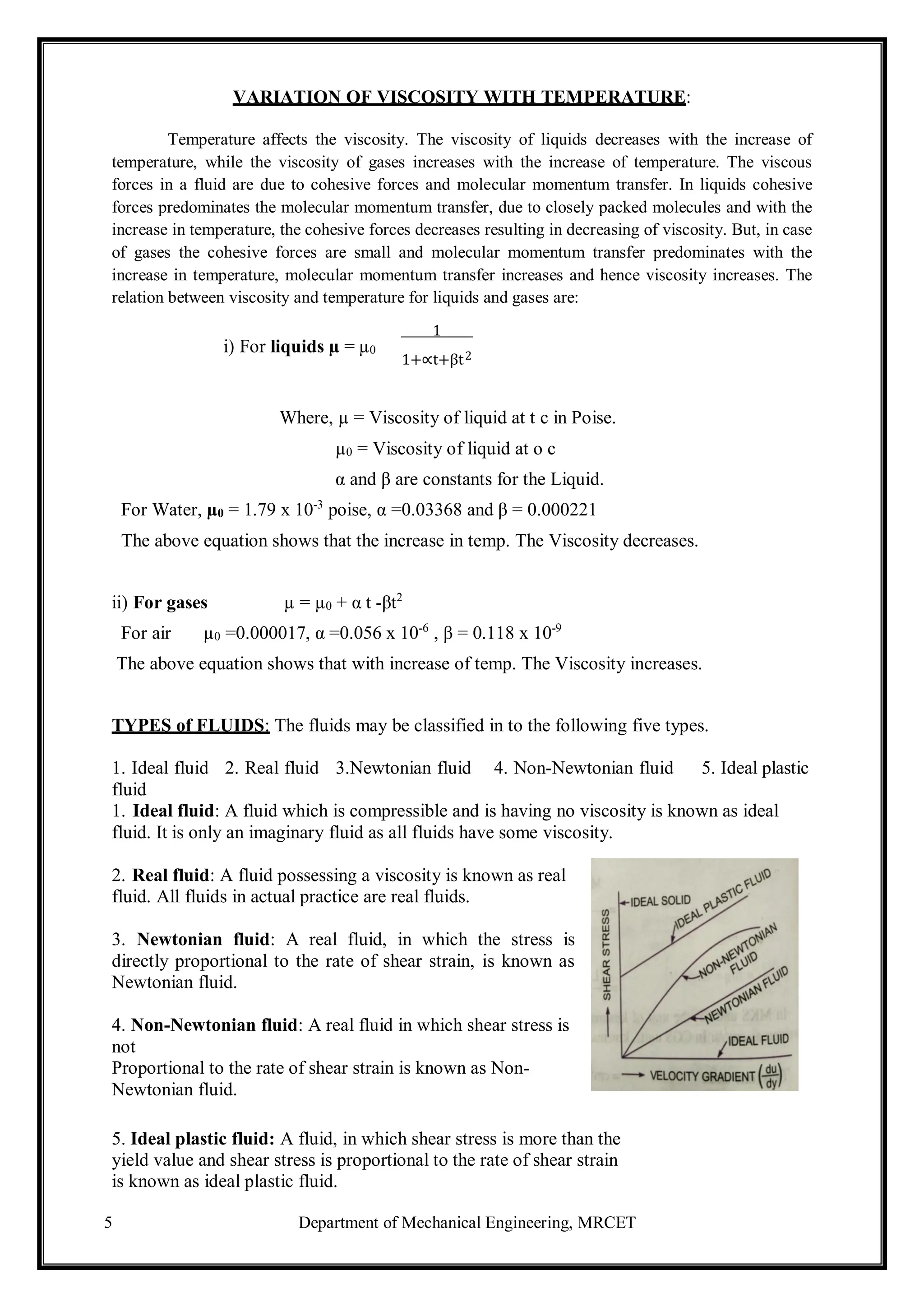
TYPES of FLUIDS: The fluids may be classified in to the following five types.
1. Ideal fluid 2. Real fluid 3.Newtonian fluid 4. Non-Newtonian fluid 5. Ideal plastic
fluid
1. Ideal fluid: A fluid which is compressible and is having no viscosity is known as ideal
fluid. It is only an imaginary fluid as all fluids have some viscosity.
2. Real fluid: A fluid possessing a viscosity is known as real
fluid. All fluids in actual practice are real fluids.
3. Newtonian fluid: A real fluid, in which the stress is
directly proportional to the rate of shear strain, is known as
Newtonian fluid.
4. Non-Newtonian fluid: A real fluid in which shear stress is
not
Proportional to the rate of shear strain is known as Non-
Newtonian fluid.
5. Ideal plastic fluid: A fluid, in which shear stress is more than the
yield value and shear stress is proportional to the rate of shear strain
is known as ideal plastic fluid.
6 Department of Mechanical Engineering, MRCET
=
4
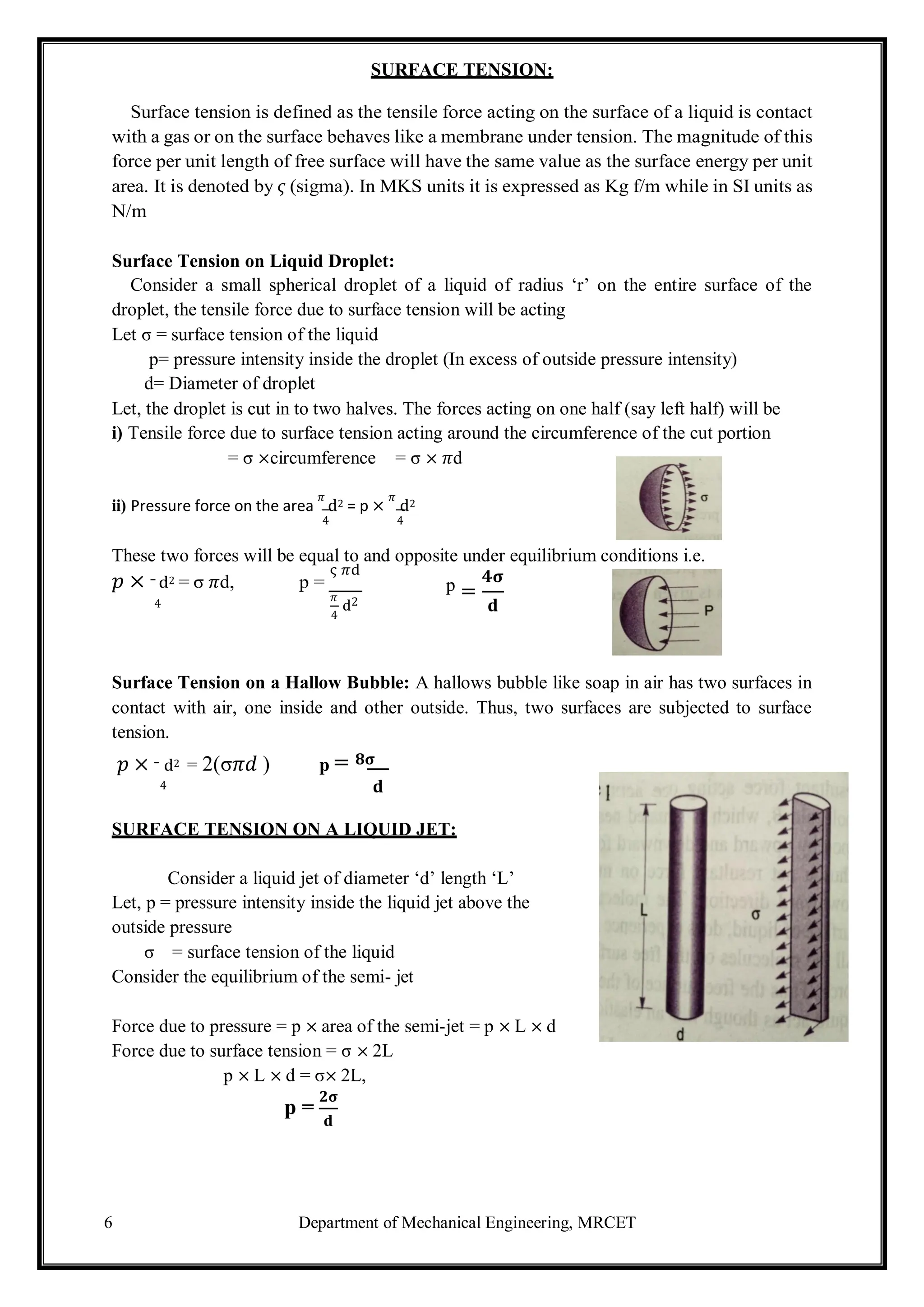
SURFACE TENSION:
Surface tension is defined as the tensile force acting on the surface of a liquid is contact
with a gas or on the surface behaves like a membrane under tension. The magnitude of this
force per unit length of free surface will have the same value as the surface energy per unit
area. It is denoted by 𝜍 (sigma). In MKS units it is expressed as Kg f/m while in SI units as
N/m
Surface Tension on Liquid Droplet:
Consider a small spherical droplet of a liquid of radius ‘r’ on the entire surface of the
droplet, the tensile force due to surface tension will be acting
Let σ = surface tension of the liquid
p= pressure intensity inside the droplet (In excess of outside pressure intensity)
d= Diameter of droplet
Let, the droplet is cut in to two halves. The forces acting on one half (say left half) will be
i) Tensile force due to surface tension acting around the circumference of the cut portion
= σ ×circumference = σ × 𝜋d
ii) Pressure force on the area
𝜋
d2 = p ×
𝜋
d2
4 4
These two forces will be equal to and opposite under equilibrium conditions i.e.
𝑝 × d2 = σ 𝜋d, p =
ς 𝜋d 𝟒𝛔
p
4
𝜋
d2 𝐝
Surface Tension on a Hallow Bubble: A hallows bubble like soap in air has two surfaces in
contact with air, one inside and other outside. Thus, two surfaces are subjected to surface
tension.
𝑝 × d2 = 2(σ𝜋𝑑 ) p = 𝟖𝛔
4 𝐝
SURFACE TENSION ON A LIQUID JET:
Consider a liquid jet of diameter ‘d’ length ‘L’
Let, p = pressure intensity inside the liquid jet above the
outside pressure
σ = surface tension of the liquid
Consider the equilibrium of the semi- jet
Force due to pressure = p × area of the semi-jet = p × L × d
Force due to surface tension = σ × 2L
p × L × d = σ× 2L,
p =
𝟐𝛔
𝐝
7 Department of Mechanical Engineering, MRCET
CAPILLARITY
Capillarity is defined as a phenomenon of rise or fall of a liquid surface in a small tube relative to the
adjacent general level of liquid when the tube is held vertically in the liquid. The rise of liquid surface
is known as capillary rise, while the fall of the liquid surface is known as capillary depression. It is
expressed in terms of ‘cm’ or ‘mm’ of liquid. Its value depends upon the specific weight of the liquid,
diameter of the tube and surface tension of the liquid.
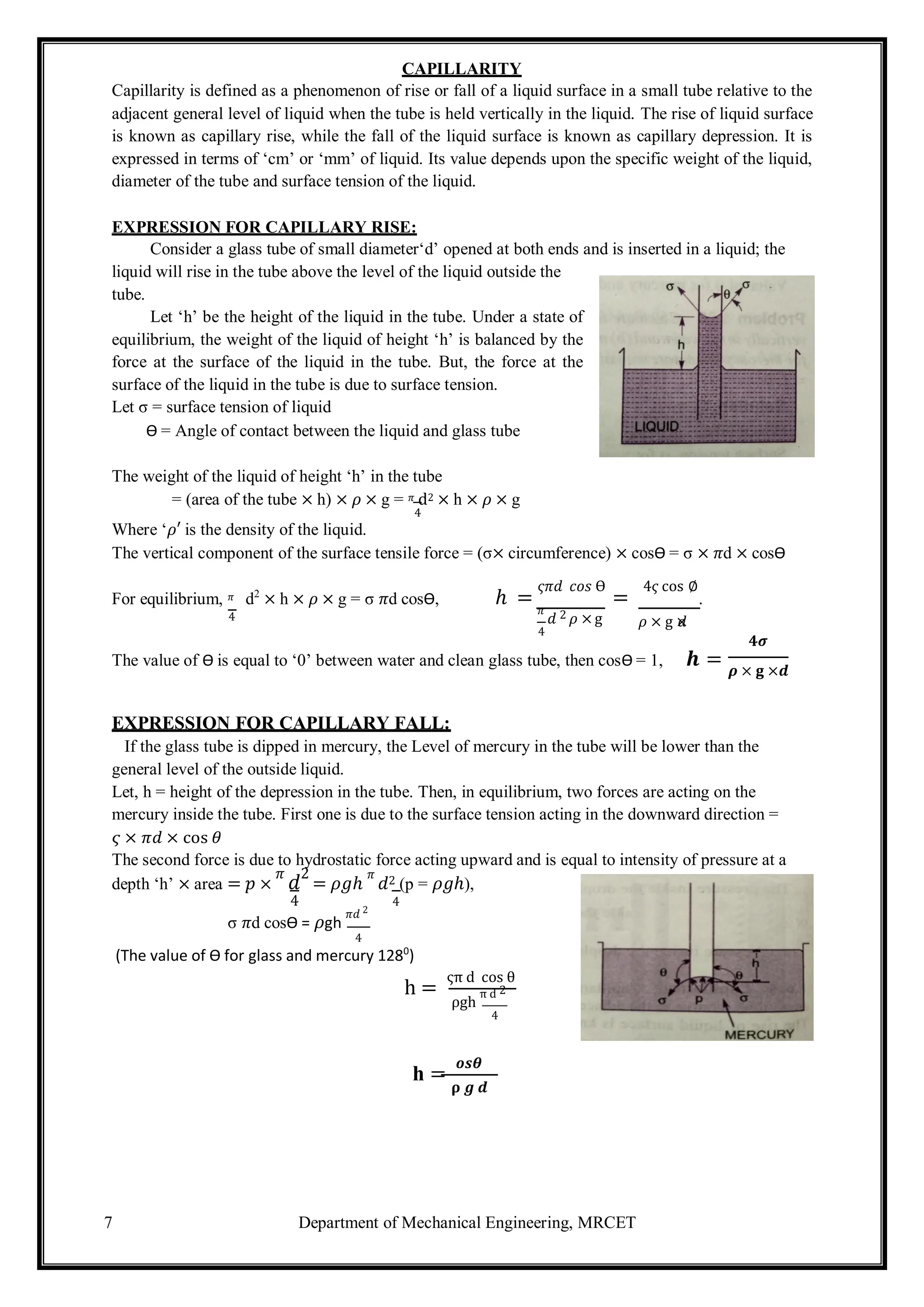
EXPRESSION FOR CAPILLARY RISE:
Consider a glass tube of small diameter‘d’ opened at both ends and is inserted in a liquid; the
liquid will rise in the tube above the level of the liquid outside the
tube.
Let ‘h’ be the height of the liquid in the tube. Under a state of
equilibrium, the weight of the liquid of height ‘h’ is balanced by the
force at the surface of the liquid in the tube. But, the force at the
surface of the liquid in the tube is due to surface tension.
Let σ = surface tension of liquid
Ѳ = Angle of contact between the liquid and glass tube
The weight of the liquid of height ‘h’ in the tube
= (area of the tube × h) × 𝜌 × g = 𝜋 d2 × h × 𝜌 × g
4
Where ‘𝜌′ is the density of the liquid.
The vertical component of the surface tensile force = (σ× circumference) × cosѲ = σ × 𝜋d × cosѲ
For equilibrium, 𝜋 d2
× h × 𝜌 × g = σ 𝜋d cosѲ, ℎ =
𝜍𝜋𝑑 𝑐𝑜𝑠 Ѳ
=
4𝜍 cos ∅
.
4
𝜋
𝑑 2 𝜌 ×g
4
𝜌 × g ×
𝑑
𝟒𝝈
The value of Ѳ is equal to ‘0’ between water and clean glass tube, then cosѲ = 1, 𝒉 = 𝝆 × 𝐠 ×𝒅
EXPRESSION FOR CAPILLARY FALL:
If the glass tube is dipped in mercury, the Level of mercury in the tube will be lower than the
general level of the outside liquid.
Let, h = height of the depression in the tube. Then, in equilibrium, two forces are acting on the
mercury inside the tube. First one is due to the surface tension acting in the downward direction =
𝜍 × 𝜋𝑑 × cos 𝜃
The second force is due to hydrostatic force acting upward and is equal to intensity of pressure at a
depth ‘h’ × area = 𝑝 ×
𝜋
𝑑
2
= 𝜌𝑔ℎ
𝜋
𝑑2 (p = 𝜌𝑔ℎ),
4 4
σ 𝜋d cosѲ = 𝜌gh
𝜋𝑑 2
4
(The value of Ѳ for glass and mercury 1280
)
h =
ςπ d cos θ
ρgh
π d 2
4
h =
𝒐𝒔𝜽
𝛒 𝒈 𝒅
8 Department of Mechanical Engineering, MRCET
VAPOUR PRESSURE AND CAVITATION
A change from the liquid state to the gaseous state is known as Vaporizations. The
vaporization (which depends upon the prevailing pressure and temperature condition) occurs
because of continuous escaping of the molecules through the free liquid surface.
Consider a liquid at a temp. of 20°C and pressure is atmospheric is confined in a closed
vessel. This liquid will vaporize at 100°C, the molecules escape from the free surface of the
liquid and get accumulated in the space between the free liquid surface and top of the vessel.
These accumulated vapours exert a pressure on the liquid surface. This pressure is known as
vapour pressure of the liquid or pressure at which the liquid is converted in to vapours.
Consider the same liquid at 20 ° c at atmospheric pressure in the closed vessel and the
pressure above the liquid surface is reduced by some means; the boiling temperature will also
reduce. If the pressure is reduced to such an extent that it becomes equal to or less than the
vapour pressure, the boiling of the liquid will start, though the temperature of the liquid is
20°C. Thus, the liquid may boil at the ordinary temperature, if the pressure above the liquid
surface is reduced so as to be equal or less than the vapour pressure of the liquid at that
temperature.
Now, consider a flowing system, if the pressure at any point in this flowing liquid becomes
equal to or less than the vapour pressure, the vapourisation of the liquid starts. The bubbles of
these vapours are carried by the flowing liquid in to the region of high pressure where they
collapse, giving rise to impact pressure. The pressure developed by the collapsing bubbles is
so high that the material from the adjoining boundaries gets eroded and cavities are formed
on them. This phenomenon is known as CAVITATION.
Hence the cavitations is the phenomenon of formation of vapour bubbles of a flowing
liquid in a region where the pressure of the liquid falls below the vapour pressure and sudden
collapsing of these vapour bubbles in a region of high pressure,. When the vapour bubbles
collapse, a very high pressure is created. The metallic surface, above which the liquid is
flowing, is subjected to these high pressures, which cause pitting actions on the surface. Thus
cavities are formed on the metallic surface and hence the name is cavitation.
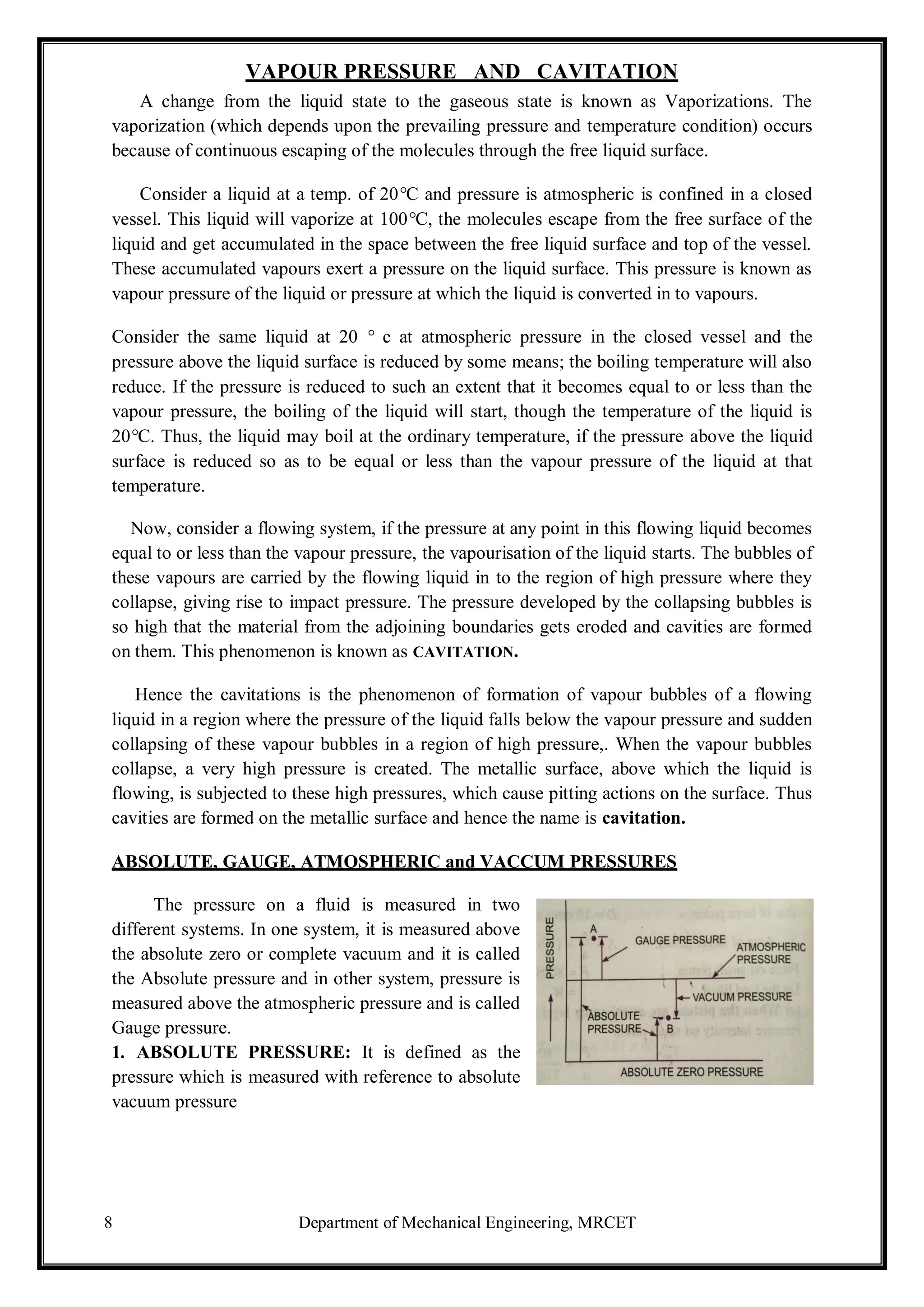
ABSOLUTE, GAUGE, ATMOSPHERIC and VACCUM PRESSURES
The pressure on a fluid is measured in two
different systems. In one system, it is measured above
the absolute zero or complete vacuum and it is called
the Absolute pressure and in other system, pressure is
measured above the atmospheric pressure and is called
Gauge pressure.
1. ABSOLUTE PRESSURE: It is defined as the
pressure which is measured with reference to absolute
vacuum pressure
9 Department of Mechanical Engineering, MRCET
𝟐
2. GAUGE PRESSURE: It is defined as the pressure, which is measured with the help of a
pressure measuring instrument, in which the atmospheric pressure is taken as datum. The
atmospheric on the scale is marked as zero.
3. VACUUM PRESSURE: It is defined as the pressure below the atmospheric pressure
i) Absolute pressure = Atmospheric pressure+ gauge pressure
pab = patm +pguag
ii) Vacuum pressure = Atmospheric pressure - Absolute pressure
The atmospheric pressure at sea level at 150
C is 10.13N/cm2
or
101.3KN/m2
in S I Unitsand 1.033 Kg f/cm2
in M K S System.
The atmospheric pressure head is 760mm of mercury or 10.33m of water.
MEASUREMENT OF PRESSURE
The pressure of a fluid is measured by the fallowing devices.
1. Manometers 2.Mechanical gauges.
1. Manometers: Manometers are defined as the devices used for measuring the pressure at a
point in a fluid by balancing the column of fluid by the same or another column of fluid.
They are classified as:
a) Simple Manometers b) Differential Manometers.
2. Mechanical Gauges: are defined as the devices used for measuring the pressure by
balancing the fluid column by the spring or dead weight. The commonly used Mechanical
pressure gauges are:
a) Diaphragm pressure gauge b) Bourdon tube pressure gauge
c) Dead – Weight pressure gauge d) Bellows pressure gauge.
Simple Manometers: A simple manometer consists of a glass tube having one of its ends
connected to a point where pressure is to be measured and the other end remains open to the
atmosphere. The common types of simple manometers are:
1. Piezo meter.
2. U-tube manometer.
3. Single column manometer.
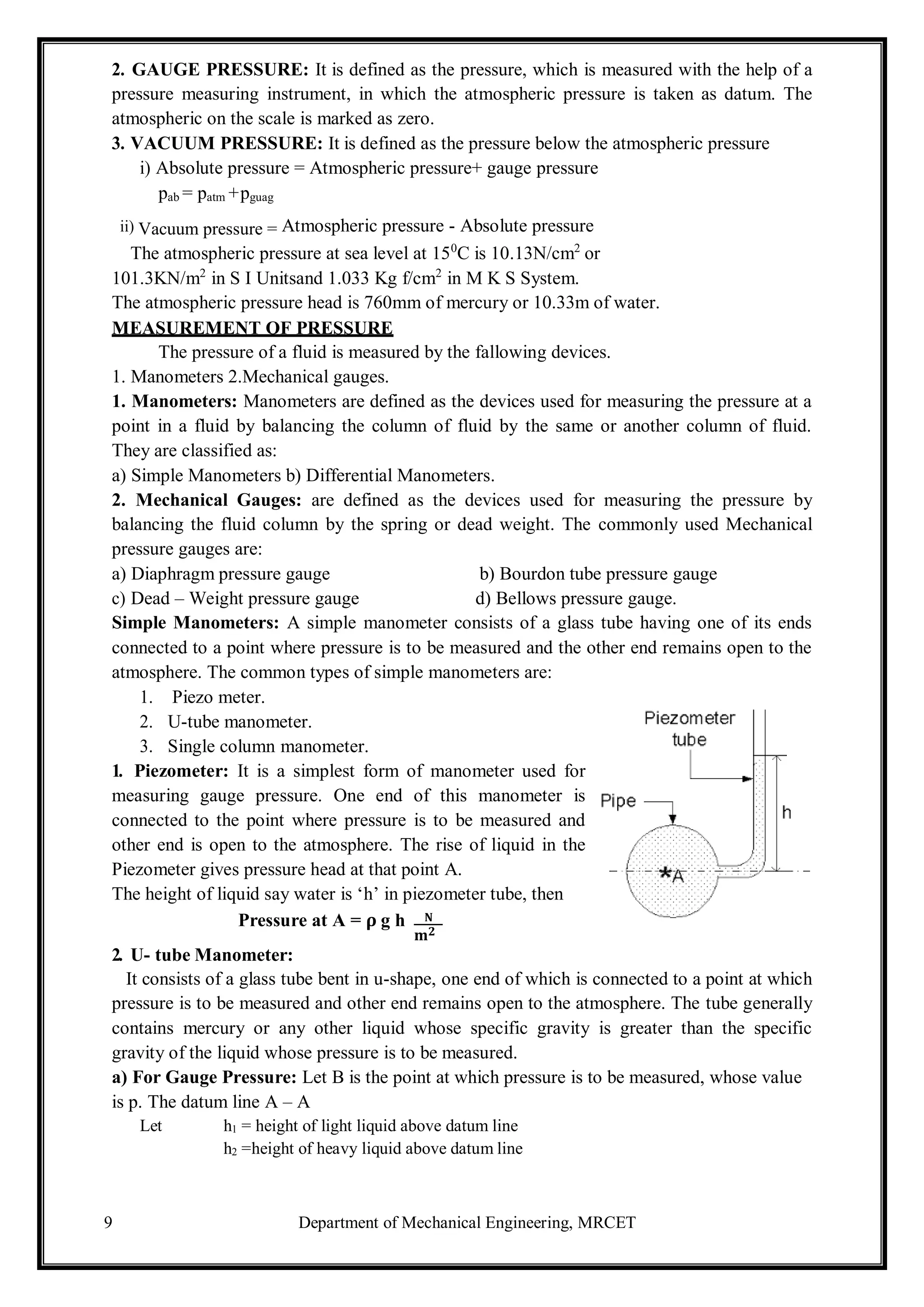
1. Piezometer: It is a simplest form of manometer used for
measuring gauge pressure. One end of this manometer is
connected to the point where pressure is to be measured and
other end is open to the atmosphere. The rise of liquid in the
Piezometer gives pressure head at that point A.
The height of liquid say water is ‘h’ in piezometer tube, then
Pressure at A = 𝛒 g h 𝐍
𝐦
2. U- tube Manometer:
It consists of a glass tube bent in u-shape, one end of which is connected to a point at which
pressure is to be measured and other end remains open to the atmosphere. The tube generally
contains mercury or any other liquid whose specific gravity is greater than the specific
gravity of the liquid whose pressure is to be measured.
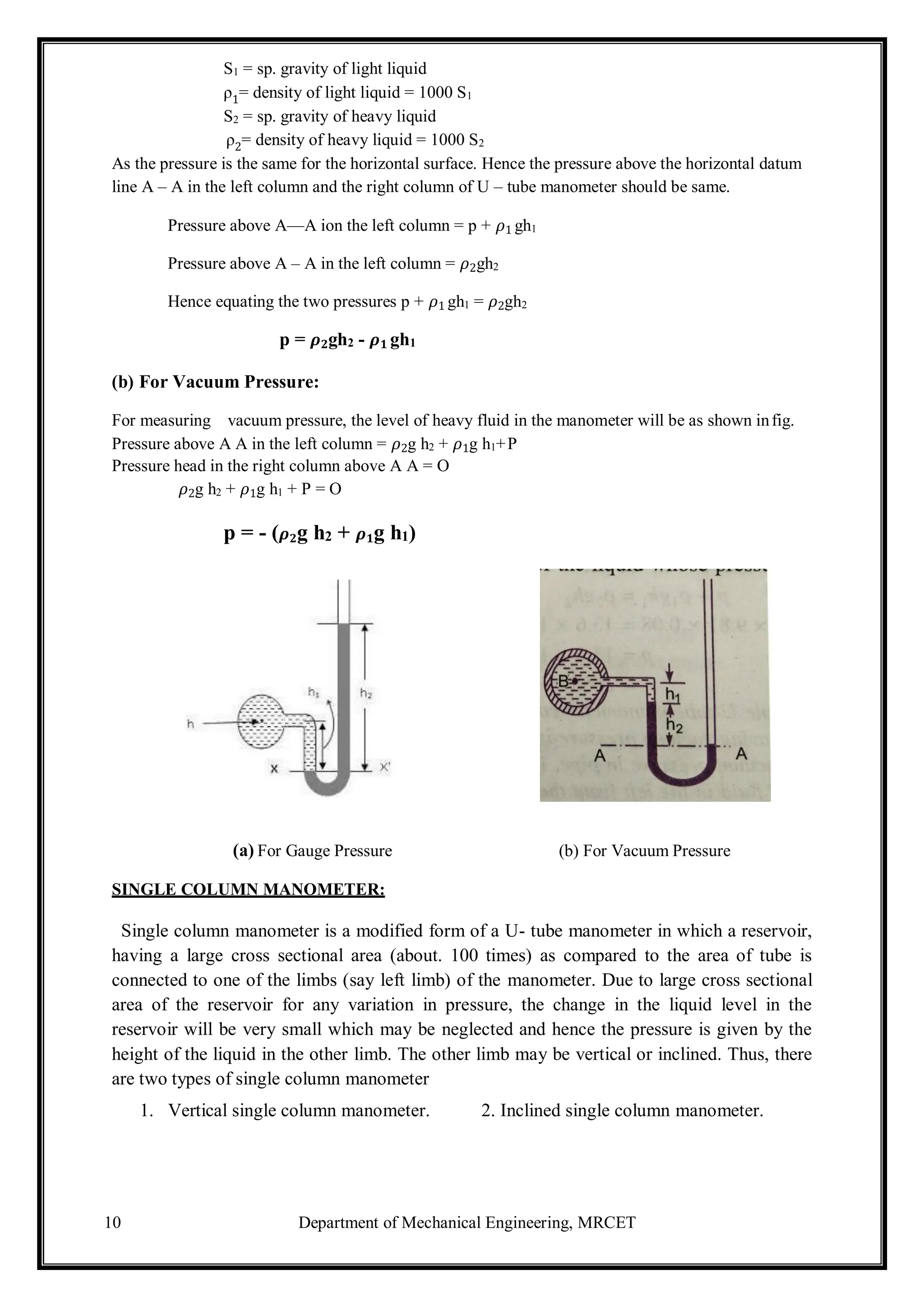
a) For Gauge Pressure: Let B is the point at which pressure is to be measured, whose value
is p. The datum line A – A
Let h1 = height of light liquid above datum line
h2 =height of heavy liquid above datum line
10 Department of Mechanical Engineering, MRCET
S1 = sp. gravity of light liquid
ρ1= density of light liquid = 1000 S1
S2 = sp. gravity of heavy liquid
ρ2= density of heavy liquid = 1000 S2
As the pressure is the same for the horizontal surface. Hence the pressure above the horizontal datum
line A – A in the left column and the right column of U – tube manometer should be same.
Pressure above A—A ion the left column = p + 𝜌1 gh1
Pressure above A – A in the left column = 𝜌2gh2
Hence equating the two pressures p + 𝜌1 gh1 = 𝜌2gh2
p = 𝝆𝟐gh2 - 𝝆𝟏 gh1
(b) For Vacuum Pressure:
For measuring vacuum pressure, the level of heavy fluid in the manometer will be as shown infig.
Pressure above A A in the left column = 𝜌2g h2 + 𝜌1g h1+P
Pressure head in the right column above A A = O
𝜌2g h2 + 𝜌1g h1 + P = O
p = - (𝝆𝟐g h2 + 𝝆𝟏g h1)
(a) For Gauge Pressure (b) For Vacuum Pressure
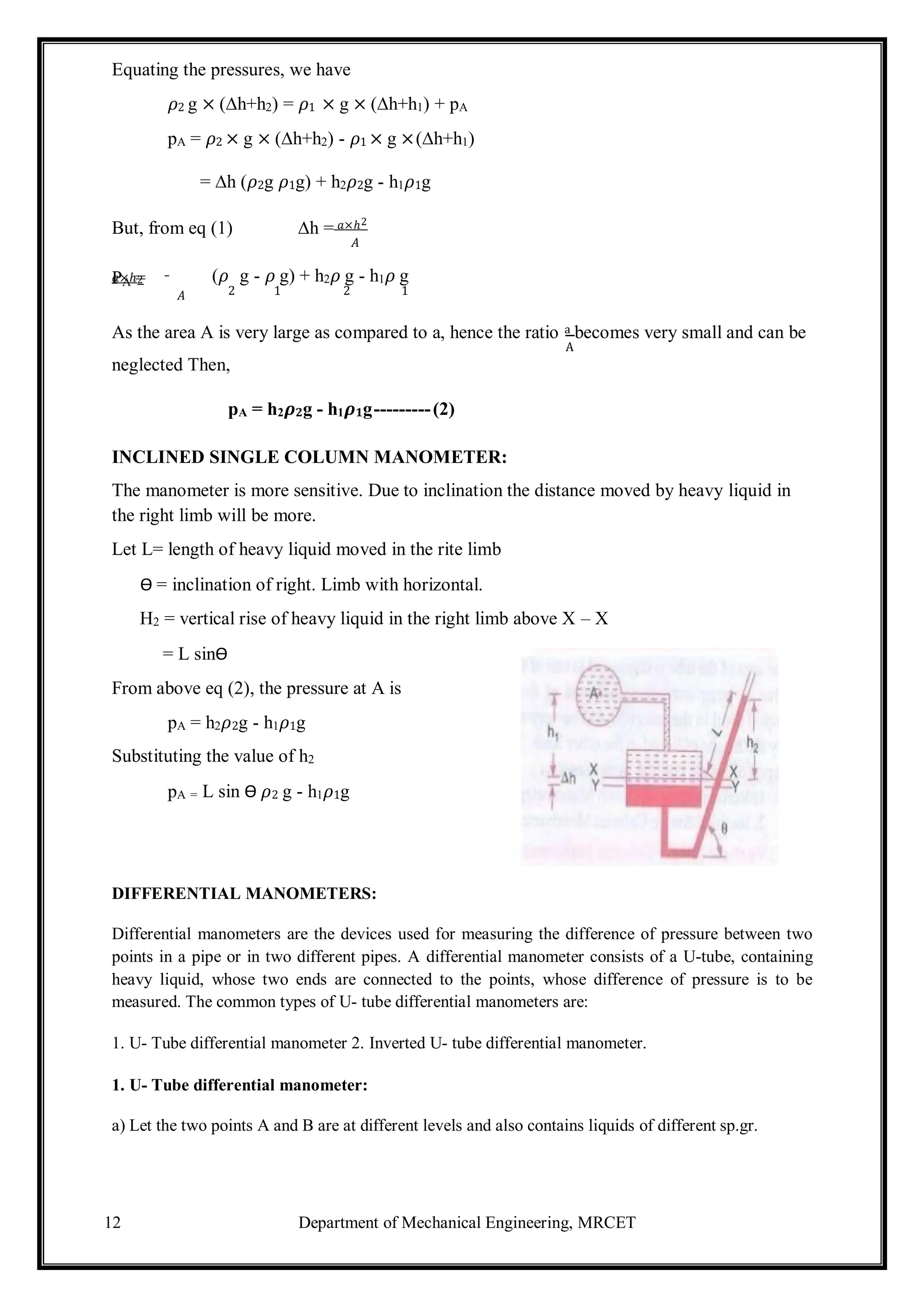
SINGLE COLUMN MANOMETER:
Single column manometer is a modified form of a U- tube manometer in which a reservoir,
having a large cross sectional area (about. 100 times) as compared to the area of tube is
connected to one of the limbs (say left limb) of the manometer. Due to large cross sectional
area of the reservoir for any variation in pressure, the change in the liquid level in the
reservoir will be very small which may be neglected and hence the pressure is given by the
height of the liquid in the other limb. The other limb may be vertical or inclined. Thus, there
are two types of single column manometer
1. Vertical single column manometer. 2. Inclined single column manometer.
11 Department of Mechanical Engineering, MRCET
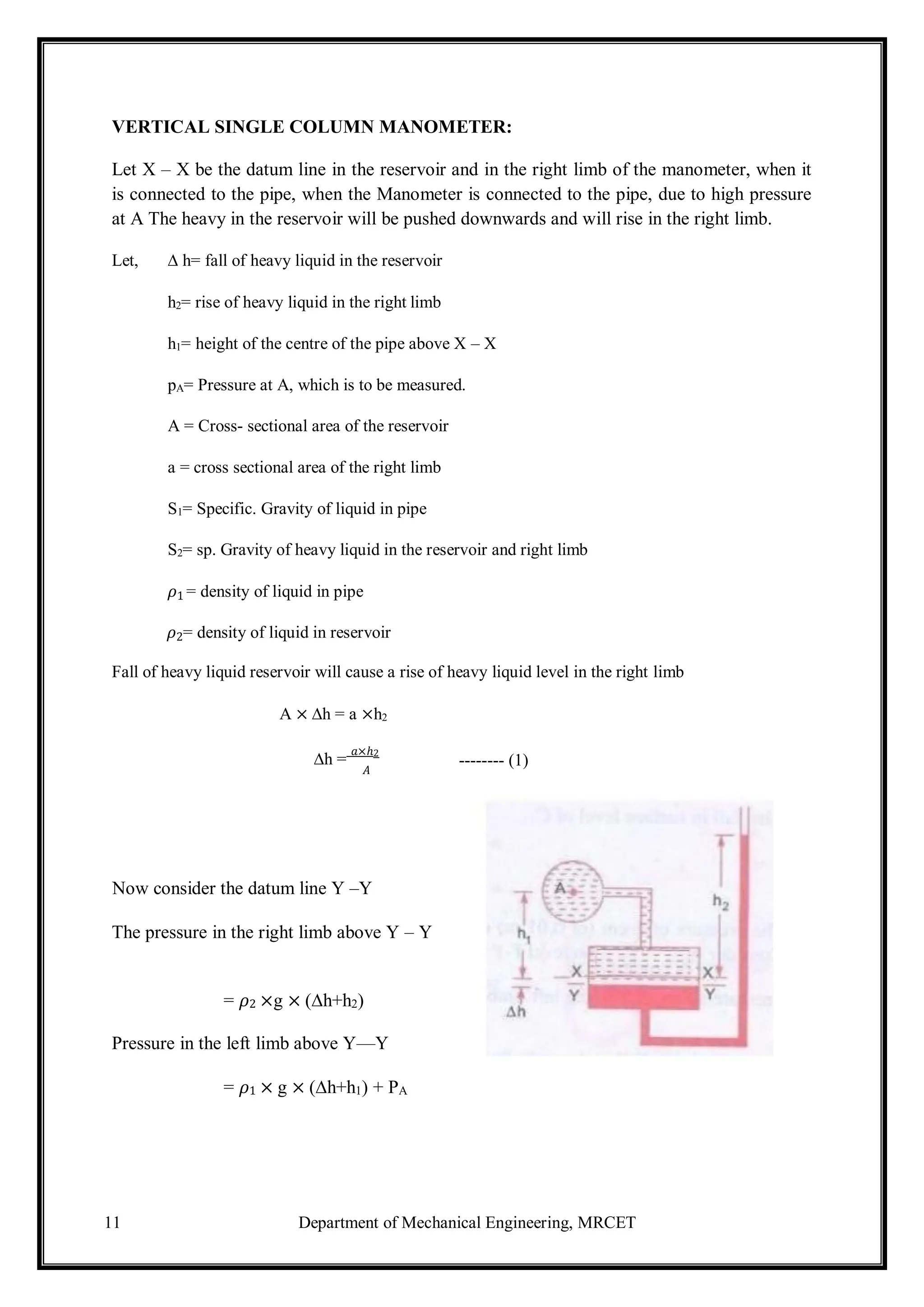
VERTICAL SINGLE COLUMN MANOMETER:
Let X – X be the datum line in the reservoir and in the right limb of the manometer, when it
is connected to the pipe, when the Manometer is connected to the pipe, due to high pressure
at A The heavy in the reservoir will be pushed downwards and will rise in the right limb.
Let, ∆ h= fall of heavy liquid in the reservoir
h2= rise of heavy liquid in the right limb
h1= height of the centre of the pipe above X – X
pA= Pressure at A, which is to be measured.
A = Cross- sectional area of the reservoir
a = cross sectional area of the right limb
S1= Specific. Gravity of liquid in pipe
S2= sp. Gravity of heavy liquid in the reservoir and right limb
𝜌1 = density of liquid in pipe
𝜌2= density of liquid in reservoir
Fall of heavy liquid reservoir will cause a rise of heavy liquid level in the right limb
A × ∆h = a ×h2
∆h =
𝑎×ℎ2
𝐴
Now consider the datum line Y –Y
The pressure in the right limb above Y – Y
= 𝜌2 ×g × (∆h+h2)
Pressure in the left limb above Y—Y
= 𝜌1 × g × (∆h+h1) + PA
-------- (1)
12 Department of Mechanical Engineering, MRCET
Equating the pressures, we have
𝜌2 g × (∆h+h2) = 𝜌1 × g × (∆h+h1) + pA
pA = 𝜌2 × g × (∆h+h2) - 𝜌1 × g ×(∆h+h1)
= ∆h (𝜌2g 𝜌1g) + h2𝜌2g - h1𝜌1g
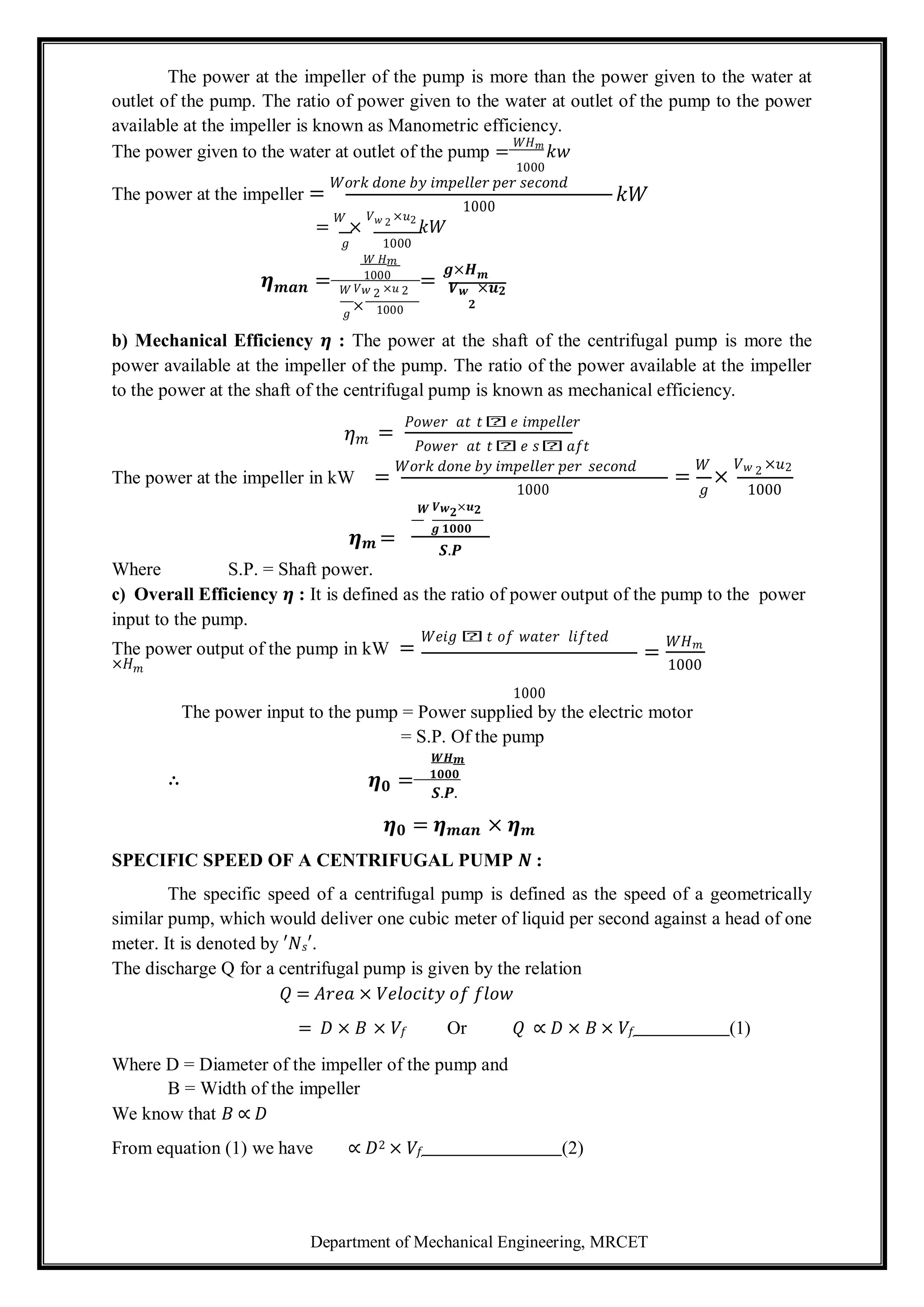
But, from eq (1) ∆h = 𝑎×ℎ2
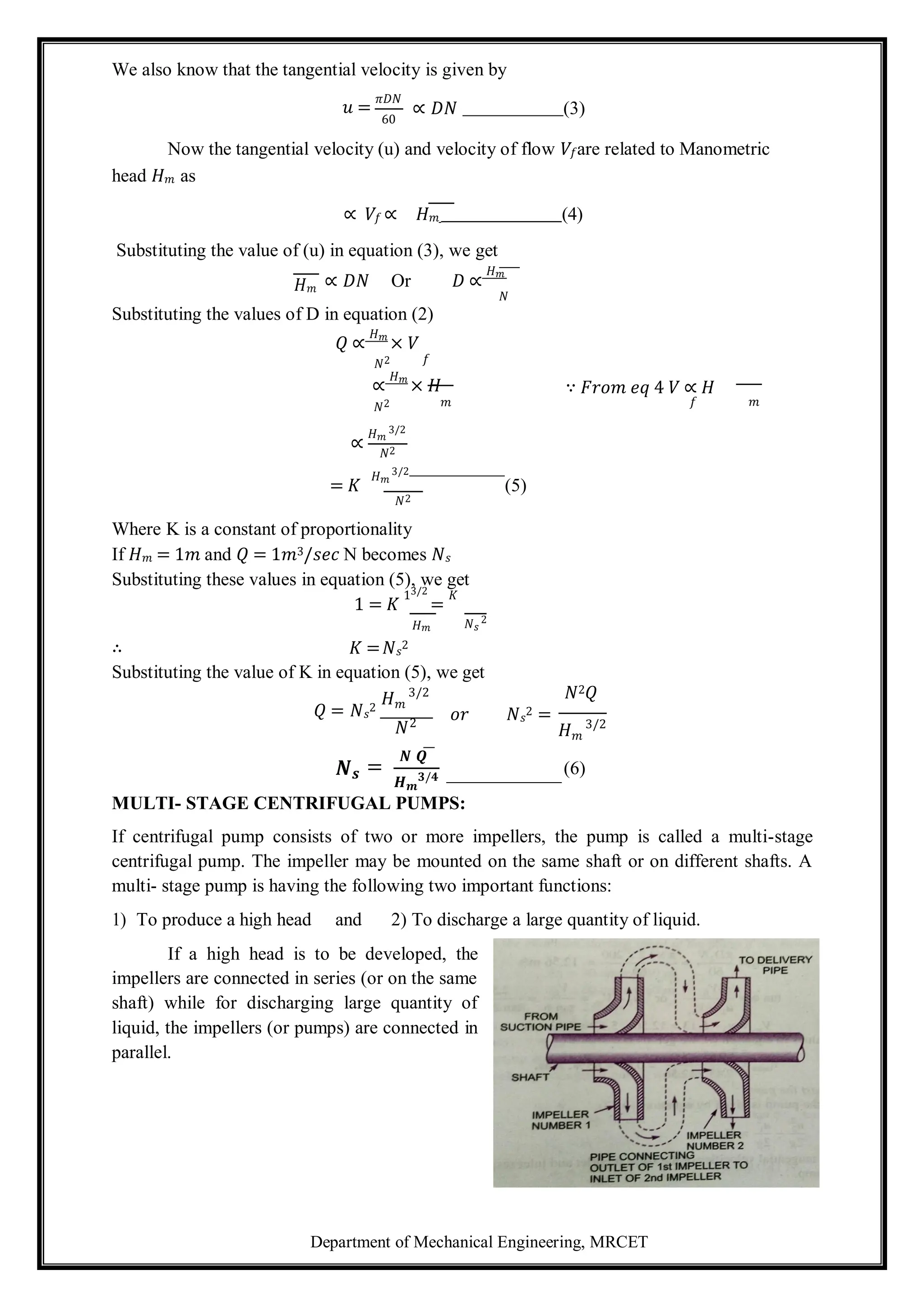
𝐴
PA =
𝑎×ℎ2 (𝜌 g - 𝜌 g) + h2𝜌 g - h1𝜌 g
𝐴 2 1 2 1
As the area A is very large as compared to a, hence the ratio a becomes very small and can be
A
neglected Then,
pA = h2𝝆𝟐g - h1𝝆𝟏g---------(2)
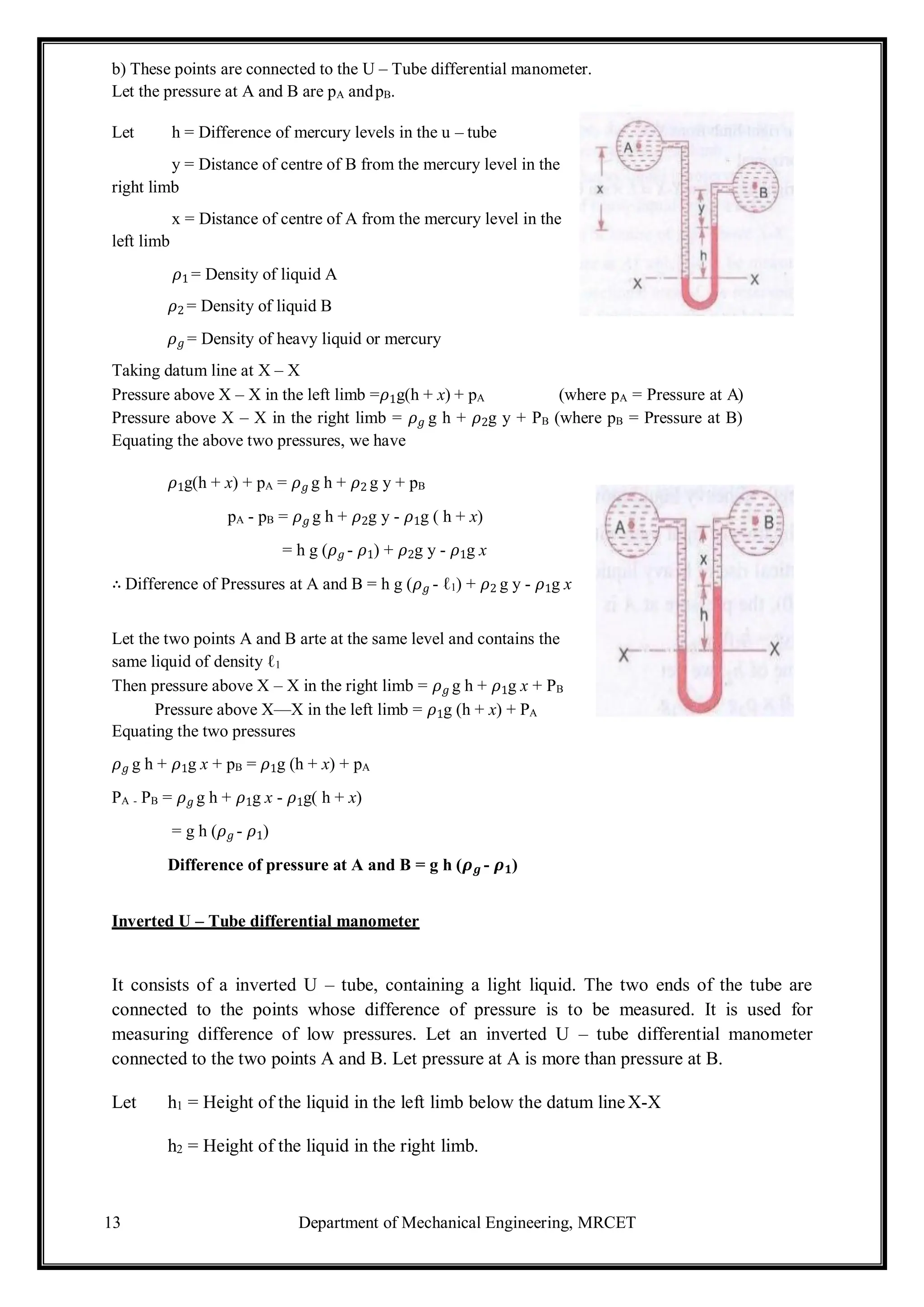
INCLINED SINGLE COLUMN MANOMETER:
The manometer is more sensitive. Due to inclination the distance moved by heavy liquid in
the right limb will be more.
Let L= length of heavy liquid moved in the rite limb
Ѳ = inclination of right. Limb with horizontal.
H2 = vertical rise of heavy liquid in the right limb above X – X
= L sinѲ
From above eq (2), the pressure at A is
pA = h2𝜌2g - h1𝜌1g
Substituting the value of h2
pA = L sin Ѳ 𝜌2 g - h1𝜌1g
DIFFERENTIAL MANOMETERS:
Differential manometers are the devices used for measuring the difference of pressure between two
points in a pipe or in two different pipes. A differential manometer consists of a U-tube, containing
heavy liquid, whose two ends are connected to the points, whose difference of pressure is to be
measured. The common types of U- tube differential manometers are:
1. U- Tube differential manometer 2. Inverted U- tube differential manometer.
1. U- Tube differential manometer:
a) Let the two points A and B are at different levels and also contains liquids of different sp.gr.
13 Department of Mechanical Engineering, MRCET
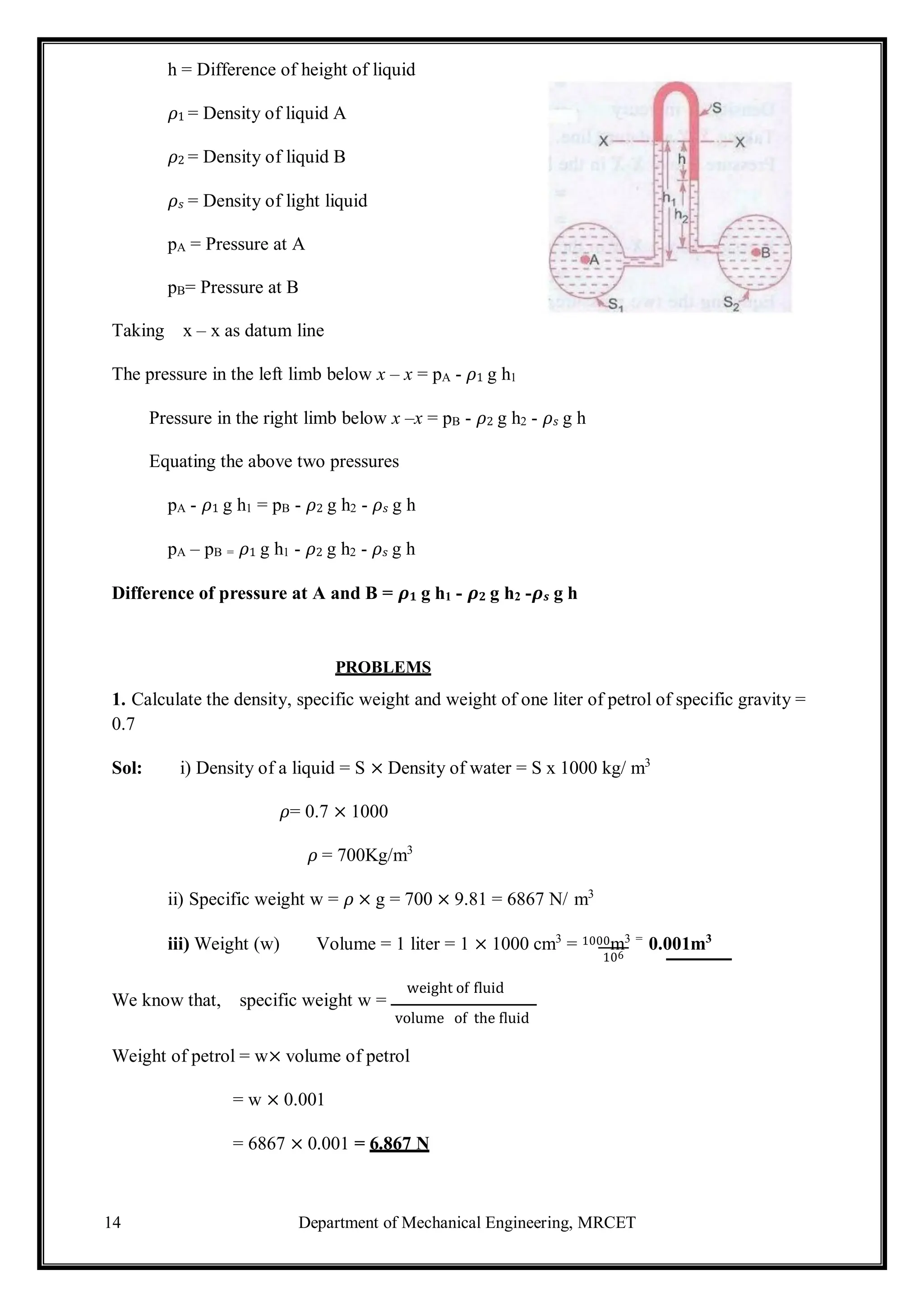
b) These points are connected to the U – Tube differential manometer.
Let the pressure at A and B are pA andpB.
Let h = Difference of mercury levels in the u – tube
y = Distance of centre of B from the mercury level in the
right limb
x = Distance of centre of A from the mercury level in the
left limb
𝜌1 = Density of liquid A
𝜌2 = Density of liquid B
𝜌𝑔 = Density of heavy liquid or mercury
Taking datum line at X – X
Pressure above X – X in the left limb =𝜌1g(h + x) + pA (where pA = Pressure at A)
Pressure above X – X in the right limb = 𝜌𝑔 g h + 𝜌2g y + PB (where pB = Pressure at B)
Equating the above two pressures, we have
𝜌1g(h + x) + pA = 𝜌𝑔 g h + 𝜌2 g y + pB
pA - pB = 𝜌𝑔 g h + 𝜌2g y - 𝜌1g ( h + x)
= h g (𝜌𝑔 - 𝜌1) + 𝜌2g y - 𝜌1g x
∴ Difference of Pressures at A and B = h g (𝜌𝑔 - ℓ1) + 𝜌2 g y - 𝜌1g x
Let the two points A and B arte at the same level and contains the
same liquid of density ℓ1
Then pressure above X – X in the right limb = 𝜌𝑔 g h + 𝜌1g x + PB
Pressure above X—X in the left limb = 𝜌1g (h + x) + PA
Equating the two pressures
𝜌𝑔 g h + 𝜌1g x + pB = 𝜌1g (h + x) + pA
PA - PB = 𝜌𝑔 g h + 𝜌1g x - 𝜌1g( h + x)
= g h (𝜌𝑔 - 𝜌1)
Difference of pressure at A and B = g h (𝝆𝒈 - 𝝆𝟏)
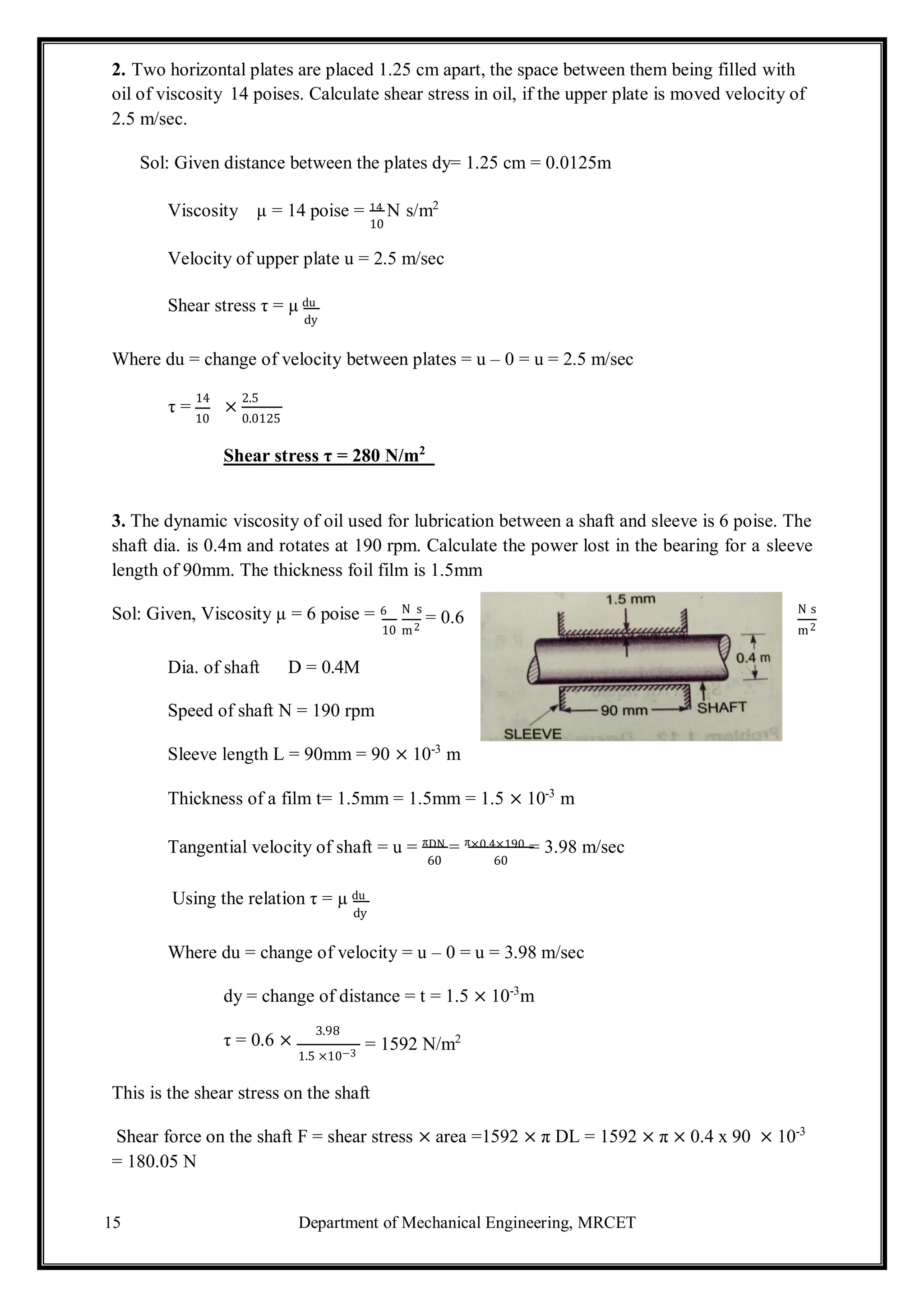
Inverted U – Tube differential manometer
It consists of a inverted U – tube, containing a light liquid. The two ends of the tube are
connected to the points whose difference of pressure is to be measured. It is used for
measuring difference of low pressures. Let an inverted U – tube differential manometer
connected to the two points A and B. Let pressure at A is more than pressure at B.
Let h1 = Height of the liquid in the left limb below the datum lineX-X
h2 = Height of the liquid in the right limb.
14 Department of Mechanical Engineering, MRCET
h = Difference of height of liquid
𝜌1 = Density of liquid A
𝜌2 = Density of liquid B
𝜌𝑠 = Density of light liquid
pA = Pressure at A
pB= Pressure at B
Taking x – x as datum line
The pressure in the left limb below x – x = pA - 𝜌1 g h1
Pressure in the right limb below x –x = pB - 𝜌2 g h2 - 𝜌𝑠 g h
Equating the above two pressures
pA - 𝜌1 g h1 = pB - 𝜌2 g h2 - 𝜌𝑠 g h
pA – pB = 𝜌1 g h1 - 𝜌2 g h2 - 𝜌𝑠 g h
Difference of pressure at A and B = 𝝆𝟏 g h1 - 𝝆𝟐 g h2 -𝝆𝒔 g h
PROBLEMS
1. Calculate the density, specific weight and weight of one liter of petrol of specific gravity =
0.7
Sol: i) Density of a liquid = S × Density of water = S x 1000 kg/ m3
𝜌= 0.7 × 1000
𝜌 = 700Kg/m3
ii) Specific weight w = 𝜌 × g = 700 × 9.81 = 6867 N/ m3
iii) Weight (w) Volume = 1 liter = 1 × 1000 cm3
= 1000m3 =
0.001m3
106
We know that, specific weight w =
weight of fluid
volume of the fluid
Weight of petrol = w× volume of petrol
= w × 0.001
= 6867 × 0.001 = 6.867 N
15 Department of Mechanical Engineering, MRCET
2. Two horizontal plates are placed 1.25 cm apart, the space between them being filled with
oil of viscosity 14 poises. Calculate shear stress in oil, if the upper plate is moved velocity of
2.5 m/sec.
Sol: Given distance between the plates dy= 1.25 cm = 0.0125m
Viscosity µ = 14 poise = 14 N s/m2
10
Velocity of upper plate u = 2.5 m/sec
Shear stress τ = µ du
dy
Where du = change of velocity between plates = u – 0 = u = 2.5 m/sec
τ =
14
10
×
2.5
0.0125
Shear stress τ = 280 N/m2
3. The dynamic viscosity of oil used for lubrication between a shaft and sleeve is 6 poise. The
shaft dia. is 0.4m and rotates at 190 rpm. Calculate the power lost in the bearing for a sleeve
length of 90mm. The thickness foil film is 1.5mm
Sol: Given, Viscosity µ = 6 poise = 6 N s
= 0.6
N s
Dia. of shaft D = 0.4M
10 m2 m2
Speed of shaft N = 190 rpm
Sleeve length L = 90mm = 90 × 10-3
m
Thickness of a film t= 1.5mm = 1.5mm = 1.5 × 10⁻³
m
Tangential velocity of shaft = u = πDN = π×0.4×190 = 3.98 m/sec
60 60
Using the relation τ = µ du
dy
Where du = change of velocity = u – 0 = u = 3.98 m/sec
dy = change of distance = t = 1.5 × 10⁻³
m
τ = 0.6 ×
3.98
1.5 ×10−3
= 1592 N/m2
This is the shear stress on the shaft
Shear force on the shaft F = shear stress × area =1592 × π DL = 1592 × π × 0.4 x 90 × 10-3
= 180.05 N
16 Department of Mechanical Engineering, MRCET
Torque on the shaft T = Force ×
D
= 180.05 ×
0.4
= 36.01 Nm
2 2
Power lost =2πNT = 36.01 ×
2π×190
× 36.01
60 60
Power lost = 716.48 W
4. A cylinder 0.12m radius rotates concentrically inside a fixed cylinder of 0.13 m radius. Both
cylinders are 0.3m long. Determine the viscosity of liquid which fills the space between the cylinders,
if a torque of 0.88 Nm is required to maintain an angular velocity of 2 π rad / sec.
Sol : Diameter of inner cylinder = 0.24m
Diameter of outer cylinder = 0.26 m
Length of cylinder L = 0.3 m
Torque T = 0.88 NM
w = 2 π N/60 = 2 π
N = speed = 60rpm
Let the viscosity = µ
Tangential velocity of cylinder u = πDN = π×0.24×60 = 0.7536 m/sec
60 60
Surface area of cylinder A = π DL = π × 0.24 x 0.3 = 0.226 m2
Now using the relation τ = µ du
dy
Where du = u – 0 = 0.7536 m/sec
dy =
0.26−0.24
2
τ = µ ×
0.7536
0.01
= 0.02 = 0.01 m
Shear force, F = shear stress x area
= µ × 75.36 × 0.226 = 17.03 µ
Torque T = F ×D/2 = 17.03 µ ×
0.24
2
0.88 = µ × 2.0436
µ =
0.88
2.0436
= 0.4306 Ns/ m2
= 0.4306 × 10 poise
Viscosity of liquid = 4.306 poise
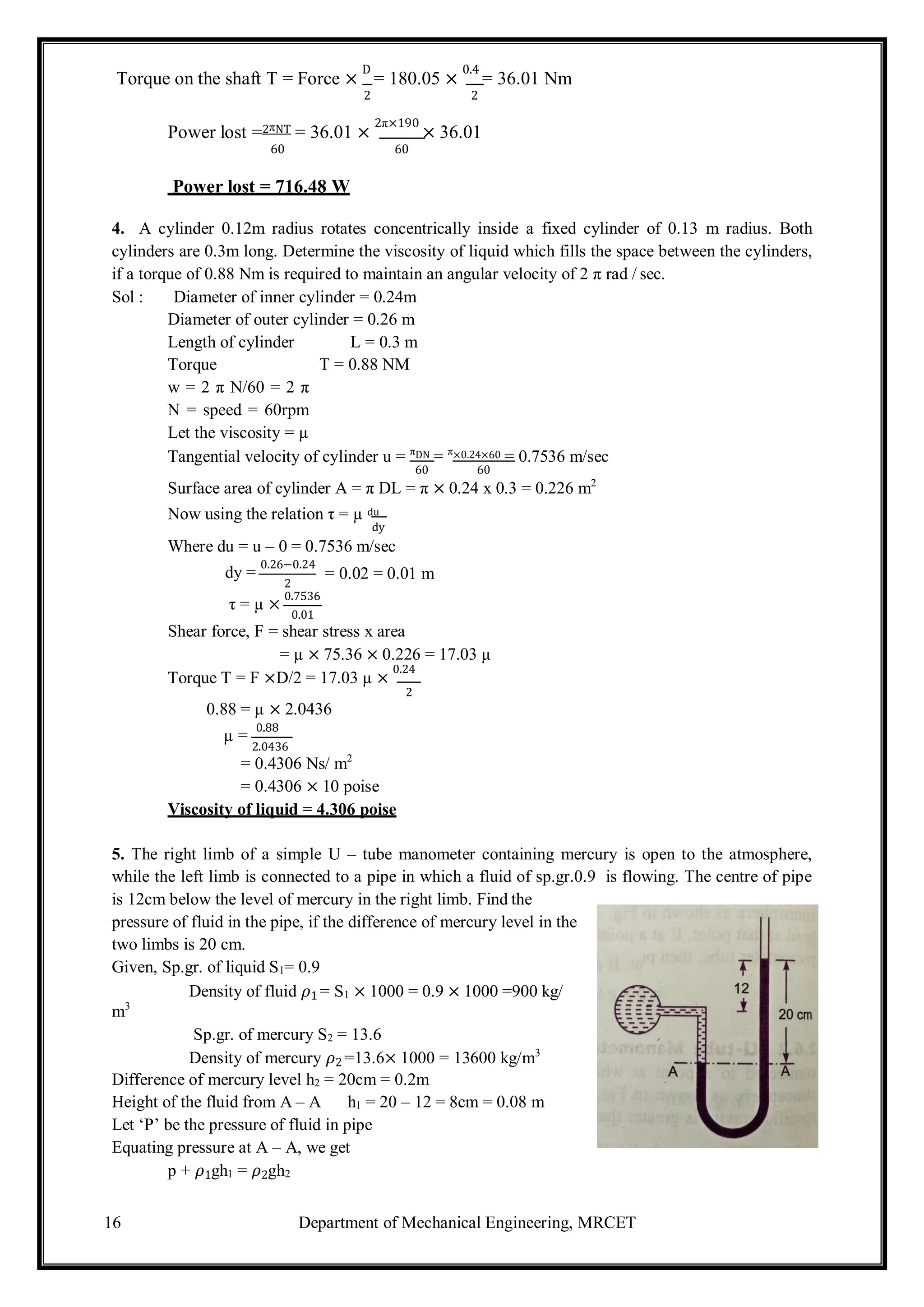
5. The right limb of a simple U – tube manometer containing mercury is open to the atmosphere,
while the left limb is connected to a pipe in which a fluid of sp.gr.0.9 is flowing. The centre of pipe
is 12cm below the level of mercury in the right limb. Find the
pressure of fluid in the pipe, if the difference of mercury level in the
two limbs is 20 cm.
Given, Sp.gr. of liquid S1= 0.9
Density of fluid 𝜌1 = S1 × 1000 = 0.9 × 1000 =900 kg/
m3
Sp.gr. of mercury S2 = 13.6
Density of mercury 𝜌2 =13.6× 1000 = 13600 kg/m3
Difference of mercury level h2 = 20cm = 0.2m
Height of the fluid from A – A h1 = 20 – 12 = 8cm = 0.08 m
Let ‘P’ be the pressure of fluid in pipe
Equating pressure at A – A, we get
p + 𝜌1gh1 = 𝜌2gh2
17 Department of Mechanical Engineering, MRCET
p + 900 × 9.81 × 0.08 = 13.6 × 1000 × 9.81 × 0.2
p = 13.6 × 1000 × 9.81 × 0.2 – 900 × 9.81 × 0.08
p = 26683 – 706
p = 25977 N/m2
p = 2.597 N/cm2
Pressure of fluid = 2.597 N/ cm2
6. A simple U – tube manometer containing mercury is connected to a pipe in which a fluid of sp.gr.
0.8 And having vacuum pressure is flowing. The other end of the manometer is open to atmosphere.
Find the vacuum pressure in pipe, if the difference of mercury level in the two limbs is 40cm. and the
height of the fluid in the left tube from the centre of pipe is 15cm below.
Given,
Sp.gr of fluid S1 = 0.8
Sp.gr. of mercury S2 = 13.6
Density of the fluid = S1 × 1000 = 0.8 × 1000 = 800
Density of mercury = 13.6 × 1000
Difference of mercury level h2 = 40cm = 0.4m
Height of the liquid in the left limb = 15cm =0.15m
Let the pressure in the pipe = p
Equating pressures above datum line A-- A
𝜌2gh2 + 𝜌1gh1 + P = 0
P = - [𝜌2gh2 + 𝜌1gh1]
= - [13.6 ×1000 × 9.81 × 0.4 + 800 × 9.81 × 0.15]
= 53366.4 + 1177.2
= -54543.6 N/m2
P = - 5.454 N/cm2
7. What are the gauge pressure and absolute pressure at a point 3m below the surface of a liquid
having a density of 1.53 x 10³
kg/m3
? If the atmospheric pressure is equivalent to 750mm of mercury.
The specific gravity of mercury is 13.6 and density of water 1000 kg/m3
Given:
Depth of the liquid, z1 = 3m
Density of liquid 𝜌1= 1.53 × 10³
kg/ m3
Atmospheric pressure head z0 = 750 mm of mercury = 750
1000
= 0.75m of Hg
Atmospheric pressure patm = 𝜌0 × g × z0
Where 𝜌0 = density of Hg = sp.gr. of mercury x density of water
= 13.6 × 1000 kg/ m3
And z0 = pressure head in terms of mercury = 0.75m of Hg
Patm = (13.6 × 1000) × 9.81 × 0.75 N/m2
= 100062 N/ m2
Pressure at a point, which is at a depth of 3m from the free surface of the liquid is
P = 𝜌1 × g × z1 =1.53× 103
× 9.81 × 3
Gauge pressure P = 45028 N/ m2
18 Department of Mechanical Engineering, MRCET
Absolute Pressure = Gauge pressure + Atmospheric pressure
= 45028 + 100062
Absolute Pressure = 145090 N/m2
8. A single column manometer is connected to the pipe containing liquid of sp.gr.0.9. Find the
pressure in the pipe if the area of the reservoir is 100 times the area of the tube of manometer. sp.gr.
of mercury is 13.6. Height of the liquid from the centre of pipe is 20cm and difference in level of
mercury is 40cm.
Given,
Sp.gr. of liquid in pipe S1 = 0.9
Density 𝜌1= 900 kg/ m3
Sp.gr. of heavy liquid S2 = 13.6
Density 𝜌2= 13600
Area of reservoir
Area of right limb
=
A
= 100
a
Height of the liquid h1 = 20cm = 0.2m
Rise of mercury in the right limb h2 = 40cm = 0.4m
Pressure in pipe A
p = A × h [𝜌 g - 𝜌 g] h 𝜌 g - h 𝜌 g
A a 2 2 1 + 2 2 1 1
=
1
100
× 0.4 [13600 × 9.81 – 900 x 9.81] + 0.4 × 13600 × 9.81 – 0.2 × 900 × 9.81
= 0.4 [133416 – 8829] + 53366.4 – 1765.8
100
= 533.664 + 53366.4 – 1765.8
= 52134 N/m2
Pressure in pipe A= 5.21 N/ cm2
9. A pipe contains an oil of sp.gr.0.9. A differential manometer is connected at the two points A and
B shows a difference in mercury level at 15cm. find the difference of pressure at the two points.
Given: Sp.gr. of oil S1 = 0.9: density 𝜌1= 0.9 x 1000 = 900 kg/ m3
Difference of level in the mercury h = 15cm = 0.15 m
Sp.gr. of mercury = 13.6, Density = 13.6 × 1000 = 13600 kg/m3
The difference of pressure pA – pB = g × h × (𝜌𝑔 - 𝜌1)
= 9.81 x 0.15 (13600 – 900)
pA – pB = 18688 N/ m2
10. A differential manometer is connected at two points A and B .At B
air pressure is 9.81 N/cm2
. Find absolute pressure at A.
Density of air = 0.9 × 1000 = 900 kg/m3
Density of mercury = 13.6 × 10³
kg/ m3
19 Department of Mechanical Engineering, MRCET
Let pressure at A is pA
Taking datum as X – X
Pressure above X – X in the right limb
= 1000 × 9.81 × 0.6 + pB = 5886 + 98100 = 103986
Pressure above X – X in the left limb
= 13.6 × 103
× 9.81 × 0.1 +0900 × 9.81 × 0.2 + pA
= 13341.6 +1765.8 +pA
Equating the two pressures heads
103986 = 13341.6 + 1765.8 + pA
= 15107.4 + pA
pA = 103986 – 15107.4
= 88878.6 N/m2
pA = 8.887 N/cm2
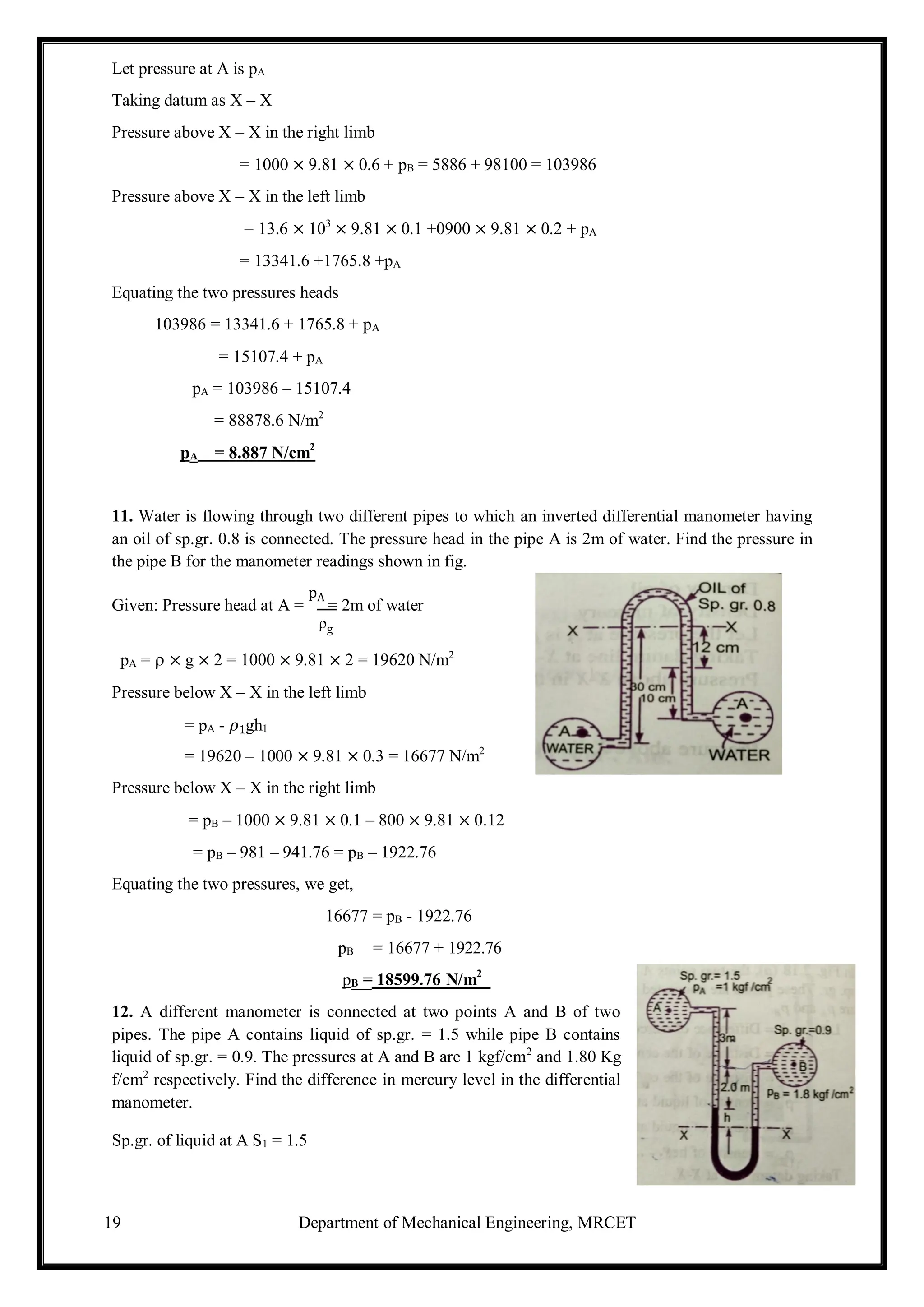
11. Water is flowing through two different pipes to which an inverted differential manometer having
an oil of sp.gr. 0.8 is connected. The pressure head in the pipe A is 2m of water. Find the pressure in
the pipe B for the manometer readings shown in fig.
Given: Pressure head at A =
pA
= 2m of water
ρg
pA = ρ × g × 2 = 1000 × 9.81 × 2 = 19620 N/m2
Pressure below X – X in the left limb
= pA - 𝜌1gh1
= 19620 – 1000 × 9.81 × 0.3 = 16677 N/m2
Pressure below X – X in the right limb
= pB – 1000 × 9.81 × 0.1 – 800 × 9.81 × 0.12
= pB – 981 – 941.76 = pB – 1922.76
Equating the two pressures, we get,
16677 = pB - 1922.76
pB = 16677 + 1922.76
pB = 18599.76 N/m2
12. A different manometer is connected at two points A and B of two
pipes. The pipe A contains liquid of sp.gr. = 1.5 while pipe B contains
liquid of sp.gr. = 0.9. The pressures at A and B are 1 kgf/cm2
and 1.80 Kg
f/cm2
respectively. Find the difference in mercury level in the differential
manometer.
Sp.gr. of liquid at A S1 = 1.5
20 Department of Mechanical Engineering, MRCET
Sp.gr. of liquid at B S2 == 0.9
Pressure at A pA= 1 kgf/c m2
= 1 × 10⁴
× kg/m2
= 1 × 104
× 9.81N/m2
Pressure at B pB = 1.8 kgf/cm2 =
1.8 × 104
× 9.81 N/m2
[1kgf = 9.81 N]
Density of mercury = 13.6 × 1000 kg/m3
Taking X – X as datum line
Pressure above X – X in left limb
= 13.6 × 1000 × 9.81 × h + 1500 × 9.81(2+3) + (9.81 x 10⁴
)
Pressure above X – X in the right limb = 900 × 9.81(h + 2) + 1.8 × 9.81 × 104
Equating the two pressures, we get
13.6 × 1000 × 9.81h + 1500 × 9.81 × 5 + 9.81 × 104
= 900 × 9.81(h + 2) + 1.8 × 9.81 × 104
Dividing both sides by 1000 × 9.81
13.6 h + 7.5 +10 = 0.9(h+2) + 18
(13.6 – 0.9)h = 1.8 + 18 – 17.5 = 19.8 – 17.5 =2.3
h =
2.3
12.7
= 0.181m
h = 18.1 cm
Department of Mechanical Engineering, MRCET
UNIT-2
FLUID KINEMATICS
Kinematics is defined as a branch of science which deals with motion of particles without
considering the forces causing the motion. The velocity at any point in a flow field at any
time is studied in this. Once the velocity is known, then the pressure distribution and hence
the forces acting on the fluid can be determined.
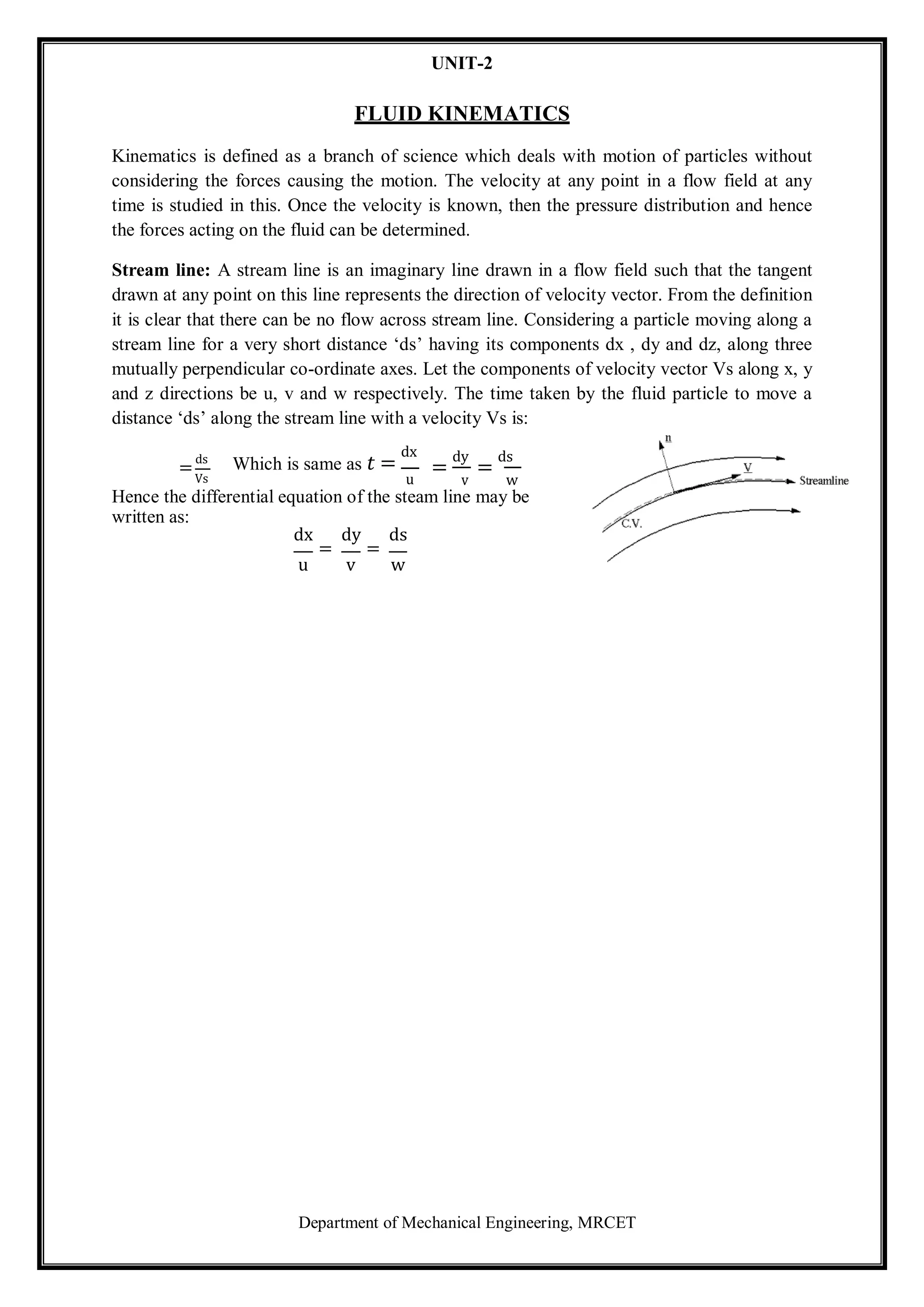
Stream line: A stream line is an imaginary line drawn in a flow field such that the tangent
drawn at any point on this line represents the direction of velocity vector. From the definition
it is clear that there can be no flow across stream line. Considering a particle moving along a
stream line for a very short distance ‘ds’ having its components dx , dy and dz, along three
mutually perpendicular co-ordinate axes. Let the components of velocity vector Vs along x, y
and z directions be u, v and w respectively. The time taken by the fluid particle to move a
distance ‘ds’ along the stream line with a velocity Vs is:
=
ds
Vs
Which is same as 𝑡 =
dx
u
=
dy
v
=
ds
w
Hence the differential equation of the steam line may be
written as:
dx dy ds
= =
u v w
Department of Mechanical Engineering, MRCET
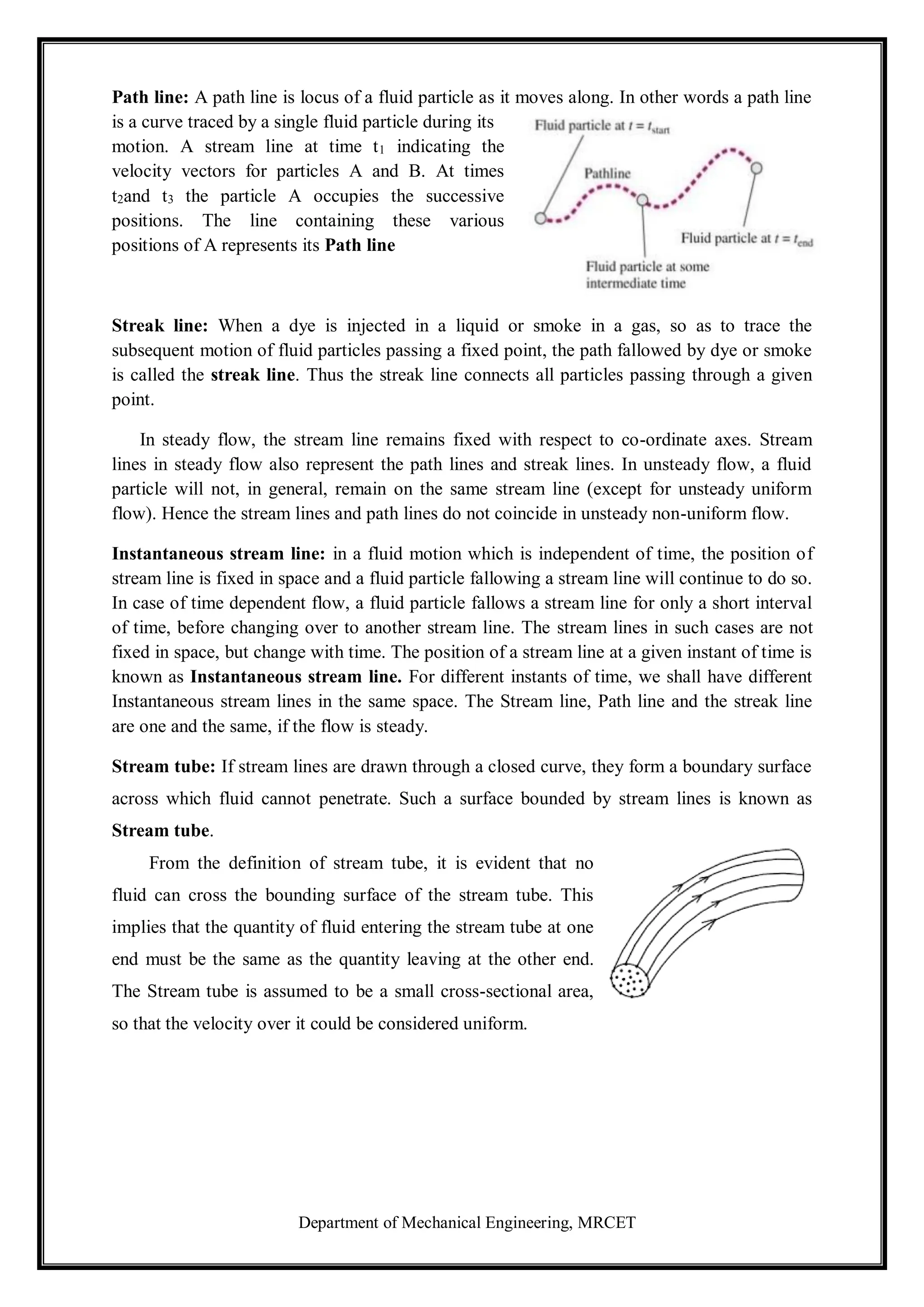
Path line: A path line is locus of a fluid particle as it moves along. In other words a path line
is a curve traced by a single fluid particle during its
motion. A stream line at time t1 indicating the
velocity vectors for particles A and B. At times
t2and t3 the particle A occupies the successive
positions. The line containing these various
positions of A represents its Path line
Streak line: When a dye is injected in a liquid or smoke in a gas, so as to trace the
subsequent motion of fluid particles passing a fixed point, the path fallowed by dye or smoke
is called the streak line. Thus the streak line connects all particles passing through a given
point.
In steady flow, the stream line remains fixed with respect to co-ordinate axes. Stream
lines in steady flow also represent the path lines and streak lines. In unsteady flow, a fluid
particle will not, in general, remain on the same stream line (except for unsteady uniform
flow). Hence the stream lines and path lines do not coincide in unsteady non-uniform flow.
Instantaneous stream line: in a fluid motion which is independent of time, the position of
stream line is fixed in space and a fluid particle fallowing a stream line will continue to do so.
In case of time dependent flow, a fluid particle fallows a stream line for only a short interval
of time, before changing over to another stream line. The stream lines in such cases are not
fixed in space, but change with time. The position of a stream line at a given instant of time is
known as Instantaneous stream line. For different instants of time, we shall have different
Instantaneous stream lines in the same space. The Stream line, Path line and the streak line
are one and the same, if the flow is steady.
Stream tube: If stream lines are drawn through a closed curve, they form a boundary surface
across which fluid cannot penetrate. Such a surface bounded by stream lines is known as
Stream tube.
From the definition of stream tube, it is evident that no
fluid can cross the bounding surface of the stream tube. This
implies that the quantity of fluid entering the stream tube at one
end must be the same as the quantity leaving at the other end.
The Stream tube is assumed to be a small cross-sectional area,
so that the velocity over it could be considered uniform.
Department of Mechanical Engineering, MRCET
CLASSIFICATION OF FLOWS
The fluid flow is classified as:
i) Steady and unsteady flows.
ii) Uniform and Non-uniform flows.
iii) Laminar and Turbulent flows.
iv) Compressible and incompressible flows.
v) Rotational and Ir-rotational flows.
vi) One, two and three dimensional flows.
i) Steady and Un-steady flows: Steady flow is defined as the flow in which the fluid
characteristics like velocity, pressure, density etc. at a point do not change with time.
Thus for a steady flow, we have
∂V ∂p ∂ρ
∂t x,y,z
= 0,
∂t x,y,z
= 0, = 0
∂t x,y,z
Un-Steady flow is the flow in which the velocity, pressure, density at a point changes
with respect to time. Thus for un-steady flow, we have
∂V ∂p ∂ρ
∂t x,y,z
≠ 0,
∂t x,y,z
≠ 0, ≠ 0
∂t x,y,z
ii) Uniform and Non-uniform flows:
Uniform flow is defined as the flow in which the velocity at any given time does not
change with respect to space. ( i.e. the length of direction of flow )
For uniform flow
∂V
= 0
∂s t=const
Where 𝜕𝑉 = Change of velocity
𝜕s = Length of flow in the direction of – S
Non-uniform is the flow in which the velocity at any given time changes with respect to
space.
For Non-uniform flow
∂V
≠ 0
∂s t=const
iii) Laminar and turbulent flow:
Laminar flow is defined as the flow in which the fluid particles move along well-defined
paths or stream line and all the stream lines are straight and parallel. Thus the particles move
in laminas or layers gliding smoothly over the adjacent layer. This type of flow is also called
streamline flow or viscous flow.
Turbulent flow is the flow in which the fluid particles move in a zigzag way. Due to the
movement of fluid particles in a zigzag way, the eddies formation takes place, which are
responsible for high energy loss. For a pipe flow, the type of flow is determined by a non-
Dimensional number
VD
called the Reynolds number.
𝑣
Where D = Diameter of pipe.
V = Mean velocity of flow in pipe.
Department of Mechanical Engineering, MRCET
𝑣 = Kinematic viscosity of fluid.
If the Reynolds number is lessthan2000, the flow is called Laminar flow.
If the Reynolds number is more than 4000, it is called Turbulent flow.
If the Reynolds number is between 2000 and 4000 the flow may be Laminar or Turbulent
flow.
iv) Compressible and Incompressible flows:
Compressible flow is the flow in which the density of fluid changes from point to point or in
other words the density is not constant for the fluid.
For compressible flow ρ ≠ Constant.
In compressible flow is the flow in which the density is constant for the fluid flow. Liquids
are generally incompressible, while the gases are compressible.
For incompressible flow ρ = Constant.
v) Rotational and Irrotational flows:
Rotational flow is a type of flow in which the fluid particles while flowing along stream
lines also rotate about their own axis. And if the fluid particles, while flowing along stream
lines, do not rotate about their own axis, the flow is called Ir-rotational flow.
vi) One, Two and Three – dimensional flows:
One dimensional flow is a type of flow in which flow parameter such as velocity is a
function of time and one space co-ordinate only, say ‘x’. For a steady one- dimensional flow,
the velocity is a function of one space co-ordinate only. The variation of velocities in other
two mutually perpendicular directions is assumed negligible.
Hence for one dimensional flow u = f(x), v = 0 and w = 0
Where u, v and w are velocity components in x, y and z directions respectively.
Two – dimensional flow is the type of flow in which the velocity is a function of time and
two space co-ordinates, say x and y. For a steady two-dimensional flow the velocity is a
function of two space co-ordinates only. The variation of velocity in the third direction is
negligible.
Thus for two dimensional flow u = f1 (x, y), v = f2 (x, y) and w = 0.
Three – dimensional flow is the type of flow in which the velocity is a function of time and
three mutually perpendicular directions. But for a steady three-dimensional flow, the fluid
parameters are functions of three space co-ordinates (x, y, and z) only.
Thus for three- dimensional flow u = f1 (x, y, z), v = f2 (x, y, z), z = f3 (x, y, z).
Department of Mechanical Engineering, MRCET
Rate of flow or Discharge (Q)
It is defined as the quantity of a fluid flowing per second through a section of pipe or channel.
For an incompressible fluid (or liquid) the rate of flow or discharge is expressed as the
volume of the liquid flowing cross the section per second. or compressible fluids, the rate of
flow is usually expressed as the weight of fluid flowing across the section.
Thus i) For liquids the unit of Q is m3
/sec or Litres/sec. Ii)
For gases the unit of Q is Kg f/sec or Newton/sec.
The discharge Q = A×V
Where, A = Area of cross-section of pipe.
V= Average velocity of fluid across the section.
CONTINUITY EQUATION
The equation based on the principle of conservation of mass is called Continuity equation.
Thus for a fluid flowing through the pipe at all cross- sections, the quantity of fluid per
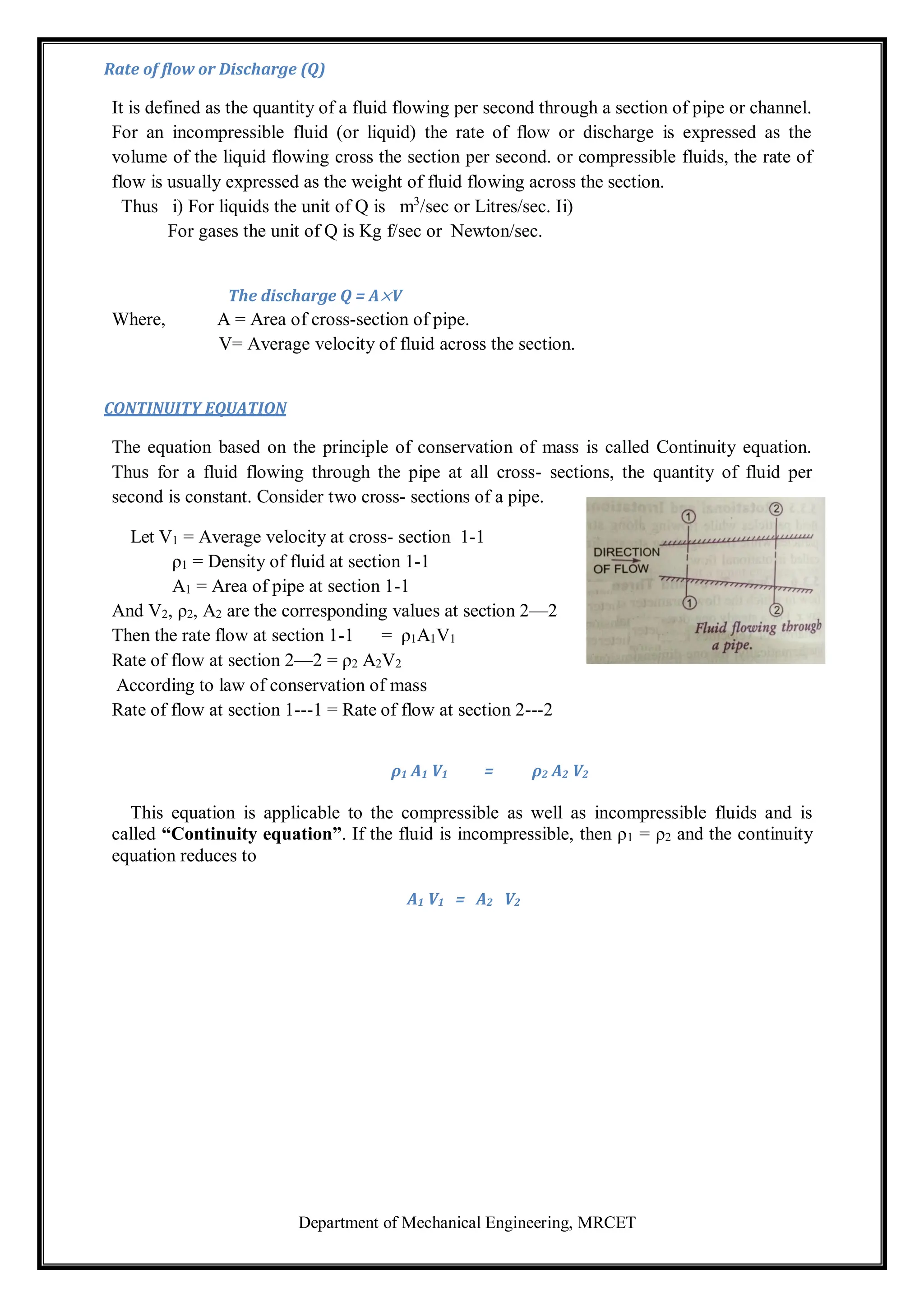
second is constant. Consider two cross- sections of a pipe.
Let V1 = Average velocity at cross- section 1-1
ρ1 = Density of fluid at section 1-1
A1 = Area of pipe at section 1-1
And V2, ρ2, A2 are the corresponding values at section 2—2
Then the rate flow at section 1-1 = ρ1A1V1
Rate of flow at section 2—2 = ρ2 A2V2
According to law of conservation of mass
Rate of flow at section 1---1 = Rate of flow at section 2---2
ρ1 A1 V1 = ρ2 A2 V2
This equation is applicable to the compressible as well as incompressible fluids and is
called “Continuity equation”. If the fluid is incompressible, then ρ1 = ρ2 and the continuity
equation reduces to
A1 V1 = A2 V2
Department of Mechanical Engineering, MRCET
CONTINUITY EQUATION IN THREE DIMENSIONAL FLOW
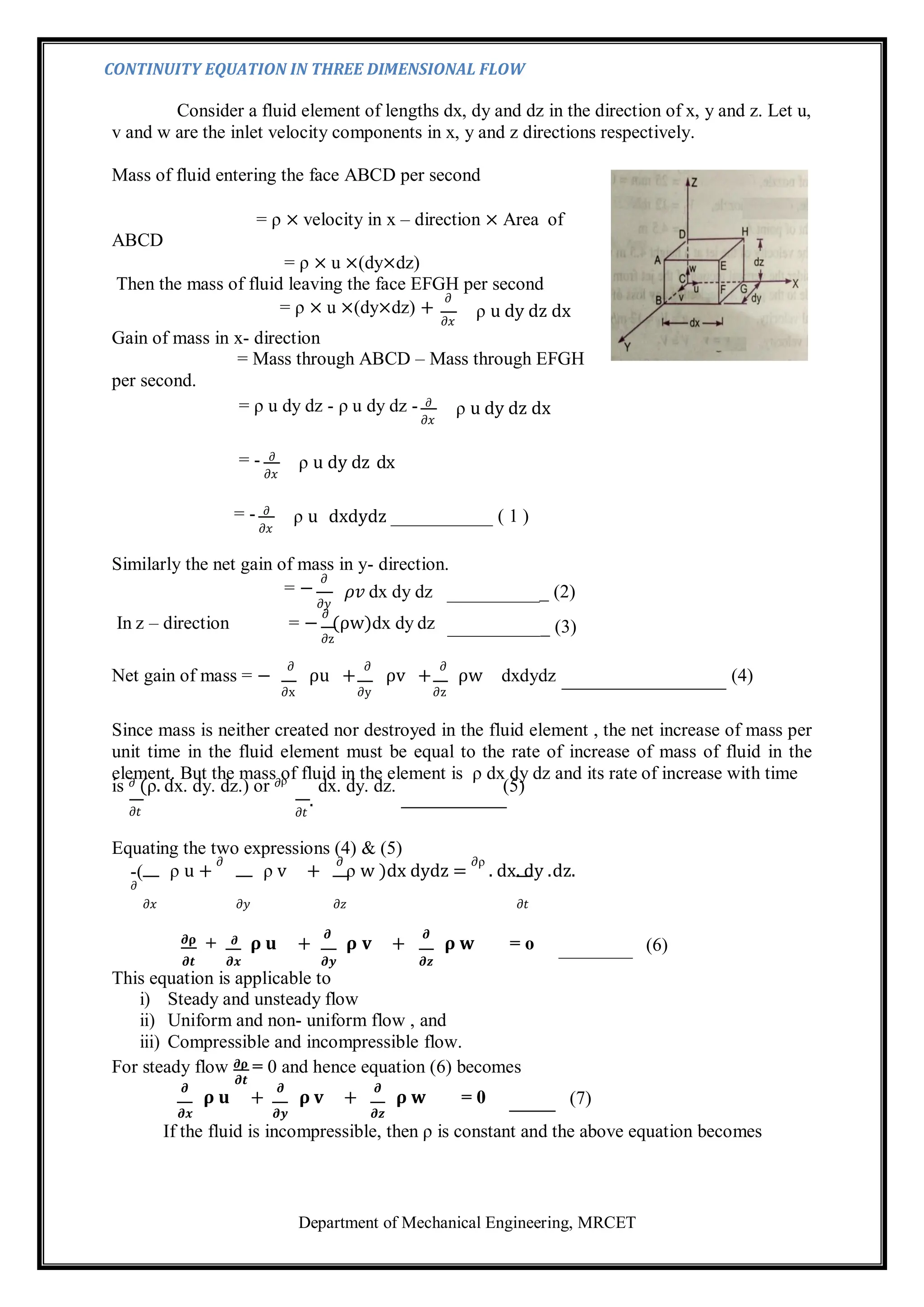
Consider a fluid element of lengths dx, dy and dz in the direction of x, y and z. Let u,
v and w are the inlet velocity components in x, y and z directions respectively.
Mass of fluid entering the face ABCD per second
ABCD
= ρ × velocity in x – direction × Area of
= ρ × u ×(dy×dz)
Then the mass of fluid leaving the face EFGH per second
= ρ × u ×(dy×dz) +
𝜕
𝜕𝑥
ρ u dy dz dx
Gain of mass in x- direction
= Mass through ABCD – Mass through EFGH
per second.
= ρ u dy dz - ρ u dy dz - 𝜕
𝜕𝑥
ρ u dy dz dx
= - 𝜕
𝜕𝑥
= - 𝜕
𝜕𝑥
ρ u dy dz dx
ρ u dxdydz ( 1 )
Similarly the net gain of mass in y- direction.
= −
𝜕
𝜕𝑦
𝜌𝑣 dx dy dz _ (2)
In z – direction = −
∂
(ρw)dx dy dz
∂z
_ (3)
Net gain of mass = −
∂
ρu +
∂
ρv +
∂
ρw dxdydz (4)
∂x ∂y ∂z
Since mass is neither created nor destroyed in the fluid element , the net increase of mass per
unit time in the fluid element must be equal to the rate of increase of mass of fluid in the
element. But the mass of fluid in the element is ρ dx dy dz and its rate of increase with time
is 𝜕 (ρ. dx. dy. dz.) or 𝜕ρ
dx. dy. dz. (5)
𝜕𝑡
.
𝜕𝑡
Equating the two expressions (4) & (5)
-(
𝜕
ρ u +
𝜕
ρ v +
𝜕
ρ w )dx dydz =
𝜕ρ
. dx. dy .dz.
𝜕𝑥 𝜕𝑦 𝜕𝑧 𝜕𝑡
𝝏𝛒 + 𝝏 𝛒 𝐮 +
𝝏
𝛒 𝐯 +
𝝏
𝛒 𝐰 = o (6)
𝝏𝒕 𝝏𝒙 𝝏𝒚 𝝏𝒛
This equation is applicable to
i) Steady and unsteady flow
ii) Uniform and non- uniform flow , and
iii) Compressible and incompressible flow.
For steady flow 𝝏𝛒 = 0 and hence equation (6) becomes
𝝏𝒕
𝝏
𝛒 𝐮 +
𝝏
𝛒 𝐯 +
𝝏
𝛒 𝐰 = 0 (7)
𝝏𝒙 𝝏𝒚 𝝏𝒛
If the fluid is incompressible, then ρ is constant and the above equation becomes
Department of Mechanical Engineering, MRCET
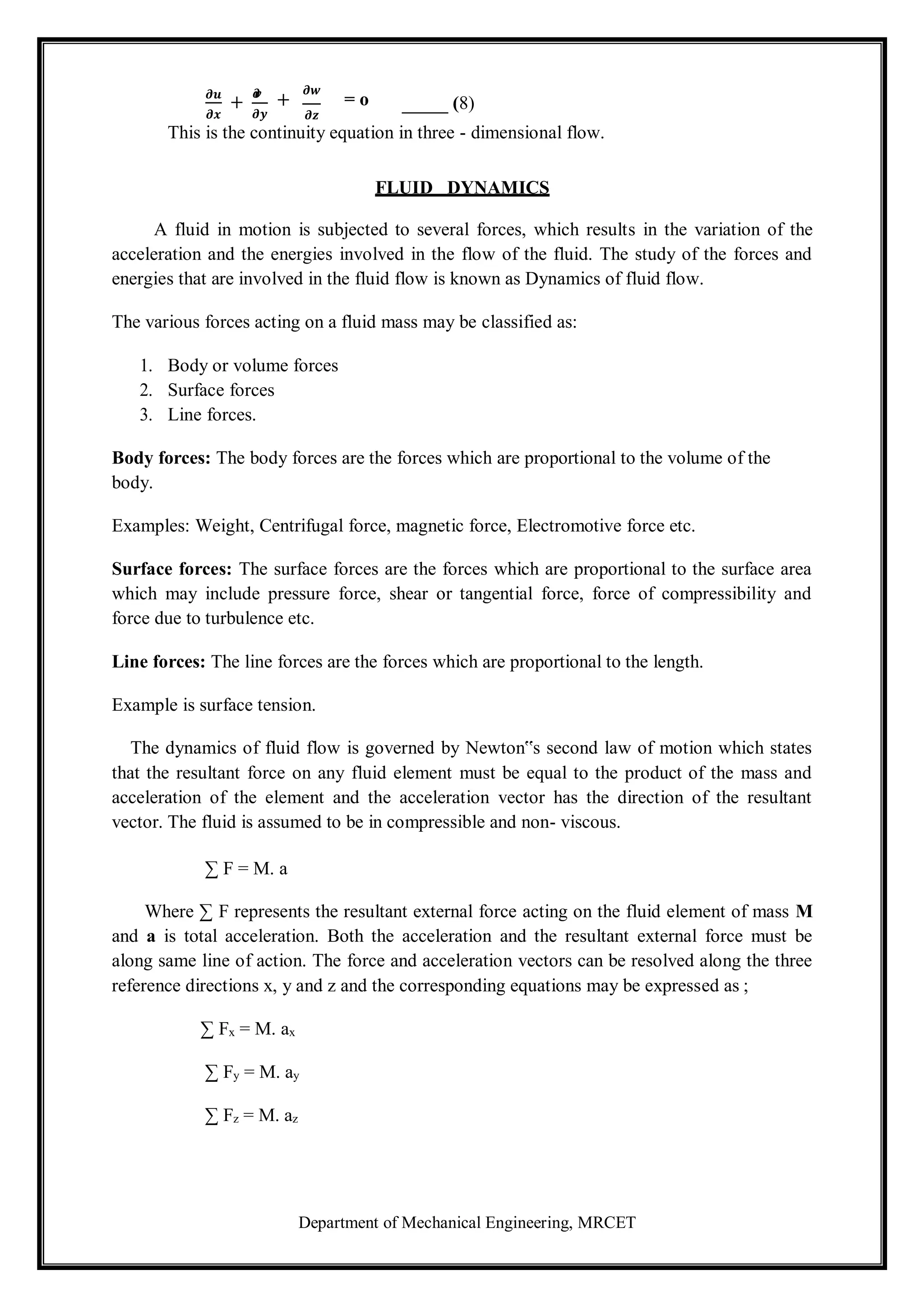
𝝏𝒖
𝝏𝒙
+
𝝏
𝒗
𝝏𝒚
+
𝝏𝒘
= o
𝝏𝒛
(8)
This is the continuity equation in three - dimensional flow.
FLUID DYNAMICS
A fluid in motion is subjected to several forces, which results in the variation of the
acceleration and the energies involved in the flow of the fluid. The study of the forces and
energies that are involved in the fluid flow is known as Dynamics of fluid flow.
The various forces acting on a fluid mass may be classified as:
1. Body or volume forces
2. Surface forces
3. Line forces.
Body forces: The body forces are the forces which are proportional to the volume of the
body.
Examples: Weight, Centrifugal force, magnetic force, Electromotive force etc.
Surface forces: The surface forces are the forces which are proportional to the surface area
which may include pressure force, shear or tangential force, force of compressibility and
force due to turbulence etc.
Line forces: The line forces are the forces which are proportional to the length.
Example is surface tension.
The dynamics of fluid flow is governed by Newton‟s second law of motion which states
that the resultant force on any fluid element must be equal to the product of the mass and
acceleration of the element and the acceleration vector has the direction of the resultant
vector. The fluid is assumed to be in compressible and non- viscous.
∑ F = M. a
Where ∑ F represents the resultant external force acting on the fluid element of mass M
and a is total acceleration. Both the acceleration and the resultant external force must be
along same line of action. The force and acceleration vectors can be resolved along the three
reference directions x, y and z and the corresponding equations may be expressed as ;
∑ Fx = M. ax
∑ Fy = M. ay
∑ Fz = M. az
Department of Mechanical Engineering, MRCET
Where ∑ Fx , ∑ Fy and ∑ Fz are the components of the resultant force in the x, y and z
directions respectively, and ax , ay and az are the components of the total acceleration in x, y
and z directions respectively.
FORCES ACTING ON FLUID IN MOTION:
The various forces that influence the motion of fluid are due to gravity, pressure,
viscosity, turbulence and compressibility.
The gravity force Fg is due to the weight of the fluid and is equal to Mg . The gravity
force per unit volume is equal to “ρ g”.
The pressure force Fp is exerted on the fluid mass, if there exists a pressure gradiant
between the two points in the direction of the flow.
The viscous force Fv is due to the viscosity of the flowing fluid and thus exists in case
of all real fluids.
The turbulent flow Ft is due to the turbulence of the fluid flow.
The compressibility force Fc is due to the elastic property of the fluid and it is important
only for compressible fluids.
If a certain mass of fluid in motion is influenced by all the above forces, then according
to Newton‟s second law of motion
The net force Fx =M. ax = (Fg )x + ( Fp )x + ( Fv )x + ( Ft )x + ( Fc )x
i) if the net force due to compressibility(Fc) is negligible, the resulting net force
Fx = (Fg) x + (Fp) x + (Fv) x + (Ft) x and the equation of motions are called
Reynolds’s equations of motion.
ii) For flow where (Ft) is negligible, the resulting equations of motion are known as
Navier – Stokes equation.
iii) If the flow is assumed to be ideal, viscous force (Fv) is zero and the equations of motion
are known as Euler’s equation of motion.
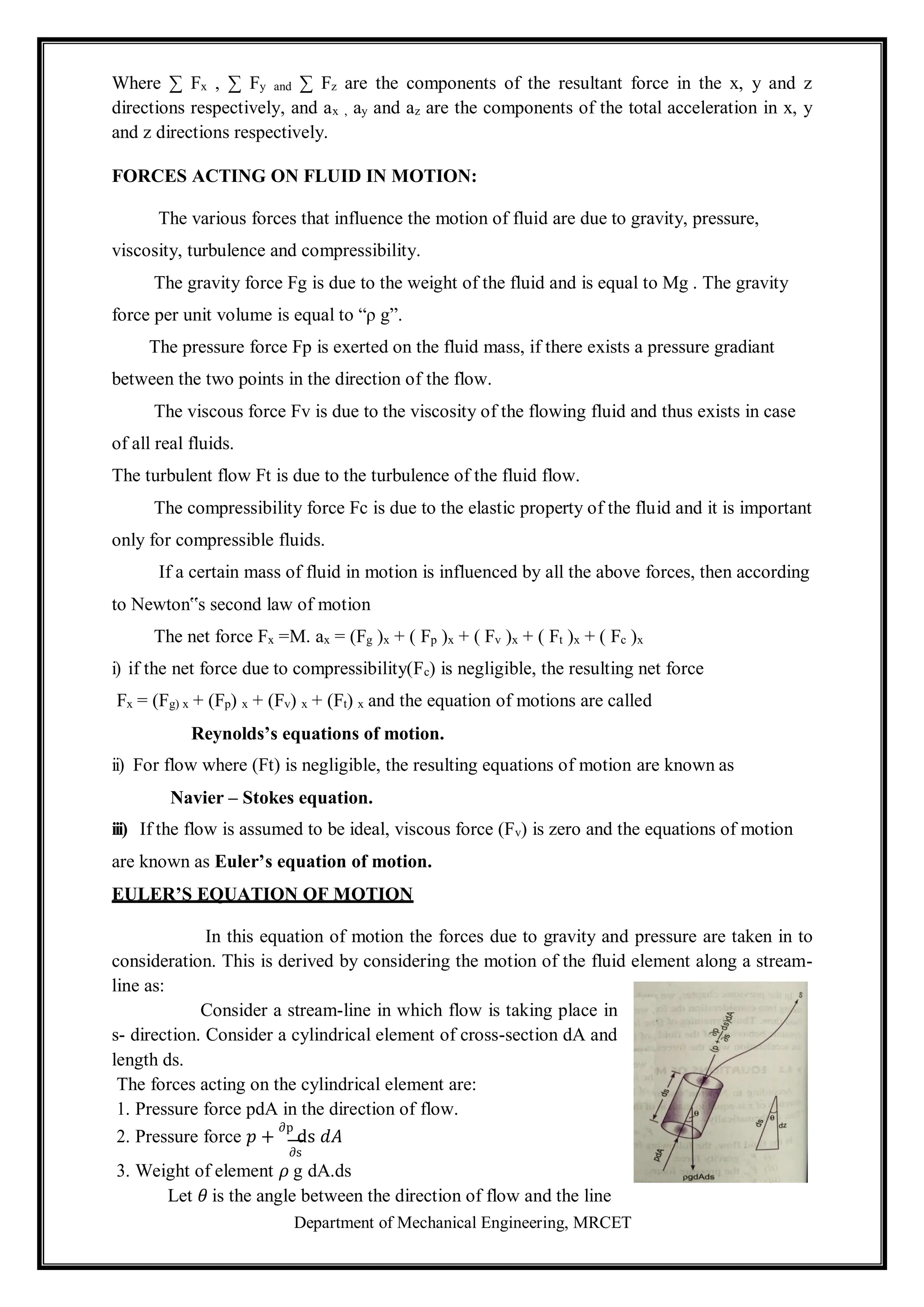
EULER’S EQUATION OF MOTION
In this equation of motion the forces due to gravity and pressure are taken in to
consideration. This is derived by considering the motion of the fluid element along a stream-
line as:
Consider a stream-line in which flow is taking place in
s- direction. Consider a cylindrical element of cross-section dA and
length ds.
The forces acting on the cylindrical element are:
1. Pressure force pdA in the direction of flow.
2. Pressure force 𝑝 +
∂p
ds 𝑑𝐴
∂s
3. Weight of element 𝜌 g dA.ds
Let 𝜃 is the angle between the direction of flow and the line
Department of Mechanical Engineering, MRCET
s
of action of the weight of the element.
The resultant force on the fluid element in the direction of S must be equal to the mass of
fluid element× acceleration in the direction of s.
𝑝𝑑𝐴 − 𝑝 +
∂p
𝑑𝑠 𝑑𝐴 − 𝜌𝑔𝑑𝐴𝑑𝑠 cosθ
∂s
= 𝜌𝑑𝐴𝑑𝑠 × 𝑎𝑠 (1)
Whereas is the acceleration in the direction of s.
Now as =
dv
dt
where „v‟ is a function of s and t.
=
𝜕𝑣 𝑑𝑠
+
𝜕𝑣
=
𝑣𝜕𝑣
+
𝜕𝑣
𝜕𝑠 𝑑𝑡 𝜕𝑡 𝜕𝑠 𝜕𝑡
If the flow is steady, then
𝜕𝑣
= 0
𝜕𝑡
a =
𝑣𝜕𝑣
𝜕𝑠
Substituting the value of as in equation (1) and simplifying, we get
−
∂p
dsdA − ρgdAds cosθ = ρdAds ×
∂v
∂s
Dividing by 𝜌 dA.ds ,
1 ∂p
− ×
ρ ∂s
1 ∂p
∂s
− g cosθ =
v ∂v
v ∂v
∂s
dz
×
ρ ∂s
+ g cosθ +
∂s
= 0 But we have cosθ =
ds
1 ∂p
×
ρ ∂s
+ g
dz
+
ds
v ∂v
= 0
∂s
𝛛𝐩
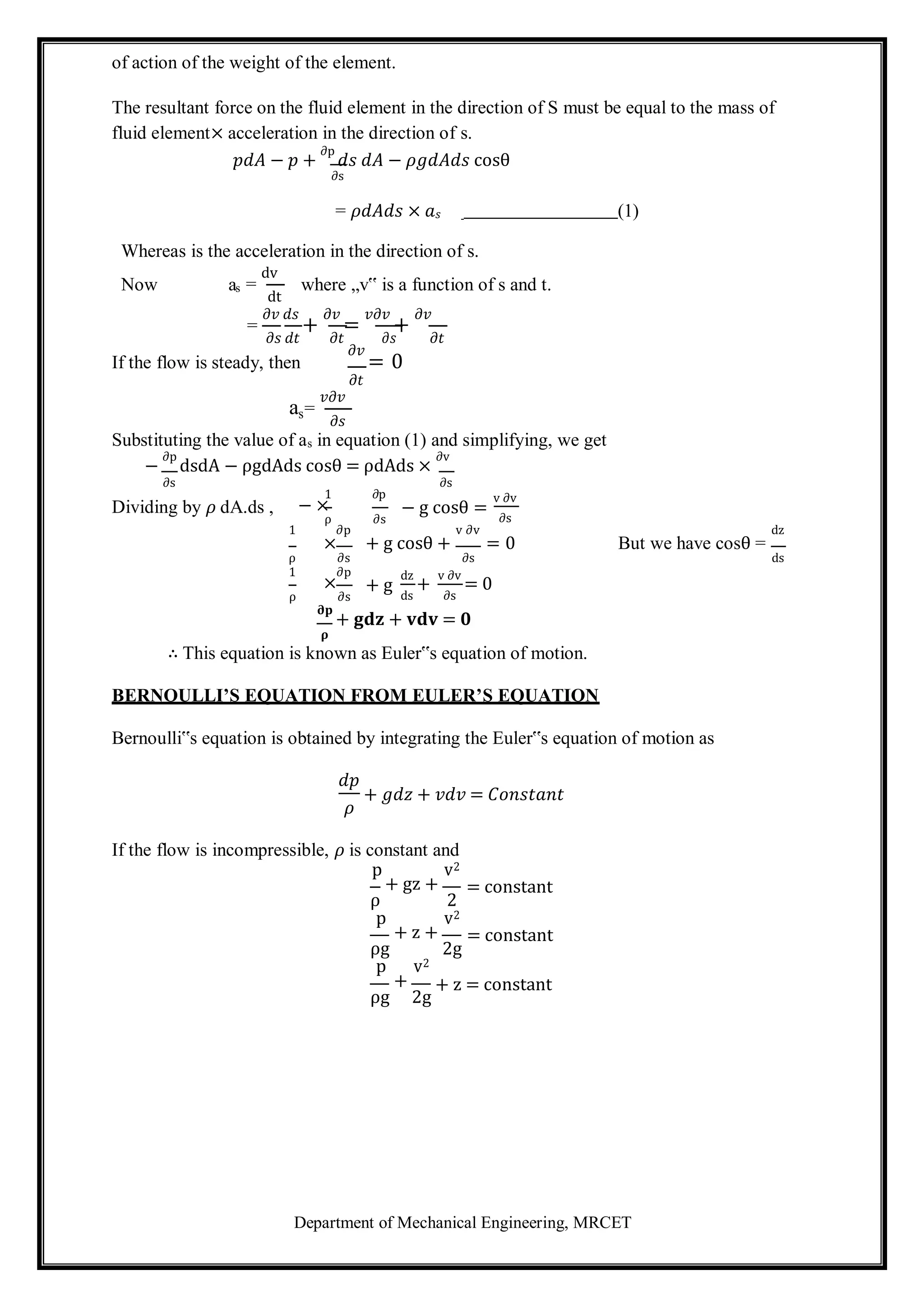
+ 𝐠𝐝𝐳 + 𝐯𝐝𝐯 = 𝟎
𝛒
∴ This equation is known as Euler‟s equation of motion.
BERNOULLI’S EQUATION FROM EULER’S EQUATION
Bernoulli‟s equation is obtained by integrating the Euler‟s equation of motion as
𝑑𝑝
𝜌
+ 𝑔𝑑𝑧 + 𝑣𝑑𝑣 = 𝐶𝑜𝑛𝑠𝑡𝑎𝑛𝑡
If the flow is incompressible, 𝜌 is constant and
p v2
+ gz +
ρ 2
= constant
p v2
+ z +
ρg 2g
p v2
= constant
+
ρg 2g
+ z = constant
Department of Mechanical Engineering, MRCET
The above equation is Bernoulli‟s equation in which
p
= Pressure energy per unit weight of fluid or pressure head.
ρg
v2
= Kinetic energy per unit weight of fluid or Kinetic head.
2g
z = Potential energy per unit weight of fluid or Potential head.
The following are the assumptions made in the derivation of Bernoulli‟s equation.
i. The fluid is ideal. i.e. Viscosity is zero.
ii. The flow is steady.
iii. The flow is incompressible.
iv. The flow is irrotational.
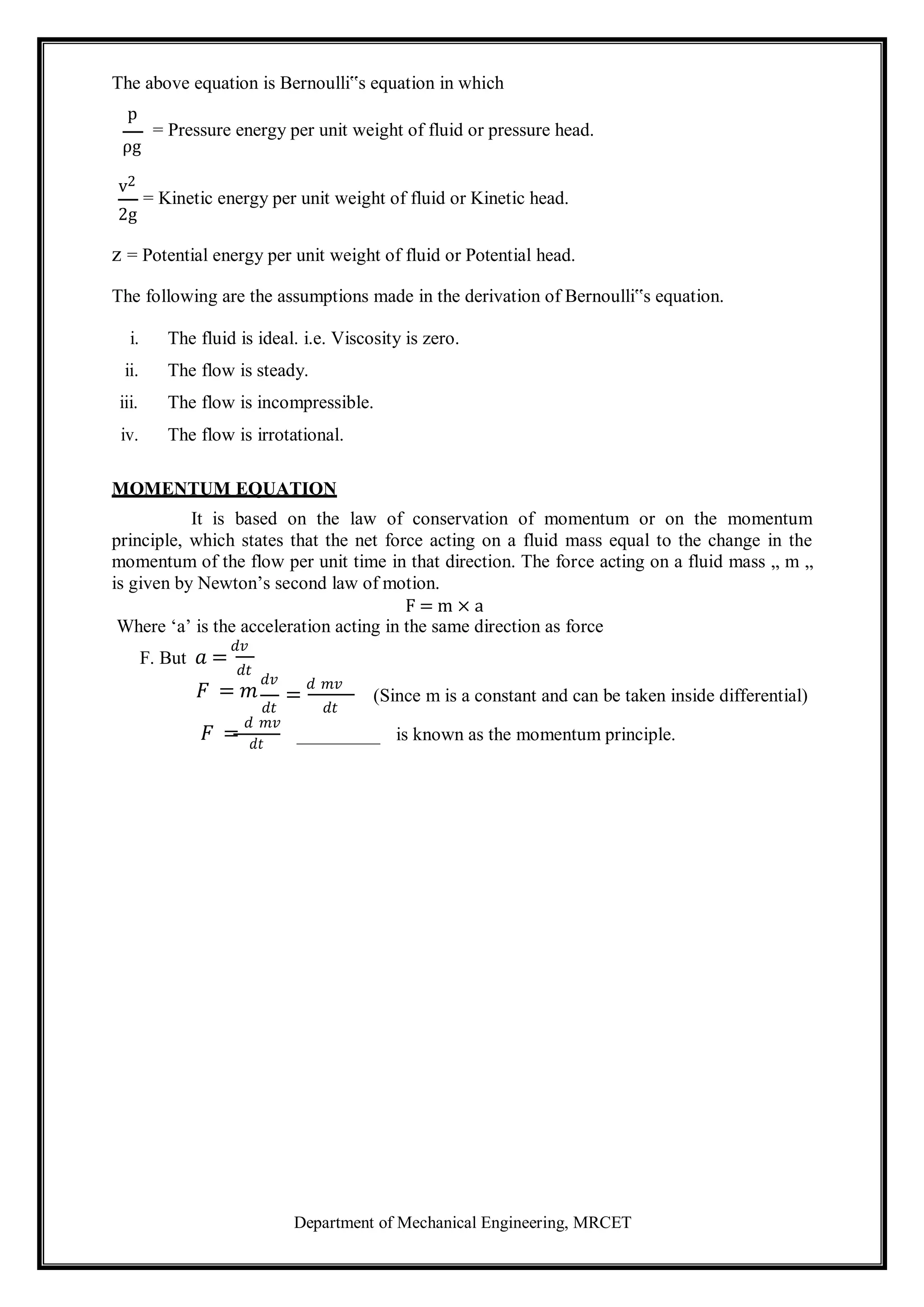
MOMENTUM EQUATION
It is based on the law of conservation of momentum or on the momentum
principle, which states that the net force acting on a fluid mass equal to the change in the
momentum of the flow per unit time in that direction. The force acting on a fluid mass „ m „
is given by Newton’s second law of motion.
F = m × a
Where ‘a’ is the acceleration acting in the same direction as force
F. But 𝑎 =
𝑑𝑣
𝑑𝑡
𝐹 = 𝑚
𝑑𝑣
𝑑𝑡
𝐹 =
𝑑 𝑚𝑣
𝑑𝑡
=
𝑑 𝑚𝑣
𝑑𝑡
(Since m is a constant and can be taken inside differential)
is known as the momentum principle.
Department of Mechanical Engineering, MRCET
F. dt = d(mv) Is known as the impulse momentum equation.
It states that the impulse of a force F acting on a fluid mass m in a short interval of time dt is
equal to the change of momentum d(m v) in the direction of force.
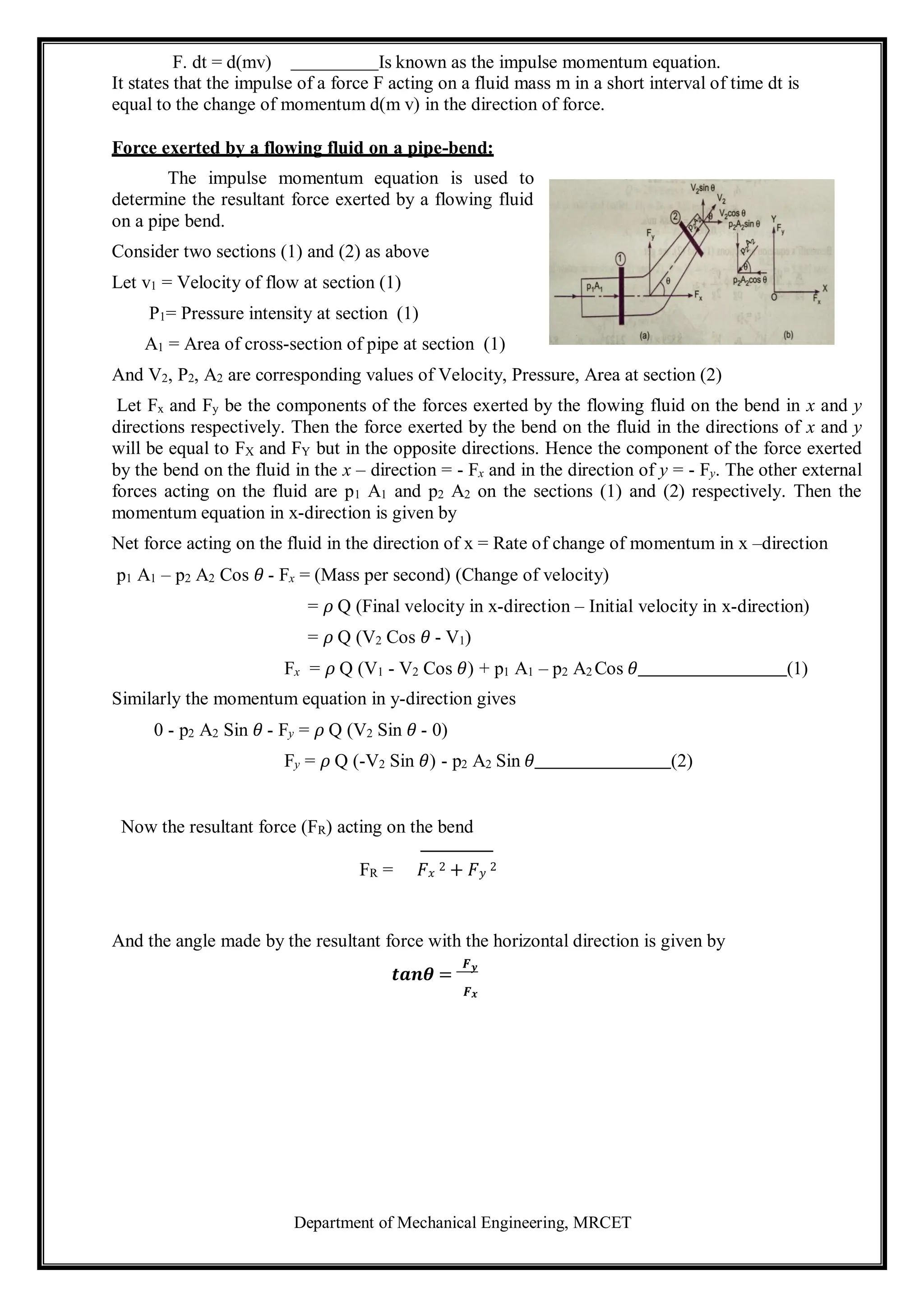
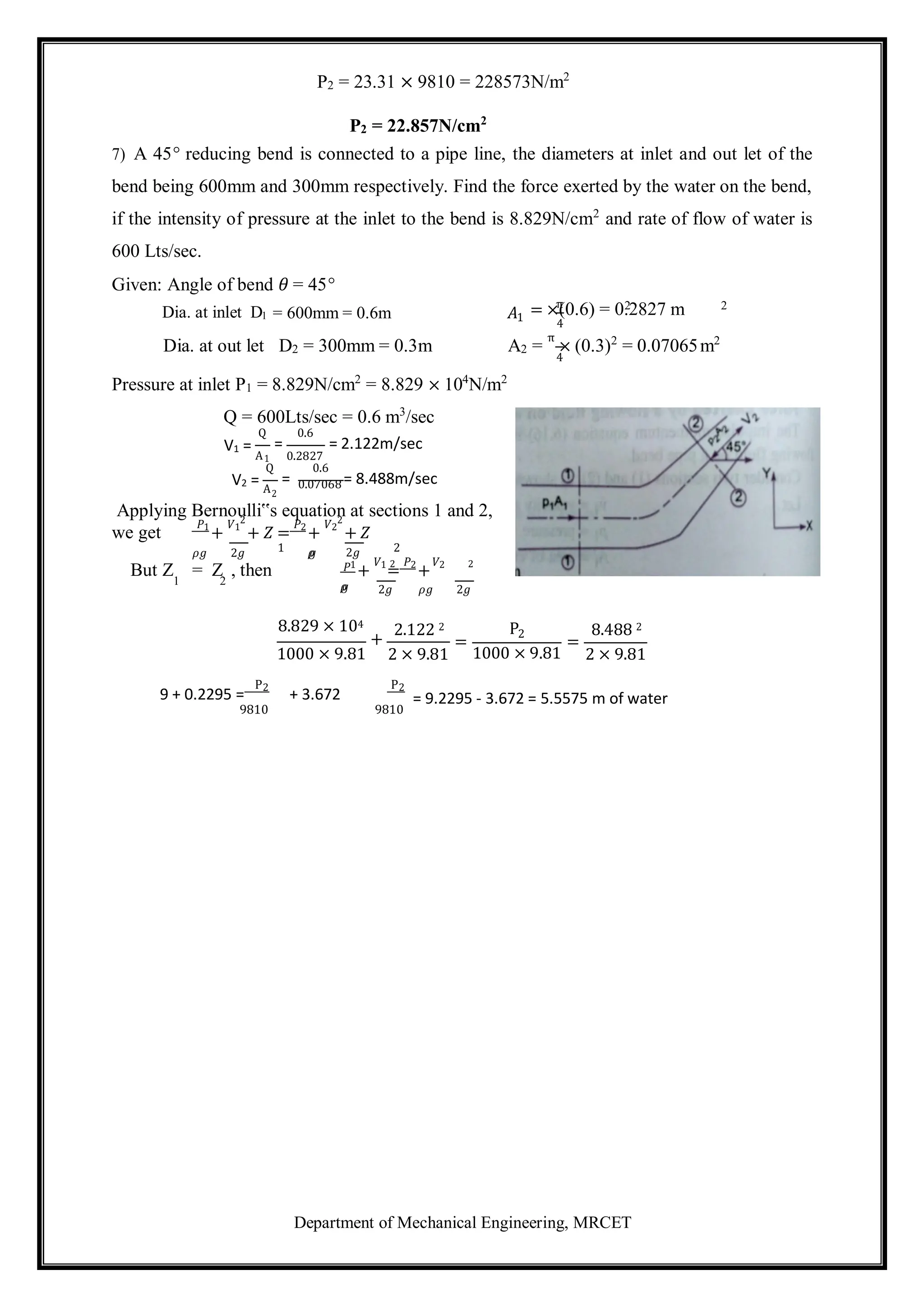
Force exerted by a flowing fluid on a pipe-bend:
The impulse momentum equation is used to
determine the resultant force exerted by a flowing fluid
on a pipe bend.
Consider two sections (1) and (2) as above
Let v1 = Velocity of flow at section (1)
P1= Pressure intensity at section (1)
A1 = Area of cross-section of pipe at section (1)
And V2, P2, A2 are corresponding values of Velocity, Pressure, Area at section (2)
Let Fx and Fy be the components of the forces exerted by the flowing fluid on the bend in x and y
directions respectively. Then the force exerted by the bend on the fluid in the directions of x and y
will be equal to FX and FY but in the opposite directions. Hence the component of the force exerted
by the bend on the fluid in the x – direction = - Fx and in the direction of y = - Fy. The other external
forces acting on the fluid are p1 A1 and p2 A2 on the sections (1) and (2) respectively. Then the
momentum equation in x-direction is given by
Net force acting on the fluid in the direction of x = Rate of change of momentum in x –direction
p1 A1 – p2 A2 Cos 𝜃 - Fx = (Mass per second) (Change of velocity)
= 𝜌 Q (Final velocity in x-direction – Initial velocity in x-direction)
= 𝜌 Q (V2 Cos 𝜃 - V1)
Fx = 𝜌 Q (V1 - V2 Cos 𝜃) + p1 A1 – p2 A2 Cos 𝜃 (1)
Similarly the momentum equation in y-direction gives
0 - p2 A2 Sin 𝜃 - Fy = 𝜌 Q (V2 Sin 𝜃 - 0)
Fy = 𝜌 Q (-V2 Sin 𝜃) - p2 A2 Sin 𝜃 (2)
Now the resultant force (FR) acting on the bend
FR = 𝐹𝑥
2 + 𝐹𝑦
2
And the angle made by the resultant force with the horizontal direction is given by
𝒕𝒂𝒏𝜽 =
𝑭𝒚
𝑭𝒙
Department of Mechanical Engineering, MRCET
PROBLEMS
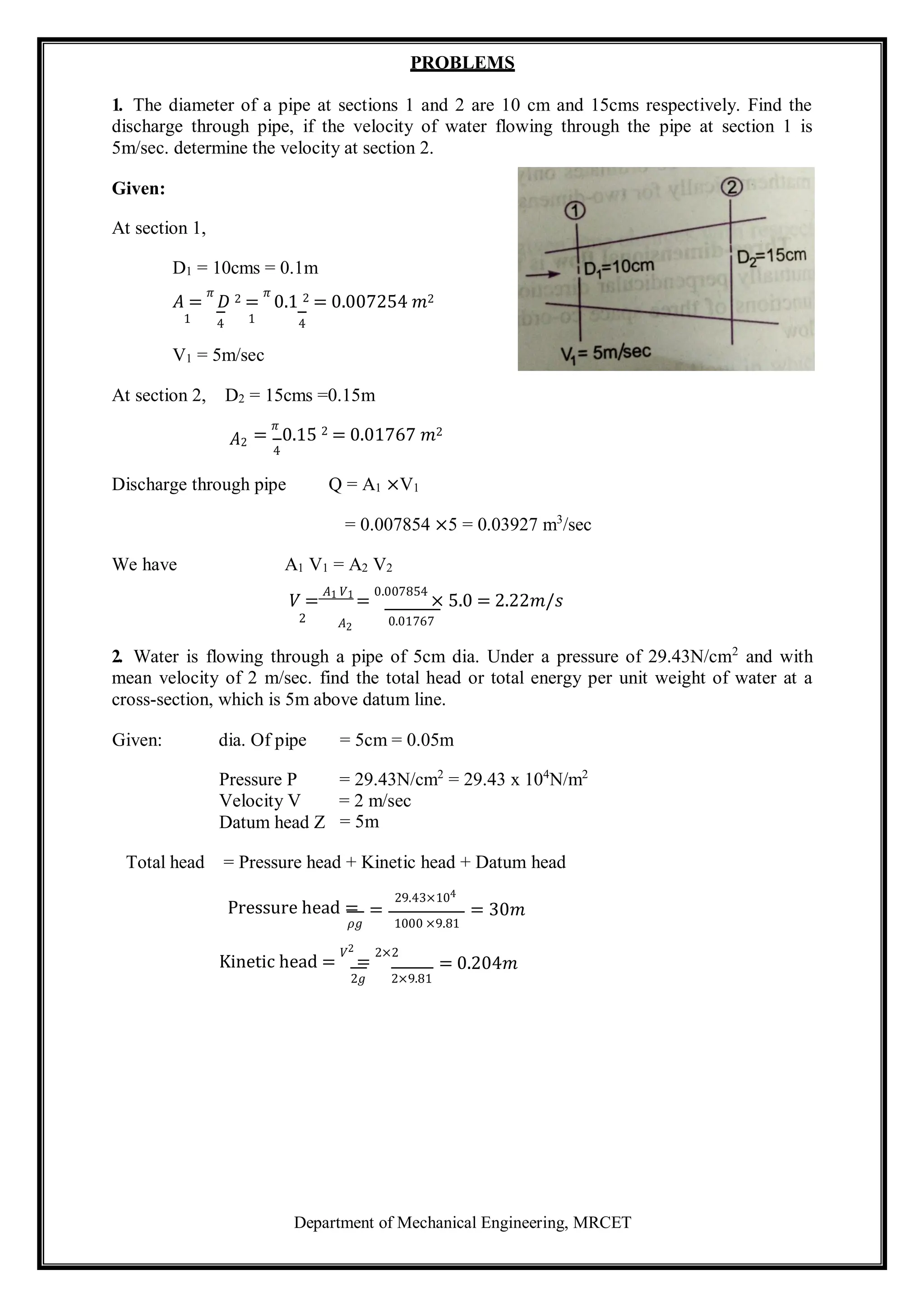
1. The diameter of a pipe at sections 1 and 2 are 10 cm and 15cms respectively. Find the
discharge through pipe, if the velocity of water flowing through the pipe at section 1 is
5m/sec. determine the velocity at section 2.
Given:
At section 1,
D1 = 10cms = 0.1m
𝐴 =
𝜋
𝐷 2 =
𝜋
0.1 2 = 0.007254 𝑚2
1 4 1 4
V1 = 5m/sec
At section 2, D2 = 15cms =0.15m
𝐴2 =
𝜋
0.15 2 = 0.01767 𝑚2
4
Discharge through pipe Q = A1 ×V1
= 0.007854 ×5 = 0.03927 m3
/sec
We have A1 V1 = A2 V2
𝑉 =
𝐴1 𝑉1
=
0.007854
× 5.0 = 2.22𝑚/𝑠
2 𝐴2 0.01767
2. Water is flowing through a pipe of 5cm dia. Under a pressure of 29.43N/cm2
and with
mean velocity of 2 m/sec. find the total head or total energy per unit weight of water at a
cross-section, which is 5m above datum line.
Given: dia. Of pipe = 5cm = 0.05m
Pressure P
Velocity V
Datum head Z
= 29.43N/cm2
= 29.43 x 10⁴
N/m2
= 2 m/sec
= 5m
Total head = Pressure head + Kinetic head + Datum head
Pressure head =
𝜌𝑔
29.43×104
= = 30𝑚
1000 ×9.81
Kinetic head =
𝑉2
=
2×2
= 0.204𝑚
2𝑔 2×9.81
Department of Mechanical Engineering, MRCET
1
2
Datum head = Z = 5m
𝑝
𝜌𝑔
+
𝑉2
+ 𝑍 = 30 + 0.204 + 5 = 35.204𝑚
2𝑔
Total head = 35.204m
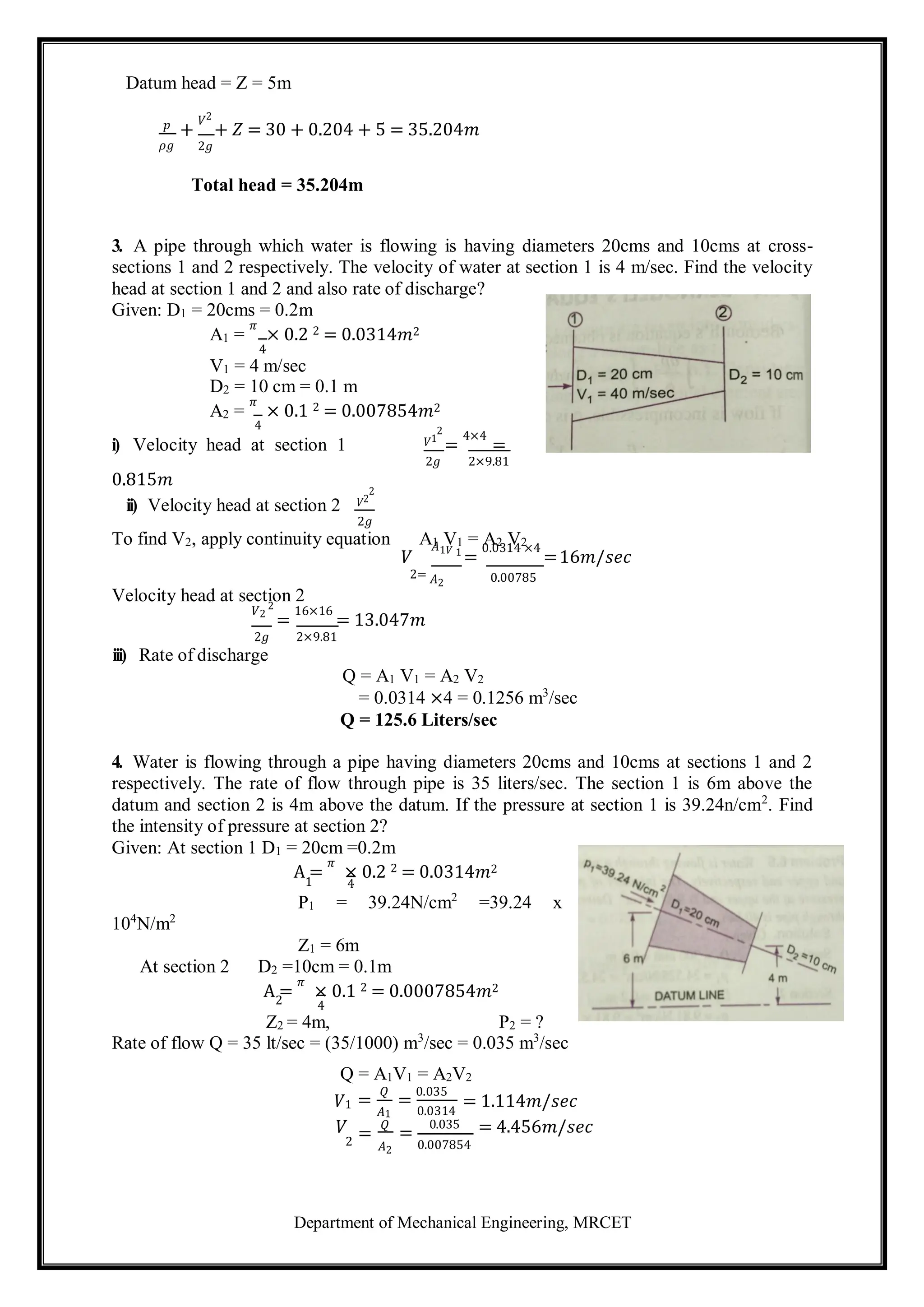
3. A pipe through which water is flowing is having diameters 20cms and 10cms at cross-
sections 1 and 2 respectively. The velocity of water at section 1 is 4 m/sec. Find the velocity
head at section 1 and 2 and also rate of discharge?
Given: D1 = 20cms = 0.2m
A1 =
𝜋
× 0.2 2 = 0.0314𝑚2
4
V1 = 4 m/sec
D2 = 10 cm = 0.1 m
A2 =
𝜋
× 0.1 2 = 0.007854𝑚2
4
i) Velocity head at section 1 𝑉1
2
=
4×4
=
0.815𝑚
ii) Velocity head at section 2 𝑉2
2
2𝑔
2𝑔 2×9.81
To find V2, apply continuity equation A1 V1 = A2 V2
𝑉
𝐴1𝑉 1
=
0.0314 ×4
=16𝑚/𝑠𝑒𝑐
Velocity head at section 2
2= 𝐴2 0.00785
𝑉2
2
=
16×16
= 13.047𝑚
2𝑔
iii) Rate of discharge
2×9.81
Q = A1 V1 = A2 V2
= 0.0314 ×4 = 0.1256 m3
/sec
Q = 125.6 Liters/sec
4. Water is flowing through a pipe having diameters 20cms and 10cms at sections 1 and 2
respectively. The rate of flow through pipe is 35 liters/sec. The section 1 is 6m above the
datum and section 2 is 4m above the datum. If the pressure at section 1 is 39.24n/cm2
. Find
the intensity of pressure at section 2?
Given: At section 1 D1 = 20cm =0.2m
A =
𝜋
× 0.2 2 = 0.0314𝑚2
4
104
N/m2
P1 = 39.24N/cm2
=39.24 x
Z1 = 6m
At section 2 D2 =10cm = 0.1m
A =
𝜋
× 0.1 2 = 0.0007854𝑚2
4
Z2 = 4m, P2 = ?
Rate of flow Q = 35 lt/sec = (35/1000) m3
/sec = 0.035 m3
/sec
Q = A1V1 = A2V2
𝑉1
𝑉
=
𝑄
𝐴1
=
𝑄
=
0.035
0.0314
=
0.035
= 1.114𝑚/𝑠𝑒𝑐
= 4.456𝑚/𝑠𝑒𝑐
2 𝐴2 0.007854
Department of Mechanical Engineering, MRCET
Applying Bernoulli‟s equation at sections 1 and 2 𝑃1
+
𝑉1
2
+ 𝑍 =
𝑃2
+
𝑉2
2
+ 𝑍
𝜌𝑔 2𝑔 1 𝜌
𝑔 2𝑔 2
39.24 × 10⁴ 1000 × 9.81 +
1.114 2
+6 =
𝑃2
+
4.456 2
+ 4
2×9.81 1000 ×9.81 2×9.81
𝑃2
9810
40 + 0.063 + 6 =
𝑃2
+ 1.102 + 4
9810
46.063 = 𝑃2
+ 5.102
9810
= 46.063 – 5.102 = 41.051
P2 = 41.051 ×9810 =402710 N/m2
P2 = 40.271N/cm2
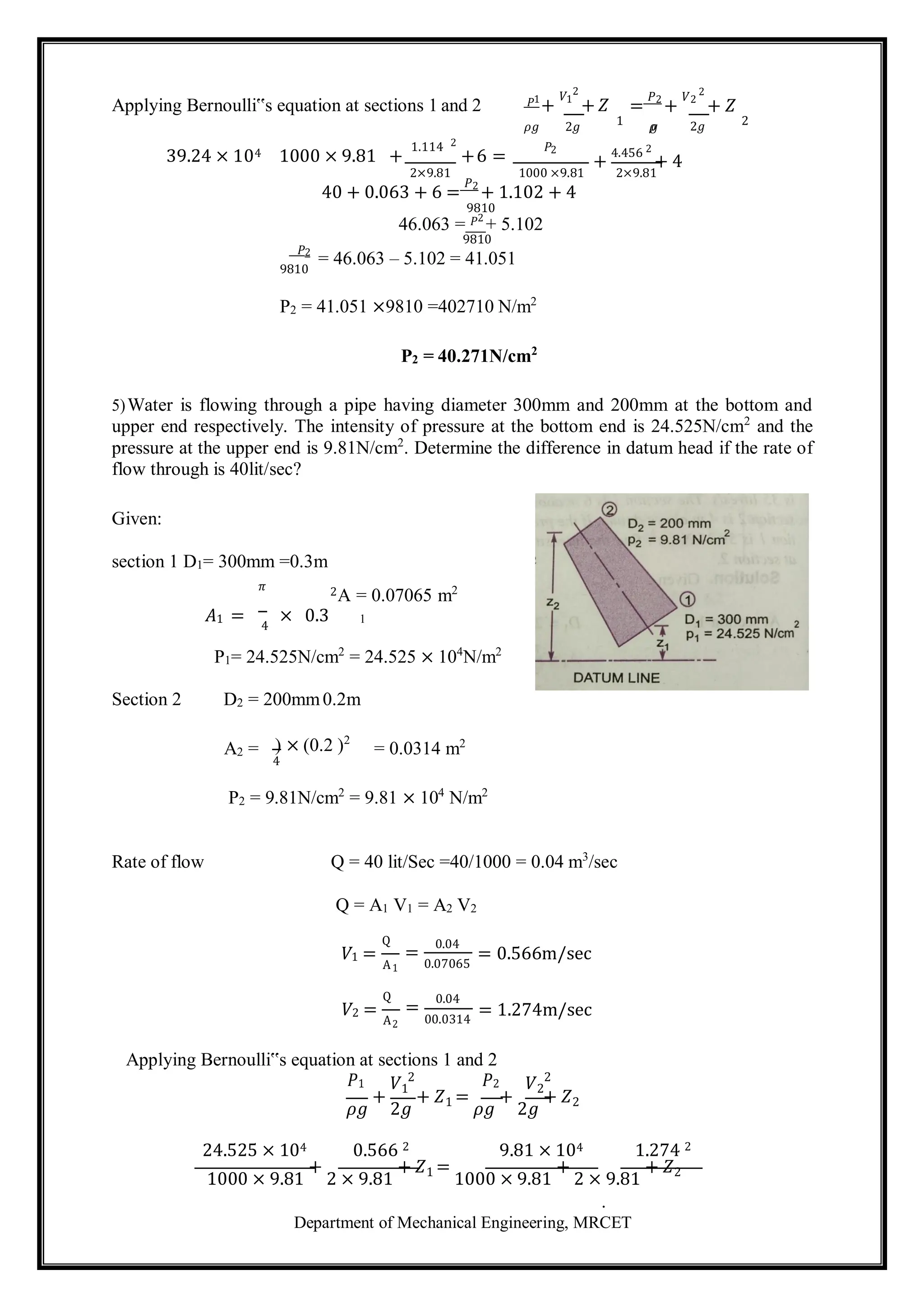
5)Water is flowing through a pipe having diameter 300mm and 200mm at the bottom and
upper end respectively. The intensity of pressure at the bottom end is 24.525N/cm2
and the
pressure at the upper end is 9.81N/cm2
. Determine the difference in datum head if the rate of
flow through is 40lit/sec?
Given:
section 1 D1= 300mm =0.3m
𝜋 2A = 0.07065 m2
𝐴1 = 4
× 0.3 1
P1= 24.525N/cm2
= 24.525 × 10⁴
N/m2
Section 2 D2 = 200mm0.2m
A2 = ) × (0.2 )2
4
= 0.0314 m2
P2 = 9.81N/cm2
= 9.81 × 10⁴
N/m2
Rate of flow Q = 40 lit/Sec =40/1000 = 0.04 m3
/sec
Q = A1 V1 = A2 V2
Q
𝑉1 =
1
Q
𝑉2 =
2
=
0.04
0.07065
=
0.04
00.0314
= 0.566m/sec
= 1.274m/sec
Applying Bernoulli‟s equation at sections 1 and 2
𝑃1 𝑉1
2 𝑃2 𝑉2
2
𝜌𝑔
+
2𝑔
+ 𝑍1 =
𝜌𝑔
+
2𝑔
+ 𝑍2
24.525 × 10⁴ 0.566 2 9.81 × 10⁴ 1.274 2
1000 × 9.81
+
2 × 9.81
+ 𝑍1 =
1000 × 9.81
+
2 × 9.81
+ 𝑍2
.
A
A
Department of Mechanical Engineering, MRCET
25 + 0.32 +Z1 = 10 +1.623 + Z2
Z2 – Z1 = 25.32 – 11.623 = 13.697 or say 13.70m
The difference in datum head = Z2 – Z1 = 13.70m
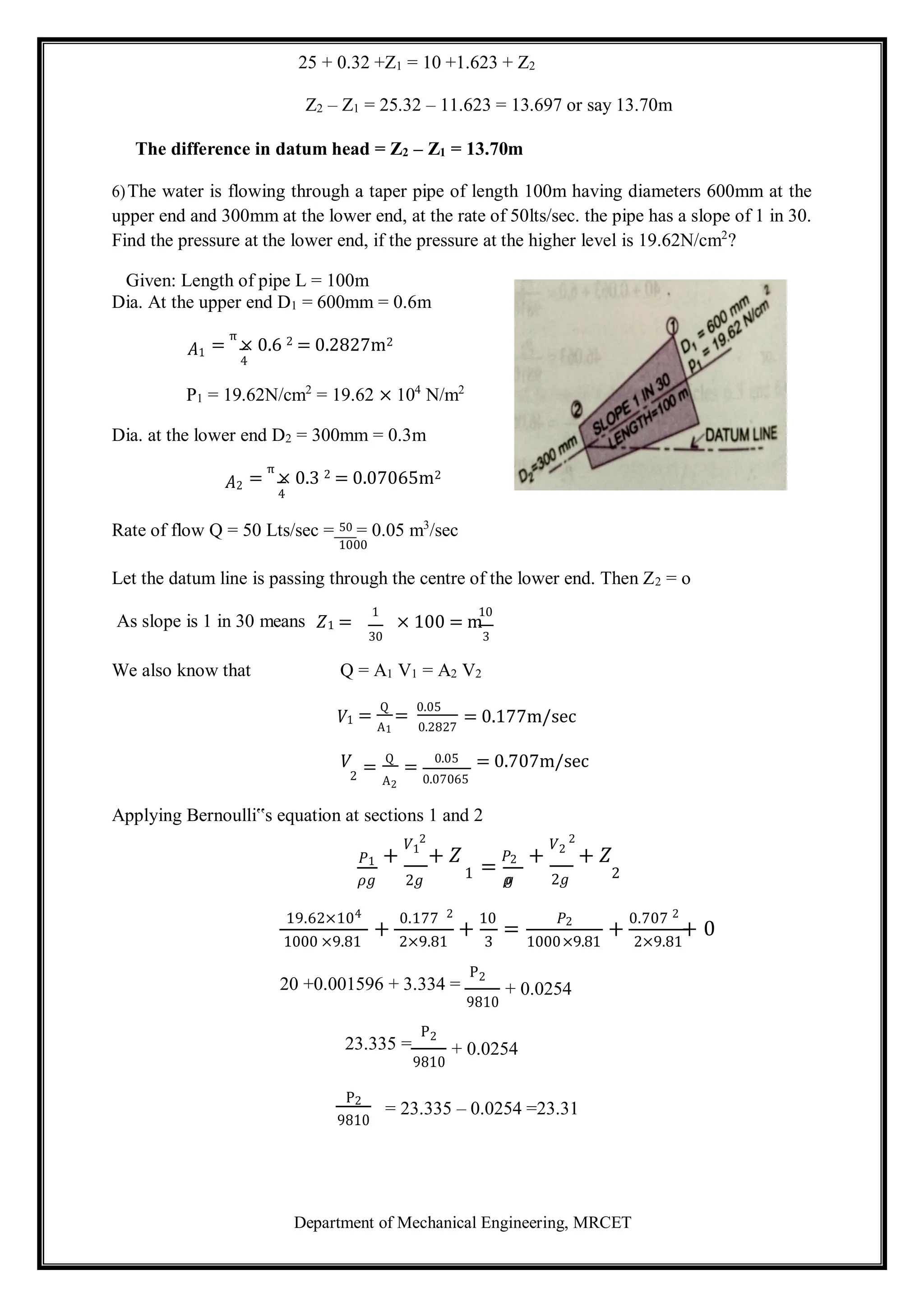
6)The water is flowing through a taper pipe of length 100m having diameters 600mm at the
upper end and 300mm at the lower end, at the rate of 50lts/sec. the pipe has a slope of 1 in 30.
Find the pressure at the lower end, if the pressure at the higher level is 19.62N/cm2
?
Given: Length of pipe L = 100m
Dia. At the upper end D1 = 600mm = 0.6m
𝐴1 =
π
× 0.6 2 = 0.2827m2
4
P1 = 19.62N/cm2
= 19.62 × 10⁴
N/m2
Dia. at the lower end D2 = 300mm = 0.3m
𝐴2 =
π
× 0.3 2 = 0.07065m2
4
Rate of flow Q = 50 Lts/sec = 50 = 0.05 m3
/sec
1000
Let the datum line is passing through the centre of the lower end. Then Z2 = o
As slope is 1 in 30 means
1
𝑍1 =
10
× 100 = m
30 3
We also know that Q = A1 V1 = A2 V2
𝑉1
𝑉
=
Q
=
0.05
A1 0.2827
=
Q
=
0.05
= 0.177m/sec
= 0.707m/sec
2 A2 0.07065
Applying Bernoulli‟s equation at sections 1 and 2
𝑃1 +
𝑉1
2
+ 𝑍
=
𝑃2 +
𝑉2
2
+ 𝑍
𝜌𝑔 2𝑔 1 𝜌
𝑔 2𝑔 2
19.62×10⁴
+
0.177 2
+
10
=
𝑃2
+
0.707 2
+ 0
1000 ×9.81 2×9.81 3 1000×9.81 2×9.81
20 +0.001596 + 3.334 =
P2
9810
+ 0.0254
23.335 =
P2
9810
+ 0.0254
P2
9810
= 23.335 – 0.0254 =23.31
Department of Mechanical Engineering, MRCET
π 2 2
4
P2 = 23.31 × 9810 = 228573N/m2
P2 = 22.857N/cm2
7) A 45° reducing bend is connected to a pipe line, the diameters at inlet and out let of the
bend being 600mm and 300mm respectively. Find the force exerted by the water on the bend,
if the intensity of pressure at the inlet to the bend is 8.829N/cm2
and rate of flow of water is
600 Lts/sec.
Given: Angle of bend 𝜃 = 45°
Dia. at inlet D1 = 600mm = 0.6m 𝐴1
= ×(0.6) = 0.2827 m
4
Dia. at out let D2 = 300mm = 0.3m A2 =
π
× (0.3)2
= 0.07065m2
Pressure at inlet P1 = 8.829N/cm2
= 8.829 × 10⁴
N/m2
Q = 600Lts/sec = 0.6 m3
/sec
Q
V1 =
1
Q
V2 = A
0.6
= = 2.122m/sec
0.2827
0.6
= = 8.488m/sec
0.07068
2
Applying Bernoulli‟s equation at sections 1 and 2,
we get
𝑃1
+
𝑉1
2
+ 𝑍 =
𝑃2
+
𝑉2
2
+ 𝑍
𝜌𝑔 2𝑔 1 𝜌
𝑔 2𝑔 2
2 2
But Z = Z , then 𝑃1
+
𝑉1
=
𝑃2
+
𝑉2
1 2 𝜌
𝑔 2𝑔 𝜌𝑔 2𝑔
8.829 × 10⁴
+
1000 × 9.81
2.122 2
2 × 9.81
=
P2
=
1000 × 9.81
8.488 2
2 × 9.81
9 + 0.2295 =
P2
9810
+ 3.672
P2
9810
= 9.2295 - 3.672 = 5.5575 m of water
A
Department of Mechanical Engineering, MRCET
P2 =5.5575 × 9810 = 5.45 × 10⁴
N/m2
Force exerted on the bend in X and Y – directions
Fx = 𝜌 Q (V1 - V2 Cos 𝜃) + P1 A1 – P2 A2 Cos 𝜃
= 1000 × 0.6 (2.122 – 8.488 Cos45°) + 8.829 ×104
×0.2827 – 5.45 × 104
× 0.07065 × Cos45°
= - 2327.9 + 24959.6 – 2720.3 =24959.6 - 5048.2 = 19911.4N
Fx = 19911.4 N
Fy = 𝜌 Q (-V2 Sin 𝜃) - P2 A2 Sin 𝜃
= 1000×0.6 (- 8.488 Sin45° ) - 5.45 × 104
×0.07068 Sin45°
= - 3601.1 - 2721.1 = - 6322.2N
(- ve sign means Fy is acting in the down ward direction)
Fy = - 6322.2N
Therefore the Resultant Force FR = 𝐹𝑥
2 + 𝐹𝑦
2 = (19911.4)2
+ (- 6322.2)2
= 20890.9N
FR = 20890.9 N
The angle made by resultant force with X – axis is Tan 𝜃 = Fx
Fy
= (6322.2/19911.4) = 0.3175
𝜽= tan-1
0.3175= 𝟏𝟕𝟎𝟑𝟔′
Department of Mechanical Engineering, MRCET
UNIT-3
BOUNDARY LAYER
Boundary Layer Characteristics
The concept of boundary layer was first introduced by a German scientist, Ludwig Prandtl, in the year
1904. Although, the complete descriptions of motion of a viscous fluid were known through Navier-
Stokes equations, the mathematical difficulties in solving these equations prohibited the theoretical
analysis of viscous flow. Prandtl suggested that the viscous flows can be analyzed by dividing the flow
into two regions; one close to the solid boundaries and other covering the rest of the flow. Boundary
layer is the regions close to the solid boundary where the effects of viscosity are experienced by the
flow. In the regions outside the boundary layer, the effect of viscosity is negligible and the fluid is
treated as inviscid. So, the boundary layer is a buffer region between the wall below and the inviscid
free-stream above. This approach allows the complete solution of viscous fluid flows which would
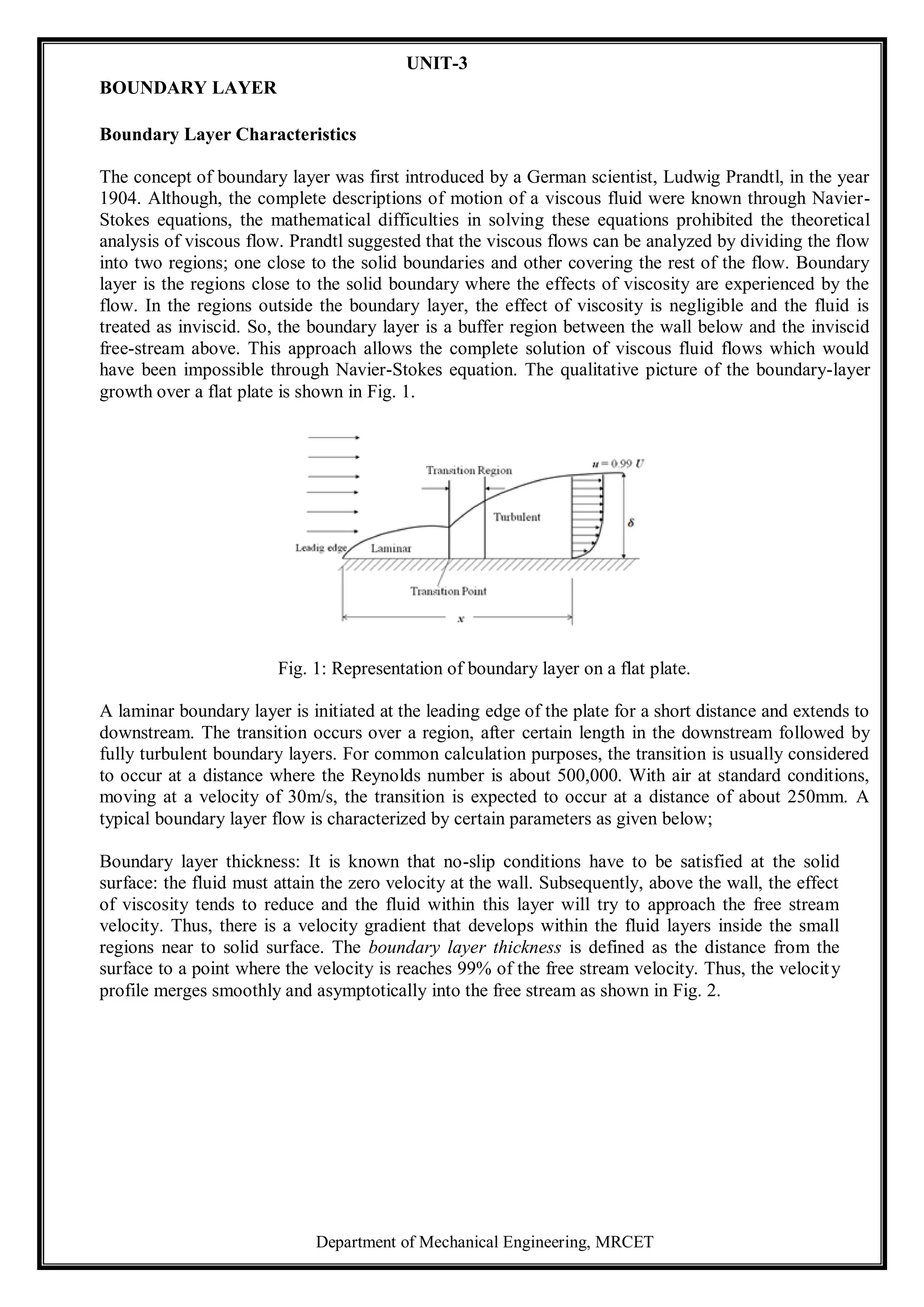
have been impossible through Navier-Stokes equation. The qualitative picture of the boundary-layer
growth over a flat plate is shown in Fig. 1.
Fig. 1: Representation of boundary layer on a flat plate.
A laminar boundary layer is initiated at the leading edge of the plate for a short distance and extends to
downstream. The transition occurs over a region, after certain length in the downstream followed by
fully turbulent boundary layers. For common calculation purposes, the transition is usually considered
to occur at a distance where the Reynolds number is about 500,000. With air at standard conditions,
moving at a velocity of 30m/s, the transition is expected to occur at a distance of about 250mm. A
typical boundary layer flow is characterized by certain parameters as given below;
Boundary layer thickness: It is known that no-slip conditions have to be satisfied at the solid
surface: the fluid must attain the zero velocity at the wall. Subsequently, above the wall, the effect
of viscosity tends to reduce and the fluid within this layer will try to approach the free stream
velocity. Thus, there is a velocity gradient that develops within the fluid layers inside the small
regions near to solid surface. The boundary layer thickness is defined as the distance from the
surface to a point where the velocity is reaches 99% of the free stream velocity. Thus, the velocity
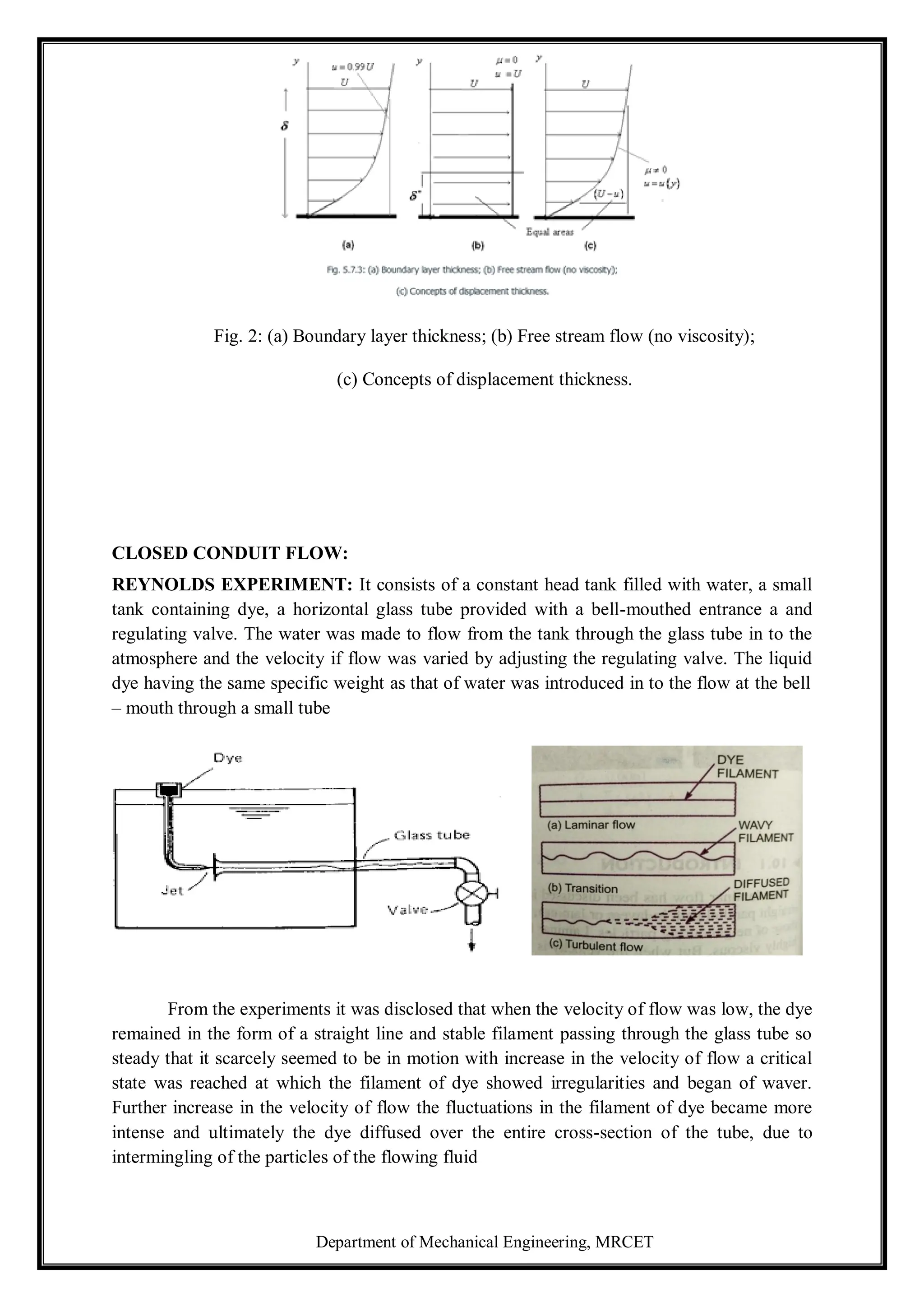
profile merges smoothly and asymptotically into the free stream as shown in Fig. 2.
Department of Mechanical Engineering, MRCET
Fig. 2: (a) Boundary layer thickness; (b) Free stream flow (no viscosity);
(c) Concepts of displacement thickness.
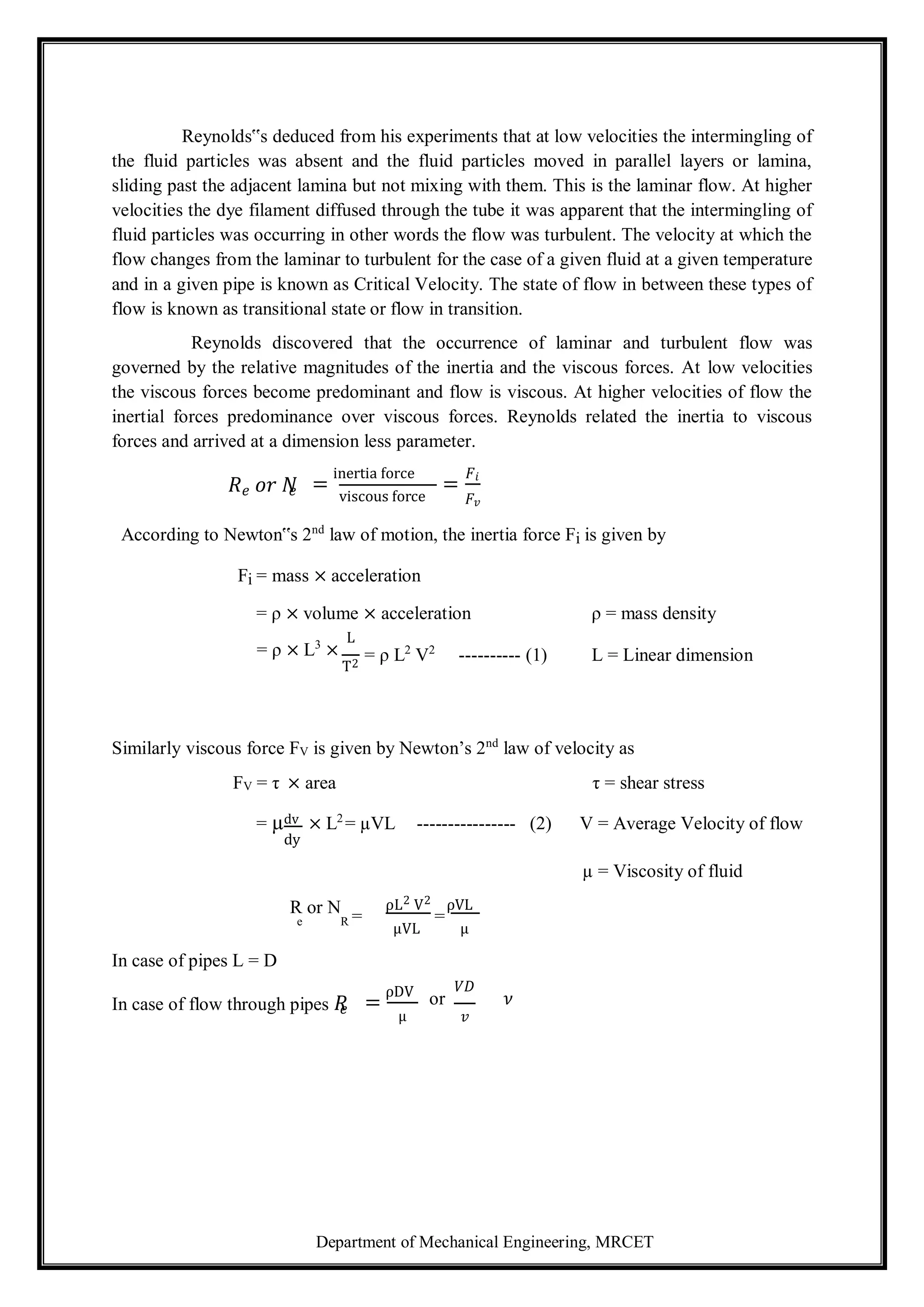
CLOSED CONDUIT FLOW:
REYNOLDS EXPERIMENT: It consists of a constant head tank filled with water, a small
tank containing dye, a horizontal glass tube provided with a bell-mouthed entrance a and
regulating valve. The water was made to flow from the tank through the glass tube in to the
atmosphere and the velocity if flow was varied by adjusting the regulating valve. The liquid
dye having the same specific weight as that of water was introduced in to the flow at the bell
– mouth through a small tube
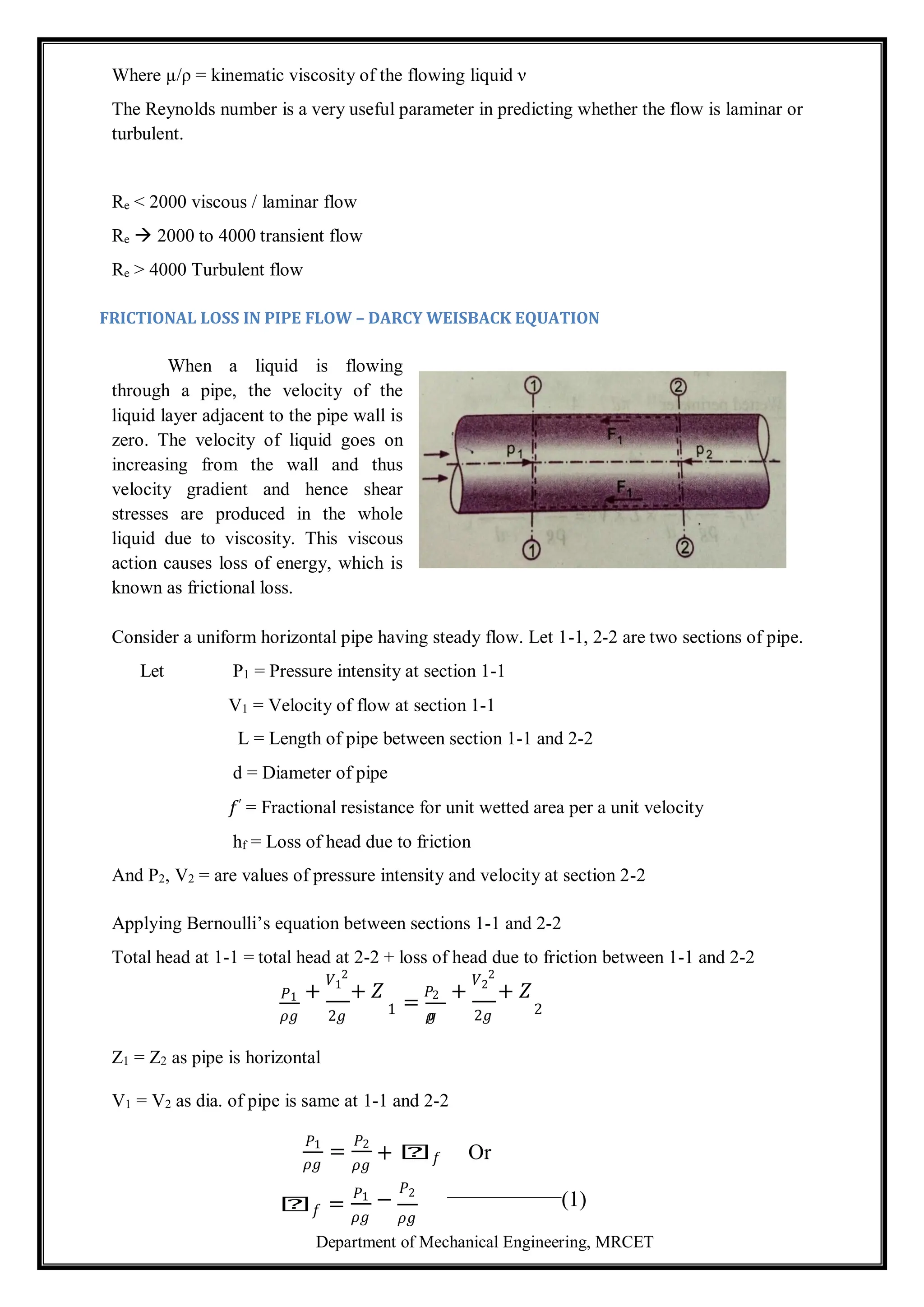
From the experiments it was disclosed that when the velocity of flow was low, the dye
remained in the form of a straight line and stable filament passing through the glass tube so
steady that it scarcely seemed to be in motion with increase in the velocity of flow a critical
state was reached at which the filament of dye showed irregularities and began of waver.
Further increase in the velocity of flow the fluctuations in the filament of dye became more
intense and ultimately the dye diffused over the entire cross-section of the tube, due to
intermingling of the particles of the flowing fluid
Department of Mechanical Engineering, MRCET
Reynolds‟s deduced from his experiments that at low velocities the intermingling of
the fluid particles was absent and the fluid particles moved in parallel layers or lamina,
sliding past the adjacent lamina but not mixing with them. This is the laminar flow. At higher
velocities the dye filament diffused through the tube it was apparent that the intermingling of
fluid particles was occurring in other words the flow was turbulent. The velocity at which the
flow changes from the laminar to turbulent for the case of a given fluid at a given temperature
and in a given pipe is known as Critical Velocity. The state of flow in between these types of
flow is known as transitional state or flow in transition.
Reynolds discovered that the occurrence of laminar and turbulent flow was
governed by the relative magnitudes of the inertia and the viscous forces. At low velocities
the viscous forces become predominant and flow is viscous. At higher velocities of flow the
inertial forces predominance over viscous forces. Reynolds related the inertia to viscous
forces and arrived at a dimension less parameter.
𝑅𝑒 𝑜𝑟 𝑁
𝑒 =
inertia force
viscous force
=
𝐹𝑖
𝐹𝑣
According to Newton‟s 2nd
law of motion, the inertia force Fi is given by
Fi = mass × acceleration
= ρ × volume × acceleration ρ = mass density
= ρ × L3
×
L
T2
= ρ L2
V2
---------- (1) L = Linear dimension
Similarly viscous force FV is given by Newton’s 2nd
law of velocity as
FV = τ × area τ = shear stress
= µdv × L2
= µVL ---------------- (2) V = Average Velocity of flow
dy
R or N =
ρL2 V2
=
ρVL
µ = Viscosity of fluid
e R
In case of pipes L = D
μVL μ
In case of flow through pipes 𝑅
𝑒 =
ρDV
μ
or
𝑉𝐷
𝜈
𝑣
Department of Mechanical Engineering, MRCET
Where µ/ρ = kinematic viscosity of the flowing liquid ν
The Reynolds number is a very useful parameter in predicting whether the flow is laminar or
turbulent.
Re < 2000 viscous / laminar flow
Re  2000 to 4000 transient flow
Re > 4000 Turbulent flow
FRICTIONAL LOSS IN PIPE FLOW – DARCY WEISBACK EQUATION
When a liquid is flowing
through a pipe, the velocity of the
liquid layer adjacent to the pipe wall is
zero. The velocity of liquid goes on
increasing from the wall and thus
velocity gradient and hence shear
stresses are produced in the whole
liquid due to viscosity. This viscous
action causes loss of energy, which is
known as frictional loss.
Consider a uniform horizontal pipe having steady flow. Let 1-1, 2-2 are two sections of pipe.
Let P1 = Pressure intensity at section 1-1
V1 = Velocity of flow at section 1-1
L = Length of pipe between section 1-1 and 2-2
d = Diameter of pipe
𝑓′ = Fractional resistance for unit wetted area per a unit velocity
hf = Loss of head due to friction
And P2, V2 = are values of pressure intensity and velocity at section 2-2
Applying Bernoulli’s equation between sections 1-1 and 2-2
Total head at 1-1 = total head at 2-2 + loss of head due to friction between 1-1 and 2-2
𝑃1 +
𝑉1
2
+ 𝑍
=
𝑃2 +
𝑉2
2
+ 𝑍
𝜌𝑔 2𝑔 1 𝜌
𝑔 2𝑔 2
Z1 = Z2 as pipe is horizontal
V1 = V2 as dia. of pipe is same at 1-1 and 2-2
𝑃1
𝜌𝑔
=
𝑃2
𝜌𝑔
+ 𝑕𝑓 Or
𝑕𝑓 =
𝑃1
𝜌𝑔
−
𝑃2
(1)
𝜌𝑔
Department of Mechanical Engineering, MRCET
But hf is head is lost due to friction and hence the intensity of pressure will be reduced in the
direction flow by frictional resistance.
Now, Frictional Resistance = Frictional resistance per unit wetted area per unit velocity
× Wetted Area × (velocity)2
𝐹1 = 𝑓′ × 𝜋𝑑𝐿× 𝑉2 [∵Wetted area =𝜋𝑑 × 𝐿, Velocity = V=V1=V2 ]
𝐹1 = 𝑓′ × 𝑝𝐿𝑉2 (2) [∵ 𝜋d = perimeter = p ]
The forces acting on the fluid between section 1-1 and 2-2 are
Pressure force at section 1-1 = P1 ×A where A = area of pipe
Pressure force at section 2-2 = P2 ×A
Frictional force = F1
Resolving all forces in the horizontal direction, we have
P1 A – P2A – F1 = 0
(P1 – P2)A = F1 = 𝑓′ × 𝑝 × 𝐿 × 𝑉2 from equation – (2)
P1 – P2 =
𝑓′ ×𝑝×𝐿×𝑉2
A
But from equation (1) P1 - P2 = ρghf
Equating the value of P1 - P2, we get
ρghf =
𝑓′ ×𝑝×𝐿×𝑉2
A
𝑕𝑓 =
f′
pg
×
P
× L × V2 (3)
A
In the equation (3)
P
A
=
Wetted Permiter
Area
πd π
π
d2
=
d
4
𝑕 =
𝑓′ 4
2 𝑓′ 4𝐿𝑉2
× × 𝐿 × 𝑉
𝜌𝑔 𝑑
= ×
𝜌𝑔 𝑑
Putting
𝑓′
𝜌
=
𝑓
2
Where f is known as co-efficient of friction.
=
𝑓
Department of Mechanical Engineering, MRCET
Equation (4) becomes as
𝑕 =
4𝑓
×
𝐿𝑉2
𝑓 2𝑔 𝑑
𝑕 =
4𝑓𝐿𝑉2
𝑓 2𝑔𝑑
This Equation is known as Darcy – Weisbach equation, commonly used for finding loss of
head due to friction in pipes
Then f is known as a friction factor or co-efficient of friction which is a dimensionless
quantity. f is not a constant but, its value depends upon the roughness condition of pipe
surface and the Reynolds number of the flow.
MINOR LOSSES IN PIPES:
The loss of energy due to friction is classified as a major loss, because in case of long
pipe lines it is much more than the loss of energy incurred by other causes.
The minor losses of energy are caused on account of the change in the velocity of
flowing fluids (either in magnitude or direction). In case of long pipes these loses are quite
small as compared with the loss of energy due to friction and hence these are termed as
„‟minor losses „‟
Which may even be neglected without serious error However in short pipes these losses may
sometimes outweigh the friction loss. Some of the losses of energy which may be caused due
to the change of velocity are:
1
. Loss of energy due to sudden enlargement
𝑕
�
�
2
. Lossofenergyduetosuddencontraction
𝑕
=
𝑉1−𝑉2
2
2𝑔
= 0.5
𝑉2
2
𝑐 2𝑔
3
. Loss of energy at the entrance to a pipe
𝑕
�
�
4
. Loss of energy at the exit from a pipe
𝑕𝑜
= 0.5
𝑉2
2𝑔
=
𝑉2
2𝑔
5
. Loss of energy due to gradual contraction or enlargement
𝑕𝑙
=
𝑘 𝑉1−𝑉2
2
2𝑔
6
. Loss of energy in the bends
𝑕
�
�
=
𝑘𝑉2
2𝑔
7
. Loss of energy in various pipe fittings
𝑕
�
�
Department of Mechanical Engineering, MRCET
=
𝑘𝑉2
2𝑔
Department of Mechanical Engineering, MRCET
1. LOSS OF HEAD DUE TO SUDDEN ENLARGEMENT
Consider a liquid flowing through a
pipe which has sudden enlargement.
Consider two sections 1-1 and 2-2 before
and after enlargement. Due to sudden
change of diameter of the pipe from D1 to
D2. , The liquid flowing from the smaller
pipe is not able to fallow the abrupt change
of the boundary. Thus the flow separates
from the boundary and turbulent eddies are
formed. The loss of head takes place due to
the formation of these eddies.
Let 𝑝′ = Pressure intensity of the liquid eddies on the area (A2 – A1)
he = loss of head due to the sudden enlargement.
Applying Bernoulli‟s equation at section 1-1 and 2-2
𝑝1
+
𝑉1
2
+ 𝑧 =
𝑝2
+
𝑉2
2
+ 𝑧 + Loss of head due to sudden enlargement
𝜌𝑔 2𝑔 1 𝜌
𝑔 2𝑔 2
But z1 = z2 as pipe ishorizontal
𝑝1
+
𝑉1
2
=
𝑝2
+
𝑉2
2
+ 𝑕
𝜌𝑔 2𝑔 𝜌𝑔 2𝑔 𝑒
Or 𝑕
=
𝑝1
−
𝑝2
+
𝑉1
2
−
𝑉2
2
(1)
𝑒 𝜌𝑔 𝜌𝑔 2𝑔 2𝑔
The force acting on the liquid in the control volume in the direction of flow
𝐹𝑥 = 𝑝1𝐴1 + 𝑝′ 𝐴2 − 𝐴1 − 𝑝2𝐴2
But experimentally it is found that 𝑝′ = 𝑝1
𝐹𝑥 = 𝑝1𝐴1 + 𝑝1 𝐴2 − 𝐴1 − 𝑝2𝐴2
= 𝑝1𝐴2 − 𝑝2𝐴2
= 𝑝1 −𝑝2 𝐴2 (2)
Momentum of liquid/ second at section 1-1 = mass × velocity
= 𝜌𝐴1𝑉1 × 𝑉1
= 𝜌𝐴1𝑉1
2
Momentum of liquid/ second at section 2-2 𝜌𝐴2𝑉2 × 𝑉2 = 𝜌𝐴2𝑉2
2
Change of momentum/second = 𝜌𝐴2𝑉2
2 − 𝜌𝐴1𝑉1
2 (3)
Department of Mechanical Engineering, MRCET
But from continuity equation, we have
A1V1 = A2V2
Or 𝐴1 =
𝐴2 𝑉2
𝑉1
∴ Change of momentum/sec= 𝜌𝐴 𝑉 2 − 𝜌 ×
𝐴2 𝑉2
× 𝑉 2
2 2 𝑉1
1
= 𝜌𝐴2𝑉2
2 − 𝜌𝐴1𝑉1𝑉2
= 𝜌𝐴2 𝑉2
2
− 𝑉1𝑉2 (4)
Now the net force acting on the control volume in the direction of flow must be equal to rate
of change of momentum per second. Hence equating equation (2) and equation (4)
𝑝1 − 𝑝2 𝐴2 = 𝜌𝐴2 𝑉2
2 − 𝑉1𝑉2
𝑝1 − 𝑝 2
= 𝑉 2 − 𝑉 𝑉
𝜌 2 1 2
Dividing both sides by „g‟ we have
𝑝1− 𝑝 2
=
𝑉2
2
−𝑉1𝑉2
𝜌𝑔 𝑔
Or
𝑝1
−
𝑝 2
=
𝑉2
2
−𝑉1𝑉2
𝜌𝑔 𝜌𝑔 𝑔
Substituting in equation (1)
𝑉1
2 2 2 2 2
𝑕 =
𝑉2
2
−𝑉1𝑉2
+ −
𝑉2
=
2𝑉2−2𝑉1𝑉2+𝑉1 −𝑉2
𝑒 𝑔 2𝑔 2𝑔 2𝑔
=
𝑉1
2
+𝑉2
2
−2𝑉1𝑉2
2𝑔
𝑉1 − 𝑉2
2
𝑕𝑒 = 2𝑕
2. LOSS OF HEAD DUE TO SUDDEN CONTRACTION
Consider a liquid flowing in a pipe, which has a sudden
contraction in area. Consider two sections 1-1 and 2-2 before
and after contraction. As the liquid flows from larger pipe to
smaller pipe, the area of flow goes on decreasing and
becomes minimum at section C - C. This section is called
Vena-contracta. After section C-C, a sudden enlargement of
area takes place. The loss of head due to sudden contraction is
actually due to sudden enlargement of area from vena-
contracta to smaller pipe.
Department of Mechanical Engineering, MRCET
c
Let Ac = Area of flow at section C - C
Vc = Velocity of flow at section C – C
A2 = Area of flow at section 2 - 2
V2 = Velocity of flow at section 2 - 2
hc = Loss of head due to sudden contraction
Now, hc = Actual loss of head due to sudden enlargement from section C - C to section 2-2 is
h =
𝑉𝑐 −𝑉2
2
2𝑔
=
𝑉2
2
2𝑔
𝑉𝑐
𝑉2
− 1
2
( 1 )
From continuity equation, we have
A V = A V Or
𝑉
𝑐
=
𝐴2
=
1
=
1 ∵ 𝑕 =
𝐴𝑐
c c 2 2
𝑉2 𝐴𝑐
𝐴𝑐
𝐴2
𝐶𝑐
𝑐 𝐴2
Substituting the value of
𝑉𝑐
in equation (1)
𝑉2
𝑕𝑐 =
𝑉2
2
2𝑔
1
𝐶𝑐
2
− 1 =
𝑘𝑉2
2
2𝑔
, Where k =
1
𝐶𝑐
2
− 1
If the value of Cc is assumed to be equal to 0.62, then
𝑘 =
1
0.62
2
− 1 = 0.375
Then h becomesas 𝑕
=
𝑘𝑉2
2
= 0.375
𝑉2
2
c 𝑐 2𝑔 2𝑔
If the value of Cc is not given, then the head loss due to contraction is taken as
𝑉2
2
= 0.5
2𝑔
3. LOSS OF HEAD AT THE ENTRANCE OF A PIPE
This is the loss of energy which occurs when a liquid enters a pipe which is connected to
a large tank or reservoir. This loss is similar to the loss of head due to sudden contraction.
This loss depends on the form of entrance. For a sharp edge entrance, this loss is slightly
more than a rounded or bell mouthed entrance. In practice the value of loss of head at the
entrance. In practice the value of loss of head at the entrance (inlet) of a pipe with sharp
cornered entrance is taken as 0.5 v2
/2g where v = velocity of liquid in pipe. This loss is
denoted by hf
𝑕𝑓 = 0.5
𝑉2
2𝑔
4. LOSS OF HEAD AT THE EXIT OF A PIPE
This loss of head (or energy) due to the velocity of the liquid at the out let of the pipe, which
is dissipated either in the form of a free jet (if the out let of the pipe is free) or it is lost in the
tank or reservoir. This loss is equal to 𝑉
2
, where V is the velocity of liquid at the out let of
2𝑔
the pipe. This loss is denoted by ho.
𝑕𝑜 =
𝑉2
2𝑔
V = velocity at outlet of the pipe
Department of Mechanical Engineering, MRCET
5. LOSS OF HEAD DUE TO OBSTRUCTION IN A PIPE
Whenever there is an obstruction in a pipe, the loss of energy take place due to reduction of
the area of the cross section of the pipe at the place where obstruction is present. There is a
sudden enlargement of the area of flow beyond the obstruction due to which loss of head
takes place.
Consider a pipe of area of cross- section A having an
obstruction
Let a = max. Area of obstruction
A = Area of pipe
V = velocity of liquid in pipe
Then (A - a) = Area of flow of liquid at section 1-1
As the liquid flows and passes through section 1-1, a vena - contracta is formed
beyond section 1-1- after which the stream of liquid widens again and velocity of flow at
section on 2-2 become uniform and equal to velocity, v in the pipe. This situation is similar to
the flow of liquid through sudden enlargement.
Let Vc = velocity of liquid at vena – contracta
Then loss of head due to obstruction = loss of head due to enlargement from vena – contracta
to section 2-2
=
𝑉𝑐 −𝑉 2
-------- (1)
2𝑔
From continuity equation we have × 𝑉𝑐 = 𝐴× 𝑉 (2)
Where ac = Area of cross section at vena- contracta
If Cc= co-efficient of contraction
Then 𝐶
𝑐 =
𝑎𝑟𝑒𝑎 𝑎𝑡 𝑣𝑒𝑛𝑎 −𝑐𝑜𝑛𝑡𝑟𝑎𝑐𝑡𝑎
𝐴−𝑎
=
𝑎𝑐
𝐴−𝑎
ac = Cc (A-a)
Substituting this value in equation (2) Cc (A-a) Vc = AV
∴ 𝑉𝑐 =
𝐴×𝑉
𝐶𝑐 𝐴−𝑎
Substituting this value of VC in equation (1)
𝐴×𝑉 2
−𝑉 2
Head loss due to obstruction =
𝑉𝑐 −𝑉 2
= 𝐴−𝑎 𝐶𝑐
=
𝑉2 𝐴
2𝑔 2𝑔 2𝑔 𝐴−𝑎 𝐶𝑐
6. LOSS OF HEAD DUE TO BEND IN PIPE:
When there is a bend in a pipe, the velocity flow changes, due to which separation of
the flow from the boundary and also formation of eddies takes place, thus the energy is lost.
Loss of head in pipe due to bend is expressed as
𝑕𝑏 =
𝑘𝑉2
2𝑔
Department of Mechanical Engineering, MRCET
Where, = Loss of head due to bend, V = Velocity of flow, k = Co-efficient of bend.
The value of k dependson
1. Angle of bend,
2. Radius of curvature of bend,
3. Diameter of pipe.
7. LOSS OF HEAD IN VARIOUS PIPE FITTINGS:
The loss of head in various pipe fittings such as valves, couplings etc. is expressed as
=
𝑘𝑉2
.
2𝑔
Where V= Velocity of flow, k= co-efficient of pipe fitting.
LOSS OF ENERGY DUE TO GRADUAL CONTRACTION OR ENLARGEMENT:
The loss of energy can be considerably reduced if in place of a sudden contraction or
sudden enlargement a gradual contraction or gradual enlargement is provided. This is because
in gradual contraction or enlargement the velocity of flow is gradually increased or reduced,
the formation of eddies responsible for dissipation of energy are eliminated.
The loss of head in gradual contraction or gradual enlargement is expressed as
𝑕𝐿 =
𝑘 𝑉1−𝑉2
2
2𝑔
Where k is a co-efficient and V1 and V2 are the mean velocities at the inlet and the out
let the value of K depends on the angle of convergence or divergence and on the ratio of the
upstream and the downstream cross-sectional areas. For gradual contraction the value of K is
very small even for larger values of the angle of convergence. For gradual contraction
without sharp corners the loss of energy caused is so small that it may be neglected.
For gradual enlargement the value of K depends on the angle of divergence.
The value of K increases as the angle of divergence increases for a given ratio of the
cross-sectional areas at the inlet and at the outlet. In the case of gradual enlargement, except
for very small angles of divergence, the flow of fluid is always subjected to separation from
the boundaries and consequent formation of the eddies resulting in loss of energy. Therefore
in the case of gradual enlargement the loss of energy can’t be completely eliminated.
Department of Mechanical Engineering, MRCET
PIPES IN SERIES:
If a pipe line connecting two reservoirs is made up of several pipes of different diameters d1,
d2, d3, etc. and lengths L1, L2, L3 etc. all connected in series ( i.e. end to end ), then the
difference in the liquid surface levels is equal to the sum of the head losses in all the sections.
Further the discharge through each pipe will be same.
𝐻 =
0.5𝑉1
2
2𝑔
4𝑓1𝐿1𝑉1
2
+
2𝑔𝑑1
0.5𝑉2
2
+
2𝑔
4𝑓2𝐿2𝑉2
2
+
2𝑔𝑑2
0.5𝑉3
2
+
2𝑔
4𝑓3𝐿3𝑉3
2
+
2𝑔𝑑3
𝜋×𝑑1
2
𝜋×𝑑2
2
𝜋×𝑑3
2
Also 𝑄 =
4
× 𝑉1 = 4
× 𝑉2 = 4
× 𝑉3
However if the minor losses are neglected as compared with the loss of head due to friction in
each pipe, then
𝐻 =
4𝑓1𝐿1𝑉1
2
+
4𝑓2𝐿2 𝑉2
2
+
4𝑓3𝐿3𝑉3
2
2𝑔𝑑1 2𝑔𝑑2 2𝑔𝑑3
The above equation may be used to solve the problems of pipe lines in series. There
are two types of problems which may arise for the pipe lines in series. Viz.
a) Given a discharge Q to determine the head H and
b) Given H to determine discharge Q.
If the co-efficient of friction is same for all the pipes i.e. f1 = f2 = f3, then
𝐻 =
4𝑓1 𝐿1𝑉1
2
+
𝐿2 𝑉2
2
+
𝐿3 𝑉3
2
2𝑔 𝑑1 𝑑2 𝑑3
Department of Mechanical Engineering, MRCET
PIPES IN PARALLEL:
When a main pipeline divides in to two or more parallel pipes, which may again join
together downstream and continue as
main line, the pipes are said to be in
parallel. The pipes are connected in
parallel in order to increase the discharge
passing through the main. It is analogous
to parallel electric current in which the
drop in potential and flow of electric
current can be comp ared to head loss and
rate of discharge in a fluid flow respectively.
The rate of discharge in the main line is equal to the sum of the discharges in each of the
parallel pipes.
Thus Q = Q1 + Q2
The flow of liquid in pipes (1) and (2) takes place under the difference of head
between the sections A and B and hence the loss of head between the sections A and B will
be the same whether the liquid flows through pipe (1) or pipe (2). Thus if D1, D2 and L1, L2
are the diameters and lengths of the pipes (1) and (2) respectively, then the velocities of flow
V1 and V2 in the two pipes must be such as to give
𝑕𝑓 =
𝑓𝐿1𝑉1
2
2𝑔𝑑1
𝑓𝐿2𝑉2
2
=
2𝑔𝑑2
Assuming same value of f for each parallel pipe
𝐿1 𝑉1
2
=
𝐿2𝑉2
2
2𝑔𝑑1 2𝑔𝑑2
Department of Mechanical Engineering, MRCET
HYDRAULIC GRADIENT LINE AND TOTAL ENERGY LINE:
Consider a long pipe line carrying liquid from a reservoir A to reservoir B. At several
points along the pipeline let piezo meters be installed. The liquid will rise in the piezometers
to certain heights corresponding to the pressure intensity at each section. The height of the
liquid surface above the axis of the pipe in the piezometer at any section will be equal to the
pressure head (p/w) at that section. On account of loss of energy due to friction, the pressure
head will decrease gradually from section to section of pipe in the direction of flow. If the
pressure heads at the different sections of the pipe are plotted to scale as vertical ordinates
above the axis of the pipe and all these points are joined by a straight line , a sloping line is
obtained, which is known as Hydraulic Gradient Line (H.G.L ).
Since at any section of pipe the vertical distance between the pipe axis and Hydraulic
gradient line is equal to the pressure head at that section, it is also known as pressure line.
Moreover if Z is the height of the pipe axis at any section above an arbitrary datum, then the
vertical height of the Hydraulic gradient line above the datum at that section of pipe
represents the piezometric head equal to (p/w + z). Sometimes the Hydraulic gradient line is
also known as piezometric head line.
At the entrance section of the pipe for some distance the Hydraulic gradient line is not
very well defined. This is because as liquid from the reservoir enters the pipe, a sudden drop
in pressure head takes place in this portion of pipe. Further the exit section of pipe being
submerged, the pressure head at this section is equal to the height of the liquid surface in the
reservoir B and hence the hydraulic gradient line at the exit section of pipe will meet the
liquid surface in the reservoir B.
If at different sections of pipe the total energy ( in terms of head) is plotted to scale as
vertical ordinate above the assumed datum and all these points are joined, then a straight
sloping line will be obtained and is known as energy grade line or Total energy line (T.E.L).
Since total energy at any section is the sum of the pressure head (p/w), datum head z and
velocity head
𝑉2
2𝑔
and the vertical distance between the datum and hydraulic grade line is
equal to the piezometric head (p/w + z), the energy grade line will be parallel to the hydraulic
grade line, with a vertical distance between them equal to
𝑉2
2𝑔
. at the entrance section of the
Department of Mechanical Engineering, MRCET
=
pipe there occurs some loss of energy called “Entrance loss” equal to h
𝑉2
L 0.5
2𝑔
and hence
the energy grade line at this section will lie at a vertical depth equal to 0.5 𝑉2
below the
2𝑔
liquid surface in the reservoir A. Similarly at the exit section of pipe, since there occurs an
exit loss equal to hL =
𝑉2
2𝑔
. The energy gradiant line at this section will lie at a vertical
distance equal to
𝑉2
2𝑔
above the liquid surface in the reservoir B. Since at any section of pipe
the vertical distance between the energy grade line and the horizontal line drawn through the
liquid surface in reservoir A will represents the total loss of energy incurred up to that
section.
If the pipe line connecting the two reservoirs is horizontal, then the datum may be
assumed to be along the pipe axis only. The piezometric head and the pressure head will then
become the same.
If a pipe line carrying liquid from reservoir A discharges freely in to the
atmosphere at its exit end, the hydraulic grade line at the exit end of the pipe will pass
through the centre line of the pipe, since the pressure head at the exit end of the pipe will be
zero (being atmospheric). The energy grade line will again be parallel to the hydraulic grade
line and it will be at a vertical distance of 𝑉2
above the Hydraulic grade line
2𝑔
PITOT – TUBE
A Pitot tube is a simple device used for measuring the velocity of flow. The basic
principle used in this is that if the velocity of flow at a particular point is reduced to zero,
which is known as stagnation point, the pressure there is increased due to conversion of the
kinetic energy in to pressure energy and by measuring the increase in pressure energy at this
point , the velocity of flow may be determined.
Simplest form of a pitot tube consists of a glass tube, large enough for capillary
effects to be negligible and bent at right angles. A single tube of this type is used for
measuring the velocity of flow in an open channel. The tube is dipped vertically in the
flowing stream of fluid with its open end A directed to face the flow and other open end
projecting above the fluid surface in the stream. The fluid enters the tube and the level of the
Department of Mechanical Engineering, MRCET
fluid in the tube exceeds that of the fluid surface in the surrounding stream. This is so because
Department of Mechanical Engineering, MRCET
the end A of the tube is a stagnation point, where the fluid is at rest, and the fluid approaching
end A divides at this point and passes around tube. Since at stagnation point the kinetic
energy is converted in to pressure energy, the fluid in the tube rises above the surrounding
fluid surface by a height, which corresponds to the velocity of flow of fluid approaching end
A of the tube. The pressure at the stagnation point is known as stagnation pressure.
Consider a point 1 slightly upstream of end A and lying along the same horizontal
plane in the flowing stream of velocity V. Now if the point 1 and A are at a vertical depth of
hO from the free surface of fluid and h is the height of the fluid raised in the pitot tube above
the free surface of the liquid. Then by applying Bernoulli‟s equation between the point 1 and
A, neglecting loss of energy, we get
𝑕 =
𝑉2
=
𝑕
+ 𝑕
𝑜 2𝑔 𝑜
(ho + h) is the stagnation pressure head at a point A, which consists of static pressure head hO
and dynamic pressure head h. Simplifying the expression,
𝑉2
= 𝑕 Or 𝑣 = 2𝑔𝑕 (1)
2𝑔
This equation indicates that the dynamic pressure head h is proportional to the
square of the velocity of flow close to end A.
Thus the velocity of flow at any point in the flowing stream may be determined by
dipping the Pitot tube to the required point and measuring the height „h‟ of the fluid raised in
the tube above the free surface. The velocity of flow given by the above equation (1) is more
than actual velocity of flow as no loss of energy is considered in deriving the above equation.
When the flow is highly turbulent the Pitot tube records a higher value of h, which is
higher than the mean velocity of flow. In order to take in to account the errors due to the
above factors, the actual velocity of flow may be obtained by introducing a co-efficient C or
CV called Pitot tube co-efficient. So the actual velocity is given by
𝑣 = 𝐶 2𝑔𝑕 (Probable value of C is 0.98)
When a pitot tube is used for measuring the velocity of a flow in a pipe, the Pitot tube may be
inserted in a pipe. Since pitot tube measures the stagnation pressure head (or the total head) at
its dipped end, the static pressure head is also required to be measured at the same section,
where tip of pitot tube is held, in order to determine the dynamic pressure head „h‟. For
measuring the static pressure head a pressure tap is provided at this section to which a piezo
meter may be connected. Alternatively a dynamic pressure head may also be determined
directly by connecting a suitable differential manometer between the pitot tube and pressure
tap.
Consider point 1 slightly up stream of the stagnation point 2.
Appling Bernoulli‟s equation between the points 1 and 2, we get
𝑃1
+
𝑉2
=
𝑃2
(2)
𝜔 2𝑔 𝜔
Department of Mechanical Engineering, MRCET
1 𝑃2
Where P1 and P2 are the pressure intensities at points 1 and 2, V is velocity of flow at point 1
and 𝜔 is the specific weight of the fluid flowing through the pipe. P1 is the static pressure and
P2 is the stagnation pressure. The equation for the pressure through the manometer in meters
of water may be written as,
𝑃
𝜔
𝑥𝑠 + 𝑦𝑠 + 𝑥𝑠𝑚 = 𝑦 + 𝑥 𝑠 + 𝑠 (3)
𝜔
Where s and sm are the specific gravities of the fluid flowing in the pipe and the manometric
liquid respectively. By simplifying
𝑃2
−
𝑃1 = 𝑥
𝑠𝑚
− 1
𝜔 𝜔 𝑠
After substituting for ( 2
−
𝑃1
=) in the equation (2) and solving for V
𝜔 𝜔
𝑠𝑚
= 𝐶 2𝑔𝑥
𝑠
− 1
Department of Mechanical Engineering, MRCET
VENTURI METER
A venture meter is a device used for measuring the rate of flow of fluid through a
pipe. The basic principle on which venture meter works is that by reducing the cross-
sectional area of the flow passage, a pressure difference is created and the measurement of
the pressure difference enables the determination of the discharge through the pipe.
A venture meter consists of (1) an inlet section, followed by a converging cone (2) a
cylindrical throat and (3) a gradually divergent cone. The inlet section of venture meter is the
same diameter as that of the pipe which is followed by a convergent cone. The convergent
cone is a short pipe, which tapers from the original size of the pipe to that of the throat of the
venture meter. The throat of the venture meter is a short parallel – sided tube having its cross-
sectional area smaller than that of the pipe. The divergent cone of the venture meter is a
gradually diverging pipe with its cross-sectional area increasing from that of the throat to the
original size of the pipe. At the inlet section and the throat i.e sections 1 and 2 of the venture
meter pressure gauges are provided.
The convergent cone of the venture meter has a total included angle of 21° + 1°
and its length parallel to the axis is approx. equal to 2.7(D-d), where D is the dia. of pipe at
inlet section and d is the dia. of the throat. The length of the throat is equal to d. The
divergent cone has a total included angle 5° to 15°, preferably about 6°. This results in the
convergent cone of the venture meter to be of smaller length than its divergent cone. In the
convergent cone the fluid is being accelerated from the inlet section 1 to the throat section 2,
but in the divergent cone the fluid is retarded from the throat section 2 to the end section 3 of
the venture meter. The acceleration of the flowing fluid may be allowed to take place rapidly
in a relatively small length without resulting in loss of energy. However if the retardation of
the flow is allowed to take place rapidly in small length, then the flowing fluid will not
remain in contact with the boundary of the diverging flow passage or the flow separates from
the walls and eddies are formed and consequent energy loss. Therefore to avoid flow
separation and consequent energy loss, the divergent cone is made longer with a gradual
divergence. Since separation may occur in the divergent cone this portion is not used for
discharge measurement.
Since the cross-sectional area of the throat is smaller than the cross-sectional area
of the inlet section, the velocity of flow at the throat will become greater than that at inlet
section, according to continuity equation. The increase in the velocity of flow at the throat
results in the decrease in the pressure. As such a pressure difference is developed between the
inlet section and the throat section of the venture meter. The pressure difference between
these sections can be determined either by connecting differential manometer or pressure
gauges. The measurement of the pressure difference between these sections enables the rate
of flow of fluid to be calculated. For greater accuracy the cross-sectional area of the throat is
reduced so that the pressure at the throat is very much reduced. But if the cross-sectional area
Department of Mechanical Engineering, MRCET
of the throat is reduced so much that pressure drops below the vapour pressure of the flowing
liquid. The formation of vapour and air pockets results in cavitation, which is not desirable.
Therefore in order to avoid cavitation to occur, they diameter of the throat can be reduced to
1/3 to 3/4 of pipe diameter, more commonly the diameter of the throat is 1/2 of pipe diameter.
Let a1and a2 be the cross-section l areas at inlet and throat sections, at which P1
and P2 the pressures and velocities V1 and V2 respectively. Assuming the flowing fluid is
incompressible and there is no loss of energy between section 1 and 2 and applying
Bernoulli‟s equation between sections 1 and 2, we get,
𝑃1 𝑣1
2 𝑃2 𝑣2
2
𝜔
+
2𝑔
+ 𝑧1 =
𝜔
+
2𝑔
+ 𝑧2
Where 𝜔 is the specific weight of flowing fluid.
If the venturi meter is connected in a horizontal pipe, then Z1 = Z2, then
𝑃1
+
𝑣1
2
=
𝑃2
+
𝑣2
2
𝜔 2𝑔 𝜔 2𝑔
𝑃1
−
𝑃2
=
𝑣2
2
−
𝑣1
2
𝜔 𝜔 2𝑔 2𝑔
In the above expression 1−
𝑃2
𝑖𝑠 𝑡𝑕𝑒 𝑝𝑟𝑒𝑠𝑠𝑢𝑟𝑒 𝑑𝑖𝑓𝑓𝑒𝑟𝑒𝑛𝑐𝑒 between the pressure heads
𝜔 𝜔
at section 1 and 2 , is known as venture head and is denoted by h
𝑕 =
𝑣2
2
−
𝑣1
2
2𝑔 2𝑔
𝑄𝑡𝑕 = 𝑎1𝑣1 = 𝑎2𝑣2 ,
𝑣1
=
𝑄
𝑡
�
�
𝑎1
, 𝑣2 =
𝑄𝑡 𝑕
𝑎2
=
𝑄𝑡𝑕
2
1
−
1
2𝑔 𝑎2
2 𝑎1
2
𝑄𝑡𝑕 =
𝑎1𝑎2 2𝑔𝑕
𝑎1
2−𝑎2
2
𝑄 = 𝐶𝑑𝑄𝑡𝑕
=
𝐶𝑑𝑎1𝑎2 2𝑔𝑕
𝑎1
2−𝑎2
2
= 𝐶𝑑
∵ 𝐶 = 1 𝑎2 2𝑔
𝑎12 −𝑎22
𝑸𝒂𝒄𝒕𝒖𝒂𝒍 = 𝑪𝒅𝑪 𝒉
Cd = Co-efficient of discharge < 1
Department of Mechanical Engineering, MRCET
ORIFICE METER
An orifice meter is a simple device for measuring the discharge through pipes. Orifice meter
also works on the same principle as that of venture meter i.e by reducing cross-sectional area
of the flow passage, a pressure difference between the two sections is developed and the
measurement of the pressure difference enables the determination of the discharge through
the pipe. Orifice meter is a cheaper
arrangement and requires smaller
length and can be used where space is
limited.
An orifice meter consists of a flat
circular plate with a circular hole
called orifice, which is concentric with
the pipe axis. The thickness of the
plate t is less than or equal to 0.05
times the diameter of pipe. From the upstream face of the plate the edge of the orifice is made
flat for a thickness 0.02 times the diameter of pipe and the remaining thickness the plate is
beveled with the bevel angle 45°. The diameter of the orifice is kept at 0.5 times the diameter
of pipe. Two pressure taps are provided one at section 1 on upstream side of the orifice plate
and other at section 2 on the downstream side of the orifice plate. The upstream tap is located
at a distance of 0.9 to 1.1 times the pipe diameter from the orifice plate. The position of
downstream pressure tap, however depends on the ratio of the orifice diameter and the pipe
diameter. Since the orifice diameter is less than pipe diameter as the fluid flows through the
orifice, the flowing stream converges, which results in the acceleration of the flowing fluid in
accordance with the consideration of continuity. The effect of convergence of flowing stream
extends up to a certain distance upstream from the orifice plate and therefore the pressure tap
on the upstream side is provided away from the orifice plate at a section where this effect is
non-existent. However on the downstream side the pressure tap is provided quite close to the
orifice plate at a section where the converging jet of fluid has the smallest cross-sectional
area (which is known as veena- contracta) resulting in the max.velocity of flow and
consequently the min. pressure at this section. Therefore a max. Pressure difference exists
between the section 1 and 2, which is measured by connecting a differential manometer
between the pressure taps at these sections or connecting separate pressure gauges. The jet of
fluid coming out of the orifice gradually expands from the veena-contracta to again fill the
pipe. In case of an orifice meter an abrupt change in the cross-sectional area of the flow
passage is provided and there being no gradual change in the cross-sectional area of flow
passage as in the case of venture meter, there is a greater loss of energy in an orifice meter.
Let p1,p2 and v1,v2 be the pressures and velocities at sections 1 and 2 respectively.
Then for an incompressible fluid, applying Bernoulli‟s equation between section 1 and 2 and
neglecting losses, we have
𝑃1
+
𝑣1
2
+ 𝑧 =
𝑃2
+
𝑣2
2
+ 𝑧
𝜔 2𝑔 1 𝜔 2𝑔 2
Or
𝑃1
+ 𝑧 −
𝑃2
+ 𝑧 =
𝑣2
2
−
𝑣1
2
𝜔 1 𝜔 2 2𝑔 2𝑔
𝑕 =
𝑣2
2
−
𝑣1
2
(1)
2𝑔 2𝑔
Department of Mechanical Engineering, MRCET
2 2 0
2
Where h is the difference between piezo metric heads at sections 1 and 2. However if
the orifice meter is connected in a horizontal pipe, then z1 = z2, in which case h will represent
the pressure head difference between sections 1 and 2. From equation (1) we have
𝑣2 = 2𝑔𝑕 + 𝑣1
2 (2)
In deriving the above expression losses have not been considered, this expression
gives the theoretical velocity of flow at section 2. To obtain actual velocity, it must be
multiplied by a factor CV, called co-efficient of velocity, which is defined as the ratio
between the actual velocity and theoretical velocity. Thus actual velocity of flow at section 2
is obtained as
𝑣2 = 𝐶𝑣 2𝑔𝑕 + 𝑣1
2 ) (3)
Further if a1 and a2 are the cross-sectional areas of pipe at section 1 and 2,
By continuity equation Q = a1 v1 = a2 v2 (4)
The area of jet a2 at section 2 (i.e. at veena- contracta) may be related to the area of orifice ao
by the fallowing expression
a2 = CC ao where CC is known as co-efficient of contraction, which is defined as the
ratio between the area of the jet at veena - contracta and the area of orifice. Thus introducing
the value of a2 in equation (4), we get
𝑣 = 𝑣 𝐶 𝑎0 By substituting this value of 𝑣 in equation (3), we get
1 2 𝑐 𝑎1
𝑣 = 𝐶 2𝑔𝑕
+ �
�
1
2𝐶 2 𝑎0
2
2 𝑣 2 𝑐 𝑎1
2
Solving for 𝑣 , we get 𝑣 =
2𝑔𝑕
2 2
2 2 𝑎 0
2
1−𝐶𝑣 𝐶𝑐
𝑎 1
Now 𝑄 = 𝑎2𝑣2 = 𝐶𝑐 𝑎0𝑣2 and 𝐶𝑐 𝐶𝑣 = 𝐶𝑑
𝑄 =
𝐶𝑐𝑎0 2𝑔𝑕
=
𝐶𝑑 𝑎0 2𝑔𝑕
𝑎 2
1−𝐶 𝐶 1−𝐶 2 𝑎 0
2
𝑣 𝑐 𝑎12 𝑑
𝑎 1
Where Cd is the co-efficient of discharge of the orifice.
Simplifying the above expression for the discharge through the orifice meter by using a co-
efficient C expressed as
𝑕 =
𝐶𝑑
1−
𝑎 0
2
𝑎 1
1−𝐶𝑑
2 𝑎 0
2
𝑎 1
So that 𝑄 =
𝐶𝑎0 2
𝑔
�
�
= 𝑕𝑕 𝑕 2𝑔𝑕
𝑎 0
2 0 1 𝑎1
2−𝑎0
2
1− 𝑎 1
𝑕 = 𝑕𝑕 𝑕 2𝑔𝑕
0 1 𝑎1
2 −𝑎0
2
This gives the discharge through an orifice meter and is similar to the discharge
through venture meter. The co-efficient C may be considered as the co-efficient of discharge
of an orifice meter. The co-efficient of discharge for an orifice meter is smaller than that for a
venture meter. This is because there are no gradual converging and diverging flow passages
as in the case of venture meter, which results in a greater loss of energy and consequent
reduction of the co-efficient of discharge for an orifice meter.
2
Department of Mechanical Engineering, MRCET
2
1
1
PROBLEMS ON FLOW THROUGH PIPES
1. At a sudden enlargement of a water main from 240mm to 480mm diameter, the hydraulic
gradient rises by 10mm. Estimate the rate of flow.
Given: Dia. of smaller pipe D1= 240mm =0.24m
Area A1= 𝜋 D1
2
= 𝜋 (0.24)2
4 4
Dia. of larger pipe D2 = 480mm = 0.48m
Area A2 = 𝜋 𝐷 2 = 𝜋 (0.48)2
4 2 4
Rise of hydraulic gradient i.e. 𝑍 +
𝑃2
− 𝑍 +
𝑃1
= 10mm = 10 𝑚= 1 𝑚
Let the rate of flow = Q
2 𝜌𝑔 1 𝜌𝑔 1000 100
Applying Bernoulli’s equation to both sections i.e smaller and larger sections
P1
+
V1
2
+ Z =
P2
+
V2
2
+ Z + Head loss due to enlargement (1)
ρg 2g 1 ρg 2g 2
But head loss due to enlargement, =
V1 −V2
2
(2)
2g
From continuity equation, we have A1 V1 = A2 V2 𝑉1 =
𝐴2 𝑉2
𝑉1
𝜋
𝐷2
2
𝑉2 𝐷 2 0.48 2
𝑉1 = 4
𝜋
4
𝐷1
2
= 2
𝐷1
× 𝑉 =
0.24
𝑉2= 22 𝑉2= 4𝑉2
Substituting this value in equation (2), we get
𝑕 =
4𝑉2−𝑉2
2
=
3𝑉2
2
=
9𝑉2
2
𝑒 2𝑔 2𝑔 2𝑔
Now substituting the value of he and V1 in equation (1)
P1 4𝑉2
2 P2 V2
2 9𝑉2
2
ρg
+
2g
+ 𝑍1 =
ρg
+ 2g
+ Z2 + 2𝑔
16V2
2
2g
−
V2
2
2g
9𝑉2
2
−
2𝑔
= P2
ρg
P
ρg
+ 𝑍1
But Hydraulic gradient rise =
P2
+ Z P 1
− + 𝑍 = m
ρg 2 ρg 1 100
6V2
2
1
= m 𝑉
=
2×9.81
= 0.1808 = 0.181𝑚/𝑠𝑒𝑐
2g 100 2 6×100
Discharge Q = A2 V2 = 𝜋 D2
2
V2
4
= 𝜋 (0.48)2
× 0.181 = 0.03275m3
/sec
4
= 32.75Lts/sec
+ Z2 −
Department of Mechanical Engineering, MRCET
2. A 150mm dia. pipe reduces in dia. abruptly to 100mm dia. If the pipe carries water at
30lts/sec, calculate the pressure loss across the contraction. Take co-efficient of contraction
as 0.6
Given: Dia. of larger pipe D1 = 150mm = 0.15m
Area of larger pipe A1 = 𝜋 (0.15)2
= 0.01767m2
4
Dia. of smaller pipe D2 = 100mm = 0.10m
Area of smaller pipe A2 = 𝜋 (0.10)2
= 0.007854m2
4
Discharge Q = 30 lts/sec = 0.03m3
/sec
Co-efficient of contraction CC = 0.6
From continuity equation, we have Q = A1 V1 = A2 V2
𝑉1
𝑉
=
𝑄
𝐴1
=
𝑄
=
0.03
0.01767
=
0.03
= 1.697 𝑚/𝑠𝑒𝑐
= 3.82 𝑚/𝑠𝑒𝑐
2 𝐴2 0.007854
Applying Bernoulli‟s equation before and after contraction
P1
+
V1
2
+ Z =
P2
+
V2
2
+ Z + h (1)
ρg 2g 1 ρg 2g 2 c
But Z1 = Z2 and hc the head loss due to contraction is given by the equation
𝑉2
2
1
= 2𝑔
2
− 1 =
3.82 2 1
− 1 = 0.33
𝐶𝑐
Substituting these values in equation (1), we get
2×9.81 0.6
𝑃1
+
1.697 2
=
𝑃2 +
3.82 2
+ 0.33
𝜌𝑔 2×9.81 𝜌𝑔 2×9.81
𝑃1
+ 0.1467 =
𝑃2
+ 0.7438 + 0.33
𝜌𝑔 𝜌𝑔
𝑃1
−
𝑃2
= 0.7438 + 0.33 − 0.1467 = 0.9271 𝑚 𝑜𝑓 𝑊𝑎𝑡𝑒𝑟
𝜌𝑔 𝜌𝑔
𝑃1 − 𝑃2 = 𝜌𝑔 × 0.9271 = 1000 × 9.81 × 0.9271 = 0.909 × 10⁴ 𝑁/𝑚2
= 0.909 N/cm2
Pressure loss across contraction = P1- P2 = 0.909N/cm2
2
Department of Mechanical Engineering, MRCET
3. Water is flowing through a horizontal pipe of diameter 200mm at a velocity of 3m/sec. A
circular solid plate of diameter150mm is placed in the pipe to obstruct the flow. Find the loss
of head due to obstruction in the pipe, if CC =0.62.
Given: Diameter of pipe D = 200mm = 0.2m
Velocity V = 3m/sec
Area of pipe A = 𝜋 D2
= 𝜋 (0.2)2
= 0.03141m2
4 4
Diameter of obstruction d = 150mm =0.15m
Area of obstruction a = 𝜋 (0.15)2
=0.01767m
4
CC = 0.62
The head loss due to obstruction = 𝑉2
2
𝐴 2
− 1
2𝑔 −𝑎
=
3×3
2×9.81
0.03141
0.62× 0.03141 −0.01767
2
− 1
=
9
19.62
= 3.311m
[3.687 – 1]2
Problems on Pitot tube
1. A pitot tube is placed in the centre of a 300mm pipe line has one end pointing upstream
and other perpendicular to it. The mean velocity in the pipe is 0.80 of the central velocity.
Find the discharge through the pipe, if the pressure difference between the two orifices is
60mm of water. Co-efficient of Pitot tube CV =0.98
Given: Diameter of pipe = 300mm =0.3m
Difference of pressure head h = 60mm of water = 0.06m of water
Mean velocity 𝑉 = 0.80 × central velocity
Central velocity = 𝐶𝑣 2𝑔𝑕 = 0.98 × 2 × 9.81 × 0.06 = 1.063 𝑚/𝑠𝑒𝑐
Mean velocity =0.8 × 1.063 = 0.8504m/sec
Discharge Q = Area of pipe × Mean velocity = A × 𝑉
= 𝜋 (0.3)2
× 0.8504
4
= 0.06m3/sec
Department of Mechanical Engineering, MRCET
2. Find the velocity of flow of an oil through a pipe, when the difference of mercury level in a
differential U-tube manometer connected to the two tappings of the pitot tube is 100mm. Co-
efficient of pitot tube C = 0.98 and sp.gr.of oil =0.8.
Given: Difference of mercury level x = 100mm = 0.1m
Sp.gr. of oil = 0.8, CV = 0.98
Difference of pressure head 𝑕 = 𝑥
𝑆𝑚
− 1 = 0.1
13.6
− 1
𝑆
= 1.6 m of oil
0.8
Velocity of flow = CV 2 × 𝑔 × 𝑕 = 0.98 2 × 9.81 × 1.6 = 5.49m/sec
= 5.49m/sec
3. A pitot tube is used to measure the velocity of water in a pipe. The stag nature pressure
head is 6m and static pressure head is 5m. Calculate the velocity of flow. Co-efficient of pitot
tube is 0.98.
Given: Stag nature pressure head hS =6m
Static pressure head ht =5m
h = hS – ht = 6 – 5 = 1m
Velocity of flow V = CV 2 × 𝑔 × 𝑕
= 0.98 2 × 9.81 × 1
= 4.34 m/sec
4. A submarine moves horizontally in a sea and has its axis 15m below the surface of the
water. A pitot tube is properly placed just in front of the submarine and along its axis is
connected to the two limbs of a U- tube containing mercury. The difference of mercury level
is found to be 170mm. Find the speed of the sub-marine. Specific gravity of mercury is 13.6
and sea water is 1.026 with respect to fresh water.
Given: Difference of mercury level = 170mm = 0.17m
Specific gravity of mercury Sm =13.6,
Specific gravity of sea water So = 1.026
𝑆
𝑕 = 𝑥
𝑆
− 1 = 0.17
13.6
1.026
− 1 = 3.0834
V = 2 𝑔𝑕 = 2 × 9.81 × 2.0834
= 6.393 m/sec
=
6.393×60×60
1000
= 23.01 km / hr
𝑚
Department of Mechanical Engineering, MRCET
5. A pitot tube is inserted in a pipe of 300mm diameter. The static pressure in the pipe is
100mm of mercury (Vacuum). The stagnation pressure at the centre of the pipe is recorded by
Pitot tube is 0.981N/cm2
. Calculate the rate of flow of water through the pipe. The mean
velocity of flow is 0.85 times the central velocity CV = 0.98
Given: Diameter of pipe d = 0.3m
Area of pipe a = 𝜋 (0.3)2
=0.07068m2
4
Static pressure head = 100mm of mercury = 100
1000
Stag nature pressure head = 0.981×10
4
× 9.81 = 1
𝑚
1000
h= Stagnation pressure head –
static pressure head = 1 – (- 1.36) = 2.36m
Velocity at centre = CV 2𝑔 𝑕 = 0.98 2 ×
9.81 × 2.36 = 6.668m/sec
Mean velocity 𝑉 = 0.85× 6.668 = 5.6678m/sec
Rate of flow of water = 𝑉 × Area of pipe
= 5.6678 × 0.07068
= 0.4006m3/sec
× 13.6 =1.36m of water
Department of Mechanical Engineering, MRCET
UNIT-4
BASICS OF TURBO MACHINERY
HYDRO-DYNAMIC FORCE OF JETS:
The liquid comes out in the form of a jet from the outlet of a nozzle, the liquid is flowing under
pressure. If some plate, which may be fixed or moving, is placed in the path of the jet, a force is
exerted by the jet on the plate. This force is obtained by Newton’s second law of motion or from
Impulse – Momentum equation.
F = ma or 𝐹 × 𝑑𝑡 = 𝑑 𝑚𝑣
Thus the impact of jet means, the force exerted by the jet on a plate, which may be stationary or
moving.
The fallowing cases of impact of jet i.e. the force exerted by the jet on a plate will be considered.
1) Force exerted by the jet on a stationary plate, when
a) Plate is vertical to the jet.
b) Plate is inclined to the jet and
c) Plate is curved
2) Force exerted by the jet on a moving plate, when
a) Plate is vertical to the jet.
b) Plate is inclined to the jet.
c) Plate is curved.
a) FORCE EXERTED BY THE JET ON A STATIONARY VERTICAL PLATE:
Consider a jet of water coming out from the nozzle, strikes a flat vertical plate.
Let V= Velocity of jet.
d = Diameter of jet.
a = Area of cross-section of jet. = 𝜋 d2
4
The jet of water after striking the plate will move
along the plate. But the plate is at right angles to
the jet. Hence the jet after striking will be
deflected through 90°.
Department of Mechanical Engineering, MRCET
Hence the component of the velocity of the jet, in the direction of jet, after striking will be
zero.
The force exerted by the jet on the plate in the direction of jet,
Fx = Rate of change of momentum in the direction of force.
=
Initial momentum−Final momentum
Time
=
Mass × Initial velocity − Mass × Final velocity
Time
= 𝑀𝑎𝑠𝑠 (Initial velocity – Final velocity)
𝑇𝑖𝑚𝑒
= 𝑀𝑎𝑠𝑠/𝑠𝑒𝑐 × (Velocity of jet before striking – Final velocity of jet after striking)
= 𝜌 a V (V – o)
𝐹𝑥 = 𝜌𝑎𝑉2
For deriving the above equation, we have taken initial velocity minus final velocity and not
final velocity minus initial velocity. If the force exerted on the jet is to be calculated, then final
velocity minus initial velocity is to be taken. But if the force exerted by the jet on the plate is to be
calculated, then initial velocity minus final velocity is to be taken.
b) Force exerted by a jet on a stationary inclined Flat plate:
Let a jet of water coming out from the nozzle, strikes an inclined flat plate.
V = Velocity of jet in the direction of X
𝜃 = Angle between the jet and plate.
a = Area of cross-section of jet.
Mass of water per second striking the
plate = 𝜌 a v
If the plate is smooth and there is no loss of
energy due to impact of the jet, the jet
will move over the plate after striking
with a velocity equal to initial velocity. i.e.
with a velocity V. Let us find the force exerted by the jet on the plate in the direction normal to
the plate. Let this force is represented by Fn.
Then Fn = Mass of jet striking per second
× (Initial velocity of jet before striking in the direction of n
– Final velocity of jet after striking in the direction of n)
Department of Mechanical Engineering, MRCET
= 𝜌 a V (Vsin 𝜃 – 0) = 𝜌 a V2
sin 𝜃----------------(1)
This force can be resolved in two components, one in the direction of the jet and the other
perpendicular to the direction of flow.
Then we have Fx = Component of Fn in the direction of flow.
𝐹𝑥= 𝐹𝑛cos 90 − 𝜃 = 𝐹𝑛sin 𝜃 − 𝜌𝑎𝑉2 sin 𝜃 × sin 𝜃
𝐹𝑥 = 𝜌𝑎𝑉2𝑠𝑖𝑛2𝜃 (1)
And F y = Component of Fn in the direction perpendicular to the flow.
𝐹𝑦= 𝐹𝑛sin 90 − 𝜃 = 𝐹𝑛cos 𝜃 = 𝜌𝑎𝑣2 sin 𝜃 × cos 𝜃
𝐹𝑦 = 𝜌𝑎𝑣2𝑠𝑖𝑛𝜃𝑐𝑜𝑠𝜃 (2)
c) Force exerted by a jet on a stationary Curved plate:
i) Jet strikes the curved plate at the centre:
The jet after striking the plate comes out
with same velocity, if the plate is smooth and
there is no loss of energy due to impact of the
jet, in the tangential direction of the curved
plate. The velocity at the out let of the plate
can be resolved in to two components, one in
the direction of the jet and other
perpendicular to the direction of jet.
Component of velocity in the direction of jet = −𝑉 𝐶𝑜𝑠𝜃
(-ve sign is taken as the velocity at out let is in the opposite direction of the jet of water coming
out from nozzle.)
Component of velocity perpendicular to the jet = V sin𝜃
Force exerted by the jet in the direction of the jet
Fx = Mass per sec (V1x – V2x)
Where V1x = Initial velocity in the direction of jet = V
V2x = Final velocity in the direction of jet = −𝑉 𝐶𝑜𝑠𝜃
Fx = 𝜌aV [V – (−𝑉 𝐶𝑜𝑠𝜃)] = 𝜌aV [V+ V Cos𝜃] = 𝜌aV2
(1 + Cos𝜃)-------------(1)
Similarly Fy = Mass per second (V1y – V2y)
Where V1y = Initial velocity in the direction of y = 0
V2y = Final velocity in the direction of y = V sin𝜃
Fy = 𝜌aV [0 – V Sin𝜃] = −𝜌aV2
Sin𝜃---------------(2)
Department of Mechanical Engineering, MRCET
-ve sign means the force is acting in the downward direction.
In this case the angle of deflection of jet = 180° - 𝜃
ii) Jet strikes the curved plate at one end tangentially when the plate is
symmetrical:
Let the jet strikes the curved fixed plate at one end tangentially. Let the curved plate is
symmetrical about x–axis. Then the angle made by the tangents at the two ends of the plate will
be same.
Let V = Velocity of jet of water.
𝜃 = Angle made by the jet with x–axis at the
inlet tip of the curved plate.
If the plate is smooth and loss of energy due to
impact is zero, then the velocity of water at the out
let tip of the curved plate will be equal to V. The
force exerted by the jet of water in the direction of x
and y are
Fx = (mass/sec) × (V1x – V2x)
= 𝜌aV [V Cos𝜃 − (−𝑉 𝐶𝑜𝑠𝜃)]
= 2 𝝆aV2
Cos𝜽
Fy = 𝜌aV (V1y – V2y) = 𝜌aV [V sin𝜃 −𝑉𝑆𝑖𝑛𝜃] = 0
iii) Jet strikes the curved plate at one end tangentially when the plate is un-
symmetrical:
When the curved plate is unsymmetrical about x- axis, then the angles made by tangents drawn at
inlet and outlet tips of the plate with x- axis will be different.
Let 𝜃 = Angle made by tangent at the inlet tip with x-axis.
∅ = Angle made by tangent at the outlet tip with x-axis
The two components of velocity at inlet are
V1x = V cos𝜃 and V1y = V sin𝜃
The two components of velocity at outlet are
V2x = −𝑉 cos ∅ and V2y = V sin ∅
The forces exerted by the jet of water in the directions of x and y are:
Fx = 𝜌aV (V1x – V2x) = 𝜌aV (V Cos𝜃 + V Cos ∅)
= 𝜌𝑎𝑉2 + 𝑐𝑜𝑠∅
Fy = 𝜌aV (V1y – V2y) = 𝜌aV [V sin𝜃 −V sin ∅] = 𝝆 a V2
(sin𝜽 - Sin ∅)
Department of Mechanical Engineering, MRCET
FORCE EXERTED BY A JET ON MOVING PLATES
The fallowing cases of the moving plates will be considered:
a. Flat vertical plate moving in the direction of jet and away from the jet.
b. Inclined plate moving in the direction of jet and
c. Curved plate moving in the direction of jet or in the horizontal direction.
a) Force on flat vertical plate moving in the direction of jet:
Let a jet of water striking a flat vertical plate
moving with a uniform velocity away from the jet.
Let V = Velocity of jet.
a = Area of cross-section of jet.
u = Velocity of flat plate.
In this case, the jet does not strike the plate with a
velocity v, but it strikes with a relative velocity,
which is equal to the absolute velocity of jet of water
minus velocity of the plate.
Hence relative velocity of the jet with respect to plate = V – u
Mass of water striking the plate per second
= 𝜌 × 𝐴𝑟𝑒𝑎 𝑜𝑓 𝑗𝑒𝑡 × 𝑣𝑒𝑙𝑜𝑐𝑖𝑡𝑦 𝑤𝑖𝑡𝑕 𝑤𝑕𝑖𝑐𝑕 𝑗𝑒𝑡 𝑠𝑡𝑟𝑖𝑘𝑒𝑠 𝑡𝑕𝑒 𝑝𝑙𝑎𝑡𝑒
= 𝜌 a (V – u)
∴ Force exerted by the jet on the moving in the direction of the plate
Fx = mass of water striking per second × (Initial velocity with which water strikes – Final velocity)
= 𝜌 a (V – u)[( V – u) –0] = 𝜌 a (V – u)2---------- (1)
Since final velocity in the direction of jet is zero.
In this, case the work will be done by the jet on the plate, as the plate is moving. For stationary
plates, the work done is zero.
∴ The work done per second by the jet on the plate
= 𝐹𝑜𝑟𝑐𝑒 ×
Distance in the direction of force
Time
= Fx × u = 𝝆a(v – u)2
× u -------------(2)
In the above equation (2), if the value of 𝜌 for water is taken in S.I units (i.e.1000kg/m3
) the work
done will be in N m/s. The term
Nm
is equal to Watt (W).
s
Department of Mechanical Engineering, MRCET
b) Force on inclined plate moving in the direction of jet:
Let a jet of water strikes an inclined plate, which is moving with a uniform velocity in the
direction of jet.
Let V = Absolute velocity of water.
u = Velocity of plate in the direction of jet.
a = Cross-sectional area of jet
𝜃 = Angle between jet and plate.
Relative velocity of jet of water = 𝑉 − 𝑢
The velocity with which jet strikes = 𝑉 − 𝑢
Mass of water striking per second = 𝜌 a (V – u)
If the plate is smooth and loss of energy due to impact of the jet is assumed zero, the jet of water
will leave the inclined plate with a velocity equal to 𝑉 − 𝑢 .
The force exerted by the jet of water on the plate in the direction normal to the plate is given as
Fn = Mass striking per sec x (Initial velocity in the normal direction with which jet strikes – final velocity)
= 𝜌 a (V – u) [(V – u) sin𝜃 − 0]
= 𝝆 a (V– u)2
sin𝜽
This normal force Fn is resolved in to two components, namely Fx and Fy in the direction of jet
and perpendicular to the direction of jet respectively.
𝐹𝑥 = 𝐹𝑛 𝑠𝑖𝑛𝜃 = 𝜌𝑎 𝑉 − 𝑢 2𝑠𝑖𝑛2𝜃
𝐹𝑦 = 𝐹𝑛 𝑐𝑜𝑠𝜃 = 𝜌𝑎 𝑉 − 𝑢 2𝑠𝑖𝑛𝜃𝑐𝑜𝑠𝜃
Work done per second by the jet on the plate
= Fx × Distance per second in the direction of x
= Fx × u = 𝜌a(V – u)2
sin2
𝜃 × u
= 𝝆 a (V – u)2
u sin2
𝜽 N m/sec
Department of Mechanical Engineering, MRCET
c) Force on the curved plate when the plate is moving in the direction of jet:
Let a jet of water strikes a curved plate at the centre of the plate, which is moving with a
uniform velocity in the direction of jet.
Let V = absolute velocity of jet.
a = area of jet.
u = Velocity of plate in the direction of jet.
Relative velocity of jet of water or the velocity with
which jet strikes the curved plate = V – u
If the plate is smooth and the loss of energy due to
impact of jet is zero, then the velocity with which the
jet will be leaving the curved vane = (V – u)
This velocity can be resolved in to two components, one in the direction of jet and the other
perpendicular to the direction of jet.
Component of the velocity in the direction of jet = - (V – u) Cos𝜃
(-ve sign is taken as at the out let, the component is in the opposite direction of the jet).
Component of velocity in the direction perpendicular to the direction of jet = (V – u) sin𝜃
Mass of water striking the plate = 𝜌𝑎 × velocity with which jet strikes the plate.
= 𝜌𝑎 (V – u)
∴Force exerted by the jet of water on the curved plate in the direction of jet Fx
Fx = Mass striking per sec [Initial velocity with which jet strikes the plate in
the direction of jet −Final velocity]
= 𝜌𝑎 𝑉 − 𝑢 𝑉 − 𝑢 − − 𝑉 − 𝑢 cos 𝜃
= 𝜌 − 2 1 + cos 𝜃 (1)
Work done by the jet on the plate per second
= Fx ×Distance travelled per second in the direction of x
= 𝐹𝑥 × 𝑢 = 𝜌𝑎 𝑉 − 𝑢 2 1 + cos 𝜃 × 𝑢
= 𝜌𝑎 𝑉 − 𝑢 2 × 𝑢 1 + cos 𝜃
Department of Mechanical Engineering, MRCET
d)Force exerted by a jet of water on an un-symmetrical moving Curved
plate when Jet strikes tangentially at one of the tips:
Let a jet of water striking a moving
curved plate tangentially, at one of its tips.
As the jet strikes tangentially, the
loss of energy due to impact of the jet will
be zero. In this case as plate is moving, the
velocity with which the jet of water strikes
is equal to the relative velocity of jet with
respect to the plate. Also as the plate is
moving in different direction of the jet, the
relative velocity at inlet will be equal to the
vector difference of velocity of jet and
velocity of the plate at inlet.
Let V1= Velocity of jet at inlet.
𝑢1= Velocity of the plate at inlet.
𝑉
𝑟1
= Relative velocity of jet and plate at inlet.
𝛼 = Angle between the direction of jet and direction of moving plate.
𝜃 = Angle made by relative velocity (𝑉
𝑟2
) with direction of motion at inlet.
(Vane angle at inlet)
𝑉
𝑤1
and 𝑉𝑓1
= The components of velocity of the jet V1, in the direction of motion and
Perpendicular to the direction of motion respectively.
𝑉
𝑤1
= Velocity of whirl at inlet.
𝑉𝑓1
= Velocity of flow at inlet.
V2 = Velocity of jet at the outlet of the vane.
u2 = Velocity of vane at outlet.
𝑉
𝑟2
= Relative velocity of jet w.r.t the vane at the outlet.
= Angle made by the velocity V2 with direction of motion of vane at outlet.
= Angle made by the relative velocity 𝑉
𝑟2
with the direction of motion of the
Vane at outlet.
𝑉
𝑤2
and 𝑉𝑓2
= Components of velocity V2 in the direction of motion of vane and
Perpendicular to the direction of motion of vane at outlet.
𝑉
𝑤2
= Velocity of whirl at outlet.
𝑉𝑓2
= Velocity of flow at outlet.
The triangles ABD and EGH are called velocity triangles at inlet and outlet.
Department of Mechanical Engineering, MRCET
Velocity triangle at inlet: Take any point A and draw a line AB = V1 in magnitude and direction
which means line AB makes an angle 𝛼 with the horizontal line AD. Next draw a line AC = u1 in
magnitude. Join C to B. Then CB represents the relative velocity of the jet at inlet. If the loss of
energy at inlet due to impact is zero, then CB must be in the tangential direction to the vane at
inlet. From B draw a vertical line BD in the downward direction to meet the horizontal line AC
produced at D.
Then BD = Represents the velocity of flow at inlet = 𝑉𝑓1
AD = Represents the velocity of whirl at inlet = 𝑉
𝑤1
∠BCD = Vane angle at inlet = 𝜃
Velocity triangle at outlet: If the vane surface is assumed to be very smooth, the loss of energy
due to friction will be zero. The water will be gliding over the surface of the vane with a relative
velocity 𝑉
𝑟1
and will come out of the vane with a relative velocity𝑉
𝑟2
. This means that the relative
velocity at out let 𝑉
𝑟2
= 𝑉
𝑟1
. The relative velocity at outlet should be in tangential direction to the
vane at outlet.
Draw EG in the tangential direction of the vane at outlet and cut EG = 𝑉
𝑟2
. From G, draw a
line GF in the direction of vane at outlet and equal to u2, the velocity of vane at outlet. Join EF.
Then EF represents the absolute velocity of the jet at outlet in magnitude and direction. From E
draw a vertical line EH to meet the line GF produced at H.
Then, EH = Velocity of flow at outlet. = 𝑉𝑓2
.
FH = Velocity of whirl at outlet = 𝑉
𝑤2
∅ = Angle of vane at outlet
𝛽 = Angle made by V2 with the direction of motion of vane at outlet.
If vane is smooth and is having velocity in the direction of motion at inlet and outlet equal, then
we have
𝑢1 = 𝑢2 = 𝑢 = velocity of vane in the direction of motion and
𝑉
𝑟1
= 𝑉
𝑟2
Now mass of water striking the vane per second 𝜌𝑎𝑉
𝑟1 -------------------------
(1)
Where a= area of jet of water, 𝑉
𝑟1
= Relative velocity at inlet.
∴ Force exerted by the jet in the direction of motion
FX = Mass of water striking per second × [Initial velocity with which jet strikes in the
direction of motion – Final velocity of jet in the direction of motion]--------(2)
Department of Mechanical Engineering, MRCET
But initial velocity with which jet strikes the vane =𝑉
𝑟1
The component of this velocity in the direction of motion = 𝑉
𝑟1
cos 𝜃 𝑉
𝑤1
− 𝑢1 similarly,
the component of relative velocity at the outlet in the direction of motion
= 𝑉𝑟2
𝑐𝑜𝑠∅ = − 𝑢2 + 𝑉𝑤2
Ve sign is taken as the component of the relative velocity Vr2 in the direction of motion is in the
opposite direction
Substituting the equation (1) and all the above values of the velocities in equation (2), we get
= 𝜌𝑎𝑉
𝑟1
𝑉
𝑤1
− 𝑢1 − − 𝑢2 + 𝑉
𝑤2
= 𝜌𝑎𝑉
𝑟1
𝑉
𝑤1
− 𝑢1 + 𝑢2 − 𝑉
𝑤2
= 𝜌𝑎𝑉
𝑟1
𝑉
𝑤1
+ 𝑉
𝑤2
(3) 𝑠𝑖𝑛𝑐𝑒 𝑢1 = 𝑢2
The equation (3) is true only when angle𝛽 is an acute angle. If 𝛽=90°, then 𝑉
𝑤2
= 0
Then equation (3) becomes as FX = 𝜌 a Vr1 Vw1
If 𝛽 is an obtuse angle, then the expression for FX will become
= 𝜌𝑎𝑉
𝑟1 1
− 𝑉
𝑤2
Thus in general, Fx is written as = 𝜌𝑎𝑉
𝑟1 1
± 𝑉
𝑤2
Work done per second on the vane by the jet
= Force × distance per second in the direction of force
= 𝐹 × 𝑢 = 1
𝑉
𝑤1
± 𝑉
𝑤2
× 𝑢 (5)
∴Work done per second per unit weight of fluid striking per second
=
𝜌𝑎𝑉𝑟1
𝑉𝑤1
±𝑉𝑤2
×𝑢 𝑁𝑚/𝑠
=
𝜌𝑎𝑉𝑟1
𝑉𝑤1
±𝑉𝑤2
×𝑢
= 𝑁𝑚/𝑁
𝑤𝑒𝑖𝑔𝑕𝑡 𝑜𝑓 𝑓𝑙𝑢𝑖𝑑
𝑠𝑡𝑟𝑖𝑘𝑖𝑛𝑔/𝑠
𝑁/𝑠 𝑔× 𝜌𝑎𝑉𝑟1
= 1 𝑉 ± 𝑉 × 𝑢 𝑁𝑚/𝑁 (6)
𝑔 𝑤1 𝑤2
Work done/second per unit mass of fluid striking per second
=
𝜌𝑎 𝑉𝑟1 𝑉𝑤1 ±𝑉𝑤2 ×
𝑢 𝑁𝑚 /𝑠
=
𝜌𝑎 𝑉𝑟1 𝑉𝑤1 ±𝑉𝑤2 ×
𝑢
𝑁𝑁/𝑁𝑁
𝑤𝑒𝑖𝑔 𝑕𝑡 𝑜𝑓 𝑓𝑙𝑢𝑖𝑑 𝑠𝑡𝑟𝑖𝑘𝑖𝑛𝑔
/𝑠
𝑘𝑔/
�
� 𝜌𝑎 𝑉𝑟 1
= ± 𝑽𝒘𝟐
× 𝒖 𝑵𝒎/𝒌𝒈 (7)
Department of Mechanical Engineering, MRCET
2
2
Efficiency of jet: The work done by the jet on the vane given by equation (5) is the output of the
jet whereas the initial kinetic energy of the jet is the input. Hence the efficiency of jet is expressed
as
Efficiency η =
𝑂𝑢𝑡 𝑝𝑢𝑡
𝐼𝑛 𝑝𝑢𝑡
=
𝑊𝑜𝑟𝑘 𝑑𝑜𝑛𝑒 𝑝𝑒𝑟 𝑠𝑒𝑐𝑜𝑛𝑑 𝑜𝑛 𝑡𝑕𝑒 𝑣𝑎𝑛𝑒
𝐼𝑛𝑖𝑡𝑖𝑎𝑙 𝐾.𝐸 𝑝𝑒𝑟 𝑠𝑒𝑐𝑜𝑛𝑑 𝑜𝑓 𝑡𝑕𝑒 𝑗𝑒𝑡
=
𝜌𝑎𝑉𝑟1
𝑉𝑤1
±𝑉𝑤2
×𝑢
1
𝑚𝑉1
2
Where m = Mass of fluid per second in the jet =𝜌𝑎𝑉1
V1 = Initial velocity of jet
Efficiency 𝜂 =
𝜌𝑎 𝑉𝑟1
𝑉𝑤1
±𝑉𝑤2
×𝑢
(8)
1
𝜌𝑎 𝑉1 ×𝑉1
2
Department of Mechanical Engineering, MRCET
v
PROBLEMS
1. Water is flowing through a pipe at the end of which a nozzle is fitted. The diameter of the
nozzle is 100 mm and the head of the water at the centre of the nozzle is 100m. Find the force
exerted by the jet of water on a fixed vertical plate. The co-efficient of velocity is given as 0.95.
Given: Diameter of nozzle d = 100mm =0.1m
Area of nozzle = 𝜋 × 0.1 2 = 0.00785𝑚2
4
Head of water H = 100m
Co-efficient of velocity 𝐶𝑣 = 0.95
Theoretical velocity of jet of water Vth = 2𝑔𝑕 = 2 × 9.81 × 100 =
44.294m/sec
ButC =
𝐴𝑐𝑡𝑢𝑎𝑙 𝑣𝑒𝑙𝑜𝑐𝑖𝑡𝑦
𝑇𝑕𝑒𝑜𝑟𝑖𝑡𝑖𝑐𝑎𝑙 𝑣𝑒𝑙𝑜𝑐𝑖𝑡𝑦
∴ Actual velocity of jet of water = 𝐶𝑣 × Vth = 0.95 × 44.294 = 42.08m/sec
Force exerted on a fixed vertical plate
F = 𝜌𝑎𝑉2 = 1000 × 0.007854 × 42.08 2
F= 13907.2 N = 13.9 kN
2. A jet of water of diameter 75mm moving with a velocity of 25m/sec strikes a fixed plate in
such a way that the angle between the jet and plate is 60°. Find the force exerted by the jet on the
plate
i. In the direction normal to the plate and
ii. In the direction of the jet.
Given: Diameter of the jet d =75mm = 0.075m
Area of the jet 𝜋 × 0.075 2 =0.004417𝑚2
4
Velocity of jet V = 25m/sec
Angle between jet and plate 𝜃 = 60°
i) The force exerted by the jet of water in the direction normal to the plate
𝐹𝑛 = 𝜌𝑎𝑉2𝑠𝑖𝑛𝜃 = 1000 × 0.004417 × 25 2𝑠𝑖𝑛 600
𝑭𝒏 = 𝟐𝟑𝟗𝟎. 𝟕 𝑵
ii) The force in the direction of jet
𝐹𝑥 = 𝜌𝑎𝑉2𝑠𝑖𝑛2 𝜃 = 1000 × 0.004417 × 25 2 × 𝑠𝑖𝑛2600
𝑭𝒙 = 𝟐𝟎𝟕𝟎. 𝟒 𝑵
Department of Mechanical Engineering, MRCET
3. A jet of water of dia.50mm moving with a velocity of 40m/sec strikes a curved fixed
symmetrical plate at the centre. Find the force exerted by the jet of water in the direction of jet, if
the direction of jet is deflected through an angle of 120° at the out let of curved plate.
Given: Dia. of jet d = 0.05m
Area of jet a = 𝜋 × 0.05 2 = 0.001963𝑚2
4
Velocity of jet V = 40m/sec
Angle of deflection = 180 – 𝜃 = 180 – 120 = 60°
Force exerted by the jet on the curved plate in the direction of jet
𝐹𝑥 = 𝜌𝑎𝑉2 1 + 𝑐𝑜𝑠𝜃
𝐹𝑥 = 1000 × 0.001963 × 40 2 × 1 + cos 600
𝑭𝒙 = 𝟒𝟕𝟏𝟏. 𝟏𝟓 𝑵
4. A jet of water of dia. 75mm moving with a velocity of 30m/sec strikes a curved fixed plate
tangentially at one end at an angle of 30° to the horizontal. The jet leaves the plate at an angle of
200
to the horizontal. Find the force exerted by the jet on the plate in the horizontal and vertical
direction.
Given: Dia. of jet d = 75mm = 0.075m,
Area of jet 𝑎 =
𝜋
× 0.075 2 = 0.004417 𝑚2
4
Velocity of jet V = 30m/sec
Angle made by the jet at inlet tip with the horizontal 𝜃 =30°
Angle made by the jet at out let tip with the horizontal ∅ = 20°
The force exerted by the jet of water on the plate in horizontal direction Fx
𝐹𝑥 = 𝜌𝑎𝑉2 cos 𝜃 + cos ∅
= 1000 × 0.004417 cos 300 + cos 200 × 30 2
𝑭𝒙 = 𝟕𝟏𝟕𝟖. 𝟐 𝑵
The force exerted by the jet of water on the plate in vertical direction Fy
𝐹𝑦 = 𝜌𝑎𝑉2 𝑠𝑖𝑛 𝜃 − 𝑠𝑖𝑛 ∅
= 1000 × 0.004417 sin 300 − sin 200 × 30 2
𝑭𝒚 = 𝟔𝟐𝟖. 𝟏𝟑 𝑵
Department of Mechanical Engineering, MRCET
5. A nozzle of 50mm dia. delivers a stream of water at 20m/sec perpendicular to the plate that
moves away from the plate at 5m/sec. Find:
i) The force on the plate.
ii) The work done and
iii) The efficiency of the jet.
Given: Dia. of jet d = 50mm = 0.05m,
Area of jet a = 𝜋
4
(0.05)2
= 0.0019635 m2
Velocity of jet V = 20m/sec,
Velocity of plate u = 5m/sec
i) The force on the plate 𝐹𝑥= 𝜌𝑎 𝑉 − 𝑢 2
𝐹𝑥 = 1000 × 0.0019635 × 20 − 5 2
𝑭𝒙 = 𝟒𝟒𝟏. 𝟕𝟖 𝑵
ii) The work done by the jet = 𝐹𝑥× 𝑢
= 441.78 × 5
= 𝟐𝟐𝟎𝟖. 𝟗 𝑵𝒎 /𝒔
iii) The efficiency of the jet 𝜂 =
𝑂𝑢𝑡 𝑝𝑢𝑡 𝑜𝑓𝑗𝑒𝑡
𝐼𝑛𝑝𝑢𝑡 𝑜𝑓 𝑗𝑒𝑡
=
𝑊𝑜𝑟𝑘 𝑑𝑜𝑛𝑒 /𝑠𝑒𝑐
𝐾.𝐸 𝑜𝑓 𝑗𝑒𝑡 /𝑠𝑒𝑐
=
𝐹𝑥× 𝑢
1
𝜌𝑎𝑉 𝑉2
2
=
𝐹𝑥×𝑢
1
𝑚𝑣2
2
=
2208.9
1
1000 ×0.0019635 ×20 ×202
2
= 0.3377 = 33.77%
=
2208 .9
6540
6. A 7.5cm dia. jet having a velocity of 30m/sec strikes a flat plate, the normal of which is
inclined at 45° to the axis of the jet. Find the normal pressure on the plate:
i. When the plate is stationary and
ii. When the plate is moving with a velocity of 15m/sec away from the jet. Also determine
the power and efficiency of the jet when the plate is moving.
Given: Dia. of the jet d = 7.5cm = 0.075m
Department of Mechanical Engineering, MRCET
𝜌𝑎𝑉 ×
𝑉 2
2
2
2
Area of jet a = 𝜋
4
(0.075)2
= 0.004417m2
Angle between jet and plate 𝜃 = 90° – 45° = 45°
Velocity of jet V = 30m/sec
i) When the plate is stationary, the normal force 𝐹𝑛on the plate is
𝐹𝑛 = 𝜌𝑎𝑉2 sin 𝜃 = 1000 × 0.004417 × 30 2 × sin 450
= 𝟐𝟖𝟏𝟎. 𝟗𝟔 𝑵
ii) When the plate is moving with a velocity of 15m/sec away from the jet, the normal force on
the plate 𝐹𝑛
𝐹𝑛 = 𝜌𝑎 𝑉 − 𝑢 2 sin 𝜃 = 1000 × 0.004417 × 30 − 15 2 × sin 450
= 702.74 N
iii) The power and efficiency of the jet, when the plate is moving is obtained as
Work done /sec by the jet
= Force in the direction of jet x Distance moved by plate in the direction of jet/sec
= 𝐹𝑥 × 𝑢 Where 𝐹𝑥= 𝐹𝑛sin 𝜃 = 702.74 × sin 450 = 496.9 𝑁
Work done/ sec = 496.9 × 15 = 7453.5Nm/s
∴ Power in kW =
𝑊𝑜𝑟𝑘 𝑑𝑜𝑛𝑒 /
𝑠
𝑒
𝑐
1000
=
7453.5
1000
= 7.453 kW
Efficiency of jet =
𝑂𝑢𝑡 𝑝𝑢𝑡
𝐼𝑛𝑝𝑢𝑡
=
7453.5
=
𝑊𝑜𝑟𝑘 𝑑𝑜𝑛𝑒 𝑝𝑒𝑟 𝑠𝑒𝑐
𝐾.𝐸 𝑜𝑓 𝑗𝑒𝑡 𝑝𝑒𝑟 𝑠𝑒𝑐
= 7453.5
1 1
𝜌𝑎𝑉3
=
7453.5
1
× 1000 ×0.004417 ×303
= 0.1249 ≃ 0.125 =12.5%
Department of Mechanical Engineering, MRCET
2
7. A jet of water of dia. 7.5cm strikes a curved plate at its centre with a velocity of 20m/sec. the
curved plate is moving with a velocity of 8m/sec in the direction of the jet. The jet is deflected
through an angle of 165°. Assuming plate is smooth, find
i. Force exerted on the plate in the direction of jet.
ii. Power of jet.
iii. Efficiency of jet.
Given: Dia. of jet d = 7.5cm = 0.075m
Area of jet a = 𝜋
4
(0.075)2
= 0.004417m2
Velocity of jet V = 20m/sec
Velocity of plate u = 8m/sec
Angle made by the relative velocity at the out let of the plate 𝜃 = 180 °-165° =15°
i) Force exerted by the jet on the plate in the direction of jet
𝐹𝑥 = 𝜌𝑎 𝑉 − 𝑢 2 1 + cos 𝜃
𝐹𝑥 = 1000 × 0.004417 × 20 − 8 2 1 + cos 150
= 𝟏𝟐𝟓𝟎. 𝟑𝟖𝑵
ii) Work done by the jet on the plate per second
= 𝐹𝑥 × 𝑢
= 1250.38 × 8
= 𝟏𝟎𝟎𝟎𝟑. 𝟎𝟒 𝑵𝒎/𝒔
∴ Power of jet =
10003 .04
1000
= 10kW
iii)Efficiency of the jet =
𝑂𝑢𝑡 𝑝
𝑢
𝑡
𝐼𝑛𝑝𝑢𝑡
=
𝑊𝑜𝑟𝑘 𝑑𝑜𝑛𝑒 𝑝𝑒𝑟 𝑠𝑒𝑐
𝐾.𝐸 𝑜𝑓 𝑗𝑒𝑡 𝑝𝑒𝑟 𝑠𝑒𝑐
=
1250 .38 × 8
1
𝜌𝑎𝑉 .𝑉2
2
=
1250.38 × 8
1
×1000 ×0.004417 × (20)203
= 0.564 = 56.4%
Department of Mechanical Engineering, MRCET
1
8. A jet of water having a velocity of 40m/sec strikes a curved vane, which is moving with a
velocity of 20m/sec. The jet makes an angle of 30° with the direction of motion of vane at inlet
and leaves at an angle of 90° to the direction of motion of vane at out let. Draw velocity triangles
at inlet and outlet and determine vane angles at inlet and outlet, so that the water enters and leaves
the vanes without shock.
Given: Velocity of jet 𝑉1= 40m/sec
Velocity of vane u1 = 20m/sec
Angle made by jet at inlet 𝛼 =30°
Angle made by leaving jet = 90°
∴ 𝛽 = 180° - 90° = 90°
u1 = u2 = u = 20m/sec
Vane angles at inlet and outlet are 𝜃 and ∅
From ∆ BCD we have tan 𝜃= 𝐵𝐷 = 𝐵𝐷
=
𝑉𝑓1
𝐶𝐷 𝐴𝐷−𝐴𝐶 𝑉𝑤 1 −𝑢1
0
Where 𝑉𝑓1
= 𝑉1sin 𝛼 = 40 × sin 30 =20𝑚/𝑠
𝑉𝑤 = 𝑉1 cos 𝛼 = 40 × cos 300 = 34.64 𝑚/𝑠
𝑢1 = 20𝑚/𝑠
20
∴ tan 𝑁 =
34.64−20
=
20
14.64
= 1.366 = tan 53.790
∴ 𝜽 = 𝟓𝟑. 𝟕𝟗𝟎 𝒐𝒓 𝟓𝟑𝟎𝟒𝟕. 𝟒′
Also from ∆ BCD we have sin 𝜃 =
𝑉𝑓 1
𝑉𝑟1
∴ 𝑉𝑟1
= 24.78𝑚/𝑠
𝑜𝑟 𝑉𝑟1
= 1
sin 𝜃 =
20
sin 53.790 = 24.78 𝑁/𝑁
But 𝑉𝑟2
= 𝑉𝑟1
= 24.78
Hence, From ∆ EFG, cos ∅ = 2
𝑉𝑟2
=
20
24.78
= 0.8071 = cos 36.180
∅ = 𝟑𝟔. 𝟏𝟖𝟎 𝒐𝒓 𝟑𝟔𝟎 𝟏𝟎. 𝟖′
Department of Mechanical Engineering, MRCET
9. A stationary vane having an inlet angle of zero degree and an outlet angle of 25°, receives
water at a velocity of 50m/sec. Determine the components of force acting on it in the direction of
jet velocity and normal to it. Also find the resultant force in magnitude and direction per unit
weight of the flow.
Given: Velocity of jet V = 50m/sec
Angle at outlet =25°
For the stationary vane, the force in the direction of jet.
𝐹𝑥 = 𝑀𝑎𝑠𝑠 𝑝𝑒𝑟 𝑠𝑒𝑐 × 𝑉1𝑥 − 𝑉2𝑥
Where 𝑉1𝑥 = 50m/sec , 𝑉2𝑥 = −50 cos 250 = −45.315
∴ Force in the direction of jet per unit weight of water 𝐹𝑥
𝐹 =
𝑀𝑎𝑠𝑠 / sec [50− −45.315 ]
=
𝑀𝑎𝑠𝑠 /sec ⁡
[50+45.315]
𝑥 𝑊𝑒𝑖𝑔 𝑕𝑡 𝑜𝑓 𝑤𝑎𝑡𝑒𝑟
/
𝑠
𝑒
𝑐
=
95.315
= 9.716 𝑁/𝑁
9.81
𝑚𝑎𝑠𝑠 /𝑠𝑒𝑐 ×𝑔
Force exerted by the jet in perpendicular direction to the jet per unit weight of flow
𝑉1 = 0 𝑉2𝑦 = 50 sin 250
𝐹𝑦 =
𝑀𝑎𝑠𝑠 / sec (𝑉1𝑦 − 𝑉 2 )
𝑔× 𝑚𝑎𝑠𝑠 𝑝𝑒𝑟 𝑠𝑒𝑐
=
(0−50 𝑆𝑖𝑛 25°)
=
−50 𝑆𝑖𝑛 25°
𝑔
= - 2.154 N
9.81
- ve sign means the force Fy is acting in the downward direction.
∴ Resultant Force per unit weight of water FR = 𝐹𝑥
2 + 𝐹𝑦
2
𝐹𝑅 = (9.716)2 + (2.154)2 = 9.952N
The angle made by the Resultant Force with x- axis
tan 𝜃 =
Fy
=
2.154
= 0.2217
Fx 9.716
𝜽 = 𝒕𝒂𝒏−𝟏0.2217 = 12.50°
Department of Mechanical Engineering, MRCET
10. A jet of water diameter 50mm moving with a velocity of 25m/sec impinges on a fixed curved
plate tangentially at one end at an angle of 30° to the horizontal. Calculate the resultant force of
the jet on the plate, if the jet is deflected through an angle of 50°. Take g=10m/sec2
.
Given:
Dia. of jet d =50mm = 0.05m,
Area of jet 𝑎 =
𝜋
(0.05)2
= 0.0019635 m2
4
Velocity of jet V = 25m/sec,
Angle made by the jet at inlet with horizontal 𝜃 = 30°
Angle of deflection = 50°
Angle made by the jet at the outlet with horizontal ∅
∅ = + 𝑎𝑛𝑔𝑙𝑒 𝑜𝑓 𝑑𝑒𝑓𝑙𝑒𝑐𝑡𝑖𝑜𝑛 = 30°+50° = 80° The
Force exerted by the jet of water in the direction of x
𝐹𝑥 = 𝜌𝑎𝑉 𝑉1𝑥 − 𝑉2𝑥
Where 𝜌 = 1000
=
𝜋
0.05 2 V = 25 m/s
4
𝑉1𝑥 = 𝑉 cos 300 = 25 cos 300
𝑉2𝑥 = 𝑉 cos 800 = 25 cos 800
𝐹𝑥 = 1000 ×
𝜋
0.05 2 × 25 25 cos 300 − 25 cos 800 = 𝟖𝟒𝟗. 𝟕 𝑵
4
The Force exerted by the jet of water in the direction of y
𝐹𝑦 = 𝜌𝑎𝑉 𝑉1𝑦 − 𝑉2𝑦
𝐹𝑦 = 1000 ×
𝜋
0.05 2 × 25 25 sin 300 − 25 sin 800 = −𝟓𝟗𝟒. 𝟗 𝑵
4
- ve sign shows that Force Fy is acting in the downward direction.
The Resultant force FR = 𝐹𝑥
2 + 𝐹𝑦
2
= (849.7)2 + (594.9)2
= 1037N
Angle made by the Resultant Force with the Horizontal
tan =
𝐹𝑦
𝐹𝑥
=
594.9
= 0.7
849.7
𝜶 = 𝒕𝒂𝒏−𝟏0.7 = 35°
Department of Mechanical Engineering, MRCET
HYDRAULIC TURBINES
Turbines are defined as the hydraulic machines which converts hydraulic energy in to
mechanical energy. This mechanical energy is used in running an electric generator which is
directly coupled to the shaft of Turbine. Thus mechanical energy is converted in to electrical
energy. The electric power which is obtained from the hydraulic energy is known as the
Hydro-electric power.
Efficiency of a Turbine: The following are the important efficiencies of Turbine.
a) Hydraulic Efficiency,
b) Mechanical Efficiency,
c) Volumetric Efficiency,
d) Overall Efficiency,
a) Hydraulic Efficiency ( ): it is defined as the ratio of power given by the water to the
runner of a turbine (runner is a rotating part of a turbine and on the runner vanes are fixed) to
the power supplied by the water at the inlet of the turbine. The power at the inlet of the
turbine is more and this power goes on decreasing as the water flows over the vanes of the
turbine due to hydraulic losses as the vanes are not smooth. Hence power delivered to the
runner of the turbine will be less than the power available at the inlet of the turbine.
R.P = Power delivered to the runner kW ---------- for Pelton Turbine
kW ------Radial flow Turbine.
W.P = power supplied at inlet of turbine = kW
Where W = weight of water striking the vanes of the turbine per second =
Q = Volume of water per second
=Velocity of whirl at inlet.
= Velocity of whirl at outlet
= Tangential velocity of vane
= Tangential velocity of vane at inlet of radial vane.
= Tangential velocity of vane at outlet of radial vane.
H = Net head on the Turbine.
Department of Mechanical Engineering, MRCET
Power supplied at the inlet of the turbine in S I Units is known as Water Power.
W.P = K.W (For water = 1000Kg/m3
)
= kW
b) Mechanical Efficiency ( ): The power delivered by the water to the runner of a turbine
is transmitted to the shaft of the turbine. Due to mechanical losses, the power available at the
shaft of the turbine is less than the power delivered to the runner of the turbine. The ratio of
power available at the shaft of the turbine (Known as S.P or B.P) to the power delivered to
the runner is defined as Mechanical efficiency.
c) Volumetric Efficiency ( ): The volume of the water striking the runner of the turbine is
slightly less than the volume of water supplied to the turbine. Some of the volume of the
water is discharged to the tailrace without striking the runner of the turbine. Thus the ratio of
the volume of the water supplied to the turbine is defined as Volumetric Efficiency.
d) Overall Efficiency ( ): It is defined as the ratio of power available at the shaft of the
turbine to the power supplied by the water at the inlet of the turbine.
If shaft power (S.P) is taken in kW, Then water power should also be taken in kW. Shaft
power is represented by P.
Water power in Where = 1000Kg/m3
Where P = Shaft Power
Department of Mechanical Engineering, MRCET
CLASSIFICATION OF HYDRAULIC TURBINES:
The Hydraulic turbines are classified according to the type of energy available at the inlet of
the turbine, direction of flow through the vanes, head at the inlet of the turbine and specific
speed of the turbine. The following are the important classification of the turbines.
1. According to the type of energy at inlet:
(a) Impulse turbine and
(b) Reaction turbine
2. According to the direction of flow through the runner:
(a) Tangential flow turbine
(b) Radial flow turbine.
(c) Axial flow turbine
(d) Mixed flow turbine.
3. According to the head at inlet of the turbine:
(a) High head turbine
(b) Medium head turbine and
(c) Low head turbines.
4. According to the specific speed of the turbine:
(a) Low specific speed turbine
(b) Medium specific speed turbine
(c) High specific speed turbine.
If at the inlet of turbine, the energy available is only kinetic energy, the turbine is
known as Impulse turbine. As the water flows over the vanes, the pressure is atmospheric
from inlet to outlet of the turbine. If at the inlet of the turbine, the water possesses kinetic
energy as well as pressure energy, the turbine is known as Reaction turbine. As the water
flows through runner, the water is under pressure and the pressure energy goes on changing
in to kinetic energy. The runner is completely enclosed in an air-tight casing and the runner
and casing is completely full of water.
If the water flows along the tangent of runner, the turbine is known as Tangential flow
turbine. If the water flows in the radial direction through the runner, the turbine is called
Radial flow turbine. If the water flows from outward to inwards radially, the turbine is
known as Inward radial flow turbine, on the other hand, if the water flows radially from
inward to outwards, the turbine is known as outward radial flow turbine. If the water flows
through the runner along the direction parallel to the axis of rotation of the runner, the turbine
is called axial flow turbine. If the water flows through the runner in the radial direction but
leaves in the direction parallel to the axis of rotation of the runner, the turbine is called mixed
flow turbine.
Department of Mechanical Engineering, MRCET
PELTON WHEEL (Turbine)
It is a tangential flow impulse turbine. The water strikes the bucket along the tangent
of the runner. The energy available at the inlet of the turbine is only kinetic energy. The
pressure at the inlet and out let of turbine is atmospheric. This turbine is used for high heads
and is named after L.A.Pelton an American engineer.
The water from the reservoir flows through the penstocks at the out let of which a
nozzle is fitted. The nozzle increases the kinetic energy of the water flowing through the
penstock. At the outlet of the nozzle, the water comes out in the form of a jet and strikes the
buckets (vanes) of the runner. The main parts of the Pelton turbine are:
1. Nozzle and flow regulating arrangement (spear)
2. Runner and Buckets.
3. Casing and
4. Breaking jet
1. Nozzle and flow regulating arrangement: The amount of water striking the buckets
(vanes) of the runner is controlled by providing a spear in the nozzle. The spear is a conical
needle which is operated either by hand wheel or automatically in an axial direction
depending upon the size of the unit. When the spear is pushed forward in to the nozzle, the
amount of water striking the runner is reduced. On the other hand, if the spear is pushed back,
the amount of water striking the runner increases.
2. Runner with buckets: It consists of a circular disc on the periphery of which a number of
buckets evenly spaced are fixed. The shape of the buckets is of a double hemispherical cup or
bowl. Each bucket is divided in to two symmetrical parts by a dividing wall, which is known
as splitter.
The jet of water strikes on the splitter. The splitter divides the jet in to two
equal parts and the jet comes out at the outer edge of the bucket. The buckets are shaped in
such a way that the jet gets deflected through an angle of 160 or 170 . The buckets are made
of cast Iron, cast steel, Bronze or stainless steel depending upon the head at the inlet of the
turbine.
3. Casing: The function of casing is to prevent the splashing of the water and to discharge the
water to tailrace. It also acts as safeguard against accidents. It is made of Cast Iron or
fabricated steel plates. The casing of the Pelton wheel does not perform any hydraulic
function.
4. Breaking jet: When the nozzle is completely closed by moving the spear in the forward
direction, the amount of water striking the runner reduces to zero. But the runner due to
inertia goes on revolving for a long time. To stop the runner in a short time, a small nozzle is
provided, which directs the jet of water on the back of the vanes. This jet of water is called
Breaking jet.
Department of Mechanical Engineering, MRCET
Velocity triangles and work done for Pelton wheel:
The jet of water from the nozzle strikes the bucket at the splitter, which splits up the
jet into two parts. These parts of the jet, glides over the inner surfaces and comes out at the
outer edge. The splitter is the in let tip and outer edge of the bucket is the outlet tip of the
bucket. The inlet velocity triangle is drawn at the splitter and outer velocity triangle is drawn
at the outer edge of the bucket.
Let
H = Net head acting on the Pelton Wheel
Where = Gross Head
Where =diameter of penstock,
D = Diameter of wheel,
d = Diameter of Jet,
N = Speed of the wheel in r.p.m
Then V1 = Velocity of jet at inlet
The Velocity Triangle at inlet will be a straight line where
From the velocity triangle at outlet, we have
The force exerted by the Jet of water in the direction of motion is
(1)
As the angle β is an acute angle, +ve sign should be taken. Also this is the case of
series of vanes, the mass of water striking is and not . In equation (1) „a‟ is thearea
of the jet =
Now work done by the jet on the runner per second
Power given to the runner by the jet
Department of Mechanical Engineering, MRCET
Work done/s per unit weight of water striking/s
(3)
The energy supplied to the jet at inlet is in the form of kinetic energy
K.E. of jet per second
Hydraulic efficiency,
(4)
Now
And
Substituting the values of and in equation (4)
(5)
The efficiency will be maximum for a given value of when
Or
Or
Or Or (6)
Equation (6) states that hydraulic efficiency of a Pelton wheel will be maximum when the
velocity of the wheel is half the velocity of the jet water at inlet. The expression for
maximum efficiency will be obtained by substituting the value of in equation (5)
Max.
Department of Mechanical Engineering, MRCET
(7)
RADIAL FLOW REACTION TURBINE:
In the Radial flow turbines water flows in the radial direction. The water may flow
radially from outwards to inwards (i.e. towards the axis of rotation) or from inwards to
outwards. If the water flows from outwards to inwards through the runner, the turbine is
known as inwards radial flow turbine. And if the water flows from inwards to outwards, the
turbine is known as outward radial flow turbine.
Reaction turbine means that the water at the inlet of the turbine possesses kinetic
energy as well as pressure energy. As the water flows through the runner, a part of pressure
energy goes on charging into kinetic energy. Thus the water through the runner is under
pressure. The runner is completely enclosed in an air-tight casing and the runner is always
full of water.
Main parts of a Radial flow Reaction turbine:
1. Casing
2. Guide mechanism
3. Runner and
4. Draft tube.
1. Casing: in case of reaction turbine,
casing and runner are always full of
water. The water from the penstocks
enters the casing which is of spiral shape
in which area of cross-section one of the
casing goes on decreasing gradually.
The casing completely surrounds the
runner of the turbine. The water enters
the runner at constant velocity throughout the circumference of the runner.
2. Guide Mechanism: It consists of a stationary circular wheel all around the runner of the
turbine. The stationary guide vanes are fixed on the guide mechanism. The guide vanes allow
the water to strike the vanes fixed on the runner without shock at inlet. Also by suitable
arrangement, the width between two adjacent vanes of guide mechanism can be altered so
that the amount of water striking the runner can be varied.
3. Runner: It is a circular wheel on which a series of radial curved vanes are fixed. The
surfaces of the vanes are made very smooth. The radial curved vanes are so shaped that the
water enters and leaves the runner without shock. The runners are made of cast steel, cast iron
or stain less steel. They are keyed to the shaft.
4. Draft - Tube: The pressure at the exit of the runner of a reaction turbine is generally less
than atmospheric pressure. The water at exit can‟t be directly discharged to the tail race. A
tube or pipe of gradually increasing area is used for discharging the water from the exit of the
turbine to the tail race. This tube of increasing area is called draft-tube.
Inward Radial Flow Turbine: In the inward radial flow turbine, in which case the water
from the casing enters the stationary guiding wheel. The guiding wheel consists of guide
vanes which direct the water to enter the runner which consists of moving vanes. The water
flows over the moving vanes in the inward radial direction and is discharged at the inner
Department of Mechanical Engineering, MRCET
diameter of the runner. The outer diameter of the runner is the inlet and the inner diameter is
the outlet.
Velocity triangles and work done by water on runner:
Work done per second on the runner by water
(1)
The equation represents the energy transfer per second to the runner.
Where Velocity of whirl at inlet
Velocity of whirl at outlet
Tangential velocity at inlet
, Where Outer dia. Of runner,
Tangential velocity at outlet
Where Inner dia. Of runner,
N = Speed of the turbine in r.p.m.
The work done per second per unit weight of water per second
(2)
Equation (2) represents the energy transfer per unit weight/s to
the runner. This equation is known by Euler’s equation.
In equation +ve sign is taken if β is an acute angle,
-ve sign is taken if β is an obtuse angle.
If then and work done per second per unit
weight of water striking/s
Work done
Hydraulic efficiency
(3)
Where R.P. = Runner Power i.e. power delivered by water to the runner
W.P. = Water Power
Department of Mechanical Engineering, MRCET
If the discharge is radial at outlet, then
Definitions:
The following terms are generally used in case of reaction radial flow turbines which
are defined as:
1. Speed Ratio: The speed ratio is defined as
Where tangential velocity of wheel at inlet
2. Flow Ratio: The ratio of velocity of flow at inlet to the velocity given is
known as the flow ratio.
Where H = Head on turbine
3. Discharge of the turbine: The discharge through a reaction radial flow turbine is
Where Dia of runner at inlet
Dia of runner at outlet
Width of the runner at inlet
Width of runner at outlet
Velocity of flow at inlet
Velocity of flow at outlet
If the thickness of the vanes are taken into consideration then the area through which flow
takes place is given by
4. Head: The (H) on the turbine is given by
Where Number of vanes and
Thickness of each vane
Where Pressure at inlet
Department of Mechanical Engineering, MRCET
5. Radial Discharge: This means the angle made by absolute velocity with the tangent on the
wheel is and the component of whirl velocity is zero. The radial discharge at outlet
means and while radial discharge at inlet means and
6. If there is no loss of energy when the water
flows through the vanes then we have
FRANCIS TURBINE:
The inward flow reaction turbine having radial discharge at outlet is known as Francis
Turbine. The water enters the runner of the turbine in the radial direction at outlet and leaves
in the axial direction at the inlet of the runner. Thus the Francis turbine is a mixed flow type
turbine.
The velocity triangle at inlet and outlet of the Francis turbine are drawn in the same
way as in case of inward flow reaction turbine. As in case of inward radial flow turbine. The
discharge of Francis turbine is radial at outlet; the velocity of whirl at outlet will be
zero. Hence the work done by water on the runner per second will be
=
The work done per second per unit weight of water striking/sec =
Hydraulic efficiency
Important relations for Francis turbines:
1. The ratio of width of the wheel to its diameter is given
as . The value of n varies from 0.10 to 0.40
2. The flow ratio is given as
Flow ratio and varies from 0.15 to 0.30
3. The speed ratio varies from 0.6 to 0.9
Department of Mechanical Engineering, MRCET
Outward radial Flow Reaction Turbine:
In the outward radial flow reaction turbine water from the casing enters the stationary
guide wheel. The guide wheel consists of guide vanes which direct the water to enter the
runner which is around the stationary guide wheel. The water flows through the vanes of the
runner in the outward radial direction and is discharges at the outer diameter of the runner.
The inner diameter of the runner is inlet and outer diameter is the outlet.
The velocity triangles a inlet and outlet will be drawn by the same procedure as
adopted for inward flow turbine. The work done by the water on the runner per second, the
horse power developed and hydraulic efficiency will be obtained from the velocity triangles.
In this case as the inlet of the runner is at the inner diameter of the runner, the tangential
velocity at inlet will be less than that of an outlet. i.e.
As All
the working conditions flow through the
runner blades without shock. As such eddy
losses which are inevitable in Francis and
propeller turbines are almost completely
eliminated in a Kaplan turbine.
The discharge through the runner is
obtained as
Where outer diameter of the runner
Diameter of the hub
Velocity of flow at inlet
Important points for Kaplan turbine:
1. The peripheral velocity at inlet and outlet are equal.
Where Outer diameter of runner.
2. Velocity of flow at inlet and outlet are equal.
3. Area of flow at inlet = Area of flow at outlet
Department of Mechanical Engineering, MRCET
AXIAL FLOW REACTION TURBINE:
If the water flows parallel to the axis of the rotation shaft the turbine is known as axial
flow turbine. If the head at inlet of the turbine is the sum of pressure energy and kinetic
energy and during the flow of the water through the runner a part of pressure energy in
converted in to kinetic energy, the turbine is known as reaction turbine.
For axial flow reaction turbine, the shaft of the turbine is vertical. The lower end of
the shaft is made longer known as “hub” or “boss”. The vanes are fixed on the hub and acts
as a runner for the axial flow reaction turbine. The important types of axial flow reaction
turbines are:
1. Propeller Turbine
2. Kaplan Turbine
When the vanes are fixed to the hub and they are not
adjustable the turbine is known as propeller turbine. But if
the vanes on the hub are adjustable, the turbine is known as
Kaplan turbine. This turbine is suitable, where large
quantity of water at low heads is available.
The main parts of the Kaplan turbine are:
1. Scroll casing
2. Guide vanes mechanism
3. Hub with vanes or runner of the
turbine
4. Draft tube
Between the guide vanes and the runner
the water in the Kaplan turbine turns
through a right angle in to the axial angle
direction and then posses through the
runner. The runner of the Kaplan turbine has
four or six or eight in some cases blades and it closely resembles a ships propeller. The blades
(vanes) attached to a hub or bosses are so shaped that water flows axially through the runner.
The runner blades of a propeller turbine are
fixed but the Kaplan turbine runner heads can be
turned about their own axis, so that their angle of
inclination may be adjusted while the turbine is in
motion. The adjustment of the runner blades in
usually carried out automatically by means of a
servomotor operating inside the hollow coupling of
turbine and generator shaft. When both guide vane
angle and runner blade angle may thus be varied a
Department of Mechanical Engineering, MRCET
high efficiency can be maintained over a wide range of operating conditions. i.e. even at part
load, when a lower discharge is following through the runner a high efficiency can be
attained in case of Kaplan turbine. The flow through turbine runner does not affect the shape
of velocity triangles as blade angles are simultaneously adjusted, the water under all the
working conditions flows through the runner blades without shock. The eddy losses which
are inevitable in Francis and propeller turbines are completely eliminated in a Kaplan
Turbine.
Working Proportions of Kaplan Turbine:
The main dimensions of Kaplan Turbine runners are similar to Francis turbine runner.
However the following are main deviations,
i. Choose an appropriate value of the ratio , where d in hub or boss diameter and
D is runner outside diameter. The value of n varies from 0.35 to 0.6
ii. The discharge Q flowing through the runner is given by
The value of flow ratio for a Kaplan turbine is 0.7
iii. The runner blades of the Kaplan turbine are twisted, the blade angle being greater at
the outer tip than at the hub. This is because the peripheral velocity of the blades
being directly proportional to radius. It will valy from section to section along the
blade, and hence in order to have shock free entry and exit of water over the blades
with angles varying from section to section will have to be designed.
DRAFT TUBE:
The draft tube is a pipe of gradually increasing area, which connects the outlet of the
runner to the tail race. It is used for discharging water from the exit of the turbine to the tail
race. This pipe of gradually increasing area is called a draft tube. One end of the draft tube is
connected to the outlet of the runner and the other end is submerged below the level of water
in the tail race. The draft tube in addition to save a passage for water discharge has the
following two purposes also:
1. It permits a negative head to be established at the outlet of the runner and their by
increase the net head on the turbine. The turbine may be placed above the tail race
without any loss of net head and hence turbine may be inspected properly.
2. It converts a large portion of the kinetic energy rejected at the outlet of the
turbine into useful energy. Without the draft tube the kinetic energy rejected at the
turbine will go waste to the tail race.
Hence by using the draft tube, the net head on turbine increases. The turbine develops
more power and also the efficiency of the turbine increase.
If a reaction turbine is not fitted with a draft tube, the pressure at the outlet of
the runner will be equal to atmospheric pressure. The water from the outlet of the runner
will discharge freely into the tail race. The net head on the turbine will be less than that of
Department of Mechanical Engineering, MRCET
a reaction turbine fitted with a draft tube. Also without draft tube the kinetic energy
rejected at the outlet of the will go water to the tail race.
Types of Draft Tube:
1. Conical Draft Tube
2. Simple Elbow Tubes
3. Moody Spreading tubes
4. Elbow Draft Tubes with Circular inlet and rectangular outletThe conical draft tubes
and moody spreading draft tubes are most efficient while simple elbow draft tube and elbow draft tubes
with circular inlet and rectangular outlet require less space as compared to other draft tubes.
Draft tube theory: Consider a conical draft tube
Vertical height of draft tube above tail race
Y= Distance of bottom of draft tube from tail race.
Applying Bernoulli‟s equation to inlet section 1-1 and outlet section 2-2of the draft
tube and taking section 2-2 a datum, we get
(1)
Where loss of energy between section 1-1 and 2-2.
But Atmospheric Pressure + y =
Substituting this value of in equation (1) we get
Department of Mechanical Engineering, MRCET
(2)
In equation (2) is less than atmospheric pressure.
Efficiency of Draft Tube: the efficiency of a draft tube is defined as the ratio of actual
conversion of kinetic head in to pressure in the draft tube to the kinetic head at the inlet of the
draft tube.
Theoretical conversion of Kinetic head into Pressure head in
Draft tube
Actual conversion of Kinetic head into pressure head
Now Efficiency of draft tube
PROBLEMS
1. A pelton wheel has a mean bucket speed of 10m/s with a jet of water flowing at the rate of
700lts/sec under a head of 30 m. the buckets deflect the jet through an angle of 1600
calculate
the power given by the water to the runner and hydraulic efficiency of the turbine? Assume
co-efficient of velocity=0.98
Given:
Speed of bucket
Discharge Q = 700lt/sec=0.7m3
/s
Head of water H = 30m
Angle deflection = 1600
Co-efficient of velocity
The velocity of jet
Let Velocity of water at inlet of draft tube
Velocity of water at outlet of draft tube
Loss of head in the draft tube
Department of Mechanical Engineering, MRCET
From the outlet velocity triangle
Work done by the jet/sec on the runner is given by equation
Power given to the turbine
The hydraulic efficiency of the turbine is given by equation
Or = 94.54%
2. A reaction turbine works at 450rpm under a head of 120m. its diameter at inlet is 120cm
and flow area is 0.4m2
. The angles made by absolute and relative velocities at inlet are 200
and 600
respectively, with the tangential velocity. Determine
i) Volume flow rate ii) the power developed
iii) The hydraulic efficiency. Assume whirl at outlet is zero.
Given: Speed of turbine N = 450rpm
Head H = 120m
Diameter of inlet D1 = 120cm=1.2m
Flow area
Angle made by absolute velocity
Angle made by relative velocity
Whirl at outlet
Tangential velocity of the turbine at inlet
From inlet triangle
Department of Mechanical Engineering, MRCET
Also
(1)
From equation (1)
i) Volume flow rate is given by equation as
ii) Work done per second on the turbine is given by equation
Power developed in
iii) The hydraulic efficiency is given by equation
= 85.95%
3. The internal and external diameters of an outward flow reaction turbine are 2m and 2.75m
respectively. The turbine is running at 250rpm and the rate of flow of water through the
turbine is 5m3
/s. the width of the runner is constant at inlet and outlet is equal to 250mm. the
head on the turbine is 150m. Neglecting the thickness of the vanes and taking discharge radial
at outlet, determine:
i) Vane angle at inlet and outlet ii) velocity of flow inlet and outlet
Given: Internal diameter D1=2m
External diameter D2=2.75m
Speed of turbine N=250rpm
Discharge Q=5m3
/s
Width at inlet and outlet B1=B2=250mm=0.25m
Head H = 150m
Discharge at outlet = radial
The tangential velocity of turbine at inlet and outlet
Department of Mechanical Engineering, MRCET
The discharge through the turbine is given by
Using equation
But for radial discharge
Or
i) Vane angle at inlet and outlet
From the inlet velocity triangle
From outlet velocity triangle
ii) Velocity of flow at inlet and outlet
4. A Francis turbine with an overall efficiency of 75% is required to produce 148.25kW
power. It is working under a head of 7.62m. The peripheral velocity=0.26 and the
radial velocity of flow at inlet is 0.96 . The wheel runs at 150rpm and the hydraulic
losses in the turbine are 22% of the available energy. Assuming radial discharge determine
i) The guide blade angle. ii) The wheel vane angle at inlet
iii) The diameter of the wheel at inlet, and iv) Width of the wheel at inlet.
Given: Overall efficiency
Head H=7.62rpm
Power Produced S.P. = 148.25kW
Speed N= 150rpm
Hydraulic loses =22% of energy
Peripheral velocity
Discharge at outlet = Radial
Department of Mechanical Engineering, MRCET
The hydraulic efficiency
But ,
i) The guide blade angle i.e. From inlet velocity triangle
ii) The wheel angle at inlet
iii) The diameter of wheel at inlet
Using relation
iv) Width of the wheel at inlet
But
Using equation
5. A Kaplan turbine runner is to be designed to develop 7357.5kW shaft power. The net
available head is 5.50m. Assume that the speed ratio is 2.09 and flow ratio is 0.68 and the
overall efficiency is 60%. The diameter of boss is of the diameter of runner. Find the
diameter of the runner, its speed and specific speed.
Given: Shaft power P = 7357.5kW
Head H = 5.5m
Speed ratio =
Flow ratio
Department of Mechanical Engineering, MRCET
Overall Efficiency
Diameter of boss
Using the relation
Discharge
Using equation for discharge
Using the relation
The specific speed
Department of Mechanical Engineering, MRCET
Geometric similarity
The geometric similarity must exist between the model and its proto type. the ratio of
all corresponding linear dimensions in the model and its proto type are equal.
Let length of model
Breadth of model
Diameter of model
Area of model
Volume of model
And Corresponding values of the prototype.
For geometrical similarity between model and prototype, we must have the relation,
Where is called scale ratio.
For area‟s ratio and volume‟s ratio the relation should be,
Performance of Hydraulic Turbines
In order to predict the behavior of a turbine working under varying conditions of
head, speed, output and gate opening , the results are expressed in terms of quantities which
may be obtained when the head on the turbine is reduced to unity. The conditions of the
turbine under unit head are such that the efficiency of the turbine remains unaffected. The
three important unit quantities are:
1. Unit speed,
2. Unit discharge, and
3. Unit power
Department of Mechanical Engineering, MRCET
1. Unit Speed: it is defined as the speed of a turbine working under a unit head. It is denoted
by . The expression of unit speed is obtained as:
Let N = Speed of the turbine under a head H
H = Head under which a turbine is working
u = Tangential velocity.
The tangential velocity, absolute velocity of water and head on turbine are related as:
Where
(1)
Also tangential velocity (u) is given by
Where D = Diameter of turbine.
For a given turbine, the diameter (D) is constant
Or Or
(2) Where is constant of proportionality.
If head on the turbine becomes unity, the speed becomes unit speed or
When H = 1, N =Nu
Substituting these values in equation (2), we get
Substituting the value of K1 in equation (2)
(I)
2. Unit Discharge: It is defined as the discharge passing through a turbine, which is working
under a unit head (i.e. 1 m). It is denoted by the expression for unit discharge is given as:
Let H = head of water on the turbine
Q = Discharge passing through turbine when head is H on the turbine.
= Area of flow of water
Department of Mechanical Engineering, MRCET
The discharge passing through a given turbine under a head ‘H’ is given by,
Q=Area of flow Velocity
But for a turbine, area of flow is constant and velocity is proportional to
Or
Where is constant of proportionality
If H = 1, (By definition)
Substituting these values in equation (3) we get
Substituting the value of in equation (3) we get
(II)
3. Unit Power: It is defined as the power developed by a turbine working under a unit head
(i.e. under a head of 1m). It is denoted by . The expression for unit power is obtained as:
Let H= Head of water on the turbine
P= Power developed by the turbine under a head of H
Q= Discharge through turbine under a head H
The overall efficiency is given as
(4) Where is a constant of proportionality
When H=1 m,
Substituting the value of in equation (4) we get
(III)
Use of Unit Quantities
If a turbine is working under different heads, the behaviour of the turbine can be
easily known from the values of the unit quantities i.e. from the value of unit speed, unit
discharge and unit power.
(3)
:
Department of Mechanical Engineering, MRCET
Let H1, H2, H3, -------- are the heads under which a turbine works,
N1, N2, N3, --------- are the corresponding speeds,
Q1, Q2, Q3, -------- are the discharge and
P1, P2, P3,----------are the power developed by the turbine.
Using equation I, II, III respectively,
(IV)
Hence, if the speed, discharge and power developed by a turbine under a head are known,
then by using equation (IV) the speed, discharge, power developed by the same turbine a
different head can be obtained easily.
CHARACTERISTIC CURVES OF HYDRAULIC TURBINES:
Characteristic curves of a hydraulic turbine are the curves, with the help of which the
exact behaviour and performance of the turbine under different working conditions can be
known. These curves are plotted from the results of the tests performed on the turbine under
different working conditions.
The important parameters which are varied during a test on turbine are:
1) Speed (N) 2) Head (H) 3) Discharge (Q)
4) Power (P) 5) Overall Efficiency ( ) and 6) Gate opening.
Out of the above six parameters, three parameters namely speed (N), Head (H) and
discharge (Q) are independent parameters.
Out of the three independent parameters, (N, H, Q) one of the parameter is kept
constant (say H) and the variation of other two parameters with respect to any one of the
remaining two independent variables (say N and Q) are plotted and various curves are
obtained. These curves are called characteristic curves. The following are the important
characteristic curves of a turbine.
1. Main Characteristic Curves or Constant Head Curves.
2. Operating Characteristic Curves or Constant Speed Curves.
3. Muschel Curves or Constant Efficiency Curves.
1. Main Characteristic Curves or Constant Head Curves:
Department of Mechanical Engineering, MRCET
These curves are obtained by maintaining a constant head and a constant gate opening
(G.O.) on the turbine. The speed of the turbine is varied by changing the load on the turbine.
For each value of the speed, the corresponding values of the power (P) and discharge (Q) are
obtained. Then the overall efficiency ( ) for each value of the speed is calculated. From
these readings the values of unit speed ( ), unit power ( ) and unit discharge ( ) are
determined. Taking as abscissa, the values of P and are plotted. By changing
the gate opening, the values of and and are determined and taking as
abscissa, the values of and are plotted.
Department of Mechanical Engineering, MRCET
2. Operating Characteristic Curves or Constant Speed Curves:
These curves are plotted when the speed
on the turbine is constant. In case turbines, the
head is generally constant. As already discussed
there are three independent parameters namely N,
H and Q. For operating characteristics N and H
are constant and hence the variation of power
and the efficiency with respect to discharge Q are
plotted. The power curve for the turbine shall not
pass through the origin, because certain amount
of discharge is needed to produce power to
overcome initial friction. Hence the power and efficiency curves will be slightly away from
the origin on the x-axis, as to overcome initial friction certain amount of discharge will be
required.
3. Constant Efficiency Curves or Muschel Curves or Iso - Efficiency Curves:
These curves are obtained from the speed vs.
efficiency and speed vs. discharge curves for
different gate openings. For a given efficiency
from the vs. curves there are two
speeds. From the vs. curves,
corresponding to two values of speeds there
are two values of discharge. Hence for a given
efficiency there are two values of discharge for
a particular gate opening. This means for a
given efficiency there are two values of speeds
and two values of discharge for a given gate
opening. If the efficiency is maximum there is
only one value. These two values of speed and
two values of discharge. Corresponding to a
particular gate opening are plotted. The
procedure is repeated for different gate
openings and the curves Q vs. N are plotted.
The points having the same efficiencies are
joined. The curves having the same efficiency
are called Iso-efficiency curves. There curves are helpful for determining the zone of constant
efficiency and for predicating the performance of the turbine at various efficiencies.
For plotting the Iso-efficiency curves, horizontal lines representing the same
efficiency are drawn on the speed curves. The points at which these lines cut the
efficiency curves at various gate opening are transferred to the corresponding speed
curves. The points having the same efficiency are then joined by smooth curves. These
smooth curves represent the Iso-efficiency curves.
Department of Mechanical Engineering, MRCET
Cavitation : Cavitation is defined as the phenomenon of formation of vapour bubbles of
a flowing liquid in a region, where the pressure of the liquid falls below its vapour pressure
and the sudden collapsing of these vapour bubbles in a region of higher pressure. When the
vapour bubbles collapse, a very high pressure is created. The metallic surfaces, above which
these vapour bubbles collapse, is subjected to these high pressures, which cause pitting action
on the surface. Thus cavities are formed on the metallic surface and also considerable noise
and vibrations are produced.
Cavitation includes formation of vapour bubbles of the flowing liquid and collapsing
of the vapour bubbles. Formation of vapour bubbles of the flowing liquid take place only
whenever the pressure in any region falls below vapour pressure. When the pressure of the
flowing liquid is less than its vapour pressure, the liquid starts boiling and the vapour bubbles
are formed. These vapour bubbles are carried along with the flowing liquid to higher pressure
zones, where these vapour condense and the bubbles collapse. Due to sudden collapsing of
the bubbles on the metallic surface, high pressure is produced and metallic surfaces are
subjected to high local stress. Thus the surfaces are damaged.
Precaution against Cavitation: The following are the Precaution against cavitation
i. The pressure of the flowing liquid in any part of the hydraulic system should not be
allowed to fall below its vapour pressure. If the flowing liquid is water, then the
absolute pressure head should not be below 2.5m of water.
ii. The special materials or coatings such as Aluminum-bronze and stainless steel, which
are cavitation resistant materials, should be used.
Effects of Cavitation: the following are the effects of cavitation.
i. The metallic surfaces are damaged and cavities are formed on the surfaces.
ii. Due to sudden collapse of vapour bubbles, considerable noise and vibrations are
produced.
iii. The efficiency of a turbine decreases due to cavitation. Due to pitting action, the
surface of the turbine blades becomes rough and the force exerted by the water on the
turbine blades decreases. Hence, the work done by water or output horse power
becomes less and efficiency decreases.
Hydraulic Machines Subjected to Cavitation: The hydraulic machines subjected to
Cavitation are reaction turbine and centrifugal pumps.
Cavitation in Turbines: in turbines, only reaction turbines are subjected to cavitation. In
reaction turbines the cavitation may occur at the outlet of the runner or at the inlet of the draft
tube where the pressure is considerably reduced. (i.e. which may be below vapour pressure of
the liquid flowing through the turbine) Due to cavitation, the metal of the runner vanes and
draft tube is gradually eaten away, which results in lowering the efficiency of the turbine.
Hence the cavitation in a reaction turbine can be noted by a sudden drop in efficiency. In
order to determine whether cavitation will occur in any portion of a reaction turbine, the
critical value of Thoma‟s cavitation factors sigma iscalculated.
,
Where Barometric pressure head in m of water,
Atmospheric pressure head in m of water,
Vapour pressure head in m of water,
Department of Mechanical Engineering, MRCET
Suction pressure at the outlet of reaction turbine in m of water or height of
turbine runner above the tail water surface,
H = Net head on the turbine in m.
Surge Tank:
When the load on the generator decreases, the governor reduces the rate of flow of
water striking the runner to main constant speed for the runner. The sudden reaction of rate of
flow in the penstock may lead to water hammer in pipe due to which the pipe may burst.
When the load on the generator increases the turbine requires more water. Sugar tank and
fore bays are usually employed to meet the above requirements. Surge tanks are employed in
case of high head and medium head hydro power plants where the penstock is very long and
fore bays are suitable for medium and low head hydro power plants where the length of
penstock is short.
An ordinary sugar tank is a cylindrical open toped storage reservoir, which is
connected to the penstock at a point as close as possible to the turbine. The upper lip of the
tank is kept well above the maximum water level in the supply reservoir. When the load on
the turbine is steady and normal and there are no velocities variations in the pipe line there
will be normal pressure gradient oaa1. The water surface in the surge tank will be lower than
the reservoir surface by an amount equal to friction head loss in the pipe connecting reservoir
and sugar tank. When the load on the generator is reduced, the turbine gates are closed and
the water moving towards the turbine has to move back ward. The rejected water is then
stored in the surge tank, raising the pressure gradient. The retarding head so built up in the
surge tank reduces the velocity of flow in the pipe line corresponding to the reduced
discharge required by the turbine.
When the load on the generator increases the governor opens the turbine gates to
increase the rate of flow entering the runner. The increased demand of water by the turbine is
partly met by the water stored in the surge tank. As such the water level in the surge tank falls
and falling pressure gradient is developed. In other words, the surge tank develops an
accelerating head which increases the velocity of flow in the pipe line to a valve
corresponding to the increased discharge required by the turbine.
Department of Mechanical Engineering, MRCET
Water Hammer:
Consider a long pipe AB, connected at
one end to a tank containing water at a height
of H from the centre of the pipe. At the other
end of the pipe, a valve to regulate the flow of
water is provided. When the valve is
completely open, the water is flowing witha
velocity, V in the pipe. If now the valve is suddenly closed, the momentum of the flowing
water will be destroyed and consequently a wave of high pressure will be set up. This wave
of high pressure will be transmitted along the pipe with a velocity equal to the velocity of
sound wave and may create noise called knocking. Also this wave of high pressure has the
effect of hammering action on the walls of the pipe and hence it is known as water hammer.
The pressure rise due to water hammer depends up on:
1. Velocity of flow of water in pipe.
2. The length of pipe.
3. Time taken to close the valve.
4. Elastic properties of the material of the pipe.
The following cases of water hammer in pipes will be considered.
1. Gradual closure of valve
2. Sudden closure of valve considering pipe in rigid
3. Sudden closer of valve considering pipe elastic.
1. Gradual Closure of Valve:
Where A = Area of cross-section of the pipe
L = Length of pipe
The valve is closed gradually in time „T‟ seconds and hence the water is brought from initial
velocity V to zero velocity in time seconds.
(1)
If p is the intensity of pressure wave produced due to closure of the valve, the force due to
pressure wave
(2)
Equating the two forces given by equation (1) & (2)
Head of pressure
i) The valve closure is said to be gradual if T
Where T = Time in sec, C= Velocity of Pressure wave
ii) The valve closure is said to be sudden if
Where C = Velocity of Pressure Wave
Department of Mechanical Engineering, MRCET
2) Sudden Closure of Valve and Pipe is Rigid:
In sudden closure of valve T=0, the increase in pressure will be infinite when wave of
high pressure is created the liquid gets compressed to some extent and pipe material gets
stretched. For a sudden closure of valve, the valve of T is very small and hence a wave of
high pressure is created.
When the valve is closed suddenly, the kinetic energy of flowing water is converted in
to strain energy of water if the effect of friction is neglected and pipe wall is assumed to be
rigid.
Equating loss of Kinetic energy to gain of strain energy
Where C = velocity of pressure wave.
Department of Mechanical Engineering, MRCET
UNIT-5
CENTRIFUGAL PUMPS
The hydraulic machines which convert the mechanical energy in to hydraulic energy
are called pumps. The hydraulic energy is in the form of pressure energy. If the mechanical
energy is converted in to pressure energy by means of centrifugal force acting on the fluid,
the hydraulic machine is called centrifugal pump.
The centrifugal pump acts as a reversed of an inward radial flow reaction turbine.
This means that the flow in centrifugal pumps is in the radial outward directions. The
centrifugal pump works on the principle of forced vertex flow which means that when a
certain mass of liquid is rotated by an external torque, the rise in pressure head of the rotating
liquid takes place. The rise in pressure head at any point of the rotating liquid is proportional
to the square of tangential velocity of the liquid at that point. (i.e. rise in pressure head =
𝑉2
2𝑔
or
2 𝑟2
). Thus the outlet of the impeller, where radius is more, the rise in pressure head will
2𝑔
be more and the liquid will be discharged at the outlet with a high pressure head. Due to this
high pressure head, the liquid can be lifted to a high level.
The following are the main parts of a centrifugal pump.
1) Impeller. 2) Casing. 3) Suction pipe with foot valve and a strainer 4) Delivery pipe.
1. Impeller: The rotating part of a centrifugal pump is called impeller. It consists of a series
of backward curved vanes. The impeller is mounted on a shaft which is connected to the shaft
of an electric motor.
2. Casing: the casing of a centrifugal pump is similar to the casing of a reaction turbine. It is
an air tight passage surrounding the impeller and is designed in such a way that the kinetic
energy of the water discharged at the outlet of the impeller is converted in to pressure energy
before the water leaves the casing and enters the delivery pipe. The following three types of
the casing are commonly adopted.
a) Volute b) Vortex
c) Casing with guide blades
Department of Mechanical Engineering, MRCET
a) Volute Casing: It is the casing surrounding the impeller. It is of a spiral type, in which
area of flow increases gradually. The increase in area of flow decreases the velocity of flow.
The decrease in velocity increases the pressure of the water flowing through the casing. It has
been observed that in case of volute casing, the efficiency of the pump increase slightly as a
large amount of energy in lost due to the formation of eddies in this type of casing.
b) Vortex Casing: If a circular chamber is introduced between the casing and the impeller,
the casing is known as vortex casing. By introducing the circular chamber, the loss of energy
due to the formation of eddies is reduced to a considerable extent. Thus the efficiency of the
pump is more than the efficiency when only volute casing is provided.
c) Casing with guide blades: in this type of casing the impeller is surrounded by a series of
guide blades mounted on a ring known as diffuser. The guide vanes are designed in which
away that the water from the impeller enters the guide vanes without shock.
Also the area of guide vanes increases thus reducing the velocity of flow through guide vanes
and consequently increasing the pressure of the water. The water from the guide vanes then
pass through the surrounding casing, which is in most of the cases concentric with the
impeller.
3. Suction pipe with a foot valve and a strainer: A pipe whose one end is connected to the
inlet of the pump and other end dips in to water in a sump is known as suction pipe. A foot
valve which is a non-return valve or one-way type of valve is fitted at the lower end of the
suction pipe. The foot valve opens only in the upward direction. A strainer is also fitted at the
lower end of the suction pipe.
4. Delivery pipe: A pipe whose one end is connected to the outlet of the pump and the other
end delivers the water at the required height is known as delivery pipe.
Department of Mechanical Engineering, MRCET
1
Work done by the centrifugal pump on water:
In the centrifugal pump, work is done
by the impeller on the water. The expression
for the work done by the impeller on the
water is obtained by drawing velocity
triangles at inlet and outlet of the impeller in
the same way as for a turbine. The water
enters the impeller radially at inlet for best
efficiency of the pump, which means the
absolute velocity of water at inlet makes an
angle of 900 with the direction of motion of
the impeller at inlet. Hence angle 𝛼 = 900
and 𝑉
𝑤1
= 0 for drawing the velocity
triangles the same notations are used as that
for turbines.
Let N = Speed of the impeller in r.p.m.
𝐷1 = Diameter of impeller at inlet
𝑢1
= Tangential velocity of impeller at inlet =
𝜋𝐷1 𝑁
60
𝐷2 = Diameter of impeller at outlet
𝑢2 = Tangential velocity of impeller at outlet =
𝜋𝐷2 𝑁
60
𝑉1 = Absolute velocity of water at inlet.
𝑉𝑟1
= Relative velocity of water at inlet
𝛼 = Angle made by absolute velocity 𝑉1 at inlet with the direction of motion of vane
𝜃 = Angle made by relative velocity (𝑉𝑟1
)at inlet with the direction of motion of vane
And 𝑉2, 𝑉𝑟2
, 𝛽 𝑎𝑛𝑑 ∅ are the corresponding valves at outlet.
As the water enters the impeller radially which means the absolute velocity of water at
inlet is in the radial direction and hence angle 𝛼 = 900 and 𝑉𝑤 = 0.
A centrifugal pump is the reverse of a radially inward flow reaction turbine. But in
case of a radially inward flow reaction turbine, the work done by the water on the runner per
second per unit weight of the water striking per second is given by equation.
1
= 𝑤1
𝑢1 − 𝑉
𝑤2
𝑢2
Department of Mechanical Engineering, MRCET
∴Work done by the impeller on the water per second per unit weight of water striking/second
= − 𝑤𝑜𝑟𝑘𝑑𝑜𝑛𝑒 𝑖𝑛 𝑐𝑎𝑠𝑒 𝑜𝑓 𝑎 𝑡𝑢𝑟𝑏𝑖𝑛𝑒
1
= − 𝑔
𝑉
𝑤1
𝑢1 − 𝑉
𝑤2
𝑢2
1
= 𝑤2
𝑢2 − 𝑉
𝑤1
𝑢1
1
= 𝑔
𝑉
𝑤2
𝑢2 (1) ∵ 𝑤1
= 0
Work done by the impeller on water per second
=
𝑊
× 𝑉 𝑢 Where W = Weight of water = 𝜌 × 𝑔 × 𝑄
𝑔 𝑤2 2
Q = Volume of water
Q = Area × Velocity of flow
= 𝐷1𝐵1 × 𝑉𝑓1
= 𝜋𝐷2𝐵2 × 𝑉𝑓2
Where 𝐵1 and 𝐵2 are width of impeller at inlet and outlet and
𝑉𝑓1
And 𝑉𝑓2
are velocities of flow at inlet and outlet
Head imparted to the water by the impeller or energy given by impeller to water per
unit weight per second
𝟏
= 𝒈
𝑽𝒘𝟐
𝒖𝟐
HEADS OF A CENTRIFUGAL PUMP:
1. Suction Head 𝒉 : It is the vertical height of the centre line of centrifugal pump, above
the water surface in the tank or sump from which water is to be lifted. This height is also
called suction lift ′𝑕𝑠′.
2. Delivery Head 𝒉 : The vertical distance between the centre line of the pump and the water
surface in the tank to which water is delivered is known as delivery head. This is denoted by
′𝑕𝑑′.
3. Static Head 𝑯 : The sum of suction head and delivery head is known as statics head′𝐻𝑠′.
𝐻𝑠 = 𝑕𝑠 + 𝑕𝑑
4. Manometric Head 𝑯 : Manometric head is defined as the head against which a
centrifugal pump has to work. It is denoted by 𝐻.
Department of Mechanical Engineering, MRCET
a) 𝐻𝑚 = Head imparted by the impeller to the water – Loss of head in the pump
=
𝑉𝑤 2 𝑢2
− Loss of head in impeller and casing
𝑔
=
𝑉𝑤2 𝑢2
𝑔
………… If loss of head in pump is zero.
b) 𝐻𝑚 = Total head at outlet of pump – Total head at the inlet of the pump
=
𝑃0
+
𝑉0
2
+ 𝑍 −
𝑃𝑖
+
𝑉𝑖
2
+ 𝑍
𝜌𝑔 2𝑔 0 𝜌𝑔 2𝑔 𝑖
Where 𝑃0
= Pressure head at outlet of the pump = 𝑕
𝜌𝑔 𝑑
𝑉0
2
= Velocity head at outlet of the pump
2𝑔
= Velocity head in delivery pipe =
𝑉𝑑
2
2𝑔
𝑍0 = Vertical height of the outlet of the pump from datum line, and
𝑃
,
𝑉𝑖
2
, 𝑍
𝜌𝑔 2𝑔
= Corresponding values of pressure head, velocity head and datum head at the
In let of the pump,
i.e. ,
𝑉𝑠
2
𝑎𝑛𝑑 𝑍 respectively.
𝑠
c) 𝐻
2𝑔
= 𝑕
+ 𝑕
𝑠
+
𝑕
+
𝑕 +
𝑉𝑑
2
𝑚 𝑠 𝑑 𝑓
𝑠 𝑓𝑑 2𝑔
Where 𝑠 = Suction head,
𝑕 = Delivery head,
𝑕𝑓𝑠
= Frictional head loss in suction pipe,
𝑕𝑓𝑑
= Frictional head loss in delivery pipe
𝑉𝑑 = Velocity of water in delivery pipe.
5. Efficiencies of a Centrifugal Pump: In a centrifugal pump, the power is transmitted from
electric motor shaft to pump shaft and then to the impeller. From the impeller, the power is
given to the water. Thus the power is decreasing from the shaft of the pump to the impeller
and then to the water. The following are the important efficiencies of a centrifugal pump:
a) Manometric efficiency, 𝜂𝑚𝑎𝑛 b) Mechanical efficiency, 𝜂𝑚 and
c) Overall efficiency, 𝜂0.
a) Manometric Efficiency 𝜼𝒎𝒂𝒏 : The ratio of the Manometric head to the head imparted
by the impeller to the water is known as
𝑀𝑎𝑛𝑜𝑚𝑒𝑡𝑟𝑖𝑐 𝑕𝑒𝑎𝑑
𝑀𝑎𝑛𝑜𝑚𝑒𝑡𝑟𝑖𝑐 𝐸𝑓𝑓𝑖𝑐𝑖𝑒𝑛𝑐𝑦 𝜂𝑚𝑎𝑛 =
𝐻𝑒𝑎𝑑 𝑖𝑚𝑝𝑎𝑟𝑡𝑒𝑑 𝑏𝑦 𝑖𝑚𝑝𝑒𝑙𝑙𝑒𝑟 𝑡𝑜 𝑤𝑎𝑡𝑒𝑟
=
𝐻𝑚
=
𝑔𝐻𝑚
𝑉𝑤 2 𝑢 2
𝑔
𝑉𝑤2 𝑢2
𝑖
Department of Mechanical Engineering, MRCET
𝟎
The power at the impeller of the pump is more than the power given to the water at
outlet of the pump. The ratio of power given to the water at outlet of the pump to the power
available at the impeller is known as Manometric efficiency.
The power given to the water at outlet of the pump =
𝑊𝐻𝑚
𝑘𝑤
1000
The power at the impeller =
𝑊𝑜𝑟𝑘 𝑑𝑜𝑛𝑒 𝑏𝑦 𝑖𝑚𝑝𝑒𝑙𝑙𝑒𝑟 𝑝𝑒𝑟 𝑠𝑒𝑐𝑜𝑛𝑑
1000
𝑘𝑊
=
𝑊
×
𝑉𝑤 2 ×𝑢2
𝑘𝑊
𝑔 1000
𝑊 𝐻𝑚
𝜼 = 1000
=
𝒈×𝑯𝒎
𝒎𝒂𝒏 𝑊 𝑉𝑤 2 ×𝑢 2 𝑽𝒘 ×𝒖𝟐
𝑔
× 1000 𝟐
b) Mechanical Efficiency 𝜼 : The power at the shaft of the centrifugal pump is more the
power available at the impeller of the pump. The ratio of the power available at the impeller
to the power at the shaft of the centrifugal pump is known as mechanical efficiency.
𝜂𝑚 =
𝑃𝑜𝑤𝑒𝑟 𝑎𝑡 𝑡𝑕𝑒 𝑖𝑚𝑝𝑒𝑙𝑙𝑒𝑟
𝑃𝑜𝑤𝑒𝑟 𝑎𝑡 𝑡𝑕𝑒 𝑠𝑕𝑎𝑓𝑡
The power at the impeller in kW =
𝑊𝑜𝑟𝑘 𝑑𝑜𝑛𝑒 𝑏𝑦 𝑖𝑚𝑝𝑒𝑙𝑙𝑒𝑟 𝑝𝑒𝑟 𝑠𝑒𝑐𝑜𝑛𝑑
=
𝑊
×
𝑉𝑤 2 ×𝑢2
𝑾 𝑽𝒘𝟐×𝒖𝟐
1000 𝑔 1000
𝜼𝒎 =
Where S.P. = Shaft power.
𝒈 𝟏𝟎𝟎𝟎
𝑺.𝑷
c) Overall Efficiency 𝜼 : It is defined as the ratio of power output of the pump to the power
input to the pump.
The power output of the pump in kW =
𝑊𝑒𝑖𝑔𝑕𝑡 𝑜𝑓 𝑤𝑎𝑡𝑒𝑟 𝑙𝑖𝑓𝑡𝑒𝑑
×𝐻𝑚
1000
=
𝑊𝐻𝑚
1000
The power input to the pump = Power supplied by the electric motor
= S.P. Of the pump
𝑾𝑯𝒎
∴ 𝜼 = 𝟏𝟎𝟎𝟎
𝑺.𝑷.
𝜼𝟎 = 𝜼𝒎𝒂𝒏 × 𝜼𝒎
SPECIFIC SPEED OF A CENTRIFUGAL PUMP 𝑵 :
The specific speed of a centrifugal pump is defined as the speed of a geometrically
similar pump, which would deliver one cubic meter of liquid per second against a head of one
meter. It is denoted by ′𝑁𝑠′.
The discharge Q for a centrifugal pump is given by the relation
𝑄 = 𝐴𝑟𝑒𝑎 × 𝑉𝑒𝑙𝑜𝑐𝑖𝑡𝑦 𝑜𝑓 𝑓𝑙𝑜𝑤
= 𝐷 × 𝐵 × 𝑉𝑓 Or 𝑄 ∝ 𝐷 × 𝐵 × 𝑉𝑓 (1)
Where D = Diameter of the impeller of the pump and
B = Width of the impeller
We know that 𝐵 ∝ 𝐷
From equation (1) we have ∝ 𝐷2 × 𝑉𝑓 (2)
Department of Mechanical Engineering, MRCET
We also know that the tangential velocity is given by
𝑢 =
𝜋𝐷𝑁
60
∝ 𝐷𝑁 (3)
Now the tangential velocity (u) and velocity of flow 𝑉𝑓are related to Manometric
head 𝐻𝑚 as
∝ 𝑉𝑓 ∝ 𝐻𝑚 (4)
Substituting the value of (u) in equation (3), we get
𝐻𝑚 ∝ 𝐷𝑁 Or 𝐷 ∝
𝐻𝑚
𝑁
Substituting the values of D in equation (2)
𝑄 ∝
𝐻𝑚
× 𝑉
𝑁2 𝑓
∝
𝐻𝑚
× 𝐻 ∵ 𝐹𝑟𝑜𝑚 𝑒𝑞 4 𝑉 ∝ 𝐻
𝑁2 𝑚
∝
𝐻𝑚
3/2
𝑁2
𝑓 𝑚
= 𝐾
𝐻𝑚
3/2
(5)
𝑁2
Where K is a constant of proportionality
If 𝐻𝑚 = 1𝑚 and 𝑄 = 1𝑚3/𝑠𝑒𝑐 N becomes 𝑁𝑠
Substituting these values in equation (5), we get
1 = 𝐾
13/2
=
𝐾
𝐻𝑚
∴ 𝐾 =𝑁𝑠
2
𝑁𝑠
2
Substituting the value of K in equation (5), we get
𝐻𝑚
3/2 𝑁2𝑄
𝑄 = 𝑁𝑠
2
𝑁
𝑜𝑟 𝑁𝑠
2 =
𝐻𝑚
3/2
𝑵𝒔 =
𝑵 𝑸
𝑯𝒎
𝟑/𝟒
(6)
MULTI- STAGE CENTRIFUGAL PUMPS:
If centrifugal pump consists of two or more impellers, the pump is called a multi-stage
centrifugal pump. The impeller may be mounted on the same shaft or on different shafts. A
multi- stage pump is having the following two important functions:
1) To produce a high head and 2) To discharge a large quantity of liquid.
If a high head is to be developed, the
impellers are connected in series (or on the same
shaft) while for discharging large quantity of
liquid, the impellers (or pumps) are connected in
parallel.
2
Department of Mechanical Engineering, MRCET
Multi-Stage Centrifugal Pumps for High Heads: For developing a high head, a number of
impellers are mounted in series on the same shaft.
The water from suction pipe enters the 1st
impeller at inlet and is discharged at outlet
with increased pressure. The water with increased pressure from the outlet of the 1st
impeller
is taken to the inlet of the 2nd
impeller with the help of a connecting pipe. At the outlet of the
2nd
impeller the pressure of the water will be more than the water at the outlet of the 1st
impeller. Thus if more impellers are mounted on the same shaft, the pressure at the outlet will
be increased further.
Let n= Number of identical impellers mounted on the same shaft,
𝐻𝑚 = Head developed by each impeller.
Then total Head developed = 𝑛 × 𝐻𝑚
The discharge passing through each impeller is same.
Multi-Stage Centrifugal Pumps for High Discharge:
For obtaining high discharge, the pumps should be connected in parallel. Each of the
pumps lifts the water from a common sump and discharges water to a common pipe to which
the delivery pipes of each pump is connected. Each of the pumps is working against the same
head.
Let n = Number of identical pumps
arranged in parallel.
Q = Discharge from one pump.
∴ Total Discharge = 𝒏 × 𝑸
Department of Mechanical Engineering, MRCET
Performance Characteristic Curves of centrifugal pumps
The characteristic curves of a centrifugal pump are defined as those curves which are plotted
from the results of a number of tests on the centrifugal pump. These curves are necessary to
predict the behavior and performance of the pump, when the pump is working under different
flow rate, head and speed. The following are the important characteristic curves for the
pumps:
1. Main characteristic curves.
2. Operating characteristic curves and
3. Constant efficiency or Muschel curves.
1. Main Characteristic Curves: the main
characteristic curves of a centrifugal pump
consists of a head (Manometric head 𝐻 )
power and discharge with respect to speed.
For plotting curves of Manometric head
versus speed, discharge is kept constant. For
plotting curves of discharge versus speed,
Manometric head (𝐻 ) is kept constant. For plotting curves power versus speed, Manometric
head and discharge are kept constant.
For plotting the curve of 𝐻𝑚 versus speed (N) the discharge is kept constant. From the
equation it is clear that
𝐻𝑚
is a constant or𝐻 ∝ 𝑁2. This means that the head developed by
𝐷𝑁 𝑚
a pump is proportional to𝑁2. Hence the curve of 𝐻𝑚 v/s N is a parabolic curve.
From equation 𝑷
𝑫𝟓𝑵𝟑
is a constant. Hence𝑃 ∝ 𝑁3. This means that the curve P v/s N is
a cubic curve.
The equation 𝑸
𝑫𝟑𝑵
= 𝑐𝑜𝑛𝑠𝑡𝑎𝑛𝑡 . This means 𝑄 ∝ 𝑁 for a given pump. Hence the curve Q
v/s N is straight line.
2. Operating Characteristic Curves:
If the speed is kept constant, the
variation of Manometric head, power and
efficiency with respect to discharge gives the
operating characteristics of the pump.
The input power curve for pumps shall
not pass through the origin. It will be slightly
away from the origin on the y-axis, as even at
zero discharge some power is needed to
Department of Mechanical Engineering, MRCET
overcome mechanical losses.
The head curve will have maximum value of head when the discharge is zero.
The output power curve will start from origin as at Q=0, output power 𝜌𝑄𝑔𝐻 will be zero.
The efficiency curve will start from origin as at = 0, 𝜂 = 0. ∵ 𝜂 =
𝑂𝑢𝑡𝑝𝑢𝑡
𝐼𝑛𝑝𝑢𝑡
3. Constant Efficiency Curves:
For obtaining constant efficiency curves
for a pump, the head versus discharge curves
and efficiency v/s discharge curves for different
speeds are used. By combining these curves
∼ 𝑄 𝑐𝑢𝑟𝑣𝑒𝑠 𝜂 ∼ 𝑄𝑐𝑢𝑟𝑣𝑒𝑠 constant
efficiency curves are obtained.
For plotting the constant efficiency
curves (Iso– efficiency curves), horizontal lines
representing constant efficiencies are drawn on
the 𝜂 ∼ 𝑄 curves. The points, at which these
lines cut the efficiency curves at various speeds,
are transferred to the corresponding 𝐻 ∼ 𝑄 curves. The points having the same efficiency are
then joined by smooth curves. These smooth curves represent the iso – efficiency curves.
NET POSITIVE SUCTION HEAD (NPSH)
The term NPSH is very commonly used selection of a pump. The minimum suction
conditions are specified in terms NPSH.
It is defined as the absolute pressure head at the inlet to the pump minus the vapour
pressure head plus velocity head.
∴ NPSH = Absolute pressure head at inlet of pump – vapour pressure head (absolute units)
+ Velocity head
=
𝑝1
−
𝑝𝑣
+
𝑣𝑠
2
(1)
𝜌𝑔 𝜌𝑔
2𝑔
∵
𝐴𝑏𝑠𝑜𝑙𝑢𝑡𝑒 𝑝𝑟𝑒𝑠𝑠𝑢𝑟𝑒 𝑎𝑡 𝑖𝑛𝑙𝑒𝑡 𝑜𝑓 𝑝𝑢𝑚𝑝 = 𝑝1
The absolute pressure head at inlet of the pump is given by as
𝑝1
=
𝑝𝑎 𝑣𝑠
2
𝜌𝑔 𝜌
− 2𝑔
+ 𝑕𝑠 + 𝑕𝑓𝑠
Substituting this value in the above equation
𝑁𝑃𝑆𝐻 =
𝑝𝑎
−
𝑣𝑠
2
− 𝑕
− 𝑕
−
𝑝𝑣
+
𝑣𝑠
2
𝜌𝑔 2𝑔 𝑠 𝑓
𝑠 𝜌𝑔 2𝑔
Department of Mechanical Engineering, MRCET
=
𝑝𝑎
−
𝑝𝑣
− 𝑕− 𝑕
𝜌𝑔 𝜌𝑔
= 𝐻 − 𝐻
𝑠 𝑓
𝑠
− 𝑕
− 𝑕 ∵
𝑝𝑎
= 𝐻 = 𝐴𝑡𝑚𝑜𝑠𝑝𝑕𝑒𝑟𝑖𝑐 𝑝𝑟𝑒𝑠𝑠𝑢𝑟𝑒 𝑕𝑒𝑎𝑑,
𝑎 𝑣 𝑠 𝑓𝑠 𝜌𝑔 𝑎
= 𝐻 − 𝑕 − − 𝐻 (2) ∵
𝑝𝑣
= 𝐻 = 𝑉𝑎𝑝𝑜𝑢𝑟 𝑕𝑒𝑎𝑑
𝑎 𝑠 𝑓𝑠 𝑣 𝜌𝑔 𝑣
The right hand side of the above equation is the total suction head. Hence NPSH is equal to
the total suction head. Thus NPSH may also be defined as the total head required to make the
liquid flow through the suction pipe to the pump impeller.
For any pump installation, a distinction is made between the required NPSH and the
available NPSH. The value of required NPSH is given by the pump manufacturer. This value
can also be determined experimentally. For determining its value the pump is tested and
minimum value of 𝑕𝑠 is obtained at which the pump gives maximum efficiency without
any noise. (i.e. cavitation free). The required NPSH varies with the pump design, speed of the
pump and capacity of the pump.
When the pump is installed, the available NPSH is calculated from the above
equation (2). In order to have cavitation free operation of centrifugal pump, the available
NPSH should be greater than the required NPSH.
RECIPROCATING PUMPS
The mechanical energy is converted in to hydraulic energy (pressure energy) by
sucking the liquid in to a cylinder in which a piston is reciprocating, which exerts the thrust
on the liquid and increases its hydraulic energy (pressure energy) the pump is known as
reciprocating pump.
Department of Mechanical Engineering, MRCET
A single acting reciprocating pump consists of a piston, which moves forwards and
backwards in a close fitting cylinder. The movement of the piston is obtained by connecting
the piston rod to crank by means of a connecting rod. The crank is rotated by means of an
electric motor. Suction and delivery pipes with suction valve and delivery valve are
connected to the cylinder. The suction and delivery valves are one way valves or non-return
valves, which allow the water to flow in one direction only. Suction valve allows water from
suction pipe to the cylinder which delivery valve allows water from cylinder to delivery pipe
only.
When the crank starts rotating, the piston moves to and fro in the cylinder. When the
crank is at A the piston is at the extreme left position in the cylinder. As the crank is rotating
from A to C (i.e. from𝜃 = 0 𝑡𝑜 1800 ) the piston is moving towards right in the cylinder. The
movement of the piston towards right creates a partial vacuum in the cylinder. But on the
surface of the liquid in the sump atmospheric pressure in acting, which is more than the
pressure inside the cylinder. Thus the liquid is forced in the suction pipe from the sump. This
liquid opens the suction valve and enters the cylinder.
When crank is rotating from C to A (i.e. from 𝜃 = 1800 𝑡𝑜 3600 ), the piston from its
extreme right position starts moving towards left in the cylinder. The movement of the piston
towards the left increases the pressure on the liquid inside the cylinder more than atmospheric
pressure. Hence the suction valve closes and delivery valve opens. The liquid is forced in to
the delivery pipe and is raised to the required height.
Discharge through a Reciprocating Pump:
Consider a single acting reciprocating pump.
Let D = Diameter of cylinder
A = Cross-sectional area of piston or cylinder
r = Radius of crank
N = r.p.m. of the crank
L = Length of the stroke = 2 × 𝑟
=
𝜋
4
𝐷2
𝑕 = Height of the axis of the cylinder from water surface in sump
𝑕 = Height of delivery outlet above the cylinder axis (also called delivery
head) Volume of water delivered in one revolution or
Discharge of water in one revolution = Are × Length of stroke
= 𝐴 × 𝐿
Number of revolutions per second =
𝑁
60
Discharge of pump per second Q = Discharge in one revolution × No. of revolutions per sec
= 𝐴 × 𝐿 ×
𝑁
60
=
𝐴𝐿𝑁
60
Department of Mechanical Engineering, MRCET
Weight of water delivered per second 𝑊 = 𝜌 × 𝑔 × 𝑄
=
𝜌𝑔𝐴𝐿𝑁
60
(1)
Work done by Reciprocating Pump:
Work done per second = Weight of water lifted per second ×Total height through which
water is lifted
= × 𝑕𝑠 + 𝑕𝑑 (2)
Where 𝑠 + 𝑕𝑑 = Total height through which water is lifted
From equation (1) weight of water is given by
𝑊 =
𝜌𝑔𝐴𝐿𝑁
60
Substituting the value of W in equation (2), we get
Work done per second =
𝜌𝑔𝐴𝐿𝑁
× 𝑕 + 𝑕
60 𝑠 𝑑
Power required to drive the pump in kW
𝑃 =
𝑊𝑜𝑟𝑘 𝑑𝑜𝑛𝑒 𝑝𝑒𝑟 𝑠𝑒𝑐𝑜𝑛𝑑
1000
𝑃 =
𝜌𝑔×𝐴𝐿𝑁× 𝑕𝑠+𝑕𝑑
𝑘𝑊
60,000
SLIP OF RECIPROCATING PUMP
=
𝜌𝑔 ×𝐴𝐿𝑁× 𝑕𝑠+𝑕𝑑
60×1000
Slip of a pump is defined as the difference between the theoretical discharge and
actual discharge of a pump. The actual discharge of pump is less than the theoretical
discharge due to leakage. The difference of the theoretical discharge and actual discharge is
known as slip of the pump.
Hence 𝑠𝑙𝑖𝑝 = 𝑡𝑕 − 𝑄𝑎𝑐𝑡
But slip is mostly expressed as percentage slip
𝑃𝑒𝑟𝑐𝑒𝑛𝑡𝑎𝑔𝑒 𝑠𝑙𝑖𝑝 =
𝑄 𝑡𝑕 −𝑄𝑎𝑐𝑡
× 100 = 1 −
𝑄 𝑎𝑐𝑡
× 100
𝑄𝑡𝑕 𝑄𝑡𝑕
= 1 − 𝐶 × 100 ∵
𝑄𝑎𝑐𝑡
= 𝐶
𝑑
Where 𝐶𝑑 = Co-efficient of discharge.
𝑄𝑡𝑕
𝑑
Negative Slip of the Reciprocating Pump:
Slip is equal to the difference of theoretical discharge and actual discharge. If actual
discharge is more than the theoretical discharge, the slip of the pump will become –ve. In that
case the slip of the pump is known as negative slip.
Negative slip occurs when the delivery pipe is short, suction pipe is long and pump is
running at high speed.
Department of Mechanical Engineering, MRCET
INDICATOR DIAGRAM
The indicator diagram for a reciprocating pump is defined the graph between the
pressure head in the cylinder and the distance travelled by piston from inner dead centre for
one complete revolution of the crank. As the maximum distance travelled by the piston is
equal to the stroke length and hence the indicator diagram is a graph between pressure head
and stroke length of the piston for one complete revolution. The pressure head is taken as
ordinate and stroke length as abscissa.
Ideal Indicator Diagram:
The graph between pressure head in
the cylinder and the stroke length of
piston for one complete revolution
of the crank under ideal conditions
is known as ideal indicator diagram.
Line EF represents the atmospheric
pressure head equal to 10.3 meters
of water.
Let 𝐻 = Atmospheric
pressure head = 10.3 m of water
L = Length of the stroke
𝑕 = Suction head and
𝑕 = Delivery head
During suction stroke, the pressure head in the cylinder is constant and equal to suction
head 𝑕𝑠 , which is below the atmospheric pressure head 𝐻𝑎𝑡𝑚 by a height of𝑕𝑠 .
The pressure head during suction stroke is represented by a horizontal line AB which is
below the line EF by a height of ′𝑕𝑠′
During delivery stroke, the pressure head in the cylinder is constant and equal to
delivery head ( 𝑕𝑑 ), which is above the atmospheric head by a height of ′𝑕𝑑 ′.
Thus the pressure head during the delivery stroke is represented by a horizontal line CD,
which is above the line EF by a height of 𝑕𝑑 . Thus for one complete revolution of crank,
the pressure head in the cylinder is represented by the diagram ABCD. This diagram is
known as ideal indicator diagram.
The work done by the pump per second =
𝜌𝑔𝐴𝐿𝑁
× 𝑕 + 𝑕
60 𝑠 𝑑
Where 𝐾 =
𝜌𝑔𝐴
𝑁
60
= 𝑐𝑜𝑛𝑠𝑡𝑎𝑛𝑡
= 𝐾 × 𝐿 𝑕𝑠 + 𝑕𝑑
∝ 𝐿 × 𝑠 + 𝑕𝑑 (1)
Area of Indicator diagram = 𝐴𝐵 × 𝐵𝐶 = 𝐴𝐵 × 𝐹 + 𝐹𝐶 = 𝐿 × 𝑕𝑠 + 𝑕𝑑
Department of Mechanical Engineering, MRCET
16
Substituting this value in equation (1), we get
Work done by pump ∝ Area of Indicator diagram
Problems on reciprocating pump.
1. A single acting reciprocating pump running at 50 r.p.m. delivers 0.01 𝑚3/𝑠 of water. The
diameter of piston is 200mm and stroke length in 400mm. Determine
i) The theoretical discharge of pump ii) Co-efficient of discharge
iii) Slip and the percentage slip of pump
Given: The speed of the pump N = 50 rpm
Actual discharge 𝑄𝑎𝑐𝑡 = 0.01 𝑚3/𝑠
Dia. Of piston D = 200mm = 0.2m
Area 𝐴 =
𝜋𝐷2
=
𝜋
0.2 2 = 0.031416 𝑚2
4 4
i) The theoretical discharge 𝑄 =
𝐴𝐿𝑁
=
0.031416 ×0.4×50
𝑡𝑕 60 60
= 𝟎. 𝟎𝟏𝟎𝟒𝟕𝒎𝟑/𝒔
ii) The Co-efficient of discharge 𝐶
𝑑 =
𝑄𝑎
𝑐
𝑡
𝑄𝑡
𝑕
=
0.01
0.01047
= 𝟎. 𝟗𝟓𝟓
iii) Slip 𝑄𝑡𝑕 − 𝑄𝑎𝑐𝑡 = 0.01047 − 0.01
= 𝟎. 𝟎𝟎𝟎𝟒𝟕𝒎𝟑/𝒔
Percentage Slip = 𝑡𝑕 −𝑄𝑎𝑐𝑡
× 100
𝑄𝑡𝑕
=
0.01047 −0.01
× 100
0.01047
= 𝟒. 𝟒𝟖𝟗%
Department of Mechanical Engineering, MRCET
2. A double acting reciprocating pump, running at 40 r.p.m. is discharging 1.0m3 of water per
minute. The pump has a stroke of 400 mm. the diameter of piston is 200 mm. the delivery
and suction head are 20m and 5m respectively. Find the slip of the pump and power required
to drive the pump.
Given: Speed of the pump N = 40 r.p.m.
Actual discharge 𝑄𝑎𝑐𝑡 = 1 𝑚3/𝑠 =
1
60
= 0.01666𝑚3/𝑠
Stroke L = 400mm = 0.4m
Diameter of piston D = 200 mm = 0.2m
∴ 𝐴𝑟𝑒𝑎 𝐴 =
𝜋
𝐷2 =
𝜋
0.2 2 =0.031416𝑚2
4 4
Suction Head 𝑕 = 5𝑚
Delivery head 𝑕 = 20 𝑚
Theoretical discharge for double acting pump
𝑄 =
2𝐴𝐿𝑁
=
2×0.31416 ×0.4×40
𝑡𝑕 60 60
= 𝟎. 𝟎𝟏𝟔𝟕𝟓𝒎𝟑/𝒔
Slip 𝑄𝑡𝑕 − 𝑄𝑎𝑐𝑡 = 0.01675 − 0.1666
= 𝟎. 𝟎𝟎𝟎𝟎𝟗𝒎𝟑/𝒔
Power required to drive the double acting pump
𝑃 =
2×𝜌𝑔 ×𝐴𝐿𝑁× 𝑕𝑠+𝑕𝑑
60,000
=
2×1000 ×9.81×0.031416 ×0.4×40× 5+20
60,000
= 𝟒. 𝟏𝟎𝟗𝒌𝑾

lecture notes on fundamental of mechanical engineering

  • 1.
    Department Of MechanicalEngineering,MRCET. DIGITAL NOTES FLUID MECHANICS AND HYDRAULIC MACHINERY R17A0309 B.Tech II –Year –II Semester DEPARTMENT OF MECHANICAL ENGINEERING MALLA REDDY COLLEGE OF ENGINEERING & TECHNOLOGY (An Autonomous Institution – UGC, Govt.of India) Recognizes under 2(f) and 12(B) of UGC ACT 1956 (Affiliated to JNTUH, Hyderabad, Approved by AICTE –Accredited by NBA & NAAC-“A” Grade-ISO 9001:2015 Certified)
  • 2.
    Department Of MechanicalEngineering,MRCET. MALLA REDDY COLLEGE OF ENGINEERING & TECHNOLOGY Objectives:  To understand fluid statics and fluid dynamics.  To understand application of mass, momentum and energy equation in fluid flow.  To learn various flow measurement techniques. UNIT-I Fluid Statics: Dimensions and units: physical properties of fluids- specific gravity, viscosity surface tension- vapor pressure and their influence on fluid motion- atmospheric gauge and vacuum pressure – measurement of pressure- Piezometer, U-tube and differential manometers. UNIT-II Fluid Kinematics: Stream line, path line and streak lines and stream tube, classification of flows-steady & unsteady, uniform, non uniform, laminar, turbulent, rotational, and irrotational flows-equation of continuity for one dimensional flow. Fluid Dynamics: Surface and body forces –Euler’s and Bernoulli’s equations for flow along a stream line, momentum equation and its application on force on pipe bend. UNIT-III Boundary Layer Concept: Definition, thickness, characteristics along thin plate, laminar and turbulent boundary layers (No derivation). Closed conduit flow: Reynold’s experiment- Darcy Weisbach equation- Major and Minor losses - pipes in series and pipes in parallel- total energy line-hydraulic gradient line. Measurement of flow: pitot tube, venturimeter, and orifice meter. UNIT-IV Basics of Turbo Machinery: Hydrodynamic force of jets on stationary and moving flat, inclined, and curved vanes. Hydraulic Turbines: Classification of turbines, impulse and reaction turbines, Pelton wheel turbine, Francis turbine and Kaplan turbine-working proportions, work done, efficiencies. Hydraulic design- draft tube theory- functions and efficiency. Performance of hydraulic turbines: Geometric similarity, Unit and specific quantities, characteristic curves, cavitation, surge tank, water hammer. UNIT-V Centrifugal Pumps: Classification, working, work done – manomertic head and efficiencies specific speed- performance characteristic curves, NPSH. Reciprocating Pumps: Working, Discharge, slip, indicator diagrams. TEXT BOOKS: 1. Hydraulics, fluid mechanics and Hydraulic machinery MODI and SETH. 2. Fluid Mechanics and Hydraulic Machines by Rajput. 3. Fluid Mechanics and Machinery by D. Rama Durgaiah, New Age International REFERENCE BOOKS: 1. Fluid Mechanics and Fluid Power Engineering by D.S. Kumar, Kotaria & Sons. 2. Hydraulic Machines by Banga & Sharma, Khanna Publishers. 3. Instrumentation for Engineering Measurements by James W. Dally, William E. Riley , Wiley & Sons Inc. 2004 (Chapter 12 – Fluid Flow Measurements). OUTCOMES:  Student will be able to understand properties of fluids and classification of flows.  Formulate and solve equations of the control volume for fluid flow systems, calculate resistance to flow of incompressible fluids through closed conduits and oversurfaces.  Apply fundamentals of compressible fluid flows to relevant systems.
  • 3.
    Department Of MechanicalEngineering,MRCET. CONTENTS UNIT NO NAME OF THE UNIT PAGE NO I FLUID STATICS 1-20 II FLUID KINEMATICS FLUID DYNAMICS 21-38 III BOUNDARY LAYER CONCEPT CLOSED CONDUIT FLOW 39-71 IV BASICS OF TURBO MACHINERY HYDRAULIC TURBINES PERFORMANCE OF HYDRAULIC TURBINES 72-103 V CENTRIFUGAL PUMP RECIPROCATING PUMP 104-119
  • 4.
    1 Department ofMechanical Engineering, MRCET UNIT-1 FLUID STATICS Fluid Mechanics is basically a study of: 1) Physical behavior of fluids and fluid systems and laws governing their behavior. 2) Action of forces on fluids and the resulting flow pattern. Fluid is further sub-divided in to liquid and gas. The liquids and gases exhibit different characteristics on account of their different molecular structure. Spacing and latitude of the motion of molecules is large in a gas and weak in liquids and very strong in a solid. It is due to these aspects that solid is very compact and rigid in form, liquid accommodates itself to the shape of the container, and gas fill up the whole of the vessel containing it. Fluid mechanics cover many areas like: 1. Design of wide range of hydraulic structures (dams, canals, weirs etc) and machinery (Pumps, Turbines etc). 2. Design of complex network of pumping and pipe lines for transporting liquids. Flow of water through pipes and its distribution to service lines. 3. Fluid control devices both pneumatic and hydraulic. 4. Design and analysis of gas turbines and rocket engines and air–craft. 5. Power generation from hydraulic, stream and Gas turbines. 6. Methods and devices for measurement of pressure and velocity of a fluid in motion. UNITS AND DIMENSIONS: A dimension is a name which describes the measurable characteristics of an object such as mass, length and temperature etc. a unit is accepted standard for measuring the dimension. The dimensions used are expressed in four fundamental dimensions namely Mass, Length, Time and Temperature. Mass (M) – Kg Length (L) – m Time (T) – S Temperature (t) – 0 C or K (Kelvin) 1. Density: Mass per unit volume=kg/m3 2. Newton: Unit of force expressed in terms of mass and acceleration, according to Newton’s 2nd law motion. Newton is that force which when applied to a mass of 1 kg gives an acceleration 1m/Sec2 . F=Mass x Acceleration = kg – m/sec2 = N. 3. Pascal: A Pascal is the pressure produced by a force of Newton uniformly applied over an area of 1 m2 . Pressure = Force per unit area = N/ m2 = Pascal or Pa. 4. Joule: A joule is the work done when the point of application of force of 1 Newton is displaced Work = Force per unit area = N m = J or Joule.
  • 5.
    2 Department ofMechanical Engineering, MRCET 5. Watt: A Watt represents a work equivalent of a Joule done per second. Power = Work done per unit time = J/ Sec = W or Watt. Density or Mass Density: The density or mass density of a fluid is defined as the ratio of the mass of the fluid to its volume. Thus the mass per unit volume of the fluid is called density. It is denoted by ℓ The unit of mass density is Kg/m3 𝜌 = The value of density of water is 1000Kg/m3 . Mass of fluid Volume of fluid Specific weight or Specific density: It is the ratio between the weights of the fluid to its volume. The weight per unit volume of the fluid is called weight density and it is denoted by w. w = Weight of fluid Volume of fluid = Mass of fluid × Acceleration due togravity Volume of fluid = Mass of fluid ×g Volume of fluid = ρ × g Specific volume: It is defined as the volume of the fluid occupied by a unit mass or volume per unit mass of fluid is called Specific volume. Specific volume = Volume of the fluid = Mass of fluid 1 1 Mass of fluid = ρ Volume of the fluid Thus the Specific volume is the reciprocal of Mass density. It is expressed as m3 // kg/ and is commonly applied to gases. Specific Gravity: It is defined as the ratio of the Weight density (or density) of a fluid to the Weight density (or density) of a standard fluid. For liquids the standard fluid taken is water and for gases the standard liquid taken is air. The Specific gravity is also called relative density. It is a dimension less quantity and it is denoted by ѕ. S (for liquids) = weight density of liquid weight density of water S (for gases) = weight density of gas weight density of air Weight density of liquid=S × weight density of water = S×1000 ×9.81 N/ m 3 Density of liquid= S × density of water = S × 1000 Kg/ m 3 If the specific gravity of fluid is known, then the density of fluid will be equal to specific gravity of the fluid multiplied by the density of water Example: The specific gravity of mercury is 13.6 Hence density of mercury = 13.6 ×1000 = 13600 Kg/ m 3
  • 6.
    3 Department ofMechanical Engineering, MRCET VISCOSITY: It is defined as the property of a fluid which offers resistance to the movement of one layer of the fluid over another adjacent layer of the fluid. When the two layers of a fluid, at a distance ‘dy’ apart, move one over the other at different velocities, say u and u+du. The viscosity together with relative velocities causes a shear stress acting between the fluid layers. The top layer causes a shear stress on the adjacent lower layer while the lower layer causes a shear stress on the adjacent top layer. This shear stress is proportional to the rate of change of velocity with respect to y. it is denoted by symbol τ (tau) du τ ∝ dy du τ = μ dy Where µ is the constant of proportionality and is known as the co-efficient of dynamic viscosity or only viscosity. du represents the rate of shear strain or rate of shear deformation or velocity gradient. dy From the above equation, we have μ = τ du dy Thus, viscosity is also defined as the shear stress required producing unit rate of shear strain. The unit of viscosity in CGS is called poise and is equal to dyne-see/ cm2 KINEMATIC VISCOSITY: It is defined as the ratio between dynamic viscosity and density of fluid. It is denoted by symbol 𝜗 (nu) 𝜗 = viscosity = μ density ρ The unit of kinematic viscosity is m2 /sec 2 Thus one stoke = cm2 /sec = 1 m2 /sec= 10-4 m2 /sec 100 NEWTONS LAW OF VISCOSITY: It states that the shear stress (τ) on a fluid element layer is directly proportional to the rate of shear strain. The constant of proportionality is called the co- efficient of viscosity .It is expressed as: du τ = μ dy Fluids which obey above relation are known as NEWTONIAN fluids and fluids which do not obey the above relation are called NON-NEWTONIAN fluids.
  • 7.
    4 Department ofMechanical Engineering, MRCET 2 2 . 2 UNITS OF VISCOSITY The units of viscosity is obtained by putting the dimensions of the quantities in equation 𝜏 𝑑𝑢 𝑑𝑦 Shear stress Change of velocity change of distance = Force/Area = Force/ Length 2 = Force × Time (Length ) × 1 1 Length 2 Time Length Time In MKS System Force is represented by (Kg f) and Length by meters (m) In CGS System Force is represented by dyne and length by cm and In SI System Force is represented by Newton (N) and Length by meter (m) MKS unit of Viscosity = Kg f −Sec m CGS Unit of Viscosity = dyne − sec cm 2 S I Unit of Viscosity = Newton – sec m 2 = Ns m2 The unit of Viscosity in CGS is called Poise, which is equal to (dyne −sec ) cm The numerical conversion of the unit of viscosity from MKS units to CGS unit is as follows: One Kg f−sec m 2 = 9.81N−sec m 2 (1Kgf = 9.81 Newton) But one Newton = One Kg (mass) × one m (Acceleration) sec = (1000 gms × 100cm ) sec 2 = 1000 × 100 gm −cm sec 2 = 1000 × 100 dyne (dyne = gm × cm ) sec 2 One Kg f−sec = 9.81 × dyne −sec 100000 m 2 cm2 . = 9.81×100000 dyne −sec = 9.81 ×100000 dyne −sec = 98.1 dyne −sec cm 2 cm 2 100×100×cm 2 = 98.1 Poise (dyne −sec ) = Poise cm 2 One Ns m 2 = 9.81 9.81 Poise = 10 Poise Or 1 Poise = 1 Ns 10 m 2 µ = µ =
  • 8.
    5 Department ofMechanical Engineering, MRCET 2 VARIATION OF VISCOSITY WITH TEMPERATURE: Temperature affects the viscosity. The viscosity of liquids decreases with the increase of temperature, while the viscosity of gases increases with the increase of temperature. The viscous forces in a fluid are due to cohesive forces and molecular momentum transfer. In liquids cohesive forces predominates the molecular momentum transfer, due to closely packed molecules and with the increase in temperature, the cohesive forces decreases resulting in decreasing of viscosity. But, in case of gases the cohesive forces are small and molecular momentum transfer predominates with the increase in temperature, molecular momentum transfer increases and hence viscosity increases. The relation between viscosity and temperature for liquids and gases are: i) For liquids µ = µ0 1 1+∝t+βt Where, µ = Viscosity of liquid at t c in Poise. µ0 = Viscosity of liquid at о c α and β are constants for the Liquid. For Water, µ0 = 1.79 x 10⁻³ poise, α =0.03368 and β = 0.000221 The above equation shows that the increase in temp. The Viscosity decreases. ii) For gases µ = µ0 + α t -βt2 For air µ0 =0.000017, α =0.056 x 10⁻⁶ , β = 0.118 x 10⁻⁹ The above equation shows that with increase of temp. The Viscosity increases. TYPES of FLUIDS: The fluids may be classified in to the following five types. 1. Ideal fluid 2. Real fluid 3.Newtonian fluid 4. Non-Newtonian fluid 5. Ideal plastic fluid 1. Ideal fluid: A fluid which is compressible and is having no viscosity is known as ideal fluid. It is only an imaginary fluid as all fluids have some viscosity. 2. Real fluid: A fluid possessing a viscosity is known as real fluid. All fluids in actual practice are real fluids. 3. Newtonian fluid: A real fluid, in which the stress is directly proportional to the rate of shear strain, is known as Newtonian fluid. 4. Non-Newtonian fluid: A real fluid in which shear stress is not Proportional to the rate of shear strain is known as Non- Newtonian fluid. 5. Ideal plastic fluid: A fluid, in which shear stress is more than the yield value and shear stress is proportional to the rate of shear strain is known as ideal plastic fluid.
  • 9.
    6 Department ofMechanical Engineering, MRCET = 4 SURFACE TENSION: Surface tension is defined as the tensile force acting on the surface of a liquid is contact with a gas or on the surface behaves like a membrane under tension. The magnitude of this force per unit length of free surface will have the same value as the surface energy per unit area. It is denoted by 𝜍 (sigma). In MKS units it is expressed as Kg f/m while in SI units as N/m Surface Tension on Liquid Droplet: Consider a small spherical droplet of a liquid of radius ‘r’ on the entire surface of the droplet, the tensile force due to surface tension will be acting Let σ = surface tension of the liquid p= pressure intensity inside the droplet (In excess of outside pressure intensity) d= Diameter of droplet Let, the droplet is cut in to two halves. The forces acting on one half (say left half) will be i) Tensile force due to surface tension acting around the circumference of the cut portion = σ ×circumference = σ × 𝜋d ii) Pressure force on the area 𝜋 d2 = p × 𝜋 d2 4 4 These two forces will be equal to and opposite under equilibrium conditions i.e. 𝑝 × d2 = σ 𝜋d, p = ς 𝜋d 𝟒𝛔 p 4 𝜋 d2 𝐝 Surface Tension on a Hallow Bubble: A hallows bubble like soap in air has two surfaces in contact with air, one inside and other outside. Thus, two surfaces are subjected to surface tension. 𝑝 × d2 = 2(σ𝜋𝑑 ) p = 𝟖𝛔 4 𝐝 SURFACE TENSION ON A LIQUID JET: Consider a liquid jet of diameter ‘d’ length ‘L’ Let, p = pressure intensity inside the liquid jet above the outside pressure σ = surface tension of the liquid Consider the equilibrium of the semi- jet Force due to pressure = p × area of the semi-jet = p × L × d Force due to surface tension = σ × 2L p × L × d = σ× 2L, p = 𝟐𝛔 𝐝
  • 10.
    7 Department ofMechanical Engineering, MRCET CAPILLARITY Capillarity is defined as a phenomenon of rise or fall of a liquid surface in a small tube relative to the adjacent general level of liquid when the tube is held vertically in the liquid. The rise of liquid surface is known as capillary rise, while the fall of the liquid surface is known as capillary depression. It is expressed in terms of ‘cm’ or ‘mm’ of liquid. Its value depends upon the specific weight of the liquid, diameter of the tube and surface tension of the liquid. EXPRESSION FOR CAPILLARY RISE: Consider a glass tube of small diameter‘d’ opened at both ends and is inserted in a liquid; the liquid will rise in the tube above the level of the liquid outside the tube. Let ‘h’ be the height of the liquid in the tube. Under a state of equilibrium, the weight of the liquid of height ‘h’ is balanced by the force at the surface of the liquid in the tube. But, the force at the surface of the liquid in the tube is due to surface tension. Let σ = surface tension of liquid Ѳ = Angle of contact between the liquid and glass tube The weight of the liquid of height ‘h’ in the tube = (area of the tube × h) × 𝜌 × g = 𝜋 d2 × h × 𝜌 × g 4 Where ‘𝜌′ is the density of the liquid. The vertical component of the surface tensile force = (σ× circumference) × cosѲ = σ × 𝜋d × cosѲ For equilibrium, 𝜋 d2 × h × 𝜌 × g = σ 𝜋d cosѲ, ℎ = 𝜍𝜋𝑑 𝑐𝑜𝑠 Ѳ = 4𝜍 cos ∅ . 4 𝜋 𝑑 2 𝜌 ×g 4 𝜌 × g × 𝑑 𝟒𝝈 The value of Ѳ is equal to ‘0’ between water and clean glass tube, then cosѲ = 1, 𝒉 = 𝝆 × 𝐠 ×𝒅 EXPRESSION FOR CAPILLARY FALL: If the glass tube is dipped in mercury, the Level of mercury in the tube will be lower than the general level of the outside liquid. Let, h = height of the depression in the tube. Then, in equilibrium, two forces are acting on the mercury inside the tube. First one is due to the surface tension acting in the downward direction = 𝜍 × 𝜋𝑑 × cos 𝜃 The second force is due to hydrostatic force acting upward and is equal to intensity of pressure at a depth ‘h’ × area = 𝑝 × 𝜋 𝑑 2 = 𝜌𝑔ℎ 𝜋 𝑑2 (p = 𝜌𝑔ℎ), 4 4 σ 𝜋d cosѲ = 𝜌gh 𝜋𝑑 2 4 (The value of Ѳ for glass and mercury 1280 ) h = ςπ d cos θ ρgh π d 2 4 h = 𝒐𝒔𝜽 𝛒 𝒈 𝒅
  • 11.
    8 Department ofMechanical Engineering, MRCET VAPOUR PRESSURE AND CAVITATION A change from the liquid state to the gaseous state is known as Vaporizations. The vaporization (which depends upon the prevailing pressure and temperature condition) occurs because of continuous escaping of the molecules through the free liquid surface. Consider a liquid at a temp. of 20°C and pressure is atmospheric is confined in a closed vessel. This liquid will vaporize at 100°C, the molecules escape from the free surface of the liquid and get accumulated in the space between the free liquid surface and top of the vessel. These accumulated vapours exert a pressure on the liquid surface. This pressure is known as vapour pressure of the liquid or pressure at which the liquid is converted in to vapours. Consider the same liquid at 20 ° c at atmospheric pressure in the closed vessel and the pressure above the liquid surface is reduced by some means; the boiling temperature will also reduce. If the pressure is reduced to such an extent that it becomes equal to or less than the vapour pressure, the boiling of the liquid will start, though the temperature of the liquid is 20°C. Thus, the liquid may boil at the ordinary temperature, if the pressure above the liquid surface is reduced so as to be equal or less than the vapour pressure of the liquid at that temperature. Now, consider a flowing system, if the pressure at any point in this flowing liquid becomes equal to or less than the vapour pressure, the vapourisation of the liquid starts. The bubbles of these vapours are carried by the flowing liquid in to the region of high pressure where they collapse, giving rise to impact pressure. The pressure developed by the collapsing bubbles is so high that the material from the adjoining boundaries gets eroded and cavities are formed on them. This phenomenon is known as CAVITATION. Hence the cavitations is the phenomenon of formation of vapour bubbles of a flowing liquid in a region where the pressure of the liquid falls below the vapour pressure and sudden collapsing of these vapour bubbles in a region of high pressure,. When the vapour bubbles collapse, a very high pressure is created. The metallic surface, above which the liquid is flowing, is subjected to these high pressures, which cause pitting actions on the surface. Thus cavities are formed on the metallic surface and hence the name is cavitation. ABSOLUTE, GAUGE, ATMOSPHERIC and VACCUM PRESSURES The pressure on a fluid is measured in two different systems. In one system, it is measured above the absolute zero or complete vacuum and it is called the Absolute pressure and in other system, pressure is measured above the atmospheric pressure and is called Gauge pressure. 1. ABSOLUTE PRESSURE: It is defined as the pressure which is measured with reference to absolute vacuum pressure
  • 12.
    9 Department ofMechanical Engineering, MRCET 𝟐 2. GAUGE PRESSURE: It is defined as the pressure, which is measured with the help of a pressure measuring instrument, in which the atmospheric pressure is taken as datum. The atmospheric on the scale is marked as zero. 3. VACUUM PRESSURE: It is defined as the pressure below the atmospheric pressure i) Absolute pressure = Atmospheric pressure+ gauge pressure pab = patm +pguag ii) Vacuum pressure = Atmospheric pressure - Absolute pressure The atmospheric pressure at sea level at 150 C is 10.13N/cm2 or 101.3KN/m2 in S I Unitsand 1.033 Kg f/cm2 in M K S System. The atmospheric pressure head is 760mm of mercury or 10.33m of water. MEASUREMENT OF PRESSURE The pressure of a fluid is measured by the fallowing devices. 1. Manometers 2.Mechanical gauges. 1. Manometers: Manometers are defined as the devices used for measuring the pressure at a point in a fluid by balancing the column of fluid by the same or another column of fluid. They are classified as: a) Simple Manometers b) Differential Manometers. 2. Mechanical Gauges: are defined as the devices used for measuring the pressure by balancing the fluid column by the spring or dead weight. The commonly used Mechanical pressure gauges are: a) Diaphragm pressure gauge b) Bourdon tube pressure gauge c) Dead – Weight pressure gauge d) Bellows pressure gauge. Simple Manometers: A simple manometer consists of a glass tube having one of its ends connected to a point where pressure is to be measured and the other end remains open to the atmosphere. The common types of simple manometers are: 1. Piezo meter. 2. U-tube manometer. 3. Single column manometer. 1. Piezometer: It is a simplest form of manometer used for measuring gauge pressure. One end of this manometer is connected to the point where pressure is to be measured and other end is open to the atmosphere. The rise of liquid in the Piezometer gives pressure head at that point A. The height of liquid say water is ‘h’ in piezometer tube, then Pressure at A = 𝛒 g h 𝐍 𝐦 2. U- tube Manometer: It consists of a glass tube bent in u-shape, one end of which is connected to a point at which pressure is to be measured and other end remains open to the atmosphere. The tube generally contains mercury or any other liquid whose specific gravity is greater than the specific gravity of the liquid whose pressure is to be measured. a) For Gauge Pressure: Let B is the point at which pressure is to be measured, whose value is p. The datum line A – A Let h1 = height of light liquid above datum line h2 =height of heavy liquid above datum line
  • 13.
    10 Department ofMechanical Engineering, MRCET S1 = sp. gravity of light liquid ρ1= density of light liquid = 1000 S1 S2 = sp. gravity of heavy liquid ρ2= density of heavy liquid = 1000 S2 As the pressure is the same for the horizontal surface. Hence the pressure above the horizontal datum line A – A in the left column and the right column of U – tube manometer should be same. Pressure above A—A ion the left column = p + 𝜌1 gh1 Pressure above A – A in the left column = 𝜌2gh2 Hence equating the two pressures p + 𝜌1 gh1 = 𝜌2gh2 p = 𝝆𝟐gh2 - 𝝆𝟏 gh1 (b) For Vacuum Pressure: For measuring vacuum pressure, the level of heavy fluid in the manometer will be as shown infig. Pressure above A A in the left column = 𝜌2g h2 + 𝜌1g h1+P Pressure head in the right column above A A = O 𝜌2g h2 + 𝜌1g h1 + P = O p = - (𝝆𝟐g h2 + 𝝆𝟏g h1) (a) For Gauge Pressure (b) For Vacuum Pressure SINGLE COLUMN MANOMETER: Single column manometer is a modified form of a U- tube manometer in which a reservoir, having a large cross sectional area (about. 100 times) as compared to the area of tube is connected to one of the limbs (say left limb) of the manometer. Due to large cross sectional area of the reservoir for any variation in pressure, the change in the liquid level in the reservoir will be very small which may be neglected and hence the pressure is given by the height of the liquid in the other limb. The other limb may be vertical or inclined. Thus, there are two types of single column manometer 1. Vertical single column manometer. 2. Inclined single column manometer.
  • 14.
    11 Department ofMechanical Engineering, MRCET VERTICAL SINGLE COLUMN MANOMETER: Let X – X be the datum line in the reservoir and in the right limb of the manometer, when it is connected to the pipe, when the Manometer is connected to the pipe, due to high pressure at A The heavy in the reservoir will be pushed downwards and will rise in the right limb. Let, ∆ h= fall of heavy liquid in the reservoir h2= rise of heavy liquid in the right limb h1= height of the centre of the pipe above X – X pA= Pressure at A, which is to be measured. A = Cross- sectional area of the reservoir a = cross sectional area of the right limb S1= Specific. Gravity of liquid in pipe S2= sp. Gravity of heavy liquid in the reservoir and right limb 𝜌1 = density of liquid in pipe 𝜌2= density of liquid in reservoir Fall of heavy liquid reservoir will cause a rise of heavy liquid level in the right limb A × ∆h = a ×h2 ∆h = 𝑎×ℎ2 𝐴 Now consider the datum line Y –Y The pressure in the right limb above Y – Y = 𝜌2 ×g × (∆h+h2) Pressure in the left limb above Y—Y = 𝜌1 × g × (∆h+h1) + PA -------- (1)
  • 15.
    12 Department ofMechanical Engineering, MRCET Equating the pressures, we have 𝜌2 g × (∆h+h2) = 𝜌1 × g × (∆h+h1) + pA pA = 𝜌2 × g × (∆h+h2) - 𝜌1 × g ×(∆h+h1) = ∆h (𝜌2g 𝜌1g) + h2𝜌2g - h1𝜌1g But, from eq (1) ∆h = 𝑎×ℎ2 𝐴 PA = 𝑎×ℎ2 (𝜌 g - 𝜌 g) + h2𝜌 g - h1𝜌 g 𝐴 2 1 2 1 As the area A is very large as compared to a, hence the ratio a becomes very small and can be A neglected Then, pA = h2𝝆𝟐g - h1𝝆𝟏g---------(2) INCLINED SINGLE COLUMN MANOMETER: The manometer is more sensitive. Due to inclination the distance moved by heavy liquid in the right limb will be more. Let L= length of heavy liquid moved in the rite limb Ѳ = inclination of right. Limb with horizontal. H2 = vertical rise of heavy liquid in the right limb above X – X = L sinѲ From above eq (2), the pressure at A is pA = h2𝜌2g - h1𝜌1g Substituting the value of h2 pA = L sin Ѳ 𝜌2 g - h1𝜌1g DIFFERENTIAL MANOMETERS: Differential manometers are the devices used for measuring the difference of pressure between two points in a pipe or in two different pipes. A differential manometer consists of a U-tube, containing heavy liquid, whose two ends are connected to the points, whose difference of pressure is to be measured. The common types of U- tube differential manometers are: 1. U- Tube differential manometer 2. Inverted U- tube differential manometer. 1. U- Tube differential manometer: a) Let the two points A and B are at different levels and also contains liquids of different sp.gr.
  • 16.
    13 Department ofMechanical Engineering, MRCET b) These points are connected to the U – Tube differential manometer. Let the pressure at A and B are pA andpB. Let h = Difference of mercury levels in the u – tube y = Distance of centre of B from the mercury level in the right limb x = Distance of centre of A from the mercury level in the left limb 𝜌1 = Density of liquid A 𝜌2 = Density of liquid B 𝜌𝑔 = Density of heavy liquid or mercury Taking datum line at X – X Pressure above X – X in the left limb =𝜌1g(h + x) + pA (where pA = Pressure at A) Pressure above X – X in the right limb = 𝜌𝑔 g h + 𝜌2g y + PB (where pB = Pressure at B) Equating the above two pressures, we have 𝜌1g(h + x) + pA = 𝜌𝑔 g h + 𝜌2 g y + pB pA - pB = 𝜌𝑔 g h + 𝜌2g y - 𝜌1g ( h + x) = h g (𝜌𝑔 - 𝜌1) + 𝜌2g y - 𝜌1g x ∴ Difference of Pressures at A and B = h g (𝜌𝑔 - ℓ1) + 𝜌2 g y - 𝜌1g x Let the two points A and B arte at the same level and contains the same liquid of density ℓ1 Then pressure above X – X in the right limb = 𝜌𝑔 g h + 𝜌1g x + PB Pressure above X—X in the left limb = 𝜌1g (h + x) + PA Equating the two pressures 𝜌𝑔 g h + 𝜌1g x + pB = 𝜌1g (h + x) + pA PA - PB = 𝜌𝑔 g h + 𝜌1g x - 𝜌1g( h + x) = g h (𝜌𝑔 - 𝜌1) Difference of pressure at A and B = g h (𝝆𝒈 - 𝝆𝟏) Inverted U – Tube differential manometer It consists of a inverted U – tube, containing a light liquid. The two ends of the tube are connected to the points whose difference of pressure is to be measured. It is used for measuring difference of low pressures. Let an inverted U – tube differential manometer connected to the two points A and B. Let pressure at A is more than pressure at B. Let h1 = Height of the liquid in the left limb below the datum lineX-X h2 = Height of the liquid in the right limb.
  • 17.
    14 Department ofMechanical Engineering, MRCET h = Difference of height of liquid 𝜌1 = Density of liquid A 𝜌2 = Density of liquid B 𝜌𝑠 = Density of light liquid pA = Pressure at A pB= Pressure at B Taking x – x as datum line The pressure in the left limb below x – x = pA - 𝜌1 g h1 Pressure in the right limb below x –x = pB - 𝜌2 g h2 - 𝜌𝑠 g h Equating the above two pressures pA - 𝜌1 g h1 = pB - 𝜌2 g h2 - 𝜌𝑠 g h pA – pB = 𝜌1 g h1 - 𝜌2 g h2 - 𝜌𝑠 g h Difference of pressure at A and B = 𝝆𝟏 g h1 - 𝝆𝟐 g h2 -𝝆𝒔 g h PROBLEMS 1. Calculate the density, specific weight and weight of one liter of petrol of specific gravity = 0.7 Sol: i) Density of a liquid = S × Density of water = S x 1000 kg/ m3 𝜌= 0.7 × 1000 𝜌 = 700Kg/m3 ii) Specific weight w = 𝜌 × g = 700 × 9.81 = 6867 N/ m3 iii) Weight (w) Volume = 1 liter = 1 × 1000 cm3 = 1000m3 = 0.001m3 106 We know that, specific weight w = weight of fluid volume of the fluid Weight of petrol = w× volume of petrol = w × 0.001 = 6867 × 0.001 = 6.867 N
  • 18.
    15 Department ofMechanical Engineering, MRCET 2. Two horizontal plates are placed 1.25 cm apart, the space between them being filled with oil of viscosity 14 poises. Calculate shear stress in oil, if the upper plate is moved velocity of 2.5 m/sec. Sol: Given distance between the plates dy= 1.25 cm = 0.0125m Viscosity µ = 14 poise = 14 N s/m2 10 Velocity of upper plate u = 2.5 m/sec Shear stress τ = µ du dy Where du = change of velocity between plates = u – 0 = u = 2.5 m/sec τ = 14 10 × 2.5 0.0125 Shear stress τ = 280 N/m2 3. The dynamic viscosity of oil used for lubrication between a shaft and sleeve is 6 poise. The shaft dia. is 0.4m and rotates at 190 rpm. Calculate the power lost in the bearing for a sleeve length of 90mm. The thickness foil film is 1.5mm Sol: Given, Viscosity µ = 6 poise = 6 N s = 0.6 N s Dia. of shaft D = 0.4M 10 m2 m2 Speed of shaft N = 190 rpm Sleeve length L = 90mm = 90 × 10-3 m Thickness of a film t= 1.5mm = 1.5mm = 1.5 × 10⁻³ m Tangential velocity of shaft = u = πDN = π×0.4×190 = 3.98 m/sec 60 60 Using the relation τ = µ du dy Where du = change of velocity = u – 0 = u = 3.98 m/sec dy = change of distance = t = 1.5 × 10⁻³ m τ = 0.6 × 3.98 1.5 ×10−3 = 1592 N/m2 This is the shear stress on the shaft Shear force on the shaft F = shear stress × area =1592 × π DL = 1592 × π × 0.4 x 90 × 10-3 = 180.05 N
  • 19.
    16 Department ofMechanical Engineering, MRCET Torque on the shaft T = Force × D = 180.05 × 0.4 = 36.01 Nm 2 2 Power lost =2πNT = 36.01 × 2π×190 × 36.01 60 60 Power lost = 716.48 W 4. A cylinder 0.12m radius rotates concentrically inside a fixed cylinder of 0.13 m radius. Both cylinders are 0.3m long. Determine the viscosity of liquid which fills the space between the cylinders, if a torque of 0.88 Nm is required to maintain an angular velocity of 2 π rad / sec. Sol : Diameter of inner cylinder = 0.24m Diameter of outer cylinder = 0.26 m Length of cylinder L = 0.3 m Torque T = 0.88 NM w = 2 π N/60 = 2 π N = speed = 60rpm Let the viscosity = µ Tangential velocity of cylinder u = πDN = π×0.24×60 = 0.7536 m/sec 60 60 Surface area of cylinder A = π DL = π × 0.24 x 0.3 = 0.226 m2 Now using the relation τ = µ du dy Where du = u – 0 = 0.7536 m/sec dy = 0.26−0.24 2 τ = µ × 0.7536 0.01 = 0.02 = 0.01 m Shear force, F = shear stress x area = µ × 75.36 × 0.226 = 17.03 µ Torque T = F ×D/2 = 17.03 µ × 0.24 2 0.88 = µ × 2.0436 µ = 0.88 2.0436 = 0.4306 Ns/ m2 = 0.4306 × 10 poise Viscosity of liquid = 4.306 poise 5. The right limb of a simple U – tube manometer containing mercury is open to the atmosphere, while the left limb is connected to a pipe in which a fluid of sp.gr.0.9 is flowing. The centre of pipe is 12cm below the level of mercury in the right limb. Find the pressure of fluid in the pipe, if the difference of mercury level in the two limbs is 20 cm. Given, Sp.gr. of liquid S1= 0.9 Density of fluid 𝜌1 = S1 × 1000 = 0.9 × 1000 =900 kg/ m3 Sp.gr. of mercury S2 = 13.6 Density of mercury 𝜌2 =13.6× 1000 = 13600 kg/m3 Difference of mercury level h2 = 20cm = 0.2m Height of the fluid from A – A h1 = 20 – 12 = 8cm = 0.08 m Let ‘P’ be the pressure of fluid in pipe Equating pressure at A – A, we get p + 𝜌1gh1 = 𝜌2gh2
  • 20.
    17 Department ofMechanical Engineering, MRCET p + 900 × 9.81 × 0.08 = 13.6 × 1000 × 9.81 × 0.2 p = 13.6 × 1000 × 9.81 × 0.2 – 900 × 9.81 × 0.08 p = 26683 – 706 p = 25977 N/m2 p = 2.597 N/cm2 Pressure of fluid = 2.597 N/ cm2 6. A simple U – tube manometer containing mercury is connected to a pipe in which a fluid of sp.gr. 0.8 And having vacuum pressure is flowing. The other end of the manometer is open to atmosphere. Find the vacuum pressure in pipe, if the difference of mercury level in the two limbs is 40cm. and the height of the fluid in the left tube from the centre of pipe is 15cm below. Given, Sp.gr of fluid S1 = 0.8 Sp.gr. of mercury S2 = 13.6 Density of the fluid = S1 × 1000 = 0.8 × 1000 = 800 Density of mercury = 13.6 × 1000 Difference of mercury level h2 = 40cm = 0.4m Height of the liquid in the left limb = 15cm =0.15m Let the pressure in the pipe = p Equating pressures above datum line A-- A 𝜌2gh2 + 𝜌1gh1 + P = 0 P = - [𝜌2gh2 + 𝜌1gh1] = - [13.6 ×1000 × 9.81 × 0.4 + 800 × 9.81 × 0.15] = 53366.4 + 1177.2 = -54543.6 N/m2 P = - 5.454 N/cm2 7. What are the gauge pressure and absolute pressure at a point 3m below the surface of a liquid having a density of 1.53 x 10³ kg/m3 ? If the atmospheric pressure is equivalent to 750mm of mercury. The specific gravity of mercury is 13.6 and density of water 1000 kg/m3 Given: Depth of the liquid, z1 = 3m Density of liquid 𝜌1= 1.53 × 10³ kg/ m3 Atmospheric pressure head z0 = 750 mm of mercury = 750 1000 = 0.75m of Hg Atmospheric pressure patm = 𝜌0 × g × z0 Where 𝜌0 = density of Hg = sp.gr. of mercury x density of water = 13.6 × 1000 kg/ m3 And z0 = pressure head in terms of mercury = 0.75m of Hg Patm = (13.6 × 1000) × 9.81 × 0.75 N/m2 = 100062 N/ m2 Pressure at a point, which is at a depth of 3m from the free surface of the liquid is P = 𝜌1 × g × z1 =1.53× 103 × 9.81 × 3 Gauge pressure P = 45028 N/ m2
  • 21.
    18 Department ofMechanical Engineering, MRCET Absolute Pressure = Gauge pressure + Atmospheric pressure = 45028 + 100062 Absolute Pressure = 145090 N/m2 8. A single column manometer is connected to the pipe containing liquid of sp.gr.0.9. Find the pressure in the pipe if the area of the reservoir is 100 times the area of the tube of manometer. sp.gr. of mercury is 13.6. Height of the liquid from the centre of pipe is 20cm and difference in level of mercury is 40cm. Given, Sp.gr. of liquid in pipe S1 = 0.9 Density 𝜌1= 900 kg/ m3 Sp.gr. of heavy liquid S2 = 13.6 Density 𝜌2= 13600 Area of reservoir Area of right limb = A = 100 a Height of the liquid h1 = 20cm = 0.2m Rise of mercury in the right limb h2 = 40cm = 0.4m Pressure in pipe A p = A × h [𝜌 g - 𝜌 g] h 𝜌 g - h 𝜌 g A a 2 2 1 + 2 2 1 1 = 1 100 × 0.4 [13600 × 9.81 – 900 x 9.81] + 0.4 × 13600 × 9.81 – 0.2 × 900 × 9.81 = 0.4 [133416 – 8829] + 53366.4 – 1765.8 100 = 533.664 + 53366.4 – 1765.8 = 52134 N/m2 Pressure in pipe A= 5.21 N/ cm2 9. A pipe contains an oil of sp.gr.0.9. A differential manometer is connected at the two points A and B shows a difference in mercury level at 15cm. find the difference of pressure at the two points. Given: Sp.gr. of oil S1 = 0.9: density 𝜌1= 0.9 x 1000 = 900 kg/ m3 Difference of level in the mercury h = 15cm = 0.15 m Sp.gr. of mercury = 13.6, Density = 13.6 × 1000 = 13600 kg/m3 The difference of pressure pA – pB = g × h × (𝜌𝑔 - 𝜌1) = 9.81 x 0.15 (13600 – 900) pA – pB = 18688 N/ m2 10. A differential manometer is connected at two points A and B .At B air pressure is 9.81 N/cm2 . Find absolute pressure at A. Density of air = 0.9 × 1000 = 900 kg/m3 Density of mercury = 13.6 × 10³ kg/ m3
  • 22.
    19 Department ofMechanical Engineering, MRCET Let pressure at A is pA Taking datum as X – X Pressure above X – X in the right limb = 1000 × 9.81 × 0.6 + pB = 5886 + 98100 = 103986 Pressure above X – X in the left limb = 13.6 × 103 × 9.81 × 0.1 +0900 × 9.81 × 0.2 + pA = 13341.6 +1765.8 +pA Equating the two pressures heads 103986 = 13341.6 + 1765.8 + pA = 15107.4 + pA pA = 103986 – 15107.4 = 88878.6 N/m2 pA = 8.887 N/cm2 11. Water is flowing through two different pipes to which an inverted differential manometer having an oil of sp.gr. 0.8 is connected. The pressure head in the pipe A is 2m of water. Find the pressure in the pipe B for the manometer readings shown in fig. Given: Pressure head at A = pA = 2m of water ρg pA = ρ × g × 2 = 1000 × 9.81 × 2 = 19620 N/m2 Pressure below X – X in the left limb = pA - 𝜌1gh1 = 19620 – 1000 × 9.81 × 0.3 = 16677 N/m2 Pressure below X – X in the right limb = pB – 1000 × 9.81 × 0.1 – 800 × 9.81 × 0.12 = pB – 981 – 941.76 = pB – 1922.76 Equating the two pressures, we get, 16677 = pB - 1922.76 pB = 16677 + 1922.76 pB = 18599.76 N/m2 12. A different manometer is connected at two points A and B of two pipes. The pipe A contains liquid of sp.gr. = 1.5 while pipe B contains liquid of sp.gr. = 0.9. The pressures at A and B are 1 kgf/cm2 and 1.80 Kg f/cm2 respectively. Find the difference in mercury level in the differential manometer. Sp.gr. of liquid at A S1 = 1.5
  • 23.
    20 Department ofMechanical Engineering, MRCET Sp.gr. of liquid at B S2 == 0.9 Pressure at A pA= 1 kgf/c m2 = 1 × 10⁴ × kg/m2 = 1 × 104 × 9.81N/m2 Pressure at B pB = 1.8 kgf/cm2 = 1.8 × 104 × 9.81 N/m2 [1kgf = 9.81 N] Density of mercury = 13.6 × 1000 kg/m3 Taking X – X as datum line Pressure above X – X in left limb = 13.6 × 1000 × 9.81 × h + 1500 × 9.81(2+3) + (9.81 x 10⁴ ) Pressure above X – X in the right limb = 900 × 9.81(h + 2) + 1.8 × 9.81 × 104 Equating the two pressures, we get 13.6 × 1000 × 9.81h + 1500 × 9.81 × 5 + 9.81 × 104 = 900 × 9.81(h + 2) + 1.8 × 9.81 × 104 Dividing both sides by 1000 × 9.81 13.6 h + 7.5 +10 = 0.9(h+2) + 18 (13.6 – 0.9)h = 1.8 + 18 – 17.5 = 19.8 – 17.5 =2.3 h = 2.3 12.7 = 0.181m h = 18.1 cm
  • 24.
    Department of MechanicalEngineering, MRCET UNIT-2 FLUID KINEMATICS Kinematics is defined as a branch of science which deals with motion of particles without considering the forces causing the motion. The velocity at any point in a flow field at any time is studied in this. Once the velocity is known, then the pressure distribution and hence the forces acting on the fluid can be determined. Stream line: A stream line is an imaginary line drawn in a flow field such that the tangent drawn at any point on this line represents the direction of velocity vector. From the definition it is clear that there can be no flow across stream line. Considering a particle moving along a stream line for a very short distance ‘ds’ having its components dx , dy and dz, along three mutually perpendicular co-ordinate axes. Let the components of velocity vector Vs along x, y and z directions be u, v and w respectively. The time taken by the fluid particle to move a distance ‘ds’ along the stream line with a velocity Vs is: = ds Vs Which is same as 𝑡 = dx u = dy v = ds w Hence the differential equation of the steam line may be written as: dx dy ds = = u v w
  • 25.
    Department of MechanicalEngineering, MRCET Path line: A path line is locus of a fluid particle as it moves along. In other words a path line is a curve traced by a single fluid particle during its motion. A stream line at time t1 indicating the velocity vectors for particles A and B. At times t2and t3 the particle A occupies the successive positions. The line containing these various positions of A represents its Path line Streak line: When a dye is injected in a liquid or smoke in a gas, so as to trace the subsequent motion of fluid particles passing a fixed point, the path fallowed by dye or smoke is called the streak line. Thus the streak line connects all particles passing through a given point. In steady flow, the stream line remains fixed with respect to co-ordinate axes. Stream lines in steady flow also represent the path lines and streak lines. In unsteady flow, a fluid particle will not, in general, remain on the same stream line (except for unsteady uniform flow). Hence the stream lines and path lines do not coincide in unsteady non-uniform flow. Instantaneous stream line: in a fluid motion which is independent of time, the position of stream line is fixed in space and a fluid particle fallowing a stream line will continue to do so. In case of time dependent flow, a fluid particle fallows a stream line for only a short interval of time, before changing over to another stream line. The stream lines in such cases are not fixed in space, but change with time. The position of a stream line at a given instant of time is known as Instantaneous stream line. For different instants of time, we shall have different Instantaneous stream lines in the same space. The Stream line, Path line and the streak line are one and the same, if the flow is steady. Stream tube: If stream lines are drawn through a closed curve, they form a boundary surface across which fluid cannot penetrate. Such a surface bounded by stream lines is known as Stream tube. From the definition of stream tube, it is evident that no fluid can cross the bounding surface of the stream tube. This implies that the quantity of fluid entering the stream tube at one end must be the same as the quantity leaving at the other end. The Stream tube is assumed to be a small cross-sectional area, so that the velocity over it could be considered uniform.
  • 26.
    Department of MechanicalEngineering, MRCET CLASSIFICATION OF FLOWS The fluid flow is classified as: i) Steady and unsteady flows. ii) Uniform and Non-uniform flows. iii) Laminar and Turbulent flows. iv) Compressible and incompressible flows. v) Rotational and Ir-rotational flows. vi) One, two and three dimensional flows. i) Steady and Un-steady flows: Steady flow is defined as the flow in which the fluid characteristics like velocity, pressure, density etc. at a point do not change with time. Thus for a steady flow, we have ∂V ∂p ∂ρ ∂t x,y,z = 0, ∂t x,y,z = 0, = 0 ∂t x,y,z Un-Steady flow is the flow in which the velocity, pressure, density at a point changes with respect to time. Thus for un-steady flow, we have ∂V ∂p ∂ρ ∂t x,y,z ≠ 0, ∂t x,y,z ≠ 0, ≠ 0 ∂t x,y,z ii) Uniform and Non-uniform flows: Uniform flow is defined as the flow in which the velocity at any given time does not change with respect to space. ( i.e. the length of direction of flow ) For uniform flow ∂V = 0 ∂s t=const Where 𝜕𝑉 = Change of velocity 𝜕s = Length of flow in the direction of – S Non-uniform is the flow in which the velocity at any given time changes with respect to space. For Non-uniform flow ∂V ≠ 0 ∂s t=const iii) Laminar and turbulent flow: Laminar flow is defined as the flow in which the fluid particles move along well-defined paths or stream line and all the stream lines are straight and parallel. Thus the particles move in laminas or layers gliding smoothly over the adjacent layer. This type of flow is also called streamline flow or viscous flow. Turbulent flow is the flow in which the fluid particles move in a zigzag way. Due to the movement of fluid particles in a zigzag way, the eddies formation takes place, which are responsible for high energy loss. For a pipe flow, the type of flow is determined by a non- Dimensional number VD called the Reynolds number. 𝑣 Where D = Diameter of pipe. V = Mean velocity of flow in pipe.
  • 27.
    Department of MechanicalEngineering, MRCET 𝑣 = Kinematic viscosity of fluid. If the Reynolds number is lessthan2000, the flow is called Laminar flow. If the Reynolds number is more than 4000, it is called Turbulent flow. If the Reynolds number is between 2000 and 4000 the flow may be Laminar or Turbulent flow. iv) Compressible and Incompressible flows: Compressible flow is the flow in which the density of fluid changes from point to point or in other words the density is not constant for the fluid. For compressible flow ρ ≠ Constant. In compressible flow is the flow in which the density is constant for the fluid flow. Liquids are generally incompressible, while the gases are compressible. For incompressible flow ρ = Constant. v) Rotational and Irrotational flows: Rotational flow is a type of flow in which the fluid particles while flowing along stream lines also rotate about their own axis. And if the fluid particles, while flowing along stream lines, do not rotate about their own axis, the flow is called Ir-rotational flow. vi) One, Two and Three – dimensional flows: One dimensional flow is a type of flow in which flow parameter such as velocity is a function of time and one space co-ordinate only, say ‘x’. For a steady one- dimensional flow, the velocity is a function of one space co-ordinate only. The variation of velocities in other two mutually perpendicular directions is assumed negligible. Hence for one dimensional flow u = f(x), v = 0 and w = 0 Where u, v and w are velocity components in x, y and z directions respectively. Two – dimensional flow is the type of flow in which the velocity is a function of time and two space co-ordinates, say x and y. For a steady two-dimensional flow the velocity is a function of two space co-ordinates only. The variation of velocity in the third direction is negligible. Thus for two dimensional flow u = f1 (x, y), v = f2 (x, y) and w = 0. Three – dimensional flow is the type of flow in which the velocity is a function of time and three mutually perpendicular directions. But for a steady three-dimensional flow, the fluid parameters are functions of three space co-ordinates (x, y, and z) only. Thus for three- dimensional flow u = f1 (x, y, z), v = f2 (x, y, z), z = f3 (x, y, z).
  • 28.
    Department of MechanicalEngineering, MRCET Rate of flow or Discharge (Q) It is defined as the quantity of a fluid flowing per second through a section of pipe or channel. For an incompressible fluid (or liquid) the rate of flow or discharge is expressed as the volume of the liquid flowing cross the section per second. or compressible fluids, the rate of flow is usually expressed as the weight of fluid flowing across the section. Thus i) For liquids the unit of Q is m3 /sec or Litres/sec. Ii) For gases the unit of Q is Kg f/sec or Newton/sec. The discharge Q = A×V Where, A = Area of cross-section of pipe. V= Average velocity of fluid across the section. CONTINUITY EQUATION The equation based on the principle of conservation of mass is called Continuity equation. Thus for a fluid flowing through the pipe at all cross- sections, the quantity of fluid per second is constant. Consider two cross- sections of a pipe. Let V1 = Average velocity at cross- section 1-1 ρ1 = Density of fluid at section 1-1 A1 = Area of pipe at section 1-1 And V2, ρ2, A2 are the corresponding values at section 2—2 Then the rate flow at section 1-1 = ρ1A1V1 Rate of flow at section 2—2 = ρ2 A2V2 According to law of conservation of mass Rate of flow at section 1---1 = Rate of flow at section 2---2 ρ1 A1 V1 = ρ2 A2 V2 This equation is applicable to the compressible as well as incompressible fluids and is called “Continuity equation”. If the fluid is incompressible, then ρ1 = ρ2 and the continuity equation reduces to A1 V1 = A2 V2
  • 29.
    Department of MechanicalEngineering, MRCET CONTINUITY EQUATION IN THREE DIMENSIONAL FLOW Consider a fluid element of lengths dx, dy and dz in the direction of x, y and z. Let u, v and w are the inlet velocity components in x, y and z directions respectively. Mass of fluid entering the face ABCD per second ABCD = ρ × velocity in x – direction × Area of = ρ × u ×(dy×dz) Then the mass of fluid leaving the face EFGH per second = ρ × u ×(dy×dz) + 𝜕 𝜕𝑥 ρ u dy dz dx Gain of mass in x- direction = Mass through ABCD – Mass through EFGH per second. = ρ u dy dz - ρ u dy dz - 𝜕 𝜕𝑥 ρ u dy dz dx = - 𝜕 𝜕𝑥 = - 𝜕 𝜕𝑥 ρ u dy dz dx ρ u dxdydz ( 1 ) Similarly the net gain of mass in y- direction. = − 𝜕 𝜕𝑦 𝜌𝑣 dx dy dz _ (2) In z – direction = − ∂ (ρw)dx dy dz ∂z _ (3) Net gain of mass = − ∂ ρu + ∂ ρv + ∂ ρw dxdydz (4) ∂x ∂y ∂z Since mass is neither created nor destroyed in the fluid element , the net increase of mass per unit time in the fluid element must be equal to the rate of increase of mass of fluid in the element. But the mass of fluid in the element is ρ dx dy dz and its rate of increase with time is 𝜕 (ρ. dx. dy. dz.) or 𝜕ρ dx. dy. dz. (5) 𝜕𝑡 . 𝜕𝑡 Equating the two expressions (4) & (5) -( 𝜕 ρ u + 𝜕 ρ v + 𝜕 ρ w )dx dydz = 𝜕ρ . dx. dy .dz. 𝜕𝑥 𝜕𝑦 𝜕𝑧 𝜕𝑡 𝝏𝛒 + 𝝏 𝛒 𝐮 + 𝝏 𝛒 𝐯 + 𝝏 𝛒 𝐰 = o (6) 𝝏𝒕 𝝏𝒙 𝝏𝒚 𝝏𝒛 This equation is applicable to i) Steady and unsteady flow ii) Uniform and non- uniform flow , and iii) Compressible and incompressible flow. For steady flow 𝝏𝛒 = 0 and hence equation (6) becomes 𝝏𝒕 𝝏 𝛒 𝐮 + 𝝏 𝛒 𝐯 + 𝝏 𝛒 𝐰 = 0 (7) 𝝏𝒙 𝝏𝒚 𝝏𝒛 If the fluid is incompressible, then ρ is constant and the above equation becomes
  • 30.
    Department of MechanicalEngineering, MRCET 𝝏𝒖 𝝏𝒙 + 𝝏 𝒗 𝝏𝒚 + 𝝏𝒘 = o 𝝏𝒛 (8) This is the continuity equation in three - dimensional flow. FLUID DYNAMICS A fluid in motion is subjected to several forces, which results in the variation of the acceleration and the energies involved in the flow of the fluid. The study of the forces and energies that are involved in the fluid flow is known as Dynamics of fluid flow. The various forces acting on a fluid mass may be classified as: 1. Body or volume forces 2. Surface forces 3. Line forces. Body forces: The body forces are the forces which are proportional to the volume of the body. Examples: Weight, Centrifugal force, magnetic force, Electromotive force etc. Surface forces: The surface forces are the forces which are proportional to the surface area which may include pressure force, shear or tangential force, force of compressibility and force due to turbulence etc. Line forces: The line forces are the forces which are proportional to the length. Example is surface tension. The dynamics of fluid flow is governed by Newton‟s second law of motion which states that the resultant force on any fluid element must be equal to the product of the mass and acceleration of the element and the acceleration vector has the direction of the resultant vector. The fluid is assumed to be in compressible and non- viscous. ∑ F = M. a Where ∑ F represents the resultant external force acting on the fluid element of mass M and a is total acceleration. Both the acceleration and the resultant external force must be along same line of action. The force and acceleration vectors can be resolved along the three reference directions x, y and z and the corresponding equations may be expressed as ; ∑ Fx = M. ax ∑ Fy = M. ay ∑ Fz = M. az
  • 31.
    Department of MechanicalEngineering, MRCET Where ∑ Fx , ∑ Fy and ∑ Fz are the components of the resultant force in the x, y and z directions respectively, and ax , ay and az are the components of the total acceleration in x, y and z directions respectively. FORCES ACTING ON FLUID IN MOTION: The various forces that influence the motion of fluid are due to gravity, pressure, viscosity, turbulence and compressibility. The gravity force Fg is due to the weight of the fluid and is equal to Mg . The gravity force per unit volume is equal to “ρ g”. The pressure force Fp is exerted on the fluid mass, if there exists a pressure gradiant between the two points in the direction of the flow. The viscous force Fv is due to the viscosity of the flowing fluid and thus exists in case of all real fluids. The turbulent flow Ft is due to the turbulence of the fluid flow. The compressibility force Fc is due to the elastic property of the fluid and it is important only for compressible fluids. If a certain mass of fluid in motion is influenced by all the above forces, then according to Newton‟s second law of motion The net force Fx =M. ax = (Fg )x + ( Fp )x + ( Fv )x + ( Ft )x + ( Fc )x i) if the net force due to compressibility(Fc) is negligible, the resulting net force Fx = (Fg) x + (Fp) x + (Fv) x + (Ft) x and the equation of motions are called Reynolds’s equations of motion. ii) For flow where (Ft) is negligible, the resulting equations of motion are known as Navier – Stokes equation. iii) If the flow is assumed to be ideal, viscous force (Fv) is zero and the equations of motion are known as Euler’s equation of motion. EULER’S EQUATION OF MOTION In this equation of motion the forces due to gravity and pressure are taken in to consideration. This is derived by considering the motion of the fluid element along a stream- line as: Consider a stream-line in which flow is taking place in s- direction. Consider a cylindrical element of cross-section dA and length ds. The forces acting on the cylindrical element are: 1. Pressure force pdA in the direction of flow. 2. Pressure force 𝑝 + ∂p ds 𝑑𝐴 ∂s 3. Weight of element 𝜌 g dA.ds Let 𝜃 is the angle between the direction of flow and the line
  • 32.
    Department of MechanicalEngineering, MRCET s of action of the weight of the element. The resultant force on the fluid element in the direction of S must be equal to the mass of fluid element× acceleration in the direction of s. 𝑝𝑑𝐴 − 𝑝 + ∂p 𝑑𝑠 𝑑𝐴 − 𝜌𝑔𝑑𝐴𝑑𝑠 cosθ ∂s = 𝜌𝑑𝐴𝑑𝑠 × 𝑎𝑠 (1) Whereas is the acceleration in the direction of s. Now as = dv dt where „v‟ is a function of s and t. = 𝜕𝑣 𝑑𝑠 + 𝜕𝑣 = 𝑣𝜕𝑣 + 𝜕𝑣 𝜕𝑠 𝑑𝑡 𝜕𝑡 𝜕𝑠 𝜕𝑡 If the flow is steady, then 𝜕𝑣 = 0 𝜕𝑡 a = 𝑣𝜕𝑣 𝜕𝑠 Substituting the value of as in equation (1) and simplifying, we get − ∂p dsdA − ρgdAds cosθ = ρdAds × ∂v ∂s Dividing by 𝜌 dA.ds , 1 ∂p − × ρ ∂s 1 ∂p ∂s − g cosθ = v ∂v v ∂v ∂s dz × ρ ∂s + g cosθ + ∂s = 0 But we have cosθ = ds 1 ∂p × ρ ∂s + g dz + ds v ∂v = 0 ∂s 𝛛𝐩 + 𝐠𝐝𝐳 + 𝐯𝐝𝐯 = 𝟎 𝛒 ∴ This equation is known as Euler‟s equation of motion. BERNOULLI’S EQUATION FROM EULER’S EQUATION Bernoulli‟s equation is obtained by integrating the Euler‟s equation of motion as 𝑑𝑝 𝜌 + 𝑔𝑑𝑧 + 𝑣𝑑𝑣 = 𝐶𝑜𝑛𝑠𝑡𝑎𝑛𝑡 If the flow is incompressible, 𝜌 is constant and p v2 + gz + ρ 2 = constant p v2 + z + ρg 2g p v2 = constant + ρg 2g + z = constant
  • 33.
    Department of MechanicalEngineering, MRCET The above equation is Bernoulli‟s equation in which p = Pressure energy per unit weight of fluid or pressure head. ρg v2 = Kinetic energy per unit weight of fluid or Kinetic head. 2g z = Potential energy per unit weight of fluid or Potential head. The following are the assumptions made in the derivation of Bernoulli‟s equation. i. The fluid is ideal. i.e. Viscosity is zero. ii. The flow is steady. iii. The flow is incompressible. iv. The flow is irrotational. MOMENTUM EQUATION It is based on the law of conservation of momentum or on the momentum principle, which states that the net force acting on a fluid mass equal to the change in the momentum of the flow per unit time in that direction. The force acting on a fluid mass „ m „ is given by Newton’s second law of motion. F = m × a Where ‘a’ is the acceleration acting in the same direction as force F. But 𝑎 = 𝑑𝑣 𝑑𝑡 𝐹 = 𝑚 𝑑𝑣 𝑑𝑡 𝐹 = 𝑑 𝑚𝑣 𝑑𝑡 = 𝑑 𝑚𝑣 𝑑𝑡 (Since m is a constant and can be taken inside differential) is known as the momentum principle.
  • 34.
    Department of MechanicalEngineering, MRCET F. dt = d(mv) Is known as the impulse momentum equation. It states that the impulse of a force F acting on a fluid mass m in a short interval of time dt is equal to the change of momentum d(m v) in the direction of force. Force exerted by a flowing fluid on a pipe-bend: The impulse momentum equation is used to determine the resultant force exerted by a flowing fluid on a pipe bend. Consider two sections (1) and (2) as above Let v1 = Velocity of flow at section (1) P1= Pressure intensity at section (1) A1 = Area of cross-section of pipe at section (1) And V2, P2, A2 are corresponding values of Velocity, Pressure, Area at section (2) Let Fx and Fy be the components of the forces exerted by the flowing fluid on the bend in x and y directions respectively. Then the force exerted by the bend on the fluid in the directions of x and y will be equal to FX and FY but in the opposite directions. Hence the component of the force exerted by the bend on the fluid in the x – direction = - Fx and in the direction of y = - Fy. The other external forces acting on the fluid are p1 A1 and p2 A2 on the sections (1) and (2) respectively. Then the momentum equation in x-direction is given by Net force acting on the fluid in the direction of x = Rate of change of momentum in x –direction p1 A1 – p2 A2 Cos 𝜃 - Fx = (Mass per second) (Change of velocity) = 𝜌 Q (Final velocity in x-direction – Initial velocity in x-direction) = 𝜌 Q (V2 Cos 𝜃 - V1) Fx = 𝜌 Q (V1 - V2 Cos 𝜃) + p1 A1 – p2 A2 Cos 𝜃 (1) Similarly the momentum equation in y-direction gives 0 - p2 A2 Sin 𝜃 - Fy = 𝜌 Q (V2 Sin 𝜃 - 0) Fy = 𝜌 Q (-V2 Sin 𝜃) - p2 A2 Sin 𝜃 (2) Now the resultant force (FR) acting on the bend FR = 𝐹𝑥 2 + 𝐹𝑦 2 And the angle made by the resultant force with the horizontal direction is given by 𝒕𝒂𝒏𝜽 = 𝑭𝒚 𝑭𝒙
  • 35.
    Department of MechanicalEngineering, MRCET PROBLEMS 1. The diameter of a pipe at sections 1 and 2 are 10 cm and 15cms respectively. Find the discharge through pipe, if the velocity of water flowing through the pipe at section 1 is 5m/sec. determine the velocity at section 2. Given: At section 1, D1 = 10cms = 0.1m 𝐴 = 𝜋 𝐷 2 = 𝜋 0.1 2 = 0.007254 𝑚2 1 4 1 4 V1 = 5m/sec At section 2, D2 = 15cms =0.15m 𝐴2 = 𝜋 0.15 2 = 0.01767 𝑚2 4 Discharge through pipe Q = A1 ×V1 = 0.007854 ×5 = 0.03927 m3 /sec We have A1 V1 = A2 V2 𝑉 = 𝐴1 𝑉1 = 0.007854 × 5.0 = 2.22𝑚/𝑠 2 𝐴2 0.01767 2. Water is flowing through a pipe of 5cm dia. Under a pressure of 29.43N/cm2 and with mean velocity of 2 m/sec. find the total head or total energy per unit weight of water at a cross-section, which is 5m above datum line. Given: dia. Of pipe = 5cm = 0.05m Pressure P Velocity V Datum head Z = 29.43N/cm2 = 29.43 x 10⁴ N/m2 = 2 m/sec = 5m Total head = Pressure head + Kinetic head + Datum head Pressure head = 𝜌𝑔 29.43×104 = = 30𝑚 1000 ×9.81 Kinetic head = 𝑉2 = 2×2 = 0.204𝑚 2𝑔 2×9.81
  • 36.
    Department of MechanicalEngineering, MRCET 1 2 Datum head = Z = 5m 𝑝 𝜌𝑔 + 𝑉2 + 𝑍 = 30 + 0.204 + 5 = 35.204𝑚 2𝑔 Total head = 35.204m 3. A pipe through which water is flowing is having diameters 20cms and 10cms at cross- sections 1 and 2 respectively. The velocity of water at section 1 is 4 m/sec. Find the velocity head at section 1 and 2 and also rate of discharge? Given: D1 = 20cms = 0.2m A1 = 𝜋 × 0.2 2 = 0.0314𝑚2 4 V1 = 4 m/sec D2 = 10 cm = 0.1 m A2 = 𝜋 × 0.1 2 = 0.007854𝑚2 4 i) Velocity head at section 1 𝑉1 2 = 4×4 = 0.815𝑚 ii) Velocity head at section 2 𝑉2 2 2𝑔 2𝑔 2×9.81 To find V2, apply continuity equation A1 V1 = A2 V2 𝑉 𝐴1𝑉 1 = 0.0314 ×4 =16𝑚/𝑠𝑒𝑐 Velocity head at section 2 2= 𝐴2 0.00785 𝑉2 2 = 16×16 = 13.047𝑚 2𝑔 iii) Rate of discharge 2×9.81 Q = A1 V1 = A2 V2 = 0.0314 ×4 = 0.1256 m3 /sec Q = 125.6 Liters/sec 4. Water is flowing through a pipe having diameters 20cms and 10cms at sections 1 and 2 respectively. The rate of flow through pipe is 35 liters/sec. The section 1 is 6m above the datum and section 2 is 4m above the datum. If the pressure at section 1 is 39.24n/cm2 . Find the intensity of pressure at section 2? Given: At section 1 D1 = 20cm =0.2m A = 𝜋 × 0.2 2 = 0.0314𝑚2 4 104 N/m2 P1 = 39.24N/cm2 =39.24 x Z1 = 6m At section 2 D2 =10cm = 0.1m A = 𝜋 × 0.1 2 = 0.0007854𝑚2 4 Z2 = 4m, P2 = ? Rate of flow Q = 35 lt/sec = (35/1000) m3 /sec = 0.035 m3 /sec Q = A1V1 = A2V2 𝑉1 𝑉 = 𝑄 𝐴1 = 𝑄 = 0.035 0.0314 = 0.035 = 1.114𝑚/𝑠𝑒𝑐 = 4.456𝑚/𝑠𝑒𝑐 2 𝐴2 0.007854
  • 37.
    Department of MechanicalEngineering, MRCET Applying Bernoulli‟s equation at sections 1 and 2 𝑃1 + 𝑉1 2 + 𝑍 = 𝑃2 + 𝑉2 2 + 𝑍 𝜌𝑔 2𝑔 1 𝜌 𝑔 2𝑔 2 39.24 × 10⁴ 1000 × 9.81 + 1.114 2 +6 = 𝑃2 + 4.456 2 + 4 2×9.81 1000 ×9.81 2×9.81 𝑃2 9810 40 + 0.063 + 6 = 𝑃2 + 1.102 + 4 9810 46.063 = 𝑃2 + 5.102 9810 = 46.063 – 5.102 = 41.051 P2 = 41.051 ×9810 =402710 N/m2 P2 = 40.271N/cm2 5)Water is flowing through a pipe having diameter 300mm and 200mm at the bottom and upper end respectively. The intensity of pressure at the bottom end is 24.525N/cm2 and the pressure at the upper end is 9.81N/cm2 . Determine the difference in datum head if the rate of flow through is 40lit/sec? Given: section 1 D1= 300mm =0.3m 𝜋 2A = 0.07065 m2 𝐴1 = 4 × 0.3 1 P1= 24.525N/cm2 = 24.525 × 10⁴ N/m2 Section 2 D2 = 200mm0.2m A2 = ) × (0.2 )2 4 = 0.0314 m2 P2 = 9.81N/cm2 = 9.81 × 10⁴ N/m2 Rate of flow Q = 40 lit/Sec =40/1000 = 0.04 m3 /sec Q = A1 V1 = A2 V2 Q 𝑉1 = 1 Q 𝑉2 = 2 = 0.04 0.07065 = 0.04 00.0314 = 0.566m/sec = 1.274m/sec Applying Bernoulli‟s equation at sections 1 and 2 𝑃1 𝑉1 2 𝑃2 𝑉2 2 𝜌𝑔 + 2𝑔 + 𝑍1 = 𝜌𝑔 + 2𝑔 + 𝑍2 24.525 × 10⁴ 0.566 2 9.81 × 10⁴ 1.274 2 1000 × 9.81 + 2 × 9.81 + 𝑍1 = 1000 × 9.81 + 2 × 9.81 + 𝑍2 . A A
  • 38.
    Department of MechanicalEngineering, MRCET 25 + 0.32 +Z1 = 10 +1.623 + Z2 Z2 – Z1 = 25.32 – 11.623 = 13.697 or say 13.70m The difference in datum head = Z2 – Z1 = 13.70m 6)The water is flowing through a taper pipe of length 100m having diameters 600mm at the upper end and 300mm at the lower end, at the rate of 50lts/sec. the pipe has a slope of 1 in 30. Find the pressure at the lower end, if the pressure at the higher level is 19.62N/cm2 ? Given: Length of pipe L = 100m Dia. At the upper end D1 = 600mm = 0.6m 𝐴1 = π × 0.6 2 = 0.2827m2 4 P1 = 19.62N/cm2 = 19.62 × 10⁴ N/m2 Dia. at the lower end D2 = 300mm = 0.3m 𝐴2 = π × 0.3 2 = 0.07065m2 4 Rate of flow Q = 50 Lts/sec = 50 = 0.05 m3 /sec 1000 Let the datum line is passing through the centre of the lower end. Then Z2 = o As slope is 1 in 30 means 1 𝑍1 = 10 × 100 = m 30 3 We also know that Q = A1 V1 = A2 V2 𝑉1 𝑉 = Q = 0.05 A1 0.2827 = Q = 0.05 = 0.177m/sec = 0.707m/sec 2 A2 0.07065 Applying Bernoulli‟s equation at sections 1 and 2 𝑃1 + 𝑉1 2 + 𝑍 = 𝑃2 + 𝑉2 2 + 𝑍 𝜌𝑔 2𝑔 1 𝜌 𝑔 2𝑔 2 19.62×10⁴ + 0.177 2 + 10 = 𝑃2 + 0.707 2 + 0 1000 ×9.81 2×9.81 3 1000×9.81 2×9.81 20 +0.001596 + 3.334 = P2 9810 + 0.0254 23.335 = P2 9810 + 0.0254 P2 9810 = 23.335 – 0.0254 =23.31
  • 39.
    Department of MechanicalEngineering, MRCET π 2 2 4 P2 = 23.31 × 9810 = 228573N/m2 P2 = 22.857N/cm2 7) A 45° reducing bend is connected to a pipe line, the diameters at inlet and out let of the bend being 600mm and 300mm respectively. Find the force exerted by the water on the bend, if the intensity of pressure at the inlet to the bend is 8.829N/cm2 and rate of flow of water is 600 Lts/sec. Given: Angle of bend 𝜃 = 45° Dia. at inlet D1 = 600mm = 0.6m 𝐴1 = ×(0.6) = 0.2827 m 4 Dia. at out let D2 = 300mm = 0.3m A2 = π × (0.3)2 = 0.07065m2 Pressure at inlet P1 = 8.829N/cm2 = 8.829 × 10⁴ N/m2 Q = 600Lts/sec = 0.6 m3 /sec Q V1 = 1 Q V2 = A 0.6 = = 2.122m/sec 0.2827 0.6 = = 8.488m/sec 0.07068 2 Applying Bernoulli‟s equation at sections 1 and 2, we get 𝑃1 + 𝑉1 2 + 𝑍 = 𝑃2 + 𝑉2 2 + 𝑍 𝜌𝑔 2𝑔 1 𝜌 𝑔 2𝑔 2 2 2 But Z = Z , then 𝑃1 + 𝑉1 = 𝑃2 + 𝑉2 1 2 𝜌 𝑔 2𝑔 𝜌𝑔 2𝑔 8.829 × 10⁴ + 1000 × 9.81 2.122 2 2 × 9.81 = P2 = 1000 × 9.81 8.488 2 2 × 9.81 9 + 0.2295 = P2 9810 + 3.672 P2 9810 = 9.2295 - 3.672 = 5.5575 m of water A
  • 40.
    Department of MechanicalEngineering, MRCET P2 =5.5575 × 9810 = 5.45 × 10⁴ N/m2 Force exerted on the bend in X and Y – directions Fx = 𝜌 Q (V1 - V2 Cos 𝜃) + P1 A1 – P2 A2 Cos 𝜃 = 1000 × 0.6 (2.122 – 8.488 Cos45°) + 8.829 ×104 ×0.2827 – 5.45 × 104 × 0.07065 × Cos45° = - 2327.9 + 24959.6 – 2720.3 =24959.6 - 5048.2 = 19911.4N Fx = 19911.4 N Fy = 𝜌 Q (-V2 Sin 𝜃) - P2 A2 Sin 𝜃 = 1000×0.6 (- 8.488 Sin45° ) - 5.45 × 104 ×0.07068 Sin45° = - 3601.1 - 2721.1 = - 6322.2N (- ve sign means Fy is acting in the down ward direction) Fy = - 6322.2N Therefore the Resultant Force FR = 𝐹𝑥 2 + 𝐹𝑦 2 = (19911.4)2 + (- 6322.2)2 = 20890.9N FR = 20890.9 N The angle made by resultant force with X – axis is Tan 𝜃 = Fx Fy = (6322.2/19911.4) = 0.3175 𝜽= tan-1 0.3175= 𝟏𝟕𝟎𝟑𝟔′
  • 41.
    Department of MechanicalEngineering, MRCET UNIT-3 BOUNDARY LAYER Boundary Layer Characteristics The concept of boundary layer was first introduced by a German scientist, Ludwig Prandtl, in the year 1904. Although, the complete descriptions of motion of a viscous fluid were known through Navier- Stokes equations, the mathematical difficulties in solving these equations prohibited the theoretical analysis of viscous flow. Prandtl suggested that the viscous flows can be analyzed by dividing the flow into two regions; one close to the solid boundaries and other covering the rest of the flow. Boundary layer is the regions close to the solid boundary where the effects of viscosity are experienced by the flow. In the regions outside the boundary layer, the effect of viscosity is negligible and the fluid is treated as inviscid. So, the boundary layer is a buffer region between the wall below and the inviscid free-stream above. This approach allows the complete solution of viscous fluid flows which would have been impossible through Navier-Stokes equation. The qualitative picture of the boundary-layer growth over a flat plate is shown in Fig. 1. Fig. 1: Representation of boundary layer on a flat plate. A laminar boundary layer is initiated at the leading edge of the plate for a short distance and extends to downstream. The transition occurs over a region, after certain length in the downstream followed by fully turbulent boundary layers. For common calculation purposes, the transition is usually considered to occur at a distance where the Reynolds number is about 500,000. With air at standard conditions, moving at a velocity of 30m/s, the transition is expected to occur at a distance of about 250mm. A typical boundary layer flow is characterized by certain parameters as given below; Boundary layer thickness: It is known that no-slip conditions have to be satisfied at the solid surface: the fluid must attain the zero velocity at the wall. Subsequently, above the wall, the effect of viscosity tends to reduce and the fluid within this layer will try to approach the free stream velocity. Thus, there is a velocity gradient that develops within the fluid layers inside the small regions near to solid surface. The boundary layer thickness is defined as the distance from the surface to a point where the velocity is reaches 99% of the free stream velocity. Thus, the velocity profile merges smoothly and asymptotically into the free stream as shown in Fig. 2.
  • 42.
    Department of MechanicalEngineering, MRCET Fig. 2: (a) Boundary layer thickness; (b) Free stream flow (no viscosity); (c) Concepts of displacement thickness. CLOSED CONDUIT FLOW: REYNOLDS EXPERIMENT: It consists of a constant head tank filled with water, a small tank containing dye, a horizontal glass tube provided with a bell-mouthed entrance a and regulating valve. The water was made to flow from the tank through the glass tube in to the atmosphere and the velocity if flow was varied by adjusting the regulating valve. The liquid dye having the same specific weight as that of water was introduced in to the flow at the bell – mouth through a small tube From the experiments it was disclosed that when the velocity of flow was low, the dye remained in the form of a straight line and stable filament passing through the glass tube so steady that it scarcely seemed to be in motion with increase in the velocity of flow a critical state was reached at which the filament of dye showed irregularities and began of waver. Further increase in the velocity of flow the fluctuations in the filament of dye became more intense and ultimately the dye diffused over the entire cross-section of the tube, due to intermingling of the particles of the flowing fluid
  • 43.
    Department of MechanicalEngineering, MRCET Reynolds‟s deduced from his experiments that at low velocities the intermingling of the fluid particles was absent and the fluid particles moved in parallel layers or lamina, sliding past the adjacent lamina but not mixing with them. This is the laminar flow. At higher velocities the dye filament diffused through the tube it was apparent that the intermingling of fluid particles was occurring in other words the flow was turbulent. The velocity at which the flow changes from the laminar to turbulent for the case of a given fluid at a given temperature and in a given pipe is known as Critical Velocity. The state of flow in between these types of flow is known as transitional state or flow in transition. Reynolds discovered that the occurrence of laminar and turbulent flow was governed by the relative magnitudes of the inertia and the viscous forces. At low velocities the viscous forces become predominant and flow is viscous. At higher velocities of flow the inertial forces predominance over viscous forces. Reynolds related the inertia to viscous forces and arrived at a dimension less parameter. 𝑅𝑒 𝑜𝑟 𝑁 𝑒 = inertia force viscous force = 𝐹𝑖 𝐹𝑣 According to Newton‟s 2nd law of motion, the inertia force Fi is given by Fi = mass × acceleration = ρ × volume × acceleration ρ = mass density = ρ × L3 × L T2 = ρ L2 V2 ---------- (1) L = Linear dimension Similarly viscous force FV is given by Newton’s 2nd law of velocity as FV = τ × area τ = shear stress = µdv × L2 = µVL ---------------- (2) V = Average Velocity of flow dy R or N = ρL2 V2 = ρVL µ = Viscosity of fluid e R In case of pipes L = D μVL μ In case of flow through pipes 𝑅 𝑒 = ρDV μ or 𝑉𝐷 𝜈 𝑣
  • 44.
    Department of MechanicalEngineering, MRCET Where µ/ρ = kinematic viscosity of the flowing liquid ν The Reynolds number is a very useful parameter in predicting whether the flow is laminar or turbulent. Re < 2000 viscous / laminar flow Re  2000 to 4000 transient flow Re > 4000 Turbulent flow FRICTIONAL LOSS IN PIPE FLOW – DARCY WEISBACK EQUATION When a liquid is flowing through a pipe, the velocity of the liquid layer adjacent to the pipe wall is zero. The velocity of liquid goes on increasing from the wall and thus velocity gradient and hence shear stresses are produced in the whole liquid due to viscosity. This viscous action causes loss of energy, which is known as frictional loss. Consider a uniform horizontal pipe having steady flow. Let 1-1, 2-2 are two sections of pipe. Let P1 = Pressure intensity at section 1-1 V1 = Velocity of flow at section 1-1 L = Length of pipe between section 1-1 and 2-2 d = Diameter of pipe 𝑓′ = Fractional resistance for unit wetted area per a unit velocity hf = Loss of head due to friction And P2, V2 = are values of pressure intensity and velocity at section 2-2 Applying Bernoulli’s equation between sections 1-1 and 2-2 Total head at 1-1 = total head at 2-2 + loss of head due to friction between 1-1 and 2-2 𝑃1 + 𝑉1 2 + 𝑍 = 𝑃2 + 𝑉2 2 + 𝑍 𝜌𝑔 2𝑔 1 𝜌 𝑔 2𝑔 2 Z1 = Z2 as pipe is horizontal V1 = V2 as dia. of pipe is same at 1-1 and 2-2 𝑃1 𝜌𝑔 = 𝑃2 𝜌𝑔 + 𝑕𝑓 Or 𝑕𝑓 = 𝑃1 𝜌𝑔 − 𝑃2 (1) 𝜌𝑔
  • 45.
    Department of MechanicalEngineering, MRCET But hf is head is lost due to friction and hence the intensity of pressure will be reduced in the direction flow by frictional resistance. Now, Frictional Resistance = Frictional resistance per unit wetted area per unit velocity × Wetted Area × (velocity)2 𝐹1 = 𝑓′ × 𝜋𝑑𝐿× 𝑉2 [∵Wetted area =𝜋𝑑 × 𝐿, Velocity = V=V1=V2 ] 𝐹1 = 𝑓′ × 𝑝𝐿𝑉2 (2) [∵ 𝜋d = perimeter = p ] The forces acting on the fluid between section 1-1 and 2-2 are Pressure force at section 1-1 = P1 ×A where A = area of pipe Pressure force at section 2-2 = P2 ×A Frictional force = F1 Resolving all forces in the horizontal direction, we have P1 A – P2A – F1 = 0 (P1 – P2)A = F1 = 𝑓′ × 𝑝 × 𝐿 × 𝑉2 from equation – (2) P1 – P2 = 𝑓′ ×𝑝×𝐿×𝑉2 A But from equation (1) P1 - P2 = ρghf Equating the value of P1 - P2, we get ρghf = 𝑓′ ×𝑝×𝐿×𝑉2 A 𝑕𝑓 = f′ pg × P × L × V2 (3) A In the equation (3) P A = Wetted Permiter Area πd π π d2 = d 4 𝑕 = 𝑓′ 4 2 𝑓′ 4𝐿𝑉2 × × 𝐿 × 𝑉 𝜌𝑔 𝑑 = × 𝜌𝑔 𝑑 Putting 𝑓′ 𝜌 = 𝑓 2 Where f is known as co-efficient of friction. = 𝑓
  • 46.
    Department of MechanicalEngineering, MRCET Equation (4) becomes as 𝑕 = 4𝑓 × 𝐿𝑉2 𝑓 2𝑔 𝑑 𝑕 = 4𝑓𝐿𝑉2 𝑓 2𝑔𝑑 This Equation is known as Darcy – Weisbach equation, commonly used for finding loss of head due to friction in pipes Then f is known as a friction factor or co-efficient of friction which is a dimensionless quantity. f is not a constant but, its value depends upon the roughness condition of pipe surface and the Reynolds number of the flow. MINOR LOSSES IN PIPES: The loss of energy due to friction is classified as a major loss, because in case of long pipe lines it is much more than the loss of energy incurred by other causes. The minor losses of energy are caused on account of the change in the velocity of flowing fluids (either in magnitude or direction). In case of long pipes these loses are quite small as compared with the loss of energy due to friction and hence these are termed as „‟minor losses „‟ Which may even be neglected without serious error However in short pipes these losses may sometimes outweigh the friction loss. Some of the losses of energy which may be caused due to the change of velocity are: 1 . Loss of energy due to sudden enlargement 𝑕 � � 2 . Lossofenergyduetosuddencontraction 𝑕 = 𝑉1−𝑉2 2 2𝑔 = 0.5 𝑉2 2 𝑐 2𝑔 3 . Loss of energy at the entrance to a pipe 𝑕 � � 4 . Loss of energy at the exit from a pipe 𝑕𝑜 = 0.5 𝑉2 2𝑔 = 𝑉2 2𝑔 5 . Loss of energy due to gradual contraction or enlargement 𝑕𝑙 = 𝑘 𝑉1−𝑉2 2 2𝑔 6 . Loss of energy in the bends 𝑕 � � = 𝑘𝑉2 2𝑔 7 . Loss of energy in various pipe fittings 𝑕 � �
  • 47.
    Department of MechanicalEngineering, MRCET = 𝑘𝑉2 2𝑔
  • 48.
    Department of MechanicalEngineering, MRCET 1. LOSS OF HEAD DUE TO SUDDEN ENLARGEMENT Consider a liquid flowing through a pipe which has sudden enlargement. Consider two sections 1-1 and 2-2 before and after enlargement. Due to sudden change of diameter of the pipe from D1 to D2. , The liquid flowing from the smaller pipe is not able to fallow the abrupt change of the boundary. Thus the flow separates from the boundary and turbulent eddies are formed. The loss of head takes place due to the formation of these eddies. Let 𝑝′ = Pressure intensity of the liquid eddies on the area (A2 – A1) he = loss of head due to the sudden enlargement. Applying Bernoulli‟s equation at section 1-1 and 2-2 𝑝1 + 𝑉1 2 + 𝑧 = 𝑝2 + 𝑉2 2 + 𝑧 + Loss of head due to sudden enlargement 𝜌𝑔 2𝑔 1 𝜌 𝑔 2𝑔 2 But z1 = z2 as pipe ishorizontal 𝑝1 + 𝑉1 2 = 𝑝2 + 𝑉2 2 + 𝑕 𝜌𝑔 2𝑔 𝜌𝑔 2𝑔 𝑒 Or 𝑕 = 𝑝1 − 𝑝2 + 𝑉1 2 − 𝑉2 2 (1) 𝑒 𝜌𝑔 𝜌𝑔 2𝑔 2𝑔 The force acting on the liquid in the control volume in the direction of flow 𝐹𝑥 = 𝑝1𝐴1 + 𝑝′ 𝐴2 − 𝐴1 − 𝑝2𝐴2 But experimentally it is found that 𝑝′ = 𝑝1 𝐹𝑥 = 𝑝1𝐴1 + 𝑝1 𝐴2 − 𝐴1 − 𝑝2𝐴2 = 𝑝1𝐴2 − 𝑝2𝐴2 = 𝑝1 −𝑝2 𝐴2 (2) Momentum of liquid/ second at section 1-1 = mass × velocity = 𝜌𝐴1𝑉1 × 𝑉1 = 𝜌𝐴1𝑉1 2 Momentum of liquid/ second at section 2-2 𝜌𝐴2𝑉2 × 𝑉2 = 𝜌𝐴2𝑉2 2 Change of momentum/second = 𝜌𝐴2𝑉2 2 − 𝜌𝐴1𝑉1 2 (3)
  • 49.
    Department of MechanicalEngineering, MRCET But from continuity equation, we have A1V1 = A2V2 Or 𝐴1 = 𝐴2 𝑉2 𝑉1 ∴ Change of momentum/sec= 𝜌𝐴 𝑉 2 − 𝜌 × 𝐴2 𝑉2 × 𝑉 2 2 2 𝑉1 1 = 𝜌𝐴2𝑉2 2 − 𝜌𝐴1𝑉1𝑉2 = 𝜌𝐴2 𝑉2 2 − 𝑉1𝑉2 (4) Now the net force acting on the control volume in the direction of flow must be equal to rate of change of momentum per second. Hence equating equation (2) and equation (4) 𝑝1 − 𝑝2 𝐴2 = 𝜌𝐴2 𝑉2 2 − 𝑉1𝑉2 𝑝1 − 𝑝 2 = 𝑉 2 − 𝑉 𝑉 𝜌 2 1 2 Dividing both sides by „g‟ we have 𝑝1− 𝑝 2 = 𝑉2 2 −𝑉1𝑉2 𝜌𝑔 𝑔 Or 𝑝1 − 𝑝 2 = 𝑉2 2 −𝑉1𝑉2 𝜌𝑔 𝜌𝑔 𝑔 Substituting in equation (1) 𝑉1 2 2 2 2 2 𝑕 = 𝑉2 2 −𝑉1𝑉2 + − 𝑉2 = 2𝑉2−2𝑉1𝑉2+𝑉1 −𝑉2 𝑒 𝑔 2𝑔 2𝑔 2𝑔 = 𝑉1 2 +𝑉2 2 −2𝑉1𝑉2 2𝑔 𝑉1 − 𝑉2 2 𝑕𝑒 = 2𝑕 2. LOSS OF HEAD DUE TO SUDDEN CONTRACTION Consider a liquid flowing in a pipe, which has a sudden contraction in area. Consider two sections 1-1 and 2-2 before and after contraction. As the liquid flows from larger pipe to smaller pipe, the area of flow goes on decreasing and becomes minimum at section C - C. This section is called Vena-contracta. After section C-C, a sudden enlargement of area takes place. The loss of head due to sudden contraction is actually due to sudden enlargement of area from vena- contracta to smaller pipe.
  • 50.
    Department of MechanicalEngineering, MRCET c Let Ac = Area of flow at section C - C Vc = Velocity of flow at section C – C A2 = Area of flow at section 2 - 2 V2 = Velocity of flow at section 2 - 2 hc = Loss of head due to sudden contraction Now, hc = Actual loss of head due to sudden enlargement from section C - C to section 2-2 is h = 𝑉𝑐 −𝑉2 2 2𝑔 = 𝑉2 2 2𝑔 𝑉𝑐 𝑉2 − 1 2 ( 1 ) From continuity equation, we have A V = A V Or 𝑉 𝑐 = 𝐴2 = 1 = 1 ∵ 𝑕 = 𝐴𝑐 c c 2 2 𝑉2 𝐴𝑐 𝐴𝑐 𝐴2 𝐶𝑐 𝑐 𝐴2 Substituting the value of 𝑉𝑐 in equation (1) 𝑉2 𝑕𝑐 = 𝑉2 2 2𝑔 1 𝐶𝑐 2 − 1 = 𝑘𝑉2 2 2𝑔 , Where k = 1 𝐶𝑐 2 − 1 If the value of Cc is assumed to be equal to 0.62, then 𝑘 = 1 0.62 2 − 1 = 0.375 Then h becomesas 𝑕 = 𝑘𝑉2 2 = 0.375 𝑉2 2 c 𝑐 2𝑔 2𝑔 If the value of Cc is not given, then the head loss due to contraction is taken as 𝑉2 2 = 0.5 2𝑔 3. LOSS OF HEAD AT THE ENTRANCE OF A PIPE This is the loss of energy which occurs when a liquid enters a pipe which is connected to a large tank or reservoir. This loss is similar to the loss of head due to sudden contraction. This loss depends on the form of entrance. For a sharp edge entrance, this loss is slightly more than a rounded or bell mouthed entrance. In practice the value of loss of head at the entrance. In practice the value of loss of head at the entrance (inlet) of a pipe with sharp cornered entrance is taken as 0.5 v2 /2g where v = velocity of liquid in pipe. This loss is denoted by hf 𝑕𝑓 = 0.5 𝑉2 2𝑔 4. LOSS OF HEAD AT THE EXIT OF A PIPE This loss of head (or energy) due to the velocity of the liquid at the out let of the pipe, which is dissipated either in the form of a free jet (if the out let of the pipe is free) or it is lost in the tank or reservoir. This loss is equal to 𝑉 2 , where V is the velocity of liquid at the out let of 2𝑔 the pipe. This loss is denoted by ho. 𝑕𝑜 = 𝑉2 2𝑔 V = velocity at outlet of the pipe
  • 51.
    Department of MechanicalEngineering, MRCET 5. LOSS OF HEAD DUE TO OBSTRUCTION IN A PIPE Whenever there is an obstruction in a pipe, the loss of energy take place due to reduction of the area of the cross section of the pipe at the place where obstruction is present. There is a sudden enlargement of the area of flow beyond the obstruction due to which loss of head takes place. Consider a pipe of area of cross- section A having an obstruction Let a = max. Area of obstruction A = Area of pipe V = velocity of liquid in pipe Then (A - a) = Area of flow of liquid at section 1-1 As the liquid flows and passes through section 1-1, a vena - contracta is formed beyond section 1-1- after which the stream of liquid widens again and velocity of flow at section on 2-2 become uniform and equal to velocity, v in the pipe. This situation is similar to the flow of liquid through sudden enlargement. Let Vc = velocity of liquid at vena – contracta Then loss of head due to obstruction = loss of head due to enlargement from vena – contracta to section 2-2 = 𝑉𝑐 −𝑉 2 -------- (1) 2𝑔 From continuity equation we have × 𝑉𝑐 = 𝐴× 𝑉 (2) Where ac = Area of cross section at vena- contracta If Cc= co-efficient of contraction Then 𝐶 𝑐 = 𝑎𝑟𝑒𝑎 𝑎𝑡 𝑣𝑒𝑛𝑎 −𝑐𝑜𝑛𝑡𝑟𝑎𝑐𝑡𝑎 𝐴−𝑎 = 𝑎𝑐 𝐴−𝑎 ac = Cc (A-a) Substituting this value in equation (2) Cc (A-a) Vc = AV ∴ 𝑉𝑐 = 𝐴×𝑉 𝐶𝑐 𝐴−𝑎 Substituting this value of VC in equation (1) 𝐴×𝑉 2 −𝑉 2 Head loss due to obstruction = 𝑉𝑐 −𝑉 2 = 𝐴−𝑎 𝐶𝑐 = 𝑉2 𝐴 2𝑔 2𝑔 2𝑔 𝐴−𝑎 𝐶𝑐 6. LOSS OF HEAD DUE TO BEND IN PIPE: When there is a bend in a pipe, the velocity flow changes, due to which separation of the flow from the boundary and also formation of eddies takes place, thus the energy is lost. Loss of head in pipe due to bend is expressed as 𝑕𝑏 = 𝑘𝑉2 2𝑔
  • 52.
    Department of MechanicalEngineering, MRCET Where, = Loss of head due to bend, V = Velocity of flow, k = Co-efficient of bend. The value of k dependson 1. Angle of bend, 2. Radius of curvature of bend, 3. Diameter of pipe. 7. LOSS OF HEAD IN VARIOUS PIPE FITTINGS: The loss of head in various pipe fittings such as valves, couplings etc. is expressed as = 𝑘𝑉2 . 2𝑔 Where V= Velocity of flow, k= co-efficient of pipe fitting. LOSS OF ENERGY DUE TO GRADUAL CONTRACTION OR ENLARGEMENT: The loss of energy can be considerably reduced if in place of a sudden contraction or sudden enlargement a gradual contraction or gradual enlargement is provided. This is because in gradual contraction or enlargement the velocity of flow is gradually increased or reduced, the formation of eddies responsible for dissipation of energy are eliminated. The loss of head in gradual contraction or gradual enlargement is expressed as 𝑕𝐿 = 𝑘 𝑉1−𝑉2 2 2𝑔 Where k is a co-efficient and V1 and V2 are the mean velocities at the inlet and the out let the value of K depends on the angle of convergence or divergence and on the ratio of the upstream and the downstream cross-sectional areas. For gradual contraction the value of K is very small even for larger values of the angle of convergence. For gradual contraction without sharp corners the loss of energy caused is so small that it may be neglected. For gradual enlargement the value of K depends on the angle of divergence. The value of K increases as the angle of divergence increases for a given ratio of the cross-sectional areas at the inlet and at the outlet. In the case of gradual enlargement, except for very small angles of divergence, the flow of fluid is always subjected to separation from the boundaries and consequent formation of the eddies resulting in loss of energy. Therefore in the case of gradual enlargement the loss of energy can’t be completely eliminated.
  • 53.
    Department of MechanicalEngineering, MRCET PIPES IN SERIES: If a pipe line connecting two reservoirs is made up of several pipes of different diameters d1, d2, d3, etc. and lengths L1, L2, L3 etc. all connected in series ( i.e. end to end ), then the difference in the liquid surface levels is equal to the sum of the head losses in all the sections. Further the discharge through each pipe will be same. 𝐻 = 0.5𝑉1 2 2𝑔 4𝑓1𝐿1𝑉1 2 + 2𝑔𝑑1 0.5𝑉2 2 + 2𝑔 4𝑓2𝐿2𝑉2 2 + 2𝑔𝑑2 0.5𝑉3 2 + 2𝑔 4𝑓3𝐿3𝑉3 2 + 2𝑔𝑑3 𝜋×𝑑1 2 𝜋×𝑑2 2 𝜋×𝑑3 2 Also 𝑄 = 4 × 𝑉1 = 4 × 𝑉2 = 4 × 𝑉3 However if the minor losses are neglected as compared with the loss of head due to friction in each pipe, then 𝐻 = 4𝑓1𝐿1𝑉1 2 + 4𝑓2𝐿2 𝑉2 2 + 4𝑓3𝐿3𝑉3 2 2𝑔𝑑1 2𝑔𝑑2 2𝑔𝑑3 The above equation may be used to solve the problems of pipe lines in series. There are two types of problems which may arise for the pipe lines in series. Viz. a) Given a discharge Q to determine the head H and b) Given H to determine discharge Q. If the co-efficient of friction is same for all the pipes i.e. f1 = f2 = f3, then 𝐻 = 4𝑓1 𝐿1𝑉1 2 + 𝐿2 𝑉2 2 + 𝐿3 𝑉3 2 2𝑔 𝑑1 𝑑2 𝑑3
  • 54.
    Department of MechanicalEngineering, MRCET PIPES IN PARALLEL: When a main pipeline divides in to two or more parallel pipes, which may again join together downstream and continue as main line, the pipes are said to be in parallel. The pipes are connected in parallel in order to increase the discharge passing through the main. It is analogous to parallel electric current in which the drop in potential and flow of electric current can be comp ared to head loss and rate of discharge in a fluid flow respectively. The rate of discharge in the main line is equal to the sum of the discharges in each of the parallel pipes. Thus Q = Q1 + Q2 The flow of liquid in pipes (1) and (2) takes place under the difference of head between the sections A and B and hence the loss of head between the sections A and B will be the same whether the liquid flows through pipe (1) or pipe (2). Thus if D1, D2 and L1, L2 are the diameters and lengths of the pipes (1) and (2) respectively, then the velocities of flow V1 and V2 in the two pipes must be such as to give 𝑕𝑓 = 𝑓𝐿1𝑉1 2 2𝑔𝑑1 𝑓𝐿2𝑉2 2 = 2𝑔𝑑2 Assuming same value of f for each parallel pipe 𝐿1 𝑉1 2 = 𝐿2𝑉2 2 2𝑔𝑑1 2𝑔𝑑2
  • 55.
    Department of MechanicalEngineering, MRCET HYDRAULIC GRADIENT LINE AND TOTAL ENERGY LINE: Consider a long pipe line carrying liquid from a reservoir A to reservoir B. At several points along the pipeline let piezo meters be installed. The liquid will rise in the piezometers to certain heights corresponding to the pressure intensity at each section. The height of the liquid surface above the axis of the pipe in the piezometer at any section will be equal to the pressure head (p/w) at that section. On account of loss of energy due to friction, the pressure head will decrease gradually from section to section of pipe in the direction of flow. If the pressure heads at the different sections of the pipe are plotted to scale as vertical ordinates above the axis of the pipe and all these points are joined by a straight line , a sloping line is obtained, which is known as Hydraulic Gradient Line (H.G.L ). Since at any section of pipe the vertical distance between the pipe axis and Hydraulic gradient line is equal to the pressure head at that section, it is also known as pressure line. Moreover if Z is the height of the pipe axis at any section above an arbitrary datum, then the vertical height of the Hydraulic gradient line above the datum at that section of pipe represents the piezometric head equal to (p/w + z). Sometimes the Hydraulic gradient line is also known as piezometric head line. At the entrance section of the pipe for some distance the Hydraulic gradient line is not very well defined. This is because as liquid from the reservoir enters the pipe, a sudden drop in pressure head takes place in this portion of pipe. Further the exit section of pipe being submerged, the pressure head at this section is equal to the height of the liquid surface in the reservoir B and hence the hydraulic gradient line at the exit section of pipe will meet the liquid surface in the reservoir B. If at different sections of pipe the total energy ( in terms of head) is plotted to scale as vertical ordinate above the assumed datum and all these points are joined, then a straight sloping line will be obtained and is known as energy grade line or Total energy line (T.E.L). Since total energy at any section is the sum of the pressure head (p/w), datum head z and velocity head 𝑉2 2𝑔 and the vertical distance between the datum and hydraulic grade line is equal to the piezometric head (p/w + z), the energy grade line will be parallel to the hydraulic grade line, with a vertical distance between them equal to 𝑉2 2𝑔 . at the entrance section of the
  • 56.
    Department of MechanicalEngineering, MRCET = pipe there occurs some loss of energy called “Entrance loss” equal to h 𝑉2 L 0.5 2𝑔 and hence the energy grade line at this section will lie at a vertical depth equal to 0.5 𝑉2 below the 2𝑔 liquid surface in the reservoir A. Similarly at the exit section of pipe, since there occurs an exit loss equal to hL = 𝑉2 2𝑔 . The energy gradiant line at this section will lie at a vertical distance equal to 𝑉2 2𝑔 above the liquid surface in the reservoir B. Since at any section of pipe the vertical distance between the energy grade line and the horizontal line drawn through the liquid surface in reservoir A will represents the total loss of energy incurred up to that section. If the pipe line connecting the two reservoirs is horizontal, then the datum may be assumed to be along the pipe axis only. The piezometric head and the pressure head will then become the same. If a pipe line carrying liquid from reservoir A discharges freely in to the atmosphere at its exit end, the hydraulic grade line at the exit end of the pipe will pass through the centre line of the pipe, since the pressure head at the exit end of the pipe will be zero (being atmospheric). The energy grade line will again be parallel to the hydraulic grade line and it will be at a vertical distance of 𝑉2 above the Hydraulic grade line 2𝑔 PITOT – TUBE A Pitot tube is a simple device used for measuring the velocity of flow. The basic principle used in this is that if the velocity of flow at a particular point is reduced to zero, which is known as stagnation point, the pressure there is increased due to conversion of the kinetic energy in to pressure energy and by measuring the increase in pressure energy at this point , the velocity of flow may be determined. Simplest form of a pitot tube consists of a glass tube, large enough for capillary effects to be negligible and bent at right angles. A single tube of this type is used for measuring the velocity of flow in an open channel. The tube is dipped vertically in the flowing stream of fluid with its open end A directed to face the flow and other open end projecting above the fluid surface in the stream. The fluid enters the tube and the level of the
  • 57.
    Department of MechanicalEngineering, MRCET fluid in the tube exceeds that of the fluid surface in the surrounding stream. This is so because
  • 58.
    Department of MechanicalEngineering, MRCET the end A of the tube is a stagnation point, where the fluid is at rest, and the fluid approaching end A divides at this point and passes around tube. Since at stagnation point the kinetic energy is converted in to pressure energy, the fluid in the tube rises above the surrounding fluid surface by a height, which corresponds to the velocity of flow of fluid approaching end A of the tube. The pressure at the stagnation point is known as stagnation pressure. Consider a point 1 slightly upstream of end A and lying along the same horizontal plane in the flowing stream of velocity V. Now if the point 1 and A are at a vertical depth of hO from the free surface of fluid and h is the height of the fluid raised in the pitot tube above the free surface of the liquid. Then by applying Bernoulli‟s equation between the point 1 and A, neglecting loss of energy, we get 𝑕 = 𝑉2 = 𝑕 + 𝑕 𝑜 2𝑔 𝑜 (ho + h) is the stagnation pressure head at a point A, which consists of static pressure head hO and dynamic pressure head h. Simplifying the expression, 𝑉2 = 𝑕 Or 𝑣 = 2𝑔𝑕 (1) 2𝑔 This equation indicates that the dynamic pressure head h is proportional to the square of the velocity of flow close to end A. Thus the velocity of flow at any point in the flowing stream may be determined by dipping the Pitot tube to the required point and measuring the height „h‟ of the fluid raised in the tube above the free surface. The velocity of flow given by the above equation (1) is more than actual velocity of flow as no loss of energy is considered in deriving the above equation. When the flow is highly turbulent the Pitot tube records a higher value of h, which is higher than the mean velocity of flow. In order to take in to account the errors due to the above factors, the actual velocity of flow may be obtained by introducing a co-efficient C or CV called Pitot tube co-efficient. So the actual velocity is given by 𝑣 = 𝐶 2𝑔𝑕 (Probable value of C is 0.98) When a pitot tube is used for measuring the velocity of a flow in a pipe, the Pitot tube may be inserted in a pipe. Since pitot tube measures the stagnation pressure head (or the total head) at its dipped end, the static pressure head is also required to be measured at the same section, where tip of pitot tube is held, in order to determine the dynamic pressure head „h‟. For measuring the static pressure head a pressure tap is provided at this section to which a piezo meter may be connected. Alternatively a dynamic pressure head may also be determined directly by connecting a suitable differential manometer between the pitot tube and pressure tap. Consider point 1 slightly up stream of the stagnation point 2. Appling Bernoulli‟s equation between the points 1 and 2, we get 𝑃1 + 𝑉2 = 𝑃2 (2) 𝜔 2𝑔 𝜔
  • 59.
    Department of MechanicalEngineering, MRCET 1 𝑃2 Where P1 and P2 are the pressure intensities at points 1 and 2, V is velocity of flow at point 1 and 𝜔 is the specific weight of the fluid flowing through the pipe. P1 is the static pressure and P2 is the stagnation pressure. The equation for the pressure through the manometer in meters of water may be written as, 𝑃 𝜔 𝑥𝑠 + 𝑦𝑠 + 𝑥𝑠𝑚 = 𝑦 + 𝑥 𝑠 + 𝑠 (3) 𝜔 Where s and sm are the specific gravities of the fluid flowing in the pipe and the manometric liquid respectively. By simplifying 𝑃2 − 𝑃1 = 𝑥 𝑠𝑚 − 1 𝜔 𝜔 𝑠 After substituting for ( 2 − 𝑃1 =) in the equation (2) and solving for V 𝜔 𝜔 𝑠𝑚 = 𝐶 2𝑔𝑥 𝑠 − 1
  • 60.
    Department of MechanicalEngineering, MRCET VENTURI METER A venture meter is a device used for measuring the rate of flow of fluid through a pipe. The basic principle on which venture meter works is that by reducing the cross- sectional area of the flow passage, a pressure difference is created and the measurement of the pressure difference enables the determination of the discharge through the pipe. A venture meter consists of (1) an inlet section, followed by a converging cone (2) a cylindrical throat and (3) a gradually divergent cone. The inlet section of venture meter is the same diameter as that of the pipe which is followed by a convergent cone. The convergent cone is a short pipe, which tapers from the original size of the pipe to that of the throat of the venture meter. The throat of the venture meter is a short parallel – sided tube having its cross- sectional area smaller than that of the pipe. The divergent cone of the venture meter is a gradually diverging pipe with its cross-sectional area increasing from that of the throat to the original size of the pipe. At the inlet section and the throat i.e sections 1 and 2 of the venture meter pressure gauges are provided. The convergent cone of the venture meter has a total included angle of 21° + 1° and its length parallel to the axis is approx. equal to 2.7(D-d), where D is the dia. of pipe at inlet section and d is the dia. of the throat. The length of the throat is equal to d. The divergent cone has a total included angle 5° to 15°, preferably about 6°. This results in the convergent cone of the venture meter to be of smaller length than its divergent cone. In the convergent cone the fluid is being accelerated from the inlet section 1 to the throat section 2, but in the divergent cone the fluid is retarded from the throat section 2 to the end section 3 of the venture meter. The acceleration of the flowing fluid may be allowed to take place rapidly in a relatively small length without resulting in loss of energy. However if the retardation of the flow is allowed to take place rapidly in small length, then the flowing fluid will not remain in contact with the boundary of the diverging flow passage or the flow separates from the walls and eddies are formed and consequent energy loss. Therefore to avoid flow separation and consequent energy loss, the divergent cone is made longer with a gradual divergence. Since separation may occur in the divergent cone this portion is not used for discharge measurement. Since the cross-sectional area of the throat is smaller than the cross-sectional area of the inlet section, the velocity of flow at the throat will become greater than that at inlet section, according to continuity equation. The increase in the velocity of flow at the throat results in the decrease in the pressure. As such a pressure difference is developed between the inlet section and the throat section of the venture meter. The pressure difference between these sections can be determined either by connecting differential manometer or pressure gauges. The measurement of the pressure difference between these sections enables the rate of flow of fluid to be calculated. For greater accuracy the cross-sectional area of the throat is reduced so that the pressure at the throat is very much reduced. But if the cross-sectional area
  • 61.
    Department of MechanicalEngineering, MRCET of the throat is reduced so much that pressure drops below the vapour pressure of the flowing liquid. The formation of vapour and air pockets results in cavitation, which is not desirable. Therefore in order to avoid cavitation to occur, they diameter of the throat can be reduced to 1/3 to 3/4 of pipe diameter, more commonly the diameter of the throat is 1/2 of pipe diameter. Let a1and a2 be the cross-section l areas at inlet and throat sections, at which P1 and P2 the pressures and velocities V1 and V2 respectively. Assuming the flowing fluid is incompressible and there is no loss of energy between section 1 and 2 and applying Bernoulli‟s equation between sections 1 and 2, we get, 𝑃1 𝑣1 2 𝑃2 𝑣2 2 𝜔 + 2𝑔 + 𝑧1 = 𝜔 + 2𝑔 + 𝑧2 Where 𝜔 is the specific weight of flowing fluid. If the venturi meter is connected in a horizontal pipe, then Z1 = Z2, then 𝑃1 + 𝑣1 2 = 𝑃2 + 𝑣2 2 𝜔 2𝑔 𝜔 2𝑔 𝑃1 − 𝑃2 = 𝑣2 2 − 𝑣1 2 𝜔 𝜔 2𝑔 2𝑔 In the above expression 1− 𝑃2 𝑖𝑠 𝑡𝑕𝑒 𝑝𝑟𝑒𝑠𝑠𝑢𝑟𝑒 𝑑𝑖𝑓𝑓𝑒𝑟𝑒𝑛𝑐𝑒 between the pressure heads 𝜔 𝜔 at section 1 and 2 , is known as venture head and is denoted by h 𝑕 = 𝑣2 2 − 𝑣1 2 2𝑔 2𝑔 𝑄𝑡𝑕 = 𝑎1𝑣1 = 𝑎2𝑣2 , 𝑣1 = 𝑄 𝑡 � � 𝑎1 , 𝑣2 = 𝑄𝑡 𝑕 𝑎2 = 𝑄𝑡𝑕 2 1 − 1 2𝑔 𝑎2 2 𝑎1 2 𝑄𝑡𝑕 = 𝑎1𝑎2 2𝑔𝑕 𝑎1 2−𝑎2 2 𝑄 = 𝐶𝑑𝑄𝑡𝑕 = 𝐶𝑑𝑎1𝑎2 2𝑔𝑕 𝑎1 2−𝑎2 2 = 𝐶𝑑 ∵ 𝐶 = 1 𝑎2 2𝑔 𝑎12 −𝑎22 𝑸𝒂𝒄𝒕𝒖𝒂𝒍 = 𝑪𝒅𝑪 𝒉 Cd = Co-efficient of discharge < 1
  • 62.
    Department of MechanicalEngineering, MRCET ORIFICE METER An orifice meter is a simple device for measuring the discharge through pipes. Orifice meter also works on the same principle as that of venture meter i.e by reducing cross-sectional area of the flow passage, a pressure difference between the two sections is developed and the measurement of the pressure difference enables the determination of the discharge through the pipe. Orifice meter is a cheaper arrangement and requires smaller length and can be used where space is limited. An orifice meter consists of a flat circular plate with a circular hole called orifice, which is concentric with the pipe axis. The thickness of the plate t is less than or equal to 0.05 times the diameter of pipe. From the upstream face of the plate the edge of the orifice is made flat for a thickness 0.02 times the diameter of pipe and the remaining thickness the plate is beveled with the bevel angle 45°. The diameter of the orifice is kept at 0.5 times the diameter of pipe. Two pressure taps are provided one at section 1 on upstream side of the orifice plate and other at section 2 on the downstream side of the orifice plate. The upstream tap is located at a distance of 0.9 to 1.1 times the pipe diameter from the orifice plate. The position of downstream pressure tap, however depends on the ratio of the orifice diameter and the pipe diameter. Since the orifice diameter is less than pipe diameter as the fluid flows through the orifice, the flowing stream converges, which results in the acceleration of the flowing fluid in accordance with the consideration of continuity. The effect of convergence of flowing stream extends up to a certain distance upstream from the orifice plate and therefore the pressure tap on the upstream side is provided away from the orifice plate at a section where this effect is non-existent. However on the downstream side the pressure tap is provided quite close to the orifice plate at a section where the converging jet of fluid has the smallest cross-sectional area (which is known as veena- contracta) resulting in the max.velocity of flow and consequently the min. pressure at this section. Therefore a max. Pressure difference exists between the section 1 and 2, which is measured by connecting a differential manometer between the pressure taps at these sections or connecting separate pressure gauges. The jet of fluid coming out of the orifice gradually expands from the veena-contracta to again fill the pipe. In case of an orifice meter an abrupt change in the cross-sectional area of the flow passage is provided and there being no gradual change in the cross-sectional area of flow passage as in the case of venture meter, there is a greater loss of energy in an orifice meter. Let p1,p2 and v1,v2 be the pressures and velocities at sections 1 and 2 respectively. Then for an incompressible fluid, applying Bernoulli‟s equation between section 1 and 2 and neglecting losses, we have 𝑃1 + 𝑣1 2 + 𝑧 = 𝑃2 + 𝑣2 2 + 𝑧 𝜔 2𝑔 1 𝜔 2𝑔 2 Or 𝑃1 + 𝑧 − 𝑃2 + 𝑧 = 𝑣2 2 − 𝑣1 2 𝜔 1 𝜔 2 2𝑔 2𝑔 𝑕 = 𝑣2 2 − 𝑣1 2 (1) 2𝑔 2𝑔
  • 63.
    Department of MechanicalEngineering, MRCET 2 2 0 2 Where h is the difference between piezo metric heads at sections 1 and 2. However if the orifice meter is connected in a horizontal pipe, then z1 = z2, in which case h will represent the pressure head difference between sections 1 and 2. From equation (1) we have 𝑣2 = 2𝑔𝑕 + 𝑣1 2 (2) In deriving the above expression losses have not been considered, this expression gives the theoretical velocity of flow at section 2. To obtain actual velocity, it must be multiplied by a factor CV, called co-efficient of velocity, which is defined as the ratio between the actual velocity and theoretical velocity. Thus actual velocity of flow at section 2 is obtained as 𝑣2 = 𝐶𝑣 2𝑔𝑕 + 𝑣1 2 ) (3) Further if a1 and a2 are the cross-sectional areas of pipe at section 1 and 2, By continuity equation Q = a1 v1 = a2 v2 (4) The area of jet a2 at section 2 (i.e. at veena- contracta) may be related to the area of orifice ao by the fallowing expression a2 = CC ao where CC is known as co-efficient of contraction, which is defined as the ratio between the area of the jet at veena - contracta and the area of orifice. Thus introducing the value of a2 in equation (4), we get 𝑣 = 𝑣 𝐶 𝑎0 By substituting this value of 𝑣 in equation (3), we get 1 2 𝑐 𝑎1 𝑣 = 𝐶 2𝑔𝑕 + � � 1 2𝐶 2 𝑎0 2 2 𝑣 2 𝑐 𝑎1 2 Solving for 𝑣 , we get 𝑣 = 2𝑔𝑕 2 2 2 2 𝑎 0 2 1−𝐶𝑣 𝐶𝑐 𝑎 1 Now 𝑄 = 𝑎2𝑣2 = 𝐶𝑐 𝑎0𝑣2 and 𝐶𝑐 𝐶𝑣 = 𝐶𝑑 𝑄 = 𝐶𝑐𝑎0 2𝑔𝑕 = 𝐶𝑑 𝑎0 2𝑔𝑕 𝑎 2 1−𝐶 𝐶 1−𝐶 2 𝑎 0 2 𝑣 𝑐 𝑎12 𝑑 𝑎 1 Where Cd is the co-efficient of discharge of the orifice. Simplifying the above expression for the discharge through the orifice meter by using a co- efficient C expressed as 𝑕 = 𝐶𝑑 1− 𝑎 0 2 𝑎 1 1−𝐶𝑑 2 𝑎 0 2 𝑎 1 So that 𝑄 = 𝐶𝑎0 2 𝑔 � � = 𝑕𝑕 𝑕 2𝑔𝑕 𝑎 0 2 0 1 𝑎1 2−𝑎0 2 1− 𝑎 1 𝑕 = 𝑕𝑕 𝑕 2𝑔𝑕 0 1 𝑎1 2 −𝑎0 2 This gives the discharge through an orifice meter and is similar to the discharge through venture meter. The co-efficient C may be considered as the co-efficient of discharge of an orifice meter. The co-efficient of discharge for an orifice meter is smaller than that for a venture meter. This is because there are no gradual converging and diverging flow passages as in the case of venture meter, which results in a greater loss of energy and consequent reduction of the co-efficient of discharge for an orifice meter. 2
  • 64.
    Department of MechanicalEngineering, MRCET 2 1 1 PROBLEMS ON FLOW THROUGH PIPES 1. At a sudden enlargement of a water main from 240mm to 480mm diameter, the hydraulic gradient rises by 10mm. Estimate the rate of flow. Given: Dia. of smaller pipe D1= 240mm =0.24m Area A1= 𝜋 D1 2 = 𝜋 (0.24)2 4 4 Dia. of larger pipe D2 = 480mm = 0.48m Area A2 = 𝜋 𝐷 2 = 𝜋 (0.48)2 4 2 4 Rise of hydraulic gradient i.e. 𝑍 + 𝑃2 − 𝑍 + 𝑃1 = 10mm = 10 𝑚= 1 𝑚 Let the rate of flow = Q 2 𝜌𝑔 1 𝜌𝑔 1000 100 Applying Bernoulli’s equation to both sections i.e smaller and larger sections P1 + V1 2 + Z = P2 + V2 2 + Z + Head loss due to enlargement (1) ρg 2g 1 ρg 2g 2 But head loss due to enlargement, = V1 −V2 2 (2) 2g From continuity equation, we have A1 V1 = A2 V2 𝑉1 = 𝐴2 𝑉2 𝑉1 𝜋 𝐷2 2 𝑉2 𝐷 2 0.48 2 𝑉1 = 4 𝜋 4 𝐷1 2 = 2 𝐷1 × 𝑉 = 0.24 𝑉2= 22 𝑉2= 4𝑉2 Substituting this value in equation (2), we get 𝑕 = 4𝑉2−𝑉2 2 = 3𝑉2 2 = 9𝑉2 2 𝑒 2𝑔 2𝑔 2𝑔 Now substituting the value of he and V1 in equation (1) P1 4𝑉2 2 P2 V2 2 9𝑉2 2 ρg + 2g + 𝑍1 = ρg + 2g + Z2 + 2𝑔 16V2 2 2g − V2 2 2g 9𝑉2 2 − 2𝑔 = P2 ρg P ρg + 𝑍1 But Hydraulic gradient rise = P2 + Z P 1 − + 𝑍 = m ρg 2 ρg 1 100 6V2 2 1 = m 𝑉 = 2×9.81 = 0.1808 = 0.181𝑚/𝑠𝑒𝑐 2g 100 2 6×100 Discharge Q = A2 V2 = 𝜋 D2 2 V2 4 = 𝜋 (0.48)2 × 0.181 = 0.03275m3 /sec 4 = 32.75Lts/sec + Z2 −
  • 65.
    Department of MechanicalEngineering, MRCET 2. A 150mm dia. pipe reduces in dia. abruptly to 100mm dia. If the pipe carries water at 30lts/sec, calculate the pressure loss across the contraction. Take co-efficient of contraction as 0.6 Given: Dia. of larger pipe D1 = 150mm = 0.15m Area of larger pipe A1 = 𝜋 (0.15)2 = 0.01767m2 4 Dia. of smaller pipe D2 = 100mm = 0.10m Area of smaller pipe A2 = 𝜋 (0.10)2 = 0.007854m2 4 Discharge Q = 30 lts/sec = 0.03m3 /sec Co-efficient of contraction CC = 0.6 From continuity equation, we have Q = A1 V1 = A2 V2 𝑉1 𝑉 = 𝑄 𝐴1 = 𝑄 = 0.03 0.01767 = 0.03 = 1.697 𝑚/𝑠𝑒𝑐 = 3.82 𝑚/𝑠𝑒𝑐 2 𝐴2 0.007854 Applying Bernoulli‟s equation before and after contraction P1 + V1 2 + Z = P2 + V2 2 + Z + h (1) ρg 2g 1 ρg 2g 2 c But Z1 = Z2 and hc the head loss due to contraction is given by the equation 𝑉2 2 1 = 2𝑔 2 − 1 = 3.82 2 1 − 1 = 0.33 𝐶𝑐 Substituting these values in equation (1), we get 2×9.81 0.6 𝑃1 + 1.697 2 = 𝑃2 + 3.82 2 + 0.33 𝜌𝑔 2×9.81 𝜌𝑔 2×9.81 𝑃1 + 0.1467 = 𝑃2 + 0.7438 + 0.33 𝜌𝑔 𝜌𝑔 𝑃1 − 𝑃2 = 0.7438 + 0.33 − 0.1467 = 0.9271 𝑚 𝑜𝑓 𝑊𝑎𝑡𝑒𝑟 𝜌𝑔 𝜌𝑔 𝑃1 − 𝑃2 = 𝜌𝑔 × 0.9271 = 1000 × 9.81 × 0.9271 = 0.909 × 10⁴ 𝑁/𝑚2 = 0.909 N/cm2 Pressure loss across contraction = P1- P2 = 0.909N/cm2 2
  • 66.
    Department of MechanicalEngineering, MRCET 3. Water is flowing through a horizontal pipe of diameter 200mm at a velocity of 3m/sec. A circular solid plate of diameter150mm is placed in the pipe to obstruct the flow. Find the loss of head due to obstruction in the pipe, if CC =0.62. Given: Diameter of pipe D = 200mm = 0.2m Velocity V = 3m/sec Area of pipe A = 𝜋 D2 = 𝜋 (0.2)2 = 0.03141m2 4 4 Diameter of obstruction d = 150mm =0.15m Area of obstruction a = 𝜋 (0.15)2 =0.01767m 4 CC = 0.62 The head loss due to obstruction = 𝑉2 2 𝐴 2 − 1 2𝑔 −𝑎 = 3×3 2×9.81 0.03141 0.62× 0.03141 −0.01767 2 − 1 = 9 19.62 = 3.311m [3.687 – 1]2 Problems on Pitot tube 1. A pitot tube is placed in the centre of a 300mm pipe line has one end pointing upstream and other perpendicular to it. The mean velocity in the pipe is 0.80 of the central velocity. Find the discharge through the pipe, if the pressure difference between the two orifices is 60mm of water. Co-efficient of Pitot tube CV =0.98 Given: Diameter of pipe = 300mm =0.3m Difference of pressure head h = 60mm of water = 0.06m of water Mean velocity 𝑉 = 0.80 × central velocity Central velocity = 𝐶𝑣 2𝑔𝑕 = 0.98 × 2 × 9.81 × 0.06 = 1.063 𝑚/𝑠𝑒𝑐 Mean velocity =0.8 × 1.063 = 0.8504m/sec Discharge Q = Area of pipe × Mean velocity = A × 𝑉 = 𝜋 (0.3)2 × 0.8504 4 = 0.06m3/sec
  • 67.
    Department of MechanicalEngineering, MRCET 2. Find the velocity of flow of an oil through a pipe, when the difference of mercury level in a differential U-tube manometer connected to the two tappings of the pitot tube is 100mm. Co- efficient of pitot tube C = 0.98 and sp.gr.of oil =0.8. Given: Difference of mercury level x = 100mm = 0.1m Sp.gr. of oil = 0.8, CV = 0.98 Difference of pressure head 𝑕 = 𝑥 𝑆𝑚 − 1 = 0.1 13.6 − 1 𝑆 = 1.6 m of oil 0.8 Velocity of flow = CV 2 × 𝑔 × 𝑕 = 0.98 2 × 9.81 × 1.6 = 5.49m/sec = 5.49m/sec 3. A pitot tube is used to measure the velocity of water in a pipe. The stag nature pressure head is 6m and static pressure head is 5m. Calculate the velocity of flow. Co-efficient of pitot tube is 0.98. Given: Stag nature pressure head hS =6m Static pressure head ht =5m h = hS – ht = 6 – 5 = 1m Velocity of flow V = CV 2 × 𝑔 × 𝑕 = 0.98 2 × 9.81 × 1 = 4.34 m/sec 4. A submarine moves horizontally in a sea and has its axis 15m below the surface of the water. A pitot tube is properly placed just in front of the submarine and along its axis is connected to the two limbs of a U- tube containing mercury. The difference of mercury level is found to be 170mm. Find the speed of the sub-marine. Specific gravity of mercury is 13.6 and sea water is 1.026 with respect to fresh water. Given: Difference of mercury level = 170mm = 0.17m Specific gravity of mercury Sm =13.6, Specific gravity of sea water So = 1.026 𝑆 𝑕 = 𝑥 𝑆 − 1 = 0.17 13.6 1.026 − 1 = 3.0834 V = 2 𝑔𝑕 = 2 × 9.81 × 2.0834 = 6.393 m/sec = 6.393×60×60 1000 = 23.01 km / hr 𝑚
  • 68.
    Department of MechanicalEngineering, MRCET 5. A pitot tube is inserted in a pipe of 300mm diameter. The static pressure in the pipe is 100mm of mercury (Vacuum). The stagnation pressure at the centre of the pipe is recorded by Pitot tube is 0.981N/cm2 . Calculate the rate of flow of water through the pipe. The mean velocity of flow is 0.85 times the central velocity CV = 0.98 Given: Diameter of pipe d = 0.3m Area of pipe a = 𝜋 (0.3)2 =0.07068m2 4 Static pressure head = 100mm of mercury = 100 1000 Stag nature pressure head = 0.981×10 4 × 9.81 = 1 𝑚 1000 h= Stagnation pressure head – static pressure head = 1 – (- 1.36) = 2.36m Velocity at centre = CV 2𝑔 𝑕 = 0.98 2 × 9.81 × 2.36 = 6.668m/sec Mean velocity 𝑉 = 0.85× 6.668 = 5.6678m/sec Rate of flow of water = 𝑉 × Area of pipe = 5.6678 × 0.07068 = 0.4006m3/sec × 13.6 =1.36m of water
  • 69.
    Department of MechanicalEngineering, MRCET
  • 70.
    Department of MechanicalEngineering, MRCET UNIT-4 BASICS OF TURBO MACHINERY HYDRO-DYNAMIC FORCE OF JETS: The liquid comes out in the form of a jet from the outlet of a nozzle, the liquid is flowing under pressure. If some plate, which may be fixed or moving, is placed in the path of the jet, a force is exerted by the jet on the plate. This force is obtained by Newton’s second law of motion or from Impulse – Momentum equation. F = ma or 𝐹 × 𝑑𝑡 = 𝑑 𝑚𝑣 Thus the impact of jet means, the force exerted by the jet on a plate, which may be stationary or moving. The fallowing cases of impact of jet i.e. the force exerted by the jet on a plate will be considered. 1) Force exerted by the jet on a stationary plate, when a) Plate is vertical to the jet. b) Plate is inclined to the jet and c) Plate is curved 2) Force exerted by the jet on a moving plate, when a) Plate is vertical to the jet. b) Plate is inclined to the jet. c) Plate is curved. a) FORCE EXERTED BY THE JET ON A STATIONARY VERTICAL PLATE: Consider a jet of water coming out from the nozzle, strikes a flat vertical plate. Let V= Velocity of jet. d = Diameter of jet. a = Area of cross-section of jet. = 𝜋 d2 4 The jet of water after striking the plate will move along the plate. But the plate is at right angles to the jet. Hence the jet after striking will be deflected through 90°.
  • 71.
    Department of MechanicalEngineering, MRCET Hence the component of the velocity of the jet, in the direction of jet, after striking will be zero. The force exerted by the jet on the plate in the direction of jet, Fx = Rate of change of momentum in the direction of force. = Initial momentum−Final momentum Time = Mass × Initial velocity − Mass × Final velocity Time = 𝑀𝑎𝑠𝑠 (Initial velocity – Final velocity) 𝑇𝑖𝑚𝑒 = 𝑀𝑎𝑠𝑠/𝑠𝑒𝑐 × (Velocity of jet before striking – Final velocity of jet after striking) = 𝜌 a V (V – o) 𝐹𝑥 = 𝜌𝑎𝑉2 For deriving the above equation, we have taken initial velocity minus final velocity and not final velocity minus initial velocity. If the force exerted on the jet is to be calculated, then final velocity minus initial velocity is to be taken. But if the force exerted by the jet on the plate is to be calculated, then initial velocity minus final velocity is to be taken. b) Force exerted by a jet on a stationary inclined Flat plate: Let a jet of water coming out from the nozzle, strikes an inclined flat plate. V = Velocity of jet in the direction of X 𝜃 = Angle between the jet and plate. a = Area of cross-section of jet. Mass of water per second striking the plate = 𝜌 a v If the plate is smooth and there is no loss of energy due to impact of the jet, the jet will move over the plate after striking with a velocity equal to initial velocity. i.e. with a velocity V. Let us find the force exerted by the jet on the plate in the direction normal to the plate. Let this force is represented by Fn. Then Fn = Mass of jet striking per second × (Initial velocity of jet before striking in the direction of n – Final velocity of jet after striking in the direction of n)
  • 72.
    Department of MechanicalEngineering, MRCET = 𝜌 a V (Vsin 𝜃 – 0) = 𝜌 a V2 sin 𝜃----------------(1) This force can be resolved in two components, one in the direction of the jet and the other perpendicular to the direction of flow. Then we have Fx = Component of Fn in the direction of flow. 𝐹𝑥= 𝐹𝑛cos 90 − 𝜃 = 𝐹𝑛sin 𝜃 − 𝜌𝑎𝑉2 sin 𝜃 × sin 𝜃 𝐹𝑥 = 𝜌𝑎𝑉2𝑠𝑖𝑛2𝜃 (1) And F y = Component of Fn in the direction perpendicular to the flow. 𝐹𝑦= 𝐹𝑛sin 90 − 𝜃 = 𝐹𝑛cos 𝜃 = 𝜌𝑎𝑣2 sin 𝜃 × cos 𝜃 𝐹𝑦 = 𝜌𝑎𝑣2𝑠𝑖𝑛𝜃𝑐𝑜𝑠𝜃 (2) c) Force exerted by a jet on a stationary Curved plate: i) Jet strikes the curved plate at the centre: The jet after striking the plate comes out with same velocity, if the plate is smooth and there is no loss of energy due to impact of the jet, in the tangential direction of the curved plate. The velocity at the out let of the plate can be resolved in to two components, one in the direction of the jet and other perpendicular to the direction of jet. Component of velocity in the direction of jet = −𝑉 𝐶𝑜𝑠𝜃 (-ve sign is taken as the velocity at out let is in the opposite direction of the jet of water coming out from nozzle.) Component of velocity perpendicular to the jet = V sin𝜃 Force exerted by the jet in the direction of the jet Fx = Mass per sec (V1x – V2x) Where V1x = Initial velocity in the direction of jet = V V2x = Final velocity in the direction of jet = −𝑉 𝐶𝑜𝑠𝜃 Fx = 𝜌aV [V – (−𝑉 𝐶𝑜𝑠𝜃)] = 𝜌aV [V+ V Cos𝜃] = 𝜌aV2 (1 + Cos𝜃)-------------(1) Similarly Fy = Mass per second (V1y – V2y) Where V1y = Initial velocity in the direction of y = 0 V2y = Final velocity in the direction of y = V sin𝜃 Fy = 𝜌aV [0 – V Sin𝜃] = −𝜌aV2 Sin𝜃---------------(2)
  • 73.
    Department of MechanicalEngineering, MRCET -ve sign means the force is acting in the downward direction. In this case the angle of deflection of jet = 180° - 𝜃 ii) Jet strikes the curved plate at one end tangentially when the plate is symmetrical: Let the jet strikes the curved fixed plate at one end tangentially. Let the curved plate is symmetrical about x–axis. Then the angle made by the tangents at the two ends of the plate will be same. Let V = Velocity of jet of water. 𝜃 = Angle made by the jet with x–axis at the inlet tip of the curved plate. If the plate is smooth and loss of energy due to impact is zero, then the velocity of water at the out let tip of the curved plate will be equal to V. The force exerted by the jet of water in the direction of x and y are Fx = (mass/sec) × (V1x – V2x) = 𝜌aV [V Cos𝜃 − (−𝑉 𝐶𝑜𝑠𝜃)] = 2 𝝆aV2 Cos𝜽 Fy = 𝜌aV (V1y – V2y) = 𝜌aV [V sin𝜃 −𝑉𝑆𝑖𝑛𝜃] = 0 iii) Jet strikes the curved plate at one end tangentially when the plate is un- symmetrical: When the curved plate is unsymmetrical about x- axis, then the angles made by tangents drawn at inlet and outlet tips of the plate with x- axis will be different. Let 𝜃 = Angle made by tangent at the inlet tip with x-axis. ∅ = Angle made by tangent at the outlet tip with x-axis The two components of velocity at inlet are V1x = V cos𝜃 and V1y = V sin𝜃 The two components of velocity at outlet are V2x = −𝑉 cos ∅ and V2y = V sin ∅ The forces exerted by the jet of water in the directions of x and y are: Fx = 𝜌aV (V1x – V2x) = 𝜌aV (V Cos𝜃 + V Cos ∅) = 𝜌𝑎𝑉2 + 𝑐𝑜𝑠∅ Fy = 𝜌aV (V1y – V2y) = 𝜌aV [V sin𝜃 −V sin ∅] = 𝝆 a V2 (sin𝜽 - Sin ∅)
  • 74.
    Department of MechanicalEngineering, MRCET FORCE EXERTED BY A JET ON MOVING PLATES The fallowing cases of the moving plates will be considered: a. Flat vertical plate moving in the direction of jet and away from the jet. b. Inclined plate moving in the direction of jet and c. Curved plate moving in the direction of jet or in the horizontal direction. a) Force on flat vertical plate moving in the direction of jet: Let a jet of water striking a flat vertical plate moving with a uniform velocity away from the jet. Let V = Velocity of jet. a = Area of cross-section of jet. u = Velocity of flat plate. In this case, the jet does not strike the plate with a velocity v, but it strikes with a relative velocity, which is equal to the absolute velocity of jet of water minus velocity of the plate. Hence relative velocity of the jet with respect to plate = V – u Mass of water striking the plate per second = 𝜌 × 𝐴𝑟𝑒𝑎 𝑜𝑓 𝑗𝑒𝑡 × 𝑣𝑒𝑙𝑜𝑐𝑖𝑡𝑦 𝑤𝑖𝑡𝑕 𝑤𝑕𝑖𝑐𝑕 𝑗𝑒𝑡 𝑠𝑡𝑟𝑖𝑘𝑒𝑠 𝑡𝑕𝑒 𝑝𝑙𝑎𝑡𝑒 = 𝜌 a (V – u) ∴ Force exerted by the jet on the moving in the direction of the plate Fx = mass of water striking per second × (Initial velocity with which water strikes – Final velocity) = 𝜌 a (V – u)[( V – u) –0] = 𝜌 a (V – u)2---------- (1) Since final velocity in the direction of jet is zero. In this, case the work will be done by the jet on the plate, as the plate is moving. For stationary plates, the work done is zero. ∴ The work done per second by the jet on the plate = 𝐹𝑜𝑟𝑐𝑒 × Distance in the direction of force Time = Fx × u = 𝝆a(v – u)2 × u -------------(2) In the above equation (2), if the value of 𝜌 for water is taken in S.I units (i.e.1000kg/m3 ) the work done will be in N m/s. The term Nm is equal to Watt (W). s
  • 75.
    Department of MechanicalEngineering, MRCET b) Force on inclined plate moving in the direction of jet: Let a jet of water strikes an inclined plate, which is moving with a uniform velocity in the direction of jet. Let V = Absolute velocity of water. u = Velocity of plate in the direction of jet. a = Cross-sectional area of jet 𝜃 = Angle between jet and plate. Relative velocity of jet of water = 𝑉 − 𝑢 The velocity with which jet strikes = 𝑉 − 𝑢 Mass of water striking per second = 𝜌 a (V – u) If the plate is smooth and loss of energy due to impact of the jet is assumed zero, the jet of water will leave the inclined plate with a velocity equal to 𝑉 − 𝑢 . The force exerted by the jet of water on the plate in the direction normal to the plate is given as Fn = Mass striking per sec x (Initial velocity in the normal direction with which jet strikes – final velocity) = 𝜌 a (V – u) [(V – u) sin𝜃 − 0] = 𝝆 a (V– u)2 sin𝜽 This normal force Fn is resolved in to two components, namely Fx and Fy in the direction of jet and perpendicular to the direction of jet respectively. 𝐹𝑥 = 𝐹𝑛 𝑠𝑖𝑛𝜃 = 𝜌𝑎 𝑉 − 𝑢 2𝑠𝑖𝑛2𝜃 𝐹𝑦 = 𝐹𝑛 𝑐𝑜𝑠𝜃 = 𝜌𝑎 𝑉 − 𝑢 2𝑠𝑖𝑛𝜃𝑐𝑜𝑠𝜃 Work done per second by the jet on the plate = Fx × Distance per second in the direction of x = Fx × u = 𝜌a(V – u)2 sin2 𝜃 × u = 𝝆 a (V – u)2 u sin2 𝜽 N m/sec
  • 76.
    Department of MechanicalEngineering, MRCET c) Force on the curved plate when the plate is moving in the direction of jet: Let a jet of water strikes a curved plate at the centre of the plate, which is moving with a uniform velocity in the direction of jet. Let V = absolute velocity of jet. a = area of jet. u = Velocity of plate in the direction of jet. Relative velocity of jet of water or the velocity with which jet strikes the curved plate = V – u If the plate is smooth and the loss of energy due to impact of jet is zero, then the velocity with which the jet will be leaving the curved vane = (V – u) This velocity can be resolved in to two components, one in the direction of jet and the other perpendicular to the direction of jet. Component of the velocity in the direction of jet = - (V – u) Cos𝜃 (-ve sign is taken as at the out let, the component is in the opposite direction of the jet). Component of velocity in the direction perpendicular to the direction of jet = (V – u) sin𝜃 Mass of water striking the plate = 𝜌𝑎 × velocity with which jet strikes the plate. = 𝜌𝑎 (V – u) ∴Force exerted by the jet of water on the curved plate in the direction of jet Fx Fx = Mass striking per sec [Initial velocity with which jet strikes the plate in the direction of jet −Final velocity] = 𝜌𝑎 𝑉 − 𝑢 𝑉 − 𝑢 − − 𝑉 − 𝑢 cos 𝜃 = 𝜌 − 2 1 + cos 𝜃 (1) Work done by the jet on the plate per second = Fx ×Distance travelled per second in the direction of x = 𝐹𝑥 × 𝑢 = 𝜌𝑎 𝑉 − 𝑢 2 1 + cos 𝜃 × 𝑢 = 𝜌𝑎 𝑉 − 𝑢 2 × 𝑢 1 + cos 𝜃
  • 77.
    Department of MechanicalEngineering, MRCET d)Force exerted by a jet of water on an un-symmetrical moving Curved plate when Jet strikes tangentially at one of the tips: Let a jet of water striking a moving curved plate tangentially, at one of its tips. As the jet strikes tangentially, the loss of energy due to impact of the jet will be zero. In this case as plate is moving, the velocity with which the jet of water strikes is equal to the relative velocity of jet with respect to the plate. Also as the plate is moving in different direction of the jet, the relative velocity at inlet will be equal to the vector difference of velocity of jet and velocity of the plate at inlet. Let V1= Velocity of jet at inlet. 𝑢1= Velocity of the plate at inlet. 𝑉 𝑟1 = Relative velocity of jet and plate at inlet. 𝛼 = Angle between the direction of jet and direction of moving plate. 𝜃 = Angle made by relative velocity (𝑉 𝑟2 ) with direction of motion at inlet. (Vane angle at inlet) 𝑉 𝑤1 and 𝑉𝑓1 = The components of velocity of the jet V1, in the direction of motion and Perpendicular to the direction of motion respectively. 𝑉 𝑤1 = Velocity of whirl at inlet. 𝑉𝑓1 = Velocity of flow at inlet. V2 = Velocity of jet at the outlet of the vane. u2 = Velocity of vane at outlet. 𝑉 𝑟2 = Relative velocity of jet w.r.t the vane at the outlet. = Angle made by the velocity V2 with direction of motion of vane at outlet. = Angle made by the relative velocity 𝑉 𝑟2 with the direction of motion of the Vane at outlet. 𝑉 𝑤2 and 𝑉𝑓2 = Components of velocity V2 in the direction of motion of vane and Perpendicular to the direction of motion of vane at outlet. 𝑉 𝑤2 = Velocity of whirl at outlet. 𝑉𝑓2 = Velocity of flow at outlet. The triangles ABD and EGH are called velocity triangles at inlet and outlet.
  • 78.
    Department of MechanicalEngineering, MRCET Velocity triangle at inlet: Take any point A and draw a line AB = V1 in magnitude and direction which means line AB makes an angle 𝛼 with the horizontal line AD. Next draw a line AC = u1 in magnitude. Join C to B. Then CB represents the relative velocity of the jet at inlet. If the loss of energy at inlet due to impact is zero, then CB must be in the tangential direction to the vane at inlet. From B draw a vertical line BD in the downward direction to meet the horizontal line AC produced at D. Then BD = Represents the velocity of flow at inlet = 𝑉𝑓1 AD = Represents the velocity of whirl at inlet = 𝑉 𝑤1 ∠BCD = Vane angle at inlet = 𝜃 Velocity triangle at outlet: If the vane surface is assumed to be very smooth, the loss of energy due to friction will be zero. The water will be gliding over the surface of the vane with a relative velocity 𝑉 𝑟1 and will come out of the vane with a relative velocity𝑉 𝑟2 . This means that the relative velocity at out let 𝑉 𝑟2 = 𝑉 𝑟1 . The relative velocity at outlet should be in tangential direction to the vane at outlet. Draw EG in the tangential direction of the vane at outlet and cut EG = 𝑉 𝑟2 . From G, draw a line GF in the direction of vane at outlet and equal to u2, the velocity of vane at outlet. Join EF. Then EF represents the absolute velocity of the jet at outlet in magnitude and direction. From E draw a vertical line EH to meet the line GF produced at H. Then, EH = Velocity of flow at outlet. = 𝑉𝑓2 . FH = Velocity of whirl at outlet = 𝑉 𝑤2 ∅ = Angle of vane at outlet 𝛽 = Angle made by V2 with the direction of motion of vane at outlet. If vane is smooth and is having velocity in the direction of motion at inlet and outlet equal, then we have 𝑢1 = 𝑢2 = 𝑢 = velocity of vane in the direction of motion and 𝑉 𝑟1 = 𝑉 𝑟2 Now mass of water striking the vane per second 𝜌𝑎𝑉 𝑟1 ------------------------- (1) Where a= area of jet of water, 𝑉 𝑟1 = Relative velocity at inlet. ∴ Force exerted by the jet in the direction of motion FX = Mass of water striking per second × [Initial velocity with which jet strikes in the direction of motion – Final velocity of jet in the direction of motion]--------(2)
  • 79.
    Department of MechanicalEngineering, MRCET But initial velocity with which jet strikes the vane =𝑉 𝑟1 The component of this velocity in the direction of motion = 𝑉 𝑟1 cos 𝜃 𝑉 𝑤1 − 𝑢1 similarly, the component of relative velocity at the outlet in the direction of motion = 𝑉𝑟2 𝑐𝑜𝑠∅ = − 𝑢2 + 𝑉𝑤2 Ve sign is taken as the component of the relative velocity Vr2 in the direction of motion is in the opposite direction Substituting the equation (1) and all the above values of the velocities in equation (2), we get = 𝜌𝑎𝑉 𝑟1 𝑉 𝑤1 − 𝑢1 − − 𝑢2 + 𝑉 𝑤2 = 𝜌𝑎𝑉 𝑟1 𝑉 𝑤1 − 𝑢1 + 𝑢2 − 𝑉 𝑤2 = 𝜌𝑎𝑉 𝑟1 𝑉 𝑤1 + 𝑉 𝑤2 (3) 𝑠𝑖𝑛𝑐𝑒 𝑢1 = 𝑢2 The equation (3) is true only when angle𝛽 is an acute angle. If 𝛽=90°, then 𝑉 𝑤2 = 0 Then equation (3) becomes as FX = 𝜌 a Vr1 Vw1 If 𝛽 is an obtuse angle, then the expression for FX will become = 𝜌𝑎𝑉 𝑟1 1 − 𝑉 𝑤2 Thus in general, Fx is written as = 𝜌𝑎𝑉 𝑟1 1 ± 𝑉 𝑤2 Work done per second on the vane by the jet = Force × distance per second in the direction of force = 𝐹 × 𝑢 = 1 𝑉 𝑤1 ± 𝑉 𝑤2 × 𝑢 (5) ∴Work done per second per unit weight of fluid striking per second = 𝜌𝑎𝑉𝑟1 𝑉𝑤1 ±𝑉𝑤2 ×𝑢 𝑁𝑚/𝑠 = 𝜌𝑎𝑉𝑟1 𝑉𝑤1 ±𝑉𝑤2 ×𝑢 = 𝑁𝑚/𝑁 𝑤𝑒𝑖𝑔𝑕𝑡 𝑜𝑓 𝑓𝑙𝑢𝑖𝑑 𝑠𝑡𝑟𝑖𝑘𝑖𝑛𝑔/𝑠 𝑁/𝑠 𝑔× 𝜌𝑎𝑉𝑟1 = 1 𝑉 ± 𝑉 × 𝑢 𝑁𝑚/𝑁 (6) 𝑔 𝑤1 𝑤2 Work done/second per unit mass of fluid striking per second = 𝜌𝑎 𝑉𝑟1 𝑉𝑤1 ±𝑉𝑤2 × 𝑢 𝑁𝑚 /𝑠 = 𝜌𝑎 𝑉𝑟1 𝑉𝑤1 ±𝑉𝑤2 × 𝑢 𝑁𝑁/𝑁𝑁 𝑤𝑒𝑖𝑔 𝑕𝑡 𝑜𝑓 𝑓𝑙𝑢𝑖𝑑 𝑠𝑡𝑟𝑖𝑘𝑖𝑛𝑔 /𝑠 𝑘𝑔/ � � 𝜌𝑎 𝑉𝑟 1 = ± 𝑽𝒘𝟐 × 𝒖 𝑵𝒎/𝒌𝒈 (7)
  • 80.
    Department of MechanicalEngineering, MRCET 2 2 Efficiency of jet: The work done by the jet on the vane given by equation (5) is the output of the jet whereas the initial kinetic energy of the jet is the input. Hence the efficiency of jet is expressed as Efficiency η = 𝑂𝑢𝑡 𝑝𝑢𝑡 𝐼𝑛 𝑝𝑢𝑡 = 𝑊𝑜𝑟𝑘 𝑑𝑜𝑛𝑒 𝑝𝑒𝑟 𝑠𝑒𝑐𝑜𝑛𝑑 𝑜𝑛 𝑡𝑕𝑒 𝑣𝑎𝑛𝑒 𝐼𝑛𝑖𝑡𝑖𝑎𝑙 𝐾.𝐸 𝑝𝑒𝑟 𝑠𝑒𝑐𝑜𝑛𝑑 𝑜𝑓 𝑡𝑕𝑒 𝑗𝑒𝑡 = 𝜌𝑎𝑉𝑟1 𝑉𝑤1 ±𝑉𝑤2 ×𝑢 1 𝑚𝑉1 2 Where m = Mass of fluid per second in the jet =𝜌𝑎𝑉1 V1 = Initial velocity of jet Efficiency 𝜂 = 𝜌𝑎 𝑉𝑟1 𝑉𝑤1 ±𝑉𝑤2 ×𝑢 (8) 1 𝜌𝑎 𝑉1 ×𝑉1 2
  • 81.
    Department of MechanicalEngineering, MRCET v PROBLEMS 1. Water is flowing through a pipe at the end of which a nozzle is fitted. The diameter of the nozzle is 100 mm and the head of the water at the centre of the nozzle is 100m. Find the force exerted by the jet of water on a fixed vertical plate. The co-efficient of velocity is given as 0.95. Given: Diameter of nozzle d = 100mm =0.1m Area of nozzle = 𝜋 × 0.1 2 = 0.00785𝑚2 4 Head of water H = 100m Co-efficient of velocity 𝐶𝑣 = 0.95 Theoretical velocity of jet of water Vth = 2𝑔𝑕 = 2 × 9.81 × 100 = 44.294m/sec ButC = 𝐴𝑐𝑡𝑢𝑎𝑙 𝑣𝑒𝑙𝑜𝑐𝑖𝑡𝑦 𝑇𝑕𝑒𝑜𝑟𝑖𝑡𝑖𝑐𝑎𝑙 𝑣𝑒𝑙𝑜𝑐𝑖𝑡𝑦 ∴ Actual velocity of jet of water = 𝐶𝑣 × Vth = 0.95 × 44.294 = 42.08m/sec Force exerted on a fixed vertical plate F = 𝜌𝑎𝑉2 = 1000 × 0.007854 × 42.08 2 F= 13907.2 N = 13.9 kN 2. A jet of water of diameter 75mm moving with a velocity of 25m/sec strikes a fixed plate in such a way that the angle between the jet and plate is 60°. Find the force exerted by the jet on the plate i. In the direction normal to the plate and ii. In the direction of the jet. Given: Diameter of the jet d =75mm = 0.075m Area of the jet 𝜋 × 0.075 2 =0.004417𝑚2 4 Velocity of jet V = 25m/sec Angle between jet and plate 𝜃 = 60° i) The force exerted by the jet of water in the direction normal to the plate 𝐹𝑛 = 𝜌𝑎𝑉2𝑠𝑖𝑛𝜃 = 1000 × 0.004417 × 25 2𝑠𝑖𝑛 600 𝑭𝒏 = 𝟐𝟑𝟗𝟎. 𝟕 𝑵 ii) The force in the direction of jet 𝐹𝑥 = 𝜌𝑎𝑉2𝑠𝑖𝑛2 𝜃 = 1000 × 0.004417 × 25 2 × 𝑠𝑖𝑛2600 𝑭𝒙 = 𝟐𝟎𝟕𝟎. 𝟒 𝑵
  • 82.
    Department of MechanicalEngineering, MRCET 3. A jet of water of dia.50mm moving with a velocity of 40m/sec strikes a curved fixed symmetrical plate at the centre. Find the force exerted by the jet of water in the direction of jet, if the direction of jet is deflected through an angle of 120° at the out let of curved plate. Given: Dia. of jet d = 0.05m Area of jet a = 𝜋 × 0.05 2 = 0.001963𝑚2 4 Velocity of jet V = 40m/sec Angle of deflection = 180 – 𝜃 = 180 – 120 = 60° Force exerted by the jet on the curved plate in the direction of jet 𝐹𝑥 = 𝜌𝑎𝑉2 1 + 𝑐𝑜𝑠𝜃 𝐹𝑥 = 1000 × 0.001963 × 40 2 × 1 + cos 600 𝑭𝒙 = 𝟒𝟕𝟏𝟏. 𝟏𝟓 𝑵 4. A jet of water of dia. 75mm moving with a velocity of 30m/sec strikes a curved fixed plate tangentially at one end at an angle of 30° to the horizontal. The jet leaves the plate at an angle of 200 to the horizontal. Find the force exerted by the jet on the plate in the horizontal and vertical direction. Given: Dia. of jet d = 75mm = 0.075m, Area of jet 𝑎 = 𝜋 × 0.075 2 = 0.004417 𝑚2 4 Velocity of jet V = 30m/sec Angle made by the jet at inlet tip with the horizontal 𝜃 =30° Angle made by the jet at out let tip with the horizontal ∅ = 20° The force exerted by the jet of water on the plate in horizontal direction Fx 𝐹𝑥 = 𝜌𝑎𝑉2 cos 𝜃 + cos ∅ = 1000 × 0.004417 cos 300 + cos 200 × 30 2 𝑭𝒙 = 𝟕𝟏𝟕𝟖. 𝟐 𝑵 The force exerted by the jet of water on the plate in vertical direction Fy 𝐹𝑦 = 𝜌𝑎𝑉2 𝑠𝑖𝑛 𝜃 − 𝑠𝑖𝑛 ∅ = 1000 × 0.004417 sin 300 − sin 200 × 30 2 𝑭𝒚 = 𝟔𝟐𝟖. 𝟏𝟑 𝑵
  • 83.
    Department of MechanicalEngineering, MRCET 5. A nozzle of 50mm dia. delivers a stream of water at 20m/sec perpendicular to the plate that moves away from the plate at 5m/sec. Find: i) The force on the plate. ii) The work done and iii) The efficiency of the jet. Given: Dia. of jet d = 50mm = 0.05m, Area of jet a = 𝜋 4 (0.05)2 = 0.0019635 m2 Velocity of jet V = 20m/sec, Velocity of plate u = 5m/sec i) The force on the plate 𝐹𝑥= 𝜌𝑎 𝑉 − 𝑢 2 𝐹𝑥 = 1000 × 0.0019635 × 20 − 5 2 𝑭𝒙 = 𝟒𝟒𝟏. 𝟕𝟖 𝑵 ii) The work done by the jet = 𝐹𝑥× 𝑢 = 441.78 × 5 = 𝟐𝟐𝟎𝟖. 𝟗 𝑵𝒎 /𝒔 iii) The efficiency of the jet 𝜂 = 𝑂𝑢𝑡 𝑝𝑢𝑡 𝑜𝑓𝑗𝑒𝑡 𝐼𝑛𝑝𝑢𝑡 𝑜𝑓 𝑗𝑒𝑡 = 𝑊𝑜𝑟𝑘 𝑑𝑜𝑛𝑒 /𝑠𝑒𝑐 𝐾.𝐸 𝑜𝑓 𝑗𝑒𝑡 /𝑠𝑒𝑐 = 𝐹𝑥× 𝑢 1 𝜌𝑎𝑉 𝑉2 2 = 𝐹𝑥×𝑢 1 𝑚𝑣2 2 = 2208.9 1 1000 ×0.0019635 ×20 ×202 2 = 0.3377 = 33.77% = 2208 .9 6540 6. A 7.5cm dia. jet having a velocity of 30m/sec strikes a flat plate, the normal of which is inclined at 45° to the axis of the jet. Find the normal pressure on the plate: i. When the plate is stationary and ii. When the plate is moving with a velocity of 15m/sec away from the jet. Also determine the power and efficiency of the jet when the plate is moving. Given: Dia. of the jet d = 7.5cm = 0.075m
  • 84.
    Department of MechanicalEngineering, MRCET 𝜌𝑎𝑉 × 𝑉 2 2 2 2 Area of jet a = 𝜋 4 (0.075)2 = 0.004417m2 Angle between jet and plate 𝜃 = 90° – 45° = 45° Velocity of jet V = 30m/sec i) When the plate is stationary, the normal force 𝐹𝑛on the plate is 𝐹𝑛 = 𝜌𝑎𝑉2 sin 𝜃 = 1000 × 0.004417 × 30 2 × sin 450 = 𝟐𝟖𝟏𝟎. 𝟗𝟔 𝑵 ii) When the plate is moving with a velocity of 15m/sec away from the jet, the normal force on the plate 𝐹𝑛 𝐹𝑛 = 𝜌𝑎 𝑉 − 𝑢 2 sin 𝜃 = 1000 × 0.004417 × 30 − 15 2 × sin 450 = 702.74 N iii) The power and efficiency of the jet, when the plate is moving is obtained as Work done /sec by the jet = Force in the direction of jet x Distance moved by plate in the direction of jet/sec = 𝐹𝑥 × 𝑢 Where 𝐹𝑥= 𝐹𝑛sin 𝜃 = 702.74 × sin 450 = 496.9 𝑁 Work done/ sec = 496.9 × 15 = 7453.5Nm/s ∴ Power in kW = 𝑊𝑜𝑟𝑘 𝑑𝑜𝑛𝑒 / 𝑠 𝑒 𝑐 1000 = 7453.5 1000 = 7.453 kW Efficiency of jet = 𝑂𝑢𝑡 𝑝𝑢𝑡 𝐼𝑛𝑝𝑢𝑡 = 7453.5 = 𝑊𝑜𝑟𝑘 𝑑𝑜𝑛𝑒 𝑝𝑒𝑟 𝑠𝑒𝑐 𝐾.𝐸 𝑜𝑓 𝑗𝑒𝑡 𝑝𝑒𝑟 𝑠𝑒𝑐 = 7453.5 1 1 𝜌𝑎𝑉3 = 7453.5 1 × 1000 ×0.004417 ×303 = 0.1249 ≃ 0.125 =12.5%
  • 85.
    Department of MechanicalEngineering, MRCET 2 7. A jet of water of dia. 7.5cm strikes a curved plate at its centre with a velocity of 20m/sec. the curved plate is moving with a velocity of 8m/sec in the direction of the jet. The jet is deflected through an angle of 165°. Assuming plate is smooth, find i. Force exerted on the plate in the direction of jet. ii. Power of jet. iii. Efficiency of jet. Given: Dia. of jet d = 7.5cm = 0.075m Area of jet a = 𝜋 4 (0.075)2 = 0.004417m2 Velocity of jet V = 20m/sec Velocity of plate u = 8m/sec Angle made by the relative velocity at the out let of the plate 𝜃 = 180 °-165° =15° i) Force exerted by the jet on the plate in the direction of jet 𝐹𝑥 = 𝜌𝑎 𝑉 − 𝑢 2 1 + cos 𝜃 𝐹𝑥 = 1000 × 0.004417 × 20 − 8 2 1 + cos 150 = 𝟏𝟐𝟓𝟎. 𝟑𝟖𝑵 ii) Work done by the jet on the plate per second = 𝐹𝑥 × 𝑢 = 1250.38 × 8 = 𝟏𝟎𝟎𝟎𝟑. 𝟎𝟒 𝑵𝒎/𝒔 ∴ Power of jet = 10003 .04 1000 = 10kW iii)Efficiency of the jet = 𝑂𝑢𝑡 𝑝 𝑢 𝑡 𝐼𝑛𝑝𝑢𝑡 = 𝑊𝑜𝑟𝑘 𝑑𝑜𝑛𝑒 𝑝𝑒𝑟 𝑠𝑒𝑐 𝐾.𝐸 𝑜𝑓 𝑗𝑒𝑡 𝑝𝑒𝑟 𝑠𝑒𝑐 = 1250 .38 × 8 1 𝜌𝑎𝑉 .𝑉2 2 = 1250.38 × 8 1 ×1000 ×0.004417 × (20)203 = 0.564 = 56.4%
  • 86.
    Department of MechanicalEngineering, MRCET 1 8. A jet of water having a velocity of 40m/sec strikes a curved vane, which is moving with a velocity of 20m/sec. The jet makes an angle of 30° with the direction of motion of vane at inlet and leaves at an angle of 90° to the direction of motion of vane at out let. Draw velocity triangles at inlet and outlet and determine vane angles at inlet and outlet, so that the water enters and leaves the vanes without shock. Given: Velocity of jet 𝑉1= 40m/sec Velocity of vane u1 = 20m/sec Angle made by jet at inlet 𝛼 =30° Angle made by leaving jet = 90° ∴ 𝛽 = 180° - 90° = 90° u1 = u2 = u = 20m/sec Vane angles at inlet and outlet are 𝜃 and ∅ From ∆ BCD we have tan 𝜃= 𝐵𝐷 = 𝐵𝐷 = 𝑉𝑓1 𝐶𝐷 𝐴𝐷−𝐴𝐶 𝑉𝑤 1 −𝑢1 0 Where 𝑉𝑓1 = 𝑉1sin 𝛼 = 40 × sin 30 =20𝑚/𝑠 𝑉𝑤 = 𝑉1 cos 𝛼 = 40 × cos 300 = 34.64 𝑚/𝑠 𝑢1 = 20𝑚/𝑠 20 ∴ tan 𝑁 = 34.64−20 = 20 14.64 = 1.366 = tan 53.790 ∴ 𝜽 = 𝟓𝟑. 𝟕𝟗𝟎 𝒐𝒓 𝟓𝟑𝟎𝟒𝟕. 𝟒′ Also from ∆ BCD we have sin 𝜃 = 𝑉𝑓 1 𝑉𝑟1 ∴ 𝑉𝑟1 = 24.78𝑚/𝑠 𝑜𝑟 𝑉𝑟1 = 1 sin 𝜃 = 20 sin 53.790 = 24.78 𝑁/𝑁 But 𝑉𝑟2 = 𝑉𝑟1 = 24.78 Hence, From ∆ EFG, cos ∅ = 2 𝑉𝑟2 = 20 24.78 = 0.8071 = cos 36.180 ∅ = 𝟑𝟔. 𝟏𝟖𝟎 𝒐𝒓 𝟑𝟔𝟎 𝟏𝟎. 𝟖′
  • 87.
    Department of MechanicalEngineering, MRCET 9. A stationary vane having an inlet angle of zero degree and an outlet angle of 25°, receives water at a velocity of 50m/sec. Determine the components of force acting on it in the direction of jet velocity and normal to it. Also find the resultant force in magnitude and direction per unit weight of the flow. Given: Velocity of jet V = 50m/sec Angle at outlet =25° For the stationary vane, the force in the direction of jet. 𝐹𝑥 = 𝑀𝑎𝑠𝑠 𝑝𝑒𝑟 𝑠𝑒𝑐 × 𝑉1𝑥 − 𝑉2𝑥 Where 𝑉1𝑥 = 50m/sec , 𝑉2𝑥 = −50 cos 250 = −45.315 ∴ Force in the direction of jet per unit weight of water 𝐹𝑥 𝐹 = 𝑀𝑎𝑠𝑠 / sec [50− −45.315 ] = 𝑀𝑎𝑠𝑠 /sec ⁡ [50+45.315] 𝑥 𝑊𝑒𝑖𝑔 𝑕𝑡 𝑜𝑓 𝑤𝑎𝑡𝑒𝑟 / 𝑠 𝑒 𝑐 = 95.315 = 9.716 𝑁/𝑁 9.81 𝑚𝑎𝑠𝑠 /𝑠𝑒𝑐 ×𝑔 Force exerted by the jet in perpendicular direction to the jet per unit weight of flow 𝑉1 = 0 𝑉2𝑦 = 50 sin 250 𝐹𝑦 = 𝑀𝑎𝑠𝑠 / sec (𝑉1𝑦 − 𝑉 2 ) 𝑔× 𝑚𝑎𝑠𝑠 𝑝𝑒𝑟 𝑠𝑒𝑐 = (0−50 𝑆𝑖𝑛 25°) = −50 𝑆𝑖𝑛 25° 𝑔 = - 2.154 N 9.81 - ve sign means the force Fy is acting in the downward direction. ∴ Resultant Force per unit weight of water FR = 𝐹𝑥 2 + 𝐹𝑦 2 𝐹𝑅 = (9.716)2 + (2.154)2 = 9.952N The angle made by the Resultant Force with x- axis tan 𝜃 = Fy = 2.154 = 0.2217 Fx 9.716 𝜽 = 𝒕𝒂𝒏−𝟏0.2217 = 12.50°
  • 88.
    Department of MechanicalEngineering, MRCET 10. A jet of water diameter 50mm moving with a velocity of 25m/sec impinges on a fixed curved plate tangentially at one end at an angle of 30° to the horizontal. Calculate the resultant force of the jet on the plate, if the jet is deflected through an angle of 50°. Take g=10m/sec2 . Given: Dia. of jet d =50mm = 0.05m, Area of jet 𝑎 = 𝜋 (0.05)2 = 0.0019635 m2 4 Velocity of jet V = 25m/sec, Angle made by the jet at inlet with horizontal 𝜃 = 30° Angle of deflection = 50° Angle made by the jet at the outlet with horizontal ∅ ∅ = + 𝑎𝑛𝑔𝑙𝑒 𝑜𝑓 𝑑𝑒𝑓𝑙𝑒𝑐𝑡𝑖𝑜𝑛 = 30°+50° = 80° The Force exerted by the jet of water in the direction of x 𝐹𝑥 = 𝜌𝑎𝑉 𝑉1𝑥 − 𝑉2𝑥 Where 𝜌 = 1000 = 𝜋 0.05 2 V = 25 m/s 4 𝑉1𝑥 = 𝑉 cos 300 = 25 cos 300 𝑉2𝑥 = 𝑉 cos 800 = 25 cos 800 𝐹𝑥 = 1000 × 𝜋 0.05 2 × 25 25 cos 300 − 25 cos 800 = 𝟖𝟒𝟗. 𝟕 𝑵 4 The Force exerted by the jet of water in the direction of y 𝐹𝑦 = 𝜌𝑎𝑉 𝑉1𝑦 − 𝑉2𝑦 𝐹𝑦 = 1000 × 𝜋 0.05 2 × 25 25 sin 300 − 25 sin 800 = −𝟓𝟗𝟒. 𝟗 𝑵 4 - ve sign shows that Force Fy is acting in the downward direction. The Resultant force FR = 𝐹𝑥 2 + 𝐹𝑦 2 = (849.7)2 + (594.9)2 = 1037N Angle made by the Resultant Force with the Horizontal tan = 𝐹𝑦 𝐹𝑥 = 594.9 = 0.7 849.7 𝜶 = 𝒕𝒂𝒏−𝟏0.7 = 35°
  • 89.
    Department of MechanicalEngineering, MRCET HYDRAULIC TURBINES Turbines are defined as the hydraulic machines which converts hydraulic energy in to mechanical energy. This mechanical energy is used in running an electric generator which is directly coupled to the shaft of Turbine. Thus mechanical energy is converted in to electrical energy. The electric power which is obtained from the hydraulic energy is known as the Hydro-electric power. Efficiency of a Turbine: The following are the important efficiencies of Turbine. a) Hydraulic Efficiency, b) Mechanical Efficiency, c) Volumetric Efficiency, d) Overall Efficiency, a) Hydraulic Efficiency ( ): it is defined as the ratio of power given by the water to the runner of a turbine (runner is a rotating part of a turbine and on the runner vanes are fixed) to the power supplied by the water at the inlet of the turbine. The power at the inlet of the turbine is more and this power goes on decreasing as the water flows over the vanes of the turbine due to hydraulic losses as the vanes are not smooth. Hence power delivered to the runner of the turbine will be less than the power available at the inlet of the turbine. R.P = Power delivered to the runner kW ---------- for Pelton Turbine kW ------Radial flow Turbine. W.P = power supplied at inlet of turbine = kW Where W = weight of water striking the vanes of the turbine per second = Q = Volume of water per second =Velocity of whirl at inlet. = Velocity of whirl at outlet = Tangential velocity of vane = Tangential velocity of vane at inlet of radial vane. = Tangential velocity of vane at outlet of radial vane. H = Net head on the Turbine.
  • 90.
    Department of MechanicalEngineering, MRCET Power supplied at the inlet of the turbine in S I Units is known as Water Power. W.P = K.W (For water = 1000Kg/m3 ) = kW b) Mechanical Efficiency ( ): The power delivered by the water to the runner of a turbine is transmitted to the shaft of the turbine. Due to mechanical losses, the power available at the shaft of the turbine is less than the power delivered to the runner of the turbine. The ratio of power available at the shaft of the turbine (Known as S.P or B.P) to the power delivered to the runner is defined as Mechanical efficiency. c) Volumetric Efficiency ( ): The volume of the water striking the runner of the turbine is slightly less than the volume of water supplied to the turbine. Some of the volume of the water is discharged to the tailrace without striking the runner of the turbine. Thus the ratio of the volume of the water supplied to the turbine is defined as Volumetric Efficiency. d) Overall Efficiency ( ): It is defined as the ratio of power available at the shaft of the turbine to the power supplied by the water at the inlet of the turbine. If shaft power (S.P) is taken in kW, Then water power should also be taken in kW. Shaft power is represented by P. Water power in Where = 1000Kg/m3 Where P = Shaft Power
  • 91.
    Department of MechanicalEngineering, MRCET CLASSIFICATION OF HYDRAULIC TURBINES: The Hydraulic turbines are classified according to the type of energy available at the inlet of the turbine, direction of flow through the vanes, head at the inlet of the turbine and specific speed of the turbine. The following are the important classification of the turbines. 1. According to the type of energy at inlet: (a) Impulse turbine and (b) Reaction turbine 2. According to the direction of flow through the runner: (a) Tangential flow turbine (b) Radial flow turbine. (c) Axial flow turbine (d) Mixed flow turbine. 3. According to the head at inlet of the turbine: (a) High head turbine (b) Medium head turbine and (c) Low head turbines. 4. According to the specific speed of the turbine: (a) Low specific speed turbine (b) Medium specific speed turbine (c) High specific speed turbine. If at the inlet of turbine, the energy available is only kinetic energy, the turbine is known as Impulse turbine. As the water flows over the vanes, the pressure is atmospheric from inlet to outlet of the turbine. If at the inlet of the turbine, the water possesses kinetic energy as well as pressure energy, the turbine is known as Reaction turbine. As the water flows through runner, the water is under pressure and the pressure energy goes on changing in to kinetic energy. The runner is completely enclosed in an air-tight casing and the runner and casing is completely full of water. If the water flows along the tangent of runner, the turbine is known as Tangential flow turbine. If the water flows in the radial direction through the runner, the turbine is called Radial flow turbine. If the water flows from outward to inwards radially, the turbine is known as Inward radial flow turbine, on the other hand, if the water flows radially from inward to outwards, the turbine is known as outward radial flow turbine. If the water flows through the runner along the direction parallel to the axis of rotation of the runner, the turbine is called axial flow turbine. If the water flows through the runner in the radial direction but leaves in the direction parallel to the axis of rotation of the runner, the turbine is called mixed flow turbine.
  • 92.
    Department of MechanicalEngineering, MRCET PELTON WHEEL (Turbine) It is a tangential flow impulse turbine. The water strikes the bucket along the tangent of the runner. The energy available at the inlet of the turbine is only kinetic energy. The pressure at the inlet and out let of turbine is atmospheric. This turbine is used for high heads and is named after L.A.Pelton an American engineer. The water from the reservoir flows through the penstocks at the out let of which a nozzle is fitted. The nozzle increases the kinetic energy of the water flowing through the penstock. At the outlet of the nozzle, the water comes out in the form of a jet and strikes the buckets (vanes) of the runner. The main parts of the Pelton turbine are: 1. Nozzle and flow regulating arrangement (spear) 2. Runner and Buckets. 3. Casing and 4. Breaking jet 1. Nozzle and flow regulating arrangement: The amount of water striking the buckets (vanes) of the runner is controlled by providing a spear in the nozzle. The spear is a conical needle which is operated either by hand wheel or automatically in an axial direction depending upon the size of the unit. When the spear is pushed forward in to the nozzle, the amount of water striking the runner is reduced. On the other hand, if the spear is pushed back, the amount of water striking the runner increases. 2. Runner with buckets: It consists of a circular disc on the periphery of which a number of buckets evenly spaced are fixed. The shape of the buckets is of a double hemispherical cup or bowl. Each bucket is divided in to two symmetrical parts by a dividing wall, which is known as splitter. The jet of water strikes on the splitter. The splitter divides the jet in to two equal parts and the jet comes out at the outer edge of the bucket. The buckets are shaped in such a way that the jet gets deflected through an angle of 160 or 170 . The buckets are made of cast Iron, cast steel, Bronze or stainless steel depending upon the head at the inlet of the turbine. 3. Casing: The function of casing is to prevent the splashing of the water and to discharge the water to tailrace. It also acts as safeguard against accidents. It is made of Cast Iron or fabricated steel plates. The casing of the Pelton wheel does not perform any hydraulic function. 4. Breaking jet: When the nozzle is completely closed by moving the spear in the forward direction, the amount of water striking the runner reduces to zero. But the runner due to inertia goes on revolving for a long time. To stop the runner in a short time, a small nozzle is provided, which directs the jet of water on the back of the vanes. This jet of water is called Breaking jet.
  • 93.
    Department of MechanicalEngineering, MRCET Velocity triangles and work done for Pelton wheel: The jet of water from the nozzle strikes the bucket at the splitter, which splits up the jet into two parts. These parts of the jet, glides over the inner surfaces and comes out at the outer edge. The splitter is the in let tip and outer edge of the bucket is the outlet tip of the bucket. The inlet velocity triangle is drawn at the splitter and outer velocity triangle is drawn at the outer edge of the bucket. Let H = Net head acting on the Pelton Wheel Where = Gross Head Where =diameter of penstock, D = Diameter of wheel, d = Diameter of Jet, N = Speed of the wheel in r.p.m Then V1 = Velocity of jet at inlet The Velocity Triangle at inlet will be a straight line where From the velocity triangle at outlet, we have The force exerted by the Jet of water in the direction of motion is (1) As the angle β is an acute angle, +ve sign should be taken. Also this is the case of series of vanes, the mass of water striking is and not . In equation (1) „a‟ is thearea of the jet = Now work done by the jet on the runner per second Power given to the runner by the jet
  • 94.
    Department of MechanicalEngineering, MRCET Work done/s per unit weight of water striking/s (3) The energy supplied to the jet at inlet is in the form of kinetic energy K.E. of jet per second Hydraulic efficiency, (4) Now And Substituting the values of and in equation (4) (5) The efficiency will be maximum for a given value of when Or Or Or Or (6) Equation (6) states that hydraulic efficiency of a Pelton wheel will be maximum when the velocity of the wheel is half the velocity of the jet water at inlet. The expression for maximum efficiency will be obtained by substituting the value of in equation (5) Max.
  • 95.
    Department of MechanicalEngineering, MRCET (7) RADIAL FLOW REACTION TURBINE: In the Radial flow turbines water flows in the radial direction. The water may flow radially from outwards to inwards (i.e. towards the axis of rotation) or from inwards to outwards. If the water flows from outwards to inwards through the runner, the turbine is known as inwards radial flow turbine. And if the water flows from inwards to outwards, the turbine is known as outward radial flow turbine. Reaction turbine means that the water at the inlet of the turbine possesses kinetic energy as well as pressure energy. As the water flows through the runner, a part of pressure energy goes on charging into kinetic energy. Thus the water through the runner is under pressure. The runner is completely enclosed in an air-tight casing and the runner is always full of water. Main parts of a Radial flow Reaction turbine: 1. Casing 2. Guide mechanism 3. Runner and 4. Draft tube. 1. Casing: in case of reaction turbine, casing and runner are always full of water. The water from the penstocks enters the casing which is of spiral shape in which area of cross-section one of the casing goes on decreasing gradually. The casing completely surrounds the runner of the turbine. The water enters the runner at constant velocity throughout the circumference of the runner. 2. Guide Mechanism: It consists of a stationary circular wheel all around the runner of the turbine. The stationary guide vanes are fixed on the guide mechanism. The guide vanes allow the water to strike the vanes fixed on the runner without shock at inlet. Also by suitable arrangement, the width between two adjacent vanes of guide mechanism can be altered so that the amount of water striking the runner can be varied. 3. Runner: It is a circular wheel on which a series of radial curved vanes are fixed. The surfaces of the vanes are made very smooth. The radial curved vanes are so shaped that the water enters and leaves the runner without shock. The runners are made of cast steel, cast iron or stain less steel. They are keyed to the shaft. 4. Draft - Tube: The pressure at the exit of the runner of a reaction turbine is generally less than atmospheric pressure. The water at exit can‟t be directly discharged to the tail race. A tube or pipe of gradually increasing area is used for discharging the water from the exit of the turbine to the tail race. This tube of increasing area is called draft-tube. Inward Radial Flow Turbine: In the inward radial flow turbine, in which case the water from the casing enters the stationary guiding wheel. The guiding wheel consists of guide vanes which direct the water to enter the runner which consists of moving vanes. The water flows over the moving vanes in the inward radial direction and is discharged at the inner
  • 96.
    Department of MechanicalEngineering, MRCET diameter of the runner. The outer diameter of the runner is the inlet and the inner diameter is the outlet. Velocity triangles and work done by water on runner: Work done per second on the runner by water (1) The equation represents the energy transfer per second to the runner. Where Velocity of whirl at inlet Velocity of whirl at outlet Tangential velocity at inlet , Where Outer dia. Of runner, Tangential velocity at outlet Where Inner dia. Of runner, N = Speed of the turbine in r.p.m. The work done per second per unit weight of water per second (2) Equation (2) represents the energy transfer per unit weight/s to the runner. This equation is known by Euler’s equation. In equation +ve sign is taken if β is an acute angle, -ve sign is taken if β is an obtuse angle. If then and work done per second per unit weight of water striking/s Work done Hydraulic efficiency (3) Where R.P. = Runner Power i.e. power delivered by water to the runner W.P. = Water Power
  • 97.
    Department of MechanicalEngineering, MRCET If the discharge is radial at outlet, then Definitions: The following terms are generally used in case of reaction radial flow turbines which are defined as: 1. Speed Ratio: The speed ratio is defined as Where tangential velocity of wheel at inlet 2. Flow Ratio: The ratio of velocity of flow at inlet to the velocity given is known as the flow ratio. Where H = Head on turbine 3. Discharge of the turbine: The discharge through a reaction radial flow turbine is Where Dia of runner at inlet Dia of runner at outlet Width of the runner at inlet Width of runner at outlet Velocity of flow at inlet Velocity of flow at outlet If the thickness of the vanes are taken into consideration then the area through which flow takes place is given by 4. Head: The (H) on the turbine is given by Where Number of vanes and Thickness of each vane Where Pressure at inlet
  • 98.
    Department of MechanicalEngineering, MRCET 5. Radial Discharge: This means the angle made by absolute velocity with the tangent on the wheel is and the component of whirl velocity is zero. The radial discharge at outlet means and while radial discharge at inlet means and 6. If there is no loss of energy when the water flows through the vanes then we have FRANCIS TURBINE: The inward flow reaction turbine having radial discharge at outlet is known as Francis Turbine. The water enters the runner of the turbine in the radial direction at outlet and leaves in the axial direction at the inlet of the runner. Thus the Francis turbine is a mixed flow type turbine. The velocity triangle at inlet and outlet of the Francis turbine are drawn in the same way as in case of inward flow reaction turbine. As in case of inward radial flow turbine. The discharge of Francis turbine is radial at outlet; the velocity of whirl at outlet will be zero. Hence the work done by water on the runner per second will be = The work done per second per unit weight of water striking/sec = Hydraulic efficiency Important relations for Francis turbines: 1. The ratio of width of the wheel to its diameter is given as . The value of n varies from 0.10 to 0.40 2. The flow ratio is given as Flow ratio and varies from 0.15 to 0.30 3. The speed ratio varies from 0.6 to 0.9
  • 99.
    Department of MechanicalEngineering, MRCET Outward radial Flow Reaction Turbine: In the outward radial flow reaction turbine water from the casing enters the stationary guide wheel. The guide wheel consists of guide vanes which direct the water to enter the runner which is around the stationary guide wheel. The water flows through the vanes of the runner in the outward radial direction and is discharges at the outer diameter of the runner. The inner diameter of the runner is inlet and outer diameter is the outlet. The velocity triangles a inlet and outlet will be drawn by the same procedure as adopted for inward flow turbine. The work done by the water on the runner per second, the horse power developed and hydraulic efficiency will be obtained from the velocity triangles. In this case as the inlet of the runner is at the inner diameter of the runner, the tangential velocity at inlet will be less than that of an outlet. i.e. As All the working conditions flow through the runner blades without shock. As such eddy losses which are inevitable in Francis and propeller turbines are almost completely eliminated in a Kaplan turbine. The discharge through the runner is obtained as Where outer diameter of the runner Diameter of the hub Velocity of flow at inlet Important points for Kaplan turbine: 1. The peripheral velocity at inlet and outlet are equal. Where Outer diameter of runner. 2. Velocity of flow at inlet and outlet are equal. 3. Area of flow at inlet = Area of flow at outlet
  • 100.
    Department of MechanicalEngineering, MRCET AXIAL FLOW REACTION TURBINE: If the water flows parallel to the axis of the rotation shaft the turbine is known as axial flow turbine. If the head at inlet of the turbine is the sum of pressure energy and kinetic energy and during the flow of the water through the runner a part of pressure energy in converted in to kinetic energy, the turbine is known as reaction turbine. For axial flow reaction turbine, the shaft of the turbine is vertical. The lower end of the shaft is made longer known as “hub” or “boss”. The vanes are fixed on the hub and acts as a runner for the axial flow reaction turbine. The important types of axial flow reaction turbines are: 1. Propeller Turbine 2. Kaplan Turbine When the vanes are fixed to the hub and they are not adjustable the turbine is known as propeller turbine. But if the vanes on the hub are adjustable, the turbine is known as Kaplan turbine. This turbine is suitable, where large quantity of water at low heads is available. The main parts of the Kaplan turbine are: 1. Scroll casing 2. Guide vanes mechanism 3. Hub with vanes or runner of the turbine 4. Draft tube Between the guide vanes and the runner the water in the Kaplan turbine turns through a right angle in to the axial angle direction and then posses through the runner. The runner of the Kaplan turbine has four or six or eight in some cases blades and it closely resembles a ships propeller. The blades (vanes) attached to a hub or bosses are so shaped that water flows axially through the runner. The runner blades of a propeller turbine are fixed but the Kaplan turbine runner heads can be turned about their own axis, so that their angle of inclination may be adjusted while the turbine is in motion. The adjustment of the runner blades in usually carried out automatically by means of a servomotor operating inside the hollow coupling of turbine and generator shaft. When both guide vane angle and runner blade angle may thus be varied a
  • 101.
    Department of MechanicalEngineering, MRCET high efficiency can be maintained over a wide range of operating conditions. i.e. even at part load, when a lower discharge is following through the runner a high efficiency can be attained in case of Kaplan turbine. The flow through turbine runner does not affect the shape of velocity triangles as blade angles are simultaneously adjusted, the water under all the working conditions flows through the runner blades without shock. The eddy losses which are inevitable in Francis and propeller turbines are completely eliminated in a Kaplan Turbine. Working Proportions of Kaplan Turbine: The main dimensions of Kaplan Turbine runners are similar to Francis turbine runner. However the following are main deviations, i. Choose an appropriate value of the ratio , where d in hub or boss diameter and D is runner outside diameter. The value of n varies from 0.35 to 0.6 ii. The discharge Q flowing through the runner is given by The value of flow ratio for a Kaplan turbine is 0.7 iii. The runner blades of the Kaplan turbine are twisted, the blade angle being greater at the outer tip than at the hub. This is because the peripheral velocity of the blades being directly proportional to radius. It will valy from section to section along the blade, and hence in order to have shock free entry and exit of water over the blades with angles varying from section to section will have to be designed. DRAFT TUBE: The draft tube is a pipe of gradually increasing area, which connects the outlet of the runner to the tail race. It is used for discharging water from the exit of the turbine to the tail race. This pipe of gradually increasing area is called a draft tube. One end of the draft tube is connected to the outlet of the runner and the other end is submerged below the level of water in the tail race. The draft tube in addition to save a passage for water discharge has the following two purposes also: 1. It permits a negative head to be established at the outlet of the runner and their by increase the net head on the turbine. The turbine may be placed above the tail race without any loss of net head and hence turbine may be inspected properly. 2. It converts a large portion of the kinetic energy rejected at the outlet of the turbine into useful energy. Without the draft tube the kinetic energy rejected at the turbine will go waste to the tail race. Hence by using the draft tube, the net head on turbine increases. The turbine develops more power and also the efficiency of the turbine increase. If a reaction turbine is not fitted with a draft tube, the pressure at the outlet of the runner will be equal to atmospheric pressure. The water from the outlet of the runner will discharge freely into the tail race. The net head on the turbine will be less than that of
  • 102.
    Department of MechanicalEngineering, MRCET a reaction turbine fitted with a draft tube. Also without draft tube the kinetic energy rejected at the outlet of the will go water to the tail race. Types of Draft Tube: 1. Conical Draft Tube 2. Simple Elbow Tubes 3. Moody Spreading tubes 4. Elbow Draft Tubes with Circular inlet and rectangular outletThe conical draft tubes and moody spreading draft tubes are most efficient while simple elbow draft tube and elbow draft tubes with circular inlet and rectangular outlet require less space as compared to other draft tubes. Draft tube theory: Consider a conical draft tube Vertical height of draft tube above tail race Y= Distance of bottom of draft tube from tail race. Applying Bernoulli‟s equation to inlet section 1-1 and outlet section 2-2of the draft tube and taking section 2-2 a datum, we get (1) Where loss of energy between section 1-1 and 2-2. But Atmospheric Pressure + y = Substituting this value of in equation (1) we get
  • 103.
    Department of MechanicalEngineering, MRCET (2) In equation (2) is less than atmospheric pressure. Efficiency of Draft Tube: the efficiency of a draft tube is defined as the ratio of actual conversion of kinetic head in to pressure in the draft tube to the kinetic head at the inlet of the draft tube. Theoretical conversion of Kinetic head into Pressure head in Draft tube Actual conversion of Kinetic head into pressure head Now Efficiency of draft tube PROBLEMS 1. A pelton wheel has a mean bucket speed of 10m/s with a jet of water flowing at the rate of 700lts/sec under a head of 30 m. the buckets deflect the jet through an angle of 1600 calculate the power given by the water to the runner and hydraulic efficiency of the turbine? Assume co-efficient of velocity=0.98 Given: Speed of bucket Discharge Q = 700lt/sec=0.7m3 /s Head of water H = 30m Angle deflection = 1600 Co-efficient of velocity The velocity of jet Let Velocity of water at inlet of draft tube Velocity of water at outlet of draft tube Loss of head in the draft tube
  • 104.
    Department of MechanicalEngineering, MRCET From the outlet velocity triangle Work done by the jet/sec on the runner is given by equation Power given to the turbine The hydraulic efficiency of the turbine is given by equation Or = 94.54% 2. A reaction turbine works at 450rpm under a head of 120m. its diameter at inlet is 120cm and flow area is 0.4m2 . The angles made by absolute and relative velocities at inlet are 200 and 600 respectively, with the tangential velocity. Determine i) Volume flow rate ii) the power developed iii) The hydraulic efficiency. Assume whirl at outlet is zero. Given: Speed of turbine N = 450rpm Head H = 120m Diameter of inlet D1 = 120cm=1.2m Flow area Angle made by absolute velocity Angle made by relative velocity Whirl at outlet Tangential velocity of the turbine at inlet From inlet triangle
  • 105.
    Department of MechanicalEngineering, MRCET Also (1) From equation (1) i) Volume flow rate is given by equation as ii) Work done per second on the turbine is given by equation Power developed in iii) The hydraulic efficiency is given by equation = 85.95% 3. The internal and external diameters of an outward flow reaction turbine are 2m and 2.75m respectively. The turbine is running at 250rpm and the rate of flow of water through the turbine is 5m3 /s. the width of the runner is constant at inlet and outlet is equal to 250mm. the head on the turbine is 150m. Neglecting the thickness of the vanes and taking discharge radial at outlet, determine: i) Vane angle at inlet and outlet ii) velocity of flow inlet and outlet Given: Internal diameter D1=2m External diameter D2=2.75m Speed of turbine N=250rpm Discharge Q=5m3 /s Width at inlet and outlet B1=B2=250mm=0.25m Head H = 150m Discharge at outlet = radial The tangential velocity of turbine at inlet and outlet
  • 106.
    Department of MechanicalEngineering, MRCET The discharge through the turbine is given by Using equation But for radial discharge Or i) Vane angle at inlet and outlet From the inlet velocity triangle From outlet velocity triangle ii) Velocity of flow at inlet and outlet 4. A Francis turbine with an overall efficiency of 75% is required to produce 148.25kW power. It is working under a head of 7.62m. The peripheral velocity=0.26 and the radial velocity of flow at inlet is 0.96 . The wheel runs at 150rpm and the hydraulic losses in the turbine are 22% of the available energy. Assuming radial discharge determine i) The guide blade angle. ii) The wheel vane angle at inlet iii) The diameter of the wheel at inlet, and iv) Width of the wheel at inlet. Given: Overall efficiency Head H=7.62rpm Power Produced S.P. = 148.25kW Speed N= 150rpm Hydraulic loses =22% of energy Peripheral velocity Discharge at outlet = Radial
  • 107.
    Department of MechanicalEngineering, MRCET The hydraulic efficiency But , i) The guide blade angle i.e. From inlet velocity triangle ii) The wheel angle at inlet iii) The diameter of wheel at inlet Using relation iv) Width of the wheel at inlet But Using equation 5. A Kaplan turbine runner is to be designed to develop 7357.5kW shaft power. The net available head is 5.50m. Assume that the speed ratio is 2.09 and flow ratio is 0.68 and the overall efficiency is 60%. The diameter of boss is of the diameter of runner. Find the diameter of the runner, its speed and specific speed. Given: Shaft power P = 7357.5kW Head H = 5.5m Speed ratio = Flow ratio
  • 108.
    Department of MechanicalEngineering, MRCET Overall Efficiency Diameter of boss Using the relation Discharge Using equation for discharge Using the relation The specific speed
  • 109.
    Department of MechanicalEngineering, MRCET Geometric similarity The geometric similarity must exist between the model and its proto type. the ratio of all corresponding linear dimensions in the model and its proto type are equal. Let length of model Breadth of model Diameter of model Area of model Volume of model And Corresponding values of the prototype. For geometrical similarity between model and prototype, we must have the relation, Where is called scale ratio. For area‟s ratio and volume‟s ratio the relation should be, Performance of Hydraulic Turbines In order to predict the behavior of a turbine working under varying conditions of head, speed, output and gate opening , the results are expressed in terms of quantities which may be obtained when the head on the turbine is reduced to unity. The conditions of the turbine under unit head are such that the efficiency of the turbine remains unaffected. The three important unit quantities are: 1. Unit speed, 2. Unit discharge, and 3. Unit power
  • 110.
    Department of MechanicalEngineering, MRCET 1. Unit Speed: it is defined as the speed of a turbine working under a unit head. It is denoted by . The expression of unit speed is obtained as: Let N = Speed of the turbine under a head H H = Head under which a turbine is working u = Tangential velocity. The tangential velocity, absolute velocity of water and head on turbine are related as: Where (1) Also tangential velocity (u) is given by Where D = Diameter of turbine. For a given turbine, the diameter (D) is constant Or Or (2) Where is constant of proportionality. If head on the turbine becomes unity, the speed becomes unit speed or When H = 1, N =Nu Substituting these values in equation (2), we get Substituting the value of K1 in equation (2) (I) 2. Unit Discharge: It is defined as the discharge passing through a turbine, which is working under a unit head (i.e. 1 m). It is denoted by the expression for unit discharge is given as: Let H = head of water on the turbine Q = Discharge passing through turbine when head is H on the turbine. = Area of flow of water
  • 111.
    Department of MechanicalEngineering, MRCET The discharge passing through a given turbine under a head ‘H’ is given by, Q=Area of flow Velocity But for a turbine, area of flow is constant and velocity is proportional to Or Where is constant of proportionality If H = 1, (By definition) Substituting these values in equation (3) we get Substituting the value of in equation (3) we get (II) 3. Unit Power: It is defined as the power developed by a turbine working under a unit head (i.e. under a head of 1m). It is denoted by . The expression for unit power is obtained as: Let H= Head of water on the turbine P= Power developed by the turbine under a head of H Q= Discharge through turbine under a head H The overall efficiency is given as (4) Where is a constant of proportionality When H=1 m, Substituting the value of in equation (4) we get (III) Use of Unit Quantities If a turbine is working under different heads, the behaviour of the turbine can be easily known from the values of the unit quantities i.e. from the value of unit speed, unit discharge and unit power. (3) :
  • 112.
    Department of MechanicalEngineering, MRCET Let H1, H2, H3, -------- are the heads under which a turbine works, N1, N2, N3, --------- are the corresponding speeds, Q1, Q2, Q3, -------- are the discharge and P1, P2, P3,----------are the power developed by the turbine. Using equation I, II, III respectively, (IV) Hence, if the speed, discharge and power developed by a turbine under a head are known, then by using equation (IV) the speed, discharge, power developed by the same turbine a different head can be obtained easily. CHARACTERISTIC CURVES OF HYDRAULIC TURBINES: Characteristic curves of a hydraulic turbine are the curves, with the help of which the exact behaviour and performance of the turbine under different working conditions can be known. These curves are plotted from the results of the tests performed on the turbine under different working conditions. The important parameters which are varied during a test on turbine are: 1) Speed (N) 2) Head (H) 3) Discharge (Q) 4) Power (P) 5) Overall Efficiency ( ) and 6) Gate opening. Out of the above six parameters, three parameters namely speed (N), Head (H) and discharge (Q) are independent parameters. Out of the three independent parameters, (N, H, Q) one of the parameter is kept constant (say H) and the variation of other two parameters with respect to any one of the remaining two independent variables (say N and Q) are plotted and various curves are obtained. These curves are called characteristic curves. The following are the important characteristic curves of a turbine. 1. Main Characteristic Curves or Constant Head Curves. 2. Operating Characteristic Curves or Constant Speed Curves. 3. Muschel Curves or Constant Efficiency Curves. 1. Main Characteristic Curves or Constant Head Curves:
  • 113.
    Department of MechanicalEngineering, MRCET These curves are obtained by maintaining a constant head and a constant gate opening (G.O.) on the turbine. The speed of the turbine is varied by changing the load on the turbine. For each value of the speed, the corresponding values of the power (P) and discharge (Q) are obtained. Then the overall efficiency ( ) for each value of the speed is calculated. From these readings the values of unit speed ( ), unit power ( ) and unit discharge ( ) are determined. Taking as abscissa, the values of P and are plotted. By changing the gate opening, the values of and and are determined and taking as abscissa, the values of and are plotted.
  • 114.
    Department of MechanicalEngineering, MRCET
  • 115.
    Department of MechanicalEngineering, MRCET 2. Operating Characteristic Curves or Constant Speed Curves: These curves are plotted when the speed on the turbine is constant. In case turbines, the head is generally constant. As already discussed there are three independent parameters namely N, H and Q. For operating characteristics N and H are constant and hence the variation of power and the efficiency with respect to discharge Q are plotted. The power curve for the turbine shall not pass through the origin, because certain amount of discharge is needed to produce power to overcome initial friction. Hence the power and efficiency curves will be slightly away from the origin on the x-axis, as to overcome initial friction certain amount of discharge will be required. 3. Constant Efficiency Curves or Muschel Curves or Iso - Efficiency Curves: These curves are obtained from the speed vs. efficiency and speed vs. discharge curves for different gate openings. For a given efficiency from the vs. curves there are two speeds. From the vs. curves, corresponding to two values of speeds there are two values of discharge. Hence for a given efficiency there are two values of discharge for a particular gate opening. This means for a given efficiency there are two values of speeds and two values of discharge for a given gate opening. If the efficiency is maximum there is only one value. These two values of speed and two values of discharge. Corresponding to a particular gate opening are plotted. The procedure is repeated for different gate openings and the curves Q vs. N are plotted. The points having the same efficiencies are joined. The curves having the same efficiency are called Iso-efficiency curves. There curves are helpful for determining the zone of constant efficiency and for predicating the performance of the turbine at various efficiencies. For plotting the Iso-efficiency curves, horizontal lines representing the same efficiency are drawn on the speed curves. The points at which these lines cut the efficiency curves at various gate opening are transferred to the corresponding speed curves. The points having the same efficiency are then joined by smooth curves. These smooth curves represent the Iso-efficiency curves.
  • 116.
    Department of MechanicalEngineering, MRCET Cavitation : Cavitation is defined as the phenomenon of formation of vapour bubbles of a flowing liquid in a region, where the pressure of the liquid falls below its vapour pressure and the sudden collapsing of these vapour bubbles in a region of higher pressure. When the vapour bubbles collapse, a very high pressure is created. The metallic surfaces, above which these vapour bubbles collapse, is subjected to these high pressures, which cause pitting action on the surface. Thus cavities are formed on the metallic surface and also considerable noise and vibrations are produced. Cavitation includes formation of vapour bubbles of the flowing liquid and collapsing of the vapour bubbles. Formation of vapour bubbles of the flowing liquid take place only whenever the pressure in any region falls below vapour pressure. When the pressure of the flowing liquid is less than its vapour pressure, the liquid starts boiling and the vapour bubbles are formed. These vapour bubbles are carried along with the flowing liquid to higher pressure zones, where these vapour condense and the bubbles collapse. Due to sudden collapsing of the bubbles on the metallic surface, high pressure is produced and metallic surfaces are subjected to high local stress. Thus the surfaces are damaged. Precaution against Cavitation: The following are the Precaution against cavitation i. The pressure of the flowing liquid in any part of the hydraulic system should not be allowed to fall below its vapour pressure. If the flowing liquid is water, then the absolute pressure head should not be below 2.5m of water. ii. The special materials or coatings such as Aluminum-bronze and stainless steel, which are cavitation resistant materials, should be used. Effects of Cavitation: the following are the effects of cavitation. i. The metallic surfaces are damaged and cavities are formed on the surfaces. ii. Due to sudden collapse of vapour bubbles, considerable noise and vibrations are produced. iii. The efficiency of a turbine decreases due to cavitation. Due to pitting action, the surface of the turbine blades becomes rough and the force exerted by the water on the turbine blades decreases. Hence, the work done by water or output horse power becomes less and efficiency decreases. Hydraulic Machines Subjected to Cavitation: The hydraulic machines subjected to Cavitation are reaction turbine and centrifugal pumps. Cavitation in Turbines: in turbines, only reaction turbines are subjected to cavitation. In reaction turbines the cavitation may occur at the outlet of the runner or at the inlet of the draft tube where the pressure is considerably reduced. (i.e. which may be below vapour pressure of the liquid flowing through the turbine) Due to cavitation, the metal of the runner vanes and draft tube is gradually eaten away, which results in lowering the efficiency of the turbine. Hence the cavitation in a reaction turbine can be noted by a sudden drop in efficiency. In order to determine whether cavitation will occur in any portion of a reaction turbine, the critical value of Thoma‟s cavitation factors sigma iscalculated. , Where Barometric pressure head in m of water, Atmospheric pressure head in m of water, Vapour pressure head in m of water,
  • 117.
    Department of MechanicalEngineering, MRCET Suction pressure at the outlet of reaction turbine in m of water or height of turbine runner above the tail water surface, H = Net head on the turbine in m. Surge Tank: When the load on the generator decreases, the governor reduces the rate of flow of water striking the runner to main constant speed for the runner. The sudden reaction of rate of flow in the penstock may lead to water hammer in pipe due to which the pipe may burst. When the load on the generator increases the turbine requires more water. Sugar tank and fore bays are usually employed to meet the above requirements. Surge tanks are employed in case of high head and medium head hydro power plants where the penstock is very long and fore bays are suitable for medium and low head hydro power plants where the length of penstock is short. An ordinary sugar tank is a cylindrical open toped storage reservoir, which is connected to the penstock at a point as close as possible to the turbine. The upper lip of the tank is kept well above the maximum water level in the supply reservoir. When the load on the turbine is steady and normal and there are no velocities variations in the pipe line there will be normal pressure gradient oaa1. The water surface in the surge tank will be lower than the reservoir surface by an amount equal to friction head loss in the pipe connecting reservoir and sugar tank. When the load on the generator is reduced, the turbine gates are closed and the water moving towards the turbine has to move back ward. The rejected water is then stored in the surge tank, raising the pressure gradient. The retarding head so built up in the surge tank reduces the velocity of flow in the pipe line corresponding to the reduced discharge required by the turbine. When the load on the generator increases the governor opens the turbine gates to increase the rate of flow entering the runner. The increased demand of water by the turbine is partly met by the water stored in the surge tank. As such the water level in the surge tank falls and falling pressure gradient is developed. In other words, the surge tank develops an accelerating head which increases the velocity of flow in the pipe line to a valve corresponding to the increased discharge required by the turbine.
  • 118.
    Department of MechanicalEngineering, MRCET Water Hammer: Consider a long pipe AB, connected at one end to a tank containing water at a height of H from the centre of the pipe. At the other end of the pipe, a valve to regulate the flow of water is provided. When the valve is completely open, the water is flowing witha velocity, V in the pipe. If now the valve is suddenly closed, the momentum of the flowing water will be destroyed and consequently a wave of high pressure will be set up. This wave of high pressure will be transmitted along the pipe with a velocity equal to the velocity of sound wave and may create noise called knocking. Also this wave of high pressure has the effect of hammering action on the walls of the pipe and hence it is known as water hammer. The pressure rise due to water hammer depends up on: 1. Velocity of flow of water in pipe. 2. The length of pipe. 3. Time taken to close the valve. 4. Elastic properties of the material of the pipe. The following cases of water hammer in pipes will be considered. 1. Gradual closure of valve 2. Sudden closure of valve considering pipe in rigid 3. Sudden closer of valve considering pipe elastic. 1. Gradual Closure of Valve: Where A = Area of cross-section of the pipe L = Length of pipe The valve is closed gradually in time „T‟ seconds and hence the water is brought from initial velocity V to zero velocity in time seconds. (1) If p is the intensity of pressure wave produced due to closure of the valve, the force due to pressure wave (2) Equating the two forces given by equation (1) & (2) Head of pressure i) The valve closure is said to be gradual if T Where T = Time in sec, C= Velocity of Pressure wave ii) The valve closure is said to be sudden if Where C = Velocity of Pressure Wave
  • 119.
    Department of MechanicalEngineering, MRCET 2) Sudden Closure of Valve and Pipe is Rigid: In sudden closure of valve T=0, the increase in pressure will be infinite when wave of high pressure is created the liquid gets compressed to some extent and pipe material gets stretched. For a sudden closure of valve, the valve of T is very small and hence a wave of high pressure is created. When the valve is closed suddenly, the kinetic energy of flowing water is converted in to strain energy of water if the effect of friction is neglected and pipe wall is assumed to be rigid. Equating loss of Kinetic energy to gain of strain energy Where C = velocity of pressure wave.
  • 120.
    Department of MechanicalEngineering, MRCET UNIT-5 CENTRIFUGAL PUMPS The hydraulic machines which convert the mechanical energy in to hydraulic energy are called pumps. The hydraulic energy is in the form of pressure energy. If the mechanical energy is converted in to pressure energy by means of centrifugal force acting on the fluid, the hydraulic machine is called centrifugal pump. The centrifugal pump acts as a reversed of an inward radial flow reaction turbine. This means that the flow in centrifugal pumps is in the radial outward directions. The centrifugal pump works on the principle of forced vertex flow which means that when a certain mass of liquid is rotated by an external torque, the rise in pressure head of the rotating liquid takes place. The rise in pressure head at any point of the rotating liquid is proportional to the square of tangential velocity of the liquid at that point. (i.e. rise in pressure head = 𝑉2 2𝑔 or 2 𝑟2 ). Thus the outlet of the impeller, where radius is more, the rise in pressure head will 2𝑔 be more and the liquid will be discharged at the outlet with a high pressure head. Due to this high pressure head, the liquid can be lifted to a high level. The following are the main parts of a centrifugal pump. 1) Impeller. 2) Casing. 3) Suction pipe with foot valve and a strainer 4) Delivery pipe. 1. Impeller: The rotating part of a centrifugal pump is called impeller. It consists of a series of backward curved vanes. The impeller is mounted on a shaft which is connected to the shaft of an electric motor. 2. Casing: the casing of a centrifugal pump is similar to the casing of a reaction turbine. It is an air tight passage surrounding the impeller and is designed in such a way that the kinetic energy of the water discharged at the outlet of the impeller is converted in to pressure energy before the water leaves the casing and enters the delivery pipe. The following three types of the casing are commonly adopted. a) Volute b) Vortex c) Casing with guide blades
  • 121.
    Department of MechanicalEngineering, MRCET a) Volute Casing: It is the casing surrounding the impeller. It is of a spiral type, in which area of flow increases gradually. The increase in area of flow decreases the velocity of flow. The decrease in velocity increases the pressure of the water flowing through the casing. It has been observed that in case of volute casing, the efficiency of the pump increase slightly as a large amount of energy in lost due to the formation of eddies in this type of casing. b) Vortex Casing: If a circular chamber is introduced between the casing and the impeller, the casing is known as vortex casing. By introducing the circular chamber, the loss of energy due to the formation of eddies is reduced to a considerable extent. Thus the efficiency of the pump is more than the efficiency when only volute casing is provided. c) Casing with guide blades: in this type of casing the impeller is surrounded by a series of guide blades mounted on a ring known as diffuser. The guide vanes are designed in which away that the water from the impeller enters the guide vanes without shock. Also the area of guide vanes increases thus reducing the velocity of flow through guide vanes and consequently increasing the pressure of the water. The water from the guide vanes then pass through the surrounding casing, which is in most of the cases concentric with the impeller. 3. Suction pipe with a foot valve and a strainer: A pipe whose one end is connected to the inlet of the pump and other end dips in to water in a sump is known as suction pipe. A foot valve which is a non-return valve or one-way type of valve is fitted at the lower end of the suction pipe. The foot valve opens only in the upward direction. A strainer is also fitted at the lower end of the suction pipe. 4. Delivery pipe: A pipe whose one end is connected to the outlet of the pump and the other end delivers the water at the required height is known as delivery pipe.
  • 122.
    Department of MechanicalEngineering, MRCET 1 Work done by the centrifugal pump on water: In the centrifugal pump, work is done by the impeller on the water. The expression for the work done by the impeller on the water is obtained by drawing velocity triangles at inlet and outlet of the impeller in the same way as for a turbine. The water enters the impeller radially at inlet for best efficiency of the pump, which means the absolute velocity of water at inlet makes an angle of 900 with the direction of motion of the impeller at inlet. Hence angle 𝛼 = 900 and 𝑉 𝑤1 = 0 for drawing the velocity triangles the same notations are used as that for turbines. Let N = Speed of the impeller in r.p.m. 𝐷1 = Diameter of impeller at inlet 𝑢1 = Tangential velocity of impeller at inlet = 𝜋𝐷1 𝑁 60 𝐷2 = Diameter of impeller at outlet 𝑢2 = Tangential velocity of impeller at outlet = 𝜋𝐷2 𝑁 60 𝑉1 = Absolute velocity of water at inlet. 𝑉𝑟1 = Relative velocity of water at inlet 𝛼 = Angle made by absolute velocity 𝑉1 at inlet with the direction of motion of vane 𝜃 = Angle made by relative velocity (𝑉𝑟1 )at inlet with the direction of motion of vane And 𝑉2, 𝑉𝑟2 , 𝛽 𝑎𝑛𝑑 ∅ are the corresponding valves at outlet. As the water enters the impeller radially which means the absolute velocity of water at inlet is in the radial direction and hence angle 𝛼 = 900 and 𝑉𝑤 = 0. A centrifugal pump is the reverse of a radially inward flow reaction turbine. But in case of a radially inward flow reaction turbine, the work done by the water on the runner per second per unit weight of the water striking per second is given by equation. 1 = 𝑤1 𝑢1 − 𝑉 𝑤2 𝑢2
  • 123.
    Department of MechanicalEngineering, MRCET ∴Work done by the impeller on the water per second per unit weight of water striking/second = − 𝑤𝑜𝑟𝑘𝑑𝑜𝑛𝑒 𝑖𝑛 𝑐𝑎𝑠𝑒 𝑜𝑓 𝑎 𝑡𝑢𝑟𝑏𝑖𝑛𝑒 1 = − 𝑔 𝑉 𝑤1 𝑢1 − 𝑉 𝑤2 𝑢2 1 = 𝑤2 𝑢2 − 𝑉 𝑤1 𝑢1 1 = 𝑔 𝑉 𝑤2 𝑢2 (1) ∵ 𝑤1 = 0 Work done by the impeller on water per second = 𝑊 × 𝑉 𝑢 Where W = Weight of water = 𝜌 × 𝑔 × 𝑄 𝑔 𝑤2 2 Q = Volume of water Q = Area × Velocity of flow = 𝐷1𝐵1 × 𝑉𝑓1 = 𝜋𝐷2𝐵2 × 𝑉𝑓2 Where 𝐵1 and 𝐵2 are width of impeller at inlet and outlet and 𝑉𝑓1 And 𝑉𝑓2 are velocities of flow at inlet and outlet Head imparted to the water by the impeller or energy given by impeller to water per unit weight per second 𝟏 = 𝒈 𝑽𝒘𝟐 𝒖𝟐 HEADS OF A CENTRIFUGAL PUMP: 1. Suction Head 𝒉 : It is the vertical height of the centre line of centrifugal pump, above the water surface in the tank or sump from which water is to be lifted. This height is also called suction lift ′𝑕𝑠′. 2. Delivery Head 𝒉 : The vertical distance between the centre line of the pump and the water surface in the tank to which water is delivered is known as delivery head. This is denoted by ′𝑕𝑑′. 3. Static Head 𝑯 : The sum of suction head and delivery head is known as statics head′𝐻𝑠′. 𝐻𝑠 = 𝑕𝑠 + 𝑕𝑑 4. Manometric Head 𝑯 : Manometric head is defined as the head against which a centrifugal pump has to work. It is denoted by 𝐻.
  • 124.
    Department of MechanicalEngineering, MRCET a) 𝐻𝑚 = Head imparted by the impeller to the water – Loss of head in the pump = 𝑉𝑤 2 𝑢2 − Loss of head in impeller and casing 𝑔 = 𝑉𝑤2 𝑢2 𝑔 ………… If loss of head in pump is zero. b) 𝐻𝑚 = Total head at outlet of pump – Total head at the inlet of the pump = 𝑃0 + 𝑉0 2 + 𝑍 − 𝑃𝑖 + 𝑉𝑖 2 + 𝑍 𝜌𝑔 2𝑔 0 𝜌𝑔 2𝑔 𝑖 Where 𝑃0 = Pressure head at outlet of the pump = 𝑕 𝜌𝑔 𝑑 𝑉0 2 = Velocity head at outlet of the pump 2𝑔 = Velocity head in delivery pipe = 𝑉𝑑 2 2𝑔 𝑍0 = Vertical height of the outlet of the pump from datum line, and 𝑃 , 𝑉𝑖 2 , 𝑍 𝜌𝑔 2𝑔 = Corresponding values of pressure head, velocity head and datum head at the In let of the pump, i.e. , 𝑉𝑠 2 𝑎𝑛𝑑 𝑍 respectively. 𝑠 c) 𝐻 2𝑔 = 𝑕 + 𝑕 𝑠 + 𝑕 + 𝑕 + 𝑉𝑑 2 𝑚 𝑠 𝑑 𝑓 𝑠 𝑓𝑑 2𝑔 Where 𝑠 = Suction head, 𝑕 = Delivery head, 𝑕𝑓𝑠 = Frictional head loss in suction pipe, 𝑕𝑓𝑑 = Frictional head loss in delivery pipe 𝑉𝑑 = Velocity of water in delivery pipe. 5. Efficiencies of a Centrifugal Pump: In a centrifugal pump, the power is transmitted from electric motor shaft to pump shaft and then to the impeller. From the impeller, the power is given to the water. Thus the power is decreasing from the shaft of the pump to the impeller and then to the water. The following are the important efficiencies of a centrifugal pump: a) Manometric efficiency, 𝜂𝑚𝑎𝑛 b) Mechanical efficiency, 𝜂𝑚 and c) Overall efficiency, 𝜂0. a) Manometric Efficiency 𝜼𝒎𝒂𝒏 : The ratio of the Manometric head to the head imparted by the impeller to the water is known as 𝑀𝑎𝑛𝑜𝑚𝑒𝑡𝑟𝑖𝑐 𝑕𝑒𝑎𝑑 𝑀𝑎𝑛𝑜𝑚𝑒𝑡𝑟𝑖𝑐 𝐸𝑓𝑓𝑖𝑐𝑖𝑒𝑛𝑐𝑦 𝜂𝑚𝑎𝑛 = 𝐻𝑒𝑎𝑑 𝑖𝑚𝑝𝑎𝑟𝑡𝑒𝑑 𝑏𝑦 𝑖𝑚𝑝𝑒𝑙𝑙𝑒𝑟 𝑡𝑜 𝑤𝑎𝑡𝑒𝑟 = 𝐻𝑚 = 𝑔𝐻𝑚 𝑉𝑤 2 𝑢 2 𝑔 𝑉𝑤2 𝑢2 𝑖
  • 125.
    Department of MechanicalEngineering, MRCET 𝟎 The power at the impeller of the pump is more than the power given to the water at outlet of the pump. The ratio of power given to the water at outlet of the pump to the power available at the impeller is known as Manometric efficiency. The power given to the water at outlet of the pump = 𝑊𝐻𝑚 𝑘𝑤 1000 The power at the impeller = 𝑊𝑜𝑟𝑘 𝑑𝑜𝑛𝑒 𝑏𝑦 𝑖𝑚𝑝𝑒𝑙𝑙𝑒𝑟 𝑝𝑒𝑟 𝑠𝑒𝑐𝑜𝑛𝑑 1000 𝑘𝑊 = 𝑊 × 𝑉𝑤 2 ×𝑢2 𝑘𝑊 𝑔 1000 𝑊 𝐻𝑚 𝜼 = 1000 = 𝒈×𝑯𝒎 𝒎𝒂𝒏 𝑊 𝑉𝑤 2 ×𝑢 2 𝑽𝒘 ×𝒖𝟐 𝑔 × 1000 𝟐 b) Mechanical Efficiency 𝜼 : The power at the shaft of the centrifugal pump is more the power available at the impeller of the pump. The ratio of the power available at the impeller to the power at the shaft of the centrifugal pump is known as mechanical efficiency. 𝜂𝑚 = 𝑃𝑜𝑤𝑒𝑟 𝑎𝑡 𝑡𝑕𝑒 𝑖𝑚𝑝𝑒𝑙𝑙𝑒𝑟 𝑃𝑜𝑤𝑒𝑟 𝑎𝑡 𝑡𝑕𝑒 𝑠𝑕𝑎𝑓𝑡 The power at the impeller in kW = 𝑊𝑜𝑟𝑘 𝑑𝑜𝑛𝑒 𝑏𝑦 𝑖𝑚𝑝𝑒𝑙𝑙𝑒𝑟 𝑝𝑒𝑟 𝑠𝑒𝑐𝑜𝑛𝑑 = 𝑊 × 𝑉𝑤 2 ×𝑢2 𝑾 𝑽𝒘𝟐×𝒖𝟐 1000 𝑔 1000 𝜼𝒎 = Where S.P. = Shaft power. 𝒈 𝟏𝟎𝟎𝟎 𝑺.𝑷 c) Overall Efficiency 𝜼 : It is defined as the ratio of power output of the pump to the power input to the pump. The power output of the pump in kW = 𝑊𝑒𝑖𝑔𝑕𝑡 𝑜𝑓 𝑤𝑎𝑡𝑒𝑟 𝑙𝑖𝑓𝑡𝑒𝑑 ×𝐻𝑚 1000 = 𝑊𝐻𝑚 1000 The power input to the pump = Power supplied by the electric motor = S.P. Of the pump 𝑾𝑯𝒎 ∴ 𝜼 = 𝟏𝟎𝟎𝟎 𝑺.𝑷. 𝜼𝟎 = 𝜼𝒎𝒂𝒏 × 𝜼𝒎 SPECIFIC SPEED OF A CENTRIFUGAL PUMP 𝑵 : The specific speed of a centrifugal pump is defined as the speed of a geometrically similar pump, which would deliver one cubic meter of liquid per second against a head of one meter. It is denoted by ′𝑁𝑠′. The discharge Q for a centrifugal pump is given by the relation 𝑄 = 𝐴𝑟𝑒𝑎 × 𝑉𝑒𝑙𝑜𝑐𝑖𝑡𝑦 𝑜𝑓 𝑓𝑙𝑜𝑤 = 𝐷 × 𝐵 × 𝑉𝑓 Or 𝑄 ∝ 𝐷 × 𝐵 × 𝑉𝑓 (1) Where D = Diameter of the impeller of the pump and B = Width of the impeller We know that 𝐵 ∝ 𝐷 From equation (1) we have ∝ 𝐷2 × 𝑉𝑓 (2)
  • 126.
    Department of MechanicalEngineering, MRCET We also know that the tangential velocity is given by 𝑢 = 𝜋𝐷𝑁 60 ∝ 𝐷𝑁 (3) Now the tangential velocity (u) and velocity of flow 𝑉𝑓are related to Manometric head 𝐻𝑚 as ∝ 𝑉𝑓 ∝ 𝐻𝑚 (4) Substituting the value of (u) in equation (3), we get 𝐻𝑚 ∝ 𝐷𝑁 Or 𝐷 ∝ 𝐻𝑚 𝑁 Substituting the values of D in equation (2) 𝑄 ∝ 𝐻𝑚 × 𝑉 𝑁2 𝑓 ∝ 𝐻𝑚 × 𝐻 ∵ 𝐹𝑟𝑜𝑚 𝑒𝑞 4 𝑉 ∝ 𝐻 𝑁2 𝑚 ∝ 𝐻𝑚 3/2 𝑁2 𝑓 𝑚 = 𝐾 𝐻𝑚 3/2 (5) 𝑁2 Where K is a constant of proportionality If 𝐻𝑚 = 1𝑚 and 𝑄 = 1𝑚3/𝑠𝑒𝑐 N becomes 𝑁𝑠 Substituting these values in equation (5), we get 1 = 𝐾 13/2 = 𝐾 𝐻𝑚 ∴ 𝐾 =𝑁𝑠 2 𝑁𝑠 2 Substituting the value of K in equation (5), we get 𝐻𝑚 3/2 𝑁2𝑄 𝑄 = 𝑁𝑠 2 𝑁 𝑜𝑟 𝑁𝑠 2 = 𝐻𝑚 3/2 𝑵𝒔 = 𝑵 𝑸 𝑯𝒎 𝟑/𝟒 (6) MULTI- STAGE CENTRIFUGAL PUMPS: If centrifugal pump consists of two or more impellers, the pump is called a multi-stage centrifugal pump. The impeller may be mounted on the same shaft or on different shafts. A multi- stage pump is having the following two important functions: 1) To produce a high head and 2) To discharge a large quantity of liquid. If a high head is to be developed, the impellers are connected in series (or on the same shaft) while for discharging large quantity of liquid, the impellers (or pumps) are connected in parallel. 2
  • 127.
    Department of MechanicalEngineering, MRCET Multi-Stage Centrifugal Pumps for High Heads: For developing a high head, a number of impellers are mounted in series on the same shaft. The water from suction pipe enters the 1st impeller at inlet and is discharged at outlet with increased pressure. The water with increased pressure from the outlet of the 1st impeller is taken to the inlet of the 2nd impeller with the help of a connecting pipe. At the outlet of the 2nd impeller the pressure of the water will be more than the water at the outlet of the 1st impeller. Thus if more impellers are mounted on the same shaft, the pressure at the outlet will be increased further. Let n= Number of identical impellers mounted on the same shaft, 𝐻𝑚 = Head developed by each impeller. Then total Head developed = 𝑛 × 𝐻𝑚 The discharge passing through each impeller is same. Multi-Stage Centrifugal Pumps for High Discharge: For obtaining high discharge, the pumps should be connected in parallel. Each of the pumps lifts the water from a common sump and discharges water to a common pipe to which the delivery pipes of each pump is connected. Each of the pumps is working against the same head. Let n = Number of identical pumps arranged in parallel. Q = Discharge from one pump. ∴ Total Discharge = 𝒏 × 𝑸
  • 128.
    Department of MechanicalEngineering, MRCET Performance Characteristic Curves of centrifugal pumps The characteristic curves of a centrifugal pump are defined as those curves which are plotted from the results of a number of tests on the centrifugal pump. These curves are necessary to predict the behavior and performance of the pump, when the pump is working under different flow rate, head and speed. The following are the important characteristic curves for the pumps: 1. Main characteristic curves. 2. Operating characteristic curves and 3. Constant efficiency or Muschel curves. 1. Main Characteristic Curves: the main characteristic curves of a centrifugal pump consists of a head (Manometric head 𝐻 ) power and discharge with respect to speed. For plotting curves of Manometric head versus speed, discharge is kept constant. For plotting curves of discharge versus speed, Manometric head (𝐻 ) is kept constant. For plotting curves power versus speed, Manometric head and discharge are kept constant. For plotting the curve of 𝐻𝑚 versus speed (N) the discharge is kept constant. From the equation it is clear that 𝐻𝑚 is a constant or𝐻 ∝ 𝑁2. This means that the head developed by 𝐷𝑁 𝑚 a pump is proportional to𝑁2. Hence the curve of 𝐻𝑚 v/s N is a parabolic curve. From equation 𝑷 𝑫𝟓𝑵𝟑 is a constant. Hence𝑃 ∝ 𝑁3. This means that the curve P v/s N is a cubic curve. The equation 𝑸 𝑫𝟑𝑵 = 𝑐𝑜𝑛𝑠𝑡𝑎𝑛𝑡 . This means 𝑄 ∝ 𝑁 for a given pump. Hence the curve Q v/s N is straight line. 2. Operating Characteristic Curves: If the speed is kept constant, the variation of Manometric head, power and efficiency with respect to discharge gives the operating characteristics of the pump. The input power curve for pumps shall not pass through the origin. It will be slightly away from the origin on the y-axis, as even at zero discharge some power is needed to
  • 129.
    Department of MechanicalEngineering, MRCET overcome mechanical losses. The head curve will have maximum value of head when the discharge is zero. The output power curve will start from origin as at Q=0, output power 𝜌𝑄𝑔𝐻 will be zero. The efficiency curve will start from origin as at = 0, 𝜂 = 0. ∵ 𝜂 = 𝑂𝑢𝑡𝑝𝑢𝑡 𝐼𝑛𝑝𝑢𝑡 3. Constant Efficiency Curves: For obtaining constant efficiency curves for a pump, the head versus discharge curves and efficiency v/s discharge curves for different speeds are used. By combining these curves ∼ 𝑄 𝑐𝑢𝑟𝑣𝑒𝑠 𝜂 ∼ 𝑄𝑐𝑢𝑟𝑣𝑒𝑠 constant efficiency curves are obtained. For plotting the constant efficiency curves (Iso– efficiency curves), horizontal lines representing constant efficiencies are drawn on the 𝜂 ∼ 𝑄 curves. The points, at which these lines cut the efficiency curves at various speeds, are transferred to the corresponding 𝐻 ∼ 𝑄 curves. The points having the same efficiency are then joined by smooth curves. These smooth curves represent the iso – efficiency curves. NET POSITIVE SUCTION HEAD (NPSH) The term NPSH is very commonly used selection of a pump. The minimum suction conditions are specified in terms NPSH. It is defined as the absolute pressure head at the inlet to the pump minus the vapour pressure head plus velocity head. ∴ NPSH = Absolute pressure head at inlet of pump – vapour pressure head (absolute units) + Velocity head = 𝑝1 − 𝑝𝑣 + 𝑣𝑠 2 (1) 𝜌𝑔 𝜌𝑔 2𝑔 ∵ 𝐴𝑏𝑠𝑜𝑙𝑢𝑡𝑒 𝑝𝑟𝑒𝑠𝑠𝑢𝑟𝑒 𝑎𝑡 𝑖𝑛𝑙𝑒𝑡 𝑜𝑓 𝑝𝑢𝑚𝑝 = 𝑝1 The absolute pressure head at inlet of the pump is given by as 𝑝1 = 𝑝𝑎 𝑣𝑠 2 𝜌𝑔 𝜌 − 2𝑔 + 𝑕𝑠 + 𝑕𝑓𝑠 Substituting this value in the above equation 𝑁𝑃𝑆𝐻 = 𝑝𝑎 − 𝑣𝑠 2 − 𝑕 − 𝑕 − 𝑝𝑣 + 𝑣𝑠 2 𝜌𝑔 2𝑔 𝑠 𝑓 𝑠 𝜌𝑔 2𝑔
  • 130.
    Department of MechanicalEngineering, MRCET = 𝑝𝑎 − 𝑝𝑣 − 𝑕− 𝑕 𝜌𝑔 𝜌𝑔 = 𝐻 − 𝐻 𝑠 𝑓 𝑠 − 𝑕 − 𝑕 ∵ 𝑝𝑎 = 𝐻 = 𝐴𝑡𝑚𝑜𝑠𝑝𝑕𝑒𝑟𝑖𝑐 𝑝𝑟𝑒𝑠𝑠𝑢𝑟𝑒 𝑕𝑒𝑎𝑑, 𝑎 𝑣 𝑠 𝑓𝑠 𝜌𝑔 𝑎 = 𝐻 − 𝑕 − − 𝐻 (2) ∵ 𝑝𝑣 = 𝐻 = 𝑉𝑎𝑝𝑜𝑢𝑟 𝑕𝑒𝑎𝑑 𝑎 𝑠 𝑓𝑠 𝑣 𝜌𝑔 𝑣 The right hand side of the above equation is the total suction head. Hence NPSH is equal to the total suction head. Thus NPSH may also be defined as the total head required to make the liquid flow through the suction pipe to the pump impeller. For any pump installation, a distinction is made between the required NPSH and the available NPSH. The value of required NPSH is given by the pump manufacturer. This value can also be determined experimentally. For determining its value the pump is tested and minimum value of 𝑕𝑠 is obtained at which the pump gives maximum efficiency without any noise. (i.e. cavitation free). The required NPSH varies with the pump design, speed of the pump and capacity of the pump. When the pump is installed, the available NPSH is calculated from the above equation (2). In order to have cavitation free operation of centrifugal pump, the available NPSH should be greater than the required NPSH. RECIPROCATING PUMPS The mechanical energy is converted in to hydraulic energy (pressure energy) by sucking the liquid in to a cylinder in which a piston is reciprocating, which exerts the thrust on the liquid and increases its hydraulic energy (pressure energy) the pump is known as reciprocating pump.
  • 131.
    Department of MechanicalEngineering, MRCET A single acting reciprocating pump consists of a piston, which moves forwards and backwards in a close fitting cylinder. The movement of the piston is obtained by connecting the piston rod to crank by means of a connecting rod. The crank is rotated by means of an electric motor. Suction and delivery pipes with suction valve and delivery valve are connected to the cylinder. The suction and delivery valves are one way valves or non-return valves, which allow the water to flow in one direction only. Suction valve allows water from suction pipe to the cylinder which delivery valve allows water from cylinder to delivery pipe only. When the crank starts rotating, the piston moves to and fro in the cylinder. When the crank is at A the piston is at the extreme left position in the cylinder. As the crank is rotating from A to C (i.e. from𝜃 = 0 𝑡𝑜 1800 ) the piston is moving towards right in the cylinder. The movement of the piston towards right creates a partial vacuum in the cylinder. But on the surface of the liquid in the sump atmospheric pressure in acting, which is more than the pressure inside the cylinder. Thus the liquid is forced in the suction pipe from the sump. This liquid opens the suction valve and enters the cylinder. When crank is rotating from C to A (i.e. from 𝜃 = 1800 𝑡𝑜 3600 ), the piston from its extreme right position starts moving towards left in the cylinder. The movement of the piston towards the left increases the pressure on the liquid inside the cylinder more than atmospheric pressure. Hence the suction valve closes and delivery valve opens. The liquid is forced in to the delivery pipe and is raised to the required height. Discharge through a Reciprocating Pump: Consider a single acting reciprocating pump. Let D = Diameter of cylinder A = Cross-sectional area of piston or cylinder r = Radius of crank N = r.p.m. of the crank L = Length of the stroke = 2 × 𝑟 = 𝜋 4 𝐷2 𝑕 = Height of the axis of the cylinder from water surface in sump 𝑕 = Height of delivery outlet above the cylinder axis (also called delivery head) Volume of water delivered in one revolution or Discharge of water in one revolution = Are × Length of stroke = 𝐴 × 𝐿 Number of revolutions per second = 𝑁 60 Discharge of pump per second Q = Discharge in one revolution × No. of revolutions per sec = 𝐴 × 𝐿 × 𝑁 60 = 𝐴𝐿𝑁 60
  • 132.
    Department of MechanicalEngineering, MRCET Weight of water delivered per second 𝑊 = 𝜌 × 𝑔 × 𝑄 = 𝜌𝑔𝐴𝐿𝑁 60 (1) Work done by Reciprocating Pump: Work done per second = Weight of water lifted per second ×Total height through which water is lifted = × 𝑕𝑠 + 𝑕𝑑 (2) Where 𝑠 + 𝑕𝑑 = Total height through which water is lifted From equation (1) weight of water is given by 𝑊 = 𝜌𝑔𝐴𝐿𝑁 60 Substituting the value of W in equation (2), we get Work done per second = 𝜌𝑔𝐴𝐿𝑁 × 𝑕 + 𝑕 60 𝑠 𝑑 Power required to drive the pump in kW 𝑃 = 𝑊𝑜𝑟𝑘 𝑑𝑜𝑛𝑒 𝑝𝑒𝑟 𝑠𝑒𝑐𝑜𝑛𝑑 1000 𝑃 = 𝜌𝑔×𝐴𝐿𝑁× 𝑕𝑠+𝑕𝑑 𝑘𝑊 60,000 SLIP OF RECIPROCATING PUMP = 𝜌𝑔 ×𝐴𝐿𝑁× 𝑕𝑠+𝑕𝑑 60×1000 Slip of a pump is defined as the difference between the theoretical discharge and actual discharge of a pump. The actual discharge of pump is less than the theoretical discharge due to leakage. The difference of the theoretical discharge and actual discharge is known as slip of the pump. Hence 𝑠𝑙𝑖𝑝 = 𝑡𝑕 − 𝑄𝑎𝑐𝑡 But slip is mostly expressed as percentage slip 𝑃𝑒𝑟𝑐𝑒𝑛𝑡𝑎𝑔𝑒 𝑠𝑙𝑖𝑝 = 𝑄 𝑡𝑕 −𝑄𝑎𝑐𝑡 × 100 = 1 − 𝑄 𝑎𝑐𝑡 × 100 𝑄𝑡𝑕 𝑄𝑡𝑕 = 1 − 𝐶 × 100 ∵ 𝑄𝑎𝑐𝑡 = 𝐶 𝑑 Where 𝐶𝑑 = Co-efficient of discharge. 𝑄𝑡𝑕 𝑑 Negative Slip of the Reciprocating Pump: Slip is equal to the difference of theoretical discharge and actual discharge. If actual discharge is more than the theoretical discharge, the slip of the pump will become –ve. In that case the slip of the pump is known as negative slip. Negative slip occurs when the delivery pipe is short, suction pipe is long and pump is running at high speed.
  • 133.
    Department of MechanicalEngineering, MRCET INDICATOR DIAGRAM The indicator diagram for a reciprocating pump is defined the graph between the pressure head in the cylinder and the distance travelled by piston from inner dead centre for one complete revolution of the crank. As the maximum distance travelled by the piston is equal to the stroke length and hence the indicator diagram is a graph between pressure head and stroke length of the piston for one complete revolution. The pressure head is taken as ordinate and stroke length as abscissa. Ideal Indicator Diagram: The graph between pressure head in the cylinder and the stroke length of piston for one complete revolution of the crank under ideal conditions is known as ideal indicator diagram. Line EF represents the atmospheric pressure head equal to 10.3 meters of water. Let 𝐻 = Atmospheric pressure head = 10.3 m of water L = Length of the stroke 𝑕 = Suction head and 𝑕 = Delivery head During suction stroke, the pressure head in the cylinder is constant and equal to suction head 𝑕𝑠 , which is below the atmospheric pressure head 𝐻𝑎𝑡𝑚 by a height of𝑕𝑠 . The pressure head during suction stroke is represented by a horizontal line AB which is below the line EF by a height of ′𝑕𝑠′ During delivery stroke, the pressure head in the cylinder is constant and equal to delivery head ( 𝑕𝑑 ), which is above the atmospheric head by a height of ′𝑕𝑑 ′. Thus the pressure head during the delivery stroke is represented by a horizontal line CD, which is above the line EF by a height of 𝑕𝑑 . Thus for one complete revolution of crank, the pressure head in the cylinder is represented by the diagram ABCD. This diagram is known as ideal indicator diagram. The work done by the pump per second = 𝜌𝑔𝐴𝐿𝑁 × 𝑕 + 𝑕 60 𝑠 𝑑 Where 𝐾 = 𝜌𝑔𝐴 𝑁 60 = 𝑐𝑜𝑛𝑠𝑡𝑎𝑛𝑡 = 𝐾 × 𝐿 𝑕𝑠 + 𝑕𝑑 ∝ 𝐿 × 𝑠 + 𝑕𝑑 (1) Area of Indicator diagram = 𝐴𝐵 × 𝐵𝐶 = 𝐴𝐵 × 𝐹 + 𝐹𝐶 = 𝐿 × 𝑕𝑠 + 𝑕𝑑
  • 134.
    Department of MechanicalEngineering, MRCET 16 Substituting this value in equation (1), we get Work done by pump ∝ Area of Indicator diagram Problems on reciprocating pump. 1. A single acting reciprocating pump running at 50 r.p.m. delivers 0.01 𝑚3/𝑠 of water. The diameter of piston is 200mm and stroke length in 400mm. Determine i) The theoretical discharge of pump ii) Co-efficient of discharge iii) Slip and the percentage slip of pump Given: The speed of the pump N = 50 rpm Actual discharge 𝑄𝑎𝑐𝑡 = 0.01 𝑚3/𝑠 Dia. Of piston D = 200mm = 0.2m Area 𝐴 = 𝜋𝐷2 = 𝜋 0.2 2 = 0.031416 𝑚2 4 4 i) The theoretical discharge 𝑄 = 𝐴𝐿𝑁 = 0.031416 ×0.4×50 𝑡𝑕 60 60 = 𝟎. 𝟎𝟏𝟎𝟒𝟕𝒎𝟑/𝒔 ii) The Co-efficient of discharge 𝐶 𝑑 = 𝑄𝑎 𝑐 𝑡 𝑄𝑡 𝑕 = 0.01 0.01047 = 𝟎. 𝟗𝟓𝟓 iii) Slip 𝑄𝑡𝑕 − 𝑄𝑎𝑐𝑡 = 0.01047 − 0.01 = 𝟎. 𝟎𝟎𝟎𝟒𝟕𝒎𝟑/𝒔 Percentage Slip = 𝑡𝑕 −𝑄𝑎𝑐𝑡 × 100 𝑄𝑡𝑕 = 0.01047 −0.01 × 100 0.01047 = 𝟒. 𝟒𝟖𝟗%
  • 135.
    Department of MechanicalEngineering, MRCET 2. A double acting reciprocating pump, running at 40 r.p.m. is discharging 1.0m3 of water per minute. The pump has a stroke of 400 mm. the diameter of piston is 200 mm. the delivery and suction head are 20m and 5m respectively. Find the slip of the pump and power required to drive the pump. Given: Speed of the pump N = 40 r.p.m. Actual discharge 𝑄𝑎𝑐𝑡 = 1 𝑚3/𝑠 = 1 60 = 0.01666𝑚3/𝑠 Stroke L = 400mm = 0.4m Diameter of piston D = 200 mm = 0.2m ∴ 𝐴𝑟𝑒𝑎 𝐴 = 𝜋 𝐷2 = 𝜋 0.2 2 =0.031416𝑚2 4 4 Suction Head 𝑕 = 5𝑚 Delivery head 𝑕 = 20 𝑚 Theoretical discharge for double acting pump 𝑄 = 2𝐴𝐿𝑁 = 2×0.31416 ×0.4×40 𝑡𝑕 60 60 = 𝟎. 𝟎𝟏𝟔𝟕𝟓𝒎𝟑/𝒔 Slip 𝑄𝑡𝑕 − 𝑄𝑎𝑐𝑡 = 0.01675 − 0.1666 = 𝟎. 𝟎𝟎𝟎𝟎𝟗𝒎𝟑/𝒔 Power required to drive the double acting pump 𝑃 = 2×𝜌𝑔 ×𝐴𝐿𝑁× 𝑕𝑠+𝑕𝑑 60,000 = 2×1000 ×9.81×0.031416 ×0.4×40× 5+20 60,000 = 𝟒. 𝟏𝟎𝟗𝒌𝑾