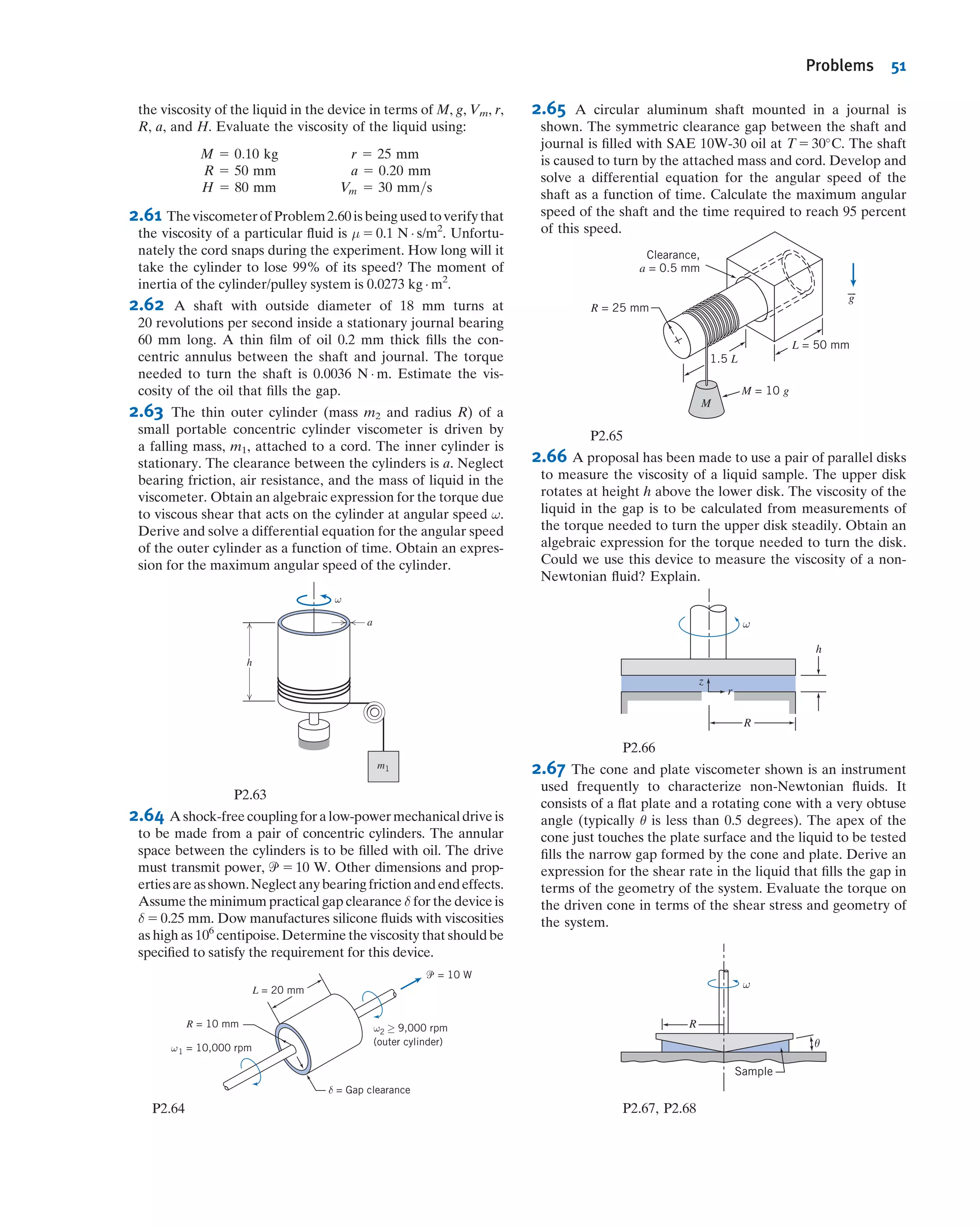
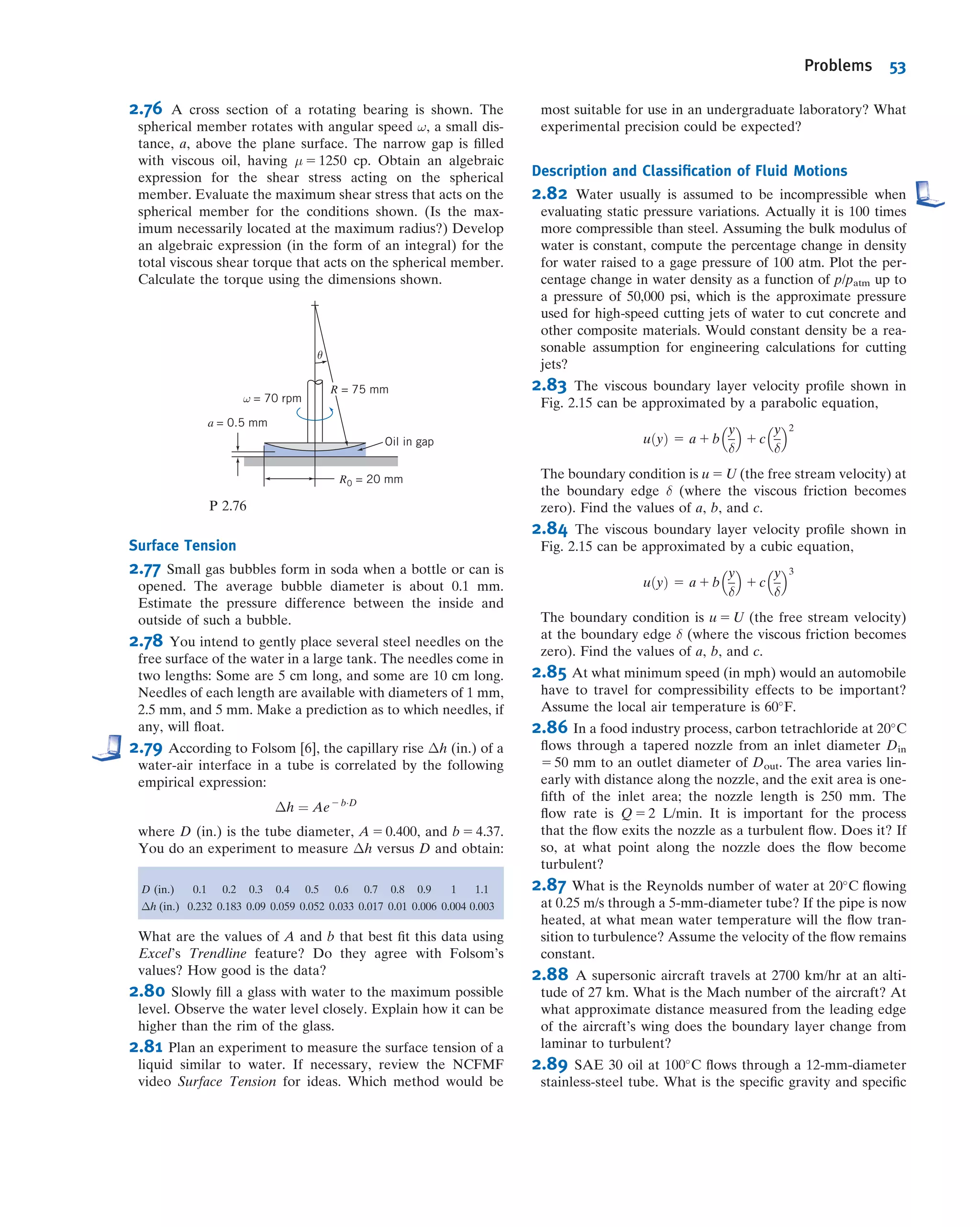
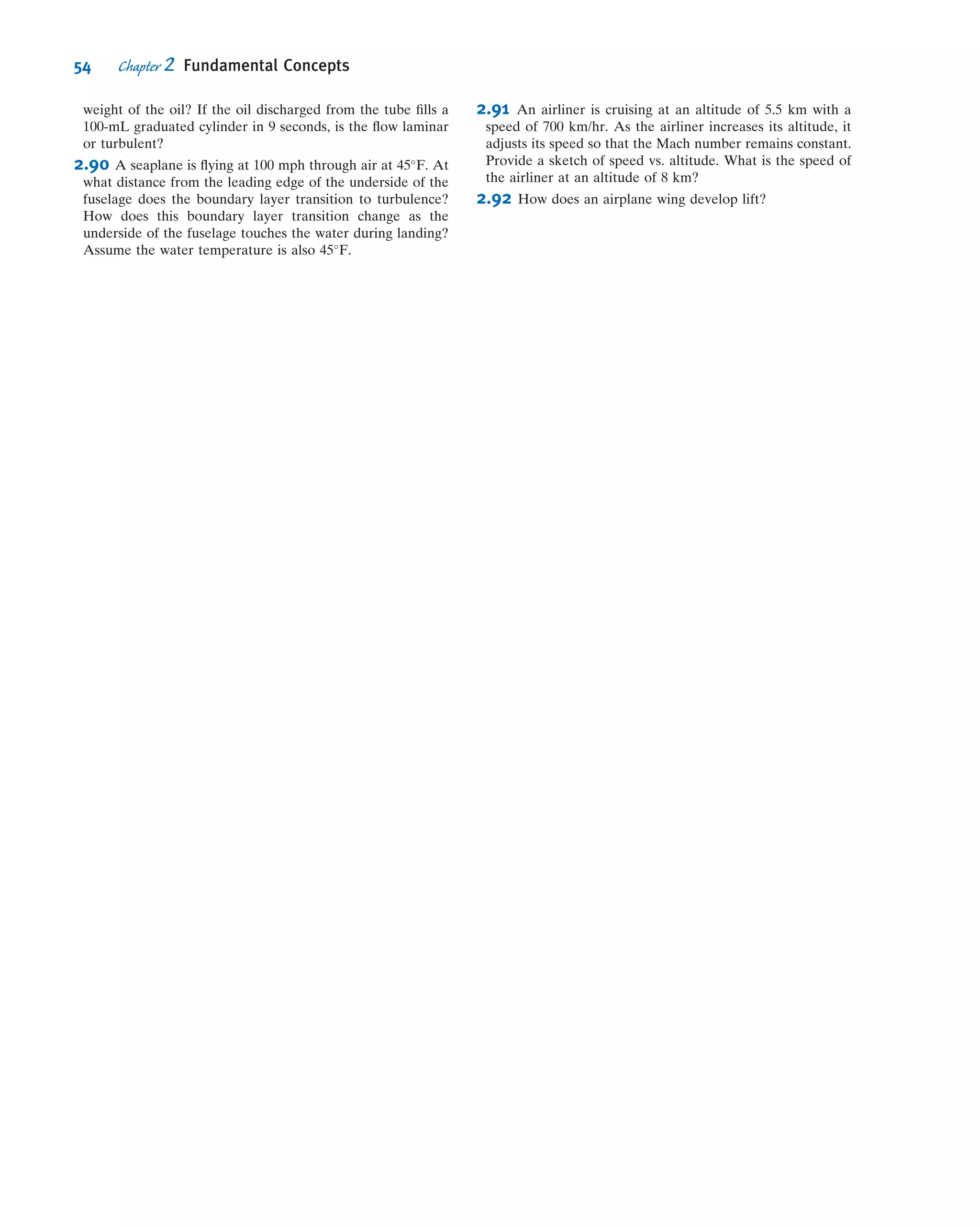
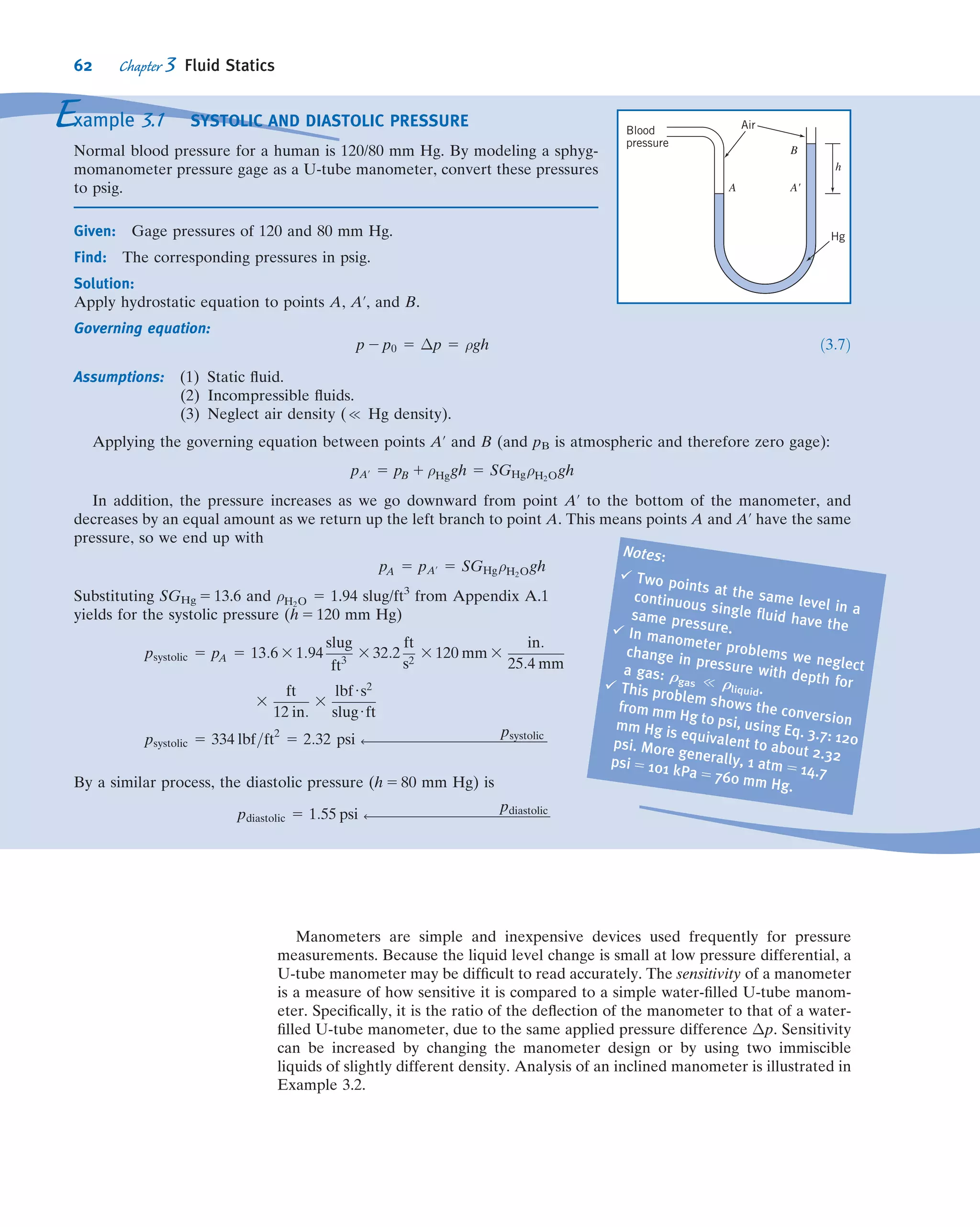
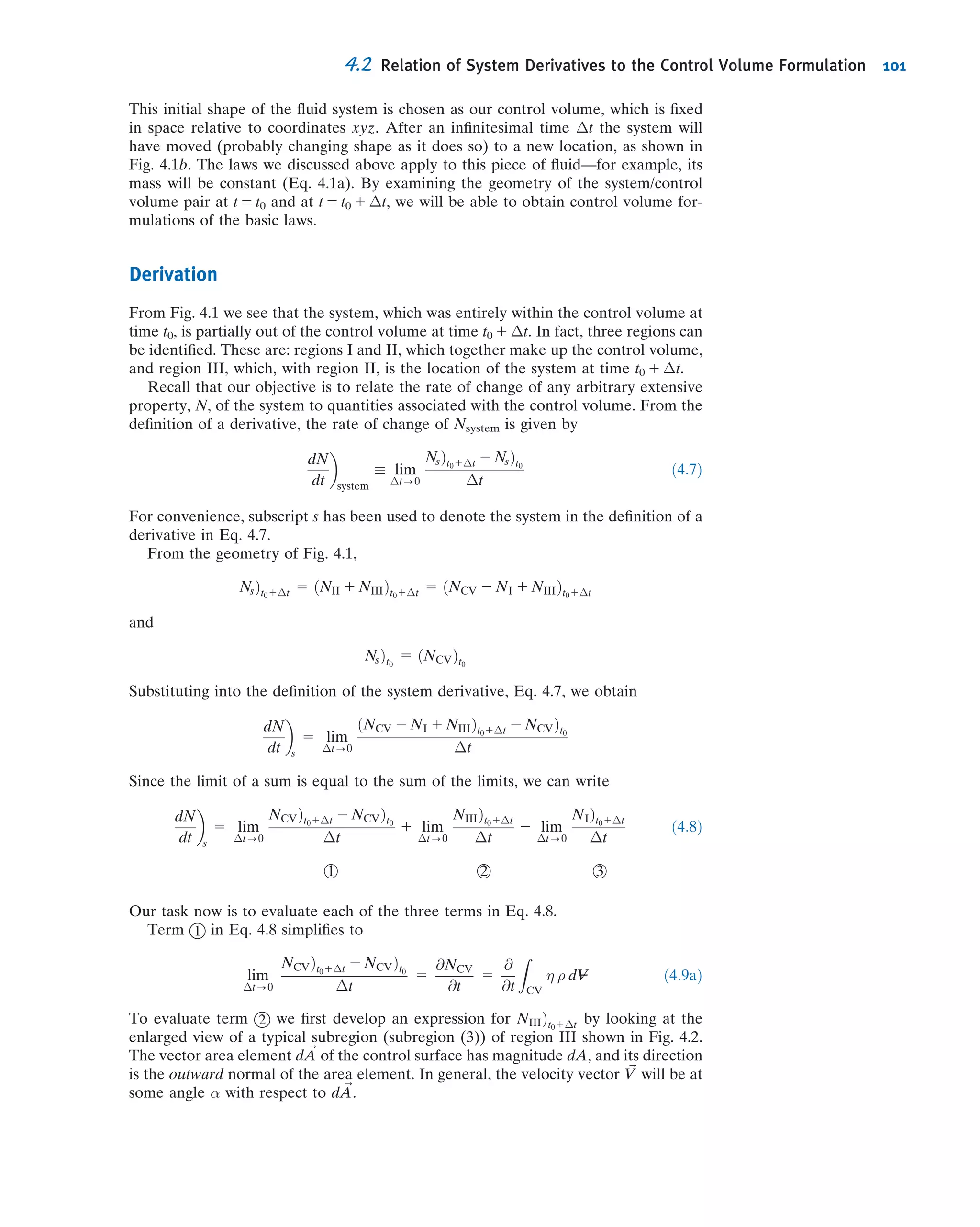
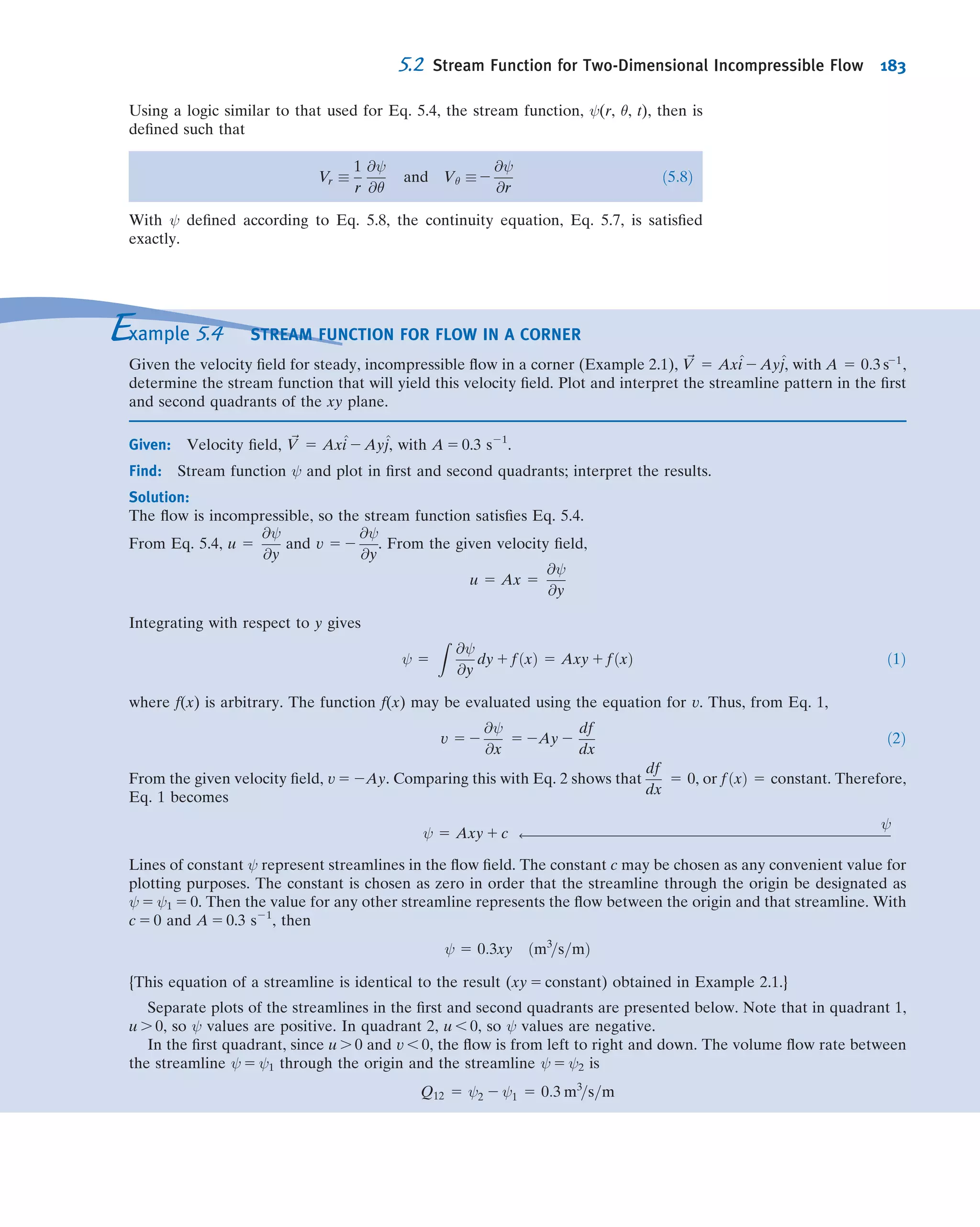
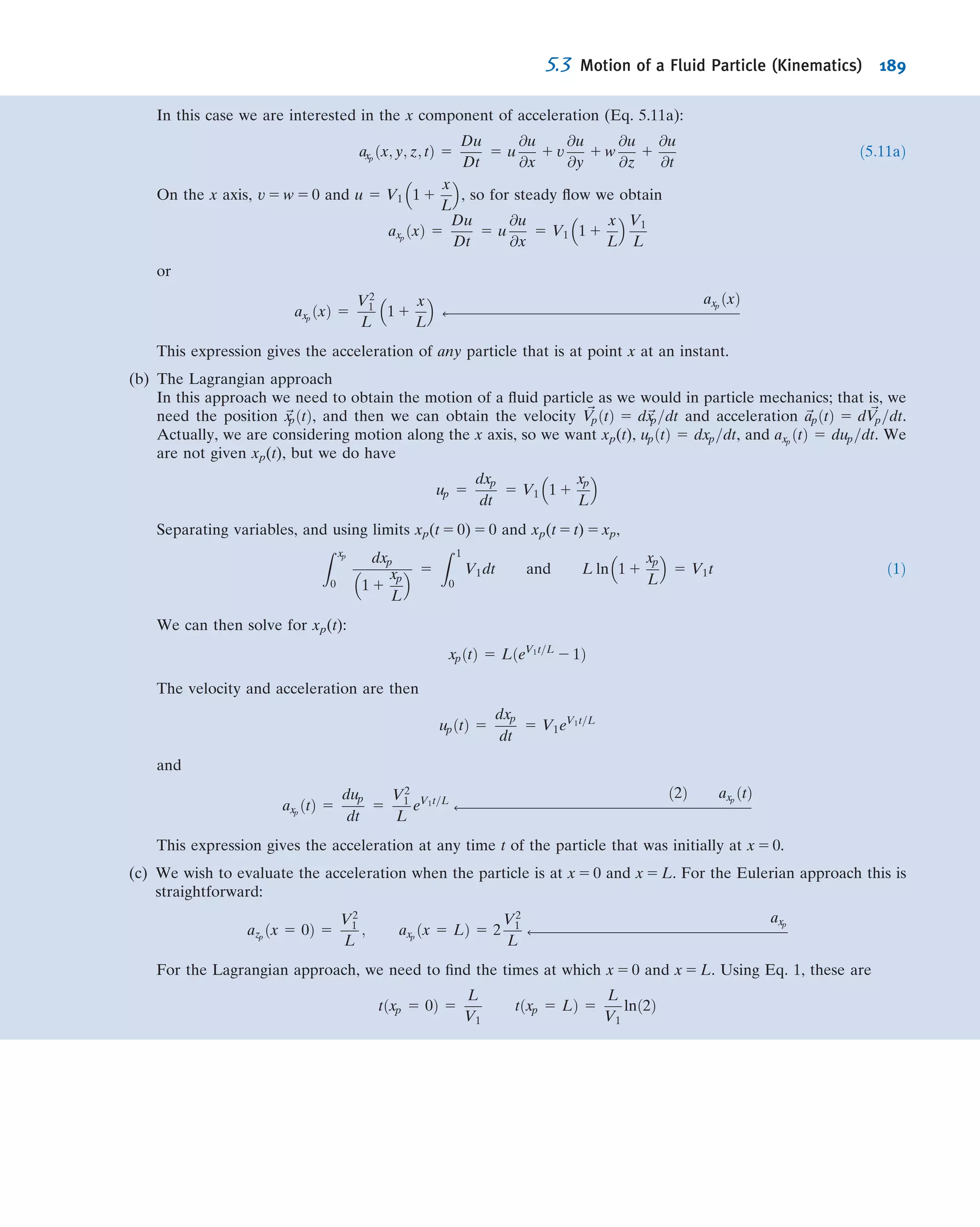
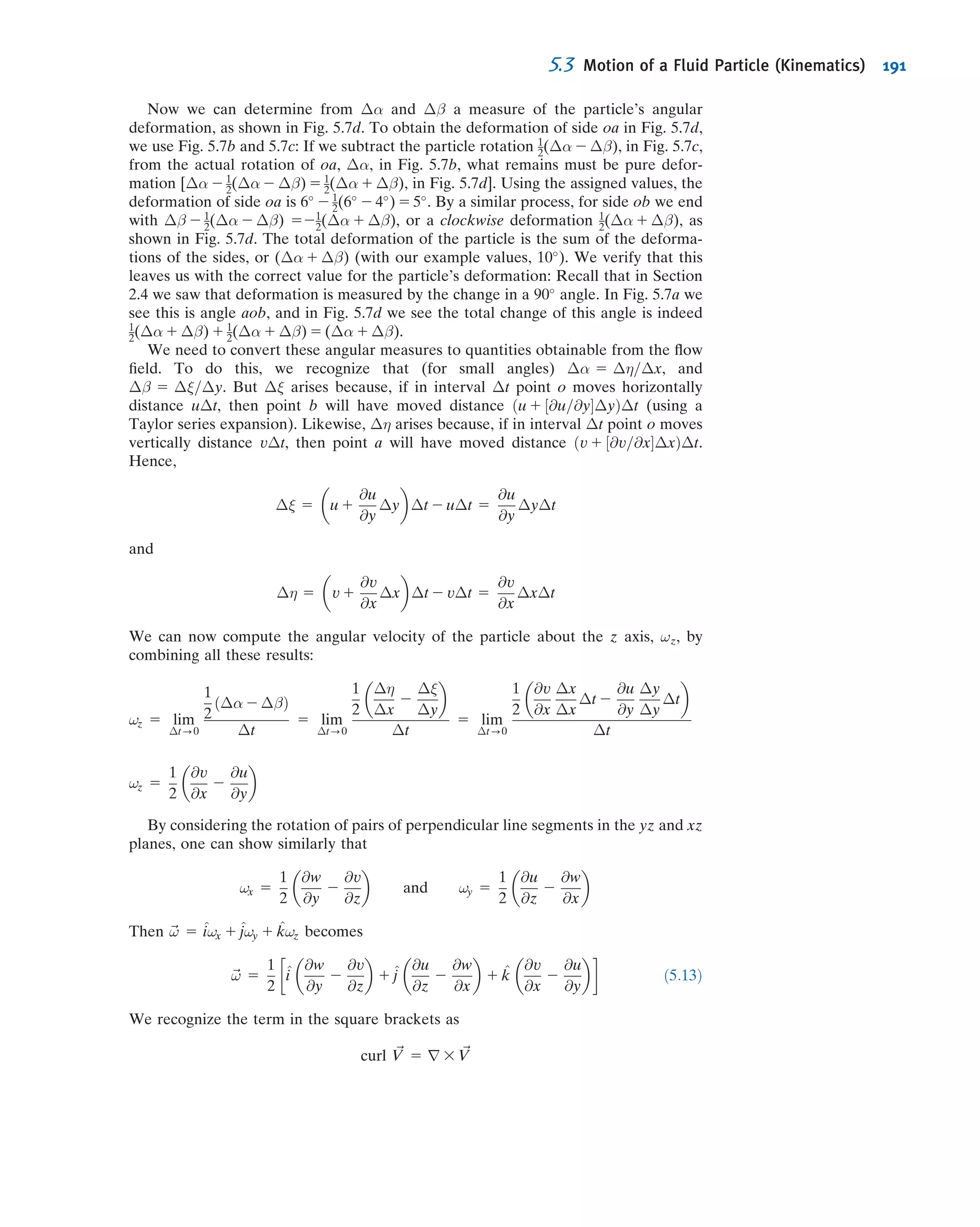
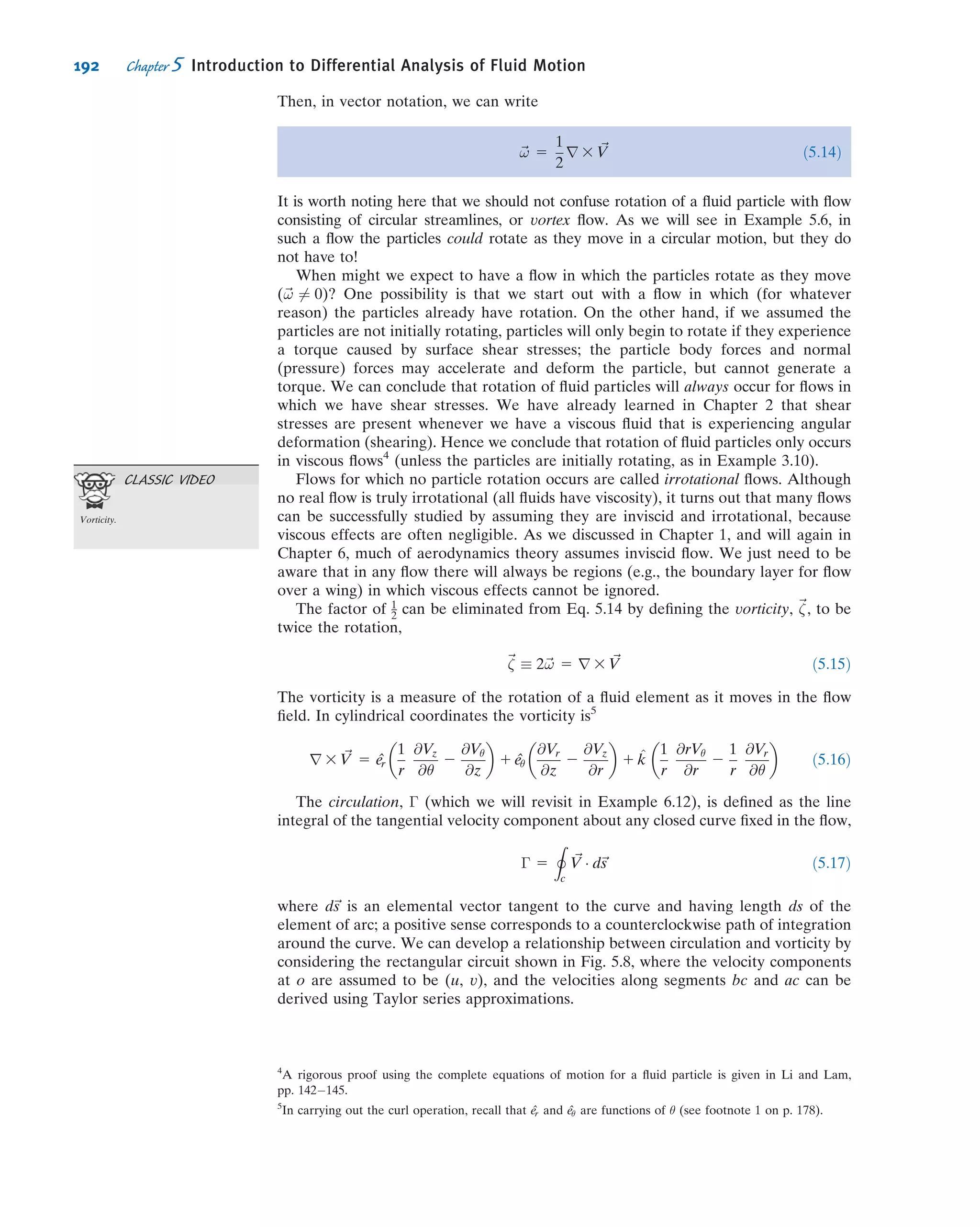
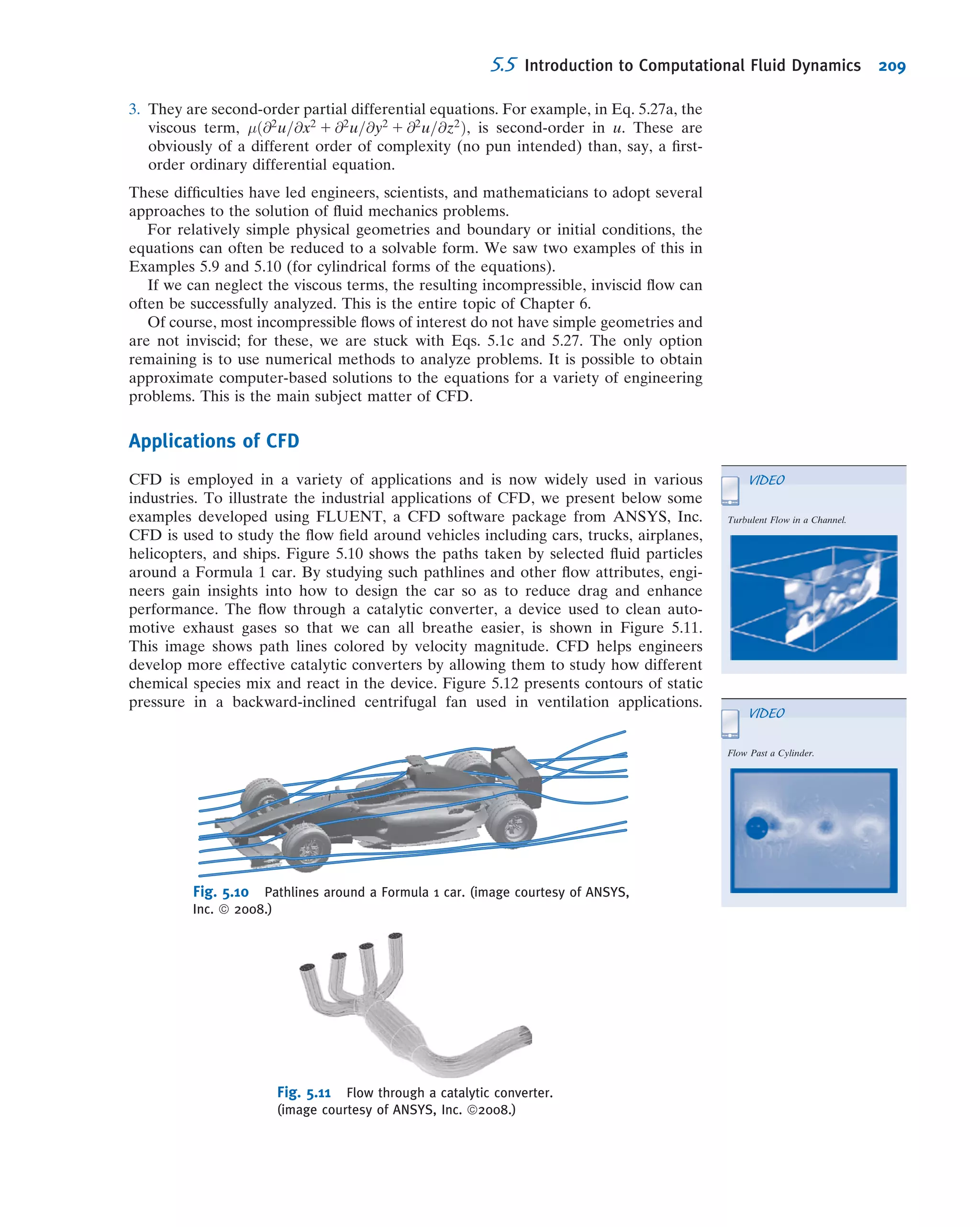
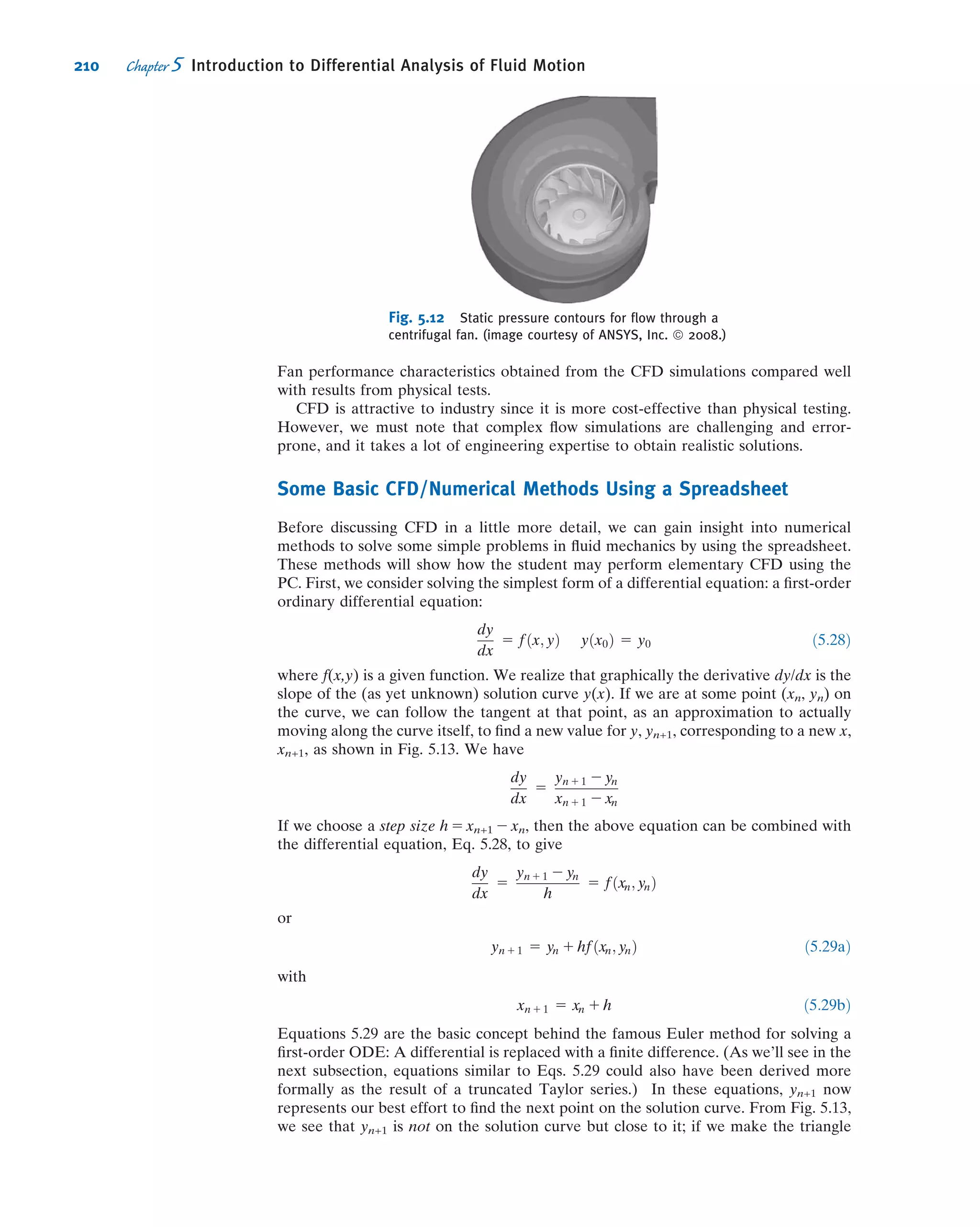
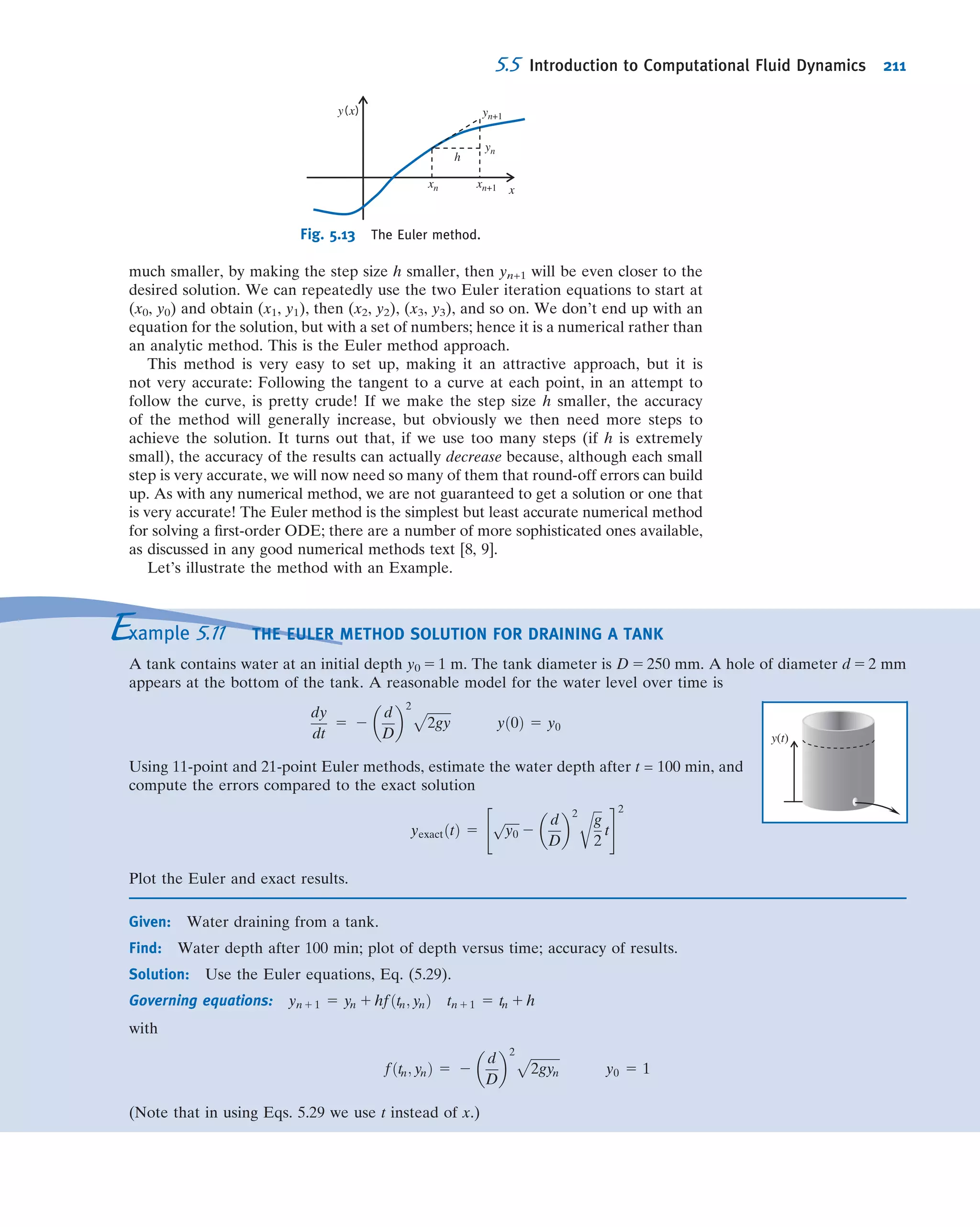
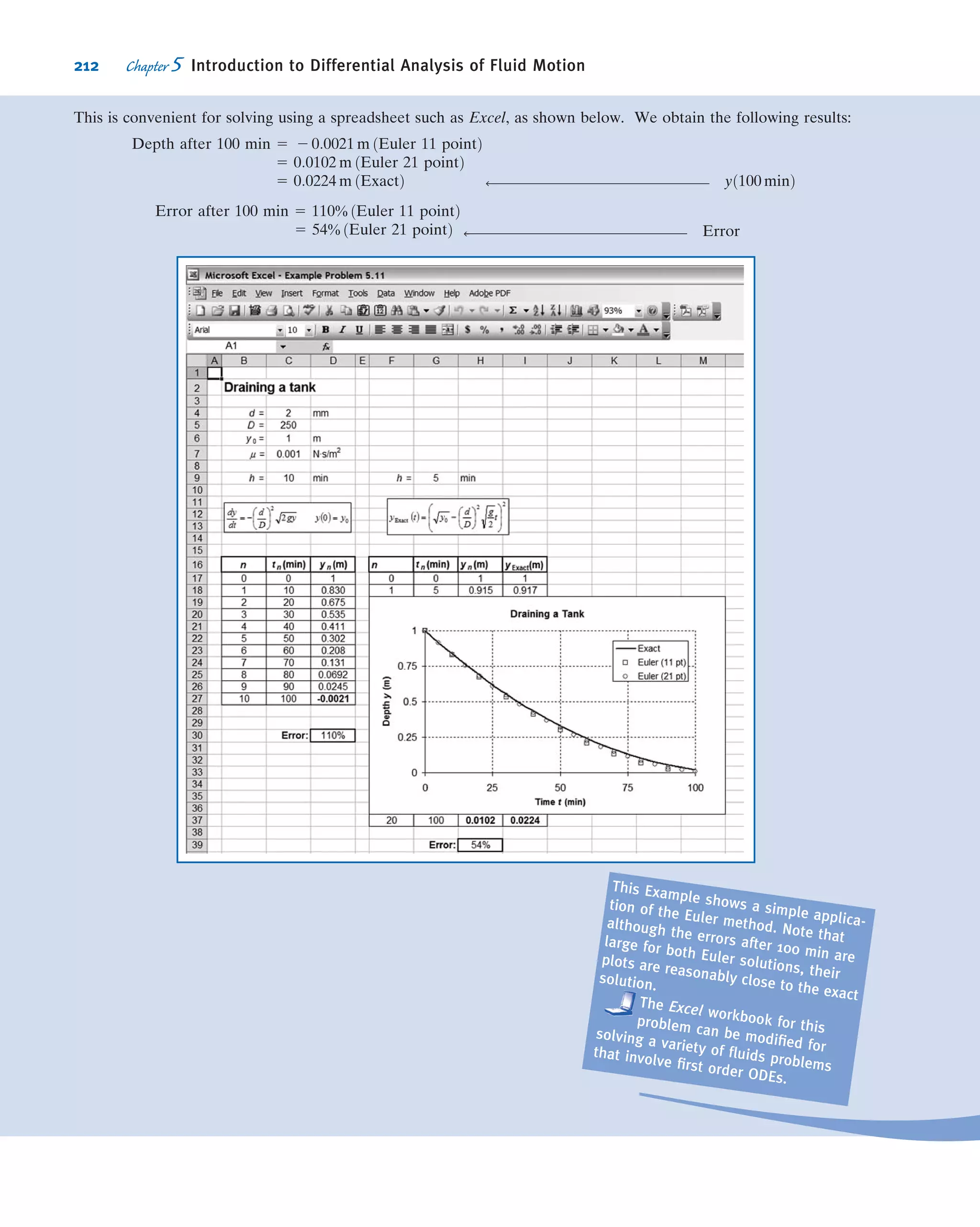
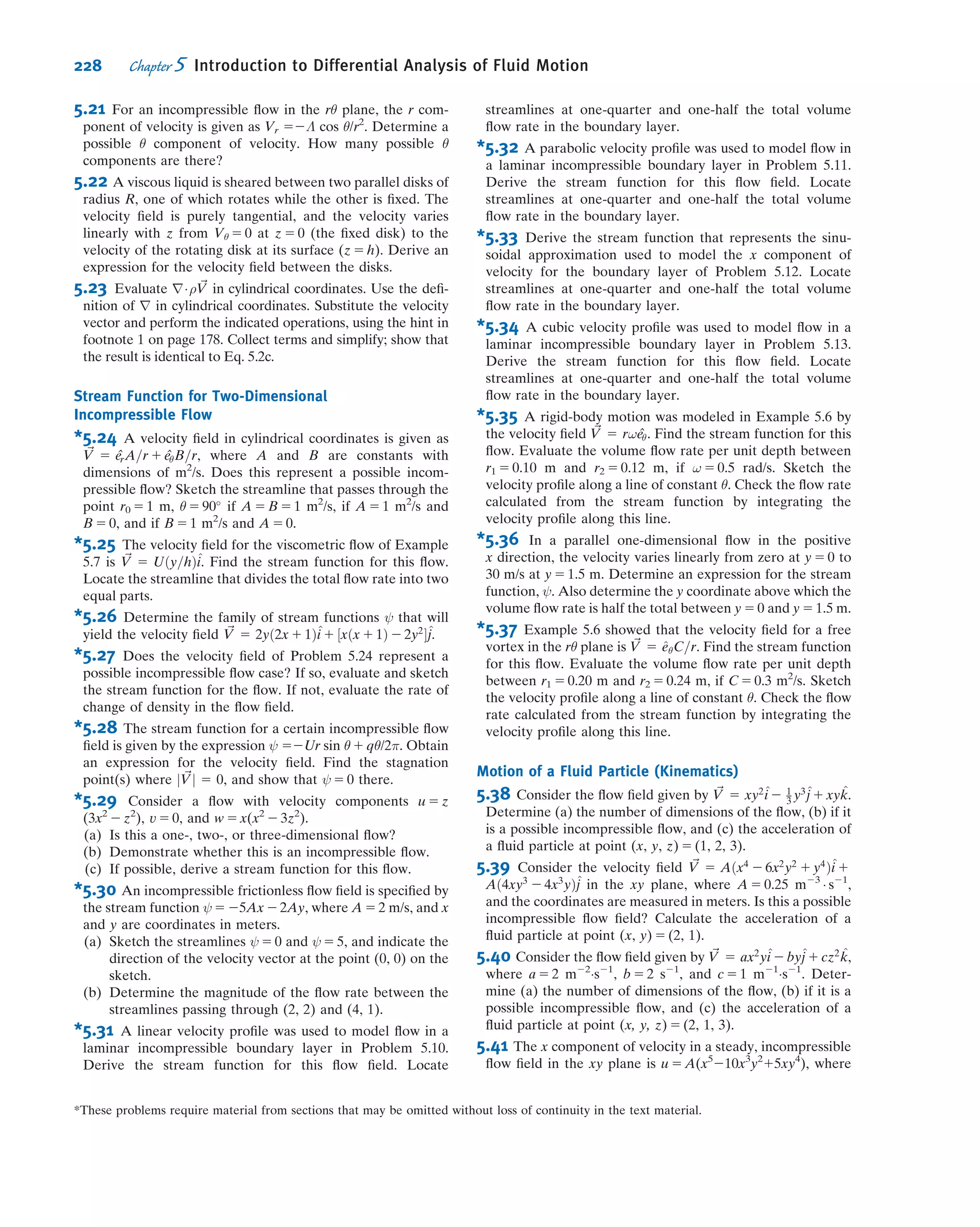
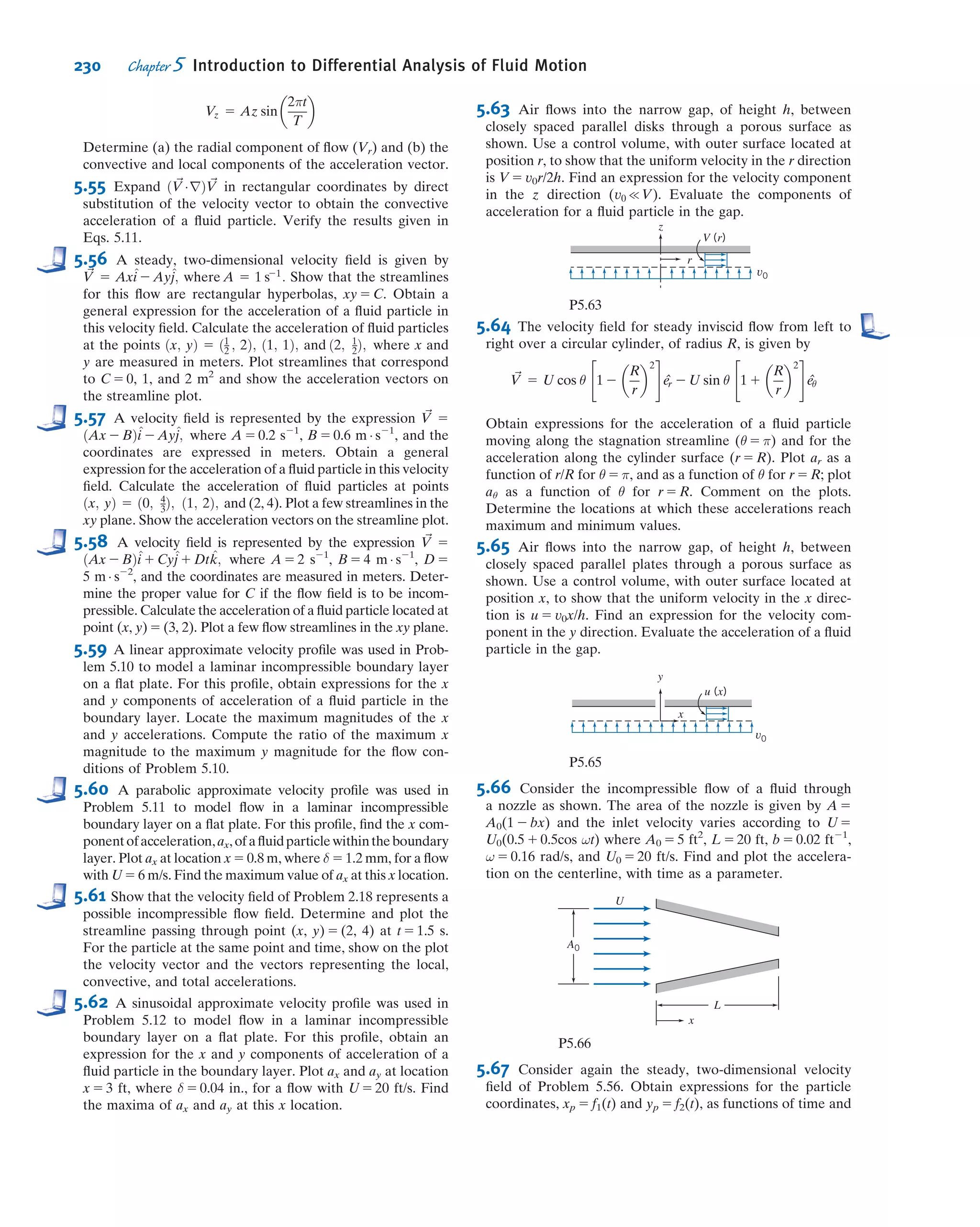
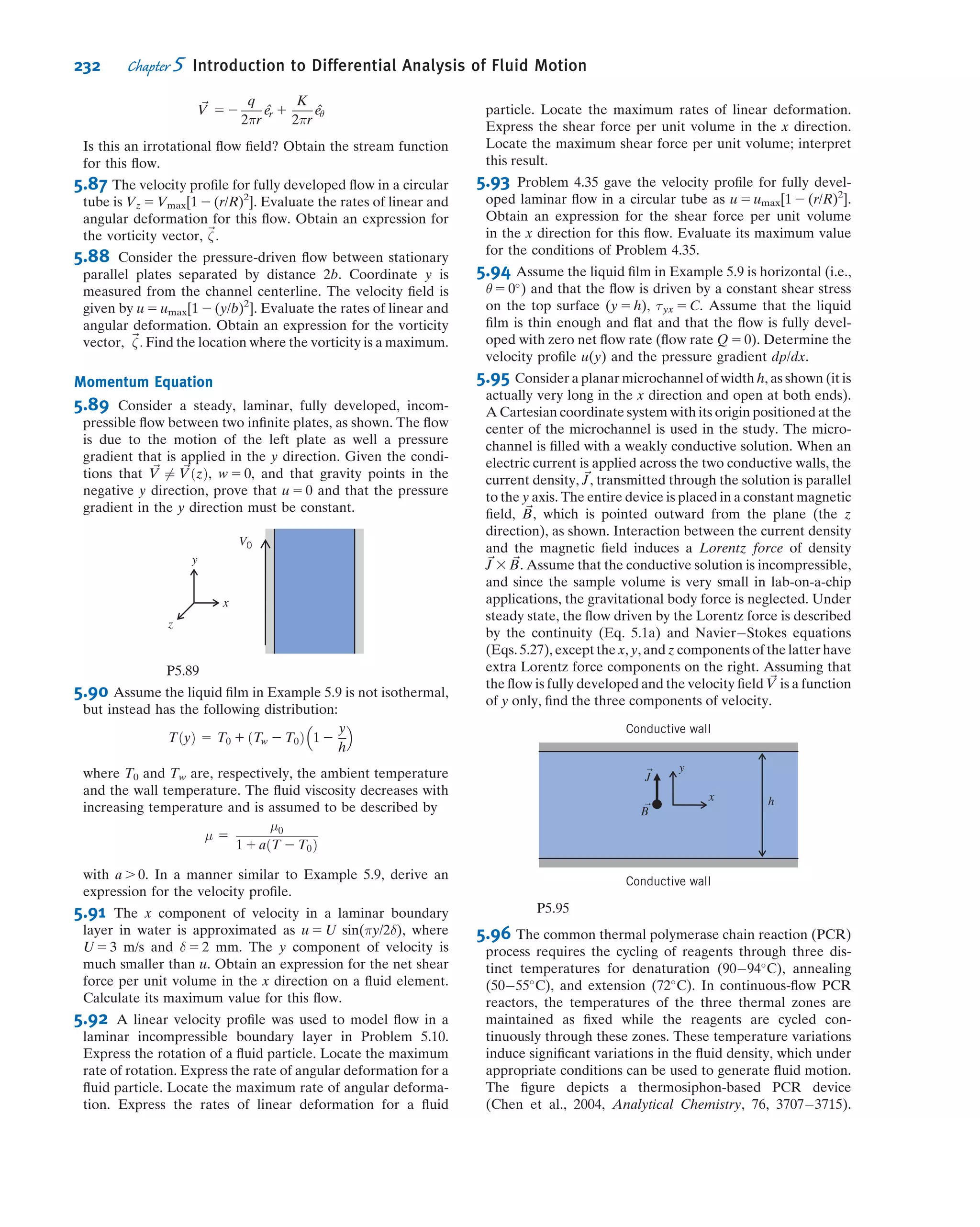
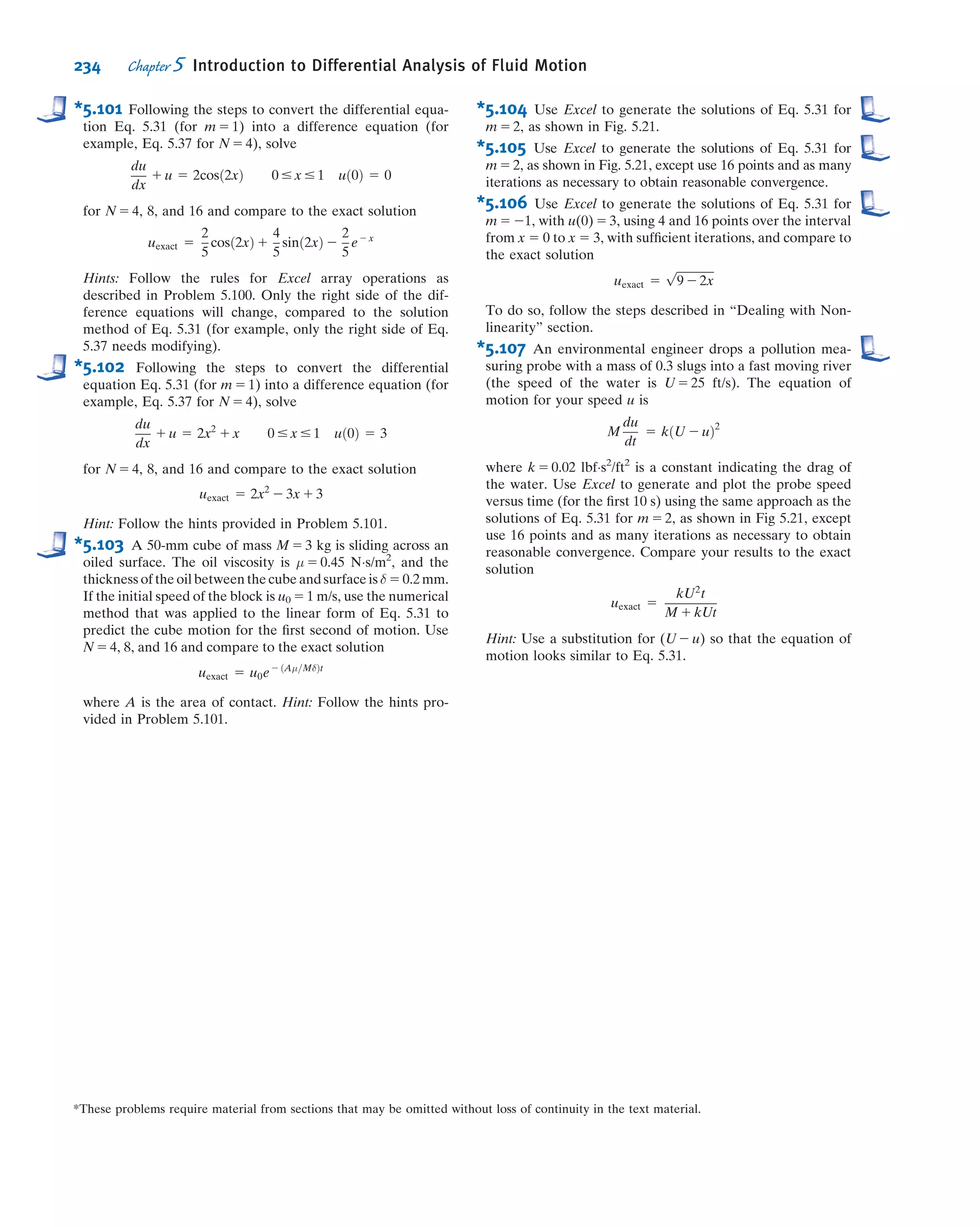
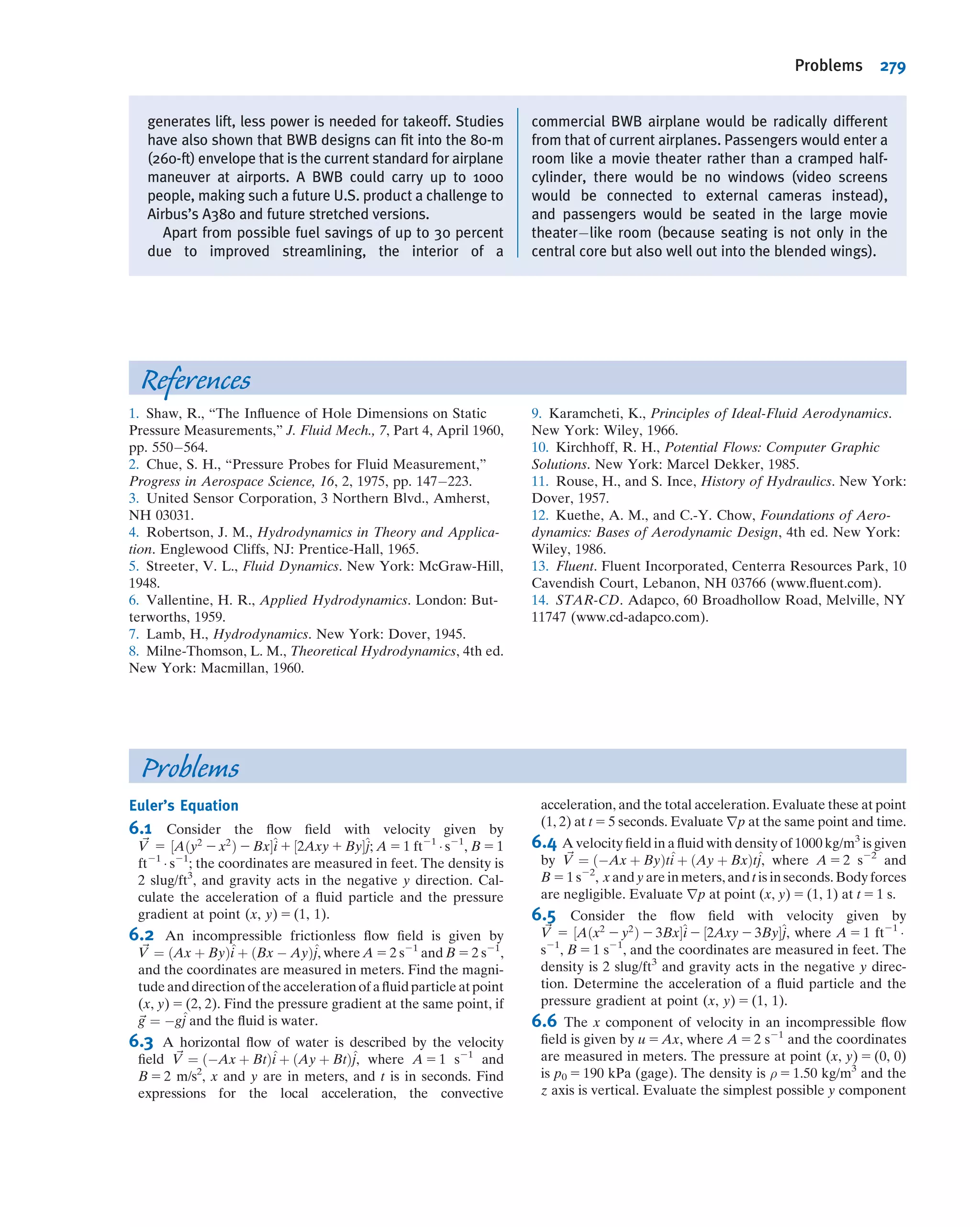
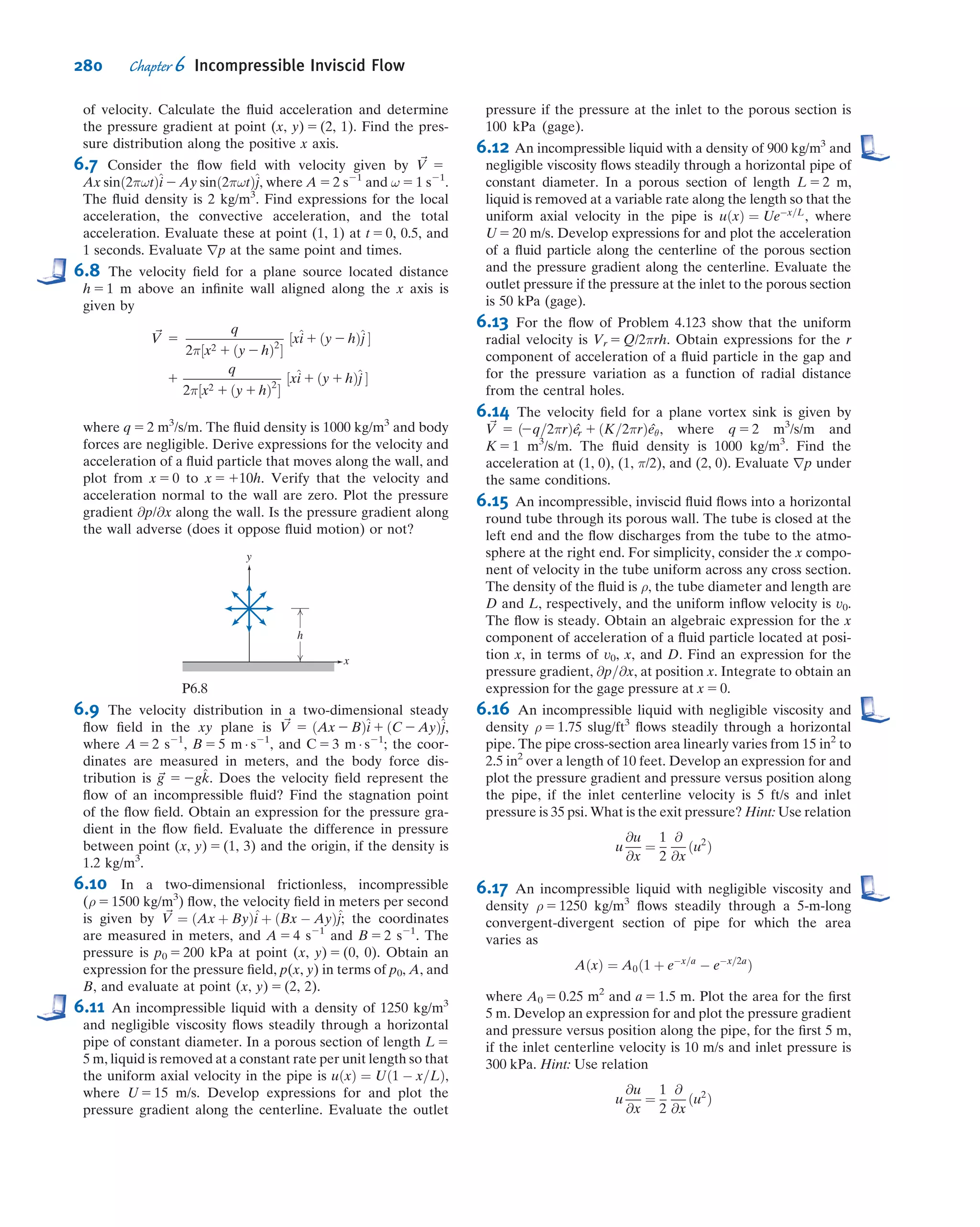
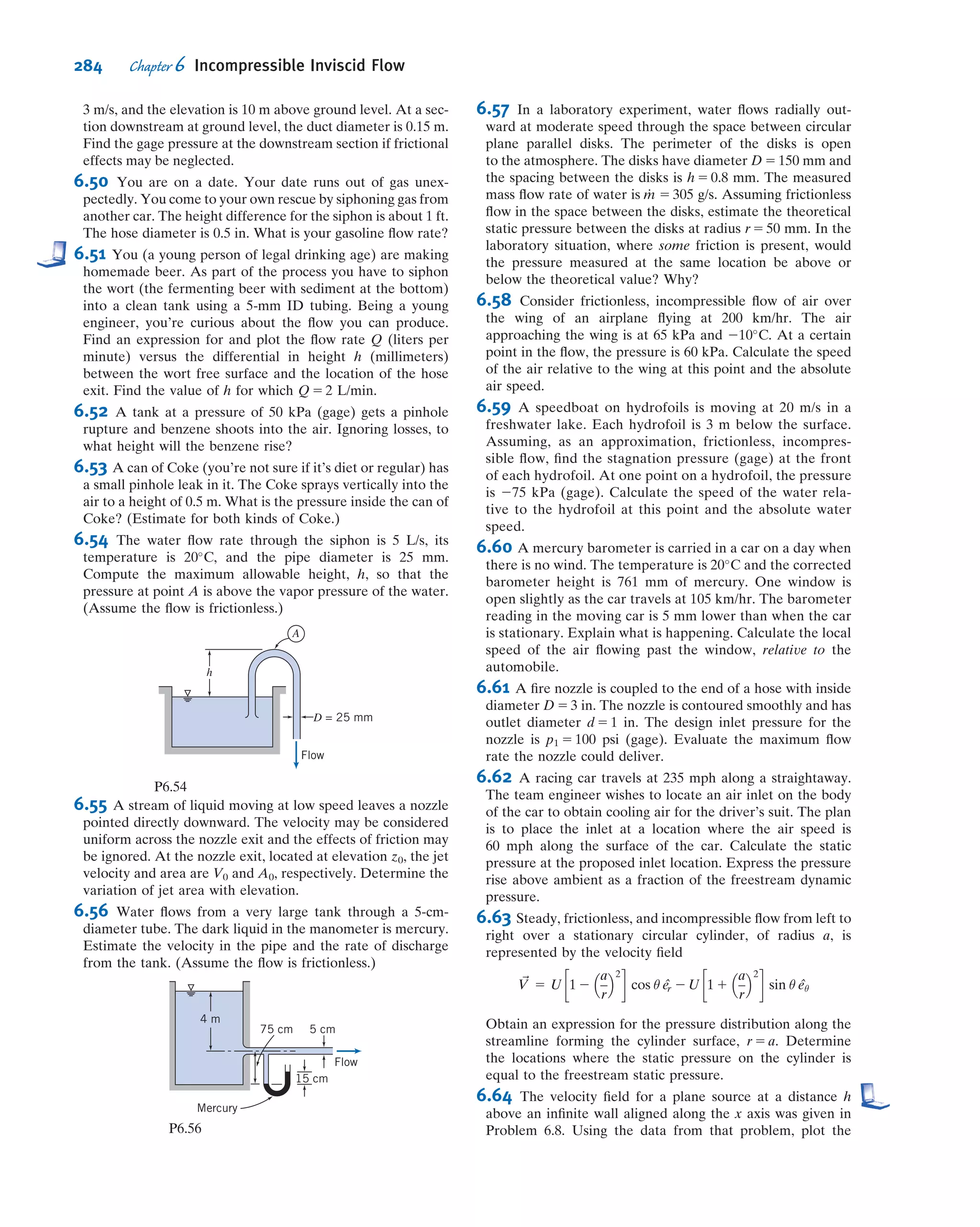
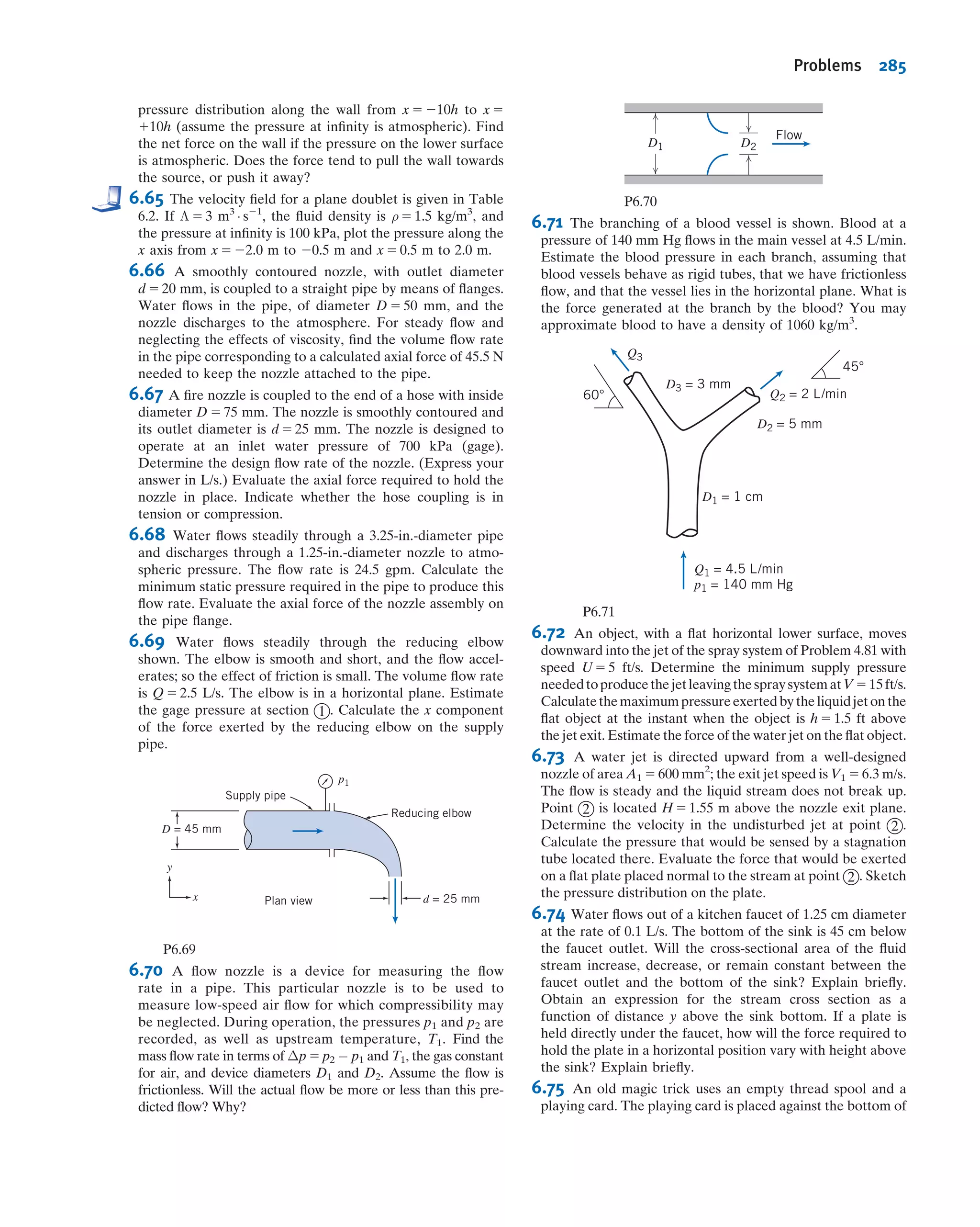
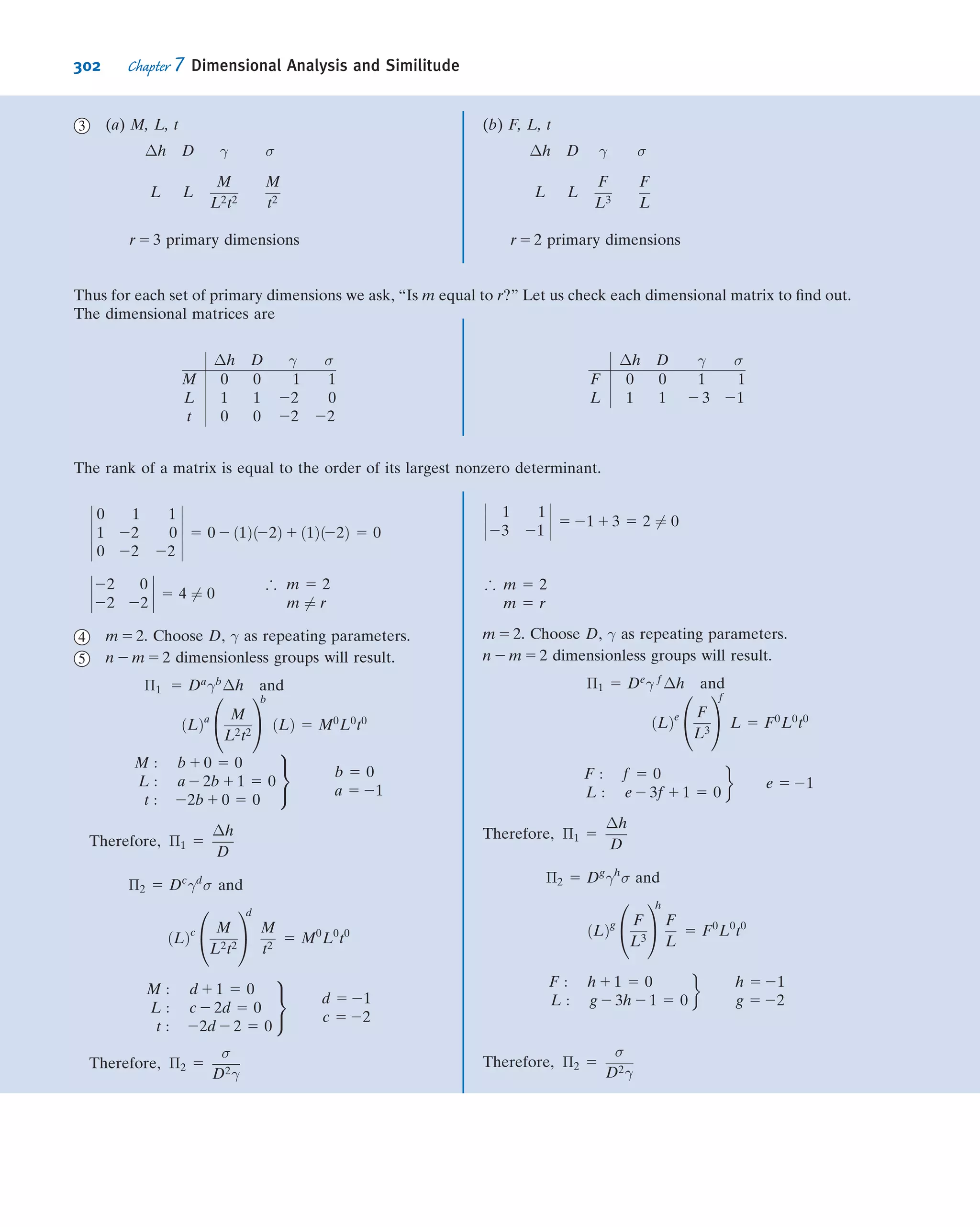
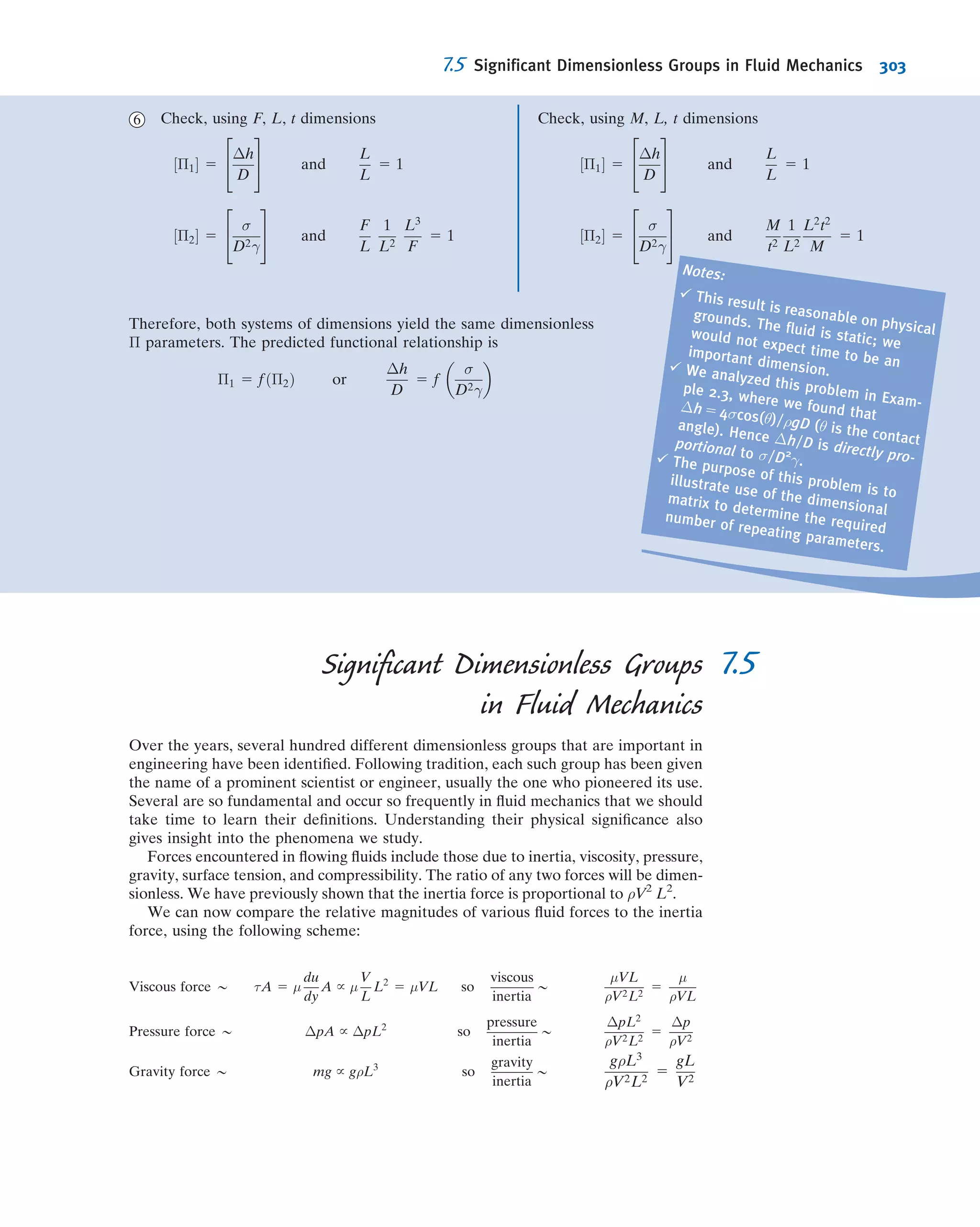
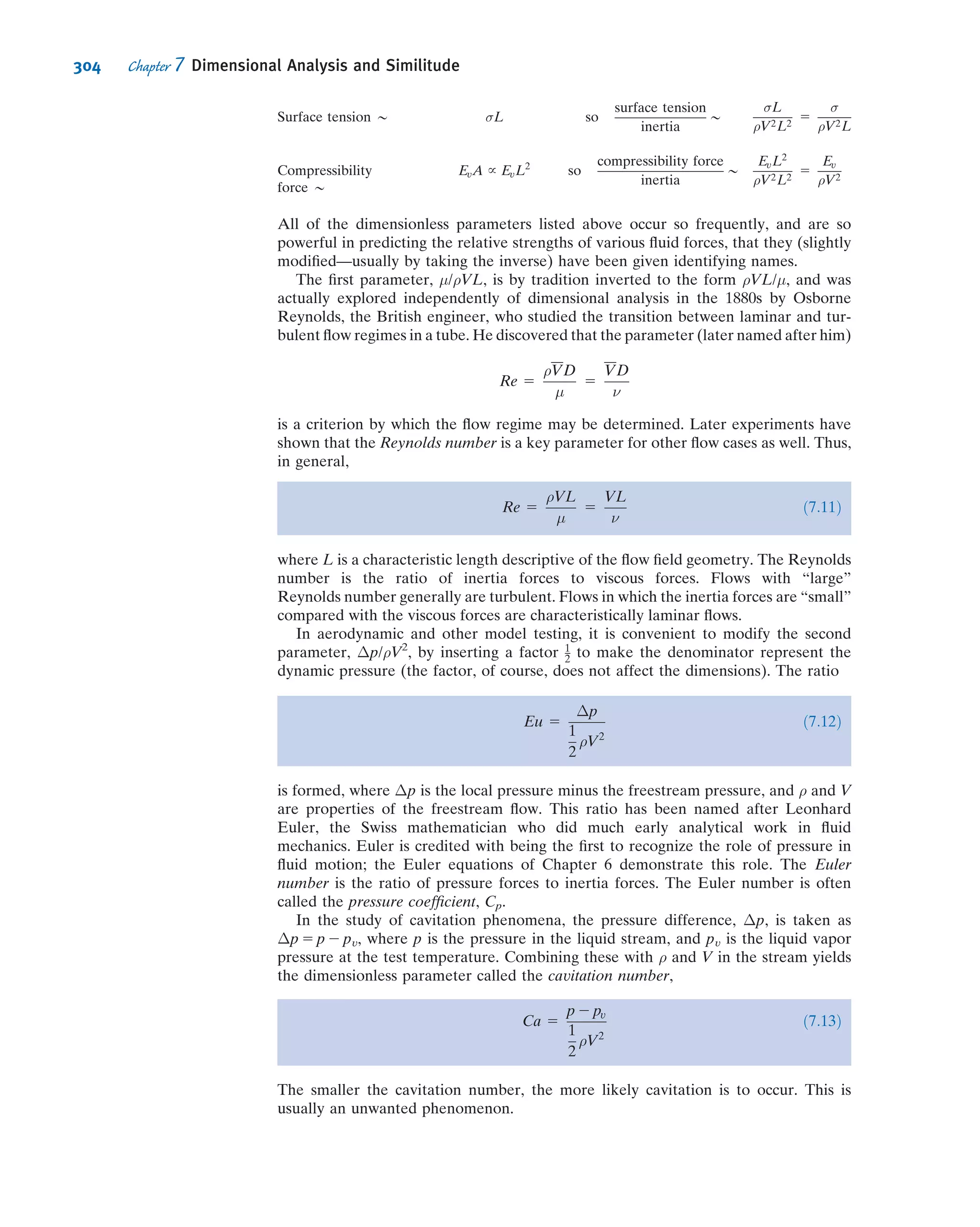
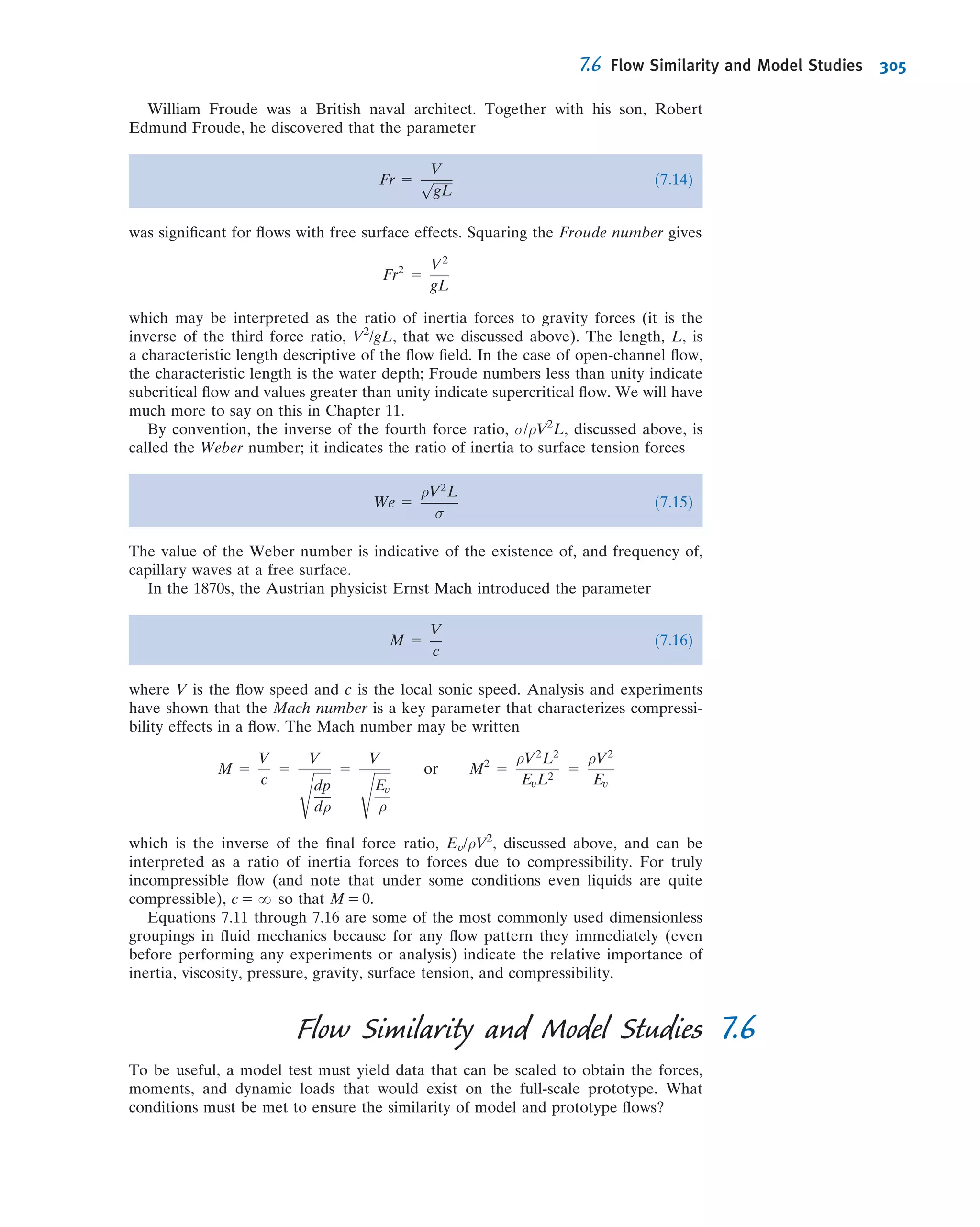
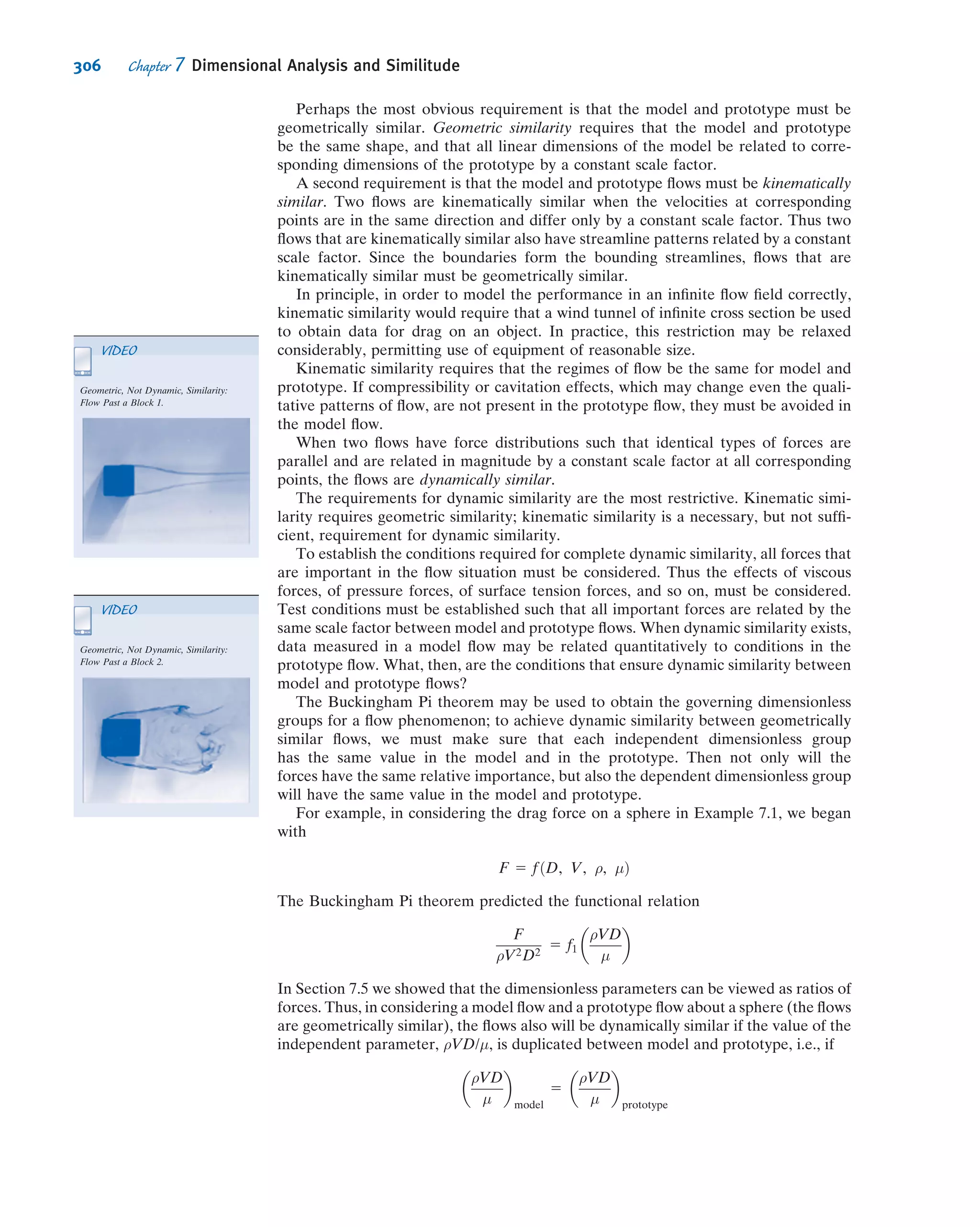
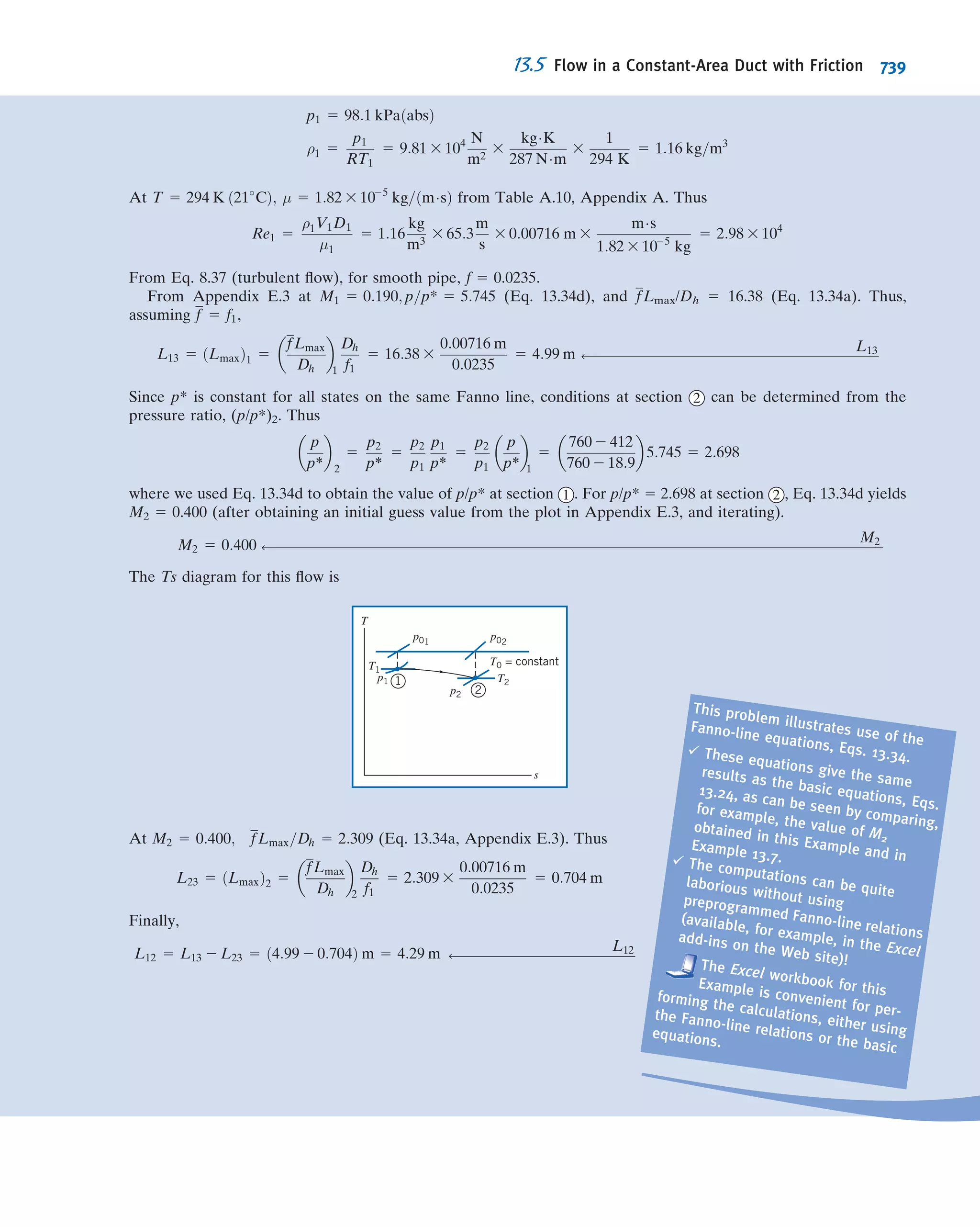
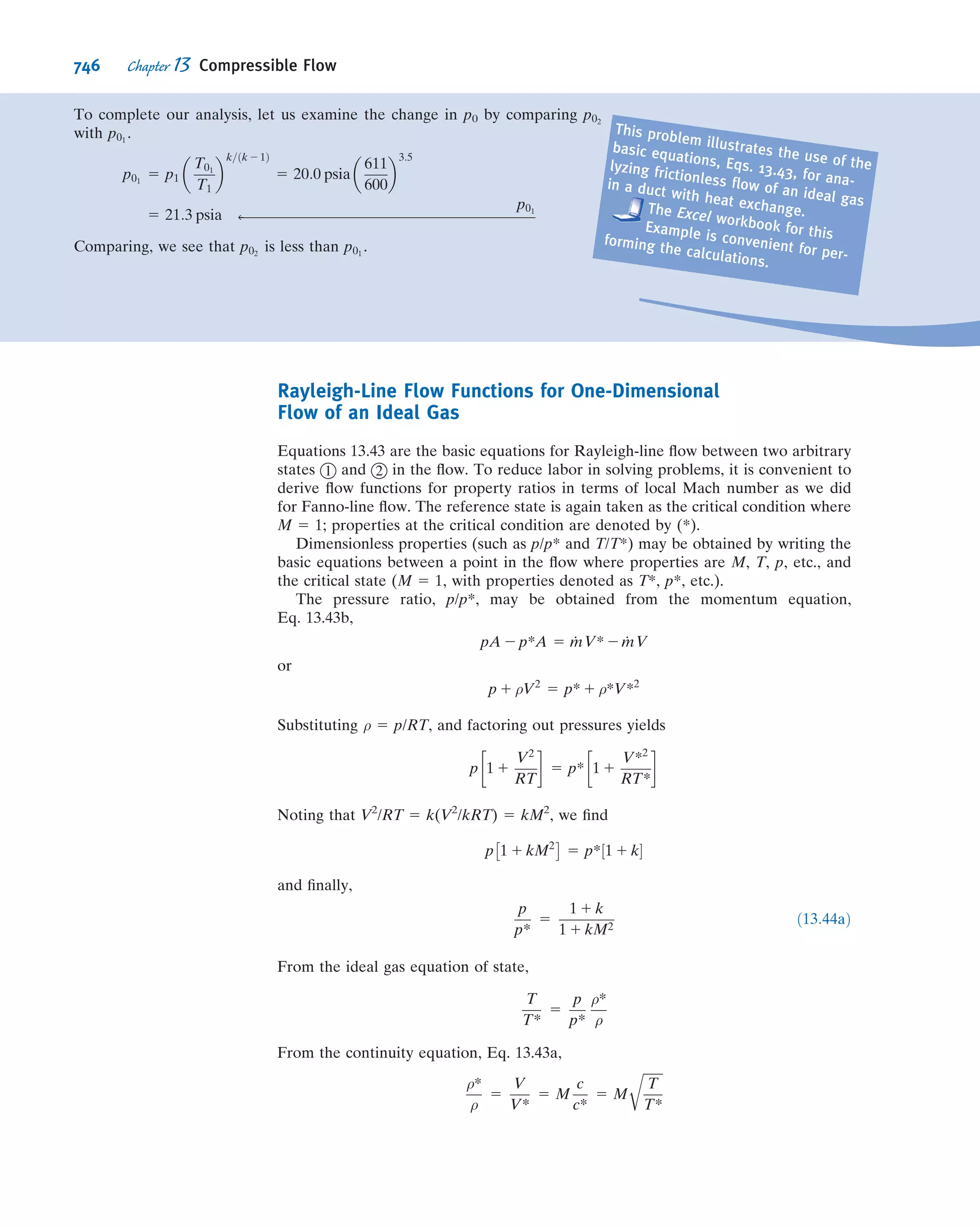
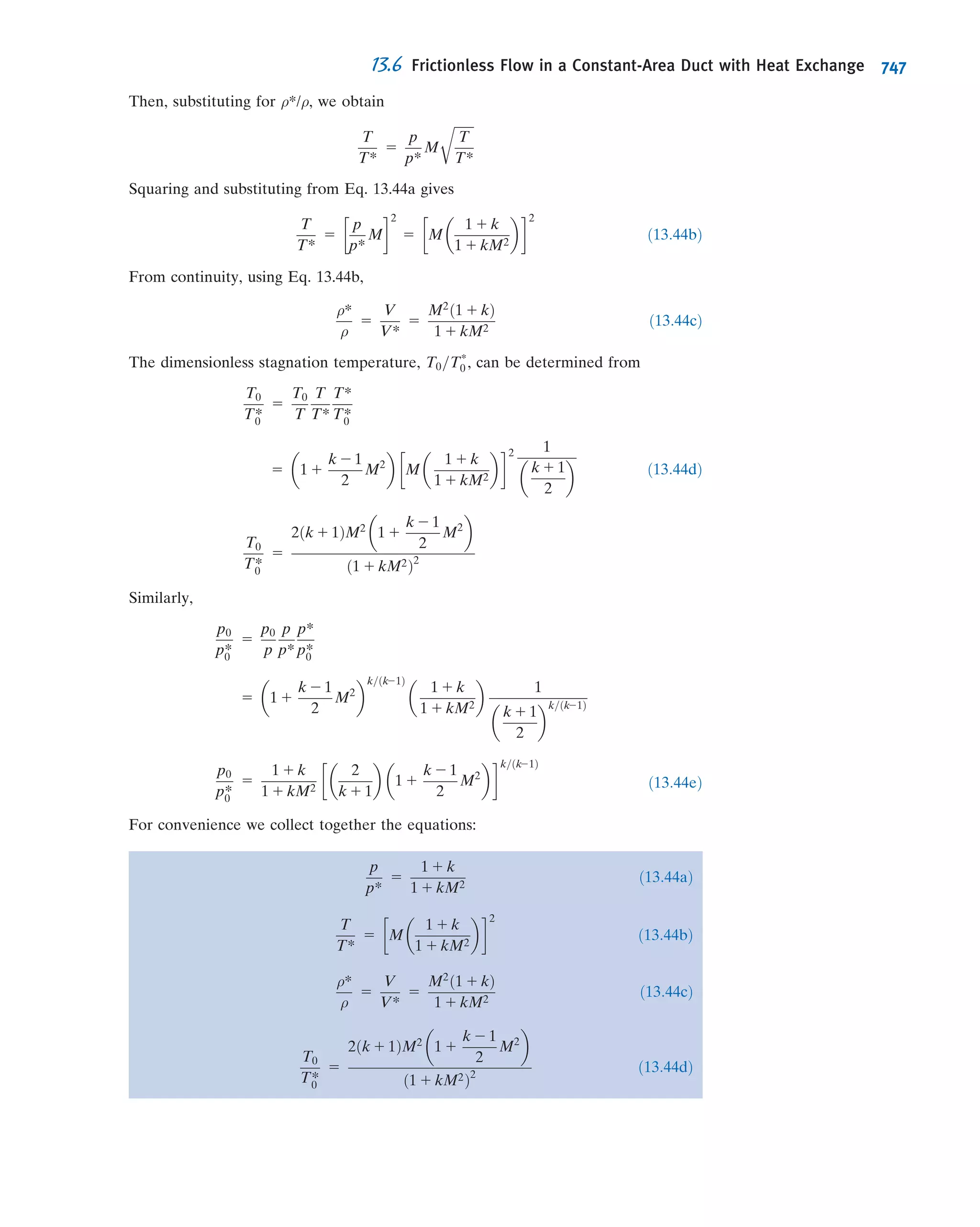
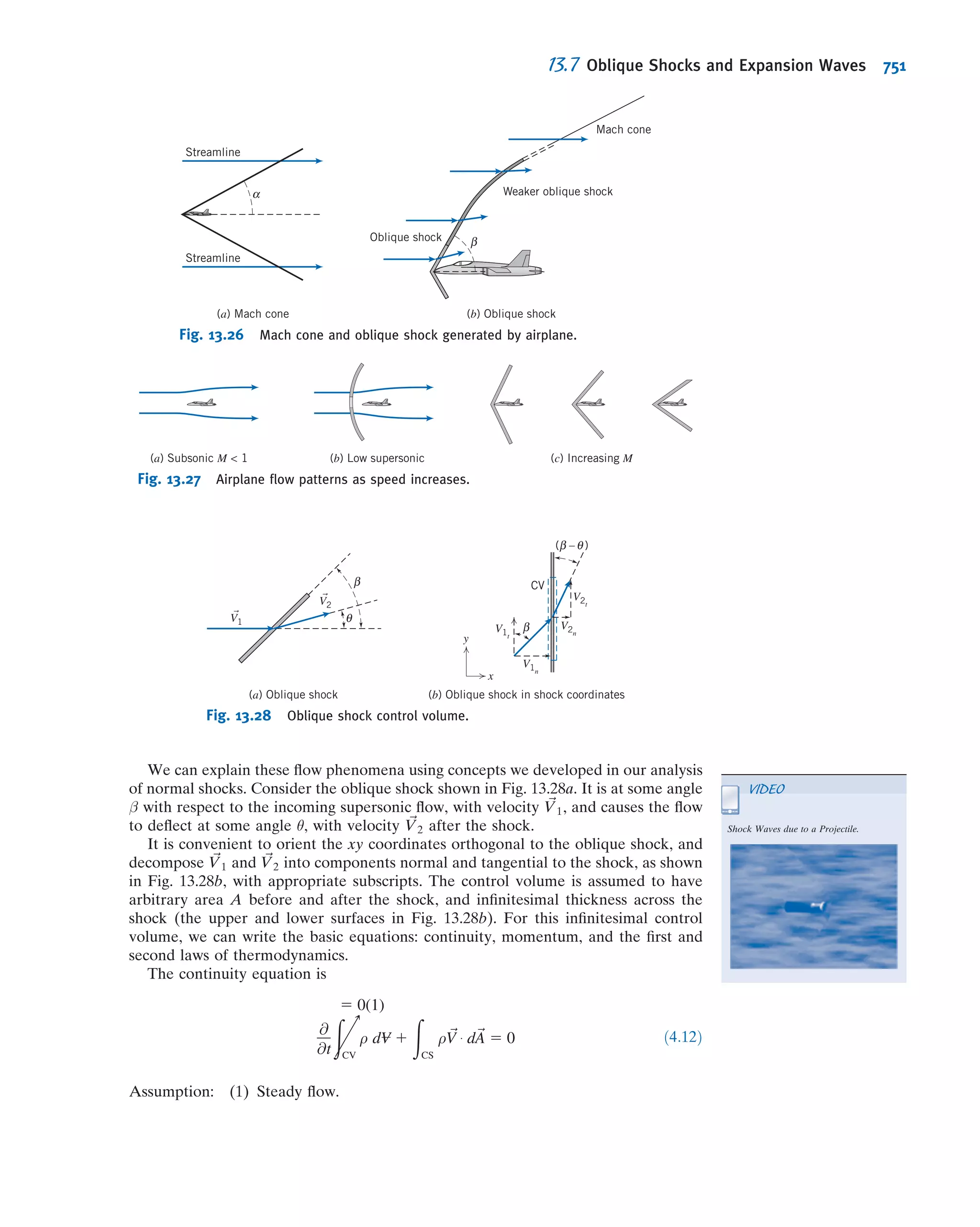
This page intentionally left blank
WILEY
PLUS
www.wileyplus.com
accessible, affordable,
active learning
WileyPLUS is an innovative, research-based, online environment for
effective teaching and learning.
WileyPLUS...
...motivates students with
confidence-boosting
feedback and proof of
progress, 24/7.
...supports instructors with
reliable resources that
reinforce course goals
inside and outside of
the classroom.
Includes
Interactive
Textbook &
Resources
WileyPLUS... Learn More,
;+.
www.wileyplus.com
WILEY
PLUS
www.wileyplus.com
ALL THE HELP, RESOURCES, AND PERSONAL SUPPORT
YOU AND YOUR STUDENTSNEED!
2-Minute Tutorials and all
of the resources you & your
students need to get started.
Student support from an
experienced student user.
Collaborate with your colleagues,
find a mentor, attend virtual and live
events, and view resources.
www.WhereFacultyConnect.com
Pre-loaded, ready-to-use
assignments and presentations.
Created by subject matter experts.
Technical Support 2-4/7
FAQs, online chat,
and phone support.
www.wileyplus.com/support
Your WileyPLUS Account Manager.
Personal training and
implementation support.
+
www.wileyplus.com/resources
Fox and McDonald’s
INTRODUCTION
TO
FLUID
MECHANICS
EIGHTH EDITION
PHILIP J. PRITCHARD
Manhattan College
With special contributions from:
JOHN C. LEYLEGIAN
Manhattan College
JOHN WILEY & SONS, INC.
VICE PRESIDENT AND EXECUTIVE PUBLISHER Don Fowley
ASSOCIATE PUBLISHER Daniel Sayre
AQUISITIONS EDITOR Jennifer Welter
EDITORIAL ASSISTANT Alexandra Spicehandler
MARKETING MANAGER Christopher Ruel
MEDIA EDITOR Elena Santa Maria
CREATIVE DIRECTOR Harold Nolan
SENIOR DESIGNER Kevin Murphy
SENIOR ILLUSTRATION EDITOR Anna Melhorn
PHOTO EDITOR Sheena Goldstein
PRODUCTION MANAGER Dorothy Sinclair
SENIOR PRODUCTION EDITOR Trish McFadden
PRODUCTION MANAGEMENT SERVICES MPS Limited, A Macmillan Company
COVER DESIGN Wendy Lai
COVER PHOTO rsupertramp/iStockphoto CFD simulation image courtesy of
Symscape at www.symscape.com
CHAPTER OPENING PHOTO Dr. Charles O’Neill, Oklahoma State University
This book was set in Times Roman by MPS Limited, A Macmillan Company and printed and bound by R.R. Donnelley-JC. The cover
was printed by R.R. Donnelley-JC.
This book is printed on acid-free paper.
Copyright r 2011 John Wiley & Sons, Inc. All rights reserved. No part of this publication may be reproduced, stored in a retrieval
system or transmitted in any form or by any means, electronic, mechanical, photocopying, recording, scanning, or otherwise, except
as permitted under Sections 107 or 108 of the 1976 United States Copyright Act, without either the prior written permission of the
Publisher, or authorization through payment of the appropriate per-copy fee to the Copyright Clearance Center, Inc., 222 Rosewood
Drive, Danvers, MA 01923, (978)750-8400, fax (978)750-4470 or on the web at www.copyright.com. Requests to the Publisher for
permission should be addressed to the Permissions Department, John Wiley & Sons, Inc., 111 River Street, Hoboken, NJ 07030-5774,
(201)748-6011, fax (201)748-6008, or online at http://www.wiley.com/go/permissions.
Evaluation copies are provided to qualified academics and professionals for review purposes only, for use in their courses during
the next academic year. These copies are licensed and may not be sold or transferred to a third party. Upon completion of the review
period, please return the evaluation copy to Wiley. Return instructions and a free of charge return shipping label are available at
www.wiley.com/go/returnlabel. Outside of the United States, please contact your local representative.
ISBN-13 9780470547557
ISBN-10 0470547553
Printed in the United States of America
10 9 8 7 6 5 4 3 2 1
Contents
CHAPTER 1 INTRODUCTION /1
1.1 Note to Students /3
1.2 Scope of Fluid Mechanics /4
1.3 Definition of a Fluid /4
1.4 Basic Equations /5
1.5 Methods of Analysis /6
System and Control Volume /7
Differential versus Integral Approach /8
Methods of Description /9
1.6 Dimensions and Units /11
Systems of Dimensions /11
Systems of Units /11
Preferred Systems of Units /13
Dimensional Consistency and “Engineering” Equations /14
1.7 Analysis of Experimental Error /15
1.8 Summary /16
Problems /17
CHAPTER 2 FUNDAMENTAL CONCEPTS /20
2.1 Fluid as a Continuum /21
2.2 Velocity Field /23
One-, Two-, and Three-Dimensional Flows /24
Timelines, Pathlines, Streaklines, and Streamlines /25
2.3 Stress Field /29
2.4 Viscosity /31
Newtonian Fluid /32
Non-Newtonian Fluids /34
2.5 Surface Tension /36
2.6 Description and Classification of Fluid Motions /38
Viscous and Inviscid Flows /38
Laminar and Turbulent Flows /41
Compressible and Incompressible Flows /42
Internal and External Flows /43
2.7 Summary and Useful Equations /44
v
References /46
Problems /46
CHAPTER 3 FLUID STATICS /55
3.1 The Basic Equation of Fluid Statics /56
3.2 The Standard Atmosphere /60
3.3 Pressure Variation in a Static Fluid /61
Incompressible Liquids: Manometers /61
Gases /66
3.4 Hydraulic Systems /69
3.5 Hydrostatic Force on Submerged Surfaces /69
Hydrostatic Force on a Plane Submerged Surface /69
Hydrostatic Force on a Curved Submerged Surface /76
*3.6 Buoyancy and Stability /80
3.7 Fluids in Rigid-Body Motion (on the Web) /W-1
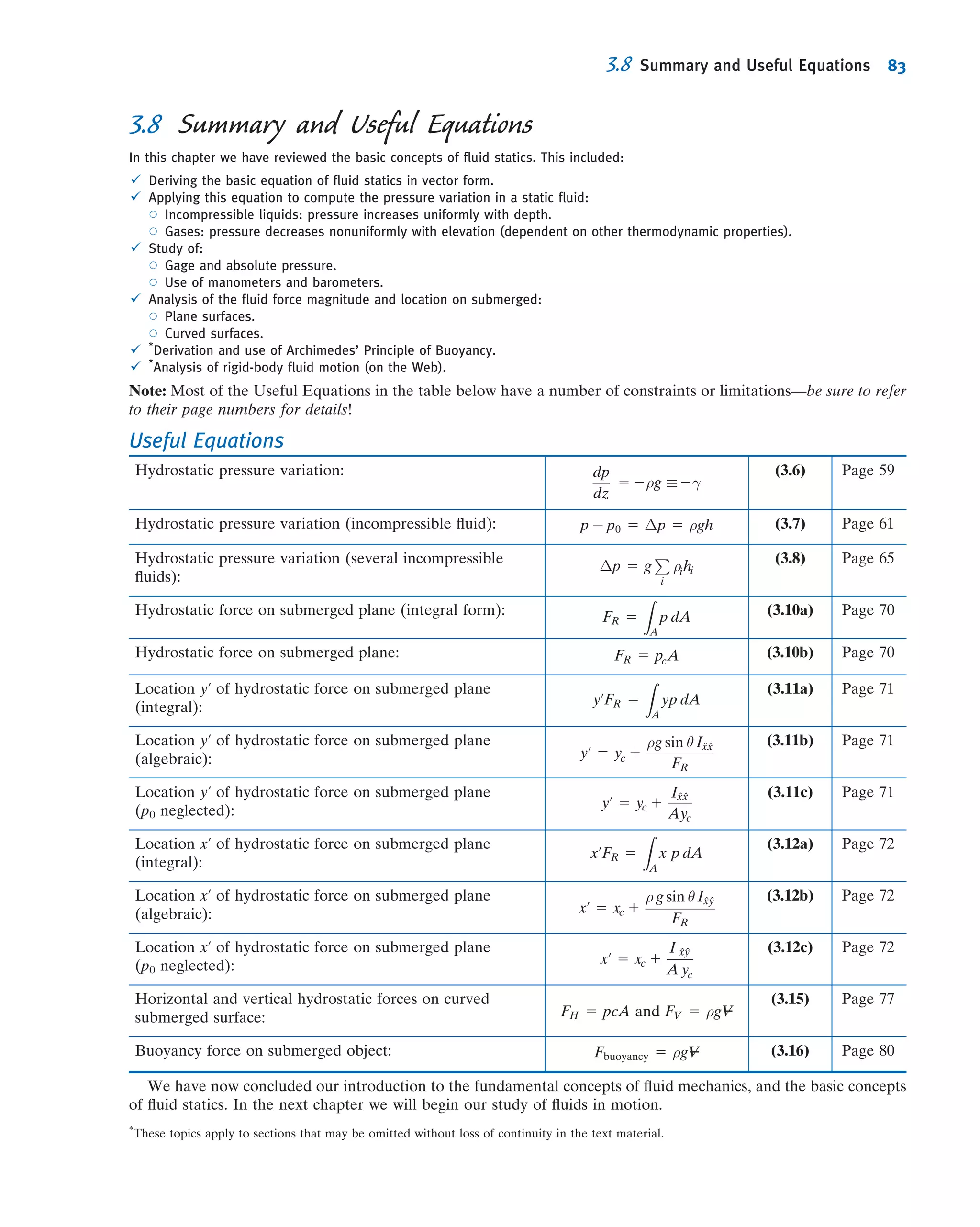
3.8 Summary and Useful Equations /83
References /84
Problems /84
CHAPTER 4 BASIC EQUATIONS IN INTEGRAL FORM FOR A CONTROL VOLUME /96
4.1 Basic Laws for a System /98
Conservation of Mass /98
Newton’s Second Law /98
The Angular-Momentum Principle /99
The First Law of Thermodynamics /99
The Second Law of Thermodynamics /99
4.2 Relation of System Derivatives to the Control Volume Formulation /100
Derivation /101
Physical Interpretation /103
4.3 Conservation of Mass /104
Special Cases /105
4.4 Momentum Equation for Inertial Control Volume /110
*Differential Control Volume Analysis /122
Control Volume Moving with Constant Velocity /126
4.5 Momentum Equation for Control Volume with Rectilinear Acceleration /128
4.6 Momentum Equation for Control Volume with Arbitrary Acceleration (on the Web) /W-6
*4.7 The Angular-Momentum Principle /135
Equation for Fixed Control Volume /135
Equation for Rotating Control Volume (on the Web) /W-11
4.8 The First Law of Thermodynamics /139
Rate of Work Done by a Control Volume /140
Control Volume Equation /142
4.9 The Second Law of Thermodynamics /146
4.10 Summary and Useful Equations /147
Problems /149
CHAPTER 5 INTRODUCTION TO DIFFERENTIAL ANALYSIS OF FLUID MOTION /171
5.1 Conservation of Mass /172
Rectangular Coordinate System /173
Cylindrical Coordinate System /177
*5.2 Stream Function for Two-Dimensional Incompressible Flow /180
5.3 Motion of a Fluid Particle (Kinematics) /184
Fluid Translation: Acceleration of a Fluid Particle in a Velocity Field /185
Fluid Rotation /190
Fluid Deformation /194
5.4 Momentum Equation /197
Forces Acting on a Fluid Particle /198
Differential Momentum Equation /199
Newtonian Fluid: NavierÀStokes Equations /199
vi Contents
*5.5 Introduction to Computational Fluid Dynamics /208
The Need for CFD /208
Applications of CFD /209
Some Basic CFD/Numerical Methods Using a Spreadsheet /210
The Strategy of CFD /215
Discretization Using the Finite-Difference Method /216
Assembly of Discrete System and Application of Boundary Conditions /217
Solution of Discrete System /218
Grid Convergence /219
Dealing with Nonlinearity /220
Direct and Iterative Solvers /221
Iterative Convergence /222
Concluding Remarks /223
5.6 Summary and Useful Equations /224
References /226
Problems /226
CHAPTER 6 INCOMPRESSIBLE INVISCID FLOW /235
6.1 Momentum Equation for Frictionless Flow: Euler’s Equation /237
6.2 Euler’s Equations in Streamline Coordinates /238
6.3 Bernoulli Equation—Integration of Euler’s Equation Along a Streamline for Steady Flow /241
*Derivation Using Streamline Coordinates /241
*Derivation Using Rectangular Coordinates /242
Static, Stagnation, and Dynamic Pressures /244
Applications /247
Cautions on Use of the Bernoulli Equation /252
6.4 The Bernoulli Equation Interpreted as an Energy Equation /253
6.5 Energy Grade Line and Hydraulic Grade Line /257
*6.6 Unsteady Bernoulli Equation: Integration of Euler’s Equation Along a Streamline
(on the Web) /W-16
*6.7 Irrotational Flow /259
Bernoulli Equation Applied to Irrotational Flow /260
Velocity Potential /261
Stream Function and Velocity Potential for Two-Dimensional, Irrotational, Incompressible Flow:
Laplace’s Equation /262
Elementary Plane Flows /264
Superposition of Elementary Plane Flows /267
6.8 Summary and Useful Equations /276
References /279
Problems /279
CHAPTER 7 DIMENSIONAL ANALYSIS AND SIMILITUDE /290
7.1 Nondimensionalizing the Basic Differential Equations /292
7.2 Nature of Dimensional Analysis /294
7.3 Buckingham Pi Theorem /296
7.4 Determining the Π Groups /297
7.5 Significant Dimensionless Groups in Fluid Mechanics /303
7.6 Flow Similarity and Model Studies /305
Incomplete Similarity /308
Scaling with Multiple Dependent Parameters /314
Comments on Model Testing /317
7.7 Summary and Useful Equations /318
References /319
Problems /320
CHAPTER 8 INTERNAL INCOMPRESSIBLE VISCOUS FLOW /328
8.1 Introduction /330
Laminar versus Turbulent Flow /330
The Entrance Region /331
PART A. FULLY DEVELOPED LAMINAR FLOW /332
Contents vii
8.2 Fully Developed Laminar Flow between Infinite Parallel Plates /332
Both Plates Stationary /332
Upper Plate Moving with Constant Speed, U /338
8.3 Fully Developed Laminar Flow in a Pipe /344
PART B. FLOW IN PIPES AND DUCTS /348
8.4 Shear Stress Distribution in Fully Developed Pipe Flow /349
8.5 Turbulent Velocity Profiles in Fully Developed Pipe Flow /351
8.6 Energy Considerations in Pipe Flow /353
Kinetic Energy Coefficient /355
Head Loss /355
8.7 Calculation of Head Loss /357
Major Losses: Friction Factor /357
Minor Losses /361
Pumps, Fans, and Blowers in Fluid Systems /367
Noncircular Ducts /368
8.8 Solution of Pipe Flow Problems /369
Single-Path Systems /370
*Multiple-Path Systems /383
PART C. FLOW MEASUREMENT /387
8.9 Direct Methods /387
8.10 Restriction Flow Meters for Internal Flows /387
The Orifice Plate /391
The Flow Nozzle /391
The Venturi /393
The Laminar Flow Element /394
8.11 Linear Flow Meters /397
8.12 Traversing Methods /399
8.13 Summary and Useful Equations /400
References /402
Problems /403
CHAPTER 9 EXTERNAL INCOMPRESSIBLE VISCOUS FLOW /421
PART A. BOUNDARY LAYERS /423
9.1 The Boundary-Layer Concept /423
9.2 Boundary-Layer Thicknesses /425
9.3 Laminar Flat-Plate Boundary Layer: Exact Solution (on the Web) /W-19
9.4 Momentum Integral Equation /428
9.5 Use of the Momentum Integral Equation for Flow with Zero Pressure Gradient /433
Laminar Flow /434
Turbulent Flow /439
Summary of Results for Boundary-Layer Flow with Zero Pressure Gradient /441
9.6 Pressure Gradients in Boundary-Layer Flow /442
PART B. FLUID FLOW ABOUT IMMERSED BODIES /445
9.7 Drag /445
Pure Friction Drag: Flow over a Flat Plate Parallel to the Flow /446
Pure Pressure Drag: Flow over a Flat Plate Normal to the Flow /450
Friction and Pressure Drag: Flow over a Sphere and Cylinder /450
Streamlining /456
9.8 Lift /459
9.9 Summary and Useful Equations /474
References /477
Problems /478
CHAPTER 10 FLUID MACHINERY /492
10.1 Introduction and Classification of Fluid Machines /494
Machines for Doing Work on a Fluid /494
Machines for Extracting Work (Power) from a Fluid /496
Scope of Coverage /498
10.2 Turbomachinery Analysis /499
The Angular-Momentum Principle: The Euler Turbomachine Equation /499
Velocity Diagrams /501
viii Contents
Performance: Hydraulic Power /504
Dimensional Analysis and Specific Speed /505
10.3 Pumps, Fans, and Blowers /510
Application of Euler Turbomachine Equation to Centrifugal Pumps /510
Application of the Euler Equation to Axial Flow Pumps and Fans /512
Performance Characteristics /516
Similarity Rules /522
Cavitation and Net Positive Suction Head /526
Pump Selection: Applications to Fluid Systems /529
Blowers and Fans /541
10.4 Positive Displacement Pumps /548
10.5 Hydraulic Turbines /552
Hydraulic Turbine Theory /552
Performance Characteristics for Hydraulic Turbines /554
Sizing Hydraulic Turbines for Fluid Systems /558
10.6 Propellers and Wind-Power Machines /562
Propellers /563
Wind-Power Machines /571
10.7 Compressible Flow Turbomachines /581
Application of the Energy Equation to a Compressible Flow Machine /581
Compressors /582
Compressible-Flow Turbines /586
10.8 Summary and Useful Equations /586
References /589
Problems /591
CHAPTER 11 FLOW IN OPEN CHANNELS /600
11.1 Basic Concepts and Definitions /603
Simplifying Assumptions /604
Channel Geometry /605
Speed of Surface Waves and the Froude Number /606
11.2 Energy Equation for Open-Channel Flows /610
Specific Energy /613
Critical Depth: Minimum Specific Energy /616
11.3 Localized Effect of Area Change (Frictionless Flow) /619
Flow over a Bump /620
11.4 The Hydraulic Jump /625
Depth Increase Across a Hydraulic Jump /627
Head Loss Across a Hydraulic Jump /628
11.5 Steady Uniform Flow /631
The Manning Equation for Uniform Flow /633
Energy Equation for Uniform Flow /639
Optimum Channel Cross Section /640
11.6 Flow with Gradually Varying Depth /641
Calculation of Surface Profiles /643
11.7 Discharge Measurement Using Weirs /646
Suppressed Rectangular Weir /646
Contracted Rectangular Weirs /647
Triangular Weir /648
Broad-Crested Weir /648
11.8 Summary and Useful Equations /650
References /652
Problems /653
CHAPTER 12 INTRODUCTION TO COMPRESSIBLE FLOW /657
12.1 Review of Thermodynamics /659
12.2 Propagation of Sound Waves /665
Speed of Sound /665
Types of Flow—The Mach Cone /670
12.3 Reference State: Local Isentropic Stagnation Properties /673
Local Isentropic Stagnation Properties for the Flow of an Ideal Gas /674
Contents ix
12.4 Critical Conditions /681
12.5 Summary and Useful Equations /681
References /683
Problems /683
CHAPTER 13 COMPRESSIBLE FLOW /689
13.1 Basic Equations for One-Dimensional Compressible Flow /691
13.2 Isentropic Flow of an Ideal Gas: Area Variation /694
Subsonic Flow, M , 1 /697
Supersonic Flow, M . 1 /697
Sonic Flow, M 5 1 /698
Reference Stagnation and Critical Conditions for Isentropic Flow of an Ideal Gas /699
Isentropic Flow in a Converging Nozzle /704
Isentropic Flow in a Converging-Diverging Nozzle /709
13.3 Normal Shocks /715
Basic Equations for a Normal Shock /716
Fanno and Rayleigh Interpretation of Normal Shock /718
Normal-Shock Flow Functions for One-Dimensional Flow of an Ideal Gas /719
13.4 Supersonic Channel Flow with Shocks /724
Flow in a Converging-Diverging Nozzle /724
Supersonic Diffuser (on the Web) /W-24
Supersonic Wind Tunnel Operation (on the Web) /W-25
Supersonic Flow with Friction in a Constant-Area Channel (on the Web) /W-26
Supersonic Flow with Heat Addition in a Constant-Area Channel (on the Web) /W-26
13.5 Flow in a Constant-Area Duct with Friction /727
Basic Equations for Adiabatic Flow /727
Adiabatic Flow: The Fanno Line /728
Fanno-Line Flow Functions for One-Dimensional Flow of an Ideal Gas /732
Isothermal Flow (on the Web) /W-29
13.6 Frictionless Flow in a Constant-Area Duct with Heat Exchange /740
Basic Equations for Flow with Heat Exchange /740
The Rayleigh Line /741
Rayleigh-Line Flow Functions for One-Dimensional Flow of an Ideal Gas /746
13.7 Oblique Shocks and Expansion Waves /750
Oblique Shocks /750
Isentropic Expansion Waves /759
13.8 Summary and Useful Equations /768
References /771
Problems /772
APPENDIX A FLUID PROPERTY DATA /785
APPENDIX B EQUATIONS OF MOTION IN CYLINDRICAL COORDINATES /798
APPENDIX C VIDEOS FOR FLUID MECHANICS /800
APPENDIX D SELECTED PERFORMANCE CURVES FOR PUMPS AND FANS /803
APPENDIX E FLOW FUNCTIONS FOR COMPUTATION OF COMPRESSIBLE FLOW /818
APPENDIX F ANALYSIS OF EXPERIMENTAL UNCERTAINTY /829
APPENDIX G SI UNITS, PREFIXES, AND CONVERSION FACTORS /836
APPENDIX H A BRIEF REVIEW OF MICROSOFT EXCEL (ON THE WEB) /W-33
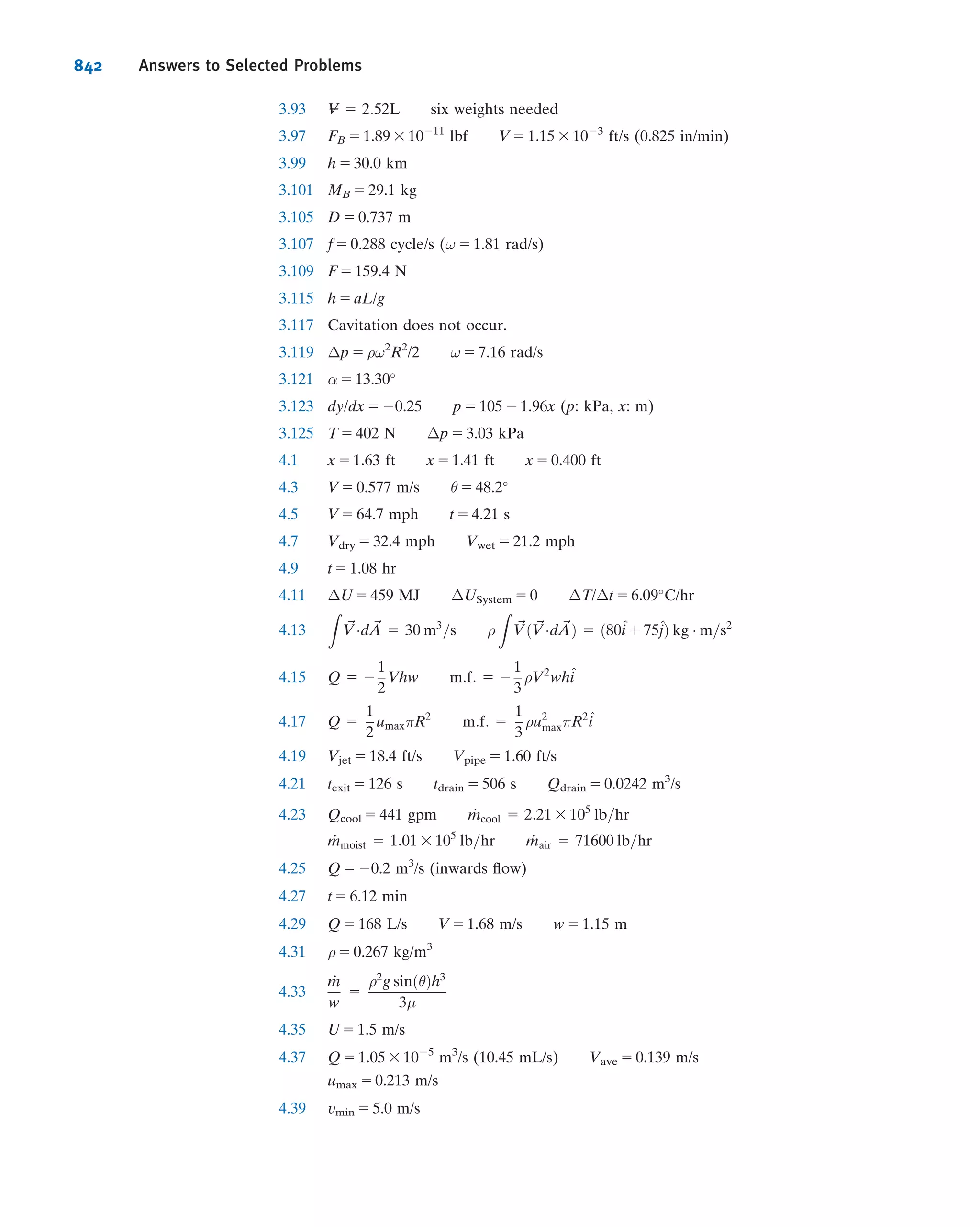
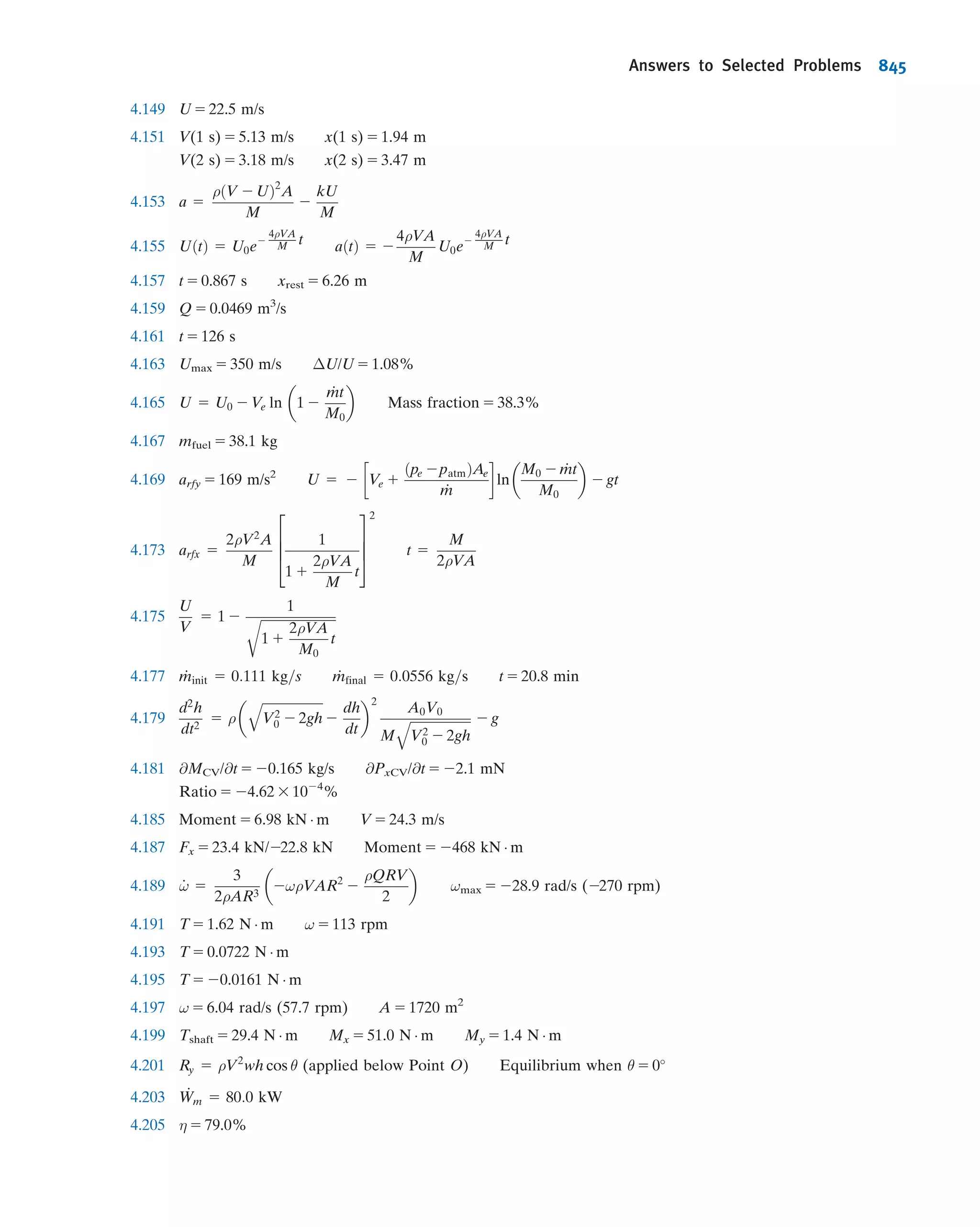
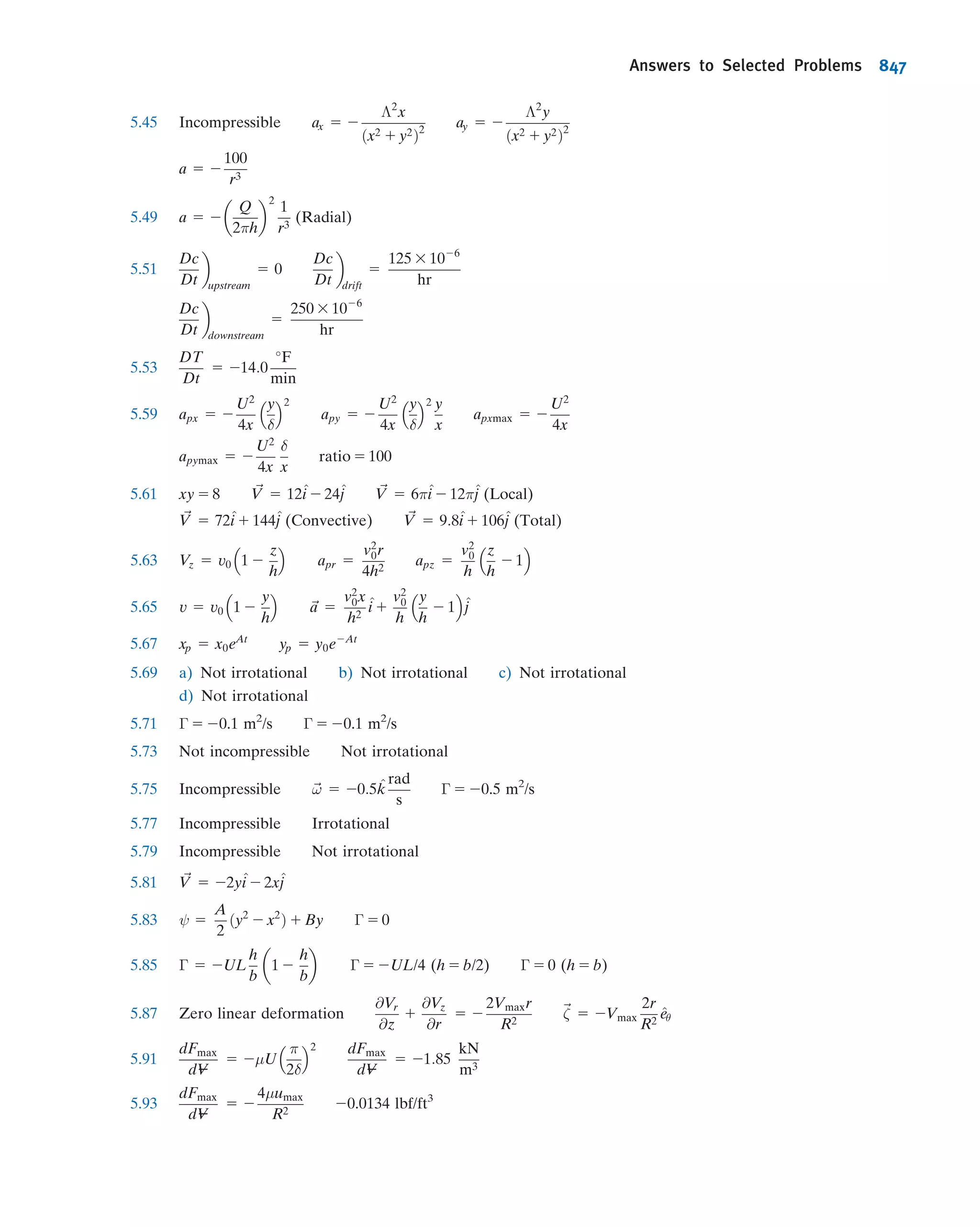
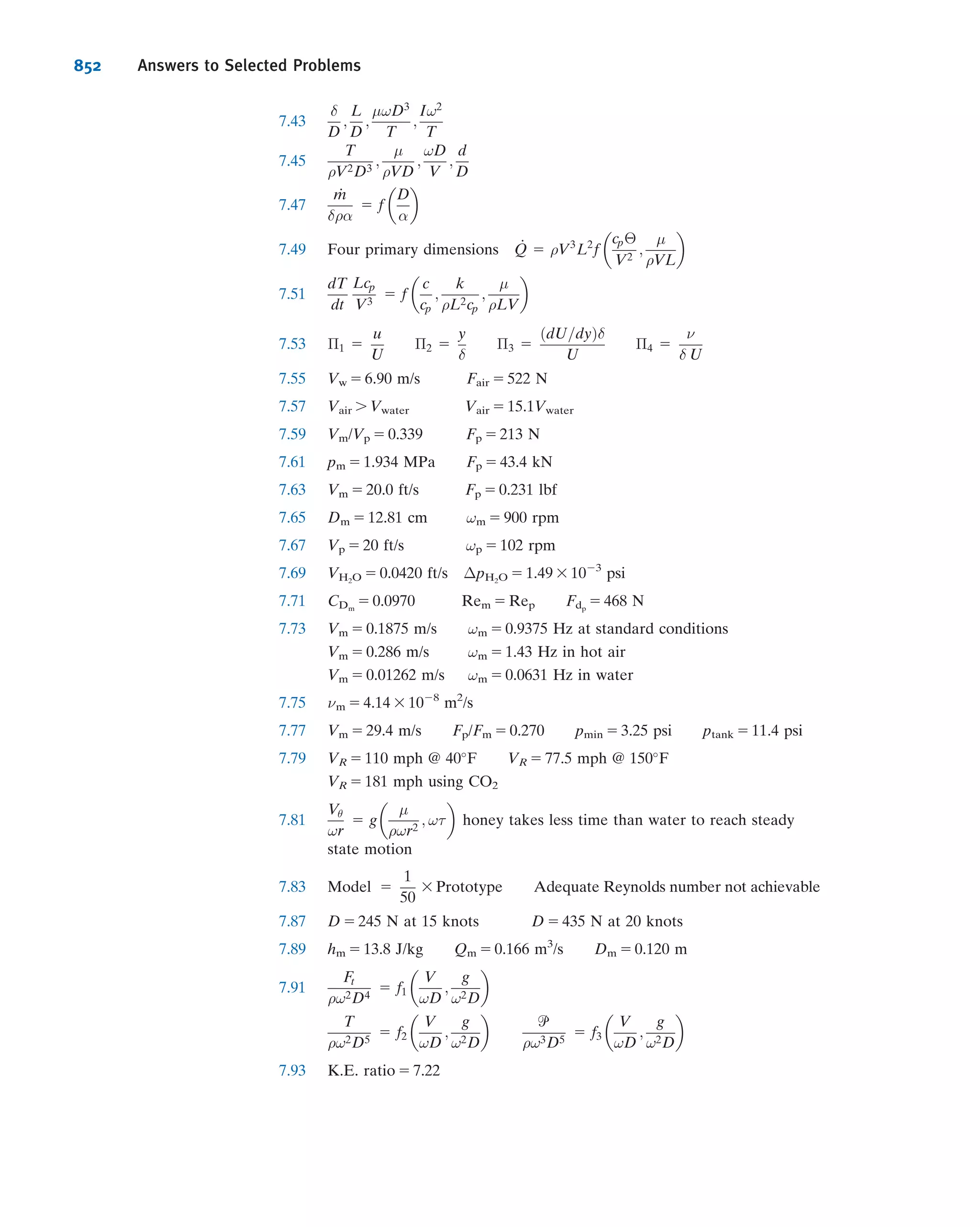
Answers to Selected Problems /838
Index /867
x Contents
Preface
Introduction
This text was written for an introductory course in fluid mechanics. Our approach to
the subject, as in all previous editions, emphasizes the physical concepts of fluid
mechanics and methods of analysis that begin from basic principles. The primary
objective of this text is to help users develop an orderly approach to problem solving.
Thus we always start from governing equations, state assumptions clearly, and try to
relate mathematical results to corresponding physical behavior. We continue
to emphasize the use of control volumes to maintain a practical problem-solving
approach that is also theoretically inclusive.
Proven Problem-Solving Methodology
The Fox-McDonald-Pritchard solution methodology used in this text is illustrated in
numerous Examples in each chapter. Solutions presented in the Examples have been
prepared to illustrate good solution technique and to explain difficult points of theory.
Examples are set apart in format from the text so that they are easy to identify and
follow. Additional important information about the text and our procedures is given
in the “Note to Student” in Section 1.1 of the printed text. We urge you to study this
section carefully and to integrate the suggested procedures into your problem-solving
and results-presentation approaches.
SI and English Units
SI units are used in about 70 percent of both Example and end-of-chapter problems.
English Engineering units are retained in the remaining problems to provide
experience with this traditional system and to highlight conversions among unit sys-
tems that may be derived from fundamentals.
xi
Goals and Advantages of Using This Text
Complete explanations presented in the text, together with numerous detailed
Examples, make this book understandable for students, freeing the instructor to
depart from conventional lecture teaching methods. Classroom time can be used to
bring in outside material, expand on special topics (such as non-Newtonian flow,
boundary-layer flow, lift and drag, or experimental methods), solve example prob-
lems, or explain difficult points of assigned homework problems. In addition, the 51
Example Excel workbooks are useful for presenting a variety of fluid mechanics
phenomena, especially the effects produced when varying input parameters. Thus
each class period can be used in the manner most appropriate to meet student needs.
When students finish the fluid mechanics course, we expect them to be able to
apply the governing equations to a variety of problems, including those they have not
encountered previously. We particularly emphasize physical concepts throughout to
help students model the variety of phenomena that occur in real fluid flow situations.
Although we collect, for convenience, useful equations at the end of most chapters, we
stress that our philosophy is to minimize the use of so-called magic formulas and
emphasize the systematic and fundamental approach to problem solving. By following
this format, we believe students develop confidence in their ability to apply the
material and to find that they can reason out solutions to rather challenging problems.
The book is well suited for independent study by students or practicing engineers.
Its readability and clear examples help build confidence. Answer to Selected Problems
are included, so students may check their own work.
Topical Coverage
The material has been selected carefully to include a broad range of topics suitable for
a one- or two-semester course at the junior or senior level. We assume a background
in rigid-body dynamics and mathematics through differential equations. A back-
ground in thermodynamics is desirable for studying compressible flow.
More advanced material, not typically covered in a first course, has been moved to
the Web site (these sections are identified in the Table of Contents as being on the
Web site). Advanced material is available to interested users of the book; available
online, it does not interrupt the topic flow of the printed text.
Material in the printed text has been organized into broad topic areas:
 Introductory concepts, scope of fluid mechanics, and fluid statics (Chapters 1, 2,
and 3)
 Development and application of control volume forms of basic equations
(Chapter 4)
 Development and application of differential forms of basic equations (Chapters 5
and 6)
 Dimensional analysis and correlation of experimental data (Chapter 7)
 Applications for internal viscous incompressible flows (Chapter 8)
 Applications for external viscous incompressible flows (Chapter 9)
 Analysis of fluid machinery and system applications (Chapter 10)
 Analysis and applications of open-channel flows (Chapter 11)
 Analysis and applications of one- and two-dimensional compressible flows
(Chapters 12 and 13)
Chapter 4 deals with analysis using both finite and differential control volumes. The
Bernoulli equation is derived (in an optional subsection of Section 4.4) as an example
xii Preface
application of the basic equations to a differential control volume. Being able to use
the Bernoulli equation in Chapter 4 allows us to include more challenging problems
dealing with the momentum equation for finite control volumes.
Another derivation of the Bernoulli equation is presented in Chapter 6, where it is
obtained by integrating Euler’s equation along a streamline. If an instructor chooses
to delay introducing the Bernoulli equation, the challenging problems from Chapter 4
may be assigned during study of Chapter 6.
Text Features
This edition incorporates a number of useful features:
 Examples: Fifty-one of the Examples include Excel workbooks, available online at
the text Web site, making them useful for what-if analyses by students or by the
instructor during class.
 Case Studies: Every chapter begins with a Case Studies in Energy and the Envi-
ronment, each describing an interesting application of fluid mechanics in the area of
renewable energy or of improving machine efficiencies. We have also retained from
the previous edition chapter-specific Case Studies, which are now located at the end
of chapters. These explore unusual or intriguing applications of fluid mechanics in a
number of areas.
 Chapter Summary and Useful Equations: At the end of most chapters we collect for
the student’s convenience the most used or most significant equations of the
chapter. Although this is a convenience, we cannot stress enough the need for
the student to ensure an understanding of the derivation and limitations of each
equation before its use!
 Design Problems: Where appropriate, we have provided open-ended design prob-
lems in place of traditional laboratory experiments. For those who do not have
complete laboratory facilities, students could be assigned to work in teams to solve
these problems. Design problems encourage students to spend more time exploring
applications of fluid mechanics principles to the design of devices and systems. As in
the previous edition, design problems are included with the end-of-chapter
problems
 Open-Ended Problems: We have included many open-ended problems. Some are
thought-provoking questions intended to test understanding of fundamental con-
cepts, and some require creative thought, synthesis, and/or narrative discussion. We
hope these problems will help instructors to encourage their students to think and
work in more dynamic ways, as well as to inspire each instructor to develop and use
more open-ended problems.
 End-of-Chapter Problems: Problems in each chapter are arranged by topic, and
within each topic they generally increase in complexity or difficulty. This makes it
easy for the instructor to assign homework problems at the appropriate difficulty
level for each section of the book. For convenience, problems are now grouped
according to the chapter section headings.
New to This Edition
This edition incorporates a number of significant changes:
 Case Studies in Energy and the Environment: At the beginning of each chapter is a
new case study. With these case studies we hope to provide a survey of the most
interesting and novel applications of fluid mechanics with the goal of generating
Preface xiii
increasing amounts of the world’s energy needs from renewable sources. The case
studies are not chapter specific; that is, each one is not necessarily based on
the material of the chapter in which it is presented. Instead, we hope these new case
studies will serve as a stimulating narrative on the field of renewable energy for
the reader and that they will provide material for classroom discussion. The case studies
from the previous edition have been retained and relocated to the ends of chapters.
 Demonstration Videos: The “classic” NCFMF videos (approximately 20 minutes
each, with Professor Ascher Shapiro of MIT, a pioneer in the field of biomedical
engineering and a leader in fluid mechanics research and education, explaining and
demonstrating fluid mechanics concepts) referenced in the previous edition have all
been retained and supplemented with additional new brief videos (approximately
30 seconds to 2 minutes each) from a variety of sources.
Both the classic and new videos are intended to provide visual aids for many of
the concepts covered in the text, and are available at www.wiley.com/college/
pritchard.
 CFD: The section on basic concepts of computational fluid dynamics in Chapter 5
now includes material on using the spreadsheet for numerical analysis of simple
one- and two-dimensional flows; it includes an introduction to the Euler method.
 Fluid Machinery: Chapter 10 has been restructured, presenting material for pumps
and fans first, followed by a section on hydraulic turbines. Propellers and wind
turbines are now presented together. The section on wind turbines now includes the
analysis of vertical axis wind turbines (VAWTs) in additional depth. A section on
compressible flow machines has also been added to familiarize students with the
differences in evaluating performance of compressible versus incompressible flow
machines. The data in Appendix D on pumps and fans has been updated to reflect
new products and new means of presenting data.
 Open-Channel Flow: In this edition we have completely rewritten the material on
open-channel flows. An innovation of this new material compared to similar texts is
that we have treated “local” effects, including the hydraulic jump before con-
sidering uniform and gradually varying flows. This material provides a sufficient
background on the topic for mechanical engineers and serves as an introduction for
civil engineers.
 Compressible Flow: The material in Chapter 13 has been restructured so that
normal shocks are discussed before Fanno and Rayleigh flows. This was done
because many college fluid mechanics curriculums cover normal shocks but not
Fanno or Rayleigh flows.
 New Homework Problems: The eighth edition includes 1705 end-of-chapter prob-
lems. Many problems have been combined and contain multiple parts. Most have
been structured so that all parts need not be assigned at once, and almost 25 percent
of subparts have been designed to explore what-if questions. New or modified for
this edition are some 518 problems, some created by a panel of instructors and
subject matter experts. End-of-chapter homework problems are now grouped
according to text sections.
Resources for Instructors
The following resources are available to instructors who adopt this text. Visit the Web
site at www.wiley.com/college/pritchard to register for a password.
 Solutions Manual for Instructors: The solutions manual for this edition contains a
complete, detailed solution for all homework problems. Each solution is prepared in
the same systematic way as the Example solutions in the printed text. Each solution
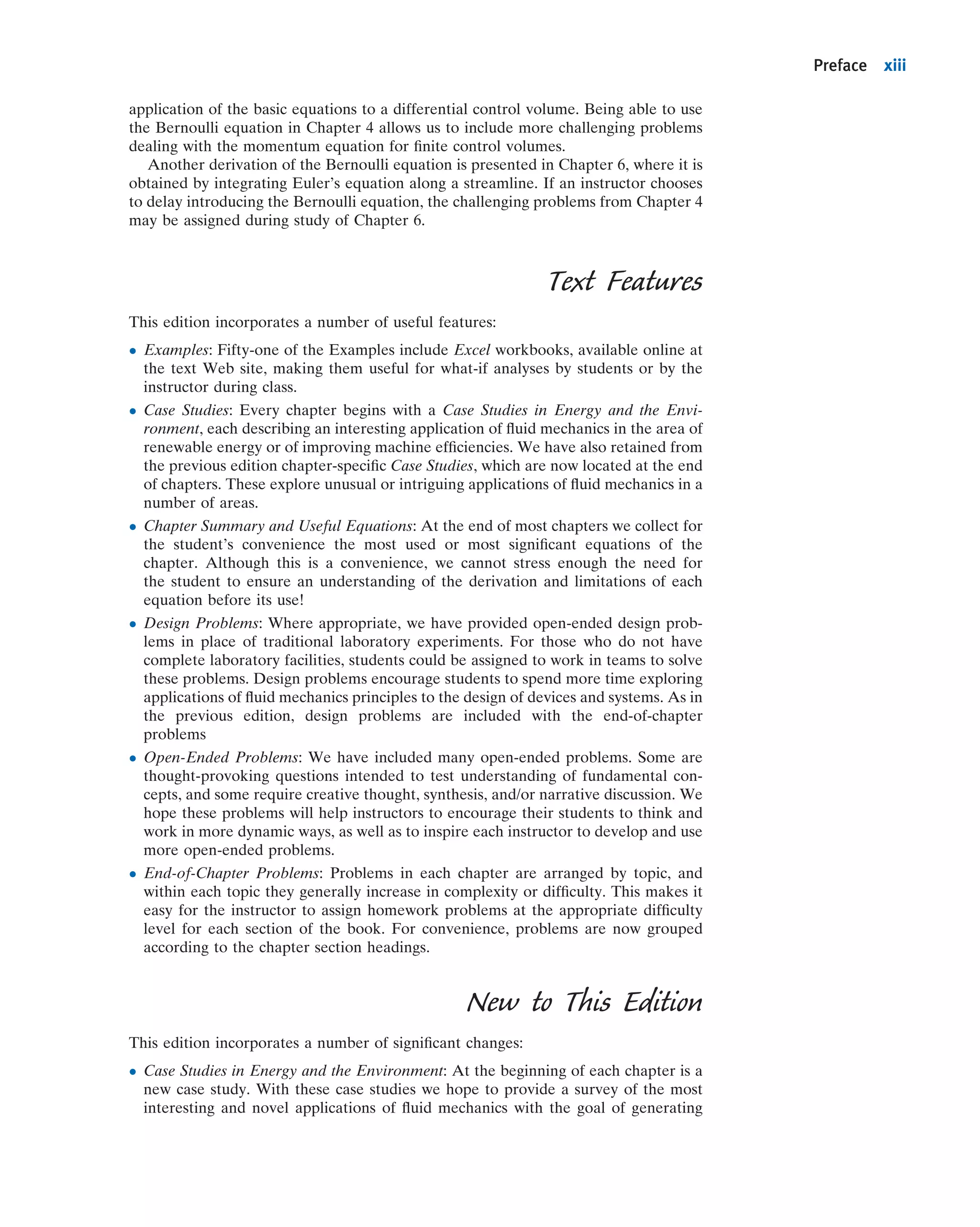
CLASSIC VIDEO
Classics!
VIDEO
New Videos!
xiv Preface
begins from governing equations, clearly states assumptions, reduces governing
equations to computing equations, obtains an algebraic result, and finally substitutes
numerical values to calculate a quantitative answer. Solutions may be reproduced
for classroom or library use, eliminating the labor of problem solving for the
instructor who adopts the text.
The Solutions Manual is available online after the text is adopted. Visit the
instructor section of the text’s Web site at www.wiley.com/college/pritchard to
request access to the password-protected online Solutions Manual.
 Problem Key: A list of all problems that are renumbered from the seventh edition of
this title, to the eighth edition. There is no change to the actual solution to each
of these problems.
 PowerPoint Lecture Slides: Lecture slides have been developed by Philip Pritchard,
outlining the concepts in the book, and including appropriate illustrations and
equations.
 Image Gallery: Illustrations from the text in a format appropriate to include in
lecture presentations.
Additional Resources
 A Brief Review of Microsoft Excel: Prepared by Philip Pritchard and included on
the book Web site as Appendix H, this resource will coach students in setting up
and solving fluid mechanics problems using Excel spreadsheets. Visit www.wiley.
com/college/pritchard to access it.
 Excel Files: These Excel Files and add-ins are for use with specific Examples from
the text.
 Additional Text Topics: PDF files for these topics/sections are available only on the
Web site. These topics are highlighted in the text’s table of contents and in
the chapters as being available on the Web site.
 Answers to Selected Problems: Answers to odd-numbered problems are listed at the
end of the book as a useful aid for student self-study.
 Videos: Many worthwhile videos are available on the book Web site to demonstrate
and clarify the basic principles of fluid mechanics. When it is appropriate to view
these videos to aid in understanding concepts or phenomena, an icon appears in the
margin of the printed text; the Web site provides links to both classic and new
videos, and these are also listed in Appendix C.
WileyPLUS
WileyPLUS is an innovative, research-based, online environment for effective
teaching and learning.
What do students receive with WileyPLUS?
A Research-Based Design
WileyPLUS provides an online environment that integrates relevant resources, including
the entire digital textbook, in an easy-to-navigate framework that helps students study
more effectively.
Preface xv
WileyPLUS adds structure by organizing textbook content into smaller, more
manageable “chunks.”
 Related media, examples, and sample practice items reinforce the learning
objectives.
 Innovative features such as calendars, visual progress tracking and self-evaluation
tools improve time management and strengthen areas of weakness.
One-on-One Engagement
With WileyPLUS for Introduction to Fluid Mechanics, eighth edition, students receive
24/7 access to resources that promote positive learning outcomes. Students engage with
related examples (in various media) and sample practice items, including:
 Guided Online (GO) Tutorial problems
 Concept Questions
 Demonstration videos
Measurable Outcomes
Throughout each study session, students can assess their progress and gain immediate
feedback. WileyPLUS provides precise reporting of strengths and weaknesses, as well as
individualized quizzes, so that students are confident they are spending their time on the
right things. With WileyPLUS, students always know the exact outcome of their efforts.
What do instructors receive with WileyPLUS?
WileyPLUS provides reliable, customizable resources that reinforce course goals
inside and outside of the classroom as well as visibility into individual student prog-
ress. Pre-created materials and activities help instructors optimize their time:
Customizable Course Plan
WileyPLUS comes with a pre-created Course Plan designed by a subject matter
expert uniquely for this course. Simple drag-and-drop tools make it easy to assign the
course plan as-is or modify it to reflect your course syllabus.
Pre-created Activity Types Include
 Questions
 Readings and Resources
Course Materials and Assessment Content
 Lecture Notes PowerPoint Slides
 Image Gallery
 Gradable FE Exam sample Questions
 Question Assignments: Selected end-of-chapter problems coded algorithmically
with hints, links to text, whiteboard/show work feature and instructor controlled
problem solving help.
xvi Preface
Concept Question Assignments: Questions developed by Jay Martin and John
Mitchell of the University of Wisconsin-Madison to assess students’ conceptual
understanding of fluid mechanics.
Gradebook
WileyPLUS provides instant access to reports on trends in class performance, student
use of course materials, and progress towards learning objectives, helping inform
decisions and drive classroom discussions.
WileyPLUS. Learn More. www.wileyplus.com.
Powered by proven technology and built on a foundation of cognitive research,
WileyPLUS has enriched the education of millions of students, in over 20 countries
around the world.
Acknowledgments
We recognize that no single approach can satisfy all needs, and we are grateful to the
many students and faculty whose comments have helped us improve on earlier edi-
tions of this book.
We wish to express our thanks to the contributors and reviewers of the WileyPLUS
course:
Darrell W. Pepper, University of Nevada, Las Vegas
Brian P. Sangeorzan, Oakland University
Asghar Esmaeeli, Southern Illinois University, Carbondale
Andrew Gerhart, Lawrence Technological University
John Mitchell, University of Wisconsin, Madison
David Benson, Kettering University
Donald Fenton, Kansas State University
Alison Griffin, University of Central Florida
John Leylegian, Manhattan College
Mark Cummings, University of Idaho
We would also like to thank Bud Homsy for his assistance in getting permission from
Stanford University, as well as the University of California, Santa Barbara, to license
many of the videos we are making available to adopters of this edition, and we thank
Gordon McCreight for his assistance with this process as well.
The following individuals are thanked for their invaluable contributions in devel-
oping interesting new problems for several chapters:
Kenneth W. Miller, St. Cloud State University
Darrell W. Pepper, University of Nevada, Las Vegas
Shizhi Qian, Old Dominion University
Thomas Shepard, University of Minnesota
The eighth edition was carefully reviewed in whole or part by:
John Abbitt, University of Florida
Soyoung Stephen Cha, University of Illinois, Chicago
Kangping Chen, Arizona State University
W. Scott Crawford, Stanford University
Timothy J. Fry, University of Dayton
James W. Leach, North Carolina State University
Jed E. Marquart, Ohio Northern University
Hans Mayer, California Polytechnic State University, San Luis Obispo
Karl R. Nelson, Colorado School of Mines
Preface xvii
Siva Parameswaran, Texas Tech University
Brian P. Sangeorzan, Oakland University
Brian Savilonis, Worcester Polytechnic Institute
Hayley H. Shen, Clarkson University
We are extremely grateful for their comments and suggestions.
Finally, for this edition, we are very deeply indebted to John Leylegian, of
Manhattan College, for his major contributions to this edition. He restructured
Chapter 10 (and revised Appendix D), and he made significant contributions to
changes in all the other chapters. He also took major responsibility for revising,
updating, or replacing end-of-chapter problems for half of the chapters, as well as
generating the corresponding parts of the solution manual. His expertise was essential
for the revisions to Chapter 10.
We look forward to continued interactions with these and other colleagues who use
the book.
Professor Pritchard appreciates the unstinting support of his wife, Penelope, who is
keenly aware of all the hours that went into the effort of preparing this edition.
We welcome suggestions and/or criticisms from interested users of this book.
Philip J. Pritchard
August 2010
xviii Preface
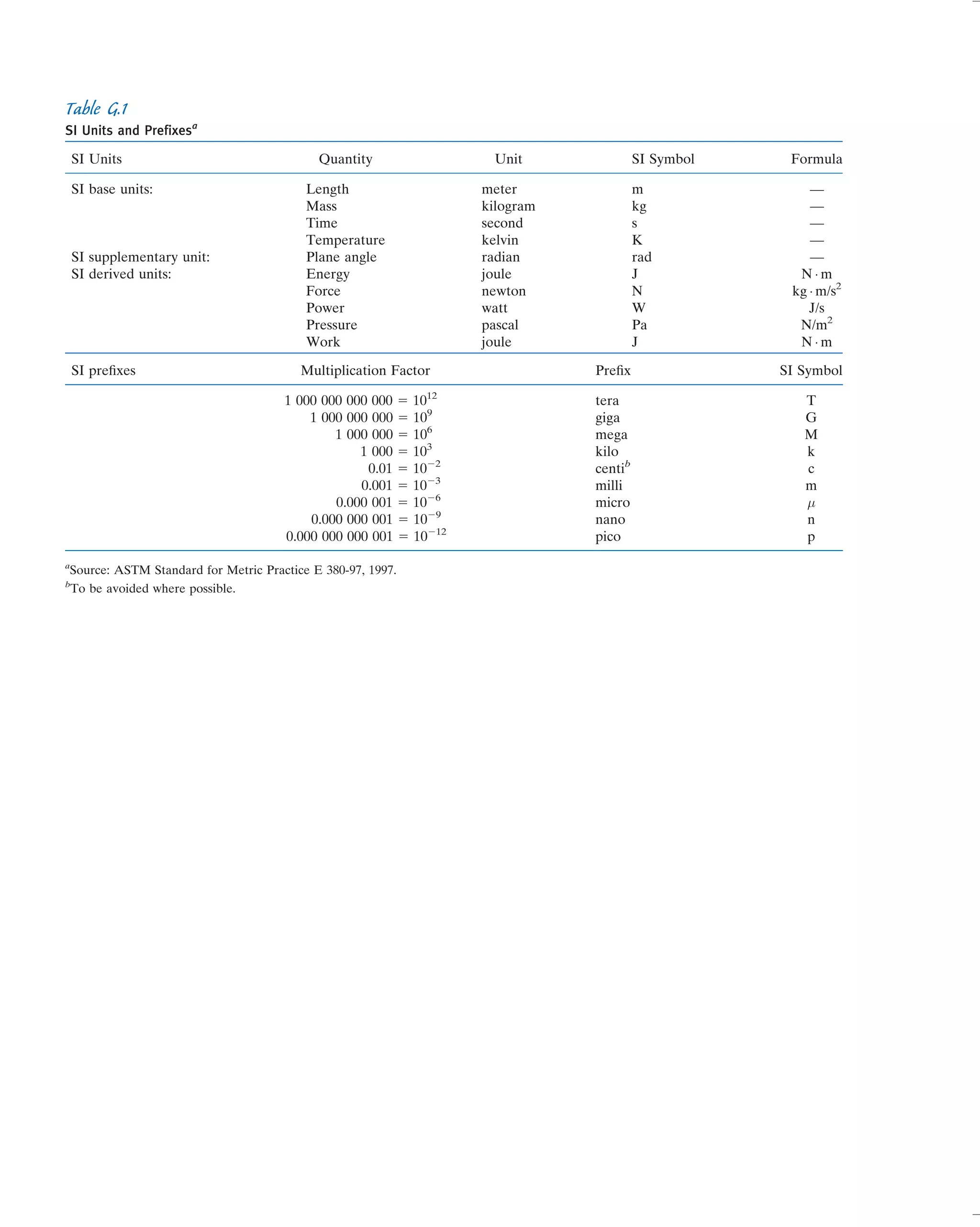
Table G.1
SI Units and Prefixesa
SI Units Quantity Unit SI Symbol Formula
SI base units: Length meter m —
Mass kilogram kg —
Time second s —
Temperature kelvin K —
SI supplementary unit: Plane angle radian rad —
SI derived units: Energy joule J N Á m
Force newton N kg Á m/s2
Power watt W J/s
Pressure pascal Pa N/m2
Work joule J N Á m
SI prefixes Multiplication Factor Prefix SI Symbol
1 000 000 000 000 5 1012
tera T
1 000 000 000 5 109
giga G
1 000 000 5 106
mega M
1 000 5 103
kilo k
0.01 5 1022
centib
c
0.001 5 1023
milli m
0.000 001 5 1026
micro µ
0.000 000 001 5 1029
nano n
0.000 000 000 001 5 10212
pico p
a
Source: ASTM Standard for Metric Practice E 380-97, 1997.
b
To be avoided where possible.
Table G.2
Conversion Factors and Definitions
Fundamental
Dimension English Unit Exact SI Value Approximate SI Value
Length 1 in. 0.0254 m —
Mass 1 lbm 0.453 592 37 kg 0.454 kg
Temperature 1
F 5/9 K —
Definitions:
Acceleration of gravity: g 5 9.8066 m/s2
(5 32.174 ft/s2
)
Energy: Btu (British thermal unit)  amount of energy required to raise the
temperature of 1 lbm of water 1
F (1 Btu 5 778.2 ft Á lbf)
kilocalorie  amount of energy required to raise the temperature of
1 kg of water 1 K(1 kcal 5 4187 J)
Length: 1 mile 5 5280 ft; 1 nautical mile 5 6076.1 ft 5 1852 m (exact)
Power: 1 horsepower  550 ft Á lbf/s
Pressure: 1 bar  105
Pa
Temperature: degree Fahrenheit, TF 5 9
5 TC 1 32 (where TC is degrees Celsius)
degree Rankine, TR 5 TF 1 459.67
Kelvin, TK 5 TC 1 273.15 (exact)
Viscosity: 1 Poise  0.1 kg/(m Á s)
1 Stoke  0.0001 m2
/s
Volume: 1 gal  231 in.3
(1 ft3
5 7.48 gal)
Useful Conversion Factors:
Length: 1 ft 5 0.3048 m
1 in. 5 25.4 mm
Mass: 1 lbm 5 0.4536 kg
1 slug 5 14.59 kg
Force: 1 lbf 5 4.448 N
1 kgf 5 9.807 N
Velocity: 1 ft/s 5 0.3048 m/s
1 ft/s 5 15/22 mph
1 mph 5 0.447 m/s
Pressure: 1 psi 5 6.895 kPa
1 lbf/ft2
5 47.88 Pa
1 atm 5 101.3 kPa
1 atm 5 14.7 psi
1 in. Hg 5 3.386 kPa
1 mm Hg 5 133.3 Pa
Energy: 1 Btu 5 1.055 kJ
1 ft Á lbf 5 1.356 J
1 cal 5 4.187 J
Power: 1 hp 5 745.7 W
1 ft Á lbf/s 5 1.356 W
1 Btu/hr 5 0.2931 W
Area 1 ft2
5 0.0929 m2
1 acre 5 4047 m2
Volume: 1 ft3
5 0.02832 m3
1 gal (US) 5 0.003785 m3
1 gal (US) 5 3.785 L
Volume flow rate: 1 ft3
/s 5 0.02832 m3
/s
1 gpm 5 6.309 3 10À 5
m3
/s
Viscosity (dynamic) 1 lbf Á s/ft2
5 47.88 N Á s/m2
1 g/(cm Á s) 5 0.1 N Á s/m2
1 Poise 5 0.1 N Á s/m2
Viscosity (kinematic) 1 ft2
/s 5 0.0929 m2
/s
1 Stoke 5 0.0001 m2
/s
1
Introduction
1.1 Note to Students
1.2 Scope of Fluid Mechanics
1.3 Definition of a Fluid
1.4 Basic Equations
1.5 Methods of Analysis
1.6 Dimensions and Units
1.7 Analysis of Experimental Error
1.8 Summary
Case Study in Energy and the Environment
Wind Power
At the beginning of each chapter we present
a case study in the role of fluid mechanics in
helping solve the energy crisis and in alleviating the
environmental impact of our energy needs: the cases
provide insight into the ongoing importance of the field
of fluid mechanics. We have tried to present novel and
original developments, not the kind of applications
such as the ubiquitous wind farms. Please note that
case studies represent a narrative; so each chapter’s
case study is not necessarily representative of the
material in that chapter. Perhaps as a creative new
engineer, you’ll be able to create even better ways to
extract renewable, nonpolluting forms of energy or
invent something to make fluid-mechanics devices more
efficient!
According to the July 16, 2009, edition of the New York
Times, the global wind energy potential is much higher
than previously estimated by both wind industry groups
and government agencies. (Wind turbines are discussed
in Chapter 10.) Using data from thousands of meteo-
rological stations, the research indicates that the world’s
wind power potential is about 40 times greater than
total current power consumption; previous studies had
put that multiple at about seven times! In the lower
48 states, the potential from wind power is 16 times more
1
We decided to title this textbook “Introduction to . . .” for the following reason: After
studying the text, you will not be able to design the streamlining of a new car or an
airplane, or design a new heart valve, or select the correct air extractors and ducting for
a $100 million building; however, you will have developed a good understanding of the
concepts behind all of these, and many other applications, and have made significant
progress toward being ready to work on such state-of-the-art fluid mechanics projects.
To start toward this goal, in this chapter we cover some very basic topics: a case
study, what fluid mechanics encompasses, the standard engineering definition of a fluid,
and the basic equations and methods of analysis. Finally, we discuss some common
engineering student pitfalls in areas such as unit systems and experimental analysis.
than total electricity demand in the United States, the
researchers suggested, again much higher than a 2008
Department of Energy study that projected wind could
supply a fifth of all electricity in the country by 2030. The
findings indicate the validity of the often made claim
that “the United States is the Saudi Arabia of wind.”
The new estimate is based the idea of deploying 2.5- to
3-megawatt (MW) wind turbines in rural areas that are
neither frozen nor forested and also on shallow offshore
locations, and it includes a conservative 20 percent
estimate for capacity factor, which is a measure of how
much energy a given turbine actually produces. It has
been estimated that the total power from the wind that
could conceivably be extracted is about 72terawatts (TW,
72 3 1012
watts). Bearing in mind that the total power
consumption by all humans was about 16 TW (as of
2006), it is clear that wind energy could supply all the
world’s needs for the foreseeable future!
One reason for the new estimate is due to the
increasingly common use of very large turbines that
rise to almost 100 m, where wind speeds are greater.
Previous wind studies were based on the use of 50- to
80-m turbines. In addition, to reach even higher ele-
vations (and hence wind speed), two approaches have
been proposed. In a recent paper, Professor Archer at
California State University and Professor Caldeira at
the Carnegie Institution of Washington, Stanford,
discussed some possibilities. One of these is a design
of KiteGen (shown in the figure), consisting of tethered
airfoils (kites) manipulated by a control unit and con-
nected to a ground-based, carousel-shaped generator;
the kites are maneuvered so that they drive the car-
ousel, generating power, possibly as much as 100 MW.
This approach would be best for the lowest few kilo-
meters of the atmosphere. An approach using further
increases in elevation is to generate electricity aloft
and then transmit it to the surface with a tether. In the
design proposed by Sky Windpower, four rotors are
mounted on an airframe; the rotors both provide lift
for the device and power electricity generation. The
aircraft would lift themselves into place with supplied
electricity to reach the desired altitude but would then
generate up to 40 MW of power. Multiple arrays could
be used for large-scale electricity generation. (Airfoils
are discussed in Chapter 9.)
We shall examine some interesting developments in
wind power in the Case Studies in Energy and the
Environment in subsequent chapters.
Sky Windpower’s flying electric generators would fly at altitudes of
about 10,000 m. (Picture courtesy of Ben Shepard and Archer 
Caldeira.)
KiteGen’s kites would fly at an altitude of about 1000 m and spin a
power carousel on the ground. (Picture courtesy of Ben Shepard and
Archer  Caldeira.)
2 Chapter 1 Introduction
1.1Note to Students
This is a student-oriented book: We believe it is quite comprehensive for an intro-
ductory text, and a student can successfully self-teach from it. However, most students
will use the text in conjunction with one or two undergraduate courses. In either case, we
recommend a thorough reading of the relevant chapters. In fact, a good approach is to
read a chapter quickly once, then reread more carefully a second and even a third time,
so that concepts develop a context and meaning. While students often find fluid
mechanics quite challenging, we believe this approach, supplemented by your instruc-
tor’s lectures that will hopefully amplify and expand upon the text material (if you are
taking a course), will reveal fluid mechanics to be a fascinating and varied field of study.
Other sources of information on fluid mechanics are readily available. In addition
to your professor, there are many other fluid mechanics texts and journals as well as
the Internet (a recent Google search for “fluid mechanics” yielded 26.4 million links,
including many with fluid mechanics calculators and animations!).
There are some prerequisites for reading this text. We assume you have already
studied introductory thermodynamics, as well as statics, dynamics, and calculus;
however, as needed, we will review some of this material.
It is our strong belief that one learns best by doing. This is true whether the subject
under study is fluid mechanics, thermodynamics, or soccer. The fundamentals in any
of these are few, and mastery of them comes through practice. Thus it is extremely
important that you solve problems. The numerous problems included at the end of
each chapter provide the opportunity to practice applying fundamentals to the solu-
tion of problems. Even though we provide for your convenience a summary of useful
equations at the end of each chapter (except this one), you should avoid the temp-
tation to adopt a so-called plug-and-chug approach to solving problems. Most of the
problems are such that this approach simply will not work. In solving problems we
strongly recommend that you proceed using the following logical steps:
1. State briefly and concisely (in your own words) the information given.
2. State the information to be found.
3. Draw a schematic of the system or control volume to be used in the analysis. Be
sure to label the boundaries of the system or control volume and label appropriate
coordinate directions.
4. Give the appropriate mathematical formulation of the basic laws that you consider
necessary to solve the problem.
5. List the simplifying assumptions that you feel are appropriate in the problem.
6. Complete the analysis algebraically before substituting numerical values.
7. Substitute numerical values (using a consistent set of units) to obtain a numerical
answer.
a. Reference the source of values for any physical properties.
b. Be sure the significant figures in the answer are consistent with the given data.
8. Check the answer and review the assumptions made in the solution to make sure
they are reasonable.
9. Label the answer.
In your initial work this problem format may seem unnecessary and even long-
winded. However, it is our experience that this approach to problem solving is
ultimately the most efficient; it will also prepare you to be a successful professional,
for which a major prerequisite is to be able to communicate information and the
results of an analysis clearly and precisely. This format is used in all Examples pre-
sented in this text; answers to Examples are rounded to three significant figures.
Finally, we strongly urge you to take advantage of the many Excel tools available for
this book on the text Web site, for use in solving problems. Many problems can be
1.1 Note to Students 3
solved much more quickly using these tools; occasional problems can only be solved
with the tools or with an equivalent computer application.
1.2 Scope of Fluid Mechanics
As the name implies, fluid mechanics is the study of fluids at rest or in motion. It has
traditionally been applied in such areas as the design of canal, levee, and dam systems;
the design of pumps, compressors, and piping and ducting used in the water and air
conditioning systems of homes and businesses, as well as the piping systems needed in
chemical plants; the aerodynamics of automobiles and sub- and supersonic airplanes;
and the development of many different flow measurement devices such as gas pump
meters.
While these are still extremely important areas (witness, for example, the current
emphasis on automobile streamlining and the levee failures in New Orleans in 2005),
fluid mechanics is truly a “high-tech” or “hot” discipline, and many exciting areas
have developed in the last quarter-century. Some examples include environmental
and energy issues (e.g., containing oil slicks, large-scale wind turbines, energy gene-
ration from ocean waves, the aerodynamics of large buildings, and the fluid mechanics
of the atmosphere and ocean and of phenomena such as tornadoes, hurricanes, and
tsunamis); biomechanics (e.g., artificial hearts and valves and other organs such as
the liver; understanding of the fluid mechanics of blood, synovial fluid in the joints, the
respiratory system, the circulatory system, and the urinary system); sport (design of
bicycles and bicycle helmets, skis, and sprinting and swimming clothing, and the
aerodynamics of the golf, tennis, and soccer ball); “smart fluids” (e.g., in automobile
suspension systems to optimize motion under all terrain conditions, military uniforms
containing a fluid layer that is “thin” until combat, when it can be “stiffened” to give
the soldier strength and protection, and fluid lenses with humanlike properties for use
in cameras and cell phones); and microfluids (e.g., for extremely precise administra-
tion of medications).
These are just a small sampling of the newer areas of fluid mechanics. They illus-
trate how the discipline is still highly relevant, and increasingly diverse, even though it
may be thousands of years old.
1.3 Definition of a Fluid
We already have a common-sense idea of when we are working with a fluid, as
opposed to a solid: Fluids tend to flow when we interact with them (e.g., when you stir
your morning coffee); solids tend to deform or bend (e.g., when you type on a key-
board, the springs under the keys compress). Engineers need a more formal and
precise definition of a fluid: A fluid is a substance that deforms continuously under the
application of a shear (tangential) stress no matter how small the shear stress may be.
Because the fluid motion continues under the application of a shear stress, we can also
define a fluid as any substance that cannot sustain a shear stress when at rest.
Hence liquids and gases (or vapors) are the forms, or phases, that fluids can take.
We wish to distinguish these phases from the solid phase of matter. We can see the
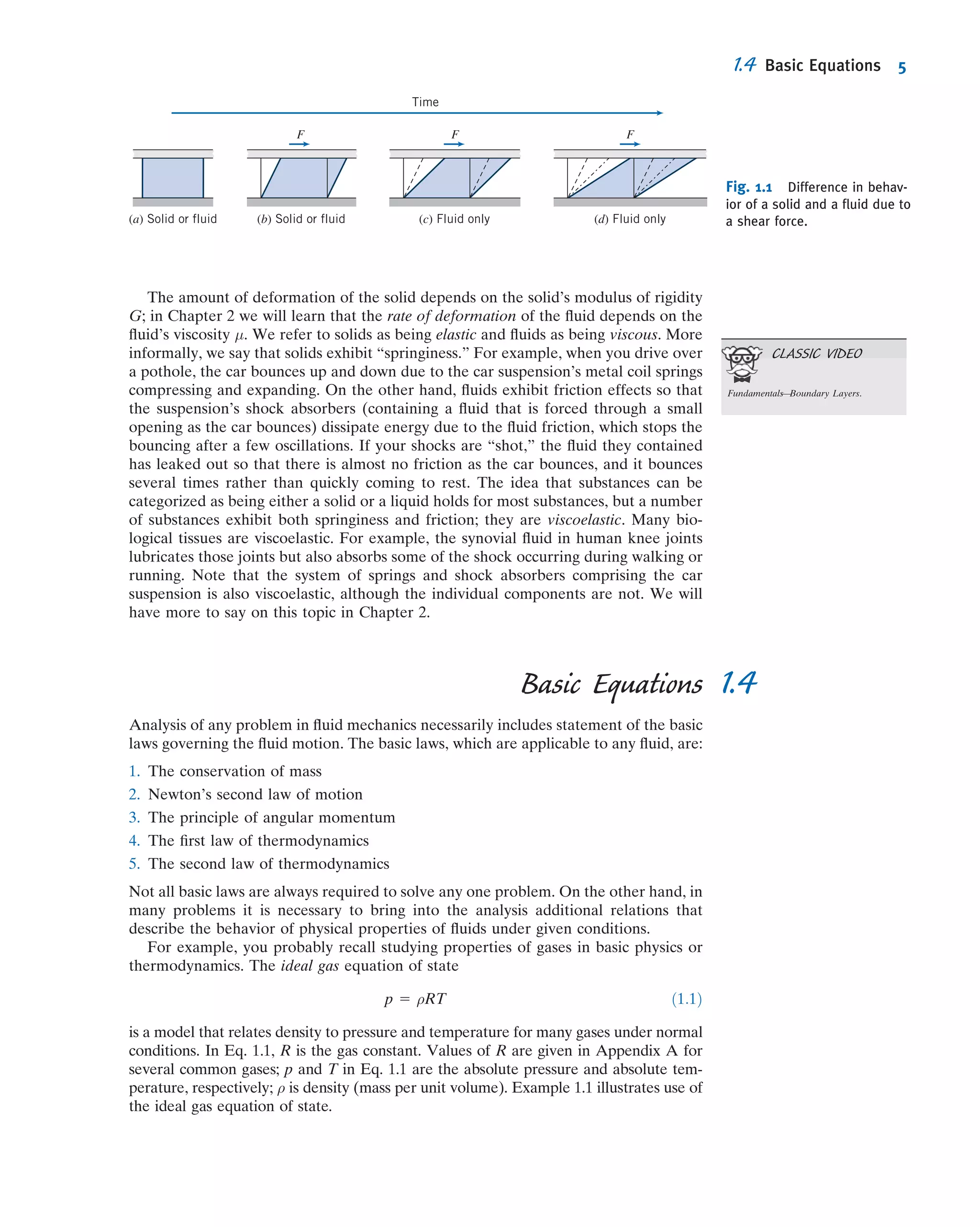
difference between solid and fluid behavior in Fig. 1.1. If we place a specimen of either
substance between two plates (Fig. 1.1a) and then apply a shearing force F, each will
initially deform (Fig. 1.1b); however, whereas a solid will then be at rest (assuming the
force is not large enough to go beyond its elastic limit), a fluid will continue to deform
(Fig. 1.1c, Fig. 1.1d, etc) as long as the force is applied. Note that a fluid in contact with
a solid surface does not slip—it has the same velocity as that surface because of the no-
slip condition, an experimental fact.
CLASSIC VIDEO
Deformation of Continuous Media.
4 Chapter 1 Introduction
The amount of deformation of the solid depends on the solid’s modulus of rigidity
G; in Chapter 2 we will learn that the rate of deformation of the fluid depends on the
fluid’s viscosity μ. We refer to solids as being elastic and fluids as being viscous. More
informally, we say that solids exhibit “springiness.” For example, when you drive over
a pothole, the car bounces up and down due to the car suspension’s metal coil springs
compressing and expanding. On the other hand, fluids exhibit friction effects so that
the suspension’s shock absorbers (containing a fluid that is forced through a small
opening as the car bounces) dissipate energy due to the fluid friction, which stops the
bouncing after a few oscillations. If your shocks are “shot,” the fluid they contained
has leaked out so that there is almost no friction as the car bounces, and it bounces
several times rather than quickly coming to rest. The idea that substances can be
categorized as being either a solid or a liquid holds for most substances, but a number
of substances exhibit both springiness and friction; they are viscoelastic. Many bio-
logical tissues are viscoelastic. For example, the synovial fluid in human knee joints
lubricates those joints but also absorbs some of the shock occurring during walking or
running. Note that the system of springs and shock absorbers comprising the car
suspension is also viscoelastic, although the individual components are not. We will
have more to say on this topic in Chapter 2.
1.4Basic Equations
Analysis of any problem in fluid mechanics necessarily includes statement of the basic
laws governing the fluid motion. The basic laws, which are applicable to any fluid, are:
1. The conservation of mass
2. Newton’s second law of motion
3. The principle of angular momentum
4. The first law of thermodynamics
5. The second law of thermodynamics
Not all basic laws are always required to solve any one problem. On the other hand, in
many problems it is necessary to bring into the analysis additional relations that
describe the behavior of physical properties of fluids under given conditions.
For example, you probably recall studying properties of gases in basic physics or
thermodynamics. The ideal gas equation of state
p 5 ρRT ð1:1Þ
is a model that relates density to pressure and temperature for many gases under normal
conditions. In Eq. 1.1, R is the gas constant. Values of R are given in Appendix A for
several common gases; p and T in Eq. 1.1 are the absolute pressure and absolute tem-
perature, respectively; ρ is density (mass per unit volume). Example 1.1 illustrates use of
the ideal gas equation of state.
F F F
Time
(a) Solid or fluid (b) Solid or fluid (c) Fluid only (d) Fluid only
Fig. 1.1 Difference in behav-
ior of a solid and a fluid due to
a shear force.
CLASSIC VIDEO
Fundamentals—Boundary Layers.
1.4 Basic Equations 5
It is obvious that the basic laws with which we shall deal are the same as those used
in mechanics and thermodynamics. Our task will be to formulate these laws in suitable
forms to solve fluid flow problems and to apply them to a wide variety of situations.
We must emphasize that there are, as we shall see, many apparently simple
problems in fluid mechanics that cannot be solved analytically. In such cases we must
resort to more complicated numerical solutions and/or results of experimental tests.
1.5 Methods of Analysis
The first step in solving a problem is to define the system that you are attempting to
analyze. In basic mechanics, we made extensive use of the free-body diagram. We will
Example 1.1 FIRST LAW APPLICATION TO CLOSED SYSTEM
A piston-cylinder device contains 0.95 kg of oxygen initially at a temperature of 27
C and a pressure due to the
weight of 150 kPa (abs). Heat is added to the gas until it reaches a temperature of 627
C. Determine the amount of
heat added during the process.
Given: Piston-cylinder containing O2, m 5 0.95 kg.
T1 5 27
C T2 5 627
C
Find: Q1!2.
Solution: p 5 constant 5 150 kPa (abs)
We are dealing with a system, m 5 0.95 kg.
Governing equation: First law for the system, Q12 2 W12 5 E2 2 E1
Assumptions: (1) E 5 U, since the system is stationary.
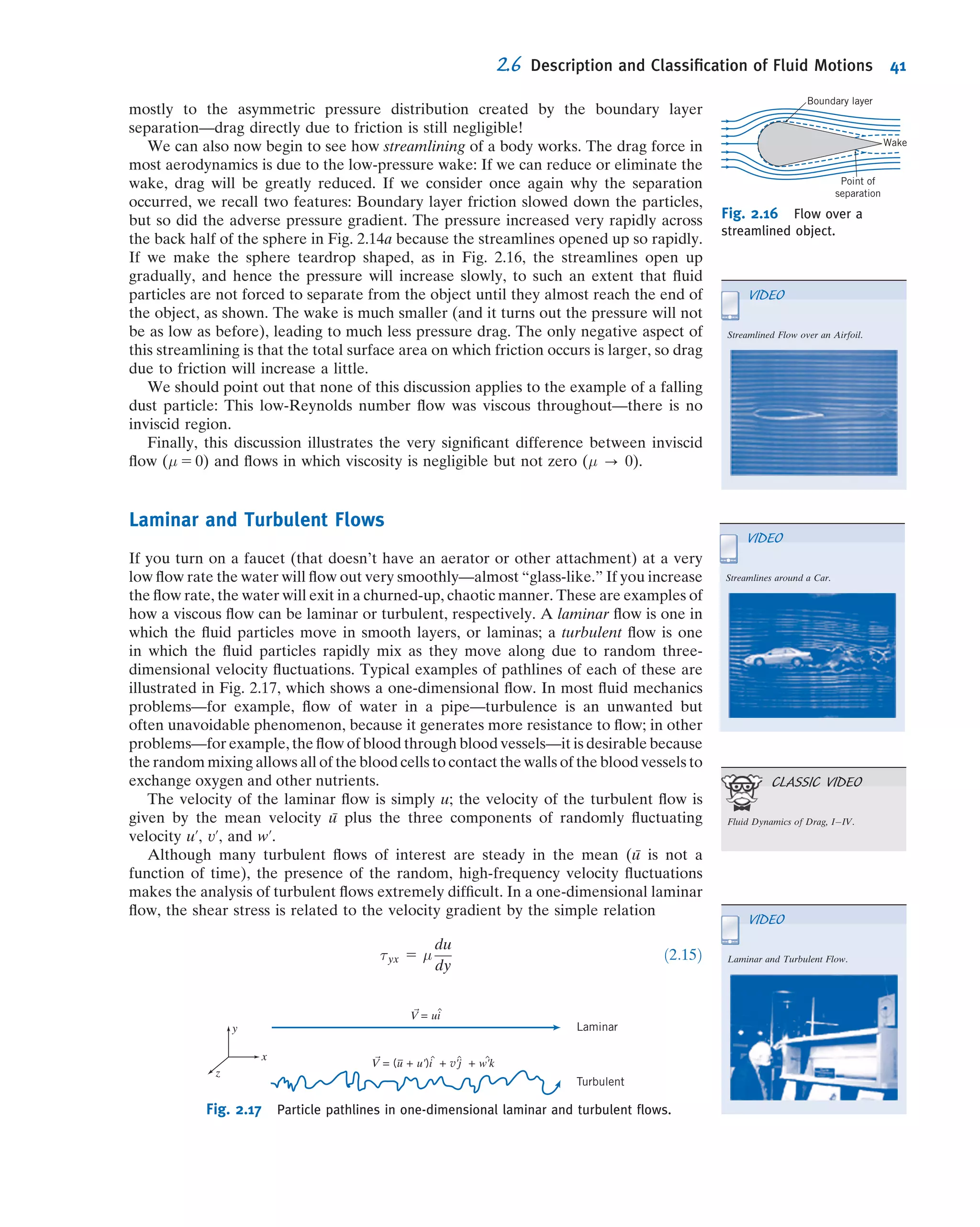
(2) Ideal gas with constant specific heats.
Under the above assumptions,
E2 2 E1 5 U2 2 U1 5 mðu2 2 u1Þ 5 mcvðT2 2 T1Þ
The work done during the process is moving boundary work
W12 5
Z V---2
V---1
pdV--- 5 pðV---2 2 V---1Þ
For an ideal gas, pV--- 5 mRT. Hence W12 5 mR(T2 2 T1). Then from the
first law equation,
Q12 5 E2 2 E1 1 W12 5 mcvðT2 2 T1Þ 1 mRðT2 2 T1Þ
Q12 5 mðT2 2 T1Þðcv 1 RÞ
Q12 5 mcpðT2 2 T1Þ fR 5 cp 2 cvg
From the Appendix, Table A.6, for O2, cp 5 909.4 J/(kg Á K). Solving for
Q12, we obtain
Q12 5 0:95 kg 3 909
J
kg Á K
3 600 K 5 518 kJ ß
Q12
Q
W
This problem:
ü Was solved using the nine logical
steps discussed earlier.ü Reviewed use of the ideal gas
equation and the first law of ther-
modynamics for a system.
6 Chapter 1 Introduction
use a system or a control volume, depending on the problem being studied. These
concepts are identical to the ones you used in thermodynamics (except you may
have called them closed system and open system, respectively). We can use either
one to get mathematical expressions for each of the basic laws. In thermodynamics
they were mostly used to obtain expressions for conservation of mass and the first
and second laws of thermodynamics; in our study of fluid mechanics, we will be
most interested in conservation of mass and Newton’s second law of motion. In
thermodynamics our focus was energy; in fluid mechanics it will mainly be forces
and motion. We must always be aware of whether we are using a system or a
control volume approach because each leads to different mathematical expressions
of these laws. At this point we review the definitions of systems and control
volumes.
System and Control Volume
A system is defined as a fixed, identifiable quantity of mass; the system boundaries
separate the system from the surroundings. The boundaries of the system may be
fixed or movable; however, no mass crosses the system boundaries.
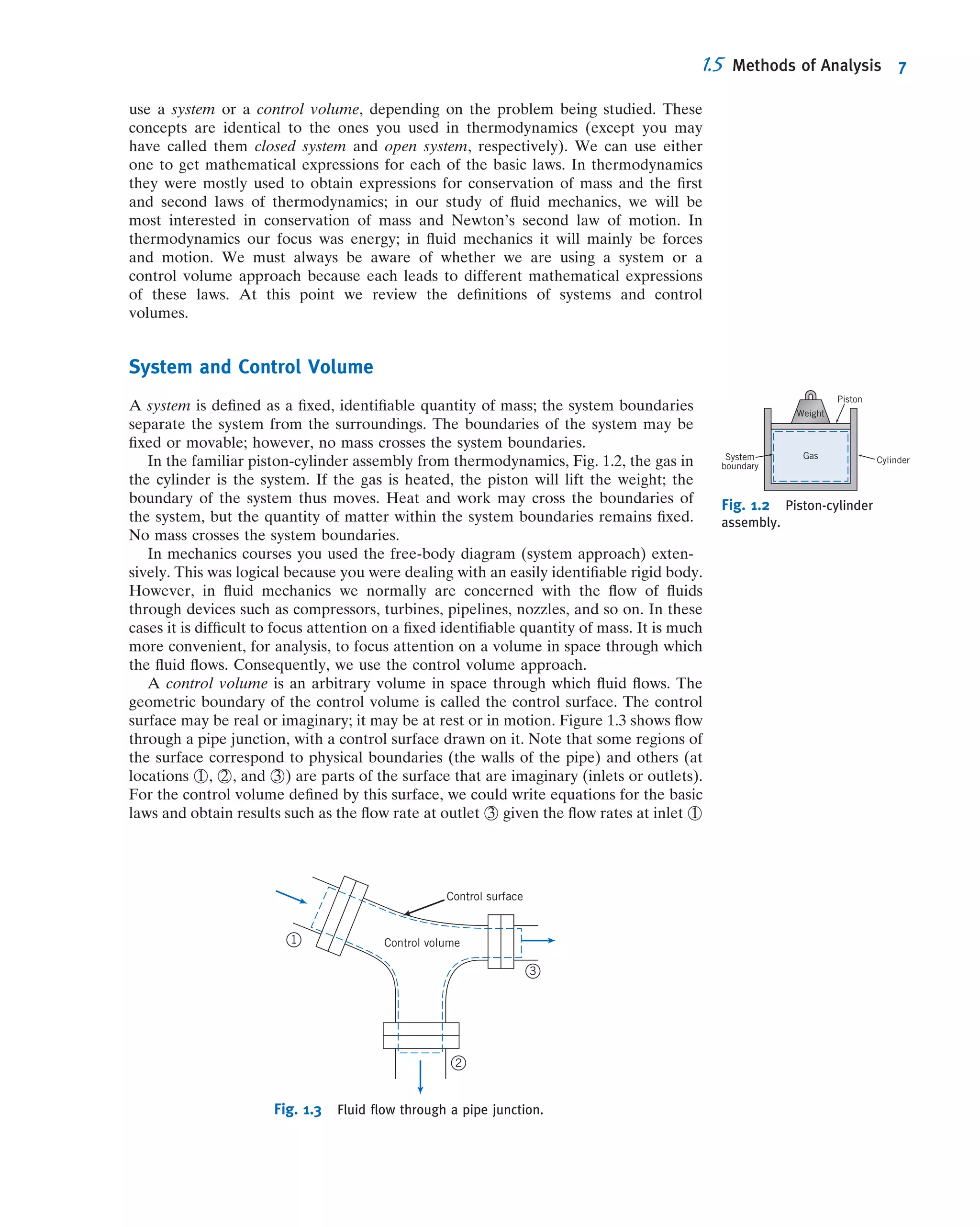
In the familiar piston-cylinder assembly from thermodynamics, Fig. 1.2, the gas in
the cylinder is the system. If the gas is heated, the piston will lift the weight; the
boundary of the system thus moves. Heat and work may cross the boundaries of
the system, but the quantity of matter within the system boundaries remains fixed.
No mass crosses the system boundaries.
In mechanics courses you used the free-body diagram (system approach) exten-
sively. This was logical because you were dealing with an easily identifiable rigid body.
However, in fluid mechanics we normally are concerned with the flow of fluids
through devices such as compressors, turbines, pipelines, nozzles, and so on. In these
cases it is difficult to focus attention on a fixed identifiable quantity of mass. It is much
more convenient, for analysis, to focus attention on a volume in space through which
the fluid flows. Consequently, we use the control volume approach.
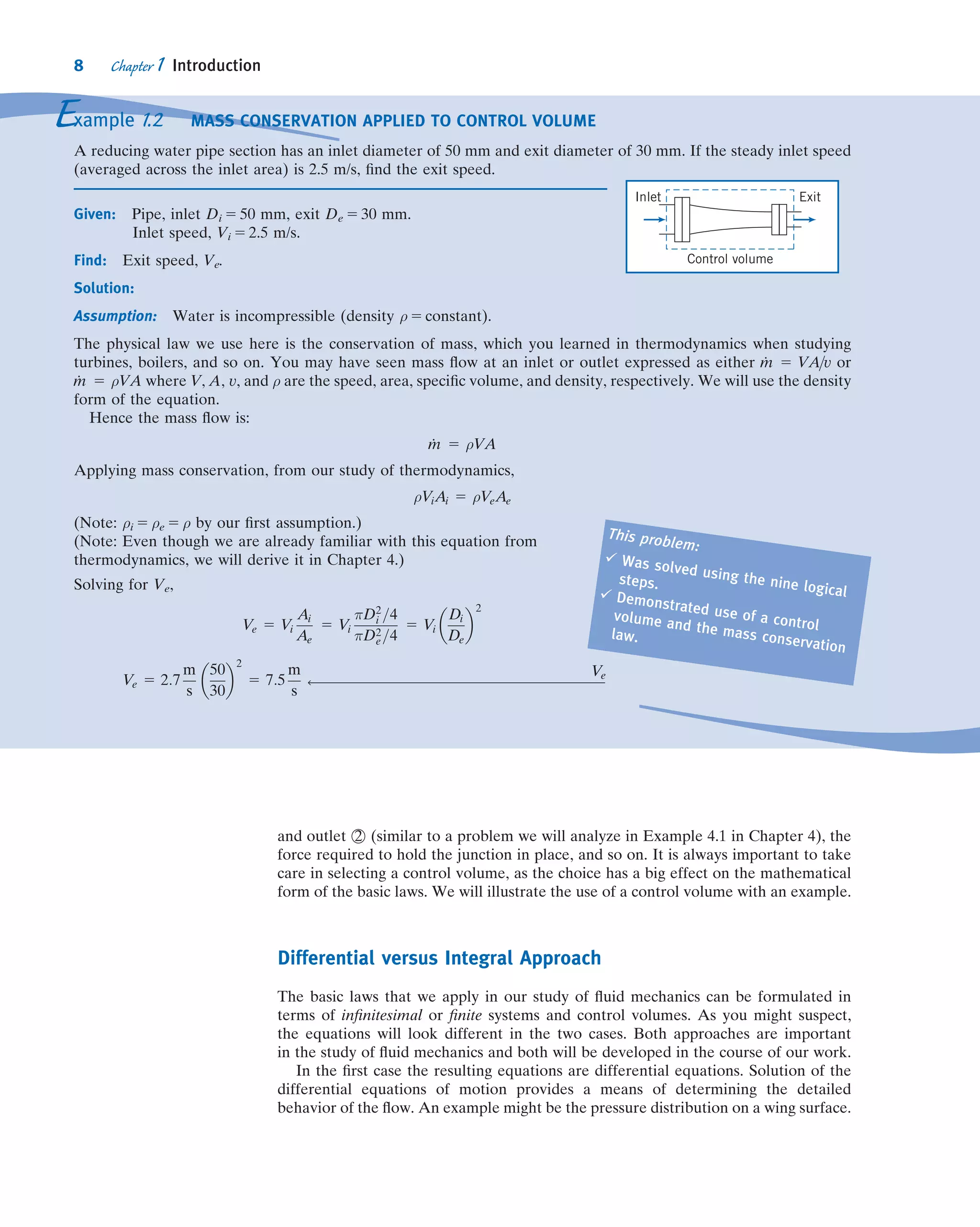
A control volume is an arbitrary volume in space through which fluid flows. The
geometric boundary of the control volume is called the control surface. The control
surface may be real or imaginary; it may be at rest or in motion. Figure 1.3 shows flow
through a pipe junction, with a control surface drawn on it. Note that some regions of
the surface correspond to physical boundaries (the walls of the pipe) and others (at
locations 1 , 2 , and 3 ) are parts of the surface that are imaginary (inlets or outlets).
For the control volume defined by this surface, we could write equations for the basic
laws and obtain results such as the flow rate at outlet 3 given the flow rates at inlet 1
Gas
Weight
Piston
CylinderSystem
boundary
Fig. 1.2 Piston-cylinder
assembly.
Control volume
Control surface
1
2
3
Fig. 1.3 Fluid flow through a pipe junction.
1.5 Methods of Analysis 7
and outlet 2 (similar to a problem we will analyze in Example 4.1 in Chapter 4), the
force required to hold the junction in place, and so on. It is always important to take
care in selecting a control volume, as the choice has a big effect on the mathematical
form of the basic laws. We will illustrate the use of a control volume with an example.
Differential versus Integral Approach
The basic laws that we apply in our study of fluid mechanics can be formulated in
terms of infinitesimal or finite systems and control volumes. As you might suspect,
the equations will look different in the two cases. Both approaches are important
in the study of fluid mechanics and both will be developed in the course of our work.
In the first case the resulting equations are differential equations. Solution of the
differential equations of motion provides a means of determining the detailed
behavior of the flow. An example might be the pressure distribution on a wing surface.
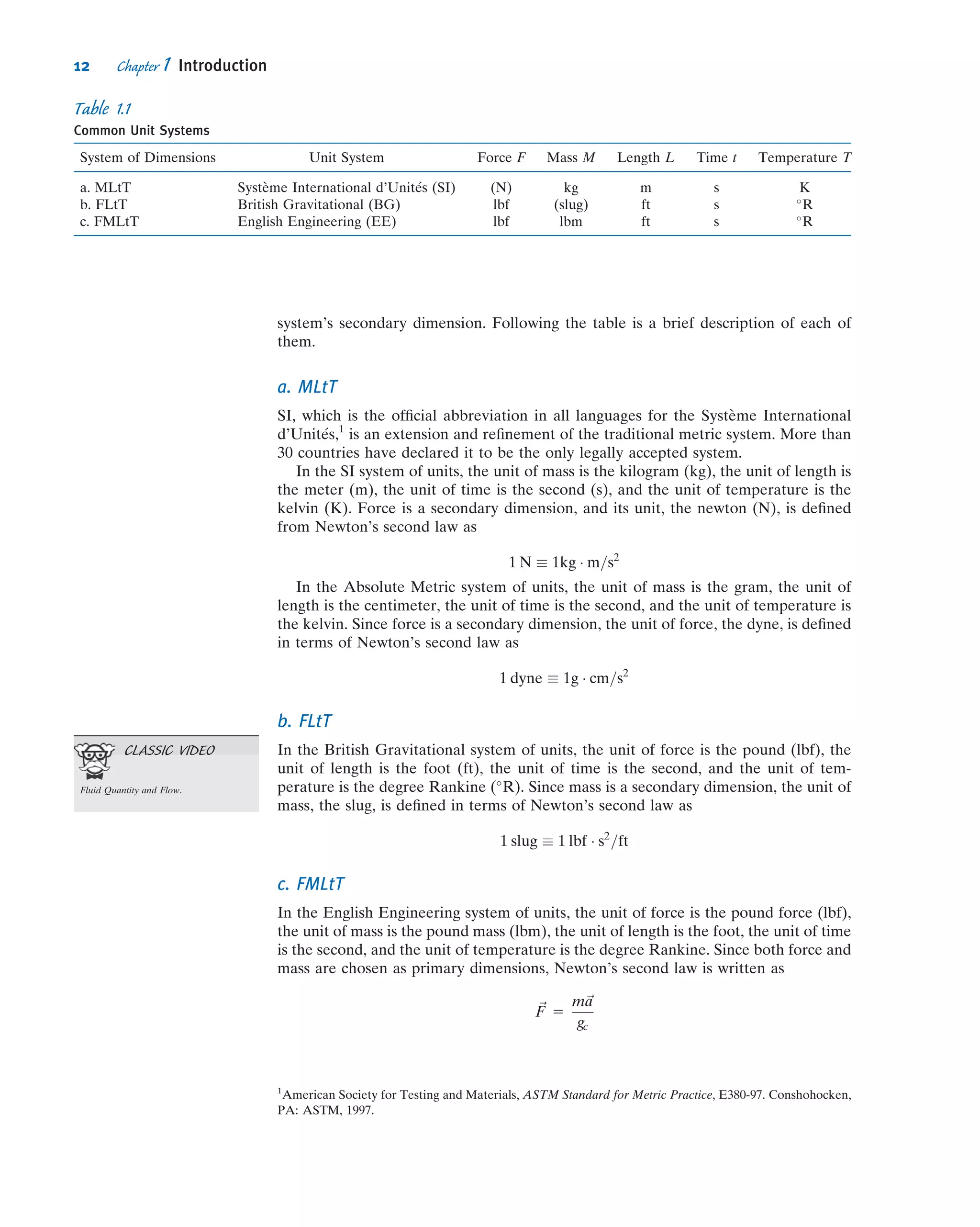
Example 1.2 MASS CONSERVATION APPLIED TO CONTROL VOLUME
A reducing water pipe section has an inlet diameter of 50 mm and exit diameter of 30 mm. If the steady inlet speed
(averaged across the inlet area) is 2.5 m/s, find the exit speed.
Given: Pipe, inlet Di 5 50 mm, exit De 5 30 mm.
Inlet speed, Vi 5 2.5 m/s.
Find: Exit speed, Ve.
Solution:
Assumption: Water is incompressible (density ρ 5 constant).
The physical law we use here is the conservation of mass, which you learned in thermodynamics when studying
turbines, boilers, and so on. You may have seen mass flow at an inlet or outlet expressed as either Ám 5 VA=v or
Ám 5 ρVA where V, A, v, and ρ are the speed, area, specific volume, and density, respectively. We will use the density
form of the equation.
Hence the mass flow is:
Ám 5 ρVA
Applying mass conservation, from our study of thermodynamics,
ρViAi 5 ρVeAe
(Note: ρi 5 ρe 5 ρ by our first assumption.)
(Note: Even though we are already familiar with this equation from
thermodynamics, we will derive it in Chapter 4.)
Solving for Ve,
Ve 5 Vi
Ai
Ae
5 Vi
πD2
i =4
πD2
e=4
5 Vi
Di
De
 2
Ve 5 2:7
m
s
50
30
 2
5 7:5
m
s
ß
Ve
This problem:
ü Was solved using the nine logical
steps.
ü Demonstrated use of a control
volume and the mass conservation
law.
Inlet Exit
Control volume
8 Chapter 1 Introduction
Frequently the information sought does not require a detailed knowledge of the
flow. We often are interested in the gross behavior of a device; in such cases it is
more appropriate to use integral formulations of the basic laws. An example might be
the overall lift a wing produces. Integral formulations, using finite systems or control
volumes, usually are easier to treat analytically. The basic laws of mechanics and
thermodynamics, formulated in terms of finite systems, are the basis for deriving the
control volume equations in Chapter 4.
Methods of Description
Mechanics deals almost exclusively with systems; you have made extensive use of the
basic equations applied to a fixed, identifiable quantity of mass. On the other hand,
attempting to analyze thermodynamic devices, you often found it necessary to use a
control volume (open system) analysis. Clearly, the type of analysis depends on the
problem.
Where it is easy to keep track of identifiable elements of mass (e.g., in particle
mechanics), we use a method of description that follows the particle. This sometimes
is referred to as the Lagrangian method of description.
Consider, for example, the application of Newton’s second law to a particle of fixed
mass. Mathematically, we can write Newton’s second law for a system of mass m as
Σ~F 5 m~a 5 m
d ~V
dt
5 m
d2~r
dt2
ð1:2Þ
In Eq. 1.2, Σ~F is the sum of all external forces acting on the system, ~a is the accel-
eration of the center of mass of the system, ~V is the velocity of the center of mass of
the system, and ~r is the position vector of the center of mass of the system relative to a
fixed coordinate system.
Example 1.3 FREE FALL OF BALL IN AIR
The air resistance (drag force) on a 200 g ball in free flight is given by FD 5 2 3 1024
V2
, where FD is in newtons and
V is in meters per second. If the ball is dropped from rest 500 m above the ground, determine the speed at which it
hits the ground. What percentage of the terminal speed is the result? (The terminal speed is the steady speed a falling
body eventually attains.)
Given: Ball, m 5 0.2 kg, released from rest at y0 5 500 m.
Air resistance, FD 5 kV2
, where k 5 2 3 1024
N Á s2
/m2
.
Units: FD(N), V(m/s).
Find: (a) Speed at which the ball hits the ground.
(b) Ratio of speed to terminal speed.
Solution:
Governing equation: Σ~F 5 m~a
Assumption: Neglect buoyancy force.
The motion of the ball is governed by the equation
ΣFy 5 may 5 m
dV
dt
FD
x
y
y0
mg
1.5 Methods of Analysis 9
We could use this Lagrangian approach to analyze a fluid flow by assuming the fluid
to be composed of a very large number of particles whose motion must be described.
However, keeping track of the motion of each fluid particle would become a horren-
dous bookkeeping problem. Consequently, a particle description becomes unmanage-
able. Often we find it convenient to use a different type of description. Particularly with
control volume analyses, it is convenient to use the field, or Eulerian, method of
description, which focuses attention on the properties of a flow at a given point in space
as a function of time. In the Eulerian method of description, the properties of a flow
field are described as functions of space coordinates and time. We shall see in Chapter 2
that this method of description is a logical outgrowth of the assumption that fluids may
be treated as continuous media.
Since V 5 V(y), we write ΣFy 5 m
dV
dy
dy
dt
5 mV
dV
dy
Then,
ΣFy 5 FD 2 mg 5 kV2
2 mg 5 mV
dV
dy
Separating variables and integrating,
Z y
y0
dy 5
Z V
0
mVdV
kV2 2 mg
y 2 y0 5
m
2k
lnðkV2
2 mgÞ
2
4
3
5
V
0
5
m
2k
ln
kV2
2 mg
2 mg
Taking antilogarithms, we obtain
kV2
2 mg 52 mg e½ð2k=mÞðy 2 y0ÞŠ
Solving for V gives
V 5
mg
k

1 2 e½ð2k=mÞðy 2 y0ÞŠ
n o1=2
Substituting numerical values with y 5 0 yields
V 5 0:2 kg 3 9:81
m
s2
3
m2
2 3 102 4
N Á s2
3
N Á s2
kg Á m
1 2 e½2 3 2 3 102 4
=0:2ð 2 500ÞŠ
 
8

:
9
=
;
V 5 78:7 m=s ß
V
At terminal speed, ay 5 0 and ΣFy 5 0 5 kV2
t 2 mg:
Then, Vt 5
h mg
k
i1=2
5

0:2 kg 3 9:81
m
s2
3
m2
2 3 102 4
N Á s2
3
N Á s2
kg Á m
#1=2
5 99:0 m=s
The ratio of actual speed to terminal speed is
V
Vt
5
78:7
99:0
5 0:795; or 79:5%ß
V
Vt
This problem:
ü Reviewed the methods used in par-
ticle mechanics.ü Introduced a variable aerodynamic
drag force.
Try the Excel workbook for this
Example for variations on this
problem.
10 Chapter 1 Introduction
1.6Dimensions and Units
Engineering problems are solved to answer specific questions. It goes without saying
that the answer must include units. In 1999, NASA’s Mars Climate Observer crashed
because the JPL engineers assumed that a measurement was in meters, but the sup-
plying company’s engineers had actually made the measurement in feet! Conse-
quently, it is appropriate to present a brief review of dimensions and units. We say
“review” because the topic is familiar from your earlier work in mechanics.
We refer to physical quantities such as length, time, mass, and temperature as
dimensions. In terms of a particular system of dimensions, all measurable quantities
are subdivided into two groups—primary quantities and secondary quantities. We
refer to a small group of dimensions from which all others can be formed as primary
quantities, for which we set up arbitrary scales of measure. Secondary quantities are
those quantities whose dimensions are expressible in terms of the dimensions of the
primary quantities.
Units are the arbitrary names (and magnitudes) assigned to the primary dimensions
adopted as standards for measurement. For example, the primary dimension of length
may be measured in units of meters, feet, yards, or miles. These units of length are
related to each other through unit conversion factors (1 mile 5 5280 feet 5 1609 meters).
Systems of Dimensions
Any valid equation that relates physical quantities must be dimensionally homo-
geneous; each term in the equation must have the same dimensions. We recognize
that Newton’s second law (~F ~ m~a) relates the four dimensions, F, M, L, and t. Thus
force and mass cannot both be selected as primary dimensions without introducing a
constant of proportionality that has dimensions (and units).
Length and time are primary dimensions in all dimensional systems in common use.
In some systems, mass is taken as a primary dimension. In others, force is selected as a
primary dimension; a third system chooses both force and mass as primary dimen-
sions. Thus we have three basic systems of dimensions, corresponding to the different
ways of specifying the primary dimensions.
a. Mass [M], length [L], time [t], temperature [T]
b. Force [F], length [L], time [t], temperature [T]
c. Force [F], mass [M], length [L], time [t], temperature [T]
In system a, force [F] is a secondary dimension and the constant of proportionality in
Newton’s second law is dimensionless. In system b, mass [M] is a secondary dimension,
and again the constant of proportionality in Newton’s second law is dimensionless. In
system c, both force [F] and mass [M] have been selected as primary dimensions. In this
case the constant of proportionality, gc (not to be confused with g, the acceleration of
gravity!) in Newton’s second law (written ~F 5 m~a/gc) is not dimensionless. The
dimensions of gc must in fact be [ML/Ft2
] for the equation to be dimensionally
homogeneous. The numerical value of the constant of proportionality depends on the
units of measure chosen for each of the primary quantities.
Systems of Units
There is more than one way to select the unit of measure for each primary dimension.
We shall present only the more common engineering systems of units for each of the
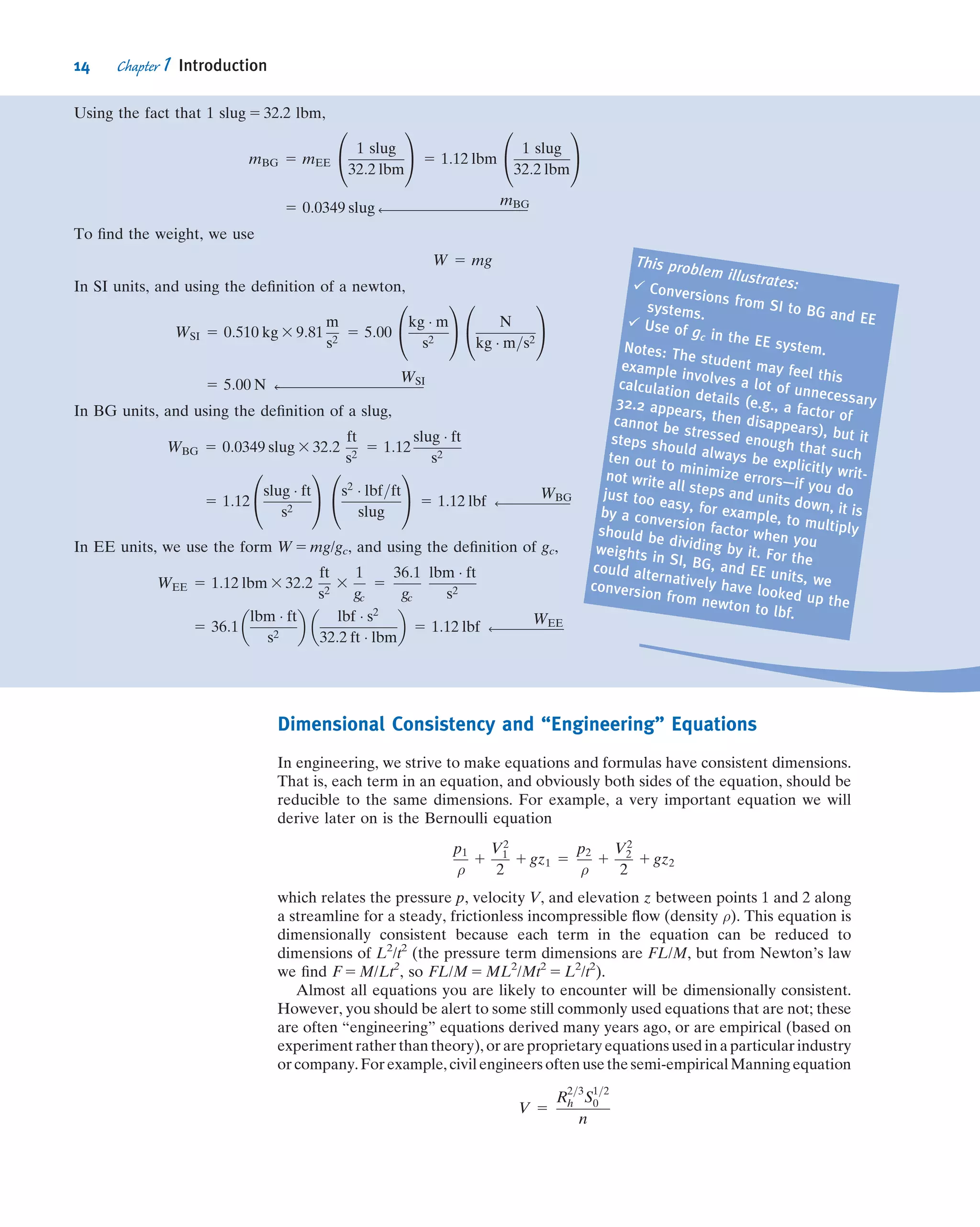
basic systems of dimensions. Table 1.1 shows the basic units assigned to the primary
dimensions for these systems. The units in parentheses are those assigned to that unit
1.6 Dimensions and Units 11
system’s secondary dimension. Following the table is a brief description of each of
them.
a. MLtT
SI, which is the official abbreviation in all languages for the Syste`me International
d’Unit´es,1
is an extension and refinement of the traditional metric system. More than
30 countries have declared it to be the only legally accepted system.
In the SI system of units, the unit of mass is the kilogram (kg), the unit of length is
the meter (m), the unit of time is the second (s), and the unit of temperature is the
kelvin (K). Force is a secondary dimension, and its unit, the newton (N), is defined
from Newton’s second law as
1 N  1kg Á m=s2
In the Absolute Metric system of units, the unit of mass is the gram, the unit of
length is the centimeter, the unit of time is the second, and the unit of temperature is
the kelvin. Since force is a secondary dimension, the unit of force, the dyne, is defined
in terms of Newton’s second law as
1 dyne  1g Á cm=s2
b. FLtT
In the British Gravitational system of units, the unit of force is the pound (lbf), the
unit of length is the foot (ft), the unit of time is the second, and the unit of tem-
perature is the degree Rankine (
R). Since mass is a secondary dimension, the unit of
mass, the slug, is defined in terms of Newton’s second law as
1 slug  1 lbf Á s2
=ft
c. FMLtT
In the English Engineering system of units, the unit of force is the pound force (lbf),
the unit of mass is the pound mass (lbm), the unit of length is the foot, the unit of time
is the second, and the unit of temperature is the degree Rankine. Since both force and
mass are chosen as primary dimensions, Newton’s second law is written as
~F 5
m~a
gc
Table 1.1
Common Unit Systems
System of Dimensions Unit System Force F Mass M Length L Time t Temperature T
a. MLtT Syste`me International d’Unit´es (SI) (N) kg m s K
b. FLtT British Gravitational (BG) lbf (slug) ft s 
R
c. FMLtT English Engineering (EE) lbf lbm ft s 
R
1
American Society for Testing and Materials, ASTM Standard for Metric Practice, E380-97. Conshohocken,
PA: ASTM, 1997.
CLASSIC VIDEO
Fluid Quantity and Flow.
12 Chapter 1 Introduction
A force of one pound (1 lbf) is the force that gives a pound mass (1 lbm) an accel-
eration equal to the standard acceleration of gravity on Earth, 32.2 ft/s2
. From
Newton’s second law we see that
1 lbf 
1 lbm 3 32:2 ft=s2
gc
or
gc  32:2 ft Á lbm=ðlbf Á s2
Þ
The constant of proportionality, gc, has both dimensions and units. The dimensions
arose because we selected both force and mass as primary dimensions; the units (and
the numerical value) are a consequence of our choices for the standards of
measurement.
Since a force of 1 lbf accelerates 1 lbm at 32.2 ft/s2
, it would accelerate 32.2 lbm at
1 ft/s2
. A slug also is accelerated at 1 ft/s2
by a force of 1 lbf. Therefore,
1 slug  32:2 lbm
Many textbooks and references use lb instead of lbf or lbm, leaving it up to the reader
to determine from the context whether a force or mass is being referred to.
Preferred Systems of Units
In this text we shall use both the SI and the British Gravitational systems of units. In
either case, the constant of proportionality in Newton’s second law is dimensionless
and has a value of unity. Consequently, Newton’s second law is written as ~F 5 m~a. In
these systems, it follows that the gravitational force (the “weight”2
) on an object of
mass m is given by W 5 mg.
SI units and prefixes, together with other defined units and useful conversion
factors, are summarized in Appendix G.
Example 1.4 USE OF UNITS
The label on a jar of peanut butter states its net weight is 510 g. Express its mass and weight in SI, BG, and EE units.
Given: Peanut butter “weight,” m 5 510 g.
Find: Mass and weight in SI, BG, and EE units.
Solution: This problem involves unit conversions and use of the equation relating weight and mass:
W 5 mg
The given “weight” is actually the mass because it is expressed in units of mass:
mSI 5 0:510 kg ß
mSI
Using the conversions of Table G.2 (Appendix G),
mEE 5 mSI
1 lbm
0:454 kg
 
5 0:510 kg
1 lbm
0:454 kg
 
5 1:12 lbm ß
mEE
2
Note that in the English Engineering system, the weight of an object is given by W 5 mg/gc.
1.6 Dimensions and Units 13
Dimensional Consistency and “Engineering” Equations
In engineering, we strive to make equations and formulas have consistent dimensions.
That is, each term in an equation, and obviously both sides of the equation, should be
reducible to the same dimensions. For example, a very important equation we will
derive later on is the Bernoulli equation
p1
ρ
1
V2
1
2
1 gz1 5
p2
ρ
1
V2
2
2
1 gz2
which relates the pressure p, velocity V, and elevation z between points 1 and 2 along
a streamline for a steady, frictionless incompressible flow (density ρ). This equation is
dimensionally consistent because each term in the equation can be reduced to
dimensions of L2
/t2
(the pressure term dimensions are FL/M, but from Newton’s law
we find F 5 M/Lt2
, so FL/M 5 ML2
/Mt2
5 L2
/t2
).
Almost all equations you are likely to encounter will be dimensionally consistent.
However, you should be alert to some still commonly used equations that are not; these
are often “engineering” equations derived many years ago, or are empirical (based on
experiment rather than theory), or are proprietary equations used in a particular industry
or company. Forexample, civilengineers often usethe semi-empirical Manning equation
V 5
R
2=3
h S
1=2
0
n
Using the fact that 1 slug 5 32.2 lbm,
mBG 5 mEE
1 slug
32:2 lbm
0
@
1
A 5 1:12 lbm
1 slug
32:2 lbm
0
@
1
A
5 0:0349 slug ß
mBG
To find the weight, we use
W 5 mg
In SI units, and using the definition of a newton,
WSI 5 0:510 kg 3 9:81
m
s2
5 5:00
kg Á m
s2
0
@
1
A N
kg Á m=s2
0
@
1
A
5 5:00 N ß
WSI
In BG units, and using the definition of a slug,
WBG 5 0:0349 slug 3 32:2
ft
s2
5 1:12
slug Á ft
s2
5 1:12
slug Á ft
s2
0
@
1
A s2
Á lbf=ft
slug
0
@
1
A 5 1:12 lbf ß
WBG
In EE units, we use the form W 5 mg/gc, and using the definition of gc,
WEE 5 1:12 lbm 3 32:2
ft
s2
3
1
gc
5
36:1
gc
lbm Á ft
s2
5 36:1
lbm Á ft
s2
 
lbf Á s2
32:2 ft Á lbm
 
5 1:12 lbf ß
WEE
This problem illustrates:ü Conversions from SI to BG and EE
systems.
ü Use of gc in the EE system.Notes: The student may feel this
example involves a lot of unnecessary
calculation details (e.g., a factor of
32.2 appears, then disappears), but it
cannot be stressed enough that such
steps should always be explicitly writ-
ten out to minimize errors—if you do
not write all steps and units down, it is
just too easy, for example, to multiply
by a conversion factor when you
should be dividing by it. For the
weights in SI, BG, and EE units, we
could alternatively have looked up the
conversion from newton to lbf.
14 Chapter 1 Introduction
which gives the flow speed V in an open channel (such as a canal) as a function of the
hydraulic radius Rh (which is a measure of the flow cross-section and contact surface
area), the channel slope S0, and a constant n (the Manning resistance coefficient). The
value of this constant depends on the surface condition of the channel. For example,
for a canal made from unfinished concrete, most references give n % 0.014. Unfor-
tunately, the equation is dimensionally inconsistent! For the right side of the equation,
Rh has dimensions L, and S0 is dimensionless, so with a dimensionless constant n, we
end up with dimensions of L2/3
; for the left side of the equation the dimensions must
be L/t! A user of the equation is supposed to know that the values of n provided in
most references will give correct results only if we ignore the dimensional incon-
sistency, always use Rh in meters, and interpret V to be in m/s! (The alert student will
realize that this means that even though handbooks provide n values as just constants,
they must have units of s/m1/3
.) Because the equation is dimensionally inconsistent,
using the same value for n with Rh in ft does not give the correct value for V in ft/s.
A second type of problem is one in which the dimensions of an equation are
consistent but use of units is not. The commonly used EER of an air conditioner is
EER 5
cooling rate
electrical input
which indicates how efficiently the AC works—a higher EER value indicates better
performance. The equation is dimensionally consistent, with the EER being dimen-
sionless (the cooling rate and electrical input are both measured in energy/time).
However, it is used, in a sense, incorrectly, because the units traditionally used in it are
not consistent. For example, a good EER value is 10, which would appear to imply you
receive, say, 10 kW of cooling for each 1 kW of electrical power. In fact, an EER of
10 means you receive 10 Btu/hr of cooling for each 1 W of electrical power! Manu-
facturers, retailers, and customers all use the EER, in a sense, incorrectly in that they
quote an EER of, say, 10, rather than the correct way, of 10 Btu/hr/W. (The EER, as
used, is an everyday, inconsistent unit version of the coefficient of performance, COP,
studied in thermodynamics.)
The two examples above illustrate the dangers in using certain equations. Almost all the
equationsencounteredin thistext willbedimensionallyconsistent,but youshouldbeaware
of the occasional troublesome equation you will encounter in your engineering studies.
As a final note on units, we stated earlier that we will use SI and BG units in this
text. You will become very familiar with their use through using this text but should
be aware that many of the units used, although they are scientifically and engineering-
wise correct, are nevertheless not units you will use in everyday activities, and vice
versa; we do not recommend asking your grocer to give you, say, 22 newtons, or 0.16
slugs, of potatoes; nor should you be expected to immediately know what, say, a motor
oil viscosity of 5W20 means!
SI units and prefixes, other defined units, and useful conversions are given in
Appendix G.
1.7Analysis of Experimental Error
Most consumers are unaware of it but, as with most foodstuffs, soft drink containers
are filled to plus or minus a certain amount, as allowed by law. Because it is difficult to
precisely measure the filling of a container in a rapid production process, a 12-fl-oz
container may actually contain 12.1, or 12.7, fl oz. The manufacturer is never supposed
to supply less than the specified amount; and it will reduce profits if it is unnecessarily
generous. Similarly, the supplier of components for the interior of a car must
satisfy minimum and maximum dimensions (each component has what are called
tolerances) so that the final appearance of the interior is visually appealing. Engineers
performing experiments must measure not just data but also the uncertainties in their
1.7 Analysis of Experimental Error 15
measurements. They must also somehow determine how these uncertainties affect the
uncertainty in the final result.
All of these examples illustrate the importance of experimental uncertainty, that is,
the study of uncertainties in measurements and their effect on overall results. There
is always a trade-off in experimental work or in manufacturing: We can reduce the
uncertainties to a desired level, but the smaller the uncertainty (the more precise
the measurement or experiment), the more expensive the procedure will be. Fur-
thermore, in a complex manufacture or experiment, it is not always easy to see which
measurement uncertainty has the biggest influence on the final outcome.
Anyone involved in manufacturing, or in experimental work, should understand
experimental uncertainties. Appendix F has details on this topic; there is a selection of
problems on this topic at the end of this chapter.
Case Study
“Fly Like a Bird”
The airplane with various instantaneous wing shapes. (Courtesy of
Dr. Rick Lind, University of Florida.)
At the end of each chapter, we present a case study:
an interesting development in fluid mechanics chosen
to illustrate that the field is constantly evolving.
No airplane, or airplane model, flies like a bird; air-
craft all have fixed wings when in flight, whereas birds
are (almost) constantly flapping away! One reason for
this is that airplane and model wings must support
relatively significant weight and are therefore thick and
stiff; another reason is that we don’t yet fully under-
stand bird flight! Engineers at the University of Florida
in Gainesville, led by researcher Rick Lind, have gone
back to the drawing board and have developed a
small surveillance aircraft (2-ft wingspan, weight a
total of 11
/2 lb) that can change its wing shape during
flight. While it is not true bird flight (the main propul-
sion is through a propeller), it is a radical departure
from current airplane design. The airplane can change,
for example, from an M shape wing configuration (very
stable for gliding) to a W shape (for high maneuver-
ability). It is amazingly dexterous: It can turn three rolls
in less than a second (comparable to an F-15 fighter!),
and its flight is sufficiently birdlike that it has attracted
sparrows (friendly) and crows (unfriendly). Possible
uses are in military surveillance, detection of biological
agents in congested urban areas, and environmental
studies in difficult airspaces such as forests.
1.8 Summary
In this chapter we introduced or reviewed a number of basic concepts and definitions, including:
ü How fluids are defined, and the no-slip condition
ü System/control volume concepts
ü Lagrangian and Eulerian descriptions
ü Units and dimensions (including SI, British Gravitational, and English Engineering systems)
ü Experimental uncertainty
16 Chapter 1 Introduction
Problems
Definition of a Fluid: Basic Equations
1.1 A number of common substances are
Tar Sand
“Silly Putty” Jello
Modeling clay Toothpaste
Wax Shaving cream
Some of these materials exhibit characteristics of both solid
and fluid behavior under different conditions. Explain and
give examples.
1.2 Give a word statement of each of the five basic con-
servation laws stated in Section 1.4, as they apply to a
system.
Methods of Analysis
1.3 The barrel of a bicycle tire pump becomes quite warm
during use. Explain the mechanisms responsible for the
temperature increase.
1.4 Discuss the physics of skipping a stone across the water
surface of a lake. Compare these mechanisms with a stone as
it bounces after being thrown along a roadway.
1.5 Make a guess at the order of magnitude of the mass (e.g.,
0.01, 0.1, 1.0, 10, 100, or 1000 lbm or kg) of standard air that
is in a room 10 ft by 10 ft by 8 ft, and then compute this mass
in lbm and kg to see how close your estimate was.
1.6 A spherical tank of inside diameter 16 ft contains com-
pressed oxygen at 1000 psia and 77
F. What is the mass of
the oxygen?
1.7 Very small particles moving in fluids are known to experi-
ence a drag force proportional to speed. Consider a particle of
net weight W dropped in a fluid. The particle experiences
a drag force, FD 5 kV, where V is the particle speed. Deter-
mine the time required for the particle to accelerate from
rest to 95 percent of its terminal speed, Vt, in terms of k,
W, and g.
1.8 Consider again the small particle of Problem 1.7. Express
the distance required to reach 95 percent of its terminal
speed in percent terms of g, k, and W.
1.9 A cylindrical tank must be designed to contain 5 kg of
compressed nitrogen at a pressure of 200 atm (gage) and
20
C. The design constraints are that the length must be
twice the diameter and the wall thickness must be 0.5 cm.
What are the external dimensions?
1.10 In a combustion process, gasoline particles are to be
dropped in air at 200
F. The particles must drop at least 10
in. in 1 s. Find the diameter d of droplets required for this.
(The drag on these particles is given by FD 5 πμVd, where V
is the particle speed and μ is the air viscosity. To solve this
problem, use Excel’s Goal Seek.)
1.11 For a small particle of styrofoam (1 lbm/ft3
) (spherical,
with diameter d 5 0.3 mm) falling in standard air at speed V,
the drag is given by FD 5 3πμVd, where μ is the air viscosity.
Find the maximum speed starting from rest, and the time it
takes to reach 95 percent of this speed. Plot the speed as a
function of time.
1.12 In a pollution control experiment, minute solid particles
(typical mass 1 3 10213
slug) are dropped in air. The termi-
nal speed of the particles is measured to be 0.2 ft/s. The drag
of these particles is given by FD = kV, where V is the instan-
taneous particle speed. Find the value of the constant k. Find
the time required to reach 99 percent of terminal speed.
1.13 For Problem 1.12, find the distance the particles travel
before reaching 99 percent of terminal speed. Plot the dis-
tance traveled as a function of time.
1.14 A sky diver with a mass of 70 kg jumps from an aircraft.
The aerodynamic drag force acting on the sky diver is known
to be FD 5 kV2
, where k 5 0.25 N Á s2
/m2
. Determine the
maximum speed of free fall for the sky diver and the speed
reached after 100 m of fall. Plot the speed of the sky diver as
a function of time and as a function of distance fallen.
1.15 For Problem 1.14, the initial horizontal speed of the sky
diver is 70 m/s. As she falls, the k value for the vertical drag
remains as before, but the value for horizontal motion is
k 5 0.05 N Á s/m2
. Compute and plot the 2D trajectory of the
sky diver.
1.16 The English perfected the longbow as a weapon after the
Medieval period. In the hands of a skilled archer, the longbow
was reputed to be accurate at ranges to 100 m or more. If
the maximum altitude of an arrow is less than h 5 10 m while
traveling to a target 100 m away from the archer, and
neglecting air resistance, estimate the speed and angle at
which the arrow must leave the bow. Plot the required release
speed and angle as a function of height h.
Dimensions and Units
1.17 For each quantity listed, indicate dimensions using mass
as a primary dimension, and give typical SI and English units:
(a) Power
(b) Pressure
(c) Modulus of elasticity
(d) Angular velocity
(e) Energy
(f) Moment of a force
(g) Momentum
(h) Shear stress
(i) Strain
(j) Angular momentum
1.18 For each quantity listed, indicate dimensions using force
as a primary dimension, and give typical SI and English units:
(a) Power
(b) Pressure
(c) Modulus of elasticity
(d) Angular velocity
(e) Energy
(f) Momentum
(g) Shear stress
(h) Specific heat
Problems 17
(i) Thermal expansion coefficient
(j) Angular momentum
1.19 Derive the following conversion factors:
(a) Convert a viscosity of 1 m2
/s to ft2
/s.
(b) Convert a power of 100 W to horsepower.
(c) Convert a specific energy of 1 kJ/kg to Btu/lbm.
1.20 Derive the following conversion factors:
(a) Convert a pressure of 1 psi to kPa.
(b) Convert a volume of 1 liter to gallons.
(c) Convert a viscosity of 1 lbf Á s/ft2
to N Á s/m2
.
1.21 Derive the following conversion factors:
(a) Convert a specific heat of 4.18 kJ/kg Á K to Btu/lbm Á 
R.
(b) Convert a speed of 30 m/s to mph.
(c) Convert a volume of 5.0 L to in3
.
1.22 Express the following in SI units:
(a) 5 acre Á ft
(b) 150 in3
/s
(c) 3 gpm
(d) 3 mph/s
1.23 Express the following in SI units:
(a) 100 cfm (ft3
/min)
(b) 5 gal
(c) 65 mph
(d) 5.4 acres
1.24 Express the following in BG units:
(a) 50 m2
(b) 250 cc
(c) 100 kW
(d) 5 kg/m2
1.25 Express the following in BG units:
(a) 180 cc/min
(b) 300 kW Á hr
(c) 50 N Á s/m2
(d) 40 m2
Á hr
1.26 While you’re waiting for the ribs to cook, you muse about
the propane tank of your barbecue. You’re curious about the
volume of propane versus the actual tank size. Find the liquid
propane volume when full (the weight of the propane is spec-
ified on the tank). Compare this to the tank volume (take some
measurements, and approximate the tank shape as a cylinder
with a hemisphere on each end). Explain the discrepancy.
1.27 A farmer needs 4 cm of rain per week on his farm, with
10 hectares of crops. If there is a drought, how much water
(L/min) will have to be supplied to maintain his crops?
1.28 Derive the following conversion factors:
(a) Convert a volume flow rate in cubic inches per minute to
cubic millimeters per minute.
(b) Convert a volume flow rate in cubic meters per second
to gallons per minute (gpm).
(c) Convert a volume flow rate in liters per minute to gpm.
(d) Convert a volume flow rate of air in standard cubic feet
per minute (SCFM) to cubic meters per hour. A stan-
dard cubic foot of gas occupies one cubic foot at
standard temperature and pressure (T 5 15
C and
p 5 101.3 kPa absolute).
1.29 The density of mercury is given as 26.3 slug/ft3
. Calculate
the specific gravity and the specific volume in m3
/kg of the
mercury. Calculate the specific weight in lbf/ft3
on Earth
and on the moon. Acceleration of gravity on the moon is
5.47 ft/s2
.
1.30 The kilogram force is commonly used in Europe as a
unit of force. (As in the U.S. customary system, where 1 lbf is
the force exerted by a mass of 1 lbm in standard gravity, 1 kgf
is the force exerted by a mass of 1 kg in standard gravity.)
Moderate pressures, such as those for auto or truck tires, are
conveniently expressed in units of kgf/cm2
. Convert 32 psig
to these units.
1.31 In Section 1.6 we learned that the Manning equation com-
putes the flow speed V (m/s) in a canal made from unfinished
concrete,giventhehydraulicradius Rh (m),thechannelslopeS0,
and a Manning resistance coefficient constant value n % 0.014.
For a canal with Rh 5 7.5 m and a slope of 1/10, find the flow
speed. Compare this result with that obtained using the same n
value, but with Rh first converted to ft, with the answer assumed
to be in ft/s. Finally, find the value of n if we wish to correctly use
the equation for BG units (and compute V to check!).
1.32 From thermodynamics, we know that the coefficient of
performance of an ideal air conditioner (COPideal) is given by
COPideal ¼
TL
TH 2 TL
where TL and TH are the room and outside temperatures
(absolute). If an AC is to keep a room at 20
C when it is 40
C
outside, find the COPideal. Convert to an EER value, and
compare this to a typical Energy StarÀcompliant EER value.
1.33 The maximum theoretical flow rate (slug/s) through a
supersonic nozzle is
_mmax ¼ 2:38
Atp0
ffiffiffiffiffiffi
T0
p
where At (ft2
) is the nozzle throat area, p0 (psi) is the tank
pressure, and T0 (
R) is the tank temperature. Is this equa-
tion dimensionally correct? If not, find the units of the 2.38
term. Write the equivalent equation in SI units.
1.34 The mean free path λ of a molecule of gas is the average
distance it travels before collision with another molecule. It
is given by
λ 5 C
m
ρd2
where m and d are the molecule’s mass and diameter,
respectively, and ρ is the gas density. What are the dimensions
of constant C for a dimensionally consistent equation?
1.35 In Chapter 9 we will study aerodynamics and learn that
the drag force FD on a body is given by
FD 5
1
2
ρV2
ACD
Hence the drag depends on speed V, fluid density ρ, and body
size (indicated by frontal area A) and shape (indicated by drag
coefficient CD). What are the dimensions of CD?
1.36 A container weighs 3.5 lbf when empty. When filled with
water at 90
F, the mass of the container and its contents is
2.5 slug. Find the weight of water in the container, and its
volume in cubic feet, using data from Appendix A.
18 Chapter 1 Introduction
1.37 An important equation in the theory of vibrations is
m
d2
x
dt2
1 c
dx
dt
1 kx 5 fðtÞ
where m (kg) is the mass and x (m) is the position at time t (s).
For a dimensionally consistent equation, what are the
dimensions of c, k, and f? What would be suitable units for c,
k, and f in the SI and BG systems?
1.38 A parameter that is often used in describing pump
performance is the specific speed, NScu
, given by
Nscu
5
NðrpmÞ½QðgpmÞŠ1=2
½HðftÞŠ3=4
What are the units of specific speed? A particular pump has a
specific speed of 2000. What will be the specific speed in SI
units (angular velocity in rad/s)?
1.39 A particular pump has an “engineering” equation form of
the performance characteristic equation given by H (ft) 5
1.5 2 4.5 3 1025
[Q (gpm)]2
, relating the head H and flow rate
Q. What are the units of the coefficients 1.5 and 4.5 3 1025
?
Derive an SI version of this equation.
Analysis of Experimental Error
1.40 Calculate the density of standard air in a laboratory
from the ideal gas equation of state. Estimate the experi-
mental uncertainty in the air density calculated for standard
conditions (29.9 in. of mercury and 59
F) if the uncertainty in
measuring the barometer height is 60.1 in. of mercury and
the uncertainty in measuring temperature is 60.5
F. (Note
that 29.9 in. of mercury corresponds to 14.7 psia.)
1.41 Repeat the calculation of uncertainty described in Prob-
lem 1.40 for air in a hot air balloon. Assume the measured
barometer height is 759 mm of mercury with an uncertainty
of 61 mm of mercury and the temperature is 60
C with an
uncertainty of 61
C. [Note that 759 mm of mercury corre-
sponds to 101 kPa (abs).]
1.42 The mass of the standard American golf ball is 1.62 6
0.01 oz and its mean diameter is 1.68 6 0.01 in. Determine
the density and specific gravity of the American golf ball.
Estimate the uncertainties in the calculated values.
1.43 A can of pet food has the following internal dimensions:
102 mm height and 73 mm diameter (each 61 mm at odds of
20 to 1). The label lists the mass of the contents as 397 g.
Evaluate the magnitude and estimated uncertainty of the
density of the pet food if the mass value is accurate to 61 g at
the same odds.
1.44 The mass flow rate in a water flow system determined by
collecting the discharge over a timed interval is 0.2 kg/s. The
scales used can be read to the nearest 0.05 kg and the stop-
watch is accurate to 0.2 s. Estimate the precision with which
the flow rate can be calculated for time intervals of (a) 10 s
and (b) 1 min.
1.45 The mass flow rate of water in a tube is measured using a
beaker to catch water during a timed interval. The nominal
mass flow rate is 100 g/s. Assume that mass is measured using
a balance with a least count of 1 g and a maximum capacity of
1 kg, and that the timer has a least count of 0.1 s. Estimate the
time intervals and uncertainties in measured mass flow rate
that would result from using 100, 500, and 1000 mL beakers.
Would there be any advantage in using the largest beaker?
Assume the tare mass of the empty 1000 mL beaker is 500 g.
1.46 The mass of the standard British golf ball is 45.9 6 0.3 g
and its mean diameter is 41.1 6 0.3 mm. Determine the
density and specific gravity of the British golf ball. Estimate
the uncertainties in the calculated values.
1.47 The estimated dimensions of a soda can are D 5 66.0 6
0.5 mm and H 5 110 6 0.5 mm. Measure the mass of a full
can and an empty can using a kitchen scale or postal scale.
Estimate the volume of soda contained in the can. From your
measurements estimate the depth to which the can is filled
and the uncertainty in the estimate. Assume the value of
SG 5 1.055, as supplied by the bottler.
1.48 From Appendix A, the viscosity μ (N Á s/m2
) of water at
temperature T (K) can be computed from μ = A10B/(T2C)
,
where A = 2.414 3 1025
N Á s/m2
, B = 247.8 K, and C = 140 K.
Determine the viscosity of water at 30
C, and estimate its
uncertainty if the uncertainty in temperature measurement is
60.5
C.
1.49 Using the nominal dimensions of the soda can given
in Problem 1.47, determine the precision with which the
diameter and height must be measured to estimate the volume
of the can within an uncertainty of 60.5 percent.
1.50 An enthusiast magazine publishes data from its road tests
onthe lateralaccelerationcapabilityofcars.Themeasurements
are made using a 150-ft-diameter skid pad. Assume the vehicle
path deviates from the circle by 62 ft and that the vehicle speed
is read from a fifth-wheel speed-measuring system to 60.5 mph.
Estimate the experimental uncertainty in a reported lateral
acceleration of 0.7 g. How would you improve the experimental
procedure to reduce the uncertainty?
1.51 The heightofabuilding maybeestimatedbymeasuringthe
horizontal distance to a point on the ground and the angle from
this point to the top of the building. Assuming these measure-
mentsare L 5 1006 0.5ftandθ 5 306 0.2
, estimatethe height
H of the building and the uncertainty in the estimate. For the
same building height and measurement uncertainties, use
Excel’s Solver to determine the angle (and the corresponding
distance from the building) at which measurements should be
made tominimize the uncertaintyin estimated height. Evaluate
and plot the optimum measurement angle as a function of
building height for 50 # H # 1000 ft.
1.52 An American golf ball is described in Problem 1.42
Assuming the measured mass and its uncertainty as given,
determine the precision to which the diameter of the ball
must be measured so the density of the ball may be estimated
within an uncertainty of 61 percent.
1.53 A syringe pump is to dispense liquid at a flow rate of
100 mL/min. The design for the piston drive is such that the
uncertainty of the piston speed is 0.001 in./min, and the
cylinder bore diameter has a maximum uncertainty of 0.0005
in. Plot the uncertainty in the flow rate as a function of
cylinder bore. Find the combination of piston speed and bore
that minimizes the uncertainty in the flow rate.
Problems 19
2
Fundamental Concepts
2.1 Fluid as a Continuum
2.2 Velocity Field
2.3 Stress Field
2.4 Viscosity
2.5 Surface Tension
2.6 Description and Classification of Fluid Motions
2.7 Summary and Useful Equations
Case Study in Energy and the Environment
Ocean Power
We’re not used to thinking of them this
way, but the oceans are a huge repository of
solar energy (and energy due to the moon’s motion).
The solar energy storage is initially thermal in nature, as
the water surface is heated during the day. When the
water cools overnight, thermal gradients are created
that ultimately lead to ocean currents (as well as winds)
containing huge amounts of energy. According to a
2009 U.S. Department of Energy study titled “Ocean
Energy Technology,” there are four types of ocean
energy conversion: wave energy, tidal energy, marine
current energy, and ocean thermal energy conversion.
The total power from waves believed to be available
is about 2.7 TW, of which it is currently practical to
extract 500 GW (500 3 109
W). Bear in mind that we
mentioned in Chapter 1 that total power consumption
by humans was about 16 TW (as of 2006), so at best
wave power could supply about 3 percent of human
needs using current technology. These devices work by
either floating on the surface of the ocean or by being
moored to the ocean floor. Many of these devices rely
on buoyancy forces, which we will discuss in Chapter 3.
Forexample,adevicethatfloatsonthesurfacemayhave
joints hinged together that bend with the waves; this
bending motion pumps fluid through turbines and cre-
ates electric power. Alternatively, stationary tethered
devices use pressure fluctuations produced in long
tubes from the waves swelling up and down; the bob-
bing motion drives a turbine. Wave energy is already
20
In Chapter 1 we discussed in general terms what fluid mechanics is about, and
described some of the approaches we will use in analyzing fluid mechanics problems.
In this chapter we will be more specific in defining some important properties of fluids
and ways in which flows can be described and characterized.
2.1Fluid as a Continuum
We are all familiar with fluids—the most common being air and water—and we
experience them as being “smooth,” i.e., as being a continuous medium. Unless we use
reaching fairly advanced levels of development, with a
number of companies being involved.
Tidal energy uses the 12-hr cycle due to the grav-
itational force of the moon; the difference in water
height from low to high tide is an extractable form of
potential energy. For example, water can be captured
by using a barrier across an estuary during high tide
and by forcing the water through a turbine during low
tide. Alternatively, as shown in the figure, turbine sys-
tems could be mounted in such a way that they swing
with the tide, extracting energy when the tide comes in
and goes out. There are only about 20 locations on
earth with tides sufficiently high to make tidal energy
practical. The Bay of Fundy between Maine and Nova
Scotia features the highest tides in the world, reaching
17 m (56 ft). This area alone could produce up to 15 GW
of power. The total wave energy power believed to be
available is about 2.5 TW, of which, with current tech-
nology, it is practical to extract only about 65 GW.
Marine current energy is that due to ocean currents
(which in turn are generated by solar heating and by
the winds—ultimately solar in origin—as well as by the
Earth’s rotation). About 5 TW of power is believed to be
available, of which it is currently practical to extract 450
GW; at best, this energy source will supply something
less than 5 percent of total current needs. In the United
States, it is most abundant off the coast of Florida in the
flow known as the Gulf Stream. Kinetic energy can be
captured from the Gulf Stream and other currents with
submerged turbines that are very similar in appearance
to miniature wind turbines. As with wind turbines, the
continuous movement of the marine current moves
the rotor blades to generate electric power. Turbines
will be discussed in some detail in Chapter 10.
Ocean thermal energy conversion (OTEC), uses the
ocean temperature difference between surface water
and that at depths lower than 1000 m to extract
energy. The temperature of ocean water at a depth of
1000 m is just above freezing; a temperature differ-
ence of as little as 20
C (36
F) can yield usable
energy. (You can figure out the minimum surface
temperature required!) The warm surface water can be
used as a heat source to evaporate a fluid such as
ammonia, which can drive a turbine, and the deep
water acts as a heat sink. Because of the temperatures
involved, such devices will have a very low theoretical
efficiency, but the amount of stored thermal energy is
huge—about 200 TW of power!
Yet another form of ocean energy (ultimately
traceable to solar energy) is that due to the variability
of salinity due to water evaporation. When salty ocean
water (brine) is separated from fresh water by a
semipermeable membrane, a pressure gradient builds
up across the membrane (osmotic pressure). We will
learn in this text that a pressure gradient can be used
as a driving force for energy generation. The exploi-
tation of this energy is called salinity gradient energy
conversion. This is a future technology with huge
potential. There is about 1000 TW of energy available,
or about 60 times total worldwide power usage!
We shall discuss some interesting developments in
several of these energy conversion methods in Case
Studies in Energy and the Environment in subsequent
chapters.
Proposed tidal turbines.
2.1 Fluid as a Continuum 21
specialized equipment, we are not aware of the underlying molecular nature of fluids.
This molecular structure is one in which the mass is not continuously distributed in
space, but is concentrated in molecules that are separated by relatively large regions
of empty space. The sketch in Fig. 2.1a shows a schematic representation of this. A
region of space “filled” by a stationary fluid (e.g., air, treated as a single gas) looks like
a continuous medium, but if we zoom in on a very small cube of it, we can see that we
mostly have empty space, with gas molecules scattered around, moving at high speed
(indicated by the gas temperature). Note that the size of the gas molecules is greatly
exaggerated (they would be almost invisible even at this scale) and that we have
placed velocity vectors only on a small sample. We wish to ask: What is the minimum
volume, δV---u, that a “point” C must be, so that we can talk about continuous fluid
properties such as the density at a point? In other words, under what circumstances
can a fluid be treated as a continuum, for which, by definition, properties vary
smoothly from point to point? This is an important question because the concept of a
continuum is the basis of classical fluid mechanics.
Consider how we determine the density at a point. Density is defined as mass per
unit volume; in Fig. 2.1a the mass δm will be given by the instantaneous number of
molecules in δV--- (and the mass of each molecule), so the average density in volume δV---
is given by ρ 5 δm=δV---. We say “average” because the number of molecules in δV---,
and hence the density, fluctuates. For example, if the gas in Fig. 2.1a was air at
standard temperature and pressure (STP1
) and the volume δV--- was a sphere of dia-
meter 0.01 μm, there might be 15 molecules in δV--- (as shown), but an instant later
there might be 17 (three might enter while one leaves). Hence the density at “point” C
randomly fluctuates in time, as shown in Fig. 2.1b. In this figure, each vertical dashed
line represents a specific chosen volume, δV---, and each data point represents the
measured density at an instant. For very small volumes, the density varies greatly, but
above a certain volume, δV---u, the density becomes stable—the volume now encloses a
huge number of molecules. For example, if δV--- 5 0:001 mm3
(about the size of a grain
of sand), there will on average be 2:5 3 1013
molecules present. Hence we can con-
clude that air at STP (and other gases, and liquids) can be treated as a continuous
medium as long as we consider a “point” to be no smaller than about this size; this is
sufficiently precise for most engineering applications.
The concept of a continuum is the basis of classical fluid mechanics. The con-
tinuum assumption is valid in treating the behavior of fluids under normal conditions.
It only breaks down when the mean free path of the molecules2
becomes the same
order of magnitude as the smallest significant characteristic dimension of the problem.
(a) (b)
C
x
y
“Point” C at x,y,z
Volume
of mass
δV
δm
δm/δV
δV δV'
Fig. 2.1 Definition of density at a point.
VIDEO
Fluid as a Continuum.
1
STP for air are 15
C (59
F) and 101.3 kPa absolute (14.696 psia), respectively.
2
Approximately 6 3 1028
m at STP (Standard Temperature and Pressure) for gas molecules that show ideal
gas behavior [1].
22 Chapter 2 Fundamental Concepts
This occurs in such specialized problems as rarefied gas flow (e.g., as encountered in
flights into the upper reaches of the atmosphere). For these specialized cases (not
covered in this text) we must abandon the concept of a continuum in favor of the
microscopic and statistical points of view.
As a consequence of the continuum assumption, each fluid property is assumed
to have a definite value at every point in space. Thus fluid properties such as
density, temperature, velocity, and so on are considered to be continuous functions of
position and time. For example, we now have a workable definition of density at a
point,
ρ  lim
δV----δV---u
δm
δV---
ð2:1Þ
Since point C was arbitrary, the density at any other point in the fluid could be
determined in the same manner. If density was measured simultaneously at an
infinite number of points in the fluid, we would obtain an expression for the density
distribution as a function of the space coordinates, ρ 5 ρðx; y; zÞ, at the given
instant.
The density at a point may also vary with time (as a result of work done on or by
the fluid and/or heat transfer to the fluid). Thus the complete representation of density
(the field representation) is given by
ρ 5 ρðx; y; z; tÞ ð2:2Þ
Since density is a scalar quantity, requiring only the specification of a magnitude for a
complete description, the field represented by Eq. 2.2 is a scalar field.
An alternative way of expressing the density of a substance (solid or fluid) is to
compare it to an accepted reference value, typically the maximum density of water,
ρH2O (1000 kg/m3
at 4
C or 1.94 slug/ft3
at 39
F). Thus, the specific gravity, SG, of a
substance is expressed as
SG 5
ρ
ρH2O
ð2:3Þ
For example, the SG of mercury is typically 13.6—mercury is 13.6 times as dense as
water. Appendix A contains specific gravity data for selected engineering materials.
The specific gravity of liquids is a function of temperature; for most liquids specific
gravity decreases with increasing temperature.
The specific weight, γ, of a substance is another useful material property. It is
defined as the weight of a substance per unit volume and given as
γ 5
mg
V---
-γ 5 ρg ð2:4Þ
For example, the specific weight of water is approximately 9.81 kN/m3
(62.4 lbf/ft3
).
2.2Velocity Field
In the previous section we saw that the continuum assumption led directly to the
notion of the density field. Other fluid properties also may be described by fields.
A very important property defined by a field is the velocity field, given by
~V 5 ~Vðx; y; z; tÞ ð2:5Þ
Velocity is a vector quantity, requiring a magnitude and direction for a complete
description, so the velocity field (Eq. 2.5) is a vector field.
2.2 Velocity Field 23
The velocity vector, V~, also can be written in terms of its three scalar components.
Denoting the components in the x, y, and z directions by u, v, and w, then
~V 5 u^i 1 v^j 1 w ^k ð2:6Þ
In general, each component, u, v, and w, will be a function of x, y, z, and t.
We need to be clear on what ~Vðx; y; z; tÞ measures: It indicates the velocity of a fluid
particle that is passing through the point x, y, z at time instant t, in the Eulerian sense.
We can keep measuring the velocity at the same point or choose any other point x, y, z
at the next time instant; the point x, y, z is not the ongoing position of an individual
particle, but a point we choose to look at. (Hence x, y, and z are independent variables.
In Chapter 5 we will discuss the material derivative of velocity, in which we choose
x 5 xpðtÞ; y 5 ypðtÞ; and z 5 zpðtÞ, where xp(t), yp(t), zp(t) is the position of a specific
particle.) We conclude that ~Vðx; y; z; tÞ should be thought of as the velocity field of all
particles, not just the velocity of an individual particle.
If properties at every point in a flow field do not change with time, the flow is
termed steady. Stated mathematically, the definition of steady flow is
@η
@t
5 0
where η represents any fluid property. Hence, for steady flow,
@ρ
@t
5 0 or ρ 5 ρðx; y; zÞ
and
@ ~V
@t
5 0 or ~V 5 ~Vðx; y; zÞ
In steady flow, any property may vary from point to point in the field, but all prop-
erties remain constant with time at every point.
One-, Two-, and Three-Dimensional Flows
A flow is classified as one-, two-, or three-dimensional depending on the number of
space coordinates required to specify the velocity field.3
Equation 2.5 indicates that
the velocity field may be a function of three space coordinates and time. Such a flow
field is termed three-dimensional (it is also unsteady) because the velocity at any point
in the flow field depends on the three coordinates required to locate the point in space.
Although most flow fields are inherently three-dimensional, analysis based on
fewer dimensions is frequently meaningful. Consider, for example, the steady flow
through a long straight pipe that has a divergent section, as shown in Fig. 2.2. In this
example, we are using cylindrical coordinates (r, θ, x). We will learn (in Chapter 8)
that under certain circumstances (e.g., far from the entrance of the pipe and from the
divergent section, where the flow can be quite complicated), the velocity distribution
may be described by
u 5 umax 1 2
r
R
 2
 
ð2:7Þ
This is shown on the left of Fig. 2.2. The velocity u(r) is a function of only one
coordinate, and so the flow is one-dimensional. On the other hand, in the diverging
3
Some authors choose to classify a flow as one-, two-, or three-dimensional on the basis of the number of
space coordinates required to specify all fluid properties. In this text, classification of flow fields will be based
on the number of space coordinates required to specify the velocity field only.
24 Chapter 2 Fundamental Concepts
section, the velocity decreases in the x direction, and the flow becomes two-dimensional:
u 5 u(r, x).
As you might suspect, the complexity of analysis increases considerably with the
number of dimensions of the flow field. For many problems encountered in engi-
neering, a one-dimensional analysis is adequate to provide approximate solutions of
engineering accuracy.
Since all fluids satisfying the continuum assumption must have zero relative velocity
at a solid surface (to satisfy the no-slip condition), most flows are inherently two-
or three-dimensional. To simplify the analysis it is often convenient to use the notion
of uniform flow at a given cross section. In a flow that is uniform at a given cross
section, the velocity is constant across any section normal to the flow. Under this
assumption,4
the two-dimensional flow of Fig. 2.2 is modeled as the flow shown in
Fig. 2.3. In the flow of Fig. 2.3, the velocity field is a function of x alone, and thus the
flow model is one-dimensional. (Other properties, such as density or pressure, also
may be assumed uniform at a section, if appropriate.)
The term uniform flow field (as opposed to uniform flow at a cross section) is used
to describe a flow in which the velocity is constant, i.e., independent of all space
coordinates, throughout the entire flow field.
Timelines, Pathlines, Streaklines, and Streamlines
Airplane and auto companies and college engineering laboratories, among others,
frequently use wind tunnels to visualize flow fields [2]. For example, Fig. 2.4 shows a
flow pattern for flow around a car mounted in a wind tunnel, generated by releasing
smoke into the flow at five fixed upstream points. Flow patterns can be visualized
using timelines, pathlines, streaklines, or streamlines.
If a number of adjacent fluid particles in a flow field are marked at a given instant, they
form a line in the fluid at that instant; this line is called a timeline. Subsequent observa-
tions of the line may provide information about the flow field. For example, in discussing
the behavior of a fluid under the action of a constant shear force (Section 1.2) timelines
were introduced to demonstrate the deformation of a fluid at successive instants.
A pathline is the path or trajectory traced out by a moving fluid particle. To make a
pathline visible, we might identify a fluid particle at a given instant, e.g., by the use of
dye or smoke, and then take a long exposure photograph of its subsequent motion.
The line traced out by the particle is a pathline. This approach might be used to study,
for example, the trajectory of a contaminant leaving a smokestack.
On the other hand, we might choose to focus our attention on a fixed location in
space and identify, again by the use of dye or smoke, all fluid particles passing through
this point. After a short period of time we would have a number of identifiable fluid
u(r)
r
x
R
r
θ
u(r,x)
umax
Fig. 2.2 Examples of one- and two-dimensional flows.
x
Fig. 2.3 Example of uniform
flow at a section.
4
This may seem like an unrealistic simplification, but actually in many cases leads to useful results. Sweeping
assumptions such as uniform flow at a cross section should always be reviewed carefully to be sure they
provide a reasonable analytical model of the real flow.
CLASSIC VIDEO
Flow Visualization.
VIDEO
Streaklines.
2.2 Velocity Field 25
particles in the flow, all of which had, at some time, passed through one fixed location
in space. The line joining these fluid particles is defined as a streakline.
Streamlines are lines drawn in the flow field so that at a given instant they are
tangent to the direction of flow at every point in the flow field. Since the streamlines
are tangent to the velocity vector at every point in the flow field, there can be no flow
across a streamline. Streamlines are the most commonly used visualization technique.
For example, they are used to study flow over an automobile in a computer simula-
tion. The procedure used to obtain the equation for a streamline in two-dimensional
flow is illustrated in Example 2.1.
In steady flow, the velocity at each point in the flow field remains constant with
time and, consequently, the streamline shapes do not vary from one instant to the
next. This implies that a particle located on a given streamline will always move along
the same streamline. Furthermore, consecutive particles passing through a fixed point
in space will be on the same streamline and, subsequently, will remain on this
streamline. Thus in a steady flow, pathlines, streaklines, and streamlines are identical
lines in the flow field.
Figure 2.4 shows a photograph of five streaklines for flow over an automobile in a wind
tunnel. A streakline is the line produced in a flow when all particles moving through a
fixed point are marked in some way (e.g., using smoke). We can also define streamlines.
These are lines drawn in the flow field so that at a given instant they are tangent to the
direction of flow at every point in the flow field. Since the streamlines are tangent to
the velocity vector at every point in the flow field, there is no flow across a streamline.
Pathlines are as the name implies: They show, over time, the paths individual particles
take (if you’ve seen time-lapse photos of nighttime traffic, you get the idea). Finally,
timelines are created by marking a line in a flow and watching how it evolves over time.
We mentioned that Fig. 2.4 shows streaklines, but in fact the pattern shown also
represents streamlines and pathlines! The steady pattern shown will exist as long as
smoke is released from the five fixed points. If we were somehow to measure the
velocity at all points at an instant, to generate streamlines, we’d get the same pattern;
if we were instead to release only one smoke particle at each location, and video its
motion over time, we’d see the particles follow the same curves. We conclude that for
steady flow, streaklines, streamlines, and pathlines are identical.
Fig. 2.4 Streaklines over an automobile in a wind tunnel. (Courtesy Audi AG.)
VIDEO
Streamlines.
26 Chapter 2 Fundamental Concepts
Things are quite different for unsteady flow. For unsteady flow, streaklines,
streamlines, and pathlines will in general have differing shapes. For example, consider
holding a garden hose and swinging it side to side as water exits at high speed, as
shown in Fig. 2.5. We obtain a continuous sheet of water. If we consider individual
water particles, we see that each particle, once ejected, follows a straight-line path
(here, for simplicity, we ignore gravity): The pathlines are straight lines, as shown. On
the other hand, if we start injecting dye into the water as it exits the hose, we will
generate a streakline, and this takes the shape of an expanding sine wave, as shown.
Clearly, pathlines and streaklines do not coincide for this unsteady flow (we leave
determination of streamlines to an exercise).
We can use the velocity field to derive the shapes of streaklines, pathlines, and
streamlines. Starting with streamlines: Because the streamlines are parallel to the
velocity vector, we can write (for 2D)
dy
dx

streamline
5
vðx; yÞ
uðx; yÞ
ð2:8Þ
Note that streamlines are obtained at an instant in time; if the flow is unsteady, time t
is held constant in Eq. 2.8. Solution of this equation gives the equation y 5 yðxÞ, with
an undetermined integration constant, the value of which determines the particular
streamline.
For pathlines (again considering 2D), we let x 5 xpðtÞ and y 5 ypðtÞ, where xp(t)
and yp(t) are the instantaneous coordinates of a specific particle. We then get
dx
dt

particle
5 uðx; y; tÞ
dy
dt

particle
5 vðx; y; tÞ ð2:9Þ
The simultaneous solution of these equations gives the path of a particle in parametric
form xp(t), yp(t).
The computation of streaklines is somewhat tricky. The first step is to compute the
pathline of a particle (using Eqs. 2.9) that was released from the streak source point
(coordinates x0, y0) at time t0, in the form
xparticleðtÞ 5 xðt; x0; y0; t0Þ yparticleðtÞ 5 yðt; x0; y0; t0Þ
Then, instead of interpreting this as the position of a particle over time, we rewrite
these equations as
xstreaklineðt0Þ 5 xðt; x0; y0; t0Þ ystreaklineðt0Þ 5 yðt; x0; y0; t0Þ ð2:10Þ
Equations 2.10 give the line generated (by time t) from a streak source at point
(x0, y0). In these equations, t0 (the release times of particles) is varied from 0 to t to
show the instantaneous positions of all particles released up to time t!
Pathlines of
individual
fluid particles
Streakline at
some instant
Streakline at a
later instant
Fig. 2.5 Pathlines and
streaklines for flow from the
exit of an oscillating garden
hose.
Example 2.1 STREAMLINES AND PATHLINES IN TWO-DIMENSIONAL FLOW
A velocity field is given by ~V 5 Ax^i 2 Ay^j; the units of velocity are m/s; x and y are given in meters; A 5 0.3 s21
.
(a) Obtain an equation for the streamlines in the xy plane.
(b) Plot the streamline passing through the point (x0, y0) 5 (2, 8).
(c) Determine the velocity of a particle at the point (2, 8).
(d) If the particle passing through the point (x0, y0) is marked at time t 5 0, determine the location of the particle
at time t 5 6 s.
(e) What is the velocity of this particle at time t 5 6 s?
(f) Show that the equation of the particle path (the pathline) is the same as the equation of the streamline.
2.2 Velocity Field 27
Given: Velocity field, ~V 5 Ax^i 2 Ay^j; x and y in meters; A 5 0.3 s21
.
Find: (a) Equation of the streamlines in the xy plane.
(b) Streamline plot through point (2, 8).
(c) Velocity of particle at point (2, 8).
(d) Position at t 5 6 s of particle located at (2, 8) at t 5 0.
(e) Velocity of particle at position found in (d).
(f) Equation of pathline of particle located at (2, 8) at t 5 0.
Solution:
(a) Streamlinesarelinesdrawnintheflowfieldsuchthat,atagiveninstant,
they are tangent to the direction of flow at every point. Consequently,
dy
dx

streamline
5
v
u
5
2Ay
Ax
5
2y
x
Separating variables and integrating, we obtain
Z
dy
y
5 2
Z
dx
x
or
ln y 5 2lnx 1 c1
This can be written as xy 5 c ß
(b) For the streamline passing through the point (x0, y0) 5 (2, 8) the constant, c, has a value of 16 and the equation
of the streamline through the point (2, 8) is
xy 5 x0y0 5 16 m2
ß
The plot is as sketched above.
(c) The velocity field is ~V 5 Ax^i 2 Ay^j. At the point (2, 8) the velocity is
~V 5 Aðx^i 2 y^j Þ 5 0:3s21
ð2^i 2 8^jÞm 5 0:6^i 2 2:4^j m=s ß
(d) A particle moving in the flow field will have velocity given by
~V 5 Ax^i 2 Ay^j
Thus
up 5
dx
dt
5 Ax and vp 5
dy
dt
5 2Ay
Separating variables and integrating (in each equation) gives
Z x
x0
dx
x
5
Z t
0
A dt and
Z y
y0
dy
y
5
Z t
0
2A dt
Then
ln
x
x0
5 At and ln
y
y0
5 2At
or
x 5 x0eAt
and y 5 y0e2At
At t 5 6 s,
x 5 2 m eð0:3Þ6
5 12:1 m and y 5 8 m e2ð0:3Þ6
5 1:32 m
At t 5 6 s, particle is at (12.1, 1.32) m ß
16
12
8
4
0
0 4 8 12 16
xy = 16 m2
x (m)
y(m)
2,8 = 0.6i – 2.4j m/s
^^
28 Chapter 2 Fundamental Concepts
2.3Stress Field
In our study of fluid mechanics, we will need to understand what kinds of forces act on
fluid particles. Each fluid particle can experience: surface forces (pressure, friction)
that are generated by contact with other particles or a solid surface; and body forces
(such as gravity and electromagnetic) that are experienced throughout the particle.
The gravitational body force acting on an element of volume, dV---, is given by ρ~gdV---,
where ρ is the density (mass per unit volume) and ~g is the local gravitational accel-
eration. Thus the gravitational body force per unit volume is ρ~g and the gravitational
body force per unit mass is ~g.
Surface forces on a fluid particle lead to stresses. The concept of stress is useful for
describing how forces acting on the boundaries of a medium (fluid or solid) are
transmitted throughout the medium. You have probably seen stresses discussed in
solid mechanics. For example, when you stand on a diving board, stresses are gener-
ated within the board. On the other hand, when a body moves through a fluid, stresses
are developed within the fluid. The difference between a fluid and a solid is, as we’ve
seen, that stresses in a fluid are mostly generated by motion rather than by deflection.
Imagine the surface of a fluid particle in contact with other fluid particles, and
consider the contact force being generated between the particles. Consider a portion,
δ ~A, of the surface at some point C. The orientation of δ ~A is given by the unit vector, ˆn,
shown in Fig. 2.6. The vector ˆn is the outwardly drawn unit normal with respect to the
particle.
The force, δ~F, acting on δ ~A may be resolved into two components, one normal to
and the other tangent to the area. A normal stress σn and a shear stress τn are then
defined as
σn 5 lim
δAn-0
δFn
δAn
ð2:11Þ
and
τn 5 lim
δAn-0
δFt
δAn
ð2:12Þ
Subscript n on the stress is included as a reminder that the stresses are associated with
the surface δ ~A through C, having an outward normal in the ˆn direction. The fluid is
(e) At the point (12.1, 1.32) m,
~V 5 Aðx^i 2 y^jÞ 5 0:3 s21
ð12:1^i 2 1:32^jÞm
5 3:63^i 2 0:396^j m=s ß
(f) To determine the equation of the pathline, we use the parametric
equations
x 5 x0eAt
and y 5 y0e2At
and eliminate t. Solving for eAt
from both equations
eAt
5
y0
y
5
x
x0
Therefore xy 5 x0y0 5 16 m2
ß
Notes:
ü This problem illustrates the
method for computing streamlines
and pathlines.ü Because this is a steady flow, the
streamlines and pathlines have the
same shape—in an unsteady flow
this would not be true.ü When we follow a particle (the
Lagrangian approach), its position
(x, y) and velocity (up 5 dx/dt and
vp 5 dy/dt) are functions of time,
even though the flow is steady.
2.3 Stress Field 29
actually a continuum, so we could have imagined breaking it up any number of dif-
ferent ways into fluid particles around point C, and therefore obtained any number of
different stresses at point C.
In dealing with vector quantities such as force, we usually consider components in
an orthogonal coordinate system. In rectangular coordinates we might consider the
stresses acting on planes whose outwardly drawn normals (again with respect to
the material acted upon) are in the x, y, or z directions. In Fig. 2.7 we consider the stress
on the element δAx, whose outwardly drawn normal is in the x direction. The force, δ~F,
has been resolved into components along each of the coordinate directions. Dividing
the magnitude of each force component by the area, δAx, and taking the limit as δAx
approaches zero, we define the three stress components shown in Fig. 2.7b:
σxx 5 lim
δAx-0
δFx
δAx
τxy 5 lim
δAx-0
δFy
δAx
τxz 5 lim
δAx-0
δFz
δAx
ð2:13Þ
We have used a double subscript notation to label the stresses. The first subscript (in this
case, x) indicates the plane on which the stress acts (in this case, a surface perpendicular
to the x axis). The second subscript indicates the direction in which the stress acts.
Consideration of area element δAy would lead to the definitions of the stresses, σyy,
τyx,andτyz;use of area element δAz wouldsimilarly lead to the definitions of σzz,τzx,τzy.
Although we just looked at three orthogonal planes, an infinite number of planes can
be passed through point C, resulting in an infinite number of stresses associated with
planes through that point. Fortunately, the state of stress at a point can be described
completely by specifying the stresses acting on any three mutually perpendicular planes
through the point. The stress at a point is specified by the nine components
σxx τxy τxz
τyx σyy τyz
τzx τzy σzz
2
4
3
5
where σ has been used to denote a normal stress, and τ to denote a shear stress. The
notation for designating stress is shown in Fig. 2.8.
δF
δA
δFn
δFt
δA
C
C
n^
δF
Fig. 2.6 The concept of stress in a continuum.
C
x
z
y
C
x
z
y
δFz
δFx
δFy
(a) Force components (b) Stress components
τxz
σxx
τxy
Fig. 2.7 Force and stress components on the element of area δAx.
30 Chapter 2 Fundamental Concepts
Referring to the infinitesimal element shown in Fig. 2.8, we see that there are six
planes (two x planes, two y planes, and two z planes) on which stresses may act. In
order to designate the plane of interest, we could use terms like front and back, top
and bottom, or left and right. However, it is more logical to name the planes in terms
of the coordinate axes. The planes are named and denoted as positive or negative
according to the direction of the outwardly drawn normal to the plane. Thus the top
plane, for example, is a positive y plane and the back plane is a negative z plane.
It also is necessary to adopt a sign convention for stress. A stress component is
positive when the direction of the stress component and the plane on which it acts are
both positive or both negative. Thus τyx 5 5 lbf=in:2
represents a shear stress on a
positive y plane in the positive x direction or a shear stress on a negative y plane in the
negative x direction. In Fig. 2.8 all stresses have been drawn as positive stresses. Stress
components are negative when the direction of the stress component and the plane on
which it acts are of opposite sign.
2.4Viscosity
Where do stresses come from? For a solid, stresses develop when the material is
elastically deformed or strained; for a fluid, shear stresses arise due to viscous flow (we
will discuss a fluid’s normal stresses shortly). Hence we say solids are elastic, and fluids
are viscous (and it’s interesting to note that many biological tissues are viscoelastic,
meaning they combine features of a solid and a fluid). For a fluid at rest, there will be
no shear stresses. We will see that each fluid can be categorized by examining the
relation between the applied shear stresses and the flow (specifically the rate of
deformation) of the fluid.
Consider the behavior of a fluid element between the two infinite plates shown in
Fig. 2.9a. The rectangular fluid element is initially at rest at time t. Let us now suppose
a constant rightward force δFx is applied to the upper plate so that it is dragged across
the fluid at constant velocity δu. The relative shearing action of the infinite plates
produces a shear stress, τyx, which acts on the fluid element and is given by
σyy
τyx
τyz
τzy
τzx
σzz
τxy
σxx
τxz
σyy
τyx
τyz
x
z
y
τzy
τzx
σzz
τxy
σxx
τxz
Fig. 2.8 Notation for stress.
2.4 Viscosity 31
τyx 5 lim
δAy-0
δFx
δAy
5
dFx
dAy
where δAy is the area of contact of the fluid element with the plate and δFx is the force
exerted by the plate on that element. Snapshots of the fluid element, shown in Figs.
2.9aÀc, illustrate the deformation of the fluid element from position MNOP at time t,
to MuNOPu at time t 1 δt, to MvNOPv at time t 1 2δt, due to the imposed shear stress.
As mentioned in Section 1.2, it is the fact that a fluid continually deforms in response
to an applied shear stress that sets it apart from solids.
Focusing on the time interval δt (Fig. 2.9b), the deformation of the fluid is given by
deformation rate 5 lim
δt-0
δα
δt
5
dα
dt
We want to express dα/dt in terms of readily measurable quantities. This can be
done easily. The distance, δl, between the points M and Mu is given by
δl 5 δu δt
Alternatively, for small angles,
δl 5 δy δα
Equating these two expressions for δl gives
δα
δt
5
δu
δy
Taking the limits of both sides of the equality, we obtain
dα
dt
5
du
dy
Thus, the fluid element of Fig. 2.9, when subjected to shear stress τyx, experiences a
rate of deformation (shear rate) given by du/dy. We have established that any fluid
that experiences a shear stress will flow (it will have a shear rate). What is the relation
between shear stress and shear rate? Fluids in which shear stress is directly propor-
tional to rate of deformation are Newtonian fluids. The term non-Newtonian is used to
classify all fluids in which shear stress is not directly proportional to shear rate.
Newtonian Fluid
Most common fluids (the ones discussed in this text) such as water, air, and gasoline
are Newtonian under normal conditions. If the fluid of Fig. 2.9 is Newtonian, then
τyx ~
du
dy
ð2:14Þ
We are familiar with the fact that some fluids resist motion more than others.
For example, a container of SAE 30W oil is much harder to stir than one of water.
Hence SAE 30W oil is much more viscous—it has a higher viscosity. (Note that a con-
tainer of mercury is also harder to stir, but for a different reason!) The constant of
(a) (b) (c)
δx
δα
δy
x
y
N O N O N O
δl
δF
δu
δF
δu
M M M'P P P'
δl2
M M' M'' P P' P''
Fig. 2.9 (a) Fluid element at time t, (b) deformation of fluid element at time t 1 δt, and
(c) deformation of fluid element at time t 1 2δt.
32 Chapter 2 Fundamental Concepts
proportionality in Eq. 2.14 is the absolute (or dynamic) viscosity, μ. Thus in terms of the
coordinates of Fig. 2.9, Newton’s law of viscosity is given for one-dimensional flow by
τyx 5 μ
du
dy
ð2:15Þ
Note that, since the dimensions of τ are [F/L2
] and the dimensions of du/dy are [1/t], μ has
dimensions [Ft/L2
]. Since the dimensions of force, F, mass, M, length, L, and time, t, are
related by Newton’s second law of motion, the dimensions of μ can also be expressed
as [M/Lt]. In the British Gravitational system, the units of viscosity are lbf Á s/ft2
or slug/
(ft Á s). In the Absolute Metric system, the basic unit of viscosity is called a poise [1 poise 
1 g/(cm Á s)]; in the SI system the units of viscosity are kg/(m Á s) or Pa Á s (1 PaÁ s 5
1 N Á s/m2
). The calculation of viscous shear stress is illustrated in Example 2.2.
In fluid mechanics the ratio of absolute viscosity, μ, to density, ρ, often arises. This
ratio is given the name kinematic viscosity and is represented by the symbol ν. Since
density has dimensions [M/L3
], the dimensions of ν are [L2
/t]. In the Absolute Metric
system of units, the unit for ν is a stoke (1 stoke  1 cm2
/s).
Viscosity data for a number of common Newtonian fluids are given in Appendix A.
Note that for gases, viscosity increases with temperature, whereas for liquids, viscosity
decreases with increasing temperature.
Example 2.2 VISCOSITY AND SHEAR STRESS IN NEWTONIAN FLUID
An infinite plate is moved over a second plate on a layer of liquid as shown. For small gap width, d, we assume a
linear velocity distribution in the liquid. The liquid viscosity is 0.65 centipoise and its specific gravity is 0.88.
Determine:
(a) The absolute viscosity of the liquid, in lbf Á s/ft2
.
(b) The kinematic viscosity of the liquid, in m2
/s.
(c) The shear stress on the upper plate, in lbf/ft2
.
(d) The shear stress on the lower plate, in Pa.
(e) The direction of each shear stress calculated in parts (c) and (d).
Given: Linear velocity profile in the liquid between infinite parallel
plates as shown.
μ 5 0:65 cp
SG 5 0:88
Find: (a) μ in units of lbf Á s/ft2
.
(b) ν in units of m2
/s.
(c) τ on upper plate in units of lbf/ft2
.
(d) τ on lower plate in units of Pa.
(e) Direction of stresses in parts (c) and (d).
Solution:
Governing equation: τyx 5 μ
du
dy
Definition: ν 5
μ
ρ
Assumptions: (1) Linear velocity distribution (given)
(2) Steady flow
(3) μ 5 constant
(a) μ 5 0:65 cp 3
poise
100 cp
3
g
cmÁsÁpoise
3
lbm
454 g
3
slug
32:2 lbm
3 30:5
cm
ft
3
lbf Á s2
slug Á ft
μ 5 1:36 3 1025
lbf Á s=ft2
ß
μ
x
y
U = 0.3 m/s
d = 0.3 mm
x
y
U = 0.3 m/s
d = 0.3 mm
2.4 Viscosity 33
Non-Newtonian Fluids
Fluids in which shear stress is not directly proportional to deformation rate are non-
Newtonian. Although we will not discuss these much in this text, many common fluids
exhibit non-Newtonian behavior. Two familiar examples are toothpaste and Lucite5
paint. The latter is very “thick” when in the can, but becomes “thin” when sheared by
brushing. Toothpaste behaves as a “fluid” when squeezed from the tube. However, it
does not run out by itself when the cap is removed. There is a threshold or yield stress
below which toothpaste behaves as a solid. Strictly speaking, our definition of a fluid is
valid only for materials that have zero yield stress. Non-Newtonian fluids commonly
are classified as having time-independent or time-dependent behavior. Examples of
time-independent behavior are shown in the rheological diagram of Fig. 2.10.
Numerous empirical equations have been proposed [3, 4] to model the observed
relations between τyx and du/dy for time-independent fluids. They may be adequately
(b) ν 5
μ
ρ
5
μ
SG ρH2O
5 1:36 3 1025 lbf Á s
ft2
3
ft3
ð0:88Þ1:94 slug
3
slug Á ft
lbf Á s2
3 ð0:305Þ2 m2
ft2
ν 5 7:41 3 1027
m2
=s ß
ν
(c) τupper 5 τyx; upper 5 μ
du
dy

y5d
Since u varies linearly with y,
du
dy
5
Δu
Δy
5
U 2 0
d 2 0
5
U
d
5 0:3
m
s
3
1
0:3 mm
3 1000
mm
m
5 1000 s21
τupper 5 μ
U
d
5 1:36 3 1025 lbf Á s
ft2
3
1000
s
5 0:0136 lbf=ft2
ß
τupper
(d) τlower 5 μ
U
d
5 0:0136
lbf
ft2
3 4:45
N
lbf
3
ft2
ð0:305Þ2
m2
3
Pa Á m2
N
5 0:651 Pa ß
τlower
(e) Directions of shear stresses on upper and lower plates.
The upper plate is a negative y surface; so
positive τyx acts in the negative x direction:
 
The lower plate is a positive y surface; so
positive τyx acts in the positive x direction:
 
ß
ðeÞx
y
τupper
τlower
Part (c) shows that the shear stress
is:
ü Constant across the gap for a lin-
ear velocity profile.ü Directly proportional to the speed
of the upper plate (because of the
linearity of Newtonian fluids).
ü Inversely proportional to the gap
between the plates.Note that multiplying the shear stress
by the plate area in such problems
computes the force required to
maintain the motion.
5
Trademark, E. I. du Pont de Nemours  Company.
34 Chapter 2 Fundamental Concepts
represented for many engineering applications by the power law model, which for
one-dimensional flow becomes
τyx 5 k
du
dy
 n
ð2:16Þ
where the exponent, n, is called the flow behavior index and the coefficient, k, the con-
sistency index. This equation reduces to Newton’s law of viscosity for n5 1 with k5 μ.
To ensure that τyx has the same sign as du/dy, Eq. 2.16 is rewritten in the form
τyx 5 k
du
dy
n21
du
dy
5 η
du
dy
ð2:17Þ
The term η 5 kjdu=dyjn21
is referred to as the apparent viscosity. The idea behind Eq.
2.17 is that we end up with a viscosity η that is used in a formula that is the same form
as Eq. 2.15, in which the Newtonian viscosity μ is used. The big difference is that while
μ is constant (except for temperature effects), η depends on the shear rate. Most non-
Newtonian fluids have apparent viscosities that are relatively high compared with the
viscosity of water.
Fluids in which the apparent viscosity decreases with increasing deformation rate
(n , 1) are called pseudoplastic (or shear thinning) fluids. Most non-Newtonian fluids
fall into this group; examples include polymer solutions, colloidal suspensions, and
paper pulp in water. If the apparent viscosity increases with increasing deformation rate
(n . 1) the fluid is termed dilatant (or shear thickening). Suspensions of starch and of
sand are examples of dilatant fluids. You can get an idea of the latter when you’re on
the beach—if you walk slowly (and hence generate a low shear rate) on very wet sand,
you sink into it, but if you jog on it (generating a high shear rate), it’s very firm.
A “fluid” that behaves as a solid until a minimum yield stress, τy, is exceeded and
subsequently exhibits a linear relation between stress and rate of deformation is
referred to as an ideal or Bingham plastic. The corresponding shear stress model is
τyx 5 τy 1 μp
du
dy
ð2:18Þ
Clay suspensions, drilling muds, and toothpaste are examples of substances exhibiting
this behavior.
The study of non-Newtonian fluids is further complicated by the fact that the
apparent viscosity may be time-dependent. Thixotropic fluids show a decrease in η
with time under a constant applied shear stress; many paints are thixotropic. Rheo-
pectic fluids show an increase in η with time. After deformation some fluids partially
return to their original shape when the applied stress is released; such fluids are called
viscoelastic (many biological fluids work this way).
Bingham
plastic
Pseudoplastic
Pseudoplastic
Dilatant Dilatant
Newtonian Newtonian
Deformation rate, du___
dy
Deformation rate, du___
dy
(a) (b)
Shearstress,τ
Apparentviscosity,η
Fig. 2.10 (a) Shear stress, τ, and (b) apparent viscosity, η, as a function of deformation rate for
one-dimensional flow of various non-Newtonian fluids.
CLASSIC VIDEO
Rheological Behavior of Fluids.
2.4 Viscosity 35
2.5 Surface Tension
You can tell when your car needs waxing: Water droplets tend to appear somewhat
flattened out. After waxing, you get a nice “beading” effect. These two cases are
shown in Fig. 2.11. We define a liquid as “wetting” a surface when the contact angle
θ , 90
. By this definition, the car’s surface was wetted before waxing, and not wetted
after. This is an example of effects due to surface tension. Whenever a liquid is in
contact with other liquids or gases, or in this case a gas/solid surface, an inter-
face develops that acts like a stretched elastic membrane, creating surface tension.
There are two features to this membrane: the contact angle, θ, and the magnitude
of the surface tension, σ (N/m or lbf/ft). Both of these depend on the type of liquid
and the type of solid surface (or other liquid or gas) with which it shares an interface.
In the car-waxing example, the contact angle changed from being smaller than 90
, to
larger than 90
, because, in effect, the waxing changed the nature of the solid surface.
Factors that affect the contact angle include the cleanliness of the surface and the
purity of the liquid.
Other examples of surface tension effects arise when you are able to place a needle
on a water surface and, similarly, when small water insects are able to walk on the
surface of the water.
Appendix A contains data for surface tension and contact angle for common liquids
in the presence of air and of water.
A force balance on a segment of interface shows that there is a pressure jump across the
imagined elastic membrane whenever the interface is curved. For a water droplet in air,
pressure in the water is higher than ambient; the same is true for a gas bubble in liquid. For
a soap bubble in air, surface tension acts on both inside and outside interfaces between the
soap film and air along the curved bubble surface. Surface tension also leads to the
phenomena of capillary (i.e., very small wavelength) waves on a liquid surface [5], and
capillary rise or depression, discussed below in Example 2.3.
In engineering, probably the most important effect of surface tension is the creation of
a curved meniscus that appears in manometers or barometers, leading to a (usually
unwanted) capillary rise (or depression), as shown in Fig. 2.12. This rise may be pro-
nounced if the liquid is in a small-diameter tube or narrow gap, as shown in Example 2.3.
(a) A “wetted” surface
θ  90°
(b) A nonwetted surface
Water
droplet
θ  90°
Fig. 2.11 Surface tension effects on water droplets.
Tube Tube
h
h
θ
θ
θ(a) Capillary rise (  90°) (b) Capillary depression (  90°)θ
Δ
Δ
Fig. 2.12 Capillary rise and capillary depression inside and
outside a circular tube.
VIDEO
Molecular Interactions at the Interface.
VIDEO
Shrinking Soap Film.
VIDEO
Soap Film Burst.
VIDEO
Wetted and Non-wetted Surfaces.
36 Chapter 2 Fundamental Concepts
Example 2.3 ANALYSIS OF CAPILLARY EFFECT IN A TUBE
Create a graph showing the capillary rise or fall of a column of water or mercury, respectively, as a function of tube
diameter D. Find the minimum diameter of each column required so that the height magnitude will be less than 1 mm.
Given: Tube dipped in liquid as in Fig. 2.12.
Find: A general expression for Δh as a function of D.
Solution:
Apply free-body diagram analysis, and sum vertical forces.
Governing equation:
X
Fz 5 0
Assumptions: (1) Measure to middle of meniscus
(2) Neglect volume in meniscus region
Summing forces in the z direction:
X
Fz 5 σπD cos θ 2 ρgΔV--- 5 0 ð1Þ
If we neglect the volume in the meniscus region:
ΔV--- %
πD2
4
Δh
Substituting in Eq. (1) and solving for Δh gives
Δh 5
4σ cos θ
ρgD
ß
Δh
For water, σ 5 72.8 mN/m and θ % 0
, and for mercury, σ 5 484 mN/m and θ 5 140
(Table A.4). Plotting,
Using the above equation to compute Dmin for Δh 5 1 mm, we find for
mercury and water
DMmin
5 11:2 mm and DWmin
5 30 mm
Δh
Δ
σπ
θ
D
z
ρg V
Capillary effect in small tubes
Diameter, D (mm)
Water
Mercury
30
25
20
15
10
5
0
5 10 15 20 250
–5
–10
Capillaryheight,Δh(mm)
Notes:
ü This problem reviewed use of the
free-body diagram approach.
ü It turns out that neglecting the
volume in the meniscus region is
only valid when Δh is large com-
pared with D. However, in this
problem we have the result that
Δh is about 1 mm when D is 11.2
mm (or 30 mm); hence the results
can only be very approximate.The graph and results weregenerated from the Excel
workbook.
2.5 Surface Tension 37
Folsom [6] shows that the simple analysis of Example 2.3 overpredicts the capillary
effect and gives reasonable results only for tube diameters less than 0.1 in. (2.54 mm).
Over a diameter range 0.1 , D , 1.1 in., experimental data for the capillary rise with a
water-air interface are correlated by the empirical expression Δh 5 0.400/e4.37D
.
Manometer and barometer readings should be made at the level of the middle of
the meniscus. This is away from the maximum effects of surface tension and thus
nearest to the proper liquid level.
All surface tension data in Appendix A were measured for pure liquids in contact
with clean vertical surfaces. Impurities in the liquid, dirt on the surface, or surface
inclination can cause an indistinct meniscus; under such conditions it may be difficult
to determine liquid level accurately. Liquid level is most distinct in a vertical tube.
When inclined tubes are used to increase manometer sensitivity (see Section 3.3) it is
important to make each reading at the same point on the meniscus and to avoid use of
tubes inclined less than about 15
from horizontal.
Surfactant compounds reduce surface tension significantly (more than 40% with
little change in other properties [7]) when added to water. They have wide commercial
application: Most detergents contain surfactants to help water penetrate and lift soil
from surfaces. Surfactants also have major industrial applications in catalysis, aero-
sols, and oil field recovery.
2.6 Description and Classification of Fluid Motions
In Chapter 1 and in this chapter, we have almost completed our brief introduction to
some concepts and ideas that are often needed when studying fluid mechanics. Before
beginning detailed analysis of fluid mechanics in the rest of this text, we will describe some
interesting examples to illustrate a broad classification of fluid mechanics on the basis of
important flow characteristics. Fluid mechanics is a huge discipline: It covers everything
from the aerodynamics of a supersonic transport vehicle to the lubrication of human joints
by sinovial fluid. We need to break fluid mechanics down into manageable proportions. It
turns out that the two most difficult aspects of a fluid mechanics analysis to deal with are:
(1) the fluid’s viscous nature and (2) its compressibility. In fact, the area of fluid mechanics
theory that first became highly developed (about 250 years ago!) was that dealing with a
frictionless, incompressible fluid. As we will see shortly (and in more detail later on), this
theory, while extremely elegant, led to the famous result called d’Alembert’s paradox: All
bodies experience no drag as they move through such a fluid—a result not exactly con-
sistent with any real behavior!
Although not the only way to do so, most engineers subdivide fluid mechanics in
terms of whether or not viscous effects and compressibility effects are present, as
shown in Fig. 2.13. Also shown are classifications in terms of whether a flow is laminar
or turbulent, and internal or external. We will now discuss each of these.
Viscous and Inviscid Flows
When you send a ball flying through the air (as in a game of baseball, soccer, or any
number of other sports), in addition to gravity the ball experiences the aerodynamic
drag of the air. The question arises: What is the nature of the drag force of the air on
the ball? At first glance, we might conclude that it’s due to friction of the air as it flows
over the ball; a little more reflection might lead to the conclusion that because air has
such a low viscosity, friction might not contribute much to the drag, and the drag
might be due to the pressure build-up in front of the ball as it pushes the air out of the
way. The question arises: Can we predict ahead of time the relative importance of
the viscous force, and force due to the pressure build-up in front of the ball? Can we
make similar predictions for any object, for example, an automobile, a submarine, a
VIDEO
Capillary Rise.
CLASSIC VIDEO
Surface Tension in Fluid Mechanics.
VIDEO
Examples of Flow over a Sphere.
38 Chapter 2 Fundamental Concepts
red blood cell, moving through any fluid, for example, air, water, blood plasma? The
answer (which we’ll discuss in much more detail in Chapter 7) is that we can! It turns
out that we can estimate whether or not viscous forces, as opposed to pressure forces,
are negligible by simply computing the Reynolds number
Re 5 ρ
VL
μ
where ρ and μ are the fluid density and viscosity, respectively, and V and L are the
typical or “characteristic” velocity and size scale of the flow (in this example the ball
velocity and diameter), respectively. If the Reynolds number is “large,” viscous effects
will be negligible (but will still have important consequences, as we’ll soon see), at
least in most of the flow; if the Reynolds number is small, viscous effects will be
dominant. Finally, if the Reynolds number is neither large nor small, no general
conclusions can be drawn.
To illustrate this very powerful idea, consider two simple examples. First, the drag
on your ball: Suppose you kick a soccer ball (diameter 5 8.75 in.) so it moves at
60 mph. The Reynolds number (using air properties from Table A.10) for this case is
about 400,000—by any measure a large number; hence the drag on the soccer ball
is almost entirely due to the pressure build-up in front of it. For our second example,
consider a dust particle (modeled as a sphere of diameter 1 mm) falling under gravity
at a terminal velocity of 1 cm/s: In this case Re % 0.7—a quite small number; hence the
drag is mostly due to the friction of the air. Of course, in both of these examples, if we
wish to determine the drag force, we would have to do substantially more analysis.
These examples illustrate an important point: A flow is considered to be friction
dominated (or not) based not just on the fluid’s viscosity, but on the complete flow
system. In these examples, the airflow was low friction for the soccer ball, but was high
friction for the dust particle.
Let’s return for a moment to the idealized notion of frictionless flow, called
inviscid flow. This is the branch shown on the left in Fig. 2.13. This branch encom-
passes most aerodynamics, and among other things explains, for example, why sub-
and supersonic aircraft have differing shapes, how a wing generates lift, and so forth.
If this theory is applied to the ball flying through the air (a flow that is also incom-
pressible), it predicts streamlines (in coordinates attached to the sphere) as shown in
Fig. 2.14a.
Continuum
fluid mechanics
Laminar Turbulent
ExternalInternalIncompressibleCompressible
Inviscid
= 0μ
Viscous
Fig. 2.13 Possible classification of continuum fluid mechanics.
VIDEO
Internal Laminar Flow in a Tube.
VIDEO
The Space Shuttle: An External Turbulent
Flow.
CLASSIC VIDEO
Fundamentals—Boundary Layers.
2.6 Description and Classification of Fluid Motions 39
The streamlines are symmetric front-to-back. Because the mass flow between any
two streamlines is constant, wherever streamlines open up, the velocity must decrease,
and vice versa. Hence we can see that the velocity in the vicinity of points A and C
must be relatively low; at point B it will be high. In fact, the air comes to rest at points
A and C: They are stagnation points. It turns out that (as we’ll learn in Chapter 6) the
pressure in this flow is high wherever the velocity is low, and vice versa. Hence, points A
and C have relatively large (and equal) pressures; point B will be a point of low pressure.
In fact, the pressure distribution on the sphere is symmetric front-to-back, and there is
no net drag force due to pressure. Because we’re assuming inviscid flow, there can be
no drag due to friction either. Hence we have d’Alembert’s paradox of 1752: The ball
experiences no drag!
This is obviously unrealistic. On the other hand, everything seems logically con-
sistent: We established that Re for the sphere was very large (400,000), indicating
friction is negligible. We then used inviscid flow theory to obtain our no-drag result.
How can we reconcile this theory with reality? It took about 150 years after the
paradox first appeared for the answer, obtained by Prandtl in 1904: The no-slip con-
dition (Section 1.2) requires that the velocity everywhere on the surface of the sphere
be zero (in sphere coordinates), but inviscid theory states that it’s high at point B.
Prandtl suggested that even though friction is negligible in general for high-
Reynolds number flows, there will always be a thin boundary layer, in which friction is
significant and across the width of which the velocity increases rapidly from zero (at the
surface) to the value inviscid flow theory predicts (on the outer edge of the boundary
layer). This is shown in Fig. 2.14b from point A to point B, and in more detail in Fig.
2.15.
This boundary layer immediately allows us to reconcile theory and experiment:
Once we have friction in a boundary layer we will have drag. However, this boundary
layer has another important consequence: It often leads to bodies having a wake, as
shown in Fig. 2.14b from point D onwards. Point D is a separation point, where fluid
particles are pushed off the object and cause a wake to develop. Consider once again
the original inviscid flow (Fig. 2.14a): As a particle moves along the surface from point
B to C, it moves from low to high pressure. This adverse pressure gradient (a pressure
change opposing fluid motion) causes the particles to slow down as they move along
the rear of the sphere. If we now add to this the fact that the particles are moving in a
boundary layer with friction that also slows down the fluid, the particles will even-
tually be brought to rest and then pushed off the sphere by the following particles,
forming the wake. This is generally very bad news: It turns out that the wake will
always be relatively low pressure, but the front of the sphere will still have relatively
high pressure. Hence, the sphere will now have a quite large pressure drag (or form
drag—so called because it’s due to the shape of the object).
This description reconciles the inviscid flow no-drag result with the experimental
result of significant drag on a sphere. It’s interesting to note that although the
boundary layer is necessary to explain the drag on the sphere, the drag is actually due
A
B
C
y
x
(a) Inviscid flow
B D
A
y
x
(b) Viscous flow
Point of
separation
Wake
Fig. 2.14 Qualitative picture of incompressible flow over a sphere.
Inviscid
flow
Viscous
boundary
layer
Fig. 2.15 Schematic of a
boundary layer.
VIDEO
Boundary Layer Flow.
40 Chapter 2 Fundamental Concepts
mostly to the asymmetric pressure distribution created by the boundary layer
separation—drag directly due to friction is still negligible!
We can also now begin to see how streamlining of a body works. The drag force in
most aerodynamics is due to the low-pressure wake: If we can reduce or eliminate the
wake, drag will be greatly reduced. If we consider once again why the separation
occurred, we recall two features: Boundary layer friction slowed down the particles,
but so did the adverse pressure gradient. The pressure increased very rapidly across
the back half of the sphere in Fig. 2.14a because the streamlines opened up so rapidly.
If we make the sphere teardrop shaped, as in Fig. 2.16, the streamlines open up
gradually, and hence the pressure will increase slowly, to such an extent that fluid
particles are not forced to separate from the object until they almost reach the end of
the object, as shown. The wake is much smaller (and it turns out the pressure will not
be as low as before), leading to much less pressure drag. The only negative aspect of
this streamlining is that the total surface area on which friction occurs is larger, so drag
due to friction will increase a little.
We should point out that none of this discussion applies to the example of a falling
dust particle: This low-Reynolds number flow was viscous throughout—there is no
inviscid region.
Finally, this discussion illustrates the very significant difference between inviscid
flow (μ 5 0) and flows in which viscosity is negligible but not zero (μ - 0).
Laminar and Turbulent Flows
If you turn on a faucet (that doesn’t have an aerator or other attachment) at a very
low flow rate the water will flow out very smoothly—almost “glass-like.” If you increase
the flow rate, the water will exit in a churned-up, chaotic manner. These are examples of
how a viscous flow can be laminar or turbulent, respectively. A laminar flow is one in
which the fluid particles move in smooth layers, or laminas; a turbulent flow is one
in which the fluid particles rapidly mix as they move along due to random three-
dimensional velocity fluctuations. Typical examples of pathlines of each of these are
illustrated in Fig. 2.17, which shows a one-dimensional flow. In most fluid mechanics
problems—for example, flow of water in a pipe—turbulence is an unwanted but
often unavoidable phenomenon, because it generates more resistance to flow; in other
problems—for example, the flow of blood through blood vessels—it is desirable because
the random mixing allows all of the blood cells to contact the walls of the blood vessels to
exchange oxygen and other nutrients.
The velocity of the laminar flow is simply u; the velocity of the turbulent flow is
given by the mean velocity ¯u plus the three components of randomly fluctuating
velocity uu, vu, and wu.
Although many turbulent flows of interest are steady in the mean ( ¯u is not a
function of time), the presence of the random, high-frequency velocity fluctuations
makes the analysis of turbulent flows extremely difficult. In a one-dimensional laminar
flow, the shear stress is related to the velocity gradient by the simple relation
τyx 5 μ
du
dy
ð2:15Þ
Boundary layer
Point of
separation
Wake
Fig. 2.16 Flow over a
streamlined object.
x
y
z
= ui
= (u + u')i + v'j + w'k
Laminar
Turbulent
^
^ ^ ^
Fig. 2.17 Particle pathlines in one-dimensional laminar and turbulent flows.
VIDEO
Streamlined Flow over an Airfoil.
VIDEO
Streamlines around a Car.
CLASSIC VIDEO
Fluid Dynamics of Drag, IÀIV.
VIDEO
Laminar and Turbulent Flow.
2.6 Description and Classification of Fluid Motions 41
For a turbulent flow in which the mean velocity field is one-dimensional, no such
simple relation is valid. Random, three-dimensional velocity fluctuations (uu, vu, and
wu) transport momentum across the mean flow streamlines, increasing the effective
shear stress. (This apparent stress is discussed in more detail in Chapter 8.) Conse-
quently, in turbulent flow there is no universal relationship between the stress field
and the mean-velocity field. Thus in turbulent flows we must rely heavily on semi-
empirical theories and on experimental data.
Compressible and Incompressible Flows
Flows in which variations in density are negligible are termed incompressible; when
density variations within a flow are not negligible, the flow is called compressible. The
most common example of compressible flow concerns the flow of gases, while the flow
of liquids may frequently be treated as incompressible.
For many liquids, density is only a weak function of temperature. At modest
pressures, liquids may be considered incompressible. However, at high pressures,
compressibility effects in liquids can be important. Pressure and density changes in
liquids are related by the bulk compressibility modulus, or modulus of elasticity,
Ev 
dp
ðdρ=ρÞ
ð2:19Þ
If the bulk modulus is independent of temperature, then density is only a function of
pressure (the fluid is barotropic). Bulk modulus data for some common liquids are
given in Appendix A.
Water hammer and cavitation are examples of the importance of compressibility
effects in liquid flows. Water hammer is caused by acoustic waves propagating and
reflecting in a confined liquid, for example, when a valve is closed abruptly. The
resulting noise can be similar to “hammering” on the pipes, hence the term.
Cavitation occurs when vapor pockets form in a liquid flow because of local
reductions in pressure (for example at the tip of a boat’s propeller blades). Depending
on the number and distribution of particles in the liquid to which very small pockets of
undissolved gas or air may attach, the local pressure at the onset of cavitation may be
at or below the vapor pressure of the liquid. These particles act as nucleation sites to
initiate vaporization.
Vapor pressure of a liquid is the partial pressure of the vapor in contact with the
saturated liquid at a given temperature. When pressure in a liquid is reduced to less
than the vapor pressure, the liquid may change phase suddenly and “flash” to vapor.
The vapor pockets in a liquid flow may alter the geometry of the flow field sub-
stantially. When adjacent to a surface, the growth and collapse of vapor bubbles can
cause serious damage by eroding the surface material.
Very pure liquids can sustain large negative pressures—as much as 260 atmo-
spheres for distilled water—before the liquid “ruptures” and vaporization occurs.
Undissolved air is invariably present near the free surface of water or seawater, so
cavitation occurs where the local total pressure is quite close to the vapor pressure.
It turns out that gas flows with negligible heat transfer also may be considered
incompressible provided that the flow speeds are small relative to the speed of sound;
the ratio of the flow speed, V, to the local speed of sound, c, in the gas is defined as the
Mach number,
M 
V
c
For M , 0.3, the maximum density variation is less than 5 percent. Thus gas flows with
M , 0.3 can be treated as incompressible; a value of M 5 0.3 in air at standard condi-
tions corresponds to a speed of approximately 100 m/s. For example, although it might
CLASSIC VIDEO
Cavitation.
42 Chapter 2 Fundamental Concepts
be a little counterintuitive, when you drive your car at 65 mph the air flowing around
it has negligible change in density. As we shall see in Chapter 12, the speed of sound in an
ideal gas is given by c 5
ffiffiffiffiffiffiffiffiffiffi
kRT
p
, where k is the ratio of specific heats, R is the gas constant,
and T is the absolute temperature. For air at STP, k 5 1.40 and R 5 286.9 J/kg Á K
(53.33 ftÁ lbf/lbm Á 
R). Values of k and R are supplied in Appendix A for several
selected common gases at STP. In addition, Appendix A contains some useful data on
atmospheric properties, such as temperature, at various elevations.
Compressible flows occur frequently in engineering applications. Common examples
include compressed air systems used to power shop tools and dental drills, trans-
mission of gases in pipelines at high pressure, and pneumatic or fluidic control and
sensing systems. Compressibility effects are very important in the design of modern
high-speed aircraft and missiles, power plants, fans, and compressors.
Internal and External Flows
Flows completely bounded by solid surfaces are called internal or duct flows. Flows
over bodies immersed in an unbounded fluid are termed external flows. Both internal
and external flows may be laminar or turbulent, compressible or incompressible.
We mentioned an example of internal flow when we discussed the flow out of a
faucet—the flow in the pipe leading to the faucet is an internal flow. It turns out that
we have a Reynolds number for pipe flows defined as Re 5 ρVD=μ, where V is the
average flow velocity and D is the pipe diameter (note that we do not use the pipe
length!). This Reynolds number indicates whether a pipe flow will be laminar or
turbulent. Flow will generally be laminar for Re # 2300 and turbulent for larger
values: Flow in a pipe of constant diameter will be entirely laminar or entirely tur-
bulent, depending on the value of the velocity V. We will explore internal flows in
detail in Chapter 8.
We already saw some examples of external flows when we discussed the flow over a
sphere (Fig. 2.14b) and a streamlined object (Fig. 2.16). What we didn’t mention was
that these flows could be laminar or turbulent. In addition, we mentioned boundary
layers (Fig. 2.15): It turns out these also can be laminar or turbulent. When we discuss
these in detail (Chapter 9), we’ll start with the simplest kind of boundary layer—that
over a flat plate—and learn that just as we have a Reynolds number for the overall
external flow that indicates the relative significance of viscous forces, there will also be
a boundary-layer Reynolds number Rex 5 ρUNx=μ where in this case the char-
acteristic velocity UN is the velocity immediately outside the boundary layer and the
characteristic length x is the distance along the plate. Hence, at the leading edge of
the plate Rex 5 0, and at the end of a plate of length L, it will be Rex 5 ρUNL/μ. The
significance of this Reynolds number is that (as we’ll learn) the boundary layer will be
laminar for Rex # 5 3 105
and turbulent for larger values: A boundary layer will start
out laminar, and if the plate is long enough the boundary layer will transition to
become turbulent.
It is clear by now that computing a Reynolds number is often very informative for
both internal and external flows. We will discuss this and other important dimen-
sionless groups (such as the Mach number) in Chapter 7.
The internal flow through fluid machines is considered in Chapter 10. The principle
of angular momentum is applied to develop fundamental equations for fluid machines.
Pumps, fans, blowers, compressors, and propellers that add energy to fluid streams are
considered, as are turbines and windmills that extract energy. The chapter features
detailed discussion of operation of fluid systems.
The internal flow of liquids in which the duct does not flow full—where there is a
free surface subject to a constant pressure—is termed open-channel flow. Common
examples of open-channel flow include flow in rivers, irrigation ditches, and aque-
ducts. Open-channel flow will be treated in Chapter 11.
VIDEO
Compressible Flow: Shock Waves.
2.6 Description and Classification of Fluid Motions 43
Both internal and external flows can be compressible or incompressible. Com-
pressible flows can be divided into subsonic and supersonic regimes. We will study
compressible flows in Chapters 12 and 13 and see among other things that supersonic
flows (M . 1) will behave very differently than subsonic flows (M , 1). For example,
supersonic flows can experience oblique and normal shocks, and can also behave in a
counterintuitive way—e.g., a supersonic nozzle (a device to accelerate a flow) must
be divergent (i.e., it has increasing cross-sectional area) in the direction of flow! We
note here also that in a subsonic nozzle (which has a convergent cross-sectional
area), the pressure of the flow at the exit plane will always be the ambient pressure;
for a sonic flow, the exit pressure can be higher than ambient; and for a supersonic
flow the exit pressure can be greater than, equal to, or less than the ambient
pressure!
2.7 Summary and Useful Equations
In this chapter we have completed our review of some of the fundamental concepts we will utilize in our study of fluid mechanics.
Some of these are:
ü How to describe flows (timelines, pathlines, streamlines, streaklines).
ü Forces (surface, body) and stresses (shear, normal).
ü Types of fluids (Newtonian, non-Newtonian—dilatant, pseudoplastic, thixotropic, rheopectic, Bingham plastic) and viscosity
(kinematic, dynamic, apparent).
ü Types of flow (viscous/inviscid, laminar/turbulent, compressible/incompressible, internal/external).
We also briefly discussed some interesting phenomena, such as surface tension, boundary layers, wakes, and streamlining. Finally,
we introduced two very useful dimensionless groups—the Reynolds number and the Mach number.
Note: Most of the Useful Equations in the table below have a number of constraints or limitations—be sure to refer
to their page numbers for details!
Useful Equations
Definition of specific gravity: SG 5
ρ
ρH2O
(2.3) Page 23
Definition of specific weight: γ 5
mg
V---
-γ 5 ρg (2.4) Page 23
Definition of streamlines (2D): dy
dx

streamline
5
vðx; yÞ
uðx; yÞ
(2.8) Page 27
Definition of pathlines (2D): dx
dt

particle
5 uðx; y; tÞ
dy
dt

particle
5 vðx; y; tÞ
(2.9) Page 27
Definition of streaklines (2D): xstreaklineðt0Þ 5 xðt; x0; y0; t0Þ ystreaklineðt0Þ 5 yðt; x0; y0; t0Þ (2.10) Page 27
Newton’s law of viscosity (1D
flow): τyx 5 μ
du
dy
(2.15) Page 33
Shear stress for a non-Newtonian
fluid (1D flow): τyx 5 k
du
dy
n21 du
dy
5 η
du
dy
(2.17) Page 35
44 Chapter 2 Fundamental Concepts
Case Study
Fluid Mechanics and Your MP3 Player
The MP3 player of one of the authors.
Some people have the impression that fluid mechanics
is old- or low-tech: water flow in a household pipe, the
fluid forces acting on a dam, and so on. While it’s true
that many concepts in fluid mechanics are hundreds of
years old, there are still lots of exciting new areas of
research and development. Everyone has heard of the
relatively high-tech area of fluid mechanics called
streamlining (of cars, aircraft, racing bikes, and racing
swimsuits, to mention a few), but there are many
others.
If you’re a typical engineering student, there’s a
decent chance that while reading this chapter you’re
listening to music on your MP3 player; you can thank
fluid mechanics for your ability to do this! The tiny
hard disk drive (HDD) in many of these devices typi-
cally holds about 250 gigabytes (GB) of data, so the
disk platter must have a huge density (greater than
100,000 tracks per inch); in addition, the read/write
head must get very close to the platter as it transfers
data (typically the head is about 0.05 μm above
the platter surface—a human hair is about 100 μm).
The platter also spins at something greater than 500
revolutions per second! Hence the bearings in which
the spindle of the platter spins must have very low
friction but also have virtually no play or looseness—
otherwise, at worst, the head will crash into the
platter or, at best, you won’t be able to read the data
(it will be too closely packed). Designing such a
bearing presents quite a challenge. Until a few years
ago, most hard drives used ball bearings (BBs), which
are essentially just like those in the wheel of a
bicycle; they work on the principle that a spindle can
rotate if it is held by a ring of small spheres that are
supported in a cage. The problems with BBs are that
they have a lot of components; they are very difficult
to build to the precision needed for the HDD; they are
vulnerable to shock (if you drop an HDD with such a
drive, you’re likely to dent one of the spheres as it
hits the spindle, destroying the bearing); and they are
relatively noisy.
Hard-drive makers are increasingly moving to fluid
dynamic bearings (FDBs). These are mechanically
much simpler than BBs; they consist basically of the
spindle directly mounted in the bearing opening, with
only a specially formulated viscous lubricant (such as
ester oil) in the gap of only a few microns. The spindle
and/or bearing surfaces have a herringbone pattern of
grooves to maintain the oil in place. These bearings are
extremely durable (they can often survive a shock of
500 g!) and low noise; they will also allow rotation
speeds in excess of 15,000 rpm in the future, making
data access even faster than with current devices. FDBs
have been used before, in devices such as gyroscopes,
but making them at such a small scale is new. Some
FDBs even use pressurized air as the lubrication fluid,
but one of the problems with these is that they
sometimes stop working when you take them on an
airplane flight—the cabin pressure is insufficient to
maintain the pressure the bearing needs!
In recent times the price and capacity of flash
memory have improved so much that many MP3
players are switching to this technology from HDDs.
Eventually, notebook and desktop PCs will also switch
to flash memory, but at least for the next few years
HDDs will be the primary storage medium. Your PC will
still have vital fluid-mechanical components!
2.7 Summary and Useful Equations 45
References
1. Vincenti, W. G., and C. H. Kruger Jr., Introduction to
Physical Gas Dynamics. New York: Wiley, 1965.
2. Merzkirch, W., Flow Visualization, 2nd ed. New York:
Academic Press, 1987.
3. Tanner, R. I., Engineering Rheology. Oxford: Clarendon
Press, 1985.
4. Macosko, C. W., Rheology: Principles, Measurements, and
Applications. New York: VCH Publishers, 1994.
5. Loh, W. H. T., “Theory of the Hydraulic Analogy for
Steady and Unsteady Gas Dynamics,” in Modern Develop-
ments in Gas Dynamics, W. H. T. Loh, ed. New York: Plenum,
1969.
6. Folsom, R. G., “Manometer Errors Due to Capillarity,”
Instruments, 9, 1, 1937, pp. 36À37.
7. Waugh, J. G., and G. W. Stubstad, Hydroballistics Model-
ing. San Diego: Naval Undersea Center, ca. 1972.
Problems
Velocity Field
2.1 For the velocity fields given below, determine:
a. whether the flow field is one-, two-, or three-dimensional,
and why.
b. whether the flow is steady or unsteady, and why.
(The quantities a and b are constants.)
(1) ~V ¼ ½ðax þ tÞeby
Š^i (2) ~V ¼ ðax 2 byÞ^i
(3) ~V ¼ ax^i þ ½ebx
Š^j (4) ~V ¼ ax^i þ bx2 ^j þ ax ^k
(5) ~V ¼ ax^i þ ½ebt
Š^j (6) ~V ¼ ax^i þ bx2 ^j þ ay ^k
(7) ~V ¼ ax^i þ ½ebt
Š^j þ ay ^k (8) ~V ¼ ax^i þ ½eby
Š^j þ az ^k
2.2 For the velocity fields given below, determine:
a. whether the flow field is one-, two-, or three-dimensional,
and why.
b. whether the flow is steady or unsteady, and why.
(The quantities a and b are constants.)
(1) ~V 5 [ay2
e2bt
]^i (2) ~V 5 ax2^i 1 bx^j 1 c ^k
(3) ~V 5 axy^i 2 byt^j (4) ~V 5 ax^i 2 by^j 1 ct ^k
(5) ~V 5 [ae2bx
]^i 1 bt2^j (6) ~V 5 aðx2
1 y2
Þ1=2
ð1=z3
Þ ^k
(7) ~V 5 ðax 1 tÞ^i 2 by2^j (8) ~V 5 ax2^i 1 bxz^j 1 cy ^k
2.3 A viscous liquid is sheared between two parallel disks; the
upper disk rotates and the lower one is fixed. The velocity
field between the disks is given by ~V 5 ^eθrωz=h. (The origin
of coordinates is located at the center of the lower disk; the
upper disk is located at z 5 h.) What are the dimensions of
this velocity field? Does this velocity field satisfy appropriate
physical boundary conditions? What are they?
2.4 For the velocity field ~V ¼ Ax2
y^i þ Bxy2^j, where
A 5 2 m22
s21
and B 5 1 m22
s21
, and the coordinates are
measured in meters, obtain an equation for the flow
streamlines. Plot several streamlines in the first quadrant.
2.5 The velocity field ~V ¼ Ax^i 2 Ay^j, where A 5 2 s21
, can be
interpreted to represent flow in a corner. Find an equation
for the flow streamlines. Explain the relevance of A. Plot
several streamlines in the first quadrant, including the one
that passes through the point (x, y) 5 (0, 0).
2.6 A velocity field is specified as ~V 5 axy^i 1 by2^j, where
a 5 2 m21
s21
, b 5 26 m21
s21
, and the coordinates are mea-
sured in meters. Is the flow field one-, two-, or three-
dimensional? Why? Calculate the velocity components at the
point (2, 1
/2). Develop an equation for the streamline passing
through this point. Plot several streamlines in the first quad-
rant including the one that passes through the point (2, 1
/2).
2.7 A velocity field is given by ~V 5 ax^i 2 bty^j, where a 5 1 s21
and b 5 1 s22
. Find the equation of the streamlines at any
time t. Plot several streamlines in the first quadrant at t 5 0 s,
t 5 1 s, and t 5 20 s.
2.8 A velocity field is given by ~V 5 ax3^i 1 bxy3^j, where
a 5 1 m22
s21
and b 5 1 m23
s21
. Find the equation of the
streamlines. Plot several streamlines in the first quadrant.
2.9 A flow is described by the velocity field ~V 5 ðAx 1 BÞ^i 1
ð2AyÞ^j, where A 5 10 ft/s/ft and B 5 20 ft/s. Plot a few
streamlines in the xy plane, including the one that passes
through the point (x, y) 5 (1, 2).
2.10 The velocity for a steady, incompressible flow in the xy
plane is given by ~V 5 ^iA=x 1 ^jAy=x2
, where A 5 2 m2
/s, and
the coordinates are measured in meters. Obtain an equation
for the streamline that passes through the point (x, y) 5
(1, 3). Calculate the time required for a fluid particle to move
from x 5 1 m to x 5 2 m in this flow field.
2.11 The flow field for an atmospheric flow is given by
~V ¼ 2
My
2π
^i þ
Mx
2π
^j
where M 5 1 s21
, and the x and y coordinates are the parallel
to the local latitude and longitude. Plot the velocity
magnitude along the x axis, along the y axis, and along the
line y 5 x, and discuss the velocity direction with respect to
these three axes. For each plot use a range x or y 5 0 km
to 1 km. Find the equation for the streamlines and sketch
several of them. What does this flow field model?
2.12 The flow field for an atmospheric flow is given by
~V ¼ 2
Ky
2πðx2 þ y2Þ
^i þ
Kx
2πðx2 þ y2Þ
^j
where K 5 105
m2
/s, and the x and y coordinates are parallel to
the local latitude and longitude. Plot the velocity magnitude
along the x axis, along the y axis, and along the line y 5 x, and
discuss the velocity direction with respect to these three axes.
For each plot use a range x or y 5 2 1 km to 1 km, excluding |x|
or |y| , 100 m. Find the equation for the streamlines and
sketch several of them. What does this flow field model?
2.13 A flow field is given by
~V ¼ 2
qx
2πðx2 þ y2Þ
^i 2
qy
2πðx2 þ y2Þ
^j
46 Chapter 2 Fundamental Concepts
where q 5 5 3 104
m2
/s. Plot the velocity magnitude along
the x axis, along the y axis, and along the line y 5 x, and
discuss the velocity direction with respect to these three axes.
For each plot use a range x or y = 2 1 km to 1 km, excluding
jxj or jyj , 100 m. Find the equation for the streamlines and
sketch several of them. What does this flow field model?
2.14 Beginning with the velocity field of Problem 2.5, show
that the parametric equations for particle motion are given
by xp ¼ c1eAt
and yp ¼ c2e2 At
. Obtain the equation for the
pathline of the particle located at the point (x, y) 5 (2, 2) at
the instant t 5 0. Compare this pathline with the streamline
through the same point.
2.15 A flow field is given by ~V ¼ Ax^i þ 2Ay^j, where A 5 2 s21
.
Verify that the parametric equations for particle motion are
given by xp 5 c1eAt
and yp 5 c2e2At
. Obtain the equation for the
pathline of the particle located at the point (x, y) 5 (2, 2) at the
instant t 5 0. Compare this pathline with the streamline
through the same point.
2.16 A velocity field is given by ~V 5 ayt^i 2 bx^j, where a 5 1 s22
and b 5 4 s21
. Find the equation of the streamlines at any time t.
Plot several streamlines at t 5 0 s, t 5 1 s, and t 5 20 s.
2.17 Verify that xp 5 2asin(ωt), yp 5 acos(ωt) is the equation
for the pathlines of particles for the flow field of Problem
2.12. Find the frequency of motion ω as a function of the
amplitude of motion, a, and K. Verify that xp 5 2asin(ωt),
yp 5 acos(ωt) is also the equation for the pathlines of parti-
cles for the flow field of Problem 2.11, except that ω is now a
function of M. Plot typical pathlines for both flow fields and
discuss the difference.
2.18 Air flows downward toward an infinitely wide horizontal
flat plate. The velocity field is given by ~V 5 ðax^i 2 ay^jÞð2 1
cos ωtÞ, where a 5 5 s21
, ω 5 2π s21
, x and y (measured in
meters) are horizontal and vertically upward, respectively, and t
is in s. Obtain an algebraic equation for a streamline at t5 0.
Plot the streamline that passes through point (x, y) 5 (3, 3) at
this instant. Will the streamline change with time? Explain
briefly. Show the velocity vector on your plot at the same point
and time. Is the velocity vector tangent to the streamline?
Explain.
2.19 Consider the flow described by the velocity field
~V ¼ Að1 þ BtÞ^i þ Cty^j, with A 5 1 m/s, B 5 1 s21
, and C 5 1
s22
. Coordinates are measured in meters. Plot the pathline
traced out by the particle that passes through the point (1, 1) at
time t 5 0. Compare with the streamlines plotted through the
same point at the instants t 5 0, 1, and 2 s.
2.20 Consider the flow described by the velocity field
~V 5 Bxð1 1 AtÞ^i 1 Cy^j, with A 5 0.5 s21
and B 5 C 5 1 s21
.
Coordinates are measured in meters. Plot the pathline traced
out by the particle that passes through the point (1, 1) at time
t 5 0. Compare with the streamlines plotted through the
same point at the instants t 5 0, 1, and 2 s.
2.21 Consider the flow field given in Eulerian description by
the expression ~V ¼ A^i 2 Bt^j, where A 5 2 m/s, B 5 2 m/s2
,
and the coordinates are measured in meters. Derive the
Lagrangian position functions for the fluid particle that was
located at the point (x, y) 5 (1, 1) at the instant t 5 0. Obtain
an algebraic expression for the pathline followed by this
particle. Plot the pathline and compare with the stream-
lines plotted through the same point at the instants t 5 0, 1,
and 2 s.
2.22 Consider the velocity field V 5 ax^i 1 byð1 1 ctÞ^j, where
a 5 b 5 2 s21
and c 5 0.4 s21
. Coordinates are measured in
meters. For the particle that passes through the point
(x, y) 5 (1, 1) at the instant t 5 0, plot the pathline during the
interval from t 5 0 to 1.5 s. Compare this pathline with
the streamlines plotted through the same point at the
instants t 5 0, 1, and 1.5 s.
2.23 Consider the flow field given in Eulerian des-
criptionby the expression ~V ¼ ax^i þ byt^j, where a 5 0.2 s21
,
b 5 0.04 s22
, and the coordinates are measured in meters.
Derive the Lagrangian position functions for the fluid par-
ticle that was located at the point (x, y) 5 (1, 1) at
the instant t 5 0. Obtain an algebraic expression for the
pathline followed by this particle. Plot the pathline and
compare with the streamlines plotted through the same
point at the instants t 5 0, 10, and 20 s.
2.24 A velocity field is given by ~V 5 axt^i 2 by^j, where
a 5 0.1 s22
and b 5 1 s21
. For the particle that passes through
the point (x, y) 5 (1, 1) at instant t 5 0 s, plot the pathline
during the interval from t 5 0 to t 5 3 s. Compare with the
streamlines plotted through the same point at the instants
t 5 0, 1, and 2 s.
2.25 Consider the flow field ~V 5 axt^i 1 b^j, where a 5 0.1 s22
and b 5 4 m/s. Coordinates are measured in meters. For the
particle that passes through the point (x, y) 5 (3, 1) at the
instant t 5 0, plot the pathline during the interval from t 5 0
to 3 s. Compare this pathline with the streamlines plotted
through the same point at the instants t 5 1, 2, and 3 s.
2.26 Consider the garden hose of Fig. 2.5. Suppose the
velocity field is given by ~V 5 u0
^i 1 v0sin[ωðt 2 x=u0Þ]^j, where
the x direction is horizontal and the origin is at the mean
position of the hose, u0 5 10 m/s, v0 5 2 m/s, and ω 5 5 cycle/s.
Find and plot on one graph the instantaneous streamlines
that pass through the origin at t 5 0 s, 0.05 s, 0.1 s, and 0.15 s.
Also find and plot on one graph the pathlines of particles that
left the origin at the same four times.
2.27 Using the data of Problem 2.26, find and plot the
streakline shape produced after the first second of flow.
2.28 Consider the velocity field of Problem 2.20. Plot the
streakline formed by particles that passed through the point
(1, 1) during the interval from t 5 0 to t 5 3 s. Compare with
the streamlines plotted through the same point at the
instants t 5 0, 1, and 2 s.
2.29 Streaklines are traced out by neutrally buoyant marker
fluid injected into a flow field from a fixed point in space. A
particle of the marker fluid that is at point (x, y) at time t
must have passed through the injection point (x0, y0) at some
earlier instant t 5 τ. The time history of a marker particle
may be found by solving the pathline equations for the initial
conditions that x 5 x0, y 5 y0 when t 5 τ. The present loca-
tions of particles on the streakline are obtained by setting τ
equal to values in the range 0 # τ # t. Consider the flow field
~V 5 axð1 1 btÞ^i 1 cy^j, where a 5 c 5 1 s21
and b 5 0.2 s21
.
Coordinates are measured in meters. Plot the streakline that
Problems 47
passes through the initial point (x0, y0) 5 (1, 1), during the
interval from t 5 0 to t 5 3 s. Compare with the streamline
plotted through the same point at the instants t 5 0, 1, and
2 s.
2.30 Consider the flow field ~V ¼ axt^i þ b^j, where a 5 1/4 s22
and b 5 1/3 m/s. Coordinates are measured in meters. For the
particle that passes through the point (x, y) 5 (1, 2) at
the instant t 5 0, plot the pathline during the time interval
from t 5 0 to 3 s. Compare this pathline with the streakline
through the same point at the instant t 5 3 s.
2.31 A flow is described by velocity field ~V 5 ay2^i 1 b^j,
where a 5 1 m21
s21
and b 5 2 m/s. Coordinates are mea-
sured in meters. Obtain the equation for the streamline
passing through point (6, 6). At t 5 1 s, what are the coor-
dinates of the particle that passed through point (1, 4) at
t 5 0? At t 5 3 s, what are the coordinates of the particle that
passed through point (23, 0) 2 s earlier? Show that pathlines,
streamlines, and streaklines for this flow coincide.
2.32 Tiny hydrogen bubbles are being used as tracers to
visualize a flow. All the bubbles are generated at the origin
(x 5 0, y 5 0). The velocity field is unsteady and obeys the
equations:
u 5 1 m=s v 5 2 m=s 0 # t , 2 s
u 5 0 v 5 21 m=s 0 # t # 4 s
Plot the pathlines of bubbles that leave the origin at t 5 0, 1,
2, 3, and 4 s. Mark the locations of these five bubbles at t 5 4
s. Use a dashed line to indicate the position of a streakline at
t 5 4 s.
2.33 A flow is described by velocity field ~V ¼ ax^i þ b^j, where
a 5 1/5 s21
and b 5 1 m/s. Coordinates are measured in
meters. Obtain the equation for the streamline passing
through point (1, 1). At t 5 5 s, what are the coordinates of
the particle that initially (at t 5 0) passed through point
(1, 1)? What are its coordinates at t 5 10 s? Plot the
streamline and the initial, 5 s, and 10 s positions of the par-
ticle. What conclusions can you draw about the pathline,
streamline, and streakline for this flow?
2.34 A flow is described by velocity field ~V 5 a^i 1 bx^j, where
a 5 2 m/s and b 5 1 s21
. Coordinates are measured in meters.
Obtain the equation for the streamline passing through point
(2, 5). At t 5 2 s, what are the coordinates of the particle that
passed through point (0, 4) at t 5 0? At t 5 3 s, what are the
coordinates of the particle that passed through point (1, 4.25)
2 s earlier? What conclusions can you draw about the path-
line, streamline, and streakline for this flow?
2.35 A flow is described by velocity field ~V ¼ ay^i þ bt^j,
where a 5 0.2 s21
and b 5 0.4 m/s2
. At t 5 2 s, what are the
coordinates of the particle that passed through point (1, 2) at
t 5 0? At t 5 3 s, what are the coordinates of the particle that
passed through point (1, 2) at t 5 2 s? Plot the pathline and
streakline through point (1, 2), and plot the streamlines
through the same point at the instants t 5 0, 1, 2, and 3 s.
2.36 A flow is described by velocity field ~V 5 at^i 1 b^j,
where a 5 0.4 m/s2
and b 5 2 m/s. At t 5 2 s, what are the
coordinates of the particle that passed through point (2, 1)
at t 5 0? At t 5 3 s, what are the coordinates of the particle
that passed through point (2, 1) at t 5 2 s? Plot the pathline
and streakline through point (2, 1) and compare with the
streamlines through the same point at the instants t 5 0, 1,
and 2 s.
Viscosity
2.37 The variation with temperature of the viscosity of air is
represented well by the empirical Sutherland correlation
μ ¼
bT1=2
1 þ S=T
Best-fit values of b and S are given in Appendix A. Develop
an equation in SI units for kinematic viscosity versus tem-
perature for air at atmospheric pressure. Assume ideal gas
behavior. Check by using the equation to compute the
kinematic viscosity of air at 0
C and at 100
C and comparing
to the data in Appendix 10 (Table A.10); plot the kinematic
viscosity for a temperature range of 0
C to 100
C, using the
equation and the data in Table A.10.
2.38 The variation with temperature of the viscosity of air is
correlated well by the empirical Sutherland equation
μ 5
bT1=2
1 1 S=T
Best-fit values of b and S are given in Appendix A for use
with SI units. Use these values to develop an equation for
calculating air viscosity in British Gravitational units as a
function of absolute temperature in degrees Rankine. Check
your result using data from Appendix A.
2.39 Some experimental data for the viscosity of helium at
1 atm are
T, 
C 0 100 200 300 400
μ, N Á s/m2
(3 105
) 1.86 2.31 2.72 3.11 3.46
Using the approach described in Appendix A.3, correlate
these data to the empirical Sutherland equation
μ 5
bT1=2
1 1 S=T
(where T is in kelvin) and obtain values for constants b and S.
2.40 The velocity distribution for laminar flow between
parallel plates is given by
u
umax
5 1 2
2y
h
 2
where h is the distance separating the plates and the origin is
placed midway between the plates. Consider a flow of water
at 15
C, with umax 5 0.10 m/s and h 5 0.1 mm. Calculate the
shear stress on the upper plate and give its direction. Sketch
the variation of shear stress across the channel.
2.41 The velocity distribution for laminar flow between
parallel plates is given by
u
umax
5 1 2
2y
h
 2
where h is the distance separating the plates and the origin is
placed midway between the plates. Consider a flow of water
at 15
C with maximum speed of 0.05 m/s and h 5 0.1 mm.
48 Chapter 2 Fundamental Concepts
Calculate the force on a 1 m2
section of the lower plate and
give its direction.
2.42 Explain how an ice skate interacts with the ice surface.
What mechanism acts to reduce sliding friction between
skate and ice?
2.43 Crude oil, with specific gravity SG 5 0.85 and viscosity
μ 5 2.15 3 1023
lbf Á s/ft2
, flows steadily down a surface
inclined θ 5 45 degrees below the horizontal in a film of
thickness h 5 0.1 in. The velocity profile is given by
u 5
ρg
μ
hy 2
y2
2
 
sin θ
(Coordinate x is along the surface and y is normal to the
surface.) Plot the velocity profile. Determine the magnitude
and direction of the shear stress that acts on the surface.
2.44 A female freestyle ice skater, weighing 100 lbf, glides on
one skate at speed V 5 20 ft/s. Her weight is supported by a
thin film of liquid water melted from the ice by the pressure
of the skate blade. Assume the blade is L 5 11.5 in. long and
w 5 0.125 in. wide, and that the water film is h 5 0.0000575 in.
thick. Estimate the deceleration of the skater that results
from viscous shear in the water film, if end effects are
neglected.
2.45 A block weighing 10 lbf and having dimensions 10 in. on
each edge is pulled up an inclined surface on which there is a
film of SAE 10W oil at 100
F. If the speed of the block is 2 ft/s
and the oil film is 0.001 in. thick, find the force required to pull
the block. Assume the velocity distribution in the oil film is
linear. The surface is inclined at an angle of 25
from the
horizontal.
2.46 A block of mass 10 kg and measuring 250 mm on each
edge is pulled up an inclined surface on which there is a film
of SAE 10W-30 oil at 30
F (the oil film is 0.025 mm thick).
Find the steady speed of the block if it is released. If a force
of 75 N is applied to pull the block up the incline, find the
steady speed of the block. If the force is now applied to push
the block down the incline, find the steady speed of the
block. Assume the velocity distribution in the oil film is
linear. The surface is inclined at an angle of 30
from the
horizontal.
2.47 Tape is to be coated on both sides with glue by drawing
it through a narrow gap. The tape is 0.015 in. thick and 1.00
in. wide. It is centered in the gap with a clearance of 0.012 in.
on each side. The glue, of viscosity μ 5 0.02 slug/(ft Á s),
completely fills the space between the tape and gap. If the
tape can withstand a maximum tensile force of 25 lbf,
determine the maximum gap region through which it can be
pulled at a speed of 3 ft/s.
2.48 A 73-mm-diameter aluminum (SG 5 2.64) piston of 100-
mm length resides in a stationary 75-mm-inner-diameter steel
tube lined with SAE 10W-30 oil at 25
C. A mass m 5 2 kg
is suspended from the free end of the piston. The piston is
set into motion by cutting a support cord. What is the
terminal velocity of mass m? Assume a linear velocity
profile within the oil.
2.49 The piston in Problem 2.48 is traveling at terminal
speed. The mass m now disconnects from the piston. Plot the
piston speed vs. time. How long does it take the piston to
come within 1 percent of its new terminal speed?
2.50 A block of mass M slides on a thin film of oil. The film
thickness is h and the area of the block is A. When released,
mass m exerts tension on the cord, causing the block to
accelerate. Neglect friction in the pulley and air resistance.
Develop an algebraic expression for the viscous force that acts
on the block when it moves at speed V. Derive a differential
equation for the block speed as a function of time. Obtain an
expression for the block speed as a function of time. The mass
M 5 5 kg, m 5 1 kg, A 5 25 cm2
, and h 5 0.5 mm. If it takes 1 s
for the speed to reach 1 m/s, find the oil viscosity μ. Plot the
curve for V(t).
M
Block
h
mMass
Oil film
(viscosity, )μ
V
g
Cord
P2.50
2.51 A block 0.1 m square, with 5 kg mass, slides down a
smooth incline, 30
below the horizontal, on a film of SAE 30
oil at 20
C that is 0.20 mm thick. If the block is released from
rest at t 5 0, what is its initial acceleration? Derive an
expression for the speed of the block as a function of time.
Plot the curve for V(t). Find the speed after 0.1 s. If we want
the mass to instead reach a speed of 0.3 m/s at this time,
find the viscosity μ of the oil we would have to use.
2.52 A block that is a mm square slides across a flat plate on
a thin film of oil. The oil has viscosity μ and the film is h mm
thick. The block of mass M moves at steady speed U under
the influence of constant force F. Indicate the magnitude and
direction of the shear stresses on the bottom of the block
and the plate. If the force is removed suddenly and the block
begins to slow, sketch the resulting speed versus time curve
for the block. Obtain an expression for the time required for
the block to lose 95 percent of its initial speed.
2.53 Magnet wire is to be coated with varnish for insulation
by drawing it through a circular die of 1.0 mm diameter. The
wire diameter is 0.9 mm and it is centered in the die.
Cut to set
in motion
r
m V
x
Piston
Oil film
Tube
P2.48, P2.49
Problems 49
The varnish (μ 5 20 centipoise) completely fills the
space between the wire and the die for a length of 50 mm.
The wire is drawn through the die at a speed of 50 m/s.
Determine the force required to pull the wire.
2.54 In a food-processing plant, honey is pumped through an
annular tube. The tube is L 5 2 m long, with inner and outer
radii of Ri 5 5 mm and Ro 5 25 mm, respectively. The
applied pressure difference is Δp 5 125 kPa, and the honey
viscosity is μ 5 5 N Á s/m2
. The theoretical velocity profile for
laminar flow through an annulus is:
uzðrÞ ¼
1
4μ
Δp
L
 
R2
i 2 r2
2
R2
o 2 R2
i
ln
Ri
Ro
  Á ln
r
Ri
 
2
6
6
4
3
7
7
5
Show that the no-slip condition is satisfied by this expression.
Find the location at which the shear stress is zero. Find the
viscous forces acting on the inner and outer surfaces, and
compare these to the force ΔpπðR2
o 2 R2
i Þ. Explain.
Honey
Honey
Ro
Ri
z
P2.54
2.55 SAE 10W-30 oil at 100
C is pumped through a tube L 5
10 m long, diameter D 5 20 mm. The applied pressure differ-
ence is Δp 5 5 kPa. On the centerline of the tube is a metal
filament of diameter d 5 1 μm. The theoretical velocity profile
for laminar flow through the tube is:
VðrÞ ¼
1
16μ
Δp
L
 
d2
2 4r2
2
D2
2 d2
ln
d
D
  Á ln
2r
d
 
2
6
6
4
3
7
7
5
Show that the no-slip condition is satisfied by this expression.
Find the location at which the shear stress is zero, and the
stress on the tube and on the filament. Plot the velocity
distribution and the stress distribution. (For the stress curve,
set an upper limit on stress of 5 Pa.) Discuss the results.
2.56 Fluids of viscosities μ1 5 0.1 N Á s/m2
and μ2 5 0.15 N Á s/m2
are contained between two plates (each plate is 1 m2
in area).
The thicknesses are h1 5 0.5 mm and h2 5 0.3 mm, respectively.
Find the force F to make the upper plate move at a speed of
1 m/s. What is the fluid velocity at the interface between the two
fluids?
2.57 Fluids of viscosities μ1 5 0.15 N Á s/m2
, μ2 5 0.5 N Á s/m2
,
and μ3 5 0.2 N Á s/m2
are contained between two plates
(each plate is 1 m2
in area). The thicknesses are h1 5 0.5 mm,
h2 5 0.25 mm, and h3 5 0.2 mm, respectively. Find the steady
speed V of the upper plate and the velocities at the two inter-
faces due to a force F 5 100 N. Plot the velocity distribution.
h1
h2
h3
F,V
µ1
µ2
µ3
P2.57
2.58 A concentric cylinder viscometer may be formed by
rotating the inner member of a pair of closely fitting cylin-
ders. The annular gap is small so that a linear velocity profile
will exist in the liquid sample. Consider a viscometer with an
inner cylinder of 4 in. diameter and 8 in. height, and a
clearance gap width of 0.001 in., filled with castor oil at 90
F.
Determine the torque required to turn the inner cylinder at
400 rpm.
Vm
Pulley
Cordr
a
ω
H R
M
P2.58, P2.59, P2.60, P2.61
2.59 A concentric cylinder viscometer may be formed by
rotating the inner member of a pair of closely fitting cylin-
ders. For small clearances, a linear velocity profile may
be assumed in the liquid filling the annular clearance gap.
A viscometer has an inner cylinder of 75 mm diameter and
150 mm height, with a clearance gap width of 0.02 mm.
A torque of 0.021 N Á m is required to turn the inner cylinder
at 100 rpm. Determine the viscosity of the liquid in the
clearance gap of the viscometer.
2.60 A concentric cylinder viscometer is driven by a falling
mass M connected by a cord and pulley to the inner cylinder,
as shown. The liquid to be tested fills the annular gap of width
a and height H. After a brief starting transient, the mass falls
at constant speed Vm. Develop an algebraic expression for
F, V
h2µ2
µ1
h1
P2.56
50 Chapter 2 Fundamental Concepts
the viscosity of the liquid in the device in terms of M, g, Vm, r,
R, a, and H. Evaluate the viscosity of the liquid using:
M 5 0:10 kg r 5 25 mm
R 5 50 mm a 5 0:20 mm
H 5 80 mm Vm 5 30 mm=s
2.61 TheviscometerofProblem2.60 isbeing used toverifythat
the viscosity of a particular fluid is μ 5 0.1 N Á s/m2
. Unfortu-
nately the cord snaps during the experiment. How long will it
take the cylinder to lose 99% of its speed? The moment of
inertia of the cylinder/pulley system is 0.0273 kg Á m2
.
2.62 A shaft with outside diameter of 18 mm turns at
20 revolutions per second inside a stationary journal bearing
60 mm long. A thin film of oil 0.2 mm thick fills the con-
centric annulus between the shaft and journal. The torque
needed to turn the shaft is 0.0036 N Á m. Estimate the vis-
cosity of the oil that fills the gap.
2.63 The thin outer cylinder (mass m2 and radius R) of a
small portable concentric cylinder viscometer is driven by
a falling mass, m1, attached to a cord. The inner cylinder is
stationary. The clearance between the cylinders is a. Neglect
bearing friction, air resistance, and the mass of liquid in the
viscometer. Obtain an algebraic expression for the torque due
to viscous shear that acts on the cylinder at angular speed ω.
Derive and solve a differential equation for the angular speed
of the outer cylinder as a function of time. Obtain an expres-
sion for the maximum angular speed of the cylinder.
ω
h
a
m1
P2.63
2.64 A shock-free couplingfor a low-power mechanicaldrive is
to be made from a pair of concentric cylinders. The annular
space between the cylinders is to be filled with oil. The drive
must transmit power, 3 5 10 W. Other dimensions and prop-
ertiesare as shown.Neglectanybearing frictionandendeffects.
Assume the minimum practical gap clearance δ for the device is
δ 5 0.25 mm. Dow manufactures silicone fluids with viscosities
as high as 106
centipoise. Determine the viscosity that should be
specified to satisfy the requirement for this device.
L = 20 mm
ω2 ≥ 9,000 rpm
(outer cylinder)
δ = Gap clearance
R = 10 mm
ω1 = 10,000 rpm
ᏼ = 10 W
P2.64
2.65 A circular aluminum shaft mounted in a journal is
shown. The symmetric clearance gap between the shaft and
journal is filled with SAE 10W-30 oil at T 5 30
C. The shaft
is caused to turn by the attached mass and cord. Develop and
solve a differential equation for the angular speed of the
shaft as a function of time. Calculate the maximum angular
speed of the shaft and the time required to reach 95 percent
of this speed.
1.5 L
L = 50 mm
M = 10 g
M
Clearance,
a = 0.5 mm
R = 25 mm
g
P2.65
2.66 A proposal has been made to use a pair of parallel disks
to measure the viscosity of a liquid sample. The upper disk
rotates at height h above the lower disk. The viscosity of the
liquid in the gap is to be calculated from measurements of
the torque needed to turn the upper disk steadily. Obtain an
algebraic expression for the torque needed to turn the disk.
Could we use this device to measure the viscosity of a non-
Newtonian fluid? Explain.
z
r
R
h
ω
P2.66
2.67 The cone and plate viscometer shown is an instrument
used frequently to characterize non-Newtonian fluids. It
consists of a flat plate and a rotating cone with a very obtuse
angle (typically θ is less than 0.5 degrees). The apex of the
cone just touches the plate surface and the liquid to be tested
fills the narrow gap formed by the cone and plate. Derive an
expression for the shear rate in the liquid that fills the gap in
terms of the geometry of the system. Evaluate the torque on
the driven cone in terms of the shear stress and geometry of
the system.
ω
θ
R
Sample
P2.67, P2.68
Problems 51
2.68 The viscometer of Problem 2.67 is used to measure the
apparent viscosity of a fluid. The data below are obtained.
What kind of non-Newtonian fluid is this? Find the values of
k and n used in Eqs. 2.16 and 2.17 in defining the apparent
viscosity of a fluid. (Assume θ is 0.5 degrees.) Predict
the viscosity at 90 and 100 rpm.
Speed (rpm) 10 20 30 40 50 60 70 80
μ (N Á s/m2
) 0.121 0.139 0.153 0.159 0.172 0.172 0.183 0.185
2.69 An insulation company is examining a new material for
extruding into cavities. The experimental data is given below
for the speed U of the upper plate, which is separated from a
fixed lower plate by a 1-mm-thick sample of the material,
when a given shear stress is applied. Determine the type of
material. If a replacement material with a minimum yield
stress of 250 Pa is needed, what viscosity will the material
need to have the same behavior as the current material at a
shear stress of 450 Pa?
τ (Pa) 50 100 150 163 171 170 202 246 349 444
U (m/s) 0 0 0 0.005 0.01 0.025 0.05 0.1 0.2 0.3
2.70 A viscometer is used to measure the viscosity of a
patient’s blood. The deformation rate (shear rate)Àshear
stress data is shown below. Plot the apparent viscosity versus
deformation rate. Find the value of k and n in Eq. 2.17, and
from this examine the aphorism “Blood is thicker than
water.”
du/dy (s21
) 5 10 25 50 100 200 300 400
τ (Pa) 0.0457 0.119 0.241 0.375 0.634 1.06 1.46 1.78
2.71 A viscous clutch is to be made from a pair of closely
spaced parallel disks enclosing a thin layer of viscous liquid.
Develop algebraic expressions for the torque and the power
transmitted by the disk pair, in terms of liquid viscosity, μ,
disk radius, R, disk spacing, a, and the angular speeds: ωi of
the input disk and ωo of the output disk. Also develop
expressions for the slip ratio, s 5 Δω/ωi, in terms of ωi and
the torque transmitted. Determine the efficiency, η, in terms
of the slip ratio.
R
a
ωi ωo
ω
R a
b
H
P2.71 P2.72
2.72 A concentric-cylinder viscometer is shown. Viscous
torque is produced by the annular gap around the inner
cylinder. Additional viscous torque is produced by the flat
bottom of the inner cylinder as it rotates above the flat
bottom of the stationary outer cylinder. Obtain an algebraic
expression for the viscous torque due to flow in the annular
gap of width a. Obtain an algebraic expression for the viscous
torque due to flow in the bottom clearance gap of height b.
Prepare a plot showing the ratio, b/a, required to hold the
bottom torque to 1 percent or less of the annulus torque,
versus the other geometric variables. What are the design
implications? What modifications to the design can you
recommend?
2.73 A viscometer is built from a conical pointed shaft that
turns in a conical bearing, as shown. The gap between shaft
and bearing is filled with a sample of the test oil. Obtain an
algebraic expression for the viscosity μ of the oil as a func-
tion of viscometer geometry (H, a, and θ), turning speed ω,
and applied torque T. For the data given, find by referring to
Figure A.2 in Appendix A, the type of oil for which the
applied torque is 0.325 N Á m. The oil is at 20
C. Hint: First
obtain an expression for the shear stress on the surface of the
conical shaft as a function of z.
a = 0.2 mm
ω
θ
= 75 rev/s
= 30°
r
z
H = 25 mm
P2.73
2.74 Design a concentric-cylinder viscometer to measure the
viscosity of a liquid similar to water. The goal is to achieve a
measurement accuracy of 61 percent. Specify the config-
uration and dimensions of the viscometer. Indicate what
measured parameter will be used to infer the viscosity of the
liquid sample.
2.75 A spherical thrust bearing is shown. The gap between
the spherical member and the housing is of constant width h.
Obtain and plot an algebraic expression for the nondimen-
sional torque on the spherical member, as a function of
angle α.
h
ω
θ
α
μOil film (viscosity, )
R
P2.75
52 Chapter 2 Fundamental Concepts
2.76 A cross section of a rotating bearing is shown. The
spherical member rotates with angular speed ω, a small dis-
tance, a, above the plane surface. The narrow gap is filled
with viscous oil, having μ 5 1250 cp. Obtain an algebraic
expression for the shear stress acting on the spherical
member. Evaluate the maximum shear stress that acts on the
spherical member for the conditions shown. (Is the max-
imum necessarily located at the maximum radius?) Develop
an algebraic expression (in the form of an integral) for the
total viscous shear torque that acts on the spherical member.
Calculate the torque using the dimensions shown.
θ
ω
R = 75 mm
= 70 rpm
a = 0.5 mm
Oil in gap
R0 = 20 mm
P 2.76
Surface Tension
2.77 Small gas bubbles form in soda when a bottle or can is
opened. The average bubble diameter is about 0.1 mm.
Estimate the pressure difference between the inside and
outside of such a bubble.
2.78 You intend to gently place several steel needles on the
free surface of the water in a large tank. The needles come in
two lengths: Some are 5 cm long, and some are 10 cm long.
Needles of each length are available with diameters of 1 mm,
2.5 mm, and 5 mm. Make a prediction as to which needles, if
any, will float.
2.79 According to Folsom [6], the capillary rise Δh (in.) of a
water-air interface in a tube is correlated by the following
empirical expression:
Δh ¼ Ae2 bÁD
where D (in.) is the tube diameter, A 5 0.400, and b 5 4.37.
You do an experiment to measure Δh versus D and obtain:
D (in.) 0.1 0.2 0.3 0.4 0.5 0.6 0.7 0.8 0.9 1 1.1
Δh (in.) 0.232 0.183 0.09 0.059 0.052 0.033 0.017 0.01 0.006 0.004 0.003
What are the values of A and b that best fit this data using
Excel’s Trendline feature? Do they agree with Folsom’s
values? How good is the data?
2.80 Slowly fill a glass with water to the maximum possible
level. Observe the water level closely. Explain how it can be
higher than the rim of the glass.
2.81 Plan an experiment to measure the surface tension of a
liquid similar to water. If necessary, review the NCFMF
video Surface Tension for ideas. Which method would be
most suitable for use in an undergraduate laboratory? What
experimental precision could be expected?
Description and Classification of Fluid Motions
2.82 Water usually is assumed to be incompressible when
evaluating static pressure variations. Actually it is 100 times
more compressible than steel. Assuming the bulk modulus of
water is constant, compute the percentage change in density
for water raised to a gage pressure of 100 atm. Plot the per-
centage change in water density as a function of p/patm up to
a pressure of 50,000 psi, which is the approximate pressure
used for high-speed cutting jets of water to cut concrete and
other composite materials. Would constant density be a rea-
sonable assumption for engineering calculations for cutting
jets?
2.83 The viscous boundary layer velocity profile shown in
Fig. 2.15 can be approximated by a parabolic equation,
uðyÞ 5 a 1 b
y
δ
 
1 c
y
δ
 2
The boundary condition is u 5 U (the free stream velocity) at
the boundary edge δ (where the viscous friction becomes
zero). Find the values of a, b, and c.
2.84 The viscous boundary layer velocity profile shown in
Fig. 2.15 can be approximated by a cubic equation,
uðyÞ 5 a 1 b
y
δ
 
1 c
y
δ
 3
The boundary condition is u 5 U (the free stream velocity)
at the boundary edge δ (where the viscous friction becomes
zero). Find the values of a, b, and c.
2.85 At what minimum speed (in mph) would an automobile
have to travel for compressibility effects to be important?
Assume the local air temperature is 60
F.
2.86 In a food industry process, carbon tetrachloride at 20
C
flows through a tapered nozzle from an inlet diameter Din
5 50 mm to an outlet diameter of Dout. The area varies lin-
early with distance along the nozzle, and the exit area is one-
fifth of the inlet area; the nozzle length is 250 mm. The
flow rate is Q 5 2 L/min. It is important for the process
that the flow exits the nozzle as a turbulent flow. Does it? If
so, at what point along the nozzle does the flow become
turbulent?
2.87 What is the Reynolds number of water at 20
C flowing
at 0.25 m/s through a 5-mm-diameter tube? If the pipe is now
heated, at what mean water temperature will the flow tran-
sition to turbulence? Assume the velocity of the flow remains
constant.
2.88 A supersonic aircraft travels at 2700 km/hr at an alti-
tude of 27 km. What is the Mach number of the aircraft? At
what approximate distance measured from the leading edge
of the aircraft’s wing does the boundary layer change from
laminar to turbulent?
2.89 SAE 30 oil at 100
C flows through a 12-mm-diameter
stainless-steel tube. What is the specific gravity and specific
Problems 53
weight of the oil? If the oil discharged from the tube fills a
100-mL graduated cylinder in 9 seconds, is the flow laminar
or turbulent?
2.90 A seaplane is flying at 100 mph through air at 45
F. At
what distance from the leading edge of the underside of the
fuselage does the boundary layer transition to turbulence?
How does this boundary layer transition change as the
underside of the fuselage touches the water during landing?
Assume the water temperature is also 45
F.
2.91 An airliner is cruising at an altitude of 5.5 km with a
speed of 700 km/hr. As the airliner increases its altitude, it
adjusts its speed so that the Mach number remains constant.
Provide a sketch of speed vs. altitude. What is the speed of
the airliner at an altitude of 8 km?
2.92 How does an airplane wing develop lift?
54 Chapter 2 Fundamental Concepts
3
Fluid Statics
3.1 The Basic Equation of Fluid Statics
3.2 The Standard Atmosphere
3.3 Pressure Variation in a Static Fluid
3.4 Hydraulic Systems
3.5 Hydrostatic Force on Submerged Surfaces
3.6 Buoyancy and Stability
3.7 Fluids in Rigid-Body Motion (on the Web)
3.8 Summary and Useful Equations
Case Study in Energy and the Environment
Wave Power: Wavebob
Humans have been interested in tapping
the immense power of the ocean for cen-
turies, but with fossil fuels (oil and gas) becoming
depleted, the development of ocean energy technol-
ogy is becoming important. Wave power in particular
is attractive to a number of countries with access to a
suitable resource. Geographically and commercially
it’s believed the richest wave energy resources cur-
rently are off the Atlantic coast of Europe (in particular
near Ireland, the UK, and Portugal), the west coast of
North America (from San Francisco to British Colum-
bia), Hawaii, and New Zealand.
A family of devices called point absorbers is being
developed by a number of companies. These are
usually axisymmetric about a vertical axis, and by
definition they are small compared to the wavelength
of the waves that they are designed to exploit. The
devices usually operate in a vertical mode, often
referred to as heave; a surface-piercing float rises and
falls with the passing waves and reacts against either
the seabed or something attached to it. These devices
ultimately depend on a buoyancy force, one of the
topics of this chapter.
A company named Wavebob Ltd. has developed one
of the simplest of these devices. This innovative
55
In Chapter 1, we defined a fluid as any substance that flows (continuously deforms)
when it experiences a shear stress; hence for a static fluid (or one undergoing “rigid-
body” motion) only normal stress is present—in other words, pressure. We will study
the topic of fluid statics (often called hydrostatics, even though it is not restricted to
water) in this chapter.
Although fluid statics problems are the simplest kind of fluid mechanics prob-
lems, this is not the only reason we will study them. The pressure generated within a
static fluid is an important phenomenon in many practical situations. Using the
principles of hydrostatics, we can compute forces on submerged objects, develop
instruments for measuring pressures, and deduce properties of the atmosphere and
oceans. The principles of hydrostatics also may be used to determine the forces
developed by hydraulic systems in applications such as industrial presses or auto-
mobile brakes.
In a static, homogeneous fluid, or in a fluid undergoing rigid-body motion, a fluid
particle retains its identity for all time, and fluid elements do not deform. We may
apply Newton’s second law of motion to evaluate the forces acting on the particle.
3.1 The Basic Equation of Fluid Statics
The first objective of this chapter is to obtain an equation for computing the pressure
field in a static fluid. We will deduce what we already know from everyday experience,
that the pressure increases with depth. To do this, we apply Newton’s second law to
a differential fluid element of mass dm 5 ρ dV---, with sides dx, dy, and dz, as shown
eponymous device, as shown in the figure, is proving
to be successful for extracting wave energy. The figure
does not indicate the size of the device, but it is quite
large; the upper champer has a diameter of 20 m. It
looks like just another buoy floating on the surface,
but underneath it is constantly harvesting energy. The
lower component of the Wavebob is tethered to the
ocean floor and so remains in its vertical location,
while the section at the surface oscillates as the waves
move over it. Hence the distance between the two
components is constantly changing, with a significant
force between them; work can thus be done on an
electrical generator. The two components of the
machinery contain electronic systems that can be con-
trolled remotely or self-regulating, and these make the
internal mechanism automatically react to changing
ocean and wave conditions by retuning as needed, so
that at all times the maximum amount of energy is
harvested.
It has already been tested in the Atlantic Ocean off
the coast of Ireland and is designed to have a 25-year
life span and to be able to survive all but the very
worst storms. Each Wavebob is expected to produce
about 500 kW of power or more, sufficient electricity
for over a thousand homes; it is intended to be part of
a large array of such devices. It seems likely this
device will become ubiquitous because it is relatively
inexpensive, very low maintenance, and durable, and
it takes up only a small area.
Schematic of Wavebob (Picture courtesy of Gra´inne Byrne, Wavebob
Ltd.)
56 Chapter 3 Fluid Statics
in Fig. 3.1. The fluid element is stationary relative to the stationary rectangular coordinate
system shown. (Fluids in rigid-body motion will be treated in Section 3.7 on the Web.)
From our previous discussion, recall that two general types of forces may
be applied to a fluid: body forces and surface forces. The only body force that must be
considered in most engineering problems is due to gravity. In some situations body
forces caused by electric or magnetic fields might be present; they will not be con-
sidered in this text.
For a differential fluid element, the body force is
d~FB 5 ~gdm 5 ~gρ dV---
where ~g is the local gravity vector, ρ is the density, and dV--- is the volume of the
element. In Cartesian coordinates dV--- 5 dx dy dz, so
d~FB 5 ρ~g dx dy dz
In a static fluid there are no shear stresses, so the only surface force is the pressure
force. Pressure is a scalar field, p 5 p(x, y, z); in general we expect the pressure to
vary with position within the fluid. The net pressure force that results from this
variation can be found by summing the forces that act on the six faces of the fluid
element.
Let the pressure be p at the center, O, of the element. To determine the pressure at
each of the six faces of the element, we use a Taylor series expansion of the pressure
about point O. The pressure at the left face of the differential element is
pL 5 p 1
@p
@y
ðyL 2 yÞ 5 p 1
@p
@y
2
dy
2
 
5 p 2
@p
@y
dy
2
(Terms of higher order are omitted because they will vanish in the subsequent limiting
process.) The pressure on the right face of the differential element is
pR 5 p 1
@p
@y
ðyR 2 yÞ 5 p 1
@p
@y
dy
2
The pressure forces acting on the two y surfaces of the differential element are
shown in Fig. 3.1. Each pressure force is a product of three factors. The first is
the magnitude of the pressure. This magnitude is multiplied by the area of the face to
give the magnitude of the pressure force, and a unit vector is introduced to indicate
direction. Note also in Fig. 3.1 that the pressure force on each face acts against the
face. A positive pressure corresponds to a compressive normal stress.
Pressure forces on the other faces of the element are obtained in the same way.
Combining all such forces gives the net surface force acting on the element. Thus
O
Pressure, p
y
dx
dz
dy
z
x
^
(dx dz)( j )
Fig. 3.1 Differential fluid element and pressure forces in the y direction.
CLASSIC VIDEO
Magnetohydrodynamics.
3.1 The Basic Equation of Fluid Statics 57
d~FS 5 p 2
@p
@x
dx
2
0
@
1
Aðdy dzÞð^i Þ 1 p 1
@p
@x
dx
2
0
@
1
Aðdy dzÞð2^i Þ
1 p 2
@p
@y
dy
2
0
@
1
Aðdx dzÞð ^j Þ 1 p 1
@p
@y
dy
2
0
@
1
Aðdx dzÞð2^j Þ
1 p 2
@p
@z
dz
2
0
@
1
Aðdx dyÞð ^kÞ 1 p 1
@p
@z
dz
2
0
@
1
Aðdx dyÞð2 ^kÞ
Collecting and canceling terms, we obtain
d~FS 5 2
@p
@x
^i 1
@p
@y
^j 1
@p
@z
^k
 
dx dy dz ð3:1aÞ
The term in parentheses is called the gradient of the pressure or simply the pressure
gradient and may be written grad p or rp. In rectangular coordinates
grad p  rp  ^i
@p
@x
1 ^j
@p
@y
1 ^k
@p
@z
 
 ^i
@
@x
1 ^j
@
@y
1 ^k
@
@z
 
p
The gradient can be viewed as a vector operator; taking the gradient of a scalar field
gives a vector field. Using the gradient designation, Eq. 3.1a can be written as
d~FS 5 2grad p ðdx dy dzÞ 5 2rp dx dy dz ð3:1bÞ
Physically the gradient of pressure is the negative of the surface force per unit volume
due to pressure. Note that the pressure magnitude itself is not relevant in computing
the net pressure force; instead what counts is the rate of change of pressure with
distance, the pressure gradient. We shall encounter this term throughout our study of
fluid mechanics.
We combine the formulations for surface and body forces that we have developed
to obtain the total force acting on a fluid element. Thus
d~F 5 d~FS 1 d~FB 5 ð2rp 1 ρ~gÞ dx dy dz 5 ð2rp 1 ρ~gÞ dV---
or on a per unit volume basis
d~F
dV---
5 2rp 1 ρ~g ð3:2Þ
For a fluid particle, Newton’s second law gives ~F 5 ~a dm 5 ~aρdV---. For a static
fluid, ~a 5 0. Thus
d~F
dV---
5 ρ~a 5 0
Substituting for d~F=dV--- from Eq. 3.2, we obtain
2rp 1 ρ~g 5 0 ð3:3Þ
Let us review this equation briefly. The physical significance of each term is
2rp 1 ρ~g 5 0
net pressure force
per unit volume
at a point
8

:
9
=
;
1
body force per
unit volume
at a point
8

:
9
=
;
5 0
58 Chapter 3 Fluid Statics
This is a vector equation, which means that it is equivalent to three component
equations that must be satisfied individually. The component equations are
2
@p
@x
1 ρgx 5 0 x direction
2
@p
@y
1 ρgy 5 0 y direction
2
@p
@z
1 ρgz 5 0 z direction
9
=
;
ð3:4Þ
Equations 3.4 describe the pressure variation in each of the three coordinate
directions in a static fluid. It is convenient to choose a coordinate system such that the
gravity vector is aligned with one of the coordinate axes. If the coordinate system is
chosen with the z axis directed vertically upward, as in Fig. 3.1, then gx 5 0, gy 5 0, and
gz 5 2g. Under these conditions, the component equations become
@p
@x
5 0
@p
@y
5 0
@p
@ z
5 2ρg ð3:5Þ
Equations 3.5 indicate that, under the assumptions made, the pressure is independent
of coordinates x and y; it depends on z alone. Thus since p is a function of a single
variable, a total derivative may be used instead of a partial derivative. With these
simplifications, Eqs. 3.5 finally reduce to
dp
dz
5 2ρg 2γ ð3:6Þ
Restrictions: (1) Static fluid.
(2) Gravity is the only body force.
(3) The z axis is vertical and upward.
In Eq. 3.6, γ is the specific weight of the fluid. This equation is the basic pressure-
height relation of fluid statics. It is subject to the restrictions noted. Therefore it must
be applied only where these restrictions are reasonable for the physical situation. To
determine the pressure distribution in a static fluid, Eq. 3.6 may be integrated and
appropriate boundary conditions applied.
Before considering specific applications of this equation, it is important to
remember that pressure values must be stated with respect to a reference level. If the
reference level is a vacuum, pressures are termed absolute, as shown in Fig. 3.2.
Most pressure gages indicate a pressure difference—the difference between
the measured pressure and the ambient level (usually atmospheric pressure). Pressure
levels measured with respect to atmospheric pressure are termed gage pressures. Thus
pgage 5 pabsolute 2 patmosphere
pabsolute
pgage
Pressure level
Atmospheric pressure:
101.3 kPa (14.696 psia)
at standard sea level
conditions
Vacuum
Fig. 3.2 Absolute and gage pressures, showing reference levels.
3.1 The Basic Equation of Fluid Statics 59
For example, a tire gage might indicate 30 psi; the absolute pressure would be
about 44.7 psi. Absolute pressures must be used in all calculations with the ideal gas
equation or other equations of state.
3.2 The Standard Atmosphere
Scientists and engineers sometimes need a numerical or analytical model of the
Earth’s atmosphere in order to simulate climate variations to study, for example,
effects of global warming. There is no single standard model. An International
Standard Atmosphere (ISA) has been defined by the International Civil Aviation
Organization (ICAO); there is also a similar U.S. Standard Atmosphere.
The temperature profile of the U.S. Standard Atmosphere is shown in Fig. 3.3.
Additional property values are tabulated as functions of elevation in Appendix A.
Sea level conditions of the U.S. Standard Atmosphere are summarized in Table 3.1.
80.0 km
–92.5°C
61.6 km
32.2 km
20.1 km
11.0 km
52.4 km
47.3 km
–20.5°C
–2.5°C
–44.5°C
–56.5°C
15.0°C
200–20–40
Temperature (°C)
–60–80–100–120
0
10
20
30
40
50
60
70
80
90
Elevation(km)
Fig. 3.3 Temperature variation with altitude in the U.S. Standard
Atmosphere.
Table 3.1
Sea Level Conditions of the U.S. Standard Atmosphere
Property Symbol SI English
Temperature T 15
C 59
F
Pressure p 101.3 kPa (abs) 14.696 psia
Density ρ 1.225 kg/m3
0.002377 slug/ft3
Specific weight γ — 0.07651 lbf/ft3
Viscosity μ 1.789 3 1025
kg/(m Á s) (Pa Á s) 3.737 3 1027
lbf Á s/ft2
60 Chapter 3 Fluid Statics
3.3Pressure Variation in a Static Fluid
We proved that pressure variation in any static fluid is described by the basic pressure-
height relation
dp
dz
5 2ρg ð3:6Þ
Although ρg may be defined as the specific weight, γ, it has been written as ρg in
Eq. 3.6 to emphasize that both ρ and g must be considered variables. In order to
integrate Eq. 3.6 to find the pressure distribution, we need information about varia-
tions in both ρ and g.
For most practical engineering situations, the variation in g is negligible. Only for a
purpose such as computing very precisely the pressure change over a large elevation
difference would the variation in g need to be included. Unless we state otherwise, we
shall assume g to be constant with elevation at any given location.
Incompressible Liquids: Manometers
For an incompressible fluid, ρ 5 constant. Then for constant gravity,
dp
dz
5 2ρg 5 constant
To determine the pressure variation, we must integrate and apply appropriate
boundary conditions. If the pressure at the reference level, z0, is designated as p0, then
the pressure, p, at level z is found by integration:
Z p
p0
dp 5 2
Z z
z0
ρg dz
or
p 2 p0 5 2ρgðz 2 z0Þ 5 ρgðz0 2 zÞ
For liquids, it is often convenient to take the origin of the coordinate system at the
free surface (reference level) and to measure distances as positive downward from
the free surface as in Fig. 3.4.
With h measured positive downward, we have
z0 2 z 5 h
and obtain
p 2 p0 5 Δp 5 ρgh ð3:7Þ
Equation 3.7 indicates that the pressure difference between two points in a static
incompressible fluid can be determined by measuring the elevation difference
between the two points. Devices used for this purpose are called manometers.
Use of Eq. 3.7 for a manometer is illustrated in Example 3.1.
0
Reference
level and
pressure
Location and
pressure of
interest
z
z0
z  z0
p0
p  p0h
Fig. 3.4 Use of z and h coordinates.
3.3 Pressure Variation in a Static Fluid 61
Manometers are simple and inexpensive devices used frequently for pressure
measurements. Because the liquid level change is small at low pressure differential, a
U-tube manometer may be difficult to read accurately. The sensitivity of a manometer
is a measure of how sensitive it is compared to a simple water-filled U-tube manom-
eter. Specifically, it is the ratio of the deflection of the manometer to that of a water-
filled U-tube manometer, due to the same applied pressure difference Δp. Sensitivity
can be increased by changing the manometer design or by using two immiscible
liquids of slightly different density. Analysis of an inclined manometer is illustrated in
Example 3.2.
Example 3.1 SYSTOLIC AND DIASTOLIC PRESSURE
Normal blood pressure for a human is 120/80 mm Hg. By modeling a sphyg-
momanometer pressure gage as a U-tube manometer, convert these pressures
to psig.
Given: Gage pressures of 120 and 80 mm Hg.
Find: The corresponding pressures in psig.
Solution:
Apply hydrostatic equation to points A, Au, and B.
Governing equation:
p 2 p0 5 Δp 5 ρgh ð3:7Þ
Assumptions: (1) Static fluid.
(2) Incompressible fluids.
(3) Neglect air density ({ Hg density).
Applying the governing equation between points Au and B (and pB is atmospheric and therefore zero gage):
pAu 5 pB 1 ρHggh 5 SGHgρH2Ogh
In addition, the pressure increases as we go downward from point Au to the bottom of the manometer, and
decreases by an equal amount as we return up the left branch to point A. This means points A and Au have the same
pressure, so we end up with
pA 5 pAu 5 SGHgρH2Ogh
Substituting SGHg 5 13.6 and ρH2O 5 1.94 slug/ft3
from Appendix A.1
yields for the systolic pressure (h 5 120 mm Hg)
psystolic 5 pA 5 13:6 3 1:94
slug
ft3
3 32:2
ft
s2
3 120 mm 3
in:
25:4 mm
3
ft
12 in:
3
lbfUs2
slugUft
psystolic 5 334 lbf=ft2
5 2:32 psi ß
psystolic
By a similar process, the diastolic pressure (h 5 80 mm Hg) is
pdiastolic 5 1:55 psi ß
pdiastolic
Blood
pressure
Air
Hg
h
B
A'A
Notes:
ü Two points at the same level in a
continuous single fluid have the
same pressure.ü In manometer problems we neglect
change in pressure with depth for
a gas: ρgas { ρliquid.ü This problem shows the conversion
from mm Hg to psi, using Eq. 3.7: 120
mm Hg is equivalent to about 2.32
psi. More generally, 1 atm 5 14.7
psi 5 101 kPa 5 760 mm Hg.
62 Chapter 3 Fluid Statics
Example 3.2 ANALYSIS OF INCLINED-TUBE MANOMETER
An inclined-tube reservoir manometer is constructed as shown. Derive a
general expression for the liquid deflection, L, in the inclined tube, due to
the applied pressure difference, Δp. Also obtain an expression for the
manometer sensitivity, and discuss the effect on sensitivity of D, d, θ,
and SG.
Given: Inclined-tube reservoir manometer.
Find: Expression for L in terms of Δp.
General expression for manometer sensitivity.
Effect of parameter values on sensitivity.
Solution:
Use the equilibrium liquid level as a reference.
Governing equations: p 2 p0 5 Δp 5 ρgh SG 5
ρ
ρH2O
Assumptions: (1) Static fluid.
(2) Incompressible fluid.
Applying the governing equation between points 1 and 2
p1 2 p2 5 Δp 5 ρlgðh1 1 h2Þ ð1Þ
To eliminate h1, we recognize that the volume of manometer liquid remains constant; the volume displaced from the
reservoir must equal the volume that rises in the tube, so
πD2
4
h1 5
πd2
4
L or h1 5 L
d
D
 2
In addition, from the geometry of the manometer, h2 5 L sin θ. Substituting into Eq. 1 gives
Δp 5 ρlg L sin θ 1 L
d
D
 2
 #
5 ρlgL sin θ 1
d
D
 2
 #
Thus
L 5
Δp
ρlg sin θ 1
d
D
 2
 #
ß
L
To find the sensitivity of the manometer, we need to compare this to the deflection h a simple U-tube manometer,
using water (density ρ), would experience,
h 5
Δp
ρg
The sensitivity s is then
s 5
L
h
5
1
SGl sin θ 1
d
D
 2
 #
ß
s
where we have used SGl 5 ρl/ρ. This result shows that to increase sensitivity, SGl, sin θ, and d/D each should be made
as small as possible. Thus the designer must choose a gage liquid and two geometric parameters to complete a design,
as discussed below.
θ
D L
d
Δp
θ
D L
d
Gage liquid, lρ
1
h2
h1
Equilibrium
liquid level
2
Δp
3.3 Pressure Variation in a Static Fluid 63
Students sometimes have trouble analyzing multiple-liquid manometer situations.
The following rules of thumb are useful:
1. Any two points at the same elevation in a continuous region of the same liquid are
at the same pressure.
2. Pressure increases as one goes down a liquid column (remember the pressure
change on diving into a swimming pool).
Gage Liquid
The gage liquid should have the smallest possible specific gravity to increase sensitivity. In addition, the gage liquid
must be safe (without toxic fumes or flammability), be immiscible with the fluid being gaged, suffer minimal loss
from evaporation, and develop a satisfactory meniscus. Thus the gage liquid should have relatively low surface
tension and should accept dye to improve its visibility.
Tables A.1, A.2, and A.4 show that hydrocarbon liquids satisfy many of these criteria. The lowest specific gravity
is about 0.8, which increases manometer sensitivity by 25 percent compared to water.
Diameter Ratio
The plot shows the effect of diameter ratio on sensitivity for a vertical reservoir manometer with gage liquid of unity
specific gravity. Note that d/D 5 1 corresponds to an ordinary U-tube manometer; its sensitivity is 0.5 because for this
case the total deflection will be h, and for each side it will be h/2, so L 5 h/2. Sensitivity doubles to 1.0 as d/D
approaches zero because most of the level change occurs in the measuring tube.
The minimum tube diameter d must be larger than about 6 mm to avoid excessive capillary effect. The maximum
reservoir diameter D is limited by the size of the manometer. If D is set at 60 mm, so that d/D is 0.1, then
(d/D)2
5 0.01, and the sensitivity increases to 0.99, very close to the maximum attainable value of 1.0.
Inclination Angle
The final plot shows the effect of inclination angle on sensitivity for d/D 5 0. Sensitivity increases sharply as incli-
nation angle is reduced below 30 degrees. A practical limit is reached at about 10 degrees: The meniscus becomes
indistinct and the level hard to read for smaller angles.
Summary
Combining the best values (SG 5 0.8, d/D 5 0.1, and θ 5 10 degrees) gives a
manometer sensitivity of 6.81. Physically this is the ratio of observed gage
liquid deflection to equivalent water column height. Thus the deflection in
the inclined tube is amplified 6.81 times compared to a vertical water
column. With improved sensitivity, a small pressure difference can be read
more accurately than with a water manometer, or a smaller pressure
difference can be read with the same accuracy.
The graphs were generated from
the Excel workbook for this
Example. This workbook has more
detailed graphs, showing sensitivity
curves for a range of values of d/D
and θ.
θ = 90°
SG = 1
1.00.80.60.40.20
0.0
0.2
0.4
0.6
0.8
1.0
Sensitivity,s(—)
Diameter ratio, d/D (—)
d/D = 0
SG = 1
9080706050403020100
0
1
2
3
4
5
6
Sensitivity,s(—)
Angle, (degrees)θ
64 Chapter 3 Fluid Statics
To find the pressure difference Δp between two points separated by a series of
fluids, we can use the following modification of Eq. 3.7:
Δp 5 g
X
i
ρihi ð3:8Þ
where ρi and hi represent the densities and depths of the various fluids, respectively.
Use care in applying signs to the depths hi; they will be positive downwards, and
negative upwards. Example 3.3 illustrates the use of a multiple-liquid manometer for
measuring a pressure difference.
Example 3.3 MULTIPLE-LIQUID MANOMETER
Water flows through pipes A and B. Lubricating oil is in the
upper portion of the inverted U. Mercury is in the bottom of
the manometer bends. Determine the pressure difference,
pA 2 pB, in units of lbf/in.2
Given: Multiple-liquid manometer as shown.
Find: Pressure difference, pA 2 pB, in lbf/in.2
Solution:
Governing equations: Δp 5 g
P
i
ρihi SG 5
ρ
ρH2O
Assumptions: (1) Static fluid.
(2) Incompressible fluid.
Applying the governing equation, working from point B to A
pA 2 pB 5 Δp 5 gðρH2Od5 1 ρHgd4 2 ρoild3 1 ρHgd2 2 ρH2Od1Þ ð1Þ
This equation can also be derived by repeatedly using Eq. 3.7 in the following form:
p2 2 p1 5 ρgðh2 2 h1Þ
A
d1 = 10 4
d3 = 4
d4 = 5
d5 = 8
d2 = 3
H2O
Oil
Hg
H2O
B
D
C
E
F
h
z
z = h = 0
A
10 4
4
5
8
3
H2O
Oil
Hg
H2O
B
3.3 Pressure Variation in a Static Fluid 65
Atmospheric pressure may be obtained from a barometer, in which the height of a
mercury column is measured. The measured height may be converted to pressure
using Eq. 3.7 and the data for specific gravity of mercury given in Appendix A, as
discussed in the Notes of Example 3.1. Although the vapor pressure of mercury may
be neglected, for precise work, temperature and altitude corrections must be applied
to the measured level and the effects of surface tension must be considered. The
capillary effect in a tube caused by surface tension was illustrated in Example 2.3.
Gases
In many practical engineering problems density will vary appreciably with altitude,
and accurate results will require that this variation be accounted for. Pressure var-
iation in a compressible fluid can be evaluated by integrating Eq. 3.6 if the density can
be expressed as a function of p or z. Property information or an equation of state may
be used to obtain the required relation for density. Several types of property variation
may be analyzed. (See Example 3.4.)
The density of gases generally depends on pressure and temperature. The ideal gas
equation of state,
p 5 ρRT ð1:1Þ
where R is the gas constant (see Appendix A) and T the absolute temperature,
accurately models the behavior of most gases under engineering conditions. However,
the use of Eq. 1.1 introduces the gas temperature as an additional variable. Therefore,
an additional assumption must be made about temperature variation before Eq. 3.6
can be integrated.
Beginning at point A and applying the equation between successive points along the manometer gives
pC 2 pA 5 1ρH2Ogd1
pD 2 pC 5 2ρHggd2
pE 2 pD 5 1ρoilgd3
pF 2 pE 5 2ρHggd4
pB 2 pF 5 2ρH2Ogd5
Multiplying each equation by minus one and adding, we obtain Eq. (1)
pA 2 pB 5 ð pA 2 pCÞ 1 ð pC 2 pDÞ 1 ð pD 2 pEÞ 1 ð pE 2 pFÞ 1 ð pF 2 pBÞ
5 2ρH2Ogd1 1 ρHggd2 2 ρoilgd3 1 ρHggd4 1 ρH2Ogd5
Substituting ρ 5 SGρH2O with SGHg 5 13.6 and SGoil 5 0.88 (Table A.2), yields
pA 2 pB 5 gð2ρH2Od1 1 13:6ρH2Od2 2 0:88ρH2Od3 1 13:6ρH2Od4 1 ρH2Od5Þ
5 gρH2Oð2d1 1 13:6d2 2 0:88d3 1 13:6d4 1 d5Þ
pA 2 pB 5 gρH2Oð210 1 40:8 2 3:52 1 68 1 8Þ in:
pA 2 pB 5 gρH2O 3 103:3 in:
5 32:2
ft
s2
3 1:94
slug
ft3
3 103:3 in: 3
ft
12 in:
3
ft2
144 in:2
3
lbfUs2
slugU ft
pA 2 pB 5 3:73 lbf=in:2
ß
pA 2 pB
This Example shows use of both Eq. 3.7
and Eq. 3.8. Use of either equation is a
matter of personal preference.
66 Chapter 3 Fluid Statics
In the U.S. Standard Atmosphere the temperature decreases linearly with altitude
up to an elevation of 11.0 km. For a linear temperature variation with altitude given
by T 5 T0 2 mz, we obtain, from Eq. 3.6,
dp 5 2ρg dz 5 2
pg
RT
dz 5 2
pg
RðT0 2 mzÞ
dz
Separating variables and integrating from z 5 0 where p 5 p0 to elevation z where the
pressure is p gives
Z p
p0
dp
p
5 2
Z z
0
gdz
RðT0 2 mzÞ
Then
ln
p
p0
5
g
mR
ln
T0 2 mz
T0
 
5
g
mR
ln 1 2
mz
T0
 
and the pressure variation, in a gas whose temperature varies linearly with elevation,
is given by
p 5 p0 1 2
mz
T0
 g=mR
5 p0
T
T0
 g=mR
ð3:9Þ
Example 3.4 PRESSURE AND DENSITY VARIATION IN THE ATMOSPHERE
The maximum power output capability of a gasoline or diesel engine decreases with altitude because the air density
and hence the mass flow rate of air decrease. A truck leaves Denver (elevation 5280 ft) on a day when the local
temperature and barometric pressure are 80
F and 24.8 in. of mercury, respectively. It travels through Vail Pass
(elevation 10,600 ft), where the temperature is 62
F. Determine the local barometric pressure at Vail Pass and the
percent change in density.
Given: Truck travels from Denver to Vail Pass.
Denver: z 5 5280 ft Vail Pass: z 5 10,600 ft
p 5 24.8 in. Hg T 5 62
F
T 5 80
F
Find: Atmospheric pressure at Vail Pass.
Percent change in air density between Denver and Vail.
Solution:
Governing equations:
dp
dz
5 2ρg p 5 ρRT
Assumptions: (1) Static fluid.
(2) Air behaves as an ideal gas.
We shall consider four assumptions for property variations with altitude.
(a) If we assume temperature varies linearly with altitude, Eq. 3.9 gives
p
p0
5
T
T0
 g=mR
Evaluating the constant m gives
m 5
T0 2 T
z 2 z0
5
ð80 2 62Þ
F
ð10:6 2 5:28Þ103
ft
5 3:38 3 1023 
F=ft
3.3 Pressure Variation in a Static Fluid 67
and
g
mR
5 32:2
ft
s2
3
ft
3:38 3 1023 F
3
lbm U
R
53:3 ftUlbf
3
slug
32:2 lbm
3
lbfUs2
slugUft
5 5:55
Thus
p
p0
5
T
T0
 g=mR
5
460 1 62
460 1 80
 5:55
5 ð0:967Þ5:55
5 0:830
and
p 5 0:830 p0 5 ð0:830Þ24:8 in: Hg 5 20:6 in: Hgß
p
Note that temperature must be expressed as an absolute temperature in the ideal gas equation of state.
The percent change in density is given by
ρ 2 ρ0
ρ0
5
ρ
ρ0
2 1 5
p
p0
T0
T
2 1 5
0:830
0:967
2 1 5 20:142 or 214:2%ß
Δρ
ρ0
(b) For ρ assumed constant (5ρ0),
p 5 p0 2 ρ0gðz 2 z0Þ 5 p0 2
p0g ðz 2 z0Þ
RT0
5 p0 1 2
gðz 2 z0Þ
RT0
2
4
3
5
p 5 20:2 in: Hg and
Δρ
ρ0
5 0 ß
p;
Δρ
ρ0
(c) If we assume the temperature is constant, then
dp 5 2ρg dz 5 2
p
RT
g dz
and
Z p
p0
dp
p
5 2
Z z
z0
g
RT
dz
p 5 p0 exp
2gðz 2 z0Þ
RT
2
4
3
5
For T 5 constant 5 T0,
p 5 20:6 in: Hg and
Δρ
ρ0
5 216:9% ß
p;
Δρ
ρ0
(d) For an adiabatic atmosphere p/ρk
5 constant,
p 5 p0
T
T0
 k=k21
5 22:0 in: Hg and
Δρ
ρ0
5 28:2% ß
p;
Δρ
ρ0
We note that over the modest change in elevation the predicted pressure is
not strongly dependent on the assumed property variation; values calculated
under four different assumptions vary by a maximum of approximately
9 percent. There is considerably greater variation in the predicted percent
change in density. The assumption of a linear temperature variation with
altitude is the most reasonable assumption.
This Example shows use of the ideal gas
equation with the basic pressure-height
relation to obtain the change in pressure
with height in the atmosphere under
various atmospheric assumptions.
68 Chapter 3 Fluid Statics
3.4Hydraulic Systems
Hydraulic systems are characterized by very high pressures, so by comparison
hydrostatic pressure variations often may be neglected. Automobile hydraulic brakes
develop pressures up to 10 MPa (1500 psi); aircraft and machinery hydraulic actuation
systems frequently are designed for pressures up to 40 MPa (6000 psi), and jacks use
pressures to 70 MPa (10,000 psi). Special-purpose laboratory test equipment is com-
mercially available for use at pressures to 1000 MPa (150,000 psi)!
Although liquids are generally considered incompressible at ordinary pressures,
density changes may be appreciable at high pressures. Bulk moduli of hydraulic fluids
also may vary sharply at high pressures. In problems involving unsteady flow, both
compressibility of the fluid and elasticity of the boundary structure (e.g., the pipe
walls) must be considered. Analysis of problems such as water hammer noise and
vibration in hydraulic systems, actuators, and shock absorbers quickly becomes
complex and is beyond the scope of this book.
3.5Hydrostatic Force on Submerged Surfaces
Now that we have determined how the pressure varies in a static fluid, we can examine
the force on a surface submerged in a liquid.
In order to determine completely the resultant force acting on a submerged sur-
face, we must specify:
1. The magnitude of the force.
2. The direction of the force.
3. The line of action of the force.
We shall consider both plane and curved submerged surfaces.
Hydrostatic Force on a Plane Submerged Surface
A plane submerged surface, on whose upper face we wish to determine the resultant
hydrostatic force, is shown in Fig. 3.5. The coordinates are important: They have been
chosen so that the surface lies in the xy plane, and the origin O is located at the
intersection of the plane surface (or its extension) and the free surface. As well as
VIDEO
Hydraulic Force Amplification.
θ
h
O
Liquid surface
dF
FR
Liquid,
density = ρ
Edge view
y
y
z
x
dx
y'dAx'
dy
xy xy plane viewed from above
Point of application of FR
(center of pressure)
Ambient pressure, p0
Fig. 3.5 Plane submerged surface.
3.5 Hydrostatic Force on Submerged Surfaces 69
the magnitude of the force FR, we wish to locate the point (with coordinates xu, yu)
through which it acts on the surface.
Since there are no shear stresses in a static fluid, the hydrostatic force on any
element of the surface acts normal to the surface. The pressure force acting on an
element dA 5 dx dy of the upper surface is given by
dF 5 p dA
The resultant force acting on the surface is found by summing the contributions of the
infinitesimal forces over the entire area.
Usually when we sum forces we must do so in a vectorial sense. However, in this
case all of the infinitesimal forces are perpendicular to the plane, and hence so is the
resultant force. Its magnitude is given by
FR 5
Z
A
p dA ð3:10aÞ
In order to evaluate the integral in Eq. 3.10a, both the pressure, p, and the element of
area, dA, must be expressed in terms of the same variables.
We can use Eq. 3.7 to express the pressure p at depth h in the liquid as
p 5 p0 1 ρgh
In this expression p0 is the pressure at the free surface (h 5 0).
In addition, we have, from the system geometry, h 5 y sin θ. Using this expression
and the above expression for pressure in Eq. 3.10a,
FR 5
Z
A
p dA 5
Z
A
ð p0 1 ρghÞdA 5
Z
A
ð p0 1 ρgy sin θÞdA
FR 5 p0
Z
A
dA 1 ρg sin θ
Z
A
y dA 5 p0A 1 ρg sin θ
Z
A
y dA
The integral is the first moment of the surface area about the x axis, which may be
written
Z
A
y dA 5 ycA
where yc is the y coordinate of the centroid of the area, A. Thus,
FR 5 p0A 1 ρg sin θ ycA 5 ð p0 1 ρghcÞA
or
FR 5 pcA ð3:10bÞ
where pc is the absolute pressure in the liquid at the location of the centroid of area A.
Equation 3.10b computes the resultant force due to the liquid—including the effect of
the ambient pressure p0—on one side of a submerged plane surface. It does not take
into account whatever pressure or force distribution may be on the other side of
the surface. However, if we have the same pressure, p0, on this side as we do at the
free surface of the liquid, as shown in Fig. 3.6, its effect on FR cancels out, and if we
wish to obtain the net force on the surface we can use Eq. 3.10b with pc expressed as a
gage rather than absolute pressure.
In computing FR we can use either the integral of Eq. 3.l0a or the resulting Eq. 3.10b.
It is important to note that even though the force can be computed using the pressure
at the center of the plate, this is not the point through which the force acts!
Our next task is to determine (xu, yu), the location of the resultant force. Let’s first
obtain yu by recognizing that the moment of the resultant force about the x axis must
70 Chapter 3 Fluid Statics
be equal to the moment due to the distributed pressure force. Taking the sum (i.e.,
integral) of the moments of the infinitesimal forces dF about the x axis we obtain
yuFR 5
Z
A
yp dA ð3:11aÞ
We can integrate by expressing p as a function of y as before:
yuFR 5
Z
A
yp dA 5
Z
A
yð p0 1 ρghÞ dA 5
Z
A
ð p0y 1 ρgy2
sin θÞ dA
5 p0
Z
A
y dA 1 ρg sin θ
Z
A
y2
dA
The first integral is our familiar ycA. The second integral,
R
A y2
dA, is the second moment
of area about the x axis, Ixx. We can use the parallel axis theorem, Ixx 5 Ixˆxˆ 1 Ay2
c,
to replace Ixx with the standard second moment of area, about the centroidal xˆ axis.
Using all of these, we find
yuFR 5 p0ycA 1 ρg sin θðIxˆxˆ 1 Ay2
cÞ 5 ycð p0 1 ρgyc sin θÞA 1 ρg sin θ Ixˆxˆ
5 ycð p0 1 ρghcÞA 1 ρg sin θIxˆxˆ 5 ycFR 1 ρg sin θIxˆxˆ
Finally, we obtain for yu:
yu 5 yc 1
ρg sin θ Ixˆxˆ
FR
ð3:11bÞ
Equation 3.11b is convenient for computing the location yu of the force on the sub-
merged side of the surface when we include the ambient pressure p0. If we have the
same ambient pressure acting on the other side of the surface we can use Eq. 3.10b
with p0 neglected to compute the net force,
FR 5 pcgage
A 5 ρghc A 5 ρgyc sin θ A
and Eq. 3.11b becomes for this case
yu 5 yc 1
Ixˆxˆ
Ayc
ð3:11cÞ
Equation 3.11a is the integral equation for computing the location yu of the resultant
force; Eq. 3.11b is a useful algebraic form for computing yu when we are interested in the
resultant force on the submerged side of the surface; Eq. 3.11c is for computing yu when
we are interested in the net force for the case when the same p0 acts at the free surface
and on the other side of the submerged surface. For problems that have a pressure on the
other side that is not p0, we can either analyze each side of the surface separately or
reduce the two pressure distributions to one net pressure distribution, in effect creating a
system to be solved using Eq. 3.10b with pc expressed as a gage pressure.
θh
O
Liquid surface
Liquid,
density = ρ
Edge view
y
z
Ambient pressure, p0
FR
Fig. 3.6 Pressure distribution on plane submerged surface.
3.5 Hydrostatic Force on Submerged Surfaces 71
Note that in any event, yu . yc—the location of the force is always below the level of
the plate centroid. This makes sense—as Fig. 3.6 shows, the pressures will always be
larger on the lower regions, moving the resultant force down the plate.
A similar analysis can be done to compute xu, the x location of the force on the plate.
Taking the sum of the moments of the infinitesimal forces dF about the y axis we obtain
xuFR 5
Z
A
x p dA ð3:12aÞ
We can express p as a function of y as before:
xuFR 5
Z
A
xp dA 5
Z
A
xð p0 1 ρghÞ dA 5
Z
A
ð p0x 1 ρgxy sin θÞ dA
5 p0
Z
A
x dA 1 ρg sin θ
Z
A
xy dA
The first integral is xcA (where xc is the distance of the centroid from y axis). The second
integral is
R
A xy dA 5 Ixy. Using the parallel axis theorem, Ixy 5 Ixˆyˆ 1 Axc yc, we find
xuFR 5 p0xcA 1 ρg sin θðIxˆyˆ 1 AxcycÞ 5 xcðp0 1 ρgyc sin θÞA 1 ρg sin θ Ixˆyˆ
5 xcðp0 1 ρghcÞA 1 ρg sin θ Ixˆyˆ 5 xcFR 1 ρg sin θ Ixˆyˆ
Finally, we obtain for xu:
xu 5 xc 1
ρ g sin θ Ixˆyˆ
FR
ð3:12bÞ
Equation 3.12b is convenient for computing xu when we include the ambient pressure
p0. If we have ambient pressure also acting on the other side of the surface we can
again use Eq. 3.10b with p0 neglected to compute the net force and Eq. 3.12b becomes
for this case
xu 5 xc 1
Ixˆyˆ
Ayc
ð3:12cÞ
Equation 3.12a is the integral equation for computing the location xu of the resultant
force; Eq. 3.12b can be used for computations when we are interested in the force on
the submerged side only; Eq. 3.12c is useful when we have p0 on the other side of the
surface and we are interested in the net force.
In summary, Eqs. 3.10 through 3.12 constitute a complete set of equations for com-
puting the magnitude and location of the force due to hydrostatic pressure on any sub-
mergedplanesurface.Thedirectionoftheforcewillalwaysbeperpendiculartotheplane.
We can now consider several examples using these equations. In Example 3.5 we
use both the integral and algebraic sets of equations.
Example 3.5 RESULTANT FORCE ON INCLINED PLANE
SUBMERGED SURFACE
The inclined surface shown, hinged along edge A, is 5 m wide. Determine the
resultant force, FR, of the water and the air on the inclined surface.
Given: Rectangular gate, hinged along A, w 5 5 m.
Find: Resultant force, FR, of the water and the air on the gate.
D = 2 m
A
L = 4 m30°
72 Chapter 3 Fluid Statics
Solution:
In order to completely determine FR, we need to find (a) the magnitude and (b) the line of action of the force (the
direction of the force is perpendicular to the surface). We will solve this problem by using (i) direct integration and
(ii) the algebraic equations.
Direct Integration
Governing equations: p 5 p0 1 ρgh FR 5
Z
A
p dA ηu FR 5
Z
A
η p dA xuFR 5
Z
A
xp dA
Because atmospheric pressure p0 acts on both sides of the plate its effect cancels, and we can work in gage pressures
( p 5 ρgh). In addition, while we could integrate using the y variable, it will be more convenient here to define a
variable η, as shown in the figure.
Using η to obtain expressions for h and dA, then
h 5 D 1 η sin 303
and d A 5 w dη
Applying these to the governing equation for the resultant force,
FR 5
Z
A
pdA 5
Z L
0
ρgðD 1 η sin 303
Þw dη
5 ρgw D η 1
η2
2
sin 303
2
4
3
5
L
0
5 ρgw DL 1
L2
2
sin 303
2
4
3
5
5 999
kg
m3
3 9:81
m
s2
3 5m 2 m 3 4 m 1
16 m2
2
3
1
2
2
4
3
5 NUs2
kgUm
FR 5 588 kN ß
FR
For the location of the force we compute ηu (the distance from the top edge of the plate),
ηuFR 5
Z
A
ηp dA
Then
ηu 5
1
FR
Z
A
ηpdA 5
1
FR
Z L
0
ηpw dη 5
ρgw
FR
Z L
0
ηðD 1 η sin 303
Þ dη
5
ρgw
FR
Dη2
2
1
η3
3
sin 303
2
4
3
5
L
0
5
ρgw
FR
DL2
2
1
L3
3
sin 303
2
4
3
5
5 999
kg
m3
3 9:8
m
s2
3
5 m
5:88 3 105
N
2 m 3 16 m2
2
1
64 m3
3
3
1
2
2
4
3
5 NUs2
kgUm
ηu 5 2:22 m and yu 5
D
sin 303 1 ηu 5
2 m
sin 303 1 2:22 m 5 6:22 mß
yu
D = 2 m
A
L = 4 m30°
h
z
y
η
Net hydrostatic pressure distribution on gate.
3.5 Hydrostatic Force on Submerged Surfaces 73
Also, from consideration of moments about the y axis through edge A,
xu 5
1
FR
Z
A
xp dA
In calculating the moment of the distributed force (right side), recall, from your earlier courses in statics, that the
centroid of the area element must be used for x. Since the area element is of constant width, then x 5 w/2, and
xu 5
1
FR
Z
A
w
2
p dA 5
w
2FR
Z
A
p dA 5
w
2
5 2:5 mß
xu
Algebraic Equations
In using the algebraic equations we need to take care in selecting the appropriate set. In this problem we have
p0 5 patm on both sides of the plate, so Eq. 3.10b with pc as a gage pressure is used for the net force:
FR 5 pcA 5 ρghiA 5 ρg D 1
L
2
sin 303
0
@
1
ALw
FR 5 ρgw DL 1
L2
2
sin 303
2
4
3
5
This is the same expression as was obtained by direct integration.
The y coordinate of the center of pressure is given by Eq. 3.11c:
yu 5 yc 1
Ixˆxˆ
Ayc
ð3:11cÞ
For the inclined rectangular gate
yc 5
D
sin 303 1
L
2
5
2 m
sin 303 1
4 m
2
5 6 m
A 5 Lw 5 4 m 3 5 m 5 20 m2
Ixˆxˆ 5
1
12
wL3
5
1
12
3 5 m 3 ð4 mÞ3
5 26:7 m2
yu 5 yc 1
Ixˆxˆ
Ayc
5 6 m 1 26:7 m4
3
1
20 m2
3
1
6 m2
5 6:22 m ß
yu
The x coordinate of the center of pressure is given by Eq. 3.12c:
xu 5 xc 1
Ixˆyˆ
Ayc
ð3:12cÞ
For the rectangular gate Ixˆyˆ 5 0 and xu 5 xc 5 2:5 m: ß
xu
Example 3.6 FORCE ON VERTICAL PLANE SUBMERGED SURFACE
WITH NONZERO GAGE PRESSURE AT FREE SURFACE
The door shown in the side of the tank is hinged along its bottom edge. A
pressure of 100 psfg is applied to the liquid free surface. Find the force, Ft,
required to keep the door closed.
Given: Door as shown in the figure.
Find: Force required to keep door shut.
Hinge
2'
3'
Ftp = 100 lbf/ft2
(gage)
Liquid, = 100 lbf/ft3
γ
This Example showsü Use of integral and algebraicequations.ü Use of the algebraic equations for
computing the net force.
74 Chapter 3 Fluid Statics
Solution:
This problem requires a free-body diagram (FBD) of the door. The pressure distributions
on the inside and outside of the door will lead to a net force (and its location) that will be
included in the FBD. We need to be careful in choosing the equations for computing the
resultant force and its location. We can either use absolute pressures (as on the left FBD)
and compute two forces (one on each side) or gage pressures and compute one force (as on
the right FBD). For simplicity we will use gage pressures. The right-hand FBD makes clear
we should use Eqs. 3.10b and 3.11b, which were derived for problems in which we wish to
include thc effects of an ambient pressure ( p0), or in other words, for problems when we
have a nonzero gage pressure at the free surface. The components of force due to the hinge
are Ay and Az. The force Ft can be found by taking moments about A (the hinge).
Governing equations:
FR 5 pcA yu 5 yc 1
ρg sin θ Ixˆxˆ
FR
X
MA 5 0
The resultant force and its location are
FR 5 ðp0 1 ρghcÞA 5 p0 1 γ
L
2
 
bL ð1Þ
and
yu 5 yc 1
ρg sin 903
Ixˆxˆ
FR
5
L
2
1
γbL3
=12
p0 1 γ
L
2
 
bL
5
L
2
1
γL2
=12
p0 1 γ
L
2
  ð2Þ
Taking moments about point A
X
MA 5 FtL 2 FRðL 2 yuÞ 5 0 or Ft 5 FR 1 2
yu
L
 
Using Eqs. 1 and 2 in this equation we find
Ft 5 p0 1 γ
L
2
 
bL 1 2
1
2
2
γ L2
=12
p0 1 γ
L
2
 
2
6
6
4
3
7
7
5
Ft 5 p0 1 γ
L
2
0
@
1
A bL
2
1 γ
bL2
12
5
p0bL
2
1
γbL2
6
5 100
lbf
ft2
3 2 ft 3 3 ft 3
1
2
1 100
lbf
ft3
3 2 ft 3 9 ft2
3
1
6
Ft 5 600 lbf ß
Ft
ð3Þ
Ft
FR
Az
Ay
y'
L
A
Force free-body diagram
Hinge
h
y
z
x Ft
p0 + patm patm
p0 + patm + gLρ
Ft
Az
Ay
A
L = 3'
2'
p0 (gage)
p0 (gage) + gLρ
Ft
Az
Ay
A
Free-body diagrams of door
p0 = 100 lb/ft2
(gage)
3.5 Hydrostatic Force on Submerged Surfaces 75
Hydrostatic Force on a Curved Submerged Surface
For curved surfaces, we will once again derive expressions for the resultant force by
integrating the pressure distribution over the surface. However, unlike for the plane
surface, we have a more complicated problem—the pressure force is normal to the
surface at each point, but now the infinitesimal area elements point in varying directions
because of the surface curvature. This means that instead of integrating over an element
dA we need to integrate over vector element d ~A. This will initially lead to a more
complicated analysis, but we will see that a simple solution technique will be developed.
Consider the curved surface shown in Fig. 3.7. The pressure force acting on the
element of area, d ~A, is given by
d~F 5 2p d ~A
where the minus sign indicates that the force acts on the area, in the direction opposite
to the area normal. The resultant force is given by
~FR 5 2
Z
A
p d ~A ð3:13Þ
We can write
~FR 5 ^iFRx
1 ^jFRy
1 ^kFRz
where FRx; FRy; and FRz are the components of ~FR in the positive x, y, and z directions,
respectively.
To evaluate the component of the force in a given direction, we take the dot
product of the force with the unit vector in the given direction. For example, taking
the dot product of each side of Eq. 3.13 with unit vector ^i gives
FRx
5 ~FRU^i 5
Z
d~FU^i 5 2
Z
A
p d ~AU^i 5 2
Z
Ax
p dAx
We could have solved this problem by considering the two separate pres-
sure distributions on each side of the door, leading to two resultant forces and
their locations. Summing moments about point A with these forces would
also have yielded the same value for Ft. (See Problem 3.59.) Note also that
Eq. 3 could have been obtained directly (without separately finding FR and
yu) by using a direct integration approach:
X
MA 5 FtL 2
Z
A
y p dA 5 0
This Example shows:ü Use of algebraic equations for non-
zero gage pressure at the liquid free
surface.
ü Use of the moment equation from
statics for computing the required
applied force.
z
x
y
dA
dAx
dAz
dAy
z = z0
Fig. 3.7 Curved submerged surface.
76 Chapter 3 Fluid Statics
where dAx is the projection of d ~A on a plane perpendicular to the x axis (see Fig. 3.7),
and the minus sign indicates that the x component of the resultant force is in the
negative x direction.
Since, in any problem, the direction of the force component can be determined by
inspection, the use of vectors is not necessary. In general, the magnitude of the
component of the resultant force in the l direction is given by
FRl
5
Z
Al
p dAl ð3:14Þ
where dAl is the projection of the area element dA on a plane perpendicular to the l
direction. The line of action of each component of the resultant force is found by
recognizing that the moment of the resultant force component about a given axis must
be equal to the moment of the corresponding distributed force component about the
same axis.
Equation 3.14 can be used for the horizontal forces FRx
and FRy
. We have the
interesting result that the horizontal force and its location are the same as for an
imaginary vertical plane surface of the same projected area. This is illustrated in
Fig. 3.8, where we have called the horizontal force FH.
Figure 3.8 also illustrates how we can compute the vertical component of force:
With atmospheric pressure at the free surface and on the other side of the curved
surface the net vertical force will be equal to the weight of fluid directly above
the surface. This can be seen by applying Eq. 3.14 to determine the magnitude of the
vertical component of the resultant force, obtaining
FRz
5 FV 5
Z
p d Az
Since p 5 ρgh,
FV 5
Z
ρgh dAz 5
Z
ρg dV---
where ρgh dAz 5 ρg dV--- is the weight of a differential cylinder of liquid above
the element of surface area, dAz, extending a distance h from the curved surface to the
free surface. The vertical component of the resultant force is obtained by integrating
over the entire submerged surface. Thus
FV 5
Z
Az
ρgh dAz 5
Z
V---
ρg dV--- 5 ρg V---
In summary, for a curved surface we can use two simple formulas for computing the
horizontal and vertical force components due to the fluid only (no ambient pressure),
FH 5 pcA and FV 5 ρgV--- ð3:15Þ
Curved surface
+
FH
FV
FV = gVρ
FH = pcA
Liquid volume
Fig. 3.8 Forces on curved submerged surface.
3.5 Hydrostatic Force on Submerged Surfaces 77
where pc and A are the pressure at the center and the area, respectively, of a vertical
plane surface of the same projected area, and V--- is the volume of fluid above the
curved surface.
It can be shown that the line of action of the vertical force component passes
through the center of gravity of the volume of liquid directly above the curved surface
(see Example 3.7).
We have shown that the resultant hydrostatic force on a curved submerged surface
is specified in terms of its components. We recall from our study of statics that the
resultant of any force system can be represented by a force-couple system, i.e.,
the resultant force applied at a point and a couple about that point. If the force
and the couple vectors are orthogonal (as is the case for a two-dimensional curved
surface), the resultant can be represented as a pure force with a unique line of action.
Otherwise the resultant may be represented as a “wrench,” also having a unique line of
action.
Example 3.7 FORCE COMPONENTS ON A CURVED SUBMERGED SURFACE
The gate shown is hinged at O and has constant width, w 5 5 m. The equation of
the surface is x 5 y2
/a, where a 5 4 m. The depth of water to the right of the gate is
D 5 4 m. Find the magnitude of the force, Fa, applied as shown, required to
maintain the gate in equilibrium if the weight of the gate is neglected.
Given: Gate of constant width, w 5 5 m.
Equation of surface in xy plane is x 5 y2
/a, where a 5 4 m.
Water stands at depth D 5 4 m to the right of the gate.
Force Fa is applied as shown, and weight of gate is to be neglected. (Note
that for simplicity we do not show the reactions at O.)
Find: Force Fa required to maintain the gate in equilibrium.
Solution:
We will take moments about point O after finding the magnitudes and locations of the horizontal and vertical forces
due to the water. The free body diagram (FBD) of the system is shown above in part (a). Before proceeding we need to
think about how we compute FV, the vertical component of the fluid force—we have stated that it is equal (in mag-
nitude and location) to the weight of fluid directly above the curved surface. However, we have no fluid directly above
the gate, even though it is clear that the fluid does exert a vertical force! We need to do a “thought experiment” in
which we imagine having a system with water on both sides of the gate (with null effect), minus a system with water
directly above the gate (which generates fluid forces). This logic is demonstrated above: the system FBD(a) 5 the null
FBD(b) 2 the fluid forces FBD(c). Thus the vertical and horizontal fluid forces on the system, FBD(a), are equal and
opposite to those on FBD(c). In summary, the magnitude and location of the vertical fluid force FV are given by the
weight and location of the centroid of the fluid “above” the gate; the magnitude and location of the horizontal fluid
force FH are given by the magnitude and location of the force on an equivalent vertical flat plate.
D = 4 m
Fa
y
x
x =
y2
___
a
l = 5 m
O
(a) System FBD
x
y
Fa
FH
FV
(b) Null fluid forces (c) Fluid forces
x
y
Fa
l = 5 m
xx'
y
y'
FH
FV
–
O
78 Chapter 3 Fluid Statics
Governing equations: FH 5 pcA yu 5 yc 1 Ixˆxˆ
Ayc
FV 5 ρgV--- xu 5 water center of gravity
For FH, the centroid, area, and second moment of the equivalent vertical flat plate are, respectively, yc 5 hc 5 D/2,
A 5 Dw, and Ixˆxˆ 5 wD3
/12.
FH 5 pcA 5 ρghcA
5 ρg
D
2
Dw 5 ρg
D2
2
w 5 999
kg
m3
3 9:81
m
s2
3
ð4 m2
Þ
2
3 5 m 3
NUs2
kgUm
FH 5 392 kN
ð1Þ
and
yu 5 yc 1
Ixˆxˆ
Ayc
5
D
2
1
wD3
=12
wDD=2
5
D
2
1
D
6
yu 5
2
3
D 5
2
3
3 4 m 5 2:67 m ð2Þ
For FV, we need to compute the weight of water “above” the gate. To do this we define a differential column of
volume (D 2 y) w dx and integrate
FV 5 ρgV--- 5 ρg
Z D2=a
0
ðD 2 yÞw dx 5 ρgw
Z D2=a
0
ðD 2
ffiffiffi
a
p
x1=2
Þdx
5 ρgw Dx 2
2
3
ffiffiffi
a
p
x3=2
2
4
3
5
D3=a
0
5 ρgw
D3
a
2
2
3
ffiffiffi
a
p D3
a3=2
2
4
3
5 5
ρgwD3
3a
FV 5 999
kg
m3
3 9:81
m
s2
3 5 m 3
ð4Þ3
m3
3
3
1
4 m
3
N Á s2
kg Á m
5 261 kN ð3Þ
The location xu of this force is given by the location of the center of gravity of the water “above” the gate. We
recall from statics that this can be obtained by using the notion that the moment of FV and the moment of the sum of
the differential weights about the y axis must be equal, so
xuFV 5 ρg
Z D2=a
0
xðD 2 yÞw dx 5 ρgw
Z D2=a
0
ðD 2
ffiffiffi
a
p
x3=2
Þdx
xuFV 5 ρgw
D
2
x2
2
2
5
ffiffiffi
a
p
x5=2
2
4
3
5
D2=a
0
5 ρgw
D5
2a2
2
2
5
ffiffiffi
a
p D5
a5=2
2
4
3
5 5
ρgwD5
10a2
xu 5
ρgwD5
10a2FV
5
3D2
10a
5
3
10
3
ð4Þ2
m2
4 m
5 1:2 m ð4Þ
Now that we have determined the fluid forces, we can finally take
moments about O (taking care to use the appropriate signs), using
the results of Eqs. 1 through 4
P
MO 5 2lFa 1 xuFV 1 ðD 2 yuÞFH 5 0
Fa 5
1
l
[xuFV 1 ðD 2 yuÞFH]
5
1
5 m
[1:2 m 3 261 kN 1 ð4 2 2:67Þ m 3 392 kN]
Fa 5 167 kN ß
Fa
This Example shows:ü Use of vertical flat plate equations
for the horizontal force, and fluid
weight equations for the vertical
force, on a curved surface.
ü The use of “thought experiments” to
convert a problem with fluid below a
curved surface into an equivalent
problem with fluid above.
3.5 Hydrostatic Force on Submerged Surfaces 79
*3.6 Buoyancy and Stability
If an object is immersed in a liquid, or floating on its surface, the net vertical force
acting on it due to liquid pressure is termed buoyancy. Consider an object totally
immersed in static liquid, as shown in Fig. 3.9.
The vertical force on the body due to hydrostatic pressure may be found most
easily by considering cylindrical volume elements similar to the one shown in Fig. 3.9.
We recall that we can use Eq. 3.7 for computing the pressure p at depth h in a liquid,
p 5 p0 1 ρgh
The net vertical pressure force on the element is then
dFz 5 ð p0 1 ρgh2Þ dA 2 ð p0 1 ρgh1Þ dA 5 ρgðh2 2 h1Þ dA
But ðh2 2 h1ÞdA 5 dV---, the volume of the element. Thus
Fz 5
Z
dFz 5
Z
V---
ρgdV--- 5 ρgV---
where V--- is the volume of the object. Hence we conclude that for a submerged body
the buoyancy force of the fluid is equal to the weight of displaced fluid,
Fbuoyancy 5 ρgV--- ð3:16Þ
This relation reportedly was used by Archimedes in 220 B.C. to determine the gold
content in the crown of King Hiero II. Consequently, it is often called “Archimedes’
Principle.” In more current technical applications, Eq. 3.16 is used to design dis-
placement vessels, flotation gear, and submersibles [1].
The submerged object need not be solid. Hydrogen bubbles, used to visualize
streaklines and timelines in water (see Section 2.2), are positively buoyant; they rise
slowly as they are swept along by the flow. Conversely, water droplets in oil are
negatively buoyant and tend to sink.
Airships andballoons are termed“lighter-than-air” craft. Thedensity of an ideal gas is
proportional to molecular weight, so hydrogen and helium are less dense than air at the
same temperature and pressure. Hydrogen (Mm 5 2) is less dense than helium (Mm 5 4),
but extremely flammable, whereas helium is inert. Hydrogen has not been used com-
mercially since the disastrous explosion of the German passenger airship Hindenburg in
1937. The use of buoyancy force to generate lift is illustrated in Example 3.8.
Equation 3.16 predicts the net vertical pressure force on a body that is totally
submerged in a single liquid. In cases of partial immersion, a floating body displaces its
own weight of the liquid in which it floats.
The line of action of the buoyancy force, which may be found using the methods of
Section 3.5, acts through the centroid of the displaced volume. Since floating bodies
z
h
h1
h2
p0
Liquid,
density = ρd
dA
V
Fig. 3.9 Immersed body in static liquid.
1
This section may be omitted without loss of continuity in the text material.
80 Chapter 3 Fluid Statics
are in equilibrium under body and buoyancy forces, the location of the line of action
of the buoyancy force determines stability, as shown in Fig. 3.10.
The weight of an object acts through its center of gravity, CG. In Fig. 3.10a, the lines
of action of the buoyancy and the weight are offset in such a way as to produce a couple
that tends to right the craft. In Fig. 3.10b, the couple tends to capsize the craft.
Ballast may be needed to achieve roll stability. Wooden warships carried stone
ballast low in the hull to offset the weight of the heavy cannon on upper gun decks.
Example 3.8 BUOYANCY FORCE IN A HOT AIR BALLOON
A hot air balloon (approximated as a sphere of diameter 50 ft) is to lift a basket load of
600 lbf. To what temperature must the air be heated in order to achieve liftoff?
Given: Atmosphere at STP, diameter of balloon d 5 50 ft, and load Wload 5 600 lbf.
Find: The hot air temperature to attain liftoff.
Solution:
Apply the buoyancy equation to determine the lift generated by atmosphere, and apply
the vertical force equilibrium equation to obtain the hot air density. Then use the ideal
gas equation to obtain the hot air temperature.
Governing equations:
Fbuoyancy 5 ρgV---
X
Fy 5 0 p 5 ρRT
Assumptions: (1) Ideal gas.
(2) Atmospheric pressure throughout.
Summing vertical forces
X
Fy 5 Fbuoyancy 2 Whot air 2 Wload 5 ρatmgV--- 2 ρhot air gV--- 2 Wload 5 0
Rearranging and solving for ρhot air (using data from Appendix A),
ρhot air 5 ρatm 2
Wload
gV---
5 ρatm 2
6Wload
πd3g
5 0:00238
slug
ft3
2 6 3
600 lbf
πð50Þ3
ft3
3
s2
32:2 ft
3
slugUft
s2Ulbf
ρhot air 5 ð0:00238 2 0:000285Þ
slug
ft3
5 0:00209
slug
ft3
Finally, to obtain the temperature of this hot air, we can use the ideal gas
equation in the following form
phot air
ρhot airRThot air
5
patm
ρatmRTatm
and with phot air 5 patm
Thot air 5 Tatm
ρatm
ρhot air
5 ð460 1 59Þ3
R 3
0:00238
0:00209
5 5913
R
Thot air 5 1313
F ß
Thot air
Air at STP
Basket
Hot air
Notes:
ü Absolute pressures and tempera-
tures are always used in the ideal
gas equation.ü This problem demonstrates that for
lighter-than-air vehicles the buoy-
ancy force exceeds the vehicle
weight—that is, the weight of fluid
(air) displaced exceeds the vehicle
weight.
3.6 Buoyancy and Stability 81
Modern ships can have stability problems as well: overloaded ferry boats have cap-
sized when passengers all gathered on one side of the upper deck, shifting the CG
laterally. In stacking containers high on the deck of a container ship, care is needed to
avoid raising the center of gravity to a level that may result in the unstable condition
depicted in Fig. 3.10b.
For a vessel with a relatively flat bottom, as shown in Fig. 3.10a, the restoring
moment increases as roll angle becomes larger. At some angle, typically that at which
the edge of the deck goes below water level, the restoring moment peaks and starts to
decrease. The moment may become zero at some large roll angle, known as the angle
of vanishing stability. The vessel may capsize if the roll exceeds this angle; then, if still
intact, the vessel may find a new equilibrium state upside down.
The actual shape of the restoring moment curve depends on hull shape. A broad
beam gives a large lateral shift in the line of action of the buoyancy force and thus a high
restoring moment. High freeboard above the water line increases the angle at which the
moment curve peaks, but may make the moment drop rapidly above this angle.
Sailing vessels are subjected to large lateral forces as wind engages the sails (a boat
under sail in a brisk wind typically operates at a considerable roll angle). The lateral
wind force must be counteracted by a heavily weighted keel extended below the hull
bottom. In small sailboats, crew members may lean far over the side to add additional
restoring moment to prevent capsizing [2].
Within broad limits, the buoyancy of a surface vessel is adjusted automatically as
the vessel rides higher or lower in the water. However, craft that operate fully sub-
merged must actively adjust buoyancy and gravity forces to remain neutrally buoyant.
For submarines this is accomplished using tanks which are flooded to reduce excess
buoyancy or blown out with compressed air to increase buoyancy [1]. Airships may
vent gas to descend or drop ballast to rise. Buoyancy of a hot-air balloon is controlled
by varying the air temperature within the balloon envelope.
For deep ocean dives use of compressed air becomes impractical because of the high
pressures (the Pacific Ocean is over 10 km deep; seawater pressure at this depth is
greater than 1000 atmospheres!). A liquid such as gasoline, which is buoyant in seawater,
may be used to provide buoyancy. However, because gasoline is more compressible than
water, its buoyancy decreases as the dive gets deeper. Therefore it is necessary to carry
and drop ballast to achieve positive buoyancy for the return trip to the surface.
The most structurally efficient hull shape for airships and submarines has a circular
cross-section. The buoyancy force passes through the center of the circle. Therefore,
for roll stability the CG must be located below the hull centerline. Thus the crew
compartment of an airship is placed beneath the hull to lower the CG.
3.7 Fluids in Rigid-Body Motion (on the Web)
buoyancy
buoyancygravity
gravity
(a) Stable (b) Unstable
CG
CG
Fig. 3.10 Stability of floating bodies.
82 Chapter 3 Fluid Statics
3.8 Summary and Useful Equations
In this chapter we have reviewed the basic concepts of fluid statics. This included:
ü Deriving the basic equation of fluid statics in vector form.
ü Applying this equation to compute the pressure variation in a static fluid:
* Incompressible liquids: pressure increases uniformly with depth.
* Gases: pressure decreases nonuniformly with elevation (dependent on other thermodynamic properties).
ü Study of:
* Gage and absolute pressure.
* Use of manometers and barometers.
ü Analysis of the fluid force magnitude and location on submerged:
* Plane surfaces.
* Curved surfaces.
ü *
Derivation and use of Archimedes’ Principle of Buoyancy.
ü *
Analysis of rigid-body fluid motion (on the Web).
Note: Most of the Useful Equations in the table below have a number of constraints or limitations—be sure to refer
to their page numbers for details!
Useful Equations
Hydrostatic pressure variation: dp
dz
5 2ρg 2γ
(3.6) Page 59
Hydrostatic pressure variation (incompressible fluid): p 2 p0 5 Δp 5 ρgh (3.7) Page 61
Hydrostatic pressure variation (several incompressible
fluids):
Δp 5 g
P
i
ρihi
(3.8) Page 65
Hydrostatic force on submerged plane (integral form): FR 5
Z
A
p dA (3.10a) Page 70
Hydrostatic force on submerged plane: FR 5 pcA (3.10b) Page 70
Location yu of hydrostatic force on submerged plane
(integral):
yuFR 5
Z
A
yp dA
(3.11a) Page 71
Location yu of hydrostatic force on submerged plane
(algebraic): yu 5 yc 1
ρg sin θ Ixˆxˆ
FR
(3.11b) Page 71
Location yu of hydrostatic force on submerged plane
(p0 neglected):
yu 5 yc 1
Ixˆxˆ
Ayc
(3.11c) Page 71
Location xu of hydrostatic force on submerged plane
(integral):
xuFR 5
Z
A
x p dA
(3.12a) Page 72
Location xu of hydrostatic force on submerged plane
(algebraic): xu 5 xc 1
ρ g sin θ Ixˆyˆ
FR
(3.12b) Page 72
Location xu of hydrostatic force on submerged plane
(p0 neglected): xu 5 xc 1
I xˆyˆ
A yc
(3.12c) Page 72
Horizontal and vertical hydrostatic forces on curved
submerged surface: FH 5 pcA and FV 5 ρgV---
(3.15) Page 77
Buoyancy force on submerged object: Fbuoyancy 5 ρgV--- (3.16) Page 80
We have now concluded our introduction to the fundamental concepts of fluid mechanics, and the basic concepts
of fluid statics. In the next chapter we will begin our study of fluids in motion.
*
These topics apply to sections that may be omitted without loss of continuity in the text material.
3.8 Summary and Useful Equations 83
References
1. Burcher, R., and L. Rydill, Concepts in Submarine Design.
Cambridge, UK: Cambridge University Press, 1994.
2. Marchaj, C. A., Aero-Hydrodynamics of Sailing, rev. ed.
Camden, ME: International Marine Publishing, 1988.
Problems
3.1 Compressednitrogen(140lbm)isstoredinasphericaltankof
diameterD=2.5ftatatemperatureof77
F.Whatisthepressure
inside the tank? If the maximum allowable stress in the tank is
30 ksi, find the minimum theoretical wall thickness of the tank.
Standard Atmosphere
3.2 Because the pressure falls, water boils at a lower tem-
perature with increasing altitude. Consequently, cake mixes
and boiled eggs, among other foods, must be cooked dif-
ferent lengths of time. Determine the boiling temperature of
water at 1000 and 2000 m elevation on a standard day, and
compare with the sea-level value.
3.3 Ear “popping” is an unpleasant phenomenon sometimes
experienced when a change in pressure occurs, for example
in a fast-moving elevator or in an airplane. If you are in a
two-seater airplane at 3000 m and a descent of 100 m causes
your ears to “pop,” what is the pressure change that your ears
“pop” at, in millimeters of mercury? If the airplane now rises
to 8000 m and again begins descending, how far will the air-
plane descend before your ears “pop” again? Assume a U.S.
Standard Atmosphere.
3.4 When you are on a mountain face and boil water, you
notice that the water temperature is 195
F. What is your
approximate altitude? The next day, you are at a location
where it boils at 185
F. How high did you climb between the
two days? Assume a U.S. Standard Atmosphere.
Pressure Variation in a Static Fluid
3.5 A 125-mL cube of solid oak is held submerged by a tether
as shown. Calculate the actual force of the water on the
bottom surface of the cube and the tension in the tether.
SG = 0.8
Oil
Water
patm
0.3 m
0.5 m
Diameter, D = 50 mm
h = 25 mm
d = 10 mm
H = 200 mm
F
P3.5 P3.6
3.6 The tube shown is filled with mercury at 20
C. Calculate
the force applied to the piston.
Case Study
The Falkirk Wheel
The Falkirk Wheel.
Hydrostatics, the study of fluids at rest, is an ancient
discipline, so one might think there are no new or
exciting applications still to be developed. The Falkirk
wheel in Scotland is a dramatic demonstration that
this is not the case; it is a novel replacement for a lock,
a device for moving a boat from one water level to
another. The wheel, which has a diameter of 35 m,
consists of two sets of axe-shaped opposing arms
(which take the shape of a Celtic-inspired, double-
headed axe). Sitting in bearings in the ends of these
arms are two water-filled caissons, or tanks, each with
a capacity of 80,000 gal. The hydrostatics concept of
Archimedes’ principle, which we studied in this chap-
ter, states that floating objects displace their own
weight of water. Hence, the boat shown entering the
lower caisson displaces water from the caisson
weighing exactly the same as the boat itself. This
means the entire wheel remains balanced at all times
(both caissons always carry the same weight, whether
containing boats or not), and so, despite its enormous
mass, it rotates through 180
in less than four minutes
while using very little power. The electric motors used
for this use 22.5 kilowatts (kW) of power, so the
energy used in four minutes is about 1.5 kilowatt-
hours (kWh); even at current prices, this works out to
be only a few cents worth of energy.
84 Chapter 3 Fluid Statics
3.7 The following pressure and temperature measurements
were taken by a meteorological balloon rising through the
lower atmosphere:
p (psia) 14.71 14.62 14.53 14.45 14.36 14.27 14.18 14.1 14.01 13.92 13.84
T (
F) 53.6 52 50.9 50.4 50.2 50 50.5 51.4 52.9 54 53.8
The initial values (top of table) correspond to ground level.
Using the ideal gas law (p = ρRT with R = 53.3 ft Á lbf/
lbm Á 
R), compute and plot the variation of air density (in
lbm/ft3
) with height.
3.8 A hollow metal cube with sides 100 mm floats at the
interface between a layer of water and a layer of SAE 10W
oil such that 10% of the cube is exposed to the oil. What is
the pressure difference between the upper and lower hor-
izontal surfaces? What is the average density of the cube?
3.9 Your pressure gage indicates that the pressure in your cold
tiresis0.25MPa(gage)ona mountainatanelevationof3500m.
What is the absolute pressure? After you drive down to sea
level, your tires have warmed to 25
C. What pressure does your
gage now indicate? Assume a U.S. Standard Atmosphere.
3.10 An air bubble, 0.3 in. in diameter, is released from the
regulator of a scuba diver swimming 100 ft below the sea
surface. (The water temperature is 86
F.) Estimate the diam-
eter of the bubble just before it reaches the water surface.
3.11 A cube with 6 in. sides is suspended in a fluid by a wire.
The top of the cube is horizontal and 8 in. below the free
surface. If the cube has a mass of 2 slugs and the tension in
the wire is T 5 50.7 lbf, compute the fluid specific gravity,
and from this determine the fluid. What are the gage pres-
sures on the upper and lower surfaces?
3.12 Assuming the bulk modulus is constant for seawater,
derive an expression for the density variation with depth, h,
below the surface. Show that the result may be written
ρ % ρ0 þ bh
where ρ0 is the density at the surface. Evaluate the constant
b. Then, using the approximation, obtain an equation for the
variation of pressure with depth below the surface. Deter-
mine the depth in feet at which the error in pressure pre-
dicted by the approximate solution is 0.01 percent.
3.13 Oceanographic research vessels have descended to
6.5 mi below sea level. At these extreme depths, the com-
pressibility of seawater can be significant. One may model
the behavior of seawater by assuming that its bulk modulus
remains constant. Using this assumption, evaluate the
deviations in density and pressure compared with values
computed using the incompressible assumption at a depth, h,
of 6.5 mi in seawater. Express your answers as a percentage.
Plot the results over the range 0 # h # 7 mi.
3.14 An inverted cylindrical container is lowered slowly
beneath the surface of a pool of water. Air trapped in the
container is compressed isothermally as the hydrostatic
pressure increases. Develop an expression for the water
height, y, inside the container in terms of the container
height, H, and depth of submersion, h. Plot y/H versus h/H.
3.15 Youclosethe topofyourstraw with your thumband liftthe
straw out of your glass containing Coke. Holding it vertically,
the total length of the straw is 45 cm, but the Coke held in the
straw is in the bottom 15 cm. What is the pressure in the straw
just below your thumb? Ignore any surface tension effects.
3.16 A water tank filled with water to a depth of 16 ft has in
inspection cover (1 in. 3 1 in.) at its base, held in place by a
plastic bracket. The bracket can hold a load of 9 lbf. Is the
bracket strong enough? If it is, what would the water depth
have to be to cause the bracket to break?
3.17 A container with two circular vertical tubes of diameters
d1 5 39.5 mm and d2 5 12.7 mm is partially filled with mer-
cury. The equilibrium level of the liquid is shown in the left
diagram. A cylindrical object made from solid brass is placed
in the larger tube so that it floats, as shown in the right dia-
gram. The object is D 5 37.5 mm in diameter and H 5 76.2
mm high. Calculate the pressure at the lower surface needed
to float the object. Determine the new equilibrium level, h, of
the mercury with the brass cylinder in place.
d1 d2
h
x
Brass
Mercury
P3.17
3.18 A partitioned tank as shown contains water and mercury.
What is the gage pressure in the air trapped in the left chamber?
What pressure would the air on the left need to be pumped to in
order to bring the water and mercury free surfaces level?
Mercury
Water
1 m
0.75 m 3.75 m
2.9 m 3 m
3 m
P3.18, P3.19
3.19 In the tank of Problem 3.18, if the opening to atmo-
sphere on the right chamber is first sealed, what pressure
would the air on the left now need to be pumped to in order
to bring the water and mercury free surfaces level? (Assume
the air trapped in the right chamber behaves isothermally.)
3.20 Consider the two-fluid manometer shown. Calculate the
applied pressure difference.
l =
10.2 mm
Water
Carbon
tetrachloride
p1 p2
P3.20
Problems 85
3.21 A manometer is formed from glass tubing with uniform
inside diameter, D 5 6.35 mm, as shown. The U-tube is
partially filled with water. Then V--- 5 3.25 cm3
of Meriam red
oil is added to the left side. Calculate the equilibrium height,
H, when both legs of the U-tube are open to the atmosphere.
Oil
Water
D
H
P3.21
3.22 The manometer shown contains water and kerosene.
With both tubes open to the atmosphere, the free-surface
elevations differ by H0 5 20.0 mm. Determine the elevation
difference when a pressure of 98.0 Pa (gage) is applied to the
right tube.
Kerosene
Water
H0 =
20 mm
h
Liquid A
Liquid B
p1 p2
P3.22 P3.23
3.23 The manometer shown contains two liquids. Liquid A has
SG 5 0.88 and liquid B has SG 5 2.95. Calculate the deflection,
h, when the applied pressure difference is p1 2 p2 5 18 lbf/ft2
.
3.24 Determine the gage pressure in kPa at point a, if liquid
A has SG = 1.20 and liquid B has SG = 0.75. The liquid
surrounding point a is water, and the tank on the left is open
to the atmosphere.
Liquid B
Liquid A
0.25 m
0.4 m
0.125 m
0.9 m
Water
a
P3.24
3.25 An engineering research company is evaluating using
a sophisticated $80,000 laser system between two large
water storage tanks. You suggest that the job can be done with
a $200 manometer arrangement. Oil less dense than water
can be used to give a significant amplification of meniscus
movement; a small difference in level between the tanks
will cause a much larger deflection in the oil levels in the ma-
nometer. If you set up a rig using Meriam red oil as
the manometer fluid, determine the amplification factor that
will be seen in the rig.
Equilibrium
level
Meriam red oil
Water
(Tank 1)
Water
(Tank 2)
P3.25
3.26 Water flows downward along a pipe that is inclined at 30
below the horizontal, as shown. Pressure difference pA 2 pB is
due partly to gravity and partly to friction. Derive an algebraic
expression for the pressure difference. Evaluate the pressure
difference if L 5 5 ft and h 5 6 in.
Mercury h__
2
h__
2
z g
A
B
L
Water
a
30°
P3.26
3.27 Consider a tank containing mercury, water, benzene,
and air as shown. Find the air pressure (gage). If an opening
is made in the top of the tank, find the equilibrium level of
the mercury in the manometer.
Benzene
Water
Air
Mercury
D = 0.25 m
d = 0.025 m
0.3 m
0.1 m
0.1 m
0.1 m
P3.27
3.28 A reservoir manometer has vertical tubes of diameter
D 5 18 mm and d 5 6 mm. The manometer liquid is Meriam
red oil. Develop an algebraic expression for liquid deflection
L in the small tube when gage pressure Δp is applied to the
reservoir. Evaluate the liquid deflection when the applied
pressure is equivalent to 25 mm of water (gage).
D = 18 mm
x
L
Δp
Equilibrium level
d = 6 mm
P3.28
86 Chapter 3 Fluid Statics
3.29 A rectangular tank, open to the atmosphere, is filled with
water to a depth of 2.5 m as shown. A U-tube manometer is
connected to the tank at a location 0.7 m above the tank bot-
tom. If the zero level of the Meriam blue manometer fluid is
0.2 m below the connection, determine the deflection l after
the manometer is connected and all air has been removed
from the connecting leg.
l
0.2 m
Zero
level
0.7 m
2.5 m
3 m
P3.29, P3.31, P3.37
3.30 A reservoir manometer is calibrated for use with a
liquid of specific gravity 0.827. The reservoir diameter is
5/8 in. and the (vertical) tube diameter is 3/16 in. Calculate
the required distance between marks on the vertical scale for
1 in. of water pressure difference.
3.31 The manometer fluid of Problem 3.29 is replaced with
mercury (same zero level). The tank is sealed and the air
pressure is increased to a gage pressure of 0.5 atm. Deter-
mine the deflection l.
3.32 The inclined-tube manometer shown has D 5 96 mm
and d 5 8 mm. Determine the angle, θ, required to provide a
5 : 1 increase in liquid deflection, L, compared with the total
deflection in a regular U-tube manometer. Evaluate the
sensitivity of this inclined-tube manometer.
θ
Δ
D L
d
p
P3.32, P3.33
3.33 The inclined-tube manometer shown has D 5 76 mm
and d 5 8 mm, and is filled with Meriam red oil. Compute
the angle, θ, that will give a 15-cm oil deflection along the
inclined tube for an applied pressure of 25 mm of water
(gage). Determine the sensitivity of this manometer.
3.34 A barometer accidentally contains 6.5 inches of water
on top of the mercury column (so there is also water vapor
instead of a vacuum at the top of the barometer). On a day
when the temperature is 70
F, the mercury column height is
28.35 inches (corrected for thermal expansion). Determine
the barometric pressure in psia. If the ambient temperature
increased to 85
F and the barometric pressure did not
change, would the mercury column be longer, be shorter, or
remain the same length? Justify your answer.
3.35 A student wishes to design a manometer with better
sensitivity than a water-filled U-tube of constant diameter. The
student’s concept involves using tubes with different diameters
and two liquids, as shown. Evaluate the deflection h of this
manometer, if the applied pressure difference is Δp5 250 N/m2
.
Determine the sensitivity of this manometer. Plot the mano-
meter sensitivity as a function of the diameter ratio d2/d1.
g
patm patm patm + Δp patm
h
d1 =
10 mm
d2 = 15 mm
Oil
(SG = 0.85)
Water
P3.35
3.36 A water column stands 50 mm high in a 2.5-mm diam-
eter glass tube. What would be the column height if the
surface tension were zero? What would be the column height
in a 1.0-mm diameter tube?
3.37 If the tank of Problem 3.29 is sealed tightly and water
drains slowly from the bottom of the tank, determine the
deflection, l, after the system has attained equilibrium.
3.38 Consider a small-diameter open-ended tube inserted at
the interface between two immiscible fluids of different den-
sities. Derive an expression for the height difference Δh
between the interface level inside and outside the tube in
terms of tube diameter D, the two fluid densities ρ1 and ρ2, and
the surface tension σ and angle θ for the two fluids’ interface. If
the two fluids are water and mercury, find the height differ-
ence if the tube diameter is 40 mils (1 mil = 0.001 in.).
3.39 You have a manometer consisting of a tube that is
0.5 in. inner diameter (ID). On one side, the manometer leg
contains mercury, 0.6 in.3
of an oil (SG = 1.4), and 0.2 in.3
of
air as a bubble in the oil. The other leg contains only mer-
cury. Both legs are open to the atmosphere and are in a static
condition. An accident occurs in which 0.2 in.3
of the oil and
the air bubble are removed from one leg. How much do the
mercury height levels change?
3.40 Compare the height due to capillary action of water
exposed to air in a circular tube of diameter D 5 0.5 mm,
and between two infinite vertical parallel plates of gap
a 5 0.5 mm.
3.41 Two vertical glass plates 12 in. 3 12 in. are placed in an
open tank containing water. At one end the gap between the
plates is 0.004 in., and at the other it is 0.080 in. Plot the curve
of water height between the plates from one end of the pair
to the other.
3.42 Based on the atmospheric temperature data of the
U.S. Standard Atmosphere of Fig. 3.3, compute and plot
the pressure variation with altitude, and compare with the
pressure data of Table A.3.
3.43 On a certain calm day, a mild inversion causes the
atmospheric temperature to remain constant at 30
C
between sea level and 5000-m altitude. Under these condi-
tions, (a) calculate the elevation change for which a 3 percent
reduction in air pressure occurs, (b) determine the change of
elevation necessary to effect a 5 percent reduction in density,
and (c) plot p2/p1 and ρ2/ρ1 as a function of Δz.
Problems 87
3.44 At ground level in Denver, Colorado, the atmospheric
pressure and temperature are 83.2 kPa and 25
C. Calculate
the pressure on Pike’s Peak at an elevation of 2690 m
above the city assuming (a) an incompressible and (b) an
adiabatic atmosphere. Plot the ratio of pressure to ground
level pressure in Denver as a function of elevation for both
cases.
3.45 The Martian atmosphere behaves as an ideal gas with
mean molecular mass of 32.0 and constant temperature of
200 K. The atmospheric density at the planet surface is
ρ 5 0.015 kg/m3
and Martian gravity is 3.92 m/s2
. Calculate
the density of the Martian atmosphere at height z 5 20 km
above the surface. Plot the ratio of density to surface density
as a function of elevation. Compare with that for data on the
Earth’s atmosphere.
3.46 A door 1 m wide and 1.5 m high is located in a plane
vertical wall of a water tank. The door is hinged along its upper
edge, which is 1 m below the water surface. Atmospheric
pressure acts on the outer surface of the door and at the water
surface. (a) Determine the magnitude and line of action of
the total resultant force from all fluids acting on the door.
(b) If the water surface gage pressure is raised to 0.3 atm,
what is the resultant force and where is its line of action?
(c) Plot the ratios F/F0 and yu/yc for different values of the sur-
face pressure ratio ps/patm. (F0 is the resultant force when
ps 5 patm.)
3.47 A door 1 m wide and 1.5 m high is located in a plane
vertical wall of a water tank. The door is hinged along its
upper edge, which is 1 m below the water surface. Atmo-
spheric pressure acts on the outer surface of the door. (a) If
the pressure at the water surface is atmospheric, what force
must be applied at the lower edge of the door in order to
keep the door from opening? (b) If the water surface gage
pressure is raised to 0.5 atm, what force must be applied
at the lower edge of the door to keep the door from
opening? (c) Find the ratio F/F0 as a function of the surface
pressure ratio ps/patm. (F0 is the force required when
ps 5 patm.)
3.48 A hydropneumatic elevator consists of a piston-cylin-
der assembly to lift the elevator cab. Hydraulic oil, stored in
an accumulator tank pressurized by air, is valved to the
piston as needed to lift the elevator. When the elevator
descends, oil is returned to the accumulator. Design the least
expensive accumulator that can satisfy the system require-
ments. Assume the lift is 3 floors, the maximum load is 10
passengers, and the maximum system pressure is 800 kPa
(gage). For column bending strength, the piston diameter
must be at least 150 mm. The elevator cab and piston have a
combined mass of 3000 kg, and are to be purchased. Perform
the analysis needed to define, as a function of system
operating pressure, the piston diameter, the accumulator
volume and diameter, and the wall thickness. Discuss safety
features that your company should specify for the complete
elevator system. Would it be preferable to use a completely
pneumatic design or a completely hydraulic design? Why?
3.49 Find the pressures at points A, B, and C, as shown in the
figure, and in the two air cavities.
Air
Air
4 in
4 in
6 in
Meriam
Blue
Meriam
Blue
Meriam
Blue
A
B C
H2O
P3.49
Hydrostatic Force on Submerged Surfaces
3.50 Semicircular plane gate AB is hinged along B and held by
horizontal force FA applied at A. The liquid to the left of the
gate is water. Calculate the force FA required for equilibrium.
FAA
B
R = 10 ft
H = 25 ft
Gate:
side view
P3.50
3.51 A triangular access port must be provided in the side of
a form containing liquid concrete. Using the coordinates and
dimensions shown, determine the resultant force that acts on
the port and its point of application.
Liquid
concrete
a = 1.25 ft
b = 1 ft
Port
y
P3.51
3.52 A plane gate of uniform thickness holds back a depth of
water as shown. Find the minimum weight needed to keep
the gate closed.
L = 3 m
= 30°θ
Water
w = 2 m
P3.52
3.53 Consider a semicylindrical trough of radius R and length L.
Develop general expressions for the magnitude and line of
action of the hydrostatic force on one end, if the trough is par-
tially filled with water and open to atmosphere. Plot the results
(in nondimensional form) over the range of water depth
0 # d/R # 1.
88 Chapter 3 Fluid Statics
3.54 A rectangular gate (width w 5 2 m) is hinged as shown,
withastopontheloweredge.AtwhatdepthHwillthe gatetip?
Hinge
Stop
Water
0.55 m
0.45 m
H
P3.54
3.55 For a mug of tea (65 mm diameter), imagine it cut
symmetrically in half by a vertical plane. Find the force that
each half experiences due to an 80-mm depth of tea.
3.56 Gates in the Poe Lock at Sault Ste. Marie, Michigan, close
a channel W 5 34 m wide, L 5 360 m long, and D 5 10 m deep.
The geometry of one pair of gates is shown; each gate is hinged
at the channel wall. When closed, the gate edges are forced
together at the center of the channel by water pressure.
Evaluate the force exerted by the water on gate A. Determine
the magnitude and direction of the force components exerted
by the gate on the hinge. (Neglect the weight of the gate.)
x
yPlan view:
Hinge
Gate A
W = 34 m
15°
Water
P3.56
3.57 A section of vertical wall is to be constructed from ready-
mix concrete poured between forms. The wall is to be 3 m
high, 0.25 m thick, and 5 m wide. Calculate the force exerted
by the ready-mix concrete on each form. Determine the line
of application of the force.
3.58 A window in the shape of an isosceles triangle and
hinged at the top is placed in the vertical wall of a form that
contains liquid concrete. Determine the minimum force
that must be applied at point D to keep the window closed
for the configuration of form and concrete shown. Plot the
results over the range of concrete depth 0 # c # a
b = 0.3 m
a = 0.4 m
c = 0.25 m
D
Hinge line
P3.58
3.59 Solve Example 3.6 again using the two separate pressures
method. Consider the distributed force to be the sum of a force
F1 caused by the uniform gage pressure and a force F2 caused
by the liquid. Solve for these forces and their lines of action.
Then sum moments about the hinge axis to calculate Ft.
3.60 A large open tank contains water and is connected to a
6-ft-diameter conduit as shown. A circular plug is used to
seal the conduit. Determine the magnitude, direction, and
location of the force of the water on the plug.
D = 6 ft
9 ft
Plug
Water
P3.60
3.61 What holds up a car on its rubber tires? Most people
would tell you that it is the air pressure inside the tires.
However, the air pressure is the same all around the hub
(inner wheel), and the air pressure inside the tire therefore
pushes down from the top as much as it pushes up from
below, having no net effect on the hub. Resolve this paradox
by explaining where the force is that keeps the car off the
ground.
3.62 The circular access port in the side of a water stand-
pipe has a diameter of 0.6 m and is held in place by eight bolts
evenly spaced around the circumference. If the standpipe
diameter is 7 m and the center of the port is located 12 m
below the free surface of the water, determine (a) the total
force on the port and (b) the appropriate bolt diameter.
3.63 As water rises on the left side of the rectangular gate,
the gate will open automatically. At what depth above the
hinge will this occur? Neglect the mass of the gate.
D
Gate
5 ft
Hinge
6 ft
O
8 ft
12 ft
3 ft
Water
A
B
C
P3.63 P3.64
3.64 The gate AOC shown is 6 ft wide and is hinged along O.
Neglecting the weight of the gate, determine the force in bar
AB. The gate is sealed at C.
3.65 The gate shown is 3 m wide and for analysis can be
considered massless. For what depth of water will this rec-
tangular gate be in equilibrium as shown?
d
60°
5 m
2500 kg
P3.65
Problems 89
3.66 The gate shown is hinged at H. The gate is 3 m wide
normal to the plane of the diagram. Calculate the force
required at A to hold the gate closed.
F
A
30°
3 m
Water
1.5 m
H
P3.66
3.67 A long, square wooden block is pivoted along one edge.
The block is in equilibrium when immersed in water to the
depth shown. Evaluate the specific gravity of the wood, if
friction in the pivot is negligible.
Wood
d = 0.5 m
Water
Pivot, O
L = 1.0 m
L Air
P3.67
3.68 A solid concrete dam is to be built to hold back a depth
D of water. For ease of construction the walls of the dam must
be planar. Your supervisor asks you to consider the following
dam cross-sections: a rectangle, a right triangle with the
hypotenuse in contact with the water, and a right triangle with
the vertical in contact with the water. She wishes you to
determine which of these would require the least amount of
concrete. What will your report say? You decide to look at
one more possibility: a nonright triangle, as shown. Develop
and plot an expression for the cross-section area A as a
function of a, and find the minimum cross-sectional area.
Water
D
b
b
α
P3.68
3.69 For the geometry shown, what is the vertical force on the
dam? The steps are 0.5 m high, 0.5 m deep, and 3 m wide.
Dam
Water
P3.69
3.70 For the dam shown, what is the vertical force of the
water on the dam?
Top
Front Side
Water
3 ft
3 ft
3 ft
3 ft
3 ft 3 ft 3 ft6 ft 3 ft 3 ft 3 ft
3 ft
3 ft
3 ft
3 ft
P3.70
3.71 The gate shown is 1.5 m wide and pivoted at O;
a 5 1.0 m22
, D 5 1.20 m, and H 5 1.40 m. Determine (a) the
magnitude and moment of the vertical component of the force
about O, and (b) the horizontal force that must be applied at
point A to hold the gate in position.
O
x
y
Gate
Water
x = ay3
A
D H
P3.71
3.72 The parabolic gate shown is 2 m wide and pivoted at O;
c 5 0.25 m21
, D 5 2 m, and H 5 3 m. Determine (a) the
magnitude and line of action of the vertical force on the gate
due to the water, (b) the horizontal force applied at A
required to maintain the gate in equilibrium, and (c) the
vertical force applied at A required to maintain the gate in
equilibrium.
H
D
O
Gate
y = cx2
x
A
y
Water
P3.72
3.73 Liquid concrete is poured into the form (R = 2 ft). The
form is w = 15 ft wide normal to the diagram. Compute
the magnitude of the vertical force exerted on the form
by the concrete, and specify its line of action.
Concrete
h
FV
R
θ
dF
P3.73
90 Chapter 3 Fluid Statics
3.74 An open tank is filled with water to the depth indicated.
Atmospheric pressure acts on all outer surfaces of the tank.
Determine the magnitude and line of action of the vertical
component of the force of the water on the curved part of the
tank bottom.
10 ft
12 ft
10 ft
4 ft
Water
P3.74
3.75 A spillway gate formed in the shape of a circular arc is
w m wide. Find the magnitude and line of action of the vertical
component of the force due to all fluids acting on the gate.
R
h = R
Water
7 ft 1.67 ft
H = 9 ft
A = 1 ft
B = 10 ft2
xy – Ay = B
Water
y
x
10 ft
2 ft
P3.75 P3.76
3.76 A dam is to be constructed using the cross-section
shown. Assume the dam width is w5 160 ft. For water height
H5 9 ft, calculate the magnitude andline ofactionof the vertical
force of water on the dam face. Is it possible for water forces to
overturn this dam? Under what circumstances will this happen?
3.77 A Tainter gate used to control water flow from the
Uniontown Dam on the Ohio River is shown; the gate width
is w 5 35 m. Determine the magnitude, direction, and line of
action of the force from the water acting on the gate.
R = 20 m
D = 10 m
Water
P3.77
3.78 A gate, in the shape of a quarter-cylinder, hinged at A
and sealed at B, is 3 m wide. The bottom of the gate is 4.5 m
below the water surface. Determine the force on the stop at
B if the gate is made of concrete; R 5 3 m.
R
B
A
D
Water
P3.78
3.79 Consider the cylindrical weir of diameter 3 m and length
6 m. If the fluid on the left has a specific gravity of 1.6, and on
the right has a specific gravity of 0.8, find the magnitude and
direction of the resultant force.
1.5 m
D = 3.0 m3.0 m
P3.79, P3.80
3.80 A cylindrical weir has a diameter of 3 m and a length of
6 m. Find the magnitude and direction of the resultant force
acting on the weir from the water.
3.81 A cylindrical log of diameter D rests against the top of a
dam. The water is level with the top of the log and the center
of the log is level with the top of the dam. Obtain expressions
for (a) the mass of the log per unit length and (b) the contact
force per unit length between the log and dam.
3.82 A curved surface is formed as a quarter of a circular
cylinder with R 5 0.750 m as shown. The surface is w 5 3.55
m wide. Water stands to the right of the curved surface to
depth H 5 0.650 m. Calculate the vertical hydrostatic force
on the curved surface. Evaluate the line of action of this
force. Find the magnitude and line of action of the horizontal
force on the surface.
θ
R
Water H
P3.82
Buoyancy and Stability
3.83 Ifyou throwan anchoroutof your canoebut therope istoo
short for the anchor to rest on the bottom of the pond, will your
canoe float higher, lower, or stay the same? Prove your answer.
3.84 A curved submerged surface, in the shape of a quarter
cylinder with radius R 5 1.0 ft is shown. The form can
withstand a maximum vertical load of 350 lbf before break-
ing. The width is w 5 4 ft. Find the maximum depth H to
which the form may be filled. Find the line of action of
the vertical force for this condition. Plot the results over the
range of concrete depth 0 # H # R.
H
R
w
y
x
y = ax2
d
P3.84 P3.85
3.85 The cross-sectional shape of a canoe is modeled by the
curve y 5 ax2
, where a 5 1.2 ft21
and the coordinates are in
Problems 91
feet. Assume the width of the canoe is constant at w = 2 ft
over its entire length L 5 18 ft. Set up a general algebraic
expression relating the total mass of the canoe and its con-
tents to distance d between the water surface and the gun-
wale of the floating canoe. Calculate the maximum total
mass allowable without swamping the canoe.
3.86 The cylinder shown is supported by an incompressible
liquid of density ρ, and is hinged along its length. The
cylinder, of mass M, length L, and radius R, is immersed in
liquid to depth H. Obtain a general expression for the
cylinder specific gravity versus the ratio of liquid depth
to cylinder radius, α 5 H/R, needed to hold the cylinder in
equilibrium for 0 # α , 1. Plot the results.
H
R
Hinge
P3.86
3.87 A canoe is represented by a right semicircular cylinder,
with R 5 1.2 ft and L 5 17 ft. The canoe floats in water that is
d 5 1 ft deep. Set up a general algebraic expression for the
total mass (canoe and contents) that can be floated, as a
function of depth. Evaluate for the given conditions. Plot the
results over the range of water depth 0 # d # R.
3.88 A glass observation room is to be installed at the corner of
thebottomofanaquarium.Theaquariumisfilledwithseawater
to a depth of 35 ft. The glass is a segment of a sphere, radius 5 ft,
mounted symmetrically in the corner. Compute the magnitude
and direction of the net force on the glass structure.
*3.89 A hydrometer is a specific gravity indicator, the value
being indicated by the level at which the free surface intersects
the stemwhenfloating inaliquid.The 1.0markis thelevelwhen
in distilled water. For the unit shown, the immersed volume in
distilled water is 15 cm3
. The stem is 6 mm in diameter. Find the
distance, h, from the 1.0 mark to the surface when the hydro-
meter is placed in a nitric acid solution of specific gravity 1.5.
h
1.0
Nitric
acid
10 kg
Water
= 0.025 m3
V
P3.89 P3.90
*3.90 Find the specific weight of the sphere shown if its
volume is 0.025m3
. State all assumptions. What is the equi-
librium position of the sphere if the weight is removed?
*3.91 The fat-to-muscle ratio of a person may be determined
from a specific gravity measurement. The measurement is
made by immersing the body in a tank of water and measuring
the net weight. Develop an expression for the specific
gravity of a person in terms of their weight in air, net weight
in water, and SG 5 f(T) for water.
*3.92 Quantify the statement, “Only the tip of an iceberg
shows (in seawater).”
*3.93 An open tank is filled to the top with water. A steel
cylindrical container, wall thickness δ 5 1 mm, outside diameter
D5 100 mm, and height H5 1 m, with an open top, is gently
placed in the water. What is the volume of water that overflows
from the tank? How many 1 kg weights must be placed in the
container to make it sink? Neglect surface tension effects.
*3.94 Quantify the experiment performed by Archimedes to
identify the material content of King Hiero’s crown. Assume
you can measure the weight of the king’s crown in air, Wa,
and the weight in water, Ww. Express the specific gravity of
the crown as a function of these measured values.
*3.95 Gas bubbles are released from the regulator of a
submerged scuba diver. What happens to the bubbles as they
rise through the seawater? Explain.
*3.96 Hot-air ballooning is a popular sport. According to a
recent article, “hot-air volumes must be large because air
heated to 150
F over ambient lifts only 0.018 lbf/ft3
com-
pared to 0.066 and 0.071 for helium and hydrogen, respec-
tively.” Check these statements for sea-level conditions.
Calculate the effect of increasing the hot-air maximum
temperature to 250
F above ambient.
*3.97 Hydrogen bubbles are used to visualize water flow
streaklines in the video, Flow Visualization. A typical
hydrogen bubble diameter is d 5 0.001 in. The bubbles tend
to rise slowly in water because of buoyancy; eventually they
reach terminal speed relative to the water. The drag force
of the water on a bubble is given by FD 5 3πμVd, where μ is
the viscosity of water and V is the bubble speed relative
to the water. Find the buoyancy force that acts on a hydrogen
bubble immersed in water. Estimate the terminal speed of
a bubble rising in water.
*3.98 It is desired to use a hot air balloon with a volume of
320,000 ft3
for rides planned in summer morning hours when
the air temperature is about 48
F. The torch will warm the
air inside the balloon to a temperature of 160
F. Both inside
and outside pressures will be “standard” (14.7 psia). How
much mass can be carried by the balloon (basket, fuel, pas-
sengers, personal items, and the component of the balloon
itself) if neutral buoyancy is to be assured? What mass can be
carried by the balloon to ensure vertical takeoff acceleration
of 2.5 ft/s2
? For this, consider that both balloon and inside air
have to be accelerated, as well as some of the surrounding air
(to make way for the balloon). The rule of thumb is that the
total mass subject to acceleration is the mass of the balloon,
all its appurtenances, and twice its volume of air. Given that
the volume of hot air is fixed during the flight, what can the
balloonists do when they want to go down?
*3.99 Scientific balloons operating at pressure equilibrium
with the surroundings have been used to lift instrument
packages to extremely high altitudes. One such balloon,
*These problems require material from sections that may be omitted without loss of continuity in the text material.
92 Chapter 3 Fluid Statics
filled with helium, constructed of polyester with a skin
thickness of 0.013 mm and a diameter of 120 m, lifted a
payload of 230 kg. The specific gravity of the skin material is
1.28. Determine the altitude to which the balloon would rise.
Assume that the helium used in the balloon is in thermal
equilibrium with the ambient air, and that the balloon is a
perfect sphere.
*3.100 A helium balloon is to lift a payload to an altitude
of 40 km, where the atmospheric pressure and temperature
are 3.0 mbar and 225
C, respectively. The balloon skin is
polyester with specific gravity of 1.28 and thickness of 0.015
mm. To maintain a spherical shape, the balloon is pres-
surized to a gage pressure of 0.45 mbar. Determine the
maximum balloon diameter if the allowable tensile stress in
the skin is limited to 62 MN/m2
. What payload can be
carried?
*3.101 A block of volume 0.025 m3
is allowed to sink in
water as shown. A circular rod 5 m long and 20 cm2
in cross-
section is attached to the weight and also to the wall. If the
rod mass is 1.25 kg and the rod makes an angle of 12 degrees
with the horizontal at equilibrium, what is the mass of the
block?
5 m
θ
M
V = 0.025 m3
0.25 m
= 12°
P3.101
*3.102 The stem of a glass hydrometer used to measure
specific gravity is 5 mm in diameter. The distance between
marks on the stem is 2 mm per 0.1 increment of specific gravity.
Calculate the magnitude and direction of the error introduced
by surface tension if the hydrometer floats in kerosene.
(Assume the contact angle between kerosene and glass is 0
.)
*3.103 A sphere, of radius R, is partially immersed, to depth
d, in a liquid of specific gravity SG. Obtain an algebraic
expression for the buoyancy force acting on the sphere as a
function of submersion depth d. Plot the results over the
range of water depth 0 # d # 2R.
*3.104 If the mass M in Problem 3.101 is released from the
rod, at equilibrium how much of the rod will remain sub-
merged? What will be the minimum required upward force
at the tip of the rod to just lift it out of the water?
*3.105 In a logging operation, timber floats downstream to a
lumber mill. It is a dry year, and the river is running low, as
low as 60 cm in some locations. What is the largest diameter
log that may be transported in this fashion (leaving a mini-
mum 5 cm clearance between the log and the bottom of the
river)? For the wood, SG 5 0.8.
*3.106 A sphere of radius 1 in., made from material of
specific gravity of SG 5 0.95, is submerged in a tank of water.
The sphere is placed over a hole of radius 0.075 in., in the
tank bottom. When the sphere is released, will it stay on the
bottom of the tank or float to the surface?
a = 0.075 in.
H = 2.5 ft R = 1 in.
P3.106
*3.107 A cylindrical timber, with D 5 1 ft and L 5 15 ft, is
weighted on its lower end so that it floats vertically with 10 ft
submerged in seawater. When displaced vertically from its
equilibrium position, the timber oscillates or “heaves” in a
vertical direction upon release. Estimate the frequency of
oscillation in this heave mode. Neglect viscous effects and
water motion.
*3.108 You are in the Bermuda Triangle when you see a
bubble plume eruption (a large mass of air bubbles, similar
to a foam) off to the side of the boat. Do you want to head
toward it and be part of the action? What is the effective
density of the water and air bubbles in the drawing on the
right that will cause the boat to sink? Your boat is 10 ft long,
and weight is the same in both cases.
Floating
1ft
7ft
60°
Sea water
Sinking
Water rushing in!
Sea water
and air
bubbles
P3.108
*3.109 A bowl is inverted symmetrically and held in a dense
fluid, SG 5 15.6, to a depth of 200 mm measured along the
centerline of the bowl from the bowl rim. The bowl height is
80 mm, and the fluid rises 20 mm inside the bowl. The bowl
is 100 mm inside diameter, and it is made from an old clay
recipe, SG 5 6.1. The volume of the bowl itself is about 0.9 L.
What is the force required to hold it in place?
200 mm
80 mm
20 mm
D = 100 mm
P3.109
*These problems require material from sections that may be omitted without loss of continuity in the text material.
Problems 93
*3.110 In the “Cartesian diver” child’s toy, a miniature
“diver” is immersed in a column of liquid. When a dia-
phragm at the top of the column is pushed down, the diver
sinks to the bottom. When the diaphragm is released, the
diver again rises. Explain how the toy might work.
*3.111 Consider a conical funnel held upside down and sub-
merged slowly in a container of water. Discuss the force
needed to submerge the funnel if the spout is open to the
atmosphere. Compare with the force needed to submerge the
funnel when the spout opening is blocked by a rubber stopper.
*3.112 Three steel balls (each about half an inch in diam-
eter) lie at the bottom of a plastic shell floating on the water
surface in a partially filled bucket. Someone removes the
steel balls from the shell and carefully lets them fall to
the bottom of the bucket, leaving the plastic shell to float
empty. What happens to the water level in the bucket? Does
it rise, go down, or remain unchanged? Explain.
*3.113 A proposed ocean salvage scheme involves pumping
air into “bags” placed within and around a wrecked vessel on
the sea bottom. Comment on the practicality of this plan,
supporting your conclusions with analyses.
Fluids in Rigid-Body Motion
*3.114 A cylindrical container, similar to that analyzed in
Example 3.10 (on the Web), is rotated at a constant rate of 2 Hz
about its axis. The cylinder is 0.5 m in diameter and initially
contains water that is 0.3 m deep. Determine the height of the
liquid free surface at the center of the container. Does your
answer depend on the density of the liquid? Explain.
*3.115 A crude accelerometer can be made from a liquid-
filled U-tube as shown. Derive an expression for the liquid
level difference h caused by an acceleration ~a, in terms of the
tube geometry and fluid properties.
Liquid
density, ρ
y
x
h
L
d
a
P3.115
*3.116 A rectangular container of water undergoes constant
acceleration down an incline as shown. Determine the slope
of the free surface using the coordinate system shown.
y
x
= 30°θ
ax = 3 m/s2
g
P3.116
*3.117 The U-tube shown is filled with water at T 5 68
F. It
is sealed at A and open to the atmosphere at D. The tube is
rotated about vertical axis AB at 1600 rpm. For the dimen-
sions shown, would cavitation occur in the tube?
L = 3 in.
A
B C
D
WaterH = 12 in.
ω
P3.117, P3.118
*3.118 If the U-tube of Problem 3.117 is spun at 300 rpm,
what will the pressure be at A? If a small leak appears at A,
how much water will be lost at D?
*3.119 A centrifugal micromanometer can be used to create
small and accurate differential pressures in air for precise
measurement work. The device consists of a pair of parallel
disks that rotate to develop a radial pressure difference.
There is no flow between the disks. Obtain an expression for
pressure difference in terms of rotation speed, radius, and air
density. Evaluate the speed of rotation required to develop a
differential pressure of 8 μm of water using a device with a
50 mm radius.
*3.120 A test tube is spun in a centrifuge. The tube support
is mounted on a pivot so that the tube swings outward as
rotation speed increases. At high speeds, the tube is nearly
horizontal. Find (a) an expression for the radial component
of acceleration of a liquid element located at radius r, (b) the
radial pressure gradient dp/dr, and (c) the required angular
velocity to generate a pressure of 250 MPa in the bottom of a
test tube containing water. (The free surface and bottom
radii are 50 and 130 mm, respectively.)
*3.121 A rectangular container, of base dimensions 0.4 m 3
0.2 m and height 0.4 m, is filled with water to a depth of
0.2 m; the mass of the empty container is 10 kg. The con-
tainer is placed on a plane inclined at 30
to the horizontal.
If the coefficient of sliding friction between the container and
the plane is 0.3, determine the angle of the water surface
relative to the horizontal.
*3.122 If the container of Problem 3.121 slides without
friction, determine the angle of the water surface relative to
the horizontal. What is the slope of the free surface for the
same acceleration up the plane?
*3.123 A cubical box, 80 cm on a side, half-filled with oil
(SG 5 0.80), is given a constant horizontal acceleration of 0.25
g parallel to one edge. Determine the slope of the free surface
and the pressure along the horizontal bottom of the box.
*3.124 Gas centrifuges are used in one process to produce
enriched uranium for nuclear fuel rods. The maximum
*These problems require material from sections that may be omitted without loss of continuity in the text material.
94 Chapter 3 Fluid Statics
peripheral speed of a gas centrifuge is limited by stress
considerations to about 950 ft/s. Assume a gas centrifuge
containing uranium hexafluoride gas, with molecular gas Mm =
352, and ideal gas behavior. Develop an expression for the
ratio of maximum pressure to pressure at the centrifuge axis.
Evaluate the pressure ratio for a gas temperature of 620
F.
*3.125 A pail, 400 mm in diameter and 400 mm deep, weighs
15 N and contains 200 mm of water. The pail is swung in a
vertical circle of 1-m radius at a speed of 5 m/s. Assume the
water moves as a rigid body. At the instant when the pail is at
the top of its trajectory, compute the tension in the string and
the pressure on the bottom of the pail from the water.
*3.126 A partially full can of soda is placed at the outer edge
of a child’s merry-go-round, located R 5 5 ft from the axis of
rotation. The can diameter and height are 2.5 in. and 5 in.,
respectively. The can is half full, and the soda has specific
gravity SG 5 1.05. Evaluate the slope of the liquid surface in
the can if the merry-go-round spins at 20 rpm. Calculate the
spin rate at which the can would spill, assuming no slippage
between the can bottom and the merry-go-round. Would the
can most likely spill or slide off the merry-go-round?
*3.127 When a water polo ball is submerged below the
surface in a swimming pool and released from rest, it is
observed to pop out of the water. How would you expect the
height to which it rises above the water to vary with depth of
submersion below the surface? Would you expect the same
results for a beach ball? For a table-tennis ball?
*3.128 Cast iron or steel molds are used in a horizontal-
spindle machine to make tubular castings such as liners and
tubes. A charge of molten metal is poured into the spinning
mold. The radial acceleration permits nearly uniformly thick
wall sections to form. A steel liner, of length L 5 6 ft, outer
radius ro 5 6 in., and inner radius ri 5 4 in., is to be formed by
this process. To attain nearly uniform thickness, the angular
velocity should beat least 300rpm.Determine (a)the resulting
radial acceleration on the inside surface of the liner and (b) the
maximum and minimum pressures on the surface of the mold.
*3.129 The analysis of Problem 3.121 suggests that it may be
possible to determine the coefficient of sliding friction
between two surfaces by measuring the slope of the free
surface in a liquid-filled container sliding down an inclined
surface. Investigate the feasibility of this idea.
*These problems require material from sections that may be omitted without loss of continuity in the text material.
Problems 95
4
Basic Equations in
Integral Form for
a Control Volume
4.1 Basic Laws for a System
4.2 Relation of System Derivatives to the Control Volume Formulation
4.3 Conservation of Mass
4.4 Momentum Equation for Inertial Control Volume
4.5 Momentum Equation for Control Volume with Rectilinear Acceleration
4.6 Momentum Equation for Control Volume with Arbitrary Acceleration (on the Web)
4.7 The Angular-Momentum Principle
4.8 The First Law of Thermodynamics
4.9 The Second Law of Thermodynamics
4.10 Summary and Useful Equations
96
We are now ready to study fluids in motion, so we have to decide how we are to
examine a flowing fluid. There are two options available to us, discussed in Chapter 1:
1. We can study the motion of an individual fluid particle or group of particles as they
move through space. This is the system approach, which has the advantage that the
physical laws (e.g., Newton’s second law, ~F 5 d~P=dt, where ~F is the force and
d~P=dt is the rate of momentum change of the fluid) apply to matter and hence
directly to the system. One disadvantage is that in practice the math associated with
this approach can become somewhat complicated, usually leading to a set of partial
differential equations. We will look at this approach in detail in Chapter 5. The
system approach is needed if we are interested in studying the trajectory of par-
ticles over time, for example, in pollution studies.
2. We can study a region of space as fluid flows through it, which is the control volume
approach. This is very often the method of choice, because it has widespread
practical application; for example, in aerodynamics we are usually interested in the
lift and drag on a wing (which we select as part of the control volume) rather than
what happens to individual fluid particles. The disadvantage of this approach is that
Case Study in Energy and the Environment
Wave Power: Pelamis Wave
Energy Converter
As we have seen in earlier Case Studies in Energy and the
Environment, there is a lot of renewable energy in ocean
waves that could be exploited. A good example of a
machine for doing this is the Pelamis Wave Energy
Converter developed by Pelamis Wave Power Ltd. in
Scotland. This machine was the world’s first commercial-
scale machine to generate power and supply it to the
power grid from offshore wave energy, and the first to be
used in a commercial wave farm project.
The wave-powered electrical generating machine
consists of a partially submerged, articulated structure
made up of cylindrical sections connected by hinged
joints. As waves pass over the structure, the flexing
motion of the joints (generated by buoyancy forces,
discussed in Chapter 3) is resisted by an arrangement
of hydraulic “rams” inside the cylindrical sections;
these rams are then used to pump high-pressure fluid
through hydraulic motors, which ultimately drive elec-
trical generators to produce electricity. The power that
is generated in each joint is sent down a single cable to
a junction device on the sea bed; several devices can be
connected together (as suggested in the schematic)
and linked to shore through a single seabed cable.
The latest generation of machines are 180 meters
long (they have four sections, each 45 meters long) and
4 meters in diameter, with four power conversion
modules. Each machine can generate up to 750 kilo-
watts, depending on the specific environmental condi-
tions at the site; they will produce 25À40 percent of the
full rated output, on average, over the course of a year.
Hence each machine can provide sufficient power to
meet the annual electricity demand of about 500 homes.
This is not a future technology; three first-generation
machines have already been installed off the coast of
Portugal, and a single machine is being built and a
four-unit machine (generating 3 megawatts of power) is
planned for use off the northern coast of Scotland.
Pelamis Wave Power Ltd. has also expressed interest in
installing Pelamis machines off the coast of Cornwall
in England, and in the Pacific Ocean off the coast of
Tillamook, Oregon. The Pelamis machine has a number
of advantages: It is durable and low maintenance,
uses available technology, and generates electricity
inexpensively.
Schematic of possible Pelamis wave farm. (Picture courtesy of
Pelamis Wave Power Ltd.)
Basic Equations in Integral Form for a Control Volume 97
the physical laws apply to matter and not directly to regions of space, so we have to
perform some math to convert physical laws from their system formulation to a
control volume formulation.
We will examine the control volume approach in this chapter. The alert reader will
notice that this chapter has the word integral in its title, and Chapter 5 has the word
differential. This is an important distinction: It indicates that we will study a finite
region in this chapter and the motion of a particle (an infinitesimal) in Chapter 5
(although in Section 4.4 we will look at a differential control volume to derive the
famous Bernoulli equation). The agenda for this chapter is to review the physical
laws as they apply to a system (Section 4.1); develop some math to convert from a
system to a control volume (Section 4.2) description; and obtain formulas for the
physical laws for control volume analysis by combining the results of Sections 4.1
and 4.2.
4.1 Basic Laws for a System
The basic laws we will apply are conservation of mass, Newton’s second law, the
angular-momentum principle, and the first and second laws of thermodynamics. For
converting these system equations to equivalent control volume formulas, it turns out
we want to express each of the laws as a rate equation.
Conservation of Mass
For a system (by definition a fixed amount of matter, M, we have chosen) we have the
simple result that M 5 constant. However, as discussed above, we wish to express each
physical law as a rate equation, so we write
dM
dt

system
5 0 ð4:1aÞ
where
Msystem 5
Z
MðsystemÞ
dm 5
Z
V---ðsystemÞ
ρ dV--- ð4:1bÞ
Newton’s Second Law
For a system moving relative to an inertial reference frame, Newton’s second law
states that the sum of all external forces acting on the system is equal to the time rate
of change of linear momentum of the system,
~F 5
d~P
dt
!
system
ð4:2aÞ
where the linear momentum of the system is given by
~Psystem 5
Z
MðsystemÞ
~V dm 5
Z
V---ðsystemÞ
~V ρ dV--- ð4:2bÞ
98 Chapter 4 Basic Equations in Integral Form for a Control Volume
The Angular-Momentum Principle
The angular-momentum principle for a system states that the rate of change of
angular momentum is equal to the sum of all torques acting on the system,
~T 5
d ~H
dt
!
system
ð4:3aÞ
where the angular momentum of the system is given by
~Hsystem 5
Z
MðsystemÞ
~r 3 ~V dm 5
Z
V---ðsystemÞ
~r 3 ~V ρ dV--- ð4:3bÞ
Torque can be produced by surface and body forces (here gravity) and also by shafts
that cross the system boundary,
~T 5 ~r 3 ~Fs 1
Z
MðsystemÞ
~r 3~g dm 1 ~Tshaft ð4:3cÞ
The First Law of Thermodynamics
The first law of thermodynamics is a statement of conservation of energy for a
system,
δQ 2 δW 5 dE
The equation can be written in rate form as
_Q 2 _W 5
dE
dt

system
ð4:4aÞ
where the total energy of the system is given by
Esystem 5
Z
MðsystemÞ
e dm 5
Z
V---ðsystemÞ
e ρ dV--- ð4:4bÞ
and
e 5 u 1
V2
2
1 gz ð4:4cÞ
In Eq. 4.4a, _Q (the rate of heat transfer) is positive when heat is added to the system
from the surroundings; _W (the rate of work) is positive when work is done by the
system on its surroundings. In Eq. 4.4c, u is the specific internal energy, V the speed,
and z the height (relative to a convenient datum) of a particle of substance having
mass dm.
The Second Law of Thermodynamics
If an amount of heat, δQ, is transferred to a system at temperature T, the second law
of thermodynamics states that the change in entropy, dS, of the system satisfies
dS $
δQ
T
4.1 Basic Laws for a System 99
On a rate basis we can write
dS
dt

system
$
1
T
_Q ð4:5aÞ
where the total entropy of the system is given by
Ssystem 5
Z
MðsystemÞ
s dm 5
Z
V---ðsystemÞ
s ρ dV--- ð4:5bÞ
4.2 Relation of System Derivatives
to the Control Volume Formulation
We now have the five basic laws expressed as system rate equations. Our task in this
section is to develop a general expression for converting a system rate equation into
an equivalent control volume equation. Instead of converting the equations for rates
of change of M, ~P, ~H, E, and S (Eqs. 4.1a, 4.2a, 4.3a, 4.4a, and 4.5a) one by one, we let
all of them be represented by the symbol N. Hence N represents the amount of mass,
or momentum, or angular momentum, or energy, or entropy of the system. Corre-
sponding to this extensive property, we will also need the intensive (i.e., per unit mass)
property η. Thus
Nsystem 5
Z
MðsystemÞ
η dm 5
Z
V---ðsystemÞ
η ρ dV--- ð4:6Þ
Comparing Eq. 4.6 with Eqs. 4.1b, 4.2b, 4.3b, 4.4b, and 4.5b, we see that if:
N 5 M; then η 5 1
N 5 ~P; then η 5 ~V
N 5 ~H; then η 5 ~r 3 ~V
N 5 E; then η 5 e
N 5 S; then η 5 s
How can we derive a control volume description from a system description of a
fluid flow? Before specifically answering this question, we can describe the derivation
in general terms. We imagine selecting an arbitrary piece of the flowing fluid at some
time t0, as shown in Fig. 4.1a—we could imagine dyeing this piece of fluid, say, blue.
y
x
z
y
x
z
Streamlines
at time, t0
Subregion (1)
of region I
Subregion (3)
of region III
I
II
III
System
Control volume
(b) Time, t0 + Δt(a) Time, t0
Fig. 4.1 System and control volume configuration.
100 Chapter 4 Basic Equations in Integral Form for a Control Volume
This initial shape of the fluid system is chosen as our control volume, which is fixed
in space relative to coordinates xyz. After an infinitesimal time Δt the system will
have moved (probably changing shape as it does so) to a new location, as shown in
Fig. 4.1b. The laws we discussed above apply to this piece of fluid—for example, its
mass will be constant (Eq. 4.1a). By examining the geometry of the system/control
volume pair at t 5 t0 and at t 5 t0 1 Δt, we will be able to obtain control volume for-
mulations of the basic laws.
Derivation
From Fig. 4.1 we see that the system, which was entirely within the control volume at
time t0, is partially out of the control volume at time t0 1 Δt. In fact, three regions can
be identified. These are: regions I and II, which together make up the control volume,
and region III, which, with region II, is the location of the system at time t0 1 Δt.
Recall that our objective is to relate the rate of change of any arbitrary extensive
property, N, of the system to quantities associated with the control volume. From the
definition of a derivative, the rate of change of Nsystem is given by
dN
dt

system
 lim
Δt-0
NsÞt01Δt 2 NsÞt0
Δt
ð4:7Þ
For convenience, subscript s has been used to denote the system in the definition of a
derivative in Eq. 4.7.
From the geometry of Fig. 4.1,
NsÞt01Δt 5 ðNII 1 NIIIÞt01Δt 5 ðNCV 2 NI 1 NIIIÞt01Δt
and
NsÞt0
5 ðNCVÞt0
Substituting into the definition of the system derivative, Eq. 4.7, we obtain
dN
dt

s
5 lim
Δt-0
ðNCV 2 NI 1 NIIIÞt01Δt 2 NCVÞt0
Δt
Since the limit of a sum is equal to the sum of the limits, we can write
dN
dt

s
5 lim
Δt-0
NCVÞt01Δt 2 NCVÞt0
Δt
1 lim
Δt-0
NIIIÞt01Δt
Δt
2 lim
Δt-0
NIÞt01Δt
Δt
ð4:8Þ
1 2 3
Our task now is to evaluate each of the three terms in Eq. 4.8.
Term 1 in Eq. 4.8 simplifies to
lim
Δt-0
NCVÞt01Δt 2 NCVÞt0
Δt
5
@NCV
@t
5
@
@t
Z
CV
η ρ dV--- ð4:9aÞ
To evaluate term 2 we first develop an expression for NIIIÞt01Δt by looking at the
enlarged view of a typical subregion (subregion (3)) of region III shown in Fig. 4.2.
The vector area element d ~A of the control surface has magnitude dA, and its direction
is the outward normal of the area element. In general, the velocity vector ~V will be at
some angle α with respect to d ~A.
4.2 Relation of System Derivatives to the Control Volume Formulation 101
For this subregion we have
dNIIIÞt01Δt 5 ðη ρ dV---Þt01Δt
We need to obtain an expression for the volume dV--- of this cylindrical element. The
vector length of the cylinder is given by Δ~l 5 ~VΔt. The volume of a prismatic
cylinder, whose area d ~A is at an angle α to its length Δ~l, is given by
dV--- 5 Δl dA cos α5 Δ~l Á d ~A 5 ~V Á d ~AΔt. Hence, for subregion (3) we can write
dNIIIÞt01Δt 5 η ρ ~V Á d ~AΔt
Then, for the entire region III we can integrate and for term 2 in Eq. 4.8 obtain
lim
Δt-0
NIIIÞt01Δt
Δt
5 lim
Δt-0
R
CSIII
dNIIIÞt01Δt
Δt
5 lim
Δt-0
R
CSIII
ηρ ~V Ád ~AΔt
Δt
5
Z
CSIII
ηρ ~V Ád ~A ð4:9bÞ
We can perform a similar analysis for subregion (1) of region I, and obtain for term in
Eq. 4.8
lim
Δt-0
NIÞt01Δt
Δt
5 2
Z
CS1
η ρ ~V Á d ~A ð4:9cÞ
For subregion (1), the velocity vector acts into the control volume, but the area
normal always (by convention) points outward (angle α . π/2), so the scalar product
in Eq. 4.9c is negative. Hence the minus sign in Eq. 4.9c is needed to cancel the
negative result of the scalar product to make sure we obtain a positive result for the
amount of matter that was in region I (we can’t have negative matter).
This concept of the sign of the scalar product is illustrated in Fig. 4.3 for (a) the
general case of an inlet or exit, (b) an exit velocity parallel to the surface normal, and
(c) an inlet velocity parallel to the surface normal. Cases (b) and (c) are obviously
convenient special cases of (a); the value of the cosine in case (a) automatically
generates the correct sign of either an inlet or an exit.
We can finally use Eqs. 4.9a, 4.9b, and 4.9c in Eq. 4.8 to obtain
dN
dt

system
5
@
@t
Z
CV
η ρ dV--- 1
Z
CS1
η ρ ~V Á d ~A 1
Z
CSIII
η ρ ~V Á d ~A
and the two last integrals can be combined because CSI and CSIII constitute the entire
control surface,
dN
dt

system
5
@
@t
Z
CV
η ρ dV--- 1
Z
CS
η ρ ~V Á d ~A ð4:10Þ
Control surface III
System boundary
at time t0 + Δt
Δl = VΔt
V
dA
α
Fig. 4.2 Enlarged view of subregion (3) from Fig. 4.1.
102 Chapter 4 Basic Equations in Integral Form for a Control Volume
Equation 4.10 is the relation we set out to obtain. It is the fundamental relation
between the rate of change of any arbitrary extensive property, N, of a system and the
variations of this property associated with a control volume. Some authors refer to
Eq. 4.10 as the Reynolds Transport Theorem.
Physical Interpretation
It took several pages, but we have reached our goal: We now have a formula (Eq. 4.10)
that we can use to convert the rate of change of any extensive property N of a system to
an equivalent formulation for use with a control volume. We can now use Eq. 4.10 in
the various basic physical law equations (Eqs. 4.1a, 4.2a, 4.3a, 4.4a, and 4.5a) one by
one, with N replaced with each of the properties M, ~P, ~H, E, and S (with corresponding
symbols for η), to replace system derivatives with control volume expressions. Because
we consider the equation itself to be “basic” we repeat it to emphasize its importance:
dN
dt

system
5
@
@t
Z
CV
η ρ dV--- 1
Z
CS
η ρ ~V Á d ~A ð4:10Þ
We need to be clear here: The system is the matter that happens to be passing through
the chosen control volume, at the instant we chose. For example, if we chose as a
control volume the region contained by an airplane wing and an imaginary rectan-
gular boundary around it, the system would be the mass of the air that is instanta-
neously contained between the rectangle and the airfoil. Before applying Eq. 4.10 to
the physical laws, let’s discuss the meaning of each term of the equation:
dN
dt

system
is the rate of change of the system extensive property N. For exam-
ple, if N 5 ~P, we obtain the rate of change of momentum.
@
@t
Z
CV
η ρ dV--- is the rate of change of the amount of property N in the control volume.
The term
R
CV η ρ dV--- computes the instantaneous value of N in the
control volume (
R
CV ρ dV--- is the instantaneous mass in the control
volume). For example, if N 5 ~P, then η 5 ~V and
R
CV
~VρdV--- computes
the instantaneous amount of momentum in the control volume.Z
CS
η ρ ~V Á d ~A is the rate at which property N is exiting the surface of the control
volume. The term ρ ~V Á d ~A computes the rate of mass transfer leaving
across control surface area element d ~A; multiplying by η computes
the rate of flux of property N across the element; and integrating
therefore computes the net flux of N out of the control volume. For
example, if N 5 ~P, then η 5 ~V and
R
CS
~Vρ ~V Á d ~A computes the net
flux of momentum out of the control volume.
We make two comments about velocity ~V in Eq. 4.10. First, we reiterate the dis-
cussion for Fig. 4.3 that care should be taken in evaluating the dot product: Because ~A
is always directed outwards, the dot product will be positive when ~V is outward and
V · dA = VdA cos ␣
V
␣
dA
CS
(a) General inlet/exit
V · dA = +VdA
V
CS
(b) Normal exit
V · dA = –VdA
V
CS
(c) Normal inlet
dA dA
Fig. 4.3 Evaluating the scalar product.
4.2 Relation of System Derivatives to the Control Volume Formulation 103
negative when ~V is inward. Second, ~V is measured with respect to the control volume:
When the control volume coordinates xyz are stationary or moving with a constant
linear velocity, the control volume will constitute an inertial frame and the physical
laws (specifically Newton’s second law) we have described will apply.1
With these comments we are ready to combine the physical laws (Eqs. 4.1a, 4.2a,
4.3a, 4.4a, and 4.5a) with Eq. 4.10 to obtain some useful control volume equations.
4.3 Conservation of Mass
The first physical principle to which we apply this conversion from a system to a
control volume description is the mass conservation principle: The mass of the system
remains constant,
dM
dt

system
5 0 ð4:1aÞ
where
Msystem 5
Z
MðsystemÞ
dm 5
Z
V---ðsystemÞ
ρ dV--- ð4:1bÞ
The system and control volume formulations are related by Eq. 4.10,
dN
dt

system
5
@
@t
Z
CV
η ρ dV--- 1
Z
CS
η ρ ~V Á d ~A ð4:10Þ
where
Nsystem 5
Z
MðsystemÞ
η dm 5
Z
V---ðsystemÞ
η ρ dV--- ð4:6Þ
To derive the control volume formulation of conservation of mass, we set
N 5 M and η 5 1
With this substitution, we obtain
dM
dt

system
5
@
@t
Z
CV
ρ dV--- 1
Z
CS
ρ ~V Á d ~A ð4:11Þ
Comparing Eqs. 4.1a and 4.11, we arrive (after rearranging) at the control volume
formulation of the conservation of mass:
@
@t
Z
CV
ρ dV--- 1
Z
CS
ρ ~V Á d ~A 5 0 ð4:12Þ
In Eq. 4.12 the first term represents the rate of change of mass within the control
volume; the second term represents the net rate of mass flux out through the control
surface. Equation 4.12 indicates that the rate of change of mass in the control volume
plus the net outflow is zero. The mass conservation equation is also called the
1
For an accelerating control volume (one whose coordinates xyz are accelerating with respect to an
“absolute” set of coordinates XYZ), we must modify the form of Newton’s second law (Eq. 4.2a). We will do
this in Sections 4.6 (linear acceleration) and 4.7 (arbitrary acceleration).
104 Chapter 4 Basic Equations in Integral Form for a Control Volume
continuity equation. In common-sense terms, the rate of increase of mass in the
control volume is due to the net inflow of mass:
Rate of increase
of mass in CV
5
Net influx of
mass
@
@t
Z
CV
ρ dV--- 5 2
Z
CS
ρ ~V Á d ~A
Once again, we note that in using Eq. 4.12, care should be taken in evaluating the
scalar product ~V Á d ~A 5 VdA cos α: It could be positive (outflow, α , π/2), negative
(inflow, α . π/2), or even zero (α 5 π/2). Recall that Fig. 4.3 illustrates the general
case as well as the convenient cases α 5 0 and α 5 π.
Special Cases
In special cases it is possible to simplify Eq. 4.12. Consider first the case of an
incompressible fluid, in which density remains constant. When ρ is constant, it is not a
function of space or time. Consequently, for incompressible fluids, Eq. 4.12 may be
written as
ρ
@
@t
Z
CV
dV--- 1 ρ
Z
CS
~V Á d ~A 5 0
The integral of dV--- over the control volume is simply the volume of the control
volume. Thus, on dividing through by ρ, we write
@V---
@t
1
Z
CS
~V Á d ~A 5 0
For a nondeformable control volume of fixed size and shape, V--- 5 constant. The
conservation of mass for incompressible flow through a fixed control volume becomes
Z
CS
~V Á d ~A 5 0 ð4:13aÞ
A useful special case is when we have (or can approximate) uniform velocity at
each inlet and exit. In this case Eq. 4.13a simplifies to
X
CS
~V Á ~A 5 0 ð4:13bÞ
Note that we have not assumed the flow to be steady in reducing Eq. 4.12 to the forms
4.13a and 4.13b. We have only imposed the restriction of incompressible fluid. Thus
Eqs. 4.13a and 4.13b are statements of conservation of mass for flow of an
incompressible fluid that may be steady or unsteady.
The dimensions of the integrand in Eq. 4.13a are L3
/t. The integral of ~V Á d ~A over a
section of the control surface is commonly called the volume flow rate or volume rate
of flow. Thus, for incompressible flow, the volume flow rate into a fixed control
volume must be equal to the volume flow rate out of the control volume. The volume
flow rate Q, through a section of a control surface of area A, is given by
Q 5
Z
A
~V Á d ~A ð4:14aÞ
VIDEO
Mass Conservation: Filling a Tank.
4.3 Conservation of Mass 105
The average velocity magnitude, ~V, at a section is defined as
~V 5
Q
A
5
1
A
Z
A
~V Á d ~A ð4:14bÞ
Consider now the general case of steady, compressible flow through a fixed control
volume. Since the flow is steady, this means that at most ρ 5 ρ(x, y, z). By definition,
no fluid property varies with time in a steady flow. Consequently, the first term of
Eq. 4.12 must be zero and, hence, for steady flow, the statement of conservation of
mass reduces to
Z
CS
ρ ~V Á d ~A 5 0 ð4:15aÞ
A useful special case is when we have (or can approximate) uniform velocity at
each inlet and exit. In this case, Eq. 4.15a simplifies to
X
CS
ρ ~V Á ~A 5 0 ð4:15bÞ
Thus, for steady flow, the mass flow rate into a control volume must be equal to the
mass flow rate out of the control volume.
We will now look at three Examples to illustrate some features of the various forms of
the conservation of mass equation for a control volume. Example 4.1 involves a problem
in which we have uniform flow at each section, Example 4.2 involves a problem in which
we do not have uniform flow at a location, and Example 4.3 involves a problem in
which we have unsteady flow.
Example 4.1 MASS FLOW AT A PIPE JUNCTION
Consider the steady flow in a water pipe joint shown in the diagram.
The areas are: A15 0.2 m2
, A2 5 0.2 m2
, and A3 5 0.15 m2
. In addition,
fluid is lost out of a hole at 4 , estimated at a rate of 0.1 m3
/s. The
average speeds at sections 1 and 3 are V1 5 5 m/s and V3 5 12 m/s,
respectively. Find the velocity at section 2 .
Given: Steady flow of water through the device.
A1 5 0:2 m2
A2 5 0:2 m2
A3 5 0:15 m2
V1 5 5 m=s V3 5 12 m=s ρ 5 999 kg=m3
Volume flow rate at 4 5 0.1 m3
/s
Find: Velocity at section 2 .
Solution: Choose a fixed control volume as shown. Make an assumption
that the flow at section 2 is outwards, and label the diagram accordingly
(if this assumption is incorrect our final result will tell us).
Governing equation: The general control volume equation is Eq. 4.12,
but we can go immediately to Eq. 4.13b because of assumptions (2) and
(3) below,
X
CS
~V Á ~A 5 0
= 30°
1
4
3
2
␪
1
4
3
2
CV
106 Chapter 4 Basic Equations in Integral Form for a Control Volume
Assumptions: (1) Steady flow (given).
(2) Incompressible flow.
(3) Uniform properties at each section.
Hence (using Eq. 4.14a for the leak)
~V1 Á ~A1 1 ~V2 Á ~A2 1 ~V3 Á ~A3 1 Q4 5 0 ð1Þ
where Q4 is the flow rate out of the leak.
Let us examine the first three terms in Eq. 1 in light of the discussion of Fig. 4.3 and the directions of the velocity
vectors:
~V1 Á ~A1 5 2V1A1
Sign of ~V1 Á ~A1 is
negative at surface 1
 
~V2 Á ~A2 5 1V2A2
Sign of ~V2 Á ~A2 is
positive at surface 2
 
~V3 Á ~A3 5 1V3A3
Sign of ~V3 Á ~A3 is
positive at surface 3
 
Using these results in Eq. 1,
2V1A1 1 V2A2 1 V3A3 1 Q4 5 0
or
V2 5
V1A1 2 V3A3 2 Q4
A2
5
5
m
s
3 0:2 m2 2 12
m
s
3 0:15 m2 2
0:1 m3
s
0:2 m2
5 24:5 m=s ß
V2
Recall that V2 represents the magnitude of the velocity, which we
assumed was outwards from the control volume. The fact that V2 is
negative means that in fact we have an inflow at location 2 —our
initial assumption was invalid.
V1
A1
1
V2
A2
2
V3
A3
3
This problem demonstrates use of the
sign convention for evaluating
R
A
~V Á d ~A or ΣCS ~V Á ~A. In particular, the
area normal is always drawn outwards
from the control surface.
4.3 Conservation of Mass 107
Example 4.2 MASS FLOW RATE IN BOUNDARY LAYER
The fluid in direct contact with a stationary solid boundary has zero velocity; there is no slip at the boundary. Thus
the flow over a flat plate adheres to the plate surface and forms a boundary layer, as depicted below. The flow ahead of
the plate is uniform with velocity ~V 5 U^i; U 5 30 m/s. The velocity distribution within the boundary layer (0 # y # δ)
along cd is approximated as u/U 5 2(y/δ) 2 (y/δ)2
.
The boundary-layer thickness at location d is δ 5 5 mm. The fluid is air with density ρ 5 1.24 kg/m3
. Assuming the
plate width perpendicular to the paper to be w 5 0.6 m, calculate the mass flow rate across surface bc of control
volume abcd.
Given: Steady, incompressible flow over a flat plate, ρ 5 1.24 kg/m3
. Width of plate, w 5 0.6 m.
Velocity ahead of plate is uniform: ~V 5 U^i, U 5 30 m/s.
At x 5 xd :
δ 5 5 mm
u
U
5 2
y
δ
 
2
y
δ
 2
Find: Mass flow rate across surface bc.
Solution: The fixed control volume is shown by the dashed lines.
Governing equation: The general control volume equation is Eq. 4.12, but we can go immediately to Eq. 4.15a
because of assumption (1) below,
Z
CS
ρ ~V Á d ~A 5 0
Assumptions: (1) Steady flow (given).
(2) Incompressible flow (given).
(3) Two-dimensional flow, given properties are independent of z.
Assuming that there is no flow in the z direction, then
no flow
across da
 
Z
Aab
ρ ~V Á d ~A 1
Z
Abc
ρ ~V Á d ~A 1
Z
Acd
ρ ~V Á d ~A 1
Z
Ada
ρ ~V Á d ~A 5 0
‘ _mbc 5
Z
Abc
ρ ~V Á d ~A 5 2
Z
Aab
ρ ~V Á d ~A 2
Z
Acd
ρ ~V Á d ~A ð1Þ
We need to evaluate the integrals on the right side of the equation.
CV
Edge of
boundary
layer
a d
b c
U U
x
y
CV
a d
b c
U U
x
y
δ = 5 mm
108 Chapter 4 Basic Equations in Integral Form for a Control Volume
For depth w in the z direction, we obtain
Z
Aab
ρ ~V Á d ~A 5 2
Z
Aab
ρu dA 5 2
Z yb
ya
ρuw dy
5 2
Z δ
0
ρuw dy 5 2
Z δ
0
ρUw dy
Z
Aab
ρ ~V Á d ~A 5 2 ρUwy
h iδ
0
5 2ρUwδ
Z
Acd
ρ ~V Á d ~A 5
Z
Acd
ρu dA 5
Z yc
yd
ρuw dy
5
Z δ
0
ρuw dy 5
Z δ
0
ρwU 2
y
δ
0
@
1
A 2
y
δ
0
@
1
A
22
4
3
5 dy
Z
Acd
ρ ~V Á d ~A 5 ρwU
y2
δ
2
y3
3δ2
2
4
3
5
δ
0
5 ρwUδ 1 2
1
3
2
4
3
5 5
2ρUwδ
3
Substituting into Eq. 1, we obtain
‘ _mbc 5 ρUwδ 2
2ρUwδ
3
5
ρUwδ
3
5
1
3
3 1:24
kg
m3
3 30
m
s
3 0:6 m 3 5 mm 3
m
1000 mm
_mbc 5 0:0372 kg=s ß
Positive sign indicates flow
out across surface bc:
 
_mb
dA
V
b
a
dA
V
c
d
~V Á d ~A is negative
dA 5 wdy
 
fu 5 U over area abg
~V Á d ~A is positive
dA 5 wdy
 
This problem demonstrates use of the
conservation of mass equation when
we have nonuniform flow at a section.
Example 4.3 DENSITY CHANGE IN VENTING TANK
A tank of 0.05 m3
volume contains air at 800 kPa (absolute) and 15
C. At t 5 0, air begins escaping from the tank
through a valve with a flow area of 65 mm2
. The air passing through the valve has a speed of 300 m/s and a density of
6 kg/m3
. Determine the instantaneous rate of change of density in the tank at t 5 0.
Given: Tank of volume V--- 5 0:05 m3
contains air at p 5 800 kPa (absolute), T 5
15
C. At t 5 0, air escapes through a valve. Air leaves with speed V 5 300 m/s
and density ρ 5 6 kg/m3
through area A 5 65 mm2
.
Find: Rate of change of air density in the tank at t 5 0.
Solution: Choose a fixed control volume as shown by the dashed line.
Governing equation:
@
@t
Z
CV
ρ dV--- 1
Z
CS
ρ ~V Á d ~A 5 0
Assumptions: (1) Properties in the tank are uniform, but time-dependent.
(2) Uniform flow at section 1 .
CV
y
x
1
4.3 Conservation of Mass 109
4.4 Momentum Equation for Inertial Control Volume
We now wish to obtain a control volume form of Newton’s second law. We use the
same procedure we just used for mass conservation, with one note of caution:
the control volume coordinates (with respect to which we measure all velocities) are
inertial; that is, the control volume coordinates xyz are either at rest or moving at
constant speed with respect to an “absolute” set of coordinates XYZ. (Sections 4.6
and 4.7 will analyze noninertial control volumes.) We begin with the mathematical
formulation for a system and then use Eq. 4.10 to go from the system to the control
volume formulation.
Since properties are assumed uniform in the tank at any instant, we can take ρ out from within the volume integral
of the first term,
@
@t
ρCV
Z
CV
dV---
 
1
Z
CS
ρ ~V Á d ~A 5 0
Now,
R
CVdV--- 5 V---, and hence
@
@t
ðρV---ÞCV 1
Z
CS
ρ ~V Á d ~A 5 0
The only place where mass crosses the boundary of the control volume is at surface 1 . Hence
Z
CS
ρ ~V Á d ~A 5
Z
A1
ρ ~V Á d ~A and
@
@t
ðρV---Þ 1
Z
A1
ρ ~V Á d ~A 5 0
At surface 1 the sign of ρ ~V Á d ~A is positive, so
@
@t
ðρV---Þ 1
Z
A1
ρV dA 5 0
Since flow is assumed uniform over surface 1 , then
@
@t
ðρV---Þ 1 ρ1V1A1 5 0 or
@
@t
ðρV---Þ 5 2ρ1V1A1
Since the volume, V---, of the tank is not a function of time,
V---
@ρ
@t
5 2ρ1V1A1
and
@ρ
@t
5 2
ρ1V1A1
V---
At t 5 0,
@ρ
@t
5 26
kg
m3
3 300
m
s
3 65 mm2
3
1
0:05 m3
3
m2
106
mm2
@ρ
@t
5 22:34 ðkg=m3
Þ=s ß
fThe density is decreasing:g
@ρ
@t
A1
V1
This problem demonstrates use of the
conservation of mass equation for
unsteady flow problems.
110 Chapter 4 Basic Equations in Integral Form for a Control Volume
Recall that Newton’s second law for a system moving relative to an inertial coor-
dinate system was given by Eq. 4.2a as
~F 5
d~P
dt
!
system
ð4:2aÞ
where the linear momentum of the system is given by
~Psystem 5
Z
MðsystemÞ
~V dm 5
Z
V---ðsystemÞ
~V ρ dV--- ð4:2bÞ
and the resultant force, ~F, includes all surface and body forces acting on the system,
~F 5 ~FS 1 ~FB
The system and control volume formulations are related using Eq. 4.10,
dN
dt

system
5
@
@t
Z
CV
η ρ dV--- 1
Z
CS
η ρ ~V Á d ~A ð4:10Þ
To derive the control volume formulation of Newton’s second law, we set
N 5 ~P and η 5 ~V
From Eq. 4.10, with this substitution, we obtain
d~P
dt
!
system
5
@
@t
Z
CV
~V ρ dV--- 1
Z
CS
~Vρ ~V Á d ~A ð4:16Þ
From Eq. 4.2a
d~P
dt
!
system
5 ~FÞon system ð4:2aÞ
Since, in deriving Eq. 4.10, the system and the control volume coincided at t0, then
~FÞon system 5 ~FÞon control volume
In light of this, Eqs. 4.2a and 4.16 may be combined to yield the control volume
formulation of Newton’s second law for a nonaccelerating control volume
~F 5 ~FS 1 ~FB 5
@
@t
Z
CV
~V ρdV--- 1
Z
CS
~V ρ ~V Á d ~A ð4:17aÞ
For cases when we have uniform flow at each inlet and exit, we can use
~F 5 ~FS 1 ~FB 5
@
@t
Z
CV
~V ρdV--- 1
X
CS
~V ρ ~V Á ~A ð4:17bÞ
Equations 4.17a and 4.17b are our (nonaccelerating) control volume forms of
Newton’s second law. It states that the total force (due to surface and body forces)
acting on the control volume leads to a rate of change of momentum within the
control volume (the volume integral) and/or a net rate at which momentum is leaving
the control volume through the control surface.
We must be a little careful in applying Eqs. 4.17. The first step will always be to
carefully choose a control volume and its control surface so that we can evaluate the
volume integral and the surface integral (or summation); each inlet and exit should be
4.4 Momentum Equation for Inertial Control Volume 111
carefully labeled, as should the external forces acting. In fluid mechanics the body
force is usually gravity, so
~FB 5
Z
CV
ρ~g dV--- 5 ~WCV 5 M~g
where ~g is the acceleration of gravity and ~WCV is the instantaneous weight of the
entire control volume. In many applications the surface force is due to pressure,
~FS 5
Z
A
2 pd ~A
Note that the minus sign is to ensure that we always compute pressure forces acting
onto the control surface (recall d ~A was chosen to be a vector pointing out of the
control volume). It is worth stressing that even at points on the surface that have an
outflow, the pressure force acts onto the control volume.
In Eqs. 4.17 we must also be careful in evaluating
R
CS
~Vρ ~V Á d ~A or ΣCS
~Vρ ~V Á ~A
(this may be easier to do if we write them with the implied parentheses,R
CS
~Vρð ~V Á d ~AÞ or ΣCS
~Vρð ~V Á ~AÞ). The velocity ~V must be measured with respect to
the control volume coordinates xyz, with the appropriate signs for its vector com-
ponents u, v, and w; recall also that the scalar product will be positive for outflow and
negative for inflow (refer to Fig. 4.3).
The momentum equation (Eqs. 4.17) is a vector equation. We will usually write the
three scalar components, as measured in the xyz coordinates of the control volume,
Fx 5 FSx
1 FBx
5
@
@t
Z
CV
u ρ dV--- 1
Z
CS
u ρ ~V Á d ~A ð4:18aÞ
Fy 5 FSy
1 FBy
5
@
@t
Z
CV
v ρ dV--- 1
Z
CS
v ρ ~V Á d ~A ð4:18bÞ
Fz 5 FSz
1 FBz
5
@
@t
Z
CV
w ρ dV--- 1
Z
CS
w ρ ~V Á d ~A ð4:18cÞ
or, for uniform flow at each inlet and exit,
Fx 5 FSx
1 FBx
5
@
@t
Z
CV
u ρ dV--- 1
X
CS
u ρ ~V Á ~A ð4:18dÞ
Fy 5 FSy
1 FBy
5
@
@t
Z
CV
v ρ dV--- 1
X
CS
v ρ ~V Á ~A ð4:18eÞ
Fz 5 FSz
1 FBz
5
@
@t
Z
CV
w ρ dV--- 1
X
CS
w ρ ~V Á ~A ð4:18fÞ
Note that, as we found for the mass conservation equation (Eq. 4.12), for steady flow
the first term on the right in Eqs. 4.17 and 4.18 is zero.
We will now look at five Examples to illustrate some features of the various forms
of the momentum equation for a control volume. Example 4.4 demonstrates how
intelligent choice of the control volume can simplify analysis of a problem, Example
4.5 involves a problem in which we have significant body forces, Example 4.6 explains
how to simplify surface force evaluations by working in gage pressures, Example 4.7
involves nonuniform surface forces, and Example 4.8 involves a problem in which we
have unsteady flow.
VIDEO
Momentum Effect: A Jet Impacting a
Surface.
112 Chapter 4 Basic Equations in Integral Form for a Control Volume
Example 4.4 CHOICE OF CONTROL VOLUME FOR MOMENTUM ANALYSIS
Water from a stationary nozzle strikes a flat plate as shown. The water leaves the
nozzle at 15 m/s; the nozzle area is 0.01 m2
. Assuming the water is directed normal to
the plate, and flows along the plate, determine the horizontal force you need to resist
to hold it in place.
Given: Water from a stationary nozzle is directed normal to the plate; subsequent
flow is parallel to plate.
Jet velocity; ~V 5 15^i m=s
Nozzle area; An 5 0:01 m2
Find: Horizontal force on your hand.
Solution: We chose a coordinate system in defining the problem above. We must now choose a suitable control
volume. Two possible choices are shown by the dashed lines below.
In both cases, water from the nozzle crosses the control surface through area A1 (assumed equal to the nozzle area)
and is assumed to leave the control volume tangent to the plate surface in the 1y or 2y direction. Before trying to
decide which is the “best” control volume to use, let us write the governing equations.
~F 5 ~FS 1 ~FB 5
@
@t
Z
CV
~VρdV--- 1
Z
CS
~Vρ ~V Á d ~A and
@
@t
Z
CV
ρ dV--- 1
Z
CS
ρ ~V Á d ~A 5 0
Assumptions: (1) Steady flow.
(2) Incompressible flow.
(3) Uniform flow at each section where fluid crosses the CV boundaries.
Regardless of our choice of control volume, assumptions (1), (2), and (3) lead to
~F 5 ~FS 1 ~FB 5
X
CS
~Vρ ~V Á ~A and
X
CS
ρ ~V Á ~A 5 0
Evaluating the momentum flux term will lead to the same result for both control volumes. We should choose the
control volume that allows the most straightforward evaluation of the forces.
Remember in applying the momentum equation that the force, ~F, represents all forces acting on the control volume.
Let us solve the problem using each of the control volumes.
CVI
The control volume has been selected so that the area of the left surface is equal to the
area of the right surface. Denote this area by A.
The control volume cuts through your hand. We denote the components of the reac-
tion force of your hand on the control volume as Rx and Ry and assume both to be
positive. (The force of the control volume on your hand is equal and opposite to Rx and
Ry.)
Atmospheric pressure acts on all surfaces of the control volume. Note that the pressure
in a free jet is ambient, i.e., in this case atmospheric. (The distributed force due to
atmospheric pressure has been shown on the vertical faces only.)
V
y
x
A
y
x
CVI
1
y
x
CVII
1 Ap
y
x
Ry
Rx
W
patmpatm
Nozzle
Plate
4.4 Momentum Equation for Inertial Control Volume 113
The body force on the control volume is denoted as W.
Since we are looking for the horizontal force, we write the x component of the steady flow momentum equation
FSx
1 FBx
5
X
CS
u ρ ~V Á ~A
There are no body forces in the x direction, so FBx
5 0, and
FSx
5
X
CS
u ρ ~V Á ~A
To evaluate FSx
, we must include all surface forces acting on the control volume
FSx
5 patmA 2 patmA 1 Rx
force due to atmospheric
pressure acts to right
ðpositive directionÞ
on left surface
force due to atmospheric
pressure acts to left
ðnegative directionÞ
on right surface
force of your hand on
control volume
ðassumed positiveÞ
Consequently, FSx
5 Rx, and
Rx 5
X
CS
u ρ ~V Á ~A 5 u ρ ~V Á ~A 1 For top and bottom surfaces, u 5 0f gj
Rx 5 2u1 ρV1A1
fAt 1 , ρ ~V1 Á ~A1 5 ρðÀV1A1Þ since
~V1 and ~A1 are 180
apart.
Note that u1 5 V1g
Rx 5 215
m
s
3 999
kg
m3
3 15
m
s
3 0:01 m2
3
N Á s2
kg Á m
fu1 5 15 m=sg
Rx 5 22:25 kN fRx acts opposite to positive direction assumed:g
The horizontal force on your hand is
Kx 5 2Rx 5 2:25 kN ß
fforce on your hand acts to the rightg Kx
CVII with Horizontal Forces Shown
The control volume has been selected so the areas of the left surface and of the right surface are equal to the area of
the plate. Denote this area by Ap.
The control volume is in contact with the plate over the entire plate surface. We denote the horizontal reaction
force from the plate on the control volume as Bx (and assume it to be positive).
Atmospheric pressure acts on the left surface of the control volume (and on the two horizontal surfaces).
The body force on this control volume has no component in the x direction.
Then the x component of the momentum equation,
FSx
5
X
CS
u ρ ~V Á ~A
yields
FSx
5 patm Ap 1 Bx 5 u ρ ~V Á ~Aj1 5 2u1V1A1 5 22:25 kN
patm
Bx
114 Chapter 4 Basic Equations in Integral Form for a Control Volume
Then
Bx 5 2patm Ap 2 2:25 kN
To determine the net force on the plate, we need a free-body diagram of the plate:
P
Fx 5 0 5 2Bx 2 patmAp 1 Rx
Rx 5 patmAp 1 Bx
Rx 5 patmAp 1 ð2patmAp 2 2:25 kNÞ 5 22:25 kN
Then the horizontal force on your hand is Kx 5 2Rx 5 2.25 kN.
Note that the choice of CVII meant we needed an additional free-body diagram.
In general it is best to select the control volume so that the force sought
acts explicitly on the control volume.
patm
Bx
Ry
Rx
Notes:
ü This problem demonstrateshow thoughtful choice of thecontrol volume can simplifyuse of the momentumequation.
ü The analysis would have been
greatly simplified if we hadworked in gage pressures (see
Example 4.6).ü For this problem the forcegenerated was entirely due to
the plate absorbing the jet’shorizontal momentum.
Example 4.5 TANK ON SCALE: BODY FORCE
A metal container 2 ft high, with an inside cross-sectional area of 1 ft2
,
weighs 5 lbf when empty. The container is placed on a scale and water
flows in through an opening in the top and out through the two equal-area
openings in the sides, as shown in the diagram. Under steady flow con-
ditions, the height of the water in the tank is h 5 1.9 ft.
A1 5 0:1ft2
~V1 5 210^j ft=s
A2 5 A3 5 0:1 ft2
Your boss claims that the scale will read the weight of the volume of water in the tank plus the tank weight, i.e., that
we can treat this as a simple statics problem. You disagree, claiming that a fluid flow analysis is required. Who is right,
and what does the scale indicate?
Given: Metal container, of height 2 ft and cross-sectional area A 5 1 ft2
,
weighs 5 lbf when empty. Container rests on scale. Under steady flow
conditions water depth is h 5 1.9 ft. Water enters vertically at section 1 and
leaves horizontally through sections 2 and 3
A1 5 0:1 ft2
~V1 5 210^j ft=s
A2 5 A3 5 0:1 ft2
Find: Scale reading.
3
1
2
V1
h
y
x
Scale
V3 V2
3
1
2
V3
h
y
x
Wtank
WH2
O
Ry
CV
V2
V1
4.4 Momentum Equation for Inertial Control Volume 115
Solution:
Choose a control volume as shown; Ry is the force of the scale on the control volume (exerted on the control volume
through the supports) and is assumed positive.
The weight of the tank is designated Wtank; the weight of the water in the tank is WH2O.
Atmospheric pressure acts uniformly on the entire control surface, and therefore has no net effect on the control
volume. Because of this null effect we have not shown the pressure distribution in the diagram.
Governing equations: The general control volume momentum and mass conservation equations are Eqs. 4.17 and
4.12, respectively,
FS ϩ FB ϭ
CV
V dV ϩ
CS
V V · dA
ϭ 0(1)
CV
dV ϩ
CS
V · dA ϭ 0
ϭ 0(1)
␳ ␳
␳ ␳
͵ ͵
͵ ͵
Note that we usually start with the simplest forms (based on the problem assumptions, e.g., steady flow) of the mass
conservation and momentum equations. However, in this problem, for illustration purposes, we start with the most
general forms of the equations.
Assumptions: (1) Steady flow (given).
(2) Incompressible flow.
(3) Uniform flow at each section where fluid crosses the CV boundaries.
We are only interested in the y component of the momentum equation
FSy
1 FBy
5
Z
CS
v ρ ~V Á d ~A ð1Þ
FSy
5 Ry fThere is no net force due to atmosphere pressure:g
FBy
5 2Wtank 2 WH2O fBoth body forces act in negative y direction:g
WH2O 5 ρgV--- 5 γAh
Z
CS
v ρ ~V Á d ~A 5
Z
A1
v ρ ~V Á d ~A 5
Z
A1
vð2ρV1dA1Þ
5 v1ð2ρV1A1Þ
Using these results in Eq. 1 gives
Ry 2 Wtank 2 γAh 5 v1ð2ρV1A1Þ
Note that v1 is the y component of the velocity, so that v1 5 2V1, where we recall that V1 5 10 ft/s is the magnitude of
velocity ~V1. Hence, solving for Ry,
Ry 5 Wtank 1 γAh 1 ρV2
1 A1
5 5 lbf 1 62:4
lbf
ft3
3 1 ft2
3 1:9 ft 1 1:94
slug
ft3
3 100
ft2
s2
3 0:1 ft2
3
lbf Á s2
slug Á ft
5 5 lbf 1 118:6 lbf 1 19:4 lbf
Ry 5 143 lbf ß
Ry
~V Á d ~A is negative at 1
v ¼ 0 at sections 2 and 3
 
We are assuming uniform
properties at 1
 
116 Chapter 4 Basic Equations in Integral Form for a Control Volume
Note that this is the force of the scale on the control volume; it is also
the reading on the scale. We can see that the scale reading is due to: the
tank weight (5 lbf), the weight of water instantaneously in the tank
(118.6 lbf), and the force involved in absorbing the downward
momentum of the fluid at section 1 (19.4 lbf). Hence your boss is
wrong—neglecting the momentum results in an error of almost 15%.
This problem illustrates use of the
momentum equation including sig-
nificant body forces.
Example 4.6 FLOW THROUGH ELBOW: USE OF GAGE PRESSURES
Water flows steadily through the 90
reducing elbow shown in the diagram. At the inlet
to the elbow, the absolute pressure is 220 kPa and the cross-sectional area is 0.01 m2
.
At the outlet, the cross-sectional area is 0.0025 m2
and the velocity is 16 m/s. The elbow
discharges to the atmosphere. Determine the force required to hold the elbow in place.
Given: Steady flow of water through 90
reducing elbow.
p1 5 220 kPa ðabsÞ A1 5 0:01 m2 ~V2 5 216 ^j m=s A2 5 0:0025 m2
Find: Force required to hold elbow in place.
Solution:
Choose a fixed control volume as shown. Note that we have several surface force computations: p1 on area A1 and
patm everywhere else. The exit at section 2 is to a free jet, and so at ambient (i.e., atmospheric) pressure. We can use
a simplification here: If we subtract patm from the entire surface (a null effect as far as forces are concerned) we can
work in gage pressures, as shown.
Note that since the elbow is anchored to the supply line, in addition to the reaction forces Rx and Ry (shown),
there would also be a reaction moment (not shown).
Governing equations:
t
F ϭ FS ϩ FB ϭ
CV
V dV ϩ
CS
V V · dA
ϭ 0(4)
t CV
dV ϩ
CS
V · dA ϭ 0
ϭ 0(4)
␳ ␳
␳ ␳
͵ ͵
͵ ͵
Assumptions: (1) Uniform flow at each section.
(2) Atmospheric pressure, patm 5 101 kPa (abs).
(3) Incompressible flow.
(4) Steady flow (given).
(5) Neglect weight of elbow and water in elbow.
2
1
y
x
V2CV
p1 p1g
patm
patm
patm– =
W
Ry
Rx
Ry
Rx W
1
2
V1
4.4 Momentum Equation for Inertial Control Volume 117
Once again (although we didn’t need to) we started with the most general form of the governing equations. Writing
the x component of the momentum equation results in
FSx
5
Z
CS
uρ ~V Á d ~A 5
Z
A1
uρ ~V Á d ~A fFBx
5 0 and u2 5 0g
p1g
A1 1 Rx 5
Z
A1
u ρ ~V Á d ~A
so
Rx 5 2p1g
A1 1
Z
A1
u ρ ~V Á d ~A
5 2p1g
A1 1 u1ð2ρV1A1Þ
Rx 5 2p1g
A1 2 ρV2
1 A1
Note that u1 is the x component of the velocity, so that u1 5 V1. To find V1, use the mass conservation equation:
Z
CS
ρ ~V Á d ~A 5
Z
A1
ρ ~V Á d ~A 1
Z
A2
ρ ~V Á d ~A 5 0
‘ð2ρV1A1Þ 1 ðρV2A2Þ 5 0
and
V1 5 V2
A2
A1
5 16
m
s
3
0:0025
0:01
5 4 m=s
We can now compute Rx
Rx 5 2p1g
A1 2 ρV2
1 A1
5 21:19 3 105 N
m2
3 0:01 m2
2 999
kg
m3
3 16
m2
s2
3 0:01 m2
3
N Á s2
kg Á m
Rx 5 21:35 kN ß
Rx
Writing the y component of the momentum equation gives
FSy
1 FBy
5 Ry 1 FBy
5
Z
CS
v ρ ~V Á d ~A 5
Z
A2
v ρ ~V Á d ~A fv1 5 0g
or
Ry 5 2FBy
1
Z
A2
v ρ ~V Á d ~A
5 2FBy
1 v2ðρV2A2Þ
Ry 5 2FBy
2 ρV2
2 A2
Note that v2 is the y component of the velocity, so that v2 5 2V2, where V2 is the magnitude of the exit velocity.
Substituting known values
Ry 5 2FBy
12ρV2
2 A2
5 2FBy
2 999
kg
m3
3 ð16Þ2 m2
s2
3 0:0025 m2
3
N Á s2
kg Á m
5 2FBy
2 639 N ß
Ry
Neglecting FBy
gives
Ry 5 2639 N ß
Ry
This problem illustrates how using
gage pressures simplifies evaluation of
the surface forces in the momentum
equation.
118 Chapter 4 Basic Equations in Integral Form for a Control Volume
Example 4.7 FLOW UNDER A SLUICE GATE: HYDROSTATIC PRESSURE FORCE
Water in an open channel is held in by a sluice gate. Compare
the horizontal force of the water on the gate (a) when the gate is
closed and (b) when it is open (assuming steady flow, as shown).
Assume the flow at sections 1 and 2 is incompressible and
uniform, and that (because the streamlines are straight there)
the pressure distributions are hydrostatic.
Given: Flow under sluice gate. Width 5 w.
Find: Horizontal force (per unit width) on the closed and open
gate.
Solution:
Choose a control volume as shown for the open gate. Note that it is much simpler to work in gage pressures, as we
learned in Example 4.6.
The forces acting on the control volume include:
 Force of gravity W.
 Friction force Ff.
 Components Rx and Ry of reaction force from gate.
 Hydrostatic pressure distribution on vertical surfaces, assumption (6).
 Pressure distribution pb(x) along bottom surface (not shown).
Apply the x component of the momentum equation.
Governing equation:
FSx ϩ FBx ϭ
CV
u dV ϩ
CS
u dA
ϭ 0(2) ϭ 0(3)
␳ ␳͵ ͵t
·
Assumptions: (1) Ff negligible (neglect friction on channel bottom).
(2) FBx
5 0:
(3) Steady flow.
(4) Incompressible flow (given).
(5) Uniform flow at each section (given).
(6) Hydrostatic pressure distributions at 1 and 2 (given).
Then
FSx
5 FR1
1 FR2
1 Rx 5 u1ð2ρV1wD1Þ 1 u2ðρV2wD2Þ
21
Water
D1 = 3 m
V1 = 1 m/s
D2 = 0.429 m
V2 = 7 m/s
1
Water
D1 = 3 m
V1 = 1 m/s
D2 = 0.429 m
V2 = 7 m/s
W
Rx
p2(y)
p1(y)
Ff
Ry
4.4 Momentum Equation for Inertial Control Volume 119
The surface forces acting on the CV are due to the pressure distributions and the unknown force Rx. From assumption
(6), we can integrate the gage pressure distributions on each side to compute the hydrostatic forces FR1
and FR2
,
FR1
5
ZD1
0
p1 dA 5 w
ZD1
0
ρgy dy 5 ρgw
y2
2
D1
0
5
1
2
ρgwD2
1
where y is measured downward from the free surface of location 1 , and
FR2
5
ZD2
0
p2 dA 5 w
ZD2
0
ρgy dy 5 ρgw
y2
2
D2
0
5
1
2
ρgwD2
2
where y is measured downward from the free surface of location 2 . (Note that we could have used the hydrostatic
force equation, Eq. 3.10b, directly to obtain these forces.)
Evaluating FSx
gives
FSx
5 Rx 1
ρgw
2
ðD2
1 2 D2
2Þ
Substituting into the momentum equation, with u1 5 V1 and u2 5 V2, gives
Rx 1
ρgw
2
ðD2
1 2 D2
2Þ 5 2ρV2
1 wD1 1 ρV2
2 wD2
or
Rx 5 ρwðV2
2 D2 2 V2
1 D1Þ 2
ρgw
2
ðD2
1 2 D2
2Þ
The second term on the right is the net hydrostatic force on the gate; the first term “corrects” this (and leads to a
smaller net force) for the case when the gate is open. What is the nature of this “correction”? The pressure in the
fluid far away from the gate in either direction is indeed hydrostatic, but consider the flow close to the gate: Because
we have significant velocity variations here (in magnitude and direction), the pressure distributions deviate sig-
nificantly from hydrostatic—for example, as the fluid accelerates under the gate there will be a significant pressure
drop on the lower left side of the gate. Deriving this pressure field would be a difficult task, but by careful choice of
our CV we have avoided having to do so!
We can now compute the horizontal force per unit width,
Rx
w
5 ρðV2
2 D2 2 V2
1 D1Þ 2
ρg
2
ðD2
1 2 D2
2Þ
5 999
kg
m3
3 ð7Þ2
ð0:429Þ 2 ð1Þ2
ð3Þ
h i m2
s2
m 3
N Á s2
kg Á m
2
1
2
3 999
kg
m3
3 9:81
m
s2
3 ½ð3Þ2
2 ð0:429Þ2
Šm2
3
N Á s2
kg Á m
Rx
w
5 18:0 kN=m 2 43:2 kN=m
Rx
w
5 225:2 kN=m
Rx is the external force acting on the control volume, applied to the CV by the gate. Therefore, the force of the water
on the gate is Kx, where Kx 5 2Rx. Thus,
Kx
w
5 2
Rx
w
5 25:2 kN=m ß
Kx
w
This force can be compared to the force on the closed gate of 44.1 kN
(obtained from the second term on the right in the equation above, eval-
uated with D2 set to zero because for the closed gate there is no fluid on
the right of the gate)—the force on the open gate is significantly less as the
water accelerates out under the gate.
This problem illustrates the application
of the momentum equation to a control
volume for which the pressure is not
uniform on the control surface.
120 Chapter 4 Basic Equations in Integral Form for a Control Volume
Example 4.8 CONVEYOR BELT FILLING: RATE OF CHANGE OF MOMENTUM IN CONTROL VOLUME
A horizontal conveyor belt moving at 3 ft/s receives sand from a hopper. The sand falls vertically from the hopper to
the belt at a speed of 5 ft/s and a flow rate of 500 lbm/s (the density of sand is approximately 2700 lbm/cubic yard).
The conveyor belt is initially empty but begins to fill with sand. If friction in the drive system and rollers is negligible,
find the tension required to pull the belt while the conveyor is filling.
Given: Conveyor and hopper shown in sketch.
Find: Tbelt at the instant shown.
Solution: Use the control volume and coordinates shown. Apply the x component of the momentum equation.
Governing equations:
CV
u dV ϩ
CS
u V dAFSx
ϩ FBx
ϭ
ϭ 0(2)
CV
dV ϩ
CS
V dA ϭ 0␳ ␳ ␳ ␳͵ ͵ ͵ ͵t t
· ·
Assumptions: (1) FSx
5 Tbelt 5 T.
(2) FBx
5 0:
(3) Uniform flow at section 1 .
(4) All sand on belt moves with Vbelt 5 Vb.
Then
T 5
@
@t
Z
CV
uρ dV--- 1 u1ð2ρV1A1Þ 1 u2ðρV2A2Þ
Since u1 5 0, and there is no flow at section 2 ,
T 5
@
@t
Z
CV
uρ dV---
From assumption (4), inside the CV, u 5 Vb 5 constant, and hence
T 5 Vb
@
@t
Z
CV
ρ dV--- 5 Vb
@Ms
@t
where Ms is the mass of sand on the belt (inside the control volume). This result is perhaps not surprising—the
tension in the belt is the force required to increase the momentum inside the CV (which is increasing because even
though the velocity of the mass in the CV is constant, the mass is not). From the continuity equation,
@
@t
Z
CV
ρ dV--- 5
@
@t
Ms 5 2
Z
CS
ρ ~V Á d ~A 5 _ms 5 500 lbm=s
Then
T 5 Vb _ms 5 3
ft
s
3 500
lbm
s
3
slug
32:2 lbm
3
lbf Á s2
slug Á ft
T 5 46:6 lbf ß
T
Hopper
Sand
1
2
Vbelt = 3 ft/s
Vsand = 5 ft/s
CV
Tbelt
y
x
This problem illustrates application of
the momentum equation to a control
volume in which the momentum is
changing.
4.4 Momentum Equation for Inertial Control Volume 121
*
Differential Control Volume Analysis
The control volume approach, as we have seen in the previous examples, provides
useful results when applied to a finite region.
If we apply the approach to a differential control volume, we can obtain differential
equations describing a flow field. In this section, we will apply the conservation of
mass and momentum equations to such a control volume to obtain a simple differ-
ential equation describing flow in a steady, incompressible, frictionless flow, and
integrate it along a streamline to obtain the famous Bernoulli equation.
Let us apply the continuity and momentum equations to a steady incompressible
flow without friction, as shown in Fig. 4.4. The control volume chosen is fixed in space
and bounded by flow streamlines, and is thus an element of a stream tube. The length
of the control volume is ds.
Because the control volume is bounded by streamlines, flow across the bounding
surfaces occurs only at the end sections. These are located at coordinates s and s 1 ds,
measured along the central streamline.
Properties at the inlet section are assigned arbitrary symbolic values. Properties at
the outlet section are assumed to increase by differential amounts. Thus at s 1 ds, the
flow speed is assumed to be Vs 1 dVs, and so on. The differential changes, dp, dVs, and
dA, all are assumed to be positive in setting up the problem. (As in a free-body
analysis in statics or dynamics, the actual algebraic sign of each differential change will
be determined from the results of the analysis.)
Now let us apply the continuity equation and the s component of the momentum
equation to the control volume of Fig. 4.4.
a. Continuity Equation
Basic equation:
CV
dV ϩ
CS
V dA ϭ 0
ϭ 0(1)
␳ ␳͵ ͵t
· ð4:12Þ
Assumptions: (1) Steady flow.
(2) No flow across bounding streamlines.
(3) Incompressible flow, ρ 5 constant.
Then
ð2ρVsAÞ 1 fρðVs 1 dVsÞðA 1 dAÞg 5 0
*This section may be omitted without loss of continuity in the text material.
Differential control volume
Streamlines
p + dp
p
Vs + dVs
Vs
A + dA
ρ
ρ
θ
FSb
ds
A
x
y
z
g
Fig. 4.4 Differential control volume for momentum analysis of flow through
a stream tube.
122 Chapter 4 Basic Equations in Integral Form for a Control Volume
so
ρðVs 1 dVsÞðA 1 dAÞ 5 ρVsA ð4:19aÞ
On expanding the left side and simplifying, we obtain
Vs dA 1 A dVs 1 dA dVs 5 0
But dA dVs is a product of differentials, which may be neglected compared with Vs dA
or A dVs. Thus
Vs dA 1 A dVs 5 0 ð4:19bÞ
b. Streamwise Component of the Momentum Equation
Basic equation: FSs ϩ FBs ϭ
CV
us dV ϩ
CS
us V dA
ϭ 0(1)
␳ ␳͵ ͵t
· ð4:20Þ
Assumption: (4) No friction, so FSb
is due to pressure forces only.
The surface force (due only to pressure) will have three terms:
FSs
5 pA 2 ðp 1 dpÞðA 1 dAÞ 1 p 1
dp
2
 
dA ð4:21aÞ
The first and second terms in Eq. 4.21a are the pressure forces on the end faces of the
control surface. The third term is FSb
, the pressure force acting in the s direction on
the bounding stream surface of the control volume. Its magnitude is the product of the
average pressure acting on the stream surface, p 1 1
2 dp, times the area component of
the stream surface in the s direction, dA. Equation 4.21a simplifies to
FSs
5 2A dp 2
1
2
dp dA ð4:21bÞ
The body force component in the s direction is
FBs
5 ρgs dV--- 5 ρð2g sin θÞ A 1
dA
2
 
ds
But sin θ ds 5 dz, so that
FBs
5 2ρg A 1
dA
2
 
dz ð4:21cÞ
The momentum flux will be
Z
CS
us ρ ~V Á d ~A 5 Vsð2ρVsAÞ 1 ðVs 1 dVsÞfρðVs 1 dVsÞðA 1 dAÞg
since there is no mass flux across the bounding stream surfaces. The mass flux factors
in parentheses and braces are equal from continuity, Eq. 4.19a, so
Z
CS
us ρ ~V Á d ~A 5 Vsð2ρVsAÞ 1 ðVs 1 dVsÞðρVsAÞ 5 ρVsA dVs ð4:22Þ
Substituting Eqs. 4.21b, 4.21c, and 4.22 into Eq. 4.20 (the momentum equation) gives
2A dp 2
1
2
dp dA 2 ρgA dz 2
1
2
ρg dA dz 5 ρVsA dVs
4.4 Momentum Equation for Inertial Control Volume 123
Dividing by ρA and noting that products of differentials are negligible compared with
the remaining terms, we obtain
2
dp
ρ
2 g dz 5 Vs dVs 5 d
V2
s
2
 
or
dp
ρ
1 d
V2
s
2
 
1 g dz 5 0 ð4:23Þ
Because the flow is incompressible, this equation may be integrated to obtain
P
ρ
þ
V2
s
2
þ gz 5 constant ð4:24Þ
or, dropping subscript s,
P
ρ
1
V2
s
2
1gz 5 constant ð4:24Þ
This equation is subject to the restrictions:
1. Steady flow.
2. No friction.
3. Flow along a streamline.
4. Incompressible flow.
We have derived one form of perhaps the most famous (and misused) equation in
fluid mechanics—the Bernoulli equation. It can be used only when the four restric-
tions listed above apply, at least to reasonable accuracy! Although no real flow
satisfies all these restrictions (especially the second), we can approximate the behavior
of many flows with Eq. 4.24.
For example, the equation is widely used in aerodynamics to relate the pressure
and velocity in a flow (e.g., it explains the lift of a subsonic wing). It could also be used
to find the pressure at the inlet of the reducing elbow analyzed in Example 4.6 or to
determine the velocity of water leaving the sluice gate of Example 4.7 (both of these
flows approximately satisfy the four restrictions). On the other hand, Eq. 4.24 does not
correctly describe the variation of water pressure in pipe flow. According to it, for a
horizontal pipe of constant diameter, the pressure will be constant, but in fact the
pressure drops significantly along the pipe—we will need most of Chapter 8 to explain
this.
The Bernoulli equation, and the limits on its use, is so important we will derive it
again and discuss its limitations in detail in Chapter 6.
Example 4.9 NOZZLE FLOW: APPLICATION OF BERNOULLI EQUATION
Water flows steadily through a horizontal nozzle, discharging to the atmosphere. At the nozzle inlet the diameter is
D1; at the nozzle outlet the diameter is D2. Derive an expression for the minimum gage pressure required at the
nozzle inlet to produce a given volume flow rate, Q. Evaluate the inlet gage pressure if D1 5 3:0 in., D2 5 1:0 in.,
and the desired flow rate is 0.7 ft3
/s.
124 Chapter 4 Basic Equations in Integral Form for a Control Volume
Given: Steady flow of water through a horizontal nozzle, discharging to the
atmosphere.
D1 5 3:0 in: D2 5 1:0 in: p2 5 patm
Find: (a) p1g as a function of volume flow rate, Q.
(b) p1g for Q 5 0:7 ft3
=s:
Solution:
Governing equations:
p1
ρ
1
V2
1
2
1 gz1 5
p2
ρ
1
V2
2
2
1 gz2
ϭ 0(1)
␳ ␳͵ ͵t CV
dV ϩ
CS
V dA ϭ 0·
Assumptions: (1) Steady flow (given).
(2) Incompressible flow.
(3) Frictionless flow.
(4) Flow along a streamline.
(5) z1 5 z2:
(6) Uniform flow at sections 1 and 2 .
Apply the Bernoulli equation along a streamline between points 1 and 2 to evaluate p1. Then
p1g 5 p1 2 patm 5 p1 2 p2 5
ρ
2
ðV2
2 2 V2
1 Þ 5
ρ
2
V2
1
V2
V1
 2
2 1
 #
Apply the continuity equation
ð2ρV1A1Þ 1 ðρV2A2Þ 5 0 or V1A1 5 V2A2 5 Q
so that
V2
V1
5
A1
A2
and V1 5
Q
A1
Then
p1g 5
ρQ2
2A2
1
A1
A2
 2
2 1
 #
Since A 5 πD2
=4, then
p1g 5
8ρ Q2
π2 D4
1
D1
D2
 4
2 1
 #
ß
p1g
(Note that for a given nozzle the pressure required is proportional to the square of the flow rate—not surpising since
we have used Eq. 4.24, which shows that pBV2
BQ2
.) With D1 5 3:0 in., D2 5 1:0 in., and ρ 5 1:94 slug= ft3
,
p1g 5
8
π2
3 1:94
slug
ft3
3
1
ð3Þ4
in:4
3 Q2
½ð3:0Þ4
2 1Š
1bf Á s2
slug Á ft
3 144
in:2
ft2
p1g 5 224 Q2 lbf Á s2
in:2
Á ft6
With Q 5 0:7 ft3
=s, then p1g 5 110 lbf=in:2
ß
p1g
D1
D2
CV
Streamline
This problem illustrates application
of the Bernoulli equation to a flow
where the restrictions of steady,
incompressible, frictionless flow along
a streamline are reasonable.
4.4 Momentum Equation for Inertial Control Volume 125
Control Volume Moving with Constant Velocity
In the preceding problems, which illustrate applications of the momentum equation to
inertial control volumes, we have considered only stationary control volumes. Sup-
pose we have a control volume moving at constant speed. We can set up two coor-
dinate systems: XYZ, “absolute,” or stationary (and therefore inertial), coordinates,
and the xyz coordinates attached to the control volume (also inertial because the
control volume is not accelerating with respect to XYZ).
Equation 4.10, which expresses system derivatives in terms of control volume
variables, is valid for any motion of the control volume coordinate system xyz, pro-
vided that all velocities are measured relative to the control volume. To emphasize this
point, we rewrite Eq. 4.10 as
dN
dt

system
5
@
@t
Z
CV
η ρ dV--- 1
Z
CS
η ρ ~Vxyz Á d ~A ð4:25Þ
Since all velocities must be measured relative to the control volume, in using this
equation to obtain the momentum equation for an inertial control volume from the
system formulation, we must set
N 5 ~Pxyz and η 5 ~Vxyz
The control volume equation is then written as
~F 5 ~FS 1 ~FB 5
@
@t
Z
CV
~Vxyz ρ dV--- 1
Z
CS
~Vxyz ρ ~Vxyz Á d ~A ð4:26Þ
Equation 4.26 is the formulation of Newton’s second law applied to any inertial
control volume (stationary or moving with a constant velocity). It is identical to Eq.
4.17a except that we have included subscript xyz to emphasize that velocities must be
measured relative to the control volume. (It is helpful to imagine that the velocities
are those that would be seen by an observer moving with the control volume.)
Example 4.10 illustrates the use of Eq. 4.26 for a control volume moving at constant
velocity.
Example 4.10 VANE MOVING WITH CONSTANT VELOCITY
The sketch shows a vane with a turning angle of 60
. The vane moves at constant
speed, U 5 10 m=s, and receives a jet of water that leaves a stationary nozzle
with speed V 5 30 m=s. The nozzle has an exit area of 0.003 m2
. Determine the
force components that act on the vane.
Given: Vane, with turning angle θ 5 60
, moves with constant velocity,
~U 5 10^i m=s. Water from a constant area nozzle, A 5 0:003 m2
, with velocity
~V 5 30^i m=s, flows over the vane as shown.
Find: Force components acting on the vane.
Solution: Select a control volume moving with the vane at constant velocity, ~U, as shown by the dashed lines. Rx
and Ry are the components of force required to maintain the velocity of the control volume at 10^i m=s.
The control volume is inertial, since it is not accelerating (U 5 constant). Remember that all velocities must be
measured relative to the control volume in applying the basic equations.
U
V
θ = 60°
126 Chapter 4 Basic Equations in Integral Form for a Control Volume
Governing equations:
~FS 1 ~FB 5
@
@t
Z
CV
~Vxyzρ dV--- 1
Z
CS
~Vxyz ρ ~Vxyz Á d ~A
@
@t
Z
CV
ρ dV--- 1
Z
CS
ρ ~Vxyz Á d ~A 5 0
Assumptions: (1) Flow is steady relative to the vane.
(2) Magnitude of relative velocity along the vane is
constant: j ~V1j 5 j ~V2j 5 V 2 U.
(3) Properties are uniform at sections 1 and 2 .
(4) FBx
5 0:
(5) Incompressible flow.
The x component of the momentum equation is
FSx
ϩ FBx
ϭ
CV
uxyz dV ϩ
CS
uxyz Vxyz · dA
ϭ 0(4) ϭ 0(1)
␳ ␳͵ ͵t
There is no net pressure force, since patm acts on all sides of the CV. Thus
Rx 5
Z
A1
uð2ρVdAÞ 1
Z
A2
uðρVdAÞ 5 1 u1ð2ρV1A1Þ 1 u2ðρV2A2Þ
(All velocities are measured relative to xyz.) From the continuity equation
Z
A1
ð2ρVdAÞ 1
Z
A2
ðρVdAÞ 5 ð2ρV1A1Þ 1 ðρV2A2Þ 5 0
or
ρV1A1 5 ρV2A2
Therefore,
Rx 5 ðu2 2 u1ÞðρV1A1Þ
All velocities must be measured relative to the CV, so we note that
V1 5 V 2 U V2 5 V 2 U
u1 5 V 2 U u2 5 ðV 2 UÞcos θ
Substituting yields
Rx 5 ½ðV 2 UÞcos θ 2 ðV 2 UÞŠðρðV 2 UÞA1Þ 5 ðV 2 UÞðcos θ 2 1ÞfρðV 2 UÞA1g
5 ð30 2 10Þ
m
s
3 ð0:50 2 1Þ 3 999
kg
m3
ð30 2 10Þ
m
s
3 0:003 m2
0
@
1
A 3
N Á s2
kg Á m
Rx 5 2599N fto the leftg
Writing the y component of the momentum equation, we obtain
FSy
ϩ FBy
ϭ
CV
vxyz dV ϩ
CS
vxyz Vxyz dA
ϭ 0(1)
␳ ␳͵ ͵t
·
U
V
θ = 60°
Rx
Ry
X
Y
1
2x
y
CV
4.4 Momentum Equation for Inertial Control Volume 127
4.5 Momentum Equation for Control Volume
with Rectilinear Acceleration
For an inertial control volume (having no acceleration relative to a stationary frame of
reference), the appropriate formulation of Newton’s second law is given by Eq. 4.26,
~F 5 ~FS 1 ~FB 5
@
@t
Z
CV
~Vxyz ρ dV--- 1
Z
CS
~Vxyz ρ ~Vxyz Á d ~A ð4:26Þ
Not all control volumes are inertial; for example, a rocket must accelerate if it is to
get off the ground. Since we are interested in analyzing control volumes that may
accelerate relative to inertial coordinates, it is logical to ask whether Eq. 4.26 can be
used for an accelerating control volume. To answer this question, let us briefly review
the two major elements used in developing Eq. 4.26.
First, in relating the system derivatives to the control volume formulation (Eq. 4.25
or 4.10), the flow field, ~Vðx; y; z; tÞ, was specified relative to the control volume’s
coordinates x, y, and z. No restriction was placed on the motion of the xyz reference
frame. Consequently, Eq. 4.25 (or Eq. 4.10) is valid at any instant for any arbitrary
motion of the coordinates x, y, and z provided that all velocities in the equation are
measured relative to the control volume.
Second, the system equation
~F 5
d~P
dt
!
system
ð4:2aÞ
Denoting the mass of the CV as M gives
Ry 2 Mg 5
Z
CS
vρ ~V Á d ~A 5
Z
A2
vρ ~V Á d ~A fv1 5 0g
5
Z
A2
vðρVdAÞ 5 v2ðρV2A2Þ 5 v2ðρV1A1Þ
5 ðV 2 UÞsin θfρðV 2 UÞA1g
5 ð30 2 10Þ
m
s
3 ð0:866Þ 3 ð999Þ
kg
n3
ð30 2 10Þ
m
s
3 0:003m2
0
@
1
A 3
N Á s2
kg Á m
Ry 2 Mg 5 1:04 kN fupwardg
Thus the vertical force is
Ry 5 1:04 kN 1 Mg fupwardg
Then the net force on the vane (neglecting the weight of the vane and
water within the CV) is
~R 5 20:599^i 1 1:04^j kN ß
~R
All velocities are
measured relative to
xyz:
8

:
9
=
;
fRecall ρV2A2 5 ρV1A1:g
This problem illustrates how to apply
the momentum equation for a control
volume in constant velocity motion by
evaluating all velocities relative to the
control volume.
128 Chapter 4 Basic Equations in Integral Form for a Control Volume
where the linear momentum of the system is given by
~Psystem 5
Z
MðsystemÞ
~Vdm 5
Z
V---ðsystemÞ
~V ρ dV--- ð4:2bÞ
is valid only for velocities measured relative to an inertial reference frame. Thus, if we
denote the inertial reference frame by XYZ, then Newton’s second law states that
~F 5
d~PXYZ
dt
!
system
ð4:27Þ
Since the time derivatives of ~PXYZ and ~Pxyz are not equal when the control volume
reference frame xyz is accelerating relative to the inertial reference frame, Eq. 4.26 is
not valid for an accelerating control volume.
To develop the momentum equation for a linearly accelerating control volume, it is
necessary to relate ~PXYZ of the system to ~Pxyz of the system. The system derivative
d~Pxyz=dt can then be related to control volume variables through Eq. 4.25. We begin by
writing Newton’s second law for a system, remembering that the acceleration must be
measured relative to an inertial reference frame that we have designated XYZ. We write
~F 5
d~PXYZ
dt
!
system
5
d
dt
Z
MðsystemÞ
~VXYZdm 5
Z
MðsystemÞ
d ~VXYZ
dt
dm ð4:28Þ
The velocities with respect to the inertial (XYZ) and the control volume coordi-
nates (xyz) are related by the relative-motion equation
~VXYZ 5 ~Vxyz 1 ~Vrf ð4:29Þ
where ~Vrf is the velocity of the control volume coordinates xyz with respect to the
“absolute” stationary coordinates XYZ.
Since we are assuming the motion of xyz is pure translation, without rotation,
relative to inertial reference frame XYZ, then
d ~VXYZ
dt
5 ~aXYZ 5
d ~Vxyz
dt
1
d ~Vrf
dt
5 ~axyz 1~arf ð4:30Þ
where
~aXYZ is the rectilinear acceleration of the system relative to inertial reference frame
XYZ,
~axyz is the rectilinear acceleration of the system relative to noninertial reference
frame xyz (i.e., relative to the control volume), and
~arf is the rectilinear acceleration of noninertial reference frame xyz (i.e., of the
control volume) relative to inertial frame XYZ.
Substituting from Eq. 4.30 into Eq. 4.28 gives
~F 5
Z
MðsystemÞ
~arf dm 1
Z
MðsystemÞ
d ~Vxyz
dt
dm
or
~F 2
Z
MðsystemÞ
~arf dm 5
d~Pxyz
dt
!
system
ð4:31aÞ
where the linear momentum of the system is given by
~PxyzÞsystem 5
Z
MðsystemÞ
~Vxyzdm 5
Z
V---ðsystemÞ
~Vxyzρ dV--- ð4:31bÞ
and the force, ~F, includes all surface and body forces acting on the system.
4.5 Momentum Equation for Control Volume with Rectilinear Acceleration 129
To derive the control volume formulation of Newton’s second law, we set
N 5 ~Pxyz and η 5 ~Vxyz
From Eq. 4.25, with this substitution, we obtain
d~Pxyz
dt
!
system
5
@
@t
Z
CV
~Vxyzρ dV--- 1
Z
CS
~Vxyzρ ~VxyzÁd ~A ð4:32Þ
Combining Eq. 4.31a (the linear momentum equation for the system) and Eq. 4.32
(the systemÀcontrol volume conversion), and recognizing that at time t0 the system
and control volume coincide, Newton’s second law for a control volume accelerating,
without rotation, relative to an inertial reference frame is
~F 2
Z
CV
~arf ρ dV--- 5
@
@t
Z
CV
~Vxyz ρ dV--- 1
Z
CS
~Vxyz ρ ~VxyzÁd ~A
Since ~F 5 ~FS 1 ~FB, this equation becomes
~FS 1 ~FB 2
Z
CV
~arf ρ dV--- 5
@
@t
Z
CV
~Vxyz ρ dV--- 1
Z
CS
~Vxyz ρ ~Vxyz Á d ~A ð4:33Þ
Comparing this momentum equation for a control volume with rectilinear accelera-
tion to that for a nonaccelerating control volume, Eq. 4.26, we see that the only dif-
ference is the presence of one additional term in Eq. 4.33. When the control volume is
not accelerating relative to inertial reference frame XYZ, then ~arf 5 0, and Eq. 4.33
reduces to Eq. 4.26.
The precautions concerning the use of Eq. 4.26 also apply to the use of Eq. 4.33.
Before attempting to apply either equation, one must draw the boundaries of the
control volume and label appropriate coordinate directions. For an accelerating control
volume, one must label two coordinate systems: one (xyz) on the control volume and
the other (XYZ) an inertial reference frame.
In Eq. 4.33, ~FS represents all surface forces acting on the control volume. Since the
mass within the control volume may vary with time, both the remaining terms on
the left side of the equation may be functions of time. Furthermore, the acceleration,
~arf , of the reference frame xyz relative to an inertial frame will in general be a
function of time.
All velocities in Eq. 4.33 are measured relative to the control volume. The
momentum flux, ~Vxyzρ ~Vxyz Á d ~A, through an element of the control surface area, d ~A,
is a vector. As we saw for the nonaccelerating control volume, the sign of the scalar
product, ρ ~Vxyz Á d ~A, depends on the direction of the velocity vector, ~Vxyz, relative to
the area vector, d ~A.
The momentum equation is a vector equation. As with all vector equations, it may be
written as three scalar component equations. The scalar components of Eq. 4.33 are
FSx
1 FBx
2
Z
CV
arfx
ρdV--- 5
@
@t
Z
CV
uxyz ρdV--- 1
Z
CS
uxyz ρ ~Vxyz Á d ~A ð4:34aÞ
FSy
1 FBy
2
Z
CV
arfy
ρdV--- 5
@
@t
Z
CV
vxyz ρdV--- 1
Z
CS
vxyz ρ ~Vxyz Á d ~A ð4:34bÞ
FSz
1 FBz
2
Z
CV
arfz
ρdV--- 5
@
@t
Z
CV
wxyz ρdV--- 1
Z
CS
wxyz ρ ~Vxyz Á d ~A ð4:34cÞ
130 Chapter 4 Basic Equations in Integral Form for a Control Volume
We will consider two applications of the linearly accelerating control volume:
Example 4.11 will analyze an accelerating control volume in which the mass contained
in the control volume is constant; Example 4.12 will analyze an accelerating control
volume in which the mass contained varies with time.
Example 4.11 VANE MOVING WITH RECTILINEAR ACCELERATION
A vane, with turning angle θ 5 60
, is attached to a cart. The cart and vane, of mass M 5 75 kg, roll on a level track.
Friction and air resistance may be neglected. The vane receives a jet of water, which leaves a stationary nozzle
horizontally at V 5 35 m=s. The nozzle exit area is A 5 0:003 m2
. Determine the velocity of the cart as a function of
time and plot the results.
Given: Vane and cart as sketched, with M 5 75 kg.
Find: U(t) and plot results.
Solution: Choose the control volume and coordinate
systems shown for the analysis. Note that XY is a
fixed frame, while frame xy moves with the cart.
Apply the x component of the momentum equation.
Governing equation:
CV
uxyz dV ϩ
CS
uxyz Vxyz dAFSx
ϩ FBx
Ϫ
CV
arfx
dV ϭ͵ ͵ ͵
Ӎ 0(4)ϭ 0(1) ϭ 0(2)
␳ ␳␳
t
·
Assumptions: (1) FSx
5 0, since no resistance is present.
(2) FBx
5 0.
(3) Neglect the mass of water in contact with the vane compared to the cart mass.
(4) Neglect rate of change of momentum of liquid inside the CV.
@
@t
Z
CV
uxyz ρ dV---C0
(5) Uniform flow at sections 1 and 2 .
(6) Speed of water stream is not slowed by friction on the vane, so j ~Vxyz1
j 5 j ~Vxyz2
j.
(7) A2 5 A1 5 A.
Then, dropping subscripts rf and xyz for clarity (but remembering that all velocities are measured relative to the
moving coordinates of the control volume),
2
Z
CV
ax ρ dV--- 5 u1ð2ρV1A1Þ 1 u2ðρV2A2Þ
5 ðV 2 UÞf2ρðV 2 UÞAg 1 ðV 2 UÞcos θfρðV 2 UÞAg
5 2ρðV 2 UÞ2
A 1 ρðV 2 UÞ2
Acos θ
For the left side of this equation we have
2
Z
CV
ax ρ dV--- 5 2axMCV 5 2axM 5 2
dU
dt
M
so that
2M
dU
dt
5 2ρðV 2 UÞ2
A 1 ρðV 2 UÞ2
Acos θ
θ = 60°2
1
y
x
CV
U
M
= 999 kg/m3
ρ
V = 35 m/s
A = 0.003 m2
X
Y
4.5 Momentum Equation for Control Volume with Rectilinear Acceleration 131
or
M
dU
dt
5 ð1 2 cos θÞρðV 2 UÞ2
A
Separating variables, we obtain
dU
ðV 2 UÞ2
5
ð1 2 cos θÞρA
M
dt 5 bdt where b 5
ð1 2 cosθÞρA
M
Note that since V 5 constant, dU 5 2dðV 2 UÞ. Integrating between limits U 5 0 at t 5 0, and U 5 U at t 5 t,
Z U
0
dU
ðV 2 UÞ2
5
Z U
0
2dðV 2 UÞ
ðV 2 UÞ2
5
1
ðV 2 UÞ
U
0
5
Z t
0
bdt 5 bt
or
1
ðV 2 UÞ
2
1
V
5
U
VðV 2 UÞ
5 bt
Solving for U, we obtain
U
V
5
Vbt
1 1 Vbt
Evaluating Vb gives
Vb 5 V
ð1 2 cos θÞρA
M
Vb 5 35
m
s
3
ð1 2 0:5Þ
75 kg
3 999
kg
m3
3 0:003 m2
5 0:699 s21
Thus
U
V
5
0:699t
1 1 0:699t
ß
t in secondsÞ UðtÞð
Plot:
The graph was generated from an
Excel workbook. This workbook is
interactive: It allows one to see the
effect of different values of ρ, A, M,
and θ on U/V against time t, and also
to determine the time taken for the
cart to reach, for example, 95% of jet
speed.0
0
0.5
1.0
5 10
Time, t (s)
15 20
U___
V
Example 4.12 ROCKET DIRECTED VERTICALLY
A small rocket, with an initial mass of 400 kg, is to be launched vertically. Upon ignition the rocket consumes fuel
at the rate of 5 kg/s and ejects gas at atmospheric pressure with a speed of 3500 m/s relative to the rocket. Determine
the initial acceleration of the rocket and the rocket speed after 10 s, if air resistance is neglected.
132 Chapter 4 Basic Equations in Integral Form for a Control Volume
Given: Small rocket accelerates vertically from rest.
Initial mass, M0 5 400 kg.
Air resistance may be neglected.
Rate of fuel consumption, _me 5 5 kg=s.
Exhaust velocity, Ve 5 3500 m=s, relative to rocket, leaving at atmospheric pressure.
Find: (a) Initial acceleration of the rocket.
(b) Rocket velocity after 10 s.
Solution:
Choose a control volume as shown by dashed lines. Because the control volume is accel-
erating, define inertial coordinate system XY and coordinate system xy attached to the CV.
Apply the y component of the momentum equation.
Governing equation: FSy
1 FBy
2
Z
CV
arfy
ρ dV--- 5
@
@t
Z
CV
vxyz ρ dV--- 1
Z
CS
vxyz ρ ~Vxyz Á d ~A
Assumptions: (1) Atmospheric pressure acts on all surfaces of the CV; since air resistance is neglected, FSy
5 0.
(2) Gravity is the only body force; g is constant.
(3) Flow leaving the rocket is uniform, and Ve is constant.
Under these assumptions the momentum equation reduces to
FBy
2
Z
CV
arfy
ρ dV--- 5
@
@t
Z
CV
vxyz ρ dV--- 1
Z
CS
vxyz ρ ~Vxyz Á d ~A ð1Þ
A B C D
Let us look at the equation term by term:
A FBy
5 2
Z
CV
gρ dV--- 5 2g
Z
CV
ρ dV--- 5 2gMCV fsince g is constantg
The mass of the CV will be a function of time because mass is leaving the CV at rate _me. To determine MCV as a
function of time, we use the conservation of mass equation
@
@t
Z
CV
ρ dV--- 1
Z
CS
ρ ~V Á d ~A 5 0
Then
@
@t
Z
CV
ρ dV--- 5 2
Z
CS
ρ ~V Á d ~A 5 2
Z
CS
ðρVxyzdAÞ 5 2 _me
The minus sign indicates that the mass of the CV is decreasing with time. Since the mass of the CV is only a
function of time, we can write
dMCV
dt
5 2 _me
To find the mass of the CV at any time, t, we integrate
Z M
M0
dMCV 5 2
Z t
0
_me dt where at t 5 0; MCV 5 M0; and at t 5 t; MCV 5 M
Then, M 2 M0 5 2 _met, or M 5 M0 2 _met.
Substituting the expression for M into term A , we obtain
FBy
5 2
Z
CV
g ρ dV--- 5 2gMCV 5 2gðM0 2 _metÞ
B 2
Z
CV
arfy
ρ dV---
X
Y
CV
y
x
Ve
4.5 Momentum Equation for Control Volume with Rectilinear Acceleration 133
The acceleration, arfy
, of the CV is that seen by an observer in the XY coordinate system. Thus arfy
is not a function of
the coordinates xyz, and
2
Z
CV
arfy
ρ dV--- 5 2arfy
Z
CV
ρ dV--- 5 2arfy
MCV 5 2arfy
ð M0 2 _metÞ
C
@
@t
Z
CV
vxyz ρ dV---
This is the time rate of change of the y momentum of the fluid in the control volume measured relative to the control
volume.
Even though the y momentum of the fluid inside the CV, measured relative to the CV, is a large number, it does
not change appreciably with time. To see this, we must recognize that:
(1) The unburned fuel and the rocket structure have zero momentum relative to the rocket.
(2) The velocity of the gas at the nozzle exit remains constant with time as does the velocity at various points in the nozzle.
Consequently, it is reasonable to assume that
@
@t
Z
CV
vxyz ρ dV--- % 0
D
Z
CS
vxyz ρ ~Vxyz Á d ~A 5
Z
CS
vxyzðρVxyz dAÞ 5 2Ve
Z
CS
ðρVxyz dAÞ
The velocity vxyz (relative to the control volume) is 2Ve (it is in the negative y direction), and is a constant, so was
taken outside the integral. The remaining integral is simply the mass flow rate at the exit (positive because flow is out
of the control volume),
Z
CS
ðρVxyzdAÞ 5 _me
and so
Z
CS
vxyz ρ ~Vxyz Á d ~A 5 2Ve _me
Substituting terms A through D into Eq. 1, we obtain
2gðM0 2 _metÞ 2 arfy
ðM0 2 _metÞ 5 2Ve _me
or
arfy
5
Ve _me
M0 2 _met
2 g ð2Þ
At time t 5 0,
arfy
Þt 5 0 5
Ve _me
M0
2 g 5 3500
m
s
3 5
kg
s
3
1
400 kg
2 9:81
m
s2
arfy
Þt 5 0 5 33:9 m=s2
ß
arfy
Þt 5 0
The acceleration of the CV is by definition
arfy
5
dVCV
dt
134 Chapter 4 Basic Equations in Integral Form for a Control Volume
4.6Momentum Equation For Control Volume
With Arbitrary Acceleration (on the Web)
4.7*The Angular-Momentum Principle
Our next task is to derive a control volume form of the angular-momentum principle.
There are two obvious approaches we can use to express the angular-momentum
principle: We can use an inertial (fixed) XYZ control volume; we can also use a
rotating xyz control volume. For each approach we will: start with the principle in its
system form (Eq. 4.3a), then write the system angular momentum in terms of XYZ or
xyz coordinates, and finally use Eq. 4.10 (or its slightly different form, Eq. 4.25) to
convert from a system to a control volume formulation. To verify that these two
approaches are equivalent, we will use each approach to solve the same problem, in
Examples 4.14 and 4.15 (on the Web), respectively.
There are two reasons for the material of this section: We wish to develop a control
volume equation for each of the basic physical laws of Section 4.2; and we will need
the results for use in Chapter 10, where we discuss rotating machinery.
Equation for Fixed Control Volume
The angular-momentum principle for a system in an inertial frame is
~T 5
d ~H
dt
!
system
ð4:3aÞ
where ~T5 total torque exerted on the system by its surroundings, and
~H5 angular momentum of the system.
Substituting from Eq. 2,
dVCV
dt
5
Ve _me
M0 2 _met
2 g
Separating variables and integrating gives
VCV 5
Z VCV
0
dVCV 5
Z t
0
Ve _medt
M0 2 _met
2
Z t
0
gdt 5 2Ve ln
M0 2 _met
M0
 
2 gt
At t 5 10 s,
VCV 5 23500
m
s
3 ln
350 kg
400 kg
2
4
3
5 2 9:81
m
s2
3 10 s
VCV 5 369m=s ß
VCVÞt 5 10s
The velocity-time graph is shown
in an Excel workbook. This work-
book is interactive: It allows one to
see the effect of different values of M0,
Ve, and _me on VCV versus time t. Also,
the time at which the rocket attains a
given speed, e.g., 2000 m/s, can be
determined.
*This section may be omitted without loss of continuity in the text material.
4.7 The Angular-Momentum Principle 135
~H 5
Z
MðsystemÞ
~r 3 ~V dm 5
Z
V---ðsystemÞ
~r 3 ~V ρ dV--- ð4:3bÞ
All quantities in the system equation must be formulated with respect to an inertial
reference frame. Reference frames at rest, or translating with constant linear velocity,
are inertial, and Eq. 4.3b can be used directly to develop the control volume form of
the angular-momentum principle.
The position vector, ~r, locates each mass or volume element of the system with
respect to the coordinate system. The torque, ~T, applied to a system may be written
~T 5 ~r 3 ~Fs 1
Z
MðsystemÞ
~r 3~g dm 1 ~Tshaft ð4:3cÞ
where ~Fs is the surface force exerted on the system.
The relation between the system and fixed control volume formulations is
dN
dt

system
5
@
@t
Z
CV
η ρ dV--- 1
Z
CS
η ρ ~V Á d ~A ð4:10Þ
where
Nsystem 5
Z
MðsystemÞ
η dm
If we set N 5 ~H, then η 5 ~r 3 ~V, and
d ~H
dt
!
system
5
@
@t
Z
CV
~r 3 ~V ρ dV--- 1
Z
CS
~r 3 ~V ρ ~V Á d ~A ð4:45Þ
Combining Eqs. 4.3a, 4.3c, and 4.45, we obtain
~r 3 ~Fs 1
Z
MðsystemÞ
~r 3 ~g dm 1 ~Tshaft 5
@
@t
Z
CV
~r 3 ~V ρ dV--- 1
Z
CS
~r 3 ~V ρ ~V Á d ~A
Since the system and control volume coincide at time t0,
~T 5 ~TCV
and
~r 3 ~Fs 1
Z
CV
~r 3~g ρ dV--- 1 ~Tshaft 5
@
@t
Z
CV
~r 3 ~V ρ dV--- 1
Z
CS
~r 3 ~V ρ ~V Á d ~A ð4:46Þ
Equation 4.46 is a general formulation of the angular-momentum principle for an
inertial control volume. The left side of the equation is an expression for all the
torques that act on the control volume. Terms on the right express the rate of change
of angular momentum within the control volume and the net rate of flux of angular
momentum from the control volume. All velocities in Eq. 4.46 are measured relative
to the fixed control volume.
For analysis of rotating machinery, Eq. 4.46 is often used in scalar form by con-
sidering only the component directed along the axis of rotation. This application is
illustrated in Chapter 10.
The application of Eq. 4.46 to the analysis of a simple lawn sprinkler is illustrated
in Example 4.14. This same problem is considered in Example 4.15 (on the Web)
using the angular-momentum principle expressed in terms of a rotating control
volume.
136 Chapter 4 Basic Equations in Integral Form for a Control Volume
Example 4.14 LAWN SPRINKLER: ANALYSIS USING FIXED CONTROL VOLUME
A small lawn sprinkler is shown in the sketch at right. At an inlet
gage pressure of 20 kPa, the total volume flow rate of water through
the sprinkler is 7.5 liters per minute and it rotates at 30 rpm. The
diameter of each jet is 4 mm. Calculate the jet speed relative to each
sprinkler nozzle. Evaluate the friction torque at the sprinkler pivot.
Given: Small lawn sprinkler as shown.
Find: (a) Jet speed relative to each nozzle.
(b) Friction torque at pivot.
Solution: Apply continuity and angular momentum equations
using fixed control volume enclosing sprinkler arms.
Governing equations:
CV
dV ϩ
CS
V dA ϭ 0
ϭ 0(1)
␳ ␳͵͵t
·
~r 3 ~Fs 1
Z
CV
~r 3~g ρ dV--- 1 ~Tshaft 5
@
@t
Z
CV
~r 3 ~Vρ dV--- 1
Z
CS
~r 3 ~V ρ ~V Á d ~A ð1Þ
where all velocities are measured relative to the inertial coordinates XYZ.
Assumptions: (1) Incompressible flow.
(2) Uniform flow at each section.
(3) ~ω 5 constant:
From continuity, the jet speed relative to the nozzle is given by
Vrel 5
Q
2Ajet
5
Q
2
4
πD2
jet
5
1
2
3 7:5
L
min
3
4
π
1
ð4Þ2
mm2
3
m3
1000 L
3 106 mm2
m2
3
min
60 s
Vrel 5 4:97 m=s ß
Vrel
Consider terms in the angular momentum equation separately. Since atmospheric pressure acts on the entire control
surface, and the pressure force at the inlet causes no moment about O, ~r 3 ~Fs 5 0. The moments of the body (i.e.,
gravity) forces in the two arms are equal and opposite and hence the second term on the left side of the equation is
zero. The only external torque acting on the CV is friction in the pivot. It opposes the motion, so
~Tshaft 5 2Tf
^K ð2Þ
Our next task is to determine the two angular momentum terms on the right side of Eq. 1. Consider the unsteady
term: This is the rate of change of angular momentum in the control volume. It is clear that although the position
~r and velocity ~V of fluid particles are functions of time in XYZ coordinates, because the sprinkler rotates at constant
speed the control volume angular momentum is constant in XYZ coordinates, so this term is zero; however, as an
exercise in manipulating vector quantities, let us derive this result. Before we can evaluate the control volume
integral, we need to develop expressions for the instantaneous position vector, ~r, and velocity vector, ~V (measured
relative to the fixed coordinate system XYZ) of each element of fluid in the control volume. OA lies in the XY plane;
AB is inclined at angle α to the XY plane; point Bu is the projection of point B on the XY plane.
We assume that the length, L, of the tip AB is small compared with the length, R, of the horizontal arm OA.
Consequently we neglect the angular momentum of the fluid in the tips compared with the angular momentum in the
horizontal arms.
Vrel
Vrel
ω
R = 150 mm
Q = 7.5 L/min
= 30 rpmω
α = 30°
psupply = 20 kPa (gage)
Vrel
Vrel
Tf
ω
R = 150 mm
α = 30°
psupply = 20 kPa (gage)
CV
O
Z
Y
XO(Control volume
is fixed
wrt XYZ)
Q = 7.5 L/min
ω = 30 rpm
4.7 The Angular-Momentum Principle 137
Consider flow in the horizontal tube OA of length R. Denote the radial distance
from O by r. At any point in the tube the fluid velocity relative to fixed coordinates
XYZ is the sum of the velocity relative to the tube ~Vt and the tangential velocity
~ω 3~r. Thus
~V 5 ^IðVt cos θ 2 rω sin θÞ 1 ^JðVt sin θ 1 rω cos θÞ
(Note that θ is a function of time.) The position vector is
~r 5 ^Ir cos θ 1 ^Jr sin θ
and
~r 3 ~V 5 ^Kðr2
ω cos2
θ 1 r2
ω sin2
θÞ 5 ^Kr2
ω
Then
Z
V---OA
~r 3 ~V ρ dV--- 5
Z R
O
^Kr2
ωρA dr 5 ^K
R3
ω
3
ρA
and
@
@t
Z
V---OA
~r 3 ~Vρ dV--- 5
@
@t
^K
R3
ω
3
ρA
 
5 0 ð3Þ
where A is the cross-sectional area of the horizontal tube. Identical results are obtained for the other horizontal tube
in the control volume. We have confirmed our insight that the angular momentum within the control volume does
not change with time.
Now we need to evaluate the second term on the right, the flux of momentum across the control surface. There
are three surfaces through which we have mass and therefore momentum flux: the supply line (for which ~r 3 ~V 5 0)
because ~r 5 0 and the two nozzles. Consider the nozzle at the end of branch OAB. For L{R, we have
~rjet 5 ~rB % ~rjr 5 R 5 ð^Ir cos θ 1 ^Jr sin θÞjr 5 R 5 ^IR cos θ 1 ^JR sin θ
and for the instantaneous jet velocity ~Vj we have
~Vj 5 ~Vrel 1 ~Vtip 5 ^IVrel cos α sin θ 2 ^JVrel cos α cos θ 1 ^KVrel sin α 2 ^IωR sin θ 1 ^JωR cos θ
~Vj 5 ^IðVrel cos α 2 ωRÞsin θ 2 ^JðVrel cos α 2 ωRÞ cos θ 1 ^KVrel sin α
~rB 3 ~Vj 5 ^IRVrel sin α sin θ 2 ~JRVrel sin α cos θ 2 ^KRðVrel cos α 2 ωRÞðsin2
θ 1 cos2
θÞ
~rB 3 ~Vj 5 ^IRVrel sin α sin θ 2 ~JRVrel sin α cos θ 2 ^KRðVrel cos α 2 ωRÞ
A
B
B'
α
θ
Isometric view Plan view
X
Y
Z
O
O
A
X
B'θ
θω
Y
r
r
θ
θ
Y
ω A
Vt
X
O
Plan view
138 Chapter 4 Basic Equations in Integral Form for a Control Volume
Equation for Rotating Control Volume (on the Web)
4.8The First Law of Thermodynamics
The first law of thermodynamics is a statement of conservation of energy. Recall that
the system formulation of the first law was
_Q 2 _W 5
dE
dt

system
ð4:4aÞ
where the total energy of the system is given by
Esystem 5
Z
MðsystemÞ
e dm 5
Z
V---ðsystemÞ
e ρ dV--- ð4:4bÞ
The flux integral evaluated for flow crossing the control surface at location B is then
Z
CS
~r 3 ~Vj ρ ~V Á d ~A 5 ^IRVrel sin α sin θ 2 ^JRVrel sin α cos θ 2 ^KRðVrel cos α 2 ωRÞ
h i
ρ
Q
2
The velocity and radius vectors for flow in the left arm must be described in terms of the same unit vectors used for the
right arm. In the left arm the ^I and ^J components of the cross product are of opposite sign, since sin (θ 1 π) 5 2sin (θ)
and cos (θ 1 π) 5 2cos (θ). Thus for the complete CV,
Z
CS
~r 3 ~Vj ρ ~V Á d ~A 5 2 ^KRðVrel cos α 2 ωRÞρQ ð4Þ
Substituting terms (2), (3), and (4) into Eq. 1, we obtain
2Tf
^K 5 2 ^KRðVrel cos α 2 ωRÞρQ
or
Tf 5 RðVrel cos α 2 ωRÞρQ
This expression indicates that when the sprinkler runs at constant speed the friction torque at the sprinkler pivot just
balances the torque generated by the angular momentum of the two jets.
From the data given,
ωR 5 30
rev
min
3 150 mm 3 2π
rad
rev
3
min
60 s
3
m
1000 mm
5 0:471 m=s
Substituting gives
Tf 5 150 mm 3 4:97
m
s
3 cos 30
2 0:471
m
s
0
@
1
A999
kg
m3
3 7:5
L
min
3
m3
1000 L
3
min
60 s
3
N Á s3
kg Á m
3
m
1000 mm
Tf 5 0:0718 N Á m ß
Tf
This problem illustrates use of the
angular momentum principle for an
inertial control volume. Note that in
this example the fluid particle position
vector ~r and velocity vector ~V are time-
dependent (through θ) in XYZ coordi-
nates. This problem will be solved
again using a noninertial (rotating)
xyz coordinate system in Example 4.15
(on the Web).
4.8 The First Law of Thermodynamics 139
and
e 5 u 1
V2
2
1 gz
In Eq. 4.4a, the rate of heat transfer, _Q, is positive when heat is added to the system
from the surroundings; the rate of work, _W, is positive when work is done by the
system on its surroundings. (Note that some texts use the opposite notation for work.)
To derive the control volume formulation of the first law of thermodynamics, we set
N 5 E and η 5 e
in Eq. 4.10 and obtain
dE
dt

system
5
@
@t
Z
CV
e ρ dV--- 1
Z
CS
e ρ ~V Á d ~A ð4:53Þ
Since the system and the control volume coincide at t0,
½ _Q 2 _WŠsystem 5 ½ _Q 2 _WŠcontrol volume
In light of this, Eqs. 4.4a and 4.53 yield the control volume form of the first law of
thermodynamics,
_Q 2 _W 5
@
@t
Z
CV
e ρ dV--- 1
Z
CS
e ρ ~V Á d ~A ð4:54Þ
where
e 5 u 1
V2
2
1 gz
Note that for steady flow the first term on the right side of Eq. 4.54 is zero.
Is Eq. 4.54 the form of the first law used in thermodynamics? Even for steady flow,
Eq. 4.54 is not quite the same form used in applying the first law to control volume
problems. To obtain a formulation suitable and convenient for problem solutions, let
us take a closer look at the work term, _W.
Rate of Work Done by a Control Volume
The term _W in Eq. 4.54 has a positive numerical value when work is done by the
control volume on the surroundings. The rate of work done on the control volume is
of opposite sign to the work done by the control volume.
The rate of work done by the control volume is conveniently subdivided into four
classifications,
_W 5 _Ws 1 _Wnormal 1 _Wshear 1 _Wother
Let us consider these separately:
1. Shaft Work
We shall designate shaft work Ws and hence the rate of work transferred out through the
control surface by shaft work is designated _Ws. Examples of shaft work are the work
produced by the steam turbine (positive shaft work) of a power plant, and the work input
required to run the compressor of a refrigerator (negative shaft work).
140 Chapter 4 Basic Equations in Integral Form for a Control Volume
2. Work Done by Normal Stresses at the Control Surface
Recall that work requires a force to act through a distance. Thus, when a force, ~F, acts
through an infinitesimal displacement, d~s, the work done is given by
δW 5 ~F Á d~s
To obtain the rate at which work is done by the force, divide by the time increment,
Δt, and take the limit as Δt - 0. Thus the rate of work done by the force, ~F, is
_W 5 lim
Δt-0
δW
Δt
5 lim
Δt-0
~F Á d~s
Δt
or _W 5 ~F Á ~V
We can use this to compute the rate of work done by the normal and shear stresses.
Consider the segment of control surface shown in Fig. 4.6. For an element of area d ~A
we can write an expression for the normal stress force d~Fnormal: It will be given by the
normal stress σnn multiplied by the vector area element d ~A (normal to the control
surface).
Hence the rate of work done on the area element is
d~Fnormal Á ~V 5 σnn d ~A Á ~V
Since the work out across the boundaries of the control volume is the negative of the
work done on the control volume, the total rate of work out of the control volume due
to normal stresses is
_Wnormal 5 2
Z
CS
σnn d ~A Á ~V 5 2
Z
CS
σnn
~V Á d ~A
3. Work Done by Shear Stresses at the Control Surface
Just as work is done by the normal stresses at the boundaries of the control volume, so
may work be done by the shear stresses.
As shown in Fig. 4.6, the shear force acting on an element of area of the control
surface is given by
d~Fshear 5 ~τ dA
where the shear stress vector, ~τ, is the shear stress acting in some direction in the
plane of dA.
The rate of work done on the entire control surface by shear stresses is given by
Z
CS
~τ dA Á ~V 5
Z
CS
~τ Á ~VdA
Since the work out across the boundaries of the control volume is the negative of
the work done on the control volume, the rate of work out of the control volume due
to shear stresses is given by
_Wshear 5 2
Z
CS
~τ Á ~V dA
dFshear = dA
dA
τ
dFnormal = nndA
Control surfaceNormal stress force
Shear stress force
σ
Fig. 4.6 Normal and shear stress forces.
4.8 The First Law of Thermodynamics 141
This integral is better expressed as three terms
_Wshear 5 2
Z
CS
~τ Á ~V dA
5 2
Z
AðshaftsÞ
~τ Á ~V dA 2
Z
Aðsolid surfaceÞ
~τ Á ~V dA 2
Z
AðportsÞ
~τ Á ~V dA
We have already accounted for the first term, since we included _Ws previously. At solid
surfaces, ~V 5 0, so the second term is zero (for a fixed control volume). Thus,
_Wshear 5 2
Z
AðportsÞ
~τ Á ~V dA
This last term can be made zero by proper choice of control surfaces. If we choose a
control surface that cuts across each port perpendicular to the flow, then d ~A is parallel
to ~V. Since ~τ is in the plane of dA, ~τ is perpendicular to ~V. Thus, for a control surface
perpendicular to ~V,
~τ Á ~V 5 0 and _Wshear 5 0
4. Other Work
Electrical energy could be added to the control volume. Also electromagnetic energy,
e.g., in radar or laser beams, could be absorbed. In most problems, such contributions
will be absent, but we should note them in our general formulation.
With all of the terms in _W evaluated, we obtain
_W 5 _Ws 2
Z
CS
σnn
~V Á d ~A 1 _Wshear 1 _Wother ð4:55Þ
Control Volume Equation
Substituting the expression for _W from Eq. 4.55 into Eq. 4.54 gives
_Q 2 _Ws 1
Z
CS
σnn
~V Á d ~A 2 _Wshear 2 _Wother 5
@
@t
Z
CV
e ρ dV--- 1
Z
CS
e ρ ~V Á d ~A
Rearranging this equation, we obtain
_Q 2 _Ws 2 _Wshear 2 _Wother 5
@
@t
Z
CV
e ρ dV--- 1
Z
CS
e ρ ~V Á d ~A 2
Z
CS
σnn
~V Á d ~A
Since ρ 5 1=v, where v is specific volume, then
Z
CS
σnn
~V Á d ~A 5
Z
CS
σnn v ρ ~V Á d ~A
Hence
_Q 2 _Ws 2 _Wshear 2 _Wother 5
@
@t
Z
CV
e ρ dV--- 1
Z
CS
ðe 2 σnnvÞ ρ ~V Á d ~A
Viscous effects can make the normal stress, σnn, different from the negative of the
thermodynamic pressure, 2p. However, for most flows of common engineering
interest, σnn C 2p. Then
_Q 2 _Ws 2 _Wshear 2 _Wother 5
@
@t
Z
CV
e ρ dV--- 1
Z
CS
ðe 1 pvÞ ρ ~V Á d ~A
142 Chapter 4 Basic Equations in Integral Form for a Control Volume
Finally, substituting e 5 u 1 V2
=2 1 gz into the last term, we obtain the familiar form
of the first law for a control volume,
_Q 2 _Ws 2 _Wshear 2 _Wother 5
@
@t
Z
CV
e ρ dV--- 1
Z
CS
u 1 pv 1
V2
2
1 gz
 
ρ ~V Á d ~A ð4:56Þ
Each work term in Eq. 4.56 represents the rate of work done by the control volume on
the surroundings. Note that in thermodynamics, for convenience, the combination
u 1 pv (the fluid internal energy plus what is often called the “flow work”) is usually
replaced with enthalpy, h  u 1 pv (this is one of the reasons h was invented).
Example 4.16 COMPRESSOR: FIRST LAW ANALYSIS
Air at 14.7 psia, 70
F, enters a compressor with negligible velocity and is discharged at 50 psia, 100
F through a pipe
with 1 ft2
area. The flow rate is 20 lbm/s. The power input to the compressor is 600 hp. Determine the rate of heat
transfer.
Given: Air enters a compressor at 1 and leaves at 2 with
conditions as shown. The air flow rate is 20 lbm/s and the
power input to the compressor is 600 hp.
Find: Rate of heat transfer.
Solution:
Governing equations:
CV
dV ϩ
CS
V dA ϭ 0
ϭ 0(1)
Q Ϫ Ws Ϫ Wshear ϭ
CV
e dV ϩ
CS
(u ϩ pv ϩ ϩ gz) V dA
ϭ 0(4) ϭ 0(1)
V2
2
␳
␳ ␳
␳͵͵
͵͵
t
t
·
·
Assumptions: (1) Steady flow.
(2) Properties uniform over inlet and outlet sections.
(3) Treat air as an ideal gas, p 5 ρRT.
(4) Area of CV at 1 and 2 perpendicular to velocity, thus _Wshear 5 0.
(5) z1 5 z2.
(6) Inlet kinetic energy is negligible.
Under the assumptions listed, the first law becomes
_Q 2 _Ws 5
Z
CV
u 1 pv 1
V2
2
1 gz
 
ρ ~V Á d ~A
_Q 2 _Ws 5
Z
CS
h 1
V2
2
1 gz
 
ρ ~V Á d ~A
or
_Q 5 _Ws 1
Z
CS
h 1
V2
2
1 gz
 
ρ ~V Á d ~A
1
2
p1 = 14.7 psia
T1 = 70°F
V1= 0
p2 = 50 psia
T2 = 100°F
A2 = 1 ft2
CV
4.8 The First Law of Thermodynamics 143
For uniform properties, assumption (2), we can write
ϩ gz1)(Ϫ 1V1A1) ϩ (h2 ϩQ ϭ Ws ϩ (h1 ϩ
Ϸ0(6)
V1
2
2
ϩ gz2)( 2V2A2)
V2
2
2
For steady flow, from conservation of mass,
Z
CS
ρ ~V Á d ~A 5 0
Therefore, 2(ρ1V1A1) 1 (ρ2V2A2) 5 0, or ρ1V1A1 5 ρ2V2A2 5 _m. Hence we can write
Q ϭ Ws ϩ m [(h2 Ϫ h1) ϩ ϩ g(z2 Ϫ z1)]
ϭ0(5)
V2
2
2
Assume that air behaves as an ideal gas with constant cp. Then h2 2 h1 5 cp(T2 2 T1), and
_Q 5 _Ws 1 _m cpðT2 2 T1Þ 1
V2
2
2
 
From continuity V2 5 _m=ρ2A2. Since p2 5 ρ2RT2,
V2 5
_m
A2
RT2
p2
5 20
lbm
s
3
1
1 ft2
3 53:3
ft Á lbf
lbmÁ3R
3 5603
R 3
in:2
50 lbf
3
ft2
144 in:2
V2 5 82:9 ft=s
Note that power input is to the CV, so _Ws 5 2600 hp, and
_Q 5 _Ws 1 _mcp ðT2 2 T1Þ 1 _m
V2
2
2
_Q 5 2600 hp 3 550
ft Á lbf
hp Á s
3
Btu
778 ft Á lbf
1 20
lbm
s
3 0:24
Btu
lbm Á R
3 30
R
1 20
lbm
s
3
ð82:9Þ2
2
ft2
s2
3
slug
32:2 lbm
3
Btu
778 ft Á lbf
3
lbf Á s2
slug Á ft
_Q 5 2277 Btu=sß
fheat rejectiong _Q
This problem illustrates use of the first
law of thermodynamics for a control
volume. It is also an example of the
care that must be taken with unit con-
versions for mass, energy, and power.
Example 4.17 TANK FILLING: FIRST LAW ANALYSIS
A tank of 0.1 m3
volume is connected to a high-pressure air line; both line and tank are initially at a uniform
temperature of 20
C. The initial tank gage pressure is 100 kPa. The absolute line pressure is 2.0 MPa; the line is large
enough so that its temperature and pressure may be assumed constant. The tank temperature is monitored by a fast-
response thermocouple. At the instant after the valve is opened, the tank temperature rises at the rate of 0.05
C/s.
Determine the instantaneous flow rate of air into the tank if heat transfer is neglected.
144 Chapter 4 Basic Equations in Integral Form for a Control Volume
Given: Air supply pipe and tank as shown. At t 5 01
, @T=@t 5 0:053
C=s.
Find: _m at t 5 01
.
Solution:
Choose CV shown, apply energy equation.
Governing equation:
e ϭ u ϩ ϩ gz
Ӎ 0(5) Ӎ 0(6)
V2
2
Q Ϫ Ws Ϫ Wshear Ϫ Wother ϭ
CV
e dV ϩ
CS
(e ϩ p ) V dA
ϭ 0(1) ϭ 0(2) ϭ 0(3) ϭ 0(4)
␳ ␳͵͵ ␷
t
·
Assumptions: (1) _Q 5 0 (given).
(2) _Ws 5 0.
(3) _Wshear 5 0.
(4) _Wother 5 0.
(5) Velocities in line and tank are small.
(6) Neglect potential energy.
(7) Uniform flow at tank inlet.
(8) Properties uniform in tank.
(9) Ideal gas, p 5 ρRT, du 5 cvdT.
Then
@
@t
Z
CV
utankρ dV--- 1 ðu 1 pvÞjlineð2ρVAÞ 5 0
This expresses the fact that the gain in energy in the tank is due to influx of fluid energy (in the form of enthalpy
h 5 u 1 pv) from the line. We are interested in the initial instant, when T is uniform at 20
C, so utank 5 uline 5 u, the
internal energy at T; also, pvline 5 RTline 5 RT, and
@
@t
Z
CV
u ρ dV--- 1 ðu 1 RTÞð2ρVAÞ 5 0
Since tank properties are uniform, @=@t may be replaced by d/dt, and
d
dt
ðuMÞ 5 ðu 1 RTÞ _m
(where M is the instantaneous mass in the tank and _m 5 ρVA is the mass flow rate), or
u
dM
dt
1 M
du
dt
5 u _m 1 RT _m ð1Þ
Tank = 0.1 m3
Initial conditions: T = 20°C
p = 100 kPa (gage)
V
Valve
High-pressure line
T = 20°C
p = 20 MPa
(absolute)
CV
4.8 The First Law of Thermodynamics 145
4.9 The Second Law of Thermodynamics
Recall that the system formulation of the second law is
dS
dt

system
$
1
T
_Q ð4:5aÞ
where the total entropy of the system is given by
Ssystem 5
Z
MðsystemÞ
s dm 5
Z
V---ðsystemÞ
s ρ dV--- ð4:5bÞ
To derive the control volume formulation of the second law of thermodynamics, we set
N 5 S and η 5 s
The term dM/dt may be evaluated from continuity:
Governing equation:
@
@t
Z
CV
ρdV--- 1
Z
CS
ρ ~V Á d ~A 5 0
dM
dt
1 ð2ρVAÞ 5 0 or
dM
dt
5 _m
Substituting in Eq. 1 gives
u _m 1 Mcv
dT
dt
5 u _m 1 RT _m
or
_m 5
McvðdT=dtÞ
RT
5
ρV---cvðdT=dtÞ
RT
ð2Þ
But at t 5 0, ptank 5 100 kPa (gage), and
ρ 5 ρtank 5
ptank
RT
5 ð1:00 1 1:01Þ105 N
m2
3
kg Á K
287 N Á m
3
1
293 K
5 2:39 kg=m3
Substituting into Eq. 2, we obtain
_m 5 2:39
kg
m3
3 0:1 m3
3 717
N Á m
kg Á K
3 0:05
K
s
3
kg Á K
287 N Á m
3
1
293 K
3 1000
g
kg
_m 5 0:102 g=s ß
_m
This problem illustrates use of the first
law of thermodynamics for a control
volume. It is also an example of the
care that must be taken with unit con-
versions for mass, energy, and power.
146 Chapter 4 Basic Equations in Integral Form for a Control Volume
in Eq. 4.10 and obtain
dS
dt

system
5
@
@t
Z
CV
s ρ dV--- 1
Z
CS
s ρ ~V Á d ~A ð4:57Þ
The system and the control volume coincide at t0; thus in Eq. 4.5a,
1
T
_Q

system
5
1
T
_QÞCV 5
Z
CS
1
T
_Q
A
!
dA
In light of this, Eqs. 4.5a and 4.57 yield the control volume formulation of the second
law of thermodynamics
@
@t
Z
CV
s ρ dV--- 1
Z
CS
s ρ ~V Á d ~A $
Z
CS
1
T
_Q
A
!
dA ð4:58Þ
In Eq. 4.58, the factor ð _Q=AÞ represents the heat flux per unit area into the control
volume through the area element dA. To evaluate the term
Z
CS
1
T
_Q
A
!
dA
both the local heat flux, ð _Q=AÞ, and local temperature, T, must be known for each
area element of the control surface.
4.10 Summary and Useful Equations
In this chapter we wrote the basic laws for a system: mass conservation (or continuity), Newton’s second law, the angular-
momentum equation, the first law of thermodynamics, and the second law of thermodynamics. We then developed an equation
(sometimes called the Reynolds Transport Theorem) for relating system formulations to control volume formulations. Using this we
derived control volume forms of:
ü The mass conservation equation (sometimes called the continuity equation).
ü Newton’s second law (in other words, a momentum equation) for:
* An inertial control volume.
* A control volume with rectilinear acceleration.
* A control volume with arbitrary acceleration (on the Web).
ü The angular-momentum equation for:*
* A fixed control volume.
* A rotating control volume (on the Web).
ü The first law of thermodynamics (or energy equation).
ü The second law of thermodynamics.
We discussed the physical meaning of each term appearing in these control volume equations, and used the
equations for the solution of a variety of flow problems. In particular, we used a differential control volume* to
derive a famous equation in fluid mechanics—the Bernoulli equation—and while doing so learned about the
restrictions on its use in solving problems.
*These topics apply to a section that may be omitted without loss of continuity in the text material
4.10 Summary and Useful Equations 147
Note: Most of the Useful Equations in the table below have a number of constraints or limitations—be sure to refer
to their page numbers for details!
Useful Equations
Continuity (mass conservation),
incompressible fluid:
Z
CS
~V Á d ~A 5 0
(4.13a) Page
105
Continuity (mass conservation),
incompressible fluid,
uniform flow:
X
CS
~V Á ~A 5 0
(4.13b) Page
105
Continuity (mass conservation),
steady flow:
Z
CS
ρ ~V Á d ~A 5 0
(4.15a) Page
106
Continuity (mass conservation),
steady flow, uniform flow:
X
CS
ρ ~V Á ~A 5 0
(4.15b) Page
106
Momentum (Newton’s
second law):
~F 5 ~FS 1 ~FB 5
@
@t
Z
CV
~V ρ dV--- 1
Z
CS
~V ρ ~V Á d ~A
(4.17a) Page
111
Momentum (Newton’s second
law), uniform flow: ~F 5 ~FS 1 ~FB 5
@
@t
Z
CV
~V ρ dV--- 1
X
CS
~Vρ ~V Á ~A
(4.17b) Page
111
Momentum (Newton’s second
law), scalar components: Fx 5 FSx
1 FBx
5
@
@t
Z
CV
u ρ dV--- 1
Z
CS
u ρ ~V Á d ~A
Fy 5 FSy
1 FBy
5
@
@t
Z
CV
v ρ dV--- 1
Z
CS
v ρ ~V Á d ~A
Fz 5 FSz
1 FBz
5
@
@t
Z
CV
w ρ dV--- 1
Z
CS
w ρ ~V Á d ~A
(4.18a)
(4.18b)
(4.18c)
Page
112
Momentum (Newton’s second
law), uniform flow, scalar
components:
Fx 5 FSx
1 FBx
5
@
@t
Z
CV
u ρ dV--- 1
X
CS
u ρ ~V Á ~A
Fy 5 FSy
1 FBy
5
@
@t
Z
CV
v ρ dV--- 1
X
CS
v ρ ~V Á ~A
Fz 5 FSz
1 FBz
5
@
@t
Z
CV
w ρ dV--- 1
X
CS
w ρ ~V Á ~A
(4.18d)
(4.18e)
(4.18f)
Page
112
Bernoulli equation (steady,
incompressible, frictionless,
flow along a streamline):
p
ρ
1
V2
2
1 gz 5 constant
(4.24) Page
124
Momentum (Newton’s second
law), inertial control volume
(stationary or constant speed):
~F 5 ~FS 1 ~FB 5
@
@t
Z
CV
~Vxyz ρ dV--- 1
Z
CS
~Vxyz ρ ~Vxyz Á d ~A
(4.26) Page
126
Momentum (Newton’s second
law), rectilinear acceleration of
control volume:
~FS 1 ~FB 2
Z
CV
~arf ρ dV--- 5
@
@t
Z
CV
~Vxyz ρ dV---
Z
CS
~Vxyz ρ ~Vxyz Á d ~A
(4.33) Page
130
Angular-momentum principle:
~r 3 ~Fs 1
Z
CV
~r 3~g ρ dV--- 1 ~Tshaft
5
@
@t
Z
CV
~r 3 ~V ρ dV--- 1
Z
CS
~r 3 ~V ρ ~V Á d ~A
(4.46) Page
136
148 Chapter 4 Basic Equations in Integral Form for a Control Volume
First law of thermodynamics: _Q 2 _Ws 2 _Wshear 2 _Wother
5
@
@t
Z
CV
e ρ dV--- 1
Z
CS
u 1 pv 1
V2
2
1 gz
 
ρ ~V Á d ~A
(4.56) Page
143
Second law of
thermodynamics:
@
@t
Z
CV
s ρ dV--- 1
Z
CS
s ρ ~V Á d ~A$
Z
CS
1
T
_Q
A
!
dA
(4.58) Page
147
Problems
Basic Laws for a System
4.1 A mass of 5 lbm is released when it is just in contact with a
spring of stiffness 25 lbf/ft that is attached to the ground.
What is the maximum spring compression? Compare this to
the deflection if the mass was just resting on the compressed
spring. What would be the maximum spring compression if
the mass was released from a distance of 5 ft above the top
of the spring?
4.2 An ice-cube tray containing 250 mL of freshwater at 15
C
is placed in a freezer at 25
C. Determine the change in
internal energy (kJ) and entropy (kJ/K) of the water when it
has frozen.
4.3 A small steel ball of radius r = 1 mm is placed on top of a
horizontal pipe of outside radius R = 50 mm and begins to
roll under the influence of gravity. Rolling resistance and air
resistance are negligible. As the speed of the ball increases, it
Case Study
“Lab-on-a-Chip”
(a) (b) (c)
Mixing two fluids in a “lab-on-a-chip.”
An exciting new area in fluid mechanics is microfluidics,
applied to microelectromechanical systems (MEMS—the
technology of very small devices, generally ranging in
size from a micrometer to a millimeter). In particular, a lot
of research is being done in “lab-on-a-chip” technology,
which has many applications. An example of this is in
medicine, with devices for use in the immediate point-of-
care diagnosis of diseases, such as real-time detection of
bacteria, viruses, and cancers in the human body. In the
area of security, there are devices that continuously
sample and test air or water samples for biochemical
toxins and other dangerous pathogens such as those in
always-on early warning systems.
Because of the extremely small geometry, flows in
such devices will be very low Reynolds numbers and
therefore laminar; surface tension effects will also be
significant. In many common applications (for example,
typical water pipes and air conditioning ducts), laminar
flow would be desirable, but the flow is turbulent—it
costs more to pump a turbulent as opposed to a laminar
flow. In certain applications, turbulence is desirable
instead because it acts as a mixing mechanism. If you
couldn’t generate turbulence in your coffee cup, it would
take a lot of stirring before the cream and coffee were
sufficiently blended; if your blood flow never became
turbulent, you would not get sufficient oxygen to your
organs and muscles! In the lab-on-a-chip, turbulent flow
is usually desirable because the goal in these devices is
often to mix minute amounts of two or more fluids.
How do we mix fluids in such devices that are inher-
ently laminar? We could use complex geometries, or
relatively long channels (relying on molecular diffusion),
or some kind of MEM device with paddles. Research by
professors Goullet, Glasgow, and Aubry at the New Jer-
sey Institute of Technology instead suggests pulsing the
two fluids. Part a of the figure shows a schematic of two
fluids flowing at a constant rate (about 25 nL/s, average
velocity less than 2 mm/s, in ducts about 200 μm wide)
and meeting in a T junction. The two fluids do not mix
because of the strongly laminar nature of the flow. Part b
of the figure shows a schematic of an instant of a pulsed
flow, and part c shows an instant computed using a
computational fluid dynamics (CFD) model of the same
flow. In this case, the interface between the two fluid
samples is shown to stretch and fold, leading to good
nonturbulent mixing within 2 mm downstream of
the confluence (after about 1 s of contact). Such a
compact mixing device would be ideal for many of the
applications mentioned above.
Problems 149
eventually leaves the surface of the pipe and becomes a
projectile. Determine the speed and location at which the
ball loses contact with the pipe.
4.4 A fully loaded Boeing 777-200 jet transport aircraft
weighs 325,000 kg. The pilot brings the 2 engines to full
takeoff thrust of 450 kN each before releasing the brakes.
Neglecting aerodynamic and rolling resistance, estimate the
minimum runway length and time needed to reach a takeoff
speed of 225 kph. Assume engine thrust remains constant
during ground roll.
4.5 A police investigation of tire marks showed that a car
traveling along a straight and level street had skidded to a
stop for a total distance of 200 ft after the brakes were
applied. The coefficient of friction between tires and pave-
ment is estimated to be μ = 0.7. What was the probable
minimum speed (mph) of the car when the brakes were
applied? How long did the car skid?
4.6 A high school experiment consists of a block of mass 2 kg
sliding across a surface (coefficient of friction μ = 0.6). If it is
given an initial velocity of 5 m/s, how far will it slide, and how
long will it take to come to rest? The surface is now rough-
ened a little, so with the same initial speed it travels a dis-
tance of 2 m. What is the new coefficient of friction, and how
long does it now slide?
4.7 A car traveling at 30 mph encounters a curve in the road.
The radius of the road curve is 100 ft. Find the maximum
speeds (mph) before losing traction, if the coefficient of friction
on a dry road is μdry = 0.7 and on a wet road is μwet = 0.3.
4.8 Air at 20
C and an absolute pressure of 1 atm is com-
pressed adiabatically in a piston-cylinder device, without
friction, to an absolute pressure of 4 atm in a piston-cylinder
device. Find the work done (MJ).
4.9 In an experiment with a can of soda, it took 2 hr to cool
from an initial temperature of 80
F to 45
F in a 35
F
refrigerator. If the can is now taken from the refrigerator and
placed in a room at 72
F, how long will the can take to reach
60
F? You may assume that for both processes the heat
transfer is modeled by _Q % kðT 2 TambÞ, where T is the can
temperature, Tamb is the ambient temperature, and k is a
heat transfer coefficient.
4.10 A block of copper of mass 5 kg is heated to 90
C and
then plunged into an insulated container containing 4 L of
water at 10
C. Find the final temperature of the system. For
copper, the specific heat is 385 J/kg Á K, and for water the
specific heat is 4186 J/kg Á K.
4.11 The average rate of heat loss from a person to the sur-
roundings when not actively working is about 85 W. Suppose
that in an auditorium with volume of approximately 3.5 3
105
m3
, containing 6000 people, the ventilation system fails.
How much does the internal energy of the air in the audi-
torium increase during the first 15 min after the ventilation
system fails? Considering the auditorium and people as
a system, and assuming no heat transfer to the surroundings,
how much does the internal energy of the system change? How
do you account for the fact that the temperature of the air
increases? Estimate the rate of temperature rise under these
conditions.
Conservation of Mass
4.12 The velocity field in the region shown is given by
~V ¼ ða^j þ by ^kÞ where a5 10m/s and b5 5s21
. For the 1m
3 1mtriangular control volume (depth w 5 1 m perpendicular
to the diagram), an element of area 1 may be represented
by d ~A1 ¼ wdz^j 2 wdy ^k and an element of area 2 by
d ~A2 ¼ 2 wdy ^k.
(a) Find an expression for ~V Á dA1.
(b) Evaluate
R
A1
~V Á dA1.
(c) Find an expression for ~V Á dA2.
(d) Find an expression for ~Vð ~V Á dA2Þ.
(e) Evaluate
R
A2
~Vð ~V Á dA2Þ.
y
z
Control
volume1
2
P4.12
4.13 The shaded area shown is in a flow where the velocity field
is given by ~V ¼ ax^i þ by^j; a 5 b 5 1 s21
, and the coordinates
are measured in meters. Evaluate the volume flow rate and
the momentum flux through the shaded area (ρ 5 1 kg/m3
).
x
y
5 m
4 m
3 m
z
P4.13
4.14 The area shown shaded is in a flow where the velocity field
is given by ~V ¼ ax^i þ by^j þ c ^k; a 5 b 5 2 s21
and c 5 1 m/s.
Write a vector expression for an element of the shaded area.
Evaluate the integrals
R
A
~V Á dA and
R
A
~Vð ~V Á d ~AÞ over the
shaded area.
x
y
5 m
4 m
3 m
z
P4.14
150 Chapter 4 Basic Equations in Integral Form for a Control Volume
4.15 Obtain expressions for the volume flow rate and the
momentum flux through cross section 1 of the control
volume shown in the diagram.
h
V
CVu
1
x
y
Width = w
P4.15
4.16 For the flow of Problem 4.15, obtain an expression for
the kinetic energy flux,
R
ðV2
=2Þρ ~V Á d ~A, through cross sec-
tion 1 of the control volume shown.
4.17 The velocity distribution for laminar flow in a long cir-
cular tube of radius R is given by the one-dimensional
expression,
~V 5 u^i 5 umax 1 2
r
R
 2
 
^i
For this profile obtain expressions for the volume flow rate and
the momentum flux through a section normal to the pipe axis.
4.18 For the flow of Problem 4.17, obtain an expression for
the kinetic energy flux,
R
ðV2
=2Þρ ~V Á d ~A, through a section
normal to the pipe axis.
4.19 A shower head fed by a 3
/4-in. ID water pipe consists of
50 nozzles of 1
/32-in. ID. Assuming a flow rate of 2.2 gpm, what
is the exit velocity (ft/s) of each jet of water? What is the
average velocity (ft/s) in the pipe?
4.20 A farmer is spraying a liquid through 10 nozzles, 1
/8-in.
ID, at an average exit velocity of 10 ft/s. What is the average
velocity in the 1-in. ID head feeder? What is the system flow
rate, in gpm?
4.21 A cylindrical holding water tank has a 3 m ID and a
height of 3 m. There is one inlet of diameter 10 cm, an exit of
diameter 8 cm, and a drain. The tank is initially empty when
the inlet pump is turned on, producing an average inlet
velocity of 5 m/s. When the level in the tank reaches 0.7 m,
the exit pump turns on, causing flow out of the exit; the exit
average velocity is 3 m/s. When the water level reaches 2 m
the drain is opened such that the level remains at 2 m. Find
(a) the time at which the exit pump is switched on, (b) the
time at which the drain is opened, and (c) the flow rate into
the drain (m3
/min).
4.22 A university laboratory that generates 15 m3
/s of air
flow at design condition wishes to build a wind tunnel with
variable speeds. It is proposed to build the tunnel with a
sequence of three circular test sections: section 1 will have a
diameter of 1.5 m, section 2 a diameter of 1 m, and section 3
a diameter such that the average speed is 75 m/s.
(a) What will be the speeds in sections 1 and 2?
(b) What must the diameter of section 3 be to attain the
desired speed at design condition?
4.23 A wet cooling tower cools warm water by spraying it
into a forced dry-air flow. Some of the water evaporates in
this air and is carried out of the tower into the atmosphere;
the evaporation cools the remaining water droplets, which
are collected at the exit pipe (6 in. ID) of the tower.
Measurements indicate the warm water mass flow rate is
250,000 lb/hr, and the cool water (70
F) flows at an average
speed of 5 ft/s in the exit pipe. The moist air density is 0.065
lb/ft3
. Find (a) the volume flow rate (ft3
/s) and mass flow rate
(lb/hr) of the cool water, (b) the mass flow rate (lb/hr) of the
moist air, and (c) the mass flow rate (lb/hr) of the dry air.
Hint: Google “density of moist air” for information on
relating moist and dry air densities!
Warm
water
CS
Cool
water
Moist air
P4.23
4.24 Fluid with 65 lbm/ft3
density is flowing steadily through
the rectangular box shown. Given A1 5 0.5 ft2
, A2 5 0.1 ft2
,
A3 5 0.6 ft2
, ~V1 5 10^i^
ft=s, and ~V2 5 20^j^
ft=s, determine
velocity ~V3.
60°
A1
A3
A2
x
y y
x A3 = 0.02 m2
A2 = 0.05 m2
V2 = 10 m/s
A1 = 0.1 m2
V1 = 3 m/s
P4.24 P4.25
4.25 Consider steady, incompressible flow through the
device shown. Determine the magnitude and direction of
the volume flow rate through port 3.
4.26 A rice farmer needs to fill her 150 m 3 400 m field with
water to a depth of 7.5 cm in 1 hr. How many 37.5-cm-
diameter supply pipes are needed if the average velocity in
each must be less than 2.5 m/s?
4.27 You are making beer. The first step is filling the glass
carboy with the liquid wort. The internal diameter of the
carboy is 15 in., and you wish to fill it up to a depth of 2 ft. If
your wort is drawn from the kettle using a siphon process
that flows at 3 gpm, how long will it take to fill?
4.28 In your kitchen, the sink is2 ft by 18 in. by 12 in. deep. You
are fillingit with water at the rate of 4 gpm. How longwill it take
(in min) to half fill the sink? After this you turn off the faucet
and open the drain slightly so that the tank starts to drain at
1 gpm. What is the rate (in./min) at which the water level drops?
4.29 Ventilation air specifications for classrooms require
that at least 8.0 L/s of fresh air be supplied for each person in
the room (students and instructor). A system needs to be
designed that will supply ventilation air to 6 classrooms, each
with a capacity of 20 students. Air enters through a central
Problems 151
duct, with short branches successively leaving for each
classroom. Branch registers are 200 mm high and 500 mm
wide. Calculate the volume flow rate and air velocity enter-
ing each room. Ventilation noise increases with air velocity.
Given a supply duct 500 mm high, find the narrowest supply
duct that will limit air velocity to a maximum of 1.75 m/s.
4.30 You are trying to pump storm water out of your base-
ment during a storm. The pump can extract 27.5 gpm. The
water level in the basement is now sinking by about 4 in./hr.
What is the flow rate (gpm) from the storm into the base-
ment? The basement is 30 ft 3 20 ft.
4.31 In steady-state flow, downstream the density is 1 kg/m3
,
the velocity is 1000 m/sec, and the area is 0.1 m2
. Upstream, the
velocity is 1500 m/sec, and the area is 0.25 m2
. What is
the density upstream?
4.32 In the incompressible flow through the device shown,
velocities may be considered uniform over the inlet and outlet
sections. The following conditions are known: A1 5 0.1 m2
,
A2 5 0.2 m2
, A3 5 0.15 m2
, V1 5 10e2t/2
m/s, and V2 5
2 cos(2πt) m/s (t in seconds). Obtain an expression for the
velocity at section 3 , and plot V3 as a function of time. At
what instant does V3 first become zero? What is the total
mean volumetric flow at section 3 ?
2
1 3
Flow
Flow
P4.32
4.33 Oil flows steadily in a thin layer down an inclined plane.
The velocity profile is
u 5
ρg sin θ
μ
hy 2
y2
2
 
Surface
θ
x
y
u
h
P4.33
Express the mass flow rate per unit width in terms of ρ, μ, g,
θ, and h.
4.34 Water enters a wide, flat channel of height 2h with a
uniform velocity of 2.5 m/s. At the channel outlet the veloc-
ity distribution is given by
u
umax
5 1 2
y
h
 2
where y is measured from the centerline of the channel.
Determine the exit centerline velocity, umax.
4.35 Water flows steadily through a pipe of length L and
radius R 5 75 mm. Calculate the uniform inlet velocity, U, if
the velocity distribution across the outlet is given by
u 5 umax 1 2
r2
R2
 
and umax 5 3 m/s.
L
R
x
r
U
P4.35
4.36 Incompressible fluid flows steadily through a plane
diverging channel. At the inlet, of height H, the flow is
uniform with magnitude V1. At the outlet, of height 2H, the
velocity profile is
V2 5 Vm cos
πy
2H
 
where y is measured from the channel centerline. Express Vm
in terms of V1.
4.37 The velocity profile for laminar flow in an annulus is
given by
uðrÞ 5 2
Δp
4μL
R2
o 2 r2
1
R2
o 2 R2
i
lnðRi=RoÞ
ln
Ro
r
 
where Δp/L 5 210 kPa/m is the pressure gradient, μ is the
viscosity (SAE 10 oil at 20
C), and Ro 5 5 mm and Ri 5 1 mm
are the outer and inner radii. Find the volume flow rate, the
average velocity, and the maximum velocity. Plot the velocity
distribution.
Ri
u(r)r
Ro
P4.37
4.38 A two-dimensional reducing bend has a linear velocity
profile at section 1 . The flow is uniform at sections 2 and
3 . The fluid is incompressible and the flow is steady. Find
the maximum velocity, V1,max, at section 1 .
V1,max
V2 ϭ 1 m/s
h2 ϭ 0.2
h1 ϭ 0.5
V3 ϭ 5 m/s
h3 ϭ 0.15 m
3
2
1
30°
P4.38
152 Chapter 4 Basic Equations in Integral Form for a Control Volume
4.39 Water enters a two-dimensional, square channel of
constant width, h 5 75.5 mm, with uniform velocity, U. The
channel makes a 90
bend that distorts the flow to produce
the linear velocity profile shown at the exit, with vmax 5 2
vmin. Evaluate vmin, if U 5 7.5 m/s.
Vmax
Vmin
V
hU
x
y
P4.39, 4.80, 4.98
4.40 Viscous liquid from a circular tank, D5 300 mm in diam-
eter, drains through a long circular tube of radius R5 50 mm.
The velocity profile at the tube discharge is
u 5 umax 1 2
r
R
 2
 
Show that the average speed of flow in the drain tube is
V 5 1
2 umax. Evaluate the rate of change of liquid level in the
tank at the instant when umax 5 0.155 m/s.
4.41 A porous round tube with D 5 60 mm carries water. The
inlet velocity is uniform with V1 5 7.0 m/s. Water flows
radially and axisymmetrically outward through the porous
walls with velocity distribution
v 5 V0 1 2
x
L
 2
 
where V0 5 0.03 m/s and L 5 0.950 m. Calculate the mass
flow rate inside the tube at x 5 L.
4.42 A rectangular tank used to supply water for a Reynolds
flow experiment is 230 mm deep. Its width and length are
W 5 150 mm and L 5 230 mm. Water flows from the outlet
tube (inside diameter D 5 6.35 mm) at Reynolds number
Re 5 2000, when the tank is half full. The supply valve is
closed. Find the rate of change of water level in the tank at
this instant.
4.43 A hydraulic accumulator is designed to reduce pressure
pulsations in a machine tool hydraulic system. For the instant
shown, determine the rate at which the accumulator gains or
loses hydraulic oil.
D = 1.25 in.
V = 4.35 ft/sQ = 5.75 gpm
P4.43
4.44 A cylindrical tank, 0.3 m in diameter, drains through a
hole in its bottom. At the instant when the water depth is 0.6 m,
the flow rate from the tank is observed to be 4 kg/s. Determine
the rate of change of water level at this instant.
4.45 A tank of 0.4 m3
volume contains compressed air. A
valve is opened and air escapes with a velocity of 250 m/s
through an opening of 100 mm2
area. Air temperature
passing through the opening is 220
C and the absolute
pressure is 300 kPa. Find the rate of change of density of
the air in the tank at this moment.
4.46 Air enters a tank through an area of 0.2 ft2
with a
velocity of 15 ft/s and a density of 0.03 slug/ft3
. Air leaves
with a velocity of 5 ft/s and a density equal to that in the tank.
The initial density of the air in the tank is 0.02 slug/ft3
. The
total tank volume is 20 ft3
and the exit area is 0.4 ft2
. Find
the initial rate of change of density in the tank.
4.47 A recent TV news story about lowering Lake Shafer
near Monticello, Indiana, by increasing the discharge
through the dam that impounds the lake, gave the following
information for flow through the dam:
Normal flow rate 290 cfs
Flow rate during draining of lake 2000 cfs
(The flow rate during draining was stated to be equivalent to
16,000 gal/s.) The announcer also said that during draining
the lake level was expected to fall at the rate of 1 ft every
8 hr. Calculate the actual flow rate during draining in gal/s.
Estimate the surface area of the lake.
4.48 A cylindrical tank, of diameter D 5 6 in., drains
through an opening, d 5 0.25 in., in the bottom of the tank.
The speed of the liquid leaving the tank is approximately
V ¼
ffiffiffiffiffiffiffiffi
2gy
p
where y is the height from the tank bottom to the
free surface. If the tank is initially filled with water to y0 5 3
ft, determine the water depths at t 5 1 min, t 5 2 min, and t 5
3 min. Plot y (ft) versus t for the first three min.
4.49 For the conditions of Problem 4.48, estimate the times
required to drain the tank from initial depth to a depth y 5 2 ft
(a change in depth of 1 ft), and from y 5 2 ft to y 5 1 ft (also a
change in depth of 1 ft). Can you explain the discrepancy in
these times? Plot the time to drain to a depth y 5 1 ft as a
function of opening sizes ranging from d 5 0.1 in. to 0.5 in.
4.50 A conical flask contains water to height H 5 36.8 mm,
where the flask diameter is D 5 29.4 mm. Water drains out
through a smoothly rounded hole of diameter d 5 7.35 mm at
the apex of the cone. The flow speed at the exit is approxi-
mately V ¼
ffiffiffiffiffiffiffiffi
2gy
p
, where y is the height of the liquid free
surface above the hole. A stream of water flows into the top of
the flask at constant volume flow rate, Q 5 3.75 3 1027
m3
/hr.
Find the volume flow rate from the bottom of the flask.
Evaluate the direction and rate of change of water surface
level in the flask at this instant.
4.51 A conical funnel of half-angle θ 5 15
, with maximum
diameter D 5 70 mm and height H, drains through a hole
(diameter d 5 3.12 mm) in its bottom. The speed of the liquid
leaving the funnel is approximately V ¼
ffiffiffiffiffiffiffiffi
2gy
p
, where y is
the height of the liquid free surface above the hole. Find the
rate of change of surface level in the funnel at the instant
when y 5 H/2.
Problems 153
4.52 Water flows steadily past a porous flat plate. Constant
suction is applied along the porous section. The velocity
profile at section cd is
u
UN
5 3
y
δ
h i
2 2
y
δ
h i3=2
Evaluate the mass flow rate across section bc.
L = 2 m
V = –0.2j mm/s
^ d
a
c
u δ = 1.5 mm
Width,
w = 1.5 m
y
x
U = 3 m/s
b
P4.52, P4.53
4.53 Consider incompressible steady flow of standard air in a
boundary layer on the length of porous surface shown.
Assume the boundary layer at the downstream end of the
surface has an approximately parabolic velocity profile,
u/UN 5 2(y/δ) 2 (y/δ)2
. Uniform suction is applied along
the porous surface, as shown. Calculate the volume flow
rate across surface cd, through the porous suction surface,
and across surface bc.
4.54 A tank of fixed volume contains brine with initial
density, ρi, greater than water. Pure water enters the tank
steadily and mixes thoroughly with the brine in the tank. The
liquid level in the tank remains constant. Derive expressions
for (a) the rate of change of density of the liquid mixture
in the tank and (b) the time required for the density to reach
the value ρf, where ρi . ρf . ρH2O.
min
•
ρ
mout
•
ρ
H2
O
V = constant
P4.54
4.55 A conical funnel of half-angle θ 5 30
drains through a
small hole of diameter d 5 0.25 in. at the vertex. The speed
of the liquid leaving the funnel is approximately V ¼
ffiffiffiffiffiffiffiffi
2gy
p
,
where y is the height of the liquid free surface above the
hole. The funnel initially is filled to height y0 5 12 in. Obtain
an expression for the time, t, for the funnel to completely
drain, and evaluate. Find the time to drain from 12 in. to 6 in.
(a change in depth of 6 in.), and from 6 in. to completely
empty (also a change in depth of 6 in.). Can you explain the
discrepancy in these times? Plot the drain time t as a function
diameter d for d ranging from 0.25 in. to 0.5 in.
4.56 For the funnel of Problem 4.55, find the diameter d
required if the funnel is to drain in t 5 1 min. from an initial
depth y0 5 12 in. Plot the diameter d required to drain the
funnel in 1 min as a function of initial depth y0, for y0 ranging
from 1 in. to 24 in.
4.57 Over time, air seeps through pores in the rubber of high-
pressure bicycle tires. The saying is that a tire loses pressure at
the rate of “a pound [1 psi] a day.” The true rate of pressure
loss is not constant; instead, the instantaneous leakage mass
flow rate is proportional to the air density in the tire and to the
gage pressure in the tire, _m~ρp. Because the leakage rate is
slow, air in the tire is nearly isothermal. Consider a tire that
initially is inflated to 0.6 MPa (gage). Assume the initial rate
of pressure loss is 1 psi per day. Estimate how long it will take
for the pressure to drop to 500 kPa. How accurate is “a pound
a day” over the entire 30 day period? Plot the pressure as a
function of time over the 30 day period. Show the rule-of-
thumb results for comparison.
Momentum Equation for Inertial Control Volume
4.58 Evaluate the net rate of flux of momentum out through
the control surface of Problem 4.24.
4.59 For the conditions of Problem 4.34, evaluate the ratio of
the x-direction momentum flux at the channel outlet to that
at the inlet.
4.60 For the conditions of Problem 4.35, evaluate the ratio of
the x-direction momentum flux at the pipe outlet to that at
the inlet.
4.61 Evaluate the net momentum flux through the bend of
Problem 4.38, if the depth normal to the diagram is w 5 1 m.
4.62 Evaluate the net momentum flux through the channel
of Problem 4.39. Would you expect the outlet pressure to be
higher, lower, or the same as the inlet pressure? Why?
4.63 Water jets are being used more and more for metal
cutting operations. If a pump generates a flow of 1 gpm
through an orifice of 0.01 in. diameter, what is the average jet
speed? What force (lbf) will the jet produce at impact,
assuming as an approximation that the water sprays sideways
after impact?
4.64 Considering that in the fully developed region of a pipe,
the integral of the axial momentum is the same at all cross
sections, explain the reason for the pressure drop along
the pipe.
4.65 Find the force required to hold the plug in place at the
exit of the water pipe. The flow rate is 1.5 m3
/s, and the
upstream pressure is 3.5 MPa.
F
0.2 m0.25 m
P4.65
4.66 A jet of water issuing from a stationary nozzle at 10 m/s
(Aj 5 0.1 m2
) strikes a turning vane mounted on a cart as
shown. The vane turns the jet through angle θ 5 40
.
Determine the value of M required to hold the cart sta-
tionary. If the vane angle θ is adjustable, plot the mass, M,
needed to hold the cart stationary versus θ for 0 # θ # 180
.
154 Chapter 4 Basic Equations in Integral Form for a Control Volume
V
θ
M
V
P4.66 P4.67
4.67 A large tank of height h 5 1 m and diameter D 5 0.75 m
is affixed to a cart as shown. Water issues from the tank
through a nozzle of diameter d 5 15 mm. The speed of the
liquid leaving the tank is approximately V 5
ffiffiffiffiffiffiffiffi
2gy
p
, where y
is the height from the nozzle to the free surface. Determine
the tension in the wire when y 5 0.9 m. Plot the tension in the
wire as a function of water depth for 0 # y # 0.9 m.
4.68 A circular cylinder inserted across a stream of flowing
water deflects the stream through angle θ, as shown. (This is
termed the “Coanda effect.”) For a 5 12.5 mm, b 5 2.5 mm,
V 5 3 m/s, and θ 5 20
, determine the horizontal component
of the force on the cylinder caused by the flowing water.
V
V
θ
b
a
D
d
VV
P4.68 P4.69
4.69 A vertical plate has a sharp-edged orifice at its center.
A water jet of speed V strikes the plate concentrically.
Obtain an expression for the external force needed to hold
the plate in place, if the jet leaving the orifice also has speed
V. Evaluate the force for V 5 15 ft/s, D 5 4 in., and d 5 1 in.
Plot the required force as a function of diameter ratio for a
suitable range of diameter d.
4.70 In a laboratory experiment, the water flow rate is to be
measured catching the water as it vertically exits a pipe into
an empty open tank that is on a zeroed balance. The tank is
10 m directly below the pipe exit, and the pipe diameter is
50 mm. One student obtains a flow rate by noting that after
60 s the volume of water (at 4
C) in the tank was 2 m3
.
Another student obtains a flow rate by reading the instan-
taneous weight accumulated of 3150 kg indicated at the 60-s
point. Find the mass flow rate each student computes. Why
do they disagree? Which one is more accurate? Show that
the magnitude of the discrepancy can be explained by any
concept you may have.
4.71 A tank of water sits on a cart with frictionless wheels as
shown. The cart is attached using a cable to a mass M 5 10 kg,
and the coefficient of static friction of the mass with the
ground is μ 5 0.55. If the gate blocking the tank exit is
removed, will the resulting exit flow be sufficient to start the
tank moving? (Assume the water flow is frictionless, and that
the jet velocity is V ¼
ffiffiffiffiffiffiffiffi
2gh
p
, where h 5 2 m is the water
depth.) Find the mass M that is just sufficient to hold the tank
in place.
D = 50 mm
10 kg
60°
Gate
2 m
P4.71
4.72 A gate is 1 m wide and 1.2 m tall and hinged at the
bottom. On one side the gate holds back a 1-m-deep body of
water. On the other side, a 5-cm diameter water jet hits the
gate at a height of 1 m. What jet speed V is required to hold
the gate vertical? What will the required speed be if the body
of water is lowered to 0.5 m? What will the required speed be
if the water level is lowered to 0.25 m?
Water jet
V
1 m
P4.72
4.73 A farmer purchases 675 kg of bulk grain from the local
co-op. The grain is loaded into his pickup truck from a
hopper with an outlet diameter of 0.3 m. The loading
operator determines the payload by observing the indicated
gross mass of the truck as a function of time. The grain flow
from the hopper ( _m 5 40 kg=s) is terminated when the
indicated scale reading reaches the desired gross mass. If
the grain density is 600 kg/m3
, determine the true payload.
4.74 Water flows steadily through a fire hose and nozzle. The
hose is 75 mm inside diameter, and the nozzle tip is 25 mm
ID; water gage pressure in the hose is 510 kPa, and the
stream leaving the nozzle is uniform. The exit speed and
pressure are 32 m/s and atmospheric, respectively. Find the
force transmitted by the coupling between the nozzle and
hose. Indicate whether the coupling is in tension or
compression.
4.75 A shallow circular dish has a sharp-edged orifice at its
center. A water jet, of speed V, strikes the dish con-
centrically. Obtain an expression for the external force
needed to hold the dish in place if the jet issuing from the
orifice also has speed V. Evaluate the force for V 5 5 m/s,
D 5 100 mm, and d 5 25 mm. Plot the required force as a
function of the angle θ (0 # θ # 90
) with diameter ratio as
a parameter for a suitable range of diameter d.
Problems 155
θ = 45°
V
V
D
V V
d
P4.75
4.76 Obtain expressions for the rate of change in mass of the
control volume shown, as well as the horizontal and vertical
forces required to hold it in place, in terms of p1, A1, V1, p2,
A2, V2, p3, A3, V3, p4, A4, V4, and the constant density ρ.
2 (Inlet)
5
12
1
1
5
3
4
12
1 (Inlet)
4 (Outlet)
3 (Outlet)
P4.76
4.77 A 180
elbow takes in water at an average velocity of 0.8
m/s and a pressure of 350 kPa (gage) at the inlet, where the
diameter is 0.2 m. The exit pressure is 75 kPa, and the diameter
is 0.04 m. What is the force required to hold the elbow in place?
4.78 Water is flowing steadily through the 180
elbow shown.
At the inlet to the elbow the gage pressure is 15 psi. The
water discharges to atmospheric pressure. Assume properties
are uniform over the inlet and outlet areas: A1 5 4 in.2
,
A2 5 1 in.2
, and V1 5 10 ft/s. Find the horizontal component
of force required to hold the elbow in place.
1
2
V1
P4.78
4.79 Water flows steadily through the nozzle shown,
discharging to atmosphere. Calculate the horizontal com-
ponent of force in the flanged joint. Indicate whether the
joint is in tension or compression.
θ = 30°
d = 15 cm
p = 15 kPa (gage)
D = 30 cm
V1 = 1.5 m/s
P4.79
4.80 Assume the bend of Problem 4.39 is a segment of a
larger channel and lies in a horizontal plane. The inlet
pressure is 170 kPa (abs), and the outlet pressure is 130 kPa
(abs). Find the force required to hold the bend in place.
4.81 A spray system is shown in the diagram. Water is sup-
plied at p 5 1.45 psig, through the flanged opening of area
A 5 3 in.2
The water leaves in a steady free jet at atmo-
spheric pressure. The jet area and speed are a 5 1.0 in.2
and
V 5 15 ft/s. The mass of the spray system is 0.2 lbm and it
contains V--- 5 12 in:3
of water. Find the force exerted on the
supply pipe by the spray system.
M = 0.2 lbm
= 12 in.3
V
Supply A = 3 in.2
p = 1.45 psig
V = 15 ft/s
a = 1 in.2
P4.81
4.82 A flat plate orifice of 2 in. diameter is located at the end
of a 4-in.-diameter pipe. Water flows through the pipe and
orifice at 20 ft3
/s. The diameter of the water jet downstream
from the orifice is 1.5 in. Calculate the external force
required to hold the orifice in place. Neglect friction on the
pipe wall.
D = 4 in.
d = 1.5 in.
Q = 20 ft3
/s
p = 200 psig
P4.82
4.83 The nozzle shown discharges a sheet of water through a
180
arc. The water speed is 15 m/s and the jet thickness is
30 mm at a radial distance of 0.3 m from the centerline of the
supply pipe. Find (a) the volume flow rate of water in the jet
sheet and (b) the y component of force required to hold the
nozzle in place.
R = 0.3 m
t = 0.03 m
V = 15 m/s
D = 0.2 m
Q
z
yx
P4.83
156 Chapter 4 Basic Equations in Integral Form for a Control Volume
4.84 At rated thrust, a liquid-fueled rocket motor consumes
80 kg/s of nitric acid as oxidizer and 32 kg/s of aniline as fuel.
Flow leaves axially at 180 m/s relative to the nozzle and at
110 kPa. The nozzle exit diameter is D 5 0.6 m. Calculate the
thrust produced by the motor on a test stand at standard sea-
level pressure.
4.85 A typical jet engine test stand installation is shown,
together with some test data. Fuel enters the top of the
engine vertically at a rate equal to 2 percent of the mass flow
rate of the inlet air. For the given conditions, compute the air
flow rate through the engine and estimate the thrust.
2
1
V2 = 1200 ft/s
p2 = patm
A1 = 64 ft2
V1 = 500 ft/s
p1 = –298 psfg
P4.85
4.86 Consider flow through the sudden expansion shown.
If the flow is incompressible and friction is neglected, show
that the pressure rise, Δp 5 p2 2 p1, is given by
Δp
1
2 ρV
2
1
5 2
d
D
 2
1 2
d
D
 2
 #
Plot the nondimensional pressure rise versus diameter ratio
to determine the optimum value of d/D and the corre-
sponding value of the nondimensional pressure rise. Hint:
Assume the pressure is uniform and equal to p1 on the ver-
tical surface of the expansion.
V1
d
D
1 2
P4.86
4.87 A free jet of water with constant cross-section area
0.01 m2
is deflected by a hinged plate of length 2 m supported
by a spring with spring constant k 5 500 N/m and uncom-
pressed length x0 5 1 m. Find and plot the deflection angle θ
as a function of jet speed V. What jet speed has a deflection
of θ 5 5
?
Hinge
V
Spring:
k = 500 N/m
x0 = 1 m
P4.87
4.88 A conical spray head is shown. The fluid is water and
the exit stream is uniform. Evaluate (a) the thickness of the
spray sheet at 400 mm radius and (b) the axial force exerted
by the spray head on the supply pipe.
θ
θ = 30°
V = 10 m/s
Q = 0.03 m/s
p1 = 150 kPa (abs)
D = 300 mm
P4.88
4.89 A reducer in a piping system is shown. The internal
volume of the reducer is 0.2 m3
and its mass is 25 kg. Eval-
uate the total force that must be provided by the surrounding
pipes to support the reducer. The fluid is gasoline.
1 2
V1 = 3 m/s V2 = 12 m/s
p2 = 109 kPa (abs)p1 = 58.7 kPa (gage)
D = 0.4 m Reducer
d = 0.2 m
P4.89
4.90 A curved nozzle assembly that discharges to the atmo-
sphere is shown. The nozzle mass is 4.5 kg and its internal
volume is 0.002 m3
. The fluid is water. Determine the reaction
force exerted by the nozzle on the coupling to the inlet pipe.
D2 = 2.5 cm
θ = 30°
V2
p1 = 125 kPa
D1 = 7.5 cm
V1 = 2 m/s
g
P4.90
4.91 A water jet pump has jet area 0.1 ft2
and jet speed 100 ft/s.
The jet is within a secondary stream of water having speed
Vs 5 10 ft/s. The total area of the duct (the sum of the jet and
secondary stream areas) is 0.75 ft2
. The water is thoroughly
mixed and leaves the jet pump in a uniform stream. The
pressures of the jet and secondary stream are the same at
the pump inlet. Determine the speed at the pump exit and the
pressure rise, p2 2 p1.
1 2
Vs = 10 ft/s
Vj = 100 ft/s
P4.91
Problems 157
4.92 A 30
reducing elbow is shown. The fluid is water.
Evaluate the components of force that must be provided by
the adjacent pipes to keep the elbow from moving.
g
Q = 0.11 m3
/s
1
2p1 = 200 kPa (abs)
A1 = 0.0182 m2
p2 = 120 kPa (abs)
V2
30°
Internal volume, = 0.006 m3
V
Elbow mass, M = 10 kg
A2 = 0.0081 m2
P4.92
4.93 Consider the steady adiabatic flow of air through a
long straight pipe with 0.05 m2
cross-sectional area. At the
inlet, the air is at 200 kPa (gage), 60
C, and has a velocity of
150 m/s. At the exit, the air is at 80 kPa and has a velocity
of 300 m/s. Calculate the axial force of the air on the pipe.
(Be sure to make the direction clear.)
4.94 A monotube boiler consists of a 20 ft length of tubing
with 0.375 in. inside diameter. Water enters at the rate of 0.3
lbm/s at 500 psia. Steam leaves at 400 psig with 0.024 slug/ft3
density. Find the magnitude and direction of the force
exerted by the flowing fluid on the tube.
4.95 A gas flows steadily through a heated porous pipe of
constant 0.15 m2
cross-sectional area. At the pipe inlet, the
absolute pressure is 400 kPa, the density is 6 kg/m3
, and the
mean velocity is 170 m/s. The fluid passing through the porous
wall leaves in a direction normal to the pipe axis, and the total
flow rate through the porous wall is 20 kg/s. At the pipe outlet,
the absolute pressure is 300 kPa and the density is 2.75 kg/m3
.
Determine the axial force of the fluid on the pipe.
4.96 Water is discharged at a flow rateof 0.3 m3
/s from a narrow
slot in a 200-mm-diameter pipe. The resulting horizontal two-
dimensional jet is 1 m long and 20 mm thick, but of nonuniform
velocity; the velocity at location 2 is twice that at location 1 .
The pressure at the inlet section is 50 kPa (gage). Calculate (a)
the velocity in the pipe and at locations 1 and 2 and (b) the
forces required at the coupling to hold the spray pipe in place.
Neglect the mass of the pipe and the water it contains.
Q = 0.3 m3
V1
V2 = 2V1
D = 200 mm
Thickness, t = 20 mm
P4.96
4.97 Water flows steadily through the square bend of Problem
4.39. Flow at the inlet is at p1 5 185 kPa (abs). Flow at the exit
is nonuniform, vertical, and at atmospheric pressure. The
mass of the channel structure is Mc 5 2.05 kg; the internal
volume of the channel is V--- 5 0:00355 m3
. Evaluate the force
exerted by the channel assembly on the supply duct.
4.98 A nozzle for a spray system is designed to produce a
flat radial sheet of water. The sheet leaves the nozzle at V2 5
10 m/s, covers 180
of arc, and has thickness t 5 1.5 mm. The
nozzle discharge radius is R 5 50 mm. The water supply pipe
is 35 mm in diameter and the inlet pressure is p1 5 150 kPa
(abs). Evaluate the axial force exerted by the spray nozzle on
the coupling.
Water
p1
V2
R
Thickness, t
P4.98
4.99 A small round object is tested in a 0.75-m diameter
wind tunnel. The pressure is uniform across sections 1 and
2 . The upstream pressure is 30 mm H2O (gage), the
downstream pressure is 15 mm H2O (gage), and the mean air
speed is 12.5 m/s. The velocity profile at section 2 is linear;
it varies from zero at the tunnel centerline to a maximum at
the tunnel wall. Calculate (a) the mass flow rate in the wind
tunnel, (b) the maximum velocity at section 2 , and (c) the
drag of the object and its supporting vane. Neglect viscous
resistance at the tunnel wall.
Vmax
1 2
V
P4.99
4.100 The horizontal velocity in the wake behind an object
in an air stream of velocity U is given by
uðrÞ 5 U 1 2 cos2 πr
2
0
@
1
A
2
4
3
5 jrj # 1
uðrÞ 5 U jrj . 1
where r is the nondimensional radial coordinate, measured
perpendicular to the flow. Find an expression for the drag on
the object.
4.101 An incompressible fluid flows steadily in the entrance
region of a two-dimensional channel of height 2h 5 100 mm
and width w 5 25 mm. The flow rate is Q 5 0.025 m3
/s. Find
the uniform velocity U1 at the entrance. The velocity dis-
tribution at a section downstream is
u
umax
¼ 1 2
y
h
 2
Evaluate the maximum velocity at the downstream section.
Calculate the pressure drop that would exist in the channel if
viscous friction at the walls could be neglected.
158 Chapter 4 Basic Equations in Integral Form for a Control Volume
2h
2
y
x u
1
U1
= 750 kg/m3
ρ
P4.101
4.102 An incompressible fluid flows steadily in the entrance
region of a circular tube of radius R 5 75 mm. The flow rate
is Q 5 0.1 m3
/s. Find the uniform velocity U1 at the entrance.
The velocity distribution at a section downstream is
u
umax
¼ 1 2
r
R
 2
Evaluate the maximum velocity at the downstream section.
Calculate the pressure drop that would exist in the channel if
viscous friction at the walls could be neglected.
1 2
r
z
U1
= 850 kg/m3
ρ
R
u
P4.102
4.103 Air enters a duct, of diameter D 5 25.0 mm, through
a well-rounded inlet with uniform speed, U1 5 0.870 m/s.
At a downstream section where L 5 2.25 m, the fully
developed velocity profile is
uðrÞ
Uc
5 1 2
r
R
 2
The pressure drop between these sections is p1 2 p2 5 1.92 N/
m2
.Findthe totalforceoffrictionexertedbythe tubeontheair.
1 2
r
x
L = 2.25 m
U1 = 0.870 m/s
D = 25.0 mm
P4.103
4.104 Consider the incompressible flow of fluid in a
boundary layer as depicted in Example 4.2. Show that the
friction drag force of the fluid on the surface is given by
Ff 5
Z δ
0
ρuðU 2 uÞw dy
Evaluate the drag force for the conditions of Example 4.2.
4.105 A fluid with density ρ 5 750 kg/m3
flows along a flat
plate of width 1 m. The undisturbed freestream speed is U0 5
10 m/s. At L 5 1 m downstream from the leading edge of the
plate, the boundary-layer thickness is δ 5 5 mm. The velocity
profile at this location is
u
U0
¼
3
2
y
δ
2
1
2
y
δ
 3
Plot the velocity profile. Calculate the horizontal component
of force required to hold the plate stationary.
4.106 Air at standard conditions flows along a flat plate. The
undisturbed freestream speed is U0 5 20 m/s. At L 5 0.4 m
downstream from the leading edge of the plate, the boundary-
layer thickness is δ 5 2 mm. The velocity profile at this
location is approximated as u/U0 5 y/δ. Calculate the hor-
izontal component of force per unit width required to hold the
plate stationary.
4.107 A sharp-edged splitter plate inserted part way into a flat
stream of flowing water produces the flow pattern shown.
Analyze the situation to evaluate θ as a function of α, where
0 # α , 0.5. Evaluate the force needed to hold the splitter plate
in place. (Neglect any friction force between the water stream
and the splitter plate.) Plot both θ and Rx as functions of α.
θ
V
V
V
Splitter
α h
α h
h
P4.107
4.108 Gases leaving the propulsion nozzle of a rocket are
modeled as flowing radially outward from a point upstream
from the nozzle throat. Assume the speed of the exit flow, Ve,
has constant magnitude. Develop an expression for the axial
thrust, Ta, developed by flow leaving the nozzle exit plane.
Compare your result to the one-dimensional approximation,
T 5 _mVe. Evaluate the percent error for α 5 15
. Plot the
percent error versus α for 0 # α # 22.5
.
α
R
Ve
P4.108
4.109 When a plane liquid jet strikes an inclined flat plate, it
splits into two streams of equal speed but unequal thickness.
For frictionless flow there can be no tangential force on the
plate surface. Use this assumption to develop an expression
for h2/h as a function of plate angle, θ. Plot your results and
comment on the limiting cases, θ 5 0 and θ 5 90
.
θ
ρ
V
V
V
h3
h2
h
P4.109
Problems 159
*4.110 Two large tanks containing water have small
smoothly contoured orifices of equal area. A jet of liquid
issues from the left tank. Assume the flow is uniform and
unaffected by friction. The jet impinges on a vertical flat
plate covering the opening of the right tank. Determine the
minimum value for the height, h, required to keep the plate
in place over the opening of the right tank.
Water Water
h
H = const.
Jet
A
P4.110
*4.111 A horizontal axisymmetric jet of air with 0.5 in.
diameter strikes a stationary vertical disk of 8 in. diameter.
The jet speed is 225 ft/s at the nozzle exit. A manometer
is connected to the center of the disk. Calculate (a) the
deflection, h, if the manometer liquid has SG 5 1.75 and
(b) the force exerted by the jet on the disk.
SG = 1.75hV = 225 ft/s
P4.111
*4.112 Students are playing around with a water hose.
When they point it straight up, the water jet just reaches one
of the windows of Professor Pritchard’s office, 10 m above.
If the hose diameter is 1 cm, estimate the water flow rate
(L/min). Professor Pritchard happens to come along and
places his hand just above the hose to make the jet spray
sideways axisymmetrically. Estimate the maximum pressure,
and the total force, he feels. The next day the students again
are playing around, and this time aim at Professor Fox’s
window, 15 m above. Find the flow rate (L/min) and the total
force and maximum pressure when he, of course, shows up
and blocks the flow.
*4.113 A uniform jet of water leaves a 15-mm-diameter
nozzle and flows directly downward. The jet speed at the
nozzle exit plane is 2.5 m/s. The jet impinges on a horizontal
disk and flows radially outward in a flat sheet. Obtain a
general expression for the velocity the liquid stream would
reach at the level of the disk. Develop an expression for the
force required to hold the disk stationary, neglecting the
mass of the disk and water sheet. Evaluate for h 5 3 m.
V0 = 2.5 m/s
d = 15 mmh
F
P4.113
*4.114 A 2-kg disk is constrained horizontally but is free to
move vertically. The disk is struck from below by a vertical
jet of water. The speed and diameter of the water jet are
10 m/s and 25 mm at the nozzle exit. Obtain a general
expression for the speed of the water jet as a function of
height, h. Find the height to which the disk will rise and
remain stationary.
V0 = 10 m/s
h
d = 25 mm
M = 2 kg
P4.114
*4.115 Water from a jet of diameter D is used to support
the cone-shaped object shown. Derive an expression for the
combinedmass of the coneandwater, M, that canbesupported
by the jet, in terms of parameters associated with a suitably
chosen control volume. Use your expression to calculate M
when V0 5 10 m/s, H 5 1 m, h 5 0.8 m, D 5 50 mm, and θ 5 30
.
Estimate the mass of water in the control volume.
H
h
V0
D
θ = 30°
P4.115
*4.116 A stream of water from a 50-mm-diameter nozzle
strikes a curved vane, as shown. A stagnation tube connected
to a mercury-filled U-tube manometer is located in the
nozzle exit plane. Calculate the speed of the water leaving
the nozzle. Estimate the horizontal component of force
exerted on the vane by the jet. Comment on each assumption
used to solve this problem.
*These problems require material from sections that may be omitted without loss of continuity in the text material.
160 Chapter 4 Basic Equations in Integral Form for a Control Volume
Stagnation
tube
Fixed vane
Free
water jet
Open
Hg 0.75 m
Water
30°
50 mm dia.
P4.116
*4.117 A Venturi meter installed along a water pipe consists
of a convergent section, a constant-area throat, and a
divergent section. The pipe diameter is D 5 100 mm, and the
throat diameter is d 5 50 mm. Find the net fluid force acting
on the convergent section if the water pressure in the pipe is
200 kPa (gage) and the flow rate is 1000 L/min. For this
analysis, neglect viscous effects.
*4.118 A plane nozzle discharges vertically 1200 L/s per unit
width downward to atmosphere. The nozzle is supplied with
a steady flow of water. A stationary, inclined, flat plate,
located beneath the nozzle, is struck by the water stream.
The water stream divides and flows along the inclined plate;
the two streams leaving the plate are of unequal thickness.
Frictional effects are negligible in the nozzle and in the flow
along the plate surface. Evaluate the minimum gage pressure
required at the nozzle inlet.
h = 0.25 m
H = 7.5 m
V3
θ
θ
Water
w = 0.25 mm
Nozzle
Q = 1200 L/s/m
V2= 20
W = 80 mm
V
V
= 30°
P4.118
*4.119 You turn on the kitchen faucet very slightly, so that a
very narrow stream of water flows into the sink. You notice
that it is “glassy” (laminar flow) and gets narrower and
remains “glassy” for about the first 50 mm of descent. When
you measure the flow, it takes three min to fill a 1-L bottle,
and you estimate the stream of water is initially 5 mm in
diameter. Assuming the speed at any cross section is uniform
and neglecting viscous effects, derive expressions for and plot
the variations of stream speed and diameter as functions of z
(take the origin of coordinates at the faucet exit). What are
the speed and diameter when it falls to the 50-mm point?
*4.120 In ancient Egypt, circular vessels filled with water
sometimes were used as crude clocks. The vessels were
shaped in such a way that, as water drained from the bottom,
the surface level dropped at constant rate, s. Assume that
water drains from a small hole of area A. Find an expression
for the radius of the vessel, r, as a function of the water level,
h. Obtain an expression for the volume of water needed so
that the clock will operate for n hours.
*4.121 A stream of incompressible liquid moving at low
speed leaves a nozzle pointed directly downward. Assume
the speed at any cross section is uniform and neglect viscous
effects. The speed and area of the jet at the nozzle exit are V0
and A0, respectively. Apply conservation of mass and the
momentum equation to a differential control volume of
length dz in the flow direction. Derive expressions for the
variations of jet speed and area as functions of z. Evaluate
the distance at which the jet area is half its original value.
(Take the origin of coordinates at the nozzle exit.)
*4.122 Incompressible fluid of negligible viscosity is pumped,
at total volume flow rate Q, through a porous surface into the
small gap between closely spaced parallel plates as shown.
The fluid has only horizontal motion in the gap. Assume uni-
form flow across any vertical section. Obtain an expression for
the pressure variation as a function of x. Hint: Apply con-
servation of mass and the momentum equation to a differential
control volume of thickness dx, located at position x.
L
V (x)
x
Q
P4.122
*4.123 Incompressible liquid of negligible viscosity is
pumped, at total volume flow rate Q, through two small
holes into the narrow gap between closely spaced parallel
disks as shown. The liquid flowing away from the holes has
only radial motion. Assume uniform flow across any vertical
section and discharge to atmospheric pressure at r 5 R.
Obtain an expression for the pressure variation and plot as a
function of radius. Hint: Apply conservation of mass and the
momentum equation to a differential control volume of
thickness dr located at radius r.
r
Q__
2
Q__
2
V(r)
R
P4.123
*4.124 The narrow gap between two closely spaced circular
plates initially is filled with incompressible liquid. At t 5 0 the
upper plate, initially h0 above the lower plate, begins to move
downward toward the lower plate with constant speed, V0,
causing the liquid to be squeezed from the narrow gap.
Neglecting viscous effects and assuming uniform flow in the
radial direction, develop an expression for the velocity field
between the parallel plates. Hint: Apply conservation of mass
to a control volume with the outer surface located at radius r.
Note that even though the speed of the upper plate is
*These problems require material from sections that may be omitted without loss of continuity in the text material.
Problems 161
constant, the flow is unsteady. For V0 5 0.01 m/s and h0 5 2
mm, find the velocity at the exit radius R 5 100 mm at t 5 0
and t 5 0.1 s. Plot the exit velocity as a function of time, and
explain the trend.
*4.125 Liquid falls vertically into a short horizontal rectan-
gular open channel of width b. The total volume flow rate, Q,
is distributed uniformly over area bL. Neglect viscous
effects. Obtain an expression for h1 in terms of h2, Q, and b.
Hint: Choose a control volume with outer boundary located
at x 5 L. Sketch the surface profile, h(x). Hint: Use a dif-
ferential control volume of width dx.
y
x
h1 h2
L
1 2
Q
Q
P4.125
*4.126 Design a clepsydra (Egyptian water clock)—a vessel
from which water drains by gravity through a hole in the
bottom and which indicates time by the level of the
remaining water. Specify the dimensions of the vessel and
the size of the drain hole; indicate the amount of water
needed to fill the vessel and the interval at which it must be
filled. Plot the vessel radius as a function of elevation.
4.127 A jet of water is directed against a vane, which could be a
blade in a turbine or in any other piece of hydraulic machinery.
The water leaves the stationary 40-mm-diameter nozzle with a
speed of 25 m/s and enters the vane tangent to the surface at
A. The inside surface of the vane at B makes angle θ 5 150
with the x direction. Compute the force that must be applied to
maintain the vane speed constant at U 5 5 m/s.
y
x
B
A
V
U
θ
U
V
A
ρ θ
P4.127 P4.128, P4.131, P4.133, P4.145
4.128 Water from a stationary nozzle impinges on a moving
vane with turning angle θ 5 120
. The vane moves away from
the nozzle with constant speed, U 5 10 m/s, and receives a jet
that leaves the nozzle with speed V 5 30 m/s. The nozzle has
an exit area of 0.004 m2
. Find the force that must be applied
to maintain the vane speed constant.
4.129 The circular dish, whose cross section is shown, has an
outside diameter of 0.20 m. A water jet with speed of 35 m/s
strikes the dish concentrically. The dish moves to the left at
15 m/s. The jet diameter is 20 mm. The dish has a hole at its
center that allows a stream of water 10 mm in diameter to
pass through without resistance. The remainder of the jet is
deflected and flows along the dish. Calculate the force
required to maintain the dish motion.
V = 35 m/s
θ = 40°
U = 15 m/s
d = 10 mm
D = 20 mm
P4.129
4.130 A freshwater jet boat takes in water through side vents
and ejects it through a nozzle of diameter D 5 75 mm; the jet
speed is Vj. The drag on the boat is given by Fdrag ~ kV2
,
where V is the boat speed. Find an expression for the
steady speed, V, in terms of water density ρ, flow rate
through the system of Q, constant k, and jet speed Vj. A jet
speed Vj 5 15 m/s produces a boat speed of V 5 10 m/s.
(a) Under these conditions, what is the new flow rate Q?
(b) Find the value of the constant k.
(c) What speed V will be produced if the jet speed is
increased to Vj 5 25 m/s?
(d) What will be the new flow rate?
4.131 A jet of oil (SG 5 0.8) strikes a curved blade that turns
the fluid through angle θ 5 180
. The jet area is 1200 mm2
and
its speed relative to the stationary nozzle is 20 m/s. The blade
moves toward the nozzle at 10 m/s. Determine the force that
must be applied to maintain the blade speed constant.
4.132 The Canadair CL-215T amphibious aircraft is specially
designed to fight fires. It is the only production aircraft that
can scoop water—1620 gallons in 12 seconds—from any lake,
river, or ocean. Determine the added thrust required during
water scooping, as a function of aircraft speed, for a rea-
sonable range of speeds.
4.133 Consider a single vane, with turning angle θ, moving
horizontally at constant speed, U, under the influence of an
impinging jet as in Problem 4.128. The absolute speed of the
jet is V. Obtain general expressions for the resultant force
and power that the vane could produce. Show that the power
is maximized when U 5 V/3.
4.134 Water, in a 4-in. diameter jet with speed of 100 ft/s to the
right, is deflected by a cone that moves to the left at 45 ft/s.
Determine (a) the thickness of the jet sheet at a radius of 9 in.
and (b) the external horizontal force needed to move the cone.
VcVj
Cone
θ = 60°
V
P4.134
4.135 The circular dish, whose cross section is shown, has an
outside diameter of 0.15 m. A water jet strikes the dish
concentrically and then flows outward along the surface of
the dish. The jet speed is 45 m/s and the dish moves to the
left at 10 m/s. Find the thickness of the jet sheet at a radius of
*These problems require material from sections that may be omitted without loss of continuity in the text material.
162 Chapter 4 Basic Equations in Integral Form for a Control Volume
75 mm from the jet axis. What horizontal force on the dish is
required to maintain this motion?
V = 45 m/s
θ = 40°
U = 10 m/s
d = 50 mm
P4.135
4.136 Consider a series of turning vanes struck by a con-
tinuous jet of water that leaves a 50-mm diameter nozzle at
constant speed, V 5 86.6 m/s. The vanes move with constant
speed, U 5 50 m/s. Note that all the mass flow leaving the jet
crosses the vanes. The curvature of the vanes is described by
angles θ1 5 30
and θ2 5 45
, as shown. Evaluate the nozzle
angle, α, required to ensure that the jet enters tangent to the
leading edge of each vane. Calculate the force that must be
applied to maintain the vane speed constant.
U
V
α θ1
θ2
P4.136, P4.137
4.137 Consider again the moving multiple-vane system
described in Problem 4.136. Assuming that a way could be
found to make α nearly zero (and thus, θ1 nearly 90
),
evaluate the vane speed, U, that would result in maximum
power output from the moving vane system.
4.138 A steady jet of water is used to propel a small cart along
a horizontal track as shown. Total resistance to motion of the
cart assembly is given by FD 5 kU2
, where k 5 0.92 N Á s2
/m2
.
Evaluate the acceleration of the cart at the instant when its
speed is U 5 10 m/s.
D = 25.0 mm
V = 30.0 m/s
θ = 30°
M = 15.0 kg
U = 10.0 m/s
P4.138, P4.140, P4.144
4.139 A plane jet of water strikes a splitter vane and divides
into two flat streams, as shown. Find the mass flow rate ratio,
_m2= _m3, required to produce zero net vertical force on the
splitter vane. If there is a resistive force of 16 N applied to
the splitter vane, find the steady speed U of the vane.
V = 25.0 m/s
m3
•
m2
•
θ = 30°
A = 7.85 10–5
m2 U = 10.0 m/s
+
P4.139
Momentum Equation for Control Volume
with Rectilinear Acceleration
4.140 The hydraulic catapult of Problem 4.138 is accelerated
by a jet of water that strikes the curved vane. The cart moves
along a level track with negligible resistance. At any time its
speed is U. Calculate the time required to accelerate the cart
from rest to U 5 V/2.
4.141 A vane/slider assembly moves under the influence of a
liquid jet as shown. The coefficient of kinetic friction for
motion of the slider along the surface is μk 5 0.30. Calculate
the terminal speed of the slider.
V = 20 m/s
= 999 kg/m3
ρ
A = 0.005 m2
M = 30 kg
U
k = 0.30μ
P4.141, P4.143, P4.152, P4.153
4.142 A cart is propelled by a liquid jet issuing horizontally
from a tank as shown. The track is horizontal; resistance to
motion may be neglected. The tank is pressurized so that the
jet speed may be considered constant. Obtain a general
expression for the speed of the cart as it accelerates from
rest. If M0 5 100 kg, ρ 5 999 kg/m3
, and A 5 0.005 m2
, find
the jet speed V required for the cart to reach a speed of 1.5
m/s after 30 seconds. For this condition, plot the cart speed U
as a function of time. Plot the cart speed after 30 seconds as a
function of jet speed.
U
V
A
ρ
Initial mass, M0
P4.142, P4.184
4.143 For the vane/slider problem of Problem 4.141, find and
plot expressions for the acceleration and speed of the slider
as a function of time.
4.144 If the cart of Problem 4.138 is released at t 5 0, when
would you expect the acceleration to be maximum? Sketch
what you would expect for the curve of acceleration versus
time. What value of θ would maximize the acceleration at
Problems 163
any time? Why? Will the cart speed ever equal the jet speed?
Explain briefly.
4.145 The acceleration of the vane/cart assembly of Problem
4.128 is to be controlled as it accelerates from rest by changing
the vane angle, θ. A constant acceleration, a 5 1.5 m/s2
, is
desired. The water jet leaves the nozzle of area A 5 0.025 m2
,
with speed V 5 15 m/s. The vane/cart assembly has a mass of 55
kg; neglect friction. Determine θ at t 5 5 s. Plot θ(t) for the
given constant acceleration over a suitable range of t.
4.146 The wheeled cart shown rolls with negligible resis-
tance. The cart is to accelerate to the right at a constant rate
of 2.5 m/s2
. This is to be accomplished by “programming” the
water jet speed, V(t), that hits the cart. The jet area remains
constant at 50 mm2
. Find the initial jet speed, and the jet
speed and cart speeds after 2.5 s and 5 s. Theoretically, what
happens to the value of (V 2 U) over time?
= 999 kg/m3
ρ
A = 50 mm2
V (t)
120°
U
M =
5 kg
P4.146
4.147 A rocket sled, weighing 10,000 lbf and traveling 600
mph, is to be braked by lowering a scoop into a water trough.
The scoop is 6 in. wide. Determine the time required (after
lowering the scoop to a depth of 3 in. into the water) to bring
the sled to a speed of 20 mph. Plot the sled speed as a
function of time.
D
Rail
Water trough
30°
P4.147, P4.148
4.148 A rocket sled is to be slowed from an initial speed of
300 m/s by lowering a scoop into a water trough. The scoop is
0.3 m wide; it deflects the water through 150
. The trough is
800 m long. The mass of the sled is 8000 kg. At the initial
speed it experiences an aerodynamic drag force of 90 kN.
The aerodynamic force is proportional to the square of the
sled speed. It is desired to slow the sled to 100 m/s. Deter-
mine the depth D to which the scoop must be lowered into
the water.
4.149 Starting from rest, the cart shown is propelled by a
hydraulic catapult (liquid jet). The jet strikes the curved
surface and makes a 180
turn, leaving horizontally. Air and
rolling resistance may be neglected. If the mass of the cart
is 100 kg and the jet of water leaves the nozzle (of area
0.001 m2
) with a speed of 35 m/s, determine the speed of the
cart 5 s after the jet is directed against the cart. Plot the cart
speed as a function of time.
A
V
ρ
1
Mass, M
U
P4.149, P4.150, P4.173
4.150 Consider the jet and cart of Problem 4.149 again, but
include an aerodynamic drag force proportional to the
square of cart speed, FD 5 kU2
, with k 5 2.0 N Á s2
/m2
.
Derive an expression for the cart acceleration as a function
of cart speed and other given parameters. Evaluate the
acceleration of the cart at U 5 10 m/s. What fraction is this
speed of the terminal speed of the cart?
4.151 A small cart that carries a single turning vane rolls on a
level track. The cart mass is M 5 5 kg and its initial speed is
U0 5 5 m/s. At t 5 0, the vane is struck by an opposing jet of
water, as shown. Neglect any external forces due to air or
rolling resistance. Determine the jet speed V required to
bring the cart to rest in (a) 1 s and (b) 2 s. In each case find
the total distance traveled.
D = 35 mm
U0 = 5 m/s
= 60°
U
θ
M = 5 kg
P4.151
4.152 Solve Problem 4.141 if the vane and slider ride on a
film of oil instead of sliding in contact with the surface.
Assume motion resistance is proportional to speed, FR 5 kU,
with k 5 7.5 N Á s/m.
4.153 For the vane/slider problem of Problem 4.152, plot the
acceleration, speed, and position of the slider as functions of
time. (Consider numerical integration.)
4.154 A rectangular block of mass M, with vertical faces,
rolls without resistance along a smooth horizontal plane as
shown. The block travels initially at speed U0. At t 5 0 the
block is struck by a liquid jet and its speed begins to slow.
Obtain an algebraic expression for the acceleration of the
block for t . 0. Solve the equation to determine the time at
which U 5 0.
U
A
ρ
VMass, M
P4.154, P4.156
4.155 A rectangular block of mass M, with vertical faces,
rolls on a horizontal surface between two opposing jets as
shown. At t 5 0 the block is set into motion at speed U0.
Subsequently, it moves without friction parallel to the
jet axes with speed U(t). Neglect the mass of any liquid
adhering to the block compared with M. Obtain general
expressions for the acceleration of the block, a(t), and the
block speed, U(t).
164 Chapter 4 Basic Equations in Integral Form for a Control Volume
U (t)
A
ρ
A
ρ
VV Mass, M
P4.155, P4.157
4.156 Consider the diagram of Problem 4.154. If M 5 100 kg,
ρ 5 999 kg/m3
, and A 5 0.01 m2
, find the jet speed V
required for the cart to be brought to rest after one second if
the initial speed of the cart is U0 5 5 m/s. For this condition,
plot the speed U and position x of the cart as functions of
time. What is the maximum value of x, and how long does
the cart take to return to its initial position?
4.157 Consider the statement and diagram of Problem 4.155.
Assume that at t 5 0, when the block of mass M 5 5 kg is at x
5 0, it is set into motion at speed U0 5 10 m/s, to the right.
The water jets have speed V 5 20 m/s and area A 5 100
mm2
. Calculate the time required to reduce the block speed
to U 5 2.5 m/s. Plot the block position x versus time.
Compute the final rest position of the block. Explain why it
comes to rest.
*4.158 A vertical jet of water impinges on a horizontal disk
as shown. The disk assembly mass is 30 kg. When the disk is
3 m above the nozzle exit, it is moving upward at U 5 5 m/s.
Compute the vertical acceleration of the disk at this instant.
V = 15 m/s
h = 3 m
A = 0.005 m2
M = 30 kg
U = 5 m/s
P4.158, P4.159, P4.180
4.159 A vertical jet of water leaves a 75-mm diameter noz-
zle. The jet impinges on a horizontal disk (see Problem
4.158). The disk is constrained horizontally but is free to
move vertically. The mass of the disk is 35 kg. Plot disk mass
versus flow rate to determine the water flow rate required to
suspend the disk 3 m above the jet exit plane.
4.160 A rocket sled traveling on a horizontal track is slowed
by a retro-rocket fired in the direction of travel. The initial
speed of the sled is U0 5 500 m/s. The initial mass of the sled
is M0 5 1500 kg. The retro-rocket consumes fuel at the rate
of 7.75 kg/s, and the exhaust gases leave the nozzle at
atmospheric pressure and a speed of 2500 m/s relative to the
rocket. The retro-rocket fires for 20 s. Neglect aerodynamic
drag and rolling resistance. Obtain and plot an algebraic
expression for sled speed U as a function of firing time.
Calculate the sled speed at the end of retro-rocket firing.
4.161 A manned space capsule travels in level flight above
the Earth’s atmosphere at initial speed U0 5 8.00 km/s. The
capsule is to be slowed by a retro-rocket to U 5 5.00 km/s
in preparation for a reentry maneuver. The initial mass of
the capsule is M0 5 1600 kg. The rocket consumes fuel at
_m 5 8:0 kg=s, and exhaust gases leave at Ve 5 3000 m/s rela-
tive to the capsule and at negligible pressure. Evaluate the
duration of the retro-rocket firing needed to accomplish this.
Plot the final speed as a function of firing duration for a time
range 610% of this firing time.
4.162 A rocket sled accelerates from rest on a level track
with negligible air and rolling resistances. The initial mass of
the sled is M0 5 600 kg. The rocket initially contains 150 kg
of fuel. The rocket motor burns fuel at constant rate
_m 5 15 kg=s. Exhaust gases leave the rocket nozzle uni-
formly and axially at Ve 5 2900 m/s relative to the nozzle,
and the pressure is atmospheric. Find the maximum speed
reached by the rocket sled. Calculate the maximum accel-
eration of the sled during the run.
4.163 A rocket sled has mass of 5000 kg, including 1000 kg of
fuel. The motion resistance in the track on which the sled
rides and that of the air total kU, where k is 50 N Á s/m and U
is the speed of the sled in m/s. The exit speed of the exhaust
gas relative to the rocket is 1750 m/s, and the exit pressure is
atmospheric. The rocket burns fuel at the rate of 50 kg/s.
(a) Plot the sled speed as a function of time.
(b) Find the maximum speed.
(c) What percentage increase in maximum speed would be
obtained by reducing k by 10 percent?
4.164 A rocket sled with initial mass of 900 kg is to be
accelerated on a level track. The rocket motor burns fuel at
constant rate _m 5 13:5 kg=s. The rocket exhaust flow is
uniform and axial. Gases leave the nozzle at 2750 m/s rela-
tive to the nozzle, and the pressure is atmospheric. Deter-
mine the minimum mass of rocket fuel needed to propel the
sled to a speed of 265 m/s before burnout occurs. As a first
approximation, neglect resistance forces.
4.165 A rocket motor is used to accelerate a kinetic energy
weapon to a speed of 3500 mph in horizontal flight. The exit
stream leaves the nozzle axially and at atmospheric pressure
with a speed of 6000 mph relative to the rocket. The rocket
motor ignites upon release of the weapon from an aircraft
flying horizontally at U0 5 600 mph. Neglecting air resis-
tance, obtain an algebraic expression for the speed reached
by the weapon in level flight. Determine the minimum
fraction of the initial mass of the weapon that must be fuel to
accomplish the desired acceleration.
4.166 A rocket sled with initial mass of 3 metric tons,
including 1 ton of fuel, rests on a level section of track. At t 5
0, the solid fuel of the rocket is ignited and the rocket burns
fuel at the rate of 75 kg/s. The exit speed of the exhaust gas
relative to the rocket is 2500 m/s, and the pressure is atmo-
spheric. Neglecting friction and air resistance, calculate the
acceleration and speed of the sled at t 5 10 s.
4.167 A daredevil considering a record attempt—for the
world’s longest motorcycle jump—asks for your consulting
*These problems require material from sections that may be omitted without loss of continuity in the text material.
Problems 165
help: He must reach 875 km/hr (from a standing start on
horizontal ground) to make the jump, so he needs rocket
propulsion. The total mass of the motorcycle, the rocket
motor without fuel, and the rider is 375 kg. Gases leave the
rocket nozzle horizontally, at atmospheric pressure, with a
speed of 2510 m/s. Evaluate the minimum amount of rocket
fuel needed to accelerate the motorcycle and rider to the
required speed.
4.168 A “home-made” solid propellant rocket has an initial
mass of 20 lbm; 15 lbm of this is fuel. The rocket is directed
vertically upward from rest, burns fuel at a constant rate of
0.5 lbm/s, and ejects exhaust gas at a speed of 6500 ft/s
relative to the rocket. Assume that the pressure at the exit is
atmospheric and that air resistance may be neglected. Cal-
culate the rocket speed after 20 s and the distance traveled
by the rocket in 20 s. Plot the rocket speed and the distance
traveled as functions of time.
4.169 A large two-stage liquid rocket with mass of 30,000 kg is
to be launched from a sea-level launch pad. The main engine
burns liquid hydrogen and liquid oxygen in a stoichiometric
mixture at 2450 kg/s. The thrust nozzle has an exit diameter of
2.6 m. The exhaust gases exit the nozzle at 2270 m/s and an exit
plane pressure of 66 kPa absolute. Calculate the acceleration
of the rocket at liftoff. Obtain an expression for speed as a
function of time, neglecting air resistance.
4.170 Neglecting air resistance, what speed would a vertically
directed rocket attain in 5 s if it starts from rest, has initial
mass of 350 kg, burns 10 kg/s, and ejects gas at atmospheric
pressure with a speed of 2500 m/s relative to the rocket? What
would be the maximum velocity? Plot the rocket speed as a
function of time for the first minute of flight.
4.171 Inflate a toy balloon with air and release it. Watch as
the balloon darts about the room. Explain what causes the
phenomenon you see.
4.172 The vane/cart assembly of mass M 5 30 kg, shown in
Problem 4.128, is driven by a water jet. The water leaves the
stationary nozzle of area A 5 0.02 m2
, with a speed of 20 m/s.
The coefficient of kinetic friction between the assembly
and the surface is 0.10. Plot the terminal speed of the
assembly as a function of vane turning angle, θ, for 0 # θ # π/
2. At what angle does the assembly begin to move if the
coefficient of static friction is 0.15?
4.173 Consider the vehicle shown in Problem 4.149. Starting
from rest, it is propelled by a hydraulic catapult (liquid jet).
The jet strikes the curved surface and makes a l80
turn,
leaving horizontally. Air and rolling resistance may be
neglected. Using the notation shown, obtain an equation for
the acceleration of the vehicle at any time and determine the
time required for the vehicle to reach U 5 V/2.
4.174 The moving tank shown is to be slowed by lowering a
scoop to pick up water from a trough. The initial mass and
speed of the tank and its contents are M0 and U0, respec-
tively. Neglect external forces due to pressure or friction and
assume that the track is horizontal. Apply the continuity
and momentum equations to show that at any instant
U 5 U0M0/M. Obtain a general expression for U/U0 as a
function of time.
U
Water trough
Tank initial
mass, M0
U
Initial
mass, M0
A
ρ
V
P4.174 P4.175
4.175 The tank shown rolls with negligible resistance along a
horizontal track. It is to be accelerated from rest by a liquid
jet that strikes the vane and is deflected into the tank. The
initial mass of the tank is M0. Use the continuity and
momentum equations to show that at any instant the mass of
the vehicle and liquid contents is M 5 M0V/(V 2 U). Obtain
a general expression for U/V as a function of time.
4.176 A model solid propellant rocket has a mass of 69.6 g,
of which 12.5 g is fuel. The rocket produces 5.75 N of thrust
for a duration of 1.7 s. For these conditions, calculate the
maximum speed and height attainable in the absence of air
resistance. Plot the rocket speed and the distance traveled as
functions of time.
4.177 A small rocket motor is used to power a “jet pack”
device to lift a single astronaut above the Moon’s surface.
The rocket motor produces a uniform exhaust jet with con-
stant speed, Ve 5 3000 m/s, and the thrust is varied by
changing the jet size. The total initial mass of the astronaut
and the jet pack is M0 5 200 kg, 100 kg of which is fuel and
oxygen for the rocket motor. Find (a) the exhaust mass flow
rate required to just lift off initially, (b) the mass flow rate
just as the fuel and oxygen are used up, and (c) the maximum
anticipated time of flight. Note that the Moon’s gravity is
about 17 percent of Earth’s.
*4.178 Several toy manufacturers sell water “rockets” that
consist of plastic tanks to be partially filled with water and
then pressurized with air. Upon release, the compressed air
forces water out of the nozzle rapidly, propelling the rocket.
You are asked to help specify optimum conditions for this
water-jet propulsion system. To simplify the analysis, con-
sider horizontal motion only. Perform the analysis and
design needed to define the acceleration performance of the
compressed air/water-propelled rocket. Identify the fraction
of tank volume that initially should be filled with compressed
air to achieve optimum performance (i.e., maximum speed
from the water charge). Describe the effect of varying the
initial air pressure in the tank.
Water
Air
Ac
Ae
Ve (t)
V0
h(t)
d
M
ρ
P4.178 P4.179
*These problems require material from sections that may be omitted without loss of continuity in the text material.
166 Chapter 4 Basic Equations in Integral Form for a Control Volume
*4.179 A disk, of mass M, is constrained horizontally but is
free to move vertically. A jet of water strikes the disk from
below. The jet leaves the nozzle at initial speed V0. Obtain a
differential equation for the disk height, h(t), above the jet
exit plane if the disk is released from large height, H. (You
will not be able to solve this ODE, as it is highly nonlinear!)
Assume that when the disk reaches equilibrium, its height
above the jet exit plane is h0.
(a) Sketch h(t) for the disk released at t 5 0 from H . h0.
(b) Explain why the sketch is as you show it.
*4.180 Consider the configuration of the vertical jet
impinging on a horizontal disk shown in Problem 4.158.
Assume the disk is released from rest at an initial height of 2 m
above the jet exit plane. Using a numerical method such as the
Euler method (see Section 5.5), solve for the subsequent
motion of this disk. Identify the steady-state height of the disk.
4.181 A small solid-fuel rocket motor is fired on a test stand.
The combustion chamber is circular, with 100 mm diameter.
Fuel, of density 1660 kg/m3
, burns uniformly at the rate of
12.7 mm/s. Measurements show that the exhaust gases leave
the rocket at ambient pressure, at a speed of 2750 m/s. The
absolute pressure and temperature in the combustion chamber
are 7.0 MPa and 3610 K, respectively. Treat the combustion
products as an ideal gas with molecular mass of 25.8. Evaluate
the rate of change of mass and of linear momentum within the
rocket motor. Express the rate of change of linear momentum
within the motor as a percentage of the motor thrust.
*4.182 The capability of the Aircraft Landing Loads and
Traction Facility at NASA’s Langley Research Center is to
be upgraded. The facility consists of a rail-mounted carriage
propelled by a jet of water issuing from a pressurized tank.
(The setup is identical in concept to the hydraulic catapult of
Problem 4.138.) Specifications require accelerating the car-
riage with 49,000 kg mass to a speed of 220 knots in a dis-
tance of 122 m. (The vane turning angle is 170
.) Identify a
range of water jet sizes and speeds needed to accomplish this
performance. Specify the recommended operating pressure
for the water-jet system and determine the shape and esti-
mated size of tankage to contain the pressurized water.
*4.183 A classroom demonstration of linear momentum is
planned, using a water-jet propulsion system for a cart trav-
eling on a horizontal linear air track. The track is 5 m long, and
the cart mass is 155 g. The objective of the design is to obtain
the best performance for the cart, using 1 L of water contained
in an open cylindrical tank made from plastic sheet with
density of 0.0819 g/cm2
. For stability, the maximum height of
the water tank cannot exceed 0.5 m. The diameter of the
smoothly rounded water jet may not exceed 10 percent of the
tank diameter. Determine the best dimensions for the tank
and the water jet by modeling the system performance. Usinga
numerical method such as the Euler method (see Section 5.5),
plot acceleration, velocity, and distance as functions of time.
Find the optimum dimensions of the water tank and jet
opening from the tank. Discuss the limitations on your ana-
lysis. Discuss how the assumptions affect the predicted per-
formance of the cart. Would the actual performance of the cart
be better or worse than predicted? Why? What factors account
for the difference(s)?
*4.184 Analyze the design and optimize the performance of
a cart propelled along a horizontal track by a water jet that
issues under gravity from an open cylindrical tank carried on
board the cart. (A water-jet-propelled cart is shown in the
diagram for Problem 4.142.) Neglect any change in slope of
the liquid free surface in the tank during acceleration.
Analyze the motion of the cart along a horizontal track,
assuming it starts from rest and begins to accelerate when
water starts to flow from the jet. Derive algebraic equations
or solve numerically for the acceleration and speed of the
cart as functions of time. Present results as plots of accel-
eration and speed versus time, neglecting the mass of the
tank. Determine the dimensions of a tank of minimum mass
required to accelerate the cart from rest along a horizontal
track to a specified speed in a specified time interval.
The Angular-Momentum Principle
*4.185 A large irrigation sprinkler unit, mounted on a cart,
discharges water with a speed of 40 m/s at an angle of 30
to the
horizontal. The 50-mm-diameter nozzle is 3 m above the ground.
The mass of the sprinkler and cart is M 5 350 kg. Calculate the
magnitude of the moment that tends to overturn the cart. What
value of V will cause impending motion? What will be the nature
of the impending motion? What is the effect of the angle of jet
inclinationontheresults?Forthe caseofimpending motion,plot
the jet velocity as a function of the angle of jet inclination over an
appropriate range of the angles.
30°
V
w = 1.5 m
P4.185
*4.186 The 90
reducing elbow of Example 4.6 discharges
to atmosphere. Section 2 is located 0.3 m to the right of
Section 1 . Estimate the moment exerted by the flange on
the elbow.
*4.187 Crude oil (SG 5 0.95) from a tanker dock flows
through a pipe of 0.25 m diameter in the configuration shown.
The flow rate is 0.58 m3
/s, and the gage pressures are shown in
the diagram. Determine the force and torque that are exerted
by the pipe assembly on its supports.
Q = 0.58 m3
/s
p = 345 kPa
p = 332 kPa
D = 0.25 m
L = 20 m
P4.187
*These problems require material from sections that may be omitted without loss of continuity in the text material.
Problems 167
*4.188 The simplified lawn sprinkler shown rotates in the
horizontal plane. At the center pivot, Q 5 15 L/min of water
enters vertically. Water discharges in the horizontal plane
from each jet. If the pivot is frictionless, calculate the torque
needed to keep the sprinkler from rotating. Neglecting the
inertia of the sprinkler itself, calculate the angular accel-
eration that results when the torque is removed.
d = 5 mm
R = 225 mm
P4.188, P4.189, P4.190
*4.189 Consider the sprinkler of Problem 4.188 again.
Derive a differential equation for the angular speed of the
sprinkler as a function of time. Evaluate its steady-state
speed of rotation if there is no friction in the pivot.
*4.190 Repeat Problem 4.189, but assume a constant
retarding torque in the pivot of 0.5 N Á m. At what retarding
torque would the sprinkler not be able to rotate?
*4.191 Water flows in a uniform flow out of the 2.5-mm slots
of the rotating spray system, as shown. The flow rate is 3 L/s.
Find (a) the torque required to hold the system stationary
and (b) the steady-state speed of rotation after it is released.
300 mm
250 mm
Dia. = 25 mm
P4.191, P4.192
*4.192 If the same flow rate in the rotating spray system of
Problem 4.191 is not uniform but instead varies linearly from
a maximum at the outer radius to zero at the inner radius,
find (a) the torque required to hold it stationary and (b) the
steady-state speed of rotation.
*4.193 A single tube carrying water rotates at constant
angular speed, as shown. Water is pumped through the tube
at volume flow rate Q 5 13.8 L/min. Find the torque that
must be applied to maintain the steady rotation of the tube
using two methods of analysis: (a) a rotating control volume
and (b) a fixed control volume.
ω
d = 8.13 mm
Q
Q
= 33-1/3 rpm R = 300 mm
P4.193
*4.194 The lawn sprinkler shown is supplied with water
at a rate of 68 L/min. Neglecting friction in the pivot,
determine the steady-state angular speed for θ 5 30
. Plot
the steady-state angular speed of the sprinkler for 0 # θ
# 90
.
θ
R = 152 mm
d = 6.35 mm
P4.194
*4.195 A small lawn sprinkler is shown. The sprinkler operates
at a gage pressure of 140 kPa. The total flow rate of water
through the sprinkler is 4 L/min. Each jet discharges at 17 m/s
(relative to the sprinkler arm) in a direction inclined 30
above
the horizontal. The sprinkler rotates about a vertical axis. Fric-
tion in the bearing causes a torque of 0.18 N Á m opposing
rotation. Evaluate the torque required to hold the sprinkler
stationary.
Vrel
ω
R = 200 mm
30°
P4.195, P4.196, P4.197
*4.196 In Problem 4.195, calculate the initial acceleration
of the sprinkler from rest if no external torque is applied and
the moment of inertia of the sprinkler head is 0.1 kg Á m2
when filled with water.
*4.197 A small lawn sprinkler is shown (Problem 4.196). The
sprinkler operates at an inlet gage pressure of 140 kPa.
The total flow rate of water through the sprinkler is 4.0 L/
min. Each jet discharges at 17 m/s (relative to the sprinkler
arm) in a direction inclined 30
above the horizontal. The
sprinkler rotates about a vertical axis. Friction in the bearing
causes a torque of 0.18 N Á m opposing rotation. Determine
the steady speed of rotation of the sprinkler and the
approximate area covered by the spray.
*4.198 When a garden hose is used to fill a bucket, water
in the bucket may develop a swirling motion. Why does
this happen? How could the amount of swirl be calculated
approximately?
*4.199 Water flows at the rate of 0.15 m3
/s through a nozzle
assembly that rotates steadily at 30 rpm. The arm and
nozzle masses are negligible compared with the water inside.
Determine the torque required to drive the device and the
reaction torques at the flange.
*These problems require material from sections that may be omitted without loss of continuity in the text material.
168 Chapter 4 Basic Equations in Integral Form for a Control Volume
ω
θ = 30°
d = 0.05 m
L = 0.5 m
D = 0.1 m
Q = 0.15 m3
/s
P4.199
*4.200 A pipe branches symmetrically into two legs of length
L, and the whole system rotates with angular speed ω around
its axis of symmetry. Each branch is inclined at angle α to the
axis of rotation. Liquid enters the pipe steadily, with zero
angular momentum, at volume flow rate Q. The pipe diameter,
D, is much smaller than L. Obtain an expression for the
external torque required to turn the pipe. What additional
torque would be required to impart angular acceleration _ω?
L
ω
α
D
Q__
2
Q__
2
Q
P4.200
*4.201 Liquid in a thin sheet, of width w and thickness h,
flows from a slot and strikes a stationary inclined flat plate, as
shown. Experiments show that the resultant force of the liquid
jet on the plate does not act through point O, where the jet
centerline intersects the plate. Determine the magnitude and
line of application of the resultant force as functions of θ.
Evaluate the equilibrium angle of the plate if the resultant
force is applied at point O. Neglect any viscous effects.
*4.202 For the rotating sprinkler of Example 4.14, what
value of α will produce the maximum rotational speed?
What angle will provide the maximum area of coverage by
the spray? Draw a velocity diagram (using an r, θ, z coor-
dinate system) to indicate the absolute velocity of the water
jet leaving the nozzle. What governs the steady rotational
speed of the sprinkler? Does the rotational speed of the
sprinkler affect the area covered by the spray? How would
you estimate the area? For fixed α, what might be done to
increase or decrease the area covered by the spray?
θ
ρ
V
V
V
h3
h2
h
Point O
P4.201
The First Law of Thermodynamics
4.203 Air at standardconditions enters a compressor at 75 m/s
and leaves at an absolute pressure and temperature of 200 kPa
and 345K, respectively,and speed V 5 125m/s. Theflow rateis
1 kg/s. The cooling water circulating around the compressor
casing removes 18 kJ/kg of air. Determine the power required
by the compressor.
4.204 Compressed air is stored in a pressure bottle with a
volume of 100 L, at 500 kPa and 20
C. At a certain instant,
a valve is opened and mass flows from the bottle at _m 5 0.01
kg/s. Find the rate of change of temperature in the bottle at
this instant
4.205 A centrifugal water pump with a 0.1-m-diameter inlet
and a 0.1-m-diameter discharge pipehas a flow rate of 0.02 m3
/s.
The inlet pressure is 0.2m Hg vacuum and the exit pressure is
240 kPa. The inlet and outlet sections are located at the same
elevation.Themeasuredpowerinputis6.75kW.Determinethe
pump efficiency.
4.206 A turbine is supplied with 0.6 m3
/s of water from a
0.3-m-diameter pipe; the discharge pipe has a 0.4 m diam-
eter. Determine the pressure drop across the turbine if it
delivers 60 kW.
4.207 Air enters a compressor at 14 psia, 80
F with negli-
gible speed and is discharged at 70 psia, 500
F with a speed
of 500 ft/s. If the power input is 3200 hp and the flow rate is
20 lbm/s, determine the rate of heat transfer.
4.208 Air is drawn from the atmosphere into a turbo-
machine. At the exit, conditions are 500 kPa (gage) and
130
C. The exit speed is 100 m/s and the mass flow rate is
0.8 kg/s. Flow is steady and there is no heat transfer. Com-
pute the shaft work interaction with the surroundings.
4.209 All major harbors are equipped with fire boats for
extinguishing ship fires. A 3-in.-diameter hose is attached to
the discharge of a 15-hp pump on such a boat. The nozzle
attached to the end of the hose has a diameter of 1 in. If the
nozzle discharge is held 10 ft above the surface of the water,
determine the volume flow rate through the nozzle,
the maximum height to which the water will rise, and the
force on the boat if the water jet is directed horizontally over
the stern.
4.210 A pump draws water from a reservoir through a
150-mm-diameter suction pipe and delivers it to a 75-mm-
diameter discharge pipe. The end of the suction pipe is 2 m
below the free surface of the reservoir. The pressure gage on
the discharge pipe (2 m above the reservoir surface) reads
170 kPa. The average speed in the discharge pipe is 3 m/s. If
the pump efficiency is 75 percent, determine the power
required to drive it.
4.211 The total mass of the helicopter-type craft shown is
1000 kg. The pressure of the air is atmospheric at the outlet.
Assume the flow is steady and one-dimensional. Treat the air
as incompressible at standard conditions and calculate, for a
hovering position, the speed of the air leaving the craft and
the minimum power that must be delivered to the air by the
propeller.
*These problems require material from sections that may be omitted without loss of continuity in the text material.
Problems 169
4.5 m D
4.5 m D
4.25 m D
P4.211
4.212 Liquid flowing at high speed in a wide, horizontal open
channel under some conditions can undergo a hydraulic jump,
as shown. For a suitably chosen control volume, the flows
entering and leaving the jump may be considered uniform with
hydrostatic pressure distributions (see Example 4.7). Consider
a channel of width w, with water flow at D1 5 0.6 m and V1 5
5 m/s. Show that in general, D2 5 D1
ffiffiffiffiffiffiffiffiffiffiffiffiffiffiffiffiffiffiffiffiffiffiffiffiffiffiffi
1 1 8V2
1 =gD1
q
2 1
h i
=2:
D1 = 0.6 m
V1 = 5 m/s
V2
D2
P4.212
Evaluate the change in mechanical energy through the
hydraulic jump. If heat transfer to the surroundings is neg-
ligible, determine the change in water temperature through
the jump.
170 Chapter 4 Basic Equations in Integral Form for a Control Volume
5
Introduction to
Differential Analysis
of Fluid Motion
5.1 Conservation of Mass
5.2 Stream Function for Two-Dimensional Incompressible Flow
5.3 Motion of a Fluid Particle (Kinematics)
5.4 Momentum Equation
5.5 Introduction to Computational Fluid Dynamics
5.6 Summary and Useful Equations
Case Study in Energy and the Environment
Wave Power: Aquamarine Oyster
Wave Energy Converter
Aquamarine Power, a wave energy company
located in Scotland, has developed an innovative
hydroelectric wave energy converter, known as Oyster;
a demonstration-scale model was installed in 2009 and
began producing power for homes in some regions of
Scotland. They eventually plan to have commercially
viable Oyster wave farms around the world, the first
planned for 2013. A farm of 20 Oyster devices would
provide enough energy to power 9000 homes, off-
setting carbon emissions of about 20,000 metric tons.
The Oyster device consists of a simple mechanical
hinged flap, as shown in the figure, connected to the
seabed at around a 10-m depth. As each wave passes
by, it forces the flap to move; the flap in turn drives
171
In Chapter 4, we developed the basic equations in integral form for a control volume.
Integral equations are useful when we are interested in the gross behavior of a flow
field and its effect on various devices. However, the integral approach does not enable
us to obtain detailed point-by-point knowledge of the flow field. For example, the
integral approach could provide information on the lift generated by a wing; it could
not be used to determine the pressure distribution that produced the lift on the wing.
To see what is happening in a flow in detail, we need differential forms of
the equations of motion. In this chapter we shall develop differential equations for the
conservation of mass and Newton’s second law of motion. Since we are interested in
developing differential equations, we will need to analyze infinitesimal systems and
control volumes.
5.1 Conservation of Mass
In Chapter 2, we developed the field representation of fluid properties. The property
fields are defined by continuous functions of the space coordinates and time. The
density and velocity fields were related through conservation of mass in integral form
in Chapter 4 (Eq. 4.12). In this chapter we shall derive the differential equation for
hydraulic pistons to deliver high-pressure water, via a
pipeline, to an onshore electrical turbine. Oyster farms
using multiple devices are expected to be capable of
generating 100 MW or more.
Oyster has a number of advantages: It has good effi-
ciency and durability, and, with its low-cost operation,
maintenance, and manufacture, it is hoped it will
produce reliable cost-competitive electricity from the
waves for the first time. The device uses simple and
robust mechanical offshore component, combined with
proven conventional onshore hydroelectric compo-
nents. Designed with the notion that simple is best, less
ismore, ithas aminimum ofoffshoresubmergedmoving
parts; there are no underwater generators, power elec-
tronics, or gearboxes. The Oyster is designed to take
advantage of the more consistent waves found near the
shore; for durability, any excess energy from excep-
tionally large waves simply spills over the top of Oyster’s
flap. Its motion allows it to literally duck under such
waves. Aquamarine Power believes its device is com-
petitive with devices weighing up to five times as much,
and, with multiple pumps feeding a single onshore
generator, Oyster will offer good economies of scale.
As a final bonus, Oyster uses water instead of oil as its
hydraulic fluid for minimum environmental impact and
generates essentially no noise pollution.
Oyster®
Wave
Energy Converter Hydroelectric
Power Conversion Plant
Seawater Piston
High-Pressure
Flow Line
A schematic of Aquamarine’s Oyster device (Picture courtesy of Aquamarine Power)
172 Chapter 5 Introduction to Differential Analysis of Fluid Motion
conservation of mass in rectangular and in cylindrical coordinates. In both cases the
derivation is carried out by applying conservation of mass to a differential control
volume.
Rectangular Coordinate System
In rectangular coordinates, the control volume chosen is an infinitesimal cube with sides
of length dx, dy, dz as shown in Fig. 5.1. The density at the center, O, of the control
volume is assumed to be ρ and the velocity there is assumed to be ~V 5 ^iu 1 ^jv 1 ^kw.
To evaluate the properties at each of the six faces of the control surface, we use a
Taylor series expansion about point O. For example, at the right face,
ρÞx1dx=2 5 ρ 1
@ρ
@x
 
dx
2
1
@2
ρ
@x2
 
1
2!
dx
2
 2
1 Á Á Á
Neglecting higher-order terms, we can write
ρÞx1dx=2 5 ρ 1
@ρ
@x
 
dx
2
and
uÞx1dx=2 5 u 1
@u
@x
 
dx
2
where ρ, u, @ρ=@x, and @u=@x are all evaluated at point O. The corresponding terms at
the left face are
ρÞx2dx=2 5 ρ 1

@ρ
@x

2
dx
2

5 ρ 2

@ρ
@x

dx
2
uÞx2dx=2 5 u 1

@u
@x

2
dx
2

5 u 2

@u
@x

dx
2
We can write similar expressions involving ρ and v for the front and back faces and ρ
and w for the top and bottom faces of the infinitesimal cube dx dy dz. These can then
be used to evaluate the surface integral in Eq. 4.12 (recall that
R
CSρ ~V Ád ~A is the net
flux of mass out of the control volume):
@
@t
Z
CV
ρdV--- 1
Z
CS
ρ ~V Ád ~A 5 0 ð4:12Þ
dy
dz
dx
Control volume
x
y
z
Ow
v
u
Fig. 5.1 Differential control volume in rectangular
coordinates.
5.1 Conservation of Mass 173
Table 5.1 shows the details of this evaluation. Note: We assume that the velocity
components u, v, and w are positive in the x, y, and z directions, respectively; the area
normal is by convention positive out of the cube; and higher-order terms [e.g., (dx)2
]
are neglected in the limit as dx, dy, and dz - 0.
The result of all this work is
@ρu
@x
1
@ρv
@x
1
@ρw
@x
 
dx dy dz
This expression is the surface integral evaluation for our differential cube. To com-
plete Eq. 4.12, we need to evaluate the volume integral (recall that @=@t
R
CV ρdV--- is the
rate of change of mass in the control volume):
@
@t
Z
CV
ρdV----
@
@t
½ρdx dy dzŠ 5
@ρ
@t
dx dy dz
Hence, we obtain (after canceling dx dy dz) from Eq. 4.12 a differential form of the
mass conservation law
Table 5.1
Mass Flux Through the Control Surface of a Rectangular Differential Control Volume
Surface Evaluation of
Z
ρ~V Ád~A
Left
ð2xÞ
5 2 ρ 2
@ρ
@x
 
dx
2
 
u 2
@u
@x
 
dx
2
 
dy dz 5 2ρu dy dz 1
1
2
u
@ρ
@x
 
1 ρ
@u
@x
  
dx dy dz
Right
ð1xÞ
5 ρ 1
@ρ
@x
 
dx
2
 
u 1
@u
@x
 
dx
2
 
dy dz 5 ρu dy dz 1
1
2
u
@ρ
@x
 
1 ρ
@u
@x
  
dx dy dz
Bottom
ð2yÞ
5 2 ρ 2
@ρ
@y
 
dy
2
 
v 2
@v
@y
 
dy
2
 
dx dz 5 2ρv dx dz 1
1
2
v
@ρ
@y
 
1 ρ
@v
@y
  
dx dy dz
Top
ð1yÞ
5 ρ 1
@ρ
@y
 
dy
2
 
v 1
@v
@y
 
dy
2
 
dx dz 5 ρv dx dz 1
1
2
v
@ρ
@y
 
1 ρ
@v
@y
  
dx dy dz
Back
ð2zÞ
5 2 ρ 2
@ρ
@z
 
dz
2
 
w 2
@w
@z
 
dz
2
 
dx dy 5 2ρw dx dy 1
1
2
w
@ρ
@z
 
1 ρ
@w
@z
  
dx dy dz
Front
ð1zÞ
5 ρ 1
@ρ
@z
 
dz
2
 
w 1
@w
@z
 
dz
2
 
dx dy 5 ρw dx dy 1
1
2
w
@ρ
@z
 
1 ρ
@w
@z
  
dx dy dz
Adding the results for all six faces,
Z
CS
ρ ~VÁd ~A 5 u
@ρ
@x
 
1 ρ
@u
@x
  
1 v
@ρ
@y
 
1 ρ
@v
@y
  
1 w
@ρ
@z
 
1 ρ
@w
@z
   
dx dy dz
or
Z
CS
ρ ~V Ád ~A 5
@ρu
@x
1
@ρv
@y
1
@ρw
@z
 
dx dy dz
174 Chapter 5 Introduction to Differential Analysis of Fluid Motion
@ρu
@x
1
@ρv
@y
1
@ρw
@z
1
@ρ
@t
5 0 ð5:1aÞ
Equation 5.1a is frequently called the continuity equation.
Since the vector operator, r, in rectangular coordinates, is given by
r 5 ^i
@
@x
1 ^j
@
@y
1 ^k
@
@z
then
@ρu
@x
1
@ρv
@y
1
@ρw
@z
5 rÁρ ~V
Note that the del operator r acts on ρ and ~V. Think of it as rÁðρ ~VÞ. The conservation
of mass may be written as
rÁρ ~V 1
@ρ
@t
5 0 ð5:1bÞ
Two flow cases for which the differential continuity equation may be simplified are
worthy of note.
For an incompressible fluid, ρ 5 constant; density is neither a function of space
coordinates nor a function of time. For an incompressible fluid, the continuity
equation simplifies to
@u
@x
1
@v
@y
1
@w
@z
5 rÁ ~V 5 0 ð5:1cÞ
Thus the velocity field, ~Vðx; y; z; tÞ, for incompressible flow must satisfy rÁ ~V 5 0.
For steady flow, all fluid properties are, by definition, independent of time. Thus
@ρ=@t 5 0 and at most ρ 5 ρ(x, y, z). For steady flow, the continuity equation can be
written as
@ρu
@x
1
@ρv
@y
1
@ρw
@z
5 rÁρ ~V 5 0 ð5:1dÞ
(and remember that the del operator r acts on ρ and ~V).
Example 5.1 INTEGRATION OF TWO-DIMENSIONAL DIFFERENTIAL CONTINUITY EQUATION
For a two-dimensional flow in the xy plane, the x component of velocity is given by u 5 Ax. Determine a possible
y component for incompressible flow. How many y components are possible?
Given: Two-dimensional flow in the xy plane for which u 5 Ax.
Find: (a) Possible y component for incompressible flow.
(b) Number of possible y components.
5.1 Conservation of Mass 175
Solution:
Governing equation: rÁρ ~V 1
@ρ
@t
5 0
For incompressible flow this simplifies to rÁ ~V 5 0. In rectangular coordinates
@u
@x
1
@v
@y
1
@w
@z
5 0
For two-dimensional flow in the xy plane, ~V 5 ~Vðx; yÞ. Then partial derivatives with respect to z are zero, and
@u
@x
1
@v
@y
5 0
Then
@v
@y
5 2
@u
@x
5 2A
which gives an expression for the rate of change of v holding x constant.
This equation can be integrated to obtain an expression for v. The result is
v 5
Z
@v
@y
dy 1 fðx; tÞ 5 2Ay 1 fðx; tÞ ß
v
{The function of x and t appears because we had a partial derivative of v
with respect to y.}
Any function f(x, t) is allowable, since @=@y fðx; tÞ 5 0. Thus any
number of expressions for v could satisfy the differential continuity
equation under the given conditions. The simplest expression for v would
be obtained by setting f(x, t) 5 0. Then v 52Ay, and
~V 5 Ax^i 2 Ay^j ß
V
-
This problem:
ü Shows use of the differential con-
tinuity equation for obtaining infor-
mation on a flow field.ü Demonstrates integration of a par-
tial derivative.ü Proves that the flow originally dis-
cussed in Example 2.1 is indeed
incompressible.
Example 5.2 UNSTEADY DIFFERENTIAL CONTINUITY EQUATION
A gas-filled pneumatic strut in an automobile suspension system behaves like a piston-cylinder apparatus. At one
instant when the piston is L 5 0.15 m away from the closed end of the cylinder, the gas density is uniform at ρ 5 18 kg/m3
and the piston begins to move away from the closed end at V 5 12 m/s. Assume as a simple model that the gas
velocity is one-dimensional and proportional to distance from the closed end; it varies linearly from zero at the
end to u 5 V at the piston. Find the rate of change of gas density at this instant. Obtain an expression for
the average density as a function of time.
Given: Piston-cylinder as shown.
Find: (a) Rate of change of density.
(b) ρ(t).
Solution:
Governing equation: rÁρ ~V 1
@ρ
@t
5 0
L = 0.15 m
x
u = V x__
L
ρ = 18 kg/m3
V = 12 m/s
176 Chapter 5 Introduction to Differential Analysis of Fluid Motion
Cylindrical Coordinate System
A suitable differential control volume for cylindrical coordinates is shown in Fig. 5.2.
The density at the center, O, of the control volume is assumed to be ρ and the velocity
there is assumed to be ~V 5 ˆerVr 1 ˆeθVθ 1 ^kVz, where ˆer, ˆeθ, and ^k are unit vectors in the
r, θ, and z directions, respectively, and Vr, Vθ, and Vz are the velocity components in
the r, θ, and z directions, respectively. To evaluate
R
CS ρ ~V Á d ~A, we must consider the
mass flux through each of the six faces of the control surface. The properties at each of
the six faces of the control surface are obtained from a Taylor series expansion about
point O. The details of the mass flux evaluation are shown in Table 5.2. Velocity com-
ponents Vr, Vθ, and Vz are all assumed to be in the positive coordinate directions and we
have again used the convention that the area normal is positive outwards on each face,
and higher-order terms have been neglected.
We see that the net rate of mass flux out through the control surface (the termR
CS ρ ~V Á d ~A in Eq. 4.12) is given by
ρVr 1 r
@ρVr
@r
1
@ρVθ
@θ
1 r
@ρVz
@z
 
dr dθ dz
In rectangular coordinates,
@ρu
@x
1
@ρv
@y
1
@ρw
@z
1
@ρ
@t
5 0
Since u 5 u(x), partial derivatives with respect to y and z are zero, and
@ρu
@x
1
@ρ
@t
5 0
Then
@ρ
@t
5 2
@ρu
@x
5 2ρ
@u
@x
2 u
@ρ
@x
Since ρ is assumed uniform in the volume,
@ρ
@x
5 0, and
@ρ
@t
5
dρ
dt
5 2ρ
@u
@x
:
Since u 5 V
x
L
;
@u
@x
5
V
L
, then
dρ
dt
5 2ρ
V
L
. However, note that L 5 L0 1 Vt.
Separate variables and integrate,
Z ρ
ρ0
dρ
ρ
5 2
Z t
0
V
L
dt 5 2
Z t
0
V dt
L0 1 Vt
ln
ρ
ρ0
5 ln
L0
L0 1 Vt
and ρðtÞ 5 ρ0
1
1 1 Vt=L0
 
ß
ρðtÞ
At t 5 0,
@ρ
@t
5 2ρ0
V
L
5 218
kg
m3
3 12
m
s
3
1
0:15 m
5 21440 kg=ðm3
Á sÞ ß
@ρ
@t
This problem demonstrates use of the
differential continuity equation for
obtaining the density variation with
time for an unsteady flow.The density-time graph is shown
in an Excel workbook. This
workbook is interactive: It allows one
to see the effect of different values of
ρ0, L, and V on ρ versus t. Also, the
time at which the density falls to any
prescribed value can be determined.
5.1 Conservation of Mass 177
The mass inside the control volume at any instant is the product of the mass per unit
volume, ρ, and the volume, rd θ dr dz. Thus the rate of change of mass inside the
control volume (the term @=@t
R
CV ρdV--- in Eq. 4.12) is given by
@ρ
@t
r dθ dr dz
In cylindrical coordinates the differential equation for conservation of mass is then
ρVr 1 r
@ρVr
@r
1
@ρVθ
@θ
1 r
@ρVz
@z
1 r
@ρ
@t
5 0
or
@ðrρVrÞ
@r
1
@ρVθ
@θ
1 r
@ρVz
@z
1 r
@ρ
@t
5 0
Dividing by r gives
1
r
@ðrρVrÞ
@r
1
1
r
@ðρVθÞ
@θ
1
@ðρVzÞ
@z
1
@ρ
@t
5 0 ð5:2aÞ
In cylindrical coordinates the vector operator r is given by
r 5 ˆer
@
@r
1 ˆeθ
1
r
@
@θ
1 ^k
@
@z
ð3:19Þ
Equation 5.2a also may be written1
in vector notation as
rÁρ ~V 1
@ρ
@t
5 0 ð5:1bÞ
For an incompressible fluid, ρ 5 constant, and Eq. 5.2a reduces to
1
r
@ðrVrÞ
@r
1
1
r
@Vθ
@θ
1
@Vz
@z
5 rÁ ~V 5 0 ð5:2bÞ
θ θ
r
z
Vθ
Vz
Vr
O
θd dr
r
(a) Isometric view (b) Projection on r planeθ
Fig. 5.2 Differential control volume in cylindrical
coordinates.
1
To evaluate r Á ρ ~V in cylindrical coordinates, we must remember that
@ ˆer
@θ
5 ˆeθ and
@ ˆeθ
@θ
5 2ˆer
178 Chapter 5 Introduction to Differential Analysis of Fluid Motion
Table 5.2
Mass Flux Through the Control Surface of a Cylindrical Differential Control Volume
Surface Evaluation of
Z
ρ~V Á d~A
Inside
ð2rÞ
5 2 ρ 2
@ρ
@r
 
dr
2
 
Vr 2
@Vr
@r
 
dr
2
 
r 2
dr
2
 
dθ dz 5 2ρVr rdθ dz 1 ρVr
dr
2
dθ dz 1 ρ
@Vr
@r
 
r
dr
2
dθ dz 1 Vr
@ρ
@r
 
r
dr
2
dθ dz
Outside
ð1rÞ
5 ρ 1
@ρ
@r
 
dr
2
 
Vr 1
@Vr
@r
 
dr
2
 
r 1
dr
2
 
dθ dz 5 ρVr rdθ dz 1 ρVr
dr
2
dθ dz 1 ρ
@Vr
@r
 
r
dr
2
dθ dz 1 Vr
@ρ
@r
 
r
dr
2
dθ dz
Front
ð2θÞ
5 2 ρ 2
@ρ
@θ
 
dθ
2
 
Vθ 2
@Vθ
@θ
 
dθ
2
 
dr dz 5 2ρVθ dr dz 1 ρ
@Vθ
@θ
 
dθ
2
dr dz 1 Vθ
@ρ
@θ
 
dθ
2
dr dz
Back
ð1θÞ
5 ρ 1
@ρ
@θ
 
dθ
2
 
Vθ 1
@Vθ
@θ
 
dθ
2
 
dr dz 5 ρVθ dr dz 1 ρ
@Vθ
@θ
 
dθ
2
dr dz 1 Vθ
@ρ
@θ
 
dθ
2
dr dz
Bottom
ð2zÞ
5 2 ρ 2
@ρ
@z
 
dz
2
 
Vz 2
@Vz
@z
 
dz
2
 
rdθ dr 5 2ρVzrdθ dr 1 ρ
@Vz
@z
 
dz
2
rdθ dr 1 Vz
@ρ
@z
 
dz
2
rdθ dr
Top
ð1zÞ
5 ρ 1
@ρ
@z
 
dz
2
 
Vz 1
@Vz
@z
 
dz
2
 
rdθ dr 5 ρVzrdθ dr 1 ρ
@Vz
@z
 
dz
2
rdθ dr 1 Vz
@ρ
@z
 
dz
2
rdθ dr
Adding the results for all six faces,
Z
CS
ρ ~V Á d ~A 5 ρVr 1 r ρ
@Vr
@r
 
1 Vr
@ρ
@r
  
1 ρ
@Vθ
@θ
 
1 Vθ
@ρ
@θ
  
1 r ρ
@Vz
@z
 
1 Vz
@ρ
@z
   
dr dθ dz
or
Z
CS
ρ ~V Á d ~A 5 ρVr 1 r
@ρVr
@r
1
@ρVθ
@θ
1 r
@ρVz
@z
 
dr dθ dz
179
Thus the velocity field, ~Vðx; y; z; tÞ, for incompressible flow must satisfy rÁ ~V 5 0. For
steady flow, Eq. 5.2a reduces to
1
r
@ðrρVrÞ
@r
1
1
r
@ðρVθÞ
@θ
1
@ðρVzÞ
@z
5 rÁρ ~V 5 0 ð5:2cÞ
(and remember once again that the del operator r acts on ρ and ~V).
When written in vector form, the differential continuity equation (the mathemat-
ical statement of conservation of mass), Eq. 5.1b, may be applied in any coordinate
system. We simply substitute the appropriate expression for the vector operator r. In
retrospect, this result is not surprising since mass must be conserved regardless of our
choice of coordinate system.
*5.2 Stream Function for Two-Dimensional
Incompressible Flow
We already briefly discussed streamlines in Chapter 2, where we stated that they were
lines tangent to the velocity vectors in a flow at an instant
Example 5.3 DIFFERENTIAL CONTINUITY EQUATION IN CYLINDRICAL COORDINATES
Consider a one-dimensional radial flow in the rθ plane, given by Vr 5 f(r) and Vθ 5 0. Determine the conditions on
f(r) required for the flow to be incompressible.
Given: One-dimensional radial flow in the rθ plane: Vr 5 f(r) and Vθ 5 0.
Find: Requirements on f(r) for incompressible flow.
Solution:
Governing equation: rÁρ ~V 1
@ρ
@t
5 0
For incompressible flow in cylindrical coordinates this reduces to Eq. 5.2b,
1
r
@
@r
ðrVrÞ 1
1
r
@
@θ
Vθ 1
@Vz
@z
5 0
For the given velocity field, ~V 5 ~VðrÞ: Vθ 5 0 and partial derivatives with respect to z are zero, so
1
r
@
@r
ðrVrÞ 5 0
Integrating with respect to r gives
rVr 5 constant
Thus the continuity equation shows that the radial velocity must be Vr 5 f(r) 5 C/r for one-dimensional radial flow of
an incompressible fluid. This is not a surprising result: As the fluid moves outwards from the center, the volume flow
rate (per unit depth in the z direction) Q 5 2πrV at any radius r is constant.
*This section may be omitted without loss of continuity in the text material.
180 Chapter 5 Introduction to Differential Analysis of Fluid Motion
dy
dx streamline
5
v
u
ð2:8Þ
We can now develop a more formal definition of streamlines by introducing the
stream function, ψ. This will allow us to represent two entities—the velocity compo-
nents u(x, y, t) and v(x, y, t) of a two-dimensional incompressible flow—with a single
function ψ(x, y, t).
There are various ways to define the stream function. We start with the two-
dimensional version of the continuity equation for incompressible flow (Eq. 5.1c):
@u
@x
1
@v
@y
5 0 ð5:3Þ
We use what looks at first like a purely mathematical exercise (we will see a physical
basis for it later) and define the stream function by
u 
@ψ
@y
and v 2
@ψ
@x ð5:4Þ
so that Eq. 5.3 is automatically satisfied for any ψ(x, y, t) we choose! To see this, use
Eq. 5.4 in Eq. 5.3:
@u
@x
1
@v
@y
5
@2
ψ
@x@y
2
@2
ψ
@y@x
5 0
Using Eq. 2.8, we can obtain an equation valid only along a streamline
udy 2 vdx 5 0
or, using the definition of our stream function,
@ψ
@x
dx 1
@ψ
@y
dy 5 0 ð5:5Þ
On the other hand, from a strictly mathematical point of view, at any instant in time t
the variation in a function ψ(x, y, t) in space (x, y) is given by
dψ 5
@ψ
@x
dx 1
@ψ
@y
dy ð5:6Þ
Comparing Eqs. 5.5 and 5.6, we see that along an instantaneous streamline, dψ 5 0; in
other words, ψ is a constant along a streamline. Hence we can specify individual
streamlines by their stream function values: ψ 5 0, 1, 2, etc. What is the significance of
the ψ values? The answer is that they can be used to obtain the volume flow rate
between any two streamlines. Consider the streamlines shown in Fig. 5.3. We can
compute the volume flow rate between streamlines ψ1 and ψ2 by using line AB, BC,
DE, or EF (recall that there is no flow across a streamline).
Let us compute the flow rate by using line AB, and also by using line BC—they
should be the same!
For a unit depth (dimension perpendicular to the xy plane), the flow rate across
AB is
Q 5
Z y2
y1
u dy 5
Z y2
y1
@ψ
@y
dy
VIDEO
An Example of Streamlines/Streaklines.
5.2 Stream Function for Two-Dimensional Incompressible Flow 181
But along AB, x 5 constant, and (from Eq. 5.6) dψ 5 @ψ/@y dy. Therefore,
Q 5
Z y2
y1
@ψ
@y
dy 5
Z ψ2
ψ1
dψ 5 ψ2 2 ψ1
For a unit depth, the flow rate across BC is
Q 5
Z x2
x1
vdx 5 2
Z x2
x1
@ψ
@x
dx
Along BC, y 5 constant, and (from Eq. 5.6) dψ 5 @ψ/@x dx. Therefore,
Q 5 2
Z x2
x1
@ψ
@x
dx 5 2
Z ψ1
ψ2
dψ 5 ψ2 2 ψ1
Hence, whether we use line AB or line BC (or for that matter lines DE or DF), we
find that the volume flow rate (per unit depth) between two streamlines is given by the
difference between the two stream function values.2
(The derivations for lines AB and
BC are the justification for using the stream function definition of Eq. 5.4.) If
the streamline through the origin is designated ψ 5 0, then the ψ value for any other
streamline represents the flow between the origin and that streamline. [We are free to
select any streamline as the zero streamline because the stream function is defined as a
differential (Eq. 5.3); also, the flow rate will always be given by a difference of ψ
values.] Note that because the volume flow between any two streamlines is constant,
the velocity will be relatively high wherever the streamlines are close together, and
relatively low wherever the streamlines are far apart—a very useful concept for
“eyeballing” velocity fields to see where we have regions of high or low velocity.
For a two-dimensional, incompressible flow in the rθ plane, conservation of mass,
Eq. 5.2b, can be written as
@ðrVrÞ
@r
1
@Vθ
@θ
5 0 ð5:7Þ
y
x
A (x1, y1)
C (x2, y2)B (x1, y2)
D
E
F
V
u
ψ3
ψ2
ψ1
v
Fig. 5.3 Instantaneous streamlines in a two-dimensional flow.
2
For two-dimensional steady compressible flow in the xy plane, the stream function, ψ, can be defined such that
ρu 
@ψ
@y
and ρv 2
@ψ
@x
The difference between the constant values of ψ defining two streamlines is then the mass flow rate (per unit
depth) between the two streamlines.
182 Chapter 5 Introduction to Differential Analysis of Fluid Motion
Using a logic similar to that used for Eq. 5.4, the stream function, ψ(r, θ, t), then is
defined such that
Vr 
1
r
@ψ
@θ
and Vθ 2
@ψ
@r
ð5:8Þ
With ψ defined according to Eq. 5.8, the continuity equation, Eq. 5.7, is satisfied
exactly.
Example 5.4 STREAM FUNCTION FOR FLOW IN A CORNER
Given the velocity field for steady, incompressible flow in a corner (Example 2.1), ~V 5 Ax^i 2 Ay^j, with A 5 0:3 s21
,
determine the stream function that will yield this velocity field. Plot and interpret the streamline pattern in the first
and second quadrants of the xy plane.
Given: Velocity field, ~V 5 Ax^i 2 Ay^j, with A 5 0.3 s21
.
Find: Stream function ψ and plot in first and second quadrants; interpret the results.
Solution:
The flow is incompressible, so the stream function satisfies Eq. 5.4.
From Eq. 5.4, u 5
@ψ
@y
and v 5 2
@ψ
@y
. From the given velocity field,
u 5 Ax 5
@ψ
@y
Integrating with respect to y gives
ψ 5
Z
@ψ
@y
dy 1 fðxÞ 5 Axy 1 fðxÞ ð1Þ
where f(x) is arbitrary. The function f(x) may be evaluated using the equation for v. Thus, from Eq. 1,
v 5 2
@ψ
@x
5 2Ay 2
df
dx
ð2Þ
From the given velocity field, v 5 2Ay. Comparing this with Eq. 2 shows that
df
dx
5 0, or fðxÞ 5 constant. Therefore,
Eq. 1 becomes
ψ 5 Axy 1 c ß
ψ
Lines of constant ψ represent streamlines in the flow field. The constant c may be chosen as any convenient value for
plotting purposes. The constant is chosen as zero in order that the streamline through the origin be designated as
ψ 5 ψ1 5 0. Then the value for any other streamline represents the flow between the origin and that streamline. With
c 5 0 and A 5 0.3 s21
, then
ψ 5 0:3xy ðm3
=s=mÞ
{This equation of a streamline is identical to the result (xy 5 constant) obtained in Example 2.1.}
Separate plots of the streamlines in the first and second quadrants are presented below. Note that in quadrant 1,
u . 0, so ψ values are positive. In quadrant 2, u , 0, so ψ values are negative.
In the first quadrant, since u . 0 and v , 0, the flow is from left to right and down. The volume flow rate between
the streamline ψ 5 ψ1 through the origin and the streamline ψ 5 ψ2 is
Q12 5 ψ2 2 ψ1 5 0:3 m3
=s=m
5.2 Stream Function for Two-Dimensional Incompressible Flow 183
5.3 Motion of a Fluid Particle (Kinematics)
Figure 5.4 shows a typical finite fluid element, within which we have selected an
infinitesimal particle of mass dm and initial volume dx dy dz, at time t, and as it (and
the infinitesimal particle) may appear after a time interval dt. The finite element has
moved and changed its shape and orientation. Note that while the finite element
has quite severe distortion, the infinitesimal particle has changes in shape limited to
stretching/shrinking and rotation of the element’s sides—this is because we are
In the second quadrant, since u , 0 and v , 0, the flow is from right to left
and down. The volume flow rate between streamlines ψ7 and ψ9 is
Q79 5 ψ9 2 ψ7 5 ½21:2 2 ð20:6ÞŠm3
=s=m 5 20:6 m3
=s=m
The negative sign is consistent with flow having u , 0.
ψ9 = –1.2 m3
/s/m
ψ9
ψ1 = 0
ψ8
ψ7
ψ6
ψ5
ψ1 = 0
ψ4
ψ3
ψ2
ψ8 = –0.9 m3
/s/m
ψ7 = –0.6 m3
/s/m
ψ6 = –0.3 m3
/s/m
ψ5 = 1.2 m3
/s/m
ψ4 = 0.9 m3
/s/m
ψ3 = 0.6 m3
/s/m
ψ2 = 0.3 m3
/s/m
–4 –3 –2
x (m)
–1 0 0 1 2
x (m)
Quadrant 2 Quadrant 1
3 4
0
1
2
3
4
0
1
2
3
4
y (m)
As both the streamline spacing in the
graphs and the equation for ~V indi-
cate, the velocity is smallest near the
origin (a “corner”).
There is an Excel workbook for
this problem that can be used
to generate streamlines for this and
many other stream functions.
Finite element  infinitesimal
particle at time t
Finite element 
infinitesimal particle
at time t + dt
dz
dx
z
x
y
dy
Fig. 5.4 Finite fluid element and infinitesimal particle at times t and t 1 dt.
184 Chapter 5 Introduction to Differential Analysis of Fluid Motion
considering both an infinitesimal time step and particle, so that the sides remain
straight. We will examine the infinitesimal particle so that we will eventually obtain
results applicable to a point. We can decompose this particle’s motion into four
components: translation, in which the particle moves from one point to another;
rotation of the particle, which can occur about any or all of the x, y or z axes; linear
deformation, in which the particle’s sides stretch or contract; and angular deformation,
in which the angles (which were initially 90
for our particle) between the sides
change.
It may seem difficult by looking at Fig. 5.4 to distinguish between rotation and
angular deformation of the infinitesimal fluid particle. It is important to do so, because
pure rotation involves no deformation but angular deformation does and, as we
learned in Chapter 2, fluid deformation generates shear stresses. Figure 5.5 shows a
typical xy plane motion decomposed into the four components described above, and
as we examine each of these four components in turn we will see that we can dis-
tinguish between rotation and angular deformation.
Fluid Translation: Acceleration of a Fluid Particle
in a Velocity Field
The translation of a fluid particle is obviously connected with the velocity field
~V 5 ~Vðx; y; z; tÞ that we previously discussed in Section 2.2. We will need the accel-
eration of a fluid particle for use in Newton’s second law. It might seem that we could
simply compute this as ~a 5 @ ~V=@t. This is incorrect, because ~V is a field, i.e., it
describes the whole flow and not just the motion of an individual particle. (We can see
that this way of computing is incorrect by examining Example 5.4, in which particles
are clearly accelerating and decelerating so ~a 6¼ 0, but @ ~V=@t 5 0.)
The problem, then, is to retain the field description for fluid properties and obtain
an expression for the acceleration of a fluid particle as it moves in a flow field. Stated
simply, the problem is:
Given the velocity field; ~V 5 ~Vðx; y; z; tÞ;find the acceleration
of a fluid particle; ~ap:
y
x
y
x
Translation
y
x
Angular deformation
y
x
Rotation
y
x
Linear deformation
Fig. 5.5 Pictorial representation of the components of fluid motion.
VIDEO
Particle Motion in a Channel.
VIDEO
Particle Motion over a Cylinder.
5.3 Motion of a Fluid Particle (Kinematics) 185
Consider a particle moving in a velocity field. At time t, the particle is at the
position x, y, z and has a velocity corresponding to the velocity at that point in space
at time t,
~Vp
i
t
5 ~Vðx; y; z; tÞ
At t 1 dt, the particle has moved to a new position, with coordinates x 1 dx, y 1 dy,
z 1 dz, and has a velocity given by
~Vp
i
t1dt
5 ~Vðx 1 dx; y 1 dy; z 1 dz; t 1 dtÞ
This is shown pictorially in Fig. 5.6.
The particle velocity at time t (position ~r) is given by ~Vp 5 ~Vðx; y; z; tÞ. Then d ~Vp,
the change in the velocity of the particle, in moving from location ~r to ~r 1 d~r, in time
dt, is given by the chain rule,
d ~Vp 5
@ ~V
@x
dxp 1
@ ~V
@y
dyp 1
@ ~V
@z
dzp 1
@ ~V
@t
dt
The total acceleration of the particle is given by
~ap 5
d ~Vp
dt
5
@ ~V
@x
dxp
dt
1
@ ~V
@y
dyp
dt
1
@ ~V
@z
dzp
dt
1
@ ~V
@t
Since
dxp
dt
5 u;
dyp
dt
5 v; and
dzp
dt
5 w;
we have
~ap 5
d ~Vp
dt
5 u
@ ~V
@x
1 v
@ ~V
@y
1 w
@ ~V
@z
1
@ ~V
@t
To remind us that calculation of the acceleration of a fluid particle in a velocity field
requires a special derivative, it is given the symbol D ~V=Dt. Thus
D ~V
Dt
 ~ap 5 u
@ ~V
@x
1 v
@ ~V
@y
1 w
@ ~V
@z
1
@ ~V
@t
ð5:9Þ
The derivative, D/Dt, defined by Eq. 5.9, is commonly called the substantial derivative
to remind us that it is computed for a particle of “substance.” It often is called the
material derivative or particle derivative.
Particle at
time, t
Particle at
time, t + dt
Particle path
r + dr
r
y
x
z
Fig. 5.6 Motion of a particle
in a flow field.
186 Chapter 5 Introduction to Differential Analysis of Fluid Motion
The physical significance of the terms in Eq. 5.9 is
~ap 5
D ~V
Dt
total
acceleration
of a particle
5 u
@ ~V
@x
þ v
@ ~V
@y
þ w
@ ~V
@z
|fflfflfflfflfflfflfflfflfflfflfflfflfflfflfflfflfflfflffl{zfflfflfflfflfflfflfflfflfflfflfflfflfflfflfflfflfflfflffl}
convective
acceleration
1
@ ~V
@ t
local
acceleration
From Eq. 5.9 we recognize that a fluid particle moving in a flow field may undergo
acceleration for either of two reasons. As an illustration, refer to Example 5.4. This is a
steady flow in which particles are convected toward the low-velocity region (near the
“corner”), and thenaway to a high-velocity region. If a flow field is unsteady a fluid particle
willundergoanadditionallocalacceleration,becausethevelocityfieldisafunctionoftime.
The convective acceleration may be written as a single vector expression using the
gradient operator r. Thus
u
@ ~V
@x
1 v
@ ~V
@y
1 w
@ ~V
@z
5 ð ~V Á rÞ ~V
(We suggest that you check this equality by expanding the right side of the equation
using the familiar dot product operation.) Thus Eq. 5.9 may be written as
D ~V
Dt
 ~ap 5 ð ~V Á rÞ ~V 1
@ ~V
@t
ð5:10Þ
For a two-dimensional flow, say ~V 5 ~Vðx; y; tÞ, Eq. 5.9 reduces to
D ~V
Dt
5 u
@ ~V
@x
1 v
@ ~V
@y
1
@ ~V
@t
For a one-dimensional flow, say ~V 5 ~Vðx; tÞ, Eq. 5.9 becomes
D ~V
Dt
5 u
@ ~V
@x
1
@ ~V
@t
Finally, for a steady flow in three dimensions, Eq. 5.9 becomes
D ~V
Dt
5 u
@ ~V
@x
1 v
@ ~V
@y
1 w
@ ~V
@z
which, as we have seen, is not necessarily zero even though the flow is steady. Thus a
fluid particle may undergo a convective acceleration due to its motion, even in
a steady velocity field.
Equation 5.9 is a vector equation. As with all vector equations, it may be written in
scalar component equations. Relative to an xyz coordinate system, the scalar com-
ponents of Eq. 5.9 are written
axp
5
Du
Dt
5 u
@u
@x
1 v
@u
@y
1 w
@u
@z
1
@u
@t
ð5:11aÞ
ayp
5
Dv
Dt
5 u
@v
@x
1 v
@v
@y
1 w
@v
@z
1
@v
@t
ð5:11bÞ
azp
5
Dw
Dt
5 u
@w
@x
1 v
@w
@y
1 w
@w
@z
1
@w
@t
ð5:11cÞ
CLASSIC VIDEO
Eulerian and Lagrangian Descriptions
in Fluid Mechanics.
5.3 Motion of a Fluid Particle (Kinematics) 187
The components of acceleration in cylindrical coordinates may be obtained from
Eq. 5.10 by expressing the velocity, ~V, in cylindrical coordinates (Section 5.1) and
utilizing the appropriate expression (Eq. 3.19, on the Web) for the vector operator r.
Thus,3
arp
5 Vr
@Vr
@r
1
Vθ
r
@Vr
@θ
2
V2
θ
r
1 Vz
@Vr
@z
1
@Vr
@t
ð5:12aÞ
aθp
5 Vr
@Vθ
@r
1
Vθ
r
@Vθ
@θ
1
VrVθ
r
1 Vz
@Vθ
@z
1
@Vθ
@t
ð5:12bÞ
azp
5 Vr
@Vz
@r
1
Vθ
r
@Vz
@θ
1 Vz
@Vz
@z
1
@Vz
@t
ð5:12cÞ
Equations 5.9, 5.11, and 5.12 are useful for computing the acceleration of a fluid
particle anywhere in a flow from the velocity field (a function of x, y, z, and t); this is
the Eulerian method of description, the most-used approach in fluid mechanics.
As an alternative (e.g., if we wish to track an individual particle’s motion in, for
example, pollution studies) we sometimes use the Lagrangian description of particle
motion, in which the acceleration, position, and velocity of a particle are specified as a
function of time only. Both descriptions are illustrated in Example 5.5.
Example 5.5 PARTICLE ACCELERATION IN EULERIAN AND LAGRANGIAN DESCRIPTIONS
Consider two-dimensional, steady, incompressible flow through the plane converging
channel shown. The velocity on the horizontal centerline (x axis) is given by
~V 5 V1½1 1 ðx=LÞŠ^i. Find an expression for the acceleration of a particle moving along the
centerline using (a) the Eulerian approach and (b) the Lagrangian approach. Evaluate
the acceleration when the particle is at the beginning and at the end of the channel.
Given: Steady, two-dimensional, incompressible flow through the converging channel shown.
~V 5 V1 1 1
x
L
 
^i on x axis
Find: (a) The acceleration of a particle moving along the centerline using the Eulerian
approach.
(b) The acceleration of a particle moving along the centerline using the La-
grangian approach.
(c) Evaluate the acceleration when the particle is at the beginning and at the end
of the channel.
Solution:
(a) The Eulerian approach
The governing equation for acceleration of a fluid particle is Eq. 5.9:
~apðx; y; z; tÞ 5
D ~V
Dt
5 u
@ ~V
@x
1 v
@ ~V
@y
1 w
@ ~V
@z
1
@ ~V
@t
ð5:9Þ
y
x
V
x1 = 0
x2 = L
y
x
V
x1 = 0
x2 = L
3
In evaluating ð ~V ÁrÞ ~V, recall that ˆer and ˆeθ are functions of θ (see footnote 1 on p. 178).
188 Chapter 5 Introduction to Differential Analysis of Fluid Motion
In this case we are interested in the x component of acceleration (Eq. 5.11a):
axp
ðx; y; z; tÞ 5
Du
Dt
5 u
@u
@x
1 v
@u
@y
1 w
@u
@z
1
@u
@t
ð5:11aÞ
On the x axis, v 5 w 5 0 and u 5 V1 1 1
x
L
 
, so for steady flow we obtain
axp
ðxÞ 5
Du
Dt
5 u
@u
@x
5 V1 1 1
x
L
  V1
L
or
axp
ðxÞ 5
V2
1
L
1 1
x
L
 
ß
axp
ðxÞ
This expression gives the acceleration of any particle that is at point x at an instant.
(b) The Lagrangian approach
In this approach we need to obtain the motion of a fluid particle as we would in particle mechanics; that is, we
need the position ~xpðtÞ, and then we can obtain the velocity ~VpðtÞ 5 d~xp=dt and acceleration ~apðtÞ 5 d ~Vp=dt.
Actually, we are considering motion along the x axis, so we want xp(t), upðtÞ 5 dxp=dt, and axp
ðtÞ 5 dup=dt. We
are not given xp(t), but we do have
up 5
dxp
dt
5 V1 1 1
xp
L
 
Separating variables, and using limits xp(t 5 0) 5 0 and xp(t 5 t) 5 xp,
Z xp
0
dxp
1 1
xp
L
  5
Z 1
0
V1dt and L ln 1 1
xp
L
 
5 V1t ð1Þ
We can then solve for xp(t):
xpðtÞ 5 LðeV1t=L
2 1Þ
The velocity and acceleration are then
upðtÞ 5
dxp
dt
5 V1eV1t=L
and
axp
ðtÞ 5
dup
dt
5
V2
1
L
eV1t=L
ß
ð2Þ axp
ðtÞ
This expression gives the acceleration at any time t of the particle that was initially at x 5 0.
(c) We wish to evaluate the acceleration when the particle is at x 5 0 and x 5 L. For the Eulerian approach this is
straightforward:
azp
ðx 5 0Þ 5
V2
1
L
; axp
ðx 5 LÞ 5 2
V2
1
L
ß
axp
For the Lagrangian approach, we need to find the times at which x 5 0 and x 5 L. Using Eq. 1, these are
tðxp 5 0Þ 5
L
V1
tðxp 5 LÞ 5
L
V1
lnð2Þ
5.3 Motion of a Fluid Particle (Kinematics) 189
Fluid Rotation
A fluid particle moving in a general three-dimensional flow field may rotate about all
three coordinate axes. Thus particle rotation is a vector quantity and, in general,
~ω 5 ^iωx 1 ^jωy 1 ^kωz
where ωx is the rotation about the x axis, ωy is the rotation about the y axis, and ωz is the
rotation about the z axis. The positive sense of rotation is given by the right-hand rule.
We now see how we can extract the rotation component of the particle motion.
Consider the xy plane view of the particle at time t. The left and lower sides of the
particle are given by the two perpendicular line segments oa and ob of lengths Δx
and Δy, respectively, shown in Fig. 5.7a. In general, after an interval Δt the particle
will have translated to some new position, and also have rotated and deformed.
A possible instantaneous orientation of the lines at time t 1 Δt is shown in Fig. 5.7b.
We need to be careful here with our signs for angles. Following the right-hand rule,
counterclockwise rotation is positive, and we have shown side oa rotating counter-
clockwise through angle Δα, but be aware that we have shown edge ob rotating at
a clockwise angle Δβ. Both angles are obviously arbitrary, but it will help visualize the
discussion if we assign values to these angles, e.g., let Δα 5 6
and Δβ 5 4
.
How do we extract from Δα and Δβ a measure of the particle’s rotation? The
answer is that we take an average of the rotations Δα and Δβ, so that the particle’s
rigid body counterclockwise rotation is 1
2(Δα 2 Δβ), as shown in Fig. 5.7c. The minus
sign is needed because the counterclockwise rotation of ob is 2Δβ. Using the
assigned values, the rotation of the particle is then 1
2(6
2 4
) 5 1
. (Given the two
rotations, taking the average is the only way we can measure the particle’s rotation,
because any other approach would favor one side’s rotation over the other, which
doesn’t make sense.)
Then, from Eq. 2,
azp
ðt 5 0Þ 5
V2
1
L
; and
axp
t 5
L
V1
lnð2Þ
0
@
1
A 5
V2
1
L
elnð2Þ
5 2
V2
1
L
ß
axp
Note that both approaches yield the same results for particle acceleration, as they should.
This problem illustrates use of the
Eulerian and Lagrangian descriptions
of the motion of a fluid particle.
b
o a
Δy
Δx
Δa Δh
Δb
Δj
1/2(Δa – Δb)
1/2(Δa – Δb)
1/2(Δa + Δb)
1/2(Δa + Δb)
(a) Original particle (b) Particle after time Δt (c) Rotational component (d) Angular deformation component
Fig. 5.7 Rotation and angular deformation of perpendicular line segments in a two-dimensional flow.
190 Chapter 5 Introduction to Differential Analysis of Fluid Motion
Now we can determine from Δα and Δβ a measure of the particle’s angular
deformation, as shown in Fig. 5.7d. To obtain the deformation of side oa in Fig. 5.7d,
we use Fig. 5.7b and 5.7c: If we subtract the particle rotation 1
2(Δα 2 Δβ), in Fig. 5.7c,
from the actual rotation of oa, Δα, in Fig. 5.7b, what remains must be pure defor-
mation [Δα 2 1
2(Δα 2 Δβ) 5 1
2(Δα 1 Δβ), in Fig. 5.7d]. Using the assigned values, the
deformation of side oa is 6
2 1
2(6
2 4
) 5 5
. By a similar process, for side ob we end
with Δβ 2 1
2(Δα 2 Δβ) 521
2(Δα 1 Δβ), or a clockwise deformation 1
2(Δα 1 Δβ), as
shown in Fig. 5.7d. The total deformation of the particle is the sum of the deforma-
tions of the sides, or (Δα 1 Δβ) (with our example values, 10
). We verify that this
leaves us with the correct value for the particle’s deformation: Recall that in Section
2.4 we saw that deformation is measured by the change in a 90
angle. In Fig. 5.7a we
see this is angle aob, and in Fig. 5.7d we see the total change of this angle is indeed
1
2(Δα 1 Δβ) 1 1
2(Δα 1 Δβ) 5 (Δα 1 Δβ).
We need to convert these angular measures to quantities obtainable from the flow
field. To do this, we recognize that (for small angles) Δα 5 Δη=Δx, and
Δβ 5 Δξ=Δy. But Δξ arises because, if in interval Δt point o moves horizontally
distance uΔt, then point b will have moved distance ðu 1 ½@u=@yŠΔyÞΔt (using a
Taylor series expansion). Likewise, Δη arises because, if in interval Δt point o moves
vertically distance vΔt, then point a will have moved distance ðv 1 ½@v=@xŠΔxÞΔt.
Hence,
Δξ 5 u 1
@u
@y
Δy
 
Δt 2 uΔt 5
@u
@y
ΔyΔt
and
Δη 5 v 1
@v
@x
Δx
 
Δt 2 vΔt 5
@v
@x
ΔxΔt
We can now compute the angular velocity of the particle about the z axis, ωz, by
combining all these results:
ωz 5 lim
Δt-0
1
2
ðΔα 2 ΔβÞ
Δt
5 lim
Δt-0
1
2
Δη
Δx
2
Δξ
Δy
 
Δt
5 lim
Δt-0
1
2
@v
@x
Δx
Δx
Δt 2
@u
@y
Δy
Δy
Δt
 
Δt
ωz 5
1
2
@v
@x
2
@u
@y
 
By considering the rotation of pairs of perpendicular line segments in the yz and xz
planes, one can show similarly that
ωx 5
1
2
@w
@y
2
@v
@z
 
and ωy 5
1
2
@u
@z
2
@w
@x
 
Then ~ω 5 ^iωx 1 ^jωy 1 ^kωz becomes
~ω 5
1
2
^i
@w
@y
2
@v
@z
 
1 ^j
@u
@z
2
@w
@x
 
1 ^k
@v
@x
2
@u
@y
  
ð5:13Þ
We recognize the term in the square brackets as
curl ~V 5 r 3 ~V
5.3 Motion of a Fluid Particle (Kinematics) 191
Then, in vector notation, we can write
~ω 5
1
2
r 3 ~V ð5:14Þ
It is worth noting here that we should not confuse rotation of a fluid particle with flow
consisting of circular streamlines, or vortex flow. As we will see in Example 5.6, in
such a flow the particles could rotate as they move in a circular motion, but they do
not have to!
When might we expect to have a flow in which the particles rotate as they move
(~ω 6¼ 0)? One possibility is that we start out with a flow in which (for whatever
reason) the particles already have rotation. On the other hand, if we assumed the
particles are not initially rotating, particles will only begin to rotate if they experience
a torque caused by surface shear stresses; the particle body forces and normal
(pressure) forces may accelerate and deform the particle, but cannot generate a
torque. We can conclude that rotation of fluid particles will always occur for flows in
which we have shear stresses. We have already learned in Chapter 2 that shear
stresses are present whenever we have a viscous fluid that is experiencing angular
deformation (shearing). Hence we conclude that rotation of fluid particles only occurs
in viscous flows4
(unless the particles are initially rotating, as in Example 3.10).
Flows for which no particle rotation occurs are called irrotational flows. Although
no real flow is truly irrotational (all fluids have viscosity), it turns out that many flows
can be successfully studied by assuming they are inviscid and irrotational, because
viscous effects are often negligible. As we discussed in Chapter 1, and will again in
Chapter 6, much of aerodynamics theory assumes inviscid flow. We just need to be
aware that in any flow there will always be regions (e.g., the boundary layer for flow
over a wing) in which viscous effects cannot be ignored.
The factor of 1
2 can be eliminated from Eq. 5.14 by defining the vorticity, ~ζ, to be
twice the rotation,
~ζ  2~ω 5 r 3 ~V ð5:15Þ
The vorticity is a measure of the rotation of a fluid element as it moves in the flow
field. In cylindrical coordinates the vorticity is5
r 3 ~V 5 ˆer
1
r
@Vz
@θ
2
@Vθ
@z
 
1 ˆeθ
@Vr
@z
2
@Vz
@r
 
1 ^k
1
r
@rVθ
@r
2
1
r
@Vr
@θ
 
ð5:16Þ
The circulation, Γ (which we will revisit in Example 6.12), is defined as the line
integral of the tangential velocity component about any closed curve fixed in the flow,
Γ 5
I
c
~V Á d~s ð5:17Þ
where d~s is an elemental vector tangent to the curve and having length ds of the
element of arc; a positive sense corresponds to a counterclockwise path of integration
around the curve. We can develop a relationship between circulation and vorticity by
considering the rectangular circuit shown in Fig. 5.8, where the velocity components
at o are assumed to be (u, v), and the velocities along segments bc and ac can be
derived using Taylor series approximations.
4
A rigorous proof using the complete equations of motion for a fluid particle is given in Li and Lam,
pp. 142À145.
5
In carrying out the curl operation, recall that ˆer and ˆeθ are functions of θ (see footnote 1 on p. 178).
CLASSIC VIDEO
Vorticity.
192 Chapter 5 Introduction to Differential Analysis of Fluid Motion
For the closed curve oacb,
ΔΓ 5 uΔx 1

v 1
@v
@x
Δx

Δy 2

u 1
@u
@y
Δy

Δx 2 v Δy
ΔΓ 5

@v
@x
2
@u
@y

ΔxΔy
ΔΓ 5 2ωzΔxΔy
Then,
Γ 5
I
c
~V Á d~s 5
Z
A
2ωz dA 5
Z
A
ðr 3 ~VÞz dA ð5:18Þ
Equation 5.18 is a statement of the Stokes Theorem in two dimensions. Thus the
circulation around a closed contour is equal to the total vorticity enclosed within it.
u + Δyu___
y
∂
∂
v + Δxv___
x
∂
∂
b c
a x
y
Δx
u
o
Δy
v
Fig. 5.8 Velocity components
on the boundaries of a fluid
element.
Example 5.6 FREE AND FORCED VORTEX FLOWS
Consider flow fields with purely tangential motion (circular streamlines): Vr 5 0 and Vθ 5 f(r). Evaluate the rotation,
vorticity, and circulation for rigid-body rotation, a forced vortex. Show that it is possible to choose f(r) so that flow is
irrotational, i.e., to produce a free vortex.
Given: Flow fields with tangential motion, Vr 5 0 and Vθ 5 f(r).
Find: (a) Rotation, vorticity, and circulation for rigid-body motion (a forced vortex).
(b) Vθ 5 f(r) for irrotational motion (a free vortex).
Solution:
Governing equation: ~ζ 5 2~ω 5 r 3 ~V ð5:15Þ
For motion in the rθ plane, the only components of rotation and vorticity are in the z direction,
ζz 5 2ωz 5
1
r
@rVθ
@r
2
1
r
@Vr
@θ
Because Vr 5 0 everywhere in these fields, this reduces to ζz 5 2ωz 5
1
r
@rVθ
@r
:
(a) For rigid-body rotation, Vθ 5 ωr.
Then ωz 5
1
2
1
r
@rVθ
@r
5
1
2
1
r
@
@r
ωr2
5
1
2r
ð2ωrÞ 5 ω and ζz 5 2ω:
The circulation is Γ 5
I
c
~V Á d~s 5
Z
A
2ωzdA: ð5:18Þ
Since ωz 5 ω 5 constant, the circulation about any closed contour is given by Γ 5 2ωA, where A is the area
enclosed by the contour. Thus for rigid-body motion (a forced vortex), the rotation and vorticity are constants;
the circulation depends on the area enclosed by the contour.
(b) For irrotational flow, ωz 5
1
r
@
@r
rVθ 5 0. Integrating, we find
rVθ 5 constant or Vθ 5 fðrÞ 5
C
r
5.3 Motion of a Fluid Particle (Kinematics) 193
Fluid Deformation
a. Angular Deformation
As we discussed earlier (and as shown in Fig. 5.7d), the angular deformation of a
particle is given by the sum of the two angular deformations, or in other words by
(Δα 1 Δβ).
We also recall that Δα 5 Δη=Δx; Δβ 5 Δξ=Δy, and Δξ and Δη are given by
Δξ 5 u 1
@u
@y
Δy
 
Δt 2 uΔt 5
@u
@y
ΔyΔt
and
Δη 5 v 1
@v
@x
Δx
 
Δt 2 vΔt 5
@v
@x
ΔxΔt
We can now compute the rate of angular deformation of the particle in the xy plane by
combining these results,
Rate of angular
deformation
in xy plane
5 lim
Δt-0
ðΔα 1 ΔβÞ
Δt
5 lim
Δt-0
Δη
Δx
1
Δξ
Δy
 
Δt
Rate of angular
deformation
in xy plane
5 lim
Δt-0
@v
@x
Δx
Δx
Δt 1
@u
@y
Δy
Δy
Δt
 
Δt
5
@v
@x
1
@u
@y
 
ð5:19aÞ
For this flow, the origin is a singular point where Vθ - N. The circulation for any contour enclosing the origin is
Γ 5
I
c
~V Ád~s 5
Z 2π
0
C
r
r dθ 5 2πC
It turns out that the circulation around any contour not enclosing the singular point at the origin is zero.
Streamlines for the two vortex flows are shown below, along with the location and orientation at different
instants of a cross marked in the fluid that was initially at the 12 o’clock position. For the rigid-body motion
(which occurs, for example, at the eye of a tornado, creating the “dead” region at the very center), the cross
rotates as it moves in a circular motion; also, the streamlines are closer together as we move away from
the origin. For the irrotational motion (which occurs, for example, outside the eye of a tornado—in such a large
region viscous effects are negligible), the cross does not rotate as it moves in a circular motion; also, the
streamlines are farther apart as we move away from the origin.
Rigid-body motion Irrotational motion
194 Chapter 5 Introduction to Differential Analysis of Fluid Motion
Similar expressions can be written for the rate of angular deformation of the particle
in the yz and zx planes,
Rate of angular deformation in yz plane 5
@w
@y
1
@v
@z
 
ð5:19bÞ
Rate of angular deformation in zx plane 5
@w
@x
1
@u
@z
 
ð5:19cÞ
We saw in Chapter 2 that for one-dimensional laminar Newtonian flow the shear
stress is given by the rate of deformation (du/dy) of the fluid particle,
τyx 5 μ
du
dy
ð2:15Þ
We will see shortly that we can generalize Eq. 2.15 to the case of three-dimensional
laminar flow; this will lead to expressions for three-dimensional shear stresses involving
thethreeratesof angulardeformationgivenabove.(Eq.2.15isaspecial caseofEq.5.19a.)
Calculation of angular deformation is illustrated for a simple flow field in Example 5.7.
Example 5.7 ROTATION IN VISCOMETRIC FLOW
A viscometric flow in the narrow gap between large parallel
plates is shown. The velocity field in the narrow gap is given by
~V 5 Uðy=hÞ^i, where U 5 4 mm/s and h 5 4 mm. At t 5 0 line
segments ac and bd are marked in the fluid to form a cross as
shown. Evaluate the positions of the marked points at t 5 1.5 s
and sketch for comparison. Calculate the rate of angular defor-
mation and the rate of rotation of a fluid particle in this velocity
field. Comment on your results.
Given: Velocity field, ~V 5 Uðy=hÞ^i; U 5 4 mm/s, and h 5 4 mm. Fluid particles marked at t 5 0 to form cross as
shown.
Find: (a) Positions of points au, bu, cu, and du at t 5 1.5 s; plot.
(b) Rate of angular deformation.
(c) Rate of rotation of a fluid particle.
(d) Significance of these results.
Solution: For the given flow field v 5 0, so there is no vertical motion. The velocity of each point stays constant, so
Δx 5 uΔt for each point. At point b, u 5 3 mm/s, so
Δxb 5 3
mm
s
3 1:5 s 5 4:5 mm
Similarly, points a and c each move 3 mm, and point d moves 1.5 mm. Hence the plot at t 5 1.5 s is
h
u = U i
^y_
h
3
2
1
0
0 1 2 3 4
a (1,2)
d (2,1)
b (2,3)
c (3,2)
Lines marked
in fluid
at t = 0
U
x
y
U
3
2
1
0
0 1 2 3 4 5 6 7
a a'
d'
b'
c'
b
c
d
x
y
Lines at t = 1.5 s
CLASSIC VIDEO
Deformation of Continuous Media.
5.3 Motion of a Fluid Particle (Kinematics) 195
b. Linear Deformation
During linear deformation, the shape of the fluid element, described by the angles at
its vertices, remains unchanged, since all right angles continue to be right angles (see
Fig. 5.5). The element will change length in the x direction only if @u/@x is other than
zero. Similarly, a change in the y dimension requires a nonzero value of @v/@y and a
change in the z dimension requires a nonzero value of @w/@z. These quantities
represent the components of longitudinal rates of strain in the x, y, and z directions,
respectively.
Changes in length of the sides may produce changes in volume of the element. The
rate of local instantaneous volume dilation is given by
Volume dilation rate 5
@u
@x
1
@v
@y
1
@w
@z
5 rÁ ~V ð5:20Þ
For incompressible flow, the rate of volume dilation is zero (Eq. 5.1c).
The rate of angular deformation is
@u
@y
1
@v
@x
5 U
1
h
1 0 5
U
h
5 4
mm
s
3
1
4 mm
5 1 s21
ß
The rate of rotation is
ωz 5
1
2
@v
@x
2
@u
@y
 
5
1
2
0 2
U
h
 
5 2
1
2
3 4
mm
s
3
1
4 mm
5 20:5 s21
ß
ωz
In this problem we have a viscous flow,
and hence should have expected both
angular deformation and particle
rotation.
Example 5.8 DEFORMATION RATES FOR FLOW IN A CORNER
The velocity field ~V 5 Ax^i 2 Ay^j represents flow in a “corner,” as shown in Example 5.4, where A 5 0.3 s21
and the
coordinates are measured in meters. A square is marked in the fluid as shown at t 5 0. Evaluate the new positions of
the four corner points when point a has moved to x 5 3
2 m after τ seconds.Evaluate the rates of linear deformation in the
x and y directions. Compare area aubucudu at t 5 τ with area abcd at t 5 0. Comment on the significance of this result.
Given: ~V 5 Ax^i 2 Ay^j; A 5 0:3 s2 1
, x and y in meters.
Find: (a) Position of square at t 5 τ when a is at
au at x 5 3
2 m:
(b) Rates of linear deformation.
(c) Area aubucudu compared with area abcd.
(d) Significance of the results.
Solution:
First we must find τ, so we must follow a fluid particle using a
Lagrangian description. Thus
u 5
dxp
dt
5 Axp;
dx
x
5 A dt; so
Z x
x0
dx
x
5
Z τ
0
A dt and ln
x
x0
5 Aτ
τ 5
ln x=x0
A
5
ln

3
2

0:3 s21
5 1:35 s
0
0
1
2
1 2
y
b (1,2) c (2,2)
a (1,1) d (2,1)
x
Square marked
at t = 0
VIDEO
Linear Deformation.
196 Chapter 5 Introduction to Differential Analysis of Fluid Motion
We have shown in this section that the velocity field can be used to find the
acceleration, rotation, angular deformation, and linear deformation of a fluid particle
in a flow field.
5.4Momentum Equation
A dynamic equation describing fluid motion may be obtained by applying Newton’s
second law to a particle. To derive the differential form of the momentum equation,
we shall apply Newton’s second law to an infinitesimal fluid particle of mass dm.
Recall that Newton’s second law for a finite system is given by
~F 5
d~P
dt
!
system
ð4:2aÞ
where the linear momentum, ~P, of the system is given by
~Psystem 5
Z
massðsystemÞ
~V dm ð4:2bÞ
In the y direction
v 5
dyp
dt
5 2Ayp
dy
y
5 2Adt
y
y0
5 e2Aτ
The point coordinates at τ are: The plot is:
Point t 5 0 t 5 τ
a (1, 1)
3
2
;
2
3
 
b (1, 2)
3
2
;
4
3
 
c (2, 2) 3;
4
3
 
d (2, 1) 3;
2
3
 
The rates of linear deformation are:
@u
@x
5
@
@x
Ax 5 A 5 0:3 s21
in the x direction
@v
@y
5
@
@y
2Ayð Þ 5 2A 5 20:3 s21
in the y direction
The rate of volume dilation is
r Á ~V 5
@u
@x
1
@v
@y
5 A 2 A 5 0
Area abcd 5 1 m2
and area aubucudu 5 3 2
3
2
 
4
3
2
2
3
 
5 1 m2
.
Notes:
ü Parallel planes remain parallel;
there is linear deformation but no
angular deformation.ü The flow is irrotational (@v/@x 2 @u/
@y 5 0).
ü Volume is conserved because the
two rates of linear deformation are
equal and opposite.ü The NCFMF video Flow Visualization
(see http://web.mit.edu/fluids/
www/Shapiro/ncfmf.html for free
online viewing of this film) uses
hydrogen bubble time-streak mark-
ers to demonstrate experimentally
that the area of a marked fluid
square is conserved in two-dimensional incompressible flow.The Excel workbook for thisproblem shows an animation of
this motion.
0
0
1
2
1 2 3
y
x
b c
c'
a' d'
b'
a d
t = 0
t = τ
5.4 Momentum Equation 197
Then, for an infinitesimal system of mass dm, Newton’s second law can be written
d~F 5 dm
d ~V
dt
!
system
ð5:21Þ
Having obtained an expressionfor theacceleration of a fluid element of mass dm, moving
in a velocity field (Eq. 5.9), we can write Newton’s second law as the vector equation
d~F 5 dm
D ~V
Dt
5 dm u
@ ~V
@x
1 v
@ ~V
@y
1 w
@ ~V
@z
1
@ ~V
@t
 #
ð5:22Þ
We now need to obtain a suitable formulation for the force, d~F, or its components,
dFx, dFy, and dFz, acting on the element.
Forces Acting on a Fluid Particle
Recall that the forces acting on a fluid element may be classified as body forces and
surface forces; surface forces include both normal forces and tangential (shear) forces.
We shall consider the x component of the force acting on a differential element of
mass dm and volume dV--- 5 dx dy dz. Only those stresses that act in the x direction will
give rise to surface forces in the x direction. If the stresses at the center of the dif-
ferential element are taken to be σxx, τyx, and τzx, then the stresses acting in the
x direction on all faces of the element (obtained by a Taylor series expansion about
the center of the element) are as shown in Fig. 5.9.
To obtain the net surface force in the x direction, dFSx
, we must sum the forces in
the x direction. Thus,
dFSx
5

σxx 1
@σxx
@x
dx
2

dy dz 2

σxx 2
@σxx
@x
dx
2

dy dz
1

τyx 1
@τyx
@y
dy
2

dx dz 2

τyx 2
@τyx
@y
dy
2

dx dz
1

τzx 1
@τzx
@z
dz
2

dx dy 2

τzx 2
@τzx
@z
dz
2

dx dy
y
x
z
zx +τ
∂τ
∂
zx____
z
dz__
2
yx –
∂τ
∂
yx____
y
dy__
2
τ
yx +
∂τ
∂
yx____
y
dy__
2
τ
zx –
∂τ
∂
zx____
z
dz__
2
τ
xx +
∂σ
∂
xx____
x
dx__
2
σ
xx –
∂σ
∂
xx____
x
dx__
2
σ
Fig. 5.9 Stresses in the x direction on an element of fluid.
198 Chapter 5 Introduction to Differential Analysis of Fluid Motion
On simplifying, we obtain
dFSx
5
@σxx
@x
1
@τyx
@y
1
@τzx
@z
 
dxdydz
When the force of gravity is the only body force acting, then the body force per unit
mass is ~g. The net force in the x direction, dFx, is given by
dFx 5 dFBx
1 dFSx
5 ρgx 1
@σxx
@x
1
@τyx
@y
1
@τzx
@z
 
dxdydz ð5:23aÞ
We can derive similar expressions for the force components in the y and z directions:
dFy 5 dFBy
1 dFSy
5 ρgy 1
@τxy
@x
1
@σyy
@y
1
@τzy
@z
 
dxdydz ð5:23bÞ
dFz 5 dFBz
1 dFSz
5 ρgz 1
@τxz
@x
1
@τyz
@y
1
@σzz
@z
 
dxdydz ð5:23cÞ
Differential Momentum Equation
We have now formulated expressions for the components, dFx, dFy, and dFz, of the
force, d~F, acting on the element of mass dm. If we substitute these expressions
(Eqs. 5.23) for the force components into the x, y, and z components of Eq. 5.22, we
obtain the differential equations of motion,
ρgx 1
@σxx
@x
1
@τyx
@y
1
@τzx
@z
5 ρ
@u
@t
1 u
@u
@x
1 v
@u
@y
1 w
@u
@z
 
ð5:24aÞ
ρgy 1
@τxy
@x
1
@σyy
@y
1
@τzy
@z
5 ρ
@v
@t
1 u
@v
@x
1 v
@v
@y
1 w
@v
@z
 
ð5:24bÞ
ρgz 1
@τxz
@x
1
@τyz
@y
1
@σzz
@z
5 ρ
@w
@t
1 u
@w
@x
1 v
@w
@y
1 w
@w
@z
 
ð5:24cÞ
Equations 5.24 are the differential equations of motion for any fluid satisfying the
continuum assumption. Before the equations can be used to solve for u, v, and w,
suitable expressions for the stresses must be obtained in terms of the velocity and
pressure fields.
Newtonian Fluid: NavierÀStokes Equations
For a Newtonian fluid the viscous stress is directly proportional to the rate of shearing
strain (angular deformation rate). We saw in Chapter 2 that for one-dimensional
laminar Newtonian flow the shear stress is proportional to the rate of angular defor-
mation: τyx 5 du/dy (Eq. 2.15). For a three-dimensional flow the situation is a bit more
complicated (among other things we need to use the more complicated expressions for
rate of angular deformation, Eq. 5.19). The stresses may be expressed in terms of
velocity gradients and fluid properties in rectangular coordinates as follows:6
6
The derivation of these results is beyond the scope of this book. Detailed derivations may be found in Daily
and Harleman [2], Schlichting [3], and White [4].
5.4 Momentum Equation 199
τxy 5 τyx 5 μ
@v
@x
1
@u
@y
 
ð5:25aÞ
τyz 5 τzy 5 μ
@w
@y
1
@v
@z
 
ð5:25bÞ
τzx 5 τxz 5 μ
@u
@z
1
@w
@x
 
ð5:25cÞ
σxx 5 2p 2
2
3
μrÁ ~V 1 2μ
@u
@x
ð5:25dÞ
σyy 5 2p 2
2
3
μrÁ ~V 1 2μ
@v
@y
ð5:25eÞ
σzz 5 2p 2
2
3
μrÁ ~V 1 2μ
@w
@z
ð5:25fÞ
where p is the local thermodynamic pressure.7
Thermodynamic pressure is related to
the density and temperature by the thermodynamic relation usually called the
equation of state.
If these expressions for the stresses are introduced into the differential equations of
motion (Eqs. 5.24), we obtain
ρ
Du
Dt
5 ρgx 2
@p
@x
1
@
@x

μ

2
@u
@x
2
2
3
rÁ ~V

1
@
@y

μ

@u
@y
1
@v
@x

1
@
@z

μ

@w
@x
1
@u
@z
 ð5:26aÞ
ρ
Dv
Dt
5 ρgy 2
@p
@y
1
@
@x

μ

@u
@y
1
@v
@x

1
@
@y

μ

2
@v
@y
2
2
3
rÁ ~V

1
@
@z

μ

@v
@z
1
@w
@y
 ð5:26bÞ
ρ
Dw
Dt
5 ρgz 2
@p
@z
1
@
@x

μ

@w
@x
1
@u
@z

1
@
@y

μ

@w
@z
1
@w
@y

1
@
@z

μ

2
@w
@z
2
2
3
rÁ ~V
 ð5:26cÞ
These equations of motion are called the NavierÀStokes equations. The equations are
greatly simplified when applied to incompressible flow with constant viscosity. Under
these conditions the equations reduce to
ρ
@u
@t
1 u
@u
@x
1 v
@u
@y
1 w
@u
@z
 
5 ρgx 2
@p
@x
1 μ
@2
u
@x2
1
@2
u
@y2
1
@2
u
@z2
 
ð5:27aÞ
7
Sabersky et al. [5] discuss the relation between the thermodynamic pressure and the average pressure
defined as p 5 2 ðσxx 1 σyy 1 σzzÞ=3.
200 Chapter 5 Introduction to Differential Analysis of Fluid Motion
ρ
@v
@t
1 u
@v
@x
1 v
@v
@y
1 w
@v
@z
 
5 ρgy 2
@p
@y
1 μ
@2
v
@x2
1
@2
v
@y2
1
@2
v
@z2
 
ð5:27bÞ
ρ
@w
@t
1 u
@w
@x
1 v
@w
@y
1 w
@w
@z
 
5 ρgz 2
@p
@z
1 μ
@2
w
@x2
1
@2
w
@y2
1
@2
w
@z2
 
ð5:27cÞ
This form of the NavierÀStokes equations is probably (next to the Bernoulli equa-
tion) the most famous set of equations in fluid mechanics, and has been widely
studied. These equations, with the continuity equation (Eq. 5.1c), form a set of four
coupled nonlinear partial differential equations for u, v, w, and p. In principle, these
four equations describe many common flows; the only restrictions are that the fluid be
Newtonian (with a constant viscosity) and incompressible. For example, lubrication
theory (describing the behavior of machine bearings), pipe flows, and even the motion
of your coffee as you stir it are explained by these equations. Unfortunately, they are
impossible to solve analytically, except for the most basic cases [3], in which we have
simple boundaries and initial or boundary conditions! We will solve the equations for
such a simple problem in Example 5.9.
The NavierÀStokes equations for constant density and viscosity are given in
cylindrical coordinates in Appendix B; they have also been derived for spherical
coordinates [3]. We will apply the cylindrical coordinate form in solving Example 5.10.
In recent years computational fluid dynamics (CFD) computer applications (such
as Fluent [6] and STAR-CD [7]) have been developed for analyzing the NavierÀ
Stokes equations for more complicated, real-world problems. Although a detailed
treatment of the topic is beyond the scope of this text, we shall have a brief intro-
duction to CFD in the next section.
For the case of frictionless flow (μ 5 0) the equations of motion (Eqs. 5.26 or Eqs.
5.27) reduce to Euler’s equation,
ρ
D ~V
Dt
5 ρ~g 2 rp
We shall consider the case of frictionless flow in Chapter 6.
Example 5.9 ANALYSIS OF FULLY DEVELOPED LAMINAR FLOW DOWN AN INCLINED PLANE SURFACE
A liquid flows down an inclined plane surface in a steady, fully developed laminar film of thickness h. Simplify the
continuity and NavierÀStokes equations to model this flow field. Obtain expressions for the liquid velocity profile,
the shear stress distribution, the volume flow rate, and the average velocity. Relate the liquid film thickness to the
volume flow rate per unit depth of surface normal to the flow. Calculate the volume flow rate in a film of water h 5 1 mm
thick, flowing on a surface b 5 1 m wide, inclined at θ 515
to the horizontal.
Given: Liquid flow down an inclined plane surface in a steady, fully developed laminar film of thickness h.
Find: (a) Continuity and NavierÀStokes equations simplified to model this flow field.
(b) Velocity profile.
(c) Shear stress distribution.
(d) Volume flow rate per unit depth of surface normal to diagram.
(e) Average flow velocity.
(f) Film thickness in terms of volume flow rate per unit depth of surface normal to diagram.
(g) Volume flow rate in a film of water 1 mm thick on a surface 1 m wide, inclined at 15
to the horizontal.
5.4 Momentum Equation 201
Solution:
The geometry and coordinate system used to model the flow field are shown. (It is convenient to align one coordinate
with the flow down the plane surface.)
The governing equations written for incompressible flow with constant viscosity are
u
t
ϩ u
1
( )u
x
ϩ υ
4
u
y
ϩ w
5
u
z
ϭ gx Ϫ
3
␳
2
u
x2
ϩ ϩ
4
( )2
u
z2
3
2
u
y2
p
x
ϩ
4
␳
u
x
ϩ
4
ϩ
w
z
ϭ 0
3
␮
v
y
w
t
ϩ u
1
( )w
x
3
w
y
3
w
z
3 3
ϩ v ϩ w ϭ gz Ϫ␳
2
w
x2
ϩ
3
( )2
w
y2
ϩ
3
2
w
z2
3
p
z
ϩ␳ ␮
ϩ u
1
( )v
x
4
v
y
v
t
5
v
z
3
ϩ v ϩ w ϭ gy Ϫ␳
2
v
x2
ϩ
4
( )2
v
y2
ϩ
5
2
v
z2
3
p
y
ϩ␳ ␮
The terms canceled to simplify the basic equations are keyed by number to the assumptions listed below. The
assumptions are discussed in the order in which they are applied to simplify the equations.
Assumptions: (1) Steady flow (given).
(2) Incompressible flow; ρ 5 constant.
(3) No flow or variation of properties in the z direction; w 5 0 and @/@z 5 0.
(4) Fully developed flow, so no properties vary in the x direction; @/@x 5 0.
Assumption (1) eliminates time variations in any fluid property.
Assumption (2) eliminates space variations in density.
Assumption (3) states that there is no z component of velocity and no property variations in the z direction. All
terms in the z component of the NavierÀStokes equation cancel.
After assumption (4) is applied, the continuity equation reduces to @v/@y 5 0. Assumptions (3) and (4) also
indicate that @v/@z 5 0 and @v/@x 5 0. Therefore v must be constant. Since v is zero at the solid surface, then v must
be zero everywhere.
The fact that v 5 0 reduces the NavierÀStokes equations further, as indicated by (5) in Eqs 5.27a and 5.27b. The
final simplified equations are
0 5 ρgx 1 μ
@2
u
@y2
ð1Þ
0 5 ρgy 2
@p
@y
ß
ð2Þ
Since @u/@z 5 0 (assumption 3) and @u/@x 5 0 (assumption 4), then u is at most a function of y, and @2
u/@y2
5 d2
u/dy2
,
and from Eq. 1, then
d2
u
dy2
5 2
ρgx
μ
5 2ρg
sin θ
μ
y
x u
g
Width b = 1 m
h = 1 mm
θ = 15°
ð5:1cÞ
ð5:27aÞ
ð5:27bÞ
ð5:27cÞ
202 Chapter 5 Introduction to Differential Analysis of Fluid Motion
Integrating,
du
dy
5 2ρg
sin θ
μ
y 1 c1 ð3Þ
and integrating again,
u 5 2ρg
sin θ
μ
y2
2
1 c1y 1 c2 ð4Þ
The boundary conditions needed to evaluate the constants are the no-slip condition at the solid surface (u 5 0 at
y 5 0) and the zero-shear-stress condition at the liquid free surface (du/dy 5 0 at y 5 h).
Evaluating Eq. 4 at y 5 0 gives c2 5 0. From Eq. 3 at y 5 h,
0 5 2ρg
sin θ
μ
h 1 c1
or
c1 5 ρg
sin θ
μ
h
Substituting into Eq. 4 we obtain the velocity profile
u 5 2ρg
sin θ
μ
y2
2
1 ρg
sin θ
μ
hy
or
u 5 ρg
sin θ
μ
hy 2
y2
2
 
ß
uðyÞ
The shear stress distribution is (from Eq. 5.25a after setting @v/@x to zero, or alternatively, for one-dimensional flow,
from Eq. 2.15)
τyx 5 μ
du
dy
5 ρg sin θ ðh 2 yÞ ß
τyxðyÞ
The shear stress in the fluid reaches its maximum value at the wall (y 5 0); as we expect, it is zero at the free surface
(y 5 h). At the wall the shear stress τyx is positive but the surface normal for the fluid is in the negative y direction;
hence the shear force acts in the negative x direction, and just balances the x component of the body force acting on
the fluid. The volume flow rate is
Q 5
Z
A
u dA 5
Z h
0
u bdy
where b is the surface width in the z direction. Substituting,
Q 5
Z h
0
ρg sin θ
μ
hy 2
y2
2
 
b dy 5 ρg
sin θ b
μ
hy2
2
2
y3
6
 h
0
Q 5
ρg sin θ b
μ
h3
3
ß
ð5ÞQ
The average flow velocity is V 5 Q/A 5 Q/bh. Thus
V 5
Q
bh
5
ρg sin θ
μ
h2
3
ß
V
5.4 Momentum Equation 203
Solving for film thickness gives
h 5
3μQ
ρg sin θ b
 1=3
ß
ð6Þ h
A film of water h 5 1 mm thick on a plane b 5 1 m wide, inclined at θ 5 15
,
would carry
Q 5 999
kg
m3
3 9:81
m
s2
3 sin ð153
Þ 3 1 m 3
mÁs
1:00 3 1023
kg
3
ð0:001Þ3
m3
3
3 1000
L
m3
Q 5 0:846 L=s ß
Q
Notes:
ü This problem illustrates how the full
NavierÀStokes equations (Eqs.
5.27) can sometimes be reduced to a
set of solvable equations (Eqs. 1 and
2 in this problem).ü After integration of the simplified
equations, boundary (or initial)
conditions are used to complete the
solution.
ü Once the velocity field is obtained,
other useful quantities (e.g., shear
stress, volume flow rate) can be
found.
ü Equations (5) and (6) show that
even for fairly simple problems the
results can be quite complicated:
The depth of the flow depends
in a nonlinear way on flow rate
(h ~ Q1/3
).
Example 5.10 ANALYSIS OF LAMINAR VISCOMETRIC FLOW BETWEEN COAXIAL CYLINDERS
A viscous liquid fills the annular gap between vertical concentric cylinders. The inner cylinder is stationary, and the
outer cylinder rotates at constant speed. The flow is laminar. Simplify the continuity, NavierÀStokes, and tangential
shear stress equations to model this flow field. Obtain expressions for the liquid velocity profile and the shear stress
distribution. Compare the shear stress at the surface of the inner cylinder with that computed from a planar
approximation obtained by “unwrapping” the annulus into a plane and assuming a linear velocity profile across the
gap. Determine the ratio of cylinder radii for which the planar approximation predicts the correct shear stress at
the surface of the inner cylinder within 1 percent.
Given: Laminar viscometric flow of liquid in annular gap between vertical concentric cylinders. The inner cylinder
is stationary, and the outer cylinder rotates at constant speed.
Find: (a) Continuity and NavierÀStokes equations simplified to model this flow
field.
(b) Velocity profile in the annular gap.
(c) Shear stress distribution in the annular gap.
(d) Shear stress at the surface of the inner cylinder.
(e) Comparison with “planar” approximation for constant shear stress in the
narrow gap between cylinders.
(f) Ratio of cylinder radii for which the planar approximation predicts shear
stress within 1 percent of the correct value.
Solution:
The geometry and coordinate system used to model the flow field are shown. (The z
coordinate is directed vertically upward; as a consequence, gr 5 gθ 5 0 and gz 52g.)
θ
r
z
R1
R2
ω
204 Chapter 5 Introduction to Differential Analysis of Fluid Motion
The continuity, NavierÀStokes, and tangential shear stress equations (from Appendix B) written for incom-
pressible flow with constant viscosity are
r
(rvr) ϩ
z
(vz) ϭ 0
1
r
(v ) ϩ␪
1
r
34
␪
ðB:1Þ
r component:
v
ϭ gr Ϫ ϩ ϩ␮
( )␳
vr
t
ϩ vr
1
v
r
vr
r
ϩ Ϫ ϩ vz
5
vr
4
␪
r
[rvr])1
r
2vr
2
ϩ␪1
r2
4
␪
2vr
z2
3
Ϫ
2
r2
4
␪
␪ v2
r
vr
z
3
␪
0 5
{ }(p
r r
␳ ðB:3aÞ
θ component:
2v
2
ϩ vr␳
ϩϭ g Ϫ ␮
v
4
␪
v
t
␪
1
ϩ ϩ ϩ vz
v
r
␪
5
v
r
␪ ␪ v
z
3
␪vrv
r
5
␪
( )
␳ ␪
v
4
␪␪
ϩϩ ␪p
40
2v
z2
␪2
r2
[rv ])ϩ( 1
r2 }
3
␪
4
1
r
1
r r{ r ␪
␪
ðB:3bÞ
z component:
2vz
2
2vz
z2
ϭ gz Ϫ ϩ ␮ϩ vr␳ ␳
vz vz
z
4
␪
vr
4
␪
3
vz
t
1
p
z
ϩ ϩ vz
vz
r
5
v
r
␪ vz
r( {
( ) ]1
r
v
rr
ϩ)ϩ
1
r2 }) (r
3
␪
3
1
r r
3
r ϭ [r ϩ␶ ␪ ␮ ␪
ðB:3cÞ
ðB:2Þ
The terms canceled to simplify the basic equations are keyed by number to the assumptions listed below. The
assumptions are discussed in the order in which they are applied to simplify the equations.
Assumptions: (1) Steady flow; angular speed of outer cylinder is constant.
(2) Incompressible flow; ρ 5 constant.
(3) No flow or variation of properties in the z direction; vz 5 0 and @/@z 5 0.
(4) Circumferentially symmetric flow, so properties do not vary with θ, so @/@θ 5 0.
Assumption (1) eliminates time variations in fluid properties.
Assumption (2) eliminates space variations in density.
Assumption (3) causes all terms in the z component of the NavierÀStokes equation (Eq. B.3c) to cancel, except
for the hydrostatic pressure distribution.
After assumptions (3) and (4) are applied, the continuity equation (Eq. B.1) reduces to
1
r
@
@r
ðrvrÞ 5 0
Because @/@θ 5 0 and @/@z 5 0 by assumptions (3) and (4), then
@
@r
-
d
dr
, so integrating gives
rvr 5 constant
Since vr is zero at the solid surface of each cylinder, then vr must be zero everywhere.
The fact that vr 5 0 reduces the NavierÀStokes equations further, as indicated by cancellations (5). The final
equations (Eqs. B.3a and B.3b) reduce to
5.4 Momentum Equation 205
2ρ
v2
θ
r
5 2
@p
@r
0 5 μ
@
@r
1
r
@
@r
½rvθŠ
  
ß
But since @/@θ 5 0 and @/@z 5 0 by assumptions (3) and (4), then vθ is a function of radius only, and
d
dr
1
r
d
dr
½rvθŠ
 
5 0
Integrating once,
1
r
d
dr
½rvθŠ 5 c1
or
d
dr
½rvθŠ 5 c1r
Integrating again,
rvθ 5 c1
r2
2
1 c2 or vθ 5 c1
r
2
1 c2
1
r
Two boundary conditions are needed to evaluate constants c1 and c2. The boundary conditions are
vθ 5 ωR2 at r 5 R2 and
vθ 5 0 at r 5 R1
Substituting
ωR2 5 c1
R2
2
1 c2
1
R2
0 5 c1
R1
2
1 c2
1
R1
After considerable algebra
c1 5
2ω
1 2
R1
R2
 2
and c2 5
2ω R2
1
1 2
R1
R2
 2
Substituting into the expression for vθ,
vθ 5
ωr
1 2
R1
R2
 2
2
ωR2
1=r
1 2
R1
R2
 2
5
ωR1
1 2
R1
R2
 2
r
R1
2
R1
r
 
ß
vθðrÞ
The shear stress distribution is obtained from Eq. B.2 after using assumption (4):
206 Chapter 5 Introduction to Differential Analysis of Fluid Motion
τrθ 5 μr
d
dr

vθ
r

5 μr
d
dr
(
ωR1
1 2

R1
R2
2

1
R1
2
R1
r2

)
5 μr
ωR1
1 2

R1
R2
2
ð22Þ

2
R1
r3

τrθ 5 μ
2ωR2
1
1 2
R1
R2
 2
1
r2
ß
τrθ
At the surface of the inner cylinder, r 5 R1, so
τsurface 5 μ
2ω
1 2
R1
R2
 2
ß
τsurface
For a “planar” gap
τplanar 5 μ
Δv
Δy
5 μ
ω R2
R2 2 R1
or
τplanar 5 μ
ω
1 2
R1
R2
ß
τplanar
Factoring the denominator of the exact expression for shear stress at the surface
gives
τsurface 5 μ
2ω
1 2
R1
R2
 
1 1
R1
R2
  5 μ
ω
1 2
R1
R2
Á
2
1 1
R1
R2
Thus
τsurface
τplanar
5
2
1 1
R1
R2
For 1 percent accuracy,
1:01 5
2
1 1
R1
R2
or
R1
R2
5
1
1:01
ð2 2 1:01Þ 5 0:980 ß
R1
R2
The accuracy criterion is met when the gap width is less than 2 percent of
the cylinder radius.
x
y
R1R2
R2ω
Notes:
ü This problem illustrates how the full
NavierÀStokes equations in cylin-
drical coordinates (Eqs. B.1 to B.3)
can sometimes be reduced to a set
of solvable equations.ü As in Example 5.9, after integration
of the simplified equations, bound-
ary (or initial) conditions are used to
complete the solution.ü Once the velocity field is obtained,
other useful quantities (in this prob-
lem, shear stress) can be found.The Excel workbook for thisproblem compares the vis-
cometer and linear velocity profiles. It
also allows one to derive the appro-
priate value of the viscometer outer
radius to meet a prescribed accuracy
of the planar approximation. We will
discuss the concentric cylinderÀ
infinite parallel plates approximation
again in Chapter 8.
5.4 Momentum Equation 207
*5.5 Introduction to Computational Fluid Dynamics
In this section we will discuss in a very basic manner the ideas behind computational
fluid dynamics (CFD). We will first review some very basic ideas in numerically solv-
ing an ordinary and a partial differential equation using a spreadsheet such as Excel,
with a couple of Examples. After studying these, the reader will be able to use the PC
to numerically solve a range of simple CFD problems. Then, for those with further
interest in CFD, we will review in more detail some concepts behind numerical
methods, particularly CFD; this review will highlight some of the advantages and
pitfalls of CFD. We will apply some of these concepts to a simple 1D model, but these
concepts are so fundamental that they are applicable to almost any CFD calculation.
As we apply the CFD solution procedure to the model, we’ll comment on the
extension to the general case. The goal is to enable the reader to apply the CFD
solution procedure to simple nonlinear equations.
The Need for CFD
As discussed in Section 5.4, the equations describing fluid flow can be a bit intimi-
dating. For example, even though we may limit ourselves to incompressible flows for
which the viscosity is constant, we still end up with the following equations:
@u
@x
1
@v
@y
1
@w
@z
5 0 ð5:1cÞ
ρ
@u
@t
1 u
@u
@x
1 v
@u
@y
1 w
@u
@z
 
5 ρgx 2
@p
@x
1 μ
@2
u
@x2
1
@2
u
@y2
1
@2
u
@z2
 
ð5:27aÞ
ρ
@v
@t
1 u
@v
@x
1 v
@v
@y
1 w
@v
@z
 
5 ρgy 2
@p
@y
1 μ
@2
v
@x2
1
@2
v
@y2
1
@2
v
@z2
 
ð5:27bÞ
ρ
@w
@t
1 u
@w
@x
1 v
@w
@y
1 w
@w
@z
 
5 ρgz 2
@p
@z
1 μ
@2
w
@x2
1
@2
w
@y2
1
@2
w
@z2
 
ð5:27cÞ
Equation 5.1c is the continuity equation (mass conservation) and Eqs. 5.27 are the
NavierÀStokes equations (momentum), expressed in Cartesian coordinates. In prin-
ciple, we can solve these equations for the velocity field ~V 5 ^iu 1 ^jv 1 ^kw and
pressure field p, given sufficient initial and boundary conditions. Note that in general,
u, v, w, and p all depend on x, y, z, and t. In practice, there is no general analytic
solution to these equations, for the combined effect of a number of reasons (none of
which is insurmountable by itself):
1. They are coupled. The unknowns, u, v, w, and p, appear in all the equations (p is
not in Eq. 5.1c) and we cannot manipulate the equations to end up with a single
equation for any one of the unknowns. Hence we must solve for all unknowns
simultaneously.
2. They are nonlinear. For example, in Eq. 5.27a, the convective acceleration term,
u @u=@x 1 v @u=@y 1 w @u=@z, has products of u with itself as well as with v and w.
The consequence of this is that we cannot take one solution to the equations and
combine it with a second solution to obtain a third solution. We will see in Chapter 6
that if we can limit ourselves to frictionless flow, we can derive linear equations, which
will allow us to do this combining procedure (you may wish to look at Table 6.3 for
some beautiful examples of this).
*This section may be omitted without loss of continuity in the text material.
208 Chapter 5 Introduction to Differential Analysis of Fluid Motion
3. They are second-order partial differential equations. For example, in Eq. 5.27a, the
viscous term, μð@2
u=@x2
1 @2
u=@y2
1 @2
u=@z2
Þ, is second-order in u. These are
obviously of a different order of complexity (no pun intended) than, say, a first-
order ordinary differential equation.
These difficulties have led engineers, scientists, and mathematicians to adopt several
approaches to the solution of fluid mechanics problems.
For relatively simple physical geometries and boundary or initial conditions, the
equations can often be reduced to a solvable form. We saw two examples of this in
Examples 5.9 and 5.10 (for cylindrical forms of the equations).
If we can neglect the viscous terms, the resulting incompressible, inviscid flow can
often be successfully analyzed. This is the entire topic of Chapter 6.
Of course, most incompressible flows of interest do not have simple geometries and
are not inviscid; for these, we are stuck with Eqs. 5.1c and 5.27. The only option
remaining is to use numerical methods to analyze problems. It is possible to obtain
approximate computer-based solutions to the equations for a variety of engineering
problems. This is the main subject matter of CFD.
Applications of CFD
CFD is employed in a variety of applications and is now widely used in various
industries. To illustrate the industrial applications of CFD, we present below some
examples developed using FLUENT, a CFD software package from ANSYS, Inc.
CFD is used to study the flow field around vehicles including cars, trucks, airplanes,
helicopters, and ships. Figure 5.10 shows the paths taken by selected fluid particles
around a Formula 1 car. By studying such pathlines and other flow attributes, engi-
neers gain insights into how to design the car so as to reduce drag and enhance
performance. The flow through a catalytic converter, a device used to clean auto-
motive exhaust gases so that we can all breathe easier, is shown in Figure 5.11.
This image shows path lines colored by velocity magnitude. CFD helps engineers
develop more effective catalytic converters by allowing them to study how different
chemical species mix and react in the device. Figure 5.12 presents contours of static
pressure in a backward-inclined centrifugal fan used in ventilation applications.
Fig. 5.10 Pathlines around a Formula 1 car. (image courtesy of ANSYS,
Inc. ª 2008.)
Fig. 5.11 Flow through a catalytic converter.
(image courtesy of ANSYS, Inc. ª2008.)
VIDEO
Turbulent Flow in a Channel.
VIDEO
Flow Past a Cylinder.
5.5 Introduction to Computational Fluid Dynamics 209
Fan performance characteristics obtained from the CFD simulations compared well
with results from physical tests.
CFD is attractive to industry since it is more cost-effective than physical testing.
However, we must note that complex flow simulations are challenging and error-
prone, and it takes a lot of engineering expertise to obtain realistic solutions.
Some Basic CFD/Numerical Methods Using a Spreadsheet
Before discussing CFD in a little more detail, we can gain insight into numerical
methods to solve some simple problems in fluid mechanics by using the spreadsheet.
These methods will show how the student may perform elementary CFD using the
PC. First, we consider solving the simplest form of a differential equation: a first-order
ordinary differential equation:
dy
dx
5 fðx; yÞ yðx0Þ 5 y0 ð5:28Þ
where f(x,y) is a given function. We realize that graphically the derivative dy/dx is the
slope of the (as yet unknown) solution curve y(x). If we are at some point (xn, yn) on
the curve, we can follow the tangent at that point, as an approximation to actually
moving along the curve itself, to find a new value for y, yn+1, corresponding to a new x,
xn+1, as shown in Fig. 5.13. We have
dy
dx
5
yn 1 1 2 yn
xn 1 1 2 xn
If we choose a step size h 5 xn+1 2 xn, then the above equation can be combined with
the differential equation, Eq. 5.28, to give
dy
dx
5
yn 1 1 2 yn
h
5 fðxn; ynÞ
or
yn 1 1 5 yn 1 hfðxn; ynÞ ð5:29aÞ
with
xn 1 1 5 xn 1 h ð5:29bÞ
Equations 5.29 are the basic concept behind the famous Euler method for solving a
first-order ODE: A differential is replaced with a finite difference. (As we’ll see in the
next subsection, equations similar to Eqs. 5.29 could also have been derived more
formally as the result of a truncated Taylor series.) In these equations, yn+1 now
represents our best effort to find the next point on the solution curve. From Fig. 5.13,
we see that yn+1 is not on the solution curve but close to it; if we make the triangle
Fig. 5.12 Static pressure contours for flow through a
centrifugal fan. (image courtesy of ANSYS, Inc. ª 2008.)
210 Chapter 5 Introduction to Differential Analysis of Fluid Motion
much smaller, by making the step size h smaller, then yn+1 will be even closer to the
desired solution. We can repeatedly use the two Euler iteration equations to start at
(x0, y0) and obtain (x1, y1), then (x2, y2), (x3, y3), and so on. We don’t end up with an
equation for the solution, but with a set of numbers; hence it is a numerical rather than
an analytic method. This is the Euler method approach.
This method is very easy to set up, making it an attractive approach, but it is
not very accurate: Following the tangent to a curve at each point, in an attempt to
follow the curve, is pretty crude! If we make the step size h smaller, the accuracy
of the method will generally increase, but obviously we then need more steps to
achieve the solution. It turns out that, if we use too many steps (if h is extremely
small), the accuracy of the results can actually decrease because, although each small
step is very accurate, we will now need so many of them that round-off errors can build
up. As with any numerical method, we are not guaranteed to get a solution or one that
is very accurate! The Euler method is the simplest but least accurate numerical method
for solving a first-order ODE; there are a number of more sophisticated ones available,
as discussed in any good numerical methods text [8, 9].
Let’s illustrate the method with an Example.
Example 5.11 THE EULER METHOD SOLUTION FOR DRAINING A TANK
A tank contains water at an initial depth y0 5 1 m. The tank diameter is D 5 250 mm. A hole of diameter d 5 2 mm
appears at the bottom of the tank. A reasonable model for the water level over time is
dy
dt
5 2
d
D
 2 ffiffiffiffiffiffiffiffi
2gy
p
yð0Þ 5 y0
Using 11-point and 21-point Euler methods, estimate the water depth after t = 100 min, and
compute the errors compared to the exact solution
yexactðtÞ 5
ffiffiffiffiffi
y0
p
2
d
D
 2 ffiffiffi
g
2
r
t
 #2
Plot the Euler and exact results.
Given: Water draining from a tank.
Find: Water depth after 100 min; plot of depth versus time; accuracy of results.
Solution: Use the Euler equations, Eq. (5.29).
Governing equations: yn 1 1 5 yn 1 hfðtn; ynÞ tn 1 1 5 tn 1 h
with
fðtn; ynÞ 5 2
d
D
 2 ffiffiffiffiffiffiffiffiffi
2gyn
p
y0 5 1
(Note that in using Eqs. 5.29 we use t instead of x.)
y(t)
xxn xn+1
y(x)
yn
h
yn+1
Fig. 5.13 The Euler method.
5.5 Introduction to Computational Fluid Dynamics 211
This is convenient for solving using a spreadsheet such as Excel, as shown below. We obtain the following results:
Depth after 100 min 5 2 0:0021 m ðEuler 11 pointÞ
5 0:0102 m ðEuler 21 pointÞ
5 0:0224 m ðExactÞ ß yð100 minÞ
Error after 100 min 5 110% ðEuler 11 pointÞ
5 54% ðEuler 21 pointÞ ß Error
This Example shows a simple applica-
tion of the Euler method. Note that
although the errors after 100 min are
large for both Euler solutions, their
plots are reasonably close to the exact
solution.
The Excel workbook for thisproblem can be modified for
solving a variety of fluids problems
that involve first order ODEs.
212 Chapter 5 Introduction to Differential Analysis of Fluid Motion
Another basic application of a numerical method to a fluid mechanics problem is
when we have two-dimensional, steady, incompressible, inviscid flow. These seem like
a severe set of restrictions on the flow, but analysis of flows with these assumptions
leads to very good predictions for real flows, for example, for the lift on a wing section.
This is the topic of Chapter 6, but for now we simply state that under many circum-
stances such flows can be modeled with the Laplace equation,
@2
ψ
@x2
1
@2
ψ
@y2
5 0
where ψ is the stream function. We leave out the steps here (they consist of
approximating each differential with a Taylor series), but a numerical approximation
of this equation is
ψi 1 1;j 1 ψi 2 1;j
h2
1
ψi;j 1 1 1 ψi;j 2 1
h2
2 4
ψi;j
h2
5 0
Here h is the step size in the x or y direction, and ψi,j is the value of ψ at the ith value
of x and jth value of y (see Fig. 5.14). Rearranging and simplifying,
ψi;j 5
1
4
ψi 1 1;j 1 ψi 2 1;j 1 ψi;j 1 1 1 ψi;j 2 1
 
ð5:30Þ
This equation indicates that the value of the stream function ψ is simply the average of
its four neighbors! To use this equation, we need to specify the values of the stream
function at all boundaries; Eq. 5.30 then allows computation of interior values.
Equation 5.30 is ideal for solving using a spreadsheet such as Excel. We again
consider an Example.
Example 5.12 NUMERICAL MODELING OF FLOW OVER A CORNER
Consider a two-dimensional steady, incompressible, inviscid flow in a channel in
which the area is reduced by half. Plot the streamlines.
Given: Flow in a channel in which the area is reduced by half.
Find: Streamline plot.
Solution: Use the numerical approximation of the Laplace equation.
x
y
hh
h
h
ψi,j ψi+1,jψi–1,j
ψi,j+1
ψi,j–1
Fig. 5.14 Scheme for discretizing
the Laplace equation.
5.5 Introduction to Computational Fluid Dynamics 213
Governing equation: ψi;j 5
1
4
ψi 1 1;j 1 ψi 2 1;j 1 ψi;j 1 1 1 ψi;j 2 1
 
This is again convenient for solving using a spreadsheet such as Excel. Each cell in the spreadsheet represents a
location in physical space, and the value in the cell represents the value of the stream function ψ at that location.
Referring to the figure, we assign values of zero to a range of cells that represent the bottom of the channel. We then
assign a value of 10 to a second range of cells to represent the top of the channel. (The choice of 10 is arbitrary for
plotting purposes; all it determines is the speed values, not the streamline shapes.) Next, we assign a uniform dis-
tribution of values at the left and right ends, to generate uniform flow at those locations. All inserted values are
shown in bold in the figure.
We can now enter formulas in the “interior” cells to compute the stream function. Instead of the above governing
equation, it is more intuitive to rephrase it as
ψ 5
1
4
ðψA 1 ψR 1 ψB 1 ψLÞ
where ψA, ψR, ψB, and ψL represent the values stored in the cells Above, to the Right, Below, and to the Left of the
current cell. This formula is easy to enter— it is shown in cell C5 in the figure. Then it is copied into all interior cells,
with one caveat: The spreadsheet will indicate an error of circular calculation. This is a warning that you appear to be
214 Chapter 5 Introduction to Differential Analysis of Fluid Motion
Examples 5.11 and 5.12 provide guidance in using the PC to solve some simple
CFD problems. We now turn to a somewhat more detailed description of some of the
concepts behind CFD.
The Strategy of CFD
Broadly, the strategy of CFD is to replace the continuous problem domain with a
discrete domain using a “grid” or “mesh.” In the continuous domain, each flow
variable is defined at every point in the domain. For instance, the pressure p in the
continuous 1D domain shown in Fig. 5.15 would be given as
p 5 pðxÞ; 0 # x # 1
In the discrete domain, each flow variable is defined only at the grid points. So, in the
discrete domain in Fig. 5.15, the pressure would be defined only at the N grid points,
pi 5 pðxiÞ; i 5 1; 2; . . . ; N
We can extend this continuous-to-discrete conversion to two or three dimensions.
Figure 5.16 shows a 2D grid used for solving the flow over an airfoil. The grid points are
the locations where the grid lines cross. In a CFD solution, we would directly solve for the
relevant flow variables only at the grid points. The values atother locations are determined
by interpolating the values at the grid points. The governing partial differential equations
and boundary conditions are defined in terms of the continuous variables p, ~V, and so on.
We can approximate these in the discrete domain in terms of the discrete variables pi, ~Vi,
and so on. Using this procedure, we end up with a discrete system thatconsists of a largeset
of coupled, algebraic equations in the discrete variables. Setting up the discrete system and
solving it (which is a matrix inversion problem) involves a very large number of repetitive
calculations, a task made possible only with the advent of modern computers.
Continuous Domain
0 Յ x Յ 1
Discrete Domain
x = x1, x2, ... xN
x1 xi xNx = 0 x = 1
Grid
points
Fig. 5.15 Continuous and discrete domains for a one-dimensional problem.
making an error; for example, cell C5 needs cell C6 to compute, but cell C6 needs cell C5! Recall that each interior
cell value is the average of its neighbors. Circular math is usually not what we want, but in this case we do wish it to
occur. We need to switch on iteration in the spreadsheet. In the case of Excel,
it’s under menu item Tools/Options/Calculation. Finally, we need to
repeatedly iterate (in Excel, press the F9 key several times) until we have
convergence; the values in the interior cells will repeatedly update until the
variations in values is zero or trivial. After all this, the results can be
plotted (using a surface plot), as shown.
We can see that the streamlines look much as we would anticipate,
although in reality there would probably be flow separation at the corner.
Note also a mathematical artifact in that there is slight oscillations of
streamlines as they flow up the vertical surface; using a finer grid (by
using many more cells) would reduce this.
This Example shows a simple numer-
ical modeling of the Laplace equation.
The Excel workbook for thisproblem can be modified for
solving a variety of fluids problems
that involve the Laplace equation.
5.5 Introduction to Computational Fluid Dynamics 215
Discretization Using the Finite-Difference Method
To keep the details simple, we will illustrate the process of going from the continuous
domain to the discrete domain by applying it to the following simple 1D equation:
du
dx
1 um
5 0; 0 # x # 1; uð0Þ 5 1 ð5:31Þ
We’ll first consider the case where m 5 1, which is the case when the equation is
linear.We’lllaterconsiderthenonlinearcasem 5 2.Keepinmindthatthe aboveproblem
is an initial-value problem, while the numerical solution procedure below is more suitable
for boundary-value problems. Most CFD problems are boundary-value problems.
We’ll derive a discrete representation of Eq. 5.31 with m 5 1 on the rudimentary
grid shown in Fig. 5.17. This grid has four equally spaced grid points, with Δx 5 1
3 being
the spacing between successive points. Since the governing equation is valid at any
grid point, we have
du
dx
 
i
1 ui 5 0 ð5:32Þ
where the subscript i represents the value at grid point xi. In order to get an expression
for (du/dx)i in terms of u values at the grid points, we expand ui21 in a Taylor series:
ui21 5 ui 2
du
dx
 
i
Δx 1
d2
u
dx2
 
i
Δx2
2
2
d3
u
dx3
 
i
Δx3
6
1 Á Á Á
x1 = 0 x4 = 1
⌬x =
x2 =
1___
3
1___
3
x3 =
2___
3
Fig. 5.17 A simple 1D grid with four
grid points.
Fig. 5.16 Example of a grid used to
solve for the flow around an airfoil.
216 Chapter 5 Introduction to Differential Analysis of Fluid Motion
Rearranging this gives
du
dx
 
i
5
ui 2 ui21
Δx
1
d2
u
dx2
 
i
Δx
2
2
d3
u
dx3
 
i
Δx2
6
1 Á Á Á ð5:33Þ
We’ll neglect the second-, third-, and higher-order terms on the right. Thus, the first
term on the right is the finite-difference representation for (du/dx)i we are seeking.
The error in (du/dx)i due to the neglected terms in the Taylor series is called the
truncation error. In general, the truncation error is the difference between the dif-
ferential equation and its finite-difference representation. The leading-order term in
the truncation error in Eq. 5.33 is proportional to Δx. Equation 5.33 is rewritten as
du
dx
 
i
5
ui 2 ui21
Δx
1 OðΔxÞ ð5:34Þ
where the last term is pronounced “order of delta x.” The notation O(Δx) has a
precise mathematical meaning, which we will not go into here. Instead, in the interest
of brevity, we’ll return to it briefly later when we discuss the topic of grid convergence.
Since the truncation error is proportional to the first power of Δx, this discrete
representation is termed first-order accurate.
Using Eq. 5.34 in Eq. 5.32, we get the following discrete representation for our
model equation:
ui 2 ui21
Δx
1 ui 5 0 ð5:35Þ
Note that we have gone from a differential equation to an algebraic equation! Though
we have not written it out explicitly, don’t forget that the error in this representation is
O(Δx).
This method of deriving the discrete equation using Taylor’s series expansions is
called the finite-difference method. Keep in mind that most industrial CFD software
packages use the finite-volume or finite-element discretization methods since they are
better suited to modeling flow past complex geometries. We will stick with the finite-
difference method in this text since it is the easiest to understand; the concepts dis-
cussed also apply to the other discretization methods.
Assembly of Discrete System and Application
of Boundary Conditions
Rearranging the discrete equation, Eq. 5.35, we get
2ui21 1 ð1 1 ΔxÞui 5 0
Applying this equation at grid points i 5 2, 3, 4 for the 1D grid in Fig. 5.17 gives
2u1 1 ð1 1 ΔxÞu2 5 0 ð5:36aÞ
2u2 1 ð1 1 ΔxÞu3 5 0 ð5:36bÞ
2u3 1 ð1 1 ΔxÞu4 5 0 ð5:36cÞ
The discrete equation cannot be applied at the left boundary (i 5 1) since ui21 5 u0 is
not defined. Instead, we use the boundary condition to get
u1 5 1 ð5:36dÞ
5.5 Introduction to Computational Fluid Dynamics 217
Equations 5.36 form a system of four simultaneous algebraic equations in the four
unknowns u1, u2, u3, and u4. It’s convenient to write this system in matrix form:
1 0 0 0
21 1 1 Δx 0 0
0 21 1 1 Δx 0
0 0 21 1 1 Δx
2
6
6
4
3
7
7
5
u1
u2
u3
u4
2
6
6
4
3
7
7
5 5
1
0
0
0
2
6
6
4
3
7
7
5 ð5:37Þ
In a general situation (e.g., 2D or 3D domains), we would apply the discrete equations
to the grid points in the interior of the domain. For grid points at or near the
boundary, we would apply a combination of the discrete equations and boundary
conditions. In the end, one would obtain a system of simultaneous algebraic equations
similar to Eqs. 5.36 and a matrix equation similar to Eq. 5.37, with the number of
equations being equal to the number of independent discrete variables. The process is
essentially the same as for the model equation above, with the details obviously being
much more complex.
Solution of Discrete System
The discrete system (Eq. 5.37) for our own simple 1D example can be easily inverted,
using any number of techniques of linear algebra, to obtain the unknowns at the grid
points. For Δx 5 1
3, the solution is
u1 5 1 u2 5
3
4
u3 5
9
16
u4 5
27
64
The exact solution for Eq. 5.31 with m 5 1 is easily shown to be
uexact 5 e2x
Figure 5.18 shows the comparison of the discrete solution obtained on the four-point
grid with the exact solution, using Excel. The error is largest at the right boundary,
where it is equal to 14.7 percent. [It also shows the results using eight points (N 5 8,
Δx 5 1
7) and sixteen points (N 5 16, Δx 5 1
15), which we discuss below.]
In a practical CFD application, we would have thousands, even millions, of
unknowns in the discrete system; if one were to use, say, a Gaussian elimination
procedure to invert the calculations, it would be extremely time-consuming even with
a fast computer. Hence a lot of work has gone into optimizing the matrix inversion in
0.9
0.8
1
0.7
0.6
0.5
0.4
0.3
0.2 0.4 0.6 0.8 10
N = 4
N = 8
N = 16
Exact solution
x
u
Fig. 5.18 Comparison of the numerical solution obtained on three
different grids with the exact solution.
218 Chapter 5 Introduction to Differential Analysis of Fluid Motion
order to minimize the CPU time and memory required. The matrix to be inverted is
sparse; that is, most of the entries in it are zeros. The nonzero entries are clustered
around the diagonal since the discrete equation at a grid point contains only quantities
at the neighboring grid points, as shown in Eq. 5.37. A CFD code would store only the
nonzero values to minimize memory usage. It would also generally use an iterative
procedure to invert the matrix; the longer one iterates, the closer one gets to the true
solution for the matrix inversion. We’ll return to this idea a little later.
Grid Convergence
While developing the finite-difference approximation for the 1D model problem
(Eq. 5.37), we saw that the truncation error in our discrete system is O(Δx). Hence we
expect that as the number of grid points is increased and Δx is reduced, the error in
the numerical solution would decrease and the agreement between the numerical and
exact solutions would get better.
Let’s consider the effect of increasing the number of grid points N on the numerical
solution of the 1D problem. We’ll consider N 5 8 and N 5 16 in addition to the N 5 4
case solved previously. We repeat the above assembly and solution steps on each of
these additional grids; instead of the 4 3 4 problem of Eq. 5.37, we end up with an 8 3 8
and a 16 3 16 problem, respectively. Figure 5.18 compares the results obtained (using
Excel) on the three grids with the exact solution. As expected, the numerical error
decreases as the number of grid points is increased (but this only goes so far—if we
make Δx too small, we start to get round-off errors accumulating to make the results
get worse!). When the numerical solutions obtained on different grids agree to within a
level of tolerance specified by the user, they are referred to as “grid-converged” solu-
tions. It is very important to investigate the effect of grid resolution on the solution in all
CFD problems. We should never trust a CFD solution unless we are convinced that the
solution is grid-converged to an acceptance level of tolerance (which will be problem
dependent).
Let ε be some aggregate measure of the error in the numerical solution obtained on
a specific grid. For the numerical solutions in Fig. 5.19, ε is, for instance, estimated as
the RMS of the difference between the numerical and exact solutions:
ε 5
ffiffiffiffiffiffiffiffiffiffiffiffiffiffiffiffiffiffiffiffiffiffiffiffiffiffiffiffiffiffiffiffiffi
PN
i 5 1
ðui 2 uiexact
Þ2
N
v
u
u
u
t
0.1
0.01
0.001
0.1 10.01
Actual error
Least squares fit
⌬x
ε
Fig. 5.19 The variation of the aggregate
error ε with Δx.
5.5 Introduction to Computational Fluid Dynamics 219
It’s reasonable to expect that
ε ~ Δxn
Since the truncation error is O(Δx) for our discretization scheme, we expect n 5 1 (or
more precisely, n - 1 as Δx - 0). The ε values for the three grids are plotted on a
logarithmic scale in Fig. 5.19. The slope of the least squares fit gives the value of n. For
Fig. 5.19, we get n 5 0.92, which is quite close to 1. We expect that as the grid is refined
further and Δx becomes progressively smaller, the value of n will approach 1. For a
second-order scheme, we would expect n B 2; this means the discretization error will
decrease twice as fast on refining the grid.
Dealing with Nonlinearity
The NavierÀStokes equations (Eqs. 5.27) contain nonlinear convection terms; for
example, in Eq. 5.27a, the convective acceleration term, u@u=@x 1 v@u=@y 1 w@u=@z,
has products of u with itself as well as with v and w. Phenomena such as turbulence
and chemical reaction introduce additional nonlinearities. The highly nonlinear na-
ture of the governing equations for a fluid makes it challenging to obtain accurate
numerical solutions for complex flows of practical interest.
We will demonstrate the effect of nonlinearity by setting m 5 2 in our simple 1D
example, Eq. 5.31:
du
dx
1 u2
5 0; 0 # x # 1; uð0Þ 5 1
A first-order finite-difference approximation to this equation, analogous to that in Eq.
5.35 for m 5 1, is
ui 2 ui21
Δx
1 u2
i 5 0 ð5:38Þ
This is a nonlinear algebraic equation with the u2
i term being the source of the
nonlinearity.
The strategy that is adopted to deal with nonlinearity is to linearize the equations
around a guess value of the solution and to iterate until the guess agrees with the
solution to a specified tolerance level. We’ll illustrate this on the above example. Let
ugi
be the guess for ui. Define
Δui 5 ui 2 ugi
Rearranging and squaring this equation gives
u2
i 5 u2
gi
1 2ugi
Δui 1 ðΔuiÞ2
Assuming that Δui ( ugi
, we can neglect the ðΔuiÞ2
term to get
u2
i % u2
gi
1 2ugi
Δui 5 u2
gi
1 2ugi
ðui 2 ugi
Þ
Thus
u2
i % 2ugi
ui 2 u2
gi
ð5:39Þ
The finite-difference approximation, Eq. 5.38, after linearization in ui, becomes
ui 2 ui21
Δx
1 2ugi
ui 2 u2
gi
5 0 ð5:40Þ
220 Chapter 5 Introduction to Differential Analysis of Fluid Motion
Since the error due to linearization is O(Δu2
), it tends to zero as ug-u.
In order to calculate the finite-difference approximation, Eq. 5.40, we need guess
values ug at the grid points. We start with an initial guess value in the first iteration.
For each subsequent iteration, the u value obtained in the previous iteration is used as
the guess value. We continue the iterations until they converge. We’ll defer the dis-
cussion on how to evaluate convergence until a little later.
This is essentially the process used in CFD codes to linearize the nonlinear terms in
the conservation equations, with the details varying depending on the code. The
important points to remember are that the linearization is performed about a guess
and that it is necessary to iterate through successive approximations until the itera-
tions converge.
Direct and Iterative Solvers
We saw that we need to perform iterations to deal with the nonlinear terms in the
governing equations. We next discuss another factor that makes it necessary to carry
out iterations in practical CFD problems.
As an exercise, you can verify that the discrete equation system resulting from the
finite-difference approximation of Eq. 5.40, on our four-point grid, is
1 0 0 0
21 1 1 2Δxug2
0 0
0 21 1 1 2Δxug3
0
0 0 21 1 1 2Δxug4
2
6
6
4
3
7
7
5
u1
u2
u3
u4
2
6
6
4
3
7
7
5 5
1
Δxu2
g2
Δxu2
g3
Δxu2
g4
2
6
6
6
4
3
7
7
7
5
ð5:41Þ
In a practical problem, one would usually have thousands to millions of grid points or
cells so that each dimension of the above matrix would be of the order of a million
(with most of the elements being zeros). Inverting such a matrix directly would take a
prohibitively large amount of memory, so instead the matrix is inverted using an
iterative scheme as discussed below.
Rearrange the finite-difference approximation, Eq. 5.40, at grid point i so that ui is
expressed in terms of the values at the neighboring grid points and the guess values:
ui 5
ui21 1 Δx u2
gi
1 1 2Δx ugi
If a neighboring value at the current iteration level is not available, we use the guess
value for it. Let’s say that we sweep from right to left on our grid; that is, we update u4,
then u3, and finally u2 in each iteration. In any iteration, ui21 is not available while
updating ui and so we use the guess value ugi 2 1
for it instead:
ui 5
ugi 2 1
1 Δx u2
gi
1 1 2Δx ugi
ð5:42Þ
Since we are using the guess values at neighboring points, we are effectively obtaining
only an approximate solution for the matrix inversion in Eq. 5.41 during each itera-
tion, but in the process we have greatly reduced the memory required for the inver-
sion. This trade-off is a good strategy since it doesn’t make sense to expend a great
deal of resources to do an exact matrix inversion when the matrix elements depend on
guess values that are continuously being refined. We have in effect combined
the iteration to handle nonlinear terms with the iteration for matrix inversion into a
single iteration process. Most importantly, as the iterations converge and ug - u, the
approximate solution for the matrix inversion tends towards the exact solution for
the inversion, since the error introduced by using ug instead of u in Eq. 5.42 also tends
5.5 Introduction to Computational Fluid Dynamics 221
to zero. We arrive at the solution without explicitly forming the matrix system
(Eq. 5.41), which greatly simplifies the computer implementation.
Thus, iteration serves two purposes:
1. It allows for efficient matrix inversion with greatly reduced memory requirements.
2. It enables us to solve nonlinear equations.
In steady problems, a common and effective strategy used in CFD codes is to solve
the unsteady form of the governing equations and “march” the solution in time
until the solution converges to a steady value. In this case, each time step is effectively
an iteration, with the guess value at any time level being given by the solution at the
previous time level.
Iterative Convergence
Recall that as ug - u, the linearization and matrix inversion errors tend to zero. Hence
we continue the iteration process until some selected measure of the difference
between ug and u, referred to as the residual, is “small enough.” We could, for instance,
define the residual R as the RMS value of the difference between u and ug on the grid:
R 
ffiffiffiffiffiffiffiffiffiffiffiffiffiffiffiffiffiffiffiffiffiffiffiffiffiffiffiffiffi
PN
i 5 1
ðui 2 ugi
Þ2
N
v
u
u
u
t
It’s useful to scale this residual with the average value of u in the domain. Scaling
ensures that the residual is a relative rather than an absolute measure. Scaling the
above residual by dividing by the average value of u gives
R 5
ffiffiffiffiffiffiffiffiffiffiffiffiffiffiffiffiffiffiffiffiffiffiffiffiffiffiffiffiffi
PN
i 5 1
ðui 2 ugi
Þ2
N
v
u
u
u
t
0
B
B
B
B
@
1
C
C
C
C
A
N
PN
i 5 1
ui
0
B
B
B
@
1
C
C
C
A
5
ffiffiffiffiffiffiffiffiffiffiffiffiffiffiffiffiffiffiffiffiffiffiffiffiffiffiffiffiffiffiffiffiffiffi
N
PN
i 5 1
ðui 2 ugi
Þ2
s
PN
i 5 1
ui
ð5:43Þ
In our nonlinear 1D example, we’ll take the initial guess at all grid points to be equal
to the value at the left boundary, that is, u
ð1Þ
g 5 1 (where ð1Þ
signifies the first iteration).
In each iteration, we update ug, sweep from right to left on the grid updating, in turn,
u4, u3, and u2 using Eq. 5.42, and calculate the residual using Eq. 5.43. We’ll terminate
the iterations when the residual falls below 1029
(this is referred to as the convergence
criterion). The variation of the residual with iterations is shown in Fig. 5.20. Note that
a logarithmic scale is used for the ordinate. The iterative process converges to a level
smaller than 1029
in only six iterations. In more complex problems, many more
iterations would be necessary for achieving convergence.
The solution after two, four, and six iterations and the exact solution are shown in
Fig. 5.21. It can easily be verified that the exact solution is given by
uexact 5
1
x 1 1
The solutions for four and six iterations are indistinguishable on the graph. This is
another indication that the solution has converged. The converged solution doesn’t
agree well with the exact solution because we are using a coarse grid for which the
truncation error is relatively large (we will repeat this problem with finer grids as
problems at the end of the chapter). The iterative convergence error, which is of order
1029
, is swamped by the truncation error, which is of order 1021
. So driving the
residual down to 1029
when the truncation error is of order 1021
is obviously a waste
222 Chapter 5 Introduction to Differential Analysis of Fluid Motion
of computing resources. In an efficient calculation, both errors would be set at com-
parable levels, and less than a tolerance level that was chosen by the user. The
agreement between the numerical and exact solutions should get much better on
refining the grid, as was the linear case (for m 5 1). Different CFD codes use slightly
different definitions for the residual. You should always read the documentation from
the application to understand how the residual is calculated.
Concluding Remarks
In this section we have introduced some simple ways of using a spreadsheet for the
numerical solution of two types of fluid mechanics problems. Examples 5.11 and 5.12
show how certain 1D and 2D flows may be computed. We then studied some concepts
in more detail, such as convergence criteria, involved with numerical methods and
CFD, by considering a first-order ODE. In our simple 1D example, the iterations
converged very rapidly. In practice, one encounters many instances when the iterative
process doesn’t converge or converges lethargically. Hence, it’s useful to know a priori
the conditions under which a given numerical scheme converges. This is determined
by performing a stability analysis of the numerical scheme. Stability analysis of
numerical schemes and the various stabilization strategies used to overcome non-
convergence are very important topics and necessary for you to explore if you decide
to delve further into the topic of CFD.
Iterations = 2
Iterations = 4
Iterations = 6
Exact solution
10.2 0.4
x
u
0.6 0.80
0.5
0.6
0.7
0.8
0.9
1
Fig. 5.21 Progression of the iterative solution.
0.1
0.01
0.001
1
0.0001
1E-05
1E-06
1E-07
1E-09
1E-08
1E-10
1 2 3 4 5 60
Iterations
ResidualR
Fig. 5.20 Convergence history for the model
nonlinear problem.
5.5 Introduction to Computational Fluid Dynamics 223
Many engineering flows are turbulent, characterized by large, nearly random fluc-
tuationsinvelocityand pressureinbothspace andtime.Turbulent flowsoften occurinthe
limit of high Reynolds numbers. For most turbulent flows, it is not possible to resolve
the vast range of time and length scales, even with powerful computers. Instead, one
solves for a statistical average of the flow properties. In order to do this, it is necessary to
augment the governing equations with a turbulence model. Unfortunately, there is no
single turbulence model that is uniformly valid for all flows, so most CFD packages allow
you to choose from among several models. Before you use a turbulence model, you need
to understand its possibilities and limitations for the type of flow being considered.
In this brief introduction we have tried to explain some of the concepts behind CFD.
Because it is so difficult and time consuming to develop CFD code, most engineers
use commercial packages such as Fluent [6] and STAR-CD [7]. This introduction will
have hopefully indicated for you the complexity behind those applications, so that they
are not completely a “black box” of magic tricks.
VIDEO
Fully Turbulent Duct Flow.
5.6 Summary and Useful Equations
In this chapter we have:
ü Derived the differential form of the conservation of mass (continuity) equation in vector form as well as in rectangular and
cylindrical coordinates.
ü *Defined the stream function ψ for a two-dimensional incompressible flow and learned how to derive the velocity components
from it, as well as to find ψ from the velocity field.
ü Learned how to obtain the total, local, and convective accelerations of a fluid particle from the velocity field.
ü Presented examples of fluid particle translation and rotation, and both linear and angular deformation.
ü Defined vorticity and circulation of a flow.
ü Derived, and solved for simple cases, the NavierÀStokes equations, and discussed the physical meaning of each term.
ü *Been introduced to some basis ideas behind computational fluid dynamics.
We have also explored such ideas as how to determine whether a flow is incompressible by using the velocity field
and, given one velocity component of a two-dimensional incompressible flow field, how to derive the other velocity
component.
In this chapter we studied the effects of viscous stresses on fluid particle deformation and rotation; in the next
chapter we examine flows for which viscous effects are negligible.
Note: Most of the Useful Equations in the table below have a number of constraints or limitations—be sure to refer
to their page numbers for details!
Useful Equations
Continuity equation (general, rectan-
gular coordinates):
@ρu
@x
1
@ρv
@y
1
@ρw
@z
1
@ρ
@t
5 0
rÁρ ~V 1
@ρ
@t
5 0
(5.1a)
(5.1b)
Page 175
Continuity equation (incompressible,
rectangular coordinates):
@u
@x
1
@v
@y
1
@w
@z
5 rÁ ~V 5 0
(5.1c) Page 175
Continuity equation (steady, rectangu-
lar coordinates):
@ρu
@x
1
@ρv
@y
1
@ρw
@z
5 rÁρ ~V 5 0
(5.1d) Page 175
Continuity equation (general, cylindri-
cal coordinates):
1
r
@ðrρVrÞ
@r
1
1
r
@ðρVθÞ
@θ
1
@ðρVzÞ
@z
1
@ρ
@t
5 0
rÁρ ~V 1
@ρ
@t
5 0
(5.2a)
(5.1b)
Pages 178
*This section may be omitted without loss of continuity in the text material.
224 Chapter 5 Introduction to Differential Analysis of Fluid Motion
Continuity equation (incompressible,
cylindrical coordinates):
1
r
@ðrVrÞ
@r
1
1
r
@Vθ
@θ
1
@Vz
@z
5 rÁ ~V 5 0
(5.2b) Page 178
Continuity equation (steady, cylindrical
coordinates):
1
r
@ðrρVrÞ
@r
1
1
r
@ðρVθÞ
@θ
1
@ðρVzÞ
@z
5 rÁρ ~V 5 0
(5.2c) Page 180
Continuity equation (2D, incompressi-
ble, rectangular coordinates):
@u
@x
1
@v
@y
5 0
(5.3) Page 181
Stream function (2D, incompressible,
rectangular coordinates):
u 
@ψ
@y
and v 2
@ψ
@x
(5.4) Page 181
Continuity equation (2D, incompressi-
ble, cylindrical coordinates):
@ðrVrÞ
@r
1
@Vθ
@θ
5 0
(5.7) Page 182
Stream function (2D, incompressible,
cylindrical coordinates): Vr 
1
r
@ψ
@θ
and Vθ 2
@ψ
@r
(5.8) Page 183
Particle acceleration (rectangular
coordinates):
D ~V
Dt
 ~ap 5 u
@ ~V
@x
1 v
@ ~V
@y
1 w
@ ~V
@z
1
@ ~V
@t
(5.9) Page 186
Particle acceleration components in
rectangular coordinates: axp
5
Du
Dt
5 u
@u
@x
1 v
@u
@y
1 w
@u
@z
1
@u
@t
ayp
5
Dv
Dt
5 u
@v
@x
1 v
@v
@y
1 w
@v
@z
1
@v
@t
azp
5
Dw
Dt
5 u
@w
@x
1 v
@w
@y
1 w
@w
@z
1
@w
@t
(5.11a)
(5.11b)
(5.11c)
Page 187
Particle acceleration components in
cylindrical coordinates: arp
5 Vr
@Vr
@r
1
Vθ
r
@Vr
@θ
2
V2
θ
r
1 Vz
@Vr
@z
1
@Vr
@t
aθp
5 Vr
@Vθ
@r
1
Vθ
r
@Vθ
@θ
1
VrVθ
r
1 Vz
@Vθ
@z
1
@Vθ
@t
azp
5 Vr
@Vz
@r
1
Vθ
r
@Vz
@θ
1 Vz
@Vz
@z
1
@Vz
@t
(5.12a)
(5.12b)
(5.12c)
Page 188
NavierÀStokes equations (incompressi-
ble, constant viscosity): ρ
@u
@t
1 u
@u
@x
1 v
@u
@y
1 w
@u
@z
 
5 ρgx 2
@p
@x
1 μ
@2
u
@x2
1
@2
u
@y2
1
@2
u
@z2
 
ρ
@v
@t
1 u
@v
@x
1 v
@v
@y
1 w
@v
@z
 
5 ρgy 2
@p
@y
1 μ
@2
v
@x2
1
@2
v
@y2
1
@2
v
@z2
 
ρ
@w
@t
1 u
@w
@x
1 v
@w
@y
1 w
@w
@z
 
5 ρgz 2
@p
@z
1 μ
@2
w
@x2
1
@2
w
@y2
1
@2
w
@z2
 
(5.27a)
(5.27b)
(5.27c)
Page 200,
201
5.6 Summary and Useful Equations 225
References
1. Li, W. H., and S. H. Lam, Principles of Fluid Mechanics.
Reading, MA: Addison-Wesley, 1964.
2. Daily, J. W., and D. R. F. Harleman, Fluid Dynamics.
Reading, MA: Addison-Wesley, 1966.
3. Schlichting, H., Boundary-Layer Theory, 7th ed. New York:
McGraw-Hill, 1979.
4. White, F. M., Viscous Fluid Flow, 3rd ed. New York:
McGraw-Hill, 2000.
5. Sabersky, R. H., A. J. Acosta, E. G. Hauptmann, and E. M.
Gates, Fluid Flow—A First Course in Fluid Mechanics, 4th ed.
New Jersey: Prentice Hall, 1999.
6. Fluent. Fluent Incorporated, Centerra Resources Park, 10
Cavendish Court, Lebanon, NH 03766 (www.fluent.com).
7. STAR-CD. Adapco, 60 Broadhollow Road, Melville, NY
11747 (www.cd-adapco.com).
8. Chapra, S. C., and R. P. Canale, Numerical Methods for
Engineers, 5th ed. New York: McGraw-Hill, 2005.
9. Epperson, J. F., An Introduction to Numerical Methods and
Analysis, rev. ed. New York: Wiley, 2007.
Problems
Conservation of Mass
5.1 Which of the following sets of equations represent pos-
sible two-dimensional incompressible flow cases?
(a) u 5 2x2
1 y2
2 x2
y; v 5 x3
1 x(y2
2 4y)
(b) u 5 2xy 2 x2
y; v 5 2xy 2 y2
1 x2
(c) u 5 x2
t 1 2y; v 5 xt2
2 yt
(d) u 5 (2x 1 4y)xt; v 5 23(x 1 y)yt
5.2 Which of the following sets of equations represent pos-
sible three-dimensional incompressible flow cases?
(a) u 5 2y2
1 2xz; v 5 22yz 1 6x2
yz; w 5 3x2
z2
1 x3
y4
(b) u 5 xyzt; v = 2 xyzt2
; w 5 z2
(xt2
2 yt)
(c) u 5 x2
1 2y 1 z2
; v 5 x 2 2y 1 z; w 5 22xz 1 y2
1 2z
5.3 For a flow in the xy plane, the x component of velocity is
given by u 5 Ax(y 2 B), where A 5 1 ft21
Á s21
, B 5 6 ft, and x
Case Study
Olympic Swimming and Bobsledding
CFD simulation of water flow over typical female elite swimmer in
the glide position showing contours of shear stress. (Courtesy of
Speedo and Fluent Inc.)
Athletes in many competitive sports are using tech-
nology to gain an advantage. In recent years, Fast-
skins
fabric has been developed by Speedo. This
material allows the lowest-drag racing swimwear in
the world to be developed. The fabric mimics the
rough denticles of sharks’ skin to reduce drag in key
areas of the body. (Shark scales are tiny compared
with those of most fishes and have a toothlike struc-
ture, called dermal denticles—literally, “tiny skin
teeth.” These denticles are nature’s way of reducing
drag on the shark.) Detailed design of swimsuits was
based on tests in a water flume and on computational
fluid dynamics (CFD) analyses. The figure shows an
example of the results obtained. To optimize the suits,
the results were used to guide the position of the
seams; gripper panels on the underside of the fore-
arms; and “vortex” riblets on the chest, shoulders,
and back of the suit—as well as the positioning of
different patches of fabric and fabric coatings.
The same technology is now being used to make
outfits for athletes in the bobsled and luge events in
the winter Olympics. The fabric has been modified,
based on wind tunnel tests, to reduce drag based on
the airflow direction unique to sledding sports. The
new outfits also eliminate most of the fabric vibration
(a major source of drag) found in other speed suits.
For both summer and winter sports, the ability to
perform experimental and theoretical fluid dynamics
analysis and make design changes based on these can
make the difference in speed of several percent—the
difference between silver and gold!
226 Chapter 5 Introduction to Differential Analysis of Fluid Motion
and y are measured in feet. Find a possible y component for
steady, incompressible flow. Is it also valid for unsteady,
incompressible flow? Why? How many y components are
possible?
5.4 The three components of velocity in a velocity field are
given by u 5 Ax 1 By 1 Cz, v 5 Dx 1 Ey 1 Fz, and w 5 Gx 1
Hy 1 Jz. Determine the relationship among the coefficients
A through J that is necessary if this is to be a possible
incompressible flow field.
5.5 For a flow in the xy plane, the x component of velocity is
given by u 5 3x2
y 2 y3
. Determine a possible y component
for steady, incompressible flow. Is it also valid for unsteady,
incompressible flow? Why? How many possible y compo-
nents are there?
5.6 The x component of velocity in a steady, incompressible
flow field in the xy plane is u 5 A/x, where A 5 2 m2
/s, and x
is measured in meters. Find the simplest y component of
velocity for this flow field.
5.7 The y component of velocity in a steady, incompressible
flow field in the xy plane is v 5 Axy(x2
2 y2
), where A 5
3 m23
Ás21
and x and y are measured in meters. Find the
simplest x component of velocity for this flow field.
5.8 The y component of velocity in a steady incompressible
flow field in the xy plane is
v 5
2xy
ðx2 1 y2Þ2
Show that the simplest expression for the x component of
velocity is
u 5
1
ðx2 1 y2Þ
2
2y2
ðx2 1 y2Þ2
5.9 The x component of velocity in a steady incompressible
flow field in the xy plane is u 5 Aex/b
cos(y/b), where
A 5 10 m/s, b 5 5 m, and x and y are measured in meters.
Find the simplest y component of velocity for this flow field.
5.10 A crude approximation for the x component of velocity
in an incompressible laminar boundary layer is a linear
variation from u 5 0 at the surface (y 5 0 ) to the freestream
velocity, U, at the boundary-layer edge (y 5 δ). The equation
for the profile is u 5 Uy/δ, where δ 5 cx1/2
and c is a constant.
Show that the simplest expression for the y component of
velocity is v 5 uy/4x. Evaluate the maximum value of the
ratio v/U, at a location where x 5 0.5 m and δ 5 5 mm.
5.11 A useful approximation for the x component of velocity
in an incompressible laminar boundary layer is a parabolic
variation from u 5 0 at the surface (y 5 0) to the freestream
velocity, U, at the edge of the boundary layer (y 5 δ). The
equation for the profile is u/U 5 2(y/δ) 2 (y/δ)2
, where δ 5
cx1/2
and c is a constant. Show that the simplest expression
for the y component of velocity is
v
U
5
δ
x
1
2
y
δ
 2
2
1
3
y
δ
 3
 
Plot v/U versus y/δ to find the location of the maximum value of
the ratio v/U. Evaluate the ratio where δ 5 5 mm and x 5 0.5 m.
5.12 A useful approximation for the x component of velocity
in an incompressible laminar boundary layer is a sinusoidal
variation from u 5 0 at the surface (y 5 0) to the freestream
velocity, U, at the edge of the boundary layer (y 5 δ). The
equation for the profile is u 5 U sin(πy/2δ), where δ 5 cx1/2
and c is a constant. Show that the simplest expression for the
y component of velocity is
v
U
5
1
π
δ
x
cos
π
2
y
δ
 
1
π
2
y
δ
 
sin
π
2
y
δ
 
2 1
h i
Plot u/U and v/U versus y/δ, and find the location of the
maximum value of the ratio v/U. Evaluate the ratio where
x 5 0.5 m and δ 5 5 mm.
5.13 A useful approximation for the x component of velocity
in an incompressible laminar boundary layer is a cubic var-
iation from u 5 0 at the surface (y 5 0) to the freestream
velocity, U, at the edge of the boundary layer (y 5 δ). The
equation for the profile is u/U 5 3
2 (y/δ) 2 1
2(y/δ)3
, where
δ 5 cx1/2
and c is a constant. Derive the simplest expression
for v/U, the y component of velocity ratio. Plot u/U and v/U
versus y/δ, and find the location of the maximum value of the
ratio v/U. Evaluate the ratio where δ 5 5 mm and x 5 0.5 m.
5.14 For a flow in the xy plane, the x component of velocity is
given by u 5 Ax2
y2
, where A 5 0.3 m23
Á s21
, and x and y are
measured in meters. Find a possible y component for steady,
incompressible flow. Is it also valid for unsteady, incom-
pressible flow? Why? How many possible y components are
there? Determine the equation of the streamline for the
simplest y component of velocity. Plot the streamlines
through points (1, 4) and (2, 4).
5.15 The y component of velocity in a steady, incompressible
flow field in the xy plane is v 52Bxy3
, where B 5 0.2 m23
Á s21
,
and x and y are measured in meters. Find the simplest x com-
ponent of velocity for this flow field. Find the equation of
the streamlines for thisflow.Plot the streamlines throughpoints
(1, 4) and (2, 4).
5.16 Consider a water stream from a jet of an oscillating lawn
sprinkler. Describe the corresponding pathline and
streakline.
5.17 Derive the differential form of conservation of mass in
rectangular coordinates by expanding the products of density
and the velocity components, ρu, ρv, and ρw, in a Taylor series
about a point O. Show that the result is identical to Eq. 5.1a.
5.18 Which of the following sets of equations represent
possible incompressible flow cases?
(a) Vr 5 U cos θ; Vθ 5 2U sin θ
(b) Vr 52q/2πr; Vθ 5 K/2πr
(c) Vr 5 U cos θ [1 2 (a/r)2
]; Vθ 5 2U sin θ[1 1 (a/r)2
]
5.19 Which of the following sets of equations represent(s)
possible incompressible flow cases?
(a) Vr 5 2K/r; Vθ 5 0
(b) Vr 5 0; Vθ 5 K/r
(c) Vr 5 2K cos θ/r2
; Vθ 5 2K sin θ/r2
5.20 For an incompressible flow in the rθ plane, the r com-
ponent of velocity is given as Vr 5 U cos θ.
(a) Determine a possible θ component of velocity.
(b) How many possible θ components are there?
Problems 227
5.21 For an incompressible flow in the rθ plane, the r com-
ponent of velocity is given as Vr 52Λ cos θ/r2
. Determine a
possible θ component of velocity. How many possible θ
components are there?
5.22 A viscous liquid is sheared between two parallel disks of
radius R, one of which rotates while the other is fixed. The
velocity field is purely tangential, and the velocity varies
linearly with z from Vθ 5 0 at z 5 0 (the fixed disk) to the
velocity of the rotating disk at its surface (z 5 h). Derive an
expression for the velocity field between the disks.
5.23 Evaluate rÁρ ~V in cylindrical coordinates. Use the defi-
nition of r in cylindrical coordinates. Substitute the velocity
vector and perform the indicated operations, using the hint in
footnote 1 on page 178. Collect terms and simplify; show that
the result is identical to Eq. 5.2c.
Stream Function for Two-Dimensional
Incompressible Flow
*5.24 A velocity field in cylindrical coordinates is given as
~V 5 ˆerA=r 1 ˆeθB=r, where A and B are constants with
dimensions of m2
/s. Does this represent a possible incom-
pressible flow? Sketch the streamline that passes through the
point r0 5 1 m, θ 5 90
if A 5 B 5 1 m2
/s, if A 5 1 m2
/s and
B 5 0, and if B 5 1 m2
/s and A 5 0.
*5.25 The velocity field for the viscometric flow of Example
5.7 is ~V 5 Uðy=hÞ^i. Find the stream function for this flow.
Locate the streamline that divides the total flow rate into two
equal parts.
*5.26 Determine the family of stream functions ψ that will
yield the velocity field ~V 5 2yð2x 1 1Þ^i 1 ½xðx 1 1Þ 2 2y2
Š^j.
*5.27 Does the velocity field of Problem 5.24 represent a
possible incompressible flow case? If so, evaluate and sketch
the stream function for the flow. If not, evaluate the rate of
change of density in the flow field.
*5.28 The stream function for a certain incompressible flow
field is given by the expression ψ 52Ur sin θ 1 qθ/2π. Obtain
an expression for the velocity field. Find the stagnation
point(s) where j ~Vj 5 0, and show that ψ 5 0 there.
*5.29 Consider a flow with velocity components u 5 z
(3x2
2 z2
), v 5 0, and w 5 x(x2
2 3z2
).
(a) Is this a one-, two-, or three-dimensional flow?
(b) Demonstrate whether this is an incompressible flow.
(c) If possible, derive a stream function for this flow.
*5.30 An incompressible frictionless flow field is specified by
the stream function ψ 5 25Ax 2 2Ay, where A 5 2 m/s, and x
and y are coordinates in meters.
(a) Sketch the streamlines ψ 5 0 and ψ 5 5, and indicate the
direction of the velocity vector at the point (0, 0) on the
sketch.
(b) Determine the magnitude of the flow rate between the
streamlines passing through (2, 2) and (4, 1).
*5.31 A linear velocity profile was used to model flow in a
laminar incompressible boundary layer in Problem 5.10.
Derive the stream function for this flow field. Locate
streamlines at one-quarter and one-half the total volume
flow rate in the boundary layer.
*5.32 A parabolic velocity profile was used to model flow in
a laminar incompressible boundary layer in Problem 5.11.
Derive the stream function for this flow field. Locate
streamlines at one-quarter and one-half the total volume
flow rate in the boundary layer.
*5.33 Derive the stream function that represents the sinu-
soidal approximation used to model the x component of
velocity for the boundary layer of Problem 5.12. Locate
streamlines at one-quarter and one-half the total volume
flow rate in the boundary layer.
*5.34 A cubic velocity profile was used to model flow in a
laminar incompressible boundary layer in Problem 5.13.
Derive the stream function for this flow field. Locate
streamlines at one-quarter and one-half the total volume
flow rate in the boundary layer.
*5.35 A rigid-body motion was modeled in Example 5.6 by
the velocity field ~V 5 rωˆeθ. Find the stream function for this
flow. Evaluate the volume flow rate per unit depth between
r1 5 0.10 m and r2 5 0.12 m, if ω 5 0.5 rad/s. Sketch the
velocity profile along a line of constant θ. Check the flow rate
calculated from the stream function by integrating the
velocity profile along this line.
*5.36 In a parallel one-dimensional flow in the positive
x direction, the velocity varies linearly from zero at y 5 0 to
30 m/s at y 5 1.5 m. Determine an expression for the stream
function, ψ. Also determine the y coordinate above which the
volume flow rate is half the total between y 5 0 and y 5 1.5 m.
*5.37 Example 5.6 showed that the velocity field for a free
vortex in the rθ plane is ~V 5 ^eθC=r. Find the stream function
for this flow. Evaluate the volume flow rate per unit depth
between r1 5 0.20 m and r2 5 0.24 m, if C 5 0.3 m2
/s. Sketch
the velocity profile along a line of constant θ. Check the flow
rate calculated from the stream function by integrating the
velocity profile along this line.
Motion of a Fluid Particle (Kinematics)
5.38 Consider the flow field given by ~V 5 xy2^i 2 1
3 y3^j 1 xy ^k.
Determine (a) the number of dimensions of the flow, (b) if it
is a possible incompressible flow, and (c) the acceleration of
a fluid particle at point (x, y, z) 5 (1, 2, 3).
5.39 Consider the velocity field ~V 5 Aðx4
2 6x2
y2
1 y4
Þ^i 1
Að4xy3
2 4x3
yÞ^j in the xy plane, where A 5 0.25 m23
Á s21
,
and the coordinates are measured in meters. Is this a possible
incompressible flow field? Calculate the acceleration of a
fluid particle at point (x, y) 5 (2, 1).
5.40 Consider the flow field given by ~V 5 ax2
y^i 2 by^j 1 cz2 ^k,
where a 5 2 m22
Ás21
, b 5 2 s21
, and c 5 1 m21
Ás21
. Deter-
mine (a) the number of dimensions of the flow, (b) if it is a
possible incompressible flow, and (c) the acceleration of a
fluid particle at point (x, y, z) 5 (2, 1, 3).
5.41 The x component of velocity in a steady, incompressible
flow field in the xy plane is u 5 A(x5
210x3
y2
15xy4
), where
*These problems require material from sections that may be omitted without loss of continuity in the text material.
228 Chapter 5 Introduction to Differential Analysis of Fluid Motion
A 5 2 m24
Á s21
and x is measured in meters. Find the sim-
plest y component of velocity for this flow field. Evaluate the
acceleration of a fluid particle at point (x, y) 5 (1, 3).
5.42 The velocity field within a laminar boundary layer is
approximated by the expression
~V 5
AUy
x1=2
^i 1
AUy2
4x3=2
^j
In this expression, A 5 141 m21/2
, and U 5 0.240 m/s is the
freestream velocity. Show that this velocity field represents a
possible incompressible flow. Calculate the acceleration of a
fluid particle at point (x, y) 5 (0.5 m, 5 mm). Determine the
slope of the streamline through the point.
5.43 Wave flow of an incompressible fluid into a solid surface
follows a sinusoidal pattern. Flow is two-dimensional with
the x axis normal to the surface and y axis along the wall. The
x component of the flow follows the pattern
u 5 Ax sin
2πt
T
 
Determine the y component of flow (v) and the convective
and local components of the acceleration vector.
5.44 The y component of velocity in a two-dimensional,
incompressible flow field is given by v 5 2Axy, where v is in
m/s, x and y are in meters, and A is a dimensional constant.
There is no velocity component or variation in the z direc-
tion. Determine the dimensions of the constant, A. Find the
simplest x component of velocity in this flow field. Calculate
the acceleration of a fluid particle at point (x, y) 5 (1, 2).
5.45 Consider the velocity field ~V 5 Ax=ðx2
1 y2
Þ^i 1 Ay=
ðx2
1 y2
Þ^j in the xy plane, where A 5 10 m2
/s, and x and y are
measured in meters. Is this an incompressible flow field? Derive
an expression for the fluid acceleration. Evaluate the velocity
and acceleration along the x axis, the y axis, and along a line
defined by y 5 x. What can you conclude about this flow field?
5.46 An incompressible liquid with negligible viscosity flows
steadily through a horizontal pipe of constant diameter. In a
porous section of length L 5 0.3 m, liquid is removed at
a constant rate per unit length, so the uniform axial velocity
in the pipe is u(x) 5 U(1 2 x/2L), where U 5 5 m/s. Develop
an expression for the acceleration of a fluid particle along the
centerline of the porous section.
5.47 An incompressible liquid with negligible viscosity flows
steadily through a horizontal pipe. The pipe diameter linearly
varies from 4 in. to 1 in. over a length of 6 ft. Develop an
expression for the acceleration of a fluid particle along the
pipe centerline. Plot the centerline velocity and acceleration
versus position along the pipe, if the inlet centerline velocity
is 3 ft/s.
5.48 Consider the low-speed flow of air between parallel
disks as shown. Assume that the flow is incompressible and
inviscid, and that the velocity is purely radial and uniform at
any section. The flow speed is V 5 15 m/s at R 5 75 mm.
Simplify the continuity equation to a form applicable to this
flow field. Show that a general expression for the velocity
field is ~V 5 VðR=rÞˆer for ri # r # R. Calculate the accel-
eration of a fluid particle at the locations r 5 ri and r 5 R.
5.49 Solve Problem 4.123 to show that the radial velocity in
the narrow gap is Vr 5 Q/2πrh. Derive an expression for the
acceleration of a fluid particle in the gap.
5.50 As part of a pollution study, a model concentration c as
a function of position x has been developed,
cðxÞ 5 Aðe2 x=2a
2 e2 x=a
Þ
where A 5 3 3 1025
ppm (parts per million) and a 5 3 ft. Plot
this concentration from x 5 0 to x 5 30 ft. If a vehicle with a
pollution sensor travels through the area at u 5 U 5 70 ft/s,
develop an expression for the measured concentration rate
of change of c with time, and plot using the given data.
(a) At what location will the sensor indicate the most rapid
rate of change?
(b) What is the value of this rate of change?
5.51 After a rainfall the sediment concentration at a certain
point in a river increases at the rate of 100 parts per
million (ppm) per hour. In addition, the sediment con-
centration increases with distance downstream as a result of
influx from tributary streams; this rate of increase is 50 ppm
per mile. At this point the stream flows at 0.5 mph. A boat is
used to survey the sediment concentration. The operator
is amazed to find three different apparent rates of change of
sediment concentration when the boat travels upstream,
drifts with the current, or travels downstream. Explain phys-
ically why the different rates are observed. If the speed of
the boat is 2.5 mph, compute the three rates of change.
5.52 As an aircraft flies through a cold front, an onboard
instrumentindicatesthatambienttemperaturedropsattherate
of 0.7
F/min. Other instruments show an air speed of 400 knots
and a 2500 ft/min rate of climb. The front is stationary and
vertically uniform. Compute the rate of change of temperature
with respect to horizontal distance through the cold front.
5.53 An aircraft flies due north at 300 mph ground speed. Its
rate of climb is 3000 ft/min. The vertical temperature gra-
dient is 23
F per 1000 ft of altitude. The ground temperature
varies with position through a cold front, falling at the rate of
1
F per mile. Compute the rate of temperature change
shown by a recorder on board the aircraft.
5.54 Wave flow of an incompressible fluid into a solid surface
follows a sinusoidal pattern. Flow is axisymmetric about the
z axis, which is normal to the surface. The z component of
the flow follows the pattern
R
ri
V = 15 m/s
P5.48
Problems 229
Vz 5 Az sin
2πt
T
 
Determine (a) the radial component of flow (Vr) and (b) the
convective and local components of the acceleration vector.
5.55 Expand ð ~V ÁrÞ ~V in rectangular coordinates by direct
substitution of the velocity vector to obtain the convective
acceleration of a fluid particle. Verify the results given in
Eqs. 5.11.
5.56 A steady, two-dimensional velocity field is given by
~V 5 Ax^i 2 Ay^j; where A 5 1 s21
: Show that the streamlines
for this flow are rectangular hyperbolas, xy 5 C. Obtain a
general expression for the acceleration of a fluid particle in
this velocity field. Calculate the acceleration of fluid particles
at the points ðx; yÞ 5 ð1
2 ; 2Þ; ð1; 1Þ; and ð2; 1
2Þ; where x and
y are measured in meters. Plot streamlines that correspond
to C 5 0, 1, and 2 m2
and show the acceleration vectors on
the streamline plot.
5.57 A velocity field is represented by the expression ~V 5
ðAx 2 BÞ^i 2 Ay^j; where A 5 0.2 s21
, B 5 0.6 m Á s21
, and the
coordinates are expressed in meters. Obtain a general
expression for the acceleration of a fluid particle in this velocity
field. Calculate the acceleration of fluid particles at points
ðx; yÞ 5 ð0; 4
3Þ; ð1; 2Þ; and (2, 4). Plot a few streamlines in the
xy plane. Show the acceleration vectors on the streamline plot.
5.58 A velocity field is represented by the expression ~V 5
ðAx 2 BÞ^i 1 Cy^j 1 Dt ^k; where A5 2 s21
, B5 4 m Á s21
, D 5
5 mÁ s22
, and the coordinates are measured in meters. Deter-
mine the proper value for C if the flow field is to be incom-
pressible. Calculate the acceleration of a fluid particle located at
point (x, y)5 (3, 2). Plot a few flow streamlines in the xy plane.
5.59 A linear approximate velocity profile was used in Prob-
lem 5.10 to model a laminar incompressible boundary layer
on a flat plate. For this profile, obtain expressions for the x
and y components of acceleration of a fluid particle in the
boundary layer. Locate the maximum magnitudes of the x
and y accelerations. Compute the ratio of the maximum x
magnitude to the maximum y magnitude for the flow con-
ditions of Problem 5.10.
5.60 A parabolic approximate velocity profile was used in
Problem 5.11 to model flow in a laminar incompressible
boundary layer on a flat plate. For this profile, find the x com-
ponentofacceleration,ax,ofafluidparticlewithintheboundary
layer. Plot ax at location x 5 0.8 m, where δ 5 1.2 mm, for a flow
with U 5 6 m/s. Find the maximum value of ax at this x location.
5.61 Show that the velocity field of Problem 2.18 represents a
possible incompressible flow field. Determine and plot the
streamline passing through point (x, y) 5 (2, 4) at t 5 1.5 s.
For the particle at the same point and time, show on the plot
the velocity vector and the vectors representing the local,
convective, and total accelerations.
5.62 A sinusoidal approximate velocity profile was used in
Problem 5.12 to model flow in a laminar incompressible
boundary layer on a flat plate. For this profile, obtain an
expression for the x and y components of acceleration of a
fluid particle in the boundary layer. Plot ax and ay at location
x 5 3 ft, where δ 5 0.04 in., for a flow with U 5 20 ft/s. Find
the maxima of ax and ay at this x location.
5.63 Air flows into the narrow gap, of height h, between
closely spaced parallel disks through a porous surface as
shown. Use a control volume, with outer surface located at
position r, to show that the uniform velocity in the r direction
is V 5 v0r/2h. Find an expression for the velocity component
in the z direction (v0{V). Evaluate the components of
acceleration for a fluid particle in the gap.
v0
z
V (r)
r
P5.63
5.64 The velocity field for steady inviscid flow from left to
right over a circular cylinder, of radius R, is given by
~V 5 U cos θ 1 2
R
r
 2
 #
ˆer 2 U sin θ 1 1
R
r
 2
 #
ˆeθ
Obtain expressions for the acceleration of a fluid particle
moving along the stagnation streamline (θ 5 π) and for the
acceleration along the cylinder surface (r 5 R). Plot ar as a
function of r/R for θ 5 π, and as a function of θ for r 5 R; plot
aθ as a function of θ for r 5 R. Comment on the plots.
Determine the locations at which these accelerations reach
maximum and minimum values.
5.65 Air flows into the narrow gap, of height h, between
closely spaced parallel plates through a porous surface as
shown. Use a control volume, with outer surface located at
position x, to show that the uniform velocity in the x direc-
tion is u 5 v0x/h. Find an expression for the velocity com-
ponent in the y direction. Evaluate the acceleration of a fluid
particle in the gap.
v0
y
u (x)
x
P5.65
5.66 Consider the incompressible flow of a fluid through
a nozzle as shown. The area of the nozzle is given by A 5
A0(1 2 bx) and the inlet velocity varies according to U 5
U0(0.5 1 0.5cos ωt) where A0 5 5 ft2
, L 5 20 ft, b 5 0.02 ft21
,
ω 5 0.16 rad/s, and U0 5 20 ft/s. Find and plot the accelera-
tion on the centerline, with time as a parameter.
x
L
U
A0
P5.66
5.67 Consider again the steady, two-dimensional velocity
field of Problem 5.56. Obtain expressions for the particle
coordinates, xp 5 f1(t) and yp 5 f2(t), as functions of time and
230 Chapter 5 Introduction to Differential Analysis of Fluid Motion
the initial particle position, (x0, y0) at t 5 0. Determine
the time required for a particle to travel from initial position,
(x0, y0) 5 (1
2, 2) to positions ðx; yÞ 5 ð1; 1Þ and ð2; 1
2Þ: Com-
pare the particle accelerations determined by differentiating
f1(t) and f2(t) with those obtained in Problem 5.56.
5.68 Consider the one-dimensional, incompressible flow
through the circular channel shown. The velocity at section
1 is given by U 5 U0 1 U1 sin ωt, where U0 5 20 m/s,
U1 5 2 m/s, and ω 5 0.3 rad/s. The channel dimensions are
L 5 1 m, R1 5 0.2 m, and R2 5 0.1 m. Determine the particle
acceleration at the channel exit. Plot the results as a function
of time over a complete cycle. On the same plot, show the
acceleration at the channel exit if the channel is constant
area, rather than convergent, and explain the difference
between the curves.
L
x2
R2
x1
R1
P5.68
5.69 Which, if any, of the following flow fields are irrotational?
(a) u 5 2x2
1 y2
2 x2
y; v 5 x3
1 x(y2
2 2y)
(b) u 5 2xy 2 x2
1 y; v 5 2xy 2 y2
1 x2
(c) u 5 xt 1 2y; v 5 xt2
2 yt
(d) u 5 (x 1 2y)xt; v 5 2 (2x 1 y)yt
5.70 Expand ð ~V ÁrÞ ~V in cylindrical coordinates by direct
substitution of the velocity vector to obtain the convective
acceleration of a fluid particle. (Recall the hint in footnote 1
on page 178.) Verify the results given in Eqs. 5.12.
5.71 Consider again the sinusoidal velocity profile used to
model the x component of velocity for a boundary layer in
Problem 5.12. Neglect the vertical component of velocity.
Evaluate the circulation around the contour bounded by
x 5 0.4 m, x 5 0.6 m, y 5 0, and y 5 8 mm. What would be the
results of this evaluation if it were performed 0.2 m further
downstream? Assume U 5 0.5 m/s.
5.72 Consider the velocity field for flow in a rectangular
“corner,” ~V 5 Ax^i 2 Ay^j; with A 5 0.3 s21
, as in Example 5.8.
Evaluate the circulation about the unit square of Example 5.8.
5.73 A flow is represented by the velocity field ~V 5 ðx7
2
21x5
y2
1 35x3
y4
2 7xy6
Þ^i 1 ð7x6
y 2 35x4
y3
1 21x2
y5
2 y7
Þ^j.
Determine if the field is (a) a possible incompressible flow
and (b) irrotational.
5.74 Consider the two-dimensional flow field in which u 5 Ax2
and v 5 Bxy, where A 5 1/2 ft21
Ás21
, B 5 21 ft21
Ás21
, and the
coordinates are measured in feet. Show that the velocity field
represents a possible incompressible flow. Determine the
rotation at point (x, y) 5 (1, 1). Evaluate the circulation about
the “curve” bounded by y 5 0, x 5 1, y 5 1, and x 5 0.
5.75 Consider the two-dimensional flow field in which u 5 Axy
and v 5 By2
, where A 5 1m2 1
Ás2 1
; B 5 2 1
2 m2 1
Á s2 1
; and
the coordinates are measured in meters. Show that the velocity
field represents a possible incompressible flow. Determine the
rotation at point (x, y) 5 (1, 1). Evaluate the circulation about
the “curve” bounded by y 5 0, x 5 1, y 5 1, and x 5 0.
*5.76 Consider a flow field represented by the stream function
ψ 5 3x5
y 2 10x3
y3
1 3xy5
. Is this a possible two-dimensional
incompressible flow? Is the flow irrotational?
*5.77 Consider the flow field represented by the stream
function ψ 5 x6
2 15x4
y2
1 15x2
y4
2 y6
. Is this a possible two-
dimensional, incompressible flow? Is the flow irrotational?
*5.78 Consider a velocity field for motion parallel to the x
axis with constant shear. The shear rate is du/dy 5 A, where
A 5 0.1 s21
. Obtain an expression for the velocity field, ~V.
Calculate the rate of rotation. Evaluate the stream function
for this flow field.
*5.79 Consider a flow field represented by the stream function
ψ 52 A/2(x2
1 y2
), where A 5 constant. Is this a possible two-
dimensional incompressible flow? Is the flow irrotational?
*5.80 Consider the flow field represented by the stream func-
tion ψ 5 Axy 1 Ay2
, where A 5 1 s21
. Show that this represents
apossibleincompressibleflowfield.Evaluatetherotationofthe
flow. Plot a few streamlines in the upper half plane.
*5.81 A flow field is represented by the stream function
ψ 5 x2
2 y2
. Find the corresponding velocity field. Show that
this flow field is irrotational. Plot several streamlines and
illustrate the velocity field.
*5.82 Consider the velocity field given by ~V 5 Ax2^i 1 Bxy^j,
where A 5 1 ft21
Ás21
, B 5 22 ft21
Ás21
, and the coordinates
are measured in feet.
(a) Determine the fluid rotation.
(b) Evaluate the circulation about the “curve” bounded by
y 5 0, x 5 1, y 5 1, and x 5 0.
(c) Obtain an expression for the stream function.
(d) Plot several streamlines in the first quadrant.
*5.83 Consider the flow represented by the velocity field
~V 5 ðAy þ BÞ^i þ Ax^j, where A 5 10 s21
, B 5 10 ft/s, and the
coordinates are measured in feet.
(a) Obtain an expression for the stream function.
(b) Plot several streamlines (including the stagnation
streamline) in the first quadrant.
(c) Evaluate the circulation about the “curve” bounded by
y 5 0, x 5 1, y 5 1, and x 5 0.
5.84 Consider again the viscometric flow of Example 5.7.
Evaluate the average rate of rotation of a pair of perpendicular
line segments oriented at 645
from the x axis. Show that this
is the same as in the example.
5.85 Consider the pressure-driven flow between stationary
parallel plates separated by distance b. Coordinate y is mea-
sured from the bottom plate. The velocity field is given by
u 5 U(y/b)[12 (y/b)]. Obtain an expression for the circulation
about a closed contour of heighth and length L. Evaluate when
h 5 b/2 and when h 5 b. Show that the same result is obtained
from the area integral of the Stokes Theorem (Eq. 5.18).
*5.86 The velocity field near the core of a tornado can be
approximated as
*These problems require material from sections that may be omitted without loss of continuity in the text material.
Problems 231
~V 5 2
q
2πr
ˆer 1
K
2πr
ˆeθ
Is this an irrotational flow field? Obtain the stream function
for this flow.
5.87 The velocity profile for fully developed flow in a circular
tube is Vz 5 Vmax[1 2 (r/R)2
]. Evaluate the rates of linear and
angular deformation for this flow. Obtain an expression for
the vorticity vector, ~ζ:
5.88 Consider the pressure-driven flow between stationary
parallel plates separated by distance 2b. Coordinate y is
measured from the channel centerline. The velocity field is
given by u 5 umax[1 2 (y/b)2
]. Evaluate the rates of linear and
angular deformation. Obtain an expression for the vorticity
vector, ~ζ: Find the location where the vorticity is a maximum.
Momentum Equation
5.89 Consider a steady, laminar, fully developed, incom-
pressible flow between two infinite plates, as shown. The flow
is due to the motion of the left plate as well a pressure
gradient that is applied in the y direction. Given the condi-
tions that ~V 6¼ ~VðzÞ, w 5 0, and that gravity points in the
negative y direction, prove that u 5 0 and that the pressure
gradient in the y direction must be constant.
V0
x
z
y
P5.89
5.90 Assume the liquid film in Example 5.9 is not isothermal,
but instead has the following distribution:
TðyÞ 5 T0 1 ðTw 2 T0Þ 1 2
y
h
 
where T0 and Tw are, respectively, the ambient temperature
and the wall temperature. The fluid viscosity decreases with
increasing temperature and is assumed to be described by
μ 5
μ0
1 1 aðT 2 T0Þ
with a . 0. In a manner similar to Example 5.9, derive an
expression for the velocity profile.
5.91 The x component of velocity in a laminar boundary
layer in water is approximated as u 5 U sin(πy/2δ), where
U 5 3 m/s and δ 5 2 mm. The y component of velocity is
much smaller than u. Obtain an expression for the net shear
force per unit volume in the x direction on a fluid element.
Calculate its maximum value for this flow.
5.92 A linear velocity profile was used to model flow in a
laminar incompressible boundary layer in Problem 5.10.
Express the rotation of a fluid particle. Locate the maximum
rate of rotation. Express the rate of angular deformation for a
fluid particle. Locate the maximum rate of angular deforma-
tion. Express the rates of linear deformation for a fluid
particle. Locate the maximum rates of linear deformation.
Express the shear force per unit volume in the x direction.
Locate the maximum shear force per unit volume; interpret
this result.
5.93 Problem 4.35 gave the velocity profile for fully devel-
oped laminar flow in a circular tube as u 5 umax[1 2 (r/R)2
].
Obtain an expression for the shear force per unit volume
in the x direction for this flow. Evaluate its maximum value
for the conditions of Problem 4.35.
5.94 Assume the liquid film in Example 5.9 is horizontal (i.e.,
θ 5 0
) and that the flow is driven by a constant shear stress
on the top surface (y 5 h), τyx 5 C. Assume that the liquid
film is thin enough and flat and that the flow is fully devel-
oped with zero net flow rate (flow rate Q 5 0). Determine the
velocity profile u(y) and the pressure gradient dp/dx.
5.95 Consider a planar microchannel of width h, as shown (it is
actually very long in the x direction and open at both ends).
A Cartesian coordinate system with its origin positioned at the
center of the microchannel is used in the study. The micro-
channel is filled with a weakly conductive solution. When an
electric current is applied across the two conductive walls, the
current density, ~J, transmitted through the solution is parallel
to the y axis. The entire device is placed in a constant magnetic
field, ~B, which is pointed outward from the plane (the z
direction), as shown. Interaction between the current density
and the magnetic field induces a Lorentz force of density
~J 3 ~B. Assume that the conductive solution is incompressible,
and since the sample volume is very small in lab-on-a-chip
applications, the gravitational body force is neglected. Under
steady state, the flow driven by the Lorentz force is described
by the continuity (Eq. 5.1a) and NavierÀStokes equations
(Eqs. 5.27), except the x, y, and z components of the latter have
extra Lorentz force components on the right. Assuming that
the flow is fully developed and the velocity field ~V is a function
of y only, find the three components of velocity.
Conductive wall
J
y
x h
B
Conductive wall
P5.95
5.96 The common thermal polymerase chain reaction (PCR)
process requires the cycling of reagents through three dis-
tinct temperatures for denaturation (90À94
C), annealing
(50À55
C), and extension (72
C). In continuous-flow PCR
reactors, the temperatures of the three thermal zones are
maintained as fixed while the reagents are cycled con-
tinuously through these zones. These temperature variations
induce significant variations in the fluid density, which under
appropriate conditions can be used to generate fluid motion.
The figure depicts a thermosiphon-based PCR device
(Chen et al., 2004, Analytical Chemistry, 76, 3707À3715).
232 Chapter 5 Introduction to Differential Analysis of Fluid Motion
The closed loop is filled with PCR reagents. The plan of the
loop is inclined at an angle α with respect to the vertical.
The loop is surrounded by three heaters and coolers that
maintain different temperatures.
(a) Explain why the fluid automatically circulates in the
closed loop along the counterclockwise direction.
(b) What is the effect of the angle α on the fluid velocity?
y
α
50–55°C 90–94°C
72°C
Cooling section
Flow
P5.96
5.97 Electro-osmotic flow (EOF) is the motion of liquid
induced by an applied electric field across a charged capillary
tube or microchannel. Assume the channel wall is negatively
charged, a thin layer called the electric double layer (EDL)
forms in the vicinity of the channel wall in which the number
of positive ions is much larger than that of the negative ions.
The net positively charged ions in the EDL then drag the
electrolyte solution along with them and cause the fluid to
flow toward the cathode. The thickness of the EDL is typically
on the order of 10 nm. When the channel dimensions are
much larger than the thickness of EDL, there is a slip velocity,
y 2
εζ
μ
~E, on the channel wall, where ε is the fluid permittivity,
ζ is the negative surface electric potential, ~E is the electric
field intensity, and μ is the fluid dynamic viscosity. Consider a
microchannel formed by two parallel plates. The walls of the
channel have a negative surface electric potential of ζ. The
microchannel is filled with an electrolyte solution, and the
microchannel ends are subjected to an electric potential dif-
ference that gives rise to a uniform electric field strength of E
along the x direction. The pressure gradient in the channel is
zero. Derive the velocity of the steady, fully developed elec-
tro-osmotic flow. Compare the velocity profile of the EOF to
that of pressure-driven flow. Calculate the EOF velocity using
ε 5 7.08 3 10210
CÁV21
m21
, ζ 5 20.1 V, μ 5 1023
PaÁs, and
E 5 1000 V/m.
Negatively charged wall
y
x
h
E
Anode Cathode
Negatively charged wall
P5.97
Introduction to Computational Fluid Dynamics
*5.98 A tank contains water (20
C) at an initial depth y0 5
1 m. The tank diameter is D 5 250 mm, and a tube of diameter
d 5 3 mm and length L 5 4 m is attached to the bottom of the
tank. For laminar flow a reasonable model for the water level
over time is
dy
dt
5 2
d4
ρg
32D2μL
y yð0Þ 5 y0
Using Euler methods with time steps of 12 min and 6 min:
(a) Estimate the water depth after 120 min, and compute
the errors compared to the exact solution
yexactðtÞ 5 y0e
2
d4
ρg
32D2μL
t
(b) Plot the Euler and exact results.
d
L
D
P5.98
*5.99 Use the Euler method to solve and plot
dy
dx
5 cosðxÞ yð0Þ 5 0
from x 5 0 to x 5 π/2, using step sizes of π/48, π/96, and π/144.
Also plot the exact solution,
yðxÞ 5 sinðxÞ
and compute the errors at x 5 π/2 for the three Euler method
solutions.
*5.100 Use Excel to generate the solution of Eq. 5.31 for m 5 1
shown in Fig. 5.18. To do so, you need to learn how to perform
linear algebra in Excel. For example, for N 5 4 you will end up
with the matrix equation of Eq. 5.37. To solve this equation for
the u values, you will have to compute the inverse of the 4 3 4
matrix, and then multiply this inverse into the 4 3 1 matrix on
the right of the equation. In Excel, to do array operations,
you must use the following rules: Pre-select the cells that will
contain the result; use the appropriate Excel array function
(look at Excel’s Help for details); press Ctrl1Shift1Enter,
not just Enter. For example, to invert the 4 3 4 matrix you
would: Pre-select a blank 4 3 4 array that will contain the
inverse matrix; type5 minverse([array containing matrix to be
inverted]); press Ctrl1Shift1Enter. To multiply a 4 3 4 matrix
into a 4 3 1 matrix you would: Pre-select a blank 4 3 1 array
that will contain the result; type 5 mmult([array containing
4 3 4 matrix], [array containing 4 3 1 matrix]); press
Ctrl1Shift1Enter.
*These problems require material from sections that may be omitted without loss of continuity in the text material.
Problems 233
*5.101 Following the steps to convert the differential equa-
tion Eq. 5.31 (for m 5 1) into a difference equation (for
example, Eq. 5.37 for N 5 4), solve
du
dx
1 u 5 2cosð2xÞ 0 # x # 1 uð0Þ 5 0
for N 5 4, 8, and 16 and compare to the exact solution
uexact 5
2
5
cosð2xÞ 1
4
5
sinð2xÞ 2
2
5
e2 x
Hints: Follow the rules for Excel array operations as
described in Problem 5.100. Only the right side of the dif-
ference equations will change, compared to the solution
method of Eq. 5.31 (for example, only the right side of Eq.
5.37 needs modifying).
*5.102 Following the steps to convert the differential
equation Eq. 5.31 (for m 5 1) into a difference equation (for
example, Eq. 5.37 for N 5 4), solve
du
dx
1 u 5 2x2
1 x 0 # x # 1 uð0Þ 5 3
for N 5 4, 8, and 16 and compare to the exact solution
uexact 5 2x2
2 3x 1 3
Hint: Follow the hints provided in Problem 5.101.
*5.103 A 50-mm cube of mass M 5 3 kg is sliding across an
oiled surface. The oil viscosity is μ 5 0.45 NÁs/m2
, and the
thickness of the oil between the cube and surface is δ 5 0.2 mm.
If the initial speed of the block is u0 5 1 m/s, use the numerical
method that was applied to the linear form of Eq. 5.31 to
predict the cube motion for the first second of motion. Use
N 5 4, 8, and 16 and compare to the exact solution
uexact 5 u0e2 ðAμ=MδÞt
where A is the area of contact. Hint: Follow the hints pro-
vided in Problem 5.101.
*5.104 Use Excel to generate the solutions of Eq. 5.31 for
m 5 2, as shown in Fig. 5.21.
*5.105 Use Excel to generate the solutions of Eq. 5.31 for
m 5 2, as shown in Fig. 5.21, except use 16 points and as many
iterations as necessary to obtain reasonable convergence.
*5.106 Use Excel to generate the solutions of Eq. 5.31 for
m 5 21, with u(0) 5 3, using 4 and 16 points over the interval
from x 5 0 to x 5 3, with sufficient iterations, and compare to
the exact solution
uexact 5
ffiffiffiffiffiffiffiffiffiffiffiffiffi
9 2 2x
p
To do so, follow the steps described in “Dealing with Non-
linearity” section.
*5.107 An environmental engineer drops a pollution mea-
suring probe with a mass of 0.3 slugs into a fast moving river
(the speed of the water is U 5 25 ft/s). The equation of
motion for your speed u is
M
du
dt
5 kðU 2 uÞ2
where k 5 0.02 lbfÁs2
/ft2
is a constant indicating the drag of
the water. Use Excel to generate and plot the probe speed
versus time (for the first 10 s) using the same approach as the
solutions of Eq. 5.31 for m 5 2, as shown in Fig 5.21, except
use 16 points and as many iterations as necessary to obtain
reasonable convergence. Compare your results to the exact
solution
uexact 5
kU2
t
M 1 kUt
Hint: Use a substitution for (U 2 u) so that the equation of
motion looks similar to Eq. 5.31.
*These problems require material from sections that may be omitted without loss of continuity in the text material.
234 Chapter 5 Introduction to Differential Analysis of Fluid Motion
6
Incompressible
Inviscid Flow
6.1 Momentum Equation for Frictionless Flow: Euler’s Equation
6.2 Euler’s Equations in Streamline Coordinates
6.3 Bernoulli Equation: Integration of Euler’s Equation Along a Streamline for Steady Flow
6.4 The Bernoulli Equation Interpreted as an Energy Equation
6.5 Energy Grade Line and Hydraulic Grade Line
6.6 Unsteady Bernoulli Equation: Integration of Euler’s Equation Along a Streamline (on the Web)
6.7 Irrotational Flow
6.8 Summary and Useful Equations
Case Study in Energy and the Environment
Wave Power: The Limpet
As we have discussed in previous Case
Studies in Energy and the Environment, ocean
waves contain a lot of energy; some regions of the world
have an energy density (energy per width of water flow)
of up to 75 kW/m in deep water, and up to 25 kW/m at
the shoreline. Many ideas are being explored (some of
which we have discussed earlier) for extracting this
energy, from tethered buoys to articulated mechanisms.
Technical issues are rapidly being resolved with many of
these devices, but the Achilles heel of each of them is
making the technologies work at a cost, for the power
produced, that the consumer is willing to pay. Long-
term, fossil fuels will become more expensive, and wave
power will fall in cost, but we are not yet at the cross-
over point. In the 1980s, wind power had the same
kind of difficulty, but after several countries initially
subsidized the industry, it is now becoming very
235
In Chapter 5 we devoted a great deal of effort to deriving the differential equations
(Eqs. 5.24) that describe the behavior of any fluid satisfying the continuum assump-
tion. We also saw how these equations reduced to various particular forms—the most
well known being the NavierÀStokes equations for an incompressible, constant
viscosity fluid (Eqs. 5.27). Although Eqs. 5.27 describe the behavior of common fluids
(e.g., water, air, lubricating oil) for a wide range of problems, as we discussed in
cost-competitive. As with wind power, initial capital
costs typically account for more than 90 percent of the
cost of producing wave power; for fossil fuel plants the
fuel supply itself is an ongoing part of the cost. To
succeed, wave energy device developers have focused
on driving down the initial capital costs.
The Voith Hydro Wavegen Limited company has
been making big efforts in analyzing the costs and
benefits of wave power with their Limpet (Land
Installed Marine Powered Energy Transformer) device,
shown in the photograph. This device was designed
to be placed in onshore areas of high wave activity; in
the long term, such devices will be designed for the
higher-energy offshore regions. It is not a particularly
impressive-looking device, but it has some interesting
features. It looks like just a concrete block, but in fact
is hollow and open to the sea on the underside,
creating a trapped-air chamber; attached to it is an air
turbine. It works pretty much like the swimming pool
wave machine used at many amusement parks, except
it runs in reverse. In these machines, air is blown in
and out of a chamber beside the pool, which makes
the water outside bob up and down, causing waves.
For the Limpet, the arriving waves cause water in the
chamber to rise and fall, which in turn compresses and
expands the air trapped in the Limpet. If this is all we
had, we would just have a device in which the water
waves repeatedly compress and expand the trapped
air. The clever innovation of the Limpet device is that a
specially designed turbine is attached to the air
chamber, so that the air flows through it first one way
and then the other, extracting power. The Wells turbine
(developed by Professor Alan Wells of Queen’s Uni-
versity, Belfast) is a low-pressure air turbine that rotates
continuously in one direction in spite of the direction of
the air flow driving it. Its blades feature a symmetrical
airfoil with its plane of symmetry in the plane of rotation
and perpendicular to the air stream. Use of this bidir-
ectional turbine allows power to be extracted as the air
flows in andout of the chamber, avoidingthe needfor an
expensive check valve system. The trade-off for the
bidirectional turbine is that its efficiency is lower than
that of a turbine with a constant air stream direction.
However, the turbine is very simple and rugged: The
blades are fixed onto the rotor and have no pitch-
adjusting mechanism or gearbox and make no contact
withtheseawater.Turbinesarediscussedin somedetail
in Chapter 10, and some design concepts behind airfoil
blade design in Chapter 9.
The whole device—concrete chamber, Wells tur-
bine, and associated electronics—is rugged, inexpen-
sive, and durable, so the goal of minimizing the initial
capital cost is close to being realized. The technology
used is called OSW (oscillating water column). A new
project involving the installation of 16 turbines into a
breakwater off the coast of Spain is being constructed
and is intended to supply green electricity to around
250 households with a rated power of nearly 300 kW.
Two views of Wavegen’s Limpet device (Pictures courtesy of Wavegen Ltd.)
236 Chapter 6 Incompressible Inviscid Flow
Chapter 5, they are unsolvable analytically except for the simplest of geometries and
flows. For example, even using the equations to predict the motion of your coffee as
you slowly stir it would require the use of an advanced computational fluid dynamics
computer application, and the prediction would take a lot longer to compute than the
actual stirring! In this chapter, instead of the NavierÀStokes equations, we will study
Euler’s equation, which applies to an inviscid fluid. Although truly inviscid fluids do
not exist, many flow problems (especially in aerodynamics) can be successfully ana-
lyzed with the approximation that μ 5 0.
6.1Momentum Equation for Frictionless
Flow: Euler's Equation
Euler’s equation (obtained from Eqs. 5.27 after neglecting the viscous terms) is
ρ
D ~V
Dt
5 ρ~g 2 rp ð6:1Þ
This equation states that for an inviscid fluid the change in momentum of a fluid
particle is caused by the body force (assumed to be gravity only) and the net pressure
force. For convenience we recall that the particle acceleration is
D ~V
Dt
5
@ ~V
@t
1 ð ~V Á rÞ ~V ð5:10Þ
In this chapter we will apply Eq. 6.1 to the solution of incompressible, inviscid flow
problems. In addition to Eq. 6.1 we have the incompressible form of the mass con-
servation equation,
r Á ~V 5 0 ð5:1cÞ
Equation 6.1 expressed in rectangular coordinates is
ρ
@u
@t
1 u
@u
@x
1 v
@u
@y
1 w
@u
@z
 
5 ρgx 2
@p
@x
ð6:2aÞ
ρ
@v
@t
1 u
@v
@x
1 v
@v
@y
1 w
@v
@z
 
5 ρgy 2
@p
@y
ð6:2bÞ
ρ
@w
@t
1 u
@w
@x
1 v
@w
@y
1 w
@w
@z
 
5 ρgz 2
@p
@z
ð6:2cÞ
If the z axis is assumed vertical, then gx 5 0, gy 5 0, and gz 5 2g, so ~g 5 2g^k.
In cylindrical coordinates, the equations in component form, with gravity the only
body force, are
ρar 5 ρ
@Vr
@t
1 Vr
@Vr
@r
1
Vθ
r
@Vr
@θ
1 Vz
@Vr
@z
2
V2
θ
r
 
5 ρgr 2
@p
@r
ð6:3aÞ
ρaθ 5 ρ
@Vθ
@t
1 Vr
@Vθ
@r
1
Vθ
r
@Vθ
@θ
1 Vz
@Vθ
@z
1
VrVθ
r
 
5 ρgθ 2
1
r
@p
@θ
ð6:3bÞ
ρaz 5 ρ
@Vz
@t
1 Vr
@Vz
@r
1
Vθ
r
@Vz
@θ
1 Vz
@Vz
@z
 
5 ρgz 2
@p
@z
ð6:3cÞ
6.1 Momentum Equation for Frictionless Flow: Euler’s Equation 237
If the z axis is directed vertically upward, then gr 5 gθ 5 0 and gz 5 2g.
Equations 6.1, 6.2, and 6.3 apply to problems in which there are no viscous stresses.
Before continuing with the main topic of this chapter (inviscid flow), let’s consider for
a moment when we have no viscous stresses, other than when μ 5 0. We recall from
previous discussions that, in general, viscous stresses are present when we have fluid
deformation (in fact this is how we initially defined a fluid); when we have no
fluid deformation, i.e., when we have rigid-body motion, no viscous stresses will be
present, even if μ 6¼ 0. Hence Euler’s equations apply to rigid-body motions as well as
to inviscid flows. We discussed rigid-body motion in detail in Section 3.7 as a special
case of fluid statics. As an exercise, you can show that Euler’s equations can be used to
solve Examples 3.9 and 3.10.
6.2 Euler's Equations in Streamline Coordinates
In Chapters 2 and 5 we pointed out that streamlines, drawn tangent to the velocity
vectors at every point in the flow field, provide a convenient graphical representation.
In steady flow a fluid particle will move along a streamline because, for steady flow,
pathlines and streamlines coincide. Thus, in describing the motion of a fluid particle in
a steady flow, in addition to using orthogonal coordinates x, y, z, the distance along a
streamline is a logical coordinate to use in writing the equations of motion.
“Streamline coordinates” also may be used to describe unsteady flow. Streamlines in
unsteady flow give a graphical representation of the instantaneous velocity field.
For simplicity, consider the flow in the yz plane shown in Fig. 6.1. We wish to write the
equations of motion in terms of the coordinate s, distance along a streamline, and
the coordinate n, distance normal to the streamline. The pressure at the center of the
fluid element is p. If we apply Newton’s second law in the direction s of the streamline, to
the fluid element of volume ds dn dx, then neglecting viscous forces we obtain
p 2
@p
@s
ds
2
 
dn dx 2 p 1
@p
@s
ds
2
 
dn dx 2 ρg sin β ds dn dx 5 ρas ds dn dx
where β is the angle between the tangent to the streamline and the horizontal, and as
is the acceleration of the fluid particle along the streamline. Simplifying the equation,
we obtain
2
@p
@s
2 ρg sin β 5 ρas
β
β
g
n s
z
y
R
dn
[ [p – ds dx
ds
∂
∂
p___
n
dn___
2
[ [p – dn dx
∂
∂
p___
s
ds___
2
[ [p + ds dx
∂
∂
p___
n
dn___
2
[ [p + dn dx
∂
∂
p___
s
ds___
2
Fig. 6.1 Fluid particle moving along a streamline.
238 Chapter 6 Incompressible Inviscid Flow
Since sin β 5 @z=@s; we can write
2
1
ρ
@p
@s
2 g
@z
@s
5 as
Along any streamline V 5 V(s, t), and the material or total acceleration of a fluid
particle in the streamwise direction is given by
as 5
DV
Dt
5
@V
@t
1 V
@V
@s
Euler’s equation in the streamwise direction with the z axis directed vertically upward
is then
2
1
ρ
@p
@s
2 g
@z
@s
5
@V
@t
1 V
@V
@s
ð6:4aÞ
For steady flow, and neglecting body forces, Euler’s equation in the streamwise
direction reduces to
1
ρ
@p
@s
5 2V
@V
@s
ð6:4bÞ
which indicates that (for an incompressible, inviscid flow) a decrease in velocity is
accompanied by an increase in pressure and conversely. This makes sense: The only
force experienced by the particle is the net pressure force, so the particle accelerates
toward low-pressure regions and decelerates when approaching high-pressure regions.
To obtain Euler’s equation in a direction normal to the streamlines, we apply
Newton’s second law in the n direction to the fluid element. Again, neglecting viscous
forces, we obtain
p 2
@p
@n
dn
2
 
ds dx 2 p 1
@p
@n
dn
2
 
ds dx 2 ρg cos β dn dx ds 5 ρandn dx ds
where β is the angle between the n direction and the vertical, and an is the acceleration
of the fluid particle in the n direction. Simplifying the equation, we obtain
2
@p
@n
2 ρg cos β 5 ρan
Since cos β 5 @z=@n; we write
2
1
ρ
@p
@n
2 g
@z
@n
5 an
The normal acceleration of the fluid element is toward the center of curvature of the
streamline, in the minus n direction; thus in the coordinate system of Fig. 6.1,
the familiar centripetal acceleration is written
an 5 2
V2
R
for steady flow, where R is the radius of curvature of the streamline at the point
chosen. Then, Euler’s equation normal to the streamline is written for steady flow as
1
ρ
@p
@n
1 g
@z
@n
5
V2
R
ð6:5aÞ
CLASSIC VIDEO
Pressure Fields and Fluid Acceleration.
6.2 Euler’s Equations in Streamline Coordinates 239
For steady flow in a horizontal plane, Euler’s equation normal to a streamline
becomes
1
ρ
@p
@n
5
V2
R
ð6:5bÞ
Equation 6.5b indicates that pressure increases in the direction outward from the center
of curvature of the streamlines. This also makes sense: Because the only force
experienced by the particle is the net pressure force, the pressure field creates the
centripetal acceleration. In regions where the streamlines are straight, the radius of
curvature, R, is infinite so there is no pressure variation normal to straight streamlines.
Example 6.1 FLOW IN A BEND
The flow rate of air at standard conditions in a flat duct is to be determined by installing pressure taps across a
bend. The duct is 0.3 m deep and 0.1 m wide. The inner radius of the bend is 0.25 m. If the measured pressure
difference between the taps is 40 mm of water, compute the approximate flow rate.
Given: Flow through duct bend as shown.
p2 2 p1 5 ρH2Og Δh
where Δh 5 40 mm H2O. Air is at STP.
Find: Volume flow rate, Q.
Solution:
Apply Euler’s n component equation across flow streamlines.
Governing equation:
@p
@r
5
ρV2
r
Assumptions: (1) Frictionless flow.
(2) Incompressible flow.
(3) Uniform flow at measurement section.
For this flow, p 5 p(r), so
@p
@r
5
dp
dr
5
ρV2
r
or
dp 5 ρV2 dr
r
Integrating gives
p2 2 p1 5 ρV2
ln r
Ãr2
r1
5 ρV2
ln
r2
r1
and hence
V 5
p2 2 p1
ρ lnðr2=r1Þ
!1=2
r2
r1
V
r
Plan view of bend
0.1 m
0.3 mR = 0.25 m
1
2
Bend
Duct
Flow
CLASSIC VIDEO
Pressure Fields and Fluid Acceleration.
240 Chapter 6 Incompressible Inviscid Flow
6.3Bernoulli Equation: Integration of Euler's
Equation Along a Streamline for Steady Flow
Compared to the viscous-flow equivalents, the momentum or Euler’s equation for
incompressible, inviscid flow (Eq. 6.1) is simpler mathematically, but solution (in
conjunction with the mass conservation equation, Eq. 5.1c) still presents formidable
difficulties in all but the most basic flow problems. One convenient approach for a
steady flow is to integrate Euler’s equation along a streamline. We will do this below
using two different mathematical approaches, and each will result in the Bernoulli
equation. Recall that in Section 4.4 we derived the Bernoulli equation by starting with
a differential control volume; these two additional derivations will give us more
insight into the restrictions inherent in use of the Bernoulli equation.
*Derivation Using Streamline Coordinates
Euler’s equation for steady flow along a streamline (from Eq. 6.4a) is
2
1
ρ
@p
@s
2 g
@z
@s
5 V
@V
@s
ð6:6Þ
If a fluid particle moves a distance, ds, along a streamline, then
@p
@s
ds 5 dp the change in pressure along sð Þ
@z
@s
ds 5 dz the change in elevation along sð Þ
@V
@s
ds 5 dV the change in speed along sð Þ
Thus, after multiplying Eq. 6.6 by ds, we can write
But Δp 5 p2 2 p1 5 ρH2OgΔh, so V 5
ρH2OgΔh
ρ lnðr2=r1Þ
!1=2
Substituting numerical values,
V 5 999
kg
m3
3 9:81
m
s2
3 0:04 m 3
m3
1:23 kg
3
1
lnð0:35 m=0:25 mÞ
2
4
3
5
1=2
5 30:8 m=s
For uniform flow
Q 5 VA 5 30:8
m
s
3 0:1 m 3 0:3 m
Q 5 0:924 m3
=s ß
Q
In this problem we assumed that the
velocity is uniform across the section.
In fact, the velocity in the bend
approximates a free vortex (irrota-
tional) profile in which V ~ 1/r (where r
is the radius) instead of V 5 const.
Hence, this flow-measurement device
could only be used to obtain approx-
imate values of the flow rate (see
Problem 6.32).
6.3 Bernoulli Equation: Integration of Euler’s Equation Along a Streamline for Steady Flow 241
2
dp
ρ
2 g dz 5 V dV or
dp
ρ
1 V dV 1 g dz 5 0 along sð Þ
Integration of this equation gives
Z
dp
ρ
1
V2
2
1 gz 5 constant ðalong sÞ ð6:7Þ
Before Eq. 6.7 can be applied, we must specify the relation between pressure and
density. For the special case of incompressible flow, ρ 5 constant, and Eq. 6.7 becomes
the Bernoulli equation,
p
ρ
1
V2
2
1 gz 5 constant ð6:8Þ
Restrictions: (1) Steady flow.
(2) Incompressible flow.
(3) Frictionless flow.
(4) Flow along a streamline.
The Bernoulli equation is probably the most famous, and abused, equation in all of
fluid mechanics. It is always tempting to use because it is a simple algebraic equation
for relating the pressure, velocity, and elevation in a fluid. For example, it is used to
explain the lift of a wing: In aerodynamics the gravity term is usually negligible, so Eq.
6.8 indicates that wherever the velocity is relatively high (e.g., on the upper surface of
a wing), the pressure must be relatively low, and wherever the velocity is relatively
low (e.g., on the lower surface of a wing), the pressure must be relatively high, gen-
erating substantial lift. Equation 6.8 indicates that, in general (if the flow is not
constrained in some way), if a particle increases its elevation (z m) or moves into a
higher pressure region (p m), it will tend to decelerate (V k); this makes sense from
a momentum point of view (recall that the equation was derived from momentum
considerations). These comments only apply if the four restrictions listed are rea-
sonable. For example, Eq. 6.8 cannot be used to explain the pressure drop in a hor-
izontal constant diameter pipe flow: according to it, for z 5 constant and V 5 constant,
p 5 constant! We cannot stress enough that you should keep the restrictions firmly in
mind whenever you consider using the Bernoulli equation! (In general, the Bernoulli
constant in Eq. 6.8 has different values along different streamlines.1
)
*Derivation Using Rectangular Coordinates
The vector form of Euler’s equation, Eq. 6.1, also can be integrated along a stream-
line. We shall restrict the derivation to steady flow; thus, the end result of our effort
should be Eq. 6.7.
For steady flow, Euler’s equation in rectangular coordinates can be expressed as
D ~V
Dt
5 u
@ ~V
@x
1 v
@ ~V
@y
1 w
@ ~V
@z
5 ð ~V Á rÞ ~V 5 2
1
ρ
rp 2 g^k ð6:9Þ
For steady flow the velocity field is given by ~V 5 ~Vðx; y; zÞ: The streamlines are
lines drawn in the flow field tangent to the velocity vector at every point. Recall again
that for steady flow, streamlines, pathlines, and streaklines coincide. The motion of a
1
For the case of irrotational flow, the constant has a single value throughout the entire flow field (Section 6.7).
*This section may be omitted without loss of continuity in the text material.
242 Chapter 6 Incompressible Inviscid Flow
particle along a streamline is governed by Eq. 6.9. During time interval dt the particle
has vector displacement d~s along the streamline.
If we take the dot product of the terms in Eq. 6.9 with displacement d~s along the
streamline, we obtain a scalar equation relating pressure, speed, and elevation along
the streamline. Taking the dot product of d~s with Eq. 6.9 gives
ð ~V Á rÞ ~V Á d~s 5 2
1
ρ
rp Á d~s 2 g^k Á d~s ð6:10Þ
where
d~s 5 dx^i 1 dy^j 1 dz^k ðalong sÞ
Now we evaluate each of the three terms in Eq. 6.10, starting on the right,
2
1
ρ
rp Á d~s 5 2
1
ρ
^i
@p
@x
1^j
@p
@y
1 ^k
@p
@z
!
Á ½dx^i 1 dy^j 1 dz^kŠ
5 2
1
ρ
@p
@x
dx 1
@p
@y
dy 1
@p
@z
dz
!
ðalong sÞ
2
1
ρ
rp Á d~s 5 2
1
ρ
dp ðalong sÞ
and
2g^k Á d~s 5 2g^k Á ½dx^i 1 dy^j 1 dz^kŠ
5 2g dz ðalong sÞ
Using a vector identity,2
we can write the third term as
ð ~V Á rÞ ~V Á d~s 5
1
2
rð ~V Á ~VÞ 2 ~V 3 ðr 3 ~VÞ
!
Á d~s
5
n 1
2
rð ~V Á ~VÞ
o
Á d~s 2 f ~V 3 ðr 3 ~VÞg Á d~s
The last term on the right side of this equation is zero, since ~V is parallel to d~s [recall
from vector math that ~V 3 ðr 3 ~VÞ Á d~s 5 2ðr 3 ~VÞ 3 ~V Á d~s 5 2ðr 3 ~VÞ Á ~V 3 d~s].
Consequently,
ð ~V Á rÞ ~V Á d~s 5
1
2
rð ~V Á ~VÞ Á d~s 5
1
2
rðV2
Þ Á d~s ðalong sÞ
5
1
2
^i
@V2
@x
1^j
@V2
@y
1 ^k
@V2
@z
!
Á ½dx^i 1 dy^j 1 dz^kŠ
5
1
2
@V2
@x
dx 1
@V2
@y
dy 1
@V2
@z
dz
!
ð ~V Á rÞ ~V Á d~s 5
1
2
dðV2
Þ ðalong sÞ
2
The vector identity
ð ~V Á rÞ ~V 5
1
2
rð ~V Á ~VÞ 2 ~V 3 ðr 3 ~VÞ
may be verified by expanding each side into components.
6.3 Bernoulli Equation: Integration of Euler’s Equation Along a Streamline for Steady Flow 243
Substituting these three terms into Eq. 6.10 yields
dp
ρ
1
1
2
dðV2
Þ 1 g dz 5 0 ðalong sÞ
Integrating this equation, we obtain
Z
dp
ρ
1
V2
2
1 gz 5 constant ðalong sÞ
If the density is constant, we obtain the Bernoulli equation
p
ρ
1
V2
2
1 gz 5 constant
As expected, we see that the last two equations are identical to Eqs. 6.7 and 6.8
derived previously using streamline coordinates. The Bernoulli equation, derived
using rectangular coordinates, is still subject to the restrictions: (1) steady flow,
(2) incompressible flow, (3) frictionless flow, and (4) flow along a streamline.
Static, Stagnation, and Dynamic Pressures
The pressure, p, which we have used in deriving the Bernoulli equation, Eq. 6.8, is the
thermodynamic pressure; it is commonly called the static pressure. The static pressure
is the pressure experienced by the fluid particle as it moves (so it is something of a
misnomer!)—we also have the stagnation and dynamic pressures, which we will define
shortly. How do we measure the pressure in a fluid in motion?
In Section 6.2 we showed that there is no pressure variation normal to straight
streamlines. This fact makes it possible to measure the static pressure in a flowing fluid
using a wall pressure “tap,” placed in a region where the flow streamlines are straight,
as shown in Fig. 6.2a. The pressure tap is a small hole, drilled carefully in the wall, with
its axis perpendicular to the surface. If the hole is perpendicular to the duct wall and
free from burrs, accurate measurements of static pressure can be made by connecting
the tap to a suitable pressure-measuring instrument [1].
In a fluid stream far from a wall, or where streamlines are curved, accurate static
pressure measurements can be made by careful use of a static pressure probe, shown
in Fig. 6.2b. Such probes must be designed so that the measuring holes are placed
correctly with respect to the probe tip and stem to avoid erroneous results [2]. In use,
the measuring section must be aligned with the local flow direction. (In these figures, it
may appear that the pressure tap and small holes would allow flow to enter or leave or
otherwise be entrained by the main flow, but each of these is ultimately attached to a
pressure sensor or manometer and is therefore a dead-end, leading to no flow being
possible—see Example 6.2.)
Pressure
tap
Flow
streamlines
(a) Wall pressure tap (b) Static pressure probe
Flow
Small holes
Stem
To manometer or
pressure gage
Fig. 6.2 Measurement of static pressure.
244 Chapter 6 Incompressible Inviscid Flow
Static pressure probes, such as that shown in Fig 6.2b, and in a variety of other
forms, are available commercially in sizes as small as 1.5 mm ( 1
16 in.) in diameter [3].
The stagnation pressure is obtained when a flowing fluid is decelerated to zero
speed by a frictionless process. For incompressible flow, the Bernoulli equation can be
used to relate changes in speed and pressure along a streamline for such a process.
Neglecting elevation differences, Eq. 6.8 becomes
p
ρ
1
V2
2
5 constant
If the static pressure is p at a point in the flow where the speed is V, then the stag-
nation pressure, p0, where the stagnation speed, V0, is zero, may be computed from
ϭ 0
p0
ϩ
␳
V0
2
ϭ
p
ϩ
␳
V2
2
2
or
p0 5 p 1
1
2
ρV2
ð6:11Þ
Equation 6.11 is a mathematical statement of the definition of stagnation pressure,
valid for incompressible flow. The term 1
2 ρV2
generally is called the dynamic pressure.
Equation 6.11 states that the stagnation (or total) pressure equals the static pressure
plus the dynamic pressure. One way to picture the three pressures is to imagine you are
standing in a steady wind holding up your hand: The static pressure will be atmo-
spheric pressure; the larger pressure you feel at the center of your hand will be the
stagnation pressure; and the buildup of pressure (the difference between the stagnation
and static pressures) will be the dynamic pressure. Solving Eq. 6.11 for the speed,
V 5
ffiffiffiffiffiffiffiffiffiffiffiffiffiffiffiffiffiffiffi
2ðp0 2 pÞ
ρ
s
ð6:12Þ
Thus, if the stagnation pressure and the static pressure could be measured at a point,
Eq. 6.12 would give the local flow speed.
Stagnation pressure is measured in the laboratory using a probe with a hole that
faces directly upstream as shown in Fig. 6.3. Such a probe is called a stagnation
pressure probe, or pitot (pronounced pea-toe) tube. Again, the measuring section
must be aligned with the local flow direction.
We have seen that static pressure at a point can be measured with a static pressure
tap or probe (Fig. 6.2). If we knew the stagnation pressure at the same point, then
the flow speed could be computed from Eq. 6.12. Two possible experimental setups
are shown in Fig. 6.4.
In Fig. 6.4a, the static pressure corresponding to point A is read from the wall static
pressure tap. The stagnation pressure is measured directly at A by the total head tube,
Flow
To manometer or
pressure gage
Small hole
Fig. 6.3 Measurement of stagnation pressure.
6.3 Bernoulli Equation: Integration of Euler’s Equation Along a Streamline for Steady Flow 245
as shown. (The stem of the total head tube is placed downstream from the mea-
surement location to minimize disturbance of the local flow.)
Two probes often are combined, as in the pitot-static tube shown in Fig. 6.4b. The
inner tube is used to measure the stagnation pressure at point B, while the static
pressure at C is sensed using the small holes in the outer tube. In flow fields where the
static pressure variation in the streamwise direction is small, the pitot-static tube may
be used to infer the speed at point B in the flow by assuming pB 5 pC and using
Eq. 6.12. (Note that when pB 6¼ pC, this procedure will give erroneous results.)
Remember that the Bernoulli equation applies only for incompressible flow (Mach
number M # 0.3). The definition and calculation of the stagnation pressure for
compressible flow will be discussed in Section 12.3.
Flow Flow
Total
head
tube
A
p p0
B
C
Static
pressure
holes
p0
p
(b) Pitot-static tube(a) Total head tube used
with wall static tap
Fig. 6.4 Simultaneous measurement of stagnation and static pressures.
Example 6.2 PITOT TUBE
A pitot tube is inserted in an air flow (at STP) to measure the flow speed. The tube is inserted so that it points
upstream into the flow and the pressure sensed by the tube is the stagnation pressure. The static pressure is measured
at the same location in the flow, using a wall pressure tap. If the pressure difference is 30 mm of mercury, determine
the flow speed.
Given: A pitot tube inserted in a flow as shown. The flowing fluid is air and the manometer liquid is mercury.
Find: The flow speed.
Solution:
Governing equation:
p
ρ
1
V2
2
1 gz 5 constant
Assumptions: (1) Steady flow.
(2) Incompressible flow.
(3) Flow along a streamline.
(4) Frictionless deceleration along stagnation streamline.
Writing Bernoulli’s equation along the stagnation streamline (with Δz 5 0) yields
p0
ρ
5
p
ρ
1
V2
2
p0 is the stagnation pressure at the tube opening where the speed has been reduced, without friction, to zero. Solving
for V gives
V 5
ffiffiffiffiffiffiffiffiffiffiffiffiffiffiffiffiffiffiffi
2ðp0 2 pÞ
ρair
s
Air flow
Mercury
30 mm
246 Chapter 6 Incompressible Inviscid Flow
Applications
The Bernoulli equation can be applied between any two points on a streamline
provided that the other three restrictions are satisfied. The result is
p1
ρ
1
V2
1
2
1 gz1 5
p2
ρ
1
V2
2
2
1 gz2 ð6:13Þ
where subscripts 1 and 2 represent any two points on a streamline. Applications of
Eqs. 6.8 and 6.13 to typical flow problems are illustrated in Examples 6.3 through 6.5.
In some situations, the flow appears unsteady from one reference frame, but steady
from another, which translates with the flow. Since the Bernoulli equation was derived
by integrating Newton’s second law for a fluid particle, it can be applied in any inertial
reference frame (see the discussion of translating frames in Section 4.4). The proce-
dure is illustrated in Example 6.6.
From the diagram,
p0 2 p 5 ρHggh 5 ρH2OghSGHg
and
V 5
ffiffiffiffiffiffiffiffiffiffiffiffiffiffiffiffiffiffiffiffiffiffiffiffiffiffiffiffiffi
2ρH2OghSGHg
ρair
s
5
ffiffiffiffiffiffiffiffiffiffiffiffiffiffiffiffiffiffiffiffiffiffiffiffiffiffiffiffiffiffiffiffiffiffiffiffiffiffiffiffiffiffiffiffiffiffiffiffiffiffiffiffiffiffiffiffiffiffiffiffiffiffiffiffiffiffiffiffiffiffiffiffiffiffiffiffiffiffiffiffiffiffiffiffiffiffiffiffiffiffiffiffiffiffiffiffiffiffiffiffiffiffiffiffiffiffiffiffiffiffiffiffiffiffiffiffiffiffiffiffiffiffiffiffiffiffiffi
2 3 1000
kg
m3
3 9:81
m
s2
3 30 mm 3 13:6 3
m3
1:23 kg
3
1 m
1000 mm
v
u
u
t
V 5 80:8 m=s ß
V
At T 5 20
C, the speed of sound in air is 343 m/s. Hence, M 5 0.236 and the assumption of incompressible
flow is valid.
This problem illustrates use of a pitot
tube to determine flow speed. Pitot (or
pitot-static) tubes are often placed on
the exterior of aircraft to indicate air
speed relative to the aircraft, and
hence aircraft speed relative to the air.
Example 6.3 NOZZLE FLOW
Air flows steadily at low speed through a horizontal nozzle (by definition a device for accelerating a flow), dis-
charging to atmosphere. The area at the nozzle inlet is 0.1 m2
. At the nozzle exit, the area is 0.02 m2
. Determine the
gage pressure required at the nozzle inlet to produce an outlet speed of 50 m/s.
Given: Flow through a nozzle, as shown.
Find: p1 2 patm.
Solution:
Governing equations:
p1
ρ
1
V2
1
2
1 gz1 5
p2
ρ
1
V2
2
2
1 gz2 ð6:13Þ
Continuity for incompressible and uniform flow:
X
CS
~V Á ~A 5 0 ð4:13bÞ
1
2
CV
Streamline
p2 = patm
V2 = 50 m/s
A2 = 0.02 m2
A1 = 0.1 m2
6.3 Bernoulli Equation: Integration of Euler’s Equation Along a Streamline for Steady Flow 247
Assumptions: (1) Steady flow.
(2) Incompressible flow.
(3) Frictionless flow.
(4) Flow along a streamline.
(5) z1 5 z2.
(6) Uniform flow at sections 1 and 2 .
The maximum speed of 50 m/s is well below 100 m/s, which corresponds to Mach number M % 0.3 in standard air.
Hence, the flow may be treated as incompressible.
Apply the Bernoulli equation along a streamline between points 1 and 2 to evaluate p1. Then
p1 2 patm 5 p1 2 p2 5
ρ
2
ðV2
2 2 V2
1 Þ
Apply the continuity equation to determine V1,
ð2ρV1A1Þ 1 ðρV2A2Þ 5 0 or V1A1 5 V2A2
so that
V1 5 V2
A2
A1
5 50
m
s
3
0:02 m2
0:1 m2
5 10 m=s
For air at standard conditions, ρ 5 1.23 kg/m3
. Then
p1 2 patm 5
ρ
2
ðV2
2 2 V2
1 Þ
5
1
2
3 1:23
kg
m3
ð50Þ2 m2
s2
2 ð10Þ2 m2
s2
!
N Á s2
kg Á m
p1 2 patm 5 1:48 kPa ß
p1 2 patm
Example 6.4 FLOW THROUGH A SIPHON
A U-tube acts as a water siphon. The bend in the tube is 1 m above the water surface; the tube outlet is 7 m below the
water surface. The water issues from the bottom of the siphon as a free jet at atmospheric pressure. Determine (after
listing the necessary assumptions) the speed of the free jet and the minimum absolute pressure of the water in the
bend.
Given: Water flowing through a siphon as shown.
Find: (a) Speed of water leaving as a free jet.
(b) Pressure at point A (the minimum pressure point) in the flow.
Solution:
Governing equation:
p
ρ
1
V2
2
1 gz 5 constant
Assumptions: (1) Neglect friction.
(2) Steady flow.
(3) Incompressible flow.
(4) Flow along a streamline.
(5) Reservoir is large compared with pipe.
Apply the Bernoulli equation between points 1 and 2 .
1
2
A
8 m
z = 0
1 m
z
Notes:
ü This problem illustrates a typical
application of the Bernoulliequation.
ü The streamlines must be straight
at the inlet and exit in order to
have uniform pressures at those
locations.
248 Chapter 6 Incompressible Inviscid Flow
p1
ρ
1
V2
1
2
1 gz1 5
p2
ρ
1
V2
2
2
1 gz2
Since areareservoir c areapipe, then V1 % 0. Also p1 5 p2 5 patm, so
gz1 5
V2
2
2
1 gz2 and V2
2 5 2gðz1 2 z2Þ
V2 5
ffiffiffiffiffiffiffiffiffiffiffiffiffiffiffiffiffiffiffiffiffiffiffi
2gðz1 2 z2Þ
p
5
ffiffiffiffiffiffiffiffiffiffiffiffiffiffiffiffiffiffiffiffiffiffiffiffiffiffiffiffiffiffiffiffiffiffiffiffi
2 3 9:81
m
s2
3 7 m
s
5 11:7 m=s ß
V2
To determine the pressure at location A , we write the Bernoulli
equation between 1 and A .
p1
ρ
1
V2
1
2
1 gz1 5
pA
ρ
1
V2
A
2
1 gzA
Again V1 % 0 and from conservation of mass VA 5 V2. Hence
pA
ρ
5
p1
ρ
1 gz1 2
V2
2
2
2 gzA 5
p1
ρ
1 gðz1 2 zAÞ 2
V2
2
2
pA 5 p1 1 ρgðz1 2 zAÞ 2 ρ
V2
2
2
5 1:01 3 105 N
m2
1 999
kg
m3
3 9:81
m
s2
3 ð21 mÞ
N Á s2
kg Á m
2
1
2
3 999
kg
m3
3 ð11:7Þ2 m2
s2
3
N Á s2
kg Á m
pA 5 22.8 kPa (abs) or 278.5 kPa (gage) ß
pA
Notes:
ü This problem illustrates an applica-
tion of the Bernoulli equation that
includes elevation changes.
ü It is interesting to note that when
the Bernoulli equation applies
between a reservoir and a free jet
that it feeds at a location h below
the reservoir surface, the jet speed
will be V 5
ffiffiffiffiffiffiffiffiffi
2 gh
p
; this is the same
velocity a droplet (or stone) falling
without friction from the reservoir
level would attain if it fell a distance
h. Can you explain why?ü Always take care when neglecting
friction in any internal flow. In this
problem, neglecting friction is rea-
sonable if the pipe is smooth-
surfaced and is relatively short. In
Chapter 8 we will study frictional
effects in internal flows.
Example 6.5 FLOW UNDER A SLUICE GATE
Water flows under a sluice gate on a horizontal bed at the inlet to a flume. Upstream from the gate, the water depth is
1.5 ft and the speed is negligible. At the vena contracta downstream from the gate, the flow streamlines are straight
and the depth is 2 in. Determine the flow speed downstream from the gate and the discharge in cubic feet per second
per foot of width.
Given: Flow of water under a sluice gate.
Find: (a) V2.
(b) Q in ft3
/s/ft of width.
Solution:
Under the assumptions listed below, the flow satisfies all
conditions necessary to apply the Bernoulli equation. The
question is, what streamline do we use?
21
z D1 = 1.5 ft
Sluice gate
Vena contracta
V2
D2 = 2 in.
g
V1 – 0~
6.3 Bernoulli Equation: Integration of Euler’s Equation Along a Streamline for Steady Flow 249
Governing equation:
p1
ρ
1
V2
1
2
1 gz1 5
p2
ρ
1
V2
2
2
1 gz2
Assumptions: (1) Steady flow.
(2) Incompressible flow.
(3) Frictionless flow.
(4) Flow along a streamline.
(5) Uniform flow at each section.
(6) Hydrostatic pressure distribution (at each location, pressure increases linearly with depth).
If we consider the streamline that runs along the bottom of the channel (z 5 0), because of assumption 6 the
pressures at 1 and 2 are
p1 5 patm 1 ρgD1 and p2 5 patm 1 ρgD2
so that the Bernoulli equation for this streamline is
ðpatm 1 ρgD1Þ
ρ
1
V2
1
2
5
ðpatm 1 ρgD2Þ
ρ
1
V2
2
2
or
V2
1
2
1 gD1 5
V2
2
2
1 gD2 ð1Þ
On the other hand, consider the streamline that runs along the free surface on both sides and down the inner surface
of the gate. For this streamline
patm
ρ
1
V2
1
2
1 gD1 5
patm
ρ
1
V2
2
2
1 gD2
or
V2
1
2
1 gD1 5
V2
2
2
1 gD2 ð1Þ
We have arrived at the same equation (Eq. 1) for the streamline at the bottom and the streamline at the free surface,
implying the Bernoulli constant is the same for both streamlines. We will see in Section 6.6 that this flow is one of a
family of flows for which this is the case. Solving for V2 yields
V2 5
ffiffiffiffiffiffiffiffiffiffiffiffiffiffiffiffiffiffiffiffiffiffiffiffiffiffiffiffiffiffiffiffiffiffiffiffiffi
2gðD1 2 D2Þ 1 V2
1
q
But V2
1 % 0, so
V2 5
ffiffiffiffiffiffiffiffiffiffiffiffiffiffiffiffiffiffiffiffiffiffiffiffiffiffi
2gðD1 2 D2Þ
p
5
ffiffiffiffiffiffiffiffiffiffiffiffiffiffiffiffiffiffiffiffiffiffiffiffiffiffiffiffiffiffiffiffiffiffiffiffiffiffiffiffiffiffiffiffiffiffiffiffiffiffiffiffiffiffiffiffiffiffiffiffiffiffiffiffiffiffiffiffiffiffiffiffiffiffiffiffiffiffiffiffi
2 3 32:2
ft
s2
3 1:5 ft 2 2 in: 3
ft
12 in:
0
@
1
A
v
u
u
u
t
V2 5 9:27 ft=s ß
V2
For uniform flow, Q 5 VA 5 VDw, or
Q
w
5 VD 5 V2D2 5 9:27
ft
s
1 2 in: 3
ft
12 in:
5 1:55 ft2
=s
Q
w
5 1:55 ft3
=s=foot of width ß
Q
w
250 Chapter 6 Incompressible Inviscid Flow
Example 6.6 BERNOULLI EQUATION IN TRANSLATING REFERENCE FRAME
A light plane flies at 150 km/hr in standard air at an altitude of 1000 m. Determine the stagnation pressure at the
leading edge of the wing. At a certain point close to the wing, the air speed relative to the wing is 60 m/s. Compute
the pressure at this point.
Given: Aircraft in flight at 150 km/hr at 1000 m altitude in standard air.
Find: Stagnation pressure, p0A
, at point A and static pressure, pB, at point B.
Solution:
Flow is unsteady when observed from a fixed frame, that is, by an observer on the ground. However, an observer on
the wing sees the following steady flow:
At z 5 1000 m in standard air, the temperature is 281 K and the speed of sound is 336 m/s. Hence at point B,
MB 5 VB/c 5 0.178. This is less than 0.3, so the flow may be treated as incompressible. Thus the Bernoulli equation
can be applied along a streamline in the moving observer’s inertial reference frame.
Governing equation:
pair
ρ
1
V2
air
2
1 gzair 5
pA
ρ
1
V2
A
2
1 gzA 5
pB
ρ
1
V2
B
2
1 gzB
Assumptions: (1) Steady flow.
(2) Incompressible flow (V , 100 m/s).
(3) Frictionless flow.
(4) Flow along a streamline.
(5) Neglect Δz.
Values for pressure and density may be found from Table A.3. Thus, at 1000 m, p/pSL 5 0.8870 and ρ/ρSL 5 0.9075.
Consequently,
p 5 0:8870pSL 5 0:8870 3 1:01 3 105 N
m2
5 8:96 3 104
N=m2
and
ρ 5 0:9075ρSL 5 0:9075 3 1:23
kg
m3
5 1:12 kg=m3
Since the speed is VA 5 0 at the stagnation point,
p0A
5 pair 1
1
2
ρV2
air
5 8:96 3 104 N
m2
1
1
2
3 1:12
kg
m3

150
km
hr
3 1000
m
km
3
hr
3600 s
2
3
N Á s2
kg Á m
p0A
5 90:6 kPaðabsÞ ß
p0A
Vair = Vw = 150 km/hr
pair @ 1000 m
A
B VB = 60 m/s
Observer
Vair = 0
pair @ 1000 m
Vw = 150 km/hr
A B
VB = 60 m/s
(relative to wing)
Observer
6.3 Bernoulli Equation: Integration of Euler’s Equation Along a Streamline for Steady Flow 251
Cautions on Use of the Bernoulli Equation
In Examples 6.3 through 6.6, we have seen several situations where the Bernoulli
equation may be applied because the restrictions on its use led to a reasonable flow
model. However, in some situations you might be tempted to apply the Bernoulli
equation where the restrictions are not satisfied. Some subtle cases that violate the
restrictions are discussed briefly in this section.
Example 6.3 examined flow in a nozzle. In a subsonic nozzle (a converging section)
the pressure drops, accelerating a flow. Because the pressure drops and the walls
of the nozzle converge, there is no flow separation from the walls and the boundary
layer remains thin. In addition, a nozzle is usually relatively short so frictional effects
are not significant. All of this leads to the conclusion that the Bernoulli equation is
suitable for use for subsonic nozzles.
Sometimes we need to decelerate a flow. This can be accomplished using a subsonic
diffuser (a diverging section), or by using a sudden expansion (e.g., from a pipe into a
reservoir). In these devices the flow decelerates because of an adverse pressure gra-
dient. As we discussed in Section 2.6, an adverse pressure gradient tends to lead to
rapid growth of the boundary layer and its separation. Hence, we should be careful in
applying the Bernoulli equation in such devices—at best, it will be an approximation.
Because of area blockage caused by boundary-layer growth, pressure rise in actual
diffusers always is less than that predicted for inviscid one-dimensional flow.
The Bernoulli equation was a reasonable model for the siphon of Example 6.4
because the entrance was well rounded, the bends were gentle, and the overall length
was short. Flow separation, which can occur at inlets with sharp corners and in abrupt
bends, causes the flow to depart from that predicted by a one-dimensional model and the
Bernoulli equation. Frictional effects would not be negligible if the tube were long.
Example 6.5 presented an open-channel flow analogous to that in a nozzle, for
which the Bernoulli equation is a good flow model. The hydraulic jump is an example
of an open-channel flow with adverse pressure gradient. Flow through a hydraulic
jump is mixed violently, making it impossible to identify streamlines. Thus the Ber-
noulli equation cannot be used to model flow through a hydraulic jump. We will see a
more detailed presentation of open channel flows in Chapter 11.
The Bernoulli equation cannot be applied through a machine such as a propeller,
pump, turbine, or windmill. The equation was derived by integrating along a stream
Solving for the static pressure at B, we obtain
pB 5 pair 1
1
2
ρðV2
air 2 V2
BÞ
pB 5 8:96 3 104 N
m2
1
1
2
3 1:12
kg
m3

150
km
hr
3 1000
m
km
3
hr
3600 s
2
2 ð60Þ2 m2
s2
!
N Á s2
kg Á m
pB 5 88:6 kPaðabsÞ ß
pB
This problem gives a hint as to how a
wing generates lift. The incoming air has
a velocity Vair 5 150 km=hr 5 41:7 m=s
and accelerates to 60 m/s on the upper
surface. This leads, through the
Bernoulli equation, to a pressure drop of
1kPa(from89.6kPato88.6kPa).Itturns
out that the flow decelerates on the
lower surface, leading to a pressure rise
of about 1 kPa. Hence, the wing experi-
ences a net upward pressure difference
of about 2 kPa, a significant effect.
CLASSIC VIDEO
Flow Visualization.
252 Chapter 6 Incompressible Inviscid Flow
tube (Section 4.4) or a streamline (Section 6.3) in the absence of moving surfaces such
as blades or vanes. It is impossible to have locally steady flow or to identify stream-
lines during flow through a machine. Hence, while the Bernoulli equation may be
applied between points before a machine, or between points after a machine
(assuming its restrictions are satisfied), it cannot be applied through the machine. (In
effect, a machine will change the value of the Bernoulli constant.)
Finally, compressibility must be considered for flow of gases. Density changes caused
by dynamic compression due to motion may be neglected for engineering purposes if the
local Mach number remains below about M % 0.3, as noted in Examples 6.3 and 6.6.
Temperature changes can cause significant changes in density of a gas, even for low-speed
flow. Thus the Bernoulli equation could not be applied to air flow through a heating
element (e.g., of a hand-held hair dryer) where temperature changes are significant.
6.4The Bernoulli Equation Interpreted
as an Energy Equation
The Bernoulli equation, Eq. 6.8, was obtained by integrating Euler’s equation along a
streamline for steady, incompressible, frictionless flow. Thus Eq. 6.8 was derived from
the momentum equation for a fluid particle.
An equation identical in form to Eq. 6.8 (although requiring very different
restrictions) may be obtained from the first law of thermodynamics. Our objective in
this section is to reduce the energy equation to the form of the Bernoulli equation
given by Eq. 6.8. Having arrived at this form, we then compare the restrictions on the
two equations to help us understand more clearly the restrictions on the use of Eq. 6.8.
Consider steady flow in the absence of shear forces. We choose a control volume
bounded by streamlines along its periphery. Such a boundary, shown in Fig. 6.5, often
is called a stream tube.
Basic equation:
Q Ϫ Ws Ϫ Wshear Ϫ Wother ϭ
CV
e dV ϩ
CS
(e ϩ pv) V и dA
ϭ 0(1) ϭ 0(2) ϭ 0(3) ϭ 0(4)
␳ ␳͵͵t
ð4:56Þ
e 5 u 1
V2
2
1 gz
Restrictions: (1) _Ws 5 0.
(2) _Wshear 5 0.
(3) _Wother 5 0.
(4) Steady flow.
(5) Uniform flow and properties at each section.
1
2
CV
Streamlines
Flow
Fig. 6.5 Flow through a stream tube.
CLASSIC VIDEO
Waves in Fluids and Stratified Flow.
6.4 The Bernoulli Equation Interpreted as an Energy Equation 253
(Remember that here v represents the specific volume, and u represents the specific
internal energy, not velocity!) Under these restrictions, Eq. 4.56 becomes
u1 1 p1v1 1
V2
1
2
1 gz1
 
ð2ρ1V1A1Þ 1 u2 1 p2v2 1
V2
2
2
1 gz2
 
ðρ2V2A2Þ 2 _Q 5 0
From continuity, with restrictions (4) and (5):
X
CS
ρ ~V Á ~A 5 0 ð4:15bÞ
or
ð2ρ1V1A1Þ 1 ðρ2V2A2Þ 5 0
That is,
Ám 5 ρ1V1A1 5 ρ2V2A2
Also
_Q 5
δQ
dt
5
δQ
dm
dm
dt
5
δQ
dm
Ám
Thus, from the energy equation, after rearranging
p2v2 1
V2
2
2
1 gz2
 
2 p1v1 1
V2
1
2
1 gz1
 !
Ám 1 u2 2 u1 2
δQ
dm
 
Ám 5 0
or
p1v1 1
V2
1
2
1 gz1 5 p2v2 1
V2
2
2
1 gz2 1 u2 2 u1 2
δQ
dm
 
Under the additional assumption (6) of incompressible flow, v1 5 v2 5 1/ρ and hence
p1
ρ
1
V2
1
2
1 gz1 5
p2
ρ
1
V2
2
2
1 gz2 1 u2 2 u1 2
δQ
dm
 
ð6:14Þ
Equation 6.14 would reduce to the Bernoulli equation if the term in parentheses were
zero. Thus, under the further restriction,
ð7Þ ðu2 2 u1 2
δQ
dm
Þ 5 0
the energy equation reduces to
p1
ρ
1
V2
1
2
1 gz1 5
p2
ρ
1
V2
2
2
1 gz2
or
p
ρ
1
V2
2
1 gz 5 constant ð6:15Þ
Equation 6.15 is identical in form to the Bernoulli equation, Eq. 6.8. The Bernoulli
equation was derived from momentum considerations (Newton’ssecond law), and is valid
for steady, incompressible, frictionless flow along a streamline. Equation 6.15 was
obtained by applying the first law of thermodynamics to a stream tube control volume,
subject to restrictions 1 through 7 above. Thus the Bernoulli equation (Eq. 6.8) and the
identical form of the energy equation (Eq. 6.15) were developed from entirely different
models,comingfromentirelydifferentbasicconcepts,and involvingdifferentrestrictions.
254 Chapter 6 Incompressible Inviscid Flow
It looks like we needed restriction (7) to finallytransform the energy equation into the
Bernoulli equation. In fact, we didn’t! It turns out that for an incompressible and fric-
tionless flow [restriction (6), and the fact we are looking only at flows with no shear
forces], restriction (7) is automatically satisfied, as we will demonstrate in Example 6.7.
For the steady, frictionless, and incompressible flow considered in this section, it is
true that the first law of thermodynamics reduces to the Bernoulli equation. Each term
in Eq. 6.15 has dimensions of energy per unit mass (we sometimes refer to the three
terms in the equation as the “pressure” energy, kinetic energy, and potential energy per
unit mass of the fluid). It is not surprising that Eq. 6.15 contains energy terms—after all,
we used the first law of thermodynamics in deriving it. How did we end up with
the same energy-like terms in the Bernoulli equation, which we derived from the
momentum equation? The answer is because we integrated the momentum equation
(which involves force terms) along a streamline (which involves distance), and by doing
so ended up with work or energy terms (work being defined as force times distance):
The work of gravity and pressure forces leads to a kinetic energy change (which came
from integrating momentum over distance). In this context, we can think of the Ber-
noulli equation as a mechanical energy balance—the mechanical energy (“pressure”
plus potential plus kinetic) will be constant. We must always bear in mind that for the
Bernoulli equation to be valid along a streamline requires an incompressible inviscid
flow, in addition to steady flow. It’s interesting that these two properties of the flow—its
compressibility and friction—are what “link” thermodynamic and mechanical energies.
If a fluid is compressible, any flow-induced pressure changes will compress or expand
the fluid, thereby doing work and changing the particle thermal energy; and friction, as
we know from everyday experience, always converts mechanical to thermal energy.
Their absence, therefore, breaks the link between the mechanical and thermal energies,
and they are independent—it’s as if they’re in parallel universes!
Example 6.7 INTERNAL ENERGY AND HEAT TRANSFER IN FRICTIONLESS INCOMPRESSIBLE FLOW
Consider frictionless, incompressible flow with heat transfer. Show that
u2 2 u1 5
δQ
dm
Given: Frictionless, incompressible flow with heat transfer.
Show: u2 2 u1 5
δQ
dm
.
Solution:
In general, internal energy can be expressed as u 5 u(T, v). For incompressible flow, v 5 constant, and u 5 u(T). Thus
the thermodynamic state of the fluid is determined by the single thermodynamic property, T. For any process, the
internal energy change, u2 2 u1, depends only on the temperatures at the end states.
From the Gibbs equation, Tds 5 du 1 ρ dv, valid for a pure substance undergoing any process, we obtain
Tds 5 du
for incompressible flow, since dv 5 0. Since the internal energy change, du, between specified end states, is inde-
pendent of the process, we take a reversible process, for which Tds 5 d(δQ/dm) 5 du. Therefore,
u2 2 u1 5
δQ
dm
ß
6.4 The Bernoulli Equation Interpreted as an Energy Equation 255
In summary, when the conditions are satisfied for the Bernoulli equation to be
valid, we can consider separately the mechanical energy and the internal thermal
energy of a fluid particle (this is illustrated in Example 6.8); when they are not
satisfied, there will be an interaction between these energies, the Bernoulli equation
becomes invalid, and we must use the full first law of thermodynamics.
Example 6.8 FRICTIONLESS FLOW WITH HEAT TRANSFER
Water flows steadily from a large open reservoir through a short length of pipe and a nozzle with cross-sectional area
A 5 0.864 in.2
A well-insulated 10 kW heater surrounds the pipe. Find the temperature rise of the water.
Given: Water flows from a large reservoir through the system shown and
discharges to atmospheric pressure. The heater is 10 kW; A4 5 0.864 in.2
Find: The temperature rise of the water between points 1 and 2 .
Solution:
Governing equations:
p
ρ
1
V2
2
1 gz 5 constant ð6:8Þ
X
CS
~V Á ~A 5 0 ð4:13bÞ
ϩ gz) V и dA
V2
2
Q Ϫ Ws Ϫ Wshear ϭ
CV
e dV ϩ
CS
(u ϩ pv ϩ
ϭ 0(4) ϭ 0(4) ϭ 0(1)
␳ ␳͵ ͵t
ð4:56Þ
Assumptions: (1) Steady flow.
(2) Frictionless flow.
(3) Incompressible flow.
(4) No shaft work, no shear work.
(5) Flow along a streamline.
(6) Uniform flow at each section [a consequence of assumption (2)].
Under the assumptions listed, the first law of thermodynamics for the CV shown becomes
_Q 5
Z
CS

u 1 pv 1
V2
2
1 gz

ρ ~V Á d ~A
5
Z
A1

u 1 pv 1
V2
2
1 gz

ρ ~V Á d ~A 1
Z
A2

u 1 pv 1
V2
2
1 gz

ρ ~V Á d ~A
For uniform properties at 1 and 2
_Q 5 2ðρV1A1Þ u1 1 p1v 1
V2
1
2
1 gz1
 
1 ðρV2A2Þ u2 1 p2v 1
V2
2
2
1 gz2
 
From conservation of mass, ρV1A1 5 ρV2A2 5 Ám; so
_Q 5 Ám u2 2 u1 1
p2
ρ
1
V2
2
2
1 gz2
 
2
p1
ρ
1
V2
1
2
1 gz1
 !
1
3
2
4
10 ft
Heater
CV
256 Chapter 6 Incompressible Inviscid Flow
6.5Energy Grade Line and Hydraulic Grade Line
We have learned that for a steady, incompressible, frictionless flow, we may use the
Bernoulli equation (Eq. 6.8), derived from the momentum equation, and also Eq.
6.15, derived from the energy equation:
p
ρ
1
V2
2
1 gz 5 constant ð6:15Þ
We also interpreted the three terms comprised of “pressure,” kinetic, and potential
energies to make up the total mechanical energy, per unit mass, of the fluid. If we
divide Eq. 6.15 by g, we obtain another form,
For frictionless, incompressible, steady flow, along a streamline,
p
ρ
1
V2
2
1 gz 5 constant
Therefore,
_Q 5 Ámðu2 2 u1Þ
Since, for an incompressible fluid, u2 2 u1 5 c(T2 2 T1), then
T2 2 T1 5
_Q
Ámc
From continuity,
Ám 5 ρV4A4
To find V4, write the Bernoulli equation between the free surface at 3 and point 4 .
p3
ρ
1
V2
3
2
1 gz3 5
p4
ρ
1
V2
4
2
1 gz4
Since p3 5 p4 and V3 % 0, then
V4 5
ffiffiffiffiffiffiffiffiffiffiffiffiffiffiffiffiffiffiffiffiffiffiffi
2gðz3 2 z4Þ
p
5
ffiffiffiffiffiffiffiffiffiffiffiffiffiffiffiffiffiffiffiffiffiffiffiffiffiffiffiffiffiffiffiffiffiffiffiffiffi
2 3 32:2
ft
s2
3 10 ft
r
5 25:4 ft=s
and
Ám 5 ρV4A4 5 1:94
slug
ft3
3 25:4
ft
s
3 0:864 in:2
3
ft2
144 in:2
5 0:296 slug=s
Assuming no heat loss to the surroundings, we obtain
T2 2 T1 5
_Q
Ámc
5 10 kW 3 3413
Btu
kW Á hr
3
hr
3600 s
3
s
0:296 slug
3
slug
32:2 lbm
3
lbm Á
R
1 Btu
T2 2 T1 5 0:995 
R ß
T2 2 T1
This problem illustrates that:ü In general, the first law of thermo-
dynamics and the Bernoulli equation
are independent equations.
ü For an incompressible, inviscid flow
the internal thermal energy is only
changed by a heat transfer process,
and is independent of the fluid
mechanics.
6.5 Energy Grade Line and Hydraulic Grade Line 257
p
ρg
1
V2
2g
1 z 5 H ð6:16aÞ
Here H is the total head of the flow; it measures the total mechanical energy in units of
meters or feet. We will learn in Chapter 8 that in a real fluid (one with friction) this head
will not be constant but will continuously decrease in value as mechanical energy is
convertedtothermal;inthischapterHisconstant.Wecangoonestepfurtherhereandget
a very useful graphical approach if we also define this to be the energy grade line (EGL),
EGL 5
p
ρg
1
V2
2g
1 z ð6:16bÞ
This can be measured using the pitot (total head) tube (shown in Fig. 6.3). Placing
such a tube in a flow measures the total pressure, p0 5 p 1 1
2 ρV2
, so this will cause the
height of a column of the same fluid to rise to a height h 5 p0=ρg 5 p=ρg 1 V2
=2g. If
the vertical location of the pitot tube is z, measured from some datum (e.g., the
ground), the height of column of fluid measured from the datum will then be
h 1 z 5 p=ρg 1 V2
=2g 1 z 5 EGL 5 H. In summary, the height of the column,
measured from the datum, attached to a pitot tube directly indicates the EGL.
We can also define the hydraulic grade line (HGL),
HGL 5
p
ρg
1 z ð6:16cÞ
This can be measured using the static pressure tap (shown in Fig. 6.2a). Placing such a
tube in a flow measures the static pressure, p, so this will cause the height of a column
of the same fluid to rise to a height h 5 p=ρg. If the vertical location of the tap is also
at z, measured from some datum, the height of column of fluid measured from the
datum will then be h 1 z 5 p=ρg 1 z 5 HGL. The height of the column attached to a
static pressure tap thus directly indicates the HGL.
From Eqs. 6.16b and 6.16c we obtain
EGL 2 HGL 5
V2
2g
ð6:16dÞ
which shows that the difference between the EGL and HGL is always the dynamic
pressure term.
To see a graphical interpretation of the EGL and HGL, refer to the example shown
in Fig. 6.6, which shows frictionless flow from a reservoir, through a pipe reducer.
At all locations the EGL is the same because there is no loss of mechanical energy.
Station 1 is at the reservoir, and here the EGL and HGL coincide with the free surface:
in Eqs. 6.16b and 6.16c p 5 0 (gage), V 5 0, and z 5 z1, so EGL1 5 HGL1 5 H 5 z1; all of
the mechanical energy is potential. (If we were to place a pitot tube in the fluid at station
1 , the fluid would of course just rise to the free surface level.)
At station 2 we have a pitot (total head) tube and a static head tap. The pitot
tube’s column indicates the correct value of the EGL (EGL1 5 EGL2 5 H), but
something changed between the two stations: The fluid now has significant kinetic
energy and has lost some potential energy (can you determine from the figure what
happened to the pressure?). From Eq. 6.16d, we can see that the HGL is lower than
the EGL by V2
2 =2g; the HGL at station 2 shows this.
From station 2 to station 3 there is a reduction in diameter, so continuity requires
that V3 . V2; hence the gap between the EGL and HGL increases further, as shown.
258 Chapter 6 Incompressible Inviscid Flow
Station 4 is at the exit (to the atmosphere). Here the pressure is zero (gage), so the
EGL consists entirely of kinetic and potential energy terms, and HGL4 5 HGL3. We
can summarize two important ideas when sketching EGL and HGL curves:
1. The EGL is constant for incompressible, inviscid flow (in the absence of work
devices). We will see in Chapter 8 that work devices may increase or decrease the
EGL, and friction will always lead to a fall in the EGL.
2. The HGL is always lower than the EGL by distance V2
=2g. Note that the value of
velocity V depends on the overall system (e.g., reservoir height, pipe diameter,
etc.), but changes in velocity only occur when the diameter changes.
6.6*Unsteady Bernoulli Equation: Integration
of Euler's Equation Along a Streamline
(on the Web)
6.7*Irrotational Flow
We have already discussed irrotational flows in Section 5.3. These are flows in which
the fluid particles do not rotate ð~ω 5 0Þ. We recall that the only stresses that can
generate particle rotation are shear stresses; hence, inviscid flows (i.e., those with zero
3
4
2
1
z1
z2
z3
z4
Hydraulic
grade
line (HGL)
Energy grade line (EGL)Free surface
V2
___
2g
2
V2
___
2g
4
Datum (z = 0)
V2
V4
Fig. 6.6 Energy and hydraulic grade lines for frictionless flow.
* These sections may be omitted without loss of continuity in the text material. (Note that Section 5.2
contains background material needed for study of Section 6.7.)
6.7 Irrotational Flow 259
shear stresses) will be irrotational, unless the particles were initially rotating. Using
Eq. 5.14, we obtain the irrotationality condition
r 3 ~V 5 0 ð6:22Þ
leading to
@w
@y
2
@v
@z
5
@u
@z
2
@w
@x
5
@v
@x
2
@u
@y
5 0 ð6:23Þ
In cylindrical coordinates, from Eq. 5.16, the irrotationality condition requires that
1
r
@Vz
@θ
2
@Vθ
@z
5
@Vr
@z
2
@Vz
@r
5
1
r
@rVθ
@r
2
1
r
@Vr
@θ
5 0 ð6:24Þ
Bernoulli Equation Applied to Irrotational Flow
In Section 6.3, we integrated Euler’s equation along a streamline for steady, incom-
pressible, inviscid flow to obtain the Bernoulli equation
p
ρ
1
V2
2
1 gz 5 constant ð6:8Þ
Equation 6.8 can be applied between any two points on the same streamline. In
general, the value of the constant will vary from streamline to streamline.
If, in addition to being inviscid, steady, and incompressible, the flow field is also
irrotational (i.e., the particles had no initial rotation), so that r 3 ~V 5 0 (Eq. 6.22),
we can show that Bernoulli’s equation can be applied between any and all points in
the flow. Then the value of the constant in Eq. 6.8 is the same for all streamlines. To
illustrate this, we start with Euler’s equation in vector form,
ð ~V Á rÞ ~V 5 2
1
ρ
rp 2 g^k ð6:9Þ
Using the vector identity
ð ~V Á rÞ ~V 5
1
2
rð ~V Á ~VÞ 2 ~V 3 ðr 3 ~VÞ
we see for irrotational flow, where r 3 ~V 5 0, that
ð ~V Á rÞ ~V 5
1
2
rð ~V Á ~VÞ
and Euler’s equation for irrotational flow can be written as
1
2
rð ~V Á ~VÞ 5
1
2
rðV2
Þ 5 2
1
ρ
rp 2 g^k ð6:25Þ
Consider a displacement in the flow field from position ~r to position ~r 1 d~r; the dis-
placement d~r is an arbitrary infinitesimal displacement in any direction, not neces-
sarily along a streamline. Taking the dot product of d~r 5 dx^i 1 dy^j 1 dz^k with each of
the terms in Eq. 6.25, we have
1
2
rðV2
Þ Á d~r 5 2
1
ρ
rp Á d~r 2 g^k Á d~r
and hence
1
2
dðV2
Þ 5 2
dp
ρ
2 gdz
260 Chapter 6 Incompressible Inviscid Flow
or
dp
ρ
1
1
2
dðV2
Þ 1 gdz 5 0
Integrating this equation for incompressible flow gives
p
ρ
1
V2
2
1 gz 5 constant ð6:26Þ
Since d~r was an arbitrary displacement, Eq. 6.26 is valid between any two points (i.e.,
not just along a streamline) in a steady, incompressible, inviscid flow that is also
irrotational (see Example 6.5).
Velocity Potential
We were introduced in Section 5.2 to the notion of the stream function ψ for a two-
dimensional incompressible flow.
For irrotational flow we can introduce a companion function, the potential function
φ, defined by
~V 5 2rφ ð6:27Þ
Why this definition? Because it guarantees that any continuous scalar function φ(x, y,
z, t) automatically satisfies the irrotationality condition (Eq. 6.22) because of a fun-
damental identity:3
r 3 ~V 5 2r 3 rφ 5 2curlðgrad φÞ  0 ð6:28Þ
The minus sign (used in most textbooks) is inserted simply so that φ decreases in the
flow direction (analogous to the temperature decreasing in the direction of heat flow
in heat conduction). Thus,
u 5 2
@φ
@x
; v 5 2
@φ
@y
; and w 5 2
@φ
@z
ð6:29Þ
(You can check that the irrotationality condition, Eq. 6.22, is satisfied identically.)
In cylindrical coordinates,
r 5 ˆer
@
@r
1 ˆeθ
1
r
@
@θ
1 ^k
@
@z
ð3:19Þ
From Eq. 6.27, then, in cylindrical coordinates
Vr 5 2
@φ
@r
Vθ 5 2
1
r
@φ
@θ
Vz 5 2
@φ
@z
ð6:30Þ
Because r 3 rφ  0 for all φ, the velocity potential exists only for irrotational flow.
Irrotationality may be a valid assumption for those regions of a flow in which
viscous forces are negligible. (For example, such a region exists outside the boundary
layer in the flow over a wing surface, and can be analyzed to find the lift produced by
the wing.) The theory for irrotational flow is developed in terms of an imaginary ideal
fluid whose viscosity is identically zero. Since, in an irrotational flow, the velocity field
may be defined by the potential function φ, the theory is often referred to as potential
flow theory.
VIDEO
An Example of Irrotational Flow.
3
That r 3 rð Þ  0 can easily be demonstrated by expanding into components.
CLASSIC VIDEO
Vorticity.
6.7 Irrotational Flow 261
All real fluids possess viscosity, but there are many situations in which the
assumption of inviscid flow considerably simplifies the analysis and, at the same time,
gives meaningful results. Because of its relative simplicity and mathematical beauty,
potential flow has been studied extensively.4
Stream Function and Velocity Potential for Two-Dimensional,
Irrotational, Incompressible Flow: Laplace’s Equation
For a two-dimensional, incompressible, irrotational flow we have expressions for the
velocity components, u and v, in terms of both the stream function ψ, and the velocity
potential φ,
u 5
@ψ
@y
v 5 2
@ψ
@x
ð5:4Þ
u 5 2
@φ
@x
v 5 2
@φ
@y
ð6:29Þ
Substituting for u and v from Eq. 5.4 into the irrotationality condition,
@v
@x
2
@u
@y
5 0 ð6:23Þ
we obtain
@2
ψ
@x2
1
@2
ψ
@y2
5 r2
ψ 5 0 ð6:31Þ
Substituting for u and v from Eq. 6.29 into the continuity equation,
@u
@x
1
@v
@y
5 0 ð5:3Þ
we obtain
@2
φ
@x2
1
@2
φ
@y2
5 r2
φ 5 0 ð6:32Þ
Equations 6.31 and 6.32 are forms of Laplace’s equation—an equation that arises in
many areas of the physical sciences and engineering. Any function ψ or φ that satisfies
Laplace’s equation represents a possible two-dimensional, incompressible, irrota-
tional flow field.
Table 6.1 summarizes the results of our discussion of the stream function and
velocity potential for two dimensional flows.
The same rules (of when incompressibility and irrotationality apply, and with the
appropriate form of Laplace’s equation) are valid for the stream function and velocity
potential when expressed in cylindrical coordinates,
Vr 5
1
r
@ψ
@θ
and Vθ 5 2
@ψ
@r
ð5:8Þ
4
Anyone interested in a detailed study of potential flow theory may find [4À6] of interest.
262 Chapter 6 Incompressible Inviscid Flow
and
Vr 5 2
@φ
@r
and Vθ 5 2
1
r
@φ
@θ
ð6:33Þ
In Section 5.2 we showed that the stream function ψ is constant along any
streamline. For ψ 5 constant, dψ 5 0 and
dψ 5
@ψ
@x
dx 1
@ψ
@y
dy 5 0
The slope of a streamline—a line of constant ψ—is given by
dy
dx

ψ
5 2
@ψ=dx
@x=@y
5 2
2 v
u
5
v
u
ð6:34Þ
Along a line of constant φ, dφ 5 0 and
dφ 5
@φ
@x
dx 1
@φ
@y
dy 5 0
Consequently, the slope of a potential line — a line of constant φ — is given by
dy
dx

φ
5 2
@φ=@x
@φ=@y
5 2
u
v
ð6:35Þ
(The last equality of Eq. 6.35 follows from use of Eq. 6.29.)
Comparing Eqs. 6.34 and 6.35, we see that the slope of a constant ψ line at any
point is the negative reciprocal of the slope of the constant φ line at that point; this
means that lines of constant ψ and constant φ are orthogonal. This property of
potential lines and streamlines is useful in graphical analyses of flow fields.
Table 6.1
Definitions of ψ and φ, and Conditions Necessary for Satisfying Laplace’s Equation
Definition Always satisfies . . .
Satisfies Laplace equation . . .
@2
ðÞ
@x2
1
@2
ðÞ
@y2
5 r2
ðÞ 5 0
Stream function ψ
u 5
@ψ
@y
v 5 2
@ψ
@x
. . . incompressibility:
@u
@x
1
@v
@y
5
@2
ψ
@x@y
2
@2
ψ
@y@x
 0
. . . only if irrotational:
@v
@x
2
@u
@y
5 2
@2
ψ
@x@x
2
@2
ψ
@y@y
5 0
Velocity potential φ
u 5 2
@φ
@x
v 5 2
@φ
@y
. . . irrotationality:
@v
@x
2
@u
@y
5 2
@2
φ
@x@y
2
@2
φ
@y@x
 0
. . . only if incompressible:
@u
@x
1
@v
@y
5 2
@2
φ
@x@x
2
@2
φ
@y@y
5 0
Example 6.10 VELOCITY POTENTIAL
Consider the flow field given by ψ 5 ax2
2 ay2
, where a 5 3 s21
. Show that the flow is irrotational. Determine the
velocity potential for this flow.
Given: Incompressible flow field with ψ 5 ax2
2 ay2
, where a 5 3 s21
.
Find: (a) Whether or not the flow is irrotational.
(b) The velocity potential for this flow.
6.7 Irrotational Flow 263
Elementary Plane Flows
The ψ and φ functions for five elementary two-dimensional flows—a uniform flow, a
source, a sink, a vortex, and a doublet—are summarized in Table 6.2. The ψ and φ
functions can be obtained from the velocity field for each elementary flow. (We saw in
Example 6.10 that we can obtain φ from u and v.)
Solution: If the flow is irrotational, r2
ψ 5 0. Checking for the given flow,
r2
ψ 5
@2
@x2
ðax2
2 ay2
Þ 1
@2
@y2
ðax2
2 ay2
Þ 5 2a 2 2a 5 0
so that the flow is irrotational. As an alternative proof, we can compute the fluid particle rotation (in the xy plane,
the only component of rotation is ωz):
2ωz 5
@v
@x
2
@u
@y
and u 5
@ψ
@y
v 5 2
@ψ
@x
then
u 5
@
@y
ðax2
2 ay2
Þ 5 22ay and v 5 2
@
@x
ðax2
2 ay2
Þ 5 22ax
so
2ωz 5
@v
@x
2
@u
@y
5
@
@x
ð22axÞ2
@
@y
ð22ayÞ 5 22a 1 2a 5 0 ß
2ωz
Once again, we conclude that the flow is irrotational. Because it is irrotational, φ must exist, and
u 5 2
@φ
@x
and v 5 2
@φ
@y
Consequently, u 5 2
@φ
@x
5 22ay and
@φ
@x
5 2ay. Integrating with respect to x gives φ 5 2axy 1 f(y), where f(y) is an
arbitrary function of y. Then
v 5 22ax 5 2
@φ
@y
5 2
@
@x
½2axy 1 fðyÞŠ
Therefore, 2 2ax 5 22ax 2
@fðyÞ
@y
5 22ax 2
df
dy
; so
df
dy
5 0 and f 5 constant. Thus
φ 5 2axy 1 constantß
φ
We also can show that lines of constant ψ and constant φ are orthogonal.
ψ 5 ax2
2 ay2
and φ 5 2axy
For ψ 5 constant, dψ 5 0 5 2axdx 2 2aydy; hence
dy
dx

ψ 5 c
5
x
y
For φ 5 constant, dφ 5 0 5 2aydx 1 2axdy; hence
dy
dx

φ 5 c
5 2
y
x
The slopes of lines of constant φ and constant ψ are negative reciprocals.
Therefore lines of constant φ are orthogonal to lines of constant ψ.
This problem illustrates the relations
among the stream function, velocity
potential, and velocity field.The stream function ψ andvelocity potential φ are shown in
the Excel workbook. By entering the
equations for ψ and φ, other fields can
be plotted.
264 Chapter 6 Incompressible Inviscid Flow
Table 6.2
Elementary Plane Flows
U U
x
y
Uniform Flow (positive x
direction)
u 5 U ψ 5 Uy
v 5 0 φ 5 2Ux
Γ 5 0 around any closed
curve
y
x
ψ
φ
= c3
ψ = –c3
ψ = c2
ψ = –c2
ψ = c1
ψ = –c1
ψ = 0
=k2
φ=–k2
φ=k1
φ=–k1
φ=0
x
y r
θ
Source Flow (from origin)
Vr 5
q
2πr
ψ 5
q
2π
θ
Vθ 5 0 φ 5 2
q
2π
ln r
Origin is singular point
q is volume flow rate per unit
depth
Γ 5 0 around any closed curve
y
x
φ = –k1
φ = –k2
ψ = c1
ψ = c2
ψ = c3
ψ = c4
ψ = c5
ψ = c6
ψ = c7
ψ = 0
y
x
r θ
Sink Flow (toward origin)
Vr 5 2
q
2πr
ψ 5 2
q
2π
θ
Vθ 5 0 φ 5
q
2π
ln r
Origin is singular point
q is volume flow rate per unit
depth
Γ 5 0 around any closed curve
y
x
φ = k1
φ = k2
ψ = –c1
ψ = –c2
ψ = –c3
ψ = –c4
ψ = –c5
ψ = –c6
ψ = –c7
ψ = 0
y
x
r
θ
Irrotational Vortex
(counterclockwise, center
at origin)
Vr 5 0 ψ 5 2
K
2π
ln r
Vθ 5
K
2πr
φ 5 2
K
2π
θ
Origin is singular point
K is strength of the vortex
Γ 5 K around any closed curve
enclosing origin
Γ 5 0 around any closed curve
not enclosing origin
y
x
ψ = –c1
ψ = –c3
ψ = –c4
φ = –k1
φ = –k2
φ = –k3
φ = –k4
φ = –k5
φ = –k6
φ = –k7
φ = 0
ψ = –c2
(Continued)
6.7 Irrotational Flow 265
A uniform flow of constant velocity parallel to the x axis satisfies the continuity
equation and the irrotationality condition identically. In Table 6.2 we have shown the
ψ and φ functions for a uniform flow in the positive x direction.
For a uniform flow of constant magnitude V, inclined at angle α to the x axis,
ψ 5 ðV cos αÞy 2 ðV sin αÞx
φ 5 2ðV sin αÞy 2 ðV cos αÞx
A simple source is a flow pattern in the xy plane in which flow is radially outward
from the z axis and symmetrical in all directions. The strength, q, of the source is the
volume flow rate per unit depth. At any radius, r, from a source, the tangential
velocity, Vθ, is zero; the radial velocity, Vr, is the volume flow rate per unit depth, q,
divided by the flow area per unit depth, 2πr. Thus Vr 5 q/2πr for a source. Knowing Vr
and Vθ, obtaining ψ and φ from Eqs. 5.8 and 6.33, respectively, is straightforward.
In a simple sink, flow is radially inward; a sink is a negative source. The ψ and φ
functions for a sink shown in Table 6.2 are the negatives of the corresponding func-
tions for a source flow.
The origin of either a sink or a source is a singular point, since the radial velocity
approaches infinity as the radius approaches zero. Thus, while an actual flow may
resemble a source or a sink for some values of r, sources and sinks have no exact
physical counterparts. The primary value of the concept of sources and sinks is that,
when combined with other elementary flows, they produce flow patterns that ade-
quately represent realistic flows.
A flow pattern in which the streamlines are concentric circles is a vortex; in a free
(irrotational) vortex, fluid particles do not rotate as they translate in circular paths
around the vortex center. There are a number of ways of obtaining the velocity field,
for example, by combining the equation of motion (Euler’s equation) and the
Bernoulli equation to eliminate the pressure. Here, though, for circular streamlines,
we have Vr 5 0 and Vθ 5 f(θ) only. We also have previously introduced the condition
of irrotationality in cylindrical coordinates,
1
r
@rVθ
@r
2
1
r
@Vr
@θ
5 0 ð6:24Þ
Hence, using the known forms of Vr and Vθ, we obtain
Table 6.2
Elementary Plane Flows (Continued )
y
x
r
θ
Doublet (center at origin)
Vr 5 2
Λ
r2
cos θ ψ 5 2
Λ sin θ
r
Vθ 5 2
Λ
r2
sin θ φ 5 2
Λ cos θ
r
Origin is singular point
Λ is strength of the doublet
Γ 5 around any closed curve
ψ = –c2
ψ = –c3
ψ = 0
ψ = c3
ψ = c2
ψ = –c1
ψ = c1
φ = –k1φ = k1
φ = k2 φ = –k2
x
y
266 Chapter 6 Incompressible Inviscid Flow
1
r
dðrVθÞ
dr
5 0
Integrating this equation gives
Vθ r 5 constant
The strength, K, of the vortex is defined as K 5 2πrVθ; the dimensions of K are L2
/t
(volume flow rate per unit depth). Once again, knowing Vr and Vθ, obtaining ψ and φ
from Eqs. 5.8 and 6.33, respectively, is straightforward. The irrotational vortex is a
reasonable approximation to the flow field in a tornado (except in the region of the
origin; the origin is a singular point).
The final “elementary” flow listed in Table 6.2 is the doublet of strength Λ. This
flow is produced mathematically by allowing a source and a sink of numerically equal
strengths to merge. In the limit, as the distance, δs, between them approaches zero,
their strengths increase so the product qδs/2π tends to a finite value, Λ, which is
termed the strength of the doublet.
Superposition of Elementary Plane Flows
We saw earlier that both φ and ψ satisfy Laplace’s equation for flow that is both
incompressible and irrotational. Since Laplace’s equation is a linear, homogeneous
partial differential equation, solutions may be superposed (added together) to develop
more complex and interesting patterns of flow. Thus if ψ1 and ψ2 satisfy Laplace’s
equation, then so does ψ3 5 ψ1 1 ψ2. The elementary plane flows are the building
blocks in this superposition process. There is one note of caution: While Laplace’s
equation for the stream function, and the stream function-velocity field equations (Eq.
5.3) are linear, the Bernoulli equation is not; hence, in the superposition process we
will have ψ3 5 ψ1 1 ψ2, u3 5 u1 1 u2, and v3 5 v1 1 v2, but p3 6¼ p1 1 p2! We must use
the Bernoulli equation, which is nonlinear in V, to find p3.
We can add together elementary flows to try and generate recognizable flow pat-
terns. The simplest superposition approach is called the direct method, in which we try
different combinations of elementary flows and see what kinds of flow patterns are
produced. This sounds like a random process, but with a little experience it becomes a
quite logical process. For example, look at some of the classic examples listed in
Table 6.3. The source and uniform flow combination makes sense—we would intui-
tively expect a source to partially push its way upstream, and to divert the flow around
it. The source, sink, and uniform flow (generating what is called a Rankine body) is
also not surprising—the entire flow out of the source makes its way into the sink,
leading to a closed streamline. Any streamline can be interpreted as a solid surface
because there is no flow across it; we can therefore pretend that this closed streamline
represents a solid. We could easily generalize this source-sink approach to any
number of sources and sinks distributed along the x axis, and as long as the sum of the
source and sink strengths added up to zero, we would generate a closed streamline
body shape. The doublet-uniform flow (with or without a vortex) generates a very
interesting result: flow over a cylinder (with or without circulation)! We first saw the
flow without circulation in Fig. 2.12a. The flow with a clockwise vortex produces a top-
to-bottom asymmetry. This is because in the region above the cylinder the velocities
due to the uniform flow and vortex are in the same overall direction and lead to a high
velocity; below the cylinder they are in opposite directions and therefore lead to a low
velocity. As we have learned, whenever velocities are high, streamlines will be close
together, and vice versa—explaining the pattern shown. More importantly, from the
Bernoulli equation we know that whenever the velocity is high the pressure will be
low, and vice versa—hence, we can anticipate that the cylinder with circulation will
experience a net upward force (lift) due to pressure. This approach, of looking at
6.7 Irrotational Flow 267
Table 6.3
Superposition of Elementary Plane Flows
Source and Uniform Flow (flow past a half-body)
y
x
r
P
V1
V2
V
θ
ψ 5 ψso 1 ψuf 5 ψ1 1 ψ2 5
q
2π
θ 1 Uy
ψ 5
q
2π
θ 1 Ur sin θ
φ 5 φso 1 φuf 5 φ1 1 φ2 5 2
q
2π
ln r 2 Ux
φ 5 2
q
2π
ln r 2 Ur cos θ
P
Source and Sink (equal strength, separation distance on x axis 5 2a)
y
x
V2
V1
r2
r1
r V
P
θ1
θ2
(a,0)(–a,0)
ψ 5 ψso 1 ψsi 5 ψ1 1 ψ2 5
q
2π
θ1 2
q
2π
θ2
ψ 5
q
2π
ðθ1 2 θ2Þ
φ 5 φso 1 φsi 5 φ1 1 φ2 5 2
q
2π
ln r1 1
q
2π
ln r2
φ 5
q
2π
ln
r2
r1
P
Source, Sink, and Uniform Flow (flow past a Rankine body)
y
x
V2
V3
V1
r2
r1
r
V
P
θ θ1
θ2
ψ 5 ψso 1 ψsi 1 ψuf 5 ψ1 1 ψ2 1 ψ3
5
q
2π
θ1 2
q
2π
θ2 1 Uy
ψ 5
q
2π
ðθ1 2 θ2Þ 1 Ur sin θ
φ 5 φso 1 φsi 1 φuf 5 φ1 1 φ2 1 φ3
5 2
q
2π
ln r1 1
q
2π
ln r2 2 Ux
φ 5
q
2π
ln
r2
r1
2 Ur cos θ
P
Vortex (clockwise) and Uniform Flow
y
x
V1
V2P
r V
θ
ψ 5 ψv 1 ψuf 5 ψ1 1 ψ2 5
K
2π
ln r 1 Uy
ψ 5
K
2π
ln r 1 Ur sin θ
φ 5 φv 1 φuf 5 φ1 1 φ2 5
K
2π
θ 2 Ux
φ 5
K
2π
θ 2 Ur cos θ
P
268 Chapter 6 Incompressible Inviscid Flow
Table 6.3
Superposition of Elementary Plane Flows (Continued )
Doublet and Uniform Flow (flow past a cylinder)
y
x
V1
V2P
r V
θ
ψ 5 ψd 1 ψuf 5 ψ1 1 ψ2 5 2
Λ sin θ
r
1 Uy
5 2
Λ sin θ
r
1 Ur sin θ
ψ 5 U r 2
Λ
Ur
0
@
1
Asin θ
ψ 5 Ur 1 2
a2
r2
0
@
1
Asin θ a 5
ffiffiffiffiffi
Λ
U
s
φ 5 φd 1 φuf 5 φ1 1 φ2 5 2
Λ cos θ
r
2 Ux
5 2
Λ cos θ
r
2 Ur cos θ
φ 5 2U r 1
Λ
Ur
 
cos θ 5 2Ur 1 1
a2
r2
 
cos θ
P
Doublet, Vortex (clockwise), and Uniform Flow (flow past a cylinder with circulation)
y
x
V1 V2
V3P
r V
θ
ψ 5 ψd 1 ψv 1 ψuf 5 ψ1 1 ψ2 1 ψ3
5 2
Λ sin θ
r
1
K
2π
ln r 1 Uy
ψ 5 2
Λ sin θ
r
1
K
2π
ln r 1 Ur sin θ
ψ 5 Ur 1 2
a2
r2
0
@
1
Asin θ 1
K
2π
ln r
φ 5 φd 1 φv 1 φuf 5 φ1 1 φ2 1 φ3
5 2
Λ cos θ
r
1
K
2π
θ 2 Ux
P
a 5
ffiffiffiffiffi
Λ
U
r
; K , 4πaU φ 5 2
Λ cos θ
r
1
K
2π
θ 2 Ur cos θ
φ 5 2Ur 1 1
a2
r2
0
@
1
Acos θ 1
K
2π
θ
Source and Vortex (spiral vortex)
y
x
r
V
P
V1V2
θ
ψ 5 ψso 1 ψv 5 ψ1 1 ψ2 5
q
2π
θ 2
K
2π
ln r
φ 5 φso 1 φv 5 φ1 1 φ2 5 2
q
2π
ln r 2
K
2π
θ
P
(Continued)
6.7 Irrotational Flow 269
streamline patterns to see where we have regions of high or low velocity and hence
low or high pressure, is very useful. We will examine these last two flows in Examples
6.11 and 6.12. The last example in Table 6.3, the vortex pair, hints at a way to create
flows that simulate the presence of a wall or walls: for the y axis to be a stream-
line (and thus a wall), simply make sure that any objects (e.g., a source, a vortex) in
the positive x quadrants have mirror-image objects in the negative x quadrants; the y
axis will thus be a line of symmetry. For a flow pattern in a 90
corner, we need to
place objects so that we have symmetry with respect to both the x and y axes. For flow
in a corner whose angle is a fraction of 90
(e.g., 30
), we need to place objects in a
radially symmetric fashion.
Because Laplace’s equation appears in many engineering and physics applications,
it has been extensively studied. We saw in Example 5.12 that Laplace’s equation is
sometimes amenable to a fairly simple numerical solution using a spreadsheet. For
analytic solutions, one approach is to use conformal mapping with complex notation.
It turns out that any continuous complex function f(z) (where z 5 x 1 iy, and
i 5
ffiffiffiffiffiffi
21
p
) is a solution of Laplace’s equation, and can therefore represent both φ
and ψ. With this approach many elegant mathematical results have been derived
[7À10]. We mention only two: the circle theorem, which enables any given flow [e.g.,
from a source at some point (a, b)] to be easily transformed to allow for the presence
of a cylinder at the origin; and the Schwarz-Christoffel theorem, which enables a given
flow to be transformed to allow for the presence of virtually unlimited stepwise linear
boundaries (e.g., the presence on the x axis of the silhouette of a building).
Table 6.3
Superposition of Elementary Plane Flows (Continued )
Sink and Vortex
y
x
r
V P
V1
V2
θ
ψ 5 ψsi 1 ψv 5 ψ1 1 ψ2 5 2
q
2π
θ 2
K
2π
ln r
φ 5 φsi 1 φv 5 φ1 1 φ2 5
q
2π
ln r 2
K
2π
θ
P
Vortex Pair (equal strength, opposite rotation, separation distance on x axis 5 2a)
y
x
r2
r1
1
V1
V2
PV
θ 2θ
(a,0)(–a,0)
ψ 5 ψv1 1 ψv2 5 ψ1 1 ψ2 5 2
K
2π
ln r1 1
K
2π
ln r2
ψ 5
K
2π
ln
r2
r1
φ 5 φv1 1 φv2 5 φ1 1 φ2 5 2
K
2π
θ1 1
K
2π
θ2
φ 5
K
2π
ðθ2 2 θ1Þ
P
270 Chapter 6 Incompressible Inviscid Flow
Much of this analytical work was done centuries ago, when it was called “hydro-
dynamics” instead of potential theory. A list of famous contributors includes Ber-
noulli, Lagrange, d’Alembert, Cauchy, Rankine, and Euler [11]. As we discussed in
Section 2.6, the theory immediately ran into difficulties: In an ideal fluid flow no body
experiences drag—the d’Alembert paradox of 1752—a result completely counter
to experience. Prandtl, in 1904, resolved this discrepancy by describing how real flows
may be essentially inviscid almost everywhere, but there is always a “boundary layer”
adjacent to the body. In this layer significant viscous effects occur, and the no-slip
condition is satisfied (in potential flow theory the no-slip condition is not satisfied).
Development of this concept, and the Wright brothers’ historic first human flight, led
to rapid developments in aeronautics starting in the 1900s. We will study boundary
layers in detail in Chapter 9, where we will see that their existence leads to drag on
bodies, and also affects the lift of bodies.
An alternative superposition approach is the inverse method in which distributions
of objects such as sources, sinks, and vortices are used to model a body [12]. It is called
inverse because the body shape is deduced based on a desired pressure distribution.
Both the direct and inverse methods, including three-dimensional space, are today
mostly analyzed using computer applications such as Fluent [13] and STAR-CD [14].
Example 6.11 FLOW OVER A CYLINDER: SUPERPOSITION OF DOUBLET AND UNIFORM FLOW
For two-dimensional, incompressible, irrotational flow, the superposition of a doublet and a uniform flow represents
flow around a circular cylinder. Obtain the stream function and velocity potential for this flow pattern. Find the
velocity field, locate the stagnation points and the cylinder surface, and obtain the surface pressure distribution.
Integrate the pressure distribution to obtain the drag and lift forces on the circular cylinder.
Given: Two-dimensional, incompressible, irrotational flow formed from superposition of a doublet and
a uniform flow.
Find: (a) Stream function and velocity potential.
(b) Velocity field.
(c) Stagnation points.
(d) Cylinder surface.
(e) Surface pressure distribution.
(f) Drag force on the circular cylinder.
(g) Lift force on the circular cylinder.
Solution: Stream functions may be added because the flow field is incompressible and irrotational. Thus from Table
6.2, the stream function for the combination is
ψ 5 ψd 1 ψuf 5 2
Λ sin θ
r
1 Ur sin θ ß
ψ
The velocity potential is
φ 5 φd 1 φuf 5 2
Λ cos θ
r
2 Ur cos θ ß
φ
The corresponding velocity components are obtained using Eqs. 6.30 as
Vr 5 2
@φ
@r
5 2
Λ cos θ
r2
1 U cos θ
Vθ 5 2
1
r
@φ
@θ
5 2
Λ sin θ
r2
2 U sin θ
6.7 Irrotational Flow 271
The velocity field is
~V 5 Vr ˆer 1 Vθ ˆeθ 5 2
Λ cos θ
r2
1 U cos θ
 
ˆer 1 2
Λ sin θ
r2
2 U sin θ
 
ˆeθ ß
~V
Stagnation points are where ~V 5 Vr ˆer 1 Vθ ˆeθ 5 0
Vr 5 2
Λ cos θ
r2
1 U cos θ 5 cos θ U 2
Λ
r2
 
Thus Vr 5 0 when r 5
ffiffiffiffiffi
Λ
U
r
5 a: Also,
Vθ 5 2
Λ sin θ
r2
2 U sin θ 5 2sin θ U 1
Λ
r2
 
Thus Vθ 5 0 when θ 5 0, π.
Stagnation points are ðr; θÞ 5 ða; 0Þ; ða; πÞ: ß
Stagnation points
Note that Vr 5 0 along r 5 a, so this represents flow around a circular cylinder, as shown in Table 6.3. Flow is
irrotational, so the Bernoulli equation may be applied between any two points. Applying the equation between a
point far upstream and a point on the surface of the cylinder (neglecting elevation differences), we obtain
pN
ρ
1
U2
2
5
p
ρ
1
V2
2
Thus,
p 2 pN 5
1
2
ρðU2
2 V2
Þ
Along the surface, r 5 a, and
V2
5 V2
θ 5 2
Λ
a2
2 U
 2
sin2
θ 5 4U2
sin2
θ
since Λ 5 Ua2
. Substituting yields
p 2 pN 5
1
2
ρðU2
2 4U2
sin2
θÞ 5
1
2
ρU2
ð1 2 4 sin2
θÞ
or
p 2 pN
1
2
ρU2
5 1 2 4 sin2
θ ß
Pressure
distribution
Drag is the force component parallel to the freestream flow direction.
The drag force is given by
FD 5
Z
A
2p dA cos θ 5
Z 2π
0
2pa dθ b cos θ
since dA 5 a dθ b, where b is the length of the cylinder normal to the diagram.
Substituting p 5 pN 1
1
2
ρU2
ð1 2 4 sin2
θÞ,
a
p dA
U
pϱ
θ
272 Chapter 6 Incompressible Inviscid Flow
FD 5
Z 2π
0
2 pNab cos θ dθ 1
Z 2π
0
2
1
2
ρU2
ð1 2 4 sin2
θÞab cos θ dθ
5 2pN ab sin θ
!2π
0
2
1
2
ρU2
ab sin θ
!2π
0
1
1
2
pU2
ab
4
3
sin3
θ
!2π
0
FD 5 0ß
FD
Lift is the force component normal to the freestream flow direction. (By convention, positive lift is an upward force.)
The lift force is given by
FL 5
Z
A
p dAð2sin θÞ 5 2
Z 2π
0
pa dθ b sin θ
Substituting for p gives
FL 5 2
Z 2π
0
pNab sin θ dθ 2
Z 2π
0
1
2
ρU2
ð1 2 4 sin2
θÞab sin θ dθ
5 pNa b cos θ
!2π
0
1
1
2
ρU2
ab cos θ
!2π
0
1
1
2
ρU2
ab
4 cos3
θ
3
2 4 cos θ
!2π
0
FL 5 0 ß
FL
This problem illustrates:ü How elementary plane flows can be
combined to generate interesting
and useful flow patterns.ü d’Alembert’s paradox, that potential
flows over a body do not generate
drag.
The stream function and pres-
sure distribution are plotted in
the Excel workbook.
Example 6.12 FLOW OVER A CYLINDER WITH CIRCULATION: SUPERPOSITION OF DOUBLET,
UNIFORM FLOW, AND CLOCKWISE FREE VORTEX
For two-dimensional, incompressible, irrotational flow, the superposition of a doublet, a uniform flow, and a free
vortex represents the flow around a circular cylinder with circulation. Obtain the stream function and velocity
potential for this flow pattern, using a clockwise free vortex. Find the velocity field, locate the stagnation points and
the cylinder surface, and obtain the surface pressure distribution. Integrate the pressure distribution to obtain the
drag and lift forces on the circular cylinder. Relate the lift force on the cylinder to the circulation of the free vortex.
Given: Two-dimensional, incompressible, irrotational flow formed from superposition of a doublet, a uniform flow,
and a clockwise free vortex.
Find: (a) Stream function and velocity potential.
(b) Velocity field.
(c) Stagnation points.
(d) Cylinder surface.
(e) Surface pressure distribution.
(f) Drag force on the circular cylinder.
(g) Lift force on the circular cylinder.
(h) Lift force in terms of circulation of the free vortex.
Solution:
Stream functions may be added because the flow field is incompressible and irrotational. From Table 6.2, the stream
function and velocity potential for a clockwise free vortex are
6.7 Irrotational Flow 273
ψfv 5
K
2π
ln r φfv 5
K
2π
θ
Using the results of Example 6.11, the stream function for the combination is
ψ 5 ψd 1 ψuf 1 ψfv
ψ 5 2
Λ sin θ
r
1 Ur sin θ 1
K
2π
ln r ß
ψ
The velocity potential for the combination is
φ 5 φd 1 φuf 1 φfv
φ 5 2
Λ cos θ
r
2 Ur cos θ 1
K
2π
θ ß
φ
The corresponding velocity components are obtained using Eqs. 6.30 as
Vr 5 2
@φ
@r
5 2
Λ cos θ
r2
1 U cos θ ð1Þ
Vθ 5 2
1
r
@φ
@θ
5 2
Λ sin θ
r2
2 U sin θ 2
K
2πr
ð2Þ
The velocity field is
~V 5 Vr ˆer 1 Vθ ˆeθ
~V 5 2
Λ cos θ
r2
1 U cos θ
 
ˆer 1 2
Λ sin θ
r
2 U sin θ 2
K
2πr
 
ˆeθ ß
~V
Stagnation points are located where ~V 5 Vr ˆer 1 Vθ ˆeθ 5 0. From Eq. 1,
Vr 5 2
Λ cos θ
r2
1 U cos θ 5 cos θ U 2
Λ
r2
 
Thus Vr 5 0 when r 5
ffiffiffiffiffiffiffiffiffiffiffi
Λ=U
p
5 a ß
Cylinder surface
The stagnation points are located on r 5 a. Substituting into Eq. 2 with r 5 a,
Vθ 5 2
Λ sin θ
a2
2 U sin θ 2
K
2πa
5 2
Λ sin θ
Λ=U
2 U sin θ 2
K
2πa
Vθ 5 22U sin θ 2
K
2πa
Thus Vθ 5 0 along r 5 a when
sin θ 5 2
K
4πUa
or θ 5 sin21 2 K
4πUa
!
Stagnation points: r 5 a θ 5 sin2 1 2 K
4πUa
!
ß
Stagnation points
As in Example 6.11, Vr 5 0 along r 5 a, so this flow field once again represents flow around a circular cylinder, as
shown in Table 6.3. For K 5 0 the solution is identical to that of Example 6.11.
274 Chapter 6 Incompressible Inviscid Flow
The presence of the free vortex (K . 0) moves the stagnation points below the center of the cylinder. Thus the
free vortex alters the vertical symmetry of the flow field. The flow field has two stagnation points for a range of vortex
strengths between K 5 0 and K 5 4πUa.
A single stagnation point is located at θ 5 2π/2 when K 5 4πUa.
Even with the free vortex present, the flow field is irrotational, so the Bernoulli equation may be applied between
any two points. Applying the equation between a point far upstream and a point on the surface of the cylinder we
obtain
pN
ρ
1
U2
2
1 gz 5
p
ρ
1
V2
2
1 gz
Thus, neglecting elevation differences,
p 2 pN 5
1
2
ρ ðU2
2 V2
Þ 5
1
2
ρU2
1 2
U
V
 2
 #
Along the surface r 5 a and Vr 5 0, so
V2
5 V2
θ 5 22U sin θ 2
K
2πa
 
2
and
V
U
 2
5 4 sin2
θ 1
2K
πUa
sin θ 1
K2
4π2U2a2
Thus
p 5 pN 1
1
2
ρU2
1 2 4 sin2
θ 2
2K
πUa
sinθ 2
K2
4π2U2a2
 
ß
pðθÞ
Drag is the force component parallel to the freestream flow direction. As in Example 6.11, the drag force is given by
FD 5
Z
A
2p dA cos θ 5
Z 2π
0
2pa dθb cos θ
since dA 5 a dθ b, where b is the length of the cylinder normal to the diagram.
Comparing pressure distributions, the free vortex contributes only to the terms containing the factor K. The
contribution of these terms to the drag force is
FDfv
1
2
ρU2
5
Z 2π
0
2K
πUa
sin θ 1
K2
4π2U2a2
 
ab cos θ dθ ð3Þ
FDfv
1
2
ρU2
5
2K
πUa
ab
sin2
θ
2
3
7
5
2π
0
1
K2
4π2U2a2
ab sin θ
!2π
0
5 0 ß
FD
Lift is the force component normal to the freestream flow direction. (Upward force is defined as positive lift.) The
lift force is given by
FL 5
Z
A
2p dA sin θ 5
Z 2π
0
2pa dθ bsin θ
pϱ
V
θ
a
p
U
6.7 Irrotational Flow 275
Comparing pressure distributions, the free vortex contributes only to the terms containing the factor K. The con-
tribution of these terms to the lift force is
FLfv
1
2
ρU2
5
Z 2π
0
2K
πUa
sin θ 1
K2
4π2U2a2
0
@
1
Aab sin θ dθ
5
2K
πUa
Z 2π
0
ab sin2
θdθ 1
K2
4π2U2a2
Z 2π
0
ab sin θ dθ
5
2Kb
πU
θ
2
2
sin2
θ
4
2
4
3
5
2π
0
2
K2
b
4π2U2a
cos θ
!2π
0
FLfv
1
2
ρU2
5
2Kb
πU
2π
2
2
4
3
5 5
2Kb
U
Then FLfv
5 ρUKb ß
FL
The circulation is defined by Eq. 5.18 as
Γ 
I
~V Á d~s
On the cylinder surface, r 5 a, and ~V 5 Vθ ˆeθ; so
Γ 5
Z 2π
0
22U sin θ 2
K
2πa
0
@
1
Aˆeθ Á a dθ ˆeθ
5 2
Z 2π
0
2Ua sin θ dθ 2
Z 2π
0
K
2π
dθ
Γ 5 2 K ß
Circulation
Substituting into the expression for lift,
FL 5 ρUKb 5 ρUð2ΓÞb 5 2ρU Γb
or the lift force per unit length of cylinder is
FL
b
5 2ρUΓ ß
FL
b
This problem illustrates:ü Once again d’Alembert’s paradox,
that potential flows do not generate
drag on a body.ü That the lift per unit length is 2ρUΓ.
It turns out that this expression for
lift is the same for all bodies in an
ideal fluid flow, regardless of shape!The stream function and pres-
sure distribution are plotted in
the Excel workbook.
6.8 Summary and Useful Equations
In this chapter we have:
ü Derived Euler’s equations in vector form and in rectangular, cylindrical, and streamline coordinates.
ü Obtained Bernoulli’s equation by integrating Euler’s equation along a steady-flow streamline, and discussed its restrictions. We
have also seen how for a steady, incompressible flow through a stream tube the first law of thermodynamics reduces to the
Bernoulli equation if certain restrictions apply.
276 Chapter 6 Incompressible Inviscid Flow
ü Defined the static, dynamic, and stagnation (or total) pressures.
ü Defined the energy and hydraulic grade lines.
ü *Derived an unsteady flow Bernoulli equation, and discussed its restrictions.
ü *Observed that for an irrotational flow that is steady and incompressible, the Bernoulli equation applies between any two points
in the flow.
ü *Defined the velocity potential φ and discussed its restrictions.
We have also explored in detail two-dimensional, incompressible, and irrotational flows, and learned that for these flows:
the stream function ψ and the velocity potential φ satisfy Laplace’s equation; ψ and φ can be derived from the velocity
components, and vice versa, and the iso-lines of the stream function ψ and the velocity potential φ are orthogonal. We
explored for such flows how to combine potential flows to generate various flow patterns, and how to determine the
pressure distribution and lift and drag on, for example, a cylindrical shape.
Note: Most of the Useful Equations in the table below have a number of constraints or limitations—be sure to refer
to their page numbers for details!
Useful Equations
The Euler equation for
incompressible, inviscid
flow:
ρ
D ~V
Dt
5 ρ~g 2 rp
(6.1) Page
237
The Euler equation
(rectangular
coordinates):
ρ
@u
@t
1 u
@u
@x
1 v
@u
@y
1 w
@u
@z
 
5 ρgx 2
@p
@x
ρ
@v
@t
1 u
@v
@x
1 v
@v
@y
1 w
@v
@z
 
5 ρgy 2
@p
@y
ρ
@w
@t
1 u
@w
@x
1 v
@w
@y
1 w
@w
@z
 
5 ρgz 2
@p
@z
(6.2a)
(6.2b)
(6.2c)
Page
237
The Euler equation
(cylindrical coordinates): ρar 5 ρ
@Vr
@t
1 Vr
@Vr
@r
1
Vθ
r
@Vr
@θ
1 Vz
@Vr
@z
2
V2
θ
r
 
5 ρgr 2
@p
@r
ρaθ 5 ρ
@Vθ
@t
1 Vr
@Vθ
@r
1
Vθ
r
@Vθ
@θ
1 Vz
@Vθ
@z
1
VrVθ
r
 
5 ρgθ 2
1
r
@p
@θ
ρaz 5 ρ
@Vz
@t
1 Vr
@Vz
@r
1
Vθ
r
@Vz
@θ
1 Vz
@Vz
@z
 
5 ρgz 2
@p
@z
(6.3a)
(6.3b)
(6.3c)
Page
237
The Bernoulli equation
(steady, incompressible,
inviscid, along a
streamline):
p
ρ
1
V2
2
1 gz 5 constant
(6.8)
Page
242
Definition of total head
of a flow:
p
ρg
1
V2
2g
1 z 5 H (6.16a)
Page
258
Definition of energy
grade line (EGL): EGL 5
p
ρg
1
V2
2g
1 z (6.16b)
Page
258
Definition of hydraulic
grade line (HGL): HGL 5
p
ρg
1 z (6.16c)
Page
258
*These topics apply to sections that may be omitted without loss of continuity in the text material.
6.8 Summary and Useful Equations 277
Relation between EGL,
HGL, and dynamic
pressure:
EGL 2 HGL 5
V2
2g
(6.16d)
Page
258
The unsteady Bernoulli
equation (incompressi-
ble, inviscid, along a
streamline):
p1
ρ
1
V2
1
2
1 gz1 5
p2
ρ
1
V2
2
2
1 gz2 1
Z 2
1
@V
@t
ds
(6.21)
Page
W-16
Definition of stream
function (2D, incom-
pressible flow):
u 5
@ψ
@y
v 5 2
@ψ
@x
(5.4)
Page
262
Definition of velocity
potential (2D irrota-
tional flow):
u 5 2
@φ
@x
v 5 2
@φ
@y
(6.29)
Page
262
Definition of stream
function (2D, incom-
pressible flow, cylindrical
coordinates):
Vr 5
1
r
@ψ
@θ
and Vθ 5 2
@ψ
@r
(5.8)
Page
262
Definition of velocity
potential (2D irrota-
tional flow, cylindrical
coordinates):
Vr 5 2
@φ
@r
and Vθ 5 2
1
r
@φ
@θ
(6.33)
Page
263
Case Study
The Blended Wing-Body Aircraft
The X-48B prototype in the full-scale NASA tunnel. (Credit: Boeing/
Bob Ferguson)
Boeing Phantom Works has partnered with NASA and
the U.S. Air Force Research Laboratory to study an
advanced-concept, fuel-efficient, blended wing-body. It
is called a blended wing-body (BWB) because it looks
more like a modified triangular-shaped wing than tra-
ditional aircraft, which essentially consist of a tube and
wing with a tail. The concept of a BWB actually goes
back to the 1940s, but developments in composite
materials and fly-by-wire controls are making it more
feasible. Researchers have tested a 6.3-m wingspan
(8.5 percent scale) prototype of the X-48B, a BWB
aircraft that could have military and commercial appli-
cations. The next step is for NASA to flight-test a scale-
model variant called X-48C. The X-48C will be used to
examine how engines mounted to the rear and above
the body help to shield the ground from engine noise
on takeoff and approach. It also features tail fins for
additional noise shielding and for flight control.
The big difference between BWB aircraft and the tra-
ditional tube-and-wing aircraft, apart from the fact that
the tube is absorbed into the wing shape, is that it does
not have a tail. Traditional aircraft need a tail for stability
and control; the BWB uses a number of different multiple-
control surfaces and possibly tail fins to control the
vehicle. There will be a number of advantages to the BWB
if it proves feasible. Because the entire structure
278 Chapter 6 Incompressible Inviscid Flow
References
1. Shaw, R., “The Influence of Hole Dimensions on Static
Pressure Measurements,” J. Fluid Mech., 7, Part 4, April 1960,
pp. 550À564.
2. Chue, S. H., “Pressure Probes for Fluid Measurement,”
Progress in Aerospace Science, 16, 2, 1975, pp. 147À223.
3. United Sensor Corporation, 3 Northern Blvd., Amherst,
NH 03031.
4. Robertson, J. M., Hydrodynamics in Theory and Applica-
tion. Englewood Cliffs, NJ: Prentice-Hall, 1965.
5. Streeter, V. L., Fluid Dynamics. New York: McGraw-Hill,
1948.
6. Vallentine, H. R., Applied Hydrodynamics. London: But-
terworths, 1959.
7. Lamb, H., Hydrodynamics. New York: Dover, 1945.
8. Milne-Thomson, L. M., Theoretical Hydrodynamics, 4th ed.
New York: Macmillan, 1960.
9. Karamcheti, K., Principles of Ideal-Fluid Aerodynamics.
New York: Wiley, 1966.
10. Kirchhoff, R. H., Potential Flows: Computer Graphic
Solutions. New York: Marcel Dekker, 1985.
11. Rouse, H., and S. Ince, History of Hydraulics. New York:
Dover, 1957.
12. Kuethe, A. M., and C.-Y. Chow, Foundations of Aero-
dynamics: Bases of Aerodynamic Design, 4th ed. New York:
Wiley, 1986.
13. Fluent. Fluent Incorporated, Centerra Resources Park, 10
Cavendish Court, Lebanon, NH 03766 (www.fluent.com).
14. STAR-CD. Adapco, 60 Broadhollow Road, Melville, NY
11747 (www.cd-adapco.com).
Problems
Euler’s Equation
6.1 Consider the flow field with velocity given by
~V 5 ½Aðy2
2 x2
Þ 2 BxŠ^i 1 ½2Axy 1 ByŠ^j; A 5 1 ft21
Á s21
, B 5 1
ft21
Á s21
; the coordinates are measured in feet. The density is
2 slug/ft3
, and gravity acts in the negative y direction. Cal-
culate the acceleration of a fluid particle and the pressure
gradient at point (x, y) 5 (1, 1).
6.2 An incompressible frictionless flow field is given by
~V ¼ ðAx þ ByÞ^i þ ðBx À AyÞ^j, where A 5 2 s21
and B 5 2 s21
,
and the coordinates are measured in meters. Find the magni-
tude anddirection of the accelerationof a fluidparticle atpoint
(x, y) 5 (2, 2). Find the pressure gradient at the same point, if
~g ¼ Àg^j and the fluid is water.
6.3 A horizontal flow of water is described by the velocity
field ~V ¼ ðÀAx þ BtÞ^i þ ðAy þ BtÞ^j, where A 5 1 s21
and
B 5 2 m/s2
, x and y are in meters, and t is in seconds. Find
expressions for the local acceleration, the convective
acceleration, and the total acceleration. Evaluate these at point
(1, 2) at t 5 5 seconds. Evaluate rp at the same point and time.
6.4 A velocity field in a fluid with density of 1000 kg/m3
is given
by ~V ¼ ðÀAx þ ByÞt^i þ ðAy þ BxÞt^j, where A 5 2 s22
and
B 5 1 s22
, x and y are in meters, and t is in seconds. Body forces
are negligible. Evaluate rp at point (x, y) 5 (1, 1) at t 5 1 s.
6.5 Consider the flow field with velocity given by
~V 5 ½Aðx2
2 y2
Þ 2 3BxŠ^i 2 ½2Axy 2 3ByŠ^j, where A 5 1 ft21
Á
s21
, B 5 1 s21
, and the coordinates are measured in feet. The
density is 2 slug/ft3
and gravity acts in the negative y direc-
tion. Determine the acceleration of a fluid particle and the
pressure gradient at point (x, y) 5 (1, 1).
6.6 The x component of velocity in an incompressible flow
field is given by u 5 Ax, where A 5 2 s21
and the coordinates
are measured in meters. The pressure at point (x, y) 5 (0, 0)
is p0 5 190 kPa (gage). The density is ρ 5 1.50 kg/m3
and the
z axis is vertical. Evaluate the simplest possible y component
generates lift, less power is needed for takeoff. Studies
have also shown that BWB designs can fit into the 80-m
(260-ft) envelope that is the current standard for airplane
maneuver at airports. A BWB could carry up to 1000
people, making such a future U.S. product a challenge to
Airbus’s A380 and future stretched versions.
Apart from possible fuel savings of up to 30 percent
due to improved streamlining, the interior of a
commercial BWB airplane would be radically different
from that of current airplanes. Passengers would enter a
room like a movie theater rather than a cramped half-
cylinder, there would be no windows (video screens
would be connected to external cameras instead),
and passengers would be seated in the large movie
theaterÀlike room (because seating is not only in the
central core but also well out into the blended wings).
Problems 279
of velocity. Calculate the fluid acceleration and determine
the pressure gradient at point (x, y) 5 (2, 1). Find the pres-
sure distribution along the positive x axis.
6.7 Consider the flow field with velocity given by ~V 5
Ax sinð2πωtÞ^i 2 Ay sinð2πωtÞ^j, where A 5 2 s21
and ω 5 1 s21
.
The fluid density is 2 kg/m3
. Find expressions for the local
acceleration, the convective acceleration, and the total
acceleration. Evaluate these at point (1, 1) at t 5 0, 0.5, and
1 seconds. Evaluate rp at the same point and times.
6.8 The velocity field for a plane source located distance
h 5 1 m above an infinite wall aligned along the x axis is
given by
~V 5
q
2π½x2 1 ðy 2 hÞ2
Š
½x^i 1 ðy 2 hÞ^j Š
1
q
2π½x2 1 ðy 1 hÞ2
Š
½x^i 1 ðy 1 hÞ^j Š
where q 5 2 m3
/s/m. The fluid density is 1000 kg/m3
and body
forces are negligible. Derive expressions for the velocity and
acceleration of a fluid particle that moves along the wall, and
plot from x 5 0 to x 5 110h. Verify that the velocity and
acceleration normal to the wall are zero. Plot the pressure
gradient @p/@x along the wall. Is the pressure gradient along
the wall adverse (does it oppose fluid motion) or not?
y
x
h
P6.8
6.9 The velocity distribution in a two-dimensional steady
flow field in the xy plane is ~V 5 ðAx 2 BÞ^i 1 ðC 2 AyÞ^j,
where A 5 2 s21
, B 5 5 m Á s21
, and C 5 3 m Á s21
; the coor-
dinates are measured in meters, and the body force dis-
tribution is ~g 5 2g^k. Does the velocity field represent the
flow of an incompressible fluid? Find the stagnation point
of the flow field. Obtain an expression for the pressure gra-
dient in the flow field. Evaluate the difference in pressure
between point (x, y) 5 (1, 3) and the origin, if the density is
1.2 kg/m3
.
6.10 In a two-dimensional frictionless, incompressible
(ρ 5 1500 kg/m3
) flow, the velocity field in meters per second
is given by ~V ¼ ðAx þ ByÞ^i þ ðBx À AyÞ^j; the coordinates
are measured in meters, and A 5 4 s21
and B 5 2 s21
. The
pressure is p0 5 200 kPa at point (x, y) 5 (0, 0). Obtain an
expression for the pressure field, p(x, y) in terms of p0, A, and
B, and evaluate at point (x, y) 5 (2, 2).
6.11 An incompressible liquid with a density of 1250 kg/m3
and negligible viscosity flows steadily through a horizontal
pipe of constant diameter. In a porous section of length L 5
5 m, liquid is removed at a constant rate per unit length so that
the uniform axial velocity in the pipe is uðxÞ ¼ Uð1 À x=LÞ,
where U 5 15 m/s. Develop expressions for and plot the
pressure gradient along the centerline. Evaluate the outlet
pressure if the pressure at the inlet to the porous section is
100 kPa (gage).
6.12 An incompressible liquid with a density of 900 kg/m3
and
negligible viscosity flows steadily through a horizontal pipe of
constant diameter. In a porous section of length L 5 2 m,
liquid is removed at a variable rate along the length so that the
uniform axial velocity in the pipe is uðxÞ ¼ UeÀx=L
, where
U 5 20 m/s. Develop expressions for and plot the acceleration
of a fluid particle along the centerline of the porous section
and the pressure gradient along the centerline. Evaluate the
outlet pressure if the pressure at the inlet to the porous section
is 50 kPa (gage).
6.13 For the flow of Problem 4.123 show that the uniform
radial velocity is Vr 5 Q/2πrh. Obtain expressions for the r
component of acceleration of a fluid particle in the gap and
for the pressure variation as a function of radial distance
from the central holes.
6.14 The velocity field for a plane vortex sink is given by
~V 5 ð2q=2πrÞˆer 1 ðK=2πrÞˆeθ, where q 5 2 m3
/s/m and
K 5 1 m3
/s/m. The fluid density is 1000 kg/m3
. Find the
acceleration at (1, 0), (1, π/2), and (2, 0). Evaluate rp under
the same conditions.
6.15 An incompressible, inviscid fluid flows into a horizontal
round tube through its porous wall. The tube is closed at the
left end and the flow discharges from the tube to the atmo-
sphere at the right end. For simplicity, consider the x compo-
nent of velocity in the tube uniform across any cross section.
The density of the fluid is ρ, the tube diameter and length are
D and L, respectively, and the uniform inflow velocity is v0.
The flow is steady. Obtain an algebraic expression for the x
component of acceleration of a fluid particle located at posi-
tion x, in terms of v0, x, and D. Find an expression for the
pressure gradient, @p=@x, at position x. Integrate to obtain an
expression for the gage pressure at x 5 0.
6.16 An incompressible liquid with negligible viscosity and
density ρ 5 1.75 slug/ft3
flows steadily through a horizontal
pipe. The pipe cross-section area linearly varies from 15 in2
to
2.5 in2
over a length of 10 feet. Develop an expression for and
plot the pressure gradient and pressure versus position along
the pipe, if the inlet centerline velocity is 5 ft/s and inlet
pressure is 35 psi. What is the exit pressure? Hint: Use relation
u
@u
@x
¼
1
2
@
@x
ðu2
Þ
6.17 An incompressible liquid with negligible viscosity and
density ρ 5 1250 kg/m3
flows steadily through a 5-m-long
convergent-divergent section of pipe for which the area
varies as
AðxÞ ¼ A0ð1 þ eÀx=a
À eÀx=2a
Þ
where A0 5 0.25 m2
and a 5 1.5 m. Plot the area for the first
5 m. Develop an expression for and plot the pressure gradient
and pressure versus position along the pipe, for the first 5 m,
if the inlet centerline velocity is 10 m/s and inlet pressure is
300 kPa. Hint: Use relation
u
@u
@x
¼
1
2
@
@x
ðu2
Þ
280 Chapter 6 Incompressible Inviscid Flow
6.18 A nozzle for an incompressible, inviscid fluid of density
ρ 5 1000 kg/m3
consists of a converging section of pipe. At
the inlet the diameter is Di 5 100 mm, and at the outlet the
diameter is Do 5 20 mm. The nozzle length is L 5 500 mm,
and the diameter decreases linearly with distance x along the
nozzle. Derive and plot the acceleration of a fluid particle,
assuming uniform flow at each section, if the speed at
the inlet is Vi 5 1 m/s. Plot the pressure gradient through the
nozzle, and find its maximum absolute value. If the pressure
gradient must be no greater than 5 MPa/m in absolute value,
how long would the nozzle have to be?
6.19 A diffuser for an incompressible, inviscid fluid of den-
sity ρ 5 1000 kg/m3
consists of a diverging section of pipe. At
the inlet the diameter is Di 5 0.25 m, and at the outlet the
diameter is Do 5 0.75 m. The diffuser length is L 5 1 m, and
the diameter increases linearly with distance x along the
diffuser. Derive and plot the acceleration of a fluid particle,
assuming uniform flow at each section, if the speed at the
inlet is Vi 5 5 m/s. Plot the pressure gradient through the
diffuser, and find its maximum value. If the pressure gradient
must be no greater than 25 kPa/m, how long would the dif-
fuser have to be?
6.20 Consider the flow of Problem 5.48. Evaluate the mag-
nitude and direction of the net pressure force that acts on the
upper plate between ri and R, if ri 5 R/2.
6.21 Consider again the flow field of Problem 5.65. Assume the
flow is incompressible with ρ 5 1.23 kg/m3
and friction is neg-
ligible. Further assume the vertical air flow velocity is v0 5 15
mm/s, the half-width of the cavity is L 5 22 mm, and its height is
h 5 1.2 mm. Calculate the pressure gradient at (x, y) 5 (L, h).
Obtain an equation for the flow streamlines in the cavity.
6.22 A liquid layer separates two plane surfaces as shown.
The lower surface is stationary; the upper surface moves
downward at constant speed V. The moving surface has width
w, perpendicular to the plane of the diagram, and w c L. The
incompressible liquid layer, of density ρ, is squeezed from
between the surfaces. Assume the flow is uniform at any cross
section and neglect viscosity as a first approximation. Use a
suitably chosen control volume to show that u 5 Vx/b within
the gap, where b 5 b0 2 Vt. Obtain an algebraic expression
for the acceleration of a fluid particle located at x. Determine
the pressure gradient, @p/@x, in the liquid layer. Find the
pressure distribution, p(x). Obtain an expression for the net
pressure force that acts on the upper (moving) flat surface.
x
L
b
u
y
V
Liquid
P6.22
6.23 A rectangular computer chip floats on a thin layer of air,
h 5 0.5 mm thick, above a porous surface. The chip width is
b 5 40 mm, as shown. Its length, L, is very long in the direction
perpendiculartothediagram.Thereisnoflowinthezdirection.
Assume flow in the x direction in the gap under the chip is
uniform. Flow is incompressible, and frictional effects may be
neglected. Use a suitably chosen control volume to show that
U(x) 5 qx/h in the gap. Find a general expression for the (2D)
accelerationofafluidparticleinthe gapintermsofq,h,x,andy.
Obtain an expression for the pressure gradient @p/@x. Assum-
ing atmospheric pressure on the chip upper surface, find an
expression for the net pressure force on the chip; is it directed
upward or downward? Explain. Find the required flow rate q
(m3
/s/m2
) and the maximum velocity, if the mass per unit length
of the chip is0.005 kg/m. Plot the pressure distribution as part of
your explanation of the direction of the net force.
b
Porous surface
U (x)
x
y
Uniform flow of air, q
h
Chip
P6.23
6.24 Heavy weights can be moved with relative ease on air
cushions by using a load pallet as shown. Air is supplied from
the plenum through porous surface AB. It enters the gap
vertically at uniform speed, q. Once in the gap, all air flows in
the positive x direction (there is no flow across the plane at
x 5 0). Assume air flow in the gap is incompressible and
uniform at each cross section, with speed u(x), as shown in
the enlarged view. Although the gap is narrow (h { L),
neglect frictional effects as a first approximation. Use a
suitably chosen control volume to show that u(x) 5 qx/h in
the gap. Calculate the acceleration of a fluid particle in the
gap. Evaluate the pressure gradient, @p=@x, and sketch
the pressure distribution within the gap. Be sure to indicate the
pressure at x 5 L.
Air Load
Plenum
Air supply
q
BA
u (x)
x
L
h
P6.24
6.25 A velocity field is given by ~V 5 ½Ax3
1 Bxy2
Š^i 1
½Ay3
1 Bx2
yŠ^j; A 5 0.2 m22
Á s21
, B is a constant, and the
coordinates are measured in meters. Determine the value and
units for B if this velocity field is to represent an incompres-
sible flow. Calculate the acceleration of a fluid particle at point
(x, y) 5 (2, 1). Evaluate the component of particle acceleration
normal to the velocity vector at this point.
6.26 The y component of velocity in a two-dimensional
incompressible flow field is given by v 5 2Axy, where v is in
m/s, the coordinates are measured in meters, and A 5 1
m21
Á s21
. There is no velocity component or variation in the
z direction. Calculate the acceleration of a fluid particle at
point (x, y) 5 (1, 2). Estimate the radius of curvature of the
Problems 281
streamline passing through this point. Plot the streamline
and show both the velocity vector and the acceleration vec-
tor on the plot. (Assume the simplest form of the x compo-
nent of velocity.)
6.27 Consider the velocity field ~V 5 A[x4
2 6x2
y2
1 y4
]^i 1 B
[x3
y 2 xy3
]^j; A 5 2 m23
Á s21
, B is a constant, and the coor-
dinates are measured in meters. Find B for this to be an
incompressible flow. Obtain the equation of the streamline
through point (x, y) 5 (1, 2). Derive an algebraic expression
for the acceleration of a fluid particle. Estimate the radius of
curvature of the streamline at (x, y) 5 (1, 2).
6.28 The velocity field for a plane doublet is given in Table 6.2.
Find an expression for the pressure gradient at any point (r, θ).
6.29 Air flow over a stationary circular cylinder of radius a is
modeled as a steady, frictionless, and incompressible flow
from right to left, given by the velocity field
~V ¼ U
a
r
 2
À 1
!
cos θ ^er þ U
a
r
 2
þ 1
!
sin θ ^eθ
Consider flow along the streamline forming the cylinder
surface, r 5 a. Express the components of the pressure gra-
dient in terms of angle θ. Obtain an expression for the var-
iation of pressure (gage) on the surface of the cylinder. For
U 5 75 m/s and a 5 150 mm, plot the pressure distribution
(gage) and explain, and find the minimum pressure. Plot the
speed V as a function of r along the radial line θ 5 π/2 for
r . a (that is, directly above the cylinder), and explain.
6.30 To model the velocity distribution in the curved inlet
section of a water channel, the radius of curvature of the
streamlines is expressed as R 5 LR0/2y. As an approximation,
assume the water speed along each streamline is V 5 10 m/s.
Find an expression for and plot the pressure distribution from
y 5 0 to the tunnel wall at y 5 L/2, if the centerline pressure
(gage) is 50 kPa, L 5 75 mm, and R0 5 0.2 m. Find the value of
V for which the wall static pressure becomes 35 kPa.
R
R0
y
x
L___
2
P6.30
6.31 Air at 20 psia and 100
F flows around a smooth corner
at the inlet to a diffuser. The air speed is 150 ft/s, and the
radius of curvature of the streamlines is 3 in. Determine
the magnitude of the centripetal acceleration experienced by
a fluid particle rounding the corner. Express your answer in
gs. Evaluate the pressure gradient, @p/@r.
6.32 Repeat Example 6.1, but with the somewhat more
realistic assumption that the flow is similar to a free vortex
(irrotational) profile, Vθ 5 c/r (where c is a constant), as
shown in Fig. P6.32. In doing so, prove that the flow rate is
given by Q 5 k
ffiffiffiffiffiffiffi
Δp
p
, where k is
k 5 w ln
r2
r1
  ffiffiffiffiffiffiffiffiffiffiffiffiffiffiffiffiffiffiffiffi
2r2
2r2
1
ρðr2
2 2 r2
1Þ
s
and w is the depth of the bend.
r1
Vθ
θ
r2
P6.32
6.33 The velocity field in a two-dimensional, steady, inviscid
flow field in the horizontal xy plane is given by
~V 5 ðAx 1 BÞ^i 2 Ay^j, where A 5 1 s21
and B 5 2 m/s; x and
y are measured in meters. Show that streamlines for this flow
are given by (x 1 B/A)y 5 constant. Plot streamlines passing
through points (x, y) 5 (1, 1), (1, 2), and (2, 2). At point
(x, y) 5 (1, 2), evaluate and plot the acceleration vector and
the velocity vector. Find the component of acceleration
along the streamline at the same point; express it as a vector.
Evaluate the pressure gradient along the streamline at the
same point if the fluid is air. What statement, if any, can you
make about the relative value of the pressure at points (1, 1)
and (2, 2)?
6.34 Using the analyses of Example 6.1 and Problem 6.32,
plot the discrepancy (percent) between the flow rates
obtained from assuming uniform flow and the free vortex
(irrotational) profile as a function of inner radius r1.
6.35 The x component of velocity in a two-dimensional,
incompressible flow field is given by u 5 Ax2
; the coordi-
nates are measured in feet and A 5 1 ft21
Á s21
. There is no
velocity component or variation in the z direction. Calcu-
late the acceleration of a fluid particle at point (x, y) 5 (1,
2). Estimate the radius of curvature of the streamline
passing through this point. Plot the streamline and show
both the velocity vector and the acceleration vector on the
plot. (Assume the simplest form of the y component of
velocity.)
6.36 The x component of velocity in a two-dimensional
incompressible flow field is given by u 5 2Λðx2
2 y2
Þ=
ðx2
1 y2
Þ2
, where u is in m/s, the coordinates are measured in
meters, and Λ 5 2 m3
Á s21
. Show that the simplest form of the
y component of velocity is given by v 5 22Λxy=ðx2
1 y2
Þ2
.
There is no velocity component or variation in the z direc-
tion. Calculate the acceleration of fluid particles at points
(x, y) 5 (0, 1), (0, 2), and (0, 3). Estimate the radius of cur-
vature of the streamlines passing through these points. What
does the relation among the three points and their radii of
curvature suggest to you about the flow field? Verify this by
282 Chapter 6 Incompressible Inviscid Flow
plotting these streamlines. [Hint: You will need to use an
integrating factor.]
6.37 The x component of velocity in a two-dimensional,
incompressible flow field is given by u 5 Axy; the coordi-
nates are measured in meters and A 5 2 m21
Á s21
. There is
no velocity component or variation in the z direction.
Calculate the acceleration of a fluid particle at point
(x, y) 5 (2, 1). Estimate the radius of curvature of the
streamline passing through this point. Plot the streamline
and show both the velocity vector and the acceleration
vector on the plot. (Assume the simplest form of the y
component of velocity.)
The Bernoulli Equation
6.38 Water flows at a speed of 25 ft/s. Calculate the dynamic
pressure of this flow. Express your answer in inches of
mercury.
6.39 Calculate the dynamic pressure that corresponds to a
speed of 100 km/hr in standard air. Express your answer in
millimeters of water.
6.40 Plot the speed of air versus the dynamic pressure
(in millimeters of mercury), up to a dynamic pressure of
250 mm Hg.
6.41 You present your open hand out of the window of an
automobile perpendicular to the airflow. Assuming for sim-
plicity that the air pressure on the entire front surface is
stagnation pressure (with respect to automobile coordi-
nates), with atmospheric pressure on the rear surface, esti-
mate the net force on your hand when driving at (a) 30 mph
and (b) 60 mph. Do these results roughly correspond with
your experience? Do the simplifications tend to make the
calculated force an over- or underestimate?
6.42 A jet of air from a nozzle is blown at right angles
against a wall in which two pressure taps are located. A
manometer connected to the tap directly in front of the
jet shows a head of 25 mm of mercury above atmospheric.
Determine the approximate speed of the air leaving the
nozzle if it is at 210
C and 200 kPa. At the second tap
a manometer indicates a head of 5 mm of mercury
above atmospheric; what is the approximate speed of the air
there?
6.43 A pitot-static tube is used to measure the speed of air at
standard conditions at a point in a flow. To ensure that the
flow may be assumed incompressible for calculations of
engineering accuracy, the speed is to be maintained at 100
m/s or less. Determine the manometer deflection, in milli-
meters of water, that corresponds to the maximum desirable
speed.
6.44 The inlet contraction and test section of a laboratory
wind tunnel are shown. The air speed in the test section is
U 5 50 m/s. A total-head tube pointed upstream indicates
that the stagnation pressure on the test section centerline is
10 mm of water below atmospheric. The laboratory is main-
tained at atmospheric pressure and a temperature of 25
C.
Evaluate the dynamic pressure on the centerline of the wind
tunnel test section. Compute the static pressure at the same
point. Qualitatively compare the static pressure at the tunnel
wall with that at the centerline. Explain why the two may not
be identical.
Contraction
Test section
U = 50 m/sFlow
P6.44
6.45 Maintenance work on high-pressure hydraulic systems
requires special precautions. A small leak can result in a high-
speed jet of hydraulic fluid that can penetrate the skin and
cause serious injury (therefore troubleshooters are cautioned
to use a piece of paper or cardboard, not a finger, to search for
leaks). Calculate and plot the jet speed of a leak versus system
pressure, for pressures up to 40 MPa (gage). Explain how a
high-speed jet of hydraulic fluid can cause injury.
6.46 An open-circuit wind tunnel draws in air from the
atmosphere through a well-contoured nozzle. In the test
section, where the flow is straight and nearly uniform, a static
pressure tap is drilled into the tunnel wall. A manometer
connected to the tap shows that static pressure within the
tunnel is 45 mm of water below atmospheric. Assume that
the air is incompressible, and at 25
C, 100 kPa (abs). Cal-
culate the air speed in the wind-tunnel test section.
6.47 The wheeled cart shown in Problem 4.128 rolls with
negligible resistance. The cart is to accelerate to the right.
The jet speed is V 5 40 m/s. The jet area remains constant at
A 5 25 mm2
. Neglect viscous forces between the water and
vane. When the cart attains speed U 5 15 m/s, calculate the
stagnation pressure of the water leaving the nozzle with
respect to a fixed observer, the stagnation pressure of the
water jet leaving the nozzle with respect to an observer on
the vane, the absolute velocity of the jet leaving the vane
with respect to a fixed observer, and the stagnation pressure
of the jet leaving the vane with respect to a fixed observer.
How would viscous forces affect the latter stagnation pres-
sure, i.e., would viscous forces increase, decrease, or leave
unchanged this stagnation pressure? Justify your answer.
6.48 Water flows steadily up the vertical 1-in.-diameter pipe
and out the nozzle, which is 0.5 in. in diameter, discharging to
atmospheric pressure. The stream velocity at the nozzle exit
must be 30 ft/s. Calculate the minimum gage pressure
required at section 1 . If the device were inverted, what
would be the required minimum pressure at section 1 to
maintain the nozzle exit velocity at 30 ft/s?
2
1
Flow
10 ft
V2
P6.48
6.49 Water flows in a circular duct. At one section the diam-
eter is 0.3 m, the static pressure is 260 kPa(gage), the velocity is
Problems 283
3 m/s, and the elevation is 10 m above ground level. At a sec-
tion downstream at ground level, the duct diameter is 0.15 m.
Find the gage pressure at the downstream section if frictional
effects may be neglected.
6.50 You are on a date. Your date runs out of gas unex-
pectedly. You come to your own rescue by siphoning gas from
another car. The height difference for the siphon is about 1 ft.
The hose diameter is 0.5 in. What is your gasoline flow rate?
6.51 You (a young person of legal drinking age) are making
homemade beer. As part of the process you have to siphon
the wort (the fermenting beer with sediment at the bottom)
into a clean tank using a 5-mm ID tubing. Being a young
engineer, you’re curious about the flow you can produce.
Find an expression for and plot the flow rate Q (liters per
minute) versus the differential in height h (millimeters)
between the wort free surface and the location of the hose
exit. Find the value of h for which Q 5 2 L/min.
6.52 A tank at a pressure of 50 kPa (gage) gets a pinhole
rupture and benzene shoots into the air. Ignoring losses, to
what height will the benzene rise?
6.53 A can of Coke (you’re not sure if it’s diet or regular) has
a small pinhole leak in it. The Coke sprays vertically into the
air to a height of 0.5 m. What is the pressure inside the can of
Coke? (Estimate for both kinds of Coke.)
6.54 The water flow rate through the siphon is 5 L/s, its
temperature is 20
C, and the pipe diameter is 25 mm.
Compute the maximum allowable height, h, so that the
pressure at point A is above the vapor pressure of the water.
(Assume the flow is frictionless.)
A
h
D = 25 mm
Flow
P6.54
6.55 A stream of liquid moving at low speed leaves a nozzle
pointed directly downward. The velocity may be considered
uniform across the nozzle exit and the effects of friction may
be ignored. At the nozzle exit, located at elevation z0, the jet
velocity and area are V0 and A0, respectively. Determine the
variation of jet area with elevation.
6.56 Water flows from a very large tank through a 5-cm-
diameter tube. The dark liquid in the manometer is mercury.
Estimate the velocity in the pipe and the rate of discharge
from the tank. (Assume the flow is frictionless.)
75 cm
4 m
15 cm
5 cm
Flow
Mercury
P6.56
6.57 In a laboratory experiment, water flows radially out-
ward at moderate speed through the space between circular
plane parallel disks. The perimeter of the disks is open
to the atmosphere. The disks have diameter D 5 150 mm and
the spacing between the disks is h 5 0.8 mm. The measured
mass flow rate of water is Ám 5 305 g/s. Assuming frictionless
flow in the space between the disks, estimate the theoretical
static pressure between the disks at radius r 5 50 mm. In the
laboratory situation, where some friction is present, would
the pressure measured at the same location be above or
below the theoretical value? Why?
6.58 Consider frictionless, incompressible flow of air over
the wing of an airplane flying at 200 km/hr. The air
approaching the wing is at 65 kPa and 210
C. At a certain
point in the flow, the pressure is 60 kPa. Calculate the speed
of the air relative to the wing at this point and the absolute
air speed.
6.59 A speedboat on hydrofoils is moving at 20 m/s in a
freshwater lake. Each hydrofoil is 3 m below the surface.
Assuming, as an approximation, frictionless, incompres-
sible flow, find the stagnation pressure (gage) at the front
of each hydrofoil. At one point on a hydrofoil, the pressure
is 275 kPa (gage). Calculate the speed of the water rela-
tive to the hydrofoil at this point and the absolute water
speed.
6.60 A mercury barometer is carried in a car on a day when
there is no wind. The temperature is 20
C and the corrected
barometer height is 761 mm of mercury. One window is
open slightly as the car travels at 105 km/hr. The barometer
reading in the moving car is 5 mm lower than when the car
is stationary. Explain what is happening. Calculate the local
speed of the air flowing past the window, relative to the
automobile.
6.61 A fire nozzle is coupled to the end of a hose with inside
diameter D 5 3 in. The nozzle is contoured smoothly and has
outlet diameter d 5 1 in. The design inlet pressure for the
nozzle is p1 5 100 psi (gage). Evaluate the maximum flow
rate the nozzle could deliver.
6.62 A racing car travels at 235 mph along a straightaway.
The team engineer wishes to locate an air inlet on the body
of the car to obtain cooling air for the driver’s suit. The plan
is to place the inlet at a location where the air speed is
60 mph along the surface of the car. Calculate the static
pressure at the proposed inlet location. Express the pressure
rise above ambient as a fraction of the freestream dynamic
pressure.
6.63 Steady, frictionless, and incompressible flow from left to
right over a stationary circular cylinder, of radius a, is
represented by the velocity field
~V 5 U 1 2
a
r
 2
!
cos θ ˆer 2 U 1 1
a
r
 2
!
sin θ ˆeθ
Obtain an expression for the pressure distribution along the
streamline forming the cylinder surface, r 5 a. Determine
the locations where the static pressure on the cylinder is
equal to the freestream static pressure.
6.64 The velocity field for a plane source at a distance h
above an infinite wall aligned along the x axis was given in
Problem 6.8. Using the data from that problem, plot the
284 Chapter 6 Incompressible Inviscid Flow
pressure distribution along the wall from x 5 210h to x 5
110h (assume the pressure at infinity is atmospheric). Find
the net force on the wall if the pressure on the lower surface
is atmospheric. Does the force tend to pull the wall towards
the source, or push it away?
6.65 The velocity field for a plane doublet is given in Table
6.2. If Λ 5 3 m3
Á s21
, the fluid density is ρ 5 1.5 kg/m3
, and
the pressure at infinity is 100 kPa, plot the pressure along the
x axis from x 5 22.0 m to 20.5 m and x 5 0.5 m to 2.0 m.
6.66 A smoothly contoured nozzle, with outlet diameter
d 5 20 mm, is coupled to a straight pipe by means of flanges.
Water flows in the pipe, of diameter D 5 50 mm, and the
nozzle discharges to the atmosphere. For steady flow and
neglecting the effects of viscosity, find the volume flow rate
in the pipe corresponding to a calculated axial force of 45.5 N
needed to keep the nozzle attached to the pipe.
6.67 A fire nozzle is coupled to the end of a hose with inside
diameter D 5 75 mm. The nozzle is smoothly contoured and
its outlet diameter is d 5 25 mm. The nozzle is designed to
operate at an inlet water pressure of 700 kPa (gage).
Determine the design flow rate of the nozzle. (Express your
answer in L/s.) Evaluate the axial force required to hold the
nozzle in place. Indicate whether the hose coupling is in
tension or compression.
6.68 Water flows steadily through a 3.25-in.-diameter pipe
and discharges through a 1.25-in.-diameter nozzle to atmo-
spheric pressure. The flow rate is 24.5 gpm. Calculate the
minimum static pressure required in the pipe to produce this
flow rate. Evaluate the axial force of the nozzle assembly on
the pipe flange.
6.69 Water flows steadily through the reducing elbow
shown. The elbow is smooth and short, and the flow accel-
erates; so the effect of friction is small. The volume flow rate
is Q 5 2.5 L/s. The elbow is in a horizontal plane. Estimate
the gage pressure at section 1 . Calculate the x component
of the force exerted by the reducing elbow on the supply
pipe.
Supply pipe
Reducing elbow
d = 25 mmPlan viewx
y
D = 45 mm
p1
P6.69
6.70 A flow nozzle is a device for measuring the flow
rate in a pipe. This particular nozzle is to be used to
measure low-speed air flow for which compressibility may
be neglected. During operation, the pressures p1 and p2 are
recorded, as well as upstream temperature, T1. Find the
mass flow rate in terms of Δp 5 p2 À p1 and T1, the gas constant
for air, and device diameters D1 and D2. Assume the flow is
frictionless. Will the actual flow be more or less than this pre-
dicted flow? Why?
Flow
D1 D2
P6.70
6.71 The branching of a blood vessel is shown. Blood at a
pressure of 140 mm Hg flows in the main vessel at 4.5 L/min.
Estimate the blood pressure in each branch, assuming that
blood vessels behave as rigid tubes, that we have frictionless
flow, and that the vessel lies in the horizontal plane. What is
the force generated at the branch by the blood? You may
approximate blood to have a density of 1060 kg/m3
.
45°
60°
D1 = 1 cm
Q3
D3 = 3 mm
D2 = 5 mm
Q2 = 2 L/min
Q1 = 4.5 L/min
p1 = 140 mm Hg
P6.71
6.72 An object, with a flat horizontal lower surface, moves
downward into the jet of the spray system of Problem 4.81 with
speed U 5 5 ft/s. Determine the minimum supply pressure
neededtoproducethejetleavingthespraysystematV 5 15ft/s.
Calculatethemaximumpressureexertedby theliquidjetonthe
flat object at the instant when the object is h 5 1.5 ft above
the jet exit. Estimate the force of the water jet on the flat object.
6.73 A water jet is directed upward from a well-designed
nozzle of area A1 5 600 mm2
; the exit jet speed is V1 5 6.3 m/s.
The flow is steady and the liquid stream does not break up.
Point 2 is located H 5 1.55 m above the nozzle exit plane.
Determine the velocity in the undisturbed jet at point 2 .
Calculate the pressure that would be sensed by a stagnation
tube located there. Evaluate the force that would be exerted
on a flat plate placed normal to the stream at point 2 . Sketch
the pressure distribution on the plate.
6.74 Water flows out of a kitchen faucet of 1.25 cm diameter
at the rate of 0.1 L/s. The bottom of the sink is 45 cm below
the faucet outlet. Will the cross-sectional area of the fluid
stream increase, decrease, or remain constant between the
faucet outlet and the bottom of the sink? Explain briefly.
Obtain an expression for the stream cross section as a
function of distance y above the sink bottom. If a plate is
held directly under the faucet, how will the force required to
hold the plate in a horizontal position vary with height above
the sink? Explain briefly.
6.75 An old magic trick uses an empty thread spool and a
playing card. The playing card is placed against the bottom of
Problems 285
the spool. Contrary to intuition, when one blows downward
through the central hole in the spool, the card is not blown
away. Instead it is “sucked” up against the spool. Explain.
6.76 A horizontal axisymmetric jet of air with 0.4 in. diameter
strikes a stationary vertical disk of 7.5 in. diameter. The jet
speed is 225 ft/s at the nozzle exit. A manometer is connected
to the center of the disk. Calculate (a) the deflection, if
the manometer liquid has SG 5 1.75, (b) the force exerted by
the jet on the disk, and (c) the force exerted on the disk if it is
assumed that the stagnation pressure acts on the entire for-
ward surface of the disk. Sketch the streamline pattern and
plot the distribution of pressure on the face of the disk.
6.77 The tank, of diameter D, has a well-rounded nozzle with
diameter d. At t 5 0, the water level is at height h0. Develop an
expression for dimensionless water height, h/h0, at any later
time. For D/d 5 10, plot h/h0 as a function of time with h0 as
a parameter for 0.1 # h0 # 1 m. For h0 5 1 m, plot h/h0 as a
function of time with D/d as a parameter for 2 # D/d # 10.
h0
h
H
Tank
diameter, D
Jet diameter, d
P6.77
6.78 The water level in a large tank is maintained at height H
above the surrounding level terrain. A rounded nozzle
placed in the side of the tank discharges a horizontal jet.
Neglecting friction, determine the height h at which the
orifice should be placed so the water strikes the ground at
the maximum horizontal distance X from the tank. Plot jet
speed V and distance X as functions of h (0 , h , H).
6.79 The flow over a Quonset hut may be approximated by
the velocity distribution of Problem 6.63 with 0 # θ # π.
During a storm the wind speed reaches 100 km/hr; the out-
side temperature is 5
C. A barometer inside the hut reads
720 mm of mercury; pressure pN is also 720 mm Hg. The hut
has a diameter of 6 m and a length of 18 m. Determine the
net force tending to lift the hut off its foundation.
Quonset hut
θ
R
U
pϱ
P6.79
6.80 Many recreation facilities use inflatable “bubble”
structures. A tennis bubble to enclose four courts is shaped
roughly as a circular semicylinder with a diameter of 50 ft and
a length of 50 ft. The blowers used to inflate the structure
can maintain the air pressure inside the bubble at 0.75 in. of
water above ambient pressure. The bubble is subjected to a
wind that blows at 35 mph in a direction perpendicular to the
axis of the semicylindrical shape. Using polar coordinates,
with angle θ measured from the ground on the upwind side of
the structure, the resulting pressure distribution may be
expressed as
p À pN
1
2
ρV2
N
¼ 1 À 4 sin2
θ
where p is the pressure at the surface, pN the atmospheric
pressure, and Vw the wind speed. Determine the net vertical
force exerted on the structure.
6.81 High-pressure air forces a stream of water from a tiny,
rounded orifice, of area A, in a tank. The pressure is high
enough that gravity may be neglected. The air expands slowly,
so that the expansion may be considered isothermal. The initial
volume of airinthe tankisV---0.Atlaterinstantsthe volumeofair
is V---(t); the total volume of the tank is V---t. Obtain an algebraic
expression for the mass flow rate of water leaving the tank.
Find an algebraic expression for the rate of change in mass of
the water inside the tank. Develop an ordinary differential
equation and solve for the water mass in the tank at any instant.
If V---0 5 5 m3
, V---t 5 10 m3
, A 5 25 mm2
, and p0 5 1 MPa, plot
the water massinthe tankversus timefor the firstforty minutes.
6.82 Water flows at low speed through a circular tube with
inside diameter of 2 in. A smoothly contoured body of 1.5 in.
diameter is held in the end of the tube where the water dis-
charges to atmosphere. Neglect frictional effects and assume
uniformvelocityprofilesateachsection.Determinethepressure
measured by the gage and the force required to hold the body.
F
V2
V2
V1 = 20 ft/s
P6.82
6.83 Repeat Problem 6.81 assuming the air expands so
rapidly that the expansion may be treated as adiabatic.
6.84 Describe the pressure distribution on the exterior of a
multistory building in a steady wind. Identify the locations of
the maximum and minimum pressures on the outside of the
building. Discuss the effect of these pressures on infiltration
of outside air into the building.
6.85 Imagine a garden hose with a stream of water flowing out
through a nozzle. Explain why the end of the hose may be
unstable when held a half meter or so from the nozzle end.
6.86 An aspirator provides suction by using a stream of water
flowing through a venturi. Analyze the shape and dimensions
of such a device. Comment on any limitations on its use.
6.87 AtankwithareentrantorificecalledaBordamouthpieceis
shown. The fluid is inviscid and incompressible. The reentrant
orifice essentially eliminates flow along the tank walls, so the
pressure there is nearly hydrostatic. Calculate the contraction
coefficient, Cc 5 Aj/A0. Hint: Equate the unbalanced hydro-
static pressure force and momentum flux from the jet.
286 Chapter 6 Incompressible Inviscid Flow
h A0
Aj
Vj
P6.87
Unsteady Bernoulli Equation
*6.88 Apply the unsteady Bernoulli equation to the U-tube
manometer of constant diameter shown. Assume that the
manometer is initially deflected and then released. Obtain a
differential equation for l as a function of time.
l
l
P6.88
*6.89 Compressed air is used to accelerate water from a
tube. Neglect the velocity in the reservoir and assume the
flow in the tube is uniform at any section. At a particular
instant, it is known that V 5 6 ft/s and dV/dt 5 7.5 ft/s2
. The
cross-sectional area of the tube is A 5 32 in.2
. Determine the
pressure in the tank at this instant.
L = 35 ftWaterh = 4.5 ft
p
P6.89, P6.90, P6.92
*6.90 If the water in the pipe in Problem 6.89 is initially at
rest and the air pressure is 3 psig, what will be the initial
acceleration of the water in the pipe?
*6.91 Consider the reservoir and disk flow system with the
reservoir level maintained constant. Flow between the disks
is started from rest at t 5 0. Evaluate the rate of change of
volume flow rate at t 5 0, if r1 5 50 mm.
C
r1
rC
R
h = 1.5 mm
H = 1 m
P6.91
*6.92 If the water in the pipe of Problem 6.89 is initially
at rest, and the air pressure is maintained at 1.5 psig, derive
a differential equation for the velocity V in the pipe as a
function of time, integrate, and plot V versus t for t 5 0 to 5 s.
*6.93 Consider the tank of Problem 4.46. Using the Ber-
noulli equation for unsteady flow along a streamline, evalu-
ate the minimum diameter ratio, D/d, required to justify the
assumption that flow from the tank is quasi-steady.
*6.94 Two circular disks, of radius R, are separated by dis-
tance b. The upper disk moves toward the lower one at
constant speed V. The space between the disks is filled with a
frictionless, incompressible fluid, which is squeezed out as the
disks come together. Assume that, at any radial section, the
velocity is uniform across the gap width b. However, note that
b is a function of time. The pressure surrounding the disks is
atmospheric. Determine the gage pressure at r 5 0.
Energy Grade Line And Hydraulic Grade Line
6.95 Carefully sketch the energy grade lines (EGL) and
hydraulic grade lines (HGL) for the system shown in Fig. 6.6
if the pipe is horizontal (i.e., the outlet is at the base of the
reservoir), and a water turbine (extracting energy) is located
at point 2 , or at point 3 . In Chapter 8 we will investigate
the effects of friction on internal flows. Can you anticipate
and sketch the effect of friction on the EGL and HGL for the
two cases?
6.96 Carefully sketch the energy grade lines (EGL) and
hydraulic grade lines (HGL) for the system shown in Fig. 6.6
if a pump (adding energy to the fluid) is located at point 2 ,
or at point 3 , such that flow is into the reservoir. In Chapter
8 we will investigate the effects of friction on internal flows.
Can you anticipate and sketch the effect of friction on the
EGL and HGL for the two cases?
Irrotational Flow
*6.97 Determine whether the Bernoulli equation can be
applied between different radii for the vortex flow fields
(a) ~V 5 ωr ˆeθ and (b) ~V 5 ˆeθ K=2πr:
*6.98 Consider a two-dimensional fluid flow: u 5 ax + by and
v 5 cx + dy, where a, b, c and d are constant. If the flow is
incompressible and irrotational, find the relationships among
a, b, c, and d. Find the stream function and velocity potential
function of this flow.
*6.99 Consider the flow represented by the stream function
ψ 5 Ax2
y, where A is a dimensional constant equal to 2.5
m21
Á s21
. The density is 1200 kg/m3
. Is the flow rotational?
Can the pressure difference between points (x, y) 5 (1, 4) and
(2, 1) be evaluated? If so, calculate it, and if not, explain why.
*6.100 The velocity field for a two-dimensional flow is
~V 5 ðAx À ByÞtˆı À ðBx þ AyÞtˆj, where A 5 1 s22
B 5 2 s22
,
t is in seconds, and the coordinates are measured in meters.
Is this a possible incompressible flow? Is the flow steady or
unsteady? Show that the flow is irrotational and derive an
expression for the velocity potential.
*6.101 Using Table 6.2, find the stream function and velocity
potential for a plane source, of strength q, near a 90
corner.
*These problems require material from sections that may be omitted without loss of continuity in the text material.
Problems 287
The source is equidistant h from each of the two infinite
planes that make up the corner. Find the velocity distribution
along one of the planes, assuming p 5 p0 at infinity. By
choosing suitable values for q and h, plot the streamlines and
lines of constant velocity potential. (Hint: Use the Excel
workbook of Example 6.10.)
*6.102 The flow field for a plane source at a distance h
above an infinite wall aligned along the x axis is given by
~V 5
q
2π½x2 1 ðy 2 hÞ2
Š
½x^i 1 ðy 2 hÞ^j Š
1
q
2π½x2 1 ðy 1 hÞ2
Š
½x^i 1 ðy 1 hÞ^j Š
where q is the strength of the source. The flow is irrotational
and incompressible. Derive the stream function and velocity
potential. By choosing suitable values for q and h, plot the
streamlines and lines of constant velocity potential. (Hint:
Use the Excel workbook of Example 6.10.)
*6.103 Using Table 6.2, find the stream function and veloc-
ity potential for a plane vortex, of strength K, near a 90
corner. The vortex is equidistant h from each of the two
infinite planes that make up the corner. Find the velocity
distribution along one of the planes, assuming p 5 p0 at
infinity. By choosing suitable values for K and h, plot the
streamlines and lines of constant velocity potential. (Hint:
Use the Excel workbook of Example Problem 6.10.)
*6.104 The stream function of a flow field is
ψ 5 Ax2
y 2 By3
, where A 5 1 m21
Á s21
, B 5 1
3 m21
Á s21
, and
the coordinates are measured in meters. Find an expression
for the velocity potential.
*6.105 A flow field is represented by the stream function
ψ 5 x5
À 10x3
y2
þ 5xy4
. Find the corresponding velocity
field. Show that this flow field is irrotational and obtain the
potential function.
*6.106 The stream function of a flow field is
ψ ¼ Ax3
À Bxy2
, where A 5 1 m21
Á s21
and B 5 3 m21
Á s21
,
and coordinates are measured in meters. Find an expression
for the velocity potential.
*6.107 The stream function of a flow field is ψ ¼ Ax3
þ
Bðxy2
þ x2
À y2
Þ, where ψ, x, y, A, and B are all dimen-
sionless. Find the relation between A and B for this to be an
irrotational flow. Find the velocity potential.
*6.108 A flow field is represented by the stream function
ψ ¼ x5
À 15x4
y2
þ 15x2
y4
À y6
. Find the corresponding
velocity field. Show that this flow field is irrotational and
obtain the potential function.
*6.109 Consider the flow field represented by the potential
function φ 5 Ax2
1 Bxy 2 Ay2
. Verify that this is an incom-
pressibleflowanddeterminethecorrespondingstreamfunction.
*6.110 Consider the flow field presented by the potential
function φ ¼ x5
À 10x3
y2
þ 5xy4
À x2
þ y2
. Verify that this is
an incompressible flow, and obtain the corresponding stream
function.
*6.111 Consider the flow field presented by the potential
function φ 5 x6
2 15x4
y2
1 15x2
y4
2 y6
. Verify that this is an
incompressible flow and obtain the corresponding stream
function.
*6.112 Show by expanding and collecting real and imaginary
terms that f 5 z6
(where z is the complex number z 5 x + iy)
leads to a valid velocity potential (the real part of f ) and a
corresponding stream function (the negative of the imagi-
nary part of f) of an irrotational and incompressible flow.
Then show that the real and imaginary parts of df/dz yield
2u and v, respectively.
*6.113 Show that any differentiable function f(z) of the
complex number z 5 x + iy leads to a valid potential (the real
part of f) and a corresponding stream function (the negative
of the imaginary part of f) of an incompressible, irrotational
flow. To do so, prove using the chain rule that f(z)
automatically satisfies the Laplace equation. Then show that
df/dz = 2 u + iv.
*6.114 Consider the flow field represented by the velocity
potential φ 5 Ax 1 Bx2
2 By2
, where A 5 1 m Á s21
,
B 5 1 m21
Á s21
, and the coordinates are measured in meters.
Obtain expressions for the velocity field and the stream
function. Calculate the pressure difference between the ori-
gin and point (x, y) 5 (1, 2).
*6.115 A flow field is represented by the potential function
φ 5 Ay3
2 Bx2
y, where A 5 1/3 m21
Á s21
, B 5 1 m21
Á s21
,
and the coordinates are measured in meters. Obtain an
expression for the magnitude of the velocity vector. Find the
stream function for the flow. Plot the streamlines and
potential lines, and visually verify that they are orthogonal.
(Hint: Use the Excel workbook of Example 6.10.)
*6.116 An incompressible flow field is characterized by the
stream function ψ 5 3 Ax2
y 2 Ay3
, where A 5 1 m21
Á s21
.
Show that this flow field is irrotational. Derive the velocity
potential for the flow. Plot the streamlines and potential
lines, and visually verify that they are orthogonal. (Hint: Use
the Excel workbook of Example 6.10.)
*6.117 A certain irrotational flow field in the xy plane has
the stream function ψ 5 Bxy, where B 5 0.25 s21
, and the
coordinates are measured in meters. Determine the rate of
flow between points (x, y) 5 (2, 2) and (3, 3). Find the
velocity potential for this flow. Plot the streamlines and
potential lines, and visually verify that they are orthogonal.
(Hint: Use the Excel workbook of Example 6.10.)
*6.118 The velocity distribution in a two-dimensional,
steady, inviscid flow field in the xy plane is
~V 5 ðAx 1 BÞ^i 1 ðC 2 AyÞ^j; where A 5 3 s21
, B 5 6 m/s,
C 5 4 m/s, and the coordinates are measured in meters.
The body force distribution is ~B 5 2g^k and the density is
825 kg/m3
. Does this represent a possible incompressible
flow field? Plot a few streamlines in the upper half plane.
Find the stagnation point(s) of the flow field. Is the flow
irrotational? If so, obtain the potential function. Evaluate
the pressure difference between the origin and point
(x, y, z) 5 (2, 2, 2).
*These problems require material from sections that may be omitted without loss of continuity in the text material.
288 Chapter 6 Incompressible Inviscid Flow
*6.119 Consider flow around a circular cylinder with free-
stream velocity from right to left and a counterclockwise free
vortex. Show that the lift force on the cylinder can be
expressed as FL 5 2ρUΓ, as illustrated in Example 6.12.
*6.120 Consider the flow past a circular cylinder, of radius a,
used in Example 6.11. Show that Vr 5 0 along the lines
(r, θ) 5 (r, 6π/2). Plot Vθ/U versus radius for r $ a, along the
line (r, θ) 5 (r, π/2). Find the distance beyond which
the influence of the cylinder is less than 1 percent of U.
*6.121 A crude model of a tornado is formed by combining a
sink, of strength q 5 2800 m2
/s, and a free vortex, of strength
K 5 5600 m2
/s. Obtain the stream function and velocity
potential for this flow field. Estimate the radius beyond
which the flow may be treated as incompressible. Find the
gage pressure at that radius.
*6.122 A source and a sink with strengths of equal magni-
tude, q 5 3π m2
/s, are placed on the x axis at x 5 2a and x
5 a, respectively. A uniform flow, with speed U 5 20 m/s, in
the positive x direction, is added to obtain the flow past a
Rankine body. Obtain the stream function, velocity poten-
tial, and velocity field for the combined flow. Find the value
of ψ 5 constant on the stagnation streamline. Locate the
stagnation points if a 5 0.3 m.
*6.123 Consider again the flow past a Rankine body of
Problem 6.122. The half-width, h, of the body in the y
direction is given by the transcendental equation
h
a
5 cot
πUh
q
 
Evaluate the half-width, h. Find the local velocity and the
pressure at points (x, y) 5 (0, 6h). Assume the fluid density
is that of standard air.
*6.124 A flow field is formed by combining a uniform flow
in the positive x direction, with U 5 10 m/s, and a counter-
clockwise vortex, with strength K 5 16π m2
/s, located at the
origin. Obtain the stream function, velocity potential, and
velocity field for the combined flow. Locate the stagnation
point(s) for the flow. Plot the streamlines and potential lines.
(Hint: Use the Excel workbook of Example 6.10.)
*6.125 Consider the flow field formed by combining a uni-
form flow in the positive x direction with a sink located at the
origin. Let U 5 50 m/s and q 5 90 m2
/s. Use a suitably chosen
control volume to evaluate the net force per unit depth
needed to hold in place (in standard air) the surface shape
formed by the stagnation streamline.
*6.126 Consider the flow field formed by combining a uni-
form flow in the positive x direction and a source located at
the origin. Obtain expressions for the stream function,
velocity potential, and velocity field for the combined flow.
If U 5 25 m/s, determine the source strength if the stagnation
point is located at x 5 21 m. Plot the streamlines and potential
lines. (Hint: Use the Excel workbook of Example 6.10.)
*6.127 Consider the flow field formed by combining a uni-
form flow in the positive x direction and a source located
at the origin. Let U 5 30 m/s and q 5 150 m2
/s. Plot the ratio
of the local velocity to the freestream velocity as a function
of θ along the stagnation streamline. Locate the points on the
stagnation streamline where the velocity reaches its max-
imum value. Find the gage pressure there if the fluid density
is 1.2 kg/m3
.
Problems 289
7
Dimensional Analysis
and Similitude
7.1 Nondimensionalizing the Basic Differential Equations
7.2 Nature of Dimensional Analysis
7.3 Buckingham Pi Theorem
7.4 Determining the Π Groups
7.5 Significant Dimensionless Groups in Fluid Mechanics
7.6 Flow Similarity and Model Studies
7.7 Summary and Useful Equations
Case Study in Energy and the Environment
Ocean Current Power: The Vivace
We have so far presented Case Studies in
Energy and the Environment mostly on wave
power, but many developments are taking place in
ocean current power—actually, in the power available
wherever there is a current, such as in estuaries and
rivers, not just in the ocean. Plenty of power is avail-
able. Although ocean and river currents move slowly
compared to typical wind speeds, they carry a great
deal of energy because water is about 1000 times as
dense as air, and the energy flux in a current is directly
proportional to density. Hence water moving at 10 mph
exerts about the same amount of force as a 100-mph
wind. Ocean and river currents thus contain an enor-
mous amount of energy that can be captured and
converted to a usable form. For example, near the
surface of the Florida Straits Current, the relatively
constant extractable energy density is about 1 kW/m2
of flow area. It has been estimated that capturing just
1/1000th of the available energy from the Gulf Stream
could supply Florida with 35 percent of its electrical
needs.
290
Ocean current energy is at an early stage of devel-
opment, and only a small number of prototypes and
demonstration units have so far been tested. A team
of young engineers at the University of Strathclyde in
Scotland recently did a survey of current develop-
ments. They found that perhaps the most obvious
approach is to use submerged turbines. The first fig-
ure shows a horizontal-axis turbine (which is similar to
a wind turbine) and a vertical-axis turbine. In each
case, columns, cables, or anchors are required to keep
the turbines stationary relative to the currents with
which they interact. For example, they may be teth-
ered with cables, in such a way that the current
interacts with the turbine to maintain its location and
stability; this is analogous to underwater kite flying in
which the turbine plays the role of kite and the ocean-
bottom anchor, the role of kite flyer. Turbines can
include venturi-shaped shrouds around the blades to
increase the flow speed and power output from the
turbine. In regions with powerful currents over a large
area, turbines could be assembled in clusters, similar
to wind turbine farms. Space would be needed
between the water turbines to eliminate wake-
interaction effects and to allow access by maintenance
vessels. The engineers at Strathclyde also discuss the
third device shown in the figure, an oscillating foil
design, in which a hydrofoil’s angle of attack would be
repeatedly adjusted to generate a lift force that is
upward, then downward. The mechanism and controls
would use this oscillating force to generate power. The
advantage of this design is that there are no rotating
parts that could become fouled, but the disadvantage
is that the control systems involved would be quite
complex.
For ocean current energy to be commercially suc-
cessful, a number of technical challenges need to be
addressed, including cavitation problems, prevention
of marine growth buildup on turbine blades, and cor-
rosion resistance. Environmental concerns include the
protection of wildlife (fish and marine mammals) from
turning turbine blades.
As the research in these types of turbines and foils
continues, engineers are also looking at alternative
devices. A good example is the work of Professor
Michael Bernitsas, of the Department of Naval Archi-
tecture and Marine Engineering at the University of
Michigan. He has developed a novel device, called the
Vivace Converter, which uses the well-known phe-
nomenon of vortex-induced vibrations to extract power
from a flowing current. We are all familiar with vortex-
induced vibrations, in which an object in a flow is
made to vibrate due to vortices shedding first from
one side and then the other side of the object’s rear.
For example, cables or wires often vibrate in the wind,
sometimes sufficiently to make noise (Aeolian tones);
many factory chimneys and car antennas have a spiral
surface built into them specifically to suppress this
vibration. Another famous example is the collapse of
the Tacoma Narrows Bridge in Washington State in
1940, which many engineers believe was due to
vortex-shedding of cross winds (a quite scary, but
The Vivace Converter (Courtesy Professor Michael Bernitsas)
A horizontal- and a vertical-axis turbine, and an oscillating foil device (Courtesy the University of Strathclyde)
Dimensional Analysis and Similitude 291
In previous chapters we have mentioned several instances in which we claim a
simplified flow exists. For example, we have stated that a flow with typical speed V will
be essentially incompressible if the Mach number, M  V/c (where c is the speed of
sound), is less than about 0.3 and that we can neglect viscous effects in most of a flow if
the Reynolds number, Re = ρVL/μ (L is a typical or “characteristic” size scale of the
flow), is “large.” We will also make extensive use of the Reynolds number based
on pipe diameter, D (Re = ρVD/μ), to predict with a high degree of accuracy whether
the pipe flow is laminar or turbulent. It turns out that there are many such interesting
dimensionless groupings in engineering science—for example, in heat transfer, the
value of the Biot number, Bi 5 hL/k, of a hot body, size L and conductivity k, indi-
cates whether that body will tend to cool on the outside surface first or will basically
cool uniformly when it’s plunged into a cool fluid with convection coefficient h. (Can
you figure out what a high Bi number predicts?) How do we obtain these groupings,
and why do their values have such powerful predictive power?
The answers to these questions will be provided in this chapter when we introduce
the method of dimensional analysis. This is a technique for gaining insight into fluid
flows (in fact, into many engineering and scientific phenomena) before we do either
extensive theoretical analysis or experimentation; it also enables us to extract trends
from data that would otherwise remain disorganized and incoherent.
We will also discuss modeling. For example, how do we correctly perform tests on
the drag on a 3/8-scale model of an automobile in a wind tunnel to predict what the
drag would be on the full-size automobile at the same speed? Must we use the same
speed for model and full-size automobile? How do we scale up the measured model
drag to find the automobile drag?
7.1 Nondimensionalizing the Basic
Differential Equations
Before describing dimensional analysis let us see what we can learn from our previous
analytical descriptions of fluid flow. Consider, for example, a steady incompressible
fascinating, video of this can easily be found on the
Internet). Professor Bernitas has made a source of
energy from a phenomenon that is usually a nuisance
or a danger!
The figure shows a conceptualization of his device,
which consists of an assemblage of horizontal sub-
merged cylinders. As the current flows across these,
vortex shedding occurs, generating an oscillating up-
and-down force on each cylinder. Instead of the
cylinders being rigidly mounted, they are attached to a
hydraulic system designed in such a way that, as the
cylinders are forced up and down, they generate
power. Whereas existing turbine systems need a cur-
rent of about 5 knots to operate efficiently, the Vivace
can generate energy using currents that are as slow as
1 knot (most of the earth’s currents are slower than
3 knots). The device also does not obstruct views or
access on the water’s surface because it can be
installed on the river or ocean floor. It’s probable that
this new technology is gentler on aquatic life because
it is slow moving and mimics the natural vortex pat-
terns created by the movement of swimming fish. An
installation of 1 3 1.5 km (less than 1/2 mi2
) in a
current of 3 knots could generate enough power for
100,000 homes. A prototype, funded by the U.S.
Department of Energy and the Office Naval Research,
is currently operating in the Marine Hydrodynamics
Laboratory at the University of Michigan. The phe-
nomenon of vortex shedding is discussed in Chapter 9;
the vortex flow meter, which exploits the phenomenon
to measure flow rate, is discussed in Chapter 8. We
will discuss airfoil design in Chapter 9 and concepts
behind the operation of turbines and propellers in
Chapter 10.
292 Chapter 7 Dimensional Analysis and Similitude
two-dimensional flow of a Newtonian fluid with constant viscosity (already quite a list
of assumptions!). The mass conservation equation (Eq. 5.1c) becomes
@u
@x
1
@v
@y
5 0 ð7:1Þ
and the NavierÀStokes equations (Eqs. 5.27) reduce to
ρ u
@u
@x
1 v
@u
@y
 
5 2
@p
@x
1 μ
@2
u
@x2
1
@2
u
@y2
 
ð7:2Þ
and
ρ u
@v
@x
1 v
@v
@y
 
5 2ρg 2
@p
@y
1 μ
@2
v
@x2
1
@2
v
@y2
 
ð7:3Þ
As we discussed in Section 5.4, these equations form a set of coupled nonlinear partial
differential equations for u, v, and p, and are difficult to solve for most flows.
Equation 7.1 has dimensions of 1/time, and Eqs. 7.2 and 7.3 have dimensions of force/
volume. Let us see what happens when we convert them into dimensionless equations.
(Even if you did not study Section 5.4 you will be able to understand the following
material.)
To nondimensionalize these equations, divide all lengths by a reference length, L,
and all velocities by a reference speed, VN, which usually is taken as the freestream
velocity. Make the pressure nondimensional by dividing by ρV2
N (twice the freestream
dynamic pressure). Denoting nondimensional quantities with asterisks, we obtain
x* 5
x
L
, y* 5
y
L
, u* 5
u
VN
, v* 5
v
VN
, and p* 5
p
ρV2
N
ð7:4Þ
so that x 5 x*L, y 5 y*L, u 5 u*VN, and so on. We can then substitute into Eqs. 7.1
through 7.3; below we show two representative substitutions:
u
@u
@x
5 u*VN
@ðu*VNÞ
@ðx*LÞ
5
V2
N
L
u*
@u*
@x*
and
@2
u
@x2
5
@ðu*VNÞ
@ðx*LÞ2
5
VN
L2
@2
u*
@x*2
Using this procedure, the equations become
VN
L
@u*
@x*
1
VN
L
@v*
@y*
5 0 ð7:5Þ
ρV2
N
L
u*
@u*
@x*
1 v*
@u*
@y*
 
5 2
ρV2
N
L
@p*
@x*
1
μVN
L2
@2
u*
@x*2
1
@2
u*
@y*2
 
ð7:6Þ
ρV2
N
L
u*
@v*
@x*
1 v*
@v*
@y*
 
5 2ρg 2
ρV2
N
L
@p*
@y*
1
μVN
L2
@2
v*
@x*2
1
@2
v*
@y*2
 
ð7:7Þ
Dividing Eq. 7.5 by VN/L and Eqs. 7.6 and 7.7 by ρV2
N/L gives
@u*
@x*
1
@v*
@y*
5 0 ð7:8Þ
7.1 Nondimensionalizing the Basic Differential Equations 293
u*
@u*
@x*
1 v*
@u*
@y*
5 2
@p*
@x*
1
μ
ρVNL
@2
u*
@x*2
1
@2
u*
@y*2
 
ð7:9Þ
u*
@v*
@x*
1 v*
@v*
@y*
5 2
gL
V2
N
2
@p*
@y*
1
μ
ρVNL
@2
v*
@x*2
1
@2
v*
@y*2
 
ð7:10Þ
Equations 7.8, 7.9, and 7.10 are the nondimensional forms of our original equations
(Eqs. 7.1, 7.2, 7.3). As such, we can think about their solution (with appropriate
boundary conditions) as an exercise in applied mathematics. Equation 7.9 contains a
dimensionless coefficient μ/ρVNL (which we recognize as the inverse of the Reynolds
number) in front of the second-order (viscous) terms; Eq. 7.10 contains this and
another dimensionless coefficient, gL/V2
N (which we will discuss shortly) for the
gravity force term. We recall from the theory of differential equations that
the mathematical form of the solution of such equations is very sensitive to the values
of the coefficients in the equations (e.g., certain second-order partial differential
equations can be elliptical, parabolic, or hyperbolic depending on coefficient values).
These equations tell us that the solution, and hence the actual flow pattern they
describe, depends on the values of the two coefficients. For example, if μ/ρVNL is
very small (i.e., we have a high Reynolds number), the second-order differentials,
representing viscous forces, can be neglected, at least in most of the flow, and we end
up with a form of Euler’s equations (Eqs. 6.2). We say “in most of the flow” because
we have already learned that in reality for this case we will have a boundary layer in
which there is significant effect of viscosity; in addition, from a mathematical point of
view, it is always dangerous to neglect higher-order derivatives, even if their coeffi-
cients are small, because reduction to a lower-order equation means we lose a
boundary condition (specifically the no-slip condition). We can predict that if μ/ρVNL
is large or small, then viscous forces will be significant or not, respectively; if gLV2
N is
large or small, we can predict that gravity forces will be significant or not, respectively.
We can thus gain insight even before attempting a solution to the differential equa-
tions. Note that for completeness, we would have to apply the same non-
dimensionalizing approach to the boundary conditions of the problem, which often
introduce further dimensionless coefficients.
Writing nondimensional forms of the governing equations, then, can yield insight
into the underlying physical phenomena, and indicate which forces are dominant. If
we had two geometrically similar but different scale flows satisfying Eqs. 7.8, 7.9, and
7.10 (for example, a model and a prototype), the equations would only yield the same
mathematical results if the two flows had the same values for the two coefficients (i.e.,
had the same relative importance of gravity, viscous, and inertia forces). This non-
dimensional form of the equations is also the starting point in numerical methods,
which is very often the only way of obtaining their solution. Additional derivations
and examples of establishing similitude from the governing equations of a problem
are presented in Kline [1] and Hansen [2].
We will now see how the method of dimensional analysis can be used instead of the
above procedure to find appropriate dimensionless groupings of physical parameters.
As we have mentioned, using dimensionless groupings is very useful for experimental
measurements, and we will see in the next two sections that we can obtain them even
when we do not have the governing equations such as Eqs. 7.1, 7.2, and 7.3 to work from.
7.2 Nature of Dimensional Analysis
Most phenomena in fluid mechanics depend in a complex way on geometric and flow
parameters. For example, consider the drag force on a stationary smooth sphere
immersed in a uniform stream. What experiments must be conducted to determine the
294 Chapter 7 Dimensional Analysis and Similitude
drag force on the sphere? To answer this question, we must specify what we believe
are the parameters that are important in determining the drag force. Clearly, we would
expect the drag force to depend on the size of the sphere (characterized by the
diameter, D), the fluid speed, V, and the fluid viscosity, μ. In addition, the density
of the fluid, ρ, also might be important. Representing the drag force by F, we can write
the symbolic equation
F 5 fðD, V, ρ, μÞ
Although we may have neglected parameters on which the drag force depends, such
as surface roughness (or may have included parameters on which it does not depend),
we have set up the problem of determining the drag force for a stationary sphere in
terms of quantities that are both controllable and measurable in the laboratory.
We could set up an experimental procedure for finding the dependence of F on V,
D, ρ, and μ. To see how the drag, F, is affected by fluid speed, V, we could place a
sphere in a wind tunnel and measure F for a range of V values. We could then run
more tests in which we explore the effect on F of sphere diameter, D, by using dif-
ferent diameter spheres. We are already generating a lot of data: If we ran the wind
tunnel at, say, 10 different speeds, for 10 different sphere sizes, we’d have 100 data
points. We could present these results on one graph (e.g., we could plot 10 curves of F
vs. V, one for each sphere size), but acquiring the data would already be time con-
suming: If we assume each run takes 1
2 hour, we have already accumulated 50 hours of
work! We still wouldn’t be finished—we would have to book time using, say, a water
tank, where we could repeat all these runs for a different value of ρ and of μ. In
principle, we would next have to search out a way to use other fluids to be able to do
experiments for a range of ρ and μ values (say, 10 of each). At the end of the day
(actually, at the end of about 21
2 years of 40-hour weeks!) we would have performed
about 104
tests. Then we would have to try and make sense of the data: How do we
plot, say, curves of F vs. V, with D, ρ, and μ all being parameters? This is a daunting
task, even for such a seemingly simple phenomenon as the drag on a sphere!
Fortunately we do not have to do all this work. As we will see in Example 7.1, using
dimensional analysis, all the data for drag on a smooth sphere can be plotted as a
single relationship between two nondimensional parameters in the form
F
ρV2D2
5 f
ρVD
μ
 
The form of the function f still must be determined experimentally, but the point
is that all spheres, in all fluids, for most velocities will fall on the same curve. Rather
than needing to conduct 104
experiments, we could establish the nature of the function
as accurately with only about 10 tests. The time saved in performing only 10 rather
than 104
tests is obvious. Even more important is the greater experimental con-
venience. No longer must we find fluids with 10 different values of density and vis-
cosity. Nor must we make 10 spheres of different diameters. Instead, only the
parameter ρVD/μ must be varied. This can be accomplished simply by using one
sphere (e.g., 1 in. diameter), in one fluid (e.g., air), and only changing the speed, for
example.
Figure 7.1 shows some classic data for flow over a sphere (the factors 1
2 and π/4 have
been added to the denominator of the parameter on the left to make it take the form of
a commonly used nondimensional group, the drag coefficient, CD, that we will discuss
in detail in Chapter 9). If we performed the experiments as outlined above, our results
would fall on the same curve, within experimental error. The data points represent
results obtained by various workers for several different fluids and spheres. Note that
we end up with a curve that can be used to obtain the drag force on a very wide range of
sphere/fluid combinations. For example, it could be used to obtain the drag on a hot-air
balloon due to a crosswind, or on a red blood cell (assuming it could be modeled as a
VIDEO
Flow Around a Sphere 1.
VIDEO
Flow Around a Sphere 2.
7.2 Nature of Dimensional Analysis 295
sphere) as it moves through the aorta—in either case, given the fluid (ρ and μ), the
flow speed V, and the sphere diameter D, we could compute a value for ρVD/μ, then
read the corresponding value for CD, and finally compute the drag force F.
In Section 7.3 we introduce the Buckingham Pi theorem, a formalized procedure
for deducing the dimensionless groups appropriate for a given fluid mechanics or
other engineering problem. This section, and Section 7.4, may seem a bit difficult to
follow; we suggest you read them once, then study Examples 7.1, 7.2, and 7.3 to see
how practical and useful the method in fact is, before returning to the two sections for
a reread.
The Buckingham Pi theorem is a statement of the relation between a function
expressed in terms of dimensional parameters and a related function expressed in
terms of nondimensional parameters. The Buckingham Pi theorem allows us to
develop the important nondimensional parameters quickly and easily.
7.3 Buckingham Pi Theorem
In the previous section we discussed how the drag F on a sphere depends on the
sphere diameter D, fluid density ρ and viscosity μ, and fluid speed V, or
F 5 FðD, ρ, μ, VÞ
with theory or experiment being needed to determine the nature of function f. More
formally, we write
gðF, D, ρ, μ, VÞ 5 0
where g is an unspecified function, different from f. The Buckingham Pi theorem [4]
states that we can transform a relationship between n parameters of the form
gðq1, q2, . . . , qnÞ 5 0
into a corresponding relationship between n 2 m independent dimensionless Π
parameters in the form
GðΠ1, Π2, . . . , Πn2mÞ 5 0
400
200
100
60
40
20
10
6
4
2
1
0.6
0.4
0.2
0.1
0.06
10–1
100
101
1022 224 446 688 8 2 4 68103 2 4 68104 2 4 68105
1062 4 686
VD____ρ
μ
F___________
V21__
2
ρ π D2
___
4
Fig. 7.1 Experimentally derived relation between the nondimensional parameters [3].
296 Chapter 7 Dimensional Analysis and Similitude
or
Π1 5 G1ðΠ2, . . . , Πn2mÞ
where m is usually the minimum number, r, of independent dimensions (e.g., mass,
length, time) required to define the dimensions of all the parameters q1, q2, . . . , qn.
(Sometimes m 6¼ r; we will see this in Example 7.3.) For example, for the sphere
problem, we will see (in Example 7.1) that
gðF, D, ρ, μ, VÞ 5 0 or F 5 FðD, ρ, μ, VÞ
leads to
G
F
ρV2D2
,
μ
ρVD
 
5 0 or
F
ρV2D2
5 G1
μ
ρVD
 
The theorem does not predict the functional form of G or G1. The functional relation
among the independent dimensionless Π parameters must be determinedexperimentally.
The n 2 m dimensionless Π parameters obtained from the procedure are inde-
pendent. A Π parameter is not independent if it can be formed from any combination
of one or more of the other Π parameters. For example, if
Π5 5
2Π1
Π2Π3
or Π6 5
Π
3=4
1
Π2
3
then neither Π5 nor Π6 is independent of the other dimensionless parameters.
Several methods for determining the dimensionless parameters are available. A
detailed procedure is presented in the next section.
7.4Determining the Π Groups
Regardless of the method to be used to determine the dimensionless parameters, one
begins by listing all dimensional parameters that are known (or believed) to affect the
given flow phenomenon. Some experience admittedly is helpful in compiling the list.
Students, who do not have this experience, often are troubled by the need to apply
engineering judgment in an apparent massive dose. However, it is difficult to go wrong
if a generous selection of parameters is made.
If you suspect that a phenomenon depends on a given parameter, include it. If your
suspicion is correct, experiments will show that the parameter must be included to get
consistent results. If the parameter is extraneous, an extra Π parameter may result, but
experiments will later show that it may be eliminated. Therefore, do not be afraid to
include all the parameters that you feel are important.
The six steps listed below (which may seem a bit abstract but are actually easy to
do) outline a recommended procedure for determining the Π parameters:
Step 1. List all the dimensional parameters involved. (Let n be the number of param-
eters.) If all of the pertinent parameters are not included, a relation may be
obtained, but it will not give the complete story. If parameters that actually
have no effect on the physical phenomenon are included, either the process
of dimensional analysis will show that these do not enter the relation sought,
or one or more dimensionless groups will be obtained that experiments will
show to be extraneous.
Step 2. Select a set of fundamental (primary) dimensions, e.g., MLt or FLt. (Note that
for heat transfer problems you may also need T for temperature, and in
electrical systems, q for charge.)
7.4 Determining the Π Groups 297
Step 3. List the dimensions of all parameters in terms of primary dimensions. (Let r be
the number of primary dimensions.) Either force or mass may be selected as a
primary dimension.
Step 4. Select a set of r dimensional parameters that includes all the primary dimen-
sions. These parameters will all be combined with each of the remaining
parameters, one of those at a time, and so will be called repeating parameters.
No repeating parameter should have dimensions that are a power of the
dimensions of another repeating parameter; for example, do not include both
an area (L2
) and a second moment of area (L4
) as repeating parameters. The
repeating parameters chosen may appear in all the dimensionless groups
obtained; consequently, do not include the dependent parameter among those
selected in this step.
Step 5. Set up dimensional equations, combining the parameters selected in Step 4 with
each of the other parameters in turn, to form dimensionless groups. (There will
be n 2 m equations.) Solve the dimensional equations to obtain the n 2 m
dimensionless groups.
Step 6. Check to see that each group obtained is dimensionless. If mass was initially
selected as a primary dimension, it is wise to check the groups using force as a
primary dimension, or vice versa.
The functional relationship among the Π parameters must be determined experi-
mentally. The detailed procedure for determining the dimensionless Π parameters is
illustrated in Examples 7.1 and 7.2.
Example 7.1 DRAG FORCE ON A SMOOTH SPHERE
As noted in Section 7.2, the drag force, F, on a smooth sphere depends on the relative speed, V, the sphere diameter,
D, the fluid density, ρ, and the fluid viscosity, μ. Obtain a set of dimensionless groups that can be used to correlate
experimental data.
Given: F 5 f(ρ, V, D, μ) for a smooth sphere.
Find: An appropriate set of dimensionless groups.
Solution:
(Circled numbers refer to steps in the procedure for determining dimensionless Π parameters.)
1 F V D ρ μ n 5 5 dimensional parameters
2 Select primary dimensions M, L, and t.
3 F V D ρ μ
ML
t2
L
t
L
M
L3
M
Lt
r 5 3 primary dimensions
4 Select repeating parameters ρ, V, D. m 5 r 5 3 repeating parameters
5 Then n 2 m 5 2 dimensionless groups will result. Setting up dimensional equations, we obtain
Π1 5 ρa
Vb
Dc
F and
M
L3
 a
L
t
 b
ðLÞc ML
t2
 
5 M0
L0
t0
Equating the exponents of M, L, and t results in
M : a 1 1 5 0 a 5 21
L : 23a 1 b 1 c 1 1 5 0 c 5 22
t : 2b 2 2 5 0 b 5 22
9
=
;
Therefore, Π1 5
F
ρV2D2
298 Chapter 7 Dimensional Analysis and Similitude
Similarly,
Π2 5 ρd
Ve
Df
μ and
M
L3
 d
L
t
 e
ðLÞf M
Lt
 
5 M0
L0
t0
M : d 1 1 5 0 d 5 21
L : 23d 1 e 1 f 2 1 5 0 f 5 21
t : 2e 2 1 5 0 e 5 21
9
=
;
Therefore, Π2 5
μ
ρVD
6 Check using F, L, t dimensions
½Π1Š 5
F
ρV2D2
 
and F
L4
Ft2
t
L
 2 1
L2
5 1
where [ ] means “has dimensions of,” and
½Π2Š 5
μ
ρVD
 
and
Ft
L2
L4
Ft2
t
L
1
L
5 1
The functional relationship is Π1 5 f(Π2), or
F
ρV2D2
5 f
μ
ρVD
 
as noted before. The form of the function, f, must be determined
experimentally (see Fig. 7.1).
The Excel workbook for thisExample is convenient for com-
puting the values of a, b, and c for this
and other problems.
Example 7.2 PRESSURE DROP IN PIPE FLOW
The pressure drop, Δp, for steady, incompressible viscous flow through a straight horizontal pipe depends on the
pipe length, l, the average velocity, V, the fluid viscosity, μ, the pipe diameter, D, the fluid density, ρ, and the average
“roughness” height, e. Determine a set of dimensionless groups that can be used to correlate data.
Given: Δp 5 f(ρ, V, D, l, μ, e) for flow in a circular pipe.
Find: A suitable set of dimensionless groups.
Solution:
(Circled numbers refer to steps in the procedure for determining dimensionless Π parameters.)
1 Δp ρ μ V l D e n 5 7 dimensional parameters
2 Choose primary dimensions M, L, and t.
3 Δp ρ μ V l D e
M
Lt2
M
L3
M
Lt
L
t
L L L r 5 3 primary dimensions
4 Select repeating parameters ρ, V, D. m 5 r 5 3 repeating parameters
7.4 Determining the Π Groups 299
5 Then n 2 m 5 4 dimensionless groups will result. Setting up dimensional equations we have:
Π1 5 ρa
V
b
Dc
Δp and
M
L3
 a
L
t
 b
ðLÞc M
Lt2
 
5 M0
L0
t0
M : 0 5 a 1 1
L : 0 5 23a 1 b 1 c 2 1
t : 0 5 2b 2 2
9
=
;
a 5 21
b 5 22
c 5 0
Therefore, Π1 5 ρ21
V
2 2
D0
Δp 5
Δp
ρV
2
Π3 5 ρg
V
h
Di
l and
M
L3
 g
L
t
 h
ðLÞi
L 5 M0
L0
t0
M : 0 5 g
L : 0 5 23g 1 h 1 i 1 1
t : 0 5 2h
9
=
;
g 5 0
h 5 0
i 5 21
Therefore, Π3 5
l
D
Π2 5 ρd
V
e
Df
μ and
M
L3
 d
L
t
 e
ðLÞf M
Lt
5 M0
L0
t0
M : 0 5 d 1 1
L : 0 5 23d 1 e 1 f 2 1
t : 0 5 2e 2 1
9
=
;
d 5 21
e 5 21
f 5 21
Therefore, Π2 5
μ
ρVD
Π4 5 ρj
V
k
Dl
e and
M
L3
 j
L
t
 k
ðLÞl
L 5 M0
L0
t0
M : 0 5 j
L : 0 5 23j 1 k 1 l 1 1
t : 0 5 2k
9
=
;
j 5 0
k 5 0
l 5 21
Therefore, Π4 5
e
D
6 Check, using F, L, t dimensions
Π1½ Š 5
Δp
ρV
2
 #
and
F
L2
L4
Ft2
t2
L2
5 1 Π3½ Š 5
l
D
 
and
L
L
5 1
Π2½ Š 5
μ
ρVD
 
and
Ft
L2
L4
Ft2
t
L
1
L
5 1 ½Π4Š 5
e
D
h i
and
L
L
5 1
Finally, the functional relationship is
Π1 5 fðΠ2, Π3, Π4Þ
or
Δp
ρV
2
5 f
μ
ρVD
,
l
D
,
e
D
 
Notes:
ü As we shall see when we study pipe
flow in detail in Chapter 8, this
relationship correlates the data
well.
ü Each Π group is unique (e.g., there
is only one possible dimensionless
grouping of μ, ρ, V, and D).
ü We can often deduce Π groups by
inspection, e.g., l/D is the obvious
unique grouping of l with ρ, V, and D.The Excel workbook for Example
7.1 is convenient for computing
the values of a, b, and c for this
problem.
300 Chapter 7 Dimensional Analysis and Similitude
The procedure outlined above, where m is taken equal to r (the fewest independent
dimensions required to specify the dimensions of all parameters involved), almost
always produces the correct number of dimensionless Π parameters. In a few cases,
trouble arises because the number of primary dimensions differs when variables are
expressed in terms of different systems of dimensions (e.g., MLt or FLt). The value of
m can be established with certainty by determining the rank of the dimensional
matrix; that rank is m. Although not needed in most applications, for completeness,
this procedure is illustrated in Example 7.3.
The n 2 m dimensionless groups obtained from the procedure are independent but
not unique. If a different set of repeating parameters is chosen, different groups result.
The repeating parameters are so named because they may appear in all the dimen-
sionless groups obtained. Based on experience, viscosity should appear in only one
dimensionless parameter. Therefore μ should not be chosen as a repeating parameter.
Whenwehaveachoice,itusuallyworksoutbest to choosedensityρ (dimensions M/L3
in the MLt system), speed V (dimensions L/t), and characteristic length L (dimension L)
as repeating parameters because experience shows this generally leads to a set of
dimensionless parameters that are suitable for correlating a wide range of experimental
data; in addition, ρ, V, and L are usually fairly easy to measure or otherwise obtain. The
values of the dimensionless parameters obtained using these repeating parameters
almost always have a very tangible meaning, telling you the relative strength of various
fluid forces (e.g., viscous) to inertia forces—we will discuss several “classic” ones shortly.
It’s also worth stressing that, given the parameters you’re combining, we can often
determine the unique dimensional parameters by inspection. For example, if we had
repeating parameters ρ, V, and L and were combining them with a parameter Af,
representing the frontal area of an object, it’s fairly obvious that only the combination
Af /L2
is dimensionless; experienced fluid mechanicians also know that ρV2
produces
dimensions of stress, so any time a stress or force parameter arises, dividing by ρV2
or
ρV2
L2
will produce a dimensionless quantity.
We will find useful a measure of the magnitude of fluid inertia forces, obtained
from Newton’s second law, F 5 ma; the dimensions of inertia force are thus MLtÀ2
.
Using ρ, V, and L to build the dimensions of ma leads to the unique combination
ρV2
L2
(only ρ has dimension M, and only V2
will produce dimension tÀ2
; L2
is then
required to leave us with MLtÀ2
).
If n 2 m 5 1, then a single dimensionless Π parameter is obtained. In this case, the
Buckingham Pi theorem indicates that the single Π parameter must be a constant.
Example 7.3 CAPILLARY EFFECT: USE OF DIMENSIONAL MATRIX
When a small tube is dipped into a pool of liquid, surface tension causes a meniscus
to form at the free surface, which is elevated or depressed depending on the
contact angle at the liquid-solid-gas interface. Experiments indicate that
the magnitude of this capillary effect, Δh, is a function of the tube diameter, D,
liquid specific weight, γ, and surface tension, σ. Determine the number of inde-
pendent Π parameters that can be formed and obtain a set.
Given: Δh 5 f(D, γ, σ)
Find: (a) Number of independent Π parameters.
(b) One set of Π parameters.
Solution:
(Circled numbers refer to steps in the procedure for determining dimensionless Π parameters.)
1 Δh D γ σ n 5 4 dimensional parameters
2 Choose primary dimensions (use both M, L, t and F, L, t dimensions to illustrate the problem in determining m).
Δh
D
Tube
Liquid
(Specific weight =
Surface tension = )
γ
σ
7.4 Determining the Π Groups 301
3 (a) M, L, t
Δh D γ σ
L L
M
L2t2
M
t2
r 5 3 primary dimensions
(b) F, L, t
Δh D γ σ
L L
F
L3
F
L
r 5 2 primary dimensions
Thus for each set of primary dimensions we ask, “Is m equal to r?” Let us check each dimensional matrix to find out.
The dimensional matrices are
Δh D γ σ
M 0 0 1 1
L 1 1 22 0
t 0 0 22 22
Δh D γ σ
F 0 0 1 1
L 1 1 2 3 21
The rank of a matrix is equal to the order of its largest nonzero determinant.
0 1 1
1 22 0
0 22 22
5 0 2 ð1Þð22Þ 1 ð1Þð22Þ 5 0
22 0
22 22
5 4 6¼ 0
‘ m 5 2
m 6¼ r
4 m 5 2. Choose D, γ as repeating parameters.
5 n 2 m 5 2 dimensionless groups will result.
Π1 5 Da
γb
Δh and
ðLÞa M
L2t2
0
@
1
A
b
ðLÞ 5 M0
L0
t0
M : b 1 0 5 0
L : a 2 2b 1 1 5 0
t : 22b 1 0 5 0
9
=
;
b 5 0
a 5 21
Therefore, Π1 5
Δh
D
Π2 5 Dc
γd
σ and
ðLÞc M
L2t2
0
@
1
A
d
M
t2
5 M0
L0
t0
M : d 1 1 5 0
L : c 2 2d 5 0
t : 22d 2 2 5 0
9
=
;
d 5 21
c 5 22
Therefore, Π2 5
σ
D2γ
1 1
23 21
5 21 1 3 5 2 6¼ 0
‘ m 5 2
m 5 r
m 5 2. Choose D, γ as repeating parameters.
n 2 m 5 2 dimensionless groups will result.
Π1 5 De
γ f
Δh and
ðLÞe F
L3
0
@
1
A
f
L 5 F0
L0
t0
F : f 5 0
L : e 2 3f 1 1 5 0

e 5 21
Therefore, Π1 5
Δh
D
Π2 5 Dg
γh
σ and
ðLÞg F
L3
0
@
1
A
h
F
L
5 F0
L0
t0
F : h 1 1 5 0
L : g 2 3h 2 1 5 0

h 5 21
g 5 22
Therefore, Π2 5
σ
D2γ
302 Chapter 7 Dimensional Analysis and Similitude
7.5Significant Dimensionless Groups
in Fluid Mechanics
Over the years, several hundred different dimensionless groups that are important in
engineering have been identified. Following tradition, each such group has been given
the name of a prominent scientist or engineer, usually the one who pioneered its use.
Several are so fundamental and occur so frequently in fluid mechanics that we should
take time to learn their definitions. Understanding their physical significance also
gives insight into the phenomena we study.
Forces encountered in flowing fluids include those due to inertia, viscosity, pressure,
gravity, surface tension, and compressibility. The ratio of any two forces will be dimen-
sionless. We have previously shown that the inertia force is proportional to ρV2
L2
.
We can now compare the relative magnitudes of various fluid forces to the inertia
force, using the following scheme:
Viscous force B τA 5 μ
du
dy
A ~ μ
V
L
L2
5 μVL so
viscous
inertia
B
μVL
ρV2L2
5
μ
ρVL
Pressure force B ΔpA ~ ΔpL2
so
pressure
inertia
B
ΔpL2
ρV2L2
5
Δp
ρV2
Gravity force B mg ~ gρL3
so
gravity
inertia
B
gρL3
ρV2L2
5
gL
V2
6 Check, using F, L, t dimensions
½Π1Š 5
Δh
D
2
4
3
5 and
L
L
5 1
½Π2Š 5
σ
D2γ
2
4
3
5 and
F
L
1
L2
L3
F
5 1
Check, using M, L, t dimensions
½Π1Š 5
Δh
D
2
4
3
5 and
L
L
5 1
½Π2Š 5
σ
D2γ
2
4
3
5 and
M
t2
1
L2
L2
t2
M
5 1
Therefore, both systems of dimensions yield the same dimensionless
Π parameters. The predicted functional relationship is
Π1 5 fðΠ2Þ or
Δh
D
5 f
σ
D2γ
 
Notes:
ü This result is reasonable on physical
grounds. The fluid is static; we
would not expect time to be an
important dimension.ü We analyzed this problem in Exam-
ple 2.3, where we found that
Δh 5 4σcos(θ)/ρgD (θ is the contact
angle). Hence Δh/D is directly pro-
portional to σ/D2
γ.ü The purpose of this problem is to
illustrate use of the dimensional
matrix to determine the required
number of repeating parameters.
7.5 Significant Dimensionless Groups in Fluid Mechanics 303
Surface tension B σL so
surface tension
inertia
B
σL
ρV2L2
5
σ
ρV2L
Compressibility
force B
EvA ~ EvL2
so
compressibility force
inertia
B
EvL2
ρV2L2
5
Ev
ρV2
All of the dimensionless parameters listed above occur so frequently, and are so
powerful in predicting the relative strengths of various fluid forces, that they (slightly
modified—usually by taking the inverse) have been given identifying names.
The first parameter, μ/ρVL, is by tradition inverted to the form ρVL/μ, and was
actually explored independently of dimensional analysis in the 1880s by Osborne
Reynolds, the British engineer, who studied the transition between laminar and tur-
bulent flow regimes in a tube. He discovered that the parameter (later named after him)
Re 5
ρVD
μ
5
VD
ν
is a criterion by which the flow regime may be determined. Later experiments have
shown that the Reynolds number is a key parameter for other flow cases as well. Thus,
in general,
Re 5
ρVL
μ
5
VL
ν
ð7:11Þ
where L is a characteristic length descriptive of the flow field geometry. The Reynolds
number is the ratio of inertia forces to viscous forces. Flows with “large”
Reynolds number generally are turbulent. Flows in which the inertia forces are “small”
compared with the viscous forces are characteristically laminar flows.
In aerodynamic and other model testing, it is convenient to modify the second
parameter, Δp/ρV2
, by inserting a factor 1
2 to make the denominator represent the
dynamic pressure (the factor, of course, does not affect the dimensions). The ratio
Eu 5
Δp
1
2
ρV2
ð7:12Þ
is formed, where Δp is the local pressure minus the freestream pressure, and ρ and V
are properties of the freestream flow. This ratio has been named after Leonhard
Euler, the Swiss mathematician who did much early analytical work in fluid
mechanics. Euler is credited with being the first to recognize the role of pressure in
fluid motion; the Euler equations of Chapter 6 demonstrate this role. The Euler
number is the ratio of pressure forces to inertia forces. The Euler number is often
called the pressure coefficient, Cp.
In the study of cavitation phenomena, the pressure difference, Δp, is taken as
Δp 5 p 2 pv, where p is the pressure in the liquid stream, and pv is the liquid vapor
pressure at the test temperature. Combining these with ρ and V in the stream yields
the dimensionless parameter called the cavitation number,
Ca 5
p 2 pv
1
2
ρV2
ð7:13Þ
The smaller the cavitation number, the more likely cavitation is to occur. This is
usually an unwanted phenomenon.
304 Chapter 7 Dimensional Analysis and Similitude
William Froude was a British naval architect. Together with his son, Robert
Edmund Froude, he discovered that the parameter
Fr 5
V
ffiffiffiffiffiffi
gL
p ð7:14Þ
was significant for flows with free surface effects. Squaring the Froude number gives
Fr2
5
V2
gL
which may be interpreted as the ratio of inertia forces to gravity forces (it is the
inverse of the third force ratio, V2
/gL, that we discussed above). The length, L, is
a characteristic length descriptive of the flow field. In the case of open-channel flow,
the characteristic length is the water depth; Froude numbers less than unity indicate
subcritical flow and values greater than unity indicate supercritical flow. We will have
much more to say on this in Chapter 11.
By convention, the inverse of the fourth force ratio, σ/ρV2
L, discussed above, is
called the Weber number; it indicates the ratio of inertia to surface tension forces
We 5
ρV2
L
σ
ð7:15Þ
The value of the Weber number is indicative of the existence of, and frequency of,
capillary waves at a free surface.
In the 1870s, the Austrian physicist Ernst Mach introduced the parameter
M 5
V
c
ð7:16Þ
where V is the flow speed and c is the local sonic speed. Analysis and experiments
have shown that the Mach number is a key parameter that characterizes compressi-
bility effects in a flow. The Mach number may be written
M 5
V
c
5
V
ffiffiffiffiffiffi
dp
dρ
s 5
V
ffiffiffiffiffi
Ev
ρ
s or M2
5
ρV2
L2
EvL2
5
ρV2
Ev
which is the inverse of the final force ratio, Ev/ρV2
, discussed above, and can be
interpreted as a ratio of inertia forces to forces due to compressibility. For truly
incompressible flow (and note that under some conditions even liquids are quite
compressible), c 5 N so that M 5 0.
Equations 7.11 through 7.16 are some of the most commonly used dimensionless
groupings in fluid mechanics because for any flow pattern they immediately (even
before performing any experiments or analysis) indicate the relative importance of
inertia, viscosity, pressure, gravity, surface tension, and compressibility.
7.6Flow Similarity and Model Studies
To be useful, a model test must yield data that can be scaled to obtain the forces,
moments, and dynamic loads that would exist on the full-scale prototype. What
conditions must be met to ensure the similarity of model and prototype flows?
7.6 Flow Similarity and Model Studies 305
Perhaps the most obvious requirement is that the model and prototype must be
geometrically similar. Geometric similarity requires that the model and prototype
be the same shape, and that all linear dimensions of the model be related to corre-
sponding dimensions of the prototype by a constant scale factor.
A second requirement is that the model and prototype flows must be kinematically
similar. Two flows are kinematically similar when the velocities at corresponding
points are in the same direction and differ only by a constant scale factor. Thus two
flows that are kinematically similar also have streamline patterns related by a constant
scale factor. Since the boundaries form the bounding streamlines, flows that are
kinematically similar must be geometrically similar.
In principle, in order to model the performance in an infinite flow field correctly,
kinematic similarity would require that a wind tunnel of infinite cross section be used
to obtain data for drag on an object. In practice, this restriction may be relaxed
considerably, permitting use of equipment of reasonable size.
Kinematic similarity requires that the regimes of flow be the same for model and
prototype. If compressibility or cavitation effects, which may change even the quali-
tative patterns of flow, are not present in the prototype flow, they must be avoided in
the model flow.
When two flows have force distributions such that identical types of forces are
parallel and are related in magnitude by a constant scale factor at all corresponding
points, the flows are dynamically similar.
The requirements for dynamic similarity are the most restrictive. Kinematic simi-
larity requires geometric similarity; kinematic similarity is a necessary, but not suffi-
cient, requirement for dynamic similarity.
To establish the conditions required for complete dynamic similarity, all forces that
are important in the flow situation must be considered. Thus the effects of viscous
forces, of pressure forces, of surface tension forces, and so on, must be considered.
Test conditions must be established such that all important forces are related by the
same scale factor between model and prototype flows. When dynamic similarity exists,
data measured in a model flow may be related quantitatively to conditions in the
prototype flow. What, then, are the conditions that ensure dynamic similarity between
model and prototype flows?
The Buckingham Pi theorem may be used to obtain the governing dimensionless
groups for a flow phenomenon; to achieve dynamic similarity between geometrically
similar flows, we must make sure that each independent dimensionless group
has the same value in the model and in the prototype. Then not only will the
forces have the same relative importance, but also the dependent dimensionless group
will have the same value in the model and prototype.
For example, in considering the drag force on a sphere in Example 7.1, we began
with
F 5 fðD, V, ρ, μÞ
The Buckingham Pi theorem predicted the functional relation
F
ρV2D2
5 f1
ρVD
μ
 
In Section 7.5 we showed that the dimensionless parameters can be viewed as ratios of
forces. Thus, in considering a model flow and a prototype flow about a sphere (the flows
are geometrically similar), the flows also will be dynamically similar if the value of the
independent parameter, ρVD/μ, is duplicated between model and prototype, i.e., if
ρVD
μ
 
model
5
ρVD
μ
 
prototype
VIDEO
Geometric, Not Dynamic, Similarity:
Flow Past a Block 1.
VIDEO
Geometric, Not Dynamic, Similarity:
Flow Past a Block 2.
306 Chapter 7 Dimensional Analysis and Similitude
Furthermore, if
Remodel 5 Reprototype
then the value of the dependent parameter, F/ρV 2
D2
, in the functional relationship,
will be duplicated between model and prototype, i.e.,
F
ρV2D2
 
model
5
F
ρV2D2
 
prototype
and the results determined from the model study can be used to predict the drag on
the full-scale prototype.
The actual force on the object caused by the fluid is not the same for the model and
prototype, but the value of its dimensionless group is. The two tests can be run using
different fluids, if desired, as long as the Reynolds numbers are matched. For
experimental convenience, test data can be measured in a wind tunnel in air and the
results used to predict drag in water, as illustrated in Example 7.4.
Example 7.4 SIMILARITY: DRAG OF A SONAR TRANSDUCER
The drag of a sonar transducer is to be predicted, based on wind tunnel test data. The prototype, a 1-ft diam-
eter sphere, is to be towed at 5 knots (nautical miles per hour) in seawater at 40
F. The model is 6 in. in diameter.
Determine the required test speed in air. If the drag of the model at these test conditions is 0.60 lbf, estimate the
drag of the prototype.
Given: Sonar transducer to be tested in a wind tunnel.
Find: (a) Vm.
(b) Fp.
Solution:
Since the prototype operates in water and the model test is to be performed in air, useful results can be expected only
if cavitation effects are absent in the prototype flow and compressibility effects are absent from the model test.
Under these conditions,
F
ρV2D2
5 f
ρVD
μ
 
and the test should be run at
Remodel 5 Reprototype
to ensure dynamic similarity. For seawater at 40
F, ρ 5 1.99 slug/ft3
and ν % 1.69 3 1025
ft2
/s. At prototype
conditions,
Vp 5 5
nmi
hr
3 6080
ft
nmi
3
hr
3600 s
5 8:44 ft=s
Rep 5
VpDp
νp
5 8:44
ft
s
3 1 ft 3
s
1:69 3 1025
ft2
5 4:99 3 105
The model test conditions must duplicate this Reynolds number. Thus
Rem 5
VmDm
νm
5 4:99 3 105
Vp = 5 knots
Dp = 1 ft
Fp
Water at 40°F
Vm
Dm = 6 in.
Fm = 0.60 lbf
Air
7.6 Flow Similarity and Model Studies 307
Incomplete Similarity
We have shown that to achieve complete dynamic similarity between geometrically
similar flows, it is necessary to duplicate the values of the independent dimensionless
groups; by so doing the value of the dependent parameter is then duplicated.
In the simplified situation of Example 7.4, duplicating the Reynolds number value
between model and prototype ensured dynamically similar flows. Testing in air
allowed the Reynolds number to be duplicated exactly (this also could have been
accomplished in a water tunnel for this situation). The drag force on a sphere actually
depends on the nature of the boundary-layer flow. Therefore, geometric similarity
requires that the relative surface roughness of the model and prototype be the same.
This means that relative roughness also is a parameter that must be duplicated
between model and prototype situations. If we assume that the model was constructed
carefully, measured values of drag from model tests could be scaled to predict drag for
the operating conditions of the prototype.
In many model studies, to achieve dynamic similarity requires duplication of sev-
eral dimensionless groups. In some cases, complete dynamic similarity between model
and prototype may not be attainable. Determining the drag force (resistance) of a
surface ship is an example of such a situation. Resistance on a surface ship arises from
skin friction on the hull (viscous forces) and surface wave resistance (gravity forces).
Complete dynamic similarity requires that both Reynolds and Froude numbers be
duplicated between model and prototype.
In general it is not possible to predict wave resistance analytically, so it must be
modeled. This requires that
Frm 5
Vm
ðgLmÞ1=2
5 Frp 5
Vp
ðgLpÞ1=2
For air at STP, ρ 5 0.00238 slug/ft3
and ν 5 1.57 3 1024
ft2
/s. The wind tunnel
must be operated at
Vm 5 Rem
νm
Dm
5 4:99 3 105
3 1:57 3 1024 ft2
s
3
1
0:5 ft
Vm 5 157 ft=s ß
Vm
This speed is low enough to neglect compressibility effects.
At these test conditions, the model and prototype flows are dynamically
similar. Hence
F
ρV2D2

m
5
F
ρV2D2

p
and
Fp 5 Fm
ρp
ρm
V2
p
V2
m
D2
p
D2
m
5 0:60 lbf 3
1:99
0:00238
3
ð8:44Þ2
ð157Þ2
3
1
ð0:5Þ2
Fp 5 5:8 lbf ß
Fp
If cavitation were expected—if the sonar probe were operated at high speed near the free surface
of the seawater—then useful results could not be obtained from a model test in air.
This problem:
ü Demonstrates the calculation of
prototype values from model test
data.
ü “Reinvented the wheel”: the results
for drag on a smooth sphere are very
well known, so we did not need to
do a model experiment but instead
could have simply read from the
graph of Fig. 7.1 the value ofCD 5 Fp= 1
2 ρV2
p
π
4 D2
p


% 0:1, corre-
sponding to a Reynolds number of
4.99 3 105
. Then Fp % 5.6 lbf can
easily be computed. We will have
more to say on drag coefficients in
Chapter 9.
308 Chapter 7 Dimensional Analysis and Similitude
To match Froude numbers between model and prototype therefore requires a velocity
ratio of
Vm
Vp
5
Lm
Lp
 1=2
to ensure dynamically similar surface wave patterns.
Hence for any model length scale, matching the Froude numbers determines the
velocity ratio. Only the kinematic viscosity can then be varied to match Reynolds
numbers. Thus
Rem 5
VmLm
νm
5 Rep 5
VpLp
νp
leads to the condition that
νm
νp
5
Vm
Vp
Lm
LP
If we use the velocity ratio obtained from matching the Froude numbers, equality of
Reynolds numbers leads to a kinematic viscosity ratio requirement of
νm
νp
5
Lm
Lp
 1=2
Lm
Lp
5
Lm
Lp
 3=2
If Lm=Lp 5 1
100 (a typical length scale for ship model tests), then νm/νp must be 1
1000.
Figure A.3 shows that mercury is the only liquid with kinematic viscosity less than that
of water. However, it is only about an order of magnitude less, so the kinematic
viscosity ratio required to duplicate Reynolds numbers cannot be attained.
We conclude that we have a problem: it is impossible in practice for this model/
prototype scale of 1
100 to satisfy both the Reynolds number and Froude number
criteria; at best we will be able to satisfy only one of them. In addition, water is the
only practical fluid for most model tests of free-surface flows. To obtain complete
dynamic similarity then would require a full-scale test. However, all is not lost: Model
studies do provide useful information even though complete similarity cannot be
obtained. As an example, Fig. 7.2 shows data from a test of a 1:80 scale model of a ship
conducted at the U.S. Naval Academy Hydromechanics Laboratory. The plot displays
“resistance coefficient” data versus Froude number. The square points are calculated
from values of total resistance measured in the test. We would like to obtain the
corresponding total resistance curve for the full-scale ship.
If you think about it, we can only measure the total drag (the square data points).
The total drag is due to both wave resistance (dependent on the Froude number) and
friction resistance (dependent on the Reynolds number), and it’s not possible to
determine experimentally how much each contributes. We cannot use the total drag
curve of Fig. 7.2 for the full-scale ship because, as we have discussed above, we can
never set up the model conditions so that its Reynolds number and Froude number
match those of the full-scale ship. Nevertheless, we would like to extract from Fig. 7.2
the corresponding total drag curve for the full-scale ship. In many experimental
situations we need to use a creative “trick” to come up with a solution. In this case, the
experimenters used boundary-layer theory (which we discuss in Chapter 9) to predict
the viscous resistance component of the model (shown as diamonds in Fig. 7.2);
then they estimated the wave resistance (not obtainable from theory) by simply
subtracting this theoretical viscous resistance from the experimental total resistance,
point by point (shown as circles in Fig. 7.2).
Using this clever idea (typical of the kind of experimental and analytical
approaches experimentalists need to employ), Fig. 7.2 therefore gives the wave
7.6 Flow Similarity and Model Studies 309
resistance of the model as a function of Froude number. It is also valid for the full-
scale ship, because wave resistance depends only on the Froude number! We can now
build a graph similar to Fig. 7.2 valid for the full-scale ship: Simply compute from
boundary-layer theory the viscous resistance of the full-scale ship and add this to the
wave resistance values, point by point. The result is shown in Fig. 7.3. The wave
resistance points are identical to those in Fig. 7.2; the viscous resistance points are
computed from theory (and are different from those of Fig. 7.2); and the predicted
total resistance curve for the full-scale ship is finally obtained.
0.008
0.006
0.004
0.002
0.000
–0.002
0 0.1 0.2 0.3
Froude number
0.4
Wave resistance
Viscous resistance
Total resistance
0.5 0.6
Resistancecoefficient
Fig. 7.3 Resistance of full-scale ship predicted from model test
results. (Data from U.S. Naval Academy Hydromechanics Labora-
tory, courtesy of Professor Bruce Johnson.)
0.008
0.006
0.004
0.002
0.000
–0.002
0 0.1 0.2 0.3
Froude number
0.4
Wave resistance
Viscous resistance
Total resistance
0.5 0.6
Resistancecoefficient
Fig. 7.2 Data from test of 1:80 scale model of U.S. Navy guided
missile frigate Oliver Hazard Perry (FFG-7). (Data from U.S. Naval
Academy Hydromechanics Laboratory, courtesy of Professor Bruce
Johnson.)
310 Chapter 7 Dimensional Analysis and Similitude
In this example, incomplete modeling was overcome by using analytical compu-
tations; the model experiments modeled the Froude number, but not the Reynolds
number.
Because the Reynolds number cannot be matched for model tests of surface ships,
the boundary-layer behavior is not the same for model and prototype. The model
Reynolds number is only (Lm/Lp)3/2
as large as the prototype value, so the extent of
laminar flow in the boundary layer on the model is too large by a corresponding
factor. The method just described assumes that boundary-layer behavior can be
scaled. To make this possible, the model boundary layer is “tripped” or “stimulated”
to become turbulent at a location that corresponds to the behavior on the full-scale
vessel. “Studs” were used to stimulate the boundary layer for the model test results
shown in Fig. 7.2.
A correction sometimes is added to the full-scale coefficients calculated from
model test data. This correction accounts for roughness, waviness, and unevenness
that inevitably are more pronounced on the full-scale ship than on the model. Com-
parisons between predictions from model tests and measurements made in full-scale
trials suggest an overall accuracy within 65 percent [5].
As we will see in Chapter 11, the Froude number is an important parameter in the
modeling of rivers and harbors. In these situations it is not practical to obtain com-
plete similarity. Use of a reasonable model scale would lead to extremely small water
depths, so that viscous forces and surface tension forces would have much larger
relative effects in the model flow than in the prototype. Consequently, different length
scales are used for the vertical and horizontal directions. Viscous forces in the deeper
model flow are increased using artificial roughness elements.
Emphasis on fuel economy has made reduction of aerodynamic drag important for
automobiles, trucks, and buses. Most work on development of low-drag configurations
is done using model tests. Traditionally, automobile models have been built to 3
8 scale,
at which a model of a full-size automobile has a frontal area of about 0.3 m2
. Thus
testing can be done in a wind tunnel with test section area of 6 m2
or larger. At 3
8 scale,
a wind speed of about 150 mph is needed to model a prototype automobile traveling
at the legal speed limit. Thus there is no problem with compressibility effects, but the
scale models are expensive and time-consuming to build.
A large wind tunnel (test section dimensions are 5.4 m high, 10.4 m wide, and
21.3 m long; maximum air speed is 250 km/hr with the tunnel empty) is used by
General Motors to test full-scale automobiles at highway speeds. The large test sec-
tion allows use of production autos or of full-scale clay mockups of proposed auto
body styles. Many other vehicle manufacturers are using comparable facilities; Fig. 7.4
shows a full-size sedan under test in the Volvo wind tunnel. The relatively low speed
permits flow visualization using tufts or “smoke” streams.1
Using full-size “models,”
stylists and engineers can work together to achieve optimum results.
It is harder to achieve dynamic similarity in tests of trucks and buses; models must
be made to smaller scale than those for automobiles.2
A large scale for truck and bus
testing is 1:8. To achieve complete dynamic similarity by matching Reynolds numbers
at this scale would require a test speed of 440 mph. This would introduce unwanted
compressibility effects, and model and prototype flows would not be kinematically
similar. Fortunately, trucks and buses are “bluff” objects. Experiments show that
above a certain Reynolds number, their nondimensional drag becomes independent
1
A mixture of liquid nitrogen and steam may be used to produce “smoke” streaklines that evaporate and do
not clog the fine mesh screens used to reduce the turbulence level in a wind tunnel. Streaklines may be made
to appear “colored” in photos by placing a filter over the camera lens. This and other techniques for flow
visualization are detailed in Reference [6] and Merzkirch [7].
2
The vehicle length is particularly important in tests at large yaw angles to simulate crosswind behavior.
Tunnel blockage considerations limit the acceptable model size. See Reference [8] for recommended
practices.
7.6 Flow Similarity and Model Studies 311
of Reynolds number [8]. (Figure 7.1 actually shows an example of this—for a sphere,
the dimensionless drag is approximately constant for 2000 , Re , 2 3 105
.) Although
similarity is not complete, measured test data can be scaled to predict prototype drag
forces. The procedure is illustrated in Example 7.5.
Fig. 7.4 Full-scale automobile under test in Volvo wind tunnel, using smoke streaklines for flow visualization.
(Photograph courtesy of Volvo Cars of North America, Inc.)
Example 7.5 INCOMPLETE SIMILARITY: AERODYNAMIC DRAG ON A BUS
The following wind tunnel test data from a 1:16 scale model of a bus are available:
Air Speed (m/s) 18.0 21.8 26.0 30.1 35.0 38.5 40.9 44.1 46.7
Drag Force (N) 3.10 4.41 6.09 7.97 10.7 12.9 14.7 16.9 18.9
Using the properties of standard air, calculate and plot the dimensionless aerodynamic drag coefficient,
CD 5
FD
1
2
ρV2
A
versus Reynolds number Re 5 ρVw=μ, where w is model width. Find the minimum test speed above which CD
remains constant. Estimate the aerodynamic drag force and power requirement for the prototype vehicle at 100 km/
hr. (The width and frontal area of the prototype are 8 ft and 84 ft2
, respectively.)
Given: Data from a wind tunnel test of a model bus. Prototype dimensions are width of 8 ft and frontal area of
84 ft2
. Model scale is 1:16. Standard air is the test fluid.
Find: (a) Aerodynamic drag coefficient, CD 5 FD= 1
2 ρV2
A, versus Reynolds number, Re 5 ρVw=μ; plot.
(b) Speed above which CD is constant.
(c) Estimated aerodynamic drag force and power required for the full-scale vehicle at 100 km/hr.
312 Chapter 7 Dimensional Analysis and Similitude
Solution:
The model width is
wm 5
1
16
wp 5
1
16
3 8 ft 3 0:3048
m
ft
5 0:152 m
The model area is
Am 5
1
16
 2
Ap 5
1
16
 2
3 84 ft2
3 ð0:305Þ2 m2
ft2
5 0:0305 m2
The aerodynamic drag coefficient may be calculated as
CD 5
FD
1
2
ρV2
A
5 2 3 FDðNÞ 3
m3
1:23 kg
3
s2
ðVÞ2
m2
3
1
0:0305 m2
3
kg Á m
N Á s2
CD 5
53:3 FDðNÞ
½Vðm=sÞŠ2
The Reynolds number may be calculated as
Re 5
ρVw
μ
5
Vw
ν
5 V
m
s
3 0:152 m 3
s
1:46 3 1025
m2
Re 5 1:04 3 104
Vðm=sÞ
The calculated values are plotted in the following figure:
The plot shows that the model drag coefficient becomes constant at CDm % 0.46 above Rem 5 4 3 105
, which cor-
responds to an air speed of approximately 40 m/s. Since the drag coefficient is independent of Reynolds number
above Re % 4 3 105
, then for the prototype vehicle (Re % 4.5 3 106
), CD % 0.46. The drag force on the full-scale
vehicle is
FDp
5 CD
1
2
ρV2
pAp
5
0:46
2
3 1:23
kg
m3
100
km
hr
3 1000
m
km
3
hr
3600 s
0
@
1
A
2
3 84 ft2
3 ð0:305Þ2 m2
ft2
3
N Á s2
kg Á m
FDp
5 1:71 kN ß
FDp
0.6
0.5
0.4
0 1 2
Model Reynolds number, Rem (× 10−5
)
3 4 5
Modeldrag
coefficient,CDm
ß
CDm
versus Rem
7.6 Flow Similarity and Model Studies 313
For additional details on techniques and applications of dimensional analysis
consult [9À12].
Scaling with Multiple Dependent Parameters
In some situations of practical importance there may be more than one dependent
parameter. In such cases, dimensionless groups must be formed separately for each
dependent parameter.
As an example, consider a typical centrifugal pump. The detailed flow pattern
within a pump changes with volume flow rate and speed; these changes affect the
pump’s performance. Performance parameters of interest include the pressure rise (or
head) developed, the power input required, and the machine efficiency measured
under specific operating conditions.3
Performance curves are generated by varying an
independent parameter such as the volume flow rate. Thus the independent variables
are volume flow rate, angular speed, impeller diameter, and fluid properties.
Dependent variables are the several performance quantities of interest.
Finding dimensionless parameters begins from the symbolic equations for the
dependence of head, h (energy per unit mass, L2
/t2
), and power, 3, on the indepen-
dent parameters, given by
h 5 g1ðQ, ρ, ω, D, μÞ
and
3 5 g2ðQ, ρ, ω, D, μÞ
Straightforward use of the Pi theorem gives the dimensionless head coefficient and
power coefficient as
h
ω2D2
5 f1
Q
ωD3
,
ρωD2
μ
 
ð7:17Þ
The corresponding power required to overcome aerodynamic drag is
3p 5 FDp
Vp
5 1:71 3 103
N 3 100
km
hr
3 1000
m
km
3
hr
3600 s
3
W Ás
N Á m
3p 5 47:5 kW ß
3p
This problem illustrates a common
phenomenon in aerodynamics: Above a
certain minimum Reynolds number the
drag coefficient of an object usually
approaches a constant—that is,
becomes independent of the Reynolds
number. Hence, in these situations we
do not have to match the Reynolds
numbers of the model and prototype in
order for them to have the same drag
coefficient—a considerable advantage.
However, the SAE Recommended
Practices [8] suggests Re $ 2 3 106
for
truck and bus testing.
3
Efficiency is defined as the ratio of power delivered to the fluid divided by input power, η 5 3/3in. For
incompressible flow, we will see in Chapter 8 that the energy equation reduces to 3 5 ρQh (when “head” h
is expressed as energy per unit mass) or to 3 5 ρgQH (when head H is expressed as energy per unit weight).
314 Chapter 7 Dimensional Analysis and Similitude
and
3
ρω3D5
5 f2
Q
ωD3
,
ρωD2
μ
 
ð7:18Þ
The dimensionless parameter Q=ωD3
in these equations is called the flow co-
efficient. The dimensionless parameter ρωD2
=μ ð~ρVD=μÞ is a form of Reynolds
number.
Head and power in a pump are developed by inertia forces. Both the flow pattern
within a pump and the pump performance change with volume flow rate and speed of
rotation. Performance is difficult to predict analytically except at the design point
of the pump, so it is measured experimentally. Typical characteristic curves plotted
from experimental data for a centrifugal pump tested at constant speed are shown
in Fig. 7.5 as functions of volume flow rate. The head, power, and efficiency curves in
Fig. 7.5 are smoothed through points calculated from measured data. Maximum
efficiency usually occurs at the design point.
Complete similarity in pump performance tests would require identical flow
coefficients and Reynolds numbers. In practice, it has been found that viscous effects
are relatively unimportant when two geometrically similar machines operate under
“similar” flow conditions. Thus, from Eqs. 7.17 and 7.18, when
Q1
ω1D3
1
5
Q2
ω2D3
2
ð7:19Þ
it follows that
h1
ω2
1D2
1
5
h2
ω2
2D2
2
ð7:20Þ
and
31
ρ1ω3
1D5
1
5
32
ρ2ω3
2D5
2
ð7:21Þ
The empirical observation that viscous effects are unimportant under similar flow
conditions allows use of Eqs. 7.19 through 7.21 to scale the performance charac-
teristics of machines to different operating conditions, as either the speed or diameter
is changed. These useful scaling relationships are known as pump or fan “laws.” If
operating conditions for one machine are known, operating conditions for any geo-
metrically similar machine can be found by changing D and ω according to Eqs. 7.19
through 7.21. (More details on dimensional analysis, design, and performance curves
for fluid machinery are presented in Chapter 10.)
Head
Efficiency
Power
Volume flow rate
Efficiency
Headproduced
Powerinput
Fig. 7.5 Typical characteristic curves for
centrifugal pump tested at constant speed.
7.6 Flow Similarity and Model Studies 315
Another useful pump parameter can be obtained by eliminating the machine diameter
from Eqs. 7.19 and 7.20. If we designate Π1 5 Q=ωD3
and Π2 5 h=ω2
D2
, then the ratio
Π
1=2
1 =Π
3=4
2 is another dimensionless parameter; this parameter is the specific speed, Ns,
Ns 5
ωQ1=2
h3=4
ð7:22aÞ
The specific speed, as defined in Eq. 7.22a, is a dimensionless parameter (provided
that the head, h, is expressed as energy per unit mass). You may think of specific speed
as the speed required for a machine to produce unit head at unit volume flow rate. A
constant specific speed describes all operating conditions of geometrically similar
machines with similar flow conditions.
Although specific speed is a dimensionless parameter, it is common practice to use
a convenient but inconsistent set of units in specifying the variables ω and Q, and to
use the energy per unit weight H in place of energy per unit mass h in Eq. 7.22a. When
this is done the specific speed,
Nscu
5
ωQ1=2
H3=4
ð7:22bÞ
is not a unitless parameter and its magnitude depends on the units used to calculate it.
Customary units used in U.S. engineering practice for pumps are rpm for ω, gpm for
Q, and feet (energy per unit weight) for H. In these customary U.S. units, “low”
specific speed means 500 , Nscu
, 4000 and “high” means 10,000 , Nscu
, 15,000.
Example 7.6 illustrates use of the pump scaling laws and specific speed parameter.
More details of specific speed calculations and additional examples of applications to
fluid machinery are presented in Chapter 10.
Example 7.6 PUMP “LAWS”
A centrifugal pump has an efficiency of 80 percent at its design-point specific speed of 2000 (units of rpm, gpm,
and feet). The impeller diameter is 8 in. At design-point flow conditions, the volume flow rate is 300 gpm of water at
1170 rpm. To obtain a higher flow rate, the pump is to be fitted with a 1750 rpm motor. Use the pump “laws” to find
the design-point performance characteristics of the pump at the higher speed. Show that the specific speed remains
constant for the higher operating speed. Determine the motor size required.
Given: Centrifugal pump with design specific speed of 2000 (in rpm, gpm, and feet units). Impeller diameter is
D 5 8 in. At the pump’s design-point flow conditions, ω 5 1170 rpm and Q 5 300 gpm, with water.
Find: (a) Performance characteristics,
(b) specific speed, and
(c) motor size required, for similar flow conditions at 1750 rpm.
Solution: From pump “laws,” Q=ωD3
5 constant, so
Q2 5 Q1
ω2
ω1
D2
D1
 3
5 300 gpm
1750
1170
 
ð1Þ3
5 449 gpm ß
Q2
The pump head is not specified at ω1 5 1170 rpm, but it can be calculated from the specific speed, Nscu
5 2000. Using
the given units and the definition of Nscu
,
Nscu
5
ωQ1=2
H3=4
so H1 5
ω1Q
1=2
1
Nscu
!4=3
5 21:9 ft
316 Chapter 7 Dimensional Analysis and Similitude
Comments on Model Testing
While outlining the procedures involved in model testing, we have tried not to imply
that testing is a simple task that automatically gives results that are easily interpreted,
accurate, and complete. As in all experimental work, careful planning and execution
are needed to obtain valid results. Models must be constructed carefully and accu-
rately, and they must include sufficient detail in areas critical to the phenomenon
being measured. Aerodynamic balances or other force measuring systems must be
aligned carefully and calibrated correctly. Mounting methods must be devised that
offer adequate rigidity and model motion, yet do not interfere with the phenomenon
being measured. References [13À15] are considered the standard sources for details
of wind tunnel test techniques. More specialized techniques for water impact testing
are described in Waugh and Stubstad [16].
Experimental facilities must be designed and constructed carefully. The quality
of flow in a wind tunnel must be documented. Flow in the test section should be
as nearly uniform as possible (unless the desire is to simulate a special profile
such as an atmospheric boundary layer), free from angularity, and with little swirl. If
they interfere with measurements, boundary layers on tunnel walls must be
removed by suction or energized by blowing. Pressure gradients in a wind tunnel
test section may cause erroneous drag-force readings due to pressure variations in
the flow direction.
Special facilities are needed for unusual conditions or for special test requirements,
especially to achieve large Reynolds numbers. Many facilities are so large or spe-
cialized that they cannot be supported by university laboratories or private industry.
A few examples include [17À19]:
Then H/ω2
D2
5 constant, so
H2 5 H1
ω2
ω1
 2
D2
D1
 2
5 21:9 ft
1750
1170
 2
ð1Þ2
5 49:0 ft ß
H2
The pump output power is 31 5 ρgQ1H1, so at ω1 5 1170 rpm,
31 5 1:94
slug
ft3
3 32:2
ft
s2
3 300
gal
min
3 21:9 ft 3
ft3
7:48 gal
3
min
60 s
3
lbf Á s2
slug Á ft
3
hp Á s
550 ft Á lbf
31 5 1:66 hp
But 3=ρω3
D5
5 constant, so
32 5 31
ρ2
ρ1
 
ω2
ω1
 3
D2
D1
 5
5 1:66 hpð1Þ
1750
1170
 3
ð1Þ5
5 5:55 hp ß
32
The required input power may be calculated as
3in 5
32
η
5
5:55 hp
0:80
5 6:94 hp ß
3in
Thus a 7.5-hp motor (the next larger standard size) probably would be
specified.
The specific speed at ω2 5 1750 rpm is
Nscu
5
ωQ1=2
H3=4
5
1750ð449Þ1=2
ð49:0Þ3=4
5 2000 ß
Nscu
This problem illustrates application of
the pump “laws” and specific speed to
scaling of performance data. Pump and
fan “laws” are used widely in industry
to scale performance curves for fam-
ilies of machines from a single perfor-
mance curve, and to specify drive
speed and power in machineapplications.
7.6 Flow Similarity and Model Studies 317
National Full-Scale Aerodynamics Complex, NASA, Ames Research Center,
Moffett Field, California.
Two wind tunnel test sections, powered by a 125,000 hp electric drive system:
 40 ft high and 80 ft wide (12 3 24 m) test section, maximum wind speed of
300 knots.
 80 ft high and 120 ft wide (24 3 36 m) test section, maximum wind speed of
137 knots.
 U.S. Navy, David Taylor Research Center, Carderock, Maryland.
 High-Speed Towing Basin 2968 ft long, 21 ft wide, and 16 ft deep. Towing carriage
can travel at up to 100 knots while measuring drag loads to 8000 lbf and side loads
to 2000 lbf.
 36 in. variable-pressure water tunnel with 50 knot maximum test speed at pres-
sures between 2 and 60 psia.
 Anechoic Flow Facility with quiet, low-turbulence air flow in 8 ft square by 21 ft-
long open-jet test section. Flow noise at maximum speed of 200 ft/s is less than
that of conversational speech.
 U.S. Army Corps of Engineers, Sausalito, California.
 San Francisco Bay and Delta Model with slightly more than 1 acre in area, 1:1000
horizontal scale and 1:100 vertical scale, 13,500 gpm of pumping capacity, use of
fresh and salt water, and tide simulation.
 NASA, Langley Research Center, Hampton, Virginia.
 National Transonic Facility (NTF) with cryogenic technology (temperatures as
low as 2300
F) to reduce gas viscosity, raising Reynolds number by a factor of 6,
while halving drive power.
7.7 Summary and Useful Equations
In this chapter we have:
ü Obtained dimensionless coefficients by nondimensionalizing the governing differential equations of a problem.
ü Stated the Buckingham Pi theorem and used it to determine the independent and dependent dimensionless parameters from the
physical parameters of a problem.
ü Defined a number of important dimensionless groups: the Reynolds number, Euler number, cavitation number, Froude number,
Weber number, and Mach number, and discussed their physical significance.
We have also explored some ideas behind modeling: geometric, kinematic, and dynamic similarity, incomplete
modeling, and predicting prototype results from model tests.
Note: Most of the Useful Equations in the table below have a number of constraints or limitations—be sure to refer
to their page numbers for details!
Useful Equations
Reynolds number (inertia to viscous):
Re 5
ρVL
μ
5
VL
ν
(7.11) Page 304
Euler number (pressure to inertia):
Eu 5
Δp
1
2
ρV2
(7.12) Page 304
Cavitation number: Ca 5
p 2 pv
1
2
ρV2
(7.13) Page 304
318 Chapter 7 Dimensional Analysis and Similitude
Froude number (inertia to gravity):
Fr 5
V
ffiffiffiffiffiffi
gL
p
(7.14) Page 305
Weber number (inertia to surface tension):
We 5
ρV2
L
σ
(7.15) Page 305
Mach number (inertia to compressibility):
M 5
V
c
(7.16) Page 305
Centrifugal pump specific speed
(in terms of head h): Ns 5
ωQ1=2
h3=4
(7.22a) Page 316
Centrifugal pump specific speed
(in terms of head H): Nscu
5
ωQ1=2
H3=4
(7.22b) Page 316
References
1. Kline, S. J., Similitude and Approximation Theory. New
York: McGraw-Hill, 1965.
2. Hansen, A. G., Similarity Analysis of Boundary-Value
Problems in Engineering. Englewood Cliffs, NJ: Prentice-
Hall, 1964.
3. Schlichting, H., Boundary Layer Theory, 7th ed. New York:
McGraw-Hill, 1979.
4. Buckingham, E., “On Physically Similar Systems: Illustra-
tions of the Use of Dimensional Equations,” Physical Review,
4, 4, 1914, pp. 345À376.
5. Todd, L. H., “Resistance and Propulsion,” in
Principles of Naval Architecture, J. P. Comstock, ed. New
York: Society of Naval Architects and Marine Engineers,
1967.
Case Study
T. Rex
Tyrannosaurus rex. (California Academy of Sciences)
Dimensional analysis, the main topic of this chapter,
is used in many scientific pursuits. It has even been
used by Professor Alexander McNeil, now at Heriot-Watt
University in Scotland, to try to determine the speed at
which dinosaurs such as Tyrannosaurus rex may have
been able to run. The only data available on these crea-
tures are in the fossil record—the most pertinent data
being the dinosaurs’ average leg length l and stride s.
Could these data be used to extract the dinosaurs’
speed? Comparing data on l and s and the speed V of
quadrupeds (e.g., horses, dogs) and bipeds (e.g.,
humans) does not indicate a pattern, unless dimensional
analysis is used to learn that all of the data should be
plotted in the following way: Plot the dimensionless
quantity V2
/gl (where V is the measured speed of the
animal and g is the acceleration of gravity) against
the dimensionless ratio s/l. When this is done, “magi-
cally” the data for most animals fall approximately on
one curve! Hence, the running behavior of most animals
can be obtained from the graph: In this case, the dino-
saurs’valueofs/lallowsacorresponding valueofV2
/glto
be interpolated from the curve, leading to an estimate for
V of dinosaurs (because l and g are known). Based on
this, in contrast to the Jurassic Park movies, it seems
likely that humans could easily outrun T. rex!
References 319
6. “Aerodynamic Flow Visualization Techniques and Proce-
dures.” Warrendale, PA: Society of Automotive Engineers,
SAE Information Report HS J1566, January 1986.
7. Merzkirch, W., Flow Visualization, 2nd ed. New York:
Academic Press, 1987.
8. “SAE Wind Tunnel Test Procedure for Trucks and Buses,”
Recommended Practice SAE J1252, Warrendale, PA: Society
of Automotive Engineers, 1981.
9. Sedov, L. I., Similarity and Dimensional Methods in
Mechanics. New York: Academic Press, 1959.
10. Birkhoff, G., Hydrodynamics—A Study in Logic, Fact,
and Similitude, 2nd ed. Princeton, NJ: Princeton University
Press, 1960.
11. Ipsen, D. C., Units, Dimensions, and Dimensionless
Numbers. New York: McGraw-Hill, 1960.
12. Yalin, M. S., Theory of Hydraulic Models. New York:
Macmillan, 1971.
13. Pankhurst, R. C., and D. W. Holder, Wind-Tunnel Tech-
nique. London: Pitman, 1965.
14. Rae, W. H., and A. Pope, Low-Speed Wind Tunnel Test-
ing, 2nd ed. New York: Wiley-Interscience, 1984.
15. Pope, A., and K. L. Goin, High-Speed Wind Tunnel
Testing. New York: Krieger, 1978.
16. Waugh, J. G., and G. W. Stubstad, Hydroballistics Mod-
eling. San Diego, CA: U.S. Naval Undersea Center, ca. 1965.
17. Baals, D. W., and W. R. Corliss, Wind Tunnels of NASA.
Washington, D.C.: National Aeronautics and Space Admin-
istration, SP-440, 1981.
18. Vincent, M., “The Naval Ship Research and Development
Center.” Carderock, MD: Naval Ship Research and Devel-
opment Center, Report 3039 (Revised), November 1971.
19. Smith, B. E., P. T. Zell, and P. M. Shinoda, “Comparison
of Model- and Full-Scale Wind-Tunnel Performance,”
Journal of Aircraft, 27, 3, March 1990, pp. 232À238.
Problems
Nondimensionalizing the Basic Differential Equations
Many of the Problems in this chapter involve obtaining the Π
groups that characterize a problem. The Excel workbook used
in Example 7.1 is useful for performing the computations
involved. To avoid needless duplication, the computer symbol
will only be used next to Problems when they have an addi-
tional benefit (e.g., for graphing).
7.1 The propagation speed of small-amplitude surface waves
in a region of uniform depth is given by
c2
5
σ
ρ
2π
λ
1
gλ
2π
 
tanh
2πh
λ
where h is depth of the undisturbed liquid and λ is wave-
length. Using L as a characteristic length and V0 as a char-
acteristic velocity, obtain the dimensionless groups that
characterize the equation.
7.2 The equation describing small-amplitude vibration of a
beam is
ρA
@2
y
@t2
1 EI
@4
y
@x4
5 0
where y is the beam deflection at location x and time t, ρ and
E are the density and modulus of elasticity of the beam
material, respectively, and A and I are the beam cross-sec-
tion area and second moment of area, respectively. Use the
beam length L, and frequency of vibration ω, to non-
dimensionalize this equation. Obtain the dimensionless
groups that characterize the equation.
7.3 The slope of the free surface of a steady wave in one-
dimensional flow in a shallow liquid layer is described by the
equation
@h
@x
5 2
u
g
@u
@x
Use a length scale, L, and a velocity scale, V0, to non-
dimensionalize this equation. Obtain the dimensionless groups
that characterize this flow.
7.4 One-dimensional unsteady flow in a thin liquid layer is
described by the equation
@u
@t
1 u
@u
@x
5 2g
@h
@x
Use a length scale, L, and a velocity scale, V0, to nondimen-
sionalize this equation. Obtain the dimensionless groups that
characterize this flow.
7.5 A two-dimensional steady flow in a viscous liquid is
described by the equation:
u
@u
@x
¼ Àg
@h
@x
þ
μ
ρ
@2
u
@x2
þ
@2
u
@y2
 
Use a length scale, L, and a velocity scale, V0, to non-
dimensionalize this equation. Obtain the dimensionless
groups that characterize this flow.
7.6 In atmospheric studies the motion of the earth’s atmo-
sphere can sometimes be modeled with the equation
D ~V
Dt
1 2~Ω 3 ~V 5 2
1
ρ
rp
where ~V is the large-scale velocity of the atmosphere across
the Earth’s surface, rp is the climatic pressure gradient, and
~Ω is the Earth’s angular velocity. What is the meaning of the
term ~Ω 3 ~V? Use the pressure difference, Δp, and typical
length scale, L (which could, for example, be the magnitude
of, and distance between, an atmospheric high and low,
respectively), to nondimensionalize this equation. Obtain the
dimensionless groups that characterize this flow.
7.7 By using order of magnitude analysis, the continuity and
NavierÀStokes equations can be simplified to the Prandtl
320 Chapter 7 Dimensional Analysis and Similitude
boundary-layer equations. For steady, incompressible, and
two-dimensional flow, neglecting gravity, the result is
@u
@x
1
@v
@y
5 0
u
@u
@x
1 v
@u
@y
5 2
1
ρ
@p
@x
1 ν
@2
u
@y2
Use L and V0 as characteristic length and velocity, respec-
tively. Nondimensionalize these equations and identify the
similarity parameters that result.
7.8 An unsteady, two-dimensional, compressible, inviscid
flow can be described by the equation
@2
ψ
@t2
1
@
@t
ðu2
1 v2
Þ 1 ðu2
2 c2
Þ
@2
ψ
@x2
1 ðv2
2 c2
Þ
@2
ψ
@y2
1 2uv
@2
ψ
@x@y
5 0
where ψ is the stream function, u and v are the x and y
components of velocity, respectively, c is the local speed of
sound, and t is the time. Using L as a characteristic length
and c0 (the speed of sound at the stagnation point) to non-
dimensionalize this equation, obtain the dimensionless
groups that characterize the equation.
7.9 The equation describing motion of fluid in a pipe due to an
applied pressure gradient, when the flow starts from rest, is
@u
@t
5 2
1
ρ
@p
@x
1 ν
@2
u
@r2
1
1
r
@u
@r
 
Use the average velocity V, pressure drop Δp, pipe length L,
and diameter D to nondimensionalize this equation. Obtain
the dimensionless groups that characterize this flow.
Determining the Π Groups
7.10 Experiments show that the pressure drop for flow
through an orifice plate of diameter d mounted in a length of
pipe of diameter D may be expressed as Δp 5 p1 2 p2 5
fðρ, μ, V, d, DÞ. You are asked to organize some experi-
mental data. Obtain the resulting dimensionless parameters.
7.11 At relatively high speeds the drag on an object is inde-
pendent of fluid viscosity. Thus the aerodynamic drag force,
F, on an automobile, is a function only of speed, V, air
density ρ, and vehicle size, characterized by its frontal area
A. Use dimensional analysis to determine how the drag force
F depends on the speed V.
7.12 At very low speeds, the drag on an object is independent
of fluid density. Thus the drag force, F, on a small sphere is a
function only of speed, V, fluid viscosity, μ, and sphere
diameter, D. Use dimensional analysis to determine how the
drag force F depends on the speed V.
7.13 The drag force on the International Space Station
depends on the mean free path of the molecules λ (a length),
the density ρ, a characteristic length L, and the mean speed
of the air molecules c. Find a nondimensional form of this
functional relationship.
7.14 We saw in Chapter 3 that the buoyant force, FB, on a body
submerged in a fluid is directly proportional to the specific
weight of the fluid, γ. Demonstrate this using dimensional
analysis, by starting with the buoyant force as a function of the
volume of the body and the specific weight of the fluid.
7.15 When an object travels at supersonic speeds, the aero-
dynamic drag force F acting on the object is a function of the
velocity V, air density ρ, object size (characterized by some
reference area A), and the speed of sound c (note that all of
the variables except c were considered when traveling at
subsonic speeds as in Problem 7.11). Develop a functional
relationship between a set of dimensionless variables to
describe this problem.
7.16 The speed, V, of a free-surface wave in shallow liquid is
a function of depth, D, density, ρ, gravity, g, and surface
tension, σ. Use dimensional analysis to find the functional
dependence of V on the other variables. Express V in the
simplest form possible.
7.17 The wall shear stress, τw, in a boundary layer depends on
distance from the leading edge of the body, x, the density, ρ,
and viscosity, μ, of the fluid, and the freestream speed of
the flow, U. Obtain the dimensionless groups and express the
functional relationship among them.
7.18 The boundary-layer thickness, δ, on a smooth flat plate
in an incompressible flow without pressure gradients
depends on the freestream speed, U, the fluid density, ρ, the
fluid viscosity, μ, and the distance from the leading edge of
the plate, x. Express these variables in dimensionless form.
7.19 If an object is light enough it can be supported on the
surface of a fluid by surface tension. Tests are to be done to
investigate this phenomenon. The weight, W, supportable in
this way depends on the object’s perimeter, p, and the fluid’s
density, ρ, surface tension σ, and gravity, g. Determine the
dimensionless parameters that characterize this problem.
7.20 The speed, V, of a free-surface gravity wave in deep
water is a function of wavelength, λ, depth, D, density, ρ, and
acceleration of gravity, g. Use dimensional analysis to find
the functional dependence of V on the other variables.
Express V in the simplest form possible.
7.21 The mean velocity, u, for turbulent flow in a pipe or a
boundary layer may be correlated using the wall shear stress,
τw, distance from the wall, y, and the fluid properties, ρ and μ.
Use dimensional analysis to find one dimensionless parameter
containing u and one containing y that are suitable for orga-
nizing experimental data. Show that the result may be written
u
u*
5 f
yu*
ν
 
where u* 5 (τw/ρ)1/2
is the friction velocity.
7.22 The energy released during an explosion, E, is a func-
tion of the time after detonation t, the blast radius R at time
t, and the ambient air pressure p, and density ρ. Determine,
by dimensional analysis, the general form of the expression
for E in terms of the other variables.
7.23 Capillary waves are formed on a liquid free surface as a
result of surface tension. They have short wavelengths. The
speed of a capillary wave depends on surface tension, σ,
wavelength, λ, and liquid density, ρ. Use dimensional anal-
ysis to express wave speed as a function of these variables.
Problems 321
7.24 Measurements of the liquid height upstream from an
obstruction placed in an open-channel flow can be used to
determine volume flow rate. (Such obstructions, designed
and calibrated to measure rate of open-channel flow, are
called weirs.) Assume the volume flow rate, Q, over a weir is
a function of upstream height, h, gravity, g, and channel
width, b. Use dimensional analysis to find the functional
dependence of Q on the other variables.
7.25 The torque, T, of a handheld automobile buffer is a
function of rotational speed, ω, applied normal force, F,
automobile surface roughness, e, buffing paste viscosity, μ, and
surface tension, σ. Determine the dimensionless param-
eters that characterize this problem.
7.26 The power, 3, used by a vacuum cleaner is to be cor-
related with the amount of suction provided (indicated by
the pressure drop, Δp, below the ambient room pressure). It
also depends on impeller diameter, D, and width, d, motor
speed, ω, air density, ρ, and cleaner inlet and exit widths, di
and do, respectively. Determine the dimensionless param-
eters that characterize this problem.
7.27 The load-carrying capacity, W, of a journal bearing is
known to depend on its diameter, D, length, l, and clearance,
c, in addition to its angular speed, ω, and lubricant viscosity,
μ. Determine the dimensionless parameters that characterize
this problem.
7.28 The time, t, for oil to drain out of a viscosity calibration
container depends on the fluid viscosity, μ, and density, ρ, the
orifice diameter, d, and gravity, g. Use dimensional analysis
to find the functional dependence of t on the other variables.
Express t in the simplest possible form.
7.29 The power per unit cross-sectional area, E, transmitted
by a sound wave is a function of wave speed, V, medium
density, ρ, wave amplitude, r, and wave frequency, n.
Determine, by dimensional analysis, the general form of the
expression for E in terms of the other variables.
7.30 You are asked to find a set of dimensionless parameters
to organize data from a laboratory experiment, in which
a tank is drained through an orifice from initial liquid level
h0. The time, τ, to drain the tank depends on tank diameter,
D, orifice diameter, d, acceleration of gravity, g, liquid den-
sity, ρ, and liquid viscosity, μ. How many dimensionless
parameters will result? How many repeating variables must
be selected to determine the dimensionless parameters?
Obtain the Π parameter that contains the viscosity.
7.31 A continuous belt moving vertically through a bath of
viscous liquid drags a layer of liquid, of thickness h, along
with it. The volume flow rate of liquid, Q, is assumed to
depend on μ, ρ, g, h, and V, where V is the belt speed. Apply
dimensional analysis to predict the form of dependence of Q
on the other variables.
7.32 The power, 3, required to drive a fan is believed to
depend on fluid density, ρ, volume flow rate, Q, impeller
diameter, D, and angular velocity, ω. Use dimensional analysis
to determine the dependence of 3 on the other variables.
7.33 In a fluid mechanics laboratory experiment a tank of
water, with diameter D, is drained from initial level h0. The
smoothly rounded drain hole has diameter d. Assume the
mass flow rate from the tank is a function of h, D, d, g, ρ, and
μ, where g is the acceleration of gravity and ρ and μ are fluid
properties. Measured data are to be correlated in dimen-
sionless form. Determine the number of dimensionless
parameters that will result. Specify the number of repeat-
ing parameters that must be selected to determine the
dimensionless parameters. Obtain the Π parameter that
contains the viscosity.
7.34 Cylindrical water tanks are frequently found on the tops
of tall buildings. When a tank is filled with water, the bottom
of the tank typically deflects under the weight of the water
inside. The deflection δ is a function of the tank diameter D,
the height of water h, the thickness of the tank bottom d, the
specific weight of the water γ, and the modulus of elasticity
of the tank material E. Determine the functional relationship
among these parameters using dimensionless groups.
7.35 Small droplets of liquid are formed when a liquid jet
breaks up in spray and fuel injection processes. The resulting
droplet diameter, d, is thought to depend on liquid density,
viscosity, and surface tension, as well as jet speed, V, and
diameter, D. How many dimensionless ratios are required to
characterize this process? Determine these ratios.
7.36 The sketch shows an air jet discharging vertically.
Experiments show that a ball placed in the jet is suspended in
a stable position. The equilibrium height of the ball in the jet
is found to depend on D, d, V, ρ, μ, and W, where W is the
weight of the ball. Dimensional analysis is suggested to
correlate experimental data. Find the Π parameters that
characterize this phenomenon.
Ball D
d
Vh
P7.36
7.37 The diameter, d, of the dots made by an ink jet printer
depends on the ink viscosity, μ, density, ρ, and surface ten-
sion, σ, the nozzle diameter, D, the distance, L, of the nozzle
from the paper surface, and the ink jet velocity, V. Use
dimensional analysis to find the Π parameters that char-
acterize the ink jet’s behavior.
7.38 The diameter, d, of bubbles produced by a bubble-
making toy depends on the soapy water viscosity, μ, density, ρ,
and surface tension, σ, the ring diameter, D, and the pressure
differential, Δp, generating the bubbles. Use dimensional
analysis to find the Π parameters that characterize this
phenomenon.
7.39 The terminal speed V of shipping boxes sliding down an
incline on a layer of air (injected through numerous pinholes
in the incline surface) depends on the box mass, m, and base
area, A, gravity, g, the incline angle, θ, the air viscosity, μ,
and the air layer thickness, δ. Use dimensional analysis to
find the Π parameters that characterize this phenomenon.
322 Chapter 7 Dimensional Analysis and Similitude
7.40 The length of the wake w behind an airfoil is a function
of the flow speed V, chord length L, thickness t, and fluid
density ρ and viscosity μ. Find the dimensionless parameters
that characterize this phenomenon.
7.41 A washing machine agitator is to be designed. The
power, 3, required for the agitator is to be correlated with
the amount of water used (indicated by the depth, H, of the
water). It also depends on the agitator diameter, D, height, h,
maximum angular velocity, ωmax, and frequency of oscilla-
tions, f, and water density, ρ, and viscosity, μ. Determine the
dimensionless parameters that characterize this problem.
7.42 Choked-flow nozzles are often used to meter the flow of
gases through piping systems. The mass flow rate of gas is
thought to depend on nozzle area A, pressure p, and tem-
perature T upstream of the meter, and the gas constant R.
Determine how many independent Π parameters can be
formed for this problem. State the functional relationship for
the mass flow rate in terms of the dimensionless parameters.
7.43 The time, t, for a flywheel, with moment of inertia, I, to
reach angular velocity, ω, from rest, depends on the applied
torque, T, and the following flywheel bearing properties: the
oil viscosity, μ, gap, δ, diameter, D, and length, L. Use
dimensional analysis to find the Π parameters that char-
acterize this phenomenon.
7.44 A large tank of liquid under pressure is drained through
a smoothly contoured nozzle of area A. The mass flow rate is
thought to depend on nozzle area, A, liquid density, ρ, dif-
ference in height between the liquid surface and nozzle, h,
tank gage pressure, Δp, and gravitational acceleration, g.
Determine how many independent Π parameters can be
formed for this problem. Find the dimensionless parameters.
State the functional relationship for the mass flow rate in
terms of the dimensionless parameters.
7.45 Spin plays an important role in the flight trajectory of
golf, Ping-Pong, and tennis balls. Therefore, it is important to
know the rate at which spin decreases for a ball in flight. The
aerodynamic torque, T, acting on a ball in flight, is thought
to depend on flight speed, V, air density, ρ, air viscosity, μ, ball
diameter, D, spin rate (angular speed), ω, and diameter of
the dimples on the ball, d. Determine the dimensionless
parameters that result.
7.46 The ventilation in the clubhouse on a cruise ship is
insufficient to clear cigarette smoke (the ship is not yet com-
pletely smoke-free). Tests are to be done to see if a larger
extractor fan will work. The concentration of smoke, c (par-
ticles per cubic meter) depends on the number of smokers, N,
the pressure drop produced by the fan, Δp, the fan diameter,
D, motor speed, ω, the particle and air densities, ρp, and ρ,
respectively, gravity, g, and air viscosity, μ. Determine the
dimensionless parameters that characterize this problem.
7.47 The mass burning rate of flammable gas _m is a function
of the thickness of the flame δ, the gas density ρ, the thermal
diffusivity α, and the mass diffusivity D. Using dimensional
analysis, determine the functional form of this dependence in
terms of dimensionless parameters. Note that α and D have
the dimensions L2
/t.
7.48 The power loss, 3, in a journal bearing depends on
length, l, diameter, D, and clearance, c, of the bearing, in
addition to its angular speed, ω. The lubricant viscosity and
mean pressure are also important. Obtain the dimensionless
parameters that characterize this problem. Determine the
functional form of the dependence of 3 on these parameters.
7.49 In a fan-assisted convection oven, the heat transfer rate
to a roast, _Q (energy per unit time), is thought to depend on
the specific heat of air, cp, temperature difference, Θ, a
length scale, L, air density, ρ, air viscosity, μ, and air speed,
V. How many basic dimensions are included in these vari-
ables? Determine the number of Π parameters needed to
characterize the oven. Evaluate the Π parameters.
7.50 The thrust of a marine propeller is to be measured during
“open-water” tests at a variety of angular speeds and forward
speeds (“speeds of advance”). The thrust, FT, is thought to
depend on water density, ρ, propeller diameter, D, speed of
advance, V, acceleration of gravity, g, angular speed, ω,
pressure in the liquid, p, and liquid viscosity, μ. Develop a set
of dimensionless parameters to characterize the performance
of the propeller. (One of the resulting parameters, gD/V2
, is
known as the Froude speed of advance.)
7.51 The rate dT/dt at which the temperature T at the center
of a rice kernel falls during a food technology process is
critical—too high a value leads to cracking of the kernel, and
too low a value makes the process slow and costly. The rate
depends on the rice specific heat, c, thermal conductivity, k,
and size, L, as well as the cooling air specific heat, cp, density,
ρ, viscosity, μ, and speed, V. How many basic dimensions are
included in these variables? Determine the Π parameters for
this problem.
7.52 The power, 3, required to drive a propeller is known to
depend on the following variables: freestream speed, V,
propeller diameter, D, angular speed, ω, fluid viscosity, μ,
fluid density, ρ, and speed of sound in the fluid, c. How many
dimensionless groups are required to characterize this
situation? Obtain these dimensionless groups.
7.53 The fluid velocity u at any point in a boundary layer
depends on the distance y of the point above the surface, the
free-stream velocity U and free-stream velocity gradient
dU/dx, the fluid kinematic viscosity ν, and the boundary layer
thickness δ. How many dimensionless groups are required to
describe this problem? Find: (a) two Π groups by inspection,
(b) one Π that is a standard fluid mechanics group, and (c) any
remaining Π groups using the Buckingham Pi theorem.
u
U
x
y
δ
P7.53
7.54 When a valve is closed suddenly in a pipe with flowing
water, a water hammer pressure wave is set up. The very
high pressures generated by such waves can damage the pipe.
The maximum pressure, pmax, generated by water hammer is
a function of liquid density, ρ, initial flow speed, U0, and
liquid bulk modulus, Ev. How many dimensionless groups
Problems 323
are needed to characterize water hammer? Determine the
functional relationship among the variables in terms of
the necessary Π groups.
Flow Similarity and Model Studies
7.55 The designers of a large tethered pollution-sampling
balloon wish to know what the drag will be on the balloon for
the maximum anticipated wind speed of 5 m/s (the air is
assumed to be at 20
C). A 1
20-scale model is built for testing
in water at 20
C. What water speed is required to model the
prototype? At this speed the model drag is measured to be
2 kN. What will be the corresponding drag on the prototype?
7.56 An airship is to operate at 20 m/s in air at standard
conditions. A model is constructed to 1
20-scale and tested in a
wind tunnel at the same air temperature to determine drag.
What criterion should be considered to obtain dynamic
similarity? If the model is tested at 75 m/s, what pressure
should be used in the wind tunnel? If the model drag force is
250 N, what will be the drag of the prototype?
7.57 To match the Reynolds number in an air flow and a
water flow using the same size model, which flow will require
the higher flow speed? How much higher must it be?
7.58 An ocean-going vessel is to be powered by a rotating
circular cylinder. Model tests are planned to estimate the
power required to rotate the prototype cylinder. A dimen-
sional analysis is needed to scale the power requirements
from model test results to the prototype. List the parameters
that should be included in the dimensional analysis. Perform
a dimensional analysis to identify the important dimension-
less groups.
7.59 Measurements of drag force are made on a model auto-
mobile in a towing tank filled with fresh water. The model
length scale is 1
5 that of the prototype. State the conditions
required to ensure dynamic similarity between the model and
prototype. Determine the fraction of the prototype speed in air
at which the model test should be made in water to ensure
dynamically similar conditions. Measurements made at various
speeds show that the dimensionless force ratio becomes con-
stant at model test speeds above Vm 5 4 m/s. The drag force
measured during a test at this speed is FDm
5 182 N. Calculate
the drag force expected on the prototype vehicle operating at
90 km/hr in air.
7.60 On a cruise ship, passengers complain about the noise
emanating from the ship’s propellers (probably due to tur-
bulent flow effects between the propeller and the ship). You
have been hired to find out the source of this noise. You will
study the flow pattern around the propellers and have
decided to use a 1:9-scale water tank. If the ship’s propellers
rotate at 100 rpm, estimate the model propeller rotation
speed if (a) the Froude number or (b) the Reynolds number
is the governing dimensionless group. Which is most likely to
lead to the best modeling?
7.61 A 1
5-scale model of a torpedo is tested in a wind tunnel to
determine the drag force. The prototype operates in water,
has 533 mm diameter, and is 6.7 m long. The desired oper-
ating speed of the prototype is 28 m/s. To avoid compressi-
bility effects in the wind tunnel, the maximum speed is
limited to 110 m/s. However, the pressure in the wind tunnel
can be varied while holding the temperature constant at
20
C. At what minimum pressure should the wind tunnel be
operated to achieve a dynamically similar test? At dynami-
cally similar test conditions, the drag force on the model is
measured as 618 N. Evaluate the drag force expected on the
full-scale torpedo.
7.62 The drag of an airfoil at zero angle of attack is a
function of density, viscosity, and velocity, in addition to a
length parameter. A 1:5-scale model of an airfoil was tested
in a wind tunnel at a speed of 130 ft/s, temperature of 59
F,
and 5 atmospheres absolute pressure. The prototype airfoil
has a chord length of 6 ft and is to be flown in air at standard
conditions. Determine the Reynolds number at which the
wind tunnel model was tested and the corresponding pro-
totype speed at the same Reynolds number.
7.63 Consider a smooth sphere, of diameter D, immersed in
a fluid moving with speed V. The drag force on a 10-ft-
diameter weather balloon in air moving at 5 ft/s is to be
calculated from test data. The test is to be performed in
water using a 2-in.-diameter model. Under dynamically
similar conditions, the model drag force is measured as
0.85 lbf. Evaluate the model test speed and the drag force
expected on the full-scale balloon.
7.64 An airplane wing, with chord length of 1.5 m and span
of 9 m, is designed to move through standard air at a speed of
7.5 m/s. A 1
10-scale model of this wing is to be tested in a
water tunnel. What speed is necessary in the water tunnel to
achieve dynamic similarity? What will be the ratio of forces
measured in the model flow to those on the prototype wing?
7.65 The fluid dynamic characteristics of a golf ball are to be
tested using a model in a wind tunnel. Dependent param-
eters are the drag force, FD, and lift force, FL, on the ball.
The independent parameters should include angular speed,
ω, and dimple depth, d. Determine suitable dimensionless
parameters and express the functional dependence among
them. A golf pro can hit a ball at V = 75 m/s and ω =
8100 rpm. To model these conditions in a wind tunnel with a
maximum speed of 25 m/s, what diameter model should be
used? How fast must the model rotate? (The diameter of a
U.S. golf ball is 4.27 cm.)
7.66 A water pump with impeller diameter 24 in. is to be
designed to move 15 ft3
/s when running at 750 rpm. Testing is
performed on a 1:4 scale model running at 2400 rpm using air
(68
F) as the fluid. For similar conditions (neglecting Rey-
nolds number effects), what will be the model flow rate? If
the model draws 0.1 hp, what will be the power requirement
of the prototype?
7.67 A model test is performed to determine the flight
characteristics of a Frisbee. Dependent parameters are drag
force, FD, and lift force, FL. The independent parameters
should include angular speed, ω, and roughness height, h.
Determine suitable dimensionless parameters, and express
the functional dependence among them. The test (using air)
on a 1:7-scale model Frisbee is to be geometrically, kine-
matically, and dynamically similar to the prototype.
The wind tunnel test conditions are Vm = 140 ft/s and ωm =
5000 rpm. What are the corresponding values of Vp and ωp?
324 Chapter 7 Dimensional Analysis and Similitude
7.68 A model hydrofoil is to be tested at 1:20 scale. The test
speed is chosen to duplicate the Froude number corre-
sponding to the 60-knot prototype speed. To model cavita-
tion correctly, the cavitation number also must be
duplicated. At what ambient pressure must the test be run?
Water in the model test basin can be heated to 130
F,
compared to 45
F for the prototype.
7.69 SAE 10W oil at 77
F flowing in a 1-in.-diameter hor-
izontal pipe, at an average speed of 3 ft/s, produces a pressure
drop of 7 psi (gage) over a 500-ft length. Water at 60
F flows
through the same pipe under dynamically similar conditions.
Using the results of Example 7.2, calculate the average speed
of the water flow and the corresponding pressure drop.
7.70 In some speed ranges, vortices are shed from the rear of
bluff cylinders placed across a flow. The vortices alternately
leave the top and bottom of the cylinder, as shown, causing
an alternating force normal to the freestream velocity. The
vortex shedding frequency, f, is thought to depend on ρ, d, V,
and μ. Use dimensional analysis to develop a functional
relationship for f. Vortex shedding occurs in standard air on
two cylinders with a diameter ratio of 2. Determine the
velocity ratio for dynamic similarity, and the ratio of vortex
shedding frequencies.
VorticesV
d
P7.70
7.71 A 1
8-scale model of a tractor-trailer rig is tested in a
pressurized wind tunnel. The rig width, height, and length
are W 5 0.305 m, H 5 0.476 m, and L 5 2.48 m, respectively.
At wind speed V 5 75.0 m/s, the model drag force is FD 5
128 N. (Air density in the tunnel is ρ 5 3.23 kg/m3
.)
Calculate the aerodynamic drag coefficient for the model.
Compare the Reynolds numbers for the model test and for
the prototype vehicle at 55 mph. Calculate the aerodynamic
drag force on the prototype vehicle at a road speed of
55 mph into a headwind of 10 mph.
7.72 On a cruise ship, passengers complain about the amount
of smoke that becomes entrained behind the cylindrical
smoke stack. You have been hired to study the flow pattern
around the stack, and have decided to use a 1:15 scale model
of the 15-ft smoke stack. What range of wind tunnel speeds
could you use if the ship speed for which the problem occurs
is 12 to 24 knots?
7.73 The aerodynamic behavior of a flying insect is to be
investigated in a wind tunnel using a 1:8-scale model. If the
insect flaps its wings 60 times per second when flying at 1.5
m/s, determine the wind tunnel air speed and wing oscillation
required for dynamic similarity. Do you expect that this
would be a successful or practical model for generating an
easily measurable wing lift? If not, can you suggest a dif-
ferent fluid (e.g., water, or air at a different pressure or
temperature) that would produce a better modeling?
7.74 A model test of a tractor-trailer rig is performed in a
wind tunnel. The drag force, FD, is found to depend on frontal
area A, wind speed V, air density ρ, and air viscosity μ. The
model scale is 1:4; frontal area of the model is 7 ft2
. Obtain a
set of dimensionless parameters suitable to characterize
the model test results. State the conditions required to obtain
dynamic similarity between model and prototype flows.
When tested at wind speed V = 300 ft/s in standard air, the
measured drag force on the model was FD = 550 lbf.
Assuming dynamic similarity, estimate the aerodynamic drag
force on the full-scale vehicle at V = 75 ft/s. Calculate the
power needed to overcome this drag force if there is no wind.
7.75 Tests are performed on a 1:10-scale boat model. What
must be the kinematic viscosity of the model fluid if friction
and wave drag phenomena are to be correctly modeled?
The full-size boat will be used in a freshwater lake where the
average water temperature is 50
F.
7.76 Your favorite professor likes mountain climbing, so there
is always a possibility that the professor may fall into a cre-
vasse in some glacier. If that happened today, and the pro-
fessor was trapped in a slowly moving glacier, you are curious
to know whether the professor would reappear at the down-
stream drop-off of the glacier during this academic year.
Assuming ice is a Newtonian fluid with the density of glyc-
erine but a million times as viscous, you decide to build a
glycerin model and use dimensional analysis and similarity to
estimate when the professor would reappear. Assume the real
glacier is 15 m deep and is on a slope that falls 1.5 m in a
horizontal distance of 1850 m. Develop the dimensionless
parameters and conditions expected to govern dynamic simi-
larity in this problem. If the model professor reappears in the
laboratory after 9.6 hours, when should you return to the end
of the real glacier to provide help to your favorite professor?
7.77 An automobile is to travel through standard air at
60 mph. To determine the pressure distribution, a 1
5-scale
model is to be tested in water. What factors must be con-
sidered to ensure kinematic similarity in the tests? Deter-
mine the water speed that should be used. What is the
corresponding ratio of drag force between prototype and
model flows? The lowest pressure coefficient is Cp 5 21.4 at
the location of the minimum static pressure on the surface.
Estimate the minimum tunnel pressure required to avoid
cavitation, if the onset of cavitation occurs at a cavitation
number of 0.5.
7.78 A 1:50-scale model of a submarine is to be tested in a
towing tank under two conditions: motion at the free surface
and motion far below the surface. The tests are performed in
freshwater. On the surface, the submarine cruises at 24
knots. At what speed should the model be towed to ensure
dynamic similarity? Far below the surface, the sub cruises at
0.35 knot. At what speed should the model be towed to
ensure dynamic similarity? What must the drag of the model
be multiplied by under each condition to give the drag of the
full-scale submarine?
7.79 A wind tunnel is being used to study the aerodynamics
of a full-scale model rocket that is 12 in. long. Scaling for
drag calculations are based on the Reynolds number. The
rocket has an expected maximum velocity of 120 mph. What
is the Reynolds number at this speed? Assume ambient air is
at 68
F. The wind tunnel is capable of speeds up to 100 mph;
so an attempt is made to improve this top speed by varying
Problems 325
the air temperature. Calculate the equivalent speed for the
wind tunnel using air at 40
F and 150
F. Would replacing air
with carbon dioxide provide higher equivalent speeds?
7.80 Consider water flow around a circular cylinder, of diam-
eter D and length l. In addition to geometry, the drag force
is known to depend on liquid speed, V, density, ρ, and vis-
cosity, μ. Express drag force, FD, in dimensionless form as a
function of all relevant variables. The static pressure dis-
tribution on a circular cylinder, measured in the laboratory,
can be expressed in terms of the dimensionless pressure
coefficient; the lowest pressure coefficient is Cp 5 22.4
at the location of the minimum static pressure on the
cylinder surface. Estimate the maximum speed at which
a cylinder could be towed in water at atmospheric pressure,
without causing cavitation, if the onset of cavitation occurs at
a cavitation number of 0.5.
7.81 A circular container, partially filled with water, is
rotated about its axis at constant angular speed, ω. At any
time, τ, from the start of rotation, the speed, Vθ, at distance r
from the axis of rotation, was found to be a function of τ, ω,
and the properties of the liquid. Write the dimensionless
parameters that characterize this problem. If, in another
experiment, honey is rotated in the same cylinder at the
same angular speed, determine from your dimensionless
parameters whether honey will attain steady motion as
quickly as water. Explain why the Reynolds number would
not be an important dimensionless parameter in scaling the
steady-state motion of liquid in the container.
7.82 A 1
10-scale model of a tractor-trailer rig is tested in a
wind tunnel. The model frontal area is Am 5 0.1 m2
. When
tested at Vm 5 75 m/s in standard air, the measured drag
force is FD 5 350 N. Evaluate the drag coefficient for the
model conditions given. Assuming that the drag coefficient is
the same for model and prototype, calculate the drag force
on a prototype rig at a highway speed of 90 km/hr. Deter-
mine the air speed at which a model should be tested to
ensure dynamically similar results if the prototype speed is
90 km/hr. Is this air speed practical? Why or why not?
7.83 It is recommended in [8] that the frontal area of a model
be less than 5 percent of the wind tunnel test section area and
Re 5 Vw/ν . 2 3 106
, where w is the model width. Further,
the model height must be less than 30 percent of the test
section height, and the maximum projected width of the
model at maximum yaw (20
) must be less than 30 percent
of the test section width. The maximum air speed should be
less than 300 ft/s to avoid compressibility effects. A model of
a tractor-trailer rig is to be tested in a wind tunnel that has a
test section 1.5 ft high and 2 ft wide. The height, width, and
length of the full-scale rig are 13 ft 6 in., 8 ft, and 65 ft,
respectively. Evaluate the scale ratio of the largest model
that meets the recommended criteria. Assess whether an
adequate Reynolds number can be achieved in this test
facility.
7.84 The power, 3, required to drive a fan is assumed
to depend on fluid density ρ, volume flow rate Q, impeller
diameter D, and angular speed ω. If a fan with D1 = 8 in.
delivers Q1 = 15 ft3
/s of air at ω1 = 2500 rpm, what
size diameter fan could be expected to deliver Q2 = 88 ft3
/s of
air at ω2 = 1800 rpm, provided they were geometrically and
dynamically similar?
7.85 Over a certain range of air speeds, V, the lift, FL, pro-
duced by a model of a complete aircraft in a wind tunnel
depends on the air speed, air density, ρ, and a characteristic
length (the wing base chord length, c 5 150 mm). The fol-
lowing experimental data is obtained for air at standard
atmospheric conditions:
V (m/s) 10 15 20 25 30 35 40 45 50
FL (N) 2.2 4.8 8.7 13.3 19.6 26.5 34.5 43.8 54
Plot the lift versus speed curve. By using Excel to perform a
trendline analysis on this curve, generate and plot data for
the lift produced by the prototype, which has a wing base
chord length of 5 m, over a speed range of 75 m/s to 250 m/s.
7.86 The pressure rise, Δp, of a liquid flowing steadily
through a centrifugal pump depends on pump diameter D,
angular speed of the rotor ω, volume flow rate Q, and density
ρ. The table gives data for the prototype and for a geomet-
rically similar model pump. For conditions corresponding to
dynamic similarity between the model and prototype pumps,
calculate the missing values in the table.
Variable Prototype Model
Δp 52.5 kPa
Q 0.0928 m3
/min
ρ 800 kg/m3
999 kg/m3
ω 183 rad/s 367 rad/s
D 150 mm 50 mm
7.87 Tests are performed on a 3-ft-long ship model in a water
tank. Results obtained (after doing some data analysis) are
as follows:
V (ft/s) 10 20 30 40 50 60 70
DWave (lbf) 0 0.028 0.112 0.337 0.674 0.899 1.237
DFriction (lbf) 0.022 0.079 0.169 0.281 0.45 0.618 0.731
The assumption is that wave drag is done using the Froude
number and friction drag by the Reynolds number. The full-
size ship will be 150 ft long when built. Estimate the total
drag when it is cruising at 15 knots and at 20 knots in a
freshwater lake.
7.88 A centrifugal water pump running at speed ω = 800 rpm
has the following data for flow rate, Q, and pressure head, Δp.
Q (ft3
/min) 0 50 75 100 120 140 150 165
Δp (psf) 7.54 7.29 6.85 6.12 4.80 3.03 2.38 1.23
The pressure head is a function of the flow rate, speed,
impeller diameter D, and water density ρ. Plot the pressure
head versus flow rate curve. Find the two Π parameters for
this problem, and, from the above data, plot one against the
other. By using Excel to perform a trendline analysis on this
latter curve, generate and plot data for pressure head versus
flow rate for impeller speeds of 600 rpm and 1200 rpm.
7.89 An axial-flow pump is required to deliver 0.75 m3
/s of
water at a head of 15 J/kg. The diameter of the rotor is 0.25 m,
and it is to be driven at 500 rpm. The prototype is to be modeled
326 Chapter 7 Dimensional Analysis and Similitude
on a small test apparatus having a 2.25 kW, 1000 rpm power
supply. For similar performance between the prototype and
the model, calculate the head, volume flow rate, and diameter
of the model.
7.90 A model propeller 1 m in diameter is tested in a wind
tunnel. Air approaches the propeller at 50 m/s when it
rotates at 1800 rpm. The thrust and torque measured under
these conditions are 100 N and 10 N Á m, respectively. A
prototype 8 times as large as the model is to be built. At a
dynamically similar operating point, the approach air speed
is to be 130 m/s. Calculate the speed, thrust, and torque
of the prototype propeller under these conditions, neglecting
the effect of viscosity but including density.
7.91 Consider again Problem 7.51. Experience shows that for
ship-size propellers, viscous effects on scaling are small.
Also, when cavitation is not present, the nondimensional
parameter containing pressure can be ignored. Assume that
torque, T, and power, 3, depend on the same parameters as
thrust. For conditions under which effects of μ and p can be
neglected, derive scaling “laws” for propellers, similar to the
pump “laws” of Section 7.6, that relate thrust, torque, and
power to the angular speed and diameter of the propeller.
7.92 Water drops are produced by a mechanism that it is
believed follows the pattern dp = D(We)23/5
. In this formula,
dp is the drop size, D is proportional to a length scale, and
We is the Weber number. In scaling up, if the large-scale
characteristic length scale was increased by a factor of 20
and the large-scale velocity decreased by a factor of 5, how
would the small- and large-scale drops differ from each other
for the same material, for example, water?
7.93 Closed-circuit wind tunnels can produce higher speeds
than open-circuit tunnels with the same power input because
energy is recovered in the diffuser downstream from the
test section. The kinetic energy ratio is a figure of merit
defined as the ratio of the kinetic energy flux in the test
section to the drive power. Estimate the kinetic energy ratio
for the 40 ft 3 80 ft wind tunnel at NASA-Ames described
on page 318.
7.94 A 1:16 model of a 60-ft-long truck is tested in a wind
tunnel at a speed of 250 ft/s, where the axial static pressure
gradient is 20.07 lbf/ft2
per foot. The frontal area of the
prototype is 110 ft2
. Estimate the horizontal buoyancy cor-
rection for this situation. Express the correction as a fraction
of the measured CD, of CD = 0.85.
7.95 Frequently one observes a flag on a pole flapping in the
wind. Explain why this occurs.
7.96 A 1:16 model of a bus is tested in a wind tunnel in
standard air. The model is 152 mm wide, 200 mm high, and
762 mm long. The measured drag force at 26.5 m/s wind
speed is 6.09 N. The longitudinal pressure gradient in the
wind tunnel test section is 211.8 N/m2
/m. Estimate the cor-
rection that should be made to the measured drag force to
correct for horizontal buoyancy caused by the pressure gra-
dient in the test section. Calculate the drag coefficient for the
model. Evaluate the aerodynamic drag force on the proto-
type at 100 km/hr on a calm day.
7.97 Explore the variation in wave propagation speed given
by the equation of Problem 7.1 for a free-surface flow
of water. Find the operating depth to minimize the speed of
capillary waves (waves with small wavelength, also called
ripples). First assume wavelength is much smaller than water
depth. Then explore the effect of depth. What depth do you
recommend for a water table used to visualize compressible-
flow wave phenomena? What is the effect of reducing sur-
face tension by adding a surfactant?
Problems 327
8
Internal
Incompressible Viscous
Flow
8.1 Introduction
Part A Fully Developed Laminar Flow
8.2 Fully Developed Laminar Flow Between Infinite Parallel Plates
8.3 Fully Developed Laminar Flow in a Pipe
Part B Flow in Pipes and Ducts
8.4 Shear Stress Distribution in Fully Developed Pipe Flow
8.5 Turbulent Velocity Profiles in Fully Developed Pipe Flow
8.6 Energy Considerations in Pipe Flow
8.7 Calculation of Head Loss
8.8 Solution of Pipe Flow Problems
Part C Flow Measurement
8.9 Direct Methods
8.10 Restriction Flow Meters for Internal Flows
8.11 Linear Flow Meters
328
8.12 Traversing Methods
8.13 Summary and Useful Equations
Case Study in Energy and the Environment
Wind Power: The FloDesign
Wind Turbine
We are all now familiar with the ubiquitous
three-bladed wind turbines that are being used to
generate increasing amounts of power. The technol-
ogy is already quite mature, so new developments will
be incremental: improved blade designs, better con-
trols, and composite materials to allow larger turbines.
The largest in the world, being built by a Norwegian
team, will be 533 ft tall with a rotor diameter of 475 ft,
and it will generate about 10 MW, sufficient for more
than 2000 homes. Bearing in mind that the Empire
State Building is 1250 ft tall, this wind turbine will
be huge—so big it must be installed offshore.
Engineers are still investigating alternatives to these
designs. FloDesign Wind Turbine, a spin-off from the
aerospace company FloDesign based in Wilbraham,
Massachusetts, is developing a prototype that,
according to CEO Stanley Kowalski III, will be up to
three times more efficient than conventional wind
turbines. From the front, the wind turbine looks some-
thing like the air intake of a jet engine (not surprisingly,
considering FloDesign’s history). The shaped cowlings
shown in the figure guide the air into spinning vortices
as it exits the device, accelerating the flow and causing
a significant pressure drop. The incoming wind first
meets a set of fixed stator blades, which direct it onto
the rotor blades to extract power from the flow. The
exiting air hence has lower energy and velocity than
the air flowing around the turbine, but the device’s
shroud is so shaped that the relatively fast-moving
outside air is blended with the exiting air in the area just
behind the rotors, creating a low-pressure region
behind the turbine blades. This is where the device has
an advantage over conventional turbines; the induced
low-pressure region actually draws air into the device
at an increased rate, generating more power. This idea
is not new, but past attempts to build similar turbines
were limited by the fact that such a turbine had to be
very precisely aligned with the wind’s direction (within
Two views of the FloDesign Wind Turbine (Pictures courtesy of FloDesign Wind Turbine)
Internal Incompressible Viscous Flow 329
Flows completely bounded by solid surfaces are called internal flows. Thus internal
flows include many important and practical flows such as those through pipes, ducts,
nozzles, diffusers, sudden contractions and expansions, valves, and fittings.
Internal flows may be laminar or turbulent. Some laminar flow cases may be solved
analytically. In the case of turbulent flow, analytical solutions are not possible, and we
must rely heavily on semi-empirical theories and on experimental data. The nature of
laminar and turbulent flows was discussed in Section 2.6. For internal flows, the flow
regime (laminar or turbulent) is primarily a function of the Reynolds number.
In this chapter we will only consider incompressible flows; hence we will study the
flow of liquids as well as gases that have negligible heat transfer and for which
the Mach number M , 0.3; a value of M 5 0.3 in air corresponds to a speed of
approximately 100 m/s. Following a brief introduction, this chapter is divided into the
following parts:
Part A: Part A discusses fully developed laminar flow of a Newtonian fluid between
parallel plates and in a pipe. These two cases can be studied analytically.
Part B: Part B is about laminar and turbulent flows in pipes and ducts. The laminar
flow analysis follows from Part A; the turbulent flow (which is the most
common) is too complex to be analyzed, so experimental data will be used to
develop solution techniques.
Part C: Part C is a discussion of methods of flow measurement.
8.1 Introduction
Laminar versus Turbulent Flow
As discussed previously in Section 2.6, the pipe flow regime (laminar or turbulent) is
determined by the Reynolds number, Re 5 ρVD=μ. One can demonstrate, by the
classic Reynolds experiment, the qualitative difference between laminar and turbulent
flows. In this experiment water flows from a large reservoir through a clear tube. A
thin filament of dye injected at the entrance to the tube allows visual observation of
the flow. At low flow rates (low Reynolds numbers) the dye injected into the flow
remains in a single filament along the tube; there is little dispersion of dye because the
flow is laminar. A laminar flow is one in which the fluid flows in laminae, or layers;
there is no macroscopic mixing of adjacent fluid layers.
about 4
); this device will work at angles of up to 20
off
the wind.
Theoretically (as we’ll learn in Chapter 10), conven-
tional wind turbines capture a maximum of 59.3 percent
of the wind energy. The new design generates as
much power as a conventional wind turbine with
blades twice as big. The smaller blade size of the
new design means the FloDesign Wind Turbine could
be packed closer together than conventional tur-
bines, increasing the amount of power that can be
generated per acre of land. Because its blades are
lighter and smaller, the design starts spinning and
generating power at lower wind speeds, and it is
more tolerant of unstable wind patterns, making it
excellent for windy regions where large turbines
cannot be used, such as in cities. Smaller blades can
also be allowed to spin faster, reducing the need for
expensive gearboxes that conventional wind turbines
must use to connect slow-moving rotors to a high-
speed generator. With fewer gears and other moving
parts, the company claims it can reduce the number
of components by up to 75 percent, reducing costs
and making maintenance easier.
FloDesign has already built a small prototype for
wind-tunnel tests. Their next step is to build a 12-ft-
diameter, 10-kW system for field tests. The prototype
will be finished in 2010, with commercial wind turbines
to follow.
VIDEO
The Reynolds Transition Experiment.
VIDEO
Variable Viscosity Experiment
(Animation).
VIDEO
Variable Viscosity Experiment: Pressure
Drop.
330 Chapter 8 Internal Incompressible Viscous Flow
As the flow rate through the tube is increased, the dye filament eventually becomes
unstable and breaks up into a random motion throughout the tube; the line of dye is
stretched and twisted into myriad entangled threads, and it quickly disperses
throughout the entire flow field. This behavior of turbulent flow is caused by small,
high-frequency velocity fluctuations superimposed on the mean motion of a turbulent
flow, as illustrated earlier in Fig. 2.15; the mixing of fluid particles from adjacent layers
of fluid results in rapid dispersion of the dye. We mentioned in Chapter 2 an everyday
example of the difference between laminar and turbulent flow—when you gently turn
on the kitchen faucet (not aerated). For very low flow rates, the water exits smoothly
(indicating laminar flow in the pipe); for higher flow rates, the flow is churned up
(turbulent flow).
Under normal conditions, transition to turbulence occurs at Re % 2300 for flow in
pipes: For water flow in a 1-in. diameter pipe, this corresponds to an average speed of
0.3 ft/s. With great care to maintain the flow free from disturbances, and with smooth
surfaces, experiments have been able to maintain laminar flow in a pipe to a Reynolds
number of about 100,000! However, most engineering flow situations are not so
carefully controlled, so we will take Re % 2300 as our benchmark for transition to
turbulence. Transition Reynolds numbers for some other flow situations are given in
the Examples. Turbulence occurs when the viscous forces in the fluid are unable to
damp out random fluctuations in the fluid motion (generated, for example, by
roughness of a pipe wall), and the flow becomes chaotic. For example, a high-viscosity
fluid such as motor oil is able to damp out fluctuations more effectively than a low
viscosity fluid such as water and therefore remains laminar even at relatively high flow
rates. On the other hand, a high-density fluid will generate significant inertia forces
due to the random fluctuations in the motion, and this fluid will transition to turbu-
lence at a relatively low flow rate.
The Entrance Region
Figure 8.1 illustrates laminar flow in the entrance region of a circular pipe. The flow
has uniform velocity U0 at the pipe entrance. Because of the no-slip condition at the
wall, we know that the velocity at the wall must be zero along the entire length of
the pipe. A boundary layer (Section 2.6) develops along the walls of the channel.
The solid surface exerts a retarding shear force on the flow; thus the speed of the fluid
in the neighborhood of the surface is reduced. At successive sections along the pipe in
this entry region, the effect of the solid surface is felt farther out into the flow.
For incompressible flow, mass conservation requires that, as the speed close to the
wall is reduced, the speed in the central frictionless region of the pipe must increase
slightly to compensate; for this inviscid central region, then, the pressure (as indicated
by the Bernoulli equation) must also drop somewhat.
Sufficiently far from the pipe entrance, the boundary layer developing on the pipe wall
reaches the pipe centerline and the flow becomes entirely viscous. The velocity profile
shape then changes slightly after the inviscid core disappears. When the profile shape no
longer changes with increasing distance x, the flow is called fully developed. The distance
Entrance length Fully developed
velocity profile
D
u
x
r
U0
Fig. 8.1 Flow in the entrance region of a pipe.
CLASSIC VIDEO
Turbulence.
VIDEO
Laminar Pipe Flow: Velocity Profile.
VIDEO
Pipe Flow: Laminar.
VIDEO
Pipe Flow: Transitional.
VIDEO
Pipe Flow: Turbulent.
8.1 Introduction 331
downstream from the entrance to the location at which fully developed flow begins is
called the entrance length. The actual shape of the fully developed velocity profile
depends on whether the flow is laminar or turbulent. In Fig. 8.1 the profile is shown
qualitatively for a laminar flow. Although the velocity profiles for some fully developed
laminar flows can be obtained by simplifying the complete equations of motion from
Chapter 5, turbulent flows cannot be so treated.
For laminar flow, it turns out that entrance length, L, is a function of Reynolds
number,
L
D
C 0:06
ρVD
μ
ð8:1Þ
where V  Q=A is the average velocity (because flow rate Q5AV 5AU0, we have
V 5U0). Laminar flow in a pipe may be expected only for Reynolds numbers less than
2300. Thus the entrance length for laminar pipe flow may be as long as
L C 0:06 ReD # ð0:06Þð2300Þ D 5 138D
or nearly 140 pipe diameters. If the flow is turbulent, enhanced mixing among fluid
layers causes more rapid growth of the boundary layer. Experiments show that the
mean velocity profile becomes fully developed within 25 to 40 pipe diameters from
the entrance. However, the details of the turbulent motion may not be fully developed
for 80 or more pipe diameters. We are now ready to study laminar internal flows (Part
A), as well as laminar and turbulent flows in pipes and ducts (Part B). For these we
will be focusing on what happens after the entrance region, i.e., fully developed flows.
Part A Fully Developed Laminar Flow
In this section we consider a few classic examples of fully developed laminar flows.
Our intent is to obtain detailed information about the velocity field because
knowledge of the velocity field permits calculation of shear stress, pressure drop,
and flow rate.
8.2 Fully Developed Laminar Flow
Between Infinite Parallel Plates
The flow between parallel plates is appealing because the geometry is the simplest
possible, but why would there be a flow at all? The answer is that flow could be
generated by applying a pressure gradient parallel to the plates, or by moving one
plate parallel with respect to the other, or by having a body force (e.g., gravity)
parallel to the plates, or by a combination of these driving mechanisms. We will
consider all of these possibilities.
Both Plates Stationary
Fluid in high-pressure hydraulic systems (such as the brake system of an automobile)
often leaks through the annular gap between a piston and cylinder. For very small
gaps (typically 0.005 mm or less), this flow field may be modeled as flow between
infinite parallel plates, as indicated in the sketch of Fig. 8.2. To calculate the leakage
flow rate, we must first determine the velocity field.
CLASSIC VIDEO
Turbulence.
VIDEO
Fully-Developed Pipe Flow.
332 Chapter 8 Internal Incompressible Viscous Flow
Let us consider the fully developed laminar flow between horizontal infinite par-
allel plates. The plates are separated by distance a, as shown in Fig. 8.3. The plates are
considered infinite in the z direction, with no variation of any fluid property in this
direction. The flow is also assumed to be steady and incompressible. Before starting
our analysis, what do we know about the flow field? For one thing we know that the
x component of velocity must be zero at both the upper and lower plates as a result
of the no-slip condition at the wall. The boundary conditions are then
at y 5 0 u 5 0
at y 5 a u 5 0
Since the flow is fully developed, the velocity cannot vary with x and, hence, depends
on y only, so that u 5 uðyÞ. Furthermore, there is no component of velocity in either
the y or z direction ðv 5 w 5 0Þ. In fact, for fully developed flow only the pressure can
and will change (in a manner to be determined from the analysis) in the x direction.
This is an obvious case for using the NavierÀStokes equations in rectangular
coordinates (Eqs. 5.27). Using the above assumptions, these equations can be greatly
simplified and then solved using the boundary conditions (see Problem 8.17). In this
section we will instead take a longer route—using a differential control volume—to
bring out some important features of the fluid mechanics.
For our analysis we select a differential control volume of size dV--- 5 dx dy dz, and
apply the x component of the momentum equation.
Cylinder
Piston
Fluid in gap
Fig. 8.2 Piston-cylinder approximated as parallel
plates.
Differential
control
volumedx
dy
y
x
x'
y' a_
2
a
(a) Geometry of CV (b) Forces acting on CV
[ [p + (– ) dy dz
p___
x
dx___
2
[ [τyx + (– ) dx dz
τyx____
y
τyx____
y
dy___
2
dy___
2[ [τyx + ( ) dx dz
[ [p + ( ) dy dz
p___
x
dx___
2
p
τyx
Fig. 8.3 Control volume for analysis of laminar flow between stationary infinite
parallel plates.
8.2 Fully Developed Laminar Flow Between Infinite Parallel Plates 333
Basic equation:
FSx
ϩ FBx
ϭ
t ͵CV
u dV ϩ ͵CS
u VиdA
ϭ 0(3) ϭ 0(1)
␳ ␳͵ ͵ ð4:18aÞ
Assumptions: (1) Steady flow (given)
(2) Fully developed flow (given)
(3) FBx
5 0 (given)
The very nature of fully developed flow is that the velocity profile is the same at all
locations along the flow; hence there is no change in momentum. Equation 4.18a
then reduces to the simple result that the sum of the surface forces on the control
volume is zero,
FSx
5 0 ð8:2Þ
The next step is to sum the forces acting on the control volume in the x direction. We
recognize that normal forces (pressure forces) act on the left and right faces and
tangential forces (shear forces) act on the top and bottom faces.
If the pressure at the center of the element is p, then the pressure force on the left
face is
dFL 5 p 2
@p
@x
dx
2
 
dy dz
and the pressure force on the right face is
dFR 5 2 p 1
@p
@x
dx
2
 
dy dz
If the shear stress at the center of the element is τyx, then the shear force on the
bottom face is
dFB 5 2 τyx 2
dτyx
dy
dy
2
 
dx dz
and the shear force on the top face is
dFT 5 τyx 1
dτyx
dy
dy
2
 
dx dz
Note that in expanding the shear stress, τyx, in a Taylor series about the center of the
element, we have used the total derivative rather than a partial derivative. We did this
because we recognized that τyx is only a function of y, since u 5 uðyÞ.
Using the four surface forces dFL, dFR, dFB, and dFT in Eq. 8.2, this equation
simplifies to
@p
@x
5
dτyx
dy
ð8:3Þ
This equation states that because there is no change in momentum, the net pressure
force (which is actually 2@p=@x) balances the net friction force (which is actually
2dτyx=dy). Equation 8.3 has an interesting feature: The left side is at most a function
of x only (this follows immediately from writing the y component of the momentum
equation); the right side is at most a function of y only (the flow is fully developed, so
334 Chapter 8 Internal Incompressible Viscous Flow
it does not change with x). Hence, the only way the equation can be valid for all x and
y is for each side to in fact be constant:
dτyx
dy
5
@p
@x
5 constant
Integrating this equation, we obtain
τyx 5
@p
@x
 
y 1 c1
which indicates that the shear stress varies linearly with y. We wish to find the velocity
distribution. To do so, we need to relate the shear stress to the velocity field. For a
Newtonian fluid we can use Eq. 2.15 because we have a one-dimensional flow [or we
could have started with the full stress equation (Eq. 5.25a) and simplified],
τyx 5 μ
du
dy
ð2:15Þ
so we get
μ
du
dy
5
@p
@x
 
y 1 c1
Integrating again
u 5
1
2μ
@p
@x
 
y2
1
c1
μ
y 1 c2 ð8:4Þ
It is interesting to note that if we had started with the NavierÀStokes equations
(Eqs. 5.27) instead of using a differential control volume, after only a few steps (i.e.,
simplifying and integrating twice) we would have obtained Eq. 8.4 (see Problem 8.17).
To evaluate the constants, c1 and c2, we must apply the boundary conditions. At y 5 0,
u 5 0. Consequently, c2 5 0. At y 5 a, u 5 0. Hence
0 5
1
2μ
@p
@x
 
a2
1
c1
μ
a
This gives
c1 5 2
1
2
@p
@x
 
a
and hence,
u 5
1
2μ
@p
@x
 
y2
2
1
2μ
@p
@x
 
ay 5
a2
2μ
@p
@x
 
y
a
 2
2
y
a
  
ð8:5Þ
At this point we have the velocity profile. This is key to finding other flow properties,
as we next discuss.
Shear Stress Distribution
The shear stress distribution is given by
τyx 5
@p
@x
 
y 1 c1 5
@p
@x
 
y 2
1
2
@p
@x
 
a 5 a
@p
@x
 
y
a
2
1
2
 
ð8:6aÞ
8.2 Fully Developed Laminar Flow Between Infinite Parallel Plates 335
Volume Flow Rate
The volume flow rate is given by
Q 5
Z
A
~V Á d ~A
For a depth l in the z direction,
Q 5
Z a
0
ul dy or
Q
l
5
Z a
0
1
2μ
@p
@x
 
ðy2
2 ayÞ dy
Thus the volume flow rate per unit depth is given by
Q
l
5 2
1
12μ
@p
@x
 
a3
ð8:6bÞ
Flow Rate as a Function of Pressure Drop
Since @p/@x is constant, the pressure varies linearly with x and
@p
@x
5
p2 2 p1
L
5
2Δp
L
Substituting into the expression for volume flow rate gives
Q
l
5 2
1
12μ
2Δp
L
 
a3
5
a3
Δp
12μL
ð8:6cÞ
Average Velocity
The average velocity magnitude, V, is given by
V 5
Q
A
5 2
1
12μ
@p
@x
 
a3
l
la
5 2
1
12μ
@p
@x
 
a2
ð8:6dÞ
Point of Maximum Velocity
To find the point of maximum velocity, we set du/dy equal to zero and solve for the
corresponding y. From Eq. 8.5
du
dy
5
a2
2μ
@p
@x
 
2y
a2
2
1
a
 
Thus,
du
dy
5 0 at y 5
a
2
At
y 5
a
2
; u 5 umax 5 2
1
8μ
@p
@x
 
a2
5
3
2
V ð8:6cÞ
Transformation of Coordinates
In deriving the above relations, the origin of coordinates, y 5 0, was taken at the bottom
plate. We could just as easily have taken the origin at the centerline of the channel. If we
336 Chapter 8 Internal Incompressible Viscous Flow
denote the coordinates with origin at the channel centerline as x, yu, the boundary
conditions are u50 at yu56a=2.
To obtain the velocity profile in terms of x, yu, we substitute y5yu1a=2 into Eq. 8.5.
The result is
u 5
a2
2μ
@p
@x
 
yu
a
 2
2
1
4
 #
ð8:7Þ
Equation 8.7 shows that the velocity profile for laminar flow between stationary
parallel plates is parabolic, as shown in Fig. 8.4.
Since all stresses were related to velocity gradients through Newton’s law of
viscosity, and the additional stresses that arise as a result of turbulent fluctuations
have not been accounted for, all of the results in this section are valid for laminar flow
only. Experiments show that laminar flow between stationary parallel plates becomes
turbulent for Reynolds numbers (defined as Re 5 ρ ~Va/μ) greater than approximately
1400. Consequently, the Reynolds number should be checked after using Eqs. 8.6 to
ensure a valid solution.
1_
2
1_
2
–
0
0 1
y'___
a
u____
umax
u_______=
a
2
__
8μ
p__
x
∂
∂– ( )
x
y'
y
a
u
Fig. 8.4 Dimensionless velocity profile for fully developed
laminar flow between infinite parallel plates.
Example 8.1 LEAKAGE FLOW PAST A PISTON
A hydraulic system operates at a gage pressure of 20 MPa and 55
C. The
hydraulic fluid is SAE 10W oil. A control valve consists of a piston 25 mm in
diameter, fitted to a cylinder with a mean radial clearance of 0.005 mm.
Determine the leakage flow rate if the gage pressure on the low-pressure side
of the piston is 1.0 MPa. (The piston is 15 mm long.)
Given: Flow of hydraulic oil between piston and cylinder, as shown. Fluid is
SAE 10W oil at 55
C.
Find: Leakage flow rate, Q.
Solution:
The gap width is very small, so the flow may be modeled as flow between
parallel plates. Equation 8.6c may be applied.
Governing equation: Q
l
5
a3
Δp
12μL
ð8:6cÞ
a = 0.005 mm
D = 25 mm
p1 = 20 MPa (gage)
p2 = 1.0 MPa (gage)
L = 15 mm
8.2 Fully Developed Laminar Flow Between Infinite Parallel Plates 337
Upper Plate Moving with Constant Speed, U
The second basic way to generate flow between infinite parallel plates is to have one
plate move parallel to the other, either with or without an applied pressure gradient.
We will next analyze this problem for the case of laminar flow.
Such a flow commonly occurs, for example, in a journal bearing (a commonly used
type of bearing, e.g., the main crankshaft bearings in the engine of an automobile). In
such a bearing, an inner cylinder, the journal, rotates inside a stationary member. At
light loads, the centers of the two members essentially coincide, and the small
clearance gap is symmetric. Since the gap is small, it is reasonable to “unfold” the
bearing and to model the flow field as flow between infinite parallel plates, as indi-
cated in the sketch of Fig. 8.5.
Let us now consider a case where the upper plate is moving to the right with
constant speed, U. All we have done in going from a stationary upper plate to a
moving upper plate is to change one of the boundary conditions. The boundary
conditions for the moving plate case are
u 5 0 at y 5 0
u 5 U at y 5 a
Assumptions: (1) Laminar flow.
(2) Steady flow.
(3) Incompressible flow.
(4) Fully developed flow.
(Note L=a 5 15=0:005 5 3000!)
The plate width, l, is approximated as l 5 πD. Thus
Q 5
πDa3
Δp
12μL
For SAE 10W oil at 55
C, μ 5 0:018 kg=ðm Á sÞ, from Fig. A.2, Appendix A. Thus
Q 5
π
12
3 25 mm 3 ð0:005Þ3
mm3
3 ð20 2 1Þ106 N
m2
3
m Á s
0:018 kg
3
1
15 mm
3
kg Á m
N Á s2
Q 5 57:6 mm3
=s ß
Q
To ensure that flow is laminar, we also should check the Reynolds number.
V 5
Q
A
5
Q
πDa
5 57:6
mm3
s
3
1
π
3
1
25 mm
3
1
0:005 mm
3
m
103
mm
5 0:147 m=s
and
Re 5
ρVa
μ
5
SGρH2OVa
μ
For SAE 10W oil, SG 5 0:92, from Table A.2, Appendix A. Thus
Re 5 0:92 3 1000
kg
m3
3 0:147
m
s
3 0:005 mm 3
m Á s
0:018 kg
3
m
103
mm
5 0:0375
Thus flow is surely laminar, since Re{1400.
338 Chapter 8 Internal Incompressible Viscous Flow
Since only the boundary conditions have changed, there is no need to repeat the entire
analysis of the previous section. The analysis leading to Eq. 8.4 is equally valid for the
moving plate case. Thus the velocity distribution is given by
u 5
1
2μ
@p
@x
 
y2
1
c1
μ
y 1 c2 ð8:4Þ
and our only task is to evaluate constants c1 and c2 by using the appropriate boundary
conditions. [Note once again that using the full NavierÀStokes equations (Eqs. 5.27)
would have led very quickly to Eq. 8.4.]
At y 5 0; u 5 0: Consequently; c2 5 0:
At y 5 a; u 5 U: Consequently;
U 5
1
2μ
@p
@x
 
a2
1
c1
μ
a and thus c1 5
Uμ
a
2
1
2
@p
@x
 
a
Hence,
u 5
1
2μ

@p
@x

y2
1
Uy
a
2
1
2μ

@p
@x

ay 5
Uy
a
1
1
2μ

@p
@x

ðy2
2 ayÞ
u 5
Uy
a
1
a2
2μ
@p
@x
 
y
a
 
2
2
y
a
 h i
ð8:8Þ
It is reassuring to note that Eq. 8.8 reduces to Eq. 8.5 for a stationary upper plate (set
U 5 0). From Eq. 8.8, for zero pressure gradient (for @p=@x 5 0) the velocity varies
linearly with y. This was the case treated earlier in Chapter 2; this linear profile is
called a Couette flow, after a 19th-century physicist.
We can obtain additional information about the flow from the velocity distribution
of Eq. 8.8.
Shear Stress Distribution
The shear stress distribution is given by τyx 5 μðdu=dyÞ,
τyx 5 μ
U
a
1
a2
2
@p
@x
 
2y
a2
2
1
a
 
5 μ
U
a
1 a
@p
@x
 
y
a
2
1
2
 
ð8:9aÞ
Volume Flow Rate
The volume flow rate is given by Q 5
R
A
~V Á d ~A. For depth l in the z direction
Q 5
Z a
0
ul dy or
Q
l
5
Z a
0
Uy
a
1
1
2μ
@p
@x
 
ðy2
2 ayÞ
 
dy
Fluid
in gap
Bearing
Bearing
Journal
Fig. 8.5 Journal bearing approximated as
parallel plates.
8.2 Fully Developed Laminar Flow Between Infinite Parallel Plates 339
Thus the volume flow rate per unit depth is given by
Q
l
5
Ua
2
2
1
12μ
@p
@x
 
a3
ð8:9bÞ
Average Velocity
The average velocity magnitude, V, is given by
V 5
Q
A
5 l
Ua
2
2
1
12μ
@p
@x
 
a3
 
la 5
U
2
2
1
12μ
@p
@x
 
a2
ð8:9cÞ
Point of Maximum Velocity
To find the point of maximum velocity, we set du/dy equal to zero and solve for the
corresponding y. From Eq. 8.8
du
dy
5
U
a
1
a2
2μ
@p
@x
 
2y
a2
2
1
a
 
5
U
a
1
a
2μ
@p
@x
 
2
y
a
 
2 1
h i
Thus,
du
dy
5 0 at y 5
a
2
2
U=a
ð1=μÞð@p=@xÞ
There is no simple relation between the maximum velocity, umax, and the mean
velocity, V, for this flow case.
Equation 8.8 suggests that the velocity profile may be treated as a combination of a
linear and a parabolic velocity profile; the last term in Eq. 8.8 is identical to that in
Eq. 8.5. The result is a family of velocity profiles, depending on U and (1/μ)(@p/@x);
three profiles are sketched in Fig. 8.6. (As shown in Fig. 8.6, some reverse flow—flow
in the negative x direction—can occur when @p/@x . 0.)
Again, all of the results developed in this section are valid for laminar flow only.
Experiments show that this flow becomes turbulent (for @p/@x 5 0) at a Reynolds
number of approximately 1500, where Re 5 ρUa/μ for this flow case. Not much
information is available for the case where the pressure gradient is not zero.
p___
x∂
∂
 0
p___
x∂
∂
= 0
p___
x∂
∂
 0
1.0
0
y_
a
u__
U
3.02.01.00
u a
U
x
y
Fig. 8.6 Dimensionless velocity profile for fully developed laminar flow between infinite
parallel plates: upper plate moving with constant speed, U.
340 Chapter 8 Internal Incompressible Viscous Flow
Example 8.2 TORQUE AND POWER IN A JOURNAL BEARING
A crankshaft journal bearing in an automobile engine is lubricated by SAE 30 oil at 210
F. The bearing diameter is
3 in., the diametral clearance is 0.0025 in., and the shaft rotates at 3600 rpm; it is 1.25 in. long. The bearing is under no
load, so the clearance is symmetric. Determine the torque required to turn the journal and the power dissipated.
Given: Journal bearing, as shown. Note that the gap width, a, is half the
diametral clearance. Lubricant is SAE 30 oil at 210
F. Speed is 3600 rpm.
Find: (a) Torque, T.
(b) Power dissipated.
Solution:
Torqueon the journal is caused byviscousshear in the oil film. The gapwidth is
small, so the flow may be modeled as flow between infinite parallel plates:
Governing equation:
p
xyx ϭ␶ ␮ ϩ a ( Ϫ ])[U
a
ϭ 0(6)
y
a
1
2
ð8:9aÞ
Assumptions: (1) Laminar flow.
(2) Steady flow.
(3) Incompressible flow.
(4) Fully developed flow.
(5) Infinite width (L=a 5 1:25=0:00125 5 1000, so this is a reasonable assumption).
(6) @p=@x 5 0 (flow is symmetric in the actual bearing at no load).
Then
τyx 5 μ
U
a
5 μ
ωR
a
5 μ
ωD
2a
For SAE 30 oil at 210
F (99
C), μ 5 9:6 3 l023
N Á s=m2
ð2:01 3 1024
lbf Á s=ft2
Þ, from Fig. A.2, Appendix A. Thus,
τyx 5 2:01 3 1024 lbf Á s
ft2
3 3600
rev
min
3 2π
rad
rev
3
min
60 s
3 3 in: 3
1
2
3
1
0:00125 in:
τyx 5 90:9 lbf=ft2
The total shear force is given by the shear stress times the area. It is applied to the journal surface. Therefore,
for the torque
T 5 FR 5 τyxπDLR 5
π
2
τyxD2
L
5
π
2
3 90:9
lbf
ft2
3 ð3Þ2
in:2
3
ft2
144 in:2
3 1:25 in:
T 5 11:2 in: Á lbf ß
T
D = 3 in.L = 1.25 in. a = in.0.0025______
2
ω
a u
U
y
x
8.2 Fully Developed Laminar Flow Between Infinite Parallel Plates 341
We have seen how steady, one-dimensional laminar flows between two plates can be
generated by applying a pressure gradient, by moving one plate with respect to the other,
or by having both driving mechanisms present. To finish our discussion of this type of
flow, Example 8.3 examines a gravity-driven steady, one-dimensional laminar flow down
a vertical wall. Once again, the direct approach would be to start with the two-
dimensional rectangular coordinate form of the NavierÀStokes equations (Eqs. 5.27;
see Problem 8.44); instead we will use a differential control volume.
The power dissipated in the bearing is
_W 5 FU 5 FRω 5 Tω
5 11:2 in: Á lbf 3 3600
rev
min
3
min
60 s
3 2π
rad
rev
3
ft
12 in:
3
hp Á s
550 ft Á lbf
_W 5 0:640 hp ß
_W
To ensure laminar flow, check the Reynolds number.
Re 5
ρUa
μ
5
SGρH2OUa
μ
5
SGρH2OωRa
μ
Assume, as an approximation, the specific gravity of SAE 30 oil is the same
as that of SAE 10W oil. From Table A.2, Appendix A, SG 5 0:92. Thus
Re 5 0:92 3 1:94
slug
ft3
3
ð3600Þ2π
60
rad
s
3 1:5 in: 3 0:00125 in:
3
ft2
2:01 3 1024
lbf Á s
3
ft2
144 in:2
3
lbf Á s2
slug Á ft
Re 5 43:6
Therefore, the flow is laminar, since Re { 1500.
In this problem we approximated the
circular-streamline flow in a small
annular gap as a linear flow between
infinite parallel plates. As we saw in
Example 5.10, for the small value of the
gap width a to radius R ratio a/R (in
this problem ,1%), the error in shear
stress is about 1
2 of this ratio. Hence,
the error introduced is insignificant—
much less than the uncertainty asso-
ciated with obtaining a viscosity for
the oil.
Example 8.3 LAMINAR FILM ON A VERTICAL WALL
A viscous, incompressible, Newtonian liquid flows in steady, laminar flow down a vertical wall. The thickness, δ, of
the liquid film is constant. Since the liquid free surface is exposed to atmospheric pressure, there is no pressure
gradient. For this gravity-driven flow, apply the momentum equation to differential control volume dx dy dz to
derive the velocity distribution in the liquid film.
Given: Fully developed laminar flow of incompressible,
Newtonian liquid down a vertical wall; thickness, δ, of the
liquid film is constant and @p=@x 5 0.
Find: Expression for the velocity distribution in the film.
Solution:
The x component of the momentum equation for a control
volume is
FSx
1 FBx
5
@
@t
Z
CV
u ρ dV--- 1
Z
CS
u ρ ~V Á d ~A ð4:18aÞ
Differential
control
volume
y
x
dx
dy
δ
g
τyxL
dx dz τyxR
τyx
dx dz
g dx dy dzρ
342 Chapter 8 Internal Incompressible Viscous Flow
Under the conditions given we are dealing with a steady, incompressible, fully developed laminar flow.
For steady flow,
@
@t
Z
CV
u ρ dV--- 5 0
For fully developed flow,
Z
CS
u ρ ~V Á d ~A 5 0
Thus the momentum equation for the present case reduces to
FSx
1 FBx
5 0
The body force, FBx
, is given by FBx
5 ρg dV--- 5 ρg dx dy dz. The only surface forces acting on the differential
control volume are shear forces on the vertical surfaces. (Since we have a free-surface flow, with straight streamlines,
the pressure is atmospheric throughout; no net pressure forces act on the control volume.)
If the shear stress at the center of the differential control volume is τyx, then,
shear stress on left face is τyxL
5 τyx 2
dτyx
dy
dy
2
 
and
shear stress on right face is τyxR
5 τyx 1
dτyx
dy
dy
2
 
The direction of the shear stress vectors is taken consistent with the sign convention of Section 2.3. Thus on the left
face, a minus y surface, τyxL
acts upward, and on the right face, a plus y surface, τyxR
acts downward.
The surface forces are obtained by multiplying each shear stress by the area over which it acts. Substituting into
FSx
1 FBx
5 0, we obtain
2τyxL
dx dz 1 τyxR
dx dz 1 ρg dx dy dz 5 0
or
2 τyx 2
dτyx
dy
dy
2
 
dx dz 1 τyx 1
dτyx
dy
dy
2
 
dx dz 1 ρg dx dy dz 5 0
Simplifying gives
dτyx
dy
1 ρg 5 0 or
dτyx
dy
5 2ρg
Since
τyx 5 μ
du
dy
then μ
d2
u
dy2
5 2ρg and
d2
u
dy2
5 2
ρg
μ
Integrating with respect to y gives
du
dy
5 2
ρg
μ
y 1 c1
Integrating again, we obtain
u 5 2
ρg
μ
y2
2
1 c1y 1 c2
To evaluate constants c1 and c2, we apply appropriate boundary conditions:
(i) y 5 0; u 5 0 (no-slip)
(ii) y 5 δ;
du
dy
5 0 (neglect air resistance, i.e., assume zero shear stress at free surface)
From boundary condition (i), c2 5 0
8.2 Fully Developed Laminar Flow Between Infinite Parallel Plates 343
8.3 Fully Developed Laminar Flow in a Pipe
Asa finalexample of fully developedlaminarflow,let usconsider fully developedlaminar
flow in a pipe. Here the flow is axisymmetric. Consequently it is most convenient to work
in cylindrical coordinates. This is yet another case where we could use the NavierÀStokes
equations, this time in cylindrical coordinates (Eqs. B.3). Instead we will again take the
longer route—using a differential control volume—to bring out some important features
of the fluid mechanics. The development will be very similar to that for parallel plates in
the previous section; cylindrical coordinates just make the analysis a little trickier
mathematically. Since the flow is axisymmetric, the control volume will be a differential
annulus, as shown in Fig. 8.7. The control volume length is dx and its thickness is dr.
For a fully developed steady flow, the x component of the momentum equation
(Eq. 4.18a), when applied to the differential control volume, once again reduces to
FSx
5 0
The next step is to sum the forces acting on the control volume in the x direction. We
know that normal forces (pressure forces) act on the left and right ends of the control
volume, and that tangential forces (shear forces) act on the inner and outer cylindrical
surfaces.
From boundary condition (ii), 0 5 2
ρg
μ
δ 1 c1 or c1 5
ρg
μ
δ
Hence,
u 5 2
ρg
μ
y2
2
1
ρg
μ
δy or u 5
ρg
μ
δ2 y
δ
 
2
1
2
y
δ
 2
 
ß
uðyÞ
Using the velocity profile it can be shown that:
the volume flow rate is Q=l 5
ρg
3μ
δ3
the maximum velocity is Umax 5
ρg
2μ
δ2
the average velocity is V 5
ρg
3μ
δ2
Flow in the liquid film is laminar for Re 5 Vδ=ν # 1000 ½1Š:
Notes:
ü This problem is a special case
(θ 5 90
) of the inclined plate flow
analyzed in Example 5.9 that we
solved using the NavierÀStokes
equations.ü This problem and Example 5.9
demonstrate that use of the differ-
ential control volume approach or
the NavierÀStokes equations leads
to the same result.
VIDEO
Laminar Flow Exiting from a Tube.
dr
R
r
Annular differential
control
volume
Annular differential
control
volume
(a) End view of CV (b) Side view of CV (c) Forces on CV
dx
dr
x
r
[ [τrx +
τrx 2 rdx
2 (r + dr) dx
dτrx____
dr
dr π
π
dxπ πp 2 rdr 2 rdr
CV
p +
p___
x( )
Fig. 8.7 Differential control volume for analysis of fully developed laminar flow in a pipe.
344 Chapter 8 Internal Incompressible Viscous Flow
If the pressure at the left face of the control volume is p, then the pressure force on
the left end is
dFL 5 p2πr dr
The pressure force on the right end is
dFR 5 2 p 1
@p
@x
dx
 
2πr dr
If the shear stress at the inner surface of the annular control volume is τrx, then the
shear force on the inner cylindrical surface is
dFI 5 2τrx2πr dx
The shear force on the outer cylindrical surface is
dFO 5 τrx 1
dτrx
dr
dr
 
2π ðr 1 drÞdx
The sum of the x components of force, dFL, dFR, dFI, and dFO, acting on the
control volume must be zero. This leads to the condition that
2
@p
@x
2πr dr dx 1 τrx2π dr dx 1
dτrx
dr
2πr dr dx 5 0
Dividing this equation by 2πr dr dx and solving for @p/@x gives
@p
@x
5
τrx
r
1
dτrx
dr
5
1
r
dðrτrxÞ
dr
Comparing this to the corresponding equation for parallel plates (Eq. 8.3) shows the
mathematical complexity introduced because we have cylindrical coordinates.
The left side of the equation is at most a function of x only (the pressure is uniform at
each section); the right side is at most a function of r only (because the flow is fully
developed). Hence, the only way the equation can be valid for all x and r is for both
sides to in fact be constant:
1
r
dðrτrxÞ
dr
5
@p
@x
5 constant or
dðrτrxÞ
dr
5 r
@p
@x
We are not quite finished, but already we have an important result: In a constant
diameter pipe, the pressure drops uniformly along the pipe length (except for the
entrance region).
Integrating this equation, we obtain
rτrx 5
r2
2
@p
@x
 
1 c1
or
τrx 5
r
2
@p
@x
 
1
c1
r
ð8:10Þ
Since τrx 5 μdu=dr, we have
μ
du
dr
5
r
2
@p
@x
 
1
c1
r
8.3 Fully Developed Laminar Flow in a Pipe 345
and
u 5
r2
4μ
@p
@x
 
1
c1
μ
ln r 1 c2 ð8:11Þ
We need to evaluate constants c1 and c2. However, we have only the one boundary
condition that u 5 0 at r 5 R. What do we do? Before throwing in the towel, let us look at
the solution for the velocity profile given by Eq. 8.11. Although we do not know the
velocity at the pipe centerline, we do know from physical considerationsthat the velocity
must be finite at r 5 0. The only way that this can be true is for c1 to be zero. (We could
have also concluded that c1 5 0 from Eq. 8.10—which would otherwise yield an infinite
stress at r 5 0.) Thus, from physical considerations, we conclude that c1 5 0, and hence
u 5
r2
4μ
@p
@x
 
1 c2
The constant, c2, is evaluated by using the available boundary condition at the pipe
wall: at r 5 R, u 5 0. Consequently,
0 5
R2
4μ
@p
@x
 
1 c2
This gives
c2 5 2
R2
4μ
@p
@x
 
and hence
u 5
r2
4μ
@p
@x
 
2
R2
4μ
@p
@x
 
5
1
4μ
@p
@x
 
ðr2
2 R2
Þ
or
u 5 2
R2
4μ
@p
@x
 
1 2
r
R
 2
 
ð8:12Þ
Since we have the velocity profile, we can obtain a number of additional features of
the flow.
Shear Stress Distribution
The shear stress is
τrx 5 μ
du
dr
5
r
2
@p
@x
 
ð8:13aÞ
Volume Flow Rate
The volume flow rate is
Q 5
Z
A
~V Á d ~A 5
Z R
0
u2πr dr 5
Z R
0
1
4μ

@p
@x

ðr2
2 R2
Þ2πr dr
Q 5 2
πR4
8μ

@p
@x
 ð8:13bÞ
346 Chapter 8 Internal Incompressible Viscous Flow
Flow Rate as a Function of Pressure Drop
We proved that in fully developed flow the pressure gradient, @p=@x, is constant.
Therefore, @p=@x 5 ðp2 2 p1Þ=L 5 2Δp=L. Substituting into Eq. 8.13b for the
volume flow rate gives
Q 5 2
πR4
8μ
2Δp
L
 
5
πΔpR4
8μL
5
πΔpD4
128μL
ð8:13cÞ
for laminar flow in a horizontal pipe. Note that Q is a sensitive function of D; Q B D4
,
so, for example, doubling the diameter D increases the flow rate Q by a factor of 16.
Average Velocity
The average velocity magnitude, V, is given by
V 5
Q
A
5
Q
πR2
5 2
R2
8μ
@p
@x
 
ð8:13dÞ
Point of Maximum Velocity
To find the point of maximum velocity, we set du/dr equal to zero and solve for the
corresponding r. From Eq. 8.12
du
dr
5
1
2μ
@p
@x
 
r
Thus,
du
dr
5 0 at r 5 0
At r 5 0,
u 5 umax 5 U 5 2
R2
4μ
@p
@x
 
5 2V ð8:13eÞ
The velocity profile (Eq. 8.12) may be written in terms of the maximum (centerline)
velocity as
u
U
5 1 2
r
R
 2
ð8:14Þ
The parabolic velocity profile, given by Eq. 8.14 for fully developed laminar pipe
flow, was sketched in Fig. 8.1.
Example 8.4 CAPILLARY VISCOMETER
A simple and accurate viscometer can be made from a length of capillary tubing. If the flow rate and pressure drop
are measured, and the tube geometry is known, the viscosity of a Newtonian liquid can be computed from Eq. 8.13c.
A test of a certain liquid in a capillary viscometer gave the following data:
Flow rate: 880 mm3
/s Tube length: 1 m
Tube diameter: 0.50 mm Pressure drop: 1.0 MPa
Determine the viscosity of the liquid.
8.3 Fully Developed Laminar Flow in a Pipe 347
Part B Flow in Pipes and Ducts
In this section we will be interested in determining the factors that affect the pressure
in an incompressible fluid as it flows in a pipe or duct (we will refer to “pipe” but imply
“duct,” too). If we ignore friction for a moment (and assume steady flow and consider
a streamline in the flow), the Bernoulli equation from Chapter 6 applies,
p
ρ
1
V2
2
1 gz 5 constant ð6:8Þ
From this equation we can see what tends to lead to a pressure decrease along the
streamline in this frictionless flow: a reduction of area at some point in the pipe
(causing an increase in the velocity V), or the pipe having a positive incline (so
z increases). Conversely, the pressure will tend to increase if the flow area is increased
or the pipe slopes downward. We say “tends to” because one factor may counteract
another; for example, we may have a downward sloping pipe (tending to increase
pressure) with a reduction in diameter (tending to decrease pressure).
Given: Flow in a capillary viscometer.
The flow rate is Q 5 880 mm3
=s.
Find: The fluid viscosity.
Solution:
Equation 8.13c may be applied.
Governing equation: Q 5
πΔpD4
128μL
ð8:13cÞ
Assumptions: (1) Laminar flow.
(2) Steady flow.
(3) Incompressible flow.
(4) Fully developed flow.
(5) Horizontal tube.
Then
μ 5
πΔpD4
128 LQ
5
π
128
3 1:0 3 106 N
m2
3 ð0:50Þ4
mm4
3
s
880 mm3
3
1
1 m
3
m
103
mm
μ 5 1:74 3 1023
N Á s=m2
ß
μ
Check the Reynolds number. Assume the fluid density is similar to that of water, 999 kg/m3
. Then
V 5
Q
A
5
4Q
πD2
5
4
π
3 880
mm3
s
3
1
ð0:50Þ2
mm2
3
m
103
mm
5 4:48 m=s
and Re 5
ρVD
μ
5 999
kg
m3
3 4:48
m
s
3 0:50 mm
3
m2
1:74 3 1023
N Á s
3
m
103
mm
3
N Á s2
kg Á m
Re 5 1290
Consequently, since Re , 2300, the flow is laminar.
Flow
CV
L = 1 m
D = 0.5 mm
1 2
Δp = p1 – p2 = 1.0 MPa
This problem is a little oversimplified.
To design a capillary viscometer the
entrance length, liquid temperature,
and kinetic energy of the flowing liquid
would all need to be considered.
348 Chapter 8 Internal Incompressible Viscous Flow
In reality, flows in pipes and ducts experience significant friction and are often
turbulent, so the Bernoulli equation does not apply (it doesn’t even make sense to use
V; instead we will use V, to represent the average velocity at a section along the pipe).
We will learn that, in effect, friction effects lead to a continual reduction in the value
of the Bernoulli constant of Eq. 6.8 (this represents a “loss” of mechanical energy).
We have already seen that, in contrast to the Bernoulli equation, for laminar flow
there is a pressure drop even for a horizontal, constant diameter pipe; in this section
we will see that turbulent flows experience an even larger pressure drop. We will need
to replace the Bernoulli equation with an energy equation that incorporates the
effects of friction.
In summary, we can state that three factors tend to reduce the pressure in a pipe
flow: a decrease in pipe area, an upward slope, and friction. For now we will focus on
pressure loss due to friction and so will analyze pipes that are of constant area and that
are horizontal.
We have already seen in the previous section that for laminar flow we can theo-
retically deduce the pressure drop. Rearranging Eq. 8.13c to solve for the pressure
drop Δp,
Δp 5
128μLQ
πD4
We would like to develop a similar expression that applies for turbulent flows, but we
will see that this is not possible analytically; instead, we will develop expressions based
on a combination of theoretical and experimental approaches. Before proceeding, we
note that it is conventional to break losses due to friction into two categories: major
losses, which are losses due to friction in the constant-area sections of the pipe; and
minor losses (sometimes larger than “major” losses), which are losses due to valves,
elbows, and so on (and we will treat the pressure drop at the entrance region as a
minor loss term).
Since circular pipes are most common in engineering applications, the basic anal-
ysis will be performed for circular geometries. The results can be extended to other
geometries by introducing the hydraulic diameter, which is treated in Section 8.7.
(Open channel flows will be treated in Chapter 11, and compressible flow in ducts will
be treated in Chapter 13.)
8.4Shear Stress Distribution in Fully
Developed Pipe Flow
We consider again fully developed flow in a horizontal circular pipe, except now we
may have laminar or turbulent flow. In Section 8.3 we showed that a force balance
between friction and pressure forces leads to Eq. 8.10:
τrx 5
r
2
@p
@x
 
1
c1
r
ð8:10Þ
Because we cannot have infinite stress at the centerline, the constant of integration c1
must be zero, so
τrx 5
r
2
@p
@x
ð8:15Þ
Equation 8.15 indicates that for both laminar and turbulent fully developed flows the
shear stress varies linearly across the pipe, from zero at the centerline to a maximum at
8.4 Shear Stress Distribution in Fully Developed Pipe Flow 349
the pipe wall. The stress on the wall, τw (equal and opposite to the stress in the fluid at
the wall), is given by
τw 5 2 τrx½ Šr 5 R 5 2
R
2
@p
@x
ð8:16Þ
For laminar flow we used our familiar stress equation τrx 5 μ du/dr in Eq. 8.15 to
eventually obtain the laminar velocity distribution. This led to a set of usable equa-
tions, Eqs. 8.13, for obtaining various flow characteristics; e.g., Eq. 8.13c gave a
relationship for the flow rate Q, a result first obtained experimentally by Jean Louis
Poiseuille, a French physician, and independently by Gotthilf H. L. Hagen, a German
engineer, in the 1850s [2].
Unfortunately there is no equivalent stress equation for turbulent flow, so we
cannot replicate the laminar flow analysis to derive turbulent equivalents of Eqs. 8.13.
All we can do in this section is indicate some classic semi-empirical results [3].
As we discussed in Section 2.6, and illustrated in Fig. 2.17, turbulent flow is repre-
sented at each point by the time-mean velocity u plus (for a two-dimensional flow)
randomly fluctuating velocity components uu and vu in the x and y directions (in this
context y is the distance inwards from the pipe wall). These components continuously
transfer momentum between adjacent fluid layers, tending to reduce any velocity
gradient present. This effect shows up as an apparent stress, first introduced by
Osborne Reynolds, and called the Reynolds stress.1
This stress is given by 2ρuuvu,
where the overbar indicates a time average. Hence, we find
τ 5 τlam 1 τturb 5 μ
du
dy
2 ρuuvu ð8:17Þ
Do not misunderstand the minus sign in Eq. 8.17—it turns out that uu and vu are
negatively correlated, so that τturb 5 2ρuuvu is positive. In Fig. 8.8, experimental
measurements of the Reynolds stress for fully developed turbulent pipe flow at two
Reynolds numbers are presented; ReU 5 UD=ν, where U is the centerline velocity.
The turbulent shear stress has been nondimensionalized with the wall shear stress.
Recall that Eq. 8.15 showed that the shear stress in the fluid varies linearly from τw
at the pipe wall (y/R - 0) to zero at the centerline (y/R 5 1); from Fig. 8.8 we see that
the Reynolds stress has almost the same trend, so that the friction is almost all due to
Reynolds stress. What Fig. 8.8 doesn’t show is that close to the wall (y/R - 0)
the Reynolds stress drops to zero. This is because the no-slip condition holds, so not
ReU
500,000
50,000
1.00.80.60.4
Dimensionless distance from wall,
0.20
0
0.2
0.4
0.6
0.8
1.0
____
– u'v'_____
τw
ρ
y___
R
Fig. 8.8 Turbulent shear stress (Reynolds stress) for fully developed
turbulent flow in a pipe. (Data from Laufer [5].)
1
The Reynolds stress terms arise from consideration of the complete equations of motion for turbulent flow [4].
350 Chapter 8 Internal Incompressible Viscous Flow
only does the mean velocity u-0, but also the fluctuating velocity components uu and
vu-0 (the wall tends to suppress the fluctuations). Hence, the turbulent stress,
τturb 5 2ρuuvu-0, as we approach the wall, and is zero at the wall. Since the Reynolds
stress is zero at the wall, Eq. 8.17 shows that the wall shear is given by
τw 5 μðdu=dyÞy 5 0. In the region very close to the wall, called the wall layer, viscous
shear is dominant. In the region between the wall layer and the central portion of the
pipe both viscous and turbulent shear are important.
8.5Turbulent Velocity Profiles in Fully
Developed Pipe Flow
Except for flows of very viscous fluids in small diameter ducts, internal flows generally
are turbulent. As noted in the discussion of shear stress distribution in fully developed
pipe flow (Section 8.4), in turbulent flow there is no universal relationship between the
stress field and the mean velocity field. Thus, for turbulent flows we are forced to rely
on experimental data.
Dividing Eq. 8.17 by ρ gives
τ
ρ
5 ν
du
dy
2 uuvu ð8:18Þ
The term τ/ρ arises frequently in the consideration of turbulent flows; it has dimen-
sions of velocity squared. In particular, the quantity ðτw=ρÞ1=2
is called the friction
velocity and is denoted by the symbol u*. It is a constant for a given flow.
The velocity profile for fully developed turbulent flow through a smooth pipe is
shown in Fig. 8.9. The plot is semilogarithmic; u=u* is plotted against log(yu*=ν). The
nondimensional parameters u=u* and yu*=ν arise from dimensional analysis if one
reasons that the velocity in the neighborhood of the wall is determined by the con-
ditions at the wall, the fluid properties, and the distance from the wall. It is simply
fortuitous that the dimensionless plot of Fig. 8.9 gives a fairly accurate representation
of the velocity profile in a pipe away from the wall; note the small deviations in the
region of the pipe centerline.
ReU = 5ϫ104
ReU = 5ϫ105
(Solid points are centerline values)
104
52103
52102
5210521
0
10
20
30
_
u__
u*
_
u__
u*
=
_
u__
u*
= 2.5 ln + 5.0
yu*____
yu*
yu*____
n
n
n
Fig. 8.9 Turbulent velocity profile for fully developed flow in a smooth pipe.
(Data from Laufer [5].)
VIDEO
The Glen Canyon Dam: A Turbulent Pipe
Flow.
8.5 Turbulent Velocity Profiles in Fully Developed Pipe Flow 351
In the region very close to the wall where viscous shear is dominant, the mean
velocity profile follows the linear viscous relation
u1
5
u
u*
5
yu*
ν
5y1
ð8:19Þ
where y is distance measured from the wall (y 5 R 2 r; R is the pipe radius), and u is
mean velocity. Equation 8.19 is valid for 0 # y1
# 5À7; this region is called the viscous
sublayer.
For values of yu*=ν . 30, the data are quite well represented by the semiloga-
rithmic curve-fit equation
u
u*
5 2:5 ln
yu*
ν
1 5:0 ð8:20Þ
In this region both viscous and turbulent shear are important (although turbulent
shear is expected to be significantly larger). There is considerable scatter in the
numerical constants of Eq. 8.20; the values given represent averages over many
experiments [6]. The region between y1
5 527 and y1
5 30 is referred to as the
transition region, or buffer layer.
If Eq. 8.20 is evaluated at the centerline (y 5 R and u 5 U) and the general
expression of Eq. 8.20 is subtracted from the equation evaluated at the centerline, we
obtain
U 2 u
u*
5 2:5 ln
R
y
ð8:21Þ
where U is the centerline velocity. Equation 8.21, referred to as the defect law, shows
that the velocity defect (and hence the general shape of the velocity profile in the
neighborhood of the centerline) is a function of the distance ratio only and does not
depend on the viscosity of the fluid.
The velocity profile for turbulent flow through a smooth pipe may also be
approximated by the empirical power-law equation
u
U
5
y
R
 1=n
5 1 2
r
R
 1=n
ð8:22Þ
where the exponent, n, varies with the Reynolds number. In Fig. 8.10 the data of
Laufer [5] are shown on a plot of ln y/R versus ln u=U. If the power-law profile were
an accurate representation of the data, all data points would fall on a straight line of
slope n. Clearly the data for ReU 5 5 3 104
deviate from the best-fit straight line in the
neighborhood of the wall.
Hence the power-law profile is not applicable close to the wall (y=R , 0:04). Since
the velocity is low in this region, the error in calculating integral quantities such as
mass, momentum, and energy fluxes at a section is relatively small. The power-law
profile gives an infinite velocity gradient at the wall and hence cannot be used in
calculations of wall shear stress. Although the profile fits the data close to the cen-
terline, it fails to give zero slope there. Despite these shortcomings, the power-law
profile is found to give adequate results in many calculations.
Data from Hinze [7] suggest that the variation of power-law exponent n with
Reynolds number (based on pipe diameter, D, and centerline velocity, U) for fully
developed flow in smooth pipes is given by
n 5 21:7 1 1:8 log ReU ð8:23Þ
for ReU . 2 3 104
.
VIDEO
Computer Simulation: Turbulent Channel
Flow 1.
VIDEO
Computer Simulation: Turbulent Channel
Flow 2.
VIDEO
Computer Simulation: Turbulent Channel
Flow 3.
352 Chapter 8 Internal Incompressible Viscous Flow
Since the average velocity is V 5 Q=A, and
Q 5
Z
A
~V Á d ~A
the ratio of the average velocity to the centerline velocity may be calculated for the
power-law profiles of Eq. 8.22 assuming the profiles to be valid from wall to centerline.
The result is
V
U
5
2n2
ðn 1 1Þð2n 1 1Þ
ð8:24Þ
From Eq. 8.24, we see that as n increases (with increasing Reynolds number) the ratio
of the average velocity to the centerline velocity increases; with increasing Reynolds
number the velocity profile becomes more blunt or “fuller” (for n 5 6; V=U 5 0:79
and for n 5 10; V=U 5 0:87). As a representative value, 7 often is used for the
exponent; this gives rise to the term “a one-seventh power profile” for fully developed
turbulent flow:
u
U
5
y
R
 1=7
5 1 2
r
R
 1=7
Velocity profiles for n 5 6 and n 5 10 are shown in Fig. 8.11. The parabolic profile for
fully developed laminar flow is included for comparison. It is clear that the turbulent
profile has a much steeper slope near the wall. This is consistent with our discussion
leading to Eq. 8.17—the fluctuating velocity components uu and vu continuously
transfer momentum between adjacent fluid layers, tending to reduce the velocity
gradient.
8.6Energy Considerations in Pipe Flow
We have so far used the momentum and conservation of mass equations, in control
volume form, to discuss viscous flow. It is obvious that viscous effects will have an
ReU = 5ϫ104
ReU = 5ϫ105
1.00
0.50
0.20
0.10
0.05
0.02
0.01
0.005
0.002
0.10 0.20 0.50 1.00 0.50 0.70 1.00
y___
R
U
u
Fig. 8.10 Power-law velocity profiles for fully developed
turbulent flow in a smooth pipe. (Data from Laufer [5].)
8.6 Energy Considerations in Pipe Flow 353
important effect on energy considerations. In Section 6.5 we discussed the Energy
Grade Line (EGL),
EGL 5
p
ρg
1
V2
2g
1 z ð6:16bÞ
and saw that this is a measure of the total mechanical energy (“pressure,” kinetic and
potential, per unit mass) in a flow. We can expect that instead of being constant
(which it was for inviscid flow), the EGL will continuously decrease in the direction of
flow as friction “eats” the mechanical energy (Examples 8.9 and 8.10 have sketches
of such EGL—and HGL—curves; you may wish to preview them). We can now
consider the energy equation (the first law of thermodynamics) to obtain information
on the effects of friction.
Consider, for example, steady flow through the piping system, including a reducing
elbow, shown in Fig. 8.12. The control volume boundaries are shown as dashed lines.
They are normal to the flow at sections 1 and 2 and coincide with the inside surface
of the pipe wall elsewhere.
Basic equation:
Q Ϫ Ws Ϫ Wshear ϪWother ϭ
t CV
e dV ϩ
CS
(e ϩ pv) V и dA
ϭ 0(1) ϭ 0(2) ϭ 0(1) ϭ 0(3)
␳␳͵ ͵ ð4:56Þ
e 5 u 1
V2
2
1 gz
CV
g
z
y
x
2
1
Flow
Fig. 8.12 Control volume and coordinates for
energy analysis of flow through a 90
reducing elbow.
Laminar
Turbulent
n = 6
n = 10
1.00.80.60.40.20
0
0.2
0.4
0.6
0.8
1.0
r__
R
u
U
Fig. 8.11 Velocity profiles for fully
developed pipe flow.
354 Chapter 8 Internal Incompressible Viscous Flow
Assumptions: (1) _Ws 5 0; _Wother 5 0.
(2) _Wshear 5 0 (although shear stresses are present at the walls of the
elbow, the velocities are zero there, so there is no possibility of work).
(3) Steady flow.
(4) Incompressible flow.
(5) Internal energy and pressure uniform across sections 1 and 2 .
Under these assumptions the energy equation reduces to
_Q 5 Ámðu2 2 u1Þ 1 Ám
p2
ρ
2
p1
ρ
0
@
1
A 1 Ámgðz2 2 z1Þ
1
Z
A2
V2
2
2
ρV2 dA2 2
Z
A1
V2
1
2
ρV1 dA1
ð8:25Þ
Note that we have not assumed the velocity to be uniform at sections 1 and 2 , since
we know that for viscous flows the velocity at a cross-section cannot be uniform.
However, it is convenient to introduce the average velocity into Eq. 8.25 so that we
can eliminate the integrals. To do this, we define a kinetic energy coefficient.
Kinetic Energy Coefficient
The kinetic energy coefficient, α, is defined such that
Z
A
V2
2
ρV dA 5 α
Z
A
V
2
2
ρVdA 5 α Ám
V
2
2
ð8:26aÞ
or
α 5
Z
A
ρV3
dA
ÁmV
2
ð8:26bÞ
We can think of α as a correction factor that allows us to use the average velocity V in
the energy equation to compute the kinetic energy at a cross section.
For laminar flow in a pipe (velocity profile given by Eq. 8.12), α 5 2:0.
In turbulent pipe flow, the velocity profile is quite flat, as shown in Fig. 8.11. We can
use Eq. 8.26b together with Eqs. 8.22 and 8.24 to determine α. Substituting the power-
law velocity profile of Eq. 8.22 into Eq. 8.26b, we obtain
α 5
U
V
 3
2n2
ð3 1 nÞð3 1 2nÞ
ð8:27Þ
Equation 8.24 gives V=U as a function of the power-law exponent n; combining this
with Eq. 8.27 leads to a fairly complicated expression in n. The overall result is that in
the realistic range of n, from n 5 6 to n 5 10 for high Reynolds numbers, α varies from
1.08 to 1.03; for the one-seventh power profile (n 5 7), α 5 1.06. Because α is rea-
sonably close to unity for high Reynolds numbers, and because the change in kinetic
energy is usually small compared with the dominant terms in the energy equation, we
shall almost always use the approximation α 5 1 in our pipe flow calculations.
Head Loss
Using the definition of α, the energy equation (Eq. 8.25) can be written
_Q 5 Ámðu2 2 u1Þ 1 Ám
p2
ρ
2
p1
ρ
 
1 Ámgðz2 2 z1Þ 1 Ám
α2V
2
2
2
2
α1V
2
1
2
!
8.6 Energy Considerations in Pipe Flow 355
Dividing by the mass flow rate gives
δQ
dm
5 u2 2 u1 1
p2
ρ
2
p1
ρ
1 gz2 2 gz1 1
α2V
2
2
2
2
α1V
2
1
2
Rearranging this equation, we write
p1
ρ
1 α1
V
2
1
2
1 gz1
!
2
p2
ρ
1 α2
V
2
2
2
1 gz2
!
5 ðu2 2 u1Þ 2
δQ
dm
ð8:28Þ
In Eq. 8.28, the term
p
ρ
1 α
V
2
2
1 gz
!
represents the mechanical energy per unit mass at a cross section. (Compare it to the
EGL expression, Eq. 6.16b, for computing “mechanical” energy, which we discussed
at the beginning of this section. The differences are that in the EGL we divide by g to
obtain the EGL in units of feet or meters, and here αV
2
allows for the fact that in a
pipe flow we have a velocity profile, not a uniform flow.) The term u2 2 u1 2 δQ=dm is
equal to the difference in mechanical energy per unit mass between sections 1 and
2 . It represents the (irreversible) conversion of mechanical energy at section 1 to
unwanted thermal energy (u22u1) and loss of energy via heat transfer ð2δQ=dmÞ. We
identify this group of terms as the total energy loss per unit mass and designate it by
the symbol hlT
. Then
p1
ρ
1 α1
V
2
1
2
1 gz1
!
2
p2
ρ
1 α2
V
2
2
2
1 gz2
!
5 hlT
ð8:29Þ
The dimensions of energy per unit mass FL/M are equivalent to dimensions of L2
/t2
.
Equation 8.29 is one of the most important and useful equations in fluid mechanics. It
enables us to compute the loss of mechanical energy caused by friction between two
sections of a pipe. We recall our discussion at the beginning of Part B, where we dis-
cussed what would cause the pressure to change. We hypothesized a frictionless flow
(i.e., described by the Bernoulli equation, or Eq. 8.29 with α 5 1 and hlT
5 0) so that
the pressure could only change if the velocity changed (if the pipe had a change in
diameter), or if the potential changed (if the pipe was not horizontal). Now, with
friction, Eq. 8.29 indicates that the pressure will change even for a constant-area
horizontal pipe—mechanical energy will be continuously changed into thermal energy.
As the empirical science of hydraulics developed during the 19th century, it was
common practice to express the energy balance in terms of energy per unit weight
of flowing liquid (e.g., water) rather than energy per unit mass, as in Eq. 8.29. When
Eq. 8.29 is divided by the acceleration of gravity, g, we obtain
p1
ρg
1 α1
V
2
1
2g
1 z1
!
2
p2
ρg
1 α2
V
2
2
2g
1 z2
!
5
hlT
g
5 HlT
ð8:30Þ
Each term in Eq. 8.30 has dimensions of energy per unit weight of flowing fluid. Then
the net dimensions of HlT
5 hlT
=g are ðL2
=t2
Þðt2
=LÞ 5 L, or feet of flowing liquid.
Since the term head loss is in common use, we shall use it when referring to either HlT
(with dimensions of energy per unit weight or length) or hlT
5 gHlT
(with dimensions
of energy per unit mass).
Equation 8.29 (or Eq. 8.30) can be used to calculate the pressure difference
between any two points in a piping system, provided the head loss, hlT
(or HlT
), can be
determined. We shall consider calculation of head loss in the next section.
356 Chapter 8 Internal Incompressible Viscous Flow
8.7Calculation of Head Loss
Total head loss, hlT
, is regarded as the sum of major losses, hl, due to frictional effects
in fully developed flow in constant-area tubes, and minor losses, hlm
, resulting from
entrances, fittings, area changes, and so on. Consequently, we consider the major and
minor losses separately.
Major Losses: Friction Factor
The energy balance, expressed by Eq. 8.29, can be used to evaluate the major head
loss. For fully developed flow through a constant-area pipe, hlm
5 0, and
α1 ðV
2
1=2Þ 5 α2 ðV
2
2=2Þ; Eq. 8.29 reduces to
p1 2 p2
ρ
5 gðz2 2 z1Þ 1 hl ð8:31Þ
If the pipe is horizontal, then z2 5 z1 and
p1 2 p2
ρ
5
Δp
ρ
5 hl ð8:32Þ
Thus the major head loss can be expressed as the pressure loss for fully developed flow
through a horizontal pipe of constant area.
Since head loss represents the energy converted by frictional effects from
mechanical to thermal energy, head loss for fully developed flow in a constant-area
duct depends only on the details of the flow through the duct. Head loss is inde-
pendent of pipe orientation.
a. Laminar Flow
In laminar flow, we saw in Section 8.3 that the pressure drop may be computed
analytically for fully developed flow in a horizontal pipe. Thus, from Eq. 8.13c,
Δp 5
128μLQ
πD4
5
128μLVðπD2
=4Þ
πD4
5 32
L
D
μV
D
Substituting in Eq. 8.32 gives
hl 5 32
L
D
μV
ρD
5
L
D
V
2
2
64
μ
ρVD
 
5
64
Re
 
L
D
V
2
2
ð8:33Þ
(We shall see the reason for writing hl in this form shortly.)
b. Turbulent Flow
In turbulent flow we cannot evaluate the pressure drop analytically; we must resort to
experimental results and use dimensional analysis to correlate the experimental data.
In fully developed turbulent flow, the pressure drop, Δp, caused by friction in a
horizontal constant-area pipe is known to depend on pipe diameter, D, pipe length, L,
pipe roughness, e, average flow velocity, V, fluid density, ρ, and fluid viscosity, μ. In
functional form
Δp 5 ΔpðD; L; e; V; ρ; μÞ
We applied dimensional analysis to this problem in Example 7.2. The results were a
correlation of the form
8.7 Calculation of Head Loss 357
Δp
ρV
2
5 f
μ
ρVD
;
L
D
;
e
D
 
We recognize that μ=ρVD 5 1=Re, so we could just as well write
Δp
ρV
2
5 φ Re;
L
D
;
e
D
 
Substituting from Eq. 8.32, we see that
hl
V
2
5 φ Re;
L
D
;
e
D
 
Although dimensional analysis predicts the functional relationship, we must obtain
actual values experimentally.
Experiments show that the nondimensional head loss is directly proportional to L/D.
Hence we can write
hl
V
2
5
L
D
φ1 Re;
e
D
 
Since the function, φ1, is still undetermined, it is permissible to introduce a constant
into the left side of the above equation. By convention the number 1
2 is introduced into
the denominator so that the left side of the equation is the ratio of the head loss to the
kinetic energy per unit mass of flow. Then
hl
1
2 V
2
5
L
D
φ2 Re;
e
D
 
The unknown function, φ2ðRe; e=DÞ, is defined as the friction factor, f,
f  φ2 Re;
e
D
 
and
hl 5 f
L
D
V
2
2
ð8:34Þ
or
Hl 5 f
L
D
V
2
2g
ð8:35Þ
The friction factor2
is determined experimentally. The results, published by L. F.
Moody [8], are shown in Fig. 8.13.
To determine head loss for fully developed flow with known conditions, the Rey-
nolds number is evaluated first. Roughness, e, is obtained from Table 8.1. Then the
friction factor, f, can be read from the appropriate curve in Fig. 8.13, at the known
values of Re and e/D. Finally, head loss can be found using Eq. 8.34 or Eq. 8.35.
2
The friction factor defined by Eq. 8.34 is the Darcy friction factor. The Fanning friction factor, less fre-
quently used, is defined in Problem 8.95.
358 Chapter 8 Internal Incompressible Viscous Flow
Several features of Fig. 8.13 require some discussion. The friction factor for laminar
flow may be obtained by comparing Eqs. 8.33 and 8.34:
hl 5
64
Re
 
L
D
V
2
2
5 f
L
D
V
2
2
Table 8.1
Roughness for Pipes of Common Engineering Materials
Pipe
Roughness, e
Feet Millimeters
Riveted steel 0.003À0.03 0.9À9
Concrete 0.001À0.01 0.3À3
Wood stave 0.0006À0.003 0.2À0.9
Cast iron 0.00085 0.26
Galvanized iron 0.0005 0.15
Asphalted cast iron 0.0004 0.12
Commercial steel or wrought iron 0.00015 0.046
Drawn tubing 0.000005 0.0015
Source: Data from Moody [8].
Transition
zone
Fully rough zone
Smooth pipes
Recr
Laminarflowf=
64___
Re
0.1
0.09
0.08
0.07
0.06
0.05
0.04
0.03
0.025
0.02
0.015
0.01
0.009
0.008
103
104
2 3 4 5 6 8 105
2 3 4 5 6 8 106
2 3 4 5 6 8 107
2 3 4 5 6 8 108
0.000,01
0.000,05
0.0001
0.0002
0.0004
0.0006
0.0008
0.001
0.002
0.004
0.006
0.008
0.01
0.015
0.02
0.03
0.04
0.05
2 3 4 5 6 8
e___
D
= 0.000,005e___
D
e___
D
= 0.000,001Reynolds number, Re =
_
VD______ρ
μ
Frictionfactor,f
Relativeroughness,
Laminar
flow
Fig. 8.13 Friction factor for fully developed flow in circular pipes. (Data from Moody [8], used by permission.)
8.7 Calculation of Head Loss 359
Consequently, for laminar flow
flaminar 5
64
Re
ð8:36Þ
Thus, in laminar flow, the friction factor is a function of Reynolds number only; it
is independent of roughness. Although we took no notice of roughness in deriving
Eq. 8.33, experimental results verify that the friction factor is a function only of
Reynolds number in laminar flow.
The Reynolds number in a pipe may be changed most easily by varying the average
flow velocity. If the flow in a pipe is originally laminar, increasing the velocity until the
critical Reynolds number is reached causes transition to occur; the laminar flow gives
way to turbulent flow. The effect of transition on the velocity profile was discussed in
Section 8.5. Figure 8.11 shows that the velocity gradient at the tube wall is much larger
for turbulent flow than for laminar flow. This change in velocity profile causes the wall
shear stress to increase sharply, with the same effect on the friction factor.
As the Reynolds number is increased above the transition value, the velocity
profile continues to become fuller, as noted in Section 8.5. For values of relative
roughness e/D # 0.001, the friction factor at first tends to follow the smooth pipe
curve, along which friction factor is a function of Reynolds number only. However, as
the Reynolds number increases, the velocity profile becomes still fuller. The size
of the thin viscous sublayer near the tube wall decreases. As roughness elements begin
to poke through this layer, the effect of roughness becomes important, and the friction
factor becomes a function of both the Reynolds number and the relative roughness.
At very large Reynolds number, most of the roughness elements on the tube wall
protrude through the viscous sublayer; the drag and, hence, the pressure loss, depend
only on the size of the roughness elements. This is termed the “fully rough” flow
regime; the friction factor depends only on e/D in this regime.
For values of relative roughness e=D $ 0:001, as the Reynolds number is increased
above the transition value, the friction factor is greater than the smooth pipe value. As
was the case for lower values of e/D, the value of Reynolds number at which the flow
regime becomes fully rough decreases with increasing relative roughness.
To summarize the preceding discussion, we see that as Reynolds number is
increased, the friction factor decreases as long as the flow remains laminar. At tran-
sition, f increases sharply. In the turbulent flow regime, the friction factor decreases
gradually and finally levels out at a constant value for large Reynolds number.
Bear in mind that the actual loss of energy is hl (Eq. 8.34), which is proportional to f
and V
2
. Hence, for laminar flow hl ~V (because f 5 64=Re, and Re~V); for the
transition region there is a sudden increase in hl; for the fully rough zone hl ~V
2
(because f % const.), and for the rest of the turbulent region hl increases at a rate
somewhere between V and V
2
. We conclude that the head loss always increases with
flow rate, and more rapidly when the flow is turbulent.
To avoid having to use a graphical method for obtaining f for turbulent flows,
various mathematical expressions have been fitted to the data. The most widely used
formula for friction factor is from Colebrook [9],
1
ffiffiffi
f
p 5 22:0 log
e=D
3:7
1
2:51
Re
ffiffiffi
f
p
!
ð8:37Þ
Equation 8.37 is implicit in f, but these days most scientific calculators have an
equation-solving feature that can be easily used to find f for a given roughness ratio e/D
and Reynolds number Re (and some calculators have the Colebrook equation itself
built in!). Certainly a spreadsheet such as Excel, or other mathematical computer
360 Chapter 8 Internal Incompressible Viscous Flow
applications, can also be used (there is an Excel add-in for computing f for laminar
and turbulent flows available on the Web site). Even without using these automated
approaches, Eq. 8.37 is not difficult to solve for f—all we need to do is iterate.
Equation 8.37 is quite stable—almost any initial guess value for f in the right side will,
after very few iterations, lead to a converged value for f to three significant figures.
From Fig. 8.13, we can see that for turbulent flows f , 0.1; hence f 5 0.1 would make a
good initial value. Another strategy is to use Fig. 8.13 to obtain a good first estimate;
then usually one iteration using Eq. 8.37 yields a good value for f. As an alternative,
Haaland [10] developed the following equation,
1
ffiffiffi
f
p 5 21:8 log
e=D
3:7
 1:11
1
6:9
Re
 #
as an approximation to the Colebrook equation; for Re . 3000, it gives results within
about 2 percent of the Colebrook equation, without the need to iterate.
For turbulent flow in smooth pipes, the Blasius correlation, valid for Re # l05
, is
f 5
0:316
Re0:25
ð8:38Þ
When this relation is combined with the expression for wall shear stress (Eq. 8.16), the
expression for head loss (Eq. 8.32), and the definition of friction factor (Eq. 8.34), a
useful expression for the wall shear stress is obtained as
τw 5 0:0332ρV
2 ν
RV
 0:25
ð8:39Þ
This equation will be used later in our study of turbulent boundary-layer flow over a
flat plate (Chapter 9).
All of the e values given in Table 8.1 are for new pipes, in relatively good condition.
Over long periods of service, corrosion takes place and, particularly in hard water
areas, lime deposits and rust scale form on pipe walls. Corrosion can weaken pipes,
eventually leading to failure. Deposit formation increases wall roughness appreciably,
and also decreases the effective diameter. These factors combine to cause e/D to
increase by factors of 5 to 10 for old pipes (see Problem 10.63). An example is shown
in Fig. 8.14.
Curves presented in Fig. 8.13 represent average values for data obtained from
numerous experiments. The curves should be considered accurate within approxi-
mately 610 percent, which is sufficient for many engineering analyses. If more
accuracy is needed, actual test data should be used.
Minor Losses
The flow in a piping system may be required to pass through a variety of fittings,
bends, or abrupt changes in area. Additional head losses are encountered, primarily as
a result of flow separation. (Energy eventually is dissipated by violent mixing in
the separated zones.) These losses will be minor (hence the term minor losses) if the
piping system includes long lengths of constant-area pipe. Depending on the device,
minor losses traditionally are computed in one of two ways, either
hlm
5 K
V
2
2
ð8:40aÞ
8.7 Calculation of Head Loss 361
where the loss coefficient, K, must be determined experimentally for each situation, or
hlm
5 f
Le
D
V
2
2
ð8:40bÞ
where Le is an equivalent length of straight pipe.
For flow through pipe bends and fittings, the loss coefficient, K, is found to vary
with pipe size (diameter) in much the same manner as the friction factor, f, for flow
through a straight pipe. Consequently, the equivalent length, Le/D, tends toward a
constant for different sizes of a given type of fitting.
Experimental data for minor losses are plentiful, but they are scattered among a
variety of sources. Different sources may give different values for the same flow
configuration. The data presented here should be considered as representative for
some commonly encountered situations; in each case the source of the data is
identified.
a. Inlets and Exits
A poorly designed inlet to a pipe can cause appreciable head loss. If the inlet has
sharp corners, flow separation occurs at the corners, and a vena contracta is formed.
The fluid must accelerate locally to pass through the reduced flow area at the vena
contracta. Losses in mechanical energy result from the unconfined mixing as the flow
stream decelerates again to fill the pipe. Three basic inlet geometries are shown in
Table 8.2. From the table it is clear that the loss coefficient is reduced significantly
when the inlet is rounded even slightly. For a well-rounded inlet (r=D$0:15) the
entrance loss coefficient is almost negligible. Example 8.9 illustrates a procedure for
experimentally determining the loss coefficient for a pipe inlet.
The kinetic energy per unit mass, αV
2
=2, is completely dissipated by mixing when
flow discharges from a duct into a large reservoir or plenum chamber. The situation
corresponds to flow through an abrupt expansion with AR 5 0 (Fig. 8.15). The minor
loss coefficient thus equals α, which as we saw in the previous section we usually set
Fig. 8.14 Pipe section removed after 40 years of service as a water line, showing
formation of scale. (Photo courtesy of Alan T. McDonald.)
362 Chapter 8 Internal Incompressible Viscous Flow
to 1 for turbulent flow. No improvement in minor loss coefficient for an exit is possible;
however, addition of a diffuser can reduce V
2
=2 and therefore hlm
considerably (see
Example 8.10).
b. Enlargements and Contractions
Minor loss coefficients for sudden expansions and contractions in circular ducts are
given in Fig. 8.15. Note that both loss coefficients are based on the larger V2
/2. Thus
losses for a sudden expansion are based on V
2
1=2, and those for a contraction are based
on V
2
2=2.
Losses caused by area change can be reduced somewhat by installing a nozzle or
diffuser between the two sections of straight pipe. Data for nozzles are given in Table 8.3.
Note that the final column (data for the included angle θ 5 180
) agrees with the data of
Fig. 8.15.
Losses in diffusers depend on a number of geometric and flow variables. Diffuser
data most commonly are presented in terms of a pressure recovery coefficient, Cp,
defined as the ratio of static pressure rise to inlet dynamic pressure,
Cp 
p2 2 p1
1
2 ρV
2
1
ð8:41Þ
Table 8.2
Minor Loss Coefficients for Pipe Entrances
Entrance Type Minor Loss Coefficient, Ka
r
D
Reentrant
Square-edged
Rounded
0.78
0.5
r=D 0:02 0:06 $ 0:15
K 0:28 0:15 0:04
a
Based on hlm
5 K(V2
/2), where V is the mean velocity in the pipe.
Source: Data from Reference [11].
A1 A2 A1 A2
Contraction Expansion
AR = A2/A1 AR = A1/A2
1.0
0.8
0.6
0.4
0.2
0
0 0.2 0.4 0.6 0.8 1.0
0
0.2
0.4
0.6
0.8
1.0
[[hlm
=Ke
V1___
2
2
_Expansionlosscoefficient,Ke
[[hlm
=Kc
V2___
2
2
_Contractionlosscoefficient,Kc
Area ratio, AR
Fig. 8.15 Loss coefficients for flow through sudden area changes.
(Data from Streeter [1].)
8.7 Calculation of Head Loss 363
This shows what fraction of the inlet kinetic energy shows up as a pressure rise. It is
not difficult to show (using the Bernoulli and continuity equations; see Problem 8.201)
that the ideal (frictionless) pressure recovery coefficient is given by
Cpi
5 1 2
1
AR2
ð8:42Þ
where AR is the area ratio. Hence, the ideal pressure recovery coefficient is a function
only of the area ratio. In reality a diffuser typically has turbulent flow, and the static
pressure rise in the direction of flow may cause flow separation from the walls if the
diffuser is poorly designed; flow pulsations can even occur. For these reasons
the actual Cp will be somewhat less than indicated by Eq. 8.42. For example, data for
conical diffusers with fully developed turbulent pipe flow at the inlet are presented in
Fig. 8.16 as a function of geometry. Note that more tapered diffusers (small diver-
gence angle φ or large dimensionless length N/R1) are more likely to approach the
ideal constant value for Cp. As we make the cone shorter, for a given fixed area ratio
we start to see a drop in Cp—we can consider the cone length at which this starts to
happen the optimum length (it is the shortest length for which we obtain the max-
imum coefficient for a given area ratio—closest to that predicted by Eq. 8.42). We can
relate Cp to the head loss. If gravity is neglected, and α1 5 α2 5 1.0, the head loss
equation, Eq. 8.29, reduces to
p1
ρ
1
V
2
1
2
 #
2
p2
ρ
1
V
2
2
2
 #
5 hlT
5 hlm
Thus,
hlm
5
V
2
1
2
2
V
2
2
2
2
p2 2 p1
ρ
hlm
5
V
2
1
2

1 2
V
2
2
V
2
1
!
2
p2 2 p1
1
2
ρV
2
1
#
5
V
2
1
2

1 2
V
2
2
V
2
1
!
2 Cp
#
From continuity, A1V1 5 A2V2, so
hlm
5
V
2
1
2
1 2
A1
A2
 2
2 Cp
 #
Table 8.3
Loss Coefficients (K) for Gradual Contractions: Round and Rectangular Ducts
Included Angle, θ, Degrees
A2/A1 10 15À40 50À60 90 120 150 180
θ
Flow
A1
A2 0.50 0.05 0.05 0.06 0.12 0.18 0.24 0.26
0.25 0.05 0.04 0.07 0.17 0.27 0.35 0.41
0.10 0.05 0.05 0.08 0.19 0.29 0.37 0.43
Note: Coefficients are based on hlm
5 Kð ~V
2
2=2Þ.
Source: Data from ASHRAE [12].
364 Chapter 8 Internal Incompressible Viscous Flow
or
hlm
5
V
2
1
2
1 2
1
ðARÞ2
!
2 Cp
 #
ð8:43Þ
The frictionless result (Eq. 8.42) is obtained from Eq. 8.43 if hlm
5 0. We can combine
Eqs. 8.42 and 8.43 to obtain an expression for the head loss in terms of the actual and
ideal Cp values:
hlm
5 ðCpi
2 CpÞ
V
2
1
2
ð8:44Þ
Performance maps for plane wall and annular diffusers [14] and for radial diffusers
[15] are available in the literature.
Diffuser pressure recovery is essentially independent of Reynolds number for inlet
Reynolds numbers greater than 7.5 3 104
[16]. Diffuser pressure recovery with uni-
form inlet flow is somewhat better than that for fully developed inlet flow. Perfor-
mance maps for plane wall, conical, and annular diffusers for a variety of inlet flow
conditions are presented in [17].
Since static pressure rises in the direction of flow in a diffuser, flow may separate
from the walls. For some geometries, the outlet flow is distorted. For wide angle dif-
fusers, vanes or splitters can be used to suppress stall and improve pressure
recovery [18].
c. Pipe Bends
The head loss of a bend is larger than for fully developed flow through a straight
section of equal length. The additional loss is primarily the result of secondary flow,
and is represented most conveniently by an equivalent length of straight pipe. The
equivalent length depends on the relative radius of curvature of the bend, as shown in
Flow
R1
N
p1 p2
φ
φAR = (1 + tan )2N___
R1
4.0
3.0
2.0
1.8
1.6
1.4
1.3
1.2
0.5 1.0 1.5 2.0 3.0 5.0 10.08.04.00.8
Dimensionless length, N/R1
4681214
16
18
0.30
0.40
0.30
0.35
0.40
0.45
0.50
0.60
0.70
Cp = 0.35
Cp
2
=
5
degrees
φ
2
=
15
degrees
φ
2
=
20
degrees
φ
φ2
=
10
degrees
4
6
812
Arearatio,AR=A2/A1
Fig. 8.16 Pressure recovery for conical diffusers with fully developed turbulent
pipe flow at inlet. (Data from Cockrell and Bradley [13].)
CLASSIC VIDEO
Flow Visualization.
8.7 Calculation of Head Loss 365
Fig. 8.17a for 90
bends. An approximate procedure for computing the resistance of
bends with other turning angles is given in [11].
Because they are simple and inexpensive to construct in the field, miter bends often
are used in large pipe systems. Design data for miter bends are given in Fig. 8.17b.
Note that you get what you pay for: From Fig. 8.17a the equivalent length for pipe
bends varies from about 10 to about 40 diameters; for the cheaper 90
miter bend of
Fig. 8.17b we get a much larger equivalent length of 60 diameters.
d. Valves and Fittings
Losses for flow through valves and fittings also may be expressed in terms of an
equivalent length of straight pipe. Some representative data are given in Table 8.4.
All resistances are given for fully open valves; losses increase markedly when
valves are partially open. Valve design varies significantly among manufacturers.
40
30
20
10
0 5 10
Relative radius, r/D
(a)
15
Dimensionlessequivalentlength,Le/D
r
D
60
40
20
0
0 30 4515 60 75
Deflection angle, (degrees)
(b)
90
Dimensionlessequivalentlength,Le/D
D
D D
θ
θ
Fig. 8.17 Representative total resistance (Le/D) for (a) 90
pipe bends and flanged elbows,
and (b) miter bends. (Data from Reference [11].)
Table 8.4
Representative Dimensionless Equivalent Lengths (Le/D) for Valves and
Fittings
Fitting Type Equivalent Length,a
Le/D
Valves (fully open)
Gate valve 8
Globe valve 340
Angle valve 150
Ball valve 3
Lift check valve: globe lift 600
angle lift 55
Foot valve with strainer: poppet disk 420
hinged disk 75
Standard elbow: 90
30
45
16
Return bend, close pattern 50
Standard tee: flow through run 20
flow through branch 60
a
Based on hlm
5 fðLe=DÞðV
2
=2Þ.
Source: Data from Reference [11].
366 Chapter 8 Internal Incompressible Viscous Flow
Whenever possible, resistances furnished by the valve supplier should be used if
accurate results are needed.
Fittings in a piping system may have threaded, flanged, or welded connections. For
small diameters, threaded joints are most common; large pipe systems frequently have
flanged or welded joints.
In practice, insertion losses for fittings and valves vary considerably, depending on
the care used in fabricating the pipe system. If burrs from cutting pipe sections are
allowed to remain, they cause local flow obstructions, which increase losses
appreciably.
Although the losses discussed in this section were termed “minor losses,” they can
be a large fraction of the overall system loss. Thus a system for which calculations are
to be made must be checked carefully to make sure all losses have been identified and
their magnitudes estimated. If calculations are made carefully, the results will be of
satisfactory engineering accuracy. You may expect to predict actual losses within
610 percent.
We include here one more device that changes the energy of the fluid—except this
time the energy of the fluid will be increased, so it creates a “negative energy loss.”
Pumps, Fans, and Blowers in Fluid Systems
In many practical flow situations (e.g., the cooling system of an automobile engine, the
HVAC system of a building), the driving force for maintaining the flow against fric-
tion is a pump (for liquids) or a fan or blower (for gases). Here we will consider
pumps, although all the results apply equally to fans and blowers. We generally
neglect heat transfer and internal energy changes of the fluid (we will incorporate
them later into the definition of the pump efficiency), so the first law of thermo-
dynamics applied across the pump is
_Wpump 5 Ám
p
ρ
1
V
2
2
1 gz
!
discharge
2
p
ρ
1
V
2
2
1 gz
!
suction
2
4
3
5
We can also compute the head Δhpump (energy/mass) produced by the pump,
Δhpump 5
_Wpump
Ám
5
p
ρ
1
V
2
2
1 gz
!
discharge
2
p
ρ
1
V
2
2
1 gz
!
suction
ð8:45Þ
In many cases the inlet and outlet diameters (and therefore velocities) and elevations
are the same or negligibly different, so Eq. 8.45 simplifies to
Δhpump 5
Δppump
ρ
ð8:46Þ
It is interesting to note that a pump adds energy to the fluid in the form of a gain in
pressure—the everyday, invalid perception is that pumps add kinetic energy to the
fluid. (It is true that when a pump-pipe system is first started up, the pump does work
to accelerate the fluid to its steady speed; this is when a pump driven by an electric
motor is most in danger of burning out the motor.)
The idea is that in a pump-pipe system the head produced by the pump (Eq. 8.45 or
8.46) is needed to overcome the head loss for the pipe system. Hence, the flow rate in
such a system depends on the pump characteristics and the major and minor losses of
the pipe system. We will learn in Chapter 10 that the head produced by a given pump
is not constant, but varies with flow rate through the pump, leading to the notion of
“matching” a pump to a given system to achieve the desired flow rate.
8.7 Calculation of Head Loss 367
A useful relation is obtained from Eq. 8.46 if we multiply by Ám 5 ρQ (Q is the flow
rate) and recall that ÁmΔhpump is the power supplied to the fluid,
_Wpump 5 QΔppump ð8:47Þ
We can also define the pump efficiency:
η 5
_Wpump
_Win
ð8:48Þ
where _Wpump is the power reaching the fluid, and _Win is the power input (usually
electrical) to the pump.
We note that, when applying the energy equation (Eq. 8.29) to a pipe system, we
may sometimes choose points 1 and 2 so that a pump is included in the system. For
these cases we can simply include the head of the pump as a “negative loss”:
p1
ρ
1 α1
V
2
1
2
1 gz1
!
2
p2
ρ
1 α2
V
2
2
2
1 gz2
!
5 hlT
2 Δhpump ð8:49Þ
Noncircular Ducts
The empirical correlations for pipe flow also may be used for computations involving
noncircular ducts, provided their cross sections are not too exaggerated. Thus ducts of
square or rectangular cross section may be treated if the ratio of height to width is less
than about 3 or 4.
The correlations for turbulent pipe flow are extended for use with noncircular
geometries by introducing the hydraulic diameter, defined as
Dh 
4A
P
ð8:50Þ
in place of the diameter, D. In Eq. 8.50, A is cross-sectional area, and P is wetted
perimeter, the length of wall in contact with the flowing fluid at any cross-section. The
factor 4 is introduced so that the hydraulic diameter will equal the duct diameter for a
circular cross section. For a circular duct, A 5 πD2
=4 and P 5 πD, so that
Dh 5
4A
P
5
4
π
4
 
D2
πD
5 D
For a rectangular duct of width b and height h, A 5 bh and P 5 2ðb 1 hÞ, so
Dh 5
4bh
2ðb 1 hÞ
If the aspect ratio, ar, is defined as ar 5 h=b, then
Dh 5
2h
1 1 ar
for rectangular ducts. For a square duct, ar 5 1 and Dh 5 h.
As noted, the hydraulic diameter concept can be applied in the approximate range
1
4 , ar , 4. Under these conditions, the correlations for pipe flow give acceptably
accurate results for rectangular ducts. Since such ducts are easy and cheap to fabricate
368 Chapter 8 Internal Incompressible Viscous Flow
from sheet metal, they are commonly used in air conditioning, heating, and ventilating
applications. Extensive data on losses for air flow are available (e.g., see [12, 19]).
Losses caused by secondary flows increase rapidly for more extreme geometries, so
the correlations are not applicable to wide, flat ducts, or to ducts of triangular or other
irregular shapes. Experimental data must be used when precise design information is
required for specific situations.
8.8Solution of Pipe Flow Problems
Section 8.7 provides us with a complete scheme for solving many different pipe flow
problems. For convenience we collect together the relevant computing equations.
The energy equation, relating the conditions at any two points 1 and 2 for a single-
path pipe system, is
p1
ρ
1 α1
V
2
1
2
1 gz1
!
2
p2
ρ
1 α2
V
2
2
2
1 gz2
!
5 hlT
5
X
hl 1
X
hlm
ð8:29Þ
This equation expresses the fact that there will be a loss of mechanical energy
(“pressure,” kinetic and/or potential) in the pipe. Recall that for turbulent flows α % 1.
Note that by judicious choice of points 1 and 2 we can analyze not only the entire pipe
system, but also just a certain section of it that we may be interested in. The total head
loss is given by the sum of the major and minor losses. (Remember that we can also
include “negative losses” for any pumps present between points 1 and 2. The relevant
form of the energy equation is then Eq. 8.49.)
Each major loss is given by
hl 5 f
L
D
V
2
2
ð8:34Þ
where the friction factor is obtained from
f 5
64
Re
for laminar flow ðRe , 2300Þ ð8:36Þ
or
1
ffiffiffi
f
p 5 22:0 log
e=D
3:7
1
2:51
Re
ffiffiffi
f
p
!
for turbulent flow ðRe $ 2300Þ ð8:37Þ
and Eqs. 8.36 and 8.37 are presented graphically in the Moody chart (Fig. 8.13).
Each minor loss is given either by
hlm
5 K
V
2
2
ð8:40aÞ
where K is the device loss coefficient, or
hlm
5 f
Le
D
V
2
2
ð8:40bÞ
where Le is the additional equivalent length of pipe.
We also note that the flow rate Q is related to the average velocity V at each pipe
cross section by
Q 5 π
D2
4
V
We will apply these equations first to single-path systems.
8.8 Solution of Pipe Flow Problems 369
Single-Path Systems
In single-path pipe problems we generally know the system configuration (type of pipe
material and hence pipe roughness, the number and type of elbows, valves, and other
fittings, etc., and changes of elevation), as well as the fluid (ρ and μ) we will be
working with. Although not the only possibilities, usually the goal is to determine one
of the following:
(a) The pressure drop Δp, for a given pipe (L and D), and flow rate Q.
(b) The pipe length L, for a given pressure drop
Fox Philip J. Pritchard-8 ed Mc Donald's Introduction to Fluid Mechanics -wiley (2011)

Fox Philip J. Pritchard-8 ed Mc Donald's Introduction to Fluid Mechanics -wiley (2011)

  • 2.
  • 3.
    WILEY PLUS www.wileyplus.com accessible, affordable, active learning WileyPLUSis an innovative, research-based, online environment for effective teaching and learning. WileyPLUS... ...motivates students with confidence-boosting feedback and proof of progress, 24/7. ...supports instructors with reliable resources that reinforce course goals inside and outside of the classroom. Includes Interactive Textbook & Resources WileyPLUS... Learn More, ;+. www.wileyplus.com
  • 4.
    WILEY PLUS www.wileyplus.com ALL THE HELP,RESOURCES, AND PERSONAL SUPPORT YOU AND YOUR STUDENTSNEED! 2-Minute Tutorials and all of the resources you & your students need to get started. Student support from an experienced student user. Collaborate with your colleagues, find a mentor, attend virtual and live events, and view resources. www.WhereFacultyConnect.com Pre-loaded, ready-to-use assignments and presentations. Created by subject matter experts. Technical Support 2-4/7 FAQs, online chat, and phone support. www.wileyplus.com/support Your WileyPLUS Account Manager. Personal training and implementation support. + www.wileyplus.com/resources
  • 5.
    Fox and McDonald’s INTRODUCTION TO FLUID MECHANICS EIGHTHEDITION PHILIP J. PRITCHARD Manhattan College With special contributions from: JOHN C. LEYLEGIAN Manhattan College JOHN WILEY & SONS, INC.
  • 6.
    VICE PRESIDENT ANDEXECUTIVE PUBLISHER Don Fowley ASSOCIATE PUBLISHER Daniel Sayre AQUISITIONS EDITOR Jennifer Welter EDITORIAL ASSISTANT Alexandra Spicehandler MARKETING MANAGER Christopher Ruel MEDIA EDITOR Elena Santa Maria CREATIVE DIRECTOR Harold Nolan SENIOR DESIGNER Kevin Murphy SENIOR ILLUSTRATION EDITOR Anna Melhorn PHOTO EDITOR Sheena Goldstein PRODUCTION MANAGER Dorothy Sinclair SENIOR PRODUCTION EDITOR Trish McFadden PRODUCTION MANAGEMENT SERVICES MPS Limited, A Macmillan Company COVER DESIGN Wendy Lai COVER PHOTO rsupertramp/iStockphoto CFD simulation image courtesy of Symscape at www.symscape.com CHAPTER OPENING PHOTO Dr. Charles O’Neill, Oklahoma State University This book was set in Times Roman by MPS Limited, A Macmillan Company and printed and bound by R.R. Donnelley-JC. The cover was printed by R.R. Donnelley-JC. This book is printed on acid-free paper. Copyright r 2011 John Wiley & Sons, Inc. All rights reserved. No part of this publication may be reproduced, stored in a retrieval system or transmitted in any form or by any means, electronic, mechanical, photocopying, recording, scanning, or otherwise, except as permitted under Sections 107 or 108 of the 1976 United States Copyright Act, without either the prior written permission of the Publisher, or authorization through payment of the appropriate per-copy fee to the Copyright Clearance Center, Inc., 222 Rosewood Drive, Danvers, MA 01923, (978)750-8400, fax (978)750-4470 or on the web at www.copyright.com. Requests to the Publisher for permission should be addressed to the Permissions Department, John Wiley & Sons, Inc., 111 River Street, Hoboken, NJ 07030-5774, (201)748-6011, fax (201)748-6008, or online at http://www.wiley.com/go/permissions. Evaluation copies are provided to qualified academics and professionals for review purposes only, for use in their courses during the next academic year. These copies are licensed and may not be sold or transferred to a third party. Upon completion of the review period, please return the evaluation copy to Wiley. Return instructions and a free of charge return shipping label are available at www.wiley.com/go/returnlabel. Outside of the United States, please contact your local representative. ISBN-13 9780470547557 ISBN-10 0470547553 Printed in the United States of America 10 9 8 7 6 5 4 3 2 1
  • 7.
    Contents CHAPTER 1 INTRODUCTION/1 1.1 Note to Students /3 1.2 Scope of Fluid Mechanics /4 1.3 Definition of a Fluid /4 1.4 Basic Equations /5 1.5 Methods of Analysis /6 System and Control Volume /7 Differential versus Integral Approach /8 Methods of Description /9 1.6 Dimensions and Units /11 Systems of Dimensions /11 Systems of Units /11 Preferred Systems of Units /13 Dimensional Consistency and “Engineering” Equations /14 1.7 Analysis of Experimental Error /15 1.8 Summary /16 Problems /17 CHAPTER 2 FUNDAMENTAL CONCEPTS /20 2.1 Fluid as a Continuum /21 2.2 Velocity Field /23 One-, Two-, and Three-Dimensional Flows /24 Timelines, Pathlines, Streaklines, and Streamlines /25 2.3 Stress Field /29 2.4 Viscosity /31 Newtonian Fluid /32 Non-Newtonian Fluids /34 2.5 Surface Tension /36 2.6 Description and Classification of Fluid Motions /38 Viscous and Inviscid Flows /38 Laminar and Turbulent Flows /41 Compressible and Incompressible Flows /42 Internal and External Flows /43 2.7 Summary and Useful Equations /44 v
  • 8.
    References /46 Problems /46 CHAPTER3 FLUID STATICS /55 3.1 The Basic Equation of Fluid Statics /56 3.2 The Standard Atmosphere /60 3.3 Pressure Variation in a Static Fluid /61 Incompressible Liquids: Manometers /61 Gases /66 3.4 Hydraulic Systems /69 3.5 Hydrostatic Force on Submerged Surfaces /69 Hydrostatic Force on a Plane Submerged Surface /69 Hydrostatic Force on a Curved Submerged Surface /76 *3.6 Buoyancy and Stability /80 3.7 Fluids in Rigid-Body Motion (on the Web) /W-1 3.8 Summary and Useful Equations /83 References /84 Problems /84 CHAPTER 4 BASIC EQUATIONS IN INTEGRAL FORM FOR A CONTROL VOLUME /96 4.1 Basic Laws for a System /98 Conservation of Mass /98 Newton’s Second Law /98 The Angular-Momentum Principle /99 The First Law of Thermodynamics /99 The Second Law of Thermodynamics /99 4.2 Relation of System Derivatives to the Control Volume Formulation /100 Derivation /101 Physical Interpretation /103 4.3 Conservation of Mass /104 Special Cases /105 4.4 Momentum Equation for Inertial Control Volume /110 *Differential Control Volume Analysis /122 Control Volume Moving with Constant Velocity /126 4.5 Momentum Equation for Control Volume with Rectilinear Acceleration /128 4.6 Momentum Equation for Control Volume with Arbitrary Acceleration (on the Web) /W-6 *4.7 The Angular-Momentum Principle /135 Equation for Fixed Control Volume /135 Equation for Rotating Control Volume (on the Web) /W-11 4.8 The First Law of Thermodynamics /139 Rate of Work Done by a Control Volume /140 Control Volume Equation /142 4.9 The Second Law of Thermodynamics /146 4.10 Summary and Useful Equations /147 Problems /149 CHAPTER 5 INTRODUCTION TO DIFFERENTIAL ANALYSIS OF FLUID MOTION /171 5.1 Conservation of Mass /172 Rectangular Coordinate System /173 Cylindrical Coordinate System /177 *5.2 Stream Function for Two-Dimensional Incompressible Flow /180 5.3 Motion of a Fluid Particle (Kinematics) /184 Fluid Translation: Acceleration of a Fluid Particle in a Velocity Field /185 Fluid Rotation /190 Fluid Deformation /194 5.4 Momentum Equation /197 Forces Acting on a Fluid Particle /198 Differential Momentum Equation /199 Newtonian Fluid: NavierÀStokes Equations /199 vi Contents
  • 9.
    *5.5 Introduction toComputational Fluid Dynamics /208 The Need for CFD /208 Applications of CFD /209 Some Basic CFD/Numerical Methods Using a Spreadsheet /210 The Strategy of CFD /215 Discretization Using the Finite-Difference Method /216 Assembly of Discrete System and Application of Boundary Conditions /217 Solution of Discrete System /218 Grid Convergence /219 Dealing with Nonlinearity /220 Direct and Iterative Solvers /221 Iterative Convergence /222 Concluding Remarks /223 5.6 Summary and Useful Equations /224 References /226 Problems /226 CHAPTER 6 INCOMPRESSIBLE INVISCID FLOW /235 6.1 Momentum Equation for Frictionless Flow: Euler’s Equation /237 6.2 Euler’s Equations in Streamline Coordinates /238 6.3 Bernoulli Equation—Integration of Euler’s Equation Along a Streamline for Steady Flow /241 *Derivation Using Streamline Coordinates /241 *Derivation Using Rectangular Coordinates /242 Static, Stagnation, and Dynamic Pressures /244 Applications /247 Cautions on Use of the Bernoulli Equation /252 6.4 The Bernoulli Equation Interpreted as an Energy Equation /253 6.5 Energy Grade Line and Hydraulic Grade Line /257 *6.6 Unsteady Bernoulli Equation: Integration of Euler’s Equation Along a Streamline (on the Web) /W-16 *6.7 Irrotational Flow /259 Bernoulli Equation Applied to Irrotational Flow /260 Velocity Potential /261 Stream Function and Velocity Potential for Two-Dimensional, Irrotational, Incompressible Flow: Laplace’s Equation /262 Elementary Plane Flows /264 Superposition of Elementary Plane Flows /267 6.8 Summary and Useful Equations /276 References /279 Problems /279 CHAPTER 7 DIMENSIONAL ANALYSIS AND SIMILITUDE /290 7.1 Nondimensionalizing the Basic Differential Equations /292 7.2 Nature of Dimensional Analysis /294 7.3 Buckingham Pi Theorem /296 7.4 Determining the Π Groups /297 7.5 Significant Dimensionless Groups in Fluid Mechanics /303 7.6 Flow Similarity and Model Studies /305 Incomplete Similarity /308 Scaling with Multiple Dependent Parameters /314 Comments on Model Testing /317 7.7 Summary and Useful Equations /318 References /319 Problems /320 CHAPTER 8 INTERNAL INCOMPRESSIBLE VISCOUS FLOW /328 8.1 Introduction /330 Laminar versus Turbulent Flow /330 The Entrance Region /331 PART A. FULLY DEVELOPED LAMINAR FLOW /332 Contents vii
  • 10.
    8.2 Fully DevelopedLaminar Flow between Infinite Parallel Plates /332 Both Plates Stationary /332 Upper Plate Moving with Constant Speed, U /338 8.3 Fully Developed Laminar Flow in a Pipe /344 PART B. FLOW IN PIPES AND DUCTS /348 8.4 Shear Stress Distribution in Fully Developed Pipe Flow /349 8.5 Turbulent Velocity Profiles in Fully Developed Pipe Flow /351 8.6 Energy Considerations in Pipe Flow /353 Kinetic Energy Coefficient /355 Head Loss /355 8.7 Calculation of Head Loss /357 Major Losses: Friction Factor /357 Minor Losses /361 Pumps, Fans, and Blowers in Fluid Systems /367 Noncircular Ducts /368 8.8 Solution of Pipe Flow Problems /369 Single-Path Systems /370 *Multiple-Path Systems /383 PART C. FLOW MEASUREMENT /387 8.9 Direct Methods /387 8.10 Restriction Flow Meters for Internal Flows /387 The Orifice Plate /391 The Flow Nozzle /391 The Venturi /393 The Laminar Flow Element /394 8.11 Linear Flow Meters /397 8.12 Traversing Methods /399 8.13 Summary and Useful Equations /400 References /402 Problems /403 CHAPTER 9 EXTERNAL INCOMPRESSIBLE VISCOUS FLOW /421 PART A. BOUNDARY LAYERS /423 9.1 The Boundary-Layer Concept /423 9.2 Boundary-Layer Thicknesses /425 9.3 Laminar Flat-Plate Boundary Layer: Exact Solution (on the Web) /W-19 9.4 Momentum Integral Equation /428 9.5 Use of the Momentum Integral Equation for Flow with Zero Pressure Gradient /433 Laminar Flow /434 Turbulent Flow /439 Summary of Results for Boundary-Layer Flow with Zero Pressure Gradient /441 9.6 Pressure Gradients in Boundary-Layer Flow /442 PART B. FLUID FLOW ABOUT IMMERSED BODIES /445 9.7 Drag /445 Pure Friction Drag: Flow over a Flat Plate Parallel to the Flow /446 Pure Pressure Drag: Flow over a Flat Plate Normal to the Flow /450 Friction and Pressure Drag: Flow over a Sphere and Cylinder /450 Streamlining /456 9.8 Lift /459 9.9 Summary and Useful Equations /474 References /477 Problems /478 CHAPTER 10 FLUID MACHINERY /492 10.1 Introduction and Classification of Fluid Machines /494 Machines for Doing Work on a Fluid /494 Machines for Extracting Work (Power) from a Fluid /496 Scope of Coverage /498 10.2 Turbomachinery Analysis /499 The Angular-Momentum Principle: The Euler Turbomachine Equation /499 Velocity Diagrams /501 viii Contents
  • 11.
    Performance: Hydraulic Power/504 Dimensional Analysis and Specific Speed /505 10.3 Pumps, Fans, and Blowers /510 Application of Euler Turbomachine Equation to Centrifugal Pumps /510 Application of the Euler Equation to Axial Flow Pumps and Fans /512 Performance Characteristics /516 Similarity Rules /522 Cavitation and Net Positive Suction Head /526 Pump Selection: Applications to Fluid Systems /529 Blowers and Fans /541 10.4 Positive Displacement Pumps /548 10.5 Hydraulic Turbines /552 Hydraulic Turbine Theory /552 Performance Characteristics for Hydraulic Turbines /554 Sizing Hydraulic Turbines for Fluid Systems /558 10.6 Propellers and Wind-Power Machines /562 Propellers /563 Wind-Power Machines /571 10.7 Compressible Flow Turbomachines /581 Application of the Energy Equation to a Compressible Flow Machine /581 Compressors /582 Compressible-Flow Turbines /586 10.8 Summary and Useful Equations /586 References /589 Problems /591 CHAPTER 11 FLOW IN OPEN CHANNELS /600 11.1 Basic Concepts and Definitions /603 Simplifying Assumptions /604 Channel Geometry /605 Speed of Surface Waves and the Froude Number /606 11.2 Energy Equation for Open-Channel Flows /610 Specific Energy /613 Critical Depth: Minimum Specific Energy /616 11.3 Localized Effect of Area Change (Frictionless Flow) /619 Flow over a Bump /620 11.4 The Hydraulic Jump /625 Depth Increase Across a Hydraulic Jump /627 Head Loss Across a Hydraulic Jump /628 11.5 Steady Uniform Flow /631 The Manning Equation for Uniform Flow /633 Energy Equation for Uniform Flow /639 Optimum Channel Cross Section /640 11.6 Flow with Gradually Varying Depth /641 Calculation of Surface Profiles /643 11.7 Discharge Measurement Using Weirs /646 Suppressed Rectangular Weir /646 Contracted Rectangular Weirs /647 Triangular Weir /648 Broad-Crested Weir /648 11.8 Summary and Useful Equations /650 References /652 Problems /653 CHAPTER 12 INTRODUCTION TO COMPRESSIBLE FLOW /657 12.1 Review of Thermodynamics /659 12.2 Propagation of Sound Waves /665 Speed of Sound /665 Types of Flow—The Mach Cone /670 12.3 Reference State: Local Isentropic Stagnation Properties /673 Local Isentropic Stagnation Properties for the Flow of an Ideal Gas /674 Contents ix
  • 12.
    12.4 Critical Conditions/681 12.5 Summary and Useful Equations /681 References /683 Problems /683 CHAPTER 13 COMPRESSIBLE FLOW /689 13.1 Basic Equations for One-Dimensional Compressible Flow /691 13.2 Isentropic Flow of an Ideal Gas: Area Variation /694 Subsonic Flow, M , 1 /697 Supersonic Flow, M . 1 /697 Sonic Flow, M 5 1 /698 Reference Stagnation and Critical Conditions for Isentropic Flow of an Ideal Gas /699 Isentropic Flow in a Converging Nozzle /704 Isentropic Flow in a Converging-Diverging Nozzle /709 13.3 Normal Shocks /715 Basic Equations for a Normal Shock /716 Fanno and Rayleigh Interpretation of Normal Shock /718 Normal-Shock Flow Functions for One-Dimensional Flow of an Ideal Gas /719 13.4 Supersonic Channel Flow with Shocks /724 Flow in a Converging-Diverging Nozzle /724 Supersonic Diffuser (on the Web) /W-24 Supersonic Wind Tunnel Operation (on the Web) /W-25 Supersonic Flow with Friction in a Constant-Area Channel (on the Web) /W-26 Supersonic Flow with Heat Addition in a Constant-Area Channel (on the Web) /W-26 13.5 Flow in a Constant-Area Duct with Friction /727 Basic Equations for Adiabatic Flow /727 Adiabatic Flow: The Fanno Line /728 Fanno-Line Flow Functions for One-Dimensional Flow of an Ideal Gas /732 Isothermal Flow (on the Web) /W-29 13.6 Frictionless Flow in a Constant-Area Duct with Heat Exchange /740 Basic Equations for Flow with Heat Exchange /740 The Rayleigh Line /741 Rayleigh-Line Flow Functions for One-Dimensional Flow of an Ideal Gas /746 13.7 Oblique Shocks and Expansion Waves /750 Oblique Shocks /750 Isentropic Expansion Waves /759 13.8 Summary and Useful Equations /768 References /771 Problems /772 APPENDIX A FLUID PROPERTY DATA /785 APPENDIX B EQUATIONS OF MOTION IN CYLINDRICAL COORDINATES /798 APPENDIX C VIDEOS FOR FLUID MECHANICS /800 APPENDIX D SELECTED PERFORMANCE CURVES FOR PUMPS AND FANS /803 APPENDIX E FLOW FUNCTIONS FOR COMPUTATION OF COMPRESSIBLE FLOW /818 APPENDIX F ANALYSIS OF EXPERIMENTAL UNCERTAINTY /829 APPENDIX G SI UNITS, PREFIXES, AND CONVERSION FACTORS /836 APPENDIX H A BRIEF REVIEW OF MICROSOFT EXCEL (ON THE WEB) /W-33 Answers to Selected Problems /838 Index /867 x Contents
  • 13.
    Preface Introduction This text waswritten for an introductory course in fluid mechanics. Our approach to the subject, as in all previous editions, emphasizes the physical concepts of fluid mechanics and methods of analysis that begin from basic principles. The primary objective of this text is to help users develop an orderly approach to problem solving. Thus we always start from governing equations, state assumptions clearly, and try to relate mathematical results to corresponding physical behavior. We continue to emphasize the use of control volumes to maintain a practical problem-solving approach that is also theoretically inclusive. Proven Problem-Solving Methodology The Fox-McDonald-Pritchard solution methodology used in this text is illustrated in numerous Examples in each chapter. Solutions presented in the Examples have been prepared to illustrate good solution technique and to explain difficult points of theory. Examples are set apart in format from the text so that they are easy to identify and follow. Additional important information about the text and our procedures is given in the “Note to Student” in Section 1.1 of the printed text. We urge you to study this section carefully and to integrate the suggested procedures into your problem-solving and results-presentation approaches. SI and English Units SI units are used in about 70 percent of both Example and end-of-chapter problems. English Engineering units are retained in the remaining problems to provide experience with this traditional system and to highlight conversions among unit sys- tems that may be derived from fundamentals. xi
  • 14.
    Goals and Advantagesof Using This Text Complete explanations presented in the text, together with numerous detailed Examples, make this book understandable for students, freeing the instructor to depart from conventional lecture teaching methods. Classroom time can be used to bring in outside material, expand on special topics (such as non-Newtonian flow, boundary-layer flow, lift and drag, or experimental methods), solve example prob- lems, or explain difficult points of assigned homework problems. In addition, the 51 Example Excel workbooks are useful for presenting a variety of fluid mechanics phenomena, especially the effects produced when varying input parameters. Thus each class period can be used in the manner most appropriate to meet student needs. When students finish the fluid mechanics course, we expect them to be able to apply the governing equations to a variety of problems, including those they have not encountered previously. We particularly emphasize physical concepts throughout to help students model the variety of phenomena that occur in real fluid flow situations. Although we collect, for convenience, useful equations at the end of most chapters, we stress that our philosophy is to minimize the use of so-called magic formulas and emphasize the systematic and fundamental approach to problem solving. By following this format, we believe students develop confidence in their ability to apply the material and to find that they can reason out solutions to rather challenging problems. The book is well suited for independent study by students or practicing engineers. Its readability and clear examples help build confidence. Answer to Selected Problems are included, so students may check their own work. Topical Coverage The material has been selected carefully to include a broad range of topics suitable for a one- or two-semester course at the junior or senior level. We assume a background in rigid-body dynamics and mathematics through differential equations. A back- ground in thermodynamics is desirable for studying compressible flow. More advanced material, not typically covered in a first course, has been moved to the Web site (these sections are identified in the Table of Contents as being on the Web site). Advanced material is available to interested users of the book; available online, it does not interrupt the topic flow of the printed text. Material in the printed text has been organized into broad topic areas: Introductory concepts, scope of fluid mechanics, and fluid statics (Chapters 1, 2, and 3) Development and application of control volume forms of basic equations (Chapter 4) Development and application of differential forms of basic equations (Chapters 5 and 6) Dimensional analysis and correlation of experimental data (Chapter 7) Applications for internal viscous incompressible flows (Chapter 8) Applications for external viscous incompressible flows (Chapter 9) Analysis of fluid machinery and system applications (Chapter 10) Analysis and applications of open-channel flows (Chapter 11) Analysis and applications of one- and two-dimensional compressible flows (Chapters 12 and 13) Chapter 4 deals with analysis using both finite and differential control volumes. The Bernoulli equation is derived (in an optional subsection of Section 4.4) as an example xii Preface
  • 15.
    application of thebasic equations to a differential control volume. Being able to use the Bernoulli equation in Chapter 4 allows us to include more challenging problems dealing with the momentum equation for finite control volumes. Another derivation of the Bernoulli equation is presented in Chapter 6, where it is obtained by integrating Euler’s equation along a streamline. If an instructor chooses to delay introducing the Bernoulli equation, the challenging problems from Chapter 4 may be assigned during study of Chapter 6. Text Features This edition incorporates a number of useful features: Examples: Fifty-one of the Examples include Excel workbooks, available online at the text Web site, making them useful for what-if analyses by students or by the instructor during class. Case Studies: Every chapter begins with a Case Studies in Energy and the Envi- ronment, each describing an interesting application of fluid mechanics in the area of renewable energy or of improving machine efficiencies. We have also retained from the previous edition chapter-specific Case Studies, which are now located at the end of chapters. These explore unusual or intriguing applications of fluid mechanics in a number of areas. Chapter Summary and Useful Equations: At the end of most chapters we collect for the student’s convenience the most used or most significant equations of the chapter. Although this is a convenience, we cannot stress enough the need for the student to ensure an understanding of the derivation and limitations of each equation before its use! Design Problems: Where appropriate, we have provided open-ended design prob- lems in place of traditional laboratory experiments. For those who do not have complete laboratory facilities, students could be assigned to work in teams to solve these problems. Design problems encourage students to spend more time exploring applications of fluid mechanics principles to the design of devices and systems. As in the previous edition, design problems are included with the end-of-chapter problems Open-Ended Problems: We have included many open-ended problems. Some are thought-provoking questions intended to test understanding of fundamental con- cepts, and some require creative thought, synthesis, and/or narrative discussion. We hope these problems will help instructors to encourage their students to think and work in more dynamic ways, as well as to inspire each instructor to develop and use more open-ended problems. End-of-Chapter Problems: Problems in each chapter are arranged by topic, and within each topic they generally increase in complexity or difficulty. This makes it easy for the instructor to assign homework problems at the appropriate difficulty level for each section of the book. For convenience, problems are now grouped according to the chapter section headings. New to This Edition This edition incorporates a number of significant changes: Case Studies in Energy and the Environment: At the beginning of each chapter is a new case study. With these case studies we hope to provide a survey of the most interesting and novel applications of fluid mechanics with the goal of generating Preface xiii
  • 16.
    increasing amounts ofthe world’s energy needs from renewable sources. The case studies are not chapter specific; that is, each one is not necessarily based on the material of the chapter in which it is presented. Instead, we hope these new case studies will serve as a stimulating narrative on the field of renewable energy for the reader and that they will provide material for classroom discussion. The case studies from the previous edition have been retained and relocated to the ends of chapters. Demonstration Videos: The “classic” NCFMF videos (approximately 20 minutes each, with Professor Ascher Shapiro of MIT, a pioneer in the field of biomedical engineering and a leader in fluid mechanics research and education, explaining and demonstrating fluid mechanics concepts) referenced in the previous edition have all been retained and supplemented with additional new brief videos (approximately 30 seconds to 2 minutes each) from a variety of sources. Both the classic and new videos are intended to provide visual aids for many of the concepts covered in the text, and are available at www.wiley.com/college/ pritchard. CFD: The section on basic concepts of computational fluid dynamics in Chapter 5 now includes material on using the spreadsheet for numerical analysis of simple one- and two-dimensional flows; it includes an introduction to the Euler method. Fluid Machinery: Chapter 10 has been restructured, presenting material for pumps and fans first, followed by a section on hydraulic turbines. Propellers and wind turbines are now presented together. The section on wind turbines now includes the analysis of vertical axis wind turbines (VAWTs) in additional depth. A section on compressible flow machines has also been added to familiarize students with the differences in evaluating performance of compressible versus incompressible flow machines. The data in Appendix D on pumps and fans has been updated to reflect new products and new means of presenting data. Open-Channel Flow: In this edition we have completely rewritten the material on open-channel flows. An innovation of this new material compared to similar texts is that we have treated “local” effects, including the hydraulic jump before con- sidering uniform and gradually varying flows. This material provides a sufficient background on the topic for mechanical engineers and serves as an introduction for civil engineers. Compressible Flow: The material in Chapter 13 has been restructured so that normal shocks are discussed before Fanno and Rayleigh flows. This was done because many college fluid mechanics curriculums cover normal shocks but not Fanno or Rayleigh flows. New Homework Problems: The eighth edition includes 1705 end-of-chapter prob- lems. Many problems have been combined and contain multiple parts. Most have been structured so that all parts need not be assigned at once, and almost 25 percent of subparts have been designed to explore what-if questions. New or modified for this edition are some 518 problems, some created by a panel of instructors and subject matter experts. End-of-chapter homework problems are now grouped according to text sections. Resources for Instructors The following resources are available to instructors who adopt this text. Visit the Web site at www.wiley.com/college/pritchard to register for a password. Solutions Manual for Instructors: The solutions manual for this edition contains a complete, detailed solution for all homework problems. Each solution is prepared in the same systematic way as the Example solutions in the printed text. Each solution CLASSIC VIDEO Classics! VIDEO New Videos! xiv Preface
  • 17.
    begins from governingequations, clearly states assumptions, reduces governing equations to computing equations, obtains an algebraic result, and finally substitutes numerical values to calculate a quantitative answer. Solutions may be reproduced for classroom or library use, eliminating the labor of problem solving for the instructor who adopts the text. The Solutions Manual is available online after the text is adopted. Visit the instructor section of the text’s Web site at www.wiley.com/college/pritchard to request access to the password-protected online Solutions Manual. Problem Key: A list of all problems that are renumbered from the seventh edition of this title, to the eighth edition. There is no change to the actual solution to each of these problems. PowerPoint Lecture Slides: Lecture slides have been developed by Philip Pritchard, outlining the concepts in the book, and including appropriate illustrations and equations. Image Gallery: Illustrations from the text in a format appropriate to include in lecture presentations. Additional Resources A Brief Review of Microsoft Excel: Prepared by Philip Pritchard and included on the book Web site as Appendix H, this resource will coach students in setting up and solving fluid mechanics problems using Excel spreadsheets. Visit www.wiley. com/college/pritchard to access it. Excel Files: These Excel Files and add-ins are for use with specific Examples from the text. Additional Text Topics: PDF files for these topics/sections are available only on the Web site. These topics are highlighted in the text’s table of contents and in the chapters as being available on the Web site. Answers to Selected Problems: Answers to odd-numbered problems are listed at the end of the book as a useful aid for student self-study. Videos: Many worthwhile videos are available on the book Web site to demonstrate and clarify the basic principles of fluid mechanics. When it is appropriate to view these videos to aid in understanding concepts or phenomena, an icon appears in the margin of the printed text; the Web site provides links to both classic and new videos, and these are also listed in Appendix C. WileyPLUS WileyPLUS is an innovative, research-based, online environment for effective teaching and learning. What do students receive with WileyPLUS? A Research-Based Design WileyPLUS provides an online environment that integrates relevant resources, including the entire digital textbook, in an easy-to-navigate framework that helps students study more effectively. Preface xv
  • 18.
    WileyPLUS adds structureby organizing textbook content into smaller, more manageable “chunks.” Related media, examples, and sample practice items reinforce the learning objectives. Innovative features such as calendars, visual progress tracking and self-evaluation tools improve time management and strengthen areas of weakness. One-on-One Engagement With WileyPLUS for Introduction to Fluid Mechanics, eighth edition, students receive 24/7 access to resources that promote positive learning outcomes. Students engage with related examples (in various media) and sample practice items, including: Guided Online (GO) Tutorial problems Concept Questions Demonstration videos Measurable Outcomes Throughout each study session, students can assess their progress and gain immediate feedback. WileyPLUS provides precise reporting of strengths and weaknesses, as well as individualized quizzes, so that students are confident they are spending their time on the right things. With WileyPLUS, students always know the exact outcome of their efforts. What do instructors receive with WileyPLUS? WileyPLUS provides reliable, customizable resources that reinforce course goals inside and outside of the classroom as well as visibility into individual student prog- ress. Pre-created materials and activities help instructors optimize their time: Customizable Course Plan WileyPLUS comes with a pre-created Course Plan designed by a subject matter expert uniquely for this course. Simple drag-and-drop tools make it easy to assign the course plan as-is or modify it to reflect your course syllabus. Pre-created Activity Types Include Questions Readings and Resources Course Materials and Assessment Content Lecture Notes PowerPoint Slides Image Gallery Gradable FE Exam sample Questions Question Assignments: Selected end-of-chapter problems coded algorithmically with hints, links to text, whiteboard/show work feature and instructor controlled problem solving help. xvi Preface
  • 19.
    Concept Question Assignments:Questions developed by Jay Martin and John Mitchell of the University of Wisconsin-Madison to assess students’ conceptual understanding of fluid mechanics. Gradebook WileyPLUS provides instant access to reports on trends in class performance, student use of course materials, and progress towards learning objectives, helping inform decisions and drive classroom discussions. WileyPLUS. Learn More. www.wileyplus.com. Powered by proven technology and built on a foundation of cognitive research, WileyPLUS has enriched the education of millions of students, in over 20 countries around the world. Acknowledgments We recognize that no single approach can satisfy all needs, and we are grateful to the many students and faculty whose comments have helped us improve on earlier edi- tions of this book. We wish to express our thanks to the contributors and reviewers of the WileyPLUS course: Darrell W. Pepper, University of Nevada, Las Vegas Brian P. Sangeorzan, Oakland University Asghar Esmaeeli, Southern Illinois University, Carbondale Andrew Gerhart, Lawrence Technological University John Mitchell, University of Wisconsin, Madison David Benson, Kettering University Donald Fenton, Kansas State University Alison Griffin, University of Central Florida John Leylegian, Manhattan College Mark Cummings, University of Idaho We would also like to thank Bud Homsy for his assistance in getting permission from Stanford University, as well as the University of California, Santa Barbara, to license many of the videos we are making available to adopters of this edition, and we thank Gordon McCreight for his assistance with this process as well. The following individuals are thanked for their invaluable contributions in devel- oping interesting new problems for several chapters: Kenneth W. Miller, St. Cloud State University Darrell W. Pepper, University of Nevada, Las Vegas Shizhi Qian, Old Dominion University Thomas Shepard, University of Minnesota The eighth edition was carefully reviewed in whole or part by: John Abbitt, University of Florida Soyoung Stephen Cha, University of Illinois, Chicago Kangping Chen, Arizona State University W. Scott Crawford, Stanford University Timothy J. Fry, University of Dayton James W. Leach, North Carolina State University Jed E. Marquart, Ohio Northern University Hans Mayer, California Polytechnic State University, San Luis Obispo Karl R. Nelson, Colorado School of Mines Preface xvii
  • 20.
    Siva Parameswaran, TexasTech University Brian P. Sangeorzan, Oakland University Brian Savilonis, Worcester Polytechnic Institute Hayley H. Shen, Clarkson University We are extremely grateful for their comments and suggestions. Finally, for this edition, we are very deeply indebted to John Leylegian, of Manhattan College, for his major contributions to this edition. He restructured Chapter 10 (and revised Appendix D), and he made significant contributions to changes in all the other chapters. He also took major responsibility for revising, updating, or replacing end-of-chapter problems for half of the chapters, as well as generating the corresponding parts of the solution manual. His expertise was essential for the revisions to Chapter 10. We look forward to continued interactions with these and other colleagues who use the book. Professor Pritchard appreciates the unstinting support of his wife, Penelope, who is keenly aware of all the hours that went into the effort of preparing this edition. We welcome suggestions and/or criticisms from interested users of this book. Philip J. Pritchard August 2010 xviii Preface
  • 21.
    Table G.1 SI Unitsand Prefixesa SI Units Quantity Unit SI Symbol Formula SI base units: Length meter m — Mass kilogram kg — Time second s — Temperature kelvin K — SI supplementary unit: Plane angle radian rad — SI derived units: Energy joule J N Á m Force newton N kg Á m/s2 Power watt W J/s Pressure pascal Pa N/m2 Work joule J N Á m SI prefixes Multiplication Factor Prefix SI Symbol 1 000 000 000 000 5 1012 tera T 1 000 000 000 5 109 giga G 1 000 000 5 106 mega M 1 000 5 103 kilo k 0.01 5 1022 centib c 0.001 5 1023 milli m 0.000 001 5 1026 micro µ 0.000 000 001 5 1029 nano n 0.000 000 000 001 5 10212 pico p a Source: ASTM Standard for Metric Practice E 380-97, 1997. b To be avoided where possible.
  • 22.
    Table G.2 Conversion Factorsand Definitions Fundamental Dimension English Unit Exact SI Value Approximate SI Value Length 1 in. 0.0254 m — Mass 1 lbm 0.453 592 37 kg 0.454 kg Temperature 1 F 5/9 K — Definitions: Acceleration of gravity: g 5 9.8066 m/s2 (5 32.174 ft/s2 ) Energy: Btu (British thermal unit) amount of energy required to raise the temperature of 1 lbm of water 1 F (1 Btu 5 778.2 ft Á lbf) kilocalorie amount of energy required to raise the temperature of 1 kg of water 1 K(1 kcal 5 4187 J) Length: 1 mile 5 5280 ft; 1 nautical mile 5 6076.1 ft 5 1852 m (exact) Power: 1 horsepower 550 ft Á lbf/s Pressure: 1 bar 105 Pa Temperature: degree Fahrenheit, TF 5 9 5 TC 1 32 (where TC is degrees Celsius) degree Rankine, TR 5 TF 1 459.67 Kelvin, TK 5 TC 1 273.15 (exact) Viscosity: 1 Poise 0.1 kg/(m Á s) 1 Stoke 0.0001 m2 /s Volume: 1 gal 231 in.3 (1 ft3 5 7.48 gal) Useful Conversion Factors: Length: 1 ft 5 0.3048 m 1 in. 5 25.4 mm Mass: 1 lbm 5 0.4536 kg 1 slug 5 14.59 kg Force: 1 lbf 5 4.448 N 1 kgf 5 9.807 N Velocity: 1 ft/s 5 0.3048 m/s 1 ft/s 5 15/22 mph 1 mph 5 0.447 m/s Pressure: 1 psi 5 6.895 kPa 1 lbf/ft2 5 47.88 Pa 1 atm 5 101.3 kPa 1 atm 5 14.7 psi 1 in. Hg 5 3.386 kPa 1 mm Hg 5 133.3 Pa Energy: 1 Btu 5 1.055 kJ 1 ft Á lbf 5 1.356 J 1 cal 5 4.187 J Power: 1 hp 5 745.7 W 1 ft Á lbf/s 5 1.356 W 1 Btu/hr 5 0.2931 W Area 1 ft2 5 0.0929 m2 1 acre 5 4047 m2 Volume: 1 ft3 5 0.02832 m3 1 gal (US) 5 0.003785 m3 1 gal (US) 5 3.785 L Volume flow rate: 1 ft3 /s 5 0.02832 m3 /s 1 gpm 5 6.309 3 10À 5 m3 /s Viscosity (dynamic) 1 lbf Á s/ft2 5 47.88 N Á s/m2 1 g/(cm Á s) 5 0.1 N Á s/m2 1 Poise 5 0.1 N Á s/m2 Viscosity (kinematic) 1 ft2 /s 5 0.0929 m2 /s 1 Stoke 5 0.0001 m2 /s
  • 23.
    1 Introduction 1.1 Note toStudents 1.2 Scope of Fluid Mechanics 1.3 Definition of a Fluid 1.4 Basic Equations 1.5 Methods of Analysis 1.6 Dimensions and Units 1.7 Analysis of Experimental Error 1.8 Summary Case Study in Energy and the Environment Wind Power At the beginning of each chapter we present a case study in the role of fluid mechanics in helping solve the energy crisis and in alleviating the environmental impact of our energy needs: the cases provide insight into the ongoing importance of the field of fluid mechanics. We have tried to present novel and original developments, not the kind of applications such as the ubiquitous wind farms. Please note that case studies represent a narrative; so each chapter’s case study is not necessarily representative of the material in that chapter. Perhaps as a creative new engineer, you’ll be able to create even better ways to extract renewable, nonpolluting forms of energy or invent something to make fluid-mechanics devices more efficient! According to the July 16, 2009, edition of the New York Times, the global wind energy potential is much higher than previously estimated by both wind industry groups and government agencies. (Wind turbines are discussed in Chapter 10.) Using data from thousands of meteo- rological stations, the research indicates that the world’s wind power potential is about 40 times greater than total current power consumption; previous studies had put that multiple at about seven times! In the lower 48 states, the potential from wind power is 16 times more 1
  • 24.
    We decided totitle this textbook “Introduction to . . .” for the following reason: After studying the text, you will not be able to design the streamlining of a new car or an airplane, or design a new heart valve, or select the correct air extractors and ducting for a $100 million building; however, you will have developed a good understanding of the concepts behind all of these, and many other applications, and have made significant progress toward being ready to work on such state-of-the-art fluid mechanics projects. To start toward this goal, in this chapter we cover some very basic topics: a case study, what fluid mechanics encompasses, the standard engineering definition of a fluid, and the basic equations and methods of analysis. Finally, we discuss some common engineering student pitfalls in areas such as unit systems and experimental analysis. than total electricity demand in the United States, the researchers suggested, again much higher than a 2008 Department of Energy study that projected wind could supply a fifth of all electricity in the country by 2030. The findings indicate the validity of the often made claim that “the United States is the Saudi Arabia of wind.” The new estimate is based the idea of deploying 2.5- to 3-megawatt (MW) wind turbines in rural areas that are neither frozen nor forested and also on shallow offshore locations, and it includes a conservative 20 percent estimate for capacity factor, which is a measure of how much energy a given turbine actually produces. It has been estimated that the total power from the wind that could conceivably be extracted is about 72terawatts (TW, 72 3 1012 watts). Bearing in mind that the total power consumption by all humans was about 16 TW (as of 2006), it is clear that wind energy could supply all the world’s needs for the foreseeable future! One reason for the new estimate is due to the increasingly common use of very large turbines that rise to almost 100 m, where wind speeds are greater. Previous wind studies were based on the use of 50- to 80-m turbines. In addition, to reach even higher ele- vations (and hence wind speed), two approaches have been proposed. In a recent paper, Professor Archer at California State University and Professor Caldeira at the Carnegie Institution of Washington, Stanford, discussed some possibilities. One of these is a design of KiteGen (shown in the figure), consisting of tethered airfoils (kites) manipulated by a control unit and con- nected to a ground-based, carousel-shaped generator; the kites are maneuvered so that they drive the car- ousel, generating power, possibly as much as 100 MW. This approach would be best for the lowest few kilo- meters of the atmosphere. An approach using further increases in elevation is to generate electricity aloft and then transmit it to the surface with a tether. In the design proposed by Sky Windpower, four rotors are mounted on an airframe; the rotors both provide lift for the device and power electricity generation. The aircraft would lift themselves into place with supplied electricity to reach the desired altitude but would then generate up to 40 MW of power. Multiple arrays could be used for large-scale electricity generation. (Airfoils are discussed in Chapter 9.) We shall examine some interesting developments in wind power in the Case Studies in Energy and the Environment in subsequent chapters. Sky Windpower’s flying electric generators would fly at altitudes of about 10,000 m. (Picture courtesy of Ben Shepard and Archer Caldeira.) KiteGen’s kites would fly at an altitude of about 1000 m and spin a power carousel on the ground. (Picture courtesy of Ben Shepard and Archer Caldeira.) 2 Chapter 1 Introduction
  • 25.
    1.1Note to Students Thisis a student-oriented book: We believe it is quite comprehensive for an intro- ductory text, and a student can successfully self-teach from it. However, most students will use the text in conjunction with one or two undergraduate courses. In either case, we recommend a thorough reading of the relevant chapters. In fact, a good approach is to read a chapter quickly once, then reread more carefully a second and even a third time, so that concepts develop a context and meaning. While students often find fluid mechanics quite challenging, we believe this approach, supplemented by your instruc- tor’s lectures that will hopefully amplify and expand upon the text material (if you are taking a course), will reveal fluid mechanics to be a fascinating and varied field of study. Other sources of information on fluid mechanics are readily available. In addition to your professor, there are many other fluid mechanics texts and journals as well as the Internet (a recent Google search for “fluid mechanics” yielded 26.4 million links, including many with fluid mechanics calculators and animations!). There are some prerequisites for reading this text. We assume you have already studied introductory thermodynamics, as well as statics, dynamics, and calculus; however, as needed, we will review some of this material. It is our strong belief that one learns best by doing. This is true whether the subject under study is fluid mechanics, thermodynamics, or soccer. The fundamentals in any of these are few, and mastery of them comes through practice. Thus it is extremely important that you solve problems. The numerous problems included at the end of each chapter provide the opportunity to practice applying fundamentals to the solu- tion of problems. Even though we provide for your convenience a summary of useful equations at the end of each chapter (except this one), you should avoid the temp- tation to adopt a so-called plug-and-chug approach to solving problems. Most of the problems are such that this approach simply will not work. In solving problems we strongly recommend that you proceed using the following logical steps: 1. State briefly and concisely (in your own words) the information given. 2. State the information to be found. 3. Draw a schematic of the system or control volume to be used in the analysis. Be sure to label the boundaries of the system or control volume and label appropriate coordinate directions. 4. Give the appropriate mathematical formulation of the basic laws that you consider necessary to solve the problem. 5. List the simplifying assumptions that you feel are appropriate in the problem. 6. Complete the analysis algebraically before substituting numerical values. 7. Substitute numerical values (using a consistent set of units) to obtain a numerical answer. a. Reference the source of values for any physical properties. b. Be sure the significant figures in the answer are consistent with the given data. 8. Check the answer and review the assumptions made in the solution to make sure they are reasonable. 9. Label the answer. In your initial work this problem format may seem unnecessary and even long- winded. However, it is our experience that this approach to problem solving is ultimately the most efficient; it will also prepare you to be a successful professional, for which a major prerequisite is to be able to communicate information and the results of an analysis clearly and precisely. This format is used in all Examples pre- sented in this text; answers to Examples are rounded to three significant figures. Finally, we strongly urge you to take advantage of the many Excel tools available for this book on the text Web site, for use in solving problems. Many problems can be 1.1 Note to Students 3
  • 26.
    solved much morequickly using these tools; occasional problems can only be solved with the tools or with an equivalent computer application. 1.2 Scope of Fluid Mechanics As the name implies, fluid mechanics is the study of fluids at rest or in motion. It has traditionally been applied in such areas as the design of canal, levee, and dam systems; the design of pumps, compressors, and piping and ducting used in the water and air conditioning systems of homes and businesses, as well as the piping systems needed in chemical plants; the aerodynamics of automobiles and sub- and supersonic airplanes; and the development of many different flow measurement devices such as gas pump meters. While these are still extremely important areas (witness, for example, the current emphasis on automobile streamlining and the levee failures in New Orleans in 2005), fluid mechanics is truly a “high-tech” or “hot” discipline, and many exciting areas have developed in the last quarter-century. Some examples include environmental and energy issues (e.g., containing oil slicks, large-scale wind turbines, energy gene- ration from ocean waves, the aerodynamics of large buildings, and the fluid mechanics of the atmosphere and ocean and of phenomena such as tornadoes, hurricanes, and tsunamis); biomechanics (e.g., artificial hearts and valves and other organs such as the liver; understanding of the fluid mechanics of blood, synovial fluid in the joints, the respiratory system, the circulatory system, and the urinary system); sport (design of bicycles and bicycle helmets, skis, and sprinting and swimming clothing, and the aerodynamics of the golf, tennis, and soccer ball); “smart fluids” (e.g., in automobile suspension systems to optimize motion under all terrain conditions, military uniforms containing a fluid layer that is “thin” until combat, when it can be “stiffened” to give the soldier strength and protection, and fluid lenses with humanlike properties for use in cameras and cell phones); and microfluids (e.g., for extremely precise administra- tion of medications). These are just a small sampling of the newer areas of fluid mechanics. They illus- trate how the discipline is still highly relevant, and increasingly diverse, even though it may be thousands of years old. 1.3 Definition of a Fluid We already have a common-sense idea of when we are working with a fluid, as opposed to a solid: Fluids tend to flow when we interact with them (e.g., when you stir your morning coffee); solids tend to deform or bend (e.g., when you type on a key- board, the springs under the keys compress). Engineers need a more formal and precise definition of a fluid: A fluid is a substance that deforms continuously under the application of a shear (tangential) stress no matter how small the shear stress may be. Because the fluid motion continues under the application of a shear stress, we can also define a fluid as any substance that cannot sustain a shear stress when at rest. Hence liquids and gases (or vapors) are the forms, or phases, that fluids can take. We wish to distinguish these phases from the solid phase of matter. We can see the difference between solid and fluid behavior in Fig. 1.1. If we place a specimen of either substance between two plates (Fig. 1.1a) and then apply a shearing force F, each will initially deform (Fig. 1.1b); however, whereas a solid will then be at rest (assuming the force is not large enough to go beyond its elastic limit), a fluid will continue to deform (Fig. 1.1c, Fig. 1.1d, etc) as long as the force is applied. Note that a fluid in contact with a solid surface does not slip—it has the same velocity as that surface because of the no- slip condition, an experimental fact. CLASSIC VIDEO Deformation of Continuous Media. 4 Chapter 1 Introduction
  • 27.
    The amount ofdeformation of the solid depends on the solid’s modulus of rigidity G; in Chapter 2 we will learn that the rate of deformation of the fluid depends on the fluid’s viscosity μ. We refer to solids as being elastic and fluids as being viscous. More informally, we say that solids exhibit “springiness.” For example, when you drive over a pothole, the car bounces up and down due to the car suspension’s metal coil springs compressing and expanding. On the other hand, fluids exhibit friction effects so that the suspension’s shock absorbers (containing a fluid that is forced through a small opening as the car bounces) dissipate energy due to the fluid friction, which stops the bouncing after a few oscillations. If your shocks are “shot,” the fluid they contained has leaked out so that there is almost no friction as the car bounces, and it bounces several times rather than quickly coming to rest. The idea that substances can be categorized as being either a solid or a liquid holds for most substances, but a number of substances exhibit both springiness and friction; they are viscoelastic. Many bio- logical tissues are viscoelastic. For example, the synovial fluid in human knee joints lubricates those joints but also absorbs some of the shock occurring during walking or running. Note that the system of springs and shock absorbers comprising the car suspension is also viscoelastic, although the individual components are not. We will have more to say on this topic in Chapter 2. 1.4Basic Equations Analysis of any problem in fluid mechanics necessarily includes statement of the basic laws governing the fluid motion. The basic laws, which are applicable to any fluid, are: 1. The conservation of mass 2. Newton’s second law of motion 3. The principle of angular momentum 4. The first law of thermodynamics 5. The second law of thermodynamics Not all basic laws are always required to solve any one problem. On the other hand, in many problems it is necessary to bring into the analysis additional relations that describe the behavior of physical properties of fluids under given conditions. For example, you probably recall studying properties of gases in basic physics or thermodynamics. The ideal gas equation of state p 5 ρRT ð1:1Þ is a model that relates density to pressure and temperature for many gases under normal conditions. In Eq. 1.1, R is the gas constant. Values of R are given in Appendix A for several common gases; p and T in Eq. 1.1 are the absolute pressure and absolute tem- perature, respectively; ρ is density (mass per unit volume). Example 1.1 illustrates use of the ideal gas equation of state. F F F Time (a) Solid or fluid (b) Solid or fluid (c) Fluid only (d) Fluid only Fig. 1.1 Difference in behav- ior of a solid and a fluid due to a shear force. CLASSIC VIDEO Fundamentals—Boundary Layers. 1.4 Basic Equations 5
  • 28.
    It is obviousthat the basic laws with which we shall deal are the same as those used in mechanics and thermodynamics. Our task will be to formulate these laws in suitable forms to solve fluid flow problems and to apply them to a wide variety of situations. We must emphasize that there are, as we shall see, many apparently simple problems in fluid mechanics that cannot be solved analytically. In such cases we must resort to more complicated numerical solutions and/or results of experimental tests. 1.5 Methods of Analysis The first step in solving a problem is to define the system that you are attempting to analyze. In basic mechanics, we made extensive use of the free-body diagram. We will Example 1.1 FIRST LAW APPLICATION TO CLOSED SYSTEM A piston-cylinder device contains 0.95 kg of oxygen initially at a temperature of 27 C and a pressure due to the weight of 150 kPa (abs). Heat is added to the gas until it reaches a temperature of 627 C. Determine the amount of heat added during the process. Given: Piston-cylinder containing O2, m 5 0.95 kg. T1 5 27 C T2 5 627 C Find: Q1!2. Solution: p 5 constant 5 150 kPa (abs) We are dealing with a system, m 5 0.95 kg. Governing equation: First law for the system, Q12 2 W12 5 E2 2 E1 Assumptions: (1) E 5 U, since the system is stationary. (2) Ideal gas with constant specific heats. Under the above assumptions, E2 2 E1 5 U2 2 U1 5 mðu2 2 u1Þ 5 mcvðT2 2 T1Þ The work done during the process is moving boundary work W12 5 Z V---2 V---1 pdV--- 5 pðV---2 2 V---1Þ For an ideal gas, pV--- 5 mRT. Hence W12 5 mR(T2 2 T1). Then from the first law equation, Q12 5 E2 2 E1 1 W12 5 mcvðT2 2 T1Þ 1 mRðT2 2 T1Þ Q12 5 mðT2 2 T1Þðcv 1 RÞ Q12 5 mcpðT2 2 T1Þ fR 5 cp 2 cvg From the Appendix, Table A.6, for O2, cp 5 909.4 J/(kg Á K). Solving for Q12, we obtain Q12 5 0:95 kg 3 909 J kg Á K 3 600 K 5 518 kJ ß Q12 Q W This problem: ü Was solved using the nine logical steps discussed earlier.ü Reviewed use of the ideal gas equation and the first law of ther- modynamics for a system. 6 Chapter 1 Introduction
  • 29.
    use a systemor a control volume, depending on the problem being studied. These concepts are identical to the ones you used in thermodynamics (except you may have called them closed system and open system, respectively). We can use either one to get mathematical expressions for each of the basic laws. In thermodynamics they were mostly used to obtain expressions for conservation of mass and the first and second laws of thermodynamics; in our study of fluid mechanics, we will be most interested in conservation of mass and Newton’s second law of motion. In thermodynamics our focus was energy; in fluid mechanics it will mainly be forces and motion. We must always be aware of whether we are using a system or a control volume approach because each leads to different mathematical expressions of these laws. At this point we review the definitions of systems and control volumes. System and Control Volume A system is defined as a fixed, identifiable quantity of mass; the system boundaries separate the system from the surroundings. The boundaries of the system may be fixed or movable; however, no mass crosses the system boundaries. In the familiar piston-cylinder assembly from thermodynamics, Fig. 1.2, the gas in the cylinder is the system. If the gas is heated, the piston will lift the weight; the boundary of the system thus moves. Heat and work may cross the boundaries of the system, but the quantity of matter within the system boundaries remains fixed. No mass crosses the system boundaries. In mechanics courses you used the free-body diagram (system approach) exten- sively. This was logical because you were dealing with an easily identifiable rigid body. However, in fluid mechanics we normally are concerned with the flow of fluids through devices such as compressors, turbines, pipelines, nozzles, and so on. In these cases it is difficult to focus attention on a fixed identifiable quantity of mass. It is much more convenient, for analysis, to focus attention on a volume in space through which the fluid flows. Consequently, we use the control volume approach. A control volume is an arbitrary volume in space through which fluid flows. The geometric boundary of the control volume is called the control surface. The control surface may be real or imaginary; it may be at rest or in motion. Figure 1.3 shows flow through a pipe junction, with a control surface drawn on it. Note that some regions of the surface correspond to physical boundaries (the walls of the pipe) and others (at locations 1 , 2 , and 3 ) are parts of the surface that are imaginary (inlets or outlets). For the control volume defined by this surface, we could write equations for the basic laws and obtain results such as the flow rate at outlet 3 given the flow rates at inlet 1 Gas Weight Piston CylinderSystem boundary Fig. 1.2 Piston-cylinder assembly. Control volume Control surface 1 2 3 Fig. 1.3 Fluid flow through a pipe junction. 1.5 Methods of Analysis 7
  • 30.
    and outlet 2(similar to a problem we will analyze in Example 4.1 in Chapter 4), the force required to hold the junction in place, and so on. It is always important to take care in selecting a control volume, as the choice has a big effect on the mathematical form of the basic laws. We will illustrate the use of a control volume with an example. Differential versus Integral Approach The basic laws that we apply in our study of fluid mechanics can be formulated in terms of infinitesimal or finite systems and control volumes. As you might suspect, the equations will look different in the two cases. Both approaches are important in the study of fluid mechanics and both will be developed in the course of our work. In the first case the resulting equations are differential equations. Solution of the differential equations of motion provides a means of determining the detailed behavior of the flow. An example might be the pressure distribution on a wing surface. Example 1.2 MASS CONSERVATION APPLIED TO CONTROL VOLUME A reducing water pipe section has an inlet diameter of 50 mm and exit diameter of 30 mm. If the steady inlet speed (averaged across the inlet area) is 2.5 m/s, find the exit speed. Given: Pipe, inlet Di 5 50 mm, exit De 5 30 mm. Inlet speed, Vi 5 2.5 m/s. Find: Exit speed, Ve. Solution: Assumption: Water is incompressible (density ρ 5 constant). The physical law we use here is the conservation of mass, which you learned in thermodynamics when studying turbines, boilers, and so on. You may have seen mass flow at an inlet or outlet expressed as either Ám 5 VA=v or Ám 5 ρVA where V, A, v, and ρ are the speed, area, specific volume, and density, respectively. We will use the density form of the equation. Hence the mass flow is: Ám 5 ρVA Applying mass conservation, from our study of thermodynamics, ρViAi 5 ρVeAe (Note: ρi 5 ρe 5 ρ by our first assumption.) (Note: Even though we are already familiar with this equation from thermodynamics, we will derive it in Chapter 4.) Solving for Ve, Ve 5 Vi Ai Ae 5 Vi πD2 i =4 πD2 e=4 5 Vi Di De 2 Ve 5 2:7 m s 50 30 2 5 7:5 m s ß Ve This problem: ü Was solved using the nine logical steps. ü Demonstrated use of a control volume and the mass conservation law. Inlet Exit Control volume 8 Chapter 1 Introduction
  • 31.
    Frequently the informationsought does not require a detailed knowledge of the flow. We often are interested in the gross behavior of a device; in such cases it is more appropriate to use integral formulations of the basic laws. An example might be the overall lift a wing produces. Integral formulations, using finite systems or control volumes, usually are easier to treat analytically. The basic laws of mechanics and thermodynamics, formulated in terms of finite systems, are the basis for deriving the control volume equations in Chapter 4. Methods of Description Mechanics deals almost exclusively with systems; you have made extensive use of the basic equations applied to a fixed, identifiable quantity of mass. On the other hand, attempting to analyze thermodynamic devices, you often found it necessary to use a control volume (open system) analysis. Clearly, the type of analysis depends on the problem. Where it is easy to keep track of identifiable elements of mass (e.g., in particle mechanics), we use a method of description that follows the particle. This sometimes is referred to as the Lagrangian method of description. Consider, for example, the application of Newton’s second law to a particle of fixed mass. Mathematically, we can write Newton’s second law for a system of mass m as Σ~F 5 m~a 5 m d ~V dt 5 m d2~r dt2 ð1:2Þ In Eq. 1.2, Σ~F is the sum of all external forces acting on the system, ~a is the accel- eration of the center of mass of the system, ~V is the velocity of the center of mass of the system, and ~r is the position vector of the center of mass of the system relative to a fixed coordinate system. Example 1.3 FREE FALL OF BALL IN AIR The air resistance (drag force) on a 200 g ball in free flight is given by FD 5 2 3 1024 V2 , where FD is in newtons and V is in meters per second. If the ball is dropped from rest 500 m above the ground, determine the speed at which it hits the ground. What percentage of the terminal speed is the result? (The terminal speed is the steady speed a falling body eventually attains.) Given: Ball, m 5 0.2 kg, released from rest at y0 5 500 m. Air resistance, FD 5 kV2 , where k 5 2 3 1024 N Á s2 /m2 . Units: FD(N), V(m/s). Find: (a) Speed at which the ball hits the ground. (b) Ratio of speed to terminal speed. Solution: Governing equation: Σ~F 5 m~a Assumption: Neglect buoyancy force. The motion of the ball is governed by the equation ΣFy 5 may 5 m dV dt FD x y y0 mg 1.5 Methods of Analysis 9
  • 32.
    We could usethis Lagrangian approach to analyze a fluid flow by assuming the fluid to be composed of a very large number of particles whose motion must be described. However, keeping track of the motion of each fluid particle would become a horren- dous bookkeeping problem. Consequently, a particle description becomes unmanage- able. Often we find it convenient to use a different type of description. Particularly with control volume analyses, it is convenient to use the field, or Eulerian, method of description, which focuses attention on the properties of a flow at a given point in space as a function of time. In the Eulerian method of description, the properties of a flow field are described as functions of space coordinates and time. We shall see in Chapter 2 that this method of description is a logical outgrowth of the assumption that fluids may be treated as continuous media. Since V 5 V(y), we write ΣFy 5 m dV dy dy dt 5 mV dV dy Then, ΣFy 5 FD 2 mg 5 kV2 2 mg 5 mV dV dy Separating variables and integrating, Z y y0 dy 5 Z V 0 mVdV kV2 2 mg y 2 y0 5 m 2k lnðkV2 2 mgÞ 2 4 3 5 V 0 5 m 2k ln kV2 2 mg 2 mg Taking antilogarithms, we obtain kV2 2 mg 52 mg e½ð2k=mÞðy 2 y0ÞŠ Solving for V gives V 5 mg k 1 2 e½ð2k=mÞðy 2 y0ÞŠ n o1=2 Substituting numerical values with y 5 0 yields V 5 0:2 kg 3 9:81 m s2 3 m2 2 3 102 4 N Á s2 3 N Á s2 kg Á m 1 2 e½2 3 2 3 102 4 =0:2ð 2 500ÞŠ 8 : 9 = ; V 5 78:7 m=s ß V At terminal speed, ay 5 0 and ΣFy 5 0 5 kV2 t 2 mg: Then, Vt 5 h mg k i1=2 5 0:2 kg 3 9:81 m s2 3 m2 2 3 102 4 N Á s2 3 N Á s2 kg Á m #1=2 5 99:0 m=s The ratio of actual speed to terminal speed is V Vt 5 78:7 99:0 5 0:795; or 79:5%ß V Vt This problem: ü Reviewed the methods used in par- ticle mechanics.ü Introduced a variable aerodynamic drag force. Try the Excel workbook for this Example for variations on this problem. 10 Chapter 1 Introduction
  • 33.
    1.6Dimensions and Units Engineeringproblems are solved to answer specific questions. It goes without saying that the answer must include units. In 1999, NASA’s Mars Climate Observer crashed because the JPL engineers assumed that a measurement was in meters, but the sup- plying company’s engineers had actually made the measurement in feet! Conse- quently, it is appropriate to present a brief review of dimensions and units. We say “review” because the topic is familiar from your earlier work in mechanics. We refer to physical quantities such as length, time, mass, and temperature as dimensions. In terms of a particular system of dimensions, all measurable quantities are subdivided into two groups—primary quantities and secondary quantities. We refer to a small group of dimensions from which all others can be formed as primary quantities, for which we set up arbitrary scales of measure. Secondary quantities are those quantities whose dimensions are expressible in terms of the dimensions of the primary quantities. Units are the arbitrary names (and magnitudes) assigned to the primary dimensions adopted as standards for measurement. For example, the primary dimension of length may be measured in units of meters, feet, yards, or miles. These units of length are related to each other through unit conversion factors (1 mile 5 5280 feet 5 1609 meters). Systems of Dimensions Any valid equation that relates physical quantities must be dimensionally homo- geneous; each term in the equation must have the same dimensions. We recognize that Newton’s second law (~F ~ m~a) relates the four dimensions, F, M, L, and t. Thus force and mass cannot both be selected as primary dimensions without introducing a constant of proportionality that has dimensions (and units). Length and time are primary dimensions in all dimensional systems in common use. In some systems, mass is taken as a primary dimension. In others, force is selected as a primary dimension; a third system chooses both force and mass as primary dimen- sions. Thus we have three basic systems of dimensions, corresponding to the different ways of specifying the primary dimensions. a. Mass [M], length [L], time [t], temperature [T] b. Force [F], length [L], time [t], temperature [T] c. Force [F], mass [M], length [L], time [t], temperature [T] In system a, force [F] is a secondary dimension and the constant of proportionality in Newton’s second law is dimensionless. In system b, mass [M] is a secondary dimension, and again the constant of proportionality in Newton’s second law is dimensionless. In system c, both force [F] and mass [M] have been selected as primary dimensions. In this case the constant of proportionality, gc (not to be confused with g, the acceleration of gravity!) in Newton’s second law (written ~F 5 m~a/gc) is not dimensionless. The dimensions of gc must in fact be [ML/Ft2 ] for the equation to be dimensionally homogeneous. The numerical value of the constant of proportionality depends on the units of measure chosen for each of the primary quantities. Systems of Units There is more than one way to select the unit of measure for each primary dimension. We shall present only the more common engineering systems of units for each of the basic systems of dimensions. Table 1.1 shows the basic units assigned to the primary dimensions for these systems. The units in parentheses are those assigned to that unit 1.6 Dimensions and Units 11
  • 34.
    system’s secondary dimension.Following the table is a brief description of each of them. a. MLtT SI, which is the official abbreviation in all languages for the Syste`me International d’Unit´es,1 is an extension and refinement of the traditional metric system. More than 30 countries have declared it to be the only legally accepted system. In the SI system of units, the unit of mass is the kilogram (kg), the unit of length is the meter (m), the unit of time is the second (s), and the unit of temperature is the kelvin (K). Force is a secondary dimension, and its unit, the newton (N), is defined from Newton’s second law as 1 N 1kg Á m=s2 In the Absolute Metric system of units, the unit of mass is the gram, the unit of length is the centimeter, the unit of time is the second, and the unit of temperature is the kelvin. Since force is a secondary dimension, the unit of force, the dyne, is defined in terms of Newton’s second law as 1 dyne 1g Á cm=s2 b. FLtT In the British Gravitational system of units, the unit of force is the pound (lbf), the unit of length is the foot (ft), the unit of time is the second, and the unit of tem- perature is the degree Rankine ( R). Since mass is a secondary dimension, the unit of mass, the slug, is defined in terms of Newton’s second law as 1 slug 1 lbf Á s2 =ft c. FMLtT In the English Engineering system of units, the unit of force is the pound force (lbf), the unit of mass is the pound mass (lbm), the unit of length is the foot, the unit of time is the second, and the unit of temperature is the degree Rankine. Since both force and mass are chosen as primary dimensions, Newton’s second law is written as ~F 5 m~a gc Table 1.1 Common Unit Systems System of Dimensions Unit System Force F Mass M Length L Time t Temperature T a. MLtT Syste`me International d’Unit´es (SI) (N) kg m s K b. FLtT British Gravitational (BG) lbf (slug) ft s R c. FMLtT English Engineering (EE) lbf lbm ft s R 1 American Society for Testing and Materials, ASTM Standard for Metric Practice, E380-97. Conshohocken, PA: ASTM, 1997. CLASSIC VIDEO Fluid Quantity and Flow. 12 Chapter 1 Introduction
  • 35.
    A force ofone pound (1 lbf) is the force that gives a pound mass (1 lbm) an accel- eration equal to the standard acceleration of gravity on Earth, 32.2 ft/s2 . From Newton’s second law we see that 1 lbf 1 lbm 3 32:2 ft=s2 gc or gc 32:2 ft Á lbm=ðlbf Á s2 Þ The constant of proportionality, gc, has both dimensions and units. The dimensions arose because we selected both force and mass as primary dimensions; the units (and the numerical value) are a consequence of our choices for the standards of measurement. Since a force of 1 lbf accelerates 1 lbm at 32.2 ft/s2 , it would accelerate 32.2 lbm at 1 ft/s2 . A slug also is accelerated at 1 ft/s2 by a force of 1 lbf. Therefore, 1 slug 32:2 lbm Many textbooks and references use lb instead of lbf or lbm, leaving it up to the reader to determine from the context whether a force or mass is being referred to. Preferred Systems of Units In this text we shall use both the SI and the British Gravitational systems of units. In either case, the constant of proportionality in Newton’s second law is dimensionless and has a value of unity. Consequently, Newton’s second law is written as ~F 5 m~a. In these systems, it follows that the gravitational force (the “weight”2 ) on an object of mass m is given by W 5 mg. SI units and prefixes, together with other defined units and useful conversion factors, are summarized in Appendix G. Example 1.4 USE OF UNITS The label on a jar of peanut butter states its net weight is 510 g. Express its mass and weight in SI, BG, and EE units. Given: Peanut butter “weight,” m 5 510 g. Find: Mass and weight in SI, BG, and EE units. Solution: This problem involves unit conversions and use of the equation relating weight and mass: W 5 mg The given “weight” is actually the mass because it is expressed in units of mass: mSI 5 0:510 kg ß mSI Using the conversions of Table G.2 (Appendix G), mEE 5 mSI 1 lbm 0:454 kg 5 0:510 kg 1 lbm 0:454 kg 5 1:12 lbm ß mEE 2 Note that in the English Engineering system, the weight of an object is given by W 5 mg/gc. 1.6 Dimensions and Units 13
  • 36.
    Dimensional Consistency and“Engineering” Equations In engineering, we strive to make equations and formulas have consistent dimensions. That is, each term in an equation, and obviously both sides of the equation, should be reducible to the same dimensions. For example, a very important equation we will derive later on is the Bernoulli equation p1 ρ 1 V2 1 2 1 gz1 5 p2 ρ 1 V2 2 2 1 gz2 which relates the pressure p, velocity V, and elevation z between points 1 and 2 along a streamline for a steady, frictionless incompressible flow (density ρ). This equation is dimensionally consistent because each term in the equation can be reduced to dimensions of L2 /t2 (the pressure term dimensions are FL/M, but from Newton’s law we find F 5 M/Lt2 , so FL/M 5 ML2 /Mt2 5 L2 /t2 ). Almost all equations you are likely to encounter will be dimensionally consistent. However, you should be alert to some still commonly used equations that are not; these are often “engineering” equations derived many years ago, or are empirical (based on experiment rather than theory), or are proprietary equations used in a particular industry or company. Forexample, civilengineers often usethe semi-empirical Manning equation V 5 R 2=3 h S 1=2 0 n Using the fact that 1 slug 5 32.2 lbm, mBG 5 mEE 1 slug 32:2 lbm 0 @ 1 A 5 1:12 lbm 1 slug 32:2 lbm 0 @ 1 A 5 0:0349 slug ß mBG To find the weight, we use W 5 mg In SI units, and using the definition of a newton, WSI 5 0:510 kg 3 9:81 m s2 5 5:00 kg Á m s2 0 @ 1 A N kg Á m=s2 0 @ 1 A 5 5:00 N ß WSI In BG units, and using the definition of a slug, WBG 5 0:0349 slug 3 32:2 ft s2 5 1:12 slug Á ft s2 5 1:12 slug Á ft s2 0 @ 1 A s2 Á lbf=ft slug 0 @ 1 A 5 1:12 lbf ß WBG In EE units, we use the form W 5 mg/gc, and using the definition of gc, WEE 5 1:12 lbm 3 32:2 ft s2 3 1 gc 5 36:1 gc lbm Á ft s2 5 36:1 lbm Á ft s2 lbf Á s2 32:2 ft Á lbm 5 1:12 lbf ß WEE This problem illustrates:ü Conversions from SI to BG and EE systems. ü Use of gc in the EE system.Notes: The student may feel this example involves a lot of unnecessary calculation details (e.g., a factor of 32.2 appears, then disappears), but it cannot be stressed enough that such steps should always be explicitly writ- ten out to minimize errors—if you do not write all steps and units down, it is just too easy, for example, to multiply by a conversion factor when you should be dividing by it. For the weights in SI, BG, and EE units, we could alternatively have looked up the conversion from newton to lbf. 14 Chapter 1 Introduction
  • 37.
    which gives theflow speed V in an open channel (such as a canal) as a function of the hydraulic radius Rh (which is a measure of the flow cross-section and contact surface area), the channel slope S0, and a constant n (the Manning resistance coefficient). The value of this constant depends on the surface condition of the channel. For example, for a canal made from unfinished concrete, most references give n % 0.014. Unfor- tunately, the equation is dimensionally inconsistent! For the right side of the equation, Rh has dimensions L, and S0 is dimensionless, so with a dimensionless constant n, we end up with dimensions of L2/3 ; for the left side of the equation the dimensions must be L/t! A user of the equation is supposed to know that the values of n provided in most references will give correct results only if we ignore the dimensional incon- sistency, always use Rh in meters, and interpret V to be in m/s! (The alert student will realize that this means that even though handbooks provide n values as just constants, they must have units of s/m1/3 .) Because the equation is dimensionally inconsistent, using the same value for n with Rh in ft does not give the correct value for V in ft/s. A second type of problem is one in which the dimensions of an equation are consistent but use of units is not. The commonly used EER of an air conditioner is EER 5 cooling rate electrical input which indicates how efficiently the AC works—a higher EER value indicates better performance. The equation is dimensionally consistent, with the EER being dimen- sionless (the cooling rate and electrical input are both measured in energy/time). However, it is used, in a sense, incorrectly, because the units traditionally used in it are not consistent. For example, a good EER value is 10, which would appear to imply you receive, say, 10 kW of cooling for each 1 kW of electrical power. In fact, an EER of 10 means you receive 10 Btu/hr of cooling for each 1 W of electrical power! Manu- facturers, retailers, and customers all use the EER, in a sense, incorrectly in that they quote an EER of, say, 10, rather than the correct way, of 10 Btu/hr/W. (The EER, as used, is an everyday, inconsistent unit version of the coefficient of performance, COP, studied in thermodynamics.) The two examples above illustrate the dangers in using certain equations. Almost all the equationsencounteredin thistext willbedimensionallyconsistent,but youshouldbeaware of the occasional troublesome equation you will encounter in your engineering studies. As a final note on units, we stated earlier that we will use SI and BG units in this text. You will become very familiar with their use through using this text but should be aware that many of the units used, although they are scientifically and engineering- wise correct, are nevertheless not units you will use in everyday activities, and vice versa; we do not recommend asking your grocer to give you, say, 22 newtons, or 0.16 slugs, of potatoes; nor should you be expected to immediately know what, say, a motor oil viscosity of 5W20 means! SI units and prefixes, other defined units, and useful conversions are given in Appendix G. 1.7Analysis of Experimental Error Most consumers are unaware of it but, as with most foodstuffs, soft drink containers are filled to plus or minus a certain amount, as allowed by law. Because it is difficult to precisely measure the filling of a container in a rapid production process, a 12-fl-oz container may actually contain 12.1, or 12.7, fl oz. The manufacturer is never supposed to supply less than the specified amount; and it will reduce profits if it is unnecessarily generous. Similarly, the supplier of components for the interior of a car must satisfy minimum and maximum dimensions (each component has what are called tolerances) so that the final appearance of the interior is visually appealing. Engineers performing experiments must measure not just data but also the uncertainties in their 1.7 Analysis of Experimental Error 15
  • 38.
    measurements. They mustalso somehow determine how these uncertainties affect the uncertainty in the final result. All of these examples illustrate the importance of experimental uncertainty, that is, the study of uncertainties in measurements and their effect on overall results. There is always a trade-off in experimental work or in manufacturing: We can reduce the uncertainties to a desired level, but the smaller the uncertainty (the more precise the measurement or experiment), the more expensive the procedure will be. Fur- thermore, in a complex manufacture or experiment, it is not always easy to see which measurement uncertainty has the biggest influence on the final outcome. Anyone involved in manufacturing, or in experimental work, should understand experimental uncertainties. Appendix F has details on this topic; there is a selection of problems on this topic at the end of this chapter. Case Study “Fly Like a Bird” The airplane with various instantaneous wing shapes. (Courtesy of Dr. Rick Lind, University of Florida.) At the end of each chapter, we present a case study: an interesting development in fluid mechanics chosen to illustrate that the field is constantly evolving. No airplane, or airplane model, flies like a bird; air- craft all have fixed wings when in flight, whereas birds are (almost) constantly flapping away! One reason for this is that airplane and model wings must support relatively significant weight and are therefore thick and stiff; another reason is that we don’t yet fully under- stand bird flight! Engineers at the University of Florida in Gainesville, led by researcher Rick Lind, have gone back to the drawing board and have developed a small surveillance aircraft (2-ft wingspan, weight a total of 11 /2 lb) that can change its wing shape during flight. While it is not true bird flight (the main propul- sion is through a propeller), it is a radical departure from current airplane design. The airplane can change, for example, from an M shape wing configuration (very stable for gliding) to a W shape (for high maneuver- ability). It is amazingly dexterous: It can turn three rolls in less than a second (comparable to an F-15 fighter!), and its flight is sufficiently birdlike that it has attracted sparrows (friendly) and crows (unfriendly). Possible uses are in military surveillance, detection of biological agents in congested urban areas, and environmental studies in difficult airspaces such as forests. 1.8 Summary In this chapter we introduced or reviewed a number of basic concepts and definitions, including: ü How fluids are defined, and the no-slip condition ü System/control volume concepts ü Lagrangian and Eulerian descriptions ü Units and dimensions (including SI, British Gravitational, and English Engineering systems) ü Experimental uncertainty 16 Chapter 1 Introduction
  • 39.
    Problems Definition of aFluid: Basic Equations 1.1 A number of common substances are Tar Sand “Silly Putty” Jello Modeling clay Toothpaste Wax Shaving cream Some of these materials exhibit characteristics of both solid and fluid behavior under different conditions. Explain and give examples. 1.2 Give a word statement of each of the five basic con- servation laws stated in Section 1.4, as they apply to a system. Methods of Analysis 1.3 The barrel of a bicycle tire pump becomes quite warm during use. Explain the mechanisms responsible for the temperature increase. 1.4 Discuss the physics of skipping a stone across the water surface of a lake. Compare these mechanisms with a stone as it bounces after being thrown along a roadway. 1.5 Make a guess at the order of magnitude of the mass (e.g., 0.01, 0.1, 1.0, 10, 100, or 1000 lbm or kg) of standard air that is in a room 10 ft by 10 ft by 8 ft, and then compute this mass in lbm and kg to see how close your estimate was. 1.6 A spherical tank of inside diameter 16 ft contains com- pressed oxygen at 1000 psia and 77 F. What is the mass of the oxygen? 1.7 Very small particles moving in fluids are known to experi- ence a drag force proportional to speed. Consider a particle of net weight W dropped in a fluid. The particle experiences a drag force, FD 5 kV, where V is the particle speed. Deter- mine the time required for the particle to accelerate from rest to 95 percent of its terminal speed, Vt, in terms of k, W, and g. 1.8 Consider again the small particle of Problem 1.7. Express the distance required to reach 95 percent of its terminal speed in percent terms of g, k, and W. 1.9 A cylindrical tank must be designed to contain 5 kg of compressed nitrogen at a pressure of 200 atm (gage) and 20 C. The design constraints are that the length must be twice the diameter and the wall thickness must be 0.5 cm. What are the external dimensions? 1.10 In a combustion process, gasoline particles are to be dropped in air at 200 F. The particles must drop at least 10 in. in 1 s. Find the diameter d of droplets required for this. (The drag on these particles is given by FD 5 πμVd, where V is the particle speed and μ is the air viscosity. To solve this problem, use Excel’s Goal Seek.) 1.11 For a small particle of styrofoam (1 lbm/ft3 ) (spherical, with diameter d 5 0.3 mm) falling in standard air at speed V, the drag is given by FD 5 3πμVd, where μ is the air viscosity. Find the maximum speed starting from rest, and the time it takes to reach 95 percent of this speed. Plot the speed as a function of time. 1.12 In a pollution control experiment, minute solid particles (typical mass 1 3 10213 slug) are dropped in air. The termi- nal speed of the particles is measured to be 0.2 ft/s. The drag of these particles is given by FD = kV, where V is the instan- taneous particle speed. Find the value of the constant k. Find the time required to reach 99 percent of terminal speed. 1.13 For Problem 1.12, find the distance the particles travel before reaching 99 percent of terminal speed. Plot the dis- tance traveled as a function of time. 1.14 A sky diver with a mass of 70 kg jumps from an aircraft. The aerodynamic drag force acting on the sky diver is known to be FD 5 kV2 , where k 5 0.25 N Á s2 /m2 . Determine the maximum speed of free fall for the sky diver and the speed reached after 100 m of fall. Plot the speed of the sky diver as a function of time and as a function of distance fallen. 1.15 For Problem 1.14, the initial horizontal speed of the sky diver is 70 m/s. As she falls, the k value for the vertical drag remains as before, but the value for horizontal motion is k 5 0.05 N Á s/m2 . Compute and plot the 2D trajectory of the sky diver. 1.16 The English perfected the longbow as a weapon after the Medieval period. In the hands of a skilled archer, the longbow was reputed to be accurate at ranges to 100 m or more. If the maximum altitude of an arrow is less than h 5 10 m while traveling to a target 100 m away from the archer, and neglecting air resistance, estimate the speed and angle at which the arrow must leave the bow. Plot the required release speed and angle as a function of height h. Dimensions and Units 1.17 For each quantity listed, indicate dimensions using mass as a primary dimension, and give typical SI and English units: (a) Power (b) Pressure (c) Modulus of elasticity (d) Angular velocity (e) Energy (f) Moment of a force (g) Momentum (h) Shear stress (i) Strain (j) Angular momentum 1.18 For each quantity listed, indicate dimensions using force as a primary dimension, and give typical SI and English units: (a) Power (b) Pressure (c) Modulus of elasticity (d) Angular velocity (e) Energy (f) Momentum (g) Shear stress (h) Specific heat Problems 17
  • 40.
    (i) Thermal expansioncoefficient (j) Angular momentum 1.19 Derive the following conversion factors: (a) Convert a viscosity of 1 m2 /s to ft2 /s. (b) Convert a power of 100 W to horsepower. (c) Convert a specific energy of 1 kJ/kg to Btu/lbm. 1.20 Derive the following conversion factors: (a) Convert a pressure of 1 psi to kPa. (b) Convert a volume of 1 liter to gallons. (c) Convert a viscosity of 1 lbf Á s/ft2 to N Á s/m2 . 1.21 Derive the following conversion factors: (a) Convert a specific heat of 4.18 kJ/kg Á K to Btu/lbm Á R. (b) Convert a speed of 30 m/s to mph. (c) Convert a volume of 5.0 L to in3 . 1.22 Express the following in SI units: (a) 5 acre Á ft (b) 150 in3 /s (c) 3 gpm (d) 3 mph/s 1.23 Express the following in SI units: (a) 100 cfm (ft3 /min) (b) 5 gal (c) 65 mph (d) 5.4 acres 1.24 Express the following in BG units: (a) 50 m2 (b) 250 cc (c) 100 kW (d) 5 kg/m2 1.25 Express the following in BG units: (a) 180 cc/min (b) 300 kW Á hr (c) 50 N Á s/m2 (d) 40 m2 Á hr 1.26 While you’re waiting for the ribs to cook, you muse about the propane tank of your barbecue. You’re curious about the volume of propane versus the actual tank size. Find the liquid propane volume when full (the weight of the propane is spec- ified on the tank). Compare this to the tank volume (take some measurements, and approximate the tank shape as a cylinder with a hemisphere on each end). Explain the discrepancy. 1.27 A farmer needs 4 cm of rain per week on his farm, with 10 hectares of crops. If there is a drought, how much water (L/min) will have to be supplied to maintain his crops? 1.28 Derive the following conversion factors: (a) Convert a volume flow rate in cubic inches per minute to cubic millimeters per minute. (b) Convert a volume flow rate in cubic meters per second to gallons per minute (gpm). (c) Convert a volume flow rate in liters per minute to gpm. (d) Convert a volume flow rate of air in standard cubic feet per minute (SCFM) to cubic meters per hour. A stan- dard cubic foot of gas occupies one cubic foot at standard temperature and pressure (T 5 15 C and p 5 101.3 kPa absolute). 1.29 The density of mercury is given as 26.3 slug/ft3 . Calculate the specific gravity and the specific volume in m3 /kg of the mercury. Calculate the specific weight in lbf/ft3 on Earth and on the moon. Acceleration of gravity on the moon is 5.47 ft/s2 . 1.30 The kilogram force is commonly used in Europe as a unit of force. (As in the U.S. customary system, where 1 lbf is the force exerted by a mass of 1 lbm in standard gravity, 1 kgf is the force exerted by a mass of 1 kg in standard gravity.) Moderate pressures, such as those for auto or truck tires, are conveniently expressed in units of kgf/cm2 . Convert 32 psig to these units. 1.31 In Section 1.6 we learned that the Manning equation com- putes the flow speed V (m/s) in a canal made from unfinished concrete,giventhehydraulicradius Rh (m),thechannelslopeS0, and a Manning resistance coefficient constant value n % 0.014. For a canal with Rh 5 7.5 m and a slope of 1/10, find the flow speed. Compare this result with that obtained using the same n value, but with Rh first converted to ft, with the answer assumed to be in ft/s. Finally, find the value of n if we wish to correctly use the equation for BG units (and compute V to check!). 1.32 From thermodynamics, we know that the coefficient of performance of an ideal air conditioner (COPideal) is given by COPideal ¼ TL TH 2 TL where TL and TH are the room and outside temperatures (absolute). If an AC is to keep a room at 20 C when it is 40 C outside, find the COPideal. Convert to an EER value, and compare this to a typical Energy StarÀcompliant EER value. 1.33 The maximum theoretical flow rate (slug/s) through a supersonic nozzle is _mmax ¼ 2:38 Atp0 ffiffiffiffiffiffi T0 p where At (ft2 ) is the nozzle throat area, p0 (psi) is the tank pressure, and T0 ( R) is the tank temperature. Is this equa- tion dimensionally correct? If not, find the units of the 2.38 term. Write the equivalent equation in SI units. 1.34 The mean free path λ of a molecule of gas is the average distance it travels before collision with another molecule. It is given by λ 5 C m ρd2 where m and d are the molecule’s mass and diameter, respectively, and ρ is the gas density. What are the dimensions of constant C for a dimensionally consistent equation? 1.35 In Chapter 9 we will study aerodynamics and learn that the drag force FD on a body is given by FD 5 1 2 ρV2 ACD Hence the drag depends on speed V, fluid density ρ, and body size (indicated by frontal area A) and shape (indicated by drag coefficient CD). What are the dimensions of CD? 1.36 A container weighs 3.5 lbf when empty. When filled with water at 90 F, the mass of the container and its contents is 2.5 slug. Find the weight of water in the container, and its volume in cubic feet, using data from Appendix A. 18 Chapter 1 Introduction
  • 41.
    1.37 An importantequation in the theory of vibrations is m d2 x dt2 1 c dx dt 1 kx 5 fðtÞ where m (kg) is the mass and x (m) is the position at time t (s). For a dimensionally consistent equation, what are the dimensions of c, k, and f? What would be suitable units for c, k, and f in the SI and BG systems? 1.38 A parameter that is often used in describing pump performance is the specific speed, NScu , given by Nscu 5 NðrpmÞ½QðgpmÞŠ1=2 ½HðftÞŠ3=4 What are the units of specific speed? A particular pump has a specific speed of 2000. What will be the specific speed in SI units (angular velocity in rad/s)? 1.39 A particular pump has an “engineering” equation form of the performance characteristic equation given by H (ft) 5 1.5 2 4.5 3 1025 [Q (gpm)]2 , relating the head H and flow rate Q. What are the units of the coefficients 1.5 and 4.5 3 1025 ? Derive an SI version of this equation. Analysis of Experimental Error 1.40 Calculate the density of standard air in a laboratory from the ideal gas equation of state. Estimate the experi- mental uncertainty in the air density calculated for standard conditions (29.9 in. of mercury and 59 F) if the uncertainty in measuring the barometer height is 60.1 in. of mercury and the uncertainty in measuring temperature is 60.5 F. (Note that 29.9 in. of mercury corresponds to 14.7 psia.) 1.41 Repeat the calculation of uncertainty described in Prob- lem 1.40 for air in a hot air balloon. Assume the measured barometer height is 759 mm of mercury with an uncertainty of 61 mm of mercury and the temperature is 60 C with an uncertainty of 61 C. [Note that 759 mm of mercury corre- sponds to 101 kPa (abs).] 1.42 The mass of the standard American golf ball is 1.62 6 0.01 oz and its mean diameter is 1.68 6 0.01 in. Determine the density and specific gravity of the American golf ball. Estimate the uncertainties in the calculated values. 1.43 A can of pet food has the following internal dimensions: 102 mm height and 73 mm diameter (each 61 mm at odds of 20 to 1). The label lists the mass of the contents as 397 g. Evaluate the magnitude and estimated uncertainty of the density of the pet food if the mass value is accurate to 61 g at the same odds. 1.44 The mass flow rate in a water flow system determined by collecting the discharge over a timed interval is 0.2 kg/s. The scales used can be read to the nearest 0.05 kg and the stop- watch is accurate to 0.2 s. Estimate the precision with which the flow rate can be calculated for time intervals of (a) 10 s and (b) 1 min. 1.45 The mass flow rate of water in a tube is measured using a beaker to catch water during a timed interval. The nominal mass flow rate is 100 g/s. Assume that mass is measured using a balance with a least count of 1 g and a maximum capacity of 1 kg, and that the timer has a least count of 0.1 s. Estimate the time intervals and uncertainties in measured mass flow rate that would result from using 100, 500, and 1000 mL beakers. Would there be any advantage in using the largest beaker? Assume the tare mass of the empty 1000 mL beaker is 500 g. 1.46 The mass of the standard British golf ball is 45.9 6 0.3 g and its mean diameter is 41.1 6 0.3 mm. Determine the density and specific gravity of the British golf ball. Estimate the uncertainties in the calculated values. 1.47 The estimated dimensions of a soda can are D 5 66.0 6 0.5 mm and H 5 110 6 0.5 mm. Measure the mass of a full can and an empty can using a kitchen scale or postal scale. Estimate the volume of soda contained in the can. From your measurements estimate the depth to which the can is filled and the uncertainty in the estimate. Assume the value of SG 5 1.055, as supplied by the bottler. 1.48 From Appendix A, the viscosity μ (N Á s/m2 ) of water at temperature T (K) can be computed from μ = A10B/(T2C) , where A = 2.414 3 1025 N Á s/m2 , B = 247.8 K, and C = 140 K. Determine the viscosity of water at 30 C, and estimate its uncertainty if the uncertainty in temperature measurement is 60.5 C. 1.49 Using the nominal dimensions of the soda can given in Problem 1.47, determine the precision with which the diameter and height must be measured to estimate the volume of the can within an uncertainty of 60.5 percent. 1.50 An enthusiast magazine publishes data from its road tests onthe lateralaccelerationcapabilityofcars.Themeasurements are made using a 150-ft-diameter skid pad. Assume the vehicle path deviates from the circle by 62 ft and that the vehicle speed is read from a fifth-wheel speed-measuring system to 60.5 mph. Estimate the experimental uncertainty in a reported lateral acceleration of 0.7 g. How would you improve the experimental procedure to reduce the uncertainty? 1.51 The heightofabuilding maybeestimatedbymeasuringthe horizontal distance to a point on the ground and the angle from this point to the top of the building. Assuming these measure- mentsare L 5 1006 0.5ftandθ 5 306 0.2 , estimatethe height H of the building and the uncertainty in the estimate. For the same building height and measurement uncertainties, use Excel’s Solver to determine the angle (and the corresponding distance from the building) at which measurements should be made tominimize the uncertaintyin estimated height. Evaluate and plot the optimum measurement angle as a function of building height for 50 # H # 1000 ft. 1.52 An American golf ball is described in Problem 1.42 Assuming the measured mass and its uncertainty as given, determine the precision to which the diameter of the ball must be measured so the density of the ball may be estimated within an uncertainty of 61 percent. 1.53 A syringe pump is to dispense liquid at a flow rate of 100 mL/min. The design for the piston drive is such that the uncertainty of the piston speed is 0.001 in./min, and the cylinder bore diameter has a maximum uncertainty of 0.0005 in. Plot the uncertainty in the flow rate as a function of cylinder bore. Find the combination of piston speed and bore that minimizes the uncertainty in the flow rate. Problems 19
  • 42.
    2 Fundamental Concepts 2.1 Fluidas a Continuum 2.2 Velocity Field 2.3 Stress Field 2.4 Viscosity 2.5 Surface Tension 2.6 Description and Classification of Fluid Motions 2.7 Summary and Useful Equations Case Study in Energy and the Environment Ocean Power We’re not used to thinking of them this way, but the oceans are a huge repository of solar energy (and energy due to the moon’s motion). The solar energy storage is initially thermal in nature, as the water surface is heated during the day. When the water cools overnight, thermal gradients are created that ultimately lead to ocean currents (as well as winds) containing huge amounts of energy. According to a 2009 U.S. Department of Energy study titled “Ocean Energy Technology,” there are four types of ocean energy conversion: wave energy, tidal energy, marine current energy, and ocean thermal energy conversion. The total power from waves believed to be available is about 2.7 TW, of which it is currently practical to extract 500 GW (500 3 109 W). Bear in mind that we mentioned in Chapter 1 that total power consumption by humans was about 16 TW (as of 2006), so at best wave power could supply about 3 percent of human needs using current technology. These devices work by either floating on the surface of the ocean or by being moored to the ocean floor. Many of these devices rely on buoyancy forces, which we will discuss in Chapter 3. Forexample,adevicethatfloatsonthesurfacemayhave joints hinged together that bend with the waves; this bending motion pumps fluid through turbines and cre- ates electric power. Alternatively, stationary tethered devices use pressure fluctuations produced in long tubes from the waves swelling up and down; the bob- bing motion drives a turbine. Wave energy is already 20
  • 43.
    In Chapter 1we discussed in general terms what fluid mechanics is about, and described some of the approaches we will use in analyzing fluid mechanics problems. In this chapter we will be more specific in defining some important properties of fluids and ways in which flows can be described and characterized. 2.1Fluid as a Continuum We are all familiar with fluids—the most common being air and water—and we experience them as being “smooth,” i.e., as being a continuous medium. Unless we use reaching fairly advanced levels of development, with a number of companies being involved. Tidal energy uses the 12-hr cycle due to the grav- itational force of the moon; the difference in water height from low to high tide is an extractable form of potential energy. For example, water can be captured by using a barrier across an estuary during high tide and by forcing the water through a turbine during low tide. Alternatively, as shown in the figure, turbine sys- tems could be mounted in such a way that they swing with the tide, extracting energy when the tide comes in and goes out. There are only about 20 locations on earth with tides sufficiently high to make tidal energy practical. The Bay of Fundy between Maine and Nova Scotia features the highest tides in the world, reaching 17 m (56 ft). This area alone could produce up to 15 GW of power. The total wave energy power believed to be available is about 2.5 TW, of which, with current tech- nology, it is practical to extract only about 65 GW. Marine current energy is that due to ocean currents (which in turn are generated by solar heating and by the winds—ultimately solar in origin—as well as by the Earth’s rotation). About 5 TW of power is believed to be available, of which it is currently practical to extract 450 GW; at best, this energy source will supply something less than 5 percent of total current needs. In the United States, it is most abundant off the coast of Florida in the flow known as the Gulf Stream. Kinetic energy can be captured from the Gulf Stream and other currents with submerged turbines that are very similar in appearance to miniature wind turbines. As with wind turbines, the continuous movement of the marine current moves the rotor blades to generate electric power. Turbines will be discussed in some detail in Chapter 10. Ocean thermal energy conversion (OTEC), uses the ocean temperature difference between surface water and that at depths lower than 1000 m to extract energy. The temperature of ocean water at a depth of 1000 m is just above freezing; a temperature differ- ence of as little as 20 C (36 F) can yield usable energy. (You can figure out the minimum surface temperature required!) The warm surface water can be used as a heat source to evaporate a fluid such as ammonia, which can drive a turbine, and the deep water acts as a heat sink. Because of the temperatures involved, such devices will have a very low theoretical efficiency, but the amount of stored thermal energy is huge—about 200 TW of power! Yet another form of ocean energy (ultimately traceable to solar energy) is that due to the variability of salinity due to water evaporation. When salty ocean water (brine) is separated from fresh water by a semipermeable membrane, a pressure gradient builds up across the membrane (osmotic pressure). We will learn in this text that a pressure gradient can be used as a driving force for energy generation. The exploi- tation of this energy is called salinity gradient energy conversion. This is a future technology with huge potential. There is about 1000 TW of energy available, or about 60 times total worldwide power usage! We shall discuss some interesting developments in several of these energy conversion methods in Case Studies in Energy and the Environment in subsequent chapters. Proposed tidal turbines. 2.1 Fluid as a Continuum 21
  • 44.
    specialized equipment, weare not aware of the underlying molecular nature of fluids. This molecular structure is one in which the mass is not continuously distributed in space, but is concentrated in molecules that are separated by relatively large regions of empty space. The sketch in Fig. 2.1a shows a schematic representation of this. A region of space “filled” by a stationary fluid (e.g., air, treated as a single gas) looks like a continuous medium, but if we zoom in on a very small cube of it, we can see that we mostly have empty space, with gas molecules scattered around, moving at high speed (indicated by the gas temperature). Note that the size of the gas molecules is greatly exaggerated (they would be almost invisible even at this scale) and that we have placed velocity vectors only on a small sample. We wish to ask: What is the minimum volume, δV---u, that a “point” C must be, so that we can talk about continuous fluid properties such as the density at a point? In other words, under what circumstances can a fluid be treated as a continuum, for which, by definition, properties vary smoothly from point to point? This is an important question because the concept of a continuum is the basis of classical fluid mechanics. Consider how we determine the density at a point. Density is defined as mass per unit volume; in Fig. 2.1a the mass δm will be given by the instantaneous number of molecules in δV--- (and the mass of each molecule), so the average density in volume δV--- is given by ρ 5 δm=δV---. We say “average” because the number of molecules in δV---, and hence the density, fluctuates. For example, if the gas in Fig. 2.1a was air at standard temperature and pressure (STP1 ) and the volume δV--- was a sphere of dia- meter 0.01 μm, there might be 15 molecules in δV--- (as shown), but an instant later there might be 17 (three might enter while one leaves). Hence the density at “point” C randomly fluctuates in time, as shown in Fig. 2.1b. In this figure, each vertical dashed line represents a specific chosen volume, δV---, and each data point represents the measured density at an instant. For very small volumes, the density varies greatly, but above a certain volume, δV---u, the density becomes stable—the volume now encloses a huge number of molecules. For example, if δV--- 5 0:001 mm3 (about the size of a grain of sand), there will on average be 2:5 3 1013 molecules present. Hence we can con- clude that air at STP (and other gases, and liquids) can be treated as a continuous medium as long as we consider a “point” to be no smaller than about this size; this is sufficiently precise for most engineering applications. The concept of a continuum is the basis of classical fluid mechanics. The con- tinuum assumption is valid in treating the behavior of fluids under normal conditions. It only breaks down when the mean free path of the molecules2 becomes the same order of magnitude as the smallest significant characteristic dimension of the problem. (a) (b) C x y “Point” C at x,y,z Volume of mass δV δm δm/δV δV δV' Fig. 2.1 Definition of density at a point. VIDEO Fluid as a Continuum. 1 STP for air are 15 C (59 F) and 101.3 kPa absolute (14.696 psia), respectively. 2 Approximately 6 3 1028 m at STP (Standard Temperature and Pressure) for gas molecules that show ideal gas behavior [1]. 22 Chapter 2 Fundamental Concepts
  • 45.
    This occurs insuch specialized problems as rarefied gas flow (e.g., as encountered in flights into the upper reaches of the atmosphere). For these specialized cases (not covered in this text) we must abandon the concept of a continuum in favor of the microscopic and statistical points of view. As a consequence of the continuum assumption, each fluid property is assumed to have a definite value at every point in space. Thus fluid properties such as density, temperature, velocity, and so on are considered to be continuous functions of position and time. For example, we now have a workable definition of density at a point, ρ lim δV----δV---u δm δV--- ð2:1Þ Since point C was arbitrary, the density at any other point in the fluid could be determined in the same manner. If density was measured simultaneously at an infinite number of points in the fluid, we would obtain an expression for the density distribution as a function of the space coordinates, ρ 5 ρðx; y; zÞ, at the given instant. The density at a point may also vary with time (as a result of work done on or by the fluid and/or heat transfer to the fluid). Thus the complete representation of density (the field representation) is given by ρ 5 ρðx; y; z; tÞ ð2:2Þ Since density is a scalar quantity, requiring only the specification of a magnitude for a complete description, the field represented by Eq. 2.2 is a scalar field. An alternative way of expressing the density of a substance (solid or fluid) is to compare it to an accepted reference value, typically the maximum density of water, ρH2O (1000 kg/m3 at 4 C or 1.94 slug/ft3 at 39 F). Thus, the specific gravity, SG, of a substance is expressed as SG 5 ρ ρH2O ð2:3Þ For example, the SG of mercury is typically 13.6—mercury is 13.6 times as dense as water. Appendix A contains specific gravity data for selected engineering materials. The specific gravity of liquids is a function of temperature; for most liquids specific gravity decreases with increasing temperature. The specific weight, γ, of a substance is another useful material property. It is defined as the weight of a substance per unit volume and given as γ 5 mg V--- -γ 5 ρg ð2:4Þ For example, the specific weight of water is approximately 9.81 kN/m3 (62.4 lbf/ft3 ). 2.2Velocity Field In the previous section we saw that the continuum assumption led directly to the notion of the density field. Other fluid properties also may be described by fields. A very important property defined by a field is the velocity field, given by ~V 5 ~Vðx; y; z; tÞ ð2:5Þ Velocity is a vector quantity, requiring a magnitude and direction for a complete description, so the velocity field (Eq. 2.5) is a vector field. 2.2 Velocity Field 23
  • 46.
    The velocity vector,V~, also can be written in terms of its three scalar components. Denoting the components in the x, y, and z directions by u, v, and w, then ~V 5 u^i 1 v^j 1 w ^k ð2:6Þ In general, each component, u, v, and w, will be a function of x, y, z, and t. We need to be clear on what ~Vðx; y; z; tÞ measures: It indicates the velocity of a fluid particle that is passing through the point x, y, z at time instant t, in the Eulerian sense. We can keep measuring the velocity at the same point or choose any other point x, y, z at the next time instant; the point x, y, z is not the ongoing position of an individual particle, but a point we choose to look at. (Hence x, y, and z are independent variables. In Chapter 5 we will discuss the material derivative of velocity, in which we choose x 5 xpðtÞ; y 5 ypðtÞ; and z 5 zpðtÞ, where xp(t), yp(t), zp(t) is the position of a specific particle.) We conclude that ~Vðx; y; z; tÞ should be thought of as the velocity field of all particles, not just the velocity of an individual particle. If properties at every point in a flow field do not change with time, the flow is termed steady. Stated mathematically, the definition of steady flow is @η @t 5 0 where η represents any fluid property. Hence, for steady flow, @ρ @t 5 0 or ρ 5 ρðx; y; zÞ and @ ~V @t 5 0 or ~V 5 ~Vðx; y; zÞ In steady flow, any property may vary from point to point in the field, but all prop- erties remain constant with time at every point. One-, Two-, and Three-Dimensional Flows A flow is classified as one-, two-, or three-dimensional depending on the number of space coordinates required to specify the velocity field.3 Equation 2.5 indicates that the velocity field may be a function of three space coordinates and time. Such a flow field is termed three-dimensional (it is also unsteady) because the velocity at any point in the flow field depends on the three coordinates required to locate the point in space. Although most flow fields are inherently three-dimensional, analysis based on fewer dimensions is frequently meaningful. Consider, for example, the steady flow through a long straight pipe that has a divergent section, as shown in Fig. 2.2. In this example, we are using cylindrical coordinates (r, θ, x). We will learn (in Chapter 8) that under certain circumstances (e.g., far from the entrance of the pipe and from the divergent section, where the flow can be quite complicated), the velocity distribution may be described by u 5 umax 1 2 r R 2 ð2:7Þ This is shown on the left of Fig. 2.2. The velocity u(r) is a function of only one coordinate, and so the flow is one-dimensional. On the other hand, in the diverging 3 Some authors choose to classify a flow as one-, two-, or three-dimensional on the basis of the number of space coordinates required to specify all fluid properties. In this text, classification of flow fields will be based on the number of space coordinates required to specify the velocity field only. 24 Chapter 2 Fundamental Concepts
  • 47.
    section, the velocitydecreases in the x direction, and the flow becomes two-dimensional: u 5 u(r, x). As you might suspect, the complexity of analysis increases considerably with the number of dimensions of the flow field. For many problems encountered in engi- neering, a one-dimensional analysis is adequate to provide approximate solutions of engineering accuracy. Since all fluids satisfying the continuum assumption must have zero relative velocity at a solid surface (to satisfy the no-slip condition), most flows are inherently two- or three-dimensional. To simplify the analysis it is often convenient to use the notion of uniform flow at a given cross section. In a flow that is uniform at a given cross section, the velocity is constant across any section normal to the flow. Under this assumption,4 the two-dimensional flow of Fig. 2.2 is modeled as the flow shown in Fig. 2.3. In the flow of Fig. 2.3, the velocity field is a function of x alone, and thus the flow model is one-dimensional. (Other properties, such as density or pressure, also may be assumed uniform at a section, if appropriate.) The term uniform flow field (as opposed to uniform flow at a cross section) is used to describe a flow in which the velocity is constant, i.e., independent of all space coordinates, throughout the entire flow field. Timelines, Pathlines, Streaklines, and Streamlines Airplane and auto companies and college engineering laboratories, among others, frequently use wind tunnels to visualize flow fields [2]. For example, Fig. 2.4 shows a flow pattern for flow around a car mounted in a wind tunnel, generated by releasing smoke into the flow at five fixed upstream points. Flow patterns can be visualized using timelines, pathlines, streaklines, or streamlines. If a number of adjacent fluid particles in a flow field are marked at a given instant, they form a line in the fluid at that instant; this line is called a timeline. Subsequent observa- tions of the line may provide information about the flow field. For example, in discussing the behavior of a fluid under the action of a constant shear force (Section 1.2) timelines were introduced to demonstrate the deformation of a fluid at successive instants. A pathline is the path or trajectory traced out by a moving fluid particle. To make a pathline visible, we might identify a fluid particle at a given instant, e.g., by the use of dye or smoke, and then take a long exposure photograph of its subsequent motion. The line traced out by the particle is a pathline. This approach might be used to study, for example, the trajectory of a contaminant leaving a smokestack. On the other hand, we might choose to focus our attention on a fixed location in space and identify, again by the use of dye or smoke, all fluid particles passing through this point. After a short period of time we would have a number of identifiable fluid u(r) r x R r θ u(r,x) umax Fig. 2.2 Examples of one- and two-dimensional flows. x Fig. 2.3 Example of uniform flow at a section. 4 This may seem like an unrealistic simplification, but actually in many cases leads to useful results. Sweeping assumptions such as uniform flow at a cross section should always be reviewed carefully to be sure they provide a reasonable analytical model of the real flow. CLASSIC VIDEO Flow Visualization. VIDEO Streaklines. 2.2 Velocity Field 25
  • 48.
    particles in theflow, all of which had, at some time, passed through one fixed location in space. The line joining these fluid particles is defined as a streakline. Streamlines are lines drawn in the flow field so that at a given instant they are tangent to the direction of flow at every point in the flow field. Since the streamlines are tangent to the velocity vector at every point in the flow field, there can be no flow across a streamline. Streamlines are the most commonly used visualization technique. For example, they are used to study flow over an automobile in a computer simula- tion. The procedure used to obtain the equation for a streamline in two-dimensional flow is illustrated in Example 2.1. In steady flow, the velocity at each point in the flow field remains constant with time and, consequently, the streamline shapes do not vary from one instant to the next. This implies that a particle located on a given streamline will always move along the same streamline. Furthermore, consecutive particles passing through a fixed point in space will be on the same streamline and, subsequently, will remain on this streamline. Thus in a steady flow, pathlines, streaklines, and streamlines are identical lines in the flow field. Figure 2.4 shows a photograph of five streaklines for flow over an automobile in a wind tunnel. A streakline is the line produced in a flow when all particles moving through a fixed point are marked in some way (e.g., using smoke). We can also define streamlines. These are lines drawn in the flow field so that at a given instant they are tangent to the direction of flow at every point in the flow field. Since the streamlines are tangent to the velocity vector at every point in the flow field, there is no flow across a streamline. Pathlines are as the name implies: They show, over time, the paths individual particles take (if you’ve seen time-lapse photos of nighttime traffic, you get the idea). Finally, timelines are created by marking a line in a flow and watching how it evolves over time. We mentioned that Fig. 2.4 shows streaklines, but in fact the pattern shown also represents streamlines and pathlines! The steady pattern shown will exist as long as smoke is released from the five fixed points. If we were somehow to measure the velocity at all points at an instant, to generate streamlines, we’d get the same pattern; if we were instead to release only one smoke particle at each location, and video its motion over time, we’d see the particles follow the same curves. We conclude that for steady flow, streaklines, streamlines, and pathlines are identical. Fig. 2.4 Streaklines over an automobile in a wind tunnel. (Courtesy Audi AG.) VIDEO Streamlines. 26 Chapter 2 Fundamental Concepts
  • 49.
    Things are quitedifferent for unsteady flow. For unsteady flow, streaklines, streamlines, and pathlines will in general have differing shapes. For example, consider holding a garden hose and swinging it side to side as water exits at high speed, as shown in Fig. 2.5. We obtain a continuous sheet of water. If we consider individual water particles, we see that each particle, once ejected, follows a straight-line path (here, for simplicity, we ignore gravity): The pathlines are straight lines, as shown. On the other hand, if we start injecting dye into the water as it exits the hose, we will generate a streakline, and this takes the shape of an expanding sine wave, as shown. Clearly, pathlines and streaklines do not coincide for this unsteady flow (we leave determination of streamlines to an exercise). We can use the velocity field to derive the shapes of streaklines, pathlines, and streamlines. Starting with streamlines: Because the streamlines are parallel to the velocity vector, we can write (for 2D) dy dx streamline 5 vðx; yÞ uðx; yÞ ð2:8Þ Note that streamlines are obtained at an instant in time; if the flow is unsteady, time t is held constant in Eq. 2.8. Solution of this equation gives the equation y 5 yðxÞ, with an undetermined integration constant, the value of which determines the particular streamline. For pathlines (again considering 2D), we let x 5 xpðtÞ and y 5 ypðtÞ, where xp(t) and yp(t) are the instantaneous coordinates of a specific particle. We then get dx dt particle 5 uðx; y; tÞ dy dt particle 5 vðx; y; tÞ ð2:9Þ The simultaneous solution of these equations gives the path of a particle in parametric form xp(t), yp(t). The computation of streaklines is somewhat tricky. The first step is to compute the pathline of a particle (using Eqs. 2.9) that was released from the streak source point (coordinates x0, y0) at time t0, in the form xparticleðtÞ 5 xðt; x0; y0; t0Þ yparticleðtÞ 5 yðt; x0; y0; t0Þ Then, instead of interpreting this as the position of a particle over time, we rewrite these equations as xstreaklineðt0Þ 5 xðt; x0; y0; t0Þ ystreaklineðt0Þ 5 yðt; x0; y0; t0Þ ð2:10Þ Equations 2.10 give the line generated (by time t) from a streak source at point (x0, y0). In these equations, t0 (the release times of particles) is varied from 0 to t to show the instantaneous positions of all particles released up to time t! Pathlines of individual fluid particles Streakline at some instant Streakline at a later instant Fig. 2.5 Pathlines and streaklines for flow from the exit of an oscillating garden hose. Example 2.1 STREAMLINES AND PATHLINES IN TWO-DIMENSIONAL FLOW A velocity field is given by ~V 5 Ax^i 2 Ay^j; the units of velocity are m/s; x and y are given in meters; A 5 0.3 s21 . (a) Obtain an equation for the streamlines in the xy plane. (b) Plot the streamline passing through the point (x0, y0) 5 (2, 8). (c) Determine the velocity of a particle at the point (2, 8). (d) If the particle passing through the point (x0, y0) is marked at time t 5 0, determine the location of the particle at time t 5 6 s. (e) What is the velocity of this particle at time t 5 6 s? (f) Show that the equation of the particle path (the pathline) is the same as the equation of the streamline. 2.2 Velocity Field 27
  • 50.
    Given: Velocity field,~V 5 Ax^i 2 Ay^j; x and y in meters; A 5 0.3 s21 . Find: (a) Equation of the streamlines in the xy plane. (b) Streamline plot through point (2, 8). (c) Velocity of particle at point (2, 8). (d) Position at t 5 6 s of particle located at (2, 8) at t 5 0. (e) Velocity of particle at position found in (d). (f) Equation of pathline of particle located at (2, 8) at t 5 0. Solution: (a) Streamlinesarelinesdrawnintheflowfieldsuchthat,atagiveninstant, they are tangent to the direction of flow at every point. Consequently, dy dx streamline 5 v u 5 2Ay Ax 5 2y x Separating variables and integrating, we obtain Z dy y 5 2 Z dx x or ln y 5 2lnx 1 c1 This can be written as xy 5 c ß (b) For the streamline passing through the point (x0, y0) 5 (2, 8) the constant, c, has a value of 16 and the equation of the streamline through the point (2, 8) is xy 5 x0y0 5 16 m2 ß The plot is as sketched above. (c) The velocity field is ~V 5 Ax^i 2 Ay^j. At the point (2, 8) the velocity is ~V 5 Aðx^i 2 y^j Þ 5 0:3s21 ð2^i 2 8^jÞm 5 0:6^i 2 2:4^j m=s ß (d) A particle moving in the flow field will have velocity given by ~V 5 Ax^i 2 Ay^j Thus up 5 dx dt 5 Ax and vp 5 dy dt 5 2Ay Separating variables and integrating (in each equation) gives Z x x0 dx x 5 Z t 0 A dt and Z y y0 dy y 5 Z t 0 2A dt Then ln x x0 5 At and ln y y0 5 2At or x 5 x0eAt and y 5 y0e2At At t 5 6 s, x 5 2 m eð0:3Þ6 5 12:1 m and y 5 8 m e2ð0:3Þ6 5 1:32 m At t 5 6 s, particle is at (12.1, 1.32) m ß 16 12 8 4 0 0 4 8 12 16 xy = 16 m2 x (m) y(m) 2,8 = 0.6i – 2.4j m/s ^^ 28 Chapter 2 Fundamental Concepts
  • 51.
    2.3Stress Field In ourstudy of fluid mechanics, we will need to understand what kinds of forces act on fluid particles. Each fluid particle can experience: surface forces (pressure, friction) that are generated by contact with other particles or a solid surface; and body forces (such as gravity and electromagnetic) that are experienced throughout the particle. The gravitational body force acting on an element of volume, dV---, is given by ρ~gdV---, where ρ is the density (mass per unit volume) and ~g is the local gravitational accel- eration. Thus the gravitational body force per unit volume is ρ~g and the gravitational body force per unit mass is ~g. Surface forces on a fluid particle lead to stresses. The concept of stress is useful for describing how forces acting on the boundaries of a medium (fluid or solid) are transmitted throughout the medium. You have probably seen stresses discussed in solid mechanics. For example, when you stand on a diving board, stresses are gener- ated within the board. On the other hand, when a body moves through a fluid, stresses are developed within the fluid. The difference between a fluid and a solid is, as we’ve seen, that stresses in a fluid are mostly generated by motion rather than by deflection. Imagine the surface of a fluid particle in contact with other fluid particles, and consider the contact force being generated between the particles. Consider a portion, δ ~A, of the surface at some point C. The orientation of δ ~A is given by the unit vector, ˆn, shown in Fig. 2.6. The vector ˆn is the outwardly drawn unit normal with respect to the particle. The force, δ~F, acting on δ ~A may be resolved into two components, one normal to and the other tangent to the area. A normal stress σn and a shear stress τn are then defined as σn 5 lim δAn-0 δFn δAn ð2:11Þ and τn 5 lim δAn-0 δFt δAn ð2:12Þ Subscript n on the stress is included as a reminder that the stresses are associated with the surface δ ~A through C, having an outward normal in the ˆn direction. The fluid is (e) At the point (12.1, 1.32) m, ~V 5 Aðx^i 2 y^jÞ 5 0:3 s21 ð12:1^i 2 1:32^jÞm 5 3:63^i 2 0:396^j m=s ß (f) To determine the equation of the pathline, we use the parametric equations x 5 x0eAt and y 5 y0e2At and eliminate t. Solving for eAt from both equations eAt 5 y0 y 5 x x0 Therefore xy 5 x0y0 5 16 m2 ß Notes: ü This problem illustrates the method for computing streamlines and pathlines.ü Because this is a steady flow, the streamlines and pathlines have the same shape—in an unsteady flow this would not be true.ü When we follow a particle (the Lagrangian approach), its position (x, y) and velocity (up 5 dx/dt and vp 5 dy/dt) are functions of time, even though the flow is steady. 2.3 Stress Field 29
  • 52.
    actually a continuum,so we could have imagined breaking it up any number of dif- ferent ways into fluid particles around point C, and therefore obtained any number of different stresses at point C. In dealing with vector quantities such as force, we usually consider components in an orthogonal coordinate system. In rectangular coordinates we might consider the stresses acting on planes whose outwardly drawn normals (again with respect to the material acted upon) are in the x, y, or z directions. In Fig. 2.7 we consider the stress on the element δAx, whose outwardly drawn normal is in the x direction. The force, δ~F, has been resolved into components along each of the coordinate directions. Dividing the magnitude of each force component by the area, δAx, and taking the limit as δAx approaches zero, we define the three stress components shown in Fig. 2.7b: σxx 5 lim δAx-0 δFx δAx τxy 5 lim δAx-0 δFy δAx τxz 5 lim δAx-0 δFz δAx ð2:13Þ We have used a double subscript notation to label the stresses. The first subscript (in this case, x) indicates the plane on which the stress acts (in this case, a surface perpendicular to the x axis). The second subscript indicates the direction in which the stress acts. Consideration of area element δAy would lead to the definitions of the stresses, σyy, τyx,andτyz;use of area element δAz wouldsimilarly lead to the definitions of σzz,τzx,τzy. Although we just looked at three orthogonal planes, an infinite number of planes can be passed through point C, resulting in an infinite number of stresses associated with planes through that point. Fortunately, the state of stress at a point can be described completely by specifying the stresses acting on any three mutually perpendicular planes through the point. The stress at a point is specified by the nine components σxx τxy τxz τyx σyy τyz τzx τzy σzz 2 4 3 5 where σ has been used to denote a normal stress, and τ to denote a shear stress. The notation for designating stress is shown in Fig. 2.8. δF δA δFn δFt δA C C n^ δF Fig. 2.6 The concept of stress in a continuum. C x z y C x z y δFz δFx δFy (a) Force components (b) Stress components τxz σxx τxy Fig. 2.7 Force and stress components on the element of area δAx. 30 Chapter 2 Fundamental Concepts
  • 53.
    Referring to theinfinitesimal element shown in Fig. 2.8, we see that there are six planes (two x planes, two y planes, and two z planes) on which stresses may act. In order to designate the plane of interest, we could use terms like front and back, top and bottom, or left and right. However, it is more logical to name the planes in terms of the coordinate axes. The planes are named and denoted as positive or negative according to the direction of the outwardly drawn normal to the plane. Thus the top plane, for example, is a positive y plane and the back plane is a negative z plane. It also is necessary to adopt a sign convention for stress. A stress component is positive when the direction of the stress component and the plane on which it acts are both positive or both negative. Thus τyx 5 5 lbf=in:2 represents a shear stress on a positive y plane in the positive x direction or a shear stress on a negative y plane in the negative x direction. In Fig. 2.8 all stresses have been drawn as positive stresses. Stress components are negative when the direction of the stress component and the plane on which it acts are of opposite sign. 2.4Viscosity Where do stresses come from? For a solid, stresses develop when the material is elastically deformed or strained; for a fluid, shear stresses arise due to viscous flow (we will discuss a fluid’s normal stresses shortly). Hence we say solids are elastic, and fluids are viscous (and it’s interesting to note that many biological tissues are viscoelastic, meaning they combine features of a solid and a fluid). For a fluid at rest, there will be no shear stresses. We will see that each fluid can be categorized by examining the relation between the applied shear stresses and the flow (specifically the rate of deformation) of the fluid. Consider the behavior of a fluid element between the two infinite plates shown in Fig. 2.9a. The rectangular fluid element is initially at rest at time t. Let us now suppose a constant rightward force δFx is applied to the upper plate so that it is dragged across the fluid at constant velocity δu. The relative shearing action of the infinite plates produces a shear stress, τyx, which acts on the fluid element and is given by σyy τyx τyz τzy τzx σzz τxy σxx τxz σyy τyx τyz x z y τzy τzx σzz τxy σxx τxz Fig. 2.8 Notation for stress. 2.4 Viscosity 31
  • 54.
    τyx 5 lim δAy-0 δFx δAy 5 dFx dAy whereδAy is the area of contact of the fluid element with the plate and δFx is the force exerted by the plate on that element. Snapshots of the fluid element, shown in Figs. 2.9aÀc, illustrate the deformation of the fluid element from position MNOP at time t, to MuNOPu at time t 1 δt, to MvNOPv at time t 1 2δt, due to the imposed shear stress. As mentioned in Section 1.2, it is the fact that a fluid continually deforms in response to an applied shear stress that sets it apart from solids. Focusing on the time interval δt (Fig. 2.9b), the deformation of the fluid is given by deformation rate 5 lim δt-0 δα δt 5 dα dt We want to express dα/dt in terms of readily measurable quantities. This can be done easily. The distance, δl, between the points M and Mu is given by δl 5 δu δt Alternatively, for small angles, δl 5 δy δα Equating these two expressions for δl gives δα δt 5 δu δy Taking the limits of both sides of the equality, we obtain dα dt 5 du dy Thus, the fluid element of Fig. 2.9, when subjected to shear stress τyx, experiences a rate of deformation (shear rate) given by du/dy. We have established that any fluid that experiences a shear stress will flow (it will have a shear rate). What is the relation between shear stress and shear rate? Fluids in which shear stress is directly propor- tional to rate of deformation are Newtonian fluids. The term non-Newtonian is used to classify all fluids in which shear stress is not directly proportional to shear rate. Newtonian Fluid Most common fluids (the ones discussed in this text) such as water, air, and gasoline are Newtonian under normal conditions. If the fluid of Fig. 2.9 is Newtonian, then τyx ~ du dy ð2:14Þ We are familiar with the fact that some fluids resist motion more than others. For example, a container of SAE 30W oil is much harder to stir than one of water. Hence SAE 30W oil is much more viscous—it has a higher viscosity. (Note that a con- tainer of mercury is also harder to stir, but for a different reason!) The constant of (a) (b) (c) δx δα δy x y N O N O N O δl δF δu δF δu M M M'P P P' δl2 M M' M'' P P' P'' Fig. 2.9 (a) Fluid element at time t, (b) deformation of fluid element at time t 1 δt, and (c) deformation of fluid element at time t 1 2δt. 32 Chapter 2 Fundamental Concepts
  • 55.
    proportionality in Eq.2.14 is the absolute (or dynamic) viscosity, μ. Thus in terms of the coordinates of Fig. 2.9, Newton’s law of viscosity is given for one-dimensional flow by τyx 5 μ du dy ð2:15Þ Note that, since the dimensions of τ are [F/L2 ] and the dimensions of du/dy are [1/t], μ has dimensions [Ft/L2 ]. Since the dimensions of force, F, mass, M, length, L, and time, t, are related by Newton’s second law of motion, the dimensions of μ can also be expressed as [M/Lt]. In the British Gravitational system, the units of viscosity are lbf Á s/ft2 or slug/ (ft Á s). In the Absolute Metric system, the basic unit of viscosity is called a poise [1 poise 1 g/(cm Á s)]; in the SI system the units of viscosity are kg/(m Á s) or Pa Á s (1 PaÁ s 5 1 N Á s/m2 ). The calculation of viscous shear stress is illustrated in Example 2.2. In fluid mechanics the ratio of absolute viscosity, μ, to density, ρ, often arises. This ratio is given the name kinematic viscosity and is represented by the symbol ν. Since density has dimensions [M/L3 ], the dimensions of ν are [L2 /t]. In the Absolute Metric system of units, the unit for ν is a stoke (1 stoke 1 cm2 /s). Viscosity data for a number of common Newtonian fluids are given in Appendix A. Note that for gases, viscosity increases with temperature, whereas for liquids, viscosity decreases with increasing temperature. Example 2.2 VISCOSITY AND SHEAR STRESS IN NEWTONIAN FLUID An infinite plate is moved over a second plate on a layer of liquid as shown. For small gap width, d, we assume a linear velocity distribution in the liquid. The liquid viscosity is 0.65 centipoise and its specific gravity is 0.88. Determine: (a) The absolute viscosity of the liquid, in lbf Á s/ft2 . (b) The kinematic viscosity of the liquid, in m2 /s. (c) The shear stress on the upper plate, in lbf/ft2 . (d) The shear stress on the lower plate, in Pa. (e) The direction of each shear stress calculated in parts (c) and (d). Given: Linear velocity profile in the liquid between infinite parallel plates as shown. μ 5 0:65 cp SG 5 0:88 Find: (a) μ in units of lbf Á s/ft2 . (b) ν in units of m2 /s. (c) τ on upper plate in units of lbf/ft2 . (d) τ on lower plate in units of Pa. (e) Direction of stresses in parts (c) and (d). Solution: Governing equation: τyx 5 μ du dy Definition: ν 5 μ ρ Assumptions: (1) Linear velocity distribution (given) (2) Steady flow (3) μ 5 constant (a) μ 5 0:65 cp 3 poise 100 cp 3 g cmÁsÁpoise 3 lbm 454 g 3 slug 32:2 lbm 3 30:5 cm ft 3 lbf Á s2 slug Á ft μ 5 1:36 3 1025 lbf Á s=ft2 ß μ x y U = 0.3 m/s d = 0.3 mm x y U = 0.3 m/s d = 0.3 mm 2.4 Viscosity 33
  • 56.
    Non-Newtonian Fluids Fluids inwhich shear stress is not directly proportional to deformation rate are non- Newtonian. Although we will not discuss these much in this text, many common fluids exhibit non-Newtonian behavior. Two familiar examples are toothpaste and Lucite5 paint. The latter is very “thick” when in the can, but becomes “thin” when sheared by brushing. Toothpaste behaves as a “fluid” when squeezed from the tube. However, it does not run out by itself when the cap is removed. There is a threshold or yield stress below which toothpaste behaves as a solid. Strictly speaking, our definition of a fluid is valid only for materials that have zero yield stress. Non-Newtonian fluids commonly are classified as having time-independent or time-dependent behavior. Examples of time-independent behavior are shown in the rheological diagram of Fig. 2.10. Numerous empirical equations have been proposed [3, 4] to model the observed relations between τyx and du/dy for time-independent fluids. They may be adequately (b) ν 5 μ ρ 5 μ SG ρH2O 5 1:36 3 1025 lbf Á s ft2 3 ft3 ð0:88Þ1:94 slug 3 slug Á ft lbf Á s2 3 ð0:305Þ2 m2 ft2 ν 5 7:41 3 1027 m2 =s ß ν (c) τupper 5 τyx; upper 5 μ du dy y5d Since u varies linearly with y, du dy 5 Δu Δy 5 U 2 0 d 2 0 5 U d 5 0:3 m s 3 1 0:3 mm 3 1000 mm m 5 1000 s21 τupper 5 μ U d 5 1:36 3 1025 lbf Á s ft2 3 1000 s 5 0:0136 lbf=ft2 ß τupper (d) τlower 5 μ U d 5 0:0136 lbf ft2 3 4:45 N lbf 3 ft2 ð0:305Þ2 m2 3 Pa Á m2 N 5 0:651 Pa ß τlower (e) Directions of shear stresses on upper and lower plates. The upper plate is a negative y surface; so positive τyx acts in the negative x direction: The lower plate is a positive y surface; so positive τyx acts in the positive x direction: ß ðeÞx y τupper τlower Part (c) shows that the shear stress is: ü Constant across the gap for a lin- ear velocity profile.ü Directly proportional to the speed of the upper plate (because of the linearity of Newtonian fluids). ü Inversely proportional to the gap between the plates.Note that multiplying the shear stress by the plate area in such problems computes the force required to maintain the motion. 5 Trademark, E. I. du Pont de Nemours Company. 34 Chapter 2 Fundamental Concepts
  • 57.
    represented for manyengineering applications by the power law model, which for one-dimensional flow becomes τyx 5 k du dy n ð2:16Þ where the exponent, n, is called the flow behavior index and the coefficient, k, the con- sistency index. This equation reduces to Newton’s law of viscosity for n5 1 with k5 μ. To ensure that τyx has the same sign as du/dy, Eq. 2.16 is rewritten in the form τyx 5 k du dy
  • 65.
    n21 du dy 5 η du dy ð2:17Þ The termη 5 kjdu=dyjn21 is referred to as the apparent viscosity. The idea behind Eq. 2.17 is that we end up with a viscosity η that is used in a formula that is the same form as Eq. 2.15, in which the Newtonian viscosity μ is used. The big difference is that while μ is constant (except for temperature effects), η depends on the shear rate. Most non- Newtonian fluids have apparent viscosities that are relatively high compared with the viscosity of water. Fluids in which the apparent viscosity decreases with increasing deformation rate (n , 1) are called pseudoplastic (or shear thinning) fluids. Most non-Newtonian fluids fall into this group; examples include polymer solutions, colloidal suspensions, and paper pulp in water. If the apparent viscosity increases with increasing deformation rate (n . 1) the fluid is termed dilatant (or shear thickening). Suspensions of starch and of sand are examples of dilatant fluids. You can get an idea of the latter when you’re on the beach—if you walk slowly (and hence generate a low shear rate) on very wet sand, you sink into it, but if you jog on it (generating a high shear rate), it’s very firm. A “fluid” that behaves as a solid until a minimum yield stress, τy, is exceeded and subsequently exhibits a linear relation between stress and rate of deformation is referred to as an ideal or Bingham plastic. The corresponding shear stress model is τyx 5 τy 1 μp du dy ð2:18Þ Clay suspensions, drilling muds, and toothpaste are examples of substances exhibiting this behavior. The study of non-Newtonian fluids is further complicated by the fact that the apparent viscosity may be time-dependent. Thixotropic fluids show a decrease in η with time under a constant applied shear stress; many paints are thixotropic. Rheo- pectic fluids show an increase in η with time. After deformation some fluids partially return to their original shape when the applied stress is released; such fluids are called viscoelastic (many biological fluids work this way). Bingham plastic Pseudoplastic Pseudoplastic Dilatant Dilatant Newtonian Newtonian Deformation rate, du___ dy Deformation rate, du___ dy (a) (b) Shearstress,τ Apparentviscosity,η Fig. 2.10 (a) Shear stress, τ, and (b) apparent viscosity, η, as a function of deformation rate for one-dimensional flow of various non-Newtonian fluids. CLASSIC VIDEO Rheological Behavior of Fluids. 2.4 Viscosity 35
  • 66.
    2.5 Surface Tension Youcan tell when your car needs waxing: Water droplets tend to appear somewhat flattened out. After waxing, you get a nice “beading” effect. These two cases are shown in Fig. 2.11. We define a liquid as “wetting” a surface when the contact angle θ , 90 . By this definition, the car’s surface was wetted before waxing, and not wetted after. This is an example of effects due to surface tension. Whenever a liquid is in contact with other liquids or gases, or in this case a gas/solid surface, an inter- face develops that acts like a stretched elastic membrane, creating surface tension. There are two features to this membrane: the contact angle, θ, and the magnitude of the surface tension, σ (N/m or lbf/ft). Both of these depend on the type of liquid and the type of solid surface (or other liquid or gas) with which it shares an interface. In the car-waxing example, the contact angle changed from being smaller than 90 , to larger than 90 , because, in effect, the waxing changed the nature of the solid surface. Factors that affect the contact angle include the cleanliness of the surface and the purity of the liquid. Other examples of surface tension effects arise when you are able to place a needle on a water surface and, similarly, when small water insects are able to walk on the surface of the water. Appendix A contains data for surface tension and contact angle for common liquids in the presence of air and of water. A force balance on a segment of interface shows that there is a pressure jump across the imagined elastic membrane whenever the interface is curved. For a water droplet in air, pressure in the water is higher than ambient; the same is true for a gas bubble in liquid. For a soap bubble in air, surface tension acts on both inside and outside interfaces between the soap film and air along the curved bubble surface. Surface tension also leads to the phenomena of capillary (i.e., very small wavelength) waves on a liquid surface [5], and capillary rise or depression, discussed below in Example 2.3. In engineering, probably the most important effect of surface tension is the creation of a curved meniscus that appears in manometers or barometers, leading to a (usually unwanted) capillary rise (or depression), as shown in Fig. 2.12. This rise may be pro- nounced if the liquid is in a small-diameter tube or narrow gap, as shown in Example 2.3. (a) A “wetted” surface θ 90° (b) A nonwetted surface Water droplet θ 90° Fig. 2.11 Surface tension effects on water droplets. Tube Tube h h θ θ θ(a) Capillary rise ( 90°) (b) Capillary depression ( 90°)θ Δ Δ Fig. 2.12 Capillary rise and capillary depression inside and outside a circular tube. VIDEO Molecular Interactions at the Interface. VIDEO Shrinking Soap Film. VIDEO Soap Film Burst. VIDEO Wetted and Non-wetted Surfaces. 36 Chapter 2 Fundamental Concepts
  • 67.
    Example 2.3 ANALYSISOF CAPILLARY EFFECT IN A TUBE Create a graph showing the capillary rise or fall of a column of water or mercury, respectively, as a function of tube diameter D. Find the minimum diameter of each column required so that the height magnitude will be less than 1 mm. Given: Tube dipped in liquid as in Fig. 2.12. Find: A general expression for Δh as a function of D. Solution: Apply free-body diagram analysis, and sum vertical forces. Governing equation: X Fz 5 0 Assumptions: (1) Measure to middle of meniscus (2) Neglect volume in meniscus region Summing forces in the z direction: X Fz 5 σπD cos θ 2 ρgΔV--- 5 0 ð1Þ If we neglect the volume in the meniscus region: ΔV--- % πD2 4 Δh Substituting in Eq. (1) and solving for Δh gives Δh 5 4σ cos θ ρgD ß Δh For water, σ 5 72.8 mN/m and θ % 0 , and for mercury, σ 5 484 mN/m and θ 5 140 (Table A.4). Plotting, Using the above equation to compute Dmin for Δh 5 1 mm, we find for mercury and water DMmin 5 11:2 mm and DWmin 5 30 mm Δh Δ σπ θ D z ρg V Capillary effect in small tubes Diameter, D (mm) Water Mercury 30 25 20 15 10 5 0 5 10 15 20 250 –5 –10 Capillaryheight,Δh(mm) Notes: ü This problem reviewed use of the free-body diagram approach. ü It turns out that neglecting the volume in the meniscus region is only valid when Δh is large com- pared with D. However, in this problem we have the result that Δh is about 1 mm when D is 11.2 mm (or 30 mm); hence the results can only be very approximate.The graph and results weregenerated from the Excel workbook. 2.5 Surface Tension 37
  • 68.
    Folsom [6] showsthat the simple analysis of Example 2.3 overpredicts the capillary effect and gives reasonable results only for tube diameters less than 0.1 in. (2.54 mm). Over a diameter range 0.1 , D , 1.1 in., experimental data for the capillary rise with a water-air interface are correlated by the empirical expression Δh 5 0.400/e4.37D . Manometer and barometer readings should be made at the level of the middle of the meniscus. This is away from the maximum effects of surface tension and thus nearest to the proper liquid level. All surface tension data in Appendix A were measured for pure liquids in contact with clean vertical surfaces. Impurities in the liquid, dirt on the surface, or surface inclination can cause an indistinct meniscus; under such conditions it may be difficult to determine liquid level accurately. Liquid level is most distinct in a vertical tube. When inclined tubes are used to increase manometer sensitivity (see Section 3.3) it is important to make each reading at the same point on the meniscus and to avoid use of tubes inclined less than about 15 from horizontal. Surfactant compounds reduce surface tension significantly (more than 40% with little change in other properties [7]) when added to water. They have wide commercial application: Most detergents contain surfactants to help water penetrate and lift soil from surfaces. Surfactants also have major industrial applications in catalysis, aero- sols, and oil field recovery. 2.6 Description and Classification of Fluid Motions In Chapter 1 and in this chapter, we have almost completed our brief introduction to some concepts and ideas that are often needed when studying fluid mechanics. Before beginning detailed analysis of fluid mechanics in the rest of this text, we will describe some interesting examples to illustrate a broad classification of fluid mechanics on the basis of important flow characteristics. Fluid mechanics is a huge discipline: It covers everything from the aerodynamics of a supersonic transport vehicle to the lubrication of human joints by sinovial fluid. We need to break fluid mechanics down into manageable proportions. It turns out that the two most difficult aspects of a fluid mechanics analysis to deal with are: (1) the fluid’s viscous nature and (2) its compressibility. In fact, the area of fluid mechanics theory that first became highly developed (about 250 years ago!) was that dealing with a frictionless, incompressible fluid. As we will see shortly (and in more detail later on), this theory, while extremely elegant, led to the famous result called d’Alembert’s paradox: All bodies experience no drag as they move through such a fluid—a result not exactly con- sistent with any real behavior! Although not the only way to do so, most engineers subdivide fluid mechanics in terms of whether or not viscous effects and compressibility effects are present, as shown in Fig. 2.13. Also shown are classifications in terms of whether a flow is laminar or turbulent, and internal or external. We will now discuss each of these. Viscous and Inviscid Flows When you send a ball flying through the air (as in a game of baseball, soccer, or any number of other sports), in addition to gravity the ball experiences the aerodynamic drag of the air. The question arises: What is the nature of the drag force of the air on the ball? At first glance, we might conclude that it’s due to friction of the air as it flows over the ball; a little more reflection might lead to the conclusion that because air has such a low viscosity, friction might not contribute much to the drag, and the drag might be due to the pressure build-up in front of the ball as it pushes the air out of the way. The question arises: Can we predict ahead of time the relative importance of the viscous force, and force due to the pressure build-up in front of the ball? Can we make similar predictions for any object, for example, an automobile, a submarine, a VIDEO Capillary Rise. CLASSIC VIDEO Surface Tension in Fluid Mechanics. VIDEO Examples of Flow over a Sphere. 38 Chapter 2 Fundamental Concepts
  • 69.
    red blood cell,moving through any fluid, for example, air, water, blood plasma? The answer (which we’ll discuss in much more detail in Chapter 7) is that we can! It turns out that we can estimate whether or not viscous forces, as opposed to pressure forces, are negligible by simply computing the Reynolds number Re 5 ρ VL μ where ρ and μ are the fluid density and viscosity, respectively, and V and L are the typical or “characteristic” velocity and size scale of the flow (in this example the ball velocity and diameter), respectively. If the Reynolds number is “large,” viscous effects will be negligible (but will still have important consequences, as we’ll soon see), at least in most of the flow; if the Reynolds number is small, viscous effects will be dominant. Finally, if the Reynolds number is neither large nor small, no general conclusions can be drawn. To illustrate this very powerful idea, consider two simple examples. First, the drag on your ball: Suppose you kick a soccer ball (diameter 5 8.75 in.) so it moves at 60 mph. The Reynolds number (using air properties from Table A.10) for this case is about 400,000—by any measure a large number; hence the drag on the soccer ball is almost entirely due to the pressure build-up in front of it. For our second example, consider a dust particle (modeled as a sphere of diameter 1 mm) falling under gravity at a terminal velocity of 1 cm/s: In this case Re % 0.7—a quite small number; hence the drag is mostly due to the friction of the air. Of course, in both of these examples, if we wish to determine the drag force, we would have to do substantially more analysis. These examples illustrate an important point: A flow is considered to be friction dominated (or not) based not just on the fluid’s viscosity, but on the complete flow system. In these examples, the airflow was low friction for the soccer ball, but was high friction for the dust particle. Let’s return for a moment to the idealized notion of frictionless flow, called inviscid flow. This is the branch shown on the left in Fig. 2.13. This branch encom- passes most aerodynamics, and among other things explains, for example, why sub- and supersonic aircraft have differing shapes, how a wing generates lift, and so forth. If this theory is applied to the ball flying through the air (a flow that is also incom- pressible), it predicts streamlines (in coordinates attached to the sphere) as shown in Fig. 2.14a. Continuum fluid mechanics Laminar Turbulent ExternalInternalIncompressibleCompressible Inviscid = 0μ Viscous Fig. 2.13 Possible classification of continuum fluid mechanics. VIDEO Internal Laminar Flow in a Tube. VIDEO The Space Shuttle: An External Turbulent Flow. CLASSIC VIDEO Fundamentals—Boundary Layers. 2.6 Description and Classification of Fluid Motions 39
  • 70.
    The streamlines aresymmetric front-to-back. Because the mass flow between any two streamlines is constant, wherever streamlines open up, the velocity must decrease, and vice versa. Hence we can see that the velocity in the vicinity of points A and C must be relatively low; at point B it will be high. In fact, the air comes to rest at points A and C: They are stagnation points. It turns out that (as we’ll learn in Chapter 6) the pressure in this flow is high wherever the velocity is low, and vice versa. Hence, points A and C have relatively large (and equal) pressures; point B will be a point of low pressure. In fact, the pressure distribution on the sphere is symmetric front-to-back, and there is no net drag force due to pressure. Because we’re assuming inviscid flow, there can be no drag due to friction either. Hence we have d’Alembert’s paradox of 1752: The ball experiences no drag! This is obviously unrealistic. On the other hand, everything seems logically con- sistent: We established that Re for the sphere was very large (400,000), indicating friction is negligible. We then used inviscid flow theory to obtain our no-drag result. How can we reconcile this theory with reality? It took about 150 years after the paradox first appeared for the answer, obtained by Prandtl in 1904: The no-slip con- dition (Section 1.2) requires that the velocity everywhere on the surface of the sphere be zero (in sphere coordinates), but inviscid theory states that it’s high at point B. Prandtl suggested that even though friction is negligible in general for high- Reynolds number flows, there will always be a thin boundary layer, in which friction is significant and across the width of which the velocity increases rapidly from zero (at the surface) to the value inviscid flow theory predicts (on the outer edge of the boundary layer). This is shown in Fig. 2.14b from point A to point B, and in more detail in Fig. 2.15. This boundary layer immediately allows us to reconcile theory and experiment: Once we have friction in a boundary layer we will have drag. However, this boundary layer has another important consequence: It often leads to bodies having a wake, as shown in Fig. 2.14b from point D onwards. Point D is a separation point, where fluid particles are pushed off the object and cause a wake to develop. Consider once again the original inviscid flow (Fig. 2.14a): As a particle moves along the surface from point B to C, it moves from low to high pressure. This adverse pressure gradient (a pressure change opposing fluid motion) causes the particles to slow down as they move along the rear of the sphere. If we now add to this the fact that the particles are moving in a boundary layer with friction that also slows down the fluid, the particles will even- tually be brought to rest and then pushed off the sphere by the following particles, forming the wake. This is generally very bad news: It turns out that the wake will always be relatively low pressure, but the front of the sphere will still have relatively high pressure. Hence, the sphere will now have a quite large pressure drag (or form drag—so called because it’s due to the shape of the object). This description reconciles the inviscid flow no-drag result with the experimental result of significant drag on a sphere. It’s interesting to note that although the boundary layer is necessary to explain the drag on the sphere, the drag is actually due A B C y x (a) Inviscid flow B D A y x (b) Viscous flow Point of separation Wake Fig. 2.14 Qualitative picture of incompressible flow over a sphere. Inviscid flow Viscous boundary layer Fig. 2.15 Schematic of a boundary layer. VIDEO Boundary Layer Flow. 40 Chapter 2 Fundamental Concepts
  • 71.
    mostly to theasymmetric pressure distribution created by the boundary layer separation—drag directly due to friction is still negligible! We can also now begin to see how streamlining of a body works. The drag force in most aerodynamics is due to the low-pressure wake: If we can reduce or eliminate the wake, drag will be greatly reduced. If we consider once again why the separation occurred, we recall two features: Boundary layer friction slowed down the particles, but so did the adverse pressure gradient. The pressure increased very rapidly across the back half of the sphere in Fig. 2.14a because the streamlines opened up so rapidly. If we make the sphere teardrop shaped, as in Fig. 2.16, the streamlines open up gradually, and hence the pressure will increase slowly, to such an extent that fluid particles are not forced to separate from the object until they almost reach the end of the object, as shown. The wake is much smaller (and it turns out the pressure will not be as low as before), leading to much less pressure drag. The only negative aspect of this streamlining is that the total surface area on which friction occurs is larger, so drag due to friction will increase a little. We should point out that none of this discussion applies to the example of a falling dust particle: This low-Reynolds number flow was viscous throughout—there is no inviscid region. Finally, this discussion illustrates the very significant difference between inviscid flow (μ 5 0) and flows in which viscosity is negligible but not zero (μ - 0). Laminar and Turbulent Flows If you turn on a faucet (that doesn’t have an aerator or other attachment) at a very low flow rate the water will flow out very smoothly—almost “glass-like.” If you increase the flow rate, the water will exit in a churned-up, chaotic manner. These are examples of how a viscous flow can be laminar or turbulent, respectively. A laminar flow is one in which the fluid particles move in smooth layers, or laminas; a turbulent flow is one in which the fluid particles rapidly mix as they move along due to random three- dimensional velocity fluctuations. Typical examples of pathlines of each of these are illustrated in Fig. 2.17, which shows a one-dimensional flow. In most fluid mechanics problems—for example, flow of water in a pipe—turbulence is an unwanted but often unavoidable phenomenon, because it generates more resistance to flow; in other problems—for example, the flow of blood through blood vessels—it is desirable because the random mixing allows all of the blood cells to contact the walls of the blood vessels to exchange oxygen and other nutrients. The velocity of the laminar flow is simply u; the velocity of the turbulent flow is given by the mean velocity ¯u plus the three components of randomly fluctuating velocity uu, vu, and wu. Although many turbulent flows of interest are steady in the mean ( ¯u is not a function of time), the presence of the random, high-frequency velocity fluctuations makes the analysis of turbulent flows extremely difficult. In a one-dimensional laminar flow, the shear stress is related to the velocity gradient by the simple relation τyx 5 μ du dy ð2:15Þ Boundary layer Point of separation Wake Fig. 2.16 Flow over a streamlined object. x y z = ui = (u + u')i + v'j + w'k Laminar Turbulent ^ ^ ^ ^ Fig. 2.17 Particle pathlines in one-dimensional laminar and turbulent flows. VIDEO Streamlined Flow over an Airfoil. VIDEO Streamlines around a Car. CLASSIC VIDEO Fluid Dynamics of Drag, IÀIV. VIDEO Laminar and Turbulent Flow. 2.6 Description and Classification of Fluid Motions 41
  • 72.
    For a turbulentflow in which the mean velocity field is one-dimensional, no such simple relation is valid. Random, three-dimensional velocity fluctuations (uu, vu, and wu) transport momentum across the mean flow streamlines, increasing the effective shear stress. (This apparent stress is discussed in more detail in Chapter 8.) Conse- quently, in turbulent flow there is no universal relationship between the stress field and the mean-velocity field. Thus in turbulent flows we must rely heavily on semi- empirical theories and on experimental data. Compressible and Incompressible Flows Flows in which variations in density are negligible are termed incompressible; when density variations within a flow are not negligible, the flow is called compressible. The most common example of compressible flow concerns the flow of gases, while the flow of liquids may frequently be treated as incompressible. For many liquids, density is only a weak function of temperature. At modest pressures, liquids may be considered incompressible. However, at high pressures, compressibility effects in liquids can be important. Pressure and density changes in liquids are related by the bulk compressibility modulus, or modulus of elasticity, Ev dp ðdρ=ρÞ ð2:19Þ If the bulk modulus is independent of temperature, then density is only a function of pressure (the fluid is barotropic). Bulk modulus data for some common liquids are given in Appendix A. Water hammer and cavitation are examples of the importance of compressibility effects in liquid flows. Water hammer is caused by acoustic waves propagating and reflecting in a confined liquid, for example, when a valve is closed abruptly. The resulting noise can be similar to “hammering” on the pipes, hence the term. Cavitation occurs when vapor pockets form in a liquid flow because of local reductions in pressure (for example at the tip of a boat’s propeller blades). Depending on the number and distribution of particles in the liquid to which very small pockets of undissolved gas or air may attach, the local pressure at the onset of cavitation may be at or below the vapor pressure of the liquid. These particles act as nucleation sites to initiate vaporization. Vapor pressure of a liquid is the partial pressure of the vapor in contact with the saturated liquid at a given temperature. When pressure in a liquid is reduced to less than the vapor pressure, the liquid may change phase suddenly and “flash” to vapor. The vapor pockets in a liquid flow may alter the geometry of the flow field sub- stantially. When adjacent to a surface, the growth and collapse of vapor bubbles can cause serious damage by eroding the surface material. Very pure liquids can sustain large negative pressures—as much as 260 atmo- spheres for distilled water—before the liquid “ruptures” and vaporization occurs. Undissolved air is invariably present near the free surface of water or seawater, so cavitation occurs where the local total pressure is quite close to the vapor pressure. It turns out that gas flows with negligible heat transfer also may be considered incompressible provided that the flow speeds are small relative to the speed of sound; the ratio of the flow speed, V, to the local speed of sound, c, in the gas is defined as the Mach number, M V c For M , 0.3, the maximum density variation is less than 5 percent. Thus gas flows with M , 0.3 can be treated as incompressible; a value of M 5 0.3 in air at standard condi- tions corresponds to a speed of approximately 100 m/s. For example, although it might CLASSIC VIDEO Cavitation. 42 Chapter 2 Fundamental Concepts
  • 73.
    be a littlecounterintuitive, when you drive your car at 65 mph the air flowing around it has negligible change in density. As we shall see in Chapter 12, the speed of sound in an ideal gas is given by c 5 ffiffiffiffiffiffiffiffiffiffi kRT p , where k is the ratio of specific heats, R is the gas constant, and T is the absolute temperature. For air at STP, k 5 1.40 and R 5 286.9 J/kg Á K (53.33 ftÁ lbf/lbm Á R). Values of k and R are supplied in Appendix A for several selected common gases at STP. In addition, Appendix A contains some useful data on atmospheric properties, such as temperature, at various elevations. Compressible flows occur frequently in engineering applications. Common examples include compressed air systems used to power shop tools and dental drills, trans- mission of gases in pipelines at high pressure, and pneumatic or fluidic control and sensing systems. Compressibility effects are very important in the design of modern high-speed aircraft and missiles, power plants, fans, and compressors. Internal and External Flows Flows completely bounded by solid surfaces are called internal or duct flows. Flows over bodies immersed in an unbounded fluid are termed external flows. Both internal and external flows may be laminar or turbulent, compressible or incompressible. We mentioned an example of internal flow when we discussed the flow out of a faucet—the flow in the pipe leading to the faucet is an internal flow. It turns out that we have a Reynolds number for pipe flows defined as Re 5 ρVD=μ, where V is the average flow velocity and D is the pipe diameter (note that we do not use the pipe length!). This Reynolds number indicates whether a pipe flow will be laminar or turbulent. Flow will generally be laminar for Re # 2300 and turbulent for larger values: Flow in a pipe of constant diameter will be entirely laminar or entirely tur- bulent, depending on the value of the velocity V. We will explore internal flows in detail in Chapter 8. We already saw some examples of external flows when we discussed the flow over a sphere (Fig. 2.14b) and a streamlined object (Fig. 2.16). What we didn’t mention was that these flows could be laminar or turbulent. In addition, we mentioned boundary layers (Fig. 2.15): It turns out these also can be laminar or turbulent. When we discuss these in detail (Chapter 9), we’ll start with the simplest kind of boundary layer—that over a flat plate—and learn that just as we have a Reynolds number for the overall external flow that indicates the relative significance of viscous forces, there will also be a boundary-layer Reynolds number Rex 5 ρUNx=μ where in this case the char- acteristic velocity UN is the velocity immediately outside the boundary layer and the characteristic length x is the distance along the plate. Hence, at the leading edge of the plate Rex 5 0, and at the end of a plate of length L, it will be Rex 5 ρUNL/μ. The significance of this Reynolds number is that (as we’ll learn) the boundary layer will be laminar for Rex # 5 3 105 and turbulent for larger values: A boundary layer will start out laminar, and if the plate is long enough the boundary layer will transition to become turbulent. It is clear by now that computing a Reynolds number is often very informative for both internal and external flows. We will discuss this and other important dimen- sionless groups (such as the Mach number) in Chapter 7. The internal flow through fluid machines is considered in Chapter 10. The principle of angular momentum is applied to develop fundamental equations for fluid machines. Pumps, fans, blowers, compressors, and propellers that add energy to fluid streams are considered, as are turbines and windmills that extract energy. The chapter features detailed discussion of operation of fluid systems. The internal flow of liquids in which the duct does not flow full—where there is a free surface subject to a constant pressure—is termed open-channel flow. Common examples of open-channel flow include flow in rivers, irrigation ditches, and aque- ducts. Open-channel flow will be treated in Chapter 11. VIDEO Compressible Flow: Shock Waves. 2.6 Description and Classification of Fluid Motions 43
  • 74.
    Both internal andexternal flows can be compressible or incompressible. Com- pressible flows can be divided into subsonic and supersonic regimes. We will study compressible flows in Chapters 12 and 13 and see among other things that supersonic flows (M . 1) will behave very differently than subsonic flows (M , 1). For example, supersonic flows can experience oblique and normal shocks, and can also behave in a counterintuitive way—e.g., a supersonic nozzle (a device to accelerate a flow) must be divergent (i.e., it has increasing cross-sectional area) in the direction of flow! We note here also that in a subsonic nozzle (which has a convergent cross-sectional area), the pressure of the flow at the exit plane will always be the ambient pressure; for a sonic flow, the exit pressure can be higher than ambient; and for a supersonic flow the exit pressure can be greater than, equal to, or less than the ambient pressure! 2.7 Summary and Useful Equations In this chapter we have completed our review of some of the fundamental concepts we will utilize in our study of fluid mechanics. Some of these are: ü How to describe flows (timelines, pathlines, streamlines, streaklines). ü Forces (surface, body) and stresses (shear, normal). ü Types of fluids (Newtonian, non-Newtonian—dilatant, pseudoplastic, thixotropic, rheopectic, Bingham plastic) and viscosity (kinematic, dynamic, apparent). ü Types of flow (viscous/inviscid, laminar/turbulent, compressible/incompressible, internal/external). We also briefly discussed some interesting phenomena, such as surface tension, boundary layers, wakes, and streamlining. Finally, we introduced two very useful dimensionless groups—the Reynolds number and the Mach number. Note: Most of the Useful Equations in the table below have a number of constraints or limitations—be sure to refer to their page numbers for details! Useful Equations Definition of specific gravity: SG 5 ρ ρH2O (2.3) Page 23 Definition of specific weight: γ 5 mg V--- -γ 5 ρg (2.4) Page 23 Definition of streamlines (2D): dy dx streamline 5 vðx; yÞ uðx; yÞ (2.8) Page 27 Definition of pathlines (2D): dx dt particle 5 uðx; y; tÞ dy dt particle 5 vðx; y; tÞ (2.9) Page 27 Definition of streaklines (2D): xstreaklineðt0Þ 5 xðt; x0; y0; t0Þ ystreaklineðt0Þ 5 yðt; x0; y0; t0Þ (2.10) Page 27 Newton’s law of viscosity (1D flow): τyx 5 μ du dy (2.15) Page 33 Shear stress for a non-Newtonian fluid (1D flow): τyx 5 k
  • 77.
  • 80.
    n21 du dy 5 η du dy (2.17)Page 35 44 Chapter 2 Fundamental Concepts
  • 81.
    Case Study Fluid Mechanicsand Your MP3 Player The MP3 player of one of the authors. Some people have the impression that fluid mechanics is old- or low-tech: water flow in a household pipe, the fluid forces acting on a dam, and so on. While it’s true that many concepts in fluid mechanics are hundreds of years old, there are still lots of exciting new areas of research and development. Everyone has heard of the relatively high-tech area of fluid mechanics called streamlining (of cars, aircraft, racing bikes, and racing swimsuits, to mention a few), but there are many others. If you’re a typical engineering student, there’s a decent chance that while reading this chapter you’re listening to music on your MP3 player; you can thank fluid mechanics for your ability to do this! The tiny hard disk drive (HDD) in many of these devices typi- cally holds about 250 gigabytes (GB) of data, so the disk platter must have a huge density (greater than 100,000 tracks per inch); in addition, the read/write head must get very close to the platter as it transfers data (typically the head is about 0.05 μm above the platter surface—a human hair is about 100 μm). The platter also spins at something greater than 500 revolutions per second! Hence the bearings in which the spindle of the platter spins must have very low friction but also have virtually no play or looseness— otherwise, at worst, the head will crash into the platter or, at best, you won’t be able to read the data (it will be too closely packed). Designing such a bearing presents quite a challenge. Until a few years ago, most hard drives used ball bearings (BBs), which are essentially just like those in the wheel of a bicycle; they work on the principle that a spindle can rotate if it is held by a ring of small spheres that are supported in a cage. The problems with BBs are that they have a lot of components; they are very difficult to build to the precision needed for the HDD; they are vulnerable to shock (if you drop an HDD with such a drive, you’re likely to dent one of the spheres as it hits the spindle, destroying the bearing); and they are relatively noisy. Hard-drive makers are increasingly moving to fluid dynamic bearings (FDBs). These are mechanically much simpler than BBs; they consist basically of the spindle directly mounted in the bearing opening, with only a specially formulated viscous lubricant (such as ester oil) in the gap of only a few microns. The spindle and/or bearing surfaces have a herringbone pattern of grooves to maintain the oil in place. These bearings are extremely durable (they can often survive a shock of 500 g!) and low noise; they will also allow rotation speeds in excess of 15,000 rpm in the future, making data access even faster than with current devices. FDBs have been used before, in devices such as gyroscopes, but making them at such a small scale is new. Some FDBs even use pressurized air as the lubrication fluid, but one of the problems with these is that they sometimes stop working when you take them on an airplane flight—the cabin pressure is insufficient to maintain the pressure the bearing needs! In recent times the price and capacity of flash memory have improved so much that many MP3 players are switching to this technology from HDDs. Eventually, notebook and desktop PCs will also switch to flash memory, but at least for the next few years HDDs will be the primary storage medium. Your PC will still have vital fluid-mechanical components! 2.7 Summary and Useful Equations 45
  • 82.
    References 1. Vincenti, W.G., and C. H. Kruger Jr., Introduction to Physical Gas Dynamics. New York: Wiley, 1965. 2. Merzkirch, W., Flow Visualization, 2nd ed. New York: Academic Press, 1987. 3. Tanner, R. I., Engineering Rheology. Oxford: Clarendon Press, 1985. 4. Macosko, C. W., Rheology: Principles, Measurements, and Applications. New York: VCH Publishers, 1994. 5. Loh, W. H. T., “Theory of the Hydraulic Analogy for Steady and Unsteady Gas Dynamics,” in Modern Develop- ments in Gas Dynamics, W. H. T. Loh, ed. New York: Plenum, 1969. 6. Folsom, R. G., “Manometer Errors Due to Capillarity,” Instruments, 9, 1, 1937, pp. 36À37. 7. Waugh, J. G., and G. W. Stubstad, Hydroballistics Model- ing. San Diego: Naval Undersea Center, ca. 1972. Problems Velocity Field 2.1 For the velocity fields given below, determine: a. whether the flow field is one-, two-, or three-dimensional, and why. b. whether the flow is steady or unsteady, and why. (The quantities a and b are constants.) (1) ~V ¼ ½ðax þ tÞeby Š^i (2) ~V ¼ ðax 2 byÞ^i (3) ~V ¼ ax^i þ ½ebx Š^j (4) ~V ¼ ax^i þ bx2 ^j þ ax ^k (5) ~V ¼ ax^i þ ½ebt Š^j (6) ~V ¼ ax^i þ bx2 ^j þ ay ^k (7) ~V ¼ ax^i þ ½ebt Š^j þ ay ^k (8) ~V ¼ ax^i þ ½eby Š^j þ az ^k 2.2 For the velocity fields given below, determine: a. whether the flow field is one-, two-, or three-dimensional, and why. b. whether the flow is steady or unsteady, and why. (The quantities a and b are constants.) (1) ~V 5 [ay2 e2bt ]^i (2) ~V 5 ax2^i 1 bx^j 1 c ^k (3) ~V 5 axy^i 2 byt^j (4) ~V 5 ax^i 2 by^j 1 ct ^k (5) ~V 5 [ae2bx ]^i 1 bt2^j (6) ~V 5 aðx2 1 y2 Þ1=2 ð1=z3 Þ ^k (7) ~V 5 ðax 1 tÞ^i 2 by2^j (8) ~V 5 ax2^i 1 bxz^j 1 cy ^k 2.3 A viscous liquid is sheared between two parallel disks; the upper disk rotates and the lower one is fixed. The velocity field between the disks is given by ~V 5 ^eθrωz=h. (The origin of coordinates is located at the center of the lower disk; the upper disk is located at z 5 h.) What are the dimensions of this velocity field? Does this velocity field satisfy appropriate physical boundary conditions? What are they? 2.4 For the velocity field ~V ¼ Ax2 y^i þ Bxy2^j, where A 5 2 m22 s21 and B 5 1 m22 s21 , and the coordinates are measured in meters, obtain an equation for the flow streamlines. Plot several streamlines in the first quadrant. 2.5 The velocity field ~V ¼ Ax^i 2 Ay^j, where A 5 2 s21 , can be interpreted to represent flow in a corner. Find an equation for the flow streamlines. Explain the relevance of A. Plot several streamlines in the first quadrant, including the one that passes through the point (x, y) 5 (0, 0). 2.6 A velocity field is specified as ~V 5 axy^i 1 by2^j, where a 5 2 m21 s21 , b 5 26 m21 s21 , and the coordinates are mea- sured in meters. Is the flow field one-, two-, or three- dimensional? Why? Calculate the velocity components at the point (2, 1 /2). Develop an equation for the streamline passing through this point. Plot several streamlines in the first quad- rant including the one that passes through the point (2, 1 /2). 2.7 A velocity field is given by ~V 5 ax^i 2 bty^j, where a 5 1 s21 and b 5 1 s22 . Find the equation of the streamlines at any time t. Plot several streamlines in the first quadrant at t 5 0 s, t 5 1 s, and t 5 20 s. 2.8 A velocity field is given by ~V 5 ax3^i 1 bxy3^j, where a 5 1 m22 s21 and b 5 1 m23 s21 . Find the equation of the streamlines. Plot several streamlines in the first quadrant. 2.9 A flow is described by the velocity field ~V 5 ðAx 1 BÞ^i 1 ð2AyÞ^j, where A 5 10 ft/s/ft and B 5 20 ft/s. Plot a few streamlines in the xy plane, including the one that passes through the point (x, y) 5 (1, 2). 2.10 The velocity for a steady, incompressible flow in the xy plane is given by ~V 5 ^iA=x 1 ^jAy=x2 , where A 5 2 m2 /s, and the coordinates are measured in meters. Obtain an equation for the streamline that passes through the point (x, y) 5 (1, 3). Calculate the time required for a fluid particle to move from x 5 1 m to x 5 2 m in this flow field. 2.11 The flow field for an atmospheric flow is given by ~V ¼ 2 My 2π ^i þ Mx 2π ^j where M 5 1 s21 , and the x and y coordinates are the parallel to the local latitude and longitude. Plot the velocity magnitude along the x axis, along the y axis, and along the line y 5 x, and discuss the velocity direction with respect to these three axes. For each plot use a range x or y 5 0 km to 1 km. Find the equation for the streamlines and sketch several of them. What does this flow field model? 2.12 The flow field for an atmospheric flow is given by ~V ¼ 2 Ky 2πðx2 þ y2Þ ^i þ Kx 2πðx2 þ y2Þ ^j where K 5 105 m2 /s, and the x and y coordinates are parallel to the local latitude and longitude. Plot the velocity magnitude along the x axis, along the y axis, and along the line y 5 x, and discuss the velocity direction with respect to these three axes. For each plot use a range x or y 5 2 1 km to 1 km, excluding |x| or |y| , 100 m. Find the equation for the streamlines and sketch several of them. What does this flow field model? 2.13 A flow field is given by ~V ¼ 2 qx 2πðx2 þ y2Þ ^i 2 qy 2πðx2 þ y2Þ ^j 46 Chapter 2 Fundamental Concepts
  • 83.
    where q 55 3 104 m2 /s. Plot the velocity magnitude along the x axis, along the y axis, and along the line y 5 x, and discuss the velocity direction with respect to these three axes. For each plot use a range x or y = 2 1 km to 1 km, excluding jxj or jyj , 100 m. Find the equation for the streamlines and sketch several of them. What does this flow field model? 2.14 Beginning with the velocity field of Problem 2.5, show that the parametric equations for particle motion are given by xp ¼ c1eAt and yp ¼ c2e2 At . Obtain the equation for the pathline of the particle located at the point (x, y) 5 (2, 2) at the instant t 5 0. Compare this pathline with the streamline through the same point. 2.15 A flow field is given by ~V ¼ Ax^i þ 2Ay^j, where A 5 2 s21 . Verify that the parametric equations for particle motion are given by xp 5 c1eAt and yp 5 c2e2At . Obtain the equation for the pathline of the particle located at the point (x, y) 5 (2, 2) at the instant t 5 0. Compare this pathline with the streamline through the same point. 2.16 A velocity field is given by ~V 5 ayt^i 2 bx^j, where a 5 1 s22 and b 5 4 s21 . Find the equation of the streamlines at any time t. Plot several streamlines at t 5 0 s, t 5 1 s, and t 5 20 s. 2.17 Verify that xp 5 2asin(ωt), yp 5 acos(ωt) is the equation for the pathlines of particles for the flow field of Problem 2.12. Find the frequency of motion ω as a function of the amplitude of motion, a, and K. Verify that xp 5 2asin(ωt), yp 5 acos(ωt) is also the equation for the pathlines of parti- cles for the flow field of Problem 2.11, except that ω is now a function of M. Plot typical pathlines for both flow fields and discuss the difference. 2.18 Air flows downward toward an infinitely wide horizontal flat plate. The velocity field is given by ~V 5 ðax^i 2 ay^jÞð2 1 cos ωtÞ, where a 5 5 s21 , ω 5 2π s21 , x and y (measured in meters) are horizontal and vertically upward, respectively, and t is in s. Obtain an algebraic equation for a streamline at t5 0. Plot the streamline that passes through point (x, y) 5 (3, 3) at this instant. Will the streamline change with time? Explain briefly. Show the velocity vector on your plot at the same point and time. Is the velocity vector tangent to the streamline? Explain. 2.19 Consider the flow described by the velocity field ~V ¼ Að1 þ BtÞ^i þ Cty^j, with A 5 1 m/s, B 5 1 s21 , and C 5 1 s22 . Coordinates are measured in meters. Plot the pathline traced out by the particle that passes through the point (1, 1) at time t 5 0. Compare with the streamlines plotted through the same point at the instants t 5 0, 1, and 2 s. 2.20 Consider the flow described by the velocity field ~V 5 Bxð1 1 AtÞ^i 1 Cy^j, with A 5 0.5 s21 and B 5 C 5 1 s21 . Coordinates are measured in meters. Plot the pathline traced out by the particle that passes through the point (1, 1) at time t 5 0. Compare with the streamlines plotted through the same point at the instants t 5 0, 1, and 2 s. 2.21 Consider the flow field given in Eulerian description by the expression ~V ¼ A^i 2 Bt^j, where A 5 2 m/s, B 5 2 m/s2 , and the coordinates are measured in meters. Derive the Lagrangian position functions for the fluid particle that was located at the point (x, y) 5 (1, 1) at the instant t 5 0. Obtain an algebraic expression for the pathline followed by this particle. Plot the pathline and compare with the stream- lines plotted through the same point at the instants t 5 0, 1, and 2 s. 2.22 Consider the velocity field V 5 ax^i 1 byð1 1 ctÞ^j, where a 5 b 5 2 s21 and c 5 0.4 s21 . Coordinates are measured in meters. For the particle that passes through the point (x, y) 5 (1, 1) at the instant t 5 0, plot the pathline during the interval from t 5 0 to 1.5 s. Compare this pathline with the streamlines plotted through the same point at the instants t 5 0, 1, and 1.5 s. 2.23 Consider the flow field given in Eulerian des- criptionby the expression ~V ¼ ax^i þ byt^j, where a 5 0.2 s21 , b 5 0.04 s22 , and the coordinates are measured in meters. Derive the Lagrangian position functions for the fluid par- ticle that was located at the point (x, y) 5 (1, 1) at the instant t 5 0. Obtain an algebraic expression for the pathline followed by this particle. Plot the pathline and compare with the streamlines plotted through the same point at the instants t 5 0, 10, and 20 s. 2.24 A velocity field is given by ~V 5 axt^i 2 by^j, where a 5 0.1 s22 and b 5 1 s21 . For the particle that passes through the point (x, y) 5 (1, 1) at instant t 5 0 s, plot the pathline during the interval from t 5 0 to t 5 3 s. Compare with the streamlines plotted through the same point at the instants t 5 0, 1, and 2 s. 2.25 Consider the flow field ~V 5 axt^i 1 b^j, where a 5 0.1 s22 and b 5 4 m/s. Coordinates are measured in meters. For the particle that passes through the point (x, y) 5 (3, 1) at the instant t 5 0, plot the pathline during the interval from t 5 0 to 3 s. Compare this pathline with the streamlines plotted through the same point at the instants t 5 1, 2, and 3 s. 2.26 Consider the garden hose of Fig. 2.5. Suppose the velocity field is given by ~V 5 u0 ^i 1 v0sin[ωðt 2 x=u0Þ]^j, where the x direction is horizontal and the origin is at the mean position of the hose, u0 5 10 m/s, v0 5 2 m/s, and ω 5 5 cycle/s. Find and plot on one graph the instantaneous streamlines that pass through the origin at t 5 0 s, 0.05 s, 0.1 s, and 0.15 s. Also find and plot on one graph the pathlines of particles that left the origin at the same four times. 2.27 Using the data of Problem 2.26, find and plot the streakline shape produced after the first second of flow. 2.28 Consider the velocity field of Problem 2.20. Plot the streakline formed by particles that passed through the point (1, 1) during the interval from t 5 0 to t 5 3 s. Compare with the streamlines plotted through the same point at the instants t 5 0, 1, and 2 s. 2.29 Streaklines are traced out by neutrally buoyant marker fluid injected into a flow field from a fixed point in space. A particle of the marker fluid that is at point (x, y) at time t must have passed through the injection point (x0, y0) at some earlier instant t 5 τ. The time history of a marker particle may be found by solving the pathline equations for the initial conditions that x 5 x0, y 5 y0 when t 5 τ. The present loca- tions of particles on the streakline are obtained by setting τ equal to values in the range 0 # τ # t. Consider the flow field ~V 5 axð1 1 btÞ^i 1 cy^j, where a 5 c 5 1 s21 and b 5 0.2 s21 . Coordinates are measured in meters. Plot the streakline that Problems 47
  • 84.
    passes through theinitial point (x0, y0) 5 (1, 1), during the interval from t 5 0 to t 5 3 s. Compare with the streamline plotted through the same point at the instants t 5 0, 1, and 2 s. 2.30 Consider the flow field ~V ¼ axt^i þ b^j, where a 5 1/4 s22 and b 5 1/3 m/s. Coordinates are measured in meters. For the particle that passes through the point (x, y) 5 (1, 2) at the instant t 5 0, plot the pathline during the time interval from t 5 0 to 3 s. Compare this pathline with the streakline through the same point at the instant t 5 3 s. 2.31 A flow is described by velocity field ~V 5 ay2^i 1 b^j, where a 5 1 m21 s21 and b 5 2 m/s. Coordinates are mea- sured in meters. Obtain the equation for the streamline passing through point (6, 6). At t 5 1 s, what are the coor- dinates of the particle that passed through point (1, 4) at t 5 0? At t 5 3 s, what are the coordinates of the particle that passed through point (23, 0) 2 s earlier? Show that pathlines, streamlines, and streaklines for this flow coincide. 2.32 Tiny hydrogen bubbles are being used as tracers to visualize a flow. All the bubbles are generated at the origin (x 5 0, y 5 0). The velocity field is unsteady and obeys the equations: u 5 1 m=s v 5 2 m=s 0 # t , 2 s u 5 0 v 5 21 m=s 0 # t # 4 s Plot the pathlines of bubbles that leave the origin at t 5 0, 1, 2, 3, and 4 s. Mark the locations of these five bubbles at t 5 4 s. Use a dashed line to indicate the position of a streakline at t 5 4 s. 2.33 A flow is described by velocity field ~V ¼ ax^i þ b^j, where a 5 1/5 s21 and b 5 1 m/s. Coordinates are measured in meters. Obtain the equation for the streamline passing through point (1, 1). At t 5 5 s, what are the coordinates of the particle that initially (at t 5 0) passed through point (1, 1)? What are its coordinates at t 5 10 s? Plot the streamline and the initial, 5 s, and 10 s positions of the par- ticle. What conclusions can you draw about the pathline, streamline, and streakline for this flow? 2.34 A flow is described by velocity field ~V 5 a^i 1 bx^j, where a 5 2 m/s and b 5 1 s21 . Coordinates are measured in meters. Obtain the equation for the streamline passing through point (2, 5). At t 5 2 s, what are the coordinates of the particle that passed through point (0, 4) at t 5 0? At t 5 3 s, what are the coordinates of the particle that passed through point (1, 4.25) 2 s earlier? What conclusions can you draw about the path- line, streamline, and streakline for this flow? 2.35 A flow is described by velocity field ~V ¼ ay^i þ bt^j, where a 5 0.2 s21 and b 5 0.4 m/s2 . At t 5 2 s, what are the coordinates of the particle that passed through point (1, 2) at t 5 0? At t 5 3 s, what are the coordinates of the particle that passed through point (1, 2) at t 5 2 s? Plot the pathline and streakline through point (1, 2), and plot the streamlines through the same point at the instants t 5 0, 1, 2, and 3 s. 2.36 A flow is described by velocity field ~V 5 at^i 1 b^j, where a 5 0.4 m/s2 and b 5 2 m/s. At t 5 2 s, what are the coordinates of the particle that passed through point (2, 1) at t 5 0? At t 5 3 s, what are the coordinates of the particle that passed through point (2, 1) at t 5 2 s? Plot the pathline and streakline through point (2, 1) and compare with the streamlines through the same point at the instants t 5 0, 1, and 2 s. Viscosity 2.37 The variation with temperature of the viscosity of air is represented well by the empirical Sutherland correlation μ ¼ bT1=2 1 þ S=T Best-fit values of b and S are given in Appendix A. Develop an equation in SI units for kinematic viscosity versus tem- perature for air at atmospheric pressure. Assume ideal gas behavior. Check by using the equation to compute the kinematic viscosity of air at 0 C and at 100 C and comparing to the data in Appendix 10 (Table A.10); plot the kinematic viscosity for a temperature range of 0 C to 100 C, using the equation and the data in Table A.10. 2.38 The variation with temperature of the viscosity of air is correlated well by the empirical Sutherland equation μ 5 bT1=2 1 1 S=T Best-fit values of b and S are given in Appendix A for use with SI units. Use these values to develop an equation for calculating air viscosity in British Gravitational units as a function of absolute temperature in degrees Rankine. Check your result using data from Appendix A. 2.39 Some experimental data for the viscosity of helium at 1 atm are T, C 0 100 200 300 400 μ, N Á s/m2 (3 105 ) 1.86 2.31 2.72 3.11 3.46 Using the approach described in Appendix A.3, correlate these data to the empirical Sutherland equation μ 5 bT1=2 1 1 S=T (where T is in kelvin) and obtain values for constants b and S. 2.40 The velocity distribution for laminar flow between parallel plates is given by u umax 5 1 2 2y h 2 where h is the distance separating the plates and the origin is placed midway between the plates. Consider a flow of water at 15 C, with umax 5 0.10 m/s and h 5 0.1 mm. Calculate the shear stress on the upper plate and give its direction. Sketch the variation of shear stress across the channel. 2.41 The velocity distribution for laminar flow between parallel plates is given by u umax 5 1 2 2y h 2 where h is the distance separating the plates and the origin is placed midway between the plates. Consider a flow of water at 15 C with maximum speed of 0.05 m/s and h 5 0.1 mm. 48 Chapter 2 Fundamental Concepts
  • 85.
    Calculate the forceon a 1 m2 section of the lower plate and give its direction. 2.42 Explain how an ice skate interacts with the ice surface. What mechanism acts to reduce sliding friction between skate and ice? 2.43 Crude oil, with specific gravity SG 5 0.85 and viscosity μ 5 2.15 3 1023 lbf Á s/ft2 , flows steadily down a surface inclined θ 5 45 degrees below the horizontal in a film of thickness h 5 0.1 in. The velocity profile is given by u 5 ρg μ hy 2 y2 2 sin θ (Coordinate x is along the surface and y is normal to the surface.) Plot the velocity profile. Determine the magnitude and direction of the shear stress that acts on the surface. 2.44 A female freestyle ice skater, weighing 100 lbf, glides on one skate at speed V 5 20 ft/s. Her weight is supported by a thin film of liquid water melted from the ice by the pressure of the skate blade. Assume the blade is L 5 11.5 in. long and w 5 0.125 in. wide, and that the water film is h 5 0.0000575 in. thick. Estimate the deceleration of the skater that results from viscous shear in the water film, if end effects are neglected. 2.45 A block weighing 10 lbf and having dimensions 10 in. on each edge is pulled up an inclined surface on which there is a film of SAE 10W oil at 100 F. If the speed of the block is 2 ft/s and the oil film is 0.001 in. thick, find the force required to pull the block. Assume the velocity distribution in the oil film is linear. The surface is inclined at an angle of 25 from the horizontal. 2.46 A block of mass 10 kg and measuring 250 mm on each edge is pulled up an inclined surface on which there is a film of SAE 10W-30 oil at 30 F (the oil film is 0.025 mm thick). Find the steady speed of the block if it is released. If a force of 75 N is applied to pull the block up the incline, find the steady speed of the block. If the force is now applied to push the block down the incline, find the steady speed of the block. Assume the velocity distribution in the oil film is linear. The surface is inclined at an angle of 30 from the horizontal. 2.47 Tape is to be coated on both sides with glue by drawing it through a narrow gap. The tape is 0.015 in. thick and 1.00 in. wide. It is centered in the gap with a clearance of 0.012 in. on each side. The glue, of viscosity μ 5 0.02 slug/(ft Á s), completely fills the space between the tape and gap. If the tape can withstand a maximum tensile force of 25 lbf, determine the maximum gap region through which it can be pulled at a speed of 3 ft/s. 2.48 A 73-mm-diameter aluminum (SG 5 2.64) piston of 100- mm length resides in a stationary 75-mm-inner-diameter steel tube lined with SAE 10W-30 oil at 25 C. A mass m 5 2 kg is suspended from the free end of the piston. The piston is set into motion by cutting a support cord. What is the terminal velocity of mass m? Assume a linear velocity profile within the oil. 2.49 The piston in Problem 2.48 is traveling at terminal speed. The mass m now disconnects from the piston. Plot the piston speed vs. time. How long does it take the piston to come within 1 percent of its new terminal speed? 2.50 A block of mass M slides on a thin film of oil. The film thickness is h and the area of the block is A. When released, mass m exerts tension on the cord, causing the block to accelerate. Neglect friction in the pulley and air resistance. Develop an algebraic expression for the viscous force that acts on the block when it moves at speed V. Derive a differential equation for the block speed as a function of time. Obtain an expression for the block speed as a function of time. The mass M 5 5 kg, m 5 1 kg, A 5 25 cm2 , and h 5 0.5 mm. If it takes 1 s for the speed to reach 1 m/s, find the oil viscosity μ. Plot the curve for V(t). M Block h mMass Oil film (viscosity, )μ V g Cord P2.50 2.51 A block 0.1 m square, with 5 kg mass, slides down a smooth incline, 30 below the horizontal, on a film of SAE 30 oil at 20 C that is 0.20 mm thick. If the block is released from rest at t 5 0, what is its initial acceleration? Derive an expression for the speed of the block as a function of time. Plot the curve for V(t). Find the speed after 0.1 s. If we want the mass to instead reach a speed of 0.3 m/s at this time, find the viscosity μ of the oil we would have to use. 2.52 A block that is a mm square slides across a flat plate on a thin film of oil. The oil has viscosity μ and the film is h mm thick. The block of mass M moves at steady speed U under the influence of constant force F. Indicate the magnitude and direction of the shear stresses on the bottom of the block and the plate. If the force is removed suddenly and the block begins to slow, sketch the resulting speed versus time curve for the block. Obtain an expression for the time required for the block to lose 95 percent of its initial speed. 2.53 Magnet wire is to be coated with varnish for insulation by drawing it through a circular die of 1.0 mm diameter. The wire diameter is 0.9 mm and it is centered in the die. Cut to set in motion r m V x Piston Oil film Tube P2.48, P2.49 Problems 49
  • 86.
    The varnish (μ5 20 centipoise) completely fills the space between the wire and the die for a length of 50 mm. The wire is drawn through the die at a speed of 50 m/s. Determine the force required to pull the wire. 2.54 In a food-processing plant, honey is pumped through an annular tube. The tube is L 5 2 m long, with inner and outer radii of Ri 5 5 mm and Ro 5 25 mm, respectively. The applied pressure difference is Δp 5 125 kPa, and the honey viscosity is μ 5 5 N Á s/m2 . The theoretical velocity profile for laminar flow through an annulus is: uzðrÞ ¼ 1 4μ Δp L R2 i 2 r2 2 R2 o 2 R2 i ln Ri Ro Á ln r Ri 2 6 6 4 3 7 7 5 Show that the no-slip condition is satisfied by this expression. Find the location at which the shear stress is zero. Find the viscous forces acting on the inner and outer surfaces, and compare these to the force ΔpπðR2 o 2 R2 i Þ. Explain. Honey Honey Ro Ri z P2.54 2.55 SAE 10W-30 oil at 100 C is pumped through a tube L 5 10 m long, diameter D 5 20 mm. The applied pressure differ- ence is Δp 5 5 kPa. On the centerline of the tube is a metal filament of diameter d 5 1 μm. The theoretical velocity profile for laminar flow through the tube is: VðrÞ ¼ 1 16μ Δp L d2 2 4r2 2 D2 2 d2 ln d D Á ln 2r d 2 6 6 4 3 7 7 5 Show that the no-slip condition is satisfied by this expression. Find the location at which the shear stress is zero, and the stress on the tube and on the filament. Plot the velocity distribution and the stress distribution. (For the stress curve, set an upper limit on stress of 5 Pa.) Discuss the results. 2.56 Fluids of viscosities μ1 5 0.1 N Á s/m2 and μ2 5 0.15 N Á s/m2 are contained between two plates (each plate is 1 m2 in area). The thicknesses are h1 5 0.5 mm and h2 5 0.3 mm, respectively. Find the force F to make the upper plate move at a speed of 1 m/s. What is the fluid velocity at the interface between the two fluids? 2.57 Fluids of viscosities μ1 5 0.15 N Á s/m2 , μ2 5 0.5 N Á s/m2 , and μ3 5 0.2 N Á s/m2 are contained between two plates (each plate is 1 m2 in area). The thicknesses are h1 5 0.5 mm, h2 5 0.25 mm, and h3 5 0.2 mm, respectively. Find the steady speed V of the upper plate and the velocities at the two inter- faces due to a force F 5 100 N. Plot the velocity distribution. h1 h2 h3 F,V µ1 µ2 µ3 P2.57 2.58 A concentric cylinder viscometer may be formed by rotating the inner member of a pair of closely fitting cylin- ders. The annular gap is small so that a linear velocity profile will exist in the liquid sample. Consider a viscometer with an inner cylinder of 4 in. diameter and 8 in. height, and a clearance gap width of 0.001 in., filled with castor oil at 90 F. Determine the torque required to turn the inner cylinder at 400 rpm. Vm Pulley Cordr a ω H R M P2.58, P2.59, P2.60, P2.61 2.59 A concentric cylinder viscometer may be formed by rotating the inner member of a pair of closely fitting cylin- ders. For small clearances, a linear velocity profile may be assumed in the liquid filling the annular clearance gap. A viscometer has an inner cylinder of 75 mm diameter and 150 mm height, with a clearance gap width of 0.02 mm. A torque of 0.021 N Á m is required to turn the inner cylinder at 100 rpm. Determine the viscosity of the liquid in the clearance gap of the viscometer. 2.60 A concentric cylinder viscometer is driven by a falling mass M connected by a cord and pulley to the inner cylinder, as shown. The liquid to be tested fills the annular gap of width a and height H. After a brief starting transient, the mass falls at constant speed Vm. Develop an algebraic expression for F, V h2µ2 µ1 h1 P2.56 50 Chapter 2 Fundamental Concepts
  • 87.
    the viscosity ofthe liquid in the device in terms of M, g, Vm, r, R, a, and H. Evaluate the viscosity of the liquid using: M 5 0:10 kg r 5 25 mm R 5 50 mm a 5 0:20 mm H 5 80 mm Vm 5 30 mm=s 2.61 TheviscometerofProblem2.60 isbeing used toverifythat the viscosity of a particular fluid is μ 5 0.1 N Á s/m2 . Unfortu- nately the cord snaps during the experiment. How long will it take the cylinder to lose 99% of its speed? The moment of inertia of the cylinder/pulley system is 0.0273 kg Á m2 . 2.62 A shaft with outside diameter of 18 mm turns at 20 revolutions per second inside a stationary journal bearing 60 mm long. A thin film of oil 0.2 mm thick fills the con- centric annulus between the shaft and journal. The torque needed to turn the shaft is 0.0036 N Á m. Estimate the vis- cosity of the oil that fills the gap. 2.63 The thin outer cylinder (mass m2 and radius R) of a small portable concentric cylinder viscometer is driven by a falling mass, m1, attached to a cord. The inner cylinder is stationary. The clearance between the cylinders is a. Neglect bearing friction, air resistance, and the mass of liquid in the viscometer. Obtain an algebraic expression for the torque due to viscous shear that acts on the cylinder at angular speed ω. Derive and solve a differential equation for the angular speed of the outer cylinder as a function of time. Obtain an expres- sion for the maximum angular speed of the cylinder. ω h a m1 P2.63 2.64 A shock-free couplingfor a low-power mechanicaldrive is to be made from a pair of concentric cylinders. The annular space between the cylinders is to be filled with oil. The drive must transmit power, 3 5 10 W. Other dimensions and prop- ertiesare as shown.Neglectanybearing frictionandendeffects. Assume the minimum practical gap clearance δ for the device is δ 5 0.25 mm. Dow manufactures silicone fluids with viscosities as high as 106 centipoise. Determine the viscosity that should be specified to satisfy the requirement for this device. L = 20 mm ω2 ≥ 9,000 rpm (outer cylinder) δ = Gap clearance R = 10 mm ω1 = 10,000 rpm ᏼ = 10 W P2.64 2.65 A circular aluminum shaft mounted in a journal is shown. The symmetric clearance gap between the shaft and journal is filled with SAE 10W-30 oil at T 5 30 C. The shaft is caused to turn by the attached mass and cord. Develop and solve a differential equation for the angular speed of the shaft as a function of time. Calculate the maximum angular speed of the shaft and the time required to reach 95 percent of this speed. 1.5 L L = 50 mm M = 10 g M Clearance, a = 0.5 mm R = 25 mm g P2.65 2.66 A proposal has been made to use a pair of parallel disks to measure the viscosity of a liquid sample. The upper disk rotates at height h above the lower disk. The viscosity of the liquid in the gap is to be calculated from measurements of the torque needed to turn the upper disk steadily. Obtain an algebraic expression for the torque needed to turn the disk. Could we use this device to measure the viscosity of a non- Newtonian fluid? Explain. z r R h ω P2.66 2.67 The cone and plate viscometer shown is an instrument used frequently to characterize non-Newtonian fluids. It consists of a flat plate and a rotating cone with a very obtuse angle (typically θ is less than 0.5 degrees). The apex of the cone just touches the plate surface and the liquid to be tested fills the narrow gap formed by the cone and plate. Derive an expression for the shear rate in the liquid that fills the gap in terms of the geometry of the system. Evaluate the torque on the driven cone in terms of the shear stress and geometry of the system. ω θ R Sample P2.67, P2.68 Problems 51
  • 88.
    2.68 The viscometerof Problem 2.67 is used to measure the apparent viscosity of a fluid. The data below are obtained. What kind of non-Newtonian fluid is this? Find the values of k and n used in Eqs. 2.16 and 2.17 in defining the apparent viscosity of a fluid. (Assume θ is 0.5 degrees.) Predict the viscosity at 90 and 100 rpm. Speed (rpm) 10 20 30 40 50 60 70 80 μ (N Á s/m2 ) 0.121 0.139 0.153 0.159 0.172 0.172 0.183 0.185 2.69 An insulation company is examining a new material for extruding into cavities. The experimental data is given below for the speed U of the upper plate, which is separated from a fixed lower plate by a 1-mm-thick sample of the material, when a given shear stress is applied. Determine the type of material. If a replacement material with a minimum yield stress of 250 Pa is needed, what viscosity will the material need to have the same behavior as the current material at a shear stress of 450 Pa? τ (Pa) 50 100 150 163 171 170 202 246 349 444 U (m/s) 0 0 0 0.005 0.01 0.025 0.05 0.1 0.2 0.3 2.70 A viscometer is used to measure the viscosity of a patient’s blood. The deformation rate (shear rate)Àshear stress data is shown below. Plot the apparent viscosity versus deformation rate. Find the value of k and n in Eq. 2.17, and from this examine the aphorism “Blood is thicker than water.” du/dy (s21 ) 5 10 25 50 100 200 300 400 τ (Pa) 0.0457 0.119 0.241 0.375 0.634 1.06 1.46 1.78 2.71 A viscous clutch is to be made from a pair of closely spaced parallel disks enclosing a thin layer of viscous liquid. Develop algebraic expressions for the torque and the power transmitted by the disk pair, in terms of liquid viscosity, μ, disk radius, R, disk spacing, a, and the angular speeds: ωi of the input disk and ωo of the output disk. Also develop expressions for the slip ratio, s 5 Δω/ωi, in terms of ωi and the torque transmitted. Determine the efficiency, η, in terms of the slip ratio. R a ωi ωo ω R a b H P2.71 P2.72 2.72 A concentric-cylinder viscometer is shown. Viscous torque is produced by the annular gap around the inner cylinder. Additional viscous torque is produced by the flat bottom of the inner cylinder as it rotates above the flat bottom of the stationary outer cylinder. Obtain an algebraic expression for the viscous torque due to flow in the annular gap of width a. Obtain an algebraic expression for the viscous torque due to flow in the bottom clearance gap of height b. Prepare a plot showing the ratio, b/a, required to hold the bottom torque to 1 percent or less of the annulus torque, versus the other geometric variables. What are the design implications? What modifications to the design can you recommend? 2.73 A viscometer is built from a conical pointed shaft that turns in a conical bearing, as shown. The gap between shaft and bearing is filled with a sample of the test oil. Obtain an algebraic expression for the viscosity μ of the oil as a func- tion of viscometer geometry (H, a, and θ), turning speed ω, and applied torque T. For the data given, find by referring to Figure A.2 in Appendix A, the type of oil for which the applied torque is 0.325 N Á m. The oil is at 20 C. Hint: First obtain an expression for the shear stress on the surface of the conical shaft as a function of z. a = 0.2 mm ω θ = 75 rev/s = 30° r z H = 25 mm P2.73 2.74 Design a concentric-cylinder viscometer to measure the viscosity of a liquid similar to water. The goal is to achieve a measurement accuracy of 61 percent. Specify the config- uration and dimensions of the viscometer. Indicate what measured parameter will be used to infer the viscosity of the liquid sample. 2.75 A spherical thrust bearing is shown. The gap between the spherical member and the housing is of constant width h. Obtain and plot an algebraic expression for the nondimen- sional torque on the spherical member, as a function of angle α. h ω θ α μOil film (viscosity, ) R P2.75 52 Chapter 2 Fundamental Concepts
  • 89.
    2.76 A crosssection of a rotating bearing is shown. The spherical member rotates with angular speed ω, a small dis- tance, a, above the plane surface. The narrow gap is filled with viscous oil, having μ 5 1250 cp. Obtain an algebraic expression for the shear stress acting on the spherical member. Evaluate the maximum shear stress that acts on the spherical member for the conditions shown. (Is the max- imum necessarily located at the maximum radius?) Develop an algebraic expression (in the form of an integral) for the total viscous shear torque that acts on the spherical member. Calculate the torque using the dimensions shown. θ ω R = 75 mm = 70 rpm a = 0.5 mm Oil in gap R0 = 20 mm P 2.76 Surface Tension 2.77 Small gas bubbles form in soda when a bottle or can is opened. The average bubble diameter is about 0.1 mm. Estimate the pressure difference between the inside and outside of such a bubble. 2.78 You intend to gently place several steel needles on the free surface of the water in a large tank. The needles come in two lengths: Some are 5 cm long, and some are 10 cm long. Needles of each length are available with diameters of 1 mm, 2.5 mm, and 5 mm. Make a prediction as to which needles, if any, will float. 2.79 According to Folsom [6], the capillary rise Δh (in.) of a water-air interface in a tube is correlated by the following empirical expression: Δh ¼ Ae2 bÁD where D (in.) is the tube diameter, A 5 0.400, and b 5 4.37. You do an experiment to measure Δh versus D and obtain: D (in.) 0.1 0.2 0.3 0.4 0.5 0.6 0.7 0.8 0.9 1 1.1 Δh (in.) 0.232 0.183 0.09 0.059 0.052 0.033 0.017 0.01 0.006 0.004 0.003 What are the values of A and b that best fit this data using Excel’s Trendline feature? Do they agree with Folsom’s values? How good is the data? 2.80 Slowly fill a glass with water to the maximum possible level. Observe the water level closely. Explain how it can be higher than the rim of the glass. 2.81 Plan an experiment to measure the surface tension of a liquid similar to water. If necessary, review the NCFMF video Surface Tension for ideas. Which method would be most suitable for use in an undergraduate laboratory? What experimental precision could be expected? Description and Classification of Fluid Motions 2.82 Water usually is assumed to be incompressible when evaluating static pressure variations. Actually it is 100 times more compressible than steel. Assuming the bulk modulus of water is constant, compute the percentage change in density for water raised to a gage pressure of 100 atm. Plot the per- centage change in water density as a function of p/patm up to a pressure of 50,000 psi, which is the approximate pressure used for high-speed cutting jets of water to cut concrete and other composite materials. Would constant density be a rea- sonable assumption for engineering calculations for cutting jets? 2.83 The viscous boundary layer velocity profile shown in Fig. 2.15 can be approximated by a parabolic equation, uðyÞ 5 a 1 b y δ 1 c y δ 2 The boundary condition is u 5 U (the free stream velocity) at the boundary edge δ (where the viscous friction becomes zero). Find the values of a, b, and c. 2.84 The viscous boundary layer velocity profile shown in Fig. 2.15 can be approximated by a cubic equation, uðyÞ 5 a 1 b y δ 1 c y δ 3 The boundary condition is u 5 U (the free stream velocity) at the boundary edge δ (where the viscous friction becomes zero). Find the values of a, b, and c. 2.85 At what minimum speed (in mph) would an automobile have to travel for compressibility effects to be important? Assume the local air temperature is 60 F. 2.86 In a food industry process, carbon tetrachloride at 20 C flows through a tapered nozzle from an inlet diameter Din 5 50 mm to an outlet diameter of Dout. The area varies lin- early with distance along the nozzle, and the exit area is one- fifth of the inlet area; the nozzle length is 250 mm. The flow rate is Q 5 2 L/min. It is important for the process that the flow exits the nozzle as a turbulent flow. Does it? If so, at what point along the nozzle does the flow become turbulent? 2.87 What is the Reynolds number of water at 20 C flowing at 0.25 m/s through a 5-mm-diameter tube? If the pipe is now heated, at what mean water temperature will the flow tran- sition to turbulence? Assume the velocity of the flow remains constant. 2.88 A supersonic aircraft travels at 2700 km/hr at an alti- tude of 27 km. What is the Mach number of the aircraft? At what approximate distance measured from the leading edge of the aircraft’s wing does the boundary layer change from laminar to turbulent? 2.89 SAE 30 oil at 100 C flows through a 12-mm-diameter stainless-steel tube. What is the specific gravity and specific Problems 53
  • 90.
    weight of theoil? If the oil discharged from the tube fills a 100-mL graduated cylinder in 9 seconds, is the flow laminar or turbulent? 2.90 A seaplane is flying at 100 mph through air at 45 F. At what distance from the leading edge of the underside of the fuselage does the boundary layer transition to turbulence? How does this boundary layer transition change as the underside of the fuselage touches the water during landing? Assume the water temperature is also 45 F. 2.91 An airliner is cruising at an altitude of 5.5 km with a speed of 700 km/hr. As the airliner increases its altitude, it adjusts its speed so that the Mach number remains constant. Provide a sketch of speed vs. altitude. What is the speed of the airliner at an altitude of 8 km? 2.92 How does an airplane wing develop lift? 54 Chapter 2 Fundamental Concepts
  • 91.
    3 Fluid Statics 3.1 TheBasic Equation of Fluid Statics 3.2 The Standard Atmosphere 3.3 Pressure Variation in a Static Fluid 3.4 Hydraulic Systems 3.5 Hydrostatic Force on Submerged Surfaces 3.6 Buoyancy and Stability 3.7 Fluids in Rigid-Body Motion (on the Web) 3.8 Summary and Useful Equations Case Study in Energy and the Environment Wave Power: Wavebob Humans have been interested in tapping the immense power of the ocean for cen- turies, but with fossil fuels (oil and gas) becoming depleted, the development of ocean energy technol- ogy is becoming important. Wave power in particular is attractive to a number of countries with access to a suitable resource. Geographically and commercially it’s believed the richest wave energy resources cur- rently are off the Atlantic coast of Europe (in particular near Ireland, the UK, and Portugal), the west coast of North America (from San Francisco to British Colum- bia), Hawaii, and New Zealand. A family of devices called point absorbers is being developed by a number of companies. These are usually axisymmetric about a vertical axis, and by definition they are small compared to the wavelength of the waves that they are designed to exploit. The devices usually operate in a vertical mode, often referred to as heave; a surface-piercing float rises and falls with the passing waves and reacts against either the seabed or something attached to it. These devices ultimately depend on a buoyancy force, one of the topics of this chapter. A company named Wavebob Ltd. has developed one of the simplest of these devices. This innovative 55
  • 92.
    In Chapter 1,we defined a fluid as any substance that flows (continuously deforms) when it experiences a shear stress; hence for a static fluid (or one undergoing “rigid- body” motion) only normal stress is present—in other words, pressure. We will study the topic of fluid statics (often called hydrostatics, even though it is not restricted to water) in this chapter. Although fluid statics problems are the simplest kind of fluid mechanics prob- lems, this is not the only reason we will study them. The pressure generated within a static fluid is an important phenomenon in many practical situations. Using the principles of hydrostatics, we can compute forces on submerged objects, develop instruments for measuring pressures, and deduce properties of the atmosphere and oceans. The principles of hydrostatics also may be used to determine the forces developed by hydraulic systems in applications such as industrial presses or auto- mobile brakes. In a static, homogeneous fluid, or in a fluid undergoing rigid-body motion, a fluid particle retains its identity for all time, and fluid elements do not deform. We may apply Newton’s second law of motion to evaluate the forces acting on the particle. 3.1 The Basic Equation of Fluid Statics The first objective of this chapter is to obtain an equation for computing the pressure field in a static fluid. We will deduce what we already know from everyday experience, that the pressure increases with depth. To do this, we apply Newton’s second law to a differential fluid element of mass dm 5 ρ dV---, with sides dx, dy, and dz, as shown eponymous device, as shown in the figure, is proving to be successful for extracting wave energy. The figure does not indicate the size of the device, but it is quite large; the upper champer has a diameter of 20 m. It looks like just another buoy floating on the surface, but underneath it is constantly harvesting energy. The lower component of the Wavebob is tethered to the ocean floor and so remains in its vertical location, while the section at the surface oscillates as the waves move over it. Hence the distance between the two components is constantly changing, with a significant force between them; work can thus be done on an electrical generator. The two components of the machinery contain electronic systems that can be con- trolled remotely or self-regulating, and these make the internal mechanism automatically react to changing ocean and wave conditions by retuning as needed, so that at all times the maximum amount of energy is harvested. It has already been tested in the Atlantic Ocean off the coast of Ireland and is designed to have a 25-year life span and to be able to survive all but the very worst storms. Each Wavebob is expected to produce about 500 kW of power or more, sufficient electricity for over a thousand homes; it is intended to be part of a large array of such devices. It seems likely this device will become ubiquitous because it is relatively inexpensive, very low maintenance, and durable, and it takes up only a small area. Schematic of Wavebob (Picture courtesy of Gra´inne Byrne, Wavebob Ltd.) 56 Chapter 3 Fluid Statics
  • 93.
    in Fig. 3.1.The fluid element is stationary relative to the stationary rectangular coordinate system shown. (Fluids in rigid-body motion will be treated in Section 3.7 on the Web.) From our previous discussion, recall that two general types of forces may be applied to a fluid: body forces and surface forces. The only body force that must be considered in most engineering problems is due to gravity. In some situations body forces caused by electric or magnetic fields might be present; they will not be con- sidered in this text. For a differential fluid element, the body force is d~FB 5 ~gdm 5 ~gρ dV--- where ~g is the local gravity vector, ρ is the density, and dV--- is the volume of the element. In Cartesian coordinates dV--- 5 dx dy dz, so d~FB 5 ρ~g dx dy dz In a static fluid there are no shear stresses, so the only surface force is the pressure force. Pressure is a scalar field, p 5 p(x, y, z); in general we expect the pressure to vary with position within the fluid. The net pressure force that results from this variation can be found by summing the forces that act on the six faces of the fluid element. Let the pressure be p at the center, O, of the element. To determine the pressure at each of the six faces of the element, we use a Taylor series expansion of the pressure about point O. The pressure at the left face of the differential element is pL 5 p 1 @p @y ðyL 2 yÞ 5 p 1 @p @y 2 dy 2 5 p 2 @p @y dy 2 (Terms of higher order are omitted because they will vanish in the subsequent limiting process.) The pressure on the right face of the differential element is pR 5 p 1 @p @y ðyR 2 yÞ 5 p 1 @p @y dy 2 The pressure forces acting on the two y surfaces of the differential element are shown in Fig. 3.1. Each pressure force is a product of three factors. The first is the magnitude of the pressure. This magnitude is multiplied by the area of the face to give the magnitude of the pressure force, and a unit vector is introduced to indicate direction. Note also in Fig. 3.1 that the pressure force on each face acts against the face. A positive pressure corresponds to a compressive normal stress. Pressure forces on the other faces of the element are obtained in the same way. Combining all such forces gives the net surface force acting on the element. Thus O Pressure, p y dx dz dy z x ^ (dx dz)( j ) Fig. 3.1 Differential fluid element and pressure forces in the y direction. CLASSIC VIDEO Magnetohydrodynamics. 3.1 The Basic Equation of Fluid Statics 57
  • 94.
    d~FS 5 p2 @p @x dx 2 0 @ 1 Aðdy dzÞð^i Þ 1 p 1 @p @x dx 2 0 @ 1 Aðdy dzÞð2^i Þ 1 p 2 @p @y dy 2 0 @ 1 Aðdx dzÞð ^j Þ 1 p 1 @p @y dy 2 0 @ 1 Aðdx dzÞð2^j Þ 1 p 2 @p @z dz 2 0 @ 1 Aðdx dyÞð ^kÞ 1 p 1 @p @z dz 2 0 @ 1 Aðdx dyÞð2 ^kÞ Collecting and canceling terms, we obtain d~FS 5 2 @p @x ^i 1 @p @y ^j 1 @p @z ^k dx dy dz ð3:1aÞ The term in parentheses is called the gradient of the pressure or simply the pressure gradient and may be written grad p or rp. In rectangular coordinates grad p rp ^i @p @x 1 ^j @p @y 1 ^k @p @z ^i @ @x 1 ^j @ @y 1 ^k @ @z p The gradient can be viewed as a vector operator; taking the gradient of a scalar field gives a vector field. Using the gradient designation, Eq. 3.1a can be written as d~FS 5 2grad p ðdx dy dzÞ 5 2rp dx dy dz ð3:1bÞ Physically the gradient of pressure is the negative of the surface force per unit volume due to pressure. Note that the pressure magnitude itself is not relevant in computing the net pressure force; instead what counts is the rate of change of pressure with distance, the pressure gradient. We shall encounter this term throughout our study of fluid mechanics. We combine the formulations for surface and body forces that we have developed to obtain the total force acting on a fluid element. Thus d~F 5 d~FS 1 d~FB 5 ð2rp 1 ρ~gÞ dx dy dz 5 ð2rp 1 ρ~gÞ dV--- or on a per unit volume basis d~F dV--- 5 2rp 1 ρ~g ð3:2Þ For a fluid particle, Newton’s second law gives ~F 5 ~a dm 5 ~aρdV---. For a static fluid, ~a 5 0. Thus d~F dV--- 5 ρ~a 5 0 Substituting for d~F=dV--- from Eq. 3.2, we obtain 2rp 1 ρ~g 5 0 ð3:3Þ Let us review this equation briefly. The physical significance of each term is 2rp 1 ρ~g 5 0 net pressure force per unit volume at a point 8 : 9 = ; 1 body force per unit volume at a point 8 : 9 = ; 5 0 58 Chapter 3 Fluid Statics
  • 95.
    This is avector equation, which means that it is equivalent to three component equations that must be satisfied individually. The component equations are 2 @p @x 1 ρgx 5 0 x direction 2 @p @y 1 ρgy 5 0 y direction 2 @p @z 1 ρgz 5 0 z direction 9 = ; ð3:4Þ Equations 3.4 describe the pressure variation in each of the three coordinate directions in a static fluid. It is convenient to choose a coordinate system such that the gravity vector is aligned with one of the coordinate axes. If the coordinate system is chosen with the z axis directed vertically upward, as in Fig. 3.1, then gx 5 0, gy 5 0, and gz 5 2g. Under these conditions, the component equations become @p @x 5 0 @p @y 5 0 @p @ z 5 2ρg ð3:5Þ Equations 3.5 indicate that, under the assumptions made, the pressure is independent of coordinates x and y; it depends on z alone. Thus since p is a function of a single variable, a total derivative may be used instead of a partial derivative. With these simplifications, Eqs. 3.5 finally reduce to dp dz 5 2ρg 2γ ð3:6Þ Restrictions: (1) Static fluid. (2) Gravity is the only body force. (3) The z axis is vertical and upward. In Eq. 3.6, γ is the specific weight of the fluid. This equation is the basic pressure- height relation of fluid statics. It is subject to the restrictions noted. Therefore it must be applied only where these restrictions are reasonable for the physical situation. To determine the pressure distribution in a static fluid, Eq. 3.6 may be integrated and appropriate boundary conditions applied. Before considering specific applications of this equation, it is important to remember that pressure values must be stated with respect to a reference level. If the reference level is a vacuum, pressures are termed absolute, as shown in Fig. 3.2. Most pressure gages indicate a pressure difference—the difference between the measured pressure and the ambient level (usually atmospheric pressure). Pressure levels measured with respect to atmospheric pressure are termed gage pressures. Thus pgage 5 pabsolute 2 patmosphere pabsolute pgage Pressure level Atmospheric pressure: 101.3 kPa (14.696 psia) at standard sea level conditions Vacuum Fig. 3.2 Absolute and gage pressures, showing reference levels. 3.1 The Basic Equation of Fluid Statics 59
  • 96.
    For example, atire gage might indicate 30 psi; the absolute pressure would be about 44.7 psi. Absolute pressures must be used in all calculations with the ideal gas equation or other equations of state. 3.2 The Standard Atmosphere Scientists and engineers sometimes need a numerical or analytical model of the Earth’s atmosphere in order to simulate climate variations to study, for example, effects of global warming. There is no single standard model. An International Standard Atmosphere (ISA) has been defined by the International Civil Aviation Organization (ICAO); there is also a similar U.S. Standard Atmosphere. The temperature profile of the U.S. Standard Atmosphere is shown in Fig. 3.3. Additional property values are tabulated as functions of elevation in Appendix A. Sea level conditions of the U.S. Standard Atmosphere are summarized in Table 3.1. 80.0 km –92.5°C 61.6 km 32.2 km 20.1 km 11.0 km 52.4 km 47.3 km –20.5°C –2.5°C –44.5°C –56.5°C 15.0°C 200–20–40 Temperature (°C) –60–80–100–120 0 10 20 30 40 50 60 70 80 90 Elevation(km) Fig. 3.3 Temperature variation with altitude in the U.S. Standard Atmosphere. Table 3.1 Sea Level Conditions of the U.S. Standard Atmosphere Property Symbol SI English Temperature T 15 C 59 F Pressure p 101.3 kPa (abs) 14.696 psia Density ρ 1.225 kg/m3 0.002377 slug/ft3 Specific weight γ — 0.07651 lbf/ft3 Viscosity μ 1.789 3 1025 kg/(m Á s) (Pa Á s) 3.737 3 1027 lbf Á s/ft2 60 Chapter 3 Fluid Statics
  • 97.
    3.3Pressure Variation ina Static Fluid We proved that pressure variation in any static fluid is described by the basic pressure- height relation dp dz 5 2ρg ð3:6Þ Although ρg may be defined as the specific weight, γ, it has been written as ρg in Eq. 3.6 to emphasize that both ρ and g must be considered variables. In order to integrate Eq. 3.6 to find the pressure distribution, we need information about varia- tions in both ρ and g. For most practical engineering situations, the variation in g is negligible. Only for a purpose such as computing very precisely the pressure change over a large elevation difference would the variation in g need to be included. Unless we state otherwise, we shall assume g to be constant with elevation at any given location. Incompressible Liquids: Manometers For an incompressible fluid, ρ 5 constant. Then for constant gravity, dp dz 5 2ρg 5 constant To determine the pressure variation, we must integrate and apply appropriate boundary conditions. If the pressure at the reference level, z0, is designated as p0, then the pressure, p, at level z is found by integration: Z p p0 dp 5 2 Z z z0 ρg dz or p 2 p0 5 2ρgðz 2 z0Þ 5 ρgðz0 2 zÞ For liquids, it is often convenient to take the origin of the coordinate system at the free surface (reference level) and to measure distances as positive downward from the free surface as in Fig. 3.4. With h measured positive downward, we have z0 2 z 5 h and obtain p 2 p0 5 Δp 5 ρgh ð3:7Þ Equation 3.7 indicates that the pressure difference between two points in a static incompressible fluid can be determined by measuring the elevation difference between the two points. Devices used for this purpose are called manometers. Use of Eq. 3.7 for a manometer is illustrated in Example 3.1. 0 Reference level and pressure Location and pressure of interest z z0 z z0 p0 p p0h Fig. 3.4 Use of z and h coordinates. 3.3 Pressure Variation in a Static Fluid 61
  • 98.
    Manometers are simpleand inexpensive devices used frequently for pressure measurements. Because the liquid level change is small at low pressure differential, a U-tube manometer may be difficult to read accurately. The sensitivity of a manometer is a measure of how sensitive it is compared to a simple water-filled U-tube manom- eter. Specifically, it is the ratio of the deflection of the manometer to that of a water- filled U-tube manometer, due to the same applied pressure difference Δp. Sensitivity can be increased by changing the manometer design or by using two immiscible liquids of slightly different density. Analysis of an inclined manometer is illustrated in Example 3.2. Example 3.1 SYSTOLIC AND DIASTOLIC PRESSURE Normal blood pressure for a human is 120/80 mm Hg. By modeling a sphyg- momanometer pressure gage as a U-tube manometer, convert these pressures to psig. Given: Gage pressures of 120 and 80 mm Hg. Find: The corresponding pressures in psig. Solution: Apply hydrostatic equation to points A, Au, and B. Governing equation: p 2 p0 5 Δp 5 ρgh ð3:7Þ Assumptions: (1) Static fluid. (2) Incompressible fluids. (3) Neglect air density ({ Hg density). Applying the governing equation between points Au and B (and pB is atmospheric and therefore zero gage): pAu 5 pB 1 ρHggh 5 SGHgρH2Ogh In addition, the pressure increases as we go downward from point Au to the bottom of the manometer, and decreases by an equal amount as we return up the left branch to point A. This means points A and Au have the same pressure, so we end up with pA 5 pAu 5 SGHgρH2Ogh Substituting SGHg 5 13.6 and ρH2O 5 1.94 slug/ft3 from Appendix A.1 yields for the systolic pressure (h 5 120 mm Hg) psystolic 5 pA 5 13:6 3 1:94 slug ft3 3 32:2 ft s2 3 120 mm 3 in: 25:4 mm 3 ft 12 in: 3 lbfUs2 slugUft psystolic 5 334 lbf=ft2 5 2:32 psi ß psystolic By a similar process, the diastolic pressure (h 5 80 mm Hg) is pdiastolic 5 1:55 psi ß pdiastolic Blood pressure Air Hg h B A'A Notes: ü Two points at the same level in a continuous single fluid have the same pressure.ü In manometer problems we neglect change in pressure with depth for a gas: ρgas { ρliquid.ü This problem shows the conversion from mm Hg to psi, using Eq. 3.7: 120 mm Hg is equivalent to about 2.32 psi. More generally, 1 atm 5 14.7 psi 5 101 kPa 5 760 mm Hg. 62 Chapter 3 Fluid Statics
  • 99.
    Example 3.2 ANALYSISOF INCLINED-TUBE MANOMETER An inclined-tube reservoir manometer is constructed as shown. Derive a general expression for the liquid deflection, L, in the inclined tube, due to the applied pressure difference, Δp. Also obtain an expression for the manometer sensitivity, and discuss the effect on sensitivity of D, d, θ, and SG. Given: Inclined-tube reservoir manometer. Find: Expression for L in terms of Δp. General expression for manometer sensitivity. Effect of parameter values on sensitivity. Solution: Use the equilibrium liquid level as a reference. Governing equations: p 2 p0 5 Δp 5 ρgh SG 5 ρ ρH2O Assumptions: (1) Static fluid. (2) Incompressible fluid. Applying the governing equation between points 1 and 2 p1 2 p2 5 Δp 5 ρlgðh1 1 h2Þ ð1Þ To eliminate h1, we recognize that the volume of manometer liquid remains constant; the volume displaced from the reservoir must equal the volume that rises in the tube, so πD2 4 h1 5 πd2 4 L or h1 5 L d D 2 In addition, from the geometry of the manometer, h2 5 L sin θ. Substituting into Eq. 1 gives Δp 5 ρlg L sin θ 1 L d D 2 # 5 ρlgL sin θ 1 d D 2 # Thus L 5 Δp ρlg sin θ 1 d D 2 # ß L To find the sensitivity of the manometer, we need to compare this to the deflection h a simple U-tube manometer, using water (density ρ), would experience, h 5 Δp ρg The sensitivity s is then s 5 L h 5 1 SGl sin θ 1 d D 2 # ß s where we have used SGl 5 ρl/ρ. This result shows that to increase sensitivity, SGl, sin θ, and d/D each should be made as small as possible. Thus the designer must choose a gage liquid and two geometric parameters to complete a design, as discussed below. θ D L d Δp θ D L d Gage liquid, lρ 1 h2 h1 Equilibrium liquid level 2 Δp 3.3 Pressure Variation in a Static Fluid 63
  • 100.
    Students sometimes havetrouble analyzing multiple-liquid manometer situations. The following rules of thumb are useful: 1. Any two points at the same elevation in a continuous region of the same liquid are at the same pressure. 2. Pressure increases as one goes down a liquid column (remember the pressure change on diving into a swimming pool). Gage Liquid The gage liquid should have the smallest possible specific gravity to increase sensitivity. In addition, the gage liquid must be safe (without toxic fumes or flammability), be immiscible with the fluid being gaged, suffer minimal loss from evaporation, and develop a satisfactory meniscus. Thus the gage liquid should have relatively low surface tension and should accept dye to improve its visibility. Tables A.1, A.2, and A.4 show that hydrocarbon liquids satisfy many of these criteria. The lowest specific gravity is about 0.8, which increases manometer sensitivity by 25 percent compared to water. Diameter Ratio The plot shows the effect of diameter ratio on sensitivity for a vertical reservoir manometer with gage liquid of unity specific gravity. Note that d/D 5 1 corresponds to an ordinary U-tube manometer; its sensitivity is 0.5 because for this case the total deflection will be h, and for each side it will be h/2, so L 5 h/2. Sensitivity doubles to 1.0 as d/D approaches zero because most of the level change occurs in the measuring tube. The minimum tube diameter d must be larger than about 6 mm to avoid excessive capillary effect. The maximum reservoir diameter D is limited by the size of the manometer. If D is set at 60 mm, so that d/D is 0.1, then (d/D)2 5 0.01, and the sensitivity increases to 0.99, very close to the maximum attainable value of 1.0. Inclination Angle The final plot shows the effect of inclination angle on sensitivity for d/D 5 0. Sensitivity increases sharply as incli- nation angle is reduced below 30 degrees. A practical limit is reached at about 10 degrees: The meniscus becomes indistinct and the level hard to read for smaller angles. Summary Combining the best values (SG 5 0.8, d/D 5 0.1, and θ 5 10 degrees) gives a manometer sensitivity of 6.81. Physically this is the ratio of observed gage liquid deflection to equivalent water column height. Thus the deflection in the inclined tube is amplified 6.81 times compared to a vertical water column. With improved sensitivity, a small pressure difference can be read more accurately than with a water manometer, or a smaller pressure difference can be read with the same accuracy. The graphs were generated from the Excel workbook for this Example. This workbook has more detailed graphs, showing sensitivity curves for a range of values of d/D and θ. θ = 90° SG = 1 1.00.80.60.40.20 0.0 0.2 0.4 0.6 0.8 1.0 Sensitivity,s(—) Diameter ratio, d/D (—) d/D = 0 SG = 1 9080706050403020100 0 1 2 3 4 5 6 Sensitivity,s(—) Angle, (degrees)θ 64 Chapter 3 Fluid Statics
  • 101.
    To find thepressure difference Δp between two points separated by a series of fluids, we can use the following modification of Eq. 3.7: Δp 5 g X i ρihi ð3:8Þ where ρi and hi represent the densities and depths of the various fluids, respectively. Use care in applying signs to the depths hi; they will be positive downwards, and negative upwards. Example 3.3 illustrates the use of a multiple-liquid manometer for measuring a pressure difference. Example 3.3 MULTIPLE-LIQUID MANOMETER Water flows through pipes A and B. Lubricating oil is in the upper portion of the inverted U. Mercury is in the bottom of the manometer bends. Determine the pressure difference, pA 2 pB, in units of lbf/in.2 Given: Multiple-liquid manometer as shown. Find: Pressure difference, pA 2 pB, in lbf/in.2 Solution: Governing equations: Δp 5 g P i ρihi SG 5 ρ ρH2O Assumptions: (1) Static fluid. (2) Incompressible fluid. Applying the governing equation, working from point B to A pA 2 pB 5 Δp 5 gðρH2Od5 1 ρHgd4 2 ρoild3 1 ρHgd2 2 ρH2Od1Þ ð1Þ This equation can also be derived by repeatedly using Eq. 3.7 in the following form: p2 2 p1 5 ρgðh2 2 h1Þ A d1 = 10 4 d3 = 4 d4 = 5 d5 = 8 d2 = 3 H2O Oil Hg H2O B D C E F h z z = h = 0 A 10 4 4 5 8 3 H2O Oil Hg H2O B 3.3 Pressure Variation in a Static Fluid 65
  • 102.
    Atmospheric pressure maybe obtained from a barometer, in which the height of a mercury column is measured. The measured height may be converted to pressure using Eq. 3.7 and the data for specific gravity of mercury given in Appendix A, as discussed in the Notes of Example 3.1. Although the vapor pressure of mercury may be neglected, for precise work, temperature and altitude corrections must be applied to the measured level and the effects of surface tension must be considered. The capillary effect in a tube caused by surface tension was illustrated in Example 2.3. Gases In many practical engineering problems density will vary appreciably with altitude, and accurate results will require that this variation be accounted for. Pressure var- iation in a compressible fluid can be evaluated by integrating Eq. 3.6 if the density can be expressed as a function of p or z. Property information or an equation of state may be used to obtain the required relation for density. Several types of property variation may be analyzed. (See Example 3.4.) The density of gases generally depends on pressure and temperature. The ideal gas equation of state, p 5 ρRT ð1:1Þ where R is the gas constant (see Appendix A) and T the absolute temperature, accurately models the behavior of most gases under engineering conditions. However, the use of Eq. 1.1 introduces the gas temperature as an additional variable. Therefore, an additional assumption must be made about temperature variation before Eq. 3.6 can be integrated. Beginning at point A and applying the equation between successive points along the manometer gives pC 2 pA 5 1ρH2Ogd1 pD 2 pC 5 2ρHggd2 pE 2 pD 5 1ρoilgd3 pF 2 pE 5 2ρHggd4 pB 2 pF 5 2ρH2Ogd5 Multiplying each equation by minus one and adding, we obtain Eq. (1) pA 2 pB 5 ð pA 2 pCÞ 1 ð pC 2 pDÞ 1 ð pD 2 pEÞ 1 ð pE 2 pFÞ 1 ð pF 2 pBÞ 5 2ρH2Ogd1 1 ρHggd2 2 ρoilgd3 1 ρHggd4 1 ρH2Ogd5 Substituting ρ 5 SGρH2O with SGHg 5 13.6 and SGoil 5 0.88 (Table A.2), yields pA 2 pB 5 gð2ρH2Od1 1 13:6ρH2Od2 2 0:88ρH2Od3 1 13:6ρH2Od4 1 ρH2Od5Þ 5 gρH2Oð2d1 1 13:6d2 2 0:88d3 1 13:6d4 1 d5Þ pA 2 pB 5 gρH2Oð210 1 40:8 2 3:52 1 68 1 8Þ in: pA 2 pB 5 gρH2O 3 103:3 in: 5 32:2 ft s2 3 1:94 slug ft3 3 103:3 in: 3 ft 12 in: 3 ft2 144 in:2 3 lbfUs2 slugU ft pA 2 pB 5 3:73 lbf=in:2 ß pA 2 pB This Example shows use of both Eq. 3.7 and Eq. 3.8. Use of either equation is a matter of personal preference. 66 Chapter 3 Fluid Statics
  • 103.
    In the U.S.Standard Atmosphere the temperature decreases linearly with altitude up to an elevation of 11.0 km. For a linear temperature variation with altitude given by T 5 T0 2 mz, we obtain, from Eq. 3.6, dp 5 2ρg dz 5 2 pg RT dz 5 2 pg RðT0 2 mzÞ dz Separating variables and integrating from z 5 0 where p 5 p0 to elevation z where the pressure is p gives Z p p0 dp p 5 2 Z z 0 gdz RðT0 2 mzÞ Then ln p p0 5 g mR ln T0 2 mz T0 5 g mR ln 1 2 mz T0 and the pressure variation, in a gas whose temperature varies linearly with elevation, is given by p 5 p0 1 2 mz T0 g=mR 5 p0 T T0 g=mR ð3:9Þ Example 3.4 PRESSURE AND DENSITY VARIATION IN THE ATMOSPHERE The maximum power output capability of a gasoline or diesel engine decreases with altitude because the air density and hence the mass flow rate of air decrease. A truck leaves Denver (elevation 5280 ft) on a day when the local temperature and barometric pressure are 80 F and 24.8 in. of mercury, respectively. It travels through Vail Pass (elevation 10,600 ft), where the temperature is 62 F. Determine the local barometric pressure at Vail Pass and the percent change in density. Given: Truck travels from Denver to Vail Pass. Denver: z 5 5280 ft Vail Pass: z 5 10,600 ft p 5 24.8 in. Hg T 5 62 F T 5 80 F Find: Atmospheric pressure at Vail Pass. Percent change in air density between Denver and Vail. Solution: Governing equations: dp dz 5 2ρg p 5 ρRT Assumptions: (1) Static fluid. (2) Air behaves as an ideal gas. We shall consider four assumptions for property variations with altitude. (a) If we assume temperature varies linearly with altitude, Eq. 3.9 gives p p0 5 T T0 g=mR Evaluating the constant m gives m 5 T0 2 T z 2 z0 5 ð80 2 62Þ F ð10:6 2 5:28Þ103 ft 5 3:38 3 1023 F=ft 3.3 Pressure Variation in a Static Fluid 67
  • 104.
    and g mR 5 32:2 ft s2 3 ft 3:38 31023 F 3 lbm U R 53:3 ftUlbf 3 slug 32:2 lbm 3 lbfUs2 slugUft 5 5:55 Thus p p0 5 T T0 g=mR 5 460 1 62 460 1 80 5:55 5 ð0:967Þ5:55 5 0:830 and p 5 0:830 p0 5 ð0:830Þ24:8 in: Hg 5 20:6 in: Hgß p Note that temperature must be expressed as an absolute temperature in the ideal gas equation of state. The percent change in density is given by ρ 2 ρ0 ρ0 5 ρ ρ0 2 1 5 p p0 T0 T 2 1 5 0:830 0:967 2 1 5 20:142 or 214:2%ß Δρ ρ0 (b) For ρ assumed constant (5ρ0), p 5 p0 2 ρ0gðz 2 z0Þ 5 p0 2 p0g ðz 2 z0Þ RT0 5 p0 1 2 gðz 2 z0Þ RT0 2 4 3 5 p 5 20:2 in: Hg and Δρ ρ0 5 0 ß p; Δρ ρ0 (c) If we assume the temperature is constant, then dp 5 2ρg dz 5 2 p RT g dz and Z p p0 dp p 5 2 Z z z0 g RT dz p 5 p0 exp 2gðz 2 z0Þ RT 2 4 3 5 For T 5 constant 5 T0, p 5 20:6 in: Hg and Δρ ρ0 5 216:9% ß p; Δρ ρ0 (d) For an adiabatic atmosphere p/ρk 5 constant, p 5 p0 T T0 k=k21 5 22:0 in: Hg and Δρ ρ0 5 28:2% ß p; Δρ ρ0 We note that over the modest change in elevation the predicted pressure is not strongly dependent on the assumed property variation; values calculated under four different assumptions vary by a maximum of approximately 9 percent. There is considerably greater variation in the predicted percent change in density. The assumption of a linear temperature variation with altitude is the most reasonable assumption. This Example shows use of the ideal gas equation with the basic pressure-height relation to obtain the change in pressure with height in the atmosphere under various atmospheric assumptions. 68 Chapter 3 Fluid Statics
  • 105.
    3.4Hydraulic Systems Hydraulic systemsare characterized by very high pressures, so by comparison hydrostatic pressure variations often may be neglected. Automobile hydraulic brakes develop pressures up to 10 MPa (1500 psi); aircraft and machinery hydraulic actuation systems frequently are designed for pressures up to 40 MPa (6000 psi), and jacks use pressures to 70 MPa (10,000 psi). Special-purpose laboratory test equipment is com- mercially available for use at pressures to 1000 MPa (150,000 psi)! Although liquids are generally considered incompressible at ordinary pressures, density changes may be appreciable at high pressures. Bulk moduli of hydraulic fluids also may vary sharply at high pressures. In problems involving unsteady flow, both compressibility of the fluid and elasticity of the boundary structure (e.g., the pipe walls) must be considered. Analysis of problems such as water hammer noise and vibration in hydraulic systems, actuators, and shock absorbers quickly becomes complex and is beyond the scope of this book. 3.5Hydrostatic Force on Submerged Surfaces Now that we have determined how the pressure varies in a static fluid, we can examine the force on a surface submerged in a liquid. In order to determine completely the resultant force acting on a submerged sur- face, we must specify: 1. The magnitude of the force. 2. The direction of the force. 3. The line of action of the force. We shall consider both plane and curved submerged surfaces. Hydrostatic Force on a Plane Submerged Surface A plane submerged surface, on whose upper face we wish to determine the resultant hydrostatic force, is shown in Fig. 3.5. The coordinates are important: They have been chosen so that the surface lies in the xy plane, and the origin O is located at the intersection of the plane surface (or its extension) and the free surface. As well as VIDEO Hydraulic Force Amplification. θ h O Liquid surface dF FR Liquid, density = ρ Edge view y y z x dx y'dAx' dy xy xy plane viewed from above Point of application of FR (center of pressure) Ambient pressure, p0 Fig. 3.5 Plane submerged surface. 3.5 Hydrostatic Force on Submerged Surfaces 69
  • 106.
    the magnitude ofthe force FR, we wish to locate the point (with coordinates xu, yu) through which it acts on the surface. Since there are no shear stresses in a static fluid, the hydrostatic force on any element of the surface acts normal to the surface. The pressure force acting on an element dA 5 dx dy of the upper surface is given by dF 5 p dA The resultant force acting on the surface is found by summing the contributions of the infinitesimal forces over the entire area. Usually when we sum forces we must do so in a vectorial sense. However, in this case all of the infinitesimal forces are perpendicular to the plane, and hence so is the resultant force. Its magnitude is given by FR 5 Z A p dA ð3:10aÞ In order to evaluate the integral in Eq. 3.10a, both the pressure, p, and the element of area, dA, must be expressed in terms of the same variables. We can use Eq. 3.7 to express the pressure p at depth h in the liquid as p 5 p0 1 ρgh In this expression p0 is the pressure at the free surface (h 5 0). In addition, we have, from the system geometry, h 5 y sin θ. Using this expression and the above expression for pressure in Eq. 3.10a, FR 5 Z A p dA 5 Z A ð p0 1 ρghÞdA 5 Z A ð p0 1 ρgy sin θÞdA FR 5 p0 Z A dA 1 ρg sin θ Z A y dA 5 p0A 1 ρg sin θ Z A y dA The integral is the first moment of the surface area about the x axis, which may be written Z A y dA 5 ycA where yc is the y coordinate of the centroid of the area, A. Thus, FR 5 p0A 1 ρg sin θ ycA 5 ð p0 1 ρghcÞA or FR 5 pcA ð3:10bÞ where pc is the absolute pressure in the liquid at the location of the centroid of area A. Equation 3.10b computes the resultant force due to the liquid—including the effect of the ambient pressure p0—on one side of a submerged plane surface. It does not take into account whatever pressure or force distribution may be on the other side of the surface. However, if we have the same pressure, p0, on this side as we do at the free surface of the liquid, as shown in Fig. 3.6, its effect on FR cancels out, and if we wish to obtain the net force on the surface we can use Eq. 3.10b with pc expressed as a gage rather than absolute pressure. In computing FR we can use either the integral of Eq. 3.l0a or the resulting Eq. 3.10b. It is important to note that even though the force can be computed using the pressure at the center of the plate, this is not the point through which the force acts! Our next task is to determine (xu, yu), the location of the resultant force. Let’s first obtain yu by recognizing that the moment of the resultant force about the x axis must 70 Chapter 3 Fluid Statics
  • 107.
    be equal tothe moment due to the distributed pressure force. Taking the sum (i.e., integral) of the moments of the infinitesimal forces dF about the x axis we obtain yuFR 5 Z A yp dA ð3:11aÞ We can integrate by expressing p as a function of y as before: yuFR 5 Z A yp dA 5 Z A yð p0 1 ρghÞ dA 5 Z A ð p0y 1 ρgy2 sin θÞ dA 5 p0 Z A y dA 1 ρg sin θ Z A y2 dA The first integral is our familiar ycA. The second integral, R A y2 dA, is the second moment of area about the x axis, Ixx. We can use the parallel axis theorem, Ixx 5 Ixˆxˆ 1 Ay2 c, to replace Ixx with the standard second moment of area, about the centroidal xˆ axis. Using all of these, we find yuFR 5 p0ycA 1 ρg sin θðIxˆxˆ 1 Ay2 cÞ 5 ycð p0 1 ρgyc sin θÞA 1 ρg sin θ Ixˆxˆ 5 ycð p0 1 ρghcÞA 1 ρg sin θIxˆxˆ 5 ycFR 1 ρg sin θIxˆxˆ Finally, we obtain for yu: yu 5 yc 1 ρg sin θ Ixˆxˆ FR ð3:11bÞ Equation 3.11b is convenient for computing the location yu of the force on the sub- merged side of the surface when we include the ambient pressure p0. If we have the same ambient pressure acting on the other side of the surface we can use Eq. 3.10b with p0 neglected to compute the net force, FR 5 pcgage A 5 ρghc A 5 ρgyc sin θ A and Eq. 3.11b becomes for this case yu 5 yc 1 Ixˆxˆ Ayc ð3:11cÞ Equation 3.11a is the integral equation for computing the location yu of the resultant force; Eq. 3.11b is a useful algebraic form for computing yu when we are interested in the resultant force on the submerged side of the surface; Eq. 3.11c is for computing yu when we are interested in the net force for the case when the same p0 acts at the free surface and on the other side of the submerged surface. For problems that have a pressure on the other side that is not p0, we can either analyze each side of the surface separately or reduce the two pressure distributions to one net pressure distribution, in effect creating a system to be solved using Eq. 3.10b with pc expressed as a gage pressure. θh O Liquid surface Liquid, density = ρ Edge view y z Ambient pressure, p0 FR Fig. 3.6 Pressure distribution on plane submerged surface. 3.5 Hydrostatic Force on Submerged Surfaces 71
  • 108.
    Note that inany event, yu . yc—the location of the force is always below the level of the plate centroid. This makes sense—as Fig. 3.6 shows, the pressures will always be larger on the lower regions, moving the resultant force down the plate. A similar analysis can be done to compute xu, the x location of the force on the plate. Taking the sum of the moments of the infinitesimal forces dF about the y axis we obtain xuFR 5 Z A x p dA ð3:12aÞ We can express p as a function of y as before: xuFR 5 Z A xp dA 5 Z A xð p0 1 ρghÞ dA 5 Z A ð p0x 1 ρgxy sin θÞ dA 5 p0 Z A x dA 1 ρg sin θ Z A xy dA The first integral is xcA (where xc is the distance of the centroid from y axis). The second integral is R A xy dA 5 Ixy. Using the parallel axis theorem, Ixy 5 Ixˆyˆ 1 Axc yc, we find xuFR 5 p0xcA 1 ρg sin θðIxˆyˆ 1 AxcycÞ 5 xcðp0 1 ρgyc sin θÞA 1 ρg sin θ Ixˆyˆ 5 xcðp0 1 ρghcÞA 1 ρg sin θ Ixˆyˆ 5 xcFR 1 ρg sin θ Ixˆyˆ Finally, we obtain for xu: xu 5 xc 1 ρ g sin θ Ixˆyˆ FR ð3:12bÞ Equation 3.12b is convenient for computing xu when we include the ambient pressure p0. If we have ambient pressure also acting on the other side of the surface we can again use Eq. 3.10b with p0 neglected to compute the net force and Eq. 3.12b becomes for this case xu 5 xc 1 Ixˆyˆ Ayc ð3:12cÞ Equation 3.12a is the integral equation for computing the location xu of the resultant force; Eq. 3.12b can be used for computations when we are interested in the force on the submerged side only; Eq. 3.12c is useful when we have p0 on the other side of the surface and we are interested in the net force. In summary, Eqs. 3.10 through 3.12 constitute a complete set of equations for com- puting the magnitude and location of the force due to hydrostatic pressure on any sub- mergedplanesurface.Thedirectionoftheforcewillalwaysbeperpendiculartotheplane. We can now consider several examples using these equations. In Example 3.5 we use both the integral and algebraic sets of equations. Example 3.5 RESULTANT FORCE ON INCLINED PLANE SUBMERGED SURFACE The inclined surface shown, hinged along edge A, is 5 m wide. Determine the resultant force, FR, of the water and the air on the inclined surface. Given: Rectangular gate, hinged along A, w 5 5 m. Find: Resultant force, FR, of the water and the air on the gate. D = 2 m A L = 4 m30° 72 Chapter 3 Fluid Statics
  • 109.
    Solution: In order tocompletely determine FR, we need to find (a) the magnitude and (b) the line of action of the force (the direction of the force is perpendicular to the surface). We will solve this problem by using (i) direct integration and (ii) the algebraic equations. Direct Integration Governing equations: p 5 p0 1 ρgh FR 5 Z A p dA ηu FR 5 Z A η p dA xuFR 5 Z A xp dA Because atmospheric pressure p0 acts on both sides of the plate its effect cancels, and we can work in gage pressures ( p 5 ρgh). In addition, while we could integrate using the y variable, it will be more convenient here to define a variable η, as shown in the figure. Using η to obtain expressions for h and dA, then h 5 D 1 η sin 303 and d A 5 w dη Applying these to the governing equation for the resultant force, FR 5 Z A pdA 5 Z L 0 ρgðD 1 η sin 303 Þw dη 5 ρgw D η 1 η2 2 sin 303 2 4 3 5 L 0 5 ρgw DL 1 L2 2 sin 303 2 4 3 5 5 999 kg m3 3 9:81 m s2 3 5m 2 m 3 4 m 1 16 m2 2 3 1 2 2 4 3 5 NUs2 kgUm FR 5 588 kN ß FR For the location of the force we compute ηu (the distance from the top edge of the plate), ηuFR 5 Z A ηp dA Then ηu 5 1 FR Z A ηpdA 5 1 FR Z L 0 ηpw dη 5 ρgw FR Z L 0 ηðD 1 η sin 303 Þ dη 5 ρgw FR Dη2 2 1 η3 3 sin 303 2 4 3 5 L 0 5 ρgw FR DL2 2 1 L3 3 sin 303 2 4 3 5 5 999 kg m3 3 9:8 m s2 3 5 m 5:88 3 105 N 2 m 3 16 m2 2 1 64 m3 3 3 1 2 2 4 3 5 NUs2 kgUm ηu 5 2:22 m and yu 5 D sin 303 1 ηu 5 2 m sin 303 1 2:22 m 5 6:22 mß yu D = 2 m A L = 4 m30° h z y η Net hydrostatic pressure distribution on gate. 3.5 Hydrostatic Force on Submerged Surfaces 73
  • 110.
    Also, from considerationof moments about the y axis through edge A, xu 5 1 FR Z A xp dA In calculating the moment of the distributed force (right side), recall, from your earlier courses in statics, that the centroid of the area element must be used for x. Since the area element is of constant width, then x 5 w/2, and xu 5 1 FR Z A w 2 p dA 5 w 2FR Z A p dA 5 w 2 5 2:5 mß xu Algebraic Equations In using the algebraic equations we need to take care in selecting the appropriate set. In this problem we have p0 5 patm on both sides of the plate, so Eq. 3.10b with pc as a gage pressure is used for the net force: FR 5 pcA 5 ρghiA 5 ρg D 1 L 2 sin 303 0 @ 1 ALw FR 5 ρgw DL 1 L2 2 sin 303 2 4 3 5 This is the same expression as was obtained by direct integration. The y coordinate of the center of pressure is given by Eq. 3.11c: yu 5 yc 1 Ixˆxˆ Ayc ð3:11cÞ For the inclined rectangular gate yc 5 D sin 303 1 L 2 5 2 m sin 303 1 4 m 2 5 6 m A 5 Lw 5 4 m 3 5 m 5 20 m2 Ixˆxˆ 5 1 12 wL3 5 1 12 3 5 m 3 ð4 mÞ3 5 26:7 m2 yu 5 yc 1 Ixˆxˆ Ayc 5 6 m 1 26:7 m4 3 1 20 m2 3 1 6 m2 5 6:22 m ß yu The x coordinate of the center of pressure is given by Eq. 3.12c: xu 5 xc 1 Ixˆyˆ Ayc ð3:12cÞ For the rectangular gate Ixˆyˆ 5 0 and xu 5 xc 5 2:5 m: ß xu Example 3.6 FORCE ON VERTICAL PLANE SUBMERGED SURFACE WITH NONZERO GAGE PRESSURE AT FREE SURFACE The door shown in the side of the tank is hinged along its bottom edge. A pressure of 100 psfg is applied to the liquid free surface. Find the force, Ft, required to keep the door closed. Given: Door as shown in the figure. Find: Force required to keep door shut. Hinge 2' 3' Ftp = 100 lbf/ft2 (gage) Liquid, = 100 lbf/ft3 γ This Example showsü Use of integral and algebraicequations.ü Use of the algebraic equations for computing the net force. 74 Chapter 3 Fluid Statics
  • 111.
    Solution: This problem requiresa free-body diagram (FBD) of the door. The pressure distributions on the inside and outside of the door will lead to a net force (and its location) that will be included in the FBD. We need to be careful in choosing the equations for computing the resultant force and its location. We can either use absolute pressures (as on the left FBD) and compute two forces (one on each side) or gage pressures and compute one force (as on the right FBD). For simplicity we will use gage pressures. The right-hand FBD makes clear we should use Eqs. 3.10b and 3.11b, which were derived for problems in which we wish to include thc effects of an ambient pressure ( p0), or in other words, for problems when we have a nonzero gage pressure at the free surface. The components of force due to the hinge are Ay and Az. The force Ft can be found by taking moments about A (the hinge). Governing equations: FR 5 pcA yu 5 yc 1 ρg sin θ Ixˆxˆ FR X MA 5 0 The resultant force and its location are FR 5 ðp0 1 ρghcÞA 5 p0 1 γ L 2 bL ð1Þ and yu 5 yc 1 ρg sin 903 Ixˆxˆ FR 5 L 2 1 γbL3 =12 p0 1 γ L 2 bL 5 L 2 1 γL2 =12 p0 1 γ L 2 ð2Þ Taking moments about point A X MA 5 FtL 2 FRðL 2 yuÞ 5 0 or Ft 5 FR 1 2 yu L Using Eqs. 1 and 2 in this equation we find Ft 5 p0 1 γ L 2 bL 1 2 1 2 2 γ L2 =12 p0 1 γ L 2 2 6 6 4 3 7 7 5 Ft 5 p0 1 γ L 2 0 @ 1 A bL 2 1 γ bL2 12 5 p0bL 2 1 γbL2 6 5 100 lbf ft2 3 2 ft 3 3 ft 3 1 2 1 100 lbf ft3 3 2 ft 3 9 ft2 3 1 6 Ft 5 600 lbf ß Ft ð3Þ Ft FR Az Ay y' L A Force free-body diagram Hinge h y z x Ft p0 + patm patm p0 + patm + gLρ Ft Az Ay A L = 3' 2' p0 (gage) p0 (gage) + gLρ Ft Az Ay A Free-body diagrams of door p0 = 100 lb/ft2 (gage) 3.5 Hydrostatic Force on Submerged Surfaces 75
  • 112.
    Hydrostatic Force ona Curved Submerged Surface For curved surfaces, we will once again derive expressions for the resultant force by integrating the pressure distribution over the surface. However, unlike for the plane surface, we have a more complicated problem—the pressure force is normal to the surface at each point, but now the infinitesimal area elements point in varying directions because of the surface curvature. This means that instead of integrating over an element dA we need to integrate over vector element d ~A. This will initially lead to a more complicated analysis, but we will see that a simple solution technique will be developed. Consider the curved surface shown in Fig. 3.7. The pressure force acting on the element of area, d ~A, is given by d~F 5 2p d ~A where the minus sign indicates that the force acts on the area, in the direction opposite to the area normal. The resultant force is given by ~FR 5 2 Z A p d ~A ð3:13Þ We can write ~FR 5 ^iFRx 1 ^jFRy 1 ^kFRz where FRx; FRy; and FRz are the components of ~FR in the positive x, y, and z directions, respectively. To evaluate the component of the force in a given direction, we take the dot product of the force with the unit vector in the given direction. For example, taking the dot product of each side of Eq. 3.13 with unit vector ^i gives FRx 5 ~FRU^i 5 Z d~FU^i 5 2 Z A p d ~AU^i 5 2 Z Ax p dAx We could have solved this problem by considering the two separate pres- sure distributions on each side of the door, leading to two resultant forces and their locations. Summing moments about point A with these forces would also have yielded the same value for Ft. (See Problem 3.59.) Note also that Eq. 3 could have been obtained directly (without separately finding FR and yu) by using a direct integration approach: X MA 5 FtL 2 Z A y p dA 5 0 This Example shows:ü Use of algebraic equations for non- zero gage pressure at the liquid free surface. ü Use of the moment equation from statics for computing the required applied force. z x y dA dAx dAz dAy z = z0 Fig. 3.7 Curved submerged surface. 76 Chapter 3 Fluid Statics
  • 113.
    where dAx isthe projection of d ~A on a plane perpendicular to the x axis (see Fig. 3.7), and the minus sign indicates that the x component of the resultant force is in the negative x direction. Since, in any problem, the direction of the force component can be determined by inspection, the use of vectors is not necessary. In general, the magnitude of the component of the resultant force in the l direction is given by FRl 5 Z Al p dAl ð3:14Þ where dAl is the projection of the area element dA on a plane perpendicular to the l direction. The line of action of each component of the resultant force is found by recognizing that the moment of the resultant force component about a given axis must be equal to the moment of the corresponding distributed force component about the same axis. Equation 3.14 can be used for the horizontal forces FRx and FRy . We have the interesting result that the horizontal force and its location are the same as for an imaginary vertical plane surface of the same projected area. This is illustrated in Fig. 3.8, where we have called the horizontal force FH. Figure 3.8 also illustrates how we can compute the vertical component of force: With atmospheric pressure at the free surface and on the other side of the curved surface the net vertical force will be equal to the weight of fluid directly above the surface. This can be seen by applying Eq. 3.14 to determine the magnitude of the vertical component of the resultant force, obtaining FRz 5 FV 5 Z p d Az Since p 5 ρgh, FV 5 Z ρgh dAz 5 Z ρg dV--- where ρgh dAz 5 ρg dV--- is the weight of a differential cylinder of liquid above the element of surface area, dAz, extending a distance h from the curved surface to the free surface. The vertical component of the resultant force is obtained by integrating over the entire submerged surface. Thus FV 5 Z Az ρgh dAz 5 Z V--- ρg dV--- 5 ρg V--- In summary, for a curved surface we can use two simple formulas for computing the horizontal and vertical force components due to the fluid only (no ambient pressure), FH 5 pcA and FV 5 ρgV--- ð3:15Þ Curved surface + FH FV FV = gVρ FH = pcA Liquid volume Fig. 3.8 Forces on curved submerged surface. 3.5 Hydrostatic Force on Submerged Surfaces 77
  • 114.
    where pc andA are the pressure at the center and the area, respectively, of a vertical plane surface of the same projected area, and V--- is the volume of fluid above the curved surface. It can be shown that the line of action of the vertical force component passes through the center of gravity of the volume of liquid directly above the curved surface (see Example 3.7). We have shown that the resultant hydrostatic force on a curved submerged surface is specified in terms of its components. We recall from our study of statics that the resultant of any force system can be represented by a force-couple system, i.e., the resultant force applied at a point and a couple about that point. If the force and the couple vectors are orthogonal (as is the case for a two-dimensional curved surface), the resultant can be represented as a pure force with a unique line of action. Otherwise the resultant may be represented as a “wrench,” also having a unique line of action. Example 3.7 FORCE COMPONENTS ON A CURVED SUBMERGED SURFACE The gate shown is hinged at O and has constant width, w 5 5 m. The equation of the surface is x 5 y2 /a, where a 5 4 m. The depth of water to the right of the gate is D 5 4 m. Find the magnitude of the force, Fa, applied as shown, required to maintain the gate in equilibrium if the weight of the gate is neglected. Given: Gate of constant width, w 5 5 m. Equation of surface in xy plane is x 5 y2 /a, where a 5 4 m. Water stands at depth D 5 4 m to the right of the gate. Force Fa is applied as shown, and weight of gate is to be neglected. (Note that for simplicity we do not show the reactions at O.) Find: Force Fa required to maintain the gate in equilibrium. Solution: We will take moments about point O after finding the magnitudes and locations of the horizontal and vertical forces due to the water. The free body diagram (FBD) of the system is shown above in part (a). Before proceeding we need to think about how we compute FV, the vertical component of the fluid force—we have stated that it is equal (in mag- nitude and location) to the weight of fluid directly above the curved surface. However, we have no fluid directly above the gate, even though it is clear that the fluid does exert a vertical force! We need to do a “thought experiment” in which we imagine having a system with water on both sides of the gate (with null effect), minus a system with water directly above the gate (which generates fluid forces). This logic is demonstrated above: the system FBD(a) 5 the null FBD(b) 2 the fluid forces FBD(c). Thus the vertical and horizontal fluid forces on the system, FBD(a), are equal and opposite to those on FBD(c). In summary, the magnitude and location of the vertical fluid force FV are given by the weight and location of the centroid of the fluid “above” the gate; the magnitude and location of the horizontal fluid force FH are given by the magnitude and location of the force on an equivalent vertical flat plate. D = 4 m Fa y x x = y2 ___ a l = 5 m O (a) System FBD x y Fa FH FV (b) Null fluid forces (c) Fluid forces x y Fa l = 5 m xx' y y' FH FV – O 78 Chapter 3 Fluid Statics
  • 115.
    Governing equations: FH5 pcA yu 5 yc 1 Ixˆxˆ Ayc FV 5 ρgV--- xu 5 water center of gravity For FH, the centroid, area, and second moment of the equivalent vertical flat plate are, respectively, yc 5 hc 5 D/2, A 5 Dw, and Ixˆxˆ 5 wD3 /12. FH 5 pcA 5 ρghcA 5 ρg D 2 Dw 5 ρg D2 2 w 5 999 kg m3 3 9:81 m s2 3 ð4 m2 Þ 2 3 5 m 3 NUs2 kgUm FH 5 392 kN ð1Þ and yu 5 yc 1 Ixˆxˆ Ayc 5 D 2 1 wD3 =12 wDD=2 5 D 2 1 D 6 yu 5 2 3 D 5 2 3 3 4 m 5 2:67 m ð2Þ For FV, we need to compute the weight of water “above” the gate. To do this we define a differential column of volume (D 2 y) w dx and integrate FV 5 ρgV--- 5 ρg Z D2=a 0 ðD 2 yÞw dx 5 ρgw Z D2=a 0 ðD 2 ffiffiffi a p x1=2 Þdx 5 ρgw Dx 2 2 3 ffiffiffi a p x3=2 2 4 3 5 D3=a 0 5 ρgw D3 a 2 2 3 ffiffiffi a p D3 a3=2 2 4 3 5 5 ρgwD3 3a FV 5 999 kg m3 3 9:81 m s2 3 5 m 3 ð4Þ3 m3 3 3 1 4 m 3 N Á s2 kg Á m 5 261 kN ð3Þ The location xu of this force is given by the location of the center of gravity of the water “above” the gate. We recall from statics that this can be obtained by using the notion that the moment of FV and the moment of the sum of the differential weights about the y axis must be equal, so xuFV 5 ρg Z D2=a 0 xðD 2 yÞw dx 5 ρgw Z D2=a 0 ðD 2 ffiffiffi a p x3=2 Þdx xuFV 5 ρgw D 2 x2 2 2 5 ffiffiffi a p x5=2 2 4 3 5 D2=a 0 5 ρgw D5 2a2 2 2 5 ffiffiffi a p D5 a5=2 2 4 3 5 5 ρgwD5 10a2 xu 5 ρgwD5 10a2FV 5 3D2 10a 5 3 10 3 ð4Þ2 m2 4 m 5 1:2 m ð4Þ Now that we have determined the fluid forces, we can finally take moments about O (taking care to use the appropriate signs), using the results of Eqs. 1 through 4 P MO 5 2lFa 1 xuFV 1 ðD 2 yuÞFH 5 0 Fa 5 1 l [xuFV 1 ðD 2 yuÞFH] 5 1 5 m [1:2 m 3 261 kN 1 ð4 2 2:67Þ m 3 392 kN] Fa 5 167 kN ß Fa This Example shows:ü Use of vertical flat plate equations for the horizontal force, and fluid weight equations for the vertical force, on a curved surface. ü The use of “thought experiments” to convert a problem with fluid below a curved surface into an equivalent problem with fluid above. 3.5 Hydrostatic Force on Submerged Surfaces 79
  • 116.
    *3.6 Buoyancy andStability If an object is immersed in a liquid, or floating on its surface, the net vertical force acting on it due to liquid pressure is termed buoyancy. Consider an object totally immersed in static liquid, as shown in Fig. 3.9. The vertical force on the body due to hydrostatic pressure may be found most easily by considering cylindrical volume elements similar to the one shown in Fig. 3.9. We recall that we can use Eq. 3.7 for computing the pressure p at depth h in a liquid, p 5 p0 1 ρgh The net vertical pressure force on the element is then dFz 5 ð p0 1 ρgh2Þ dA 2 ð p0 1 ρgh1Þ dA 5 ρgðh2 2 h1Þ dA But ðh2 2 h1ÞdA 5 dV---, the volume of the element. Thus Fz 5 Z dFz 5 Z V--- ρgdV--- 5 ρgV--- where V--- is the volume of the object. Hence we conclude that for a submerged body the buoyancy force of the fluid is equal to the weight of displaced fluid, Fbuoyancy 5 ρgV--- ð3:16Þ This relation reportedly was used by Archimedes in 220 B.C. to determine the gold content in the crown of King Hiero II. Consequently, it is often called “Archimedes’ Principle.” In more current technical applications, Eq. 3.16 is used to design dis- placement vessels, flotation gear, and submersibles [1]. The submerged object need not be solid. Hydrogen bubbles, used to visualize streaklines and timelines in water (see Section 2.2), are positively buoyant; they rise slowly as they are swept along by the flow. Conversely, water droplets in oil are negatively buoyant and tend to sink. Airships andballoons are termed“lighter-than-air” craft. Thedensity of an ideal gas is proportional to molecular weight, so hydrogen and helium are less dense than air at the same temperature and pressure. Hydrogen (Mm 5 2) is less dense than helium (Mm 5 4), but extremely flammable, whereas helium is inert. Hydrogen has not been used com- mercially since the disastrous explosion of the German passenger airship Hindenburg in 1937. The use of buoyancy force to generate lift is illustrated in Example 3.8. Equation 3.16 predicts the net vertical pressure force on a body that is totally submerged in a single liquid. In cases of partial immersion, a floating body displaces its own weight of the liquid in which it floats. The line of action of the buoyancy force, which may be found using the methods of Section 3.5, acts through the centroid of the displaced volume. Since floating bodies z h h1 h2 p0 Liquid, density = ρd dA V Fig. 3.9 Immersed body in static liquid. 1 This section may be omitted without loss of continuity in the text material. 80 Chapter 3 Fluid Statics
  • 117.
    are in equilibriumunder body and buoyancy forces, the location of the line of action of the buoyancy force determines stability, as shown in Fig. 3.10. The weight of an object acts through its center of gravity, CG. In Fig. 3.10a, the lines of action of the buoyancy and the weight are offset in such a way as to produce a couple that tends to right the craft. In Fig. 3.10b, the couple tends to capsize the craft. Ballast may be needed to achieve roll stability. Wooden warships carried stone ballast low in the hull to offset the weight of the heavy cannon on upper gun decks. Example 3.8 BUOYANCY FORCE IN A HOT AIR BALLOON A hot air balloon (approximated as a sphere of diameter 50 ft) is to lift a basket load of 600 lbf. To what temperature must the air be heated in order to achieve liftoff? Given: Atmosphere at STP, diameter of balloon d 5 50 ft, and load Wload 5 600 lbf. Find: The hot air temperature to attain liftoff. Solution: Apply the buoyancy equation to determine the lift generated by atmosphere, and apply the vertical force equilibrium equation to obtain the hot air density. Then use the ideal gas equation to obtain the hot air temperature. Governing equations: Fbuoyancy 5 ρgV--- X Fy 5 0 p 5 ρRT Assumptions: (1) Ideal gas. (2) Atmospheric pressure throughout. Summing vertical forces X Fy 5 Fbuoyancy 2 Whot air 2 Wload 5 ρatmgV--- 2 ρhot air gV--- 2 Wload 5 0 Rearranging and solving for ρhot air (using data from Appendix A), ρhot air 5 ρatm 2 Wload gV--- 5 ρatm 2 6Wload πd3g 5 0:00238 slug ft3 2 6 3 600 lbf πð50Þ3 ft3 3 s2 32:2 ft 3 slugUft s2Ulbf ρhot air 5 ð0:00238 2 0:000285Þ slug ft3 5 0:00209 slug ft3 Finally, to obtain the temperature of this hot air, we can use the ideal gas equation in the following form phot air ρhot airRThot air 5 patm ρatmRTatm and with phot air 5 patm Thot air 5 Tatm ρatm ρhot air 5 ð460 1 59Þ3 R 3 0:00238 0:00209 5 5913 R Thot air 5 1313 F ß Thot air Air at STP Basket Hot air Notes: ü Absolute pressures and tempera- tures are always used in the ideal gas equation.ü This problem demonstrates that for lighter-than-air vehicles the buoy- ancy force exceeds the vehicle weight—that is, the weight of fluid (air) displaced exceeds the vehicle weight. 3.6 Buoyancy and Stability 81
  • 118.
    Modern ships canhave stability problems as well: overloaded ferry boats have cap- sized when passengers all gathered on one side of the upper deck, shifting the CG laterally. In stacking containers high on the deck of a container ship, care is needed to avoid raising the center of gravity to a level that may result in the unstable condition depicted in Fig. 3.10b. For a vessel with a relatively flat bottom, as shown in Fig. 3.10a, the restoring moment increases as roll angle becomes larger. At some angle, typically that at which the edge of the deck goes below water level, the restoring moment peaks and starts to decrease. The moment may become zero at some large roll angle, known as the angle of vanishing stability. The vessel may capsize if the roll exceeds this angle; then, if still intact, the vessel may find a new equilibrium state upside down. The actual shape of the restoring moment curve depends on hull shape. A broad beam gives a large lateral shift in the line of action of the buoyancy force and thus a high restoring moment. High freeboard above the water line increases the angle at which the moment curve peaks, but may make the moment drop rapidly above this angle. Sailing vessels are subjected to large lateral forces as wind engages the sails (a boat under sail in a brisk wind typically operates at a considerable roll angle). The lateral wind force must be counteracted by a heavily weighted keel extended below the hull bottom. In small sailboats, crew members may lean far over the side to add additional restoring moment to prevent capsizing [2]. Within broad limits, the buoyancy of a surface vessel is adjusted automatically as the vessel rides higher or lower in the water. However, craft that operate fully sub- merged must actively adjust buoyancy and gravity forces to remain neutrally buoyant. For submarines this is accomplished using tanks which are flooded to reduce excess buoyancy or blown out with compressed air to increase buoyancy [1]. Airships may vent gas to descend or drop ballast to rise. Buoyancy of a hot-air balloon is controlled by varying the air temperature within the balloon envelope. For deep ocean dives use of compressed air becomes impractical because of the high pressures (the Pacific Ocean is over 10 km deep; seawater pressure at this depth is greater than 1000 atmospheres!). A liquid such as gasoline, which is buoyant in seawater, may be used to provide buoyancy. However, because gasoline is more compressible than water, its buoyancy decreases as the dive gets deeper. Therefore it is necessary to carry and drop ballast to achieve positive buoyancy for the return trip to the surface. The most structurally efficient hull shape for airships and submarines has a circular cross-section. The buoyancy force passes through the center of the circle. Therefore, for roll stability the CG must be located below the hull centerline. Thus the crew compartment of an airship is placed beneath the hull to lower the CG. 3.7 Fluids in Rigid-Body Motion (on the Web) buoyancy buoyancygravity gravity (a) Stable (b) Unstable CG CG Fig. 3.10 Stability of floating bodies. 82 Chapter 3 Fluid Statics
  • 119.
    3.8 Summary andUseful Equations In this chapter we have reviewed the basic concepts of fluid statics. This included: ü Deriving the basic equation of fluid statics in vector form. ü Applying this equation to compute the pressure variation in a static fluid: * Incompressible liquids: pressure increases uniformly with depth. * Gases: pressure decreases nonuniformly with elevation (dependent on other thermodynamic properties). ü Study of: * Gage and absolute pressure. * Use of manometers and barometers. ü Analysis of the fluid force magnitude and location on submerged: * Plane surfaces. * Curved surfaces. ü * Derivation and use of Archimedes’ Principle of Buoyancy. ü * Analysis of rigid-body fluid motion (on the Web). Note: Most of the Useful Equations in the table below have a number of constraints or limitations—be sure to refer to their page numbers for details! Useful Equations Hydrostatic pressure variation: dp dz 5 2ρg 2γ (3.6) Page 59 Hydrostatic pressure variation (incompressible fluid): p 2 p0 5 Δp 5 ρgh (3.7) Page 61 Hydrostatic pressure variation (several incompressible fluids): Δp 5 g P i ρihi (3.8) Page 65 Hydrostatic force on submerged plane (integral form): FR 5 Z A p dA (3.10a) Page 70 Hydrostatic force on submerged plane: FR 5 pcA (3.10b) Page 70 Location yu of hydrostatic force on submerged plane (integral): yuFR 5 Z A yp dA (3.11a) Page 71 Location yu of hydrostatic force on submerged plane (algebraic): yu 5 yc 1 ρg sin θ Ixˆxˆ FR (3.11b) Page 71 Location yu of hydrostatic force on submerged plane (p0 neglected): yu 5 yc 1 Ixˆxˆ Ayc (3.11c) Page 71 Location xu of hydrostatic force on submerged plane (integral): xuFR 5 Z A x p dA (3.12a) Page 72 Location xu of hydrostatic force on submerged plane (algebraic): xu 5 xc 1 ρ g sin θ Ixˆyˆ FR (3.12b) Page 72 Location xu of hydrostatic force on submerged plane (p0 neglected): xu 5 xc 1 I xˆyˆ A yc (3.12c) Page 72 Horizontal and vertical hydrostatic forces on curved submerged surface: FH 5 pcA and FV 5 ρgV--- (3.15) Page 77 Buoyancy force on submerged object: Fbuoyancy 5 ρgV--- (3.16) Page 80 We have now concluded our introduction to the fundamental concepts of fluid mechanics, and the basic concepts of fluid statics. In the next chapter we will begin our study of fluids in motion. * These topics apply to sections that may be omitted without loss of continuity in the text material. 3.8 Summary and Useful Equations 83
  • 120.
    References 1. Burcher, R.,and L. Rydill, Concepts in Submarine Design. Cambridge, UK: Cambridge University Press, 1994. 2. Marchaj, C. A., Aero-Hydrodynamics of Sailing, rev. ed. Camden, ME: International Marine Publishing, 1988. Problems 3.1 Compressednitrogen(140lbm)isstoredinasphericaltankof diameterD=2.5ftatatemperatureof77 F.Whatisthepressure inside the tank? If the maximum allowable stress in the tank is 30 ksi, find the minimum theoretical wall thickness of the tank. Standard Atmosphere 3.2 Because the pressure falls, water boils at a lower tem- perature with increasing altitude. Consequently, cake mixes and boiled eggs, among other foods, must be cooked dif- ferent lengths of time. Determine the boiling temperature of water at 1000 and 2000 m elevation on a standard day, and compare with the sea-level value. 3.3 Ear “popping” is an unpleasant phenomenon sometimes experienced when a change in pressure occurs, for example in a fast-moving elevator or in an airplane. If you are in a two-seater airplane at 3000 m and a descent of 100 m causes your ears to “pop,” what is the pressure change that your ears “pop” at, in millimeters of mercury? If the airplane now rises to 8000 m and again begins descending, how far will the air- plane descend before your ears “pop” again? Assume a U.S. Standard Atmosphere. 3.4 When you are on a mountain face and boil water, you notice that the water temperature is 195 F. What is your approximate altitude? The next day, you are at a location where it boils at 185 F. How high did you climb between the two days? Assume a U.S. Standard Atmosphere. Pressure Variation in a Static Fluid 3.5 A 125-mL cube of solid oak is held submerged by a tether as shown. Calculate the actual force of the water on the bottom surface of the cube and the tension in the tether. SG = 0.8 Oil Water patm 0.3 m 0.5 m Diameter, D = 50 mm h = 25 mm d = 10 mm H = 200 mm F P3.5 P3.6 3.6 The tube shown is filled with mercury at 20 C. Calculate the force applied to the piston. Case Study The Falkirk Wheel The Falkirk Wheel. Hydrostatics, the study of fluids at rest, is an ancient discipline, so one might think there are no new or exciting applications still to be developed. The Falkirk wheel in Scotland is a dramatic demonstration that this is not the case; it is a novel replacement for a lock, a device for moving a boat from one water level to another. The wheel, which has a diameter of 35 m, consists of two sets of axe-shaped opposing arms (which take the shape of a Celtic-inspired, double- headed axe). Sitting in bearings in the ends of these arms are two water-filled caissons, or tanks, each with a capacity of 80,000 gal. The hydrostatics concept of Archimedes’ principle, which we studied in this chap- ter, states that floating objects displace their own weight of water. Hence, the boat shown entering the lower caisson displaces water from the caisson weighing exactly the same as the boat itself. This means the entire wheel remains balanced at all times (both caissons always carry the same weight, whether containing boats or not), and so, despite its enormous mass, it rotates through 180 in less than four minutes while using very little power. The electric motors used for this use 22.5 kilowatts (kW) of power, so the energy used in four minutes is about 1.5 kilowatt- hours (kWh); even at current prices, this works out to be only a few cents worth of energy. 84 Chapter 3 Fluid Statics
  • 121.
    3.7 The followingpressure and temperature measurements were taken by a meteorological balloon rising through the lower atmosphere: p (psia) 14.71 14.62 14.53 14.45 14.36 14.27 14.18 14.1 14.01 13.92 13.84 T ( F) 53.6 52 50.9 50.4 50.2 50 50.5 51.4 52.9 54 53.8 The initial values (top of table) correspond to ground level. Using the ideal gas law (p = ρRT with R = 53.3 ft Á lbf/ lbm Á R), compute and plot the variation of air density (in lbm/ft3 ) with height. 3.8 A hollow metal cube with sides 100 mm floats at the interface between a layer of water and a layer of SAE 10W oil such that 10% of the cube is exposed to the oil. What is the pressure difference between the upper and lower hor- izontal surfaces? What is the average density of the cube? 3.9 Your pressure gage indicates that the pressure in your cold tiresis0.25MPa(gage)ona mountainatanelevationof3500m. What is the absolute pressure? After you drive down to sea level, your tires have warmed to 25 C. What pressure does your gage now indicate? Assume a U.S. Standard Atmosphere. 3.10 An air bubble, 0.3 in. in diameter, is released from the regulator of a scuba diver swimming 100 ft below the sea surface. (The water temperature is 86 F.) Estimate the diam- eter of the bubble just before it reaches the water surface. 3.11 A cube with 6 in. sides is suspended in a fluid by a wire. The top of the cube is horizontal and 8 in. below the free surface. If the cube has a mass of 2 slugs and the tension in the wire is T 5 50.7 lbf, compute the fluid specific gravity, and from this determine the fluid. What are the gage pres- sures on the upper and lower surfaces? 3.12 Assuming the bulk modulus is constant for seawater, derive an expression for the density variation with depth, h, below the surface. Show that the result may be written ρ % ρ0 þ bh where ρ0 is the density at the surface. Evaluate the constant b. Then, using the approximation, obtain an equation for the variation of pressure with depth below the surface. Deter- mine the depth in feet at which the error in pressure pre- dicted by the approximate solution is 0.01 percent. 3.13 Oceanographic research vessels have descended to 6.5 mi below sea level. At these extreme depths, the com- pressibility of seawater can be significant. One may model the behavior of seawater by assuming that its bulk modulus remains constant. Using this assumption, evaluate the deviations in density and pressure compared with values computed using the incompressible assumption at a depth, h, of 6.5 mi in seawater. Express your answers as a percentage. Plot the results over the range 0 # h # 7 mi. 3.14 An inverted cylindrical container is lowered slowly beneath the surface of a pool of water. Air trapped in the container is compressed isothermally as the hydrostatic pressure increases. Develop an expression for the water height, y, inside the container in terms of the container height, H, and depth of submersion, h. Plot y/H versus h/H. 3.15 Youclosethe topofyourstraw with your thumband liftthe straw out of your glass containing Coke. Holding it vertically, the total length of the straw is 45 cm, but the Coke held in the straw is in the bottom 15 cm. What is the pressure in the straw just below your thumb? Ignore any surface tension effects. 3.16 A water tank filled with water to a depth of 16 ft has in inspection cover (1 in. 3 1 in.) at its base, held in place by a plastic bracket. The bracket can hold a load of 9 lbf. Is the bracket strong enough? If it is, what would the water depth have to be to cause the bracket to break? 3.17 A container with two circular vertical tubes of diameters d1 5 39.5 mm and d2 5 12.7 mm is partially filled with mer- cury. The equilibrium level of the liquid is shown in the left diagram. A cylindrical object made from solid brass is placed in the larger tube so that it floats, as shown in the right dia- gram. The object is D 5 37.5 mm in diameter and H 5 76.2 mm high. Calculate the pressure at the lower surface needed to float the object. Determine the new equilibrium level, h, of the mercury with the brass cylinder in place. d1 d2 h x Brass Mercury P3.17 3.18 A partitioned tank as shown contains water and mercury. What is the gage pressure in the air trapped in the left chamber? What pressure would the air on the left need to be pumped to in order to bring the water and mercury free surfaces level? Mercury Water 1 m 0.75 m 3.75 m 2.9 m 3 m 3 m P3.18, P3.19 3.19 In the tank of Problem 3.18, if the opening to atmo- sphere on the right chamber is first sealed, what pressure would the air on the left now need to be pumped to in order to bring the water and mercury free surfaces level? (Assume the air trapped in the right chamber behaves isothermally.) 3.20 Consider the two-fluid manometer shown. Calculate the applied pressure difference. l = 10.2 mm Water Carbon tetrachloride p1 p2 P3.20 Problems 85
  • 122.
    3.21 A manometeris formed from glass tubing with uniform inside diameter, D 5 6.35 mm, as shown. The U-tube is partially filled with water. Then V--- 5 3.25 cm3 of Meriam red oil is added to the left side. Calculate the equilibrium height, H, when both legs of the U-tube are open to the atmosphere. Oil Water D H P3.21 3.22 The manometer shown contains water and kerosene. With both tubes open to the atmosphere, the free-surface elevations differ by H0 5 20.0 mm. Determine the elevation difference when a pressure of 98.0 Pa (gage) is applied to the right tube. Kerosene Water H0 = 20 mm h Liquid A Liquid B p1 p2 P3.22 P3.23 3.23 The manometer shown contains two liquids. Liquid A has SG 5 0.88 and liquid B has SG 5 2.95. Calculate the deflection, h, when the applied pressure difference is p1 2 p2 5 18 lbf/ft2 . 3.24 Determine the gage pressure in kPa at point a, if liquid A has SG = 1.20 and liquid B has SG = 0.75. The liquid surrounding point a is water, and the tank on the left is open to the atmosphere. Liquid B Liquid A 0.25 m 0.4 m 0.125 m 0.9 m Water a P3.24 3.25 An engineering research company is evaluating using a sophisticated $80,000 laser system between two large water storage tanks. You suggest that the job can be done with a $200 manometer arrangement. Oil less dense than water can be used to give a significant amplification of meniscus movement; a small difference in level between the tanks will cause a much larger deflection in the oil levels in the ma- nometer. If you set up a rig using Meriam red oil as the manometer fluid, determine the amplification factor that will be seen in the rig. Equilibrium level Meriam red oil Water (Tank 1) Water (Tank 2) P3.25 3.26 Water flows downward along a pipe that is inclined at 30 below the horizontal, as shown. Pressure difference pA 2 pB is due partly to gravity and partly to friction. Derive an algebraic expression for the pressure difference. Evaluate the pressure difference if L 5 5 ft and h 5 6 in. Mercury h__ 2 h__ 2 z g A B L Water a 30° P3.26 3.27 Consider a tank containing mercury, water, benzene, and air as shown. Find the air pressure (gage). If an opening is made in the top of the tank, find the equilibrium level of the mercury in the manometer. Benzene Water Air Mercury D = 0.25 m d = 0.025 m 0.3 m 0.1 m 0.1 m 0.1 m P3.27 3.28 A reservoir manometer has vertical tubes of diameter D 5 18 mm and d 5 6 mm. The manometer liquid is Meriam red oil. Develop an algebraic expression for liquid deflection L in the small tube when gage pressure Δp is applied to the reservoir. Evaluate the liquid deflection when the applied pressure is equivalent to 25 mm of water (gage). D = 18 mm x L Δp Equilibrium level d = 6 mm P3.28 86 Chapter 3 Fluid Statics
  • 123.
    3.29 A rectangulartank, open to the atmosphere, is filled with water to a depth of 2.5 m as shown. A U-tube manometer is connected to the tank at a location 0.7 m above the tank bot- tom. If the zero level of the Meriam blue manometer fluid is 0.2 m below the connection, determine the deflection l after the manometer is connected and all air has been removed from the connecting leg. l 0.2 m Zero level 0.7 m 2.5 m 3 m P3.29, P3.31, P3.37 3.30 A reservoir manometer is calibrated for use with a liquid of specific gravity 0.827. The reservoir diameter is 5/8 in. and the (vertical) tube diameter is 3/16 in. Calculate the required distance between marks on the vertical scale for 1 in. of water pressure difference. 3.31 The manometer fluid of Problem 3.29 is replaced with mercury (same zero level). The tank is sealed and the air pressure is increased to a gage pressure of 0.5 atm. Deter- mine the deflection l. 3.32 The inclined-tube manometer shown has D 5 96 mm and d 5 8 mm. Determine the angle, θ, required to provide a 5 : 1 increase in liquid deflection, L, compared with the total deflection in a regular U-tube manometer. Evaluate the sensitivity of this inclined-tube manometer. θ Δ D L d p P3.32, P3.33 3.33 The inclined-tube manometer shown has D 5 76 mm and d 5 8 mm, and is filled with Meriam red oil. Compute the angle, θ, that will give a 15-cm oil deflection along the inclined tube for an applied pressure of 25 mm of water (gage). Determine the sensitivity of this manometer. 3.34 A barometer accidentally contains 6.5 inches of water on top of the mercury column (so there is also water vapor instead of a vacuum at the top of the barometer). On a day when the temperature is 70 F, the mercury column height is 28.35 inches (corrected for thermal expansion). Determine the barometric pressure in psia. If the ambient temperature increased to 85 F and the barometric pressure did not change, would the mercury column be longer, be shorter, or remain the same length? Justify your answer. 3.35 A student wishes to design a manometer with better sensitivity than a water-filled U-tube of constant diameter. The student’s concept involves using tubes with different diameters and two liquids, as shown. Evaluate the deflection h of this manometer, if the applied pressure difference is Δp5 250 N/m2 . Determine the sensitivity of this manometer. Plot the mano- meter sensitivity as a function of the diameter ratio d2/d1. g patm patm patm + Δp patm h d1 = 10 mm d2 = 15 mm Oil (SG = 0.85) Water P3.35 3.36 A water column stands 50 mm high in a 2.5-mm diam- eter glass tube. What would be the column height if the surface tension were zero? What would be the column height in a 1.0-mm diameter tube? 3.37 If the tank of Problem 3.29 is sealed tightly and water drains slowly from the bottom of the tank, determine the deflection, l, after the system has attained equilibrium. 3.38 Consider a small-diameter open-ended tube inserted at the interface between two immiscible fluids of different den- sities. Derive an expression for the height difference Δh between the interface level inside and outside the tube in terms of tube diameter D, the two fluid densities ρ1 and ρ2, and the surface tension σ and angle θ for the two fluids’ interface. If the two fluids are water and mercury, find the height differ- ence if the tube diameter is 40 mils (1 mil = 0.001 in.). 3.39 You have a manometer consisting of a tube that is 0.5 in. inner diameter (ID). On one side, the manometer leg contains mercury, 0.6 in.3 of an oil (SG = 1.4), and 0.2 in.3 of air as a bubble in the oil. The other leg contains only mer- cury. Both legs are open to the atmosphere and are in a static condition. An accident occurs in which 0.2 in.3 of the oil and the air bubble are removed from one leg. How much do the mercury height levels change? 3.40 Compare the height due to capillary action of water exposed to air in a circular tube of diameter D 5 0.5 mm, and between two infinite vertical parallel plates of gap a 5 0.5 mm. 3.41 Two vertical glass plates 12 in. 3 12 in. are placed in an open tank containing water. At one end the gap between the plates is 0.004 in., and at the other it is 0.080 in. Plot the curve of water height between the plates from one end of the pair to the other. 3.42 Based on the atmospheric temperature data of the U.S. Standard Atmosphere of Fig. 3.3, compute and plot the pressure variation with altitude, and compare with the pressure data of Table A.3. 3.43 On a certain calm day, a mild inversion causes the atmospheric temperature to remain constant at 30 C between sea level and 5000-m altitude. Under these condi- tions, (a) calculate the elevation change for which a 3 percent reduction in air pressure occurs, (b) determine the change of elevation necessary to effect a 5 percent reduction in density, and (c) plot p2/p1 and ρ2/ρ1 as a function of Δz. Problems 87
  • 124.
    3.44 At groundlevel in Denver, Colorado, the atmospheric pressure and temperature are 83.2 kPa and 25 C. Calculate the pressure on Pike’s Peak at an elevation of 2690 m above the city assuming (a) an incompressible and (b) an adiabatic atmosphere. Plot the ratio of pressure to ground level pressure in Denver as a function of elevation for both cases. 3.45 The Martian atmosphere behaves as an ideal gas with mean molecular mass of 32.0 and constant temperature of 200 K. The atmospheric density at the planet surface is ρ 5 0.015 kg/m3 and Martian gravity is 3.92 m/s2 . Calculate the density of the Martian atmosphere at height z 5 20 km above the surface. Plot the ratio of density to surface density as a function of elevation. Compare with that for data on the Earth’s atmosphere. 3.46 A door 1 m wide and 1.5 m high is located in a plane vertical wall of a water tank. The door is hinged along its upper edge, which is 1 m below the water surface. Atmospheric pressure acts on the outer surface of the door and at the water surface. (a) Determine the magnitude and line of action of the total resultant force from all fluids acting on the door. (b) If the water surface gage pressure is raised to 0.3 atm, what is the resultant force and where is its line of action? (c) Plot the ratios F/F0 and yu/yc for different values of the sur- face pressure ratio ps/patm. (F0 is the resultant force when ps 5 patm.) 3.47 A door 1 m wide and 1.5 m high is located in a plane vertical wall of a water tank. The door is hinged along its upper edge, which is 1 m below the water surface. Atmo- spheric pressure acts on the outer surface of the door. (a) If the pressure at the water surface is atmospheric, what force must be applied at the lower edge of the door in order to keep the door from opening? (b) If the water surface gage pressure is raised to 0.5 atm, what force must be applied at the lower edge of the door to keep the door from opening? (c) Find the ratio F/F0 as a function of the surface pressure ratio ps/patm. (F0 is the force required when ps 5 patm.) 3.48 A hydropneumatic elevator consists of a piston-cylin- der assembly to lift the elevator cab. Hydraulic oil, stored in an accumulator tank pressurized by air, is valved to the piston as needed to lift the elevator. When the elevator descends, oil is returned to the accumulator. Design the least expensive accumulator that can satisfy the system require- ments. Assume the lift is 3 floors, the maximum load is 10 passengers, and the maximum system pressure is 800 kPa (gage). For column bending strength, the piston diameter must be at least 150 mm. The elevator cab and piston have a combined mass of 3000 kg, and are to be purchased. Perform the analysis needed to define, as a function of system operating pressure, the piston diameter, the accumulator volume and diameter, and the wall thickness. Discuss safety features that your company should specify for the complete elevator system. Would it be preferable to use a completely pneumatic design or a completely hydraulic design? Why? 3.49 Find the pressures at points A, B, and C, as shown in the figure, and in the two air cavities. Air Air 4 in 4 in 6 in Meriam Blue Meriam Blue Meriam Blue A B C H2O P3.49 Hydrostatic Force on Submerged Surfaces 3.50 Semicircular plane gate AB is hinged along B and held by horizontal force FA applied at A. The liquid to the left of the gate is water. Calculate the force FA required for equilibrium. FAA B R = 10 ft H = 25 ft Gate: side view P3.50 3.51 A triangular access port must be provided in the side of a form containing liquid concrete. Using the coordinates and dimensions shown, determine the resultant force that acts on the port and its point of application. Liquid concrete a = 1.25 ft b = 1 ft Port y P3.51 3.52 A plane gate of uniform thickness holds back a depth of water as shown. Find the minimum weight needed to keep the gate closed. L = 3 m = 30°θ Water w = 2 m P3.52 3.53 Consider a semicylindrical trough of radius R and length L. Develop general expressions for the magnitude and line of action of the hydrostatic force on one end, if the trough is par- tially filled with water and open to atmosphere. Plot the results (in nondimensional form) over the range of water depth 0 # d/R # 1. 88 Chapter 3 Fluid Statics
  • 125.
    3.54 A rectangulargate (width w 5 2 m) is hinged as shown, withastopontheloweredge.AtwhatdepthHwillthe gatetip? Hinge Stop Water 0.55 m 0.45 m H P3.54 3.55 For a mug of tea (65 mm diameter), imagine it cut symmetrically in half by a vertical plane. Find the force that each half experiences due to an 80-mm depth of tea. 3.56 Gates in the Poe Lock at Sault Ste. Marie, Michigan, close a channel W 5 34 m wide, L 5 360 m long, and D 5 10 m deep. The geometry of one pair of gates is shown; each gate is hinged at the channel wall. When closed, the gate edges are forced together at the center of the channel by water pressure. Evaluate the force exerted by the water on gate A. Determine the magnitude and direction of the force components exerted by the gate on the hinge. (Neglect the weight of the gate.) x yPlan view: Hinge Gate A W = 34 m 15° Water P3.56 3.57 A section of vertical wall is to be constructed from ready- mix concrete poured between forms. The wall is to be 3 m high, 0.25 m thick, and 5 m wide. Calculate the force exerted by the ready-mix concrete on each form. Determine the line of application of the force. 3.58 A window in the shape of an isosceles triangle and hinged at the top is placed in the vertical wall of a form that contains liquid concrete. Determine the minimum force that must be applied at point D to keep the window closed for the configuration of form and concrete shown. Plot the results over the range of concrete depth 0 # c # a b = 0.3 m a = 0.4 m c = 0.25 m D Hinge line P3.58 3.59 Solve Example 3.6 again using the two separate pressures method. Consider the distributed force to be the sum of a force F1 caused by the uniform gage pressure and a force F2 caused by the liquid. Solve for these forces and their lines of action. Then sum moments about the hinge axis to calculate Ft. 3.60 A large open tank contains water and is connected to a 6-ft-diameter conduit as shown. A circular plug is used to seal the conduit. Determine the magnitude, direction, and location of the force of the water on the plug. D = 6 ft 9 ft Plug Water P3.60 3.61 What holds up a car on its rubber tires? Most people would tell you that it is the air pressure inside the tires. However, the air pressure is the same all around the hub (inner wheel), and the air pressure inside the tire therefore pushes down from the top as much as it pushes up from below, having no net effect on the hub. Resolve this paradox by explaining where the force is that keeps the car off the ground. 3.62 The circular access port in the side of a water stand- pipe has a diameter of 0.6 m and is held in place by eight bolts evenly spaced around the circumference. If the standpipe diameter is 7 m and the center of the port is located 12 m below the free surface of the water, determine (a) the total force on the port and (b) the appropriate bolt diameter. 3.63 As water rises on the left side of the rectangular gate, the gate will open automatically. At what depth above the hinge will this occur? Neglect the mass of the gate. D Gate 5 ft Hinge 6 ft O 8 ft 12 ft 3 ft Water A B C P3.63 P3.64 3.64 The gate AOC shown is 6 ft wide and is hinged along O. Neglecting the weight of the gate, determine the force in bar AB. The gate is sealed at C. 3.65 The gate shown is 3 m wide and for analysis can be considered massless. For what depth of water will this rec- tangular gate be in equilibrium as shown? d 60° 5 m 2500 kg P3.65 Problems 89
  • 126.
    3.66 The gateshown is hinged at H. The gate is 3 m wide normal to the plane of the diagram. Calculate the force required at A to hold the gate closed. F A 30° 3 m Water 1.5 m H P3.66 3.67 A long, square wooden block is pivoted along one edge. The block is in equilibrium when immersed in water to the depth shown. Evaluate the specific gravity of the wood, if friction in the pivot is negligible. Wood d = 0.5 m Water Pivot, O L = 1.0 m L Air P3.67 3.68 A solid concrete dam is to be built to hold back a depth D of water. For ease of construction the walls of the dam must be planar. Your supervisor asks you to consider the following dam cross-sections: a rectangle, a right triangle with the hypotenuse in contact with the water, and a right triangle with the vertical in contact with the water. She wishes you to determine which of these would require the least amount of concrete. What will your report say? You decide to look at one more possibility: a nonright triangle, as shown. Develop and plot an expression for the cross-section area A as a function of a, and find the minimum cross-sectional area. Water D b b α P3.68 3.69 For the geometry shown, what is the vertical force on the dam? The steps are 0.5 m high, 0.5 m deep, and 3 m wide. Dam Water P3.69 3.70 For the dam shown, what is the vertical force of the water on the dam? Top Front Side Water 3 ft 3 ft 3 ft 3 ft 3 ft 3 ft 3 ft6 ft 3 ft 3 ft 3 ft 3 ft 3 ft 3 ft 3 ft P3.70 3.71 The gate shown is 1.5 m wide and pivoted at O; a 5 1.0 m22 , D 5 1.20 m, and H 5 1.40 m. Determine (a) the magnitude and moment of the vertical component of the force about O, and (b) the horizontal force that must be applied at point A to hold the gate in position. O x y Gate Water x = ay3 A D H P3.71 3.72 The parabolic gate shown is 2 m wide and pivoted at O; c 5 0.25 m21 , D 5 2 m, and H 5 3 m. Determine (a) the magnitude and line of action of the vertical force on the gate due to the water, (b) the horizontal force applied at A required to maintain the gate in equilibrium, and (c) the vertical force applied at A required to maintain the gate in equilibrium. H D O Gate y = cx2 x A y Water P3.72 3.73 Liquid concrete is poured into the form (R = 2 ft). The form is w = 15 ft wide normal to the diagram. Compute the magnitude of the vertical force exerted on the form by the concrete, and specify its line of action. Concrete h FV R θ dF P3.73 90 Chapter 3 Fluid Statics
  • 127.
    3.74 An opentank is filled with water to the depth indicated. Atmospheric pressure acts on all outer surfaces of the tank. Determine the magnitude and line of action of the vertical component of the force of the water on the curved part of the tank bottom. 10 ft 12 ft 10 ft 4 ft Water P3.74 3.75 A spillway gate formed in the shape of a circular arc is w m wide. Find the magnitude and line of action of the vertical component of the force due to all fluids acting on the gate. R h = R Water 7 ft 1.67 ft H = 9 ft A = 1 ft B = 10 ft2 xy – Ay = B Water y x 10 ft 2 ft P3.75 P3.76 3.76 A dam is to be constructed using the cross-section shown. Assume the dam width is w5 160 ft. For water height H5 9 ft, calculate the magnitude andline ofactionof the vertical force of water on the dam face. Is it possible for water forces to overturn this dam? Under what circumstances will this happen? 3.77 A Tainter gate used to control water flow from the Uniontown Dam on the Ohio River is shown; the gate width is w 5 35 m. Determine the magnitude, direction, and line of action of the force from the water acting on the gate. R = 20 m D = 10 m Water P3.77 3.78 A gate, in the shape of a quarter-cylinder, hinged at A and sealed at B, is 3 m wide. The bottom of the gate is 4.5 m below the water surface. Determine the force on the stop at B if the gate is made of concrete; R 5 3 m. R B A D Water P3.78 3.79 Consider the cylindrical weir of diameter 3 m and length 6 m. If the fluid on the left has a specific gravity of 1.6, and on the right has a specific gravity of 0.8, find the magnitude and direction of the resultant force. 1.5 m D = 3.0 m3.0 m P3.79, P3.80 3.80 A cylindrical weir has a diameter of 3 m and a length of 6 m. Find the magnitude and direction of the resultant force acting on the weir from the water. 3.81 A cylindrical log of diameter D rests against the top of a dam. The water is level with the top of the log and the center of the log is level with the top of the dam. Obtain expressions for (a) the mass of the log per unit length and (b) the contact force per unit length between the log and dam. 3.82 A curved surface is formed as a quarter of a circular cylinder with R 5 0.750 m as shown. The surface is w 5 3.55 m wide. Water stands to the right of the curved surface to depth H 5 0.650 m. Calculate the vertical hydrostatic force on the curved surface. Evaluate the line of action of this force. Find the magnitude and line of action of the horizontal force on the surface. θ R Water H P3.82 Buoyancy and Stability 3.83 Ifyou throwan anchoroutof your canoebut therope istoo short for the anchor to rest on the bottom of the pond, will your canoe float higher, lower, or stay the same? Prove your answer. 3.84 A curved submerged surface, in the shape of a quarter cylinder with radius R 5 1.0 ft is shown. The form can withstand a maximum vertical load of 350 lbf before break- ing. The width is w 5 4 ft. Find the maximum depth H to which the form may be filled. Find the line of action of the vertical force for this condition. Plot the results over the range of concrete depth 0 # H # R. H R w y x y = ax2 d P3.84 P3.85 3.85 The cross-sectional shape of a canoe is modeled by the curve y 5 ax2 , where a 5 1.2 ft21 and the coordinates are in Problems 91
  • 128.
    feet. Assume thewidth of the canoe is constant at w = 2 ft over its entire length L 5 18 ft. Set up a general algebraic expression relating the total mass of the canoe and its con- tents to distance d between the water surface and the gun- wale of the floating canoe. Calculate the maximum total mass allowable without swamping the canoe. 3.86 The cylinder shown is supported by an incompressible liquid of density ρ, and is hinged along its length. The cylinder, of mass M, length L, and radius R, is immersed in liquid to depth H. Obtain a general expression for the cylinder specific gravity versus the ratio of liquid depth to cylinder radius, α 5 H/R, needed to hold the cylinder in equilibrium for 0 # α , 1. Plot the results. H R Hinge P3.86 3.87 A canoe is represented by a right semicircular cylinder, with R 5 1.2 ft and L 5 17 ft. The canoe floats in water that is d 5 1 ft deep. Set up a general algebraic expression for the total mass (canoe and contents) that can be floated, as a function of depth. Evaluate for the given conditions. Plot the results over the range of water depth 0 # d # R. 3.88 A glass observation room is to be installed at the corner of thebottomofanaquarium.Theaquariumisfilledwithseawater to a depth of 35 ft. The glass is a segment of a sphere, radius 5 ft, mounted symmetrically in the corner. Compute the magnitude and direction of the net force on the glass structure. *3.89 A hydrometer is a specific gravity indicator, the value being indicated by the level at which the free surface intersects the stemwhenfloating inaliquid.The 1.0markis thelevelwhen in distilled water. For the unit shown, the immersed volume in distilled water is 15 cm3 . The stem is 6 mm in diameter. Find the distance, h, from the 1.0 mark to the surface when the hydro- meter is placed in a nitric acid solution of specific gravity 1.5. h 1.0 Nitric acid 10 kg Water = 0.025 m3 V P3.89 P3.90 *3.90 Find the specific weight of the sphere shown if its volume is 0.025m3 . State all assumptions. What is the equi- librium position of the sphere if the weight is removed? *3.91 The fat-to-muscle ratio of a person may be determined from a specific gravity measurement. The measurement is made by immersing the body in a tank of water and measuring the net weight. Develop an expression for the specific gravity of a person in terms of their weight in air, net weight in water, and SG 5 f(T) for water. *3.92 Quantify the statement, “Only the tip of an iceberg shows (in seawater).” *3.93 An open tank is filled to the top with water. A steel cylindrical container, wall thickness δ 5 1 mm, outside diameter D5 100 mm, and height H5 1 m, with an open top, is gently placed in the water. What is the volume of water that overflows from the tank? How many 1 kg weights must be placed in the container to make it sink? Neglect surface tension effects. *3.94 Quantify the experiment performed by Archimedes to identify the material content of King Hiero’s crown. Assume you can measure the weight of the king’s crown in air, Wa, and the weight in water, Ww. Express the specific gravity of the crown as a function of these measured values. *3.95 Gas bubbles are released from the regulator of a submerged scuba diver. What happens to the bubbles as they rise through the seawater? Explain. *3.96 Hot-air ballooning is a popular sport. According to a recent article, “hot-air volumes must be large because air heated to 150 F over ambient lifts only 0.018 lbf/ft3 com- pared to 0.066 and 0.071 for helium and hydrogen, respec- tively.” Check these statements for sea-level conditions. Calculate the effect of increasing the hot-air maximum temperature to 250 F above ambient. *3.97 Hydrogen bubbles are used to visualize water flow streaklines in the video, Flow Visualization. A typical hydrogen bubble diameter is d 5 0.001 in. The bubbles tend to rise slowly in water because of buoyancy; eventually they reach terminal speed relative to the water. The drag force of the water on a bubble is given by FD 5 3πμVd, where μ is the viscosity of water and V is the bubble speed relative to the water. Find the buoyancy force that acts on a hydrogen bubble immersed in water. Estimate the terminal speed of a bubble rising in water. *3.98 It is desired to use a hot air balloon with a volume of 320,000 ft3 for rides planned in summer morning hours when the air temperature is about 48 F. The torch will warm the air inside the balloon to a temperature of 160 F. Both inside and outside pressures will be “standard” (14.7 psia). How much mass can be carried by the balloon (basket, fuel, pas- sengers, personal items, and the component of the balloon itself) if neutral buoyancy is to be assured? What mass can be carried by the balloon to ensure vertical takeoff acceleration of 2.5 ft/s2 ? For this, consider that both balloon and inside air have to be accelerated, as well as some of the surrounding air (to make way for the balloon). The rule of thumb is that the total mass subject to acceleration is the mass of the balloon, all its appurtenances, and twice its volume of air. Given that the volume of hot air is fixed during the flight, what can the balloonists do when they want to go down? *3.99 Scientific balloons operating at pressure equilibrium with the surroundings have been used to lift instrument packages to extremely high altitudes. One such balloon, *These problems require material from sections that may be omitted without loss of continuity in the text material. 92 Chapter 3 Fluid Statics
  • 129.
    filled with helium,constructed of polyester with a skin thickness of 0.013 mm and a diameter of 120 m, lifted a payload of 230 kg. The specific gravity of the skin material is 1.28. Determine the altitude to which the balloon would rise. Assume that the helium used in the balloon is in thermal equilibrium with the ambient air, and that the balloon is a perfect sphere. *3.100 A helium balloon is to lift a payload to an altitude of 40 km, where the atmospheric pressure and temperature are 3.0 mbar and 225 C, respectively. The balloon skin is polyester with specific gravity of 1.28 and thickness of 0.015 mm. To maintain a spherical shape, the balloon is pres- surized to a gage pressure of 0.45 mbar. Determine the maximum balloon diameter if the allowable tensile stress in the skin is limited to 62 MN/m2 . What payload can be carried? *3.101 A block of volume 0.025 m3 is allowed to sink in water as shown. A circular rod 5 m long and 20 cm2 in cross- section is attached to the weight and also to the wall. If the rod mass is 1.25 kg and the rod makes an angle of 12 degrees with the horizontal at equilibrium, what is the mass of the block? 5 m θ M V = 0.025 m3 0.25 m = 12° P3.101 *3.102 The stem of a glass hydrometer used to measure specific gravity is 5 mm in diameter. The distance between marks on the stem is 2 mm per 0.1 increment of specific gravity. Calculate the magnitude and direction of the error introduced by surface tension if the hydrometer floats in kerosene. (Assume the contact angle between kerosene and glass is 0 .) *3.103 A sphere, of radius R, is partially immersed, to depth d, in a liquid of specific gravity SG. Obtain an algebraic expression for the buoyancy force acting on the sphere as a function of submersion depth d. Plot the results over the range of water depth 0 # d # 2R. *3.104 If the mass M in Problem 3.101 is released from the rod, at equilibrium how much of the rod will remain sub- merged? What will be the minimum required upward force at the tip of the rod to just lift it out of the water? *3.105 In a logging operation, timber floats downstream to a lumber mill. It is a dry year, and the river is running low, as low as 60 cm in some locations. What is the largest diameter log that may be transported in this fashion (leaving a mini- mum 5 cm clearance between the log and the bottom of the river)? For the wood, SG 5 0.8. *3.106 A sphere of radius 1 in., made from material of specific gravity of SG 5 0.95, is submerged in a tank of water. The sphere is placed over a hole of radius 0.075 in., in the tank bottom. When the sphere is released, will it stay on the bottom of the tank or float to the surface? a = 0.075 in. H = 2.5 ft R = 1 in. P3.106 *3.107 A cylindrical timber, with D 5 1 ft and L 5 15 ft, is weighted on its lower end so that it floats vertically with 10 ft submerged in seawater. When displaced vertically from its equilibrium position, the timber oscillates or “heaves” in a vertical direction upon release. Estimate the frequency of oscillation in this heave mode. Neglect viscous effects and water motion. *3.108 You are in the Bermuda Triangle when you see a bubble plume eruption (a large mass of air bubbles, similar to a foam) off to the side of the boat. Do you want to head toward it and be part of the action? What is the effective density of the water and air bubbles in the drawing on the right that will cause the boat to sink? Your boat is 10 ft long, and weight is the same in both cases. Floating 1ft 7ft 60° Sea water Sinking Water rushing in! Sea water and air bubbles P3.108 *3.109 A bowl is inverted symmetrically and held in a dense fluid, SG 5 15.6, to a depth of 200 mm measured along the centerline of the bowl from the bowl rim. The bowl height is 80 mm, and the fluid rises 20 mm inside the bowl. The bowl is 100 mm inside diameter, and it is made from an old clay recipe, SG 5 6.1. The volume of the bowl itself is about 0.9 L. What is the force required to hold it in place? 200 mm 80 mm 20 mm D = 100 mm P3.109 *These problems require material from sections that may be omitted without loss of continuity in the text material. Problems 93
  • 130.
    *3.110 In the“Cartesian diver” child’s toy, a miniature “diver” is immersed in a column of liquid. When a dia- phragm at the top of the column is pushed down, the diver sinks to the bottom. When the diaphragm is released, the diver again rises. Explain how the toy might work. *3.111 Consider a conical funnel held upside down and sub- merged slowly in a container of water. Discuss the force needed to submerge the funnel if the spout is open to the atmosphere. Compare with the force needed to submerge the funnel when the spout opening is blocked by a rubber stopper. *3.112 Three steel balls (each about half an inch in diam- eter) lie at the bottom of a plastic shell floating on the water surface in a partially filled bucket. Someone removes the steel balls from the shell and carefully lets them fall to the bottom of the bucket, leaving the plastic shell to float empty. What happens to the water level in the bucket? Does it rise, go down, or remain unchanged? Explain. *3.113 A proposed ocean salvage scheme involves pumping air into “bags” placed within and around a wrecked vessel on the sea bottom. Comment on the practicality of this plan, supporting your conclusions with analyses. Fluids in Rigid-Body Motion *3.114 A cylindrical container, similar to that analyzed in Example 3.10 (on the Web), is rotated at a constant rate of 2 Hz about its axis. The cylinder is 0.5 m in diameter and initially contains water that is 0.3 m deep. Determine the height of the liquid free surface at the center of the container. Does your answer depend on the density of the liquid? Explain. *3.115 A crude accelerometer can be made from a liquid- filled U-tube as shown. Derive an expression for the liquid level difference h caused by an acceleration ~a, in terms of the tube geometry and fluid properties. Liquid density, ρ y x h L d a P3.115 *3.116 A rectangular container of water undergoes constant acceleration down an incline as shown. Determine the slope of the free surface using the coordinate system shown. y x = 30°θ ax = 3 m/s2 g P3.116 *3.117 The U-tube shown is filled with water at T 5 68 F. It is sealed at A and open to the atmosphere at D. The tube is rotated about vertical axis AB at 1600 rpm. For the dimen- sions shown, would cavitation occur in the tube? L = 3 in. A B C D WaterH = 12 in. ω P3.117, P3.118 *3.118 If the U-tube of Problem 3.117 is spun at 300 rpm, what will the pressure be at A? If a small leak appears at A, how much water will be lost at D? *3.119 A centrifugal micromanometer can be used to create small and accurate differential pressures in air for precise measurement work. The device consists of a pair of parallel disks that rotate to develop a radial pressure difference. There is no flow between the disks. Obtain an expression for pressure difference in terms of rotation speed, radius, and air density. Evaluate the speed of rotation required to develop a differential pressure of 8 μm of water using a device with a 50 mm radius. *3.120 A test tube is spun in a centrifuge. The tube support is mounted on a pivot so that the tube swings outward as rotation speed increases. At high speeds, the tube is nearly horizontal. Find (a) an expression for the radial component of acceleration of a liquid element located at radius r, (b) the radial pressure gradient dp/dr, and (c) the required angular velocity to generate a pressure of 250 MPa in the bottom of a test tube containing water. (The free surface and bottom radii are 50 and 130 mm, respectively.) *3.121 A rectangular container, of base dimensions 0.4 m 3 0.2 m and height 0.4 m, is filled with water to a depth of 0.2 m; the mass of the empty container is 10 kg. The con- tainer is placed on a plane inclined at 30 to the horizontal. If the coefficient of sliding friction between the container and the plane is 0.3, determine the angle of the water surface relative to the horizontal. *3.122 If the container of Problem 3.121 slides without friction, determine the angle of the water surface relative to the horizontal. What is the slope of the free surface for the same acceleration up the plane? *3.123 A cubical box, 80 cm on a side, half-filled with oil (SG 5 0.80), is given a constant horizontal acceleration of 0.25 g parallel to one edge. Determine the slope of the free surface and the pressure along the horizontal bottom of the box. *3.124 Gas centrifuges are used in one process to produce enriched uranium for nuclear fuel rods. The maximum *These problems require material from sections that may be omitted without loss of continuity in the text material. 94 Chapter 3 Fluid Statics
  • 131.
    peripheral speed ofa gas centrifuge is limited by stress considerations to about 950 ft/s. Assume a gas centrifuge containing uranium hexafluoride gas, with molecular gas Mm = 352, and ideal gas behavior. Develop an expression for the ratio of maximum pressure to pressure at the centrifuge axis. Evaluate the pressure ratio for a gas temperature of 620 F. *3.125 A pail, 400 mm in diameter and 400 mm deep, weighs 15 N and contains 200 mm of water. The pail is swung in a vertical circle of 1-m radius at a speed of 5 m/s. Assume the water moves as a rigid body. At the instant when the pail is at the top of its trajectory, compute the tension in the string and the pressure on the bottom of the pail from the water. *3.126 A partially full can of soda is placed at the outer edge of a child’s merry-go-round, located R 5 5 ft from the axis of rotation. The can diameter and height are 2.5 in. and 5 in., respectively. The can is half full, and the soda has specific gravity SG 5 1.05. Evaluate the slope of the liquid surface in the can if the merry-go-round spins at 20 rpm. Calculate the spin rate at which the can would spill, assuming no slippage between the can bottom and the merry-go-round. Would the can most likely spill or slide off the merry-go-round? *3.127 When a water polo ball is submerged below the surface in a swimming pool and released from rest, it is observed to pop out of the water. How would you expect the height to which it rises above the water to vary with depth of submersion below the surface? Would you expect the same results for a beach ball? For a table-tennis ball? *3.128 Cast iron or steel molds are used in a horizontal- spindle machine to make tubular castings such as liners and tubes. A charge of molten metal is poured into the spinning mold. The radial acceleration permits nearly uniformly thick wall sections to form. A steel liner, of length L 5 6 ft, outer radius ro 5 6 in., and inner radius ri 5 4 in., is to be formed by this process. To attain nearly uniform thickness, the angular velocity should beat least 300rpm.Determine (a)the resulting radial acceleration on the inside surface of the liner and (b) the maximum and minimum pressures on the surface of the mold. *3.129 The analysis of Problem 3.121 suggests that it may be possible to determine the coefficient of sliding friction between two surfaces by measuring the slope of the free surface in a liquid-filled container sliding down an inclined surface. Investigate the feasibility of this idea. *These problems require material from sections that may be omitted without loss of continuity in the text material. Problems 95
  • 132.
    4 Basic Equations in IntegralForm for a Control Volume 4.1 Basic Laws for a System 4.2 Relation of System Derivatives to the Control Volume Formulation 4.3 Conservation of Mass 4.4 Momentum Equation for Inertial Control Volume 4.5 Momentum Equation for Control Volume with Rectilinear Acceleration 4.6 Momentum Equation for Control Volume with Arbitrary Acceleration (on the Web) 4.7 The Angular-Momentum Principle 4.8 The First Law of Thermodynamics 4.9 The Second Law of Thermodynamics 4.10 Summary and Useful Equations 96
  • 133.
    We are nowready to study fluids in motion, so we have to decide how we are to examine a flowing fluid. There are two options available to us, discussed in Chapter 1: 1. We can study the motion of an individual fluid particle or group of particles as they move through space. This is the system approach, which has the advantage that the physical laws (e.g., Newton’s second law, ~F 5 d~P=dt, where ~F is the force and d~P=dt is the rate of momentum change of the fluid) apply to matter and hence directly to the system. One disadvantage is that in practice the math associated with this approach can become somewhat complicated, usually leading to a set of partial differential equations. We will look at this approach in detail in Chapter 5. The system approach is needed if we are interested in studying the trajectory of par- ticles over time, for example, in pollution studies. 2. We can study a region of space as fluid flows through it, which is the control volume approach. This is very often the method of choice, because it has widespread practical application; for example, in aerodynamics we are usually interested in the lift and drag on a wing (which we select as part of the control volume) rather than what happens to individual fluid particles. The disadvantage of this approach is that Case Study in Energy and the Environment Wave Power: Pelamis Wave Energy Converter As we have seen in earlier Case Studies in Energy and the Environment, there is a lot of renewable energy in ocean waves that could be exploited. A good example of a machine for doing this is the Pelamis Wave Energy Converter developed by Pelamis Wave Power Ltd. in Scotland. This machine was the world’s first commercial- scale machine to generate power and supply it to the power grid from offshore wave energy, and the first to be used in a commercial wave farm project. The wave-powered electrical generating machine consists of a partially submerged, articulated structure made up of cylindrical sections connected by hinged joints. As waves pass over the structure, the flexing motion of the joints (generated by buoyancy forces, discussed in Chapter 3) is resisted by an arrangement of hydraulic “rams” inside the cylindrical sections; these rams are then used to pump high-pressure fluid through hydraulic motors, which ultimately drive elec- trical generators to produce electricity. The power that is generated in each joint is sent down a single cable to a junction device on the sea bed; several devices can be connected together (as suggested in the schematic) and linked to shore through a single seabed cable. The latest generation of machines are 180 meters long (they have four sections, each 45 meters long) and 4 meters in diameter, with four power conversion modules. Each machine can generate up to 750 kilo- watts, depending on the specific environmental condi- tions at the site; they will produce 25À40 percent of the full rated output, on average, over the course of a year. Hence each machine can provide sufficient power to meet the annual electricity demand of about 500 homes. This is not a future technology; three first-generation machines have already been installed off the coast of Portugal, and a single machine is being built and a four-unit machine (generating 3 megawatts of power) is planned for use off the northern coast of Scotland. Pelamis Wave Power Ltd. has also expressed interest in installing Pelamis machines off the coast of Cornwall in England, and in the Pacific Ocean off the coast of Tillamook, Oregon. The Pelamis machine has a number of advantages: It is durable and low maintenance, uses available technology, and generates electricity inexpensively. Schematic of possible Pelamis wave farm. (Picture courtesy of Pelamis Wave Power Ltd.) Basic Equations in Integral Form for a Control Volume 97
  • 134.
    the physical lawsapply to matter and not directly to regions of space, so we have to perform some math to convert physical laws from their system formulation to a control volume formulation. We will examine the control volume approach in this chapter. The alert reader will notice that this chapter has the word integral in its title, and Chapter 5 has the word differential. This is an important distinction: It indicates that we will study a finite region in this chapter and the motion of a particle (an infinitesimal) in Chapter 5 (although in Section 4.4 we will look at a differential control volume to derive the famous Bernoulli equation). The agenda for this chapter is to review the physical laws as they apply to a system (Section 4.1); develop some math to convert from a system to a control volume (Section 4.2) description; and obtain formulas for the physical laws for control volume analysis by combining the results of Sections 4.1 and 4.2. 4.1 Basic Laws for a System The basic laws we will apply are conservation of mass, Newton’s second law, the angular-momentum principle, and the first and second laws of thermodynamics. For converting these system equations to equivalent control volume formulas, it turns out we want to express each of the laws as a rate equation. Conservation of Mass For a system (by definition a fixed amount of matter, M, we have chosen) we have the simple result that M 5 constant. However, as discussed above, we wish to express each physical law as a rate equation, so we write dM dt system 5 0 ð4:1aÞ where Msystem 5 Z MðsystemÞ dm 5 Z V---ðsystemÞ ρ dV--- ð4:1bÞ Newton’s Second Law For a system moving relative to an inertial reference frame, Newton’s second law states that the sum of all external forces acting on the system is equal to the time rate of change of linear momentum of the system, ~F 5 d~P dt ! system ð4:2aÞ where the linear momentum of the system is given by ~Psystem 5 Z MðsystemÞ ~V dm 5 Z V---ðsystemÞ ~V ρ dV--- ð4:2bÞ 98 Chapter 4 Basic Equations in Integral Form for a Control Volume
  • 135.
    The Angular-Momentum Principle Theangular-momentum principle for a system states that the rate of change of angular momentum is equal to the sum of all torques acting on the system, ~T 5 d ~H dt ! system ð4:3aÞ where the angular momentum of the system is given by ~Hsystem 5 Z MðsystemÞ ~r 3 ~V dm 5 Z V---ðsystemÞ ~r 3 ~V ρ dV--- ð4:3bÞ Torque can be produced by surface and body forces (here gravity) and also by shafts that cross the system boundary, ~T 5 ~r 3 ~Fs 1 Z MðsystemÞ ~r 3~g dm 1 ~Tshaft ð4:3cÞ The First Law of Thermodynamics The first law of thermodynamics is a statement of conservation of energy for a system, δQ 2 δW 5 dE The equation can be written in rate form as _Q 2 _W 5 dE dt system ð4:4aÞ where the total energy of the system is given by Esystem 5 Z MðsystemÞ e dm 5 Z V---ðsystemÞ e ρ dV--- ð4:4bÞ and e 5 u 1 V2 2 1 gz ð4:4cÞ In Eq. 4.4a, _Q (the rate of heat transfer) is positive when heat is added to the system from the surroundings; _W (the rate of work) is positive when work is done by the system on its surroundings. In Eq. 4.4c, u is the specific internal energy, V the speed, and z the height (relative to a convenient datum) of a particle of substance having mass dm. The Second Law of Thermodynamics If an amount of heat, δQ, is transferred to a system at temperature T, the second law of thermodynamics states that the change in entropy, dS, of the system satisfies dS $ δQ T 4.1 Basic Laws for a System 99
  • 136.
    On a ratebasis we can write dS dt system $ 1 T _Q ð4:5aÞ where the total entropy of the system is given by Ssystem 5 Z MðsystemÞ s dm 5 Z V---ðsystemÞ s ρ dV--- ð4:5bÞ 4.2 Relation of System Derivatives to the Control Volume Formulation We now have the five basic laws expressed as system rate equations. Our task in this section is to develop a general expression for converting a system rate equation into an equivalent control volume equation. Instead of converting the equations for rates of change of M, ~P, ~H, E, and S (Eqs. 4.1a, 4.2a, 4.3a, 4.4a, and 4.5a) one by one, we let all of them be represented by the symbol N. Hence N represents the amount of mass, or momentum, or angular momentum, or energy, or entropy of the system. Corre- sponding to this extensive property, we will also need the intensive (i.e., per unit mass) property η. Thus Nsystem 5 Z MðsystemÞ η dm 5 Z V---ðsystemÞ η ρ dV--- ð4:6Þ Comparing Eq. 4.6 with Eqs. 4.1b, 4.2b, 4.3b, 4.4b, and 4.5b, we see that if: N 5 M; then η 5 1 N 5 ~P; then η 5 ~V N 5 ~H; then η 5 ~r 3 ~V N 5 E; then η 5 e N 5 S; then η 5 s How can we derive a control volume description from a system description of a fluid flow? Before specifically answering this question, we can describe the derivation in general terms. We imagine selecting an arbitrary piece of the flowing fluid at some time t0, as shown in Fig. 4.1a—we could imagine dyeing this piece of fluid, say, blue. y x z y x z Streamlines at time, t0 Subregion (1) of region I Subregion (3) of region III I II III System Control volume (b) Time, t0 + Δt(a) Time, t0 Fig. 4.1 System and control volume configuration. 100 Chapter 4 Basic Equations in Integral Form for a Control Volume
  • 137.
    This initial shapeof the fluid system is chosen as our control volume, which is fixed in space relative to coordinates xyz. After an infinitesimal time Δt the system will have moved (probably changing shape as it does so) to a new location, as shown in Fig. 4.1b. The laws we discussed above apply to this piece of fluid—for example, its mass will be constant (Eq. 4.1a). By examining the geometry of the system/control volume pair at t 5 t0 and at t 5 t0 1 Δt, we will be able to obtain control volume for- mulations of the basic laws. Derivation From Fig. 4.1 we see that the system, which was entirely within the control volume at time t0, is partially out of the control volume at time t0 1 Δt. In fact, three regions can be identified. These are: regions I and II, which together make up the control volume, and region III, which, with region II, is the location of the system at time t0 1 Δt. Recall that our objective is to relate the rate of change of any arbitrary extensive property, N, of the system to quantities associated with the control volume. From the definition of a derivative, the rate of change of Nsystem is given by dN dt system lim Δt-0 NsÞt01Δt 2 NsÞt0 Δt ð4:7Þ For convenience, subscript s has been used to denote the system in the definition of a derivative in Eq. 4.7. From the geometry of Fig. 4.1, NsÞt01Δt 5 ðNII 1 NIIIÞt01Δt 5 ðNCV 2 NI 1 NIIIÞt01Δt and NsÞt0 5 ðNCVÞt0 Substituting into the definition of the system derivative, Eq. 4.7, we obtain dN dt s 5 lim Δt-0 ðNCV 2 NI 1 NIIIÞt01Δt 2 NCVÞt0 Δt Since the limit of a sum is equal to the sum of the limits, we can write dN dt s 5 lim Δt-0 NCVÞt01Δt 2 NCVÞt0 Δt 1 lim Δt-0 NIIIÞt01Δt Δt 2 lim Δt-0 NIÞt01Δt Δt ð4:8Þ 1 2 3 Our task now is to evaluate each of the three terms in Eq. 4.8. Term 1 in Eq. 4.8 simplifies to lim Δt-0 NCVÞt01Δt 2 NCVÞt0 Δt 5 @NCV @t 5 @ @t Z CV η ρ dV--- ð4:9aÞ To evaluate term 2 we first develop an expression for NIIIÞt01Δt by looking at the enlarged view of a typical subregion (subregion (3)) of region III shown in Fig. 4.2. The vector area element d ~A of the control surface has magnitude dA, and its direction is the outward normal of the area element. In general, the velocity vector ~V will be at some angle α with respect to d ~A. 4.2 Relation of System Derivatives to the Control Volume Formulation 101
  • 138.
    For this subregionwe have dNIIIÞt01Δt 5 ðη ρ dV---Þt01Δt We need to obtain an expression for the volume dV--- of this cylindrical element. The vector length of the cylinder is given by Δ~l 5 ~VΔt. The volume of a prismatic cylinder, whose area d ~A is at an angle α to its length Δ~l, is given by dV--- 5 Δl dA cos α5 Δ~l Á d ~A 5 ~V Á d ~AΔt. Hence, for subregion (3) we can write dNIIIÞt01Δt 5 η ρ ~V Á d ~AΔt Then, for the entire region III we can integrate and for term 2 in Eq. 4.8 obtain lim Δt-0 NIIIÞt01Δt Δt 5 lim Δt-0 R CSIII dNIIIÞt01Δt Δt 5 lim Δt-0 R CSIII ηρ ~V Ád ~AΔt Δt 5 Z CSIII ηρ ~V Ád ~A ð4:9bÞ We can perform a similar analysis for subregion (1) of region I, and obtain for term in Eq. 4.8 lim Δt-0 NIÞt01Δt Δt 5 2 Z CS1 η ρ ~V Á d ~A ð4:9cÞ For subregion (1), the velocity vector acts into the control volume, but the area normal always (by convention) points outward (angle α . π/2), so the scalar product in Eq. 4.9c is negative. Hence the minus sign in Eq. 4.9c is needed to cancel the negative result of the scalar product to make sure we obtain a positive result for the amount of matter that was in region I (we can’t have negative matter). This concept of the sign of the scalar product is illustrated in Fig. 4.3 for (a) the general case of an inlet or exit, (b) an exit velocity parallel to the surface normal, and (c) an inlet velocity parallel to the surface normal. Cases (b) and (c) are obviously convenient special cases of (a); the value of the cosine in case (a) automatically generates the correct sign of either an inlet or an exit. We can finally use Eqs. 4.9a, 4.9b, and 4.9c in Eq. 4.8 to obtain dN dt system 5 @ @t Z CV η ρ dV--- 1 Z CS1 η ρ ~V Á d ~A 1 Z CSIII η ρ ~V Á d ~A and the two last integrals can be combined because CSI and CSIII constitute the entire control surface, dN dt system 5 @ @t Z CV η ρ dV--- 1 Z CS η ρ ~V Á d ~A ð4:10Þ Control surface III System boundary at time t0 + Δt Δl = VΔt V dA α Fig. 4.2 Enlarged view of subregion (3) from Fig. 4.1. 102 Chapter 4 Basic Equations in Integral Form for a Control Volume
  • 139.
    Equation 4.10 isthe relation we set out to obtain. It is the fundamental relation between the rate of change of any arbitrary extensive property, N, of a system and the variations of this property associated with a control volume. Some authors refer to Eq. 4.10 as the Reynolds Transport Theorem. Physical Interpretation It took several pages, but we have reached our goal: We now have a formula (Eq. 4.10) that we can use to convert the rate of change of any extensive property N of a system to an equivalent formulation for use with a control volume. We can now use Eq. 4.10 in the various basic physical law equations (Eqs. 4.1a, 4.2a, 4.3a, 4.4a, and 4.5a) one by one, with N replaced with each of the properties M, ~P, ~H, E, and S (with corresponding symbols for η), to replace system derivatives with control volume expressions. Because we consider the equation itself to be “basic” we repeat it to emphasize its importance: dN dt system 5 @ @t Z CV η ρ dV--- 1 Z CS η ρ ~V Á d ~A ð4:10Þ We need to be clear here: The system is the matter that happens to be passing through the chosen control volume, at the instant we chose. For example, if we chose as a control volume the region contained by an airplane wing and an imaginary rectan- gular boundary around it, the system would be the mass of the air that is instanta- neously contained between the rectangle and the airfoil. Before applying Eq. 4.10 to the physical laws, let’s discuss the meaning of each term of the equation: dN dt system is the rate of change of the system extensive property N. For exam- ple, if N 5 ~P, we obtain the rate of change of momentum. @ @t Z CV η ρ dV--- is the rate of change of the amount of property N in the control volume. The term R CV η ρ dV--- computes the instantaneous value of N in the control volume ( R CV ρ dV--- is the instantaneous mass in the control volume). For example, if N 5 ~P, then η 5 ~V and R CV ~VρdV--- computes the instantaneous amount of momentum in the control volume.Z CS η ρ ~V Á d ~A is the rate at which property N is exiting the surface of the control volume. The term ρ ~V Á d ~A computes the rate of mass transfer leaving across control surface area element d ~A; multiplying by η computes the rate of flux of property N across the element; and integrating therefore computes the net flux of N out of the control volume. For example, if N 5 ~P, then η 5 ~V and R CS ~Vρ ~V Á d ~A computes the net flux of momentum out of the control volume. We make two comments about velocity ~V in Eq. 4.10. First, we reiterate the dis- cussion for Fig. 4.3 that care should be taken in evaluating the dot product: Because ~A is always directed outwards, the dot product will be positive when ~V is outward and V · dA = VdA cos ␣ V ␣ dA CS (a) General inlet/exit V · dA = +VdA V CS (b) Normal exit V · dA = –VdA V CS (c) Normal inlet dA dA Fig. 4.3 Evaluating the scalar product. 4.2 Relation of System Derivatives to the Control Volume Formulation 103
  • 140.
    negative when ~Vis inward. Second, ~V is measured with respect to the control volume: When the control volume coordinates xyz are stationary or moving with a constant linear velocity, the control volume will constitute an inertial frame and the physical laws (specifically Newton’s second law) we have described will apply.1 With these comments we are ready to combine the physical laws (Eqs. 4.1a, 4.2a, 4.3a, 4.4a, and 4.5a) with Eq. 4.10 to obtain some useful control volume equations. 4.3 Conservation of Mass The first physical principle to which we apply this conversion from a system to a control volume description is the mass conservation principle: The mass of the system remains constant, dM dt system 5 0 ð4:1aÞ where Msystem 5 Z MðsystemÞ dm 5 Z V---ðsystemÞ ρ dV--- ð4:1bÞ The system and control volume formulations are related by Eq. 4.10, dN dt system 5 @ @t Z CV η ρ dV--- 1 Z CS η ρ ~V Á d ~A ð4:10Þ where Nsystem 5 Z MðsystemÞ η dm 5 Z V---ðsystemÞ η ρ dV--- ð4:6Þ To derive the control volume formulation of conservation of mass, we set N 5 M and η 5 1 With this substitution, we obtain dM dt system 5 @ @t Z CV ρ dV--- 1 Z CS ρ ~V Á d ~A ð4:11Þ Comparing Eqs. 4.1a and 4.11, we arrive (after rearranging) at the control volume formulation of the conservation of mass: @ @t Z CV ρ dV--- 1 Z CS ρ ~V Á d ~A 5 0 ð4:12Þ In Eq. 4.12 the first term represents the rate of change of mass within the control volume; the second term represents the net rate of mass flux out through the control surface. Equation 4.12 indicates that the rate of change of mass in the control volume plus the net outflow is zero. The mass conservation equation is also called the 1 For an accelerating control volume (one whose coordinates xyz are accelerating with respect to an “absolute” set of coordinates XYZ), we must modify the form of Newton’s second law (Eq. 4.2a). We will do this in Sections 4.6 (linear acceleration) and 4.7 (arbitrary acceleration). 104 Chapter 4 Basic Equations in Integral Form for a Control Volume
  • 141.
    continuity equation. Incommon-sense terms, the rate of increase of mass in the control volume is due to the net inflow of mass: Rate of increase of mass in CV 5 Net influx of mass @ @t Z CV ρ dV--- 5 2 Z CS ρ ~V Á d ~A Once again, we note that in using Eq. 4.12, care should be taken in evaluating the scalar product ~V Á d ~A 5 VdA cos α: It could be positive (outflow, α , π/2), negative (inflow, α . π/2), or even zero (α 5 π/2). Recall that Fig. 4.3 illustrates the general case as well as the convenient cases α 5 0 and α 5 π. Special Cases In special cases it is possible to simplify Eq. 4.12. Consider first the case of an incompressible fluid, in which density remains constant. When ρ is constant, it is not a function of space or time. Consequently, for incompressible fluids, Eq. 4.12 may be written as ρ @ @t Z CV dV--- 1 ρ Z CS ~V Á d ~A 5 0 The integral of dV--- over the control volume is simply the volume of the control volume. Thus, on dividing through by ρ, we write @V--- @t 1 Z CS ~V Á d ~A 5 0 For a nondeformable control volume of fixed size and shape, V--- 5 constant. The conservation of mass for incompressible flow through a fixed control volume becomes Z CS ~V Á d ~A 5 0 ð4:13aÞ A useful special case is when we have (or can approximate) uniform velocity at each inlet and exit. In this case Eq. 4.13a simplifies to X CS ~V Á ~A 5 0 ð4:13bÞ Note that we have not assumed the flow to be steady in reducing Eq. 4.12 to the forms 4.13a and 4.13b. We have only imposed the restriction of incompressible fluid. Thus Eqs. 4.13a and 4.13b are statements of conservation of mass for flow of an incompressible fluid that may be steady or unsteady. The dimensions of the integrand in Eq. 4.13a are L3 /t. The integral of ~V Á d ~A over a section of the control surface is commonly called the volume flow rate or volume rate of flow. Thus, for incompressible flow, the volume flow rate into a fixed control volume must be equal to the volume flow rate out of the control volume. The volume flow rate Q, through a section of a control surface of area A, is given by Q 5 Z A ~V Á d ~A ð4:14aÞ VIDEO Mass Conservation: Filling a Tank. 4.3 Conservation of Mass 105
  • 142.
    The average velocitymagnitude, ~V, at a section is defined as ~V 5 Q A 5 1 A Z A ~V Á d ~A ð4:14bÞ Consider now the general case of steady, compressible flow through a fixed control volume. Since the flow is steady, this means that at most ρ 5 ρ(x, y, z). By definition, no fluid property varies with time in a steady flow. Consequently, the first term of Eq. 4.12 must be zero and, hence, for steady flow, the statement of conservation of mass reduces to Z CS ρ ~V Á d ~A 5 0 ð4:15aÞ A useful special case is when we have (or can approximate) uniform velocity at each inlet and exit. In this case, Eq. 4.15a simplifies to X CS ρ ~V Á ~A 5 0 ð4:15bÞ Thus, for steady flow, the mass flow rate into a control volume must be equal to the mass flow rate out of the control volume. We will now look at three Examples to illustrate some features of the various forms of the conservation of mass equation for a control volume. Example 4.1 involves a problem in which we have uniform flow at each section, Example 4.2 involves a problem in which we do not have uniform flow at a location, and Example 4.3 involves a problem in which we have unsteady flow. Example 4.1 MASS FLOW AT A PIPE JUNCTION Consider the steady flow in a water pipe joint shown in the diagram. The areas are: A15 0.2 m2 , A2 5 0.2 m2 , and A3 5 0.15 m2 . In addition, fluid is lost out of a hole at 4 , estimated at a rate of 0.1 m3 /s. The average speeds at sections 1 and 3 are V1 5 5 m/s and V3 5 12 m/s, respectively. Find the velocity at section 2 . Given: Steady flow of water through the device. A1 5 0:2 m2 A2 5 0:2 m2 A3 5 0:15 m2 V1 5 5 m=s V3 5 12 m=s ρ 5 999 kg=m3 Volume flow rate at 4 5 0.1 m3 /s Find: Velocity at section 2 . Solution: Choose a fixed control volume as shown. Make an assumption that the flow at section 2 is outwards, and label the diagram accordingly (if this assumption is incorrect our final result will tell us). Governing equation: The general control volume equation is Eq. 4.12, but we can go immediately to Eq. 4.13b because of assumptions (2) and (3) below, X CS ~V Á ~A 5 0 = 30° 1 4 3 2 ␪ 1 4 3 2 CV 106 Chapter 4 Basic Equations in Integral Form for a Control Volume
  • 143.
    Assumptions: (1) Steadyflow (given). (2) Incompressible flow. (3) Uniform properties at each section. Hence (using Eq. 4.14a for the leak) ~V1 Á ~A1 1 ~V2 Á ~A2 1 ~V3 Á ~A3 1 Q4 5 0 ð1Þ where Q4 is the flow rate out of the leak. Let us examine the first three terms in Eq. 1 in light of the discussion of Fig. 4.3 and the directions of the velocity vectors: ~V1 Á ~A1 5 2V1A1 Sign of ~V1 Á ~A1 is negative at surface 1 ~V2 Á ~A2 5 1V2A2 Sign of ~V2 Á ~A2 is positive at surface 2 ~V3 Á ~A3 5 1V3A3 Sign of ~V3 Á ~A3 is positive at surface 3 Using these results in Eq. 1, 2V1A1 1 V2A2 1 V3A3 1 Q4 5 0 or V2 5 V1A1 2 V3A3 2 Q4 A2 5 5 m s 3 0:2 m2 2 12 m s 3 0:15 m2 2 0:1 m3 s 0:2 m2 5 24:5 m=s ß V2 Recall that V2 represents the magnitude of the velocity, which we assumed was outwards from the control volume. The fact that V2 is negative means that in fact we have an inflow at location 2 —our initial assumption was invalid. V1 A1 1 V2 A2 2 V3 A3 3 This problem demonstrates use of the sign convention for evaluating R A ~V Á d ~A or ΣCS ~V Á ~A. In particular, the area normal is always drawn outwards from the control surface. 4.3 Conservation of Mass 107
  • 144.
    Example 4.2 MASSFLOW RATE IN BOUNDARY LAYER The fluid in direct contact with a stationary solid boundary has zero velocity; there is no slip at the boundary. Thus the flow over a flat plate adheres to the plate surface and forms a boundary layer, as depicted below. The flow ahead of the plate is uniform with velocity ~V 5 U^i; U 5 30 m/s. The velocity distribution within the boundary layer (0 # y # δ) along cd is approximated as u/U 5 2(y/δ) 2 (y/δ)2 . The boundary-layer thickness at location d is δ 5 5 mm. The fluid is air with density ρ 5 1.24 kg/m3 . Assuming the plate width perpendicular to the paper to be w 5 0.6 m, calculate the mass flow rate across surface bc of control volume abcd. Given: Steady, incompressible flow over a flat plate, ρ 5 1.24 kg/m3 . Width of plate, w 5 0.6 m. Velocity ahead of plate is uniform: ~V 5 U^i, U 5 30 m/s. At x 5 xd : δ 5 5 mm u U 5 2 y δ 2 y δ 2 Find: Mass flow rate across surface bc. Solution: The fixed control volume is shown by the dashed lines. Governing equation: The general control volume equation is Eq. 4.12, but we can go immediately to Eq. 4.15a because of assumption (1) below, Z CS ρ ~V Á d ~A 5 0 Assumptions: (1) Steady flow (given). (2) Incompressible flow (given). (3) Two-dimensional flow, given properties are independent of z. Assuming that there is no flow in the z direction, then no flow across da Z Aab ρ ~V Á d ~A 1 Z Abc ρ ~V Á d ~A 1 Z Acd ρ ~V Á d ~A 1 Z Ada ρ ~V Á d ~A 5 0 ‘ _mbc 5 Z Abc ρ ~V Á d ~A 5 2 Z Aab ρ ~V Á d ~A 2 Z Acd ρ ~V Á d ~A ð1Þ We need to evaluate the integrals on the right side of the equation. CV Edge of boundary layer a d b c U U x y CV a d b c U U x y δ = 5 mm 108 Chapter 4 Basic Equations in Integral Form for a Control Volume
  • 145.
    For depth win the z direction, we obtain Z Aab ρ ~V Á d ~A 5 2 Z Aab ρu dA 5 2 Z yb ya ρuw dy 5 2 Z δ 0 ρuw dy 5 2 Z δ 0 ρUw dy Z Aab ρ ~V Á d ~A 5 2 ρUwy h iδ 0 5 2ρUwδ Z Acd ρ ~V Á d ~A 5 Z Acd ρu dA 5 Z yc yd ρuw dy 5 Z δ 0 ρuw dy 5 Z δ 0 ρwU 2 y δ 0 @ 1 A 2 y δ 0 @ 1 A 22 4 3 5 dy Z Acd ρ ~V Á d ~A 5 ρwU y2 δ 2 y3 3δ2 2 4 3 5 δ 0 5 ρwUδ 1 2 1 3 2 4 3 5 5 2ρUwδ 3 Substituting into Eq. 1, we obtain ‘ _mbc 5 ρUwδ 2 2ρUwδ 3 5 ρUwδ 3 5 1 3 3 1:24 kg m3 3 30 m s 3 0:6 m 3 5 mm 3 m 1000 mm _mbc 5 0:0372 kg=s ß Positive sign indicates flow out across surface bc: _mb dA V b a dA V c d ~V Á d ~A is negative dA 5 wdy fu 5 U over area abg ~V Á d ~A is positive dA 5 wdy This problem demonstrates use of the conservation of mass equation when we have nonuniform flow at a section. Example 4.3 DENSITY CHANGE IN VENTING TANK A tank of 0.05 m3 volume contains air at 800 kPa (absolute) and 15 C. At t 5 0, air begins escaping from the tank through a valve with a flow area of 65 mm2 . The air passing through the valve has a speed of 300 m/s and a density of 6 kg/m3 . Determine the instantaneous rate of change of density in the tank at t 5 0. Given: Tank of volume V--- 5 0:05 m3 contains air at p 5 800 kPa (absolute), T 5 15 C. At t 5 0, air escapes through a valve. Air leaves with speed V 5 300 m/s and density ρ 5 6 kg/m3 through area A 5 65 mm2 . Find: Rate of change of air density in the tank at t 5 0. Solution: Choose a fixed control volume as shown by the dashed line. Governing equation: @ @t Z CV ρ dV--- 1 Z CS ρ ~V Á d ~A 5 0 Assumptions: (1) Properties in the tank are uniform, but time-dependent. (2) Uniform flow at section 1 . CV y x 1 4.3 Conservation of Mass 109
  • 146.
    4.4 Momentum Equationfor Inertial Control Volume We now wish to obtain a control volume form of Newton’s second law. We use the same procedure we just used for mass conservation, with one note of caution: the control volume coordinates (with respect to which we measure all velocities) are inertial; that is, the control volume coordinates xyz are either at rest or moving at constant speed with respect to an “absolute” set of coordinates XYZ. (Sections 4.6 and 4.7 will analyze noninertial control volumes.) We begin with the mathematical formulation for a system and then use Eq. 4.10 to go from the system to the control volume formulation. Since properties are assumed uniform in the tank at any instant, we can take ρ out from within the volume integral of the first term, @ @t ρCV Z CV dV--- 1 Z CS ρ ~V Á d ~A 5 0 Now, R CVdV--- 5 V---, and hence @ @t ðρV---ÞCV 1 Z CS ρ ~V Á d ~A 5 0 The only place where mass crosses the boundary of the control volume is at surface 1 . Hence Z CS ρ ~V Á d ~A 5 Z A1 ρ ~V Á d ~A and @ @t ðρV---Þ 1 Z A1 ρ ~V Á d ~A 5 0 At surface 1 the sign of ρ ~V Á d ~A is positive, so @ @t ðρV---Þ 1 Z A1 ρV dA 5 0 Since flow is assumed uniform over surface 1 , then @ @t ðρV---Þ 1 ρ1V1A1 5 0 or @ @t ðρV---Þ 5 2ρ1V1A1 Since the volume, V---, of the tank is not a function of time, V--- @ρ @t 5 2ρ1V1A1 and @ρ @t 5 2 ρ1V1A1 V--- At t 5 0, @ρ @t 5 26 kg m3 3 300 m s 3 65 mm2 3 1 0:05 m3 3 m2 106 mm2 @ρ @t 5 22:34 ðkg=m3 Þ=s ß fThe density is decreasing:g @ρ @t A1 V1 This problem demonstrates use of the conservation of mass equation for unsteady flow problems. 110 Chapter 4 Basic Equations in Integral Form for a Control Volume
  • 147.
    Recall that Newton’ssecond law for a system moving relative to an inertial coor- dinate system was given by Eq. 4.2a as ~F 5 d~P dt ! system ð4:2aÞ where the linear momentum of the system is given by ~Psystem 5 Z MðsystemÞ ~V dm 5 Z V---ðsystemÞ ~V ρ dV--- ð4:2bÞ and the resultant force, ~F, includes all surface and body forces acting on the system, ~F 5 ~FS 1 ~FB The system and control volume formulations are related using Eq. 4.10, dN dt system 5 @ @t Z CV η ρ dV--- 1 Z CS η ρ ~V Á d ~A ð4:10Þ To derive the control volume formulation of Newton’s second law, we set N 5 ~P and η 5 ~V From Eq. 4.10, with this substitution, we obtain d~P dt ! system 5 @ @t Z CV ~V ρ dV--- 1 Z CS ~Vρ ~V Á d ~A ð4:16Þ From Eq. 4.2a d~P dt ! system 5 ~FÞon system ð4:2aÞ Since, in deriving Eq. 4.10, the system and the control volume coincided at t0, then ~FÞon system 5 ~FÞon control volume In light of this, Eqs. 4.2a and 4.16 may be combined to yield the control volume formulation of Newton’s second law for a nonaccelerating control volume ~F 5 ~FS 1 ~FB 5 @ @t Z CV ~V ρdV--- 1 Z CS ~V ρ ~V Á d ~A ð4:17aÞ For cases when we have uniform flow at each inlet and exit, we can use ~F 5 ~FS 1 ~FB 5 @ @t Z CV ~V ρdV--- 1 X CS ~V ρ ~V Á ~A ð4:17bÞ Equations 4.17a and 4.17b are our (nonaccelerating) control volume forms of Newton’s second law. It states that the total force (due to surface and body forces) acting on the control volume leads to a rate of change of momentum within the control volume (the volume integral) and/or a net rate at which momentum is leaving the control volume through the control surface. We must be a little careful in applying Eqs. 4.17. The first step will always be to carefully choose a control volume and its control surface so that we can evaluate the volume integral and the surface integral (or summation); each inlet and exit should be 4.4 Momentum Equation for Inertial Control Volume 111
  • 148.
    carefully labeled, asshould the external forces acting. In fluid mechanics the body force is usually gravity, so ~FB 5 Z CV ρ~g dV--- 5 ~WCV 5 M~g where ~g is the acceleration of gravity and ~WCV is the instantaneous weight of the entire control volume. In many applications the surface force is due to pressure, ~FS 5 Z A 2 pd ~A Note that the minus sign is to ensure that we always compute pressure forces acting onto the control surface (recall d ~A was chosen to be a vector pointing out of the control volume). It is worth stressing that even at points on the surface that have an outflow, the pressure force acts onto the control volume. In Eqs. 4.17 we must also be careful in evaluating R CS ~Vρ ~V Á d ~A or ΣCS ~Vρ ~V Á ~A (this may be easier to do if we write them with the implied parentheses,R CS ~Vρð ~V Á d ~AÞ or ΣCS ~Vρð ~V Á ~AÞ). The velocity ~V must be measured with respect to the control volume coordinates xyz, with the appropriate signs for its vector com- ponents u, v, and w; recall also that the scalar product will be positive for outflow and negative for inflow (refer to Fig. 4.3). The momentum equation (Eqs. 4.17) is a vector equation. We will usually write the three scalar components, as measured in the xyz coordinates of the control volume, Fx 5 FSx 1 FBx 5 @ @t Z CV u ρ dV--- 1 Z CS u ρ ~V Á d ~A ð4:18aÞ Fy 5 FSy 1 FBy 5 @ @t Z CV v ρ dV--- 1 Z CS v ρ ~V Á d ~A ð4:18bÞ Fz 5 FSz 1 FBz 5 @ @t Z CV w ρ dV--- 1 Z CS w ρ ~V Á d ~A ð4:18cÞ or, for uniform flow at each inlet and exit, Fx 5 FSx 1 FBx 5 @ @t Z CV u ρ dV--- 1 X CS u ρ ~V Á ~A ð4:18dÞ Fy 5 FSy 1 FBy 5 @ @t Z CV v ρ dV--- 1 X CS v ρ ~V Á ~A ð4:18eÞ Fz 5 FSz 1 FBz 5 @ @t Z CV w ρ dV--- 1 X CS w ρ ~V Á ~A ð4:18fÞ Note that, as we found for the mass conservation equation (Eq. 4.12), for steady flow the first term on the right in Eqs. 4.17 and 4.18 is zero. We will now look at five Examples to illustrate some features of the various forms of the momentum equation for a control volume. Example 4.4 demonstrates how intelligent choice of the control volume can simplify analysis of a problem, Example 4.5 involves a problem in which we have significant body forces, Example 4.6 explains how to simplify surface force evaluations by working in gage pressures, Example 4.7 involves nonuniform surface forces, and Example 4.8 involves a problem in which we have unsteady flow. VIDEO Momentum Effect: A Jet Impacting a Surface. 112 Chapter 4 Basic Equations in Integral Form for a Control Volume
  • 149.
    Example 4.4 CHOICEOF CONTROL VOLUME FOR MOMENTUM ANALYSIS Water from a stationary nozzle strikes a flat plate as shown. The water leaves the nozzle at 15 m/s; the nozzle area is 0.01 m2 . Assuming the water is directed normal to the plate, and flows along the plate, determine the horizontal force you need to resist to hold it in place. Given: Water from a stationary nozzle is directed normal to the plate; subsequent flow is parallel to plate. Jet velocity; ~V 5 15^i m=s Nozzle area; An 5 0:01 m2 Find: Horizontal force on your hand. Solution: We chose a coordinate system in defining the problem above. We must now choose a suitable control volume. Two possible choices are shown by the dashed lines below. In both cases, water from the nozzle crosses the control surface through area A1 (assumed equal to the nozzle area) and is assumed to leave the control volume tangent to the plate surface in the 1y or 2y direction. Before trying to decide which is the “best” control volume to use, let us write the governing equations. ~F 5 ~FS 1 ~FB 5 @ @t Z CV ~VρdV--- 1 Z CS ~Vρ ~V Á d ~A and @ @t Z CV ρ dV--- 1 Z CS ρ ~V Á d ~A 5 0 Assumptions: (1) Steady flow. (2) Incompressible flow. (3) Uniform flow at each section where fluid crosses the CV boundaries. Regardless of our choice of control volume, assumptions (1), (2), and (3) lead to ~F 5 ~FS 1 ~FB 5 X CS ~Vρ ~V Á ~A and X CS ρ ~V Á ~A 5 0 Evaluating the momentum flux term will lead to the same result for both control volumes. We should choose the control volume that allows the most straightforward evaluation of the forces. Remember in applying the momentum equation that the force, ~F, represents all forces acting on the control volume. Let us solve the problem using each of the control volumes. CVI The control volume has been selected so that the area of the left surface is equal to the area of the right surface. Denote this area by A. The control volume cuts through your hand. We denote the components of the reac- tion force of your hand on the control volume as Rx and Ry and assume both to be positive. (The force of the control volume on your hand is equal and opposite to Rx and Ry.) Atmospheric pressure acts on all surfaces of the control volume. Note that the pressure in a free jet is ambient, i.e., in this case atmospheric. (The distributed force due to atmospheric pressure has been shown on the vertical faces only.) V y x A y x CVI 1 y x CVII 1 Ap y x Ry Rx W patmpatm Nozzle Plate 4.4 Momentum Equation for Inertial Control Volume 113
  • 150.
    The body forceon the control volume is denoted as W. Since we are looking for the horizontal force, we write the x component of the steady flow momentum equation FSx 1 FBx 5 X CS u ρ ~V Á ~A There are no body forces in the x direction, so FBx 5 0, and FSx 5 X CS u ρ ~V Á ~A To evaluate FSx , we must include all surface forces acting on the control volume FSx 5 patmA 2 patmA 1 Rx force due to atmospheric pressure acts to right ðpositive directionÞ on left surface force due to atmospheric pressure acts to left ðnegative directionÞ on right surface force of your hand on control volume ðassumed positiveÞ Consequently, FSx 5 Rx, and Rx 5 X CS u ρ ~V Á ~A 5 u ρ ~V Á ~A 1 For top and bottom surfaces, u 5 0f gj Rx 5 2u1 ρV1A1 fAt 1 , ρ ~V1 Á ~A1 5 ρðÀV1A1Þ since ~V1 and ~A1 are 180 apart. Note that u1 5 V1g Rx 5 215 m s 3 999 kg m3 3 15 m s 3 0:01 m2 3 N Á s2 kg Á m fu1 5 15 m=sg Rx 5 22:25 kN fRx acts opposite to positive direction assumed:g The horizontal force on your hand is Kx 5 2Rx 5 2:25 kN ß fforce on your hand acts to the rightg Kx CVII with Horizontal Forces Shown The control volume has been selected so the areas of the left surface and of the right surface are equal to the area of the plate. Denote this area by Ap. The control volume is in contact with the plate over the entire plate surface. We denote the horizontal reaction force from the plate on the control volume as Bx (and assume it to be positive). Atmospheric pressure acts on the left surface of the control volume (and on the two horizontal surfaces). The body force on this control volume has no component in the x direction. Then the x component of the momentum equation, FSx 5 X CS u ρ ~V Á ~A yields FSx 5 patm Ap 1 Bx 5 u ρ ~V Á ~Aj1 5 2u1V1A1 5 22:25 kN patm Bx 114 Chapter 4 Basic Equations in Integral Form for a Control Volume
  • 151.
    Then Bx 5 2patmAp 2 2:25 kN To determine the net force on the plate, we need a free-body diagram of the plate: P Fx 5 0 5 2Bx 2 patmAp 1 Rx Rx 5 patmAp 1 Bx Rx 5 patmAp 1 ð2patmAp 2 2:25 kNÞ 5 22:25 kN Then the horizontal force on your hand is Kx 5 2Rx 5 2.25 kN. Note that the choice of CVII meant we needed an additional free-body diagram. In general it is best to select the control volume so that the force sought acts explicitly on the control volume. patm Bx Ry Rx Notes: ü This problem demonstrateshow thoughtful choice of thecontrol volume can simplifyuse of the momentumequation. ü The analysis would have been greatly simplified if we hadworked in gage pressures (see Example 4.6).ü For this problem the forcegenerated was entirely due to the plate absorbing the jet’shorizontal momentum. Example 4.5 TANK ON SCALE: BODY FORCE A metal container 2 ft high, with an inside cross-sectional area of 1 ft2 , weighs 5 lbf when empty. The container is placed on a scale and water flows in through an opening in the top and out through the two equal-area openings in the sides, as shown in the diagram. Under steady flow con- ditions, the height of the water in the tank is h 5 1.9 ft. A1 5 0:1ft2 ~V1 5 210^j ft=s A2 5 A3 5 0:1 ft2 Your boss claims that the scale will read the weight of the volume of water in the tank plus the tank weight, i.e., that we can treat this as a simple statics problem. You disagree, claiming that a fluid flow analysis is required. Who is right, and what does the scale indicate? Given: Metal container, of height 2 ft and cross-sectional area A 5 1 ft2 , weighs 5 lbf when empty. Container rests on scale. Under steady flow conditions water depth is h 5 1.9 ft. Water enters vertically at section 1 and leaves horizontally through sections 2 and 3 A1 5 0:1 ft2 ~V1 5 210^j ft=s A2 5 A3 5 0:1 ft2 Find: Scale reading. 3 1 2 V1 h y x Scale V3 V2 3 1 2 V3 h y x Wtank WH2 O Ry CV V2 V1 4.4 Momentum Equation for Inertial Control Volume 115
  • 152.
    Solution: Choose a controlvolume as shown; Ry is the force of the scale on the control volume (exerted on the control volume through the supports) and is assumed positive. The weight of the tank is designated Wtank; the weight of the water in the tank is WH2O. Atmospheric pressure acts uniformly on the entire control surface, and therefore has no net effect on the control volume. Because of this null effect we have not shown the pressure distribution in the diagram. Governing equations: The general control volume momentum and mass conservation equations are Eqs. 4.17 and 4.12, respectively, FS ϩ FB ϭ CV V dV ϩ CS V V · dA ϭ 0(1) CV dV ϩ CS V · dA ϭ 0 ϭ 0(1) ␳ ␳ ␳ ␳ ͵ ͵ ͵ ͵ Note that we usually start with the simplest forms (based on the problem assumptions, e.g., steady flow) of the mass conservation and momentum equations. However, in this problem, for illustration purposes, we start with the most general forms of the equations. Assumptions: (1) Steady flow (given). (2) Incompressible flow. (3) Uniform flow at each section where fluid crosses the CV boundaries. We are only interested in the y component of the momentum equation FSy 1 FBy 5 Z CS v ρ ~V Á d ~A ð1Þ FSy 5 Ry fThere is no net force due to atmosphere pressure:g FBy 5 2Wtank 2 WH2O fBoth body forces act in negative y direction:g WH2O 5 ρgV--- 5 γAh Z CS v ρ ~V Á d ~A 5 Z A1 v ρ ~V Á d ~A 5 Z A1 vð2ρV1dA1Þ 5 v1ð2ρV1A1Þ Using these results in Eq. 1 gives Ry 2 Wtank 2 γAh 5 v1ð2ρV1A1Þ Note that v1 is the y component of the velocity, so that v1 5 2V1, where we recall that V1 5 10 ft/s is the magnitude of velocity ~V1. Hence, solving for Ry, Ry 5 Wtank 1 γAh 1 ρV2 1 A1 5 5 lbf 1 62:4 lbf ft3 3 1 ft2 3 1:9 ft 1 1:94 slug ft3 3 100 ft2 s2 3 0:1 ft2 3 lbf Á s2 slug Á ft 5 5 lbf 1 118:6 lbf 1 19:4 lbf Ry 5 143 lbf ß Ry ~V Á d ~A is negative at 1 v ¼ 0 at sections 2 and 3 We are assuming uniform properties at 1 116 Chapter 4 Basic Equations in Integral Form for a Control Volume
  • 153.
    Note that thisis the force of the scale on the control volume; it is also the reading on the scale. We can see that the scale reading is due to: the tank weight (5 lbf), the weight of water instantaneously in the tank (118.6 lbf), and the force involved in absorbing the downward momentum of the fluid at section 1 (19.4 lbf). Hence your boss is wrong—neglecting the momentum results in an error of almost 15%. This problem illustrates use of the momentum equation including sig- nificant body forces. Example 4.6 FLOW THROUGH ELBOW: USE OF GAGE PRESSURES Water flows steadily through the 90 reducing elbow shown in the diagram. At the inlet to the elbow, the absolute pressure is 220 kPa and the cross-sectional area is 0.01 m2 . At the outlet, the cross-sectional area is 0.0025 m2 and the velocity is 16 m/s. The elbow discharges to the atmosphere. Determine the force required to hold the elbow in place. Given: Steady flow of water through 90 reducing elbow. p1 5 220 kPa ðabsÞ A1 5 0:01 m2 ~V2 5 216 ^j m=s A2 5 0:0025 m2 Find: Force required to hold elbow in place. Solution: Choose a fixed control volume as shown. Note that we have several surface force computations: p1 on area A1 and patm everywhere else. The exit at section 2 is to a free jet, and so at ambient (i.e., atmospheric) pressure. We can use a simplification here: If we subtract patm from the entire surface (a null effect as far as forces are concerned) we can work in gage pressures, as shown. Note that since the elbow is anchored to the supply line, in addition to the reaction forces Rx and Ry (shown), there would also be a reaction moment (not shown). Governing equations: t F ϭ FS ϩ FB ϭ CV V dV ϩ CS V V · dA ϭ 0(4) t CV dV ϩ CS V · dA ϭ 0 ϭ 0(4) ␳ ␳ ␳ ␳ ͵ ͵ ͵ ͵ Assumptions: (1) Uniform flow at each section. (2) Atmospheric pressure, patm 5 101 kPa (abs). (3) Incompressible flow. (4) Steady flow (given). (5) Neglect weight of elbow and water in elbow. 2 1 y x V2CV p1 p1g patm patm patm– = W Ry Rx Ry Rx W 1 2 V1 4.4 Momentum Equation for Inertial Control Volume 117
  • 154.
    Once again (althoughwe didn’t need to) we started with the most general form of the governing equations. Writing the x component of the momentum equation results in FSx 5 Z CS uρ ~V Á d ~A 5 Z A1 uρ ~V Á d ~A fFBx 5 0 and u2 5 0g p1g A1 1 Rx 5 Z A1 u ρ ~V Á d ~A so Rx 5 2p1g A1 1 Z A1 u ρ ~V Á d ~A 5 2p1g A1 1 u1ð2ρV1A1Þ Rx 5 2p1g A1 2 ρV2 1 A1 Note that u1 is the x component of the velocity, so that u1 5 V1. To find V1, use the mass conservation equation: Z CS ρ ~V Á d ~A 5 Z A1 ρ ~V Á d ~A 1 Z A2 ρ ~V Á d ~A 5 0 ‘ð2ρV1A1Þ 1 ðρV2A2Þ 5 0 and V1 5 V2 A2 A1 5 16 m s 3 0:0025 0:01 5 4 m=s We can now compute Rx Rx 5 2p1g A1 2 ρV2 1 A1 5 21:19 3 105 N m2 3 0:01 m2 2 999 kg m3 3 16 m2 s2 3 0:01 m2 3 N Á s2 kg Á m Rx 5 21:35 kN ß Rx Writing the y component of the momentum equation gives FSy 1 FBy 5 Ry 1 FBy 5 Z CS v ρ ~V Á d ~A 5 Z A2 v ρ ~V Á d ~A fv1 5 0g or Ry 5 2FBy 1 Z A2 v ρ ~V Á d ~A 5 2FBy 1 v2ðρV2A2Þ Ry 5 2FBy 2 ρV2 2 A2 Note that v2 is the y component of the velocity, so that v2 5 2V2, where V2 is the magnitude of the exit velocity. Substituting known values Ry 5 2FBy 12ρV2 2 A2 5 2FBy 2 999 kg m3 3 ð16Þ2 m2 s2 3 0:0025 m2 3 N Á s2 kg Á m 5 2FBy 2 639 N ß Ry Neglecting FBy gives Ry 5 2639 N ß Ry This problem illustrates how using gage pressures simplifies evaluation of the surface forces in the momentum equation. 118 Chapter 4 Basic Equations in Integral Form for a Control Volume
  • 155.
    Example 4.7 FLOWUNDER A SLUICE GATE: HYDROSTATIC PRESSURE FORCE Water in an open channel is held in by a sluice gate. Compare the horizontal force of the water on the gate (a) when the gate is closed and (b) when it is open (assuming steady flow, as shown). Assume the flow at sections 1 and 2 is incompressible and uniform, and that (because the streamlines are straight there) the pressure distributions are hydrostatic. Given: Flow under sluice gate. Width 5 w. Find: Horizontal force (per unit width) on the closed and open gate. Solution: Choose a control volume as shown for the open gate. Note that it is much simpler to work in gage pressures, as we learned in Example 4.6. The forces acting on the control volume include: Force of gravity W. Friction force Ff. Components Rx and Ry of reaction force from gate. Hydrostatic pressure distribution on vertical surfaces, assumption (6). Pressure distribution pb(x) along bottom surface (not shown). Apply the x component of the momentum equation. Governing equation: FSx ϩ FBx ϭ CV u dV ϩ CS u dA ϭ 0(2) ϭ 0(3) ␳ ␳͵ ͵t · Assumptions: (1) Ff negligible (neglect friction on channel bottom). (2) FBx 5 0: (3) Steady flow. (4) Incompressible flow (given). (5) Uniform flow at each section (given). (6) Hydrostatic pressure distributions at 1 and 2 (given). Then FSx 5 FR1 1 FR2 1 Rx 5 u1ð2ρV1wD1Þ 1 u2ðρV2wD2Þ 21 Water D1 = 3 m V1 = 1 m/s D2 = 0.429 m V2 = 7 m/s 1 Water D1 = 3 m V1 = 1 m/s D2 = 0.429 m V2 = 7 m/s W Rx p2(y) p1(y) Ff Ry 4.4 Momentum Equation for Inertial Control Volume 119
  • 156.
    The surface forcesacting on the CV are due to the pressure distributions and the unknown force Rx. From assumption (6), we can integrate the gage pressure distributions on each side to compute the hydrostatic forces FR1 and FR2 , FR1 5 ZD1 0 p1 dA 5 w ZD1 0 ρgy dy 5 ρgw y2 2
  • 160.
    D1 0 5 1 2 ρgwD2 1 where y ismeasured downward from the free surface of location 1 , and FR2 5 ZD2 0 p2 dA 5 w ZD2 0 ρgy dy 5 ρgw y2 2
  • 164.
    D2 0 5 1 2 ρgwD2 2 where y ismeasured downward from the free surface of location 2 . (Note that we could have used the hydrostatic force equation, Eq. 3.10b, directly to obtain these forces.) Evaluating FSx gives FSx 5 Rx 1 ρgw 2 ðD2 1 2 D2 2Þ Substituting into the momentum equation, with u1 5 V1 and u2 5 V2, gives Rx 1 ρgw 2 ðD2 1 2 D2 2Þ 5 2ρV2 1 wD1 1 ρV2 2 wD2 or Rx 5 ρwðV2 2 D2 2 V2 1 D1Þ 2 ρgw 2 ðD2 1 2 D2 2Þ The second term on the right is the net hydrostatic force on the gate; the first term “corrects” this (and leads to a smaller net force) for the case when the gate is open. What is the nature of this “correction”? The pressure in the fluid far away from the gate in either direction is indeed hydrostatic, but consider the flow close to the gate: Because we have significant velocity variations here (in magnitude and direction), the pressure distributions deviate sig- nificantly from hydrostatic—for example, as the fluid accelerates under the gate there will be a significant pressure drop on the lower left side of the gate. Deriving this pressure field would be a difficult task, but by careful choice of our CV we have avoided having to do so! We can now compute the horizontal force per unit width, Rx w 5 ρðV2 2 D2 2 V2 1 D1Þ 2 ρg 2 ðD2 1 2 D2 2Þ 5 999 kg m3 3 ð7Þ2 ð0:429Þ 2 ð1Þ2 ð3Þ h i m2 s2 m 3 N Á s2 kg Á m 2 1 2 3 999 kg m3 3 9:81 m s2 3 ½ð3Þ2 2 ð0:429Þ2 Šm2 3 N Á s2 kg Á m Rx w 5 18:0 kN=m 2 43:2 kN=m Rx w 5 225:2 kN=m Rx is the external force acting on the control volume, applied to the CV by the gate. Therefore, the force of the water on the gate is Kx, where Kx 5 2Rx. Thus, Kx w 5 2 Rx w 5 25:2 kN=m ß Kx w This force can be compared to the force on the closed gate of 44.1 kN (obtained from the second term on the right in the equation above, eval- uated with D2 set to zero because for the closed gate there is no fluid on the right of the gate)—the force on the open gate is significantly less as the water accelerates out under the gate. This problem illustrates the application of the momentum equation to a control volume for which the pressure is not uniform on the control surface. 120 Chapter 4 Basic Equations in Integral Form for a Control Volume
  • 165.
    Example 4.8 CONVEYORBELT FILLING: RATE OF CHANGE OF MOMENTUM IN CONTROL VOLUME A horizontal conveyor belt moving at 3 ft/s receives sand from a hopper. The sand falls vertically from the hopper to the belt at a speed of 5 ft/s and a flow rate of 500 lbm/s (the density of sand is approximately 2700 lbm/cubic yard). The conveyor belt is initially empty but begins to fill with sand. If friction in the drive system and rollers is negligible, find the tension required to pull the belt while the conveyor is filling. Given: Conveyor and hopper shown in sketch. Find: Tbelt at the instant shown. Solution: Use the control volume and coordinates shown. Apply the x component of the momentum equation. Governing equations: CV u dV ϩ CS u V dAFSx ϩ FBx ϭ ϭ 0(2) CV dV ϩ CS V dA ϭ 0␳ ␳ ␳ ␳͵ ͵ ͵ ͵t t · · Assumptions: (1) FSx 5 Tbelt 5 T. (2) FBx 5 0: (3) Uniform flow at section 1 . (4) All sand on belt moves with Vbelt 5 Vb. Then T 5 @ @t Z CV uρ dV--- 1 u1ð2ρV1A1Þ 1 u2ðρV2A2Þ Since u1 5 0, and there is no flow at section 2 , T 5 @ @t Z CV uρ dV--- From assumption (4), inside the CV, u 5 Vb 5 constant, and hence T 5 Vb @ @t Z CV ρ dV--- 5 Vb @Ms @t where Ms is the mass of sand on the belt (inside the control volume). This result is perhaps not surprising—the tension in the belt is the force required to increase the momentum inside the CV (which is increasing because even though the velocity of the mass in the CV is constant, the mass is not). From the continuity equation, @ @t Z CV ρ dV--- 5 @ @t Ms 5 2 Z CS ρ ~V Á d ~A 5 _ms 5 500 lbm=s Then T 5 Vb _ms 5 3 ft s 3 500 lbm s 3 slug 32:2 lbm 3 lbf Á s2 slug Á ft T 5 46:6 lbf ß T Hopper Sand 1 2 Vbelt = 3 ft/s Vsand = 5 ft/s CV Tbelt y x This problem illustrates application of the momentum equation to a control volume in which the momentum is changing. 4.4 Momentum Equation for Inertial Control Volume 121
  • 166.
    * Differential Control VolumeAnalysis The control volume approach, as we have seen in the previous examples, provides useful results when applied to a finite region. If we apply the approach to a differential control volume, we can obtain differential equations describing a flow field. In this section, we will apply the conservation of mass and momentum equations to such a control volume to obtain a simple differ- ential equation describing flow in a steady, incompressible, frictionless flow, and integrate it along a streamline to obtain the famous Bernoulli equation. Let us apply the continuity and momentum equations to a steady incompressible flow without friction, as shown in Fig. 4.4. The control volume chosen is fixed in space and bounded by flow streamlines, and is thus an element of a stream tube. The length of the control volume is ds. Because the control volume is bounded by streamlines, flow across the bounding surfaces occurs only at the end sections. These are located at coordinates s and s 1 ds, measured along the central streamline. Properties at the inlet section are assigned arbitrary symbolic values. Properties at the outlet section are assumed to increase by differential amounts. Thus at s 1 ds, the flow speed is assumed to be Vs 1 dVs, and so on. The differential changes, dp, dVs, and dA, all are assumed to be positive in setting up the problem. (As in a free-body analysis in statics or dynamics, the actual algebraic sign of each differential change will be determined from the results of the analysis.) Now let us apply the continuity equation and the s component of the momentum equation to the control volume of Fig. 4.4. a. Continuity Equation Basic equation: CV dV ϩ CS V dA ϭ 0 ϭ 0(1) ␳ ␳͵ ͵t · ð4:12Þ Assumptions: (1) Steady flow. (2) No flow across bounding streamlines. (3) Incompressible flow, ρ 5 constant. Then ð2ρVsAÞ 1 fρðVs 1 dVsÞðA 1 dAÞg 5 0 *This section may be omitted without loss of continuity in the text material. Differential control volume Streamlines p + dp p Vs + dVs Vs A + dA ρ ρ θ FSb ds A x y z g Fig. 4.4 Differential control volume for momentum analysis of flow through a stream tube. 122 Chapter 4 Basic Equations in Integral Form for a Control Volume
  • 167.
    so ρðVs 1 dVsÞðA1 dAÞ 5 ρVsA ð4:19aÞ On expanding the left side and simplifying, we obtain Vs dA 1 A dVs 1 dA dVs 5 0 But dA dVs is a product of differentials, which may be neglected compared with Vs dA or A dVs. Thus Vs dA 1 A dVs 5 0 ð4:19bÞ b. Streamwise Component of the Momentum Equation Basic equation: FSs ϩ FBs ϭ CV us dV ϩ CS us V dA ϭ 0(1) ␳ ␳͵ ͵t · ð4:20Þ Assumption: (4) No friction, so FSb is due to pressure forces only. The surface force (due only to pressure) will have three terms: FSs 5 pA 2 ðp 1 dpÞðA 1 dAÞ 1 p 1 dp 2 dA ð4:21aÞ The first and second terms in Eq. 4.21a are the pressure forces on the end faces of the control surface. The third term is FSb , the pressure force acting in the s direction on the bounding stream surface of the control volume. Its magnitude is the product of the average pressure acting on the stream surface, p 1 1 2 dp, times the area component of the stream surface in the s direction, dA. Equation 4.21a simplifies to FSs 5 2A dp 2 1 2 dp dA ð4:21bÞ The body force component in the s direction is FBs 5 ρgs dV--- 5 ρð2g sin θÞ A 1 dA 2 ds But sin θ ds 5 dz, so that FBs 5 2ρg A 1 dA 2 dz ð4:21cÞ The momentum flux will be Z CS us ρ ~V Á d ~A 5 Vsð2ρVsAÞ 1 ðVs 1 dVsÞfρðVs 1 dVsÞðA 1 dAÞg since there is no mass flux across the bounding stream surfaces. The mass flux factors in parentheses and braces are equal from continuity, Eq. 4.19a, so Z CS us ρ ~V Á d ~A 5 Vsð2ρVsAÞ 1 ðVs 1 dVsÞðρVsAÞ 5 ρVsA dVs ð4:22Þ Substituting Eqs. 4.21b, 4.21c, and 4.22 into Eq. 4.20 (the momentum equation) gives 2A dp 2 1 2 dp dA 2 ρgA dz 2 1 2 ρg dA dz 5 ρVsA dVs 4.4 Momentum Equation for Inertial Control Volume 123
  • 168.
    Dividing by ρAand noting that products of differentials are negligible compared with the remaining terms, we obtain 2 dp ρ 2 g dz 5 Vs dVs 5 d V2 s 2 or dp ρ 1 d V2 s 2 1 g dz 5 0 ð4:23Þ Because the flow is incompressible, this equation may be integrated to obtain P ρ þ V2 s 2 þ gz 5 constant ð4:24Þ or, dropping subscript s, P ρ 1 V2 s 2 1gz 5 constant ð4:24Þ This equation is subject to the restrictions: 1. Steady flow. 2. No friction. 3. Flow along a streamline. 4. Incompressible flow. We have derived one form of perhaps the most famous (and misused) equation in fluid mechanics—the Bernoulli equation. It can be used only when the four restric- tions listed above apply, at least to reasonable accuracy! Although no real flow satisfies all these restrictions (especially the second), we can approximate the behavior of many flows with Eq. 4.24. For example, the equation is widely used in aerodynamics to relate the pressure and velocity in a flow (e.g., it explains the lift of a subsonic wing). It could also be used to find the pressure at the inlet of the reducing elbow analyzed in Example 4.6 or to determine the velocity of water leaving the sluice gate of Example 4.7 (both of these flows approximately satisfy the four restrictions). On the other hand, Eq. 4.24 does not correctly describe the variation of water pressure in pipe flow. According to it, for a horizontal pipe of constant diameter, the pressure will be constant, but in fact the pressure drops significantly along the pipe—we will need most of Chapter 8 to explain this. The Bernoulli equation, and the limits on its use, is so important we will derive it again and discuss its limitations in detail in Chapter 6. Example 4.9 NOZZLE FLOW: APPLICATION OF BERNOULLI EQUATION Water flows steadily through a horizontal nozzle, discharging to the atmosphere. At the nozzle inlet the diameter is D1; at the nozzle outlet the diameter is D2. Derive an expression for the minimum gage pressure required at the nozzle inlet to produce a given volume flow rate, Q. Evaluate the inlet gage pressure if D1 5 3:0 in., D2 5 1:0 in., and the desired flow rate is 0.7 ft3 /s. 124 Chapter 4 Basic Equations in Integral Form for a Control Volume
  • 169.
    Given: Steady flowof water through a horizontal nozzle, discharging to the atmosphere. D1 5 3:0 in: D2 5 1:0 in: p2 5 patm Find: (a) p1g as a function of volume flow rate, Q. (b) p1g for Q 5 0:7 ft3 =s: Solution: Governing equations: p1 ρ 1 V2 1 2 1 gz1 5 p2 ρ 1 V2 2 2 1 gz2 ϭ 0(1) ␳ ␳͵ ͵t CV dV ϩ CS V dA ϭ 0· Assumptions: (1) Steady flow (given). (2) Incompressible flow. (3) Frictionless flow. (4) Flow along a streamline. (5) z1 5 z2: (6) Uniform flow at sections 1 and 2 . Apply the Bernoulli equation along a streamline between points 1 and 2 to evaluate p1. Then p1g 5 p1 2 patm 5 p1 2 p2 5 ρ 2 ðV2 2 2 V2 1 Þ 5 ρ 2 V2 1 V2 V1 2 2 1 # Apply the continuity equation ð2ρV1A1Þ 1 ðρV2A2Þ 5 0 or V1A1 5 V2A2 5 Q so that V2 V1 5 A1 A2 and V1 5 Q A1 Then p1g 5 ρQ2 2A2 1 A1 A2 2 2 1 # Since A 5 πD2 =4, then p1g 5 8ρ Q2 π2 D4 1 D1 D2 4 2 1 # ß p1g (Note that for a given nozzle the pressure required is proportional to the square of the flow rate—not surpising since we have used Eq. 4.24, which shows that pBV2 BQ2 .) With D1 5 3:0 in., D2 5 1:0 in., and ρ 5 1:94 slug= ft3 , p1g 5 8 π2 3 1:94 slug ft3 3 1 ð3Þ4 in:4 3 Q2 ½ð3:0Þ4 2 1Š 1bf Á s2 slug Á ft 3 144 in:2 ft2 p1g 5 224 Q2 lbf Á s2 in:2 Á ft6 With Q 5 0:7 ft3 =s, then p1g 5 110 lbf=in:2 ß p1g D1 D2 CV Streamline This problem illustrates application of the Bernoulli equation to a flow where the restrictions of steady, incompressible, frictionless flow along a streamline are reasonable. 4.4 Momentum Equation for Inertial Control Volume 125
  • 170.
    Control Volume Movingwith Constant Velocity In the preceding problems, which illustrate applications of the momentum equation to inertial control volumes, we have considered only stationary control volumes. Sup- pose we have a control volume moving at constant speed. We can set up two coor- dinate systems: XYZ, “absolute,” or stationary (and therefore inertial), coordinates, and the xyz coordinates attached to the control volume (also inertial because the control volume is not accelerating with respect to XYZ). Equation 4.10, which expresses system derivatives in terms of control volume variables, is valid for any motion of the control volume coordinate system xyz, pro- vided that all velocities are measured relative to the control volume. To emphasize this point, we rewrite Eq. 4.10 as dN dt system 5 @ @t Z CV η ρ dV--- 1 Z CS η ρ ~Vxyz Á d ~A ð4:25Þ Since all velocities must be measured relative to the control volume, in using this equation to obtain the momentum equation for an inertial control volume from the system formulation, we must set N 5 ~Pxyz and η 5 ~Vxyz The control volume equation is then written as ~F 5 ~FS 1 ~FB 5 @ @t Z CV ~Vxyz ρ dV--- 1 Z CS ~Vxyz ρ ~Vxyz Á d ~A ð4:26Þ Equation 4.26 is the formulation of Newton’s second law applied to any inertial control volume (stationary or moving with a constant velocity). It is identical to Eq. 4.17a except that we have included subscript xyz to emphasize that velocities must be measured relative to the control volume. (It is helpful to imagine that the velocities are those that would be seen by an observer moving with the control volume.) Example 4.10 illustrates the use of Eq. 4.26 for a control volume moving at constant velocity. Example 4.10 VANE MOVING WITH CONSTANT VELOCITY The sketch shows a vane with a turning angle of 60 . The vane moves at constant speed, U 5 10 m=s, and receives a jet of water that leaves a stationary nozzle with speed V 5 30 m=s. The nozzle has an exit area of 0.003 m2 . Determine the force components that act on the vane. Given: Vane, with turning angle θ 5 60 , moves with constant velocity, ~U 5 10^i m=s. Water from a constant area nozzle, A 5 0:003 m2 , with velocity ~V 5 30^i m=s, flows over the vane as shown. Find: Force components acting on the vane. Solution: Select a control volume moving with the vane at constant velocity, ~U, as shown by the dashed lines. Rx and Ry are the components of force required to maintain the velocity of the control volume at 10^i m=s. The control volume is inertial, since it is not accelerating (U 5 constant). Remember that all velocities must be measured relative to the control volume in applying the basic equations. U V θ = 60° 126 Chapter 4 Basic Equations in Integral Form for a Control Volume
  • 171.
    Governing equations: ~FS 1~FB 5 @ @t Z CV ~Vxyzρ dV--- 1 Z CS ~Vxyz ρ ~Vxyz Á d ~A @ @t Z CV ρ dV--- 1 Z CS ρ ~Vxyz Á d ~A 5 0 Assumptions: (1) Flow is steady relative to the vane. (2) Magnitude of relative velocity along the vane is constant: j ~V1j 5 j ~V2j 5 V 2 U. (3) Properties are uniform at sections 1 and 2 . (4) FBx 5 0: (5) Incompressible flow. The x component of the momentum equation is FSx ϩ FBx ϭ CV uxyz dV ϩ CS uxyz Vxyz · dA ϭ 0(4) ϭ 0(1) ␳ ␳͵ ͵t There is no net pressure force, since patm acts on all sides of the CV. Thus Rx 5 Z A1 uð2ρVdAÞ 1 Z A2 uðρVdAÞ 5 1 u1ð2ρV1A1Þ 1 u2ðρV2A2Þ (All velocities are measured relative to xyz.) From the continuity equation Z A1 ð2ρVdAÞ 1 Z A2 ðρVdAÞ 5 ð2ρV1A1Þ 1 ðρV2A2Þ 5 0 or ρV1A1 5 ρV2A2 Therefore, Rx 5 ðu2 2 u1ÞðρV1A1Þ All velocities must be measured relative to the CV, so we note that V1 5 V 2 U V2 5 V 2 U u1 5 V 2 U u2 5 ðV 2 UÞcos θ Substituting yields Rx 5 ½ðV 2 UÞcos θ 2 ðV 2 UÞŠðρðV 2 UÞA1Þ 5 ðV 2 UÞðcos θ 2 1ÞfρðV 2 UÞA1g 5 ð30 2 10Þ m s 3 ð0:50 2 1Þ 3 999 kg m3 ð30 2 10Þ m s 3 0:003 m2 0 @ 1 A 3 N Á s2 kg Á m Rx 5 2599N fto the leftg Writing the y component of the momentum equation, we obtain FSy ϩ FBy ϭ CV vxyz dV ϩ CS vxyz Vxyz dA ϭ 0(1) ␳ ␳͵ ͵t · U V θ = 60° Rx Ry X Y 1 2x y CV 4.4 Momentum Equation for Inertial Control Volume 127
  • 172.
    4.5 Momentum Equationfor Control Volume with Rectilinear Acceleration For an inertial control volume (having no acceleration relative to a stationary frame of reference), the appropriate formulation of Newton’s second law is given by Eq. 4.26, ~F 5 ~FS 1 ~FB 5 @ @t Z CV ~Vxyz ρ dV--- 1 Z CS ~Vxyz ρ ~Vxyz Á d ~A ð4:26Þ Not all control volumes are inertial; for example, a rocket must accelerate if it is to get off the ground. Since we are interested in analyzing control volumes that may accelerate relative to inertial coordinates, it is logical to ask whether Eq. 4.26 can be used for an accelerating control volume. To answer this question, let us briefly review the two major elements used in developing Eq. 4.26. First, in relating the system derivatives to the control volume formulation (Eq. 4.25 or 4.10), the flow field, ~Vðx; y; z; tÞ, was specified relative to the control volume’s coordinates x, y, and z. No restriction was placed on the motion of the xyz reference frame. Consequently, Eq. 4.25 (or Eq. 4.10) is valid at any instant for any arbitrary motion of the coordinates x, y, and z provided that all velocities in the equation are measured relative to the control volume. Second, the system equation ~F 5 d~P dt ! system ð4:2aÞ Denoting the mass of the CV as M gives Ry 2 Mg 5 Z CS vρ ~V Á d ~A 5 Z A2 vρ ~V Á d ~A fv1 5 0g 5 Z A2 vðρVdAÞ 5 v2ðρV2A2Þ 5 v2ðρV1A1Þ 5 ðV 2 UÞsin θfρðV 2 UÞA1g 5 ð30 2 10Þ m s 3 ð0:866Þ 3 ð999Þ kg n3 ð30 2 10Þ m s 3 0:003m2 0 @ 1 A 3 N Á s2 kg Á m Ry 2 Mg 5 1:04 kN fupwardg Thus the vertical force is Ry 5 1:04 kN 1 Mg fupwardg Then the net force on the vane (neglecting the weight of the vane and water within the CV) is ~R 5 20:599^i 1 1:04^j kN ß ~R All velocities are measured relative to xyz: 8 : 9 = ; fRecall ρV2A2 5 ρV1A1:g This problem illustrates how to apply the momentum equation for a control volume in constant velocity motion by evaluating all velocities relative to the control volume. 128 Chapter 4 Basic Equations in Integral Form for a Control Volume
  • 173.
    where the linearmomentum of the system is given by ~Psystem 5 Z MðsystemÞ ~Vdm 5 Z V---ðsystemÞ ~V ρ dV--- ð4:2bÞ is valid only for velocities measured relative to an inertial reference frame. Thus, if we denote the inertial reference frame by XYZ, then Newton’s second law states that ~F 5 d~PXYZ dt ! system ð4:27Þ Since the time derivatives of ~PXYZ and ~Pxyz are not equal when the control volume reference frame xyz is accelerating relative to the inertial reference frame, Eq. 4.26 is not valid for an accelerating control volume. To develop the momentum equation for a linearly accelerating control volume, it is necessary to relate ~PXYZ of the system to ~Pxyz of the system. The system derivative d~Pxyz=dt can then be related to control volume variables through Eq. 4.25. We begin by writing Newton’s second law for a system, remembering that the acceleration must be measured relative to an inertial reference frame that we have designated XYZ. We write ~F 5 d~PXYZ dt ! system 5 d dt Z MðsystemÞ ~VXYZdm 5 Z MðsystemÞ d ~VXYZ dt dm ð4:28Þ The velocities with respect to the inertial (XYZ) and the control volume coordi- nates (xyz) are related by the relative-motion equation ~VXYZ 5 ~Vxyz 1 ~Vrf ð4:29Þ where ~Vrf is the velocity of the control volume coordinates xyz with respect to the “absolute” stationary coordinates XYZ. Since we are assuming the motion of xyz is pure translation, without rotation, relative to inertial reference frame XYZ, then d ~VXYZ dt 5 ~aXYZ 5 d ~Vxyz dt 1 d ~Vrf dt 5 ~axyz 1~arf ð4:30Þ where ~aXYZ is the rectilinear acceleration of the system relative to inertial reference frame XYZ, ~axyz is the rectilinear acceleration of the system relative to noninertial reference frame xyz (i.e., relative to the control volume), and ~arf is the rectilinear acceleration of noninertial reference frame xyz (i.e., of the control volume) relative to inertial frame XYZ. Substituting from Eq. 4.30 into Eq. 4.28 gives ~F 5 Z MðsystemÞ ~arf dm 1 Z MðsystemÞ d ~Vxyz dt dm or ~F 2 Z MðsystemÞ ~arf dm 5 d~Pxyz dt ! system ð4:31aÞ where the linear momentum of the system is given by ~PxyzÞsystem 5 Z MðsystemÞ ~Vxyzdm 5 Z V---ðsystemÞ ~Vxyzρ dV--- ð4:31bÞ and the force, ~F, includes all surface and body forces acting on the system. 4.5 Momentum Equation for Control Volume with Rectilinear Acceleration 129
  • 174.
    To derive thecontrol volume formulation of Newton’s second law, we set N 5 ~Pxyz and η 5 ~Vxyz From Eq. 4.25, with this substitution, we obtain d~Pxyz dt ! system 5 @ @t Z CV ~Vxyzρ dV--- 1 Z CS ~Vxyzρ ~VxyzÁd ~A ð4:32Þ Combining Eq. 4.31a (the linear momentum equation for the system) and Eq. 4.32 (the systemÀcontrol volume conversion), and recognizing that at time t0 the system and control volume coincide, Newton’s second law for a control volume accelerating, without rotation, relative to an inertial reference frame is ~F 2 Z CV ~arf ρ dV--- 5 @ @t Z CV ~Vxyz ρ dV--- 1 Z CS ~Vxyz ρ ~VxyzÁd ~A Since ~F 5 ~FS 1 ~FB, this equation becomes ~FS 1 ~FB 2 Z CV ~arf ρ dV--- 5 @ @t Z CV ~Vxyz ρ dV--- 1 Z CS ~Vxyz ρ ~Vxyz Á d ~A ð4:33Þ Comparing this momentum equation for a control volume with rectilinear accelera- tion to that for a nonaccelerating control volume, Eq. 4.26, we see that the only dif- ference is the presence of one additional term in Eq. 4.33. When the control volume is not accelerating relative to inertial reference frame XYZ, then ~arf 5 0, and Eq. 4.33 reduces to Eq. 4.26. The precautions concerning the use of Eq. 4.26 also apply to the use of Eq. 4.33. Before attempting to apply either equation, one must draw the boundaries of the control volume and label appropriate coordinate directions. For an accelerating control volume, one must label two coordinate systems: one (xyz) on the control volume and the other (XYZ) an inertial reference frame. In Eq. 4.33, ~FS represents all surface forces acting on the control volume. Since the mass within the control volume may vary with time, both the remaining terms on the left side of the equation may be functions of time. Furthermore, the acceleration, ~arf , of the reference frame xyz relative to an inertial frame will in general be a function of time. All velocities in Eq. 4.33 are measured relative to the control volume. The momentum flux, ~Vxyzρ ~Vxyz Á d ~A, through an element of the control surface area, d ~A, is a vector. As we saw for the nonaccelerating control volume, the sign of the scalar product, ρ ~Vxyz Á d ~A, depends on the direction of the velocity vector, ~Vxyz, relative to the area vector, d ~A. The momentum equation is a vector equation. As with all vector equations, it may be written as three scalar component equations. The scalar components of Eq. 4.33 are FSx 1 FBx 2 Z CV arfx ρdV--- 5 @ @t Z CV uxyz ρdV--- 1 Z CS uxyz ρ ~Vxyz Á d ~A ð4:34aÞ FSy 1 FBy 2 Z CV arfy ρdV--- 5 @ @t Z CV vxyz ρdV--- 1 Z CS vxyz ρ ~Vxyz Á d ~A ð4:34bÞ FSz 1 FBz 2 Z CV arfz ρdV--- 5 @ @t Z CV wxyz ρdV--- 1 Z CS wxyz ρ ~Vxyz Á d ~A ð4:34cÞ 130 Chapter 4 Basic Equations in Integral Form for a Control Volume
  • 175.
    We will considertwo applications of the linearly accelerating control volume: Example 4.11 will analyze an accelerating control volume in which the mass contained in the control volume is constant; Example 4.12 will analyze an accelerating control volume in which the mass contained varies with time. Example 4.11 VANE MOVING WITH RECTILINEAR ACCELERATION A vane, with turning angle θ 5 60 , is attached to a cart. The cart and vane, of mass M 5 75 kg, roll on a level track. Friction and air resistance may be neglected. The vane receives a jet of water, which leaves a stationary nozzle horizontally at V 5 35 m=s. The nozzle exit area is A 5 0:003 m2 . Determine the velocity of the cart as a function of time and plot the results. Given: Vane and cart as sketched, with M 5 75 kg. Find: U(t) and plot results. Solution: Choose the control volume and coordinate systems shown for the analysis. Note that XY is a fixed frame, while frame xy moves with the cart. Apply the x component of the momentum equation. Governing equation: CV uxyz dV ϩ CS uxyz Vxyz dAFSx ϩ FBx Ϫ CV arfx dV ϭ͵ ͵ ͵ Ӎ 0(4)ϭ 0(1) ϭ 0(2) ␳ ␳␳ t · Assumptions: (1) FSx 5 0, since no resistance is present. (2) FBx 5 0. (3) Neglect the mass of water in contact with the vane compared to the cart mass. (4) Neglect rate of change of momentum of liquid inside the CV. @ @t Z CV uxyz ρ dV---C0 (5) Uniform flow at sections 1 and 2 . (6) Speed of water stream is not slowed by friction on the vane, so j ~Vxyz1 j 5 j ~Vxyz2 j. (7) A2 5 A1 5 A. Then, dropping subscripts rf and xyz for clarity (but remembering that all velocities are measured relative to the moving coordinates of the control volume), 2 Z CV ax ρ dV--- 5 u1ð2ρV1A1Þ 1 u2ðρV2A2Þ 5 ðV 2 UÞf2ρðV 2 UÞAg 1 ðV 2 UÞcos θfρðV 2 UÞAg 5 2ρðV 2 UÞ2 A 1 ρðV 2 UÞ2 Acos θ For the left side of this equation we have 2 Z CV ax ρ dV--- 5 2axMCV 5 2axM 5 2 dU dt M so that 2M dU dt 5 2ρðV 2 UÞ2 A 1 ρðV 2 UÞ2 Acos θ θ = 60°2 1 y x CV U M = 999 kg/m3 ρ V = 35 m/s A = 0.003 m2 X Y 4.5 Momentum Equation for Control Volume with Rectilinear Acceleration 131
  • 176.
    or M dU dt 5 ð1 2cos θÞρðV 2 UÞ2 A Separating variables, we obtain dU ðV 2 UÞ2 5 ð1 2 cos θÞρA M dt 5 bdt where b 5 ð1 2 cosθÞρA M Note that since V 5 constant, dU 5 2dðV 2 UÞ. Integrating between limits U 5 0 at t 5 0, and U 5 U at t 5 t, Z U 0 dU ðV 2 UÞ2 5 Z U 0 2dðV 2 UÞ ðV 2 UÞ2 5 1 ðV 2 UÞ U 0 5 Z t 0 bdt 5 bt or 1 ðV 2 UÞ 2 1 V 5 U VðV 2 UÞ 5 bt Solving for U, we obtain U V 5 Vbt 1 1 Vbt Evaluating Vb gives Vb 5 V ð1 2 cos θÞρA M Vb 5 35 m s 3 ð1 2 0:5Þ 75 kg 3 999 kg m3 3 0:003 m2 5 0:699 s21 Thus U V 5 0:699t 1 1 0:699t ß t in secondsÞ UðtÞð Plot: The graph was generated from an Excel workbook. This workbook is interactive: It allows one to see the effect of different values of ρ, A, M, and θ on U/V against time t, and also to determine the time taken for the cart to reach, for example, 95% of jet speed.0 0 0.5 1.0 5 10 Time, t (s) 15 20 U___ V Example 4.12 ROCKET DIRECTED VERTICALLY A small rocket, with an initial mass of 400 kg, is to be launched vertically. Upon ignition the rocket consumes fuel at the rate of 5 kg/s and ejects gas at atmospheric pressure with a speed of 3500 m/s relative to the rocket. Determine the initial acceleration of the rocket and the rocket speed after 10 s, if air resistance is neglected. 132 Chapter 4 Basic Equations in Integral Form for a Control Volume
  • 177.
    Given: Small rocketaccelerates vertically from rest. Initial mass, M0 5 400 kg. Air resistance may be neglected. Rate of fuel consumption, _me 5 5 kg=s. Exhaust velocity, Ve 5 3500 m=s, relative to rocket, leaving at atmospheric pressure. Find: (a) Initial acceleration of the rocket. (b) Rocket velocity after 10 s. Solution: Choose a control volume as shown by dashed lines. Because the control volume is accel- erating, define inertial coordinate system XY and coordinate system xy attached to the CV. Apply the y component of the momentum equation. Governing equation: FSy 1 FBy 2 Z CV arfy ρ dV--- 5 @ @t Z CV vxyz ρ dV--- 1 Z CS vxyz ρ ~Vxyz Á d ~A Assumptions: (1) Atmospheric pressure acts on all surfaces of the CV; since air resistance is neglected, FSy 5 0. (2) Gravity is the only body force; g is constant. (3) Flow leaving the rocket is uniform, and Ve is constant. Under these assumptions the momentum equation reduces to FBy 2 Z CV arfy ρ dV--- 5 @ @t Z CV vxyz ρ dV--- 1 Z CS vxyz ρ ~Vxyz Á d ~A ð1Þ A B C D Let us look at the equation term by term: A FBy 5 2 Z CV gρ dV--- 5 2g Z CV ρ dV--- 5 2gMCV fsince g is constantg The mass of the CV will be a function of time because mass is leaving the CV at rate _me. To determine MCV as a function of time, we use the conservation of mass equation @ @t Z CV ρ dV--- 1 Z CS ρ ~V Á d ~A 5 0 Then @ @t Z CV ρ dV--- 5 2 Z CS ρ ~V Á d ~A 5 2 Z CS ðρVxyzdAÞ 5 2 _me The minus sign indicates that the mass of the CV is decreasing with time. Since the mass of the CV is only a function of time, we can write dMCV dt 5 2 _me To find the mass of the CV at any time, t, we integrate Z M M0 dMCV 5 2 Z t 0 _me dt where at t 5 0; MCV 5 M0; and at t 5 t; MCV 5 M Then, M 2 M0 5 2 _met, or M 5 M0 2 _met. Substituting the expression for M into term A , we obtain FBy 5 2 Z CV g ρ dV--- 5 2gMCV 5 2gðM0 2 _metÞ B 2 Z CV arfy ρ dV--- X Y CV y x Ve 4.5 Momentum Equation for Control Volume with Rectilinear Acceleration 133
  • 178.
    The acceleration, arfy ,of the CV is that seen by an observer in the XY coordinate system. Thus arfy is not a function of the coordinates xyz, and 2 Z CV arfy ρ dV--- 5 2arfy Z CV ρ dV--- 5 2arfy MCV 5 2arfy ð M0 2 _metÞ C @ @t Z CV vxyz ρ dV--- This is the time rate of change of the y momentum of the fluid in the control volume measured relative to the control volume. Even though the y momentum of the fluid inside the CV, measured relative to the CV, is a large number, it does not change appreciably with time. To see this, we must recognize that: (1) The unburned fuel and the rocket structure have zero momentum relative to the rocket. (2) The velocity of the gas at the nozzle exit remains constant with time as does the velocity at various points in the nozzle. Consequently, it is reasonable to assume that @ @t Z CV vxyz ρ dV--- % 0 D Z CS vxyz ρ ~Vxyz Á d ~A 5 Z CS vxyzðρVxyz dAÞ 5 2Ve Z CS ðρVxyz dAÞ The velocity vxyz (relative to the control volume) is 2Ve (it is in the negative y direction), and is a constant, so was taken outside the integral. The remaining integral is simply the mass flow rate at the exit (positive because flow is out of the control volume), Z CS ðρVxyzdAÞ 5 _me and so Z CS vxyz ρ ~Vxyz Á d ~A 5 2Ve _me Substituting terms A through D into Eq. 1, we obtain 2gðM0 2 _metÞ 2 arfy ðM0 2 _metÞ 5 2Ve _me or arfy 5 Ve _me M0 2 _met 2 g ð2Þ At time t 5 0, arfy Þt 5 0 5 Ve _me M0 2 g 5 3500 m s 3 5 kg s 3 1 400 kg 2 9:81 m s2 arfy Þt 5 0 5 33:9 m=s2 ß arfy Þt 5 0 The acceleration of the CV is by definition arfy 5 dVCV dt 134 Chapter 4 Basic Equations in Integral Form for a Control Volume
  • 179.
    4.6Momentum Equation ForControl Volume With Arbitrary Acceleration (on the Web) 4.7*The Angular-Momentum Principle Our next task is to derive a control volume form of the angular-momentum principle. There are two obvious approaches we can use to express the angular-momentum principle: We can use an inertial (fixed) XYZ control volume; we can also use a rotating xyz control volume. For each approach we will: start with the principle in its system form (Eq. 4.3a), then write the system angular momentum in terms of XYZ or xyz coordinates, and finally use Eq. 4.10 (or its slightly different form, Eq. 4.25) to convert from a system to a control volume formulation. To verify that these two approaches are equivalent, we will use each approach to solve the same problem, in Examples 4.14 and 4.15 (on the Web), respectively. There are two reasons for the material of this section: We wish to develop a control volume equation for each of the basic physical laws of Section 4.2; and we will need the results for use in Chapter 10, where we discuss rotating machinery. Equation for Fixed Control Volume The angular-momentum principle for a system in an inertial frame is ~T 5 d ~H dt ! system ð4:3aÞ where ~T5 total torque exerted on the system by its surroundings, and ~H5 angular momentum of the system. Substituting from Eq. 2, dVCV dt 5 Ve _me M0 2 _met 2 g Separating variables and integrating gives VCV 5 Z VCV 0 dVCV 5 Z t 0 Ve _medt M0 2 _met 2 Z t 0 gdt 5 2Ve ln M0 2 _met M0 2 gt At t 5 10 s, VCV 5 23500 m s 3 ln 350 kg 400 kg 2 4 3 5 2 9:81 m s2 3 10 s VCV 5 369m=s ß VCVÞt 5 10s The velocity-time graph is shown in an Excel workbook. This work- book is interactive: It allows one to see the effect of different values of M0, Ve, and _me on VCV versus time t. Also, the time at which the rocket attains a given speed, e.g., 2000 m/s, can be determined. *This section may be omitted without loss of continuity in the text material. 4.7 The Angular-Momentum Principle 135
  • 180.
    ~H 5 Z MðsystemÞ ~r 3~V dm 5 Z V---ðsystemÞ ~r 3 ~V ρ dV--- ð4:3bÞ All quantities in the system equation must be formulated with respect to an inertial reference frame. Reference frames at rest, or translating with constant linear velocity, are inertial, and Eq. 4.3b can be used directly to develop the control volume form of the angular-momentum principle. The position vector, ~r, locates each mass or volume element of the system with respect to the coordinate system. The torque, ~T, applied to a system may be written ~T 5 ~r 3 ~Fs 1 Z MðsystemÞ ~r 3~g dm 1 ~Tshaft ð4:3cÞ where ~Fs is the surface force exerted on the system. The relation between the system and fixed control volume formulations is dN dt system 5 @ @t Z CV η ρ dV--- 1 Z CS η ρ ~V Á d ~A ð4:10Þ where Nsystem 5 Z MðsystemÞ η dm If we set N 5 ~H, then η 5 ~r 3 ~V, and d ~H dt ! system 5 @ @t Z CV ~r 3 ~V ρ dV--- 1 Z CS ~r 3 ~V ρ ~V Á d ~A ð4:45Þ Combining Eqs. 4.3a, 4.3c, and 4.45, we obtain ~r 3 ~Fs 1 Z MðsystemÞ ~r 3 ~g dm 1 ~Tshaft 5 @ @t Z CV ~r 3 ~V ρ dV--- 1 Z CS ~r 3 ~V ρ ~V Á d ~A Since the system and control volume coincide at time t0, ~T 5 ~TCV and ~r 3 ~Fs 1 Z CV ~r 3~g ρ dV--- 1 ~Tshaft 5 @ @t Z CV ~r 3 ~V ρ dV--- 1 Z CS ~r 3 ~V ρ ~V Á d ~A ð4:46Þ Equation 4.46 is a general formulation of the angular-momentum principle for an inertial control volume. The left side of the equation is an expression for all the torques that act on the control volume. Terms on the right express the rate of change of angular momentum within the control volume and the net rate of flux of angular momentum from the control volume. All velocities in Eq. 4.46 are measured relative to the fixed control volume. For analysis of rotating machinery, Eq. 4.46 is often used in scalar form by con- sidering only the component directed along the axis of rotation. This application is illustrated in Chapter 10. The application of Eq. 4.46 to the analysis of a simple lawn sprinkler is illustrated in Example 4.14. This same problem is considered in Example 4.15 (on the Web) using the angular-momentum principle expressed in terms of a rotating control volume. 136 Chapter 4 Basic Equations in Integral Form for a Control Volume
  • 181.
    Example 4.14 LAWNSPRINKLER: ANALYSIS USING FIXED CONTROL VOLUME A small lawn sprinkler is shown in the sketch at right. At an inlet gage pressure of 20 kPa, the total volume flow rate of water through the sprinkler is 7.5 liters per minute and it rotates at 30 rpm. The diameter of each jet is 4 mm. Calculate the jet speed relative to each sprinkler nozzle. Evaluate the friction torque at the sprinkler pivot. Given: Small lawn sprinkler as shown. Find: (a) Jet speed relative to each nozzle. (b) Friction torque at pivot. Solution: Apply continuity and angular momentum equations using fixed control volume enclosing sprinkler arms. Governing equations: CV dV ϩ CS V dA ϭ 0 ϭ 0(1) ␳ ␳͵͵t · ~r 3 ~Fs 1 Z CV ~r 3~g ρ dV--- 1 ~Tshaft 5 @ @t Z CV ~r 3 ~Vρ dV--- 1 Z CS ~r 3 ~V ρ ~V Á d ~A ð1Þ where all velocities are measured relative to the inertial coordinates XYZ. Assumptions: (1) Incompressible flow. (2) Uniform flow at each section. (3) ~ω 5 constant: From continuity, the jet speed relative to the nozzle is given by Vrel 5 Q 2Ajet 5 Q 2 4 πD2 jet 5 1 2 3 7:5 L min 3 4 π 1 ð4Þ2 mm2 3 m3 1000 L 3 106 mm2 m2 3 min 60 s Vrel 5 4:97 m=s ß Vrel Consider terms in the angular momentum equation separately. Since atmospheric pressure acts on the entire control surface, and the pressure force at the inlet causes no moment about O, ~r 3 ~Fs 5 0. The moments of the body (i.e., gravity) forces in the two arms are equal and opposite and hence the second term on the left side of the equation is zero. The only external torque acting on the CV is friction in the pivot. It opposes the motion, so ~Tshaft 5 2Tf ^K ð2Þ Our next task is to determine the two angular momentum terms on the right side of Eq. 1. Consider the unsteady term: This is the rate of change of angular momentum in the control volume. It is clear that although the position ~r and velocity ~V of fluid particles are functions of time in XYZ coordinates, because the sprinkler rotates at constant speed the control volume angular momentum is constant in XYZ coordinates, so this term is zero; however, as an exercise in manipulating vector quantities, let us derive this result. Before we can evaluate the control volume integral, we need to develop expressions for the instantaneous position vector, ~r, and velocity vector, ~V (measured relative to the fixed coordinate system XYZ) of each element of fluid in the control volume. OA lies in the XY plane; AB is inclined at angle α to the XY plane; point Bu is the projection of point B on the XY plane. We assume that the length, L, of the tip AB is small compared with the length, R, of the horizontal arm OA. Consequently we neglect the angular momentum of the fluid in the tips compared with the angular momentum in the horizontal arms. Vrel Vrel ω R = 150 mm Q = 7.5 L/min = 30 rpmω α = 30° psupply = 20 kPa (gage) Vrel Vrel Tf ω R = 150 mm α = 30° psupply = 20 kPa (gage) CV O Z Y XO(Control volume is fixed wrt XYZ) Q = 7.5 L/min ω = 30 rpm 4.7 The Angular-Momentum Principle 137
  • 182.
    Consider flow inthe horizontal tube OA of length R. Denote the radial distance from O by r. At any point in the tube the fluid velocity relative to fixed coordinates XYZ is the sum of the velocity relative to the tube ~Vt and the tangential velocity ~ω 3~r. Thus ~V 5 ^IðVt cos θ 2 rω sin θÞ 1 ^JðVt sin θ 1 rω cos θÞ (Note that θ is a function of time.) The position vector is ~r 5 ^Ir cos θ 1 ^Jr sin θ and ~r 3 ~V 5 ^Kðr2 ω cos2 θ 1 r2 ω sin2 θÞ 5 ^Kr2 ω Then Z V---OA ~r 3 ~V ρ dV--- 5 Z R O ^Kr2 ωρA dr 5 ^K R3 ω 3 ρA and @ @t Z V---OA ~r 3 ~Vρ dV--- 5 @ @t ^K R3 ω 3 ρA 5 0 ð3Þ where A is the cross-sectional area of the horizontal tube. Identical results are obtained for the other horizontal tube in the control volume. We have confirmed our insight that the angular momentum within the control volume does not change with time. Now we need to evaluate the second term on the right, the flux of momentum across the control surface. There are three surfaces through which we have mass and therefore momentum flux: the supply line (for which ~r 3 ~V 5 0) because ~r 5 0 and the two nozzles. Consider the nozzle at the end of branch OAB. For L{R, we have ~rjet 5 ~rB % ~rjr 5 R 5 ð^Ir cos θ 1 ^Jr sin θÞjr 5 R 5 ^IR cos θ 1 ^JR sin θ and for the instantaneous jet velocity ~Vj we have ~Vj 5 ~Vrel 1 ~Vtip 5 ^IVrel cos α sin θ 2 ^JVrel cos α cos θ 1 ^KVrel sin α 2 ^IωR sin θ 1 ^JωR cos θ ~Vj 5 ^IðVrel cos α 2 ωRÞsin θ 2 ^JðVrel cos α 2 ωRÞ cos θ 1 ^KVrel sin α ~rB 3 ~Vj 5 ^IRVrel sin α sin θ 2 ~JRVrel sin α cos θ 2 ^KRðVrel cos α 2 ωRÞðsin2 θ 1 cos2 θÞ ~rB 3 ~Vj 5 ^IRVrel sin α sin θ 2 ~JRVrel sin α cos θ 2 ^KRðVrel cos α 2 ωRÞ A B B' α θ Isometric view Plan view X Y Z O O A X B'θ θω Y r r θ θ Y ω A Vt X O Plan view 138 Chapter 4 Basic Equations in Integral Form for a Control Volume
  • 183.
    Equation for RotatingControl Volume (on the Web) 4.8The First Law of Thermodynamics The first law of thermodynamics is a statement of conservation of energy. Recall that the system formulation of the first law was _Q 2 _W 5 dE dt system ð4:4aÞ where the total energy of the system is given by Esystem 5 Z MðsystemÞ e dm 5 Z V---ðsystemÞ e ρ dV--- ð4:4bÞ The flux integral evaluated for flow crossing the control surface at location B is then Z CS ~r 3 ~Vj ρ ~V Á d ~A 5 ^IRVrel sin α sin θ 2 ^JRVrel sin α cos θ 2 ^KRðVrel cos α 2 ωRÞ h i ρ Q 2 The velocity and radius vectors for flow in the left arm must be described in terms of the same unit vectors used for the right arm. In the left arm the ^I and ^J components of the cross product are of opposite sign, since sin (θ 1 π) 5 2sin (θ) and cos (θ 1 π) 5 2cos (θ). Thus for the complete CV, Z CS ~r 3 ~Vj ρ ~V Á d ~A 5 2 ^KRðVrel cos α 2 ωRÞρQ ð4Þ Substituting terms (2), (3), and (4) into Eq. 1, we obtain 2Tf ^K 5 2 ^KRðVrel cos α 2 ωRÞρQ or Tf 5 RðVrel cos α 2 ωRÞρQ This expression indicates that when the sprinkler runs at constant speed the friction torque at the sprinkler pivot just balances the torque generated by the angular momentum of the two jets. From the data given, ωR 5 30 rev min 3 150 mm 3 2π rad rev 3 min 60 s 3 m 1000 mm 5 0:471 m=s Substituting gives Tf 5 150 mm 3 4:97 m s 3 cos 30 2 0:471 m s 0 @ 1 A999 kg m3 3 7:5 L min 3 m3 1000 L 3 min 60 s 3 N Á s3 kg Á m 3 m 1000 mm Tf 5 0:0718 N Á m ß Tf This problem illustrates use of the angular momentum principle for an inertial control volume. Note that in this example the fluid particle position vector ~r and velocity vector ~V are time- dependent (through θ) in XYZ coordi- nates. This problem will be solved again using a noninertial (rotating) xyz coordinate system in Example 4.15 (on the Web). 4.8 The First Law of Thermodynamics 139
  • 184.
    and e 5 u1 V2 2 1 gz In Eq. 4.4a, the rate of heat transfer, _Q, is positive when heat is added to the system from the surroundings; the rate of work, _W, is positive when work is done by the system on its surroundings. (Note that some texts use the opposite notation for work.) To derive the control volume formulation of the first law of thermodynamics, we set N 5 E and η 5 e in Eq. 4.10 and obtain dE dt system 5 @ @t Z CV e ρ dV--- 1 Z CS e ρ ~V Á d ~A ð4:53Þ Since the system and the control volume coincide at t0, ½ _Q 2 _WŠsystem 5 ½ _Q 2 _WŠcontrol volume In light of this, Eqs. 4.4a and 4.53 yield the control volume form of the first law of thermodynamics, _Q 2 _W 5 @ @t Z CV e ρ dV--- 1 Z CS e ρ ~V Á d ~A ð4:54Þ where e 5 u 1 V2 2 1 gz Note that for steady flow the first term on the right side of Eq. 4.54 is zero. Is Eq. 4.54 the form of the first law used in thermodynamics? Even for steady flow, Eq. 4.54 is not quite the same form used in applying the first law to control volume problems. To obtain a formulation suitable and convenient for problem solutions, let us take a closer look at the work term, _W. Rate of Work Done by a Control Volume The term _W in Eq. 4.54 has a positive numerical value when work is done by the control volume on the surroundings. The rate of work done on the control volume is of opposite sign to the work done by the control volume. The rate of work done by the control volume is conveniently subdivided into four classifications, _W 5 _Ws 1 _Wnormal 1 _Wshear 1 _Wother Let us consider these separately: 1. Shaft Work We shall designate shaft work Ws and hence the rate of work transferred out through the control surface by shaft work is designated _Ws. Examples of shaft work are the work produced by the steam turbine (positive shaft work) of a power plant, and the work input required to run the compressor of a refrigerator (negative shaft work). 140 Chapter 4 Basic Equations in Integral Form for a Control Volume
  • 185.
    2. Work Doneby Normal Stresses at the Control Surface Recall that work requires a force to act through a distance. Thus, when a force, ~F, acts through an infinitesimal displacement, d~s, the work done is given by δW 5 ~F Á d~s To obtain the rate at which work is done by the force, divide by the time increment, Δt, and take the limit as Δt - 0. Thus the rate of work done by the force, ~F, is _W 5 lim Δt-0 δW Δt 5 lim Δt-0 ~F Á d~s Δt or _W 5 ~F Á ~V We can use this to compute the rate of work done by the normal and shear stresses. Consider the segment of control surface shown in Fig. 4.6. For an element of area d ~A we can write an expression for the normal stress force d~Fnormal: It will be given by the normal stress σnn multiplied by the vector area element d ~A (normal to the control surface). Hence the rate of work done on the area element is d~Fnormal Á ~V 5 σnn d ~A Á ~V Since the work out across the boundaries of the control volume is the negative of the work done on the control volume, the total rate of work out of the control volume due to normal stresses is _Wnormal 5 2 Z CS σnn d ~A Á ~V 5 2 Z CS σnn ~V Á d ~A 3. Work Done by Shear Stresses at the Control Surface Just as work is done by the normal stresses at the boundaries of the control volume, so may work be done by the shear stresses. As shown in Fig. 4.6, the shear force acting on an element of area of the control surface is given by d~Fshear 5 ~τ dA where the shear stress vector, ~τ, is the shear stress acting in some direction in the plane of dA. The rate of work done on the entire control surface by shear stresses is given by Z CS ~τ dA Á ~V 5 Z CS ~τ Á ~VdA Since the work out across the boundaries of the control volume is the negative of the work done on the control volume, the rate of work out of the control volume due to shear stresses is given by _Wshear 5 2 Z CS ~τ Á ~V dA dFshear = dA dA τ dFnormal = nndA Control surfaceNormal stress force Shear stress force σ Fig. 4.6 Normal and shear stress forces. 4.8 The First Law of Thermodynamics 141
  • 186.
    This integral isbetter expressed as three terms _Wshear 5 2 Z CS ~τ Á ~V dA 5 2 Z AðshaftsÞ ~τ Á ~V dA 2 Z Aðsolid surfaceÞ ~τ Á ~V dA 2 Z AðportsÞ ~τ Á ~V dA We have already accounted for the first term, since we included _Ws previously. At solid surfaces, ~V 5 0, so the second term is zero (for a fixed control volume). Thus, _Wshear 5 2 Z AðportsÞ ~τ Á ~V dA This last term can be made zero by proper choice of control surfaces. If we choose a control surface that cuts across each port perpendicular to the flow, then d ~A is parallel to ~V. Since ~τ is in the plane of dA, ~τ is perpendicular to ~V. Thus, for a control surface perpendicular to ~V, ~τ Á ~V 5 0 and _Wshear 5 0 4. Other Work Electrical energy could be added to the control volume. Also electromagnetic energy, e.g., in radar or laser beams, could be absorbed. In most problems, such contributions will be absent, but we should note them in our general formulation. With all of the terms in _W evaluated, we obtain _W 5 _Ws 2 Z CS σnn ~V Á d ~A 1 _Wshear 1 _Wother ð4:55Þ Control Volume Equation Substituting the expression for _W from Eq. 4.55 into Eq. 4.54 gives _Q 2 _Ws 1 Z CS σnn ~V Á d ~A 2 _Wshear 2 _Wother 5 @ @t Z CV e ρ dV--- 1 Z CS e ρ ~V Á d ~A Rearranging this equation, we obtain _Q 2 _Ws 2 _Wshear 2 _Wother 5 @ @t Z CV e ρ dV--- 1 Z CS e ρ ~V Á d ~A 2 Z CS σnn ~V Á d ~A Since ρ 5 1=v, where v is specific volume, then Z CS σnn ~V Á d ~A 5 Z CS σnn v ρ ~V Á d ~A Hence _Q 2 _Ws 2 _Wshear 2 _Wother 5 @ @t Z CV e ρ dV--- 1 Z CS ðe 2 σnnvÞ ρ ~V Á d ~A Viscous effects can make the normal stress, σnn, different from the negative of the thermodynamic pressure, 2p. However, for most flows of common engineering interest, σnn C 2p. Then _Q 2 _Ws 2 _Wshear 2 _Wother 5 @ @t Z CV e ρ dV--- 1 Z CS ðe 1 pvÞ ρ ~V Á d ~A 142 Chapter 4 Basic Equations in Integral Form for a Control Volume
  • 187.
    Finally, substituting e5 u 1 V2 =2 1 gz into the last term, we obtain the familiar form of the first law for a control volume, _Q 2 _Ws 2 _Wshear 2 _Wother 5 @ @t Z CV e ρ dV--- 1 Z CS u 1 pv 1 V2 2 1 gz ρ ~V Á d ~A ð4:56Þ Each work term in Eq. 4.56 represents the rate of work done by the control volume on the surroundings. Note that in thermodynamics, for convenience, the combination u 1 pv (the fluid internal energy plus what is often called the “flow work”) is usually replaced with enthalpy, h u 1 pv (this is one of the reasons h was invented). Example 4.16 COMPRESSOR: FIRST LAW ANALYSIS Air at 14.7 psia, 70 F, enters a compressor with negligible velocity and is discharged at 50 psia, 100 F through a pipe with 1 ft2 area. The flow rate is 20 lbm/s. The power input to the compressor is 600 hp. Determine the rate of heat transfer. Given: Air enters a compressor at 1 and leaves at 2 with conditions as shown. The air flow rate is 20 lbm/s and the power input to the compressor is 600 hp. Find: Rate of heat transfer. Solution: Governing equations: CV dV ϩ CS V dA ϭ 0 ϭ 0(1) Q Ϫ Ws Ϫ Wshear ϭ CV e dV ϩ CS (u ϩ pv ϩ ϩ gz) V dA ϭ 0(4) ϭ 0(1) V2 2 ␳ ␳ ␳ ␳͵͵ ͵͵ t t · · Assumptions: (1) Steady flow. (2) Properties uniform over inlet and outlet sections. (3) Treat air as an ideal gas, p 5 ρRT. (4) Area of CV at 1 and 2 perpendicular to velocity, thus _Wshear 5 0. (5) z1 5 z2. (6) Inlet kinetic energy is negligible. Under the assumptions listed, the first law becomes _Q 2 _Ws 5 Z CV u 1 pv 1 V2 2 1 gz ρ ~V Á d ~A _Q 2 _Ws 5 Z CS h 1 V2 2 1 gz ρ ~V Á d ~A or _Q 5 _Ws 1 Z CS h 1 V2 2 1 gz ρ ~V Á d ~A 1 2 p1 = 14.7 psia T1 = 70°F V1= 0 p2 = 50 psia T2 = 100°F A2 = 1 ft2 CV 4.8 The First Law of Thermodynamics 143
  • 188.
    For uniform properties,assumption (2), we can write ϩ gz1)(Ϫ 1V1A1) ϩ (h2 ϩQ ϭ Ws ϩ (h1 ϩ Ϸ0(6) V1 2 2 ϩ gz2)( 2V2A2) V2 2 2 For steady flow, from conservation of mass, Z CS ρ ~V Á d ~A 5 0 Therefore, 2(ρ1V1A1) 1 (ρ2V2A2) 5 0, or ρ1V1A1 5 ρ2V2A2 5 _m. Hence we can write Q ϭ Ws ϩ m [(h2 Ϫ h1) ϩ ϩ g(z2 Ϫ z1)] ϭ0(5) V2 2 2 Assume that air behaves as an ideal gas with constant cp. Then h2 2 h1 5 cp(T2 2 T1), and _Q 5 _Ws 1 _m cpðT2 2 T1Þ 1 V2 2 2 From continuity V2 5 _m=ρ2A2. Since p2 5 ρ2RT2, V2 5 _m A2 RT2 p2 5 20 lbm s 3 1 1 ft2 3 53:3 ft Á lbf lbmÁ3R 3 5603 R 3 in:2 50 lbf 3 ft2 144 in:2 V2 5 82:9 ft=s Note that power input is to the CV, so _Ws 5 2600 hp, and _Q 5 _Ws 1 _mcp ðT2 2 T1Þ 1 _m V2 2 2 _Q 5 2600 hp 3 550 ft Á lbf hp Á s 3 Btu 778 ft Á lbf 1 20 lbm s 3 0:24 Btu lbm Á R 3 30 R 1 20 lbm s 3 ð82:9Þ2 2 ft2 s2 3 slug 32:2 lbm 3 Btu 778 ft Á lbf 3 lbf Á s2 slug Á ft _Q 5 2277 Btu=sß fheat rejectiong _Q This problem illustrates use of the first law of thermodynamics for a control volume. It is also an example of the care that must be taken with unit con- versions for mass, energy, and power. Example 4.17 TANK FILLING: FIRST LAW ANALYSIS A tank of 0.1 m3 volume is connected to a high-pressure air line; both line and tank are initially at a uniform temperature of 20 C. The initial tank gage pressure is 100 kPa. The absolute line pressure is 2.0 MPa; the line is large enough so that its temperature and pressure may be assumed constant. The tank temperature is monitored by a fast- response thermocouple. At the instant after the valve is opened, the tank temperature rises at the rate of 0.05 C/s. Determine the instantaneous flow rate of air into the tank if heat transfer is neglected. 144 Chapter 4 Basic Equations in Integral Form for a Control Volume
  • 189.
    Given: Air supplypipe and tank as shown. At t 5 01 , @T=@t 5 0:053 C=s. Find: _m at t 5 01 . Solution: Choose CV shown, apply energy equation. Governing equation: e ϭ u ϩ ϩ gz Ӎ 0(5) Ӎ 0(6) V2 2 Q Ϫ Ws Ϫ Wshear Ϫ Wother ϭ CV e dV ϩ CS (e ϩ p ) V dA ϭ 0(1) ϭ 0(2) ϭ 0(3) ϭ 0(4) ␳ ␳͵͵ ␷ t · Assumptions: (1) _Q 5 0 (given). (2) _Ws 5 0. (3) _Wshear 5 0. (4) _Wother 5 0. (5) Velocities in line and tank are small. (6) Neglect potential energy. (7) Uniform flow at tank inlet. (8) Properties uniform in tank. (9) Ideal gas, p 5 ρRT, du 5 cvdT. Then @ @t Z CV utankρ dV--- 1 ðu 1 pvÞjlineð2ρVAÞ 5 0 This expresses the fact that the gain in energy in the tank is due to influx of fluid energy (in the form of enthalpy h 5 u 1 pv) from the line. We are interested in the initial instant, when T is uniform at 20 C, so utank 5 uline 5 u, the internal energy at T; also, pvline 5 RTline 5 RT, and @ @t Z CV u ρ dV--- 1 ðu 1 RTÞð2ρVAÞ 5 0 Since tank properties are uniform, @=@t may be replaced by d/dt, and d dt ðuMÞ 5 ðu 1 RTÞ _m (where M is the instantaneous mass in the tank and _m 5 ρVA is the mass flow rate), or u dM dt 1 M du dt 5 u _m 1 RT _m ð1Þ Tank = 0.1 m3 Initial conditions: T = 20°C p = 100 kPa (gage) V Valve High-pressure line T = 20°C p = 20 MPa (absolute) CV 4.8 The First Law of Thermodynamics 145
  • 190.
    4.9 The SecondLaw of Thermodynamics Recall that the system formulation of the second law is dS dt system $ 1 T _Q ð4:5aÞ where the total entropy of the system is given by Ssystem 5 Z MðsystemÞ s dm 5 Z V---ðsystemÞ s ρ dV--- ð4:5bÞ To derive the control volume formulation of the second law of thermodynamics, we set N 5 S and η 5 s The term dM/dt may be evaluated from continuity: Governing equation: @ @t Z CV ρdV--- 1 Z CS ρ ~V Á d ~A 5 0 dM dt 1 ð2ρVAÞ 5 0 or dM dt 5 _m Substituting in Eq. 1 gives u _m 1 Mcv dT dt 5 u _m 1 RT _m or _m 5 McvðdT=dtÞ RT 5 ρV---cvðdT=dtÞ RT ð2Þ But at t 5 0, ptank 5 100 kPa (gage), and ρ 5 ρtank 5 ptank RT 5 ð1:00 1 1:01Þ105 N m2 3 kg Á K 287 N Á m 3 1 293 K 5 2:39 kg=m3 Substituting into Eq. 2, we obtain _m 5 2:39 kg m3 3 0:1 m3 3 717 N Á m kg Á K 3 0:05 K s 3 kg Á K 287 N Á m 3 1 293 K 3 1000 g kg _m 5 0:102 g=s ß _m This problem illustrates use of the first law of thermodynamics for a control volume. It is also an example of the care that must be taken with unit con- versions for mass, energy, and power. 146 Chapter 4 Basic Equations in Integral Form for a Control Volume
  • 191.
    in Eq. 4.10and obtain dS dt system 5 @ @t Z CV s ρ dV--- 1 Z CS s ρ ~V Á d ~A ð4:57Þ The system and the control volume coincide at t0; thus in Eq. 4.5a, 1 T _Q system 5 1 T _QÞCV 5 Z CS 1 T _Q A ! dA In light of this, Eqs. 4.5a and 4.57 yield the control volume formulation of the second law of thermodynamics @ @t Z CV s ρ dV--- 1 Z CS s ρ ~V Á d ~A $ Z CS 1 T _Q A ! dA ð4:58Þ In Eq. 4.58, the factor ð _Q=AÞ represents the heat flux per unit area into the control volume through the area element dA. To evaluate the term Z CS 1 T _Q A ! dA both the local heat flux, ð _Q=AÞ, and local temperature, T, must be known for each area element of the control surface. 4.10 Summary and Useful Equations In this chapter we wrote the basic laws for a system: mass conservation (or continuity), Newton’s second law, the angular- momentum equation, the first law of thermodynamics, and the second law of thermodynamics. We then developed an equation (sometimes called the Reynolds Transport Theorem) for relating system formulations to control volume formulations. Using this we derived control volume forms of: ü The mass conservation equation (sometimes called the continuity equation). ü Newton’s second law (in other words, a momentum equation) for: * An inertial control volume. * A control volume with rectilinear acceleration. * A control volume with arbitrary acceleration (on the Web). ü The angular-momentum equation for:* * A fixed control volume. * A rotating control volume (on the Web). ü The first law of thermodynamics (or energy equation). ü The second law of thermodynamics. We discussed the physical meaning of each term appearing in these control volume equations, and used the equations for the solution of a variety of flow problems. In particular, we used a differential control volume* to derive a famous equation in fluid mechanics—the Bernoulli equation—and while doing so learned about the restrictions on its use in solving problems. *These topics apply to a section that may be omitted without loss of continuity in the text material 4.10 Summary and Useful Equations 147
  • 192.
    Note: Most ofthe Useful Equations in the table below have a number of constraints or limitations—be sure to refer to their page numbers for details! Useful Equations Continuity (mass conservation), incompressible fluid: Z CS ~V Á d ~A 5 0 (4.13a) Page 105 Continuity (mass conservation), incompressible fluid, uniform flow: X CS ~V Á ~A 5 0 (4.13b) Page 105 Continuity (mass conservation), steady flow: Z CS ρ ~V Á d ~A 5 0 (4.15a) Page 106 Continuity (mass conservation), steady flow, uniform flow: X CS ρ ~V Á ~A 5 0 (4.15b) Page 106 Momentum (Newton’s second law): ~F 5 ~FS 1 ~FB 5 @ @t Z CV ~V ρ dV--- 1 Z CS ~V ρ ~V Á d ~A (4.17a) Page 111 Momentum (Newton’s second law), uniform flow: ~F 5 ~FS 1 ~FB 5 @ @t Z CV ~V ρ dV--- 1 X CS ~Vρ ~V Á ~A (4.17b) Page 111 Momentum (Newton’s second law), scalar components: Fx 5 FSx 1 FBx 5 @ @t Z CV u ρ dV--- 1 Z CS u ρ ~V Á d ~A Fy 5 FSy 1 FBy 5 @ @t Z CV v ρ dV--- 1 Z CS v ρ ~V Á d ~A Fz 5 FSz 1 FBz 5 @ @t Z CV w ρ dV--- 1 Z CS w ρ ~V Á d ~A (4.18a) (4.18b) (4.18c) Page 112 Momentum (Newton’s second law), uniform flow, scalar components: Fx 5 FSx 1 FBx 5 @ @t Z CV u ρ dV--- 1 X CS u ρ ~V Á ~A Fy 5 FSy 1 FBy 5 @ @t Z CV v ρ dV--- 1 X CS v ρ ~V Á ~A Fz 5 FSz 1 FBz 5 @ @t Z CV w ρ dV--- 1 X CS w ρ ~V Á ~A (4.18d) (4.18e) (4.18f) Page 112 Bernoulli equation (steady, incompressible, frictionless, flow along a streamline): p ρ 1 V2 2 1 gz 5 constant (4.24) Page 124 Momentum (Newton’s second law), inertial control volume (stationary or constant speed): ~F 5 ~FS 1 ~FB 5 @ @t Z CV ~Vxyz ρ dV--- 1 Z CS ~Vxyz ρ ~Vxyz Á d ~A (4.26) Page 126 Momentum (Newton’s second law), rectilinear acceleration of control volume: ~FS 1 ~FB 2 Z CV ~arf ρ dV--- 5 @ @t Z CV ~Vxyz ρ dV--- Z CS ~Vxyz ρ ~Vxyz Á d ~A (4.33) Page 130 Angular-momentum principle: ~r 3 ~Fs 1 Z CV ~r 3~g ρ dV--- 1 ~Tshaft 5 @ @t Z CV ~r 3 ~V ρ dV--- 1 Z CS ~r 3 ~V ρ ~V Á d ~A (4.46) Page 136 148 Chapter 4 Basic Equations in Integral Form for a Control Volume
  • 193.
    First law ofthermodynamics: _Q 2 _Ws 2 _Wshear 2 _Wother 5 @ @t Z CV e ρ dV--- 1 Z CS u 1 pv 1 V2 2 1 gz ρ ~V Á d ~A (4.56) Page 143 Second law of thermodynamics: @ @t Z CV s ρ dV--- 1 Z CS s ρ ~V Á d ~A$ Z CS 1 T _Q A ! dA (4.58) Page 147 Problems Basic Laws for a System 4.1 A mass of 5 lbm is released when it is just in contact with a spring of stiffness 25 lbf/ft that is attached to the ground. What is the maximum spring compression? Compare this to the deflection if the mass was just resting on the compressed spring. What would be the maximum spring compression if the mass was released from a distance of 5 ft above the top of the spring? 4.2 An ice-cube tray containing 250 mL of freshwater at 15 C is placed in a freezer at 25 C. Determine the change in internal energy (kJ) and entropy (kJ/K) of the water when it has frozen. 4.3 A small steel ball of radius r = 1 mm is placed on top of a horizontal pipe of outside radius R = 50 mm and begins to roll under the influence of gravity. Rolling resistance and air resistance are negligible. As the speed of the ball increases, it Case Study “Lab-on-a-Chip” (a) (b) (c) Mixing two fluids in a “lab-on-a-chip.” An exciting new area in fluid mechanics is microfluidics, applied to microelectromechanical systems (MEMS—the technology of very small devices, generally ranging in size from a micrometer to a millimeter). In particular, a lot of research is being done in “lab-on-a-chip” technology, which has many applications. An example of this is in medicine, with devices for use in the immediate point-of- care diagnosis of diseases, such as real-time detection of bacteria, viruses, and cancers in the human body. In the area of security, there are devices that continuously sample and test air or water samples for biochemical toxins and other dangerous pathogens such as those in always-on early warning systems. Because of the extremely small geometry, flows in such devices will be very low Reynolds numbers and therefore laminar; surface tension effects will also be significant. In many common applications (for example, typical water pipes and air conditioning ducts), laminar flow would be desirable, but the flow is turbulent—it costs more to pump a turbulent as opposed to a laminar flow. In certain applications, turbulence is desirable instead because it acts as a mixing mechanism. If you couldn’t generate turbulence in your coffee cup, it would take a lot of stirring before the cream and coffee were sufficiently blended; if your blood flow never became turbulent, you would not get sufficient oxygen to your organs and muscles! In the lab-on-a-chip, turbulent flow is usually desirable because the goal in these devices is often to mix minute amounts of two or more fluids. How do we mix fluids in such devices that are inher- ently laminar? We could use complex geometries, or relatively long channels (relying on molecular diffusion), or some kind of MEM device with paddles. Research by professors Goullet, Glasgow, and Aubry at the New Jer- sey Institute of Technology instead suggests pulsing the two fluids. Part a of the figure shows a schematic of two fluids flowing at a constant rate (about 25 nL/s, average velocity less than 2 mm/s, in ducts about 200 μm wide) and meeting in a T junction. The two fluids do not mix because of the strongly laminar nature of the flow. Part b of the figure shows a schematic of an instant of a pulsed flow, and part c shows an instant computed using a computational fluid dynamics (CFD) model of the same flow. In this case, the interface between the two fluid samples is shown to stretch and fold, leading to good nonturbulent mixing within 2 mm downstream of the confluence (after about 1 s of contact). Such a compact mixing device would be ideal for many of the applications mentioned above. Problems 149
  • 194.
    eventually leaves thesurface of the pipe and becomes a projectile. Determine the speed and location at which the ball loses contact with the pipe. 4.4 A fully loaded Boeing 777-200 jet transport aircraft weighs 325,000 kg. The pilot brings the 2 engines to full takeoff thrust of 450 kN each before releasing the brakes. Neglecting aerodynamic and rolling resistance, estimate the minimum runway length and time needed to reach a takeoff speed of 225 kph. Assume engine thrust remains constant during ground roll. 4.5 A police investigation of tire marks showed that a car traveling along a straight and level street had skidded to a stop for a total distance of 200 ft after the brakes were applied. The coefficient of friction between tires and pave- ment is estimated to be μ = 0.7. What was the probable minimum speed (mph) of the car when the brakes were applied? How long did the car skid? 4.6 A high school experiment consists of a block of mass 2 kg sliding across a surface (coefficient of friction μ = 0.6). If it is given an initial velocity of 5 m/s, how far will it slide, and how long will it take to come to rest? The surface is now rough- ened a little, so with the same initial speed it travels a dis- tance of 2 m. What is the new coefficient of friction, and how long does it now slide? 4.7 A car traveling at 30 mph encounters a curve in the road. The radius of the road curve is 100 ft. Find the maximum speeds (mph) before losing traction, if the coefficient of friction on a dry road is μdry = 0.7 and on a wet road is μwet = 0.3. 4.8 Air at 20 C and an absolute pressure of 1 atm is com- pressed adiabatically in a piston-cylinder device, without friction, to an absolute pressure of 4 atm in a piston-cylinder device. Find the work done (MJ). 4.9 In an experiment with a can of soda, it took 2 hr to cool from an initial temperature of 80 F to 45 F in a 35 F refrigerator. If the can is now taken from the refrigerator and placed in a room at 72 F, how long will the can take to reach 60 F? You may assume that for both processes the heat transfer is modeled by _Q % kðT 2 TambÞ, where T is the can temperature, Tamb is the ambient temperature, and k is a heat transfer coefficient. 4.10 A block of copper of mass 5 kg is heated to 90 C and then plunged into an insulated container containing 4 L of water at 10 C. Find the final temperature of the system. For copper, the specific heat is 385 J/kg Á K, and for water the specific heat is 4186 J/kg Á K. 4.11 The average rate of heat loss from a person to the sur- roundings when not actively working is about 85 W. Suppose that in an auditorium with volume of approximately 3.5 3 105 m3 , containing 6000 people, the ventilation system fails. How much does the internal energy of the air in the audi- torium increase during the first 15 min after the ventilation system fails? Considering the auditorium and people as a system, and assuming no heat transfer to the surroundings, how much does the internal energy of the system change? How do you account for the fact that the temperature of the air increases? Estimate the rate of temperature rise under these conditions. Conservation of Mass 4.12 The velocity field in the region shown is given by ~V ¼ ða^j þ by ^kÞ where a5 10m/s and b5 5s21 . For the 1m 3 1mtriangular control volume (depth w 5 1 m perpendicular to the diagram), an element of area 1 may be represented by d ~A1 ¼ wdz^j 2 wdy ^k and an element of area 2 by d ~A2 ¼ 2 wdy ^k. (a) Find an expression for ~V Á dA1. (b) Evaluate R A1 ~V Á dA1. (c) Find an expression for ~V Á dA2. (d) Find an expression for ~Vð ~V Á dA2Þ. (e) Evaluate R A2 ~Vð ~V Á dA2Þ. y z Control volume1 2 P4.12 4.13 The shaded area shown is in a flow where the velocity field is given by ~V ¼ ax^i þ by^j; a 5 b 5 1 s21 , and the coordinates are measured in meters. Evaluate the volume flow rate and the momentum flux through the shaded area (ρ 5 1 kg/m3 ). x y 5 m 4 m 3 m z P4.13 4.14 The area shown shaded is in a flow where the velocity field is given by ~V ¼ ax^i þ by^j þ c ^k; a 5 b 5 2 s21 and c 5 1 m/s. Write a vector expression for an element of the shaded area. Evaluate the integrals R A ~V Á dA and R A ~Vð ~V Á d ~AÞ over the shaded area. x y 5 m 4 m 3 m z P4.14 150 Chapter 4 Basic Equations in Integral Form for a Control Volume
  • 195.
    4.15 Obtain expressionsfor the volume flow rate and the momentum flux through cross section 1 of the control volume shown in the diagram. h V CVu 1 x y Width = w P4.15 4.16 For the flow of Problem 4.15, obtain an expression for the kinetic energy flux, R ðV2 =2Þρ ~V Á d ~A, through cross sec- tion 1 of the control volume shown. 4.17 The velocity distribution for laminar flow in a long cir- cular tube of radius R is given by the one-dimensional expression, ~V 5 u^i 5 umax 1 2 r R 2 ^i For this profile obtain expressions for the volume flow rate and the momentum flux through a section normal to the pipe axis. 4.18 For the flow of Problem 4.17, obtain an expression for the kinetic energy flux, R ðV2 =2Þρ ~V Á d ~A, through a section normal to the pipe axis. 4.19 A shower head fed by a 3 /4-in. ID water pipe consists of 50 nozzles of 1 /32-in. ID. Assuming a flow rate of 2.2 gpm, what is the exit velocity (ft/s) of each jet of water? What is the average velocity (ft/s) in the pipe? 4.20 A farmer is spraying a liquid through 10 nozzles, 1 /8-in. ID, at an average exit velocity of 10 ft/s. What is the average velocity in the 1-in. ID head feeder? What is the system flow rate, in gpm? 4.21 A cylindrical holding water tank has a 3 m ID and a height of 3 m. There is one inlet of diameter 10 cm, an exit of diameter 8 cm, and a drain. The tank is initially empty when the inlet pump is turned on, producing an average inlet velocity of 5 m/s. When the level in the tank reaches 0.7 m, the exit pump turns on, causing flow out of the exit; the exit average velocity is 3 m/s. When the water level reaches 2 m the drain is opened such that the level remains at 2 m. Find (a) the time at which the exit pump is switched on, (b) the time at which the drain is opened, and (c) the flow rate into the drain (m3 /min). 4.22 A university laboratory that generates 15 m3 /s of air flow at design condition wishes to build a wind tunnel with variable speeds. It is proposed to build the tunnel with a sequence of three circular test sections: section 1 will have a diameter of 1.5 m, section 2 a diameter of 1 m, and section 3 a diameter such that the average speed is 75 m/s. (a) What will be the speeds in sections 1 and 2? (b) What must the diameter of section 3 be to attain the desired speed at design condition? 4.23 A wet cooling tower cools warm water by spraying it into a forced dry-air flow. Some of the water evaporates in this air and is carried out of the tower into the atmosphere; the evaporation cools the remaining water droplets, which are collected at the exit pipe (6 in. ID) of the tower. Measurements indicate the warm water mass flow rate is 250,000 lb/hr, and the cool water (70 F) flows at an average speed of 5 ft/s in the exit pipe. The moist air density is 0.065 lb/ft3 . Find (a) the volume flow rate (ft3 /s) and mass flow rate (lb/hr) of the cool water, (b) the mass flow rate (lb/hr) of the moist air, and (c) the mass flow rate (lb/hr) of the dry air. Hint: Google “density of moist air” for information on relating moist and dry air densities! Warm water CS Cool water Moist air P4.23 4.24 Fluid with 65 lbm/ft3 density is flowing steadily through the rectangular box shown. Given A1 5 0.5 ft2 , A2 5 0.1 ft2 , A3 5 0.6 ft2 , ~V1 5 10^i^ ft=s, and ~V2 5 20^j^ ft=s, determine velocity ~V3. 60° A1 A3 A2 x y y x A3 = 0.02 m2 A2 = 0.05 m2 V2 = 10 m/s A1 = 0.1 m2 V1 = 3 m/s P4.24 P4.25 4.25 Consider steady, incompressible flow through the device shown. Determine the magnitude and direction of the volume flow rate through port 3. 4.26 A rice farmer needs to fill her 150 m 3 400 m field with water to a depth of 7.5 cm in 1 hr. How many 37.5-cm- diameter supply pipes are needed if the average velocity in each must be less than 2.5 m/s? 4.27 You are making beer. The first step is filling the glass carboy with the liquid wort. The internal diameter of the carboy is 15 in., and you wish to fill it up to a depth of 2 ft. If your wort is drawn from the kettle using a siphon process that flows at 3 gpm, how long will it take to fill? 4.28 In your kitchen, the sink is2 ft by 18 in. by 12 in. deep. You are fillingit with water at the rate of 4 gpm. How longwill it take (in min) to half fill the sink? After this you turn off the faucet and open the drain slightly so that the tank starts to drain at 1 gpm. What is the rate (in./min) at which the water level drops? 4.29 Ventilation air specifications for classrooms require that at least 8.0 L/s of fresh air be supplied for each person in the room (students and instructor). A system needs to be designed that will supply ventilation air to 6 classrooms, each with a capacity of 20 students. Air enters through a central Problems 151
  • 196.
    duct, with shortbranches successively leaving for each classroom. Branch registers are 200 mm high and 500 mm wide. Calculate the volume flow rate and air velocity enter- ing each room. Ventilation noise increases with air velocity. Given a supply duct 500 mm high, find the narrowest supply duct that will limit air velocity to a maximum of 1.75 m/s. 4.30 You are trying to pump storm water out of your base- ment during a storm. The pump can extract 27.5 gpm. The water level in the basement is now sinking by about 4 in./hr. What is the flow rate (gpm) from the storm into the base- ment? The basement is 30 ft 3 20 ft. 4.31 In steady-state flow, downstream the density is 1 kg/m3 , the velocity is 1000 m/sec, and the area is 0.1 m2 . Upstream, the velocity is 1500 m/sec, and the area is 0.25 m2 . What is the density upstream? 4.32 In the incompressible flow through the device shown, velocities may be considered uniform over the inlet and outlet sections. The following conditions are known: A1 5 0.1 m2 , A2 5 0.2 m2 , A3 5 0.15 m2 , V1 5 10e2t/2 m/s, and V2 5 2 cos(2πt) m/s (t in seconds). Obtain an expression for the velocity at section 3 , and plot V3 as a function of time. At what instant does V3 first become zero? What is the total mean volumetric flow at section 3 ? 2 1 3 Flow Flow P4.32 4.33 Oil flows steadily in a thin layer down an inclined plane. The velocity profile is u 5 ρg sin θ μ hy 2 y2 2 Surface θ x y u h P4.33 Express the mass flow rate per unit width in terms of ρ, μ, g, θ, and h. 4.34 Water enters a wide, flat channel of height 2h with a uniform velocity of 2.5 m/s. At the channel outlet the veloc- ity distribution is given by u umax 5 1 2 y h 2 where y is measured from the centerline of the channel. Determine the exit centerline velocity, umax. 4.35 Water flows steadily through a pipe of length L and radius R 5 75 mm. Calculate the uniform inlet velocity, U, if the velocity distribution across the outlet is given by u 5 umax 1 2 r2 R2 and umax 5 3 m/s. L R x r U P4.35 4.36 Incompressible fluid flows steadily through a plane diverging channel. At the inlet, of height H, the flow is uniform with magnitude V1. At the outlet, of height 2H, the velocity profile is V2 5 Vm cos πy 2H where y is measured from the channel centerline. Express Vm in terms of V1. 4.37 The velocity profile for laminar flow in an annulus is given by uðrÞ 5 2 Δp 4μL R2 o 2 r2 1 R2 o 2 R2 i lnðRi=RoÞ ln Ro r where Δp/L 5 210 kPa/m is the pressure gradient, μ is the viscosity (SAE 10 oil at 20 C), and Ro 5 5 mm and Ri 5 1 mm are the outer and inner radii. Find the volume flow rate, the average velocity, and the maximum velocity. Plot the velocity distribution. Ri u(r)r Ro P4.37 4.38 A two-dimensional reducing bend has a linear velocity profile at section 1 . The flow is uniform at sections 2 and 3 . The fluid is incompressible and the flow is steady. Find the maximum velocity, V1,max, at section 1 . V1,max V2 ϭ 1 m/s h2 ϭ 0.2 h1 ϭ 0.5 V3 ϭ 5 m/s h3 ϭ 0.15 m 3 2 1 30° P4.38 152 Chapter 4 Basic Equations in Integral Form for a Control Volume
  • 197.
    4.39 Water entersa two-dimensional, square channel of constant width, h 5 75.5 mm, with uniform velocity, U. The channel makes a 90 bend that distorts the flow to produce the linear velocity profile shown at the exit, with vmax 5 2 vmin. Evaluate vmin, if U 5 7.5 m/s. Vmax Vmin V hU x y P4.39, 4.80, 4.98 4.40 Viscous liquid from a circular tank, D5 300 mm in diam- eter, drains through a long circular tube of radius R5 50 mm. The velocity profile at the tube discharge is u 5 umax 1 2 r R 2 Show that the average speed of flow in the drain tube is V 5 1 2 umax. Evaluate the rate of change of liquid level in the tank at the instant when umax 5 0.155 m/s. 4.41 A porous round tube with D 5 60 mm carries water. The inlet velocity is uniform with V1 5 7.0 m/s. Water flows radially and axisymmetrically outward through the porous walls with velocity distribution v 5 V0 1 2 x L 2 where V0 5 0.03 m/s and L 5 0.950 m. Calculate the mass flow rate inside the tube at x 5 L. 4.42 A rectangular tank used to supply water for a Reynolds flow experiment is 230 mm deep. Its width and length are W 5 150 mm and L 5 230 mm. Water flows from the outlet tube (inside diameter D 5 6.35 mm) at Reynolds number Re 5 2000, when the tank is half full. The supply valve is closed. Find the rate of change of water level in the tank at this instant. 4.43 A hydraulic accumulator is designed to reduce pressure pulsations in a machine tool hydraulic system. For the instant shown, determine the rate at which the accumulator gains or loses hydraulic oil. D = 1.25 in. V = 4.35 ft/sQ = 5.75 gpm P4.43 4.44 A cylindrical tank, 0.3 m in diameter, drains through a hole in its bottom. At the instant when the water depth is 0.6 m, the flow rate from the tank is observed to be 4 kg/s. Determine the rate of change of water level at this instant. 4.45 A tank of 0.4 m3 volume contains compressed air. A valve is opened and air escapes with a velocity of 250 m/s through an opening of 100 mm2 area. Air temperature passing through the opening is 220 C and the absolute pressure is 300 kPa. Find the rate of change of density of the air in the tank at this moment. 4.46 Air enters a tank through an area of 0.2 ft2 with a velocity of 15 ft/s and a density of 0.03 slug/ft3 . Air leaves with a velocity of 5 ft/s and a density equal to that in the tank. The initial density of the air in the tank is 0.02 slug/ft3 . The total tank volume is 20 ft3 and the exit area is 0.4 ft2 . Find the initial rate of change of density in the tank. 4.47 A recent TV news story about lowering Lake Shafer near Monticello, Indiana, by increasing the discharge through the dam that impounds the lake, gave the following information for flow through the dam: Normal flow rate 290 cfs Flow rate during draining of lake 2000 cfs (The flow rate during draining was stated to be equivalent to 16,000 gal/s.) The announcer also said that during draining the lake level was expected to fall at the rate of 1 ft every 8 hr. Calculate the actual flow rate during draining in gal/s. Estimate the surface area of the lake. 4.48 A cylindrical tank, of diameter D 5 6 in., drains through an opening, d 5 0.25 in., in the bottom of the tank. The speed of the liquid leaving the tank is approximately V ¼ ffiffiffiffiffiffiffiffi 2gy p where y is the height from the tank bottom to the free surface. If the tank is initially filled with water to y0 5 3 ft, determine the water depths at t 5 1 min, t 5 2 min, and t 5 3 min. Plot y (ft) versus t for the first three min. 4.49 For the conditions of Problem 4.48, estimate the times required to drain the tank from initial depth to a depth y 5 2 ft (a change in depth of 1 ft), and from y 5 2 ft to y 5 1 ft (also a change in depth of 1 ft). Can you explain the discrepancy in these times? Plot the time to drain to a depth y 5 1 ft as a function of opening sizes ranging from d 5 0.1 in. to 0.5 in. 4.50 A conical flask contains water to height H 5 36.8 mm, where the flask diameter is D 5 29.4 mm. Water drains out through a smoothly rounded hole of diameter d 5 7.35 mm at the apex of the cone. The flow speed at the exit is approxi- mately V ¼ ffiffiffiffiffiffiffiffi 2gy p , where y is the height of the liquid free surface above the hole. A stream of water flows into the top of the flask at constant volume flow rate, Q 5 3.75 3 1027 m3 /hr. Find the volume flow rate from the bottom of the flask. Evaluate the direction and rate of change of water surface level in the flask at this instant. 4.51 A conical funnel of half-angle θ 5 15 , with maximum diameter D 5 70 mm and height H, drains through a hole (diameter d 5 3.12 mm) in its bottom. The speed of the liquid leaving the funnel is approximately V ¼ ffiffiffiffiffiffiffiffi 2gy p , where y is the height of the liquid free surface above the hole. Find the rate of change of surface level in the funnel at the instant when y 5 H/2. Problems 153
  • 198.
    4.52 Water flowssteadily past a porous flat plate. Constant suction is applied along the porous section. The velocity profile at section cd is u UN 5 3 y δ h i 2 2 y δ h i3=2 Evaluate the mass flow rate across section bc. L = 2 m V = –0.2j mm/s ^ d a c u δ = 1.5 mm Width, w = 1.5 m y x U = 3 m/s b P4.52, P4.53 4.53 Consider incompressible steady flow of standard air in a boundary layer on the length of porous surface shown. Assume the boundary layer at the downstream end of the surface has an approximately parabolic velocity profile, u/UN 5 2(y/δ) 2 (y/δ)2 . Uniform suction is applied along the porous surface, as shown. Calculate the volume flow rate across surface cd, through the porous suction surface, and across surface bc. 4.54 A tank of fixed volume contains brine with initial density, ρi, greater than water. Pure water enters the tank steadily and mixes thoroughly with the brine in the tank. The liquid level in the tank remains constant. Derive expressions for (a) the rate of change of density of the liquid mixture in the tank and (b) the time required for the density to reach the value ρf, where ρi . ρf . ρH2O. min • ρ mout • ρ H2 O V = constant P4.54 4.55 A conical funnel of half-angle θ 5 30 drains through a small hole of diameter d 5 0.25 in. at the vertex. The speed of the liquid leaving the funnel is approximately V ¼ ffiffiffiffiffiffiffiffi 2gy p , where y is the height of the liquid free surface above the hole. The funnel initially is filled to height y0 5 12 in. Obtain an expression for the time, t, for the funnel to completely drain, and evaluate. Find the time to drain from 12 in. to 6 in. (a change in depth of 6 in.), and from 6 in. to completely empty (also a change in depth of 6 in.). Can you explain the discrepancy in these times? Plot the drain time t as a function diameter d for d ranging from 0.25 in. to 0.5 in. 4.56 For the funnel of Problem 4.55, find the diameter d required if the funnel is to drain in t 5 1 min. from an initial depth y0 5 12 in. Plot the diameter d required to drain the funnel in 1 min as a function of initial depth y0, for y0 ranging from 1 in. to 24 in. 4.57 Over time, air seeps through pores in the rubber of high- pressure bicycle tires. The saying is that a tire loses pressure at the rate of “a pound [1 psi] a day.” The true rate of pressure loss is not constant; instead, the instantaneous leakage mass flow rate is proportional to the air density in the tire and to the gage pressure in the tire, _m~ρp. Because the leakage rate is slow, air in the tire is nearly isothermal. Consider a tire that initially is inflated to 0.6 MPa (gage). Assume the initial rate of pressure loss is 1 psi per day. Estimate how long it will take for the pressure to drop to 500 kPa. How accurate is “a pound a day” over the entire 30 day period? Plot the pressure as a function of time over the 30 day period. Show the rule-of- thumb results for comparison. Momentum Equation for Inertial Control Volume 4.58 Evaluate the net rate of flux of momentum out through the control surface of Problem 4.24. 4.59 For the conditions of Problem 4.34, evaluate the ratio of the x-direction momentum flux at the channel outlet to that at the inlet. 4.60 For the conditions of Problem 4.35, evaluate the ratio of the x-direction momentum flux at the pipe outlet to that at the inlet. 4.61 Evaluate the net momentum flux through the bend of Problem 4.38, if the depth normal to the diagram is w 5 1 m. 4.62 Evaluate the net momentum flux through the channel of Problem 4.39. Would you expect the outlet pressure to be higher, lower, or the same as the inlet pressure? Why? 4.63 Water jets are being used more and more for metal cutting operations. If a pump generates a flow of 1 gpm through an orifice of 0.01 in. diameter, what is the average jet speed? What force (lbf) will the jet produce at impact, assuming as an approximation that the water sprays sideways after impact? 4.64 Considering that in the fully developed region of a pipe, the integral of the axial momentum is the same at all cross sections, explain the reason for the pressure drop along the pipe. 4.65 Find the force required to hold the plug in place at the exit of the water pipe. The flow rate is 1.5 m3 /s, and the upstream pressure is 3.5 MPa. F 0.2 m0.25 m P4.65 4.66 A jet of water issuing from a stationary nozzle at 10 m/s (Aj 5 0.1 m2 ) strikes a turning vane mounted on a cart as shown. The vane turns the jet through angle θ 5 40 . Determine the value of M required to hold the cart sta- tionary. If the vane angle θ is adjustable, plot the mass, M, needed to hold the cart stationary versus θ for 0 # θ # 180 . 154 Chapter 4 Basic Equations in Integral Form for a Control Volume
  • 199.
    V θ M V P4.66 P4.67 4.67 Alarge tank of height h 5 1 m and diameter D 5 0.75 m is affixed to a cart as shown. Water issues from the tank through a nozzle of diameter d 5 15 mm. The speed of the liquid leaving the tank is approximately V 5 ffiffiffiffiffiffiffiffi 2gy p , where y is the height from the nozzle to the free surface. Determine the tension in the wire when y 5 0.9 m. Plot the tension in the wire as a function of water depth for 0 # y # 0.9 m. 4.68 A circular cylinder inserted across a stream of flowing water deflects the stream through angle θ, as shown. (This is termed the “Coanda effect.”) For a 5 12.5 mm, b 5 2.5 mm, V 5 3 m/s, and θ 5 20 , determine the horizontal component of the force on the cylinder caused by the flowing water. V V θ b a D d VV P4.68 P4.69 4.69 A vertical plate has a sharp-edged orifice at its center. A water jet of speed V strikes the plate concentrically. Obtain an expression for the external force needed to hold the plate in place, if the jet leaving the orifice also has speed V. Evaluate the force for V 5 15 ft/s, D 5 4 in., and d 5 1 in. Plot the required force as a function of diameter ratio for a suitable range of diameter d. 4.70 In a laboratory experiment, the water flow rate is to be measured catching the water as it vertically exits a pipe into an empty open tank that is on a zeroed balance. The tank is 10 m directly below the pipe exit, and the pipe diameter is 50 mm. One student obtains a flow rate by noting that after 60 s the volume of water (at 4 C) in the tank was 2 m3 . Another student obtains a flow rate by reading the instan- taneous weight accumulated of 3150 kg indicated at the 60-s point. Find the mass flow rate each student computes. Why do they disagree? Which one is more accurate? Show that the magnitude of the discrepancy can be explained by any concept you may have. 4.71 A tank of water sits on a cart with frictionless wheels as shown. The cart is attached using a cable to a mass M 5 10 kg, and the coefficient of static friction of the mass with the ground is μ 5 0.55. If the gate blocking the tank exit is removed, will the resulting exit flow be sufficient to start the tank moving? (Assume the water flow is frictionless, and that the jet velocity is V ¼ ffiffiffiffiffiffiffiffi 2gh p , where h 5 2 m is the water depth.) Find the mass M that is just sufficient to hold the tank in place. D = 50 mm 10 kg 60° Gate 2 m P4.71 4.72 A gate is 1 m wide and 1.2 m tall and hinged at the bottom. On one side the gate holds back a 1-m-deep body of water. On the other side, a 5-cm diameter water jet hits the gate at a height of 1 m. What jet speed V is required to hold the gate vertical? What will the required speed be if the body of water is lowered to 0.5 m? What will the required speed be if the water level is lowered to 0.25 m? Water jet V 1 m P4.72 4.73 A farmer purchases 675 kg of bulk grain from the local co-op. The grain is loaded into his pickup truck from a hopper with an outlet diameter of 0.3 m. The loading operator determines the payload by observing the indicated gross mass of the truck as a function of time. The grain flow from the hopper ( _m 5 40 kg=s) is terminated when the indicated scale reading reaches the desired gross mass. If the grain density is 600 kg/m3 , determine the true payload. 4.74 Water flows steadily through a fire hose and nozzle. The hose is 75 mm inside diameter, and the nozzle tip is 25 mm ID; water gage pressure in the hose is 510 kPa, and the stream leaving the nozzle is uniform. The exit speed and pressure are 32 m/s and atmospheric, respectively. Find the force transmitted by the coupling between the nozzle and hose. Indicate whether the coupling is in tension or compression. 4.75 A shallow circular dish has a sharp-edged orifice at its center. A water jet, of speed V, strikes the dish con- centrically. Obtain an expression for the external force needed to hold the dish in place if the jet issuing from the orifice also has speed V. Evaluate the force for V 5 5 m/s, D 5 100 mm, and d 5 25 mm. Plot the required force as a function of the angle θ (0 # θ # 90 ) with diameter ratio as a parameter for a suitable range of diameter d. Problems 155
  • 200.
    θ = 45° V V D VV d P4.75 4.76 Obtain expressions for the rate of change in mass of the control volume shown, as well as the horizontal and vertical forces required to hold it in place, in terms of p1, A1, V1, p2, A2, V2, p3, A3, V3, p4, A4, V4, and the constant density ρ. 2 (Inlet) 5 12 1 1 5 3 4 12 1 (Inlet) 4 (Outlet) 3 (Outlet) P4.76 4.77 A 180 elbow takes in water at an average velocity of 0.8 m/s and a pressure of 350 kPa (gage) at the inlet, where the diameter is 0.2 m. The exit pressure is 75 kPa, and the diameter is 0.04 m. What is the force required to hold the elbow in place? 4.78 Water is flowing steadily through the 180 elbow shown. At the inlet to the elbow the gage pressure is 15 psi. The water discharges to atmospheric pressure. Assume properties are uniform over the inlet and outlet areas: A1 5 4 in.2 , A2 5 1 in.2 , and V1 5 10 ft/s. Find the horizontal component of force required to hold the elbow in place. 1 2 V1 P4.78 4.79 Water flows steadily through the nozzle shown, discharging to atmosphere. Calculate the horizontal com- ponent of force in the flanged joint. Indicate whether the joint is in tension or compression. θ = 30° d = 15 cm p = 15 kPa (gage) D = 30 cm V1 = 1.5 m/s P4.79 4.80 Assume the bend of Problem 4.39 is a segment of a larger channel and lies in a horizontal plane. The inlet pressure is 170 kPa (abs), and the outlet pressure is 130 kPa (abs). Find the force required to hold the bend in place. 4.81 A spray system is shown in the diagram. Water is sup- plied at p 5 1.45 psig, through the flanged opening of area A 5 3 in.2 The water leaves in a steady free jet at atmo- spheric pressure. The jet area and speed are a 5 1.0 in.2 and V 5 15 ft/s. The mass of the spray system is 0.2 lbm and it contains V--- 5 12 in:3 of water. Find the force exerted on the supply pipe by the spray system. M = 0.2 lbm = 12 in.3 V Supply A = 3 in.2 p = 1.45 psig V = 15 ft/s a = 1 in.2 P4.81 4.82 A flat plate orifice of 2 in. diameter is located at the end of a 4-in.-diameter pipe. Water flows through the pipe and orifice at 20 ft3 /s. The diameter of the water jet downstream from the orifice is 1.5 in. Calculate the external force required to hold the orifice in place. Neglect friction on the pipe wall. D = 4 in. d = 1.5 in. Q = 20 ft3 /s p = 200 psig P4.82 4.83 The nozzle shown discharges a sheet of water through a 180 arc. The water speed is 15 m/s and the jet thickness is 30 mm at a radial distance of 0.3 m from the centerline of the supply pipe. Find (a) the volume flow rate of water in the jet sheet and (b) the y component of force required to hold the nozzle in place. R = 0.3 m t = 0.03 m V = 15 m/s D = 0.2 m Q z yx P4.83 156 Chapter 4 Basic Equations in Integral Form for a Control Volume
  • 201.
    4.84 At ratedthrust, a liquid-fueled rocket motor consumes 80 kg/s of nitric acid as oxidizer and 32 kg/s of aniline as fuel. Flow leaves axially at 180 m/s relative to the nozzle and at 110 kPa. The nozzle exit diameter is D 5 0.6 m. Calculate the thrust produced by the motor on a test stand at standard sea- level pressure. 4.85 A typical jet engine test stand installation is shown, together with some test data. Fuel enters the top of the engine vertically at a rate equal to 2 percent of the mass flow rate of the inlet air. For the given conditions, compute the air flow rate through the engine and estimate the thrust. 2 1 V2 = 1200 ft/s p2 = patm A1 = 64 ft2 V1 = 500 ft/s p1 = –298 psfg P4.85 4.86 Consider flow through the sudden expansion shown. If the flow is incompressible and friction is neglected, show that the pressure rise, Δp 5 p2 2 p1, is given by Δp 1 2 ρV 2 1 5 2 d D 2 1 2 d D 2 # Plot the nondimensional pressure rise versus diameter ratio to determine the optimum value of d/D and the corre- sponding value of the nondimensional pressure rise. Hint: Assume the pressure is uniform and equal to p1 on the ver- tical surface of the expansion. V1 d D 1 2 P4.86 4.87 A free jet of water with constant cross-section area 0.01 m2 is deflected by a hinged plate of length 2 m supported by a spring with spring constant k 5 500 N/m and uncom- pressed length x0 5 1 m. Find and plot the deflection angle θ as a function of jet speed V. What jet speed has a deflection of θ 5 5 ? Hinge V Spring: k = 500 N/m x0 = 1 m P4.87 4.88 A conical spray head is shown. The fluid is water and the exit stream is uniform. Evaluate (a) the thickness of the spray sheet at 400 mm radius and (b) the axial force exerted by the spray head on the supply pipe. θ θ = 30° V = 10 m/s Q = 0.03 m/s p1 = 150 kPa (abs) D = 300 mm P4.88 4.89 A reducer in a piping system is shown. The internal volume of the reducer is 0.2 m3 and its mass is 25 kg. Eval- uate the total force that must be provided by the surrounding pipes to support the reducer. The fluid is gasoline. 1 2 V1 = 3 m/s V2 = 12 m/s p2 = 109 kPa (abs)p1 = 58.7 kPa (gage) D = 0.4 m Reducer d = 0.2 m P4.89 4.90 A curved nozzle assembly that discharges to the atmo- sphere is shown. The nozzle mass is 4.5 kg and its internal volume is 0.002 m3 . The fluid is water. Determine the reaction force exerted by the nozzle on the coupling to the inlet pipe. D2 = 2.5 cm θ = 30° V2 p1 = 125 kPa D1 = 7.5 cm V1 = 2 m/s g P4.90 4.91 A water jet pump has jet area 0.1 ft2 and jet speed 100 ft/s. The jet is within a secondary stream of water having speed Vs 5 10 ft/s. The total area of the duct (the sum of the jet and secondary stream areas) is 0.75 ft2 . The water is thoroughly mixed and leaves the jet pump in a uniform stream. The pressures of the jet and secondary stream are the same at the pump inlet. Determine the speed at the pump exit and the pressure rise, p2 2 p1. 1 2 Vs = 10 ft/s Vj = 100 ft/s P4.91 Problems 157
  • 202.
    4.92 A 30 reducingelbow is shown. The fluid is water. Evaluate the components of force that must be provided by the adjacent pipes to keep the elbow from moving. g Q = 0.11 m3 /s 1 2p1 = 200 kPa (abs) A1 = 0.0182 m2 p2 = 120 kPa (abs) V2 30° Internal volume, = 0.006 m3 V Elbow mass, M = 10 kg A2 = 0.0081 m2 P4.92 4.93 Consider the steady adiabatic flow of air through a long straight pipe with 0.05 m2 cross-sectional area. At the inlet, the air is at 200 kPa (gage), 60 C, and has a velocity of 150 m/s. At the exit, the air is at 80 kPa and has a velocity of 300 m/s. Calculate the axial force of the air on the pipe. (Be sure to make the direction clear.) 4.94 A monotube boiler consists of a 20 ft length of tubing with 0.375 in. inside diameter. Water enters at the rate of 0.3 lbm/s at 500 psia. Steam leaves at 400 psig with 0.024 slug/ft3 density. Find the magnitude and direction of the force exerted by the flowing fluid on the tube. 4.95 A gas flows steadily through a heated porous pipe of constant 0.15 m2 cross-sectional area. At the pipe inlet, the absolute pressure is 400 kPa, the density is 6 kg/m3 , and the mean velocity is 170 m/s. The fluid passing through the porous wall leaves in a direction normal to the pipe axis, and the total flow rate through the porous wall is 20 kg/s. At the pipe outlet, the absolute pressure is 300 kPa and the density is 2.75 kg/m3 . Determine the axial force of the fluid on the pipe. 4.96 Water is discharged at a flow rateof 0.3 m3 /s from a narrow slot in a 200-mm-diameter pipe. The resulting horizontal two- dimensional jet is 1 m long and 20 mm thick, but of nonuniform velocity; the velocity at location 2 is twice that at location 1 . The pressure at the inlet section is 50 kPa (gage). Calculate (a) the velocity in the pipe and at locations 1 and 2 and (b) the forces required at the coupling to hold the spray pipe in place. Neglect the mass of the pipe and the water it contains. Q = 0.3 m3 V1 V2 = 2V1 D = 200 mm Thickness, t = 20 mm P4.96 4.97 Water flows steadily through the square bend of Problem 4.39. Flow at the inlet is at p1 5 185 kPa (abs). Flow at the exit is nonuniform, vertical, and at atmospheric pressure. The mass of the channel structure is Mc 5 2.05 kg; the internal volume of the channel is V--- 5 0:00355 m3 . Evaluate the force exerted by the channel assembly on the supply duct. 4.98 A nozzle for a spray system is designed to produce a flat radial sheet of water. The sheet leaves the nozzle at V2 5 10 m/s, covers 180 of arc, and has thickness t 5 1.5 mm. The nozzle discharge radius is R 5 50 mm. The water supply pipe is 35 mm in diameter and the inlet pressure is p1 5 150 kPa (abs). Evaluate the axial force exerted by the spray nozzle on the coupling. Water p1 V2 R Thickness, t P4.98 4.99 A small round object is tested in a 0.75-m diameter wind tunnel. The pressure is uniform across sections 1 and 2 . The upstream pressure is 30 mm H2O (gage), the downstream pressure is 15 mm H2O (gage), and the mean air speed is 12.5 m/s. The velocity profile at section 2 is linear; it varies from zero at the tunnel centerline to a maximum at the tunnel wall. Calculate (a) the mass flow rate in the wind tunnel, (b) the maximum velocity at section 2 , and (c) the drag of the object and its supporting vane. Neglect viscous resistance at the tunnel wall. Vmax 1 2 V P4.99 4.100 The horizontal velocity in the wake behind an object in an air stream of velocity U is given by uðrÞ 5 U 1 2 cos2 πr 2 0 @ 1 A 2 4 3 5 jrj # 1 uðrÞ 5 U jrj . 1 where r is the nondimensional radial coordinate, measured perpendicular to the flow. Find an expression for the drag on the object. 4.101 An incompressible fluid flows steadily in the entrance region of a two-dimensional channel of height 2h 5 100 mm and width w 5 25 mm. The flow rate is Q 5 0.025 m3 /s. Find the uniform velocity U1 at the entrance. The velocity dis- tribution at a section downstream is u umax ¼ 1 2 y h 2 Evaluate the maximum velocity at the downstream section. Calculate the pressure drop that would exist in the channel if viscous friction at the walls could be neglected. 158 Chapter 4 Basic Equations in Integral Form for a Control Volume
  • 203.
    2h 2 y x u 1 U1 = 750kg/m3 ρ P4.101 4.102 An incompressible fluid flows steadily in the entrance region of a circular tube of radius R 5 75 mm. The flow rate is Q 5 0.1 m3 /s. Find the uniform velocity U1 at the entrance. The velocity distribution at a section downstream is u umax ¼ 1 2 r R 2 Evaluate the maximum velocity at the downstream section. Calculate the pressure drop that would exist in the channel if viscous friction at the walls could be neglected. 1 2 r z U1 = 850 kg/m3 ρ R u P4.102 4.103 Air enters a duct, of diameter D 5 25.0 mm, through a well-rounded inlet with uniform speed, U1 5 0.870 m/s. At a downstream section where L 5 2.25 m, the fully developed velocity profile is uðrÞ Uc 5 1 2 r R 2 The pressure drop between these sections is p1 2 p2 5 1.92 N/ m2 .Findthe totalforceoffrictionexertedbythe tubeontheair. 1 2 r x L = 2.25 m U1 = 0.870 m/s D = 25.0 mm P4.103 4.104 Consider the incompressible flow of fluid in a boundary layer as depicted in Example 4.2. Show that the friction drag force of the fluid on the surface is given by Ff 5 Z δ 0 ρuðU 2 uÞw dy Evaluate the drag force for the conditions of Example 4.2. 4.105 A fluid with density ρ 5 750 kg/m3 flows along a flat plate of width 1 m. The undisturbed freestream speed is U0 5 10 m/s. At L 5 1 m downstream from the leading edge of the plate, the boundary-layer thickness is δ 5 5 mm. The velocity profile at this location is u U0 ¼ 3 2 y δ 2 1 2 y δ 3 Plot the velocity profile. Calculate the horizontal component of force required to hold the plate stationary. 4.106 Air at standard conditions flows along a flat plate. The undisturbed freestream speed is U0 5 20 m/s. At L 5 0.4 m downstream from the leading edge of the plate, the boundary- layer thickness is δ 5 2 mm. The velocity profile at this location is approximated as u/U0 5 y/δ. Calculate the hor- izontal component of force per unit width required to hold the plate stationary. 4.107 A sharp-edged splitter plate inserted part way into a flat stream of flowing water produces the flow pattern shown. Analyze the situation to evaluate θ as a function of α, where 0 # α , 0.5. Evaluate the force needed to hold the splitter plate in place. (Neglect any friction force between the water stream and the splitter plate.) Plot both θ and Rx as functions of α. θ V V V Splitter α h α h h P4.107 4.108 Gases leaving the propulsion nozzle of a rocket are modeled as flowing radially outward from a point upstream from the nozzle throat. Assume the speed of the exit flow, Ve, has constant magnitude. Develop an expression for the axial thrust, Ta, developed by flow leaving the nozzle exit plane. Compare your result to the one-dimensional approximation, T 5 _mVe. Evaluate the percent error for α 5 15 . Plot the percent error versus α for 0 # α # 22.5 . α R Ve P4.108 4.109 When a plane liquid jet strikes an inclined flat plate, it splits into two streams of equal speed but unequal thickness. For frictionless flow there can be no tangential force on the plate surface. Use this assumption to develop an expression for h2/h as a function of plate angle, θ. Plot your results and comment on the limiting cases, θ 5 0 and θ 5 90 . θ ρ V V V h3 h2 h P4.109 Problems 159
  • 204.
    *4.110 Two largetanks containing water have small smoothly contoured orifices of equal area. A jet of liquid issues from the left tank. Assume the flow is uniform and unaffected by friction. The jet impinges on a vertical flat plate covering the opening of the right tank. Determine the minimum value for the height, h, required to keep the plate in place over the opening of the right tank. Water Water h H = const. Jet A P4.110 *4.111 A horizontal axisymmetric jet of air with 0.5 in. diameter strikes a stationary vertical disk of 8 in. diameter. The jet speed is 225 ft/s at the nozzle exit. A manometer is connected to the center of the disk. Calculate (a) the deflection, h, if the manometer liquid has SG 5 1.75 and (b) the force exerted by the jet on the disk. SG = 1.75hV = 225 ft/s P4.111 *4.112 Students are playing around with a water hose. When they point it straight up, the water jet just reaches one of the windows of Professor Pritchard’s office, 10 m above. If the hose diameter is 1 cm, estimate the water flow rate (L/min). Professor Pritchard happens to come along and places his hand just above the hose to make the jet spray sideways axisymmetrically. Estimate the maximum pressure, and the total force, he feels. The next day the students again are playing around, and this time aim at Professor Fox’s window, 15 m above. Find the flow rate (L/min) and the total force and maximum pressure when he, of course, shows up and blocks the flow. *4.113 A uniform jet of water leaves a 15-mm-diameter nozzle and flows directly downward. The jet speed at the nozzle exit plane is 2.5 m/s. The jet impinges on a horizontal disk and flows radially outward in a flat sheet. Obtain a general expression for the velocity the liquid stream would reach at the level of the disk. Develop an expression for the force required to hold the disk stationary, neglecting the mass of the disk and water sheet. Evaluate for h 5 3 m. V0 = 2.5 m/s d = 15 mmh F P4.113 *4.114 A 2-kg disk is constrained horizontally but is free to move vertically. The disk is struck from below by a vertical jet of water. The speed and diameter of the water jet are 10 m/s and 25 mm at the nozzle exit. Obtain a general expression for the speed of the water jet as a function of height, h. Find the height to which the disk will rise and remain stationary. V0 = 10 m/s h d = 25 mm M = 2 kg P4.114 *4.115 Water from a jet of diameter D is used to support the cone-shaped object shown. Derive an expression for the combinedmass of the coneandwater, M, that canbesupported by the jet, in terms of parameters associated with a suitably chosen control volume. Use your expression to calculate M when V0 5 10 m/s, H 5 1 m, h 5 0.8 m, D 5 50 mm, and θ 5 30 . Estimate the mass of water in the control volume. H h V0 D θ = 30° P4.115 *4.116 A stream of water from a 50-mm-diameter nozzle strikes a curved vane, as shown. A stagnation tube connected to a mercury-filled U-tube manometer is located in the nozzle exit plane. Calculate the speed of the water leaving the nozzle. Estimate the horizontal component of force exerted on the vane by the jet. Comment on each assumption used to solve this problem. *These problems require material from sections that may be omitted without loss of continuity in the text material. 160 Chapter 4 Basic Equations in Integral Form for a Control Volume
  • 205.
    Stagnation tube Fixed vane Free water jet Open Hg0.75 m Water 30° 50 mm dia. P4.116 *4.117 A Venturi meter installed along a water pipe consists of a convergent section, a constant-area throat, and a divergent section. The pipe diameter is D 5 100 mm, and the throat diameter is d 5 50 mm. Find the net fluid force acting on the convergent section if the water pressure in the pipe is 200 kPa (gage) and the flow rate is 1000 L/min. For this analysis, neglect viscous effects. *4.118 A plane nozzle discharges vertically 1200 L/s per unit width downward to atmosphere. The nozzle is supplied with a steady flow of water. A stationary, inclined, flat plate, located beneath the nozzle, is struck by the water stream. The water stream divides and flows along the inclined plate; the two streams leaving the plate are of unequal thickness. Frictional effects are negligible in the nozzle and in the flow along the plate surface. Evaluate the minimum gage pressure required at the nozzle inlet. h = 0.25 m H = 7.5 m V3 θ θ Water w = 0.25 mm Nozzle Q = 1200 L/s/m V2= 20 W = 80 mm V V = 30° P4.118 *4.119 You turn on the kitchen faucet very slightly, so that a very narrow stream of water flows into the sink. You notice that it is “glassy” (laminar flow) and gets narrower and remains “glassy” for about the first 50 mm of descent. When you measure the flow, it takes three min to fill a 1-L bottle, and you estimate the stream of water is initially 5 mm in diameter. Assuming the speed at any cross section is uniform and neglecting viscous effects, derive expressions for and plot the variations of stream speed and diameter as functions of z (take the origin of coordinates at the faucet exit). What are the speed and diameter when it falls to the 50-mm point? *4.120 In ancient Egypt, circular vessels filled with water sometimes were used as crude clocks. The vessels were shaped in such a way that, as water drained from the bottom, the surface level dropped at constant rate, s. Assume that water drains from a small hole of area A. Find an expression for the radius of the vessel, r, as a function of the water level, h. Obtain an expression for the volume of water needed so that the clock will operate for n hours. *4.121 A stream of incompressible liquid moving at low speed leaves a nozzle pointed directly downward. Assume the speed at any cross section is uniform and neglect viscous effects. The speed and area of the jet at the nozzle exit are V0 and A0, respectively. Apply conservation of mass and the momentum equation to a differential control volume of length dz in the flow direction. Derive expressions for the variations of jet speed and area as functions of z. Evaluate the distance at which the jet area is half its original value. (Take the origin of coordinates at the nozzle exit.) *4.122 Incompressible fluid of negligible viscosity is pumped, at total volume flow rate Q, through a porous surface into the small gap between closely spaced parallel plates as shown. The fluid has only horizontal motion in the gap. Assume uni- form flow across any vertical section. Obtain an expression for the pressure variation as a function of x. Hint: Apply con- servation of mass and the momentum equation to a differential control volume of thickness dx, located at position x. L V (x) x Q P4.122 *4.123 Incompressible liquid of negligible viscosity is pumped, at total volume flow rate Q, through two small holes into the narrow gap between closely spaced parallel disks as shown. The liquid flowing away from the holes has only radial motion. Assume uniform flow across any vertical section and discharge to atmospheric pressure at r 5 R. Obtain an expression for the pressure variation and plot as a function of radius. Hint: Apply conservation of mass and the momentum equation to a differential control volume of thickness dr located at radius r. r Q__ 2 Q__ 2 V(r) R P4.123 *4.124 The narrow gap between two closely spaced circular plates initially is filled with incompressible liquid. At t 5 0 the upper plate, initially h0 above the lower plate, begins to move downward toward the lower plate with constant speed, V0, causing the liquid to be squeezed from the narrow gap. Neglecting viscous effects and assuming uniform flow in the radial direction, develop an expression for the velocity field between the parallel plates. Hint: Apply conservation of mass to a control volume with the outer surface located at radius r. Note that even though the speed of the upper plate is *These problems require material from sections that may be omitted without loss of continuity in the text material. Problems 161
  • 206.
    constant, the flowis unsteady. For V0 5 0.01 m/s and h0 5 2 mm, find the velocity at the exit radius R 5 100 mm at t 5 0 and t 5 0.1 s. Plot the exit velocity as a function of time, and explain the trend. *4.125 Liquid falls vertically into a short horizontal rectan- gular open channel of width b. The total volume flow rate, Q, is distributed uniformly over area bL. Neglect viscous effects. Obtain an expression for h1 in terms of h2, Q, and b. Hint: Choose a control volume with outer boundary located at x 5 L. Sketch the surface profile, h(x). Hint: Use a dif- ferential control volume of width dx. y x h1 h2 L 1 2 Q Q P4.125 *4.126 Design a clepsydra (Egyptian water clock)—a vessel from which water drains by gravity through a hole in the bottom and which indicates time by the level of the remaining water. Specify the dimensions of the vessel and the size of the drain hole; indicate the amount of water needed to fill the vessel and the interval at which it must be filled. Plot the vessel radius as a function of elevation. 4.127 A jet of water is directed against a vane, which could be a blade in a turbine or in any other piece of hydraulic machinery. The water leaves the stationary 40-mm-diameter nozzle with a speed of 25 m/s and enters the vane tangent to the surface at A. The inside surface of the vane at B makes angle θ 5 150 with the x direction. Compute the force that must be applied to maintain the vane speed constant at U 5 5 m/s. y x B A V U θ U V A ρ θ P4.127 P4.128, P4.131, P4.133, P4.145 4.128 Water from a stationary nozzle impinges on a moving vane with turning angle θ 5 120 . The vane moves away from the nozzle with constant speed, U 5 10 m/s, and receives a jet that leaves the nozzle with speed V 5 30 m/s. The nozzle has an exit area of 0.004 m2 . Find the force that must be applied to maintain the vane speed constant. 4.129 The circular dish, whose cross section is shown, has an outside diameter of 0.20 m. A water jet with speed of 35 m/s strikes the dish concentrically. The dish moves to the left at 15 m/s. The jet diameter is 20 mm. The dish has a hole at its center that allows a stream of water 10 mm in diameter to pass through without resistance. The remainder of the jet is deflected and flows along the dish. Calculate the force required to maintain the dish motion. V = 35 m/s θ = 40° U = 15 m/s d = 10 mm D = 20 mm P4.129 4.130 A freshwater jet boat takes in water through side vents and ejects it through a nozzle of diameter D 5 75 mm; the jet speed is Vj. The drag on the boat is given by Fdrag ~ kV2 , where V is the boat speed. Find an expression for the steady speed, V, in terms of water density ρ, flow rate through the system of Q, constant k, and jet speed Vj. A jet speed Vj 5 15 m/s produces a boat speed of V 5 10 m/s. (a) Under these conditions, what is the new flow rate Q? (b) Find the value of the constant k. (c) What speed V will be produced if the jet speed is increased to Vj 5 25 m/s? (d) What will be the new flow rate? 4.131 A jet of oil (SG 5 0.8) strikes a curved blade that turns the fluid through angle θ 5 180 . The jet area is 1200 mm2 and its speed relative to the stationary nozzle is 20 m/s. The blade moves toward the nozzle at 10 m/s. Determine the force that must be applied to maintain the blade speed constant. 4.132 The Canadair CL-215T amphibious aircraft is specially designed to fight fires. It is the only production aircraft that can scoop water—1620 gallons in 12 seconds—from any lake, river, or ocean. Determine the added thrust required during water scooping, as a function of aircraft speed, for a rea- sonable range of speeds. 4.133 Consider a single vane, with turning angle θ, moving horizontally at constant speed, U, under the influence of an impinging jet as in Problem 4.128. The absolute speed of the jet is V. Obtain general expressions for the resultant force and power that the vane could produce. Show that the power is maximized when U 5 V/3. 4.134 Water, in a 4-in. diameter jet with speed of 100 ft/s to the right, is deflected by a cone that moves to the left at 45 ft/s. Determine (a) the thickness of the jet sheet at a radius of 9 in. and (b) the external horizontal force needed to move the cone. VcVj Cone θ = 60° V P4.134 4.135 The circular dish, whose cross section is shown, has an outside diameter of 0.15 m. A water jet strikes the dish concentrically and then flows outward along the surface of the dish. The jet speed is 45 m/s and the dish moves to the left at 10 m/s. Find the thickness of the jet sheet at a radius of *These problems require material from sections that may be omitted without loss of continuity in the text material. 162 Chapter 4 Basic Equations in Integral Form for a Control Volume
  • 207.
    75 mm fromthe jet axis. What horizontal force on the dish is required to maintain this motion? V = 45 m/s θ = 40° U = 10 m/s d = 50 mm P4.135 4.136 Consider a series of turning vanes struck by a con- tinuous jet of water that leaves a 50-mm diameter nozzle at constant speed, V 5 86.6 m/s. The vanes move with constant speed, U 5 50 m/s. Note that all the mass flow leaving the jet crosses the vanes. The curvature of the vanes is described by angles θ1 5 30 and θ2 5 45 , as shown. Evaluate the nozzle angle, α, required to ensure that the jet enters tangent to the leading edge of each vane. Calculate the force that must be applied to maintain the vane speed constant. U V α θ1 θ2 P4.136, P4.137 4.137 Consider again the moving multiple-vane system described in Problem 4.136. Assuming that a way could be found to make α nearly zero (and thus, θ1 nearly 90 ), evaluate the vane speed, U, that would result in maximum power output from the moving vane system. 4.138 A steady jet of water is used to propel a small cart along a horizontal track as shown. Total resistance to motion of the cart assembly is given by FD 5 kU2 , where k 5 0.92 N Á s2 /m2 . Evaluate the acceleration of the cart at the instant when its speed is U 5 10 m/s. D = 25.0 mm V = 30.0 m/s θ = 30° M = 15.0 kg U = 10.0 m/s P4.138, P4.140, P4.144 4.139 A plane jet of water strikes a splitter vane and divides into two flat streams, as shown. Find the mass flow rate ratio, _m2= _m3, required to produce zero net vertical force on the splitter vane. If there is a resistive force of 16 N applied to the splitter vane, find the steady speed U of the vane. V = 25.0 m/s m3 • m2 • θ = 30° A = 7.85 10–5 m2 U = 10.0 m/s + P4.139 Momentum Equation for Control Volume with Rectilinear Acceleration 4.140 The hydraulic catapult of Problem 4.138 is accelerated by a jet of water that strikes the curved vane. The cart moves along a level track with negligible resistance. At any time its speed is U. Calculate the time required to accelerate the cart from rest to U 5 V/2. 4.141 A vane/slider assembly moves under the influence of a liquid jet as shown. The coefficient of kinetic friction for motion of the slider along the surface is μk 5 0.30. Calculate the terminal speed of the slider. V = 20 m/s = 999 kg/m3 ρ A = 0.005 m2 M = 30 kg U k = 0.30μ P4.141, P4.143, P4.152, P4.153 4.142 A cart is propelled by a liquid jet issuing horizontally from a tank as shown. The track is horizontal; resistance to motion may be neglected. The tank is pressurized so that the jet speed may be considered constant. Obtain a general expression for the speed of the cart as it accelerates from rest. If M0 5 100 kg, ρ 5 999 kg/m3 , and A 5 0.005 m2 , find the jet speed V required for the cart to reach a speed of 1.5 m/s after 30 seconds. For this condition, plot the cart speed U as a function of time. Plot the cart speed after 30 seconds as a function of jet speed. U V A ρ Initial mass, M0 P4.142, P4.184 4.143 For the vane/slider problem of Problem 4.141, find and plot expressions for the acceleration and speed of the slider as a function of time. 4.144 If the cart of Problem 4.138 is released at t 5 0, when would you expect the acceleration to be maximum? Sketch what you would expect for the curve of acceleration versus time. What value of θ would maximize the acceleration at Problems 163
  • 208.
    any time? Why?Will the cart speed ever equal the jet speed? Explain briefly. 4.145 The acceleration of the vane/cart assembly of Problem 4.128 is to be controlled as it accelerates from rest by changing the vane angle, θ. A constant acceleration, a 5 1.5 m/s2 , is desired. The water jet leaves the nozzle of area A 5 0.025 m2 , with speed V 5 15 m/s. The vane/cart assembly has a mass of 55 kg; neglect friction. Determine θ at t 5 5 s. Plot θ(t) for the given constant acceleration over a suitable range of t. 4.146 The wheeled cart shown rolls with negligible resis- tance. The cart is to accelerate to the right at a constant rate of 2.5 m/s2 . This is to be accomplished by “programming” the water jet speed, V(t), that hits the cart. The jet area remains constant at 50 mm2 . Find the initial jet speed, and the jet speed and cart speeds after 2.5 s and 5 s. Theoretically, what happens to the value of (V 2 U) over time? = 999 kg/m3 ρ A = 50 mm2 V (t) 120° U M = 5 kg P4.146 4.147 A rocket sled, weighing 10,000 lbf and traveling 600 mph, is to be braked by lowering a scoop into a water trough. The scoop is 6 in. wide. Determine the time required (after lowering the scoop to a depth of 3 in. into the water) to bring the sled to a speed of 20 mph. Plot the sled speed as a function of time. D Rail Water trough 30° P4.147, P4.148 4.148 A rocket sled is to be slowed from an initial speed of 300 m/s by lowering a scoop into a water trough. The scoop is 0.3 m wide; it deflects the water through 150 . The trough is 800 m long. The mass of the sled is 8000 kg. At the initial speed it experiences an aerodynamic drag force of 90 kN. The aerodynamic force is proportional to the square of the sled speed. It is desired to slow the sled to 100 m/s. Deter- mine the depth D to which the scoop must be lowered into the water. 4.149 Starting from rest, the cart shown is propelled by a hydraulic catapult (liquid jet). The jet strikes the curved surface and makes a 180 turn, leaving horizontally. Air and rolling resistance may be neglected. If the mass of the cart is 100 kg and the jet of water leaves the nozzle (of area 0.001 m2 ) with a speed of 35 m/s, determine the speed of the cart 5 s after the jet is directed against the cart. Plot the cart speed as a function of time. A V ρ 1 Mass, M U P4.149, P4.150, P4.173 4.150 Consider the jet and cart of Problem 4.149 again, but include an aerodynamic drag force proportional to the square of cart speed, FD 5 kU2 , with k 5 2.0 N Á s2 /m2 . Derive an expression for the cart acceleration as a function of cart speed and other given parameters. Evaluate the acceleration of the cart at U 5 10 m/s. What fraction is this speed of the terminal speed of the cart? 4.151 A small cart that carries a single turning vane rolls on a level track. The cart mass is M 5 5 kg and its initial speed is U0 5 5 m/s. At t 5 0, the vane is struck by an opposing jet of water, as shown. Neglect any external forces due to air or rolling resistance. Determine the jet speed V required to bring the cart to rest in (a) 1 s and (b) 2 s. In each case find the total distance traveled. D = 35 mm U0 = 5 m/s = 60° U θ M = 5 kg P4.151 4.152 Solve Problem 4.141 if the vane and slider ride on a film of oil instead of sliding in contact with the surface. Assume motion resistance is proportional to speed, FR 5 kU, with k 5 7.5 N Á s/m. 4.153 For the vane/slider problem of Problem 4.152, plot the acceleration, speed, and position of the slider as functions of time. (Consider numerical integration.) 4.154 A rectangular block of mass M, with vertical faces, rolls without resistance along a smooth horizontal plane as shown. The block travels initially at speed U0. At t 5 0 the block is struck by a liquid jet and its speed begins to slow. Obtain an algebraic expression for the acceleration of the block for t . 0. Solve the equation to determine the time at which U 5 0. U A ρ VMass, M P4.154, P4.156 4.155 A rectangular block of mass M, with vertical faces, rolls on a horizontal surface between two opposing jets as shown. At t 5 0 the block is set into motion at speed U0. Subsequently, it moves without friction parallel to the jet axes with speed U(t). Neglect the mass of any liquid adhering to the block compared with M. Obtain general expressions for the acceleration of the block, a(t), and the block speed, U(t). 164 Chapter 4 Basic Equations in Integral Form for a Control Volume
  • 209.
    U (t) A ρ A ρ VV Mass,M P4.155, P4.157 4.156 Consider the diagram of Problem 4.154. If M 5 100 kg, ρ 5 999 kg/m3 , and A 5 0.01 m2 , find the jet speed V required for the cart to be brought to rest after one second if the initial speed of the cart is U0 5 5 m/s. For this condition, plot the speed U and position x of the cart as functions of time. What is the maximum value of x, and how long does the cart take to return to its initial position? 4.157 Consider the statement and diagram of Problem 4.155. Assume that at t 5 0, when the block of mass M 5 5 kg is at x 5 0, it is set into motion at speed U0 5 10 m/s, to the right. The water jets have speed V 5 20 m/s and area A 5 100 mm2 . Calculate the time required to reduce the block speed to U 5 2.5 m/s. Plot the block position x versus time. Compute the final rest position of the block. Explain why it comes to rest. *4.158 A vertical jet of water impinges on a horizontal disk as shown. The disk assembly mass is 30 kg. When the disk is 3 m above the nozzle exit, it is moving upward at U 5 5 m/s. Compute the vertical acceleration of the disk at this instant. V = 15 m/s h = 3 m A = 0.005 m2 M = 30 kg U = 5 m/s P4.158, P4.159, P4.180 4.159 A vertical jet of water leaves a 75-mm diameter noz- zle. The jet impinges on a horizontal disk (see Problem 4.158). The disk is constrained horizontally but is free to move vertically. The mass of the disk is 35 kg. Plot disk mass versus flow rate to determine the water flow rate required to suspend the disk 3 m above the jet exit plane. 4.160 A rocket sled traveling on a horizontal track is slowed by a retro-rocket fired in the direction of travel. The initial speed of the sled is U0 5 500 m/s. The initial mass of the sled is M0 5 1500 kg. The retro-rocket consumes fuel at the rate of 7.75 kg/s, and the exhaust gases leave the nozzle at atmospheric pressure and a speed of 2500 m/s relative to the rocket. The retro-rocket fires for 20 s. Neglect aerodynamic drag and rolling resistance. Obtain and plot an algebraic expression for sled speed U as a function of firing time. Calculate the sled speed at the end of retro-rocket firing. 4.161 A manned space capsule travels in level flight above the Earth’s atmosphere at initial speed U0 5 8.00 km/s. The capsule is to be slowed by a retro-rocket to U 5 5.00 km/s in preparation for a reentry maneuver. The initial mass of the capsule is M0 5 1600 kg. The rocket consumes fuel at _m 5 8:0 kg=s, and exhaust gases leave at Ve 5 3000 m/s rela- tive to the capsule and at negligible pressure. Evaluate the duration of the retro-rocket firing needed to accomplish this. Plot the final speed as a function of firing duration for a time range 610% of this firing time. 4.162 A rocket sled accelerates from rest on a level track with negligible air and rolling resistances. The initial mass of the sled is M0 5 600 kg. The rocket initially contains 150 kg of fuel. The rocket motor burns fuel at constant rate _m 5 15 kg=s. Exhaust gases leave the rocket nozzle uni- formly and axially at Ve 5 2900 m/s relative to the nozzle, and the pressure is atmospheric. Find the maximum speed reached by the rocket sled. Calculate the maximum accel- eration of the sled during the run. 4.163 A rocket sled has mass of 5000 kg, including 1000 kg of fuel. The motion resistance in the track on which the sled rides and that of the air total kU, where k is 50 N Á s/m and U is the speed of the sled in m/s. The exit speed of the exhaust gas relative to the rocket is 1750 m/s, and the exit pressure is atmospheric. The rocket burns fuel at the rate of 50 kg/s. (a) Plot the sled speed as a function of time. (b) Find the maximum speed. (c) What percentage increase in maximum speed would be obtained by reducing k by 10 percent? 4.164 A rocket sled with initial mass of 900 kg is to be accelerated on a level track. The rocket motor burns fuel at constant rate _m 5 13:5 kg=s. The rocket exhaust flow is uniform and axial. Gases leave the nozzle at 2750 m/s rela- tive to the nozzle, and the pressure is atmospheric. Deter- mine the minimum mass of rocket fuel needed to propel the sled to a speed of 265 m/s before burnout occurs. As a first approximation, neglect resistance forces. 4.165 A rocket motor is used to accelerate a kinetic energy weapon to a speed of 3500 mph in horizontal flight. The exit stream leaves the nozzle axially and at atmospheric pressure with a speed of 6000 mph relative to the rocket. The rocket motor ignites upon release of the weapon from an aircraft flying horizontally at U0 5 600 mph. Neglecting air resis- tance, obtain an algebraic expression for the speed reached by the weapon in level flight. Determine the minimum fraction of the initial mass of the weapon that must be fuel to accomplish the desired acceleration. 4.166 A rocket sled with initial mass of 3 metric tons, including 1 ton of fuel, rests on a level section of track. At t 5 0, the solid fuel of the rocket is ignited and the rocket burns fuel at the rate of 75 kg/s. The exit speed of the exhaust gas relative to the rocket is 2500 m/s, and the pressure is atmo- spheric. Neglecting friction and air resistance, calculate the acceleration and speed of the sled at t 5 10 s. 4.167 A daredevil considering a record attempt—for the world’s longest motorcycle jump—asks for your consulting *These problems require material from sections that may be omitted without loss of continuity in the text material. Problems 165
  • 210.
    help: He mustreach 875 km/hr (from a standing start on horizontal ground) to make the jump, so he needs rocket propulsion. The total mass of the motorcycle, the rocket motor without fuel, and the rider is 375 kg. Gases leave the rocket nozzle horizontally, at atmospheric pressure, with a speed of 2510 m/s. Evaluate the minimum amount of rocket fuel needed to accelerate the motorcycle and rider to the required speed. 4.168 A “home-made” solid propellant rocket has an initial mass of 20 lbm; 15 lbm of this is fuel. The rocket is directed vertically upward from rest, burns fuel at a constant rate of 0.5 lbm/s, and ejects exhaust gas at a speed of 6500 ft/s relative to the rocket. Assume that the pressure at the exit is atmospheric and that air resistance may be neglected. Cal- culate the rocket speed after 20 s and the distance traveled by the rocket in 20 s. Plot the rocket speed and the distance traveled as functions of time. 4.169 A large two-stage liquid rocket with mass of 30,000 kg is to be launched from a sea-level launch pad. The main engine burns liquid hydrogen and liquid oxygen in a stoichiometric mixture at 2450 kg/s. The thrust nozzle has an exit diameter of 2.6 m. The exhaust gases exit the nozzle at 2270 m/s and an exit plane pressure of 66 kPa absolute. Calculate the acceleration of the rocket at liftoff. Obtain an expression for speed as a function of time, neglecting air resistance. 4.170 Neglecting air resistance, what speed would a vertically directed rocket attain in 5 s if it starts from rest, has initial mass of 350 kg, burns 10 kg/s, and ejects gas at atmospheric pressure with a speed of 2500 m/s relative to the rocket? What would be the maximum velocity? Plot the rocket speed as a function of time for the first minute of flight. 4.171 Inflate a toy balloon with air and release it. Watch as the balloon darts about the room. Explain what causes the phenomenon you see. 4.172 The vane/cart assembly of mass M 5 30 kg, shown in Problem 4.128, is driven by a water jet. The water leaves the stationary nozzle of area A 5 0.02 m2 , with a speed of 20 m/s. The coefficient of kinetic friction between the assembly and the surface is 0.10. Plot the terminal speed of the assembly as a function of vane turning angle, θ, for 0 # θ # π/ 2. At what angle does the assembly begin to move if the coefficient of static friction is 0.15? 4.173 Consider the vehicle shown in Problem 4.149. Starting from rest, it is propelled by a hydraulic catapult (liquid jet). The jet strikes the curved surface and makes a l80 turn, leaving horizontally. Air and rolling resistance may be neglected. Using the notation shown, obtain an equation for the acceleration of the vehicle at any time and determine the time required for the vehicle to reach U 5 V/2. 4.174 The moving tank shown is to be slowed by lowering a scoop to pick up water from a trough. The initial mass and speed of the tank and its contents are M0 and U0, respec- tively. Neglect external forces due to pressure or friction and assume that the track is horizontal. Apply the continuity and momentum equations to show that at any instant U 5 U0M0/M. Obtain a general expression for U/U0 as a function of time. U Water trough Tank initial mass, M0 U Initial mass, M0 A ρ V P4.174 P4.175 4.175 The tank shown rolls with negligible resistance along a horizontal track. It is to be accelerated from rest by a liquid jet that strikes the vane and is deflected into the tank. The initial mass of the tank is M0. Use the continuity and momentum equations to show that at any instant the mass of the vehicle and liquid contents is M 5 M0V/(V 2 U). Obtain a general expression for U/V as a function of time. 4.176 A model solid propellant rocket has a mass of 69.6 g, of which 12.5 g is fuel. The rocket produces 5.75 N of thrust for a duration of 1.7 s. For these conditions, calculate the maximum speed and height attainable in the absence of air resistance. Plot the rocket speed and the distance traveled as functions of time. 4.177 A small rocket motor is used to power a “jet pack” device to lift a single astronaut above the Moon’s surface. The rocket motor produces a uniform exhaust jet with con- stant speed, Ve 5 3000 m/s, and the thrust is varied by changing the jet size. The total initial mass of the astronaut and the jet pack is M0 5 200 kg, 100 kg of which is fuel and oxygen for the rocket motor. Find (a) the exhaust mass flow rate required to just lift off initially, (b) the mass flow rate just as the fuel and oxygen are used up, and (c) the maximum anticipated time of flight. Note that the Moon’s gravity is about 17 percent of Earth’s. *4.178 Several toy manufacturers sell water “rockets” that consist of plastic tanks to be partially filled with water and then pressurized with air. Upon release, the compressed air forces water out of the nozzle rapidly, propelling the rocket. You are asked to help specify optimum conditions for this water-jet propulsion system. To simplify the analysis, con- sider horizontal motion only. Perform the analysis and design needed to define the acceleration performance of the compressed air/water-propelled rocket. Identify the fraction of tank volume that initially should be filled with compressed air to achieve optimum performance (i.e., maximum speed from the water charge). Describe the effect of varying the initial air pressure in the tank. Water Air Ac Ae Ve (t) V0 h(t) d M ρ P4.178 P4.179 *These problems require material from sections that may be omitted without loss of continuity in the text material. 166 Chapter 4 Basic Equations in Integral Form for a Control Volume
  • 211.
    *4.179 A disk,of mass M, is constrained horizontally but is free to move vertically. A jet of water strikes the disk from below. The jet leaves the nozzle at initial speed V0. Obtain a differential equation for the disk height, h(t), above the jet exit plane if the disk is released from large height, H. (You will not be able to solve this ODE, as it is highly nonlinear!) Assume that when the disk reaches equilibrium, its height above the jet exit plane is h0. (a) Sketch h(t) for the disk released at t 5 0 from H . h0. (b) Explain why the sketch is as you show it. *4.180 Consider the configuration of the vertical jet impinging on a horizontal disk shown in Problem 4.158. Assume the disk is released from rest at an initial height of 2 m above the jet exit plane. Using a numerical method such as the Euler method (see Section 5.5), solve for the subsequent motion of this disk. Identify the steady-state height of the disk. 4.181 A small solid-fuel rocket motor is fired on a test stand. The combustion chamber is circular, with 100 mm diameter. Fuel, of density 1660 kg/m3 , burns uniformly at the rate of 12.7 mm/s. Measurements show that the exhaust gases leave the rocket at ambient pressure, at a speed of 2750 m/s. The absolute pressure and temperature in the combustion chamber are 7.0 MPa and 3610 K, respectively. Treat the combustion products as an ideal gas with molecular mass of 25.8. Evaluate the rate of change of mass and of linear momentum within the rocket motor. Express the rate of change of linear momentum within the motor as a percentage of the motor thrust. *4.182 The capability of the Aircraft Landing Loads and Traction Facility at NASA’s Langley Research Center is to be upgraded. The facility consists of a rail-mounted carriage propelled by a jet of water issuing from a pressurized tank. (The setup is identical in concept to the hydraulic catapult of Problem 4.138.) Specifications require accelerating the car- riage with 49,000 kg mass to a speed of 220 knots in a dis- tance of 122 m. (The vane turning angle is 170 .) Identify a range of water jet sizes and speeds needed to accomplish this performance. Specify the recommended operating pressure for the water-jet system and determine the shape and esti- mated size of tankage to contain the pressurized water. *4.183 A classroom demonstration of linear momentum is planned, using a water-jet propulsion system for a cart trav- eling on a horizontal linear air track. The track is 5 m long, and the cart mass is 155 g. The objective of the design is to obtain the best performance for the cart, using 1 L of water contained in an open cylindrical tank made from plastic sheet with density of 0.0819 g/cm2 . For stability, the maximum height of the water tank cannot exceed 0.5 m. The diameter of the smoothly rounded water jet may not exceed 10 percent of the tank diameter. Determine the best dimensions for the tank and the water jet by modeling the system performance. Usinga numerical method such as the Euler method (see Section 5.5), plot acceleration, velocity, and distance as functions of time. Find the optimum dimensions of the water tank and jet opening from the tank. Discuss the limitations on your ana- lysis. Discuss how the assumptions affect the predicted per- formance of the cart. Would the actual performance of the cart be better or worse than predicted? Why? What factors account for the difference(s)? *4.184 Analyze the design and optimize the performance of a cart propelled along a horizontal track by a water jet that issues under gravity from an open cylindrical tank carried on board the cart. (A water-jet-propelled cart is shown in the diagram for Problem 4.142.) Neglect any change in slope of the liquid free surface in the tank during acceleration. Analyze the motion of the cart along a horizontal track, assuming it starts from rest and begins to accelerate when water starts to flow from the jet. Derive algebraic equations or solve numerically for the acceleration and speed of the cart as functions of time. Present results as plots of accel- eration and speed versus time, neglecting the mass of the tank. Determine the dimensions of a tank of minimum mass required to accelerate the cart from rest along a horizontal track to a specified speed in a specified time interval. The Angular-Momentum Principle *4.185 A large irrigation sprinkler unit, mounted on a cart, discharges water with a speed of 40 m/s at an angle of 30 to the horizontal. The 50-mm-diameter nozzle is 3 m above the ground. The mass of the sprinkler and cart is M 5 350 kg. Calculate the magnitude of the moment that tends to overturn the cart. What value of V will cause impending motion? What will be the nature of the impending motion? What is the effect of the angle of jet inclinationontheresults?Forthe caseofimpending motion,plot the jet velocity as a function of the angle of jet inclination over an appropriate range of the angles. 30° V w = 1.5 m P4.185 *4.186 The 90 reducing elbow of Example 4.6 discharges to atmosphere. Section 2 is located 0.3 m to the right of Section 1 . Estimate the moment exerted by the flange on the elbow. *4.187 Crude oil (SG 5 0.95) from a tanker dock flows through a pipe of 0.25 m diameter in the configuration shown. The flow rate is 0.58 m3 /s, and the gage pressures are shown in the diagram. Determine the force and torque that are exerted by the pipe assembly on its supports. Q = 0.58 m3 /s p = 345 kPa p = 332 kPa D = 0.25 m L = 20 m P4.187 *These problems require material from sections that may be omitted without loss of continuity in the text material. Problems 167
  • 212.
    *4.188 The simplifiedlawn sprinkler shown rotates in the horizontal plane. At the center pivot, Q 5 15 L/min of water enters vertically. Water discharges in the horizontal plane from each jet. If the pivot is frictionless, calculate the torque needed to keep the sprinkler from rotating. Neglecting the inertia of the sprinkler itself, calculate the angular accel- eration that results when the torque is removed. d = 5 mm R = 225 mm P4.188, P4.189, P4.190 *4.189 Consider the sprinkler of Problem 4.188 again. Derive a differential equation for the angular speed of the sprinkler as a function of time. Evaluate its steady-state speed of rotation if there is no friction in the pivot. *4.190 Repeat Problem 4.189, but assume a constant retarding torque in the pivot of 0.5 N Á m. At what retarding torque would the sprinkler not be able to rotate? *4.191 Water flows in a uniform flow out of the 2.5-mm slots of the rotating spray system, as shown. The flow rate is 3 L/s. Find (a) the torque required to hold the system stationary and (b) the steady-state speed of rotation after it is released. 300 mm 250 mm Dia. = 25 mm P4.191, P4.192 *4.192 If the same flow rate in the rotating spray system of Problem 4.191 is not uniform but instead varies linearly from a maximum at the outer radius to zero at the inner radius, find (a) the torque required to hold it stationary and (b) the steady-state speed of rotation. *4.193 A single tube carrying water rotates at constant angular speed, as shown. Water is pumped through the tube at volume flow rate Q 5 13.8 L/min. Find the torque that must be applied to maintain the steady rotation of the tube using two methods of analysis: (a) a rotating control volume and (b) a fixed control volume. ω d = 8.13 mm Q Q = 33-1/3 rpm R = 300 mm P4.193 *4.194 The lawn sprinkler shown is supplied with water at a rate of 68 L/min. Neglecting friction in the pivot, determine the steady-state angular speed for θ 5 30 . Plot the steady-state angular speed of the sprinkler for 0 # θ # 90 . θ R = 152 mm d = 6.35 mm P4.194 *4.195 A small lawn sprinkler is shown. The sprinkler operates at a gage pressure of 140 kPa. The total flow rate of water through the sprinkler is 4 L/min. Each jet discharges at 17 m/s (relative to the sprinkler arm) in a direction inclined 30 above the horizontal. The sprinkler rotates about a vertical axis. Fric- tion in the bearing causes a torque of 0.18 N Á m opposing rotation. Evaluate the torque required to hold the sprinkler stationary. Vrel ω R = 200 mm 30° P4.195, P4.196, P4.197 *4.196 In Problem 4.195, calculate the initial acceleration of the sprinkler from rest if no external torque is applied and the moment of inertia of the sprinkler head is 0.1 kg Á m2 when filled with water. *4.197 A small lawn sprinkler is shown (Problem 4.196). The sprinkler operates at an inlet gage pressure of 140 kPa. The total flow rate of water through the sprinkler is 4.0 L/ min. Each jet discharges at 17 m/s (relative to the sprinkler arm) in a direction inclined 30 above the horizontal. The sprinkler rotates about a vertical axis. Friction in the bearing causes a torque of 0.18 N Á m opposing rotation. Determine the steady speed of rotation of the sprinkler and the approximate area covered by the spray. *4.198 When a garden hose is used to fill a bucket, water in the bucket may develop a swirling motion. Why does this happen? How could the amount of swirl be calculated approximately? *4.199 Water flows at the rate of 0.15 m3 /s through a nozzle assembly that rotates steadily at 30 rpm. The arm and nozzle masses are negligible compared with the water inside. Determine the torque required to drive the device and the reaction torques at the flange. *These problems require material from sections that may be omitted without loss of continuity in the text material. 168 Chapter 4 Basic Equations in Integral Form for a Control Volume
  • 213.
    ω θ = 30° d= 0.05 m L = 0.5 m D = 0.1 m Q = 0.15 m3 /s P4.199 *4.200 A pipe branches symmetrically into two legs of length L, and the whole system rotates with angular speed ω around its axis of symmetry. Each branch is inclined at angle α to the axis of rotation. Liquid enters the pipe steadily, with zero angular momentum, at volume flow rate Q. The pipe diameter, D, is much smaller than L. Obtain an expression for the external torque required to turn the pipe. What additional torque would be required to impart angular acceleration _ω? L ω α D Q__ 2 Q__ 2 Q P4.200 *4.201 Liquid in a thin sheet, of width w and thickness h, flows from a slot and strikes a stationary inclined flat plate, as shown. Experiments show that the resultant force of the liquid jet on the plate does not act through point O, where the jet centerline intersects the plate. Determine the magnitude and line of application of the resultant force as functions of θ. Evaluate the equilibrium angle of the plate if the resultant force is applied at point O. Neglect any viscous effects. *4.202 For the rotating sprinkler of Example 4.14, what value of α will produce the maximum rotational speed? What angle will provide the maximum area of coverage by the spray? Draw a velocity diagram (using an r, θ, z coor- dinate system) to indicate the absolute velocity of the water jet leaving the nozzle. What governs the steady rotational speed of the sprinkler? Does the rotational speed of the sprinkler affect the area covered by the spray? How would you estimate the area? For fixed α, what might be done to increase or decrease the area covered by the spray? θ ρ V V V h3 h2 h Point O P4.201 The First Law of Thermodynamics 4.203 Air at standardconditions enters a compressor at 75 m/s and leaves at an absolute pressure and temperature of 200 kPa and 345K, respectively,and speed V 5 125m/s. Theflow rateis 1 kg/s. The cooling water circulating around the compressor casing removes 18 kJ/kg of air. Determine the power required by the compressor. 4.204 Compressed air is stored in a pressure bottle with a volume of 100 L, at 500 kPa and 20 C. At a certain instant, a valve is opened and mass flows from the bottle at _m 5 0.01 kg/s. Find the rate of change of temperature in the bottle at this instant 4.205 A centrifugal water pump with a 0.1-m-diameter inlet and a 0.1-m-diameter discharge pipehas a flow rate of 0.02 m3 /s. The inlet pressure is 0.2m Hg vacuum and the exit pressure is 240 kPa. The inlet and outlet sections are located at the same elevation.Themeasuredpowerinputis6.75kW.Determinethe pump efficiency. 4.206 A turbine is supplied with 0.6 m3 /s of water from a 0.3-m-diameter pipe; the discharge pipe has a 0.4 m diam- eter. Determine the pressure drop across the turbine if it delivers 60 kW. 4.207 Air enters a compressor at 14 psia, 80 F with negli- gible speed and is discharged at 70 psia, 500 F with a speed of 500 ft/s. If the power input is 3200 hp and the flow rate is 20 lbm/s, determine the rate of heat transfer. 4.208 Air is drawn from the atmosphere into a turbo- machine. At the exit, conditions are 500 kPa (gage) and 130 C. The exit speed is 100 m/s and the mass flow rate is 0.8 kg/s. Flow is steady and there is no heat transfer. Com- pute the shaft work interaction with the surroundings. 4.209 All major harbors are equipped with fire boats for extinguishing ship fires. A 3-in.-diameter hose is attached to the discharge of a 15-hp pump on such a boat. The nozzle attached to the end of the hose has a diameter of 1 in. If the nozzle discharge is held 10 ft above the surface of the water, determine the volume flow rate through the nozzle, the maximum height to which the water will rise, and the force on the boat if the water jet is directed horizontally over the stern. 4.210 A pump draws water from a reservoir through a 150-mm-diameter suction pipe and delivers it to a 75-mm- diameter discharge pipe. The end of the suction pipe is 2 m below the free surface of the reservoir. The pressure gage on the discharge pipe (2 m above the reservoir surface) reads 170 kPa. The average speed in the discharge pipe is 3 m/s. If the pump efficiency is 75 percent, determine the power required to drive it. 4.211 The total mass of the helicopter-type craft shown is 1000 kg. The pressure of the air is atmospheric at the outlet. Assume the flow is steady and one-dimensional. Treat the air as incompressible at standard conditions and calculate, for a hovering position, the speed of the air leaving the craft and the minimum power that must be delivered to the air by the propeller. *These problems require material from sections that may be omitted without loss of continuity in the text material. Problems 169
  • 214.
    4.5 m D 4.5m D 4.25 m D P4.211 4.212 Liquid flowing at high speed in a wide, horizontal open channel under some conditions can undergo a hydraulic jump, as shown. For a suitably chosen control volume, the flows entering and leaving the jump may be considered uniform with hydrostatic pressure distributions (see Example 4.7). Consider a channel of width w, with water flow at D1 5 0.6 m and V1 5 5 m/s. Show that in general, D2 5 D1 ffiffiffiffiffiffiffiffiffiffiffiffiffiffiffiffiffiffiffiffiffiffiffiffiffiffiffi 1 1 8V2 1 =gD1 q 2 1 h i =2: D1 = 0.6 m V1 = 5 m/s V2 D2 P4.212 Evaluate the change in mechanical energy through the hydraulic jump. If heat transfer to the surroundings is neg- ligible, determine the change in water temperature through the jump. 170 Chapter 4 Basic Equations in Integral Form for a Control Volume
  • 215.
    5 Introduction to Differential Analysis ofFluid Motion 5.1 Conservation of Mass 5.2 Stream Function for Two-Dimensional Incompressible Flow 5.3 Motion of a Fluid Particle (Kinematics) 5.4 Momentum Equation 5.5 Introduction to Computational Fluid Dynamics 5.6 Summary and Useful Equations Case Study in Energy and the Environment Wave Power: Aquamarine Oyster Wave Energy Converter Aquamarine Power, a wave energy company located in Scotland, has developed an innovative hydroelectric wave energy converter, known as Oyster; a demonstration-scale model was installed in 2009 and began producing power for homes in some regions of Scotland. They eventually plan to have commercially viable Oyster wave farms around the world, the first planned for 2013. A farm of 20 Oyster devices would provide enough energy to power 9000 homes, off- setting carbon emissions of about 20,000 metric tons. The Oyster device consists of a simple mechanical hinged flap, as shown in the figure, connected to the seabed at around a 10-m depth. As each wave passes by, it forces the flap to move; the flap in turn drives 171
  • 216.
    In Chapter 4,we developed the basic equations in integral form for a control volume. Integral equations are useful when we are interested in the gross behavior of a flow field and its effect on various devices. However, the integral approach does not enable us to obtain detailed point-by-point knowledge of the flow field. For example, the integral approach could provide information on the lift generated by a wing; it could not be used to determine the pressure distribution that produced the lift on the wing. To see what is happening in a flow in detail, we need differential forms of the equations of motion. In this chapter we shall develop differential equations for the conservation of mass and Newton’s second law of motion. Since we are interested in developing differential equations, we will need to analyze infinitesimal systems and control volumes. 5.1 Conservation of Mass In Chapter 2, we developed the field representation of fluid properties. The property fields are defined by continuous functions of the space coordinates and time. The density and velocity fields were related through conservation of mass in integral form in Chapter 4 (Eq. 4.12). In this chapter we shall derive the differential equation for hydraulic pistons to deliver high-pressure water, via a pipeline, to an onshore electrical turbine. Oyster farms using multiple devices are expected to be capable of generating 100 MW or more. Oyster has a number of advantages: It has good effi- ciency and durability, and, with its low-cost operation, maintenance, and manufacture, it is hoped it will produce reliable cost-competitive electricity from the waves for the first time. The device uses simple and robust mechanical offshore component, combined with proven conventional onshore hydroelectric compo- nents. Designed with the notion that simple is best, less ismore, ithas aminimum ofoffshoresubmergedmoving parts; there are no underwater generators, power elec- tronics, or gearboxes. The Oyster is designed to take advantage of the more consistent waves found near the shore; for durability, any excess energy from excep- tionally large waves simply spills over the top of Oyster’s flap. Its motion allows it to literally duck under such waves. Aquamarine Power believes its device is com- petitive with devices weighing up to five times as much, and, with multiple pumps feeding a single onshore generator, Oyster will offer good economies of scale. As a final bonus, Oyster uses water instead of oil as its hydraulic fluid for minimum environmental impact and generates essentially no noise pollution. Oyster® Wave Energy Converter Hydroelectric Power Conversion Plant Seawater Piston High-Pressure Flow Line A schematic of Aquamarine’s Oyster device (Picture courtesy of Aquamarine Power) 172 Chapter 5 Introduction to Differential Analysis of Fluid Motion
  • 217.
    conservation of massin rectangular and in cylindrical coordinates. In both cases the derivation is carried out by applying conservation of mass to a differential control volume. Rectangular Coordinate System In rectangular coordinates, the control volume chosen is an infinitesimal cube with sides of length dx, dy, dz as shown in Fig. 5.1. The density at the center, O, of the control volume is assumed to be ρ and the velocity there is assumed to be ~V 5 ^iu 1 ^jv 1 ^kw. To evaluate the properties at each of the six faces of the control surface, we use a Taylor series expansion about point O. For example, at the right face, ρÞx1dx=2 5 ρ 1 @ρ @x dx 2 1 @2 ρ @x2 1 2! dx 2 2 1 Á Á Á Neglecting higher-order terms, we can write ρÞx1dx=2 5 ρ 1 @ρ @x dx 2 and uÞx1dx=2 5 u 1 @u @x dx 2 where ρ, u, @ρ=@x, and @u=@x are all evaluated at point O. The corresponding terms at the left face are ρÞx2dx=2 5 ρ 1 @ρ @x 2 dx 2 5 ρ 2 @ρ @x dx 2 uÞx2dx=2 5 u 1 @u @x 2 dx 2 5 u 2 @u @x dx 2 We can write similar expressions involving ρ and v for the front and back faces and ρ and w for the top and bottom faces of the infinitesimal cube dx dy dz. These can then be used to evaluate the surface integral in Eq. 4.12 (recall that R CSρ ~V Ád ~A is the net flux of mass out of the control volume): @ @t Z CV ρdV--- 1 Z CS ρ ~V Ád ~A 5 0 ð4:12Þ dy dz dx Control volume x y z Ow v u Fig. 5.1 Differential control volume in rectangular coordinates. 5.1 Conservation of Mass 173
  • 218.
    Table 5.1 showsthe details of this evaluation. Note: We assume that the velocity components u, v, and w are positive in the x, y, and z directions, respectively; the area normal is by convention positive out of the cube; and higher-order terms [e.g., (dx)2 ] are neglected in the limit as dx, dy, and dz - 0. The result of all this work is @ρu @x 1 @ρv @x 1 @ρw @x dx dy dz This expression is the surface integral evaluation for our differential cube. To com- plete Eq. 4.12, we need to evaluate the volume integral (recall that @=@t R CV ρdV--- is the rate of change of mass in the control volume): @ @t Z CV ρdV---- @ @t ½ρdx dy dzŠ 5 @ρ @t dx dy dz Hence, we obtain (after canceling dx dy dz) from Eq. 4.12 a differential form of the mass conservation law Table 5.1 Mass Flux Through the Control Surface of a Rectangular Differential Control Volume Surface Evaluation of Z ρ~V Ád~A Left ð2xÞ 5 2 ρ 2 @ρ @x dx 2 u 2 @u @x dx 2 dy dz 5 2ρu dy dz 1 1 2 u @ρ @x 1 ρ @u @x dx dy dz Right ð1xÞ 5 ρ 1 @ρ @x dx 2 u 1 @u @x dx 2 dy dz 5 ρu dy dz 1 1 2 u @ρ @x 1 ρ @u @x dx dy dz Bottom ð2yÞ 5 2 ρ 2 @ρ @y dy 2 v 2 @v @y dy 2 dx dz 5 2ρv dx dz 1 1 2 v @ρ @y 1 ρ @v @y dx dy dz Top ð1yÞ 5 ρ 1 @ρ @y dy 2 v 1 @v @y dy 2 dx dz 5 ρv dx dz 1 1 2 v @ρ @y 1 ρ @v @y dx dy dz Back ð2zÞ 5 2 ρ 2 @ρ @z dz 2 w 2 @w @z dz 2 dx dy 5 2ρw dx dy 1 1 2 w @ρ @z 1 ρ @w @z dx dy dz Front ð1zÞ 5 ρ 1 @ρ @z dz 2 w 1 @w @z dz 2 dx dy 5 ρw dx dy 1 1 2 w @ρ @z 1 ρ @w @z dx dy dz Adding the results for all six faces, Z CS ρ ~VÁd ~A 5 u @ρ @x 1 ρ @u @x 1 v @ρ @y 1 ρ @v @y 1 w @ρ @z 1 ρ @w @z dx dy dz or Z CS ρ ~V Ád ~A 5 @ρu @x 1 @ρv @y 1 @ρw @z dx dy dz 174 Chapter 5 Introduction to Differential Analysis of Fluid Motion
  • 219.
    @ρu @x 1 @ρv @y 1 @ρw @z 1 @ρ @t 5 0 ð5:1aÞ Equation5.1a is frequently called the continuity equation. Since the vector operator, r, in rectangular coordinates, is given by r 5 ^i @ @x 1 ^j @ @y 1 ^k @ @z then @ρu @x 1 @ρv @y 1 @ρw @z 5 rÁρ ~V Note that the del operator r acts on ρ and ~V. Think of it as rÁðρ ~VÞ. The conservation of mass may be written as rÁρ ~V 1 @ρ @t 5 0 ð5:1bÞ Two flow cases for which the differential continuity equation may be simplified are worthy of note. For an incompressible fluid, ρ 5 constant; density is neither a function of space coordinates nor a function of time. For an incompressible fluid, the continuity equation simplifies to @u @x 1 @v @y 1 @w @z 5 rÁ ~V 5 0 ð5:1cÞ Thus the velocity field, ~Vðx; y; z; tÞ, for incompressible flow must satisfy rÁ ~V 5 0. For steady flow, all fluid properties are, by definition, independent of time. Thus @ρ=@t 5 0 and at most ρ 5 ρ(x, y, z). For steady flow, the continuity equation can be written as @ρu @x 1 @ρv @y 1 @ρw @z 5 rÁρ ~V 5 0 ð5:1dÞ (and remember that the del operator r acts on ρ and ~V). Example 5.1 INTEGRATION OF TWO-DIMENSIONAL DIFFERENTIAL CONTINUITY EQUATION For a two-dimensional flow in the xy plane, the x component of velocity is given by u 5 Ax. Determine a possible y component for incompressible flow. How many y components are possible? Given: Two-dimensional flow in the xy plane for which u 5 Ax. Find: (a) Possible y component for incompressible flow. (b) Number of possible y components. 5.1 Conservation of Mass 175
  • 220.
    Solution: Governing equation: rÁρ~V 1 @ρ @t 5 0 For incompressible flow this simplifies to rÁ ~V 5 0. In rectangular coordinates @u @x 1 @v @y 1 @w @z 5 0 For two-dimensional flow in the xy plane, ~V 5 ~Vðx; yÞ. Then partial derivatives with respect to z are zero, and @u @x 1 @v @y 5 0 Then @v @y 5 2 @u @x 5 2A which gives an expression for the rate of change of v holding x constant. This equation can be integrated to obtain an expression for v. The result is v 5 Z @v @y dy 1 fðx; tÞ 5 2Ay 1 fðx; tÞ ß v {The function of x and t appears because we had a partial derivative of v with respect to y.} Any function f(x, t) is allowable, since @=@y fðx; tÞ 5 0. Thus any number of expressions for v could satisfy the differential continuity equation under the given conditions. The simplest expression for v would be obtained by setting f(x, t) 5 0. Then v 52Ay, and ~V 5 Ax^i 2 Ay^j ß V - This problem: ü Shows use of the differential con- tinuity equation for obtaining infor- mation on a flow field.ü Demonstrates integration of a par- tial derivative.ü Proves that the flow originally dis- cussed in Example 2.1 is indeed incompressible. Example 5.2 UNSTEADY DIFFERENTIAL CONTINUITY EQUATION A gas-filled pneumatic strut in an automobile suspension system behaves like a piston-cylinder apparatus. At one instant when the piston is L 5 0.15 m away from the closed end of the cylinder, the gas density is uniform at ρ 5 18 kg/m3 and the piston begins to move away from the closed end at V 5 12 m/s. Assume as a simple model that the gas velocity is one-dimensional and proportional to distance from the closed end; it varies linearly from zero at the end to u 5 V at the piston. Find the rate of change of gas density at this instant. Obtain an expression for the average density as a function of time. Given: Piston-cylinder as shown. Find: (a) Rate of change of density. (b) ρ(t). Solution: Governing equation: rÁρ ~V 1 @ρ @t 5 0 L = 0.15 m x u = V x__ L ρ = 18 kg/m3 V = 12 m/s 176 Chapter 5 Introduction to Differential Analysis of Fluid Motion
  • 221.
    Cylindrical Coordinate System Asuitable differential control volume for cylindrical coordinates is shown in Fig. 5.2. The density at the center, O, of the control volume is assumed to be ρ and the velocity there is assumed to be ~V 5 ˆerVr 1 ˆeθVθ 1 ^kVz, where ˆer, ˆeθ, and ^k are unit vectors in the r, θ, and z directions, respectively, and Vr, Vθ, and Vz are the velocity components in the r, θ, and z directions, respectively. To evaluate R CS ρ ~V Á d ~A, we must consider the mass flux through each of the six faces of the control surface. The properties at each of the six faces of the control surface are obtained from a Taylor series expansion about point O. The details of the mass flux evaluation are shown in Table 5.2. Velocity com- ponents Vr, Vθ, and Vz are all assumed to be in the positive coordinate directions and we have again used the convention that the area normal is positive outwards on each face, and higher-order terms have been neglected. We see that the net rate of mass flux out through the control surface (the termR CS ρ ~V Á d ~A in Eq. 4.12) is given by ρVr 1 r @ρVr @r 1 @ρVθ @θ 1 r @ρVz @z dr dθ dz In rectangular coordinates, @ρu @x 1 @ρv @y 1 @ρw @z 1 @ρ @t 5 0 Since u 5 u(x), partial derivatives with respect to y and z are zero, and @ρu @x 1 @ρ @t 5 0 Then @ρ @t 5 2 @ρu @x 5 2ρ @u @x 2 u @ρ @x Since ρ is assumed uniform in the volume, @ρ @x 5 0, and @ρ @t 5 dρ dt 5 2ρ @u @x : Since u 5 V x L ; @u @x 5 V L , then dρ dt 5 2ρ V L . However, note that L 5 L0 1 Vt. Separate variables and integrate, Z ρ ρ0 dρ ρ 5 2 Z t 0 V L dt 5 2 Z t 0 V dt L0 1 Vt ln ρ ρ0 5 ln L0 L0 1 Vt and ρðtÞ 5 ρ0 1 1 1 Vt=L0 ß ρðtÞ At t 5 0, @ρ @t 5 2ρ0 V L 5 218 kg m3 3 12 m s 3 1 0:15 m 5 21440 kg=ðm3 Á sÞ ß @ρ @t This problem demonstrates use of the differential continuity equation for obtaining the density variation with time for an unsteady flow.The density-time graph is shown in an Excel workbook. This workbook is interactive: It allows one to see the effect of different values of ρ0, L, and V on ρ versus t. Also, the time at which the density falls to any prescribed value can be determined. 5.1 Conservation of Mass 177
  • 222.
    The mass insidethe control volume at any instant is the product of the mass per unit volume, ρ, and the volume, rd θ dr dz. Thus the rate of change of mass inside the control volume (the term @=@t R CV ρdV--- in Eq. 4.12) is given by @ρ @t r dθ dr dz In cylindrical coordinates the differential equation for conservation of mass is then ρVr 1 r @ρVr @r 1 @ρVθ @θ 1 r @ρVz @z 1 r @ρ @t 5 0 or @ðrρVrÞ @r 1 @ρVθ @θ 1 r @ρVz @z 1 r @ρ @t 5 0 Dividing by r gives 1 r @ðrρVrÞ @r 1 1 r @ðρVθÞ @θ 1 @ðρVzÞ @z 1 @ρ @t 5 0 ð5:2aÞ In cylindrical coordinates the vector operator r is given by r 5 ˆer @ @r 1 ˆeθ 1 r @ @θ 1 ^k @ @z ð3:19Þ Equation 5.2a also may be written1 in vector notation as rÁρ ~V 1 @ρ @t 5 0 ð5:1bÞ For an incompressible fluid, ρ 5 constant, and Eq. 5.2a reduces to 1 r @ðrVrÞ @r 1 1 r @Vθ @θ 1 @Vz @z 5 rÁ ~V 5 0 ð5:2bÞ θ θ r z Vθ Vz Vr O θd dr r (a) Isometric view (b) Projection on r planeθ Fig. 5.2 Differential control volume in cylindrical coordinates. 1 To evaluate r Á ρ ~V in cylindrical coordinates, we must remember that @ ˆer @θ 5 ˆeθ and @ ˆeθ @θ 5 2ˆer 178 Chapter 5 Introduction to Differential Analysis of Fluid Motion
  • 223.
    Table 5.2 Mass FluxThrough the Control Surface of a Cylindrical Differential Control Volume Surface Evaluation of Z ρ~V Á d~A Inside ð2rÞ 5 2 ρ 2 @ρ @r dr 2 Vr 2 @Vr @r dr 2 r 2 dr 2 dθ dz 5 2ρVr rdθ dz 1 ρVr dr 2 dθ dz 1 ρ @Vr @r r dr 2 dθ dz 1 Vr @ρ @r r dr 2 dθ dz Outside ð1rÞ 5 ρ 1 @ρ @r dr 2 Vr 1 @Vr @r dr 2 r 1 dr 2 dθ dz 5 ρVr rdθ dz 1 ρVr dr 2 dθ dz 1 ρ @Vr @r r dr 2 dθ dz 1 Vr @ρ @r r dr 2 dθ dz Front ð2θÞ 5 2 ρ 2 @ρ @θ dθ 2 Vθ 2 @Vθ @θ dθ 2 dr dz 5 2ρVθ dr dz 1 ρ @Vθ @θ dθ 2 dr dz 1 Vθ @ρ @θ dθ 2 dr dz Back ð1θÞ 5 ρ 1 @ρ @θ dθ 2 Vθ 1 @Vθ @θ dθ 2 dr dz 5 ρVθ dr dz 1 ρ @Vθ @θ dθ 2 dr dz 1 Vθ @ρ @θ dθ 2 dr dz Bottom ð2zÞ 5 2 ρ 2 @ρ @z dz 2 Vz 2 @Vz @z dz 2 rdθ dr 5 2ρVzrdθ dr 1 ρ @Vz @z dz 2 rdθ dr 1 Vz @ρ @z dz 2 rdθ dr Top ð1zÞ 5 ρ 1 @ρ @z dz 2 Vz 1 @Vz @z dz 2 rdθ dr 5 ρVzrdθ dr 1 ρ @Vz @z dz 2 rdθ dr 1 Vz @ρ @z dz 2 rdθ dr Adding the results for all six faces, Z CS ρ ~V Á d ~A 5 ρVr 1 r ρ @Vr @r 1 Vr @ρ @r 1 ρ @Vθ @θ 1 Vθ @ρ @θ 1 r ρ @Vz @z 1 Vz @ρ @z dr dθ dz or Z CS ρ ~V Á d ~A 5 ρVr 1 r @ρVr @r 1 @ρVθ @θ 1 r @ρVz @z dr dθ dz 179
  • 224.
    Thus the velocityfield, ~Vðx; y; z; tÞ, for incompressible flow must satisfy rÁ ~V 5 0. For steady flow, Eq. 5.2a reduces to 1 r @ðrρVrÞ @r 1 1 r @ðρVθÞ @θ 1 @ðρVzÞ @z 5 rÁρ ~V 5 0 ð5:2cÞ (and remember once again that the del operator r acts on ρ and ~V). When written in vector form, the differential continuity equation (the mathemat- ical statement of conservation of mass), Eq. 5.1b, may be applied in any coordinate system. We simply substitute the appropriate expression for the vector operator r. In retrospect, this result is not surprising since mass must be conserved regardless of our choice of coordinate system. *5.2 Stream Function for Two-Dimensional Incompressible Flow We already briefly discussed streamlines in Chapter 2, where we stated that they were lines tangent to the velocity vectors in a flow at an instant Example 5.3 DIFFERENTIAL CONTINUITY EQUATION IN CYLINDRICAL COORDINATES Consider a one-dimensional radial flow in the rθ plane, given by Vr 5 f(r) and Vθ 5 0. Determine the conditions on f(r) required for the flow to be incompressible. Given: One-dimensional radial flow in the rθ plane: Vr 5 f(r) and Vθ 5 0. Find: Requirements on f(r) for incompressible flow. Solution: Governing equation: rÁρ ~V 1 @ρ @t 5 0 For incompressible flow in cylindrical coordinates this reduces to Eq. 5.2b, 1 r @ @r ðrVrÞ 1 1 r @ @θ Vθ 1 @Vz @z 5 0 For the given velocity field, ~V 5 ~VðrÞ: Vθ 5 0 and partial derivatives with respect to z are zero, so 1 r @ @r ðrVrÞ 5 0 Integrating with respect to r gives rVr 5 constant Thus the continuity equation shows that the radial velocity must be Vr 5 f(r) 5 C/r for one-dimensional radial flow of an incompressible fluid. This is not a surprising result: As the fluid moves outwards from the center, the volume flow rate (per unit depth in the z direction) Q 5 2πrV at any radius r is constant. *This section may be omitted without loss of continuity in the text material. 180 Chapter 5 Introduction to Differential Analysis of Fluid Motion
  • 225.
  • 229.
    ð2:8Þ We can nowdevelop a more formal definition of streamlines by introducing the stream function, ψ. This will allow us to represent two entities—the velocity compo- nents u(x, y, t) and v(x, y, t) of a two-dimensional incompressible flow—with a single function ψ(x, y, t). There are various ways to define the stream function. We start with the two- dimensional version of the continuity equation for incompressible flow (Eq. 5.1c): @u @x 1 @v @y 5 0 ð5:3Þ We use what looks at first like a purely mathematical exercise (we will see a physical basis for it later) and define the stream function by u @ψ @y and v 2 @ψ @x ð5:4Þ so that Eq. 5.3 is automatically satisfied for any ψ(x, y, t) we choose! To see this, use Eq. 5.4 in Eq. 5.3: @u @x 1 @v @y 5 @2 ψ @x@y 2 @2 ψ @y@x 5 0 Using Eq. 2.8, we can obtain an equation valid only along a streamline udy 2 vdx 5 0 or, using the definition of our stream function, @ψ @x dx 1 @ψ @y dy 5 0 ð5:5Þ On the other hand, from a strictly mathematical point of view, at any instant in time t the variation in a function ψ(x, y, t) in space (x, y) is given by dψ 5 @ψ @x dx 1 @ψ @y dy ð5:6Þ Comparing Eqs. 5.5 and 5.6, we see that along an instantaneous streamline, dψ 5 0; in other words, ψ is a constant along a streamline. Hence we can specify individual streamlines by their stream function values: ψ 5 0, 1, 2, etc. What is the significance of the ψ values? The answer is that they can be used to obtain the volume flow rate between any two streamlines. Consider the streamlines shown in Fig. 5.3. We can compute the volume flow rate between streamlines ψ1 and ψ2 by using line AB, BC, DE, or EF (recall that there is no flow across a streamline). Let us compute the flow rate by using line AB, and also by using line BC—they should be the same! For a unit depth (dimension perpendicular to the xy plane), the flow rate across AB is Q 5 Z y2 y1 u dy 5 Z y2 y1 @ψ @y dy VIDEO An Example of Streamlines/Streaklines. 5.2 Stream Function for Two-Dimensional Incompressible Flow 181
  • 230.
    But along AB,x 5 constant, and (from Eq. 5.6) dψ 5 @ψ/@y dy. Therefore, Q 5 Z y2 y1 @ψ @y dy 5 Z ψ2 ψ1 dψ 5 ψ2 2 ψ1 For a unit depth, the flow rate across BC is Q 5 Z x2 x1 vdx 5 2 Z x2 x1 @ψ @x dx Along BC, y 5 constant, and (from Eq. 5.6) dψ 5 @ψ/@x dx. Therefore, Q 5 2 Z x2 x1 @ψ @x dx 5 2 Z ψ1 ψ2 dψ 5 ψ2 2 ψ1 Hence, whether we use line AB or line BC (or for that matter lines DE or DF), we find that the volume flow rate (per unit depth) between two streamlines is given by the difference between the two stream function values.2 (The derivations for lines AB and BC are the justification for using the stream function definition of Eq. 5.4.) If the streamline through the origin is designated ψ 5 0, then the ψ value for any other streamline represents the flow between the origin and that streamline. [We are free to select any streamline as the zero streamline because the stream function is defined as a differential (Eq. 5.3); also, the flow rate will always be given by a difference of ψ values.] Note that because the volume flow between any two streamlines is constant, the velocity will be relatively high wherever the streamlines are close together, and relatively low wherever the streamlines are far apart—a very useful concept for “eyeballing” velocity fields to see where we have regions of high or low velocity. For a two-dimensional, incompressible flow in the rθ plane, conservation of mass, Eq. 5.2b, can be written as @ðrVrÞ @r 1 @Vθ @θ 5 0 ð5:7Þ y x A (x1, y1) C (x2, y2)B (x1, y2) D E F V u ψ3 ψ2 ψ1 v Fig. 5.3 Instantaneous streamlines in a two-dimensional flow. 2 For two-dimensional steady compressible flow in the xy plane, the stream function, ψ, can be defined such that ρu @ψ @y and ρv 2 @ψ @x The difference between the constant values of ψ defining two streamlines is then the mass flow rate (per unit depth) between the two streamlines. 182 Chapter 5 Introduction to Differential Analysis of Fluid Motion
  • 231.
    Using a logicsimilar to that used for Eq. 5.4, the stream function, ψ(r, θ, t), then is defined such that Vr 1 r @ψ @θ and Vθ 2 @ψ @r ð5:8Þ With ψ defined according to Eq. 5.8, the continuity equation, Eq. 5.7, is satisfied exactly. Example 5.4 STREAM FUNCTION FOR FLOW IN A CORNER Given the velocity field for steady, incompressible flow in a corner (Example 2.1), ~V 5 Ax^i 2 Ay^j, with A 5 0:3 s21 , determine the stream function that will yield this velocity field. Plot and interpret the streamline pattern in the first and second quadrants of the xy plane. Given: Velocity field, ~V 5 Ax^i 2 Ay^j, with A 5 0.3 s21 . Find: Stream function ψ and plot in first and second quadrants; interpret the results. Solution: The flow is incompressible, so the stream function satisfies Eq. 5.4. From Eq. 5.4, u 5 @ψ @y and v 5 2 @ψ @y . From the given velocity field, u 5 Ax 5 @ψ @y Integrating with respect to y gives ψ 5 Z @ψ @y dy 1 fðxÞ 5 Axy 1 fðxÞ ð1Þ where f(x) is arbitrary. The function f(x) may be evaluated using the equation for v. Thus, from Eq. 1, v 5 2 @ψ @x 5 2Ay 2 df dx ð2Þ From the given velocity field, v 5 2Ay. Comparing this with Eq. 2 shows that df dx 5 0, or fðxÞ 5 constant. Therefore, Eq. 1 becomes ψ 5 Axy 1 c ß ψ Lines of constant ψ represent streamlines in the flow field. The constant c may be chosen as any convenient value for plotting purposes. The constant is chosen as zero in order that the streamline through the origin be designated as ψ 5 ψ1 5 0. Then the value for any other streamline represents the flow between the origin and that streamline. With c 5 0 and A 5 0.3 s21 , then ψ 5 0:3xy ðm3 =s=mÞ {This equation of a streamline is identical to the result (xy 5 constant) obtained in Example 2.1.} Separate plots of the streamlines in the first and second quadrants are presented below. Note that in quadrant 1, u . 0, so ψ values are positive. In quadrant 2, u , 0, so ψ values are negative. In the first quadrant, since u . 0 and v , 0, the flow is from left to right and down. The volume flow rate between the streamline ψ 5 ψ1 through the origin and the streamline ψ 5 ψ2 is Q12 5 ψ2 2 ψ1 5 0:3 m3 =s=m 5.2 Stream Function for Two-Dimensional Incompressible Flow 183
  • 232.
    5.3 Motion ofa Fluid Particle (Kinematics) Figure 5.4 shows a typical finite fluid element, within which we have selected an infinitesimal particle of mass dm and initial volume dx dy dz, at time t, and as it (and the infinitesimal particle) may appear after a time interval dt. The finite element has moved and changed its shape and orientation. Note that while the finite element has quite severe distortion, the infinitesimal particle has changes in shape limited to stretching/shrinking and rotation of the element’s sides—this is because we are In the second quadrant, since u , 0 and v , 0, the flow is from right to left and down. The volume flow rate between streamlines ψ7 and ψ9 is Q79 5 ψ9 2 ψ7 5 ½21:2 2 ð20:6ÞŠm3 =s=m 5 20:6 m3 =s=m The negative sign is consistent with flow having u , 0. ψ9 = –1.2 m3 /s/m ψ9 ψ1 = 0 ψ8 ψ7 ψ6 ψ5 ψ1 = 0 ψ4 ψ3 ψ2 ψ8 = –0.9 m3 /s/m ψ7 = –0.6 m3 /s/m ψ6 = –0.3 m3 /s/m ψ5 = 1.2 m3 /s/m ψ4 = 0.9 m3 /s/m ψ3 = 0.6 m3 /s/m ψ2 = 0.3 m3 /s/m –4 –3 –2 x (m) –1 0 0 1 2 x (m) Quadrant 2 Quadrant 1 3 4 0 1 2 3 4 0 1 2 3 4 y (m) As both the streamline spacing in the graphs and the equation for ~V indi- cate, the velocity is smallest near the origin (a “corner”). There is an Excel workbook for this problem that can be used to generate streamlines for this and many other stream functions. Finite element infinitesimal particle at time t Finite element infinitesimal particle at time t + dt dz dx z x y dy Fig. 5.4 Finite fluid element and infinitesimal particle at times t and t 1 dt. 184 Chapter 5 Introduction to Differential Analysis of Fluid Motion
  • 233.
    considering both aninfinitesimal time step and particle, so that the sides remain straight. We will examine the infinitesimal particle so that we will eventually obtain results applicable to a point. We can decompose this particle’s motion into four components: translation, in which the particle moves from one point to another; rotation of the particle, which can occur about any or all of the x, y or z axes; linear deformation, in which the particle’s sides stretch or contract; and angular deformation, in which the angles (which were initially 90 for our particle) between the sides change. It may seem difficult by looking at Fig. 5.4 to distinguish between rotation and angular deformation of the infinitesimal fluid particle. It is important to do so, because pure rotation involves no deformation but angular deformation does and, as we learned in Chapter 2, fluid deformation generates shear stresses. Figure 5.5 shows a typical xy plane motion decomposed into the four components described above, and as we examine each of these four components in turn we will see that we can dis- tinguish between rotation and angular deformation. Fluid Translation: Acceleration of a Fluid Particle in a Velocity Field The translation of a fluid particle is obviously connected with the velocity field ~V 5 ~Vðx; y; z; tÞ that we previously discussed in Section 2.2. We will need the accel- eration of a fluid particle for use in Newton’s second law. It might seem that we could simply compute this as ~a 5 @ ~V=@t. This is incorrect, because ~V is a field, i.e., it describes the whole flow and not just the motion of an individual particle. (We can see that this way of computing is incorrect by examining Example 5.4, in which particles are clearly accelerating and decelerating so ~a 6¼ 0, but @ ~V=@t 5 0.) The problem, then, is to retain the field description for fluid properties and obtain an expression for the acceleration of a fluid particle as it moves in a flow field. Stated simply, the problem is: Given the velocity field; ~V 5 ~Vðx; y; z; tÞ;find the acceleration of a fluid particle; ~ap: y x y x Translation y x Angular deformation y x Rotation y x Linear deformation Fig. 5.5 Pictorial representation of the components of fluid motion. VIDEO Particle Motion in a Channel. VIDEO Particle Motion over a Cylinder. 5.3 Motion of a Fluid Particle (Kinematics) 185
  • 234.
    Consider a particlemoving in a velocity field. At time t, the particle is at the position x, y, z and has a velocity corresponding to the velocity at that point in space at time t, ~Vp i t 5 ~Vðx; y; z; tÞ At t 1 dt, the particle has moved to a new position, with coordinates x 1 dx, y 1 dy, z 1 dz, and has a velocity given by ~Vp i t1dt 5 ~Vðx 1 dx; y 1 dy; z 1 dz; t 1 dtÞ This is shown pictorially in Fig. 5.6. The particle velocity at time t (position ~r) is given by ~Vp 5 ~Vðx; y; z; tÞ. Then d ~Vp, the change in the velocity of the particle, in moving from location ~r to ~r 1 d~r, in time dt, is given by the chain rule, d ~Vp 5 @ ~V @x dxp 1 @ ~V @y dyp 1 @ ~V @z dzp 1 @ ~V @t dt The total acceleration of the particle is given by ~ap 5 d ~Vp dt 5 @ ~V @x dxp dt 1 @ ~V @y dyp dt 1 @ ~V @z dzp dt 1 @ ~V @t Since dxp dt 5 u; dyp dt 5 v; and dzp dt 5 w; we have ~ap 5 d ~Vp dt 5 u @ ~V @x 1 v @ ~V @y 1 w @ ~V @z 1 @ ~V @t To remind us that calculation of the acceleration of a fluid particle in a velocity field requires a special derivative, it is given the symbol D ~V=Dt. Thus D ~V Dt ~ap 5 u @ ~V @x 1 v @ ~V @y 1 w @ ~V @z 1 @ ~V @t ð5:9Þ The derivative, D/Dt, defined by Eq. 5.9, is commonly called the substantial derivative to remind us that it is computed for a particle of “substance.” It often is called the material derivative or particle derivative. Particle at time, t Particle at time, t + dt Particle path r + dr r y x z Fig. 5.6 Motion of a particle in a flow field. 186 Chapter 5 Introduction to Differential Analysis of Fluid Motion
  • 235.
    The physical significanceof the terms in Eq. 5.9 is ~ap 5 D ~V Dt total acceleration of a particle 5 u @ ~V @x þ v @ ~V @y þ w @ ~V @z |fflfflfflfflfflfflfflfflfflfflfflfflfflfflfflfflfflfflffl{zfflfflfflfflfflfflfflfflfflfflfflfflfflfflfflfflfflfflffl} convective acceleration 1 @ ~V @ t local acceleration From Eq. 5.9 we recognize that a fluid particle moving in a flow field may undergo acceleration for either of two reasons. As an illustration, refer to Example 5.4. This is a steady flow in which particles are convected toward the low-velocity region (near the “corner”), and thenaway to a high-velocity region. If a flow field is unsteady a fluid particle willundergoanadditionallocalacceleration,becausethevelocityfieldisafunctionoftime. The convective acceleration may be written as a single vector expression using the gradient operator r. Thus u @ ~V @x 1 v @ ~V @y 1 w @ ~V @z 5 ð ~V Á rÞ ~V (We suggest that you check this equality by expanding the right side of the equation using the familiar dot product operation.) Thus Eq. 5.9 may be written as D ~V Dt ~ap 5 ð ~V Á rÞ ~V 1 @ ~V @t ð5:10Þ For a two-dimensional flow, say ~V 5 ~Vðx; y; tÞ, Eq. 5.9 reduces to D ~V Dt 5 u @ ~V @x 1 v @ ~V @y 1 @ ~V @t For a one-dimensional flow, say ~V 5 ~Vðx; tÞ, Eq. 5.9 becomes D ~V Dt 5 u @ ~V @x 1 @ ~V @t Finally, for a steady flow in three dimensions, Eq. 5.9 becomes D ~V Dt 5 u @ ~V @x 1 v @ ~V @y 1 w @ ~V @z which, as we have seen, is not necessarily zero even though the flow is steady. Thus a fluid particle may undergo a convective acceleration due to its motion, even in a steady velocity field. Equation 5.9 is a vector equation. As with all vector equations, it may be written in scalar component equations. Relative to an xyz coordinate system, the scalar com- ponents of Eq. 5.9 are written axp 5 Du Dt 5 u @u @x 1 v @u @y 1 w @u @z 1 @u @t ð5:11aÞ ayp 5 Dv Dt 5 u @v @x 1 v @v @y 1 w @v @z 1 @v @t ð5:11bÞ azp 5 Dw Dt 5 u @w @x 1 v @w @y 1 w @w @z 1 @w @t ð5:11cÞ CLASSIC VIDEO Eulerian and Lagrangian Descriptions in Fluid Mechanics. 5.3 Motion of a Fluid Particle (Kinematics) 187
  • 236.
    The components ofacceleration in cylindrical coordinates may be obtained from Eq. 5.10 by expressing the velocity, ~V, in cylindrical coordinates (Section 5.1) and utilizing the appropriate expression (Eq. 3.19, on the Web) for the vector operator r. Thus,3 arp 5 Vr @Vr @r 1 Vθ r @Vr @θ 2 V2 θ r 1 Vz @Vr @z 1 @Vr @t ð5:12aÞ aθp 5 Vr @Vθ @r 1 Vθ r @Vθ @θ 1 VrVθ r 1 Vz @Vθ @z 1 @Vθ @t ð5:12bÞ azp 5 Vr @Vz @r 1 Vθ r @Vz @θ 1 Vz @Vz @z 1 @Vz @t ð5:12cÞ Equations 5.9, 5.11, and 5.12 are useful for computing the acceleration of a fluid particle anywhere in a flow from the velocity field (a function of x, y, z, and t); this is the Eulerian method of description, the most-used approach in fluid mechanics. As an alternative (e.g., if we wish to track an individual particle’s motion in, for example, pollution studies) we sometimes use the Lagrangian description of particle motion, in which the acceleration, position, and velocity of a particle are specified as a function of time only. Both descriptions are illustrated in Example 5.5. Example 5.5 PARTICLE ACCELERATION IN EULERIAN AND LAGRANGIAN DESCRIPTIONS Consider two-dimensional, steady, incompressible flow through the plane converging channel shown. The velocity on the horizontal centerline (x axis) is given by ~V 5 V1½1 1 ðx=LÞŠ^i. Find an expression for the acceleration of a particle moving along the centerline using (a) the Eulerian approach and (b) the Lagrangian approach. Evaluate the acceleration when the particle is at the beginning and at the end of the channel. Given: Steady, two-dimensional, incompressible flow through the converging channel shown. ~V 5 V1 1 1 x L ^i on x axis Find: (a) The acceleration of a particle moving along the centerline using the Eulerian approach. (b) The acceleration of a particle moving along the centerline using the La- grangian approach. (c) Evaluate the acceleration when the particle is at the beginning and at the end of the channel. Solution: (a) The Eulerian approach The governing equation for acceleration of a fluid particle is Eq. 5.9: ~apðx; y; z; tÞ 5 D ~V Dt 5 u @ ~V @x 1 v @ ~V @y 1 w @ ~V @z 1 @ ~V @t ð5:9Þ y x V x1 = 0 x2 = L y x V x1 = 0 x2 = L 3 In evaluating ð ~V ÁrÞ ~V, recall that ˆer and ˆeθ are functions of θ (see footnote 1 on p. 178). 188 Chapter 5 Introduction to Differential Analysis of Fluid Motion
  • 237.
    In this casewe are interested in the x component of acceleration (Eq. 5.11a): axp ðx; y; z; tÞ 5 Du Dt 5 u @u @x 1 v @u @y 1 w @u @z 1 @u @t ð5:11aÞ On the x axis, v 5 w 5 0 and u 5 V1 1 1 x L , so for steady flow we obtain axp ðxÞ 5 Du Dt 5 u @u @x 5 V1 1 1 x L V1 L or axp ðxÞ 5 V2 1 L 1 1 x L ß axp ðxÞ This expression gives the acceleration of any particle that is at point x at an instant. (b) The Lagrangian approach In this approach we need to obtain the motion of a fluid particle as we would in particle mechanics; that is, we need the position ~xpðtÞ, and then we can obtain the velocity ~VpðtÞ 5 d~xp=dt and acceleration ~apðtÞ 5 d ~Vp=dt. Actually, we are considering motion along the x axis, so we want xp(t), upðtÞ 5 dxp=dt, and axp ðtÞ 5 dup=dt. We are not given xp(t), but we do have up 5 dxp dt 5 V1 1 1 xp L Separating variables, and using limits xp(t 5 0) 5 0 and xp(t 5 t) 5 xp, Z xp 0 dxp 1 1 xp L 5 Z 1 0 V1dt and L ln 1 1 xp L 5 V1t ð1Þ We can then solve for xp(t): xpðtÞ 5 LðeV1t=L 2 1Þ The velocity and acceleration are then upðtÞ 5 dxp dt 5 V1eV1t=L and axp ðtÞ 5 dup dt 5 V2 1 L eV1t=L ß ð2Þ axp ðtÞ This expression gives the acceleration at any time t of the particle that was initially at x 5 0. (c) We wish to evaluate the acceleration when the particle is at x 5 0 and x 5 L. For the Eulerian approach this is straightforward: azp ðx 5 0Þ 5 V2 1 L ; axp ðx 5 LÞ 5 2 V2 1 L ß axp For the Lagrangian approach, we need to find the times at which x 5 0 and x 5 L. Using Eq. 1, these are tðxp 5 0Þ 5 L V1 tðxp 5 LÞ 5 L V1 lnð2Þ 5.3 Motion of a Fluid Particle (Kinematics) 189
  • 238.
    Fluid Rotation A fluidparticle moving in a general three-dimensional flow field may rotate about all three coordinate axes. Thus particle rotation is a vector quantity and, in general, ~ω 5 ^iωx 1 ^jωy 1 ^kωz where ωx is the rotation about the x axis, ωy is the rotation about the y axis, and ωz is the rotation about the z axis. The positive sense of rotation is given by the right-hand rule. We now see how we can extract the rotation component of the particle motion. Consider the xy plane view of the particle at time t. The left and lower sides of the particle are given by the two perpendicular line segments oa and ob of lengths Δx and Δy, respectively, shown in Fig. 5.7a. In general, after an interval Δt the particle will have translated to some new position, and also have rotated and deformed. A possible instantaneous orientation of the lines at time t 1 Δt is shown in Fig. 5.7b. We need to be careful here with our signs for angles. Following the right-hand rule, counterclockwise rotation is positive, and we have shown side oa rotating counter- clockwise through angle Δα, but be aware that we have shown edge ob rotating at a clockwise angle Δβ. Both angles are obviously arbitrary, but it will help visualize the discussion if we assign values to these angles, e.g., let Δα 5 6 and Δβ 5 4 . How do we extract from Δα and Δβ a measure of the particle’s rotation? The answer is that we take an average of the rotations Δα and Δβ, so that the particle’s rigid body counterclockwise rotation is 1 2(Δα 2 Δβ), as shown in Fig. 5.7c. The minus sign is needed because the counterclockwise rotation of ob is 2Δβ. Using the assigned values, the rotation of the particle is then 1 2(6 2 4 ) 5 1 . (Given the two rotations, taking the average is the only way we can measure the particle’s rotation, because any other approach would favor one side’s rotation over the other, which doesn’t make sense.) Then, from Eq. 2, azp ðt 5 0Þ 5 V2 1 L ; and axp t 5 L V1 lnð2Þ 0 @ 1 A 5 V2 1 L elnð2Þ 5 2 V2 1 L ß axp Note that both approaches yield the same results for particle acceleration, as they should. This problem illustrates use of the Eulerian and Lagrangian descriptions of the motion of a fluid particle. b o a Δy Δx Δa Δh Δb Δj 1/2(Δa – Δb) 1/2(Δa – Δb) 1/2(Δa + Δb) 1/2(Δa + Δb) (a) Original particle (b) Particle after time Δt (c) Rotational component (d) Angular deformation component Fig. 5.7 Rotation and angular deformation of perpendicular line segments in a two-dimensional flow. 190 Chapter 5 Introduction to Differential Analysis of Fluid Motion
  • 239.
    Now we candetermine from Δα and Δβ a measure of the particle’s angular deformation, as shown in Fig. 5.7d. To obtain the deformation of side oa in Fig. 5.7d, we use Fig. 5.7b and 5.7c: If we subtract the particle rotation 1 2(Δα 2 Δβ), in Fig. 5.7c, from the actual rotation of oa, Δα, in Fig. 5.7b, what remains must be pure defor- mation [Δα 2 1 2(Δα 2 Δβ) 5 1 2(Δα 1 Δβ), in Fig. 5.7d]. Using the assigned values, the deformation of side oa is 6 2 1 2(6 2 4 ) 5 5 . By a similar process, for side ob we end with Δβ 2 1 2(Δα 2 Δβ) 521 2(Δα 1 Δβ), or a clockwise deformation 1 2(Δα 1 Δβ), as shown in Fig. 5.7d. The total deformation of the particle is the sum of the deforma- tions of the sides, or (Δα 1 Δβ) (with our example values, 10 ). We verify that this leaves us with the correct value for the particle’s deformation: Recall that in Section 2.4 we saw that deformation is measured by the change in a 90 angle. In Fig. 5.7a we see this is angle aob, and in Fig. 5.7d we see the total change of this angle is indeed 1 2(Δα 1 Δβ) 1 1 2(Δα 1 Δβ) 5 (Δα 1 Δβ). We need to convert these angular measures to quantities obtainable from the flow field. To do this, we recognize that (for small angles) Δα 5 Δη=Δx, and Δβ 5 Δξ=Δy. But Δξ arises because, if in interval Δt point o moves horizontally distance uΔt, then point b will have moved distance ðu 1 ½@u=@yŠΔyÞΔt (using a Taylor series expansion). Likewise, Δη arises because, if in interval Δt point o moves vertically distance vΔt, then point a will have moved distance ðv 1 ½@v=@xŠΔxÞΔt. Hence, Δξ 5 u 1 @u @y Δy Δt 2 uΔt 5 @u @y ΔyΔt and Δη 5 v 1 @v @x Δx Δt 2 vΔt 5 @v @x ΔxΔt We can now compute the angular velocity of the particle about the z axis, ωz, by combining all these results: ωz 5 lim Δt-0 1 2 ðΔα 2 ΔβÞ Δt 5 lim Δt-0 1 2 Δη Δx 2 Δξ Δy Δt 5 lim Δt-0 1 2 @v @x Δx Δx Δt 2 @u @y Δy Δy Δt Δt ωz 5 1 2 @v @x 2 @u @y By considering the rotation of pairs of perpendicular line segments in the yz and xz planes, one can show similarly that ωx 5 1 2 @w @y 2 @v @z and ωy 5 1 2 @u @z 2 @w @x Then ~ω 5 ^iωx 1 ^jωy 1 ^kωz becomes ~ω 5 1 2 ^i @w @y 2 @v @z 1 ^j @u @z 2 @w @x 1 ^k @v @x 2 @u @y ð5:13Þ We recognize the term in the square brackets as curl ~V 5 r 3 ~V 5.3 Motion of a Fluid Particle (Kinematics) 191
  • 240.
    Then, in vectornotation, we can write ~ω 5 1 2 r 3 ~V ð5:14Þ It is worth noting here that we should not confuse rotation of a fluid particle with flow consisting of circular streamlines, or vortex flow. As we will see in Example 5.6, in such a flow the particles could rotate as they move in a circular motion, but they do not have to! When might we expect to have a flow in which the particles rotate as they move (~ω 6¼ 0)? One possibility is that we start out with a flow in which (for whatever reason) the particles already have rotation. On the other hand, if we assumed the particles are not initially rotating, particles will only begin to rotate if they experience a torque caused by surface shear stresses; the particle body forces and normal (pressure) forces may accelerate and deform the particle, but cannot generate a torque. We can conclude that rotation of fluid particles will always occur for flows in which we have shear stresses. We have already learned in Chapter 2 that shear stresses are present whenever we have a viscous fluid that is experiencing angular deformation (shearing). Hence we conclude that rotation of fluid particles only occurs in viscous flows4 (unless the particles are initially rotating, as in Example 3.10). Flows for which no particle rotation occurs are called irrotational flows. Although no real flow is truly irrotational (all fluids have viscosity), it turns out that many flows can be successfully studied by assuming they are inviscid and irrotational, because viscous effects are often negligible. As we discussed in Chapter 1, and will again in Chapter 6, much of aerodynamics theory assumes inviscid flow. We just need to be aware that in any flow there will always be regions (e.g., the boundary layer for flow over a wing) in which viscous effects cannot be ignored. The factor of 1 2 can be eliminated from Eq. 5.14 by defining the vorticity, ~ζ, to be twice the rotation, ~ζ 2~ω 5 r 3 ~V ð5:15Þ The vorticity is a measure of the rotation of a fluid element as it moves in the flow field. In cylindrical coordinates the vorticity is5 r 3 ~V 5 ˆer 1 r @Vz @θ 2 @Vθ @z 1 ˆeθ @Vr @z 2 @Vz @r 1 ^k 1 r @rVθ @r 2 1 r @Vr @θ ð5:16Þ The circulation, Γ (which we will revisit in Example 6.12), is defined as the line integral of the tangential velocity component about any closed curve fixed in the flow, Γ 5 I c ~V Á d~s ð5:17Þ where d~s is an elemental vector tangent to the curve and having length ds of the element of arc; a positive sense corresponds to a counterclockwise path of integration around the curve. We can develop a relationship between circulation and vorticity by considering the rectangular circuit shown in Fig. 5.8, where the velocity components at o are assumed to be (u, v), and the velocities along segments bc and ac can be derived using Taylor series approximations. 4 A rigorous proof using the complete equations of motion for a fluid particle is given in Li and Lam, pp. 142À145. 5 In carrying out the curl operation, recall that ˆer and ˆeθ are functions of θ (see footnote 1 on p. 178). CLASSIC VIDEO Vorticity. 192 Chapter 5 Introduction to Differential Analysis of Fluid Motion
  • 241.
    For the closedcurve oacb, ΔΓ 5 uΔx 1 v 1 @v @x Δx Δy 2 u 1 @u @y Δy Δx 2 v Δy ΔΓ 5 @v @x 2 @u @y ΔxΔy ΔΓ 5 2ωzΔxΔy Then, Γ 5 I c ~V Á d~s 5 Z A 2ωz dA 5 Z A ðr 3 ~VÞz dA ð5:18Þ Equation 5.18 is a statement of the Stokes Theorem in two dimensions. Thus the circulation around a closed contour is equal to the total vorticity enclosed within it. u + Δyu___ y ∂ ∂ v + Δxv___ x ∂ ∂ b c a x y Δx u o Δy v Fig. 5.8 Velocity components on the boundaries of a fluid element. Example 5.6 FREE AND FORCED VORTEX FLOWS Consider flow fields with purely tangential motion (circular streamlines): Vr 5 0 and Vθ 5 f(r). Evaluate the rotation, vorticity, and circulation for rigid-body rotation, a forced vortex. Show that it is possible to choose f(r) so that flow is irrotational, i.e., to produce a free vortex. Given: Flow fields with tangential motion, Vr 5 0 and Vθ 5 f(r). Find: (a) Rotation, vorticity, and circulation for rigid-body motion (a forced vortex). (b) Vθ 5 f(r) for irrotational motion (a free vortex). Solution: Governing equation: ~ζ 5 2~ω 5 r 3 ~V ð5:15Þ For motion in the rθ plane, the only components of rotation and vorticity are in the z direction, ζz 5 2ωz 5 1 r @rVθ @r 2 1 r @Vr @θ Because Vr 5 0 everywhere in these fields, this reduces to ζz 5 2ωz 5 1 r @rVθ @r : (a) For rigid-body rotation, Vθ 5 ωr. Then ωz 5 1 2 1 r @rVθ @r 5 1 2 1 r @ @r ωr2 5 1 2r ð2ωrÞ 5 ω and ζz 5 2ω: The circulation is Γ 5 I c ~V Á d~s 5 Z A 2ωzdA: ð5:18Þ Since ωz 5 ω 5 constant, the circulation about any closed contour is given by Γ 5 2ωA, where A is the area enclosed by the contour. Thus for rigid-body motion (a forced vortex), the rotation and vorticity are constants; the circulation depends on the area enclosed by the contour. (b) For irrotational flow, ωz 5 1 r @ @r rVθ 5 0. Integrating, we find rVθ 5 constant or Vθ 5 fðrÞ 5 C r 5.3 Motion of a Fluid Particle (Kinematics) 193
  • 242.
    Fluid Deformation a. AngularDeformation As we discussed earlier (and as shown in Fig. 5.7d), the angular deformation of a particle is given by the sum of the two angular deformations, or in other words by (Δα 1 Δβ). We also recall that Δα 5 Δη=Δx; Δβ 5 Δξ=Δy, and Δξ and Δη are given by Δξ 5 u 1 @u @y Δy Δt 2 uΔt 5 @u @y ΔyΔt and Δη 5 v 1 @v @x Δx Δt 2 vΔt 5 @v @x ΔxΔt We can now compute the rate of angular deformation of the particle in the xy plane by combining these results, Rate of angular deformation in xy plane 5 lim Δt-0 ðΔα 1 ΔβÞ Δt 5 lim Δt-0 Δη Δx 1 Δξ Δy Δt Rate of angular deformation in xy plane 5 lim Δt-0 @v @x Δx Δx Δt 1 @u @y Δy Δy Δt Δt 5 @v @x 1 @u @y ð5:19aÞ For this flow, the origin is a singular point where Vθ - N. The circulation for any contour enclosing the origin is Γ 5 I c ~V Ád~s 5 Z 2π 0 C r r dθ 5 2πC It turns out that the circulation around any contour not enclosing the singular point at the origin is zero. Streamlines for the two vortex flows are shown below, along with the location and orientation at different instants of a cross marked in the fluid that was initially at the 12 o’clock position. For the rigid-body motion (which occurs, for example, at the eye of a tornado, creating the “dead” region at the very center), the cross rotates as it moves in a circular motion; also, the streamlines are closer together as we move away from the origin. For the irrotational motion (which occurs, for example, outside the eye of a tornado—in such a large region viscous effects are negligible), the cross does not rotate as it moves in a circular motion; also, the streamlines are farther apart as we move away from the origin. Rigid-body motion Irrotational motion 194 Chapter 5 Introduction to Differential Analysis of Fluid Motion
  • 243.
    Similar expressions canbe written for the rate of angular deformation of the particle in the yz and zx planes, Rate of angular deformation in yz plane 5 @w @y 1 @v @z ð5:19bÞ Rate of angular deformation in zx plane 5 @w @x 1 @u @z ð5:19cÞ We saw in Chapter 2 that for one-dimensional laminar Newtonian flow the shear stress is given by the rate of deformation (du/dy) of the fluid particle, τyx 5 μ du dy ð2:15Þ We will see shortly that we can generalize Eq. 2.15 to the case of three-dimensional laminar flow; this will lead to expressions for three-dimensional shear stresses involving thethreeratesof angulardeformationgivenabove.(Eq.2.15isaspecial caseofEq.5.19a.) Calculation of angular deformation is illustrated for a simple flow field in Example 5.7. Example 5.7 ROTATION IN VISCOMETRIC FLOW A viscometric flow in the narrow gap between large parallel plates is shown. The velocity field in the narrow gap is given by ~V 5 Uðy=hÞ^i, where U 5 4 mm/s and h 5 4 mm. At t 5 0 line segments ac and bd are marked in the fluid to form a cross as shown. Evaluate the positions of the marked points at t 5 1.5 s and sketch for comparison. Calculate the rate of angular defor- mation and the rate of rotation of a fluid particle in this velocity field. Comment on your results. Given: Velocity field, ~V 5 Uðy=hÞ^i; U 5 4 mm/s, and h 5 4 mm. Fluid particles marked at t 5 0 to form cross as shown. Find: (a) Positions of points au, bu, cu, and du at t 5 1.5 s; plot. (b) Rate of angular deformation. (c) Rate of rotation of a fluid particle. (d) Significance of these results. Solution: For the given flow field v 5 0, so there is no vertical motion. The velocity of each point stays constant, so Δx 5 uΔt for each point. At point b, u 5 3 mm/s, so Δxb 5 3 mm s 3 1:5 s 5 4:5 mm Similarly, points a and c each move 3 mm, and point d moves 1.5 mm. Hence the plot at t 5 1.5 s is h u = U i ^y_ h 3 2 1 0 0 1 2 3 4 a (1,2) d (2,1) b (2,3) c (3,2) Lines marked in fluid at t = 0 U x y U 3 2 1 0 0 1 2 3 4 5 6 7 a a' d' b' c' b c d x y Lines at t = 1.5 s CLASSIC VIDEO Deformation of Continuous Media. 5.3 Motion of a Fluid Particle (Kinematics) 195
  • 244.
    b. Linear Deformation Duringlinear deformation, the shape of the fluid element, described by the angles at its vertices, remains unchanged, since all right angles continue to be right angles (see Fig. 5.5). The element will change length in the x direction only if @u/@x is other than zero. Similarly, a change in the y dimension requires a nonzero value of @v/@y and a change in the z dimension requires a nonzero value of @w/@z. These quantities represent the components of longitudinal rates of strain in the x, y, and z directions, respectively. Changes in length of the sides may produce changes in volume of the element. The rate of local instantaneous volume dilation is given by Volume dilation rate 5 @u @x 1 @v @y 1 @w @z 5 rÁ ~V ð5:20Þ For incompressible flow, the rate of volume dilation is zero (Eq. 5.1c). The rate of angular deformation is @u @y 1 @v @x 5 U 1 h 1 0 5 U h 5 4 mm s 3 1 4 mm 5 1 s21 ß The rate of rotation is ωz 5 1 2 @v @x 2 @u @y 5 1 2 0 2 U h 5 2 1 2 3 4 mm s 3 1 4 mm 5 20:5 s21 ß ωz In this problem we have a viscous flow, and hence should have expected both angular deformation and particle rotation. Example 5.8 DEFORMATION RATES FOR FLOW IN A CORNER The velocity field ~V 5 Ax^i 2 Ay^j represents flow in a “corner,” as shown in Example 5.4, where A 5 0.3 s21 and the coordinates are measured in meters. A square is marked in the fluid as shown at t 5 0. Evaluate the new positions of the four corner points when point a has moved to x 5 3 2 m after τ seconds.Evaluate the rates of linear deformation in the x and y directions. Compare area aubucudu at t 5 τ with area abcd at t 5 0. Comment on the significance of this result. Given: ~V 5 Ax^i 2 Ay^j; A 5 0:3 s2 1 , x and y in meters. Find: (a) Position of square at t 5 τ when a is at au at x 5 3 2 m: (b) Rates of linear deformation. (c) Area aubucudu compared with area abcd. (d) Significance of the results. Solution: First we must find τ, so we must follow a fluid particle using a Lagrangian description. Thus u 5 dxp dt 5 Axp; dx x 5 A dt; so Z x x0 dx x 5 Z τ 0 A dt and ln x x0 5 Aτ τ 5 ln x=x0 A 5 ln 3 2 0:3 s21 5 1:35 s 0 0 1 2 1 2 y b (1,2) c (2,2) a (1,1) d (2,1) x Square marked at t = 0 VIDEO Linear Deformation. 196 Chapter 5 Introduction to Differential Analysis of Fluid Motion
  • 245.
    We have shownin this section that the velocity field can be used to find the acceleration, rotation, angular deformation, and linear deformation of a fluid particle in a flow field. 5.4Momentum Equation A dynamic equation describing fluid motion may be obtained by applying Newton’s second law to a particle. To derive the differential form of the momentum equation, we shall apply Newton’s second law to an infinitesimal fluid particle of mass dm. Recall that Newton’s second law for a finite system is given by ~F 5 d~P dt ! system ð4:2aÞ where the linear momentum, ~P, of the system is given by ~Psystem 5 Z massðsystemÞ ~V dm ð4:2bÞ In the y direction v 5 dyp dt 5 2Ayp dy y 5 2Adt y y0 5 e2Aτ The point coordinates at τ are: The plot is: Point t 5 0 t 5 τ a (1, 1) 3 2 ; 2 3 b (1, 2) 3 2 ; 4 3 c (2, 2) 3; 4 3 d (2, 1) 3; 2 3 The rates of linear deformation are: @u @x 5 @ @x Ax 5 A 5 0:3 s21 in the x direction @v @y 5 @ @y 2Ayð Þ 5 2A 5 20:3 s21 in the y direction The rate of volume dilation is r Á ~V 5 @u @x 1 @v @y 5 A 2 A 5 0 Area abcd 5 1 m2 and area aubucudu 5 3 2 3 2 4 3 2 2 3 5 1 m2 . Notes: ü Parallel planes remain parallel; there is linear deformation but no angular deformation.ü The flow is irrotational (@v/@x 2 @u/ @y 5 0). ü Volume is conserved because the two rates of linear deformation are equal and opposite.ü The NCFMF video Flow Visualization (see http://web.mit.edu/fluids/ www/Shapiro/ncfmf.html for free online viewing of this film) uses hydrogen bubble time-streak mark- ers to demonstrate experimentally that the area of a marked fluid square is conserved in two-dimensional incompressible flow.The Excel workbook for thisproblem shows an animation of this motion. 0 0 1 2 1 2 3 y x b c c' a' d' b' a d t = 0 t = τ 5.4 Momentum Equation 197
  • 246.
    Then, for aninfinitesimal system of mass dm, Newton’s second law can be written d~F 5 dm d ~V dt ! system ð5:21Þ Having obtained an expressionfor theacceleration of a fluid element of mass dm, moving in a velocity field (Eq. 5.9), we can write Newton’s second law as the vector equation d~F 5 dm D ~V Dt 5 dm u @ ~V @x 1 v @ ~V @y 1 w @ ~V @z 1 @ ~V @t # ð5:22Þ We now need to obtain a suitable formulation for the force, d~F, or its components, dFx, dFy, and dFz, acting on the element. Forces Acting on a Fluid Particle Recall that the forces acting on a fluid element may be classified as body forces and surface forces; surface forces include both normal forces and tangential (shear) forces. We shall consider the x component of the force acting on a differential element of mass dm and volume dV--- 5 dx dy dz. Only those stresses that act in the x direction will give rise to surface forces in the x direction. If the stresses at the center of the dif- ferential element are taken to be σxx, τyx, and τzx, then the stresses acting in the x direction on all faces of the element (obtained by a Taylor series expansion about the center of the element) are as shown in Fig. 5.9. To obtain the net surface force in the x direction, dFSx , we must sum the forces in the x direction. Thus, dFSx 5 σxx 1 @σxx @x dx 2 dy dz 2 σxx 2 @σxx @x dx 2 dy dz 1 τyx 1 @τyx @y dy 2 dx dz 2 τyx 2 @τyx @y dy 2 dx dz 1 τzx 1 @τzx @z dz 2 dx dy 2 τzx 2 @τzx @z dz 2 dx dy y x z zx +τ ∂τ ∂ zx____ z dz__ 2 yx – ∂τ ∂ yx____ y dy__ 2 τ yx + ∂τ ∂ yx____ y dy__ 2 τ zx – ∂τ ∂ zx____ z dz__ 2 τ xx + ∂σ ∂ xx____ x dx__ 2 σ xx – ∂σ ∂ xx____ x dx__ 2 σ Fig. 5.9 Stresses in the x direction on an element of fluid. 198 Chapter 5 Introduction to Differential Analysis of Fluid Motion
  • 247.
    On simplifying, weobtain dFSx 5 @σxx @x 1 @τyx @y 1 @τzx @z dxdydz When the force of gravity is the only body force acting, then the body force per unit mass is ~g. The net force in the x direction, dFx, is given by dFx 5 dFBx 1 dFSx 5 ρgx 1 @σxx @x 1 @τyx @y 1 @τzx @z dxdydz ð5:23aÞ We can derive similar expressions for the force components in the y and z directions: dFy 5 dFBy 1 dFSy 5 ρgy 1 @τxy @x 1 @σyy @y 1 @τzy @z dxdydz ð5:23bÞ dFz 5 dFBz 1 dFSz 5 ρgz 1 @τxz @x 1 @τyz @y 1 @σzz @z dxdydz ð5:23cÞ Differential Momentum Equation We have now formulated expressions for the components, dFx, dFy, and dFz, of the force, d~F, acting on the element of mass dm. If we substitute these expressions (Eqs. 5.23) for the force components into the x, y, and z components of Eq. 5.22, we obtain the differential equations of motion, ρgx 1 @σxx @x 1 @τyx @y 1 @τzx @z 5 ρ @u @t 1 u @u @x 1 v @u @y 1 w @u @z ð5:24aÞ ρgy 1 @τxy @x 1 @σyy @y 1 @τzy @z 5 ρ @v @t 1 u @v @x 1 v @v @y 1 w @v @z ð5:24bÞ ρgz 1 @τxz @x 1 @τyz @y 1 @σzz @z 5 ρ @w @t 1 u @w @x 1 v @w @y 1 w @w @z ð5:24cÞ Equations 5.24 are the differential equations of motion for any fluid satisfying the continuum assumption. Before the equations can be used to solve for u, v, and w, suitable expressions for the stresses must be obtained in terms of the velocity and pressure fields. Newtonian Fluid: NavierÀStokes Equations For a Newtonian fluid the viscous stress is directly proportional to the rate of shearing strain (angular deformation rate). We saw in Chapter 2 that for one-dimensional laminar Newtonian flow the shear stress is proportional to the rate of angular defor- mation: τyx 5 du/dy (Eq. 2.15). For a three-dimensional flow the situation is a bit more complicated (among other things we need to use the more complicated expressions for rate of angular deformation, Eq. 5.19). The stresses may be expressed in terms of velocity gradients and fluid properties in rectangular coordinates as follows:6 6 The derivation of these results is beyond the scope of this book. Detailed derivations may be found in Daily and Harleman [2], Schlichting [3], and White [4]. 5.4 Momentum Equation 199
  • 248.
    τxy 5 τyx5 μ @v @x 1 @u @y ð5:25aÞ τyz 5 τzy 5 μ @w @y 1 @v @z ð5:25bÞ τzx 5 τxz 5 μ @u @z 1 @w @x ð5:25cÞ σxx 5 2p 2 2 3 μrÁ ~V 1 2μ @u @x ð5:25dÞ σyy 5 2p 2 2 3 μrÁ ~V 1 2μ @v @y ð5:25eÞ σzz 5 2p 2 2 3 μrÁ ~V 1 2μ @w @z ð5:25fÞ where p is the local thermodynamic pressure.7 Thermodynamic pressure is related to the density and temperature by the thermodynamic relation usually called the equation of state. If these expressions for the stresses are introduced into the differential equations of motion (Eqs. 5.24), we obtain ρ Du Dt 5 ρgx 2 @p @x 1 @ @x μ 2 @u @x 2 2 3 rÁ ~V 1 @ @y μ @u @y 1 @v @x 1 @ @z μ @w @x 1 @u @z ð5:26aÞ ρ Dv Dt 5 ρgy 2 @p @y 1 @ @x μ @u @y 1 @v @x 1 @ @y μ 2 @v @y 2 2 3 rÁ ~V 1 @ @z μ @v @z 1 @w @y ð5:26bÞ ρ Dw Dt 5 ρgz 2 @p @z 1 @ @x μ @w @x 1 @u @z 1 @ @y μ @w @z 1 @w @y 1 @ @z μ 2 @w @z 2 2 3 rÁ ~V ð5:26cÞ These equations of motion are called the NavierÀStokes equations. The equations are greatly simplified when applied to incompressible flow with constant viscosity. Under these conditions the equations reduce to ρ @u @t 1 u @u @x 1 v @u @y 1 w @u @z 5 ρgx 2 @p @x 1 μ @2 u @x2 1 @2 u @y2 1 @2 u @z2 ð5:27aÞ 7 Sabersky et al. [5] discuss the relation between the thermodynamic pressure and the average pressure defined as p 5 2 ðσxx 1 σyy 1 σzzÞ=3. 200 Chapter 5 Introduction to Differential Analysis of Fluid Motion
  • 249.
    ρ @v @t 1 u @v @x 1 v @v @y 1w @v @z 5 ρgy 2 @p @y 1 μ @2 v @x2 1 @2 v @y2 1 @2 v @z2 ð5:27bÞ ρ @w @t 1 u @w @x 1 v @w @y 1 w @w @z 5 ρgz 2 @p @z 1 μ @2 w @x2 1 @2 w @y2 1 @2 w @z2 ð5:27cÞ This form of the NavierÀStokes equations is probably (next to the Bernoulli equa- tion) the most famous set of equations in fluid mechanics, and has been widely studied. These equations, with the continuity equation (Eq. 5.1c), form a set of four coupled nonlinear partial differential equations for u, v, w, and p. In principle, these four equations describe many common flows; the only restrictions are that the fluid be Newtonian (with a constant viscosity) and incompressible. For example, lubrication theory (describing the behavior of machine bearings), pipe flows, and even the motion of your coffee as you stir it are explained by these equations. Unfortunately, they are impossible to solve analytically, except for the most basic cases [3], in which we have simple boundaries and initial or boundary conditions! We will solve the equations for such a simple problem in Example 5.9. The NavierÀStokes equations for constant density and viscosity are given in cylindrical coordinates in Appendix B; they have also been derived for spherical coordinates [3]. We will apply the cylindrical coordinate form in solving Example 5.10. In recent years computational fluid dynamics (CFD) computer applications (such as Fluent [6] and STAR-CD [7]) have been developed for analyzing the NavierÀ Stokes equations for more complicated, real-world problems. Although a detailed treatment of the topic is beyond the scope of this text, we shall have a brief intro- duction to CFD in the next section. For the case of frictionless flow (μ 5 0) the equations of motion (Eqs. 5.26 or Eqs. 5.27) reduce to Euler’s equation, ρ D ~V Dt 5 ρ~g 2 rp We shall consider the case of frictionless flow in Chapter 6. Example 5.9 ANALYSIS OF FULLY DEVELOPED LAMINAR FLOW DOWN AN INCLINED PLANE SURFACE A liquid flows down an inclined plane surface in a steady, fully developed laminar film of thickness h. Simplify the continuity and NavierÀStokes equations to model this flow field. Obtain expressions for the liquid velocity profile, the shear stress distribution, the volume flow rate, and the average velocity. Relate the liquid film thickness to the volume flow rate per unit depth of surface normal to the flow. Calculate the volume flow rate in a film of water h 5 1 mm thick, flowing on a surface b 5 1 m wide, inclined at θ 515 to the horizontal. Given: Liquid flow down an inclined plane surface in a steady, fully developed laminar film of thickness h. Find: (a) Continuity and NavierÀStokes equations simplified to model this flow field. (b) Velocity profile. (c) Shear stress distribution. (d) Volume flow rate per unit depth of surface normal to diagram. (e) Average flow velocity. (f) Film thickness in terms of volume flow rate per unit depth of surface normal to diagram. (g) Volume flow rate in a film of water 1 mm thick on a surface 1 m wide, inclined at 15 to the horizontal. 5.4 Momentum Equation 201
  • 250.
    Solution: The geometry andcoordinate system used to model the flow field are shown. (It is convenient to align one coordinate with the flow down the plane surface.) The governing equations written for incompressible flow with constant viscosity are u t ϩ u 1 ( )u x ϩ υ 4 u y ϩ w 5 u z ϭ gx Ϫ 3 ␳ 2 u x2 ϩ ϩ 4 ( )2 u z2 3 2 u y2 p x ϩ 4 ␳ u x ϩ 4 ϩ w z ϭ 0 3 ␮ v y w t ϩ u 1 ( )w x 3 w y 3 w z 3 3 ϩ v ϩ w ϭ gz Ϫ␳ 2 w x2 ϩ 3 ( )2 w y2 ϩ 3 2 w z2 3 p z ϩ␳ ␮ ϩ u 1 ( )v x 4 v y v t 5 v z 3 ϩ v ϩ w ϭ gy Ϫ␳ 2 v x2 ϩ 4 ( )2 v y2 ϩ 5 2 v z2 3 p y ϩ␳ ␮ The terms canceled to simplify the basic equations are keyed by number to the assumptions listed below. The assumptions are discussed in the order in which they are applied to simplify the equations. Assumptions: (1) Steady flow (given). (2) Incompressible flow; ρ 5 constant. (3) No flow or variation of properties in the z direction; w 5 0 and @/@z 5 0. (4) Fully developed flow, so no properties vary in the x direction; @/@x 5 0. Assumption (1) eliminates time variations in any fluid property. Assumption (2) eliminates space variations in density. Assumption (3) states that there is no z component of velocity and no property variations in the z direction. All terms in the z component of the NavierÀStokes equation cancel. After assumption (4) is applied, the continuity equation reduces to @v/@y 5 0. Assumptions (3) and (4) also indicate that @v/@z 5 0 and @v/@x 5 0. Therefore v must be constant. Since v is zero at the solid surface, then v must be zero everywhere. The fact that v 5 0 reduces the NavierÀStokes equations further, as indicated by (5) in Eqs 5.27a and 5.27b. The final simplified equations are 0 5 ρgx 1 μ @2 u @y2 ð1Þ 0 5 ρgy 2 @p @y ß ð2Þ Since @u/@z 5 0 (assumption 3) and @u/@x 5 0 (assumption 4), then u is at most a function of y, and @2 u/@y2 5 d2 u/dy2 , and from Eq. 1, then d2 u dy2 5 2 ρgx μ 5 2ρg sin θ μ y x u g Width b = 1 m h = 1 mm θ = 15° ð5:1cÞ ð5:27aÞ ð5:27bÞ ð5:27cÞ 202 Chapter 5 Introduction to Differential Analysis of Fluid Motion
  • 251.
    Integrating, du dy 5 2ρg sin θ μ y1 c1 ð3Þ and integrating again, u 5 2ρg sin θ μ y2 2 1 c1y 1 c2 ð4Þ The boundary conditions needed to evaluate the constants are the no-slip condition at the solid surface (u 5 0 at y 5 0) and the zero-shear-stress condition at the liquid free surface (du/dy 5 0 at y 5 h). Evaluating Eq. 4 at y 5 0 gives c2 5 0. From Eq. 3 at y 5 h, 0 5 2ρg sin θ μ h 1 c1 or c1 5 ρg sin θ μ h Substituting into Eq. 4 we obtain the velocity profile u 5 2ρg sin θ μ y2 2 1 ρg sin θ μ hy or u 5 ρg sin θ μ hy 2 y2 2 ß uðyÞ The shear stress distribution is (from Eq. 5.25a after setting @v/@x to zero, or alternatively, for one-dimensional flow, from Eq. 2.15) τyx 5 μ du dy 5 ρg sin θ ðh 2 yÞ ß τyxðyÞ The shear stress in the fluid reaches its maximum value at the wall (y 5 0); as we expect, it is zero at the free surface (y 5 h). At the wall the shear stress τyx is positive but the surface normal for the fluid is in the negative y direction; hence the shear force acts in the negative x direction, and just balances the x component of the body force acting on the fluid. The volume flow rate is Q 5 Z A u dA 5 Z h 0 u bdy where b is the surface width in the z direction. Substituting, Q 5 Z h 0 ρg sin θ μ hy 2 y2 2 b dy 5 ρg sin θ b μ hy2 2 2 y3 6 h 0 Q 5 ρg sin θ b μ h3 3 ß ð5ÞQ The average flow velocity is V 5 Q/A 5 Q/bh. Thus V 5 Q bh 5 ρg sin θ μ h2 3 ß V 5.4 Momentum Equation 203
  • 252.
    Solving for filmthickness gives h 5 3μQ ρg sin θ b 1=3 ß ð6Þ h A film of water h 5 1 mm thick on a plane b 5 1 m wide, inclined at θ 5 15 , would carry Q 5 999 kg m3 3 9:81 m s2 3 sin ð153 Þ 3 1 m 3 mÁs 1:00 3 1023 kg 3 ð0:001Þ3 m3 3 3 1000 L m3 Q 5 0:846 L=s ß Q Notes: ü This problem illustrates how the full NavierÀStokes equations (Eqs. 5.27) can sometimes be reduced to a set of solvable equations (Eqs. 1 and 2 in this problem).ü After integration of the simplified equations, boundary (or initial) conditions are used to complete the solution. ü Once the velocity field is obtained, other useful quantities (e.g., shear stress, volume flow rate) can be found. ü Equations (5) and (6) show that even for fairly simple problems the results can be quite complicated: The depth of the flow depends in a nonlinear way on flow rate (h ~ Q1/3 ). Example 5.10 ANALYSIS OF LAMINAR VISCOMETRIC FLOW BETWEEN COAXIAL CYLINDERS A viscous liquid fills the annular gap between vertical concentric cylinders. The inner cylinder is stationary, and the outer cylinder rotates at constant speed. The flow is laminar. Simplify the continuity, NavierÀStokes, and tangential shear stress equations to model this flow field. Obtain expressions for the liquid velocity profile and the shear stress distribution. Compare the shear stress at the surface of the inner cylinder with that computed from a planar approximation obtained by “unwrapping” the annulus into a plane and assuming a linear velocity profile across the gap. Determine the ratio of cylinder radii for which the planar approximation predicts the correct shear stress at the surface of the inner cylinder within 1 percent. Given: Laminar viscometric flow of liquid in annular gap between vertical concentric cylinders. The inner cylinder is stationary, and the outer cylinder rotates at constant speed. Find: (a) Continuity and NavierÀStokes equations simplified to model this flow field. (b) Velocity profile in the annular gap. (c) Shear stress distribution in the annular gap. (d) Shear stress at the surface of the inner cylinder. (e) Comparison with “planar” approximation for constant shear stress in the narrow gap between cylinders. (f) Ratio of cylinder radii for which the planar approximation predicts shear stress within 1 percent of the correct value. Solution: The geometry and coordinate system used to model the flow field are shown. (The z coordinate is directed vertically upward; as a consequence, gr 5 gθ 5 0 and gz 52g.) θ r z R1 R2 ω 204 Chapter 5 Introduction to Differential Analysis of Fluid Motion
  • 253.
    The continuity, NavierÀStokes,and tangential shear stress equations (from Appendix B) written for incom- pressible flow with constant viscosity are r (rvr) ϩ z (vz) ϭ 0 1 r (v ) ϩ␪ 1 r 34 ␪ ðB:1Þ r component: v ϭ gr Ϫ ϩ ϩ␮ ( )␳ vr t ϩ vr 1 v r vr r ϩ Ϫ ϩ vz 5 vr 4 ␪ r [rvr])1 r 2vr 2 ϩ␪1 r2 4 ␪ 2vr z2 3 Ϫ 2 r2 4 ␪ ␪ v2 r vr z 3 ␪ 0 5 { }(p r r ␳ ðB:3aÞ θ component: 2v 2 ϩ vr␳ ϩϭ g Ϫ ␮ v 4 ␪ v t ␪ 1 ϩ ϩ ϩ vz v r ␪ 5 v r ␪ ␪ v z 3 ␪vrv r 5 ␪ ( ) ␳ ␪ v 4 ␪␪ ϩϩ ␪p 40 2v z2 ␪2 r2 [rv ])ϩ( 1 r2 } 3 ␪ 4 1 r 1 r r{ r ␪ ␪ ðB:3bÞ z component: 2vz 2 2vz z2 ϭ gz Ϫ ϩ ␮ϩ vr␳ ␳ vz vz z 4 ␪ vr 4 ␪ 3 vz t 1 p z ϩ ϩ vz vz r 5 v r ␪ vz r( { ( ) ]1 r v rr ϩ)ϩ 1 r2 }) (r 3 ␪ 3 1 r r 3 r ϭ [r ϩ␶ ␪ ␮ ␪ ðB:3cÞ ðB:2Þ The terms canceled to simplify the basic equations are keyed by number to the assumptions listed below. The assumptions are discussed in the order in which they are applied to simplify the equations. Assumptions: (1) Steady flow; angular speed of outer cylinder is constant. (2) Incompressible flow; ρ 5 constant. (3) No flow or variation of properties in the z direction; vz 5 0 and @/@z 5 0. (4) Circumferentially symmetric flow, so properties do not vary with θ, so @/@θ 5 0. Assumption (1) eliminates time variations in fluid properties. Assumption (2) eliminates space variations in density. Assumption (3) causes all terms in the z component of the NavierÀStokes equation (Eq. B.3c) to cancel, except for the hydrostatic pressure distribution. After assumptions (3) and (4) are applied, the continuity equation (Eq. B.1) reduces to 1 r @ @r ðrvrÞ 5 0 Because @/@θ 5 0 and @/@z 5 0 by assumptions (3) and (4), then @ @r - d dr , so integrating gives rvr 5 constant Since vr is zero at the solid surface of each cylinder, then vr must be zero everywhere. The fact that vr 5 0 reduces the NavierÀStokes equations further, as indicated by cancellations (5). The final equations (Eqs. B.3a and B.3b) reduce to 5.4 Momentum Equation 205
  • 254.
    2ρ v2 θ r 5 2 @p @r 0 5μ @ @r 1 r @ @r ½rvθŠ ß But since @/@θ 5 0 and @/@z 5 0 by assumptions (3) and (4), then vθ is a function of radius only, and d dr 1 r d dr ½rvθŠ 5 0 Integrating once, 1 r d dr ½rvθŠ 5 c1 or d dr ½rvθŠ 5 c1r Integrating again, rvθ 5 c1 r2 2 1 c2 or vθ 5 c1 r 2 1 c2 1 r Two boundary conditions are needed to evaluate constants c1 and c2. The boundary conditions are vθ 5 ωR2 at r 5 R2 and vθ 5 0 at r 5 R1 Substituting ωR2 5 c1 R2 2 1 c2 1 R2 0 5 c1 R1 2 1 c2 1 R1 After considerable algebra c1 5 2ω 1 2 R1 R2 2 and c2 5 2ω R2 1 1 2 R1 R2 2 Substituting into the expression for vθ, vθ 5 ωr 1 2 R1 R2 2 2 ωR2 1=r 1 2 R1 R2 2 5 ωR1 1 2 R1 R2 2 r R1 2 R1 r ß vθðrÞ The shear stress distribution is obtained from Eq. B.2 after using assumption (4): 206 Chapter 5 Introduction to Differential Analysis of Fluid Motion
  • 255.
    τrθ 5 μr d dr vθ r 5μr d dr ( ωR1 1 2 R1 R2 2 1 R1 2 R1 r2 ) 5 μr ωR1 1 2 R1 R2 2 ð22Þ 2 R1 r3 τrθ 5 μ 2ωR2 1 1 2 R1 R2 2 1 r2 ß τrθ At the surface of the inner cylinder, r 5 R1, so τsurface 5 μ 2ω 1 2 R1 R2 2 ß τsurface For a “planar” gap τplanar 5 μ Δv Δy 5 μ ω R2 R2 2 R1 or τplanar 5 μ ω 1 2 R1 R2 ß τplanar Factoring the denominator of the exact expression for shear stress at the surface gives τsurface 5 μ 2ω 1 2 R1 R2 1 1 R1 R2 5 μ ω 1 2 R1 R2 Á 2 1 1 R1 R2 Thus τsurface τplanar 5 2 1 1 R1 R2 For 1 percent accuracy, 1:01 5 2 1 1 R1 R2 or R1 R2 5 1 1:01 ð2 2 1:01Þ 5 0:980 ß R1 R2 The accuracy criterion is met when the gap width is less than 2 percent of the cylinder radius. x y R1R2 R2ω Notes: ü This problem illustrates how the full NavierÀStokes equations in cylin- drical coordinates (Eqs. B.1 to B.3) can sometimes be reduced to a set of solvable equations.ü As in Example 5.9, after integration of the simplified equations, bound- ary (or initial) conditions are used to complete the solution.ü Once the velocity field is obtained, other useful quantities (in this prob- lem, shear stress) can be found.The Excel workbook for thisproblem compares the vis- cometer and linear velocity profiles. It also allows one to derive the appro- priate value of the viscometer outer radius to meet a prescribed accuracy of the planar approximation. We will discuss the concentric cylinderÀ infinite parallel plates approximation again in Chapter 8. 5.4 Momentum Equation 207
  • 256.
    *5.5 Introduction toComputational Fluid Dynamics In this section we will discuss in a very basic manner the ideas behind computational fluid dynamics (CFD). We will first review some very basic ideas in numerically solv- ing an ordinary and a partial differential equation using a spreadsheet such as Excel, with a couple of Examples. After studying these, the reader will be able to use the PC to numerically solve a range of simple CFD problems. Then, for those with further interest in CFD, we will review in more detail some concepts behind numerical methods, particularly CFD; this review will highlight some of the advantages and pitfalls of CFD. We will apply some of these concepts to a simple 1D model, but these concepts are so fundamental that they are applicable to almost any CFD calculation. As we apply the CFD solution procedure to the model, we’ll comment on the extension to the general case. The goal is to enable the reader to apply the CFD solution procedure to simple nonlinear equations. The Need for CFD As discussed in Section 5.4, the equations describing fluid flow can be a bit intimi- dating. For example, even though we may limit ourselves to incompressible flows for which the viscosity is constant, we still end up with the following equations: @u @x 1 @v @y 1 @w @z 5 0 ð5:1cÞ ρ @u @t 1 u @u @x 1 v @u @y 1 w @u @z 5 ρgx 2 @p @x 1 μ @2 u @x2 1 @2 u @y2 1 @2 u @z2 ð5:27aÞ ρ @v @t 1 u @v @x 1 v @v @y 1 w @v @z 5 ρgy 2 @p @y 1 μ @2 v @x2 1 @2 v @y2 1 @2 v @z2 ð5:27bÞ ρ @w @t 1 u @w @x 1 v @w @y 1 w @w @z 5 ρgz 2 @p @z 1 μ @2 w @x2 1 @2 w @y2 1 @2 w @z2 ð5:27cÞ Equation 5.1c is the continuity equation (mass conservation) and Eqs. 5.27 are the NavierÀStokes equations (momentum), expressed in Cartesian coordinates. In prin- ciple, we can solve these equations for the velocity field ~V 5 ^iu 1 ^jv 1 ^kw and pressure field p, given sufficient initial and boundary conditions. Note that in general, u, v, w, and p all depend on x, y, z, and t. In practice, there is no general analytic solution to these equations, for the combined effect of a number of reasons (none of which is insurmountable by itself): 1. They are coupled. The unknowns, u, v, w, and p, appear in all the equations (p is not in Eq. 5.1c) and we cannot manipulate the equations to end up with a single equation for any one of the unknowns. Hence we must solve for all unknowns simultaneously. 2. They are nonlinear. For example, in Eq. 5.27a, the convective acceleration term, u @u=@x 1 v @u=@y 1 w @u=@z, has products of u with itself as well as with v and w. The consequence of this is that we cannot take one solution to the equations and combine it with a second solution to obtain a third solution. We will see in Chapter 6 that if we can limit ourselves to frictionless flow, we can derive linear equations, which will allow us to do this combining procedure (you may wish to look at Table 6.3 for some beautiful examples of this). *This section may be omitted without loss of continuity in the text material. 208 Chapter 5 Introduction to Differential Analysis of Fluid Motion
  • 257.
    3. They aresecond-order partial differential equations. For example, in Eq. 5.27a, the viscous term, μð@2 u=@x2 1 @2 u=@y2 1 @2 u=@z2 Þ, is second-order in u. These are obviously of a different order of complexity (no pun intended) than, say, a first- order ordinary differential equation. These difficulties have led engineers, scientists, and mathematicians to adopt several approaches to the solution of fluid mechanics problems. For relatively simple physical geometries and boundary or initial conditions, the equations can often be reduced to a solvable form. We saw two examples of this in Examples 5.9 and 5.10 (for cylindrical forms of the equations). If we can neglect the viscous terms, the resulting incompressible, inviscid flow can often be successfully analyzed. This is the entire topic of Chapter 6. Of course, most incompressible flows of interest do not have simple geometries and are not inviscid; for these, we are stuck with Eqs. 5.1c and 5.27. The only option remaining is to use numerical methods to analyze problems. It is possible to obtain approximate computer-based solutions to the equations for a variety of engineering problems. This is the main subject matter of CFD. Applications of CFD CFD is employed in a variety of applications and is now widely used in various industries. To illustrate the industrial applications of CFD, we present below some examples developed using FLUENT, a CFD software package from ANSYS, Inc. CFD is used to study the flow field around vehicles including cars, trucks, airplanes, helicopters, and ships. Figure 5.10 shows the paths taken by selected fluid particles around a Formula 1 car. By studying such pathlines and other flow attributes, engi- neers gain insights into how to design the car so as to reduce drag and enhance performance. The flow through a catalytic converter, a device used to clean auto- motive exhaust gases so that we can all breathe easier, is shown in Figure 5.11. This image shows path lines colored by velocity magnitude. CFD helps engineers develop more effective catalytic converters by allowing them to study how different chemical species mix and react in the device. Figure 5.12 presents contours of static pressure in a backward-inclined centrifugal fan used in ventilation applications. Fig. 5.10 Pathlines around a Formula 1 car. (image courtesy of ANSYS, Inc. ª 2008.) Fig. 5.11 Flow through a catalytic converter. (image courtesy of ANSYS, Inc. ª2008.) VIDEO Turbulent Flow in a Channel. VIDEO Flow Past a Cylinder. 5.5 Introduction to Computational Fluid Dynamics 209
  • 258.
    Fan performance characteristicsobtained from the CFD simulations compared well with results from physical tests. CFD is attractive to industry since it is more cost-effective than physical testing. However, we must note that complex flow simulations are challenging and error- prone, and it takes a lot of engineering expertise to obtain realistic solutions. Some Basic CFD/Numerical Methods Using a Spreadsheet Before discussing CFD in a little more detail, we can gain insight into numerical methods to solve some simple problems in fluid mechanics by using the spreadsheet. These methods will show how the student may perform elementary CFD using the PC. First, we consider solving the simplest form of a differential equation: a first-order ordinary differential equation: dy dx 5 fðx; yÞ yðx0Þ 5 y0 ð5:28Þ where f(x,y) is a given function. We realize that graphically the derivative dy/dx is the slope of the (as yet unknown) solution curve y(x). If we are at some point (xn, yn) on the curve, we can follow the tangent at that point, as an approximation to actually moving along the curve itself, to find a new value for y, yn+1, corresponding to a new x, xn+1, as shown in Fig. 5.13. We have dy dx 5 yn 1 1 2 yn xn 1 1 2 xn If we choose a step size h 5 xn+1 2 xn, then the above equation can be combined with the differential equation, Eq. 5.28, to give dy dx 5 yn 1 1 2 yn h 5 fðxn; ynÞ or yn 1 1 5 yn 1 hfðxn; ynÞ ð5:29aÞ with xn 1 1 5 xn 1 h ð5:29bÞ Equations 5.29 are the basic concept behind the famous Euler method for solving a first-order ODE: A differential is replaced with a finite difference. (As we’ll see in the next subsection, equations similar to Eqs. 5.29 could also have been derived more formally as the result of a truncated Taylor series.) In these equations, yn+1 now represents our best effort to find the next point on the solution curve. From Fig. 5.13, we see that yn+1 is not on the solution curve but close to it; if we make the triangle Fig. 5.12 Static pressure contours for flow through a centrifugal fan. (image courtesy of ANSYS, Inc. ª 2008.) 210 Chapter 5 Introduction to Differential Analysis of Fluid Motion
  • 259.
    much smaller, bymaking the step size h smaller, then yn+1 will be even closer to the desired solution. We can repeatedly use the two Euler iteration equations to start at (x0, y0) and obtain (x1, y1), then (x2, y2), (x3, y3), and so on. We don’t end up with an equation for the solution, but with a set of numbers; hence it is a numerical rather than an analytic method. This is the Euler method approach. This method is very easy to set up, making it an attractive approach, but it is not very accurate: Following the tangent to a curve at each point, in an attempt to follow the curve, is pretty crude! If we make the step size h smaller, the accuracy of the method will generally increase, but obviously we then need more steps to achieve the solution. It turns out that, if we use too many steps (if h is extremely small), the accuracy of the results can actually decrease because, although each small step is very accurate, we will now need so many of them that round-off errors can build up. As with any numerical method, we are not guaranteed to get a solution or one that is very accurate! The Euler method is the simplest but least accurate numerical method for solving a first-order ODE; there are a number of more sophisticated ones available, as discussed in any good numerical methods text [8, 9]. Let’s illustrate the method with an Example. Example 5.11 THE EULER METHOD SOLUTION FOR DRAINING A TANK A tank contains water at an initial depth y0 5 1 m. The tank diameter is D 5 250 mm. A hole of diameter d 5 2 mm appears at the bottom of the tank. A reasonable model for the water level over time is dy dt 5 2 d D 2 ffiffiffiffiffiffiffiffi 2gy p yð0Þ 5 y0 Using 11-point and 21-point Euler methods, estimate the water depth after t = 100 min, and compute the errors compared to the exact solution yexactðtÞ 5 ffiffiffiffiffi y0 p 2 d D 2 ffiffiffi g 2 r t #2 Plot the Euler and exact results. Given: Water draining from a tank. Find: Water depth after 100 min; plot of depth versus time; accuracy of results. Solution: Use the Euler equations, Eq. (5.29). Governing equations: yn 1 1 5 yn 1 hfðtn; ynÞ tn 1 1 5 tn 1 h with fðtn; ynÞ 5 2 d D 2 ffiffiffiffiffiffiffiffiffi 2gyn p y0 5 1 (Note that in using Eqs. 5.29 we use t instead of x.) y(t) xxn xn+1 y(x) yn h yn+1 Fig. 5.13 The Euler method. 5.5 Introduction to Computational Fluid Dynamics 211
  • 260.
    This is convenientfor solving using a spreadsheet such as Excel, as shown below. We obtain the following results: Depth after 100 min 5 2 0:0021 m ðEuler 11 pointÞ 5 0:0102 m ðEuler 21 pointÞ 5 0:0224 m ðExactÞ ß yð100 minÞ Error after 100 min 5 110% ðEuler 11 pointÞ 5 54% ðEuler 21 pointÞ ß Error This Example shows a simple applica- tion of the Euler method. Note that although the errors after 100 min are large for both Euler solutions, their plots are reasonably close to the exact solution. The Excel workbook for thisproblem can be modified for solving a variety of fluids problems that involve first order ODEs. 212 Chapter 5 Introduction to Differential Analysis of Fluid Motion
  • 261.
    Another basic applicationof a numerical method to a fluid mechanics problem is when we have two-dimensional, steady, incompressible, inviscid flow. These seem like a severe set of restrictions on the flow, but analysis of flows with these assumptions leads to very good predictions for real flows, for example, for the lift on a wing section. This is the topic of Chapter 6, but for now we simply state that under many circum- stances such flows can be modeled with the Laplace equation, @2 ψ @x2 1 @2 ψ @y2 5 0 where ψ is the stream function. We leave out the steps here (they consist of approximating each differential with a Taylor series), but a numerical approximation of this equation is ψi 1 1;j 1 ψi 2 1;j h2 1 ψi;j 1 1 1 ψi;j 2 1 h2 2 4 ψi;j h2 5 0 Here h is the step size in the x or y direction, and ψi,j is the value of ψ at the ith value of x and jth value of y (see Fig. 5.14). Rearranging and simplifying, ψi;j 5 1 4 ψi 1 1;j 1 ψi 2 1;j 1 ψi;j 1 1 1 ψi;j 2 1 ð5:30Þ This equation indicates that the value of the stream function ψ is simply the average of its four neighbors! To use this equation, we need to specify the values of the stream function at all boundaries; Eq. 5.30 then allows computation of interior values. Equation 5.30 is ideal for solving using a spreadsheet such as Excel. We again consider an Example. Example 5.12 NUMERICAL MODELING OF FLOW OVER A CORNER Consider a two-dimensional steady, incompressible, inviscid flow in a channel in which the area is reduced by half. Plot the streamlines. Given: Flow in a channel in which the area is reduced by half. Find: Streamline plot. Solution: Use the numerical approximation of the Laplace equation. x y hh h h ψi,j ψi+1,jψi–1,j ψi,j+1 ψi,j–1 Fig. 5.14 Scheme for discretizing the Laplace equation. 5.5 Introduction to Computational Fluid Dynamics 213
  • 262.
    Governing equation: ψi;j5 1 4 ψi 1 1;j 1 ψi 2 1;j 1 ψi;j 1 1 1 ψi;j 2 1 This is again convenient for solving using a spreadsheet such as Excel. Each cell in the spreadsheet represents a location in physical space, and the value in the cell represents the value of the stream function ψ at that location. Referring to the figure, we assign values of zero to a range of cells that represent the bottom of the channel. We then assign a value of 10 to a second range of cells to represent the top of the channel. (The choice of 10 is arbitrary for plotting purposes; all it determines is the speed values, not the streamline shapes.) Next, we assign a uniform dis- tribution of values at the left and right ends, to generate uniform flow at those locations. All inserted values are shown in bold in the figure. We can now enter formulas in the “interior” cells to compute the stream function. Instead of the above governing equation, it is more intuitive to rephrase it as ψ 5 1 4 ðψA 1 ψR 1 ψB 1 ψLÞ where ψA, ψR, ψB, and ψL represent the values stored in the cells Above, to the Right, Below, and to the Left of the current cell. This formula is easy to enter— it is shown in cell C5 in the figure. Then it is copied into all interior cells, with one caveat: The spreadsheet will indicate an error of circular calculation. This is a warning that you appear to be 214 Chapter 5 Introduction to Differential Analysis of Fluid Motion
  • 263.
    Examples 5.11 and5.12 provide guidance in using the PC to solve some simple CFD problems. We now turn to a somewhat more detailed description of some of the concepts behind CFD. The Strategy of CFD Broadly, the strategy of CFD is to replace the continuous problem domain with a discrete domain using a “grid” or “mesh.” In the continuous domain, each flow variable is defined at every point in the domain. For instance, the pressure p in the continuous 1D domain shown in Fig. 5.15 would be given as p 5 pðxÞ; 0 # x # 1 In the discrete domain, each flow variable is defined only at the grid points. So, in the discrete domain in Fig. 5.15, the pressure would be defined only at the N grid points, pi 5 pðxiÞ; i 5 1; 2; . . . ; N We can extend this continuous-to-discrete conversion to two or three dimensions. Figure 5.16 shows a 2D grid used for solving the flow over an airfoil. The grid points are the locations where the grid lines cross. In a CFD solution, we would directly solve for the relevant flow variables only at the grid points. The values atother locations are determined by interpolating the values at the grid points. The governing partial differential equations and boundary conditions are defined in terms of the continuous variables p, ~V, and so on. We can approximate these in the discrete domain in terms of the discrete variables pi, ~Vi, and so on. Using this procedure, we end up with a discrete system thatconsists of a largeset of coupled, algebraic equations in the discrete variables. Setting up the discrete system and solving it (which is a matrix inversion problem) involves a very large number of repetitive calculations, a task made possible only with the advent of modern computers. Continuous Domain 0 Յ x Յ 1 Discrete Domain x = x1, x2, ... xN x1 xi xNx = 0 x = 1 Grid points Fig. 5.15 Continuous and discrete domains for a one-dimensional problem. making an error; for example, cell C5 needs cell C6 to compute, but cell C6 needs cell C5! Recall that each interior cell value is the average of its neighbors. Circular math is usually not what we want, but in this case we do wish it to occur. We need to switch on iteration in the spreadsheet. In the case of Excel, it’s under menu item Tools/Options/Calculation. Finally, we need to repeatedly iterate (in Excel, press the F9 key several times) until we have convergence; the values in the interior cells will repeatedly update until the variations in values is zero or trivial. After all this, the results can be plotted (using a surface plot), as shown. We can see that the streamlines look much as we would anticipate, although in reality there would probably be flow separation at the corner. Note also a mathematical artifact in that there is slight oscillations of streamlines as they flow up the vertical surface; using a finer grid (by using many more cells) would reduce this. This Example shows a simple numer- ical modeling of the Laplace equation. The Excel workbook for thisproblem can be modified for solving a variety of fluids problems that involve the Laplace equation. 5.5 Introduction to Computational Fluid Dynamics 215
  • 264.
    Discretization Using theFinite-Difference Method To keep the details simple, we will illustrate the process of going from the continuous domain to the discrete domain by applying it to the following simple 1D equation: du dx 1 um 5 0; 0 # x # 1; uð0Þ 5 1 ð5:31Þ We’ll first consider the case where m 5 1, which is the case when the equation is linear.We’lllaterconsiderthenonlinearcasem 5 2.Keepinmindthatthe aboveproblem is an initial-value problem, while the numerical solution procedure below is more suitable for boundary-value problems. Most CFD problems are boundary-value problems. We’ll derive a discrete representation of Eq. 5.31 with m 5 1 on the rudimentary grid shown in Fig. 5.17. This grid has four equally spaced grid points, with Δx 5 1 3 being the spacing between successive points. Since the governing equation is valid at any grid point, we have du dx i 1 ui 5 0 ð5:32Þ where the subscript i represents the value at grid point xi. In order to get an expression for (du/dx)i in terms of u values at the grid points, we expand ui21 in a Taylor series: ui21 5 ui 2 du dx i Δx 1 d2 u dx2 i Δx2 2 2 d3 u dx3 i Δx3 6 1 Á Á Á x1 = 0 x4 = 1 ⌬x = x2 = 1___ 3 1___ 3 x3 = 2___ 3 Fig. 5.17 A simple 1D grid with four grid points. Fig. 5.16 Example of a grid used to solve for the flow around an airfoil. 216 Chapter 5 Introduction to Differential Analysis of Fluid Motion
  • 265.
    Rearranging this gives du dx i 5 ui 2 ui21 Δx 1 d2 u dx2 i Δx 2 2 d3 u dx3 i Δx2 6 1 Á Á Á ð5:33Þ We’ll neglect the second-, third-, and higher-order terms on the right. Thus, the first term on the right is the finite-difference representation for (du/dx)i we are seeking. The error in (du/dx)i due to the neglected terms in the Taylor series is called the truncation error. In general, the truncation error is the difference between the dif- ferential equation and its finite-difference representation. The leading-order term in the truncation error in Eq. 5.33 is proportional to Δx. Equation 5.33 is rewritten as du dx i 5 ui 2 ui21 Δx 1 OðΔxÞ ð5:34Þ where the last term is pronounced “order of delta x.” The notation O(Δx) has a precise mathematical meaning, which we will not go into here. Instead, in the interest of brevity, we’ll return to it briefly later when we discuss the topic of grid convergence. Since the truncation error is proportional to the first power of Δx, this discrete representation is termed first-order accurate. Using Eq. 5.34 in Eq. 5.32, we get the following discrete representation for our model equation: ui 2 ui21 Δx 1 ui 5 0 ð5:35Þ Note that we have gone from a differential equation to an algebraic equation! Though we have not written it out explicitly, don’t forget that the error in this representation is O(Δx). This method of deriving the discrete equation using Taylor’s series expansions is called the finite-difference method. Keep in mind that most industrial CFD software packages use the finite-volume or finite-element discretization methods since they are better suited to modeling flow past complex geometries. We will stick with the finite- difference method in this text since it is the easiest to understand; the concepts dis- cussed also apply to the other discretization methods. Assembly of Discrete System and Application of Boundary Conditions Rearranging the discrete equation, Eq. 5.35, we get 2ui21 1 ð1 1 ΔxÞui 5 0 Applying this equation at grid points i 5 2, 3, 4 for the 1D grid in Fig. 5.17 gives 2u1 1 ð1 1 ΔxÞu2 5 0 ð5:36aÞ 2u2 1 ð1 1 ΔxÞu3 5 0 ð5:36bÞ 2u3 1 ð1 1 ΔxÞu4 5 0 ð5:36cÞ The discrete equation cannot be applied at the left boundary (i 5 1) since ui21 5 u0 is not defined. Instead, we use the boundary condition to get u1 5 1 ð5:36dÞ 5.5 Introduction to Computational Fluid Dynamics 217
  • 266.
    Equations 5.36 forma system of four simultaneous algebraic equations in the four unknowns u1, u2, u3, and u4. It’s convenient to write this system in matrix form: 1 0 0 0 21 1 1 Δx 0 0 0 21 1 1 Δx 0 0 0 21 1 1 Δx 2 6 6 4 3 7 7 5 u1 u2 u3 u4 2 6 6 4 3 7 7 5 5 1 0 0 0 2 6 6 4 3 7 7 5 ð5:37Þ In a general situation (e.g., 2D or 3D domains), we would apply the discrete equations to the grid points in the interior of the domain. For grid points at or near the boundary, we would apply a combination of the discrete equations and boundary conditions. In the end, one would obtain a system of simultaneous algebraic equations similar to Eqs. 5.36 and a matrix equation similar to Eq. 5.37, with the number of equations being equal to the number of independent discrete variables. The process is essentially the same as for the model equation above, with the details obviously being much more complex. Solution of Discrete System The discrete system (Eq. 5.37) for our own simple 1D example can be easily inverted, using any number of techniques of linear algebra, to obtain the unknowns at the grid points. For Δx 5 1 3, the solution is u1 5 1 u2 5 3 4 u3 5 9 16 u4 5 27 64 The exact solution for Eq. 5.31 with m 5 1 is easily shown to be uexact 5 e2x Figure 5.18 shows the comparison of the discrete solution obtained on the four-point grid with the exact solution, using Excel. The error is largest at the right boundary, where it is equal to 14.7 percent. [It also shows the results using eight points (N 5 8, Δx 5 1 7) and sixteen points (N 5 16, Δx 5 1 15), which we discuss below.] In a practical CFD application, we would have thousands, even millions, of unknowns in the discrete system; if one were to use, say, a Gaussian elimination procedure to invert the calculations, it would be extremely time-consuming even with a fast computer. Hence a lot of work has gone into optimizing the matrix inversion in 0.9 0.8 1 0.7 0.6 0.5 0.4 0.3 0.2 0.4 0.6 0.8 10 N = 4 N = 8 N = 16 Exact solution x u Fig. 5.18 Comparison of the numerical solution obtained on three different grids with the exact solution. 218 Chapter 5 Introduction to Differential Analysis of Fluid Motion
  • 267.
    order to minimizethe CPU time and memory required. The matrix to be inverted is sparse; that is, most of the entries in it are zeros. The nonzero entries are clustered around the diagonal since the discrete equation at a grid point contains only quantities at the neighboring grid points, as shown in Eq. 5.37. A CFD code would store only the nonzero values to minimize memory usage. It would also generally use an iterative procedure to invert the matrix; the longer one iterates, the closer one gets to the true solution for the matrix inversion. We’ll return to this idea a little later. Grid Convergence While developing the finite-difference approximation for the 1D model problem (Eq. 5.37), we saw that the truncation error in our discrete system is O(Δx). Hence we expect that as the number of grid points is increased and Δx is reduced, the error in the numerical solution would decrease and the agreement between the numerical and exact solutions would get better. Let’s consider the effect of increasing the number of grid points N on the numerical solution of the 1D problem. We’ll consider N 5 8 and N 5 16 in addition to the N 5 4 case solved previously. We repeat the above assembly and solution steps on each of these additional grids; instead of the 4 3 4 problem of Eq. 5.37, we end up with an 8 3 8 and a 16 3 16 problem, respectively. Figure 5.18 compares the results obtained (using Excel) on the three grids with the exact solution. As expected, the numerical error decreases as the number of grid points is increased (but this only goes so far—if we make Δx too small, we start to get round-off errors accumulating to make the results get worse!). When the numerical solutions obtained on different grids agree to within a level of tolerance specified by the user, they are referred to as “grid-converged” solu- tions. It is very important to investigate the effect of grid resolution on the solution in all CFD problems. We should never trust a CFD solution unless we are convinced that the solution is grid-converged to an acceptance level of tolerance (which will be problem dependent). Let ε be some aggregate measure of the error in the numerical solution obtained on a specific grid. For the numerical solutions in Fig. 5.19, ε is, for instance, estimated as the RMS of the difference between the numerical and exact solutions: ε 5 ffiffiffiffiffiffiffiffiffiffiffiffiffiffiffiffiffiffiffiffiffiffiffiffiffiffiffiffiffiffiffiffiffi PN i 5 1 ðui 2 uiexact Þ2 N v u u u t 0.1 0.01 0.001 0.1 10.01 Actual error Least squares fit ⌬x ε Fig. 5.19 The variation of the aggregate error ε with Δx. 5.5 Introduction to Computational Fluid Dynamics 219
  • 268.
    It’s reasonable toexpect that ε ~ Δxn Since the truncation error is O(Δx) for our discretization scheme, we expect n 5 1 (or more precisely, n - 1 as Δx - 0). The ε values for the three grids are plotted on a logarithmic scale in Fig. 5.19. The slope of the least squares fit gives the value of n. For Fig. 5.19, we get n 5 0.92, which is quite close to 1. We expect that as the grid is refined further and Δx becomes progressively smaller, the value of n will approach 1. For a second-order scheme, we would expect n B 2; this means the discretization error will decrease twice as fast on refining the grid. Dealing with Nonlinearity The NavierÀStokes equations (Eqs. 5.27) contain nonlinear convection terms; for example, in Eq. 5.27a, the convective acceleration term, u@u=@x 1 v@u=@y 1 w@u=@z, has products of u with itself as well as with v and w. Phenomena such as turbulence and chemical reaction introduce additional nonlinearities. The highly nonlinear na- ture of the governing equations for a fluid makes it challenging to obtain accurate numerical solutions for complex flows of practical interest. We will demonstrate the effect of nonlinearity by setting m 5 2 in our simple 1D example, Eq. 5.31: du dx 1 u2 5 0; 0 # x # 1; uð0Þ 5 1 A first-order finite-difference approximation to this equation, analogous to that in Eq. 5.35 for m 5 1, is ui 2 ui21 Δx 1 u2 i 5 0 ð5:38Þ This is a nonlinear algebraic equation with the u2 i term being the source of the nonlinearity. The strategy that is adopted to deal with nonlinearity is to linearize the equations around a guess value of the solution and to iterate until the guess agrees with the solution to a specified tolerance level. We’ll illustrate this on the above example. Let ugi be the guess for ui. Define Δui 5 ui 2 ugi Rearranging and squaring this equation gives u2 i 5 u2 gi 1 2ugi Δui 1 ðΔuiÞ2 Assuming that Δui ( ugi , we can neglect the ðΔuiÞ2 term to get u2 i % u2 gi 1 2ugi Δui 5 u2 gi 1 2ugi ðui 2 ugi Þ Thus u2 i % 2ugi ui 2 u2 gi ð5:39Þ The finite-difference approximation, Eq. 5.38, after linearization in ui, becomes ui 2 ui21 Δx 1 2ugi ui 2 u2 gi 5 0 ð5:40Þ 220 Chapter 5 Introduction to Differential Analysis of Fluid Motion
  • 269.
    Since the errordue to linearization is O(Δu2 ), it tends to zero as ug-u. In order to calculate the finite-difference approximation, Eq. 5.40, we need guess values ug at the grid points. We start with an initial guess value in the first iteration. For each subsequent iteration, the u value obtained in the previous iteration is used as the guess value. We continue the iterations until they converge. We’ll defer the dis- cussion on how to evaluate convergence until a little later. This is essentially the process used in CFD codes to linearize the nonlinear terms in the conservation equations, with the details varying depending on the code. The important points to remember are that the linearization is performed about a guess and that it is necessary to iterate through successive approximations until the itera- tions converge. Direct and Iterative Solvers We saw that we need to perform iterations to deal with the nonlinear terms in the governing equations. We next discuss another factor that makes it necessary to carry out iterations in practical CFD problems. As an exercise, you can verify that the discrete equation system resulting from the finite-difference approximation of Eq. 5.40, on our four-point grid, is 1 0 0 0 21 1 1 2Δxug2 0 0 0 21 1 1 2Δxug3 0 0 0 21 1 1 2Δxug4 2 6 6 4 3 7 7 5 u1 u2 u3 u4 2 6 6 4 3 7 7 5 5 1 Δxu2 g2 Δxu2 g3 Δxu2 g4 2 6 6 6 4 3 7 7 7 5 ð5:41Þ In a practical problem, one would usually have thousands to millions of grid points or cells so that each dimension of the above matrix would be of the order of a million (with most of the elements being zeros). Inverting such a matrix directly would take a prohibitively large amount of memory, so instead the matrix is inverted using an iterative scheme as discussed below. Rearrange the finite-difference approximation, Eq. 5.40, at grid point i so that ui is expressed in terms of the values at the neighboring grid points and the guess values: ui 5 ui21 1 Δx u2 gi 1 1 2Δx ugi If a neighboring value at the current iteration level is not available, we use the guess value for it. Let’s say that we sweep from right to left on our grid; that is, we update u4, then u3, and finally u2 in each iteration. In any iteration, ui21 is not available while updating ui and so we use the guess value ugi 2 1 for it instead: ui 5 ugi 2 1 1 Δx u2 gi 1 1 2Δx ugi ð5:42Þ Since we are using the guess values at neighboring points, we are effectively obtaining only an approximate solution for the matrix inversion in Eq. 5.41 during each itera- tion, but in the process we have greatly reduced the memory required for the inver- sion. This trade-off is a good strategy since it doesn’t make sense to expend a great deal of resources to do an exact matrix inversion when the matrix elements depend on guess values that are continuously being refined. We have in effect combined the iteration to handle nonlinear terms with the iteration for matrix inversion into a single iteration process. Most importantly, as the iterations converge and ug - u, the approximate solution for the matrix inversion tends towards the exact solution for the inversion, since the error introduced by using ug instead of u in Eq. 5.42 also tends 5.5 Introduction to Computational Fluid Dynamics 221
  • 270.
    to zero. Wearrive at the solution without explicitly forming the matrix system (Eq. 5.41), which greatly simplifies the computer implementation. Thus, iteration serves two purposes: 1. It allows for efficient matrix inversion with greatly reduced memory requirements. 2. It enables us to solve nonlinear equations. In steady problems, a common and effective strategy used in CFD codes is to solve the unsteady form of the governing equations and “march” the solution in time until the solution converges to a steady value. In this case, each time step is effectively an iteration, with the guess value at any time level being given by the solution at the previous time level. Iterative Convergence Recall that as ug - u, the linearization and matrix inversion errors tend to zero. Hence we continue the iteration process until some selected measure of the difference between ug and u, referred to as the residual, is “small enough.” We could, for instance, define the residual R as the RMS value of the difference between u and ug on the grid: R ffiffiffiffiffiffiffiffiffiffiffiffiffiffiffiffiffiffiffiffiffiffiffiffiffiffiffiffiffi PN i 5 1 ðui 2 ugi Þ2 N v u u u t It’s useful to scale this residual with the average value of u in the domain. Scaling ensures that the residual is a relative rather than an absolute measure. Scaling the above residual by dividing by the average value of u gives R 5 ffiffiffiffiffiffiffiffiffiffiffiffiffiffiffiffiffiffiffiffiffiffiffiffiffiffiffiffiffi PN i 5 1 ðui 2 ugi Þ2 N v u u u t 0 B B B B @ 1 C C C C A N PN i 5 1 ui 0 B B B @ 1 C C C A 5 ffiffiffiffiffiffiffiffiffiffiffiffiffiffiffiffiffiffiffiffiffiffiffiffiffiffiffiffiffiffiffiffiffiffi N PN i 5 1 ðui 2 ugi Þ2 s PN i 5 1 ui ð5:43Þ In our nonlinear 1D example, we’ll take the initial guess at all grid points to be equal to the value at the left boundary, that is, u ð1Þ g 5 1 (where ð1Þ signifies the first iteration). In each iteration, we update ug, sweep from right to left on the grid updating, in turn, u4, u3, and u2 using Eq. 5.42, and calculate the residual using Eq. 5.43. We’ll terminate the iterations when the residual falls below 1029 (this is referred to as the convergence criterion). The variation of the residual with iterations is shown in Fig. 5.20. Note that a logarithmic scale is used for the ordinate. The iterative process converges to a level smaller than 1029 in only six iterations. In more complex problems, many more iterations would be necessary for achieving convergence. The solution after two, four, and six iterations and the exact solution are shown in Fig. 5.21. It can easily be verified that the exact solution is given by uexact 5 1 x 1 1 The solutions for four and six iterations are indistinguishable on the graph. This is another indication that the solution has converged. The converged solution doesn’t agree well with the exact solution because we are using a coarse grid for which the truncation error is relatively large (we will repeat this problem with finer grids as problems at the end of the chapter). The iterative convergence error, which is of order 1029 , is swamped by the truncation error, which is of order 1021 . So driving the residual down to 1029 when the truncation error is of order 1021 is obviously a waste 222 Chapter 5 Introduction to Differential Analysis of Fluid Motion
  • 271.
    of computing resources.In an efficient calculation, both errors would be set at com- parable levels, and less than a tolerance level that was chosen by the user. The agreement between the numerical and exact solutions should get much better on refining the grid, as was the linear case (for m 5 1). Different CFD codes use slightly different definitions for the residual. You should always read the documentation from the application to understand how the residual is calculated. Concluding Remarks In this section we have introduced some simple ways of using a spreadsheet for the numerical solution of two types of fluid mechanics problems. Examples 5.11 and 5.12 show how certain 1D and 2D flows may be computed. We then studied some concepts in more detail, such as convergence criteria, involved with numerical methods and CFD, by considering a first-order ODE. In our simple 1D example, the iterations converged very rapidly. In practice, one encounters many instances when the iterative process doesn’t converge or converges lethargically. Hence, it’s useful to know a priori the conditions under which a given numerical scheme converges. This is determined by performing a stability analysis of the numerical scheme. Stability analysis of numerical schemes and the various stabilization strategies used to overcome non- convergence are very important topics and necessary for you to explore if you decide to delve further into the topic of CFD. Iterations = 2 Iterations = 4 Iterations = 6 Exact solution 10.2 0.4 x u 0.6 0.80 0.5 0.6 0.7 0.8 0.9 1 Fig. 5.21 Progression of the iterative solution. 0.1 0.01 0.001 1 0.0001 1E-05 1E-06 1E-07 1E-09 1E-08 1E-10 1 2 3 4 5 60 Iterations ResidualR Fig. 5.20 Convergence history for the model nonlinear problem. 5.5 Introduction to Computational Fluid Dynamics 223
  • 272.
    Many engineering flowsare turbulent, characterized by large, nearly random fluc- tuationsinvelocityand pressureinbothspace andtime.Turbulent flowsoften occurinthe limit of high Reynolds numbers. For most turbulent flows, it is not possible to resolve the vast range of time and length scales, even with powerful computers. Instead, one solves for a statistical average of the flow properties. In order to do this, it is necessary to augment the governing equations with a turbulence model. Unfortunately, there is no single turbulence model that is uniformly valid for all flows, so most CFD packages allow you to choose from among several models. Before you use a turbulence model, you need to understand its possibilities and limitations for the type of flow being considered. In this brief introduction we have tried to explain some of the concepts behind CFD. Because it is so difficult and time consuming to develop CFD code, most engineers use commercial packages such as Fluent [6] and STAR-CD [7]. This introduction will have hopefully indicated for you the complexity behind those applications, so that they are not completely a “black box” of magic tricks. VIDEO Fully Turbulent Duct Flow. 5.6 Summary and Useful Equations In this chapter we have: ü Derived the differential form of the conservation of mass (continuity) equation in vector form as well as in rectangular and cylindrical coordinates. ü *Defined the stream function ψ for a two-dimensional incompressible flow and learned how to derive the velocity components from it, as well as to find ψ from the velocity field. ü Learned how to obtain the total, local, and convective accelerations of a fluid particle from the velocity field. ü Presented examples of fluid particle translation and rotation, and both linear and angular deformation. ü Defined vorticity and circulation of a flow. ü Derived, and solved for simple cases, the NavierÀStokes equations, and discussed the physical meaning of each term. ü *Been introduced to some basis ideas behind computational fluid dynamics. We have also explored such ideas as how to determine whether a flow is incompressible by using the velocity field and, given one velocity component of a two-dimensional incompressible flow field, how to derive the other velocity component. In this chapter we studied the effects of viscous stresses on fluid particle deformation and rotation; in the next chapter we examine flows for which viscous effects are negligible. Note: Most of the Useful Equations in the table below have a number of constraints or limitations—be sure to refer to their page numbers for details! Useful Equations Continuity equation (general, rectan- gular coordinates): @ρu @x 1 @ρv @y 1 @ρw @z 1 @ρ @t 5 0 rÁρ ~V 1 @ρ @t 5 0 (5.1a) (5.1b) Page 175 Continuity equation (incompressible, rectangular coordinates): @u @x 1 @v @y 1 @w @z 5 rÁ ~V 5 0 (5.1c) Page 175 Continuity equation (steady, rectangu- lar coordinates): @ρu @x 1 @ρv @y 1 @ρw @z 5 rÁρ ~V 5 0 (5.1d) Page 175 Continuity equation (general, cylindri- cal coordinates): 1 r @ðrρVrÞ @r 1 1 r @ðρVθÞ @θ 1 @ðρVzÞ @z 1 @ρ @t 5 0 rÁρ ~V 1 @ρ @t 5 0 (5.2a) (5.1b) Pages 178 *This section may be omitted without loss of continuity in the text material. 224 Chapter 5 Introduction to Differential Analysis of Fluid Motion
  • 273.
    Continuity equation (incompressible, cylindricalcoordinates): 1 r @ðrVrÞ @r 1 1 r @Vθ @θ 1 @Vz @z 5 rÁ ~V 5 0 (5.2b) Page 178 Continuity equation (steady, cylindrical coordinates): 1 r @ðrρVrÞ @r 1 1 r @ðρVθÞ @θ 1 @ðρVzÞ @z 5 rÁρ ~V 5 0 (5.2c) Page 180 Continuity equation (2D, incompressi- ble, rectangular coordinates): @u @x 1 @v @y 5 0 (5.3) Page 181 Stream function (2D, incompressible, rectangular coordinates): u @ψ @y and v 2 @ψ @x (5.4) Page 181 Continuity equation (2D, incompressi- ble, cylindrical coordinates): @ðrVrÞ @r 1 @Vθ @θ 5 0 (5.7) Page 182 Stream function (2D, incompressible, cylindrical coordinates): Vr 1 r @ψ @θ and Vθ 2 @ψ @r (5.8) Page 183 Particle acceleration (rectangular coordinates): D ~V Dt ~ap 5 u @ ~V @x 1 v @ ~V @y 1 w @ ~V @z 1 @ ~V @t (5.9) Page 186 Particle acceleration components in rectangular coordinates: axp 5 Du Dt 5 u @u @x 1 v @u @y 1 w @u @z 1 @u @t ayp 5 Dv Dt 5 u @v @x 1 v @v @y 1 w @v @z 1 @v @t azp 5 Dw Dt 5 u @w @x 1 v @w @y 1 w @w @z 1 @w @t (5.11a) (5.11b) (5.11c) Page 187 Particle acceleration components in cylindrical coordinates: arp 5 Vr @Vr @r 1 Vθ r @Vr @θ 2 V2 θ r 1 Vz @Vr @z 1 @Vr @t aθp 5 Vr @Vθ @r 1 Vθ r @Vθ @θ 1 VrVθ r 1 Vz @Vθ @z 1 @Vθ @t azp 5 Vr @Vz @r 1 Vθ r @Vz @θ 1 Vz @Vz @z 1 @Vz @t (5.12a) (5.12b) (5.12c) Page 188 NavierÀStokes equations (incompressi- ble, constant viscosity): ρ @u @t 1 u @u @x 1 v @u @y 1 w @u @z 5 ρgx 2 @p @x 1 μ @2 u @x2 1 @2 u @y2 1 @2 u @z2 ρ @v @t 1 u @v @x 1 v @v @y 1 w @v @z 5 ρgy 2 @p @y 1 μ @2 v @x2 1 @2 v @y2 1 @2 v @z2 ρ @w @t 1 u @w @x 1 v @w @y 1 w @w @z 5 ρgz 2 @p @z 1 μ @2 w @x2 1 @2 w @y2 1 @2 w @z2 (5.27a) (5.27b) (5.27c) Page 200, 201 5.6 Summary and Useful Equations 225
  • 274.
    References 1. Li, W.H., and S. H. Lam, Principles of Fluid Mechanics. Reading, MA: Addison-Wesley, 1964. 2. Daily, J. W., and D. R. F. Harleman, Fluid Dynamics. Reading, MA: Addison-Wesley, 1966. 3. Schlichting, H., Boundary-Layer Theory, 7th ed. New York: McGraw-Hill, 1979. 4. White, F. M., Viscous Fluid Flow, 3rd ed. New York: McGraw-Hill, 2000. 5. Sabersky, R. H., A. J. Acosta, E. G. Hauptmann, and E. M. Gates, Fluid Flow—A First Course in Fluid Mechanics, 4th ed. New Jersey: Prentice Hall, 1999. 6. Fluent. Fluent Incorporated, Centerra Resources Park, 10 Cavendish Court, Lebanon, NH 03766 (www.fluent.com). 7. STAR-CD. Adapco, 60 Broadhollow Road, Melville, NY 11747 (www.cd-adapco.com). 8. Chapra, S. C., and R. P. Canale, Numerical Methods for Engineers, 5th ed. New York: McGraw-Hill, 2005. 9. Epperson, J. F., An Introduction to Numerical Methods and Analysis, rev. ed. New York: Wiley, 2007. Problems Conservation of Mass 5.1 Which of the following sets of equations represent pos- sible two-dimensional incompressible flow cases? (a) u 5 2x2 1 y2 2 x2 y; v 5 x3 1 x(y2 2 4y) (b) u 5 2xy 2 x2 y; v 5 2xy 2 y2 1 x2 (c) u 5 x2 t 1 2y; v 5 xt2 2 yt (d) u 5 (2x 1 4y)xt; v 5 23(x 1 y)yt 5.2 Which of the following sets of equations represent pos- sible three-dimensional incompressible flow cases? (a) u 5 2y2 1 2xz; v 5 22yz 1 6x2 yz; w 5 3x2 z2 1 x3 y4 (b) u 5 xyzt; v = 2 xyzt2 ; w 5 z2 (xt2 2 yt) (c) u 5 x2 1 2y 1 z2 ; v 5 x 2 2y 1 z; w 5 22xz 1 y2 1 2z 5.3 For a flow in the xy plane, the x component of velocity is given by u 5 Ax(y 2 B), where A 5 1 ft21 Á s21 , B 5 6 ft, and x Case Study Olympic Swimming and Bobsledding CFD simulation of water flow over typical female elite swimmer in the glide position showing contours of shear stress. (Courtesy of Speedo and Fluent Inc.) Athletes in many competitive sports are using tech- nology to gain an advantage. In recent years, Fast- skins fabric has been developed by Speedo. This material allows the lowest-drag racing swimwear in the world to be developed. The fabric mimics the rough denticles of sharks’ skin to reduce drag in key areas of the body. (Shark scales are tiny compared with those of most fishes and have a toothlike struc- ture, called dermal denticles—literally, “tiny skin teeth.” These denticles are nature’s way of reducing drag on the shark.) Detailed design of swimsuits was based on tests in a water flume and on computational fluid dynamics (CFD) analyses. The figure shows an example of the results obtained. To optimize the suits, the results were used to guide the position of the seams; gripper panels on the underside of the fore- arms; and “vortex” riblets on the chest, shoulders, and back of the suit—as well as the positioning of different patches of fabric and fabric coatings. The same technology is now being used to make outfits for athletes in the bobsled and luge events in the winter Olympics. The fabric has been modified, based on wind tunnel tests, to reduce drag based on the airflow direction unique to sledding sports. The new outfits also eliminate most of the fabric vibration (a major source of drag) found in other speed suits. For both summer and winter sports, the ability to perform experimental and theoretical fluid dynamics analysis and make design changes based on these can make the difference in speed of several percent—the difference between silver and gold! 226 Chapter 5 Introduction to Differential Analysis of Fluid Motion
  • 275.
    and y aremeasured in feet. Find a possible y component for steady, incompressible flow. Is it also valid for unsteady, incompressible flow? Why? How many y components are possible? 5.4 The three components of velocity in a velocity field are given by u 5 Ax 1 By 1 Cz, v 5 Dx 1 Ey 1 Fz, and w 5 Gx 1 Hy 1 Jz. Determine the relationship among the coefficients A through J that is necessary if this is to be a possible incompressible flow field. 5.5 For a flow in the xy plane, the x component of velocity is given by u 5 3x2 y 2 y3 . Determine a possible y component for steady, incompressible flow. Is it also valid for unsteady, incompressible flow? Why? How many possible y compo- nents are there? 5.6 The x component of velocity in a steady, incompressible flow field in the xy plane is u 5 A/x, where A 5 2 m2 /s, and x is measured in meters. Find the simplest y component of velocity for this flow field. 5.7 The y component of velocity in a steady, incompressible flow field in the xy plane is v 5 Axy(x2 2 y2 ), where A 5 3 m23 Ás21 and x and y are measured in meters. Find the simplest x component of velocity for this flow field. 5.8 The y component of velocity in a steady incompressible flow field in the xy plane is v 5 2xy ðx2 1 y2Þ2 Show that the simplest expression for the x component of velocity is u 5 1 ðx2 1 y2Þ 2 2y2 ðx2 1 y2Þ2 5.9 The x component of velocity in a steady incompressible flow field in the xy plane is u 5 Aex/b cos(y/b), where A 5 10 m/s, b 5 5 m, and x and y are measured in meters. Find the simplest y component of velocity for this flow field. 5.10 A crude approximation for the x component of velocity in an incompressible laminar boundary layer is a linear variation from u 5 0 at the surface (y 5 0 ) to the freestream velocity, U, at the boundary-layer edge (y 5 δ). The equation for the profile is u 5 Uy/δ, where δ 5 cx1/2 and c is a constant. Show that the simplest expression for the y component of velocity is v 5 uy/4x. Evaluate the maximum value of the ratio v/U, at a location where x 5 0.5 m and δ 5 5 mm. 5.11 A useful approximation for the x component of velocity in an incompressible laminar boundary layer is a parabolic variation from u 5 0 at the surface (y 5 0) to the freestream velocity, U, at the edge of the boundary layer (y 5 δ). The equation for the profile is u/U 5 2(y/δ) 2 (y/δ)2 , where δ 5 cx1/2 and c is a constant. Show that the simplest expression for the y component of velocity is v U 5 δ x 1 2 y δ 2 2 1 3 y δ 3 Plot v/U versus y/δ to find the location of the maximum value of the ratio v/U. Evaluate the ratio where δ 5 5 mm and x 5 0.5 m. 5.12 A useful approximation for the x component of velocity in an incompressible laminar boundary layer is a sinusoidal variation from u 5 0 at the surface (y 5 0) to the freestream velocity, U, at the edge of the boundary layer (y 5 δ). The equation for the profile is u 5 U sin(πy/2δ), where δ 5 cx1/2 and c is a constant. Show that the simplest expression for the y component of velocity is v U 5 1 π δ x cos π 2 y δ 1 π 2 y δ sin π 2 y δ 2 1 h i Plot u/U and v/U versus y/δ, and find the location of the maximum value of the ratio v/U. Evaluate the ratio where x 5 0.5 m and δ 5 5 mm. 5.13 A useful approximation for the x component of velocity in an incompressible laminar boundary layer is a cubic var- iation from u 5 0 at the surface (y 5 0) to the freestream velocity, U, at the edge of the boundary layer (y 5 δ). The equation for the profile is u/U 5 3 2 (y/δ) 2 1 2(y/δ)3 , where δ 5 cx1/2 and c is a constant. Derive the simplest expression for v/U, the y component of velocity ratio. Plot u/U and v/U versus y/δ, and find the location of the maximum value of the ratio v/U. Evaluate the ratio where δ 5 5 mm and x 5 0.5 m. 5.14 For a flow in the xy plane, the x component of velocity is given by u 5 Ax2 y2 , where A 5 0.3 m23 Á s21 , and x and y are measured in meters. Find a possible y component for steady, incompressible flow. Is it also valid for unsteady, incom- pressible flow? Why? How many possible y components are there? Determine the equation of the streamline for the simplest y component of velocity. Plot the streamlines through points (1, 4) and (2, 4). 5.15 The y component of velocity in a steady, incompressible flow field in the xy plane is v 52Bxy3 , where B 5 0.2 m23 Á s21 , and x and y are measured in meters. Find the simplest x com- ponent of velocity for this flow field. Find the equation of the streamlines for thisflow.Plot the streamlines throughpoints (1, 4) and (2, 4). 5.16 Consider a water stream from a jet of an oscillating lawn sprinkler. Describe the corresponding pathline and streakline. 5.17 Derive the differential form of conservation of mass in rectangular coordinates by expanding the products of density and the velocity components, ρu, ρv, and ρw, in a Taylor series about a point O. Show that the result is identical to Eq. 5.1a. 5.18 Which of the following sets of equations represent possible incompressible flow cases? (a) Vr 5 U cos θ; Vθ 5 2U sin θ (b) Vr 52q/2πr; Vθ 5 K/2πr (c) Vr 5 U cos θ [1 2 (a/r)2 ]; Vθ 5 2U sin θ[1 1 (a/r)2 ] 5.19 Which of the following sets of equations represent(s) possible incompressible flow cases? (a) Vr 5 2K/r; Vθ 5 0 (b) Vr 5 0; Vθ 5 K/r (c) Vr 5 2K cos θ/r2 ; Vθ 5 2K sin θ/r2 5.20 For an incompressible flow in the rθ plane, the r com- ponent of velocity is given as Vr 5 U cos θ. (a) Determine a possible θ component of velocity. (b) How many possible θ components are there? Problems 227
  • 276.
    5.21 For anincompressible flow in the rθ plane, the r com- ponent of velocity is given as Vr 52Λ cos θ/r2 . Determine a possible θ component of velocity. How many possible θ components are there? 5.22 A viscous liquid is sheared between two parallel disks of radius R, one of which rotates while the other is fixed. The velocity field is purely tangential, and the velocity varies linearly with z from Vθ 5 0 at z 5 0 (the fixed disk) to the velocity of the rotating disk at its surface (z 5 h). Derive an expression for the velocity field between the disks. 5.23 Evaluate rÁρ ~V in cylindrical coordinates. Use the defi- nition of r in cylindrical coordinates. Substitute the velocity vector and perform the indicated operations, using the hint in footnote 1 on page 178. Collect terms and simplify; show that the result is identical to Eq. 5.2c. Stream Function for Two-Dimensional Incompressible Flow *5.24 A velocity field in cylindrical coordinates is given as ~V 5 ˆerA=r 1 ˆeθB=r, where A and B are constants with dimensions of m2 /s. Does this represent a possible incom- pressible flow? Sketch the streamline that passes through the point r0 5 1 m, θ 5 90 if A 5 B 5 1 m2 /s, if A 5 1 m2 /s and B 5 0, and if B 5 1 m2 /s and A 5 0. *5.25 The velocity field for the viscometric flow of Example 5.7 is ~V 5 Uðy=hÞ^i. Find the stream function for this flow. Locate the streamline that divides the total flow rate into two equal parts. *5.26 Determine the family of stream functions ψ that will yield the velocity field ~V 5 2yð2x 1 1Þ^i 1 ½xðx 1 1Þ 2 2y2 Š^j. *5.27 Does the velocity field of Problem 5.24 represent a possible incompressible flow case? If so, evaluate and sketch the stream function for the flow. If not, evaluate the rate of change of density in the flow field. *5.28 The stream function for a certain incompressible flow field is given by the expression ψ 52Ur sin θ 1 qθ/2π. Obtain an expression for the velocity field. Find the stagnation point(s) where j ~Vj 5 0, and show that ψ 5 0 there. *5.29 Consider a flow with velocity components u 5 z (3x2 2 z2 ), v 5 0, and w 5 x(x2 2 3z2 ). (a) Is this a one-, two-, or three-dimensional flow? (b) Demonstrate whether this is an incompressible flow. (c) If possible, derive a stream function for this flow. *5.30 An incompressible frictionless flow field is specified by the stream function ψ 5 25Ax 2 2Ay, where A 5 2 m/s, and x and y are coordinates in meters. (a) Sketch the streamlines ψ 5 0 and ψ 5 5, and indicate the direction of the velocity vector at the point (0, 0) on the sketch. (b) Determine the magnitude of the flow rate between the streamlines passing through (2, 2) and (4, 1). *5.31 A linear velocity profile was used to model flow in a laminar incompressible boundary layer in Problem 5.10. Derive the stream function for this flow field. Locate streamlines at one-quarter and one-half the total volume flow rate in the boundary layer. *5.32 A parabolic velocity profile was used to model flow in a laminar incompressible boundary layer in Problem 5.11. Derive the stream function for this flow field. Locate streamlines at one-quarter and one-half the total volume flow rate in the boundary layer. *5.33 Derive the stream function that represents the sinu- soidal approximation used to model the x component of velocity for the boundary layer of Problem 5.12. Locate streamlines at one-quarter and one-half the total volume flow rate in the boundary layer. *5.34 A cubic velocity profile was used to model flow in a laminar incompressible boundary layer in Problem 5.13. Derive the stream function for this flow field. Locate streamlines at one-quarter and one-half the total volume flow rate in the boundary layer. *5.35 A rigid-body motion was modeled in Example 5.6 by the velocity field ~V 5 rωˆeθ. Find the stream function for this flow. Evaluate the volume flow rate per unit depth between r1 5 0.10 m and r2 5 0.12 m, if ω 5 0.5 rad/s. Sketch the velocity profile along a line of constant θ. Check the flow rate calculated from the stream function by integrating the velocity profile along this line. *5.36 In a parallel one-dimensional flow in the positive x direction, the velocity varies linearly from zero at y 5 0 to 30 m/s at y 5 1.5 m. Determine an expression for the stream function, ψ. Also determine the y coordinate above which the volume flow rate is half the total between y 5 0 and y 5 1.5 m. *5.37 Example 5.6 showed that the velocity field for a free vortex in the rθ plane is ~V 5 ^eθC=r. Find the stream function for this flow. Evaluate the volume flow rate per unit depth between r1 5 0.20 m and r2 5 0.24 m, if C 5 0.3 m2 /s. Sketch the velocity profile along a line of constant θ. Check the flow rate calculated from the stream function by integrating the velocity profile along this line. Motion of a Fluid Particle (Kinematics) 5.38 Consider the flow field given by ~V 5 xy2^i 2 1 3 y3^j 1 xy ^k. Determine (a) the number of dimensions of the flow, (b) if it is a possible incompressible flow, and (c) the acceleration of a fluid particle at point (x, y, z) 5 (1, 2, 3). 5.39 Consider the velocity field ~V 5 Aðx4 2 6x2 y2 1 y4 Þ^i 1 Að4xy3 2 4x3 yÞ^j in the xy plane, where A 5 0.25 m23 Á s21 , and the coordinates are measured in meters. Is this a possible incompressible flow field? Calculate the acceleration of a fluid particle at point (x, y) 5 (2, 1). 5.40 Consider the flow field given by ~V 5 ax2 y^i 2 by^j 1 cz2 ^k, where a 5 2 m22 Ás21 , b 5 2 s21 , and c 5 1 m21 Ás21 . Deter- mine (a) the number of dimensions of the flow, (b) if it is a possible incompressible flow, and (c) the acceleration of a fluid particle at point (x, y, z) 5 (2, 1, 3). 5.41 The x component of velocity in a steady, incompressible flow field in the xy plane is u 5 A(x5 210x3 y2 15xy4 ), where *These problems require material from sections that may be omitted without loss of continuity in the text material. 228 Chapter 5 Introduction to Differential Analysis of Fluid Motion
  • 277.
    A 5 2m24 Á s21 and x is measured in meters. Find the sim- plest y component of velocity for this flow field. Evaluate the acceleration of a fluid particle at point (x, y) 5 (1, 3). 5.42 The velocity field within a laminar boundary layer is approximated by the expression ~V 5 AUy x1=2 ^i 1 AUy2 4x3=2 ^j In this expression, A 5 141 m21/2 , and U 5 0.240 m/s is the freestream velocity. Show that this velocity field represents a possible incompressible flow. Calculate the acceleration of a fluid particle at point (x, y) 5 (0.5 m, 5 mm). Determine the slope of the streamline through the point. 5.43 Wave flow of an incompressible fluid into a solid surface follows a sinusoidal pattern. Flow is two-dimensional with the x axis normal to the surface and y axis along the wall. The x component of the flow follows the pattern u 5 Ax sin 2πt T Determine the y component of flow (v) and the convective and local components of the acceleration vector. 5.44 The y component of velocity in a two-dimensional, incompressible flow field is given by v 5 2Axy, where v is in m/s, x and y are in meters, and A is a dimensional constant. There is no velocity component or variation in the z direc- tion. Determine the dimensions of the constant, A. Find the simplest x component of velocity in this flow field. Calculate the acceleration of a fluid particle at point (x, y) 5 (1, 2). 5.45 Consider the velocity field ~V 5 Ax=ðx2 1 y2 Þ^i 1 Ay= ðx2 1 y2 Þ^j in the xy plane, where A 5 10 m2 /s, and x and y are measured in meters. Is this an incompressible flow field? Derive an expression for the fluid acceleration. Evaluate the velocity and acceleration along the x axis, the y axis, and along a line defined by y 5 x. What can you conclude about this flow field? 5.46 An incompressible liquid with negligible viscosity flows steadily through a horizontal pipe of constant diameter. In a porous section of length L 5 0.3 m, liquid is removed at a constant rate per unit length, so the uniform axial velocity in the pipe is u(x) 5 U(1 2 x/2L), where U 5 5 m/s. Develop an expression for the acceleration of a fluid particle along the centerline of the porous section. 5.47 An incompressible liquid with negligible viscosity flows steadily through a horizontal pipe. The pipe diameter linearly varies from 4 in. to 1 in. over a length of 6 ft. Develop an expression for the acceleration of a fluid particle along the pipe centerline. Plot the centerline velocity and acceleration versus position along the pipe, if the inlet centerline velocity is 3 ft/s. 5.48 Consider the low-speed flow of air between parallel disks as shown. Assume that the flow is incompressible and inviscid, and that the velocity is purely radial and uniform at any section. The flow speed is V 5 15 m/s at R 5 75 mm. Simplify the continuity equation to a form applicable to this flow field. Show that a general expression for the velocity field is ~V 5 VðR=rÞˆer for ri # r # R. Calculate the accel- eration of a fluid particle at the locations r 5 ri and r 5 R. 5.49 Solve Problem 4.123 to show that the radial velocity in the narrow gap is Vr 5 Q/2πrh. Derive an expression for the acceleration of a fluid particle in the gap. 5.50 As part of a pollution study, a model concentration c as a function of position x has been developed, cðxÞ 5 Aðe2 x=2a 2 e2 x=a Þ where A 5 3 3 1025 ppm (parts per million) and a 5 3 ft. Plot this concentration from x 5 0 to x 5 30 ft. If a vehicle with a pollution sensor travels through the area at u 5 U 5 70 ft/s, develop an expression for the measured concentration rate of change of c with time, and plot using the given data. (a) At what location will the sensor indicate the most rapid rate of change? (b) What is the value of this rate of change? 5.51 After a rainfall the sediment concentration at a certain point in a river increases at the rate of 100 parts per million (ppm) per hour. In addition, the sediment con- centration increases with distance downstream as a result of influx from tributary streams; this rate of increase is 50 ppm per mile. At this point the stream flows at 0.5 mph. A boat is used to survey the sediment concentration. The operator is amazed to find three different apparent rates of change of sediment concentration when the boat travels upstream, drifts with the current, or travels downstream. Explain phys- ically why the different rates are observed. If the speed of the boat is 2.5 mph, compute the three rates of change. 5.52 As an aircraft flies through a cold front, an onboard instrumentindicatesthatambienttemperaturedropsattherate of 0.7 F/min. Other instruments show an air speed of 400 knots and a 2500 ft/min rate of climb. The front is stationary and vertically uniform. Compute the rate of change of temperature with respect to horizontal distance through the cold front. 5.53 An aircraft flies due north at 300 mph ground speed. Its rate of climb is 3000 ft/min. The vertical temperature gra- dient is 23 F per 1000 ft of altitude. The ground temperature varies with position through a cold front, falling at the rate of 1 F per mile. Compute the rate of temperature change shown by a recorder on board the aircraft. 5.54 Wave flow of an incompressible fluid into a solid surface follows a sinusoidal pattern. Flow is axisymmetric about the z axis, which is normal to the surface. The z component of the flow follows the pattern R ri V = 15 m/s P5.48 Problems 229
  • 278.
    Vz 5 Azsin 2πt T Determine (a) the radial component of flow (Vr) and (b) the convective and local components of the acceleration vector. 5.55 Expand ð ~V ÁrÞ ~V in rectangular coordinates by direct substitution of the velocity vector to obtain the convective acceleration of a fluid particle. Verify the results given in Eqs. 5.11. 5.56 A steady, two-dimensional velocity field is given by ~V 5 Ax^i 2 Ay^j; where A 5 1 s21 : Show that the streamlines for this flow are rectangular hyperbolas, xy 5 C. Obtain a general expression for the acceleration of a fluid particle in this velocity field. Calculate the acceleration of fluid particles at the points ðx; yÞ 5 ð1 2 ; 2Þ; ð1; 1Þ; and ð2; 1 2Þ; where x and y are measured in meters. Plot streamlines that correspond to C 5 0, 1, and 2 m2 and show the acceleration vectors on the streamline plot. 5.57 A velocity field is represented by the expression ~V 5 ðAx 2 BÞ^i 2 Ay^j; where A 5 0.2 s21 , B 5 0.6 m Á s21 , and the coordinates are expressed in meters. Obtain a general expression for the acceleration of a fluid particle in this velocity field. Calculate the acceleration of fluid particles at points ðx; yÞ 5 ð0; 4 3Þ; ð1; 2Þ; and (2, 4). Plot a few streamlines in the xy plane. Show the acceleration vectors on the streamline plot. 5.58 A velocity field is represented by the expression ~V 5 ðAx 2 BÞ^i 1 Cy^j 1 Dt ^k; where A5 2 s21 , B5 4 m Á s21 , D 5 5 mÁ s22 , and the coordinates are measured in meters. Deter- mine the proper value for C if the flow field is to be incom- pressible. Calculate the acceleration of a fluid particle located at point (x, y)5 (3, 2). Plot a few flow streamlines in the xy plane. 5.59 A linear approximate velocity profile was used in Prob- lem 5.10 to model a laminar incompressible boundary layer on a flat plate. For this profile, obtain expressions for the x and y components of acceleration of a fluid particle in the boundary layer. Locate the maximum magnitudes of the x and y accelerations. Compute the ratio of the maximum x magnitude to the maximum y magnitude for the flow con- ditions of Problem 5.10. 5.60 A parabolic approximate velocity profile was used in Problem 5.11 to model flow in a laminar incompressible boundary layer on a flat plate. For this profile, find the x com- ponentofacceleration,ax,ofafluidparticlewithintheboundary layer. Plot ax at location x 5 0.8 m, where δ 5 1.2 mm, for a flow with U 5 6 m/s. Find the maximum value of ax at this x location. 5.61 Show that the velocity field of Problem 2.18 represents a possible incompressible flow field. Determine and plot the streamline passing through point (x, y) 5 (2, 4) at t 5 1.5 s. For the particle at the same point and time, show on the plot the velocity vector and the vectors representing the local, convective, and total accelerations. 5.62 A sinusoidal approximate velocity profile was used in Problem 5.12 to model flow in a laminar incompressible boundary layer on a flat plate. For this profile, obtain an expression for the x and y components of acceleration of a fluid particle in the boundary layer. Plot ax and ay at location x 5 3 ft, where δ 5 0.04 in., for a flow with U 5 20 ft/s. Find the maxima of ax and ay at this x location. 5.63 Air flows into the narrow gap, of height h, between closely spaced parallel disks through a porous surface as shown. Use a control volume, with outer surface located at position r, to show that the uniform velocity in the r direction is V 5 v0r/2h. Find an expression for the velocity component in the z direction (v0{V). Evaluate the components of acceleration for a fluid particle in the gap. v0 z V (r) r P5.63 5.64 The velocity field for steady inviscid flow from left to right over a circular cylinder, of radius R, is given by ~V 5 U cos θ 1 2 R r 2 # ˆer 2 U sin θ 1 1 R r 2 # ˆeθ Obtain expressions for the acceleration of a fluid particle moving along the stagnation streamline (θ 5 π) and for the acceleration along the cylinder surface (r 5 R). Plot ar as a function of r/R for θ 5 π, and as a function of θ for r 5 R; plot aθ as a function of θ for r 5 R. Comment on the plots. Determine the locations at which these accelerations reach maximum and minimum values. 5.65 Air flows into the narrow gap, of height h, between closely spaced parallel plates through a porous surface as shown. Use a control volume, with outer surface located at position x, to show that the uniform velocity in the x direc- tion is u 5 v0x/h. Find an expression for the velocity com- ponent in the y direction. Evaluate the acceleration of a fluid particle in the gap. v0 y u (x) x P5.65 5.66 Consider the incompressible flow of a fluid through a nozzle as shown. The area of the nozzle is given by A 5 A0(1 2 bx) and the inlet velocity varies according to U 5 U0(0.5 1 0.5cos ωt) where A0 5 5 ft2 , L 5 20 ft, b 5 0.02 ft21 , ω 5 0.16 rad/s, and U0 5 20 ft/s. Find and plot the accelera- tion on the centerline, with time as a parameter. x L U A0 P5.66 5.67 Consider again the steady, two-dimensional velocity field of Problem 5.56. Obtain expressions for the particle coordinates, xp 5 f1(t) and yp 5 f2(t), as functions of time and 230 Chapter 5 Introduction to Differential Analysis of Fluid Motion
  • 279.
    the initial particleposition, (x0, y0) at t 5 0. Determine the time required for a particle to travel from initial position, (x0, y0) 5 (1 2, 2) to positions ðx; yÞ 5 ð1; 1Þ and ð2; 1 2Þ: Com- pare the particle accelerations determined by differentiating f1(t) and f2(t) with those obtained in Problem 5.56. 5.68 Consider the one-dimensional, incompressible flow through the circular channel shown. The velocity at section 1 is given by U 5 U0 1 U1 sin ωt, where U0 5 20 m/s, U1 5 2 m/s, and ω 5 0.3 rad/s. The channel dimensions are L 5 1 m, R1 5 0.2 m, and R2 5 0.1 m. Determine the particle acceleration at the channel exit. Plot the results as a function of time over a complete cycle. On the same plot, show the acceleration at the channel exit if the channel is constant area, rather than convergent, and explain the difference between the curves. L x2 R2 x1 R1 P5.68 5.69 Which, if any, of the following flow fields are irrotational? (a) u 5 2x2 1 y2 2 x2 y; v 5 x3 1 x(y2 2 2y) (b) u 5 2xy 2 x2 1 y; v 5 2xy 2 y2 1 x2 (c) u 5 xt 1 2y; v 5 xt2 2 yt (d) u 5 (x 1 2y)xt; v 5 2 (2x 1 y)yt 5.70 Expand ð ~V ÁrÞ ~V in cylindrical coordinates by direct substitution of the velocity vector to obtain the convective acceleration of a fluid particle. (Recall the hint in footnote 1 on page 178.) Verify the results given in Eqs. 5.12. 5.71 Consider again the sinusoidal velocity profile used to model the x component of velocity for a boundary layer in Problem 5.12. Neglect the vertical component of velocity. Evaluate the circulation around the contour bounded by x 5 0.4 m, x 5 0.6 m, y 5 0, and y 5 8 mm. What would be the results of this evaluation if it were performed 0.2 m further downstream? Assume U 5 0.5 m/s. 5.72 Consider the velocity field for flow in a rectangular “corner,” ~V 5 Ax^i 2 Ay^j; with A 5 0.3 s21 , as in Example 5.8. Evaluate the circulation about the unit square of Example 5.8. 5.73 A flow is represented by the velocity field ~V 5 ðx7 2 21x5 y2 1 35x3 y4 2 7xy6 Þ^i 1 ð7x6 y 2 35x4 y3 1 21x2 y5 2 y7 Þ^j. Determine if the field is (a) a possible incompressible flow and (b) irrotational. 5.74 Consider the two-dimensional flow field in which u 5 Ax2 and v 5 Bxy, where A 5 1/2 ft21 Ás21 , B 5 21 ft21 Ás21 , and the coordinates are measured in feet. Show that the velocity field represents a possible incompressible flow. Determine the rotation at point (x, y) 5 (1, 1). Evaluate the circulation about the “curve” bounded by y 5 0, x 5 1, y 5 1, and x 5 0. 5.75 Consider the two-dimensional flow field in which u 5 Axy and v 5 By2 , where A 5 1m2 1 Ás2 1 ; B 5 2 1 2 m2 1 Á s2 1 ; and the coordinates are measured in meters. Show that the velocity field represents a possible incompressible flow. Determine the rotation at point (x, y) 5 (1, 1). Evaluate the circulation about the “curve” bounded by y 5 0, x 5 1, y 5 1, and x 5 0. *5.76 Consider a flow field represented by the stream function ψ 5 3x5 y 2 10x3 y3 1 3xy5 . Is this a possible two-dimensional incompressible flow? Is the flow irrotational? *5.77 Consider the flow field represented by the stream function ψ 5 x6 2 15x4 y2 1 15x2 y4 2 y6 . Is this a possible two- dimensional, incompressible flow? Is the flow irrotational? *5.78 Consider a velocity field for motion parallel to the x axis with constant shear. The shear rate is du/dy 5 A, where A 5 0.1 s21 . Obtain an expression for the velocity field, ~V. Calculate the rate of rotation. Evaluate the stream function for this flow field. *5.79 Consider a flow field represented by the stream function ψ 52 A/2(x2 1 y2 ), where A 5 constant. Is this a possible two- dimensional incompressible flow? Is the flow irrotational? *5.80 Consider the flow field represented by the stream func- tion ψ 5 Axy 1 Ay2 , where A 5 1 s21 . Show that this represents apossibleincompressibleflowfield.Evaluatetherotationofthe flow. Plot a few streamlines in the upper half plane. *5.81 A flow field is represented by the stream function ψ 5 x2 2 y2 . Find the corresponding velocity field. Show that this flow field is irrotational. Plot several streamlines and illustrate the velocity field. *5.82 Consider the velocity field given by ~V 5 Ax2^i 1 Bxy^j, where A 5 1 ft21 Ás21 , B 5 22 ft21 Ás21 , and the coordinates are measured in feet. (a) Determine the fluid rotation. (b) Evaluate the circulation about the “curve” bounded by y 5 0, x 5 1, y 5 1, and x 5 0. (c) Obtain an expression for the stream function. (d) Plot several streamlines in the first quadrant. *5.83 Consider the flow represented by the velocity field ~V 5 ðAy þ BÞ^i þ Ax^j, where A 5 10 s21 , B 5 10 ft/s, and the coordinates are measured in feet. (a) Obtain an expression for the stream function. (b) Plot several streamlines (including the stagnation streamline) in the first quadrant. (c) Evaluate the circulation about the “curve” bounded by y 5 0, x 5 1, y 5 1, and x 5 0. 5.84 Consider again the viscometric flow of Example 5.7. Evaluate the average rate of rotation of a pair of perpendicular line segments oriented at 645 from the x axis. Show that this is the same as in the example. 5.85 Consider the pressure-driven flow between stationary parallel plates separated by distance b. Coordinate y is mea- sured from the bottom plate. The velocity field is given by u 5 U(y/b)[12 (y/b)]. Obtain an expression for the circulation about a closed contour of heighth and length L. Evaluate when h 5 b/2 and when h 5 b. Show that the same result is obtained from the area integral of the Stokes Theorem (Eq. 5.18). *5.86 The velocity field near the core of a tornado can be approximated as *These problems require material from sections that may be omitted without loss of continuity in the text material. Problems 231
  • 280.
    ~V 5 2 q 2πr ˆer1 K 2πr ˆeθ Is this an irrotational flow field? Obtain the stream function for this flow. 5.87 The velocity profile for fully developed flow in a circular tube is Vz 5 Vmax[1 2 (r/R)2 ]. Evaluate the rates of linear and angular deformation for this flow. Obtain an expression for the vorticity vector, ~ζ: 5.88 Consider the pressure-driven flow between stationary parallel plates separated by distance 2b. Coordinate y is measured from the channel centerline. The velocity field is given by u 5 umax[1 2 (y/b)2 ]. Evaluate the rates of linear and angular deformation. Obtain an expression for the vorticity vector, ~ζ: Find the location where the vorticity is a maximum. Momentum Equation 5.89 Consider a steady, laminar, fully developed, incom- pressible flow between two infinite plates, as shown. The flow is due to the motion of the left plate as well a pressure gradient that is applied in the y direction. Given the condi- tions that ~V 6¼ ~VðzÞ, w 5 0, and that gravity points in the negative y direction, prove that u 5 0 and that the pressure gradient in the y direction must be constant. V0 x z y P5.89 5.90 Assume the liquid film in Example 5.9 is not isothermal, but instead has the following distribution: TðyÞ 5 T0 1 ðTw 2 T0Þ 1 2 y h where T0 and Tw are, respectively, the ambient temperature and the wall temperature. The fluid viscosity decreases with increasing temperature and is assumed to be described by μ 5 μ0 1 1 aðT 2 T0Þ with a . 0. In a manner similar to Example 5.9, derive an expression for the velocity profile. 5.91 The x component of velocity in a laminar boundary layer in water is approximated as u 5 U sin(πy/2δ), where U 5 3 m/s and δ 5 2 mm. The y component of velocity is much smaller than u. Obtain an expression for the net shear force per unit volume in the x direction on a fluid element. Calculate its maximum value for this flow. 5.92 A linear velocity profile was used to model flow in a laminar incompressible boundary layer in Problem 5.10. Express the rotation of a fluid particle. Locate the maximum rate of rotation. Express the rate of angular deformation for a fluid particle. Locate the maximum rate of angular deforma- tion. Express the rates of linear deformation for a fluid particle. Locate the maximum rates of linear deformation. Express the shear force per unit volume in the x direction. Locate the maximum shear force per unit volume; interpret this result. 5.93 Problem 4.35 gave the velocity profile for fully devel- oped laminar flow in a circular tube as u 5 umax[1 2 (r/R)2 ]. Obtain an expression for the shear force per unit volume in the x direction for this flow. Evaluate its maximum value for the conditions of Problem 4.35. 5.94 Assume the liquid film in Example 5.9 is horizontal (i.e., θ 5 0 ) and that the flow is driven by a constant shear stress on the top surface (y 5 h), τyx 5 C. Assume that the liquid film is thin enough and flat and that the flow is fully devel- oped with zero net flow rate (flow rate Q 5 0). Determine the velocity profile u(y) and the pressure gradient dp/dx. 5.95 Consider a planar microchannel of width h, as shown (it is actually very long in the x direction and open at both ends). A Cartesian coordinate system with its origin positioned at the center of the microchannel is used in the study. The micro- channel is filled with a weakly conductive solution. When an electric current is applied across the two conductive walls, the current density, ~J, transmitted through the solution is parallel to the y axis. The entire device is placed in a constant magnetic field, ~B, which is pointed outward from the plane (the z direction), as shown. Interaction between the current density and the magnetic field induces a Lorentz force of density ~J 3 ~B. Assume that the conductive solution is incompressible, and since the sample volume is very small in lab-on-a-chip applications, the gravitational body force is neglected. Under steady state, the flow driven by the Lorentz force is described by the continuity (Eq. 5.1a) and NavierÀStokes equations (Eqs. 5.27), except the x, y, and z components of the latter have extra Lorentz force components on the right. Assuming that the flow is fully developed and the velocity field ~V is a function of y only, find the three components of velocity. Conductive wall J y x h B Conductive wall P5.95 5.96 The common thermal polymerase chain reaction (PCR) process requires the cycling of reagents through three dis- tinct temperatures for denaturation (90À94 C), annealing (50À55 C), and extension (72 C). In continuous-flow PCR reactors, the temperatures of the three thermal zones are maintained as fixed while the reagents are cycled con- tinuously through these zones. These temperature variations induce significant variations in the fluid density, which under appropriate conditions can be used to generate fluid motion. The figure depicts a thermosiphon-based PCR device (Chen et al., 2004, Analytical Chemistry, 76, 3707À3715). 232 Chapter 5 Introduction to Differential Analysis of Fluid Motion
  • 281.
    The closed loopis filled with PCR reagents. The plan of the loop is inclined at an angle α with respect to the vertical. The loop is surrounded by three heaters and coolers that maintain different temperatures. (a) Explain why the fluid automatically circulates in the closed loop along the counterclockwise direction. (b) What is the effect of the angle α on the fluid velocity? y α 50–55°C 90–94°C 72°C Cooling section Flow P5.96 5.97 Electro-osmotic flow (EOF) is the motion of liquid induced by an applied electric field across a charged capillary tube or microchannel. Assume the channel wall is negatively charged, a thin layer called the electric double layer (EDL) forms in the vicinity of the channel wall in which the number of positive ions is much larger than that of the negative ions. The net positively charged ions in the EDL then drag the electrolyte solution along with them and cause the fluid to flow toward the cathode. The thickness of the EDL is typically on the order of 10 nm. When the channel dimensions are much larger than the thickness of EDL, there is a slip velocity, y 2 εζ μ ~E, on the channel wall, where ε is the fluid permittivity, ζ is the negative surface electric potential, ~E is the electric field intensity, and μ is the fluid dynamic viscosity. Consider a microchannel formed by two parallel plates. The walls of the channel have a negative surface electric potential of ζ. The microchannel is filled with an electrolyte solution, and the microchannel ends are subjected to an electric potential dif- ference that gives rise to a uniform electric field strength of E along the x direction. The pressure gradient in the channel is zero. Derive the velocity of the steady, fully developed elec- tro-osmotic flow. Compare the velocity profile of the EOF to that of pressure-driven flow. Calculate the EOF velocity using ε 5 7.08 3 10210 CÁV21 m21 , ζ 5 20.1 V, μ 5 1023 PaÁs, and E 5 1000 V/m. Negatively charged wall y x h E Anode Cathode Negatively charged wall P5.97 Introduction to Computational Fluid Dynamics *5.98 A tank contains water (20 C) at an initial depth y0 5 1 m. The tank diameter is D 5 250 mm, and a tube of diameter d 5 3 mm and length L 5 4 m is attached to the bottom of the tank. For laminar flow a reasonable model for the water level over time is dy dt 5 2 d4 ρg 32D2μL y yð0Þ 5 y0 Using Euler methods with time steps of 12 min and 6 min: (a) Estimate the water depth after 120 min, and compute the errors compared to the exact solution yexactðtÞ 5 y0e 2 d4 ρg 32D2μL t (b) Plot the Euler and exact results. d L D P5.98 *5.99 Use the Euler method to solve and plot dy dx 5 cosðxÞ yð0Þ 5 0 from x 5 0 to x 5 π/2, using step sizes of π/48, π/96, and π/144. Also plot the exact solution, yðxÞ 5 sinðxÞ and compute the errors at x 5 π/2 for the three Euler method solutions. *5.100 Use Excel to generate the solution of Eq. 5.31 for m 5 1 shown in Fig. 5.18. To do so, you need to learn how to perform linear algebra in Excel. For example, for N 5 4 you will end up with the matrix equation of Eq. 5.37. To solve this equation for the u values, you will have to compute the inverse of the 4 3 4 matrix, and then multiply this inverse into the 4 3 1 matrix on the right of the equation. In Excel, to do array operations, you must use the following rules: Pre-select the cells that will contain the result; use the appropriate Excel array function (look at Excel’s Help for details); press Ctrl1Shift1Enter, not just Enter. For example, to invert the 4 3 4 matrix you would: Pre-select a blank 4 3 4 array that will contain the inverse matrix; type5 minverse([array containing matrix to be inverted]); press Ctrl1Shift1Enter. To multiply a 4 3 4 matrix into a 4 3 1 matrix you would: Pre-select a blank 4 3 1 array that will contain the result; type 5 mmult([array containing 4 3 4 matrix], [array containing 4 3 1 matrix]); press Ctrl1Shift1Enter. *These problems require material from sections that may be omitted without loss of continuity in the text material. Problems 233
  • 282.
    *5.101 Following thesteps to convert the differential equa- tion Eq. 5.31 (for m 5 1) into a difference equation (for example, Eq. 5.37 for N 5 4), solve du dx 1 u 5 2cosð2xÞ 0 # x # 1 uð0Þ 5 0 for N 5 4, 8, and 16 and compare to the exact solution uexact 5 2 5 cosð2xÞ 1 4 5 sinð2xÞ 2 2 5 e2 x Hints: Follow the rules for Excel array operations as described in Problem 5.100. Only the right side of the dif- ference equations will change, compared to the solution method of Eq. 5.31 (for example, only the right side of Eq. 5.37 needs modifying). *5.102 Following the steps to convert the differential equation Eq. 5.31 (for m 5 1) into a difference equation (for example, Eq. 5.37 for N 5 4), solve du dx 1 u 5 2x2 1 x 0 # x # 1 uð0Þ 5 3 for N 5 4, 8, and 16 and compare to the exact solution uexact 5 2x2 2 3x 1 3 Hint: Follow the hints provided in Problem 5.101. *5.103 A 50-mm cube of mass M 5 3 kg is sliding across an oiled surface. The oil viscosity is μ 5 0.45 NÁs/m2 , and the thickness of the oil between the cube and surface is δ 5 0.2 mm. If the initial speed of the block is u0 5 1 m/s, use the numerical method that was applied to the linear form of Eq. 5.31 to predict the cube motion for the first second of motion. Use N 5 4, 8, and 16 and compare to the exact solution uexact 5 u0e2 ðAμ=MδÞt where A is the area of contact. Hint: Follow the hints pro- vided in Problem 5.101. *5.104 Use Excel to generate the solutions of Eq. 5.31 for m 5 2, as shown in Fig. 5.21. *5.105 Use Excel to generate the solutions of Eq. 5.31 for m 5 2, as shown in Fig. 5.21, except use 16 points and as many iterations as necessary to obtain reasonable convergence. *5.106 Use Excel to generate the solutions of Eq. 5.31 for m 5 21, with u(0) 5 3, using 4 and 16 points over the interval from x 5 0 to x 5 3, with sufficient iterations, and compare to the exact solution uexact 5 ffiffiffiffiffiffiffiffiffiffiffiffiffi 9 2 2x p To do so, follow the steps described in “Dealing with Non- linearity” section. *5.107 An environmental engineer drops a pollution mea- suring probe with a mass of 0.3 slugs into a fast moving river (the speed of the water is U 5 25 ft/s). The equation of motion for your speed u is M du dt 5 kðU 2 uÞ2 where k 5 0.02 lbfÁs2 /ft2 is a constant indicating the drag of the water. Use Excel to generate and plot the probe speed versus time (for the first 10 s) using the same approach as the solutions of Eq. 5.31 for m 5 2, as shown in Fig 5.21, except use 16 points and as many iterations as necessary to obtain reasonable convergence. Compare your results to the exact solution uexact 5 kU2 t M 1 kUt Hint: Use a substitution for (U 2 u) so that the equation of motion looks similar to Eq. 5.31. *These problems require material from sections that may be omitted without loss of continuity in the text material. 234 Chapter 5 Introduction to Differential Analysis of Fluid Motion
  • 283.
    6 Incompressible Inviscid Flow 6.1 MomentumEquation for Frictionless Flow: Euler’s Equation 6.2 Euler’s Equations in Streamline Coordinates 6.3 Bernoulli Equation: Integration of Euler’s Equation Along a Streamline for Steady Flow 6.4 The Bernoulli Equation Interpreted as an Energy Equation 6.5 Energy Grade Line and Hydraulic Grade Line 6.6 Unsteady Bernoulli Equation: Integration of Euler’s Equation Along a Streamline (on the Web) 6.7 Irrotational Flow 6.8 Summary and Useful Equations Case Study in Energy and the Environment Wave Power: The Limpet As we have discussed in previous Case Studies in Energy and the Environment, ocean waves contain a lot of energy; some regions of the world have an energy density (energy per width of water flow) of up to 75 kW/m in deep water, and up to 25 kW/m at the shoreline. Many ideas are being explored (some of which we have discussed earlier) for extracting this energy, from tethered buoys to articulated mechanisms. Technical issues are rapidly being resolved with many of these devices, but the Achilles heel of each of them is making the technologies work at a cost, for the power produced, that the consumer is willing to pay. Long- term, fossil fuels will become more expensive, and wave power will fall in cost, but we are not yet at the cross- over point. In the 1980s, wind power had the same kind of difficulty, but after several countries initially subsidized the industry, it is now becoming very 235
  • 284.
    In Chapter 5we devoted a great deal of effort to deriving the differential equations (Eqs. 5.24) that describe the behavior of any fluid satisfying the continuum assump- tion. We also saw how these equations reduced to various particular forms—the most well known being the NavierÀStokes equations for an incompressible, constant viscosity fluid (Eqs. 5.27). Although Eqs. 5.27 describe the behavior of common fluids (e.g., water, air, lubricating oil) for a wide range of problems, as we discussed in cost-competitive. As with wind power, initial capital costs typically account for more than 90 percent of the cost of producing wave power; for fossil fuel plants the fuel supply itself is an ongoing part of the cost. To succeed, wave energy device developers have focused on driving down the initial capital costs. The Voith Hydro Wavegen Limited company has been making big efforts in analyzing the costs and benefits of wave power with their Limpet (Land Installed Marine Powered Energy Transformer) device, shown in the photograph. This device was designed to be placed in onshore areas of high wave activity; in the long term, such devices will be designed for the higher-energy offshore regions. It is not a particularly impressive-looking device, but it has some interesting features. It looks like just a concrete block, but in fact is hollow and open to the sea on the underside, creating a trapped-air chamber; attached to it is an air turbine. It works pretty much like the swimming pool wave machine used at many amusement parks, except it runs in reverse. In these machines, air is blown in and out of a chamber beside the pool, which makes the water outside bob up and down, causing waves. For the Limpet, the arriving waves cause water in the chamber to rise and fall, which in turn compresses and expands the air trapped in the Limpet. If this is all we had, we would just have a device in which the water waves repeatedly compress and expand the trapped air. The clever innovation of the Limpet device is that a specially designed turbine is attached to the air chamber, so that the air flows through it first one way and then the other, extracting power. The Wells turbine (developed by Professor Alan Wells of Queen’s Uni- versity, Belfast) is a low-pressure air turbine that rotates continuously in one direction in spite of the direction of the air flow driving it. Its blades feature a symmetrical airfoil with its plane of symmetry in the plane of rotation and perpendicular to the air stream. Use of this bidir- ectional turbine allows power to be extracted as the air flows in andout of the chamber, avoidingthe needfor an expensive check valve system. The trade-off for the bidirectional turbine is that its efficiency is lower than that of a turbine with a constant air stream direction. However, the turbine is very simple and rugged: The blades are fixed onto the rotor and have no pitch- adjusting mechanism or gearbox and make no contact withtheseawater.Turbinesarediscussedin somedetail in Chapter 10, and some design concepts behind airfoil blade design in Chapter 9. The whole device—concrete chamber, Wells tur- bine, and associated electronics—is rugged, inexpen- sive, and durable, so the goal of minimizing the initial capital cost is close to being realized. The technology used is called OSW (oscillating water column). A new project involving the installation of 16 turbines into a breakwater off the coast of Spain is being constructed and is intended to supply green electricity to around 250 households with a rated power of nearly 300 kW. Two views of Wavegen’s Limpet device (Pictures courtesy of Wavegen Ltd.) 236 Chapter 6 Incompressible Inviscid Flow
  • 285.
    Chapter 5, theyare unsolvable analytically except for the simplest of geometries and flows. For example, even using the equations to predict the motion of your coffee as you slowly stir it would require the use of an advanced computational fluid dynamics computer application, and the prediction would take a lot longer to compute than the actual stirring! In this chapter, instead of the NavierÀStokes equations, we will study Euler’s equation, which applies to an inviscid fluid. Although truly inviscid fluids do not exist, many flow problems (especially in aerodynamics) can be successfully ana- lyzed with the approximation that μ 5 0. 6.1Momentum Equation for Frictionless Flow: Euler's Equation Euler’s equation (obtained from Eqs. 5.27 after neglecting the viscous terms) is ρ D ~V Dt 5 ρ~g 2 rp ð6:1Þ This equation states that for an inviscid fluid the change in momentum of a fluid particle is caused by the body force (assumed to be gravity only) and the net pressure force. For convenience we recall that the particle acceleration is D ~V Dt 5 @ ~V @t 1 ð ~V Á rÞ ~V ð5:10Þ In this chapter we will apply Eq. 6.1 to the solution of incompressible, inviscid flow problems. In addition to Eq. 6.1 we have the incompressible form of the mass con- servation equation, r Á ~V 5 0 ð5:1cÞ Equation 6.1 expressed in rectangular coordinates is ρ @u @t 1 u @u @x 1 v @u @y 1 w @u @z 5 ρgx 2 @p @x ð6:2aÞ ρ @v @t 1 u @v @x 1 v @v @y 1 w @v @z 5 ρgy 2 @p @y ð6:2bÞ ρ @w @t 1 u @w @x 1 v @w @y 1 w @w @z 5 ρgz 2 @p @z ð6:2cÞ If the z axis is assumed vertical, then gx 5 0, gy 5 0, and gz 5 2g, so ~g 5 2g^k. In cylindrical coordinates, the equations in component form, with gravity the only body force, are ρar 5 ρ @Vr @t 1 Vr @Vr @r 1 Vθ r @Vr @θ 1 Vz @Vr @z 2 V2 θ r 5 ρgr 2 @p @r ð6:3aÞ ρaθ 5 ρ @Vθ @t 1 Vr @Vθ @r 1 Vθ r @Vθ @θ 1 Vz @Vθ @z 1 VrVθ r 5 ρgθ 2 1 r @p @θ ð6:3bÞ ρaz 5 ρ @Vz @t 1 Vr @Vz @r 1 Vθ r @Vz @θ 1 Vz @Vz @z 5 ρgz 2 @p @z ð6:3cÞ 6.1 Momentum Equation for Frictionless Flow: Euler’s Equation 237
  • 286.
    If the zaxis is directed vertically upward, then gr 5 gθ 5 0 and gz 5 2g. Equations 6.1, 6.2, and 6.3 apply to problems in which there are no viscous stresses. Before continuing with the main topic of this chapter (inviscid flow), let’s consider for a moment when we have no viscous stresses, other than when μ 5 0. We recall from previous discussions that, in general, viscous stresses are present when we have fluid deformation (in fact this is how we initially defined a fluid); when we have no fluid deformation, i.e., when we have rigid-body motion, no viscous stresses will be present, even if μ 6¼ 0. Hence Euler’s equations apply to rigid-body motions as well as to inviscid flows. We discussed rigid-body motion in detail in Section 3.7 as a special case of fluid statics. As an exercise, you can show that Euler’s equations can be used to solve Examples 3.9 and 3.10. 6.2 Euler's Equations in Streamline Coordinates In Chapters 2 and 5 we pointed out that streamlines, drawn tangent to the velocity vectors at every point in the flow field, provide a convenient graphical representation. In steady flow a fluid particle will move along a streamline because, for steady flow, pathlines and streamlines coincide. Thus, in describing the motion of a fluid particle in a steady flow, in addition to using orthogonal coordinates x, y, z, the distance along a streamline is a logical coordinate to use in writing the equations of motion. “Streamline coordinates” also may be used to describe unsteady flow. Streamlines in unsteady flow give a graphical representation of the instantaneous velocity field. For simplicity, consider the flow in the yz plane shown in Fig. 6.1. We wish to write the equations of motion in terms of the coordinate s, distance along a streamline, and the coordinate n, distance normal to the streamline. The pressure at the center of the fluid element is p. If we apply Newton’s second law in the direction s of the streamline, to the fluid element of volume ds dn dx, then neglecting viscous forces we obtain p 2 @p @s ds 2 dn dx 2 p 1 @p @s ds 2 dn dx 2 ρg sin β ds dn dx 5 ρas ds dn dx where β is the angle between the tangent to the streamline and the horizontal, and as is the acceleration of the fluid particle along the streamline. Simplifying the equation, we obtain 2 @p @s 2 ρg sin β 5 ρas β β g n s z y R dn [ [p – ds dx ds ∂ ∂ p___ n dn___ 2 [ [p – dn dx ∂ ∂ p___ s ds___ 2 [ [p + ds dx ∂ ∂ p___ n dn___ 2 [ [p + dn dx ∂ ∂ p___ s ds___ 2 Fig. 6.1 Fluid particle moving along a streamline. 238 Chapter 6 Incompressible Inviscid Flow
  • 287.
    Since sin β5 @z=@s; we can write 2 1 ρ @p @s 2 g @z @s 5 as Along any streamline V 5 V(s, t), and the material or total acceleration of a fluid particle in the streamwise direction is given by as 5 DV Dt 5 @V @t 1 V @V @s Euler’s equation in the streamwise direction with the z axis directed vertically upward is then 2 1 ρ @p @s 2 g @z @s 5 @V @t 1 V @V @s ð6:4aÞ For steady flow, and neglecting body forces, Euler’s equation in the streamwise direction reduces to 1 ρ @p @s 5 2V @V @s ð6:4bÞ which indicates that (for an incompressible, inviscid flow) a decrease in velocity is accompanied by an increase in pressure and conversely. This makes sense: The only force experienced by the particle is the net pressure force, so the particle accelerates toward low-pressure regions and decelerates when approaching high-pressure regions. To obtain Euler’s equation in a direction normal to the streamlines, we apply Newton’s second law in the n direction to the fluid element. Again, neglecting viscous forces, we obtain p 2 @p @n dn 2 ds dx 2 p 1 @p @n dn 2 ds dx 2 ρg cos β dn dx ds 5 ρandn dx ds where β is the angle between the n direction and the vertical, and an is the acceleration of the fluid particle in the n direction. Simplifying the equation, we obtain 2 @p @n 2 ρg cos β 5 ρan Since cos β 5 @z=@n; we write 2 1 ρ @p @n 2 g @z @n 5 an The normal acceleration of the fluid element is toward the center of curvature of the streamline, in the minus n direction; thus in the coordinate system of Fig. 6.1, the familiar centripetal acceleration is written an 5 2 V2 R for steady flow, where R is the radius of curvature of the streamline at the point chosen. Then, Euler’s equation normal to the streamline is written for steady flow as 1 ρ @p @n 1 g @z @n 5 V2 R ð6:5aÞ CLASSIC VIDEO Pressure Fields and Fluid Acceleration. 6.2 Euler’s Equations in Streamline Coordinates 239
  • 288.
    For steady flowin a horizontal plane, Euler’s equation normal to a streamline becomes 1 ρ @p @n 5 V2 R ð6:5bÞ Equation 6.5b indicates that pressure increases in the direction outward from the center of curvature of the streamlines. This also makes sense: Because the only force experienced by the particle is the net pressure force, the pressure field creates the centripetal acceleration. In regions where the streamlines are straight, the radius of curvature, R, is infinite so there is no pressure variation normal to straight streamlines. Example 6.1 FLOW IN A BEND The flow rate of air at standard conditions in a flat duct is to be determined by installing pressure taps across a bend. The duct is 0.3 m deep and 0.1 m wide. The inner radius of the bend is 0.25 m. If the measured pressure difference between the taps is 40 mm of water, compute the approximate flow rate. Given: Flow through duct bend as shown. p2 2 p1 5 ρH2Og Δh where Δh 5 40 mm H2O. Air is at STP. Find: Volume flow rate, Q. Solution: Apply Euler’s n component equation across flow streamlines. Governing equation: @p @r 5 ρV2 r Assumptions: (1) Frictionless flow. (2) Incompressible flow. (3) Uniform flow at measurement section. For this flow, p 5 p(r), so @p @r 5 dp dr 5 ρV2 r or dp 5 ρV2 dr r Integrating gives p2 2 p1 5 ρV2 ln r Ãr2 r1 5 ρV2 ln r2 r1 and hence V 5 p2 2 p1 ρ lnðr2=r1Þ !1=2 r2 r1 V r Plan view of bend 0.1 m 0.3 mR = 0.25 m 1 2 Bend Duct Flow CLASSIC VIDEO Pressure Fields and Fluid Acceleration. 240 Chapter 6 Incompressible Inviscid Flow
  • 289.
    6.3Bernoulli Equation: Integrationof Euler's Equation Along a Streamline for Steady Flow Compared to the viscous-flow equivalents, the momentum or Euler’s equation for incompressible, inviscid flow (Eq. 6.1) is simpler mathematically, but solution (in conjunction with the mass conservation equation, Eq. 5.1c) still presents formidable difficulties in all but the most basic flow problems. One convenient approach for a steady flow is to integrate Euler’s equation along a streamline. We will do this below using two different mathematical approaches, and each will result in the Bernoulli equation. Recall that in Section 4.4 we derived the Bernoulli equation by starting with a differential control volume; these two additional derivations will give us more insight into the restrictions inherent in use of the Bernoulli equation. *Derivation Using Streamline Coordinates Euler’s equation for steady flow along a streamline (from Eq. 6.4a) is 2 1 ρ @p @s 2 g @z @s 5 V @V @s ð6:6Þ If a fluid particle moves a distance, ds, along a streamline, then @p @s ds 5 dp the change in pressure along sð Þ @z @s ds 5 dz the change in elevation along sð Þ @V @s ds 5 dV the change in speed along sð Þ Thus, after multiplying Eq. 6.6 by ds, we can write But Δp 5 p2 2 p1 5 ρH2OgΔh, so V 5 ρH2OgΔh ρ lnðr2=r1Þ !1=2 Substituting numerical values, V 5 999 kg m3 3 9:81 m s2 3 0:04 m 3 m3 1:23 kg 3 1 lnð0:35 m=0:25 mÞ 2 4 3 5 1=2 5 30:8 m=s For uniform flow Q 5 VA 5 30:8 m s 3 0:1 m 3 0:3 m Q 5 0:924 m3 =s ß Q In this problem we assumed that the velocity is uniform across the section. In fact, the velocity in the bend approximates a free vortex (irrota- tional) profile in which V ~ 1/r (where r is the radius) instead of V 5 const. Hence, this flow-measurement device could only be used to obtain approx- imate values of the flow rate (see Problem 6.32). 6.3 Bernoulli Equation: Integration of Euler’s Equation Along a Streamline for Steady Flow 241
  • 290.
    2 dp ρ 2 g dz5 V dV or dp ρ 1 V dV 1 g dz 5 0 along sð Þ Integration of this equation gives Z dp ρ 1 V2 2 1 gz 5 constant ðalong sÞ ð6:7Þ Before Eq. 6.7 can be applied, we must specify the relation between pressure and density. For the special case of incompressible flow, ρ 5 constant, and Eq. 6.7 becomes the Bernoulli equation, p ρ 1 V2 2 1 gz 5 constant ð6:8Þ Restrictions: (1) Steady flow. (2) Incompressible flow. (3) Frictionless flow. (4) Flow along a streamline. The Bernoulli equation is probably the most famous, and abused, equation in all of fluid mechanics. It is always tempting to use because it is a simple algebraic equation for relating the pressure, velocity, and elevation in a fluid. For example, it is used to explain the lift of a wing: In aerodynamics the gravity term is usually negligible, so Eq. 6.8 indicates that wherever the velocity is relatively high (e.g., on the upper surface of a wing), the pressure must be relatively low, and wherever the velocity is relatively low (e.g., on the lower surface of a wing), the pressure must be relatively high, gen- erating substantial lift. Equation 6.8 indicates that, in general (if the flow is not constrained in some way), if a particle increases its elevation (z m) or moves into a higher pressure region (p m), it will tend to decelerate (V k); this makes sense from a momentum point of view (recall that the equation was derived from momentum considerations). These comments only apply if the four restrictions listed are rea- sonable. For example, Eq. 6.8 cannot be used to explain the pressure drop in a hor- izontal constant diameter pipe flow: according to it, for z 5 constant and V 5 constant, p 5 constant! We cannot stress enough that you should keep the restrictions firmly in mind whenever you consider using the Bernoulli equation! (In general, the Bernoulli constant in Eq. 6.8 has different values along different streamlines.1 ) *Derivation Using Rectangular Coordinates The vector form of Euler’s equation, Eq. 6.1, also can be integrated along a stream- line. We shall restrict the derivation to steady flow; thus, the end result of our effort should be Eq. 6.7. For steady flow, Euler’s equation in rectangular coordinates can be expressed as D ~V Dt 5 u @ ~V @x 1 v @ ~V @y 1 w @ ~V @z 5 ð ~V Á rÞ ~V 5 2 1 ρ rp 2 g^k ð6:9Þ For steady flow the velocity field is given by ~V 5 ~Vðx; y; zÞ: The streamlines are lines drawn in the flow field tangent to the velocity vector at every point. Recall again that for steady flow, streamlines, pathlines, and streaklines coincide. The motion of a 1 For the case of irrotational flow, the constant has a single value throughout the entire flow field (Section 6.7). *This section may be omitted without loss of continuity in the text material. 242 Chapter 6 Incompressible Inviscid Flow
  • 291.
    particle along astreamline is governed by Eq. 6.9. During time interval dt the particle has vector displacement d~s along the streamline. If we take the dot product of the terms in Eq. 6.9 with displacement d~s along the streamline, we obtain a scalar equation relating pressure, speed, and elevation along the streamline. Taking the dot product of d~s with Eq. 6.9 gives ð ~V Á rÞ ~V Á d~s 5 2 1 ρ rp Á d~s 2 g^k Á d~s ð6:10Þ where d~s 5 dx^i 1 dy^j 1 dz^k ðalong sÞ Now we evaluate each of the three terms in Eq. 6.10, starting on the right, 2 1 ρ rp Á d~s 5 2 1 ρ ^i @p @x 1^j @p @y 1 ^k @p @z ! Á ½dx^i 1 dy^j 1 dz^kŠ 5 2 1 ρ @p @x dx 1 @p @y dy 1 @p @z dz ! ðalong sÞ 2 1 ρ rp Á d~s 5 2 1 ρ dp ðalong sÞ and 2g^k Á d~s 5 2g^k Á ½dx^i 1 dy^j 1 dz^kŠ 5 2g dz ðalong sÞ Using a vector identity,2 we can write the third term as ð ~V Á rÞ ~V Á d~s 5 1 2 rð ~V Á ~VÞ 2 ~V 3 ðr 3 ~VÞ ! Á d~s 5 n 1 2 rð ~V Á ~VÞ o Á d~s 2 f ~V 3 ðr 3 ~VÞg Á d~s The last term on the right side of this equation is zero, since ~V is parallel to d~s [recall from vector math that ~V 3 ðr 3 ~VÞ Á d~s 5 2ðr 3 ~VÞ 3 ~V Á d~s 5 2ðr 3 ~VÞ Á ~V 3 d~s]. Consequently, ð ~V Á rÞ ~V Á d~s 5 1 2 rð ~V Á ~VÞ Á d~s 5 1 2 rðV2 Þ Á d~s ðalong sÞ 5 1 2 ^i @V2 @x 1^j @V2 @y 1 ^k @V2 @z ! Á ½dx^i 1 dy^j 1 dz^kŠ 5 1 2 @V2 @x dx 1 @V2 @y dy 1 @V2 @z dz ! ð ~V Á rÞ ~V Á d~s 5 1 2 dðV2 Þ ðalong sÞ 2 The vector identity ð ~V Á rÞ ~V 5 1 2 rð ~V Á ~VÞ 2 ~V 3 ðr 3 ~VÞ may be verified by expanding each side into components. 6.3 Bernoulli Equation: Integration of Euler’s Equation Along a Streamline for Steady Flow 243
  • 292.
    Substituting these threeterms into Eq. 6.10 yields dp ρ 1 1 2 dðV2 Þ 1 g dz 5 0 ðalong sÞ Integrating this equation, we obtain Z dp ρ 1 V2 2 1 gz 5 constant ðalong sÞ If the density is constant, we obtain the Bernoulli equation p ρ 1 V2 2 1 gz 5 constant As expected, we see that the last two equations are identical to Eqs. 6.7 and 6.8 derived previously using streamline coordinates. The Bernoulli equation, derived using rectangular coordinates, is still subject to the restrictions: (1) steady flow, (2) incompressible flow, (3) frictionless flow, and (4) flow along a streamline. Static, Stagnation, and Dynamic Pressures The pressure, p, which we have used in deriving the Bernoulli equation, Eq. 6.8, is the thermodynamic pressure; it is commonly called the static pressure. The static pressure is the pressure experienced by the fluid particle as it moves (so it is something of a misnomer!)—we also have the stagnation and dynamic pressures, which we will define shortly. How do we measure the pressure in a fluid in motion? In Section 6.2 we showed that there is no pressure variation normal to straight streamlines. This fact makes it possible to measure the static pressure in a flowing fluid using a wall pressure “tap,” placed in a region where the flow streamlines are straight, as shown in Fig. 6.2a. The pressure tap is a small hole, drilled carefully in the wall, with its axis perpendicular to the surface. If the hole is perpendicular to the duct wall and free from burrs, accurate measurements of static pressure can be made by connecting the tap to a suitable pressure-measuring instrument [1]. In a fluid stream far from a wall, or where streamlines are curved, accurate static pressure measurements can be made by careful use of a static pressure probe, shown in Fig. 6.2b. Such probes must be designed so that the measuring holes are placed correctly with respect to the probe tip and stem to avoid erroneous results [2]. In use, the measuring section must be aligned with the local flow direction. (In these figures, it may appear that the pressure tap and small holes would allow flow to enter or leave or otherwise be entrained by the main flow, but each of these is ultimately attached to a pressure sensor or manometer and is therefore a dead-end, leading to no flow being possible—see Example 6.2.) Pressure tap Flow streamlines (a) Wall pressure tap (b) Static pressure probe Flow Small holes Stem To manometer or pressure gage Fig. 6.2 Measurement of static pressure. 244 Chapter 6 Incompressible Inviscid Flow
  • 293.
    Static pressure probes,such as that shown in Fig 6.2b, and in a variety of other forms, are available commercially in sizes as small as 1.5 mm ( 1 16 in.) in diameter [3]. The stagnation pressure is obtained when a flowing fluid is decelerated to zero speed by a frictionless process. For incompressible flow, the Bernoulli equation can be used to relate changes in speed and pressure along a streamline for such a process. Neglecting elevation differences, Eq. 6.8 becomes p ρ 1 V2 2 5 constant If the static pressure is p at a point in the flow where the speed is V, then the stag- nation pressure, p0, where the stagnation speed, V0, is zero, may be computed from ϭ 0 p0 ϩ ␳ V0 2 ϭ p ϩ ␳ V2 2 2 or p0 5 p 1 1 2 ρV2 ð6:11Þ Equation 6.11 is a mathematical statement of the definition of stagnation pressure, valid for incompressible flow. The term 1 2 ρV2 generally is called the dynamic pressure. Equation 6.11 states that the stagnation (or total) pressure equals the static pressure plus the dynamic pressure. One way to picture the three pressures is to imagine you are standing in a steady wind holding up your hand: The static pressure will be atmo- spheric pressure; the larger pressure you feel at the center of your hand will be the stagnation pressure; and the buildup of pressure (the difference between the stagnation and static pressures) will be the dynamic pressure. Solving Eq. 6.11 for the speed, V 5 ffiffiffiffiffiffiffiffiffiffiffiffiffiffiffiffiffiffiffi 2ðp0 2 pÞ ρ s ð6:12Þ Thus, if the stagnation pressure and the static pressure could be measured at a point, Eq. 6.12 would give the local flow speed. Stagnation pressure is measured in the laboratory using a probe with a hole that faces directly upstream as shown in Fig. 6.3. Such a probe is called a stagnation pressure probe, or pitot (pronounced pea-toe) tube. Again, the measuring section must be aligned with the local flow direction. We have seen that static pressure at a point can be measured with a static pressure tap or probe (Fig. 6.2). If we knew the stagnation pressure at the same point, then the flow speed could be computed from Eq. 6.12. Two possible experimental setups are shown in Fig. 6.4. In Fig. 6.4a, the static pressure corresponding to point A is read from the wall static pressure tap. The stagnation pressure is measured directly at A by the total head tube, Flow To manometer or pressure gage Small hole Fig. 6.3 Measurement of stagnation pressure. 6.3 Bernoulli Equation: Integration of Euler’s Equation Along a Streamline for Steady Flow 245
  • 294.
    as shown. (Thestem of the total head tube is placed downstream from the mea- surement location to minimize disturbance of the local flow.) Two probes often are combined, as in the pitot-static tube shown in Fig. 6.4b. The inner tube is used to measure the stagnation pressure at point B, while the static pressure at C is sensed using the small holes in the outer tube. In flow fields where the static pressure variation in the streamwise direction is small, the pitot-static tube may be used to infer the speed at point B in the flow by assuming pB 5 pC and using Eq. 6.12. (Note that when pB 6¼ pC, this procedure will give erroneous results.) Remember that the Bernoulli equation applies only for incompressible flow (Mach number M # 0.3). The definition and calculation of the stagnation pressure for compressible flow will be discussed in Section 12.3. Flow Flow Total head tube A p p0 B C Static pressure holes p0 p (b) Pitot-static tube(a) Total head tube used with wall static tap Fig. 6.4 Simultaneous measurement of stagnation and static pressures. Example 6.2 PITOT TUBE A pitot tube is inserted in an air flow (at STP) to measure the flow speed. The tube is inserted so that it points upstream into the flow and the pressure sensed by the tube is the stagnation pressure. The static pressure is measured at the same location in the flow, using a wall pressure tap. If the pressure difference is 30 mm of mercury, determine the flow speed. Given: A pitot tube inserted in a flow as shown. The flowing fluid is air and the manometer liquid is mercury. Find: The flow speed. Solution: Governing equation: p ρ 1 V2 2 1 gz 5 constant Assumptions: (1) Steady flow. (2) Incompressible flow. (3) Flow along a streamline. (4) Frictionless deceleration along stagnation streamline. Writing Bernoulli’s equation along the stagnation streamline (with Δz 5 0) yields p0 ρ 5 p ρ 1 V2 2 p0 is the stagnation pressure at the tube opening where the speed has been reduced, without friction, to zero. Solving for V gives V 5 ffiffiffiffiffiffiffiffiffiffiffiffiffiffiffiffiffiffiffi 2ðp0 2 pÞ ρair s Air flow Mercury 30 mm 246 Chapter 6 Incompressible Inviscid Flow
  • 295.
    Applications The Bernoulli equationcan be applied between any two points on a streamline provided that the other three restrictions are satisfied. The result is p1 ρ 1 V2 1 2 1 gz1 5 p2 ρ 1 V2 2 2 1 gz2 ð6:13Þ where subscripts 1 and 2 represent any two points on a streamline. Applications of Eqs. 6.8 and 6.13 to typical flow problems are illustrated in Examples 6.3 through 6.5. In some situations, the flow appears unsteady from one reference frame, but steady from another, which translates with the flow. Since the Bernoulli equation was derived by integrating Newton’s second law for a fluid particle, it can be applied in any inertial reference frame (see the discussion of translating frames in Section 4.4). The proce- dure is illustrated in Example 6.6. From the diagram, p0 2 p 5 ρHggh 5 ρH2OghSGHg and V 5 ffiffiffiffiffiffiffiffiffiffiffiffiffiffiffiffiffiffiffiffiffiffiffiffiffiffiffiffiffi 2ρH2OghSGHg ρair s 5 ffiffiffiffiffiffiffiffiffiffiffiffiffiffiffiffiffiffiffiffiffiffiffiffiffiffiffiffiffiffiffiffiffiffiffiffiffiffiffiffiffiffiffiffiffiffiffiffiffiffiffiffiffiffiffiffiffiffiffiffiffiffiffiffiffiffiffiffiffiffiffiffiffiffiffiffiffiffiffiffiffiffiffiffiffiffiffiffiffiffiffiffiffiffiffiffiffiffiffiffiffiffiffiffiffiffiffiffiffiffiffiffiffiffiffiffiffiffiffiffiffiffiffiffiffiffiffi 2 3 1000 kg m3 3 9:81 m s2 3 30 mm 3 13:6 3 m3 1:23 kg 3 1 m 1000 mm v u u t V 5 80:8 m=s ß V At T 5 20 C, the speed of sound in air is 343 m/s. Hence, M 5 0.236 and the assumption of incompressible flow is valid. This problem illustrates use of a pitot tube to determine flow speed. Pitot (or pitot-static) tubes are often placed on the exterior of aircraft to indicate air speed relative to the aircraft, and hence aircraft speed relative to the air. Example 6.3 NOZZLE FLOW Air flows steadily at low speed through a horizontal nozzle (by definition a device for accelerating a flow), dis- charging to atmosphere. The area at the nozzle inlet is 0.1 m2 . At the nozzle exit, the area is 0.02 m2 . Determine the gage pressure required at the nozzle inlet to produce an outlet speed of 50 m/s. Given: Flow through a nozzle, as shown. Find: p1 2 patm. Solution: Governing equations: p1 ρ 1 V2 1 2 1 gz1 5 p2 ρ 1 V2 2 2 1 gz2 ð6:13Þ Continuity for incompressible and uniform flow: X CS ~V Á ~A 5 0 ð4:13bÞ 1 2 CV Streamline p2 = patm V2 = 50 m/s A2 = 0.02 m2 A1 = 0.1 m2 6.3 Bernoulli Equation: Integration of Euler’s Equation Along a Streamline for Steady Flow 247
  • 296.
    Assumptions: (1) Steadyflow. (2) Incompressible flow. (3) Frictionless flow. (4) Flow along a streamline. (5) z1 5 z2. (6) Uniform flow at sections 1 and 2 . The maximum speed of 50 m/s is well below 100 m/s, which corresponds to Mach number M % 0.3 in standard air. Hence, the flow may be treated as incompressible. Apply the Bernoulli equation along a streamline between points 1 and 2 to evaluate p1. Then p1 2 patm 5 p1 2 p2 5 ρ 2 ðV2 2 2 V2 1 Þ Apply the continuity equation to determine V1, ð2ρV1A1Þ 1 ðρV2A2Þ 5 0 or V1A1 5 V2A2 so that V1 5 V2 A2 A1 5 50 m s 3 0:02 m2 0:1 m2 5 10 m=s For air at standard conditions, ρ 5 1.23 kg/m3 . Then p1 2 patm 5 ρ 2 ðV2 2 2 V2 1 Þ 5 1 2 3 1:23 kg m3 ð50Þ2 m2 s2 2 ð10Þ2 m2 s2 ! N Á s2 kg Á m p1 2 patm 5 1:48 kPa ß p1 2 patm Example 6.4 FLOW THROUGH A SIPHON A U-tube acts as a water siphon. The bend in the tube is 1 m above the water surface; the tube outlet is 7 m below the water surface. The water issues from the bottom of the siphon as a free jet at atmospheric pressure. Determine (after listing the necessary assumptions) the speed of the free jet and the minimum absolute pressure of the water in the bend. Given: Water flowing through a siphon as shown. Find: (a) Speed of water leaving as a free jet. (b) Pressure at point A (the minimum pressure point) in the flow. Solution: Governing equation: p ρ 1 V2 2 1 gz 5 constant Assumptions: (1) Neglect friction. (2) Steady flow. (3) Incompressible flow. (4) Flow along a streamline. (5) Reservoir is large compared with pipe. Apply the Bernoulli equation between points 1 and 2 . 1 2 A 8 m z = 0 1 m z Notes: ü This problem illustrates a typical application of the Bernoulliequation. ü The streamlines must be straight at the inlet and exit in order to have uniform pressures at those locations. 248 Chapter 6 Incompressible Inviscid Flow
  • 297.
    p1 ρ 1 V2 1 2 1 gz1 5 p2 ρ 1 V2 2 2 1gz2 Since areareservoir c areapipe, then V1 % 0. Also p1 5 p2 5 patm, so gz1 5 V2 2 2 1 gz2 and V2 2 5 2gðz1 2 z2Þ V2 5 ffiffiffiffiffiffiffiffiffiffiffiffiffiffiffiffiffiffiffiffiffiffiffi 2gðz1 2 z2Þ p 5 ffiffiffiffiffiffiffiffiffiffiffiffiffiffiffiffiffiffiffiffiffiffiffiffiffiffiffiffiffiffiffiffiffiffiffiffi 2 3 9:81 m s2 3 7 m s 5 11:7 m=s ß V2 To determine the pressure at location A , we write the Bernoulli equation between 1 and A . p1 ρ 1 V2 1 2 1 gz1 5 pA ρ 1 V2 A 2 1 gzA Again V1 % 0 and from conservation of mass VA 5 V2. Hence pA ρ 5 p1 ρ 1 gz1 2 V2 2 2 2 gzA 5 p1 ρ 1 gðz1 2 zAÞ 2 V2 2 2 pA 5 p1 1 ρgðz1 2 zAÞ 2 ρ V2 2 2 5 1:01 3 105 N m2 1 999 kg m3 3 9:81 m s2 3 ð21 mÞ N Á s2 kg Á m 2 1 2 3 999 kg m3 3 ð11:7Þ2 m2 s2 3 N Á s2 kg Á m pA 5 22.8 kPa (abs) or 278.5 kPa (gage) ß pA Notes: ü This problem illustrates an applica- tion of the Bernoulli equation that includes elevation changes. ü It is interesting to note that when the Bernoulli equation applies between a reservoir and a free jet that it feeds at a location h below the reservoir surface, the jet speed will be V 5 ffiffiffiffiffiffiffiffiffi 2 gh p ; this is the same velocity a droplet (or stone) falling without friction from the reservoir level would attain if it fell a distance h. Can you explain why?ü Always take care when neglecting friction in any internal flow. In this problem, neglecting friction is rea- sonable if the pipe is smooth- surfaced and is relatively short. In Chapter 8 we will study frictional effects in internal flows. Example 6.5 FLOW UNDER A SLUICE GATE Water flows under a sluice gate on a horizontal bed at the inlet to a flume. Upstream from the gate, the water depth is 1.5 ft and the speed is negligible. At the vena contracta downstream from the gate, the flow streamlines are straight and the depth is 2 in. Determine the flow speed downstream from the gate and the discharge in cubic feet per second per foot of width. Given: Flow of water under a sluice gate. Find: (a) V2. (b) Q in ft3 /s/ft of width. Solution: Under the assumptions listed below, the flow satisfies all conditions necessary to apply the Bernoulli equation. The question is, what streamline do we use? 21 z D1 = 1.5 ft Sluice gate Vena contracta V2 D2 = 2 in. g V1 – 0~ 6.3 Bernoulli Equation: Integration of Euler’s Equation Along a Streamline for Steady Flow 249
  • 298.
    Governing equation: p1 ρ 1 V2 1 2 1 gz15 p2 ρ 1 V2 2 2 1 gz2 Assumptions: (1) Steady flow. (2) Incompressible flow. (3) Frictionless flow. (4) Flow along a streamline. (5) Uniform flow at each section. (6) Hydrostatic pressure distribution (at each location, pressure increases linearly with depth). If we consider the streamline that runs along the bottom of the channel (z 5 0), because of assumption 6 the pressures at 1 and 2 are p1 5 patm 1 ρgD1 and p2 5 patm 1 ρgD2 so that the Bernoulli equation for this streamline is ðpatm 1 ρgD1Þ ρ 1 V2 1 2 5 ðpatm 1 ρgD2Þ ρ 1 V2 2 2 or V2 1 2 1 gD1 5 V2 2 2 1 gD2 ð1Þ On the other hand, consider the streamline that runs along the free surface on both sides and down the inner surface of the gate. For this streamline patm ρ 1 V2 1 2 1 gD1 5 patm ρ 1 V2 2 2 1 gD2 or V2 1 2 1 gD1 5 V2 2 2 1 gD2 ð1Þ We have arrived at the same equation (Eq. 1) for the streamline at the bottom and the streamline at the free surface, implying the Bernoulli constant is the same for both streamlines. We will see in Section 6.6 that this flow is one of a family of flows for which this is the case. Solving for V2 yields V2 5 ffiffiffiffiffiffiffiffiffiffiffiffiffiffiffiffiffiffiffiffiffiffiffiffiffiffiffiffiffiffiffiffiffiffiffiffiffi 2gðD1 2 D2Þ 1 V2 1 q But V2 1 % 0, so V2 5 ffiffiffiffiffiffiffiffiffiffiffiffiffiffiffiffiffiffiffiffiffiffiffiffiffiffi 2gðD1 2 D2Þ p 5 ffiffiffiffiffiffiffiffiffiffiffiffiffiffiffiffiffiffiffiffiffiffiffiffiffiffiffiffiffiffiffiffiffiffiffiffiffiffiffiffiffiffiffiffiffiffiffiffiffiffiffiffiffiffiffiffiffiffiffiffiffiffiffiffiffiffiffiffiffiffiffiffiffiffiffiffiffiffiffiffi 2 3 32:2 ft s2 3 1:5 ft 2 2 in: 3 ft 12 in: 0 @ 1 A v u u u t V2 5 9:27 ft=s ß V2 For uniform flow, Q 5 VA 5 VDw, or Q w 5 VD 5 V2D2 5 9:27 ft s 1 2 in: 3 ft 12 in: 5 1:55 ft2 =s Q w 5 1:55 ft3 =s=foot of width ß Q w 250 Chapter 6 Incompressible Inviscid Flow
  • 299.
    Example 6.6 BERNOULLIEQUATION IN TRANSLATING REFERENCE FRAME A light plane flies at 150 km/hr in standard air at an altitude of 1000 m. Determine the stagnation pressure at the leading edge of the wing. At a certain point close to the wing, the air speed relative to the wing is 60 m/s. Compute the pressure at this point. Given: Aircraft in flight at 150 km/hr at 1000 m altitude in standard air. Find: Stagnation pressure, p0A , at point A and static pressure, pB, at point B. Solution: Flow is unsteady when observed from a fixed frame, that is, by an observer on the ground. However, an observer on the wing sees the following steady flow: At z 5 1000 m in standard air, the temperature is 281 K and the speed of sound is 336 m/s. Hence at point B, MB 5 VB/c 5 0.178. This is less than 0.3, so the flow may be treated as incompressible. Thus the Bernoulli equation can be applied along a streamline in the moving observer’s inertial reference frame. Governing equation: pair ρ 1 V2 air 2 1 gzair 5 pA ρ 1 V2 A 2 1 gzA 5 pB ρ 1 V2 B 2 1 gzB Assumptions: (1) Steady flow. (2) Incompressible flow (V , 100 m/s). (3) Frictionless flow. (4) Flow along a streamline. (5) Neglect Δz. Values for pressure and density may be found from Table A.3. Thus, at 1000 m, p/pSL 5 0.8870 and ρ/ρSL 5 0.9075. Consequently, p 5 0:8870pSL 5 0:8870 3 1:01 3 105 N m2 5 8:96 3 104 N=m2 and ρ 5 0:9075ρSL 5 0:9075 3 1:23 kg m3 5 1:12 kg=m3 Since the speed is VA 5 0 at the stagnation point, p0A 5 pair 1 1 2 ρV2 air 5 8:96 3 104 N m2 1 1 2 3 1:12 kg m3 150 km hr 3 1000 m km 3 hr 3600 s 2 3 N Á s2 kg Á m p0A 5 90:6 kPaðabsÞ ß p0A Vair = Vw = 150 km/hr pair @ 1000 m A B VB = 60 m/s Observer Vair = 0 pair @ 1000 m Vw = 150 km/hr A B VB = 60 m/s (relative to wing) Observer 6.3 Bernoulli Equation: Integration of Euler’s Equation Along a Streamline for Steady Flow 251
  • 300.
    Cautions on Useof the Bernoulli Equation In Examples 6.3 through 6.6, we have seen several situations where the Bernoulli equation may be applied because the restrictions on its use led to a reasonable flow model. However, in some situations you might be tempted to apply the Bernoulli equation where the restrictions are not satisfied. Some subtle cases that violate the restrictions are discussed briefly in this section. Example 6.3 examined flow in a nozzle. In a subsonic nozzle (a converging section) the pressure drops, accelerating a flow. Because the pressure drops and the walls of the nozzle converge, there is no flow separation from the walls and the boundary layer remains thin. In addition, a nozzle is usually relatively short so frictional effects are not significant. All of this leads to the conclusion that the Bernoulli equation is suitable for use for subsonic nozzles. Sometimes we need to decelerate a flow. This can be accomplished using a subsonic diffuser (a diverging section), or by using a sudden expansion (e.g., from a pipe into a reservoir). In these devices the flow decelerates because of an adverse pressure gra- dient. As we discussed in Section 2.6, an adverse pressure gradient tends to lead to rapid growth of the boundary layer and its separation. Hence, we should be careful in applying the Bernoulli equation in such devices—at best, it will be an approximation. Because of area blockage caused by boundary-layer growth, pressure rise in actual diffusers always is less than that predicted for inviscid one-dimensional flow. The Bernoulli equation was a reasonable model for the siphon of Example 6.4 because the entrance was well rounded, the bends were gentle, and the overall length was short. Flow separation, which can occur at inlets with sharp corners and in abrupt bends, causes the flow to depart from that predicted by a one-dimensional model and the Bernoulli equation. Frictional effects would not be negligible if the tube were long. Example 6.5 presented an open-channel flow analogous to that in a nozzle, for which the Bernoulli equation is a good flow model. The hydraulic jump is an example of an open-channel flow with adverse pressure gradient. Flow through a hydraulic jump is mixed violently, making it impossible to identify streamlines. Thus the Ber- noulli equation cannot be used to model flow through a hydraulic jump. We will see a more detailed presentation of open channel flows in Chapter 11. The Bernoulli equation cannot be applied through a machine such as a propeller, pump, turbine, or windmill. The equation was derived by integrating along a stream Solving for the static pressure at B, we obtain pB 5 pair 1 1 2 ρðV2 air 2 V2 BÞ pB 5 8:96 3 104 N m2 1 1 2 3 1:12 kg m3 150 km hr 3 1000 m km 3 hr 3600 s 2 2 ð60Þ2 m2 s2 ! N Á s2 kg Á m pB 5 88:6 kPaðabsÞ ß pB This problem gives a hint as to how a wing generates lift. The incoming air has a velocity Vair 5 150 km=hr 5 41:7 m=s and accelerates to 60 m/s on the upper surface. This leads, through the Bernoulli equation, to a pressure drop of 1kPa(from89.6kPato88.6kPa).Itturns out that the flow decelerates on the lower surface, leading to a pressure rise of about 1 kPa. Hence, the wing experi- ences a net upward pressure difference of about 2 kPa, a significant effect. CLASSIC VIDEO Flow Visualization. 252 Chapter 6 Incompressible Inviscid Flow
  • 301.
    tube (Section 4.4)or a streamline (Section 6.3) in the absence of moving surfaces such as blades or vanes. It is impossible to have locally steady flow or to identify stream- lines during flow through a machine. Hence, while the Bernoulli equation may be applied between points before a machine, or between points after a machine (assuming its restrictions are satisfied), it cannot be applied through the machine. (In effect, a machine will change the value of the Bernoulli constant.) Finally, compressibility must be considered for flow of gases. Density changes caused by dynamic compression due to motion may be neglected for engineering purposes if the local Mach number remains below about M % 0.3, as noted in Examples 6.3 and 6.6. Temperature changes can cause significant changes in density of a gas, even for low-speed flow. Thus the Bernoulli equation could not be applied to air flow through a heating element (e.g., of a hand-held hair dryer) where temperature changes are significant. 6.4The Bernoulli Equation Interpreted as an Energy Equation The Bernoulli equation, Eq. 6.8, was obtained by integrating Euler’s equation along a streamline for steady, incompressible, frictionless flow. Thus Eq. 6.8 was derived from the momentum equation for a fluid particle. An equation identical in form to Eq. 6.8 (although requiring very different restrictions) may be obtained from the first law of thermodynamics. Our objective in this section is to reduce the energy equation to the form of the Bernoulli equation given by Eq. 6.8. Having arrived at this form, we then compare the restrictions on the two equations to help us understand more clearly the restrictions on the use of Eq. 6.8. Consider steady flow in the absence of shear forces. We choose a control volume bounded by streamlines along its periphery. Such a boundary, shown in Fig. 6.5, often is called a stream tube. Basic equation: Q Ϫ Ws Ϫ Wshear Ϫ Wother ϭ CV e dV ϩ CS (e ϩ pv) V и dA ϭ 0(1) ϭ 0(2) ϭ 0(3) ϭ 0(4) ␳ ␳͵͵t ð4:56Þ e 5 u 1 V2 2 1 gz Restrictions: (1) _Ws 5 0. (2) _Wshear 5 0. (3) _Wother 5 0. (4) Steady flow. (5) Uniform flow and properties at each section. 1 2 CV Streamlines Flow Fig. 6.5 Flow through a stream tube. CLASSIC VIDEO Waves in Fluids and Stratified Flow. 6.4 The Bernoulli Equation Interpreted as an Energy Equation 253
  • 302.
    (Remember that herev represents the specific volume, and u represents the specific internal energy, not velocity!) Under these restrictions, Eq. 4.56 becomes u1 1 p1v1 1 V2 1 2 1 gz1 ð2ρ1V1A1Þ 1 u2 1 p2v2 1 V2 2 2 1 gz2 ðρ2V2A2Þ 2 _Q 5 0 From continuity, with restrictions (4) and (5): X CS ρ ~V Á ~A 5 0 ð4:15bÞ or ð2ρ1V1A1Þ 1 ðρ2V2A2Þ 5 0 That is, Ám 5 ρ1V1A1 5 ρ2V2A2 Also _Q 5 δQ dt 5 δQ dm dm dt 5 δQ dm Ám Thus, from the energy equation, after rearranging p2v2 1 V2 2 2 1 gz2 2 p1v1 1 V2 1 2 1 gz1 ! Ám 1 u2 2 u1 2 δQ dm Ám 5 0 or p1v1 1 V2 1 2 1 gz1 5 p2v2 1 V2 2 2 1 gz2 1 u2 2 u1 2 δQ dm Under the additional assumption (6) of incompressible flow, v1 5 v2 5 1/ρ and hence p1 ρ 1 V2 1 2 1 gz1 5 p2 ρ 1 V2 2 2 1 gz2 1 u2 2 u1 2 δQ dm ð6:14Þ Equation 6.14 would reduce to the Bernoulli equation if the term in parentheses were zero. Thus, under the further restriction, ð7Þ ðu2 2 u1 2 δQ dm Þ 5 0 the energy equation reduces to p1 ρ 1 V2 1 2 1 gz1 5 p2 ρ 1 V2 2 2 1 gz2 or p ρ 1 V2 2 1 gz 5 constant ð6:15Þ Equation 6.15 is identical in form to the Bernoulli equation, Eq. 6.8. The Bernoulli equation was derived from momentum considerations (Newton’ssecond law), and is valid for steady, incompressible, frictionless flow along a streamline. Equation 6.15 was obtained by applying the first law of thermodynamics to a stream tube control volume, subject to restrictions 1 through 7 above. Thus the Bernoulli equation (Eq. 6.8) and the identical form of the energy equation (Eq. 6.15) were developed from entirely different models,comingfromentirelydifferentbasicconcepts,and involvingdifferentrestrictions. 254 Chapter 6 Incompressible Inviscid Flow
  • 303.
    It looks likewe needed restriction (7) to finallytransform the energy equation into the Bernoulli equation. In fact, we didn’t! It turns out that for an incompressible and fric- tionless flow [restriction (6), and the fact we are looking only at flows with no shear forces], restriction (7) is automatically satisfied, as we will demonstrate in Example 6.7. For the steady, frictionless, and incompressible flow considered in this section, it is true that the first law of thermodynamics reduces to the Bernoulli equation. Each term in Eq. 6.15 has dimensions of energy per unit mass (we sometimes refer to the three terms in the equation as the “pressure” energy, kinetic energy, and potential energy per unit mass of the fluid). It is not surprising that Eq. 6.15 contains energy terms—after all, we used the first law of thermodynamics in deriving it. How did we end up with the same energy-like terms in the Bernoulli equation, which we derived from the momentum equation? The answer is because we integrated the momentum equation (which involves force terms) along a streamline (which involves distance), and by doing so ended up with work or energy terms (work being defined as force times distance): The work of gravity and pressure forces leads to a kinetic energy change (which came from integrating momentum over distance). In this context, we can think of the Ber- noulli equation as a mechanical energy balance—the mechanical energy (“pressure” plus potential plus kinetic) will be constant. We must always bear in mind that for the Bernoulli equation to be valid along a streamline requires an incompressible inviscid flow, in addition to steady flow. It’s interesting that these two properties of the flow—its compressibility and friction—are what “link” thermodynamic and mechanical energies. If a fluid is compressible, any flow-induced pressure changes will compress or expand the fluid, thereby doing work and changing the particle thermal energy; and friction, as we know from everyday experience, always converts mechanical to thermal energy. Their absence, therefore, breaks the link between the mechanical and thermal energies, and they are independent—it’s as if they’re in parallel universes! Example 6.7 INTERNAL ENERGY AND HEAT TRANSFER IN FRICTIONLESS INCOMPRESSIBLE FLOW Consider frictionless, incompressible flow with heat transfer. Show that u2 2 u1 5 δQ dm Given: Frictionless, incompressible flow with heat transfer. Show: u2 2 u1 5 δQ dm . Solution: In general, internal energy can be expressed as u 5 u(T, v). For incompressible flow, v 5 constant, and u 5 u(T). Thus the thermodynamic state of the fluid is determined by the single thermodynamic property, T. For any process, the internal energy change, u2 2 u1, depends only on the temperatures at the end states. From the Gibbs equation, Tds 5 du 1 ρ dv, valid for a pure substance undergoing any process, we obtain Tds 5 du for incompressible flow, since dv 5 0. Since the internal energy change, du, between specified end states, is inde- pendent of the process, we take a reversible process, for which Tds 5 d(δQ/dm) 5 du. Therefore, u2 2 u1 5 δQ dm ß 6.4 The Bernoulli Equation Interpreted as an Energy Equation 255
  • 304.
    In summary, whenthe conditions are satisfied for the Bernoulli equation to be valid, we can consider separately the mechanical energy and the internal thermal energy of a fluid particle (this is illustrated in Example 6.8); when they are not satisfied, there will be an interaction between these energies, the Bernoulli equation becomes invalid, and we must use the full first law of thermodynamics. Example 6.8 FRICTIONLESS FLOW WITH HEAT TRANSFER Water flows steadily from a large open reservoir through a short length of pipe and a nozzle with cross-sectional area A 5 0.864 in.2 A well-insulated 10 kW heater surrounds the pipe. Find the temperature rise of the water. Given: Water flows from a large reservoir through the system shown and discharges to atmospheric pressure. The heater is 10 kW; A4 5 0.864 in.2 Find: The temperature rise of the water between points 1 and 2 . Solution: Governing equations: p ρ 1 V2 2 1 gz 5 constant ð6:8Þ X CS ~V Á ~A 5 0 ð4:13bÞ ϩ gz) V и dA V2 2 Q Ϫ Ws Ϫ Wshear ϭ CV e dV ϩ CS (u ϩ pv ϩ ϭ 0(4) ϭ 0(4) ϭ 0(1) ␳ ␳͵ ͵t ð4:56Þ Assumptions: (1) Steady flow. (2) Frictionless flow. (3) Incompressible flow. (4) No shaft work, no shear work. (5) Flow along a streamline. (6) Uniform flow at each section [a consequence of assumption (2)]. Under the assumptions listed, the first law of thermodynamics for the CV shown becomes _Q 5 Z CS u 1 pv 1 V2 2 1 gz ρ ~V Á d ~A 5 Z A1 u 1 pv 1 V2 2 1 gz ρ ~V Á d ~A 1 Z A2 u 1 pv 1 V2 2 1 gz ρ ~V Á d ~A For uniform properties at 1 and 2 _Q 5 2ðρV1A1Þ u1 1 p1v 1 V2 1 2 1 gz1 1 ðρV2A2Þ u2 1 p2v 1 V2 2 2 1 gz2 From conservation of mass, ρV1A1 5 ρV2A2 5 Ám; so _Q 5 Ám u2 2 u1 1 p2 ρ 1 V2 2 2 1 gz2 2 p1 ρ 1 V2 1 2 1 gz1 ! 1 3 2 4 10 ft Heater CV 256 Chapter 6 Incompressible Inviscid Flow
  • 305.
    6.5Energy Grade Lineand Hydraulic Grade Line We have learned that for a steady, incompressible, frictionless flow, we may use the Bernoulli equation (Eq. 6.8), derived from the momentum equation, and also Eq. 6.15, derived from the energy equation: p ρ 1 V2 2 1 gz 5 constant ð6:15Þ We also interpreted the three terms comprised of “pressure,” kinetic, and potential energies to make up the total mechanical energy, per unit mass, of the fluid. If we divide Eq. 6.15 by g, we obtain another form, For frictionless, incompressible, steady flow, along a streamline, p ρ 1 V2 2 1 gz 5 constant Therefore, _Q 5 Ámðu2 2 u1Þ Since, for an incompressible fluid, u2 2 u1 5 c(T2 2 T1), then T2 2 T1 5 _Q Ámc From continuity, Ám 5 ρV4A4 To find V4, write the Bernoulli equation between the free surface at 3 and point 4 . p3 ρ 1 V2 3 2 1 gz3 5 p4 ρ 1 V2 4 2 1 gz4 Since p3 5 p4 and V3 % 0, then V4 5 ffiffiffiffiffiffiffiffiffiffiffiffiffiffiffiffiffiffiffiffiffiffiffi 2gðz3 2 z4Þ p 5 ffiffiffiffiffiffiffiffiffiffiffiffiffiffiffiffiffiffiffiffiffiffiffiffiffiffiffiffiffiffiffiffiffiffiffiffiffi 2 3 32:2 ft s2 3 10 ft r 5 25:4 ft=s and Ám 5 ρV4A4 5 1:94 slug ft3 3 25:4 ft s 3 0:864 in:2 3 ft2 144 in:2 5 0:296 slug=s Assuming no heat loss to the surroundings, we obtain T2 2 T1 5 _Q Ámc 5 10 kW 3 3413 Btu kW Á hr 3 hr 3600 s 3 s 0:296 slug 3 slug 32:2 lbm 3 lbm Á R 1 Btu T2 2 T1 5 0:995 R ß T2 2 T1 This problem illustrates that:ü In general, the first law of thermo- dynamics and the Bernoulli equation are independent equations. ü For an incompressible, inviscid flow the internal thermal energy is only changed by a heat transfer process, and is independent of the fluid mechanics. 6.5 Energy Grade Line and Hydraulic Grade Line 257
  • 306.
    p ρg 1 V2 2g 1 z 5H ð6:16aÞ Here H is the total head of the flow; it measures the total mechanical energy in units of meters or feet. We will learn in Chapter 8 that in a real fluid (one with friction) this head will not be constant but will continuously decrease in value as mechanical energy is convertedtothermal;inthischapterHisconstant.Wecangoonestepfurtherhereandget a very useful graphical approach if we also define this to be the energy grade line (EGL), EGL 5 p ρg 1 V2 2g 1 z ð6:16bÞ This can be measured using the pitot (total head) tube (shown in Fig. 6.3). Placing such a tube in a flow measures the total pressure, p0 5 p 1 1 2 ρV2 , so this will cause the height of a column of the same fluid to rise to a height h 5 p0=ρg 5 p=ρg 1 V2 =2g. If the vertical location of the pitot tube is z, measured from some datum (e.g., the ground), the height of column of fluid measured from the datum will then be h 1 z 5 p=ρg 1 V2 =2g 1 z 5 EGL 5 H. In summary, the height of the column, measured from the datum, attached to a pitot tube directly indicates the EGL. We can also define the hydraulic grade line (HGL), HGL 5 p ρg 1 z ð6:16cÞ This can be measured using the static pressure tap (shown in Fig. 6.2a). Placing such a tube in a flow measures the static pressure, p, so this will cause the height of a column of the same fluid to rise to a height h 5 p=ρg. If the vertical location of the tap is also at z, measured from some datum, the height of column of fluid measured from the datum will then be h 1 z 5 p=ρg 1 z 5 HGL. The height of the column attached to a static pressure tap thus directly indicates the HGL. From Eqs. 6.16b and 6.16c we obtain EGL 2 HGL 5 V2 2g ð6:16dÞ which shows that the difference between the EGL and HGL is always the dynamic pressure term. To see a graphical interpretation of the EGL and HGL, refer to the example shown in Fig. 6.6, which shows frictionless flow from a reservoir, through a pipe reducer. At all locations the EGL is the same because there is no loss of mechanical energy. Station 1 is at the reservoir, and here the EGL and HGL coincide with the free surface: in Eqs. 6.16b and 6.16c p 5 0 (gage), V 5 0, and z 5 z1, so EGL1 5 HGL1 5 H 5 z1; all of the mechanical energy is potential. (If we were to place a pitot tube in the fluid at station 1 , the fluid would of course just rise to the free surface level.) At station 2 we have a pitot (total head) tube and a static head tap. The pitot tube’s column indicates the correct value of the EGL (EGL1 5 EGL2 5 H), but something changed between the two stations: The fluid now has significant kinetic energy and has lost some potential energy (can you determine from the figure what happened to the pressure?). From Eq. 6.16d, we can see that the HGL is lower than the EGL by V2 2 =2g; the HGL at station 2 shows this. From station 2 to station 3 there is a reduction in diameter, so continuity requires that V3 . V2; hence the gap between the EGL and HGL increases further, as shown. 258 Chapter 6 Incompressible Inviscid Flow
  • 307.
    Station 4 isat the exit (to the atmosphere). Here the pressure is zero (gage), so the EGL consists entirely of kinetic and potential energy terms, and HGL4 5 HGL3. We can summarize two important ideas when sketching EGL and HGL curves: 1. The EGL is constant for incompressible, inviscid flow (in the absence of work devices). We will see in Chapter 8 that work devices may increase or decrease the EGL, and friction will always lead to a fall in the EGL. 2. The HGL is always lower than the EGL by distance V2 =2g. Note that the value of velocity V depends on the overall system (e.g., reservoir height, pipe diameter, etc.), but changes in velocity only occur when the diameter changes. 6.6*Unsteady Bernoulli Equation: Integration of Euler's Equation Along a Streamline (on the Web) 6.7*Irrotational Flow We have already discussed irrotational flows in Section 5.3. These are flows in which the fluid particles do not rotate ð~ω 5 0Þ. We recall that the only stresses that can generate particle rotation are shear stresses; hence, inviscid flows (i.e., those with zero 3 4 2 1 z1 z2 z3 z4 Hydraulic grade line (HGL) Energy grade line (EGL)Free surface V2 ___ 2g 2 V2 ___ 2g 4 Datum (z = 0) V2 V4 Fig. 6.6 Energy and hydraulic grade lines for frictionless flow. * These sections may be omitted without loss of continuity in the text material. (Note that Section 5.2 contains background material needed for study of Section 6.7.) 6.7 Irrotational Flow 259
  • 308.
    shear stresses) willbe irrotational, unless the particles were initially rotating. Using Eq. 5.14, we obtain the irrotationality condition r 3 ~V 5 0 ð6:22Þ leading to @w @y 2 @v @z 5 @u @z 2 @w @x 5 @v @x 2 @u @y 5 0 ð6:23Þ In cylindrical coordinates, from Eq. 5.16, the irrotationality condition requires that 1 r @Vz @θ 2 @Vθ @z 5 @Vr @z 2 @Vz @r 5 1 r @rVθ @r 2 1 r @Vr @θ 5 0 ð6:24Þ Bernoulli Equation Applied to Irrotational Flow In Section 6.3, we integrated Euler’s equation along a streamline for steady, incom- pressible, inviscid flow to obtain the Bernoulli equation p ρ 1 V2 2 1 gz 5 constant ð6:8Þ Equation 6.8 can be applied between any two points on the same streamline. In general, the value of the constant will vary from streamline to streamline. If, in addition to being inviscid, steady, and incompressible, the flow field is also irrotational (i.e., the particles had no initial rotation), so that r 3 ~V 5 0 (Eq. 6.22), we can show that Bernoulli’s equation can be applied between any and all points in the flow. Then the value of the constant in Eq. 6.8 is the same for all streamlines. To illustrate this, we start with Euler’s equation in vector form, ð ~V Á rÞ ~V 5 2 1 ρ rp 2 g^k ð6:9Þ Using the vector identity ð ~V Á rÞ ~V 5 1 2 rð ~V Á ~VÞ 2 ~V 3 ðr 3 ~VÞ we see for irrotational flow, where r 3 ~V 5 0, that ð ~V Á rÞ ~V 5 1 2 rð ~V Á ~VÞ and Euler’s equation for irrotational flow can be written as 1 2 rð ~V Á ~VÞ 5 1 2 rðV2 Þ 5 2 1 ρ rp 2 g^k ð6:25Þ Consider a displacement in the flow field from position ~r to position ~r 1 d~r; the dis- placement d~r is an arbitrary infinitesimal displacement in any direction, not neces- sarily along a streamline. Taking the dot product of d~r 5 dx^i 1 dy^j 1 dz^k with each of the terms in Eq. 6.25, we have 1 2 rðV2 Þ Á d~r 5 2 1 ρ rp Á d~r 2 g^k Á d~r and hence 1 2 dðV2 Þ 5 2 dp ρ 2 gdz 260 Chapter 6 Incompressible Inviscid Flow
  • 309.
    or dp ρ 1 1 2 dðV2 Þ 1 gdz5 0 Integrating this equation for incompressible flow gives p ρ 1 V2 2 1 gz 5 constant ð6:26Þ Since d~r was an arbitrary displacement, Eq. 6.26 is valid between any two points (i.e., not just along a streamline) in a steady, incompressible, inviscid flow that is also irrotational (see Example 6.5). Velocity Potential We were introduced in Section 5.2 to the notion of the stream function ψ for a two- dimensional incompressible flow. For irrotational flow we can introduce a companion function, the potential function φ, defined by ~V 5 2rφ ð6:27Þ Why this definition? Because it guarantees that any continuous scalar function φ(x, y, z, t) automatically satisfies the irrotationality condition (Eq. 6.22) because of a fun- damental identity:3 r 3 ~V 5 2r 3 rφ 5 2curlðgrad φÞ 0 ð6:28Þ The minus sign (used in most textbooks) is inserted simply so that φ decreases in the flow direction (analogous to the temperature decreasing in the direction of heat flow in heat conduction). Thus, u 5 2 @φ @x ; v 5 2 @φ @y ; and w 5 2 @φ @z ð6:29Þ (You can check that the irrotationality condition, Eq. 6.22, is satisfied identically.) In cylindrical coordinates, r 5 ˆer @ @r 1 ˆeθ 1 r @ @θ 1 ^k @ @z ð3:19Þ From Eq. 6.27, then, in cylindrical coordinates Vr 5 2 @φ @r Vθ 5 2 1 r @φ @θ Vz 5 2 @φ @z ð6:30Þ Because r 3 rφ 0 for all φ, the velocity potential exists only for irrotational flow. Irrotationality may be a valid assumption for those regions of a flow in which viscous forces are negligible. (For example, such a region exists outside the boundary layer in the flow over a wing surface, and can be analyzed to find the lift produced by the wing.) The theory for irrotational flow is developed in terms of an imaginary ideal fluid whose viscosity is identically zero. Since, in an irrotational flow, the velocity field may be defined by the potential function φ, the theory is often referred to as potential flow theory. VIDEO An Example of Irrotational Flow. 3 That r 3 rð Þ 0 can easily be demonstrated by expanding into components. CLASSIC VIDEO Vorticity. 6.7 Irrotational Flow 261
  • 310.
    All real fluidspossess viscosity, but there are many situations in which the assumption of inviscid flow considerably simplifies the analysis and, at the same time, gives meaningful results. Because of its relative simplicity and mathematical beauty, potential flow has been studied extensively.4 Stream Function and Velocity Potential for Two-Dimensional, Irrotational, Incompressible Flow: Laplace’s Equation For a two-dimensional, incompressible, irrotational flow we have expressions for the velocity components, u and v, in terms of both the stream function ψ, and the velocity potential φ, u 5 @ψ @y v 5 2 @ψ @x ð5:4Þ u 5 2 @φ @x v 5 2 @φ @y ð6:29Þ Substituting for u and v from Eq. 5.4 into the irrotationality condition, @v @x 2 @u @y 5 0 ð6:23Þ we obtain @2 ψ @x2 1 @2 ψ @y2 5 r2 ψ 5 0 ð6:31Þ Substituting for u and v from Eq. 6.29 into the continuity equation, @u @x 1 @v @y 5 0 ð5:3Þ we obtain @2 φ @x2 1 @2 φ @y2 5 r2 φ 5 0 ð6:32Þ Equations 6.31 and 6.32 are forms of Laplace’s equation—an equation that arises in many areas of the physical sciences and engineering. Any function ψ or φ that satisfies Laplace’s equation represents a possible two-dimensional, incompressible, irrota- tional flow field. Table 6.1 summarizes the results of our discussion of the stream function and velocity potential for two dimensional flows. The same rules (of when incompressibility and irrotationality apply, and with the appropriate form of Laplace’s equation) are valid for the stream function and velocity potential when expressed in cylindrical coordinates, Vr 5 1 r @ψ @θ and Vθ 5 2 @ψ @r ð5:8Þ 4 Anyone interested in a detailed study of potential flow theory may find [4À6] of interest. 262 Chapter 6 Incompressible Inviscid Flow
  • 311.
    and Vr 5 2 @φ @r andVθ 5 2 1 r @φ @θ ð6:33Þ In Section 5.2 we showed that the stream function ψ is constant along any streamline. For ψ 5 constant, dψ 5 0 and dψ 5 @ψ @x dx 1 @ψ @y dy 5 0 The slope of a streamline—a line of constant ψ—is given by dy dx ψ 5 2 @ψ=dx @x=@y 5 2 2 v u 5 v u ð6:34Þ Along a line of constant φ, dφ 5 0 and dφ 5 @φ @x dx 1 @φ @y dy 5 0 Consequently, the slope of a potential line — a line of constant φ — is given by dy dx φ 5 2 @φ=@x @φ=@y 5 2 u v ð6:35Þ (The last equality of Eq. 6.35 follows from use of Eq. 6.29.) Comparing Eqs. 6.34 and 6.35, we see that the slope of a constant ψ line at any point is the negative reciprocal of the slope of the constant φ line at that point; this means that lines of constant ψ and constant φ are orthogonal. This property of potential lines and streamlines is useful in graphical analyses of flow fields. Table 6.1 Definitions of ψ and φ, and Conditions Necessary for Satisfying Laplace’s Equation Definition Always satisfies . . . Satisfies Laplace equation . . . @2 ðÞ @x2 1 @2 ðÞ @y2 5 r2 ðÞ 5 0 Stream function ψ u 5 @ψ @y v 5 2 @ψ @x . . . incompressibility: @u @x 1 @v @y 5 @2 ψ @x@y 2 @2 ψ @y@x 0 . . . only if irrotational: @v @x 2 @u @y 5 2 @2 ψ @x@x 2 @2 ψ @y@y 5 0 Velocity potential φ u 5 2 @φ @x v 5 2 @φ @y . . . irrotationality: @v @x 2 @u @y 5 2 @2 φ @x@y 2 @2 φ @y@x 0 . . . only if incompressible: @u @x 1 @v @y 5 2 @2 φ @x@x 2 @2 φ @y@y 5 0 Example 6.10 VELOCITY POTENTIAL Consider the flow field given by ψ 5 ax2 2 ay2 , where a 5 3 s21 . Show that the flow is irrotational. Determine the velocity potential for this flow. Given: Incompressible flow field with ψ 5 ax2 2 ay2 , where a 5 3 s21 . Find: (a) Whether or not the flow is irrotational. (b) The velocity potential for this flow. 6.7 Irrotational Flow 263
  • 312.
    Elementary Plane Flows Theψ and φ functions for five elementary two-dimensional flows—a uniform flow, a source, a sink, a vortex, and a doublet—are summarized in Table 6.2. The ψ and φ functions can be obtained from the velocity field for each elementary flow. (We saw in Example 6.10 that we can obtain φ from u and v.) Solution: If the flow is irrotational, r2 ψ 5 0. Checking for the given flow, r2 ψ 5 @2 @x2 ðax2 2 ay2 Þ 1 @2 @y2 ðax2 2 ay2 Þ 5 2a 2 2a 5 0 so that the flow is irrotational. As an alternative proof, we can compute the fluid particle rotation (in the xy plane, the only component of rotation is ωz): 2ωz 5 @v @x 2 @u @y and u 5 @ψ @y v 5 2 @ψ @x then u 5 @ @y ðax2 2 ay2 Þ 5 22ay and v 5 2 @ @x ðax2 2 ay2 Þ 5 22ax so 2ωz 5 @v @x 2 @u @y 5 @ @x ð22axÞ2 @ @y ð22ayÞ 5 22a 1 2a 5 0 ß 2ωz Once again, we conclude that the flow is irrotational. Because it is irrotational, φ must exist, and u 5 2 @φ @x and v 5 2 @φ @y Consequently, u 5 2 @φ @x 5 22ay and @φ @x 5 2ay. Integrating with respect to x gives φ 5 2axy 1 f(y), where f(y) is an arbitrary function of y. Then v 5 22ax 5 2 @φ @y 5 2 @ @x ½2axy 1 fðyÞŠ Therefore, 2 2ax 5 22ax 2 @fðyÞ @y 5 22ax 2 df dy ; so df dy 5 0 and f 5 constant. Thus φ 5 2axy 1 constantß φ We also can show that lines of constant ψ and constant φ are orthogonal. ψ 5 ax2 2 ay2 and φ 5 2axy For ψ 5 constant, dψ 5 0 5 2axdx 2 2aydy; hence dy dx ψ 5 c 5 x y For φ 5 constant, dφ 5 0 5 2aydx 1 2axdy; hence dy dx φ 5 c 5 2 y x The slopes of lines of constant φ and constant ψ are negative reciprocals. Therefore lines of constant φ are orthogonal to lines of constant ψ. This problem illustrates the relations among the stream function, velocity potential, and velocity field.The stream function ψ andvelocity potential φ are shown in the Excel workbook. By entering the equations for ψ and φ, other fields can be plotted. 264 Chapter 6 Incompressible Inviscid Flow
  • 313.
    Table 6.2 Elementary PlaneFlows U U x y Uniform Flow (positive x direction) u 5 U ψ 5 Uy v 5 0 φ 5 2Ux Γ 5 0 around any closed curve y x ψ φ = c3 ψ = –c3 ψ = c2 ψ = –c2 ψ = c1 ψ = –c1 ψ = 0 =k2 φ=–k2 φ=k1 φ=–k1 φ=0 x y r θ Source Flow (from origin) Vr 5 q 2πr ψ 5 q 2π θ Vθ 5 0 φ 5 2 q 2π ln r Origin is singular point q is volume flow rate per unit depth Γ 5 0 around any closed curve y x φ = –k1 φ = –k2 ψ = c1 ψ = c2 ψ = c3 ψ = c4 ψ = c5 ψ = c6 ψ = c7 ψ = 0 y x r θ Sink Flow (toward origin) Vr 5 2 q 2πr ψ 5 2 q 2π θ Vθ 5 0 φ 5 q 2π ln r Origin is singular point q is volume flow rate per unit depth Γ 5 0 around any closed curve y x φ = k1 φ = k2 ψ = –c1 ψ = –c2 ψ = –c3 ψ = –c4 ψ = –c5 ψ = –c6 ψ = –c7 ψ = 0 y x r θ Irrotational Vortex (counterclockwise, center at origin) Vr 5 0 ψ 5 2 K 2π ln r Vθ 5 K 2πr φ 5 2 K 2π θ Origin is singular point K is strength of the vortex Γ 5 K around any closed curve enclosing origin Γ 5 0 around any closed curve not enclosing origin y x ψ = –c1 ψ = –c3 ψ = –c4 φ = –k1 φ = –k2 φ = –k3 φ = –k4 φ = –k5 φ = –k6 φ = –k7 φ = 0 ψ = –c2 (Continued) 6.7 Irrotational Flow 265
  • 314.
    A uniform flowof constant velocity parallel to the x axis satisfies the continuity equation and the irrotationality condition identically. In Table 6.2 we have shown the ψ and φ functions for a uniform flow in the positive x direction. For a uniform flow of constant magnitude V, inclined at angle α to the x axis, ψ 5 ðV cos αÞy 2 ðV sin αÞx φ 5 2ðV sin αÞy 2 ðV cos αÞx A simple source is a flow pattern in the xy plane in which flow is radially outward from the z axis and symmetrical in all directions. The strength, q, of the source is the volume flow rate per unit depth. At any radius, r, from a source, the tangential velocity, Vθ, is zero; the radial velocity, Vr, is the volume flow rate per unit depth, q, divided by the flow area per unit depth, 2πr. Thus Vr 5 q/2πr for a source. Knowing Vr and Vθ, obtaining ψ and φ from Eqs. 5.8 and 6.33, respectively, is straightforward. In a simple sink, flow is radially inward; a sink is a negative source. The ψ and φ functions for a sink shown in Table 6.2 are the negatives of the corresponding func- tions for a source flow. The origin of either a sink or a source is a singular point, since the radial velocity approaches infinity as the radius approaches zero. Thus, while an actual flow may resemble a source or a sink for some values of r, sources and sinks have no exact physical counterparts. The primary value of the concept of sources and sinks is that, when combined with other elementary flows, they produce flow patterns that ade- quately represent realistic flows. A flow pattern in which the streamlines are concentric circles is a vortex; in a free (irrotational) vortex, fluid particles do not rotate as they translate in circular paths around the vortex center. There are a number of ways of obtaining the velocity field, for example, by combining the equation of motion (Euler’s equation) and the Bernoulli equation to eliminate the pressure. Here, though, for circular streamlines, we have Vr 5 0 and Vθ 5 f(θ) only. We also have previously introduced the condition of irrotationality in cylindrical coordinates, 1 r @rVθ @r 2 1 r @Vr @θ 5 0 ð6:24Þ Hence, using the known forms of Vr and Vθ, we obtain Table 6.2 Elementary Plane Flows (Continued ) y x r θ Doublet (center at origin) Vr 5 2 Λ r2 cos θ ψ 5 2 Λ sin θ r Vθ 5 2 Λ r2 sin θ φ 5 2 Λ cos θ r Origin is singular point Λ is strength of the doublet Γ 5 around any closed curve ψ = –c2 ψ = –c3 ψ = 0 ψ = c3 ψ = c2 ψ = –c1 ψ = c1 φ = –k1φ = k1 φ = k2 φ = –k2 x y 266 Chapter 6 Incompressible Inviscid Flow
  • 315.
    1 r dðrVθÞ dr 5 0 Integrating thisequation gives Vθ r 5 constant The strength, K, of the vortex is defined as K 5 2πrVθ; the dimensions of K are L2 /t (volume flow rate per unit depth). Once again, knowing Vr and Vθ, obtaining ψ and φ from Eqs. 5.8 and 6.33, respectively, is straightforward. The irrotational vortex is a reasonable approximation to the flow field in a tornado (except in the region of the origin; the origin is a singular point). The final “elementary” flow listed in Table 6.2 is the doublet of strength Λ. This flow is produced mathematically by allowing a source and a sink of numerically equal strengths to merge. In the limit, as the distance, δs, between them approaches zero, their strengths increase so the product qδs/2π tends to a finite value, Λ, which is termed the strength of the doublet. Superposition of Elementary Plane Flows We saw earlier that both φ and ψ satisfy Laplace’s equation for flow that is both incompressible and irrotational. Since Laplace’s equation is a linear, homogeneous partial differential equation, solutions may be superposed (added together) to develop more complex and interesting patterns of flow. Thus if ψ1 and ψ2 satisfy Laplace’s equation, then so does ψ3 5 ψ1 1 ψ2. The elementary plane flows are the building blocks in this superposition process. There is one note of caution: While Laplace’s equation for the stream function, and the stream function-velocity field equations (Eq. 5.3) are linear, the Bernoulli equation is not; hence, in the superposition process we will have ψ3 5 ψ1 1 ψ2, u3 5 u1 1 u2, and v3 5 v1 1 v2, but p3 6¼ p1 1 p2! We must use the Bernoulli equation, which is nonlinear in V, to find p3. We can add together elementary flows to try and generate recognizable flow pat- terns. The simplest superposition approach is called the direct method, in which we try different combinations of elementary flows and see what kinds of flow patterns are produced. This sounds like a random process, but with a little experience it becomes a quite logical process. For example, look at some of the classic examples listed in Table 6.3. The source and uniform flow combination makes sense—we would intui- tively expect a source to partially push its way upstream, and to divert the flow around it. The source, sink, and uniform flow (generating what is called a Rankine body) is also not surprising—the entire flow out of the source makes its way into the sink, leading to a closed streamline. Any streamline can be interpreted as a solid surface because there is no flow across it; we can therefore pretend that this closed streamline represents a solid. We could easily generalize this source-sink approach to any number of sources and sinks distributed along the x axis, and as long as the sum of the source and sink strengths added up to zero, we would generate a closed streamline body shape. The doublet-uniform flow (with or without a vortex) generates a very interesting result: flow over a cylinder (with or without circulation)! We first saw the flow without circulation in Fig. 2.12a. The flow with a clockwise vortex produces a top- to-bottom asymmetry. This is because in the region above the cylinder the velocities due to the uniform flow and vortex are in the same overall direction and lead to a high velocity; below the cylinder they are in opposite directions and therefore lead to a low velocity. As we have learned, whenever velocities are high, streamlines will be close together, and vice versa—explaining the pattern shown. More importantly, from the Bernoulli equation we know that whenever the velocity is high the pressure will be low, and vice versa—hence, we can anticipate that the cylinder with circulation will experience a net upward force (lift) due to pressure. This approach, of looking at 6.7 Irrotational Flow 267
  • 316.
    Table 6.3 Superposition ofElementary Plane Flows Source and Uniform Flow (flow past a half-body) y x r P V1 V2 V θ ψ 5 ψso 1 ψuf 5 ψ1 1 ψ2 5 q 2π θ 1 Uy ψ 5 q 2π θ 1 Ur sin θ φ 5 φso 1 φuf 5 φ1 1 φ2 5 2 q 2π ln r 2 Ux φ 5 2 q 2π ln r 2 Ur cos θ P Source and Sink (equal strength, separation distance on x axis 5 2a) y x V2 V1 r2 r1 r V P θ1 θ2 (a,0)(–a,0) ψ 5 ψso 1 ψsi 5 ψ1 1 ψ2 5 q 2π θ1 2 q 2π θ2 ψ 5 q 2π ðθ1 2 θ2Þ φ 5 φso 1 φsi 5 φ1 1 φ2 5 2 q 2π ln r1 1 q 2π ln r2 φ 5 q 2π ln r2 r1 P Source, Sink, and Uniform Flow (flow past a Rankine body) y x V2 V3 V1 r2 r1 r V P θ θ1 θ2 ψ 5 ψso 1 ψsi 1 ψuf 5 ψ1 1 ψ2 1 ψ3 5 q 2π θ1 2 q 2π θ2 1 Uy ψ 5 q 2π ðθ1 2 θ2Þ 1 Ur sin θ φ 5 φso 1 φsi 1 φuf 5 φ1 1 φ2 1 φ3 5 2 q 2π ln r1 1 q 2π ln r2 2 Ux φ 5 q 2π ln r2 r1 2 Ur cos θ P Vortex (clockwise) and Uniform Flow y x V1 V2P r V θ ψ 5 ψv 1 ψuf 5 ψ1 1 ψ2 5 K 2π ln r 1 Uy ψ 5 K 2π ln r 1 Ur sin θ φ 5 φv 1 φuf 5 φ1 1 φ2 5 K 2π θ 2 Ux φ 5 K 2π θ 2 Ur cos θ P 268 Chapter 6 Incompressible Inviscid Flow
  • 317.
    Table 6.3 Superposition ofElementary Plane Flows (Continued ) Doublet and Uniform Flow (flow past a cylinder) y x V1 V2P r V θ ψ 5 ψd 1 ψuf 5 ψ1 1 ψ2 5 2 Λ sin θ r 1 Uy 5 2 Λ sin θ r 1 Ur sin θ ψ 5 U r 2 Λ Ur 0 @ 1 Asin θ ψ 5 Ur 1 2 a2 r2 0 @ 1 Asin θ a 5 ffiffiffiffiffi Λ U s φ 5 φd 1 φuf 5 φ1 1 φ2 5 2 Λ cos θ r 2 Ux 5 2 Λ cos θ r 2 Ur cos θ φ 5 2U r 1 Λ Ur cos θ 5 2Ur 1 1 a2 r2 cos θ P Doublet, Vortex (clockwise), and Uniform Flow (flow past a cylinder with circulation) y x V1 V2 V3P r V θ ψ 5 ψd 1 ψv 1 ψuf 5 ψ1 1 ψ2 1 ψ3 5 2 Λ sin θ r 1 K 2π ln r 1 Uy ψ 5 2 Λ sin θ r 1 K 2π ln r 1 Ur sin θ ψ 5 Ur 1 2 a2 r2 0 @ 1 Asin θ 1 K 2π ln r φ 5 φd 1 φv 1 φuf 5 φ1 1 φ2 1 φ3 5 2 Λ cos θ r 1 K 2π θ 2 Ux P a 5 ffiffiffiffiffi Λ U r ; K , 4πaU φ 5 2 Λ cos θ r 1 K 2π θ 2 Ur cos θ φ 5 2Ur 1 1 a2 r2 0 @ 1 Acos θ 1 K 2π θ Source and Vortex (spiral vortex) y x r V P V1V2 θ ψ 5 ψso 1 ψv 5 ψ1 1 ψ2 5 q 2π θ 2 K 2π ln r φ 5 φso 1 φv 5 φ1 1 φ2 5 2 q 2π ln r 2 K 2π θ P (Continued) 6.7 Irrotational Flow 269
  • 318.
    streamline patterns tosee where we have regions of high or low velocity and hence low or high pressure, is very useful. We will examine these last two flows in Examples 6.11 and 6.12. The last example in Table 6.3, the vortex pair, hints at a way to create flows that simulate the presence of a wall or walls: for the y axis to be a stream- line (and thus a wall), simply make sure that any objects (e.g., a source, a vortex) in the positive x quadrants have mirror-image objects in the negative x quadrants; the y axis will thus be a line of symmetry. For a flow pattern in a 90 corner, we need to place objects so that we have symmetry with respect to both the x and y axes. For flow in a corner whose angle is a fraction of 90 (e.g., 30 ), we need to place objects in a radially symmetric fashion. Because Laplace’s equation appears in many engineering and physics applications, it has been extensively studied. We saw in Example 5.12 that Laplace’s equation is sometimes amenable to a fairly simple numerical solution using a spreadsheet. For analytic solutions, one approach is to use conformal mapping with complex notation. It turns out that any continuous complex function f(z) (where z 5 x 1 iy, and i 5 ffiffiffiffiffiffi 21 p ) is a solution of Laplace’s equation, and can therefore represent both φ and ψ. With this approach many elegant mathematical results have been derived [7À10]. We mention only two: the circle theorem, which enables any given flow [e.g., from a source at some point (a, b)] to be easily transformed to allow for the presence of a cylinder at the origin; and the Schwarz-Christoffel theorem, which enables a given flow to be transformed to allow for the presence of virtually unlimited stepwise linear boundaries (e.g., the presence on the x axis of the silhouette of a building). Table 6.3 Superposition of Elementary Plane Flows (Continued ) Sink and Vortex y x r V P V1 V2 θ ψ 5 ψsi 1 ψv 5 ψ1 1 ψ2 5 2 q 2π θ 2 K 2π ln r φ 5 φsi 1 φv 5 φ1 1 φ2 5 q 2π ln r 2 K 2π θ P Vortex Pair (equal strength, opposite rotation, separation distance on x axis 5 2a) y x r2 r1 1 V1 V2 PV θ 2θ (a,0)(–a,0) ψ 5 ψv1 1 ψv2 5 ψ1 1 ψ2 5 2 K 2π ln r1 1 K 2π ln r2 ψ 5 K 2π ln r2 r1 φ 5 φv1 1 φv2 5 φ1 1 φ2 5 2 K 2π θ1 1 K 2π θ2 φ 5 K 2π ðθ2 2 θ1Þ P 270 Chapter 6 Incompressible Inviscid Flow
  • 319.
    Much of thisanalytical work was done centuries ago, when it was called “hydro- dynamics” instead of potential theory. A list of famous contributors includes Ber- noulli, Lagrange, d’Alembert, Cauchy, Rankine, and Euler [11]. As we discussed in Section 2.6, the theory immediately ran into difficulties: In an ideal fluid flow no body experiences drag—the d’Alembert paradox of 1752—a result completely counter to experience. Prandtl, in 1904, resolved this discrepancy by describing how real flows may be essentially inviscid almost everywhere, but there is always a “boundary layer” adjacent to the body. In this layer significant viscous effects occur, and the no-slip condition is satisfied (in potential flow theory the no-slip condition is not satisfied). Development of this concept, and the Wright brothers’ historic first human flight, led to rapid developments in aeronautics starting in the 1900s. We will study boundary layers in detail in Chapter 9, where we will see that their existence leads to drag on bodies, and also affects the lift of bodies. An alternative superposition approach is the inverse method in which distributions of objects such as sources, sinks, and vortices are used to model a body [12]. It is called inverse because the body shape is deduced based on a desired pressure distribution. Both the direct and inverse methods, including three-dimensional space, are today mostly analyzed using computer applications such as Fluent [13] and STAR-CD [14]. Example 6.11 FLOW OVER A CYLINDER: SUPERPOSITION OF DOUBLET AND UNIFORM FLOW For two-dimensional, incompressible, irrotational flow, the superposition of a doublet and a uniform flow represents flow around a circular cylinder. Obtain the stream function and velocity potential for this flow pattern. Find the velocity field, locate the stagnation points and the cylinder surface, and obtain the surface pressure distribution. Integrate the pressure distribution to obtain the drag and lift forces on the circular cylinder. Given: Two-dimensional, incompressible, irrotational flow formed from superposition of a doublet and a uniform flow. Find: (a) Stream function and velocity potential. (b) Velocity field. (c) Stagnation points. (d) Cylinder surface. (e) Surface pressure distribution. (f) Drag force on the circular cylinder. (g) Lift force on the circular cylinder. Solution: Stream functions may be added because the flow field is incompressible and irrotational. Thus from Table 6.2, the stream function for the combination is ψ 5 ψd 1 ψuf 5 2 Λ sin θ r 1 Ur sin θ ß ψ The velocity potential is φ 5 φd 1 φuf 5 2 Λ cos θ r 2 Ur cos θ ß φ The corresponding velocity components are obtained using Eqs. 6.30 as Vr 5 2 @φ @r 5 2 Λ cos θ r2 1 U cos θ Vθ 5 2 1 r @φ @θ 5 2 Λ sin θ r2 2 U sin θ 6.7 Irrotational Flow 271
  • 320.
    The velocity fieldis ~V 5 Vr ˆer 1 Vθ ˆeθ 5 2 Λ cos θ r2 1 U cos θ ˆer 1 2 Λ sin θ r2 2 U sin θ ˆeθ ß ~V Stagnation points are where ~V 5 Vr ˆer 1 Vθ ˆeθ 5 0 Vr 5 2 Λ cos θ r2 1 U cos θ 5 cos θ U 2 Λ r2 Thus Vr 5 0 when r 5 ffiffiffiffiffi Λ U r 5 a: Also, Vθ 5 2 Λ sin θ r2 2 U sin θ 5 2sin θ U 1 Λ r2 Thus Vθ 5 0 when θ 5 0, π. Stagnation points are ðr; θÞ 5 ða; 0Þ; ða; πÞ: ß Stagnation points Note that Vr 5 0 along r 5 a, so this represents flow around a circular cylinder, as shown in Table 6.3. Flow is irrotational, so the Bernoulli equation may be applied between any two points. Applying the equation between a point far upstream and a point on the surface of the cylinder (neglecting elevation differences), we obtain pN ρ 1 U2 2 5 p ρ 1 V2 2 Thus, p 2 pN 5 1 2 ρðU2 2 V2 Þ Along the surface, r 5 a, and V2 5 V2 θ 5 2 Λ a2 2 U 2 sin2 θ 5 4U2 sin2 θ since Λ 5 Ua2 . Substituting yields p 2 pN 5 1 2 ρðU2 2 4U2 sin2 θÞ 5 1 2 ρU2 ð1 2 4 sin2 θÞ or p 2 pN 1 2 ρU2 5 1 2 4 sin2 θ ß Pressure distribution Drag is the force component parallel to the freestream flow direction. The drag force is given by FD 5 Z A 2p dA cos θ 5 Z 2π 0 2pa dθ b cos θ since dA 5 a dθ b, where b is the length of the cylinder normal to the diagram. Substituting p 5 pN 1 1 2 ρU2 ð1 2 4 sin2 θÞ, a p dA U pϱ θ 272 Chapter 6 Incompressible Inviscid Flow
  • 321.
    FD 5 Z 2π 0 2pNab cos θ dθ 1 Z 2π 0 2 1 2 ρU2 ð1 2 4 sin2 θÞab cos θ dθ 5 2pN ab sin θ !2π 0 2 1 2 ρU2 ab sin θ !2π 0 1 1 2 pU2 ab 4 3 sin3 θ !2π 0 FD 5 0ß FD Lift is the force component normal to the freestream flow direction. (By convention, positive lift is an upward force.) The lift force is given by FL 5 Z A p dAð2sin θÞ 5 2 Z 2π 0 pa dθ b sin θ Substituting for p gives FL 5 2 Z 2π 0 pNab sin θ dθ 2 Z 2π 0 1 2 ρU2 ð1 2 4 sin2 θÞab sin θ dθ 5 pNa b cos θ !2π 0 1 1 2 ρU2 ab cos θ !2π 0 1 1 2 ρU2 ab 4 cos3 θ 3 2 4 cos θ !2π 0 FL 5 0 ß FL This problem illustrates:ü How elementary plane flows can be combined to generate interesting and useful flow patterns.ü d’Alembert’s paradox, that potential flows over a body do not generate drag. The stream function and pres- sure distribution are plotted in the Excel workbook. Example 6.12 FLOW OVER A CYLINDER WITH CIRCULATION: SUPERPOSITION OF DOUBLET, UNIFORM FLOW, AND CLOCKWISE FREE VORTEX For two-dimensional, incompressible, irrotational flow, the superposition of a doublet, a uniform flow, and a free vortex represents the flow around a circular cylinder with circulation. Obtain the stream function and velocity potential for this flow pattern, using a clockwise free vortex. Find the velocity field, locate the stagnation points and the cylinder surface, and obtain the surface pressure distribution. Integrate the pressure distribution to obtain the drag and lift forces on the circular cylinder. Relate the lift force on the cylinder to the circulation of the free vortex. Given: Two-dimensional, incompressible, irrotational flow formed from superposition of a doublet, a uniform flow, and a clockwise free vortex. Find: (a) Stream function and velocity potential. (b) Velocity field. (c) Stagnation points. (d) Cylinder surface. (e) Surface pressure distribution. (f) Drag force on the circular cylinder. (g) Lift force on the circular cylinder. (h) Lift force in terms of circulation of the free vortex. Solution: Stream functions may be added because the flow field is incompressible and irrotational. From Table 6.2, the stream function and velocity potential for a clockwise free vortex are 6.7 Irrotational Flow 273
  • 322.
    ψfv 5 K 2π ln rφfv 5 K 2π θ Using the results of Example 6.11, the stream function for the combination is ψ 5 ψd 1 ψuf 1 ψfv ψ 5 2 Λ sin θ r 1 Ur sin θ 1 K 2π ln r ß ψ The velocity potential for the combination is φ 5 φd 1 φuf 1 φfv φ 5 2 Λ cos θ r 2 Ur cos θ 1 K 2π θ ß φ The corresponding velocity components are obtained using Eqs. 6.30 as Vr 5 2 @φ @r 5 2 Λ cos θ r2 1 U cos θ ð1Þ Vθ 5 2 1 r @φ @θ 5 2 Λ sin θ r2 2 U sin θ 2 K 2πr ð2Þ The velocity field is ~V 5 Vr ˆer 1 Vθ ˆeθ ~V 5 2 Λ cos θ r2 1 U cos θ ˆer 1 2 Λ sin θ r 2 U sin θ 2 K 2πr ˆeθ ß ~V Stagnation points are located where ~V 5 Vr ˆer 1 Vθ ˆeθ 5 0. From Eq. 1, Vr 5 2 Λ cos θ r2 1 U cos θ 5 cos θ U 2 Λ r2 Thus Vr 5 0 when r 5 ffiffiffiffiffiffiffiffiffiffiffi Λ=U p 5 a ß Cylinder surface The stagnation points are located on r 5 a. Substituting into Eq. 2 with r 5 a, Vθ 5 2 Λ sin θ a2 2 U sin θ 2 K 2πa 5 2 Λ sin θ Λ=U 2 U sin θ 2 K 2πa Vθ 5 22U sin θ 2 K 2πa Thus Vθ 5 0 along r 5 a when sin θ 5 2 K 4πUa or θ 5 sin21 2 K 4πUa ! Stagnation points: r 5 a θ 5 sin2 1 2 K 4πUa ! ß Stagnation points As in Example 6.11, Vr 5 0 along r 5 a, so this flow field once again represents flow around a circular cylinder, as shown in Table 6.3. For K 5 0 the solution is identical to that of Example 6.11. 274 Chapter 6 Incompressible Inviscid Flow
  • 323.
    The presence ofthe free vortex (K . 0) moves the stagnation points below the center of the cylinder. Thus the free vortex alters the vertical symmetry of the flow field. The flow field has two stagnation points for a range of vortex strengths between K 5 0 and K 5 4πUa. A single stagnation point is located at θ 5 2π/2 when K 5 4πUa. Even with the free vortex present, the flow field is irrotational, so the Bernoulli equation may be applied between any two points. Applying the equation between a point far upstream and a point on the surface of the cylinder we obtain pN ρ 1 U2 2 1 gz 5 p ρ 1 V2 2 1 gz Thus, neglecting elevation differences, p 2 pN 5 1 2 ρ ðU2 2 V2 Þ 5 1 2 ρU2 1 2 U V 2 # Along the surface r 5 a and Vr 5 0, so V2 5 V2 θ 5 22U sin θ 2 K 2πa 2 and V U 2 5 4 sin2 θ 1 2K πUa sin θ 1 K2 4π2U2a2 Thus p 5 pN 1 1 2 ρU2 1 2 4 sin2 θ 2 2K πUa sinθ 2 K2 4π2U2a2 ß pðθÞ Drag is the force component parallel to the freestream flow direction. As in Example 6.11, the drag force is given by FD 5 Z A 2p dA cos θ 5 Z 2π 0 2pa dθb cos θ since dA 5 a dθ b, where b is the length of the cylinder normal to the diagram. Comparing pressure distributions, the free vortex contributes only to the terms containing the factor K. The contribution of these terms to the drag force is FDfv 1 2 ρU2 5 Z 2π 0 2K πUa sin θ 1 K2 4π2U2a2 ab cos θ dθ ð3Þ FDfv 1 2 ρU2 5 2K πUa ab sin2 θ 2 3 7 5 2π 0 1 K2 4π2U2a2 ab sin θ !2π 0 5 0 ß FD Lift is the force component normal to the freestream flow direction. (Upward force is defined as positive lift.) The lift force is given by FL 5 Z A 2p dA sin θ 5 Z 2π 0 2pa dθ bsin θ pϱ V θ a p U 6.7 Irrotational Flow 275
  • 324.
    Comparing pressure distributions,the free vortex contributes only to the terms containing the factor K. The con- tribution of these terms to the lift force is FLfv 1 2 ρU2 5 Z 2π 0 2K πUa sin θ 1 K2 4π2U2a2 0 @ 1 Aab sin θ dθ 5 2K πUa Z 2π 0 ab sin2 θdθ 1 K2 4π2U2a2 Z 2π 0 ab sin θ dθ 5 2Kb πU θ 2 2 sin2 θ 4 2 4 3 5 2π 0 2 K2 b 4π2U2a cos θ !2π 0 FLfv 1 2 ρU2 5 2Kb πU 2π 2 2 4 3 5 5 2Kb U Then FLfv 5 ρUKb ß FL The circulation is defined by Eq. 5.18 as Γ I ~V Á d~s On the cylinder surface, r 5 a, and ~V 5 Vθ ˆeθ; so Γ 5 Z 2π 0 22U sin θ 2 K 2πa 0 @ 1 Aˆeθ Á a dθ ˆeθ 5 2 Z 2π 0 2Ua sin θ dθ 2 Z 2π 0 K 2π dθ Γ 5 2 K ß Circulation Substituting into the expression for lift, FL 5 ρUKb 5 ρUð2ΓÞb 5 2ρU Γb or the lift force per unit length of cylinder is FL b 5 2ρUΓ ß FL b This problem illustrates:ü Once again d’Alembert’s paradox, that potential flows do not generate drag on a body.ü That the lift per unit length is 2ρUΓ. It turns out that this expression for lift is the same for all bodies in an ideal fluid flow, regardless of shape!The stream function and pres- sure distribution are plotted in the Excel workbook. 6.8 Summary and Useful Equations In this chapter we have: ü Derived Euler’s equations in vector form and in rectangular, cylindrical, and streamline coordinates. ü Obtained Bernoulli’s equation by integrating Euler’s equation along a steady-flow streamline, and discussed its restrictions. We have also seen how for a steady, incompressible flow through a stream tube the first law of thermodynamics reduces to the Bernoulli equation if certain restrictions apply. 276 Chapter 6 Incompressible Inviscid Flow
  • 325.
    ü Defined thestatic, dynamic, and stagnation (or total) pressures. ü Defined the energy and hydraulic grade lines. ü *Derived an unsteady flow Bernoulli equation, and discussed its restrictions. ü *Observed that for an irrotational flow that is steady and incompressible, the Bernoulli equation applies between any two points in the flow. ü *Defined the velocity potential φ and discussed its restrictions. We have also explored in detail two-dimensional, incompressible, and irrotational flows, and learned that for these flows: the stream function ψ and the velocity potential φ satisfy Laplace’s equation; ψ and φ can be derived from the velocity components, and vice versa, and the iso-lines of the stream function ψ and the velocity potential φ are orthogonal. We explored for such flows how to combine potential flows to generate various flow patterns, and how to determine the pressure distribution and lift and drag on, for example, a cylindrical shape. Note: Most of the Useful Equations in the table below have a number of constraints or limitations—be sure to refer to their page numbers for details! Useful Equations The Euler equation for incompressible, inviscid flow: ρ D ~V Dt 5 ρ~g 2 rp (6.1) Page 237 The Euler equation (rectangular coordinates): ρ @u @t 1 u @u @x 1 v @u @y 1 w @u @z 5 ρgx 2 @p @x ρ @v @t 1 u @v @x 1 v @v @y 1 w @v @z 5 ρgy 2 @p @y ρ @w @t 1 u @w @x 1 v @w @y 1 w @w @z 5 ρgz 2 @p @z (6.2a) (6.2b) (6.2c) Page 237 The Euler equation (cylindrical coordinates): ρar 5 ρ @Vr @t 1 Vr @Vr @r 1 Vθ r @Vr @θ 1 Vz @Vr @z 2 V2 θ r 5 ρgr 2 @p @r ρaθ 5 ρ @Vθ @t 1 Vr @Vθ @r 1 Vθ r @Vθ @θ 1 Vz @Vθ @z 1 VrVθ r 5 ρgθ 2 1 r @p @θ ρaz 5 ρ @Vz @t 1 Vr @Vz @r 1 Vθ r @Vz @θ 1 Vz @Vz @z 5 ρgz 2 @p @z (6.3a) (6.3b) (6.3c) Page 237 The Bernoulli equation (steady, incompressible, inviscid, along a streamline): p ρ 1 V2 2 1 gz 5 constant (6.8) Page 242 Definition of total head of a flow: p ρg 1 V2 2g 1 z 5 H (6.16a) Page 258 Definition of energy grade line (EGL): EGL 5 p ρg 1 V2 2g 1 z (6.16b) Page 258 Definition of hydraulic grade line (HGL): HGL 5 p ρg 1 z (6.16c) Page 258 *These topics apply to sections that may be omitted without loss of continuity in the text material. 6.8 Summary and Useful Equations 277
  • 326.
    Relation between EGL, HGL,and dynamic pressure: EGL 2 HGL 5 V2 2g (6.16d) Page 258 The unsteady Bernoulli equation (incompressi- ble, inviscid, along a streamline): p1 ρ 1 V2 1 2 1 gz1 5 p2 ρ 1 V2 2 2 1 gz2 1 Z 2 1 @V @t ds (6.21) Page W-16 Definition of stream function (2D, incom- pressible flow): u 5 @ψ @y v 5 2 @ψ @x (5.4) Page 262 Definition of velocity potential (2D irrota- tional flow): u 5 2 @φ @x v 5 2 @φ @y (6.29) Page 262 Definition of stream function (2D, incom- pressible flow, cylindrical coordinates): Vr 5 1 r @ψ @θ and Vθ 5 2 @ψ @r (5.8) Page 262 Definition of velocity potential (2D irrota- tional flow, cylindrical coordinates): Vr 5 2 @φ @r and Vθ 5 2 1 r @φ @θ (6.33) Page 263 Case Study The Blended Wing-Body Aircraft The X-48B prototype in the full-scale NASA tunnel. (Credit: Boeing/ Bob Ferguson) Boeing Phantom Works has partnered with NASA and the U.S. Air Force Research Laboratory to study an advanced-concept, fuel-efficient, blended wing-body. It is called a blended wing-body (BWB) because it looks more like a modified triangular-shaped wing than tra- ditional aircraft, which essentially consist of a tube and wing with a tail. The concept of a BWB actually goes back to the 1940s, but developments in composite materials and fly-by-wire controls are making it more feasible. Researchers have tested a 6.3-m wingspan (8.5 percent scale) prototype of the X-48B, a BWB aircraft that could have military and commercial appli- cations. The next step is for NASA to flight-test a scale- model variant called X-48C. The X-48C will be used to examine how engines mounted to the rear and above the body help to shield the ground from engine noise on takeoff and approach. It also features tail fins for additional noise shielding and for flight control. The big difference between BWB aircraft and the tra- ditional tube-and-wing aircraft, apart from the fact that the tube is absorbed into the wing shape, is that it does not have a tail. Traditional aircraft need a tail for stability and control; the BWB uses a number of different multiple- control surfaces and possibly tail fins to control the vehicle. There will be a number of advantages to the BWB if it proves feasible. Because the entire structure 278 Chapter 6 Incompressible Inviscid Flow
  • 327.
    References 1. Shaw, R.,“The Influence of Hole Dimensions on Static Pressure Measurements,” J. Fluid Mech., 7, Part 4, April 1960, pp. 550À564. 2. Chue, S. H., “Pressure Probes for Fluid Measurement,” Progress in Aerospace Science, 16, 2, 1975, pp. 147À223. 3. United Sensor Corporation, 3 Northern Blvd., Amherst, NH 03031. 4. Robertson, J. M., Hydrodynamics in Theory and Applica- tion. Englewood Cliffs, NJ: Prentice-Hall, 1965. 5. Streeter, V. L., Fluid Dynamics. New York: McGraw-Hill, 1948. 6. Vallentine, H. R., Applied Hydrodynamics. London: But- terworths, 1959. 7. Lamb, H., Hydrodynamics. New York: Dover, 1945. 8. Milne-Thomson, L. M., Theoretical Hydrodynamics, 4th ed. New York: Macmillan, 1960. 9. Karamcheti, K., Principles of Ideal-Fluid Aerodynamics. New York: Wiley, 1966. 10. Kirchhoff, R. H., Potential Flows: Computer Graphic Solutions. New York: Marcel Dekker, 1985. 11. Rouse, H., and S. Ince, History of Hydraulics. New York: Dover, 1957. 12. Kuethe, A. M., and C.-Y. Chow, Foundations of Aero- dynamics: Bases of Aerodynamic Design, 4th ed. New York: Wiley, 1986. 13. Fluent. Fluent Incorporated, Centerra Resources Park, 10 Cavendish Court, Lebanon, NH 03766 (www.fluent.com). 14. STAR-CD. Adapco, 60 Broadhollow Road, Melville, NY 11747 (www.cd-adapco.com). Problems Euler’s Equation 6.1 Consider the flow field with velocity given by ~V 5 ½Aðy2 2 x2 Þ 2 BxŠ^i 1 ½2Axy 1 ByŠ^j; A 5 1 ft21 Á s21 , B 5 1 ft21 Á s21 ; the coordinates are measured in feet. The density is 2 slug/ft3 , and gravity acts in the negative y direction. Cal- culate the acceleration of a fluid particle and the pressure gradient at point (x, y) 5 (1, 1). 6.2 An incompressible frictionless flow field is given by ~V ¼ ðAx þ ByÞ^i þ ðBx À AyÞ^j, where A 5 2 s21 and B 5 2 s21 , and the coordinates are measured in meters. Find the magni- tude anddirection of the accelerationof a fluidparticle atpoint (x, y) 5 (2, 2). Find the pressure gradient at the same point, if ~g ¼ Àg^j and the fluid is water. 6.3 A horizontal flow of water is described by the velocity field ~V ¼ ðÀAx þ BtÞ^i þ ðAy þ BtÞ^j, where A 5 1 s21 and B 5 2 m/s2 , x and y are in meters, and t is in seconds. Find expressions for the local acceleration, the convective acceleration, and the total acceleration. Evaluate these at point (1, 2) at t 5 5 seconds. Evaluate rp at the same point and time. 6.4 A velocity field in a fluid with density of 1000 kg/m3 is given by ~V ¼ ðÀAx þ ByÞt^i þ ðAy þ BxÞt^j, where A 5 2 s22 and B 5 1 s22 , x and y are in meters, and t is in seconds. Body forces are negligible. Evaluate rp at point (x, y) 5 (1, 1) at t 5 1 s. 6.5 Consider the flow field with velocity given by ~V 5 ½Aðx2 2 y2 Þ 2 3BxŠ^i 2 ½2Axy 2 3ByŠ^j, where A 5 1 ft21 Á s21 , B 5 1 s21 , and the coordinates are measured in feet. The density is 2 slug/ft3 and gravity acts in the negative y direc- tion. Determine the acceleration of a fluid particle and the pressure gradient at point (x, y) 5 (1, 1). 6.6 The x component of velocity in an incompressible flow field is given by u 5 Ax, where A 5 2 s21 and the coordinates are measured in meters. The pressure at point (x, y) 5 (0, 0) is p0 5 190 kPa (gage). The density is ρ 5 1.50 kg/m3 and the z axis is vertical. Evaluate the simplest possible y component generates lift, less power is needed for takeoff. Studies have also shown that BWB designs can fit into the 80-m (260-ft) envelope that is the current standard for airplane maneuver at airports. A BWB could carry up to 1000 people, making such a future U.S. product a challenge to Airbus’s A380 and future stretched versions. Apart from possible fuel savings of up to 30 percent due to improved streamlining, the interior of a commercial BWB airplane would be radically different from that of current airplanes. Passengers would enter a room like a movie theater rather than a cramped half- cylinder, there would be no windows (video screens would be connected to external cameras instead), and passengers would be seated in the large movie theaterÀlike room (because seating is not only in the central core but also well out into the blended wings). Problems 279
  • 328.
    of velocity. Calculatethe fluid acceleration and determine the pressure gradient at point (x, y) 5 (2, 1). Find the pres- sure distribution along the positive x axis. 6.7 Consider the flow field with velocity given by ~V 5 Ax sinð2πωtÞ^i 2 Ay sinð2πωtÞ^j, where A 5 2 s21 and ω 5 1 s21 . The fluid density is 2 kg/m3 . Find expressions for the local acceleration, the convective acceleration, and the total acceleration. Evaluate these at point (1, 1) at t 5 0, 0.5, and 1 seconds. Evaluate rp at the same point and times. 6.8 The velocity field for a plane source located distance h 5 1 m above an infinite wall aligned along the x axis is given by ~V 5 q 2π½x2 1 ðy 2 hÞ2 Š ½x^i 1 ðy 2 hÞ^j Š 1 q 2π½x2 1 ðy 1 hÞ2 Š ½x^i 1 ðy 1 hÞ^j Š where q 5 2 m3 /s/m. The fluid density is 1000 kg/m3 and body forces are negligible. Derive expressions for the velocity and acceleration of a fluid particle that moves along the wall, and plot from x 5 0 to x 5 110h. Verify that the velocity and acceleration normal to the wall are zero. Plot the pressure gradient @p/@x along the wall. Is the pressure gradient along the wall adverse (does it oppose fluid motion) or not? y x h P6.8 6.9 The velocity distribution in a two-dimensional steady flow field in the xy plane is ~V 5 ðAx 2 BÞ^i 1 ðC 2 AyÞ^j, where A 5 2 s21 , B 5 5 m Á s21 , and C 5 3 m Á s21 ; the coor- dinates are measured in meters, and the body force dis- tribution is ~g 5 2g^k. Does the velocity field represent the flow of an incompressible fluid? Find the stagnation point of the flow field. Obtain an expression for the pressure gra- dient in the flow field. Evaluate the difference in pressure between point (x, y) 5 (1, 3) and the origin, if the density is 1.2 kg/m3 . 6.10 In a two-dimensional frictionless, incompressible (ρ 5 1500 kg/m3 ) flow, the velocity field in meters per second is given by ~V ¼ ðAx þ ByÞ^i þ ðBx À AyÞ^j; the coordinates are measured in meters, and A 5 4 s21 and B 5 2 s21 . The pressure is p0 5 200 kPa at point (x, y) 5 (0, 0). Obtain an expression for the pressure field, p(x, y) in terms of p0, A, and B, and evaluate at point (x, y) 5 (2, 2). 6.11 An incompressible liquid with a density of 1250 kg/m3 and negligible viscosity flows steadily through a horizontal pipe of constant diameter. In a porous section of length L 5 5 m, liquid is removed at a constant rate per unit length so that the uniform axial velocity in the pipe is uðxÞ ¼ Uð1 À x=LÞ, where U 5 15 m/s. Develop expressions for and plot the pressure gradient along the centerline. Evaluate the outlet pressure if the pressure at the inlet to the porous section is 100 kPa (gage). 6.12 An incompressible liquid with a density of 900 kg/m3 and negligible viscosity flows steadily through a horizontal pipe of constant diameter. In a porous section of length L 5 2 m, liquid is removed at a variable rate along the length so that the uniform axial velocity in the pipe is uðxÞ ¼ UeÀx=L , where U 5 20 m/s. Develop expressions for and plot the acceleration of a fluid particle along the centerline of the porous section and the pressure gradient along the centerline. Evaluate the outlet pressure if the pressure at the inlet to the porous section is 50 kPa (gage). 6.13 For the flow of Problem 4.123 show that the uniform radial velocity is Vr 5 Q/2πrh. Obtain expressions for the r component of acceleration of a fluid particle in the gap and for the pressure variation as a function of radial distance from the central holes. 6.14 The velocity field for a plane vortex sink is given by ~V 5 ð2q=2πrÞˆer 1 ðK=2πrÞˆeθ, where q 5 2 m3 /s/m and K 5 1 m3 /s/m. The fluid density is 1000 kg/m3 . Find the acceleration at (1, 0), (1, π/2), and (2, 0). Evaluate rp under the same conditions. 6.15 An incompressible, inviscid fluid flows into a horizontal round tube through its porous wall. The tube is closed at the left end and the flow discharges from the tube to the atmo- sphere at the right end. For simplicity, consider the x compo- nent of velocity in the tube uniform across any cross section. The density of the fluid is ρ, the tube diameter and length are D and L, respectively, and the uniform inflow velocity is v0. The flow is steady. Obtain an algebraic expression for the x component of acceleration of a fluid particle located at posi- tion x, in terms of v0, x, and D. Find an expression for the pressure gradient, @p=@x, at position x. Integrate to obtain an expression for the gage pressure at x 5 0. 6.16 An incompressible liquid with negligible viscosity and density ρ 5 1.75 slug/ft3 flows steadily through a horizontal pipe. The pipe cross-section area linearly varies from 15 in2 to 2.5 in2 over a length of 10 feet. Develop an expression for and plot the pressure gradient and pressure versus position along the pipe, if the inlet centerline velocity is 5 ft/s and inlet pressure is 35 psi. What is the exit pressure? Hint: Use relation u @u @x ¼ 1 2 @ @x ðu2 Þ 6.17 An incompressible liquid with negligible viscosity and density ρ 5 1250 kg/m3 flows steadily through a 5-m-long convergent-divergent section of pipe for which the area varies as AðxÞ ¼ A0ð1 þ eÀx=a À eÀx=2a Þ where A0 5 0.25 m2 and a 5 1.5 m. Plot the area for the first 5 m. Develop an expression for and plot the pressure gradient and pressure versus position along the pipe, for the first 5 m, if the inlet centerline velocity is 10 m/s and inlet pressure is 300 kPa. Hint: Use relation u @u @x ¼ 1 2 @ @x ðu2 Þ 280 Chapter 6 Incompressible Inviscid Flow
  • 329.
    6.18 A nozzlefor an incompressible, inviscid fluid of density ρ 5 1000 kg/m3 consists of a converging section of pipe. At the inlet the diameter is Di 5 100 mm, and at the outlet the diameter is Do 5 20 mm. The nozzle length is L 5 500 mm, and the diameter decreases linearly with distance x along the nozzle. Derive and plot the acceleration of a fluid particle, assuming uniform flow at each section, if the speed at the inlet is Vi 5 1 m/s. Plot the pressure gradient through the nozzle, and find its maximum absolute value. If the pressure gradient must be no greater than 5 MPa/m in absolute value, how long would the nozzle have to be? 6.19 A diffuser for an incompressible, inviscid fluid of den- sity ρ 5 1000 kg/m3 consists of a diverging section of pipe. At the inlet the diameter is Di 5 0.25 m, and at the outlet the diameter is Do 5 0.75 m. The diffuser length is L 5 1 m, and the diameter increases linearly with distance x along the diffuser. Derive and plot the acceleration of a fluid particle, assuming uniform flow at each section, if the speed at the inlet is Vi 5 5 m/s. Plot the pressure gradient through the diffuser, and find its maximum value. If the pressure gradient must be no greater than 25 kPa/m, how long would the dif- fuser have to be? 6.20 Consider the flow of Problem 5.48. Evaluate the mag- nitude and direction of the net pressure force that acts on the upper plate between ri and R, if ri 5 R/2. 6.21 Consider again the flow field of Problem 5.65. Assume the flow is incompressible with ρ 5 1.23 kg/m3 and friction is neg- ligible. Further assume the vertical air flow velocity is v0 5 15 mm/s, the half-width of the cavity is L 5 22 mm, and its height is h 5 1.2 mm. Calculate the pressure gradient at (x, y) 5 (L, h). Obtain an equation for the flow streamlines in the cavity. 6.22 A liquid layer separates two plane surfaces as shown. The lower surface is stationary; the upper surface moves downward at constant speed V. The moving surface has width w, perpendicular to the plane of the diagram, and w c L. The incompressible liquid layer, of density ρ, is squeezed from between the surfaces. Assume the flow is uniform at any cross section and neglect viscosity as a first approximation. Use a suitably chosen control volume to show that u 5 Vx/b within the gap, where b 5 b0 2 Vt. Obtain an algebraic expression for the acceleration of a fluid particle located at x. Determine the pressure gradient, @p/@x, in the liquid layer. Find the pressure distribution, p(x). Obtain an expression for the net pressure force that acts on the upper (moving) flat surface. x L b u y V Liquid P6.22 6.23 A rectangular computer chip floats on a thin layer of air, h 5 0.5 mm thick, above a porous surface. The chip width is b 5 40 mm, as shown. Its length, L, is very long in the direction perpendiculartothediagram.Thereisnoflowinthezdirection. Assume flow in the x direction in the gap under the chip is uniform. Flow is incompressible, and frictional effects may be neglected. Use a suitably chosen control volume to show that U(x) 5 qx/h in the gap. Find a general expression for the (2D) accelerationofafluidparticleinthe gapintermsofq,h,x,andy. Obtain an expression for the pressure gradient @p/@x. Assum- ing atmospheric pressure on the chip upper surface, find an expression for the net pressure force on the chip; is it directed upward or downward? Explain. Find the required flow rate q (m3 /s/m2 ) and the maximum velocity, if the mass per unit length of the chip is0.005 kg/m. Plot the pressure distribution as part of your explanation of the direction of the net force. b Porous surface U (x) x y Uniform flow of air, q h Chip P6.23 6.24 Heavy weights can be moved with relative ease on air cushions by using a load pallet as shown. Air is supplied from the plenum through porous surface AB. It enters the gap vertically at uniform speed, q. Once in the gap, all air flows in the positive x direction (there is no flow across the plane at x 5 0). Assume air flow in the gap is incompressible and uniform at each cross section, with speed u(x), as shown in the enlarged view. Although the gap is narrow (h { L), neglect frictional effects as a first approximation. Use a suitably chosen control volume to show that u(x) 5 qx/h in the gap. Calculate the acceleration of a fluid particle in the gap. Evaluate the pressure gradient, @p=@x, and sketch the pressure distribution within the gap. Be sure to indicate the pressure at x 5 L. Air Load Plenum Air supply q BA u (x) x L h P6.24 6.25 A velocity field is given by ~V 5 ½Ax3 1 Bxy2 Š^i 1 ½Ay3 1 Bx2 yŠ^j; A 5 0.2 m22 Á s21 , B is a constant, and the coordinates are measured in meters. Determine the value and units for B if this velocity field is to represent an incompres- sible flow. Calculate the acceleration of a fluid particle at point (x, y) 5 (2, 1). Evaluate the component of particle acceleration normal to the velocity vector at this point. 6.26 The y component of velocity in a two-dimensional incompressible flow field is given by v 5 2Axy, where v is in m/s, the coordinates are measured in meters, and A 5 1 m21 Á s21 . There is no velocity component or variation in the z direction. Calculate the acceleration of a fluid particle at point (x, y) 5 (1, 2). Estimate the radius of curvature of the Problems 281
  • 330.
    streamline passing throughthis point. Plot the streamline and show both the velocity vector and the acceleration vec- tor on the plot. (Assume the simplest form of the x compo- nent of velocity.) 6.27 Consider the velocity field ~V 5 A[x4 2 6x2 y2 1 y4 ]^i 1 B [x3 y 2 xy3 ]^j; A 5 2 m23 Á s21 , B is a constant, and the coor- dinates are measured in meters. Find B for this to be an incompressible flow. Obtain the equation of the streamline through point (x, y) 5 (1, 2). Derive an algebraic expression for the acceleration of a fluid particle. Estimate the radius of curvature of the streamline at (x, y) 5 (1, 2). 6.28 The velocity field for a plane doublet is given in Table 6.2. Find an expression for the pressure gradient at any point (r, θ). 6.29 Air flow over a stationary circular cylinder of radius a is modeled as a steady, frictionless, and incompressible flow from right to left, given by the velocity field ~V ¼ U a r 2 À 1 ! cos θ ^er þ U a r 2 þ 1 ! sin θ ^eθ Consider flow along the streamline forming the cylinder surface, r 5 a. Express the components of the pressure gra- dient in terms of angle θ. Obtain an expression for the var- iation of pressure (gage) on the surface of the cylinder. For U 5 75 m/s and a 5 150 mm, plot the pressure distribution (gage) and explain, and find the minimum pressure. Plot the speed V as a function of r along the radial line θ 5 π/2 for r . a (that is, directly above the cylinder), and explain. 6.30 To model the velocity distribution in the curved inlet section of a water channel, the radius of curvature of the streamlines is expressed as R 5 LR0/2y. As an approximation, assume the water speed along each streamline is V 5 10 m/s. Find an expression for and plot the pressure distribution from y 5 0 to the tunnel wall at y 5 L/2, if the centerline pressure (gage) is 50 kPa, L 5 75 mm, and R0 5 0.2 m. Find the value of V for which the wall static pressure becomes 35 kPa. R R0 y x L___ 2 P6.30 6.31 Air at 20 psia and 100 F flows around a smooth corner at the inlet to a diffuser. The air speed is 150 ft/s, and the radius of curvature of the streamlines is 3 in. Determine the magnitude of the centripetal acceleration experienced by a fluid particle rounding the corner. Express your answer in gs. Evaluate the pressure gradient, @p/@r. 6.32 Repeat Example 6.1, but with the somewhat more realistic assumption that the flow is similar to a free vortex (irrotational) profile, Vθ 5 c/r (where c is a constant), as shown in Fig. P6.32. In doing so, prove that the flow rate is given by Q 5 k ffiffiffiffiffiffiffi Δp p , where k is k 5 w ln r2 r1 ffiffiffiffiffiffiffiffiffiffiffiffiffiffiffiffiffiffiffiffi 2r2 2r2 1 ρðr2 2 2 r2 1Þ s and w is the depth of the bend. r1 Vθ θ r2 P6.32 6.33 The velocity field in a two-dimensional, steady, inviscid flow field in the horizontal xy plane is given by ~V 5 ðAx 1 BÞ^i 2 Ay^j, where A 5 1 s21 and B 5 2 m/s; x and y are measured in meters. Show that streamlines for this flow are given by (x 1 B/A)y 5 constant. Plot streamlines passing through points (x, y) 5 (1, 1), (1, 2), and (2, 2). At point (x, y) 5 (1, 2), evaluate and plot the acceleration vector and the velocity vector. Find the component of acceleration along the streamline at the same point; express it as a vector. Evaluate the pressure gradient along the streamline at the same point if the fluid is air. What statement, if any, can you make about the relative value of the pressure at points (1, 1) and (2, 2)? 6.34 Using the analyses of Example 6.1 and Problem 6.32, plot the discrepancy (percent) between the flow rates obtained from assuming uniform flow and the free vortex (irrotational) profile as a function of inner radius r1. 6.35 The x component of velocity in a two-dimensional, incompressible flow field is given by u 5 Ax2 ; the coordi- nates are measured in feet and A 5 1 ft21 Á s21 . There is no velocity component or variation in the z direction. Calcu- late the acceleration of a fluid particle at point (x, y) 5 (1, 2). Estimate the radius of curvature of the streamline passing through this point. Plot the streamline and show both the velocity vector and the acceleration vector on the plot. (Assume the simplest form of the y component of velocity.) 6.36 The x component of velocity in a two-dimensional incompressible flow field is given by u 5 2Λðx2 2 y2 Þ= ðx2 1 y2 Þ2 , where u is in m/s, the coordinates are measured in meters, and Λ 5 2 m3 Á s21 . Show that the simplest form of the y component of velocity is given by v 5 22Λxy=ðx2 1 y2 Þ2 . There is no velocity component or variation in the z direc- tion. Calculate the acceleration of fluid particles at points (x, y) 5 (0, 1), (0, 2), and (0, 3). Estimate the radius of cur- vature of the streamlines passing through these points. What does the relation among the three points and their radii of curvature suggest to you about the flow field? Verify this by 282 Chapter 6 Incompressible Inviscid Flow
  • 331.
    plotting these streamlines.[Hint: You will need to use an integrating factor.] 6.37 The x component of velocity in a two-dimensional, incompressible flow field is given by u 5 Axy; the coordi- nates are measured in meters and A 5 2 m21 Á s21 . There is no velocity component or variation in the z direction. Calculate the acceleration of a fluid particle at point (x, y) 5 (2, 1). Estimate the radius of curvature of the streamline passing through this point. Plot the streamline and show both the velocity vector and the acceleration vector on the plot. (Assume the simplest form of the y component of velocity.) The Bernoulli Equation 6.38 Water flows at a speed of 25 ft/s. Calculate the dynamic pressure of this flow. Express your answer in inches of mercury. 6.39 Calculate the dynamic pressure that corresponds to a speed of 100 km/hr in standard air. Express your answer in millimeters of water. 6.40 Plot the speed of air versus the dynamic pressure (in millimeters of mercury), up to a dynamic pressure of 250 mm Hg. 6.41 You present your open hand out of the window of an automobile perpendicular to the airflow. Assuming for sim- plicity that the air pressure on the entire front surface is stagnation pressure (with respect to automobile coordi- nates), with atmospheric pressure on the rear surface, esti- mate the net force on your hand when driving at (a) 30 mph and (b) 60 mph. Do these results roughly correspond with your experience? Do the simplifications tend to make the calculated force an over- or underestimate? 6.42 A jet of air from a nozzle is blown at right angles against a wall in which two pressure taps are located. A manometer connected to the tap directly in front of the jet shows a head of 25 mm of mercury above atmospheric. Determine the approximate speed of the air leaving the nozzle if it is at 210 C and 200 kPa. At the second tap a manometer indicates a head of 5 mm of mercury above atmospheric; what is the approximate speed of the air there? 6.43 A pitot-static tube is used to measure the speed of air at standard conditions at a point in a flow. To ensure that the flow may be assumed incompressible for calculations of engineering accuracy, the speed is to be maintained at 100 m/s or less. Determine the manometer deflection, in milli- meters of water, that corresponds to the maximum desirable speed. 6.44 The inlet contraction and test section of a laboratory wind tunnel are shown. The air speed in the test section is U 5 50 m/s. A total-head tube pointed upstream indicates that the stagnation pressure on the test section centerline is 10 mm of water below atmospheric. The laboratory is main- tained at atmospheric pressure and a temperature of 25 C. Evaluate the dynamic pressure on the centerline of the wind tunnel test section. Compute the static pressure at the same point. Qualitatively compare the static pressure at the tunnel wall with that at the centerline. Explain why the two may not be identical. Contraction Test section U = 50 m/sFlow P6.44 6.45 Maintenance work on high-pressure hydraulic systems requires special precautions. A small leak can result in a high- speed jet of hydraulic fluid that can penetrate the skin and cause serious injury (therefore troubleshooters are cautioned to use a piece of paper or cardboard, not a finger, to search for leaks). Calculate and plot the jet speed of a leak versus system pressure, for pressures up to 40 MPa (gage). Explain how a high-speed jet of hydraulic fluid can cause injury. 6.46 An open-circuit wind tunnel draws in air from the atmosphere through a well-contoured nozzle. In the test section, where the flow is straight and nearly uniform, a static pressure tap is drilled into the tunnel wall. A manometer connected to the tap shows that static pressure within the tunnel is 45 mm of water below atmospheric. Assume that the air is incompressible, and at 25 C, 100 kPa (abs). Cal- culate the air speed in the wind-tunnel test section. 6.47 The wheeled cart shown in Problem 4.128 rolls with negligible resistance. The cart is to accelerate to the right. The jet speed is V 5 40 m/s. The jet area remains constant at A 5 25 mm2 . Neglect viscous forces between the water and vane. When the cart attains speed U 5 15 m/s, calculate the stagnation pressure of the water leaving the nozzle with respect to a fixed observer, the stagnation pressure of the water jet leaving the nozzle with respect to an observer on the vane, the absolute velocity of the jet leaving the vane with respect to a fixed observer, and the stagnation pressure of the jet leaving the vane with respect to a fixed observer. How would viscous forces affect the latter stagnation pres- sure, i.e., would viscous forces increase, decrease, or leave unchanged this stagnation pressure? Justify your answer. 6.48 Water flows steadily up the vertical 1-in.-diameter pipe and out the nozzle, which is 0.5 in. in diameter, discharging to atmospheric pressure. The stream velocity at the nozzle exit must be 30 ft/s. Calculate the minimum gage pressure required at section 1 . If the device were inverted, what would be the required minimum pressure at section 1 to maintain the nozzle exit velocity at 30 ft/s? 2 1 Flow 10 ft V2 P6.48 6.49 Water flows in a circular duct. At one section the diam- eter is 0.3 m, the static pressure is 260 kPa(gage), the velocity is Problems 283
  • 332.
    3 m/s, andthe elevation is 10 m above ground level. At a sec- tion downstream at ground level, the duct diameter is 0.15 m. Find the gage pressure at the downstream section if frictional effects may be neglected. 6.50 You are on a date. Your date runs out of gas unex- pectedly. You come to your own rescue by siphoning gas from another car. The height difference for the siphon is about 1 ft. The hose diameter is 0.5 in. What is your gasoline flow rate? 6.51 You (a young person of legal drinking age) are making homemade beer. As part of the process you have to siphon the wort (the fermenting beer with sediment at the bottom) into a clean tank using a 5-mm ID tubing. Being a young engineer, you’re curious about the flow you can produce. Find an expression for and plot the flow rate Q (liters per minute) versus the differential in height h (millimeters) between the wort free surface and the location of the hose exit. Find the value of h for which Q 5 2 L/min. 6.52 A tank at a pressure of 50 kPa (gage) gets a pinhole rupture and benzene shoots into the air. Ignoring losses, to what height will the benzene rise? 6.53 A can of Coke (you’re not sure if it’s diet or regular) has a small pinhole leak in it. The Coke sprays vertically into the air to a height of 0.5 m. What is the pressure inside the can of Coke? (Estimate for both kinds of Coke.) 6.54 The water flow rate through the siphon is 5 L/s, its temperature is 20 C, and the pipe diameter is 25 mm. Compute the maximum allowable height, h, so that the pressure at point A is above the vapor pressure of the water. (Assume the flow is frictionless.) A h D = 25 mm Flow P6.54 6.55 A stream of liquid moving at low speed leaves a nozzle pointed directly downward. The velocity may be considered uniform across the nozzle exit and the effects of friction may be ignored. At the nozzle exit, located at elevation z0, the jet velocity and area are V0 and A0, respectively. Determine the variation of jet area with elevation. 6.56 Water flows from a very large tank through a 5-cm- diameter tube. The dark liquid in the manometer is mercury. Estimate the velocity in the pipe and the rate of discharge from the tank. (Assume the flow is frictionless.) 75 cm 4 m 15 cm 5 cm Flow Mercury P6.56 6.57 In a laboratory experiment, water flows radially out- ward at moderate speed through the space between circular plane parallel disks. The perimeter of the disks is open to the atmosphere. The disks have diameter D 5 150 mm and the spacing between the disks is h 5 0.8 mm. The measured mass flow rate of water is Ám 5 305 g/s. Assuming frictionless flow in the space between the disks, estimate the theoretical static pressure between the disks at radius r 5 50 mm. In the laboratory situation, where some friction is present, would the pressure measured at the same location be above or below the theoretical value? Why? 6.58 Consider frictionless, incompressible flow of air over the wing of an airplane flying at 200 km/hr. The air approaching the wing is at 65 kPa and 210 C. At a certain point in the flow, the pressure is 60 kPa. Calculate the speed of the air relative to the wing at this point and the absolute air speed. 6.59 A speedboat on hydrofoils is moving at 20 m/s in a freshwater lake. Each hydrofoil is 3 m below the surface. Assuming, as an approximation, frictionless, incompres- sible flow, find the stagnation pressure (gage) at the front of each hydrofoil. At one point on a hydrofoil, the pressure is 275 kPa (gage). Calculate the speed of the water rela- tive to the hydrofoil at this point and the absolute water speed. 6.60 A mercury barometer is carried in a car on a day when there is no wind. The temperature is 20 C and the corrected barometer height is 761 mm of mercury. One window is open slightly as the car travels at 105 km/hr. The barometer reading in the moving car is 5 mm lower than when the car is stationary. Explain what is happening. Calculate the local speed of the air flowing past the window, relative to the automobile. 6.61 A fire nozzle is coupled to the end of a hose with inside diameter D 5 3 in. The nozzle is contoured smoothly and has outlet diameter d 5 1 in. The design inlet pressure for the nozzle is p1 5 100 psi (gage). Evaluate the maximum flow rate the nozzle could deliver. 6.62 A racing car travels at 235 mph along a straightaway. The team engineer wishes to locate an air inlet on the body of the car to obtain cooling air for the driver’s suit. The plan is to place the inlet at a location where the air speed is 60 mph along the surface of the car. Calculate the static pressure at the proposed inlet location. Express the pressure rise above ambient as a fraction of the freestream dynamic pressure. 6.63 Steady, frictionless, and incompressible flow from left to right over a stationary circular cylinder, of radius a, is represented by the velocity field ~V 5 U 1 2 a r 2 ! cos θ ˆer 2 U 1 1 a r 2 ! sin θ ˆeθ Obtain an expression for the pressure distribution along the streamline forming the cylinder surface, r 5 a. Determine the locations where the static pressure on the cylinder is equal to the freestream static pressure. 6.64 The velocity field for a plane source at a distance h above an infinite wall aligned along the x axis was given in Problem 6.8. Using the data from that problem, plot the 284 Chapter 6 Incompressible Inviscid Flow
  • 333.
    pressure distribution alongthe wall from x 5 210h to x 5 110h (assume the pressure at infinity is atmospheric). Find the net force on the wall if the pressure on the lower surface is atmospheric. Does the force tend to pull the wall towards the source, or push it away? 6.65 The velocity field for a plane doublet is given in Table 6.2. If Λ 5 3 m3 Á s21 , the fluid density is ρ 5 1.5 kg/m3 , and the pressure at infinity is 100 kPa, plot the pressure along the x axis from x 5 22.0 m to 20.5 m and x 5 0.5 m to 2.0 m. 6.66 A smoothly contoured nozzle, with outlet diameter d 5 20 mm, is coupled to a straight pipe by means of flanges. Water flows in the pipe, of diameter D 5 50 mm, and the nozzle discharges to the atmosphere. For steady flow and neglecting the effects of viscosity, find the volume flow rate in the pipe corresponding to a calculated axial force of 45.5 N needed to keep the nozzle attached to the pipe. 6.67 A fire nozzle is coupled to the end of a hose with inside diameter D 5 75 mm. The nozzle is smoothly contoured and its outlet diameter is d 5 25 mm. The nozzle is designed to operate at an inlet water pressure of 700 kPa (gage). Determine the design flow rate of the nozzle. (Express your answer in L/s.) Evaluate the axial force required to hold the nozzle in place. Indicate whether the hose coupling is in tension or compression. 6.68 Water flows steadily through a 3.25-in.-diameter pipe and discharges through a 1.25-in.-diameter nozzle to atmo- spheric pressure. The flow rate is 24.5 gpm. Calculate the minimum static pressure required in the pipe to produce this flow rate. Evaluate the axial force of the nozzle assembly on the pipe flange. 6.69 Water flows steadily through the reducing elbow shown. The elbow is smooth and short, and the flow accel- erates; so the effect of friction is small. The volume flow rate is Q 5 2.5 L/s. The elbow is in a horizontal plane. Estimate the gage pressure at section 1 . Calculate the x component of the force exerted by the reducing elbow on the supply pipe. Supply pipe Reducing elbow d = 25 mmPlan viewx y D = 45 mm p1 P6.69 6.70 A flow nozzle is a device for measuring the flow rate in a pipe. This particular nozzle is to be used to measure low-speed air flow for which compressibility may be neglected. During operation, the pressures p1 and p2 are recorded, as well as upstream temperature, T1. Find the mass flow rate in terms of Δp 5 p2 À p1 and T1, the gas constant for air, and device diameters D1 and D2. Assume the flow is frictionless. Will the actual flow be more or less than this pre- dicted flow? Why? Flow D1 D2 P6.70 6.71 The branching of a blood vessel is shown. Blood at a pressure of 140 mm Hg flows in the main vessel at 4.5 L/min. Estimate the blood pressure in each branch, assuming that blood vessels behave as rigid tubes, that we have frictionless flow, and that the vessel lies in the horizontal plane. What is the force generated at the branch by the blood? You may approximate blood to have a density of 1060 kg/m3 . 45° 60° D1 = 1 cm Q3 D3 = 3 mm D2 = 5 mm Q2 = 2 L/min Q1 = 4.5 L/min p1 = 140 mm Hg P6.71 6.72 An object, with a flat horizontal lower surface, moves downward into the jet of the spray system of Problem 4.81 with speed U 5 5 ft/s. Determine the minimum supply pressure neededtoproducethejetleavingthespraysystematV 5 15ft/s. Calculatethemaximumpressureexertedby theliquidjetonthe flat object at the instant when the object is h 5 1.5 ft above the jet exit. Estimate the force of the water jet on the flat object. 6.73 A water jet is directed upward from a well-designed nozzle of area A1 5 600 mm2 ; the exit jet speed is V1 5 6.3 m/s. The flow is steady and the liquid stream does not break up. Point 2 is located H 5 1.55 m above the nozzle exit plane. Determine the velocity in the undisturbed jet at point 2 . Calculate the pressure that would be sensed by a stagnation tube located there. Evaluate the force that would be exerted on a flat plate placed normal to the stream at point 2 . Sketch the pressure distribution on the plate. 6.74 Water flows out of a kitchen faucet of 1.25 cm diameter at the rate of 0.1 L/s. The bottom of the sink is 45 cm below the faucet outlet. Will the cross-sectional area of the fluid stream increase, decrease, or remain constant between the faucet outlet and the bottom of the sink? Explain briefly. Obtain an expression for the stream cross section as a function of distance y above the sink bottom. If a plate is held directly under the faucet, how will the force required to hold the plate in a horizontal position vary with height above the sink? Explain briefly. 6.75 An old magic trick uses an empty thread spool and a playing card. The playing card is placed against the bottom of Problems 285
  • 334.
    the spool. Contraryto intuition, when one blows downward through the central hole in the spool, the card is not blown away. Instead it is “sucked” up against the spool. Explain. 6.76 A horizontal axisymmetric jet of air with 0.4 in. diameter strikes a stationary vertical disk of 7.5 in. diameter. The jet speed is 225 ft/s at the nozzle exit. A manometer is connected to the center of the disk. Calculate (a) the deflection, if the manometer liquid has SG 5 1.75, (b) the force exerted by the jet on the disk, and (c) the force exerted on the disk if it is assumed that the stagnation pressure acts on the entire for- ward surface of the disk. Sketch the streamline pattern and plot the distribution of pressure on the face of the disk. 6.77 The tank, of diameter D, has a well-rounded nozzle with diameter d. At t 5 0, the water level is at height h0. Develop an expression for dimensionless water height, h/h0, at any later time. For D/d 5 10, plot h/h0 as a function of time with h0 as a parameter for 0.1 # h0 # 1 m. For h0 5 1 m, plot h/h0 as a function of time with D/d as a parameter for 2 # D/d # 10. h0 h H Tank diameter, D Jet diameter, d P6.77 6.78 The water level in a large tank is maintained at height H above the surrounding level terrain. A rounded nozzle placed in the side of the tank discharges a horizontal jet. Neglecting friction, determine the height h at which the orifice should be placed so the water strikes the ground at the maximum horizontal distance X from the tank. Plot jet speed V and distance X as functions of h (0 , h , H). 6.79 The flow over a Quonset hut may be approximated by the velocity distribution of Problem 6.63 with 0 # θ # π. During a storm the wind speed reaches 100 km/hr; the out- side temperature is 5 C. A barometer inside the hut reads 720 mm of mercury; pressure pN is also 720 mm Hg. The hut has a diameter of 6 m and a length of 18 m. Determine the net force tending to lift the hut off its foundation. Quonset hut θ R U pϱ P6.79 6.80 Many recreation facilities use inflatable “bubble” structures. A tennis bubble to enclose four courts is shaped roughly as a circular semicylinder with a diameter of 50 ft and a length of 50 ft. The blowers used to inflate the structure can maintain the air pressure inside the bubble at 0.75 in. of water above ambient pressure. The bubble is subjected to a wind that blows at 35 mph in a direction perpendicular to the axis of the semicylindrical shape. Using polar coordinates, with angle θ measured from the ground on the upwind side of the structure, the resulting pressure distribution may be expressed as p À pN 1 2 ρV2 N ¼ 1 À 4 sin2 θ where p is the pressure at the surface, pN the atmospheric pressure, and Vw the wind speed. Determine the net vertical force exerted on the structure. 6.81 High-pressure air forces a stream of water from a tiny, rounded orifice, of area A, in a tank. The pressure is high enough that gravity may be neglected. The air expands slowly, so that the expansion may be considered isothermal. The initial volume of airinthe tankisV---0.Atlaterinstantsthe volumeofair is V---(t); the total volume of the tank is V---t. Obtain an algebraic expression for the mass flow rate of water leaving the tank. Find an algebraic expression for the rate of change in mass of the water inside the tank. Develop an ordinary differential equation and solve for the water mass in the tank at any instant. If V---0 5 5 m3 , V---t 5 10 m3 , A 5 25 mm2 , and p0 5 1 MPa, plot the water massinthe tankversus timefor the firstforty minutes. 6.82 Water flows at low speed through a circular tube with inside diameter of 2 in. A smoothly contoured body of 1.5 in. diameter is held in the end of the tube where the water dis- charges to atmosphere. Neglect frictional effects and assume uniformvelocityprofilesateachsection.Determinethepressure measured by the gage and the force required to hold the body. F V2 V2 V1 = 20 ft/s P6.82 6.83 Repeat Problem 6.81 assuming the air expands so rapidly that the expansion may be treated as adiabatic. 6.84 Describe the pressure distribution on the exterior of a multistory building in a steady wind. Identify the locations of the maximum and minimum pressures on the outside of the building. Discuss the effect of these pressures on infiltration of outside air into the building. 6.85 Imagine a garden hose with a stream of water flowing out through a nozzle. Explain why the end of the hose may be unstable when held a half meter or so from the nozzle end. 6.86 An aspirator provides suction by using a stream of water flowing through a venturi. Analyze the shape and dimensions of such a device. Comment on any limitations on its use. 6.87 AtankwithareentrantorificecalledaBordamouthpieceis shown. The fluid is inviscid and incompressible. The reentrant orifice essentially eliminates flow along the tank walls, so the pressure there is nearly hydrostatic. Calculate the contraction coefficient, Cc 5 Aj/A0. Hint: Equate the unbalanced hydro- static pressure force and momentum flux from the jet. 286 Chapter 6 Incompressible Inviscid Flow
  • 335.
    h A0 Aj Vj P6.87 Unsteady BernoulliEquation *6.88 Apply the unsteady Bernoulli equation to the U-tube manometer of constant diameter shown. Assume that the manometer is initially deflected and then released. Obtain a differential equation for l as a function of time. l l P6.88 *6.89 Compressed air is used to accelerate water from a tube. Neglect the velocity in the reservoir and assume the flow in the tube is uniform at any section. At a particular instant, it is known that V 5 6 ft/s and dV/dt 5 7.5 ft/s2 . The cross-sectional area of the tube is A 5 32 in.2 . Determine the pressure in the tank at this instant. L = 35 ftWaterh = 4.5 ft p P6.89, P6.90, P6.92 *6.90 If the water in the pipe in Problem 6.89 is initially at rest and the air pressure is 3 psig, what will be the initial acceleration of the water in the pipe? *6.91 Consider the reservoir and disk flow system with the reservoir level maintained constant. Flow between the disks is started from rest at t 5 0. Evaluate the rate of change of volume flow rate at t 5 0, if r1 5 50 mm. C r1 rC R h = 1.5 mm H = 1 m P6.91 *6.92 If the water in the pipe of Problem 6.89 is initially at rest, and the air pressure is maintained at 1.5 psig, derive a differential equation for the velocity V in the pipe as a function of time, integrate, and plot V versus t for t 5 0 to 5 s. *6.93 Consider the tank of Problem 4.46. Using the Ber- noulli equation for unsteady flow along a streamline, evalu- ate the minimum diameter ratio, D/d, required to justify the assumption that flow from the tank is quasi-steady. *6.94 Two circular disks, of radius R, are separated by dis- tance b. The upper disk moves toward the lower one at constant speed V. The space between the disks is filled with a frictionless, incompressible fluid, which is squeezed out as the disks come together. Assume that, at any radial section, the velocity is uniform across the gap width b. However, note that b is a function of time. The pressure surrounding the disks is atmospheric. Determine the gage pressure at r 5 0. Energy Grade Line And Hydraulic Grade Line 6.95 Carefully sketch the energy grade lines (EGL) and hydraulic grade lines (HGL) for the system shown in Fig. 6.6 if the pipe is horizontal (i.e., the outlet is at the base of the reservoir), and a water turbine (extracting energy) is located at point 2 , or at point 3 . In Chapter 8 we will investigate the effects of friction on internal flows. Can you anticipate and sketch the effect of friction on the EGL and HGL for the two cases? 6.96 Carefully sketch the energy grade lines (EGL) and hydraulic grade lines (HGL) for the system shown in Fig. 6.6 if a pump (adding energy to the fluid) is located at point 2 , or at point 3 , such that flow is into the reservoir. In Chapter 8 we will investigate the effects of friction on internal flows. Can you anticipate and sketch the effect of friction on the EGL and HGL for the two cases? Irrotational Flow *6.97 Determine whether the Bernoulli equation can be applied between different radii for the vortex flow fields (a) ~V 5 ωr ˆeθ and (b) ~V 5 ˆeθ K=2πr: *6.98 Consider a two-dimensional fluid flow: u 5 ax + by and v 5 cx + dy, where a, b, c and d are constant. If the flow is incompressible and irrotational, find the relationships among a, b, c, and d. Find the stream function and velocity potential function of this flow. *6.99 Consider the flow represented by the stream function ψ 5 Ax2 y, where A is a dimensional constant equal to 2.5 m21 Á s21 . The density is 1200 kg/m3 . Is the flow rotational? Can the pressure difference between points (x, y) 5 (1, 4) and (2, 1) be evaluated? If so, calculate it, and if not, explain why. *6.100 The velocity field for a two-dimensional flow is ~V 5 ðAx À ByÞtˆı À ðBx þ AyÞtˆj, where A 5 1 s22 B 5 2 s22 , t is in seconds, and the coordinates are measured in meters. Is this a possible incompressible flow? Is the flow steady or unsteady? Show that the flow is irrotational and derive an expression for the velocity potential. *6.101 Using Table 6.2, find the stream function and velocity potential for a plane source, of strength q, near a 90 corner. *These problems require material from sections that may be omitted without loss of continuity in the text material. Problems 287
  • 336.
    The source isequidistant h from each of the two infinite planes that make up the corner. Find the velocity distribution along one of the planes, assuming p 5 p0 at infinity. By choosing suitable values for q and h, plot the streamlines and lines of constant velocity potential. (Hint: Use the Excel workbook of Example 6.10.) *6.102 The flow field for a plane source at a distance h above an infinite wall aligned along the x axis is given by ~V 5 q 2π½x2 1 ðy 2 hÞ2 Š ½x^i 1 ðy 2 hÞ^j Š 1 q 2π½x2 1 ðy 1 hÞ2 Š ½x^i 1 ðy 1 hÞ^j Š where q is the strength of the source. The flow is irrotational and incompressible. Derive the stream function and velocity potential. By choosing suitable values for q and h, plot the streamlines and lines of constant velocity potential. (Hint: Use the Excel workbook of Example 6.10.) *6.103 Using Table 6.2, find the stream function and veloc- ity potential for a plane vortex, of strength K, near a 90 corner. The vortex is equidistant h from each of the two infinite planes that make up the corner. Find the velocity distribution along one of the planes, assuming p 5 p0 at infinity. By choosing suitable values for K and h, plot the streamlines and lines of constant velocity potential. (Hint: Use the Excel workbook of Example Problem 6.10.) *6.104 The stream function of a flow field is ψ 5 Ax2 y 2 By3 , where A 5 1 m21 Á s21 , B 5 1 3 m21 Á s21 , and the coordinates are measured in meters. Find an expression for the velocity potential. *6.105 A flow field is represented by the stream function ψ 5 x5 À 10x3 y2 þ 5xy4 . Find the corresponding velocity field. Show that this flow field is irrotational and obtain the potential function. *6.106 The stream function of a flow field is ψ ¼ Ax3 À Bxy2 , where A 5 1 m21 Á s21 and B 5 3 m21 Á s21 , and coordinates are measured in meters. Find an expression for the velocity potential. *6.107 The stream function of a flow field is ψ ¼ Ax3 þ Bðxy2 þ x2 À y2 Þ, where ψ, x, y, A, and B are all dimen- sionless. Find the relation between A and B for this to be an irrotational flow. Find the velocity potential. *6.108 A flow field is represented by the stream function ψ ¼ x5 À 15x4 y2 þ 15x2 y4 À y6 . Find the corresponding velocity field. Show that this flow field is irrotational and obtain the potential function. *6.109 Consider the flow field represented by the potential function φ 5 Ax2 1 Bxy 2 Ay2 . Verify that this is an incom- pressibleflowanddeterminethecorrespondingstreamfunction. *6.110 Consider the flow field presented by the potential function φ ¼ x5 À 10x3 y2 þ 5xy4 À x2 þ y2 . Verify that this is an incompressible flow, and obtain the corresponding stream function. *6.111 Consider the flow field presented by the potential function φ 5 x6 2 15x4 y2 1 15x2 y4 2 y6 . Verify that this is an incompressible flow and obtain the corresponding stream function. *6.112 Show by expanding and collecting real and imaginary terms that f 5 z6 (where z is the complex number z 5 x + iy) leads to a valid velocity potential (the real part of f ) and a corresponding stream function (the negative of the imagi- nary part of f) of an irrotational and incompressible flow. Then show that the real and imaginary parts of df/dz yield 2u and v, respectively. *6.113 Show that any differentiable function f(z) of the complex number z 5 x + iy leads to a valid potential (the real part of f) and a corresponding stream function (the negative of the imaginary part of f) of an incompressible, irrotational flow. To do so, prove using the chain rule that f(z) automatically satisfies the Laplace equation. Then show that df/dz = 2 u + iv. *6.114 Consider the flow field represented by the velocity potential φ 5 Ax 1 Bx2 2 By2 , where A 5 1 m Á s21 , B 5 1 m21 Á s21 , and the coordinates are measured in meters. Obtain expressions for the velocity field and the stream function. Calculate the pressure difference between the ori- gin and point (x, y) 5 (1, 2). *6.115 A flow field is represented by the potential function φ 5 Ay3 2 Bx2 y, where A 5 1/3 m21 Á s21 , B 5 1 m21 Á s21 , and the coordinates are measured in meters. Obtain an expression for the magnitude of the velocity vector. Find the stream function for the flow. Plot the streamlines and potential lines, and visually verify that they are orthogonal. (Hint: Use the Excel workbook of Example 6.10.) *6.116 An incompressible flow field is characterized by the stream function ψ 5 3 Ax2 y 2 Ay3 , where A 5 1 m21 Á s21 . Show that this flow field is irrotational. Derive the velocity potential for the flow. Plot the streamlines and potential lines, and visually verify that they are orthogonal. (Hint: Use the Excel workbook of Example 6.10.) *6.117 A certain irrotational flow field in the xy plane has the stream function ψ 5 Bxy, where B 5 0.25 s21 , and the coordinates are measured in meters. Determine the rate of flow between points (x, y) 5 (2, 2) and (3, 3). Find the velocity potential for this flow. Plot the streamlines and potential lines, and visually verify that they are orthogonal. (Hint: Use the Excel workbook of Example 6.10.) *6.118 The velocity distribution in a two-dimensional, steady, inviscid flow field in the xy plane is ~V 5 ðAx 1 BÞ^i 1 ðC 2 AyÞ^j; where A 5 3 s21 , B 5 6 m/s, C 5 4 m/s, and the coordinates are measured in meters. The body force distribution is ~B 5 2g^k and the density is 825 kg/m3 . Does this represent a possible incompressible flow field? Plot a few streamlines in the upper half plane. Find the stagnation point(s) of the flow field. Is the flow irrotational? If so, obtain the potential function. Evaluate the pressure difference between the origin and point (x, y, z) 5 (2, 2, 2). *These problems require material from sections that may be omitted without loss of continuity in the text material. 288 Chapter 6 Incompressible Inviscid Flow
  • 337.
    *6.119 Consider flowaround a circular cylinder with free- stream velocity from right to left and a counterclockwise free vortex. Show that the lift force on the cylinder can be expressed as FL 5 2ρUΓ, as illustrated in Example 6.12. *6.120 Consider the flow past a circular cylinder, of radius a, used in Example 6.11. Show that Vr 5 0 along the lines (r, θ) 5 (r, 6π/2). Plot Vθ/U versus radius for r $ a, along the line (r, θ) 5 (r, π/2). Find the distance beyond which the influence of the cylinder is less than 1 percent of U. *6.121 A crude model of a tornado is formed by combining a sink, of strength q 5 2800 m2 /s, and a free vortex, of strength K 5 5600 m2 /s. Obtain the stream function and velocity potential for this flow field. Estimate the radius beyond which the flow may be treated as incompressible. Find the gage pressure at that radius. *6.122 A source and a sink with strengths of equal magni- tude, q 5 3π m2 /s, are placed on the x axis at x 5 2a and x 5 a, respectively. A uniform flow, with speed U 5 20 m/s, in the positive x direction, is added to obtain the flow past a Rankine body. Obtain the stream function, velocity poten- tial, and velocity field for the combined flow. Find the value of ψ 5 constant on the stagnation streamline. Locate the stagnation points if a 5 0.3 m. *6.123 Consider again the flow past a Rankine body of Problem 6.122. The half-width, h, of the body in the y direction is given by the transcendental equation h a 5 cot πUh q Evaluate the half-width, h. Find the local velocity and the pressure at points (x, y) 5 (0, 6h). Assume the fluid density is that of standard air. *6.124 A flow field is formed by combining a uniform flow in the positive x direction, with U 5 10 m/s, and a counter- clockwise vortex, with strength K 5 16π m2 /s, located at the origin. Obtain the stream function, velocity potential, and velocity field for the combined flow. Locate the stagnation point(s) for the flow. Plot the streamlines and potential lines. (Hint: Use the Excel workbook of Example 6.10.) *6.125 Consider the flow field formed by combining a uni- form flow in the positive x direction with a sink located at the origin. Let U 5 50 m/s and q 5 90 m2 /s. Use a suitably chosen control volume to evaluate the net force per unit depth needed to hold in place (in standard air) the surface shape formed by the stagnation streamline. *6.126 Consider the flow field formed by combining a uni- form flow in the positive x direction and a source located at the origin. Obtain expressions for the stream function, velocity potential, and velocity field for the combined flow. If U 5 25 m/s, determine the source strength if the stagnation point is located at x 5 21 m. Plot the streamlines and potential lines. (Hint: Use the Excel workbook of Example 6.10.) *6.127 Consider the flow field formed by combining a uni- form flow in the positive x direction and a source located at the origin. Let U 5 30 m/s and q 5 150 m2 /s. Plot the ratio of the local velocity to the freestream velocity as a function of θ along the stagnation streamline. Locate the points on the stagnation streamline where the velocity reaches its max- imum value. Find the gage pressure there if the fluid density is 1.2 kg/m3 . Problems 289
  • 338.
    7 Dimensional Analysis and Similitude 7.1Nondimensionalizing the Basic Differential Equations 7.2 Nature of Dimensional Analysis 7.3 Buckingham Pi Theorem 7.4 Determining the Π Groups 7.5 Significant Dimensionless Groups in Fluid Mechanics 7.6 Flow Similarity and Model Studies 7.7 Summary and Useful Equations Case Study in Energy and the Environment Ocean Current Power: The Vivace We have so far presented Case Studies in Energy and the Environment mostly on wave power, but many developments are taking place in ocean current power—actually, in the power available wherever there is a current, such as in estuaries and rivers, not just in the ocean. Plenty of power is avail- able. Although ocean and river currents move slowly compared to typical wind speeds, they carry a great deal of energy because water is about 1000 times as dense as air, and the energy flux in a current is directly proportional to density. Hence water moving at 10 mph exerts about the same amount of force as a 100-mph wind. Ocean and river currents thus contain an enor- mous amount of energy that can be captured and converted to a usable form. For example, near the surface of the Florida Straits Current, the relatively constant extractable energy density is about 1 kW/m2 of flow area. It has been estimated that capturing just 1/1000th of the available energy from the Gulf Stream could supply Florida with 35 percent of its electrical needs. 290
  • 339.
    Ocean current energyis at an early stage of devel- opment, and only a small number of prototypes and demonstration units have so far been tested. A team of young engineers at the University of Strathclyde in Scotland recently did a survey of current develop- ments. They found that perhaps the most obvious approach is to use submerged turbines. The first fig- ure shows a horizontal-axis turbine (which is similar to a wind turbine) and a vertical-axis turbine. In each case, columns, cables, or anchors are required to keep the turbines stationary relative to the currents with which they interact. For example, they may be teth- ered with cables, in such a way that the current interacts with the turbine to maintain its location and stability; this is analogous to underwater kite flying in which the turbine plays the role of kite and the ocean- bottom anchor, the role of kite flyer. Turbines can include venturi-shaped shrouds around the blades to increase the flow speed and power output from the turbine. In regions with powerful currents over a large area, turbines could be assembled in clusters, similar to wind turbine farms. Space would be needed between the water turbines to eliminate wake- interaction effects and to allow access by maintenance vessels. The engineers at Strathclyde also discuss the third device shown in the figure, an oscillating foil design, in which a hydrofoil’s angle of attack would be repeatedly adjusted to generate a lift force that is upward, then downward. The mechanism and controls would use this oscillating force to generate power. The advantage of this design is that there are no rotating parts that could become fouled, but the disadvantage is that the control systems involved would be quite complex. For ocean current energy to be commercially suc- cessful, a number of technical challenges need to be addressed, including cavitation problems, prevention of marine growth buildup on turbine blades, and cor- rosion resistance. Environmental concerns include the protection of wildlife (fish and marine mammals) from turning turbine blades. As the research in these types of turbines and foils continues, engineers are also looking at alternative devices. A good example is the work of Professor Michael Bernitsas, of the Department of Naval Archi- tecture and Marine Engineering at the University of Michigan. He has developed a novel device, called the Vivace Converter, which uses the well-known phe- nomenon of vortex-induced vibrations to extract power from a flowing current. We are all familiar with vortex- induced vibrations, in which an object in a flow is made to vibrate due to vortices shedding first from one side and then the other side of the object’s rear. For example, cables or wires often vibrate in the wind, sometimes sufficiently to make noise (Aeolian tones); many factory chimneys and car antennas have a spiral surface built into them specifically to suppress this vibration. Another famous example is the collapse of the Tacoma Narrows Bridge in Washington State in 1940, which many engineers believe was due to vortex-shedding of cross winds (a quite scary, but The Vivace Converter (Courtesy Professor Michael Bernitsas) A horizontal- and a vertical-axis turbine, and an oscillating foil device (Courtesy the University of Strathclyde) Dimensional Analysis and Similitude 291
  • 340.
    In previous chapterswe have mentioned several instances in which we claim a simplified flow exists. For example, we have stated that a flow with typical speed V will be essentially incompressible if the Mach number, M V/c (where c is the speed of sound), is less than about 0.3 and that we can neglect viscous effects in most of a flow if the Reynolds number, Re = ρVL/μ (L is a typical or “characteristic” size scale of the flow), is “large.” We will also make extensive use of the Reynolds number based on pipe diameter, D (Re = ρVD/μ), to predict with a high degree of accuracy whether the pipe flow is laminar or turbulent. It turns out that there are many such interesting dimensionless groupings in engineering science—for example, in heat transfer, the value of the Biot number, Bi 5 hL/k, of a hot body, size L and conductivity k, indi- cates whether that body will tend to cool on the outside surface first or will basically cool uniformly when it’s plunged into a cool fluid with convection coefficient h. (Can you figure out what a high Bi number predicts?) How do we obtain these groupings, and why do their values have such powerful predictive power? The answers to these questions will be provided in this chapter when we introduce the method of dimensional analysis. This is a technique for gaining insight into fluid flows (in fact, into many engineering and scientific phenomena) before we do either extensive theoretical analysis or experimentation; it also enables us to extract trends from data that would otherwise remain disorganized and incoherent. We will also discuss modeling. For example, how do we correctly perform tests on the drag on a 3/8-scale model of an automobile in a wind tunnel to predict what the drag would be on the full-size automobile at the same speed? Must we use the same speed for model and full-size automobile? How do we scale up the measured model drag to find the automobile drag? 7.1 Nondimensionalizing the Basic Differential Equations Before describing dimensional analysis let us see what we can learn from our previous analytical descriptions of fluid flow. Consider, for example, a steady incompressible fascinating, video of this can easily be found on the Internet). Professor Bernitas has made a source of energy from a phenomenon that is usually a nuisance or a danger! The figure shows a conceptualization of his device, which consists of an assemblage of horizontal sub- merged cylinders. As the current flows across these, vortex shedding occurs, generating an oscillating up- and-down force on each cylinder. Instead of the cylinders being rigidly mounted, they are attached to a hydraulic system designed in such a way that, as the cylinders are forced up and down, they generate power. Whereas existing turbine systems need a cur- rent of about 5 knots to operate efficiently, the Vivace can generate energy using currents that are as slow as 1 knot (most of the earth’s currents are slower than 3 knots). The device also does not obstruct views or access on the water’s surface because it can be installed on the river or ocean floor. It’s probable that this new technology is gentler on aquatic life because it is slow moving and mimics the natural vortex pat- terns created by the movement of swimming fish. An installation of 1 3 1.5 km (less than 1/2 mi2 ) in a current of 3 knots could generate enough power for 100,000 homes. A prototype, funded by the U.S. Department of Energy and the Office Naval Research, is currently operating in the Marine Hydrodynamics Laboratory at the University of Michigan. The phe- nomenon of vortex shedding is discussed in Chapter 9; the vortex flow meter, which exploits the phenomenon to measure flow rate, is discussed in Chapter 8. We will discuss airfoil design in Chapter 9 and concepts behind the operation of turbines and propellers in Chapter 10. 292 Chapter 7 Dimensional Analysis and Similitude
  • 341.
    two-dimensional flow ofa Newtonian fluid with constant viscosity (already quite a list of assumptions!). The mass conservation equation (Eq. 5.1c) becomes @u @x 1 @v @y 5 0 ð7:1Þ and the NavierÀStokes equations (Eqs. 5.27) reduce to ρ u @u @x 1 v @u @y 5 2 @p @x 1 μ @2 u @x2 1 @2 u @y2 ð7:2Þ and ρ u @v @x 1 v @v @y 5 2ρg 2 @p @y 1 μ @2 v @x2 1 @2 v @y2 ð7:3Þ As we discussed in Section 5.4, these equations form a set of coupled nonlinear partial differential equations for u, v, and p, and are difficult to solve for most flows. Equation 7.1 has dimensions of 1/time, and Eqs. 7.2 and 7.3 have dimensions of force/ volume. Let us see what happens when we convert them into dimensionless equations. (Even if you did not study Section 5.4 you will be able to understand the following material.) To nondimensionalize these equations, divide all lengths by a reference length, L, and all velocities by a reference speed, VN, which usually is taken as the freestream velocity. Make the pressure nondimensional by dividing by ρV2 N (twice the freestream dynamic pressure). Denoting nondimensional quantities with asterisks, we obtain x* 5 x L , y* 5 y L , u* 5 u VN , v* 5 v VN , and p* 5 p ρV2 N ð7:4Þ so that x 5 x*L, y 5 y*L, u 5 u*VN, and so on. We can then substitute into Eqs. 7.1 through 7.3; below we show two representative substitutions: u @u @x 5 u*VN @ðu*VNÞ @ðx*LÞ 5 V2 N L u* @u* @x* and @2 u @x2 5 @ðu*VNÞ @ðx*LÞ2 5 VN L2 @2 u* @x*2 Using this procedure, the equations become VN L @u* @x* 1 VN L @v* @y* 5 0 ð7:5Þ ρV2 N L u* @u* @x* 1 v* @u* @y* 5 2 ρV2 N L @p* @x* 1 μVN L2 @2 u* @x*2 1 @2 u* @y*2 ð7:6Þ ρV2 N L u* @v* @x* 1 v* @v* @y* 5 2ρg 2 ρV2 N L @p* @y* 1 μVN L2 @2 v* @x*2 1 @2 v* @y*2 ð7:7Þ Dividing Eq. 7.5 by VN/L and Eqs. 7.6 and 7.7 by ρV2 N/L gives @u* @x* 1 @v* @y* 5 0 ð7:8Þ 7.1 Nondimensionalizing the Basic Differential Equations 293
  • 342.
    u* @u* @x* 1 v* @u* @y* 5 2 @p* @x* 1 μ ρVNL @2 u* @x*2 1 @2 u* @y*2 ð7:9Þ u* @v* @x* 1 v* @v* @y* 5 2 gL V2 N 2 @p* @y* 1 μ ρVNL @2 v* @x*2 1 @2 v* @y*2 ð7:10Þ Equations 7.8, 7.9, and 7.10 are the nondimensional forms of our original equations (Eqs. 7.1, 7.2, 7.3). As such, we can think about their solution (with appropriate boundary conditions) as an exercise in applied mathematics. Equation 7.9 contains a dimensionless coefficient μ/ρVNL (which we recognize as the inverse of the Reynolds number) in front of the second-order (viscous) terms; Eq. 7.10 contains this and another dimensionless coefficient, gL/V2 N (which we will discuss shortly) for the gravity force term. We recall from the theory of differential equations that the mathematical form of the solution of such equations is very sensitive to the values of the coefficients in the equations (e.g., certain second-order partial differential equations can be elliptical, parabolic, or hyperbolic depending on coefficient values). These equations tell us that the solution, and hence the actual flow pattern they describe, depends on the values of the two coefficients. For example, if μ/ρVNL is very small (i.e., we have a high Reynolds number), the second-order differentials, representing viscous forces, can be neglected, at least in most of the flow, and we end up with a form of Euler’s equations (Eqs. 6.2). We say “in most of the flow” because we have already learned that in reality for this case we will have a boundary layer in which there is significant effect of viscosity; in addition, from a mathematical point of view, it is always dangerous to neglect higher-order derivatives, even if their coeffi- cients are small, because reduction to a lower-order equation means we lose a boundary condition (specifically the no-slip condition). We can predict that if μ/ρVNL is large or small, then viscous forces will be significant or not, respectively; if gLV2 N is large or small, we can predict that gravity forces will be significant or not, respectively. We can thus gain insight even before attempting a solution to the differential equa- tions. Note that for completeness, we would have to apply the same non- dimensionalizing approach to the boundary conditions of the problem, which often introduce further dimensionless coefficients. Writing nondimensional forms of the governing equations, then, can yield insight into the underlying physical phenomena, and indicate which forces are dominant. If we had two geometrically similar but different scale flows satisfying Eqs. 7.8, 7.9, and 7.10 (for example, a model and a prototype), the equations would only yield the same mathematical results if the two flows had the same values for the two coefficients (i.e., had the same relative importance of gravity, viscous, and inertia forces). This non- dimensional form of the equations is also the starting point in numerical methods, which is very often the only way of obtaining their solution. Additional derivations and examples of establishing similitude from the governing equations of a problem are presented in Kline [1] and Hansen [2]. We will now see how the method of dimensional analysis can be used instead of the above procedure to find appropriate dimensionless groupings of physical parameters. As we have mentioned, using dimensionless groupings is very useful for experimental measurements, and we will see in the next two sections that we can obtain them even when we do not have the governing equations such as Eqs. 7.1, 7.2, and 7.3 to work from. 7.2 Nature of Dimensional Analysis Most phenomena in fluid mechanics depend in a complex way on geometric and flow parameters. For example, consider the drag force on a stationary smooth sphere immersed in a uniform stream. What experiments must be conducted to determine the 294 Chapter 7 Dimensional Analysis and Similitude
  • 343.
    drag force onthe sphere? To answer this question, we must specify what we believe are the parameters that are important in determining the drag force. Clearly, we would expect the drag force to depend on the size of the sphere (characterized by the diameter, D), the fluid speed, V, and the fluid viscosity, μ. In addition, the density of the fluid, ρ, also might be important. Representing the drag force by F, we can write the symbolic equation F 5 fðD, V, ρ, μÞ Although we may have neglected parameters on which the drag force depends, such as surface roughness (or may have included parameters on which it does not depend), we have set up the problem of determining the drag force for a stationary sphere in terms of quantities that are both controllable and measurable in the laboratory. We could set up an experimental procedure for finding the dependence of F on V, D, ρ, and μ. To see how the drag, F, is affected by fluid speed, V, we could place a sphere in a wind tunnel and measure F for a range of V values. We could then run more tests in which we explore the effect on F of sphere diameter, D, by using dif- ferent diameter spheres. We are already generating a lot of data: If we ran the wind tunnel at, say, 10 different speeds, for 10 different sphere sizes, we’d have 100 data points. We could present these results on one graph (e.g., we could plot 10 curves of F vs. V, one for each sphere size), but acquiring the data would already be time con- suming: If we assume each run takes 1 2 hour, we have already accumulated 50 hours of work! We still wouldn’t be finished—we would have to book time using, say, a water tank, where we could repeat all these runs for a different value of ρ and of μ. In principle, we would next have to search out a way to use other fluids to be able to do experiments for a range of ρ and μ values (say, 10 of each). At the end of the day (actually, at the end of about 21 2 years of 40-hour weeks!) we would have performed about 104 tests. Then we would have to try and make sense of the data: How do we plot, say, curves of F vs. V, with D, ρ, and μ all being parameters? This is a daunting task, even for such a seemingly simple phenomenon as the drag on a sphere! Fortunately we do not have to do all this work. As we will see in Example 7.1, using dimensional analysis, all the data for drag on a smooth sphere can be plotted as a single relationship between two nondimensional parameters in the form F ρV2D2 5 f ρVD μ The form of the function f still must be determined experimentally, but the point is that all spheres, in all fluids, for most velocities will fall on the same curve. Rather than needing to conduct 104 experiments, we could establish the nature of the function as accurately with only about 10 tests. The time saved in performing only 10 rather than 104 tests is obvious. Even more important is the greater experimental con- venience. No longer must we find fluids with 10 different values of density and vis- cosity. Nor must we make 10 spheres of different diameters. Instead, only the parameter ρVD/μ must be varied. This can be accomplished simply by using one sphere (e.g., 1 in. diameter), in one fluid (e.g., air), and only changing the speed, for example. Figure 7.1 shows some classic data for flow over a sphere (the factors 1 2 and π/4 have been added to the denominator of the parameter on the left to make it take the form of a commonly used nondimensional group, the drag coefficient, CD, that we will discuss in detail in Chapter 9). If we performed the experiments as outlined above, our results would fall on the same curve, within experimental error. The data points represent results obtained by various workers for several different fluids and spheres. Note that we end up with a curve that can be used to obtain the drag force on a very wide range of sphere/fluid combinations. For example, it could be used to obtain the drag on a hot-air balloon due to a crosswind, or on a red blood cell (assuming it could be modeled as a VIDEO Flow Around a Sphere 1. VIDEO Flow Around a Sphere 2. 7.2 Nature of Dimensional Analysis 295
  • 344.
    sphere) as itmoves through the aorta—in either case, given the fluid (ρ and μ), the flow speed V, and the sphere diameter D, we could compute a value for ρVD/μ, then read the corresponding value for CD, and finally compute the drag force F. In Section 7.3 we introduce the Buckingham Pi theorem, a formalized procedure for deducing the dimensionless groups appropriate for a given fluid mechanics or other engineering problem. This section, and Section 7.4, may seem a bit difficult to follow; we suggest you read them once, then study Examples 7.1, 7.2, and 7.3 to see how practical and useful the method in fact is, before returning to the two sections for a reread. The Buckingham Pi theorem is a statement of the relation between a function expressed in terms of dimensional parameters and a related function expressed in terms of nondimensional parameters. The Buckingham Pi theorem allows us to develop the important nondimensional parameters quickly and easily. 7.3 Buckingham Pi Theorem In the previous section we discussed how the drag F on a sphere depends on the sphere diameter D, fluid density ρ and viscosity μ, and fluid speed V, or F 5 FðD, ρ, μ, VÞ with theory or experiment being needed to determine the nature of function f. More formally, we write gðF, D, ρ, μ, VÞ 5 0 where g is an unspecified function, different from f. The Buckingham Pi theorem [4] states that we can transform a relationship between n parameters of the form gðq1, q2, . . . , qnÞ 5 0 into a corresponding relationship between n 2 m independent dimensionless Π parameters in the form GðΠ1, Π2, . . . , Πn2mÞ 5 0 400 200 100 60 40 20 10 6 4 2 1 0.6 0.4 0.2 0.1 0.06 10–1 100 101 1022 224 446 688 8 2 4 68103 2 4 68104 2 4 68105 1062 4 686 VD____ρ μ F___________ V21__ 2 ρ π D2 ___ 4 Fig. 7.1 Experimentally derived relation between the nondimensional parameters [3]. 296 Chapter 7 Dimensional Analysis and Similitude
  • 345.
    or Π1 5 G1ðΠ2,. . . , Πn2mÞ where m is usually the minimum number, r, of independent dimensions (e.g., mass, length, time) required to define the dimensions of all the parameters q1, q2, . . . , qn. (Sometimes m 6¼ r; we will see this in Example 7.3.) For example, for the sphere problem, we will see (in Example 7.1) that gðF, D, ρ, μ, VÞ 5 0 or F 5 FðD, ρ, μ, VÞ leads to G F ρV2D2 , μ ρVD 5 0 or F ρV2D2 5 G1 μ ρVD The theorem does not predict the functional form of G or G1. The functional relation among the independent dimensionless Π parameters must be determinedexperimentally. The n 2 m dimensionless Π parameters obtained from the procedure are inde- pendent. A Π parameter is not independent if it can be formed from any combination of one or more of the other Π parameters. For example, if Π5 5 2Π1 Π2Π3 or Π6 5 Π 3=4 1 Π2 3 then neither Π5 nor Π6 is independent of the other dimensionless parameters. Several methods for determining the dimensionless parameters are available. A detailed procedure is presented in the next section. 7.4Determining the Π Groups Regardless of the method to be used to determine the dimensionless parameters, one begins by listing all dimensional parameters that are known (or believed) to affect the given flow phenomenon. Some experience admittedly is helpful in compiling the list. Students, who do not have this experience, often are troubled by the need to apply engineering judgment in an apparent massive dose. However, it is difficult to go wrong if a generous selection of parameters is made. If you suspect that a phenomenon depends on a given parameter, include it. If your suspicion is correct, experiments will show that the parameter must be included to get consistent results. If the parameter is extraneous, an extra Π parameter may result, but experiments will later show that it may be eliminated. Therefore, do not be afraid to include all the parameters that you feel are important. The six steps listed below (which may seem a bit abstract but are actually easy to do) outline a recommended procedure for determining the Π parameters: Step 1. List all the dimensional parameters involved. (Let n be the number of param- eters.) If all of the pertinent parameters are not included, a relation may be obtained, but it will not give the complete story. If parameters that actually have no effect on the physical phenomenon are included, either the process of dimensional analysis will show that these do not enter the relation sought, or one or more dimensionless groups will be obtained that experiments will show to be extraneous. Step 2. Select a set of fundamental (primary) dimensions, e.g., MLt or FLt. (Note that for heat transfer problems you may also need T for temperature, and in electrical systems, q for charge.) 7.4 Determining the Π Groups 297
  • 346.
    Step 3. Listthe dimensions of all parameters in terms of primary dimensions. (Let r be the number of primary dimensions.) Either force or mass may be selected as a primary dimension. Step 4. Select a set of r dimensional parameters that includes all the primary dimen- sions. These parameters will all be combined with each of the remaining parameters, one of those at a time, and so will be called repeating parameters. No repeating parameter should have dimensions that are a power of the dimensions of another repeating parameter; for example, do not include both an area (L2 ) and a second moment of area (L4 ) as repeating parameters. The repeating parameters chosen may appear in all the dimensionless groups obtained; consequently, do not include the dependent parameter among those selected in this step. Step 5. Set up dimensional equations, combining the parameters selected in Step 4 with each of the other parameters in turn, to form dimensionless groups. (There will be n 2 m equations.) Solve the dimensional equations to obtain the n 2 m dimensionless groups. Step 6. Check to see that each group obtained is dimensionless. If mass was initially selected as a primary dimension, it is wise to check the groups using force as a primary dimension, or vice versa. The functional relationship among the Π parameters must be determined experi- mentally. The detailed procedure for determining the dimensionless Π parameters is illustrated in Examples 7.1 and 7.2. Example 7.1 DRAG FORCE ON A SMOOTH SPHERE As noted in Section 7.2, the drag force, F, on a smooth sphere depends on the relative speed, V, the sphere diameter, D, the fluid density, ρ, and the fluid viscosity, μ. Obtain a set of dimensionless groups that can be used to correlate experimental data. Given: F 5 f(ρ, V, D, μ) for a smooth sphere. Find: An appropriate set of dimensionless groups. Solution: (Circled numbers refer to steps in the procedure for determining dimensionless Π parameters.) 1 F V D ρ μ n 5 5 dimensional parameters 2 Select primary dimensions M, L, and t. 3 F V D ρ μ ML t2 L t L M L3 M Lt r 5 3 primary dimensions 4 Select repeating parameters ρ, V, D. m 5 r 5 3 repeating parameters 5 Then n 2 m 5 2 dimensionless groups will result. Setting up dimensional equations, we obtain Π1 5 ρa Vb Dc F and M L3 a L t b ðLÞc ML t2 5 M0 L0 t0 Equating the exponents of M, L, and t results in M : a 1 1 5 0 a 5 21 L : 23a 1 b 1 c 1 1 5 0 c 5 22 t : 2b 2 2 5 0 b 5 22 9 = ; Therefore, Π1 5 F ρV2D2 298 Chapter 7 Dimensional Analysis and Similitude
  • 347.
    Similarly, Π2 5 ρd Ve Df μand M L3 d L t e ðLÞf M Lt 5 M0 L0 t0 M : d 1 1 5 0 d 5 21 L : 23d 1 e 1 f 2 1 5 0 f 5 21 t : 2e 2 1 5 0 e 5 21 9 = ; Therefore, Π2 5 μ ρVD 6 Check using F, L, t dimensions ½Π1Š 5 F ρV2D2 and F L4 Ft2 t L 2 1 L2 5 1 where [ ] means “has dimensions of,” and ½Π2Š 5 μ ρVD and Ft L2 L4 Ft2 t L 1 L 5 1 The functional relationship is Π1 5 f(Π2), or F ρV2D2 5 f μ ρVD as noted before. The form of the function, f, must be determined experimentally (see Fig. 7.1). The Excel workbook for thisExample is convenient for com- puting the values of a, b, and c for this and other problems. Example 7.2 PRESSURE DROP IN PIPE FLOW The pressure drop, Δp, for steady, incompressible viscous flow through a straight horizontal pipe depends on the pipe length, l, the average velocity, V, the fluid viscosity, μ, the pipe diameter, D, the fluid density, ρ, and the average “roughness” height, e. Determine a set of dimensionless groups that can be used to correlate data. Given: Δp 5 f(ρ, V, D, l, μ, e) for flow in a circular pipe. Find: A suitable set of dimensionless groups. Solution: (Circled numbers refer to steps in the procedure for determining dimensionless Π parameters.) 1 Δp ρ μ V l D e n 5 7 dimensional parameters 2 Choose primary dimensions M, L, and t. 3 Δp ρ μ V l D e M Lt2 M L3 M Lt L t L L L r 5 3 primary dimensions 4 Select repeating parameters ρ, V, D. m 5 r 5 3 repeating parameters 7.4 Determining the Π Groups 299
  • 348.
    5 Then n2 m 5 4 dimensionless groups will result. Setting up dimensional equations we have: Π1 5 ρa V b Dc Δp and M L3 a L t b ðLÞc M Lt2 5 M0 L0 t0 M : 0 5 a 1 1 L : 0 5 23a 1 b 1 c 2 1 t : 0 5 2b 2 2 9 = ; a 5 21 b 5 22 c 5 0 Therefore, Π1 5 ρ21 V 2 2 D0 Δp 5 Δp ρV 2 Π3 5 ρg V h Di l and M L3 g L t h ðLÞi L 5 M0 L0 t0 M : 0 5 g L : 0 5 23g 1 h 1 i 1 1 t : 0 5 2h 9 = ; g 5 0 h 5 0 i 5 21 Therefore, Π3 5 l D Π2 5 ρd V e Df μ and M L3 d L t e ðLÞf M Lt 5 M0 L0 t0 M : 0 5 d 1 1 L : 0 5 23d 1 e 1 f 2 1 t : 0 5 2e 2 1 9 = ; d 5 21 e 5 21 f 5 21 Therefore, Π2 5 μ ρVD Π4 5 ρj V k Dl e and M L3 j L t k ðLÞl L 5 M0 L0 t0 M : 0 5 j L : 0 5 23j 1 k 1 l 1 1 t : 0 5 2k 9 = ; j 5 0 k 5 0 l 5 21 Therefore, Π4 5 e D 6 Check, using F, L, t dimensions Π1½ Š 5 Δp ρV 2 # and F L2 L4 Ft2 t2 L2 5 1 Π3½ Š 5 l D and L L 5 1 Π2½ Š 5 μ ρVD and Ft L2 L4 Ft2 t L 1 L 5 1 ½Π4Š 5 e D h i and L L 5 1 Finally, the functional relationship is Π1 5 fðΠ2, Π3, Π4Þ or Δp ρV 2 5 f μ ρVD , l D , e D Notes: ü As we shall see when we study pipe flow in detail in Chapter 8, this relationship correlates the data well. ü Each Π group is unique (e.g., there is only one possible dimensionless grouping of μ, ρ, V, and D). ü We can often deduce Π groups by inspection, e.g., l/D is the obvious unique grouping of l with ρ, V, and D.The Excel workbook for Example 7.1 is convenient for computing the values of a, b, and c for this problem. 300 Chapter 7 Dimensional Analysis and Similitude
  • 349.
    The procedure outlinedabove, where m is taken equal to r (the fewest independent dimensions required to specify the dimensions of all parameters involved), almost always produces the correct number of dimensionless Π parameters. In a few cases, trouble arises because the number of primary dimensions differs when variables are expressed in terms of different systems of dimensions (e.g., MLt or FLt). The value of m can be established with certainty by determining the rank of the dimensional matrix; that rank is m. Although not needed in most applications, for completeness, this procedure is illustrated in Example 7.3. The n 2 m dimensionless groups obtained from the procedure are independent but not unique. If a different set of repeating parameters is chosen, different groups result. The repeating parameters are so named because they may appear in all the dimen- sionless groups obtained. Based on experience, viscosity should appear in only one dimensionless parameter. Therefore μ should not be chosen as a repeating parameter. Whenwehaveachoice,itusuallyworksoutbest to choosedensityρ (dimensions M/L3 in the MLt system), speed V (dimensions L/t), and characteristic length L (dimension L) as repeating parameters because experience shows this generally leads to a set of dimensionless parameters that are suitable for correlating a wide range of experimental data; in addition, ρ, V, and L are usually fairly easy to measure or otherwise obtain. The values of the dimensionless parameters obtained using these repeating parameters almost always have a very tangible meaning, telling you the relative strength of various fluid forces (e.g., viscous) to inertia forces—we will discuss several “classic” ones shortly. It’s also worth stressing that, given the parameters you’re combining, we can often determine the unique dimensional parameters by inspection. For example, if we had repeating parameters ρ, V, and L and were combining them with a parameter Af, representing the frontal area of an object, it’s fairly obvious that only the combination Af /L2 is dimensionless; experienced fluid mechanicians also know that ρV2 produces dimensions of stress, so any time a stress or force parameter arises, dividing by ρV2 or ρV2 L2 will produce a dimensionless quantity. We will find useful a measure of the magnitude of fluid inertia forces, obtained from Newton’s second law, F 5 ma; the dimensions of inertia force are thus MLtÀ2 . Using ρ, V, and L to build the dimensions of ma leads to the unique combination ρV2 L2 (only ρ has dimension M, and only V2 will produce dimension tÀ2 ; L2 is then required to leave us with MLtÀ2 ). If n 2 m 5 1, then a single dimensionless Π parameter is obtained. In this case, the Buckingham Pi theorem indicates that the single Π parameter must be a constant. Example 7.3 CAPILLARY EFFECT: USE OF DIMENSIONAL MATRIX When a small tube is dipped into a pool of liquid, surface tension causes a meniscus to form at the free surface, which is elevated or depressed depending on the contact angle at the liquid-solid-gas interface. Experiments indicate that the magnitude of this capillary effect, Δh, is a function of the tube diameter, D, liquid specific weight, γ, and surface tension, σ. Determine the number of inde- pendent Π parameters that can be formed and obtain a set. Given: Δh 5 f(D, γ, σ) Find: (a) Number of independent Π parameters. (b) One set of Π parameters. Solution: (Circled numbers refer to steps in the procedure for determining dimensionless Π parameters.) 1 Δh D γ σ n 5 4 dimensional parameters 2 Choose primary dimensions (use both M, L, t and F, L, t dimensions to illustrate the problem in determining m). Δh D Tube Liquid (Specific weight = Surface tension = ) γ σ 7.4 Determining the Π Groups 301
  • 350.
    3 (a) M,L, t Δh D γ σ L L M L2t2 M t2 r 5 3 primary dimensions (b) F, L, t Δh D γ σ L L F L3 F L r 5 2 primary dimensions Thus for each set of primary dimensions we ask, “Is m equal to r?” Let us check each dimensional matrix to find out. The dimensional matrices are Δh D γ σ M 0 0 1 1 L 1 1 22 0 t 0 0 22 22 Δh D γ σ F 0 0 1 1 L 1 1 2 3 21 The rank of a matrix is equal to the order of its largest nonzero determinant. 0 1 1 1 22 0 0 22 22
  • 362.
    5 0 2ð1Þð22Þ 1 ð1Þð22Þ 5 0 22 0 22 22
  • 370.
    5 4 6¼0 ‘ m 5 2 m 6¼ r 4 m 5 2. Choose D, γ as repeating parameters. 5 n 2 m 5 2 dimensionless groups will result. Π1 5 Da γb Δh and ðLÞa M L2t2 0 @ 1 A b ðLÞ 5 M0 L0 t0 M : b 1 0 5 0 L : a 2 2b 1 1 5 0 t : 22b 1 0 5 0 9 = ; b 5 0 a 5 21 Therefore, Π1 5 Δh D Π2 5 Dc γd σ and ðLÞc M L2t2 0 @ 1 A d M t2 5 M0 L0 t0 M : d 1 1 5 0 L : c 2 2d 5 0 t : 22d 2 2 5 0 9 = ; d 5 21 c 5 22 Therefore, Π2 5 σ D2γ 1 1 23 21
  • 378.
    5 21 13 5 2 6¼ 0 ‘ m 5 2 m 5 r m 5 2. Choose D, γ as repeating parameters. n 2 m 5 2 dimensionless groups will result. Π1 5 De γ f Δh and ðLÞe F L3 0 @ 1 A f L 5 F0 L0 t0 F : f 5 0 L : e 2 3f 1 1 5 0 e 5 21 Therefore, Π1 5 Δh D Π2 5 Dg γh σ and ðLÞg F L3 0 @ 1 A h F L 5 F0 L0 t0 F : h 1 1 5 0 L : g 2 3h 2 1 5 0 h 5 21 g 5 22 Therefore, Π2 5 σ D2γ 302 Chapter 7 Dimensional Analysis and Similitude
  • 379.
    7.5Significant Dimensionless Groups inFluid Mechanics Over the years, several hundred different dimensionless groups that are important in engineering have been identified. Following tradition, each such group has been given the name of a prominent scientist or engineer, usually the one who pioneered its use. Several are so fundamental and occur so frequently in fluid mechanics that we should take time to learn their definitions. Understanding their physical significance also gives insight into the phenomena we study. Forces encountered in flowing fluids include those due to inertia, viscosity, pressure, gravity, surface tension, and compressibility. The ratio of any two forces will be dimen- sionless. We have previously shown that the inertia force is proportional to ρV2 L2 . We can now compare the relative magnitudes of various fluid forces to the inertia force, using the following scheme: Viscous force B τA 5 μ du dy A ~ μ V L L2 5 μVL so viscous inertia B μVL ρV2L2 5 μ ρVL Pressure force B ΔpA ~ ΔpL2 so pressure inertia B ΔpL2 ρV2L2 5 Δp ρV2 Gravity force B mg ~ gρL3 so gravity inertia B gρL3 ρV2L2 5 gL V2 6 Check, using F, L, t dimensions ½Π1Š 5 Δh D 2 4 3 5 and L L 5 1 ½Π2Š 5 σ D2γ 2 4 3 5 and F L 1 L2 L3 F 5 1 Check, using M, L, t dimensions ½Π1Š 5 Δh D 2 4 3 5 and L L 5 1 ½Π2Š 5 σ D2γ 2 4 3 5 and M t2 1 L2 L2 t2 M 5 1 Therefore, both systems of dimensions yield the same dimensionless Π parameters. The predicted functional relationship is Π1 5 fðΠ2Þ or Δh D 5 f σ D2γ Notes: ü This result is reasonable on physical grounds. The fluid is static; we would not expect time to be an important dimension.ü We analyzed this problem in Exam- ple 2.3, where we found that Δh 5 4σcos(θ)/ρgD (θ is the contact angle). Hence Δh/D is directly pro- portional to σ/D2 γ.ü The purpose of this problem is to illustrate use of the dimensional matrix to determine the required number of repeating parameters. 7.5 Significant Dimensionless Groups in Fluid Mechanics 303
  • 380.
    Surface tension BσL so surface tension inertia B σL ρV2L2 5 σ ρV2L Compressibility force B EvA ~ EvL2 so compressibility force inertia B EvL2 ρV2L2 5 Ev ρV2 All of the dimensionless parameters listed above occur so frequently, and are so powerful in predicting the relative strengths of various fluid forces, that they (slightly modified—usually by taking the inverse) have been given identifying names. The first parameter, μ/ρVL, is by tradition inverted to the form ρVL/μ, and was actually explored independently of dimensional analysis in the 1880s by Osborne Reynolds, the British engineer, who studied the transition between laminar and tur- bulent flow regimes in a tube. He discovered that the parameter (later named after him) Re 5 ρVD μ 5 VD ν is a criterion by which the flow regime may be determined. Later experiments have shown that the Reynolds number is a key parameter for other flow cases as well. Thus, in general, Re 5 ρVL μ 5 VL ν ð7:11Þ where L is a characteristic length descriptive of the flow field geometry. The Reynolds number is the ratio of inertia forces to viscous forces. Flows with “large” Reynolds number generally are turbulent. Flows in which the inertia forces are “small” compared with the viscous forces are characteristically laminar flows. In aerodynamic and other model testing, it is convenient to modify the second parameter, Δp/ρV2 , by inserting a factor 1 2 to make the denominator represent the dynamic pressure (the factor, of course, does not affect the dimensions). The ratio Eu 5 Δp 1 2 ρV2 ð7:12Þ is formed, where Δp is the local pressure minus the freestream pressure, and ρ and V are properties of the freestream flow. This ratio has been named after Leonhard Euler, the Swiss mathematician who did much early analytical work in fluid mechanics. Euler is credited with being the first to recognize the role of pressure in fluid motion; the Euler equations of Chapter 6 demonstrate this role. The Euler number is the ratio of pressure forces to inertia forces. The Euler number is often called the pressure coefficient, Cp. In the study of cavitation phenomena, the pressure difference, Δp, is taken as Δp 5 p 2 pv, where p is the pressure in the liquid stream, and pv is the liquid vapor pressure at the test temperature. Combining these with ρ and V in the stream yields the dimensionless parameter called the cavitation number, Ca 5 p 2 pv 1 2 ρV2 ð7:13Þ The smaller the cavitation number, the more likely cavitation is to occur. This is usually an unwanted phenomenon. 304 Chapter 7 Dimensional Analysis and Similitude
  • 381.
    William Froude wasa British naval architect. Together with his son, Robert Edmund Froude, he discovered that the parameter Fr 5 V ffiffiffiffiffiffi gL p ð7:14Þ was significant for flows with free surface effects. Squaring the Froude number gives Fr2 5 V2 gL which may be interpreted as the ratio of inertia forces to gravity forces (it is the inverse of the third force ratio, V2 /gL, that we discussed above). The length, L, is a characteristic length descriptive of the flow field. In the case of open-channel flow, the characteristic length is the water depth; Froude numbers less than unity indicate subcritical flow and values greater than unity indicate supercritical flow. We will have much more to say on this in Chapter 11. By convention, the inverse of the fourth force ratio, σ/ρV2 L, discussed above, is called the Weber number; it indicates the ratio of inertia to surface tension forces We 5 ρV2 L σ ð7:15Þ The value of the Weber number is indicative of the existence of, and frequency of, capillary waves at a free surface. In the 1870s, the Austrian physicist Ernst Mach introduced the parameter M 5 V c ð7:16Þ where V is the flow speed and c is the local sonic speed. Analysis and experiments have shown that the Mach number is a key parameter that characterizes compressi- bility effects in a flow. The Mach number may be written M 5 V c 5 V ffiffiffiffiffiffi dp dρ s 5 V ffiffiffiffiffi Ev ρ s or M2 5 ρV2 L2 EvL2 5 ρV2 Ev which is the inverse of the final force ratio, Ev/ρV2 , discussed above, and can be interpreted as a ratio of inertia forces to forces due to compressibility. For truly incompressible flow (and note that under some conditions even liquids are quite compressible), c 5 N so that M 5 0. Equations 7.11 through 7.16 are some of the most commonly used dimensionless groupings in fluid mechanics because for any flow pattern they immediately (even before performing any experiments or analysis) indicate the relative importance of inertia, viscosity, pressure, gravity, surface tension, and compressibility. 7.6Flow Similarity and Model Studies To be useful, a model test must yield data that can be scaled to obtain the forces, moments, and dynamic loads that would exist on the full-scale prototype. What conditions must be met to ensure the similarity of model and prototype flows? 7.6 Flow Similarity and Model Studies 305
  • 382.
    Perhaps the mostobvious requirement is that the model and prototype must be geometrically similar. Geometric similarity requires that the model and prototype be the same shape, and that all linear dimensions of the model be related to corre- sponding dimensions of the prototype by a constant scale factor. A second requirement is that the model and prototype flows must be kinematically similar. Two flows are kinematically similar when the velocities at corresponding points are in the same direction and differ only by a constant scale factor. Thus two flows that are kinematically similar also have streamline patterns related by a constant scale factor. Since the boundaries form the bounding streamlines, flows that are kinematically similar must be geometrically similar. In principle, in order to model the performance in an infinite flow field correctly, kinematic similarity would require that a wind tunnel of infinite cross section be used to obtain data for drag on an object. In practice, this restriction may be relaxed considerably, permitting use of equipment of reasonable size. Kinematic similarity requires that the regimes of flow be the same for model and prototype. If compressibility or cavitation effects, which may change even the quali- tative patterns of flow, are not present in the prototype flow, they must be avoided in the model flow. When two flows have force distributions such that identical types of forces are parallel and are related in magnitude by a constant scale factor at all corresponding points, the flows are dynamically similar. The requirements for dynamic similarity are the most restrictive. Kinematic simi- larity requires geometric similarity; kinematic similarity is a necessary, but not suffi- cient, requirement for dynamic similarity. To establish the conditions required for complete dynamic similarity, all forces that are important in the flow situation must be considered. Thus the effects of viscous forces, of pressure forces, of surface tension forces, and so on, must be considered. Test conditions must be established such that all important forces are related by the same scale factor between model and prototype flows. When dynamic similarity exists, data measured in a model flow may be related quantitatively to conditions in the prototype flow. What, then, are the conditions that ensure dynamic similarity between model and prototype flows? The Buckingham Pi theorem may be used to obtain the governing dimensionless groups for a flow phenomenon; to achieve dynamic similarity between geometrically similar flows, we must make sure that each independent dimensionless group has the same value in the model and in the prototype. Then not only will the forces have the same relative importance, but also the dependent dimensionless group will have the same value in the model and prototype. For example, in considering the drag force on a sphere in Example 7.1, we began with F 5 fðD, V, ρ, μÞ The Buckingham Pi theorem predicted the functional relation F ρV2D2 5 f1 ρVD μ In Section 7.5 we showed that the dimensionless parameters can be viewed as ratios of forces. Thus, in considering a model flow and a prototype flow about a sphere (the flows are geometrically similar), the flows also will be dynamically similar if the value of the independent parameter, ρVD/μ, is duplicated between model and prototype, i.e., if ρVD μ model 5 ρVD μ prototype VIDEO Geometric, Not Dynamic, Similarity: Flow Past a Block 1. VIDEO Geometric, Not Dynamic, Similarity: Flow Past a Block 2. 306 Chapter 7 Dimensional Analysis and Similitude
  • 383.
    Furthermore, if Remodel 5Reprototype then the value of the dependent parameter, F/ρV 2 D2 , in the functional relationship, will be duplicated between model and prototype, i.e., F ρV2D2 model 5 F ρV2D2 prototype and the results determined from the model study can be used to predict the drag on the full-scale prototype. The actual force on the object caused by the fluid is not the same for the model and prototype, but the value of its dimensionless group is. The two tests can be run using different fluids, if desired, as long as the Reynolds numbers are matched. For experimental convenience, test data can be measured in a wind tunnel in air and the results used to predict drag in water, as illustrated in Example 7.4. Example 7.4 SIMILARITY: DRAG OF A SONAR TRANSDUCER The drag of a sonar transducer is to be predicted, based on wind tunnel test data. The prototype, a 1-ft diam- eter sphere, is to be towed at 5 knots (nautical miles per hour) in seawater at 40 F. The model is 6 in. in diameter. Determine the required test speed in air. If the drag of the model at these test conditions is 0.60 lbf, estimate the drag of the prototype. Given: Sonar transducer to be tested in a wind tunnel. Find: (a) Vm. (b) Fp. Solution: Since the prototype operates in water and the model test is to be performed in air, useful results can be expected only if cavitation effects are absent in the prototype flow and compressibility effects are absent from the model test. Under these conditions, F ρV2D2 5 f ρVD μ and the test should be run at Remodel 5 Reprototype to ensure dynamic similarity. For seawater at 40 F, ρ 5 1.99 slug/ft3 and ν % 1.69 3 1025 ft2 /s. At prototype conditions, Vp 5 5 nmi hr 3 6080 ft nmi 3 hr 3600 s 5 8:44 ft=s Rep 5 VpDp νp 5 8:44 ft s 3 1 ft 3 s 1:69 3 1025 ft2 5 4:99 3 105 The model test conditions must duplicate this Reynolds number. Thus Rem 5 VmDm νm 5 4:99 3 105 Vp = 5 knots Dp = 1 ft Fp Water at 40°F Vm Dm = 6 in. Fm = 0.60 lbf Air 7.6 Flow Similarity and Model Studies 307
  • 384.
    Incomplete Similarity We haveshown that to achieve complete dynamic similarity between geometrically similar flows, it is necessary to duplicate the values of the independent dimensionless groups; by so doing the value of the dependent parameter is then duplicated. In the simplified situation of Example 7.4, duplicating the Reynolds number value between model and prototype ensured dynamically similar flows. Testing in air allowed the Reynolds number to be duplicated exactly (this also could have been accomplished in a water tunnel for this situation). The drag force on a sphere actually depends on the nature of the boundary-layer flow. Therefore, geometric similarity requires that the relative surface roughness of the model and prototype be the same. This means that relative roughness also is a parameter that must be duplicated between model and prototype situations. If we assume that the model was constructed carefully, measured values of drag from model tests could be scaled to predict drag for the operating conditions of the prototype. In many model studies, to achieve dynamic similarity requires duplication of sev- eral dimensionless groups. In some cases, complete dynamic similarity between model and prototype may not be attainable. Determining the drag force (resistance) of a surface ship is an example of such a situation. Resistance on a surface ship arises from skin friction on the hull (viscous forces) and surface wave resistance (gravity forces). Complete dynamic similarity requires that both Reynolds and Froude numbers be duplicated between model and prototype. In general it is not possible to predict wave resistance analytically, so it must be modeled. This requires that Frm 5 Vm ðgLmÞ1=2 5 Frp 5 Vp ðgLpÞ1=2 For air at STP, ρ 5 0.00238 slug/ft3 and ν 5 1.57 3 1024 ft2 /s. The wind tunnel must be operated at Vm 5 Rem νm Dm 5 4:99 3 105 3 1:57 3 1024 ft2 s 3 1 0:5 ft Vm 5 157 ft=s ß Vm This speed is low enough to neglect compressibility effects. At these test conditions, the model and prototype flows are dynamically similar. Hence F ρV2D2 m 5 F ρV2D2 p and Fp 5 Fm ρp ρm V2 p V2 m D2 p D2 m 5 0:60 lbf 3 1:99 0:00238 3 ð8:44Þ2 ð157Þ2 3 1 ð0:5Þ2 Fp 5 5:8 lbf ß Fp If cavitation were expected—if the sonar probe were operated at high speed near the free surface of the seawater—then useful results could not be obtained from a model test in air. This problem: ü Demonstrates the calculation of prototype values from model test data. ü “Reinvented the wheel”: the results for drag on a smooth sphere are very well known, so we did not need to do a model experiment but instead could have simply read from the graph of Fig. 7.1 the value ofCD 5 Fp= 1 2 ρV2 p π 4 D2 p % 0:1, corre- sponding to a Reynolds number of 4.99 3 105 . Then Fp % 5.6 lbf can easily be computed. We will have more to say on drag coefficients in Chapter 9. 308 Chapter 7 Dimensional Analysis and Similitude
  • 385.
    To match Froudenumbers between model and prototype therefore requires a velocity ratio of Vm Vp 5 Lm Lp 1=2 to ensure dynamically similar surface wave patterns. Hence for any model length scale, matching the Froude numbers determines the velocity ratio. Only the kinematic viscosity can then be varied to match Reynolds numbers. Thus Rem 5 VmLm νm 5 Rep 5 VpLp νp leads to the condition that νm νp 5 Vm Vp Lm LP If we use the velocity ratio obtained from matching the Froude numbers, equality of Reynolds numbers leads to a kinematic viscosity ratio requirement of νm νp 5 Lm Lp 1=2 Lm Lp 5 Lm Lp 3=2 If Lm=Lp 5 1 100 (a typical length scale for ship model tests), then νm/νp must be 1 1000. Figure A.3 shows that mercury is the only liquid with kinematic viscosity less than that of water. However, it is only about an order of magnitude less, so the kinematic viscosity ratio required to duplicate Reynolds numbers cannot be attained. We conclude that we have a problem: it is impossible in practice for this model/ prototype scale of 1 100 to satisfy both the Reynolds number and Froude number criteria; at best we will be able to satisfy only one of them. In addition, water is the only practical fluid for most model tests of free-surface flows. To obtain complete dynamic similarity then would require a full-scale test. However, all is not lost: Model studies do provide useful information even though complete similarity cannot be obtained. As an example, Fig. 7.2 shows data from a test of a 1:80 scale model of a ship conducted at the U.S. Naval Academy Hydromechanics Laboratory. The plot displays “resistance coefficient” data versus Froude number. The square points are calculated from values of total resistance measured in the test. We would like to obtain the corresponding total resistance curve for the full-scale ship. If you think about it, we can only measure the total drag (the square data points). The total drag is due to both wave resistance (dependent on the Froude number) and friction resistance (dependent on the Reynolds number), and it’s not possible to determine experimentally how much each contributes. We cannot use the total drag curve of Fig. 7.2 for the full-scale ship because, as we have discussed above, we can never set up the model conditions so that its Reynolds number and Froude number match those of the full-scale ship. Nevertheless, we would like to extract from Fig. 7.2 the corresponding total drag curve for the full-scale ship. In many experimental situations we need to use a creative “trick” to come up with a solution. In this case, the experimenters used boundary-layer theory (which we discuss in Chapter 9) to predict the viscous resistance component of the model (shown as diamonds in Fig. 7.2); then they estimated the wave resistance (not obtainable from theory) by simply subtracting this theoretical viscous resistance from the experimental total resistance, point by point (shown as circles in Fig. 7.2). Using this clever idea (typical of the kind of experimental and analytical approaches experimentalists need to employ), Fig. 7.2 therefore gives the wave 7.6 Flow Similarity and Model Studies 309
  • 386.
    resistance of themodel as a function of Froude number. It is also valid for the full- scale ship, because wave resistance depends only on the Froude number! We can now build a graph similar to Fig. 7.2 valid for the full-scale ship: Simply compute from boundary-layer theory the viscous resistance of the full-scale ship and add this to the wave resistance values, point by point. The result is shown in Fig. 7.3. The wave resistance points are identical to those in Fig. 7.2; the viscous resistance points are computed from theory (and are different from those of Fig. 7.2); and the predicted total resistance curve for the full-scale ship is finally obtained. 0.008 0.006 0.004 0.002 0.000 –0.002 0 0.1 0.2 0.3 Froude number 0.4 Wave resistance Viscous resistance Total resistance 0.5 0.6 Resistancecoefficient Fig. 7.3 Resistance of full-scale ship predicted from model test results. (Data from U.S. Naval Academy Hydromechanics Labora- tory, courtesy of Professor Bruce Johnson.) 0.008 0.006 0.004 0.002 0.000 –0.002 0 0.1 0.2 0.3 Froude number 0.4 Wave resistance Viscous resistance Total resistance 0.5 0.6 Resistancecoefficient Fig. 7.2 Data from test of 1:80 scale model of U.S. Navy guided missile frigate Oliver Hazard Perry (FFG-7). (Data from U.S. Naval Academy Hydromechanics Laboratory, courtesy of Professor Bruce Johnson.) 310 Chapter 7 Dimensional Analysis and Similitude
  • 387.
    In this example,incomplete modeling was overcome by using analytical compu- tations; the model experiments modeled the Froude number, but not the Reynolds number. Because the Reynolds number cannot be matched for model tests of surface ships, the boundary-layer behavior is not the same for model and prototype. The model Reynolds number is only (Lm/Lp)3/2 as large as the prototype value, so the extent of laminar flow in the boundary layer on the model is too large by a corresponding factor. The method just described assumes that boundary-layer behavior can be scaled. To make this possible, the model boundary layer is “tripped” or “stimulated” to become turbulent at a location that corresponds to the behavior on the full-scale vessel. “Studs” were used to stimulate the boundary layer for the model test results shown in Fig. 7.2. A correction sometimes is added to the full-scale coefficients calculated from model test data. This correction accounts for roughness, waviness, and unevenness that inevitably are more pronounced on the full-scale ship than on the model. Com- parisons between predictions from model tests and measurements made in full-scale trials suggest an overall accuracy within 65 percent [5]. As we will see in Chapter 11, the Froude number is an important parameter in the modeling of rivers and harbors. In these situations it is not practical to obtain com- plete similarity. Use of a reasonable model scale would lead to extremely small water depths, so that viscous forces and surface tension forces would have much larger relative effects in the model flow than in the prototype. Consequently, different length scales are used for the vertical and horizontal directions. Viscous forces in the deeper model flow are increased using artificial roughness elements. Emphasis on fuel economy has made reduction of aerodynamic drag important for automobiles, trucks, and buses. Most work on development of low-drag configurations is done using model tests. Traditionally, automobile models have been built to 3 8 scale, at which a model of a full-size automobile has a frontal area of about 0.3 m2 . Thus testing can be done in a wind tunnel with test section area of 6 m2 or larger. At 3 8 scale, a wind speed of about 150 mph is needed to model a prototype automobile traveling at the legal speed limit. Thus there is no problem with compressibility effects, but the scale models are expensive and time-consuming to build. A large wind tunnel (test section dimensions are 5.4 m high, 10.4 m wide, and 21.3 m long; maximum air speed is 250 km/hr with the tunnel empty) is used by General Motors to test full-scale automobiles at highway speeds. The large test sec- tion allows use of production autos or of full-scale clay mockups of proposed auto body styles. Many other vehicle manufacturers are using comparable facilities; Fig. 7.4 shows a full-size sedan under test in the Volvo wind tunnel. The relatively low speed permits flow visualization using tufts or “smoke” streams.1 Using full-size “models,” stylists and engineers can work together to achieve optimum results. It is harder to achieve dynamic similarity in tests of trucks and buses; models must be made to smaller scale than those for automobiles.2 A large scale for truck and bus testing is 1:8. To achieve complete dynamic similarity by matching Reynolds numbers at this scale would require a test speed of 440 mph. This would introduce unwanted compressibility effects, and model and prototype flows would not be kinematically similar. Fortunately, trucks and buses are “bluff” objects. Experiments show that above a certain Reynolds number, their nondimensional drag becomes independent 1 A mixture of liquid nitrogen and steam may be used to produce “smoke” streaklines that evaporate and do not clog the fine mesh screens used to reduce the turbulence level in a wind tunnel. Streaklines may be made to appear “colored” in photos by placing a filter over the camera lens. This and other techniques for flow visualization are detailed in Reference [6] and Merzkirch [7]. 2 The vehicle length is particularly important in tests at large yaw angles to simulate crosswind behavior. Tunnel blockage considerations limit the acceptable model size. See Reference [8] for recommended practices. 7.6 Flow Similarity and Model Studies 311
  • 388.
    of Reynolds number[8]. (Figure 7.1 actually shows an example of this—for a sphere, the dimensionless drag is approximately constant for 2000 , Re , 2 3 105 .) Although similarity is not complete, measured test data can be scaled to predict prototype drag forces. The procedure is illustrated in Example 7.5. Fig. 7.4 Full-scale automobile under test in Volvo wind tunnel, using smoke streaklines for flow visualization. (Photograph courtesy of Volvo Cars of North America, Inc.) Example 7.5 INCOMPLETE SIMILARITY: AERODYNAMIC DRAG ON A BUS The following wind tunnel test data from a 1:16 scale model of a bus are available: Air Speed (m/s) 18.0 21.8 26.0 30.1 35.0 38.5 40.9 44.1 46.7 Drag Force (N) 3.10 4.41 6.09 7.97 10.7 12.9 14.7 16.9 18.9 Using the properties of standard air, calculate and plot the dimensionless aerodynamic drag coefficient, CD 5 FD 1 2 ρV2 A versus Reynolds number Re 5 ρVw=μ, where w is model width. Find the minimum test speed above which CD remains constant. Estimate the aerodynamic drag force and power requirement for the prototype vehicle at 100 km/ hr. (The width and frontal area of the prototype are 8 ft and 84 ft2 , respectively.) Given: Data from a wind tunnel test of a model bus. Prototype dimensions are width of 8 ft and frontal area of 84 ft2 . Model scale is 1:16. Standard air is the test fluid. Find: (a) Aerodynamic drag coefficient, CD 5 FD= 1 2 ρV2 A, versus Reynolds number, Re 5 ρVw=μ; plot. (b) Speed above which CD is constant. (c) Estimated aerodynamic drag force and power required for the full-scale vehicle at 100 km/hr. 312 Chapter 7 Dimensional Analysis and Similitude
  • 389.
    Solution: The model widthis wm 5 1 16 wp 5 1 16 3 8 ft 3 0:3048 m ft 5 0:152 m The model area is Am 5 1 16 2 Ap 5 1 16 2 3 84 ft2 3 ð0:305Þ2 m2 ft2 5 0:0305 m2 The aerodynamic drag coefficient may be calculated as CD 5 FD 1 2 ρV2 A 5 2 3 FDðNÞ 3 m3 1:23 kg 3 s2 ðVÞ2 m2 3 1 0:0305 m2 3 kg Á m N Á s2 CD 5 53:3 FDðNÞ ½Vðm=sÞŠ2 The Reynolds number may be calculated as Re 5 ρVw μ 5 Vw ν 5 V m s 3 0:152 m 3 s 1:46 3 1025 m2 Re 5 1:04 3 104 Vðm=sÞ The calculated values are plotted in the following figure: The plot shows that the model drag coefficient becomes constant at CDm % 0.46 above Rem 5 4 3 105 , which cor- responds to an air speed of approximately 40 m/s. Since the drag coefficient is independent of Reynolds number above Re % 4 3 105 , then for the prototype vehicle (Re % 4.5 3 106 ), CD % 0.46. The drag force on the full-scale vehicle is FDp 5 CD 1 2 ρV2 pAp 5 0:46 2 3 1:23 kg m3 100 km hr 3 1000 m km 3 hr 3600 s 0 @ 1 A 2 3 84 ft2 3 ð0:305Þ2 m2 ft2 3 N Á s2 kg Á m FDp 5 1:71 kN ß FDp 0.6 0.5 0.4 0 1 2 Model Reynolds number, Rem (× 10−5 ) 3 4 5 Modeldrag coefficient,CDm ß CDm versus Rem 7.6 Flow Similarity and Model Studies 313
  • 390.
    For additional detailson techniques and applications of dimensional analysis consult [9À12]. Scaling with Multiple Dependent Parameters In some situations of practical importance there may be more than one dependent parameter. In such cases, dimensionless groups must be formed separately for each dependent parameter. As an example, consider a typical centrifugal pump. The detailed flow pattern within a pump changes with volume flow rate and speed; these changes affect the pump’s performance. Performance parameters of interest include the pressure rise (or head) developed, the power input required, and the machine efficiency measured under specific operating conditions.3 Performance curves are generated by varying an independent parameter such as the volume flow rate. Thus the independent variables are volume flow rate, angular speed, impeller diameter, and fluid properties. Dependent variables are the several performance quantities of interest. Finding dimensionless parameters begins from the symbolic equations for the dependence of head, h (energy per unit mass, L2 /t2 ), and power, 3, on the indepen- dent parameters, given by h 5 g1ðQ, ρ, ω, D, μÞ and 3 5 g2ðQ, ρ, ω, D, μÞ Straightforward use of the Pi theorem gives the dimensionless head coefficient and power coefficient as h ω2D2 5 f1 Q ωD3 , ρωD2 μ ð7:17Þ The corresponding power required to overcome aerodynamic drag is 3p 5 FDp Vp 5 1:71 3 103 N 3 100 km hr 3 1000 m km 3 hr 3600 s 3 W Ás N Á m 3p 5 47:5 kW ß 3p This problem illustrates a common phenomenon in aerodynamics: Above a certain minimum Reynolds number the drag coefficient of an object usually approaches a constant—that is, becomes independent of the Reynolds number. Hence, in these situations we do not have to match the Reynolds numbers of the model and prototype in order for them to have the same drag coefficient—a considerable advantage. However, the SAE Recommended Practices [8] suggests Re $ 2 3 106 for truck and bus testing. 3 Efficiency is defined as the ratio of power delivered to the fluid divided by input power, η 5 3/3in. For incompressible flow, we will see in Chapter 8 that the energy equation reduces to 3 5 ρQh (when “head” h is expressed as energy per unit mass) or to 3 5 ρgQH (when head H is expressed as energy per unit weight). 314 Chapter 7 Dimensional Analysis and Similitude
  • 391.
    and 3 ρω3D5 5 f2 Q ωD3 , ρωD2 μ ð7:18Þ Thedimensionless parameter Q=ωD3 in these equations is called the flow co- efficient. The dimensionless parameter ρωD2 =μ ð~ρVD=μÞ is a form of Reynolds number. Head and power in a pump are developed by inertia forces. Both the flow pattern within a pump and the pump performance change with volume flow rate and speed of rotation. Performance is difficult to predict analytically except at the design point of the pump, so it is measured experimentally. Typical characteristic curves plotted from experimental data for a centrifugal pump tested at constant speed are shown in Fig. 7.5 as functions of volume flow rate. The head, power, and efficiency curves in Fig. 7.5 are smoothed through points calculated from measured data. Maximum efficiency usually occurs at the design point. Complete similarity in pump performance tests would require identical flow coefficients and Reynolds numbers. In practice, it has been found that viscous effects are relatively unimportant when two geometrically similar machines operate under “similar” flow conditions. Thus, from Eqs. 7.17 and 7.18, when Q1 ω1D3 1 5 Q2 ω2D3 2 ð7:19Þ it follows that h1 ω2 1D2 1 5 h2 ω2 2D2 2 ð7:20Þ and 31 ρ1ω3 1D5 1 5 32 ρ2ω3 2D5 2 ð7:21Þ The empirical observation that viscous effects are unimportant under similar flow conditions allows use of Eqs. 7.19 through 7.21 to scale the performance charac- teristics of machines to different operating conditions, as either the speed or diameter is changed. These useful scaling relationships are known as pump or fan “laws.” If operating conditions for one machine are known, operating conditions for any geo- metrically similar machine can be found by changing D and ω according to Eqs. 7.19 through 7.21. (More details on dimensional analysis, design, and performance curves for fluid machinery are presented in Chapter 10.) Head Efficiency Power Volume flow rate Efficiency Headproduced Powerinput Fig. 7.5 Typical characteristic curves for centrifugal pump tested at constant speed. 7.6 Flow Similarity and Model Studies 315
  • 392.
    Another useful pumpparameter can be obtained by eliminating the machine diameter from Eqs. 7.19 and 7.20. If we designate Π1 5 Q=ωD3 and Π2 5 h=ω2 D2 , then the ratio Π 1=2 1 =Π 3=4 2 is another dimensionless parameter; this parameter is the specific speed, Ns, Ns 5 ωQ1=2 h3=4 ð7:22aÞ The specific speed, as defined in Eq. 7.22a, is a dimensionless parameter (provided that the head, h, is expressed as energy per unit mass). You may think of specific speed as the speed required for a machine to produce unit head at unit volume flow rate. A constant specific speed describes all operating conditions of geometrically similar machines with similar flow conditions. Although specific speed is a dimensionless parameter, it is common practice to use a convenient but inconsistent set of units in specifying the variables ω and Q, and to use the energy per unit weight H in place of energy per unit mass h in Eq. 7.22a. When this is done the specific speed, Nscu 5 ωQ1=2 H3=4 ð7:22bÞ is not a unitless parameter and its magnitude depends on the units used to calculate it. Customary units used in U.S. engineering practice for pumps are rpm for ω, gpm for Q, and feet (energy per unit weight) for H. In these customary U.S. units, “low” specific speed means 500 , Nscu , 4000 and “high” means 10,000 , Nscu , 15,000. Example 7.6 illustrates use of the pump scaling laws and specific speed parameter. More details of specific speed calculations and additional examples of applications to fluid machinery are presented in Chapter 10. Example 7.6 PUMP “LAWS” A centrifugal pump has an efficiency of 80 percent at its design-point specific speed of 2000 (units of rpm, gpm, and feet). The impeller diameter is 8 in. At design-point flow conditions, the volume flow rate is 300 gpm of water at 1170 rpm. To obtain a higher flow rate, the pump is to be fitted with a 1750 rpm motor. Use the pump “laws” to find the design-point performance characteristics of the pump at the higher speed. Show that the specific speed remains constant for the higher operating speed. Determine the motor size required. Given: Centrifugal pump with design specific speed of 2000 (in rpm, gpm, and feet units). Impeller diameter is D 5 8 in. At the pump’s design-point flow conditions, ω 5 1170 rpm and Q 5 300 gpm, with water. Find: (a) Performance characteristics, (b) specific speed, and (c) motor size required, for similar flow conditions at 1750 rpm. Solution: From pump “laws,” Q=ωD3 5 constant, so Q2 5 Q1 ω2 ω1 D2 D1 3 5 300 gpm 1750 1170 ð1Þ3 5 449 gpm ß Q2 The pump head is not specified at ω1 5 1170 rpm, but it can be calculated from the specific speed, Nscu 5 2000. Using the given units and the definition of Nscu , Nscu 5 ωQ1=2 H3=4 so H1 5 ω1Q 1=2 1 Nscu !4=3 5 21:9 ft 316 Chapter 7 Dimensional Analysis and Similitude
  • 393.
    Comments on ModelTesting While outlining the procedures involved in model testing, we have tried not to imply that testing is a simple task that automatically gives results that are easily interpreted, accurate, and complete. As in all experimental work, careful planning and execution are needed to obtain valid results. Models must be constructed carefully and accu- rately, and they must include sufficient detail in areas critical to the phenomenon being measured. Aerodynamic balances or other force measuring systems must be aligned carefully and calibrated correctly. Mounting methods must be devised that offer adequate rigidity and model motion, yet do not interfere with the phenomenon being measured. References [13À15] are considered the standard sources for details of wind tunnel test techniques. More specialized techniques for water impact testing are described in Waugh and Stubstad [16]. Experimental facilities must be designed and constructed carefully. The quality of flow in a wind tunnel must be documented. Flow in the test section should be as nearly uniform as possible (unless the desire is to simulate a special profile such as an atmospheric boundary layer), free from angularity, and with little swirl. If they interfere with measurements, boundary layers on tunnel walls must be removed by suction or energized by blowing. Pressure gradients in a wind tunnel test section may cause erroneous drag-force readings due to pressure variations in the flow direction. Special facilities are needed for unusual conditions or for special test requirements, especially to achieve large Reynolds numbers. Many facilities are so large or spe- cialized that they cannot be supported by university laboratories or private industry. A few examples include [17À19]: Then H/ω2 D2 5 constant, so H2 5 H1 ω2 ω1 2 D2 D1 2 5 21:9 ft 1750 1170 2 ð1Þ2 5 49:0 ft ß H2 The pump output power is 31 5 ρgQ1H1, so at ω1 5 1170 rpm, 31 5 1:94 slug ft3 3 32:2 ft s2 3 300 gal min 3 21:9 ft 3 ft3 7:48 gal 3 min 60 s 3 lbf Á s2 slug Á ft 3 hp Á s 550 ft Á lbf 31 5 1:66 hp But 3=ρω3 D5 5 constant, so 32 5 31 ρ2 ρ1 ω2 ω1 3 D2 D1 5 5 1:66 hpð1Þ 1750 1170 3 ð1Þ5 5 5:55 hp ß 32 The required input power may be calculated as 3in 5 32 η 5 5:55 hp 0:80 5 6:94 hp ß 3in Thus a 7.5-hp motor (the next larger standard size) probably would be specified. The specific speed at ω2 5 1750 rpm is Nscu 5 ωQ1=2 H3=4 5 1750ð449Þ1=2 ð49:0Þ3=4 5 2000 ß Nscu This problem illustrates application of the pump “laws” and specific speed to scaling of performance data. Pump and fan “laws” are used widely in industry to scale performance curves for fam- ilies of machines from a single perfor- mance curve, and to specify drive speed and power in machineapplications. 7.6 Flow Similarity and Model Studies 317
  • 394.
    National Full-Scale AerodynamicsComplex, NASA, Ames Research Center, Moffett Field, California. Two wind tunnel test sections, powered by a 125,000 hp electric drive system: 40 ft high and 80 ft wide (12 3 24 m) test section, maximum wind speed of 300 knots. 80 ft high and 120 ft wide (24 3 36 m) test section, maximum wind speed of 137 knots. U.S. Navy, David Taylor Research Center, Carderock, Maryland. High-Speed Towing Basin 2968 ft long, 21 ft wide, and 16 ft deep. Towing carriage can travel at up to 100 knots while measuring drag loads to 8000 lbf and side loads to 2000 lbf. 36 in. variable-pressure water tunnel with 50 knot maximum test speed at pres- sures between 2 and 60 psia. Anechoic Flow Facility with quiet, low-turbulence air flow in 8 ft square by 21 ft- long open-jet test section. Flow noise at maximum speed of 200 ft/s is less than that of conversational speech. U.S. Army Corps of Engineers, Sausalito, California. San Francisco Bay and Delta Model with slightly more than 1 acre in area, 1:1000 horizontal scale and 1:100 vertical scale, 13,500 gpm of pumping capacity, use of fresh and salt water, and tide simulation. NASA, Langley Research Center, Hampton, Virginia. National Transonic Facility (NTF) with cryogenic technology (temperatures as low as 2300 F) to reduce gas viscosity, raising Reynolds number by a factor of 6, while halving drive power. 7.7 Summary and Useful Equations In this chapter we have: ü Obtained dimensionless coefficients by nondimensionalizing the governing differential equations of a problem. ü Stated the Buckingham Pi theorem and used it to determine the independent and dependent dimensionless parameters from the physical parameters of a problem. ü Defined a number of important dimensionless groups: the Reynolds number, Euler number, cavitation number, Froude number, Weber number, and Mach number, and discussed their physical significance. We have also explored some ideas behind modeling: geometric, kinematic, and dynamic similarity, incomplete modeling, and predicting prototype results from model tests. Note: Most of the Useful Equations in the table below have a number of constraints or limitations—be sure to refer to their page numbers for details! Useful Equations Reynolds number (inertia to viscous): Re 5 ρVL μ 5 VL ν (7.11) Page 304 Euler number (pressure to inertia): Eu 5 Δp 1 2 ρV2 (7.12) Page 304 Cavitation number: Ca 5 p 2 pv 1 2 ρV2 (7.13) Page 304 318 Chapter 7 Dimensional Analysis and Similitude
  • 395.
    Froude number (inertiato gravity): Fr 5 V ffiffiffiffiffiffi gL p (7.14) Page 305 Weber number (inertia to surface tension): We 5 ρV2 L σ (7.15) Page 305 Mach number (inertia to compressibility): M 5 V c (7.16) Page 305 Centrifugal pump specific speed (in terms of head h): Ns 5 ωQ1=2 h3=4 (7.22a) Page 316 Centrifugal pump specific speed (in terms of head H): Nscu 5 ωQ1=2 H3=4 (7.22b) Page 316 References 1. Kline, S. J., Similitude and Approximation Theory. New York: McGraw-Hill, 1965. 2. Hansen, A. G., Similarity Analysis of Boundary-Value Problems in Engineering. Englewood Cliffs, NJ: Prentice- Hall, 1964. 3. Schlichting, H., Boundary Layer Theory, 7th ed. New York: McGraw-Hill, 1979. 4. Buckingham, E., “On Physically Similar Systems: Illustra- tions of the Use of Dimensional Equations,” Physical Review, 4, 4, 1914, pp. 345À376. 5. Todd, L. H., “Resistance and Propulsion,” in Principles of Naval Architecture, J. P. Comstock, ed. New York: Society of Naval Architects and Marine Engineers, 1967. Case Study T. Rex Tyrannosaurus rex. (California Academy of Sciences) Dimensional analysis, the main topic of this chapter, is used in many scientific pursuits. It has even been used by Professor Alexander McNeil, now at Heriot-Watt University in Scotland, to try to determine the speed at which dinosaurs such as Tyrannosaurus rex may have been able to run. The only data available on these crea- tures are in the fossil record—the most pertinent data being the dinosaurs’ average leg length l and stride s. Could these data be used to extract the dinosaurs’ speed? Comparing data on l and s and the speed V of quadrupeds (e.g., horses, dogs) and bipeds (e.g., humans) does not indicate a pattern, unless dimensional analysis is used to learn that all of the data should be plotted in the following way: Plot the dimensionless quantity V2 /gl (where V is the measured speed of the animal and g is the acceleration of gravity) against the dimensionless ratio s/l. When this is done, “magi- cally” the data for most animals fall approximately on one curve! Hence, the running behavior of most animals can be obtained from the graph: In this case, the dino- saurs’valueofs/lallowsacorresponding valueofV2 /glto be interpolated from the curve, leading to an estimate for V of dinosaurs (because l and g are known). Based on this, in contrast to the Jurassic Park movies, it seems likely that humans could easily outrun T. rex! References 319
  • 396.
    6. “Aerodynamic FlowVisualization Techniques and Proce- dures.” Warrendale, PA: Society of Automotive Engineers, SAE Information Report HS J1566, January 1986. 7. Merzkirch, W., Flow Visualization, 2nd ed. New York: Academic Press, 1987. 8. “SAE Wind Tunnel Test Procedure for Trucks and Buses,” Recommended Practice SAE J1252, Warrendale, PA: Society of Automotive Engineers, 1981. 9. Sedov, L. I., Similarity and Dimensional Methods in Mechanics. New York: Academic Press, 1959. 10. Birkhoff, G., Hydrodynamics—A Study in Logic, Fact, and Similitude, 2nd ed. Princeton, NJ: Princeton University Press, 1960. 11. Ipsen, D. C., Units, Dimensions, and Dimensionless Numbers. New York: McGraw-Hill, 1960. 12. Yalin, M. S., Theory of Hydraulic Models. New York: Macmillan, 1971. 13. Pankhurst, R. C., and D. W. Holder, Wind-Tunnel Tech- nique. London: Pitman, 1965. 14. Rae, W. H., and A. Pope, Low-Speed Wind Tunnel Test- ing, 2nd ed. New York: Wiley-Interscience, 1984. 15. Pope, A., and K. L. Goin, High-Speed Wind Tunnel Testing. New York: Krieger, 1978. 16. Waugh, J. G., and G. W. Stubstad, Hydroballistics Mod- eling. San Diego, CA: U.S. Naval Undersea Center, ca. 1965. 17. Baals, D. W., and W. R. Corliss, Wind Tunnels of NASA. Washington, D.C.: National Aeronautics and Space Admin- istration, SP-440, 1981. 18. Vincent, M., “The Naval Ship Research and Development Center.” Carderock, MD: Naval Ship Research and Devel- opment Center, Report 3039 (Revised), November 1971. 19. Smith, B. E., P. T. Zell, and P. M. Shinoda, “Comparison of Model- and Full-Scale Wind-Tunnel Performance,” Journal of Aircraft, 27, 3, March 1990, pp. 232À238. Problems Nondimensionalizing the Basic Differential Equations Many of the Problems in this chapter involve obtaining the Π groups that characterize a problem. The Excel workbook used in Example 7.1 is useful for performing the computations involved. To avoid needless duplication, the computer symbol will only be used next to Problems when they have an addi- tional benefit (e.g., for graphing). 7.1 The propagation speed of small-amplitude surface waves in a region of uniform depth is given by c2 5 σ ρ 2π λ 1 gλ 2π tanh 2πh λ where h is depth of the undisturbed liquid and λ is wave- length. Using L as a characteristic length and V0 as a char- acteristic velocity, obtain the dimensionless groups that characterize the equation. 7.2 The equation describing small-amplitude vibration of a beam is ρA @2 y @t2 1 EI @4 y @x4 5 0 where y is the beam deflection at location x and time t, ρ and E are the density and modulus of elasticity of the beam material, respectively, and A and I are the beam cross-sec- tion area and second moment of area, respectively. Use the beam length L, and frequency of vibration ω, to non- dimensionalize this equation. Obtain the dimensionless groups that characterize the equation. 7.3 The slope of the free surface of a steady wave in one- dimensional flow in a shallow liquid layer is described by the equation @h @x 5 2 u g @u @x Use a length scale, L, and a velocity scale, V0, to non- dimensionalize this equation. Obtain the dimensionless groups that characterize this flow. 7.4 One-dimensional unsteady flow in a thin liquid layer is described by the equation @u @t 1 u @u @x 5 2g @h @x Use a length scale, L, and a velocity scale, V0, to nondimen- sionalize this equation. Obtain the dimensionless groups that characterize this flow. 7.5 A two-dimensional steady flow in a viscous liquid is described by the equation: u @u @x ¼ Àg @h @x þ μ ρ @2 u @x2 þ @2 u @y2 Use a length scale, L, and a velocity scale, V0, to non- dimensionalize this equation. Obtain the dimensionless groups that characterize this flow. 7.6 In atmospheric studies the motion of the earth’s atmo- sphere can sometimes be modeled with the equation D ~V Dt 1 2~Ω 3 ~V 5 2 1 ρ rp where ~V is the large-scale velocity of the atmosphere across the Earth’s surface, rp is the climatic pressure gradient, and ~Ω is the Earth’s angular velocity. What is the meaning of the term ~Ω 3 ~V? Use the pressure difference, Δp, and typical length scale, L (which could, for example, be the magnitude of, and distance between, an atmospheric high and low, respectively), to nondimensionalize this equation. Obtain the dimensionless groups that characterize this flow. 7.7 By using order of magnitude analysis, the continuity and NavierÀStokes equations can be simplified to the Prandtl 320 Chapter 7 Dimensional Analysis and Similitude
  • 397.
    boundary-layer equations. Forsteady, incompressible, and two-dimensional flow, neglecting gravity, the result is @u @x 1 @v @y 5 0 u @u @x 1 v @u @y 5 2 1 ρ @p @x 1 ν @2 u @y2 Use L and V0 as characteristic length and velocity, respec- tively. Nondimensionalize these equations and identify the similarity parameters that result. 7.8 An unsteady, two-dimensional, compressible, inviscid flow can be described by the equation @2 ψ @t2 1 @ @t ðu2 1 v2 Þ 1 ðu2 2 c2 Þ @2 ψ @x2 1 ðv2 2 c2 Þ @2 ψ @y2 1 2uv @2 ψ @x@y 5 0 where ψ is the stream function, u and v are the x and y components of velocity, respectively, c is the local speed of sound, and t is the time. Using L as a characteristic length and c0 (the speed of sound at the stagnation point) to non- dimensionalize this equation, obtain the dimensionless groups that characterize the equation. 7.9 The equation describing motion of fluid in a pipe due to an applied pressure gradient, when the flow starts from rest, is @u @t 5 2 1 ρ @p @x 1 ν @2 u @r2 1 1 r @u @r Use the average velocity V, pressure drop Δp, pipe length L, and diameter D to nondimensionalize this equation. Obtain the dimensionless groups that characterize this flow. Determining the Π Groups 7.10 Experiments show that the pressure drop for flow through an orifice plate of diameter d mounted in a length of pipe of diameter D may be expressed as Δp 5 p1 2 p2 5 fðρ, μ, V, d, DÞ. You are asked to organize some experi- mental data. Obtain the resulting dimensionless parameters. 7.11 At relatively high speeds the drag on an object is inde- pendent of fluid viscosity. Thus the aerodynamic drag force, F, on an automobile, is a function only of speed, V, air density ρ, and vehicle size, characterized by its frontal area A. Use dimensional analysis to determine how the drag force F depends on the speed V. 7.12 At very low speeds, the drag on an object is independent of fluid density. Thus the drag force, F, on a small sphere is a function only of speed, V, fluid viscosity, μ, and sphere diameter, D. Use dimensional analysis to determine how the drag force F depends on the speed V. 7.13 The drag force on the International Space Station depends on the mean free path of the molecules λ (a length), the density ρ, a characteristic length L, and the mean speed of the air molecules c. Find a nondimensional form of this functional relationship. 7.14 We saw in Chapter 3 that the buoyant force, FB, on a body submerged in a fluid is directly proportional to the specific weight of the fluid, γ. Demonstrate this using dimensional analysis, by starting with the buoyant force as a function of the volume of the body and the specific weight of the fluid. 7.15 When an object travels at supersonic speeds, the aero- dynamic drag force F acting on the object is a function of the velocity V, air density ρ, object size (characterized by some reference area A), and the speed of sound c (note that all of the variables except c were considered when traveling at subsonic speeds as in Problem 7.11). Develop a functional relationship between a set of dimensionless variables to describe this problem. 7.16 The speed, V, of a free-surface wave in shallow liquid is a function of depth, D, density, ρ, gravity, g, and surface tension, σ. Use dimensional analysis to find the functional dependence of V on the other variables. Express V in the simplest form possible. 7.17 The wall shear stress, τw, in a boundary layer depends on distance from the leading edge of the body, x, the density, ρ, and viscosity, μ, of the fluid, and the freestream speed of the flow, U. Obtain the dimensionless groups and express the functional relationship among them. 7.18 The boundary-layer thickness, δ, on a smooth flat plate in an incompressible flow without pressure gradients depends on the freestream speed, U, the fluid density, ρ, the fluid viscosity, μ, and the distance from the leading edge of the plate, x. Express these variables in dimensionless form. 7.19 If an object is light enough it can be supported on the surface of a fluid by surface tension. Tests are to be done to investigate this phenomenon. The weight, W, supportable in this way depends on the object’s perimeter, p, and the fluid’s density, ρ, surface tension σ, and gravity, g. Determine the dimensionless parameters that characterize this problem. 7.20 The speed, V, of a free-surface gravity wave in deep water is a function of wavelength, λ, depth, D, density, ρ, and acceleration of gravity, g. Use dimensional analysis to find the functional dependence of V on the other variables. Express V in the simplest form possible. 7.21 The mean velocity, u, for turbulent flow in a pipe or a boundary layer may be correlated using the wall shear stress, τw, distance from the wall, y, and the fluid properties, ρ and μ. Use dimensional analysis to find one dimensionless parameter containing u and one containing y that are suitable for orga- nizing experimental data. Show that the result may be written u u* 5 f yu* ν where u* 5 (τw/ρ)1/2 is the friction velocity. 7.22 The energy released during an explosion, E, is a func- tion of the time after detonation t, the blast radius R at time t, and the ambient air pressure p, and density ρ. Determine, by dimensional analysis, the general form of the expression for E in terms of the other variables. 7.23 Capillary waves are formed on a liquid free surface as a result of surface tension. They have short wavelengths. The speed of a capillary wave depends on surface tension, σ, wavelength, λ, and liquid density, ρ. Use dimensional anal- ysis to express wave speed as a function of these variables. Problems 321
  • 398.
    7.24 Measurements ofthe liquid height upstream from an obstruction placed in an open-channel flow can be used to determine volume flow rate. (Such obstructions, designed and calibrated to measure rate of open-channel flow, are called weirs.) Assume the volume flow rate, Q, over a weir is a function of upstream height, h, gravity, g, and channel width, b. Use dimensional analysis to find the functional dependence of Q on the other variables. 7.25 The torque, T, of a handheld automobile buffer is a function of rotational speed, ω, applied normal force, F, automobile surface roughness, e, buffing paste viscosity, μ, and surface tension, σ. Determine the dimensionless param- eters that characterize this problem. 7.26 The power, 3, used by a vacuum cleaner is to be cor- related with the amount of suction provided (indicated by the pressure drop, Δp, below the ambient room pressure). It also depends on impeller diameter, D, and width, d, motor speed, ω, air density, ρ, and cleaner inlet and exit widths, di and do, respectively. Determine the dimensionless param- eters that characterize this problem. 7.27 The load-carrying capacity, W, of a journal bearing is known to depend on its diameter, D, length, l, and clearance, c, in addition to its angular speed, ω, and lubricant viscosity, μ. Determine the dimensionless parameters that characterize this problem. 7.28 The time, t, for oil to drain out of a viscosity calibration container depends on the fluid viscosity, μ, and density, ρ, the orifice diameter, d, and gravity, g. Use dimensional analysis to find the functional dependence of t on the other variables. Express t in the simplest possible form. 7.29 The power per unit cross-sectional area, E, transmitted by a sound wave is a function of wave speed, V, medium density, ρ, wave amplitude, r, and wave frequency, n. Determine, by dimensional analysis, the general form of the expression for E in terms of the other variables. 7.30 You are asked to find a set of dimensionless parameters to organize data from a laboratory experiment, in which a tank is drained through an orifice from initial liquid level h0. The time, τ, to drain the tank depends on tank diameter, D, orifice diameter, d, acceleration of gravity, g, liquid den- sity, ρ, and liquid viscosity, μ. How many dimensionless parameters will result? How many repeating variables must be selected to determine the dimensionless parameters? Obtain the Π parameter that contains the viscosity. 7.31 A continuous belt moving vertically through a bath of viscous liquid drags a layer of liquid, of thickness h, along with it. The volume flow rate of liquid, Q, is assumed to depend on μ, ρ, g, h, and V, where V is the belt speed. Apply dimensional analysis to predict the form of dependence of Q on the other variables. 7.32 The power, 3, required to drive a fan is believed to depend on fluid density, ρ, volume flow rate, Q, impeller diameter, D, and angular velocity, ω. Use dimensional analysis to determine the dependence of 3 on the other variables. 7.33 In a fluid mechanics laboratory experiment a tank of water, with diameter D, is drained from initial level h0. The smoothly rounded drain hole has diameter d. Assume the mass flow rate from the tank is a function of h, D, d, g, ρ, and μ, where g is the acceleration of gravity and ρ and μ are fluid properties. Measured data are to be correlated in dimen- sionless form. Determine the number of dimensionless parameters that will result. Specify the number of repeat- ing parameters that must be selected to determine the dimensionless parameters. Obtain the Π parameter that contains the viscosity. 7.34 Cylindrical water tanks are frequently found on the tops of tall buildings. When a tank is filled with water, the bottom of the tank typically deflects under the weight of the water inside. The deflection δ is a function of the tank diameter D, the height of water h, the thickness of the tank bottom d, the specific weight of the water γ, and the modulus of elasticity of the tank material E. Determine the functional relationship among these parameters using dimensionless groups. 7.35 Small droplets of liquid are formed when a liquid jet breaks up in spray and fuel injection processes. The resulting droplet diameter, d, is thought to depend on liquid density, viscosity, and surface tension, as well as jet speed, V, and diameter, D. How many dimensionless ratios are required to characterize this process? Determine these ratios. 7.36 The sketch shows an air jet discharging vertically. Experiments show that a ball placed in the jet is suspended in a stable position. The equilibrium height of the ball in the jet is found to depend on D, d, V, ρ, μ, and W, where W is the weight of the ball. Dimensional analysis is suggested to correlate experimental data. Find the Π parameters that characterize this phenomenon. Ball D d Vh P7.36 7.37 The diameter, d, of the dots made by an ink jet printer depends on the ink viscosity, μ, density, ρ, and surface ten- sion, σ, the nozzle diameter, D, the distance, L, of the nozzle from the paper surface, and the ink jet velocity, V. Use dimensional analysis to find the Π parameters that char- acterize the ink jet’s behavior. 7.38 The diameter, d, of bubbles produced by a bubble- making toy depends on the soapy water viscosity, μ, density, ρ, and surface tension, σ, the ring diameter, D, and the pressure differential, Δp, generating the bubbles. Use dimensional analysis to find the Π parameters that characterize this phenomenon. 7.39 The terminal speed V of shipping boxes sliding down an incline on a layer of air (injected through numerous pinholes in the incline surface) depends on the box mass, m, and base area, A, gravity, g, the incline angle, θ, the air viscosity, μ, and the air layer thickness, δ. Use dimensional analysis to find the Π parameters that characterize this phenomenon. 322 Chapter 7 Dimensional Analysis and Similitude
  • 399.
    7.40 The lengthof the wake w behind an airfoil is a function of the flow speed V, chord length L, thickness t, and fluid density ρ and viscosity μ. Find the dimensionless parameters that characterize this phenomenon. 7.41 A washing machine agitator is to be designed. The power, 3, required for the agitator is to be correlated with the amount of water used (indicated by the depth, H, of the water). It also depends on the agitator diameter, D, height, h, maximum angular velocity, ωmax, and frequency of oscilla- tions, f, and water density, ρ, and viscosity, μ. Determine the dimensionless parameters that characterize this problem. 7.42 Choked-flow nozzles are often used to meter the flow of gases through piping systems. The mass flow rate of gas is thought to depend on nozzle area A, pressure p, and tem- perature T upstream of the meter, and the gas constant R. Determine how many independent Π parameters can be formed for this problem. State the functional relationship for the mass flow rate in terms of the dimensionless parameters. 7.43 The time, t, for a flywheel, with moment of inertia, I, to reach angular velocity, ω, from rest, depends on the applied torque, T, and the following flywheel bearing properties: the oil viscosity, μ, gap, δ, diameter, D, and length, L. Use dimensional analysis to find the Π parameters that char- acterize this phenomenon. 7.44 A large tank of liquid under pressure is drained through a smoothly contoured nozzle of area A. The mass flow rate is thought to depend on nozzle area, A, liquid density, ρ, dif- ference in height between the liquid surface and nozzle, h, tank gage pressure, Δp, and gravitational acceleration, g. Determine how many independent Π parameters can be formed for this problem. Find the dimensionless parameters. State the functional relationship for the mass flow rate in terms of the dimensionless parameters. 7.45 Spin plays an important role in the flight trajectory of golf, Ping-Pong, and tennis balls. Therefore, it is important to know the rate at which spin decreases for a ball in flight. The aerodynamic torque, T, acting on a ball in flight, is thought to depend on flight speed, V, air density, ρ, air viscosity, μ, ball diameter, D, spin rate (angular speed), ω, and diameter of the dimples on the ball, d. Determine the dimensionless parameters that result. 7.46 The ventilation in the clubhouse on a cruise ship is insufficient to clear cigarette smoke (the ship is not yet com- pletely smoke-free). Tests are to be done to see if a larger extractor fan will work. The concentration of smoke, c (par- ticles per cubic meter) depends on the number of smokers, N, the pressure drop produced by the fan, Δp, the fan diameter, D, motor speed, ω, the particle and air densities, ρp, and ρ, respectively, gravity, g, and air viscosity, μ. Determine the dimensionless parameters that characterize this problem. 7.47 The mass burning rate of flammable gas _m is a function of the thickness of the flame δ, the gas density ρ, the thermal diffusivity α, and the mass diffusivity D. Using dimensional analysis, determine the functional form of this dependence in terms of dimensionless parameters. Note that α and D have the dimensions L2 /t. 7.48 The power loss, 3, in a journal bearing depends on length, l, diameter, D, and clearance, c, of the bearing, in addition to its angular speed, ω. The lubricant viscosity and mean pressure are also important. Obtain the dimensionless parameters that characterize this problem. Determine the functional form of the dependence of 3 on these parameters. 7.49 In a fan-assisted convection oven, the heat transfer rate to a roast, _Q (energy per unit time), is thought to depend on the specific heat of air, cp, temperature difference, Θ, a length scale, L, air density, ρ, air viscosity, μ, and air speed, V. How many basic dimensions are included in these vari- ables? Determine the number of Π parameters needed to characterize the oven. Evaluate the Π parameters. 7.50 The thrust of a marine propeller is to be measured during “open-water” tests at a variety of angular speeds and forward speeds (“speeds of advance”). The thrust, FT, is thought to depend on water density, ρ, propeller diameter, D, speed of advance, V, acceleration of gravity, g, angular speed, ω, pressure in the liquid, p, and liquid viscosity, μ. Develop a set of dimensionless parameters to characterize the performance of the propeller. (One of the resulting parameters, gD/V2 , is known as the Froude speed of advance.) 7.51 The rate dT/dt at which the temperature T at the center of a rice kernel falls during a food technology process is critical—too high a value leads to cracking of the kernel, and too low a value makes the process slow and costly. The rate depends on the rice specific heat, c, thermal conductivity, k, and size, L, as well as the cooling air specific heat, cp, density, ρ, viscosity, μ, and speed, V. How many basic dimensions are included in these variables? Determine the Π parameters for this problem. 7.52 The power, 3, required to drive a propeller is known to depend on the following variables: freestream speed, V, propeller diameter, D, angular speed, ω, fluid viscosity, μ, fluid density, ρ, and speed of sound in the fluid, c. How many dimensionless groups are required to characterize this situation? Obtain these dimensionless groups. 7.53 The fluid velocity u at any point in a boundary layer depends on the distance y of the point above the surface, the free-stream velocity U and free-stream velocity gradient dU/dx, the fluid kinematic viscosity ν, and the boundary layer thickness δ. How many dimensionless groups are required to describe this problem? Find: (a) two Π groups by inspection, (b) one Π that is a standard fluid mechanics group, and (c) any remaining Π groups using the Buckingham Pi theorem. u U x y δ P7.53 7.54 When a valve is closed suddenly in a pipe with flowing water, a water hammer pressure wave is set up. The very high pressures generated by such waves can damage the pipe. The maximum pressure, pmax, generated by water hammer is a function of liquid density, ρ, initial flow speed, U0, and liquid bulk modulus, Ev. How many dimensionless groups Problems 323
  • 400.
    are needed tocharacterize water hammer? Determine the functional relationship among the variables in terms of the necessary Π groups. Flow Similarity and Model Studies 7.55 The designers of a large tethered pollution-sampling balloon wish to know what the drag will be on the balloon for the maximum anticipated wind speed of 5 m/s (the air is assumed to be at 20 C). A 1 20-scale model is built for testing in water at 20 C. What water speed is required to model the prototype? At this speed the model drag is measured to be 2 kN. What will be the corresponding drag on the prototype? 7.56 An airship is to operate at 20 m/s in air at standard conditions. A model is constructed to 1 20-scale and tested in a wind tunnel at the same air temperature to determine drag. What criterion should be considered to obtain dynamic similarity? If the model is tested at 75 m/s, what pressure should be used in the wind tunnel? If the model drag force is 250 N, what will be the drag of the prototype? 7.57 To match the Reynolds number in an air flow and a water flow using the same size model, which flow will require the higher flow speed? How much higher must it be? 7.58 An ocean-going vessel is to be powered by a rotating circular cylinder. Model tests are planned to estimate the power required to rotate the prototype cylinder. A dimen- sional analysis is needed to scale the power requirements from model test results to the prototype. List the parameters that should be included in the dimensional analysis. Perform a dimensional analysis to identify the important dimension- less groups. 7.59 Measurements of drag force are made on a model auto- mobile in a towing tank filled with fresh water. The model length scale is 1 5 that of the prototype. State the conditions required to ensure dynamic similarity between the model and prototype. Determine the fraction of the prototype speed in air at which the model test should be made in water to ensure dynamically similar conditions. Measurements made at various speeds show that the dimensionless force ratio becomes con- stant at model test speeds above Vm 5 4 m/s. The drag force measured during a test at this speed is FDm 5 182 N. Calculate the drag force expected on the prototype vehicle operating at 90 km/hr in air. 7.60 On a cruise ship, passengers complain about the noise emanating from the ship’s propellers (probably due to tur- bulent flow effects between the propeller and the ship). You have been hired to find out the source of this noise. You will study the flow pattern around the propellers and have decided to use a 1:9-scale water tank. If the ship’s propellers rotate at 100 rpm, estimate the model propeller rotation speed if (a) the Froude number or (b) the Reynolds number is the governing dimensionless group. Which is most likely to lead to the best modeling? 7.61 A 1 5-scale model of a torpedo is tested in a wind tunnel to determine the drag force. The prototype operates in water, has 533 mm diameter, and is 6.7 m long. The desired oper- ating speed of the prototype is 28 m/s. To avoid compressi- bility effects in the wind tunnel, the maximum speed is limited to 110 m/s. However, the pressure in the wind tunnel can be varied while holding the temperature constant at 20 C. At what minimum pressure should the wind tunnel be operated to achieve a dynamically similar test? At dynami- cally similar test conditions, the drag force on the model is measured as 618 N. Evaluate the drag force expected on the full-scale torpedo. 7.62 The drag of an airfoil at zero angle of attack is a function of density, viscosity, and velocity, in addition to a length parameter. A 1:5-scale model of an airfoil was tested in a wind tunnel at a speed of 130 ft/s, temperature of 59 F, and 5 atmospheres absolute pressure. The prototype airfoil has a chord length of 6 ft and is to be flown in air at standard conditions. Determine the Reynolds number at which the wind tunnel model was tested and the corresponding pro- totype speed at the same Reynolds number. 7.63 Consider a smooth sphere, of diameter D, immersed in a fluid moving with speed V. The drag force on a 10-ft- diameter weather balloon in air moving at 5 ft/s is to be calculated from test data. The test is to be performed in water using a 2-in.-diameter model. Under dynamically similar conditions, the model drag force is measured as 0.85 lbf. Evaluate the model test speed and the drag force expected on the full-scale balloon. 7.64 An airplane wing, with chord length of 1.5 m and span of 9 m, is designed to move through standard air at a speed of 7.5 m/s. A 1 10-scale model of this wing is to be tested in a water tunnel. What speed is necessary in the water tunnel to achieve dynamic similarity? What will be the ratio of forces measured in the model flow to those on the prototype wing? 7.65 The fluid dynamic characteristics of a golf ball are to be tested using a model in a wind tunnel. Dependent param- eters are the drag force, FD, and lift force, FL, on the ball. The independent parameters should include angular speed, ω, and dimple depth, d. Determine suitable dimensionless parameters and express the functional dependence among them. A golf pro can hit a ball at V = 75 m/s and ω = 8100 rpm. To model these conditions in a wind tunnel with a maximum speed of 25 m/s, what diameter model should be used? How fast must the model rotate? (The diameter of a U.S. golf ball is 4.27 cm.) 7.66 A water pump with impeller diameter 24 in. is to be designed to move 15 ft3 /s when running at 750 rpm. Testing is performed on a 1:4 scale model running at 2400 rpm using air (68 F) as the fluid. For similar conditions (neglecting Rey- nolds number effects), what will be the model flow rate? If the model draws 0.1 hp, what will be the power requirement of the prototype? 7.67 A model test is performed to determine the flight characteristics of a Frisbee. Dependent parameters are drag force, FD, and lift force, FL. The independent parameters should include angular speed, ω, and roughness height, h. Determine suitable dimensionless parameters, and express the functional dependence among them. The test (using air) on a 1:7-scale model Frisbee is to be geometrically, kine- matically, and dynamically similar to the prototype. The wind tunnel test conditions are Vm = 140 ft/s and ωm = 5000 rpm. What are the corresponding values of Vp and ωp? 324 Chapter 7 Dimensional Analysis and Similitude
  • 401.
    7.68 A modelhydrofoil is to be tested at 1:20 scale. The test speed is chosen to duplicate the Froude number corre- sponding to the 60-knot prototype speed. To model cavita- tion correctly, the cavitation number also must be duplicated. At what ambient pressure must the test be run? Water in the model test basin can be heated to 130 F, compared to 45 F for the prototype. 7.69 SAE 10W oil at 77 F flowing in a 1-in.-diameter hor- izontal pipe, at an average speed of 3 ft/s, produces a pressure drop of 7 psi (gage) over a 500-ft length. Water at 60 F flows through the same pipe under dynamically similar conditions. Using the results of Example 7.2, calculate the average speed of the water flow and the corresponding pressure drop. 7.70 In some speed ranges, vortices are shed from the rear of bluff cylinders placed across a flow. The vortices alternately leave the top and bottom of the cylinder, as shown, causing an alternating force normal to the freestream velocity. The vortex shedding frequency, f, is thought to depend on ρ, d, V, and μ. Use dimensional analysis to develop a functional relationship for f. Vortex shedding occurs in standard air on two cylinders with a diameter ratio of 2. Determine the velocity ratio for dynamic similarity, and the ratio of vortex shedding frequencies. VorticesV d P7.70 7.71 A 1 8-scale model of a tractor-trailer rig is tested in a pressurized wind tunnel. The rig width, height, and length are W 5 0.305 m, H 5 0.476 m, and L 5 2.48 m, respectively. At wind speed V 5 75.0 m/s, the model drag force is FD 5 128 N. (Air density in the tunnel is ρ 5 3.23 kg/m3 .) Calculate the aerodynamic drag coefficient for the model. Compare the Reynolds numbers for the model test and for the prototype vehicle at 55 mph. Calculate the aerodynamic drag force on the prototype vehicle at a road speed of 55 mph into a headwind of 10 mph. 7.72 On a cruise ship, passengers complain about the amount of smoke that becomes entrained behind the cylindrical smoke stack. You have been hired to study the flow pattern around the stack, and have decided to use a 1:15 scale model of the 15-ft smoke stack. What range of wind tunnel speeds could you use if the ship speed for which the problem occurs is 12 to 24 knots? 7.73 The aerodynamic behavior of a flying insect is to be investigated in a wind tunnel using a 1:8-scale model. If the insect flaps its wings 60 times per second when flying at 1.5 m/s, determine the wind tunnel air speed and wing oscillation required for dynamic similarity. Do you expect that this would be a successful or practical model for generating an easily measurable wing lift? If not, can you suggest a dif- ferent fluid (e.g., water, or air at a different pressure or temperature) that would produce a better modeling? 7.74 A model test of a tractor-trailer rig is performed in a wind tunnel. The drag force, FD, is found to depend on frontal area A, wind speed V, air density ρ, and air viscosity μ. The model scale is 1:4; frontal area of the model is 7 ft2 . Obtain a set of dimensionless parameters suitable to characterize the model test results. State the conditions required to obtain dynamic similarity between model and prototype flows. When tested at wind speed V = 300 ft/s in standard air, the measured drag force on the model was FD = 550 lbf. Assuming dynamic similarity, estimate the aerodynamic drag force on the full-scale vehicle at V = 75 ft/s. Calculate the power needed to overcome this drag force if there is no wind. 7.75 Tests are performed on a 1:10-scale boat model. What must be the kinematic viscosity of the model fluid if friction and wave drag phenomena are to be correctly modeled? The full-size boat will be used in a freshwater lake where the average water temperature is 50 F. 7.76 Your favorite professor likes mountain climbing, so there is always a possibility that the professor may fall into a cre- vasse in some glacier. If that happened today, and the pro- fessor was trapped in a slowly moving glacier, you are curious to know whether the professor would reappear at the down- stream drop-off of the glacier during this academic year. Assuming ice is a Newtonian fluid with the density of glyc- erine but a million times as viscous, you decide to build a glycerin model and use dimensional analysis and similarity to estimate when the professor would reappear. Assume the real glacier is 15 m deep and is on a slope that falls 1.5 m in a horizontal distance of 1850 m. Develop the dimensionless parameters and conditions expected to govern dynamic simi- larity in this problem. If the model professor reappears in the laboratory after 9.6 hours, when should you return to the end of the real glacier to provide help to your favorite professor? 7.77 An automobile is to travel through standard air at 60 mph. To determine the pressure distribution, a 1 5-scale model is to be tested in water. What factors must be con- sidered to ensure kinematic similarity in the tests? Deter- mine the water speed that should be used. What is the corresponding ratio of drag force between prototype and model flows? The lowest pressure coefficient is Cp 5 21.4 at the location of the minimum static pressure on the surface. Estimate the minimum tunnel pressure required to avoid cavitation, if the onset of cavitation occurs at a cavitation number of 0.5. 7.78 A 1:50-scale model of a submarine is to be tested in a towing tank under two conditions: motion at the free surface and motion far below the surface. The tests are performed in freshwater. On the surface, the submarine cruises at 24 knots. At what speed should the model be towed to ensure dynamic similarity? Far below the surface, the sub cruises at 0.35 knot. At what speed should the model be towed to ensure dynamic similarity? What must the drag of the model be multiplied by under each condition to give the drag of the full-scale submarine? 7.79 A wind tunnel is being used to study the aerodynamics of a full-scale model rocket that is 12 in. long. Scaling for drag calculations are based on the Reynolds number. The rocket has an expected maximum velocity of 120 mph. What is the Reynolds number at this speed? Assume ambient air is at 68 F. The wind tunnel is capable of speeds up to 100 mph; so an attempt is made to improve this top speed by varying Problems 325
  • 402.
    the air temperature.Calculate the equivalent speed for the wind tunnel using air at 40 F and 150 F. Would replacing air with carbon dioxide provide higher equivalent speeds? 7.80 Consider water flow around a circular cylinder, of diam- eter D and length l. In addition to geometry, the drag force is known to depend on liquid speed, V, density, ρ, and vis- cosity, μ. Express drag force, FD, in dimensionless form as a function of all relevant variables. The static pressure dis- tribution on a circular cylinder, measured in the laboratory, can be expressed in terms of the dimensionless pressure coefficient; the lowest pressure coefficient is Cp 5 22.4 at the location of the minimum static pressure on the cylinder surface. Estimate the maximum speed at which a cylinder could be towed in water at atmospheric pressure, without causing cavitation, if the onset of cavitation occurs at a cavitation number of 0.5. 7.81 A circular container, partially filled with water, is rotated about its axis at constant angular speed, ω. At any time, τ, from the start of rotation, the speed, Vθ, at distance r from the axis of rotation, was found to be a function of τ, ω, and the properties of the liquid. Write the dimensionless parameters that characterize this problem. If, in another experiment, honey is rotated in the same cylinder at the same angular speed, determine from your dimensionless parameters whether honey will attain steady motion as quickly as water. Explain why the Reynolds number would not be an important dimensionless parameter in scaling the steady-state motion of liquid in the container. 7.82 A 1 10-scale model of a tractor-trailer rig is tested in a wind tunnel. The model frontal area is Am 5 0.1 m2 . When tested at Vm 5 75 m/s in standard air, the measured drag force is FD 5 350 N. Evaluate the drag coefficient for the model conditions given. Assuming that the drag coefficient is the same for model and prototype, calculate the drag force on a prototype rig at a highway speed of 90 km/hr. Deter- mine the air speed at which a model should be tested to ensure dynamically similar results if the prototype speed is 90 km/hr. Is this air speed practical? Why or why not? 7.83 It is recommended in [8] that the frontal area of a model be less than 5 percent of the wind tunnel test section area and Re 5 Vw/ν . 2 3 106 , where w is the model width. Further, the model height must be less than 30 percent of the test section height, and the maximum projected width of the model at maximum yaw (20 ) must be less than 30 percent of the test section width. The maximum air speed should be less than 300 ft/s to avoid compressibility effects. A model of a tractor-trailer rig is to be tested in a wind tunnel that has a test section 1.5 ft high and 2 ft wide. The height, width, and length of the full-scale rig are 13 ft 6 in., 8 ft, and 65 ft, respectively. Evaluate the scale ratio of the largest model that meets the recommended criteria. Assess whether an adequate Reynolds number can be achieved in this test facility. 7.84 The power, 3, required to drive a fan is assumed to depend on fluid density ρ, volume flow rate Q, impeller diameter D, and angular speed ω. If a fan with D1 = 8 in. delivers Q1 = 15 ft3 /s of air at ω1 = 2500 rpm, what size diameter fan could be expected to deliver Q2 = 88 ft3 /s of air at ω2 = 1800 rpm, provided they were geometrically and dynamically similar? 7.85 Over a certain range of air speeds, V, the lift, FL, pro- duced by a model of a complete aircraft in a wind tunnel depends on the air speed, air density, ρ, and a characteristic length (the wing base chord length, c 5 150 mm). The fol- lowing experimental data is obtained for air at standard atmospheric conditions: V (m/s) 10 15 20 25 30 35 40 45 50 FL (N) 2.2 4.8 8.7 13.3 19.6 26.5 34.5 43.8 54 Plot the lift versus speed curve. By using Excel to perform a trendline analysis on this curve, generate and plot data for the lift produced by the prototype, which has a wing base chord length of 5 m, over a speed range of 75 m/s to 250 m/s. 7.86 The pressure rise, Δp, of a liquid flowing steadily through a centrifugal pump depends on pump diameter D, angular speed of the rotor ω, volume flow rate Q, and density ρ. The table gives data for the prototype and for a geomet- rically similar model pump. For conditions corresponding to dynamic similarity between the model and prototype pumps, calculate the missing values in the table. Variable Prototype Model Δp 52.5 kPa Q 0.0928 m3 /min ρ 800 kg/m3 999 kg/m3 ω 183 rad/s 367 rad/s D 150 mm 50 mm 7.87 Tests are performed on a 3-ft-long ship model in a water tank. Results obtained (after doing some data analysis) are as follows: V (ft/s) 10 20 30 40 50 60 70 DWave (lbf) 0 0.028 0.112 0.337 0.674 0.899 1.237 DFriction (lbf) 0.022 0.079 0.169 0.281 0.45 0.618 0.731 The assumption is that wave drag is done using the Froude number and friction drag by the Reynolds number. The full- size ship will be 150 ft long when built. Estimate the total drag when it is cruising at 15 knots and at 20 knots in a freshwater lake. 7.88 A centrifugal water pump running at speed ω = 800 rpm has the following data for flow rate, Q, and pressure head, Δp. Q (ft3 /min) 0 50 75 100 120 140 150 165 Δp (psf) 7.54 7.29 6.85 6.12 4.80 3.03 2.38 1.23 The pressure head is a function of the flow rate, speed, impeller diameter D, and water density ρ. Plot the pressure head versus flow rate curve. Find the two Π parameters for this problem, and, from the above data, plot one against the other. By using Excel to perform a trendline analysis on this latter curve, generate and plot data for pressure head versus flow rate for impeller speeds of 600 rpm and 1200 rpm. 7.89 An axial-flow pump is required to deliver 0.75 m3 /s of water at a head of 15 J/kg. The diameter of the rotor is 0.25 m, and it is to be driven at 500 rpm. The prototype is to be modeled 326 Chapter 7 Dimensional Analysis and Similitude
  • 403.
    on a smalltest apparatus having a 2.25 kW, 1000 rpm power supply. For similar performance between the prototype and the model, calculate the head, volume flow rate, and diameter of the model. 7.90 A model propeller 1 m in diameter is tested in a wind tunnel. Air approaches the propeller at 50 m/s when it rotates at 1800 rpm. The thrust and torque measured under these conditions are 100 N and 10 N Á m, respectively. A prototype 8 times as large as the model is to be built. At a dynamically similar operating point, the approach air speed is to be 130 m/s. Calculate the speed, thrust, and torque of the prototype propeller under these conditions, neglecting the effect of viscosity but including density. 7.91 Consider again Problem 7.51. Experience shows that for ship-size propellers, viscous effects on scaling are small. Also, when cavitation is not present, the nondimensional parameter containing pressure can be ignored. Assume that torque, T, and power, 3, depend on the same parameters as thrust. For conditions under which effects of μ and p can be neglected, derive scaling “laws” for propellers, similar to the pump “laws” of Section 7.6, that relate thrust, torque, and power to the angular speed and diameter of the propeller. 7.92 Water drops are produced by a mechanism that it is believed follows the pattern dp = D(We)23/5 . In this formula, dp is the drop size, D is proportional to a length scale, and We is the Weber number. In scaling up, if the large-scale characteristic length scale was increased by a factor of 20 and the large-scale velocity decreased by a factor of 5, how would the small- and large-scale drops differ from each other for the same material, for example, water? 7.93 Closed-circuit wind tunnels can produce higher speeds than open-circuit tunnels with the same power input because energy is recovered in the diffuser downstream from the test section. The kinetic energy ratio is a figure of merit defined as the ratio of the kinetic energy flux in the test section to the drive power. Estimate the kinetic energy ratio for the 40 ft 3 80 ft wind tunnel at NASA-Ames described on page 318. 7.94 A 1:16 model of a 60-ft-long truck is tested in a wind tunnel at a speed of 250 ft/s, where the axial static pressure gradient is 20.07 lbf/ft2 per foot. The frontal area of the prototype is 110 ft2 . Estimate the horizontal buoyancy cor- rection for this situation. Express the correction as a fraction of the measured CD, of CD = 0.85. 7.95 Frequently one observes a flag on a pole flapping in the wind. Explain why this occurs. 7.96 A 1:16 model of a bus is tested in a wind tunnel in standard air. The model is 152 mm wide, 200 mm high, and 762 mm long. The measured drag force at 26.5 m/s wind speed is 6.09 N. The longitudinal pressure gradient in the wind tunnel test section is 211.8 N/m2 /m. Estimate the cor- rection that should be made to the measured drag force to correct for horizontal buoyancy caused by the pressure gra- dient in the test section. Calculate the drag coefficient for the model. Evaluate the aerodynamic drag force on the proto- type at 100 km/hr on a calm day. 7.97 Explore the variation in wave propagation speed given by the equation of Problem 7.1 for a free-surface flow of water. Find the operating depth to minimize the speed of capillary waves (waves with small wavelength, also called ripples). First assume wavelength is much smaller than water depth. Then explore the effect of depth. What depth do you recommend for a water table used to visualize compressible- flow wave phenomena? What is the effect of reducing sur- face tension by adding a surfactant? Problems 327
  • 404.
    8 Internal Incompressible Viscous Flow 8.1 Introduction PartA Fully Developed Laminar Flow 8.2 Fully Developed Laminar Flow Between Infinite Parallel Plates 8.3 Fully Developed Laminar Flow in a Pipe Part B Flow in Pipes and Ducts 8.4 Shear Stress Distribution in Fully Developed Pipe Flow 8.5 Turbulent Velocity Profiles in Fully Developed Pipe Flow 8.6 Energy Considerations in Pipe Flow 8.7 Calculation of Head Loss 8.8 Solution of Pipe Flow Problems Part C Flow Measurement 8.9 Direct Methods 8.10 Restriction Flow Meters for Internal Flows 8.11 Linear Flow Meters 328
  • 405.
    8.12 Traversing Methods 8.13Summary and Useful Equations Case Study in Energy and the Environment Wind Power: The FloDesign Wind Turbine We are all now familiar with the ubiquitous three-bladed wind turbines that are being used to generate increasing amounts of power. The technol- ogy is already quite mature, so new developments will be incremental: improved blade designs, better con- trols, and composite materials to allow larger turbines. The largest in the world, being built by a Norwegian team, will be 533 ft tall with a rotor diameter of 475 ft, and it will generate about 10 MW, sufficient for more than 2000 homes. Bearing in mind that the Empire State Building is 1250 ft tall, this wind turbine will be huge—so big it must be installed offshore. Engineers are still investigating alternatives to these designs. FloDesign Wind Turbine, a spin-off from the aerospace company FloDesign based in Wilbraham, Massachusetts, is developing a prototype that, according to CEO Stanley Kowalski III, will be up to three times more efficient than conventional wind turbines. From the front, the wind turbine looks some- thing like the air intake of a jet engine (not surprisingly, considering FloDesign’s history). The shaped cowlings shown in the figure guide the air into spinning vortices as it exits the device, accelerating the flow and causing a significant pressure drop. The incoming wind first meets a set of fixed stator blades, which direct it onto the rotor blades to extract power from the flow. The exiting air hence has lower energy and velocity than the air flowing around the turbine, but the device’s shroud is so shaped that the relatively fast-moving outside air is blended with the exiting air in the area just behind the rotors, creating a low-pressure region behind the turbine blades. This is where the device has an advantage over conventional turbines; the induced low-pressure region actually draws air into the device at an increased rate, generating more power. This idea is not new, but past attempts to build similar turbines were limited by the fact that such a turbine had to be very precisely aligned with the wind’s direction (within Two views of the FloDesign Wind Turbine (Pictures courtesy of FloDesign Wind Turbine) Internal Incompressible Viscous Flow 329
  • 406.
    Flows completely boundedby solid surfaces are called internal flows. Thus internal flows include many important and practical flows such as those through pipes, ducts, nozzles, diffusers, sudden contractions and expansions, valves, and fittings. Internal flows may be laminar or turbulent. Some laminar flow cases may be solved analytically. In the case of turbulent flow, analytical solutions are not possible, and we must rely heavily on semi-empirical theories and on experimental data. The nature of laminar and turbulent flows was discussed in Section 2.6. For internal flows, the flow regime (laminar or turbulent) is primarily a function of the Reynolds number. In this chapter we will only consider incompressible flows; hence we will study the flow of liquids as well as gases that have negligible heat transfer and for which the Mach number M , 0.3; a value of M 5 0.3 in air corresponds to a speed of approximately 100 m/s. Following a brief introduction, this chapter is divided into the following parts: Part A: Part A discusses fully developed laminar flow of a Newtonian fluid between parallel plates and in a pipe. These two cases can be studied analytically. Part B: Part B is about laminar and turbulent flows in pipes and ducts. The laminar flow analysis follows from Part A; the turbulent flow (which is the most common) is too complex to be analyzed, so experimental data will be used to develop solution techniques. Part C: Part C is a discussion of methods of flow measurement. 8.1 Introduction Laminar versus Turbulent Flow As discussed previously in Section 2.6, the pipe flow regime (laminar or turbulent) is determined by the Reynolds number, Re 5 ρVD=μ. One can demonstrate, by the classic Reynolds experiment, the qualitative difference between laminar and turbulent flows. In this experiment water flows from a large reservoir through a clear tube. A thin filament of dye injected at the entrance to the tube allows visual observation of the flow. At low flow rates (low Reynolds numbers) the dye injected into the flow remains in a single filament along the tube; there is little dispersion of dye because the flow is laminar. A laminar flow is one in which the fluid flows in laminae, or layers; there is no macroscopic mixing of adjacent fluid layers. about 4 ); this device will work at angles of up to 20 off the wind. Theoretically (as we’ll learn in Chapter 10), conven- tional wind turbines capture a maximum of 59.3 percent of the wind energy. The new design generates as much power as a conventional wind turbine with blades twice as big. The smaller blade size of the new design means the FloDesign Wind Turbine could be packed closer together than conventional tur- bines, increasing the amount of power that can be generated per acre of land. Because its blades are lighter and smaller, the design starts spinning and generating power at lower wind speeds, and it is more tolerant of unstable wind patterns, making it excellent for windy regions where large turbines cannot be used, such as in cities. Smaller blades can also be allowed to spin faster, reducing the need for expensive gearboxes that conventional wind turbines must use to connect slow-moving rotors to a high- speed generator. With fewer gears and other moving parts, the company claims it can reduce the number of components by up to 75 percent, reducing costs and making maintenance easier. FloDesign has already built a small prototype for wind-tunnel tests. Their next step is to build a 12-ft- diameter, 10-kW system for field tests. The prototype will be finished in 2010, with commercial wind turbines to follow. VIDEO The Reynolds Transition Experiment. VIDEO Variable Viscosity Experiment (Animation). VIDEO Variable Viscosity Experiment: Pressure Drop. 330 Chapter 8 Internal Incompressible Viscous Flow
  • 407.
    As the flowrate through the tube is increased, the dye filament eventually becomes unstable and breaks up into a random motion throughout the tube; the line of dye is stretched and twisted into myriad entangled threads, and it quickly disperses throughout the entire flow field. This behavior of turbulent flow is caused by small, high-frequency velocity fluctuations superimposed on the mean motion of a turbulent flow, as illustrated earlier in Fig. 2.15; the mixing of fluid particles from adjacent layers of fluid results in rapid dispersion of the dye. We mentioned in Chapter 2 an everyday example of the difference between laminar and turbulent flow—when you gently turn on the kitchen faucet (not aerated). For very low flow rates, the water exits smoothly (indicating laminar flow in the pipe); for higher flow rates, the flow is churned up (turbulent flow). Under normal conditions, transition to turbulence occurs at Re % 2300 for flow in pipes: For water flow in a 1-in. diameter pipe, this corresponds to an average speed of 0.3 ft/s. With great care to maintain the flow free from disturbances, and with smooth surfaces, experiments have been able to maintain laminar flow in a pipe to a Reynolds number of about 100,000! However, most engineering flow situations are not so carefully controlled, so we will take Re % 2300 as our benchmark for transition to turbulence. Transition Reynolds numbers for some other flow situations are given in the Examples. Turbulence occurs when the viscous forces in the fluid are unable to damp out random fluctuations in the fluid motion (generated, for example, by roughness of a pipe wall), and the flow becomes chaotic. For example, a high-viscosity fluid such as motor oil is able to damp out fluctuations more effectively than a low viscosity fluid such as water and therefore remains laminar even at relatively high flow rates. On the other hand, a high-density fluid will generate significant inertia forces due to the random fluctuations in the motion, and this fluid will transition to turbu- lence at a relatively low flow rate. The Entrance Region Figure 8.1 illustrates laminar flow in the entrance region of a circular pipe. The flow has uniform velocity U0 at the pipe entrance. Because of the no-slip condition at the wall, we know that the velocity at the wall must be zero along the entire length of the pipe. A boundary layer (Section 2.6) develops along the walls of the channel. The solid surface exerts a retarding shear force on the flow; thus the speed of the fluid in the neighborhood of the surface is reduced. At successive sections along the pipe in this entry region, the effect of the solid surface is felt farther out into the flow. For incompressible flow, mass conservation requires that, as the speed close to the wall is reduced, the speed in the central frictionless region of the pipe must increase slightly to compensate; for this inviscid central region, then, the pressure (as indicated by the Bernoulli equation) must also drop somewhat. Sufficiently far from the pipe entrance, the boundary layer developing on the pipe wall reaches the pipe centerline and the flow becomes entirely viscous. The velocity profile shape then changes slightly after the inviscid core disappears. When the profile shape no longer changes with increasing distance x, the flow is called fully developed. The distance Entrance length Fully developed velocity profile D u x r U0 Fig. 8.1 Flow in the entrance region of a pipe. CLASSIC VIDEO Turbulence. VIDEO Laminar Pipe Flow: Velocity Profile. VIDEO Pipe Flow: Laminar. VIDEO Pipe Flow: Transitional. VIDEO Pipe Flow: Turbulent. 8.1 Introduction 331
  • 408.
    downstream from theentrance to the location at which fully developed flow begins is called the entrance length. The actual shape of the fully developed velocity profile depends on whether the flow is laminar or turbulent. In Fig. 8.1 the profile is shown qualitatively for a laminar flow. Although the velocity profiles for some fully developed laminar flows can be obtained by simplifying the complete equations of motion from Chapter 5, turbulent flows cannot be so treated. For laminar flow, it turns out that entrance length, L, is a function of Reynolds number, L D C 0:06 ρVD μ ð8:1Þ where V Q=A is the average velocity (because flow rate Q5AV 5AU0, we have V 5U0). Laminar flow in a pipe may be expected only for Reynolds numbers less than 2300. Thus the entrance length for laminar pipe flow may be as long as L C 0:06 ReD # ð0:06Þð2300Þ D 5 138D or nearly 140 pipe diameters. If the flow is turbulent, enhanced mixing among fluid layers causes more rapid growth of the boundary layer. Experiments show that the mean velocity profile becomes fully developed within 25 to 40 pipe diameters from the entrance. However, the details of the turbulent motion may not be fully developed for 80 or more pipe diameters. We are now ready to study laminar internal flows (Part A), as well as laminar and turbulent flows in pipes and ducts (Part B). For these we will be focusing on what happens after the entrance region, i.e., fully developed flows. Part A Fully Developed Laminar Flow In this section we consider a few classic examples of fully developed laminar flows. Our intent is to obtain detailed information about the velocity field because knowledge of the velocity field permits calculation of shear stress, pressure drop, and flow rate. 8.2 Fully Developed Laminar Flow Between Infinite Parallel Plates The flow between parallel plates is appealing because the geometry is the simplest possible, but why would there be a flow at all? The answer is that flow could be generated by applying a pressure gradient parallel to the plates, or by moving one plate parallel with respect to the other, or by having a body force (e.g., gravity) parallel to the plates, or by a combination of these driving mechanisms. We will consider all of these possibilities. Both Plates Stationary Fluid in high-pressure hydraulic systems (such as the brake system of an automobile) often leaks through the annular gap between a piston and cylinder. For very small gaps (typically 0.005 mm or less), this flow field may be modeled as flow between infinite parallel plates, as indicated in the sketch of Fig. 8.2. To calculate the leakage flow rate, we must first determine the velocity field. CLASSIC VIDEO Turbulence. VIDEO Fully-Developed Pipe Flow. 332 Chapter 8 Internal Incompressible Viscous Flow
  • 409.
    Let us considerthe fully developed laminar flow between horizontal infinite par- allel plates. The plates are separated by distance a, as shown in Fig. 8.3. The plates are considered infinite in the z direction, with no variation of any fluid property in this direction. The flow is also assumed to be steady and incompressible. Before starting our analysis, what do we know about the flow field? For one thing we know that the x component of velocity must be zero at both the upper and lower plates as a result of the no-slip condition at the wall. The boundary conditions are then at y 5 0 u 5 0 at y 5 a u 5 0 Since the flow is fully developed, the velocity cannot vary with x and, hence, depends on y only, so that u 5 uðyÞ. Furthermore, there is no component of velocity in either the y or z direction ðv 5 w 5 0Þ. In fact, for fully developed flow only the pressure can and will change (in a manner to be determined from the analysis) in the x direction. This is an obvious case for using the NavierÀStokes equations in rectangular coordinates (Eqs. 5.27). Using the above assumptions, these equations can be greatly simplified and then solved using the boundary conditions (see Problem 8.17). In this section we will instead take a longer route—using a differential control volume—to bring out some important features of the fluid mechanics. For our analysis we select a differential control volume of size dV--- 5 dx dy dz, and apply the x component of the momentum equation. Cylinder Piston Fluid in gap Fig. 8.2 Piston-cylinder approximated as parallel plates. Differential control volumedx dy y x x' y' a_ 2 a (a) Geometry of CV (b) Forces acting on CV [ [p + (– ) dy dz p___ x dx___ 2 [ [τyx + (– ) dx dz τyx____ y τyx____ y dy___ 2 dy___ 2[ [τyx + ( ) dx dz [ [p + ( ) dy dz p___ x dx___ 2 p τyx Fig. 8.3 Control volume for analysis of laminar flow between stationary infinite parallel plates. 8.2 Fully Developed Laminar Flow Between Infinite Parallel Plates 333
  • 410.
    Basic equation: FSx ϩ FBx ϭ t͵CV u dV ϩ ͵CS u VиdA ϭ 0(3) ϭ 0(1) ␳ ␳͵ ͵ ð4:18aÞ Assumptions: (1) Steady flow (given) (2) Fully developed flow (given) (3) FBx 5 0 (given) The very nature of fully developed flow is that the velocity profile is the same at all locations along the flow; hence there is no change in momentum. Equation 4.18a then reduces to the simple result that the sum of the surface forces on the control volume is zero, FSx 5 0 ð8:2Þ The next step is to sum the forces acting on the control volume in the x direction. We recognize that normal forces (pressure forces) act on the left and right faces and tangential forces (shear forces) act on the top and bottom faces. If the pressure at the center of the element is p, then the pressure force on the left face is dFL 5 p 2 @p @x dx 2 dy dz and the pressure force on the right face is dFR 5 2 p 1 @p @x dx 2 dy dz If the shear stress at the center of the element is τyx, then the shear force on the bottom face is dFB 5 2 τyx 2 dτyx dy dy 2 dx dz and the shear force on the top face is dFT 5 τyx 1 dτyx dy dy 2 dx dz Note that in expanding the shear stress, τyx, in a Taylor series about the center of the element, we have used the total derivative rather than a partial derivative. We did this because we recognized that τyx is only a function of y, since u 5 uðyÞ. Using the four surface forces dFL, dFR, dFB, and dFT in Eq. 8.2, this equation simplifies to @p @x 5 dτyx dy ð8:3Þ This equation states that because there is no change in momentum, the net pressure force (which is actually 2@p=@x) balances the net friction force (which is actually 2dτyx=dy). Equation 8.3 has an interesting feature: The left side is at most a function of x only (this follows immediately from writing the y component of the momentum equation); the right side is at most a function of y only (the flow is fully developed, so 334 Chapter 8 Internal Incompressible Viscous Flow
  • 411.
    it does notchange with x). Hence, the only way the equation can be valid for all x and y is for each side to in fact be constant: dτyx dy 5 @p @x 5 constant Integrating this equation, we obtain τyx 5 @p @x y 1 c1 which indicates that the shear stress varies linearly with y. We wish to find the velocity distribution. To do so, we need to relate the shear stress to the velocity field. For a Newtonian fluid we can use Eq. 2.15 because we have a one-dimensional flow [or we could have started with the full stress equation (Eq. 5.25a) and simplified], τyx 5 μ du dy ð2:15Þ so we get μ du dy 5 @p @x y 1 c1 Integrating again u 5 1 2μ @p @x y2 1 c1 μ y 1 c2 ð8:4Þ It is interesting to note that if we had started with the NavierÀStokes equations (Eqs. 5.27) instead of using a differential control volume, after only a few steps (i.e., simplifying and integrating twice) we would have obtained Eq. 8.4 (see Problem 8.17). To evaluate the constants, c1 and c2, we must apply the boundary conditions. At y 5 0, u 5 0. Consequently, c2 5 0. At y 5 a, u 5 0. Hence 0 5 1 2μ @p @x a2 1 c1 μ a This gives c1 5 2 1 2 @p @x a and hence, u 5 1 2μ @p @x y2 2 1 2μ @p @x ay 5 a2 2μ @p @x y a 2 2 y a ð8:5Þ At this point we have the velocity profile. This is key to finding other flow properties, as we next discuss. Shear Stress Distribution The shear stress distribution is given by τyx 5 @p @x y 1 c1 5 @p @x y 2 1 2 @p @x a 5 a @p @x y a 2 1 2 ð8:6aÞ 8.2 Fully Developed Laminar Flow Between Infinite Parallel Plates 335
  • 412.
    Volume Flow Rate Thevolume flow rate is given by Q 5 Z A ~V Á d ~A For a depth l in the z direction, Q 5 Z a 0 ul dy or Q l 5 Z a 0 1 2μ @p @x ðy2 2 ayÞ dy Thus the volume flow rate per unit depth is given by Q l 5 2 1 12μ @p @x a3 ð8:6bÞ Flow Rate as a Function of Pressure Drop Since @p/@x is constant, the pressure varies linearly with x and @p @x 5 p2 2 p1 L 5 2Δp L Substituting into the expression for volume flow rate gives Q l 5 2 1 12μ 2Δp L a3 5 a3 Δp 12μL ð8:6cÞ Average Velocity The average velocity magnitude, V, is given by V 5 Q A 5 2 1 12μ @p @x a3 l la 5 2 1 12μ @p @x a2 ð8:6dÞ Point of Maximum Velocity To find the point of maximum velocity, we set du/dy equal to zero and solve for the corresponding y. From Eq. 8.5 du dy 5 a2 2μ @p @x 2y a2 2 1 a Thus, du dy 5 0 at y 5 a 2 At y 5 a 2 ; u 5 umax 5 2 1 8μ @p @x a2 5 3 2 V ð8:6cÞ Transformation of Coordinates In deriving the above relations, the origin of coordinates, y 5 0, was taken at the bottom plate. We could just as easily have taken the origin at the centerline of the channel. If we 336 Chapter 8 Internal Incompressible Viscous Flow
  • 413.
    denote the coordinateswith origin at the channel centerline as x, yu, the boundary conditions are u50 at yu56a=2. To obtain the velocity profile in terms of x, yu, we substitute y5yu1a=2 into Eq. 8.5. The result is u 5 a2 2μ @p @x yu a 2 2 1 4 # ð8:7Þ Equation 8.7 shows that the velocity profile for laminar flow between stationary parallel plates is parabolic, as shown in Fig. 8.4. Since all stresses were related to velocity gradients through Newton’s law of viscosity, and the additional stresses that arise as a result of turbulent fluctuations have not been accounted for, all of the results in this section are valid for laminar flow only. Experiments show that laminar flow between stationary parallel plates becomes turbulent for Reynolds numbers (defined as Re 5 ρ ~Va/μ) greater than approximately 1400. Consequently, the Reynolds number should be checked after using Eqs. 8.6 to ensure a valid solution. 1_ 2 1_ 2 – 0 0 1 y'___ a u____ umax u_______= a 2 __ 8μ p__ x ∂ ∂– ( ) x y' y a u Fig. 8.4 Dimensionless velocity profile for fully developed laminar flow between infinite parallel plates. Example 8.1 LEAKAGE FLOW PAST A PISTON A hydraulic system operates at a gage pressure of 20 MPa and 55 C. The hydraulic fluid is SAE 10W oil. A control valve consists of a piston 25 mm in diameter, fitted to a cylinder with a mean radial clearance of 0.005 mm. Determine the leakage flow rate if the gage pressure on the low-pressure side of the piston is 1.0 MPa. (The piston is 15 mm long.) Given: Flow of hydraulic oil between piston and cylinder, as shown. Fluid is SAE 10W oil at 55 C. Find: Leakage flow rate, Q. Solution: The gap width is very small, so the flow may be modeled as flow between parallel plates. Equation 8.6c may be applied. Governing equation: Q l 5 a3 Δp 12μL ð8:6cÞ a = 0.005 mm D = 25 mm p1 = 20 MPa (gage) p2 = 1.0 MPa (gage) L = 15 mm 8.2 Fully Developed Laminar Flow Between Infinite Parallel Plates 337
  • 414.
    Upper Plate Movingwith Constant Speed, U The second basic way to generate flow between infinite parallel plates is to have one plate move parallel to the other, either with or without an applied pressure gradient. We will next analyze this problem for the case of laminar flow. Such a flow commonly occurs, for example, in a journal bearing (a commonly used type of bearing, e.g., the main crankshaft bearings in the engine of an automobile). In such a bearing, an inner cylinder, the journal, rotates inside a stationary member. At light loads, the centers of the two members essentially coincide, and the small clearance gap is symmetric. Since the gap is small, it is reasonable to “unfold” the bearing and to model the flow field as flow between infinite parallel plates, as indi- cated in the sketch of Fig. 8.5. Let us now consider a case where the upper plate is moving to the right with constant speed, U. All we have done in going from a stationary upper plate to a moving upper plate is to change one of the boundary conditions. The boundary conditions for the moving plate case are u 5 0 at y 5 0 u 5 U at y 5 a Assumptions: (1) Laminar flow. (2) Steady flow. (3) Incompressible flow. (4) Fully developed flow. (Note L=a 5 15=0:005 5 3000!) The plate width, l, is approximated as l 5 πD. Thus Q 5 πDa3 Δp 12μL For SAE 10W oil at 55 C, μ 5 0:018 kg=ðm Á sÞ, from Fig. A.2, Appendix A. Thus Q 5 π 12 3 25 mm 3 ð0:005Þ3 mm3 3 ð20 2 1Þ106 N m2 3 m Á s 0:018 kg 3 1 15 mm 3 kg Á m N Á s2 Q 5 57:6 mm3 =s ß Q To ensure that flow is laminar, we also should check the Reynolds number. V 5 Q A 5 Q πDa 5 57:6 mm3 s 3 1 π 3 1 25 mm 3 1 0:005 mm 3 m 103 mm 5 0:147 m=s and Re 5 ρVa μ 5 SGρH2OVa μ For SAE 10W oil, SG 5 0:92, from Table A.2, Appendix A. Thus Re 5 0:92 3 1000 kg m3 3 0:147 m s 3 0:005 mm 3 m Á s 0:018 kg 3 m 103 mm 5 0:0375 Thus flow is surely laminar, since Re{1400. 338 Chapter 8 Internal Incompressible Viscous Flow
  • 415.
    Since only theboundary conditions have changed, there is no need to repeat the entire analysis of the previous section. The analysis leading to Eq. 8.4 is equally valid for the moving plate case. Thus the velocity distribution is given by u 5 1 2μ @p @x y2 1 c1 μ y 1 c2 ð8:4Þ and our only task is to evaluate constants c1 and c2 by using the appropriate boundary conditions. [Note once again that using the full NavierÀStokes equations (Eqs. 5.27) would have led very quickly to Eq. 8.4.] At y 5 0; u 5 0: Consequently; c2 5 0: At y 5 a; u 5 U: Consequently; U 5 1 2μ @p @x a2 1 c1 μ a and thus c1 5 Uμ a 2 1 2 @p @x a Hence, u 5 1 2μ @p @x y2 1 Uy a 2 1 2μ @p @x ay 5 Uy a 1 1 2μ @p @x ðy2 2 ayÞ u 5 Uy a 1 a2 2μ @p @x y a 2 2 y a h i ð8:8Þ It is reassuring to note that Eq. 8.8 reduces to Eq. 8.5 for a stationary upper plate (set U 5 0). From Eq. 8.8, for zero pressure gradient (for @p=@x 5 0) the velocity varies linearly with y. This was the case treated earlier in Chapter 2; this linear profile is called a Couette flow, after a 19th-century physicist. We can obtain additional information about the flow from the velocity distribution of Eq. 8.8. Shear Stress Distribution The shear stress distribution is given by τyx 5 μðdu=dyÞ, τyx 5 μ U a 1 a2 2 @p @x 2y a2 2 1 a 5 μ U a 1 a @p @x y a 2 1 2 ð8:9aÞ Volume Flow Rate The volume flow rate is given by Q 5 R A ~V Á d ~A. For depth l in the z direction Q 5 Z a 0 ul dy or Q l 5 Z a 0 Uy a 1 1 2μ @p @x ðy2 2 ayÞ dy Fluid in gap Bearing Bearing Journal Fig. 8.5 Journal bearing approximated as parallel plates. 8.2 Fully Developed Laminar Flow Between Infinite Parallel Plates 339
  • 416.
    Thus the volumeflow rate per unit depth is given by Q l 5 Ua 2 2 1 12μ @p @x a3 ð8:9bÞ Average Velocity The average velocity magnitude, V, is given by V 5 Q A 5 l Ua 2 2 1 12μ @p @x a3 la 5 U 2 2 1 12μ @p @x a2 ð8:9cÞ Point of Maximum Velocity To find the point of maximum velocity, we set du/dy equal to zero and solve for the corresponding y. From Eq. 8.8 du dy 5 U a 1 a2 2μ @p @x 2y a2 2 1 a 5 U a 1 a 2μ @p @x 2 y a 2 1 h i Thus, du dy 5 0 at y 5 a 2 2 U=a ð1=μÞð@p=@xÞ There is no simple relation between the maximum velocity, umax, and the mean velocity, V, for this flow case. Equation 8.8 suggests that the velocity profile may be treated as a combination of a linear and a parabolic velocity profile; the last term in Eq. 8.8 is identical to that in Eq. 8.5. The result is a family of velocity profiles, depending on U and (1/μ)(@p/@x); three profiles are sketched in Fig. 8.6. (As shown in Fig. 8.6, some reverse flow—flow in the negative x direction—can occur when @p/@x . 0.) Again, all of the results developed in this section are valid for laminar flow only. Experiments show that this flow becomes turbulent (for @p/@x 5 0) at a Reynolds number of approximately 1500, where Re 5 ρUa/μ for this flow case. Not much information is available for the case where the pressure gradient is not zero. p___ x∂ ∂ 0 p___ x∂ ∂ = 0 p___ x∂ ∂ 0 1.0 0 y_ a u__ U 3.02.01.00 u a U x y Fig. 8.6 Dimensionless velocity profile for fully developed laminar flow between infinite parallel plates: upper plate moving with constant speed, U. 340 Chapter 8 Internal Incompressible Viscous Flow
  • 417.
    Example 8.2 TORQUEAND POWER IN A JOURNAL BEARING A crankshaft journal bearing in an automobile engine is lubricated by SAE 30 oil at 210 F. The bearing diameter is 3 in., the diametral clearance is 0.0025 in., and the shaft rotates at 3600 rpm; it is 1.25 in. long. The bearing is under no load, so the clearance is symmetric. Determine the torque required to turn the journal and the power dissipated. Given: Journal bearing, as shown. Note that the gap width, a, is half the diametral clearance. Lubricant is SAE 30 oil at 210 F. Speed is 3600 rpm. Find: (a) Torque, T. (b) Power dissipated. Solution: Torqueon the journal is caused byviscousshear in the oil film. The gapwidth is small, so the flow may be modeled as flow between infinite parallel plates: Governing equation: p xyx ϭ␶ ␮ ϩ a ( Ϫ ])[U a ϭ 0(6) y a 1 2 ð8:9aÞ Assumptions: (1) Laminar flow. (2) Steady flow. (3) Incompressible flow. (4) Fully developed flow. (5) Infinite width (L=a 5 1:25=0:00125 5 1000, so this is a reasonable assumption). (6) @p=@x 5 0 (flow is symmetric in the actual bearing at no load). Then τyx 5 μ U a 5 μ ωR a 5 μ ωD 2a For SAE 30 oil at 210 F (99 C), μ 5 9:6 3 l023 N Á s=m2 ð2:01 3 1024 lbf Á s=ft2 Þ, from Fig. A.2, Appendix A. Thus, τyx 5 2:01 3 1024 lbf Á s ft2 3 3600 rev min 3 2π rad rev 3 min 60 s 3 3 in: 3 1 2 3 1 0:00125 in: τyx 5 90:9 lbf=ft2 The total shear force is given by the shear stress times the area. It is applied to the journal surface. Therefore, for the torque T 5 FR 5 τyxπDLR 5 π 2 τyxD2 L 5 π 2 3 90:9 lbf ft2 3 ð3Þ2 in:2 3 ft2 144 in:2 3 1:25 in: T 5 11:2 in: Á lbf ß T D = 3 in.L = 1.25 in. a = in.0.0025______ 2 ω a u U y x 8.2 Fully Developed Laminar Flow Between Infinite Parallel Plates 341
  • 418.
    We have seenhow steady, one-dimensional laminar flows between two plates can be generated by applying a pressure gradient, by moving one plate with respect to the other, or by having both driving mechanisms present. To finish our discussion of this type of flow, Example 8.3 examines a gravity-driven steady, one-dimensional laminar flow down a vertical wall. Once again, the direct approach would be to start with the two- dimensional rectangular coordinate form of the NavierÀStokes equations (Eqs. 5.27; see Problem 8.44); instead we will use a differential control volume. The power dissipated in the bearing is _W 5 FU 5 FRω 5 Tω 5 11:2 in: Á lbf 3 3600 rev min 3 min 60 s 3 2π rad rev 3 ft 12 in: 3 hp Á s 550 ft Á lbf _W 5 0:640 hp ß _W To ensure laminar flow, check the Reynolds number. Re 5 ρUa μ 5 SGρH2OUa μ 5 SGρH2OωRa μ Assume, as an approximation, the specific gravity of SAE 30 oil is the same as that of SAE 10W oil. From Table A.2, Appendix A, SG 5 0:92. Thus Re 5 0:92 3 1:94 slug ft3 3 ð3600Þ2π 60 rad s 3 1:5 in: 3 0:00125 in: 3 ft2 2:01 3 1024 lbf Á s 3 ft2 144 in:2 3 lbf Á s2 slug Á ft Re 5 43:6 Therefore, the flow is laminar, since Re { 1500. In this problem we approximated the circular-streamline flow in a small annular gap as a linear flow between infinite parallel plates. As we saw in Example 5.10, for the small value of the gap width a to radius R ratio a/R (in this problem ,1%), the error in shear stress is about 1 2 of this ratio. Hence, the error introduced is insignificant— much less than the uncertainty asso- ciated with obtaining a viscosity for the oil. Example 8.3 LAMINAR FILM ON A VERTICAL WALL A viscous, incompressible, Newtonian liquid flows in steady, laminar flow down a vertical wall. The thickness, δ, of the liquid film is constant. Since the liquid free surface is exposed to atmospheric pressure, there is no pressure gradient. For this gravity-driven flow, apply the momentum equation to differential control volume dx dy dz to derive the velocity distribution in the liquid film. Given: Fully developed laminar flow of incompressible, Newtonian liquid down a vertical wall; thickness, δ, of the liquid film is constant and @p=@x 5 0. Find: Expression for the velocity distribution in the film. Solution: The x component of the momentum equation for a control volume is FSx 1 FBx 5 @ @t Z CV u ρ dV--- 1 Z CS u ρ ~V Á d ~A ð4:18aÞ Differential control volume y x dx dy δ g τyxL dx dz τyxR τyx dx dz g dx dy dzρ 342 Chapter 8 Internal Incompressible Viscous Flow
  • 419.
    Under the conditionsgiven we are dealing with a steady, incompressible, fully developed laminar flow. For steady flow, @ @t Z CV u ρ dV--- 5 0 For fully developed flow, Z CS u ρ ~V Á d ~A 5 0 Thus the momentum equation for the present case reduces to FSx 1 FBx 5 0 The body force, FBx , is given by FBx 5 ρg dV--- 5 ρg dx dy dz. The only surface forces acting on the differential control volume are shear forces on the vertical surfaces. (Since we have a free-surface flow, with straight streamlines, the pressure is atmospheric throughout; no net pressure forces act on the control volume.) If the shear stress at the center of the differential control volume is τyx, then, shear stress on left face is τyxL 5 τyx 2 dτyx dy dy 2 and shear stress on right face is τyxR 5 τyx 1 dτyx dy dy 2 The direction of the shear stress vectors is taken consistent with the sign convention of Section 2.3. Thus on the left face, a minus y surface, τyxL acts upward, and on the right face, a plus y surface, τyxR acts downward. The surface forces are obtained by multiplying each shear stress by the area over which it acts. Substituting into FSx 1 FBx 5 0, we obtain 2τyxL dx dz 1 τyxR dx dz 1 ρg dx dy dz 5 0 or 2 τyx 2 dτyx dy dy 2 dx dz 1 τyx 1 dτyx dy dy 2 dx dz 1 ρg dx dy dz 5 0 Simplifying gives dτyx dy 1 ρg 5 0 or dτyx dy 5 2ρg Since τyx 5 μ du dy then μ d2 u dy2 5 2ρg and d2 u dy2 5 2 ρg μ Integrating with respect to y gives du dy 5 2 ρg μ y 1 c1 Integrating again, we obtain u 5 2 ρg μ y2 2 1 c1y 1 c2 To evaluate constants c1 and c2, we apply appropriate boundary conditions: (i) y 5 0; u 5 0 (no-slip) (ii) y 5 δ; du dy 5 0 (neglect air resistance, i.e., assume zero shear stress at free surface) From boundary condition (i), c2 5 0 8.2 Fully Developed Laminar Flow Between Infinite Parallel Plates 343
  • 420.
    8.3 Fully DevelopedLaminar Flow in a Pipe Asa finalexample of fully developedlaminarflow,let usconsider fully developedlaminar flow in a pipe. Here the flow is axisymmetric. Consequently it is most convenient to work in cylindrical coordinates. This is yet another case where we could use the NavierÀStokes equations, this time in cylindrical coordinates (Eqs. B.3). Instead we will again take the longer route—using a differential control volume—to bring out some important features of the fluid mechanics. The development will be very similar to that for parallel plates in the previous section; cylindrical coordinates just make the analysis a little trickier mathematically. Since the flow is axisymmetric, the control volume will be a differential annulus, as shown in Fig. 8.7. The control volume length is dx and its thickness is dr. For a fully developed steady flow, the x component of the momentum equation (Eq. 4.18a), when applied to the differential control volume, once again reduces to FSx 5 0 The next step is to sum the forces acting on the control volume in the x direction. We know that normal forces (pressure forces) act on the left and right ends of the control volume, and that tangential forces (shear forces) act on the inner and outer cylindrical surfaces. From boundary condition (ii), 0 5 2 ρg μ δ 1 c1 or c1 5 ρg μ δ Hence, u 5 2 ρg μ y2 2 1 ρg μ δy or u 5 ρg μ δ2 y δ 2 1 2 y δ 2 ß uðyÞ Using the velocity profile it can be shown that: the volume flow rate is Q=l 5 ρg 3μ δ3 the maximum velocity is Umax 5 ρg 2μ δ2 the average velocity is V 5 ρg 3μ δ2 Flow in the liquid film is laminar for Re 5 Vδ=ν # 1000 ½1Š: Notes: ü This problem is a special case (θ 5 90 ) of the inclined plate flow analyzed in Example 5.9 that we solved using the NavierÀStokes equations.ü This problem and Example 5.9 demonstrate that use of the differ- ential control volume approach or the NavierÀStokes equations leads to the same result. VIDEO Laminar Flow Exiting from a Tube. dr R r Annular differential control volume Annular differential control volume (a) End view of CV (b) Side view of CV (c) Forces on CV dx dr x r [ [τrx + τrx 2 rdx 2 (r + dr) dx dτrx____ dr dr π π dxπ πp 2 rdr 2 rdr CV p + p___ x( ) Fig. 8.7 Differential control volume for analysis of fully developed laminar flow in a pipe. 344 Chapter 8 Internal Incompressible Viscous Flow
  • 421.
    If the pressureat the left face of the control volume is p, then the pressure force on the left end is dFL 5 p2πr dr The pressure force on the right end is dFR 5 2 p 1 @p @x dx 2πr dr If the shear stress at the inner surface of the annular control volume is τrx, then the shear force on the inner cylindrical surface is dFI 5 2τrx2πr dx The shear force on the outer cylindrical surface is dFO 5 τrx 1 dτrx dr dr 2π ðr 1 drÞdx The sum of the x components of force, dFL, dFR, dFI, and dFO, acting on the control volume must be zero. This leads to the condition that 2 @p @x 2πr dr dx 1 τrx2π dr dx 1 dτrx dr 2πr dr dx 5 0 Dividing this equation by 2πr dr dx and solving for @p/@x gives @p @x 5 τrx r 1 dτrx dr 5 1 r dðrτrxÞ dr Comparing this to the corresponding equation for parallel plates (Eq. 8.3) shows the mathematical complexity introduced because we have cylindrical coordinates. The left side of the equation is at most a function of x only (the pressure is uniform at each section); the right side is at most a function of r only (because the flow is fully developed). Hence, the only way the equation can be valid for all x and r is for both sides to in fact be constant: 1 r dðrτrxÞ dr 5 @p @x 5 constant or dðrτrxÞ dr 5 r @p @x We are not quite finished, but already we have an important result: In a constant diameter pipe, the pressure drops uniformly along the pipe length (except for the entrance region). Integrating this equation, we obtain rτrx 5 r2 2 @p @x 1 c1 or τrx 5 r 2 @p @x 1 c1 r ð8:10Þ Since τrx 5 μdu=dr, we have μ du dr 5 r 2 @p @x 1 c1 r 8.3 Fully Developed Laminar Flow in a Pipe 345
  • 422.
    and u 5 r2 4μ @p @x 1 c1 μ lnr 1 c2 ð8:11Þ We need to evaluate constants c1 and c2. However, we have only the one boundary condition that u 5 0 at r 5 R. What do we do? Before throwing in the towel, let us look at the solution for the velocity profile given by Eq. 8.11. Although we do not know the velocity at the pipe centerline, we do know from physical considerationsthat the velocity must be finite at r 5 0. The only way that this can be true is for c1 to be zero. (We could have also concluded that c1 5 0 from Eq. 8.10—which would otherwise yield an infinite stress at r 5 0.) Thus, from physical considerations, we conclude that c1 5 0, and hence u 5 r2 4μ @p @x 1 c2 The constant, c2, is evaluated by using the available boundary condition at the pipe wall: at r 5 R, u 5 0. Consequently, 0 5 R2 4μ @p @x 1 c2 This gives c2 5 2 R2 4μ @p @x and hence u 5 r2 4μ @p @x 2 R2 4μ @p @x 5 1 4μ @p @x ðr2 2 R2 Þ or u 5 2 R2 4μ @p @x 1 2 r R 2 ð8:12Þ Since we have the velocity profile, we can obtain a number of additional features of the flow. Shear Stress Distribution The shear stress is τrx 5 μ du dr 5 r 2 @p @x ð8:13aÞ Volume Flow Rate The volume flow rate is Q 5 Z A ~V Á d ~A 5 Z R 0 u2πr dr 5 Z R 0 1 4μ @p @x ðr2 2 R2 Þ2πr dr Q 5 2 πR4 8μ @p @x ð8:13bÞ 346 Chapter 8 Internal Incompressible Viscous Flow
  • 423.
    Flow Rate asa Function of Pressure Drop We proved that in fully developed flow the pressure gradient, @p=@x, is constant. Therefore, @p=@x 5 ðp2 2 p1Þ=L 5 2Δp=L. Substituting into Eq. 8.13b for the volume flow rate gives Q 5 2 πR4 8μ 2Δp L 5 πΔpR4 8μL 5 πΔpD4 128μL ð8:13cÞ for laminar flow in a horizontal pipe. Note that Q is a sensitive function of D; Q B D4 , so, for example, doubling the diameter D increases the flow rate Q by a factor of 16. Average Velocity The average velocity magnitude, V, is given by V 5 Q A 5 Q πR2 5 2 R2 8μ @p @x ð8:13dÞ Point of Maximum Velocity To find the point of maximum velocity, we set du/dr equal to zero and solve for the corresponding r. From Eq. 8.12 du dr 5 1 2μ @p @x r Thus, du dr 5 0 at r 5 0 At r 5 0, u 5 umax 5 U 5 2 R2 4μ @p @x 5 2V ð8:13eÞ The velocity profile (Eq. 8.12) may be written in terms of the maximum (centerline) velocity as u U 5 1 2 r R 2 ð8:14Þ The parabolic velocity profile, given by Eq. 8.14 for fully developed laminar pipe flow, was sketched in Fig. 8.1. Example 8.4 CAPILLARY VISCOMETER A simple and accurate viscometer can be made from a length of capillary tubing. If the flow rate and pressure drop are measured, and the tube geometry is known, the viscosity of a Newtonian liquid can be computed from Eq. 8.13c. A test of a certain liquid in a capillary viscometer gave the following data: Flow rate: 880 mm3 /s Tube length: 1 m Tube diameter: 0.50 mm Pressure drop: 1.0 MPa Determine the viscosity of the liquid. 8.3 Fully Developed Laminar Flow in a Pipe 347
  • 424.
    Part B Flowin Pipes and Ducts In this section we will be interested in determining the factors that affect the pressure in an incompressible fluid as it flows in a pipe or duct (we will refer to “pipe” but imply “duct,” too). If we ignore friction for a moment (and assume steady flow and consider a streamline in the flow), the Bernoulli equation from Chapter 6 applies, p ρ 1 V2 2 1 gz 5 constant ð6:8Þ From this equation we can see what tends to lead to a pressure decrease along the streamline in this frictionless flow: a reduction of area at some point in the pipe (causing an increase in the velocity V), or the pipe having a positive incline (so z increases). Conversely, the pressure will tend to increase if the flow area is increased or the pipe slopes downward. We say “tends to” because one factor may counteract another; for example, we may have a downward sloping pipe (tending to increase pressure) with a reduction in diameter (tending to decrease pressure). Given: Flow in a capillary viscometer. The flow rate is Q 5 880 mm3 =s. Find: The fluid viscosity. Solution: Equation 8.13c may be applied. Governing equation: Q 5 πΔpD4 128μL ð8:13cÞ Assumptions: (1) Laminar flow. (2) Steady flow. (3) Incompressible flow. (4) Fully developed flow. (5) Horizontal tube. Then μ 5 πΔpD4 128 LQ 5 π 128 3 1:0 3 106 N m2 3 ð0:50Þ4 mm4 3 s 880 mm3 3 1 1 m 3 m 103 mm μ 5 1:74 3 1023 N Á s=m2 ß μ Check the Reynolds number. Assume the fluid density is similar to that of water, 999 kg/m3 . Then V 5 Q A 5 4Q πD2 5 4 π 3 880 mm3 s 3 1 ð0:50Þ2 mm2 3 m 103 mm 5 4:48 m=s and Re 5 ρVD μ 5 999 kg m3 3 4:48 m s 3 0:50 mm 3 m2 1:74 3 1023 N Á s 3 m 103 mm 3 N Á s2 kg Á m Re 5 1290 Consequently, since Re , 2300, the flow is laminar. Flow CV L = 1 m D = 0.5 mm 1 2 Δp = p1 – p2 = 1.0 MPa This problem is a little oversimplified. To design a capillary viscometer the entrance length, liquid temperature, and kinetic energy of the flowing liquid would all need to be considered. 348 Chapter 8 Internal Incompressible Viscous Flow
  • 425.
    In reality, flowsin pipes and ducts experience significant friction and are often turbulent, so the Bernoulli equation does not apply (it doesn’t even make sense to use V; instead we will use V, to represent the average velocity at a section along the pipe). We will learn that, in effect, friction effects lead to a continual reduction in the value of the Bernoulli constant of Eq. 6.8 (this represents a “loss” of mechanical energy). We have already seen that, in contrast to the Bernoulli equation, for laminar flow there is a pressure drop even for a horizontal, constant diameter pipe; in this section we will see that turbulent flows experience an even larger pressure drop. We will need to replace the Bernoulli equation with an energy equation that incorporates the effects of friction. In summary, we can state that three factors tend to reduce the pressure in a pipe flow: a decrease in pipe area, an upward slope, and friction. For now we will focus on pressure loss due to friction and so will analyze pipes that are of constant area and that are horizontal. We have already seen in the previous section that for laminar flow we can theo- retically deduce the pressure drop. Rearranging Eq. 8.13c to solve for the pressure drop Δp, Δp 5 128μLQ πD4 We would like to develop a similar expression that applies for turbulent flows, but we will see that this is not possible analytically; instead, we will develop expressions based on a combination of theoretical and experimental approaches. Before proceeding, we note that it is conventional to break losses due to friction into two categories: major losses, which are losses due to friction in the constant-area sections of the pipe; and minor losses (sometimes larger than “major” losses), which are losses due to valves, elbows, and so on (and we will treat the pressure drop at the entrance region as a minor loss term). Since circular pipes are most common in engineering applications, the basic anal- ysis will be performed for circular geometries. The results can be extended to other geometries by introducing the hydraulic diameter, which is treated in Section 8.7. (Open channel flows will be treated in Chapter 11, and compressible flow in ducts will be treated in Chapter 13.) 8.4Shear Stress Distribution in Fully Developed Pipe Flow We consider again fully developed flow in a horizontal circular pipe, except now we may have laminar or turbulent flow. In Section 8.3 we showed that a force balance between friction and pressure forces leads to Eq. 8.10: τrx 5 r 2 @p @x 1 c1 r ð8:10Þ Because we cannot have infinite stress at the centerline, the constant of integration c1 must be zero, so τrx 5 r 2 @p @x ð8:15Þ Equation 8.15 indicates that for both laminar and turbulent fully developed flows the shear stress varies linearly across the pipe, from zero at the centerline to a maximum at 8.4 Shear Stress Distribution in Fully Developed Pipe Flow 349
  • 426.
    the pipe wall.The stress on the wall, τw (equal and opposite to the stress in the fluid at the wall), is given by τw 5 2 τrx½ Šr 5 R 5 2 R 2 @p @x ð8:16Þ For laminar flow we used our familiar stress equation τrx 5 μ du/dr in Eq. 8.15 to eventually obtain the laminar velocity distribution. This led to a set of usable equa- tions, Eqs. 8.13, for obtaining various flow characteristics; e.g., Eq. 8.13c gave a relationship for the flow rate Q, a result first obtained experimentally by Jean Louis Poiseuille, a French physician, and independently by Gotthilf H. L. Hagen, a German engineer, in the 1850s [2]. Unfortunately there is no equivalent stress equation for turbulent flow, so we cannot replicate the laminar flow analysis to derive turbulent equivalents of Eqs. 8.13. All we can do in this section is indicate some classic semi-empirical results [3]. As we discussed in Section 2.6, and illustrated in Fig. 2.17, turbulent flow is repre- sented at each point by the time-mean velocity u plus (for a two-dimensional flow) randomly fluctuating velocity components uu and vu in the x and y directions (in this context y is the distance inwards from the pipe wall). These components continuously transfer momentum between adjacent fluid layers, tending to reduce any velocity gradient present. This effect shows up as an apparent stress, first introduced by Osborne Reynolds, and called the Reynolds stress.1 This stress is given by 2ρuuvu, where the overbar indicates a time average. Hence, we find τ 5 τlam 1 τturb 5 μ du dy 2 ρuuvu ð8:17Þ Do not misunderstand the minus sign in Eq. 8.17—it turns out that uu and vu are negatively correlated, so that τturb 5 2ρuuvu is positive. In Fig. 8.8, experimental measurements of the Reynolds stress for fully developed turbulent pipe flow at two Reynolds numbers are presented; ReU 5 UD=ν, where U is the centerline velocity. The turbulent shear stress has been nondimensionalized with the wall shear stress. Recall that Eq. 8.15 showed that the shear stress in the fluid varies linearly from τw at the pipe wall (y/R - 0) to zero at the centerline (y/R 5 1); from Fig. 8.8 we see that the Reynolds stress has almost the same trend, so that the friction is almost all due to Reynolds stress. What Fig. 8.8 doesn’t show is that close to the wall (y/R - 0) the Reynolds stress drops to zero. This is because the no-slip condition holds, so not ReU 500,000 50,000 1.00.80.60.4 Dimensionless distance from wall, 0.20 0 0.2 0.4 0.6 0.8 1.0 ____ – u'v'_____ τw ρ y___ R Fig. 8.8 Turbulent shear stress (Reynolds stress) for fully developed turbulent flow in a pipe. (Data from Laufer [5].) 1 The Reynolds stress terms arise from consideration of the complete equations of motion for turbulent flow [4]. 350 Chapter 8 Internal Incompressible Viscous Flow
  • 427.
    only does themean velocity u-0, but also the fluctuating velocity components uu and vu-0 (the wall tends to suppress the fluctuations). Hence, the turbulent stress, τturb 5 2ρuuvu-0, as we approach the wall, and is zero at the wall. Since the Reynolds stress is zero at the wall, Eq. 8.17 shows that the wall shear is given by τw 5 μðdu=dyÞy 5 0. In the region very close to the wall, called the wall layer, viscous shear is dominant. In the region between the wall layer and the central portion of the pipe both viscous and turbulent shear are important. 8.5Turbulent Velocity Profiles in Fully Developed Pipe Flow Except for flows of very viscous fluids in small diameter ducts, internal flows generally are turbulent. As noted in the discussion of shear stress distribution in fully developed pipe flow (Section 8.4), in turbulent flow there is no universal relationship between the stress field and the mean velocity field. Thus, for turbulent flows we are forced to rely on experimental data. Dividing Eq. 8.17 by ρ gives τ ρ 5 ν du dy 2 uuvu ð8:18Þ The term τ/ρ arises frequently in the consideration of turbulent flows; it has dimen- sions of velocity squared. In particular, the quantity ðτw=ρÞ1=2 is called the friction velocity and is denoted by the symbol u*. It is a constant for a given flow. The velocity profile for fully developed turbulent flow through a smooth pipe is shown in Fig. 8.9. The plot is semilogarithmic; u=u* is plotted against log(yu*=ν). The nondimensional parameters u=u* and yu*=ν arise from dimensional analysis if one reasons that the velocity in the neighborhood of the wall is determined by the con- ditions at the wall, the fluid properties, and the distance from the wall. It is simply fortuitous that the dimensionless plot of Fig. 8.9 gives a fairly accurate representation of the velocity profile in a pipe away from the wall; note the small deviations in the region of the pipe centerline. ReU = 5ϫ104 ReU = 5ϫ105 (Solid points are centerline values) 104 52103 52102 5210521 0 10 20 30 _ u__ u* _ u__ u* = _ u__ u* = 2.5 ln + 5.0 yu*____ yu* yu*____ n n n Fig. 8.9 Turbulent velocity profile for fully developed flow in a smooth pipe. (Data from Laufer [5].) VIDEO The Glen Canyon Dam: A Turbulent Pipe Flow. 8.5 Turbulent Velocity Profiles in Fully Developed Pipe Flow 351
  • 428.
    In the regionvery close to the wall where viscous shear is dominant, the mean velocity profile follows the linear viscous relation u1 5 u u* 5 yu* ν 5y1 ð8:19Þ where y is distance measured from the wall (y 5 R 2 r; R is the pipe radius), and u is mean velocity. Equation 8.19 is valid for 0 # y1 # 5À7; this region is called the viscous sublayer. For values of yu*=ν . 30, the data are quite well represented by the semiloga- rithmic curve-fit equation u u* 5 2:5 ln yu* ν 1 5:0 ð8:20Þ In this region both viscous and turbulent shear are important (although turbulent shear is expected to be significantly larger). There is considerable scatter in the numerical constants of Eq. 8.20; the values given represent averages over many experiments [6]. The region between y1 5 527 and y1 5 30 is referred to as the transition region, or buffer layer. If Eq. 8.20 is evaluated at the centerline (y 5 R and u 5 U) and the general expression of Eq. 8.20 is subtracted from the equation evaluated at the centerline, we obtain U 2 u u* 5 2:5 ln R y ð8:21Þ where U is the centerline velocity. Equation 8.21, referred to as the defect law, shows that the velocity defect (and hence the general shape of the velocity profile in the neighborhood of the centerline) is a function of the distance ratio only and does not depend on the viscosity of the fluid. The velocity profile for turbulent flow through a smooth pipe may also be approximated by the empirical power-law equation u U 5 y R 1=n 5 1 2 r R 1=n ð8:22Þ where the exponent, n, varies with the Reynolds number. In Fig. 8.10 the data of Laufer [5] are shown on a plot of ln y/R versus ln u=U. If the power-law profile were an accurate representation of the data, all data points would fall on a straight line of slope n. Clearly the data for ReU 5 5 3 104 deviate from the best-fit straight line in the neighborhood of the wall. Hence the power-law profile is not applicable close to the wall (y=R , 0:04). Since the velocity is low in this region, the error in calculating integral quantities such as mass, momentum, and energy fluxes at a section is relatively small. The power-law profile gives an infinite velocity gradient at the wall and hence cannot be used in calculations of wall shear stress. Although the profile fits the data close to the cen- terline, it fails to give zero slope there. Despite these shortcomings, the power-law profile is found to give adequate results in many calculations. Data from Hinze [7] suggest that the variation of power-law exponent n with Reynolds number (based on pipe diameter, D, and centerline velocity, U) for fully developed flow in smooth pipes is given by n 5 21:7 1 1:8 log ReU ð8:23Þ for ReU . 2 3 104 . VIDEO Computer Simulation: Turbulent Channel Flow 1. VIDEO Computer Simulation: Turbulent Channel Flow 2. VIDEO Computer Simulation: Turbulent Channel Flow 3. 352 Chapter 8 Internal Incompressible Viscous Flow
  • 429.
    Since the averagevelocity is V 5 Q=A, and Q 5 Z A ~V Á d ~A the ratio of the average velocity to the centerline velocity may be calculated for the power-law profiles of Eq. 8.22 assuming the profiles to be valid from wall to centerline. The result is V U 5 2n2 ðn 1 1Þð2n 1 1Þ ð8:24Þ From Eq. 8.24, we see that as n increases (with increasing Reynolds number) the ratio of the average velocity to the centerline velocity increases; with increasing Reynolds number the velocity profile becomes more blunt or “fuller” (for n 5 6; V=U 5 0:79 and for n 5 10; V=U 5 0:87). As a representative value, 7 often is used for the exponent; this gives rise to the term “a one-seventh power profile” for fully developed turbulent flow: u U 5 y R 1=7 5 1 2 r R 1=7 Velocity profiles for n 5 6 and n 5 10 are shown in Fig. 8.11. The parabolic profile for fully developed laminar flow is included for comparison. It is clear that the turbulent profile has a much steeper slope near the wall. This is consistent with our discussion leading to Eq. 8.17—the fluctuating velocity components uu and vu continuously transfer momentum between adjacent fluid layers, tending to reduce the velocity gradient. 8.6Energy Considerations in Pipe Flow We have so far used the momentum and conservation of mass equations, in control volume form, to discuss viscous flow. It is obvious that viscous effects will have an ReU = 5ϫ104 ReU = 5ϫ105 1.00 0.50 0.20 0.10 0.05 0.02 0.01 0.005 0.002 0.10 0.20 0.50 1.00 0.50 0.70 1.00 y___ R U u Fig. 8.10 Power-law velocity profiles for fully developed turbulent flow in a smooth pipe. (Data from Laufer [5].) 8.6 Energy Considerations in Pipe Flow 353
  • 430.
    important effect onenergy considerations. In Section 6.5 we discussed the Energy Grade Line (EGL), EGL 5 p ρg 1 V2 2g 1 z ð6:16bÞ and saw that this is a measure of the total mechanical energy (“pressure,” kinetic and potential, per unit mass) in a flow. We can expect that instead of being constant (which it was for inviscid flow), the EGL will continuously decrease in the direction of flow as friction “eats” the mechanical energy (Examples 8.9 and 8.10 have sketches of such EGL—and HGL—curves; you may wish to preview them). We can now consider the energy equation (the first law of thermodynamics) to obtain information on the effects of friction. Consider, for example, steady flow through the piping system, including a reducing elbow, shown in Fig. 8.12. The control volume boundaries are shown as dashed lines. They are normal to the flow at sections 1 and 2 and coincide with the inside surface of the pipe wall elsewhere. Basic equation: Q Ϫ Ws Ϫ Wshear ϪWother ϭ t CV e dV ϩ CS (e ϩ pv) V и dA ϭ 0(1) ϭ 0(2) ϭ 0(1) ϭ 0(3) ␳␳͵ ͵ ð4:56Þ e 5 u 1 V2 2 1 gz CV g z y x 2 1 Flow Fig. 8.12 Control volume and coordinates for energy analysis of flow through a 90 reducing elbow. Laminar Turbulent n = 6 n = 10 1.00.80.60.40.20 0 0.2 0.4 0.6 0.8 1.0 r__ R u U Fig. 8.11 Velocity profiles for fully developed pipe flow. 354 Chapter 8 Internal Incompressible Viscous Flow
  • 431.
    Assumptions: (1) _Ws5 0; _Wother 5 0. (2) _Wshear 5 0 (although shear stresses are present at the walls of the elbow, the velocities are zero there, so there is no possibility of work). (3) Steady flow. (4) Incompressible flow. (5) Internal energy and pressure uniform across sections 1 and 2 . Under these assumptions the energy equation reduces to _Q 5 Ámðu2 2 u1Þ 1 Ám p2 ρ 2 p1 ρ 0 @ 1 A 1 Ámgðz2 2 z1Þ 1 Z A2 V2 2 2 ρV2 dA2 2 Z A1 V2 1 2 ρV1 dA1 ð8:25Þ Note that we have not assumed the velocity to be uniform at sections 1 and 2 , since we know that for viscous flows the velocity at a cross-section cannot be uniform. However, it is convenient to introduce the average velocity into Eq. 8.25 so that we can eliminate the integrals. To do this, we define a kinetic energy coefficient. Kinetic Energy Coefficient The kinetic energy coefficient, α, is defined such that Z A V2 2 ρV dA 5 α Z A V 2 2 ρVdA 5 α Ám V 2 2 ð8:26aÞ or α 5 Z A ρV3 dA ÁmV 2 ð8:26bÞ We can think of α as a correction factor that allows us to use the average velocity V in the energy equation to compute the kinetic energy at a cross section. For laminar flow in a pipe (velocity profile given by Eq. 8.12), α 5 2:0. In turbulent pipe flow, the velocity profile is quite flat, as shown in Fig. 8.11. We can use Eq. 8.26b together with Eqs. 8.22 and 8.24 to determine α. Substituting the power- law velocity profile of Eq. 8.22 into Eq. 8.26b, we obtain α 5 U V 3 2n2 ð3 1 nÞð3 1 2nÞ ð8:27Þ Equation 8.24 gives V=U as a function of the power-law exponent n; combining this with Eq. 8.27 leads to a fairly complicated expression in n. The overall result is that in the realistic range of n, from n 5 6 to n 5 10 for high Reynolds numbers, α varies from 1.08 to 1.03; for the one-seventh power profile (n 5 7), α 5 1.06. Because α is rea- sonably close to unity for high Reynolds numbers, and because the change in kinetic energy is usually small compared with the dominant terms in the energy equation, we shall almost always use the approximation α 5 1 in our pipe flow calculations. Head Loss Using the definition of α, the energy equation (Eq. 8.25) can be written _Q 5 Ámðu2 2 u1Þ 1 Ám p2 ρ 2 p1 ρ 1 Ámgðz2 2 z1Þ 1 Ám α2V 2 2 2 2 α1V 2 1 2 ! 8.6 Energy Considerations in Pipe Flow 355
  • 432.
    Dividing by themass flow rate gives δQ dm 5 u2 2 u1 1 p2 ρ 2 p1 ρ 1 gz2 2 gz1 1 α2V 2 2 2 2 α1V 2 1 2 Rearranging this equation, we write p1 ρ 1 α1 V 2 1 2 1 gz1 ! 2 p2 ρ 1 α2 V 2 2 2 1 gz2 ! 5 ðu2 2 u1Þ 2 δQ dm ð8:28Þ In Eq. 8.28, the term p ρ 1 α V 2 2 1 gz ! represents the mechanical energy per unit mass at a cross section. (Compare it to the EGL expression, Eq. 6.16b, for computing “mechanical” energy, which we discussed at the beginning of this section. The differences are that in the EGL we divide by g to obtain the EGL in units of feet or meters, and here αV 2 allows for the fact that in a pipe flow we have a velocity profile, not a uniform flow.) The term u2 2 u1 2 δQ=dm is equal to the difference in mechanical energy per unit mass between sections 1 and 2 . It represents the (irreversible) conversion of mechanical energy at section 1 to unwanted thermal energy (u22u1) and loss of energy via heat transfer ð2δQ=dmÞ. We identify this group of terms as the total energy loss per unit mass and designate it by the symbol hlT . Then p1 ρ 1 α1 V 2 1 2 1 gz1 ! 2 p2 ρ 1 α2 V 2 2 2 1 gz2 ! 5 hlT ð8:29Þ The dimensions of energy per unit mass FL/M are equivalent to dimensions of L2 /t2 . Equation 8.29 is one of the most important and useful equations in fluid mechanics. It enables us to compute the loss of mechanical energy caused by friction between two sections of a pipe. We recall our discussion at the beginning of Part B, where we dis- cussed what would cause the pressure to change. We hypothesized a frictionless flow (i.e., described by the Bernoulli equation, or Eq. 8.29 with α 5 1 and hlT 5 0) so that the pressure could only change if the velocity changed (if the pipe had a change in diameter), or if the potential changed (if the pipe was not horizontal). Now, with friction, Eq. 8.29 indicates that the pressure will change even for a constant-area horizontal pipe—mechanical energy will be continuously changed into thermal energy. As the empirical science of hydraulics developed during the 19th century, it was common practice to express the energy balance in terms of energy per unit weight of flowing liquid (e.g., water) rather than energy per unit mass, as in Eq. 8.29. When Eq. 8.29 is divided by the acceleration of gravity, g, we obtain p1 ρg 1 α1 V 2 1 2g 1 z1 ! 2 p2 ρg 1 α2 V 2 2 2g 1 z2 ! 5 hlT g 5 HlT ð8:30Þ Each term in Eq. 8.30 has dimensions of energy per unit weight of flowing fluid. Then the net dimensions of HlT 5 hlT =g are ðL2 =t2 Þðt2 =LÞ 5 L, or feet of flowing liquid. Since the term head loss is in common use, we shall use it when referring to either HlT (with dimensions of energy per unit weight or length) or hlT 5 gHlT (with dimensions of energy per unit mass). Equation 8.29 (or Eq. 8.30) can be used to calculate the pressure difference between any two points in a piping system, provided the head loss, hlT (or HlT ), can be determined. We shall consider calculation of head loss in the next section. 356 Chapter 8 Internal Incompressible Viscous Flow
  • 433.
    8.7Calculation of HeadLoss Total head loss, hlT , is regarded as the sum of major losses, hl, due to frictional effects in fully developed flow in constant-area tubes, and minor losses, hlm , resulting from entrances, fittings, area changes, and so on. Consequently, we consider the major and minor losses separately. Major Losses: Friction Factor The energy balance, expressed by Eq. 8.29, can be used to evaluate the major head loss. For fully developed flow through a constant-area pipe, hlm 5 0, and α1 ðV 2 1=2Þ 5 α2 ðV 2 2=2Þ; Eq. 8.29 reduces to p1 2 p2 ρ 5 gðz2 2 z1Þ 1 hl ð8:31Þ If the pipe is horizontal, then z2 5 z1 and p1 2 p2 ρ 5 Δp ρ 5 hl ð8:32Þ Thus the major head loss can be expressed as the pressure loss for fully developed flow through a horizontal pipe of constant area. Since head loss represents the energy converted by frictional effects from mechanical to thermal energy, head loss for fully developed flow in a constant-area duct depends only on the details of the flow through the duct. Head loss is inde- pendent of pipe orientation. a. Laminar Flow In laminar flow, we saw in Section 8.3 that the pressure drop may be computed analytically for fully developed flow in a horizontal pipe. Thus, from Eq. 8.13c, Δp 5 128μLQ πD4 5 128μLVðπD2 =4Þ πD4 5 32 L D μV D Substituting in Eq. 8.32 gives hl 5 32 L D μV ρD 5 L D V 2 2 64 μ ρVD 5 64 Re L D V 2 2 ð8:33Þ (We shall see the reason for writing hl in this form shortly.) b. Turbulent Flow In turbulent flow we cannot evaluate the pressure drop analytically; we must resort to experimental results and use dimensional analysis to correlate the experimental data. In fully developed turbulent flow, the pressure drop, Δp, caused by friction in a horizontal constant-area pipe is known to depend on pipe diameter, D, pipe length, L, pipe roughness, e, average flow velocity, V, fluid density, ρ, and fluid viscosity, μ. In functional form Δp 5 ΔpðD; L; e; V; ρ; μÞ We applied dimensional analysis to this problem in Example 7.2. The results were a correlation of the form 8.7 Calculation of Head Loss 357
  • 434.
    Δp ρV 2 5 f μ ρVD ; L D ; e D Werecognize that μ=ρVD 5 1=Re, so we could just as well write Δp ρV 2 5 φ Re; L D ; e D Substituting from Eq. 8.32, we see that hl V 2 5 φ Re; L D ; e D Although dimensional analysis predicts the functional relationship, we must obtain actual values experimentally. Experiments show that the nondimensional head loss is directly proportional to L/D. Hence we can write hl V 2 5 L D φ1 Re; e D Since the function, φ1, is still undetermined, it is permissible to introduce a constant into the left side of the above equation. By convention the number 1 2 is introduced into the denominator so that the left side of the equation is the ratio of the head loss to the kinetic energy per unit mass of flow. Then hl 1 2 V 2 5 L D φ2 Re; e D The unknown function, φ2ðRe; e=DÞ, is defined as the friction factor, f, f φ2 Re; e D and hl 5 f L D V 2 2 ð8:34Þ or Hl 5 f L D V 2 2g ð8:35Þ The friction factor2 is determined experimentally. The results, published by L. F. Moody [8], are shown in Fig. 8.13. To determine head loss for fully developed flow with known conditions, the Rey- nolds number is evaluated first. Roughness, e, is obtained from Table 8.1. Then the friction factor, f, can be read from the appropriate curve in Fig. 8.13, at the known values of Re and e/D. Finally, head loss can be found using Eq. 8.34 or Eq. 8.35. 2 The friction factor defined by Eq. 8.34 is the Darcy friction factor. The Fanning friction factor, less fre- quently used, is defined in Problem 8.95. 358 Chapter 8 Internal Incompressible Viscous Flow
  • 435.
    Several features ofFig. 8.13 require some discussion. The friction factor for laminar flow may be obtained by comparing Eqs. 8.33 and 8.34: hl 5 64 Re L D V 2 2 5 f L D V 2 2 Table 8.1 Roughness for Pipes of Common Engineering Materials Pipe Roughness, e Feet Millimeters Riveted steel 0.003À0.03 0.9À9 Concrete 0.001À0.01 0.3À3 Wood stave 0.0006À0.003 0.2À0.9 Cast iron 0.00085 0.26 Galvanized iron 0.0005 0.15 Asphalted cast iron 0.0004 0.12 Commercial steel or wrought iron 0.00015 0.046 Drawn tubing 0.000005 0.0015 Source: Data from Moody [8]. Transition zone Fully rough zone Smooth pipes Recr Laminarflowf= 64___ Re 0.1 0.09 0.08 0.07 0.06 0.05 0.04 0.03 0.025 0.02 0.015 0.01 0.009 0.008 103 104 2 3 4 5 6 8 105 2 3 4 5 6 8 106 2 3 4 5 6 8 107 2 3 4 5 6 8 108 0.000,01 0.000,05 0.0001 0.0002 0.0004 0.0006 0.0008 0.001 0.002 0.004 0.006 0.008 0.01 0.015 0.02 0.03 0.04 0.05 2 3 4 5 6 8 e___ D = 0.000,005e___ D e___ D = 0.000,001Reynolds number, Re = _ VD______ρ μ Frictionfactor,f Relativeroughness, Laminar flow Fig. 8.13 Friction factor for fully developed flow in circular pipes. (Data from Moody [8], used by permission.) 8.7 Calculation of Head Loss 359
  • 436.
    Consequently, for laminarflow flaminar 5 64 Re ð8:36Þ Thus, in laminar flow, the friction factor is a function of Reynolds number only; it is independent of roughness. Although we took no notice of roughness in deriving Eq. 8.33, experimental results verify that the friction factor is a function only of Reynolds number in laminar flow. The Reynolds number in a pipe may be changed most easily by varying the average flow velocity. If the flow in a pipe is originally laminar, increasing the velocity until the critical Reynolds number is reached causes transition to occur; the laminar flow gives way to turbulent flow. The effect of transition on the velocity profile was discussed in Section 8.5. Figure 8.11 shows that the velocity gradient at the tube wall is much larger for turbulent flow than for laminar flow. This change in velocity profile causes the wall shear stress to increase sharply, with the same effect on the friction factor. As the Reynolds number is increased above the transition value, the velocity profile continues to become fuller, as noted in Section 8.5. For values of relative roughness e/D # 0.001, the friction factor at first tends to follow the smooth pipe curve, along which friction factor is a function of Reynolds number only. However, as the Reynolds number increases, the velocity profile becomes still fuller. The size of the thin viscous sublayer near the tube wall decreases. As roughness elements begin to poke through this layer, the effect of roughness becomes important, and the friction factor becomes a function of both the Reynolds number and the relative roughness. At very large Reynolds number, most of the roughness elements on the tube wall protrude through the viscous sublayer; the drag and, hence, the pressure loss, depend only on the size of the roughness elements. This is termed the “fully rough” flow regime; the friction factor depends only on e/D in this regime. For values of relative roughness e=D $ 0:001, as the Reynolds number is increased above the transition value, the friction factor is greater than the smooth pipe value. As was the case for lower values of e/D, the value of Reynolds number at which the flow regime becomes fully rough decreases with increasing relative roughness. To summarize the preceding discussion, we see that as Reynolds number is increased, the friction factor decreases as long as the flow remains laminar. At tran- sition, f increases sharply. In the turbulent flow regime, the friction factor decreases gradually and finally levels out at a constant value for large Reynolds number. Bear in mind that the actual loss of energy is hl (Eq. 8.34), which is proportional to f and V 2 . Hence, for laminar flow hl ~V (because f 5 64=Re, and Re~V); for the transition region there is a sudden increase in hl; for the fully rough zone hl ~V 2 (because f % const.), and for the rest of the turbulent region hl increases at a rate somewhere between V and V 2 . We conclude that the head loss always increases with flow rate, and more rapidly when the flow is turbulent. To avoid having to use a graphical method for obtaining f for turbulent flows, various mathematical expressions have been fitted to the data. The most widely used formula for friction factor is from Colebrook [9], 1 ffiffiffi f p 5 22:0 log e=D 3:7 1 2:51 Re ffiffiffi f p ! ð8:37Þ Equation 8.37 is implicit in f, but these days most scientific calculators have an equation-solving feature that can be easily used to find f for a given roughness ratio e/D and Reynolds number Re (and some calculators have the Colebrook equation itself built in!). Certainly a spreadsheet such as Excel, or other mathematical computer 360 Chapter 8 Internal Incompressible Viscous Flow
  • 437.
    applications, can alsobe used (there is an Excel add-in for computing f for laminar and turbulent flows available on the Web site). Even without using these automated approaches, Eq. 8.37 is not difficult to solve for f—all we need to do is iterate. Equation 8.37 is quite stable—almost any initial guess value for f in the right side will, after very few iterations, lead to a converged value for f to three significant figures. From Fig. 8.13, we can see that for turbulent flows f , 0.1; hence f 5 0.1 would make a good initial value. Another strategy is to use Fig. 8.13 to obtain a good first estimate; then usually one iteration using Eq. 8.37 yields a good value for f. As an alternative, Haaland [10] developed the following equation, 1 ffiffiffi f p 5 21:8 log e=D 3:7 1:11 1 6:9 Re # as an approximation to the Colebrook equation; for Re . 3000, it gives results within about 2 percent of the Colebrook equation, without the need to iterate. For turbulent flow in smooth pipes, the Blasius correlation, valid for Re # l05 , is f 5 0:316 Re0:25 ð8:38Þ When this relation is combined with the expression for wall shear stress (Eq. 8.16), the expression for head loss (Eq. 8.32), and the definition of friction factor (Eq. 8.34), a useful expression for the wall shear stress is obtained as τw 5 0:0332ρV 2 ν RV 0:25 ð8:39Þ This equation will be used later in our study of turbulent boundary-layer flow over a flat plate (Chapter 9). All of the e values given in Table 8.1 are for new pipes, in relatively good condition. Over long periods of service, corrosion takes place and, particularly in hard water areas, lime deposits and rust scale form on pipe walls. Corrosion can weaken pipes, eventually leading to failure. Deposit formation increases wall roughness appreciably, and also decreases the effective diameter. These factors combine to cause e/D to increase by factors of 5 to 10 for old pipes (see Problem 10.63). An example is shown in Fig. 8.14. Curves presented in Fig. 8.13 represent average values for data obtained from numerous experiments. The curves should be considered accurate within approxi- mately 610 percent, which is sufficient for many engineering analyses. If more accuracy is needed, actual test data should be used. Minor Losses The flow in a piping system may be required to pass through a variety of fittings, bends, or abrupt changes in area. Additional head losses are encountered, primarily as a result of flow separation. (Energy eventually is dissipated by violent mixing in the separated zones.) These losses will be minor (hence the term minor losses) if the piping system includes long lengths of constant-area pipe. Depending on the device, minor losses traditionally are computed in one of two ways, either hlm 5 K V 2 2 ð8:40aÞ 8.7 Calculation of Head Loss 361
  • 438.
    where the losscoefficient, K, must be determined experimentally for each situation, or hlm 5 f Le D V 2 2 ð8:40bÞ where Le is an equivalent length of straight pipe. For flow through pipe bends and fittings, the loss coefficient, K, is found to vary with pipe size (diameter) in much the same manner as the friction factor, f, for flow through a straight pipe. Consequently, the equivalent length, Le/D, tends toward a constant for different sizes of a given type of fitting. Experimental data for minor losses are plentiful, but they are scattered among a variety of sources. Different sources may give different values for the same flow configuration. The data presented here should be considered as representative for some commonly encountered situations; in each case the source of the data is identified. a. Inlets and Exits A poorly designed inlet to a pipe can cause appreciable head loss. If the inlet has sharp corners, flow separation occurs at the corners, and a vena contracta is formed. The fluid must accelerate locally to pass through the reduced flow area at the vena contracta. Losses in mechanical energy result from the unconfined mixing as the flow stream decelerates again to fill the pipe. Three basic inlet geometries are shown in Table 8.2. From the table it is clear that the loss coefficient is reduced significantly when the inlet is rounded even slightly. For a well-rounded inlet (r=D$0:15) the entrance loss coefficient is almost negligible. Example 8.9 illustrates a procedure for experimentally determining the loss coefficient for a pipe inlet. The kinetic energy per unit mass, αV 2 =2, is completely dissipated by mixing when flow discharges from a duct into a large reservoir or plenum chamber. The situation corresponds to flow through an abrupt expansion with AR 5 0 (Fig. 8.15). The minor loss coefficient thus equals α, which as we saw in the previous section we usually set Fig. 8.14 Pipe section removed after 40 years of service as a water line, showing formation of scale. (Photo courtesy of Alan T. McDonald.) 362 Chapter 8 Internal Incompressible Viscous Flow
  • 439.
    to 1 forturbulent flow. No improvement in minor loss coefficient for an exit is possible; however, addition of a diffuser can reduce V 2 =2 and therefore hlm considerably (see Example 8.10). b. Enlargements and Contractions Minor loss coefficients for sudden expansions and contractions in circular ducts are given in Fig. 8.15. Note that both loss coefficients are based on the larger V2 /2. Thus losses for a sudden expansion are based on V 2 1=2, and those for a contraction are based on V 2 2=2. Losses caused by area change can be reduced somewhat by installing a nozzle or diffuser between the two sections of straight pipe. Data for nozzles are given in Table 8.3. Note that the final column (data for the included angle θ 5 180 ) agrees with the data of Fig. 8.15. Losses in diffusers depend on a number of geometric and flow variables. Diffuser data most commonly are presented in terms of a pressure recovery coefficient, Cp, defined as the ratio of static pressure rise to inlet dynamic pressure, Cp p2 2 p1 1 2 ρV 2 1 ð8:41Þ Table 8.2 Minor Loss Coefficients for Pipe Entrances Entrance Type Minor Loss Coefficient, Ka r D Reentrant Square-edged Rounded 0.78 0.5 r=D 0:02 0:06 $ 0:15 K 0:28 0:15 0:04 a Based on hlm 5 K(V2 /2), where V is the mean velocity in the pipe. Source: Data from Reference [11]. A1 A2 A1 A2 Contraction Expansion AR = A2/A1 AR = A1/A2 1.0 0.8 0.6 0.4 0.2 0 0 0.2 0.4 0.6 0.8 1.0 0 0.2 0.4 0.6 0.8 1.0 [[hlm =Ke V1___ 2 2 _Expansionlosscoefficient,Ke [[hlm =Kc V2___ 2 2 _Contractionlosscoefficient,Kc Area ratio, AR Fig. 8.15 Loss coefficients for flow through sudden area changes. (Data from Streeter [1].) 8.7 Calculation of Head Loss 363
  • 440.
    This shows whatfraction of the inlet kinetic energy shows up as a pressure rise. It is not difficult to show (using the Bernoulli and continuity equations; see Problem 8.201) that the ideal (frictionless) pressure recovery coefficient is given by Cpi 5 1 2 1 AR2 ð8:42Þ where AR is the area ratio. Hence, the ideal pressure recovery coefficient is a function only of the area ratio. In reality a diffuser typically has turbulent flow, and the static pressure rise in the direction of flow may cause flow separation from the walls if the diffuser is poorly designed; flow pulsations can even occur. For these reasons the actual Cp will be somewhat less than indicated by Eq. 8.42. For example, data for conical diffusers with fully developed turbulent pipe flow at the inlet are presented in Fig. 8.16 as a function of geometry. Note that more tapered diffusers (small diver- gence angle φ or large dimensionless length N/R1) are more likely to approach the ideal constant value for Cp. As we make the cone shorter, for a given fixed area ratio we start to see a drop in Cp—we can consider the cone length at which this starts to happen the optimum length (it is the shortest length for which we obtain the max- imum coefficient for a given area ratio—closest to that predicted by Eq. 8.42). We can relate Cp to the head loss. If gravity is neglected, and α1 5 α2 5 1.0, the head loss equation, Eq. 8.29, reduces to p1 ρ 1 V 2 1 2 # 2 p2 ρ 1 V 2 2 2 # 5 hlT 5 hlm Thus, hlm 5 V 2 1 2 2 V 2 2 2 2 p2 2 p1 ρ hlm 5 V 2 1 2 1 2 V 2 2 V 2 1 ! 2 p2 2 p1 1 2 ρV 2 1 # 5 V 2 1 2 1 2 V 2 2 V 2 1 ! 2 Cp # From continuity, A1V1 5 A2V2, so hlm 5 V 2 1 2 1 2 A1 A2 2 2 Cp # Table 8.3 Loss Coefficients (K) for Gradual Contractions: Round and Rectangular Ducts Included Angle, θ, Degrees A2/A1 10 15À40 50À60 90 120 150 180 θ Flow A1 A2 0.50 0.05 0.05 0.06 0.12 0.18 0.24 0.26 0.25 0.05 0.04 0.07 0.17 0.27 0.35 0.41 0.10 0.05 0.05 0.08 0.19 0.29 0.37 0.43 Note: Coefficients are based on hlm 5 Kð ~V 2 2=2Þ. Source: Data from ASHRAE [12]. 364 Chapter 8 Internal Incompressible Viscous Flow
  • 441.
    or hlm 5 V 2 1 2 1 2 1 ðARÞ2 ! 2 Cp # ð8:43Þ The frictionless result (Eq. 8.42) is obtained from Eq. 8.43 if hlm 5 0. We can combine Eqs. 8.42 and 8.43 to obtain an expression for the head loss in terms of the actual and ideal Cp values: hlm 5 ðCpi 2 CpÞ V 2 1 2 ð8:44Þ Performance maps for plane wall and annular diffusers [14] and for radial diffusers [15] are available in the literature. Diffuser pressure recovery is essentially independent of Reynolds number for inlet Reynolds numbers greater than 7.5 3 104 [16]. Diffuser pressure recovery with uni- form inlet flow is somewhat better than that for fully developed inlet flow. Perfor- mance maps for plane wall, conical, and annular diffusers for a variety of inlet flow conditions are presented in [17]. Since static pressure rises in the direction of flow in a diffuser, flow may separate from the walls. For some geometries, the outlet flow is distorted. For wide angle dif- fusers, vanes or splitters can be used to suppress stall and improve pressure recovery [18]. c. Pipe Bends The head loss of a bend is larger than for fully developed flow through a straight section of equal length. The additional loss is primarily the result of secondary flow, and is represented most conveniently by an equivalent length of straight pipe. The equivalent length depends on the relative radius of curvature of the bend, as shown in Flow R1 N p1 p2 φ φAR = (1 + tan )2N___ R1 4.0 3.0 2.0 1.8 1.6 1.4 1.3 1.2 0.5 1.0 1.5 2.0 3.0 5.0 10.08.04.00.8 Dimensionless length, N/R1 4681214 16 18 0.30 0.40 0.30 0.35 0.40 0.45 0.50 0.60 0.70 Cp = 0.35 Cp 2 = 5 degrees φ 2 = 15 degrees φ 2 = 20 degrees φ φ2 = 10 degrees 4 6 812 Arearatio,AR=A2/A1 Fig. 8.16 Pressure recovery for conical diffusers with fully developed turbulent pipe flow at inlet. (Data from Cockrell and Bradley [13].) CLASSIC VIDEO Flow Visualization. 8.7 Calculation of Head Loss 365
  • 442.
    Fig. 8.17a for90 bends. An approximate procedure for computing the resistance of bends with other turning angles is given in [11]. Because they are simple and inexpensive to construct in the field, miter bends often are used in large pipe systems. Design data for miter bends are given in Fig. 8.17b. Note that you get what you pay for: From Fig. 8.17a the equivalent length for pipe bends varies from about 10 to about 40 diameters; for the cheaper 90 miter bend of Fig. 8.17b we get a much larger equivalent length of 60 diameters. d. Valves and Fittings Losses for flow through valves and fittings also may be expressed in terms of an equivalent length of straight pipe. Some representative data are given in Table 8.4. All resistances are given for fully open valves; losses increase markedly when valves are partially open. Valve design varies significantly among manufacturers. 40 30 20 10 0 5 10 Relative radius, r/D (a) 15 Dimensionlessequivalentlength,Le/D r D 60 40 20 0 0 30 4515 60 75 Deflection angle, (degrees) (b) 90 Dimensionlessequivalentlength,Le/D D D D θ θ Fig. 8.17 Representative total resistance (Le/D) for (a) 90 pipe bends and flanged elbows, and (b) miter bends. (Data from Reference [11].) Table 8.4 Representative Dimensionless Equivalent Lengths (Le/D) for Valves and Fittings Fitting Type Equivalent Length,a Le/D Valves (fully open) Gate valve 8 Globe valve 340 Angle valve 150 Ball valve 3 Lift check valve: globe lift 600 angle lift 55 Foot valve with strainer: poppet disk 420 hinged disk 75 Standard elbow: 90 30 45 16 Return bend, close pattern 50 Standard tee: flow through run 20 flow through branch 60 a Based on hlm 5 fðLe=DÞðV 2 =2Þ. Source: Data from Reference [11]. 366 Chapter 8 Internal Incompressible Viscous Flow
  • 443.
    Whenever possible, resistancesfurnished by the valve supplier should be used if accurate results are needed. Fittings in a piping system may have threaded, flanged, or welded connections. For small diameters, threaded joints are most common; large pipe systems frequently have flanged or welded joints. In practice, insertion losses for fittings and valves vary considerably, depending on the care used in fabricating the pipe system. If burrs from cutting pipe sections are allowed to remain, they cause local flow obstructions, which increase losses appreciably. Although the losses discussed in this section were termed “minor losses,” they can be a large fraction of the overall system loss. Thus a system for which calculations are to be made must be checked carefully to make sure all losses have been identified and their magnitudes estimated. If calculations are made carefully, the results will be of satisfactory engineering accuracy. You may expect to predict actual losses within 610 percent. We include here one more device that changes the energy of the fluid—except this time the energy of the fluid will be increased, so it creates a “negative energy loss.” Pumps, Fans, and Blowers in Fluid Systems In many practical flow situations (e.g., the cooling system of an automobile engine, the HVAC system of a building), the driving force for maintaining the flow against fric- tion is a pump (for liquids) or a fan or blower (for gases). Here we will consider pumps, although all the results apply equally to fans and blowers. We generally neglect heat transfer and internal energy changes of the fluid (we will incorporate them later into the definition of the pump efficiency), so the first law of thermo- dynamics applied across the pump is _Wpump 5 Ám p ρ 1 V 2 2 1 gz ! discharge 2 p ρ 1 V 2 2 1 gz ! suction 2 4 3 5 We can also compute the head Δhpump (energy/mass) produced by the pump, Δhpump 5 _Wpump Ám 5 p ρ 1 V 2 2 1 gz ! discharge 2 p ρ 1 V 2 2 1 gz ! suction ð8:45Þ In many cases the inlet and outlet diameters (and therefore velocities) and elevations are the same or negligibly different, so Eq. 8.45 simplifies to Δhpump 5 Δppump ρ ð8:46Þ It is interesting to note that a pump adds energy to the fluid in the form of a gain in pressure—the everyday, invalid perception is that pumps add kinetic energy to the fluid. (It is true that when a pump-pipe system is first started up, the pump does work to accelerate the fluid to its steady speed; this is when a pump driven by an electric motor is most in danger of burning out the motor.) The idea is that in a pump-pipe system the head produced by the pump (Eq. 8.45 or 8.46) is needed to overcome the head loss for the pipe system. Hence, the flow rate in such a system depends on the pump characteristics and the major and minor losses of the pipe system. We will learn in Chapter 10 that the head produced by a given pump is not constant, but varies with flow rate through the pump, leading to the notion of “matching” a pump to a given system to achieve the desired flow rate. 8.7 Calculation of Head Loss 367
  • 444.
    A useful relationis obtained from Eq. 8.46 if we multiply by Ám 5 ρQ (Q is the flow rate) and recall that ÁmΔhpump is the power supplied to the fluid, _Wpump 5 QΔppump ð8:47Þ We can also define the pump efficiency: η 5 _Wpump _Win ð8:48Þ where _Wpump is the power reaching the fluid, and _Win is the power input (usually electrical) to the pump. We note that, when applying the energy equation (Eq. 8.29) to a pipe system, we may sometimes choose points 1 and 2 so that a pump is included in the system. For these cases we can simply include the head of the pump as a “negative loss”: p1 ρ 1 α1 V 2 1 2 1 gz1 ! 2 p2 ρ 1 α2 V 2 2 2 1 gz2 ! 5 hlT 2 Δhpump ð8:49Þ Noncircular Ducts The empirical correlations for pipe flow also may be used for computations involving noncircular ducts, provided their cross sections are not too exaggerated. Thus ducts of square or rectangular cross section may be treated if the ratio of height to width is less than about 3 or 4. The correlations for turbulent pipe flow are extended for use with noncircular geometries by introducing the hydraulic diameter, defined as Dh 4A P ð8:50Þ in place of the diameter, D. In Eq. 8.50, A is cross-sectional area, and P is wetted perimeter, the length of wall in contact with the flowing fluid at any cross-section. The factor 4 is introduced so that the hydraulic diameter will equal the duct diameter for a circular cross section. For a circular duct, A 5 πD2 =4 and P 5 πD, so that Dh 5 4A P 5 4 π 4 D2 πD 5 D For a rectangular duct of width b and height h, A 5 bh and P 5 2ðb 1 hÞ, so Dh 5 4bh 2ðb 1 hÞ If the aspect ratio, ar, is defined as ar 5 h=b, then Dh 5 2h 1 1 ar for rectangular ducts. For a square duct, ar 5 1 and Dh 5 h. As noted, the hydraulic diameter concept can be applied in the approximate range 1 4 , ar , 4. Under these conditions, the correlations for pipe flow give acceptably accurate results for rectangular ducts. Since such ducts are easy and cheap to fabricate 368 Chapter 8 Internal Incompressible Viscous Flow
  • 445.
    from sheet metal,they are commonly used in air conditioning, heating, and ventilating applications. Extensive data on losses for air flow are available (e.g., see [12, 19]). Losses caused by secondary flows increase rapidly for more extreme geometries, so the correlations are not applicable to wide, flat ducts, or to ducts of triangular or other irregular shapes. Experimental data must be used when precise design information is required for specific situations. 8.8Solution of Pipe Flow Problems Section 8.7 provides us with a complete scheme for solving many different pipe flow problems. For convenience we collect together the relevant computing equations. The energy equation, relating the conditions at any two points 1 and 2 for a single- path pipe system, is p1 ρ 1 α1 V 2 1 2 1 gz1 ! 2 p2 ρ 1 α2 V 2 2 2 1 gz2 ! 5 hlT 5 X hl 1 X hlm ð8:29Þ This equation expresses the fact that there will be a loss of mechanical energy (“pressure,” kinetic and/or potential) in the pipe. Recall that for turbulent flows α % 1. Note that by judicious choice of points 1 and 2 we can analyze not only the entire pipe system, but also just a certain section of it that we may be interested in. The total head loss is given by the sum of the major and minor losses. (Remember that we can also include “negative losses” for any pumps present between points 1 and 2. The relevant form of the energy equation is then Eq. 8.49.) Each major loss is given by hl 5 f L D V 2 2 ð8:34Þ where the friction factor is obtained from f 5 64 Re for laminar flow ðRe , 2300Þ ð8:36Þ or 1 ffiffiffi f p 5 22:0 log e=D 3:7 1 2:51 Re ffiffiffi f p ! for turbulent flow ðRe $ 2300Þ ð8:37Þ and Eqs. 8.36 and 8.37 are presented graphically in the Moody chart (Fig. 8.13). Each minor loss is given either by hlm 5 K V 2 2 ð8:40aÞ where K is the device loss coefficient, or hlm 5 f Le D V 2 2 ð8:40bÞ where Le is the additional equivalent length of pipe. We also note that the flow rate Q is related to the average velocity V at each pipe cross section by Q 5 π D2 4 V We will apply these equations first to single-path systems. 8.8 Solution of Pipe Flow Problems 369
  • 446.
    Single-Path Systems In single-pathpipe problems we generally know the system configuration (type of pipe material and hence pipe roughness, the number and type of elbows, valves, and other fittings, etc., and changes of elevation), as well as the fluid (ρ and μ) we will be working with. Although not the only possibilities, usually the goal is to determine one of the following: (a) The pressure drop Δp, for a given pipe (L and D), and flow rate Q. (b) The pipe length L, for a given pressure drop