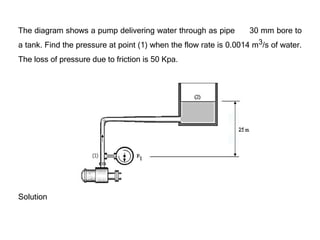
The diagram shows a pump delivering water through as pipe 30 mm bore to
a tank. Find the pressure at point (1) when the flow rate is 0.0014 m3/s of water.
The loss of pressure due to friction is 50 Kpa.
Solution
Since
𝐴𝑟𝑒𝑎"𝐴"
= 𝜋 × 𝐷2
4 = 𝜋 × 0.032
4 = 706.8 × 10⁻⁶
𝑚2
𝑎𝑛𝑑 𝑓𝑙𝑜𝑤 𝑟𝑎𝑡𝑒 𝑄 = 0.0014 𝑚3
/𝑠
∴ Mean velocity in pipe = 𝑄 𝐴 = 0.0014 706.8 × 10−6
= 1.98 𝑚 𝑠
Applying Bernoulli’s Eq. between point “1” and the surface of the tank
𝑍 +
𝑃
𝜌 𝑔
+
𝑉2
2 𝑔 1
= 𝑍 +
𝑃
𝜌 𝑔
+
𝑉2
2 𝑔 2
+ ℎ𝐿 1→2 …………………(1)
Taking the datum passes through point “1”
∴ 𝑍1 = 0 𝑎𝑛𝑑 𝑍2 = 25 𝑚
The pressure on the surface is zero (gage pressure) & P2 = 50 KPa.
The velocity at “1” is 1.98 m/s and at the surface is zero. Substituting into eq.
(1) gives:
0 +
𝑃1
𝜌 𝑔
+
1.982
2×9.81
= 25 + 0 + 0 +
50×1000
1000×9.81
∴ 𝑃1= 293.29 𝐾𝑃𝑎 (𝑔𝑎𝑔𝑒)
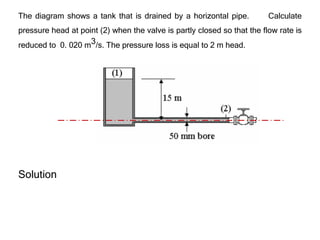
The diagram shows a tank that is drained by a horizontal pipe. Calculate
pressure head at point (2) when the valve is partly closed so that the flow rate is
reduced to 0. 020 m3/s. The pressure loss is equal to 2 m head.
Solution
Applying Bernoulli’s equation (in head form) between point “1” and “2” gives
𝑍1 + ℎ1 +
𝑉1
2
2 𝑔
= 𝑍2 + ℎ2 +
𝑉2
2
2 𝑔
+ ℎ𝐿 1 →1
or
0 + 15 + 0 = 0 + ℎ2 +
10.182
2 × 9.81
+ 2
∴ ℎ2= 7.72 𝑚
Taking a horizontal datum through point “2”
Point “1” in the free surface, then Z1= 0, and also V1 is assumed negligible.
Since Q =0.02 m3/s and =𝐴2 = 𝜋 ∙ 𝐷2
2
4 = 𝜋 ∙ 0.052 4 = 1.963 × 10⁻³𝑚2
∴ 𝑉2 = 𝑄 𝐴2=0.02 1.963 × 10−3
= 10.18 𝑚 𝑠
A pump “A” whose characteristics are given in the following table, is used to
pump water from an open tank through 40 m of 70 mm diameter pipe of friction
factor = 0.02 to another tank in which the surface level of water is 5.0 m above
that in the supply tank.
a. Determine the flow rate when the pump is operated at 1450 rev/min.
(00857 m3/s)
Head – Flow Characteristics of pump (A) when operating at 1450 rev/ min,
It is desired to increase the flow rate and 3 possibilities are under investigation.
b. To install a second identical pump in series with pump A.
c. To install a second identical pump in parallel with pump A.
d. To increase the speed of the pump by 10%.
Predict the flow rate that would occur in each of these situations.
Head (m) 9.75 8.83 7.73 6.90 5.50 3.83
Flow rate (L/s) 6.22 7.57 8.36 9.55 10.73
Q (L/S)
H
(m)
0.00
2.00
4.00
6.00
8.00
10.00
12.00
6.00 7.00 8.00 9.00 10.00 11.00 12.00
Q & H for the given pump (1450 rev/min)
0.0
5.0
10.0
15.0
20.0
25.0
5.0 10.0 15.0 20.0 25.0
Q & H for the given pump (1450 rev/min)
Q (L/S)
H
(m)
Water of h q 18 m / 3 V = flow rate has to be transported by the equipment shown in
the figure.
a) How wide pipe do we need to fulfill this task?
b) Determine the maximal dike height where the transport is possible?
(theoretical answer)
Valve
Branch B, LB
Branch A, LA
Large tank
Pump
Branch C, LC
Large tank
Large tank
1
2
3
VA
VB
VC
J
A turbine discharges 2.0 m3/s of water into a vertical draft tube as
shown in the figure. The diameter of the tube is 0.80 m at “A”. If the
head loss in the draft tube can be assumed as 1.5 times the velocity
head at “A”,
Estimate the pressure at “A”. (Ans. -30.32 kPa)

T
A
1.20 m
Dia. Da =
0.80 m
3.5 m
B
A 90N rectangular solid block slides down a 30o plan. The plane is
lubricated by a 3 mm thick film of oil of relative density 0.90 and viscosity
8.0 poise. If the contact area is 0.3 m2 (see the shown figure),
Estimate the terminal velocity the block.
At the terminal velocity, the sum of the
forces acting on the block in the direction
of its motion is zero. Hence
𝑤 ∙ 𝑠𝑖𝑛𝜃 = 𝜏 ∙ 𝐴
Where:
𝜏 = shear stress on the block, and
𝐴 = Area of the block
𝜏 = 𝜇
𝑑𝑉
𝑑𝑦
= 𝜇
𝑉
𝑦
Solution:
“w”= 90 N
V = terminal velocity
𝜃 = 30𝑜
At the terminal velocity, the sum of the forces acting on the block in the
direction of its motion is zero. Hence
𝑤 ∙ 𝑠𝑖𝑛𝜃 = 𝜏 ∙ 𝐴
𝜏 = 𝜇
𝑑𝑉
𝑑𝑦
= 𝜇
𝑉
𝑦
∴ 𝑤 ∙ 𝑠𝑖𝑛𝜃 = 𝜇 × 𝑉
𝑦
…….(1)
where:
y = thickness of oil film= 3 𝑚𝑚 = 3 × 10⁻³ 𝑚
𝜇 = 8 𝑝𝑜𝑖𝑠𝑒 = 0.8 𝑃𝑎 ∙ 𝑠
𝜏 = shear stress on the block, and
𝐴 = Area of the block = 0.30 𝑚2
Substituting the various values in eq. (1).
90 ∙ sin 30𝑜 = 0.8 ×
𝑉
3 × 10−3
× 0.3
∴ 𝑉 = 0.5625 𝑚 𝑠
𝜃
𝑤
A thin plate is placed between two flat surfaces “y” cm apart such that the
viscosity of the plate are 𝜇, 1and 𝜇, 2 respectively.
Determine the position of the thin plate such that the viscous resistance
to uniform motion of the thin plate is minimum (assume “y” to be very
small).
Solution:
Let “y” be the distance of the thin flat plate from the top flat surface and
“V” = velocity of the thin plate (see the attach figure). Since “ ϑ=
𝜇
𝜌
”
∴ 𝜇 = 𝜗 × 𝜌 = 3.7 × 10−4
× 0.85 × 1000 = 0.3145 𝑃𝑎 ∙ 𝑠
 The shear stress on the top portion 𝜏1 = 𝜇1 ×
𝑑𝑉
𝑑𝑦
= 𝜇1 ∙
𝑉
𝑦
 The gap on the bottom = h - y
 And the shear stress on the bottom portion 𝜏2
= 𝜇1 ×
𝑑𝑉
𝑑𝑦
= 𝜇2 ∙
𝑉
ℎ − 𝑦
 The total shear stress on the top and bottom of the plate
 𝐹𝑡 = 𝜏1 + 𝜏2 × 𝐴 = 𝐴 ∙ 𝑉
𝜇1
𝑦
+
𝜇2
ℎ−𝑦
Where: A & V are the area and velocity of the thin plate
 For Ft to be minimum, →
𝑑 𝐹𝑡
𝑑𝑦
= 0
∴ −
𝜇1
𝑦2
+
𝜇2
(ℎ − 𝑦)2
= 0
From which
𝑦
ℎ − 𝑦
2
=
𝜇1
𝜇2
or
𝑦
ℎ−𝑦
=
𝜇1
𝜇2
Thin flat plate
h
(h-y)
y 𝜇1
𝜇2
V
A cylindrical shaft of 90 mm diameter rotates about a vertical axis inside a
fixed cylindrical tube of length 50 cm and 95 mm internal diameter. If the
space between the tube and the shaft is filled by a lubricant of dynamic
viscosity 2.0 poise,
Determine the power required to overcome viscous resistance when the
shaft is rotated at a speed of 240 rpm (see the shown figure).
Solution:
Two vertical plates are placed with a gap of 15 mm between them and the gap is
filled with glycerin (density of glycerin = 1260 kg/m3 and  = 1.5 kg. S/ m2). An 80
cm square, 3 mm thick steel plate weighting 110 N is placed exactly midway in the
glycerin - filled gap of the vertical plates. If it required to pull the steel plate
vertically upwards at a constant velocity of 15 cm/s,
Estimate the force required, (neglect the resistance at the edges of the plate).
15 mm
Gap 6
mm
ts =3 mm
Steel
Plate
V = 15 cm/s
F
FS FS
we
A hydraulic lift used for lifting automobiles has a 25 cm diameter ram which slides
in a 25.018 cm diameter cylinder. The annular space being filled with oil having a
kinematic viscosity of 3.7 cm2/s and relative density of 0.85. If the rate of travel of
the ram is 15 cm/s, estimate:
The frictional resistance when 3.30 m of ram is engaged in the cylinder.
Solution:
Since “ ϑ=
𝜇
𝜌
”
∴ 𝜇 = 𝜗 × 𝜌 = 3.7 × 10−4 × 0.85 × 1000 = 0.3145 𝑃
𝑎 ∙ 𝑠
 The shear stress 𝜏 = 𝜇 ×
𝑑𝑉
𝑑𝑦
= 𝜇 ∙
𝑉
𝑦
= 0.3145 ×
0.15
26,018−25.00 2×102
= 524.17 𝑁 𝑚2
 Frictional resistance, 𝐹𝑠 = 𝜏 ∙ 𝐴 = 𝜏 ∙ 𝜋 𝐷 × 𝐿
= 524.17 × 𝜋 ×
25
100
× 3.30
= 1358.55 𝑁 = 1.359 𝐾𝑁
Pressure has the dimension of:
𝑝𝑟𝑒𝑠𝑠𝑢𝑟𝑒 =
𝐹𝑜𝑟𝑐𝑒
𝐴𝑟𝑒𝑎
= 𝐹 ∙ 𝐿−2
Is usually expressed in “Pascal” (𝑃𝑎𝑠𝑐𝑎𝑙 "𝑃𝑎” = 𝑁 𝑚3), kilo
Pascal Kpa = 103𝑁 𝑚3)
If “h” is the height of a column of a fluid and “ g =  ” = in bars (= 105
Pa) or atmospheres =( number of standard atmospheric pressure
values.
The pressures are commonly indicated as gage pressures and unless
a pressure is specifically marked absolute the pressure is treated as
gage pressure.
The atmosphere, however, is an exception and is an absolute
pressure.
Gage pressure: is commonly measured by a Bourdon gage.
Difference in pressure is measured by a manometers.
Local atmospheric pressure: (i.e. the absolute pressure of the
atmosphere at a place) is measured by a mercury barometer.
The local atmospheric pressure varies with the elevation above mean
see level and local meteorological conditions.
For engineering application, a standard atmospheric pressure at
mean sea level at 15oC is often used. The value of this standard
atmospheric pressure (called 1 atmosphere) is:
1 atm. = 760 mm of mercury =10.34 m of water
= 101.33 KPa = 101.33 m bar
For the system shown in figure, calculate the height “H” of oil
at which the rectangular hinged gate will just begin to rotate
counterclockwise.
Gate 1.5x 0.6 m
Oil
S.G.= 0.80
S.G. = 0.80
Air
H
1.5 m
30 KPa
Hinge
F1
F2
Oil
Pressure
Air Pressure
1.5 m
(a)
(b)
Solution
Assume the force due to oil F1
∴ 𝐹1 = 𝜌𝑜𝑖𝑙 × 𝑔 × ℎ𝑜𝑖𝑙
−
× 𝐴
where:
𝜌𝑜𝑖𝑙 × 𝑔 = 𝑆. 𝐺 𝑜𝑖𝑙 × 𝜌𝑤 × 𝑔 = 0.80 × 1000 × 9.81 = 7.848 𝑘𝑁 𝑚3
𝐴 = 1.5 × 0.6 = 0.90 𝑚2
ℎ𝑜𝑖𝑙
−
= 𝐻 −
1.50
2
∴ 𝐹1 = 7.848 × 𝐻 −
1.5
2
× 0.9 = 7.063𝐻 − 5.72
To calculate the center of pressure of F1
ℎ𝐶.𝑃 = ℎ−
+
𝐼𝐶.𝐺
𝐴∙ ℎ− = 𝐻 − 0.75 +
0.6×1.53 12
0.9× 𝐻−0.75
= 𝐻 − 0.75 +
0.1875
𝐻−0.75
And the force due to air F2
∴ 𝐹2 = 𝑃2 × 𝐴 = 30 × 1.5 × 0.60 = 27𝑘𝑁
It acts at a distance of 0.75 below the hinge (see the shown sketch)
Continue by your own
Answer
A siphon consisting of a pipe of 15 cm diameter is used to empty kerosene oil (S.
G. = 0.80) from tank “A”. The siphon discharges to the atmosphere at an elevation
of 1.00 m. The oil surface in the tank is at elevation of 4.00 m. The centerline of
the siphon pipe at its highest point “c” is at an elevation of 5.50 m. Estimate:
a) The discharge in the pipe,
b) The pressure at point “C”,
c) The losses in the pipe can be assumed to be 0.50 m up to the summit and
1.20 m from the summit to the outlet.
Consider points “1” and “2” at the surface of the oil and at the end of the siphon
(see the shown figure). By applying Bernoulli’s equation, we have:
Continue by your own
𝑍 +
𝑃
𝜌 𝑔
+
𝑉2
2 𝑔 1
= 𝑍 +
𝑃
𝜌 𝑔
+
𝑉2
2 𝑔 2
+ℎ𝐿 1 →2
Assuming P1= P2 =Patm = 0 (gage) and taking a reference datum through point “1”,
Z1 = 0
𝑍 +
𝑃
𝜌 𝑔
+
𝑉2
2 𝑔 1
= (4 − 1) +
𝑃
𝜌 𝑔
+
𝑉2
2 𝑔 2
+ (0.5 + 1.20)
………………≈ 0 ≈ 0
∴
𝑉2
2
2 𝑔
= 3 − 1.7 = 1.30 𝑚 and 𝑉2 = 2 × 9.81 × 1.3 = 25.05 =5.05 m/s
𝑎 𝑇ℎ𝑒 𝑑𝑖𝑠𝑐ℎ𝑎𝑟𝑔𝑒 𝑄 = 𝜋 × 0.15 2
× 5.05 = 0.0892 𝑚3
𝑠 = 89.2 𝐿 𝑠
For a hydraulic machine shown in the
figure, the following data are available:
Flow : From “A” to “B”
Discharge : 200 L/s of water
Diameters : at “A” 20 cm;
at “B” 30 cm
Elevation (m) : at “A” 105 m;
at “B” 100 m
Pressures : at “A” 100 kPa;
at “B” 200 kPa.
Is this machine a pump or a turbine?
Calculate the power input or output
depending on whether it is pump or a
turbine.
(Ans. The machine is a pump with P =6.965 kw)
A reaction turbine has a supply pipe of 0.8 m diameter and a draft tube with a
diameter of 1.20 m at the turbine and expanding gradually downwards. The tail-
water surface is 4.0 m below the centerline of the supply pipe at the turbine. For a
discharge of 1.10 m3/s, the pressure head just upstream the turbine is 40 m.
Estimate the power output of the turbine by assuming 85% efficiency,
Also, determine the pressure at the commencement of the draft tube next to the
turbine, which is 3.50 m above the tail-water, (see the attach figure).
(Ans. P = 405 KW; PB = -34.79 kPa)
In a siphon the summit is 4 m above the water level in the reservoir
from which the flow is being discharged out. If the head loss from the
inlet of the siphon to the summit is 2 m and the velocity head at the
summit is 0.5 m the pressure at the summit is:
(a) – 63.64 Kpa (b) - 9.0 m of water
(c) 6.50 m of water (abs) (d) - 39.16 KPa.
A liquid jet issues out from a nozzle inclined at an angle of 60o to the
horizontal and directed upwards. If the velocity of the jet at the nozzle
is 18 m/s the maximum vertical distance attained by the jet, measured
above the point of exit from the nozzle is:
(a) 14.30 m (b) 16.51 m
(c) 4.12 m (d) 12.39 m.
A Pump delivers 50 L/s of water and delivers 7.5 kw of power to the
system. The head developed by the pump:
(a) 7.5 m (b) 5 m,
(c) 1.53 m (d) 15.32 m.
In a hydro-power project a turbine has a head of 50 m. The discharge in
the feeding penstock is 3.60 m3/s. If a head loss of 5 m takes place due
to losses, and a power of 1000 kw is extracted, the residual head
downstream of the turbine is:
(a) 5.0 m (b) 10.95 m
(c) 15.95 m (d) 20.95 m.
In a turbine having a flow of 1.20 m3/s the net head is 120 m. If the
efficiency of the turbine is 90% the shaft power developed in kw, is:
(a) 1440 (b) 160
(c) 1566 (d) 1269
In a siphon the summit is 4 m above the water level in the reservoir from which the
flow is being discharged out. If the head loss from the inlet of the siphon to the
summit is 2 m and the velocity head at the summit is 0.50 m, the pressure at the
summit is:
a. -63.64 Kpa
b. - 9.0 m of water,
c. 6.5 m of water (absolute)
d. - 39.16 Kpa.
A liquid jet issues out from a nozzle inclined at an angle of 60o to the horizontal
and directed upwards. If the velocity of the jet at the nozzle is 18 m/s the maximum
vertical distance attained by the jet, measured above the point of exit from the
nozzle is:
a. 14.30 m
b. 16.51 m,
c. 4.12 m,
d. 12.39 m.
A pipeline delivering water from a reservoir is shown in the figure. A pump at
“M” adds energy to the flow and 45 L/s of water is discharged to atmosphere at
the outlet.
I. Calculate the power delivered by the pump. Assume the head loss in the
pipes as two times the velocity head at the suction side and 10 times the
velocity head in the delivery pipe.
II. Draw a neat sketch showing energy line and hydraulic grade lines.
(Ans. P = 5.218 kw)
A centrifugal pump has an axial inlet of 12 cm diameter and an impeller of 30 cm
diameter. The width of the impeller at the outlet is 25 mm (as shown in the
figure). 5% of the outlet area can be assumed to be occupied by the blade. For a
flow of 80 L/s, estimate:
a) The radial component of velocity at the outlet of the impeller.
b) What is the axial velocity in the inlet pipe?
(Ans. V = 3.575 m/s & 7.074 m/s )
30 cm dia.
12 cm dia.
5 mm
Va
Va
Solution
Discharge 𝑄 = 0.08 𝑚3 𝑠 and area at the outlet 𝐴 = 𝜋 × 𝐷 × ℎ × (free outlet
area)
= 𝜋 × 0.30 ×
5
2×1000
× 1 − 0.05 = 0.02238 𝑚3 𝑠
 Redial velocity at the outer edge of the impeller
 𝑉𝑜𝑢𝑡. =
80
1000
×
1
0.2238
= 3.574 𝑚 𝑠
The continuity equation at the inlet gives,
Q =
80
1000
= 𝐴𝑖𝑛𝑙. × 𝑉𝑖𝑛𝑙. =
𝜋×0.122
4
× 𝑉𝑖𝑛𝑙.
∴ 𝑉𝑖𝑛𝑙.=
80
1000
×
4
𝜋 × 0.122
= 7.074 𝑚 𝑠
A conical valve of weight 2.5 KN deeps water from flowing out of a tank as shown
in the figure. It is held in position by a counter weight of 10 KN connected by a
string passing over frictionless pullies as in the figure. Find: the maximum height
“H” of water in the tank, which will make the device to function without any leak.
(Ans. H = 1.06 m)
Weight of
1 0 KN
2.5 KN
Cone
60o Water
1.0 m
H
For the container shown in the figure,
Estimate the resultant force on the hemispherical bottom. (Ans. Fy
=52.46 KN, Fx =0 “due to symmetry”)
Air of 15 KPa
Oil of
S.G. = 0.75
3. 0 m
1. 50 m
hemisphere
A cylinder of diameter 0.6 m is located in water as shown in the figure. The
cylinder and the wall are smooth. If the length of the cylinder is 1.5 m, find:
a) Its weight
b) The resultant force exerted by the wall on the cylinder, and
c) The resultant moment about the center of the cylinder due to water forces on
the cylinder. (Ans. 4410 KN, 661.5 KN, zero)
o
The counterweight pivot gate shown in the figure, controls the flow from a tank.
The gate is rectangular and is 3m x 2 m.
Determine the value of the counterweight “W” such that the upstream water can
be 1.5 m. (Ans. W = 84.8 KN)
1.5 m
w
Pivot
Calculate the force “F” required to hold the hinged door shown in the figure in
closed position. The door is a 0.5 m square. An air pressure of 30 Kpa acts over
the water surface. (Ans. F = 7.217 KN)
Air of 30 KPa
Water
Hinge
Rectangular
Door
2.50 m
0.50 m
0.50 m
Door
F
solved problems in hydrostatic

solved problems in hydrostatic

  • 2.
    The diagram showsa pump delivering water through as pipe 30 mm bore to a tank. Find the pressure at point (1) when the flow rate is 0.0014 m3/s of water. The loss of pressure due to friction is 50 Kpa. Solution
  • 3.
    Since 𝐴𝑟𝑒𝑎"𝐴" = 𝜋 ×𝐷2 4 = 𝜋 × 0.032 4 = 706.8 × 10⁻⁶ 𝑚2 𝑎𝑛𝑑 𝑓𝑙𝑜𝑤 𝑟𝑎𝑡𝑒 𝑄 = 0.0014 𝑚3 /𝑠 ∴ Mean velocity in pipe = 𝑄 𝐴 = 0.0014 706.8 × 10−6 = 1.98 𝑚 𝑠 Applying Bernoulli’s Eq. between point “1” and the surface of the tank 𝑍 + 𝑃 𝜌 𝑔 + 𝑉2 2 𝑔 1 = 𝑍 + 𝑃 𝜌 𝑔 + 𝑉2 2 𝑔 2 + ℎ𝐿 1→2 …………………(1) Taking the datum passes through point “1” ∴ 𝑍1 = 0 𝑎𝑛𝑑 𝑍2 = 25 𝑚 The pressure on the surface is zero (gage pressure) & P2 = 50 KPa. The velocity at “1” is 1.98 m/s and at the surface is zero. Substituting into eq. (1) gives: 0 + 𝑃1 𝜌 𝑔 + 1.982 2×9.81 = 25 + 0 + 0 + 50×1000 1000×9.81 ∴ 𝑃1= 293.29 𝐾𝑃𝑎 (𝑔𝑎𝑔𝑒)
  • 4.
    The diagram showsa tank that is drained by a horizontal pipe. Calculate pressure head at point (2) when the valve is partly closed so that the flow rate is reduced to 0. 020 m3/s. The pressure loss is equal to 2 m head. Solution
  • 5.
    Applying Bernoulli’s equation(in head form) between point “1” and “2” gives 𝑍1 + ℎ1 + 𝑉1 2 2 𝑔 = 𝑍2 + ℎ2 + 𝑉2 2 2 𝑔 + ℎ𝐿 1 →1 or 0 + 15 + 0 = 0 + ℎ2 + 10.182 2 × 9.81 + 2 ∴ ℎ2= 7.72 𝑚 Taking a horizontal datum through point “2” Point “1” in the free surface, then Z1= 0, and also V1 is assumed negligible. Since Q =0.02 m3/s and =𝐴2 = 𝜋 ∙ 𝐷2 2 4 = 𝜋 ∙ 0.052 4 = 1.963 × 10⁻³𝑚2 ∴ 𝑉2 = 𝑄 𝐴2=0.02 1.963 × 10−3 = 10.18 𝑚 𝑠
  • 6.
    A pump “A”whose characteristics are given in the following table, is used to pump water from an open tank through 40 m of 70 mm diameter pipe of friction factor = 0.02 to another tank in which the surface level of water is 5.0 m above that in the supply tank. a. Determine the flow rate when the pump is operated at 1450 rev/min. (00857 m3/s) Head – Flow Characteristics of pump (A) when operating at 1450 rev/ min, It is desired to increase the flow rate and 3 possibilities are under investigation. b. To install a second identical pump in series with pump A. c. To install a second identical pump in parallel with pump A. d. To increase the speed of the pump by 10%. Predict the flow rate that would occur in each of these situations. Head (m) 9.75 8.83 7.73 6.90 5.50 3.83 Flow rate (L/s) 6.22 7.57 8.36 9.55 10.73
  • 7.
    Q (L/S) H (m) 0.00 2.00 4.00 6.00 8.00 10.00 12.00 6.00 7.008.00 9.00 10.00 11.00 12.00 Q & H for the given pump (1450 rev/min)
  • 8.
    0.0 5.0 10.0 15.0 20.0 25.0 5.0 10.0 15.020.0 25.0 Q & H for the given pump (1450 rev/min) Q (L/S) H (m)
  • 9.
    Water of hq 18 m / 3 V = flow rate has to be transported by the equipment shown in the figure. a) How wide pipe do we need to fulfill this task? b) Determine the maximal dike height where the transport is possible? (theoretical answer)
  • 13.
    Valve Branch B, LB BranchA, LA Large tank Pump Branch C, LC Large tank Large tank 1 2 3 VA VB VC J
  • 14.
    A turbine discharges2.0 m3/s of water into a vertical draft tube as shown in the figure. The diameter of the tube is 0.80 m at “A”. If the head loss in the draft tube can be assumed as 1.5 times the velocity head at “A”, Estimate the pressure at “A”. (Ans. -30.32 kPa)  T A 1.20 m Dia. Da = 0.80 m 3.5 m B
  • 15.
    A 90N rectangularsolid block slides down a 30o plan. The plane is lubricated by a 3 mm thick film of oil of relative density 0.90 and viscosity 8.0 poise. If the contact area is 0.3 m2 (see the shown figure), Estimate the terminal velocity the block. At the terminal velocity, the sum of the forces acting on the block in the direction of its motion is zero. Hence 𝑤 ∙ 𝑠𝑖𝑛𝜃 = 𝜏 ∙ 𝐴 Where: 𝜏 = shear stress on the block, and 𝐴 = Area of the block 𝜏 = 𝜇 𝑑𝑉 𝑑𝑦 = 𝜇 𝑉 𝑦 Solution: “w”= 90 N V = terminal velocity 𝜃 = 30𝑜
  • 16.
    At the terminalvelocity, the sum of the forces acting on the block in the direction of its motion is zero. Hence 𝑤 ∙ 𝑠𝑖𝑛𝜃 = 𝜏 ∙ 𝐴 𝜏 = 𝜇 𝑑𝑉 𝑑𝑦 = 𝜇 𝑉 𝑦 ∴ 𝑤 ∙ 𝑠𝑖𝑛𝜃 = 𝜇 × 𝑉 𝑦 …….(1) where: y = thickness of oil film= 3 𝑚𝑚 = 3 × 10⁻³ 𝑚 𝜇 = 8 𝑝𝑜𝑖𝑠𝑒 = 0.8 𝑃𝑎 ∙ 𝑠 𝜏 = shear stress on the block, and 𝐴 = Area of the block = 0.30 𝑚2 Substituting the various values in eq. (1). 90 ∙ sin 30𝑜 = 0.8 × 𝑉 3 × 10−3 × 0.3 ∴ 𝑉 = 0.5625 𝑚 𝑠
  • 17.
  • 18.
    A thin plateis placed between two flat surfaces “y” cm apart such that the viscosity of the plate are 𝜇, 1and 𝜇, 2 respectively. Determine the position of the thin plate such that the viscous resistance to uniform motion of the thin plate is minimum (assume “y” to be very small). Solution: Let “y” be the distance of the thin flat plate from the top flat surface and “V” = velocity of the thin plate (see the attach figure). Since “ ϑ= 𝜇 𝜌 ” ∴ 𝜇 = 𝜗 × 𝜌 = 3.7 × 10−4 × 0.85 × 1000 = 0.3145 𝑃𝑎 ∙ 𝑠  The shear stress on the top portion 𝜏1 = 𝜇1 × 𝑑𝑉 𝑑𝑦 = 𝜇1 ∙ 𝑉 𝑦
  • 19.
     The gapon the bottom = h - y  And the shear stress on the bottom portion 𝜏2 = 𝜇1 × 𝑑𝑉 𝑑𝑦 = 𝜇2 ∙ 𝑉 ℎ − 𝑦  The total shear stress on the top and bottom of the plate  𝐹𝑡 = 𝜏1 + 𝜏2 × 𝐴 = 𝐴 ∙ 𝑉 𝜇1 𝑦 + 𝜇2 ℎ−𝑦 Where: A & V are the area and velocity of the thin plate  For Ft to be minimum, → 𝑑 𝐹𝑡 𝑑𝑦 = 0 ∴ − 𝜇1 𝑦2 + 𝜇2 (ℎ − 𝑦)2 = 0 From which 𝑦 ℎ − 𝑦 2 = 𝜇1 𝜇2 or 𝑦 ℎ−𝑦 = 𝜇1 𝜇2
  • 20.
  • 21.
    A cylindrical shaftof 90 mm diameter rotates about a vertical axis inside a fixed cylindrical tube of length 50 cm and 95 mm internal diameter. If the space between the tube and the shaft is filled by a lubricant of dynamic viscosity 2.0 poise, Determine the power required to overcome viscous resistance when the shaft is rotated at a speed of 240 rpm (see the shown figure). Solution:
  • 25.
    Two vertical platesare placed with a gap of 15 mm between them and the gap is filled with glycerin (density of glycerin = 1260 kg/m3 and  = 1.5 kg. S/ m2). An 80 cm square, 3 mm thick steel plate weighting 110 N is placed exactly midway in the glycerin - filled gap of the vertical plates. If it required to pull the steel plate vertically upwards at a constant velocity of 15 cm/s, Estimate the force required, (neglect the resistance at the edges of the plate).
  • 27.
    15 mm Gap 6 mm ts=3 mm Steel Plate V = 15 cm/s F FS FS we
  • 28.
    A hydraulic liftused for lifting automobiles has a 25 cm diameter ram which slides in a 25.018 cm diameter cylinder. The annular space being filled with oil having a kinematic viscosity of 3.7 cm2/s and relative density of 0.85. If the rate of travel of the ram is 15 cm/s, estimate: The frictional resistance when 3.30 m of ram is engaged in the cylinder. Solution: Since “ ϑ= 𝜇 𝜌 ” ∴ 𝜇 = 𝜗 × 𝜌 = 3.7 × 10−4 × 0.85 × 1000 = 0.3145 𝑃 𝑎 ∙ 𝑠  The shear stress 𝜏 = 𝜇 × 𝑑𝑉 𝑑𝑦 = 𝜇 ∙ 𝑉 𝑦 = 0.3145 × 0.15 26,018−25.00 2×102 = 524.17 𝑁 𝑚2  Frictional resistance, 𝐹𝑠 = 𝜏 ∙ 𝐴 = 𝜏 ∙ 𝜋 𝐷 × 𝐿 = 524.17 × 𝜋 × 25 100 × 3.30 = 1358.55 𝑁 = 1.359 𝐾𝑁
  • 29.
    Pressure has thedimension of: 𝑝𝑟𝑒𝑠𝑠𝑢𝑟𝑒 = 𝐹𝑜𝑟𝑐𝑒 𝐴𝑟𝑒𝑎 = 𝐹 ∙ 𝐿−2 Is usually expressed in “Pascal” (𝑃𝑎𝑠𝑐𝑎𝑙 "𝑃𝑎” = 𝑁 𝑚3), kilo Pascal Kpa = 103𝑁 𝑚3) If “h” is the height of a column of a fluid and “ g =  ” = in bars (= 105 Pa) or atmospheres =( number of standard atmospheric pressure values. The pressures are commonly indicated as gage pressures and unless a pressure is specifically marked absolute the pressure is treated as gage pressure. The atmosphere, however, is an exception and is an absolute pressure.
  • 30.
    Gage pressure: iscommonly measured by a Bourdon gage. Difference in pressure is measured by a manometers. Local atmospheric pressure: (i.e. the absolute pressure of the atmosphere at a place) is measured by a mercury barometer. The local atmospheric pressure varies with the elevation above mean see level and local meteorological conditions. For engineering application, a standard atmospheric pressure at mean sea level at 15oC is often used. The value of this standard atmospheric pressure (called 1 atmosphere) is: 1 atm. = 760 mm of mercury =10.34 m of water = 101.33 KPa = 101.33 m bar
  • 31.
    For the systemshown in figure, calculate the height “H” of oil at which the rectangular hinged gate will just begin to rotate counterclockwise. Gate 1.5x 0.6 m Oil S.G.= 0.80 S.G. = 0.80 Air H 1.5 m 30 KPa Hinge F1 F2 Oil Pressure Air Pressure 1.5 m (a) (b)
  • 32.
    Solution Assume the forcedue to oil F1 ∴ 𝐹1 = 𝜌𝑜𝑖𝑙 × 𝑔 × ℎ𝑜𝑖𝑙 − × 𝐴 where: 𝜌𝑜𝑖𝑙 × 𝑔 = 𝑆. 𝐺 𝑜𝑖𝑙 × 𝜌𝑤 × 𝑔 = 0.80 × 1000 × 9.81 = 7.848 𝑘𝑁 𝑚3 𝐴 = 1.5 × 0.6 = 0.90 𝑚2 ℎ𝑜𝑖𝑙 − = 𝐻 − 1.50 2 ∴ 𝐹1 = 7.848 × 𝐻 − 1.5 2 × 0.9 = 7.063𝐻 − 5.72 To calculate the center of pressure of F1 ℎ𝐶.𝑃 = ℎ− + 𝐼𝐶.𝐺 𝐴∙ ℎ− = 𝐻 − 0.75 + 0.6×1.53 12 0.9× 𝐻−0.75 = 𝐻 − 0.75 + 0.1875 𝐻−0.75 And the force due to air F2 ∴ 𝐹2 = 𝑃2 × 𝐴 = 30 × 1.5 × 0.60 = 27𝑘𝑁 It acts at a distance of 0.75 below the hinge (see the shown sketch) Continue by your own
  • 33.
    Answer A siphon consistingof a pipe of 15 cm diameter is used to empty kerosene oil (S. G. = 0.80) from tank “A”. The siphon discharges to the atmosphere at an elevation of 1.00 m. The oil surface in the tank is at elevation of 4.00 m. The centerline of the siphon pipe at its highest point “c” is at an elevation of 5.50 m. Estimate: a) The discharge in the pipe, b) The pressure at point “C”, c) The losses in the pipe can be assumed to be 0.50 m up to the summit and 1.20 m from the summit to the outlet.
  • 34.
    Consider points “1”and “2” at the surface of the oil and at the end of the siphon (see the shown figure). By applying Bernoulli’s equation, we have: Continue by your own 𝑍 + 𝑃 𝜌 𝑔 + 𝑉2 2 𝑔 1 = 𝑍 + 𝑃 𝜌 𝑔 + 𝑉2 2 𝑔 2 +ℎ𝐿 1 →2 Assuming P1= P2 =Patm = 0 (gage) and taking a reference datum through point “1”, Z1 = 0 𝑍 + 𝑃 𝜌 𝑔 + 𝑉2 2 𝑔 1 = (4 − 1) + 𝑃 𝜌 𝑔 + 𝑉2 2 𝑔 2 + (0.5 + 1.20) ………………≈ 0 ≈ 0 ∴ 𝑉2 2 2 𝑔 = 3 − 1.7 = 1.30 𝑚 and 𝑉2 = 2 × 9.81 × 1.3 = 25.05 =5.05 m/s 𝑎 𝑇ℎ𝑒 𝑑𝑖𝑠𝑐ℎ𝑎𝑟𝑔𝑒 𝑄 = 𝜋 × 0.15 2 × 5.05 = 0.0892 𝑚3 𝑠 = 89.2 𝐿 𝑠
  • 35.
    For a hydraulicmachine shown in the figure, the following data are available: Flow : From “A” to “B” Discharge : 200 L/s of water Diameters : at “A” 20 cm; at “B” 30 cm Elevation (m) : at “A” 105 m; at “B” 100 m Pressures : at “A” 100 kPa; at “B” 200 kPa. Is this machine a pump or a turbine? Calculate the power input or output depending on whether it is pump or a turbine. (Ans. The machine is a pump with P =6.965 kw)
  • 36.
    A reaction turbinehas a supply pipe of 0.8 m diameter and a draft tube with a diameter of 1.20 m at the turbine and expanding gradually downwards. The tail- water surface is 4.0 m below the centerline of the supply pipe at the turbine. For a discharge of 1.10 m3/s, the pressure head just upstream the turbine is 40 m. Estimate the power output of the turbine by assuming 85% efficiency, Also, determine the pressure at the commencement of the draft tube next to the turbine, which is 3.50 m above the tail-water, (see the attach figure). (Ans. P = 405 KW; PB = -34.79 kPa)
  • 37.
    In a siphonthe summit is 4 m above the water level in the reservoir from which the flow is being discharged out. If the head loss from the inlet of the siphon to the summit is 2 m and the velocity head at the summit is 0.5 m the pressure at the summit is: (a) – 63.64 Kpa (b) - 9.0 m of water (c) 6.50 m of water (abs) (d) - 39.16 KPa. A liquid jet issues out from a nozzle inclined at an angle of 60o to the horizontal and directed upwards. If the velocity of the jet at the nozzle is 18 m/s the maximum vertical distance attained by the jet, measured above the point of exit from the nozzle is: (a) 14.30 m (b) 16.51 m (c) 4.12 m (d) 12.39 m.
  • 38.
    A Pump delivers50 L/s of water and delivers 7.5 kw of power to the system. The head developed by the pump: (a) 7.5 m (b) 5 m, (c) 1.53 m (d) 15.32 m. In a hydro-power project a turbine has a head of 50 m. The discharge in the feeding penstock is 3.60 m3/s. If a head loss of 5 m takes place due to losses, and a power of 1000 kw is extracted, the residual head downstream of the turbine is: (a) 5.0 m (b) 10.95 m (c) 15.95 m (d) 20.95 m.
  • 39.
    In a turbinehaving a flow of 1.20 m3/s the net head is 120 m. If the efficiency of the turbine is 90% the shaft power developed in kw, is: (a) 1440 (b) 160 (c) 1566 (d) 1269
  • 41.
    In a siphonthe summit is 4 m above the water level in the reservoir from which the flow is being discharged out. If the head loss from the inlet of the siphon to the summit is 2 m and the velocity head at the summit is 0.50 m, the pressure at the summit is: a. -63.64 Kpa b. - 9.0 m of water, c. 6.5 m of water (absolute) d. - 39.16 Kpa. A liquid jet issues out from a nozzle inclined at an angle of 60o to the horizontal and directed upwards. If the velocity of the jet at the nozzle is 18 m/s the maximum vertical distance attained by the jet, measured above the point of exit from the nozzle is: a. 14.30 m b. 16.51 m, c. 4.12 m, d. 12.39 m.
  • 42.
    A pipeline deliveringwater from a reservoir is shown in the figure. A pump at “M” adds energy to the flow and 45 L/s of water is discharged to atmosphere at the outlet. I. Calculate the power delivered by the pump. Assume the head loss in the pipes as two times the velocity head at the suction side and 10 times the velocity head in the delivery pipe. II. Draw a neat sketch showing energy line and hydraulic grade lines. (Ans. P = 5.218 kw)
  • 43.
    A centrifugal pumphas an axial inlet of 12 cm diameter and an impeller of 30 cm diameter. The width of the impeller at the outlet is 25 mm (as shown in the figure). 5% of the outlet area can be assumed to be occupied by the blade. For a flow of 80 L/s, estimate: a) The radial component of velocity at the outlet of the impeller. b) What is the axial velocity in the inlet pipe? (Ans. V = 3.575 m/s & 7.074 m/s ) 30 cm dia. 12 cm dia. 5 mm Va Va
  • 44.
    Solution Discharge 𝑄 =0.08 𝑚3 𝑠 and area at the outlet 𝐴 = 𝜋 × 𝐷 × ℎ × (free outlet area) = 𝜋 × 0.30 × 5 2×1000 × 1 − 0.05 = 0.02238 𝑚3 𝑠  Redial velocity at the outer edge of the impeller  𝑉𝑜𝑢𝑡. = 80 1000 × 1 0.2238 = 3.574 𝑚 𝑠 The continuity equation at the inlet gives, Q = 80 1000 = 𝐴𝑖𝑛𝑙. × 𝑉𝑖𝑛𝑙. = 𝜋×0.122 4 × 𝑉𝑖𝑛𝑙. ∴ 𝑉𝑖𝑛𝑙.= 80 1000 × 4 𝜋 × 0.122 = 7.074 𝑚 𝑠
  • 45.
    A conical valveof weight 2.5 KN deeps water from flowing out of a tank as shown in the figure. It is held in position by a counter weight of 10 KN connected by a string passing over frictionless pullies as in the figure. Find: the maximum height “H” of water in the tank, which will make the device to function without any leak. (Ans. H = 1.06 m) Weight of 1 0 KN 2.5 KN Cone 60o Water 1.0 m H
  • 46.
    For the containershown in the figure, Estimate the resultant force on the hemispherical bottom. (Ans. Fy =52.46 KN, Fx =0 “due to symmetry”) Air of 15 KPa Oil of S.G. = 0.75 3. 0 m 1. 50 m hemisphere
  • 47.
    A cylinder ofdiameter 0.6 m is located in water as shown in the figure. The cylinder and the wall are smooth. If the length of the cylinder is 1.5 m, find: a) Its weight b) The resultant force exerted by the wall on the cylinder, and c) The resultant moment about the center of the cylinder due to water forces on the cylinder. (Ans. 4410 KN, 661.5 KN, zero) o
  • 48.
    The counterweight pivotgate shown in the figure, controls the flow from a tank. The gate is rectangular and is 3m x 2 m. Determine the value of the counterweight “W” such that the upstream water can be 1.5 m. (Ans. W = 84.8 KN) 1.5 m w Pivot
  • 49.
    Calculate the force“F” required to hold the hinged door shown in the figure in closed position. The door is a 0.5 m square. An air pressure of 30 Kpa acts over the water surface. (Ans. F = 7.217 KN) Air of 30 KPa Water Hinge Rectangular Door 2.50 m 0.50 m 0.50 m Door F