setting time aright Sean Carroll, Caltech preposterousuniverse.com What is time? Why does time have a direction? How does complexity  evolve?
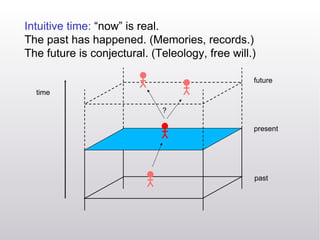
Intuitive time:  “now” is real. The past has happened. (Memories, records.) The future is conjectural. (Teleology, free will.) time future present past ?
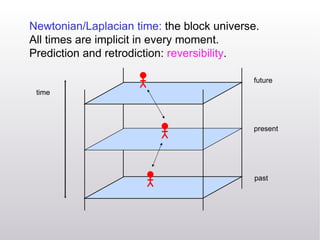
Newtonian/Laplacian time:  the block universe. All times are implicit in every moment. Prediction and retrodiction:  reversibility . time future present past
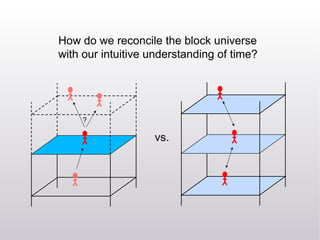
How do we reconcile the block universe with our intuitive understanding of time? vs. ?
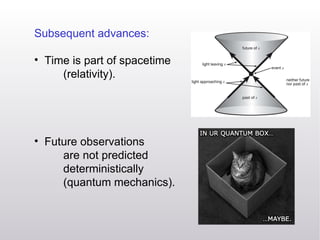
Subsequent advances: Time is part of spacetime  (relativity). Future observations  are not predicted deterministically  (quantum mechanics).
A conjecture: Time is fundamental, but space is not. In quantum mechanics, we speak of wave functions that depend  on space and time,   ( x ,  t ) .  But that’s only for one particle. The wave function really depends on  configuration space  as well as time. “ Space” is just an example of configuration space.  ( x 1 ,  x 2 ,  x 3  …  x N ;  t )  [  1 ( x ),   2 ( x )…;  t ] many-particle quantum mechanics quantum field theory
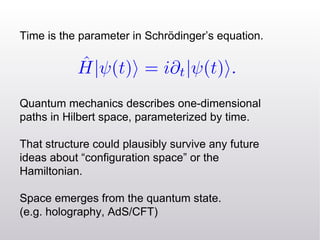
Time is the parameter in Schrödinger’s equation. Quantum mechanics describes one-dimensional paths in Hilbert space, parameterized by time. That structure could plausibly survive any future ideas about “configuration space” or the Hamiltonian. Space emerges from the quantum state. (e.g. holography, AdS/CFT)
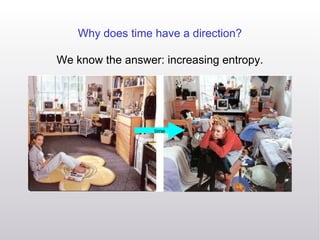
Why does time have a direction? We know the answer: increasing entropy. time
Life and death Biological evolution Memory Cause and effect [Penrose] All  past/future distinctions arise because our environment is very far from equilibrium, and entropy is increasing.
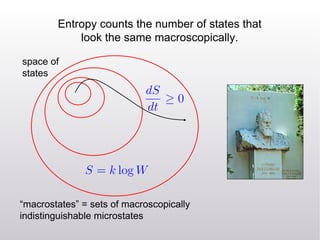
space of states “ macrostates” = sets of macroscopically indistinguishable microstates Entropy counts the number of states that look the same macroscopically.
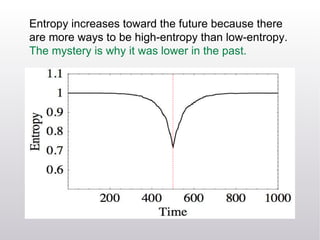
Entropy increases toward the future because there are more ways to be high-entropy than low-entropy. The mystery is why it was lower in the past.
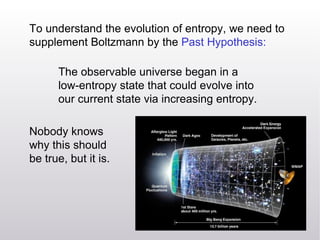
To understand the evolution of entropy, we need to  supplement Boltzmann by the  Past Hypothesis: The observable universe began in a  low-entropy state that could evolve into    our current state via increasing entropy. Nobody knows why this should be true, but it is.
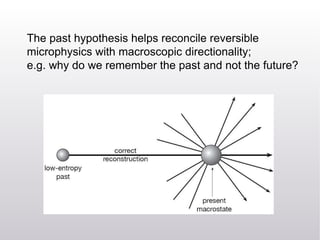
The past hypothesis helps reconcile reversible microphysics with macroscopic directionality; e.g. why do we remember the past and not the future?
empty,  quiet parent  universe “ Big Bangs” arrows of time arrows of time time One idea: the universe we see arises from a restless time-symmetric multiverse with unbounded entropy. [Carroll & Chen; cf. Aguirre & Gratton;   Garriga & Vilenkin; Hartle, Hawking, & Hertog; Page] t S
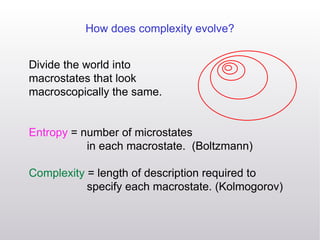
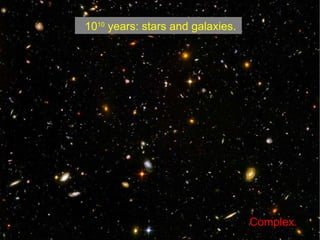
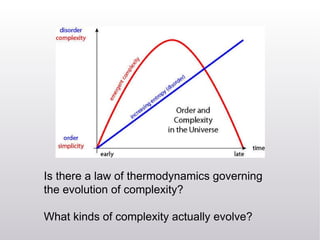
Divide the world into  macrostates that look macroscopically the same. Entropy  = number of microstates  in each macrostate.  (Boltzmann) Complexity  = length of description required to specify each macrostate. (Kolmogorov)  How does complexity evolve?
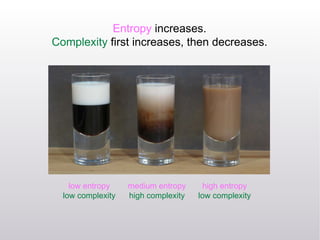
Entropy  increases. Complexity  first increases, then decreases. low entropy low complexity medium entropy high complexity high entropy low complexity
1 second:  hot, smooth plasma. Simple.
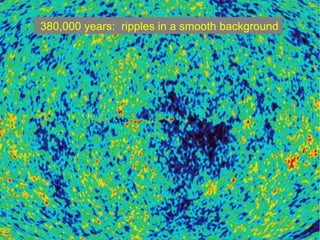
380,000 years:  ripples in a smooth background
10 10  years: stars and galaxies. Complex.
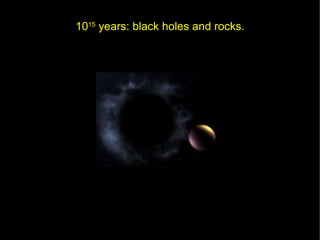
10 15  years: black holes and rocks.
10 100  years: empty space (forever). Simple.
Is there a law of thermodynamics governing the evolution of complexity? What kinds of complexity actually evolve?
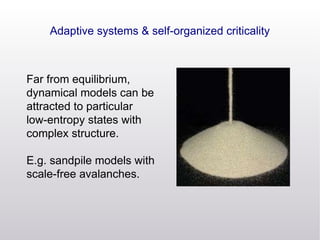
Adaptive systems & self-organized criticality Far from equilibrium, dynamical models can be attracted to particular low-entropy states with complex structure. E.g. sandpile models with  scale-free avalanches.
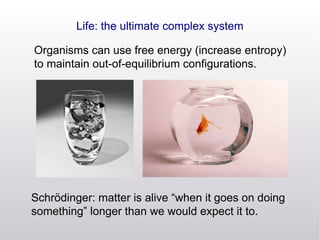
Life: the ultimate complex system Organisms can use free energy (increase entropy) to maintain out-of-equilibrium configurations. Schrödinger: matter is alive “when it goes on doing something” longer than we would expect it to.
“ The purpose of life is to hydrogenate carbon dioxide.” -- Mike Russell [E. Smith] [Yung, Russell & Parkinson]

Setting Time Aright

  • 1.
    setting time arightSean Carroll, Caltech preposterousuniverse.com What is time? Why does time have a direction? How does complexity evolve?
  • 2.
    Intuitive time: “now” is real. The past has happened. (Memories, records.) The future is conjectural. (Teleology, free will.) time future present past ?
  • 3.
    Newtonian/Laplacian time: the block universe. All times are implicit in every moment. Prediction and retrodiction: reversibility . time future present past
  • 4.
    How do wereconcile the block universe with our intuitive understanding of time? vs. ?
  • 5.
    Subsequent advances: Timeis part of spacetime (relativity). Future observations are not predicted deterministically (quantum mechanics).
  • 6.
    A conjecture: Timeis fundamental, but space is not. In quantum mechanics, we speak of wave functions that depend on space and time,  ( x , t ) . But that’s only for one particle. The wave function really depends on configuration space as well as time. “ Space” is just an example of configuration space.  ( x 1 , x 2 , x 3 … x N ; t )  [  1 ( x ),  2 ( x )…; t ] many-particle quantum mechanics quantum field theory
  • 7.
    Time is theparameter in Schrödinger’s equation. Quantum mechanics describes one-dimensional paths in Hilbert space, parameterized by time. That structure could plausibly survive any future ideas about “configuration space” or the Hamiltonian. Space emerges from the quantum state. (e.g. holography, AdS/CFT)
  • 8.
    Why does timehave a direction? We know the answer: increasing entropy. time
  • 9.
    Life and deathBiological evolution Memory Cause and effect [Penrose] All past/future distinctions arise because our environment is very far from equilibrium, and entropy is increasing.
  • 10.
    space of states“ macrostates” = sets of macroscopically indistinguishable microstates Entropy counts the number of states that look the same macroscopically.
  • 11.
    Entropy increases towardthe future because there are more ways to be high-entropy than low-entropy. The mystery is why it was lower in the past.
  • 12.
    To understand theevolution of entropy, we need to supplement Boltzmann by the Past Hypothesis: The observable universe began in a low-entropy state that could evolve into our current state via increasing entropy. Nobody knows why this should be true, but it is.
  • 13.
    The past hypothesishelps reconcile reversible microphysics with macroscopic directionality; e.g. why do we remember the past and not the future?
  • 14.
    empty, quietparent universe “ Big Bangs” arrows of time arrows of time time One idea: the universe we see arises from a restless time-symmetric multiverse with unbounded entropy. [Carroll & Chen; cf. Aguirre & Gratton; Garriga & Vilenkin; Hartle, Hawking, & Hertog; Page] t S
  • 15.
    Divide the worldinto macrostates that look macroscopically the same. Entropy = number of microstates in each macrostate. (Boltzmann) Complexity = length of description required to specify each macrostate. (Kolmogorov) How does complexity evolve?
  • 16.
    Entropy increases.Complexity first increases, then decreases. low entropy low complexity medium entropy high complexity high entropy low complexity
  • 17.
    1 second: hot, smooth plasma. Simple.
  • 18.
    380,000 years: ripples in a smooth background
  • 19.
    10 10 years: stars and galaxies. Complex.
  • 20.
    10 15 years: black holes and rocks.
  • 21.
    10 100 years: empty space (forever). Simple.
  • 22.
    Is there alaw of thermodynamics governing the evolution of complexity? What kinds of complexity actually evolve?
  • 23.
    Adaptive systems &self-organized criticality Far from equilibrium, dynamical models can be attracted to particular low-entropy states with complex structure. E.g. sandpile models with scale-free avalanches.
  • 24.
    Life: the ultimatecomplex system Organisms can use free energy (increase entropy) to maintain out-of-equilibrium configurations. Schrödinger: matter is alive “when it goes on doing something” longer than we would expect it to.
  • 25.
    “ The purposeof life is to hydrogenate carbon dioxide.” -- Mike Russell [E. Smith] [Yung, Russell & Parkinson]