www.nicsa.org
Collateral Management Market
Practices and New Legislation
Impacts
March 30, 2016
SPONSORED BY:
www.nicsa.org
MODERATOR:
Gary Crawford
Assistant Vice President, MFSC Legacy Systems
MFS Investment Management
PANELISTS:
Mark Demo
Product Director
AcadiaSoft, Inc.
Wayne Forsythe
Managing Director, Collateral Management Services
State Street Global Services
www.nicsa.org
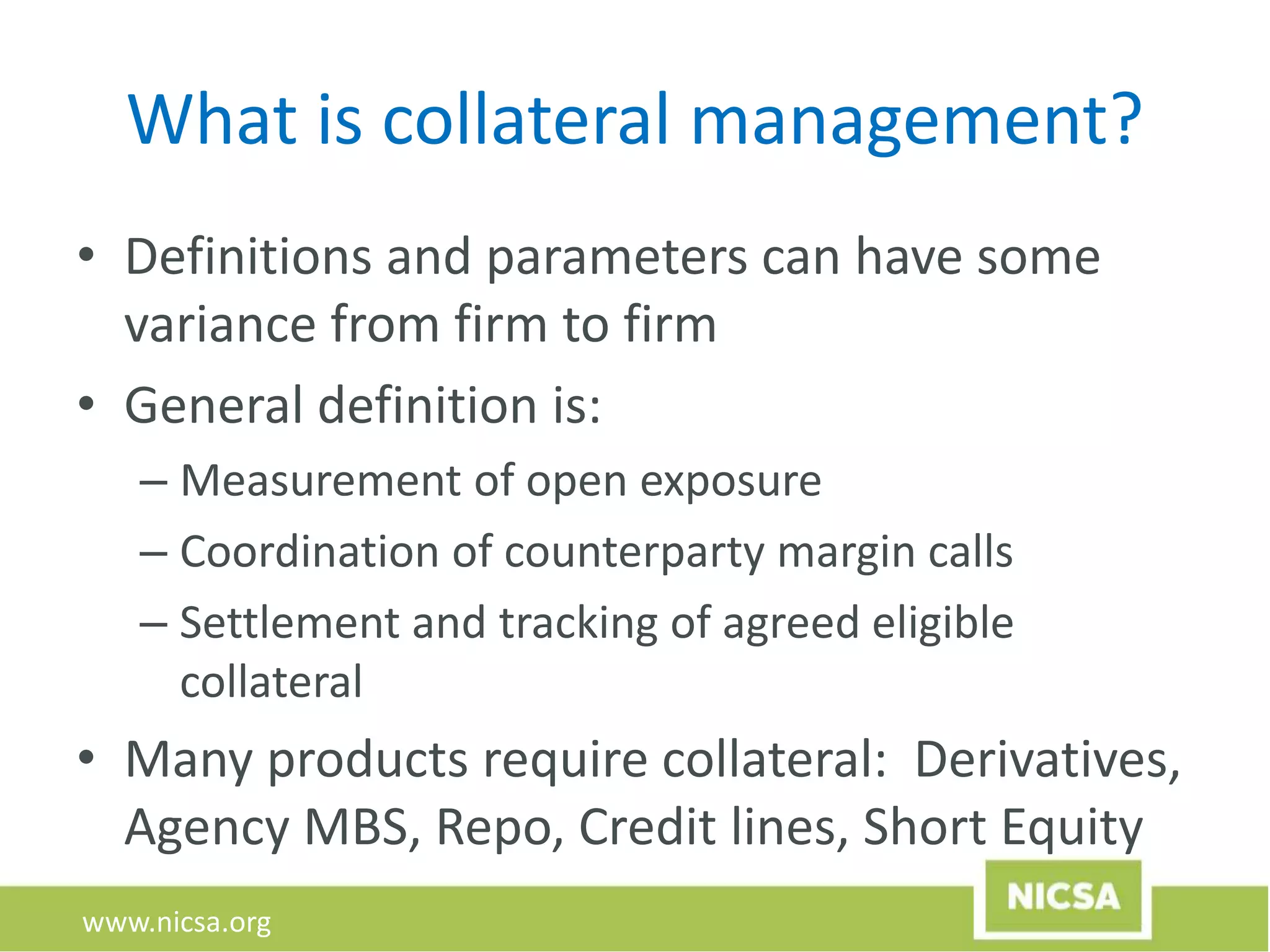
What is collateral management?
• Definitions and parameters can have some
variance from firm to firm
• General definition is:
– Measurement of open exposure
– Coordination of counterparty margin calls
– Settlement and tracking of agreed eligible
collateral
• Many products require collateral: Derivatives,
Agency MBS, Repo, Credit lines, Short Equity
www.nicsa.org
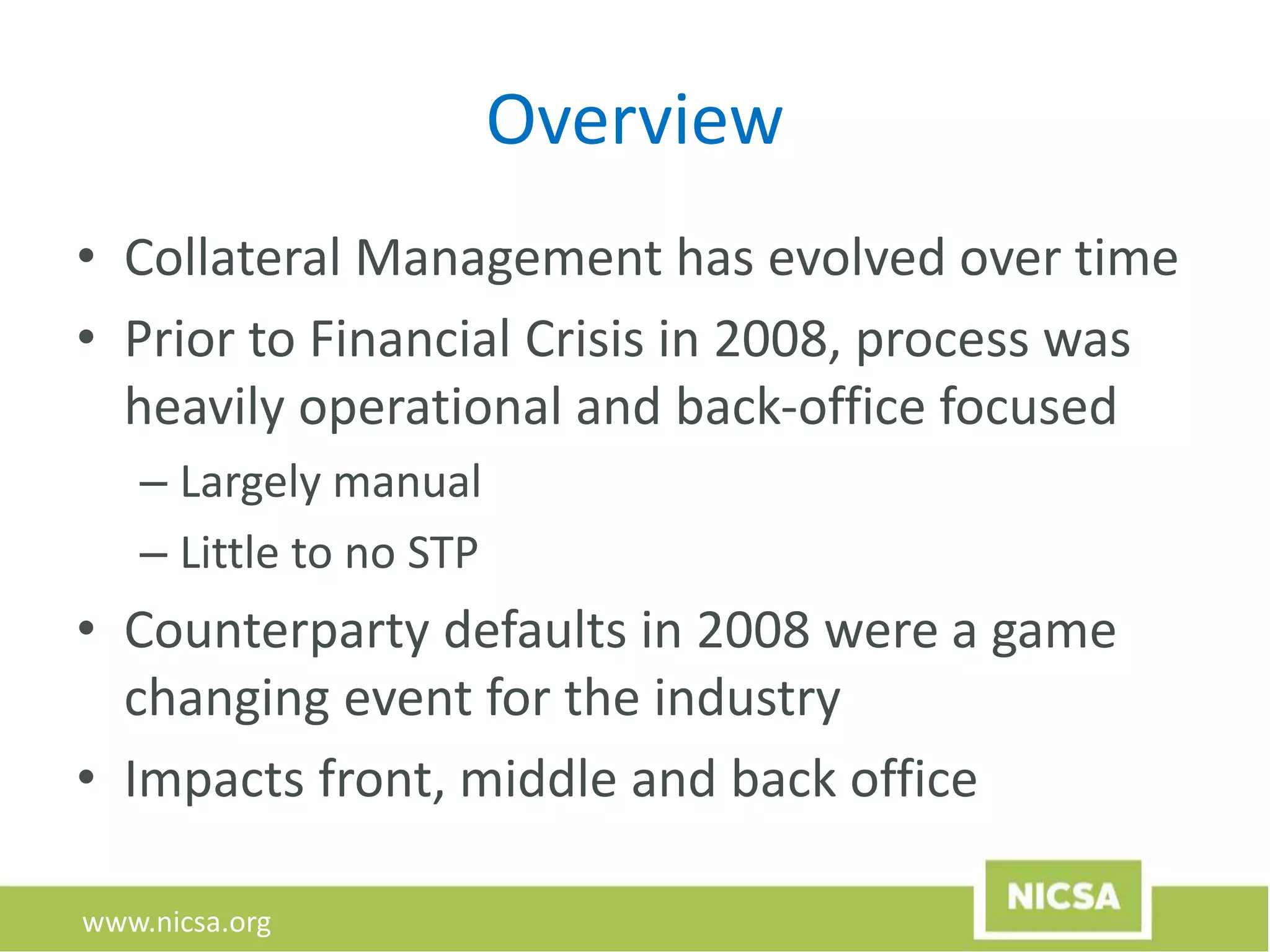
Overview
• Collateral Management has evolved over time
• Prior to Financial Crisis in 2008, process was
heavily operational and back-office focused
– Largely manual
– Little to no STP
• Counterparty defaults in 2008 were a game
changing event for the industry
• Impacts front, middle and back office
www.nicsa.org
Data overview
• Static Data requirements
– Account / Counterparty definition
– Legal terms (CSA/MSFTA/GMRA etc): Minimum
Transfer, Threshold, Rounding, Eligible Collateral,
Concentration limits
– Standing Settlement Instructions (SSI’s)
• Dynamic data
– Trade MTM / Initial Margin (independent amount)
– Settled collateral valuations
www.nicsa.org
Margin Calls
• Margin call management
– Distribution email or electronic (AcadiaSoft)
– Includes relevant details for call, including call
amount, MTM and collateral balance
– Times specified in governing agreements
• Parties agree to amounts and allocation
• Disputed calls are identified
www.nicsa.org
Correlated Processes
• Settlement: Custodians notified via SWIFT
messaging
– MT540/542/202/210
• Reconciliation
– Collateral Balances
– Underlying Portfolios (unilateral or bi-lateral)
• Substitutions
www.nicsa.org
Changing Landscape
• Critical component of Enterprise Risk Program
• Market utilities are evolving
– DTCC Margin Transit
– AcadiaSoft
– TriOptima
• Regulations are redefining the landscape
– Un-cleared margin requirements
– Agency MBS
www.nicsa.org
CPE CODE:
212
www.nicsa.org
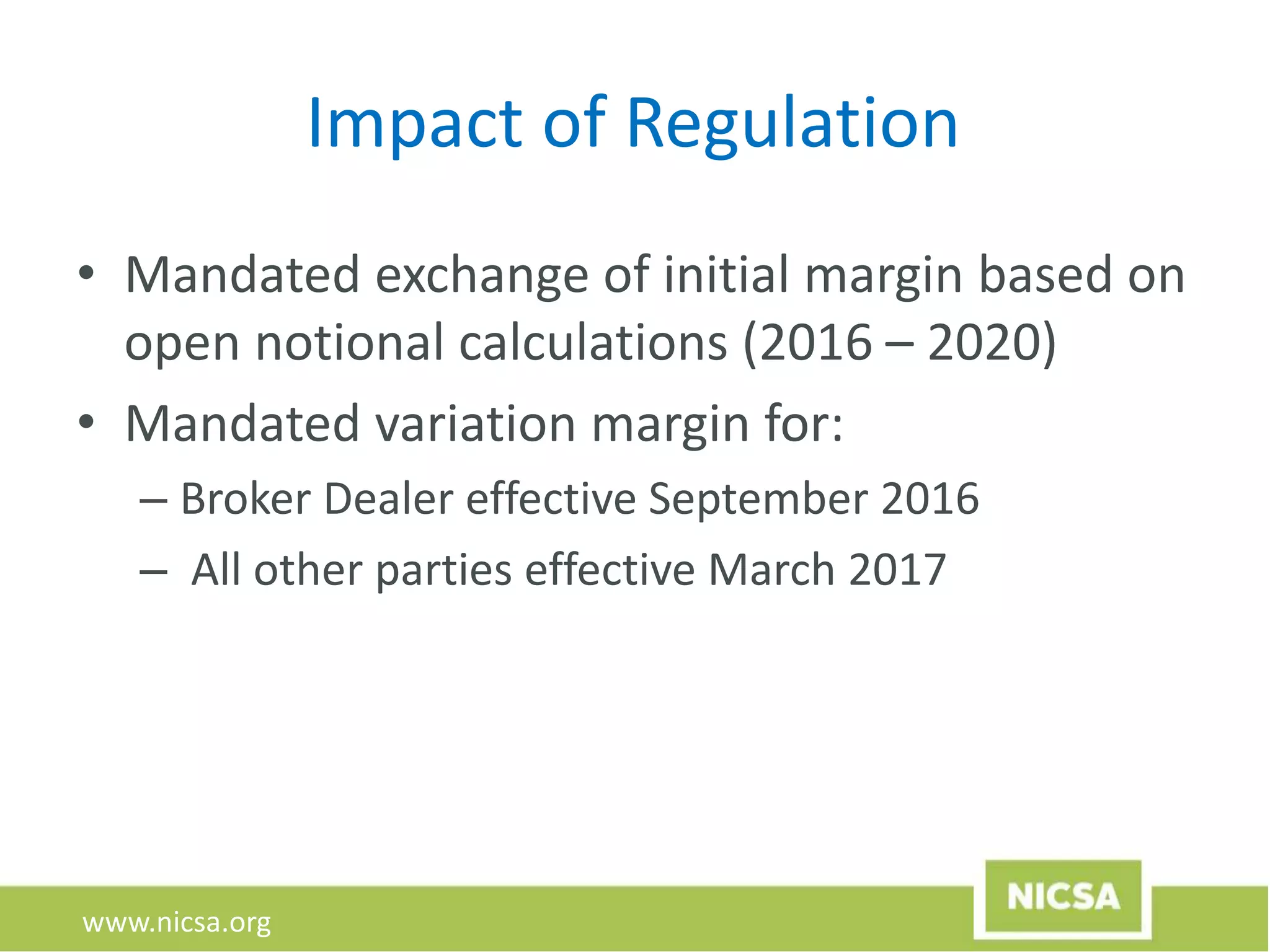
Impact of Regulation
• Mandated exchange of initial margin based on
open notional calculations (2016 – 2020)
• Mandated variation margin for:
– Broker Dealer effective September 2016
– All other parties effective March 2017
www.nicsa.org
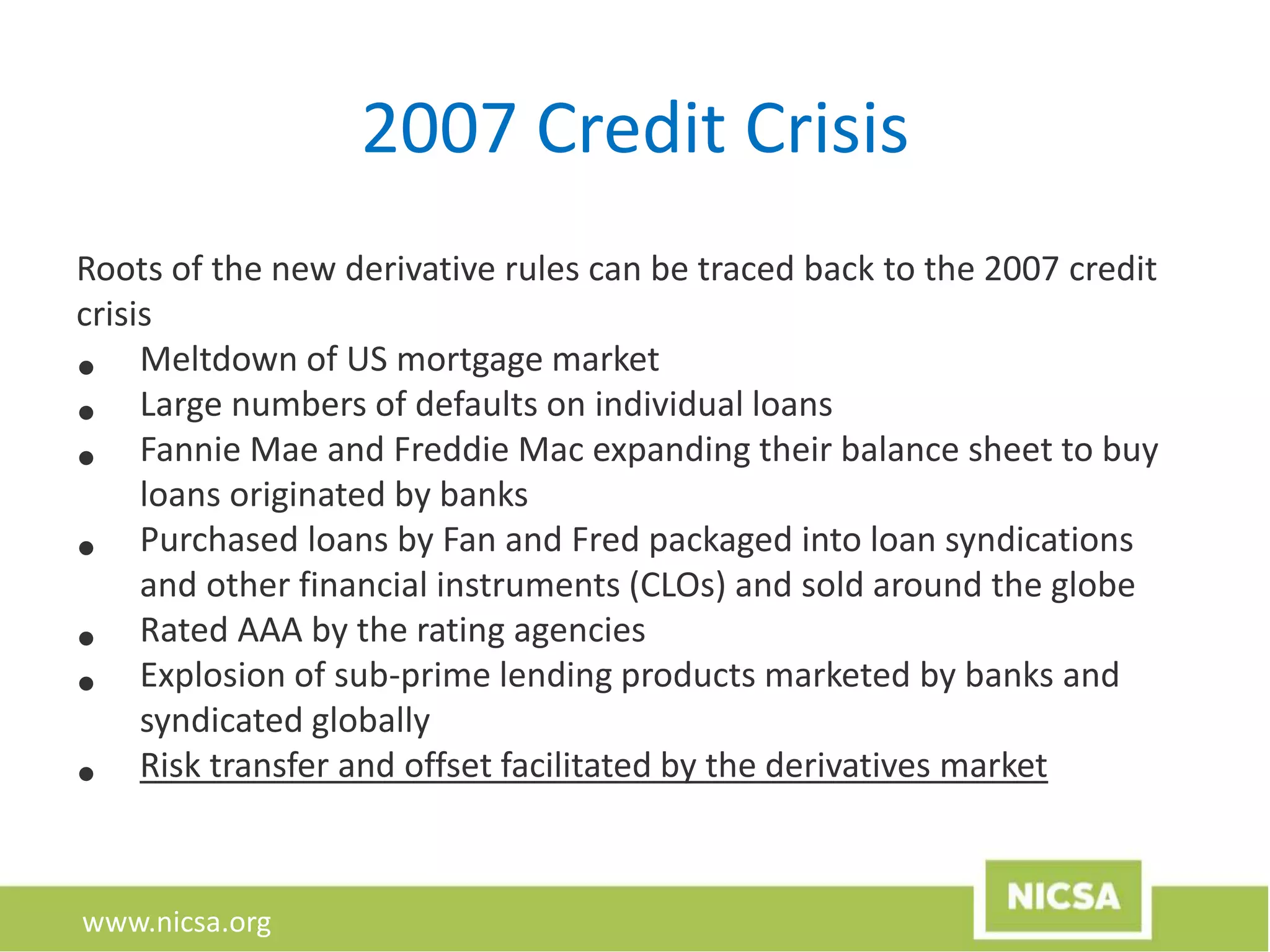
2007 Credit Crisis
Roots of the new derivative rules can be traced back to the 2007 credit
crisis
• Meltdown of US mortgage market
• Large numbers of defaults on individual loans
• Fannie Mae and Freddie Mac expanding their balance sheet to buy
loans originated by banks
• Purchased loans by Fan and Fred packaged into loan syndications
and other financial instruments (CLOs) and sold around the globe
• Rated AAA by the rating agencies
• Explosion of sub-prime lending products marketed by banks and
syndicated globally
• Risk transfer and offset facilitated by the derivatives market
www.nicsa.org
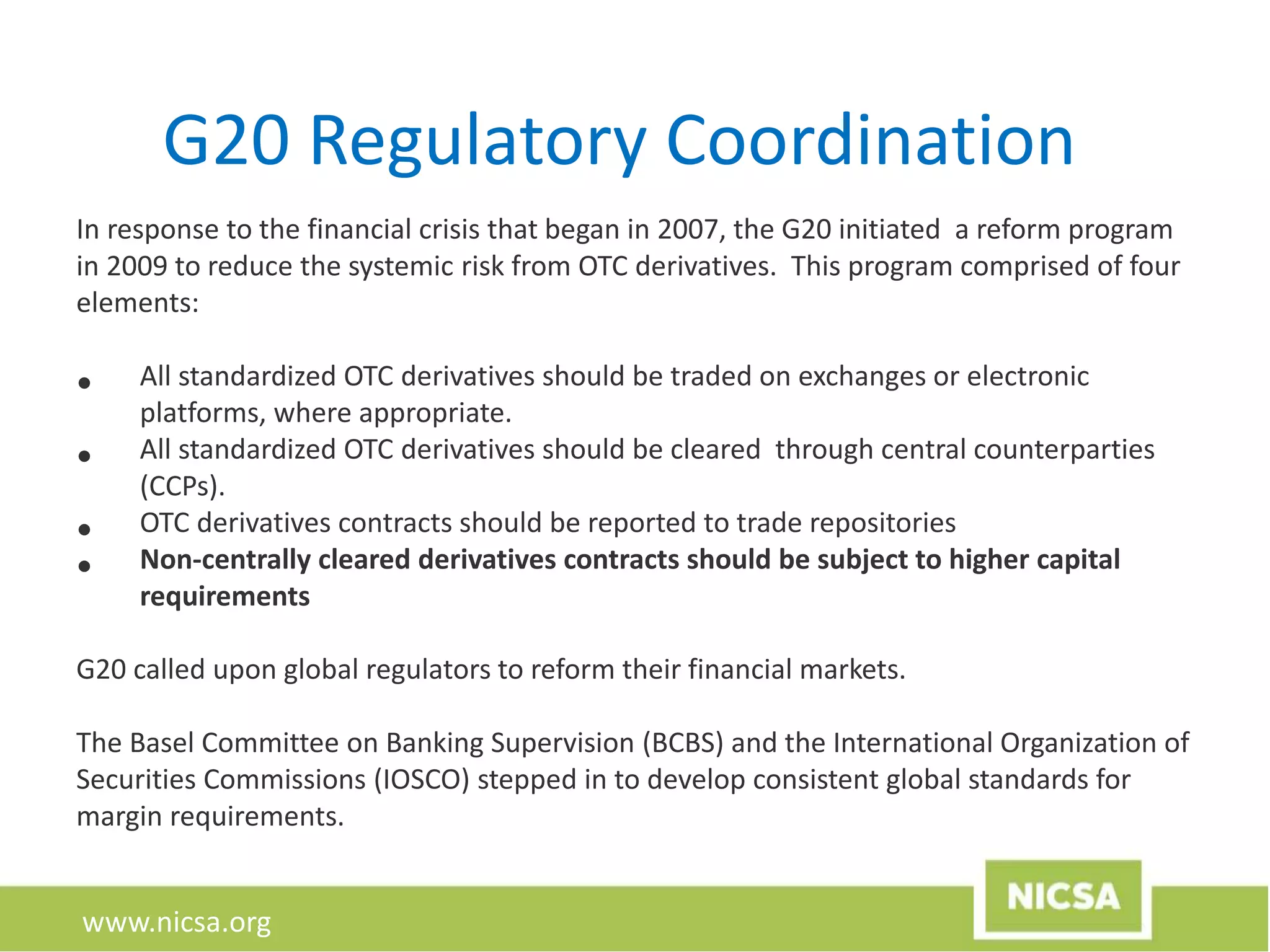
G20 Regulatory Coordination
In response to the financial crisis that began in 2007, the G20 initiated a reform program
in 2009 to reduce the systemic risk from OTC derivatives. This program comprised of four
elements:
• All standardized OTC derivatives should be traded on exchanges or electronic
platforms, where appropriate.
• All standardized OTC derivatives should be cleared through central counterparties
(CCPs).
• OTC derivatives contracts should be reported to trade repositories
• Non-centrally cleared derivatives contracts should be subject to higher capital
requirements
G20 called upon global regulators to reform their financial markets.
The Basel Committee on Banking Supervision (BCBS) and the International Organization of
Securities Commissions (IOSCO) stepped in to develop consistent global standards for
margin requirements.
www.nicsa.org
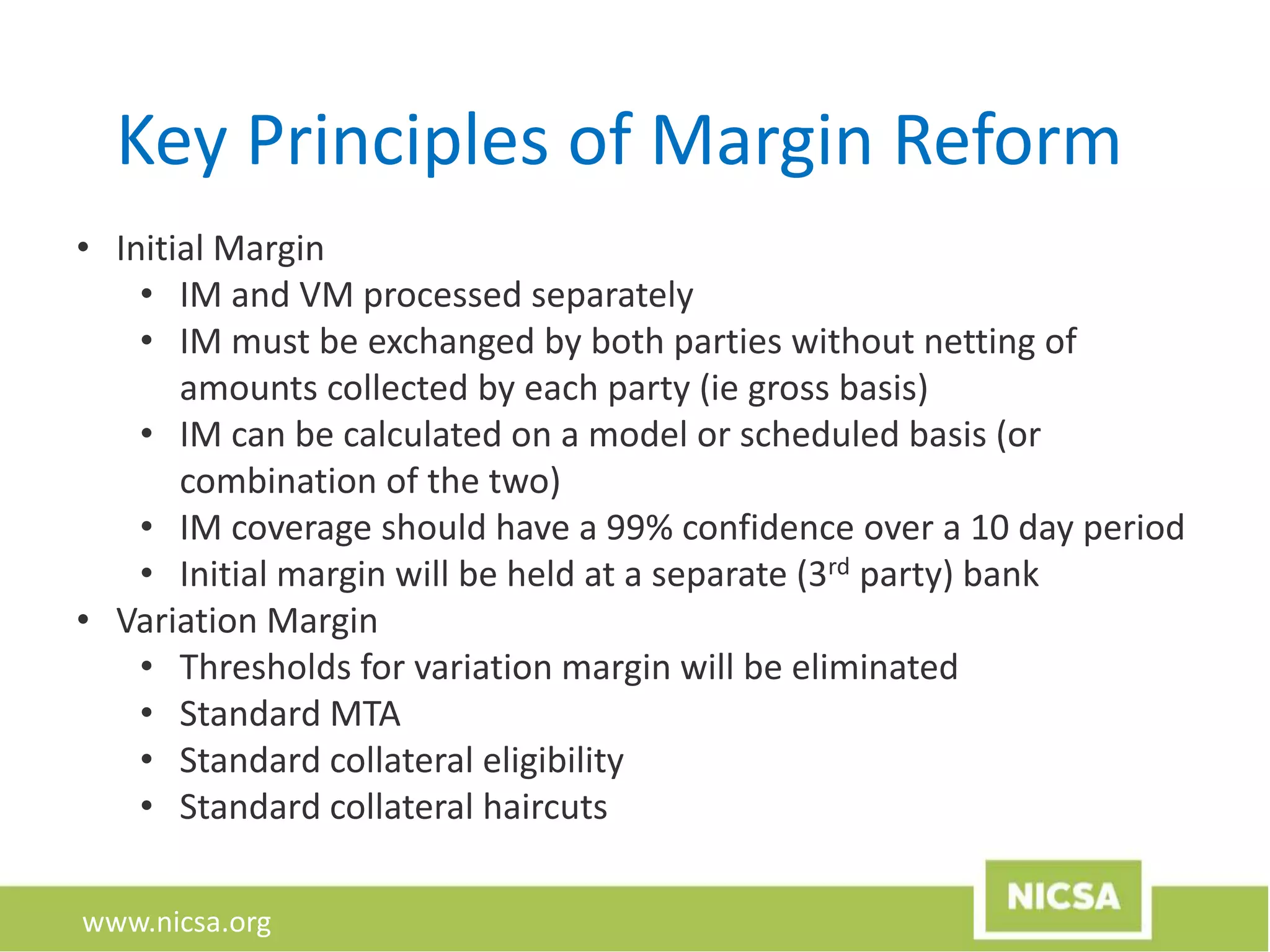
Key Principles of Margin Reform
• Initial Margin
• IM and VM processed separately
• IM must be exchanged by both parties without netting of
amounts collected by each party (ie gross basis)
• IM can be calculated on a model or scheduled basis (or
combination of the two)
• IM coverage should have a 99% confidence over a 10 day period
• Initial margin will be held at a separate (3rd party) bank
• Variation Margin
• Thresholds for variation margin will be eliminated
• Standard MTA
• Standard collateral eligibility
• Standard collateral haircuts
www.nicsa.org
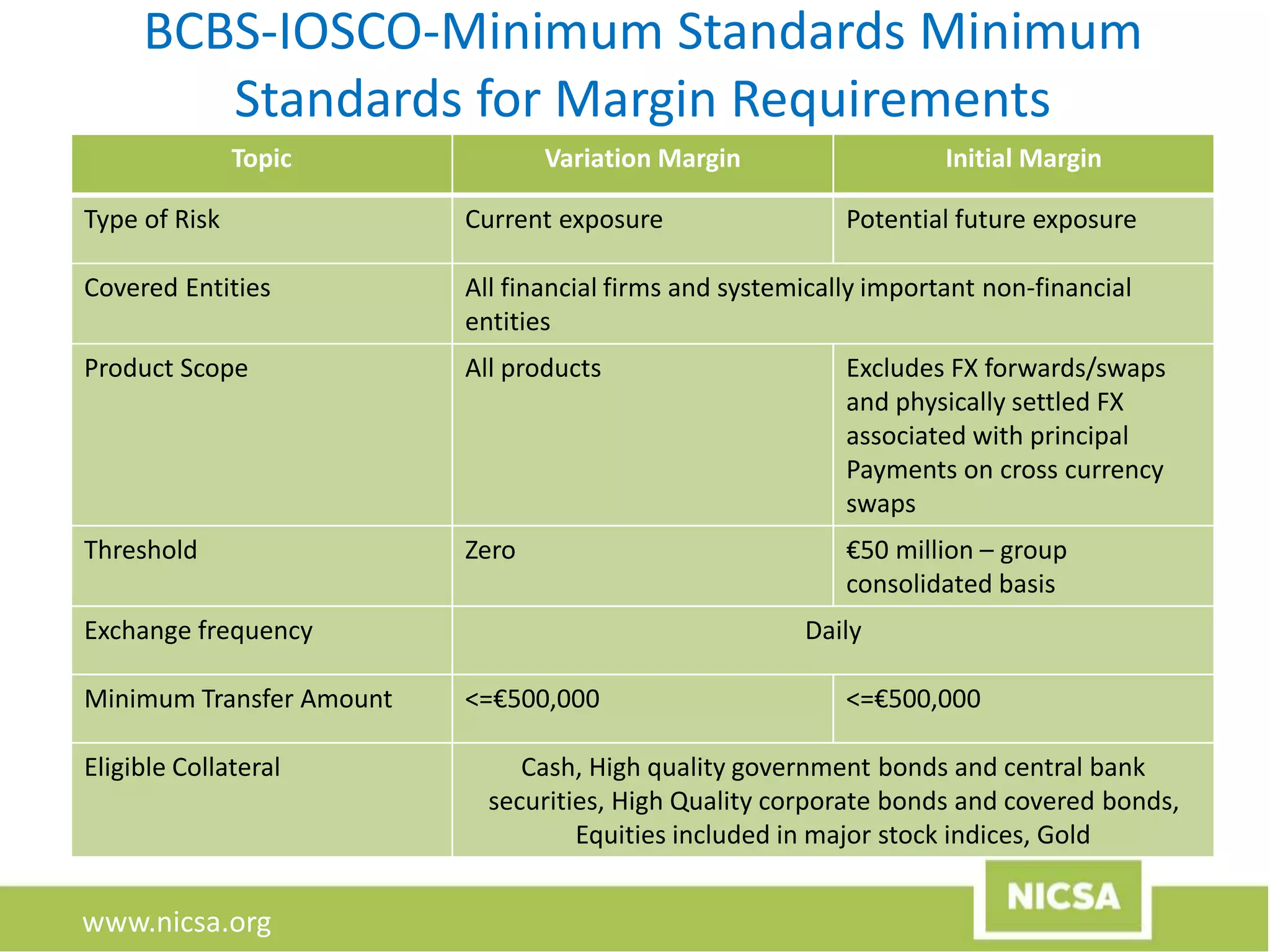
BCBS-IOSCO-Minimum Standards Minimum
Standards for Margin Requirements
Topic Variation Margin Initial Margin
Type of Risk Current exposure Potential future exposure
Covered Entities All financial firms and systemically important non-financial
entities
Product Scope All products Excludes FX forwards/swaps
and physically settled FX
associated with principal
Payments on cross currency
swaps
Threshold Zero €50 million – group
consolidated basis
Exchange frequency Daily
Minimum Transfer Amount <=€500,000 <=€500,000
Eligible Collateral Cash, High quality government bonds and central bank
securities, High Quality corporate bonds and covered bonds,
Equities included in major stock indices, Gold
www.nicsa.org
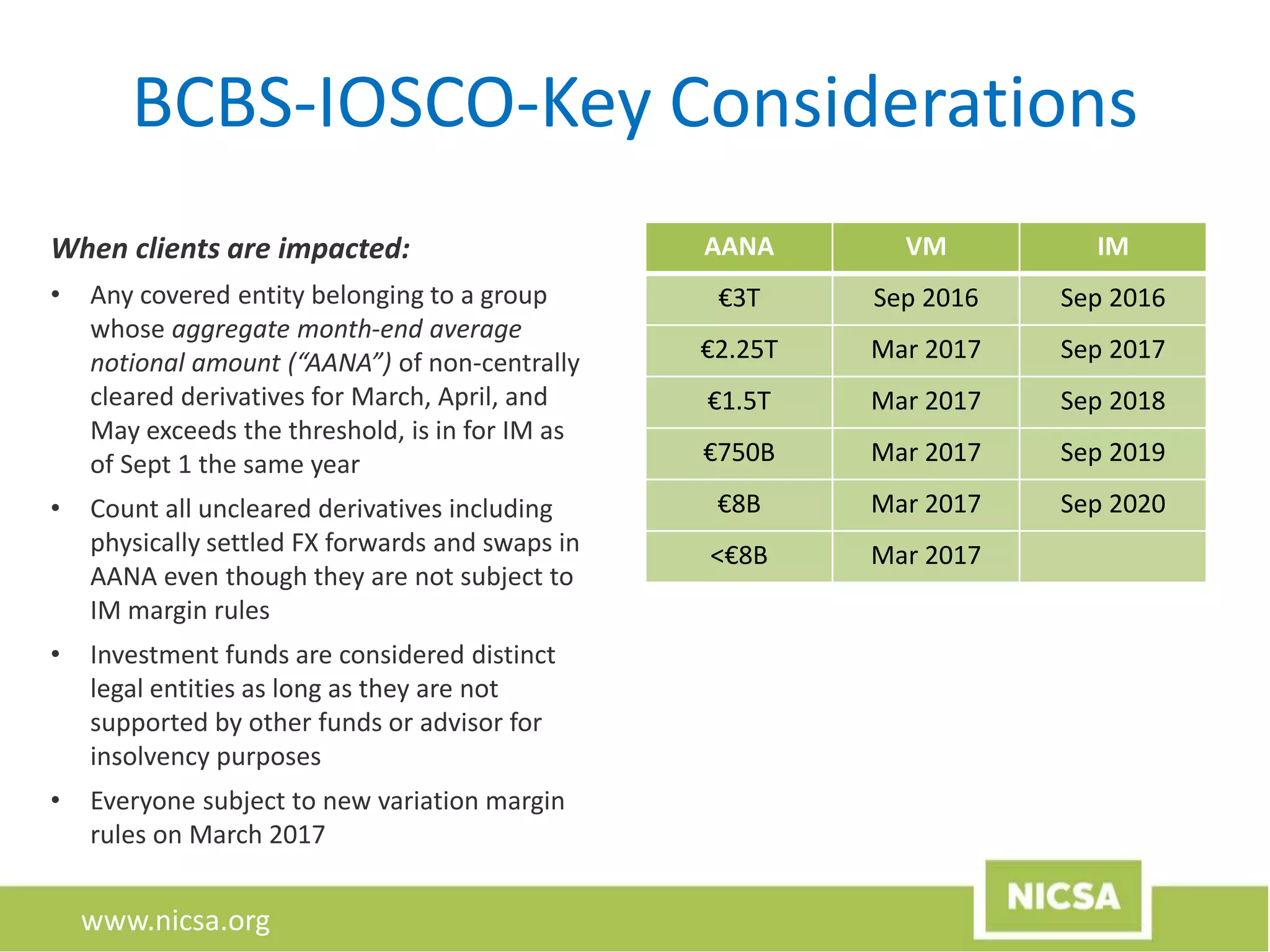
BCBS-IOSCO-Key Considerations
When clients are impacted:
• Any covered entity belonging to a group
whose aggregate month-end average
notional amount (“AANA”) of non-centrally
cleared derivatives for March, April, and
May exceeds the threshold, is in for IM as
of Sept 1 the same year
• Count all uncleared derivatives including
physically settled FX forwards and swaps in
AANA even though they are not subject to
IM margin rules
• Investment funds are considered distinct
legal entities as long as they are not
supported by other funds or advisor for
insolvency purposes
• Everyone subject to new variation margin
rules on March 2017
AANA VM IM
€3T Sep 2016 Sep 2016
€2.25T Mar 2017 Sep 2017
€1.5T Mar 2017 Sep 2018
€750B Mar 2017 Sep 2019
€8B Mar 2017 Sep 2020
<€8B Mar 2017
www.nicsa.org
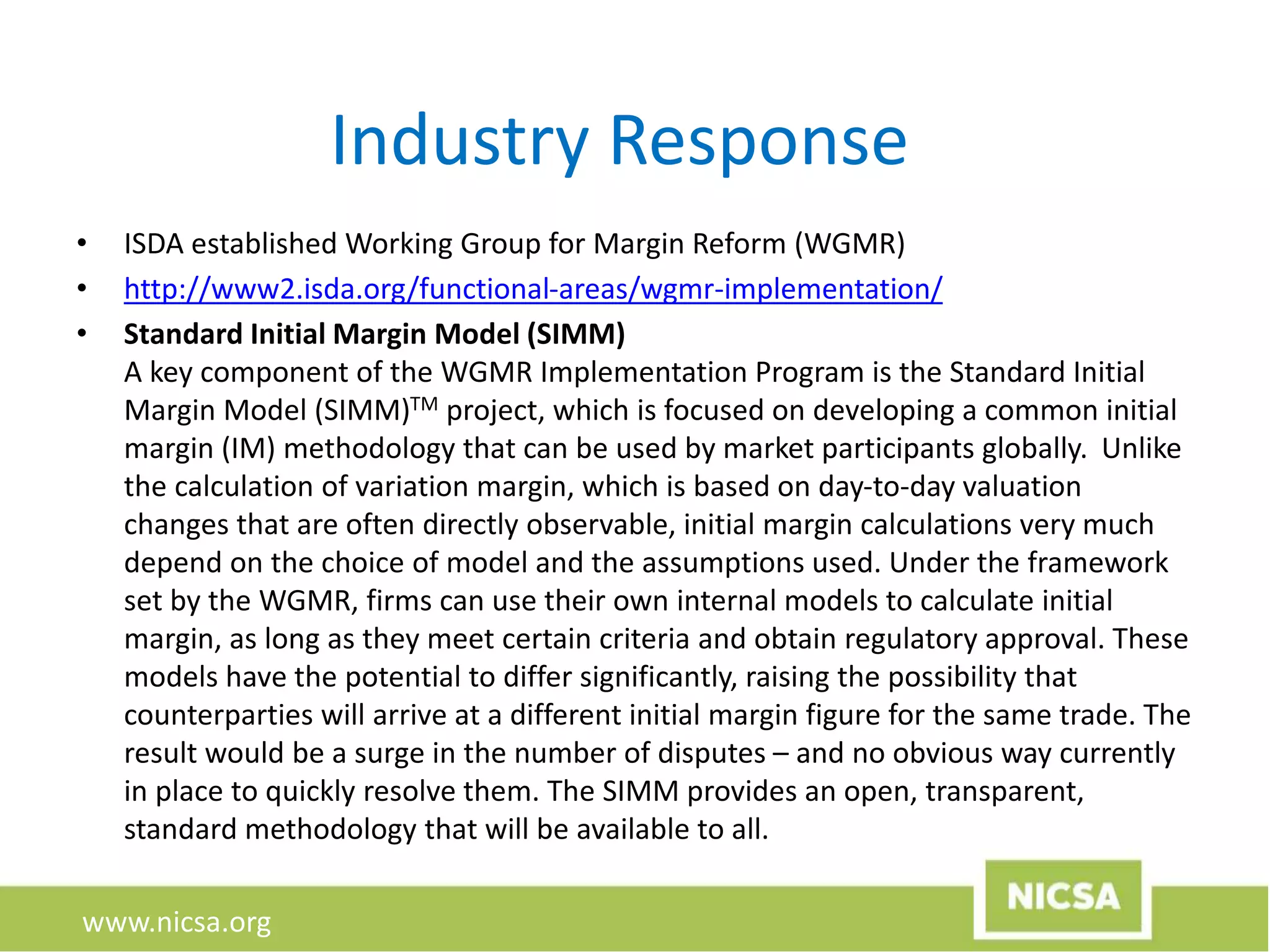
Industry Response
• ISDA established Working Group for Margin Reform (WGMR)
• http://www2.isda.org/functional-areas/wgmr-implementation/
• Standard Initial Margin Model (SIMM)
A key component of the WGMR Implementation Program is the Standard Initial
Margin Model (SIMM)TM project, which is focused on developing a common initial
margin (IM) methodology that can be used by market participants globally. Unlike
the calculation of variation margin, which is based on day-to-day valuation
changes that are often directly observable, initial margin calculations very much
depend on the choice of model and the assumptions used. Under the framework
set by the WGMR, firms can use their own internal models to calculate initial
margin, as long as they meet certain criteria and obtain regulatory approval. These
models have the potential to differ significantly, raising the possibility that
counterparties will arrive at a different initial margin figure for the same trade. The
result would be a surge in the number of disputes – and no obvious way currently
in place to quickly resolve them. The SIMM provides an open, transparent,
standard methodology that will be available to all.
www.nicsa.org
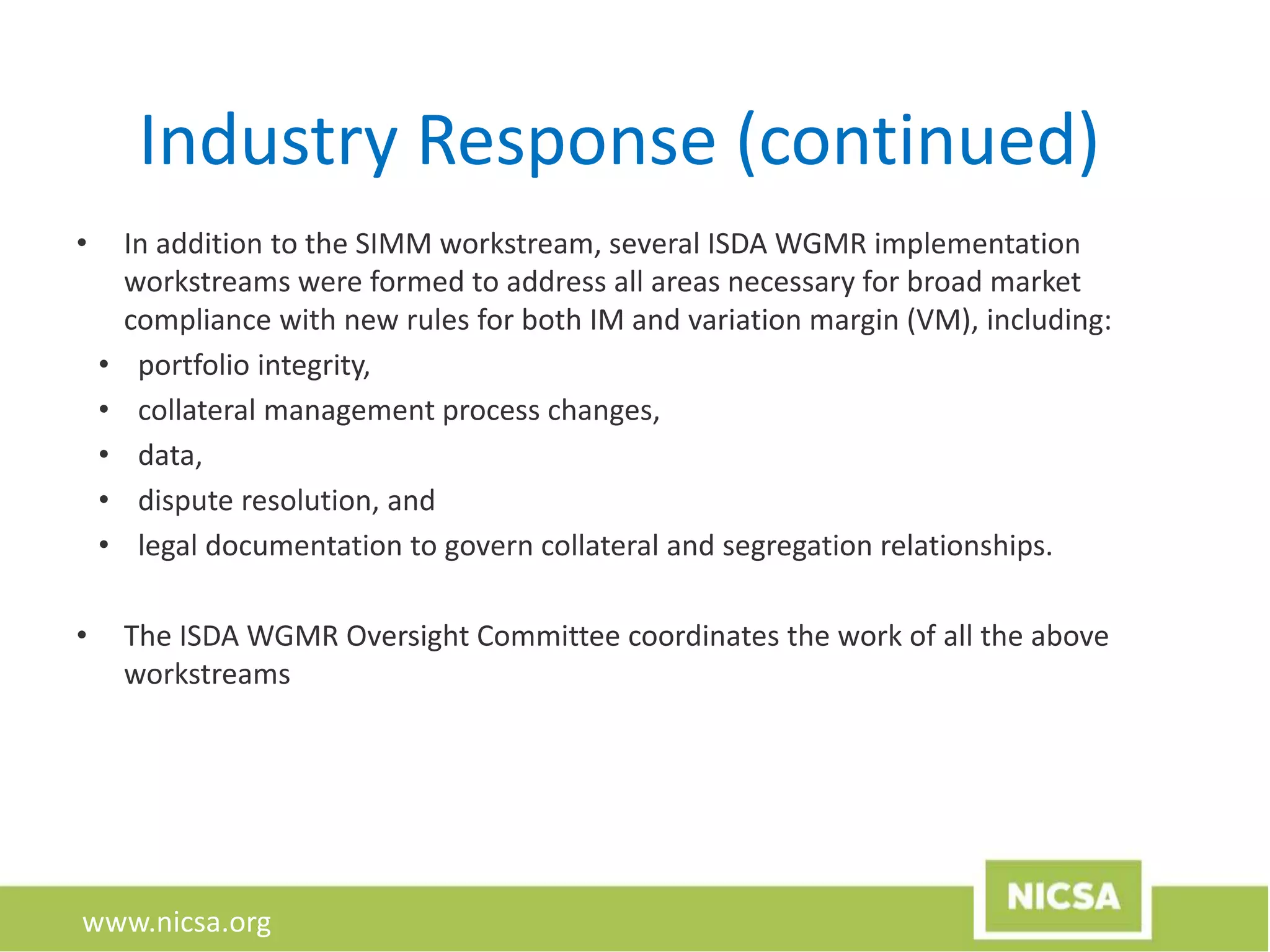
Industry Response (continued)
• In addition to the SIMM workstream, several ISDA WGMR implementation
workstreams were formed to address all areas necessary for broad market
compliance with new rules for both IM and variation margin (VM), including:
• portfolio integrity,
• collateral management process changes,
• data,
• dispute resolution, and
• legal documentation to govern collateral and segregation relationships.
• The ISDA WGMR Oversight Committee coordinates the work of all the above
workstreams
www.nicsa.org
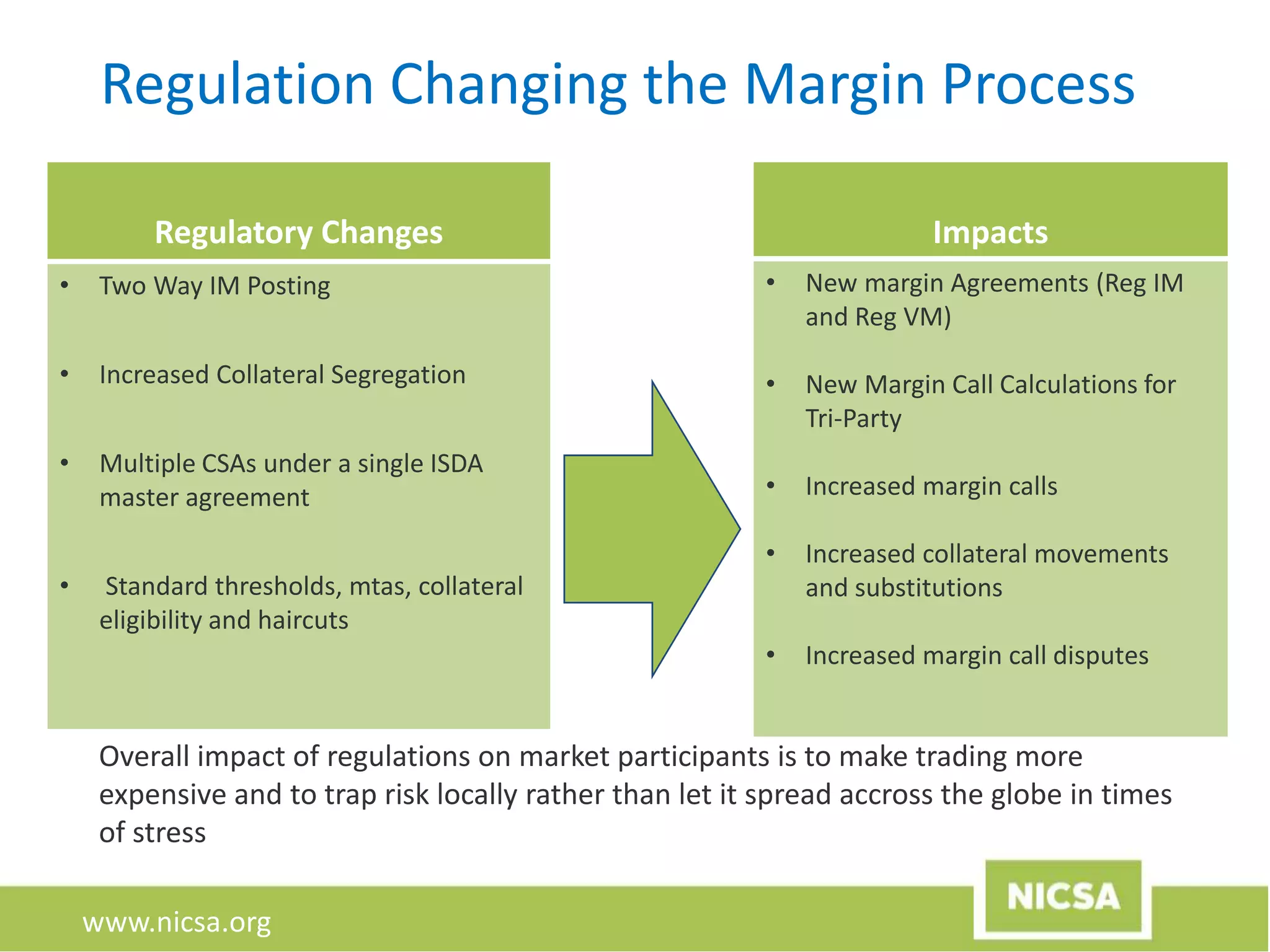
Regulation Changing the Margin Process
Regulatory Changes
• Two Way IM Posting
• Increased Collateral Segregation
• Multiple CSAs under a single ISDA
master agreement
• Standard thresholds, mtas, collateral
eligibility and haircuts
Impacts
• New margin Agreements (Reg IM
and Reg VM)
• New Margin Call Calculations for
Tri-Party
• Increased margin calls
• Increased collateral movements
and substitutions
• Increased margin call disputes
Overall impact of regulations on market participants is to make trading more
expensive and to trap risk locally rather than let it spread accross the globe in times
of stress
www.nicsa.org
CPE CODE:
903
www.nicsa.org
Mark Demo
Product Director
AcadiaSoft, Inc.
Phone: 646-780-0067
Mark.Demo@AcadiaSoft.com
Wayne Forsythe
Managing Director, Collateral Management Services State
Street Global Services
Phone: 949-932-4668
JWForsythe@statestreet.com
Questions?
www.nicsa.org
CPE CODE:
133
PLEASE SUBMIT YOUR CODES AT THE CONCLUSION OF THE WEBINAR.
YOU WILL EARN 1-CPE CREDIT IN THE REGULATORY ETHICS FIELD OF STUDY.
QUESTIONS? EMAIL INFO@NICSA.ORG

NICSA Webinar | Collateral Management Market Practices and New Legislation Impacts

  • 1.
    www.nicsa.org Collateral Management Market Practicesand New Legislation Impacts March 30, 2016 SPONSORED BY:
  • 2.
    www.nicsa.org MODERATOR: Gary Crawford Assistant VicePresident, MFSC Legacy Systems MFS Investment Management PANELISTS: Mark Demo Product Director AcadiaSoft, Inc. Wayne Forsythe Managing Director, Collateral Management Services State Street Global Services
  • 3.
    www.nicsa.org What is collateralmanagement? • Definitions and parameters can have some variance from firm to firm • General definition is: – Measurement of open exposure – Coordination of counterparty margin calls – Settlement and tracking of agreed eligible collateral • Many products require collateral: Derivatives, Agency MBS, Repo, Credit lines, Short Equity
  • 4.
    www.nicsa.org Overview • Collateral Managementhas evolved over time • Prior to Financial Crisis in 2008, process was heavily operational and back-office focused – Largely manual – Little to no STP • Counterparty defaults in 2008 were a game changing event for the industry • Impacts front, middle and back office
  • 5.
    www.nicsa.org Data overview • StaticData requirements – Account / Counterparty definition – Legal terms (CSA/MSFTA/GMRA etc): Minimum Transfer, Threshold, Rounding, Eligible Collateral, Concentration limits – Standing Settlement Instructions (SSI’s) • Dynamic data – Trade MTM / Initial Margin (independent amount) – Settled collateral valuations
  • 6.
    www.nicsa.org Margin Calls • Margincall management – Distribution email or electronic (AcadiaSoft) – Includes relevant details for call, including call amount, MTM and collateral balance – Times specified in governing agreements • Parties agree to amounts and allocation • Disputed calls are identified
  • 7.
    www.nicsa.org Correlated Processes • Settlement:Custodians notified via SWIFT messaging – MT540/542/202/210 • Reconciliation – Collateral Balances – Underlying Portfolios (unilateral or bi-lateral) • Substitutions
  • 8.
    www.nicsa.org Changing Landscape • Criticalcomponent of Enterprise Risk Program • Market utilities are evolving – DTCC Margin Transit – AcadiaSoft – TriOptima • Regulations are redefining the landscape – Un-cleared margin requirements – Agency MBS
  • 9.
  • 10.
    www.nicsa.org Impact of Regulation •Mandated exchange of initial margin based on open notional calculations (2016 – 2020) • Mandated variation margin for: – Broker Dealer effective September 2016 – All other parties effective March 2017
  • 11.
    www.nicsa.org 2007 Credit Crisis Rootsof the new derivative rules can be traced back to the 2007 credit crisis • Meltdown of US mortgage market • Large numbers of defaults on individual loans • Fannie Mae and Freddie Mac expanding their balance sheet to buy loans originated by banks • Purchased loans by Fan and Fred packaged into loan syndications and other financial instruments (CLOs) and sold around the globe • Rated AAA by the rating agencies • Explosion of sub-prime lending products marketed by banks and syndicated globally • Risk transfer and offset facilitated by the derivatives market
  • 12.
    www.nicsa.org G20 Regulatory Coordination Inresponse to the financial crisis that began in 2007, the G20 initiated a reform program in 2009 to reduce the systemic risk from OTC derivatives. This program comprised of four elements: • All standardized OTC derivatives should be traded on exchanges or electronic platforms, where appropriate. • All standardized OTC derivatives should be cleared through central counterparties (CCPs). • OTC derivatives contracts should be reported to trade repositories • Non-centrally cleared derivatives contracts should be subject to higher capital requirements G20 called upon global regulators to reform their financial markets. The Basel Committee on Banking Supervision (BCBS) and the International Organization of Securities Commissions (IOSCO) stepped in to develop consistent global standards for margin requirements.
  • 13.
    www.nicsa.org Key Principles ofMargin Reform • Initial Margin • IM and VM processed separately • IM must be exchanged by both parties without netting of amounts collected by each party (ie gross basis) • IM can be calculated on a model or scheduled basis (or combination of the two) • IM coverage should have a 99% confidence over a 10 day period • Initial margin will be held at a separate (3rd party) bank • Variation Margin • Thresholds for variation margin will be eliminated • Standard MTA • Standard collateral eligibility • Standard collateral haircuts
  • 14.
    www.nicsa.org BCBS-IOSCO-Minimum Standards Minimum Standardsfor Margin Requirements Topic Variation Margin Initial Margin Type of Risk Current exposure Potential future exposure Covered Entities All financial firms and systemically important non-financial entities Product Scope All products Excludes FX forwards/swaps and physically settled FX associated with principal Payments on cross currency swaps Threshold Zero €50 million – group consolidated basis Exchange frequency Daily Minimum Transfer Amount <=€500,000 <=€500,000 Eligible Collateral Cash, High quality government bonds and central bank securities, High Quality corporate bonds and covered bonds, Equities included in major stock indices, Gold
  • 15.
    www.nicsa.org BCBS-IOSCO-Key Considerations When clientsare impacted: • Any covered entity belonging to a group whose aggregate month-end average notional amount (“AANA”) of non-centrally cleared derivatives for March, April, and May exceeds the threshold, is in for IM as of Sept 1 the same year • Count all uncleared derivatives including physically settled FX forwards and swaps in AANA even though they are not subject to IM margin rules • Investment funds are considered distinct legal entities as long as they are not supported by other funds or advisor for insolvency purposes • Everyone subject to new variation margin rules on March 2017 AANA VM IM €3T Sep 2016 Sep 2016 €2.25T Mar 2017 Sep 2017 €1.5T Mar 2017 Sep 2018 €750B Mar 2017 Sep 2019 €8B Mar 2017 Sep 2020 <€8B Mar 2017
  • 16.
    www.nicsa.org Industry Response • ISDAestablished Working Group for Margin Reform (WGMR) • http://www2.isda.org/functional-areas/wgmr-implementation/ • Standard Initial Margin Model (SIMM) A key component of the WGMR Implementation Program is the Standard Initial Margin Model (SIMM)TM project, which is focused on developing a common initial margin (IM) methodology that can be used by market participants globally. Unlike the calculation of variation margin, which is based on day-to-day valuation changes that are often directly observable, initial margin calculations very much depend on the choice of model and the assumptions used. Under the framework set by the WGMR, firms can use their own internal models to calculate initial margin, as long as they meet certain criteria and obtain regulatory approval. These models have the potential to differ significantly, raising the possibility that counterparties will arrive at a different initial margin figure for the same trade. The result would be a surge in the number of disputes – and no obvious way currently in place to quickly resolve them. The SIMM provides an open, transparent, standard methodology that will be available to all.
  • 17.
    www.nicsa.org Industry Response (continued) •In addition to the SIMM workstream, several ISDA WGMR implementation workstreams were formed to address all areas necessary for broad market compliance with new rules for both IM and variation margin (VM), including: • portfolio integrity, • collateral management process changes, • data, • dispute resolution, and • legal documentation to govern collateral and segregation relationships. • The ISDA WGMR Oversight Committee coordinates the work of all the above workstreams
  • 18.
    www.nicsa.org Regulation Changing theMargin Process Regulatory Changes • Two Way IM Posting • Increased Collateral Segregation • Multiple CSAs under a single ISDA master agreement • Standard thresholds, mtas, collateral eligibility and haircuts Impacts • New margin Agreements (Reg IM and Reg VM) • New Margin Call Calculations for Tri-Party • Increased margin calls • Increased collateral movements and substitutions • Increased margin call disputes Overall impact of regulations on market participants is to make trading more expensive and to trap risk locally rather than let it spread accross the globe in times of stress
  • 19.
  • 20.
    www.nicsa.org Mark Demo Product Director AcadiaSoft,Inc. Phone: 646-780-0067 Mark.Demo@AcadiaSoft.com Wayne Forsythe Managing Director, Collateral Management Services State Street Global Services Phone: 949-932-4668 JWForsythe@statestreet.com Questions?
  • 21.
    www.nicsa.org CPE CODE: 133 PLEASE SUBMITYOUR CODES AT THE CONCLUSION OF THE WEBINAR. YOU WILL EARN 1-CPE CREDIT IN THE REGULATORY ETHICS FIELD OF STUDY. QUESTIONS? EMAIL INFO@NICSA.ORG