A R Usmani
Skardu Gilgit-Baltistan
abdurrehmanusmani65@gmail.com
1Financial Accounting for BSCS…… Prepared by Abdur-Rehman
Accounting
Definition.
 Accounting is derived from the word account which means recording.
 Accounting is a language of business through which two business persons are
communicate with each other.
 Accounting is a system of recording information about business then that information is
presented to various people to keep them a future decision making.
 Accounting is recording, classifying and analysis of business information.
 Accounting is the backbone of any business.
Definition of Accounting by different peoples.
 Various persons defined accounting as language.
 Economist defined the accounting is information related to income
 Manager of any organization defined accounting is a recording technique and these
information is helpful for future decision making.
 Middle manager defined accounting is.
 Labors defined accounting through which we earn income.
 Government defined accounting is helpful for tax generation.
AIS
Accounting Information System
 The systematic recording reporting and analysis of financial transaction of business as
known as Accounting.
Financial Transaction.
 The information related to money as known as financial information.
2Financial Accounting for BSCS…… Prepared by Abdur-Rehman
 The person who is in charge of accounting called accountant.
Need of Accounting.
 Transaction take place regularly in the business. It is impossible for any person to keep
all the transaction in memory so systematic record is compulsory for every business
organization.
 Accounting is beneficial for tax calculation.
 Accounting is information about profit and loss.
 It helps annoying the result of a business in term of profit and loss.
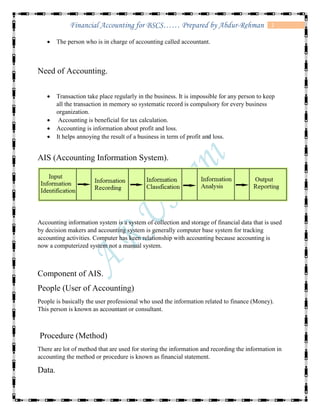
AIS (Accounting Information System).
Accounting information system is a system of collection and storage of financial data that is used
by decision makers and accounting system is generally computer base system for tracking
accounting activities. Computer has keen relationship with accounting because accounting is
now a computerized system not a manual system.
Component of AIS.
People (User of Accounting)
People is basically the user professional who used the information related to finance (Money).
This person is known as accountant or consultant.
Procedure (Method)
There are lot of method that are used for storing the information and recording the information in
accounting the method or procedure is known as financial statement.
Data.
3Financial Accounting for BSCS…… Prepared by Abdur-Rehman
Data contains in AIS means the financial information on which accountant actually works.
e.g.
 Costumer billing.
 Tax information.
Software
Software in AIS is a computer program used to share, collect and store the data for future
processing. It also helps out the companies to organize their financial information.
Information Technology Infrastructure.
(Big Name of Hardware)
This name the hardware used to operate the AIS.
e.g.
 Personal computer.
 Server.
 Printer.
 Scanner etc.
Information.
In accounting there are two type of information.
 Financial Information.
 Non-Financial Information.
Financial Information.
The information that can be measured in money is known as financial information.
e.g.
A truck loaded with the vegetable of Rs. 5000 rupees. Here Rs. 5000 is financial
information.
4Financial Accounting for BSCS…… Prepared by Abdur-Rehman
Non-Financial Information.
The information that cannot be measured in money called Non-Financial information.
e.g.
Accident of workers during working hours.
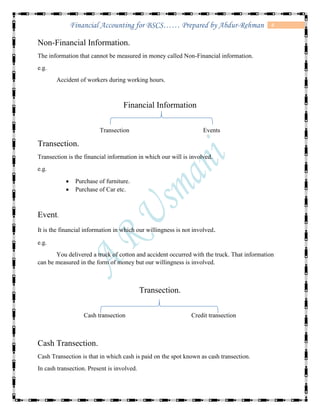
Financial Information
Transection Events
Transection.
Transection is the financial information in which our will is involved.
e.g.
 Purchase of furniture.
 Purchase of Car etc.
Event.
It is the financial information in which our willingness is not involved.
e.g.
You delivered a truck of cotton and accident occurred with the truck. That information
can be measured in the form of money but our willingness is involved.
Transection.
Cash transection Credit transection
Cash Transection.
Cash Transection is that in which cash is paid on the spot known as cash transection.
In cash transection. Present is involved.
5Financial Accounting for BSCS…… Prepared by Abdur-Rehman
e.g.
If you buy something and paid the whole price of it and there are no remaining dealing. It
is cash transection.
Credit Transection.
Settlement of cash in future is known as credit transection.
In credit transection. Future is involved.
e.g.
I will pay the cash of amount Rs 1000 rupees after a weak. Then this sort of information
is known as credit transection.
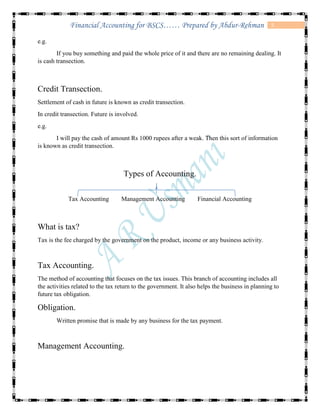
Types of Accounting.
Tax Accounting Management Accounting Financial Accounting
What is tax?
Tax is the fee charged by the government on the product, income or any business activity.
Tax Accounting.
The method of accounting that focuses on the tax issues. This branch of accounting includes all
the activities related to the tax return to the government. It also helps the business in planning to
future tax obligation.
Obligation.
Written promise that is made by any business for the tax payment.
Management Accounting.
6Financial Accounting for BSCS…… Prepared by Abdur-Rehman
Management accounting provides information related to the internal environment specifically
about employees. This branch of accounting has complete information about employees working
in any organization.
Financial Accounting.
Financial accounting is very important branch or type of accounting which provides information
about the financial condition of any organization. It contains all the information related to
finance (money).
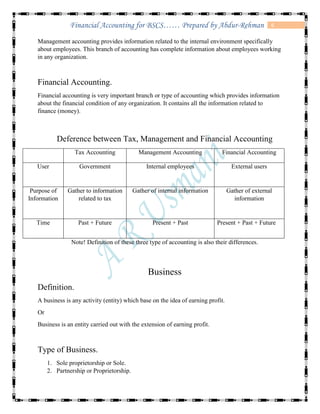
Deference between Tax, Management and Financial Accounting
Tax Accounting Management Accounting Financial Accounting
User Government Internal employees External users
Purpose of
Information
Gather to information
related to tax
Gather of internal information Gather of external
information
Time Past + Future Present + Past Present + Past + Future
Note! Definition of these three type of accounting is also their differences.
Business
Definition.
A business is any activity (entity) which base on the idea of earning profit.
Or
Business is an entity carried out with the extension of earning profit.
Type of Business.
1. Sole proprietorship or Sole.
2. Partnership or Proprietorship.
7Financial Accounting for BSCS…… Prepared by Abdur-Rehman
3. Company or Corporation.
 Sole= Single owner.
 Partnership= 2 to 20 owner.
 Company= 20 to 50 owner.
Sole Proprietorship or Sole.
A business owned and operated by a single person is known as sole proprietorship or simply
sole.
Advantages of Sole.
 Owner make all the decision.
 Owner received all the profit.
Disadvantages of Sole.
 Owner has the difficulty in the payment of liabilities, because there are no other
person to pay.
 If loss occur in business it is very difficult to cover the loss by single person.
 It is difficult to raise the capital for starting any business.
 Sole limits skills and creativity in the business.
Proprietorship or Partnership.
When a business has 2 to 20 owners then that business is known as Partnership or proprietorship.
Advantages of Partnership.
 It creates more skill and knowledge in the business information.
 Partnership is helpful in sharing of losses.
 Partnership is also helpful for raising capital.
Disadvantages of Partnership.
 Partnership may need to disagreement in decision. Some person are not willing their
share in loss.
 The value of tax is more as compare to sole proprietorship.
8Financial Accounting for BSCS…… Prepared by Abdur-Rehman
Types of Partnership.
1. General Partnership.
2. Limited partnership.
3. Joint venture.
4. Strategic alliance.
General Partnership.
A partnership in which all the partners has equal authority in decision and equal
distribution of profit and loss. All the partners have full responsibility for the
management of the organization.
Limited Partnership.
A partnership in which the partner have limited authority and responsibility to their investment.
This is known as limited partnership.
Joint Venture.
This is the type of partnership in which two business joins to complete a specific project. This
type of partnership ends after a specified time period.
Strategic Alliance.
A type of partnership in which two businesses works together without time specification or
simply working without ending.
Company or Corporation.
Company or corporation is the highest level of business. The range of owner is 20 to 50.
Advantages of Company.
 Very easy to raise capital.
9Financial Accounting for BSCS…… Prepared by Abdur-Rehman
 A lot of skills and creativity is there in corporation because of maximum people.
Disadvantages of Company.
 Corporation to pay double tax.
 Lack of loyal person.
Fundamental characteristics of Financial Accounting.
General Purpose.
 Financial accounting prepared financial statement and it is very helpful to show
the financial condition of any organization.
 Financial information are that is record by financial accounting is reliable because
it is the whole information system through which we record, classify and report
the financial information in a systematic way.
Reliable information.
Those information in which there is no error called reliable information.
Comparability.
Accounting information about any organization is very helpful in order to compare financial
condition of your organization to that organization.
Financial principles.
Those principles that is used to generate profit by any organization is known as financial
principles.
Main Accounting
Accounting cycle.
10Financial Accounting for BSCS…… Prepared by Abdur-Rehman
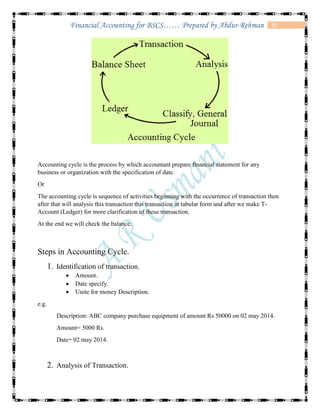
Accounting cycle is the process by which accountant prepare financial statement for any
business or organization with the specification of date.
Or
The accounting cycle is sequence of activities beginning with the occurrence of transaction then
after that will analysis this transaction this transaction in tabular form and after we make T-
Account (Ledger) for more clarification of these transaction.
At the end we will check the balance.
Steps in Accounting Cycle.
1. Identification of transaction.
 Amount.
 Date specify.
 Unite for money Description.
e.g.
Description: ABC company purchase equipment of amount Rs 50000 on 02 may 2014.
Amount= 5000 Rs.
Date= 02 may 2014.
2. Analysis of Transaction.
11Financial Accounting for BSCS…… Prepared by Abdur-Rehman
Determine which transaction is occur and how that transaction effects in your business
(Either positive or negative) and of how much amount.
3. Make General Journal.
Record occurrence of these transaction in chronological order.
Or
Record the transaction in sequence.
4. T-Account / Ledger.
To distribute those transaction that we have recorded in tabular form, into different T-
Accounts is known as T-Account or Ledger.
Ledger contains information of each and every account separately.
5. Balance Sheet.
At the end we will discuss balance sheet whose contains information of whole transaction in
a balance form.
Accounting Equation
Asset = Liabilities + owner equity (capital)
A=L+OE.
Asset.
Assets are economic resources of an organization that are having monetary importance.
Assets are thing used by any organization in its operation and activities.
e.g.
A departmental store owns truck. This truck provides benefit for delivery different items to
departmental store. So this truck is asset.
12Financial Accounting for BSCS…… Prepared by Abdur-Rehman
Main Types of Asset
Fixed Asset Current Asset
Fixed Asset. (More than one year)
These are the assets held by the business on a long term basis.
e.g.
Land, Furniture, Building, Machinery, Motor vehicles etc.
Current Asset (Within one year)
Those assets held on shorter basis.
e.g.
Cash, Account receivable etc.
There are some other types of asset.
Tangible Asset.
Those asset that can be touch or they have sort of existence.
e.g.
Cash, Land, Furniture etc.
Intangible Asset.
Those asset that cannot be touch. These assets has imaginary feelings.
e.g.
Brand Name, Slogans, logo etc.
13Financial Accounting for BSCS…… Prepared by Abdur-Rehman
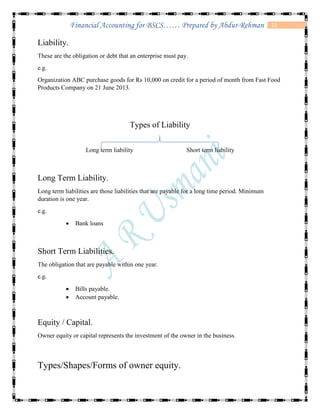
Liability.
These are the obligation or debt that an enterprise must pay.
e.g.
Organization ABC purchase goods for Rs 10,000 on credit for a period of month from Fast Food
Products Company on 21 June 2013.
Types of Liability
Long term liability Short term liability
Long Term Liability.
Long term liabilities are those liabilities that are payable for a long time period. Minimum
duration is one year.
e.g.
 Bank loans
Short Term Liabilities.
The obligation that are payable within one year.
e.g.
 Bills payable.
 Account payable.
Equity / Capital.
Owner equity or capital represents the investment of the owner in the business.
Types/Shapes/Forms of owner equity.
14Financial Accounting for BSCS…… Prepared by Abdur-Rehman
1. Withdrawal.
2. Revenue.
3. Expenses.
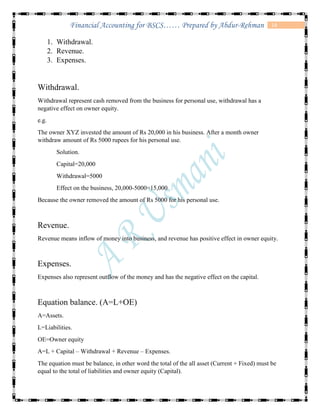
Withdrawal.
Withdrawal represent cash removed from the business for personal use, withdrawal has a
negative effect on owner equity.
e.g.
The owner XYZ invested the amount of Rs 20,000 in his business. After a month owner
withdraw amount of Rs 5000 rupees for his personal use.
Solution.
Capital=20,000
Withdrawal=5000
Effect on the business, 20,000-5000=15,000
Because the owner removed the amount of Rs 5000 for his personal use.
Revenue.
Revenue means inflow of money into business, and revenue has positive effect in owner equity.
Expenses.
Expenses also represent outflow of the money and has the negative effect on the capital.
Equation balance. (A=L+OE)
A=Assets.
L=Liabilities.
OE=Owner equity
A=L + Capital – Withdrawal + Revenue – Expenses.
The equation must be balance, in other word the total of the all asset (Current + Fixed) must be
equal to the total of liabilities and owner equity (Capital).
15Financial Accounting for BSCS…… Prepared by Abdur-Rehman
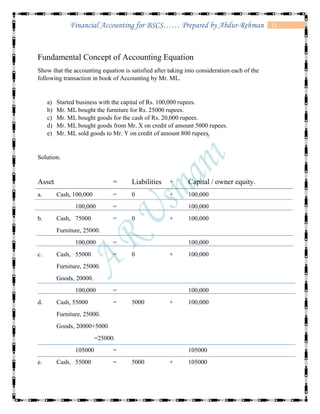
Fundamental Concept of Accounting Equation
Show that the accounting equation is satisfied after taking into consideration each of the
following transaction in book of Accounting by Mr. ML.
a) Started business with the capital of Rs. 100,000 rupees.
b) Mr. ML bought the furniture for Rs. 25000 rupees.
c) Mr. ML bought goods for the cash of Rs. 20,000 rupees.
d) Mr. ML bought goods from Mr. X on credit of amount 5000 rupees.
e) Mr. ML sold goods to Mr. Y on credit of amount 800 rupees.
Solution.
Asset = Liabilities + Capital / owner equity.
a. Cash, 100,000 = 0 + 100,000
100,000 = 100,000
b. Cash, 75000 = 0 + 100,000
Furniture, 25000.
100,000 = 100,000
c. Cash, 55000 = 0 + 100,000
Furniture, 25000.
Goods, 20000.
100,000 = 100,000
d. Cash, 55000 = 5000 + 100,000
Furniture, 25000.
Goods, 20000+5000
=25000.
105000 = 105000
e. Cash, 55000 = 5000 + 105000
16Financial Accounting for BSCS…… Prepared by Abdur-Rehman
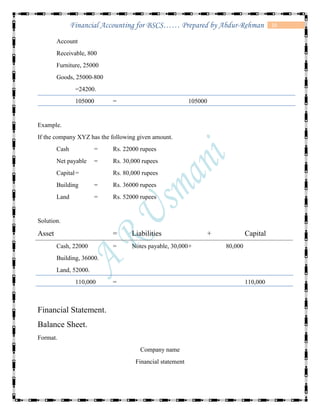
Account
Receivable, 800
Furniture, 25000
Goods, 25000-800
=24200.
105000 = 105000
Example.
If the company XYZ has the following given amount.
Cash = Rs. 22000 rupees
Net payable = Rs. 30,000 rupees
Capital= Rs. 80,000 rupees
Building = Rs. 36000 rupees
Land = Rs. 52000 rupees
Solution.
Asset = Liabilities + Capital
Cash, 22000 = Notes payable, 30,000+ 80,000
Building, 36000.
Land, 52000.
110,000 = 110,000
Financial Statement.
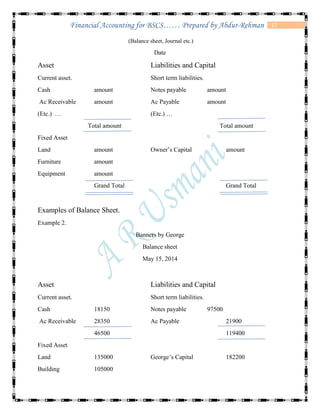
Balance Sheet.
Format.
Company name
Financial statement
17Financial Accounting for BSCS…… Prepared by Abdur-Rehman
(Balance sheet, Journal etc.)
Date
Asset Liabilities and Capital
Current asset. Short term liabilities.
Cash amount Notes payable amount
Ac Receivable amount Ac Payable amount
(Etc.) … (Etc.) …
Total amount Total amount
Fixed Asset
Land amount Owner’s Capital amount
Furniture amount
Equipment amount
Grand Total Grand Total
Examples of Balance Sheet.
Example 2.
Banners by George
Balance sheet
May 15, 2014
Asset Liabilities and Capital
Current asset. Short term liabilities.
Cash 18150 Notes payable 97500
Ac Receivable 28350 Ac Payable 21900
46500 119400
Fixed Asset
Land 135000 George’s Capital 182200
Building 105000
18Financial Accounting for BSCS…… Prepared by Abdur-Rehman
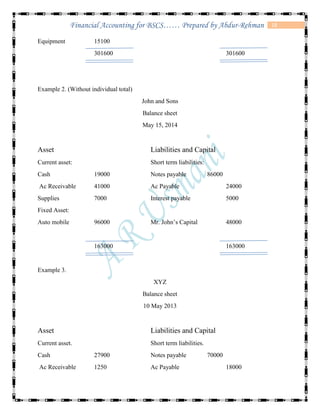
Equipment 15100
301600 301600
Example 2. (Without individual total)
John and Sons
Balance sheet
May 15, 2014
Asset Liabilities and Capital
Current asset: Short term liabilities:
Cash 19000 Notes payable 86000
Ac Receivable 41000 Ac Payable 24000
Supplies 7000 Interest payable 5000
Fixed Asset:
Auto mobile 96000 Mr. John’s Capital 48000
163000 163000
Example 3.
XYZ
Balance sheet
10 May 2013
Asset Liabilities and Capital
Current asset. Short term liabilities.
Cash 27900 Notes payable 70000
Ac Receivable 1250 Ac Payable 18000
19Financial Accounting for BSCS…… Prepared by Abdur-Rehman
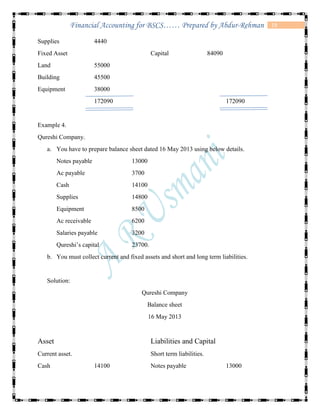
Supplies 4440
Fixed Asset Capital 84090
Land 55000
Building 45500
Equipment 38000
172090 172090
Example 4.
Qureshi Company.
a. You have to prepare balance sheet dated 16 May 2013 using below details.
Notes payable 13000
Ac payable 3700
Cash 14100
Supplies 14800
Equipment 8500
Ac receivable 6200
Salaries payable 3200
Qureshi’s capital 23700.
b. You must collect current and fixed assets and short and long term liabilities.
Solution:
Qureshi Company
Balance sheet
16 May 2013
Asset Liabilities and Capital
Current asset. Short term liabilities.
Cash 14100 Notes payable 13000
20Financial Accounting for BSCS…… Prepared by Abdur-Rehman
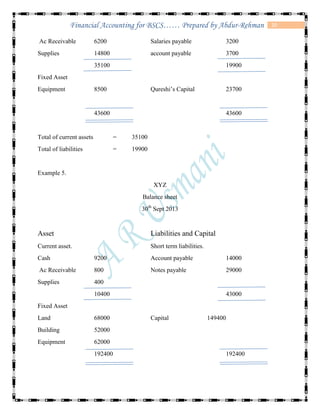
Ac Receivable 6200 Salaries payable 3200
Supplies 14800 account payable 3700
35100 19900
Fixed Asset
Equipment 8500 Qureshi’s Capital 23700
43600 43600
Total of current assets = 35100
Total of liabilities = 19900
Example 5.
XYZ
Balance sheet
30th
Sept 2013
Asset Liabilities and Capital
Current asset. Short term liabilities.
Cash 9200 Account payable 14000
Ac Receivable 800 Notes payable 29000
Supplies 400
10400 43000
Fixed Asset
Land 68000 Capital 149400
Building 52000
Equipment 62000
192400 192400
21Financial Accounting for BSCS…… Prepared by Abdur-Rehman

Financial accounting

  • 1.
    A R Usmani SkarduGilgit-Baltistan abdurrehmanusmani65@gmail.com
  • 2.
    1Financial Accounting forBSCS…… Prepared by Abdur-Rehman Accounting Definition.  Accounting is derived from the word account which means recording.  Accounting is a language of business through which two business persons are communicate with each other.  Accounting is a system of recording information about business then that information is presented to various people to keep them a future decision making.  Accounting is recording, classifying and analysis of business information.  Accounting is the backbone of any business. Definition of Accounting by different peoples.  Various persons defined accounting as language.  Economist defined the accounting is information related to income  Manager of any organization defined accounting is a recording technique and these information is helpful for future decision making.  Middle manager defined accounting is.  Labors defined accounting through which we earn income.  Government defined accounting is helpful for tax generation. AIS Accounting Information System  The systematic recording reporting and analysis of financial transaction of business as known as Accounting. Financial Transaction.  The information related to money as known as financial information.
  • 3.
    2Financial Accounting forBSCS…… Prepared by Abdur-Rehman  The person who is in charge of accounting called accountant. Need of Accounting.  Transaction take place regularly in the business. It is impossible for any person to keep all the transaction in memory so systematic record is compulsory for every business organization.  Accounting is beneficial for tax calculation.  Accounting is information about profit and loss.  It helps annoying the result of a business in term of profit and loss. AIS (Accounting Information System). Accounting information system is a system of collection and storage of financial data that is used by decision makers and accounting system is generally computer base system for tracking accounting activities. Computer has keen relationship with accounting because accounting is now a computerized system not a manual system. Component of AIS. People (User of Accounting) People is basically the user professional who used the information related to finance (Money). This person is known as accountant or consultant. Procedure (Method) There are lot of method that are used for storing the information and recording the information in accounting the method or procedure is known as financial statement. Data.
  • 4.
    3Financial Accounting forBSCS…… Prepared by Abdur-Rehman Data contains in AIS means the financial information on which accountant actually works. e.g.  Costumer billing.  Tax information. Software Software in AIS is a computer program used to share, collect and store the data for future processing. It also helps out the companies to organize their financial information. Information Technology Infrastructure. (Big Name of Hardware) This name the hardware used to operate the AIS. e.g.  Personal computer.  Server.  Printer.  Scanner etc. Information. In accounting there are two type of information.  Financial Information.  Non-Financial Information. Financial Information. The information that can be measured in money is known as financial information. e.g. A truck loaded with the vegetable of Rs. 5000 rupees. Here Rs. 5000 is financial information.
  • 5.
    4Financial Accounting forBSCS…… Prepared by Abdur-Rehman Non-Financial Information. The information that cannot be measured in money called Non-Financial information. e.g. Accident of workers during working hours. Financial Information Transection Events Transection. Transection is the financial information in which our will is involved. e.g.  Purchase of furniture.  Purchase of Car etc. Event. It is the financial information in which our willingness is not involved. e.g. You delivered a truck of cotton and accident occurred with the truck. That information can be measured in the form of money but our willingness is involved. Transection. Cash transection Credit transection Cash Transection. Cash Transection is that in which cash is paid on the spot known as cash transection. In cash transection. Present is involved.
  • 6.
    5Financial Accounting forBSCS…… Prepared by Abdur-Rehman e.g. If you buy something and paid the whole price of it and there are no remaining dealing. It is cash transection. Credit Transection. Settlement of cash in future is known as credit transection. In credit transection. Future is involved. e.g. I will pay the cash of amount Rs 1000 rupees after a weak. Then this sort of information is known as credit transection. Types of Accounting. Tax Accounting Management Accounting Financial Accounting What is tax? Tax is the fee charged by the government on the product, income or any business activity. Tax Accounting. The method of accounting that focuses on the tax issues. This branch of accounting includes all the activities related to the tax return to the government. It also helps the business in planning to future tax obligation. Obligation. Written promise that is made by any business for the tax payment. Management Accounting.
  • 7.
    6Financial Accounting forBSCS…… Prepared by Abdur-Rehman Management accounting provides information related to the internal environment specifically about employees. This branch of accounting has complete information about employees working in any organization. Financial Accounting. Financial accounting is very important branch or type of accounting which provides information about the financial condition of any organization. It contains all the information related to finance (money). Deference between Tax, Management and Financial Accounting Tax Accounting Management Accounting Financial Accounting User Government Internal employees External users Purpose of Information Gather to information related to tax Gather of internal information Gather of external information Time Past + Future Present + Past Present + Past + Future Note! Definition of these three type of accounting is also their differences. Business Definition. A business is any activity (entity) which base on the idea of earning profit. Or Business is an entity carried out with the extension of earning profit. Type of Business. 1. Sole proprietorship or Sole. 2. Partnership or Proprietorship.
  • 8.
    7Financial Accounting forBSCS…… Prepared by Abdur-Rehman 3. Company or Corporation.  Sole= Single owner.  Partnership= 2 to 20 owner.  Company= 20 to 50 owner. Sole Proprietorship or Sole. A business owned and operated by a single person is known as sole proprietorship or simply sole. Advantages of Sole.  Owner make all the decision.  Owner received all the profit. Disadvantages of Sole.  Owner has the difficulty in the payment of liabilities, because there are no other person to pay.  If loss occur in business it is very difficult to cover the loss by single person.  It is difficult to raise the capital for starting any business.  Sole limits skills and creativity in the business. Proprietorship or Partnership. When a business has 2 to 20 owners then that business is known as Partnership or proprietorship. Advantages of Partnership.  It creates more skill and knowledge in the business information.  Partnership is helpful in sharing of losses.  Partnership is also helpful for raising capital. Disadvantages of Partnership.  Partnership may need to disagreement in decision. Some person are not willing their share in loss.  The value of tax is more as compare to sole proprietorship.
  • 9.
    8Financial Accounting forBSCS…… Prepared by Abdur-Rehman Types of Partnership. 1. General Partnership. 2. Limited partnership. 3. Joint venture. 4. Strategic alliance. General Partnership. A partnership in which all the partners has equal authority in decision and equal distribution of profit and loss. All the partners have full responsibility for the management of the organization. Limited Partnership. A partnership in which the partner have limited authority and responsibility to their investment. This is known as limited partnership. Joint Venture. This is the type of partnership in which two business joins to complete a specific project. This type of partnership ends after a specified time period. Strategic Alliance. A type of partnership in which two businesses works together without time specification or simply working without ending. Company or Corporation. Company or corporation is the highest level of business. The range of owner is 20 to 50. Advantages of Company.  Very easy to raise capital.
  • 10.
    9Financial Accounting forBSCS…… Prepared by Abdur-Rehman  A lot of skills and creativity is there in corporation because of maximum people. Disadvantages of Company.  Corporation to pay double tax.  Lack of loyal person. Fundamental characteristics of Financial Accounting. General Purpose.  Financial accounting prepared financial statement and it is very helpful to show the financial condition of any organization.  Financial information are that is record by financial accounting is reliable because it is the whole information system through which we record, classify and report the financial information in a systematic way. Reliable information. Those information in which there is no error called reliable information. Comparability. Accounting information about any organization is very helpful in order to compare financial condition of your organization to that organization. Financial principles. Those principles that is used to generate profit by any organization is known as financial principles. Main Accounting Accounting cycle.
  • 11.
    10Financial Accounting forBSCS…… Prepared by Abdur-Rehman Accounting cycle is the process by which accountant prepare financial statement for any business or organization with the specification of date. Or The accounting cycle is sequence of activities beginning with the occurrence of transaction then after that will analysis this transaction this transaction in tabular form and after we make T- Account (Ledger) for more clarification of these transaction. At the end we will check the balance. Steps in Accounting Cycle. 1. Identification of transaction.  Amount.  Date specify.  Unite for money Description. e.g. Description: ABC company purchase equipment of amount Rs 50000 on 02 may 2014. Amount= 5000 Rs. Date= 02 may 2014. 2. Analysis of Transaction.
  • 12.
    11Financial Accounting forBSCS…… Prepared by Abdur-Rehman Determine which transaction is occur and how that transaction effects in your business (Either positive or negative) and of how much amount. 3. Make General Journal. Record occurrence of these transaction in chronological order. Or Record the transaction in sequence. 4. T-Account / Ledger. To distribute those transaction that we have recorded in tabular form, into different T- Accounts is known as T-Account or Ledger. Ledger contains information of each and every account separately. 5. Balance Sheet. At the end we will discuss balance sheet whose contains information of whole transaction in a balance form. Accounting Equation Asset = Liabilities + owner equity (capital) A=L+OE. Asset. Assets are economic resources of an organization that are having monetary importance. Assets are thing used by any organization in its operation and activities. e.g. A departmental store owns truck. This truck provides benefit for delivery different items to departmental store. So this truck is asset.
  • 13.
    12Financial Accounting forBSCS…… Prepared by Abdur-Rehman Main Types of Asset Fixed Asset Current Asset Fixed Asset. (More than one year) These are the assets held by the business on a long term basis. e.g. Land, Furniture, Building, Machinery, Motor vehicles etc. Current Asset (Within one year) Those assets held on shorter basis. e.g. Cash, Account receivable etc. There are some other types of asset. Tangible Asset. Those asset that can be touch or they have sort of existence. e.g. Cash, Land, Furniture etc. Intangible Asset. Those asset that cannot be touch. These assets has imaginary feelings. e.g. Brand Name, Slogans, logo etc.
  • 14.
    13Financial Accounting forBSCS…… Prepared by Abdur-Rehman Liability. These are the obligation or debt that an enterprise must pay. e.g. Organization ABC purchase goods for Rs 10,000 on credit for a period of month from Fast Food Products Company on 21 June 2013. Types of Liability Long term liability Short term liability Long Term Liability. Long term liabilities are those liabilities that are payable for a long time period. Minimum duration is one year. e.g.  Bank loans Short Term Liabilities. The obligation that are payable within one year. e.g.  Bills payable.  Account payable. Equity / Capital. Owner equity or capital represents the investment of the owner in the business. Types/Shapes/Forms of owner equity.
  • 15.
    14Financial Accounting forBSCS…… Prepared by Abdur-Rehman 1. Withdrawal. 2. Revenue. 3. Expenses. Withdrawal. Withdrawal represent cash removed from the business for personal use, withdrawal has a negative effect on owner equity. e.g. The owner XYZ invested the amount of Rs 20,000 in his business. After a month owner withdraw amount of Rs 5000 rupees for his personal use. Solution. Capital=20,000 Withdrawal=5000 Effect on the business, 20,000-5000=15,000 Because the owner removed the amount of Rs 5000 for his personal use. Revenue. Revenue means inflow of money into business, and revenue has positive effect in owner equity. Expenses. Expenses also represent outflow of the money and has the negative effect on the capital. Equation balance. (A=L+OE) A=Assets. L=Liabilities. OE=Owner equity A=L + Capital – Withdrawal + Revenue – Expenses. The equation must be balance, in other word the total of the all asset (Current + Fixed) must be equal to the total of liabilities and owner equity (Capital).
  • 16.
    15Financial Accounting forBSCS…… Prepared by Abdur-Rehman Fundamental Concept of Accounting Equation Show that the accounting equation is satisfied after taking into consideration each of the following transaction in book of Accounting by Mr. ML. a) Started business with the capital of Rs. 100,000 rupees. b) Mr. ML bought the furniture for Rs. 25000 rupees. c) Mr. ML bought goods for the cash of Rs. 20,000 rupees. d) Mr. ML bought goods from Mr. X on credit of amount 5000 rupees. e) Mr. ML sold goods to Mr. Y on credit of amount 800 rupees. Solution. Asset = Liabilities + Capital / owner equity. a. Cash, 100,000 = 0 + 100,000 100,000 = 100,000 b. Cash, 75000 = 0 + 100,000 Furniture, 25000. 100,000 = 100,000 c. Cash, 55000 = 0 + 100,000 Furniture, 25000. Goods, 20000. 100,000 = 100,000 d. Cash, 55000 = 5000 + 100,000 Furniture, 25000. Goods, 20000+5000 =25000. 105000 = 105000 e. Cash, 55000 = 5000 + 105000
  • 17.
    16Financial Accounting forBSCS…… Prepared by Abdur-Rehman Account Receivable, 800 Furniture, 25000 Goods, 25000-800 =24200. 105000 = 105000 Example. If the company XYZ has the following given amount. Cash = Rs. 22000 rupees Net payable = Rs. 30,000 rupees Capital= Rs. 80,000 rupees Building = Rs. 36000 rupees Land = Rs. 52000 rupees Solution. Asset = Liabilities + Capital Cash, 22000 = Notes payable, 30,000+ 80,000 Building, 36000. Land, 52000. 110,000 = 110,000 Financial Statement. Balance Sheet. Format. Company name Financial statement
  • 18.
    17Financial Accounting forBSCS…… Prepared by Abdur-Rehman (Balance sheet, Journal etc.) Date Asset Liabilities and Capital Current asset. Short term liabilities. Cash amount Notes payable amount Ac Receivable amount Ac Payable amount (Etc.) … (Etc.) … Total amount Total amount Fixed Asset Land amount Owner’s Capital amount Furniture amount Equipment amount Grand Total Grand Total Examples of Balance Sheet. Example 2. Banners by George Balance sheet May 15, 2014 Asset Liabilities and Capital Current asset. Short term liabilities. Cash 18150 Notes payable 97500 Ac Receivable 28350 Ac Payable 21900 46500 119400 Fixed Asset Land 135000 George’s Capital 182200 Building 105000
  • 19.
    18Financial Accounting forBSCS…… Prepared by Abdur-Rehman Equipment 15100 301600 301600 Example 2. (Without individual total) John and Sons Balance sheet May 15, 2014 Asset Liabilities and Capital Current asset: Short term liabilities: Cash 19000 Notes payable 86000 Ac Receivable 41000 Ac Payable 24000 Supplies 7000 Interest payable 5000 Fixed Asset: Auto mobile 96000 Mr. John’s Capital 48000 163000 163000 Example 3. XYZ Balance sheet 10 May 2013 Asset Liabilities and Capital Current asset. Short term liabilities. Cash 27900 Notes payable 70000 Ac Receivable 1250 Ac Payable 18000
  • 20.
    19Financial Accounting forBSCS…… Prepared by Abdur-Rehman Supplies 4440 Fixed Asset Capital 84090 Land 55000 Building 45500 Equipment 38000 172090 172090 Example 4. Qureshi Company. a. You have to prepare balance sheet dated 16 May 2013 using below details. Notes payable 13000 Ac payable 3700 Cash 14100 Supplies 14800 Equipment 8500 Ac receivable 6200 Salaries payable 3200 Qureshi’s capital 23700. b. You must collect current and fixed assets and short and long term liabilities. Solution: Qureshi Company Balance sheet 16 May 2013 Asset Liabilities and Capital Current asset. Short term liabilities. Cash 14100 Notes payable 13000
  • 21.
    20Financial Accounting forBSCS…… Prepared by Abdur-Rehman Ac Receivable 6200 Salaries payable 3200 Supplies 14800 account payable 3700 35100 19900 Fixed Asset Equipment 8500 Qureshi’s Capital 23700 43600 43600 Total of current assets = 35100 Total of liabilities = 19900 Example 5. XYZ Balance sheet 30th Sept 2013 Asset Liabilities and Capital Current asset. Short term liabilities. Cash 9200 Account payable 14000 Ac Receivable 800 Notes payable 29000 Supplies 400 10400 43000 Fixed Asset Land 68000 Capital 149400 Building 52000 Equipment 62000 192400 192400
  • 22.
    21Financial Accounting forBSCS…… Prepared by Abdur-Rehman