
















On 2 July 2010 The                   Times raised
  a paywall around all digital content.
     For two weeks, access was free.
      During this period, it’s reputed
150,000 people said they would pay.


                 Source: http://bit.ly/bCDTeD
On 15 July 2010 the free trial ended.
Access to content was set at £1 per day, or £2 per week.
    To date, gures quoted online estimate
       that only 10-15% of people have
     become paid digital subscribers.


                       Source: http://bit.ly/bCDTeD
On 16 July, the Financial Times reported that
   The Times had lost two-thirds of previous
visitors in the weeks since the paywall went up,
           even though access had been free.
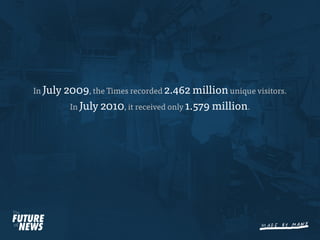
In July 2009, the Times recorded 2.462 million unique visitors.
         In July 2010, it received only 1.579 million.
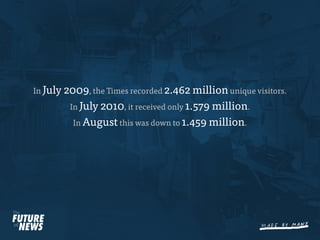
In July 2009, the Times recorded 2.462 million unique visitors.
         In July 2010, it received only 1.579 million.
         In August this was down to 1.459 million.
This isn’t surprising: the Times is a
   generalist publication in a
crowded marketplace where other
  generalist publications, many with
  arguably better content, allow users
       free online access.
There is a well-known argument that a
   generalist news publication must
stand out from the crowd with something
        truly special if it is to attract
   enough paying customers to survive.
This isn’t the magic bullet.

Cultural relevance is.
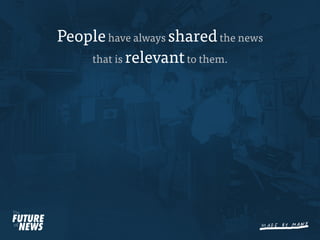
People have always shared the news
    that is relevant to them.
People have always shared the news
    that is relevant to them.


            Photo by hdptcar. Creative Commons
People have always shared the news
    that is relevant to them.


          Photos by hdptcar and pedrosimoes7. Creative Commons
Leaps in digital  technology mean we
can share news with more people and from
            just about anywhere.
      The conversation around news can
             be huge and amazing.
Leaps in digital  technology mean we
can share news with more people and from
            just about anywhere.
      The conversation around news can
             be huge and amazing.
Leaps in digital  technology mean we
can share news with more people and from
            just about anywhere.
      The conversation around news can
             be huge and amazing.
Leaps in digital  technology mean we
can share news with more people and from
            just about anywhere.
      The conversation around news can
             be huge and amazing.
Turn it up, and this technology facilitates
             cultural relevance.
Turn it up, and this technology facilitates
              cultural relevance.


  Turn it o     and it decimates tra c,
         page views and pro tability.
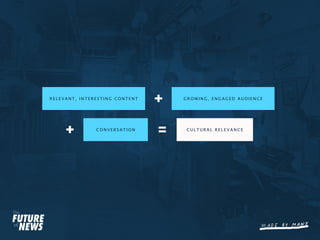
RELEVANT, INTERESTING CONTENT
                                +   GROWING, ENGAGED AUDIENCE


     +         CONVERSATION
                                =   CULTURAL RELEVANCE
Cultural relevance drives   page views and pro ts
     By cutting itself out of the broader conversation,
        The Times has become less     relevant.
Cultural relevance drives   page views and pro ts
     By cutting itself out of the broader conversation,
        The Times has become less     relevant.
     Its cultural     value has depreciated.
In a recent interview with Vanity Fair, Arthur Sulzberger,
       publisher of The    New York Times,
    said his goal was not to be the largest-circulation
paper in the country, but to be the “thought    leader”.
In a recent interview with Vanity Fair, Arthur Sulzberger,
       publisher of The    New York Times,
    said his goal was not to be the largest-circulation
paper in the country, but to be the “thought    leader”.

       Sulzberger wants The New York Times to be
           the most    relevant publication.
The intricacies of the relationship between
  cultural relevance and pro tability
may not yet be fully understood, but The Times’ paywall
          experiment proves the connection.


   A publisher can start to draw a bottom line based
    on units sold x cost per unit, but that line only
    dips lower as the conversation dwindles away.
says the Guardian’s Emily Bell:

 “The paywall may address the issue of newspaper
 circulation decline, but it does not begin to tackle
 the far greater challenge of telling e ective stories
and creating activities and audiences in a constantly
            changing digital landscape.


     To stimulate a market for news, you need
              an engaged population.”
The challenge for publishers is to make
                                     money
      whilst being culturally relevant.


                 This could mean:
     use-based charging - a new approach to ads
      paid-for apps - paid-for premium content
            content type-based charging
The challenge for publishers is to make
                                     money
      whilst being culturally relevant.


                 This could mean:
     use-based charging - a new approach to ads
      paid-for apps - paid-for premium content
            content type-based charging


            This de nitely doesn’t mean:
       unshareable content - a rigid paywall
The Financial     Times, a specialist publication
        as opposed to the generalist The Times,
   also has a paywall, but charges based on use:
 the casual user doesn’t pay, while the heavy user does.
Allowing new users to access      content without
hitting them with charges means the FT’s audience can grow.
         So, too, can its cultural   relevance.
Today’s technologies solve problems created by
 past technologies and create problems that

      future technologies will solve.
The race is on to solve the problem of
   the future of news, and now we know that
cultural relevance must be central
                to the solution.

The case for cultural relevance

  • 2.
    On 2 July2010 The Times raised a paywall around all digital content. For two weeks, access was free. During this period, it’s reputed 150,000 people said they would pay. Source: http://bit.ly/bCDTeD
  • 3.
    On 15 July2010 the free trial ended. Access to content was set at £1 per day, or £2 per week. To date, gures quoted online estimate that only 10-15% of people have become paid digital subscribers. Source: http://bit.ly/bCDTeD
  • 4.
    On 16 July,the Financial Times reported that The Times had lost two-thirds of previous visitors in the weeks since the paywall went up, even though access had been free.
  • 5.
    In July 2009,the Times recorded 2.462 million unique visitors.
  • 6.
    In July 2009,the Times recorded 2.462 million unique visitors. In July 2010, it received only 1.579 million.
  • 7.
    In July 2009,the Times recorded 2.462 million unique visitors. In July 2010, it received only 1.579 million. In August this was down to 1.459 million.
  • 8.
    This isn’t surprising:the Times is a generalist publication in a crowded marketplace where other generalist publications, many with arguably better content, allow users free online access.
  • 9.
    There is awell-known argument that a generalist news publication must stand out from the crowd with something truly special if it is to attract enough paying customers to survive.
  • 10.
    This isn’t themagic bullet.
  • 11.
    This isn’t themagic bullet. Cultural relevance is.
  • 12.
    People have alwaysshared the news that is relevant to them.
  • 13.
    People have alwaysshared the news that is relevant to them. Photo by hdptcar. Creative Commons
  • 14.
    People have alwaysshared the news that is relevant to them. Photos by hdptcar and pedrosimoes7. Creative Commons
  • 15.
    Leaps in digital technology mean we can share news with more people and from just about anywhere. The conversation around news can be huge and amazing.
  • 16.
    Leaps in digital technology mean we can share news with more people and from just about anywhere. The conversation around news can be huge and amazing.
  • 17.
    Leaps in digital technology mean we can share news with more people and from just about anywhere. The conversation around news can be huge and amazing.
  • 18.
    Leaps in digital technology mean we can share news with more people and from just about anywhere. The conversation around news can be huge and amazing.
  • 19.
    Turn it up,and this technology facilitates cultural relevance.
  • 20.
    Turn it up,and this technology facilitates cultural relevance. Turn it o and it decimates tra c, page views and pro tability.
  • 21.
    RELEVANT, INTERESTING CONTENT + GROWING, ENGAGED AUDIENCE + CONVERSATION = CULTURAL RELEVANCE
  • 22.
    Cultural relevance drives page views and pro ts By cutting itself out of the broader conversation, The Times has become less relevant.
  • 23.
    Cultural relevance drives page views and pro ts By cutting itself out of the broader conversation, The Times has become less relevant. Its cultural value has depreciated.
  • 24.
    In a recentinterview with Vanity Fair, Arthur Sulzberger, publisher of The New York Times, said his goal was not to be the largest-circulation paper in the country, but to be the “thought leader”.
  • 25.
    In a recentinterview with Vanity Fair, Arthur Sulzberger, publisher of The New York Times, said his goal was not to be the largest-circulation paper in the country, but to be the “thought leader”. Sulzberger wants The New York Times to be the most relevant publication.
  • 26.
    The intricacies ofthe relationship between cultural relevance and pro tability may not yet be fully understood, but The Times’ paywall experiment proves the connection. A publisher can start to draw a bottom line based on units sold x cost per unit, but that line only dips lower as the conversation dwindles away.
  • 27.
    says the Guardian’sEmily Bell: “The paywall may address the issue of newspaper circulation decline, but it does not begin to tackle the far greater challenge of telling e ective stories and creating activities and audiences in a constantly changing digital landscape. To stimulate a market for news, you need an engaged population.”
  • 28.
    The challenge forpublishers is to make money whilst being culturally relevant. This could mean: use-based charging - a new approach to ads paid-for apps - paid-for premium content content type-based charging
  • 29.
    The challenge forpublishers is to make money whilst being culturally relevant. This could mean: use-based charging - a new approach to ads paid-for apps - paid-for premium content content type-based charging This de nitely doesn’t mean: unshareable content - a rigid paywall
  • 30.
    The Financial Times, a specialist publication as opposed to the generalist The Times, also has a paywall, but charges based on use: the casual user doesn’t pay, while the heavy user does.
  • 31.
    Allowing new usersto access content without hitting them with charges means the FT’s audience can grow. So, too, can its cultural relevance.
  • 32.
    Today’s technologies solveproblems created by past technologies and create problems that future technologies will solve.
  • 33.
    The race ison to solve the problem of the future of news, and now we know that cultural relevance must be central to the solution.