CRISP SETS
BY
T.Deepika
M.SC(COMPUTER SCIENCE)
NADAR SARASWATHI COLLEGE OF ARTS AND
SCIENCE
INTRODUCTION:
• Classical Set theory also termed as CRISP
SETS.
• It is also the fundamental to the study of fuzzy
sets.
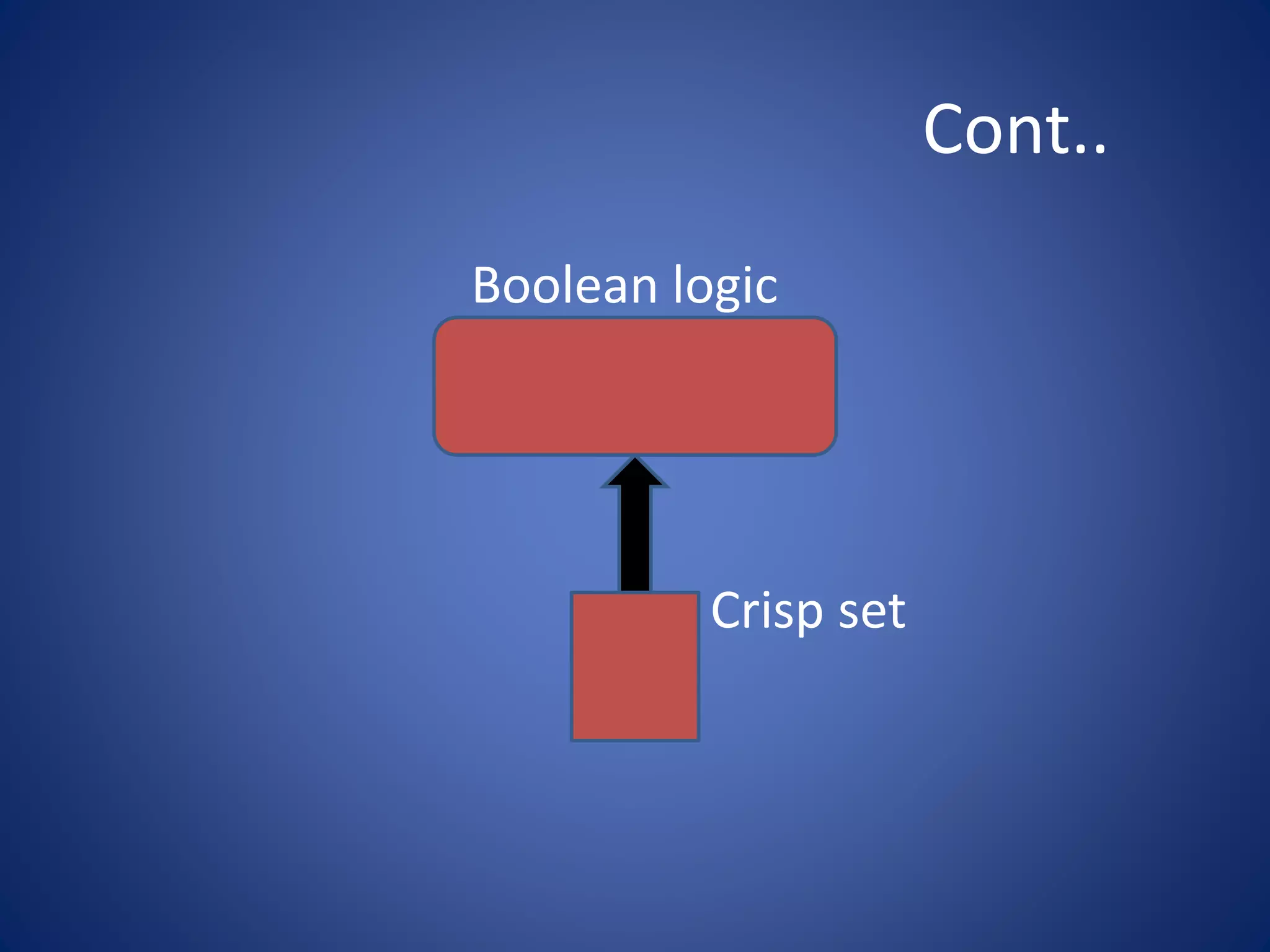
• Theory of Crisp sets had its roots of boolean
logic.
Cont..
Boolean logic
Cr Crisp set
• By using boolean logic,crisp set have only two
options .i.e (YES or NO).
• For Example:
1.Is dog barks? ->> Yes. The dog
barks.
• Here crisp set say only yes or no type answers.
Universe Of Discourse:
• Universe of discourse is also known as the
Universal Set.
• It contains all elements having same
characteristics.
• Universal Set is denoted by the symbol “E”.
Set:
• A set is “Well defined collection of objects”.
• Example:
• A={X1,X2,X3,……………….Xn}
• Where X1 ,X2 and X3 are called the members
of the set.
• It is also known as “LIST FORM”.
• A set is also be defined based on the
properties of the numbers .
Venn Diagram:
• Venn diagram is a pictorial representation to
denote a set.
• E
A
MEMBERSHIP:
• An element x is said to be a member of a set A
if x belongs to the set A.
• The membership is indicated by ε.
• X ε A means x belongs to A and x to A
means x does not belong to A.
• Example:
A={1,2,3,4,5,6,7,8}
X=9;Y=6.
• Each element from the set either belongs to
or does not belongs to a set.And,therefore
membership is definite.
Family Of Set:
• A set whose members are sets themselves , is
referred to as a family of set.
• Example:
A={{3,4,5},{1,2,3},{ 9,4}}
Subset:
• In a given set A and B defined over E the
universal set,A is said to be a subset of
B.(i.e)Every element of A is in B.
• A Contains B.Here, A is a subset of B.
• A is a proper subset of B.
• A is called the improper subset of B.
Superset:
• Given sets A and B on E the universal set,A is
said to be a superset of B if every element of B
is contained in A.
• A Ͻ B. A is a superset of B.
• If A contains B and is equivalent to B.
Power set:
• A power set is a set of A is the set of all
possible subsets that are derivable from A
including null set.
• A power set of a set is indicated as p(A) and
has cardinality of |p(A)|=2|4|.
Operations on crisp sets:
UNION(U):
• The union of two sets A and B (AUB) is the set
of all elements that belong to A or B or both.
• AUB={x/xϹA or XϹB}.
• Example:
A={1,2,3,4,5} and B={a,b,c,d}
AUB={a,b,c,d,1,2,3,4,5}
Intersection(ᴖ):
• The intersection of two sets A and B (A ᴖ B) is
the set of all elements that belongs to A and
B.}
• AᴖB={x|x εA and xεB}
Complement(c):
• The complement of a set Ac(A|A) is the set of
elements which are in E but not in A.
• Example:
• X={1,2,3,4,5,6,7} and A={5,4,3}
we get A={1,2,6,7}.
Difference(-):
• The difference of the set A and B is A-B the set
of all elements which are in A but not in B.
• A-b={x|x belongs to A and X belongs to B}.
• Example:
• A={a,b,c,d,e} and B={b,d}
• A-B={a,c,e}.
Properties of crisp set:
Law of Commutativity:
(A ∪ B) = (B ∪ A)
(A ∩ B) = (B ∩ A)
Law of Associativity:
(A ∪ B) ∪ C = A ∪ (B ∪ C)
(A ∩ B) ∩ C = A ∩ (B ∩ C)
Law of Distributivity:
A ∪ (B ∩ C) = (A ∪ B) ∩ (A ∪ C)
A ∩ (B ∪ C) = (A ∩ B) ∪ (A ∩ C)
Idempotent Law:
A ∪ Φ = A => A ∪ E = E
A ∩ Φ = Φ => A ∩ E = A
Law of Absorption
A ∪ (A ∩ B) = A
A ∩ (A ∪ B) = A
Law of Transitivity
If A ⊆ B, B ⊆ C, then A ⊆ C
Law of Contradiction
(A ∩ Ac) = Φ
De morgan laws
(A ∪ B)c = Ac ∩ Bc
(A ∩ B)c = Ac ∪ Bc
CONCLUSION:
• By using crisp sets,the set defined using
characteristic function that assigns a boolean
value.

Crisp sets

  • 1.
    CRISP SETS BY T.Deepika M.SC(COMPUTER SCIENCE) NADARSARASWATHI COLLEGE OF ARTS AND SCIENCE
  • 2.
    INTRODUCTION: • Classical Settheory also termed as CRISP SETS. • It is also the fundamental to the study of fuzzy sets. • Theory of Crisp sets had its roots of boolean logic.
  • 3.
  • 4.
    • By usingboolean logic,crisp set have only two options .i.e (YES or NO). • For Example: 1.Is dog barks? ->> Yes. The dog barks. • Here crisp set say only yes or no type answers.
  • 5.
    Universe Of Discourse: •Universe of discourse is also known as the Universal Set. • It contains all elements having same characteristics. • Universal Set is denoted by the symbol “E”.
  • 6.
    Set: • A setis “Well defined collection of objects”. • Example: • A={X1,X2,X3,……………….Xn} • Where X1 ,X2 and X3 are called the members of the set. • It is also known as “LIST FORM”. • A set is also be defined based on the properties of the numbers .
  • 7.
    Venn Diagram: • Venndiagram is a pictorial representation to denote a set. • E A
  • 8.
    MEMBERSHIP: • An elementx is said to be a member of a set A if x belongs to the set A. • The membership is indicated by ε. • X ε A means x belongs to A and x to A means x does not belong to A.
  • 9.
    • Example: A={1,2,3,4,5,6,7,8} X=9;Y=6. • Eachelement from the set either belongs to or does not belongs to a set.And,therefore membership is definite.
  • 10.
    Family Of Set: •A set whose members are sets themselves , is referred to as a family of set. • Example: A={{3,4,5},{1,2,3},{ 9,4}}
  • 11.
    Subset: • In agiven set A and B defined over E the universal set,A is said to be a subset of B.(i.e)Every element of A is in B. • A Contains B.Here, A is a subset of B. • A is a proper subset of B. • A is called the improper subset of B.
  • 12.
    Superset: • Given setsA and B on E the universal set,A is said to be a superset of B if every element of B is contained in A. • A Ͻ B. A is a superset of B. • If A contains B and is equivalent to B.
  • 13.
    Power set: • Apower set is a set of A is the set of all possible subsets that are derivable from A including null set. • A power set of a set is indicated as p(A) and has cardinality of |p(A)|=2|4|.
  • 14.
    Operations on crispsets: UNION(U): • The union of two sets A and B (AUB) is the set of all elements that belong to A or B or both. • AUB={x/xϹA or XϹB}. • Example: A={1,2,3,4,5} and B={a,b,c,d} AUB={a,b,c,d,1,2,3,4,5}
  • 15.
    Intersection(ᴖ): • The intersectionof two sets A and B (A ᴖ B) is the set of all elements that belongs to A and B.} • AᴖB={x|x εA and xεB}
  • 16.
    Complement(c): • The complementof a set Ac(A|A) is the set of elements which are in E but not in A. • Example: • X={1,2,3,4,5,6,7} and A={5,4,3} we get A={1,2,6,7}.
  • 17.
    Difference(-): • The differenceof the set A and B is A-B the set of all elements which are in A but not in B. • A-b={x|x belongs to A and X belongs to B}. • Example: • A={a,b,c,d,e} and B={b,d} • A-B={a,c,e}.
  • 18.
    Properties of crispset: Law of Commutativity: (A ∪ B) = (B ∪ A) (A ∩ B) = (B ∩ A) Law of Associativity: (A ∪ B) ∪ C = A ∪ (B ∪ C) (A ∩ B) ∩ C = A ∩ (B ∩ C) Law of Distributivity: A ∪ (B ∩ C) = (A ∪ B) ∩ (A ∪ C) A ∩ (B ∪ C) = (A ∩ B) ∪ (A ∩ C) Idempotent Law: A ∪ Φ = A => A ∪ E = E A ∩ Φ = Φ => A ∩ E = A
  • 19.
    Law of Absorption A∪ (A ∩ B) = A A ∩ (A ∪ B) = A Law of Transitivity If A ⊆ B, B ⊆ C, then A ⊆ C Law of Contradiction (A ∩ Ac) = Φ De morgan laws (A ∪ B)c = Ac ∩ Bc (A ∩ B)c = Ac ∪ Bc
  • 20.
    CONCLUSION: • By usingcrisp sets,the set defined using characteristic function that assigns a boolean value.