Welcome  –  Week 4 iTunesU Copyright  Creative Commons Learning Theory Cater for learners
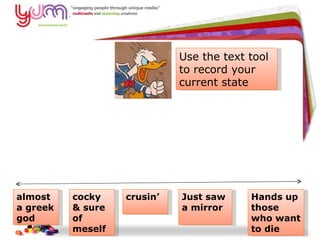
almost a greek god Hands up those who want to die crusin’ cocky & sure of meself Just saw a mirror Use the text tool to record your current state
Welcome
Welcome
Welcome
Assessment Task 2 Add some dot points to the following table that demonstrate how you think the various learning theories relate to e learning strategies and web 2 tools  (if relevant).  Briefly Consider how each learning theory might relate to a specific activity delivered as part of your current training. 23rd March
Assessment Task 2
Assessment Task 2 Resources: Learning styles and strategies Richard M. Felder http://www4.ncsu.edu/unity/lockers/users/f/felder/public/ILSdir/styles.htm Foundations of Educational Theory for Online Learning  Mohamed Ally Athabasca University http://cde.athabascau.ca/online_book/ch1.html Gallery of e Learning Strategies http://designing.flexiblelearning.net.au/gallery/all.htm
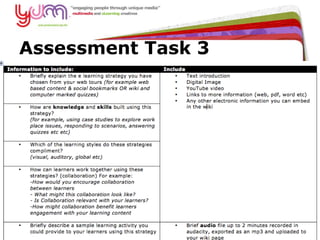
Assessment Task 3 From your exploration of eLearning strategies, web  2 tools and Learning styles explore 2 eLearning strategies that would be a likely choice for you when delivering to your predominant target group of learners. You will publish your findings on the wiki for this course at  http://taayum.wikispaces.com/ . Add a page there and include the required information 30th March
Assessment Task 3
iTunesU More than 250,000 free podcast/lecture content Much more in closed content 300 educational institutions – MIT, Yale, Swinburne, Uni of Melbourne, Uni of NSW, Uni of WA
iTunesU Demo
Copyright Who owns what? How much can you use? What are your license options? Double check what your organisation’s policies are.
Creative Commons Creative Commons is a nonprofit that offers flexible copyright management tools for creative work. Offering your work under a Creative Commons license does not mean giving up your copyright. It means offering some of your rights to any taker, and only on certain conditions.
Good sources of CC Multimedia Images  - Most pull from Flickr's extensive collection Flickr  (check the Creative Commons box at the bottom) FlickrCC Compfight FlickrStorm everystockphoto Open Clipart Library Geograph British Isles Wikimedia Commons/ Audio CC Mixter Samples Jamendo Freesound Internet Archive Owl Music Search SpinXpress Wikimedia Commons Video MOD Films Internet Archive SpinXpress http://drapestakes.blogspot.com/2008/12/educators-guide-to-creative-commons.html
Creative Commons  –  Licence Types Attribution -  This applies to every Creative Commons work. Whenever a work is copied or redistributed under a Creative Commons license, credit must always be given to the creator. Non commercial  - Lets others copy, distribute, display, and perform your work — and derivative works based upon it — but for noncommercial purposes only. No Derivative Works  - Lets others copy, distribute, display, and perform only verbatim copies of your work, not derivative works based upon it. Share Alike  - Allows others to distribute derivative works only under a license identical to the license that governs your work.
Some Websites Flickr –  www.flickr.com Robyn jay’s photostream  http://www.flickr.com/photos/learnscope/   Open Source Music -  http://www.opensourcemusic.com/   Designing and implementing eLearning with Creative Commons (Australian Flexible Learning Framework) http://designing.flexiblelearning.net.au/gallery/activities/creative_commons.htm Creative Commons information Australia –  http://creativecommons.org.au   Creative Commons (Global) –  http://creativecommons.org/
Questions for today How do learning theories relate to online learning activities Start to identify e learning tools with specific strategies to suit a range of learners and purposes
 
Learning Theory – Behaviorism We learn because we  make a particular  response to a  given stimulus
Learning Theory – Cognitivism Behaviourism didn’t  have a role for  thinking .  ~to learn something  you must have: Attention: Retention: Reproduction: Motivation:
Learning Theory – Constructivism Our past experiences have a great influence on how we learn. emphasises  learning, not teaching encourages  learners to use initiative and be independent encourages  learners to interact with other learners/teacher/mentor supports  co-operative learning
Learning Theory
Learning Theory – Online Learning Most computer-based learning now is based around constructivism, but with elements of behaviourism and cognitivism thrown in!
Basic Tenants of Constructivism Knowledge is constructed from and shaped by experience. Learners must take an active role and assume responsibility for their learning. Learning is a collaborative process and students create their own meaning from obtaining multiple perspectives.
Basic Tenants of Constructivism Learning should occur in a realistic setting. Learners should choose their own path through content and activities. Content should be presented holistically, not broken into separate smaller tasks.
Constructivism – How Realistic? Learning should occur in a realistic setting.
Constructivism – How Realistic? Knowledge is constructed from and shaped by experience.
Constructivism – How Realistic? Learners should choose their own path through content and activities.
Constructivism – How Realistic? Content should be presented holistically, not broken into separate smaller tasks.
Learners come in all shapes and sizes Learners exhibit a variety of learning style preferences Active Reflective Visual Experiential Auditory Sensing
Lets cater for them! Reduce reliance on text  (Audio, Visuals, Video) Use multimedia Engage learner to think through online material (learning activities) Put back industry knowledge
Push or Pull?
Push or Pull?
Push or Pull? – Cathy Moore
Push or Pull?
Push or Pull? – Cathy Moore
Cathy Moore Real world actions that learners need to take Realistic online activity that helps learners practice those actions http://blog.cathy-moore.com/2009/11/why-you-want-to-use-scenarios-in-your-elearning/
Cathy Moore Character faces a challenge Show not tell Make learners justify their choices. Challenge their assumptions and make them think deeply about the material. Contextual feedback will help learners see where they went wrong
Cathy Moore – example of push
Cathy Moore – example of pull
The Parting Glass

Session4

  • 1.
    Welcome – Week 4 iTunesU Copyright Creative Commons Learning Theory Cater for learners
  • 2.
    almost a greekgod Hands up those who want to die crusin’ cocky & sure of meself Just saw a mirror Use the text tool to record your current state
  • 3.
  • 4.
  • 5.
  • 6.
    Assessment Task 2Add some dot points to the following table that demonstrate how you think the various learning theories relate to e learning strategies and web 2 tools (if relevant). Briefly Consider how each learning theory might relate to a specific activity delivered as part of your current training. 23rd March
  • 7.
  • 8.
    Assessment Task 2Resources: Learning styles and strategies Richard M. Felder http://www4.ncsu.edu/unity/lockers/users/f/felder/public/ILSdir/styles.htm Foundations of Educational Theory for Online Learning Mohamed Ally Athabasca University http://cde.athabascau.ca/online_book/ch1.html Gallery of e Learning Strategies http://designing.flexiblelearning.net.au/gallery/all.htm
  • 9.
    Assessment Task 3From your exploration of eLearning strategies, web 2 tools and Learning styles explore 2 eLearning strategies that would be a likely choice for you when delivering to your predominant target group of learners. You will publish your findings on the wiki for this course at http://taayum.wikispaces.com/ . Add a page there and include the required information 30th March
  • 10.
  • 11.
    iTunesU More than250,000 free podcast/lecture content Much more in closed content 300 educational institutions – MIT, Yale, Swinburne, Uni of Melbourne, Uni of NSW, Uni of WA
  • 12.
  • 13.
    Copyright Who ownswhat? How much can you use? What are your license options? Double check what your organisation’s policies are.
  • 14.
    Creative Commons CreativeCommons is a nonprofit that offers flexible copyright management tools for creative work. Offering your work under a Creative Commons license does not mean giving up your copyright. It means offering some of your rights to any taker, and only on certain conditions.
  • 15.
    Good sources ofCC Multimedia Images - Most pull from Flickr's extensive collection Flickr (check the Creative Commons box at the bottom) FlickrCC Compfight FlickrStorm everystockphoto Open Clipart Library Geograph British Isles Wikimedia Commons/ Audio CC Mixter Samples Jamendo Freesound Internet Archive Owl Music Search SpinXpress Wikimedia Commons Video MOD Films Internet Archive SpinXpress http://drapestakes.blogspot.com/2008/12/educators-guide-to-creative-commons.html
  • 16.
    Creative Commons – Licence Types Attribution - This applies to every Creative Commons work. Whenever a work is copied or redistributed under a Creative Commons license, credit must always be given to the creator. Non commercial - Lets others copy, distribute, display, and perform your work — and derivative works based upon it — but for noncommercial purposes only. No Derivative Works - Lets others copy, distribute, display, and perform only verbatim copies of your work, not derivative works based upon it. Share Alike - Allows others to distribute derivative works only under a license identical to the license that governs your work.
  • 17.
    Some Websites Flickr– www.flickr.com Robyn jay’s photostream http://www.flickr.com/photos/learnscope/ Open Source Music - http://www.opensourcemusic.com/ Designing and implementing eLearning with Creative Commons (Australian Flexible Learning Framework) http://designing.flexiblelearning.net.au/gallery/activities/creative_commons.htm Creative Commons information Australia – http://creativecommons.org.au Creative Commons (Global) – http://creativecommons.org/
  • 18.
    Questions for todayHow do learning theories relate to online learning activities Start to identify e learning tools with specific strategies to suit a range of learners and purposes
  • 19.
  • 20.
    Learning Theory –Behaviorism We learn because we make a particular response to a given stimulus
  • 21.
    Learning Theory –Cognitivism Behaviourism didn’t have a role for thinking . ~to learn something you must have: Attention: Retention: Reproduction: Motivation:
  • 22.
    Learning Theory –Constructivism Our past experiences have a great influence on how we learn. emphasises learning, not teaching encourages learners to use initiative and be independent encourages learners to interact with other learners/teacher/mentor supports co-operative learning
  • 23.
  • 24.
    Learning Theory –Online Learning Most computer-based learning now is based around constructivism, but with elements of behaviourism and cognitivism thrown in!
  • 25.
    Basic Tenants ofConstructivism Knowledge is constructed from and shaped by experience. Learners must take an active role and assume responsibility for their learning. Learning is a collaborative process and students create their own meaning from obtaining multiple perspectives.
  • 26.
    Basic Tenants ofConstructivism Learning should occur in a realistic setting. Learners should choose their own path through content and activities. Content should be presented holistically, not broken into separate smaller tasks.
  • 27.
    Constructivism – HowRealistic? Learning should occur in a realistic setting.
  • 28.
    Constructivism – HowRealistic? Knowledge is constructed from and shaped by experience.
  • 29.
    Constructivism – HowRealistic? Learners should choose their own path through content and activities.
  • 30.
    Constructivism – HowRealistic? Content should be presented holistically, not broken into separate smaller tasks.
  • 31.
    Learners come inall shapes and sizes Learners exhibit a variety of learning style preferences Active Reflective Visual Experiential Auditory Sensing
  • 32.
    Lets cater forthem! Reduce reliance on text (Audio, Visuals, Video) Use multimedia Engage learner to think through online material (learning activities) Put back industry knowledge
  • 33.
  • 34.
  • 35.
    Push or Pull?– Cathy Moore
  • 36.
  • 37.
    Push or Pull?– Cathy Moore
  • 38.
    Cathy Moore Realworld actions that learners need to take Realistic online activity that helps learners practice those actions http://blog.cathy-moore.com/2009/11/why-you-want-to-use-scenarios-in-your-elearning/
  • 39.
    Cathy Moore Characterfaces a challenge Show not tell Make learners justify their choices. Challenge their assumptions and make them think deeply about the material. Contextual feedback will help learners see where they went wrong
  • 40.
    Cathy Moore –example of push
  • 41.
    Cathy Moore –example of pull
  • 42.