Communication and Collaboration: An Introduction to Web2.0 November 27, 2007 Julie Hannaford [email_address] http://leo.oise.utoronto.ca/~jhannaford/USCWeb2.0.ppt
What is Web 2.0?  Collaboration Exploration Experimentation Communication … Sites and tools that let you connect with others in a whole new way  Innovative ways to reach our users
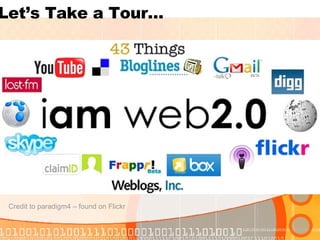
Let’s Take a Tour… Credit to paradigm4 – found on Flickr
Social Bookmarking What it is: Tagging (adding keywords) websites, videos and photos, in a way that is meaningful to you Sharing those sites and tags with others Examples:  http://del.icio.us  or  http:// diigo.com http:// www.youtube.com   http:// flickr.com /
del.icio.us Social bookmarking/tagging of websites Store favourites in ways that are meaningful to you – tag them AND bundle them Add people to your network; subscribe to tags that are of interest to you; search for others’ sites Example: search for: learning communities education
diigo.com Similar to del.icio.us Lets you use additional features: Highlight content on a website that is of particular interest Add a sticky note with comments on a site Share your stored sites with others by forwarding them on Look at the group: Web2.0
Examples and Uses Individual tagging: Researching and storing of sites most relevant to individual user Building a learning community: Class chooses one tag and contributes to  del.icio.us  using that tag Class members can recommend sites to one another Creation of a class archive http://del.icio.us/chem130   Use for group work : Sharing and commenting on sites during collaborative research Provide links to useful sites for your users: Use del.icio.us to store your recommendations  Thunder Bay Public Library
Flickr Online site that allows you to upload photos/images Tag images, share photos with others and find images that you need  Get permission – give credit Consider privacy/copyright issues Usage agreement:  http://www.flickr.com/guidelines.gne   Create groups:  EFL/ESL Forum http://www.flickr.com/groups/utoronto/pool/   Scientist Photographers Flickr works with:  fd’s   flickr  toys   – display images in new ways Take Flickr code and place it into your blog or website, so  that your photos are displayed
Examples and Uses Art analysis: http://flickr.com/photos/ha112/901660/in/set-129006/ Allows for analysis of parts of the painting – use the ‘notes’ feature Allows student commenting to build a discussion Search for images to support presentations – an alternative to Google Images Virtual fieldtrips or any type of visual portfolio: http://www.flickr.com/photos/kbrigham/sets/72157601916114594/   Book displays:  Clemens & Alcuin Book Displays Use Flickr toys to create promo materials for your library Upload photos of library events Allow commenting so that users can provide feedback Engage with your users Hennepin County Library:  http://www.flickr.com/photos/hennepincountylibrary/   National Library of New Zealand:  http://www.flickr.com/people/nationallibrarynz/
Podcasting What is a podcast? “a multimedia file distributed over the Internet, using syndication feeds, for playback on mobile devices and personal computers”  http:// en.wikipedia.org/wiki/Podcasts   Some features:  Can be audio or video  Can be downloaded automatically using software capable of reading feed formats (like RSS) Subscribe to a feed, then each time a new clip is added, you are automatically updated with the newest episode Listen/watch podcasts via an iPod or other MP3 player or via a computer
How to Find Podcasts iTunes   Select Podcasts from the Music Store Subscribe via the Music Store iTunesU  The  Podcast  Directory   http://podcastalley.com University of Toronto  uPodcast  Project
YouTube / Video Google Service that allows users to upload videos that they would like to tag and share with others Could be an animation or footage that the user has captured him/herself The First Help Desk  – very, very funny! Video Google is in beta – it has an ‘educational’ category for searching:  http://video.google.com/videoadvancedsearch   choose education as the ‘genre’
Educational Examples Use to enhance visual literacy – it allows students to engage with video via creation, analysis, commentary Search for: university class projects  Availability of class lectures:  University of California, Berkeley has made 300 hours of lectures available:  http://youtube.com/ucberkeley   Engage in school life:  http://youtube.com/school_main   Tutorials: Formatting a Research Paper in APA Style:  http://www.youtube.com/watch?v=reFXrhdvnmw
Library Examples Library tours: Ease your users’ comfort level with your environment:  http:// www.youtube.com/watch?v =pS28qydjfsg   http:// www.youtube.com/watch?v =Jv1r_JWEFAA Information Literacy: http:// www.youtube.com/watch?v =k-2hziLTSyU http:// www.youtube.com/watch?v =nik3pyJwaYI Make seminars/presentations available – reach a broader audience Kankakee Public Library SirsiDynix  Institute In iTunes: Arizona State University Libraries –  updated weekly
Instant Messaging/Chat Lots of different IM systems: MSN, AIM, Yahoo, Google Chat, etc.  Need for an aggregator that will allow them to all work together Use free tools that allow chatting with library users or students regardless of which chat they have chosen:  Meebo  or  Pidgin
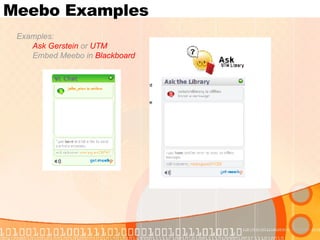
Meebo Examples Examples:  Ask Gerstein  or  UTM   Embed Meebo in  Blackboard
References 7 Things you Should Know About:  http://www.educause.edu/7ThingsYouShouldKnowAboutSeries/7495   Back to School with the Class of Web2.0, Part 3 by Brian Benzinger:  http://www.solutionwatch.com/519/back-to-school-with-the-class-of-web-20-part-3/   Blogs, Wikis, Podcasts and Other Powerful Web Tools for Classrooms by Will Richardson:  http://main.library.utoronto.ca/webcat/goto_catalogue_url.cfm?where=ckey&what=5816488   IM=FASTER Virtual Reference on the Cheap! By Rachel Singer Gordon and Michael Stephens:   http://simplelink.library.utoronto.ca/url.cfm/28503
References Cont’d Tags Help Make Libraries Del.icio.us by Melissa L. Rethlefsen :  http://www.libraryjournal.com/article/CA6476403.html Using Del.icio.us in Education by Gabriela Grosseck:  http://www.scribd.com/doc/212002/Using-delicious-In-Education   Using Flickr in the Classroom by David Jakes:   http://www.jakesonline.org/flickrinclassroom.pdf Web2.0 & Libraries: Best Practices for Social Software by Michael Stephens:   http://main.library.utoronto.ca/webcat/goto_catalogue_url.cfm?where = ckey&what =4182726

Communication and Collaboration: An Introduction to Web2.0

  • 1.
    Communication and Collaboration:An Introduction to Web2.0 November 27, 2007 Julie Hannaford [email_address] http://leo.oise.utoronto.ca/~jhannaford/USCWeb2.0.ppt
  • 2.
    What is Web2.0? Collaboration Exploration Experimentation Communication … Sites and tools that let you connect with others in a whole new way Innovative ways to reach our users
  • 3.
    Let’s Take aTour… Credit to paradigm4 – found on Flickr
  • 4.
    Social Bookmarking Whatit is: Tagging (adding keywords) websites, videos and photos, in a way that is meaningful to you Sharing those sites and tags with others Examples: http://del.icio.us or http:// diigo.com http:// www.youtube.com http:// flickr.com /
  • 5.
    del.icio.us Social bookmarking/taggingof websites Store favourites in ways that are meaningful to you – tag them AND bundle them Add people to your network; subscribe to tags that are of interest to you; search for others’ sites Example: search for: learning communities education
  • 6.
    diigo.com Similar todel.icio.us Lets you use additional features: Highlight content on a website that is of particular interest Add a sticky note with comments on a site Share your stored sites with others by forwarding them on Look at the group: Web2.0
  • 7.
    Examples and UsesIndividual tagging: Researching and storing of sites most relevant to individual user Building a learning community: Class chooses one tag and contributes to del.icio.us using that tag Class members can recommend sites to one another Creation of a class archive http://del.icio.us/chem130 Use for group work : Sharing and commenting on sites during collaborative research Provide links to useful sites for your users: Use del.icio.us to store your recommendations Thunder Bay Public Library
  • 8.
    Flickr Online sitethat allows you to upload photos/images Tag images, share photos with others and find images that you need Get permission – give credit Consider privacy/copyright issues Usage agreement: http://www.flickr.com/guidelines.gne Create groups: EFL/ESL Forum http://www.flickr.com/groups/utoronto/pool/ Scientist Photographers Flickr works with: fd’s flickr toys – display images in new ways Take Flickr code and place it into your blog or website, so that your photos are displayed
  • 9.
    Examples and UsesArt analysis: http://flickr.com/photos/ha112/901660/in/set-129006/ Allows for analysis of parts of the painting – use the ‘notes’ feature Allows student commenting to build a discussion Search for images to support presentations – an alternative to Google Images Virtual fieldtrips or any type of visual portfolio: http://www.flickr.com/photos/kbrigham/sets/72157601916114594/ Book displays: Clemens & Alcuin Book Displays Use Flickr toys to create promo materials for your library Upload photos of library events Allow commenting so that users can provide feedback Engage with your users Hennepin County Library: http://www.flickr.com/photos/hennepincountylibrary/ National Library of New Zealand: http://www.flickr.com/people/nationallibrarynz/
  • 10.
    Podcasting What isa podcast? “a multimedia file distributed over the Internet, using syndication feeds, for playback on mobile devices and personal computers” http:// en.wikipedia.org/wiki/Podcasts Some features: Can be audio or video Can be downloaded automatically using software capable of reading feed formats (like RSS) Subscribe to a feed, then each time a new clip is added, you are automatically updated with the newest episode Listen/watch podcasts via an iPod or other MP3 player or via a computer
  • 11.
    How to FindPodcasts iTunes Select Podcasts from the Music Store Subscribe via the Music Store iTunesU The Podcast Directory http://podcastalley.com University of Toronto uPodcast Project
  • 12.
    YouTube / VideoGoogle Service that allows users to upload videos that they would like to tag and share with others Could be an animation or footage that the user has captured him/herself The First Help Desk – very, very funny! Video Google is in beta – it has an ‘educational’ category for searching: http://video.google.com/videoadvancedsearch choose education as the ‘genre’
  • 13.
    Educational Examples Useto enhance visual literacy – it allows students to engage with video via creation, analysis, commentary Search for: university class projects Availability of class lectures: University of California, Berkeley has made 300 hours of lectures available: http://youtube.com/ucberkeley Engage in school life: http://youtube.com/school_main Tutorials: Formatting a Research Paper in APA Style: http://www.youtube.com/watch?v=reFXrhdvnmw
  • 14.
    Library Examples Librarytours: Ease your users’ comfort level with your environment: http:// www.youtube.com/watch?v =pS28qydjfsg http:// www.youtube.com/watch?v =Jv1r_JWEFAA Information Literacy: http:// www.youtube.com/watch?v =k-2hziLTSyU http:// www.youtube.com/watch?v =nik3pyJwaYI Make seminars/presentations available – reach a broader audience Kankakee Public Library SirsiDynix Institute In iTunes: Arizona State University Libraries – updated weekly
  • 15.
    Instant Messaging/Chat Lotsof different IM systems: MSN, AIM, Yahoo, Google Chat, etc. Need for an aggregator that will allow them to all work together Use free tools that allow chatting with library users or students regardless of which chat they have chosen: Meebo or Pidgin
  • 16.
    Meebo Examples Examples: Ask Gerstein or UTM Embed Meebo in Blackboard
  • 17.
    References 7 Thingsyou Should Know About: http://www.educause.edu/7ThingsYouShouldKnowAboutSeries/7495 Back to School with the Class of Web2.0, Part 3 by Brian Benzinger: http://www.solutionwatch.com/519/back-to-school-with-the-class-of-web-20-part-3/ Blogs, Wikis, Podcasts and Other Powerful Web Tools for Classrooms by Will Richardson: http://main.library.utoronto.ca/webcat/goto_catalogue_url.cfm?where=ckey&what=5816488 IM=FASTER Virtual Reference on the Cheap! By Rachel Singer Gordon and Michael Stephens: http://simplelink.library.utoronto.ca/url.cfm/28503
  • 18.
    References Cont’d TagsHelp Make Libraries Del.icio.us by Melissa L. Rethlefsen : http://www.libraryjournal.com/article/CA6476403.html Using Del.icio.us in Education by Gabriela Grosseck: http://www.scribd.com/doc/212002/Using-delicious-In-Education Using Flickr in the Classroom by David Jakes: http://www.jakesonline.org/flickrinclassroom.pdf Web2.0 & Libraries: Best Practices for Social Software by Michael Stephens: http://main.library.utoronto.ca/webcat/goto_catalogue_url.cfm?where = ckey&what =4182726