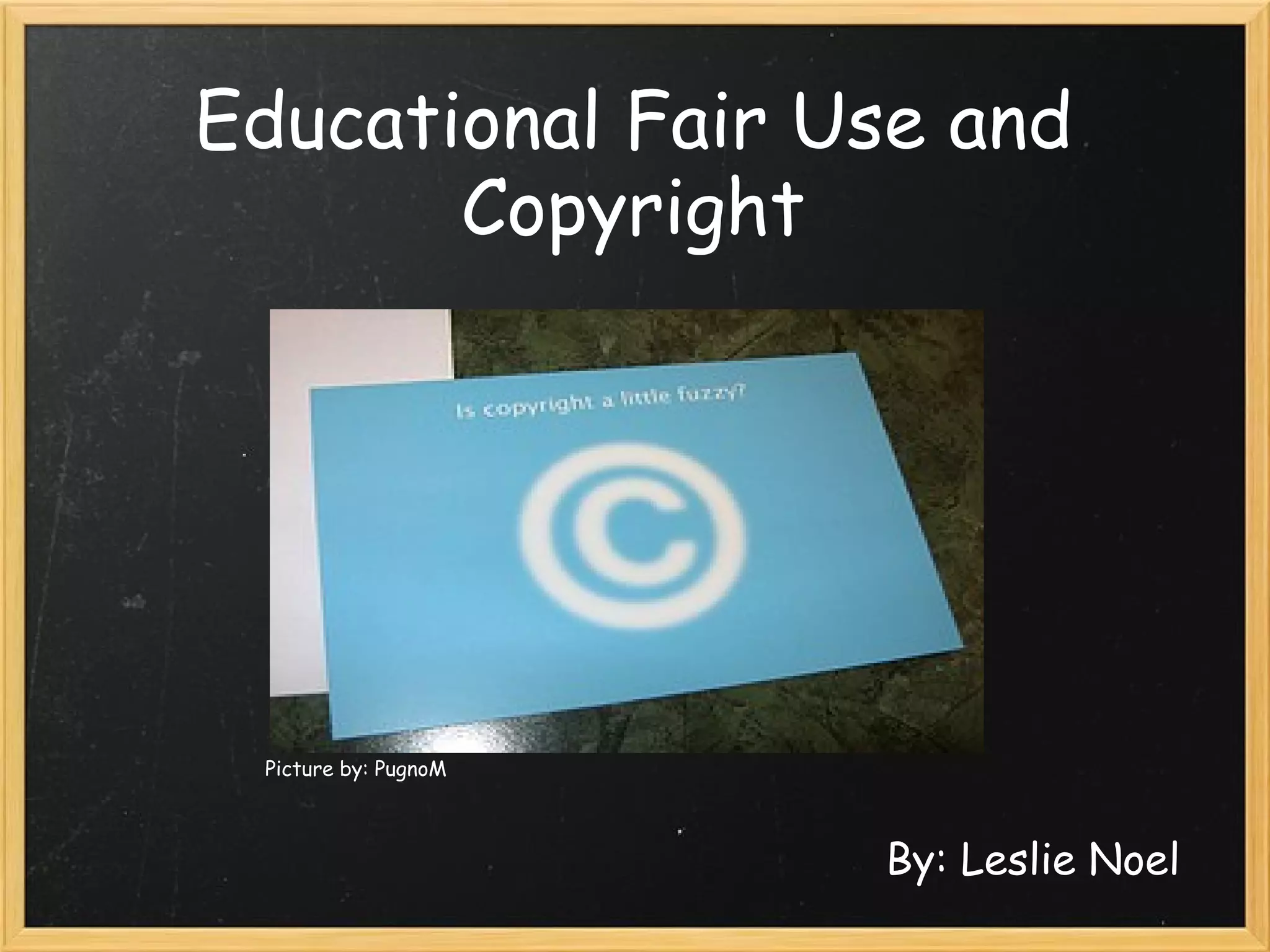
Educational Fair Use and Copyright By: Leslie Noel Picture by: PugnoM
Fair Use...  is the right to use copyrighted material without permission or payment under certain circumstances   is the most important element of the copyright laws in regards to user's rights upholds the first amendment   is situational Video by: centerforsocialmedia.org/medialiteracy
Code of Best Practices     The code was created to help educators using media literacy.  It identifies five principles in media literacy education where fair use can be applied.      The five principles were designed to guide your reasoning about copyright laws and fair use in education.
Five Principles Employing Copyrighted Material in Media Literacy Lessons Educators utilizing media literacy have the right to access materials from the full range of copyrighted sources and make them available to their students in an educational setting.
Five Principles 2. Employing Copyrighted Material in Preparing Curriculum Materials  Educators utilizing media literacy have the right to include copyrighted material into their curriculum.                              
Five Principles 3. Sharing Media Literacy Curriculum Materials  Educators utilizing media literacy should be able to share effective materials with each other.
Five Principles 4. Student Use of Copyrighted Materials in Their Own Academic and Creative Work  Educators utilizing media literacy should encourage students to use existing media material in their classwork.
Five Principles 5. Developing Audiences for Student Work  Educators utilizing media literacy should collaborate with their students to determine how widespread their work should be distributed.
Five Principles The five principles:     can be applied to all forms of media   can be applied to institutional settings and non-school based programs concern the unlicensed fair use of copyrighted materials for education, not the way those materials were acquired   are subject to the "rules of proportionality"
Additional Information For more information on “free use,” review  “Yes, You Can!"     Other professional codes for:  Documentary Filmmakers  Film Scholars Online Video Creators
Creative Commons non-profit organization provides free licenses to people for their creative works (photos, music, videos, drawings,stories, etc.) licenses allows an individuals works to be shared, edited, and expanded upon by the rest of the world    licenses covers everything that copyright laws cover   individuals can put conditions on how the public can use their creative works   six main licenses are available with four possible conditions to choose from
Creative Commons video by: Creative Commons
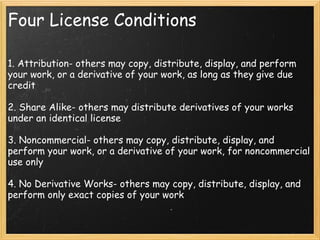
Four License Conditions 1. Attribution- others may copy, distribute, display, and perform your work, or a derivative of your work, as long as they give due credit    2. Share Alike- others may distribute derivatives of your works under an identical license    3. Noncommercial- others may copy, distribute, display, and perform your work, or a derivative of your work, for noncommercial use only    4. No Derivative Works- others may copy, distribute, display, and perform only exact copies of your work
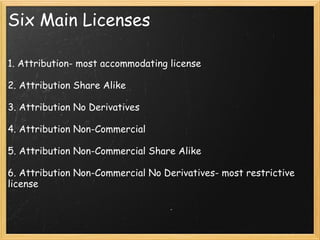
Six Main Licenses 1. Attribution- most accommodating license    2. Attribution Share Alike    3. Attribution No Derivatives   4. Attribution Non-Commercial   5. Attribution Non-Commercial Share Alike   6. Attribution Non-Commercial No Derivatives- most restrictive license

Educational Fair Use And Copyright

  • 1.
    Educational Fair Useand Copyright By: Leslie Noel Picture by: PugnoM
  • 2.
    Fair Use... is the right to use copyrighted material without permission or payment under certain circumstances   is the most important element of the copyright laws in regards to user's rights upholds the first amendment   is situational Video by: centerforsocialmedia.org/medialiteracy
  • 3.
    Code of BestPractices     The code was created to help educators using media literacy.  It identifies five principles in media literacy education where fair use can be applied.     The five principles were designed to guide your reasoning about copyright laws and fair use in education.
  • 4.
    Five Principles EmployingCopyrighted Material in Media Literacy Lessons Educators utilizing media literacy have the right to access materials from the full range of copyrighted sources and make them available to their students in an educational setting.
  • 5.
    Five Principles 2.Employing Copyrighted Material in Preparing Curriculum Materials Educators utilizing media literacy have the right to include copyrighted material into their curriculum.                              
  • 6.
    Five Principles 3.Sharing Media Literacy Curriculum Materials Educators utilizing media literacy should be able to share effective materials with each other.
  • 7.
    Five Principles 4.Student Use of Copyrighted Materials in Their Own Academic and Creative Work Educators utilizing media literacy should encourage students to use existing media material in their classwork.
  • 8.
    Five Principles 5.Developing Audiences for Student Work Educators utilizing media literacy should collaborate with their students to determine how widespread their work should be distributed.
  • 9.
    Five Principles Thefive principles:     can be applied to all forms of media   can be applied to institutional settings and non-school based programs concern the unlicensed fair use of copyrighted materials for education, not the way those materials were acquired   are subject to the "rules of proportionality"
  • 10.
    Additional Information Formore information on “free use,” review “Yes, You Can!"     Other professional codes for:  Documentary Filmmakers Film Scholars Online Video Creators
  • 11.
    Creative Commons non-profitorganization provides free licenses to people for their creative works (photos, music, videos, drawings,stories, etc.) licenses allows an individuals works to be shared, edited, and expanded upon by the rest of the world   licenses covers everything that copyright laws cover   individuals can put conditions on how the public can use their creative works   six main licenses are available with four possible conditions to choose from
  • 12.
    Creative Commons videoby: Creative Commons
  • 13.
    Four License Conditions1. Attribution- others may copy, distribute, display, and perform your work, or a derivative of your work, as long as they give due credit   2. Share Alike- others may distribute derivatives of your works under an identical license   3. Noncommercial- others may copy, distribute, display, and perform your work, or a derivative of your work, for noncommercial use only   4. No Derivative Works- others may copy, distribute, display, and perform only exact copies of your work
  • 14.
    Six Main Licenses1. Attribution- most accommodating license    2. Attribution Share Alike    3. Attribution No Derivatives   4. Attribution Non-Commercial   5. Attribution Non-Commercial Share Alike   6. Attribution Non-Commercial No Derivatives- most restrictive license