Engagement of private sector in
REDD+:
issues, opportunities and challenges
Marisa Camargo
University of Helsinki; Indufor
Isilda Nhantumbo - IIED

12/02/2014

World Agroforestry Congress
New Delhi, India

1
Introduction
• REDD+: No binding agreement, but
demonstration projects being tested on the
ground
• Is the PS engaged in demonstration projects?
• How did it acquire the right to develop and
transact credits?
• How is it sharing benefits with local
communities?
12/02/2014

World Agroforestry Congress
New Delhi, India
Who is the Private Sector?
• No agreed definition: OECD, UN, EU
• In this study:
– For-profit: e.g. corporations, foundations,
consulting companies, brokers
– Voluntary: NGOs

12/02/2014

World Agroforestry Congress
New Delhi, India

3
Importance of the PS
• Benefits of engaging PS include:
– help close the financial gap (limited public funds)
– has technical capacity to help implement REDD+ more
efficiently
– provide price incentives to stimulate investment in SFM;
– large size of investments = high potential for change

• Warsaw Framework for REDD+: 7 decisions
– Finance: ‘results based’, resources from public and private,
bilateral and multilateral entities including alternative sources

• But also risks… e.g. take land away from community
• Private sector engagement is central to successful REDD+…
if equity considerations are incorporated

12/02/2014

World Agroforestry Congress
New Delhi, India

4
Database
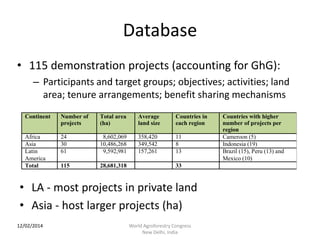
• 115 demonstration projects (accounting for GhG):
– Participants and target groups; objectives; activities; land
area; tenure arrangements; benefit sharing mechanisms
Continent

Number of
projects

Total area
(ha)

Average
land size

Countries in
each region

Africa
Asia
Latin
America
Total

24
30
61

8,602,069
10,486,268
9,592,981

358,420
349,542
157,261

11
8
13

115

28,681,318

33

• LA - most projects in private land
• Asia - host larger projects (ha)
12/02/2014

World Agroforestry Congress
New Delhi, India

Countries with higher
number of projects per
region
Cameroon (5)
Indonesia (19)
Brazil (15), Peru (13) and
Mexico (10)
Database
• Objectives: Reduce emissions
• Activities:
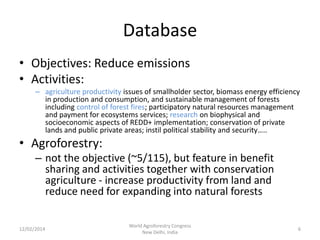
– agriculture productivity issues of smallholder sector, biomass energy efficiency
in production and consumption, and sustainable management of forests
including control of forest fires; participatory natural resources management
and payment for ecosystems services; research on biophysical and
socioeconomic aspects of REDD+ implementation; conservation of private
lands and public private areas; instil political stability and security…..

• Agroforestry:
– not the objective (~5/115), but feature in benefit
sharing and activities together with conservation
agriculture - increase productivity from land and
reduce need for expanding into natural forests

12/02/2014

World Agroforestry Congress
New Delhi, India

6
Database: actors
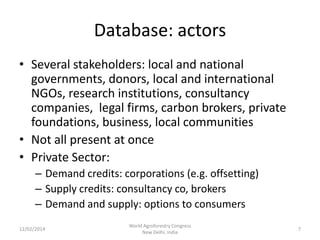
• Several stakeholders: local and national
governments, donors, local and international
NGOs, research institutions, consultancy
companies, legal firms, carbon brokers, private
foundations, business, local communities
• Not all present at once
• Private Sector:
– Demand credits: corporations (e.g. offsetting)
– Supply credits: consultancy co, brokers
– Demand and supply: options to consumers
12/02/2014

World Agroforestry Congress
New Delhi, India

7
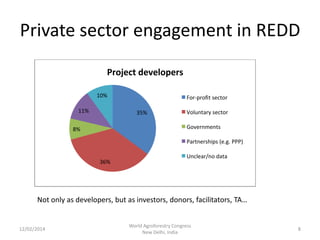
Private sector engagement in REDD
Project developers
10%
11%

For-profit sector
35%

Voluntary sector
Governments

8%

Partnerships (e.g. PPP)
36%

Unclear/no data

Not only as developers, but as investors, donors, facilitators, TA…

12/02/2014

World Agroforestry Congress
New Delhi, India

8
Rights: Who owns the carbon?

12/02/2014

World Agroforestry Congress
New Delhi, India

9
Rights: who owns the carbon?
• Carbon credit is a new commodity
• Countries are still building legal frameworks
– Who owns cc? Conditions to transfer rights

• Policy vacuum - developers are innovating:
– C interpreted as product of the forest, similar to wood,
non-wood, wildlife, so communities (as holders of these
rights) also hold rights to carbon
– Law defines - State owns all land and water including
subsoil resources, so they interpreted that, by default, the
State would also be the owner of carbon rights
– Governments - conservation concession borrowed from
forest concession which exists in the legal framework
12/02/2014

World Agroforestry Congress
New Delhi, India
Rights: who owns the carbon?
• Rights to carbon is not always discussed in
project documents
• Too risky?

12/02/2014

World Agroforestry Congress
New Delhi, India

11
Rights: who owns the carbon?
• REDD+ as an opportunity to fill the policy vacuum
with more equitable rules
• Inclusive legislation
– Encourage more private sector investment
– Ensure real community involvement and fair benefit
distribution

• After all…
– Project developers acknowledge that community
engagement is key to ensure sustainability to the
project – risk mitigation strategy – decreases
likelihood of leakage
12/02/2014

World Agroforestry Congress
New Delhi, India

12
Benefit Sharing:
how are communities engaged and
benefits distributed?

12/02/2014

World Agroforestry Congress
New Delhi, India

13
Community engagement
• Communities are involved in several ways:
– Decision making, employees, receivers of capacity

• Some projects: NO local community involvement
– driven by a private land owner
– NO people living in the area (and neighbor
communities will not be negatively impacted)
– Communities not integrated…

• Long-term pressure on land? Population growth?
Projects are in average (only) 30 years
12/02/2014

World Agroforestry Congress
New Delhi, India

14
Benefit Sharing
• Communities not always see a share of carbon
revenues - only 23%
• But project developers list several benefits:
– E.g. capacity building, employment opportunities,
introducing sustainable land management practices

• investment and costs incurred to secure
generation of carbon credits?
• Communities also contribute with labour to
ensure that carbon credits are generated
• What should we take into account when
partitioning the benefits?
12/02/2014

World Agroforestry Congress
New Delhi, India

15
Benefit Sharing
• Not so transparent…
– 16% give information on the share of the benefits
allocated to different stakeholders
– Out of the 115 projects, only 4 contracts available
– Peru project: list of preferential beneficiaries, but
the amounts allocated to each are confidential

12/02/2014

World Agroforestry Congress
New Delhi, India

16
Conclusions

12/02/2014

World Agroforestry Congress
New Delhi, India

17
Conclusions
• PS is an important player to help implement
REDD and design more inclusive legal
instruments
• However…. more transparency, accountability,
integration, FPIC should be promoted to
ensure the design of a more equitable and
sustainable system
• WIN-WIN solutions
12/02/2014

World Agroforestry Congress
New Delhi, India

18
Thank you!
Marisa Camargo
marisa.camargo@helsinki.fi

12/02/2014

World Agroforestry Congress
New Delhi, India

19
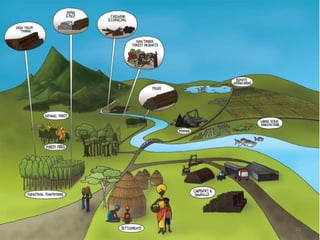
REDD+ in the landscape

12/02/2014

World Agroforestry Congress
New Delhi, India

20
21
REDD+ at landscape level
• No evidence that projects actively involve
businesses across sectors that are part of the
landscape driving the local economies
• Exclusion of stakeholders poses several risks:
– Increases competition and affects benefit sharing
– reduces the potentially higher cumulative impacts
– creates potential for leakage
– sustainability is tested
12/02/2014

World Agroforestry Congress
New Delhi, India

22
Inclusive REDD+
• Some elements of inclusive business models
– Mapping of all land users and uses within the
landscape;
– Conduct FPIC, including local communities but
also all other users (forest concessionaires, small
timber operators, mining companies, large scale
agriculture investments);
– design an intervention that brings the different
interests in a shareholding approach;
12/02/2014

World Agroforestry Congress
New Delhi, India

23

Session 6.1 Marissa camargo redd private sector

  • 1.
    Engagement of privatesector in REDD+: issues, opportunities and challenges Marisa Camargo University of Helsinki; Indufor Isilda Nhantumbo - IIED 12/02/2014 World Agroforestry Congress New Delhi, India 1
  • 2.
    Introduction • REDD+: Nobinding agreement, but demonstration projects being tested on the ground • Is the PS engaged in demonstration projects? • How did it acquire the right to develop and transact credits? • How is it sharing benefits with local communities? 12/02/2014 World Agroforestry Congress New Delhi, India
  • 3.
    Who is thePrivate Sector? • No agreed definition: OECD, UN, EU • In this study: – For-profit: e.g. corporations, foundations, consulting companies, brokers – Voluntary: NGOs 12/02/2014 World Agroforestry Congress New Delhi, India 3
  • 4.
    Importance of thePS • Benefits of engaging PS include: – help close the financial gap (limited public funds) – has technical capacity to help implement REDD+ more efficiently – provide price incentives to stimulate investment in SFM; – large size of investments = high potential for change • Warsaw Framework for REDD+: 7 decisions – Finance: ‘results based’, resources from public and private, bilateral and multilateral entities including alternative sources • But also risks… e.g. take land away from community • Private sector engagement is central to successful REDD+… if equity considerations are incorporated 12/02/2014 World Agroforestry Congress New Delhi, India 4
  • 5.
    Database • 115 demonstrationprojects (accounting for GhG): – Participants and target groups; objectives; activities; land area; tenure arrangements; benefit sharing mechanisms Continent Number of projects Total area (ha) Average land size Countries in each region Africa Asia Latin America Total 24 30 61 8,602,069 10,486,268 9,592,981 358,420 349,542 157,261 11 8 13 115 28,681,318 33 • LA - most projects in private land • Asia - host larger projects (ha) 12/02/2014 World Agroforestry Congress New Delhi, India Countries with higher number of projects per region Cameroon (5) Indonesia (19) Brazil (15), Peru (13) and Mexico (10)
  • 6.
    Database • Objectives: Reduceemissions • Activities: – agriculture productivity issues of smallholder sector, biomass energy efficiency in production and consumption, and sustainable management of forests including control of forest fires; participatory natural resources management and payment for ecosystems services; research on biophysical and socioeconomic aspects of REDD+ implementation; conservation of private lands and public private areas; instil political stability and security….. • Agroforestry: – not the objective (~5/115), but feature in benefit sharing and activities together with conservation agriculture - increase productivity from land and reduce need for expanding into natural forests 12/02/2014 World Agroforestry Congress New Delhi, India 6
  • 7.
    Database: actors • Severalstakeholders: local and national governments, donors, local and international NGOs, research institutions, consultancy companies, legal firms, carbon brokers, private foundations, business, local communities • Not all present at once • Private Sector: – Demand credits: corporations (e.g. offsetting) – Supply credits: consultancy co, brokers – Demand and supply: options to consumers 12/02/2014 World Agroforestry Congress New Delhi, India 7
  • 8.
    Private sector engagementin REDD Project developers 10% 11% For-profit sector 35% Voluntary sector Governments 8% Partnerships (e.g. PPP) 36% Unclear/no data Not only as developers, but as investors, donors, facilitators, TA… 12/02/2014 World Agroforestry Congress New Delhi, India 8
  • 9.
    Rights: Who ownsthe carbon? 12/02/2014 World Agroforestry Congress New Delhi, India 9
  • 10.
    Rights: who ownsthe carbon? • Carbon credit is a new commodity • Countries are still building legal frameworks – Who owns cc? Conditions to transfer rights • Policy vacuum - developers are innovating: – C interpreted as product of the forest, similar to wood, non-wood, wildlife, so communities (as holders of these rights) also hold rights to carbon – Law defines - State owns all land and water including subsoil resources, so they interpreted that, by default, the State would also be the owner of carbon rights – Governments - conservation concession borrowed from forest concession which exists in the legal framework 12/02/2014 World Agroforestry Congress New Delhi, India
  • 11.
    Rights: who ownsthe carbon? • Rights to carbon is not always discussed in project documents • Too risky? 12/02/2014 World Agroforestry Congress New Delhi, India 11
  • 12.
    Rights: who ownsthe carbon? • REDD+ as an opportunity to fill the policy vacuum with more equitable rules • Inclusive legislation – Encourage more private sector investment – Ensure real community involvement and fair benefit distribution • After all… – Project developers acknowledge that community engagement is key to ensure sustainability to the project – risk mitigation strategy – decreases likelihood of leakage 12/02/2014 World Agroforestry Congress New Delhi, India 12
  • 13.
    Benefit Sharing: how arecommunities engaged and benefits distributed? 12/02/2014 World Agroforestry Congress New Delhi, India 13
  • 14.
    Community engagement • Communitiesare involved in several ways: – Decision making, employees, receivers of capacity • Some projects: NO local community involvement – driven by a private land owner – NO people living in the area (and neighbor communities will not be negatively impacted) – Communities not integrated… • Long-term pressure on land? Population growth? Projects are in average (only) 30 years 12/02/2014 World Agroforestry Congress New Delhi, India 14
  • 15.
    Benefit Sharing • Communitiesnot always see a share of carbon revenues - only 23% • But project developers list several benefits: – E.g. capacity building, employment opportunities, introducing sustainable land management practices • investment and costs incurred to secure generation of carbon credits? • Communities also contribute with labour to ensure that carbon credits are generated • What should we take into account when partitioning the benefits? 12/02/2014 World Agroforestry Congress New Delhi, India 15
  • 16.
    Benefit Sharing • Notso transparent… – 16% give information on the share of the benefits allocated to different stakeholders – Out of the 115 projects, only 4 contracts available – Peru project: list of preferential beneficiaries, but the amounts allocated to each are confidential 12/02/2014 World Agroforestry Congress New Delhi, India 16
  • 17.
  • 18.
    Conclusions • PS isan important player to help implement REDD and design more inclusive legal instruments • However…. more transparency, accountability, integration, FPIC should be promoted to ensure the design of a more equitable and sustainable system • WIN-WIN solutions 12/02/2014 World Agroforestry Congress New Delhi, India 18
  • 19.
  • 20.
    REDD+ in thelandscape 12/02/2014 World Agroforestry Congress New Delhi, India 20
  • 21.
  • 22.
    REDD+ at landscapelevel • No evidence that projects actively involve businesses across sectors that are part of the landscape driving the local economies • Exclusion of stakeholders poses several risks: – Increases competition and affects benefit sharing – reduces the potentially higher cumulative impacts – creates potential for leakage – sustainability is tested 12/02/2014 World Agroforestry Congress New Delhi, India 22
  • 23.
    Inclusive REDD+ • Someelements of inclusive business models – Mapping of all land users and uses within the landscape; – Conduct FPIC, including local communities but also all other users (forest concessionaires, small timber operators, mining companies, large scale agriculture investments); – design an intervention that brings the different interests in a shareholding approach; 12/02/2014 World Agroforestry Congress New Delhi, India 23

Editor's Notes

  • #3 Discuss PS engagement in REDD+
  • #4 The early engagement of the private sector in climate change mitigation and adaptation efforts is fundamental in demonstrating how the sector can draw upon its market-based knowledge in financing risks and venture into reducing emissions endeavours as providers/suppliers, buyers, or investors
  • #5 Warsaw further consolidate the assumption that private sector engagement is central to successful REDD+. think we should highlight the risks as well. the issue of taking land away from local people - expanding the notion of conservation beyond biodiversity to include carbon credits. This is what is being done in countries like DRC where 'conservation concessions' for carbon stocks are introduced in the contractsthe issue of benefit sharing- who implement the emissions reducing activities and who decides what to pay
  • #6 In order to understand the extent of involvement of private sector engagement in implementation of REDD+ we constructed a database of projects in Africa, Asia and Latin America and analysed who are the payers, their objectives, key issues addressed by the projects, target groups or participants, tenure arrangements and benefit sharing mechanisms. In order to get a better understanding of the legal and institutional context of engagement of private sector in REDD+ implementation, a case study of DRC is discussed in some detail, particularly in regards the legal provisions for tenure and benefit distribution in the for-profit private sector REDD+ projects.
  • #7  would say that agroforestry features together with conservation agriculture as the technological change that will increase productivity from land and reduce need for expanding into natural forests
  • #11 and governments - for example the use of the notion of conservation concession is borrowed from forest concession which exists in the current legal framework
  • #16 hese are considered benefits by project developers, but in effect they are investment and costs incurred to secure generation of carbon credits; communities also contribute by foregoing land uses and labour to ensure that carbon credits are generated; however, the latter does not seem to enter the accounts. the result is overinflating the benefits to communities.
  • #22 The implementation of REDD+ by the private sector is done in large areas (up to 4.4 million ha as shows previously in Table 1), hence covering large landscapes and jurisdictions (Figure 1). Inevitably this encompasses several sectoral (forest) and extra-sectoral activities (agriculture, energy, industry, infrastructure, mining), undertaken by large and small scale entrepreneurs. The boundaries of private sector REDD+ are within this complex environment. Irrespective of the wide range of stated project aims, the overarching objective is to generate carbon credits for performance based payments through implementation of sustainability practices