India’s Policy towards REDD+:
     Dense Forest Ahead!


       Sharachchandra Lele
             Senior Fellow
 Centre for Environment & Development
                 ATREE
India’s official attraction to REDD+

• REDD+ will be a just reward for India’s
  forest conservation efforts that
  benefit the globe

• REDD+ will generate large economic
  benefits (3 billion USD over 3 decades)

• These benefits will be passed on to
  forest protecting communities, leading
  to poverty alleviation
How should we evaluate REDD+?


• Climate effectiveness
• Fairness (international, internal)
• Benefits must exceed opportunity costs
• Poverty alleviation
• Impact on biodiversity & other
  environmental concerns
• Impact on democratic processes
Two variants of REDD+ funding
• Funded by donor agencies:
  – no CERs given in return, so no loss of our ‘low
    hanging fruit’, “free” money
  – Similar to previous ‘forestry sector’ projects: can
    add other conditions (biodiv, poverty)
• Funded by carbon market:
  – CERs given in return, deducted from national cap,
    hence not “free”
  – Strictly market transaction, hard to impose
    other considerations
• Which one will prevail?
  – Free version only at pilot stage
  – Only carbon market can provide the big money
Two variants of REDD+ structure

• Fully market-based: individual buyers
  contract with individual sellers
  (communities)
• Partially market-based: individual buyers
  contract with governments, who then
  pass on the returns to individual
  communities
• 2nd version will prevail because of
  leakage issue.
• For the community: not market-based
  (no competition amongst buyers)
Climate effectiveness
• Potential of REDD = Contribution of
  Deforestation/Degradation to GHG emissions =
  17% (assuming there is enough money to prevent
  all of this!)

• Potential of REDD’+’ = How much additional
  reforestation /growth is feasible, how much GHG
  reductions from that, and how much it will cost
   – Large uncertainties about growth rates of
     natural forests
   – Large uncertainties about area ‘available’:
     • 75 Mha of wastelands is myth
  – Cross-sectoral leakages cannot be stopped (e.g.,
    LPG instead of firewood)
  – Opportunity cost is not zero, not even $5/tC (see
    below)
Poverty alleviation requirements

•   Gross returns must be high
•   Opportunity costs must be low
•   Transaction costs must be low
•   Returns must go to local communities
•   Returns must go preferentially into the
    hands of the poor within local
    communities
Gross returns: what are buyers
           willing to pay?
• ‘Free’ version:
  – Donors will continue to see this as
    ‘additional’, ‘incentive’, and not paying for
    30 yrs: maybe Rs.15000/ha one time
• Carbon market:
  – DOES NOT EXIST
  – Will only exist if there is a global
    agreement
  – High prices only if global agreement is
    sufficiently onerous
  – Onerous agreement: implications for
    India?
Gross returns & transaction costs

• Quantum of gross returns from carbon
  forestry:
  – $50/tC amounts to only Rs 2000/ha/yr
    for the growing period (say 50 years)
  – Typical forest area available: 100 hhs
    has 100 ha (!), each hh gets Rs 2000/yr

• Transaction costs (Negotiating, Contracting,
  MONITORING!, implementing, paying)
  – Could be as much as 50% of final price (at low
    prices)
Opportunity costs

• “Degraded” forests are often highly
  productive secondary forests
  – Forest-based incomes: Rs.2,000-
    Rs.12,000/hh/yr
     • JFMCs of WBengal: 1,100-5,500 Rs/ha/yr
  – large fraction: grazing & firewood
    collection
• ‘Regeneration’ is typically done through
  closure
• So “reforestation” or “forest
  regeneration” involves substantial
  opportunity costs for local users
Conditions for
      “To the hands of the poor”
• Villagers must fully control forest
  carbon resource and its marketing
• Within village, marginalised groups must
  have strong say within village
• Poor must have capacity to make long-
  term investments, absorb opp.costs,
  engage with technicalities
• CDM on private lands must not swamp
  REDD+ on community lands
To the hands of the poor:
            Indian situation
• Rights of village community not legallly
  defined/granted (vis-à-vis state, vis-à-vis
  neighbouring community)
   – JFM does not provide for autonomous decision-
     making
   – CFR provisions of FRA not implemented
   – Full rights not clarified (e.g., timber, other
     services)
• Danger of elite capture, exacerbated by JFM
• Paternalistic state control => no local capacity
  (e.g., NTFP)
• Rich farmers will always out-compete through
  CDM (e.g., biofuels)
International equity

• What is ‘fair compensation’ for India’s
  contribution to mitigation?

  – Rights-based answer

  – Market economics answer

• We are not anywhere close to either
Democratic governance

• Current state of forest governance
  highly undemocratic
• State-managed (non-market) REDD+
  only strengthens centralisation
• Market-based REDD+, in absence of
  community-level autonomy, does not
  work
• Either way: governance reform is strong
  pre-condition
Impact of biodiversity conservation
  and other environmental benefits
• Carbon forestry is not intrinsically
  biodiversity friendly: fast growing tree
  plantations are best for carbon
• Carbon forestry can also have mixed
  effects on hydrological cycle
• If one adopts mixed forestry or native
  species, biodiv increases, but
  sequestration rates go down, $$ go
  down
Summary
• REDD+ bound to be market-based
• Market does not exist, requires prior
  assignment of carbon rights
• Conditions for markets to work in a poverty-
  reducing manner do not exist:
  – No property rights to the poor
  – No sign of high returns that compensate for
    opportunity costs
  – No pro-poor institutional structures in place
• Tradeoffs with other ecosystem services also
  significant
• Democratic governance to make transparent
  trade-off decisions not in place
Recommendations

• Enormous caution required
• Engagement in REDD+ itself is
  questionable
• Forest rights and governance reform
  should be absolute pre-condition (for
  non-market or market-based)
• Post-FRA, local capacities for
  democratic decision-making and market
  engagement need strengthening
Shyamsunder & Reddy (IFS)

• Mean annual increment of India’s
  forests is 0.5 t/ha/yr
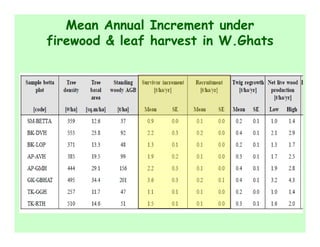
Mean Annual Increment under
firewood & leaf harvest in W.Ghats

Sharachchandra, L. (2011) India’s Policy towards REDD+: Dense Forest Ahead!

  • 1.
    India’s Policy towardsREDD+: Dense Forest Ahead! Sharachchandra Lele Senior Fellow Centre for Environment & Development ATREE
  • 2.
    India’s official attractionto REDD+ • REDD+ will be a just reward for India’s forest conservation efforts that benefit the globe • REDD+ will generate large economic benefits (3 billion USD over 3 decades) • These benefits will be passed on to forest protecting communities, leading to poverty alleviation
  • 3.
    How should weevaluate REDD+? • Climate effectiveness • Fairness (international, internal) • Benefits must exceed opportunity costs • Poverty alleviation • Impact on biodiversity & other environmental concerns • Impact on democratic processes
  • 4.
    Two variants ofREDD+ funding • Funded by donor agencies: – no CERs given in return, so no loss of our ‘low hanging fruit’, “free” money – Similar to previous ‘forestry sector’ projects: can add other conditions (biodiv, poverty) • Funded by carbon market: – CERs given in return, deducted from national cap, hence not “free” – Strictly market transaction, hard to impose other considerations • Which one will prevail? – Free version only at pilot stage – Only carbon market can provide the big money
  • 5.
    Two variants ofREDD+ structure • Fully market-based: individual buyers contract with individual sellers (communities) • Partially market-based: individual buyers contract with governments, who then pass on the returns to individual communities • 2nd version will prevail because of leakage issue. • For the community: not market-based (no competition amongst buyers)
  • 6.
    Climate effectiveness • Potentialof REDD = Contribution of Deforestation/Degradation to GHG emissions = 17% (assuming there is enough money to prevent all of this!) • Potential of REDD’+’ = How much additional reforestation /growth is feasible, how much GHG reductions from that, and how much it will cost – Large uncertainties about growth rates of natural forests – Large uncertainties about area ‘available’: • 75 Mha of wastelands is myth – Cross-sectoral leakages cannot be stopped (e.g., LPG instead of firewood) – Opportunity cost is not zero, not even $5/tC (see below)
  • 7.
    Poverty alleviation requirements • Gross returns must be high • Opportunity costs must be low • Transaction costs must be low • Returns must go to local communities • Returns must go preferentially into the hands of the poor within local communities
  • 8.
    Gross returns: whatare buyers willing to pay? • ‘Free’ version: – Donors will continue to see this as ‘additional’, ‘incentive’, and not paying for 30 yrs: maybe Rs.15000/ha one time • Carbon market: – DOES NOT EXIST – Will only exist if there is a global agreement – High prices only if global agreement is sufficiently onerous – Onerous agreement: implications for India?
  • 9.
    Gross returns &transaction costs • Quantum of gross returns from carbon forestry: – $50/tC amounts to only Rs 2000/ha/yr for the growing period (say 50 years) – Typical forest area available: 100 hhs has 100 ha (!), each hh gets Rs 2000/yr • Transaction costs (Negotiating, Contracting, MONITORING!, implementing, paying) – Could be as much as 50% of final price (at low prices)
  • 10.
    Opportunity costs • “Degraded”forests are often highly productive secondary forests – Forest-based incomes: Rs.2,000- Rs.12,000/hh/yr • JFMCs of WBengal: 1,100-5,500 Rs/ha/yr – large fraction: grazing & firewood collection • ‘Regeneration’ is typically done through closure • So “reforestation” or “forest regeneration” involves substantial opportunity costs for local users
  • 11.
    Conditions for “To the hands of the poor” • Villagers must fully control forest carbon resource and its marketing • Within village, marginalised groups must have strong say within village • Poor must have capacity to make long- term investments, absorb opp.costs, engage with technicalities • CDM on private lands must not swamp REDD+ on community lands
  • 12.
    To the handsof the poor: Indian situation • Rights of village community not legallly defined/granted (vis-à-vis state, vis-à-vis neighbouring community) – JFM does not provide for autonomous decision- making – CFR provisions of FRA not implemented – Full rights not clarified (e.g., timber, other services) • Danger of elite capture, exacerbated by JFM • Paternalistic state control => no local capacity (e.g., NTFP) • Rich farmers will always out-compete through CDM (e.g., biofuels)
  • 13.
    International equity • Whatis ‘fair compensation’ for India’s contribution to mitigation? – Rights-based answer – Market economics answer • We are not anywhere close to either
  • 14.
    Democratic governance • Currentstate of forest governance highly undemocratic • State-managed (non-market) REDD+ only strengthens centralisation • Market-based REDD+, in absence of community-level autonomy, does not work • Either way: governance reform is strong pre-condition
  • 15.
    Impact of biodiversityconservation and other environmental benefits • Carbon forestry is not intrinsically biodiversity friendly: fast growing tree plantations are best for carbon • Carbon forestry can also have mixed effects on hydrological cycle • If one adopts mixed forestry or native species, biodiv increases, but sequestration rates go down, $$ go down
  • 16.
    Summary • REDD+ boundto be market-based • Market does not exist, requires prior assignment of carbon rights • Conditions for markets to work in a poverty- reducing manner do not exist: – No property rights to the poor – No sign of high returns that compensate for opportunity costs – No pro-poor institutional structures in place • Tradeoffs with other ecosystem services also significant • Democratic governance to make transparent trade-off decisions not in place
  • 17.
    Recommendations • Enormous cautionrequired • Engagement in REDD+ itself is questionable • Forest rights and governance reform should be absolute pre-condition (for non-market or market-based) • Post-FRA, local capacities for democratic decision-making and market engagement need strengthening
  • 19.
    Shyamsunder & Reddy(IFS) • Mean annual increment of India’s forests is 0.5 t/ha/yr
  • 20.
    Mean Annual Incrementunder firewood & leaf harvest in W.Ghats