REDD‌+: Opportunities and
challenges
HK Laudari
MoFE, Nepal
Outline of presentation
•Background
•Stages/phases of REDD+
•Opportunities
•Issues and challenges
•Conclusion
Background
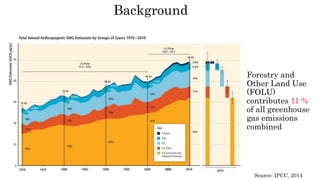
Forestry and
Other Land Use
(FOLU)
contributes 11 %
of all greenhouse
gas emissions
combined
Source: IPCC, 2014
Background
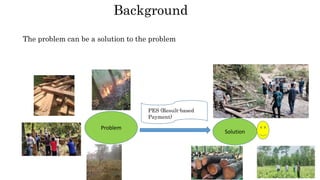
The problem can be a solution to the problem
Problem
Solution
PES (Result-based
Payment)
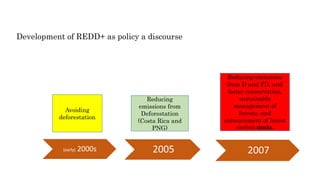
Development of REDD+ as policy a discourse
(early) 2000s 2005 2007
Avoiding
deforestation
Reducing
emissions from
Deforestation
(Costa Rica and
PNG)
Reducing emissions
from D and FD, and
foster conservation,
sustainable
management of
forests, and
enhancement of forest
carbon stocks.
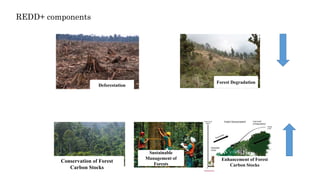
REDD+ components
Deforestation
Forest Degradation
Conservation of Forest
Carbon Stocks
Sustainable
Management of
Forests
Enhancement of Forest
Carbon Stocks
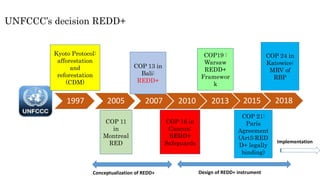
UNFCCC’s decision REDD+
1997 2005 2007 2010 2013 2015 2018
Kyoto Protocol:
afforestation
and
reforestation
(CDM)
COP 11
in
Montreal
RED
COP 13 in
Bali:
REDD+
COP 16 in
Cancun:
REDD+
Safeguards
COP19 :
Warsaw
REDD+
Framewor
k
COP 21:
Paris
Agreement
(Art5:RED
D+ legally
binding)
COP 24 in
Katowice:
MRV of
RBP
Conceptualization of REDD+ Design of REDD+ instrument
Implementation
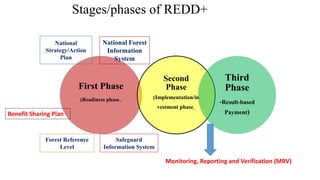
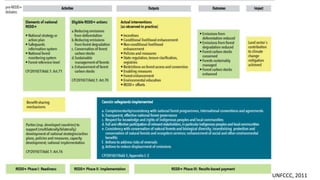
First Phase
(Readiness phase_
Second
Phase
(Implementation/in
vestment phase_
Third
Phase
-Result-based
Payment)
Monitoring, Reporting and Verification (MRV)
National
Strategy/Action
Plan
Forest Reference
Level
National Forest
Information
System
Safeguard
Information System
Stages/phases of REDD+
Benefit Sharing Plan
UNFCCC, 2011
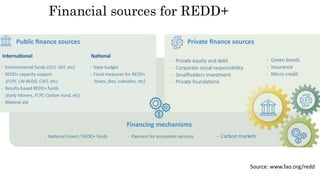
Financial sources for REDD+
Source: www.fao.org/redd
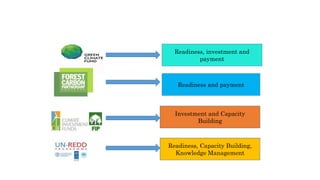
Readiness, investment and
payment
Readiness and payment
Investment and Capacity
Building
Readiness, Capacity Building,
Knowledge Management
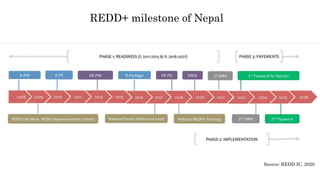
REDD+ milestone of Nepal
Source: REDD IC, 2020
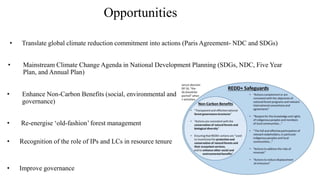
Opportunities
• Mainstream Climate Change Agenda in National Development Planning (SDGs, NDC, Five Year
Plan, and Annual Plan)
• Translate global climate reduction commitment into actions (Paris Agreement- NDC and SDGs)
• Enhance Non-Carbon Benefits (social, environmental and
governance)
• Re-energise ‘old-fashion’ forest management
• Recognition of the role of IPs and LCs in resource tenure
• Improve governance
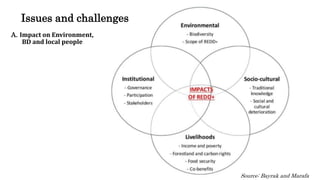
A. Impact on Environment,
BD and local people
Source: Bayrak and Marafa
Issues and challenges
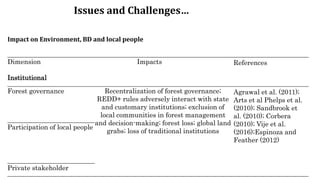
Dimension
Institutional
Impacts References
Forest governance Recentralization of forest governance;
REDD+ rules adversely interact with state
and customary institutions; exclusion of
local communities in forest management
and decision-making; forest loss; global land
grabs; loss of traditional institutions
Agrawal et al. (2011);
Arts et al Phelps et al.
(2010); Sandbrook et
al. (2010); Corbera
(2010); Vije et al.
(2016);Espinoza and
Feather (2012)
Participation of local people
Private stakeholder
Issues and Challenges…
Impact on Environment, BD and local people
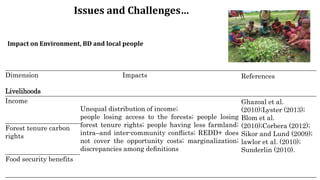
Dimension
Livelihoods
Impacts References
Income
Unequal distribution of income;
people losing access to the forests; people losing
forest tenure rights; people having less farmland;
intra–and inter-community conflicts; REDD+ does
not cover the opportunity costs; marginalization;
discrepancies among definitions
Ghazoal et al.
(2010);Lyster (2013);
Blom et al.
(2010);Corbera (2012);
Sikor and Lund (2009);
lawlor et al. (2010);
Sunderlin (2010).
Forest tenure carbon
rights
Food security benefits
Issues and Challenges…
Impact on Environment, BD and local people
Dimension Impacts References
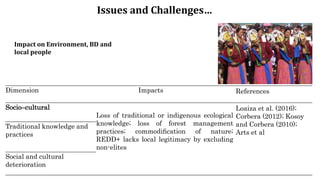
Socio–cultural
Loss of traditional or indigenous ecological
knowledge; loss of forest management
practices; commodification of nature;
REDD+ lacks local legitimacy by excluding
non-elites
Loaiza et al. (2016);
Corbera (2012); Kosoy
and Corbera (2010);
Arts et al
Traditional knowledge and
practices
Social and cultural
deterioration
Impact on Environment, BD and
local people
Issues and Challenges…
Dimension Impacts References
Environmental Introducing mono tree plantations and
high-carbon production forests; more
pressure on land outside REDD+ forests;
threat to ecosystems with high biodiversity
but low carbon sequestration
Agrawal et al. (2011);
Sandbrook et al. (2010);
Reed (2011); Huettner
(2012); Panfil and
Harvey (2016)Biodiversity Scope of REDD+
Impact on Environment, BD and local people
Issues and Challenges…
• Donor funding is not enough and is vulnerable to political fluctuations
The world needs USD 15 billion per year, compared to the USD 1–2 billion currently available (Norman and Nakhooda 2014).
Issues and challenges of REDD+
B. Financing for REDD+
• Readiness funding is drying up, so newcomers face more funding challenges
UNREDD and FCPF are closing soon and FIP of CIF is facing potential deficit, GCF (no dedicated fund for REDD+)
• The private sectors are less attractive
Many risks involved, e.g., lack of tenure security, carbon rights and law enforcement.
• Communities are filling the funding gap without being acknowledged
A high proportion of villages (62%) and subnational institutions (40%) carry significant implementation costs without receiving any monetary
benefits (Luttrell et al. 2016).
Source: Atmadja et al. 2018
• What to pay for?
Input (Capacity development, data colln, Monitoring or reporting) Or Output (actual emission reduction); Or Carbon or Non-
carbon benefits;
Issues and challenges ..
C. Results-based payment
• How to set reference level? (RL=AE (R)-RL)
No scientific consensus on appropriate methodology (time period and Driver of D&FD factors)
• Whom to pay?
legal land right holders, low emitting forest stewards, cost-bearing for implementation, facilitator for implementation,
poorest group, contributor to emission reduction (BSP)
Source: Angelsen et al. 2018
• Full implementation cost vs opportunity cost
• Capacity Development, Law enforcement, MRV, Transaction cost, Coordination
Issues and challenges ..
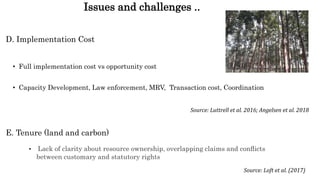
D. Implementation Cost
Source: Luttrell et al. 2016; Angelsen et al. 2018
E. Tenure (land and carbon)
• Lack of clarity about resource ownership, overlapping claims and conflicts
between customary and statutory rights
Source: Loft et al. (2017)
Issues and challenges ..
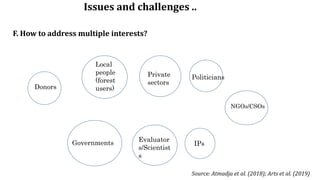
F. How to address multiple interests?
Source: Atmadja et al. (2018); Arts et al. (2019)
Local
people
(forest
users)
Politicians
Evaluator
s/Scientist
s
IPsGovernments
Private
sectors
Donors
NGOs/CSOs
Issues and challenges ..
G. Strengthening MRV System
Source: Ochieng et al. (2016); Ochieng et al. (2018)
• Institutionalization and localization of MRV system (NFI, emission factors,
finance…)
• Good governance (leakage, reversal, double-counting, addressing D and FD, role and
responsibility for undertaking MRV)
• Administrative capacity of national authority (database management
and reporting)
Conclusion
• Implementing REDD+ has both opportunities and challenges
• Whole series of interventions need to be rolled out beyond forest
boundary
• Capacity Development and Coordination
• A positive narrative: Forests contribute to economic development and
climate goals
References
• Luttrell C, Sills E, Aryani R, Ekaputri AD and Evnike MF. 2016. Who will bear the cost of REDD+? Evidence from subnational REDD+ initiatives. Working Paper
204. Bogor, Indonesia: CIFOR.
• Intergovernmental Panel on Climate Change (IPCC). 2000. Land use, land-use change and forestry. Special report. Cambridge, UK, Cambridge University Press
• Bayrak, M.M. and Marafa, L.M., 2016. Ten years of REDD+: A critical review of the impact of REDD+ on forest-dependent communities. Sustainability, 8(7), p.620.
• Huettner, M., 2012. Risks and opportunities of REDD+ implementation for environmental integrity and socio-economic compatibility. Environmental science &
policy, 15(1), pp.4-12.
• Reed, P., 2011. REDD+ and the indigenous question: a case study from Ecuador. Forests, 2(2), pp.525-549.
• Sandbrook, C., Nelson, F., Adams, W.M. and Agrawal, A., 2010. Carbon, forests and the REDD paradox. Oryx, 44(3), pp.330-334
• Agrawal, A., Nepstad, D. and Chhatre, A., 2011. Reducing emissions from deforestation and forest degradation. Annual Review of Environment and Resources, 36,
pp.373-396.
• Panfil, S.N. and Harvey, C.A., 2016. REDD+ and biodiversity conservation: A review of the biodiversity goals, monitoring methods, and impacts of 80 REDD+
projects. Conservation Letters, 9(2), pp.143-150
• Kosoy, N. and Corbera, E., 2010. Payments for ecosystem services as commodity fetishism. Ecological economics, 69(6), pp.1228-1236.
• Corbera, E., 2012. Problematizing REDD+ as an experiment in payments for ecosystem services. Current Opinion in Environmental Sustainability, 4(6), pp.612-619
• Loaiza, T., Nehren, U. and Gerold, G., 2016. REDD+ implementation in the Ecuadorian Amazon: Why land configuration and common-pool resources management
matter. Forest Policy and Economics, 70, pp.67-79.
• Ghazoul, J., Butler, R.A., Mateo-Vega, J. and Koh, L.P., 2010. REDD: a reckoning of environment and development implications. Trends in ecology & evolution, 25(7),
pp.396-402.
• Lyster, R., 2013. International Legal Frameworks for REDD: Ensuring Legitimacy. LAW, TROPICAL FORESTS AND CARBON: THE CASE OF REDD+, R. Lyster,
C. MacKenzie & C. McDermott, eds., Cambridge University Press: United Kingdom, pp.3-25.
• Blom, B., Sunderland, T. and Murdiyarso, D., 2010. Getting REDD to work locally: lessons learned from integrated conservation and development
projects. Environmental science & policy, 13(2), pp.164-172
• Sikor, T. and Lund, C., 2009. Access and property: a question of power and authority. Development and change, 40(1), pp.1-22.
References
• Luttrell C, Sills E, Aryani R, Ekaputri AD and Evnike MF. 2016. Who will bear the cost of REDD+? Evidence from subnational REDD+ initiatives. Working
Paper 204. Bogor, Indonesia: CIFOR.
• Lawlor, K.; Weinthal, E.; Olander, L. 2010. Institutions and policies to protect rural livelihoods in REDD+ regimes. Global Environ. Polit 10 (1–11).
• Sunderlin, W. Tenure 2010: What will REDD+ mean for forest communities? In Tenure in REDD+—Start-Point or Afterthought?; Cotula, L., Mayers, J., Eds.;
Natural Resource Issues No. 15; International Institute for Environment and Development: London, UK,
• Agrawal, A., Nepstad, D. and Chhatre, A., 2011. Reducing emissions from deforestation and forest degradation. Annual Review of Environment and
Resources, 36, pp.373-396.
• Phelps, J., Webb, E.L. and Agrawal, A., 2010. Does REDD+ threaten to recentralize forest governance?. Science, 328(5976), pp.312-313.
• Sandbrook, C., Nelson, F., Adams, W.M. and Agrawal, A., 2010. Carbon, forests and the REDD paradox. Oryx, 44(3), pp.330-334.
• Vijge, M.J., Brockhaus, M., Di Gregorio, M. and Muharrom, E., 2016. Framing national REDD+ benefits, monitoring, governance and finance: A comparative
analysis of seven countries. Global Environmental Change, 39, pp.57-68.
• Espinoza, L. and Feather, C., 2012. The reality of REDD+ in Peru: between theory and practice. Indigenous Amazonian Peoples' analyses and alternatives. The
reality of REDD+ in Peru: between theory and practice. Indigenous Amazonian Peoples' analyses and alternatives.
• Arts, B., Ingram, V. and Brockhaus, M., 2019. The Performance of REDD+: From Global Governance to Local Practices. Forests. 10. pp 837.
• Angelsen A, Martius C, De Sy V, Duchelle AE, Larson AM and Pham TT (eds). 2018. Transforming REDD+: Lessons and new directions. Bogor, Indonesia:
CIFOR.
• Atmadja, S., Arwida, S.D., Martius, C. and Pham, T.T., 2018. Financing REDD+: A transaction among equals, or an uneven playing field?. In Transforming
REDD+: Lessons and new directions. Center for International Forestry Research (CIFOR), Bogor, Indonesia.
• Ochieng, R.M., Visseren-Hamakers, I.J., Arts, B., Brockhaus, M. and Herold, M., 2016. Institutional effectiveness of REDD+ MRV: Countries progress in
implementing technical guidelines and good governance requirements. Environmental Science & Policy, 61, pp.42-52.
• IPCC, 2014: Summary for Policymakers. In: Climate Change 2014: Mitigation of Climate Change. Contribution of Working Group III to the Fifth Assessment
Report of the Intergovernmental Panel on Climate Change [Edenhofer, O., R. Pichs-Madruga, Y. Sokona, E. Farahani, S. Kadner, K. Seyboth, A. Adler, I. Baum,
S. Brunner, P. Eickemeier, B. Kriemann, J. Savolainen, S. Schlömer, C. von Stechow, T. Zwickel and J.C. Minx (eds.)]. Cambridge University Press, Cambridge,
United Kingdom and New York, NY, USA.
• Loft, L., Pham, T.T., Wong, G.Y., Brockhaus, M., Le, D.N., Tjajadi, J.S. and Luttrell, C., 2017. Risks to REDD+: potential pitfalls for policy design and
implementation. Environmental Conservation, 44(1), pp.44-55.

REDD+: Opportunties and Challenges

  • 1.
  • 2.
    Outline of presentation •Background •Stages/phasesof REDD+ •Opportunities •Issues and challenges •Conclusion
  • 3.
    Background Forestry and Other LandUse (FOLU) contributes 11 % of all greenhouse gas emissions combined Source: IPCC, 2014
  • 4.
    Background The problem canbe a solution to the problem Problem Solution PES (Result-based Payment)
  • 5.
    Development of REDD+as policy a discourse (early) 2000s 2005 2007 Avoiding deforestation Reducing emissions from Deforestation (Costa Rica and PNG) Reducing emissions from D and FD, and foster conservation, sustainable management of forests, and enhancement of forest carbon stocks.
  • 6.
    REDD+ components Deforestation Forest Degradation Conservationof Forest Carbon Stocks Sustainable Management of Forests Enhancement of Forest Carbon Stocks
  • 7.
    UNFCCC’s decision REDD+ 19972005 2007 2010 2013 2015 2018 Kyoto Protocol: afforestation and reforestation (CDM) COP 11 in Montreal RED COP 13 in Bali: REDD+ COP 16 in Cancun: REDD+ Safeguards COP19 : Warsaw REDD+ Framewor k COP 21: Paris Agreement (Art5:RED D+ legally binding) COP 24 in Katowice: MRV of RBP Conceptualization of REDD+ Design of REDD+ instrument Implementation
  • 8.
    First Phase (Readiness phase_ Second Phase (Implementation/in vestmentphase_ Third Phase -Result-based Payment) Monitoring, Reporting and Verification (MRV) National Strategy/Action Plan Forest Reference Level National Forest Information System Safeguard Information System Stages/phases of REDD+ Benefit Sharing Plan
  • 9.
  • 10.
    Financial sources forREDD+ Source: www.fao.org/redd
  • 11.
    Readiness, investment and payment Readinessand payment Investment and Capacity Building Readiness, Capacity Building, Knowledge Management
  • 12.
    REDD+ milestone ofNepal Source: REDD IC, 2020
  • 13.
    Opportunities • Mainstream ClimateChange Agenda in National Development Planning (SDGs, NDC, Five Year Plan, and Annual Plan) • Translate global climate reduction commitment into actions (Paris Agreement- NDC and SDGs) • Enhance Non-Carbon Benefits (social, environmental and governance) • Re-energise ‘old-fashion’ forest management • Recognition of the role of IPs and LCs in resource tenure • Improve governance
  • 14.
    A. Impact onEnvironment, BD and local people Source: Bayrak and Marafa Issues and challenges
  • 15.
    Dimension Institutional Impacts References Forest governanceRecentralization of forest governance; REDD+ rules adversely interact with state and customary institutions; exclusion of local communities in forest management and decision-making; forest loss; global land grabs; loss of traditional institutions Agrawal et al. (2011); Arts et al Phelps et al. (2010); Sandbrook et al. (2010); Corbera (2010); Vije et al. (2016);Espinoza and Feather (2012) Participation of local people Private stakeholder Issues and Challenges… Impact on Environment, BD and local people
  • 16.
    Dimension Livelihoods Impacts References Income Unequal distributionof income; people losing access to the forests; people losing forest tenure rights; people having less farmland; intra–and inter-community conflicts; REDD+ does not cover the opportunity costs; marginalization; discrepancies among definitions Ghazoal et al. (2010);Lyster (2013); Blom et al. (2010);Corbera (2012); Sikor and Lund (2009); lawlor et al. (2010); Sunderlin (2010). Forest tenure carbon rights Food security benefits Issues and Challenges… Impact on Environment, BD and local people
  • 17.
    Dimension Impacts References Socio–cultural Lossof traditional or indigenous ecological knowledge; loss of forest management practices; commodification of nature; REDD+ lacks local legitimacy by excluding non-elites Loaiza et al. (2016); Corbera (2012); Kosoy and Corbera (2010); Arts et al Traditional knowledge and practices Social and cultural deterioration Impact on Environment, BD and local people Issues and Challenges…
  • 18.
    Dimension Impacts References EnvironmentalIntroducing mono tree plantations and high-carbon production forests; more pressure on land outside REDD+ forests; threat to ecosystems with high biodiversity but low carbon sequestration Agrawal et al. (2011); Sandbrook et al. (2010); Reed (2011); Huettner (2012); Panfil and Harvey (2016)Biodiversity Scope of REDD+ Impact on Environment, BD and local people Issues and Challenges…
  • 19.
    • Donor fundingis not enough and is vulnerable to political fluctuations The world needs USD 15 billion per year, compared to the USD 1–2 billion currently available (Norman and Nakhooda 2014). Issues and challenges of REDD+ B. Financing for REDD+ • Readiness funding is drying up, so newcomers face more funding challenges UNREDD and FCPF are closing soon and FIP of CIF is facing potential deficit, GCF (no dedicated fund for REDD+) • The private sectors are less attractive Many risks involved, e.g., lack of tenure security, carbon rights and law enforcement. • Communities are filling the funding gap without being acknowledged A high proportion of villages (62%) and subnational institutions (40%) carry significant implementation costs without receiving any monetary benefits (Luttrell et al. 2016). Source: Atmadja et al. 2018
  • 20.
    • What topay for? Input (Capacity development, data colln, Monitoring or reporting) Or Output (actual emission reduction); Or Carbon or Non- carbon benefits; Issues and challenges .. C. Results-based payment • How to set reference level? (RL=AE (R)-RL) No scientific consensus on appropriate methodology (time period and Driver of D&FD factors) • Whom to pay? legal land right holders, low emitting forest stewards, cost-bearing for implementation, facilitator for implementation, poorest group, contributor to emission reduction (BSP) Source: Angelsen et al. 2018
  • 21.
    • Full implementationcost vs opportunity cost • Capacity Development, Law enforcement, MRV, Transaction cost, Coordination Issues and challenges .. D. Implementation Cost Source: Luttrell et al. 2016; Angelsen et al. 2018 E. Tenure (land and carbon) • Lack of clarity about resource ownership, overlapping claims and conflicts between customary and statutory rights Source: Loft et al. (2017)
  • 22.
    Issues and challenges.. F. How to address multiple interests? Source: Atmadja et al. (2018); Arts et al. (2019) Local people (forest users) Politicians Evaluator s/Scientist s IPsGovernments Private sectors Donors NGOs/CSOs
  • 23.
    Issues and challenges.. G. Strengthening MRV System Source: Ochieng et al. (2016); Ochieng et al. (2018) • Institutionalization and localization of MRV system (NFI, emission factors, finance…) • Good governance (leakage, reversal, double-counting, addressing D and FD, role and responsibility for undertaking MRV) • Administrative capacity of national authority (database management and reporting)
  • 24.
    Conclusion • Implementing REDD+has both opportunities and challenges • Whole series of interventions need to be rolled out beyond forest boundary • Capacity Development and Coordination • A positive narrative: Forests contribute to economic development and climate goals
  • 25.
    References • Luttrell C,Sills E, Aryani R, Ekaputri AD and Evnike MF. 2016. Who will bear the cost of REDD+? Evidence from subnational REDD+ initiatives. Working Paper 204. Bogor, Indonesia: CIFOR. • Intergovernmental Panel on Climate Change (IPCC). 2000. Land use, land-use change and forestry. Special report. Cambridge, UK, Cambridge University Press • Bayrak, M.M. and Marafa, L.M., 2016. Ten years of REDD+: A critical review of the impact of REDD+ on forest-dependent communities. Sustainability, 8(7), p.620. • Huettner, M., 2012. Risks and opportunities of REDD+ implementation for environmental integrity and socio-economic compatibility. Environmental science & policy, 15(1), pp.4-12. • Reed, P., 2011. REDD+ and the indigenous question: a case study from Ecuador. Forests, 2(2), pp.525-549. • Sandbrook, C., Nelson, F., Adams, W.M. and Agrawal, A., 2010. Carbon, forests and the REDD paradox. Oryx, 44(3), pp.330-334 • Agrawal, A., Nepstad, D. and Chhatre, A., 2011. Reducing emissions from deforestation and forest degradation. Annual Review of Environment and Resources, 36, pp.373-396. • Panfil, S.N. and Harvey, C.A., 2016. REDD+ and biodiversity conservation: A review of the biodiversity goals, monitoring methods, and impacts of 80 REDD+ projects. Conservation Letters, 9(2), pp.143-150 • Kosoy, N. and Corbera, E., 2010. Payments for ecosystem services as commodity fetishism. Ecological economics, 69(6), pp.1228-1236. • Corbera, E., 2012. Problematizing REDD+ as an experiment in payments for ecosystem services. Current Opinion in Environmental Sustainability, 4(6), pp.612-619 • Loaiza, T., Nehren, U. and Gerold, G., 2016. REDD+ implementation in the Ecuadorian Amazon: Why land configuration and common-pool resources management matter. Forest Policy and Economics, 70, pp.67-79. • Ghazoul, J., Butler, R.A., Mateo-Vega, J. and Koh, L.P., 2010. REDD: a reckoning of environment and development implications. Trends in ecology & evolution, 25(7), pp.396-402. • Lyster, R., 2013. International Legal Frameworks for REDD: Ensuring Legitimacy. LAW, TROPICAL FORESTS AND CARBON: THE CASE OF REDD+, R. Lyster, C. MacKenzie & C. McDermott, eds., Cambridge University Press: United Kingdom, pp.3-25. • Blom, B., Sunderland, T. and Murdiyarso, D., 2010. Getting REDD to work locally: lessons learned from integrated conservation and development projects. Environmental science & policy, 13(2), pp.164-172 • Sikor, T. and Lund, C., 2009. Access and property: a question of power and authority. Development and change, 40(1), pp.1-22.
  • 26.
    References • Luttrell C,Sills E, Aryani R, Ekaputri AD and Evnike MF. 2016. Who will bear the cost of REDD+? Evidence from subnational REDD+ initiatives. Working Paper 204. Bogor, Indonesia: CIFOR. • Lawlor, K.; Weinthal, E.; Olander, L. 2010. Institutions and policies to protect rural livelihoods in REDD+ regimes. Global Environ. Polit 10 (1–11). • Sunderlin, W. Tenure 2010: What will REDD+ mean for forest communities? In Tenure in REDD+—Start-Point or Afterthought?; Cotula, L., Mayers, J., Eds.; Natural Resource Issues No. 15; International Institute for Environment and Development: London, UK, • Agrawal, A., Nepstad, D. and Chhatre, A., 2011. Reducing emissions from deforestation and forest degradation. Annual Review of Environment and Resources, 36, pp.373-396. • Phelps, J., Webb, E.L. and Agrawal, A., 2010. Does REDD+ threaten to recentralize forest governance?. Science, 328(5976), pp.312-313. • Sandbrook, C., Nelson, F., Adams, W.M. and Agrawal, A., 2010. Carbon, forests and the REDD paradox. Oryx, 44(3), pp.330-334. • Vijge, M.J., Brockhaus, M., Di Gregorio, M. and Muharrom, E., 2016. Framing national REDD+ benefits, monitoring, governance and finance: A comparative analysis of seven countries. Global Environmental Change, 39, pp.57-68. • Espinoza, L. and Feather, C., 2012. The reality of REDD+ in Peru: between theory and practice. Indigenous Amazonian Peoples' analyses and alternatives. The reality of REDD+ in Peru: between theory and practice. Indigenous Amazonian Peoples' analyses and alternatives. • Arts, B., Ingram, V. and Brockhaus, M., 2019. The Performance of REDD+: From Global Governance to Local Practices. Forests. 10. pp 837. • Angelsen A, Martius C, De Sy V, Duchelle AE, Larson AM and Pham TT (eds). 2018. Transforming REDD+: Lessons and new directions. Bogor, Indonesia: CIFOR. • Atmadja, S., Arwida, S.D., Martius, C. and Pham, T.T., 2018. Financing REDD+: A transaction among equals, or an uneven playing field?. In Transforming REDD+: Lessons and new directions. Center for International Forestry Research (CIFOR), Bogor, Indonesia. • Ochieng, R.M., Visseren-Hamakers, I.J., Arts, B., Brockhaus, M. and Herold, M., 2016. Institutional effectiveness of REDD+ MRV: Countries progress in implementing technical guidelines and good governance requirements. Environmental Science & Policy, 61, pp.42-52. • IPCC, 2014: Summary for Policymakers. In: Climate Change 2014: Mitigation of Climate Change. Contribution of Working Group III to the Fifth Assessment Report of the Intergovernmental Panel on Climate Change [Edenhofer, O., R. Pichs-Madruga, Y. Sokona, E. Farahani, S. Kadner, K. Seyboth, A. Adler, I. Baum, S. Brunner, P. Eickemeier, B. Kriemann, J. Savolainen, S. Schlömer, C. von Stechow, T. Zwickel and J.C. Minx (eds.)]. Cambridge University Press, Cambridge, United Kingdom and New York, NY, USA. • Loft, L., Pham, T.T., Wong, G.Y., Brockhaus, M., Le, D.N., Tjajadi, J.S. and Luttrell, C., 2017. Risks to REDD+: potential pitfalls for policy design and implementation. Environmental Conservation, 44(1), pp.44-55.

Editor's Notes

  • #4 Kyoto: emission trading, joint implementation and CDM
  • #5 Kyoto: emission trading, joint implementation and CDM
  • #6 Kyoto: emission trading, joint implementation and CDM
  • #8 Kyoto: emission trading, joint implementation and CDM
  • #10  Green and blue boxes represent formal decisions on carbon (green) and co-benefits (blue). Yellow boxes represent crucial elements in the ToC that are not formally part of the Warsaw Framework. The corresponding ToC steps are shown in grey boxes at the bottom.
  • #20 UNREDD and FCPF are closing by 2020 and FIP of CIF facing potential deficit
  • #21 UNREDD and FCPF are closing by 2020 and FIP of CIF facing potential deficit
  • #22 UNREDD and FCPF are closing by 2020 and FIP of CIF facing potential deficit
  • #23 UNREDD and FCPF are closing by 2020 and FIP of CIF facing potential deficit
  • #24 UNREDD and FCPF are closing by 2020 and FIP of CIF facing potential deficit
  • #25 UNREDD and FCPF are closing by 2020 and FIP of CIF facing potential deficit