MSDU - Magnetic Speed and Distance Unit
Lindometer

Introduction – How it works
The MSDU utilizes the eddy current principle. A sensor unit is mounted
approximately 10 cm over the railhead. In the sensor unit there are two coil
systems, one operating with 20 kHz and the other with 30 kHz. The coil
systems are placed along the rail direction with a relative centre to centre
distance of 190 mm.

A coil system consists of a field emitting coil and two differentially coupled
pickup coils. The field coil creates eddy currents into the rail and other
metallic parts in the vicinity of the rail. The pickup coils then senses the
variations of the eddy currents in the rail. Due to that eddy currents are
extremely sensitive to the geometrical variations; the MSDU can detect
individual rail clamps, joints, points etc. Each coil system is generating a
time varying signal that represents the variation of the eddy currents along
the rail.

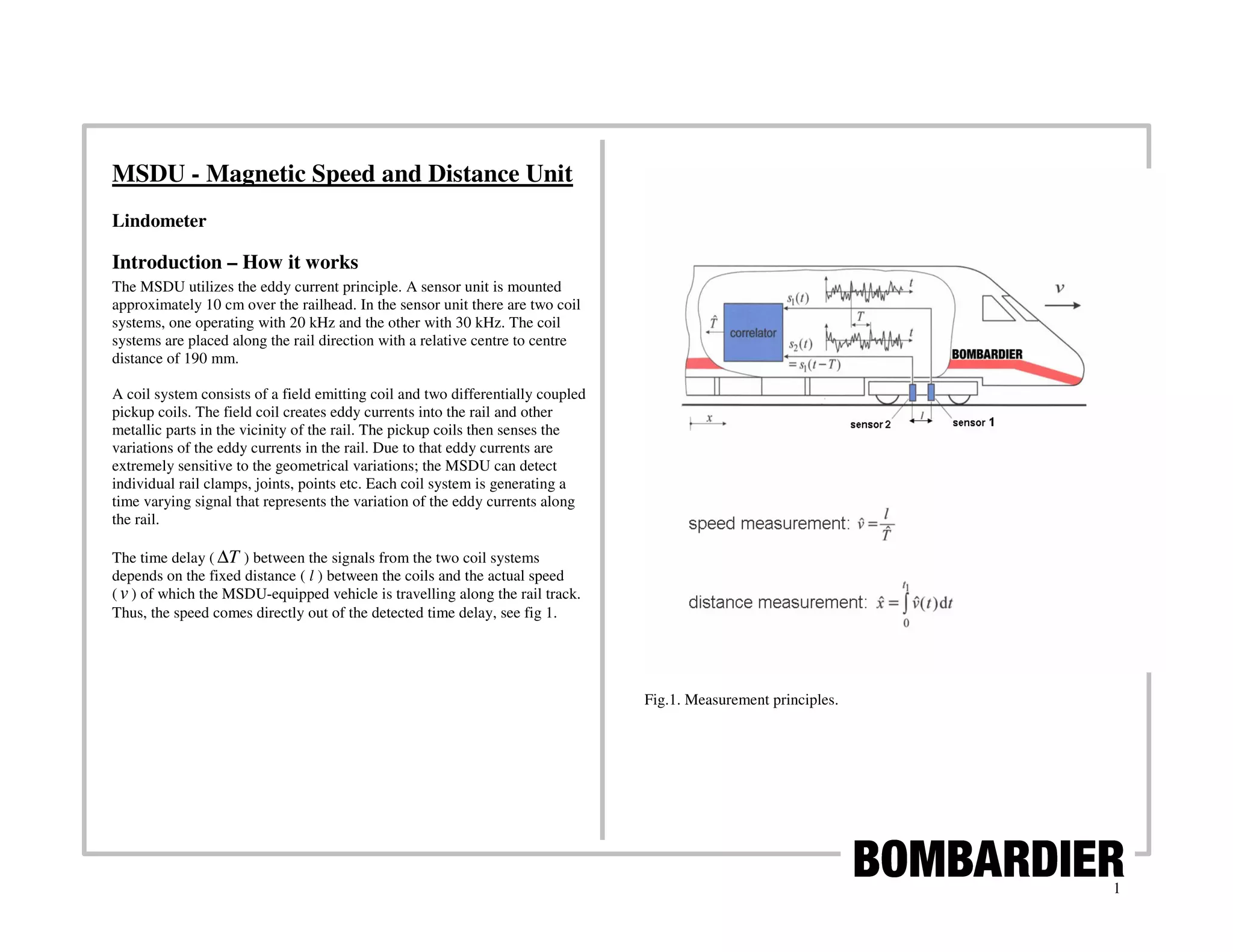
The time delay ( ∆T ) between the signals from the two coil systems
depends on the fixed distance ( l ) between the coils and the actual speed
( v ) of which the MSDU-equipped vehicle is travelling along the rail track.
Thus, the speed comes directly out of the detected time delay, see fig 1.


                                                                                 Fig.1. Measurement principles.


                                                                                                                  1
Key Features

                                                                        Speed and Odometer function
                                                                       The MSDU gives the speed, odometer values and direction in relation to
                                                                       ground. Thus the MSDU is totally independent of the wheel diameter,
                                                                       whether the wheels are slipping or skidding. Even though the MSDU is
                                                                       dependent on geometrical variations as measured when traveling along the
                                                                       rail, it is possible to detect stand-still due to the DC coupled demodulated
         Fig.2. Clamps and rail joints are detected by the MSDU.       signal. The speed measurement range is 0-360 km/h and the accuracy is
                                                                       during normal conditions 1%. The odometer value is, over a traveled
                                                                       distance of 100 meters or more, better than 1%.
                                                                       These accurate data are important parameters for the ATP supervision
                                                                       function of the train.


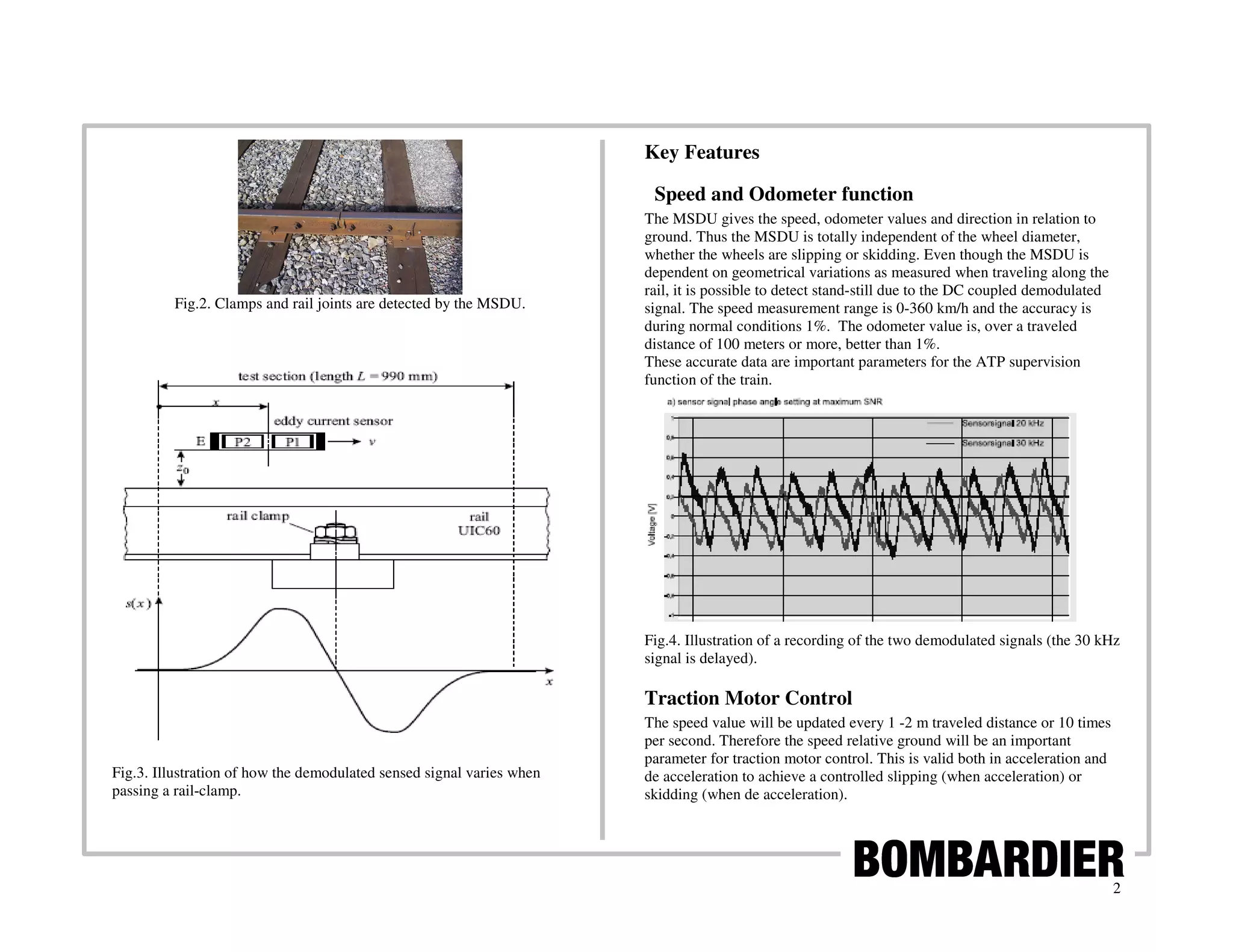
                                                                       Fig.4. Illustration of a recording of the two demodulated signals (the 30 kHz
                                                                       signal is delayed).

                                                                       Traction Motor Control
                                                                       The speed value will be updated every 1 -2 m traveled distance or 10 times
                                                                       per second. Therefore the speed relative ground will be an important
                                                                       parameter for traction motor control. This is valid both in acceleration and
Fig.3. Illustration of how the demodulated sensed signal varies when   de acceleration to achieve a controlled slipping (when acceleration) or
passing a rail-clamp.                                                  skidding (when de acceleration).


                                                                                                                                                      2
MSDU used in future railway applications
EXACT POSITIONING
The MDSU can also be used as a safe and accurate positioning instrument.
By using the existing rail infrastructure with points, joints etc a “magnetic”
map can be created and stored as a reference. When traveling along the
track, the magnetic reference map is compared with the actual readings and
the exact position can be derived. This function will be tested in Germany
2006 and 2007 within the “Demoort” project.

WAYSIDE TO TRAIN COMMUNICATION
Another scenario is to mount an iron bar with a slit (binary, slit=0, no slit=1)
pattern close to the railhead. The functionality is then equivalent to a balise
with a fixed message, position balise. A 16 bit message requires a 1.5m
long iron bar.

RAIL FAILURE DETECTION
By using the same technique as in exact positioning, the MSDU field
pattern readings can be compared to a database with field patterns
                                                                                   Fig 5 MSDU sensor unit mounted between the wheels of the boogie.
representing different stages of rail failures. Rail failures can then be
reported to the infrastructure manager along with the exact positioning.


Technical Description
The MSDU consists of two main parts, a sensor unit and an evaluation unit,
that are connected with a cable that can have a maximum length of
approximately 20 meters.

SENSOR UNIT
The sensor unit has two coil systems (20 and 30kHz), internal shielding,
An interface PCB and an outer housing in aluminum. The sensor unit is
IP 67 classified, to withstand the harsh environment under the loco.


                                                                                   Fig 6 During winter test the antenna got totally iced without any impact in
                                                                                   performance. The eddy currents in “low” frequencies are not sensible to
                                                                                   debris as water, snow, ice, oil, dirt, etc.


                                                                                                                                                                 3
MSDU Short form Technical Data
EVALUATION UNIT
The evaluation unit consists of a Transmitter, a Receiver (20 and 30 kHz), a     INPUT POWER
Correlator, a Power Supply and an embedded controller. All units are
connected by a motherboard. The housing is aluminum and the total weight         The MSDU is fed by the loco battery (24, 36, 48, 72, 110 or 150V) and the
is approximately 6 kg. The evaluation unit is IP 42 classified                   overall power consumption is 35 W. Input voltage variation shall be
                                                                                 system voltage +20/-30%.

                                                                                 PC-PORT
                                                                                 Configuration and monitoring of the MSDU can be achieved by connecting
                                                                                 an external PC. The PC interface to the evaluation unit is RS 422 with a
                                                                                 data rate of 19.2kbit/sec.

                                                                                 ANALOG OUTPUTS
                                                                                 The demodulated signals, 20 and 30 kHz, are buffered and accessible via
                                                                                 balanced line drivers. The analog signals may be used for external
                                                                                 applications such as positioning, pattern recognition etc.

                                                                                 DATA OUTPUT PROTOCOL
                                                                                 The MSDU has two ports (MVB and RS422) and a defined output protocol
                                                                                 from which speed, odometer values, acceleration, quality factors, direction,
                                                                                 standstill detection etc. can be readout. All data is time stamped with
Fig 7. MSDU evaluation unit
                                                                                 a resolution of 1ms. The MSDU does also provide a 2-pulse tachometer
                                                                                 output.
EXTENSIVE INTERNAL TESTS -HIGH SAFETY INTEGRITY
                                                                                 PERFORMANCE
LEVEL
                                                                                 Frequency: 20 and 30 kHz which is possible to adjust +/- 5%.
                                                                                 Tx (field current): Nominal 4A rms.
The MSDU continuously performs internal tests and diagnostics. Due to
                                                                                 Rx (pickup): Differentially coupled coils. Balance better than 0.5‰ . Active
that the two coil systems, 20 and 30 kHz, are independent they can be tested
                                                                                 Cross Talk Cancellation (CTC). Demodulation angle selectable in 256 steps
against each other by correlation. Together with other functional tests, fatal
                                                                                 (360 degrees)
failures will be detected within a few seconds. The extensive self tests and
                                                                                 Amplification from pickup coils to output via demodulator,
diagnostics serve as a good foundation when certifying applications for
                                                                                 adjustable from approx. 60 to 100 dB.
specific safety integrity levels.
                                                                                 Analog output: AC coupled, cut off frequency approx 1 Hz, separate
                                                                                 adjustable amplification.
                                                                                 Sample rate of analog signal to the Close Loop Correlator (CLC): adjustable
                                                                                 from approx. 3.75 kHz to 480 kHz (dependent of actual speed).


                                                                                                                                                             4

Session 34 Håkan Lind

  • 1.
    MSDU - MagneticSpeed and Distance Unit Lindometer Introduction – How it works The MSDU utilizes the eddy current principle. A sensor unit is mounted approximately 10 cm over the railhead. In the sensor unit there are two coil systems, one operating with 20 kHz and the other with 30 kHz. The coil systems are placed along the rail direction with a relative centre to centre distance of 190 mm. A coil system consists of a field emitting coil and two differentially coupled pickup coils. The field coil creates eddy currents into the rail and other metallic parts in the vicinity of the rail. The pickup coils then senses the variations of the eddy currents in the rail. Due to that eddy currents are extremely sensitive to the geometrical variations; the MSDU can detect individual rail clamps, joints, points etc. Each coil system is generating a time varying signal that represents the variation of the eddy currents along the rail. The time delay ( ∆T ) between the signals from the two coil systems depends on the fixed distance ( l ) between the coils and the actual speed ( v ) of which the MSDU-equipped vehicle is travelling along the rail track. Thus, the speed comes directly out of the detected time delay, see fig 1. Fig.1. Measurement principles. 1
  • 2.
    Key Features Speed and Odometer function The MSDU gives the speed, odometer values and direction in relation to ground. Thus the MSDU is totally independent of the wheel diameter, whether the wheels are slipping or skidding. Even though the MSDU is dependent on geometrical variations as measured when traveling along the rail, it is possible to detect stand-still due to the DC coupled demodulated Fig.2. Clamps and rail joints are detected by the MSDU. signal. The speed measurement range is 0-360 km/h and the accuracy is during normal conditions 1%. The odometer value is, over a traveled distance of 100 meters or more, better than 1%. These accurate data are important parameters for the ATP supervision function of the train. Fig.4. Illustration of a recording of the two demodulated signals (the 30 kHz signal is delayed). Traction Motor Control The speed value will be updated every 1 -2 m traveled distance or 10 times per second. Therefore the speed relative ground will be an important parameter for traction motor control. This is valid both in acceleration and Fig.3. Illustration of how the demodulated sensed signal varies when de acceleration to achieve a controlled slipping (when acceleration) or passing a rail-clamp. skidding (when de acceleration). 2
  • 3.
    MSDU used infuture railway applications EXACT POSITIONING The MDSU can also be used as a safe and accurate positioning instrument. By using the existing rail infrastructure with points, joints etc a “magnetic” map can be created and stored as a reference. When traveling along the track, the magnetic reference map is compared with the actual readings and the exact position can be derived. This function will be tested in Germany 2006 and 2007 within the “Demoort” project. WAYSIDE TO TRAIN COMMUNICATION Another scenario is to mount an iron bar with a slit (binary, slit=0, no slit=1) pattern close to the railhead. The functionality is then equivalent to a balise with a fixed message, position balise. A 16 bit message requires a 1.5m long iron bar. RAIL FAILURE DETECTION By using the same technique as in exact positioning, the MSDU field pattern readings can be compared to a database with field patterns Fig 5 MSDU sensor unit mounted between the wheels of the boogie. representing different stages of rail failures. Rail failures can then be reported to the infrastructure manager along with the exact positioning. Technical Description The MSDU consists of two main parts, a sensor unit and an evaluation unit, that are connected with a cable that can have a maximum length of approximately 20 meters. SENSOR UNIT The sensor unit has two coil systems (20 and 30kHz), internal shielding, An interface PCB and an outer housing in aluminum. The sensor unit is IP 67 classified, to withstand the harsh environment under the loco. Fig 6 During winter test the antenna got totally iced without any impact in performance. The eddy currents in “low” frequencies are not sensible to debris as water, snow, ice, oil, dirt, etc. 3
  • 4.
    MSDU Short formTechnical Data EVALUATION UNIT The evaluation unit consists of a Transmitter, a Receiver (20 and 30 kHz), a INPUT POWER Correlator, a Power Supply and an embedded controller. All units are connected by a motherboard. The housing is aluminum and the total weight The MSDU is fed by the loco battery (24, 36, 48, 72, 110 or 150V) and the is approximately 6 kg. The evaluation unit is IP 42 classified overall power consumption is 35 W. Input voltage variation shall be system voltage +20/-30%. PC-PORT Configuration and monitoring of the MSDU can be achieved by connecting an external PC. The PC interface to the evaluation unit is RS 422 with a data rate of 19.2kbit/sec. ANALOG OUTPUTS The demodulated signals, 20 and 30 kHz, are buffered and accessible via balanced line drivers. The analog signals may be used for external applications such as positioning, pattern recognition etc. DATA OUTPUT PROTOCOL The MSDU has two ports (MVB and RS422) and a defined output protocol from which speed, odometer values, acceleration, quality factors, direction, standstill detection etc. can be readout. All data is time stamped with Fig 7. MSDU evaluation unit a resolution of 1ms. The MSDU does also provide a 2-pulse tachometer output. EXTENSIVE INTERNAL TESTS -HIGH SAFETY INTEGRITY PERFORMANCE LEVEL Frequency: 20 and 30 kHz which is possible to adjust +/- 5%. Tx (field current): Nominal 4A rms. The MSDU continuously performs internal tests and diagnostics. Due to Rx (pickup): Differentially coupled coils. Balance better than 0.5‰ . Active that the two coil systems, 20 and 30 kHz, are independent they can be tested Cross Talk Cancellation (CTC). Demodulation angle selectable in 256 steps against each other by correlation. Together with other functional tests, fatal (360 degrees) failures will be detected within a few seconds. The extensive self tests and Amplification from pickup coils to output via demodulator, diagnostics serve as a good foundation when certifying applications for adjustable from approx. 60 to 100 dB. specific safety integrity levels. Analog output: AC coupled, cut off frequency approx 1 Hz, separate adjustable amplification. Sample rate of analog signal to the Close Loop Correlator (CLC): adjustable from approx. 3.75 kHz to 480 kHz (dependent of actual speed). 4