Session 3.2

Integrating Local Governments in Sector/
      Budget Support Programmes

 Presentation by Jorge Rodriguez Bilbao
         (DEG DEVCO Unit D2)
Presentation verview
    Part I: BS in decentralized
     environments: Limits and
     challenges;
      Part II: Broadening the scope of
       the debate beyond aid
       modalities: What do we need to
       know about the Local Public
       Sector in order to design
       effective development
       interventions that rely on local
       country systems
Part I: BS in
    decentralized
   environments:
Limits and challenges
Budget Support in decentralized contexts:
  Limits & challenges (1)

The Concept of Budget Support: Look at the whole package:

     Financial Input
        The transfer of funds to the National Treasury (not into
         Sector or SN budget)
     Non Financial Input
        Policy Dialogue
        Capacity Development activities
        Conditions (e.g. agreed actions and results)


     Conditionalities & Indicators can only be
       focused on the responsibility of CG;
Budget Support in decentralized contexts:
 Limits & challenges (2)
                    What happens at grassroots level?

Some limits to the BS modality:

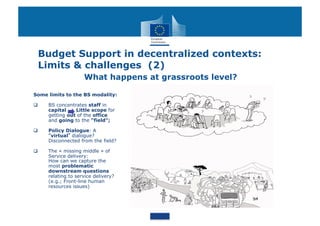
    BS concentrates staff in
     capital    Little scope for
     getting out of the office
     and going to the "field";

    Policy Dialogue: A
      virtual dialogue?
     Disconnected from the field?

    The « missing middle » of
     Service delivery:
     How can we capture the
     most problematic
     downstream questions
     relating to service delivery?
     (e.g.; Front-line human
     resources issues)
Budget Support in decentralized contexts:
 Limits & challenges (3)
  Different regional seminars on Budget Support organised by EU in
  the last years (Hanoi 2007, Bangkok 2008, Jakarta 2010 and
  Bangkok 2012): have progressively built a consensus among
  participants around the need for EU to provide guidance on the
  following topics:

      Recognize in the BS guidelines that decentralization is a complex
       political process and a system with several dimensions, levels and
       actors that have to be factored-in the design, implementation and
       evaluation of BS operations;
      Clarify at what levels and how BS could be decentralized;
      Focus on linkages between fiscal decentralization and BS;
      Ensure consistency with Agenda for Change by ensuring that BS in
       decentralized environments contributes to enhancing citizen demands
       and domestic accountability ;
      Explore practical ways to apply a mix of modalities in order to combine
       support to national policies with specific actions aiming at
       empowering local level, which, in turn, helps to increase demand for
       services, can feed policy-making and provide evidence for PD
Budget Support in decentralized context:
          Limits & challenges (5)
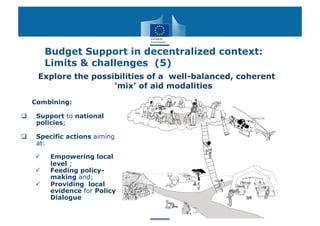
      Explore the possibilities of a well-balanced, coherent
                       ‘mix’ of aid modalities

     Combining:

     Support to national
      policies;

     Specific actions aiming
      at:

          Empowering local
           level ;
          Feeding policy-
           making and;
          Providing local
           evidence for Policy
           Dialogue
Budget Support in decentralized contexts:
Limits & challenges (4)
  This opens a rather complex set of issues that
  touch upon the various dimensions of BS
  including :

    type of interlocutors to be involved in PD;

    Accountability lines for the indicators;

    The possible avenues for decentralizing funding ;

    Capacity development of sub national/local
     governments;

    etc
Part II:
  Broadening the scope of the
 debate beyond aid modalities:

What do we need to know about
 the Local Public Sector in order
to design effective development
           interventions
    that rely on local country
             systems?
Shifting the debate: decentralization as a
  development issue
      In many development agencies, decentralization has been
       treated as a stand-alone governance topic;
      Decentralization is a means to achieving certain
       development objectives, not an end in itself;
      Decentralization Reforms are playing out everywhere in
       Africa, Latin America and Asia;
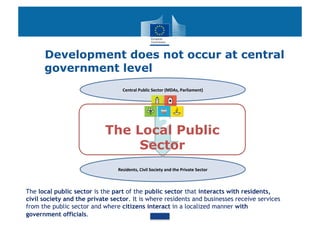
Development does not occur at central
      government level
                                   Central	
  Public	
  Sector	
  (MDAs,	
  Parliament)	


                            The Local Public                  ?
                                 Sector
                                Residents,	
  Civil	
  Society	
  and	
  the	
  Private	
  Sector	


The local public sector is the part of the public sector that interacts with residents,
civil society and the private sector. It is where residents and businesses receive services
from the public sector and where citizens interact in a localized manner with
government officials.
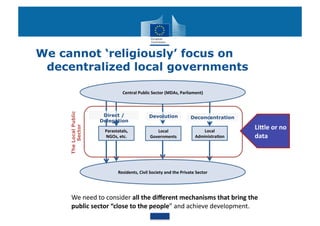
We cannot ‘religiously’ focus on
 decentralized local governments

                                     Central	
  Public	
  Sector	
  (MDAs,	
  Parliament)	
  
     The Local Public


                         Direct /                        Devolution                      Deconcentration
                        Delegation
                                                                                                                LiGle	
  or	
  no	
  
          Sector


                         Parastatals,	
                      Local	
                           Local	
  
                         NGOs,	
  etc.	
                  Governments	
                     Administra?on	
     data	


                                  Residents,	
  Civil	
  Society	
  and	
  the	
  Private	
  Sector	


      We	
  need	
  to	
  consider	
  all	
  the	
  different	
  mechanisms	
  that	
  bring	
  the	
  
      public	
  sector	
  “close	
  to	
  the	
  people”	
  and	
  achieve	
  development.	
  
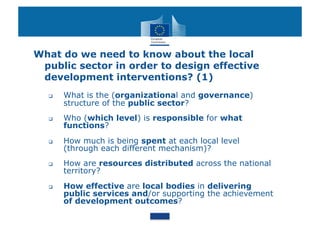
What do we need to know about the local
 public sector in order to design effective
 development interventions? (1)
      What is the (organizational and governance)
       structure of the public sector?
      Who (which level) is responsible for what
       functions?
      How much is being spent at each local level
       (through each different mechanism)?
      How are resources distributed across the national
       territory?
      How effective are local bodies in delivering
       public services and/or supporting the achievement
       of development outcomes?
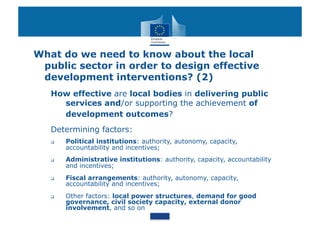
What do we need to know about the local
 public sector in order to design effective
 development interventions? (2)
   How effective are local bodies in delivering public
     services and/or supporting the achievement of
     development outcomes?
   Determining factors:
       Political institutions: authority, autonomy, capacity,
        accountability and incentives;
       Administrative institutions: authority, capacity, accountability
        and incentives;
       Fiscal arrangements: authority, autonomy, capacity,
        accountability and incentives;
       Other factors: local power structures, demand for good
        governance, civil society capacity, external donor
        involvement, and so on
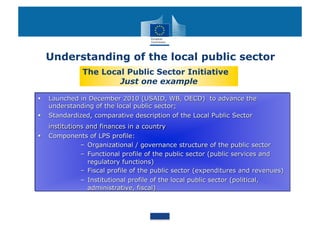
Understanding of the local public sector
      The Local Public Sector Initiative
              Just one example
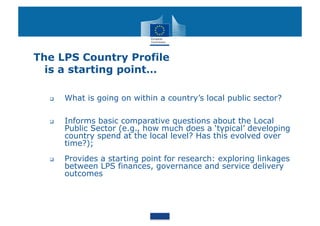
The LPS Country Profile
  is a starting point…

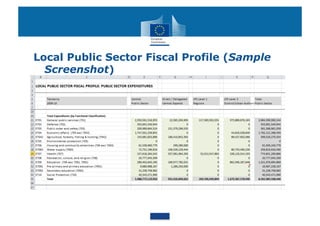
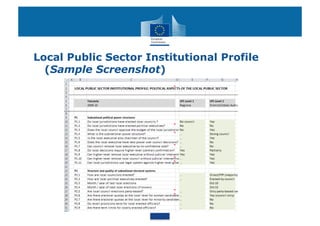
      What is going on within a country’s local public sector?

      Informs basic comparative questions about the Local
       Public Sector (e.g., how much does a ‘typical’ developing
       country spend at the local level? Has this evolved over
       time?);
      Provides a starting point for research: exploring linkages
       between LPS finances, governance and service delivery
       outcomes
Local Public Sector Fiscal Profile (Sample
  Screenshot)
Local Public Sector Institutional Profile
  (Sample Screenshot)
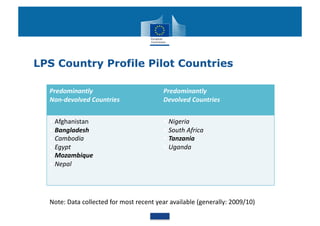
LPS Country Profile Pilot Countries

  Predominantly	
  	
                                     Predominantly	
  
  Non-­‐devolved	
  Countries	
                           Devolved	
  Countries	


  • 	
  Afghanistan	
                                     • 	
  Nigeria	
  
  • 	
  Bangladesh	
                                      • 	
  South	
  Africa	
  
  • 	
  Cambodia	
                                        • 	
  Tanzania	
  
  • 	
  Egypt	
                                           • 	
  Uganda	
  
  • 	
  Mozambique	
  
  • 	
  Nepal	


  Note:	
  Data	
  collected	
  for	
  most	
  recent	
  year	
  available	
  (generally:	
  2009/10)	
  
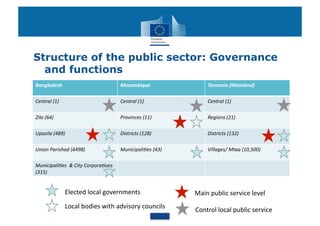
Structure of the public sector: Governance
  and functions
Bangladesh	
                                        Mozambique	
                      Tanzania	
  (Mainland)	
  

Central	
  (1)	
                                    Central	
  (1)	
                  Central	
  (1)	
  

Zila	
  (64)	
                                      Provinces	
  (11)	
               Regions	
  (21)	
  

Upazila	
  (489)	
                                  Districts	
  (128)	
              Districts	
  (132)	
  

Union	
  Parishad	
  (4498)	
                       MunicipaliKes	
  (43)	
           Villages/	
  Mtaa	
  (10,500)	
  

MunicipaliKes	
  	
  &	
  City	
  CorporaKons	
  
(315)	


                     Elected	
  local	
  governments	
                          Main	
  public	
  service	
  level	
  
                     Local	
  bodies	
  with	
  advisory	
  councils	
  
                                                                                Control	
  local	
  public	
  service	
  	
  
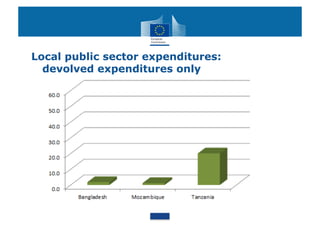
Local public sector expenditures:
  devolved expenditures only
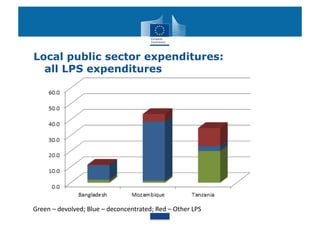
Local public sector expenditures:
  all LPS expenditures


Green	
  –	
  devolved;	
  Blue	
  –	
  deconcentrated;	
  Red	
  –	
  Other	
  LPS	
  
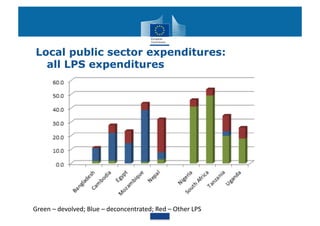
Local public sector expenditures:
   all LPS expenditures


Green	
  –	
  devolved;	
  Blue	
  –	
  deconcentrated;	
  Red	
  –	
  Other	
  LPS	
  
Thank you!

Session 3.2 integrating local governments in sector support programmes

  • 1.
    Session 3.2 Integrating LocalGovernments in Sector/ Budget Support Programmes Presentation by Jorge Rodriguez Bilbao (DEG DEVCO Unit D2)
  • 2.
    Presentation verview   Part I: BS in decentralized environments: Limits and challenges;   Part II: Broadening the scope of the debate beyond aid modalities: What do we need to know about the Local Public Sector in order to design effective development interventions that rely on local country systems
  • 3.
    Part I: BSin decentralized environments: Limits and challenges
  • 4.
    Budget Support indecentralized contexts: Limits & challenges (1) The Concept of Budget Support: Look at the whole package:   Financial Input   The transfer of funds to the National Treasury (not into Sector or SN budget)   Non Financial Input   Policy Dialogue   Capacity Development activities   Conditions (e.g. agreed actions and results) Conditionalities & Indicators can only be focused on the responsibility of CG;
  • 5.
    Budget Support indecentralized contexts: Limits & challenges (2) What happens at grassroots level? Some limits to the BS modality:   BS concentrates staff in capital Little scope for getting out of the office and going to the "field";   Policy Dialogue: A virtual dialogue? Disconnected from the field?   The « missing middle » of Service delivery: How can we capture the most problematic downstream questions relating to service delivery? (e.g.; Front-line human resources issues)
  • 6.
    Budget Support indecentralized contexts: Limits & challenges (3) Different regional seminars on Budget Support organised by EU in the last years (Hanoi 2007, Bangkok 2008, Jakarta 2010 and Bangkok 2012): have progressively built a consensus among participants around the need for EU to provide guidance on the following topics:   Recognize in the BS guidelines that decentralization is a complex political process and a system with several dimensions, levels and actors that have to be factored-in the design, implementation and evaluation of BS operations;   Clarify at what levels and how BS could be decentralized;   Focus on linkages between fiscal decentralization and BS;   Ensure consistency with Agenda for Change by ensuring that BS in decentralized environments contributes to enhancing citizen demands and domestic accountability ;   Explore practical ways to apply a mix of modalities in order to combine support to national policies with specific actions aiming at empowering local level, which, in turn, helps to increase demand for services, can feed policy-making and provide evidence for PD
  • 7.
    Budget Support indecentralized context: Limits & challenges (5) Explore the possibilities of a well-balanced, coherent ‘mix’ of aid modalities Combining:   Support to national policies;   Specific actions aiming at:   Empowering local level ;   Feeding policy- making and;   Providing local evidence for Policy Dialogue
  • 8.
    Budget Support indecentralized contexts: Limits & challenges (4) This opens a rather complex set of issues that touch upon the various dimensions of BS including :   type of interlocutors to be involved in PD;   Accountability lines for the indicators;   The possible avenues for decentralizing funding ;   Capacity development of sub national/local governments;   etc
  • 9.
    Part II: Broadening the scope of the debate beyond aid modalities: What do we need to know about the Local Public Sector in order to design effective development interventions that rely on local country systems?
  • 10.
    Shifting the debate:decentralization as a development issue   In many development agencies, decentralization has been treated as a stand-alone governance topic;   Decentralization is a means to achieving certain development objectives, not an end in itself;   Decentralization Reforms are playing out everywhere in Africa, Latin America and Asia;
  • 11.
    Development does notoccur at central government level Central  Public  Sector  (MDAs,  Parliament)   The Local Public ? Sector Residents,  Civil  Society  and  the  Private  Sector   The local public sector is the part of the public sector that interacts with residents, civil society and the private sector. It is where residents and businesses receive services from the public sector and where citizens interact in a localized manner with government officials.
  • 12.
    We cannot ‘religiously’focus on decentralized local governments Central  Public  Sector  (MDAs,  Parliament)   The Local Public Direct / Devolution Deconcentration Delegation LiGle  or  no   Sector Parastatals,   Local   Local   NGOs,  etc.   Governments   Administra?on   data   Residents,  Civil  Society  and  the  Private  Sector   We  need  to  consider  all  the  different  mechanisms  that  bring  the   public  sector  “close  to  the  people”  and  achieve  development.  
  • 13.
    What do weneed to know about the local public sector in order to design effective development interventions? (1)   What is the (organizational and governance) structure of the public sector?   Who (which level) is responsible for what functions?   How much is being spent at each local level (through each different mechanism)?   How are resources distributed across the national territory?   How effective are local bodies in delivering public services and/or supporting the achievement of development outcomes?
  • 14.
    What do weneed to know about the local public sector in order to design effective development interventions? (2) How effective are local bodies in delivering public services and/or supporting the achievement of development outcomes? Determining factors:   Political institutions: authority, autonomy, capacity, accountability and incentives;   Administrative institutions: authority, capacity, accountability and incentives;   Fiscal arrangements: authority, autonomy, capacity, accountability and incentives;   Other factors: local power structures, demand for good governance, civil society capacity, external donor involvement, and so on
  • 15.
    Understanding of thelocal public sector The Local Public Sector Initiative Just one example
  • 16.
    The LPS CountryProfile is a starting point…   What is going on within a country’s local public sector?   Informs basic comparative questions about the Local Public Sector (e.g., how much does a ‘typical’ developing country spend at the local level? Has this evolved over time?);   Provides a starting point for research: exploring linkages between LPS finances, governance and service delivery outcomes
  • 17.
    Local Public SectorFiscal Profile (Sample Screenshot)
  • 18.
    Local Public SectorInstitutional Profile (Sample Screenshot)
  • 19.
    LPS Country ProfilePilot Countries Predominantly     Predominantly   Non-­‐devolved  Countries   Devolved  Countries   •   Afghanistan   •   Nigeria   •   Bangladesh   •   South  Africa   •   Cambodia   •   Tanzania   •   Egypt   •   Uganda   •   Mozambique   •   Nepal   Note:  Data  collected  for  most  recent  year  available  (generally:  2009/10)  
  • 20.
    Structure of thepublic sector: Governance and functions Bangladesh   Mozambique   Tanzania  (Mainland)   Central  (1)   Central  (1)   Central  (1)   Zila  (64)   Provinces  (11)   Regions  (21)   Upazila  (489)   Districts  (128)   Districts  (132)   Union  Parishad  (4498)   MunicipaliKes  (43)   Villages/  Mtaa  (10,500)   MunicipaliKes    &  City  CorporaKons   (315)   Elected  local  governments   Main  public  service  level   Local  bodies  with  advisory  councils   Control  local  public  service    
  • 21.
    Local public sectorexpenditures: devolved expenditures only
  • 22.
    Local public sectorexpenditures: all LPS expenditures Green  –  devolved;  Blue  –  deconcentrated;  Red  –  Other  LPS  
  • 23.
    Local public sectorexpenditures: all LPS expenditures Green  –  devolved;  Blue  –  deconcentrated;  Red  –  Other  LPS  
  • 24.