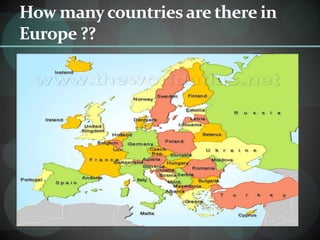
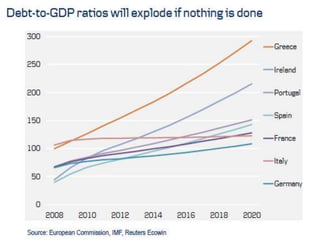
WHAT IS EUROPE ??
How manycountriesare there in
Europe ??
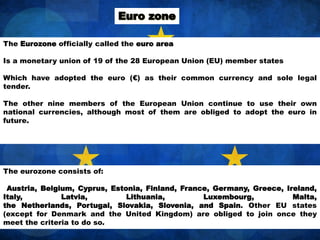
The Eurozone officially called the euro area
Is a monetary union of 19 of the 28 European Union (EU) member states
Which have adopted the euro (€) as their common currency and sole legal
tender.
The other nine members of the European Union continue to use their own
national currencies, although most of them are obliged to adopt the euro in
future.
The eurozone consists of:
Austria, Belgium, Cyprus, Estonia, Finland, France, Germany, Greece, Ireland,
Italy, Latvia, Lithuania, Luxembourg, Malta,
the Netherlands, Portugal, Slovakia, Slovenia, and Spain. Other EU states
(except for Denmark and the United Kingdom) are obliged to join once they
meet the criteria to do so.
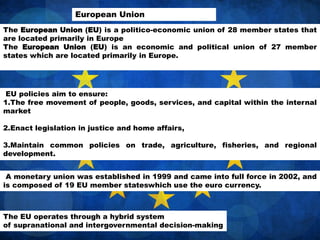
European Union
The European Union (EU) is a politico-economic union of 28 member states that
are located primarily in Europe
The European Union (EU) is an economic and political union of 27 member
states which are located primarily in Europe.
EU policies aim to ensure:
1.The free movement of people, goods, services, and capital within the internal
market
2.Enact legislation in justice and home affairs,
3.Maintain common policies on trade, agriculture, fisheries, and regional
development.
A monetary union was established in 1999 and came into full force in 2002, and
is composed of 19 EU member stateswhich use the euro currency.
The EU operates through a hybrid system
of supranational and intergovernmental decision-making
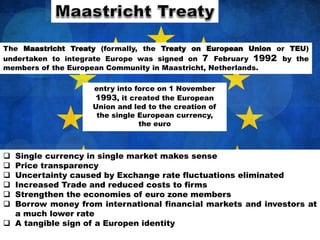
The Maastricht Treaty (formally, the Treaty on European Union or TEU)
undertaken to integrate Europe was signed on 7 February 1992 by the
members of the European Community in Maastricht, Netherlands.
entry into force on 1 November
1993, it created the European
Union and led to the creation of
the single European currency,
the euro
 Single currency in single market makes sense
 Price transparency
 Uncertainty caused by Exchange rate fluctuations eliminated
 Increased Trade and reduced costs to firms
 Strengthen the economies of euro zone members
 Borrow money from international financial markets and investors at
a much lower rate
 A tangible sign of a Europen identity
•This is also known as Euro zone sovereign debt crisis
•The term indicates the financial problems caused due to overspending by come
European countries
•When a nation lives beyond its means by borrowing heavily, a point comes
when it cannot manage its financial obligations.
When that country faces insolvency (unable to repay its debts and lenders start
demanding higher interest rates) that nation begins to get swallowed up by
what is known as the Sovereign Debt Crisis
Euro zone Crisis – What is it?
•The EDC began in 2008 with the crash of Iceland’s banking system,
which spread to Greece.
•Greece had experienced corruption and spending as its government
continued borrowing money despite not being able to produce
sufficient income through work and goods.
•It was admitted that Greece's debts had reached 300bn euros, the
highest in modern history
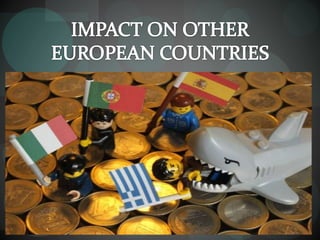
•Spain, Portugal, and the other nations later followed Greece.
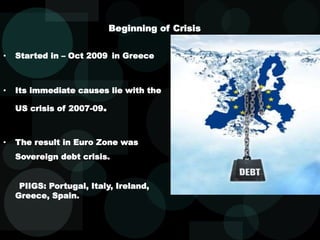
Beginning of Crisis
• Started in – Oct 2009 in Greece
• Its immediate causes lie with the
US crisis of 2007-09.
• The result in Euro Zone was
Sovereign debt crisis.
PIIGS: Portugal, Italy, Ireland,
Greece, Spain.
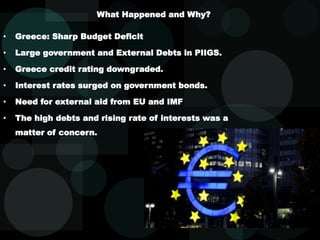
What Happened and Why?
• Greece: Sharp Budget Deficit
• Large government and External Debts in PIIGS.
• Greece credit rating downgraded.
• Interest rates surged on government bonds.
• Need for external aid from EU and IMF
• The high debts and rising rate of interests was a
matter of concern.
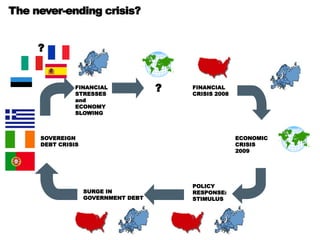
The never-ending crisis?
? FINANCIAL
CRISIS 2008
ECONOMIC
CRISIS
2009
POLICY
RESPONSE:
STIMULUS
SURGE IN
GOVERNMENT DEBT
SOVEREIGN
DEBT CRISIS
FINANCIAL
STRESSES
and
ECONOMY
SLOWING
?
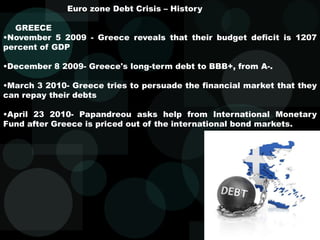
Euro zone Debt Crisis – History
GREECE
•November 5 2009 - Greece reveals that their budget deficit is 1207
percent of GDP
•December 8 2009- Greece's long-term debt to BBB+, from A-.
•March 3 2010- Greece tries to persuade the financial market that they
can repay their debts
•April 23 2010- Papandreou asks help from International Monetary
Fund after Greece is priced out of the international bond markets.
•June 29, 2011- EU leaders agree on €109bn bailout – which will see
private sector lenders take losses of 20%
•October 27 2011- Europe leaders agree new deals that slash Greek
debt and increase the power of the main bailout fund to around €1
trillion.
November 6 2011- Prime Minister resigns
•May 2 2010- European finance ministers lend 110€bn which covers
until 2013. Greece pledges to bring its budget deficit into line, through
unprecedented budget cuts.
•April 17 2011- Greek borrowing costs start rising sharply again, on
fears that its austerity measures are failing to work. Greece is now
deep in recession.
•June 19 2011- Admits that they need to borrow money again
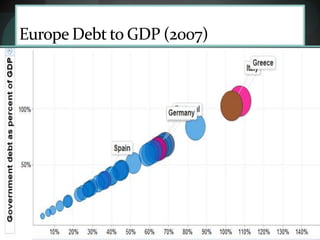
Europe Debt to GDP (2007)
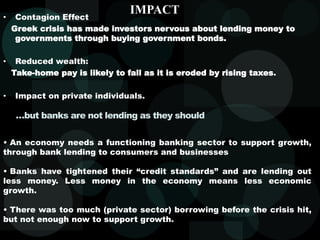
IMPACT• Contagion Effect
Greek crisis has made investors nervous about lending money to
governments through buying government bonds.
• Reduced wealth:
Take-home pay is likely to fall as it is eroded by rising taxes.
• Impact on private individuals.
…but banks are not lending as they should
• An economy needs a functioning banking sector to support growth,
through bank lending to consumers and businesses
• Banks have tightened their “credit standards” and are lending out
less money. Less money in the economy means less economic
growth.
• There was too much (private sector) borrowing before the crisis hit,
but not enough now to support growth.
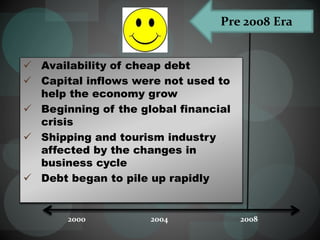
2000 2004 2008
 Availability of cheap debt
 Capital inflows were not used to
help the economy grow
 Beginning of the global financial
crisis
 Shipping and tourism industry
affected by the changes in
business cycle
 Debt began to pile up rapidly
Pre 2008 Era
2008 2012
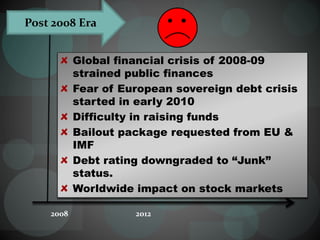
Global financial crisis of 2008-09
strained public finances
Fear of European sovereign debt crisis
started in early 2010
Difficulty in raising funds
Bailout package requested from EU &
IMF
Debt rating downgraded to “Junk”
status.
Worldwide impact on stock markets
Post 2008 Era
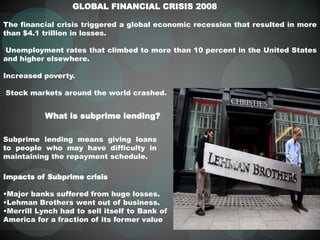
GLOBAL FINANCIAL CRISIS 2008
What is subprime lending?
Subprime lending means giving loans
to people who may have difficulty in
maintaining the repayment schedule.
Impacts of Subprime crisis
•Major banks suffered from huge losses.
•Lehman Brothers went out of business.
•Merrill Lynch had to sell itself to Bank of
America for a fraction of its former value
The financial crisis triggered a global economic recession that resulted in more
than $4.1 trillion in losses.
Unemployment rates that climbed to more than 10 percent in the United States
and higher elsewhere.
Increased poverty.
Stock markets around the world crashed.
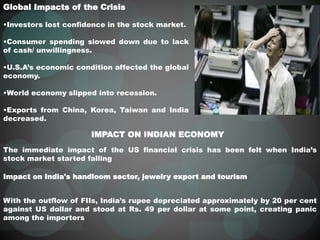
Global Impacts of the Crisis
•Investors lost confidence in the stock market.
•Consumer spending slowed down due to lack
of cash/ unwillingness.
•U.S.A’s economic condition affected the global
economy.
•World economy slipped into recession.
•Exports from China, Korea, Taiwan and India
decreased.
IMPACT ON INDIAN ECONOMY
The immediate impact of the US financial crisis has been felt when India’s
stock market started falling
Impact on India's handloom sector, jewelry export and tourism
With the outflow of FIIs, India’s rupee depreciated approximately by 20 per cent
against US dollar and stood at Rs. 49 per dollar at some point, creating panic
among the importers
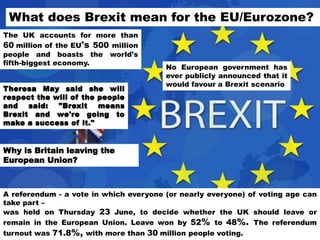
What does Brexit mean for the EU/Eurozone?
No European government has
ever publicly announced that it
would favour a Brexit scenario
The UK accounts for more than
60 million of the EU's 500 million
people and boasts the world's
fifth-biggest economy.
A referendum - a vote in which everyone (or nearly everyone) of voting age can
take part –
was held on Thursday 23 June, to decide whether the UK should leave or
remain in the European Union. Leave won by 52% to 48%. The referendum
turnout was 71.8%, with more than 30 million people voting.
Why is Britain leaving the
European Union?
Theresa May said she will
respect the will of the people
and said: "Brexit means
Brexit and we're going to
make a success of it."
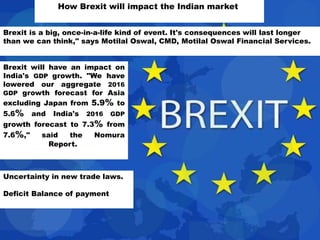
How Brexit will impact the Indian market
Brexit is a big, once-in-a-life kind of event. It's consequences will last longer
than we can think," says Motilal Oswal, CMD, Motilal Oswal Financial Services.
Brexit will have an impact on
India's GDP growth. "We have
lowered our aggregate 2016
GDP growth forecast for Asia
excluding Japan from 5.9% to
5.6% and India's 2016 GDP
growth forecast to 7.3% from
7.6%," said the Nomura
Report.
Uncertainty in new trade laws.
Deficit Balance of payment
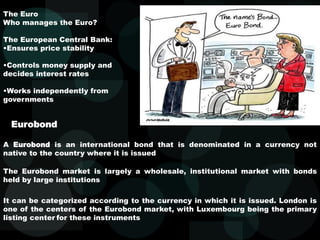
The Euro
Who manages the Euro?
The European Central Bank:
•Ensures price stability
•Controls money supply and
decides interest rates
•Works independently from
governments
A Eurobond is an international bond that is denominated in a currency not
native to the country where it is issued
It can be categorized according to the currency in which it is issued. London is
one of the centers of the Eurobond market, with Luxembourg being the primary
listing center for these instruments
Eurobond
The Eurobond market is largely a wholesale, institutional market with bonds
held by large institutions
European Central Bank
The European Central Bank (ECB) has taken a series of measures aimed at
reducing volatility in the financial markets and at improving liquidity
It began open market operations buying government and private debt securities,
reaching €219.5 billion in February 2012
The European Central Bank (ECB) is the central bank for the euro and
administers monetary policy of the Euro zone, which consists of 19 EU member
states
European Financial Stability Facility(EFSF)
The European Financial Stability Facility (EFSF) is a special purpose
vehicle financed by members of the euro zone to address the European
sovereign-debt crisis.
It was agreed by the Council of the European Union on 9 May 2010, with the
objective of preserving financial stability in Europe by providing financial
assistance to euro zone states in economic difficulty
The EFSF is authorized to borrow up to €440 billion, of which €250 billion
remained available after the Irish and Portuguese bailout.
To provide loans to countries in financial difficulties (e.g. Greek bailout)
A legal instrument aiming at preserving financial stability in Europe by
providing financial assistance to euro zone states in difficulty.
European Financial Stabilisation Mechanism (EFSM)
On 5 January 2011, the European Union created the European Financial
Stabilisation Mechanism (EFSM),
An emergency funding programme reliant upon funds raised on the financial
markets
And guaranteed by the European Commission using the budget of the European
Union as collateral.
It runs under the supervision of the Commission and aims at preserving
financial stability in Europe by providing financial assistance to EU member
states in economic difficulty.
The Commission fund, backed by all 28 European Union members, has the
authority to raise up to €60 billion.
The EFSM is rated AAA by Fitch, Moody's and Standard & Poor's. The EFSM has
been operational since 10 May 2010.
European Stability Mechanism(ESM)
It was established on 27 September 2012 as a permanent firewall for the euro
zone,
It safeguard and provide instant access to financial assistance programmes for
member states of the euro zone in financial difficulty, with a maximum lending
capacity of €500 billion.
It replaces two earlier temporary EU funding programmes: the European
Financial Stability Facility (EFSF) and the European Financial Stabilisation
Mechanism (EFSM).
All new bailouts for any eurozone member state will now be covered by ESM,
while the EFSF and EFSM will continue to handle money transfers and
programme monitoring for the previously approved bailout loans to Ireland,
Portugal and Greece.
Outright Monetary Transactions (OMTs)
On 6 September 2012, the ECB announced to offer additional financial support
in the form of some yield-lowering bond purchases (OMT), for all eurozone
countries.
Unlimited:
The ECB says it will buy as many bonds as it takes for markets to get the
message that countries like Greece, Spain and Italy are not leaving the euro,
that the single currency is irreversible
Short term:
The OMT will only buy short-term bonds between one and three-year duration.
Transparency
Aggregate Outright Monetary Transaction holdings and their market values will
be published on a weekly basis
Single Supervisory Mechanism (SSM)
The Single Supervisory Mechanism (SSM) is the name for the mechanism which
has granted the European Central Bank (ECB) a supervisory role to monitor the
financial stability of banks based in participating states, starting from 4
November 2014
The ECB's monitoring regime will including conducting stress tests on financial
institutions.
If problems are found, the ECB will have the ability to conduct early
intervention in the bank to rectify the situation, such as by setting capital or
risk limits or by requiring changes in management
However, if a bank is found to be in danger of failing, the responsibility for
resolving it will rest with the Single Resolution Mechanism
PORTUGAL
 In the first quarter of 2010 Portugal had one of the best rates of
economic recovery in the EU
 Portuguese government public debt has increased due to mismanaged
structural and cohesion funds
 Bonuses and wages of head officers also resulted to their economic
situation
 On 16 May 2011- Euro zone leaders officially approved a €78 billion
bailout package for Portugal
 The country agreed to cut its budget deficit from 9.8% of GDP in 2010
to 5.9% in 2011, 4.5% in 2012 and 3% in 2013
 On 6 July 2011-Rating’s agency Moody had cut Portugal’s credit rating
to junk status
IRELAND
 The Irish sovereign debt crisis arose not from government over
spending, but from the state guaranteeing the six main Irish
based banks who had financed a property bubble
 On 29 September 2008, Finance Minister Brian Lenihan, issued a
two-year guarantee to the banks depositors and bondholders
 Irish banks had lost an estimated €100 billion
 Unemployment rose from 4% in 2006 to 14% by 2010
ITALY
 Italy’s deficit was 4.6% of GDP in 2010
 Italy even has a surplus in it’s primary budget, which excludes debt
interest payments. However it’s debt has increased to almost 120%
of GDP (US $2.4 trillion in 2010)
 Italian bonds more and more as a risky asset for investors
 On 15th July and 14th September 2011 government passed austerity
measures meant to save €124 Billion
 By 8 November 2011, the Italian bond yield was 6.74% For climbing
above the 7% level on 11 November 2011, Italian 10 year borrowing
costs fell sharply from 7.5% to 6.7% after Italian legislature
approved
 The measures include
 A pledge to raise €15 billion from real estate sales
 A 2 years increase in the retirement age to 67 by 2026
 Opening up closed professions within 12 months
 A gradual reduction in government ownership of local services
SPAIN
 Spain has a comparatively low debt among advanced economy but
experienced highest unemployment rate of 20%
 Spain’s economy is of particular concern to international observers
and faced pressure from United States, The IMF, Other European
countries and the European commission to cut it’s deficit more
aggressively
 Announcement of the European Union's new ‘Emergency Fund’ in
early May 2010, Spain had to announce new austerity measures
designed to reduce budget deficit in order to signal financial market
that it is safe to invest in country
 Spain succeed in trimming it’s deficit from 11.2% of GDP in 2009 to
9.2% in 2010 and originally expected 6% in 2011 but due to European
crisis and over spending by regional government the deficit
overshoot target and reached between 6.6% to 8%
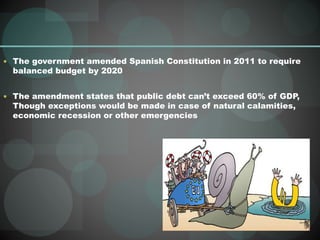
 The government amended Spanish Constitution in 2011 to require
balanced budget by 2020
 The amendment states that public debt can’t exceed 60% of GDP,
Though exceptions would be made in case of natural calamities,
economic recession or other emergencies
FRANCE
 France was one of the six founding members of
the European Community in 1957
 Since the foundation of the European Union, France has
been a driving force behind many European projects
 France participates in all of the most far-reaching EU
projects, including Economic and Monetary Union
 France's public debt in 2010 was approximately U.S. $2.1
trillion and 83% GDP, with a 2010 budget deficit of 7% GDP
 By 16 November 2011, France's bond yield spreads had
widened 450% since July, 2011
 France's C.D.S. contract value rose 300% in the same
period
BELGIUM
 In 2010 Belgium's public debt was 100% it’s GDP
 The government deficit of 5% was relatively modest and Belgium
government 10 years bond yields in November 2010 of 3.7% were
still below of these of Ireland (9.2%), Portugal (7%) and Spain
(5.2%)
 High personal saving rate in Belgium and making it less prone to
fluctuations of international market
 On 25 November 2011, Belgium’s long term sovereign credit rating was
down graded from AA+ to AA by Standard and Poor
 10 year bond yields reached 5.66% shortly after Belgian
negotiating parties reached on an agreement to form a new
government
 The deal includes spending cuts and tax rises worth about €11
Billion which should bring the budget deficit down to 2.8% of GDP
by 2012 and to balanced the book in 2015
 Following the announcement Belgium 10 year bond yields fall
sharply to 4.6%
GERMANY
 In 2011, Germany's economy as measured
by GDP produced $3.085 trillion. This makes it the sixth
largest economy, after the European Union (EU), the
U.S, China, Japan, and India
 Its GDP growth rate was 2.7%, slightly less than the 3.5%
rate in 2010, but better than the 4.7% decline in 2009
 Its strong manufacturing base meant it had plenty to
export to other members of the euro zone, and could do so
more cheaply
 About 40 percent of German gross domestic product
comes from exports, much of them to the EU
PROBLEMS
 It combines efficient and indiscipline economies.
 Too high debts.
 Political problems.
• Low Growth
• High Unemployment
• Slow Decision Making
SOLUTIONS
Countries affected must:
Grind down Wages
Raise Productivity
Slash Spending
Raise taxes
Transparent Banking system
Endure such Austerity Drives for many years
European debt crisis and fragile US recovery have contributed to the growth
slowdown of the Indian economy by hurting our exports and affecting capital
inflows into India.
The capital outflows have resulted in crash in our stock markets that have
affected investment sentiments of the corporate world.
Impact on India:
The rupee’s depreciation, while aggravated by domestic speculative activity, is
primarily traceable to the ongoing sovereign debt crisis in Europe
The value of rupee which was around 44.50 rupees to a US dollar in August
2011 fell to as low as 54 rupees to a dollar on December 15, 2011 and was
around Rs. 54.8 to a US dollar in the first week of April 2013.
However, we think that current slowdown in economic growth is partly a result
as pointed out above, of Eurozone debt crisis and overall global environment,
especially slow recovery in the United States and stagnation in the European
countries.
Besides, increase in interest rates by RBI to fight inflation has led the
corporate sector to defer investment has resulted in the drastic fall in output
of capital goods
However, in our view, the Indian economy will soon recover once these short-
run problems are resolved. Once inflation is brought under control RBI will cut
its interest rates which will give a push to investment that will boost industrial
growth.
If investment in infrastructure increases, as is expected now, this will lead to
the expansion in domestic demand for capital goods.
his will ensure a higher growth rate in the next year, 2013-14. Besides, we still
have the ability to achieve 8% per cent growth rate even on the basis of our
domestic market.
FUTURE PREDICTED
 Either the euro zone should go for integrating their
economic policies.
OR
 It collapses, and the Greeks and other profligate
countries devalue and the banks (German, French,
British and American) lose hundreds of billions.
,
•Emergency loans have been extended as bailouts mainly by stronger
economies like France and Germany, as also by the IMF.
•The EU member states have also created the European Financial
Stability Facility (EFSF) to provide emergency loans.
•Restructuring of the debt
The US crisis led to Global financial crisis, which further spread to
Euro zone and caused Euro zone crisis, as these countries were most
affected.
Hence the Big Brothers should help the countries in problem to come
out from the crisis.
Conclusion
•The crisis wont stop for a period of time till all debt obligations in
eurozone are not cleared.
• The situation is because the euro countries are dependent on each
other.
• Hence the countries are not able to repay the debt to countries they
borrowed from and hence the lender is in threat of going into debt
crisis.
• Policy reactions are made to come out from the debt crisis.
euro crisis

euro crisis

  • 3.
  • 4.
  • 5.
    The Eurozone officiallycalled the euro area Is a monetary union of 19 of the 28 European Union (EU) member states Which have adopted the euro (€) as their common currency and sole legal tender. The other nine members of the European Union continue to use their own national currencies, although most of them are obliged to adopt the euro in future. The eurozone consists of: Austria, Belgium, Cyprus, Estonia, Finland, France, Germany, Greece, Ireland, Italy, Latvia, Lithuania, Luxembourg, Malta, the Netherlands, Portugal, Slovakia, Slovenia, and Spain. Other EU states (except for Denmark and the United Kingdom) are obliged to join once they meet the criteria to do so.
  • 6.
    European Union The EuropeanUnion (EU) is a politico-economic union of 28 member states that are located primarily in Europe The European Union (EU) is an economic and political union of 27 member states which are located primarily in Europe. EU policies aim to ensure: 1.The free movement of people, goods, services, and capital within the internal market 2.Enact legislation in justice and home affairs, 3.Maintain common policies on trade, agriculture, fisheries, and regional development. A monetary union was established in 1999 and came into full force in 2002, and is composed of 19 EU member stateswhich use the euro currency. The EU operates through a hybrid system of supranational and intergovernmental decision-making
  • 7.
    The Maastricht Treaty(formally, the Treaty on European Union or TEU) undertaken to integrate Europe was signed on 7 February 1992 by the members of the European Community in Maastricht, Netherlands. entry into force on 1 November 1993, it created the European Union and led to the creation of the single European currency, the euro  Single currency in single market makes sense  Price transparency  Uncertainty caused by Exchange rate fluctuations eliminated  Increased Trade and reduced costs to firms  Strengthen the economies of euro zone members  Borrow money from international financial markets and investors at a much lower rate  A tangible sign of a Europen identity
  • 8.
    •This is alsoknown as Euro zone sovereign debt crisis •The term indicates the financial problems caused due to overspending by come European countries •When a nation lives beyond its means by borrowing heavily, a point comes when it cannot manage its financial obligations. When that country faces insolvency (unable to repay its debts and lenders start demanding higher interest rates) that nation begins to get swallowed up by what is known as the Sovereign Debt Crisis Euro zone Crisis – What is it?
  • 9.
    •The EDC beganin 2008 with the crash of Iceland’s banking system, which spread to Greece. •Greece had experienced corruption and spending as its government continued borrowing money despite not being able to produce sufficient income through work and goods. •It was admitted that Greece's debts had reached 300bn euros, the highest in modern history •Spain, Portugal, and the other nations later followed Greece.
  • 10.
    Beginning of Crisis •Started in – Oct 2009 in Greece • Its immediate causes lie with the US crisis of 2007-09. • The result in Euro Zone was Sovereign debt crisis. PIIGS: Portugal, Italy, Ireland, Greece, Spain.
  • 11.
    What Happened andWhy? • Greece: Sharp Budget Deficit • Large government and External Debts in PIIGS. • Greece credit rating downgraded. • Interest rates surged on government bonds. • Need for external aid from EU and IMF • The high debts and rising rate of interests was a matter of concern.
  • 12.
    The never-ending crisis? ?FINANCIAL CRISIS 2008 ECONOMIC CRISIS 2009 POLICY RESPONSE: STIMULUS SURGE IN GOVERNMENT DEBT SOVEREIGN DEBT CRISIS FINANCIAL STRESSES and ECONOMY SLOWING ?
  • 13.
    Euro zone DebtCrisis – History GREECE •November 5 2009 - Greece reveals that their budget deficit is 1207 percent of GDP •December 8 2009- Greece's long-term debt to BBB+, from A-. •March 3 2010- Greece tries to persuade the financial market that they can repay their debts •April 23 2010- Papandreou asks help from International Monetary Fund after Greece is priced out of the international bond markets.
  • 14.
    •June 29, 2011-EU leaders agree on €109bn bailout – which will see private sector lenders take losses of 20% •October 27 2011- Europe leaders agree new deals that slash Greek debt and increase the power of the main bailout fund to around €1 trillion. November 6 2011- Prime Minister resigns •May 2 2010- European finance ministers lend 110€bn which covers until 2013. Greece pledges to bring its budget deficit into line, through unprecedented budget cuts. •April 17 2011- Greek borrowing costs start rising sharply again, on fears that its austerity measures are failing to work. Greece is now deep in recession. •June 19 2011- Admits that they need to borrow money again
  • 15.
    Europe Debt toGDP (2007)
  • 16.
    IMPACT• Contagion Effect Greekcrisis has made investors nervous about lending money to governments through buying government bonds. • Reduced wealth: Take-home pay is likely to fall as it is eroded by rising taxes. • Impact on private individuals. …but banks are not lending as they should • An economy needs a functioning banking sector to support growth, through bank lending to consumers and businesses • Banks have tightened their “credit standards” and are lending out less money. Less money in the economy means less economic growth. • There was too much (private sector) borrowing before the crisis hit, but not enough now to support growth.
  • 18.
    2000 2004 2008 Availability of cheap debt  Capital inflows were not used to help the economy grow  Beginning of the global financial crisis  Shipping and tourism industry affected by the changes in business cycle  Debt began to pile up rapidly Pre 2008 Era
  • 19.
    2008 2012 Global financialcrisis of 2008-09 strained public finances Fear of European sovereign debt crisis started in early 2010 Difficulty in raising funds Bailout package requested from EU & IMF Debt rating downgraded to “Junk” status. Worldwide impact on stock markets Post 2008 Era
  • 20.
    GLOBAL FINANCIAL CRISIS2008 What is subprime lending? Subprime lending means giving loans to people who may have difficulty in maintaining the repayment schedule. Impacts of Subprime crisis •Major banks suffered from huge losses. •Lehman Brothers went out of business. •Merrill Lynch had to sell itself to Bank of America for a fraction of its former value The financial crisis triggered a global economic recession that resulted in more than $4.1 trillion in losses. Unemployment rates that climbed to more than 10 percent in the United States and higher elsewhere. Increased poverty. Stock markets around the world crashed.
  • 21.
    Global Impacts ofthe Crisis •Investors lost confidence in the stock market. •Consumer spending slowed down due to lack of cash/ unwillingness. •U.S.A’s economic condition affected the global economy. •World economy slipped into recession. •Exports from China, Korea, Taiwan and India decreased. IMPACT ON INDIAN ECONOMY The immediate impact of the US financial crisis has been felt when India’s stock market started falling Impact on India's handloom sector, jewelry export and tourism With the outflow of FIIs, India’s rupee depreciated approximately by 20 per cent against US dollar and stood at Rs. 49 per dollar at some point, creating panic among the importers
  • 22.
    What does Brexitmean for the EU/Eurozone? No European government has ever publicly announced that it would favour a Brexit scenario The UK accounts for more than 60 million of the EU's 500 million people and boasts the world's fifth-biggest economy. A referendum - a vote in which everyone (or nearly everyone) of voting age can take part – was held on Thursday 23 June, to decide whether the UK should leave or remain in the European Union. Leave won by 52% to 48%. The referendum turnout was 71.8%, with more than 30 million people voting. Why is Britain leaving the European Union? Theresa May said she will respect the will of the people and said: "Brexit means Brexit and we're going to make a success of it."
  • 23.
    How Brexit willimpact the Indian market Brexit is a big, once-in-a-life kind of event. It's consequences will last longer than we can think," says Motilal Oswal, CMD, Motilal Oswal Financial Services. Brexit will have an impact on India's GDP growth. "We have lowered our aggregate 2016 GDP growth forecast for Asia excluding Japan from 5.9% to 5.6% and India's 2016 GDP growth forecast to 7.3% from 7.6%," said the Nomura Report. Uncertainty in new trade laws. Deficit Balance of payment
  • 24.
    The Euro Who managesthe Euro? The European Central Bank: •Ensures price stability •Controls money supply and decides interest rates •Works independently from governments A Eurobond is an international bond that is denominated in a currency not native to the country where it is issued It can be categorized according to the currency in which it is issued. London is one of the centers of the Eurobond market, with Luxembourg being the primary listing center for these instruments Eurobond The Eurobond market is largely a wholesale, institutional market with bonds held by large institutions
  • 25.
    European Central Bank TheEuropean Central Bank (ECB) has taken a series of measures aimed at reducing volatility in the financial markets and at improving liquidity It began open market operations buying government and private debt securities, reaching €219.5 billion in February 2012 The European Central Bank (ECB) is the central bank for the euro and administers monetary policy of the Euro zone, which consists of 19 EU member states
  • 26.
    European Financial StabilityFacility(EFSF) The European Financial Stability Facility (EFSF) is a special purpose vehicle financed by members of the euro zone to address the European sovereign-debt crisis. It was agreed by the Council of the European Union on 9 May 2010, with the objective of preserving financial stability in Europe by providing financial assistance to euro zone states in economic difficulty The EFSF is authorized to borrow up to €440 billion, of which €250 billion remained available after the Irish and Portuguese bailout. To provide loans to countries in financial difficulties (e.g. Greek bailout) A legal instrument aiming at preserving financial stability in Europe by providing financial assistance to euro zone states in difficulty.
  • 27.
    European Financial StabilisationMechanism (EFSM) On 5 January 2011, the European Union created the European Financial Stabilisation Mechanism (EFSM), An emergency funding programme reliant upon funds raised on the financial markets And guaranteed by the European Commission using the budget of the European Union as collateral. It runs under the supervision of the Commission and aims at preserving financial stability in Europe by providing financial assistance to EU member states in economic difficulty. The Commission fund, backed by all 28 European Union members, has the authority to raise up to €60 billion. The EFSM is rated AAA by Fitch, Moody's and Standard & Poor's. The EFSM has been operational since 10 May 2010.
  • 28.
    European Stability Mechanism(ESM) Itwas established on 27 September 2012 as a permanent firewall for the euro zone, It safeguard and provide instant access to financial assistance programmes for member states of the euro zone in financial difficulty, with a maximum lending capacity of €500 billion. It replaces two earlier temporary EU funding programmes: the European Financial Stability Facility (EFSF) and the European Financial Stabilisation Mechanism (EFSM). All new bailouts for any eurozone member state will now be covered by ESM, while the EFSF and EFSM will continue to handle money transfers and programme monitoring for the previously approved bailout loans to Ireland, Portugal and Greece.
  • 29.
    Outright Monetary Transactions(OMTs) On 6 September 2012, the ECB announced to offer additional financial support in the form of some yield-lowering bond purchases (OMT), for all eurozone countries. Unlimited: The ECB says it will buy as many bonds as it takes for markets to get the message that countries like Greece, Spain and Italy are not leaving the euro, that the single currency is irreversible Short term: The OMT will only buy short-term bonds between one and three-year duration. Transparency Aggregate Outright Monetary Transaction holdings and their market values will be published on a weekly basis
  • 30.
    Single Supervisory Mechanism(SSM) The Single Supervisory Mechanism (SSM) is the name for the mechanism which has granted the European Central Bank (ECB) a supervisory role to monitor the financial stability of banks based in participating states, starting from 4 November 2014 The ECB's monitoring regime will including conducting stress tests on financial institutions. If problems are found, the ECB will have the ability to conduct early intervention in the bank to rectify the situation, such as by setting capital or risk limits or by requiring changes in management However, if a bank is found to be in danger of failing, the responsibility for resolving it will rest with the Single Resolution Mechanism
  • 32.
    PORTUGAL  In thefirst quarter of 2010 Portugal had one of the best rates of economic recovery in the EU  Portuguese government public debt has increased due to mismanaged structural and cohesion funds  Bonuses and wages of head officers also resulted to their economic situation  On 16 May 2011- Euro zone leaders officially approved a €78 billion bailout package for Portugal  The country agreed to cut its budget deficit from 9.8% of GDP in 2010 to 5.9% in 2011, 4.5% in 2012 and 3% in 2013  On 6 July 2011-Rating’s agency Moody had cut Portugal’s credit rating to junk status
  • 33.
    IRELAND  The Irishsovereign debt crisis arose not from government over spending, but from the state guaranteeing the six main Irish based banks who had financed a property bubble  On 29 September 2008, Finance Minister Brian Lenihan, issued a two-year guarantee to the banks depositors and bondholders  Irish banks had lost an estimated €100 billion  Unemployment rose from 4% in 2006 to 14% by 2010
  • 34.
    ITALY  Italy’s deficitwas 4.6% of GDP in 2010  Italy even has a surplus in it’s primary budget, which excludes debt interest payments. However it’s debt has increased to almost 120% of GDP (US $2.4 trillion in 2010)  Italian bonds more and more as a risky asset for investors  On 15th July and 14th September 2011 government passed austerity measures meant to save €124 Billion  By 8 November 2011, the Italian bond yield was 6.74% For climbing above the 7% level on 11 November 2011, Italian 10 year borrowing costs fell sharply from 7.5% to 6.7% after Italian legislature approved
  • 35.
     The measuresinclude  A pledge to raise €15 billion from real estate sales  A 2 years increase in the retirement age to 67 by 2026  Opening up closed professions within 12 months  A gradual reduction in government ownership of local services
  • 36.
    SPAIN  Spain hasa comparatively low debt among advanced economy but experienced highest unemployment rate of 20%  Spain’s economy is of particular concern to international observers and faced pressure from United States, The IMF, Other European countries and the European commission to cut it’s deficit more aggressively  Announcement of the European Union's new ‘Emergency Fund’ in early May 2010, Spain had to announce new austerity measures designed to reduce budget deficit in order to signal financial market that it is safe to invest in country  Spain succeed in trimming it’s deficit from 11.2% of GDP in 2009 to 9.2% in 2010 and originally expected 6% in 2011 but due to European crisis and over spending by regional government the deficit overshoot target and reached between 6.6% to 8%
  • 37.
     The governmentamended Spanish Constitution in 2011 to require balanced budget by 2020  The amendment states that public debt can’t exceed 60% of GDP, Though exceptions would be made in case of natural calamities, economic recession or other emergencies
  • 38.
    FRANCE  France wasone of the six founding members of the European Community in 1957  Since the foundation of the European Union, France has been a driving force behind many European projects  France participates in all of the most far-reaching EU projects, including Economic and Monetary Union  France's public debt in 2010 was approximately U.S. $2.1 trillion and 83% GDP, with a 2010 budget deficit of 7% GDP  By 16 November 2011, France's bond yield spreads had widened 450% since July, 2011  France's C.D.S. contract value rose 300% in the same period
  • 39.
    BELGIUM  In 2010Belgium's public debt was 100% it’s GDP  The government deficit of 5% was relatively modest and Belgium government 10 years bond yields in November 2010 of 3.7% were still below of these of Ireland (9.2%), Portugal (7%) and Spain (5.2%)  High personal saving rate in Belgium and making it less prone to fluctuations of international market  On 25 November 2011, Belgium’s long term sovereign credit rating was down graded from AA+ to AA by Standard and Poor  10 year bond yields reached 5.66% shortly after Belgian negotiating parties reached on an agreement to form a new government
  • 40.
     The dealincludes spending cuts and tax rises worth about €11 Billion which should bring the budget deficit down to 2.8% of GDP by 2012 and to balanced the book in 2015  Following the announcement Belgium 10 year bond yields fall sharply to 4.6%
  • 41.
    GERMANY  In 2011,Germany's economy as measured by GDP produced $3.085 trillion. This makes it the sixth largest economy, after the European Union (EU), the U.S, China, Japan, and India  Its GDP growth rate was 2.7%, slightly less than the 3.5% rate in 2010, but better than the 4.7% decline in 2009  Its strong manufacturing base meant it had plenty to export to other members of the euro zone, and could do so more cheaply  About 40 percent of German gross domestic product comes from exports, much of them to the EU
  • 42.
    PROBLEMS  It combinesefficient and indiscipline economies.  Too high debts.  Political problems. • Low Growth • High Unemployment • Slow Decision Making
  • 43.
    SOLUTIONS Countries affected must: Grinddown Wages Raise Productivity Slash Spending Raise taxes Transparent Banking system Endure such Austerity Drives for many years
  • 44.
    European debt crisisand fragile US recovery have contributed to the growth slowdown of the Indian economy by hurting our exports and affecting capital inflows into India. The capital outflows have resulted in crash in our stock markets that have affected investment sentiments of the corporate world. Impact on India: The rupee’s depreciation, while aggravated by domestic speculative activity, is primarily traceable to the ongoing sovereign debt crisis in Europe The value of rupee which was around 44.50 rupees to a US dollar in August 2011 fell to as low as 54 rupees to a dollar on December 15, 2011 and was around Rs. 54.8 to a US dollar in the first week of April 2013. However, we think that current slowdown in economic growth is partly a result as pointed out above, of Eurozone debt crisis and overall global environment, especially slow recovery in the United States and stagnation in the European countries.
  • 45.
    Besides, increase ininterest rates by RBI to fight inflation has led the corporate sector to defer investment has resulted in the drastic fall in output of capital goods However, in our view, the Indian economy will soon recover once these short- run problems are resolved. Once inflation is brought under control RBI will cut its interest rates which will give a push to investment that will boost industrial growth. If investment in infrastructure increases, as is expected now, this will lead to the expansion in domestic demand for capital goods. his will ensure a higher growth rate in the next year, 2013-14. Besides, we still have the ability to achieve 8% per cent growth rate even on the basis of our domestic market.
  • 46.
    FUTURE PREDICTED  Eitherthe euro zone should go for integrating their economic policies. OR  It collapses, and the Greeks and other profligate countries devalue and the banks (German, French, British and American) lose hundreds of billions. ,
  • 47.
    •Emergency loans havebeen extended as bailouts mainly by stronger economies like France and Germany, as also by the IMF. •The EU member states have also created the European Financial Stability Facility (EFSF) to provide emergency loans. •Restructuring of the debt The US crisis led to Global financial crisis, which further spread to Euro zone and caused Euro zone crisis, as these countries were most affected. Hence the Big Brothers should help the countries in problem to come out from the crisis. Conclusion
  • 48.
    •The crisis wontstop for a period of time till all debt obligations in eurozone are not cleared. • The situation is because the euro countries are dependent on each other. • Hence the countries are not able to repay the debt to countries they borrowed from and hence the lender is in threat of going into debt crisis. • Policy reactions are made to come out from the debt crisis.