European debt crisis and its effect on
Indian economy
Presenter- Manpreet Singh
 What is Euro debt Crisis?
 Brief History
 Causes for the Crisis
 RemedialActions
 Impact on Indian Economy
 Conclusions
 This is also known as Eurozone sovereign debt crisis
 The term indicates the financial woes caused due to overspending by
some European countries
 When a nation lives beyond its means by borrowing heavily and spending
freely, there comes a point when it cannot manage its financial situation.
 It is unable to repay its debts and lenders start demanding higher
interest rates, the cornered nation begins to get swallowed up by what is
known as the Sovereign Debt Crisis
 The actual beginning is how the European Union (EU) began in 1992 where
27 European nations "agreed to form an alliance that could compete
economically with larger nations such as the US".This is what created the
currency of the euro which was adopted in 16 December 1995.
 Members of the European Union signed the MaastrichtTreaty, under which
they pledged to limit their deficit spending and debt levels.
 However, in the early 2000, a number of EU member states were failing to
stay within the confines of the Maastricht criteria.These violations marked
the beginning Euro debt crisis.
 Greece had experienced corruption and spending as its government
continued borrowing money despite not being able to produce sufficient
income through work and goods.
 Spain, Portugal, and the other nations later followed Greece with alarming
levels of debt on their economies.
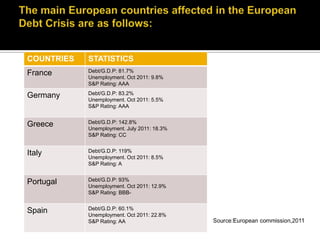
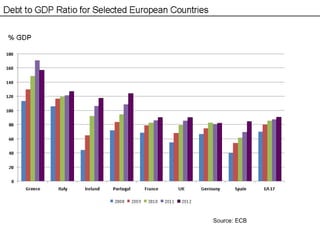
COUNTRIES STATISTICS
France Debt/G.D.P: 81.7%
Unemployment. Oct 2011: 9.8%
S&P Rating: AAA
Germany Debt/G.D.P: 83.2%
Unemployment. Oct 2011: 5.5%
S&P Rating: AAA
Greece Debt/G.D.P: 142.8%
Unemployment. July 2011: 18.3%
S&P Rating: CC
Italy Debt/G.D.P: 119%
Unemployment. Oct 2011: 8.5%
S&P Rating: A
Portugal Debt/G.D.P: 93%
Unemployment. Oct 2011: 12.9%
S&P Rating: BBB-
Spain Debt/G.D.P: 60.1%
Unemployment. Oct 2011: 22.8%
S&P Rating: AA
Countries with originally weak currencies
(and higher interest rates) suddenly enjoyed
much more favorable credit terms, which
spurred private and government spending
and led to an economic boom.
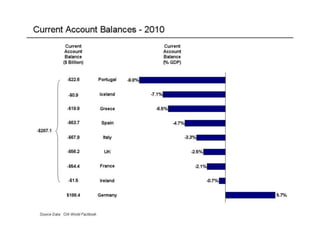
 Almost all the countries in Eurozone have trade deficits.
 A trade deficit is when imports exceed exports.Trade deficits
have goods and services components.A country that is a net
importer of goods and services must borrow capital to fund
this activity.
 Germany has a significant trade surplus, meaning it is a net
exporter.
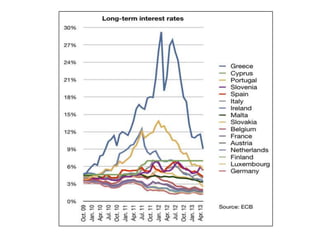
 After failing to payback the huge debts the
interest rates to repay rose significantly and
swallowed the weaker economies in
eurozone,further burdening their current
situation.
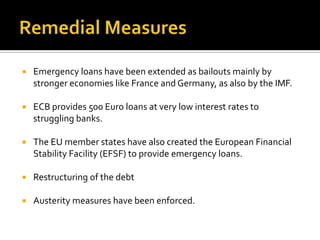
 Emergency loans have been extended as bailouts mainly by
stronger economies like France and Germany, as also by the IMF.
 ECB provides 500 Euro loans at very low interest rates to
struggling banks.
 The EU member states have also created the European Financial
Stability Facility (EFSF) to provide emergency loans.
 Restructuring of the debt
 Austerity measures have been enforced.
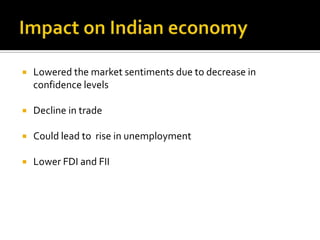
 Lowered the market sentiments due to decrease in
confidence levels
 Decline in trade
 Could lead to rise in unemployment
 Lower FDI and FII
Eurozone debt and impact on Indian economy

Eurozone debt and impact on Indian economy

  • 1.
    European debt crisisand its effect on Indian economy Presenter- Manpreet Singh
  • 2.
     What isEuro debt Crisis?  Brief History  Causes for the Crisis  RemedialActions  Impact on Indian Economy  Conclusions
  • 4.
     This isalso known as Eurozone sovereign debt crisis  The term indicates the financial woes caused due to overspending by some European countries  When a nation lives beyond its means by borrowing heavily and spending freely, there comes a point when it cannot manage its financial situation.  It is unable to repay its debts and lenders start demanding higher interest rates, the cornered nation begins to get swallowed up by what is known as the Sovereign Debt Crisis
  • 6.
     The actualbeginning is how the European Union (EU) began in 1992 where 27 European nations "agreed to form an alliance that could compete economically with larger nations such as the US".This is what created the currency of the euro which was adopted in 16 December 1995.  Members of the European Union signed the MaastrichtTreaty, under which they pledged to limit their deficit spending and debt levels.  However, in the early 2000, a number of EU member states were failing to stay within the confines of the Maastricht criteria.These violations marked the beginning Euro debt crisis.  Greece had experienced corruption and spending as its government continued borrowing money despite not being able to produce sufficient income through work and goods.  Spain, Portugal, and the other nations later followed Greece with alarming levels of debt on their economies.
  • 7.
    COUNTRIES STATISTICS France Debt/G.D.P:81.7% Unemployment. Oct 2011: 9.8% S&P Rating: AAA Germany Debt/G.D.P: 83.2% Unemployment. Oct 2011: 5.5% S&P Rating: AAA Greece Debt/G.D.P: 142.8% Unemployment. July 2011: 18.3% S&P Rating: CC Italy Debt/G.D.P: 119% Unemployment. Oct 2011: 8.5% S&P Rating: A Portugal Debt/G.D.P: 93% Unemployment. Oct 2011: 12.9% S&P Rating: BBB- Spain Debt/G.D.P: 60.1% Unemployment. Oct 2011: 22.8% S&P Rating: AA
  • 9.
    Countries with originallyweak currencies (and higher interest rates) suddenly enjoyed much more favorable credit terms, which spurred private and government spending and led to an economic boom.
  • 12.
     Almost allthe countries in Eurozone have trade deficits.  A trade deficit is when imports exceed exports.Trade deficits have goods and services components.A country that is a net importer of goods and services must borrow capital to fund this activity.  Germany has a significant trade surplus, meaning it is a net exporter.
  • 15.
     After failingto payback the huge debts the interest rates to repay rose significantly and swallowed the weaker economies in eurozone,further burdening their current situation.
  • 18.
     Emergency loanshave been extended as bailouts mainly by stronger economies like France and Germany, as also by the IMF.  ECB provides 500 Euro loans at very low interest rates to struggling banks.  The EU member states have also created the European Financial Stability Facility (EFSF) to provide emergency loans.  Restructuring of the debt  Austerity measures have been enforced.
  • 20.
     Lowered themarket sentiments due to decrease in confidence levels  Decline in trade  Could lead to rise in unemployment  Lower FDI and FII