













Small Animal Nutrition
Nutrition of Dogs and Cats
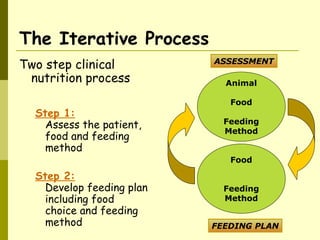
The Iterative Process
Two step clinical
nutrition process
Step 1:
Assess the patient,
food and feeding
method
Step 2:
Develop feeding plan
including food
choice and feeding
method
Animal
Food
Feeding
Method
ASSESSMENT
Food
Feeding
Method
FEEDING PLAN
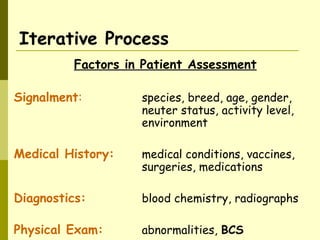
Iterative Process
Factors in Patient Assessment
Signalment: species, breed, age, gender,
neuter status, activity level,
environment
Medical History: medical conditions, vaccines,
surgeries, medications
Diagnostics: blood chemistry, radiographs
Physical Exam: abnormalities, BCS
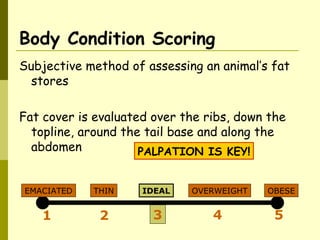
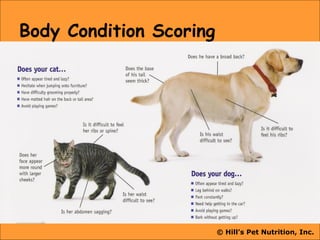
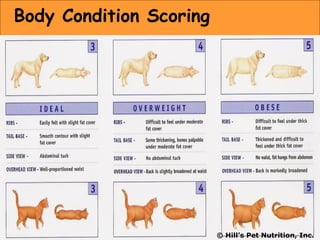
Body Condition Scoring
Subjective method of assessing an animal’s fat
stores
Fat cover is evaluated over the ribs, down the
topline, around the tail base and along the
abdomen
1 2 4 5
EMACIATED THIN
3
IDEAL OVERWEIGHT OBESE
PALPATION IS KEY!
© Hill’s Pet Nutrition, Inc.
Body Condition Scoring
© Hill’s Pet Nutrition, Inc.
Body Condition Scoring
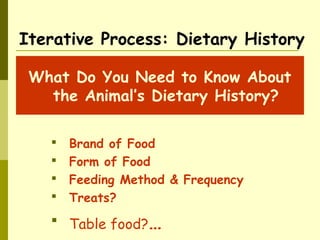
Iterative Process: Dietary History
What Do You Need to Know About
the Animal’s Dietary History?
 Brand of Food
 Form of Food
 Feeding Method & Frequency
 Treats?
 Table food?…
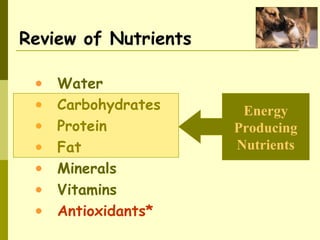
Review of Nutrients
• Water
• Carbohydrates
• Protein
• Fat
• Minerals
• Vitamins
• Antioxidants*
Energy
Producing
Nutrients
Review of Basic Nutrients:
Water
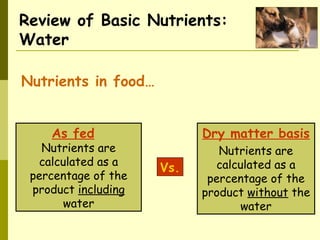
As fed
Nutrients are
calculated as a
percentage of the
product including
water
Dry matter basis
Nutrients are
calculated as a
percentage of the
product without the
water
Vs.
Nutrients in food…
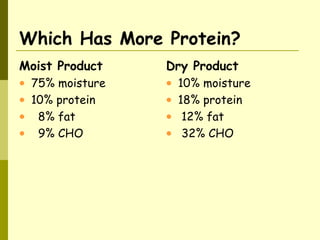
Which Has More Protein?
Moist Product
• 75% moisture
• 10% protein
• 8% fat
• 9% CHO
Dry Product
• 10% moisture
• 18% protein
• 12% fat
• 32% CHO
Review of Basic Nutrients:
Water
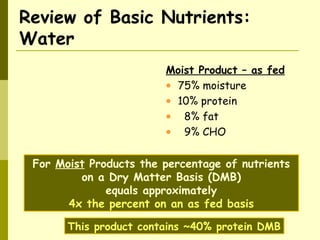
For Moist Products the percentage of nutrients
on a Dry Matter Basis (DMB)
equals approximately
4x the percent on an as fed basis
Moist Product – as fed
• 75% moisture
• 10% protein
• 8% fat
• 9% CHO
This product contains ~40% protein DMB
Review of Basic Nutrients:
Water
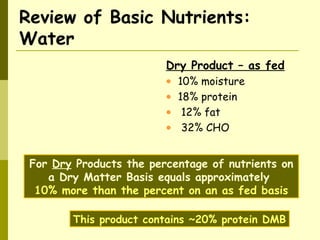
Dry Product – as fed
• 10% moisture
• 18% protein
• 12% fat
• 32% CHO
For Dry Products the percentage of nutrients on
a Dry Matter Basis equals approximately
10% more than the percent on an as fed basis
This product contains ~20% protein DMB
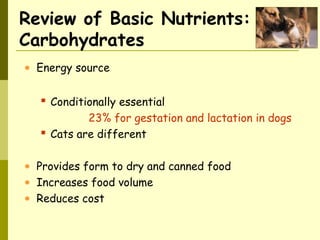
• Energy source
 Conditionally essential
23% for gestation and lactation in dogs
 Cats are different
• Provides form to dry and canned food
• Increases food volume
• Reduces cost
Review of Basic Nutrients:
Carbohydrates
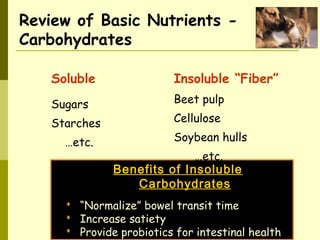
Benefits of Insoluble
Carbohydrates
 “Normalize” bowel transit time
 Increase satiety
 Provide probiotics for intestinal health
Review of Basic Nutrients -
Carbohydrates
Soluble Insoluble “Fiber”
Sugars
Starches
…etc.
Beet pulp
Cellulose
Soybean hulls
…etc.
Review of Basic Nutrients -
Proteins
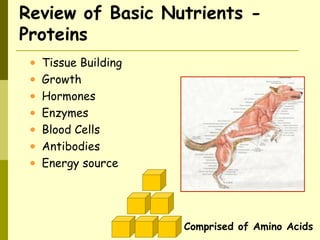
• Tissue Building
• Growth
• Hormones
• Enzymes
• Blood Cells
• Antibodies
• Energy source
Comprised of Amino Acids
Amino Acids of Special Concern
Arginine
(Essential)
Immune system stimulant; key in
management of dogs with cancer
Taurine
(Essential in
cats)
Critical for retinal and cardiac muscle
development in cats; Conditionally
essential in Newfoundlands
Carnitine
(Conditionally
essential)
Improves fat metabolism, builds lean
body tissue, make mitochondria more
efficient
AAFCO
Association of AmericanAssociation of American
Feed Control OfficialsFeed Control Officials
Nutrient Profiles forNutrient Profiles for
dogs and catsdogs and cats
 minimum nutrient valuesminimum nutrient values
required at different liferequired at different life
stagesstages
 some maximumsome maximum valuesvalues
Review of Basic Nutrients -
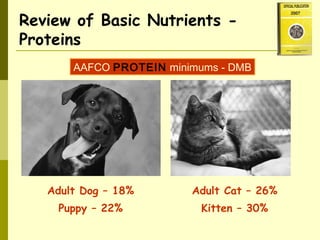
Proteins
AAFCO PROTEIN minimums - DMB
Adult Dog – 18%
Puppy – 22%
Adult Cat – 26%
Kitten – 30%
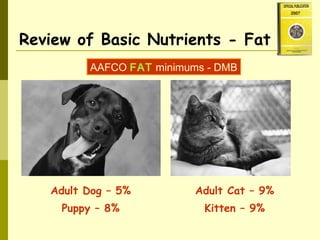
Review of Basic Nutrients - Fat
AAFCO FAT minimums - DMB
Adult Dog – 5%
Puppy – 8%
Adult Cat – 9%
Kitten – 9%
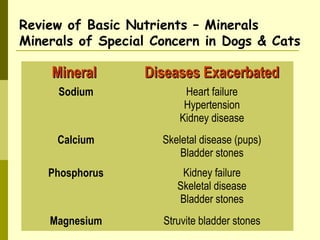
Review of Basic Nutrients – Minerals
Minerals of Special Concern in Dogs & Cats
MineralMineral Diseases ExacerbatedDiseases Exacerbated
Sodium Heart failure
Hypertension
Kidney disease
Calcium Skeletal disease (pups)
Bladder stones
Phosphorus Kidney failure
Skeletal disease
Bladder stones
Magnesium Struvite bladder stones
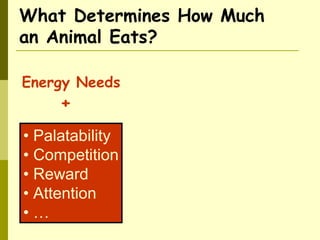
What Determines How Much
an Animal Eats?
Energy Needs
+
• Palatability
• Competition
• Reward
• Attention
• …
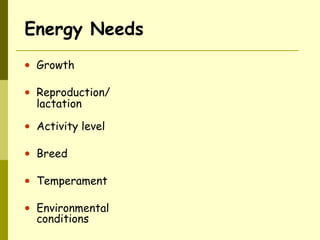
Energy Needs
• Growth
• Reproduction/
lactation
• Activity level
• Breed
• Temperament
• Environmental
conditions
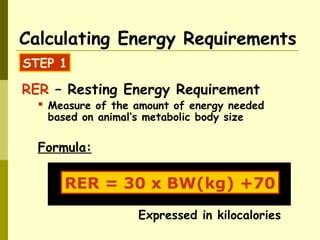
Calculating Energy Requirements
RER – Resting Energy Requirement
 Measure of the amount of energy needed
based on animal’s metabolic body size
Formula:
Expressed in kilocalories
RER = 30 x BW(kg) +70
STEP 1
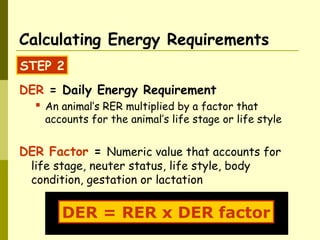
DER = Daily Energy Requirement
 An animal’s RER multiplied by a factor that
accounts for the animal’s life stage or life style
DER Factor = Numeric value that accounts for
life stage, neuter status, life style, body
condition, gestation or lactation
Calculating Energy Requirements
STEP 2
DER = RER x DER factor
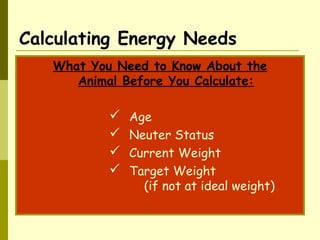
Calculating Energy Needs
What You Need to Know About the
Animal Before You Calculate:
 Age
 Neuter Status
 Current Weight
 Target Weight
(if not at ideal weight)
How Much Will We Feed
Gracie Whitesox?
“Gracie Whitesox”
3yrs; Female(N) Maine Coon; Wt. 11lbs; BCS 3/5
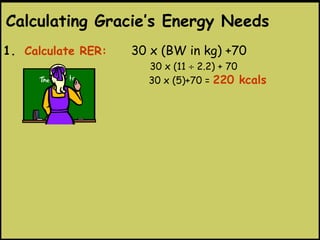
1. Calculate RER: 30 x (BW in kg) +70
Calculating Gracie’s Energy Needs
1. Calculate RER: 30 x (BW in kg) +70
30 x (11 ÷ 2.2) + 70
Calculating Gracie’s Energy Needs
1. Calculate RER: 30 x (BW in kg) +70
30 x (11 ÷ 2.2) + 70
30 x (5)+70 = 220 kcals
Calculating Gracie’s Energy Needs
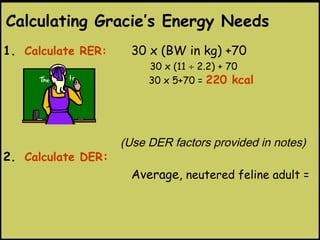
1. Calculate RER: 30 x (BW in kg) +70
30 x (11 ÷ 2.2) + 70
30 x 5+70 = 220 kcal
2. Calculate DER:
Average, neutered feline adult =
(Use DER factors provided in notes)
Calculating Gracie’s Energy Needs
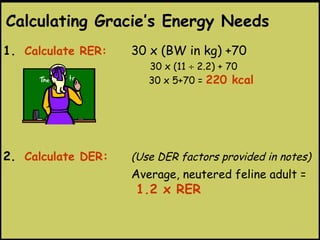
1. Calculate RER: 30 x (BW in kg) +70
30 x (11 ÷ 2.2) + 70
30 x 5+70 = 220 kcal
2. Calculate DER: (Use DER factors provided in notes)
Average, neutered feline adult =
1.2 x RER
Calculating Gracie’s Energy Needs
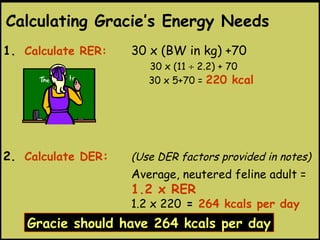
1. Calculate RER: 30 x (BW in kg) +70
30 x (11 ÷ 2.2) + 70
30 x 5+70 = 220 kcal
2. Calculate DER: (Use DER factors provided in notes)
Average, neutered feline adult =
1.2 x RER
1.2 x 220 = 264 kcals per day
Gracie should have 264 kcals per day
Calculating Gracie’s Energy Needs
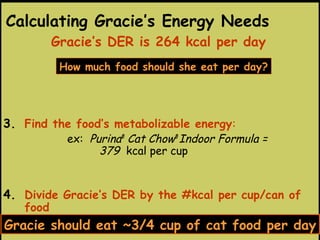
3. Find the food’s metabolizable energy:
ex: Purina®
Cat Chow®
Indoor Formula =
379 kcal per cup
4. Divide Gracie’s DER by the #kcal per cup/can of
food
DER = 264 ÷ 379 = ~3/4 cup per dayGracie should eat ~3/4 cup of cat food per day
Gracie’s DER is 264 kcal per day
How much food should she eat per day?
Calculating Gracie’s Energy Needs
How Much
Should
Breeze
Eat?
11-years old M(N)
Shetland Sheepdog, 21# BCS 3/5
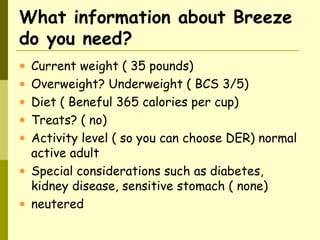
What information about Breeze
do you need?
• Current weight ( 35 pounds)
• Overweight? Underweight ( BCS 3/5)
• Diet ( Beneful 365 calories per cup)
• Treats? ( no)
• Activity level ( so you can choose DER) normal
active adult
• Special considerations such as diabetes,
kidney disease, sensitive stomach ( none)
• neutered
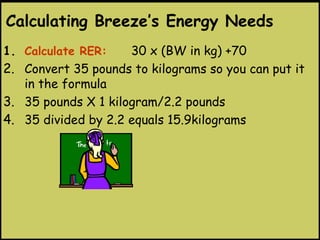
1. Calculate RER: 30 x (BW in kg) +70
2. Convert 35 pounds to kilograms so you can put it
in the formula
3. 35 pounds X 1 kilogram/2.2 pounds
4. 35 divided by 2.2 equals 15.9kilograms
Calculating Breeze’s Energy Needs
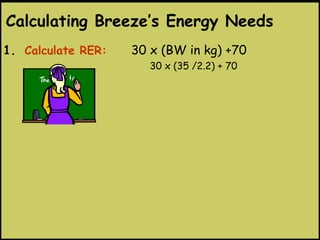
1. Calculate RER: 30 x (BW in kg) +70
30 x (35 /2.2) + 70
Calculating Breeze’s Energy Needs
1. Calculate RER: 30 x (BW in kg) +70
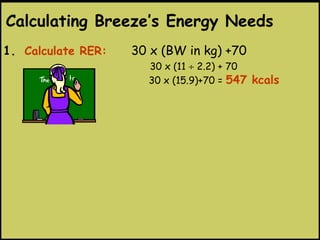
30 x (11 ÷ 2.2) + 70
30 x (15.9)+70 = 547 kcals
Calculating Breeze’s Energy Needs
1. Calculate RER: 30 x (BW in kg) +70
30 x (11 ÷ 2.2) + 70
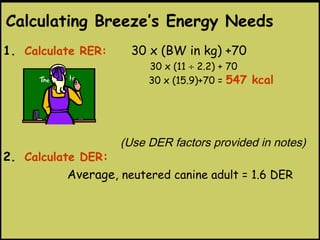
30 x (15.9)+70 = 547 kcal
2. Calculate DER:
Average, neutered canine adult = 1.6 DER
(Use DER factors provided in notes)
Calculating Breeze’s Energy Needs
1. Calculate RER: 30 x (BW in kg) +70
30 x (11 ÷ 2.2) + 70
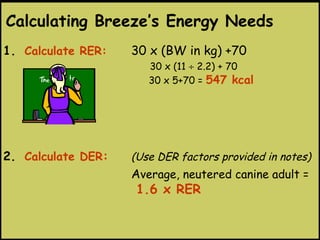
30 x 5+70 = 547 kcal
2. Calculate DER: (Use DER factors provided in notes)
Average, neutered canine adult =
1.6 x RER
Calculating Breeze’s Energy Needs
1. Calculate RER: 30 x (BW in kg) +70
30 x (11 ÷ 2.2) + 70
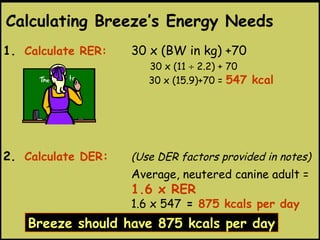
30 x (15.9)+70 = 547 kcal
2. Calculate DER: (Use DER factors provided in notes)
Average, neutered canine adult =
1.6 x RER
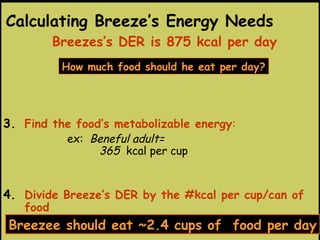
1.6 x 547 = 875 kcals per day
Breeze should have 875 kcals per day
Calculating Breeze’s Energy Needs
3. Find the food’s metabolizable energy:
ex: Beneful adult=
365 kcal per cup
4. Divide Breeze’s DER by the #kcal per cup/can of
food
DER = 875 ÷ 365 = ~2.4 cup per dayBreezee should eat ~2.4 cups of food per day
Breezes’s DER is 875 kcal per day
How much food should he eat per day?
Calculating Breeze’s Energy Needs
Life Stage &
Lifestyle Nutrition
Source: Geneva Acor
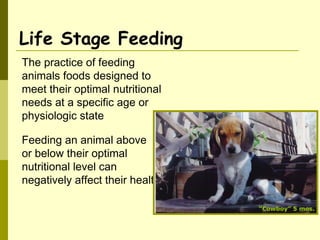
Life Stage Feeding
The practice of feeding
animals foods designed to
meet their optimal nutritional
needs at a specific age or
physiologic state
Feeding an animal above
or below their optimal
nutritional level can
negatively affect their health.
“Cowboy” 5 mos.
Different Life Stages =
Different Nutritional Requirements
• Growth, Reproduction & Lactation
Small & Medium Breeds vs. Large Breeds
• Adult
• Senior
Small Animal Clinical Nutrition
Nutrient Profiles Published For
 Dogs and Cats
 Recommended Nutrient Ranges
(OPTIMAL LEVELS)
 All Life Stages
On reserve in Library
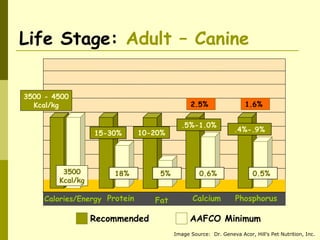
Life Stage: Adult
Recommended
3500
Kcal/kg
AAFCO Minimum
Calories/Energy Fat Calcium PhosphorusProtein
2.5% 1.6%
0.5%0.6%5%18%
.4%-.9%
.5%-1.0%
10-20%15-30%
3500 - 4500
Kcal/kg
Life Stage: Adult – Canine
Image Source: Dr. Geneva Acor, Hill’s Pet Nutrition, Inc.
What Defines
a Large
Breed Dog?
ANY DOG WHOSE
IDEAL ADULT
WEIGHT IS 55#
OR MORE
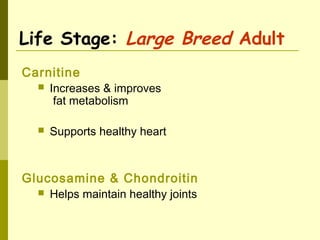
Life Stage: Large Breed Adult
Carnitine
 Increases & improves
fat metabolism
 Supports healthy heart
Glucosamine & Chondroitin
 Helps maintain healthy joints
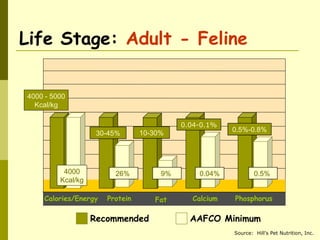
Life Stage: Adult - Feline
Recommended
4000
Kcal/kg
AAFCO Minimum
Calories/Energy Fat Calcium PhosphorusProtein
0.5%0.04%9%26%
0.5%-0.8%
0.04-0.1%
10-30%30-45%
4000 - 5000
Kcal/kg
Source: Hill’s Pet Nutrition, Inc.
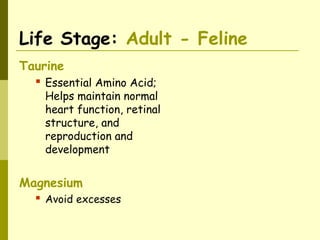
Taurine
 Essential Amino Acid;
Helps maintain normal
heart function, retinal
structure, and
reproduction and
development
Magnesium
 Avoid excesses
Life Stage: Adult - Feline
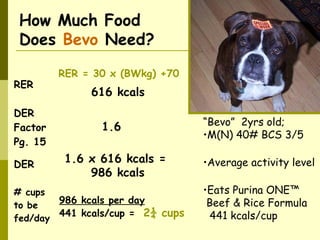
How Much Food
Does Bevo Need?
“Bevo” 2yrs old;
•M(N) 40# BCS 3/5
•Average activity level
•Eats Purina ONE™
Beef & Rice Formula
441 kcals/cup
RER
RER = 30 x (BWkg) +70
DER
Factor
Pg. 15
DER
# cups
to be
fed/day
616 kcals
1.6
1.6 x 616 kcals =
986 kcals
986 kcals per day
441 kcals/cup = 2¼ cups
Choose a dog or cat that you
own or a friend owns
• Use the previous
slide to fill in the
information on the
pet and calculate the
amount of food the
pet should be eating.
• If you are having
trouble with these
calculations, please
email me for help.
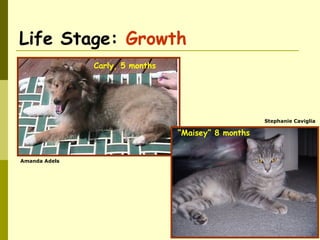
Life Stage: Growth
Carly, 5 months
Amanda Adels
“Maisey” 8 months
Stephanie Caviglia
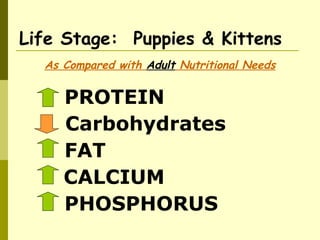
Life Stage: Puppies & Kittens
As Compared with Adult Nutritional Needs
PROTEIN
PHOSPHORUS
CALCIUM
FAT
Carbohydrates
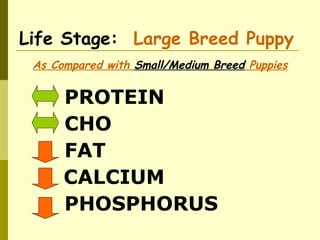
Life Stage: Large Breed Puppy
As Compared with Small/Medium Breed Puppies
PROTEIN
PHOSPHORUS
CALCIUM
FAT
CHO
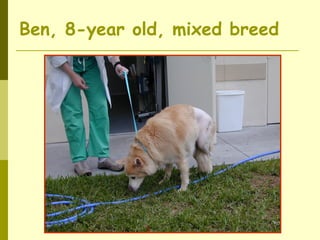
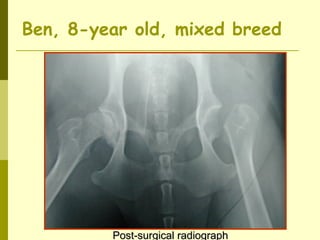
Ben, 8-year old, mixed breed
Pre-surgical radiographPre-surgical radiograph
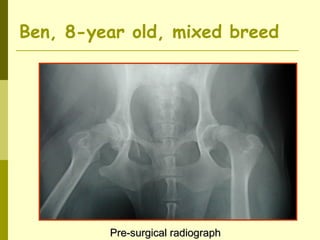
Ben, 8-year old, mixed breed
Post-surgical radiographPost-surgical radiograph
Ben, 8-year old, mixed breed
What Purina Learned…
The Purina Life Span Study
 14 year study (1987 – 2001)
 Purpose: “Evaluate the effects of food intake on
body condition…and life span.”
www.purinavets.com
User name: purinavets
Password: nutrition
Search: Life Span Study
JAVMA, Vol. 220, No. 9, May 1, 2002
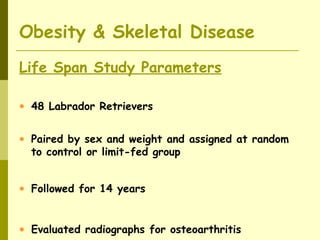
Life Span Study Parameters
• 48 Labrador Retrievers
• Paired by sex and weight and assigned at random
to control or limit-fed group
• Followed for 14 years
• Evaluated radiographs for osteoarthritis
Obesity & Skeletal Disease
Control
Group
Limit-fed
Group
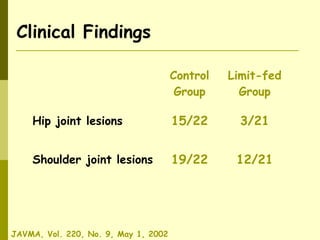
Hip joint lesions 15/22 3/21
Shoulder joint lesions 19/22 12/21
Clinical Findings
JAVMA, Vol. 220, No. 9, May 1, 2002
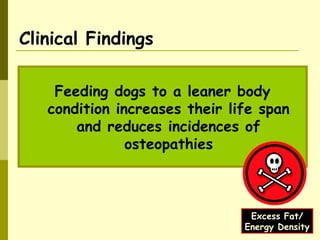
Clinical Findings
Feeding dogs to a leaner body
condition increases their life span
and reduces incidences of
osteopathies
Excess Fat/
Energy Density
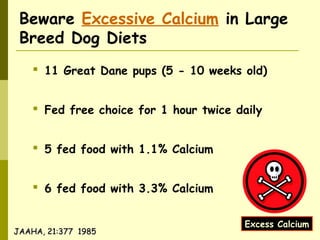
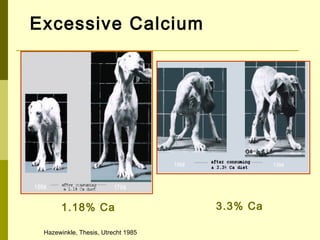
 11 Great Dane pups (5 - 10 weeks old)
 Fed free choice for 1 hour twice daily
 5 fed food with 1.1% Calcium
 6 fed food with 3.3% Calcium
Beware Excessive Calcium in Large
Breed Dog Diets
JAAHA, 21:377 1985JAAHA, 21:377 1985
Excess Calcium
1.18% Ca 3.3% Ca
Excessive Calcium
Hazewinkle, Thesis, Utrecht 1985
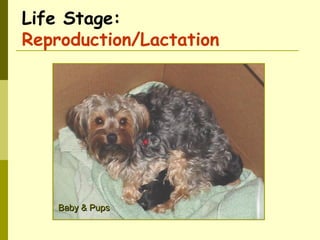
Life Stage:
Reproduction/Lactation
Baby & PupsBaby & Pups
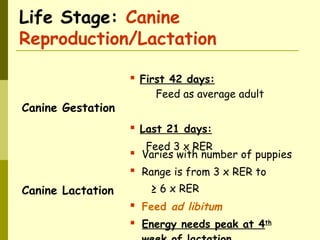
Life Stage: Canine
Reproduction/Lactation
Canine Gestation
 First 42 days:
Feed as average adult
 Last 21 days:
Feed 3 x RER
Canine Lactation
 Varies with number of puppies
 Range is from 3 x RER to
≥ 6 x RER
 Feed ad libitum
 Energy needs peak at 4th
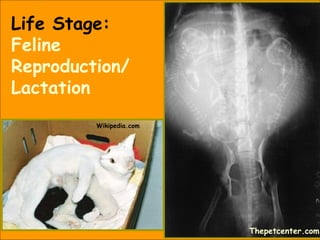
Life Stage:
Feline
Reproduction/
Lactation
Thepetcenter.com
Wikipedia.com
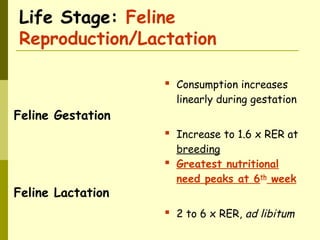
Life Stage: Feline
Reproduction/Lactation
Feline Gestation
 Consumption increases
linearly during gestation
 Increase to 1.6 x RER at
breeding
Feline Lactation
 Greatest nutritional
need peaks at 6th
week
 2 to 6 x RER, ad libitum
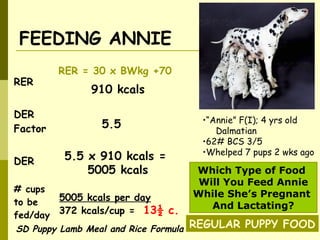
FEEDING ANNIE
•“Annie” F(I); 4 yrs old
Dalmatian
•62# BCS 3/5
•Whelped 7 pups 2 wks ago
RER
RER = 30 x BWkg +70
DER
Factor
DER
# cups
to be
fed/day
910 kcals
5.5
5.5 x 910 kcals =
5005 kcals
5005 kcals per day
372 kcals/cup = 13½ c.
Which Type of Food
Will You Feed Annie
While She’s Pregnant
And Lactating?
REGULAR PUPPY FOODSD Puppy Lamb Meal and Rice Formula
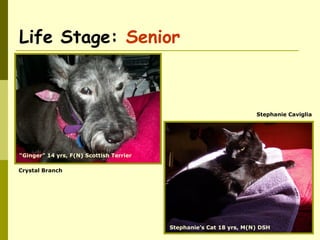
Life Stage: Senior
“Ginger” 14 yrs, F(N) Scottish Terrier
Stephanie’s Cat 18 yrs, M(N) DSH
Crystal Branch
Stephanie Caviglia
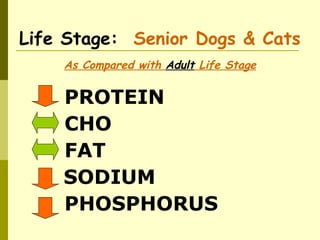
Life Stage: Senior Dogs & Cats
As Compared with Adult Life Stage
PROTEIN
PHOSPHORUS
SODIUM
FAT
CHO
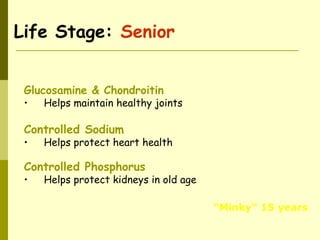
Life Stage: Senior
“Minky” 15 years
Glucosamine & Chondroitin
• Helps maintain healthy joints
Controlled Sodium
• Helps protect heart health
Controlled Phosphorus
• Helps protect kidneys in old age
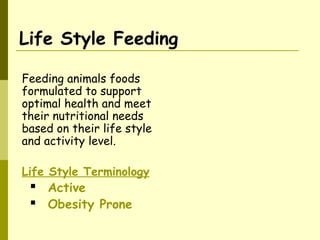
Life Style Feeding
Feeding animals foods
formulated to support
optimal health and meet
their nutritional needs
based on their life style
and activity level.
Life Style Terminology
 Active
 Obesity Prone
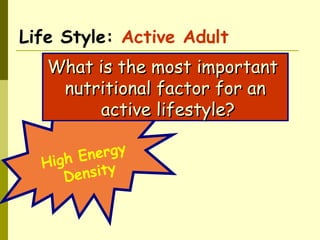
Life Style: Active Adult
High Energy
Density
What is the most importantWhat is the most important
nutritional factor for annutritional factor for an
active lifestyle?active lifestyle?
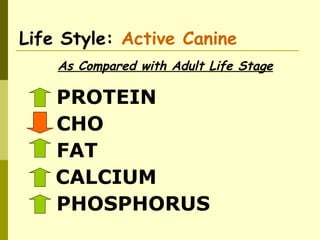
Life Style: Active Canine
As Compared with Adult Life Stage
PROTEIN
PHOSPHORUS
CALCIUM
FAT
CHO
© Flickr
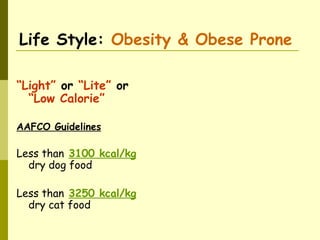
Life Style: Obesity & Obese Prone
“Light” or “Lite” or
“Low Calorie”
AAFCO Guidelines
Less than 3100 kcal/kg
dry dog food
Less than 3250 kcal/kg
dry cat food
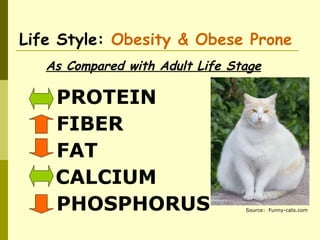
Life Style: Obesity & Obese Prone
As Compared with Adult Life Stage
PROTEIN
PHOSPHORUS
CALCIUM
FAT
FIBER
Source: Funny-cats.com
No visible
waistline
Fat pools
around
tailbase
“Missy”
English Pointer
F(N); 92# BCS 5/5
Karen Pogmore
Missy
• What body condition score do you give her?
• What DER are you going to use?
“Rocky” 7years, M(N) DSH 20# BCS 5/5
(enjoys yoga )
Nicole Polizzi
Rocky
• What body condition score are you going to
use?
• What DER should you use?
• REMEMBER cats that stop eating can develop
Hepatic Lipidosis ( look it up for discussion)
• Be very cautious about changing Rocky’s food
to a diet food
Managing Obese & Obese Prone Animals
 FOOD
 FEEDING METHOD
 EXERCISE
 OWNER
Beware of
Marketing Claims
Managing Obese & Obese Prone Animals
 FOOD
 EXERCISE
 FEEDING METHOD
 OWNER
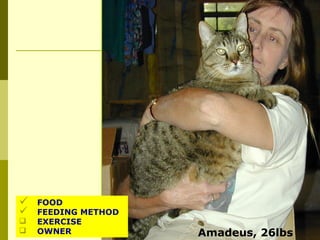
Amadeus, 26lbs
 FOOD
 FEEDING METHOD
 EXERCISE
 OWNER
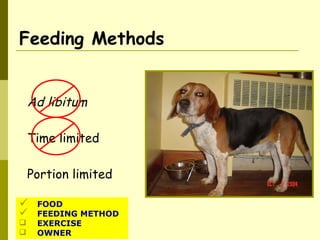
Feeding Methods
Ad libitum
Time limited
Portion limited
 FOOD
 FEEDING METHOD
 EXERCISE
 OWNER
Exercise is Important Too!
What Are Some Ways
To Get Your
Cat to Exercise?
 FOOD
 FEEDING METHOD
 EXERCISE
 OWNER
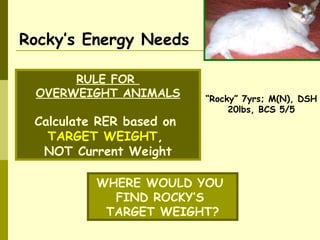
Rocky’s Energy Needs
“Rocky” 7yrs; M(N), DSH
20lbs, BCS 5/5
RULE FOR
OVERWEIGHT ANIMALS
Calculate RER based on
TARGET WEIGHT,
NOT Current Weight
WHERE WOULD YOU
FIND ROCKY’S
TARGET WEIGHT?
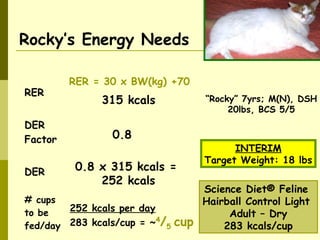
Rocky’s Energy Needs
RER
RER = 30 x BW(kg) +70
DER
Factor
DER
# cups
to be
fed/day
315 kcals
0.8
0.8 x 315 kcals =
252 kcals
252 kcals per day
283 kcals/cup = ~4
/5 cup
INTERIM
Target Weight: 18 lbs
Science Diet® Feline
Hairball Control Light
Adult – Dry
283 kcals/cup
“Rocky” 7yrs; M(N), DSH
20lbs, BCS 5/5

Session 3 -_san_ecalcs___ls_ls

  • 1.
  • 2.
    The Iterative Process Twostep clinical nutrition process Step 1: Assess the patient, food and feeding method Step 2: Develop feeding plan including food choice and feeding method Animal Food Feeding Method ASSESSMENT Food Feeding Method FEEDING PLAN
  • 3.
    Iterative Process Factors inPatient Assessment Signalment: species, breed, age, gender, neuter status, activity level, environment Medical History: medical conditions, vaccines, surgeries, medications Diagnostics: blood chemistry, radiographs Physical Exam: abnormalities, BCS
  • 4.
    Body Condition Scoring Subjectivemethod of assessing an animal’s fat stores Fat cover is evaluated over the ribs, down the topline, around the tail base and along the abdomen 1 2 4 5 EMACIATED THIN 3 IDEAL OVERWEIGHT OBESE PALPATION IS KEY!
  • 5.
    © Hill’s PetNutrition, Inc. Body Condition Scoring
  • 6.
    © Hill’s PetNutrition, Inc. Body Condition Scoring
  • 7.
    Iterative Process: DietaryHistory What Do You Need to Know About the Animal’s Dietary History?  Brand of Food  Form of Food  Feeding Method & Frequency  Treats?  Table food?…
  • 8.
    Review of Nutrients •Water • Carbohydrates • Protein • Fat • Minerals • Vitamins • Antioxidants* Energy Producing Nutrients
  • 9.
    Review of BasicNutrients: Water As fed Nutrients are calculated as a percentage of the product including water Dry matter basis Nutrients are calculated as a percentage of the product without the water Vs. Nutrients in food…
  • 10.
    Which Has MoreProtein? Moist Product • 75% moisture • 10% protein • 8% fat • 9% CHO Dry Product • 10% moisture • 18% protein • 12% fat • 32% CHO
  • 11.
    Review of BasicNutrients: Water For Moist Products the percentage of nutrients on a Dry Matter Basis (DMB) equals approximately 4x the percent on an as fed basis Moist Product – as fed • 75% moisture • 10% protein • 8% fat • 9% CHO This product contains ~40% protein DMB
  • 12.
    Review of BasicNutrients: Water Dry Product – as fed • 10% moisture • 18% protein • 12% fat • 32% CHO For Dry Products the percentage of nutrients on a Dry Matter Basis equals approximately 10% more than the percent on an as fed basis This product contains ~20% protein DMB
  • 13.
    • Energy source Conditionally essential 23% for gestation and lactation in dogs  Cats are different • Provides form to dry and canned food • Increases food volume • Reduces cost Review of Basic Nutrients: Carbohydrates
  • 14.
    Benefits of Insoluble Carbohydrates “Normalize” bowel transit time  Increase satiety  Provide probiotics for intestinal health Review of Basic Nutrients - Carbohydrates Soluble Insoluble “Fiber” Sugars Starches …etc. Beet pulp Cellulose Soybean hulls …etc.
  • 15.
    Review of BasicNutrients - Proteins • Tissue Building • Growth • Hormones • Enzymes • Blood Cells • Antibodies • Energy source Comprised of Amino Acids
  • 16.
    Amino Acids ofSpecial Concern Arginine (Essential) Immune system stimulant; key in management of dogs with cancer Taurine (Essential in cats) Critical for retinal and cardiac muscle development in cats; Conditionally essential in Newfoundlands Carnitine (Conditionally essential) Improves fat metabolism, builds lean body tissue, make mitochondria more efficient
  • 17.
    AAFCO Association of AmericanAssociationof American Feed Control OfficialsFeed Control Officials Nutrient Profiles forNutrient Profiles for dogs and catsdogs and cats  minimum nutrient valuesminimum nutrient values required at different liferequired at different life stagesstages  some maximumsome maximum valuesvalues
  • 18.
    Review of BasicNutrients - Proteins AAFCO PROTEIN minimums - DMB Adult Dog – 18% Puppy – 22% Adult Cat – 26% Kitten – 30%
  • 19.
    Review of BasicNutrients - Fat AAFCO FAT minimums - DMB Adult Dog – 5% Puppy – 8% Adult Cat – 9% Kitten – 9%
  • 20.
    Review of BasicNutrients – Minerals Minerals of Special Concern in Dogs & Cats MineralMineral Diseases ExacerbatedDiseases Exacerbated Sodium Heart failure Hypertension Kidney disease Calcium Skeletal disease (pups) Bladder stones Phosphorus Kidney failure Skeletal disease Bladder stones Magnesium Struvite bladder stones
  • 21.
    What Determines HowMuch an Animal Eats? Energy Needs + • Palatability • Competition • Reward • Attention • …
  • 22.
    Energy Needs • Growth •Reproduction/ lactation • Activity level • Breed • Temperament • Environmental conditions
  • 23.
    Calculating Energy Requirements RER– Resting Energy Requirement  Measure of the amount of energy needed based on animal’s metabolic body size Formula: Expressed in kilocalories RER = 30 x BW(kg) +70 STEP 1
  • 24.
    DER = DailyEnergy Requirement  An animal’s RER multiplied by a factor that accounts for the animal’s life stage or life style DER Factor = Numeric value that accounts for life stage, neuter status, life style, body condition, gestation or lactation Calculating Energy Requirements STEP 2 DER = RER x DER factor
  • 25.
    Calculating Energy Needs WhatYou Need to Know About the Animal Before You Calculate:  Age  Neuter Status  Current Weight  Target Weight (if not at ideal weight)
  • 26.
    How Much WillWe Feed Gracie Whitesox? “Gracie Whitesox” 3yrs; Female(N) Maine Coon; Wt. 11lbs; BCS 3/5
  • 27.
    1. Calculate RER:30 x (BW in kg) +70 Calculating Gracie’s Energy Needs
  • 28.
    1. Calculate RER:30 x (BW in kg) +70 30 x (11 ÷ 2.2) + 70 Calculating Gracie’s Energy Needs
  • 29.
    1. Calculate RER:30 x (BW in kg) +70 30 x (11 ÷ 2.2) + 70 30 x (5)+70 = 220 kcals Calculating Gracie’s Energy Needs
  • 30.
    1. Calculate RER:30 x (BW in kg) +70 30 x (11 ÷ 2.2) + 70 30 x 5+70 = 220 kcal 2. Calculate DER: Average, neutered feline adult = (Use DER factors provided in notes) Calculating Gracie’s Energy Needs
  • 31.
    1. Calculate RER:30 x (BW in kg) +70 30 x (11 ÷ 2.2) + 70 30 x 5+70 = 220 kcal 2. Calculate DER: (Use DER factors provided in notes) Average, neutered feline adult = 1.2 x RER Calculating Gracie’s Energy Needs
  • 32.
    1. Calculate RER:30 x (BW in kg) +70 30 x (11 ÷ 2.2) + 70 30 x 5+70 = 220 kcal 2. Calculate DER: (Use DER factors provided in notes) Average, neutered feline adult = 1.2 x RER 1.2 x 220 = 264 kcals per day Gracie should have 264 kcals per day Calculating Gracie’s Energy Needs
  • 33.
    3. Find thefood’s metabolizable energy: ex: Purina® Cat Chow® Indoor Formula = 379 kcal per cup 4. Divide Gracie’s DER by the #kcal per cup/can of food DER = 264 ÷ 379 = ~3/4 cup per dayGracie should eat ~3/4 cup of cat food per day Gracie’s DER is 264 kcal per day How much food should she eat per day? Calculating Gracie’s Energy Needs
  • 34.
    How Much Should Breeze Eat? 11-years oldM(N) Shetland Sheepdog, 21# BCS 3/5
  • 35.
    What information aboutBreeze do you need? • Current weight ( 35 pounds) • Overweight? Underweight ( BCS 3/5) • Diet ( Beneful 365 calories per cup) • Treats? ( no) • Activity level ( so you can choose DER) normal active adult • Special considerations such as diabetes, kidney disease, sensitive stomach ( none) • neutered
  • 36.
    1. Calculate RER:30 x (BW in kg) +70 2. Convert 35 pounds to kilograms so you can put it in the formula 3. 35 pounds X 1 kilogram/2.2 pounds 4. 35 divided by 2.2 equals 15.9kilograms Calculating Breeze’s Energy Needs
  • 37.
    1. Calculate RER:30 x (BW in kg) +70 30 x (35 /2.2) + 70 Calculating Breeze’s Energy Needs
  • 38.
    1. Calculate RER:30 x (BW in kg) +70 30 x (11 ÷ 2.2) + 70 30 x (15.9)+70 = 547 kcals Calculating Breeze’s Energy Needs
  • 39.
    1. Calculate RER:30 x (BW in kg) +70 30 x (11 ÷ 2.2) + 70 30 x (15.9)+70 = 547 kcal 2. Calculate DER: Average, neutered canine adult = 1.6 DER (Use DER factors provided in notes) Calculating Breeze’s Energy Needs
  • 40.
    1. Calculate RER:30 x (BW in kg) +70 30 x (11 ÷ 2.2) + 70 30 x 5+70 = 547 kcal 2. Calculate DER: (Use DER factors provided in notes) Average, neutered canine adult = 1.6 x RER Calculating Breeze’s Energy Needs
  • 41.
    1. Calculate RER:30 x (BW in kg) +70 30 x (11 ÷ 2.2) + 70 30 x (15.9)+70 = 547 kcal 2. Calculate DER: (Use DER factors provided in notes) Average, neutered canine adult = 1.6 x RER 1.6 x 547 = 875 kcals per day Breeze should have 875 kcals per day Calculating Breeze’s Energy Needs
  • 42.
    3. Find thefood’s metabolizable energy: ex: Beneful adult= 365 kcal per cup 4. Divide Breeze’s DER by the #kcal per cup/can of food DER = 875 ÷ 365 = ~2.4 cup per dayBreezee should eat ~2.4 cups of food per day Breezes’s DER is 875 kcal per day How much food should he eat per day? Calculating Breeze’s Energy Needs
  • 43.
    Life Stage & LifestyleNutrition Source: Geneva Acor
  • 44.
    Life Stage Feeding Thepractice of feeding animals foods designed to meet their optimal nutritional needs at a specific age or physiologic state Feeding an animal above or below their optimal nutritional level can negatively affect their health. “Cowboy” 5 mos.
  • 45.
    Different Life Stages= Different Nutritional Requirements • Growth, Reproduction & Lactation Small & Medium Breeds vs. Large Breeds • Adult • Senior
  • 46.
    Small Animal ClinicalNutrition Nutrient Profiles Published For  Dogs and Cats  Recommended Nutrient Ranges (OPTIMAL LEVELS)  All Life Stages On reserve in Library
  • 47.
  • 48.
    Recommended 3500 Kcal/kg AAFCO Minimum Calories/Energy FatCalcium PhosphorusProtein 2.5% 1.6% 0.5%0.6%5%18% .4%-.9% .5%-1.0% 10-20%15-30% 3500 - 4500 Kcal/kg Life Stage: Adult – Canine Image Source: Dr. Geneva Acor, Hill’s Pet Nutrition, Inc.
  • 49.
    What Defines a Large BreedDog? ANY DOG WHOSE IDEAL ADULT WEIGHT IS 55# OR MORE
  • 50.
    Life Stage: LargeBreed Adult Carnitine  Increases & improves fat metabolism  Supports healthy heart Glucosamine & Chondroitin  Helps maintain healthy joints
  • 51.
    Life Stage: Adult- Feline Recommended 4000 Kcal/kg AAFCO Minimum Calories/Energy Fat Calcium PhosphorusProtein 0.5%0.04%9%26% 0.5%-0.8% 0.04-0.1% 10-30%30-45% 4000 - 5000 Kcal/kg Source: Hill’s Pet Nutrition, Inc.
  • 52.
    Taurine  Essential AminoAcid; Helps maintain normal heart function, retinal structure, and reproduction and development Magnesium  Avoid excesses Life Stage: Adult - Feline
  • 53.
    How Much Food DoesBevo Need? “Bevo” 2yrs old; •M(N) 40# BCS 3/5 •Average activity level •Eats Purina ONE™ Beef & Rice Formula 441 kcals/cup RER RER = 30 x (BWkg) +70 DER Factor Pg. 15 DER # cups to be fed/day 616 kcals 1.6 1.6 x 616 kcals = 986 kcals 986 kcals per day 441 kcals/cup = 2¼ cups
  • 54.
    Choose a dogor cat that you own or a friend owns • Use the previous slide to fill in the information on the pet and calculate the amount of food the pet should be eating. • If you are having trouble with these calculations, please email me for help.
  • 55.
    Life Stage: Growth Carly,5 months Amanda Adels “Maisey” 8 months Stephanie Caviglia
  • 56.
    Life Stage: Puppies& Kittens As Compared with Adult Nutritional Needs PROTEIN PHOSPHORUS CALCIUM FAT Carbohydrates
  • 57.
    Life Stage: LargeBreed Puppy
  • 58.
    Life Stage: LargeBreed Puppy As Compared with Small/Medium Breed Puppies PROTEIN PHOSPHORUS CALCIUM FAT CHO
  • 59.
    Ben, 8-year old,mixed breed
  • 60.
  • 61.
  • 62.
    What Purina Learned… ThePurina Life Span Study  14 year study (1987 – 2001)  Purpose: “Evaluate the effects of food intake on body condition…and life span.” www.purinavets.com User name: purinavets Password: nutrition Search: Life Span Study JAVMA, Vol. 220, No. 9, May 1, 2002
  • 63.
    Life Span StudyParameters • 48 Labrador Retrievers • Paired by sex and weight and assigned at random to control or limit-fed group • Followed for 14 years • Evaluated radiographs for osteoarthritis Obesity & Skeletal Disease
  • 64.
    Control Group Limit-fed Group Hip joint lesions15/22 3/21 Shoulder joint lesions 19/22 12/21 Clinical Findings JAVMA, Vol. 220, No. 9, May 1, 2002
  • 65.
    Clinical Findings Feeding dogsto a leaner body condition increases their life span and reduces incidences of osteopathies Excess Fat/ Energy Density
  • 66.
     11 GreatDane pups (5 - 10 weeks old)  Fed free choice for 1 hour twice daily  5 fed food with 1.1% Calcium  6 fed food with 3.3% Calcium Beware Excessive Calcium in Large Breed Dog Diets JAAHA, 21:377 1985JAAHA, 21:377 1985 Excess Calcium
  • 67.
    1.18% Ca 3.3%Ca Excessive Calcium Hazewinkle, Thesis, Utrecht 1985
  • 68.
  • 69.
    Life Stage: Canine Reproduction/Lactation CanineGestation  First 42 days: Feed as average adult  Last 21 days: Feed 3 x RER Canine Lactation  Varies with number of puppies  Range is from 3 x RER to ≥ 6 x RER  Feed ad libitum  Energy needs peak at 4th
  • 70.
  • 71.
    Life Stage: Feline Reproduction/Lactation FelineGestation  Consumption increases linearly during gestation  Increase to 1.6 x RER at breeding Feline Lactation  Greatest nutritional need peaks at 6th week  2 to 6 x RER, ad libitum
  • 72.
    FEEDING ANNIE •“Annie” F(I);4 yrs old Dalmatian •62# BCS 3/5 •Whelped 7 pups 2 wks ago RER RER = 30 x BWkg +70 DER Factor DER # cups to be fed/day 910 kcals 5.5 5.5 x 910 kcals = 5005 kcals 5005 kcals per day 372 kcals/cup = 13½ c. Which Type of Food Will You Feed Annie While She’s Pregnant And Lactating? REGULAR PUPPY FOODSD Puppy Lamb Meal and Rice Formula
  • 73.
    Life Stage: Senior “Ginger”14 yrs, F(N) Scottish Terrier Stephanie’s Cat 18 yrs, M(N) DSH Crystal Branch Stephanie Caviglia
  • 74.
    Life Stage: SeniorDogs & Cats As Compared with Adult Life Stage PROTEIN PHOSPHORUS SODIUM FAT CHO
  • 75.
    Life Stage: Senior “Minky”15 years Glucosamine & Chondroitin • Helps maintain healthy joints Controlled Sodium • Helps protect heart health Controlled Phosphorus • Helps protect kidneys in old age
  • 76.
    Life Style Feeding Feedinganimals foods formulated to support optimal health and meet their nutritional needs based on their life style and activity level. Life Style Terminology  Active  Obesity Prone
  • 77.
    Life Style: ActiveAdult High Energy Density What is the most importantWhat is the most important nutritional factor for annutritional factor for an active lifestyle?active lifestyle?
  • 78.
    Life Style: ActiveCanine As Compared with Adult Life Stage PROTEIN PHOSPHORUS CALCIUM FAT CHO © Flickr
  • 79.
    Life Style: Obesity& Obese Prone “Light” or “Lite” or “Low Calorie” AAFCO Guidelines Less than 3100 kcal/kg dry dog food Less than 3250 kcal/kg dry cat food
  • 80.
    Life Style: Obesity& Obese Prone As Compared with Adult Life Stage PROTEIN PHOSPHORUS CALCIUM FAT FIBER Source: Funny-cats.com
  • 81.
  • 82.
    Missy • What bodycondition score do you give her? • What DER are you going to use?
  • 83.
    “Rocky” 7years, M(N)DSH 20# BCS 5/5 (enjoys yoga ) Nicole Polizzi
  • 84.
    Rocky • What bodycondition score are you going to use? • What DER should you use? • REMEMBER cats that stop eating can develop Hepatic Lipidosis ( look it up for discussion) • Be very cautious about changing Rocky’s food to a diet food
  • 85.
    Managing Obese &Obese Prone Animals  FOOD  FEEDING METHOD  EXERCISE  OWNER
  • 86.
    Beware of Marketing Claims ManagingObese & Obese Prone Animals  FOOD  EXERCISE  FEEDING METHOD  OWNER
  • 87.
    Amadeus, 26lbs  FOOD FEEDING METHOD  EXERCISE  OWNER
  • 88.
    Feeding Methods Ad libitum Timelimited Portion limited  FOOD  FEEDING METHOD  EXERCISE  OWNER
  • 89.
    Exercise is ImportantToo! What Are Some Ways To Get Your Cat to Exercise?  FOOD  FEEDING METHOD  EXERCISE  OWNER
  • 90.
    Rocky’s Energy Needs “Rocky”7yrs; M(N), DSH 20lbs, BCS 5/5 RULE FOR OVERWEIGHT ANIMALS Calculate RER based on TARGET WEIGHT, NOT Current Weight WHERE WOULD YOU FIND ROCKY’S TARGET WEIGHT?
  • 91.
    Rocky’s Energy Needs RER RER= 30 x BW(kg) +70 DER Factor DER # cups to be fed/day 315 kcals 0.8 0.8 x 315 kcals = 252 kcals 252 kcals per day 283 kcals/cup = ~4 /5 cup INTERIM Target Weight: 18 lbs Science Diet® Feline Hairball Control Light Adult – Dry 283 kcals/cup “Rocky” 7yrs; M(N), DSH 20lbs, BCS 5/5

Editor's Notes

  • #15 The energy requirements for carbohydrates increase in dogs during pregnancy. Because cats are strict carnivores, they don’t have a dietary requirement for carbohydrates and cannot metabolize large amounts of simple carbohydrates. It bulks up food – more bulk/fiber It reduces cost – in the manufacturing process, CHO less expensive than fat or protein.
  • #16 Normalize bowel transit time is IMPORTANT because fiber pulls water into the bowel and softens it for passage. If an animal has diarrhea, the fiber absorbs the excess water. Probiotics help to establish the best balance of microorganisms in the GI tract. They live in the colon and break down long chain insoluble carbohydrates into healthy short-chain fatty acids. They nourish colonic cells.
  • #18 Cats lose taurine in their feces due to normal GI bacterial action, and coupled with the fact that they can’t synthesize it, makes it an important essential amino acid. Tell story of litter of kittens and vegetarian owner at ASPCA. Importance of Taurine.
  • #22 AAFCO doesn’t publish ranges in its profiles – only minimums of nutrients and in the case of certain minerals like calcium and phosphorus – maximums.
  • #24 Alpha linolenic , Linoleic acid and Arachaonic acid are all ESSENTIAL FATTY ACIDS. DOGS: Linoleic is essential in the dog, and from that dogs can make alpha linolenic. Dogs can also synthesize arachidonic acid CATS: Arachidonic is essential in the cat only – they cannot synthesize it. Omega-6 fatty acids are required for growth and reproduction, and are precursors to certain hormones – like prostaglandin CELL MEMBRANE: remember from your anatomy class that the cell membrane is made up of a phospholipid bi-layer
  • #68 Ben was a patient at the Animal Referral Center in Ft. Pierce, Florida.
  • #69 This is a radiograph taken of Ben’s pelvis prior to surgery. You can see cardinal signs of hip dysplasia here. The left femur head doesn’t fit into the acetabulum, and has worn away some.
  • #70 This is a post-surgery radiograph – Ben had his left femur head removed – a femoral head ostectomy. The point of all this is to illustrate the connection between obesity and skeletal problems.
  • #72 This research was done by Purina. The Purina Life Span Study www.Purinavets.com Password: nutrition