OSS & BSS
OSS & BSS Operations Support Systems Network systems, inventory, provisioning, configuration, element management OAM&P Business Support Systems Customer management, order processing Payments and billing Sometimes Billing Support Systems
OSS & BSS Why is OSS & BSS complicated? Involves end to end management of services How do you make a service work once ordered? Provisioning, activation, maintenance, payment? Has to encapsulate complete value chain Must recognise and integrate multiple elements from multiple vendors Vendor independence is key business requirement Vendor interop is essential....but difficult
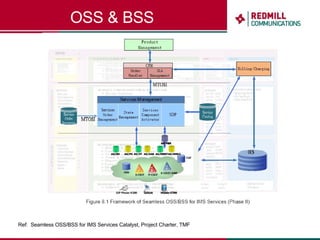
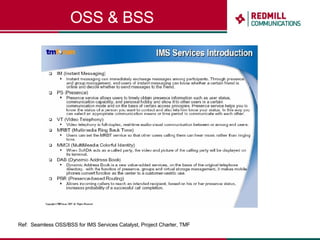
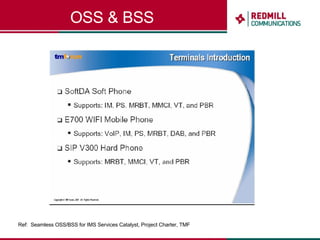
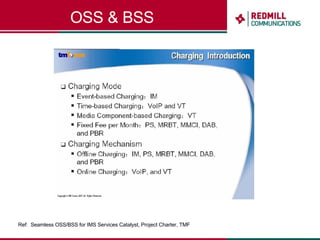
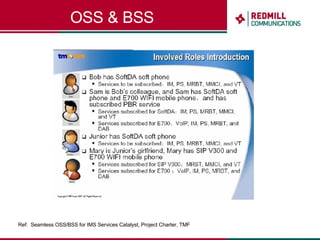
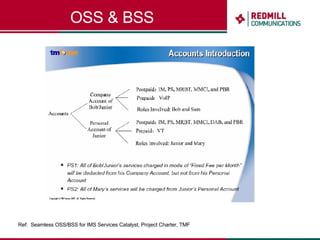
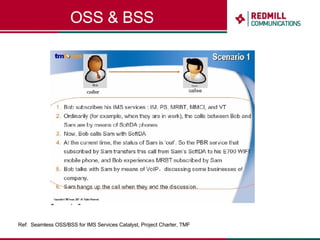
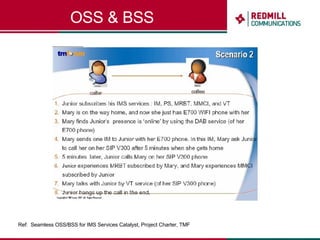
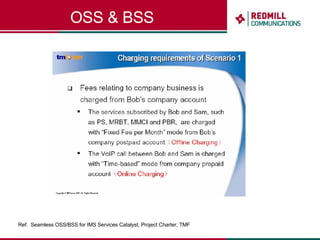
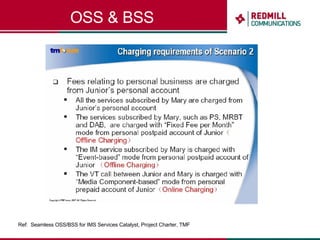
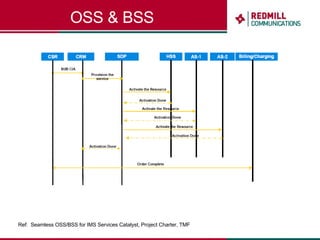
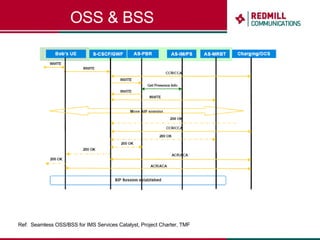
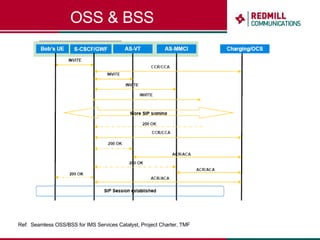
OSS & BSS Ref:  Seamless OSS/BSS for IMS Services Catalyst, Project Charter, TMF
OSS & BSS OSS integration is a significant and ongoing challenge Seamless automation, management and activation Subject to considerable standardisation efforts Considerable variation Role of SI
OSS & BSS Processes Sequence of events Data Information that is acted upon Applications Components that implement processes Technology How application is implemented
OSS & BSS ITU-T Telecommunications Management Network (TMN) model M.3000 Business Management Level (BML) Service Management Level (SML) Network Management Level (NML) Element Management Level (EML) ISO FCAPS model Fault, Configuration, Accounting, Performance, Security
OSS & BSS Different protocols act at different levels E.g. SNMP at EML / NML level I.e. Individual elements reporting into a network alarm system Many proprietary interfaces How do you consolidate these? Telemanagement Forum now has leading role in developing standardised model Recommendations and frameworks incorporated into standards 3GPP – explicitly refer to vendor interop as key goal (3GPP TS 32.102.810)
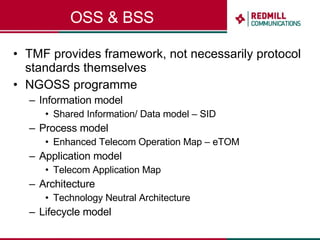
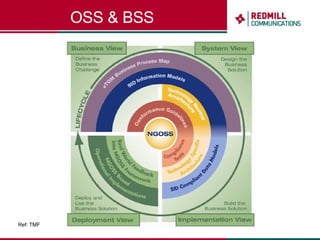
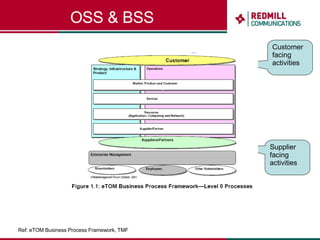
OSS & BSS TMF provides framework, not necessarily protocol standards themselves NGOSS programme Information model  Shared Information/ Data model – SID Process model Enhanced Telecom Operation Map – eTOM Application model Telecom Application Map Architecture Technology Neutral Architecture Lifecycle model
OSS & BSS Ref: TMF
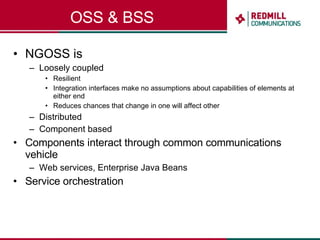
OSS & BSS NGOSS is Loosely coupled Resilient Integration interfaces make no assumptions about capabilities of elements at either end Reduces chances that change in one will affect other Distributed Component based Components interact through common communications vehicle Web services, Enterprise Java Beans Service orchestration
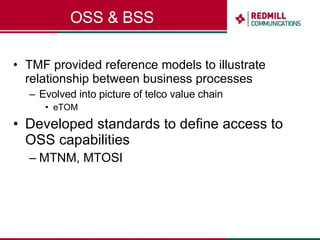
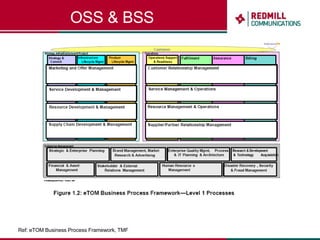
OSS & BSS TMF provided reference models to illustrate relationship between business processes Evolved into picture of telco value chain eTOM Developed standards to define access to OSS capabilities MTNM, MTOSI
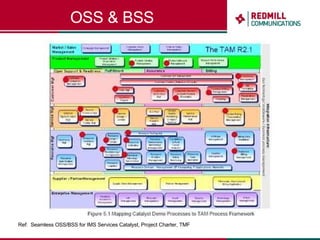
OSS & BSS TAM Telecom Application Map Considers role and functions of applications that deliver OSS & BSS functionality Reference framework allowing unambiguous statements of requirements Highlights overlap Groups function and data into recognised components
OSS & BSS Ref:  Seamless OSS/BSS for IMS Services Catalyst, Project Charter, TMF
OSS & BSS eTOM A guidebook to business processes in telecoms Describes business processes and their interaction Defines key elements and interaction between them Analogous to ITIL (TQM, ISO 9000) eTOM is specific to telecoms See  http://www.amdocs.com/amdocscom/post/doc/etom6.pdf
OSS & BSS Ref: eTOM Business Process Framework, TMF
OSS & BSS Customer facing activities Supplier facing activities Ref: eTOM Business Process Framework, TMF
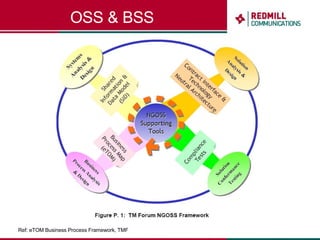
OSS & BSS Ref: eTOM Business Process Framework, TMF
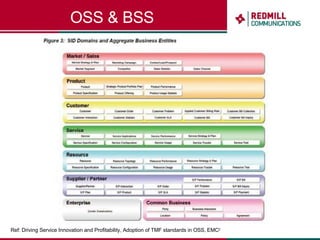
OSS & BSS SID Shared Information/Data Model Defines NGOSS architectures Common vocabulary Set of information/data definitions Relationships Object model, using UML  Unified Modelling Language Articulates concerns of 4 principal stakeholders Business, System, Implementation, Deployment Build requirements from each in common language 8 Domains
OSS & BSS Ref: Driving Service Innovation and Profitability, Adoption of TMF standards in OSS, EMC 2
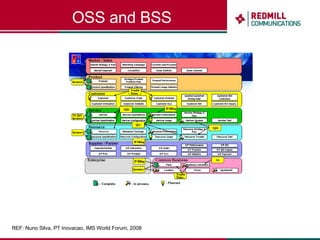
OSS and BSS REF: Nuno Silva, PT Inovacao, IMS World Forum, 2008
OSS & BSS Multi Technology Network Management Team Evolved from SSIM (Sonet/SDH Information Model) and other technologies E.g. ATM Based on CORBA, realised as ITU M.3170 Also X.780.2 / Q816.2 Parallel activity to extend MTNM to XML interfaces Multi Technology Operating Systems Interface, MTOSI
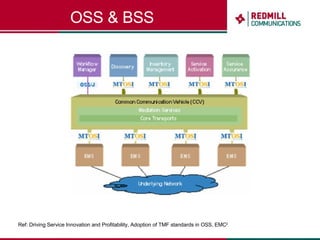
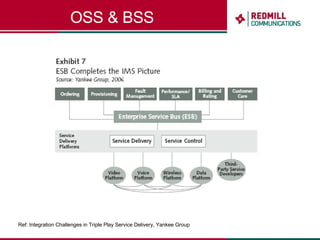
OSS & BSS MTOSI presents single management interface Common information model Supports all transport technologies Fewer interfaces to develop, integrate, deploy, etc Enterprise service bus connects and acts as message broker between components Standards will be unified with XML / Corba interface versions under mTOP
OSS & BSS Ref: Driving Service Innovation and Profitability, Adoption of TMF standards in OSS, EMC 2
OSS & BSS Ref: Integration Challenges in Triple Play Service Delivery, Yankee Group
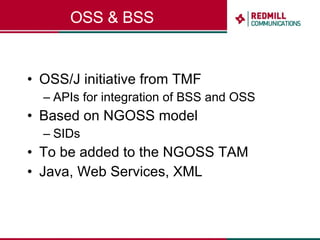
OSS & BSS OSS/J initiative from TMF APIs for integration of BSS and OSS Based on NGOSS model SIDs To be added to the NGOSS TAM Java, Web Services, XML
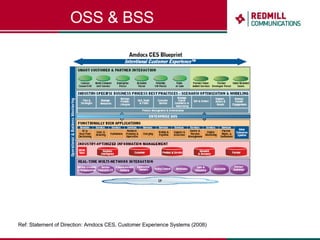
OSS & BSS Ref: Statement of Direction: Amdocs CES, Customer Experience Systems (2008)
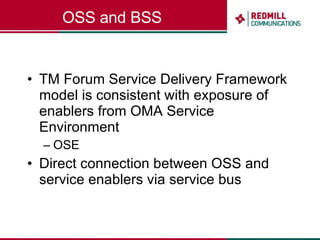
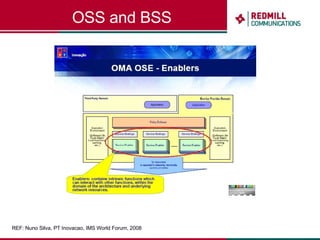
OSS and BSS TM Forum Service Delivery Framework model is consistent with exposure of enablers from OMA Service Environment OSE Direct connection between OSS and service enablers via service bus
OSS and BSS REF: Nuno Silva, PT Inovacao, IMS World Forum, 2008
OSS & BSS Billing
OSS & BSS Billing is fundamental to telecoms Accounting for authorised access to network resources Billing resources construct records from collection of token, pulses and CDR*s from various entities in the network IMS provides standardised way to approach *Charging Data Record, sometimes known as Call Data Record
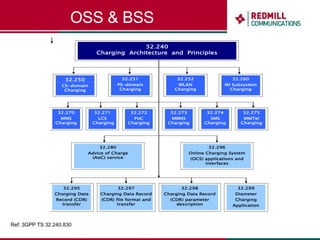
OSS & BSS Ref: 3GPP TS 32.240.830
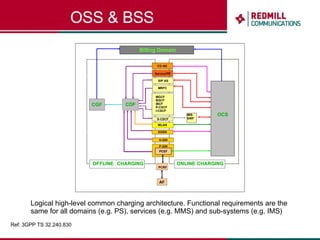
OSS & BSS Ref: 3GPP TS 32.240.830 Logical high-level common charging architecture. Functional requirements are the same for all domains (e.g. PS), services (e.g. MMS) and sub-systems (e.g. IMS) Billing Domain ONLINE CHARGING OFFLINE CHARGING WLAN MRFC SIP AS PCRF AF CDF CS - NE SGSN CGF OCS IMS-GWF S-CSCF Service - NE P-GW PCEF MGCF BGCF IBCF P-CSCF I-CSCF S-GW
IMS Charging and Billing Online charging Charging information collected in real time alongside resource usage Authorisation must be obtained prior to session Resource usage authorisation may be limited May be renewed during usage Prepaid solutions
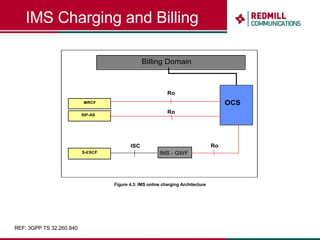
IMS Charging and Billing REF: 3GPP TS 32.260.840 Figure 4.3: IMS online charging Architecture
IMS Charging and Billing Offline charging Charging information collected in real time alongside resource usage Charging information does not affect service CDRs are generated and passed to Billing Domain Subscriber billing and inter-operator accounting Post payment systems
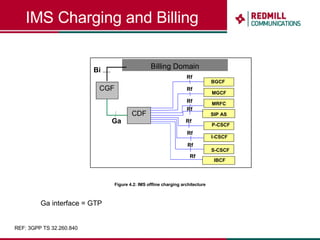
IMS Charging and Billing Figure 4.2: IMS offline charging architecture REF: 3GPP TS 32.260.840 Ga interface = GTP
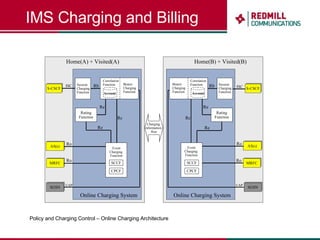
IMS Charging and Billing Charging Gateway Function (CGF) : within the Packet-Switched domain, provides a mechanism to transfer charging information from the SGSN and GGSN nodes to the network operator‘s chosen Billing Systems Charging Collection Function (CCF) :  main functionalities for IMS are in principle equivalent to the Charging Gateway Functions (CGF) that are used in the PS domain  。 Session Charging Function (SCF) : is responsible for Session Charging including the session control such as e.g. session termination.  Bearer Charging Function (BCF) :  performs the Bearer Charging.  Event Charging Function (ECF)  : performs event-based charging (content charging).
IMS Charging and Billing Content Provider Charging Function (CPCF) manages the account that is maintained for the content provider. Upon receipt of a charging request from the AS/MRFC, the CPCF processes the request and relays it to the SCCF. Subscriber Content Charging Function (SCCF) Handles content charging requests that are made when the subscriber accesses the content.  Upon such a content charging request, the SCCF may for example request the Correlation Function to check or to debit the subscriber's account.   Content charging requests are received from the Content Provider Charging Function (CPCF)
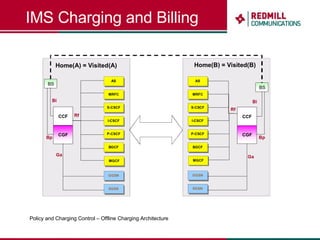
IMS Charging and Billing AS / MRFC determine whether to apply Offline or Online charging, or both Offline charging Post payment IMS elements report charging events via Rf interface Diameter Each session has unique ICID (IMS Charging Identifier) IOI (Inter Operator Identified) defines originating and terminating networks Charging Collection Function (CCF) constructs and formats CDRs CDR sent to billing system (BS) Format specified in TS 32.225.5b0 Bi interface – not specified, but FTP / IP suggested
IMS Charging and Billing Policy and Charging Control – Offline Charging Architecture
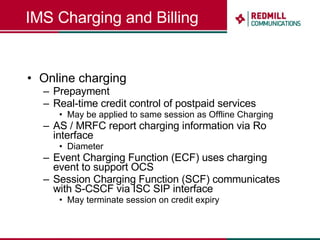
IMS Charging and Billing Online charging Prepayment Real-time credit control of postpaid services May be applied to same session as Offline Charging AS / MRFC report charging information via Ro interface Diameter Event Charging Function (ECF) uses charging event to support OCS Session Charging Function (SCF) communicates with S-CSCF via ISC SIP interface May terminate session on credit expiry
IMS Charging and Billing Policy and Charging Control – Online Charging Architecture
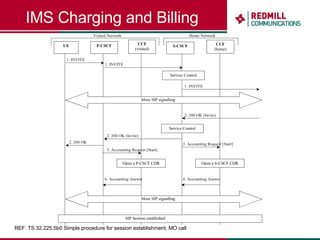
IMS Charging and Billing REF: TS 32.225.5b0 Simple procedure for session establishment, MO call
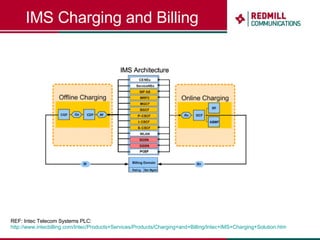
IMS Charging and Billing REF: Intec Telecom Systems PLC:  http://www.intecbilling.com/Intec/Products+Services/Products/Charging+and+Billing/Intec+IMS+Charging+Solution.htm
Policy Servers
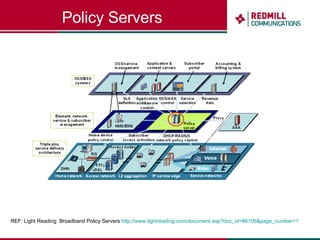
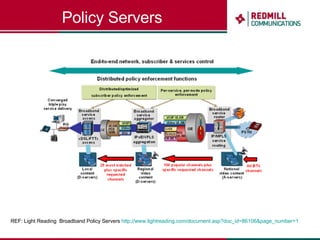
Policy Servers Policy refers to the treatment of a session with respect to resources available and demanded Policy server provides services to applications Vendor / network independent Determines whether subscriber request should be permitted of required needs
Policy Servers Session level policies Subscriber entitlements / content permissions Authorisation Session level policies include  Security High-availability DRM Content delivery IPTV
Policy Servers Resource level policies Network admission control QoS Delivery
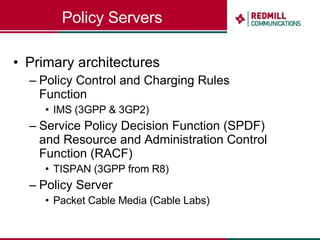
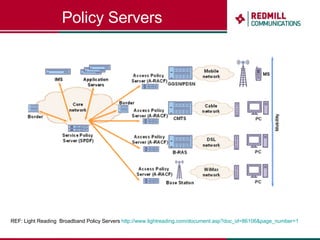
Policy Servers Primary architectures Policy Control and Charging Rules Function IMS (3GPP & 3GP2) Service Policy Decision Function (SPDF) and Resource and Administration Control Function (RACF) TISPAN (3GPP from R8) Policy Server Packet Cable Media (Cable Labs)
Policy Servers REF: Light Reading  Broadband Policy Servers  http://www.lightreading.com/document.asp?doc_id=86106&page_number=1
Opportunities for Sun OSS has been domain of specialists Amdocs, Iona, Intec, Crane, Telcordia, Orga, HP According to Light Reading, TEMs now moving in to market Often with OEM software partner Alcatel-Lucent / Convergys Cisco / Amdocs
Opportunities for Sun Suggests focus on both TEMs and Tier 2 vendors may be fruitful Attack both sides Increased need to deploy high-performance policy servers will drive requirements for high-performance COTS technology Database growth associated with subscriber complexity
Opportunities for Sun Enterprise service bus layer for integration Oracle, BEA, Iona, etc SOA emergence in telecoms for orchestration of web services across OSS bus Integration will require high-performance servers to realise connectivity issues

Session 3 Bss

  • 1.
  • 2.
  • 3.
    OSS & BSSOperations Support Systems Network systems, inventory, provisioning, configuration, element management OAM&P Business Support Systems Customer management, order processing Payments and billing Sometimes Billing Support Systems
  • 4.
    OSS & BSSWhy is OSS & BSS complicated? Involves end to end management of services How do you make a service work once ordered? Provisioning, activation, maintenance, payment? Has to encapsulate complete value chain Must recognise and integrate multiple elements from multiple vendors Vendor independence is key business requirement Vendor interop is essential....but difficult
  • 5.
    OSS & BSSRef: Seamless OSS/BSS for IMS Services Catalyst, Project Charter, TMF
  • 6.
    OSS & BSSRef: Seamless OSS/BSS for IMS Services Catalyst, Project Charter, TMF
  • 7.
    OSS & BSSRef: Seamless OSS/BSS for IMS Services Catalyst, Project Charter, TMF
  • 8.
    OSS & BSSRef: Seamless OSS/BSS for IMS Services Catalyst, Project Charter, TMF
  • 9.
    OSS & BSSRef: Seamless OSS/BSS for IMS Services Catalyst, Project Charter, TMF
  • 10.
    OSS & BSSRef: Seamless OSS/BSS for IMS Services Catalyst, Project Charter, TMF
  • 11.
    OSS & BSSRef: Seamless OSS/BSS for IMS Services Catalyst, Project Charter, TMF
  • 12.
    OSS & BSSRef: Seamless OSS/BSS for IMS Services Catalyst, Project Charter, TMF
  • 13.
    OSS & BSSRef: Seamless OSS/BSS for IMS Services Catalyst, Project Charter, TMF
  • 14.
    OSS & BSSRef: Seamless OSS/BSS for IMS Services Catalyst, Project Charter, TMF
  • 15.
    OSS & BSSRef: Seamless OSS/BSS for IMS Services Catalyst, Project Charter, TMF
  • 16.
    OSS & BSSRef: Seamless OSS/BSS for IMS Services Catalyst, Project Charter, TMF
  • 17.
    OSS & BSSRef: Seamless OSS/BSS for IMS Services Catalyst, Project Charter, TMF
  • 18.
    OSS & BSSOSS integration is a significant and ongoing challenge Seamless automation, management and activation Subject to considerable standardisation efforts Considerable variation Role of SI
  • 19.
    OSS & BSSProcesses Sequence of events Data Information that is acted upon Applications Components that implement processes Technology How application is implemented
  • 20.
    OSS & BSSITU-T Telecommunications Management Network (TMN) model M.3000 Business Management Level (BML) Service Management Level (SML) Network Management Level (NML) Element Management Level (EML) ISO FCAPS model Fault, Configuration, Accounting, Performance, Security
  • 21.
    OSS & BSSDifferent protocols act at different levels E.g. SNMP at EML / NML level I.e. Individual elements reporting into a network alarm system Many proprietary interfaces How do you consolidate these? Telemanagement Forum now has leading role in developing standardised model Recommendations and frameworks incorporated into standards 3GPP – explicitly refer to vendor interop as key goal (3GPP TS 32.102.810)
  • 22.
    OSS & BSSTMF provides framework, not necessarily protocol standards themselves NGOSS programme Information model Shared Information/ Data model – SID Process model Enhanced Telecom Operation Map – eTOM Application model Telecom Application Map Architecture Technology Neutral Architecture Lifecycle model
  • 23.
    OSS & BSSRef: TMF
  • 24.
    OSS & BSSNGOSS is Loosely coupled Resilient Integration interfaces make no assumptions about capabilities of elements at either end Reduces chances that change in one will affect other Distributed Component based Components interact through common communications vehicle Web services, Enterprise Java Beans Service orchestration
  • 25.
    OSS & BSSTMF provided reference models to illustrate relationship between business processes Evolved into picture of telco value chain eTOM Developed standards to define access to OSS capabilities MTNM, MTOSI
  • 26.
    OSS & BSSTAM Telecom Application Map Considers role and functions of applications that deliver OSS & BSS functionality Reference framework allowing unambiguous statements of requirements Highlights overlap Groups function and data into recognised components
  • 27.
    OSS & BSSRef: Seamless OSS/BSS for IMS Services Catalyst, Project Charter, TMF
  • 28.
    OSS & BSSeTOM A guidebook to business processes in telecoms Describes business processes and their interaction Defines key elements and interaction between them Analogous to ITIL (TQM, ISO 9000) eTOM is specific to telecoms See http://www.amdocs.com/amdocscom/post/doc/etom6.pdf
  • 29.
    OSS & BSSRef: eTOM Business Process Framework, TMF
  • 30.
    OSS & BSSCustomer facing activities Supplier facing activities Ref: eTOM Business Process Framework, TMF
  • 31.
    OSS & BSSRef: eTOM Business Process Framework, TMF
  • 32.
    OSS & BSSSID Shared Information/Data Model Defines NGOSS architectures Common vocabulary Set of information/data definitions Relationships Object model, using UML Unified Modelling Language Articulates concerns of 4 principal stakeholders Business, System, Implementation, Deployment Build requirements from each in common language 8 Domains
  • 33.
    OSS & BSSRef: Driving Service Innovation and Profitability, Adoption of TMF standards in OSS, EMC 2
  • 34.
    OSS and BSSREF: Nuno Silva, PT Inovacao, IMS World Forum, 2008
  • 35.
    OSS & BSSMulti Technology Network Management Team Evolved from SSIM (Sonet/SDH Information Model) and other technologies E.g. ATM Based on CORBA, realised as ITU M.3170 Also X.780.2 / Q816.2 Parallel activity to extend MTNM to XML interfaces Multi Technology Operating Systems Interface, MTOSI
  • 36.
    OSS & BSSMTOSI presents single management interface Common information model Supports all transport technologies Fewer interfaces to develop, integrate, deploy, etc Enterprise service bus connects and acts as message broker between components Standards will be unified with XML / Corba interface versions under mTOP
  • 37.
    OSS & BSSRef: Driving Service Innovation and Profitability, Adoption of TMF standards in OSS, EMC 2
  • 38.
    OSS & BSSRef: Integration Challenges in Triple Play Service Delivery, Yankee Group
  • 39.
    OSS & BSSOSS/J initiative from TMF APIs for integration of BSS and OSS Based on NGOSS model SIDs To be added to the NGOSS TAM Java, Web Services, XML
  • 40.
    OSS & BSSRef: Statement of Direction: Amdocs CES, Customer Experience Systems (2008)
  • 41.
    OSS and BSSTM Forum Service Delivery Framework model is consistent with exposure of enablers from OMA Service Environment OSE Direct connection between OSS and service enablers via service bus
  • 42.
    OSS and BSSREF: Nuno Silva, PT Inovacao, IMS World Forum, 2008
  • 43.
    OSS & BSSBilling
  • 44.
    OSS & BSSBilling is fundamental to telecoms Accounting for authorised access to network resources Billing resources construct records from collection of token, pulses and CDR*s from various entities in the network IMS provides standardised way to approach *Charging Data Record, sometimes known as Call Data Record
  • 45.
    OSS & BSSRef: 3GPP TS 32.240.830
  • 46.
    OSS & BSSRef: 3GPP TS 32.240.830 Logical high-level common charging architecture. Functional requirements are the same for all domains (e.g. PS), services (e.g. MMS) and sub-systems (e.g. IMS) Billing Domain ONLINE CHARGING OFFLINE CHARGING WLAN MRFC SIP AS PCRF AF CDF CS - NE SGSN CGF OCS IMS-GWF S-CSCF Service - NE P-GW PCEF MGCF BGCF IBCF P-CSCF I-CSCF S-GW
  • 47.
    IMS Charging andBilling Online charging Charging information collected in real time alongside resource usage Authorisation must be obtained prior to session Resource usage authorisation may be limited May be renewed during usage Prepaid solutions
  • 48.
    IMS Charging andBilling REF: 3GPP TS 32.260.840 Figure 4.3: IMS online charging Architecture
  • 49.
    IMS Charging andBilling Offline charging Charging information collected in real time alongside resource usage Charging information does not affect service CDRs are generated and passed to Billing Domain Subscriber billing and inter-operator accounting Post payment systems
  • 50.
    IMS Charging andBilling Figure 4.2: IMS offline charging architecture REF: 3GPP TS 32.260.840 Ga interface = GTP
  • 51.
    IMS Charging andBilling Charging Gateway Function (CGF) : within the Packet-Switched domain, provides a mechanism to transfer charging information from the SGSN and GGSN nodes to the network operator‘s chosen Billing Systems Charging Collection Function (CCF) : main functionalities for IMS are in principle equivalent to the Charging Gateway Functions (CGF) that are used in the PS domain 。 Session Charging Function (SCF) : is responsible for Session Charging including the session control such as e.g. session termination. Bearer Charging Function (BCF) : performs the Bearer Charging. Event Charging Function (ECF) : performs event-based charging (content charging).
  • 52.
    IMS Charging andBilling Content Provider Charging Function (CPCF) manages the account that is maintained for the content provider. Upon receipt of a charging request from the AS/MRFC, the CPCF processes the request and relays it to the SCCF. Subscriber Content Charging Function (SCCF) Handles content charging requests that are made when the subscriber accesses the content. Upon such a content charging request, the SCCF may for example request the Correlation Function to check or to debit the subscriber's account. Content charging requests are received from the Content Provider Charging Function (CPCF)
  • 53.
    IMS Charging andBilling AS / MRFC determine whether to apply Offline or Online charging, or both Offline charging Post payment IMS elements report charging events via Rf interface Diameter Each session has unique ICID (IMS Charging Identifier) IOI (Inter Operator Identified) defines originating and terminating networks Charging Collection Function (CCF) constructs and formats CDRs CDR sent to billing system (BS) Format specified in TS 32.225.5b0 Bi interface – not specified, but FTP / IP suggested
  • 54.
    IMS Charging andBilling Policy and Charging Control – Offline Charging Architecture
  • 55.
    IMS Charging andBilling Online charging Prepayment Real-time credit control of postpaid services May be applied to same session as Offline Charging AS / MRFC report charging information via Ro interface Diameter Event Charging Function (ECF) uses charging event to support OCS Session Charging Function (SCF) communicates with S-CSCF via ISC SIP interface May terminate session on credit expiry
  • 56.
    IMS Charging andBilling Policy and Charging Control – Online Charging Architecture
  • 57.
    IMS Charging andBilling REF: TS 32.225.5b0 Simple procedure for session establishment, MO call
  • 58.
    IMS Charging andBilling REF: Intec Telecom Systems PLC: http://www.intecbilling.com/Intec/Products+Services/Products/Charging+and+Billing/Intec+IMS+Charging+Solution.htm
  • 59.
  • 60.
    Policy Servers Policyrefers to the treatment of a session with respect to resources available and demanded Policy server provides services to applications Vendor / network independent Determines whether subscriber request should be permitted of required needs
  • 61.
    Policy Servers Sessionlevel policies Subscriber entitlements / content permissions Authorisation Session level policies include Security High-availability DRM Content delivery IPTV
  • 62.
    Policy Servers Resourcelevel policies Network admission control QoS Delivery
  • 63.
    Policy Servers Primaryarchitectures Policy Control and Charging Rules Function IMS (3GPP & 3GP2) Service Policy Decision Function (SPDF) and Resource and Administration Control Function (RACF) TISPAN (3GPP from R8) Policy Server Packet Cable Media (Cable Labs)
  • 64.
    Policy Servers REF:Light Reading Broadband Policy Servers http://www.lightreading.com/document.asp?doc_id=86106&page_number=1
  • 65.
    Policy Servers REF:Light Reading Broadband Policy Servers http://www.lightreading.com/document.asp?doc_id=86106&page_number=1
  • 66.
    Policy Servers REF:Light Reading Broadband Policy Servers http://www.lightreading.com/document.asp?doc_id=86106&page_number=1
  • 67.
    Opportunities for SunOSS has been domain of specialists Amdocs, Iona, Intec, Crane, Telcordia, Orga, HP According to Light Reading, TEMs now moving in to market Often with OEM software partner Alcatel-Lucent / Convergys Cisco / Amdocs
  • 68.
    Opportunities for SunSuggests focus on both TEMs and Tier 2 vendors may be fruitful Attack both sides Increased need to deploy high-performance policy servers will drive requirements for high-performance COTS technology Database growth associated with subscriber complexity
  • 69.
    Opportunities for SunEnterprise service bus layer for integration Oracle, BEA, Iona, etc SOA emergence in telecoms for orchestration of web services across OSS bus Integration will require high-performance servers to realise connectivity issues