

So how do you Computewhen its so Cloudy?
Evaluating the impacts of Mobile Cloud Computing on OSS-BSS LandscapeMuhammad Imran AwanMobile Cloud Computing Asia 2010
Agenda
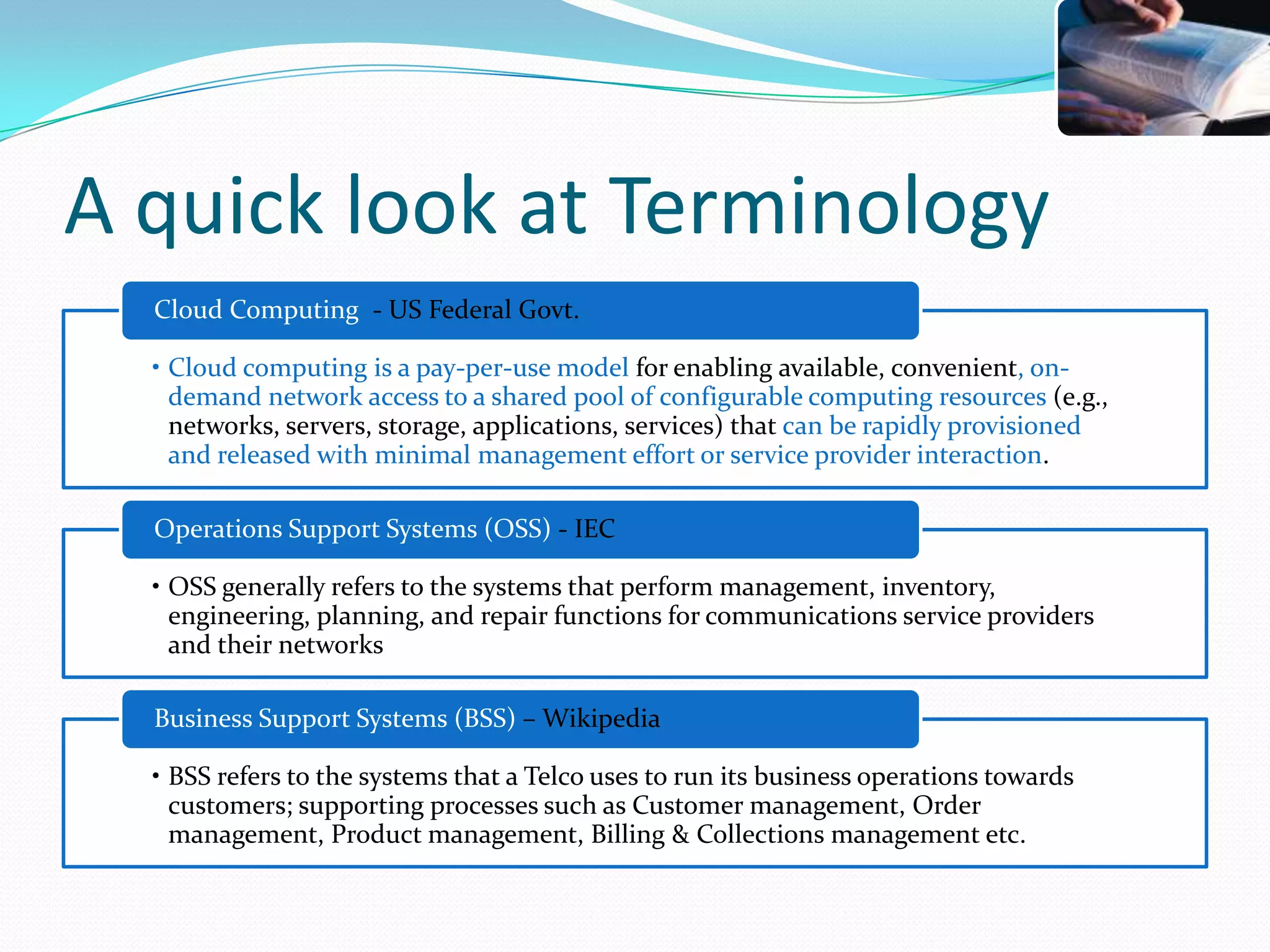
A quick look at Terminology
Its No more “business-as-usual” for a Telecom SPRevenues from value-added services have become Key to Service Provider’s survival (at a time when network traffic grows at around 40% per year with only a modest increase in prices)Competition from “over-the-top” (OTT) players is ever increasing; incumbent SPs owning the network footprint must face this challenge while operating within the stringent financial constraints imposed by today’s economyNot only to Survive but Thrive in the Internet/Web age, Operators need to radically transform their service delivery infrastructures – and their business models – into something that is much closer to the open and agile service creation and implementation model of the Web.
 One way to address these challenges is to leverage the growing momentum of XaaS, and the increasing number of “cloud‑based” applications available in the market; adopting the pay‑as‑you go, usage‑based model for delivery of IT and communications services as a means to further penetrate the small and medium business (SMB) marketIts No more “business-as-usual” for a Telecom SP
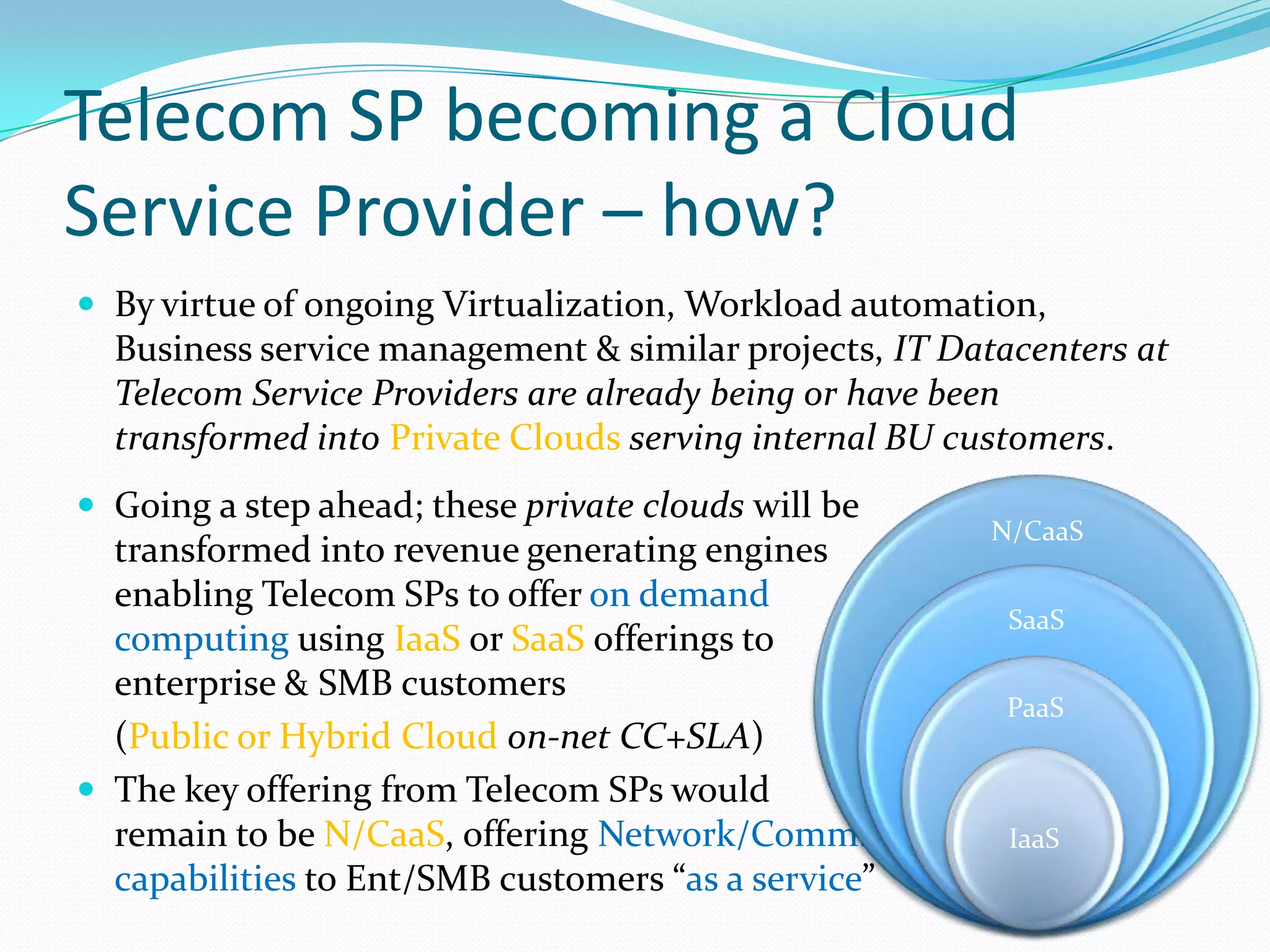
Telecom SP becoming a Cloud Service Provider – how?N/CaaSSaaSPaaSBy virtue of ongoing Virtualization, Workload automation, Business service management & similar projects, IT Datacenters at Telecom Service Providers are already being or have been transformed into Private Cloudsserving internal BU customers.IaaSGoing a step ahead; these private cl0uds will be transformed into revenue generating engines enabling Telecom SPs to offer on demand computing using IaaS or SaaS offerings to enterprise & SMB customers 	(Public or Hybrid Cloudon-net CC+SLA)The key offering from Telecom SPs would remain to be N/CaaS, offering Network/Comm.capabilities to Ent/SMB customers “as a service”
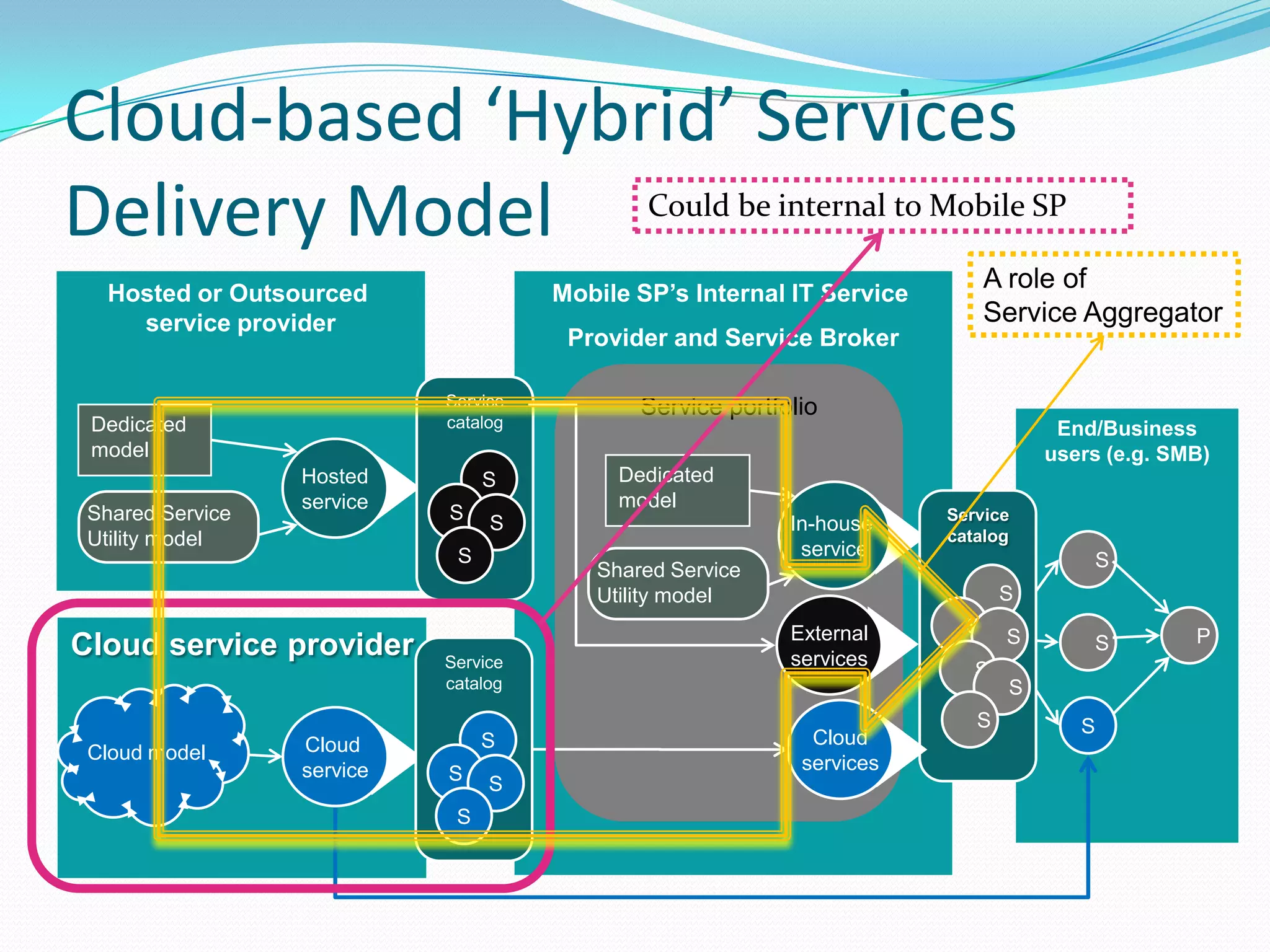
Cloud-based ‘Hybrid’ Services Delivery ModelHosted or Outsourced service providerMobile SP’s Internal IT Service Provider and Service BrokerService portfolioDedicated modelEnd/Businessusers (e.g. SMB)HostedserviceDedicated modelIn-house serviceService catalogShared Service Utility modelSShared Service Utility modelSExternalservicesSPSSCloud service providerService catalogSSCloud modelSSCloudservicesCloud serviceSSSSCould be internal to Mobile SPA role ofService AggregatorService catalogSSSS
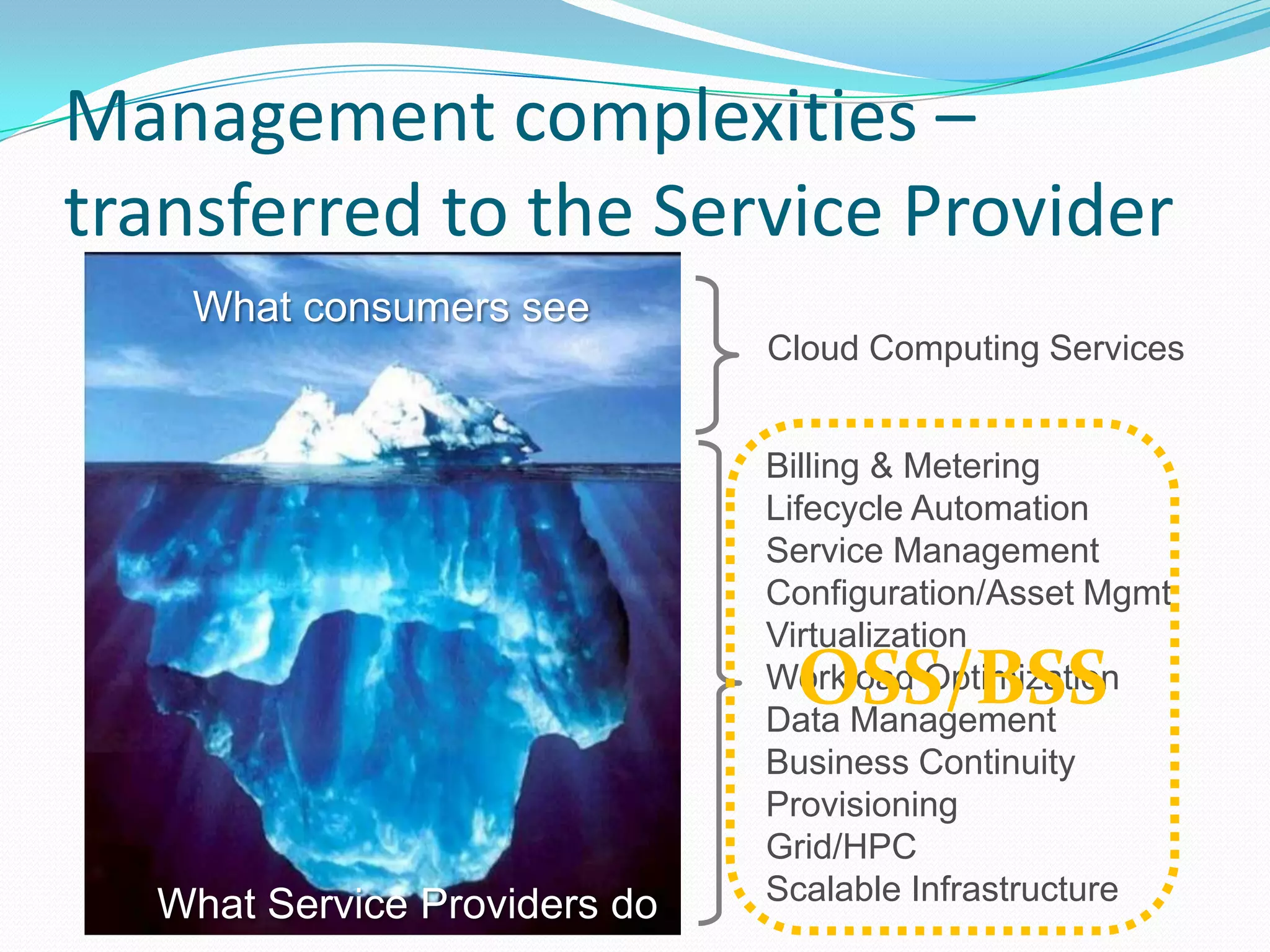
Management complexities –  transferred to the Service ProviderWhat consumers seeCloud Computing ServicesOSS/BSSBilling & MeteringLifecycle AutomationService ManagementConfiguration/Asset MgmtVirtualizationWorkload OptimizationData ManagementBusiness ContinuityProvisioningGrid/HPCScalable InfrastructureWhat Service Providers do
The Key Challenges to be overcome
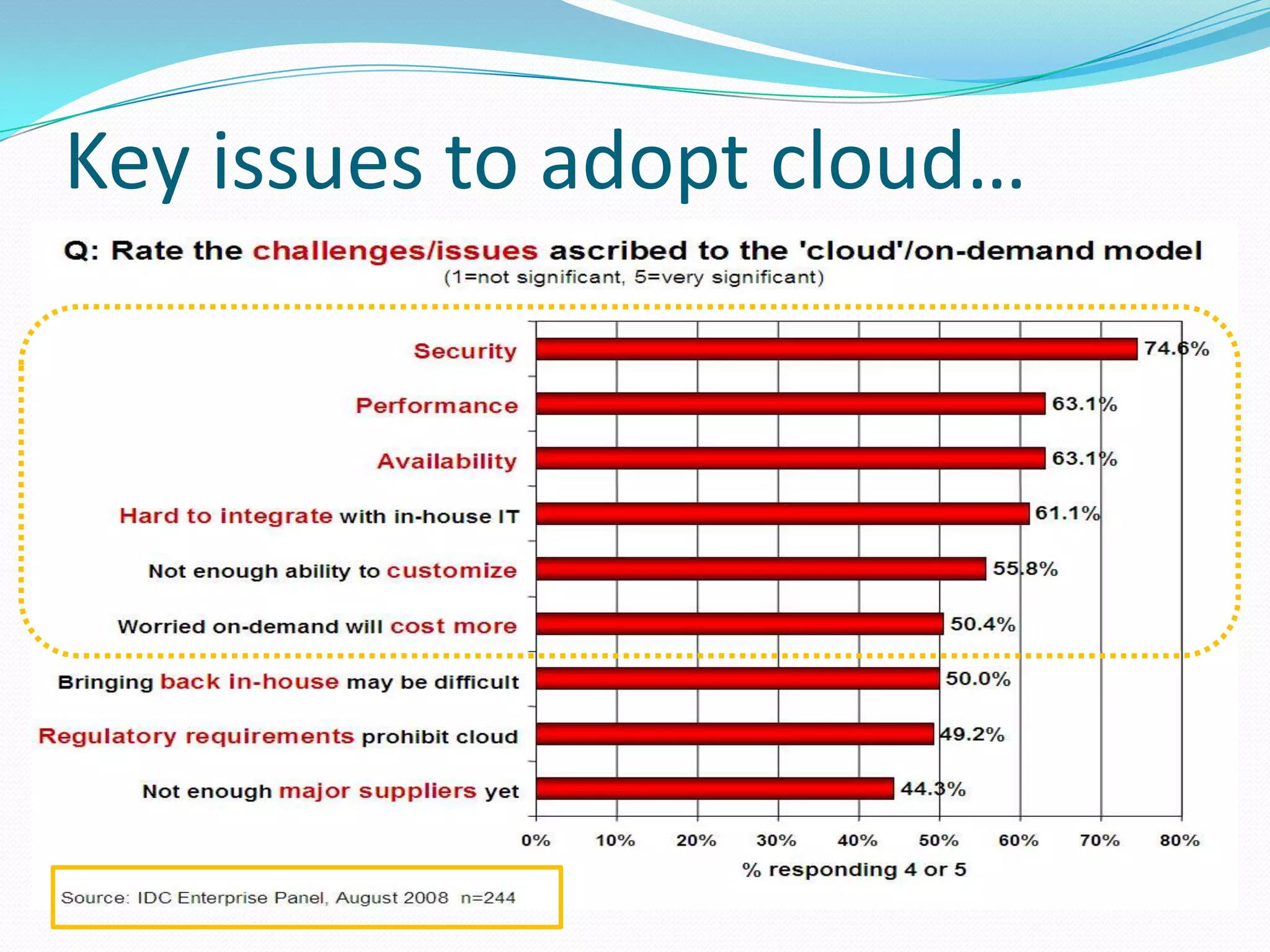
Key issues to adopt cloud…
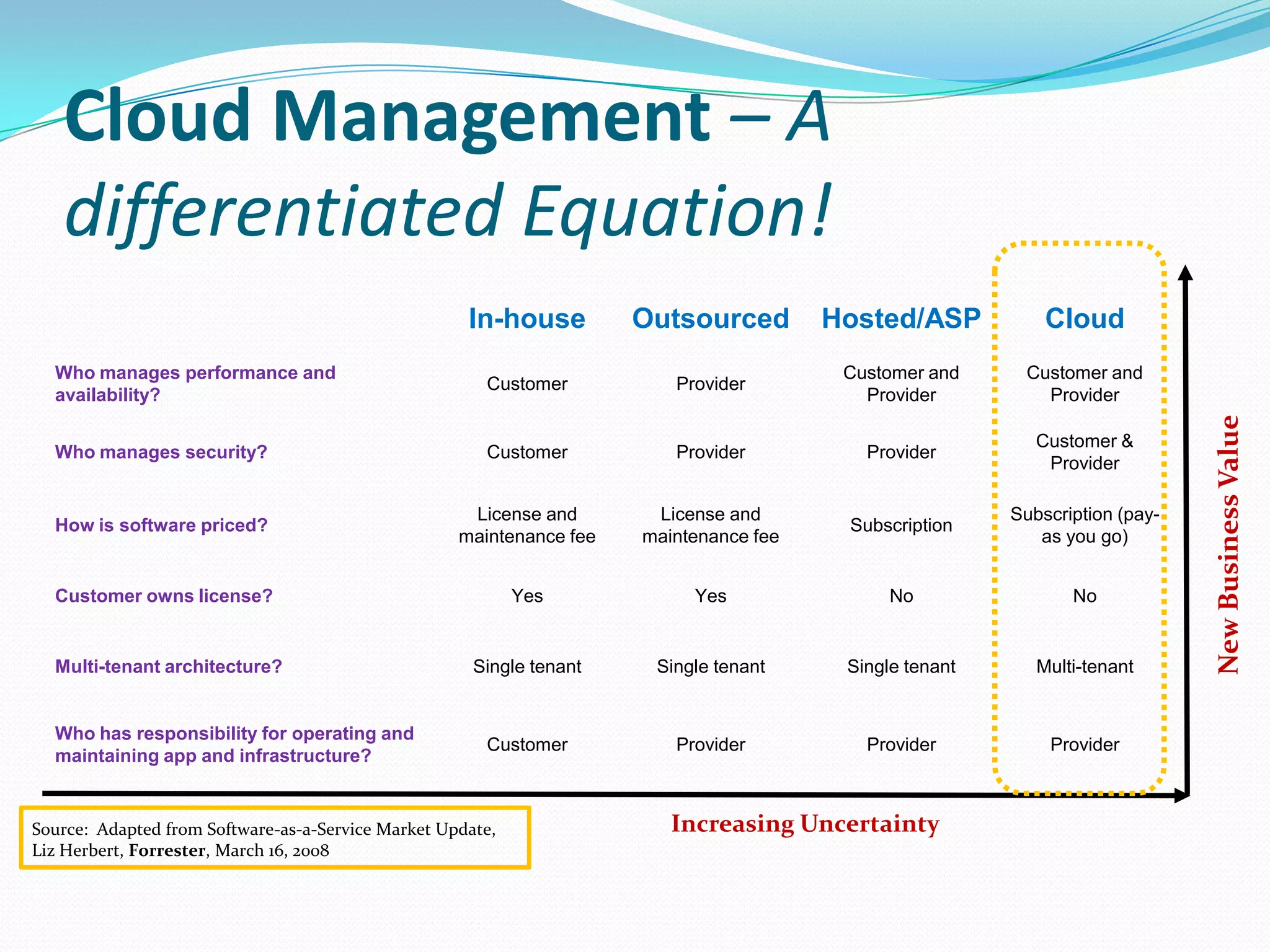
Cloud Management – A differentiated Equation!New Business ValueIncreasing UncertaintySource:  Adapted from Software-as-a-Service Market Update,Liz Herbert, Forrester, March 16, 2008
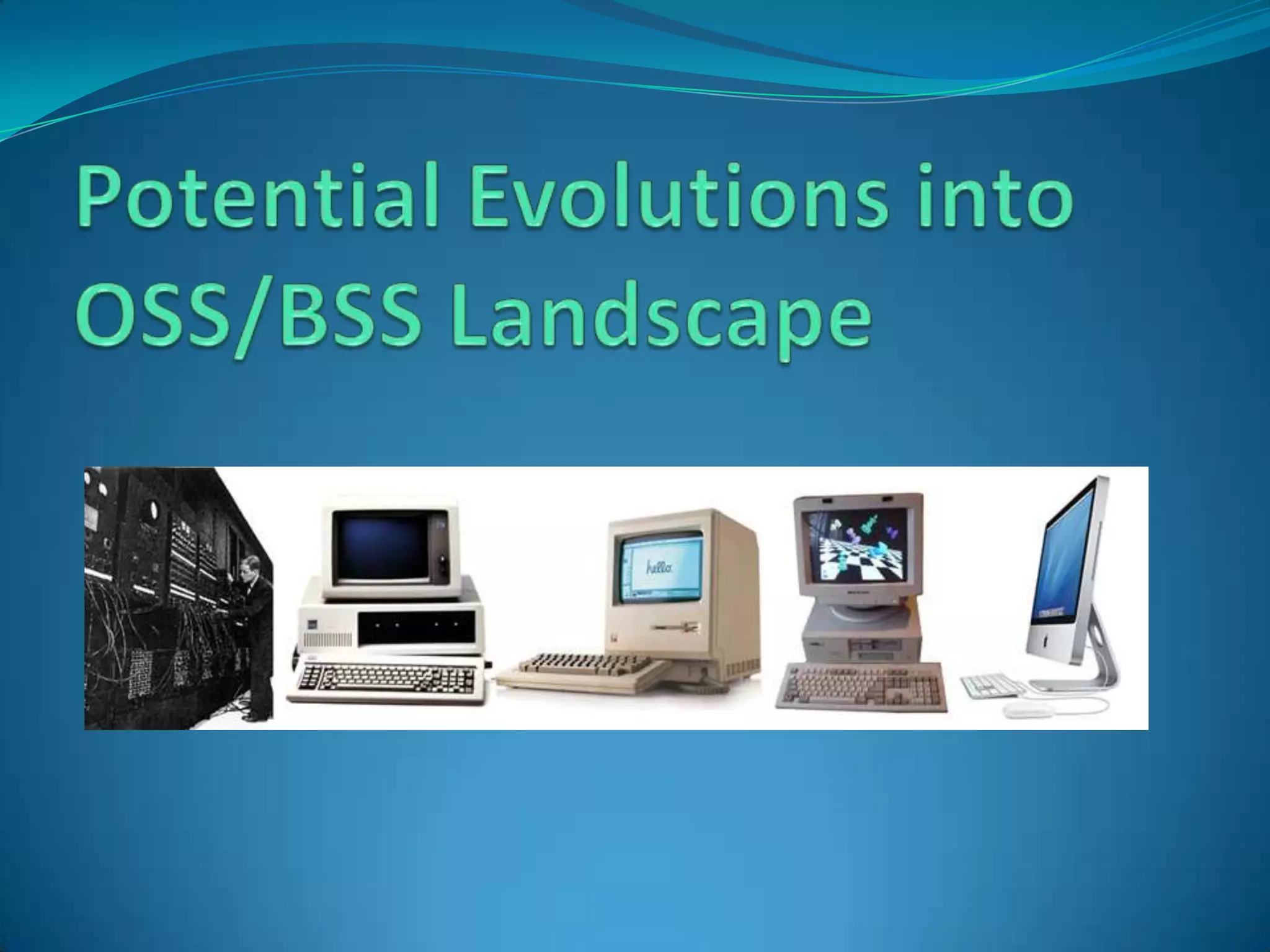
Potential Evolutions into OSS/BSS Landscape
Key impact areas
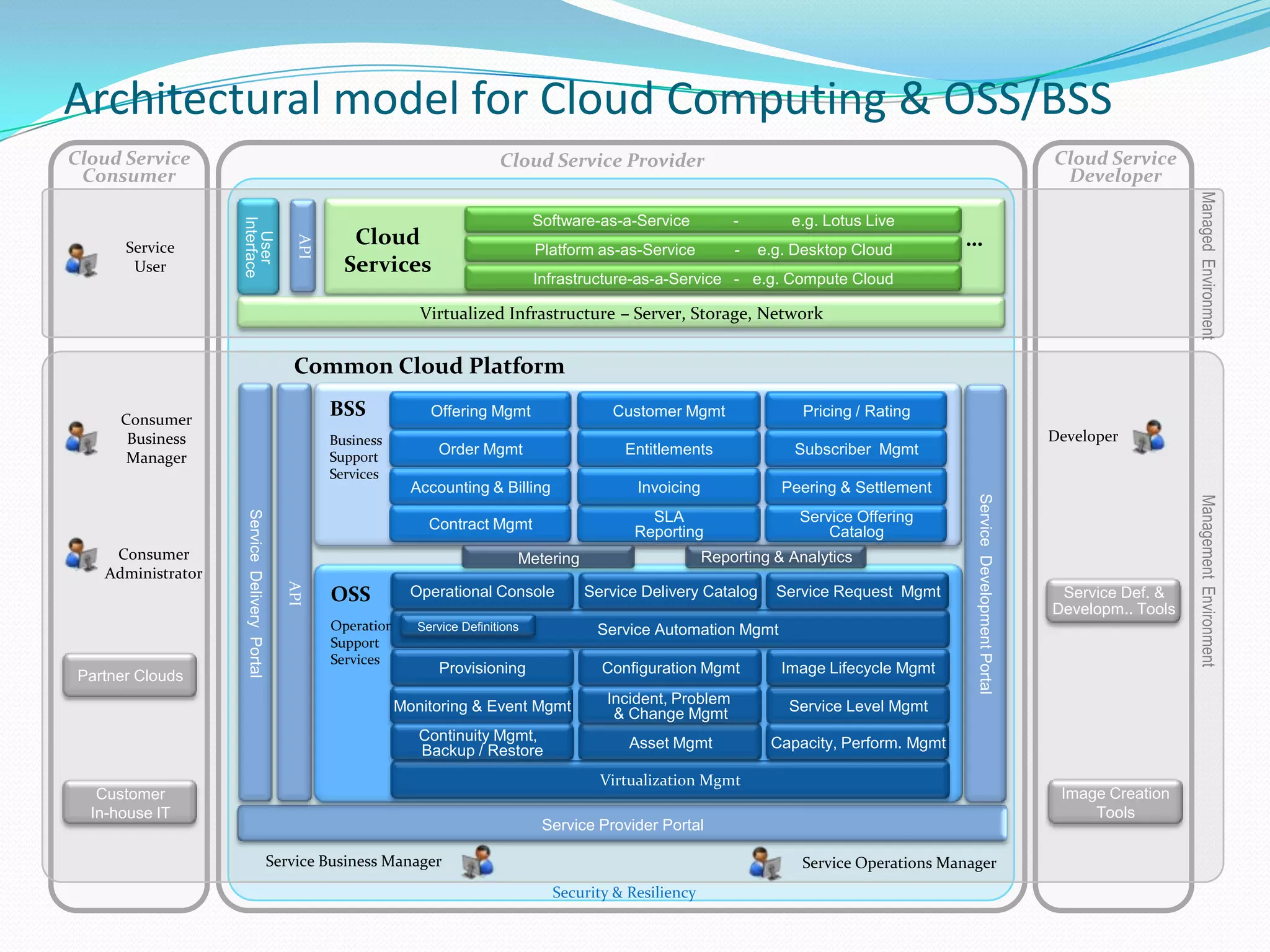
Architectural model for Cloud Computing & OSS/BSSCloud Service ProviderCloud ServiceDeveloperCloud ServiceConsumerUser InterfaceAPISoftware-as-a-Service          -            e.g. Lotus LiveCloud Services…Service UserPlatform as-as-Service         -    e.g. Desktop CloudManaged  EnvironmentInfrastructure-as-a-Service   -   e.g. Compute CloudVirtualized Infrastructure – Server, Storage, NetworkCommon Cloud PlatformBSSBusinessSupportServicesService  Delivery  PortalAPIService  Development PortalOffering MgmtCustomer MgmtPricing / RatingConsumer Business ManagerDeveloperOrder MgmtEntitlementsSubscriber  MgmtService Provider PortalAccounting & BillingPeering & SettlementInvoicingContract MgmtSLAReportingService OfferingCatalogConsumer AdministratorReporting & AnalyticsMeteringManagement  EnvironmentOSSOperationalSupportServicesOperational ConsoleService Delivery CatalogService Request  MgmtService Def. & Developm.. Tools        Service Automation MgmtService DefinitionsProvisioningConfiguration MgmtImage Lifecycle MgmtPartner CloudsMonitoring & Event MgmtService Level MgmtIncident, Problem & Change MgmtContinuity Mgmt,  Backup / RestoreAsset MgmtCapacity, Perform. MgmtVirtualization MgmtImage Creation ToolsCustomer In-house ITService Business Manager Service Operations Manager Security & Resiliency
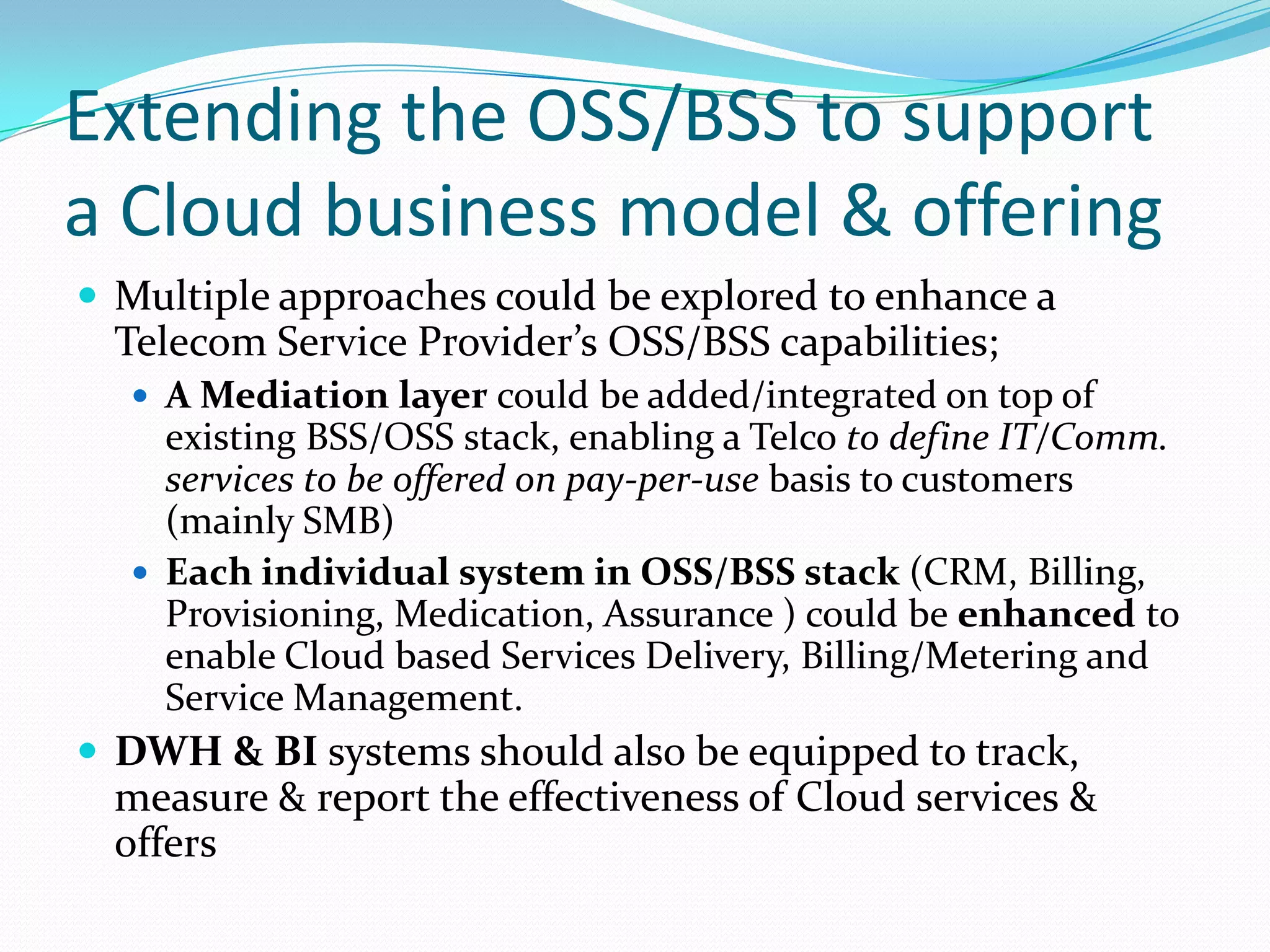
Extending the OSS/BSS to support a Cloud business model & offeringMultiple approaches could be explored to enhance a Telecom Service Provider’s OSS/BSS capabilities;A Mediation layer could be added/integrated on top of existing BSS/OSS stack, enabling a Telco to define IT/Comm. services to be offered on pay-per-use basis to customers (mainly SMB)Each individual system in OSS/BSS stack (CRM, Billing, Provisioning, Medication, Assurance ) could be enhanced to enable Cloud based Services Delivery, Billing/Metering and Service Management.DWH & BI systems should also be equipped to track, measure & report the effectiveness of Cloud services & offers
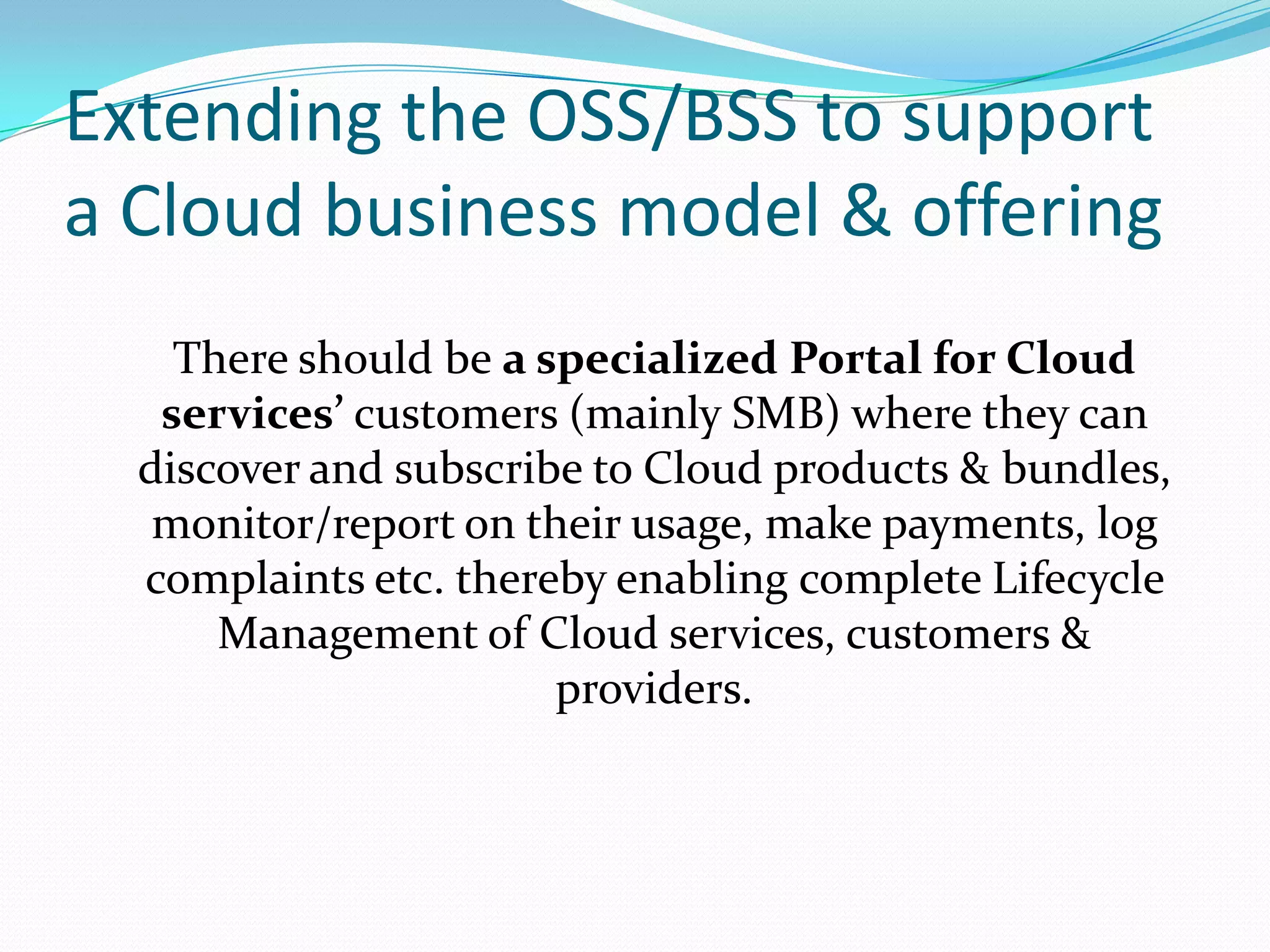
Extending the OSS/BSS to support a Cloud business model & offeringThere should be a specialized Portal for Cloud services’ customers (mainly SMB) where they can discover and subscribe to Cloud products & bundles, monitor/report on their usage, make payments, log complaints etc. thereby enabling complete Lifecycle Management of Cloud services, customers & providers.
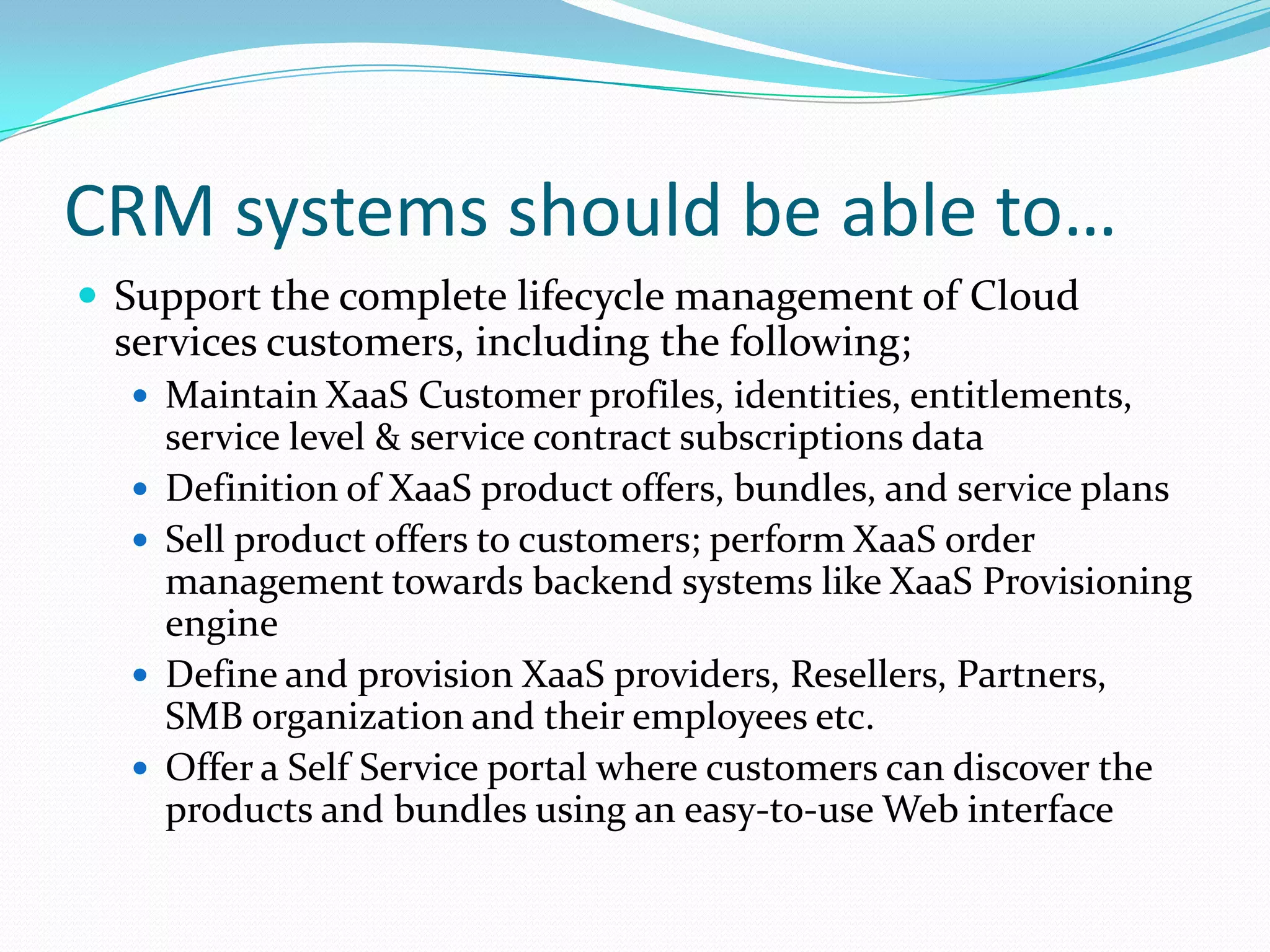
CRM systems should be able to…Support the complete lifecycle management of Cloud services customers, including the following;Maintain XaaS Customer profiles, identities, entitlements, service level & service contract subscriptions dataDefinition of XaaS product offers, bundles, and service plansSell product offers to customers; perform XaaS order management towards backend systems like XaaS Provisioning engineDefine and provision XaaS providers, Resellers, Partners, SMB organization and their employees etc.Offer a Self Service portal where customers can discover the products and bundles using an easy‑to‑use Web interface
Service Mediation, Charging & Billing systems should be able to…Support Charging models relevant to XaaS business model (Pay-per-use, pay-per-subscription, trails, discounts etc.)Define flexible pricing rules based on "any" unit of measure (sites, networks, users, devices, downloads, logins, emails, MBs)Capture & aggregate charging events from various source: network elements, applications, operating systems, licensing systems etc.Provide mediated usage records to upstream systems like Revenue management, DWH & BI, OSS, GL; for management of revenue streams & financial relationship between SPs, XaaS providers, & resellersSupport a Billing model which allows for a parent/child relationship to exist between master providers, resellers, distributors, franchises, affiliates etc.
Service Fulfillment systems should be able to…Offer a Converged and flexible Services Catalog for XaaS services order management and services deliveryProvide a rapid & automated XaaS resources & services & user  provisioning across the network boundaries, thru integration with various Cloud EMs (LDAP/AD, Mail, RADIUS/SSO, UNIX, Storage managers etc.)Permit resellers to self-manage their account by adding or removing services & users; online reportingMaintain a services and network/resource Inventory and Topology for XaaS platforms (thru integration with XaaS provider’s Inventory system)
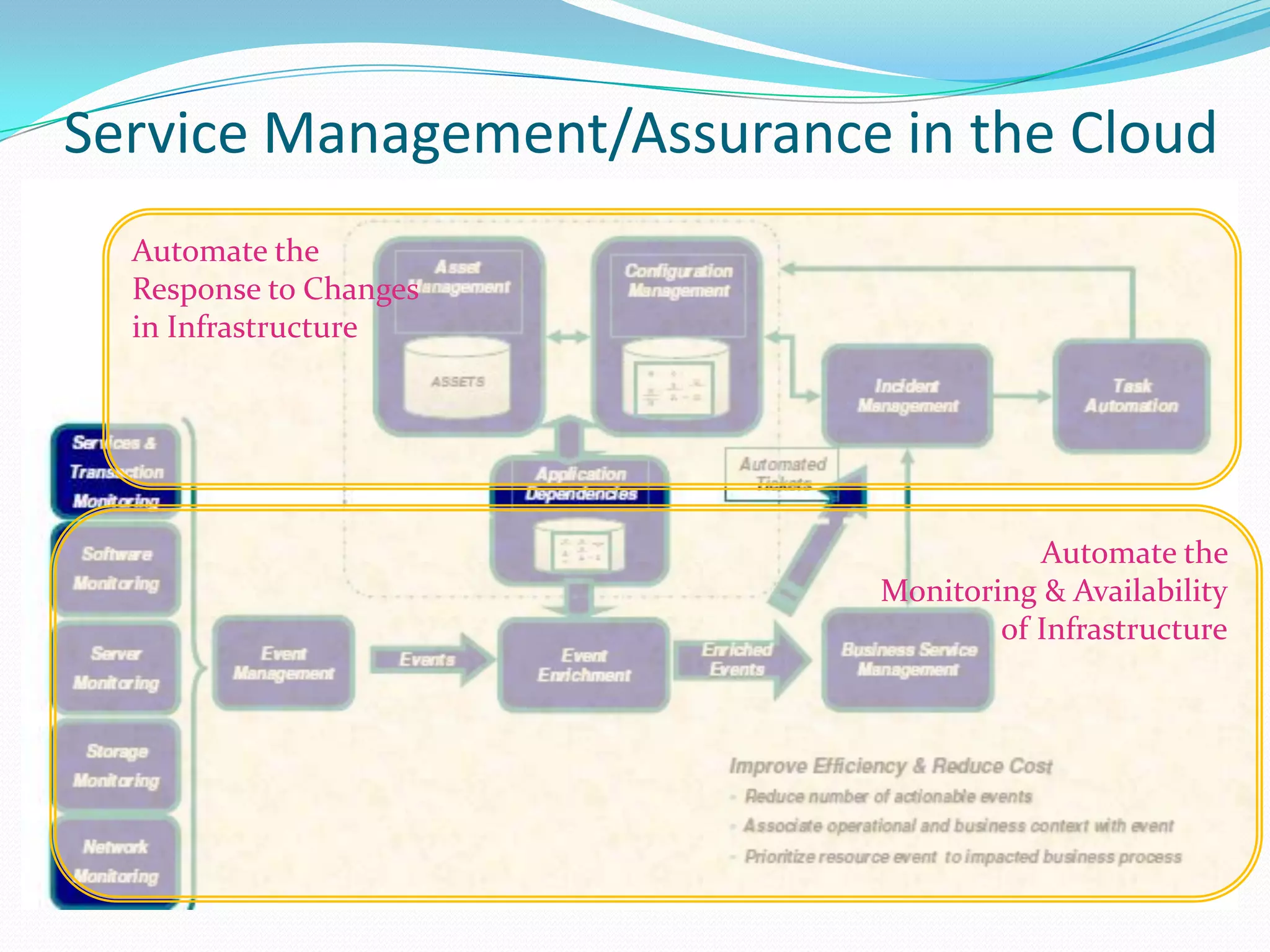
Service Management/Assurance in the CloudAutomate the Response to Changesin InfrastructureAutomate the Monitoring & Availabilityof Infrastructure
Service Management/Assurance systems should address…Performance ManagementShould have capabilities for continuously testing the bandwidth, connectivity, scalability and the quality of  end-user experience for all cloud based services in addition to the ones internally hostedAvailability ManagementMonitor the availability of XaaS services to guarantee Service Level Agreements Tools & processes should be capable of testing and monitoring web-based application business processes , identifying and analyzing performance issues and trends. Detect & report failuresSecurity Management – A shared responsibility!Access & Authorization Controls – Operator drivenAlignment of Encryption policiesLog & Audit management – Operator drivenShould have tools for scanning networks, operating systems & web applications and performing automated penetration testingDashboards and Reporting for management needsIntegrated Service Management / Federated ITSM
An increased focus onSLAs & GovernanceProviding Trust in this new Paradigmis a difficult task; there are many areas to be considered;Transparency (Trans-border information flow)Privacy (in a Multitenant environment)Compliance (Standards)CertificationsThe use of standards and frameworks can be helpful to gain assurance, however in the absence of any specific standards for Cloud, the general IT/Telecom standards can be consulted and tailored for relevant areas!
An increased focus onSLAs & GovernanceService Level ManagementDefine comprehensive SLAs ensuring CIA, Performance  etc.Governance, Risk & Compliance ManagementEnsure to include Security in all SDLC, Operational and Governance processesAddress new Legal issues, Risk models, Audit issuesLogging & reporting from a 3rd party; ensure fairnessFinancial management & Cost controlShould have tools & processes to right size your footprint by measuring resource, code and end-user performance metricsDisaster Recovery & Crisis management
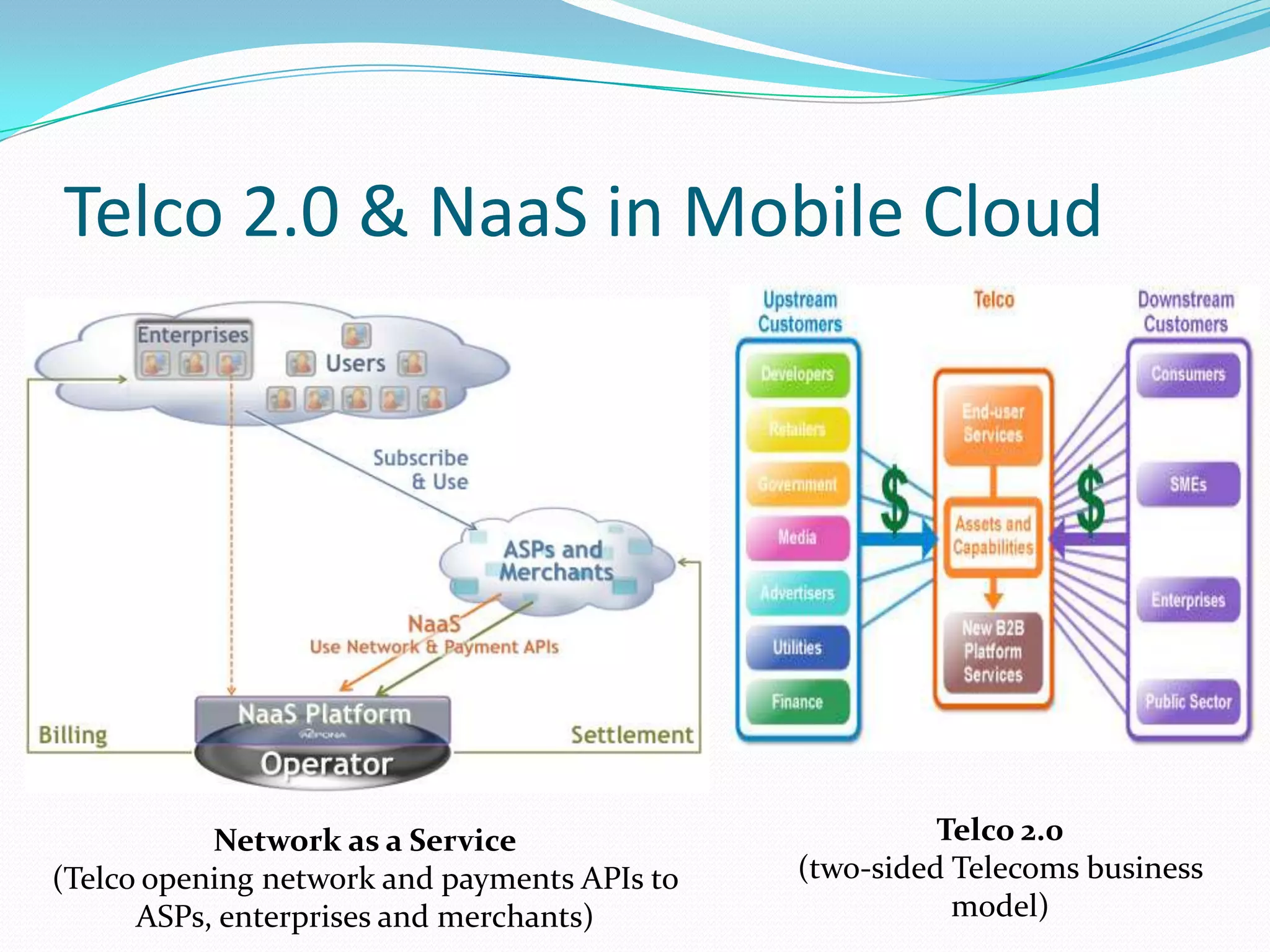
Telco 2.0 & NaaS in Mobile CloudTelco 2.0 (two-sided Telecoms business model)Network as a Service(Telco opening network and payments APIs to ASPs, enterprises and merchants)
OSS/BSS for NaaS in Mobile Cloud Mobile Cloud Computing requires on-demand access to NaaS (network & payment resources) across multiple OperatorsA successful NaaS strategy must include;Management of SLAs (touching both BSS & OSS systems)Policy Management (multiple BSS systems)An online portal providing web-based partner registration and self-care (BSS/CRM)Automated provisioning capabilities to speed up the  partner onboarding process (OSS/Fulfillment)
OSS/BSS for NaaS in Mobile Cloud … NaaS platform needs to support payments and settlement services and associated business infrastructure , allowing  ASPs and merchants to charge their customers through their accounts with an operator. Known as “Bill on Behalf of” (BoBo)	(BSS/Billing)Third party management tools & processes
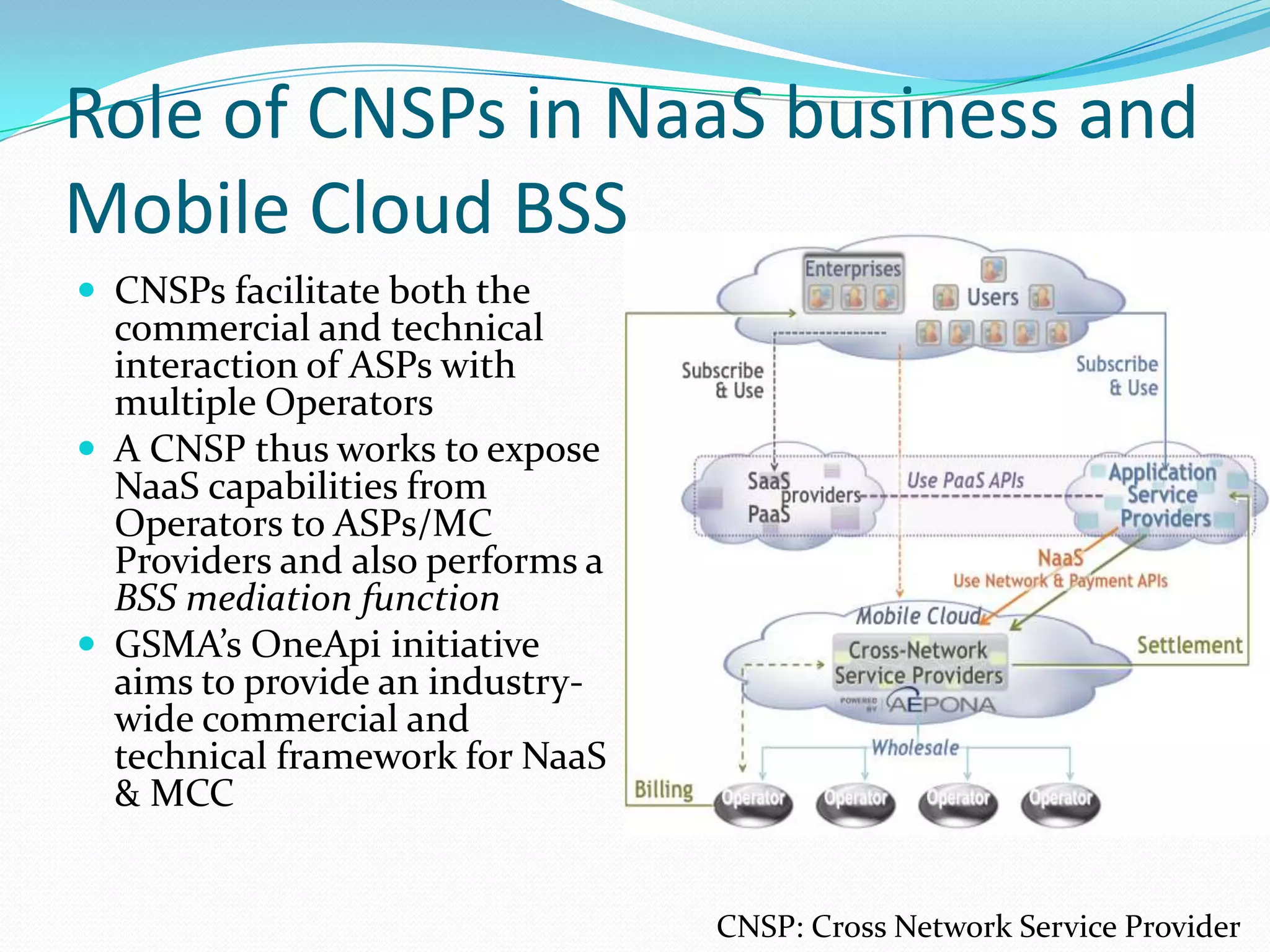
Role of CNSPs in NaaS business and Mobile Cloud BSSCNSPs facilitate both the commercial and technical interaction of ASPs with multiple Operators A CNSP thus works to expose NaaS capabilities from Operators to ASPs/MC Providers and also performs a BSS mediation functionGSMA’s OneApi initiative aims to provide an industry-wide commercial and technical framework for NaaS & MCCCNSP: Cross Network Service Provider
Recap!Telecom Operators are gradually	adopting the role of Hybrid Cloud	Providers & Cloud Services AggregatorsOSS/BSS tools, processes and systems are among the key impacted areas for Telcos Cloud Computing offerings – thus requiring a thorough relook & enhancements
CNSPs have a pivotal role to play in the Mobile Cloud Computing and NaaS based business ecosystemContact:Email: imran.awan@msn.comLinkedIn: imranawan

Evaluating the impacts of (Mobile) Cloud Computing on OSS/BSS Landscape

  • 1.
    So how doyou Computewhen its so Cloudy?
  • 2.
    Evaluating the impactsof Mobile Cloud Computing on OSS-BSS LandscapeMuhammad Imran AwanMobile Cloud Computing Asia 2010
  • 3.
  • 4.
    A quick lookat Terminology
  • 5.
    Its No more“business-as-usual” for a Telecom SPRevenues from value-added services have become Key to Service Provider’s survival (at a time when network traffic grows at around 40% per year with only a modest increase in prices)Competition from “over-the-top” (OTT) players is ever increasing; incumbent SPs owning the network footprint must face this challenge while operating within the stringent financial constraints imposed by today’s economyNot only to Survive but Thrive in the Internet/Web age, Operators need to radically transform their service delivery infrastructures – and their business models – into something that is much closer to the open and agile service creation and implementation model of the Web.
  • 6.
    One wayto address these challenges is to leverage the growing momentum of XaaS, and the increasing number of “cloud‑based” applications available in the market; adopting the pay‑as‑you go, usage‑based model for delivery of IT and communications services as a means to further penetrate the small and medium business (SMB) marketIts No more “business-as-usual” for a Telecom SP
  • 7.
    Telecom SP becominga Cloud Service Provider – how?N/CaaSSaaSPaaSBy virtue of ongoing Virtualization, Workload automation, Business service management & similar projects, IT Datacenters at Telecom Service Providers are already being or have been transformed into Private Cloudsserving internal BU customers.IaaSGoing a step ahead; these private cl0uds will be transformed into revenue generating engines enabling Telecom SPs to offer on demand computing using IaaS or SaaS offerings to enterprise & SMB customers (Public or Hybrid Cloudon-net CC+SLA)The key offering from Telecom SPs would remain to be N/CaaS, offering Network/Comm.capabilities to Ent/SMB customers “as a service”
  • 8.
    Cloud-based ‘Hybrid’ ServicesDelivery ModelHosted or Outsourced service providerMobile SP’s Internal IT Service Provider and Service BrokerService portfolioDedicated modelEnd/Businessusers (e.g. SMB)HostedserviceDedicated modelIn-house serviceService catalogShared Service Utility modelSShared Service Utility modelSExternalservicesSPSSCloud service providerService catalogSSCloud modelSSCloudservicesCloud serviceSSSSCould be internal to Mobile SPA role ofService AggregatorService catalogSSSS
  • 9.
    Management complexities – transferred to the Service ProviderWhat consumers seeCloud Computing ServicesOSS/BSSBilling & MeteringLifecycle AutomationService ManagementConfiguration/Asset MgmtVirtualizationWorkload OptimizationData ManagementBusiness ContinuityProvisioningGrid/HPCScalable InfrastructureWhat Service Providers do
  • 10.
    The Key Challengesto be overcome
  • 11.
    Key issues toadopt cloud…
  • 12.
    Cloud Management –A differentiated Equation!New Business ValueIncreasing UncertaintySource: Adapted from Software-as-a-Service Market Update,Liz Herbert, Forrester, March 16, 2008
  • 13.
    Potential Evolutions intoOSS/BSS Landscape
  • 14.
  • 15.
    Architectural model forCloud Computing & OSS/BSSCloud Service ProviderCloud ServiceDeveloperCloud ServiceConsumerUser InterfaceAPISoftware-as-a-Service - e.g. Lotus LiveCloud Services…Service UserPlatform as-as-Service - e.g. Desktop CloudManaged EnvironmentInfrastructure-as-a-Service - e.g. Compute CloudVirtualized Infrastructure – Server, Storage, NetworkCommon Cloud PlatformBSSBusinessSupportServicesService Delivery PortalAPIService Development PortalOffering MgmtCustomer MgmtPricing / RatingConsumer Business ManagerDeveloperOrder MgmtEntitlementsSubscriber MgmtService Provider PortalAccounting & BillingPeering & SettlementInvoicingContract MgmtSLAReportingService OfferingCatalogConsumer AdministratorReporting & AnalyticsMeteringManagement EnvironmentOSSOperationalSupportServicesOperational ConsoleService Delivery CatalogService Request MgmtService Def. & Developm.. Tools Service Automation MgmtService DefinitionsProvisioningConfiguration MgmtImage Lifecycle MgmtPartner CloudsMonitoring & Event MgmtService Level MgmtIncident, Problem & Change MgmtContinuity Mgmt, Backup / RestoreAsset MgmtCapacity, Perform. MgmtVirtualization MgmtImage Creation ToolsCustomer In-house ITService Business Manager Service Operations Manager Security & Resiliency
  • 16.
    Extending the OSS/BSSto support a Cloud business model & offeringMultiple approaches could be explored to enhance a Telecom Service Provider’s OSS/BSS capabilities;A Mediation layer could be added/integrated on top of existing BSS/OSS stack, enabling a Telco to define IT/Comm. services to be offered on pay-per-use basis to customers (mainly SMB)Each individual system in OSS/BSS stack (CRM, Billing, Provisioning, Medication, Assurance ) could be enhanced to enable Cloud based Services Delivery, Billing/Metering and Service Management.DWH & BI systems should also be equipped to track, measure & report the effectiveness of Cloud services & offers
  • 17.
    Extending the OSS/BSSto support a Cloud business model & offeringThere should be a specialized Portal for Cloud services’ customers (mainly SMB) where they can discover and subscribe to Cloud products & bundles, monitor/report on their usage, make payments, log complaints etc. thereby enabling complete Lifecycle Management of Cloud services, customers & providers.
  • 18.
    CRM systems shouldbe able to…Support the complete lifecycle management of Cloud services customers, including the following;Maintain XaaS Customer profiles, identities, entitlements, service level & service contract subscriptions dataDefinition of XaaS product offers, bundles, and service plansSell product offers to customers; perform XaaS order management towards backend systems like XaaS Provisioning engineDefine and provision XaaS providers, Resellers, Partners, SMB organization and their employees etc.Offer a Self Service portal where customers can discover the products and bundles using an easy‑to‑use Web interface
  • 19.
    Service Mediation, Charging& Billing systems should be able to…Support Charging models relevant to XaaS business model (Pay-per-use, pay-per-subscription, trails, discounts etc.)Define flexible pricing rules based on "any" unit of measure (sites, networks, users, devices, downloads, logins, emails, MBs)Capture & aggregate charging events from various source: network elements, applications, operating systems, licensing systems etc.Provide mediated usage records to upstream systems like Revenue management, DWH & BI, OSS, GL; for management of revenue streams & financial relationship between SPs, XaaS providers, & resellersSupport a Billing model which allows for a parent/child relationship to exist between master providers, resellers, distributors, franchises, affiliates etc.
  • 20.
    Service Fulfillment systemsshould be able to…Offer a Converged and flexible Services Catalog for XaaS services order management and services deliveryProvide a rapid & automated XaaS resources & services & user provisioning across the network boundaries, thru integration with various Cloud EMs (LDAP/AD, Mail, RADIUS/SSO, UNIX, Storage managers etc.)Permit resellers to self-manage their account by adding or removing services & users; online reportingMaintain a services and network/resource Inventory and Topology for XaaS platforms (thru integration with XaaS provider’s Inventory system)
  • 21.
    Service Management/Assurance inthe CloudAutomate the Response to Changesin InfrastructureAutomate the Monitoring & Availabilityof Infrastructure
  • 22.
    Service Management/Assurance systemsshould address…Performance ManagementShould have capabilities for continuously testing the bandwidth, connectivity, scalability and the quality of end-user experience for all cloud based services in addition to the ones internally hostedAvailability ManagementMonitor the availability of XaaS services to guarantee Service Level Agreements Tools & processes should be capable of testing and monitoring web-based application business processes , identifying and analyzing performance issues and trends. Detect & report failuresSecurity Management – A shared responsibility!Access & Authorization Controls – Operator drivenAlignment of Encryption policiesLog & Audit management – Operator drivenShould have tools for scanning networks, operating systems & web applications and performing automated penetration testingDashboards and Reporting for management needsIntegrated Service Management / Federated ITSM
  • 23.
    An increased focusonSLAs & GovernanceProviding Trust in this new Paradigmis a difficult task; there are many areas to be considered;Transparency (Trans-border information flow)Privacy (in a Multitenant environment)Compliance (Standards)CertificationsThe use of standards and frameworks can be helpful to gain assurance, however in the absence of any specific standards for Cloud, the general IT/Telecom standards can be consulted and tailored for relevant areas!
  • 24.
    An increased focusonSLAs & GovernanceService Level ManagementDefine comprehensive SLAs ensuring CIA, Performance etc.Governance, Risk & Compliance ManagementEnsure to include Security in all SDLC, Operational and Governance processesAddress new Legal issues, Risk models, Audit issuesLogging & reporting from a 3rd party; ensure fairnessFinancial management & Cost controlShould have tools & processes to right size your footprint by measuring resource, code and end-user performance metricsDisaster Recovery & Crisis management
  • 25.
    Telco 2.0 &NaaS in Mobile CloudTelco 2.0 (two-sided Telecoms business model)Network as a Service(Telco opening network and payments APIs to ASPs, enterprises and merchants)
  • 26.
    OSS/BSS for NaaSin Mobile Cloud Mobile Cloud Computing requires on-demand access to NaaS (network & payment resources) across multiple OperatorsA successful NaaS strategy must include;Management of SLAs (touching both BSS & OSS systems)Policy Management (multiple BSS systems)An online portal providing web-based partner registration and self-care (BSS/CRM)Automated provisioning capabilities to speed up the partner onboarding process (OSS/Fulfillment)
  • 27.
    OSS/BSS for NaaSin Mobile Cloud … NaaS platform needs to support payments and settlement services and associated business infrastructure , allowing ASPs and merchants to charge their customers through their accounts with an operator. Known as “Bill on Behalf of” (BoBo) (BSS/Billing)Third party management tools & processes
  • 28.
    Role of CNSPsin NaaS business and Mobile Cloud BSSCNSPs facilitate both the commercial and technical interaction of ASPs with multiple Operators A CNSP thus works to expose NaaS capabilities from Operators to ASPs/MC Providers and also performs a BSS mediation functionGSMA’s OneApi initiative aims to provide an industry-wide commercial and technical framework for NaaS & MCCCNSP: Cross Network Service Provider
  • 29.
    Recap!Telecom Operators aregradually adopting the role of Hybrid Cloud Providers & Cloud Services AggregatorsOSS/BSS tools, processes and systems are among the key impacted areas for Telcos Cloud Computing offerings – thus requiring a thorough relook & enhancements
  • 30.
    CNSPs have apivotal role to play in the Mobile Cloud Computing and NaaS based business ecosystemContact:Email: imran.awan@msn.comLinkedIn: imranawan

Editor's Notes

  • #3 As they say, Cloud Computing is still an immature child; adding to that, within the mobile space, the implications of Cloud Computing are just being realized. So my presentation here would only try to present some abstract ideas around the technical impact of mobile cloud computing can potentially have on OSS & BSS domains. Probably it would still require significant time for industry to reach an information & integration level where such abstract ideas can be actually built into practical tools & processes in OSS & BSS domains.Also my presentation while talking about OSS/BSS impacts is largely going to be equally applicable to Fixed and Mobile Telecom service provides; the reason being OSS/BSS technologies and tools tend to be pretty common across both of networks; and cloud services would be utilized in both Fixed & Mobile Telecom business in more or less a common fashion.
  • #5  Cloud computing is a pay-per-use model for enabling available, convenient, on-demand network access to a shared pool of configurable computing resources (e.g., networks, servers, storage, applications, services) that can be rapidly provisioned and released with minimal management effort or service provider interaction. This cloud model promotes availability and is comprised of five key characteristics, three delivery models, and four deployment models.
  • #6 After 120 years or so of a business-as-usual existence marked by only a few incidental transitions, the telecommunications industry is on the verge of a profound transformation that marks the end of one era and the start of another, Internet Age!Value added services are the primary candidates for being hosted on clouds; and IP based VAS services are the biggest eater of precious network bandwidth.the so-called over the top (OTT) players, have essentially built up multi-billion dollar businesses without paying a penny for the distribution of devices or the construction of access infrastructures that connect millions of subscribers to their servicesThis transformation, to be effective, requires a near-complete overhaul of hardware platforms, service delivery and OSS/BSS architectures and current relationships with developers and content providers. Accordingly, the three most influential competitive mileposts to look for over the next several years will be the migration to generic hardware/software platforms, the smooth and timely implementation of horizontal service delivery architectures and the opening up of traditional telecom networks for rapid service introduction and decommissioning
  • #9  Infrastructure As A Service, Platform As A Service, Applications As A Service All Projects & Infrastructure is provided by a combination of services Resources are provided in a geographically independent manner
  • #12 As per IDC these are the top 9 issues and challenges as being considered by enterprises to adopt Cloud Computing model; as we can see the top 6 related to OSS & BSS area which signifies how important it is correctly align the OSS & BSS systems & tools between a mobile operator and its cloud computing service providers, internal or external!This generally puts much morse responsibility and pressure on Cloud Service Providers to enable right kind of automation & tooling on their end which can provide complete transparency and visibility to the service consumers; they have to also incorporate best-in-class customization and integration capability in order to suite each clients unique needs.
  • #13 Traditionally, customers have controlled the security, performance and availability of their physical infrastructure, applications and business processes. As you move into different sourcing models, aspects of this traditional control paradigm shift from the customer to the service provider. While this shift holds out the promise of lower costs and greater agility and flexibility, it can result in loss of control, and thus greater uncertainty and greater risk. There are several sources of this uncertainty and risk: for example, managing service levels which most enterprises find challenging within their own domain, let alone across the internet; or the change from owning to renting licenses in a subscription model; or having data stored in common infrastructure in a multi-tenant model.Depending on the maturity of the service provider these variable can result in either benefits or risks to the customer.
  • #23 As organizations migrate IT capabilities from private, internal networks to the open dispersed environment of "the cloud," they also relinquish the controls they're accustomed to. Security, performance and availability may all be compromised--if adequate steps aren't taken to ensure them
  • #26 Network as a Service and the associated Telco 2.0 business model, is being adopted by manyindividual operators. However, currently, there is a lot of fragmentation, limited number ofcapabilities, and a lack of cross-operator inter-operability. Mobile Cloud Computing has a hugepotential, but it requires on-demand access to NaaS services (network and payments resources)across multiple operators.
  • #27 Network as a Service and the associated Telco 2.0 business model, is being adopted by manyindividual operators. However, currently, there is a lot of fragmentation, limited number ofcapabilities, and a lack of cross-operator inter-operability. Mobile Cloud Computing has a hugepotential, but it requires on-demand access to NaaS services (network and payments resources)across multiple operators.
  • #28 Network as a Service and the associated Telco 2.0 business model, is being adopted by manyindividual operators. However, currently, there is a lot of fragmentation, limited number ofcapabilities, and a lack of cross-operator inter-operability. Mobile Cloud Computing has a hugepotential, but it requires on-demand access to NaaS services (network and payments resources)across multiple operators.
  • #29 On demand access to cross-operator network and charging services adds a new dimension toCloud Computing. Specifically it enables the Cloud Computing players to enhance their serviceswith network capabilities. Of course, for this to be realistic, it needs to be properlycommercialized, end-to-end. This is where the cross-network service providers (CNSPs) comeinto the picture. Their role is critical to the successful commercialisation of Mobile CloudComputing.Introducing payments and settlement capabilities across multiple Telcos allows ASPs (and SaaS providers) tocharge their customers via their phone bill, regardless of their subscription network.The real power of cross-operator payments is evident when one considers the benefits to MobileCloud Computing. Everyone benefits;Telcos get additional revenue from the payments services, with reducedoverheads• CNSPs get more customers and more chargeable transactions• ASPs, SaaS providers, etc, not only sell more services but reduce costs• Finally the end user gets access to more advanced capabilities with simple andsecure methods of paymentThe CNSPs in the mobile cloud can take over the complexity from the operators, handling thedifferent payment models and policies that need to be catered for; these include:• Who pays (e.g. enterprise or user);• Bulk payments versus pay per use;• Different settlement terms (revenue share);• Recurrent subscriptions;• Advice of charge and mandating payments;• Tax considerations;• Refund policy• Incentives