Building Brand
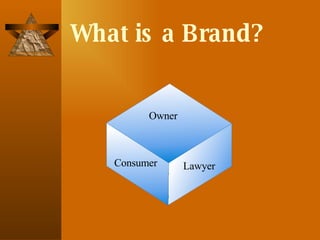
What is a Brand? Lawyer Owner Consumer
These are all great definitions, but we believe the best is this: "A brand is a collection of perceptions in the mind of the consumer." Why is it best? Well, first of all it is easy to remember, which is always useful! But it is also best because it works to remind us of some key points: This definition makes it absolutely clear that a brand is very different from a product or service. A brand is intangible and exists in the mind of the consumer.  This definition helps us understand the idea of brand loyalty and the 'loyalty ladder'. Different people have different perceptions of a product or service, which places them at different points on the loyalty ladder.  This definition makes it clear how to build a brand. A brand is built not only through effective communications or appealing logos. A brand is built through the total experience that it offers.
A minister, a priest and a rabbi went for a hike one day. It was very hot. They were sweating and exhausted when they came upon a small lake. Since it was fairly secluded, they took off all their clothes and jumped in the water. Feeling refreshed, the trio decided to pick a few berries while enjoying their "freedom." As they were crossing an open area, who should come along but a group of ladies from town. Unable to get to their clothes in time, the minister and the priest covered their privates and the rabbi covered his face while they ran for cover.  After the ladies left and the men got their clothes back on, the minister and the priest asked the rabbi why he covered his face rather than his privates. The rabbi replied, "I don't know about you, but in MY congregation, it's my face they would recognize."   Brand Identity
Brand Identity-Definition Brand Identity is a unique set of brand associations that the brand strategist aspires to create or maintain.  These associations represent what the brand stands for and imply a promise to customers from the organisation member. - David Aaker
Creating the Brand Identity Concept Positioning Identity Prism
What are my core values? What do I stand for? How do I want to be perceived? What Personality Traits do I want to project? What are the important relationships in my life? Brand Identity - Concept
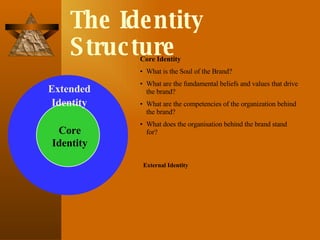
The Identity Structure Core Identity Extended Identity Core Identity What is the Soul of the Brand? What are the fundamental beliefs and values that drive the brand? What are the competencies of the organization behind the brand? What does the organisation behind the brand stand for? External Identity
Extended Identity Extended Identity Organisation Person Product Symbol
Brand as a PRODUCT - Extended Identity Product Scope Product Attributes Quality/Value Uses Users Country of Origin
Brand as a ORGANISATION - Extended Identity 7. Organisation Attributes (e.g., innovation, consumer concern, trustworthiness) 8. Local vs. Global
Brand as a PERSON - Extended Identity 9 Personality (eg. Genuine, energetic, rugged) 10 Brand Customer relationship (e.g. friend, adviser)
BRAND as a SYMBOL - Extended Identity 11 Visual Imagery and metaphors 12 Brand Heritage
Value Proposition Functional Benefit Emotional Benefit Self Expressive Benefit
Credibility Support other Brands
Branding A name, term, sign, symbol or design or combination intended to identify the goods/services of a seller and differentiate them from the competitor. A Strategic Asset Quantifiable Balance Sheet   Value
Brand Facets Positioning Proposition Personality Values Identity
Building Brand Value DIFFERENTIATION ESTEEM RELEVANCE FAMILIARITY VITALITY STATURE VALUE
Brand Customer Relationship
Brand’s particular vision & aim? What makes it different? What need is the brand fulfilling? What is its permanent nature? What are its value or values? What are the signs that makes it recognisable?
Positioning  of a Brand Why? -  Brand Promise and Consumer Benefit Aspect For Whom?-  Target Aspect When? –  Occasion when the product will be consumed Against Whom? –  Competitors A Brand Position is the part of the brand identity and value proposition that is to be actively communicated to the target audience and that demonstrate an advantage over competing brands. Why Against whom When For whom Brand Positioning
Brand Positioning Positioning a Battle for the Mind Al Ries & Jack Trout Identification, development and communication of a differentiated advantage which makes the product or service to be perceived as superior and distinctive in the prospect’s mind
Some Positioning Methods By benefit By price v/s quality By use By product user By product class Using culture By competition
Positioning Process Determine the level (Industry, organisation, product line, brand) Identify the attributes Locate on a positioning map Evaluate options Implement
Exercise Why? -  ……………… For Whom?-……… When? – . …………….. Against Whom? –  ………………
Identity Prism PICTURE OF SENDER PICTURE OF RECIPIENT EXTERNALISATION INTERNALISATION Physique Personality Reflection Self-image
Twenty top CEOs boarding an  airplane are told that the flight that they are about to take is the  first-ever to  feature pilotless technology.  Each one of the CEOs is then told, privately, that the software being  used to fly the aircraft is the same one that they use to run their  companies.  Nineteen of the CEOs promptly leave the aircraft, each offering a  different excuse.One CEO alone remains on board the jet, seeming very     calm indeed.Asked why he is so confident in this first pilotless  flight, and why he isn't afraid of crashing, he replies,"If it's the  same software that runs my company's IT systems, then this plane  won't even take off."
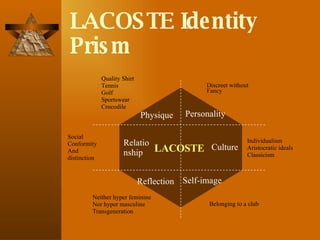
LACOSTE Identity Prism Physique Personality Reflection Self-image LACOSTE Relationship Culture Quality Shirt Tennis Golf Sportswear Crocodile Discreet without Fancy Individualism Aristocratic ideals Classicism Social Conformity And distinction Neither hyper feminine Nor hyper masculine Transgeneration Belonging to a club
Hair & Care Exercise
Launching Brand Name Brand Name or Product Name? Danger of Descriptive Name Taking the Copy phenomenon into account Taking Time into account Thinking Internationally Defining the Brand’s Platform Why must this brand exist? Or What would consumer be missing if the brand didn’t exist? Stand Point. From where does the brand speak?
Vision What is the brand vision of the product category? Mission What specific mission does the brand want to carry out in its market? Know-how What is the brand specific know how? Territory Where can the brand legitimately carry out its mission, in which product category? Typical Products or actions. Which product and actions best embody, best exemplify the brand’s values and vision Style and language What are the brand’s stylistic idiosyncrasies? Reflection Whom are we addressing? What image do we want to render of the clients themselves?
Brand Language express brand’s ideology, Personality culture, value,   Brand Recognition
Brand Architecture Strategies Product Brand Corporate Brands Retail Brands
Strategic Brand Decisions Brand Extension Multi-Brand Strategies Global Branding
McDonald’s Core Identity Core Identity : Value Offering : Mc Donald’s Provide value as defined by the product, special offers,  and buying experience given the price. Food Quality : Consistently hot, good-taste at any McDonald’s in the world Service:  Fast, accurate, friendly and hassle free Cleanliness: The operation are always spotless on both sides of the counter User : Families and kids are a focus but serves a wide clientele.
McDonald’s Extended Identity Extended Identity: Convenience : McDonal’s is the most convenient quick-service restaurant –located close to where people live, work and gather; feature efficient, time saving service; and serve easy to eat food Product Scope : Fast food, Hamburgers, children’s entertainment,  Subbrands:  Big Mac, Egg Mcmuffin, Happy Meal, Extra Value Meals and others Corporate Citizenship:  Ronald McDonald Children’s Charities, Ronald McDonald House Brand Personality:  Family oriented, all-American, genuine, wholesome, cheerful, fun Relationship:  The Ronald McDonald Children’s Charities engender respect, liking and admiration Logo: Golden Arches Character: Ronald McDonald; McDonald’s dolls & Toy’s
Value Proposition: Functional Benefits:  Good-tasting hamburgers, fries and drinks that provide value; extras such as playgrounds, prizes, premiums and games Emotional Benefits:  Kids-fun via excitement of birthday parties, relationship with Ronald McDonald and other characters and feeling of special family times; adults-warmth via link to family events and experiences reinforced by the McDonald’s emotional advertising McDonald’s Value Proposition
"a name, sign or symbol used to identify items or services of the seller(s) and to differentiate them from goods of competitors."
The  brand is a 'mental box' and brand equity is "A set of assets (or liabilities) linked to a brand's name and symbol that adds to (or subtracts from) the value provided by a product or service… " This is an important point: brands are not necessarily positive! - David Aaker  http://www.buildingbrands.com/definitions/02_brand_definition.shtml
A brand is the most valuable real-estate in the world, a corner of the consumer's mind.”
"Simply put, a brand is a promise. By identifying and authenticating a product or service it delivers a pledge of satisfaction and quality. -Walter Landor

Building Brand

  • 1.
  • 2.
    What is aBrand? Lawyer Owner Consumer
  • 3.
    These are allgreat definitions, but we believe the best is this: "A brand is a collection of perceptions in the mind of the consumer." Why is it best? Well, first of all it is easy to remember, which is always useful! But it is also best because it works to remind us of some key points: This definition makes it absolutely clear that a brand is very different from a product or service. A brand is intangible and exists in the mind of the consumer. This definition helps us understand the idea of brand loyalty and the 'loyalty ladder'. Different people have different perceptions of a product or service, which places them at different points on the loyalty ladder. This definition makes it clear how to build a brand. A brand is built not only through effective communications or appealing logos. A brand is built through the total experience that it offers.
  • 4.
    A minister, apriest and a rabbi went for a hike one day. It was very hot. They were sweating and exhausted when they came upon a small lake. Since it was fairly secluded, they took off all their clothes and jumped in the water. Feeling refreshed, the trio decided to pick a few berries while enjoying their "freedom." As they were crossing an open area, who should come along but a group of ladies from town. Unable to get to their clothes in time, the minister and the priest covered their privates and the rabbi covered his face while they ran for cover. After the ladies left and the men got their clothes back on, the minister and the priest asked the rabbi why he covered his face rather than his privates. The rabbi replied, "I don't know about you, but in MY congregation, it's my face they would recognize." Brand Identity
  • 5.
    Brand Identity-Definition BrandIdentity is a unique set of brand associations that the brand strategist aspires to create or maintain. These associations represent what the brand stands for and imply a promise to customers from the organisation member. - David Aaker
  • 6.
    Creating the BrandIdentity Concept Positioning Identity Prism
  • 7.
    What are mycore values? What do I stand for? How do I want to be perceived? What Personality Traits do I want to project? What are the important relationships in my life? Brand Identity - Concept
  • 8.
    The Identity StructureCore Identity Extended Identity Core Identity What is the Soul of the Brand? What are the fundamental beliefs and values that drive the brand? What are the competencies of the organization behind the brand? What does the organisation behind the brand stand for? External Identity
  • 9.
    Extended Identity ExtendedIdentity Organisation Person Product Symbol
  • 10.
    Brand as aPRODUCT - Extended Identity Product Scope Product Attributes Quality/Value Uses Users Country of Origin
  • 11.
    Brand as aORGANISATION - Extended Identity 7. Organisation Attributes (e.g., innovation, consumer concern, trustworthiness) 8. Local vs. Global
  • 12.
    Brand as aPERSON - Extended Identity 9 Personality (eg. Genuine, energetic, rugged) 10 Brand Customer relationship (e.g. friend, adviser)
  • 13.
    BRAND as aSYMBOL - Extended Identity 11 Visual Imagery and metaphors 12 Brand Heritage
  • 14.
    Value Proposition FunctionalBenefit Emotional Benefit Self Expressive Benefit
  • 15.
  • 16.
    Branding A name,term, sign, symbol or design or combination intended to identify the goods/services of a seller and differentiate them from the competitor. A Strategic Asset Quantifiable Balance Sheet Value
  • 17.
    Brand Facets PositioningProposition Personality Values Identity
  • 18.
    Building Brand ValueDIFFERENTIATION ESTEEM RELEVANCE FAMILIARITY VITALITY STATURE VALUE
  • 19.
  • 20.
    Brand’s particular vision& aim? What makes it different? What need is the brand fulfilling? What is its permanent nature? What are its value or values? What are the signs that makes it recognisable?
  • 21.
    Positioning ofa Brand Why? - Brand Promise and Consumer Benefit Aspect For Whom?- Target Aspect When? – Occasion when the product will be consumed Against Whom? – Competitors A Brand Position is the part of the brand identity and value proposition that is to be actively communicated to the target audience and that demonstrate an advantage over competing brands. Why Against whom When For whom Brand Positioning
  • 22.
    Brand Positioning Positioninga Battle for the Mind Al Ries & Jack Trout Identification, development and communication of a differentiated advantage which makes the product or service to be perceived as superior and distinctive in the prospect’s mind
  • 23.
    Some Positioning MethodsBy benefit By price v/s quality By use By product user By product class Using culture By competition
  • 24.
    Positioning Process Determinethe level (Industry, organisation, product line, brand) Identify the attributes Locate on a positioning map Evaluate options Implement
  • 25.
    Exercise Why? - ……………… For Whom?-……… When? – . …………….. Against Whom? – ………………
  • 26.
    Identity Prism PICTUREOF SENDER PICTURE OF RECIPIENT EXTERNALISATION INTERNALISATION Physique Personality Reflection Self-image
  • 27.
    Twenty top CEOsboarding an airplane are told that the flight that they are about to take is the first-ever to feature pilotless technology. Each one of the CEOs is then told, privately, that the software being used to fly the aircraft is the same one that they use to run their companies. Nineteen of the CEOs promptly leave the aircraft, each offering a different excuse.One CEO alone remains on board the jet, seeming very    calm indeed.Asked why he is so confident in this first pilotless flight, and why he isn't afraid of crashing, he replies,"If it's the same software that runs my company's IT systems, then this plane won't even take off."
  • 28.
    LACOSTE Identity PrismPhysique Personality Reflection Self-image LACOSTE Relationship Culture Quality Shirt Tennis Golf Sportswear Crocodile Discreet without Fancy Individualism Aristocratic ideals Classicism Social Conformity And distinction Neither hyper feminine Nor hyper masculine Transgeneration Belonging to a club
  • 29.
    Hair & CareExercise
  • 30.
    Launching Brand NameBrand Name or Product Name? Danger of Descriptive Name Taking the Copy phenomenon into account Taking Time into account Thinking Internationally Defining the Brand’s Platform Why must this brand exist? Or What would consumer be missing if the brand didn’t exist? Stand Point. From where does the brand speak?
  • 31.
    Vision What isthe brand vision of the product category? Mission What specific mission does the brand want to carry out in its market? Know-how What is the brand specific know how? Territory Where can the brand legitimately carry out its mission, in which product category? Typical Products or actions. Which product and actions best embody, best exemplify the brand’s values and vision Style and language What are the brand’s stylistic idiosyncrasies? Reflection Whom are we addressing? What image do we want to render of the clients themselves?
  • 32.
    Brand Language expressbrand’s ideology, Personality culture, value, Brand Recognition
  • 33.
    Brand Architecture StrategiesProduct Brand Corporate Brands Retail Brands
  • 34.
    Strategic Brand DecisionsBrand Extension Multi-Brand Strategies Global Branding
  • 35.
    McDonald’s Core IdentityCore Identity : Value Offering : Mc Donald’s Provide value as defined by the product, special offers, and buying experience given the price. Food Quality : Consistently hot, good-taste at any McDonald’s in the world Service: Fast, accurate, friendly and hassle free Cleanliness: The operation are always spotless on both sides of the counter User : Families and kids are a focus but serves a wide clientele.
  • 36.
    McDonald’s Extended IdentityExtended Identity: Convenience : McDonal’s is the most convenient quick-service restaurant –located close to where people live, work and gather; feature efficient, time saving service; and serve easy to eat food Product Scope : Fast food, Hamburgers, children’s entertainment, Subbrands: Big Mac, Egg Mcmuffin, Happy Meal, Extra Value Meals and others Corporate Citizenship: Ronald McDonald Children’s Charities, Ronald McDonald House Brand Personality: Family oriented, all-American, genuine, wholesome, cheerful, fun Relationship: The Ronald McDonald Children’s Charities engender respect, liking and admiration Logo: Golden Arches Character: Ronald McDonald; McDonald’s dolls & Toy’s
  • 37.
    Value Proposition: FunctionalBenefits: Good-tasting hamburgers, fries and drinks that provide value; extras such as playgrounds, prizes, premiums and games Emotional Benefits: Kids-fun via excitement of birthday parties, relationship with Ronald McDonald and other characters and feeling of special family times; adults-warmth via link to family events and experiences reinforced by the McDonald’s emotional advertising McDonald’s Value Proposition
  • 38.
    "a name, signor symbol used to identify items or services of the seller(s) and to differentiate them from goods of competitors."
  • 39.
    The brandis a 'mental box' and brand equity is "A set of assets (or liabilities) linked to a brand's name and symbol that adds to (or subtracts from) the value provided by a product or service… " This is an important point: brands are not necessarily positive! - David Aaker http://www.buildingbrands.com/definitions/02_brand_definition.shtml
  • 40.
    A brand isthe most valuable real-estate in the world, a corner of the consumer's mind.”
  • 41.
    "Simply put, abrand is a promise. By identifying and authenticating a product or service it delivers a pledge of satisfaction and quality. -Walter Landor