Branding
Putting a FACE
to the MYTH
What is a brand?

A name, a term

A symbol, a sign

“A name, term, sign, symbol or any other feature that identifies one
seller’s product or service as distinct from those of other sellers” The American Marketing Association
What is Branding?
• Started as a HOT STAMP applied on
the skins of Cattle to identify and
differentiate them.
• Now Branding is applied to virtually
everything around us from SOAP to
COUNTRIES.
THE EVOLUTION OF
BRANDING
Phase I

Manufacturing Era
• First signs of Branding as we know it started
during the Industrial Revolution (mass
production).
• To :
–
–
–
–

Identify Manufacturer
Convey quality
Differentiate from unbranded
Justify premium price over
unbranded

PHYSICAL
ATTRIBUTES
Phase II
Sales Era

• During the great Recession 1930, rose
the need for salesmanship to push the
merchandise to the end
consumer.
• Initial signs of Advertising

FUNCTIONAL
ATTRIBUTES
Phase III

Marketing Era
• After world war II purchasing power was up
and so was the production capacities so rose
the need for Marketing.
• TV began in the 50’s so did Advertising.
• New dimensions that
defined the Brand became
more evident.

EMOTIONAL
ATTRIBUTES
Phase IV
The PR Era

• With increasing competition and consumer
sophistication came the need for further
differentiation.
• Brands / Companies
started to differentiate
based on Morals and Values.
• This is an advanced stage
still being explored in our
region

VALUES
SO, WHAT IS A BRAND??
A Brand is …….
• A proposition with certain:
–
–
–
–

Physical attributes (looks)
Functional attributes (works)
Emotional attributes (personality)
Values

All above relative to a specific consumer
group.
And for a certain
– Price Bracket (social class)
BRAND
Components
Physical
Attributes

Emotional
Attributes

BRAND

Functional
Attributes

Values
A Real Brand should have
–
–
–
–
–
–
–
–

A name
A gender
An Age
Specific Physical features
Well defined looks
A social group
Values
Personality

Real Brand = A person
Lets try to prove it
• If A PERSON called BMW walked in at this
moment, lets imagine who this person
would be:
– Gender
– Age
– Wears what? (Casual, Suit, Signe, local brand
etc)
– Looks (Tall / Thin, Handsome,
elegant, foreign etc)
– Social class (Upper, Middle, Lower)
– Personality (Fun, Cool, conservative,
boring etc)
Lets Prove it Again

• Lets do the same exercise for Mercedes
Benz and Toyota

– Gender
– Age
– Wears what? (Suit, Casual, Signe, Local
Brands etc)
– Looks (Tall / Thin, Handsome, elegant,
foreign etc)
– Social class (Upper, Middle, Lower)
– Personality (Fun, Cool, conservative, boring
etc)
More Proof …..

• This is unbranded Tea (put some loose Tea in front
of your audience) . Try to do the exercise for that..
• What if we put a face to this Tea? Can you imagine
a person?
• How about another face? Can you imagine a
different person?
SO ..A Brand is…
What is the Significance of this?
• People relate to Brands like relating to
Friends.

– If I see myself as cool I want to hang out with
cool people.
– If I see myself young I want to be with young
lively people.
– If I need someone I can trust I will turn to a
trustworthy friend.
– If I want to have a good time I ll call up the
FUN guy.
– If I want to be distinguished I ll hang out
with distinguished guys.
What is the significance of this?
• Your Friends have specific attributes.
• These attributes may DEVELOP with time.
• If they develop positively (relative to your
expectations), your friendship may grow
stronger.
• If the opposite, then your friendship may fade.
• If your needs or beliefs change, this relationship
may also be affected
• IF they change completely then certainly they are
not your Friends anymore, they are STRANGERS.
Branding = Relative consistency
What is the significance of this?
• Branding leads to UNIQUNESS /
DIFFERENTIATION.
Harley Davidson = Freedom
VOLVO
=
SAFETY
SONY = Entertainment
Rolls Royce = Extreme Luxury

Branding = Value
Branding = Value
BRAND EVOLUTION
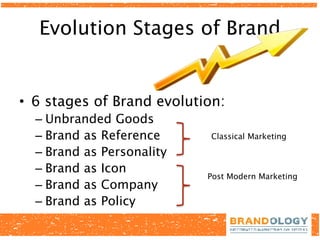
Evolution Stages of Brand

• 6 stages of Brand evolution:
– Unbranded Goods
– Brand as Reference
– Brand as Personality
– Brand as Icon
– Brand as Company
– Brand as Policy

Classical Marketing

Post Modern Marketing
Unbranded Goods
• Characteristic of developing countries.
• Demand exceeds supply.
• Main edge is Price, Supply and product
performance.
• Price sensitive.
Brand as Refference
Main promise is functional benefit.
Provides a source for the Product.
Guarantee of a specific quality.
Provides window of higher price than
Unbranded.
• Price can be determined by the
importance of the functional benefit
and its uniqueness vs competitors.
•
•
•
•
Brand as Personality
• Focus on Emotional values taking the
functionality for granted.
• Presents Target consumer Values /
lifestyle.
• Often uses celebrities to portray Brand
image.
• More Self Realization
• Permits higher pricing than previous
stage.
Brand as Icon
• Even more focus on emotional
attributes with equivalent functional
attributes.
• Brand becomes synonymous to A
VALUE.
• Self expression.
• Doorway to group acceptance.
• Permits higher pricing than previous
stage.
Brand as Company
• The relationship between Consumer
and Brand / Company is open.
• The Brand / Company interacts
directly with Consumers.
• Every aspect of the Brand is mirrored
in every consumer touch point.
• The consumer takes part in the
development of the Brand.
Brand as Policy
• Brand become identified with Social,
Political or ethical issues / causes.
• Consumers with same beliefs become
strongly attached to these Brands.
• Result in strong Loyalty.
• Credibility is a Make it or Break it
factor.
Maslow's Hierarchy
Brand as
Policy

Unbranded
Brand vs Stage
Stage

Brand

Brand

Brand

Brand

Policy

Timberland
, The Body
Shop

Company

Harley
Davidson

Icon

Rolex

Personality
Reference
Unbranded

Brand

Camay
Pril
THATS HOW VALUABLE
Coca Cola - 67M $
Microsoft – 57 M $
IBM – 56.2 M $
GE – 49 M $
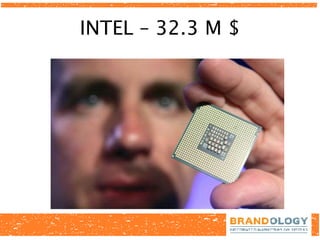
INTEL – 32.3 M $
NOKIA – 30 M $
TOYOTA – 28 M $
Disney – 27.8 m $
McDonalds – 27.5 m $
Mercedes Benz – 21.8 M $

Brand value

  • 1.
  • 2.
    What is abrand? A name, a term A symbol, a sign “A name, term, sign, symbol or any other feature that identifies one seller’s product or service as distinct from those of other sellers” The American Marketing Association
  • 3.
    What is Branding? •Started as a HOT STAMP applied on the skins of Cattle to identify and differentiate them. • Now Branding is applied to virtually everything around us from SOAP to COUNTRIES.
  • 4.
  • 5.
    Phase I Manufacturing Era •First signs of Branding as we know it started during the Industrial Revolution (mass production). • To : – – – – Identify Manufacturer Convey quality Differentiate from unbranded Justify premium price over unbranded PHYSICAL ATTRIBUTES
  • 6.
    Phase II Sales Era •During the great Recession 1930, rose the need for salesmanship to push the merchandise to the end consumer. • Initial signs of Advertising FUNCTIONAL ATTRIBUTES
  • 7.
    Phase III Marketing Era •After world war II purchasing power was up and so was the production capacities so rose the need for Marketing. • TV began in the 50’s so did Advertising. • New dimensions that defined the Brand became more evident. EMOTIONAL ATTRIBUTES
  • 8.
    Phase IV The PREra • With increasing competition and consumer sophistication came the need for further differentiation. • Brands / Companies started to differentiate based on Morals and Values. • This is an advanced stage still being explored in our region VALUES
  • 9.
    SO, WHAT ISA BRAND??
  • 10.
    A Brand is……. • A proposition with certain: – – – – Physical attributes (looks) Functional attributes (works) Emotional attributes (personality) Values All above relative to a specific consumer group. And for a certain – Price Bracket (social class)
  • 11.
  • 12.
    A Real Brandshould have – – – – – – – – A name A gender An Age Specific Physical features Well defined looks A social group Values Personality Real Brand = A person
  • 13.
    Lets try toprove it • If A PERSON called BMW walked in at this moment, lets imagine who this person would be: – Gender – Age – Wears what? (Casual, Suit, Signe, local brand etc) – Looks (Tall / Thin, Handsome, elegant, foreign etc) – Social class (Upper, Middle, Lower) – Personality (Fun, Cool, conservative, boring etc)
  • 14.
    Lets Prove itAgain • Lets do the same exercise for Mercedes Benz and Toyota – Gender – Age – Wears what? (Suit, Casual, Signe, Local Brands etc) – Looks (Tall / Thin, Handsome, elegant, foreign etc) – Social class (Upper, Middle, Lower) – Personality (Fun, Cool, conservative, boring etc)
  • 15.
    More Proof ….. •This is unbranded Tea (put some loose Tea in front of your audience) . Try to do the exercise for that.. • What if we put a face to this Tea? Can you imagine a person? • How about another face? Can you imagine a different person?
  • 16.
  • 17.
    What is theSignificance of this? • People relate to Brands like relating to Friends. – If I see myself as cool I want to hang out with cool people. – If I see myself young I want to be with young lively people. – If I need someone I can trust I will turn to a trustworthy friend. – If I want to have a good time I ll call up the FUN guy. – If I want to be distinguished I ll hang out with distinguished guys.
  • 18.
    What is thesignificance of this? • Your Friends have specific attributes. • These attributes may DEVELOP with time. • If they develop positively (relative to your expectations), your friendship may grow stronger. • If the opposite, then your friendship may fade. • If your needs or beliefs change, this relationship may also be affected • IF they change completely then certainly they are not your Friends anymore, they are STRANGERS. Branding = Relative consistency
  • 19.
    What is thesignificance of this? • Branding leads to UNIQUNESS / DIFFERENTIATION. Harley Davidson = Freedom VOLVO = SAFETY SONY = Entertainment Rolls Royce = Extreme Luxury Branding = Value
  • 20.
  • 21.
  • 22.
    Evolution Stages ofBrand • 6 stages of Brand evolution: – Unbranded Goods – Brand as Reference – Brand as Personality – Brand as Icon – Brand as Company – Brand as Policy Classical Marketing Post Modern Marketing
  • 23.
    Unbranded Goods • Characteristicof developing countries. • Demand exceeds supply. • Main edge is Price, Supply and product performance. • Price sensitive.
  • 24.
    Brand as Refference Mainpromise is functional benefit. Provides a source for the Product. Guarantee of a specific quality. Provides window of higher price than Unbranded. • Price can be determined by the importance of the functional benefit and its uniqueness vs competitors. • • • •
  • 25.
    Brand as Personality •Focus on Emotional values taking the functionality for granted. • Presents Target consumer Values / lifestyle. • Often uses celebrities to portray Brand image. • More Self Realization • Permits higher pricing than previous stage.
  • 26.
    Brand as Icon •Even more focus on emotional attributes with equivalent functional attributes. • Brand becomes synonymous to A VALUE. • Self expression. • Doorway to group acceptance. • Permits higher pricing than previous stage.
  • 27.
    Brand as Company •The relationship between Consumer and Brand / Company is open. • The Brand / Company interacts directly with Consumers. • Every aspect of the Brand is mirrored in every consumer touch point. • The consumer takes part in the development of the Brand.
  • 28.
    Brand as Policy •Brand become identified with Social, Political or ethical issues / causes. • Consumers with same beliefs become strongly attached to these Brands. • Result in strong Loyalty. • Credibility is a Make it or Break it factor.
  • 29.
  • 30.
    Brand vs Stage Stage Brand Brand Brand Brand Policy Timberland ,The Body Shop Company Harley Davidson Icon Rolex Personality Reference Unbranded Brand Camay Pril
  • 31.
  • 32.
  • 33.
  • 34.
  • 35.
  • 36.
  • 37.
  • 38.
  • 39.
  • 40.
  • 41.