™
B®ANDING
Session 2
creating brand value &
  brand positioning
1 week ago

•    introduction to branding
•    why branding is important
•    branding events, music & entertainment
•    6 reasons why we should brand
homework
•    prepare chapter 1
•    bring with you: ‘one physical product of
     branded entertainment’
•    describe:
     brand awareness, brand knowledge,
     brand image, brand attitude,
     brand value, brand preference,
     brand loyalty, brand fan?
•    you could be picked out
today
•    strategic brand management process
•    customer based brand equity
•    brand image
•    brand designing vs. brand building
•    coffee-case
•    brand positioning
reference:

chapter 2 & 3 Keller
“so what does
a brand manager do?”
“he/she works with brands”
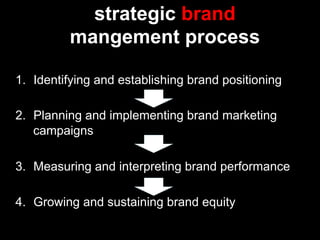
strategic brand
          mangement process

1.  Identifying and establishing brand positioning

2.  Planning and implementing brand marketing
    campaigns

3.  Measuring and interpreting brand performance

4.  Growing and sustaining brand equity
“a test”
“a conclusion”
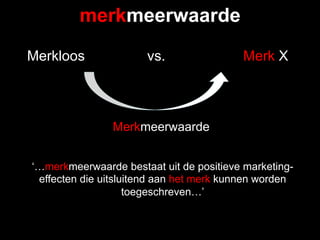
merkmeerwaarde
Merkloos              vs.                 Merk X


                Merkmeerwaarde


‘…merkmeerwaarde bestaat uit de positieve marketing-
 effecten die uitsluitend aan het merk kunnen worden
                    toegeschreven…’
customer-based brand equity
(CBBE)
Merkmeerwaarde bekeken vanuit consument

Kracht v/h merk komt voort uit:
wat heeft de consument door de jaren heen:
     geleerd over het merk
     gevoeld bij het merk
     gezien van het merk
     gehoord over het merk
customer-based brand equity
(equity = waarde, vermogen)

1.  Onderscheidend effect, van
2.  Merkkennis, op de
3.  Reactie van consumenten, op de
    marketing van dat merk
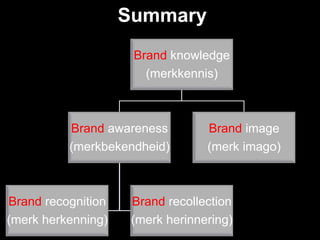
brand knowledge
            (merkkennis)
•  Consists of:
  –  1) brand awareness
  –  2) brand image
•  The associative network memory model
   (the brain is a network of associations,
   links and nodes)
1. brand awareness
         (merkbekendheid)
•  Consists of:
  –  1) brand recognition (merk herkenning)
        –  I’ve seen this before…
  –  2) brand recollection (merk herinnering)
        –  I think you are referring to...

•  Advantages:
  –  Influences the amount, speed and strength of
     associations to be made
  –  Better chance to be part of consideration set
  –  Better chance to become the chosen brand
2. brand image
                 (merkimago)
•  Building a good brand image: creating strong,
   positive and unique brand associations

•  Important:
  –  Personal relevance
  –  Uniqueness
  –  Consistency
  –  Credibility
What’s brand image?
The Body Shop heeft een globaal merkimago
gecreëerd zonder gebruik te maken van conventionele
reclamekanalen. De sterke associaties die het merk
oproept met persoonlijke verzorging en milieukwesties zijn
gegenereerd door de producten (alleen natuurlijke
ingrediënten, nooit op dieren getest), de verpakking
(eenvoudig, navulbaar, te recyclen), de merchandising
(gedetailleerde point-of sale posters, brochures en displays),
het personeel (dat wordt aangemoedigd om enthousiast en
informatief te zijn met betrekking tot milieukwesties), sourcing
beleid (gebruikmaken van kleine, lokale producenten van over
de hele wereld), sociaal actieprogramma (waarbij elke
franchisenemer wordt verplicht om een lokaal gemeenschaps-
programma te organiseren), en PR-programma’s en –
activiteiten (zichtbare en soms uitgesproken standpunten
innemen met betrekking tot verschillende kwesties).
Summary
                     Brand knowledge
                       (merkkennis)


          Brand awareness         Brand image
          (merkbekendheid)        (merk imago)


Brand recognition    Brand recollection
(merk herkenning)    (merk herinnering)
“building a strong brand”
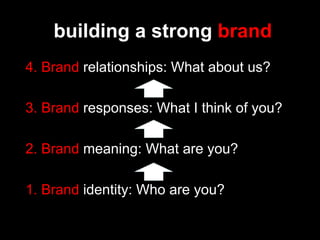
building a strong brand
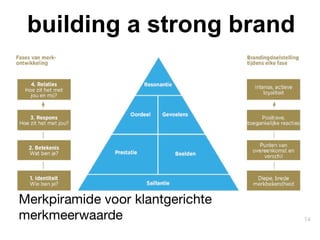
4. Brand relationships: What about us?

3. Brand responses: What I think of you?

2. Brand meaning: What are you?

1. Brand identity: Who are you?
building a strong brand
“building a strong brand
 is an ongoing process”
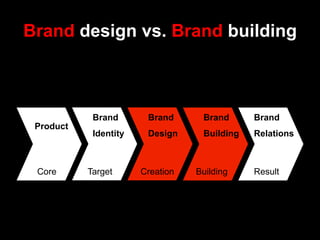
Brand design vs. Brand building


            Brand       Brand      Brand      Brand
 Product
            Identity    Design     Building   Relations


 Core      Target      Creation   Building    Result
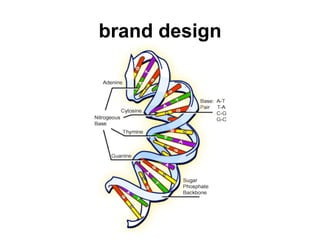
brand design
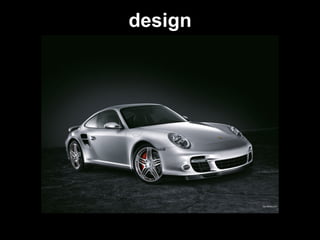
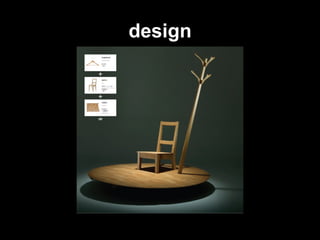
design
design
what is brand design?
“…brand design is the
   creation (!) and
 the visualization (!)
     of brands..”

     source: Brand design,
   voor beleid in merkidentiteit
           Ruud Boer
a case: starbucks
coffee
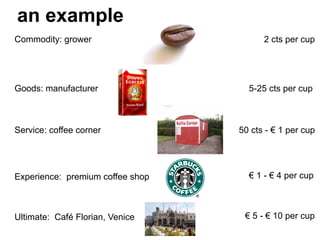
an example
Commodity: grower                       2 cts per cup


Goods: manufacturer                 5-25 cts per cup


Service: coffee corner            50 cts - € 1 per cup


Experience: premium coffee shop     € 1 - € 4 per cup


Ultimate: Café Florian, Venice     € 5 - € 10 per cup
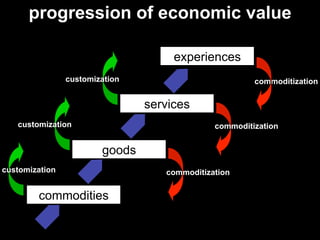
progression of economic value

                                     experiences
                customization                          commoditization


                                services
   customization                              commoditization


                        goods
customization                      commoditization


        commodities
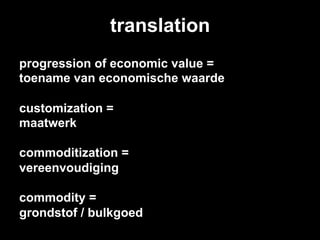
translation
progression of economic value =
toename van economische waarde

customization =
maatwerk

commoditization =
vereenvoudiging

commodity =
grondstof / bulkgoed
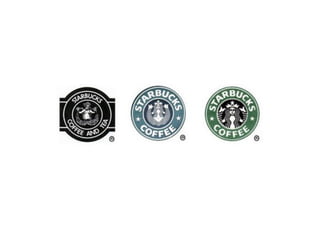
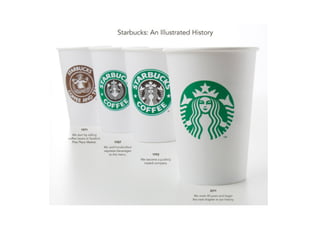
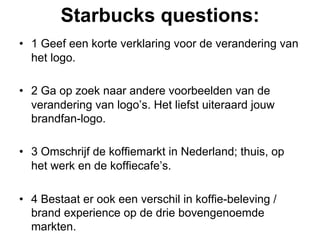
Starbucks questions:
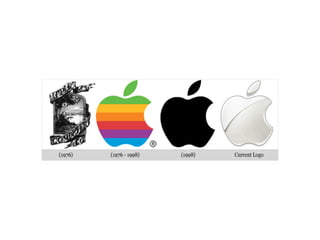
•  1 Geef een korte verklaring voor de verandering van
   het logo.

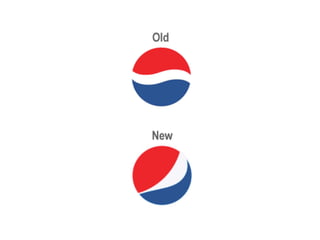
•  2 Ga op zoek naar andere voorbeelden van de
   verandering van logo’s. Het liefst uiteraard jouw
   brandfan-logo.

•  3 Omschrijf de koffiemarkt in Nederland; thuis, op
   het werk en de koffiecafe’s.

•  4 Bestaat er ook een verschil in koffie-beleving /
   brand experience op de drie bovengenoemde
   markten.
Functions of brand design
1.    Creating difference
2.    Creating extra value
3.    Communicating promises
4.    Creating awareness
5.    Creating recognition
6.    Communicating basic information
7.    Fulfulling other functions
       •    For example ‘Living the brand’
Brand desigining:
      the inner side:
  A. creation of brands
  (vormen van merken)

      the outer side:
B. visualisation of brands
(vormgeven van merken)
A. the creation of a brand
             (inner side)

•  establishing brand DNA (genetisch)
•  establishing brand soul (karakter)
A. the creation of a brand
                    (inner side)
1.     Brand vision
      •    What does the market look like in 5-10 years? What
           position does the brand have?
2.     Brand mission
      •    What do we have to do to make our vision come true?
3.     Brand values
      •    What is unique for our brand?
4.     Brand personality
      •    How can we describe our brand as it were a person? How
           can we describe our brand different to other brands
5.     Brand promise
      •    What is the most important promise we have towards the
           target group
6.     Brand core-concept
      •    What is the core of the brand, what is reason the brand
           exists?
B. the visualization of a brand
                 (outer side)
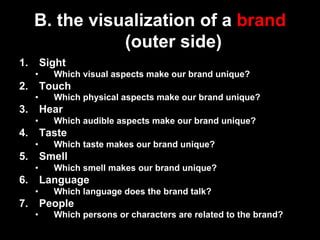
1.     Sight
      •    Which visual aspects make our brand unique?
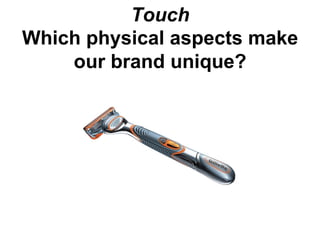
2.     Touch
      •    Which physical aspects make our brand unique?
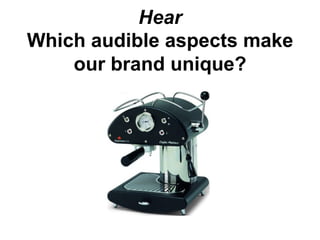
3.     Hear
      •    Which audible aspects make our brand unique?
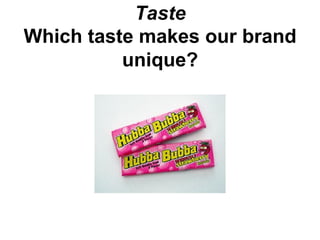
4.     Taste
      •    Which taste makes our brand unique?
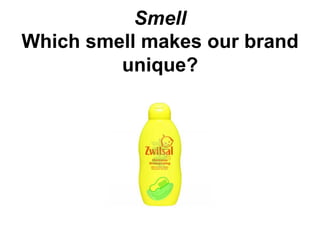
5.     Smell
      •    Which smell makes our brand unique?
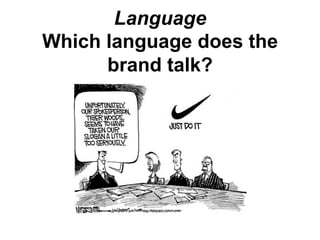
6.     Language
      •    Which language does the brand talk?
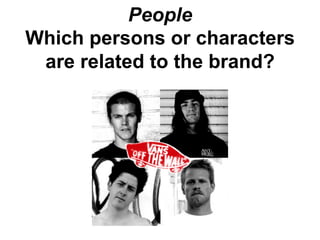
7.     People
      •    Which persons or characters are related to the brand?
B. the visualization of a brand
             (outer side)
•  Visualisation through:
  –  Logo
  –  Colours
  –  Fonts
  –  Text
  –  Shape
  –  Material
  –  Lay-out
  –  Visuals (photos, icons, illustrations)
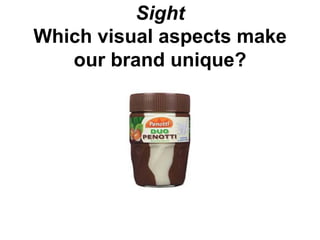
Sight
Which visual aspects make
   our brand unique?
Touch
Which physical aspects make
    our brand unique?
Hear
Which audible aspects make
    our brand unique?
Taste
Which taste makes our brand
          unique?
Smell
Which smell makes our brand
         unique?
Language
Which language does the
      brand talk?
People
Which persons or characters
 are related to the brand?
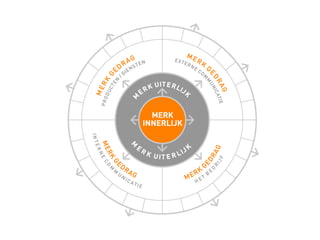
the inner side:
     A. creation of brands
 mental brand identity
(mentale merk identiteit)
         the outer side:
   B. visualisation of brands
 visual brand identity
(visuele merkidentiteit)
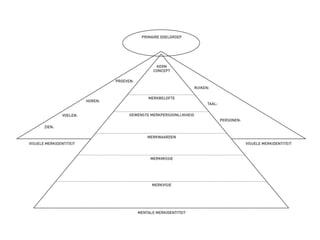
Het merk-wijzer model


             Bron: Brand design, Ruud Boer
brand positioning &
  brand elements
brand building

  Building a strong brand:
creating strong, positive and
  unique brand associations
merkpositionering

  “…het vinden van de juiste
locatie van het merk (aanbod &
  imago) in de hoofden van de
         consument…”
positioneren en
herpositioneren
merkpositionering
Nodig voor een goede merkpositionering:

1.  Overzicht van de doelgroep
2.  Overzicht van de grootste concurrenten
3.  A) Punten van vergelijkbaarheid t.o.v. de
    grootste concurrenten
4.  B) Punten van verschil t.o.v. de
    grootste concurrenten
1. overzicht van de
     doelgroep
Een segment:
•  een herkenbare groep potentiële klanten
•  Voorwaarden voor een segment:
  –  Grootte: voldoende omvang
  –  Meetbaar (o.a. voldoende koopkracht)
  –  Herkenbaar (van andere segmenten)
  –  Toegankelijkheid (o.a. communicatie,
     distributie)
  –  Responsiviteit (reageert het segement op het
     marketingprogramma?)
Segmentatie voorbeelden
•  Nokia’s Market Segmentation
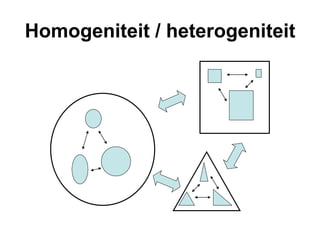
Homogeniteit / heterogeniteit
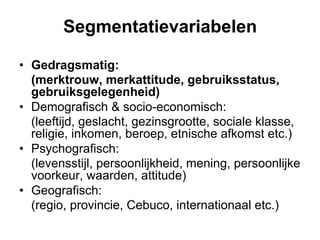
Segmentatievariabelen

•  Gedragsmatig:
   (merktrouw, merkattitude, gebruiksstatus,
   gebruiksgelegenheid)
•  Demografisch & socio-economisch:
   (leeftijd, geslacht, gezinsgrootte, sociale klasse,
   religie, inkomen, beroep, etnische afkomst etc.)
•  Psychografisch:
   (levensstijl, persoonlijkheid, mening, persoonlijke
   voorkeur, waarden, attitude)
•  Geografisch:
   (regio, provincie, Cebuco, internationaal etc.)
2. overzicht van de
grootste concurrenten
Concurrentie
            Alle partijen
  die een organisatie belemmeren
in het behalen van haar (marketing)
           doelstellingen
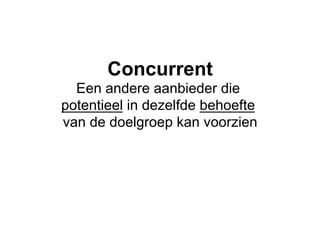
Concurrent
  Een andere aanbieder die
potentieel in dezelfde behoefte
van de doelgroep kan voorzien
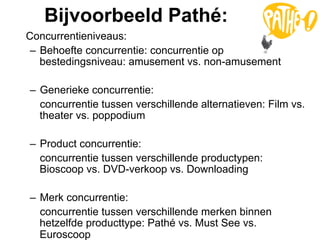
Bijvoorbeeld Pathé:
Concurrentieniveaus:
 –  Behoefte concurrentie: concurrentie op
    bestedingsniveau: amusement vs. non-amusement

–  Generieke concurrentie:
   concurrentie tussen verschillende alternatieven: Film vs.
   theater vs. poppodium

–  Product concurrentie:
   concurrentie tussen verschillende productypen:
   Bioscoop vs. DVD-verkoop vs. Downloading

–  Merk concurrentie:
   concurrentie tussen verschillende merken binnen
   hetzelfde producttype: Pathé vs. Must See vs.
   Euroscoop
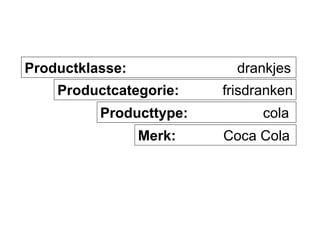
Productklasse:             drankjes
    Productcategorie:    frisdranken
          Producttype:         cola
                 Merk:   Coca Cola
3a. Punten van
vergelijkbaarheid
t.o.v. de grootste
   concurrenten
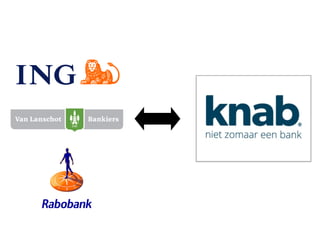
•  Points of parity (POP)
•  Positieve associaties die het merk
   deelt met concurrenten
•  POP’s zorgen ervoor dat het merk
   door de consument binnen een
   productcategorie wordt
   geaccepteerd
3b. Punten van
   verschil t.o.v. de
grootste concurrenten
 (points of difference)
•  Points of difference (POD)
•  Positieve associaties die de
   consument uitsluitend aan 1 merk
   toeschrijft
•  Zowel functioneel als emotioneel
•  Vergelijkbaar met USP
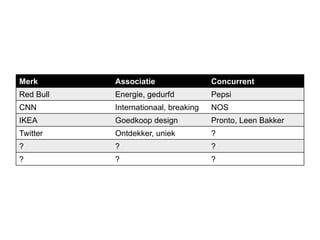
Merk       Associatie                 Concurrent
Red Bull   Energie, gedurfd           Pepsi
CNN        Internationaal, breaking   NOS
IKEA       Goedkoop design            Pronto, Leen Bakker
Twitter    Ontdekker, uniek           ?
?          ?                          ?
?          ?                          ?
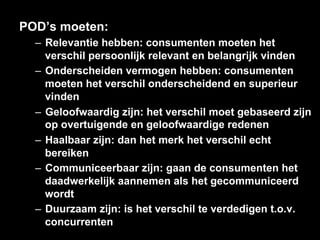
POD’s moeten:
  –  Relevantie hebben: consumenten moeten het
     verschil persoonlijk relevant en belangrijk vinden
  –  Onderscheiden vermogen hebben: consumenten
     moeten het verschil onderscheidend en superieur
     vinden
  –  Geloofwaardig zijn: het verschil moet gebaseerd zijn
     op overtuigende en geloofwaardige redenen
  –  Haalbaar zijn: dan het merk het verschil echt
     bereiken
  –  Communiceerbaar zijn: gaan de consumenten het
     daadwerkelijk aannemen als het gecommuniceerd
     wordt
  –  Duurzaam zijn: is het verschil te verdedigen t.o.v.
     concurrenten
“… het bereiken van POP’s is
gemakkelijker dan het bereiken
        van POD’s…”

“…er is een verschil tussen het
 feitelijk behalen van een POD
en het behalen van een POD in
        de hoofden van de
           consument…”
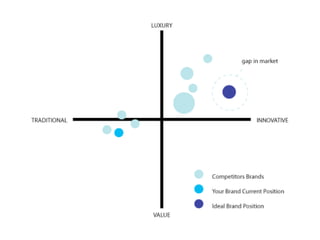
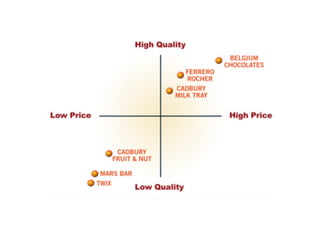
positioneringsgrafiek
“…maar wat nu als jouw merk
   een erg sterk POD heeft
 gevestigd voor een bepaald
 product, en je wil dat merk
       voor een andere
    productcategorie gaan
         gebruiken…”
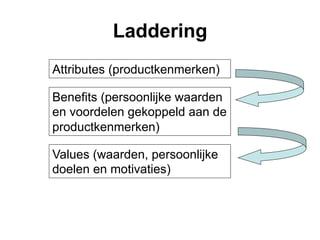
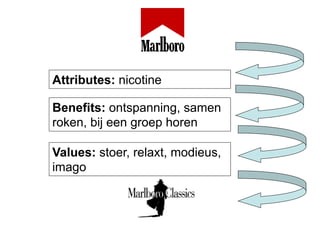
Laddering
Attributes (productkenmerken)

Benefits (persoonlijke waarden
en voordelen gekoppeld aan de
productkenmerken)

Values (waarden, persoonlijke
doelen en motivaties)
“…brand laddering
involves progression from
  attributes to benefits to
   more abstract values.
    Laddering involves
repeatedly asking what the
 implication of an attribute
    or benefit is for the
        customer…"
bijvoorbeeld
Attributes: nicotine

Benefits: ontspanning, samen
roken, bij een groep horen

Values: stoer, relaxt, modieus,
imago
“…maar wat nu als jouw merk
  wordt gebruikt in allerlei
   verschillende product-
 categorieën en dus enorm
     veel verschillende
  positioneringen heeft…”
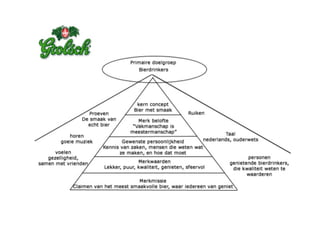
kern-merk associaties
•  Omschrijving kern-merkbelofte
•  5-10 meest belangrijke aspecten van
   het merk
•  D.m.v. onderzoek onder consumenten
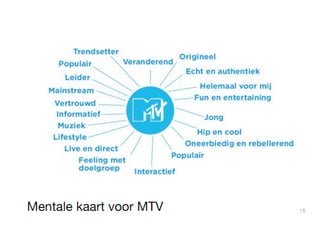
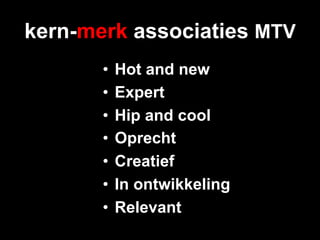
kern-merk associaties MTV
       •  Hot and new
       •  Expert
       •  Hip and cool
       •  Oprecht
       •  Creatief
       •  In ontwikkeling
       •  Relevant
merkmantra
•    Verwoording van het hart en ziel v/h merk
•    Bruikbaar bij nieuwe merkextensies
•    Zorgen voor een consistent merkimago
•    Zorgen voor internal branding

•  B.v. de merkmantra van Rabobank
   (zie boek pagina 82)
homework


•    prepare chapter 2 and 3
questions? /comments
thank you!

Session 2, creating brand value 2012 2013

  • 1.
  • 2.
    Session 2 creating brandvalue & brand positioning
  • 3.
    1 week ago •  introduction to branding •  why branding is important •  branding events, music & entertainment •  6 reasons why we should brand
  • 4.
    homework •  prepare chapter 1 •  bring with you: ‘one physical product of branded entertainment’ •  describe: brand awareness, brand knowledge, brand image, brand attitude, brand value, brand preference, brand loyalty, brand fan? •  you could be picked out
  • 6.
    today •  strategic brand management process •  customer based brand equity •  brand image •  brand designing vs. brand building •  coffee-case •  brand positioning
  • 7.
  • 8.
    “so what does abrand manager do?”
  • 9.
  • 10.
    strategic brand mangement process 1.  Identifying and establishing brand positioning 2.  Planning and implementing brand marketing campaigns 3.  Measuring and interpreting brand performance 4.  Growing and sustaining brand equity
  • 11.
  • 12.
  • 13.
    merkmeerwaarde Merkloos vs. Merk X Merkmeerwaarde ‘…merkmeerwaarde bestaat uit de positieve marketing- effecten die uitsluitend aan het merk kunnen worden toegeschreven…’
  • 14.
    customer-based brand equity (CBBE) Merkmeerwaardebekeken vanuit consument Kracht v/h merk komt voort uit: wat heeft de consument door de jaren heen: geleerd over het merk gevoeld bij het merk gezien van het merk gehoord over het merk
  • 15.
    customer-based brand equity (equity= waarde, vermogen) 1.  Onderscheidend effect, van 2.  Merkkennis, op de 3.  Reactie van consumenten, op de marketing van dat merk
  • 16.
    brand knowledge (merkkennis) •  Consists of: –  1) brand awareness –  2) brand image •  The associative network memory model (the brain is a network of associations, links and nodes)
  • 19.
    1. brand awareness (merkbekendheid) •  Consists of: –  1) brand recognition (merk herkenning) –  I’ve seen this before… –  2) brand recollection (merk herinnering) –  I think you are referring to... •  Advantages: –  Influences the amount, speed and strength of associations to be made –  Better chance to be part of consideration set –  Better chance to become the chosen brand
  • 20.
    2. brand image (merkimago) •  Building a good brand image: creating strong, positive and unique brand associations •  Important: –  Personal relevance –  Uniqueness –  Consistency –  Credibility
  • 21.
  • 23.
    The Body Shopheeft een globaal merkimago gecreëerd zonder gebruik te maken van conventionele reclamekanalen. De sterke associaties die het merk oproept met persoonlijke verzorging en milieukwesties zijn gegenereerd door de producten (alleen natuurlijke ingrediënten, nooit op dieren getest), de verpakking (eenvoudig, navulbaar, te recyclen), de merchandising (gedetailleerde point-of sale posters, brochures en displays), het personeel (dat wordt aangemoedigd om enthousiast en informatief te zijn met betrekking tot milieukwesties), sourcing beleid (gebruikmaken van kleine, lokale producenten van over de hele wereld), sociaal actieprogramma (waarbij elke franchisenemer wordt verplicht om een lokaal gemeenschaps- programma te organiseren), en PR-programma’s en – activiteiten (zichtbare en soms uitgesproken standpunten innemen met betrekking tot verschillende kwesties).
  • 27.
    Summary Brand knowledge (merkkennis) Brand awareness Brand image (merkbekendheid) (merk imago) Brand recognition Brand recollection (merk herkenning) (merk herinnering)
  • 28.
  • 29.
    building a strongbrand 4. Brand relationships: What about us? 3. Brand responses: What I think of you? 2. Brand meaning: What are you? 1. Brand identity: Who are you?
  • 30.
  • 31.
    “building a strongbrand is an ongoing process”
  • 32.
    Brand design vs.Brand building Brand Brand Brand Brand Product Identity Design Building Relations Core Target Creation Building Result
  • 33.
  • 34.
  • 35.
  • 36.
  • 37.
    “…brand design isthe creation (!) and the visualization (!) of brands..” source: Brand design, voor beleid in merkidentiteit Ruud Boer
  • 38.
  • 41.
  • 42.
    an example Commodity: grower 2 cts per cup Goods: manufacturer 5-25 cts per cup Service: coffee corner 50 cts - € 1 per cup Experience: premium coffee shop € 1 - € 4 per cup Ultimate: Café Florian, Venice € 5 - € 10 per cup
  • 43.
    progression of economicvalue experiences customization commoditization services customization commoditization goods customization commoditization commodities
  • 44.
    translation progression of economicvalue = toename van economische waarde customization = maatwerk commoditization = vereenvoudiging commodity = grondstof / bulkgoed
  • 45.
    Starbucks questions: •  1Geef een korte verklaring voor de verandering van het logo. •  2 Ga op zoek naar andere voorbeelden van de verandering van logo’s. Het liefst uiteraard jouw brandfan-logo. •  3 Omschrijf de koffiemarkt in Nederland; thuis, op het werk en de koffiecafe’s. •  4 Bestaat er ook een verschil in koffie-beleving / brand experience op de drie bovengenoemde markten.
  • 49.
    Functions of branddesign 1.  Creating difference 2.  Creating extra value 3.  Communicating promises 4.  Creating awareness 5.  Creating recognition 6.  Communicating basic information 7.  Fulfulling other functions •  For example ‘Living the brand’
  • 50.
    Brand desigining: the inner side: A. creation of brands (vormen van merken) the outer side: B. visualisation of brands (vormgeven van merken)
  • 52.
    A. the creationof a brand (inner side) •  establishing brand DNA (genetisch) •  establishing brand soul (karakter)
  • 53.
    A. the creationof a brand (inner side) 1.  Brand vision •  What does the market look like in 5-10 years? What position does the brand have? 2.  Brand mission •  What do we have to do to make our vision come true? 3.  Brand values •  What is unique for our brand? 4.  Brand personality •  How can we describe our brand as it were a person? How can we describe our brand different to other brands 5.  Brand promise •  What is the most important promise we have towards the target group 6.  Brand core-concept •  What is the core of the brand, what is reason the brand exists?
  • 54.
    B. the visualizationof a brand (outer side) 1.  Sight •  Which visual aspects make our brand unique? 2.  Touch •  Which physical aspects make our brand unique? 3.  Hear •  Which audible aspects make our brand unique? 4.  Taste •  Which taste makes our brand unique? 5.  Smell •  Which smell makes our brand unique? 6.  Language •  Which language does the brand talk? 7.  People •  Which persons or characters are related to the brand?
  • 55.
    B. the visualizationof a brand (outer side) •  Visualisation through: –  Logo –  Colours –  Fonts –  Text –  Shape –  Material –  Lay-out –  Visuals (photos, icons, illustrations)
  • 56.
    Sight Which visual aspectsmake our brand unique?
  • 57.
    Touch Which physical aspectsmake our brand unique?
  • 58.
    Hear Which audible aspectsmake our brand unique?
  • 59.
    Taste Which taste makesour brand unique?
  • 60.
    Smell Which smell makesour brand unique?
  • 61.
  • 62.
    People Which persons orcharacters are related to the brand?
  • 63.
    the inner side: A. creation of brands mental brand identity (mentale merk identiteit) the outer side: B. visualisation of brands visual brand identity (visuele merkidentiteit)
  • 64.
    Het merk-wijzer model Bron: Brand design, Ruud Boer
  • 67.
    brand positioning & brand elements
  • 68.
    brand building Building a strong brand: creating strong, positive and unique brand associations
  • 69.
    merkpositionering “…hetvinden van de juiste locatie van het merk (aanbod & imago) in de hoofden van de consument…”
  • 71.
  • 74.
    merkpositionering Nodig voor eengoede merkpositionering: 1.  Overzicht van de doelgroep 2.  Overzicht van de grootste concurrenten 3.  A) Punten van vergelijkbaarheid t.o.v. de grootste concurrenten 4.  B) Punten van verschil t.o.v. de grootste concurrenten
  • 75.
    1. overzicht vande doelgroep
  • 76.
    Een segment: •  eenherkenbare groep potentiële klanten •  Voorwaarden voor een segment: –  Grootte: voldoende omvang –  Meetbaar (o.a. voldoende koopkracht) –  Herkenbaar (van andere segmenten) –  Toegankelijkheid (o.a. communicatie, distributie) –  Responsiviteit (reageert het segement op het marketingprogramma?)
  • 77.
  • 78.
  • 79.
    Segmentatievariabelen •  Gedragsmatig: (merktrouw, merkattitude, gebruiksstatus, gebruiksgelegenheid) •  Demografisch & socio-economisch: (leeftijd, geslacht, gezinsgrootte, sociale klasse, religie, inkomen, beroep, etnische afkomst etc.) •  Psychografisch: (levensstijl, persoonlijkheid, mening, persoonlijke voorkeur, waarden, attitude) •  Geografisch: (regio, provincie, Cebuco, internationaal etc.)
  • 80.
    2. overzicht vande grootste concurrenten
  • 81.
    Concurrentie Alle partijen die een organisatie belemmeren in het behalen van haar (marketing) doelstellingen
  • 82.
    Concurrent Eenandere aanbieder die potentieel in dezelfde behoefte van de doelgroep kan voorzien
  • 83.
    Bijvoorbeeld Pathé: Concurrentieniveaus: – Behoefte concurrentie: concurrentie op bestedingsniveau: amusement vs. non-amusement –  Generieke concurrentie: concurrentie tussen verschillende alternatieven: Film vs. theater vs. poppodium –  Product concurrentie: concurrentie tussen verschillende productypen: Bioscoop vs. DVD-verkoop vs. Downloading –  Merk concurrentie: concurrentie tussen verschillende merken binnen hetzelfde producttype: Pathé vs. Must See vs. Euroscoop
  • 84.
    Productklasse: drankjes Productcategorie: frisdranken Producttype: cola Merk: Coca Cola
  • 85.
  • 86.
    •  Points ofparity (POP) •  Positieve associaties die het merk deelt met concurrenten •  POP’s zorgen ervoor dat het merk door de consument binnen een productcategorie wordt geaccepteerd
  • 88.
    3b. Punten van verschil t.o.v. de grootste concurrenten (points of difference)
  • 89.
    •  Points ofdifference (POD) •  Positieve associaties die de consument uitsluitend aan 1 merk toeschrijft •  Zowel functioneel als emotioneel •  Vergelijkbaar met USP
  • 90.
    Merk Associatie Concurrent Red Bull Energie, gedurfd Pepsi CNN Internationaal, breaking NOS IKEA Goedkoop design Pronto, Leen Bakker Twitter Ontdekker, uniek ? ? ? ? ? ? ?
  • 91.
    POD’s moeten: –  Relevantie hebben: consumenten moeten het verschil persoonlijk relevant en belangrijk vinden –  Onderscheiden vermogen hebben: consumenten moeten het verschil onderscheidend en superieur vinden –  Geloofwaardig zijn: het verschil moet gebaseerd zijn op overtuigende en geloofwaardige redenen –  Haalbaar zijn: dan het merk het verschil echt bereiken –  Communiceerbaar zijn: gaan de consumenten het daadwerkelijk aannemen als het gecommuniceerd wordt –  Duurzaam zijn: is het verschil te verdedigen t.o.v. concurrenten
  • 92.
    “… het bereikenvan POP’s is gemakkelijker dan het bereiken van POD’s…” “…er is een verschil tussen het feitelijk behalen van een POD en het behalen van een POD in de hoofden van de consument…”
  • 93.
  • 95.
    “…maar wat nuals jouw merk een erg sterk POD heeft gevestigd voor een bepaald product, en je wil dat merk voor een andere productcategorie gaan gebruiken…”
  • 96.
    Laddering Attributes (productkenmerken) Benefits (persoonlijkewaarden en voordelen gekoppeld aan de productkenmerken) Values (waarden, persoonlijke doelen en motivaties)
  • 97.
    “…brand laddering involves progressionfrom attributes to benefits to more abstract values. Laddering involves repeatedly asking what the implication of an attribute or benefit is for the customer…"
  • 98.
  • 99.
    Attributes: nicotine Benefits: ontspanning,samen roken, bij een groep horen Values: stoer, relaxt, modieus, imago
  • 100.
    “…maar wat nuals jouw merk wordt gebruikt in allerlei verschillende product- categorieën en dus enorm veel verschillende positioneringen heeft…”
  • 101.
    kern-merk associaties •  Omschrijvingkern-merkbelofte •  5-10 meest belangrijke aspecten van het merk •  D.m.v. onderzoek onder consumenten
  • 103.
    kern-merk associaties MTV •  Hot and new •  Expert •  Hip and cool •  Oprecht •  Creatief •  In ontwikkeling •  Relevant
  • 104.
    merkmantra •  Verwoording van het hart en ziel v/h merk •  Bruikbaar bij nieuwe merkextensies •  Zorgen voor een consistent merkimago •  Zorgen voor internal branding •  B.v. de merkmantra van Rabobank (zie boek pagina 82)
  • 105.
    homework •  prepare chapter 2 and 3
  • 106.
  • 107.