advanced course


business model
  marketing
session 4
last week...
Distribution models, user models,
(co) creation models, Google
assignment
this week
Long tail model, free as a business
model, business model design,
customer segments, empathy map
getting deeper
    into it..
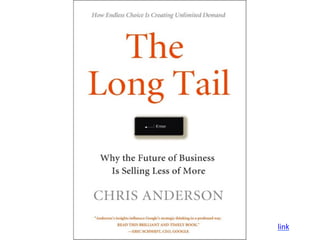
(1) the long tail model..	
  
link	
  
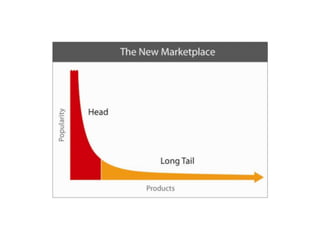
the long tail model..	
  
Long	
  tail	
  models	
  are	
  about	
  selling	
  a	
  lower	
  
volume	
  of	
  a	
  greater	
  amount	
  of	
  different	
  
products.	


The	
  long	
  tail	
  focuses	
  on	
  selling	
  a	
  large	
  amount	
  of	
  
niche	
  products.	


All	
  together	
  these	
  sales	
  are	
  equally	
  profitable	
  as	
  
the	
  tradi?onal	
  model	
  which	
  makes	
  use	
  of	
  a	
  
small	
  number	
  of	
  bestselling	
  products.	
  	
  
1. what   products do you get for
               free?

   2. what can you get for free
             online?

3. what should be free (online)???
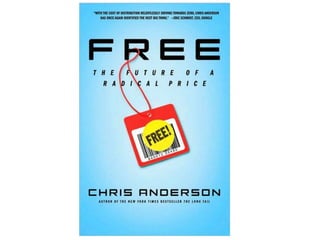
‘free’ as a business model..	
  
Free got started in the twentieth century by companies
giving away something that spurred purchases of related
goods. Gillette razors is an example.

Free in the bits economy, however, can be really Free.

In 1996 the Village Voice became a free newspaper. Since it
no longer charged, people perceived that it had a lesser
quality. Another paper, The Onion, started Free and stayed
Free, and is a much bigger success. This shows that our
feelings about Free are relative, not absolute.

                                           (Chris Anderson)
‘free’ as a business model..	
  
At	
  places	
  like	
  Google,	
  new	
  services	
  start	
  with	
  ques?ons	
  like	
  
“Would	
  it	
  be	
  cool?”,	
  “Do	
  people	
  want	
  it?”	
  or	
  “Does	
  it	
  use	
  
technology	
  well?”	
  rather	
  than	
  “Will	
  it	
  make	
  money?”	


In	
  Google’s	
  case,	
  they	
  first	
  invented	
  a	
  way	
  to	
  do	
  
search	
  that	
  gets	
  beIer	
  as	
  the	
  Web	
  gets	
  bigger.	
  They	
  then	
  
allowed	
  adver?sers	
  to	
  create	
  ads	
  that	
  matched	
  keywords	
  or	
  
content	
  and	
  bid	
  against	
  each	
  other	
  for	
  the	
  most	
  prominent	
  
posi?ons.	
  They	
  then	
  created	
  other	
  products	
  to	
  extend	
  their	
  
reach	
  and	
  only	
  aIached	
  ads	
  when	
  it	
  made	
  sense.	
  (Chris	
  Anderson)
(2) the freemium model..	
  
When	
  using	
  the	
  freemium	
  model	
  the	
  product	
  is	
  
given	
  away	
  for	
  free.	
  A	
  beIer	
  version	
  of	
  the	
  
product	
  is	
  only	
  accessible	
  aNer	
  buying	
  an	
  
updated	
  version.	
  There	
  are	
  also	
  freemium	
  
models	
  used	
  that	
  have	
  a	
  connec?on	
  with	
  
annoying	
  adver?sing.	
  ANer	
  a	
  paid	
  update	
  you	
  
don’t	
  get	
  this	
  adver?sing	
  anymore.	


‘free’ as a business model..	
  
In	
  the	
  FREE	
  business	
  model	
  at	
  least	
  one	
  substan?al	
  
Customer	
  segment	
  is	
  able	
  to	
  con?nuously	
  benefit	
  from	
  
a	
  free-­‐of-­‐charge	
  offer.	
  Different	
  paIerns	
  make	
  the	
  free	
  
offer	
  possible.	
  	
  
Non-­‐paying	
  customers	
  are	
  financed	
  by	
  another	
  part	
  of	
  
the	
  business	
  model	
  or	
  by	
  another	
  Customer	
  Segment.	
  
                                                                     (Business	
  model	
  genera?on)	


                            (so..	
  who	
  IS	
  going	
  to	
  pay??)	


business
 model
 design
business model design..
-customer insights
-ideation
 (what if-questions, brainstorming rules,
 silly cow exercise)
-visual thinking
-prototyping
-storytelling
-scenarios
customer
     insight:
it all begins with the
     customer..
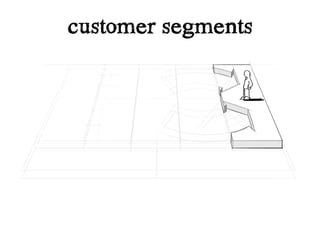
customer segments
wat wil een klantsegment...
-lees het artikel ‘Voor 15 euro
flirten met klassieke muziek..’
-zoek alle punten op die jongeren
blijkbaar als voorwaarde hebben
om naar naar het concertgebouw
te gaan
-hoe ziet de marketingmix er voor
dit jongerensegment er nu uit?
wat willen jongeren...
-behoefte aan klassieke muziek

-behoefte aan leeftijdsgenoten (sociaal aspect)

-behoefte aan korte tijdsduur (1 uur max)

-behoefte aan naborrelen/afterparty

-behoefte aan extra beleving (projectiescherm,
tekstinfo, rondleiding, meet&greet)

-behoefte aan een scherpe prijs (15 euro/
sprintplaats 10 euro
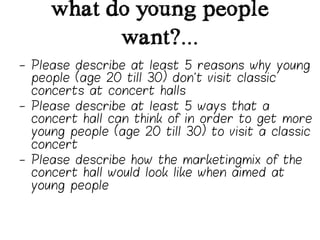
what do young people
           want?...
-  Please describe at least 5 reasons why young
   people (age 20 till 30) don’t visit classic
   concerts at concert halls
-  Please describe at least 5 ways that a
   concert hall can think of in order to get more
   young people (age 20 till 30) to visit a classic
   concert
-  Please describe how the marketingmix of the
   concert hall would look like when aimed at
   young people
now let’s stick together..
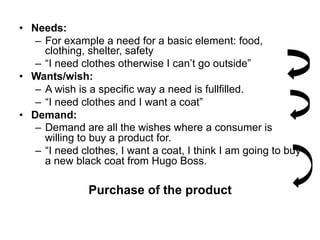
•  Needs:
    –  For example a need for a basic element: food,
       clothing, shelter, safety
    –  “I need clothes otherwise I can’t go outside”
•  Wants/wish:
    –  A wish is a specific way a need is fullfilled.
    –  “I need clothes and I want a coat”
•  Demand:
    –  Demand are all the wishes where a consumer is
       willing to buy a product for.
    –  “I need clothes, I want a coat, I think I am going to buy
       a new black coat from Hugo Boss.

               Purchase of the product
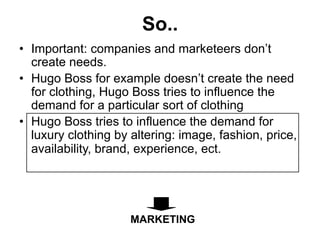
So..
•  Important: companies and marketeers don’t
   create needs.
•  Hugo Boss for example doesn’t create the need
   for clothing, Hugo Boss tries to influence the
   demand for a particular sort of clothing
•  Hugo Boss tries to influence the demand for
   luxury clothing by altering: image, fashion, price,
   availability, brand, experience, ect.


                     MARKETING
customer needs
•  Do customers buy their products
   consciously?

•  Do customers even know what they
   want?

•  Are customers aware of their
   (latent) needs?

•  Do customers know what is
   technically possible?
what are the underlying
             needs of..?
…buying	
  a	
  Makita	
  drilling	
  machine	
  ?	


…buying	
  an	
  iPhone	
  5?	


…buying	
  ?ckets	
  of	
  a	
  concert	
  of	
  Madonna?	


customer needs
When one is doing customer
research it is important to
get a deeper insight in
consumer behavior. Not simply
asking customers which
products the miss..
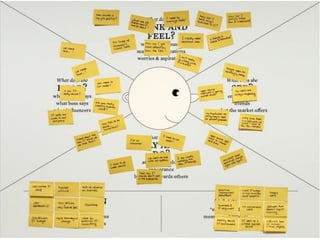
empathy map
empathy map
•  Profiling customer segments
•  A better understanding of the
   environment, behavior, worries
   and aspirations of the segment.
•  Check page 131 to find out how
   to use the ‘empathy map’
other points to start from..
   (a side from customer driven)
-resource driven
(for example: eventlocaties)
-offer driven
(for example: Ikea)
-finance driven
(for example: Easyjet)
-multiple epicenter driven
aan de slag..

Business model marketing course 4

  • 1.
  • 2.
  • 3.
    last week... Distribution models,user models, (co) creation models, Google assignment
  • 4.
    this week Long tailmodel, free as a business model, business model design, customer segments, empathy map
  • 5.
    getting deeper into it..
  • 6.
    (1) the longtail model..  
  • 8.
  • 9.
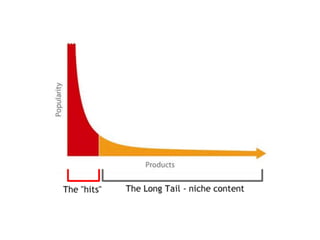
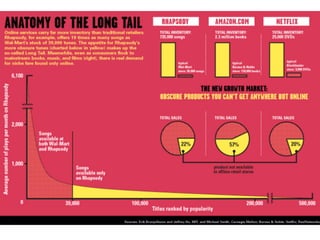
    the long tailmodel..   Long  tail  models  are  about  selling  a  lower   volume  of  a  greater  amount  of  different   products.       The  long  tail  focuses  on  selling  a  large  amount  of   niche  products.       All  together  these  sales  are  equally  profitable  as   the  tradi?onal  model  which  makes  use  of  a   small  number  of  bestselling  products.    
  • 13.
    1. what products do you get for free? 2. what can you get for free online? 3. what should be free (online)???
  • 14.
    ‘free’ as abusiness model..   Free got started in the twentieth century by companies giving away something that spurred purchases of related goods. Gillette razors is an example. Free in the bits economy, however, can be really Free. In 1996 the Village Voice became a free newspaper. Since it no longer charged, people perceived that it had a lesser quality. Another paper, The Onion, started Free and stayed Free, and is a much bigger success. This shows that our feelings about Free are relative, not absolute. (Chris Anderson)
  • 15.
    ‘free’ as abusiness model..   At  places  like  Google,  new  services  start  with  ques?ons  like   “Would  it  be  cool?”,  “Do  people  want  it?”  or  “Does  it  use   technology  well?”  rather  than  “Will  it  make  money?”       In  Google’s  case,  they  first  invented  a  way  to  do   search  that  gets  beIer  as  the  Web  gets  bigger.  They  then   allowed  adver?sers  to  create  ads  that  matched  keywords  or   content  and  bid  against  each  other  for  the  most  prominent   posi?ons.  They  then  created  other  products  to  extend  their   reach  and  only  aIached  ads  when  it  made  sense.  (Chris  Anderson)
  • 16.
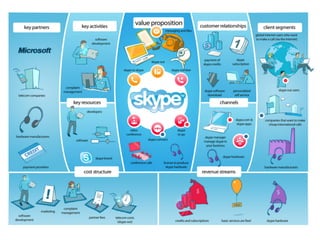
    (2) the freemiummodel..   When  using  the  freemium  model  the  product  is   given  away  for  free.  A  beIer  version  of  the   product  is  only  accessible  aNer  buying  an   updated  version.  There  are  also  freemium   models  used  that  have  a  connec?on  with   annoying  adver?sing.  ANer  a  paid  update  you   don’t  get  this  adver?sing  anymore.        
  • 21.
    ‘free’ as abusiness model..   In  the  FREE  business  model  at  least  one  substan?al   Customer  segment  is  able  to  con?nuously  benefit  from   a  free-­‐of-­‐charge  offer.  Different  paIerns  make  the  free   offer  possible.     Non-­‐paying  customers  are  financed  by  another  part  of   the  business  model  or  by  another  Customer  Segment.   (Business  model  genera?on)         (so..  who  IS  going  to  pay??)                      
  • 22.
  • 23.
    business model design.. -customerinsights -ideation (what if-questions, brainstorming rules, silly cow exercise) -visual thinking -prototyping -storytelling -scenarios
  • 24.
    customer insight: it all begins with the customer..
  • 25.
  • 26.
    wat wil eenklantsegment... -lees het artikel ‘Voor 15 euro flirten met klassieke muziek..’ -zoek alle punten op die jongeren blijkbaar als voorwaarde hebben om naar naar het concertgebouw te gaan -hoe ziet de marketingmix er voor dit jongerensegment er nu uit?
  • 27.
    wat willen jongeren... -behoefteaan klassieke muziek -behoefte aan leeftijdsgenoten (sociaal aspect) -behoefte aan korte tijdsduur (1 uur max) -behoefte aan naborrelen/afterparty -behoefte aan extra beleving (projectiescherm, tekstinfo, rondleiding, meet&greet) -behoefte aan een scherpe prijs (15 euro/ sprintplaats 10 euro
  • 28.
    what do youngpeople want?... -  Please describe at least 5 reasons why young people (age 20 till 30) don’t visit classic concerts at concert halls -  Please describe at least 5 ways that a concert hall can think of in order to get more young people (age 20 till 30) to visit a classic concert -  Please describe how the marketingmix of the concert hall would look like when aimed at young people
  • 29.
  • 30.
    •  Needs: –  For example a need for a basic element: food, clothing, shelter, safety –  “I need clothes otherwise I can’t go outside” •  Wants/wish: –  A wish is a specific way a need is fullfilled. –  “I need clothes and I want a coat” •  Demand: –  Demand are all the wishes where a consumer is willing to buy a product for. –  “I need clothes, I want a coat, I think I am going to buy a new black coat from Hugo Boss. Purchase of the product
  • 31.
    So.. •  Important: companiesand marketeers don’t create needs. •  Hugo Boss for example doesn’t create the need for clothing, Hugo Boss tries to influence the demand for a particular sort of clothing •  Hugo Boss tries to influence the demand for luxury clothing by altering: image, fashion, price, availability, brand, experience, ect. MARKETING
  • 32.
    customer needs •  Docustomers buy their products consciously? •  Do customers even know what they want? •  Are customers aware of their (latent) needs? •  Do customers know what is technically possible?
  • 33.
    what are theunderlying needs of..? …buying  a  Makita  drilling  machine  ?     …buying  an  iPhone  5?     …buying  ?ckets  of  a  concert  of  Madonna?    
  • 34.
    customer needs When oneis doing customer research it is important to get a deeper insight in consumer behavior. Not simply asking customers which products the miss..
  • 35.
  • 37.
    empathy map •  Profilingcustomer segments •  A better understanding of the environment, behavior, worries and aspirations of the segment. •  Check page 131 to find out how to use the ‘empathy map’
  • 39.
    other points tostart from.. (a side from customer driven) -resource driven (for example: eventlocaties) -offer driven (for example: Ikea) -finance driven (for example: Easyjet) -multiple epicenter driven
  • 40.