
SERVOSYSTEM
www.indiandentalacademy.com
Introduction
Craniofacial growth has been the ground for research for
several years, starting from Genetic theory, Sutural
theory, Cartilaginous theory, Functional matrix theory,
Van Limborg’s theory and now the Cybernetic theory.
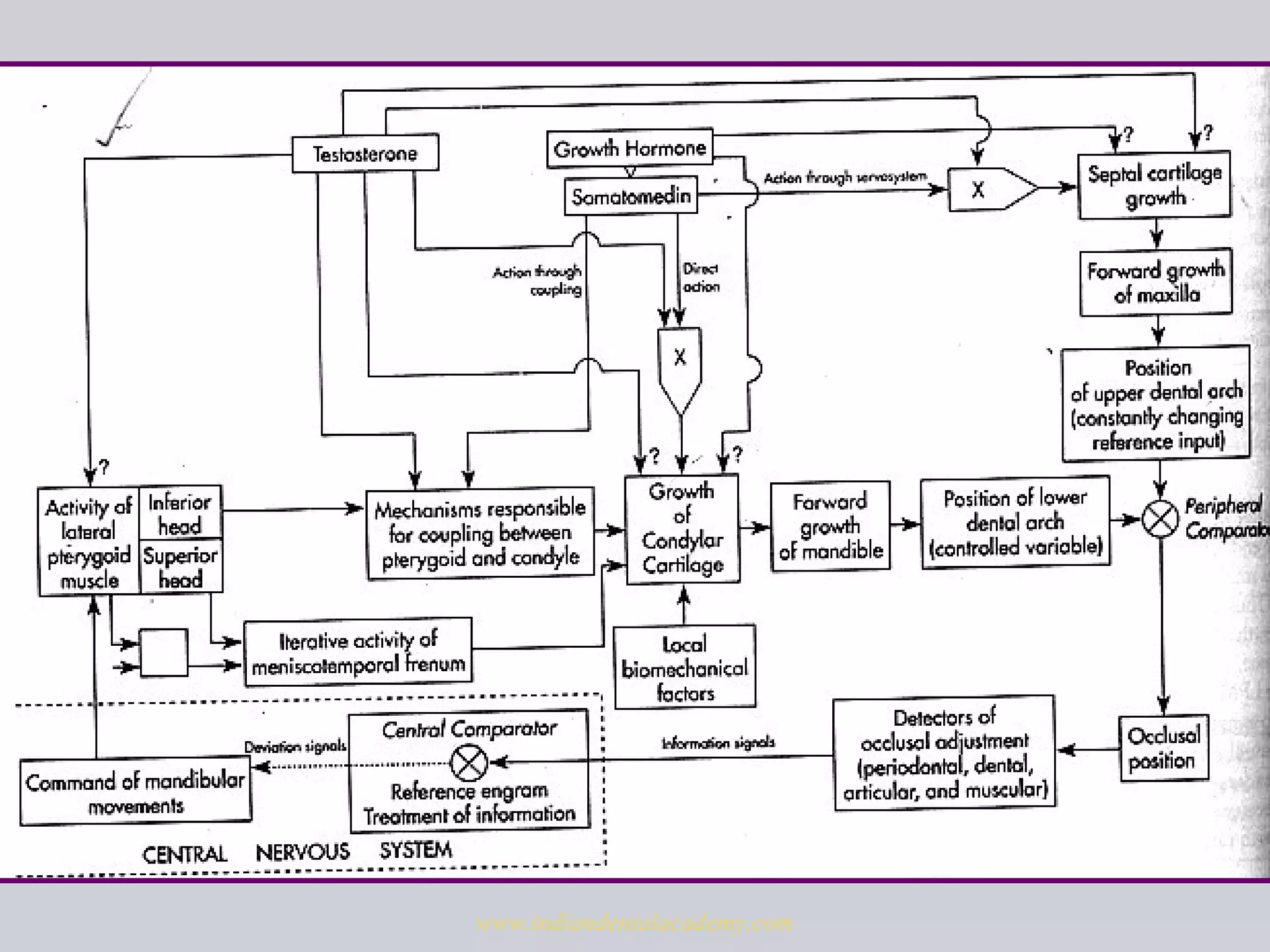
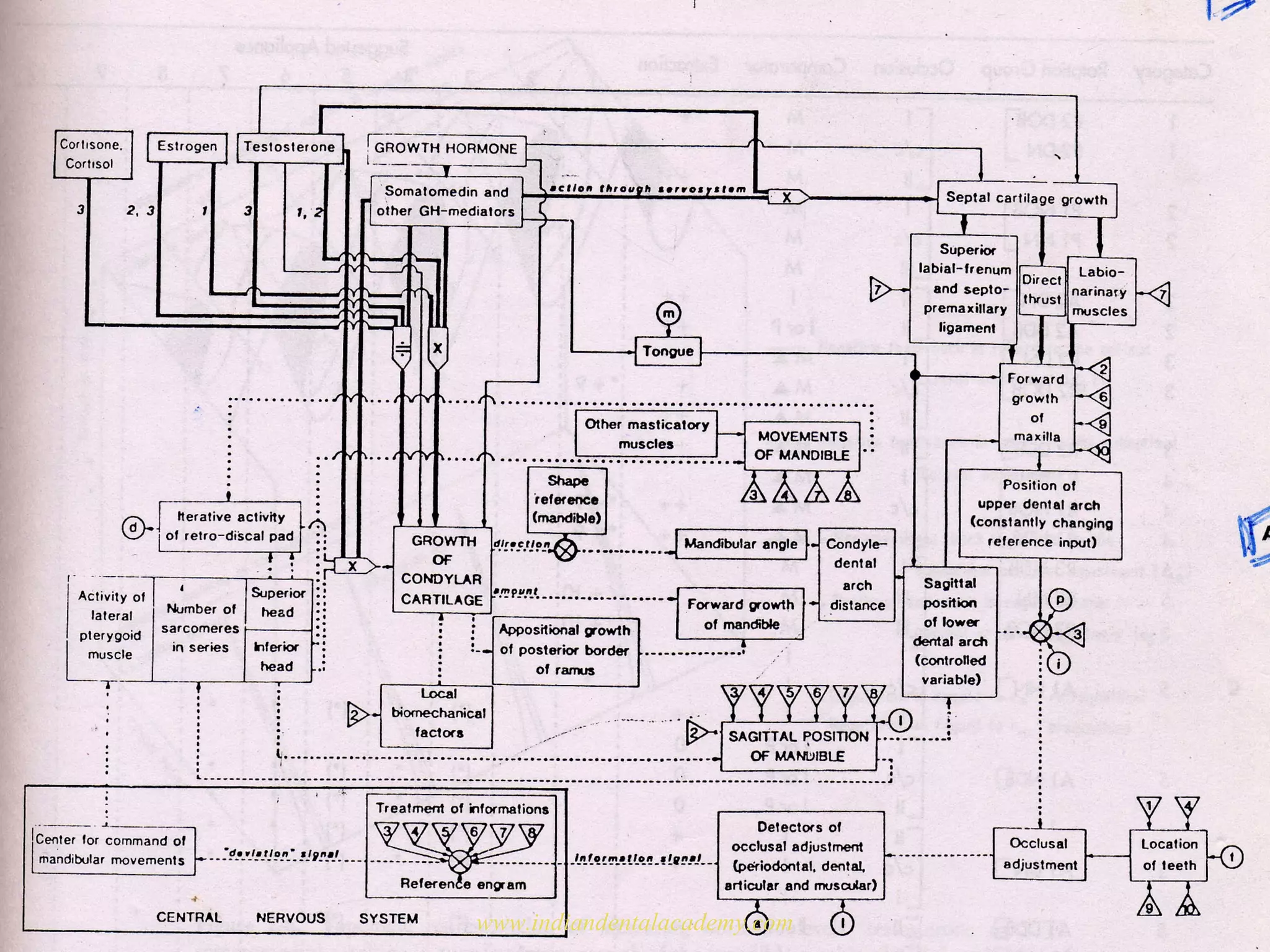
The Servosystem is a part of the cybernetic theory which
describes the craniofacial growth mechanism
systematically and also explains the functioning of the
various appliance system
www.indiandentalacademy.com
Genetic theory
 Genotype supplies all the information required for the
phenotypic expression
 The influence of the general, regional and local factors
modifying the gene expression
How does the modification occurs
www.indiandentalacademy.com
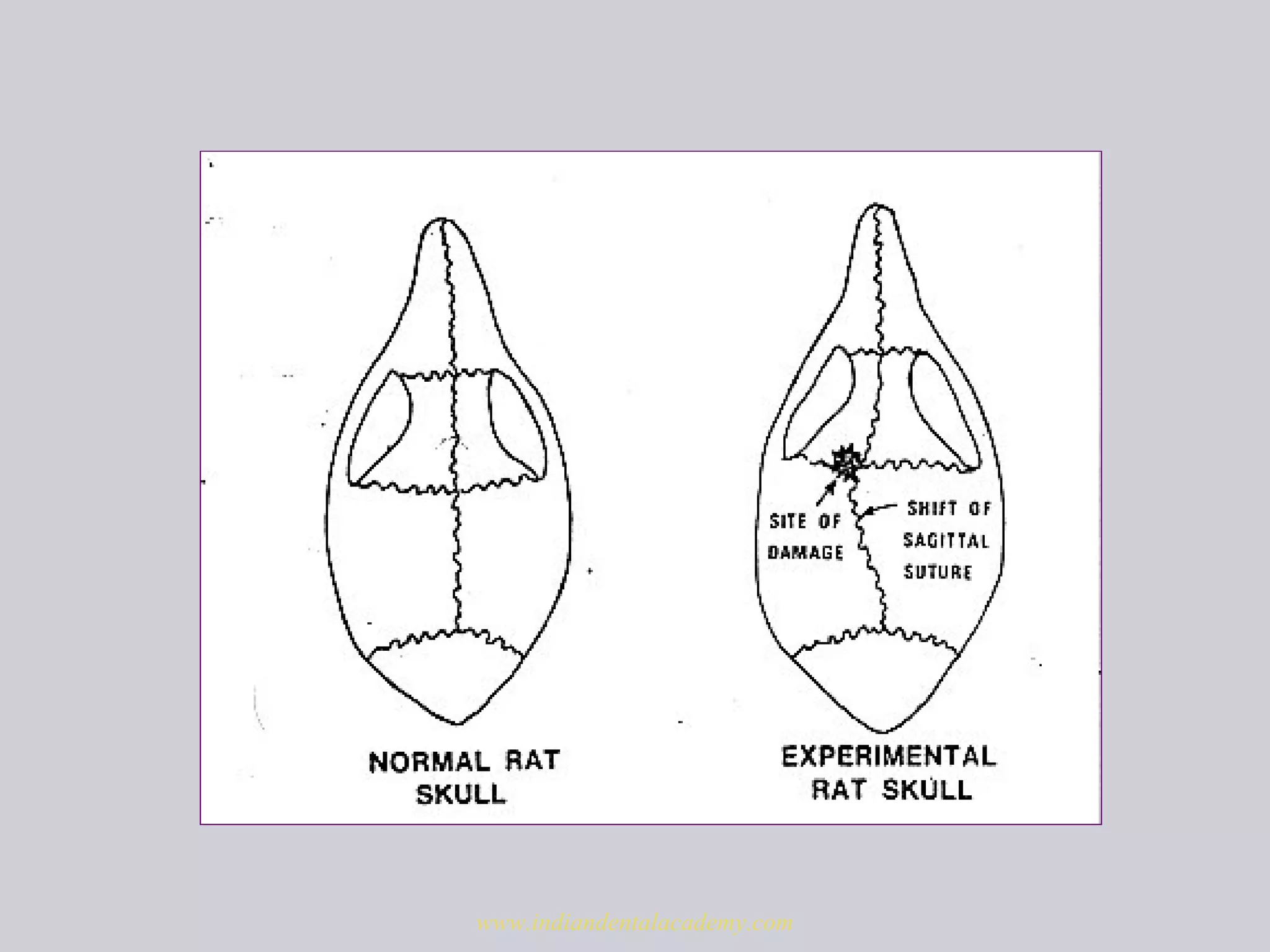
Sicher’s Sutural dominance theory
 Craniofacial sutures are responsible for the growth
 This theory acknowledge the importance of Genetic
theory
 Sutures, cartilage and and Periosteum are growth centers
 Sutures carry the genetic potential of the growth
pattern,thus sutural patterns were predetermined
 Disapproved
Transplantation of the sutures
Moss’ experiment on rats
Hydrocephaly and microcephaly
www.indiandentalacademy.com
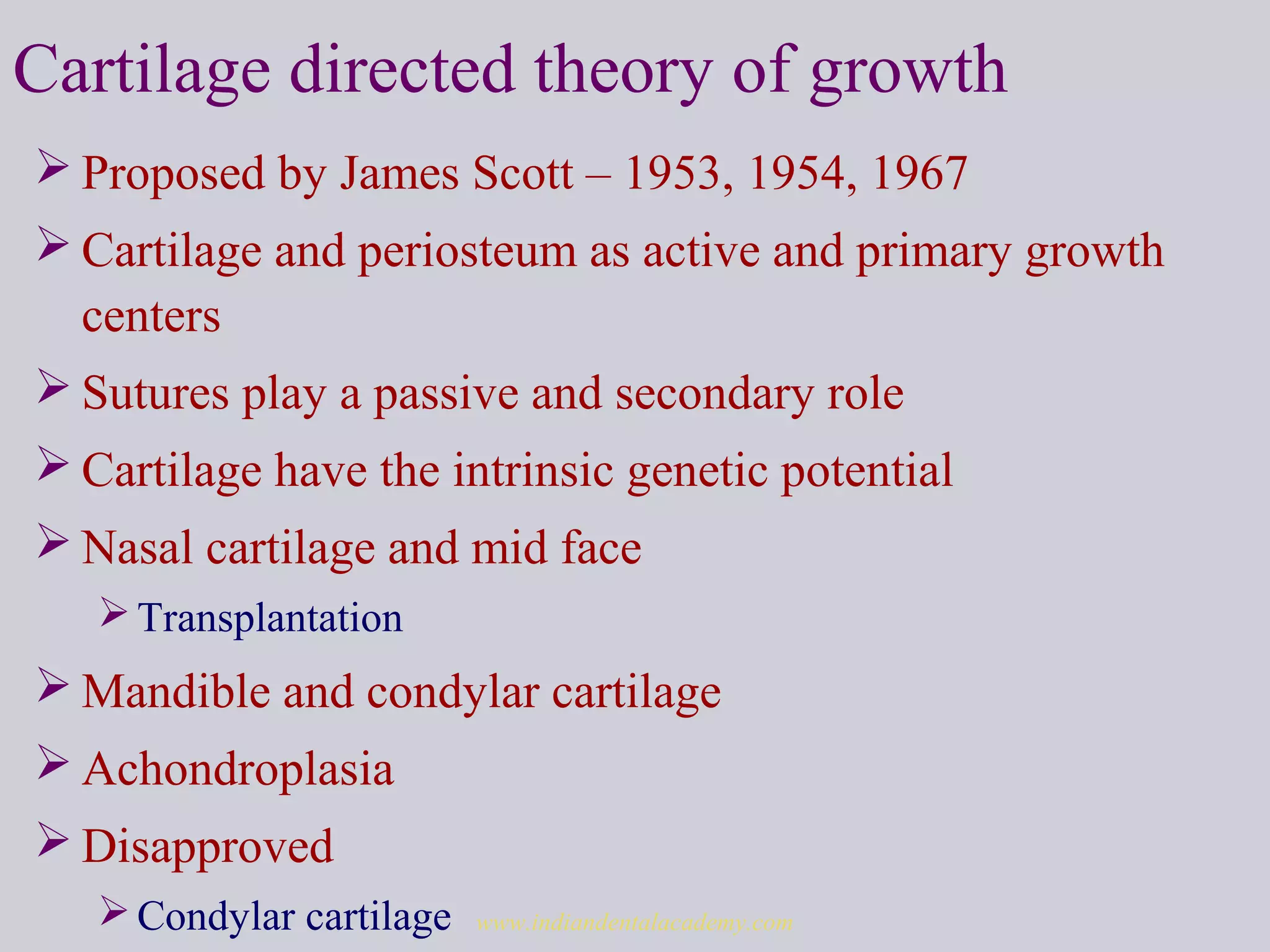
Cartilage directed theory of growth
 Proposed by James Scott – 1953, 1954, 1967
 Cartilage and periosteum as active and primary growth
centers
 Sutures play a passive and secondary role
 Cartilage have the intrinsic genetic potential
 Nasal cartilage and mid face
Transplantation
 Mandible and condylar cartilage
 Achondroplasia
 Disapproved
Condylar cartilage www.indiandentalacademy.com
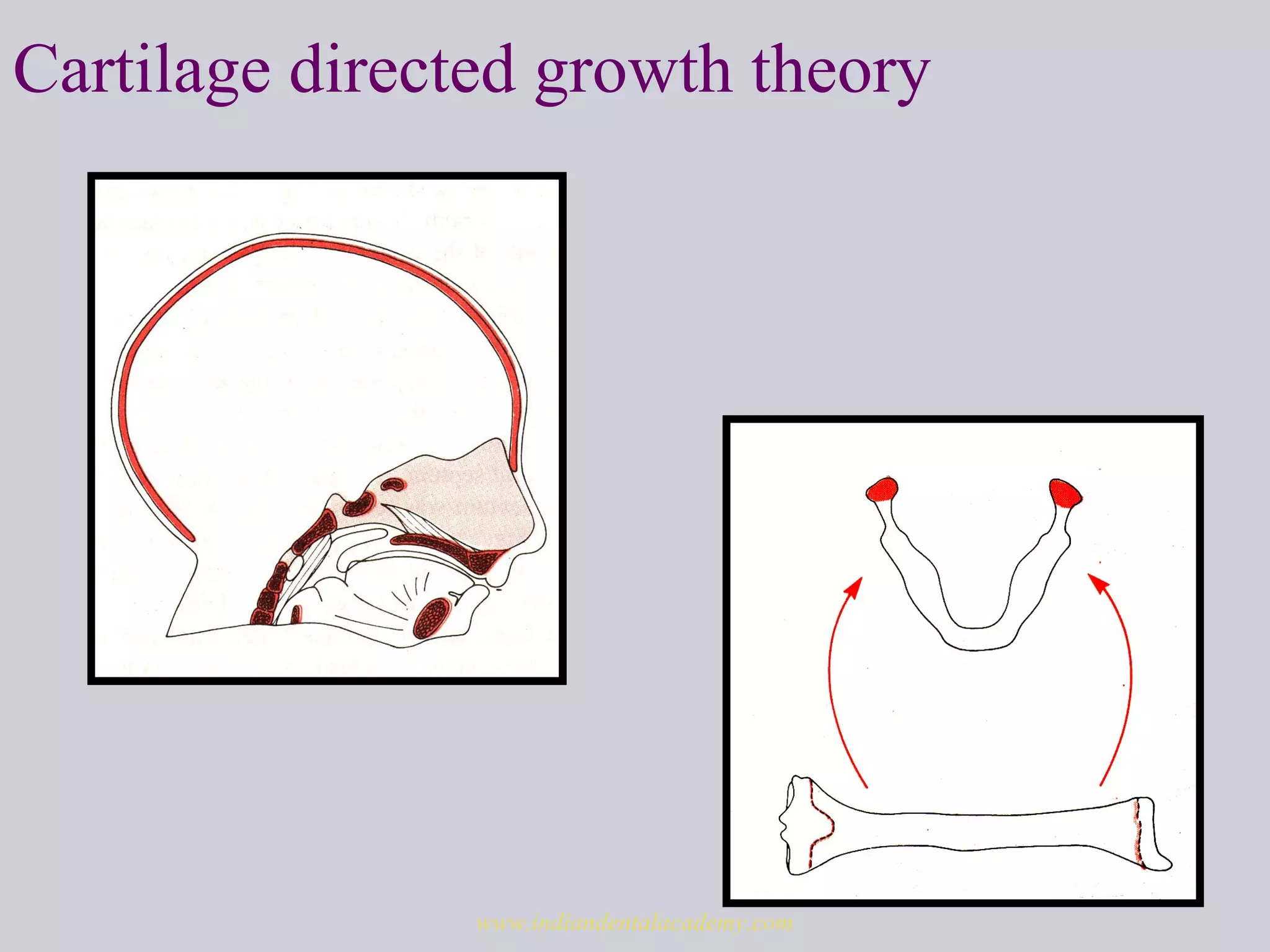
Cartilage directed growth theory
www.indiandentalacademy.com
Functional matrix
 Proposed by Melvin Moss 1960, 1962, 1997
 Original concept of Functional cranial component by Van
Der Klaaw
 The origin, form, position ,growth and maintenance of
the skeletal tissue is secondary and compensatory to the
responses that occur in the specifically related non
skeletal tissues, organs or functioning spaces
 Could not explain the control of the epigenetic factors
 Functional matrix hypothesis revisited – 1997 AJO DOwww.indiandentalacademy.com
Functional matrix
Functional cranial component
Functional matrixSkeletal unit
Micro
Skeletal
unit
Macro
Skeletal
unit
Capsular
matrix
Periosteal
matrix
Transformation
Translation
www.indiandentalacademy.com
Mechano transduction
Collagen fibres
Trans membrane
protein Integrin
Actin
Cytoplasmic
membrane
Nuclear membrane
www.indiandentalacademy.com
Cybernetic and control theory
 Demonstrates the quantitative and qualitative relationship
between the observationally and experimentally collected
findings
 Petrovic was the first to propose a cybernetic model to
account for the physiological phenomena involving
facial growth and functioning of the functional and
orthopeadic appliances
Observation findings Experimental finding
www.indiandentalacademy.com
Epistemplogic features
 Branch of philosophy that deals with the possibility,
nature, origin, structure and validity of knowledge
Hypothesis
Refute
FAIL
Corroboration Strengthening
of the theory
Popper1963,
Science is not a
static
acceptance of
truth but rather
the permanent
search for truth
www.indiandentalacademy.com
Cibernetically organized biologic features
Orthodontic
functional , and
orthopaedic
appliances
o Maxillary
lengthening and
widening,
o mandibular
lengthening and
widening,
oTeeth movements
Correction of
malocclusion
and
intermaxillary
relation
INPUT BLACK BOX OUTPUT
www.indiandentalacademy.com
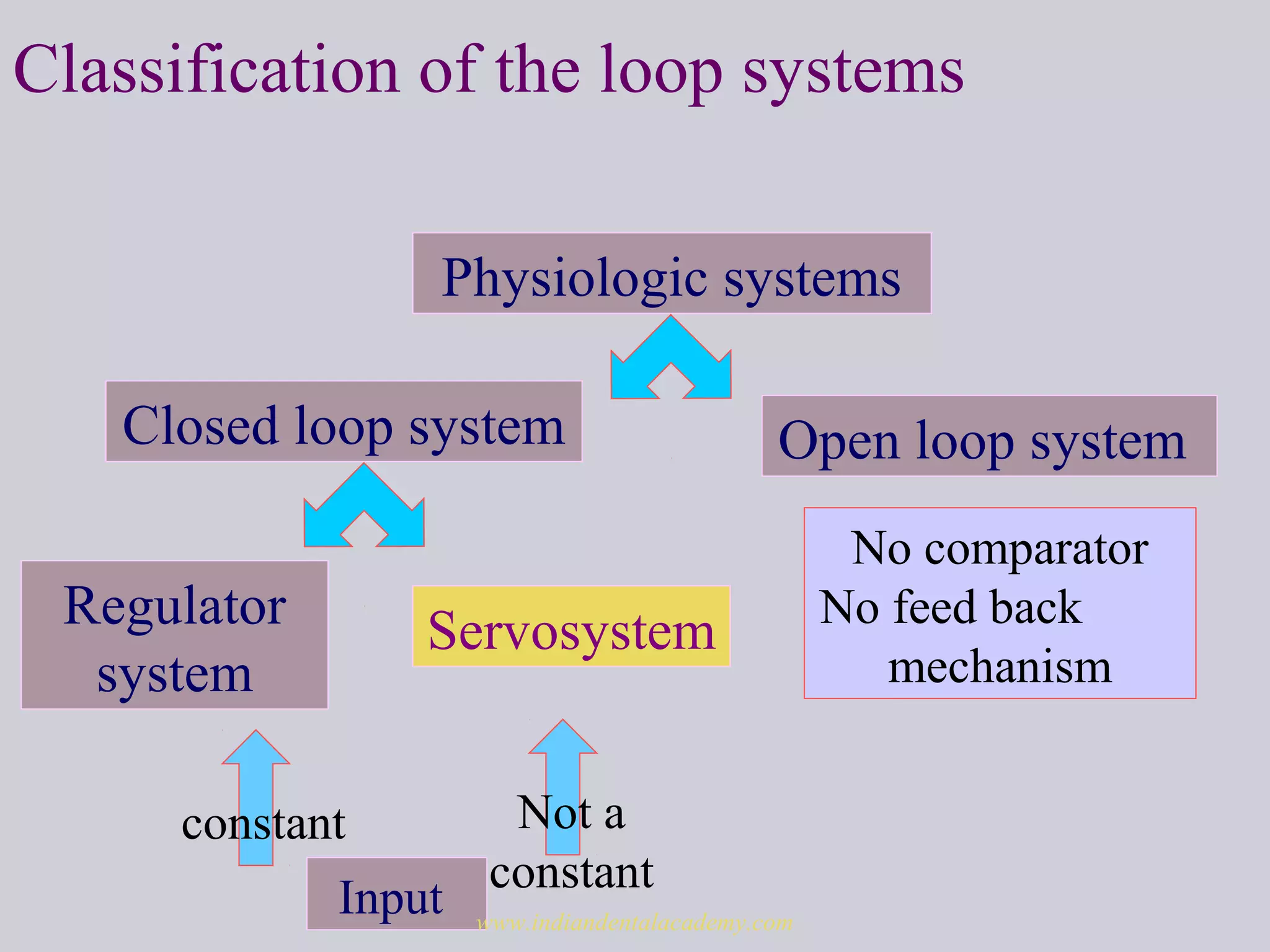
Classification of the loop systems
Physiologic systems
Closed loop system Open loop system
Regulator
system
Servosystem
Input
Not a
constant
constant
No comparator
No feed back
mechanism
www.indiandentalacademy.com
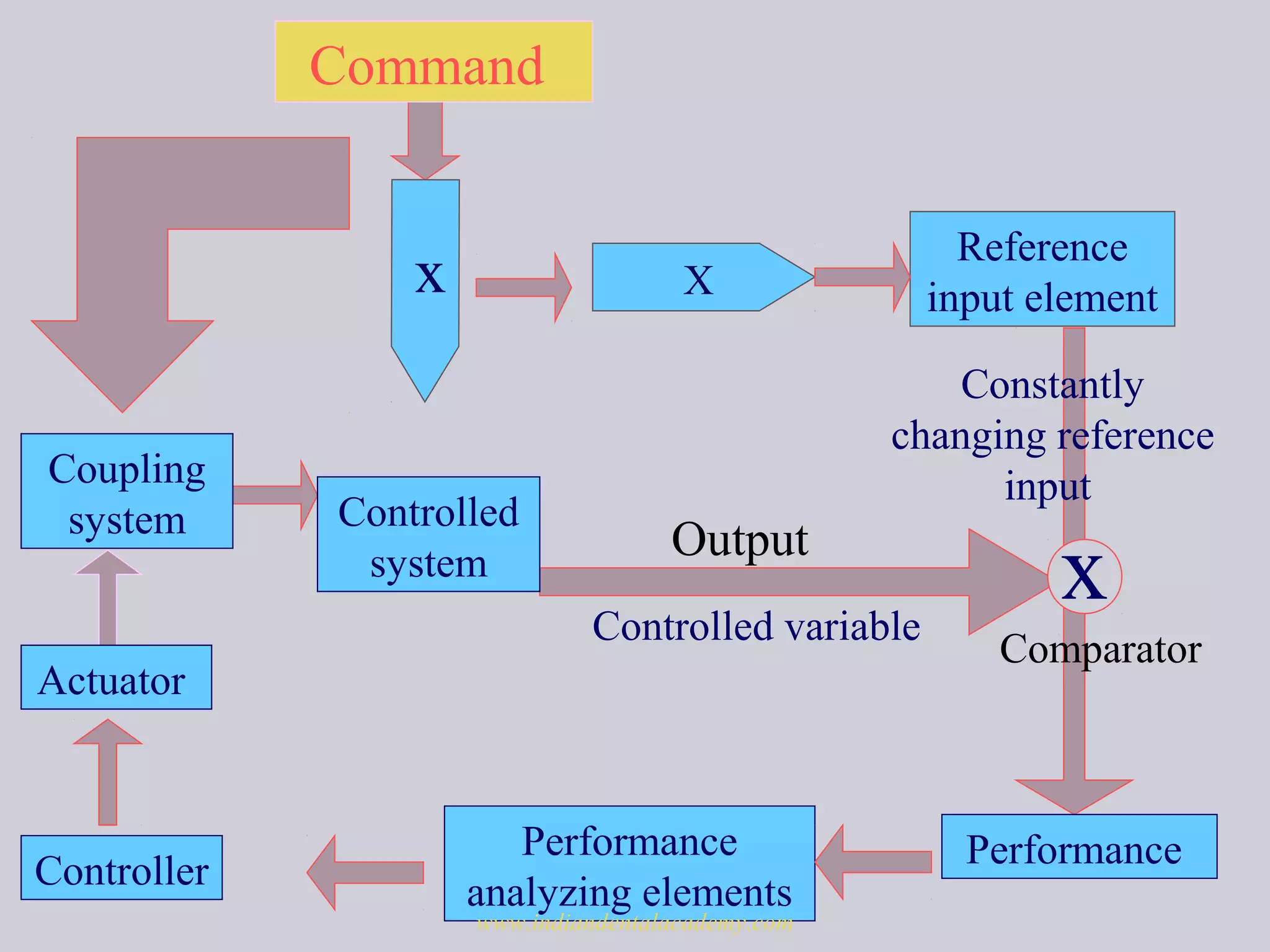
Command
Reference
input element
Constantly
changing reference
input
x
PerformancePerformance
analyzing elements
Controller
Actuator
Coupling
system Controlled
system
Output
Controlled variable
Xx
Comparator
www.indiandentalacademy.com
Command
 Signal established independent of the feedback system
 Affects the behavior of the control system without being
affected by the consequences
 Eg. Growth hormones,testosterone, and estrogen
CONTROLLER
ACTUATOR
REFERENCE INPUT
ELEMENT
COMPARATOR
COMMAND
PERFORMANCE
ANALYSING
ELEMENTS
CONTROLLED
SYSTEM
PERFORMANCE
AMPLIFIER
REFERENCE
INPUT
OPUTPUT
www.indiandentalacademy.com
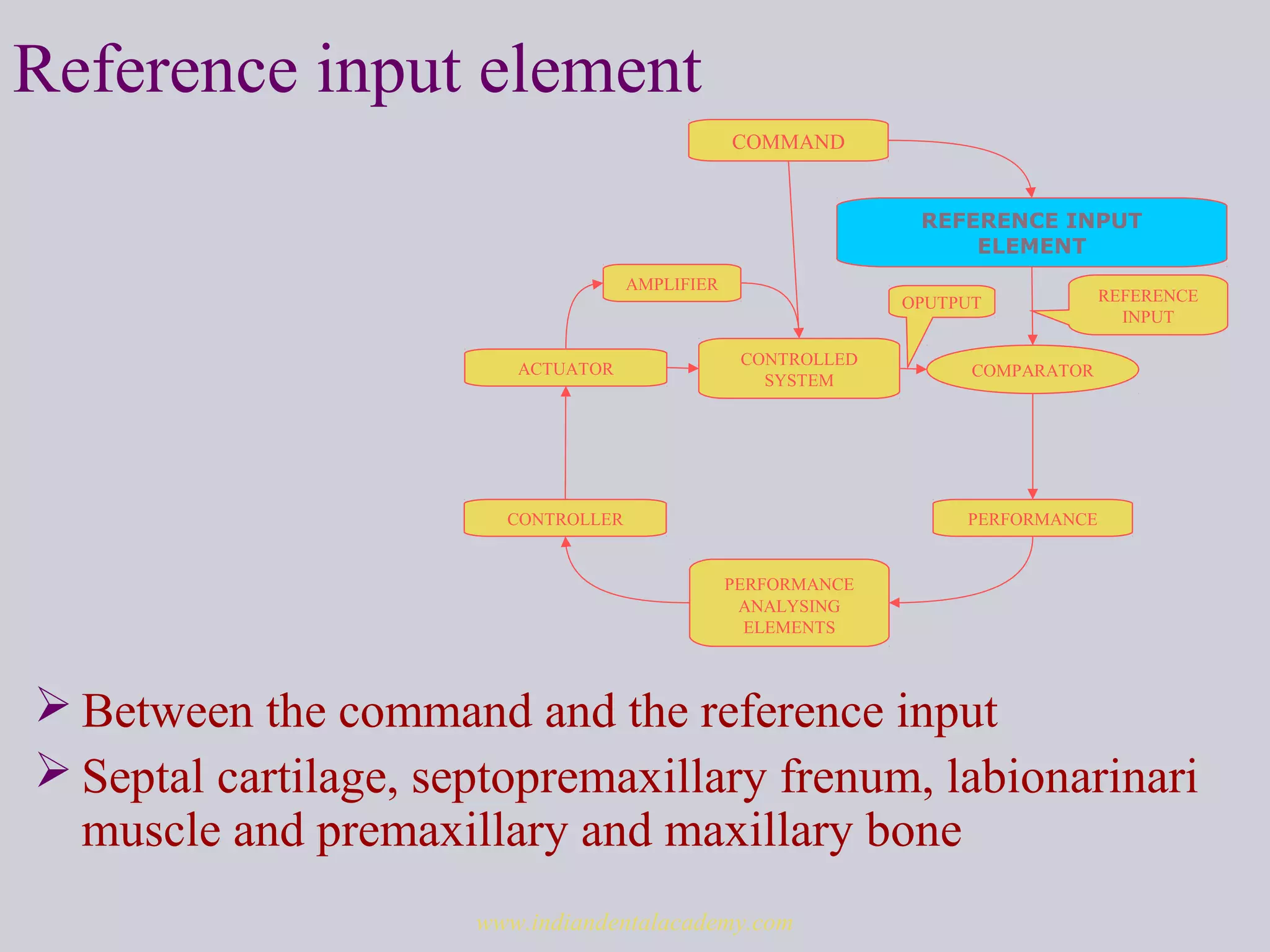
Reference input element
 Between the command and the reference input
 Septal cartilage, septopremaxillary frenum, labionarinari
muscle and premaxillary and maxillary bone
REFERENCE INPUT
ELEMENT
COMPARATOR
COMMAND
PERFORMANCE
ANALYSING
ELEMENTS
CONTROLLED
SYSTEM
CONTROLLER
ACTUATOR
PERFORMANCE
AMPLIFIER
REFERENCE
INPUT
OPUTPUT
www.indiandentalacademy.com
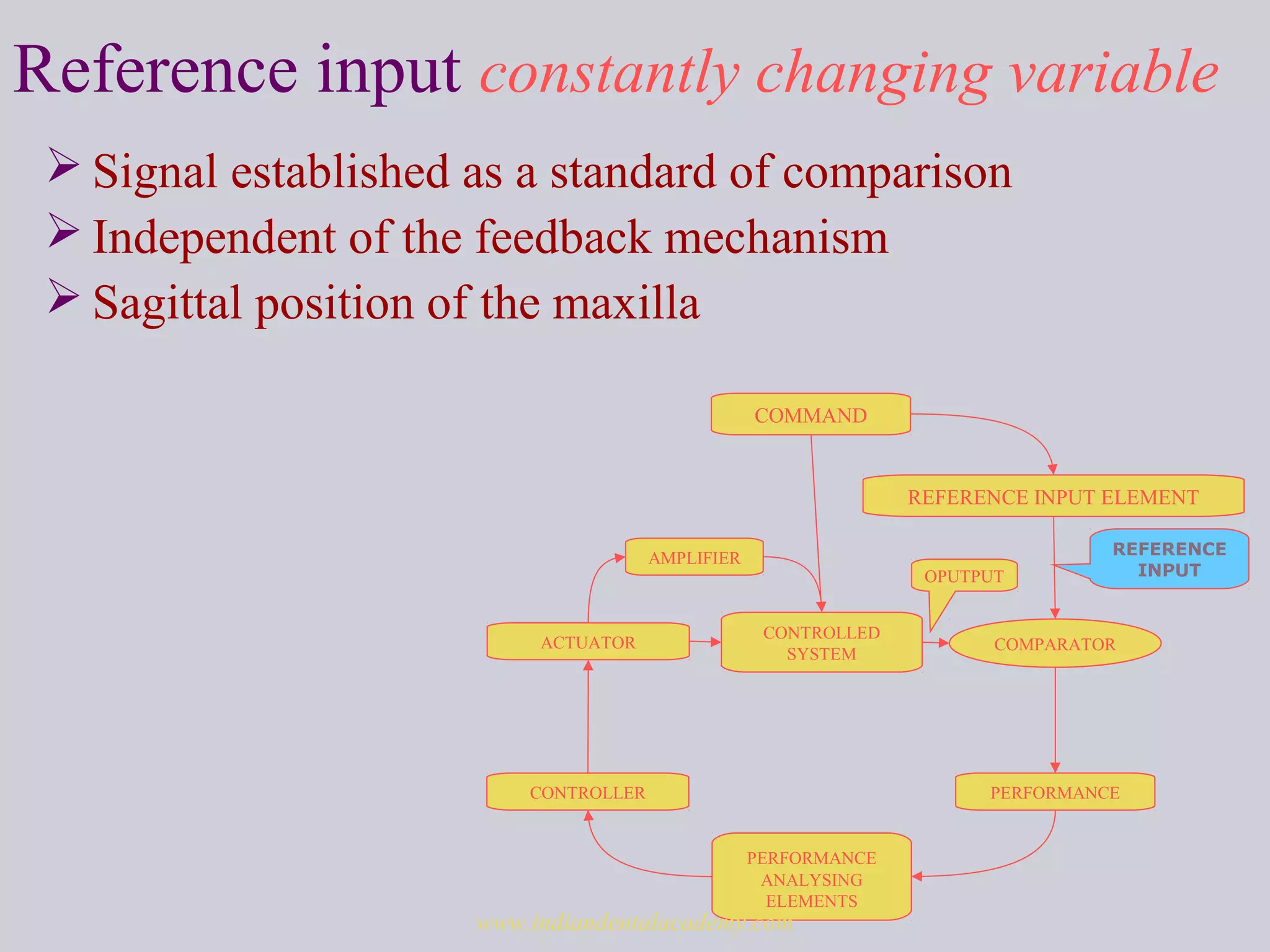
Reference input constantly changing variable
 Signal established as a standard of comparison
 Independent of the feedback mechanism
 Sagittal position of the maxilla
REFERENCE INPUT ELEMENT
COMPARATOR
COMMAND
PERFORMANCE
ANALYSING
ELEMENTS
CONTROLLED
SYSTEM
CONTROLLER
ACTUATOR
PERFORMANCE
AMPLIFIER REFERENCE
INPUTOPUTPUT
www.indiandentalacademy.com
Control of the maxillary growth
Direct effect Indirect effect
STH -
stomatomedin
Spheno occipital synchondrosis
Nasal septal cartilage
Lateral masses of ethmoid
Body and greater wing of sphenoid
Forward
growth of
septal
cartilage
Outward
growth
www.indiandentalacademy.com
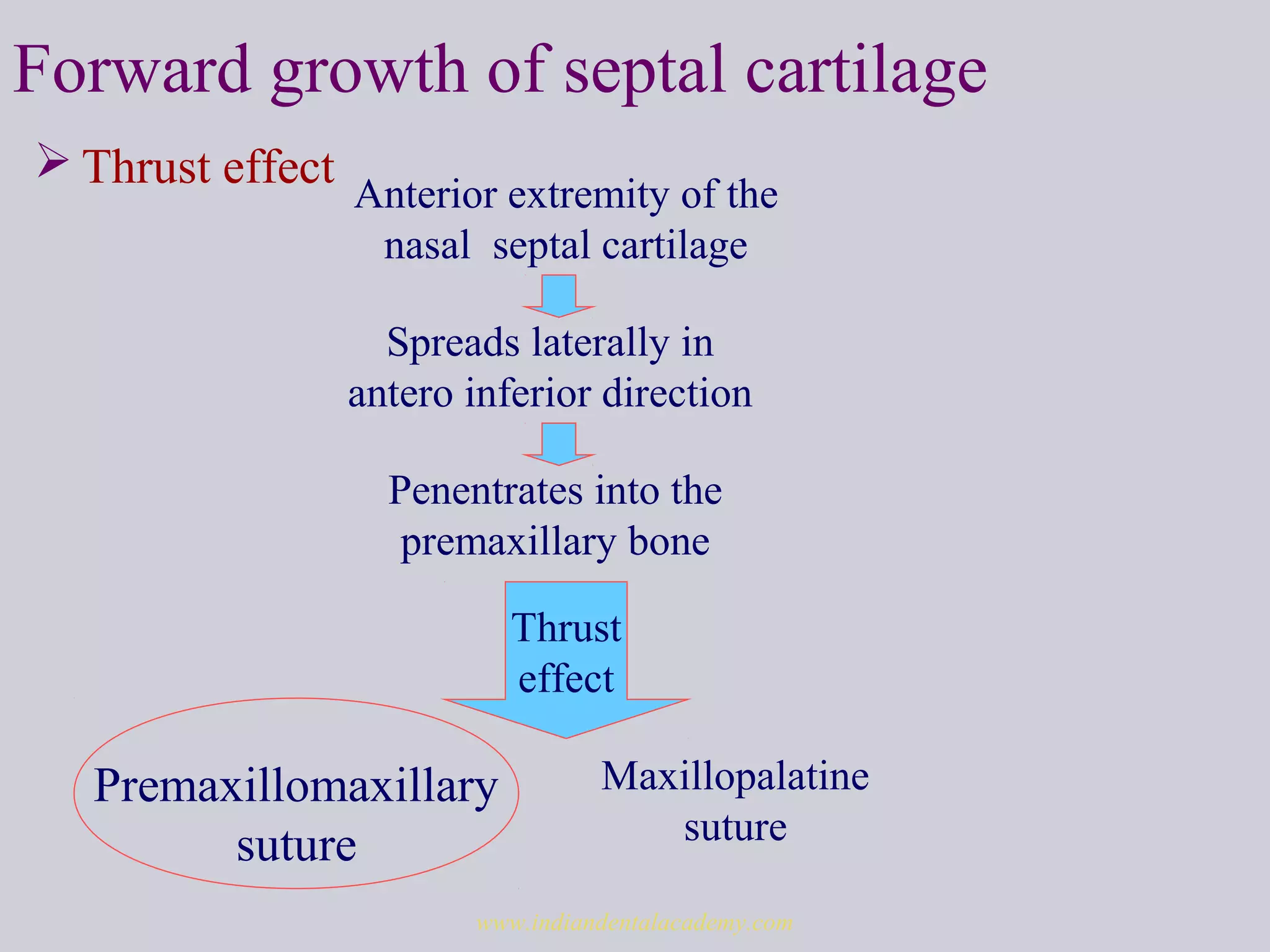
Forward growth of septal cartilage
 Thrust effect
Anterior extremity of the
nasal septal cartilage
Spreads laterally in
antero inferior direction
Penentrates into the
premaxillary bone
Premaxillomaxillary
suture
Maxillopalatine
suture
Thrust
effect
www.indiandentalacademy.com
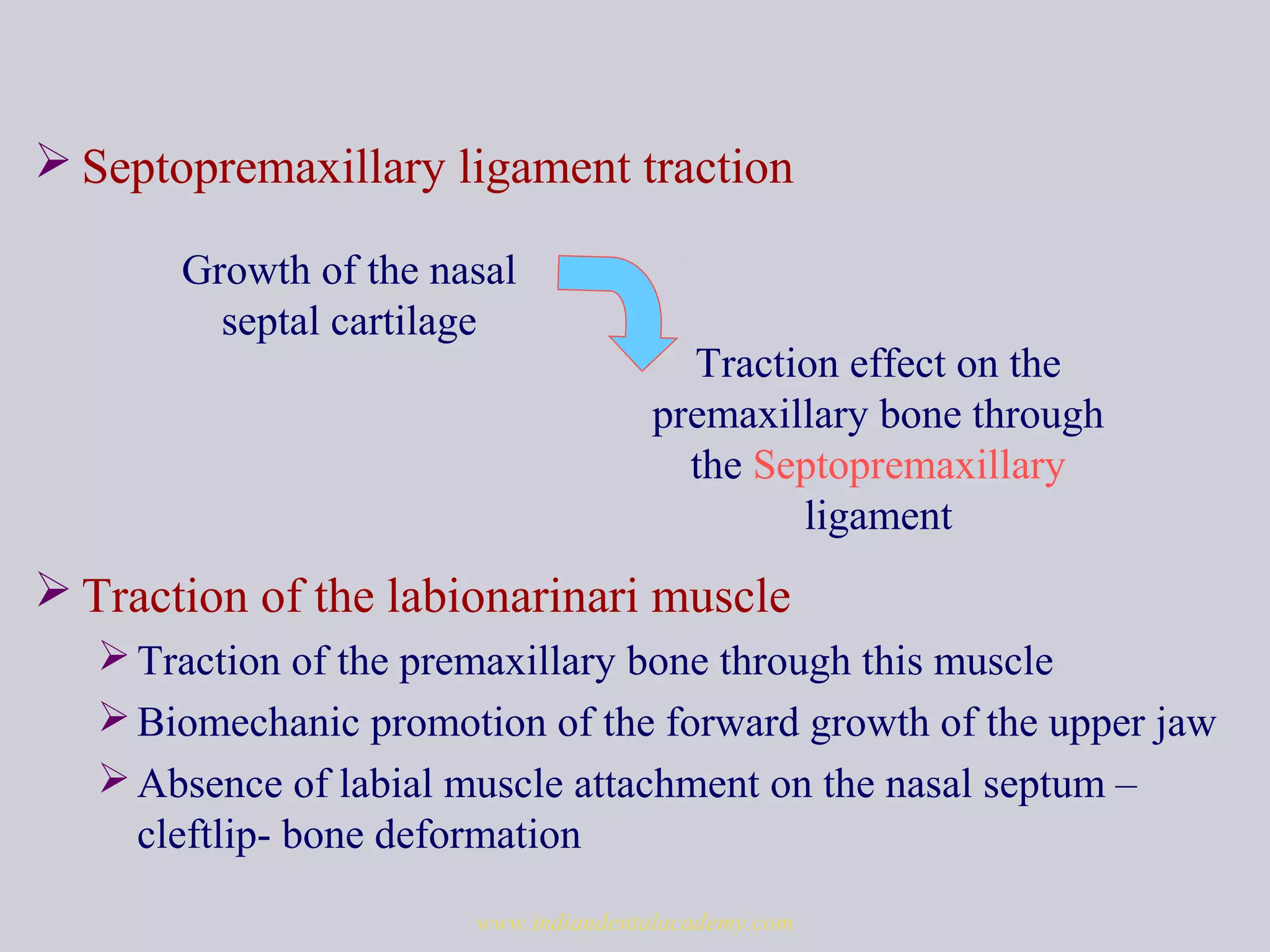
 Septopremaxillary ligament traction
 Traction of the labionarinari muscle
Traction of the premaxillary bone through this muscle
Biomechanic promotion of the forward growth of the upper jaw
Absence of labial muscle attachment on the nasal septum –
cleftlip- bone deformation
Growth of the nasal
septal cartilage
Traction effect on the
premaxillary bone through
the Septopremaxillary
ligament
www.indiandentalacademy.com
Outward growth
Outward growth of the lateral cartilaginous
masses of the ethmoid and the cartilage
between the body and greater wings of
sphenoid
Produces a lateralization of the right and left
alveolar ridges
Stimulates the growth of the midpalatal suture
Outward growth of the
maxilla
www.indiandentalacademy.com
Performance and the performance
analysing elements
REFERENCE INPUT ELEMENT
COMPARATOR
COMMAND
PERFORMANCE
ANALYSING
ELEMENTS
CONTROLLED
SYSTEM
CONTROLLER
ACTUATOR
PERFORMANC
E
AMPLIFIER
REFERENCE
INPUT
OPUTPUT
www.indiandentalacademy.com
The controller and the actuating signal
 The central nervous system
 Controls the activity of the lateral pterygoid muscle and
the retrodiscal pad
 The A.signal is the response of muscle and the
retrodiscal pad
REFERENCE INPUT
ELEMENT
COMPARATOR
COMMAND
PERFORMANCE
ANALYSING
ELEMENTS
CONTROLLED
SYSTEM
CONTROLLER
ACTUATOR
PERFORMANCE
AMPLIFIER
OPUTPUT
www.indiandentalacademy.com
Role of lateral pterygoid & retrodiscal pad
I CONTROL- INTACT LPM AND
RETRODISCAL PAD
NORMAL
II BILATERAL RESECTION OF LPM DECREASED NO OF DIVIDING
CELLS
DECREASED GROWTH RATE
OPENING OF STUTZMANN’S
ANGLE
DECREASED WIDTH OF MITOTIC
COMPARTMENT
III TMF CLAMPED BILATERALLY SAME AS II BUT LESS
INTENSE
IV TMF CLAMPED
LPM RESECTED
SAME AS II AND V
V TMF RESECTED SAME AS A II
VI LPM AND TMF RESECTED
BILATERALLY
NO CHANGE
www.indiandentalacademy.com
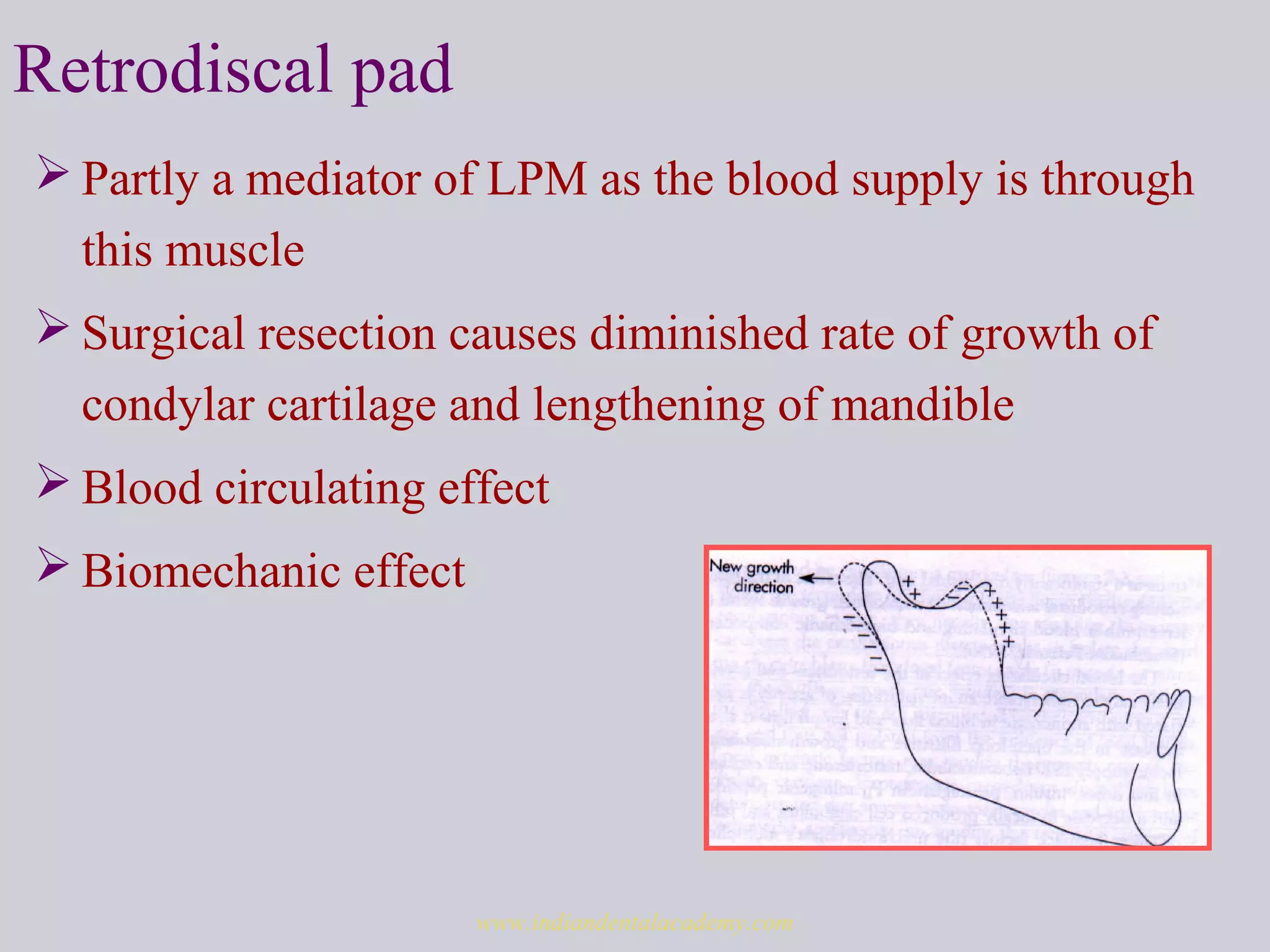
Retrodiscal pad
 Partly a mediator of LPM as the blood supply is through
this muscle
 Surgical resection causes diminished rate of growth of
condylar cartilage and lengthening of mandible
 Blood circulating effect
 Biomechanic effect
www.indiandentalacademy.com
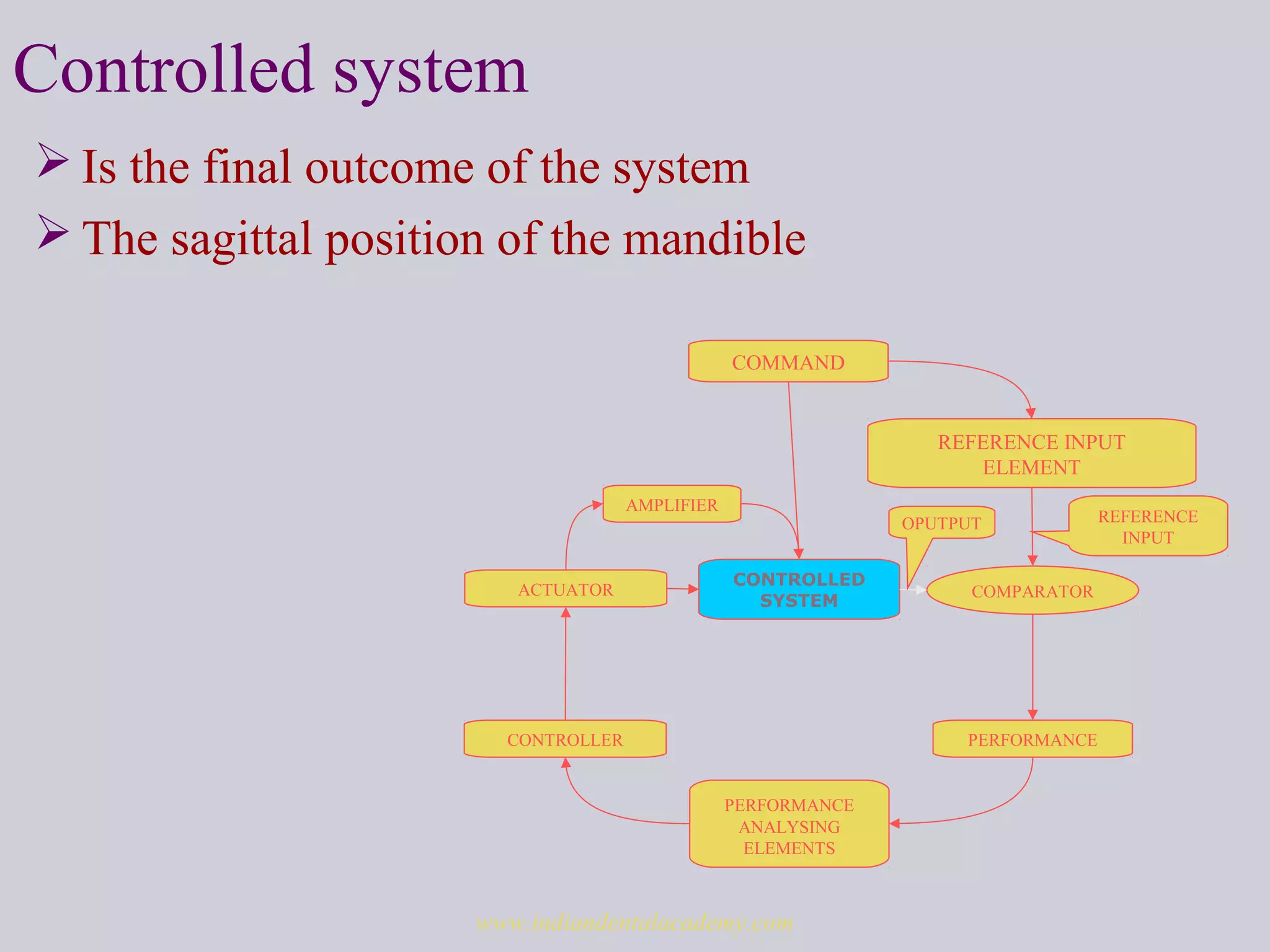
Controlled system
 Is the final outcome of the system
 The sagittal position of the mandible
REFERENCE INPUT
ELEMENT
COMPARATOR
COMMAND
PERFORMANCE
ANALYSING
ELEMENTS
CONTROLLED
SYSTEM
CONTROLLER
ACTUATOR
PERFORMANCE
AMPLIFIER
REFERENCE
INPUT
OPUTPUT
www.indiandentalacademy.com
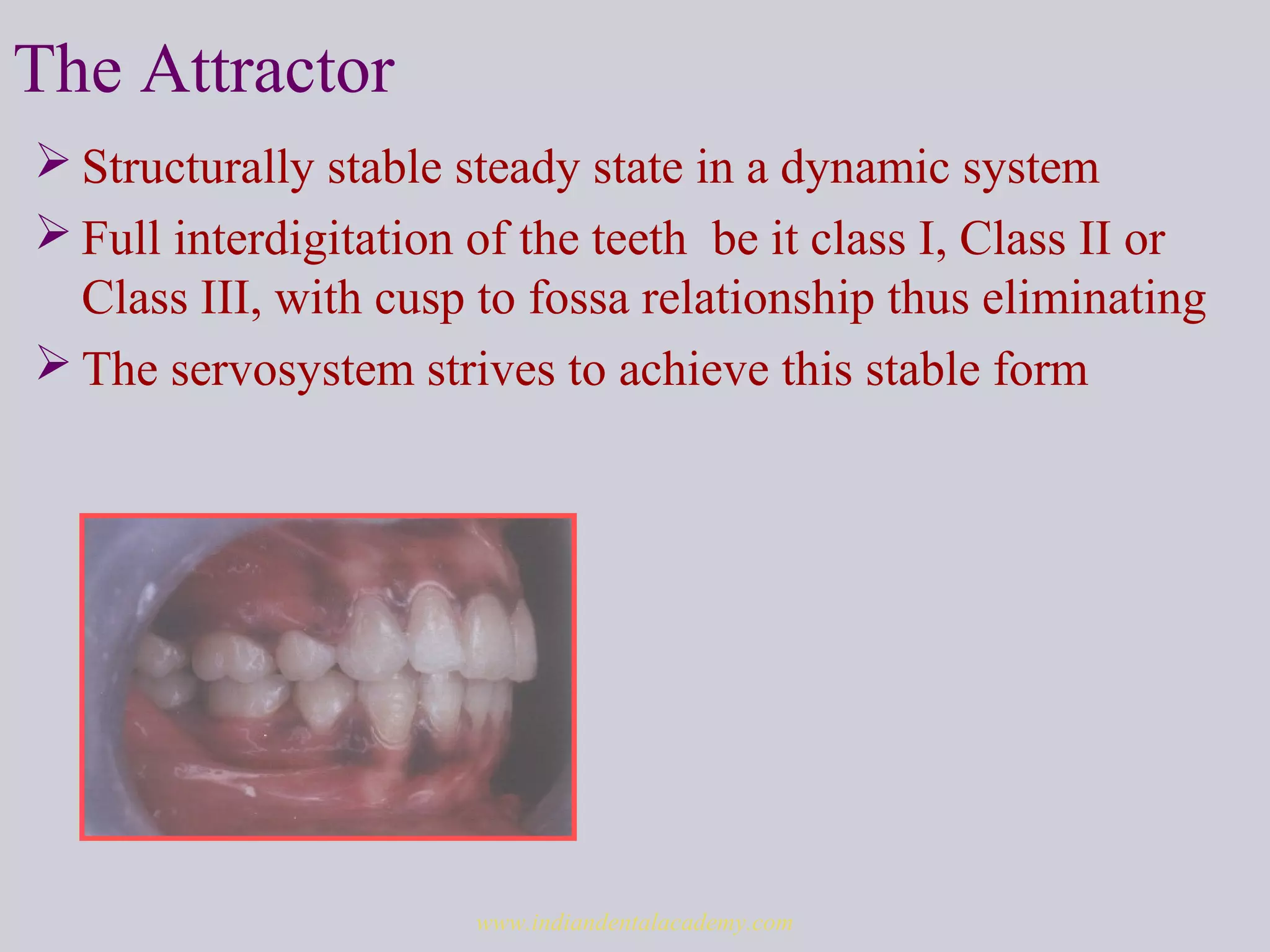
The Attractor
 Structurally stable steady state in a dynamic system
 Full interdigitation of the teeth be it class I, Class II or
Class III, with cusp to fossa relationship thus eliminating
 The servosystem strives to achieve this stable form
www.indiandentalacademy.com
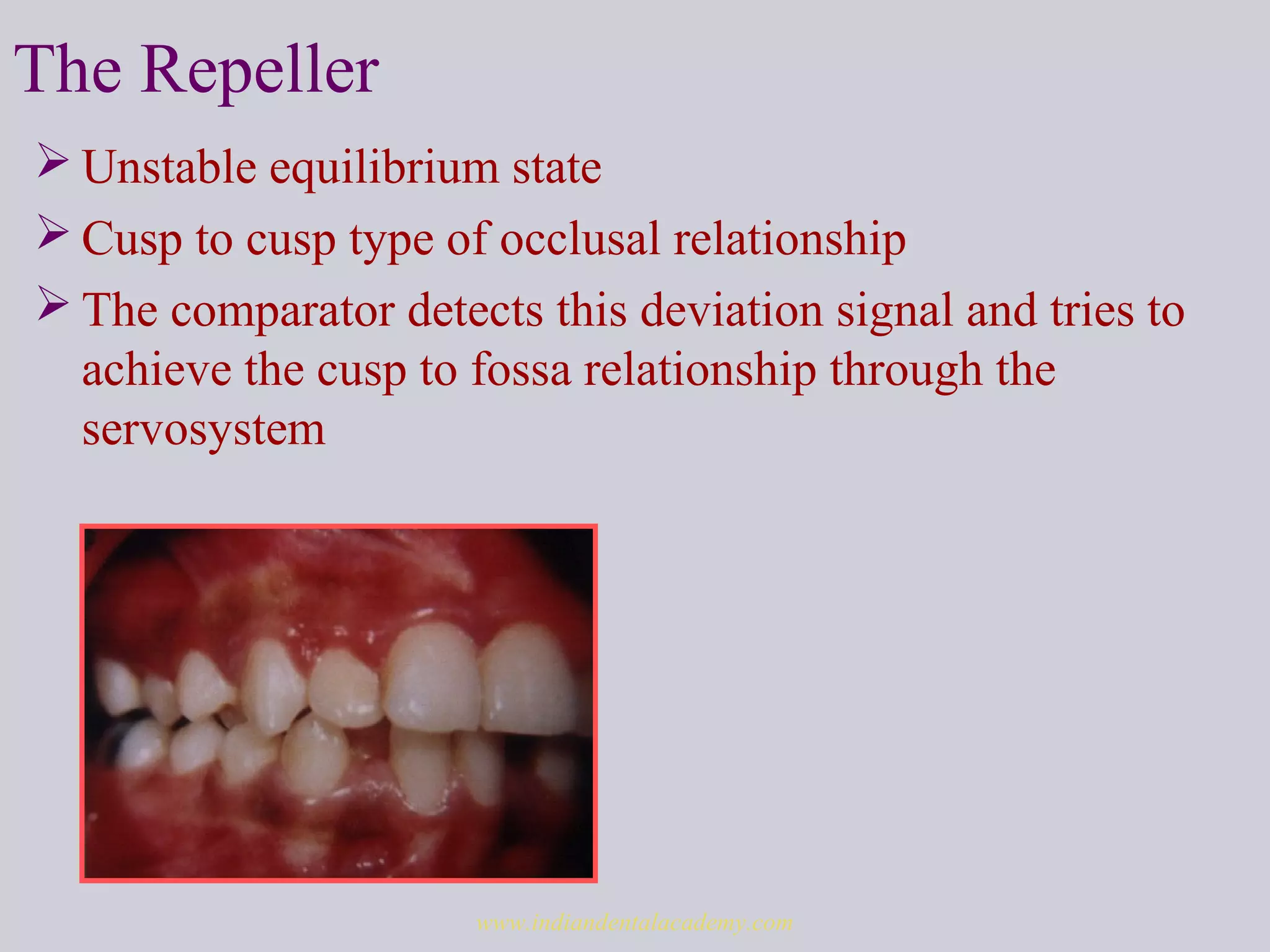
The Repeller
 Unstable equilibrium state
 Cusp to cusp type of occlusal relationship
 The comparator detects this deviation signal and tries to
achieve the cusp to fossa relationship through the
servosystem
www.indiandentalacademy.com
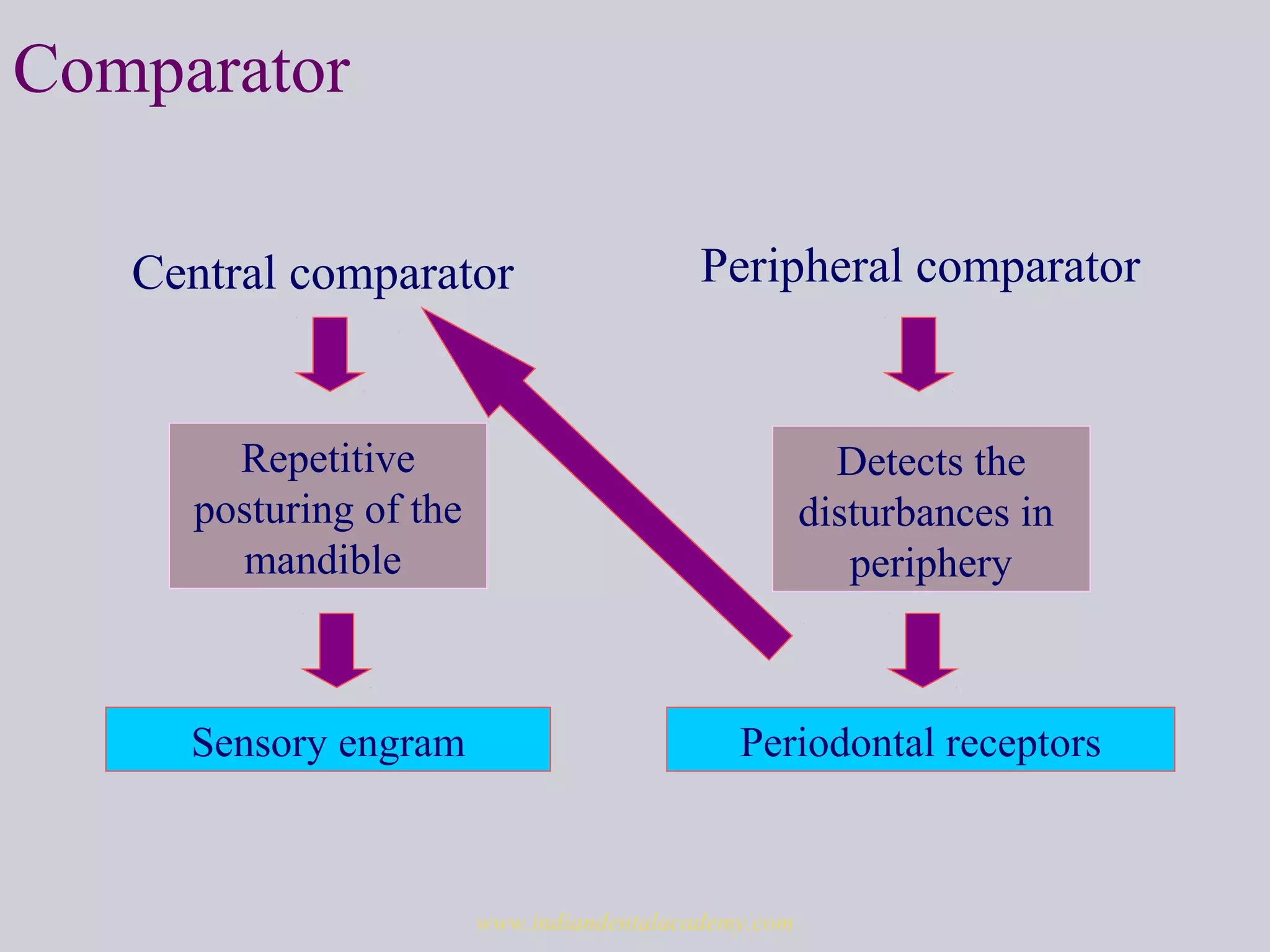
Comparator
Central comparator Peripheral comparator
Detects the
disturbances in
periphery
Periodontal receptors
Repetitive
posturing of the
mandible
Sensory engram
www.indiandentalacademy.com
Functioning of functional appliances
Functional appliances
Increased contraction
of LPM
Additional growth of
condylar cartilage
In growth stimulating factors
Change in the condylar
trabecular orientation
Iterative activity of the
retrodiscal pad
Enhancement of local mediators
Reduction of local regulators
Additional subperiosteal
ossification of the posterior
border of mandible
Supplementary
lengthening of
the mandible
www.indiandentalacademy.com
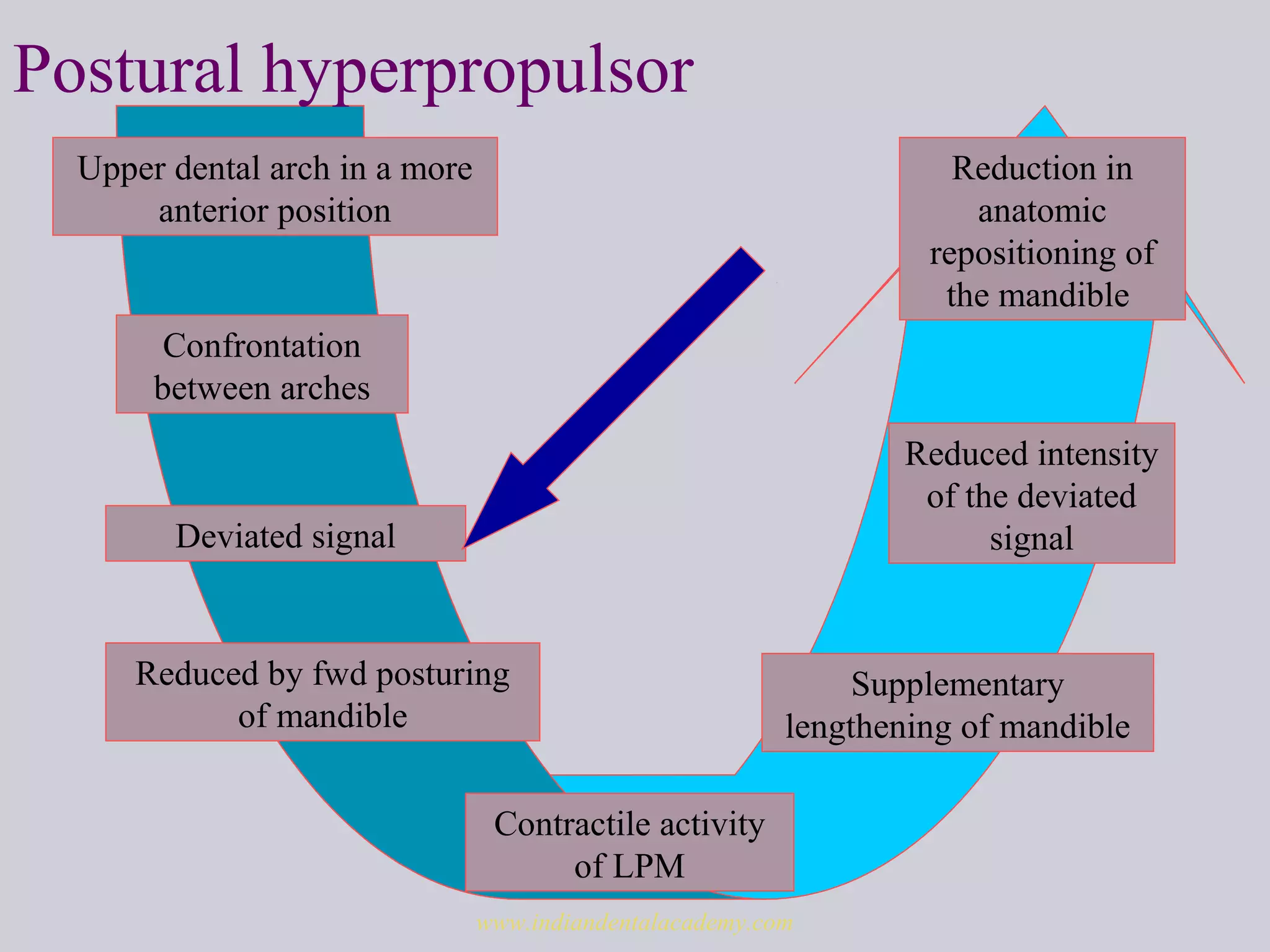
Postural hyperpropulsor
Upper dental arch in a more
anterior position
Confrontation
between arches
Supplementary
lengthening of mandible
Contractile activity
of LPM
Reduced by fwd posturing
of mandible
Deviated signal
Reduced intensity
of the deviated
signal
Reduction in
anatomic
repositioning of
the mandible
www.indiandentalacademy.com
Class II elastics
 No increase in the contractile activity
 Action through the retrodiscal pad
 Intrinsic regulation of the prechondroblasts multiplication
 Biologic activator for stimulating effect of class II
elastics seem to be retrodiscal pad and its role as a
metabolic pump
Functional prechondroblast
stimulated growth rate
Restriction of the
prechondroblast multiplication
www.indiandentalacademy.com
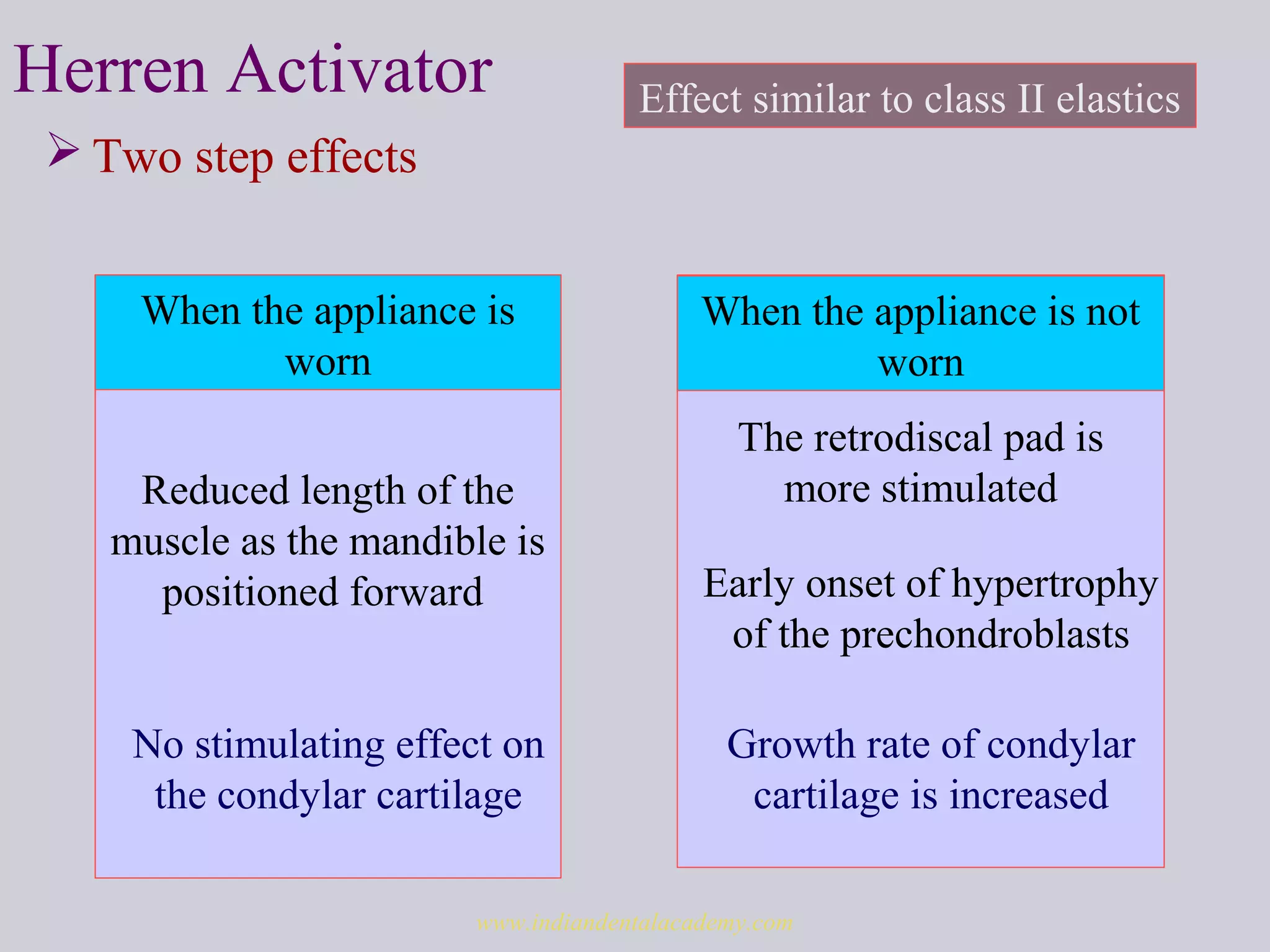
Herren Activator
 Two step effects
When the appliance is
worn
Reduced length of the
muscle as the mandible is
positioned forward
When the appliance is not
worn
The retrodiscal pad is
more stimulated
Early onset of hypertrophy
of the prechondroblasts
Growth rate of condylar
cartilage is increased
No stimulating effect on
the condylar cartilage
Effect similar to class II elastics
www.indiandentalacademy.com
Chin cap therapy
 The number of dividing cells in the condylar cartilage is
decreased
 Vertical growth direction and closing of the Stutzmann
angle
 Decrease in the length of the mandible
 Complete immobilization and the use of chin cap induces
the greatest decrease in the growth rate of condylar
cartilage and the lengthening of the mandible
www.indiandentalacademy.com
Upper jaw
growth
control by
STH
www.indiandentalacademy.com
Effect of hormone - maxilla and mandible
www.indiandentalacademy.com
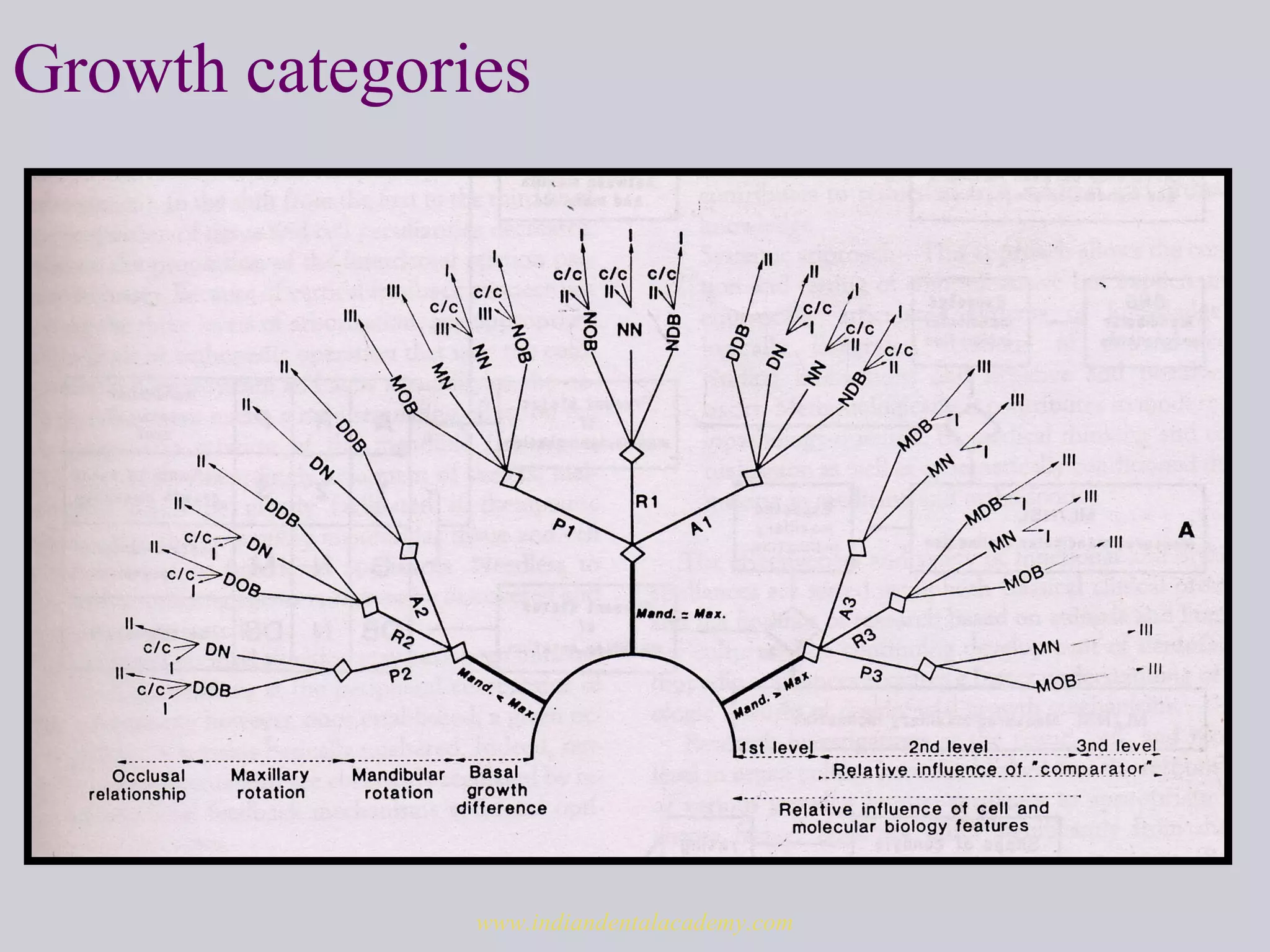
Lavergne and Petrovic,1983
 Growth categories - taken both maxilla and mandible
into consideration
 Three level arborization
I
l
e
v
e
l
2
l
e
v
e
l
3
L
e
v
e
l
www.indiandentalacademy.com
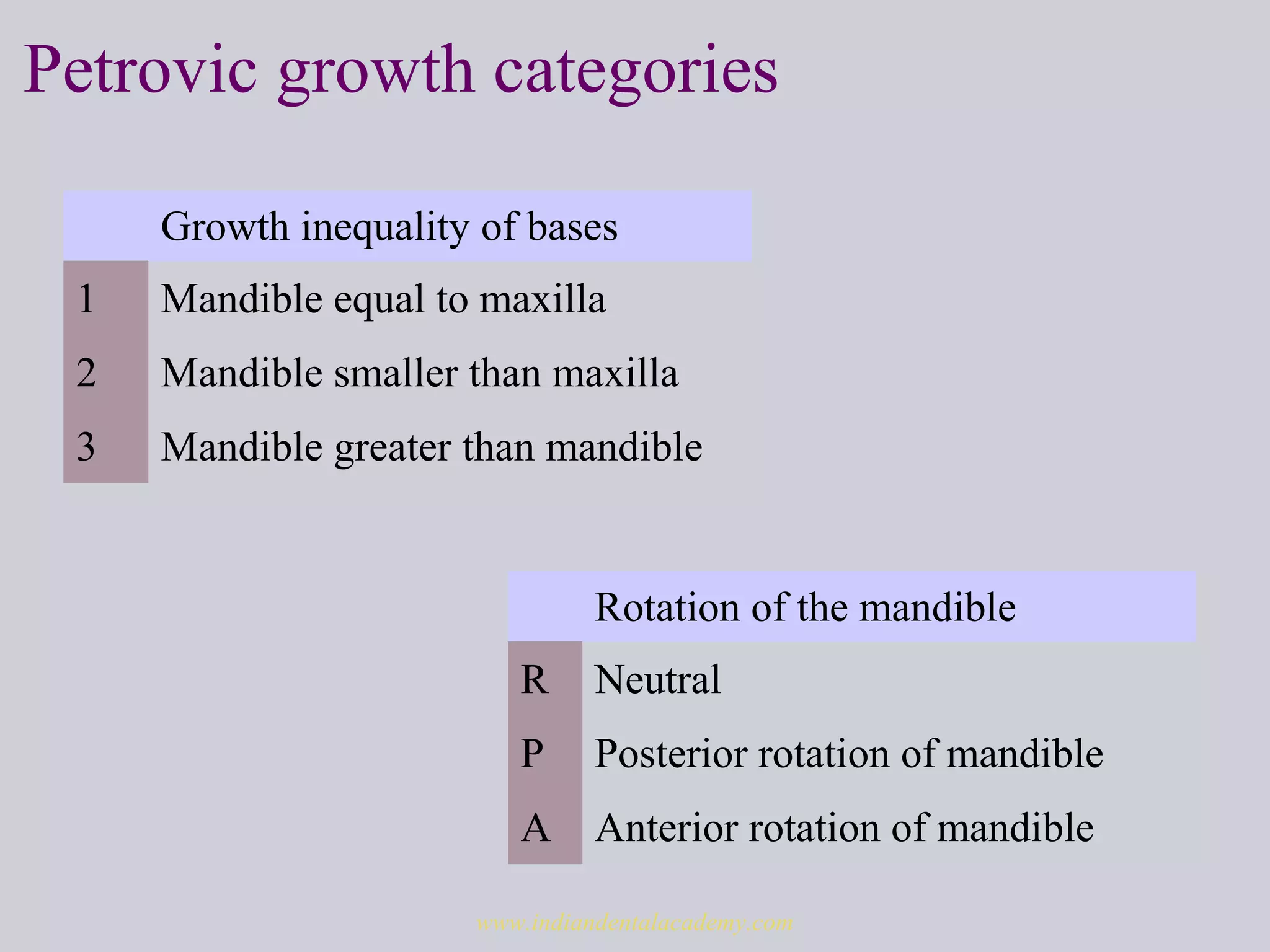
Petrovic growth categories
Growth inequality of bases
1 Mandible equal to maxilla
2 Mandible smaller than maxilla
3 Mandible greater than mandible
Rotation of the mandible
R Neutral
P Posterior rotation of mandible
A Anterior rotation of mandible
www.indiandentalacademy.com
Petrovic growth categories
Posteroanterior state
N Normal
D Distal
M Mesial
Vertical state
N Normal overbite
OB Open bite
DB Deep bite
www.indiandentalacademy.com
Growth categories
www.indiandentalacademy.com
I LEVEL
Mandible
greater than
maxilla
Mandible
less than
maxilla
Mandible equal to maxilla
Quantitative
determination of
difference between
maxilla and mandible
70%
3%25% Cell and molecular
biology level
www.indiandentalacademy.com
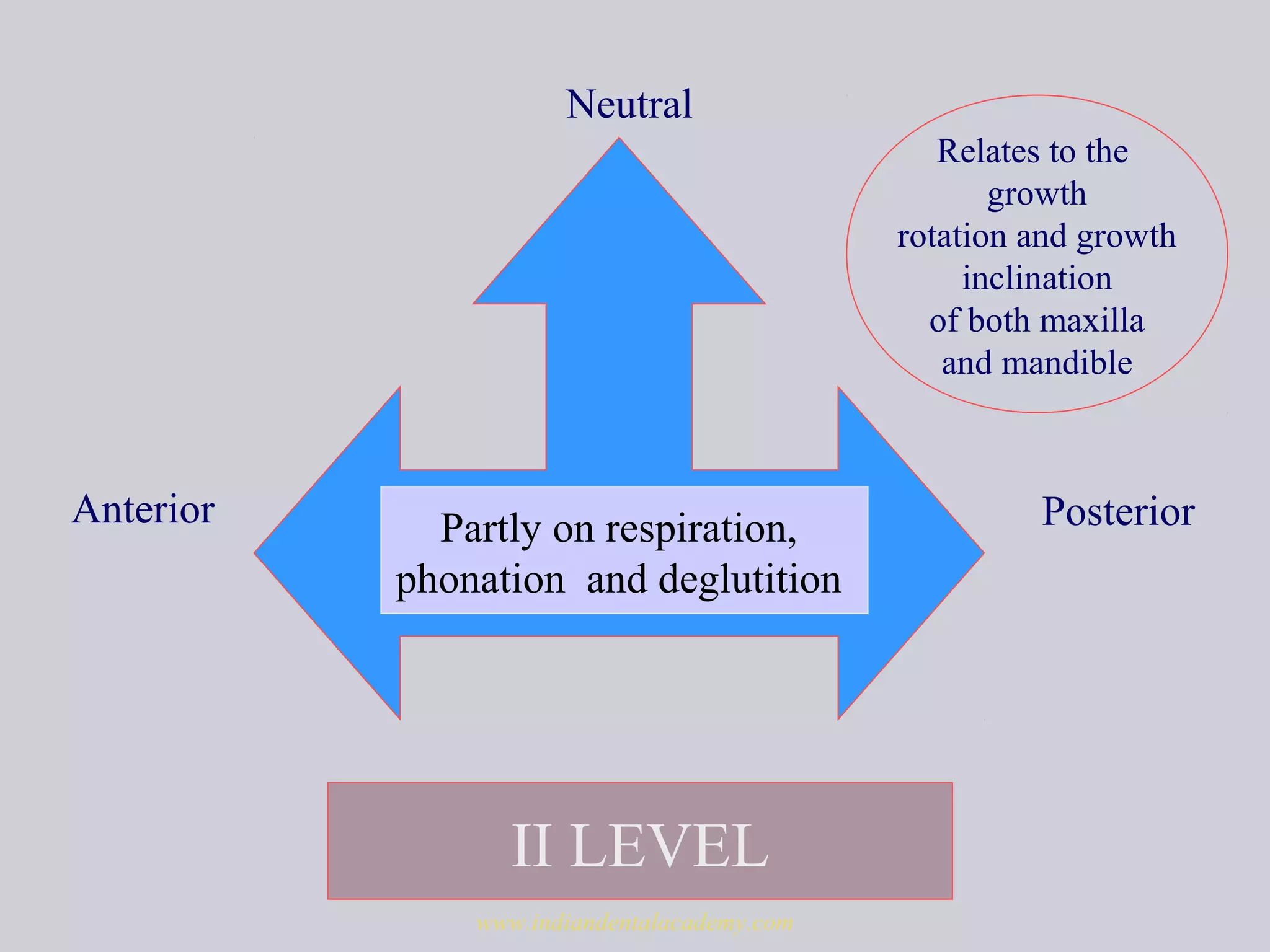
II LEVEL
PosteriorAnterior
Neutral
Relates to the
growth
rotation and growth
inclination
of both maxilla
and mandible
Partly on respiration,
phonation and deglutition
www.indiandentalacademy.com
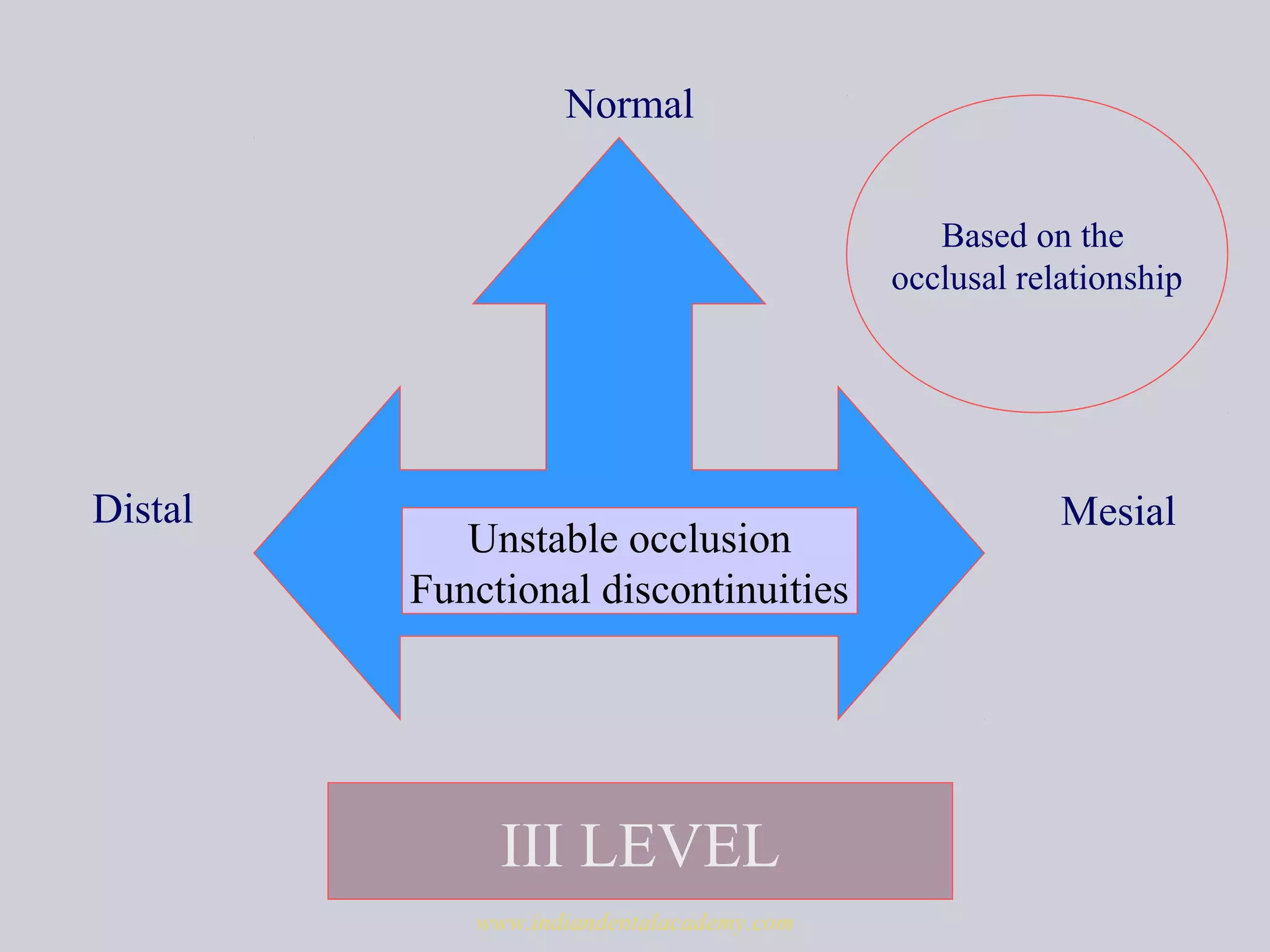
III LEVEL
MesialDistal
Normal
Based on the
occlusal relationship
Unstable occlusion
Functional discontinuities
www.indiandentalacademy.com
 Tissue level growth potential – level of subperiosteal
ossification rate and the level of alveolar bone turnover
rate
 Tissue level growth responsiveness – the degree of
augmentation of the alveolar bone turnover resulting
from orthodontic treatment
 Morphogenetic rotation – the change in the shape of the
mandible
 Positional rotation – the change in the position of the
mandible with relation to adjacent structures
www.indiandentalacademy.com
Lavergne and Gasson, 1977
 Six auxologic categories of the mandible
 Depends on – tissue level growth potential
- tissue level growth responsiveness to
orthodontic, orthopaedic and functional appliances
 helps define the biologic, inter individual variation of the
growing mandible
 Clinicians must give more importance to tissue level
growth responsiveness than just determining the growth
direction
www.indiandentalacademy.com
Auxologic groups
www.indiandentalacademy.com
Local factors affecting the condylar
cartilage
Cytoplasmic junction
between the skeletoblasts
become quantitatively
reduced
Inhibitory intercellular
stimulations are reduced
Cell division rate
increases
Rate of differentiation of
skeletoblasts to
prechondroblasts increases
www.indiandentalacademy.com
 Consistent transmembrane ion flux variation
•Intra cellular Na ion concentration increased
•Intracellular K ion concentration is decreased
•Discharge of H ion from blasts cell is increased
•Increased pH
•Intracytoplasmic Ca concentration is low
Local factors affecting the condylar
cartilage
www.indiandentalacademy.com
Local coupling mechanism
Open loop part of the
system
Stimulating effect on the
cell multiplication
Growth hormone and
growth promoting factors
acting primarily by
inhibition of the restraining
signal
Closed loop part of the
system
Inhibitory effect on the
cell multiplication and
consists of regulators of
local origin
www.indiandentalacademy.com
Bifurcation
Cusp to cusp unstable position
corresponds to functional
discontinuity
Lack of interdental contacts
correspond to the absence of
both stable and bifurcation
situation
www.indiandentalacademy.com
Occlusal development
First phase
Morphogenetic process
leading to stable occlusion
Stable occlusal
development capable of
serving as a peripheral
comparator is not achieved
Creation of an engram is
not possible
Second phase
First phase coincides with
the establishment of the
occlusion to serve as the
peripheral comparator
Thus the creation of an
engram
Minimizes the possible
deviation to achieve
stable occlusal
adjustment
www.indiandentalacademy.com
Malfunctioning of the servosystem
Morphologically defective
peripheral comparator
Morphologically acceptable
peripheral comparator
Multiple caries
Extreme bruxism
Inadequate reference bases
Anterior rotating mand with
distal jaw basal relationship
Or a posteriorly rotating mand
with mesial interjaw basal
relation ship
The control system operates
faultlessly but is unable to
correct the discrepancy between
the growth rates of the upper
and lower jaw
Seen in anteriorly rotating mand
associated with mesial basal
interjaw relationship and in
posteriorly rotating mand
associated with distal basal inter
jaw relationship
www.indiandentalacademy.com
Conclusion
 The treatment of dentofacial malrelations requires
considerable insight into the modalities of craniofacial
growth which is adequately understood only with a
knowledge of mechanisms controlling it,so far the
cybernetic language has been the best tool to render
accurately the intricacy and complexity of the
craniofacial growth and means to influence it clinically
www.indiandentalacademy.com
Thank you
www.indiandentalacademy.com

Servosystem

  • 1.
  • 2.
    Introduction Craniofacial growth hasbeen the ground for research for several years, starting from Genetic theory, Sutural theory, Cartilaginous theory, Functional matrix theory, Van Limborg’s theory and now the Cybernetic theory. The Servosystem is a part of the cybernetic theory which describes the craniofacial growth mechanism systematically and also explains the functioning of the various appliance system www.indiandentalacademy.com
  • 3.
    Genetic theory  Genotypesupplies all the information required for the phenotypic expression  The influence of the general, regional and local factors modifying the gene expression How does the modification occurs www.indiandentalacademy.com
  • 4.
    Sicher’s Sutural dominancetheory  Craniofacial sutures are responsible for the growth  This theory acknowledge the importance of Genetic theory  Sutures, cartilage and and Periosteum are growth centers  Sutures carry the genetic potential of the growth pattern,thus sutural patterns were predetermined  Disapproved Transplantation of the sutures Moss’ experiment on rats Hydrocephaly and microcephaly www.indiandentalacademy.com
  • 5.
  • 6.
    Cartilage directed theoryof growth  Proposed by James Scott – 1953, 1954, 1967  Cartilage and periosteum as active and primary growth centers  Sutures play a passive and secondary role  Cartilage have the intrinsic genetic potential  Nasal cartilage and mid face Transplantation  Mandible and condylar cartilage  Achondroplasia  Disapproved Condylar cartilage www.indiandentalacademy.com
  • 7.
    Cartilage directed growththeory www.indiandentalacademy.com
  • 8.
    Functional matrix  Proposedby Melvin Moss 1960, 1962, 1997  Original concept of Functional cranial component by Van Der Klaaw  The origin, form, position ,growth and maintenance of the skeletal tissue is secondary and compensatory to the responses that occur in the specifically related non skeletal tissues, organs or functioning spaces  Could not explain the control of the epigenetic factors  Functional matrix hypothesis revisited – 1997 AJO DOwww.indiandentalacademy.com
  • 9.
    Functional matrix Functional cranialcomponent Functional matrixSkeletal unit Micro Skeletal unit Macro Skeletal unit Capsular matrix Periosteal matrix Transformation Translation www.indiandentalacademy.com
  • 10.
    Mechano transduction Collagen fibres Transmembrane protein Integrin Actin Cytoplasmic membrane Nuclear membrane www.indiandentalacademy.com
  • 11.
    Cybernetic and controltheory  Demonstrates the quantitative and qualitative relationship between the observationally and experimentally collected findings  Petrovic was the first to propose a cybernetic model to account for the physiological phenomena involving facial growth and functioning of the functional and orthopeadic appliances Observation findings Experimental finding www.indiandentalacademy.com
  • 12.
    Epistemplogic features  Branchof philosophy that deals with the possibility, nature, origin, structure and validity of knowledge Hypothesis Refute FAIL Corroboration Strengthening of the theory Popper1963, Science is not a static acceptance of truth but rather the permanent search for truth www.indiandentalacademy.com
  • 13.
    Cibernetically organized biologicfeatures Orthodontic functional , and orthopaedic appliances o Maxillary lengthening and widening, o mandibular lengthening and widening, oTeeth movements Correction of malocclusion and intermaxillary relation INPUT BLACK BOX OUTPUT www.indiandentalacademy.com
  • 14.
    Classification of theloop systems Physiologic systems Closed loop system Open loop system Regulator system Servosystem Input Not a constant constant No comparator No feed back mechanism www.indiandentalacademy.com
  • 15.
    Command Reference input element Constantly changing reference input x PerformancePerformance analyzingelements Controller Actuator Coupling system Controlled system Output Controlled variable Xx Comparator www.indiandentalacademy.com
  • 16.
    Command  Signal establishedindependent of the feedback system  Affects the behavior of the control system without being affected by the consequences  Eg. Growth hormones,testosterone, and estrogen CONTROLLER ACTUATOR REFERENCE INPUT ELEMENT COMPARATOR COMMAND PERFORMANCE ANALYSING ELEMENTS CONTROLLED SYSTEM PERFORMANCE AMPLIFIER REFERENCE INPUT OPUTPUT www.indiandentalacademy.com
  • 17.
    Reference input element Between the command and the reference input  Septal cartilage, septopremaxillary frenum, labionarinari muscle and premaxillary and maxillary bone REFERENCE INPUT ELEMENT COMPARATOR COMMAND PERFORMANCE ANALYSING ELEMENTS CONTROLLED SYSTEM CONTROLLER ACTUATOR PERFORMANCE AMPLIFIER REFERENCE INPUT OPUTPUT www.indiandentalacademy.com
  • 18.
    Reference input constantlychanging variable  Signal established as a standard of comparison  Independent of the feedback mechanism  Sagittal position of the maxilla REFERENCE INPUT ELEMENT COMPARATOR COMMAND PERFORMANCE ANALYSING ELEMENTS CONTROLLED SYSTEM CONTROLLER ACTUATOR PERFORMANCE AMPLIFIER REFERENCE INPUTOPUTPUT www.indiandentalacademy.com
  • 19.
    Control of themaxillary growth Direct effect Indirect effect STH - stomatomedin Spheno occipital synchondrosis Nasal septal cartilage Lateral masses of ethmoid Body and greater wing of sphenoid Forward growth of septal cartilage Outward growth www.indiandentalacademy.com
  • 20.
    Forward growth ofseptal cartilage  Thrust effect Anterior extremity of the nasal septal cartilage Spreads laterally in antero inferior direction Penentrates into the premaxillary bone Premaxillomaxillary suture Maxillopalatine suture Thrust effect www.indiandentalacademy.com
  • 21.
     Septopremaxillary ligamenttraction  Traction of the labionarinari muscle Traction of the premaxillary bone through this muscle Biomechanic promotion of the forward growth of the upper jaw Absence of labial muscle attachment on the nasal septum – cleftlip- bone deformation Growth of the nasal septal cartilage Traction effect on the premaxillary bone through the Septopremaxillary ligament www.indiandentalacademy.com
  • 22.
    Outward growth Outward growthof the lateral cartilaginous masses of the ethmoid and the cartilage between the body and greater wings of sphenoid Produces a lateralization of the right and left alveolar ridges Stimulates the growth of the midpalatal suture Outward growth of the maxilla www.indiandentalacademy.com
  • 23.
    Performance and theperformance analysing elements REFERENCE INPUT ELEMENT COMPARATOR COMMAND PERFORMANCE ANALYSING ELEMENTS CONTROLLED SYSTEM CONTROLLER ACTUATOR PERFORMANC E AMPLIFIER REFERENCE INPUT OPUTPUT www.indiandentalacademy.com
  • 24.
    The controller andthe actuating signal  The central nervous system  Controls the activity of the lateral pterygoid muscle and the retrodiscal pad  The A.signal is the response of muscle and the retrodiscal pad REFERENCE INPUT ELEMENT COMPARATOR COMMAND PERFORMANCE ANALYSING ELEMENTS CONTROLLED SYSTEM CONTROLLER ACTUATOR PERFORMANCE AMPLIFIER OPUTPUT www.indiandentalacademy.com
  • 25.
    Role of lateralpterygoid & retrodiscal pad I CONTROL- INTACT LPM AND RETRODISCAL PAD NORMAL II BILATERAL RESECTION OF LPM DECREASED NO OF DIVIDING CELLS DECREASED GROWTH RATE OPENING OF STUTZMANN’S ANGLE DECREASED WIDTH OF MITOTIC COMPARTMENT III TMF CLAMPED BILATERALLY SAME AS II BUT LESS INTENSE IV TMF CLAMPED LPM RESECTED SAME AS II AND V V TMF RESECTED SAME AS A II VI LPM AND TMF RESECTED BILATERALLY NO CHANGE www.indiandentalacademy.com
  • 26.
    Retrodiscal pad  Partlya mediator of LPM as the blood supply is through this muscle  Surgical resection causes diminished rate of growth of condylar cartilage and lengthening of mandible  Blood circulating effect  Biomechanic effect www.indiandentalacademy.com
  • 27.
    Controlled system  Isthe final outcome of the system  The sagittal position of the mandible REFERENCE INPUT ELEMENT COMPARATOR COMMAND PERFORMANCE ANALYSING ELEMENTS CONTROLLED SYSTEM CONTROLLER ACTUATOR PERFORMANCE AMPLIFIER REFERENCE INPUT OPUTPUT www.indiandentalacademy.com
  • 28.
    The Attractor  Structurallystable steady state in a dynamic system  Full interdigitation of the teeth be it class I, Class II or Class III, with cusp to fossa relationship thus eliminating  The servosystem strives to achieve this stable form www.indiandentalacademy.com
  • 29.
    The Repeller  Unstableequilibrium state  Cusp to cusp type of occlusal relationship  The comparator detects this deviation signal and tries to achieve the cusp to fossa relationship through the servosystem www.indiandentalacademy.com
  • 30.
    Comparator Central comparator Peripheralcomparator Detects the disturbances in periphery Periodontal receptors Repetitive posturing of the mandible Sensory engram www.indiandentalacademy.com
  • 31.
    Functioning of functionalappliances Functional appliances Increased contraction of LPM Additional growth of condylar cartilage In growth stimulating factors Change in the condylar trabecular orientation Iterative activity of the retrodiscal pad Enhancement of local mediators Reduction of local regulators Additional subperiosteal ossification of the posterior border of mandible Supplementary lengthening of the mandible www.indiandentalacademy.com
  • 32.
    Postural hyperpropulsor Upper dentalarch in a more anterior position Confrontation between arches Supplementary lengthening of mandible Contractile activity of LPM Reduced by fwd posturing of mandible Deviated signal Reduced intensity of the deviated signal Reduction in anatomic repositioning of the mandible www.indiandentalacademy.com
  • 33.
    Class II elastics No increase in the contractile activity  Action through the retrodiscal pad  Intrinsic regulation of the prechondroblasts multiplication  Biologic activator for stimulating effect of class II elastics seem to be retrodiscal pad and its role as a metabolic pump Functional prechondroblast stimulated growth rate Restriction of the prechondroblast multiplication www.indiandentalacademy.com
  • 34.
    Herren Activator  Twostep effects When the appliance is worn Reduced length of the muscle as the mandible is positioned forward When the appliance is not worn The retrodiscal pad is more stimulated Early onset of hypertrophy of the prechondroblasts Growth rate of condylar cartilage is increased No stimulating effect on the condylar cartilage Effect similar to class II elastics www.indiandentalacademy.com
  • 35.
    Chin cap therapy The number of dividing cells in the condylar cartilage is decreased  Vertical growth direction and closing of the Stutzmann angle  Decrease in the length of the mandible  Complete immobilization and the use of chin cap induces the greatest decrease in the growth rate of condylar cartilage and the lengthening of the mandible www.indiandentalacademy.com
  • 36.
  • 37.
  • 38.
  • 39.
    Effect of hormone- maxilla and mandible www.indiandentalacademy.com
  • 40.
    Lavergne and Petrovic,1983 Growth categories - taken both maxilla and mandible into consideration  Three level arborization I l e v e l 2 l e v e l 3 L e v e l www.indiandentalacademy.com
  • 41.
    Petrovic growth categories Growthinequality of bases 1 Mandible equal to maxilla 2 Mandible smaller than maxilla 3 Mandible greater than mandible Rotation of the mandible R Neutral P Posterior rotation of mandible A Anterior rotation of mandible www.indiandentalacademy.com
  • 42.
    Petrovic growth categories Posteroanteriorstate N Normal D Distal M Mesial Vertical state N Normal overbite OB Open bite DB Deep bite www.indiandentalacademy.com
  • 43.
  • 44.
    I LEVEL Mandible greater than maxilla Mandible lessthan maxilla Mandible equal to maxilla Quantitative determination of difference between maxilla and mandible 70% 3%25% Cell and molecular biology level www.indiandentalacademy.com
  • 45.
    II LEVEL PosteriorAnterior Neutral Relates tothe growth rotation and growth inclination of both maxilla and mandible Partly on respiration, phonation and deglutition www.indiandentalacademy.com
  • 46.
    III LEVEL MesialDistal Normal Based onthe occlusal relationship Unstable occlusion Functional discontinuities www.indiandentalacademy.com
  • 47.
     Tissue levelgrowth potential – level of subperiosteal ossification rate and the level of alveolar bone turnover rate  Tissue level growth responsiveness – the degree of augmentation of the alveolar bone turnover resulting from orthodontic treatment  Morphogenetic rotation – the change in the shape of the mandible  Positional rotation – the change in the position of the mandible with relation to adjacent structures www.indiandentalacademy.com
  • 48.
    Lavergne and Gasson,1977  Six auxologic categories of the mandible  Depends on – tissue level growth potential - tissue level growth responsiveness to orthodontic, orthopaedic and functional appliances  helps define the biologic, inter individual variation of the growing mandible  Clinicians must give more importance to tissue level growth responsiveness than just determining the growth direction www.indiandentalacademy.com
  • 49.
  • 50.
    Local factors affectingthe condylar cartilage Cytoplasmic junction between the skeletoblasts become quantitatively reduced Inhibitory intercellular stimulations are reduced Cell division rate increases Rate of differentiation of skeletoblasts to prechondroblasts increases www.indiandentalacademy.com
  • 51.
     Consistent transmembraneion flux variation •Intra cellular Na ion concentration increased •Intracellular K ion concentration is decreased •Discharge of H ion from blasts cell is increased •Increased pH •Intracytoplasmic Ca concentration is low Local factors affecting the condylar cartilage www.indiandentalacademy.com
  • 52.
    Local coupling mechanism Openloop part of the system Stimulating effect on the cell multiplication Growth hormone and growth promoting factors acting primarily by inhibition of the restraining signal Closed loop part of the system Inhibitory effect on the cell multiplication and consists of regulators of local origin www.indiandentalacademy.com
  • 53.
    Bifurcation Cusp to cuspunstable position corresponds to functional discontinuity Lack of interdental contacts correspond to the absence of both stable and bifurcation situation www.indiandentalacademy.com
  • 54.
    Occlusal development First phase Morphogeneticprocess leading to stable occlusion Stable occlusal development capable of serving as a peripheral comparator is not achieved Creation of an engram is not possible Second phase First phase coincides with the establishment of the occlusion to serve as the peripheral comparator Thus the creation of an engram Minimizes the possible deviation to achieve stable occlusal adjustment www.indiandentalacademy.com
  • 55.
    Malfunctioning of theservosystem Morphologically defective peripheral comparator Morphologically acceptable peripheral comparator Multiple caries Extreme bruxism Inadequate reference bases Anterior rotating mand with distal jaw basal relationship Or a posteriorly rotating mand with mesial interjaw basal relation ship The control system operates faultlessly but is unable to correct the discrepancy between the growth rates of the upper and lower jaw Seen in anteriorly rotating mand associated with mesial basal interjaw relationship and in posteriorly rotating mand associated with distal basal inter jaw relationship www.indiandentalacademy.com
  • 56.
    Conclusion  The treatmentof dentofacial malrelations requires considerable insight into the modalities of craniofacial growth which is adequately understood only with a knowledge of mechanisms controlling it,so far the cybernetic language has been the best tool to render accurately the intricacy and complexity of the craniofacial growth and means to influence it clinically www.indiandentalacademy.com
  • 57.