1
Presented by-
Dr. Shreya Mittal
(1st year PG)
CYBERNETIC THEORY-
2
 INTRODUCTION
 CYBERNETICS DEFINITION
 BLACK BOX CONCEPT
 CLASSIFICATION OF CONTROL SYSTEMS
 ELEMENTS OF SERVOSYSTEM THEORY
 TYPES OF CARTILAGE
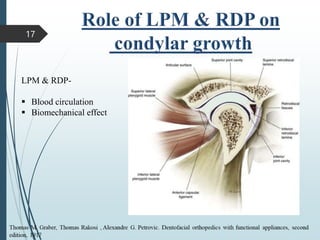
 ROLE OF LPM & RDP ON CONDYLAR GROWTH
 EXPLANATION OF SERVOSYSTEM THEORY
 GROWTH OF MAXILLA
Growth in width
Growth in length
3
 GRAPH – INTERACTION BETWEEN LPM ACTIVITY &
HORMONES
 CLINICAL SIGNIFICANCE
 MODE OF ACTION OF FUNCTIONAL APPLIANCES (based
on servosystem theory)
 EVIDENCES AGAINST THE THEORY
 CONCLUSION
 REFERENCES
Over many years various theories of growth have been proposed for the
craniofacial complex.
SERVOSYSTEM THEORY – BY ALEXANDRE PETROVIC (1977) ,
relies on the components of cybernetics to describe the growth of the
craniofacial complex.
4
CYBERNETICS
 Weiner defines cybernetics as the science
of control and communication in the
animal and machine.
 Ashby defines it as the study of systems
that are open to energy but closed to
information and control.
5
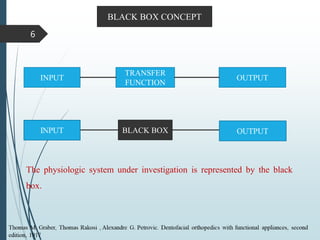
BLACK BOX CONCEPT
INPUT
TRANSFER
FUNCTION
OUTPUT
BLACK BOX
The physiologic system under investigation is represented by the black
box.
6
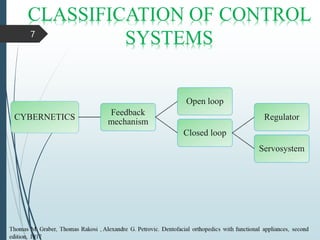
CYBERNETICS
Feedback
mechanism
Open loop
Closed loop
Regulator
Servosystem
CLASSIFICATION OF CONTROL
SYSTEMS
7
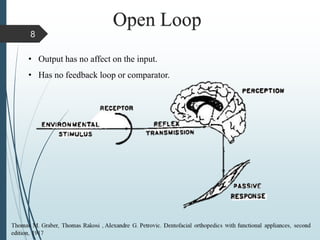
Open Loop
• Output has no affect on the input.
• Has no feedback loop or comparator.
8
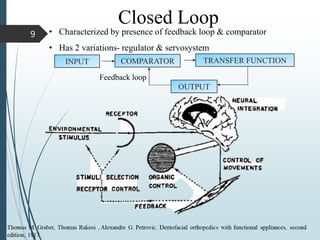
Closed Loop
• Characterized by presence of feedback loop & comparator
• Has 2 variations- regulator & servosystem
INPUT COMPARATOR TRANSFER FUNCTION
OUTPUT
Feedback loop
9
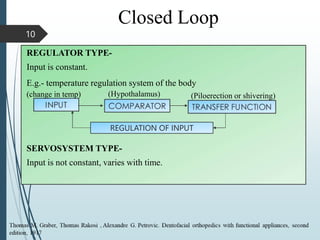
Closed Loop
REGULATOR TYPE-
Input is constant.
E.g.- temperature regulation system of the body
REGULATION OF INPUT
SERVOSYSTEM TYPE-
Input is not constant, varies with time.
10
(change in temp) (Hypothalamus) (Piloerection or shivering)
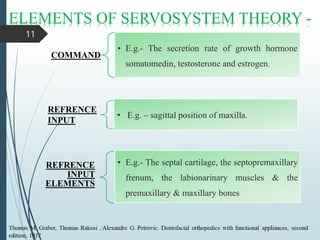
COMMAND
• E.g.- The secretion rate of growth hormone
somatomedin, testosterone and estrogen.
REFRENCE
INPUT
ELEMENTS
• E.g.- The septal cartilage, the septopremaxillary
frenum, the labionarinary muscles & the
premaxillary & maxillary bones
ELEMENTS OF SERVOSYSTEM THEORY -
• E.g. – sagittal position of maxilla.
REFRENCE
INPUT
11
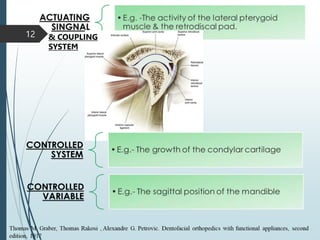
12 & COUPLING
SYSTEM
13
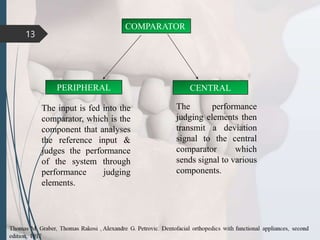
COMPARATOR
PERIPHERAL CENTRAL
The input is fed into the
comparator, which is the
component that analyses
the reference input &
judges the performance
of the system through
performance judging
elements.
The performance
judging elements then
transmit a deviation
signal to the central
comparator which
sends signal to various
components.
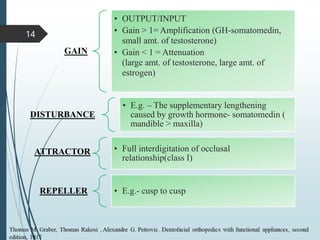
GAIN
• OUTPUT/INPUT
• Gain > 1= Amplification (GH-somatomedin,
small amt. of testosterone)
• Gain < 1 = Attenuation
(large amt. of testosterone, large amt. of
estrogen)
DISTURBANCE
• E.g. – The supplementary lengthening
caused by growth hormone- somatomedin (
mandible > maxilla)
• Full interdigitation of occlusal
relationship(class I)
REPELLER • E.g.- cusp to cusp
ATTRACTOR
14
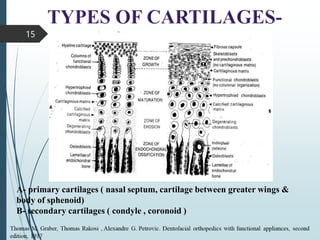
15
A- primary cartilages ( nasal septum, cartilage between greater wings &
body of sphenoid)
B- secondary cartilages ( condyle , coronoid )
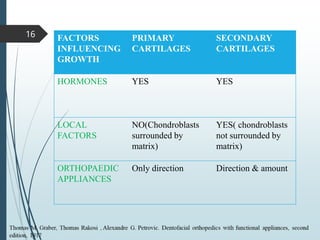
16 FACTORS
INFLUENCING
GROWTH
PRIMARY
CARTILAGES
SECONDARY
CARTILAGES
HORMONES YES YES
LOCAL
FACTORS
NO(Chondroblasts
surrounded by
matrix)
YES( chondroblasts
not surrounded by
matrix)
ORTHOPAEDIC
APPLIANCES
Only direction Direction & amount
17
LPM & RDP-
 Blood circulation
 Biomechanical effect
18
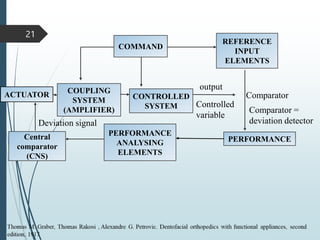
The CNS serves as the central comparator for the servosystem
It is collection of feedback loops, that records the activity of masticatory
muscles corresponding to a particular, habitual mandibular position. It
acts as a blueprint.
Any particular muscle action or mandibular position that gives the
minimum deviation signal is recorded in the sensory engram.
Sensory engram-
Lavergne J, Petrovic A. Discontinuities in occlusal relationship and the regulation of facial growth. A cybernetic view. Eur J
Orthod. 1983 Nov;5(4):269-78.
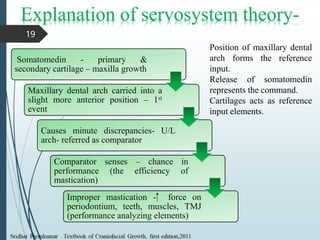
Explanation of servosystem theory-
Somatomedin - primary &
secondary cartilage – maxilla growth
Maxillary dental arch carried into a
slight more anterior position – 1st
event
Causes minute discrepancies- U/L
arch- referred as comparator
Comparator senses – chance in
performance (the efficiency of
mastication)
Improper mastication - force on
periodontium, teeth, muscles, TMJ
(performance analyzing elements)
19
Position of maxillary dental
arch forms the reference
input.
Release of somatomedin
represents the command.
Cartilages acts as reference
input elements.
20
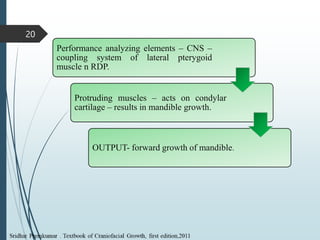
Performance analyzing elements – CNS –
coupling system of lateral pterygoid
muscle n RDP.
Protruding muscles – acts on condylar
cartilage – results in mandible growth.
OUTPUT- forward growth of mandible.
COMMAND
REFERENCE
INPUT
ELEMENTS
ACTUATOR
Central
comparator
(CNS)
COUPLING
SYSTEM
(AMPLIFIER)
CONTROLLED
SYSTEM
PERFORMANCE
ANALYSING
ELEMENTS
PERFORMANCE
output
Controlled
variable
Comparator
Comparator =
deviation detector
21
Deviation signal
22
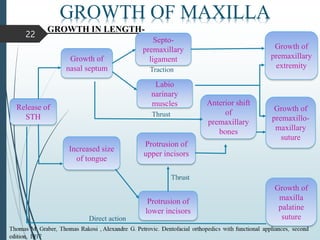
GROWTH OF MAXILLA
GROWTH IN LENGTH-
Release of
STH
Growth of
nasal septum
Increased size
of tongue
Septo-
premaxillary
ligament
Labio
narinary
muscles
Protrusion of
upper incisors
Protrusion of
lower incisors
Anterior shift
of
premaxillary
bones
Growth of
premaxillary
extremity
Growth of
premaxillo-
maxillary
suture
Growth of
maxilla
palatine
suture
Thrust
Traction
Direct action
23
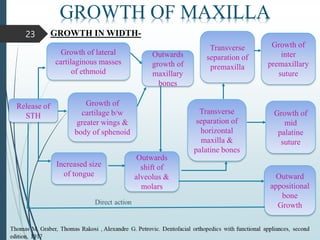
GROWTH OF MAXILLA
GROWTH IN WIDTH-
Release of
STH
Growth of lateral
cartilaginous masses
of ethmoid
Increased size
of tongue
Outwards
growth of
maxillary
bones
Growth of
cartilage b/w
greater wings &
body of sphenoid
Transverse
separation of
horizontal
maxilla &
palatine bones
Outwards
shift of
alveolus &
molars
Transverse
separation of
premaxilla
Growth of
inter
premaxillary
suture
Growth of
mid
palatine
suture
Outward
appositional
bone
Growth
24
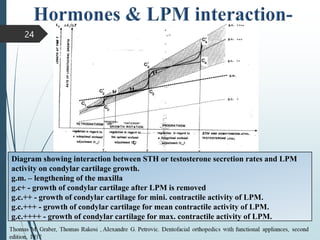
Diagram showing interaction between STH or testosterone secretion rates and LPM
activity on condylar cartilage growth.
g.m. – lengthening of the maxilla
g.c+ - growth of condylar cartilage after LPM is removed
g.c.++ - growth of condylar cartilage for mini. contractile activity of LPM.
g.c.+++ - growth of condylar cartilage for mean contractile activity of LPM.
g.c.++++ - growth of condylar cartilage for max. contractile activity of LPM.
25
For every unit of STH or testosterone that is released , amt. of growth
( man > max )
 At normal hormonal level N – good max-man relation is maintained
 At T2 hormonal level – (man > max) – LPM is reduced
 Beyond T2 hormonal level – LPM activity can no longer be reduced
– prognathism
 The opposite happens when hormonal level is below T1 , below T1
hormonal level – LPM activity can no longer be increased –
retrognathism
 Within levels T1- T2 , good max-man relation is maintained ,
outside these levels – malocclusion occurs.
26
Clinical Significance-
 It is used to explain the growth of mandible following functional
appliance therapy.
 Useful as a research tool.
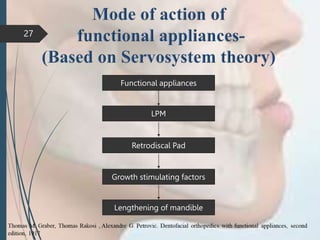
27
Functional appliances
LPM
Retrodiscal Pad
Growth stimulating factors
Lengthening of mandible
28
Two types of functional appliances have been recognized to their
mode of action-
1. Appliances like the activator, frankel appliances, Twin block,
Bionator etc.
2. Appliances like the Herren & LSU activator , Extra oral
traction on the mandible, which position the mandible forward
and open it beyond the physiologic rest position.
Thomas M. Graber, Thomas Rakosi , Alexandre G. Petrovic. Dentofacial orthopedics with functional appliances, second
edition, 1917
29 FIRST GROUP-
When appliance is in place - activity of LPM & RPD – due to forward
positioning of the mandible.
Oudet et al & Carlson et al studies – non fatigable fibers in the LPM-
mandible grows in forward direction by deposition of bone at condyle.
LPM is helped to contract more by Functional appliances.
SECOND GROUP-
Position mandible forward , open beyond the rest position
no increase in activity of LPM, yet there is increase in growth
30
Evidences against the theory-
 Goret – Nicaise, Awn (1983) – resection of LPM - fails to diminish
condylar growth.
 Whetten & Johnston (1985) – bilaterally condylectomy & unilateral
LPM in rats – same growth both sides
 Das, Myer & Sicher (1980) – occlusion remained unaffected in
condylectomy studies.
Sridhar Premkumar . Textbook of Craniofacial Growth, first edition,2011
31
CONCLUSION-
32
 Thomas M. Graber, Thomas Rakosi , Alexandre G. Petrovic. Dentofacial
orthopedics with functional appliances, second edition, 1917
 Sridhar Premkumar . Textbook of Craniofacial Growth, first edition,2011
 Lavergne J, Petrovic A. Discontinuities in occlusal relationship and the
regulation of facial growth. A cybernetic view. Eur J Orthod. 1983 Nov;5(4):269-
78.
 Stutzmann JJ, Petrovic AG. Role of the lateral pterygoid muscle and
meniscotemporomandibular frenum in spontaneous growth of the mandible.
American Journal of Orthodontics and Dentofacial Orthopedics. 1990 May
1;97(5):381-92.
33

seminar 1 cybernetics theory.pptx

  • 1.
    1 Presented by- Dr. ShreyaMittal (1st year PG) CYBERNETIC THEORY-
  • 2.
    2  INTRODUCTION  CYBERNETICSDEFINITION  BLACK BOX CONCEPT  CLASSIFICATION OF CONTROL SYSTEMS  ELEMENTS OF SERVOSYSTEM THEORY  TYPES OF CARTILAGE  ROLE OF LPM & RDP ON CONDYLAR GROWTH  EXPLANATION OF SERVOSYSTEM THEORY  GROWTH OF MAXILLA Growth in width Growth in length
  • 3.
    3  GRAPH –INTERACTION BETWEEN LPM ACTIVITY & HORMONES  CLINICAL SIGNIFICANCE  MODE OF ACTION OF FUNCTIONAL APPLIANCES (based on servosystem theory)  EVIDENCES AGAINST THE THEORY  CONCLUSION  REFERENCES
  • 4.
    Over many yearsvarious theories of growth have been proposed for the craniofacial complex. SERVOSYSTEM THEORY – BY ALEXANDRE PETROVIC (1977) , relies on the components of cybernetics to describe the growth of the craniofacial complex. 4
  • 5.
    CYBERNETICS  Weiner definescybernetics as the science of control and communication in the animal and machine.  Ashby defines it as the study of systems that are open to energy but closed to information and control. 5
  • 6.
    BLACK BOX CONCEPT INPUT TRANSFER FUNCTION OUTPUT BLACKBOX The physiologic system under investigation is represented by the black box. 6
  • 7.
  • 8.
    Open Loop • Outputhas no affect on the input. • Has no feedback loop or comparator. 8
  • 9.
    Closed Loop • Characterizedby presence of feedback loop & comparator • Has 2 variations- regulator & servosystem INPUT COMPARATOR TRANSFER FUNCTION OUTPUT Feedback loop 9
  • 10.
    Closed Loop REGULATOR TYPE- Inputis constant. E.g.- temperature regulation system of the body REGULATION OF INPUT SERVOSYSTEM TYPE- Input is not constant, varies with time. 10 (change in temp) (Hypothalamus) (Piloerection or shivering)
  • 11.
    COMMAND • E.g.- Thesecretion rate of growth hormone somatomedin, testosterone and estrogen. REFRENCE INPUT ELEMENTS • E.g.- The septal cartilage, the septopremaxillary frenum, the labionarinary muscles & the premaxillary & maxillary bones ELEMENTS OF SERVOSYSTEM THEORY - • E.g. – sagittal position of maxilla. REFRENCE INPUT 11
  • 12.
  • 13.
    13 COMPARATOR PERIPHERAL CENTRAL The inputis fed into the comparator, which is the component that analyses the reference input & judges the performance of the system through performance judging elements. The performance judging elements then transmit a deviation signal to the central comparator which sends signal to various components.
  • 14.
    GAIN • OUTPUT/INPUT • Gain> 1= Amplification (GH-somatomedin, small amt. of testosterone) • Gain < 1 = Attenuation (large amt. of testosterone, large amt. of estrogen) DISTURBANCE • E.g. – The supplementary lengthening caused by growth hormone- somatomedin ( mandible > maxilla) • Full interdigitation of occlusal relationship(class I) REPELLER • E.g.- cusp to cusp ATTRACTOR 14
  • 15.
    15 A- primary cartilages( nasal septum, cartilage between greater wings & body of sphenoid) B- secondary cartilages ( condyle , coronoid )
  • 16.
    16 FACTORS INFLUENCING GROWTH PRIMARY CARTILAGES SECONDARY CARTILAGES HORMONES YESYES LOCAL FACTORS NO(Chondroblasts surrounded by matrix) YES( chondroblasts not surrounded by matrix) ORTHOPAEDIC APPLIANCES Only direction Direction & amount
  • 17.
    17 LPM & RDP- Blood circulation  Biomechanical effect
  • 18.
    18 The CNS servesas the central comparator for the servosystem It is collection of feedback loops, that records the activity of masticatory muscles corresponding to a particular, habitual mandibular position. It acts as a blueprint. Any particular muscle action or mandibular position that gives the minimum deviation signal is recorded in the sensory engram. Sensory engram- Lavergne J, Petrovic A. Discontinuities in occlusal relationship and the regulation of facial growth. A cybernetic view. Eur J Orthod. 1983 Nov;5(4):269-78.
  • 19.
    Explanation of servosystemtheory- Somatomedin - primary & secondary cartilage – maxilla growth Maxillary dental arch carried into a slight more anterior position – 1st event Causes minute discrepancies- U/L arch- referred as comparator Comparator senses – chance in performance (the efficiency of mastication) Improper mastication - force on periodontium, teeth, muscles, TMJ (performance analyzing elements) 19 Position of maxillary dental arch forms the reference input. Release of somatomedin represents the command. Cartilages acts as reference input elements.
  • 20.
    20 Performance analyzing elements– CNS – coupling system of lateral pterygoid muscle n RDP. Protruding muscles – acts on condylar cartilage – results in mandible growth. OUTPUT- forward growth of mandible.
  • 21.
  • 22.
    22 GROWTH OF MAXILLA GROWTHIN LENGTH- Release of STH Growth of nasal septum Increased size of tongue Septo- premaxillary ligament Labio narinary muscles Protrusion of upper incisors Protrusion of lower incisors Anterior shift of premaxillary bones Growth of premaxillary extremity Growth of premaxillo- maxillary suture Growth of maxilla palatine suture Thrust Traction Direct action
  • 23.
    23 GROWTH OF MAXILLA GROWTHIN WIDTH- Release of STH Growth of lateral cartilaginous masses of ethmoid Increased size of tongue Outwards growth of maxillary bones Growth of cartilage b/w greater wings & body of sphenoid Transverse separation of horizontal maxilla & palatine bones Outwards shift of alveolus & molars Transverse separation of premaxilla Growth of inter premaxillary suture Growth of mid palatine suture Outward appositional bone Growth
  • 24.
    24 Diagram showing interactionbetween STH or testosterone secretion rates and LPM activity on condylar cartilage growth. g.m. – lengthening of the maxilla g.c+ - growth of condylar cartilage after LPM is removed g.c.++ - growth of condylar cartilage for mini. contractile activity of LPM. g.c.+++ - growth of condylar cartilage for mean contractile activity of LPM. g.c.++++ - growth of condylar cartilage for max. contractile activity of LPM.
  • 25.
    25 For every unitof STH or testosterone that is released , amt. of growth ( man > max )  At normal hormonal level N – good max-man relation is maintained  At T2 hormonal level – (man > max) – LPM is reduced  Beyond T2 hormonal level – LPM activity can no longer be reduced – prognathism  The opposite happens when hormonal level is below T1 , below T1 hormonal level – LPM activity can no longer be increased – retrognathism  Within levels T1- T2 , good max-man relation is maintained , outside these levels – malocclusion occurs.
  • 26.
    26 Clinical Significance-  Itis used to explain the growth of mandible following functional appliance therapy.  Useful as a research tool.
  • 27.
    27 Functional appliances LPM Retrodiscal Pad Growthstimulating factors Lengthening of mandible
  • 28.
    28 Two types offunctional appliances have been recognized to their mode of action- 1. Appliances like the activator, frankel appliances, Twin block, Bionator etc. 2. Appliances like the Herren & LSU activator , Extra oral traction on the mandible, which position the mandible forward and open it beyond the physiologic rest position. Thomas M. Graber, Thomas Rakosi , Alexandre G. Petrovic. Dentofacial orthopedics with functional appliances, second edition, 1917
  • 29.
    29 FIRST GROUP- Whenappliance is in place - activity of LPM & RPD – due to forward positioning of the mandible. Oudet et al & Carlson et al studies – non fatigable fibers in the LPM- mandible grows in forward direction by deposition of bone at condyle. LPM is helped to contract more by Functional appliances. SECOND GROUP- Position mandible forward , open beyond the rest position no increase in activity of LPM, yet there is increase in growth
  • 30.
    30 Evidences against thetheory-  Goret – Nicaise, Awn (1983) – resection of LPM - fails to diminish condylar growth.  Whetten & Johnston (1985) – bilaterally condylectomy & unilateral LPM in rats – same growth both sides  Das, Myer & Sicher (1980) – occlusion remained unaffected in condylectomy studies. Sridhar Premkumar . Textbook of Craniofacial Growth, first edition,2011
  • 31.
  • 32.
    32  Thomas M.Graber, Thomas Rakosi , Alexandre G. Petrovic. Dentofacial orthopedics with functional appliances, second edition, 1917  Sridhar Premkumar . Textbook of Craniofacial Growth, first edition,2011  Lavergne J, Petrovic A. Discontinuities in occlusal relationship and the regulation of facial growth. A cybernetic view. Eur J Orthod. 1983 Nov;5(4):269- 78.  Stutzmann JJ, Petrovic AG. Role of the lateral pterygoid muscle and meniscotemporomandibular frenum in spontaneous growth of the mandible. American Journal of Orthodontics and Dentofacial Orthopedics. 1990 May 1;97(5):381-92.
  • 33.