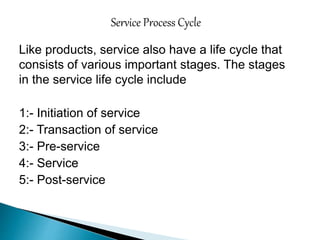
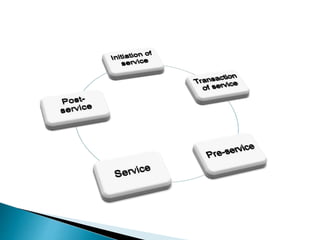
Like products, service also have a life cycle that
consists of various important stages. The stages
in the service life cycle include
1:- Initiation of service
2:- Transaction of service
3:- Pre-service
4:- Service
5:- Post-service
Service Process Cycle
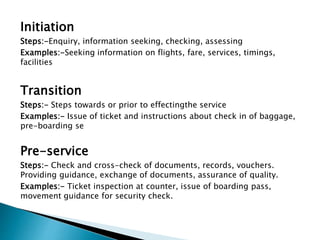
Initiation
Steps:-Enquiry, information seeking, checking, assessing
Examples:-Seeking information on flights, fare, services, timings,
facilities
Transition
Steps:- Steps towards or prior to effectingthe service
Examples:- Issue of ticket and instructions about check in of baggage,
pre-boarding se
Pre-service
Steps:- Check and cross-check of documents, records, vouchers.
Providing guidance, exchange of documents, assurance of quality.
Examples:- Ticket inspection at counter, issue of boarding pass,
movement guidance for security check.
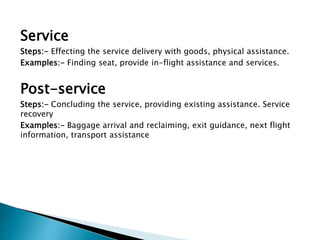
Service
Steps:- Effecting the service delivery with goods, physical assistance.
Examples:- Finding seat, provide in-flight assistance and services.
Post-service
Steps:- Concluding the service, providing existing assistance. Service
recovery
Examples:- Baggage arrival and reclaiming, exit guidance, next flight
information, transport assistance
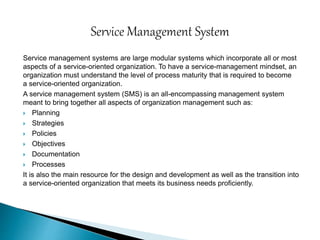
Service management systems are large modular systems which incorporate all or most
aspects of a service-oriented organization. To have a service-management mindset, an
organization must understand the level of process maturity that is required to become
a service-oriented organization.
A service management system (SMS) is an all-encompassing management system
meant to bring together all aspects of organization management such as:
 Planning
 Strategies
 Policies
 Objectives
 Documentation
 Processes
It is also the main resource for the design and development as well as the transition into
a service-oriented organization that meets its business needs proficiently.
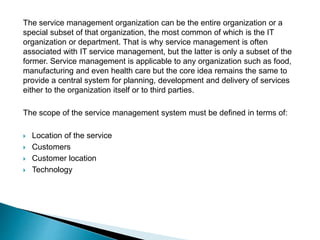
The service management organization can be the entire organization or a
special subset of that organization, the most common of which is the IT
organization or department. That is why service management is often
associated with IT service management, but the latter is only a subset of the
former. Service management is applicable to any organization such as food,
manufacturing and even health care but the core idea remains the same to
provide a central system for planning, development and delivery of services
either to the organization itself or to third parties.
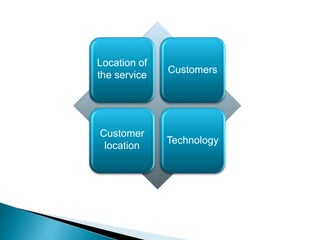
The scope of the service management system must be defined in terms of:
 Location of the service
 Customers
 Customer location
 Technology
Location of
the service
Customers
Customer
location
Technology
The steps involved establishing and maintaining SMS and their requirements
are provided by ISO/IEC 20000. These Steps are based on Deming cycle
1:- Plan- Plan the service management system
2:- Do- Implement and operate the SMS
3:- Check- Monitor and review the working of SMS
4:- Act- Maintain and improve the SMS whenever required
The service process cycle has a wide scope beginning with initiation of
services to delivery and then post service evaluation. This cycle is used as a
basis for developing all types of services. Once a service design has been
selected and developed, the launch and implementation is handled by the
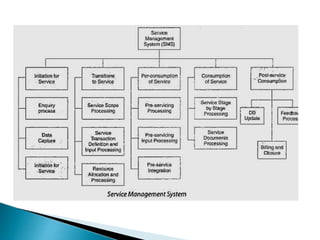
SMS which is a well-designed system to handle the service. SMS diagram will
shown down;
Service process cycle and service management system

Service process cycle and service management system

  • 2.
    Like products, servicealso have a life cycle that consists of various important stages. The stages in the service life cycle include 1:- Initiation of service 2:- Transaction of service 3:- Pre-service 4:- Service 5:- Post-service Service Process Cycle
  • 4.
    Initiation Steps:-Enquiry, information seeking,checking, assessing Examples:-Seeking information on flights, fare, services, timings, facilities Transition Steps:- Steps towards or prior to effectingthe service Examples:- Issue of ticket and instructions about check in of baggage, pre-boarding se Pre-service Steps:- Check and cross-check of documents, records, vouchers. Providing guidance, exchange of documents, assurance of quality. Examples:- Ticket inspection at counter, issue of boarding pass, movement guidance for security check.
  • 5.
    Service Steps:- Effecting theservice delivery with goods, physical assistance. Examples:- Finding seat, provide in-flight assistance and services. Post-service Steps:- Concluding the service, providing existing assistance. Service recovery Examples:- Baggage arrival and reclaiming, exit guidance, next flight information, transport assistance
  • 6.
    Service management systemsare large modular systems which incorporate all or most aspects of a service-oriented organization. To have a service-management mindset, an organization must understand the level of process maturity that is required to become a service-oriented organization. A service management system (SMS) is an all-encompassing management system meant to bring together all aspects of organization management such as:  Planning  Strategies  Policies  Objectives  Documentation  Processes It is also the main resource for the design and development as well as the transition into a service-oriented organization that meets its business needs proficiently.
  • 7.
    The service managementorganization can be the entire organization or a special subset of that organization, the most common of which is the IT organization or department. That is why service management is often associated with IT service management, but the latter is only a subset of the former. Service management is applicable to any organization such as food, manufacturing and even health care but the core idea remains the same to provide a central system for planning, development and delivery of services either to the organization itself or to third parties. The scope of the service management system must be defined in terms of:  Location of the service  Customers  Customer location  Technology
  • 8.
  • 9.
    The steps involvedestablishing and maintaining SMS and their requirements are provided by ISO/IEC 20000. These Steps are based on Deming cycle 1:- Plan- Plan the service management system 2:- Do- Implement and operate the SMS 3:- Check- Monitor and review the working of SMS 4:- Act- Maintain and improve the SMS whenever required The service process cycle has a wide scope beginning with initiation of services to delivery and then post service evaluation. This cycle is used as a basis for developing all types of services. Once a service design has been selected and developed, the launch and implementation is handled by the SMS which is a well-designed system to handle the service. SMS diagram will shown down;