Transaction Processing System
Presented by:
Vidhu Arora
Introduction
• A Transaction Processing System (TPS) is a type of information
system that collects, stores, modifies and retrieves the data
transactions of an enterprise.
Example : airline reservation systems, electronic transfer of funds, bank
account processing systems.
• Designed to process routine business transactions
• Seeks time and cost efficiency by automating repetitive operations
in large volumes.
Objectives of TPS
• Process data generated by and about transactions.
• Maintain a high degree of accuracy.
• Ensure data information integrity and accuracy.
• Produce timely documents and reports.
• Increase labour efficiency.
• Help provide increased and enhanced efficiency.
• To build and maintain customer loyalty.
Components of a Transaction System
• The User of the information system is the person belonging
to the organization that owns the transaction system.
• Participants are the people who conduct the information
processing.
• People from the environment become participants of the
system as they directly enter transactions and perform
validation.
Types of TPS
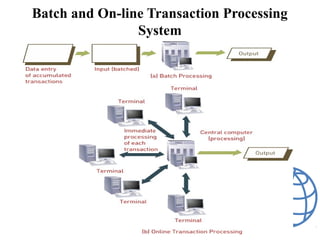
1. Batch processing systems :
• Batch processing is where the information is collected and
stored as a batch but not processed immediately.
• Batch processing is useful for enterprises that need to process
large amounts of data using limited resources.
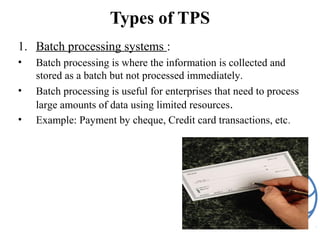
• Example: Payment by cheque, Credit card transactions, etc.
2. On-line transaction processing (OLTP) :
• A system whereby each transaction is processed
immediately,
without the delay of accumulating transactions into a batch.
• Examples :
 Mostly in Online shopping
Uses PCI cards (Payment Card Industry): PayPal or World Pay, We
Pay, e-Way, ICEPAY, ATM’s.
Batch and On-line Transaction Processing
System
3. On-Line Entry with Delayed Processing
• This type of transaction is a compromise between the batch
and on-line processing.
• Orders or transactions are entered into the computer system
when they occur, but they are not processed immediately.
• Example: A typical mail order system in which orders are
accumulated and then it is forwarded to a warehouse for
shipment
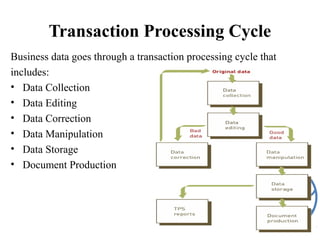
Transaction Processing Cycle
Business data goes through a transaction processing cycle that
includes:
• Data Collection
• Data Editing
• Data Correction
• Data Manipulation
• Data Storage
• Document Production
• Data Collection
– The process of capturing and gathering all data necessary to
complete transactions is called data collection.
– It can be manual such as completing a purchase order by hand. It can
also be automated via special input device such as scanners and
terminals.
• Data Editing
– An important step in processing data is to check for validity and
completeness of data. Controls must be placed in the data-entry form.
– For example, quantity and cost must be numeric and names must be
alphabetic.
• Data Correction
– A data that is not entered properly needs to be entered correctly.
– Data correction involves reentering incorrect data in the data entry
point.
– For example, a UPC code not found in the retail store checkout, is
given a special code to complete the transaction for an item.
• Data Manipulation
– The process of performing calculations and other data
transformations is termed data manipulation.
– Examples are, sorting data, summarizing data, finding price of five
items, calculating employee weekly pay, and so on.
• Data Storage
– Involves updating one or more database tables or files with new
transactions.
– For example, inserting new customer information, updating customer
demographics, updating inventory transactions, creating new student
registration, and so on.
• Document Production
– TPSs produce important business documents such as sales receipts,
order entry list, customer list, invoices, purchase orders, inventory on-
hand report, paychecks, and so on.
– Documents can be hard copy paper report or displayed on computer
screen.
Traditional Transaction Processing
Systems
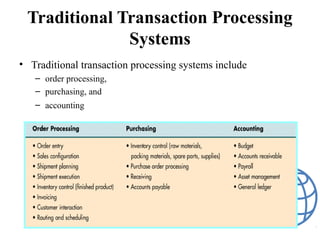
• Traditional transaction processing systems include
– order processing,
– purchasing, and
– accounting
• Order Processing Systems : Order processing systems
include order entry, sales configuration, shipment
planning, shipment execution, inventory control,
invoicing, customer interaction, and routing and
scheduling.
• Purchasing System : The purchasing transaction
processing system is used when an item (such as a chair
or software) is ordered to a supplier from a company. It
includes inventory control, purchase order processing,
receiving, and accounts payable.
• Accounting Systems : An accounting system includes
budget, accounts receivable, payroll, asset management,
general ledger
THANK YOU

Transaction processing system

  • 1.
  • 2.
    Introduction • A TransactionProcessing System (TPS) is a type of information system that collects, stores, modifies and retrieves the data transactions of an enterprise. Example : airline reservation systems, electronic transfer of funds, bank account processing systems. • Designed to process routine business transactions • Seeks time and cost efficiency by automating repetitive operations in large volumes.
  • 3.
    Objectives of TPS •Process data generated by and about transactions. • Maintain a high degree of accuracy. • Ensure data information integrity and accuracy. • Produce timely documents and reports. • Increase labour efficiency. • Help provide increased and enhanced efficiency. • To build and maintain customer loyalty.
  • 4.
    Components of aTransaction System • The User of the information system is the person belonging to the organization that owns the transaction system. • Participants are the people who conduct the information processing. • People from the environment become participants of the system as they directly enter transactions and perform validation.
  • 5.
    Types of TPS 1.Batch processing systems : • Batch processing is where the information is collected and stored as a batch but not processed immediately. • Batch processing is useful for enterprises that need to process large amounts of data using limited resources. • Example: Payment by cheque, Credit card transactions, etc.
  • 6.
    2. On-line transactionprocessing (OLTP) : • A system whereby each transaction is processed immediately, without the delay of accumulating transactions into a batch. • Examples :  Mostly in Online shopping Uses PCI cards (Payment Card Industry): PayPal or World Pay, We Pay, e-Way, ICEPAY, ATM’s.
  • 7.
    Batch and On-lineTransaction Processing System
  • 8.
    3. On-Line Entrywith Delayed Processing • This type of transaction is a compromise between the batch and on-line processing. • Orders or transactions are entered into the computer system when they occur, but they are not processed immediately. • Example: A typical mail order system in which orders are accumulated and then it is forwarded to a warehouse for shipment
  • 9.
    Transaction Processing Cycle Businessdata goes through a transaction processing cycle that includes: • Data Collection • Data Editing • Data Correction • Data Manipulation • Data Storage • Document Production
  • 10.
    • Data Collection –The process of capturing and gathering all data necessary to complete transactions is called data collection. – It can be manual such as completing a purchase order by hand. It can also be automated via special input device such as scanners and terminals. • Data Editing – An important step in processing data is to check for validity and completeness of data. Controls must be placed in the data-entry form. – For example, quantity and cost must be numeric and names must be alphabetic.
  • 11.
    • Data Correction –A data that is not entered properly needs to be entered correctly. – Data correction involves reentering incorrect data in the data entry point. – For example, a UPC code not found in the retail store checkout, is given a special code to complete the transaction for an item. • Data Manipulation – The process of performing calculations and other data transformations is termed data manipulation. – Examples are, sorting data, summarizing data, finding price of five items, calculating employee weekly pay, and so on.
  • 12.
    • Data Storage –Involves updating one or more database tables or files with new transactions. – For example, inserting new customer information, updating customer demographics, updating inventory transactions, creating new student registration, and so on. • Document Production – TPSs produce important business documents such as sales receipts, order entry list, customer list, invoices, purchase orders, inventory on- hand report, paychecks, and so on. – Documents can be hard copy paper report or displayed on computer screen.
  • 13.
    Traditional Transaction Processing Systems •Traditional transaction processing systems include – order processing, – purchasing, and – accounting
  • 14.
    • Order ProcessingSystems : Order processing systems include order entry, sales configuration, shipment planning, shipment execution, inventory control, invoicing, customer interaction, and routing and scheduling. • Purchasing System : The purchasing transaction processing system is used when an item (such as a chair or software) is ordered to a supplier from a company. It includes inventory control, purchase order processing, receiving, and accounts payable. • Accounting Systems : An accounting system includes budget, accounts receivable, payroll, asset management, general ledger
  • 15.