SERVICE MARKETING
Recommended Book:- Zeithaml, Bitner & Gremlar
PGDM (IIM Raipur)
Bakhresa FMCG (South Africa)
Relationship Manager (HDFC Bank)
MD- Shyam Hospital
Faculty(MBA)- GLA University, Mathura
Swarit Yadav
Topics to be covered
 Delivering service
 Role of communication in Service Marketing
 People and internal communication
 Process of operations and delivery of services
 Service recovery
 Role of technology in service marketing
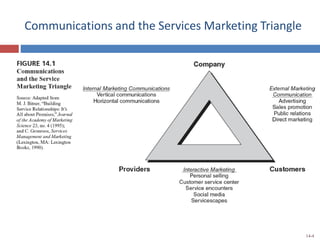
Communications and the Services Marketing Triangle
14-4
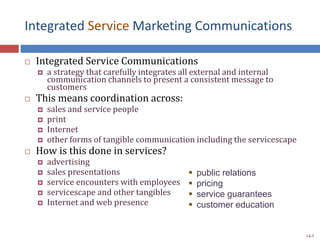
Integrated Service Marketing Communications
 Integrated Service Communications
 a strategy that carefully integrates all external and internal
communication channels to present a consistent message to
customers
 This means coordination across:
 sales and service people
 print
 Internet
 other forms of tangible communication including the servicescape
 How is this done in services?
 advertising
 sales presentations
 service encounters with employees
 servicescape and other tangibles
 Internet and web presence
 public relations
 pricing
 service guarantees
 customer education
14-5
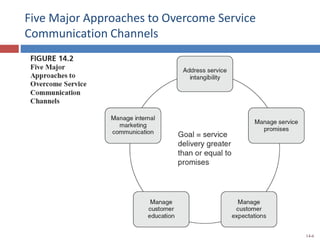
Five Major Approaches to Overcome Service
Communication Channels
14-6
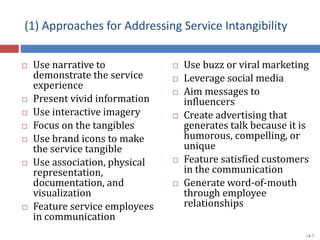
(1) Approaches for Addressing Service Intangibility
 Use narrative to
demonstrate the service
experience
 Present vivid information
 Use interactive imagery
 Focus on the tangibles
 Use brand icons to make
the service tangible
 Use association, physical
representation,
documentation, and
visualization
 Feature service employees
in communication
 Use buzz or viral marketing
 Leverage social media
 Aim messages to
influencers
 Create advertising that
generates talk because it is
humorous, compelling, or
unique
 Feature satisfied customers
in the communication
 Generate word-of-mouth
through employee
relationships
14-7
(2) Approaches for Managing Service Promises
 Create a strong service brand
 Coordinate external communication
14-8
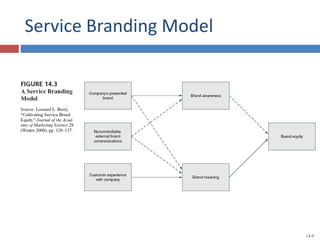
Service Branding Model
14-9
(3) Approaches for Managing Customer Expectations
 Make realistic promises
 Offer service guarantees
 Offer choices
 Create tiered-value service offerings
 Communicate the criteria and levels of service
effectiveness
14-10
(4) Approaches for Managing Customer Education
 Prepare customers for the service process
 Confirm performance to standards and
expectations
 Clarify expectations after the sale
14-11
(5) Approaches for Managing Internal Marketing
Communication
 Create effective vertical communications
 Create effective horizontal communications
 Sell the brand inside the company
 Create effective upward communication
 Align back-office and support personnel with
external customers through interaction or
measurement
 Create cross-functional teams
14-12
New Service Development
 Service Blueprinting
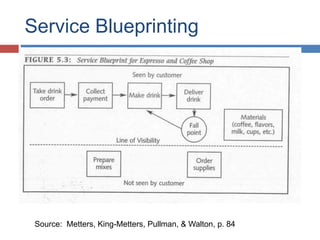
Focus on moments of truth
 Servicescapes
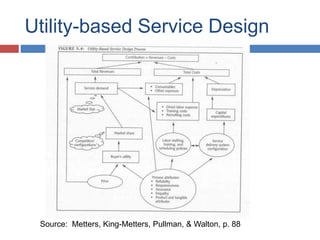
 Utility-based Service Design
Perceived utility to customer
 Relative importance of Dimensions of
Service Quality
Service Blueprinting
Source: Metters, King-Metters, Pullman, & Walton, p. 84
Utility-based Service Design
Source: Metters, King-Metters, Pullman, & Walton, p. 88
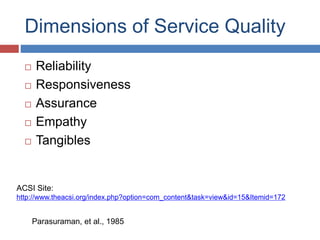
Dimensions of Service Quality
 Reliability
 Responsiveness
 Assurance
 Empathy
 Tangibles
Parasuraman, et al., 1985
ACSI Site:
http://www.theacsi.org/index.php?option=com_content&task=view&id=15&Itemid=172
Managing Service Experiences
 Customer Engagement
 Context
 Time
 Service Blueprinting
Focus on moments of truth
Front-office/Back-office
 Front-office work requires customer presence.
 Back-office work does not require customer
presence.
 Decoupling: separating work into high-
contact/low-contact jobs.
Ultimate = outsourcing/offshoring
Analyzing Processes
 Process flow diagrams (flow charts)
 Process communication
 Focusing mgt. attention on customer
 Determining what to work on
• Process Simulation
Service Recovery
 Measure the costs
 Listen closely for complaints
 Anticipate needs for recovery
 Act fast
 Train employees
 Empower front line
 Close the loop
Yield Management
Purpose is to sell the right capacity to the right
customer at the right price.
 Overbooking
 Differential pricing
 Capacity allocation
Waiting Time Management
 Waiting lines are pervasive in services
 The problem is important
 Lack of management intuition about waiting
lines
Reliability is Critical in Service
but…
 In all service contexts, service failure is inevitable.
 Service failure occurs when service performance
that falls below a customer’s expectations in such
a way that leads to customer dissatisfaction.
 Service recovery refers to the actions taken by a
firm in response to service failure.
7-23
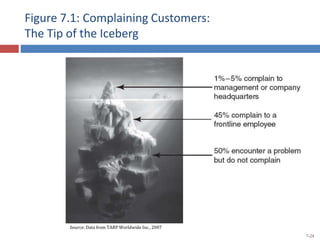
Figure 7.1: Complaining Customers:
The Tip of the Iceberg
Source: Data from TARP Worldwide Inc., 2007
7-24
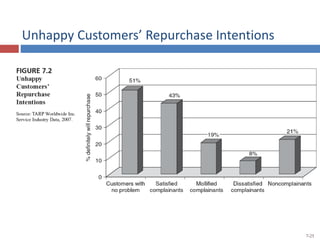
Unhappy Customers’ Repurchase Intentions
7-25
The Service Recovery Paradox
 Is a customer who has experienced a service
failure and exemplary service recovery more
likely to be more satisfied – impressed even –
with the service provider?
 Should a firm “screw up” just a little so that it
can “fix the problem” superbly?
7-26
The Service Recovery Paradox
 “A good recovery can turn angry, frustrated
customers into loyal ones. ..can, in fact, create
more goodwill than if things had gone smoothly in
the first place.” (Hart et al. 1990)
 HOWEVER:
 Only a small percent of customers complain
 Service recovery must be SUPERLATIVE
 Only with responsiveness, redress, and empathy/courtesy
 Only with tangible rewards
 Even though service recovery can improve satisfaction,
it has not been found to increase purchase intentions or
perceptions of the brand
 Service recovery is expensive
7-27
The Service Recovery Paradox
 The service recovery paradox is more likely to
occur when:
 The failure is not considered by the customer to be
severe
 The customer has not experienced prior failures with
the firm
 The cause of the failure is viewed as unstable by The
customer
 The customer perceives that the company had little
control over the cause of the failure
 Conditions must be just right in order for the
recovery paradox to be present!
7-28
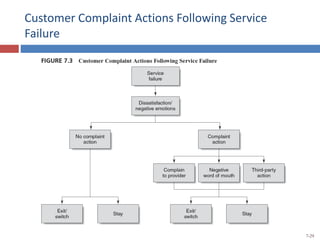
Customer Complaint Actions Following Service
Failure
7-29
Types of Complainers
 Passives: least likely to take any action, say
anything to the provider, spread negative WOM, or
complain to a third party; doubtful of the
effectiveness of complaining
 Voicers: actively complain to the provider, but not
likely to spread negative WOM; believe in the
positive consequences of complaining - the service
provider’s best friends!
7-30
Types of Complainers
 Irates: more likely to engage in negative WOM to
friends and relatives and to switch providers;
average in complaints to provider; unlikely to
complain to third parties; more angry, less likely
to give provider a second chance
 Activists: above average propensity to complain
on all levels; more likely to complain to a third
party; feel most alienated from the marketplace
compared to other groups; in extreme cases can
become “terrorists”
7-31
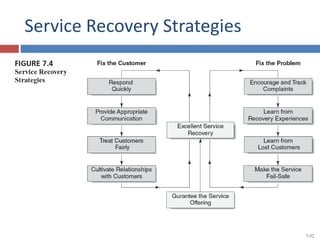
Service Recovery Strategies
7-32
Fixing the Customer
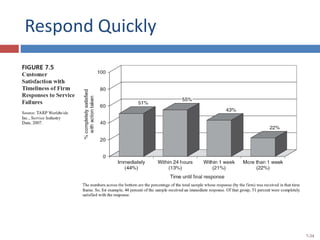
 When customers take the time to complain, they
generally have high expectations.
 They expect the company to respond quickly and to
be accountable.
 They expect to be compensated for their grief and
for the hassle of being inconvenienced.
 They expect to be treated nicely in the process!
7-33
Respond Quickly
7-34
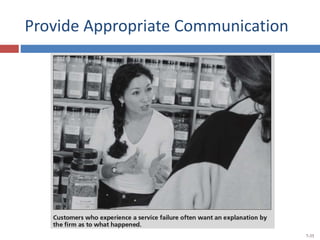
Provide Appropriate Communication
7-35
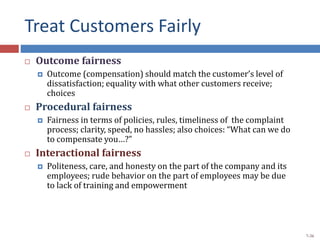
Treat Customers Fairly
 Outcome fairness
 Outcome (compensation) should match the customer’s level of
dissatisfaction; equality with what other customers receive;
choices
 Procedural fairness
 Fairness in terms of policies, rules, timeliness of the complaint
process; clarity, speed, no hassles; also choices: “What can we do
to compensate you…?”
 Interactional fairness
 Politeness, care, and honesty on the part of the company and its
employees; rude behavior on the part of employees may be due
to lack of training and empowerment
7-36
Fixing the Problem
 After “fixing the customer” the company should
address the actual problem that created the poor
service delivery in the first place.
 If the problem is likely to recur for other
customers, then the service delivery process may
need to be fixed, too.
 Strategies for fixing the problem include
encouraging and tracking complaints, learning
from recovery experiences and from lost
customers, and making the service fail-safe.
7-37
Service Guarantees
 Guarantee = an assurance of the fulfillment of a condition
(Webster’s Dictionary)
 In a business context, a guarantee is a pledge or assurance that
a product offered by a firm will perform as promised and, if not,
then some form of reparation will be undertaken by the firm
 For tangible products, a guarantee is often done in the form of a
warranty
 Services are often not guaranteed
 Cannot return the service
 Service experience is intangible (so what do you guarantee?)
7-38
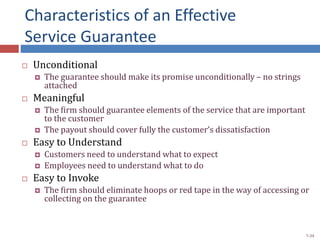
Characteristics of an Effective
Service Guarantee
 Unconditional
 The guarantee should make its promise unconditionally – no strings
attached
 Meaningful
 The firm should guarantee elements of the service that are important
to the customer
 The payout should cover fully the customer’s dissatisfaction
 Easy to Understand
 Customers need to understand what to expect
 Employees need to understand what to do
 Easy to Invoke
 The firm should eliminate hoops or red tape in the way of accessing or
collecting on the guarantee
7-39
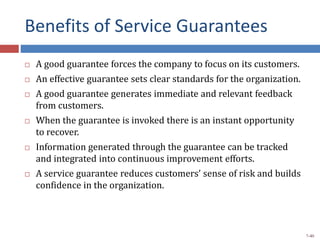
Benefits of Service Guarantees
 A good guarantee forces the company to focus on its customers.
 An effective guarantee sets clear standards for the organization.
 A good guarantee generates immediate and relevant feedback
from customers.
 When the guarantee is invoked there is an instant opportunity
to recover.
 Information generated through the guarantee can be tracked
and integrated into continuous improvement efforts.
 A service guarantee reduces customers’ sense of risk and builds
confidence in the organization.
7-40
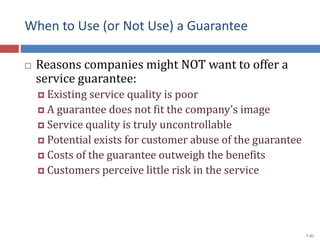
When to Use (or Not Use) a Guarantee
 Reasons companies might NOT want to offer a
service guarantee:
 Existing service quality is poor
 A guarantee does not fit the company’s image
 Service quality is truly uncontrollable
 Potential exists for customer abuse of the guarantee
 Costs of the guarantee outweigh the benefits
 Customers perceive little risk in the service
7-41
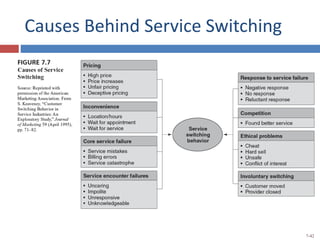
Causes Behind Service Switching
7-42
Service marketing4

Service marketing4

  • 1.
    SERVICE MARKETING Recommended Book:-Zeithaml, Bitner & Gremlar
  • 2.
    PGDM (IIM Raipur) BakhresaFMCG (South Africa) Relationship Manager (HDFC Bank) MD- Shyam Hospital Faculty(MBA)- GLA University, Mathura Swarit Yadav
  • 3.
    Topics to becovered  Delivering service  Role of communication in Service Marketing  People and internal communication  Process of operations and delivery of services  Service recovery  Role of technology in service marketing
  • 4.
    Communications and theServices Marketing Triangle 14-4
  • 5.
    Integrated Service MarketingCommunications  Integrated Service Communications  a strategy that carefully integrates all external and internal communication channels to present a consistent message to customers  This means coordination across:  sales and service people  print  Internet  other forms of tangible communication including the servicescape  How is this done in services?  advertising  sales presentations  service encounters with employees  servicescape and other tangibles  Internet and web presence  public relations  pricing  service guarantees  customer education 14-5
  • 6.
    Five Major Approachesto Overcome Service Communication Channels 14-6
  • 7.
    (1) Approaches forAddressing Service Intangibility  Use narrative to demonstrate the service experience  Present vivid information  Use interactive imagery  Focus on the tangibles  Use brand icons to make the service tangible  Use association, physical representation, documentation, and visualization  Feature service employees in communication  Use buzz or viral marketing  Leverage social media  Aim messages to influencers  Create advertising that generates talk because it is humorous, compelling, or unique  Feature satisfied customers in the communication  Generate word-of-mouth through employee relationships 14-7
  • 8.
    (2) Approaches forManaging Service Promises  Create a strong service brand  Coordinate external communication 14-8
  • 9.
  • 10.
    (3) Approaches forManaging Customer Expectations  Make realistic promises  Offer service guarantees  Offer choices  Create tiered-value service offerings  Communicate the criteria and levels of service effectiveness 14-10
  • 11.
    (4) Approaches forManaging Customer Education  Prepare customers for the service process  Confirm performance to standards and expectations  Clarify expectations after the sale 14-11
  • 12.
    (5) Approaches forManaging Internal Marketing Communication  Create effective vertical communications  Create effective horizontal communications  Sell the brand inside the company  Create effective upward communication  Align back-office and support personnel with external customers through interaction or measurement  Create cross-functional teams 14-12
  • 13.
    New Service Development Service Blueprinting Focus on moments of truth  Servicescapes  Utility-based Service Design Perceived utility to customer  Relative importance of Dimensions of Service Quality
  • 14.
    Service Blueprinting Source: Metters,King-Metters, Pullman, & Walton, p. 84
  • 15.
    Utility-based Service Design Source:Metters, King-Metters, Pullman, & Walton, p. 88
  • 16.
    Dimensions of ServiceQuality  Reliability  Responsiveness  Assurance  Empathy  Tangibles Parasuraman, et al., 1985 ACSI Site: http://www.theacsi.org/index.php?option=com_content&task=view&id=15&Itemid=172
  • 17.
    Managing Service Experiences Customer Engagement  Context  Time  Service Blueprinting Focus on moments of truth
  • 18.
    Front-office/Back-office  Front-office workrequires customer presence.  Back-office work does not require customer presence.  Decoupling: separating work into high- contact/low-contact jobs. Ultimate = outsourcing/offshoring
  • 19.
    Analyzing Processes  Processflow diagrams (flow charts)  Process communication  Focusing mgt. attention on customer  Determining what to work on • Process Simulation
  • 20.
    Service Recovery  Measurethe costs  Listen closely for complaints  Anticipate needs for recovery  Act fast  Train employees  Empower front line  Close the loop
  • 21.
    Yield Management Purpose isto sell the right capacity to the right customer at the right price.  Overbooking  Differential pricing  Capacity allocation
  • 22.
    Waiting Time Management Waiting lines are pervasive in services  The problem is important  Lack of management intuition about waiting lines
  • 23.
    Reliability is Criticalin Service but…  In all service contexts, service failure is inevitable.  Service failure occurs when service performance that falls below a customer’s expectations in such a way that leads to customer dissatisfaction.  Service recovery refers to the actions taken by a firm in response to service failure. 7-23
  • 24.
    Figure 7.1: ComplainingCustomers: The Tip of the Iceberg Source: Data from TARP Worldwide Inc., 2007 7-24
  • 25.
  • 26.
    The Service RecoveryParadox  Is a customer who has experienced a service failure and exemplary service recovery more likely to be more satisfied – impressed even – with the service provider?  Should a firm “screw up” just a little so that it can “fix the problem” superbly? 7-26
  • 27.
    The Service RecoveryParadox  “A good recovery can turn angry, frustrated customers into loyal ones. ..can, in fact, create more goodwill than if things had gone smoothly in the first place.” (Hart et al. 1990)  HOWEVER:  Only a small percent of customers complain  Service recovery must be SUPERLATIVE  Only with responsiveness, redress, and empathy/courtesy  Only with tangible rewards  Even though service recovery can improve satisfaction, it has not been found to increase purchase intentions or perceptions of the brand  Service recovery is expensive 7-27
  • 28.
    The Service RecoveryParadox  The service recovery paradox is more likely to occur when:  The failure is not considered by the customer to be severe  The customer has not experienced prior failures with the firm  The cause of the failure is viewed as unstable by The customer  The customer perceives that the company had little control over the cause of the failure  Conditions must be just right in order for the recovery paradox to be present! 7-28
  • 29.
    Customer Complaint ActionsFollowing Service Failure 7-29
  • 30.
    Types of Complainers Passives: least likely to take any action, say anything to the provider, spread negative WOM, or complain to a third party; doubtful of the effectiveness of complaining  Voicers: actively complain to the provider, but not likely to spread negative WOM; believe in the positive consequences of complaining - the service provider’s best friends! 7-30
  • 31.
    Types of Complainers Irates: more likely to engage in negative WOM to friends and relatives and to switch providers; average in complaints to provider; unlikely to complain to third parties; more angry, less likely to give provider a second chance  Activists: above average propensity to complain on all levels; more likely to complain to a third party; feel most alienated from the marketplace compared to other groups; in extreme cases can become “terrorists” 7-31
  • 32.
  • 33.
    Fixing the Customer When customers take the time to complain, they generally have high expectations.  They expect the company to respond quickly and to be accountable.  They expect to be compensated for their grief and for the hassle of being inconvenienced.  They expect to be treated nicely in the process! 7-33
  • 34.
  • 35.
  • 36.
    Treat Customers Fairly Outcome fairness  Outcome (compensation) should match the customer’s level of dissatisfaction; equality with what other customers receive; choices  Procedural fairness  Fairness in terms of policies, rules, timeliness of the complaint process; clarity, speed, no hassles; also choices: “What can we do to compensate you…?”  Interactional fairness  Politeness, care, and honesty on the part of the company and its employees; rude behavior on the part of employees may be due to lack of training and empowerment 7-36
  • 37.
    Fixing the Problem After “fixing the customer” the company should address the actual problem that created the poor service delivery in the first place.  If the problem is likely to recur for other customers, then the service delivery process may need to be fixed, too.  Strategies for fixing the problem include encouraging and tracking complaints, learning from recovery experiences and from lost customers, and making the service fail-safe. 7-37
  • 38.
    Service Guarantees  Guarantee= an assurance of the fulfillment of a condition (Webster’s Dictionary)  In a business context, a guarantee is a pledge or assurance that a product offered by a firm will perform as promised and, if not, then some form of reparation will be undertaken by the firm  For tangible products, a guarantee is often done in the form of a warranty  Services are often not guaranteed  Cannot return the service  Service experience is intangible (so what do you guarantee?) 7-38
  • 39.
    Characteristics of anEffective Service Guarantee  Unconditional  The guarantee should make its promise unconditionally – no strings attached  Meaningful  The firm should guarantee elements of the service that are important to the customer  The payout should cover fully the customer’s dissatisfaction  Easy to Understand  Customers need to understand what to expect  Employees need to understand what to do  Easy to Invoke  The firm should eliminate hoops or red tape in the way of accessing or collecting on the guarantee 7-39
  • 40.
    Benefits of ServiceGuarantees  A good guarantee forces the company to focus on its customers.  An effective guarantee sets clear standards for the organization.  A good guarantee generates immediate and relevant feedback from customers.  When the guarantee is invoked there is an instant opportunity to recover.  Information generated through the guarantee can be tracked and integrated into continuous improvement efforts.  A service guarantee reduces customers’ sense of risk and builds confidence in the organization. 7-40
  • 41.
    When to Use(or Not Use) a Guarantee  Reasons companies might NOT want to offer a service guarantee:  Existing service quality is poor  A guarantee does not fit the company’s image  Service quality is truly uncontrollable  Potential exists for customer abuse of the guarantee  Costs of the guarantee outweigh the benefits  Customers perceive little risk in the service 7-41
  • 42.
    Causes Behind ServiceSwitching 7-42