Customer Relationship Management (CRM)
Learning Objectives
Define CRM;
Understand the importance of CRM;
Explain the determinants of CRM and the key stages in its development;
Discuss the main functions and various models of CRM;
Explain the role of salespeople as relationship developers
Discuss the management of customer relationships.
By: Er. Vaibhav Agarwal
Asst. Prof.
BBDUEr. Vaibhav
What is Customer Relationship Management (CRM)?
CRM is “the development and maintenance of mutually beneficial
long-term relationships with strategically significant customers”
(Buttle, 2000)
CRM is “an IT enhanced value process, which identifies, develops,
integrates and focuses the various competencies of the firm to the
‘voice’ of the customer in order to deliver long-term superior
customer value, at a profit to well identified existing and potential
customers”.
(Plakoyiannaki and Tzokas, 2001)
Er. Vaibhav
Understanding Customer Relationship Management
(CRM)?
CRM is a business philosophy based on upon individual customers and customised products
and services supported by open lines of communication and feedback from the participating
firms that
mutually benefit both buying and selling organisations.
The buying and selling firms enter into a “learning relationship”, with the customer being
willing to collaborate with the seller and grow as a loyal customer. In return,, the seller works
to maximize
the value of the relationship for the customer’s benefit.
In short, CRM provides selling organisations with the platform to obtain a competitive
advantage by embracing customer needs and building value-driven long-term relationships.Er. Vaibhav
Determinants of CRM
Trust
The willingness to rely on the ability, integrity, and motivation of
one company to serve the needs of the other company as agreed
upon implicitly and explicitly.
Value
The ability of a selling organisation to satisfy the needs of the
customer at a comparatively lower cost or higher benefit than
that offered by competitors and measured in monetary,
temporal, functional and psychological terms.
Er. Vaibhav
Determinants of CRM
In addition to trust and value, salespeople must:
Understand customer needs and problems;
Meet their commitments;
Provide superior after sales support;
Make sure that the customer is always told the truth
(must be honest); and
Have a passionate interest in establishing and retaining a long-
term relationship (e.g., have long-term perspective).
Er. Vaibhav
Phases in the development of a Customer Relationship
The Pre-relationship Stage
The event that triggers a buyer to seek a new business partner.
The Early Stage
Experience is accumulated between the buyer and seller although a great
degree of uncertainty and distance exists.
The Development Stage
Increased levels of transactions lead to a higher degree of commitment and
the distance is reduced to a social exchange.
The Long-term Stage
Characterised by the companies’ mutual importance to each other.
The Final Stage
The interaction between the companies becomes institutionalized.
Er. Vaibhav
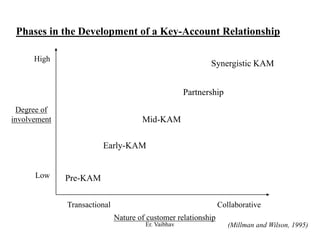
Phases in the Development of a Key-Account Relationship
Degree of
involvement
High
Low
Nature of customer relationship
Transactional Collaborative
Pre-KAM
Early-KAM
Mid-KAM
Partnership
Synergistic KAM
(Millman and Wilson, 1995)Er. Vaibhav
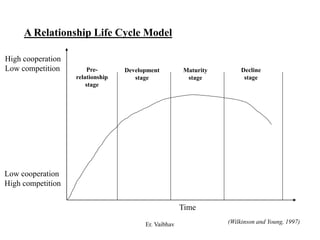
A Relationship Life Cycle Model
High cooperation
Low competition
Low cooperation
High competition
Time
Pre-
relationship
stage
Development
stage
Maturity
stage
Decline
stage
(Wilkinson and Young, 1997)Er. Vaibhav
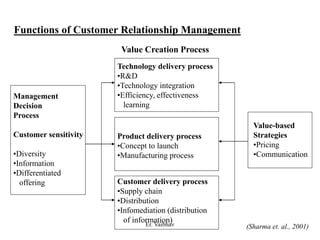
Functions of Customer Relationship Management
Direct functions (are the basic requirements of a company that are
necessary to survive in the competitive marketplace)
Profit;
Volume; and
Safeguard
Indirect functions (are the actions necessary to convince the
customer to participate in various marketing activities).
Innovation:
Market;
Scout: and
Access.
Er. Vaibhav
Functions of Customer Relationship Management
Management
Decision
Process
Customer sensitivity
•Diversity
•Information
•Differentiated
offering
Value Creation Process
Technology delivery process
•R&D
•Technology integration
•Efficiency, effectiveness
learning
Product delivery process
•Concept to launch
•Manufacturing process
Customer delivery process
•Supply chain
•Distribution
•Infomediation (distribution
of information)
Value-based
Strategies
•Pricing
•Communication
(Sharma et. al., 2001)Er. Vaibhav
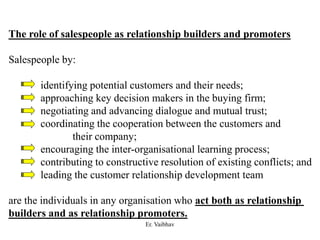
The role of salespeople as relationship builders and promoters
Salespeople by:
identifying potential customers and their needs;
approaching key decision makers in the buying firm;
negotiating and advancing dialogue and mutual trust;
coordinating the cooperation between the customers and
their company;
encouraging the inter-organisational learning process;
contributing to constructive resolution of existing conflicts; and
leading the customer relationship development team
are the individuals in any organisation who act both as relationship
builders and as relationship promoters.
Er. Vaibhav
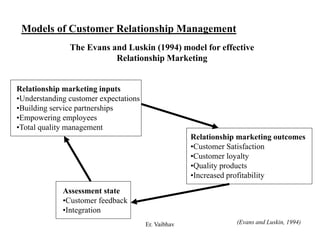
Models of Customer Relationship Management
The Evans and Luskin (1994) model for effective
Relationship Marketing
Relationship marketing inputs
•Understanding customer expectations
•Building service partnerships
•Empowering employees
•Total quality management
Relationship marketing outcomes
•Customer Satisfaction
•Customer loyalty
•Quality products
•Increased profitability
Assessment state
•Customer feedback
•Integration
(Evans and Luskin, 1994)Er. Vaibhav
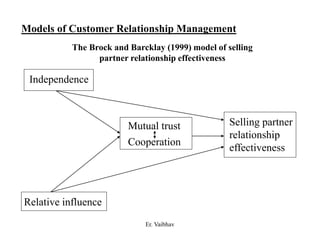
Models of Customer Relationship Management
The Brock and Barcklay (1999) model of selling
partner relationship effectiveness
Independence
Relative influence
Mutual trust
Cooperation
Selling partner
relationship
effectiveness
Er. Vaibhav
Managing Customer Relationships
The global salesperson must be involved in the following activities in order to initiate,
develop and enhance the process that is aimed at building trust and commitment with the
customer.
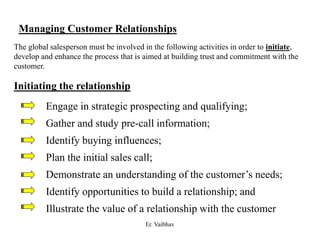
Initiating the relationship
Engage in strategic prospecting and qualifying;
Gather and study pre-call information;
Identify buying influences;
Plan the initial sales call;
Demonstrate an understanding of the customer’s needs;
Identify opportunities to build a relationship; and
Illustrate the value of a relationship with the customer
Er. Vaibhav
Managing Customer Relationships
The global salesperson must be involved in the following activities in order to initiate,
develop and enhance the process that is aimed at building trust and commitment with the
customer.
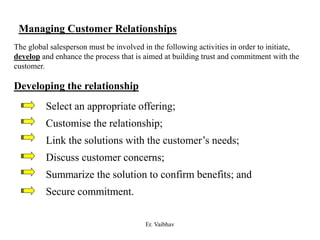
Developing the relationship
Select an appropriate offering;
Customise the relationship;
Link the solutions with the customer’s needs;
Discuss customer concerns;
Summarize the solution to confirm benefits; and
Secure commitment.
Er. Vaibhav
Managing Customer Relationships
The global salesperson must be involved in the following activities in order to initiate,
develop and enhance the process that is aimed at building trust and commitment with the
customer.
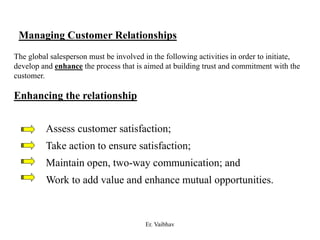
Enhancing the relationship
Assess customer satisfaction;
Take action to ensure satisfaction;
Maintain open, two-way communication; and
Work to add value and enhance mutual opportunities.
Er. Vaibhav
Managing Customer Relationships
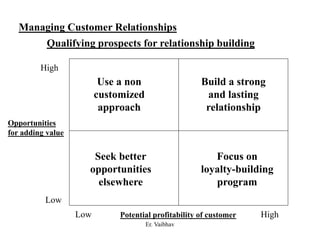
Qualifying prospects for relationship building
Opportunities
for adding value
Potential profitability of customer
High
Low
Low High
Use a non
customized
approach
Seek better
opportunities
elsewhere
Build a strong
and lasting
relationship
Focus on
loyalty-building
program
Er. Vaibhav
Relationship networks
The ultimate outcome of a successful CRM strategy is the creation
of a unique company asset known as a relationship network.
A relationship network consists of the company and its major
customers with whom the company has established long and
enduring business relationships.
The additional aspects of a global salesperson’s job are to:
Manage customer value;
Act as customer advocate; and
Enhance customer loyalty and build a “health” and
profitable network of relationships.
Er. Vaibhav
Summary
CRM is a new business philosophy based on trust and value;
The core function of CRM is the value creation process;
Customer relationships develop over time;
The role of global salespeople in the process is that of both
relationship builders and relationship promoters; and
The basic premise of CRM is to offer superior value to
customers in an effort to turn prospects into
customers, customers into loyal customers, and
loyal customers into partners.
Er. Vaibhav

Customer relationship Management

  • 1.
    Customer Relationship Management(CRM) Learning Objectives Define CRM; Understand the importance of CRM; Explain the determinants of CRM and the key stages in its development; Discuss the main functions and various models of CRM; Explain the role of salespeople as relationship developers Discuss the management of customer relationships. By: Er. Vaibhav Agarwal Asst. Prof. BBDUEr. Vaibhav
  • 2.
    What is CustomerRelationship Management (CRM)? CRM is “the development and maintenance of mutually beneficial long-term relationships with strategically significant customers” (Buttle, 2000) CRM is “an IT enhanced value process, which identifies, develops, integrates and focuses the various competencies of the firm to the ‘voice’ of the customer in order to deliver long-term superior customer value, at a profit to well identified existing and potential customers”. (Plakoyiannaki and Tzokas, 2001) Er. Vaibhav
  • 3.
    Understanding Customer RelationshipManagement (CRM)? CRM is a business philosophy based on upon individual customers and customised products and services supported by open lines of communication and feedback from the participating firms that mutually benefit both buying and selling organisations. The buying and selling firms enter into a “learning relationship”, with the customer being willing to collaborate with the seller and grow as a loyal customer. In return,, the seller works to maximize the value of the relationship for the customer’s benefit. In short, CRM provides selling organisations with the platform to obtain a competitive advantage by embracing customer needs and building value-driven long-term relationships.Er. Vaibhav
  • 4.
    Determinants of CRM Trust Thewillingness to rely on the ability, integrity, and motivation of one company to serve the needs of the other company as agreed upon implicitly and explicitly. Value The ability of a selling organisation to satisfy the needs of the customer at a comparatively lower cost or higher benefit than that offered by competitors and measured in monetary, temporal, functional and psychological terms. Er. Vaibhav
  • 5.
    Determinants of CRM Inaddition to trust and value, salespeople must: Understand customer needs and problems; Meet their commitments; Provide superior after sales support; Make sure that the customer is always told the truth (must be honest); and Have a passionate interest in establishing and retaining a long- term relationship (e.g., have long-term perspective). Er. Vaibhav
  • 6.
    Phases in thedevelopment of a Customer Relationship The Pre-relationship Stage The event that triggers a buyer to seek a new business partner. The Early Stage Experience is accumulated between the buyer and seller although a great degree of uncertainty and distance exists. The Development Stage Increased levels of transactions lead to a higher degree of commitment and the distance is reduced to a social exchange. The Long-term Stage Characterised by the companies’ mutual importance to each other. The Final Stage The interaction between the companies becomes institutionalized. Er. Vaibhav
  • 7.
    Phases in theDevelopment of a Key-Account Relationship Degree of involvement High Low Nature of customer relationship Transactional Collaborative Pre-KAM Early-KAM Mid-KAM Partnership Synergistic KAM (Millman and Wilson, 1995)Er. Vaibhav
  • 8.
    A Relationship LifeCycle Model High cooperation Low competition Low cooperation High competition Time Pre- relationship stage Development stage Maturity stage Decline stage (Wilkinson and Young, 1997)Er. Vaibhav
  • 9.
    Functions of CustomerRelationship Management Direct functions (are the basic requirements of a company that are necessary to survive in the competitive marketplace) Profit; Volume; and Safeguard Indirect functions (are the actions necessary to convince the customer to participate in various marketing activities). Innovation: Market; Scout: and Access. Er. Vaibhav
  • 10.
    Functions of CustomerRelationship Management Management Decision Process Customer sensitivity •Diversity •Information •Differentiated offering Value Creation Process Technology delivery process •R&D •Technology integration •Efficiency, effectiveness learning Product delivery process •Concept to launch •Manufacturing process Customer delivery process •Supply chain •Distribution •Infomediation (distribution of information) Value-based Strategies •Pricing •Communication (Sharma et. al., 2001)Er. Vaibhav
  • 11.
    The role ofsalespeople as relationship builders and promoters Salespeople by: identifying potential customers and their needs; approaching key decision makers in the buying firm; negotiating and advancing dialogue and mutual trust; coordinating the cooperation between the customers and their company; encouraging the inter-organisational learning process; contributing to constructive resolution of existing conflicts; and leading the customer relationship development team are the individuals in any organisation who act both as relationship builders and as relationship promoters. Er. Vaibhav
  • 12.
    Models of CustomerRelationship Management The Evans and Luskin (1994) model for effective Relationship Marketing Relationship marketing inputs •Understanding customer expectations •Building service partnerships •Empowering employees •Total quality management Relationship marketing outcomes •Customer Satisfaction •Customer loyalty •Quality products •Increased profitability Assessment state •Customer feedback •Integration (Evans and Luskin, 1994)Er. Vaibhav
  • 13.
    Models of CustomerRelationship Management The Brock and Barcklay (1999) model of selling partner relationship effectiveness Independence Relative influence Mutual trust Cooperation Selling partner relationship effectiveness Er. Vaibhav
  • 14.
    Managing Customer Relationships Theglobal salesperson must be involved in the following activities in order to initiate, develop and enhance the process that is aimed at building trust and commitment with the customer. Initiating the relationship Engage in strategic prospecting and qualifying; Gather and study pre-call information; Identify buying influences; Plan the initial sales call; Demonstrate an understanding of the customer’s needs; Identify opportunities to build a relationship; and Illustrate the value of a relationship with the customer Er. Vaibhav
  • 15.
    Managing Customer Relationships Theglobal salesperson must be involved in the following activities in order to initiate, develop and enhance the process that is aimed at building trust and commitment with the customer. Developing the relationship Select an appropriate offering; Customise the relationship; Link the solutions with the customer’s needs; Discuss customer concerns; Summarize the solution to confirm benefits; and Secure commitment. Er. Vaibhav
  • 16.
    Managing Customer Relationships Theglobal salesperson must be involved in the following activities in order to initiate, develop and enhance the process that is aimed at building trust and commitment with the customer. Enhancing the relationship Assess customer satisfaction; Take action to ensure satisfaction; Maintain open, two-way communication; and Work to add value and enhance mutual opportunities. Er. Vaibhav
  • 17.
    Managing Customer Relationships Qualifyingprospects for relationship building Opportunities for adding value Potential profitability of customer High Low Low High Use a non customized approach Seek better opportunities elsewhere Build a strong and lasting relationship Focus on loyalty-building program Er. Vaibhav
  • 18.
    Relationship networks The ultimateoutcome of a successful CRM strategy is the creation of a unique company asset known as a relationship network. A relationship network consists of the company and its major customers with whom the company has established long and enduring business relationships. The additional aspects of a global salesperson’s job are to: Manage customer value; Act as customer advocate; and Enhance customer loyalty and build a “health” and profitable network of relationships. Er. Vaibhav
  • 19.
    Summary CRM is anew business philosophy based on trust and value; The core function of CRM is the value creation process; Customer relationships develop over time; The role of global salespeople in the process is that of both relationship builders and relationship promoters; and The basic premise of CRM is to offer superior value to customers in an effort to turn prospects into customers, customers into loyal customers, and loyal customers into partners. Er. Vaibhav