What is Customer Relationship Management (CRM)? CRM is “the development and maintenance of  mutually beneficial   long-term  relationships with  strategically significant customers ” CRM is “an  IT enhanced value process , which identifies, develops, integrates and focuses the various competencies of the firm to the ‘ voice’ of the customer  in order to deliver  long-term superior customer value , at a profit to  well identified existing and potential customers ”.
CRM is a  business philosophy  based on upon individual customers  and customised products and services supported by  open lines  of communication and feedback  from the participating firms that  mutually benefit both buying and selling organisations . The buying and selling firms enter into a  “learning relationship ”,  with the customer being willing to collaborate with the seller and  grow as a  loyal customer . In return,, the seller works to  maximize  the value of the relationship for the customer’s benefit . In short, CRM provides selling organisations with the platform  to obtain a  competitive advantage  by embracing customer needs  and building  value-driven long-term relationships .
Chapter 15: Customer Relationship Management (CRM) Functions of Customer Relationship Management Direct functions  (are the basic requirements of a company that are  necessary to survive in the competitive marketplace) Profit;  Volume; and  Safeguard Indirect functions  (are the actions necessary to convince the  customer to participate in various marketing activities). Innovation:  Market;  Scout: and  Access.
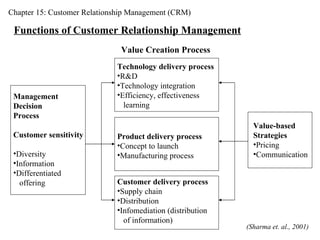
Chapter 15: Customer Relationship Management (CRM) Functions of Customer Relationship Management Management  Decision Process Customer sensitivity Diversity Information Differentiated  offering Value Creation Process Technology delivery process R&D Technology integration Efficiency, effectiveness learning Product delivery process Concept to launch Manufacturing process Customer delivery process Supply chain Distribution Infomediation (distribution of information) Value-based Strategies Pricing Communication (Sharma et. al., 2001)
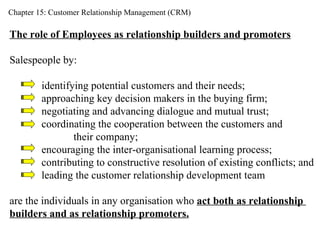
Chapter 15: Customer Relationship Management (CRM) The role of Employees as relationship builders and promoters Salespeople by: identifying potential customers and their needs; approaching key decision makers in the buying firm; negotiating and advancing dialogue and mutual trust; coordinating the cooperation between the customers and  their company; encouraging the inter-organisational learning process;  contributing to constructive resolution of existing conflicts; and leading the customer relationship development team are the individuals in any organisation who  act both as relationship  builders and as relationship promoters.
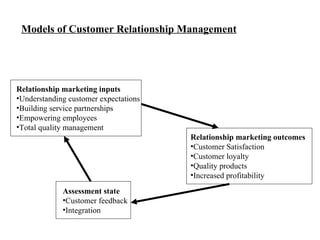
Models of Customer Relationship Management Relationship marketing inputs Understanding customer expectations Building service partnerships Empowering employees Total quality management Relationship marketing outcomes Customer Satisfaction Customer loyalty Quality products Increased profitability Assessment state Customer feedback Integration
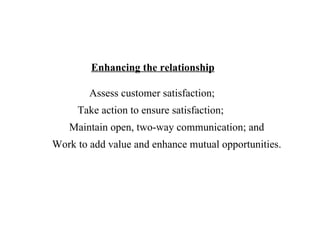
Enhancing the relationship Assess customer satisfaction; Take action to ensure satisfaction; Maintain open, two-way communication; and Work to add value and enhance mutual opportunities.
Relationship networks The ultimate outcome of a successful CRM strategy is the creation of a unique company asset known as a relationship network. A  relationship network  consists of the company and its major  customers with whom the company has established long and  enduring business relationships. The additional aspects of a global salesperson’s job are to:
Summary in a nutshell CRM is a new business philosophy based on trust and value The core function of CRM is the value creation process; Customer relationships develop over time

Presentation Explaining Crm

  • 1.
    What is CustomerRelationship Management (CRM)? CRM is “the development and maintenance of mutually beneficial long-term relationships with strategically significant customers ” CRM is “an IT enhanced value process , which identifies, develops, integrates and focuses the various competencies of the firm to the ‘ voice’ of the customer in order to deliver long-term superior customer value , at a profit to well identified existing and potential customers ”.
  • 2.
    CRM is a business philosophy based on upon individual customers and customised products and services supported by open lines of communication and feedback from the participating firms that mutually benefit both buying and selling organisations . The buying and selling firms enter into a “learning relationship ”, with the customer being willing to collaborate with the seller and grow as a loyal customer . In return,, the seller works to maximize the value of the relationship for the customer’s benefit . In short, CRM provides selling organisations with the platform to obtain a competitive advantage by embracing customer needs and building value-driven long-term relationships .
  • 3.
    Chapter 15: CustomerRelationship Management (CRM) Functions of Customer Relationship Management Direct functions (are the basic requirements of a company that are necessary to survive in the competitive marketplace) Profit; Volume; and Safeguard Indirect functions (are the actions necessary to convince the customer to participate in various marketing activities). Innovation: Market; Scout: and Access.
  • 4.
    Chapter 15: CustomerRelationship Management (CRM) Functions of Customer Relationship Management Management Decision Process Customer sensitivity Diversity Information Differentiated offering Value Creation Process Technology delivery process R&D Technology integration Efficiency, effectiveness learning Product delivery process Concept to launch Manufacturing process Customer delivery process Supply chain Distribution Infomediation (distribution of information) Value-based Strategies Pricing Communication (Sharma et. al., 2001)
  • 5.
    Chapter 15: CustomerRelationship Management (CRM) The role of Employees as relationship builders and promoters Salespeople by: identifying potential customers and their needs; approaching key decision makers in the buying firm; negotiating and advancing dialogue and mutual trust; coordinating the cooperation between the customers and their company; encouraging the inter-organisational learning process; contributing to constructive resolution of existing conflicts; and leading the customer relationship development team are the individuals in any organisation who act both as relationship builders and as relationship promoters.
  • 6.
    Models of CustomerRelationship Management Relationship marketing inputs Understanding customer expectations Building service partnerships Empowering employees Total quality management Relationship marketing outcomes Customer Satisfaction Customer loyalty Quality products Increased profitability Assessment state Customer feedback Integration
  • 7.
    Enhancing the relationshipAssess customer satisfaction; Take action to ensure satisfaction; Maintain open, two-way communication; and Work to add value and enhance mutual opportunities.
  • 8.
    Relationship networks Theultimate outcome of a successful CRM strategy is the creation of a unique company asset known as a relationship network. A relationship network consists of the company and its major customers with whom the company has established long and enduring business relationships. The additional aspects of a global salesperson’s job are to:
  • 9.
    Summary in anutshell CRM is a new business philosophy based on trust and value The core function of CRM is the value creation process; Customer relationships develop over time