Post- harvest processing
of cocoons
1) Stifling:
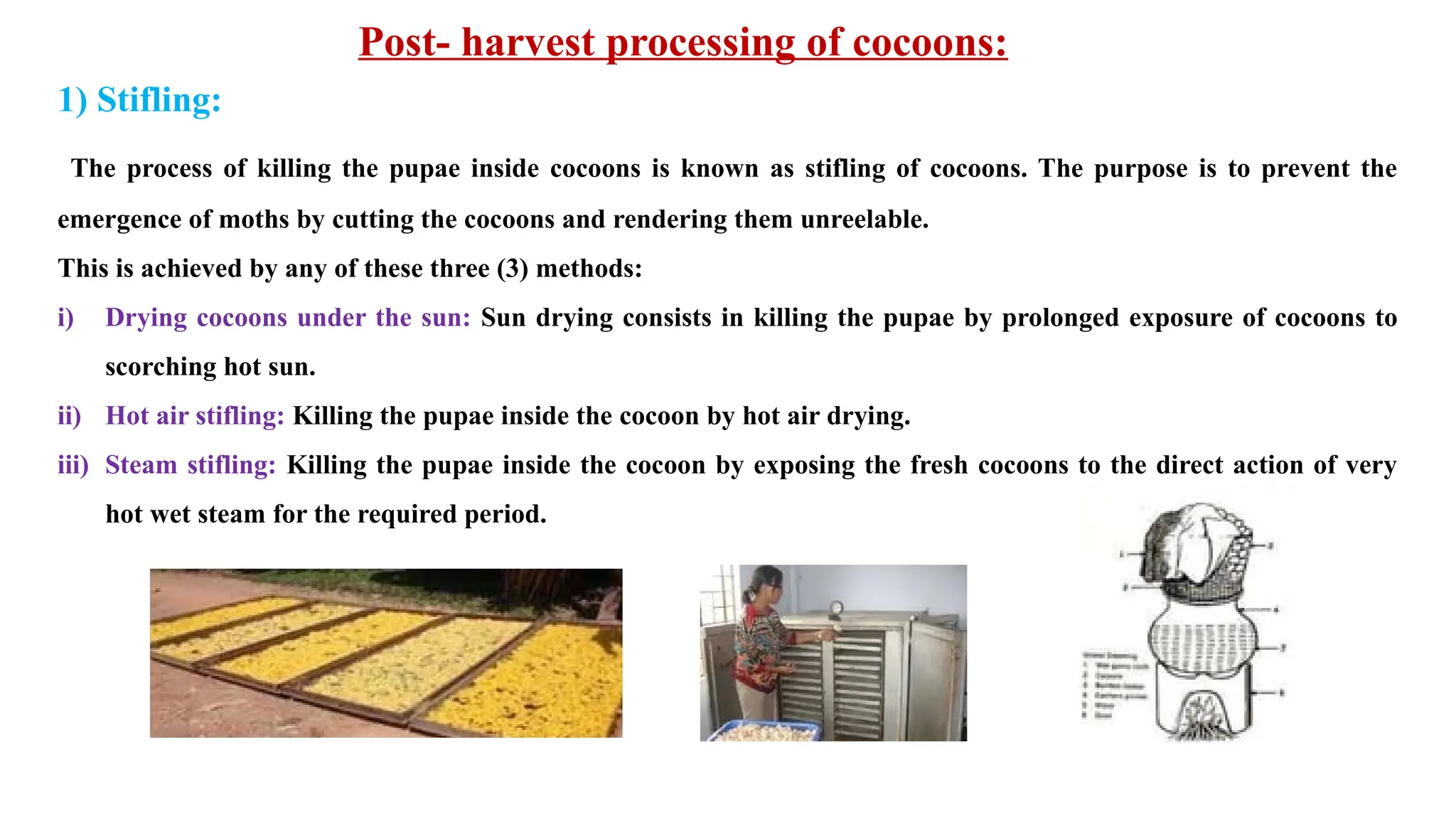
The process of killing the pupae inside cocoons is known as stifling of cocoons. The purpose is to prevent the
emergence of moths by cutting the cocoons and rendering them unreelable.
This is achieved by any of these three (3) methods:
i) Drying cocoons under the sun: Sun drying consists in killing the pupae by prolonged exposure of cocoons to
scorching hot sun.
ii) Hot air stifling: Killing the pupae inside the cocoon by hot air drying.
iii) Steam stifling: Killing the pupae inside the cocoon by exposing the fresh cocoons to the direct action of very
hot wet steam for the required period.
Post- harvest processing of cocoons:
2) Cocoons boiling:
By dissolving the gum-like protective serecin that keeps the thread's winding segments together, this is
done to make the cocoon thread.
3) Brushing:
Brushing is done for seeking the free end of the silk filament (Brin) in the cocoon. It could be achieved manually or
mechanically operated brushes.
4) Reeling:
This is the process of unwinding the silk thread or brins from the cocoons, combing the required number of brins
to produce silk filaments of a required thickness and gathering the same on standard reels.
Three types of reeling method of India-
i) Country charkha
ii) Cottage basin
iii) Multi-end reeling
5) Re-reeling:
The raw silk is first reeled on small reels, allowed to properly dry up on them and re-reeled on large reels.
Purpose of re-reeling: Direct reeling on large reels leads to insufficient drying which causes production of hard
gum spots on the threads.
6) Finishing:
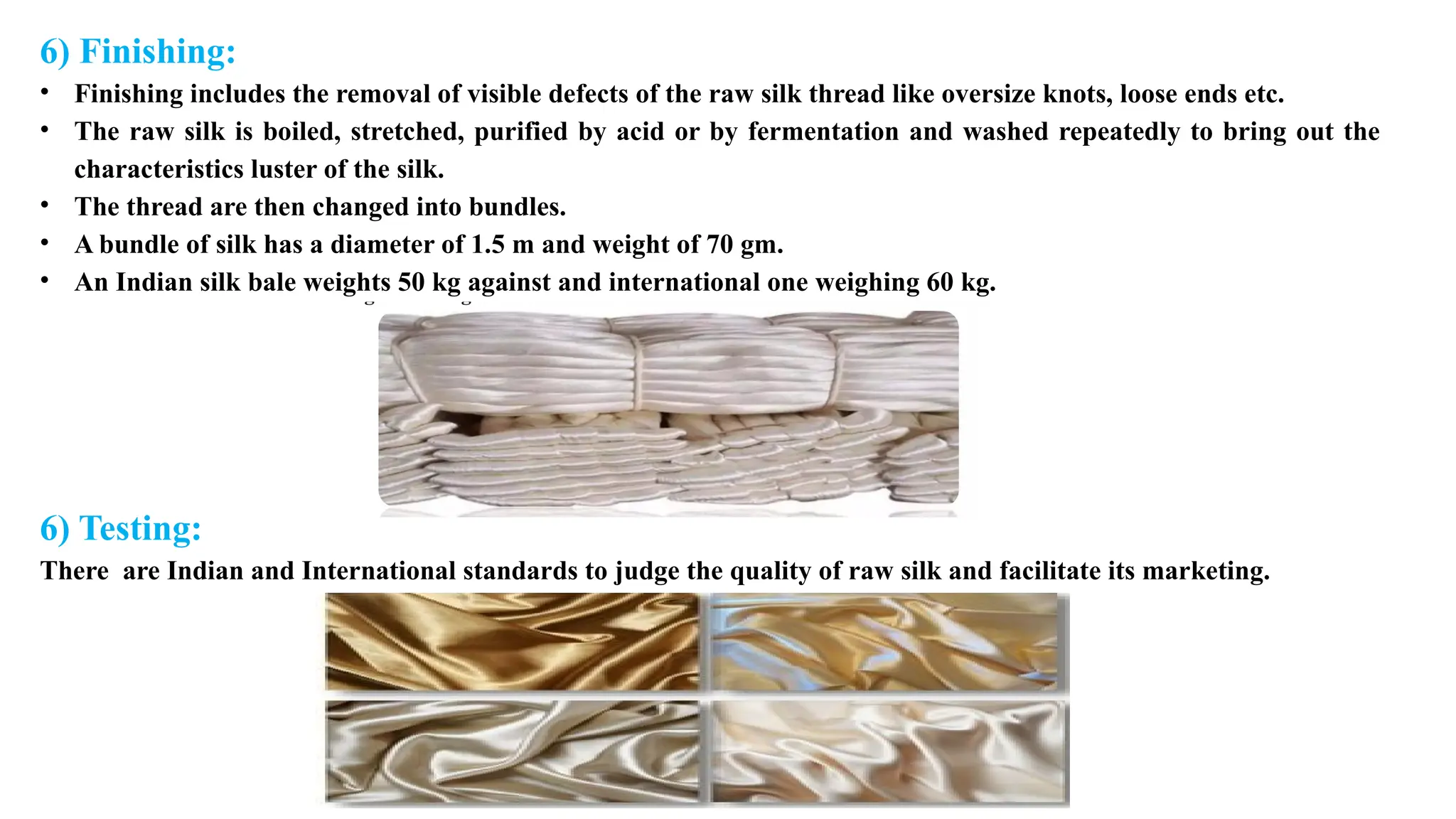
• Finishing includes the removal of visible defects of the raw silk thread like oversize knots, loose ends etc.
• The raw silk is boiled, stretched, purified by acid or by fermentation and washed repeatedly to bring out the
characteristics luster of the silk.
• The thread are then changed into bundles.
• A bundle of silk has a diameter of 1.5 m and weight of 70 gm.
• An Indian silk bale weights 50 kg against and international one weighing 60 kg.
6) Testing:
There are Indian and International standards to judge the quality of raw silk and facilitate its marketing.
Insect pests and diseases
of silkworm
1. Indian Uzi fly: Exorista bombycis (Tachnidae: Diptera)
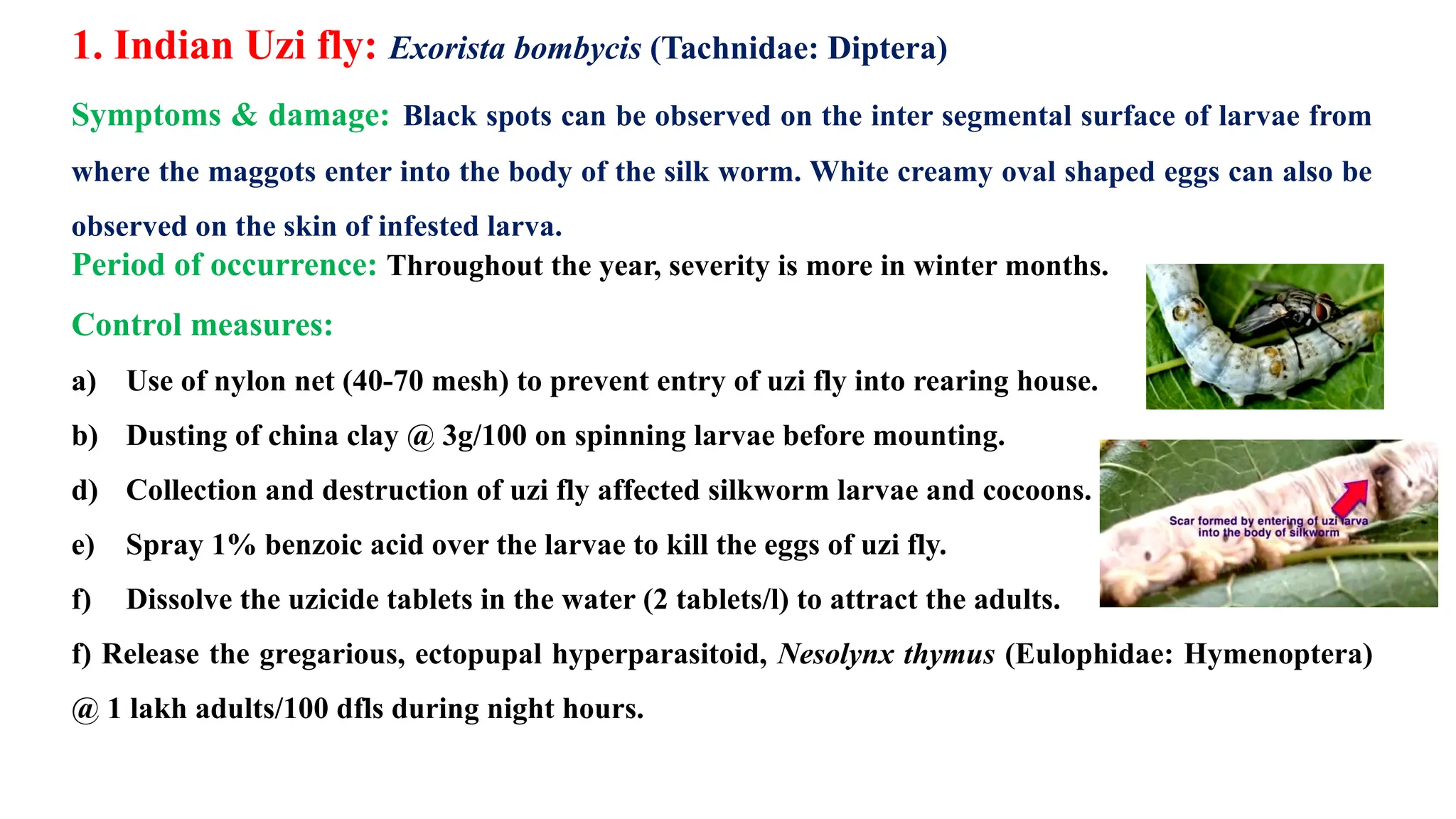
Symptoms & damage: Black spots can be observed on the inter segmental surface of larvae from
where the maggots enter into the body of the silk worm. White creamy oval shaped eggs can also be
observed on the skin of infested larva.
Period of occurrence: Throughout the year, severity is more in winter months.
Control measures:
a) Use of nylon net (40-70 mesh) to prevent entry of uzi fly into rearing house.
b) Dusting of china clay @ 3g/100 on spinning larvae before mounting.
d) Collection and destruction of uzi fly affected silkworm larvae and cocoons.
e) Spray 1% benzoic acid over the larvae to kill the eggs of uzi fly.
f) Dissolve the uzicide tablets in the water (2 tablets/l) to attract the adults.
f) Release the gregarious, ectopupal hyperparasitoid, Nesolynx thymus (Eulophidae: Hymenoptera)
@ 1 lakh adults/100 dfls during night hours.
2. Beetles: Dermestes cadverinus,. (Dermestidae: Coleoptera)
 Adults and grubs of this dermestid beetle and other dermestid beetles are attracted to smell of
the cocoons.
 The stored cocoons after stifling are mostly infested by the grubs of dermestid beetles. They
make hole and feed on the pupae inside.
 The female lay eggs in the crevices, organic matter and wooden boards.
Control measures:
Cleaning of rearing house and cocoon store room.
 Do not store rejected cocoons and perished eggs for long time.
Fumigate the dried cocoon storage rooms with Methyl bromide @ 0.5 kg/283 m2
for a day.
3. Ants: Different types of ants (Hymenopteran)
Management: Use ant wells (water + kerosene) at the base of rearing stands and kerosene oil at the
handles of the mountages at the time of spinning.
4. Lizards, birds, rats and squirrels: These feeds on silkworms
Management: Rearing rooms should be kept free from lizards. Setting of traps for rat and squirrel
control. Scaring of birds from the vicinity.
DISEASES OF SILKWORMS
1. Muscardine (Fungal disease):
Causative agent: White Muscardine is caused by a fungus Beauveria bassiana and the Green
Muscardine is caused by a fungus Metarrhizium anisopliae, Brown Muscardine is caused by a fungus
Aspergillus falvus
Symptoms:
Presence of oily specks on body, Infected larvae lose appetite and become sluggish, After death,
larvae become mummified and gets hardened. Then, Mycelial cluster are seen on the dead
silkworm body. This disease is not passed on to the eggs from moths, as the infected silkworms
cannot survive to the moth stage. This fungus can spread to other insects.
Control:
• Disinfection of room/equipment with 2% formalin / 5% bleaching powder.
• Avoid low temperature and high humidity in the rearing room
• Keep the rearing bed thin and dry
• Early diagnosis and rejection of infected lots
2. Grasserie disease (Polyhedrosis)
Causative agent: Nuclear polyhedrosis Virus
Symptom:
 The larvae will be sluggish with swollen inter-segmantal region
 Integument of diseased larvae will be fragile and breaks easily.
 Milky fluid containing many polyhedral inclusion bodies oozes out from the larval body
 The diseases larvae appear to be restless and do not settle for moult
 The dead larvae hanged by hind legs head downward
Control:
• Sun drying of rearing appliances for one/two days
• Disinfection of rearing room and appliances with 5% bleaching powder
• Disinfection of worms, trays and discarding of diseased worms
• Provide proper bed spacing and ensure proper ventilation and air circulation
• Feed the larvae with nutritious mulberry leaves
• Collect and burn infected larvae, faecal matter and bed refuses
• Early diagnosis and rejection of infected lots
• Spray 1% of extract of Psoralea coryleifolia on mulberry leaves, shade dry and feed worms once
during third instars.
3. Pebrine disease (Protozoa: Nosema bombycis):
Causative agent: Protozoa, Nosema bombycis. Pebrine disease is also known as Pepper disease or
corpuscle disease.
Symptoms: Stage susceptible to infection (All stages Egg to Adult)
Eggs: Poor sticking, laying of unfertilized and dead eggs
Larva: Spotted and wrinkled skin, sluggish, poor appetite
Pupa: Swollen darken body
Adult: Scale less patches, unstrched wings, swollen abdomen and poor egg laying..
Control:
• Produce healthy eggs and disinfection of rearing room and equipments
• Maintain hygienic conditions during rearing
• Surface disinfect with 2% formalin for 10 minutes before incubation.
• Collect and burn the diseased eggs, larvae, pupae and moths, bed refuses, faecal pellets, etc.
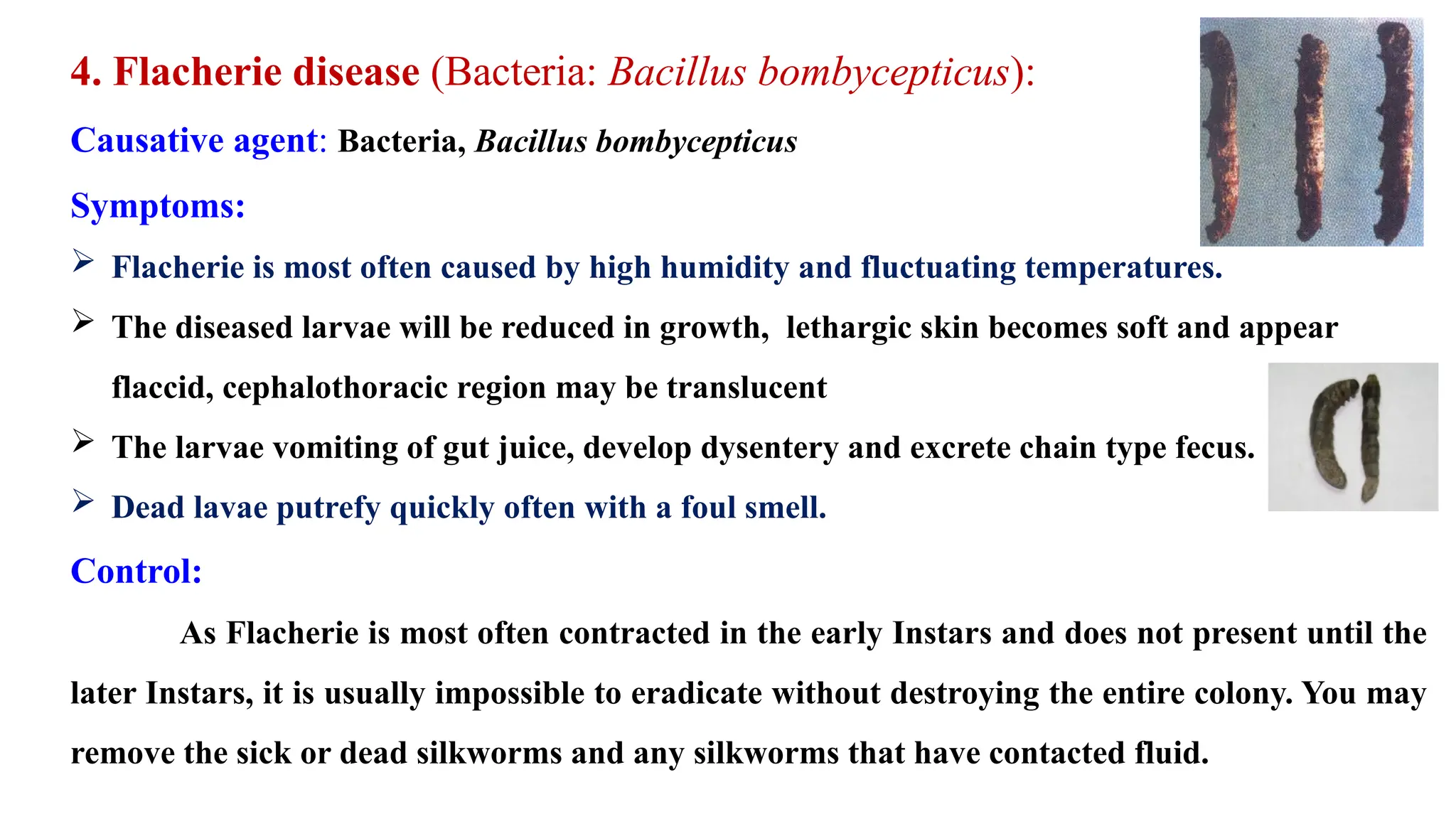
4. Flacherie disease (Bacteria: Bacillus bombycepticus):
Causative agent: Bacteria, Bacillus bombycepticus
Symptoms:
 Flacherie is most often caused by high humidity and fluctuating temperatures.
 The diseased larvae will be reduced in growth, lethargic skin becomes soft and appear
flaccid, cephalothoracic region may be translucent
 The larvae vomiting of gut juice, develop dysentery and excrete chain type fecus.
 Dead lavae putrefy quickly often with a foul smell.
Control:
As Flacherie is most often contracted in the early Instars and does not present until the
later Instars, it is usually impossible to eradicate without destroying the entire colony. You may
remove the sick or dead silkworms and any silkworms that have contacted fluid.
Sericulture Research Institute in India
1. Central Sericultural Research and Training Institute (CSRTI), Mysore, Karnataka,
established in the year 1943 is a research institute unit of Indian Silk Board under Ministry of
Textiles, Govt. of India.
2. Central Sericultural Research and Training Institute (CSRTI), Berhampore, West Bengal
3. Central Sericulture Research and Training Institute (CSRTI), Pampore, Jammu & Kashmir.
4. Central Tasar Research and Training Institute (CTRTI), Ranchi, Jharkhand established in
the year 1964 under the aegis of Central Silk Board under Ministry of Textiles, Govt. of India to
provide Research & development support to tropical and temperate tasar, a tribal based rural
microenterprise in the country.

Sericulture- post harvest of cocoon.pptx

  • 1.
  • 2.
    1) Stifling: The processof killing the pupae inside cocoons is known as stifling of cocoons. The purpose is to prevent the emergence of moths by cutting the cocoons and rendering them unreelable. This is achieved by any of these three (3) methods: i) Drying cocoons under the sun: Sun drying consists in killing the pupae by prolonged exposure of cocoons to scorching hot sun. ii) Hot air stifling: Killing the pupae inside the cocoon by hot air drying. iii) Steam stifling: Killing the pupae inside the cocoon by exposing the fresh cocoons to the direct action of very hot wet steam for the required period. Post- harvest processing of cocoons:
  • 3.
    2) Cocoons boiling: Bydissolving the gum-like protective serecin that keeps the thread's winding segments together, this is done to make the cocoon thread. 3) Brushing: Brushing is done for seeking the free end of the silk filament (Brin) in the cocoon. It could be achieved manually or mechanically operated brushes.
  • 4.
    4) Reeling: This isthe process of unwinding the silk thread or brins from the cocoons, combing the required number of brins to produce silk filaments of a required thickness and gathering the same on standard reels. Three types of reeling method of India- i) Country charkha ii) Cottage basin iii) Multi-end reeling 5) Re-reeling: The raw silk is first reeled on small reels, allowed to properly dry up on them and re-reeled on large reels. Purpose of re-reeling: Direct reeling on large reels leads to insufficient drying which causes production of hard gum spots on the threads.
  • 5.
    6) Finishing: • Finishingincludes the removal of visible defects of the raw silk thread like oversize knots, loose ends etc. • The raw silk is boiled, stretched, purified by acid or by fermentation and washed repeatedly to bring out the characteristics luster of the silk. • The thread are then changed into bundles. • A bundle of silk has a diameter of 1.5 m and weight of 70 gm. • An Indian silk bale weights 50 kg against and international one weighing 60 kg. 6) Testing: There are Indian and International standards to judge the quality of raw silk and facilitate its marketing.
  • 6.
    Insect pests anddiseases of silkworm
  • 7.
    1. Indian Uzifly: Exorista bombycis (Tachnidae: Diptera) Symptoms & damage: Black spots can be observed on the inter segmental surface of larvae from where the maggots enter into the body of the silk worm. White creamy oval shaped eggs can also be observed on the skin of infested larva. Period of occurrence: Throughout the year, severity is more in winter months. Control measures: a) Use of nylon net (40-70 mesh) to prevent entry of uzi fly into rearing house. b) Dusting of china clay @ 3g/100 on spinning larvae before mounting. d) Collection and destruction of uzi fly affected silkworm larvae and cocoons. e) Spray 1% benzoic acid over the larvae to kill the eggs of uzi fly. f) Dissolve the uzicide tablets in the water (2 tablets/l) to attract the adults. f) Release the gregarious, ectopupal hyperparasitoid, Nesolynx thymus (Eulophidae: Hymenoptera) @ 1 lakh adults/100 dfls during night hours.
  • 8.
    2. Beetles: Dermestescadverinus,. (Dermestidae: Coleoptera)  Adults and grubs of this dermestid beetle and other dermestid beetles are attracted to smell of the cocoons.  The stored cocoons after stifling are mostly infested by the grubs of dermestid beetles. They make hole and feed on the pupae inside.  The female lay eggs in the crevices, organic matter and wooden boards. Control measures: Cleaning of rearing house and cocoon store room.  Do not store rejected cocoons and perished eggs for long time. Fumigate the dried cocoon storage rooms with Methyl bromide @ 0.5 kg/283 m2 for a day. 3. Ants: Different types of ants (Hymenopteran) Management: Use ant wells (water + kerosene) at the base of rearing stands and kerosene oil at the handles of the mountages at the time of spinning. 4. Lizards, birds, rats and squirrels: These feeds on silkworms Management: Rearing rooms should be kept free from lizards. Setting of traps for rat and squirrel control. Scaring of birds from the vicinity.
  • 9.
    DISEASES OF SILKWORMS 1.Muscardine (Fungal disease): Causative agent: White Muscardine is caused by a fungus Beauveria bassiana and the Green Muscardine is caused by a fungus Metarrhizium anisopliae, Brown Muscardine is caused by a fungus Aspergillus falvus Symptoms: Presence of oily specks on body, Infected larvae lose appetite and become sluggish, After death, larvae become mummified and gets hardened. Then, Mycelial cluster are seen on the dead silkworm body. This disease is not passed on to the eggs from moths, as the infected silkworms cannot survive to the moth stage. This fungus can spread to other insects. Control: • Disinfection of room/equipment with 2% formalin / 5% bleaching powder. • Avoid low temperature and high humidity in the rearing room • Keep the rearing bed thin and dry • Early diagnosis and rejection of infected lots
  • 10.
    2. Grasserie disease(Polyhedrosis) Causative agent: Nuclear polyhedrosis Virus Symptom:  The larvae will be sluggish with swollen inter-segmantal region  Integument of diseased larvae will be fragile and breaks easily.  Milky fluid containing many polyhedral inclusion bodies oozes out from the larval body  The diseases larvae appear to be restless and do not settle for moult  The dead larvae hanged by hind legs head downward Control: • Sun drying of rearing appliances for one/two days • Disinfection of rearing room and appliances with 5% bleaching powder • Disinfection of worms, trays and discarding of diseased worms • Provide proper bed spacing and ensure proper ventilation and air circulation • Feed the larvae with nutritious mulberry leaves • Collect and burn infected larvae, faecal matter and bed refuses • Early diagnosis and rejection of infected lots • Spray 1% of extract of Psoralea coryleifolia on mulberry leaves, shade dry and feed worms once during third instars.
  • 11.
    3. Pebrine disease(Protozoa: Nosema bombycis): Causative agent: Protozoa, Nosema bombycis. Pebrine disease is also known as Pepper disease or corpuscle disease. Symptoms: Stage susceptible to infection (All stages Egg to Adult) Eggs: Poor sticking, laying of unfertilized and dead eggs Larva: Spotted and wrinkled skin, sluggish, poor appetite Pupa: Swollen darken body Adult: Scale less patches, unstrched wings, swollen abdomen and poor egg laying.. Control: • Produce healthy eggs and disinfection of rearing room and equipments • Maintain hygienic conditions during rearing • Surface disinfect with 2% formalin for 10 minutes before incubation. • Collect and burn the diseased eggs, larvae, pupae and moths, bed refuses, faecal pellets, etc.
  • 12.
    4. Flacherie disease(Bacteria: Bacillus bombycepticus): Causative agent: Bacteria, Bacillus bombycepticus Symptoms:  Flacherie is most often caused by high humidity and fluctuating temperatures.  The diseased larvae will be reduced in growth, lethargic skin becomes soft and appear flaccid, cephalothoracic region may be translucent  The larvae vomiting of gut juice, develop dysentery and excrete chain type fecus.  Dead lavae putrefy quickly often with a foul smell. Control: As Flacherie is most often contracted in the early Instars and does not present until the later Instars, it is usually impossible to eradicate without destroying the entire colony. You may remove the sick or dead silkworms and any silkworms that have contacted fluid.
  • 13.
    Sericulture Research Institutein India 1. Central Sericultural Research and Training Institute (CSRTI), Mysore, Karnataka, established in the year 1943 is a research institute unit of Indian Silk Board under Ministry of Textiles, Govt. of India. 2. Central Sericultural Research and Training Institute (CSRTI), Berhampore, West Bengal 3. Central Sericulture Research and Training Institute (CSRTI), Pampore, Jammu & Kashmir. 4. Central Tasar Research and Training Institute (CTRTI), Ranchi, Jharkhand established in the year 1964 under the aegis of Central Silk Board under Ministry of Textiles, Govt. of India to provide Research & development support to tropical and temperate tasar, a tribal based rural microenterprise in the country.