SILKWORM REARING
(BLPI-003)
Resource Person:
Dr. K.Kamatchi
Assistant Professor of Zoology
Vivekananda College,
Tiruvedakam West, Madurai
IGNOU - Academic Counsellor
Code: GYYPK2432J/001
Vivekananda College, Tiruvedakam West
IGNOU - Study Centre - 43016
Sericulture
History of the sericulture
Central Silk Board and other organizations
Morphology and anatomy of silkworm
Morphology of mulberry plant
Diseases and pests of mulberry.
Diseases and pests of silkworm
Mulberry cultivation
Rearing Facilities
Rearing Appliances
Rearing Operations
Rearing Methods
Cocoon Qualities
Silk Reeling
Silk Twisting
Silk Weaving
Dyeing
Printing
Synopsis
• Introduction
• Rearing Facilities
• Rearing House
• Rearing Appliances
• Disinfection
• Rearing Operations
• Brushing
• Feeding
• Bed Cleaning
• Spacing
• Care during moulting
• Mounting of mature worms for spinning
• Harvesting of cocoons
REARING FACILITIES
• Rearing House:
• Silkworm is domesticated animal.
• It cannot tolerate seasonal fluctuations.
• It need an ideal rearing house.
• It has separate rooms for storing leaves
• Keeping rearing appliances.
• Rearing house must be brick-walled
• Roof – non conductor of heat-RCC roof
• Cement –plastered
• Not in water logged area
• North-south orientation
• Provision of broad verandah
• Planting shady trees
• Double door system
Rearing Appliances
• Rural based agro industry
• Appliances – cheap and locally available
• It differ from place to place
• CSB devising novel rearing appliances
• Appliances used for keeping the worms
being reared.
• Rearing Stand
• Rearing Trays
• Ant wells
• Paraffin Paper
• Chop Sticks
• Feathers
Rearing Stand:
• Locally available wood or bamboo.
• Height 2.5m
• Length 1.5m
• Width 0.65m
• 10-20 cross bars
Rearing Trays:
• Bamboo or plastic trays
• 138 cm diameter
• 6.5 cm depth
Ant Wells:
• Placed below the legs of rearing stand
• Prevent ants – crawling up
• Water poured
• CSR&TI give –Raksha rekha
• Chalk line – base of stand.
Paraffin Paper:
• Thick craft paper – paraffin wax coat
• Prevent evaporation of moisture
• Maintain high humidity
• Polythene sheets
• Dried banana leaves
Chop Sticks:
• Thin sticks of bamboo – 20 cm.
• Used like a forceps
• Picking worms
• Particularly diseased worms
Feather:
• Bird feathers
• White ones – preferable
• Brushing newly hatched larvae
• Spread the young worms.
Appliances used for feeding:
• Leaf basket
• Leaf chamber
• Chopping board
• Chopping knife
• Mats
• Feeding stand
Leaf Basket:
• Bamboo baskets – convenient size
• Collecting and transporting the leaves
Leaf Chamber:
• Store harvested leaves.
• Wet gunny cloth is placed.
• Water sprinkled periodically on cloth
• To keep leaves fresh.
Chopping board:
• Rectangular board
• Soft wood
• Used to cutting of leaves.
Chopping knife:
• Broad and sharp blade
• Cut without any splits
Mats:
• Below the chopping board
• Collect cut leaves.
• Clean paper may used.
Appliances used to support the
spinning larvae:
• Cocoonage or Mountage:
• Determine both quality and quantity of good cocoons.
• Weeds, straw and dry twigs
• Provide convenient space
• Not promote the formation of double cocoons
• Malformed cocoons and flimsy cocoons.
• Provision for drying of liquid excreta
• Easy mounting and harvesting
• Cheap, durable, easy to handle
• Occupy less space, allow free flow of air.
Chandrika:
• Bamboo spiral mountage – south india
• West Bengal and other parts of india
• 1.8m x 1.2m
• 4 – 5 cm width
• 1000 worms can be mount.
Types of Mountages:
• Screen type mountage
• Plastic mountage
• Polymer mountage
• Japanese low cost mountage
Japanese low cost mountage
Rearing Operations:
• Disinfection
• Brushing
• Maintenance of optimum temperature and humidity in the
rearing bed
• Feeding
• Bed cleaning
• Spacing
• Care during moulting
• Mounting of mature worms for spinning
• Harvesting of cocoons.
Disinfection:
• It must be effective against the pathogens.
• Application must be simple, easy and take minimum time.
• Harmless to man and domestic animals.
• Cheap and easily available.
• Physical methods
• Chemical methods
Physical methods:
• Sun drying
• Disinfection by steaming
• Disinfection by Hot Air
Sun Drying:
• Expose the appliances to direct sun light
• Cheap method
• Suitable only for tropics
• Cannot suitable for temperate
• Also in winter and rainy seasons
• Some appliances damaged
Disinfection by Steaming:
• Good sterilizing agent
• Disinfecting the rearing room
• Initial cost is high
• Harmful to bamboo and wood.
Disinfection by Hot Air:
• It is a good sterilizing method
Chemical methods:
• Disinfectant may be solid, liquid, gas
• It should have a broad spectrum activity
• non- toxic to man and animals.
• Have a capacity to avoid combination with organic matter
• Non-corroding and non-standing over the equipment and
surface
• Readily mix with water
• Have detergent property
• No offensive odour
• Available readily in large quantities at a fair price.
Disinfectants are:
• Chlorine
• Iodine
• Phenol
• Quaternary Ammonium Compounds
• Formaldehyde
• Spraying with 2% Formalin
• Spraying of Bleaching powder
• Fumigating with formaldehyde gas
Brushing:
• Hatching – Photoperiodic response
• Sunshine in the early morning – noon
• Newly hatched larvae – black and bristly
• Ants
• Process of separating them – egg shell
• Transferring to rearing bed
• Best time – 10 a.m.
• Unhatched eggs – return to black box
• Brushed the next day
Brushing from loose eggs in egg
boxes:
• 75% of eggs – blue egg stage
• Cover of box removed
• Thin muslin cloth or fine meshed net placed above
• Small amount of fresh, chopped mulberry leaves spread over
the net
• Larvae crawled up
• Feather method
• Husk method
• Cloth/paper/net method
Maintenance of Optimum
Conditions for Rearing:
• Productivity and Profitability depends upon healthy and
hygienic rearing.
• Giving quality leaves
• Optimum environmental conditions
• Temperature
• Humidity
Temperature:
Larval age Temperature
I instar 26 - 28°C
II instar 26 - 28°C
III instar 24 - 26°C
IV instar 24 - 26°C
V instar 23 - 24°C
Humidity:
Triple role
1. Affects growth of larvae and quality of
cocoons
2. Quality of leaves
3. Induces diseases
Larval age Humidity optimum
I instar 85%
II instar 85%
III instar 80%
IV instar 75%
V instar 70%
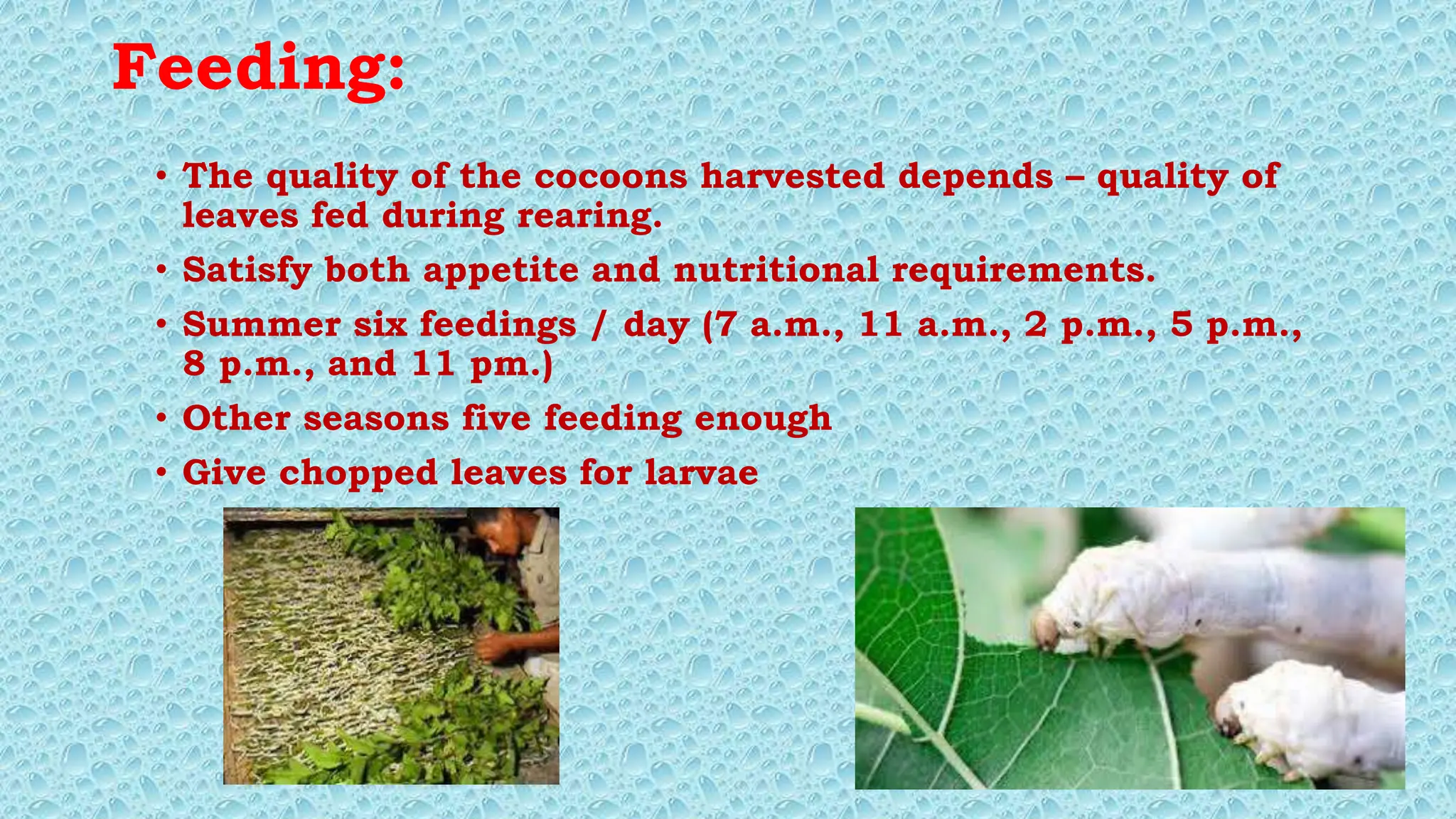
Feeding:
• The quality of the cocoons harvested depends – quality of
leaves fed during rearing.
• Satisfy both appetite and nutritional requirements.
• Summer six feedings / day (7 a.m., 11 a.m., 2 p.m., 5 p.m.,
8 p.m., and 11 pm.)
• Other seasons five feeding enough
• Give chopped leaves for larvae
Bed cleaning:
• In the rearing tray after feeding the unconsumed leaves and
the feacal matter of the larvae to be removed by this
method.
• Clean with husk
• Clean with net
• Combined net and husk method
Spacing:
• Silkworm developed rapidly from age to age.
• Increase several times their original weight and size.
• 15 times – hatching – I instar
• 4 to 5 times – II and III instar
• 25 times – IV and V instar
• Total increase in weight from hatching – V instar 7,000 -
10,000 times.
• So rearing space has to be extended
Moulting:
• Moulting occurs four times during the larval life.
• Sensitive period lasting for 15-30 hours.
• During this time worm does not feed
• Wriggles out of old skin and come out of new and soft skin.
• Bed should be dry.
• Pre-moult – worms shining body with a dark small sized
head and move to the periphery of bed.
• Moult – stop feeding.
• Post moult – large head, loose and less shiny skin – more
appetite.
Mounting:
• It is the final and most busy operation
• V instar larva attaining full growth.
• Let is for spinning – select suitable place
• Ripe worm
• Translucent colour
• Stop feeding – move to the edge of the bed.
• They transfer to the mountages.
Methods of Mounting:
• Hand Picking:
• Ripe worms are picked one by one by hand
• Collected in a tray and transferred to mountages
• Some worm to be injured
• More labours
• Worms uniformly distributed in mountages.
• Injured and diseased worms removed.
• Simultaneous mounting
• Net method
• Branch method
• Free mounting
Process of Spinning:
• Mature larva passes out its last excreta
• After emptying its gut, it secretes first silk droplet
• It is hardens and sticks on the mountage.
• Anchorage spot.
• Sericin – secreted by silk gland.
• 1.5 cm/ second.
Harvesting:
• Aim of the silkworm rearing is to harvest the cocoons
produced and sell them to the reeling agencies.
• Time of harvest – 3-4th day of mounting
• Early harvest injured the pupa.
• Late harvest – the moth emerge and pierced the cocoon.
• Cocoons are harvested by hand
• Remove faccal pellets on them
• Sorted size, defective cocoons

silkwormrearing-220628071406-72ff0a67 (1).pdf

  • 1.
    SILKWORM REARING (BLPI-003) Resource Person: Dr.K.Kamatchi Assistant Professor of Zoology Vivekananda College, Tiruvedakam West, Madurai IGNOU - Academic Counsellor Code: GYYPK2432J/001 Vivekananda College, Tiruvedakam West IGNOU - Study Centre - 43016
  • 2.
    Sericulture History of thesericulture Central Silk Board and other organizations Morphology and anatomy of silkworm Morphology of mulberry plant Diseases and pests of mulberry. Diseases and pests of silkworm Mulberry cultivation Rearing Facilities Rearing Appliances Rearing Operations Rearing Methods Cocoon Qualities Silk Reeling Silk Twisting Silk Weaving Dyeing Printing
  • 3.
    Synopsis • Introduction • RearingFacilities • Rearing House • Rearing Appliances • Disinfection • Rearing Operations • Brushing • Feeding • Bed Cleaning • Spacing • Care during moulting • Mounting of mature worms for spinning • Harvesting of cocoons
  • 4.
    REARING FACILITIES • RearingHouse: • Silkworm is domesticated animal. • It cannot tolerate seasonal fluctuations. • It need an ideal rearing house. • It has separate rooms for storing leaves • Keeping rearing appliances. • Rearing house must be brick-walled • Roof – non conductor of heat-RCC roof • Cement –plastered • Not in water logged area • North-south orientation • Provision of broad verandah • Planting shady trees • Double door system
  • 5.
    Rearing Appliances • Ruralbased agro industry • Appliances – cheap and locally available • It differ from place to place • CSB devising novel rearing appliances
  • 6.
    • Appliances usedfor keeping the worms being reared. • Rearing Stand • Rearing Trays • Ant wells • Paraffin Paper • Chop Sticks • Feathers
  • 7.
    Rearing Stand: • Locallyavailable wood or bamboo. • Height 2.5m • Length 1.5m • Width 0.65m • 10-20 cross bars
  • 8.
    Rearing Trays: • Bambooor plastic trays • 138 cm diameter • 6.5 cm depth
  • 9.
    Ant Wells: • Placedbelow the legs of rearing stand • Prevent ants – crawling up • Water poured • CSR&TI give –Raksha rekha • Chalk line – base of stand.
  • 10.
    Paraffin Paper: • Thickcraft paper – paraffin wax coat • Prevent evaporation of moisture • Maintain high humidity • Polythene sheets • Dried banana leaves
  • 11.
    Chop Sticks: • Thinsticks of bamboo – 20 cm. • Used like a forceps • Picking worms • Particularly diseased worms
  • 12.
    Feather: • Bird feathers •White ones – preferable • Brushing newly hatched larvae • Spread the young worms.
  • 13.
    Appliances used forfeeding: • Leaf basket • Leaf chamber • Chopping board • Chopping knife • Mats • Feeding stand
  • 14.
    Leaf Basket: • Bamboobaskets – convenient size • Collecting and transporting the leaves
  • 15.
    Leaf Chamber: • Storeharvested leaves. • Wet gunny cloth is placed. • Water sprinkled periodically on cloth • To keep leaves fresh.
  • 16.
    Chopping board: • Rectangularboard • Soft wood • Used to cutting of leaves.
  • 17.
    Chopping knife: • Broadand sharp blade • Cut without any splits
  • 18.
    Mats: • Below thechopping board • Collect cut leaves. • Clean paper may used.
  • 19.
    Appliances used tosupport the spinning larvae: • Cocoonage or Mountage: • Determine both quality and quantity of good cocoons. • Weeds, straw and dry twigs • Provide convenient space • Not promote the formation of double cocoons • Malformed cocoons and flimsy cocoons. • Provision for drying of liquid excreta • Easy mounting and harvesting • Cheap, durable, easy to handle • Occupy less space, allow free flow of air.
  • 20.
    Chandrika: • Bamboo spiralmountage – south india • West Bengal and other parts of india • 1.8m x 1.2m • 4 – 5 cm width • 1000 worms can be mount.
  • 21.
    Types of Mountages: •Screen type mountage • Plastic mountage • Polymer mountage • Japanese low cost mountage
  • 22.
  • 23.
    Rearing Operations: • Disinfection •Brushing • Maintenance of optimum temperature and humidity in the rearing bed • Feeding • Bed cleaning • Spacing • Care during moulting • Mounting of mature worms for spinning • Harvesting of cocoons.
  • 24.
    Disinfection: • It mustbe effective against the pathogens. • Application must be simple, easy and take minimum time. • Harmless to man and domestic animals. • Cheap and easily available. • Physical methods • Chemical methods
  • 25.
    Physical methods: • Sundrying • Disinfection by steaming • Disinfection by Hot Air
  • 26.
    Sun Drying: • Exposethe appliances to direct sun light • Cheap method • Suitable only for tropics • Cannot suitable for temperate • Also in winter and rainy seasons • Some appliances damaged
  • 27.
    Disinfection by Steaming: •Good sterilizing agent • Disinfecting the rearing room • Initial cost is high • Harmful to bamboo and wood.
  • 28.
    Disinfection by HotAir: • It is a good sterilizing method
  • 29.
    Chemical methods: • Disinfectantmay be solid, liquid, gas • It should have a broad spectrum activity • non- toxic to man and animals. • Have a capacity to avoid combination with organic matter • Non-corroding and non-standing over the equipment and surface • Readily mix with water • Have detergent property • No offensive odour • Available readily in large quantities at a fair price.
  • 30.
    Disinfectants are: • Chlorine •Iodine • Phenol • Quaternary Ammonium Compounds • Formaldehyde • Spraying with 2% Formalin • Spraying of Bleaching powder • Fumigating with formaldehyde gas
  • 31.
    Brushing: • Hatching –Photoperiodic response • Sunshine in the early morning – noon • Newly hatched larvae – black and bristly • Ants • Process of separating them – egg shell • Transferring to rearing bed • Best time – 10 a.m. • Unhatched eggs – return to black box • Brushed the next day
  • 32.
    Brushing from looseeggs in egg boxes: • 75% of eggs – blue egg stage • Cover of box removed • Thin muslin cloth or fine meshed net placed above • Small amount of fresh, chopped mulberry leaves spread over the net • Larvae crawled up • Feather method • Husk method • Cloth/paper/net method
  • 33.
    Maintenance of Optimum Conditionsfor Rearing: • Productivity and Profitability depends upon healthy and hygienic rearing. • Giving quality leaves • Optimum environmental conditions • Temperature • Humidity
  • 34.
    Temperature: Larval age Temperature Iinstar 26 - 28°C II instar 26 - 28°C III instar 24 - 26°C IV instar 24 - 26°C V instar 23 - 24°C
  • 35.
    Humidity: Triple role 1. Affectsgrowth of larvae and quality of cocoons 2. Quality of leaves 3. Induces diseases Larval age Humidity optimum I instar 85% II instar 85% III instar 80% IV instar 75% V instar 70%
  • 36.
    Feeding: • The qualityof the cocoons harvested depends – quality of leaves fed during rearing. • Satisfy both appetite and nutritional requirements. • Summer six feedings / day (7 a.m., 11 a.m., 2 p.m., 5 p.m., 8 p.m., and 11 pm.) • Other seasons five feeding enough • Give chopped leaves for larvae
  • 37.
    Bed cleaning: • Inthe rearing tray after feeding the unconsumed leaves and the feacal matter of the larvae to be removed by this method. • Clean with husk • Clean with net • Combined net and husk method
  • 38.
    Spacing: • Silkworm developedrapidly from age to age. • Increase several times their original weight and size. • 15 times – hatching – I instar • 4 to 5 times – II and III instar • 25 times – IV and V instar • Total increase in weight from hatching – V instar 7,000 - 10,000 times. • So rearing space has to be extended
  • 39.
    Moulting: • Moulting occursfour times during the larval life. • Sensitive period lasting for 15-30 hours. • During this time worm does not feed • Wriggles out of old skin and come out of new and soft skin. • Bed should be dry. • Pre-moult – worms shining body with a dark small sized head and move to the periphery of bed. • Moult – stop feeding. • Post moult – large head, loose and less shiny skin – more appetite.
  • 40.
    Mounting: • It isthe final and most busy operation • V instar larva attaining full growth. • Let is for spinning – select suitable place • Ripe worm • Translucent colour • Stop feeding – move to the edge of the bed. • They transfer to the mountages.
  • 41.
    Methods of Mounting: •Hand Picking: • Ripe worms are picked one by one by hand • Collected in a tray and transferred to mountages • Some worm to be injured • More labours • Worms uniformly distributed in mountages. • Injured and diseased worms removed. • Simultaneous mounting • Net method • Branch method • Free mounting
  • 42.
    Process of Spinning: •Mature larva passes out its last excreta • After emptying its gut, it secretes first silk droplet • It is hardens and sticks on the mountage. • Anchorage spot. • Sericin – secreted by silk gland. • 1.5 cm/ second.
  • 43.
    Harvesting: • Aim ofthe silkworm rearing is to harvest the cocoons produced and sell them to the reeling agencies. • Time of harvest – 3-4th day of mounting • Early harvest injured the pupa. • Late harvest – the moth emerge and pierced the cocoon. • Cocoons are harvested by hand • Remove faccal pellets on them • Sorted size, defective cocoons