COLLEGE OF HORTICULTURE
V.C.S.G UTTARAKHAND UNIVERSITY OF HORTICULTURE &
FORESTRY
BHARSAR, PAURI GARHWAL, UTTARAKHAND – 246 123
Topic:- diseases of mint
and their control
SubmittedTo- SubmittedBy-
GaneshChandraarya(16005)
vivekkumar (16006)
Sanjaysinghbisht(16025)
Ashutosh naithani(16028)
Amit nawani(16033)
Mohammad nazim(16043)
Dr. Sanjeev ravi
Contents
 Introduction
 Classification
 Fungal diseases
 Nematode disease
 Viral disease
 Research paper
 Reference
t is plant of both aromatinc and medicinal purpose. The species comes under it are-
arvensis, spicuta and piperata.But most commomly known species are-
Arvensis -Called Japanese mint in English and pudinah in hindi,
Spicuta - Called Spearmint in English and pudinah in hindi.
• Family – Labiateae
 Part used-
Leaves and flowering tops and in some cases whole plant.
 Constituents-
Volatile oil-menthone,menthol,isomenthol,methyle acetate,neomenthol,piperitone.
 Uses-
Aromatic,Digestive,stimulant,antiseptic,spleen disease,jaundice,antibacterial antifungal
It is plant of both aromatinc and medicinal purpose. The species comes under it
are- arvensis, spicuta and piperata.But most commomly used species are-
Arvensis -Called Japanese mint in English and pudinah in hindi,
Spicuta - Called Spearmint in English and pudinah in hindi.
• Family – Labiateae
 Part used-
Leaves and flowering tops and in some cases whole plant.
 Constituents-
Volatile oil- menthone , menthol , isomenthol , methyle
acetate,neomenthol,piperitone.
 Uses-
Aromatic,Digestive,stimulant,antiseptic,spleen disease,jaundice,antibacterial
antifungal
MINT
Classification
Kingdom - Plantae(plants)
Subkingdom- Tracheobionta(vascular plants)
Division - Magnoliyophyta(flowering plants)
Order - Lamiales
Family - Labiateae
Genus - Mentha
Species - arvensis,piperata,spicuta
Common diseases of mint-
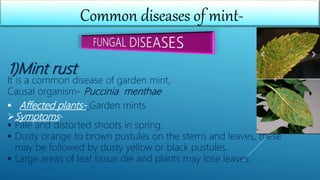
1)Mint rust
It is a common disease of garden mint,
Causal organism- Puccinia menthae
 Affected plants- Garden mints
Symptoms-
 Pale and distorted shoots in spring.
 Dusty orange to brown pustules on the stems and leaves, these
may be followed by dusty yellow or black pustules.
 Large areas of leaf tissue die and plants may lose leaves.
 Control measures-
• Chemical control –
spray of Mancozeb (0.25%) or Hexaconazol(0.1%).
• Cultural control-
I. Field sanitation.
II. Use disease free stock and treat it with hot water.
III.Crop rotation with non host crop.
• Biological control-
• In it biological vectors are used like-Trichoderma
viridae & Trichoderma harzianum.
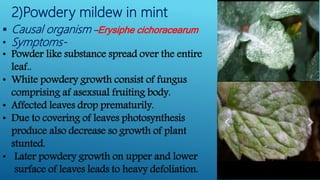
2)Powdery mildew in mint
 Causal organism –Erysiphe cichoracearum
• Symptoms-
• Powder like substance spread over the entire
leaf..
• White powdery growth consist of fungus
comprising af asexsual fruiting body.
• Affected leaves drop prematurily.
• Due to covering of leaves photosynthesis
produce also decrease so growth of plant
stunted.
• Later powdery growth on upper and lower
surface of leaves leads to heavy defoliation.
 Control measures-
• Chemical control –
Wettable sulphur(0.3%) ,Carbendazim(0.1%) or
karathane(0.05%) at 15 days interval can be used.
• Cultural control-
I. Field sanitation.
II. Collect the affected part and burn it.
III.Crop rotation with non host crop.
IV.Avoid dense planting
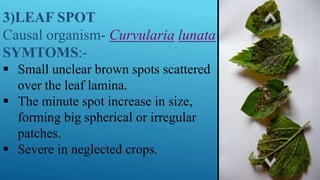
3)LEAF SPOT
Causal organism- Curvularia lunata
SYMTOMS:-
 Small unclear brown spots scattered
over the leaf lamina.
 The minute spot increase in size,
forming big spherical or irregular
patches.
 Severe in neglected crops.
 Control measures-
• Chemical control –
Mancozeb(0.25%) as aerial spray can be used.
• Cultural control-
I. Field sanitation
II. Collect the affected part and burn it.
III.Reduce plant population
• Biological control-
• In it biological vectors are used like-Trichoderma
viridiae & Trichoderma harzianum
4) LEAF BLIGHT: Alternaria alternata
SYMPTOMS:
 Lower most leaves first infected &disease later
develop on upper leaves.
 The infected leaves shows round to oval to irregular
or slightly irregular dark
brown spots on the upper surface of the leaves with
concentric rings.
 Spot size increases and covers the entire leaves
Later Blightening & detaching of
Leaves.
• In advance stage these spots enlarge and occupy
the entire leaf leading to defoliation.
 Control measures-
• Chemical control –
spray of mancozeb(0.2%),or copper
oxychloride(0.3%)at initial stage.
• Cultural control-
I. Field sanitation
II.Use disease free stock and treat it with
hot water.
III.Crop rotation
 Control measures-
• Chemical control –
Soil drenching with carbendazim(0.1%).
• Cultural control-
I. Always use disease free stolons as planting
material.
II. Collect the affected part and burn it.
III.Reduce plant populationn
IV.Deep summer ploughing & well drained field
conditions
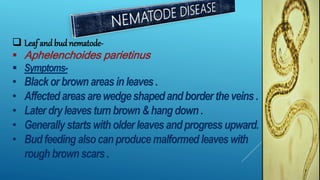
 Leaf and bud nematode-
 Aphelenchoides parietinus
 Symptoms-
• Blackorbrown areasinleaves.
• Affected areasarewedge shapedandborder theveins.
• Later dryleavesturn brown &hangdown .
• Generally starts with older leaves andprogressupward.
• Budfeeding alsocanproduce malformed leaveswith
rough brown scars.
 Control measures-
• Mulch to discourage nematode from
moving up from the soil
• Keep plant top dry not irrigation or sprinkiling
overhead.
• Grow insterile media.
• Dispose all plant debris properly .
• Propagate from nematode free stock plants.
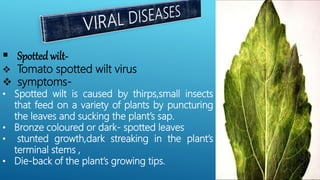
 Spotted wilt-
 Tomato spotted wilt virus
 symptoms-
• Spotted wilt is caused by thirps,small insects
that feed on a variety of plants by puncturing
the leaves and sucking the plant’s sap.
• Bronze coloured or dark- spotted leaves
• stunted growth,dark streaking in the plant’s
terminal stems ,
• Die-back of the plant’s growing tips.
 Control measures-
•No effective control as it is a virus disease.
•Infected plants should be removed and
destroyed as soon as identified.
REFERENCE
 Prescribed E –course(P.143-154)
Chadha K .L, Handbook of horticulture, (p-843-
844)published by I.C.A.R,krishai Anushandhan Bhavan
,Pusa New Dehli
 Internet
 http://www.ikisan.com
http://www.tnauagritechportal.com
http://journals.Cambridge.org
DISEASE OF MINT

DISEASE OF MINT

  • 1.
    COLLEGE OF HORTICULTURE V.C.S.GUTTARAKHAND UNIVERSITY OF HORTICULTURE & FORESTRY BHARSAR, PAURI GARHWAL, UTTARAKHAND – 246 123 Topic:- diseases of mint and their control SubmittedTo- SubmittedBy- GaneshChandraarya(16005) vivekkumar (16006) Sanjaysinghbisht(16025) Ashutosh naithani(16028) Amit nawani(16033) Mohammad nazim(16043) Dr. Sanjeev ravi
  • 2.
    Contents  Introduction  Classification Fungal diseases  Nematode disease  Viral disease  Research paper  Reference
  • 3.
    t is plantof both aromatinc and medicinal purpose. The species comes under it are- arvensis, spicuta and piperata.But most commomly known species are- Arvensis -Called Japanese mint in English and pudinah in hindi, Spicuta - Called Spearmint in English and pudinah in hindi. • Family – Labiateae  Part used- Leaves and flowering tops and in some cases whole plant.  Constituents- Volatile oil-menthone,menthol,isomenthol,methyle acetate,neomenthol,piperitone.  Uses- Aromatic,Digestive,stimulant,antiseptic,spleen disease,jaundice,antibacterial antifungal It is plant of both aromatinc and medicinal purpose. The species comes under it are- arvensis, spicuta and piperata.But most commomly used species are- Arvensis -Called Japanese mint in English and pudinah in hindi, Spicuta - Called Spearmint in English and pudinah in hindi. • Family – Labiateae  Part used- Leaves and flowering tops and in some cases whole plant.  Constituents- Volatile oil- menthone , menthol , isomenthol , methyle acetate,neomenthol,piperitone.  Uses- Aromatic,Digestive,stimulant,antiseptic,spleen disease,jaundice,antibacterial antifungal MINT
  • 4.
    Classification Kingdom - Plantae(plants) Subkingdom-Tracheobionta(vascular plants) Division - Magnoliyophyta(flowering plants) Order - Lamiales Family - Labiateae Genus - Mentha Species - arvensis,piperata,spicuta
  • 5.
    Common diseases ofmint- 1)Mint rust It is a common disease of garden mint, Causal organism- Puccinia menthae  Affected plants- Garden mints Symptoms-  Pale and distorted shoots in spring.  Dusty orange to brown pustules on the stems and leaves, these may be followed by dusty yellow or black pustules.  Large areas of leaf tissue die and plants may lose leaves.
  • 6.
     Control measures- •Chemical control – spray of Mancozeb (0.25%) or Hexaconazol(0.1%). • Cultural control- I. Field sanitation. II. Use disease free stock and treat it with hot water. III.Crop rotation with non host crop. • Biological control- • In it biological vectors are used like-Trichoderma viridae & Trichoderma harzianum.
  • 7.
    2)Powdery mildew inmint  Causal organism –Erysiphe cichoracearum • Symptoms- • Powder like substance spread over the entire leaf.. • White powdery growth consist of fungus comprising af asexsual fruiting body. • Affected leaves drop prematurily. • Due to covering of leaves photosynthesis produce also decrease so growth of plant stunted. • Later powdery growth on upper and lower surface of leaves leads to heavy defoliation.
  • 8.
     Control measures- •Chemical control – Wettable sulphur(0.3%) ,Carbendazim(0.1%) or karathane(0.05%) at 15 days interval can be used. • Cultural control- I. Field sanitation. II. Collect the affected part and burn it. III.Crop rotation with non host crop. IV.Avoid dense planting
  • 9.
    3)LEAF SPOT Causal organism-Curvularia lunata SYMTOMS:-  Small unclear brown spots scattered over the leaf lamina.  The minute spot increase in size, forming big spherical or irregular patches.  Severe in neglected crops.
  • 10.
     Control measures- •Chemical control – Mancozeb(0.25%) as aerial spray can be used. • Cultural control- I. Field sanitation II. Collect the affected part and burn it. III.Reduce plant population • Biological control- • In it biological vectors are used like-Trichoderma viridiae & Trichoderma harzianum
  • 11.
    4) LEAF BLIGHT:Alternaria alternata SYMPTOMS:  Lower most leaves first infected &disease later develop on upper leaves.  The infected leaves shows round to oval to irregular or slightly irregular dark brown spots on the upper surface of the leaves with concentric rings.  Spot size increases and covers the entire leaves Later Blightening & detaching of Leaves. • In advance stage these spots enlarge and occupy the entire leaf leading to defoliation.
  • 12.
     Control measures- •Chemical control – spray of mancozeb(0.2%),or copper oxychloride(0.3%)at initial stage. • Cultural control- I. Field sanitation II.Use disease free stock and treat it with hot water. III.Crop rotation
  • 13.
     Control measures- •Chemical control – Soil drenching with carbendazim(0.1%). • Cultural control- I. Always use disease free stolons as planting material. II. Collect the affected part and burn it. III.Reduce plant populationn IV.Deep summer ploughing & well drained field conditions
  • 14.
     Leaf andbud nematode-  Aphelenchoides parietinus  Symptoms- • Blackorbrown areasinleaves. • Affected areasarewedge shapedandborder theveins. • Later dryleavesturn brown &hangdown . • Generally starts with older leaves andprogressupward. • Budfeeding alsocanproduce malformed leaveswith rough brown scars.
  • 15.
     Control measures- •Mulch to discourage nematode from moving up from the soil • Keep plant top dry not irrigation or sprinkiling overhead. • Grow insterile media. • Dispose all plant debris properly . • Propagate from nematode free stock plants.
  • 16.
     Spotted wilt- Tomato spotted wilt virus  symptoms- • Spotted wilt is caused by thirps,small insects that feed on a variety of plants by puncturing the leaves and sucking the plant’s sap. • Bronze coloured or dark- spotted leaves • stunted growth,dark streaking in the plant’s terminal stems , • Die-back of the plant’s growing tips.
  • 17.
     Control measures- •Noeffective control as it is a virus disease. •Infected plants should be removed and destroyed as soon as identified.
  • 22.
    REFERENCE  Prescribed E–course(P.143-154) Chadha K .L, Handbook of horticulture, (p-843- 844)published by I.C.A.R,krishai Anushandhan Bhavan ,Pusa New Dehli  Internet  http://www.ikisan.com http://www.tnauagritechportal.com http://journals.Cambridge.org