Ser and Adjectives
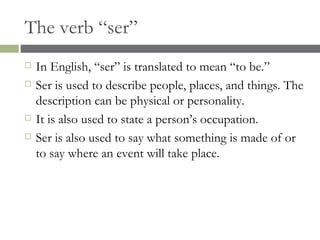
The verb “ser”
   In English, “ser” is translated to mean “to be.”
   Ser is used to describe people, places, and things. The
    description can be physical or personality.
   It is also used to state a person’s occupation.
   Ser is also used to say what something is made of or
    to say where an event will take place.
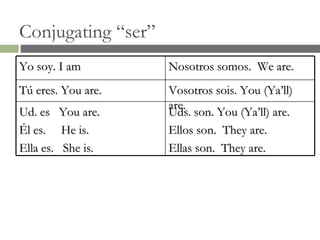
Conjugating “ser”
Yo soy. I am        Nosotros somos. We are.
Tú eres. You are.   Vosotros sois. You (Ya’ll)
                    are.
Ud. es You are.     Uds. son. You (Ya’ll) are.
Él es. He is.       Ellos son. They are.
Ella es. She is.    Ellas son. They are.
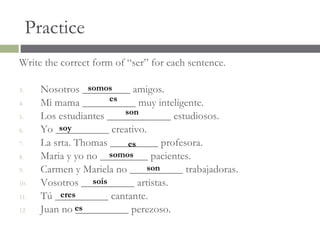
Practice
Write the correct form of “ser” for each sentence.

3.                somos
       Nosotros _________ amigos.
                        es
4.     Mi mama __________ muy inteligente.
                           son
5.     Los estudiantes ____________ estudiosos.
6.         soy
       Yo __________ creativo.
7.     La srta. Thomas _________ profesora.
                            es
8.                      somos
       Maria y yo no _________ pacientes.
9.                             son
       Carmen y Mariela no __________ trabajadoras.
10.                sois
       Vosotros __________ artistas.
11.         eres
       Tú __________ cantante.
12.    Juan no es
                __________ perezoso.
Adjectives
   Adjectives are words used to describe nouns.
   In Spanish, there are four different classification for
    adjectives: masculine, feminine, masculine-plural,
    feminine plural.
   Because of the classification system, adjectives must
    agree in gender and number with the noun in
    modifies.
   An adjective usually follows the noun it modifies if it
    is not preceded by a verb.
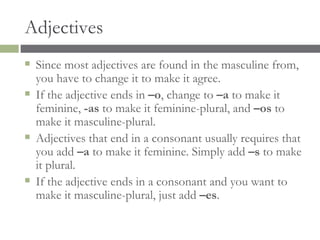
Adjectives
   Since most adjectives are found in the masculine from,
    you have to change it to make it agree.
   If the adjective ends in –o, change to –a to make it
    feminine, -as to make it feminine-plural, and –os to
    make it masculine-plural.
   Adjectives that end in a consonant usually requires that
    you add –a to make it feminine. Simply add –s to make
    it plural.
   If the adjective ends in a consonant and you want to
    make it masculine-plural, just add –es.
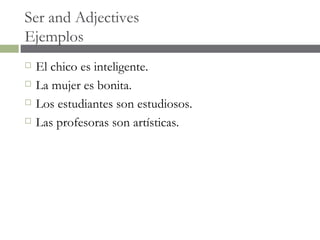
Ser and Adjectives
Ejemplos
   El chico es inteligente.
   La mujer es bonita.
   Los estudiantes son estudiosos.
   Las profesoras son artísticas.

Ser and adjectives

  • 1.
  • 2.
    The verb “ser”  In English, “ser” is translated to mean “to be.”  Ser is used to describe people, places, and things. The description can be physical or personality.  It is also used to state a person’s occupation.  Ser is also used to say what something is made of or to say where an event will take place.
  • 3.
    Conjugating “ser” Yo soy.I am Nosotros somos. We are. Tú eres. You are. Vosotros sois. You (Ya’ll) are. Ud. es You are. Uds. son. You (Ya’ll) are. Él es. He is. Ellos son. They are. Ella es. She is. Ellas son. They are.
  • 4.
    Practice Write the correctform of “ser” for each sentence. 3. somos Nosotros _________ amigos. es 4. Mi mama __________ muy inteligente. son 5. Los estudiantes ____________ estudiosos. 6. soy Yo __________ creativo. 7. La srta. Thomas _________ profesora. es 8. somos Maria y yo no _________ pacientes. 9. son Carmen y Mariela no __________ trabajadoras. 10. sois Vosotros __________ artistas. 11. eres Tú __________ cantante. 12. Juan no es __________ perezoso.
  • 5.
    Adjectives  Adjectives are words used to describe nouns.  In Spanish, there are four different classification for adjectives: masculine, feminine, masculine-plural, feminine plural.  Because of the classification system, adjectives must agree in gender and number with the noun in modifies.  An adjective usually follows the noun it modifies if it is not preceded by a verb.
  • 6.
    Adjectives  Since most adjectives are found in the masculine from, you have to change it to make it agree.  If the adjective ends in –o, change to –a to make it feminine, -as to make it feminine-plural, and –os to make it masculine-plural.  Adjectives that end in a consonant usually requires that you add –a to make it feminine. Simply add –s to make it plural.  If the adjective ends in a consonant and you want to make it masculine-plural, just add –es.
  • 7.
    Ser and Adjectives Ejemplos  El chico es inteligente.  La mujer es bonita.  Los estudiantes son estudiosos.  Las profesoras son artísticas.