Arithmetic Operation
1
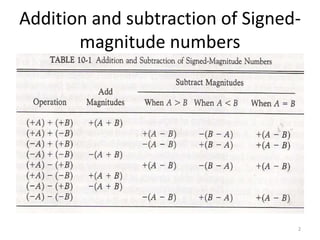
Addition and subtraction of Signed-
magnitude numbers
2
• In the above table, last column is needed to
prevent a negative zero.
• i.e. when 2 equal numbers are subtracted, the
result should be +0 not -0
3
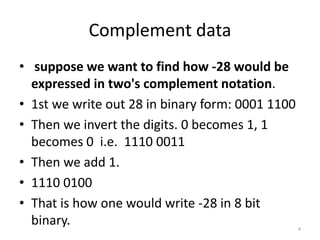
Complement data
• suppose we want to find how -28 would be
expressed in two's complement notation.
• 1st we write out 28 in binary form: 0001 1100
• Then we invert the digits. 0 becomes 1, 1
becomes 0 i.e. 1110 0011
• Then we add 1.
• 1110 0100
• That is how one would write -28 in 8 bit
binary. 4
Complement data
+33 is represented as:
0010 0001
And -33 is represented as:
1101 1111 which is the 2’s complement of
0010 0001
5
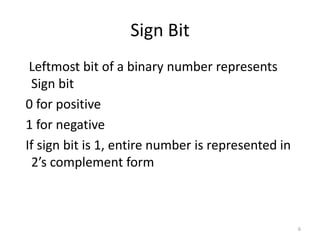
Sign Bit
Leftmost bit of a binary number represents
Sign bit
0 for positive
1 for negative
If sign bit is 1, entire number is represented in
2’s complement form
6
Hardware Implementation
7
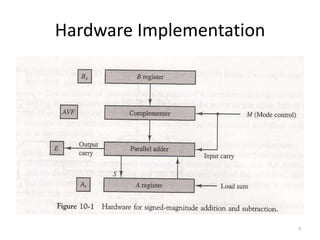
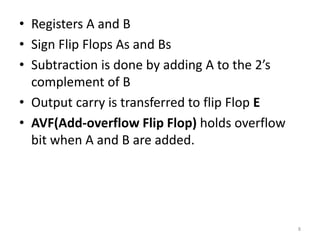
• Registers A and B
• Sign Flip Flops As and Bs
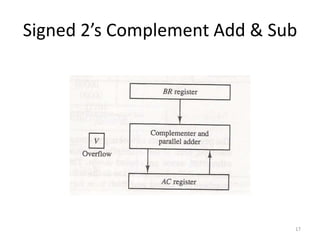
• Subtraction is done by adding A to the 2’s
complement of B
• Output carry is transferred to flip Flop E
• AVF(Add-overflow Flip Flop) holds overflow
bit when A and B are added.
8
• Addition A+B is done by parallel adder
• S (Sum) output of parallel adder is applied to
input of register A
• Complementer provides Output of B or
Complement of B(depending on state of Mode
control M)
• M signal also applied to input carry of adder.
When M=0, output of B is transferred to
Adder, Input carry is 0, output of adder= sum
A+B
9
• When M=1, 1’s complement of B is applied to
adder, input carry is 1, output S=A+B+1
(i.e equal to A plus 2’s complement of B)
Which is equal to subtraction A-B
10
Addition
• In addition, an augend and an addend are
added to find a sum.
In the following
6 + 3 = 9
6 is the augend,
3 is the addend
and 9 is the sum:
11
Subtraction
• In subtraction, a subtrahend is subtracted
from a minuend to find a difference.
• In the following:
9 – 3 = 6
• 9 is the minuend,
• 3 is the subtrahend,
• and 6 is the difference.
12
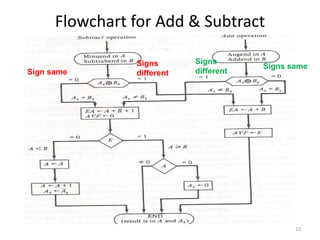
Flowchart for Add & Subtract
13
Sign same
Signs
different
Signs
different
Signs same
Flowchart for Add & Subtract:
Explanation
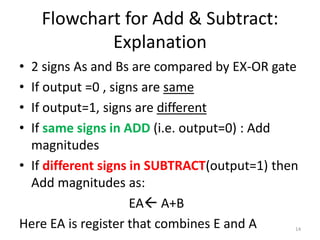
• 2 signs As and Bs are compared by EX-OR gate
• If output =0 , signs are same
• If output=1, signs are different
• If same signs in ADD (i.e. output=0) : Add
magnitudes
• If different signs in SUBTRACT(output=1) then
Add magnitudes as:
EA A+B
Here EA is register that combines E and A 14
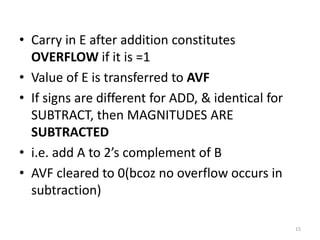
• Carry in E after addition constitutes
OVERFLOW if it is =1
• Value of E is transferred to AVF
• If signs are different for ADD, & identical for
SUBTRACT, then MAGNITUDES ARE
SUBTRACTED
• i.e. add A to 2’s complement of B
• AVF cleared to 0(bcoz no overflow occurs in
subtraction)
15
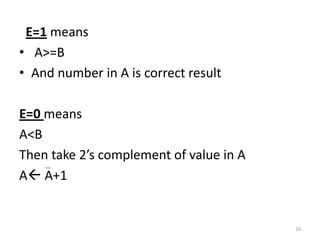
E=1 means
• A>=B
• And number in A is correct result
E=0 means
A<B
Then take 2’s complement of value in A
A A+1
16
Signed 2’s Complement Add & Sub
17
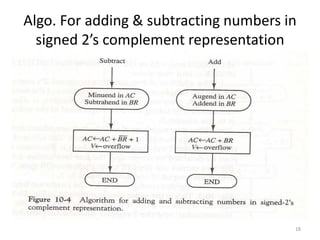
Algo. For adding & subtracting numbers in
signed 2’s complement representation
18
MULTIPLICATION
• Multiplication
In multiplication, a multiplicand and
a multiplier are multiplied to find a product.
e.g. In the following equation,
6 x 3 = 18
6 is the multiplicand,
3 is the multiplier
18 is the product.
19
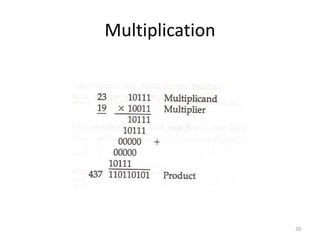
Multiplication
20
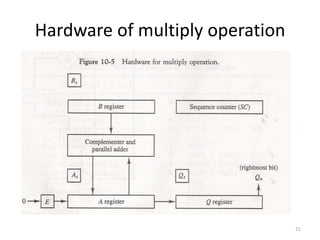
Hardware of multiply operation
21
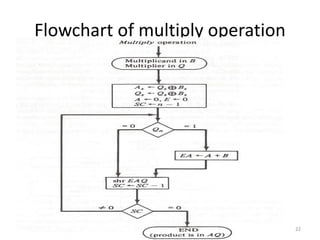
Flowchart of multiply operation
22
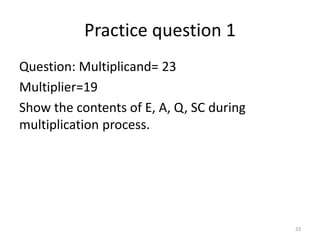
Practice question 1
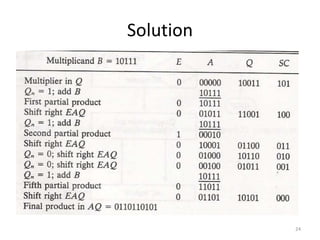
Question: Multiplicand= 23
Multiplier=19
Show the contents of E, A, Q, SC during
multiplication process.
23
Solution
24
Practice question 2
Show the contents of registers E, A, Q and SC
during the process of multiplication of 2 binary
numbers:
11111(multiplicand) and 10101(multiplier).
The signs are not included.
25
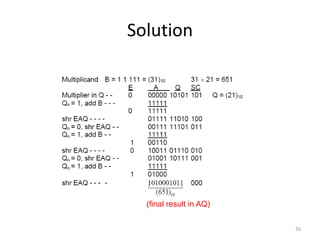
Solution
26
(final result in AQ)
BOOTH ALGORITHM FOR
MULTIPLICATION OF SIGNED 2’s
COMPLEMENT NUMBERS
27
Booth Algorithm
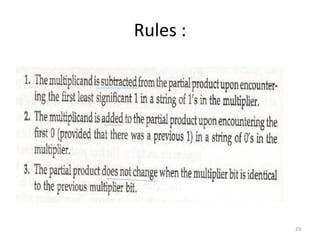
• Check multiplier bits and shift partial
product
• Before shifting, multiplicand may be
added/subtracted from partial product or left
unchanged according to following rules
28
Rules :
29
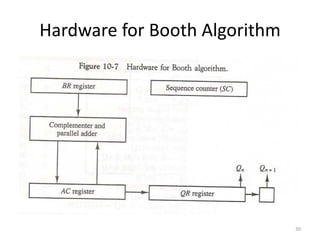
Hardware for Booth Algorithm
30
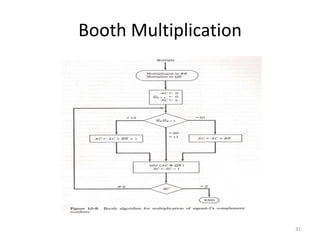
Booth Multiplication
31
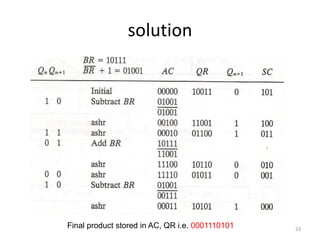
Practice Question 1
Booth Multiplication
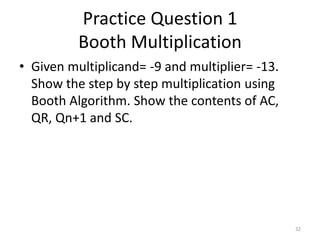
• Given multiplicand= -9 and multiplier= -13.
Show the step by step multiplication using
Booth Algorithm. Show the contents of AC,
QR, Qn+1 and SC.
32
solution
33
Final product stored in AC, QR i.e. 0001110101
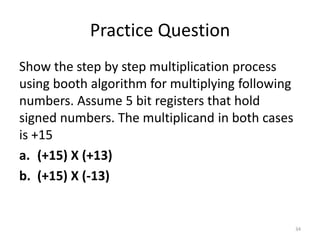
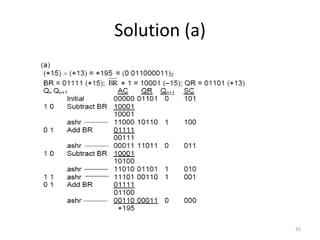
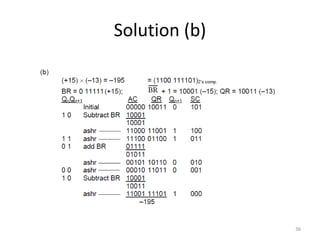
Practice Question
Show the step by step multiplication process
using booth algorithm for multiplying following
numbers. Assume 5 bit registers that hold
signed numbers. The multiplicand in both cases
is +15
a. (+15) X (+13)
b. (+15) X (-13)
34
Solution (a)
35
Solution (b)
36

Arithmatic Ch 10 (4).pdf

  • 1.
  • 2.
    Addition and subtractionof Signed- magnitude numbers 2
  • 3.
    • In theabove table, last column is needed to prevent a negative zero. • i.e. when 2 equal numbers are subtracted, the result should be +0 not -0 3
  • 4.
    Complement data • supposewe want to find how -28 would be expressed in two's complement notation. • 1st we write out 28 in binary form: 0001 1100 • Then we invert the digits. 0 becomes 1, 1 becomes 0 i.e. 1110 0011 • Then we add 1. • 1110 0100 • That is how one would write -28 in 8 bit binary. 4
  • 5.
    Complement data +33 isrepresented as: 0010 0001 And -33 is represented as: 1101 1111 which is the 2’s complement of 0010 0001 5
  • 6.
    Sign Bit Leftmost bitof a binary number represents Sign bit 0 for positive 1 for negative If sign bit is 1, entire number is represented in 2’s complement form 6
  • 7.
  • 8.
    • Registers Aand B • Sign Flip Flops As and Bs • Subtraction is done by adding A to the 2’s complement of B • Output carry is transferred to flip Flop E • AVF(Add-overflow Flip Flop) holds overflow bit when A and B are added. 8
  • 9.
    • Addition A+Bis done by parallel adder • S (Sum) output of parallel adder is applied to input of register A • Complementer provides Output of B or Complement of B(depending on state of Mode control M) • M signal also applied to input carry of adder. When M=0, output of B is transferred to Adder, Input carry is 0, output of adder= sum A+B 9
  • 10.
    • When M=1,1’s complement of B is applied to adder, input carry is 1, output S=A+B+1 (i.e equal to A plus 2’s complement of B) Which is equal to subtraction A-B 10
  • 11.
    Addition • In addition,an augend and an addend are added to find a sum. In the following 6 + 3 = 9 6 is the augend, 3 is the addend and 9 is the sum: 11
  • 12.
    Subtraction • In subtraction,a subtrahend is subtracted from a minuend to find a difference. • In the following: 9 – 3 = 6 • 9 is the minuend, • 3 is the subtrahend, • and 6 is the difference. 12
  • 13.
    Flowchart for Add& Subtract 13 Sign same Signs different Signs different Signs same
  • 14.
    Flowchart for Add& Subtract: Explanation • 2 signs As and Bs are compared by EX-OR gate • If output =0 , signs are same • If output=1, signs are different • If same signs in ADD (i.e. output=0) : Add magnitudes • If different signs in SUBTRACT(output=1) then Add magnitudes as: EA A+B Here EA is register that combines E and A 14
  • 15.
    • Carry inE after addition constitutes OVERFLOW if it is =1 • Value of E is transferred to AVF • If signs are different for ADD, & identical for SUBTRACT, then MAGNITUDES ARE SUBTRACTED • i.e. add A to 2’s complement of B • AVF cleared to 0(bcoz no overflow occurs in subtraction) 15
  • 16.
    E=1 means • A>=B •And number in A is correct result E=0 means A<B Then take 2’s complement of value in A A A+1 16
  • 17.
  • 18.
    Algo. For adding& subtracting numbers in signed 2’s complement representation 18
  • 19.
    MULTIPLICATION • Multiplication In multiplication,a multiplicand and a multiplier are multiplied to find a product. e.g. In the following equation, 6 x 3 = 18 6 is the multiplicand, 3 is the multiplier 18 is the product. 19
  • 20.
  • 21.
  • 22.
  • 23.
    Practice question 1 Question:Multiplicand= 23 Multiplier=19 Show the contents of E, A, Q, SC during multiplication process. 23
  • 24.
  • 25.
    Practice question 2 Showthe contents of registers E, A, Q and SC during the process of multiplication of 2 binary numbers: 11111(multiplicand) and 10101(multiplier). The signs are not included. 25
  • 26.
  • 27.
    BOOTH ALGORITHM FOR MULTIPLICATIONOF SIGNED 2’s COMPLEMENT NUMBERS 27
  • 28.
    Booth Algorithm • Checkmultiplier bits and shift partial product • Before shifting, multiplicand may be added/subtracted from partial product or left unchanged according to following rules 28
  • 29.
  • 30.
    Hardware for BoothAlgorithm 30
  • 31.
  • 32.
    Practice Question 1 BoothMultiplication • Given multiplicand= -9 and multiplier= -13. Show the step by step multiplication using Booth Algorithm. Show the contents of AC, QR, Qn+1 and SC. 32
  • 33.
    solution 33 Final product storedin AC, QR i.e. 0001110101
  • 34.
    Practice Question Show thestep by step multiplication process using booth algorithm for multiplying following numbers. Assume 5 bit registers that hold signed numbers. The multiplicand in both cases is +15 a. (+15) X (+13) b. (+15) X (-13) 34
  • 35.
  • 36.