ECE/CS 552:
Integer Multipliers
© Prof. Mikko Lipasti
Lecture notes based in part on slides created by Mark
Hill, David Wood, Guri Sohi, John Shen and Jim Smith
Basic Arithmetic and the ALU
2
• Earlier in the semester
• Number representations, 2’s complement,
unsigned
• Addition/Subtraction
• Add/Sub ALU
• Full adder, ripple carry, subtraction
• Carry-lookahead addition
• Logical operations
• and, or, xor, nor, shifts
• Overflow
Basic Arithmetic and the ALU
• Now
– Integer multiplication
• Booth’s algorithm
• This is not crucial for the project
3
Multiplication
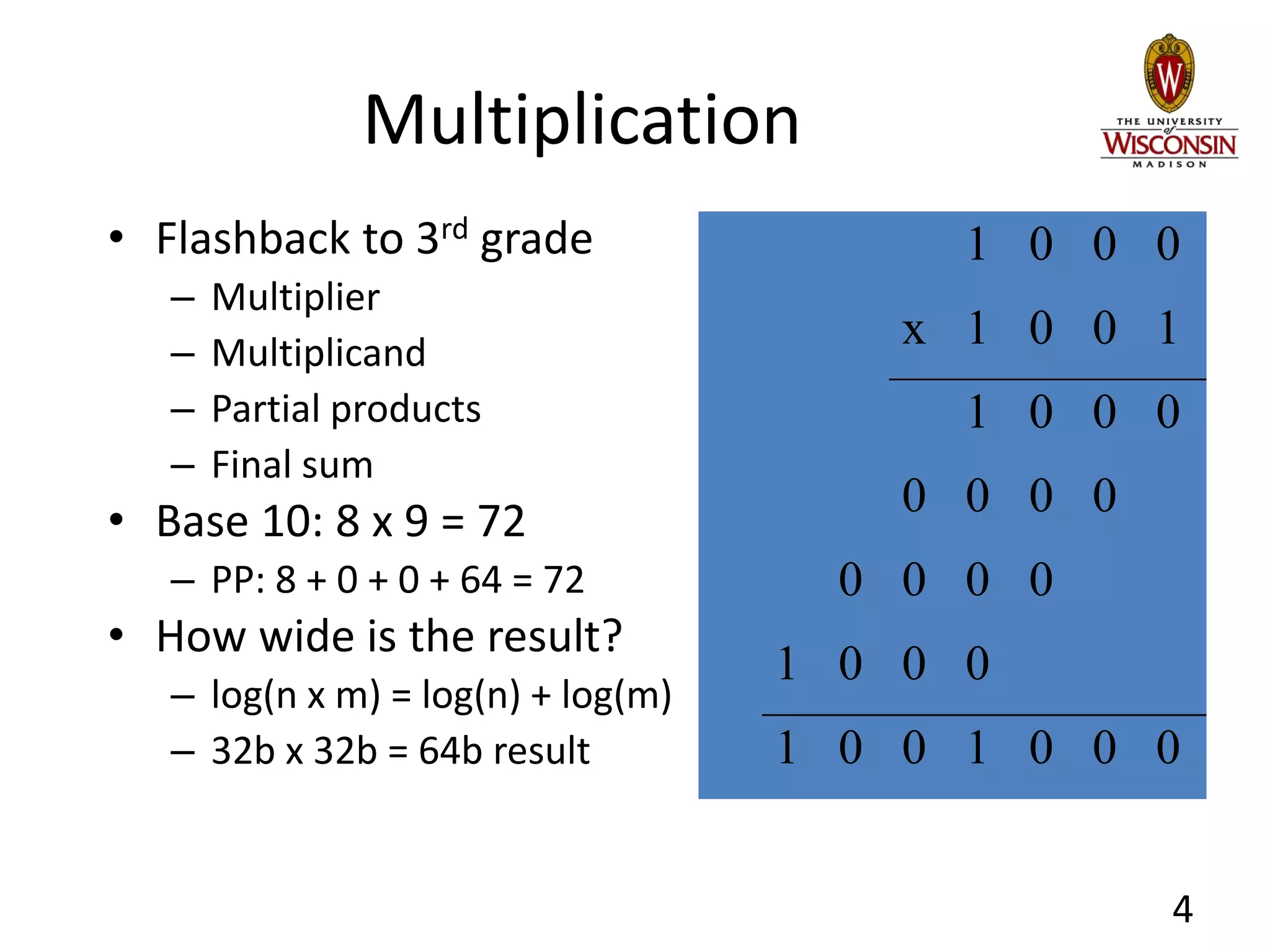
• Flashback to 3rd grade
– Multiplier
– Multiplicand
– Partial products
– Final sum
• Base 10: 8 x 9 = 72
– PP: 8 + 0 + 0 + 64 = 72
• How wide is the result?
– log(n x m) = log(n) + log(m)
– 32b x 32b = 64b result
4
1 0 0 0
x 1 0 0 1
1 0 0 0
0 0 0 0
0 0 0 0
1 0 0 0
1 0 0 1 0 0 0
Array Multiplier
• Adding all partial products
simultaneously using an
array of basic cells
5
1 0 0 0
x 1 0 0 1
1 0 0 0
0 0 0 0
0 0 0 0
1 0 0 0
1 0 0 1 0 0 0
Full Adder
Sin Cin Ai Bj
Cout Sout
Ai ,Bj
16-bit Array Multiplier
6
Conceptually straightforward
Fairly expensive hardware, integer multiplies relatively rare
Most used in array address calc: replace with shifts
[Source: J. Hayes,
Univ. of Michigan]
Instead: Multicycle Multipliers
• Combinational multipliers
– Very hardware-intensive
– Integer multiply relatively rare
– Not the right place to spend resources
• Multicycle multipliers
– Iterate through bits of multiplier
– Conditionally add shifted multiplicand
7
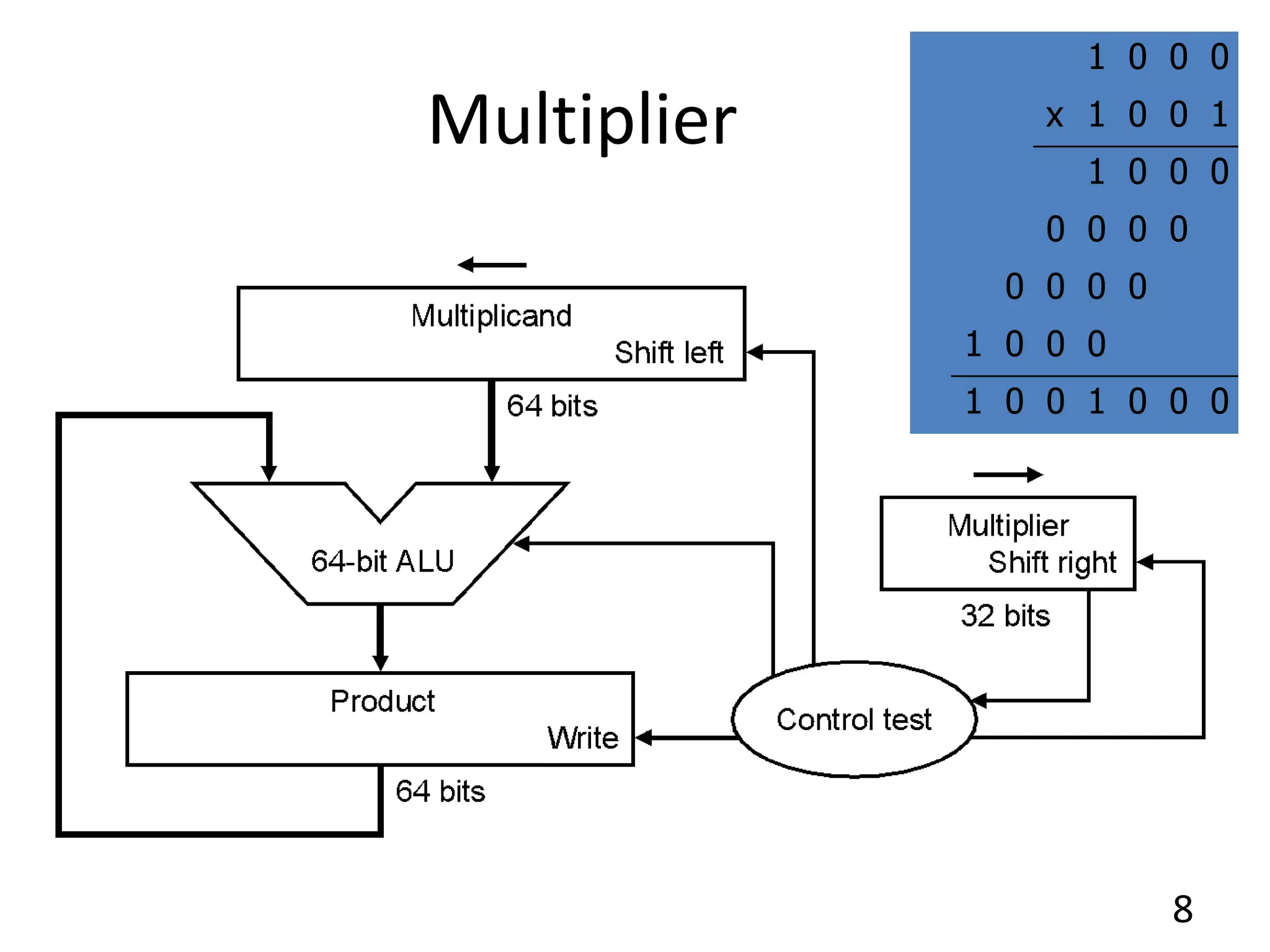
Multiplier
8
1 0 0 0
x 1 0 0 1
1 0 0 0
0 0 0 0
0 0 0 0
1 0 0 0
1 0 0 1 0 0 0
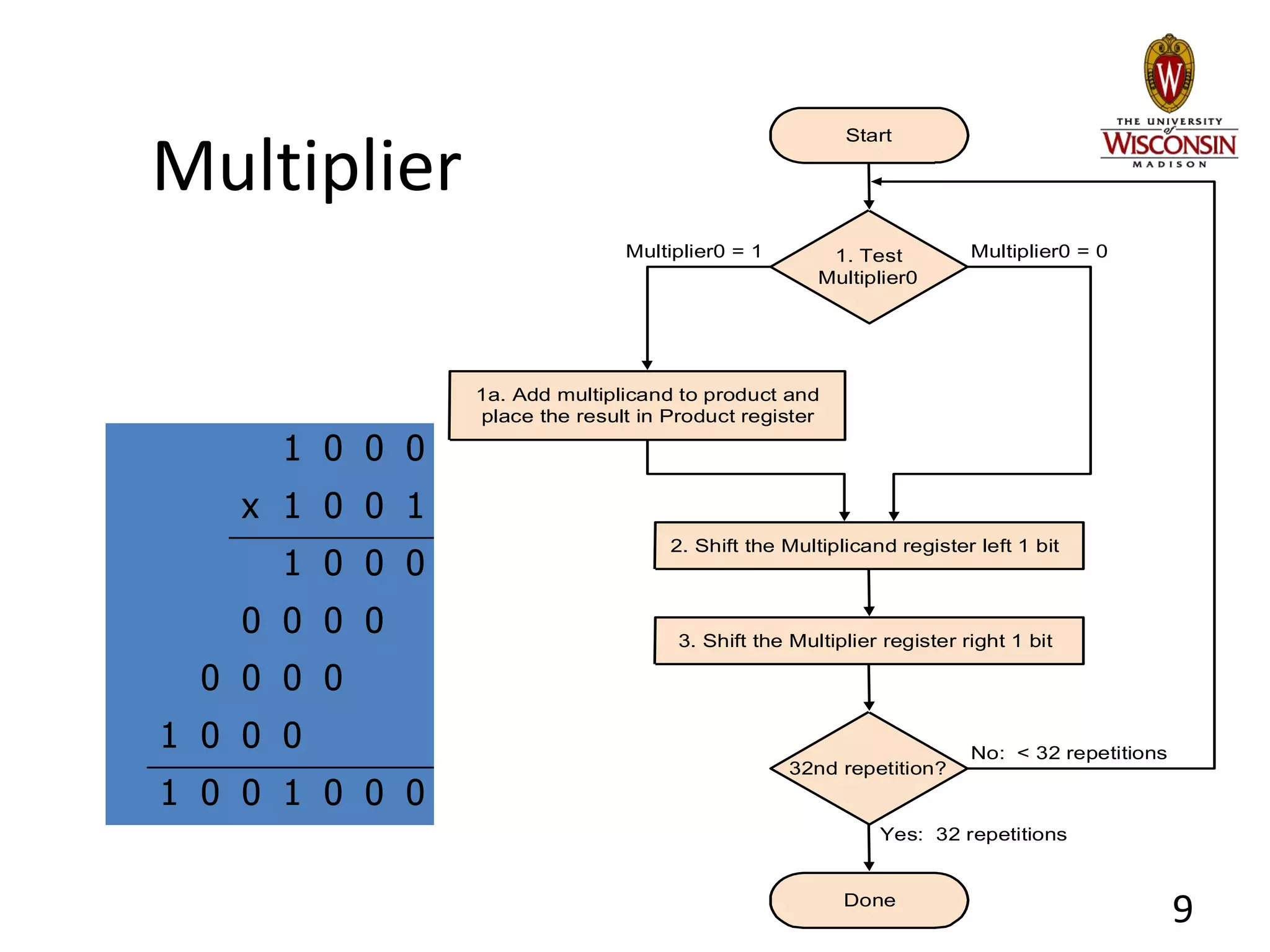
Multiplier
9
Done
1. Test
Multiplier0
1a. Add multiplicand to product and
place the result in Product register
2. Shift the Multiplicand register left 1 bit
3. Shift the Multiplier register right 1 bit
32nd repetition?
Start
Multiplier0 = 0
Multiplier0 = 1
No: < 32 repetitions
Yes: 32 repetitions
1 0 0 0
x 1 0 0 1
1 0 0 0
0 0 0 0
0 0 0 0
1 0 0 0
1 0 0 1 0 0 0
Multiplier Improvements
• Do we really need a 64-bit adder?
– No, since low-order bits are not involved
– Hence, just use a 32-bit adder
• Shift product register right on every step
• Do we really need a separate multiplier
register?
– No, since low-order bits of 64-bit product are
initially unused
– Hence, just store multiplier there initially
10
Multiplier
11
Control
test
Write
32 bits
64 bits
Shift right
Product
Multiplicand
32-bit ALU
1 0 0 0
x 1 0 0 1
1 0 0 0
0 0 0 0
0 0 0 0
1 0 0 0
1 0 0 1 0 0 0
Multiplier
12
Done
1. Test
Product0
1a. Add multiplicand to the left half of
the product and place the result in
the left half of the Product register
2. Shift the Product register right 1 bit
32nd repetition?
Start
Product0 = 0
Product0 = 1
No: < 32 repetitions
Yes: 32 repetitions
1 0 0 0
x 1 0 0 1
1 0 0 0
0 0 0 0
0 0 0 0
1 0 0 0
1 0 0 1 0 0 0
Signed Multiplication
• Recall
– For p = a x b, if a<0 or b<0, then p < 0
– If a<0 and b<0, then p > 0
– Hence sign(p) = sign(a) xor sign(b)
• Hence
– Convert multiplier, multiplicand to positive number
with (n-1) bits
– Multiply positive numbers
– Compute sign, convert product accordingly
• Or,
– Perform sign-extension on shifts for prev. design
– Right answer falls out
13
Booth’s Encoding
• Recall grade school trick
– When multiplying by 9:
• Multiply by 10 (easy, just shift digits left)
• Subtract once
– E.g.
• 123454 x 9 = 123454 x (10 – 1) = 1234540 – 123454
• Converts addition of six partial products to one shift and one
subtraction
• Booth’s algorithm applies same principle
– Except no ‘9’ in binary, just ‘1’ and ‘0’
– So, it’s actually easier!
14
Booth’s Encoding
• Search for a run of ‘1’ bits in the multiplier
– E.g. ‘0110’ has a run of 2 ‘1’ bits in the middle
– Multiplying by ‘0110’ (6 in decimal) is equivalent to
multiplying by 8 and subtracting twice, since 6 x m = (8 – 2)
x m = 8m – 2m
• Hence, iterate right to left and:
– Subtract multiplicand from product at first ‘1’
– Add multiplicand to product after last ‘1’
– Don’t do either for ‘1’ bits in the middle
15
Booth’s Algorithm
16
Current
bit
Bit to
right
Explanation Example Operation
1 0 Begins run of ‘1’ 00001111000 Subtract
1 1 Middle of run of ‘1’ 00001111000 Nothing
0 1 End of a run of ‘1’ 00001111000 Add
0 0 Middle of a run of ‘0’ 00001111000 Nothing
Booth’s Encoding
• Really just a new way to encode numbers
– Normally positionally weighted as 2n
– With Booth, each position has a sign bit
– Can be extended to multiple bits
17
0 1 1 0 Binary
+1 0 -1 0 1-bit Booth
+2 -2 2-bit Booth
2-bits/cycle Booth Multiplier
• For every pair of multiplier bits
– If Booth’s encoding is ‘-2’
• Shift multiplicand left by 1, then subtract
– If Booth’s encoding is ‘-1’
• Subtract
– If Booth’s encoding is ‘0’
• Do nothing
– If Booth’s encoding is ‘1’
• Add
– If Booth’s encoding is ‘2’
• Shift multiplicand left by 1, then add
18
2 bits/cycle Booth’s
19
Current Previous Operation Explanation
00 0 +0;shift 2 [00] => +0, [00] => +0; 2x(+0)+(+0)=+0
00 1 +M; shift 2 [00] => +0, [01] => +M; 2x(+0)+(+M)=+M
01 0 +M; shift 2 [01] => +M, [10] => -M; 2x(+M)+(-M)=+M
01 1 +2M; shift 2 [01] => +M, [11] => +0; 2x(+M)+(+0)=+2M
10 0 -2M; shift 2 [10] => -M, [00] => +0; 2x(-M)+(+0)=-2M
10 1 -M; shift 2 [10] => -M, [01] => +M; 2x(-M)+(+M)=-M
11 0 -M; shift 2 [11] => +0, [10] => -M; 2x(+0)+(-M)=-M
11 1 +0; shift 2 [11] => +0, [11] => +0; 2x(+0)+(+0)=+0
1 bit Booth
00 +0
01 +M;
10 -M;
11 +0
Booth’s Example
• Negative multiplicand:
-6 x 6 = -36
1010 x 0110, 0110 in Booth’s encoding is +0-0
Hence:
20
1111 1010 x 0 0000 0000
1111 0100 x –1 0000 1100
1110 1000 x 0 0000 0000
1101 0000 x +1 1101 0000
Final Sum: 1101 1100 (-36)
Booth’s Example
• Negative multiplier:
-6 x -2 = 12
1010 x 1110, 1110 in Booth’s encoding is 00-0
Hence:
21
1111 1010 x 0 0000 0000
1111 0100 x –1 0000 1100
1110 1000 x 0 0000 0000
1101 0000 x 0 0000 0000
Final Sum: 0000 1100 (12)
Summary
• Integer multiply
– Combinational
– Multicycle
– Booth’s algorithm
22

ece552_08_integer_multiply.ppt

  • 1.
    ECE/CS 552: Integer Multipliers ©Prof. Mikko Lipasti Lecture notes based in part on slides created by Mark Hill, David Wood, Guri Sohi, John Shen and Jim Smith
  • 2.
    Basic Arithmetic andthe ALU 2 • Earlier in the semester • Number representations, 2’s complement, unsigned • Addition/Subtraction • Add/Sub ALU • Full adder, ripple carry, subtraction • Carry-lookahead addition • Logical operations • and, or, xor, nor, shifts • Overflow
  • 3.
    Basic Arithmetic andthe ALU • Now – Integer multiplication • Booth’s algorithm • This is not crucial for the project 3
  • 4.
    Multiplication • Flashback to3rd grade – Multiplier – Multiplicand – Partial products – Final sum • Base 10: 8 x 9 = 72 – PP: 8 + 0 + 0 + 64 = 72 • How wide is the result? – log(n x m) = log(n) + log(m) – 32b x 32b = 64b result 4 1 0 0 0 x 1 0 0 1 1 0 0 0 0 0 0 0 0 0 0 0 1 0 0 0 1 0 0 1 0 0 0
  • 5.
    Array Multiplier • Addingall partial products simultaneously using an array of basic cells 5 1 0 0 0 x 1 0 0 1 1 0 0 0 0 0 0 0 0 0 0 0 1 0 0 0 1 0 0 1 0 0 0 Full Adder Sin Cin Ai Bj Cout Sout Ai ,Bj
  • 6.
    16-bit Array Multiplier 6 Conceptuallystraightforward Fairly expensive hardware, integer multiplies relatively rare Most used in array address calc: replace with shifts [Source: J. Hayes, Univ. of Michigan]
  • 7.
    Instead: Multicycle Multipliers •Combinational multipliers – Very hardware-intensive – Integer multiply relatively rare – Not the right place to spend resources • Multicycle multipliers – Iterate through bits of multiplier – Conditionally add shifted multiplicand 7
  • 8.
    Multiplier 8 1 0 00 x 1 0 0 1 1 0 0 0 0 0 0 0 0 0 0 0 1 0 0 0 1 0 0 1 0 0 0
  • 9.
    Multiplier 9 Done 1. Test Multiplier0 1a. Addmultiplicand to product and place the result in Product register 2. Shift the Multiplicand register left 1 bit 3. Shift the Multiplier register right 1 bit 32nd repetition? Start Multiplier0 = 0 Multiplier0 = 1 No: < 32 repetitions Yes: 32 repetitions 1 0 0 0 x 1 0 0 1 1 0 0 0 0 0 0 0 0 0 0 0 1 0 0 0 1 0 0 1 0 0 0
  • 10.
    Multiplier Improvements • Dowe really need a 64-bit adder? – No, since low-order bits are not involved – Hence, just use a 32-bit adder • Shift product register right on every step • Do we really need a separate multiplier register? – No, since low-order bits of 64-bit product are initially unused – Hence, just store multiplier there initially 10
  • 11.
    Multiplier 11 Control test Write 32 bits 64 bits Shiftright Product Multiplicand 32-bit ALU 1 0 0 0 x 1 0 0 1 1 0 0 0 0 0 0 0 0 0 0 0 1 0 0 0 1 0 0 1 0 0 0
  • 12.
    Multiplier 12 Done 1. Test Product0 1a. Addmultiplicand to the left half of the product and place the result in the left half of the Product register 2. Shift the Product register right 1 bit 32nd repetition? Start Product0 = 0 Product0 = 1 No: < 32 repetitions Yes: 32 repetitions 1 0 0 0 x 1 0 0 1 1 0 0 0 0 0 0 0 0 0 0 0 1 0 0 0 1 0 0 1 0 0 0
  • 13.
    Signed Multiplication • Recall –For p = a x b, if a<0 or b<0, then p < 0 – If a<0 and b<0, then p > 0 – Hence sign(p) = sign(a) xor sign(b) • Hence – Convert multiplier, multiplicand to positive number with (n-1) bits – Multiply positive numbers – Compute sign, convert product accordingly • Or, – Perform sign-extension on shifts for prev. design – Right answer falls out 13
  • 14.
    Booth’s Encoding • Recallgrade school trick – When multiplying by 9: • Multiply by 10 (easy, just shift digits left) • Subtract once – E.g. • 123454 x 9 = 123454 x (10 – 1) = 1234540 – 123454 • Converts addition of six partial products to one shift and one subtraction • Booth’s algorithm applies same principle – Except no ‘9’ in binary, just ‘1’ and ‘0’ – So, it’s actually easier! 14
  • 15.
    Booth’s Encoding • Searchfor a run of ‘1’ bits in the multiplier – E.g. ‘0110’ has a run of 2 ‘1’ bits in the middle – Multiplying by ‘0110’ (6 in decimal) is equivalent to multiplying by 8 and subtracting twice, since 6 x m = (8 – 2) x m = 8m – 2m • Hence, iterate right to left and: – Subtract multiplicand from product at first ‘1’ – Add multiplicand to product after last ‘1’ – Don’t do either for ‘1’ bits in the middle 15
  • 16.
    Booth’s Algorithm 16 Current bit Bit to right ExplanationExample Operation 1 0 Begins run of ‘1’ 00001111000 Subtract 1 1 Middle of run of ‘1’ 00001111000 Nothing 0 1 End of a run of ‘1’ 00001111000 Add 0 0 Middle of a run of ‘0’ 00001111000 Nothing
  • 17.
    Booth’s Encoding • Reallyjust a new way to encode numbers – Normally positionally weighted as 2n – With Booth, each position has a sign bit – Can be extended to multiple bits 17 0 1 1 0 Binary +1 0 -1 0 1-bit Booth +2 -2 2-bit Booth
  • 18.
    2-bits/cycle Booth Multiplier •For every pair of multiplier bits – If Booth’s encoding is ‘-2’ • Shift multiplicand left by 1, then subtract – If Booth’s encoding is ‘-1’ • Subtract – If Booth’s encoding is ‘0’ • Do nothing – If Booth’s encoding is ‘1’ • Add – If Booth’s encoding is ‘2’ • Shift multiplicand left by 1, then add 18
  • 19.
    2 bits/cycle Booth’s 19 CurrentPrevious Operation Explanation 00 0 +0;shift 2 [00] => +0, [00] => +0; 2x(+0)+(+0)=+0 00 1 +M; shift 2 [00] => +0, [01] => +M; 2x(+0)+(+M)=+M 01 0 +M; shift 2 [01] => +M, [10] => -M; 2x(+M)+(-M)=+M 01 1 +2M; shift 2 [01] => +M, [11] => +0; 2x(+M)+(+0)=+2M 10 0 -2M; shift 2 [10] => -M, [00] => +0; 2x(-M)+(+0)=-2M 10 1 -M; shift 2 [10] => -M, [01] => +M; 2x(-M)+(+M)=-M 11 0 -M; shift 2 [11] => +0, [10] => -M; 2x(+0)+(-M)=-M 11 1 +0; shift 2 [11] => +0, [11] => +0; 2x(+0)+(+0)=+0 1 bit Booth 00 +0 01 +M; 10 -M; 11 +0
  • 20.
    Booth’s Example • Negativemultiplicand: -6 x 6 = -36 1010 x 0110, 0110 in Booth’s encoding is +0-0 Hence: 20 1111 1010 x 0 0000 0000 1111 0100 x –1 0000 1100 1110 1000 x 0 0000 0000 1101 0000 x +1 1101 0000 Final Sum: 1101 1100 (-36)
  • 21.
    Booth’s Example • Negativemultiplier: -6 x -2 = 12 1010 x 1110, 1110 in Booth’s encoding is 00-0 Hence: 21 1111 1010 x 0 0000 0000 1111 0100 x –1 0000 1100 1110 1000 x 0 0000 0000 1101 0000 x 0 0000 0000 Final Sum: 0000 1100 (12)
  • 22.
    Summary • Integer multiply –Combinational – Multicycle – Booth’s algorithm 22