Republic of the Philippines
Department of Education
Region V – Bicol
SCHOOLS DIVISION OFFICE OF CAMARINES NORTE
SCHOOL Daet Elementary Schol GRADE LEVEL Grade 4
TEACHER Applicant MARLON O. LAMUG LEARNING AREA Mathematics
TIME AND DATE QUARTER
I – OBJECTIVES:
CONTENT STANDARD:
The learner demonstrates understanding of concepts of
continuous and repeating patterns and number sequences.
PERFORMANCE STANDARD The learner can identify the missing element in a pattern and
number sentence.
LEARNING COMPETENCIES Determines the missing term/s in a sequence of numbers.
(e.g odd numbers, even numbers, multiples of a number,
factors of a number, etc.) M4AL-IIIe-5
SPECIFIC OBJECTIVES After the 60 minutes discussion 75% of the students shall be
able to.
1. Identify the missing term/s in a sequence of numbers.
2. Write the missing term/s in a sequence of numbers.
3. Shows workmanship in doing group activity.
II – CONTENT: Topic/title Determining the missing term/s in a sequence of
numbers
Unit/module:
Time allotment:
III – LEARNING RESOURCES/ REFERENCES:
Curriculum Guide
Learner’s Materials Mathematics 4 Learner’s Material pp.168 – 170
Teachers’ Guide Mathematics 4 Teacher’s Guide pp.223 – 226
Additional materials from the LR portal
Other Learning Resources : puzzle mat, puzzle pieces of a butterfly, web concept chart, activity chart, activity
envelope, marker, Manila Paper
IV - PROCEDURE: Teacher’s Activity Student’s Activity
Preliminary
(2 minutes)
Activity
1. Greetings
2. Prayer
3. Attendance
“Good morning grade 4 pupils!”
Please stand for our opening prayer.
“Kindly pick up the pieces of paper under your
chair.”
“Do we have absentees today?”
“As we go on to our formal and very interesting
discussion first you need to follow several rules.”
Good morning Sir.
Pupils will pray.
Sir we are happy to tell you
that there is no absent
today.
Is that good?
So, you need to copy my gestures and repeat my
words. Is that, ok?
Rule no. 1
Follow directions quickly.
Rule no. 2
Raise your hand for permission to speak.
Rule no. 3
Raise your hand for permission to leave your
seat.
Rule no. 4
Make Smart Choices.
Rule no. 5
Keep your dear teacher happy.
Yes sir.
Yes sir.
(Pupils will repeat what the
teacher says.)
A. Reviewing
previous lesson or
presenting the
new lesson (3
minutes)
Pupils before we start our discussion I want you to
look around you, What do you see? Have you seen
patterns of objects?
The teacher will show example of patterns.
Yes Sir.
Class I have here example of patterns can you still
remember what a pattern is?
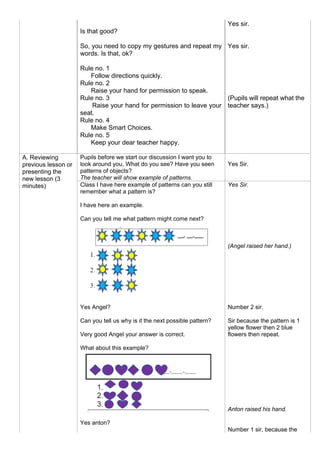
I have here an example.
Can you tell me what pattern might come next?
Yes Angel?
Can you tell us why is it the next possible pattern?
Very good Angel your answer is correct.
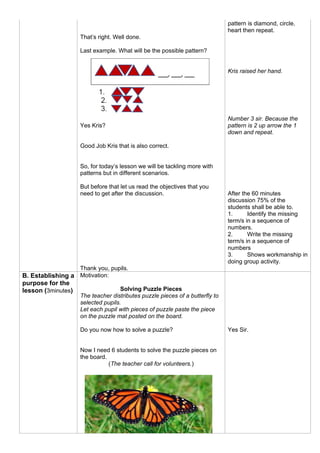
What about this example?
Yes anton?
Yes Sir.
(Angel raised her hand.)
Number 2 sir.
Sir because the pattern is 1
yellow flower then 2 blue
flowers then repeat.
Anton raised his hand.
Number 1 sir, because the
That’s right. Well done.
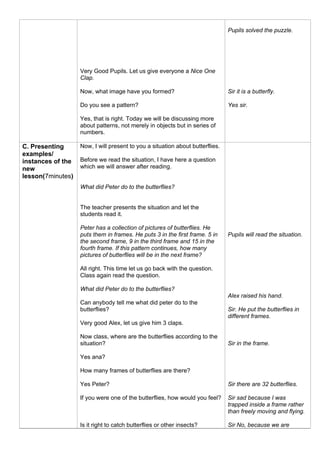
Last example. What will be the possible pattern?
Yes Kris?
Good Job Kris that is also correct.
So, for today’s lesson we will be tackling more with
patterns but in different scenarios.
But before that let us read the objectives that you
need to get after the discussion.
Thank you, pupils.
pattern is diamond, circle,
heart then repeat.
Kris raised her hand.
Number 3 sir. Because the
pattern is 2 up arrow the 1
down and repeat.
After the 60 minutes
discussion 75% of the
students shall be able to.
1. Identify the missing
term/s in a sequence of
numbers.
2. Write the missing
term/s in a sequence of
numbers
3. Shows workmanship in
doing group activity.
B. Establishing a
purpose for the
lesson (3minutes)
Motivation:
Solving Puzzle Pieces
The teacher distributes puzzle pieces of a butterfly to
selected pupils.
Let each pupil with pieces of puzzle paste the piece
on the puzzle mat posted on the board.
Do you now how to solve a puzzle?
Now I need 6 students to solve the puzzle pieces on
the board.
(The teacher call for volunteers.)
Yes Sir.
Very Good Pupils. Let us give everyone a Nice One
Clap.
Now, what image have you formed?
Do you see a pattern?
Yes, that is right. Today we will be discussing more
about patterns, not merely in objects but in series of
numbers.
Pupils solved the puzzle.
Sir it is a butterfly.
Yes sir.
C. Presenting
examples/
instances of the
new
lesson(7minutes)
Now, I will present to you a situation about butterflies.
Before we read the situation, I have here a question
which we will answer after reading.
What did Peter do to the butterflies?
The teacher presents the situation and let the
students read it.
Peter has a collection of pictures of butterflies. He
puts them in frames. He puts 3 in the first frame. 5 in
the second frame, 9 in the third frame and 15 in the
fourth frame. If this pattern continues, how many
pictures of butterflies will be in the next frame?
All right. This time let us go back with the question.
Class again read the question.
What did Peter do to the butterflies?
Can anybody tell me what did peter do to the
butterflies?
Very good Alex, let us give him 3 claps.
Now class, where are the butterflies according to the
situation?
Yes ana?
How many frames of butterflies are there?
Yes Peter?
If you were one of the butterflies, how would you feel?
Is it right to catch butterflies or other insects?
Pupils will read the situation.
Alex raised his hand.
Sir. He put the butterflies in
different frames.
Sir in the frame.
Sir there are 32 butterflies.
Sir sad because I was
trapped inside a frame rather
than freely moving and flying.
Sir No, because we are
Why/Why not?
What is being asked in the situation?
What are the given data?
How can we solve the problem?
Very good.
restricting them to lively freely
that causes also to decrease
their number and die.
Sir the question is, how many
pictures of butterflies will be in
the next frame?
Sir by looking for the pattern.
D. Discussing
new concepts
and practicing
new skills #1
(15 minutes)
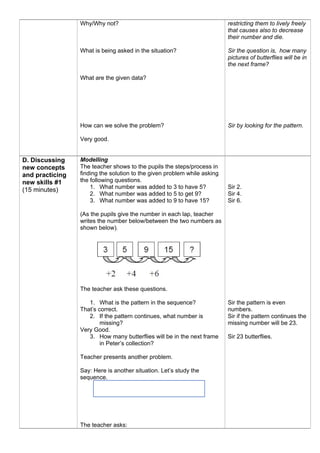
Modelling
The teacher shows to the pupils the steps/process in
finding the solution to the given problem while asking
the following questions.
1. What number was added to 3 to have 5?
2. What number was added to 5 to get 9?
3. What number was added to 9 to have 15?
(As the pupils give the number in each lap, teacher
writes the number below/between the two numbers as
shown below).
The teacher ask these questions.
1. What is the pattern in the sequence?
That’s correct.
2. If the pattern continues, what number is
missing?
Very Good.
3. How many butterflies will be in the next frame
in Peter’s collection?
Teacher presents another problem.
Say: Here is another situation. Let’s study the
sequence.
The teacher asks:
Sir 2.
Sir 4.
Sir 6.
Sir the pattern is even
numbers.
Sir if the pattern continues the
missing number will be 23.
Sir 23 butterflies.
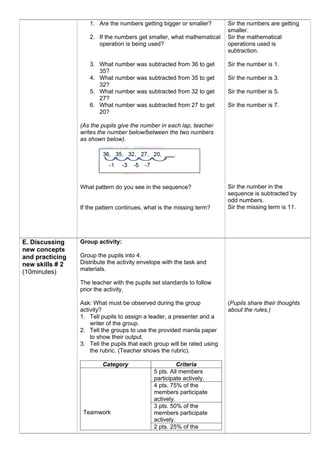
36, 35, 32, 27, 20,
____
1. Are the numbers getting bigger or smaller?
2. If the numbers get smaller, what mathematical
operation is being used?
3. What number was subtracted from 36 to get
35?
4. What number was subtracted from 35 to get
32?
5. What number was subtracted from 32 to get
27?
6. What number was subtracted from 27 to get
20?
(As the pupils give the number in each lap, teacher
writes the number below/between the two numbers
as shown below).
What pattern do you see in the sequence?
If the pattern continues, what is the missing term?
Sir the numbers are getting
smaller.
Sir the mathematical
operations used is
subtraction.
Sir the number is 1.
Sir the number is 3.
Sir the number is 5.
Sir the number is 7.
Sir the number in the
sequence is subtracted by
odd numbers.
Sir the missing term is 11.
E. Discussing
new concepts
and practicing
new skills # 2
(10minutes)
Group activity:
Group the pupils into 4.
Distribute the activity envelope with the task and
materials.
The teacher with the pupils set standards to follow
prior the activity.
Ask: What must be observed during the group
activity?
1. Tell pupils to assign a leader, a presenter and a
writer of the group.
2. Tell the groups to use the provided manila paper
to show their output.
3. Tell the pupils that each group will be rated using
the rubric. (Teacher shows the rubric).
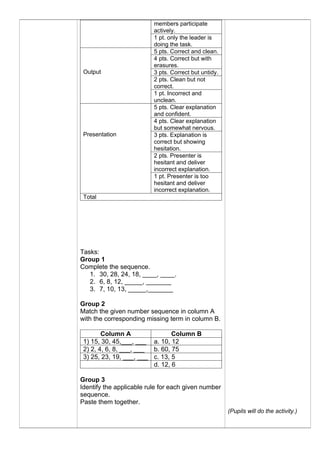
Category Criteria
Teamwork
5 pts. All members
participate actively.
4 pts. 75% of the
members participate
actively.
3 pts. 50% of the
members participate
actively.
2 pts. 25% of the
(Pupils share their thoughts
about the rules.)
members participate
actively.
1 pt. only the leader is
doing the task.
Output
5 pts. Correct and clean.
4 pts. Correct but with
erasures.
3 pts. Correct but untidy.
2 pts. Clean but not
correct.
1 pt. Incorrect and
unclean.
Presentation
5 pts. Clear explanation
and confident.
4 pts. Clear explanation
but somewhat nervous.
3 pts. Explanation is
correct but showing
hesitation.
2 pts. Presenter is
hesitant and deliver
incorrect explanation.
1 pt. Presenter is too
hesitant and deliver
incorrect explanation.
Total
Tasks:
Group 1
Complete the sequence.
1. 30, 28, 24, 18, ____, ____.
2. 6, 8, 12, _____, _______
3. 7, 10, 13, _____,_______
Group 2
Match the given number sequence in column A
with the corresponding missing term in column B.
Column A Column B
1) 15, 30, 45,___, ___ a. 10, 12
2) 2, 4, 6, 8, ___, ___ b. 60, 75
3) 25, 23, 19, ___, ___ c. 13, 5
d. 12, 6
Group 3
Identify the applicable rule for each given number
sequence.
Paste them together.
(Pupils will do the activity.)
Group 4
Read the problem. Solve for the answer by finding a
pattern.
Rica is stringing beads for a new necklace. The
color sequence will be red, blue, yellow, red, blue,
yellow. She puts 2 red beads first, 4 blue ones and
then 6 yellow beads. If this pattern goes on, how
many beads and what colors will she put in on the
4th and 5th sections?
 Group presentation.
 Process each group using the rubric.
 Give praise to each group after each
presentation.
Did everybody enjoy the activity? Is it good to help
your groupmates in the activity?
Yes Sir.
Yes sir, because it makes the
activity easier to answer if
every body is helping.
F. Developing
mastery
(5 minutes)
The teacher will call some students to answer the
board work.
Complete the table.
Study the sequence in each item. Find the pattern
rule then write the missing term.
Number Sequence Missing Terms
1) 3, 4, 7, 12, __.
2) 50, 48, 44, 38, __
3) __,12, 15, 20, 27.
4) 36, 34, ___, 30, 28.
5) (2, 4) (2, 4, 6) (2, 4,
6, 8) ( __, ___, ___,
___, ___ )
(Pupils will go in front as they
were called)
G. Finding
practical
applications of
concepts and
skills in daily
living.
(3 minutes)
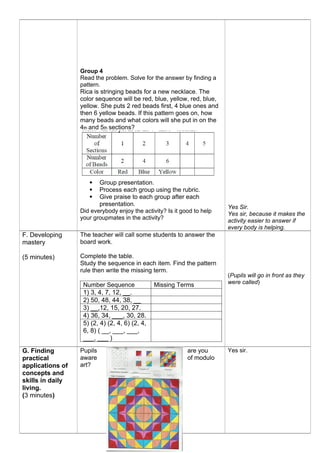
Pupils are you
aware of modulo
art?
Yes sir.
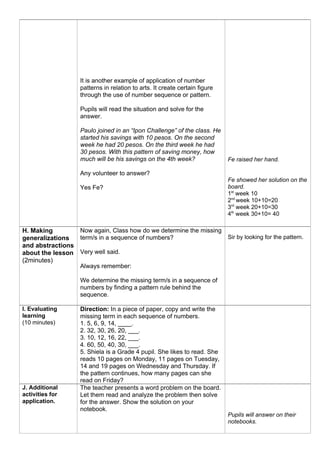
It is another example of application of number
patterns in relation to arts. It create certain figure
through the use of number sequence or pattern.
Pupils will read the situation and solve for the
answer.
Paulo joined in an “Ipon Challenge” of the class. He
started his savings with 10 pesos. On the second
week he had 20 pesos. On the third week he had
30 pesos. With this pattern of saving money, how
much will be his savings on the 4th week?
Any volunteer to answer?
Yes Fe?
Fe raised her hand.
Fe showed her solution on the
board.
1st
week 10
2nd
week 10+10=20
3rd
week 20+10=30
4th
week 30+10= 40
H. Making
generalizations
and abstractions
about the lesson
(2minutes)
Now again, Class how do we determine the missing
term/s in a sequence of numbers?
Very well said.
Always remember:
We determine the missing term/s in a sequence of
numbers by finding a pattern rule behind the
sequence.
Sir by looking for the pattern.
I. Evaluating
learning
(10 minutes)
Direction: In a piece of paper, copy and write the
missing term in each sequence of numbers.
1. 5, 6, 9, 14, ____.
2. 32, 30, 26, 20, ___.
3. 10, 12, 16, 22, ___.
4. 60, 50, 40, 30, ___.
5. Shiela is a Grade 4 pupil. She likes to read. She
reads 10 pages on Monday, 11 pages on Tuesday,
14 and 19 pages on Wednesday and Thursday. If
the pattern continues, how many pages can she
read on Friday?
J. Additional
activities for
application.
The teacher presents a word problem on the board.
Let them read and analyze the problem then solve
for the answer. Show the solution on your
notebook.
Pupils will answer on their
notebooks.
Prepared by:
MARLON O. LAMUG
Teacher Applicant

Marlon Lamug lesson plan in grade 4 Mathematics

  • 1.
    Republic of thePhilippines Department of Education Region V – Bicol SCHOOLS DIVISION OFFICE OF CAMARINES NORTE SCHOOL Daet Elementary Schol GRADE LEVEL Grade 4 TEACHER Applicant MARLON O. LAMUG LEARNING AREA Mathematics TIME AND DATE QUARTER I – OBJECTIVES: CONTENT STANDARD: The learner demonstrates understanding of concepts of continuous and repeating patterns and number sequences. PERFORMANCE STANDARD The learner can identify the missing element in a pattern and number sentence. LEARNING COMPETENCIES Determines the missing term/s in a sequence of numbers. (e.g odd numbers, even numbers, multiples of a number, factors of a number, etc.) M4AL-IIIe-5 SPECIFIC OBJECTIVES After the 60 minutes discussion 75% of the students shall be able to. 1. Identify the missing term/s in a sequence of numbers. 2. Write the missing term/s in a sequence of numbers. 3. Shows workmanship in doing group activity. II – CONTENT: Topic/title Determining the missing term/s in a sequence of numbers Unit/module: Time allotment: III – LEARNING RESOURCES/ REFERENCES: Curriculum Guide Learner’s Materials Mathematics 4 Learner’s Material pp.168 – 170 Teachers’ Guide Mathematics 4 Teacher’s Guide pp.223 – 226 Additional materials from the LR portal Other Learning Resources : puzzle mat, puzzle pieces of a butterfly, web concept chart, activity chart, activity envelope, marker, Manila Paper IV - PROCEDURE: Teacher’s Activity Student’s Activity Preliminary (2 minutes) Activity 1. Greetings 2. Prayer 3. Attendance “Good morning grade 4 pupils!” Please stand for our opening prayer. “Kindly pick up the pieces of paper under your chair.” “Do we have absentees today?” “As we go on to our formal and very interesting discussion first you need to follow several rules.” Good morning Sir. Pupils will pray. Sir we are happy to tell you that there is no absent today.
  • 2.
    Is that good? So,you need to copy my gestures and repeat my words. Is that, ok? Rule no. 1 Follow directions quickly. Rule no. 2 Raise your hand for permission to speak. Rule no. 3 Raise your hand for permission to leave your seat. Rule no. 4 Make Smart Choices. Rule no. 5 Keep your dear teacher happy. Yes sir. Yes sir. (Pupils will repeat what the teacher says.) A. Reviewing previous lesson or presenting the new lesson (3 minutes) Pupils before we start our discussion I want you to look around you, What do you see? Have you seen patterns of objects? The teacher will show example of patterns. Yes Sir. Class I have here example of patterns can you still remember what a pattern is? I have here an example. Can you tell me what pattern might come next? Yes Angel? Can you tell us why is it the next possible pattern? Very good Angel your answer is correct. What about this example? Yes anton? Yes Sir. (Angel raised her hand.) Number 2 sir. Sir because the pattern is 1 yellow flower then 2 blue flowers then repeat. Anton raised his hand. Number 1 sir, because the
  • 3.
    That’s right. Welldone. Last example. What will be the possible pattern? Yes Kris? Good Job Kris that is also correct. So, for today’s lesson we will be tackling more with patterns but in different scenarios. But before that let us read the objectives that you need to get after the discussion. Thank you, pupils. pattern is diamond, circle, heart then repeat. Kris raised her hand. Number 3 sir. Because the pattern is 2 up arrow the 1 down and repeat. After the 60 minutes discussion 75% of the students shall be able to. 1. Identify the missing term/s in a sequence of numbers. 2. Write the missing term/s in a sequence of numbers 3. Shows workmanship in doing group activity. B. Establishing a purpose for the lesson (3minutes) Motivation: Solving Puzzle Pieces The teacher distributes puzzle pieces of a butterfly to selected pupils. Let each pupil with pieces of puzzle paste the piece on the puzzle mat posted on the board. Do you now how to solve a puzzle? Now I need 6 students to solve the puzzle pieces on the board. (The teacher call for volunteers.) Yes Sir.
  • 4.
    Very Good Pupils.Let us give everyone a Nice One Clap. Now, what image have you formed? Do you see a pattern? Yes, that is right. Today we will be discussing more about patterns, not merely in objects but in series of numbers. Pupils solved the puzzle. Sir it is a butterfly. Yes sir. C. Presenting examples/ instances of the new lesson(7minutes) Now, I will present to you a situation about butterflies. Before we read the situation, I have here a question which we will answer after reading. What did Peter do to the butterflies? The teacher presents the situation and let the students read it. Peter has a collection of pictures of butterflies. He puts them in frames. He puts 3 in the first frame. 5 in the second frame, 9 in the third frame and 15 in the fourth frame. If this pattern continues, how many pictures of butterflies will be in the next frame? All right. This time let us go back with the question. Class again read the question. What did Peter do to the butterflies? Can anybody tell me what did peter do to the butterflies? Very good Alex, let us give him 3 claps. Now class, where are the butterflies according to the situation? Yes ana? How many frames of butterflies are there? Yes Peter? If you were one of the butterflies, how would you feel? Is it right to catch butterflies or other insects? Pupils will read the situation. Alex raised his hand. Sir. He put the butterflies in different frames. Sir in the frame. Sir there are 32 butterflies. Sir sad because I was trapped inside a frame rather than freely moving and flying. Sir No, because we are
  • 5.
    Why/Why not? What isbeing asked in the situation? What are the given data? How can we solve the problem? Very good. restricting them to lively freely that causes also to decrease their number and die. Sir the question is, how many pictures of butterflies will be in the next frame? Sir by looking for the pattern. D. Discussing new concepts and practicing new skills #1 (15 minutes) Modelling The teacher shows to the pupils the steps/process in finding the solution to the given problem while asking the following questions. 1. What number was added to 3 to have 5? 2. What number was added to 5 to get 9? 3. What number was added to 9 to have 15? (As the pupils give the number in each lap, teacher writes the number below/between the two numbers as shown below). The teacher ask these questions. 1. What is the pattern in the sequence? That’s correct. 2. If the pattern continues, what number is missing? Very Good. 3. How many butterflies will be in the next frame in Peter’s collection? Teacher presents another problem. Say: Here is another situation. Let’s study the sequence. The teacher asks: Sir 2. Sir 4. Sir 6. Sir the pattern is even numbers. Sir if the pattern continues the missing number will be 23. Sir 23 butterflies. 36, 35, 32, 27, 20, ____
  • 6.
    1. Are thenumbers getting bigger or smaller? 2. If the numbers get smaller, what mathematical operation is being used? 3. What number was subtracted from 36 to get 35? 4. What number was subtracted from 35 to get 32? 5. What number was subtracted from 32 to get 27? 6. What number was subtracted from 27 to get 20? (As the pupils give the number in each lap, teacher writes the number below/between the two numbers as shown below). What pattern do you see in the sequence? If the pattern continues, what is the missing term? Sir the numbers are getting smaller. Sir the mathematical operations used is subtraction. Sir the number is 1. Sir the number is 3. Sir the number is 5. Sir the number is 7. Sir the number in the sequence is subtracted by odd numbers. Sir the missing term is 11. E. Discussing new concepts and practicing new skills # 2 (10minutes) Group activity: Group the pupils into 4. Distribute the activity envelope with the task and materials. The teacher with the pupils set standards to follow prior the activity. Ask: What must be observed during the group activity? 1. Tell pupils to assign a leader, a presenter and a writer of the group. 2. Tell the groups to use the provided manila paper to show their output. 3. Tell the pupils that each group will be rated using the rubric. (Teacher shows the rubric). Category Criteria Teamwork 5 pts. All members participate actively. 4 pts. 75% of the members participate actively. 3 pts. 50% of the members participate actively. 2 pts. 25% of the (Pupils share their thoughts about the rules.)
  • 7.
    members participate actively. 1 pt.only the leader is doing the task. Output 5 pts. Correct and clean. 4 pts. Correct but with erasures. 3 pts. Correct but untidy. 2 pts. Clean but not correct. 1 pt. Incorrect and unclean. Presentation 5 pts. Clear explanation and confident. 4 pts. Clear explanation but somewhat nervous. 3 pts. Explanation is correct but showing hesitation. 2 pts. Presenter is hesitant and deliver incorrect explanation. 1 pt. Presenter is too hesitant and deliver incorrect explanation. Total Tasks: Group 1 Complete the sequence. 1. 30, 28, 24, 18, ____, ____. 2. 6, 8, 12, _____, _______ 3. 7, 10, 13, _____,_______ Group 2 Match the given number sequence in column A with the corresponding missing term in column B. Column A Column B 1) 15, 30, 45,___, ___ a. 10, 12 2) 2, 4, 6, 8, ___, ___ b. 60, 75 3) 25, 23, 19, ___, ___ c. 13, 5 d. 12, 6 Group 3 Identify the applicable rule for each given number sequence. Paste them together. (Pupils will do the activity.)
  • 8.
    Group 4 Read theproblem. Solve for the answer by finding a pattern. Rica is stringing beads for a new necklace. The color sequence will be red, blue, yellow, red, blue, yellow. She puts 2 red beads first, 4 blue ones and then 6 yellow beads. If this pattern goes on, how many beads and what colors will she put in on the 4th and 5th sections?  Group presentation.  Process each group using the rubric.  Give praise to each group after each presentation. Did everybody enjoy the activity? Is it good to help your groupmates in the activity? Yes Sir. Yes sir, because it makes the activity easier to answer if every body is helping. F. Developing mastery (5 minutes) The teacher will call some students to answer the board work. Complete the table. Study the sequence in each item. Find the pattern rule then write the missing term. Number Sequence Missing Terms 1) 3, 4, 7, 12, __. 2) 50, 48, 44, 38, __ 3) __,12, 15, 20, 27. 4) 36, 34, ___, 30, 28. 5) (2, 4) (2, 4, 6) (2, 4, 6, 8) ( __, ___, ___, ___, ___ ) (Pupils will go in front as they were called) G. Finding practical applications of concepts and skills in daily living. (3 minutes) Pupils are you aware of modulo art? Yes sir.
  • 9.
    It is anotherexample of application of number patterns in relation to arts. It create certain figure through the use of number sequence or pattern. Pupils will read the situation and solve for the answer. Paulo joined in an “Ipon Challenge” of the class. He started his savings with 10 pesos. On the second week he had 20 pesos. On the third week he had 30 pesos. With this pattern of saving money, how much will be his savings on the 4th week? Any volunteer to answer? Yes Fe? Fe raised her hand. Fe showed her solution on the board. 1st week 10 2nd week 10+10=20 3rd week 20+10=30 4th week 30+10= 40 H. Making generalizations and abstractions about the lesson (2minutes) Now again, Class how do we determine the missing term/s in a sequence of numbers? Very well said. Always remember: We determine the missing term/s in a sequence of numbers by finding a pattern rule behind the sequence. Sir by looking for the pattern. I. Evaluating learning (10 minutes) Direction: In a piece of paper, copy and write the missing term in each sequence of numbers. 1. 5, 6, 9, 14, ____. 2. 32, 30, 26, 20, ___. 3. 10, 12, 16, 22, ___. 4. 60, 50, 40, 30, ___. 5. Shiela is a Grade 4 pupil. She likes to read. She reads 10 pages on Monday, 11 pages on Tuesday, 14 and 19 pages on Wednesday and Thursday. If the pattern continues, how many pages can she read on Friday? J. Additional activities for application. The teacher presents a word problem on the board. Let them read and analyze the problem then solve for the answer. Show the solution on your notebook. Pupils will answer on their notebooks.
  • 10.
    Prepared by: MARLON O.LAMUG Teacher Applicant