Sequences and Series
Students Name:
Faisal Buradha 224009217
Nawaf Naif Alghanim 224009114
Abdulrahman Almulhim: 224015805
Abdulaziz Alfuwaires 224011618
Abdulhadi almarhabi 224013200 Supervised by
Dr. Muhammad Nur
Introduction
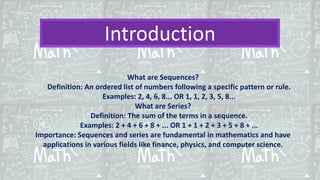
What are Sequences?
Definition: An ordered list of numbers following a specific pattern or rule.
Examples: 2, 4, 6, 8... OR 1, 1, 2, 3, 5, 8...
What are Series?
Definition: The sum of the terms in a sequence.
Examples: 2 + 4 + 6 + 8 + ... OR 1 + 1 + 2 + 3 + 5 + 8 + ...
Importance: Sequences and series are fundamental in mathematics and have
applications in various fields like finance, physics, and computer science.
Types of Sequences
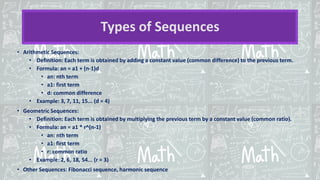
• Arithmetic Sequences:
• Definition: Each term is obtained by adding a constant value (common difference) to the previous term.
• Formula: an = a1 + (n-1)d
• an: nth term
• a1: first term
• d: common difference
• Example: 3, 7, 11, 15... (d = 4)
• Geometric Sequences:
• Definition: Each term is obtained by multiplying the previous term by a constant value (common ratio).
• Formula: an = a1 * r^(n-1)
• an: nth term
• a1: first term
• r: common ratio
• Example: 2, 6, 18, 54... (r = 3)
• Other Sequences: Fibonacci sequence, harmonic sequence
Finding the nth Term
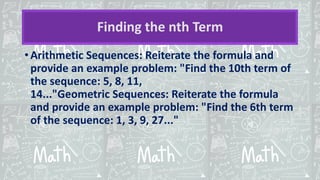
•Arithmetic Sequences: Reiterate the formula and
provide an example problem: "Find the 10th term of
the sequence: 5, 8, 11,
14..."Geometric Sequences: Reiterate the formula
and provide an example problem: "Find the 6th term
of the sequence: 1, 3, 9, 27..."
Arithmetic Series
• Definition: The sum of an arithmetic sequence.
• Formulae:
• Sn = (n/2) * (a1 + an)
• Sn = (n/2) * [2a1 + (n-1)d]
• Sn: sum of the first n terms
• Example Problem: Find the sum of the first 20 terms of the
sequence: 2, 5, 8, 11...
Geometric Series
• Definition: The sum of a geometric sequence.
• Formula:
• Sn = a1 * (1 - rn) / (1 - r)
• Sn: sum of the first n terms
• Example Problem: Find the sum of the first 8 terms of the sequence:
1, 2, 4, 8...
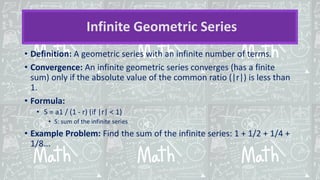
Infinite Geometric Series
• Definition: A geometric series with an infinite number of terms.
• Convergence: An infinite geometric series converges (has a finite
sum) only if the absolute value of the common ratio (|r|) is less than
1.
• Formula:
• S = a1 / (1 - r) (if |r| < 1)
• S: sum of the infinite series
• Example Problem: Find the sum of the infinite series: 1 + 1/2 + 1/4 +
1/8...
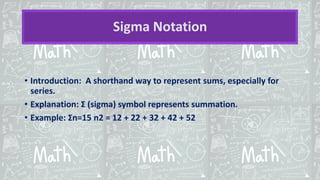
Sigma Notation
• Introduction: A shorthand way to represent sums, especially for
series.
• Explanation: Σ (sigma) symbol represents summation.
• Example: Σn=15 n2 = 12 + 22 + 32 + 42 + 52
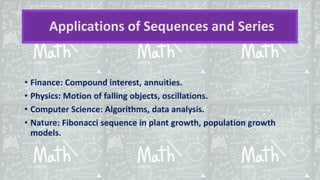
Applications of Sequences and Series
• Finance: Compound interest, annuities.
• Physics: Motion of falling objects, oscillations.
• Computer Science: Algorithms, data analysis.
• Nature: Fibonacci sequence in plant growth, population growth
models.
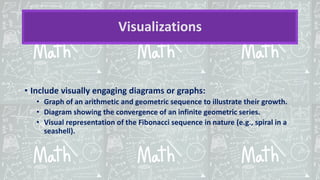
Visualizations
• Include visually engaging diagrams or graphs:
• Graph of an arithmetic and geometric sequence to illustrate their growth.
• Diagram showing the convergence of an infinite geometric series.
• Visual representation of the Fibonacci sequence in nature (e.g., spiral in a
seashell).
Conclusion
Recap the key concepts of sequences and series.
Emphasize their importance and real-
world applications.
Encourage further exploration and learning about this
fascinating area of mathematics
references
1.Khan Academy (https://www.khanacademy.org/)
2.MathWorld (https://mathworld.wolfram.com/)
Thank you

sequence and series powerpoint in math assinment

  • 1.
    Sequences and Series StudentsName: Faisal Buradha 224009217 Nawaf Naif Alghanim 224009114 Abdulrahman Almulhim: 224015805 Abdulaziz Alfuwaires 224011618 Abdulhadi almarhabi 224013200 Supervised by Dr. Muhammad Nur
  • 2.
    Introduction What are Sequences? Definition:An ordered list of numbers following a specific pattern or rule. Examples: 2, 4, 6, 8... OR 1, 1, 2, 3, 5, 8... What are Series? Definition: The sum of the terms in a sequence. Examples: 2 + 4 + 6 + 8 + ... OR 1 + 1 + 2 + 3 + 5 + 8 + ... Importance: Sequences and series are fundamental in mathematics and have applications in various fields like finance, physics, and computer science.
  • 3.
    Types of Sequences •Arithmetic Sequences: • Definition: Each term is obtained by adding a constant value (common difference) to the previous term. • Formula: an = a1 + (n-1)d • an: nth term • a1: first term • d: common difference • Example: 3, 7, 11, 15... (d = 4) • Geometric Sequences: • Definition: Each term is obtained by multiplying the previous term by a constant value (common ratio). • Formula: an = a1 * r^(n-1) • an: nth term • a1: first term • r: common ratio • Example: 2, 6, 18, 54... (r = 3) • Other Sequences: Fibonacci sequence, harmonic sequence
  • 4.
    Finding the nthTerm •Arithmetic Sequences: Reiterate the formula and provide an example problem: "Find the 10th term of the sequence: 5, 8, 11, 14..."Geometric Sequences: Reiterate the formula and provide an example problem: "Find the 6th term of the sequence: 1, 3, 9, 27..."
  • 5.
    Arithmetic Series • Definition:The sum of an arithmetic sequence. • Formulae: • Sn = (n/2) * (a1 + an) • Sn = (n/2) * [2a1 + (n-1)d] • Sn: sum of the first n terms • Example Problem: Find the sum of the first 20 terms of the sequence: 2, 5, 8, 11...
  • 6.
    Geometric Series • Definition:The sum of a geometric sequence. • Formula: • Sn = a1 * (1 - rn) / (1 - r) • Sn: sum of the first n terms • Example Problem: Find the sum of the first 8 terms of the sequence: 1, 2, 4, 8...
  • 7.
    Infinite Geometric Series •Definition: A geometric series with an infinite number of terms. • Convergence: An infinite geometric series converges (has a finite sum) only if the absolute value of the common ratio (|r|) is less than 1. • Formula: • S = a1 / (1 - r) (if |r| < 1) • S: sum of the infinite series • Example Problem: Find the sum of the infinite series: 1 + 1/2 + 1/4 + 1/8...
  • 8.
    Sigma Notation • Introduction:A shorthand way to represent sums, especially for series. • Explanation: Σ (sigma) symbol represents summation. • Example: Σn=15 n2 = 12 + 22 + 32 + 42 + 52
  • 9.
    Applications of Sequencesand Series • Finance: Compound interest, annuities. • Physics: Motion of falling objects, oscillations. • Computer Science: Algorithms, data analysis. • Nature: Fibonacci sequence in plant growth, population growth models.
  • 10.
    Visualizations • Include visuallyengaging diagrams or graphs: • Graph of an arithmetic and geometric sequence to illustrate their growth. • Diagram showing the convergence of an infinite geometric series. • Visual representation of the Fibonacci sequence in nature (e.g., spiral in a seashell).
  • 11.
    Conclusion Recap the keyconcepts of sequences and series. Emphasize their importance and real- world applications. Encourage further exploration and learning about this fascinating area of mathematics
  • 12.
  • 13.