Complete the following:
OBJECTIVES
Define sequence, finite and infinite
sequence.
List the next few terms given several
consecutive terms of a sequence.
Appreciate the concept of generating
patterns.
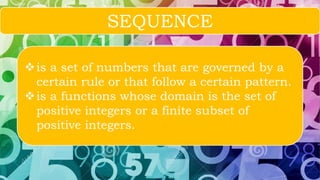
SEQUENCE
is a set of numbers that are governed by a
certain rule or that follow a certain pattern.
is a functions whose domain is the set of
positive integers or a finite subset of
positive integers.
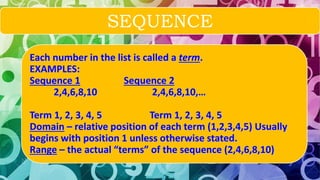
SEQUENCE
Each number in the list is called a term.
EXAMPLES:
Sequence 1 Sequence 2
2,4,6,8,10 2,4,6,8,10,…
Term 1, 2, 3, 4, 5 Term 1, 2, 3, 4, 5
Domain – relative position of each term (1,2,3,4,5) Usually
begins with position 1 unless otherwise stated.
Range – the actual “terms” of the sequence (2,4,6,8,10)
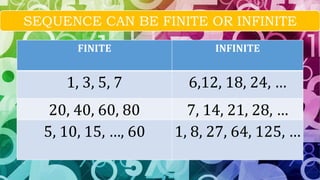
SEQUENCE CAN BE FINITE OR INFINITE
FINITE INFINITE
1, 3, 5, 7 6,12, 18, 24, …
20, 40, 60, 80 7, 14, 21, 28, …
5, 10, 15, …, 60 1, 8, 27, 64, 125, …
SEQUENCE CAN BE FINITE OR INFINITE
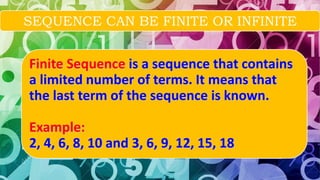
Finite Sequence is a sequence that contains
a limited number of terms. It means that
the last term of the sequence is known.
Example:
2, 4, 6, 8, 10 and 3, 6, 9, 12, 15, 18
SEQUENCE CAN BE FINITE OR INFINITE
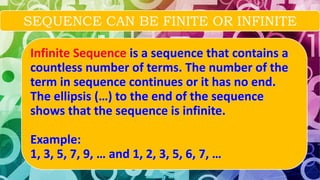
Infinite Sequence is a sequence that contains a
countless number of terms. The number of the
term in sequence continues or it has no end.
The ellipsis (…) to the end of the sequence
shows that the sequence is infinite.
Example:
1, 3, 5, 7, 9, … and 1, 2, 3, 5, 6, 7, …
EXAMPLE
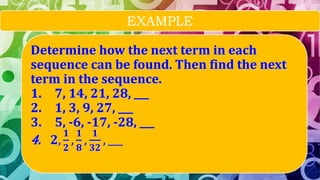
Determine how the next term in each
sequence can be found. Then find the next
term in the sequence.
1. 7, 14, 21, 28, ___
2. 1, 3, 9, 27, ___
3. 5, -6, -17, -28, ___
4. 𝟐,
𝟏
𝟐
,
𝟏
𝟖
,
𝟏
𝟑𝟐
, ___
Boards Up!
Write at least the first 5 terms of the following sequence, then
tell whether the sequence is finite or infinite sequence.
1. Counting number from 1 – 20.
2. Multiples of 3.
3. Even numbers from 4 – 100.
4. Odd numbers.
5. Prime numbers from 2.
Examples:
1. The table below shows the cost of renting the Cavite
Hall at Island Cove Resort and Leisure Park in Kawit, Cavite
depending on the number of attendees.
Number of
Persons
Rental Cost in
Peso
20 6200
25 6500
30 6800
35 7100
SEATWORK 1:
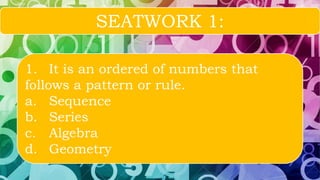
1. It is an ordered of numbers that
follows a pattern or rule.
a. Sequence
b. Series
c. Algebra
d. Geometry
SEATWORK 1:
2. What are the next 3 terms of the
sequence 2, 4, 6, __, __, __.
a. 1, 2, 3
b. 8, 10, 12
c. 3, 4, 5
d. 3, 5, 7
SEATWORK 1:
3. Which of the following sequence
illustrates an infinite sequence.
a. 1, 2, 3, 4, 5, … 10
b. 2, 4, 6, 8, 10
c. 3, 6, 9, 12, 15, ….
d. 5, 10, 15, 20, 25
SEATWORK 1:
4. The sequence 1/3, 1/6, 1/9, 1/12,
1/15 is an example of a finite sequence.
a. True
b. False
c. Maybe
d. I don’t know
SEATWORK 1:
5. It is a symbol that tells you that the
sequence is infinite.
a. Greater than
b. Less than
c. Equal
d. Ellipsis

(1)SEQUENCE.pptx

  • 1.
  • 2.
    OBJECTIVES Define sequence, finiteand infinite sequence. List the next few terms given several consecutive terms of a sequence. Appreciate the concept of generating patterns.
  • 3.
    SEQUENCE is a setof numbers that are governed by a certain rule or that follow a certain pattern. is a functions whose domain is the set of positive integers or a finite subset of positive integers.
  • 4.
    SEQUENCE Each number inthe list is called a term. EXAMPLES: Sequence 1 Sequence 2 2,4,6,8,10 2,4,6,8,10,… Term 1, 2, 3, 4, 5 Term 1, 2, 3, 4, 5 Domain – relative position of each term (1,2,3,4,5) Usually begins with position 1 unless otherwise stated. Range – the actual “terms” of the sequence (2,4,6,8,10)
  • 5.
    SEQUENCE CAN BEFINITE OR INFINITE FINITE INFINITE 1, 3, 5, 7 6,12, 18, 24, … 20, 40, 60, 80 7, 14, 21, 28, … 5, 10, 15, …, 60 1, 8, 27, 64, 125, …
  • 6.
    SEQUENCE CAN BEFINITE OR INFINITE Finite Sequence is a sequence that contains a limited number of terms. It means that the last term of the sequence is known. Example: 2, 4, 6, 8, 10 and 3, 6, 9, 12, 15, 18
  • 7.
    SEQUENCE CAN BEFINITE OR INFINITE Infinite Sequence is a sequence that contains a countless number of terms. The number of the term in sequence continues or it has no end. The ellipsis (…) to the end of the sequence shows that the sequence is infinite. Example: 1, 3, 5, 7, 9, … and 1, 2, 3, 5, 6, 7, …
  • 8.
    EXAMPLE Determine how thenext term in each sequence can be found. Then find the next term in the sequence. 1. 7, 14, 21, 28, ___ 2. 1, 3, 9, 27, ___ 3. 5, -6, -17, -28, ___ 4. 𝟐, 𝟏 𝟐 , 𝟏 𝟖 , 𝟏 𝟑𝟐 , ___
  • 9.
    Boards Up! Write atleast the first 5 terms of the following sequence, then tell whether the sequence is finite or infinite sequence. 1. Counting number from 1 – 20. 2. Multiples of 3. 3. Even numbers from 4 – 100. 4. Odd numbers. 5. Prime numbers from 2.
  • 10.
    Examples: 1. The tablebelow shows the cost of renting the Cavite Hall at Island Cove Resort and Leisure Park in Kawit, Cavite depending on the number of attendees. Number of Persons Rental Cost in Peso 20 6200 25 6500 30 6800 35 7100
  • 11.
    SEATWORK 1: 1. Itis an ordered of numbers that follows a pattern or rule. a. Sequence b. Series c. Algebra d. Geometry
  • 12.
    SEATWORK 1: 2. Whatare the next 3 terms of the sequence 2, 4, 6, __, __, __. a. 1, 2, 3 b. 8, 10, 12 c. 3, 4, 5 d. 3, 5, 7
  • 13.
    SEATWORK 1: 3. Whichof the following sequence illustrates an infinite sequence. a. 1, 2, 3, 4, 5, … 10 b. 2, 4, 6, 8, 10 c. 3, 6, 9, 12, 15, …. d. 5, 10, 15, 20, 25
  • 14.
    SEATWORK 1: 4. Thesequence 1/3, 1/6, 1/9, 1/12, 1/15 is an example of a finite sequence. a. True b. False c. Maybe d. I don’t know
  • 15.
    SEATWORK 1: 5. Itis a symbol that tells you that the sequence is infinite. a. Greater than b. Less than c. Equal d. Ellipsis