Noggin
(BYU Students,
SIGGRAPH 2006)
Introduction to
OpenGL Programming
Rick Skarbez, Instructor
COMP 575
September 11, 2007
Announcements
• Reminder: Homework 1 is due
Thursday
• Questions?
• Class next Tuesday (9/18) will be held
in SN 014
• Extended transformations to 3D
• Introduced some principles of computer
animation
• Lasseter’s “Principles of Traditional
Animation Applied to 3D Computer
Graphics”
• How to create “The Illusion of Life”
Last Time
Today
• Learning how to program in OpenGL
• OpenGL
• C/C++
• GLUT, FLTK, Cocoa
OpenGL in Java
• I have never used Java for OpenGL
programming
• I can’t be much help in getting it set up
• If you really want to try using OpenGL in
Java
• The JOGL API Project
• https://jogl.dev.java.net/
• Go there and follow the instructions
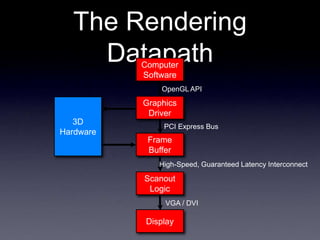
What is OpenGL?
• The standard specification defining an
API that interfaces with the computer’s
graphics system
• Cross-language
• Cross-platform
• Vendor-independent
• Competes with DirectX on Windows
The Rendering
Datapath
Computer
Software
Graphics
Driver
Frame
Buffer
Scanout
Logic
Display
VGA / DVI
OpenGL API
PCI Express Bus
High-Speed, Guaranteed Latency Interconnect
3D
Hardware
An older version is available (free!)
online:
http://fly.cc.fer.hr/~unreal/theredboo
k/
The “Red Book”
Online Resources
http://nehe.gamedev.net
http://www.opengl.org
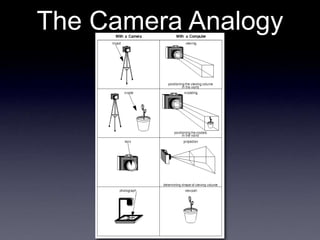
The Camera Analogy
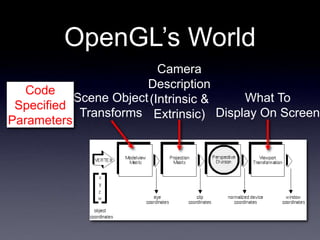
OpenGL’s World
Camera
Description
(Intrinsic &
Extrinsic)
Scene Object
Transforms
What To
Display On Screen
Code
Specified
Parameters
Contexts and
Viewports?
• Each OpenGL application creates a
context to issue rendering commands to
• The application must also define a
viewport, a region of pixels on the
screen that can see the context
• Can be
• Part of a window
• An entire window
• The whole screen
OpenGL as a State
Machine
• OpenGL is designed as a finite state
machine
• Graphics system is a “black box”
• Most functions change the state of the
machine
• One function runs input through the
machine
OpenGL State
• Some attributes of the OpenGL state
• Current color
• Camera properties (location, orientation,
field of view, etc.)
• Lighting model (flat, smooth, etc.)
• Type of primitive being drawn
• And many more...
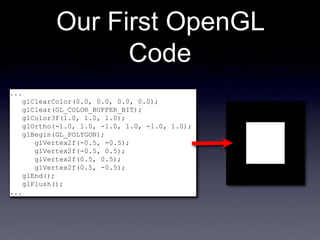
Our First OpenGL
Code
...
glClearColor(0.0, 0.0, 0.0, 0.0);
glClear(GL_COLOR_BUFFER_BIT);
glColor3f(1.0, 1.0, 1.0);
glOrtho(-1.0, 1.0, -1.0, 1.0, -1.0, 1.0);
glBegin(GL_POLYGON);
glVertex2f(-0.5, -0.5);
glVertex2f(-0.5, 0.5);
glVertex2f(0.5, 0.5);
glVertex2f(0.5, -0.5);
glEnd();
glFlush();
...
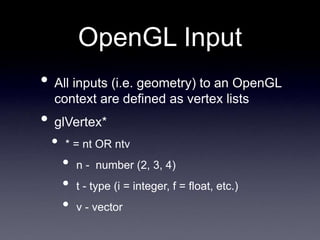
OpenGL Input
• All inputs (i.e. geometry) to an OpenGL
context are defined as vertex lists
• glVertex*
• * = nt OR ntv
• n - number (2, 3, 4)
• t - type (i = integer, f = float, etc.)
• v - vector
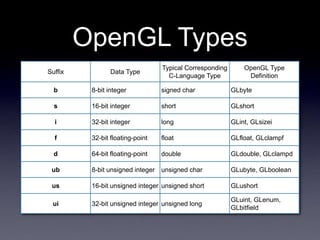
OpenGL Types
Suffix Data Type
Typical Corresponding
C-Language Type
OpenGL Type
Definition
b 8-bit integer signed char GLbyte
s 16-bit integer short GLshort
i 32-bit integer long GLint, GLsizei
f 32-bit floating-point float GLfloat, GLclampf
d 64-bit floating-point double GLdouble, GLclampd
ub 8-bit unsigned integer unsigned char GLubyte, GLboolean
us 16-bit unsigned integer unsigned short GLushort
ui 32-bit unsigned integer unsigned long
GLuint, GLenum,
GLbitfield
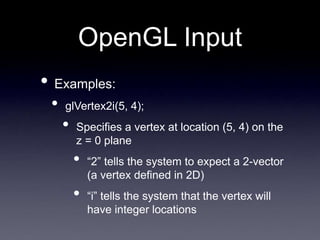
OpenGL Input
• Examples:
• glVertex2i(5, 4);
• Specifies a vertex at location (5, 4) on the
z = 0 plane
• “2” tells the system to expect a 2-vector
(a vertex defined in 2D)
• “i” tells the system that the vertex will
have integer locations
OpenGL Input
• More examples:
• glVertex3f(.25, .25, .5);
• double vertex[3] = {1.0, .33, 3.14159};
glVertex3dv(vertex);
• “v” tells the system to expect the
coordinate list in a single data structure,
instead of a list of n numbers
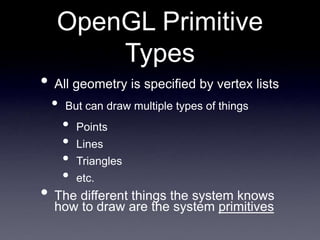
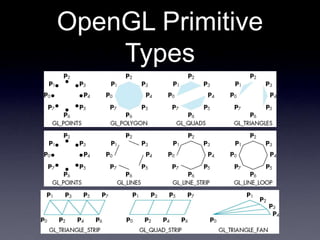
OpenGL Primitive
Types
• All geometry is specified by vertex lists
• But can draw multiple types of things
• Points
• Lines
• Triangles
• etc.
• The different things the system knows
how to draw are the system primitives
Specifying the
OpenGL Primitive
Type
• glBegin(primitiveType);
// A list of glVertex* calls goes here
// ...
glEnd();
• primitiveType can be any of several
things
• See the next slide
OpenGL Primitive
Types
OpenGL Primitives
Example
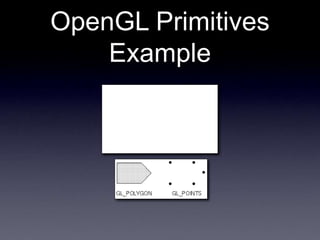
glBegin(GL_POLYGON);
glVertex2f(0.0, 0.0);
glVertex2f(0.0, 3.0);
glVertex2f(3.0, 3.0);
glVertex2f(4.0, 1.5);
glVertex2f(3.0, 0.0);
glEnd();
Color in OpenGL
• Monitors can have different color
resolutions
• Black & white
• 256 color
• 16.8M color
• Want to specify color in a device-
independent way
Color in OpenGL
• glColor4f(r, g, b, a);
• r, g, b, a - should all be between [0.0, 1.0]
• r, g, b - amounts of red, green, and blue
• a - alpha
• Defines how opaque a primitive is
• 0.0 = totally transparent, 1.0 = totally
opaque
• Usually want a = 1.0
Finishing Up Your
OpenGL Program
• OpenGL commands are not executed
immediately
• They are put into a command buffer that
gets fed to the hardware
• When you’re done drawing, need to
send the commands to the graphics
hardware
• glFlush() or glFinish()
glFlush vs. glFinish
• glFlush();
• Forces all issued commands to begin
execution
• Returns immediately (asynchronous)
• glFinish();
• Forces all issued commands to execute
• Does not return until execution is complete
(synchronous)
Matrices in OpenGL
• Vertices are transformed by 2 matrices:
• ModelView
• Maps 3D to 3D
• Transforms vertices from object
coordinates to eye coordinates
• Projection
• Maps 3D to 2D (sort of)
• Transforms vertices from eye coordinates
to clip coordinates
The ModelView
Matrix
• In OpenGL, the viewing and modeling
transforms are combined into a single
matrix - the modelview matrix
• Viewing Transform - positioning the camera
• Modeling Transform - positioning the object
• Why?
• Consider how you would “translate” a fixed
object with a real camera
Placing the Camera
• gluLookAt(
GLdouble eyeX, GLdouble eyeY, GLdouble
eyeZ, GLdouble midX, GLdouble midY,
GLdouble midZ,
GLdouble upX, GLdouble upY, GLdouble upZ)
• (eyeX, eyeY, eyeZ) - location of the
viewpoint
• (midX, midY, midZ) - location of a point on
the line of sight
• (upX, upY, upZ) - direction of the up vector
• By default the camera is at the origin,
looking down negative z, and the up
vector is the positive y axis
WARNING!
OpenGL Matrices
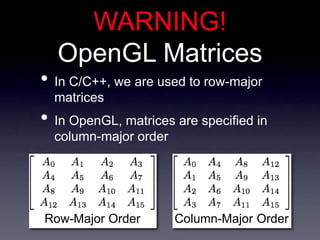
• In C/C++, we are used to row-major
matrices
• In OpenGL, matrices are specified in
column-major order
Row-Major Order Column-Major Order
Using OpenGL
Matrices
• Use the following function to specify
which matrix you are changing:
• glMatrixMode(whichMatrix);
• whichMatrix = GL_PROJECTION |
GL_MODELVIEW
• To guarantee a “fresh start”, use
glLoadIdentity();
• Loads the identity matrix into the active
matrix
Using OpenGL
Matrices
• To load a user-defined matrix into the
current matrix:
• glLoadMatrix{fd}(TYPE *m)
• To multiply the current matrix by a user
defined matrix
• glMultMatrix{fd}(TYPE *m)
• SUGGESTION: To avoid row-/column-
major confusion, specify matrices as
m[16] instead of m[4][4]
Transforms in
OpenGL
• OpenGL uses 4x4 matrices for all its
transforms
• But you don’t have to build them all by hand!
• glRotate{fd}(angle, x, y, z)
• Rotates counter-clockwise by angle degrees
about the vector (x, y, z)
• glTranslate{fd}(x, y, z)
• glScale{fd}(x, y, z)
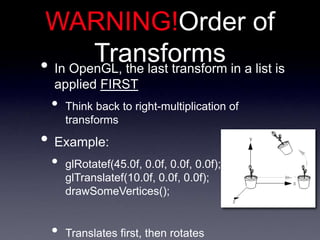
• In OpenGL, the last transform in a list is
applied FIRST
• Think back to right-multiplication of
transforms
• Example:
• glRotatef(45.0f, 0.0f, 0.0f, 0.0f);
glTranslatef(10.0f, 0.0f, 0.0f);
drawSomeVertices();
• Translates first, then rotates
WARNING!Order of
Transforms
Projection
Transforms
• The projection matrix defines the
viewing volume
• Used for 2 things:
• Projects an object onto the screen
• Determines how objects are clipped
• The viewpoint (the location of the
“camera”) that we’ve been talking about
is at one end of the viewing volume
Projection
Transforms
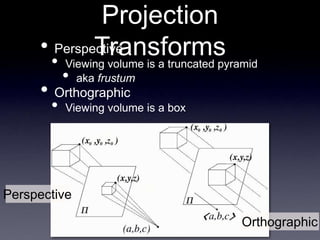
• Perspective
• Viewing volume is a truncated pyramid
• aka frustum
• Orthographic
• Viewing volume is a box
Perspective
Orthographic
Perspective
Projection
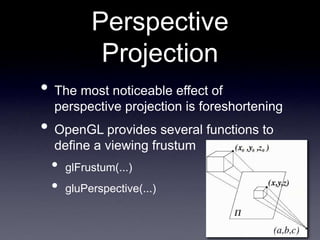
• The most noticeable effect of
perspective projection is foreshortening
• OpenGL provides several functions to
define a viewing frustum
• glFrustum(...)
• gluPerspective(...)
glFrustum
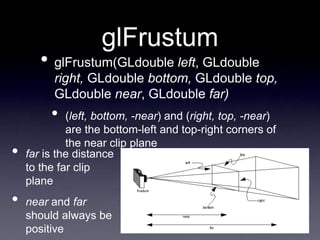
• glFrustum(GLdouble left, GLdouble
right, GLdouble bottom, GLdouble top,
GLdouble near, GLdouble far)
• (left, bottom, -near) and (right, top, -near)
are the bottom-left and top-right corners of
the near clip plane
• far is the distance
to the far clip
plane
• near and far
should always be
positive
gluPerspective
• This GL Utility Library function provides a
more intuitive way (I think) to define a
frustum
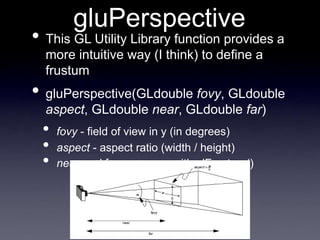
• gluPerspective(GLdouble fovy, GLdouble
aspect, GLdouble near, GLdouble far)
• fovy - field of view in y (in degrees)
• aspect - aspect ratio (width / height)
• near and far - same as with glFrustum()
Orthographic
Projection
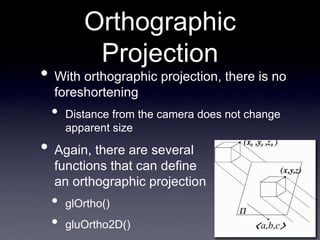
• With orthographic projection, there is no
foreshortening
• Distance from the camera does not change
apparent size
• Again, there are several
functions that can define
an orthographic projection
• glOrtho()
• gluOrtho2D()
glOrtho
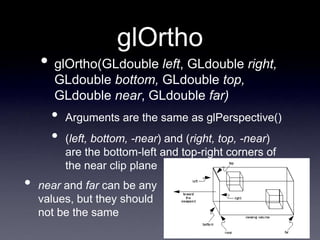
• glOrtho(GLdouble left, GLdouble right,
GLdouble bottom, GLdouble top,
GLdouble near, GLdouble far)
• Arguments are the same as glPerspective()
• (left, bottom, -near) and (right, top, -near)
are the bottom-left and top-right corners of
the near clip plane
• near and far can be any
values, but they should
not be the same
gluOrtho2D
• This GL Utility Library function provides
a more intuitive way (I think) to define a
frustum
• gluOrtho2D(GLdouble left, GLdouble
right, GLdouble bottom, GLdouble top)
• (left, bottom) and (right, top) define the (x, y)
coordinates of the bottom-left and top-right
corners of the clipping region
• Automatically clips to between -1.0 and 1.0
in z
Viewport
• The viewport is the part of the window
your drawing is displayed to
• By default, the viewport is the entire window
• Modifying the viewport is analogous to
changing the size of the final picture
• From the camera analogy
• Can have multiple viewports in the
same window for a split-screen effect
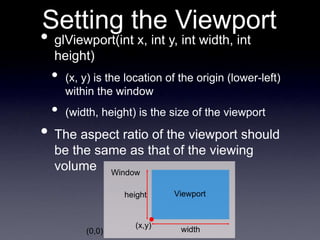
Setting the Viewport
• glViewport(int x, int y, int width, int
height)
• (x, y) is the location of the origin (lower-left)
within the window
• (width, height) is the size of the viewport
• The aspect ratio of the viewport should
be the same as that of the viewing
volume
(0,0) width
height
(x,y)
Viewport
Window

september11.ppt

  • 1.
  • 2.
    Introduction to OpenGL Programming RickSkarbez, Instructor COMP 575 September 11, 2007
  • 3.
    Announcements • Reminder: Homework1 is due Thursday • Questions? • Class next Tuesday (9/18) will be held in SN 014
  • 4.
    • Extended transformationsto 3D • Introduced some principles of computer animation • Lasseter’s “Principles of Traditional Animation Applied to 3D Computer Graphics” • How to create “The Illusion of Life” Last Time
  • 5.
    Today • Learning howto program in OpenGL • OpenGL • C/C++ • GLUT, FLTK, Cocoa
  • 6.
    OpenGL in Java •I have never used Java for OpenGL programming • I can’t be much help in getting it set up • If you really want to try using OpenGL in Java • The JOGL API Project • https://jogl.dev.java.net/ • Go there and follow the instructions
  • 7.
    What is OpenGL? •The standard specification defining an API that interfaces with the computer’s graphics system • Cross-language • Cross-platform • Vendor-independent • Competes with DirectX on Windows
  • 8.
    The Rendering Datapath Computer Software Graphics Driver Frame Buffer Scanout Logic Display VGA /DVI OpenGL API PCI Express Bus High-Speed, Guaranteed Latency Interconnect 3D Hardware
  • 9.
    An older versionis available (free!) online: http://fly.cc.fer.hr/~unreal/theredboo k/ The “Red Book”
  • 10.
  • 11.
  • 12.
    OpenGL’s World Camera Description (Intrinsic & Extrinsic) SceneObject Transforms What To Display On Screen Code Specified Parameters
  • 13.
    Contexts and Viewports? • EachOpenGL application creates a context to issue rendering commands to • The application must also define a viewport, a region of pixels on the screen that can see the context • Can be • Part of a window • An entire window • The whole screen
  • 14.
    OpenGL as aState Machine • OpenGL is designed as a finite state machine • Graphics system is a “black box” • Most functions change the state of the machine • One function runs input through the machine
  • 15.
    OpenGL State • Someattributes of the OpenGL state • Current color • Camera properties (location, orientation, field of view, etc.) • Lighting model (flat, smooth, etc.) • Type of primitive being drawn • And many more...
  • 16.
    Our First OpenGL Code ... glClearColor(0.0,0.0, 0.0, 0.0); glClear(GL_COLOR_BUFFER_BIT); glColor3f(1.0, 1.0, 1.0); glOrtho(-1.0, 1.0, -1.0, 1.0, -1.0, 1.0); glBegin(GL_POLYGON); glVertex2f(-0.5, -0.5); glVertex2f(-0.5, 0.5); glVertex2f(0.5, 0.5); glVertex2f(0.5, -0.5); glEnd(); glFlush(); ...
  • 17.
    OpenGL Input • Allinputs (i.e. geometry) to an OpenGL context are defined as vertex lists • glVertex* • * = nt OR ntv • n - number (2, 3, 4) • t - type (i = integer, f = float, etc.) • v - vector
  • 18.
    OpenGL Types Suffix DataType Typical Corresponding C-Language Type OpenGL Type Definition b 8-bit integer signed char GLbyte s 16-bit integer short GLshort i 32-bit integer long GLint, GLsizei f 32-bit floating-point float GLfloat, GLclampf d 64-bit floating-point double GLdouble, GLclampd ub 8-bit unsigned integer unsigned char GLubyte, GLboolean us 16-bit unsigned integer unsigned short GLushort ui 32-bit unsigned integer unsigned long GLuint, GLenum, GLbitfield
  • 19.
    OpenGL Input • Examples: •glVertex2i(5, 4); • Specifies a vertex at location (5, 4) on the z = 0 plane • “2” tells the system to expect a 2-vector (a vertex defined in 2D) • “i” tells the system that the vertex will have integer locations
  • 20.
    OpenGL Input • Moreexamples: • glVertex3f(.25, .25, .5); • double vertex[3] = {1.0, .33, 3.14159}; glVertex3dv(vertex); • “v” tells the system to expect the coordinate list in a single data structure, instead of a list of n numbers
  • 21.
    OpenGL Primitive Types • Allgeometry is specified by vertex lists • But can draw multiple types of things • Points • Lines • Triangles • etc. • The different things the system knows how to draw are the system primitives
  • 22.
    Specifying the OpenGL Primitive Type •glBegin(primitiveType); // A list of glVertex* calls goes here // ... glEnd(); • primitiveType can be any of several things • See the next slide
  • 23.
  • 24.
    OpenGL Primitives Example glBegin(GL_POLYGON); glVertex2f(0.0, 0.0); glVertex2f(0.0,3.0); glVertex2f(3.0, 3.0); glVertex2f(4.0, 1.5); glVertex2f(3.0, 0.0); glEnd();
  • 25.
    Color in OpenGL •Monitors can have different color resolutions • Black & white • 256 color • 16.8M color • Want to specify color in a device- independent way
  • 26.
    Color in OpenGL •glColor4f(r, g, b, a); • r, g, b, a - should all be between [0.0, 1.0] • r, g, b - amounts of red, green, and blue • a - alpha • Defines how opaque a primitive is • 0.0 = totally transparent, 1.0 = totally opaque • Usually want a = 1.0
  • 27.
    Finishing Up Your OpenGLProgram • OpenGL commands are not executed immediately • They are put into a command buffer that gets fed to the hardware • When you’re done drawing, need to send the commands to the graphics hardware • glFlush() or glFinish()
  • 28.
    glFlush vs. glFinish •glFlush(); • Forces all issued commands to begin execution • Returns immediately (asynchronous) • glFinish(); • Forces all issued commands to execute • Does not return until execution is complete (synchronous)
  • 29.
    Matrices in OpenGL •Vertices are transformed by 2 matrices: • ModelView • Maps 3D to 3D • Transforms vertices from object coordinates to eye coordinates • Projection • Maps 3D to 2D (sort of) • Transforms vertices from eye coordinates to clip coordinates
  • 30.
    The ModelView Matrix • InOpenGL, the viewing and modeling transforms are combined into a single matrix - the modelview matrix • Viewing Transform - positioning the camera • Modeling Transform - positioning the object • Why? • Consider how you would “translate” a fixed object with a real camera
  • 31.
    Placing the Camera •gluLookAt( GLdouble eyeX, GLdouble eyeY, GLdouble eyeZ, GLdouble midX, GLdouble midY, GLdouble midZ, GLdouble upX, GLdouble upY, GLdouble upZ) • (eyeX, eyeY, eyeZ) - location of the viewpoint • (midX, midY, midZ) - location of a point on the line of sight • (upX, upY, upZ) - direction of the up vector • By default the camera is at the origin, looking down negative z, and the up vector is the positive y axis
  • 32.
    WARNING! OpenGL Matrices • InC/C++, we are used to row-major matrices • In OpenGL, matrices are specified in column-major order Row-Major Order Column-Major Order
  • 33.
    Using OpenGL Matrices • Usethe following function to specify which matrix you are changing: • glMatrixMode(whichMatrix); • whichMatrix = GL_PROJECTION | GL_MODELVIEW • To guarantee a “fresh start”, use glLoadIdentity(); • Loads the identity matrix into the active matrix
  • 34.
    Using OpenGL Matrices • Toload a user-defined matrix into the current matrix: • glLoadMatrix{fd}(TYPE *m) • To multiply the current matrix by a user defined matrix • glMultMatrix{fd}(TYPE *m) • SUGGESTION: To avoid row-/column- major confusion, specify matrices as m[16] instead of m[4][4]
  • 35.
    Transforms in OpenGL • OpenGLuses 4x4 matrices for all its transforms • But you don’t have to build them all by hand! • glRotate{fd}(angle, x, y, z) • Rotates counter-clockwise by angle degrees about the vector (x, y, z) • glTranslate{fd}(x, y, z) • glScale{fd}(x, y, z)
  • 36.
    • In OpenGL,the last transform in a list is applied FIRST • Think back to right-multiplication of transforms • Example: • glRotatef(45.0f, 0.0f, 0.0f, 0.0f); glTranslatef(10.0f, 0.0f, 0.0f); drawSomeVertices(); • Translates first, then rotates WARNING!Order of Transforms
  • 37.
    Projection Transforms • The projectionmatrix defines the viewing volume • Used for 2 things: • Projects an object onto the screen • Determines how objects are clipped • The viewpoint (the location of the “camera”) that we’ve been talking about is at one end of the viewing volume
  • 38.
    Projection Transforms • Perspective • Viewingvolume is a truncated pyramid • aka frustum • Orthographic • Viewing volume is a box Perspective Orthographic
  • 39.
    Perspective Projection • The mostnoticeable effect of perspective projection is foreshortening • OpenGL provides several functions to define a viewing frustum • glFrustum(...) • gluPerspective(...)
  • 40.
    glFrustum • glFrustum(GLdouble left,GLdouble right, GLdouble bottom, GLdouble top, GLdouble near, GLdouble far) • (left, bottom, -near) and (right, top, -near) are the bottom-left and top-right corners of the near clip plane • far is the distance to the far clip plane • near and far should always be positive
  • 41.
    gluPerspective • This GLUtility Library function provides a more intuitive way (I think) to define a frustum • gluPerspective(GLdouble fovy, GLdouble aspect, GLdouble near, GLdouble far) • fovy - field of view in y (in degrees) • aspect - aspect ratio (width / height) • near and far - same as with glFrustum()
  • 42.
    Orthographic Projection • With orthographicprojection, there is no foreshortening • Distance from the camera does not change apparent size • Again, there are several functions that can define an orthographic projection • glOrtho() • gluOrtho2D()
  • 43.
    glOrtho • glOrtho(GLdouble left,GLdouble right, GLdouble bottom, GLdouble top, GLdouble near, GLdouble far) • Arguments are the same as glPerspective() • (left, bottom, -near) and (right, top, -near) are the bottom-left and top-right corners of the near clip plane • near and far can be any values, but they should not be the same
  • 44.
    gluOrtho2D • This GLUtility Library function provides a more intuitive way (I think) to define a frustum • gluOrtho2D(GLdouble left, GLdouble right, GLdouble bottom, GLdouble top) • (left, bottom) and (right, top) define the (x, y) coordinates of the bottom-left and top-right corners of the clipping region • Automatically clips to between -1.0 and 1.0 in z
  • 45.
    Viewport • The viewportis the part of the window your drawing is displayed to • By default, the viewport is the entire window • Modifying the viewport is analogous to changing the size of the final picture • From the camera analogy • Can have multiple viewports in the same window for a split-screen effect
  • 46.
    Setting the Viewport •glViewport(int x, int y, int width, int height) • (x, y) is the location of the origin (lower-left) within the window • (width, height) is the size of the viewport • The aspect ratio of the viewport should be the same as that of the viewing volume (0,0) width height (x,y) Viewport Window