SEPTICEMIA AND MODS
overview
A. Definitions
B. Magnitude of the problem
C. Sepsis – A complex entity
D. Source of infection ?
E. Pathophysiological basis of abnormalies
F. Surviving Sepsis Campaign – Addressing the issue
globally
 History of SSC
 Management Guidelines
 The “bundle” approach
G. Recent advances
H. Biomarkers
definitions
Bacteremia - Presence of bacteria in blood, as evidenced
by positive blood cultures.
Septicemia - Presence of microbes or their toxins in
blood.
definitions
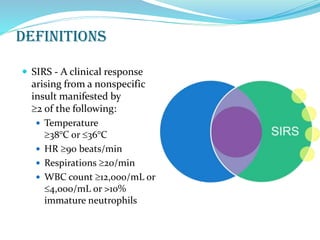
 SIRS - A clinical response
arising from a nonspecific
insult manifested by
2 of the following:
 Temperature
38°C or 36°C
 HR 90 beats/min
 Respirations 20/min
 WBC count 12,000/mL or
4,000/mL or >10%
immature neutrophils
definitions
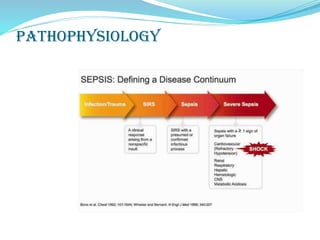
 Sepsis:
 Known or suspected
infection
 SIRS criteria
definitions
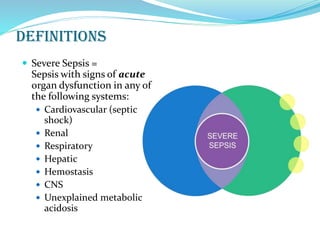
 Severe Sepsis =
Sepsis with signs of acute
organ dysfunction in any of
the following systems:
 Cardiovascular (septic
shock)
 Renal
 Respiratory
 Hepatic
 Hemostasis
 CNS
 Unexplained metabolic
acidosis
definitions
Septic shock- Sepsis, with
hypotension (SBP <90 mmHg systolic, or
40 mmHg less than patient's normal
blood pressure) for at least 1 h despite adequate
fluid resuscitation,
or
Need for vasopressors to maintain systolic
blood pressure 90 mmHg or mean arterial
pressure 70 mmHg
definitions
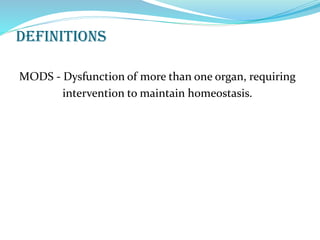
MODS - Dysfunction of more than one organ, requiring
intervention to maintain homeostasis.
Sepsis – A complex entity
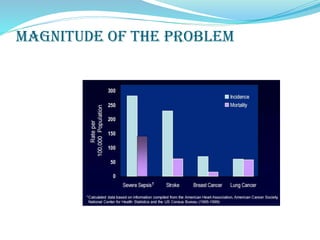
Magnitude of the problem
Magnitude of the problem - India
SOURCE OF INFECTION
Organisms Most common source
Gram negative pathogen Pneumonia
Coagulase –ve Staph. Vascular catheters
Staph. aureus Pneumonia
Enterococci Pneumonia
Streptococci Unknown
Anaerobic organisms Pneumonia
Candida spp. Vascular catheters
pathophysiology
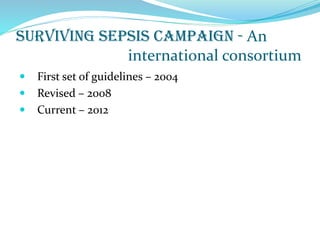
Surviving sepsis campaign - An
international consortium
 First set of guidelines – 2004
 Revised – 2008
 Current – 2012
Ssc guidelines – Initial resuscitation &
infection issues
Ssc guidelines – Initial resuscitation &
infection issues
Ssc guidelines – Initial resuscitation &
infection issues
Ssc guidelines – Initial resuscitation &
infection issues
Ssc guidelines – Hemodynamic support
& adjunctive therapy
Ssc guidelines – Hemodynamic support
& adjunctive therapy
Ssc guidelines – Hemodynamic support
& adjunctive therapy
Ssc guidelines – Hemodynamic support
& adjunctive therapy
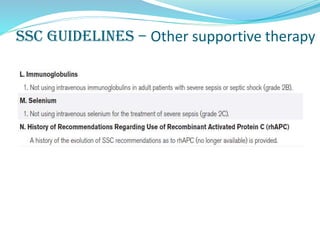
Ssc guidelines – Other supportive therapy
Ssc - The “bundle” approach
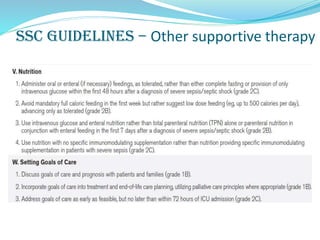
Ssc guidelines – Other supportive therapy
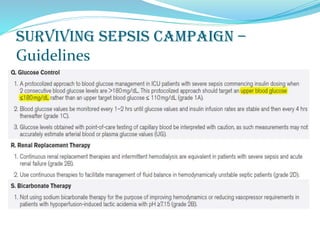
Surviving sepsis campaign –
Guidelines
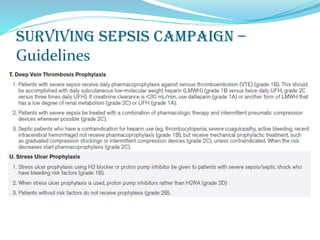
Surviving sepsis campaign –
Guidelines
Surviving sepsis campaign –
Guidelines
Ssc guidelines – Other supportive therapy
Recent advances & controversies
• Sepsis leads to
– Inflammation
– Coagulation
– Tissue damage and repair
• The sicker you are, the greater the changes
• We can identify biomarkers for these processes
• We can measure these biomarkers
• We can stratify severity based on biomarker levels
• We can prognosticate based on biomarker levels
biomarkers
• Acute phase proteins
– CRP
– Procalcitonin
– Pentraxin 3 (PTX3)
– Lipopolysaccharide binding protein (LBP)
• Cytokines & chemokines
– IL-1RA, IL-1b,IL-2, IL-6, MCP-1
– TNF-a, TNFR1/2
– HMGBP1
• Cell surface markers
– Soluble CD14 (presepsin)
– Neutrophil CD64 index (CD64in)
– mHLA-DR (monocyte HLA-DR levels)
– CD-163
• Receptor markers
– VEGF
– Soluble VEGF-receptor 1 (sFLT)
– Soluble urokinase plasminogen activator (suPAR)
– sTREM-1
– RAGE (soluble receptor for advanced glycation
end products)
• Coagulation
– Activated partial thromboplastin time
(aPTT) waveform analysis
– Protein C receptor
– Thrombomodulin
• Endothelial damage
– Heparin binding protein
– E-selectin
– Neopterin
– ICAM-1, VCAM-1
– Angiopoietin-1 and -2
– Syndecan-1 and -2
• Vasodilation
– Copeptin (AVP precursor)
• Cell damage
– MicroRNA
– Microparticles
• Cell repair
– Procollagen III amino propeptide
Biomarkers - Examples
• Bacterial infections
– > ubiqitous CALC-1 gene expression
– > release of PCT from all parenchymal tissues
– Procalcitonin (PCT) increases after 2-3 hours after
induction e.g. by endotoxin
– Falls with successful treatment
Biomarkers - Procalcitonin
• Pentraxins are liquid-phase PAMP receptors
• “Short” pentraxins include CRP as is serum amyloid
P component (SAP)
• Pentraxin-3 involved in:
– complement activation
– pathogen opsonisation
– self versus modified-self versus non-self discrimination
Biomarkers - Pentraxin
Thank you

Sepsis

  • 1.
  • 2.
    overview A. Definitions B. Magnitudeof the problem C. Sepsis – A complex entity D. Source of infection ? E. Pathophysiological basis of abnormalies F. Surviving Sepsis Campaign – Addressing the issue globally  History of SSC  Management Guidelines  The “bundle” approach G. Recent advances H. Biomarkers
  • 3.
    definitions Bacteremia - Presenceof bacteria in blood, as evidenced by positive blood cultures. Septicemia - Presence of microbes or their toxins in blood.
  • 4.
    definitions  SIRS -A clinical response arising from a nonspecific insult manifested by 2 of the following:  Temperature 38°C or 36°C  HR 90 beats/min  Respirations 20/min  WBC count 12,000/mL or 4,000/mL or >10% immature neutrophils
  • 5.
    definitions  Sepsis:  Knownor suspected infection  SIRS criteria
  • 6.
    definitions  Severe Sepsis= Sepsis with signs of acute organ dysfunction in any of the following systems:  Cardiovascular (septic shock)  Renal  Respiratory  Hepatic  Hemostasis  CNS  Unexplained metabolic acidosis
  • 7.
    definitions Septic shock- Sepsis,with hypotension (SBP <90 mmHg systolic, or 40 mmHg less than patient's normal blood pressure) for at least 1 h despite adequate fluid resuscitation, or Need for vasopressors to maintain systolic blood pressure 90 mmHg or mean arterial pressure 70 mmHg
  • 8.
    definitions MODS - Dysfunctionof more than one organ, requiring intervention to maintain homeostasis.
  • 9.
    Sepsis – Acomplex entity
  • 10.
  • 11.
    Magnitude of theproblem - India
  • 12.
    SOURCE OF INFECTION OrganismsMost common source Gram negative pathogen Pneumonia Coagulase –ve Staph. Vascular catheters Staph. aureus Pneumonia Enterococci Pneumonia Streptococci Unknown Anaerobic organisms Pneumonia Candida spp. Vascular catheters
  • 13.
  • 14.
    Surviving sepsis campaign- An international consortium  First set of guidelines – 2004  Revised – 2008  Current – 2012
  • 15.
    Ssc guidelines –Initial resuscitation & infection issues
  • 16.
    Ssc guidelines –Initial resuscitation & infection issues
  • 17.
    Ssc guidelines –Initial resuscitation & infection issues
  • 18.
    Ssc guidelines –Initial resuscitation & infection issues
  • 19.
    Ssc guidelines –Hemodynamic support & adjunctive therapy
  • 20.
    Ssc guidelines –Hemodynamic support & adjunctive therapy
  • 21.
    Ssc guidelines –Hemodynamic support & adjunctive therapy
  • 22.
    Ssc guidelines –Hemodynamic support & adjunctive therapy
  • 23.
    Ssc guidelines –Other supportive therapy
  • 24.
    Ssc guidelines –Other supportive therapy
  • 25.
    Ssc - The“bundle” approach
  • 26.
    Ssc guidelines –Other supportive therapy
  • 27.
  • 28.
  • 29.
  • 30.
    Ssc guidelines –Other supportive therapy
  • 31.
    Recent advances &controversies
  • 32.
    Recent advances &controversies
  • 33.
    Recent advances &controversies
  • 34.
    • Sepsis leadsto – Inflammation – Coagulation – Tissue damage and repair • The sicker you are, the greater the changes • We can identify biomarkers for these processes • We can measure these biomarkers • We can stratify severity based on biomarker levels • We can prognosticate based on biomarker levels biomarkers
  • 35.
    • Acute phaseproteins – CRP – Procalcitonin – Pentraxin 3 (PTX3) – Lipopolysaccharide binding protein (LBP) • Cytokines & chemokines – IL-1RA, IL-1b,IL-2, IL-6, MCP-1 – TNF-a, TNFR1/2 – HMGBP1 • Cell surface markers – Soluble CD14 (presepsin) – Neutrophil CD64 index (CD64in) – mHLA-DR (monocyte HLA-DR levels) – CD-163 • Receptor markers – VEGF – Soluble VEGF-receptor 1 (sFLT) – Soluble urokinase plasminogen activator (suPAR) – sTREM-1 – RAGE (soluble receptor for advanced glycation end products) • Coagulation – Activated partial thromboplastin time (aPTT) waveform analysis – Protein C receptor – Thrombomodulin • Endothelial damage – Heparin binding protein – E-selectin – Neopterin – ICAM-1, VCAM-1 – Angiopoietin-1 and -2 – Syndecan-1 and -2 • Vasodilation – Copeptin (AVP precursor) • Cell damage – MicroRNA – Microparticles • Cell repair – Procollagen III amino propeptide Biomarkers - Examples
  • 36.
    • Bacterial infections –> ubiqitous CALC-1 gene expression – > release of PCT from all parenchymal tissues – Procalcitonin (PCT) increases after 2-3 hours after induction e.g. by endotoxin – Falls with successful treatment Biomarkers - Procalcitonin
  • 37.
    • Pentraxins areliquid-phase PAMP receptors • “Short” pentraxins include CRP as is serum amyloid P component (SAP) • Pentraxin-3 involved in: – complement activation – pathogen opsonisation – self versus modified-self versus non-self discrimination Biomarkers - Pentraxin
  • 38.