Layoffs, downsizing and restructuringby Toronto Training and HR January 2011
Contents3-4 Introduction to Toronto 			Training and HR	5-6	Definitions	7-8	Implications of poor termination 		practices	9-20	Meeting details21-23	After the meeting24-25	Termination letters	26-30	Downsizing31-36	Outplacement37-39	Separation and severance policies40-42	Career motivation43-44	Tackling survivor syndrome45-46	Layoffs in the US47-48	Avoiding pitfalls49-52	Case studies53-54	Conclusion and questionsPage 2
Page 3Introduction
Page 4Introduction to Toronto Training and HRToronto Training and HRis a specialist training and human resources consultancy headed by Timothy Holden 10 years in banking10 years in training and human resourcesFreelance practitioner since 2006The core services provided by Toronto Training and HR are:Training course design
Training course delivery-  Reducing costsSaving time
Improving employee engagement & morale
Services for job seekersPage 5Definitions
Page 6DefinitionsLAYOFFSDOWNSIZING
Page 7Implications of poor termination practices
Page 8Implications of poor termination practicesINCREASEDlegal compliance issues and litigation (time and $ saved)likelihood of sign-off on termination package (time and $ saved)NEGATIVE IMPACT ONcorporate brand (maintain $ revenue and $ saved)remaining employees (maintain $ productivity/employee)
Page 9Meeting details
Page 10Meeting details 1 of 11LOCATIONConfidential room on-siteAway from employee’s work areaAway from manager’s officeAdditional or dual exit access
Page 11Meeting details 2 of 11TIMEEarlier in the week is ideal (Tues/Wed)Earlier in the day is idealAvoid employee birthday or anniversary dateAvoid significant holidays
Page 12Meeting details 3 of 11ATTENDEESDirect manager should deliver the messageHR or another manager to support the process is idealLeverage skills and experience of outplacement specialistsDefine roles and scripts ahead of time
Page 13Meeting details 4 of 11OTHER CONSIDERATIONSWill security be an issue?Will medical conditions create a risk?Create a termination checklist for network and software access, laptops, cell phones, pass codes, voicemail, etc.
Page 14Meeting details 5 of 11POSITIONING STATEMENTBe honest – don’t set up the meeting under false pretences“George, I’d like to have a conversation with you about your performance. Can you come see me in the ABC room?”Do not schedule meeting too far in advance
Page 15Meeting details 6 of 11DELIVERING THE MESSAGEGet right to the pointReinforce decision is final – do not negotiateBe brief, but respectful – 2 to 3 minutesKeep the discussion in business termsMove the conversation along to a discussion of next steps –this will take longer
Page 16Meeting details 7 of 11REACTIONS TO PREPARE FOR-SHOCK AND DENIALAllow them time to reactRepeat the message if necessaryProbe gently to ensure they understand the message
Page 17Meeting details 8 of 11REACTIONS TO PREPARE FOR-ANGER AND HOSTILITYRemain calm, keep it businessDo not argue, debate or take sidesAcknowledge their anger but bring discussion back to next steps“You can schedule a time to discuss it at a later date withxxx/me. However, my purpose today is simply tocommunicate the decision, provide the package and introduce your career transition expert”
Page 18Meeting details 9 of 11REACTIONS TO PREPARE FOR-NEGOTIATIONAcknowledge their suggestionReinforce alternatives were considered but decision is final
Page 19Meeting details 10 of 11REACTIONS TO PREPARE FOR-RELIEF AND ACCEPTANCEProbe gently to ensure they understand the messageReinforce next stepsInform outplacement expert and HR of “controlled” reaction
Page 20Meeting details 11 of 11BEST PRACTICENever mention names of others affected or remainingEscort the employee out of the building – they can connect with co-workers and clean up desk at a later date (if applicable)Ensure the employee is capable of returning home – assess and offer alternatives if necessary – leverage outplacement expert
Page 21After the meeting
Page 22After the meeting 1 of 2DELIVER THE MESSAGE TO THE SURVIVORSThey may go through similar emotionsReinforce decision and support employee(s) is receivingOutline how work will be allocated/replacedOutline how calls/emails/clients will be managedReinforce the importance of their jobs
Page 23After the meeting 2 of 2BEST PRACTICE-BE VISIBLE AND ACCESSIBLEDemonstrate objectivity and empathyUtilize change management resources – HR, Employee Assistance Programs, team meetingsHave more senior or other managers “check-in” with remaining employees
Page 24Termination letters
Page 25Termination lettersShould be clear, concise, direct and cover the important detailsRecognition of service and contributions can be added if applicableNot required to include details/evidence of performance issues or steps taken unless for causeCreate a separate financial package
Page 26Downsizing
Page 27Downsizing 1 of 4EFFECTS OF DOWNSIZING Job securityJob satisfactionOrganizational justiceOrganizational commitmentUnion commitment
Page 28Downsizing 2 of 4REDUCING THE IMPACT OF DOWNSIZING Do it once – identify a group if necessary and get it over with.Handle the situation with sensitivity. Have a package ready - provide employees with information regarding their benefits, eligibility for unemployment insurance, any severance payments or other information you think they will need - before they leave the meeting.Communicate – communicate – communicate.
Page 29Downsizing 3 of 4REDUCING THE IMPACT OF DOWNSIZING Prepare managers with information and a communication strategy for their role with their teams.If at all possible, offer an outplacement service to the employees being let go…this will buy you tremendous good will with them and the employees who stay. In the end you are left with those upon whom you will rely to work harder and smarter. Make sure they are your key contributors and that you work hard to keep their trust. Let them know you appreciate their hard work and communicate, communicate, communicate!
Page 30Downsizing 4 of 4NEGATIVE IMPACTS Decreased morale Reduced loyalty Productivity/Quality Loss Damage to brand Turnover Absenteeism Lawsuits Negative image Stock price decrease Loss of customers
Page 31Outplacement
Page 32Outplacement 1 of 5FACE TO FACEOne-on-one sessionsGroup sessionsPersonality and career assessments Specialized webinars, workshops and networking sessions Personal finance consultation Personal image guidanceInterview coachingGuidance on approaching organizations speculativelySmall business optionsEducation, retraining and retirement options
Page 33Outplacement 2 of 5NON FACE TO FACEDiscounts on a number of training & development courses Business cards
Page 34Outplacement 3 of 5ONLINECreation of a customized resumeCreation of a customized cover letterCreation or revision of social media profilesGuidance on contributing to blogs and forumsDatabase of contactsAccess to a computerized career transition tool
Page 35Outplacement 4 of 5RECENT TRENDSKey decision criteria for choosing an outplacement providerWhich employees receive outplacement support, including global differences Factors considered when determining outplacement support Which employees get what level of support, including global differences
Page 36Outplacement 5 of 5RECENT TRENDSThe most important components of an outplacement program, including opinions of those in transition Circumstances in which outplacement support is increasedThe most important indicator of a successful outplacement partner The most important indicator of a successful downsizing Perceived differences of opinion from those inside and outside of HR
Page 37Separation and severance policies
Page 38Separation and severance policies 1 of 2THINGS TO BEAR IN MINDConsideration of employees Compliance Protecting morale and commitment Corporate values Avoiding lawsuits Protecting brand Budget Return on investment
Page 39Separation and severance policies 2 of 2TRENDS IN SEVERANCE POLICIESWhich employees receive severance payHow severance formulae are determinedWhich employees get what level of severance, including global differencesMinimum and maximum caps for severance pay-outs, including global differencesPay-out methods, including global differencesCircumstances in which severance amounts are increased, including global differencesOther benefits provided after separation
Page 40Career motivation
Page 41Career motivation 1 of 2COMPONENTSCareer resilienceCareer insightCareer identity
Page 42Career motivation 2 of 2SURVIVORS OF LAYOFFSIdentification with layoff victimsPerceived justice of the layoffPerceived planningContinuance commitmentTrust in managementJob insecurityAffective commitmentNegative mood
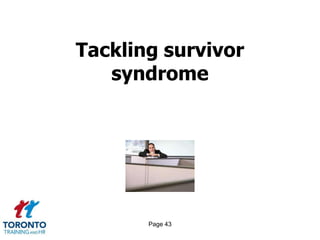
Page 43Tackling survivor syndrome
Page 44Tackling survivor syndromeMASS LAYOFF STATISTICS PROGRAM1421 mass lay-off actions in the last month (50 or more employees) involving 130000 workersNational unemployment rate 8.9%Industries with the largest number of mass layoff initial claims
Page 45Lay-offs in the US
Page 46Lay-offs in the USMASS LAYOFF STATISTICS PROGRAM1421 mass lay-off actions in the last month (50 or more employees) involving 130000 workersNational unemployment rate 8.9%Industries with the largest number of mass layoff initial claims
Page 47Avoiding pitfalls
Page 48Avoiding pitfallsDefining the pool for lay-offs incorrectlyNot offering suitable alternative employmentAbsence of a genuine lay-off situationFailure to carry out a fair selection procedureFailure to consult properly on collective lay-offsFailure to inform and consult on an individual basisFailing to consider alternatives to lay-offsNot training managers on how to carry out the exerciseNot accounting for the extra costs and resources involvedFailing to account for the wider effects of the lay-offs exercise
Page 49Case study A
Page 50Case study A
Page 51Case study B
Page 52Case study B

Layoffs, downsizing and restructuring January 2011

  • 1.
    Layoffs, downsizing andrestructuringby Toronto Training and HR January 2011
  • 2.
    Contents3-4 Introduction toToronto Training and HR 5-6 Definitions 7-8 Implications of poor termination practices 9-20 Meeting details21-23 After the meeting24-25 Termination letters 26-30 Downsizing31-36 Outplacement37-39 Separation and severance policies40-42 Career motivation43-44 Tackling survivor syndrome45-46 Layoffs in the US47-48 Avoiding pitfalls49-52 Case studies53-54 Conclusion and questionsPage 2
  • 3.
  • 4.
    Page 4Introduction toToronto Training and HRToronto Training and HRis a specialist training and human resources consultancy headed by Timothy Holden 10 years in banking10 years in training and human resourcesFreelance practitioner since 2006The core services provided by Toronto Training and HR are:Training course design
  • 5.
    Training course delivery- Reducing costsSaving time
  • 6.
  • 7.
    Services for jobseekersPage 5Definitions
  • 8.
  • 9.
    Page 7Implications ofpoor termination practices
  • 10.
    Page 8Implications ofpoor termination practicesINCREASEDlegal compliance issues and litigation (time and $ saved)likelihood of sign-off on termination package (time and $ saved)NEGATIVE IMPACT ONcorporate brand (maintain $ revenue and $ saved)remaining employees (maintain $ productivity/employee)
  • 11.
  • 12.
    Page 10Meeting details1 of 11LOCATIONConfidential room on-siteAway from employee’s work areaAway from manager’s officeAdditional or dual exit access
  • 13.
    Page 11Meeting details2 of 11TIMEEarlier in the week is ideal (Tues/Wed)Earlier in the day is idealAvoid employee birthday or anniversary dateAvoid significant holidays
  • 14.
    Page 12Meeting details3 of 11ATTENDEESDirect manager should deliver the messageHR or another manager to support the process is idealLeverage skills and experience of outplacement specialistsDefine roles and scripts ahead of time
  • 15.
    Page 13Meeting details4 of 11OTHER CONSIDERATIONSWill security be an issue?Will medical conditions create a risk?Create a termination checklist for network and software access, laptops, cell phones, pass codes, voicemail, etc.
  • 16.
    Page 14Meeting details5 of 11POSITIONING STATEMENTBe honest – don’t set up the meeting under false pretences“George, I’d like to have a conversation with you about your performance. Can you come see me in the ABC room?”Do not schedule meeting too far in advance
  • 17.
    Page 15Meeting details6 of 11DELIVERING THE MESSAGEGet right to the pointReinforce decision is final – do not negotiateBe brief, but respectful – 2 to 3 minutesKeep the discussion in business termsMove the conversation along to a discussion of next steps –this will take longer
  • 18.
    Page 16Meeting details7 of 11REACTIONS TO PREPARE FOR-SHOCK AND DENIALAllow them time to reactRepeat the message if necessaryProbe gently to ensure they understand the message
  • 19.
    Page 17Meeting details8 of 11REACTIONS TO PREPARE FOR-ANGER AND HOSTILITYRemain calm, keep it businessDo not argue, debate or take sidesAcknowledge their anger but bring discussion back to next steps“You can schedule a time to discuss it at a later date withxxx/me. However, my purpose today is simply tocommunicate the decision, provide the package and introduce your career transition expert”
  • 20.
    Page 18Meeting details9 of 11REACTIONS TO PREPARE FOR-NEGOTIATIONAcknowledge their suggestionReinforce alternatives were considered but decision is final
  • 21.
    Page 19Meeting details10 of 11REACTIONS TO PREPARE FOR-RELIEF AND ACCEPTANCEProbe gently to ensure they understand the messageReinforce next stepsInform outplacement expert and HR of “controlled” reaction
  • 22.
    Page 20Meeting details11 of 11BEST PRACTICENever mention names of others affected or remainingEscort the employee out of the building – they can connect with co-workers and clean up desk at a later date (if applicable)Ensure the employee is capable of returning home – assess and offer alternatives if necessary – leverage outplacement expert
  • 23.
  • 24.
    Page 22After themeeting 1 of 2DELIVER THE MESSAGE TO THE SURVIVORSThey may go through similar emotionsReinforce decision and support employee(s) is receivingOutline how work will be allocated/replacedOutline how calls/emails/clients will be managedReinforce the importance of their jobs
  • 25.
    Page 23After themeeting 2 of 2BEST PRACTICE-BE VISIBLE AND ACCESSIBLEDemonstrate objectivity and empathyUtilize change management resources – HR, Employee Assistance Programs, team meetingsHave more senior or other managers “check-in” with remaining employees
  • 26.
  • 27.
    Page 25Termination lettersShouldbe clear, concise, direct and cover the important detailsRecognition of service and contributions can be added if applicableNot required to include details/evidence of performance issues or steps taken unless for causeCreate a separate financial package
  • 28.
  • 29.
    Page 27Downsizing 1of 4EFFECTS OF DOWNSIZING Job securityJob satisfactionOrganizational justiceOrganizational commitmentUnion commitment
  • 30.
    Page 28Downsizing 2of 4REDUCING THE IMPACT OF DOWNSIZING Do it once – identify a group if necessary and get it over with.Handle the situation with sensitivity. Have a package ready - provide employees with information regarding their benefits, eligibility for unemployment insurance, any severance payments or other information you think they will need - before they leave the meeting.Communicate – communicate – communicate.
  • 31.
    Page 29Downsizing 3of 4REDUCING THE IMPACT OF DOWNSIZING Prepare managers with information and a communication strategy for their role with their teams.If at all possible, offer an outplacement service to the employees being let go…this will buy you tremendous good will with them and the employees who stay. In the end you are left with those upon whom you will rely to work harder and smarter. Make sure they are your key contributors and that you work hard to keep their trust. Let them know you appreciate their hard work and communicate, communicate, communicate!
  • 32.
    Page 30Downsizing 4of 4NEGATIVE IMPACTS Decreased morale Reduced loyalty Productivity/Quality Loss Damage to brand Turnover Absenteeism Lawsuits Negative image Stock price decrease Loss of customers
  • 33.
  • 34.
    Page 32Outplacement 1of 5FACE TO FACEOne-on-one sessionsGroup sessionsPersonality and career assessments Specialized webinars, workshops and networking sessions Personal finance consultation Personal image guidanceInterview coachingGuidance on approaching organizations speculativelySmall business optionsEducation, retraining and retirement options
  • 35.
    Page 33Outplacement 2of 5NON FACE TO FACEDiscounts on a number of training & development courses Business cards
  • 36.
    Page 34Outplacement 3of 5ONLINECreation of a customized resumeCreation of a customized cover letterCreation or revision of social media profilesGuidance on contributing to blogs and forumsDatabase of contactsAccess to a computerized career transition tool
  • 37.
    Page 35Outplacement 4of 5RECENT TRENDSKey decision criteria for choosing an outplacement providerWhich employees receive outplacement support, including global differences Factors considered when determining outplacement support Which employees get what level of support, including global differences
  • 38.
    Page 36Outplacement 5of 5RECENT TRENDSThe most important components of an outplacement program, including opinions of those in transition Circumstances in which outplacement support is increasedThe most important indicator of a successful outplacement partner The most important indicator of a successful downsizing Perceived differences of opinion from those inside and outside of HR
  • 39.
    Page 37Separation andseverance policies
  • 40.
    Page 38Separation andseverance policies 1 of 2THINGS TO BEAR IN MINDConsideration of employees Compliance Protecting morale and commitment Corporate values Avoiding lawsuits Protecting brand Budget Return on investment
  • 41.
    Page 39Separation andseverance policies 2 of 2TRENDS IN SEVERANCE POLICIESWhich employees receive severance payHow severance formulae are determinedWhich employees get what level of severance, including global differencesMinimum and maximum caps for severance pay-outs, including global differencesPay-out methods, including global differencesCircumstances in which severance amounts are increased, including global differencesOther benefits provided after separation
  • 42.
  • 43.
    Page 41Career motivation1 of 2COMPONENTSCareer resilienceCareer insightCareer identity
  • 44.
    Page 42Career motivation2 of 2SURVIVORS OF LAYOFFSIdentification with layoff victimsPerceived justice of the layoffPerceived planningContinuance commitmentTrust in managementJob insecurityAffective commitmentNegative mood
  • 45.
  • 46.
    Page 44Tackling survivorsyndromeMASS LAYOFF STATISTICS PROGRAM1421 mass lay-off actions in the last month (50 or more employees) involving 130000 workersNational unemployment rate 8.9%Industries with the largest number of mass layoff initial claims
  • 47.
  • 48.
    Page 46Lay-offs inthe USMASS LAYOFF STATISTICS PROGRAM1421 mass lay-off actions in the last month (50 or more employees) involving 130000 workersNational unemployment rate 8.9%Industries with the largest number of mass layoff initial claims
  • 49.
  • 50.
    Page 48Avoiding pitfallsDefiningthe pool for lay-offs incorrectlyNot offering suitable alternative employmentAbsence of a genuine lay-off situationFailure to carry out a fair selection procedureFailure to consult properly on collective lay-offsFailure to inform and consult on an individual basisFailing to consider alternatives to lay-offsNot training managers on how to carry out the exerciseNot accounting for the extra costs and resources involvedFailing to account for the wider effects of the lay-offs exercise
  • 51.
  • 52.
  • 53.
  • 54.